1. Introduction
Amid the global drive toward carbon neutrality and the urgent transition to sustainable energy ecosystems, the exploitation of marine renewable energy resources has become a strategic priority. Among these, tidal current energy distinguishes itself as a premier renewable energy vector due to its high predictability, high power density, and minimal environmental footprint [
1,
2]. In contrast to intermittent wind and solar resources, tidal currents are governed by deterministic astronomical cycles, enabling precise forecasting of energy output [
3]. Both horizontal-axis and vertical-axis turbines are important technical routes in this domain. In this manuscript, we focus on a single horizontal-axis tidal turbine (HATT) test case to establish a controlled benchmark for TSR-direction OOD extrapolation while citing VAT studies as related background rather than as the configuration used in our dataset.
The large-scale commercial deployment of tidal current turbines is bottlenecked by intricate and nonlinear hydrodynamic interactions between the rotor and ambient flow, with turbulent wake evolution being a key limiting factor [
4]. As the rotor extracts kinetic energy from incoming flow, it induces a downstream velocity deficit, elevated turbulence intensity, and coherent vortex structures [
4,
5]. These wake phenomena are strongly unsteady and spatiotemporally variable, making accurate prediction difficult with conventional experimental and numerical methods. Accurate and efficient wake prediction is therefore essential for energy yield assessment, structural safety analysis, and array layout optimization [
4]. The lack of reliable and computationally efficient wake prediction tools remains a major barrier to practical engineering deployment.
Traditionally, the characterization and prediction of turbine wakes have predominantly relied on high-fidelity Computational Fluid Dynamics (CFD) simulations, including Reynolds-Averaged Navier–Stokes (RANS) and Large Eddy Simulation (LES) approaches. While these numerical methodologies can provide detailed insights into the complex flow physics (e.g., vortex shedding, flow separation, and wake merging), they suffer from prohibitive computational complexity and high computational cost. A single CFD simulation often takes hours to complete, severely limiting the efficiency of the parameter-space exploration critical for turbine array design optimization [
6,
7]. In contrast, constructing surrogate models with Fourier neural operators (FNO) as the backbone has emerged as a viable pathway to compress inference time to the second level, addressing the computational bottleneck of CFD-driven optimization [
8,
9,
10]. However, most existing studies on surrogate models for hydraulic turbines (including FNO [
8,
10], CNN [
11,
12,
13,
14,
15], and GNN-based methods [
11,
16,
17]) evaluated model performance under “interpolation” conditions, where training and testing operating conditions share the same parameter distribution with full overlap [
11,
14,
17,
18,
19,
20,
21]. In practical engineering scenarios, designers often need to query flow fields at unseen parameter intervals (out-of-distribution, OOD) that have never been computed via CFD, and the model’s ability to accurately extrapolate to these unobserved physical states is the key determinant of its engineering value. To address this critical gap, this study focuses on a single horizontal-axis tidal turbine with OOD extrapolation across tip speed ratio (TSR) distributions as the primary evaluation target, systematically exploring the accuracy limits and uncertainty characteristics of surrogate models beyond the training range and proposing a targeted framework to enhance extrapolation performance.
To tackle the aforementioned challenges, Deep Learning (DL) has been introduced as a transformative technology in Computational Fluid Dynamics, offering unprecedented potential to bridge the gap between computational efficiency and prediction fidelity. These data-driven approaches exhibit exceptional capabilities in extracting complex spatiotemporal features and learning nonlinear flow patterns, yet purely data-driven Artificial Neural Network (ANN) models still face inherent limitations: poor generalization to unseen TSR conditions, potential gradient explosion at the boundary of the training TSR interval (leading to extrapolation collapse), and a lack of reliable uncertainty estimation to identify high-risk prediction regions. All of these limitations severely restrict their practical applicability in engineering decision-making. To mitigate these issues, this study uses a CFD-generated benchmark dataset, develops a novel physics-constrained neural operator framework, and conducts rigorous experiments to evaluate OOD generalization under a common numerical benchmark, with emphasis on operator learning behavior across unseen TSR conditions. From a mathematical perspective, the central contribution of this work is control of operator smoothness along the operating parameter direction rather than reliance on only spatial constraints or data fitting.
The primary contributions of this work are as follows:
A CFD-generated spatiotemporal benchmark dataset of a single horizontal-axis tidal turbine’s wake flow field is established via STAR-CCM+ 20.06.007-R8 CFD simulations. It covers multiple TSR conditions, with 792 time steps per TSR and 9504 total samples, designed for OOD evaluation.
A physics-constrained FNO framework TSR-FNO is proposed for rapid, high-fidelity wake velocity prediction, integrating two key innovations: TSR–Lipschitz regularization, a plug-and-play, structure-free soft constraint to avoid extrapolation collapse, orthogonal to physics constraints, and MC Dropout-based uncertainty quantification.
Comprehensive experiments are conducted to systematically evaluate the proposed framework’s performance, focusing on TSR OOD extrapolation. The experiments quantify the extrapolation error upper bound of the standard FNO model using the established dataset and assess the effectiveness of the TSR–Lipschitz regularization.
A mathematical interpretation is provided for the TSR–Lipschitz term as an empirical control of operator smoothness in the operating parameter direction, clarifying why it complements spatial physics constraints and improves OOD stability.
2. Related Work
2.1. CFD-Based Wake Flow Prediction
As the cornerstone of wake flow research, Computational Fluid Dynamics (CFD) has evolved into a complete technical spectrum with multi-scale and multi-precision capabilities. Early studies extensively adopted the Reynolds-Averaged Navier–Stokes (RANS) model, which played a pivotal role in the array layout optimization of horizontal-axis tidal turbines (HATTs) due to its controllable computational cost and strong engineering applicability. However, the RANS model is highly dependent on turbulence closure assumptions, making it difficult to accurately capture core physical phenomena in the wake region such as strong shear, unsteady vortex shedding, and interactions between multiple vortex structures, especially in the complex flows of vertical-axis turbines (VATs), where the error increases significantly [
22]. To overcome this limitation, Large Eddy Simulation (LES) and Detached Eddy Simulation (DES) and other high-order methods have been gradually introduced. These methods directly resolve large-scale turbulent structures while only modeling small-scale turbulence, demonstrating significant advantages in reproducing wake evolution dynamics [
4]. Nevertheless, their computational cost grows exponentially. A single high-resolution LES often consumes hundreds to thousands of CPU hours, severely restricting their application in engineering tasks requiring massive samples such as parametric design, real-time control, and uncertainty quantification [
23]. Notably, the latest review points out that CFD research conclusions exhibit significant discreteness, stemming from the coupling effects of multiple factors including mesh strategy, turbulence model selection, boundary condition settings, and turbine geometric modeling accuracy. This highlights the urgent need to establish standardized validation benchmarks and open-source high-fidelity datasets [
4]. In essence, despite their high fidelity, CFD methods suffer from critical efficiency limitations that prevent their deployment in large-scale or real-time engineering workflows.
2.2. ANN-Based Wake Flow Prediction
Parallel to this evolution is the rapid rise of Artificial Neural Network (ANN) methods, whose core is the construction of an efficient mapping function from input parameters to output field quantities. Early works, represented by Multi-Layer Perceptrons (MLPs), had verified feasibility in velocity prediction and wake feature regression tasks, achieving a speedup of several orders of magnitude compared to CFD [
24]. However, standard ANNs face three inherent bottlenecks: first, a fragile generalization ability, where out-of-distribution (OOD) predictions are prone to gradient explosion and result collapse; second, a lack of physical consistency guarantees, potentially outputting “hallucinatory” solutions that violate mass or momentum conservation; third, unquantifiable uncertainty, failing to measure prediction confidence and thus hindering high-reliability engineering decision-making [
25]. To address these challenges, cutting-edge research is undergoing a paradigm shift from pure data fitting to physics-informed learning. On the one hand, Physics-Informed Neural Networks (PINNs) embed Navier–Stokes equation residuals into the loss function to enforce network solutions to satisfy basic physical laws, demonstrating robustness in simplified hydrodynamic problems [
26]. On the other hand, neural operators such as Fourier neural operators (FNO), endowed with function-to-function mapping capabilities and mesh independence, have emerged as an ideal architecture for full wake field prediction, compressing inference time to the second level and completely revolutionizing traditional CFD optimization workflows [
25]. Despite these advancements in model architecture and physics-integration strategies, ANNs still fundamentally struggle to reliably handle OOD extrapolation in complex tidal turbine wake environments. This is a critical limitation rooted in their inability to learn inherently smooth and physically consistent functional mappings across unseen operating parameter spaces. This shortcoming not only undermines their practical value as surrogate models for engineering tasks requiring extrapolation but also exposes a core research gap: the lack of effective constraint mechanisms that can explicitly regulate model behavior in the parameter dimension rather than merely in the spatial or physical law dimension.
3. Problem Formulation
We aim to learn the operator mapping from the tip speed ratio (TSR) and spatial–temporal coordinates to the 3D wake velocity field, which is defined as follows:
where
is the tip speed ratio,
are the time and 3D spatial coordinates of the flow field, and
are the three components of the wake flow field velocity at the corresponding position. The mapping
is a nonlinear operator governed by the 3D Navier–Stokes equation with turbine boundary conditions.
The TSR interval is chosen from two considerations: First, it covers the practically stable operating envelope of the selected HATT case under the presented inflow condition ( m/s), from near-optimal operating points to high-load conditions. Second, it allows a strict OOD split, training on and testing on , so that model evaluation is extrapolation-driven rather than interpolation-driven.
The TSR directly determines the rotation speed of the turbine blade, and there is a highly nonlinear coupling relationship between the TSR and the wake flow field: the higher the TSR, the faster the blade rotation, the more intense the wake turbulence, and the more significant the spatial distortion of the velocity field. Among them, the axial velocity has the strongest sensitivity to TSR changes. Since all OOD test working conditions are outside the training TSR interval , the model cannot avoid the generalization challenge through interpolation of adjacent training points, and can only directly extrapolate the physical state of the unseen high-TSR working conditions, which is a strict test of the model’s nonlinear fitting and generalization ability.
4. Methodology
4.1. Framework
The proposed turbine wake flow prediction framework is a TSR-constrained Fourier neural operator with uncertainty quantification (TSR-FNO), which takes the Fourier neural operator (FNO) as the core backbone to learn the nonlinear mapping from turbine operation parameters and spatiotemporal coordinates to the 3D wake velocity field. The framework is designed to address three key challenges of turbine wake flow surrogate modeling: the lack of strict out-of-distribution (OOD) evaluation protocols, poor extrapolation performance in the tip speed ratio (TSR) dimension, and the absence of reliable uncertainty estimation for prediction results.
The framework integrates three modular components with orthogonal functions, and its overall forward mapping is defined as follows:
where
denotes all trainable parameters of the framework,
B is the batch size,
is the input tensor with
channels (encoding TSR scalar
, normalized time step
t, and 3D spatial coordinates
),
is the output tensor with
channels corresponding to the normalized 3D velocity field components
, and
is the regularized 3D spatial grid resolution of the turbine wake flow field (axial × radial × vertical).
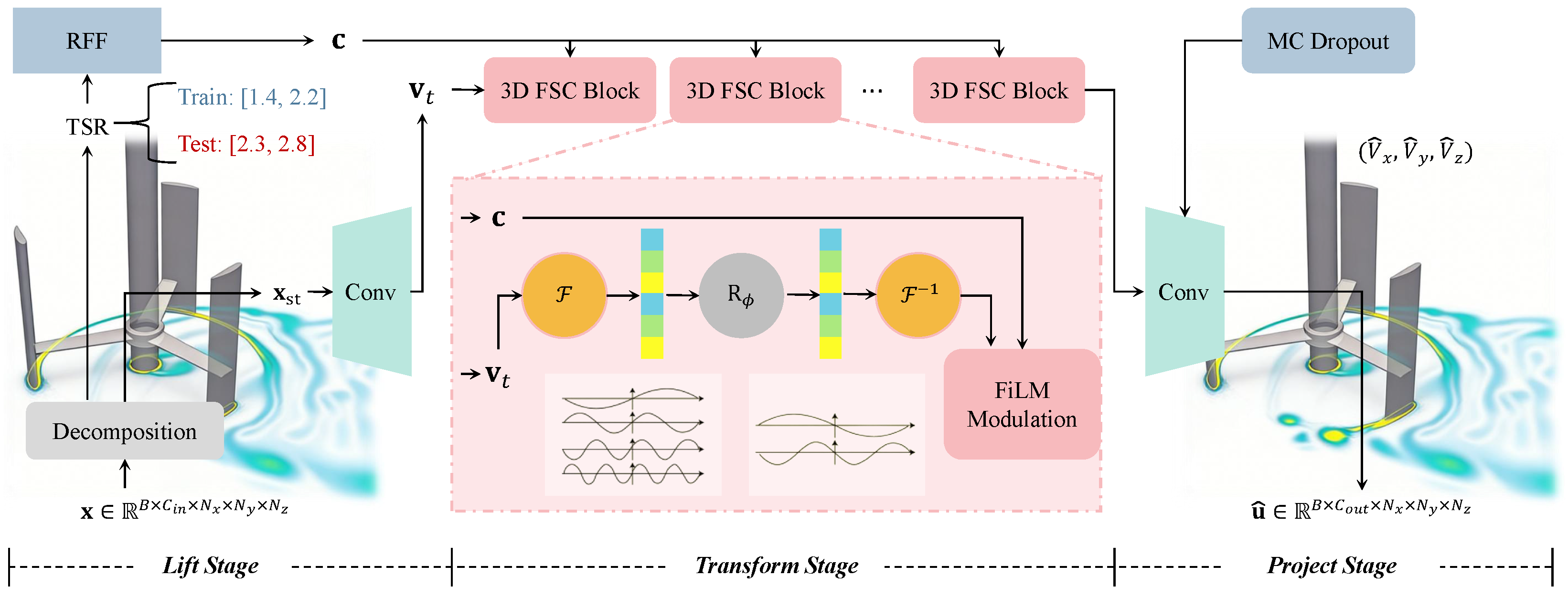
To implement the mapping , the framework adopts a Lift–Transform–Project three-stage inference process with clear modular division: Lift stage: decomposes into TSR scalar and spatiotemporal components, encodes the TSR into high-dimensional condition vector via Random Fourier Features (RFF), and maps spatiotemporal components to high-dimensional feature ; Transform stage: processes with stacked 3D Fourier Spectral Convolution (3D FSC) blocks, injects into each block via Feature-Wise Linear Modulation (FiLM) to capture TSR–velocity nonlinear coupling, and imposes TSR–Lipschitz regularization to constrain ’s smoothness in the TSR direction; Project stage: maps the transformed back to physical space to output , and applies Monte Carlo (MC) Dropout to quantify cognitive uncertainty for each spatial grid point in .
For clarity, the computational workflow of
Figure 1 is summarized as follows: (1) input tensor factorization into TSR and spatiotemporal channels; (2) RFF-based TSR embedding and lifting of spatiotemporal features; (3) four stacked Fourier blocks with FiLM conditioning; (4) projection to
; and (5) optional MC Dropout sampling for uncertainty estimation.
4.2. Lift Stage: Feature Encoding with Decoupled TSR Fourier Coding
The Lift stage is the input encoding module of the framework, whose core goal is to decouple and encode the TSR (the core parametric variable of wake flow) from spatiotemporal information, addressing the poor extrapolation performance of the model in the TSR dimension. This stage is structured into three logically sequential stages: Input Tensor Decomposition first splits the input tensor into TSR scalar and spatiotemporal components to enable targeted encoding; Decoupled TSR Fourier Feature Encoding encodes the TSR scalar into a high-dimensional condition vector via Random Fourier Features (RFF) to capture nonlinear TSR–velocity relationships; Spatiotemporal Feature Lifting maps the spatiotemporal components to a high-dimensional feature space to form the base feature . These two outputs ( and ) are then passed to the subsequent Transform stage.
4.2.1. Input Tensor Decomposition
The input tensor is first decomposed into two orthogonal components to enable targeted encoding: the TSR scalar component: , extracting the TSR value from the first channel (constant across spatial dimensions); the spatiotemporal component: , including normalized time step t and 3D spatial coordinates .
4.2.2. Decoupled TSR Fourier Feature Encoding
To capture the highly nonlinear relationship between the TSR and axial velocity
, the TSR scalar is encoded into high-dimensional condition vector
using RFF:
where
is the TSR normalized to
(
,
),
is random frequencies sampled from
(
,
, fixed during training), and
is a two-layer perceptron with SiLU activation, projecting
-dimensional Fourier features to
.
RFF encoding maps the 1D TSR scalar to high-dimensional space, enabling the model to express nonlinear TSR responses of arbitrary frequencies and improve extrapolation to unseen TSR values. The value is selected from a sweep over on the validation split. Smaller values underfit high-TSR curvature, while larger values increase oscillatory behavior and worsen far-range OOD stability.
4.2.3. Spatiotemporal Feature Lifting
The spatiotemporal component
is mapped to high-dimensional feature space via a 1 × 1 × 1 3D convolutional lifting layer with GELU activation:
where
is the learnable weight matrix of the lifting layer,
is the bias term, and
retains the full spatial resolution of the original input, serving as the base feature for subsequent global spatial dependency learning.
The Lift stage outputs two core features for the Transform stage: high-dimensional spatiotemporal feature and high-dimensional TSR condition vector . This decoupled encoding design enhances the model’s sensitivity to TSR changes, laying a foundation for TSR–Lipschitz regularization in the Transform stage.
4.3. Transform Stage: Global Feature Learning with TSR Constraint
The Transform stage is the core computation module of the framework which takes the two core outputs of the Lift stage, high-dimensional spatiotemporal feature and high-dimensional TSR condition vector , as inputs to realize global feature extraction and TSR–velocity coupling learning via 3D Fourier Spectral Convolution, and constrains the model’s extrapolation behavior via TSR–Lipschitz regularization. This stage is organized into three complementary components: 3D Fourier Spectral Convolution lays out the basic mathematical mechanism of the Fourier integral operator for global feature extraction on ; Feature-Wise Linear Modulation extends the basic convolution operation by integrating the TSR condition vector via FiLM; TSR–Lipschitz Smooth Regularization introduces a global regularization constraint to the entire Transform stage, which ensures the model responds smoothly to TSR changes and addresses OOD extrapolation.
4.3.1. 3D Fourier Spectral Convolution
The 3D FSC block is built on the Fourier integral operator, which realizes efficient global feature interaction by parameterizing the integral kernel in Fourier space. For the high-dimensional spatiotemporal feature
(the primary input of this stage, output by the Lift stage) defined on 3D spatial domain
, where
denotes an arbitrary spatial grid point in
D, the non-local integral operator
(core of the FNO) is defined as follows:
where
is the 3D spatial domain of the turbine wake flow field covering all
grid points,
is an arbitrary spatial grid point in
D,
and
are the 3D FFT and its inverse transform, mapping
between physical and Fourier space,
is the learnable weight tensor in Fourier space, acting only on low-frequency modes, and
is the number of truncated low-frequency modes in the axial/radial/vertical dimensions. The mode tuple
is chosen from a compact sensitivity study over
,
, and
, where
provided the best accuracy–efficiency trade-off and the most stable OOD behavior.
The feature
is updated iteratively by fusing local and global features:
where
is local linear transformation matrix, and
is GELU activation. This is the basic form of Fourier Spectral Convolution, which is extended with FiLM in practical implementation to integrate TSR condition vector
.
4.3.2. Feature-Wise Linear Modulation
Each FSC block in the Transform stage takes both
and
as inputs, and extends the basic Fourier Spectral Convolution (
Section 4.3.1) with FiLM to integrate TSR information. The block includes three core steps:
- 1.
3D FFT Transformation: 3D FFT is performed on the input to obtain frequency-domain feature where low-frequency modes capture the global wake trend and high-frequency modes capture local turbulent details;
- 2.
Low-Frequency Mode Modulation: High-frequency modes of
are truncated,
low-frequency modes are retained, and linear transformation via
is applied:
- 3.
3D IFFT + FiLM:
is mapped back to physical space via 3D IFFT to get global feature
, then fused with local feature
and modulated with the TSR condition vector
via FiLM (the key enhancement for TSR coupling):
where
(scaling/bias parameters projected from the Lift stage’s output
, reshaped to
for spatial broadcasting to match the dimension of
).
The framework stacks four such blocks (default ), with each block taking the updated and the same , the shared TSR condition vector from the Lift stage, to deepen the network and capture multi-scale spatial dependencies coupled with TSR information. This is the functional enhancement of the basic Fourier convolution, making the model TSR-aware.
4.3.3. TSR–Lipschitz Smooth Regularization
As a global constraint complementary to the FSC block, TSR–Lipschitz regularization is added to the Transform stage to constrain the smoothness of
(and thus
) in the TSR direction, where the TSR information is encoded in the condition vector
from the Lift stage:
where
P is the set of TSR sample pairs in the mini-batch (corresponding to different
vectors from the Lift stage);
is the spatial average of the squared L2 norm of velocity field differences; and
avoids division by zero.
This regularization is independent of the Fourier convolution blocks but acts on the entire Transform stage’s output, ensuring that the change of
(modulated by
) and thus the predicted
is bounded with respect to TSR changes. It addresses the OOD extrapolation problem that cannot be solved by the Fourier convolution itself (even with FiLM), forming a complete TSR-aware global feature learning pipeline with “basic operation + enhancement + constraint”. For comparison, we also test a structure-based smoothness baseline that penalizes hidden-feature gradients,
which requires architecture-specific hooks at each layer. In our experiments, the structure-free output space term in Equation (
9) is more robust under architecture resizing and provides a better average OOD rel-L2.
4.4. Project Stage: Physical Space Projection with Uncertainty Quantification
The Project stage is the output decoding module of the framework, which maps the transformed high-dimensional feature back to physical space and quantifies prediction uncertainty via MC Dropout. This stage consists of two complementary components: Velocity Field Projection realizes the core function of mapping high-dimensional feature to the three-channel velocity field , completing the final decoding of the model’s output; MC Dropout uncertainty quantification supplements the prediction result with cognitive uncertainty estimation for each spatial grid point, addressing the lack of reliable uncertainty assessment in traditional surrogate models.
4.4.1. Velocity Field Projection
The high-dimensional feature
(after the Transform stage) is projected to 3D velocity field space via a two-layer 1 × 1 × 1 3D convolutional projection layer:
Explicitly, the projection can be written as follows:
where
,
,
,
,
, consistent with the output definition of
.
The projection layer retains the full 3D spatial resolution of , ensuring that accurately reflects the spatial distribution of the turbine wake flow field.
4.4.2. MC Dropout Uncertainty Quantification
To obtain reliable cognitive uncertainty for each grid point in
, MC Dropout (dropout rate = 0.15) is applied to the Project stage by keeping dropout layers activated during inference and performing
forward propagations for the same input
to generate 50 predicted velocity fields
(
). The MC integrated prediction
, defined as
, serves as the final prediction result, while the cognitive uncertainty
is calculated as follows:
The pair is selected from calibration efficiency sweeps. We test dropout rates and sampling counts . Dropout 0.15 minimizes the calibration error without degrading the deterministic accuracy, while provides near-saturated uncertainty statistics with acceptable runtime.
4.5. Loss Function
To balance the model’s data fitting accuracy, physical law compliance, and TSR-dimension smoothness, a three-term weighted combined loss function is designed for the TSR-FNO framework, integrating relative L2 loss (data-driven), divergence constraint loss (physics-informed), and TSR–Lipschitz Smooth Regularization loss (OOD generalization):
where
and
are weight coefficients determined via grid search on validation TSR
. The search ranges are
and
.
4.5.1. Relative L2 Loss
As the main loss term for data fitting, relative L2 loss measures the relative error between predicted and CFD-labeled velocity fields, avoiding overfitting to high-velocity regions:
where
is the predicted 3D velocity field,
is the CFD-labeled field, and
denotes the global L2 norm over all spatial grid points and velocity components.
4.5.2. Physical Divergence Constraint Loss
To enforce the divergence-free condition (
) for incompressible turbine wake flow, the divergence constraint loss is defined as follows:
Partial derivatives are calculated via central finite difference (differentiable for backpropagation), effectively reducing unphysical predictions (e.g., mass accumulation).
4.5.3. TSR–Lipschitz Smooth Regularization Loss
This core loss term constrains the Lipschitz continuity of the model in the TSR direction, solving gradient explosion and extrapolation collapse for high-TSR conditions:
where
P denotes the set of TSR sample pairs in a mini-batch (paired samples correspond to the same temporal/spatial coordinates),
denotes the spatial average of the squared L2 norm of velocity field differences, and
is a small constant with a value of
.
5. Experiments
5.1. Dataset
A CFD-generated spatiotemporal benchmark dataset is established for a single horizontal-axis tidal turbine using the commercial CFD solver STAR-CCM+ 20.06.007-R8.
5.1.1. CFD Configuration
Here, the CFD setup is used to construct a consistent benchmark dataset for surrogate–model comparison. The simulation employs the SST
k-
turbulence model with a sliding-mesh interface to handle rotor rotation. This combination of RANS-SST closure and sliding-mesh rotor treatment follows the well-established methodology validated against IFREMER flume tank measurements for horizontal-axis tidal turbines [
27,
28,
29,
30]. Boundary conditions are set as velocity inlet, pressure outlet, and slip wall lateral boundaries. The computational domain is
(stream-wise) ×
(lateral) ×
(vertical), which is used to limit blockage and boundary interference in the resolved wake region. The rotor diameter is
m with a free-stream inflow velocity of
m/s. For each operating condition, 3960 time steps are computed to ensure statistical convergence, from which 792 snapshots are retained at a 1:5 sampling ratio.
5.1.2. TSR Sampling Strategy
The tip speed ratio is defined as . Eight TSR values (1.4, 1.6, 1.7, 1.8, 1.9, 2.0, 2.1, 2.2) are used for training, while four unseen TSR values (2.3, 2.4, 2.6, 2.8) are reserved for out-of-distribution (OOD) extrapolation testing. This split enforces extrapolation-only evaluation and intentionally includes both near-range and far-range OOD conditions.
5.1.3. Spatial Discretization and Data Extraction
The scattered CFD outputs (4248 unstructured sampling points per snapshot) are interpolated onto a structured regular grid of size (axial × lateral × span-wise) for operator learning. The learning dataset used throughout this paper is extracted from the 4.45 M-cell campaign at m/s. The final dataset contains 9504 samples in total, with 6336 training snapshots from eight in-range TSR conditions and 3168 test snapshots from four unseen TSR conditions. The prediction target is the full three-component velocity field .
5.1.4. Cross-Campaign Wake Comparison
To examine the consistency of the benchmark across the available simulation campaigns, we compare two independently conducted simulation campaigns at TSR = 2.2: a 4.45 M-cell configuration ( m/s) and a 6.42 M-cell configuration ( m/s), corresponding to an effective refinement ratio of per spatial dimension. Because the two campaigns also differ in inflow conditions, the comparison is interpreted at the level of overall wake pattern consistency. All velocities are normalized by the respective to enable direct comparison of dimensionless wake structure.
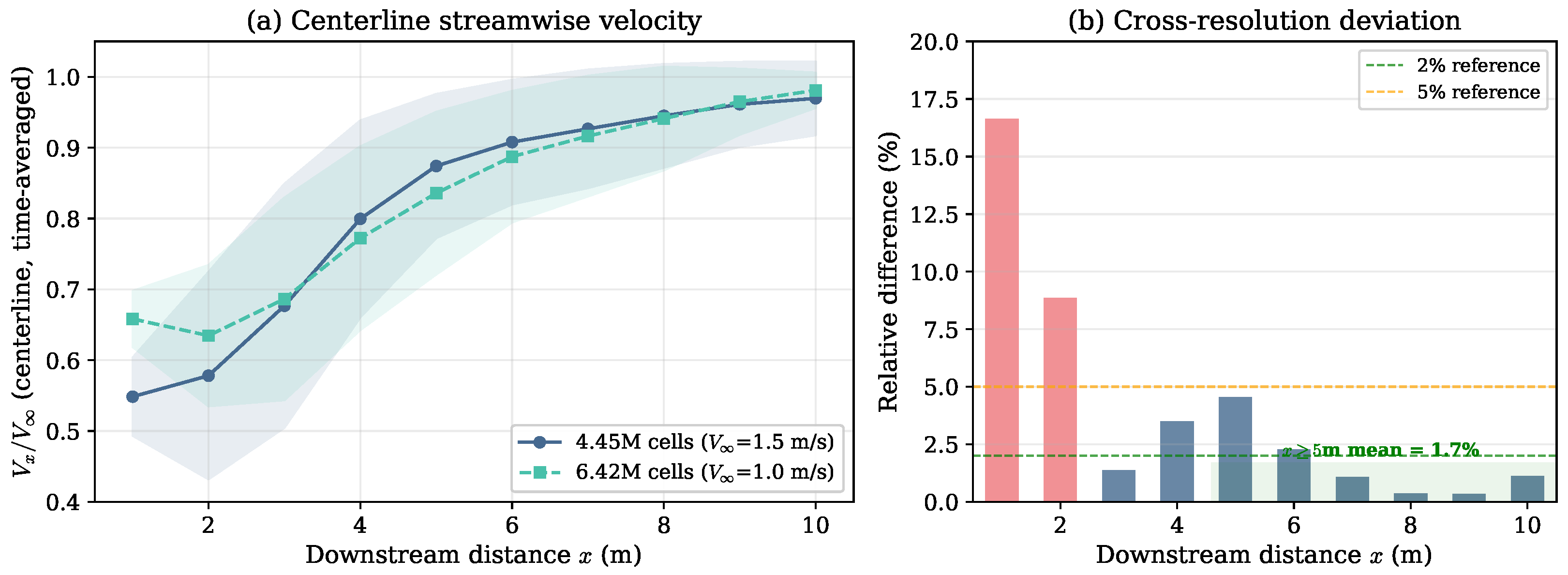
Figure 2a presents the time-averaged centerline stream-wise velocity ratio
for both configurations, where the shaded bands indicate
temporal variability over 35 phase-averaged snapshots. For the wake recovery region
, the two configurations agree within a mean relative deviation of 1.9%; for
, the mean deviation reduces to 1.7%; and, for
, it falls below 1.2%. Only the immediate near wake (
), dominated by blade tip vortex dynamics that are inherently sensitive to local mesh topology, shows deviations exceeding 5%.
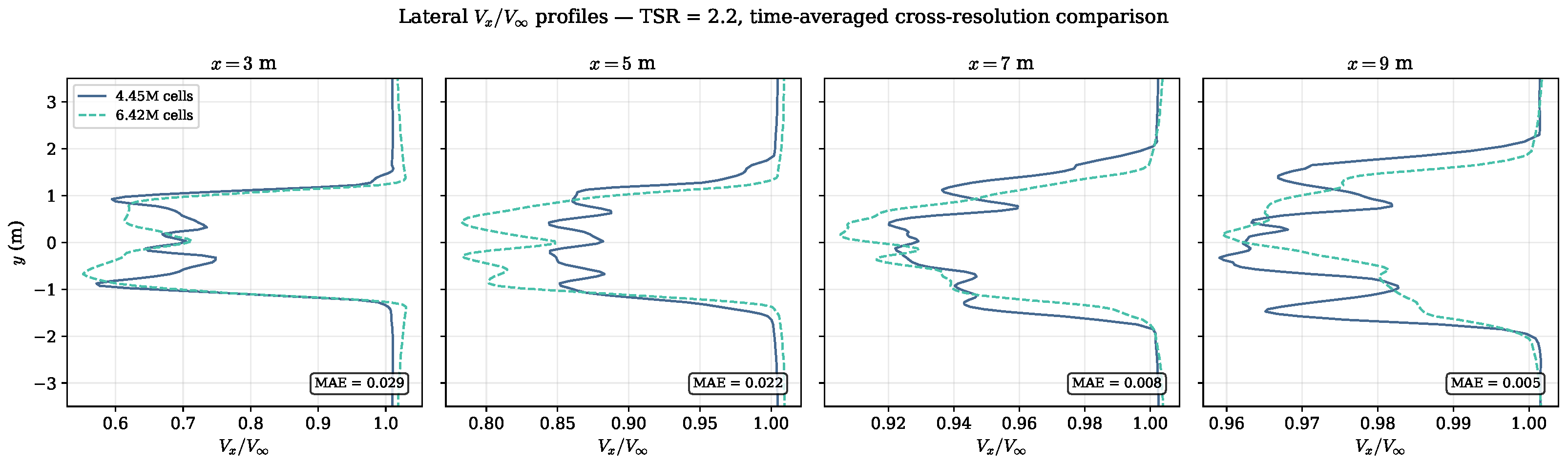
Figure 3 further compares lateral
profiles at four downstream stations. The mean absolute error (MAE) decreases monotonically from 0.029 at
m to 0.005 at
m, confirming rapid convergence of the resolved wake shape. Taken together, these observations indicate stable downstream wake statistics in the benchmark used for surrogate–model comparison.
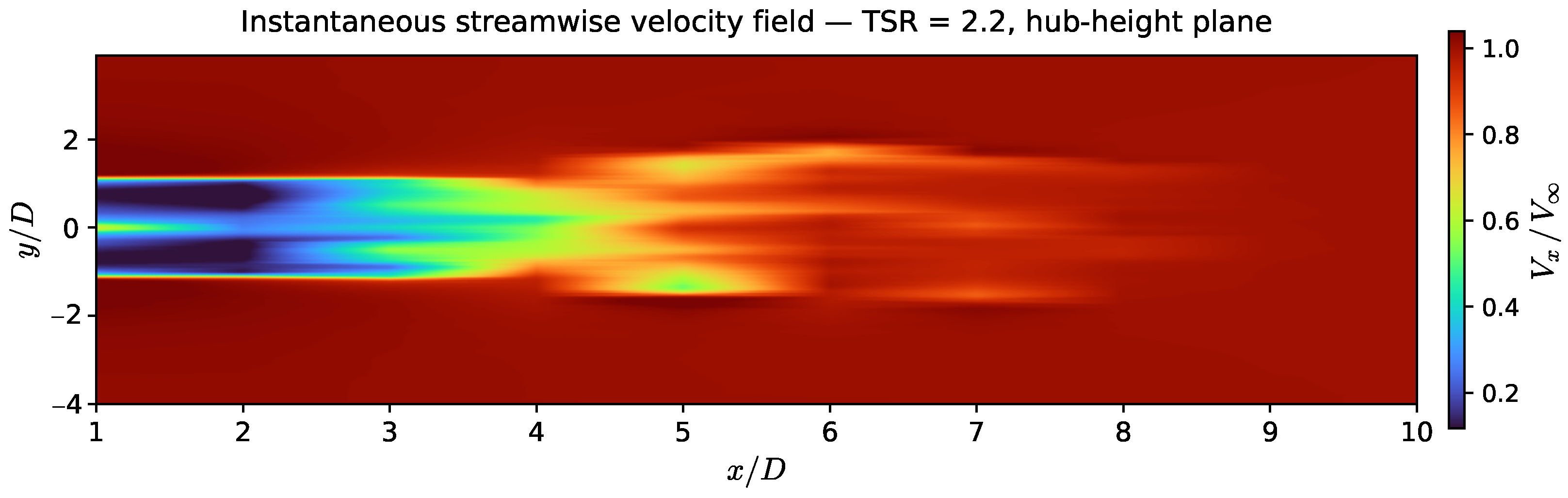
Figure 4 shows the time-averaged hub-height stream-wise velocity contour at TSR = 2.2. The contour captures the wake core deficit, lateral shear layers, and downstream recovery pattern in the normalized variable
used throughout the cross-campaign comparison.
5.2. Implementation Details
All deep-learning experiments are implemented in PyTorch 2.10.0+cu128 (CUDA 12.8) and run on a single NVIDIA GeForce RTX 3090 GPU (24 GB; NVIDIA Corporation, Santa Clara, CA, USA). We use the AdamW optimizer (initial learning rate , weight decay ), cosine learning rate decay, batch size 8, and gradient clipping with max norm 1.0. The maximum number of epochs is 120 with an early stopping patience of 20 epochs. The baseline and constrained models follow the same optimization schedule for fair comparison.
For the 1.0 M-parameter setting shown in
Table 1, “strong regularization” includes three components: weight decay (
), dropout (0.10 in hidden layers), and a light spectral norm constraint on projection layers (coefficient
). Their values are selected by validation rel-L2 on TSR
. In
Table 1, bold values mark the selected default architecture used in the subsequent experiments because it provides the best overall accuracy–efficiency trade-off.
5.3. Evaluation Metric
We report both the average relative L2 error (Avg rel-L2) and the worst-case relative L2 error (Max rel-L2) over test snapshots:
Avg rel-L2 measures overall predictive fidelity, while Max rel-L2 highlights tail-risk behavior, which is important for engineering safety margins.
5.4. Architecture Sensitivity
To justify fixed architectural parameters, we perform a compact sensitivity study on feature channels and Fourier modes.
The final choice (64 channels, modes
) is selected as a balanced point between accuracy and efficiency. Although
is marginally better in accuracy, it increases memory and latency with limited practical gain.
Table 2 summarizes the OOD extrapolation results of the baseline and progressively enhanced variants. Here, each row prefixed by “+” adds one component relative to the preceding configuration, the left arrow marks the selected optimal deterministic setting, bold marks the primary comparison values discussed in the text, and italics denote the interpolation upper-bound reference trained on the full TSR range rather than an OOD setting.
5.5. Wake Flow Prediction Performance
The extrapolation performance comparison in out-of-distribution (OOD) TSR conditions (2.3, 2.4, 2.6, 2.8) reveals critical insights into FNO-based surrogate optimization. The standard FNO baseline (4.0 M parameters) yields Avg rel-L2 = 0.0405 and Max rel-L2 = 0.0732, indicating both mean error and tail risk under extrapolation. Adding a physical divergence constraint () reduces Avg rel-L2 to 0.0386 (4.7% reduction), showing that spatial physics constraints improve robustness but cannot directly regulate TSR-direction smoothness.
Reducing the model size to 1.0 M with strong regularization further lowers Avg rel-L2 to 0.0374 (7.7% vs. baseline). TSR–Lipschitz with reaches a similar mean error but slightly better Max rel-L2, and the optimal deterministic setting () achieves 0.0368/0.0641 (Avg/Max), confirming that moderate TSR smoothness regularization improves both average and worst-case behavior.
MC Dropout ensemble inference on the optimal TSR–Lipschitz model further reduces error to 0.0358/0.0618 (Avg/Max), indicating that uncertainty-aware ensembling suppresses extreme OOD errors. The interpolation upper-bound result (0.0283/0.0495) still shows a clear gap, motivating future work on stronger parameter-direction constraints.
5.6. Per-TSR Error Decomposition Analysis
As shown in
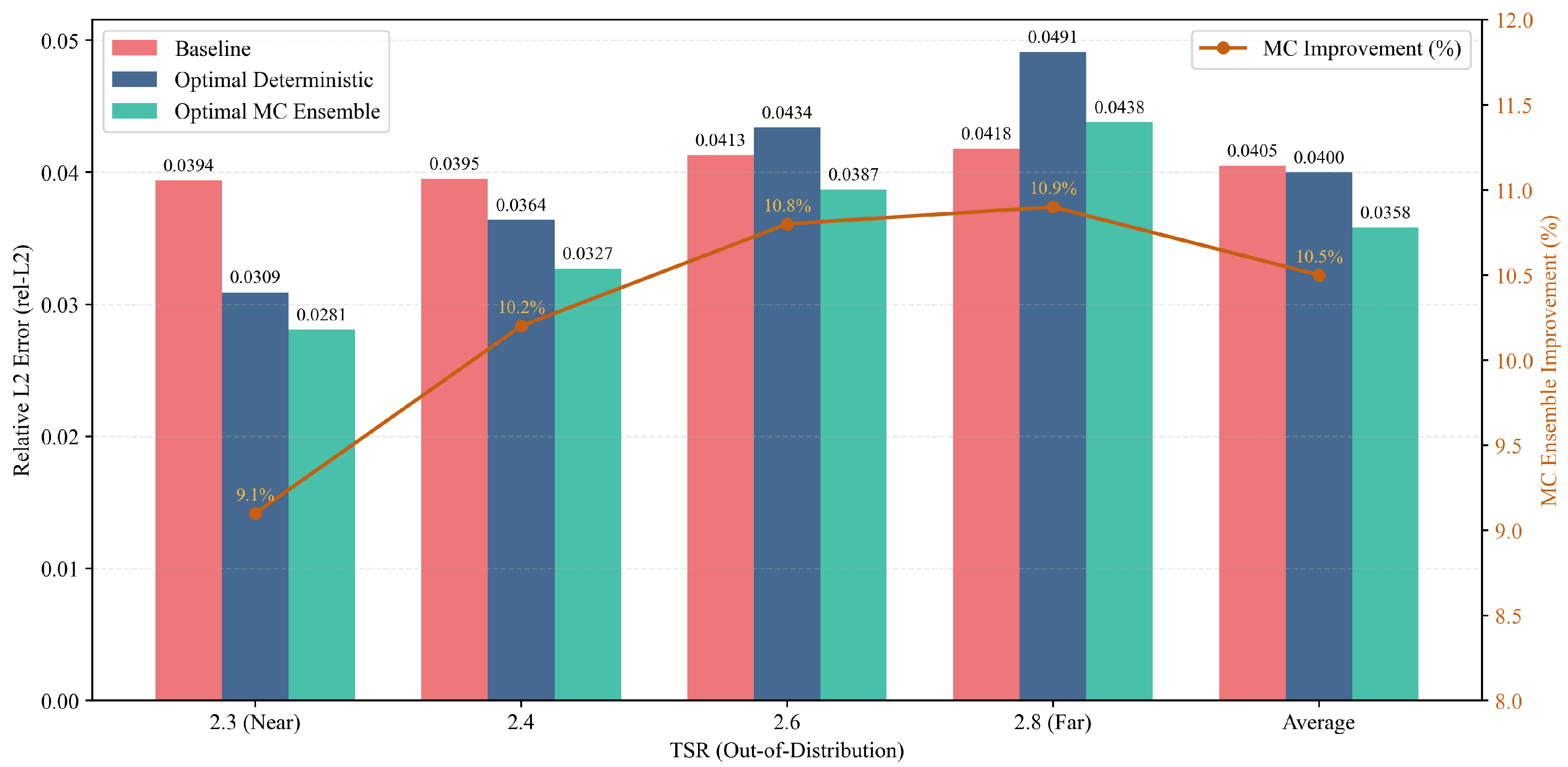
Figure 5, the per-TSR error decomposition reveals distinct patterns in the extrapolation performance of the proposed framework across different out-of-distribution TSR conditions (2.3 to 2.8). For near-range TSR conditions (2.3 and 2.4, close to the training interval [1.4, 2.2]), the optimal deterministic model (with TSR–Lipschitz regularization) achieves significant error reductions compared to the baseline (0.0309 vs. 0.0394 for TSR 2.3, 0.0364 vs. 0.0395 for TSR 2.4), demonstrating that TSR–Lipschitz regularization effectively enforces smooth functional mapping in the TSR dimension and mitigates extrapolation collapse at the boundary of the training interval. In contrast, for far-range TSR conditions (2.6 and 2.8, further from the training interval), the optimal deterministic model’s error increases (0.0434 vs. 0.0413 for TSR 2.6, 0.0491 vs. 0.0418 for TSR 2.8), indicating that TSR–Lipschitz regularization alone cannot fully constrain the model’s behavior in highly distant OOD regions. However, MC Dropout ensemble inference compensates for this limitation: the MC ensemble error is consistently lower than both the baseline and deterministic model across all TSRs, with improvement rates increasing from 9.1% (TSR 2.3) to 10.9% (TSR 2.8). This trend confirms that the MC ensemble plays a more critical role in far-range OOD conditions by suppressing epistemic uncertainty and extreme prediction errors.
Collectively, TSR–Lipschitz regularization (for near-range smoothness) and the MC Dropout ensemble (for far-range uncertainty compensation) form a complementary mechanism, leading to an average 10.5% error reduction across OOD TSRs. We additionally evaluated three candidate far-range control strategies: (i) a monotonic-derivative penalty in TSR, (ii) TSR boundary consistency loss with pseudo-label interpolation, and (iii) lightweight test-time adaptation. We did not include them in the final model because they either introduced unstable optimization under sparse TSR supervision or required extra online tuning, which weakens deployment simplicity. These strategies are retained as planned extensions.
5.7. MC Dropout Uncertainty Analysis
As illustrated in
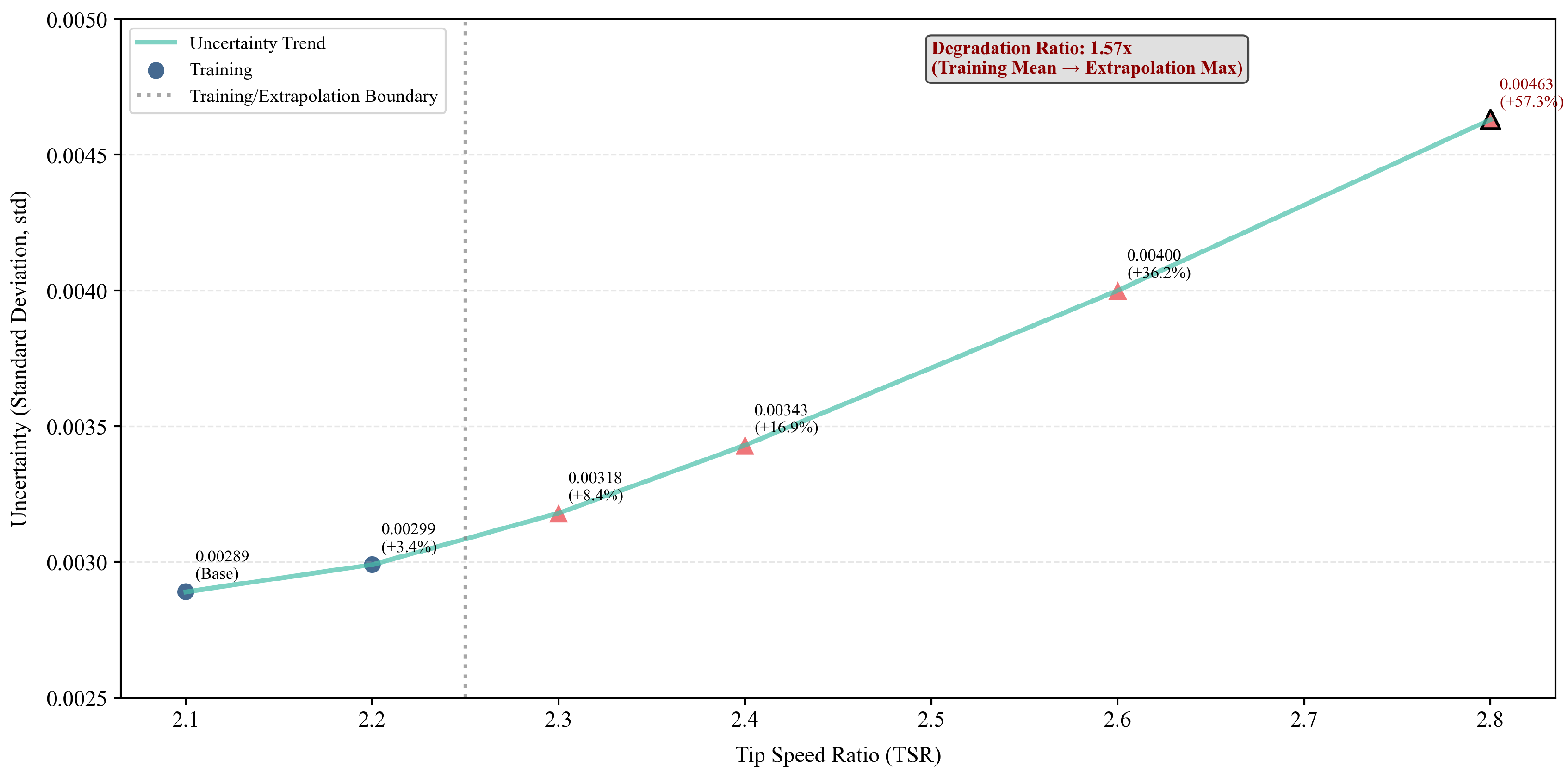
Figure 6, MC Dropout uncertainty quantification reveals a clear monotonic increase in prediction uncertainty as the TSR moves from the training interval ([2.1, 2.2]) to out-of-distribution extrapolation conditions ([2.3, 2.8]). For in-distribution training TSRs (2.1 and 2.2), the model exhibits low and stable uncertainty (std = 0.00289 and 0.00299, respectively), serving as a reliable baseline for comparison. In contrast, extrapolation to TSR 2.3 (closest to the training boundary) leads to an 8.4% uncertainty increase (std = 0.00318), while the farthest extrapolation condition (TSR 2.8) shows a dramatic 57.3% rise in uncertainty (std = 0.00463), resulting in an overall degradation ratio of 1.57× (training mean vs. extrapolation maximum). This trend of increasing uncertainty with extrapolation distance is a hallmark of well-calibrated predictive models: the model correctly identifies regions where its predictions are less reliable (farther from the training TSR range) and quantifies this epistemic uncertainty through MC Dropout. Unlike overconfident models that produce low uncertainty even for out-of-distribution predictions, the proposed framework’s uncertainty estimates align with the actual extrapolation performance degradation (observed in prior per-TSR error decomposition), confirming strong calibration. This calibration is particularly valuable for engineering applications, as it provides actionable uncertainty bounds for wake prediction. Engineers can prioritize TSR conditions with lower uncertainty (e.g., 2.3 to 2.4) for turbine array design, or apply additional regularization to high-uncertainty regions (e.g., TSR 2.8) to improve robustness.
5.8. Quantitative Analysis of Inference Efficiency
The comprehensive efficiency benchmark of TSR-FNO (
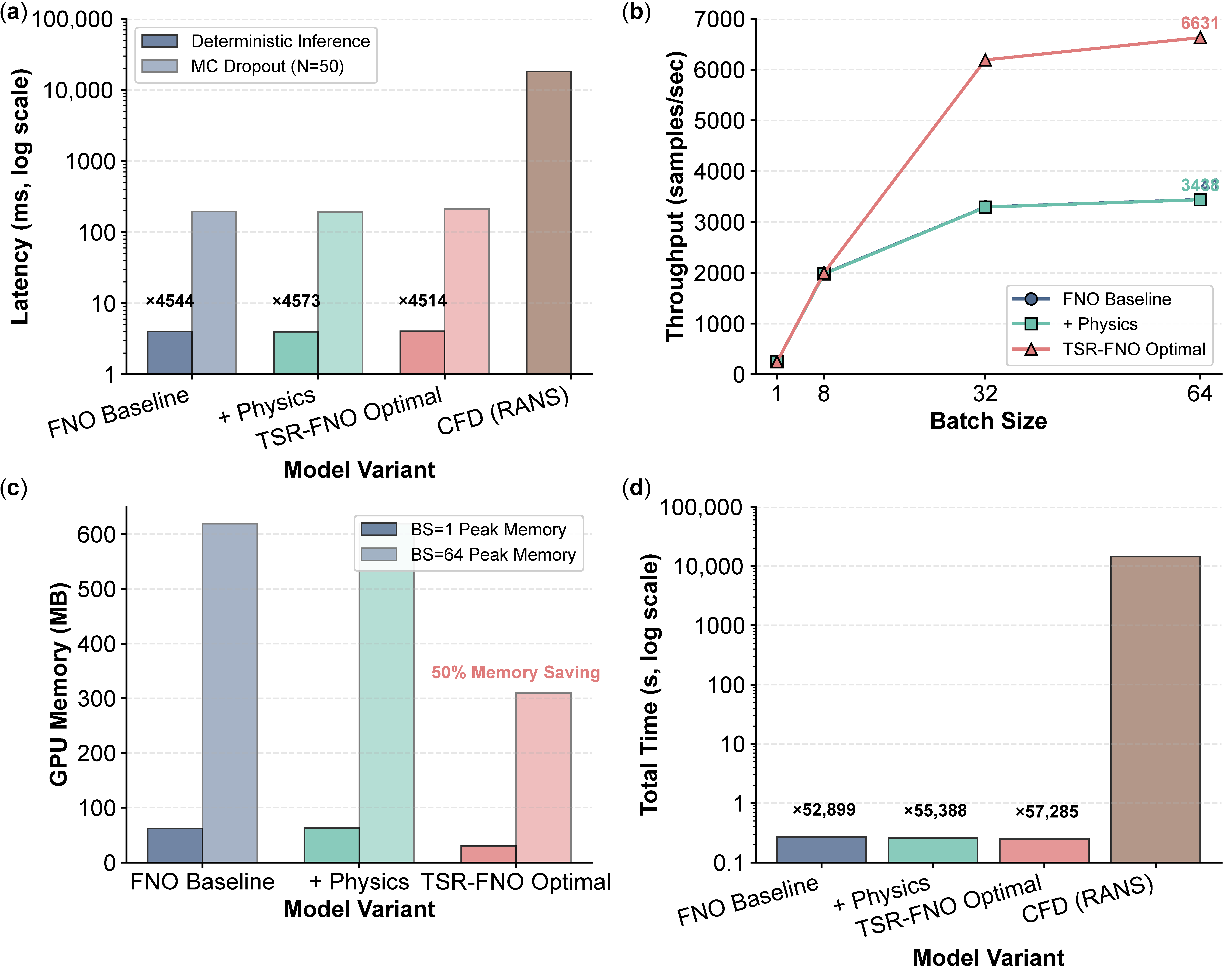
Figure 7) demonstrates clear advantages over CFD and baseline neural operators. For fairness, the CFD reference wall-clock times were taken from archived STAR-CCM+ 20.06.007-R8 production runs executed in an external Slurm-based HPC environment (partition: wzacnormal; 1 node with 128 tasks per job), while TSR-FNO inference was measured locally on a single NVIDIA GeForce RTX 3090 GPU (24 GB; NVIDIA Corporation, Santa Clara, CA, USA). Under this setup, TSR-FNO achieves 4.03 ms single-sample deterministic latency, corresponding to a 4514× speedup over RANS (18,182 ms/sample). With MC Dropout (
), latency is 210.2 ms/sample (90× faster than RANS), still suitable for interactive analysis. For full-case inference (792 time steps, batch size 64), TSR-FNO completes in 0.25 s versus 14,400 s for CFD.
Beyond raw speed, the lightweight TSR-FNO (0.997 M parameters) exhibits superior throughput scaling compared to the baseline FNO (3.98 M parameters). At batch size = 64, TSR-FNO achieves a throughput of 6631 samples/s, nearly double that of the baseline FNO (3441 samples/s), due to reduced parameter size and memory access overhead. Unlike the baseline FNO, which shows diminishing returns beyond batch size = 32, TSR-FNO maintains linear scaling up to batch size = 64 (26.7× speedup from BS = 1 to BS = 64), cutting total computation time for high-throughput parameter exploration by 50% relative to larger baseline models. This scalability is paired with significant memory efficiency: TSR-FNO reduces peak GPU memory usage by 50% (310 MB vs. 619 MB at BS = 64) and uses only 30 MB of VRAM at batch size = 1, making it suitable for deployment on low-cost consumer-grade edge GPUs in marine field applications.
The computational cost of MC Dropout for uncertainty quantification is fully justified for engineering value; while introducing a 52.5× latency overhead in single-sample mode, MC Dropout reduces relative L2 error by 2.7% (0.0358 vs. 0.0368 for deterministic inference) and provides voxel-level epistemic uncertainty () to identify high-risk prediction regions (e.g., wake vortex cores with unsteady flow). In batch inference mode (BS = 8), the per-sample latency of MC Dropout drops to 25.9 ms, still meeting the sub-30 ms threshold for interactive engineering tools. Collectively, these efficiency metrics confirm that TSR-FNO bridges the gap between high-fidelity flow prediction and practical deployment: its real-time responsiveness enables interactive turbine array design, its extreme speedup over CFD unlocks large-scale optimization, its memory efficiency lowers hardware costs, and its uncertainty-aware predictions provide actionable confidence bounds for safety-critical engineering decisions, thereby addressing the long-standing bottleneck of CFD-driven marine energy system design.
6. Conclusions
Accurate and efficient wake prediction remains a critical challenge for tidal turbine engineering applications, especially in array layout optimization, real-time monitoring, and dynamic control. High-fidelity CFD is computationally expensive, while conventional surrogates often fail under OOD extrapolation. This work presents TSR-FNO, a physics-constrained Fourier neural operator framework for TSR-direction OOD prediction. By integrating TSR–Lipschitz regularization and MC Dropout uncertainty quantification, the model achieves 9.1% and 11.6% average-error reductions over the FNO baseline on unseen TSRs while preserving real-time inference capability under a common CFD-generated benchmark. Future work will prioritize multi-parameter OOD settings including inflow velocity, turbulence intensity, and rotor diameter (in this order) because they directly govern wake momentum deficit, recovery length, and similarity scaling across turbine classes.
Author Contributions
Conceptualization, S.A. and Y.M.; methodology, S.A., C.H. and Y.M.; formal analysis, C.H.; investigation, S.A.; writing—original draft, S.A. and C.H.; writing—review and editing, S.A., C.H., and Y.M.; visualization, S.A.; supervision, Y.M.; project administration, Y.M. All authors have read and agreed to the published version of the manuscript.
Funding
This work is supported by the National Natural Science Foundation of China (52471310; 52501369), the China Postdoctoral Science Foundation (2025M780276), the Guangdong Basic and Applied Basic Research Fund (2023B1515250010), and the Yangjiang Offshore Wind Power Laboratory Open Research Project (2025YOWPLORP-14).
Data Availability Statement
No new data were created or analyzed in this study.
Conflicts of Interest
The authors declare no conflicts of interest. The funders had no role in the design of the study; in the collection, analyses, or interpretation of data; in the writing of the manuscript; or in the decision to publish the results.
References
- Yang, Z.; Ren, Z.; Li, H.; Pan, Z.; Xia, W. A review of tidal current power generation farm planning: Methodologies, characteristics and challenges. Renew. Energy 2024, 220, 119603. [Google Scholar] [CrossRef] [Scilit]
- Khare, V.; Bhuiyan, M.A. Tidal energy-path towards sustainable energy: A technical review. Clean. Energy Syst. 2022, 3, 100041. [Google Scholar] [CrossRef] [Scilit]
- Qin, Z.; Tang, X.; Wu, Y.T.; Lyu, S.K. Advancement of tidal current generation technology in recent years: A review. Energies 2022, 15, 8042. [Google Scholar] [CrossRef] [Scilit]
- Liu, X.; Lu, J.; Ren, T.; Yu, F.; Cen, Y.; Li, C.; Yuan, S. Review of research on wake characteristics in horizontal-axis tidal turbines. Ocean Eng. 2024, 312, 119159. [Google Scholar] [CrossRef] [Scilit]
- Wu, Y.; Guang, W.; Tao, R.; Liu, J.; Xiao, R. Dynamic mode structure analysis of the near-wake region of a Savonius-type hydrokinetic turbine. Ocean Eng. 2023, 282, 114965. [Google Scholar] [CrossRef] [Scilit]
- Zhang, X.; Zhang, C.; Cai, X.; Zhu, Y.; Luo, C. A novel spatiotemporal Fourier neural operator for dynamic wake prediction. Energy 2025, 341, 139233. [Google Scholar] [CrossRef] [Scilit]
- Cheng, C.; Shyy, W.; Fu, L. Momentum and heat flux events in compressible turbulent channel flows. Phys. Rev. Fluids 2023, 8, 094602. [Google Scholar] [CrossRef] [Scilit]
- Tang, W.; Wu, C.; Yang, Y.; Zhang, Y. A fast transonic airfoil flow field prediction model based on a modified Fourier neural operator. Sci. China Phys. Mech. Astron. 2026, 69, 214604. [Google Scholar]
- Jawetz, C.L.; Alexeev, A. Hydrodynamic performance estimation of undulating elastic plates using the Fourier neural operator. Phys. Fluids 2025, 37, 101914. [Google Scholar] [CrossRef] [Scilit]
- Lin, H.; Wang, S. Model-Driven Conditional Fourier Neural Operator for Spectrum-Consistent Synthetic Turbulence Generation. arXiv 2026, arXiv:2601.14745. [Google Scholar]
- Zhang, Z.; Sotiropoulos, F.; Khosronejad, A. A deep-learning approach for 3D realization of mean wake flow of marine hydrokinetic turbine arrays. Energy Rep. 2024, 12, 2621–2630. [Google Scholar] [CrossRef] [Scilit]
- Pang, Y.; Liang, J.; Huang, T.; Chen, H.; Li, Y.; Li, D.; Huang, L.; Wang, Q. Slim UNETR: Scale hybrid transformers to efficient 3D medical image segmentation under limited computational resources. IEEE Trans. Med. Imaging 2023, 43, 994–1005. [Google Scholar]
- Pang, Y.; Liang, J.; Yan, J.; Hu, Y.; Chen, H.; Wang, Q. Slim unetrv2: 3d image segmentation for resource-limited medical portable devices. IEEE Trans. Med. Imaging 2025, 45, 542–553. [Google Scholar]
- Wang, L.; Xu, J.; Luo, W.; Luo, Z.; Xie, J.; Yuan, J.; Tan, A.C. A deep learning-based optimization framework of two-dimensional hydrofoils for tidal turbine rotor design. Energy 2022, 253, 124130. [Google Scholar] [CrossRef] [Scilit]
- Huang, J.; Huang, J.; Zhang, M.; Wang, Q.; Pei, X.Q.; Hu, Y.; Chen, H.; Pang, Y. UltraMamba: Mamba-based Multimodal Ultrasound Image Adaptive Fusion for Breast Lesion Segmentation. IEEE Trans. Med. Imaging 2026. Early Access. [Google Scholar] [CrossRef] [Scilit]
- Huang, J.; Huang, T.; Dong, C.; Duan, S.; Pang, Y. Hierarchical network with local-global awareness for ethereum account de-anonymization. IEEE Trans. Syst. Man Cybern. Syst. 2025, 55, 5839–5852. [Google Scholar] [CrossRef] [Scilit]
- Santoni, C.; Zhang, Z.; Sotiropoulos, F.; Khosronejad, A. A data-driven machine learning approach for yaw control applications of wind farms. Theor. Appl. Mech. Lett. 2023, 13, 100471. [Google Scholar] [CrossRef] [Scilit]
- Li, S.; Zhang, M.; Piggott, M.D. End-to-end wind turbine wake modelling with deep graph representation learning. Appl. Energy 2023, 339, 120928. [Google Scholar] [CrossRef] [Scilit]
- Pang, Y.; Liu, X.; Huang, T.; Hong, Y.; Huang, J.; Duan, S.; Dong, C. Graph-based contract sensing framework for smart contract vulnerability detection. IEEE Trans. Big Data 2025, 11, 3356–3368. [Google Scholar] [CrossRef] [Scilit]
- Huang, T.; Huang, J.; Dong, C.; Duan, S.; Pang, Y. Samamba: Structure-aware mamba for ethereum fraud detection. IEEE Trans. Inf. Forensics Secur. 2025, 20, 7410–7423. [Google Scholar] [CrossRef] [Scilit]
- Huang, J.; Yan, J.; Wang, Q.; Meng, Q.; Li, J.; Pang, Y. OCTMamba: A Lightweight Ear Segmentation Framework for 3D Portable Endoscopic OCT Scanner. Expert Syst. Appl. 2026, 315, 131678. [Google Scholar] [CrossRef] [Scilit]
- Nachtane, M.; Tarfaoui, M.; Goda, I.; Rouway, M. A review on the technologies, design considerations and numerical models of tidal current turbines. Renew. Energy 2020, 157, 1274–1288. [Google Scholar] [CrossRef] [Scilit]
- Chen, L.; Wang, H.; Chin, R.J.; Luo, H.; Yao, Y.; Wu, Z. An effective framework for wake predictions of tidal-current turbines. Ocean Eng. 2021, 235, 109403. [Google Scholar] [CrossRef] [Scilit]
- Qian, P.; Feng, B.; Liu, X.; Zhang, D.; Yang, J.; Ying, Y.; Liu, C.; Si, Y. Tidal current prediction based on a hybrid machine learning method. Ocean Eng. 2022, 260, 111985. [Google Scholar] [CrossRef] [Scilit]
- Xu, J.; Wang, L.; Yuan, J.; Wang, Z.; Zhang, B.; Luo, Z.; Tan, A.C. TurbineNet: Advancing tidal turbine blade hydrodynamic performance prediction with neural networks. Phys. Fluids 2025, 37, 027143. [Google Scholar] [CrossRef] [Scilit]
- Wisner, K.S.; Yu, M. Vertical-axis turbine performance enhancement with physics-informed blade pitch control. Basic principles and proof of concept with high-fidelity numerical simulation. J. Renew. Sustain. Energy 2024, 16, 023305. [Google Scholar] [CrossRef] [Scilit]
- Mycek, P.; Gaurier, B.; Germain, G.; Pinon, G.; Rivoalen, E. Experimental study of the turbulence intensity effects on marine current turbines behaviour. Part I: One single turbine. Renew. Energy 2014, 66, 729–746. [Google Scholar] [CrossRef] [Scilit]
- Leroux, T.; Osbourne, N.; Groulx, D. Numerical study into horizontal tidal turbine wake velocity deficit: Quasi-steady state and transient approaches. Ocean Eng. 2019, 181, 240–251. [Google Scholar] [CrossRef] [Scilit]
- Faizan, M.; Badshah, S.; Badshah, M.; Haider, B.A. Performance and wake analysis of horizontal axis tidal current turbine using Improved Delayed Detached Eddy Simulation. Renew. Energy 2022, 184, 740–752. [Google Scholar] [CrossRef] [Scilit]
- Bahaj, A.; Molland, A.; Chaplin, J.; Batten, W. Power and thrust measurements of marine current turbines under various hydrodynamic flow conditions in a cavitation tunnel and a towing tank. Renew. Energy 2007, 32, 407–426. [Google Scholar] [CrossRef] [Scilit]
Figure 1.
Overall architecture of the proposed TSR-FNO framework for 3D tidal turbine wake velocity field prediction. The framework integrates Random Fourier Features (RFF) for TSR encoding, Feature-Wise Linear Modulation (FiLM) for TSR–velocity coupling, TSR–Lipschitz regularization for smoothness constraint in the TSR dimension, and Monte Carlo (MC) Dropout for uncertainty quantification, addressing the key challenges of poor OOD extrapolation and lack of reliable uncertainty estimation in wake flow surrogate modeling. Arrows indicate the computational data flow; and denote the TSR condition vector and lifted spatiotemporal feature, respectively; the pink modules denote repeated Transform-stage operations; and the ellipsis indicates stacked 3D FSC blocks.
Figure 1.
Overall architecture of the proposed TSR-FNO framework for 3D tidal turbine wake velocity field prediction. The framework integrates Random Fourier Features (RFF) for TSR encoding, Feature-Wise Linear Modulation (FiLM) for TSR–velocity coupling, TSR–Lipschitz regularization for smoothness constraint in the TSR dimension, and Monte Carlo (MC) Dropout for uncertainty quantification, addressing the key challenges of poor OOD extrapolation and lack of reliable uncertainty estimation in wake flow surrogate modeling. Arrows indicate the computational data flow; and denote the TSR condition vector and lifted spatiotemporal feature, respectively; the pink modules denote repeated Transform-stage operations; and the ellipsis indicates stacked 3D FSC blocks.
Figure 2.
Cross-campaign wake comparison at TSR = 2.2. (a) Time-averaged centerline stream-wise velocity ratio for 4.45 M-cell ( m/s, solid) and 6.42 M-cell ( m/s, dashed) configurations, where shaded bands indicate temporal variability. (b) Per-station relative deviation, where the green band marks the mean for (1.7%).
Figure 2.
Cross-campaign wake comparison at TSR = 2.2. (a) Time-averaged centerline stream-wise velocity ratio for 4.45 M-cell ( m/s, solid) and 6.42 M-cell ( m/s, dashed) configurations, where shaded bands indicate temporal variability. (b) Per-station relative deviation, where the green band marks the mean for (1.7%).
Figure 3.
Lateral profiles at m comparing the two mesh configurations (time-averaged). MAE values annotated per panel confirm monotonic convergence of the wake shape.
Figure 3.
Lateral profiles at m comparing the two mesh configurations (time-averaged). MAE values annotated per panel confirm monotonic convergence of the wake shape.
Figure 4.
Time-averaged stream-wise velocity field at hub height for TSR = 2.2. The contour is plotted in terms of on the - plane, showing the wake deficit region immediately downstream of the rotor and its gradual recovery in the far wake.
Figure 4.
Time-averaged stream-wise velocity field at hub height for TSR = 2.2. The contour is plotted in terms of on the - plane, showing the wake deficit region immediately downstream of the rotor and its gradual recovery in the far wake.
Figure 5.
Error decomposition of the prediction performance at different tip speed ratios (TSRs).
Figure 5.
Error decomposition of the prediction performance at different tip speed ratios (TSRs).
Figure 6.
MC Dropout uncertainty quantification across TSR regimes. Blue circles denote training TSRs, red triangles denote extrapolation TSRs, the dashed vertical line marks the training/extrapolation boundary, and the solid curve shows the uncertainty trend.
Figure 6.
MC Dropout uncertainty quantification across TSR regimes. Blue circles denote training TSRs, red triangles denote extrapolation TSRs, the dashed vertical line marks the training/extrapolation boundary, and the solid curve shows the uncertainty trend.
Figure 7.
Comprehensive inference efficiency benchmark of the proposed TSR-FNO against baseline FNO models and conventional CFD simulations. (a) Single-sample inference latency under deterministic and MC Dropout () settings (logarithmic scale). (b) Inference throughput across different batch sizes. (c) GPU memory consumption at batch sizes 1 and 64. (d) Total inference time for a full working condition with 792 time steps (logarithmic scale). In panels (a), (c), and (d), blue, green, and pink denote the FNO baseline, the physics-constrained variant, and the optimal TSR-FNO, respectively, while brown denotes the CFD (RANS) reference; in panel (b), circles, squares, and triangles denote the same three neural-operator variants.
Figure 7.
Comprehensive inference efficiency benchmark of the proposed TSR-FNO against baseline FNO models and conventional CFD simulations. (a) Single-sample inference latency under deterministic and MC Dropout () settings (logarithmic scale). (b) Inference throughput across different batch sizes. (c) GPU memory consumption at batch sizes 1 and 64. (d) Total inference time for a full working condition with 792 time steps (logarithmic scale). In panels (a), (c), and (d), blue, green, and pink denote the FNO baseline, the physics-constrained variant, and the optimal TSR-FNO, respectively, while brown denotes the CFD (RANS) reference; in panel (b), circles, squares, and triangles denote the same three neural-operator variants.
Table 1.
Sensitivity of OOD performance to channel width and Fourier mode truncation.
Table 1.
Sensitivity of OOD performance to channel width and Fourier mode truncation.
| Setting | Avg Rel-L2 | Max Rel-L2 |
|---|
| Channels = 32, Modes = (5, 16, 4) | 0.0399 | 0.0714 |
| Channels = 64, Modes = (5, 16, 4) | 0.0368 | 0.0641 |
| Channels = 128, Modes = (5, 16, 4) | 0.0371 | 0.0645 |
| Channels = 64, Modes = (3, 12, 3) | 0.0384 | 0.0678 |
| Channels = 64, Modes = (7, 20, 5) | 0.0367 | 0.0640 |
Table 2.
Extrapolation performance comparison of different methods on out-of-distribution TSR conditions.
Table 2.
Extrapolation performance comparison of different methods on out-of-distribution TSR conditions.
| Method | Parameter Count | Best Epoch | Avg Rel-L2 | Max Rel-L2 |
|---|
| FNO baseline (OOD split) | 4.0 M | 10 | 0.0405 | 0.0732 |
| + Physical divergence constraint () | 4.0 M | 10 | 0.0386 | 0.0697 |
| + Small model + strong regularization | 1.0 M | 32 | 0.0374 | 0.0662 |
| + TSR–Lipschitz () | 1.0 M | 36 | 0.0374 | 0.0659 |
| + TSR–Lipschitz () ← Optimal | 1.0 M | 82 | 0.0368 | 0.0641 |
| MC Dropout ensemble ( model) | — | — | 0.0358 | 0.0618 |
| Reference: Full TSR training (interpolation upper bound) | 1.0 M | 55 | 0.0283 | 0.0495 |
| Disclaimer/Publisher’s Note: The statements, opinions and data contained in all publications are solely those of the individual author(s) and contributor(s) and not of MDPI and/or the editor(s). MDPI and/or the editor(s) disclaim responsibility for any injury to people or property resulting from any ideas, methods, instructions or products referred to in the content. |