1. Introduction
As third-party intermediaries, auction houses specialize in aggregating market information, managing auction processes, and facilitating the valuation and allocation of goods [
1,
2]. These capabilities enable auction houses to offer orderly, efficient, and convenient trading services for both buyers and sellers. Consequently, most sellers choose not to organize auctions independently but instead consign their goods to auction houses, particularly in markets involving large volumes of homogeneous goods [
3]. Representative examples include the North American Fur Auctions in Toronto, the Aalsmeer Flower Auction in Amsterdam, the Colombo Tea Auction in Sri Lanka, and the Tsukiji tuna auction market in Tokyo. Across these markets, the annual value of consigned goods traded reaches tens of billions of dollars.
A typical multi-unit consignment auction is conducted under a commission-based mechanism. When a seller consigns a given quantity of goods to an auction house, a reserve price is specified in advance. The goods are sold when the auction price exceeds the reserve price, and the auction house charges a commission as a fixed proportion of the final price. If not, the goods remain unsold and are returned to the seller. Although the commission mechanism is simple to implement and widely adopted in practice, it has attracted substantial criticism. The auction literature shows that maximizing system-wide revenue requires the joint optimization of supply and selling decisions [
4]. In practice, however, sellers’ choices of auction quantities and reserve prices, as well as auction houses’ commission rates, are often misaligned with the objective of optimizing overall supply chain performance [
5]. Moreover, empirical evidence suggests that some sellers exhibit low willingness to cooperate with auction houses and may collude with buyers to bypass the auction process and engage in private transactions [
6]. As a result, disputes arising from commission-based consignment auctions are frequently reported, undermining normal market order.
To address these issues and stabilize sellers’ supply, auction houses are increasingly adopting guaranteed auction mechanisms. These mechanisms promise sellers a minimum return. For example, the North American Fur Auctions and the Colombo Tea Auction cooperate with governments or industry associations to provide downside protection for sellers, whereby unsold lots are purchased at a predetermined minimum price by the auction house. In China, the Dounan Flower Electronic Trading Center (DFETC) in Kunming has recently begun experimenting with compensation schemes for unsold lots. In addition, large liquidation and bankruptcy service providers, such as Hilco Global and Gordon Brothers, frequently offer guaranteed minimum return arrangements. Such price guarantees require auction houses to commit their own capital. To compensate for this investment risk, these guarantees are typically accompanied by surplus-sharing mechanisms that allow auction houses to participate in upside gains. Nevertheless, compared with the risk-free commission-based mechanisms, a considerable number of auction houses remain cautious about adopting guaranteed auction arrangements.
Our study examines optimal supply and selling strategies in a consignment auction supply chain consisting of a seller and an auction house. We analyze why commission-based mechanisms are often resisted by sellers and how these mechanisms lead to coordination failures that undermine total supply chain profit. We further investigate whether guaranteed auction mechanisms constitute a superior contractual arrangement and, if so, how such contracts can be designed to benefit both parties.
To address these questions, we develop a game-theoretic model in which a seller consigns a given quantity of goods to an auction house for sale. Prices are discovered through auctions in an uncertain market, and auction revenues are shared between the seller and the auction house after the sale. We take the supply and selling strategies under centralized decision making as a benchmark, representing the best achievable performance of the consignment auction supply chain. We then examine the strategic decisions of supply chain members and the resulting performance under commission-based and guaranteed auction mechanisms, respectively. In particular, we focus on how profits and associated risks are allocated among members, as these factors are critical to the stability of cooperation within the supply chain.
Our analysis shows that the presence of auction commissions distorts the transmission of market demand information, thereby preventing the supply chain from achieving optimal outcomes. More importantly, the commission-based mechanism insulates the auction house from downside risk associated with the auction. Under this mechanism, the auction house merely extracts commissions from sellers and buyers, while the entire risk of unsold goods is borne by the seller. This asymmetry explains why sellers may obtain demand information from the auction house yet subsequently bypass the auction process in actual transactions. By doing so, they avoid commission payments and reduce their exposure to transaction failure risk. These findings highlight the need for an alternative mechanism that more closely aligns the incentives of the seller and the auction house, enabling them to jointly confront market uncertainty.
Unlike commission contracts, guaranteed auction mechanisms provide greater flexibility in profit allocation. Recognizing that auction houses do not always occupy a leading position in cooperative relationships and that some sellers may also be sufficiently influential to negotiate contract terms, we analyze supply and selling decisions under two decision regimes: non-cooperative and cooperative games. Our results show that both regimes can achieve supply chain coordination. However, outcomes under the cooperative game framework are characterized by a high-risk–high-return profile and yield a more balanced distribution of profits. In contrast, non-cooperative games tend to induce profit appropriation by the auction house at the expense of the seller, which may destabilize the collaborative supply chain relationship when the external competitive environment changes. Accordingly, we argue that guaranteed auction contracts are more appropriately negotiated within a cooperative game framework. Even when the auction house plays a leading role in the supply chain, profit allocation should be benchmarked against the cooperative game outcome in order to enhance supply chain competitiveness and long-term sustainability.
The remainder of the paper is organized as follows.
Section 2 reviews the related literature.
Section 3 introduces the basic multi-unit consignment auction model and derives the system-optimal solution under centralized decision making.
Section 4 analyzes supply and selling decisions under the conventional commission contract and shows that such contracts fail to coordinate the supply chain.
Section 5 develops coordination mechanisms based on guaranteed auction contracts under both cooperative and non-cooperative game frameworks and provides a comparative analysis of the two regimes.
Section 6 presents numerical experiments to validate the theoretical results and to examine the risk–return trade-offs faced by supply chain members under different game structures.
Section 7 concludes the paper by summarizing the main findings, discussing managerial implications, and outlining directions for future research. All proofs are provided in
Appendix A.
3. Model Settings and Benchmark
To investigate supply and selling cooperation between a seller and an auction house,
Section 3.1 presents a normative description of a multi-unit consignment auction abstracted from industry practice.
Section 3.2 analyzes the operation of a hypothetical centralized decision maker, whose resulting outcome serves as a benchmark against which the performance of conventional commission contracts and guaranteed auction contracts is evaluated.
3.1. Assumptions and Notations
We consider a two-tier auction supply chain consisting of a seller, denoted by , and an auction house, denoted by . The seller produces and supplies a monopolistic product with a constant unit production cost . In each production cycle, the seller consigns units of a homogeneous and indivisible product to the auction house, which auctions them to a large number of potential buyers. The organizational cost of conducting the auction is assumed to be zero, as incorporating such costs would not materially affect the main conclusions of this study.
The auction is conducted as a discriminatory price auction with a non-public reserve price . Each buyer submits sealed bids, with each bid referring to a single unit offered for sale, and the highest bids are identified as the competitive bids. For unit , if the corresponding competitive bid , the bid is deemed a winning bid. The buyer submitting this bid wins unit and pays to the supply chain, together with a premium charged at rate . If , unit remains unsold. In this case, the supply chain recovers a salvage value for the unit in the secondary market.
To avoid unnecessary complexity, we model market demand as a stationary stochastic process. All competitive bids are assumed to be independently and identically distributed according to a distribution function with support and associated density function . We assume that when , the distribution first-order stochastically dominates , and that . These assumptions capture the commonly observed pattern that buyers’ bids decrease as the supplied quantity increases.
In the subsequent analysis, all supply chain participants make decisions to maximize their expected profits. They are assumed to have complete information and to be risk neutral. In addition, to ensure the internal consistency of the model, we impose the parameter ordering .
3.2. Benchmark: Centralized Operation
As a benchmark for evaluating system performance, we first derive the optimal operation of the auction supply chain under centralized decision making, including the auction reserve price and the supply quantity, denoted by .
From the perspective of the supply chain as a whole, the profit generated from selling unit
is
The corresponding expected profit is
where
denotes the expectation operator. Accordingly, the expected total sales profit of the supply chain is given by
Under centralized decision making, the profits of individual supply chain members are not distinguished; instead, all auction profits are treated as a single aggregate. The optimal reserve price
and supply quantity
are determined by maximizing the expected profit of the entire supply chain. This leads to Proposition 1. To maintain the flow of the paper, the proof is provided in
Appendix A.
Proposition 1. The optimal auction reserve price for the supply chain
Proposition 1 shows that the optimal auction reserve price is independent of both the supply quantity and the distribution of competing bids . This result simplifies reserve-price implementation for system decision makers, because the hidden reserve price need not be adjusted in response to demand fluctuations. The key criterion is whether the auction’s net revenue exceeds the item’s opportunity cost, defined as its buyer-premium-adjusted salvage value. Any bid satisfying this condition contributes positively to total supply chain profit and should therefore be accepted.
On the other hand, the presence of the abstract distribution function prevents us from deriving a closed-form expression for the optimal supply quantity . Nevertheless, the following proposition establishes the existence of such an optimal solution.
Proposition 2. Given the reserve price , there exists an optimal supply quantity that maximizes the supply chain’s expected profit .
Proposition 2 highlights a central operational trade-off arising from the scarcity effect in multi-unit auctions. A larger supply quantity may raise sales volume, but it may also reduce buyers’ average valuations by weakening market scarcity. This result suggests that decision makers in the auction supply chain should avoid expanding supply excessively in an attempt to capture market share. Instead, supply should be managed carefully to balance the gains from higher sales volume against the erosion of scarcity-based premiums.
4. Supply Chain Performance Under Conventional Commission Contracts
In conventional multi-unit consignment auctions, auction revenues are typically allocated between the seller and the auction house according to a commission contract. The seller transfers a fraction of the transaction price to the auction house as a seller-side commission. In addition, the auction house may charge buyers a premium at rate . All unsold units are returned to the seller, who can recover a salvage value per unit in the secondary market.
Under this revenue allocation scheme, the profit that the seller obtains from the sale of unit
is
The corresponding expected profit is
Accordingly, the seller’s expected profit from selling all units is given by
On the other hand, the profit earned by the auction house from the sale of unit
is
The corresponding expected profit is
Accordingly, the auction house’s expected profit from accepting the auction consignment is given by
Under the commission auction contract, both the supply quantity and the auction reserve price are determined by the seller. Acting in its own interest, the seller chooses the optimal consignment strategy at the beginning of each production cycle to maximize its expected profit function .
Proposition 3. Under the commission auction contract, the seller’s optimal auction reserve price
Comparing Equations (2) and (6), we observe that . This result arises because the seller must transfer a portion of buyers’ bids to the auction house in the form of commissions. Consequently, the seller sets a higher reserve price to ensure that its net auction revenue is no lower than the salvage value . However, doing so also causes some units that could have generated positive surplus for the supply chain as a whole to remain unsold. This leads to the following result.
Proposition 4. The commission auction contract fails to coordinate the supply chain.
The fundamental reason for the failure of the conventional commission mechanism to coordinate the supply chain is that the seller’s auction revenue is net of the seller’s commission and the buyer’s premium. As a result, the revenue benchmark used by the seller when setting the reserve price does not reflect buyers’ true willingness to pay. The seller’s optimal reserve price therefore inevitably deviates from the system-optimal reserve price . In other words, auction commissions distort market demand information as it is transmitted from the demand side to the supply side.
5. Supply Chain Coordination Under Guaranteed Auction Contracts
Section 4 has shown that conventional commission contracts fail to coordinate the supply chain. In this section, we examine whether guaranteed auction contracts can deliver superior supply chain performance. Under a guaranteed auction arrangement, the auction house offers a guaranteed price
for each unit after accepting the seller’s consignment. If a unit remains unsold, the auction house is obligated to purchase the unit from the seller at price
, thereby ensuring a minimum auction revenue for the seller. In return for providing the guarantee and forgoing commission revenues, the auction house receives a fraction
of the surplus whenever the auction price exceeds the guaranteed price
.
Under the guaranteed auction contract, the seller’s auction revenue does not depend on whether a unit remains unsold, but only on whether the auction price exceeds the guaranteed price
. If the competitive bid for unit
satisfies
, i.e., the auction price exceeds the guaranteed price, the seller receives the guaranteed price
plus a fraction
of the surplus. If
, then regardless of whether the unit is sold through the auction, the seller receives a payment of
from the auction house. Subtracting the production cost yields the seller’s profit from consigning unit
:
The corresponding expected profit is
Accordingly, the seller’s expected profit under the guaranteed auction contract is given by
On the other hand, the auction house’s profit from auctioning unit
depends on the corresponding competitive bid
and can be classified into three cases. First, if
, i.e., the auction price exceeds the guaranteed price, the auction house receives the bid payment
and the buyer’s premium
, and then transfers the guaranteed price
as well as a fraction
of the surplus to the seller. Second, if
, unit
is successfully sold but at a price below the guaranteed price
. In this case, the auction house must transfer the entire auction price
to the seller and can rely only on the buyer’s premium to cover the gap between the auction price and the guaranteed price. If the buyer’s premium is insufficient, the auction house incurs a loss. Finally, if
, unit
remains unsold, but under the terms of the contract, the auction house must purchase the unit from the seller at the guaranteed price
. This outcome is clearly unfavorable for the auction house, which can resell the unit in the secondary market at price
to partially recover its loss. Taken together, the auction house’s profit from auctioning unit
is given by
The corresponding expected profit is
Accordingly, the auction house’s expected profit under the guaranteed auction contract is
In fact, guaranteed auction contracts can facilitate the coordination of supply chain members’ decisions under both cooperative and non-cooperative game frameworks. In
Section 5.1 and
Section 5.2, we demonstrate how supply chain coordination mechanisms are constructed under these two frameworks, respectively.
Section 5.3 then compares the similarities and differences in the two coordination mechanisms.
5.1. Supply Chain Coordination Under a Cooperative Game
Under a cooperative game framework, the seller and the auction house bargain over the rights and obligations embedded in the guaranteed auction contract and jointly determine the guaranteed price and the surplus-sharing ratio . If the parties fail to reach a mutually acceptable pair of contract parameters , i.e., the guaranteed auction bargaining breaks down, auction revenues revert to being allocated under the conventional commission-based mechanism.
For convenience of exposition, we formalize the bargaining process as follows. Let
denote a profit allocation of the supply chain under the guaranteed auction contract, where
and
represent the profits of the seller and the auction house, respectively. The feasible set of supply chain profit allocations is given by
Let
denote the disagreement point of the bargaining, corresponding to the profit allocation under the conventional commission contract. Then, the pair
constitutes the bargaining game between the seller and the auction house over the guaranteed auction contract.
Based on the Nash axioms [
26,
27], the equilibrium outcome of this bargaining game exhibits the following properties.
Proposition 5. Under the Nash bargaining solution, the seller and the auction house jointly choose the system-optimal supply and selling strategy and equally share the additional surplus generated by adopting the guaranteed auction contract instead of the commission contract.
Proposition 5 indicates that the bargaining process induces the seller and the auction house to adopt the system-optimal supply and selling strategy . This result is both reasonable and intuitive, as the potential gains available to each participant are maximized only when the supply chain as a whole achieves its maximum profit. The second part of Proposition 5 characterizes how this system profit is allocated between the seller and the auction house, showing that the two parties equally share the additional surplus generated by operating at the system optimum. This allocation outcome reflects the symmetry in bargaining power between the seller and the auction house. To induce the adoption of the system-optimal strategy and thereby realize system-wide profit maximization, both parties must accept the revised revenue-sharing arrangement, as rejection by either party would lead to a breakdown of cooperation. Consequently, the seller and the auction house make equal marginal contributions to achieving the system optimum and therefore split the gains from cooperation equally.
Proposition 6. Under the cooperative game framework, the guaranteed auction contract coordinates the supply chain. The coordinating contract parameters satisfy Proposition 6 yields several important managerial insights, which are discussed below.
There generally exists more than one combination of
and
that can coordinate the supply chain, and all such combinations form a nonlinear curve. Note that
and
These properties imply that the seller’s share of the surplus,
, decreases as the corresponding guaranteed price
increases, and that the rate of decrease becomes progressively steeper. This trade-off reflects a mutually acceptable outcome for both the seller and the auction house when negotiating the guaranteed auction contract.
Compared with the conventional commission-based mechanism, guaranteed auctions reduce the variance of the seller’s profit. On the one hand, guaranteed auctions shield the seller from low buyer bids. As shown in Equation (7), bids below the guaranteed price have no impact on the seller’s profit, and the lower bound of the seller’s profit is effectively locked in at . On the other hand, when buyer bids exceed the guaranteed price , the auction house captures a fraction of the surplus, which limits how much the seller’s profit can rise above . As a result, relative to the commission-based mechanism, both the lower and upper bounds of the seller’s profit are compressed under the guaranteed auction contract, while the probability of receiving the guaranteed price increases substantially. This contraction of the profit range leads to a lower variance of the seller’s profit and thereby enhances income stability.
According to Equation (10), determining the values of
and
requires knowledge of the distribution of competitive bids
, which may be difficult to obtain in practice. However, the proof of Proposition 6 in
Appendix A reveals that the key to supply chain coordination lies in the equal sharing of the additional surplus generated by the guaranteed auction. Equation (10) characterizes the necessary condition for achieving such an allocation. Therefore, under symmetric information, even in the absence of explicit knowledge of the bid distribution
, the seller and the auction house can iteratively adjust the parameters of the guaranteed auction contract in practice. By ensuring that each adjustment yields equal incremental gains for both parties, the supply chain can gradually approach the system-optimal profit level and ultimately achieve coordination.
Proposition 7. Under the cooperative game framework, when the supply chain is coordinated through a guaranteed auction contract, the proportion of the seller’s expected profit in the total supply chain profit iswhile the proportion of the auction house’s expected profit in the total supply chain profit is Proposition 6 characterizes cooperative operations under the guaranteed auction contract, whereas Proposition 7 clarifies the resulting profit allocation under such cooperation. The shares of expected profits allocated to supply chain members depend on their respective disagreement payoffs, which correspond to their expected profits under the conventional commission-based mechanism. These disagreement payoffs constitute each party’s effective threat point in the bargaining process. A higher threat point implies a stronger bargaining position and, consequently, a larger share of the total profit secured in equilibrium.
5.2. Supply Chain Coordination Under a Non-Cooperative Game
Under a non-cooperative game framework, the seller and the auction house make decisions independently so as to maximize their own expected profit functions. Treating the auction house as the leader of the supply chain, the sequence of decisions unfolds as follows. First, the auction house announces the parameters of the guaranteed auction contract, . Next, given the guaranteed price and the surplus-sharing ratio , the seller chooses the optimal supply quantity . Finally, after receiving the consigned goods, the auction house selects the optimal auction reserve price based on the distribution of buyers’ bids . This decision process can be modeled as a Stackelberg game. Applying backward induction, we begin by solving for the auction house’s optimal strategy.
Proposition 8. Under the guaranteed auction contract, the auction house’s optimal auction reserve price
Proposition 8 highlights the advantage of transferring the reserve price decision from the seller to the auction house in consignment auctions. Unlike the seller, who captures only a fraction of the auction revenue, the auction house directly receives the full payment from winning buyers, including both the transaction price and the buyer’s premium. Leveraging this advantage, the auction house can fully extract buyers’ willingness to pay. Notably, the auction house’s optimal reserve price coincides with the system-optimal reserve price under centralized decision making. This equivalence creates the possibility for guaranteed auction contracts to coordinate the supply chain even within the non-cooperative game framework.
Proposition 9. Under the non-cooperative game framework, the guaranteed auction contract coordinates the supply chain. If the seller’s expected profit accounts for a proportion of the total supply chain profit, then the coordinating contract parameters satisfyand Equations (13) and (14) in Proposition 9 restrict the feasible ranges of the coordinating contract parameters and , while Equation (15) characterizes the functional relationship between them. For any given profit-sharing ratio of the supply chain, Equation (15) identifies a unique relationship between and ; however, the parameter pair itself is not uniquely determined. This non-uniqueness arises from the indivisibility of the auctioned units, which requires the seller’s supply decision to take integer values. As a result, there remains flexibility in adjusting the continuously valued contract parameters while preserving supply chain coordination.
It is worth noting that the guaranteed auction contract is a two-parameter contract. Compared with the single-parameter commission contract, guaranteed auctions offer substantially greater flexibility in allocating auction revenues. This flexibility not only enables supply chain coordination under a non-cooperative game framework, but also allows the profit-sharing ratio between the seller and the auction house to be adjusted within a certain range.
5.3. Comparing Coordination Mechanisms Under Cooperative and Non-Cooperative Games
Both the cooperative game mechanism developed in
Section 5.1 and the non-cooperative game mechanism developed in
Section 5.2 are capable of guiding the multi-unit consignment auction supply chain toward coordination. They represent two alternative approaches to addressing the same contract coordination problem, sharing certain common features while also exhibiting important differences.
5.3.1. Mapping Equivalence and Orientation Difference
Regardless of whether coordination is achieved under the cooperative or the non-cooperative game framework, once the supply chain attains channel coordination through the guaranteed auction contract, the functional relationship between the coordinating parameters
and
is identical. In fact, Equations (10) and (11) together yield
Comparing Equations (15) and (16), we observe that when the profit-sharing ratios
under the cooperative and non-cooperative coordination mechanisms are identical, the corresponding guaranteed auction strategies
are also identical. Because a change in the game framework does not alter the revenue allocation rule embedded in the guaranteed auction contract, there exists a one-to-one correspondence between the supply chain’s guaranteed auction strategy and its profit-sharing outcome.
The key difference between the two coordination mechanisms lies in their orientation. The cooperative game is outcome oriented in that the seller and the auction house focus on the total profit and its allocation. The cooperative guaranteed auction strategy serves primarily as an action guideline for achieving that outcome. In contrast, the non-cooperative game is strategy oriented. The seller and the auction house focus on the set of feasible strategies available to them and on identifying those that maximize their individual payoffs, and the resulting profit allocation reflects the system outcome induced by the equilibrium of their strategic interactions.
5.3.2. Implementation Difficulty and Parameter Adjustability
Note that the cooperative coordination mechanism requires the seller and the auction house to jointly negotiate and determine the system-optimal supply quantity and reserve price . By contrast, under the non-cooperative coordination mechanism, it suffices for the auction house to announce the guaranteed auction contract parameters . Driven by profit maximization, the seller and the auction house then independently choose the system-optimal operating decisions . From this perspective, the non-cooperative coordination mechanism is easier to implement than its cooperative counterpart. Moreover, as the supply chain leader, the auction house can further adjust the guaranteed auction parameters to exert partial control over the profit-sharing ratio within the supply chain.
However, compared with the cooperative coordination mechanism, the feasible set of guaranteed auction contract parameters under the non-cooperative coordination mechanism is much narrower. This difference stems from the distinct equilibrium formation processes underlying the two game frameworks. Under the cooperative mechanism, coordination is achieved by first reaching a mutual agreement on a desired profit-sharing outcome and then selecting appropriate contract parameters to implement that outcome. As long as the agreed profit allocation remains unchanged, the corresponding parameter pair can vary within a relatively broad range. In contrast, the non-cooperative coordination mechanism relies entirely on the careful design of the guaranteed auction rules, exploiting supply chain participants’ profit-seeking behavior to induce autonomous adjustments in the supply and selling decisions and thereby achieve coordination. This approach imposes much stricter requirements on the coordinating contract parameters . In the mathematical formulation, this restriction is reflected in the fact that their feasible ranges are constrained not only by Equations (13) and (14), but also by the requirement that the guaranteed price must not exceed the unit production cost . Otherwise, driven by the seller’s profit-maximizing incentives, the optimal supply quantity would become unbounded.
5.3.3. Stability and Suitability Under Intensified Competition
Although early studies on supply chain coordination were largely grounded in non-cooperative game theory, this framework fails to address a critical issue: how supply chain profits should be allocated. Coordination mechanisms based on non-cooperative games often grant excessive control over profit allocation to the supply chain leader. While such control reflects the strong decision-making influence historically exercised by firms with superior capital or technological capabilities over followers in distribution channels, excessive control may also lead to the exploitation of weaker parties [
28,
29]. As a result, coordination mechanisms based on non-cooperative games tend to be unstable. When the internal or external decision environment of the supply chain changes, followers are incentivized to deviate from the prevailing equilibrium in pursuit of higher profits, thereby undermining supply chain coordination [
30].
To place the foregoing discussion in a broader context, it is instructive to briefly revisit several well-known industry episodes. In 2012, retail giant Carrefour adopted a tough stance in its annual procurement contracts regarding pricing and profit rebates, which led to conflicts with Master Kong and COFCO, bringing their retail–supplier relationships close to breakdown. In 2016, leveraging its terminal channel power, Gome demanded lower wholesale prices from Gree and required Gree to bear promotional expenses, severely disrupting Gree’s established pricing system and eventually prompting the suspension of supplies to Gome. More recently, in 2023, Xiaomi compressed the profit margins offered to offline retailers to only 8–10%, triggering collective resistance from distributors across several southern Indian states, who demanded higher rebate rates and threatened to halt purchases otherwise.
Admittedly, these real-world episodes involve multi-product portfolios, information asymmetries, and institutional complexities beyond the scope of our stylized model. Even so, they still reveal a clear pattern. In non-cooperative coordination settings, aggressive profit extraction by channel leaders tends to provoke follower resistance and is becoming increasingly unsustainable. Two broad forces underlie this trend. First, the development of the commodity economy has intensified market competition. Competition has become increasingly fierce among both upstream firms and downstream channel participants, making it difficult for any single firm to exert sufficient influence over the entire market [
31,
32]. As formerly monopolistic positions erode, leading firms have come to recognize that only through cooperation and mutual benefit can they attract and retain reliable partners. Second, advances in communication technologies have substantially reduced information and coordination costs. Whereas business negotiations in the past often required time-consuming travel, modern online communication tools, such as video conferencing, have become ubiquitous, significantly improving the timeliness and effectiveness of information exchange [
33]. This reduction in coordination costs has strengthened the willingness of upstream and downstream partners to engage in negotiations aimed at establishing long-term cooperative relationships [
34].
Against this backdrop of social and economic transformation, supply chain coordination mechanisms grounded in cooperative game theory demonstrate clear advantages. Unlike non-cooperative mechanisms, which often entail an implicit element of coercion, cooperative approaches emphasize joint value creation and mutual benefit. By allocating supply chain profits according to principles of fairness, cooperative mechanisms yield outcomes that all participating members can accept and endorse. As a result, they exhibit greater stability and are more effective in strengthening supply chain cohesion and enhancing overall competitiveness.
6. Numerical Experiments
This section draws on survey data from an actual flower auction market to validate and illustrate the analytical results derived above.
Section 6.1 introduces the empirical background of the numerical experiments and explains how the parameter settings are calibrated from the field data.
Section 6.2 presents the design of coordinating contracts under the guaranteed auction mechanism, and
Section 6.3 further compares the risk–return profiles of individual supply chain members across alternative contractual arrangements.
6.1. Empirical Background and Parameter Settings
The data used in the subsequent experiments were collected from DFETC, the largest flower auction market in Asia, with an average daily trading volume of 15.68 million stems. In the early hours of each day, flower growers consign batches of graded, homogeneous fresh-cut flowers to DFETC, which subsequently auctions them to a large pool of buyers, mainly brokers and wholesalers. This two-tier consignment structure closely corresponds to the seller–auction house supply chain examined in our model, and the Dutch clock auction adopted by DFETC is strategically equivalent to the discriminatory price auction analyzed in this paper.
Specifically, we consider Grade-B roses of a particular brand traded in DFETC. Owing to the strong reputation of this brand, Grade-B flowers remain highly attractive to buyers despite being slightly inferior to Grade-A flowers of the same brand in stem length and bloom size. It is therefore reasonable to assume that the supply of this product is largely unaffected by competition from other flowers.
DFETC (hereafter, the auction house) charges the supplier (hereafter, the seller) a commission rate of
and charges buyers a premium rate of
. The seller’s unit cost, including seedlings, agricultural inputs, logistics and packaging, and labor, is
yuan/stem. If the product remains unsold, its highly perishable nature implies that it can only be disposed of at a low price in the free-trading area outside the auction market. This salvage value typically ranges from a few fen to about 0.2 yuan/stem, and we set its average value at
yuan/stem. Because buyers’ bids are not fully disclosed, the competitive bid density and distribution functions reported below are calibrated from historical average transaction prices:
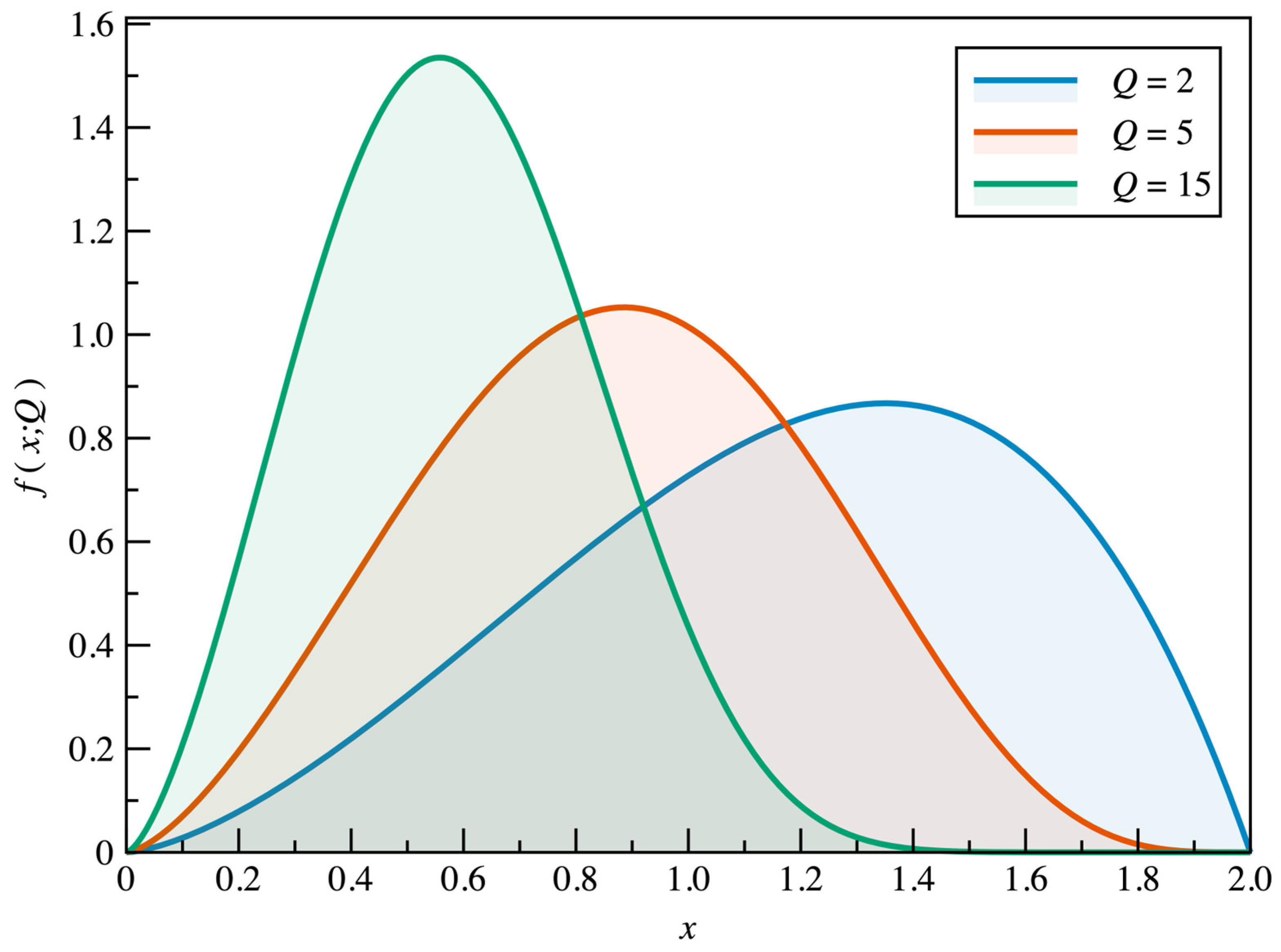
Based on the density functions above,
Figure 1 depicts the relationship between competitive bids and supply quantity. As supply increases, buyers’ bids gradually decline and converge to zero, which accords with standard economic intuition. It should also be noted that the main conclusions of this paper do not depend on the specific functional form assumed for the bid distribution.
The minimum trading unit of the flower auction is one bucket, and each bucket of the product discussed here contains 120 stems. Because the auction house quotes prices on a per-stem basis, substituting the parameter values above into the analytical expressions developed in this paper yields profit figures measured in yuan·bucket/stem. The actual settlement amount can therefore be obtained by multiplying these figures by 120. For ease of interpretation and direct comparison with the theoretical results in
Section 3,
Section 4 and
Section 5, all profit figures reported below are expressed in yuan·bucket/stem, without further conversion.
6.2. Design of Coordinating Contracts Under Guaranteed Auctions
First, we verify that the conventional commission contract fails to coordinate the supply chain. According to Proposition 1, together with standard optimization techniques, the system-optimal supply and selling strategy is given by and . Based on Equation (1), the corresponding expected profit of the supply chain is . When the supply chain operates under the commission auction contract, Proposition 3 implies that the seller’s optimal strategy is and . According to Equation (4), the seller’s expected profit is , while Equation (5) yields the auction house’s expected profit . Consequently, the expected profit of the entire supply chain is . Since , the commission contract fails to coordinate the supply chain, thereby validating Proposition 4.
We next present the design of coordinating contracts based on guaranteed auctions under the cooperative and non-cooperative game frameworks, respectively.
6.2.1. Coordinating Contract Design Under a Cooperative Game
Based on Proposition 6, under the cooperative game framework, all pairs of guaranteed auction contract parameters
that induce supply chain coordination satisfy the following relationship:
Note that guaranteed auctions typically require the guaranteed price
to be no lower than the salvage value
, and the surplus-sharing ratio
to be non-negative. As a result, the feasible range of
is restricted to the interval
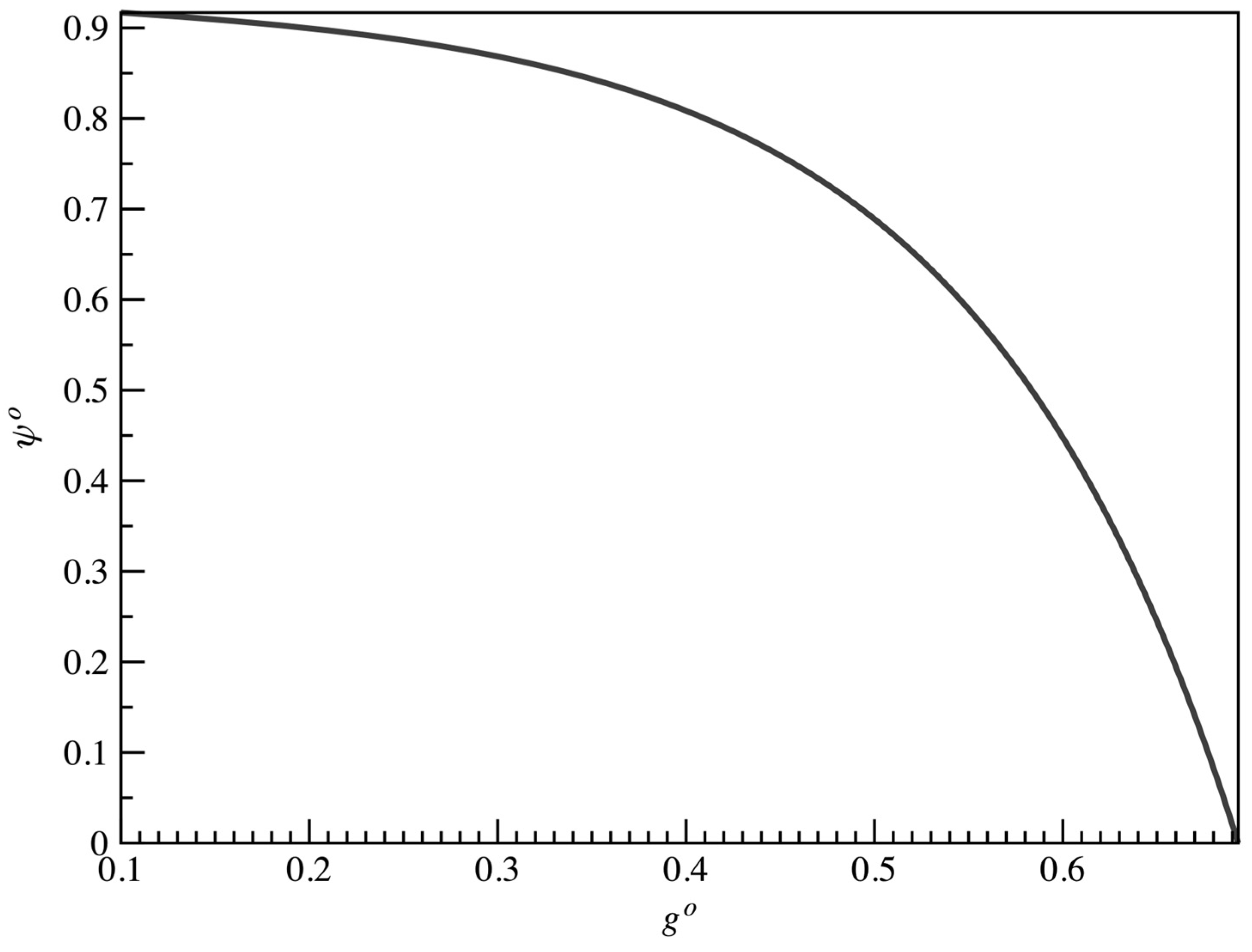
. Based on Equation (17), the functional relationship between
and
is depicted in
Figure 2. The figure clearly shows that the surplus-sharing ratio
decreases as the guaranteed price
increases, and that the rate of decrease becomes progressively steeper. This pattern is fully consistent with the analytical insights derived earlier.
Figure 2 indicates that there exist infinitely many combinations of
and
that can coordinate the supply chain. We select one such combination,
, for further analysis. Substituting this pair into Equations (8) and (9) yields the profit allocation reported in
Table 1. For ease of comparison, the table also presents the expected profit distribution under the commission contract.
The above numerical results demonstrate that the guaranteed auction indeed generates a Pareto improvement for both the seller and the auction house, successfully steering the auction supply chain toward a coordinated outcome. Note that
This equality implies that, after switching from the commission contract to the guaranteed auction contract, the increases in expected profits for the seller and the auction house are identical, reflecting the symmetry in their bargaining power. Moreover, since
, the seller’s disagreement payoff exceeds that of the auction house. Consequently, despite equal bargaining power, the final profit allocation favors the seller, with shares of
and
for the seller and the auction house, respectively.
6.2.2. Coordinating Contract Design Under a Non-Cooperative Game
According to Equation (15), under the non-cooperative game framework, the guaranteed auction contract parameters
that can coordinate the supply chain satisfy the following relationship:
If we set
, that is, if the profit allocation outcome under the non-cooperative game coincides with that under the cooperative game, the above relationship reduces to
Comparing this expression with Equation (17), we find that the coordinating contract parameters under the non-cooperative game framework exhibit the same functional structure as those under the cooperative framework, which is consistent with our earlier analytical predictions. It is worth noting that although the relationship between
and
mirrors that in the cooperative case, the feasible range of the guaranteed price
is further restricted by Equations (13) and (14) to the interval
. This additional restriction on the coordinating contract parameters can be interpreted as the necessary compromise arising from allowing the seller and the auction house to make decisions independently.
Under the non-cooperative game framework, the auction house, as the supply chain leader, can influence the profit-sharing ratio
among participants, as illustrated more clearly by the numerical example in
Section 6.3.3.
6.3. Risk–Return Profiles Under Alternative Contract Mechanisms
In multi-unit consignment auctions, uncertainty in buyers’ bids exposes the supply chain to the risk of asset losses while simultaneously creating opportunities to earn returns beyond expectations. This dual effect naturally raises the question of how risks and returns are allocated among supply chain members under commission-based and guaranteed auction mechanisms, and whether these mechanisms are capable of supporting stable long-term cooperation.
We measure the risk borne by each supply chain member using Conditional Value-at-Risk (CVaR) [
35]. Let
denote the loss incurred by a supply chain member in a given auction. The Value-at-Risk (VaR) at level
is defined as
which represents the maximum loss that the member may incur with probability
. The corresponding CVaR is given by
which captures the expected loss conditional on the loss exceeding the VaR threshold. This risk measure can be viewed as an extension of the approach adopted by Charlin and Cifuentes [
13]. Unlike their measures that rely solely on expected losses, CVaR evaluates tail losses at a given confidence level, thereby providing a more flexible and accurate representation of the heterogeneous risk tolerance across supply chain members.
Based on Equation (18), if we replace the loss variable
with a supply chain member’s profit
, the corresponding CVaR can be expressed as
This measure captures the average profit conditional on the profit exceeding
, that is, the expected profit under extremely favorable outcomes. To distinguish it from the conventional CVaR used to assess downside risk, we refer to this metric as Conditional Value-at-Return, denoted by CVaR
+.
We next apply Monte Carlo simulation techniques [
36,
37] to simulate auction outcomes under the numerical settings described above. Using CVaR and CVaR
+, we evaluate and compare the risks and returns borne by the seller and the auction house before and after the auction contract is modified.
6.3.1. Risk–Return Profiles Under the Commission Contract
To simulate the outcomes of consignment auctions, we independently draw
samples of the competitive bid
, thereby generating
bid vectors of dimension
, denoted by
(
). Each bid vector corresponds to one simulated auction outcome. Let
(
) denote the profit obtained by the seller from bid
. According to Equation (3), we have
Thus
denotes the seller’s total profit corresponding to bid vector
. We then reorder the realizations
in ascending order, and denote the
-th order statistic by
. Accordingly, based on Equation (18), the seller’s
-level CVaR for multi-unit consignment auctions can be expressed as
where
denotes the floor function. According to Equation (19), the seller’s
-level CVaR
+ is given by
The auction house’s CVaR and CVaR
+ can be derived in an analogous manner.
For the above experiment, we set
, corresponding to
simulated realizations of multi-unit consignment auctions. Based on these simulations, we estimate the CVaR and CVaR
+ for both the seller and the auction house under the commission contract at three confidence levels, namely
,
, and
(
,
and
). The resulting estimates are reported in
Table 2.
As shown in
Table 2, as
decreases from
to
, both CVaR and CVaR
+ increase for the seller and the auction house. This pattern arises because lower values of
capture more extreme loss and gain outcomes. For the seller, CVaR remains negative at
and
, indicating that the seller is profitable in most cases and thereby supporting the practical viability of the commission contract. However, as
declines further, the seller becomes exposed to the risk of loss. By contrast, the auction house’s CVaR remains negative throughout, and this pattern persists even at lower values of
. This contrast confirms our earlier conjecture that, under the conventional commission contract, market uncertainty is borne entirely by the seller. The auction house merely serves as an intermediary, earning revenue from the seller’s commission and the buyer’s premium, and thus operates in a risk-free manner.
6.3.2. Risk–Return Profiles Under Guaranteed Auctions with Cooperative Coordination
Since guaranteed auctions coordinate the supply chain, both the supply quantity and the reserve price differ from those under the commission-based mechanism. It is therefore necessary to re-simulate the auction outcomes. Specifically, we independently draw samples of the competitive bid , thereby generating bid vectors of dimension , denoted by (). The procedures for estimating the CVaR and CVaR+ for both the seller and the auction house are analogous to those described in the previous subsection and are therefore omitted for brevity.
Similarly, we analyze
randomly generated sets of buyers’ bid data. Note that there exist infinitely many combinations of coordinating contract parameters
. We select five representative cases and compute the CVaR and CVaR
+ at the
,
, and
levels for both the seller and the auction house under the corresponding guaranteed auction arrangements. The results are reported in
Table 3.
As shown in
Table 3, focusing on the rows corresponding to
reveals that as the guaranteed price
increases, the seller’s CVaR decreases, whereas the auction house’s CVaR increases. A similar pattern can be observed at
and
. This pattern indicates that the guaranteed auction contract reallocates the downside risk associated with unsold units between the seller and the auction house through the guaranteed price
. At the same time, the surplus-sharing ratio
decreases as
increases, ensuring that when the auction house bears a larger share of downside risk, it is compensated by a greater share of the upside gains generated by high buyer bids. Consequently, as reported in
Table 3, for both the seller and the auction house, CVaR
+ always moves in the same direction as the corresponding CVaR. These results indicate that, under the cooperative game framework, guaranteed auctions constitute a high-risk–high-return profit-sharing mechanism that is consistent with commonly accepted notions of fairness.
6.3.3. Risk–Return Profiles Under Guaranteed Auctions with Non-Cooperative Coordination
Under the non-cooperative game framework, the profit allocation rule embedded in the guaranteed auction contract remains unchanged; what differs are the specific values of the contract parameters
. Accordingly, we continue to employ the Monte Carlo simulation procedure and the simulated data described in
Section 6.3.2 to evaluate the CVaR and CVaR
+ for both the seller and the auction house under the non-cooperative setting.
As discussed earlier, under the non-cooperative game framework, the auction house can influence the profit shares allocated between supply chain members. To illustrate this effect, we consider five alternative values of
. In all cases, the guaranteed price is fixed at
, and we compute the CVaR and CVaR
+ at the
,
, and
levels for both the seller and the auction house. The resulting estimates are reported in
Table 4.
Table 4 contains two benchmark groups. The first is represented by the first three rows, where
, implying that the seller maintains the same expected profit as under the conventional commission contract. The second is represented by rows 4–6, where
, for which both the profit allocation and the associated risk–return profile coincide with those under the cooperative game framework when
. From the perspective of the auction house as the supply chain leader, however, the latter allocation is unlikely to be chosen. Instead, the auction house has a stronger incentive to adopt
, thereby appropriating the additional gains generated by shifting from the commission contract to the coordinating guaranteed auction contract. If feasible, it may even prefer a lower value of
, capturing a larger share of profit at the seller’s expense and weakening the seller’s financial buffer against risk.
Comparing the rows associated with a given value of clarifies the logic behind the auction house’s preference. As the seller’s profit share decreases, the seller’s CVaR increases, whereas its CVaR+ gradually decreases. By contrast, the auction house’s CVaR decreases, while its CVaR+ steadily increases. This risk–return pattern indicates that, under the non-cooperative game framework, a lower seller profit share allows the auction house to secure not only a larger share of total profit but also a more favorable risk exposure, characterized by lower downside risk and greater upside potential.
Yet the very asymmetry that favors the auction house also makes the supply chain more fragile. Under such an extremely asymmetric arrangement, even a small and unanticipated decline in demand, or a shift in the external competitive environment, may undermine the fragile balance of supply chain cooperation and trigger severe supply disruptions. The numerical results therefore suggest that it is myopic for the supply chain leader to rely solely on the non-cooperative mechanism to appropriate the entire coordination surplus. Because tail risks are distributed so unevenly, even a dominant platform should move toward the cooperative benchmark, which restores a more balanced allocation of risk and thereby strengthens the supply chain’s ability to withstand external shocks and sustain long-term operations.