Article

Sharpness Estimation of Hankel Determinants and Logarithmic Coefficients for a Family of Analytic Functions Related to a Lung-Shaped Domain


1
Department of Mathematics, Faculty of Science, Tanta University, Tanta 31527, Egypt
2
Department of Mathematics and Statistics, College of Science, Imam Mohammad Ibn Saud Islamic University (IMSIU), Riyadh 11564, Saudi Arabia
3
Department of Mathematics, College of Science, King Saud University, Riyadh 11421, Saudi Arabia
4
Department of Mathematics, Faculty of Science, Zagazig University, Zagazig 44519, Egypt
*
Author to whom correspondence should be addressed.
Mathematics 2026, 14(8), 1240; https://doi.org/10.3390/math14081240
Submission received: 4 March 2026 / Revised: 31 March 2026 / Accepted: 3 April 2026 / Published: 8 April 2026

Abstract

This investigation introduces a novel family of univalent analytic functions subordinate to lung-shaped domains within the open unit disk. Through rigorous application of subordination theory and systematic analysis, we establish coefficient bounds for the initial five coefficients, derive estimates for Hankel determinants of orders two and three, determine bounds for the first four logarithmic coefficients, and derive the bounds of some Zalcman functionals. The lung-shaped domain is characterized by the subordination condition involving a secant-based function, which maps the unit disk onto a geometrically distinctive region exhibiting bilateral symmetry. All obtained bounds are demonstrated to be sharp through the construction of specific extreme functions.

1. Introduction, Definitions and Notations

The theory of univalent analytic functions constitutes a fundamental domain within complex analysis, encompassing profound connections between geometric properties of image domains and analytic characteristics of analytic mappings. Since the pioneering investigations of the early twentieth century, researchers have systematically explored how geometric constraints on the range of a function impose specific restrictions on its coefficients and functional behavior.
Let A denote the family of all analytic functions ψ defined in the open unit disk D : = { ζ C : | ζ | < 1 } and normalized by the conditions ψ ( 0 ) = 0 and ψ ( 0 ) = 1 . Each function ψ A admits a Taylor–Maclaurin series expansion of the form:
ψ ( ζ ) = ζ + n = 2 α n ζ n .
Furthermore, let S denote the subfamily of A comprising all functions that are univalent (injective) in D . The systematic study of coefficient estimates for functions in S has yielded numerous significant results, culminating in de Branges’ 1985 proof of the Bieberbach conjecture [1], which established that | a n | n for all ψ S and n 2 .
The concept of subordination [1] provides an elegant mechanism for defining function families through geometric constraints. Given two functions ψ and ϕ in A , the function ψ is said to be subordinate to ϕ in D , denoted ψ ϕ , if there exists a Schwarz function r ( ζ ) , analytic in D , satisfying:
r ( 0 ) = 0 and r ( ζ ) < 1 for all ζ D ,
such that ψ ( ζ ) = ϕ ( r ( ζ ) ) for all ζ D . When the function ϕ is univalent in D , the subordination relationship simplifies to the equivalent geometric condition:
ψ ( ζ ) ϕ ( ζ ) ψ ( 0 ) = ϕ ( 0 ) and ψ ( D ) ϕ ( D ) .
This equivalence demonstrates that subordination effectively encodes the geometric requirement that the image of ψ lies within the image of ϕ , providing a powerful analytical tool for studying functions with prescribed geometric properties.
Ma and Minda [2] proposed a comprehensive framework for starlike and convex functions subject to particular functions, leading to further research. Their approach defines families through conditions of the form:
ζ ψ ( ζ ) ψ ( ζ ) ϕ ( ζ ) ,
where ϕ is a prescribed univalent function with positive real part. Subsequent research explored various choices of ϕ . Recent research has integrated special functions, including Bessel functions, hypergeometric functions, and transcendental functions, as subordinating functions. El-Qadeem et al. [3,4] investigated bi-univalent functions associated with Einstein functions, establishing coefficient bounds and Fekete–Szegö inequalities. This approach demonstrates how transcendental subordinating functions yield novel function families with distinctive analytic and geometric properties.
The logarithmic coefficients β n of a function ψ S are defined through the expansion:
F ψ ( ζ ) : = log ψ ( ζ ) ζ = 2 n = 1 β n ζ n . ( ζ D )
These coefficients reflect significant geometric information and arise naturally in many extremal applications. Milin [5] established their significance in proving partial results toward the Bieberbach conjecture. De Branges [6] proved the Milin Conjecture, which states that for a univalent function ψ S , the logarithmic coefficients β n satisfy:
m = 1 n j = 1 m j | β | 2 1 j 0 for all n 1 .
Recently, the study of logarithmic coefficient bounds has experienced renewed interest in contemporary geometric function theory, particularly for functions subordinate to specific domains; see [7,8,9,10].
The Hankel determinant is a classical and powerful tool in mathematical analysis with a rich history and broad relevance across several branches of mathematics. Originally arising in the theory of continued fractions and moment problems, Hankel determinants have become indispensable in the study of analytic and univalent functions. Hankel determinants emerge as indispensable analytical instruments for investigating relationships among coefficients of analytic functions. A Hankel matrix is constructed from a sequence of coefficients, and its determinant reflects intrinsic properties of the function represented by that sequence. Within geometric function theory, the magnitude and characteristics of Hankel determinants provide valuable insights into univalence, starlikeness, convexity, and other geometric attributes.
The systematic study of Hankel determinants in the context of univalent functions was initiated by Pommerenke [11,12], and subsequently developed by Noonan and Thomas [13], who established the general q-th order Hankel determinant framework as follows:
H q , n ( ψ ) = α n α n + 1 α n + q 1 α n + 1 α n + 2 α n + q . . . . . . . . . . . . α n + q 1 α n + q α n + 2 q 2 , ( α 1 = 1 ) .
Of particular significance are the second-order Hankel determinants:
H 2 , 1 ( ψ ) = α 1 α 2 α 2 α 3 and H 2 , 2 ( ψ ) = α 2 α 3 α 3 α 4 .
Beyond their intrinsic theoretical interest, they arise naturally in practical problems involving conformal mappings, fluid dynamics, and the study of dynamical systems. The second-order Hankel determinant H 2 , 1 ( ψ ) = α 3 α 2 2 encodes the classical Fekete–Szegö functional, which has been central to coefficient problems since the foundational work of Fekete and Szegö [14]. Estimating sharp bounds for higher-order Hankel determinants particularly H 2 , 2 ( ψ ) and H 3 , 1 ( ψ ) remains one of the most active and challenging problems in geometric function theory, as these quantities capture deeper structural information about the geometry of the image domain and the distribution of the Taylor coefficients of the function under consideration. Recent investigations (see [15,16,17,18,19,20]) have established bounds for H 2 , 2 and H 3 , 1 across various subfamilies of S , employing techniques from convexity theory, majorization, and complex optimization.
Closely related to the Hankel determinant framework is the Zalcman functional [21,22], introduced by Zalcman as a powerful tool for investigating coefficient relationships in univalent function theory. For a function ψ A , the generalized Zalcman functional is defined by:
Φ n , m ( ψ ) = α n + m 1 α n α m ,
where n , m 2 are positive integers. The most extensively studied case corresponds to n = m = 2 , yielding:
Φ 2 , 2 ( ψ ) = α 3 α 2 2 ,
which represents a specific linear combination arising in determinant expansions. The relationship:
H 2 , 1 ( ψ ) = α 3 α 2 2 = Φ 2 , 2 ( ψ ) ,
demonstrates that the Fekete–Szegö problem constitutes a special case of Zalcman functional estimation. More generally, Hankel determinants can be expressed as sums of products involving Zalcman-type terms, establishing deep connections between these coefficient functionals.
Zalcman conjectured that for ψ S , the inequality
| α n 2 α 2 n 1 | ( n 1 ) 2 , ( n 2 )
holds, with equality achieved for the Koebe function ψ ( ζ ) = ζ ( 1 ζ ) 2 and its rotations. While this conjecture remains unresolved in general, substantial progress has been achieved for specific subfamilies of univalent functions. Ravichandran et al. [22] deduced that | α 3 α 2 2 |   2 ( 1 α ) for the function belongs to the starlike family of order α . This hypothesis involves the well-known Bieberbach conjecture | α n |   n . The Bieberbach Theorem [23] demonstrates the validity of the Zalcman conjecture for n = 2 . Kruskal [24] formulated the conjecture for n = 3 and subsequently for n = 4 , 5 , 6 . The Zalcman conjecture remains unresolved for n > 6 .
Recent developments in geometric function theory have witnessed substantial interest in function families defined through subordination to domains possessing distinctive geometric characteristics. This approach connects abstract analytical characteristics to specific geometric schemes, leading to families with clear graphical representations. Notable examples include:
  • Cardioid domains: Functions whose derivatives are subordinate to mappings producing cardioid-shaped images; see [25,26,27].
  • Nephroid domains: Families associated with kidney-shaped regions; see [18,28].
  • Lemniscate domains: Functions related to Bernoulli lemniscates; see [29,30].
  • Exponential and trigonometric domains: Families subordinate to images of exponential or trigonometric functions; see [16,31,32,33].
  • Limacon-Shaped Domain: Functions subordinate to images of the function ϕ ( ζ ) = 1 + 2 ζ + 1 2 ζ 2 ; see [34].
These investigations demonstrate that specific geometric constraints yield tractable analytical problems while maintaining mathematical depth and applicability.
Natural forms provide geometrically rich yet mathematically tractable domains that may model physical phenomena while offering novel theoretical challenges. Examples include leaf-shaped domains, petal-shaped regions, and anatomically inspired configurations.

2. The Lung-Shaped Domain and Auxiliary Tools

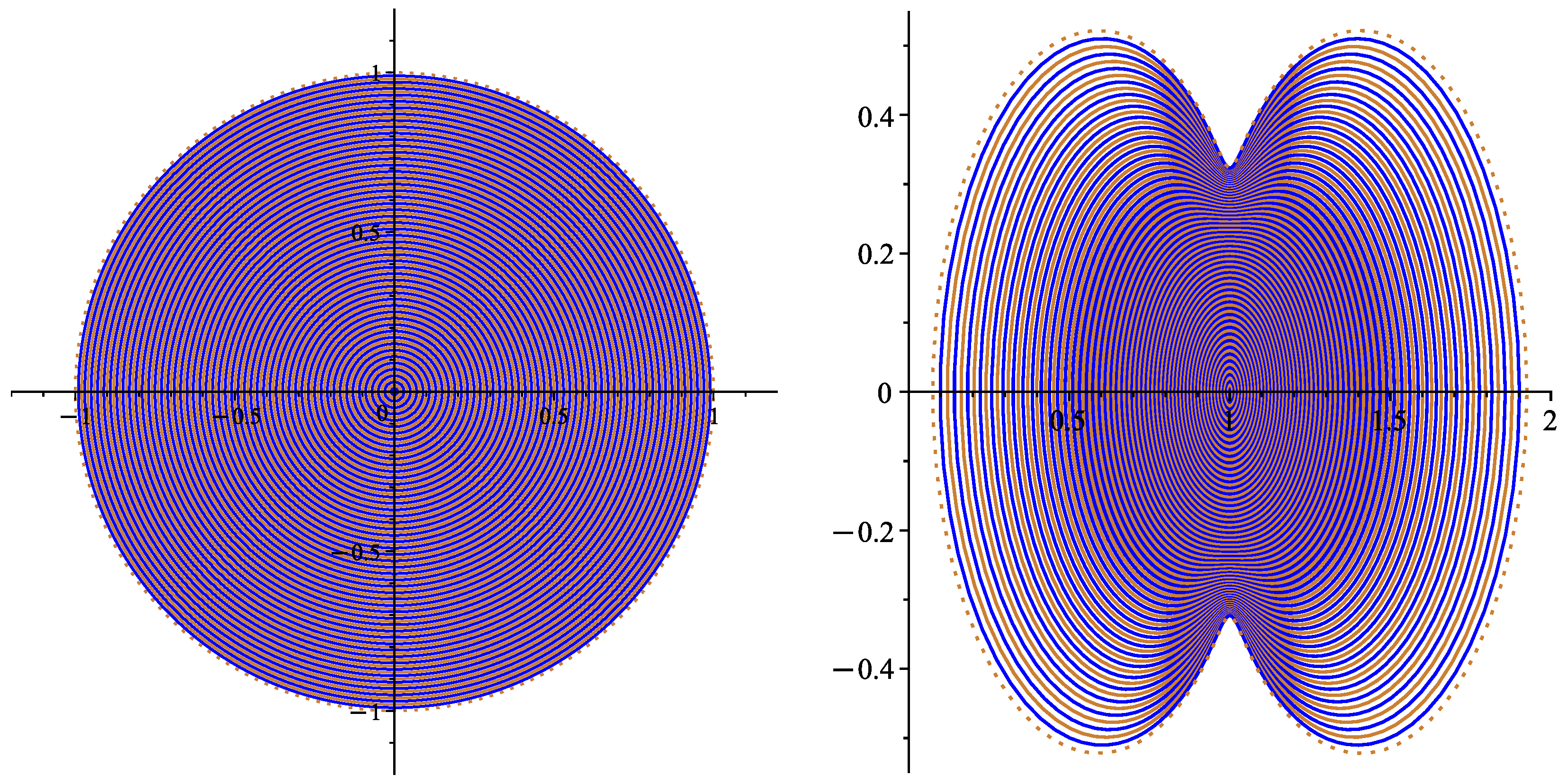
In this part, we introduce the function L ( ζ ) = 1 + ζ 2 sec ( ζ ) , which maps the unit open disk D into a lung-shaped domain as illustrated in Figure 1, and so a new subfamily of bounded turning functions associated with a lung-shaped domain are investigated.
The subordinating function L ( ζ ) possesses a positive real part in D and maps the unit disk onto a region exhibiting distinctive geometric characteristics. The presence of the secant function introduces periodic behavior that, when restricted to the unit disk, generates a domain with bilateral extensions and bounded curvature.
Definition 1.
Let ψ, denoted by (1), be a member of the family A and fulfill
ψ ( ζ ) L ( ζ ) . ( ζ D )
Consequently, ψ is a member of the family M L .
In other words, ψ M L if and only if ψ ( D ) L ( D ) ; that is, the derivative of ψ takes values exclusively within the lung-shaped domain. This is the defining geometric constraint that governs all subsequent coefficient estimates. Before stating the key lemmas, we fix notation and recall the analytical framework that underlies all subsequent proofs. This preliminary material allows the reader to follow the logical thread of the coefficient calculations as a coherent mathematical argument rather than a sequence of isolated algebraic steps.
  • Schwarz function and subordination representation. Since ψ ( ζ ) L ( ζ ) , there exists a Schwarz function  r : D D , analytic in D with r ( 0 ) = 0 and | r ( ζ ) | < 1 for all ζ D , such that
    ψ ( ζ ) = L r ( ζ ) . ( ζ D )
    Writing the power-series expansion of r as
    r ( ζ ) = n = 1 c n ζ n = c 1 ζ + c 2 ζ 2 + c 3 ζ 3 + , | c n | 1 ,
    and substituting into (4), a term-by-term expansion of L ( r ( ζ ) ) in powers of ζ yields explicit expressions for the Taylor coefficients α n of ψ in terms of c 1 , c 2 , .
  • Carathéodory family and the function χ . A key bridge between the subordination condition (4) and classical coefficient methods is provided by the Carathéodory family P , consisting of all analytic functions χ : D C with χ ( 0 ) = 1 and Re χ ( ζ ) > 0 for ζ D , admitting the Taylor expansion
    χ ( ζ ) = 1 + n = 1 η n ζ n = 1 + η 1 ζ + η 2 ζ 2 + η 3 ζ 3 + .
    The connection to the Schwarz function r is established via the standard Möbius-type relation
    χ ( ζ ) = 1 + r ( ζ ) 1 r ( ζ ) , equivalently , r ( ζ ) = χ ( ζ ) 1 χ ( ζ ) + 1 ,
    which allows one to translate bounds on | r ( ζ ) | into the well-developed coefficient theory for P .
Proof strategy.
The overall strategy of the coefficient analysis is as follows.
(i)
Express ψ ( ζ ) = L ( r ( ζ ) ) and expand both sides as power series in ζ , equating coefficients to obtain α n in terms of c 1 , , c n 1 .
(ii)
Pass from the Schwarz coefficients c n to the Carathéodory coefficients η n via (7), exploiting the classical bounds | η n |   2 and the Carathéodory parametrization recalled in Lemma 2 below.
(iii)
Apply sharp estimates for | η n | and related functionals (Lemmas 1 and 2) to obtain the stated bounds on | α n | , and verify sharpness by exhibiting extremal functions.
This three-step scheme transforms what might otherwise appear as a collection of routine calculations into a transparent and systematic mathematical argument.
The following lemmas provide the technical foundation for Steps (i)–(iii). Lemma 1 records the classical sharp bounds on the coefficients of P and supplies the Fekete–Szego-type inequality that controls mixed coefficient functionals. Also, Lemmas 2 and 3 give the Carathéodory parametric representation that is essential for the higher-order estimates of α 4 , α 5 , and the Hankel determinants.

3. Set of Lemmas

Let P be the family of analytic functions χ satisfying χ ( 0 ) = 1 and ( χ ( ζ ) ) > 0 for ζ D , characterized by the Taylor–Maclaurin series illustrated in (6). The subsequent lemmas assist in demonstrating our fundamental desirable outcomes, involving η n , η n + m , and η n + 2 m for n , m N are the coefficients of the Taylor–Maclaurin series (6).
Lemma 1
([11]). Let χ be an element of the family P . The subsequent inequalities are valid:
| η n |   2 , for all n N ;
| η n + m ν η n η m |   2 , for 0 ν 1 ;
| η n + 2 m ν η n η m 2 |   2 ( 1 + 2 ν ) , for 0 ν 1 ;
| η 2 1 2 η 1 2 |   2 1 2 | η 1 | 2 .
Lemma 2
([11,35,36,37]). Let χ, given by (6), be an element of the family P with η 1 0 . Then,
η 2 = 1 2 η 1 2 + μ 4 η 1 2 ; η 3 = 1 4 η 1 3 + η 1 μ ( 2 μ ) 4 η 1 2 + 2 γ 4 η 1 2 1 | μ | 2 ; η 4 = 1 8 [ η 1 4 + μ 4 η 1 2 4 μ + η 1 2 μ 2 3 μ + 3 4 4 η 1 2 1 | μ | 2 η 1 γ ( μ 1 ) + μ ¯ γ 2 κ 1 | γ | 2 ] .
where μ , γ , κ D ¯ : = { z C : | z | 1 } , depending on χ.
In Lemma 2, the complex numbers μ , γ , and κ are the Carathéodory parameters associated with χ , arising from the canonical representation of functions in the family P .
Lemma 3
([38]). Let χ, given by (6), be an element of the family P , where 0 δ 1 and δ ( 2 δ 1 ) ε δ ; then, the subsequent inequality is valid:
η 3 2 δ η 1 η 2 + ε η 1 3 2 .
Lemma 4
([39]). Let λ 1 , λ 2 and λ 3 be numbers such that λ 1 0 , λ 2 C , and λ 3 R . Also suppose χ P of the form (6). Define Λ + ( η 1 , η 2 ) and Λ ( η 1 , η 2 ) by
Λ + ( η 1 , η 2 ) = λ 2 η 1 2 λ 3 η 2 λ 1 | η 1 | ; Λ ( η 1 , η 2 ) = Λ + ( η 1 , η 2 ) .
Then,
Λ + ( η 1 , η 2 ) | 4 λ 2 + 2 λ 3 | 2 λ 1 , | 2 λ 2 + λ 3 | | λ 3 | + λ 1 , 2 | λ 3 | , | 2 λ 2 + λ 3 | < | λ 3 | + λ 1 .
and,
Λ ( η 1 , η 2 ) 2 λ 1 λ 4 , λ 1 λ 4 + 2 | λ 3 | 2 λ 1 2 | λ 3 | λ 4 + 2 | λ 3 | , λ 1 2 2 | λ 3 | λ 4 + 2 | λ 3 | 2 | λ 3 | + λ 1 2 λ 4 + 2 | λ 3 | , Otherwise .
where λ 4 = 4 λ 2 + 2 λ 3 . All inequalities in (12) and (13) are sharp.
  • The principal aims of this investigation are:
    (I)
    Initial Taylor–Maclaurin Coefficient Estimation. To establish sharp bounds for the coefficients | α 2 | , | α 3 | , | α 4 | , and | α 5 | for functions ψ M L . These coefficients are the most fundamental geometric descriptors of the mapping ψ , encoding information about its local distortion and the shape of the image domain; their estimation is the natural starting point for any systematic study of a new function family.
    (II)
    Logarithmic Coefficient Bounds. To determine sharp bounds for the logarithmic coefficients β 1 , β 2 , β 3 , and β 4 . These coefficients control the distortion of the function log ( ψ ( ζ ) / ζ ) and play a central role in the Milin–Lebedev inequalities, which in turn underlie de Branges’ celebrated proof of the Bieberbach conjecture.
    (III)
    Moduli Differences in Logarithmic Coefficients. To establish a sharp bound for the difference | β 2 | | β 1 | . Such difference estimates refine the individual bounds obtained in (ii) by capturing the relative growth of successive logarithmic coefficients, a question that has attracted considerable attention in the recent literature on coefficient problems for subfamilies of univalent functions.
    (IV)
    Hankel Determinant Analysis. To derive sharp estimates for the Hankel determinants H 2 , 1 ( ψ ) , H 2 , 2 ( ψ ) , and H 3 , 1 ( ψ ) . These determinants encode deeper structural information about the Taylor coefficients than individual bounds can provide: H 2 , 1 recovers the classical Fekete–Szegö functional, while H 2 , 2 and H 3 , 1 measure higher-order coefficient interactions and have direct connections to the theory of Padé approximants and the study of bounded-characteristic functions.
    (V)
    Zalcman Functional Bounds. To obtain a sharp bound for the Zalcman functional Φ 2 , 2 ( ψ ) = α 2 α 4 α 3 2 . The Zalcman conjecture, which asserts that | α n 2 α 2 n 1 |   ( n 1 ) 2 for every univalent function, has stimulated a rich body of research; establishing its sharp form for the family M L contributes to this programme and complements the Hankel determinant estimates in (iv).
    (VI)
    Sharpness Verification. To demonstrate that every bound obtained in (i)–(v) is sharp by constructing explicit extremal functions. Sharpness is the hallmark of a complete coefficient result: it confirms that the estimates cannot be improved and identifies the functions at which equality is attained, thereby giving a precise geometric characterization of the extremal configurations within M L .

4. Initial Coefficient Bounds

Theorem 1.
Let ψ be a member of the family M L . Then,
| α 2 | 1 4 , | α 3 | 1 6 , | α 4 | 1 8 , and | α 5 | 1 10 .
The result is sharp for
ψ 1 ( ζ ) = 0 ζ 1 + t 2 sec ( t ) d t = ζ + ζ 2 4 + ζ 4 16 + ,
ψ 2 ( ζ ) = 0 ζ 1 + t 2 2 sec ( t 2 ) d t = ζ + ζ 3 6 + ζ 7 28 + ,
ψ 3 ( ζ ) = 0 ζ 1 + t 3 2 sec ( t 3 ) d t = ζ + ζ 4 8 + ζ 10 40 + ,
ψ 4 ( ζ ) = 0 ζ 1 + t 4 2 sec ( t 4 ) d t = ζ + ζ 5 10 + ζ 13 52 + .
Proof of Theorem 1.
Since ψ is belonging to the family M L , based on (3); there exists a Schwarz function r ( ζ ) that produces
ψ ( ζ ) = L ( r ( ζ ) ) .
From (1), we derive
ψ ( ζ ) = 1 + n = 2 n α n ζ n 1 .
Furthermore, let χ ( ζ ) P be expressed as
χ ( ζ ) = 1 + r ( ζ ) 1 r ( ζ ) = 1 + η 1 ζ + η 2 ζ 2 + η 3 ζ 3 + .
This indicates that
r ( ζ ) = χ ( ζ ) 1 χ ( ζ ) + 1 = η 1 2 ζ + 1 2 η 2 η 1 2 2 ζ 2 + 1 2 η 3 η 1 η 2 + η 1 3 4 ζ 3 + 1 2 η 4 η 1 η 3 + 3 4 η 1 2 η 2 1 8 η 1 4 1 2 η 2 2 ζ 4 + .
Therefore,
L ( r ( ζ ) ) = 1 + 1 4 η 1 ζ + 1 4 η 2 1 2 η 1 2 ζ 2 + 1 4 η 3 η 1 η 2 + 3 8 η 1 3 ζ 3 + 1 4 η 4 η 1 η 3 + 9 8 η 1 2 η 2 5 16 η 1 4 1 2 η 2 2 ζ 4 + .
By substituting (19) and (20) into (18) along with comparing the coefficients on the two different sides, we acquire
α 2 = 1 8 η 1 ;
α 3 = 1 12 η 2 1 2 η 1 2 ;
α 4 = 1 16 η 3 η 1 η 2 + 3 8 η 1 3 ;
α 5 = 1 20 η 4 η 1 η 3 + 9 8 η 1 2 η 2 5 16 η 1 4 1 2 η 2 2 .
By applying (8) and (9) in conjunction with (21) and (22), we obtain
| α 2 |   1 4 , and | α 3 | 1 6 .
Making use of Lemma 3 to (23), we derive
| α 4 |   1 8 .
By assigning η 1 = η and use of Lemma 2, (24) simplifies to
α 5 = 1 20 u 1 ( η , μ ) + u 2 ( η , μ ) γ + u 3 ( η , μ ) γ 2 + u 4 ( η , μ , γ ) κ ,
where
u 1 ( η , μ ) = 1 8 η 2 μ ( 4 η 2 ) μ 2 + μ + 3 2 ; u 2 ( η , μ ) = 1 2 η μ ( 4 η 2 ) ( 1 | μ | 2 ) ; u 3 ( η , μ ) = 1 2 μ ¯ ( 4 η 2 ) ( 1 | μ | 2 ) ; u 4 ( η , μ , γ ) = 1 2 ( 4 η 2 ) ( 1 | μ | 2 ) ( 1 | γ | 2 ) .
Let | γ | = x [ 0 , 1 ] and | κ | 1 , then
| α 5 | 1 20 | u 1 ( η , μ ) | + | u 2 ( η , μ ) | x + | u 3 ( η , μ ) | x 2 + | u 4 ( η , μ , γ ) | ; = 1 20 v 1 ( η , μ ) + v 2 ( η , μ ) x + v 3 ( η , μ ) x 2 + v 4 ( η , μ ) ( 1 x 2 ) ; = 1 20 T ( η , μ , x ) ,
in which
v 1 ( η , μ ) = 1 8 η 2 | μ | ( 4 η 2 ) | μ | 2 + | μ | + 3 2 ; v 2 ( η , μ ) = 1 2 η | μ | ( 4 η 2 ) ( 1 | μ | 2 ) ; v 3 ( η , μ ) = 1 2 | μ | ( 4 η 2 ) ( 1 | μ | 2 ) ; v 4 ( η , μ ) = 1 2 ( 4 η 2 ) ( 1 | μ | 2 ) .
In the remainder of this investigation, we consider μ = | μ | [ 0 , 1 ] . To evaluate the maximum values of the function T ( η , μ , x ) within the closed cuboid Ω = [ 0 , 2 ] × [ 0 , 1 ] × [ 0 , 1 ] , it is necessary to analyze the function T ( η , μ , x ) both within the cuboid and on its faces and edges. We intend to divide the analysis into three distinct cases.
 I. 
Interior points of cuboid
We attempt to determine a maximum of T ( η , μ , x ) within the interior of the cuboid. Let ( η , μ , x ) ( 0 , 2 ) × ( 0 , 1 ) × ( 0 , 1 ) .
Considering T x = 0 yields x = η μ 1 μ = x 0 . The point x 0 is critical within the interval ( 0 , 1 ) if the inequality ( η + 1 ) μ < 1 holds.
After simple calculations, we get that x 0 ( 0 , 1 ) does not hold for μ ( 1 3 , 1 ) . Consequently, it may be deduced that the function T ( η , μ , x ) does not contain critical points throughout the interior of the cuboid ( 0 , 2 ) × ( 1 3 , 1 ) × ( 0 , 1 ) .
Assume ( η , μ , x ) to be a critical point of T ( η , μ , x ) located within the interior of the cuboid defined by the intervals ( 0 , 2 ) × ( 0 , 1 3 ) × ( 0 , 1 ) . Given that 0 < μ < 1 3 , it may be mentioned that
v 1 ( η , μ ) v 1 η , 1 3 = 35 432 η 2 ( 4 η 2 ) = ω 1 ( η ) ; v 2 ( η , μ ) v 2 η , 1 3 = 8 27 η ( 4 η 2 ) = ω 2 ( η ) ; v 3 ( η , μ ) v 3 η , 1 3 = 4 27 ( 4 η 2 ) = ω 3 ( η ) ; v 4 ( η , μ ) v 4 η , 1 3 = 4 9 ( 4 η 2 ) = ω 4 ( η ) .
Consequently,
T ( η , μ , x ) ω 1 ( η ) + ω 4 ( η ) + ω 2 ( η ) x + [ ω 3 ( η ) ω 4 ( η ) ] x 2 = φ 1 ( η , x ) .
By assuming φ 1 x = 0 , which indicates x = 1 2 η . Although, ω 3 ( η ) ω 4 ( η ) < 0 , it ensues that
φ 1 ( η , x ) φ 1 η , 1 2 η ; = 67 432 η 4 + 19 108 η 2 + 16 9 = ϕ 1 ( η ) .
Establishing ϕ 1 η = 0 yields η = 2546 67 , which represent a local maximum of ϕ 1 ( η ) . As a result,
ϕ 1 ( η ) ϕ 1 2546 67 = 13225 7236 .
Therefore,
T ( η , μ , x ) 13225 7236 ,
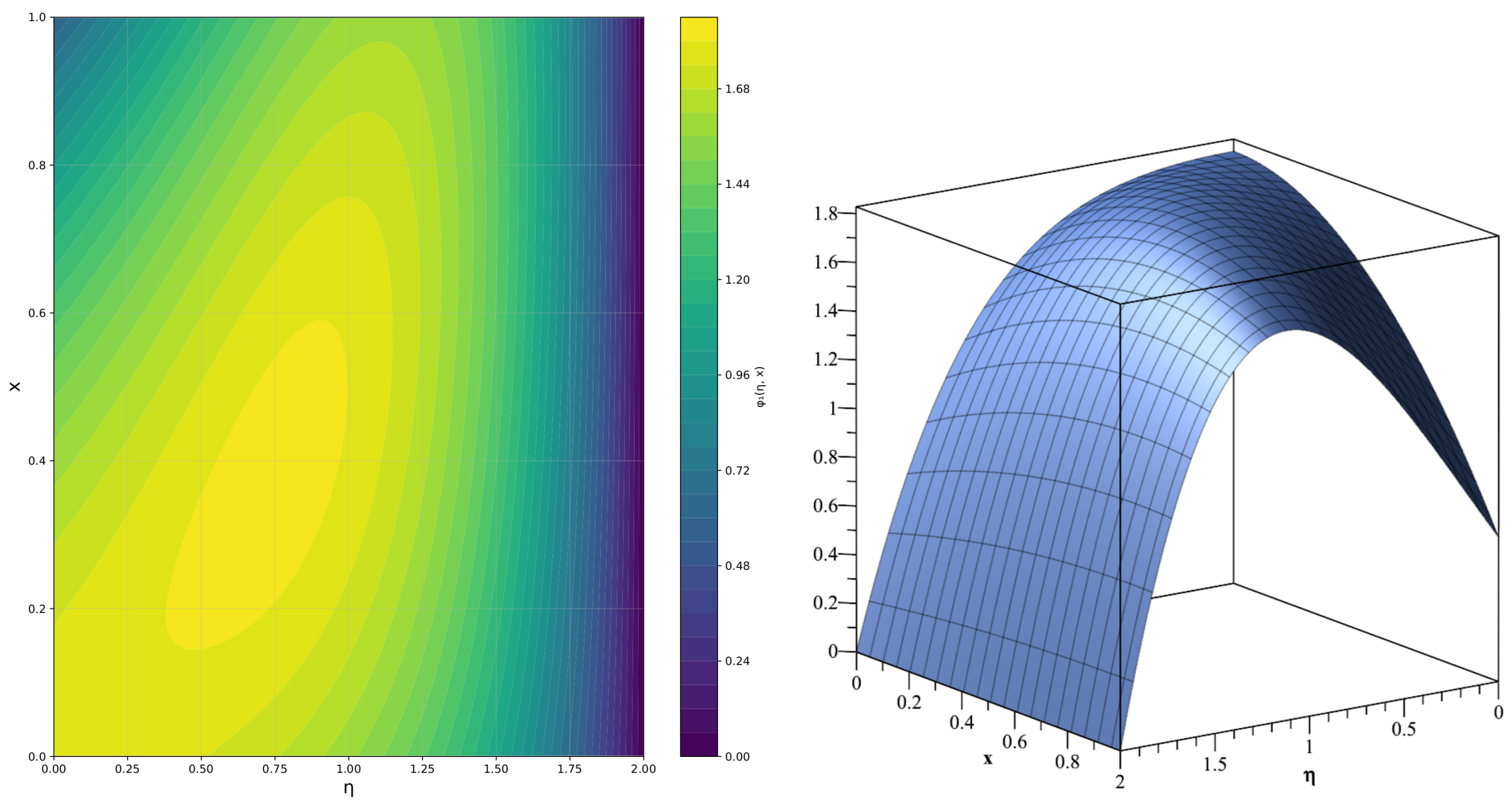
which agree with the behavior of φ 1 ( η , x ) shown in Figure 2.
 II. 
On the six faces of the cuboid
Subsequently, we aim to determine the maximum possible value of the function T ( η , μ , x ) across all six sides of the cuboid Ω .
(i)
Regarding the face η = 0 , T ( η , μ , x ) is transformed into
F 1 ( μ , x ) = 2 ( 1 μ 2 ) [ 1 + ( μ 1 ) x 2 ] .
Following that
F 1 x = 4 ( 1 μ 2 ) ( μ 1 ) x 0 for all x ( 0 , 1 ) .
Consequently, F 1 ( μ , x ) has no optimal points in the region ( 0 , 1 ) × ( 0 , 1 ) .
(ii)
Regarding the face η = 2 , T ( η , μ , x ) is turned to
T ( η , μ , x ) = 0 .
(iii)
Regarding the face μ = 0 , T ( η , μ , x ) is converted to
F 2 ( η , x ) = 1 2 ( 4 η 2 ) ( 1 x 2 ) .
Following that
F 2 x = ( 4 η 2 ) x 0 for all x ( 0 , 1 ) .
Consequently, F 2 ( η , x ) has no any optimal points within the region ( 0 , 2 ) × ( 0 , 1 ) .
(iv)
Regarding the face μ = 1 , T ( η , μ , x ) is evolved to
F 3 ( η , x ) = 7 16 η 2 ( 4 η 2 ) .
By setting F 3 η = 0 , we identify the critical point η = 2 , at which F 3 ( η , x ) reaches its maximum value; specifically,
F 3 ( η , x ) F 3 ( 2 , x ) = 7 4 .
(v)
Regarding the face x = 0 , T ( η , μ , x ) is transformed to
F 4 ( η , μ ) = 1 2 ( 4 η 2 ) 1 4 η 2 μ ( μ 2 + μ + 3 2 ) + 1 μ 2 .
Based on optimization, we deduce that the system of equations F 4 η = 0 and F 4 μ = 0 has a distinct solution within the region ( 0 , 2 ) × ( 0 , 1 ) , referred to as ( η , μ ) ( 1.130144 , 0.640259 ) . Given that,
2 F 4 η 2 2 F 4 μ 2 2 F 4 η μ < 0 .
Consequently, F 4 ( η , μ ) has no extreme points.
(vi)
Regarding the face x = 1 , T ( η , μ , x ) is converted to
F 5 ( η , μ ) = 1 2 μ ( 4 η 2 ) 1 4 η 2 ( μ 2 + μ + 3 2 ) + ( 2 η + 1 ) ( 1 μ 2 ) .
Through a series of complicated steps, we conclude that the system of equations F 5 η = 0 and F 5 μ = 0 has no possible solutions within the area ( 0 , 2 ) × ( 0 , 1 ) .
 III. 
On the twelve edges of the cuboid
Finally, we have to establish the maximum of T ( η , μ , x ) along the twelve edges of the cuboid Ω .
 (i) 
On μ = 0 and x = 0 , T ( η , μ , x ) turns to
F 6 ( η ) = 1 2 ( 4 η 2 ) .
It appears that F 6 η < 0 for η ( 0 , 2 ) , indicating that F 6 ( η ) is a decreasing function, with its maximum value established as follows:
F 6 ( η ) F 6 ( 0 ) = 2 .
 (ii) 
On η = 2 (similarly μ = 0 and x = 1 & η = 0 and μ = 1 ), we have
T ( η , 0 , 1 ) = T ( 0 , 1 , x ) = T ( 2 , 0 , x ) = T ( 2 , 1 , x ) = T ( 2 , μ , 0 ) = T ( 2 , μ , 1 ) = 0 .
 (iii) 
On μ = 0 and η = 0 , T ( η , μ , x ) transforms into
F 7 ( x ) = 2 ( 1 x 2 ) .
It appears that F 7 x < 0 for x ( 0 , 1 ) , indicating that F 7 ( x ) is a decreasing function, with its maximum value established as follows:
F 7 ( x ) F 7 ( 0 ) = 2 .
 (iv) 
On μ = 1 and x = 0 (similarly for μ = 1 and x = 1 ), T ( η , μ , x ) converts to
F 8 ( η ) = 7 16 η 2 ( 4 η 2 ) .
Providing F 8 η = 0 yields a critical point at η = 2 . However, d 2 F 8 d η 2 < 0 , indicating that F 8 ( η ) reaches its maximum value at η = 2 as follows:
F 8 ( η ) F 8 ( 2 ) = 7 4 .
 (v) 
On η = 0 and x = 0 , T ( η , μ , x ) evolves into
F 9 ( μ ) = 2 ( 1 μ 2 ) .
It is worth noting that F 9 μ < 0 for μ ( 0 , 1 ) , indicating that F 9 ( μ ) is a decreasing function, with its maximum value derived to be as follows:
F 9 ( μ ) F 9 ( 0 ) = 2 .
 (vi) 
On η = 0 and x = 1 , T ( η , μ , x ) transforms into
F 10 ( μ ) = 2 μ ( 1 μ 2 ) .
Providing F 10 μ = 0 generates a critical point at μ = 1 3 . However, 2 F 10 μ 2 < 0 , implying that F 10 ( μ ) approaches its maximum value at μ = 1 3 as follows:
F 10 ( μ ) F 10 1 3 = 4 3 9 .
Upon having finished the last procedures, we can verify that
T ( η , μ , x ) 2 .
Based on (26), we are going to deduce that
| α 5 | 1 10 .
Therefore, we finally finished all of the proof. □

5. The Logarithmic Coefficients Estimate

The next part will discuss how to estimate the upper bounds for the logarithmic coefficients of functions in the family M L . The coefficients β n : = β n ( ψ ) , in which n N , of the logarithmic function corresponding to ψ S are identified by
F ψ ( ζ ) : = log ψ ( ζ ) ζ = 2 n = 1 β n ζ n . ( ζ D ) .
It is easy to establish the logarithmic coefficients for functions ψ M L because the subordinated function χ ( ζ ) = 1 + ζ 2 sec ( ζ ) has a positive real part over D and M L S .
Theorem 2.
Let ψ be a member of the family M L . Then, the logarithmic coefficients are estimated as follows:
| β 1 |   1 8 , | β 2 |   1 12 , | β 3 |   1 16 , and | β 4 | 0.056686 .
Proof of Theorem 2.
Since ψ is a member of the family M L , it takes the form (1); the logarithmic function is denoted by
F ψ ( ζ ) = α 2 ζ + α 3 ζ 2 + α 4 ζ 3 + 1 2 α 2 ζ + α 3 ζ 2 + α 4 ζ 3 + 2 + 1 3 α 2 ζ + α 3 ζ 2 + α 4 ζ 3 + 3 + . ( ζ D )
By equating the first four coefficients of (27) with those of (28), we obtain
2 β 1 = α 2 , 2 β 2 = α 3 1 2 α 2 2 , 2 β 3 = α 4 α 2 α 3 + 1 3 α 2 3 , 2 β 4 = α 5 α 2 α 4 + α 2 2 α 3 1 2 α 3 2 1 4 α 2 4 .
Applying an identical technique as in the proof of the Theorem 1, replacing in (29) the values of α 2 , α 3 , α 4 and α 5 from the relations (21), (22), (23) and (24), we have
β 1 = η 1 16 ;
β 2 = 1 24 η 2 19 32 η 1 2 ;
β 3 = 1 32 η 3 7 6 η 1 η 2 + 15 32 η 1 3 ;
β 4 = 1 40 16285 36864 η 1 4 + 41 72 η 2 2 + 37 32 η 1 η 3 419 288 η 1 2 η 2 η 4 .
By applying Lemma 1 to (30) and (31), we conclude that
| β 1 |   1 8 and | β 2 |   1 12 .
By applying Lemma 3 to (32), we get
| β 3 |   1 16 .
Upon using Lemma 1 onto (33), considering that | κ | 1 and also η 1 = η [ 0 , 2 ] , | γ | = x [ 0 , 1 ] , and | μ | = μ [ 0 , 1 ] , then we obtain
| β 4 | 1 40 v 1 ( η , μ ) + v 2 ( η , μ ) x + v 3 ( η , μ ) x 2 + v 4 ( η , μ ) ( 1 x 2 ) ; = 1 40 W ( η , μ , x ) ,
in which v j ( j = 1 , 2 , 3 , 4 ) is recorded at Appendix A. In order to determine the maximum values of the function W ( η , μ , x ) throughout the closed cuboidal domain Ω = [ 0 , 2 ] × [ 0 , 1 ] × [ 0 , 1 ] , it is vital to assess the maximum both in the interior of the cuboid and along its boundaries, including the six faces and twelve edges. This investigation will be systematically categorized into three distinct cases for a comprehensive analysis.
 (I) 
Interior points of cuboid:
We shall evaluate the maximum value of W ( η , μ , x ) within the interior of cuboid Ω . Suppose that ( η , μ , x ) ( 0 , 2 ) × ( 0 , 1 ) × ( 0 , 1 ) .
By putting W x = 0 , we obtain
x = η ( 32 μ + 5 ) 64 ( 1 μ ) = x 3 .
Wherever x 3 is a critical point within Ω , therefore x 3 ( 0 , 1 ) , which is acceptable as long as
32 μ ( η + 2 ) + 5 η 64 < 0 .
It is evident from the straightforward computations that (35) is valid merely for μ ( 0 , 27 64 ) . Consequently, we may assert that the function W ( η , μ , x ) possesses a critical point x 3 within the cuboid ( 0 , 2 ) × ( 0 , 27 64 ) × ( 0 , 1 ) . Hence,
W ( η , μ , x ) W η , 27 64 , x = φ 2 ( η , x ) ·
Let us consider
φ 2 ( η , x ) = ω 1 ( η ) + ω 2 ( η ) x + ω 3 ( η ) x 2 + ω 4 ( η ) ( 1 x 2 ) ,
where ω k ( k = 1 , 2 , 3 , 4 ) is recorded in Appendix A.
Assuming that φ 2 x = 0 , we conclude that x = 1 2 η . Consequently,
φ 2 ( η , x ) φ 2 η , η 2 = ϕ 2 ( η ) ,
where
ϕ 2 ( η ) = 128485 1048576 η 4 + 77661 262144 η 2 + 13873 8192 .
Differentiating ϕ 2 with respect to η and equating to zero, we possess a critical point at η = 3 2217394130 128485 , which represents a local maximum. Therefore,
ϕ 2 ( η ) 1.872548 .
Thus, W ( η , μ , x ) gets its maximum within the interior of the cuboid Ω and be
W ( η , μ , x ) 1.87255 ,
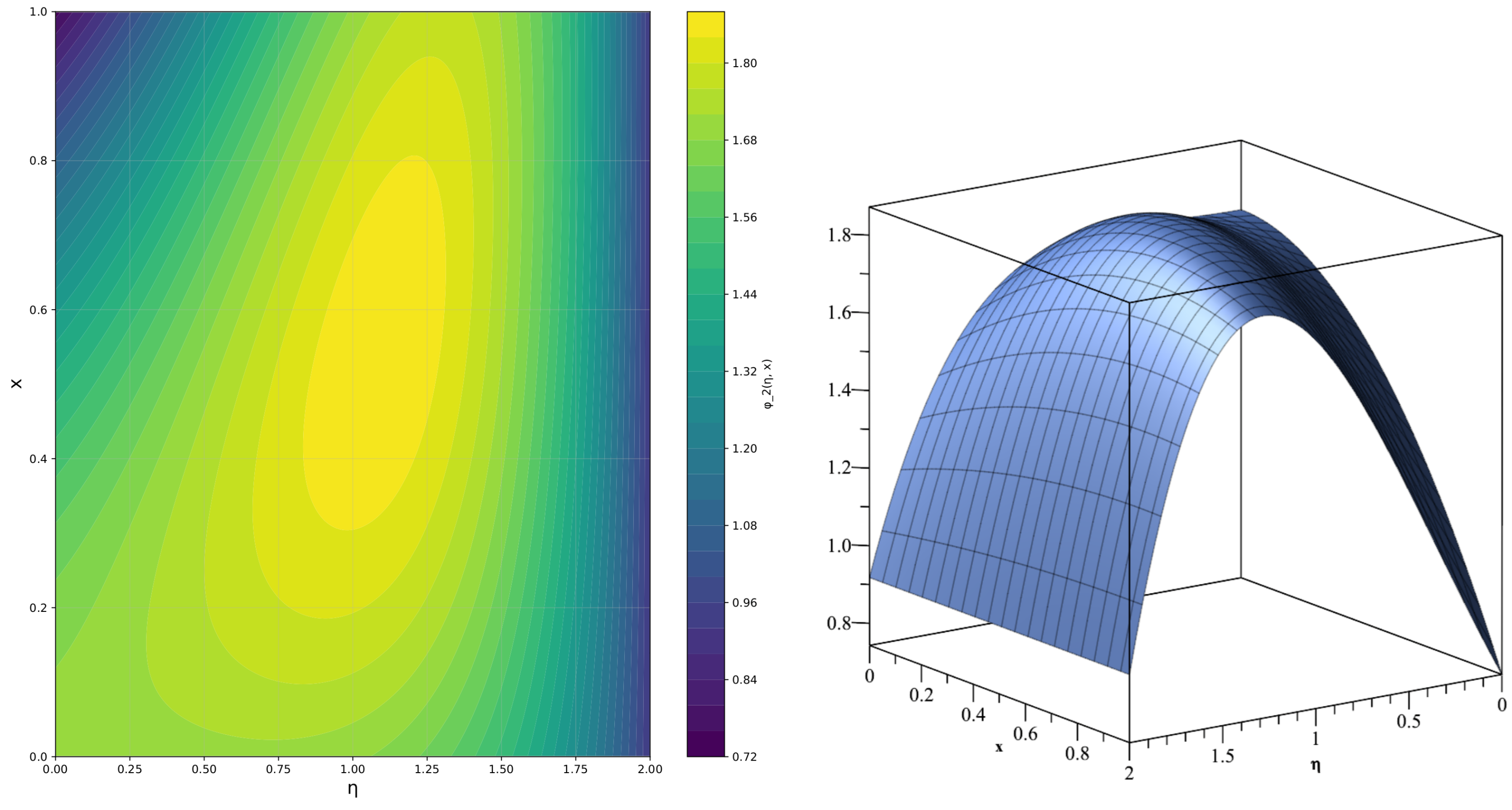
which is compatible with the behavior of the function φ 2 ( η , x ) , as shown in Figure 3.
 (II) 
On the six faces of cuboid:
Subsequent to the previous discussion, we will look at the maximum value of the function W ( η , μ , x ) across the six faces of the cuboid Ω . This analysis aims to identify the optimal solutions within the defined parameters of the cuboidal structure.
 (i) 
Regarding the face η = 0 , W ( η , μ , x ) turns into
Z 1 ( μ , x ) = 2 ( 1 μ 2 ) ( 1 μ ) x 2 31 18 μ 2 + 2 .
Since Z 1 x < 0 for every x ( 0 , 1 ) , then Z 1 ( μ , x ) will be a decreasing function and has no optimal point over the region ( 0 , 1 ) × ( 0 , 1 ) .
 (ii) 
Regarding the face η = 2 , W ( η , μ , x ) becomes
W ( 2 , μ , x ) = 235 256 .
 (iii) 
Regarding the face μ = 0 , W ( η , μ , x ) converts to
Z 2 ( η , x ) = 1 2 η 2 2 x 2 + 5 16 η 5 64 η 3 x + 235 4096 η 4 1 2 η 2 + 2 .
Let us analyze Z 2 x = 0 , which leads to x = 5 64 η , a critical point representing a local maximum; hence,
Z 2 ( η , x ) Z 2 η , 5 64 η = 2 999 2048 η 2 + 445 8192 η 4 = ϕ 4 ( η ) .
Given that ϕ 4 η 0 for all η ( 0 , 2 ) , we may deduce that Z 2 ( η , x ) has no optimum points in the area ( 0 , 2 ) × ( 0 , 1 ) .
 (iv) 
Regarding the face μ = 1 , W ( η , μ , x ) transforms into
Z 3 ( η ) = 13405 36864 η 4 + 155 96 η 2 + 5 18 .
Considering Z 3 η = 0 , which leads to η = 8 249333 2681 , is a critical point and exhibits a local maximum; hence,
Z 3 ( η ) 99895 48258 .
 (v) 
Regarding the face x = 0 , W ( η , μ , x ) turns into
Z 4 ( η , μ ) = 2 + 21 32 μ 2 η 2 1 8 η 4 μ 3 + 1 2 η 2 μ 3 65 1152 η 4 μ 2 23 96 η 4 μ + 23 24 η 2 μ 31 18 μ 2 + 235 4096 η 4 1 2 η 2 .
By setting Z 4 η = 0 , Z 4 μ = 0 , solve the system within the region ( 0 , 2 ) × ( 0 , 1 ) . The optimization reveals that the function Z 4 ( η , μ ) has a critical point at ( 1.05017 , 0.497806 ) . However,
2 Z 4 η 2 2 Z 4 μ 2 2 Z 4 η μ < 0 .
Therefore, Z 4 ( η , μ ) does not possess a maximum within ( 0 , 2 ) × ( 0 , 1 ) .
 (vi) 
Regarding the face x = 1 , W ( η , μ , x ) converts into
Z 5 ( η , μ ) = 2 μ 3 5 16 η μ 2 + 5 64 η 3 μ 2 2 η μ 3 + 1 2 η 3 μ 3 1 2 η 3 μ + 2 η μ 5 64 η 3 + 5 32 μ 2 η 2 1 8 η 4 μ 3 + η 2 μ 3 + 2 μ + 5 16 η 65 1152 η 4 μ 2 23 96 η 4 μ + 11 24 η 2 μ + 5 18 μ 2 + 235 4096 η 4 .
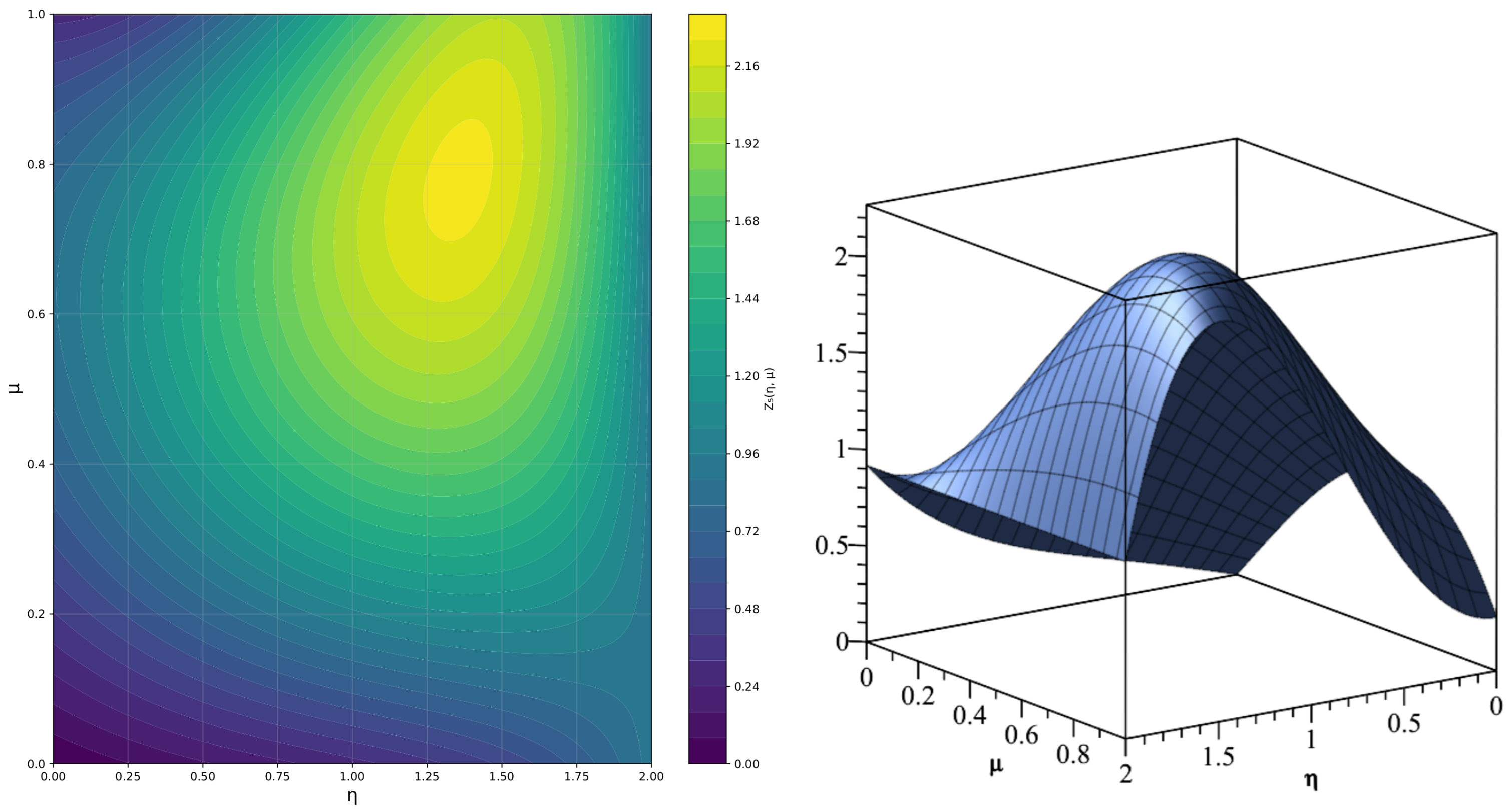
By setting Z 5 η = 0 , Z 5 μ = 0 , solve the system within the region ( 0 , 2 ) × ( 0 , 1 ) . Upon using the numerical optimization, the function Z 5 ( η , μ ) has a critical point at approximately ( η * , μ * ) = ( 1.357798 , 0.778749 ) . However,
2 Z 5 η 2 2 Z 5 μ 2 2 Z 5 η μ > 0 , and 2 Z 5 η 2 < 0 at ( η * , μ * ) .
Therefore, Z 5 ( η , μ ) attains its maximum within ( 0 , 2 ) × ( 0 , 1 ) as follows:
Z 5 ( η , μ ) 2.267423 ,
which agree with the behavior of Z 5 ( η , μ ) , illustrated in Figure 4.
 III. 
On the twelve edges of cuboid:
Afterwards, an evaluation will be performed to ascertain the maximum values of the function W ( η , μ , x ) along the twelve edges of the cuboidal region, denoted as Ω .
 (i) 
On μ = x = 0 , we have
Z 6 ( η ) = 235 4096 η 4 1 2 η 2 + 2 .
Since Z 6 η < 0 , for all η ( 0 , 2 ) , then Z 6 ( η ) is a decreasing function. Thus,
Z 6 ( η ) 2 .
 (ii) 
On μ = 0 and x = 1 , we obtain
Z 7 ( η ) = 235 4096 η 4 5 64 η 3 + 5 16 η .
Since Z 7 η > 0 , for all η ( 0 , 2 ) , then Z 7 ( η ) is an increasing function. Therefore, the function Z 7 ( η ) attains it maximum at η = 2 . Hence,
Z 7 ( η ) 235 256 0.917969 .
 (iii) 
On η = 0 and μ = 0 , we get
Z 8 ( x ) = 2 x 2 + 2 .
Given that Z 8 x < 0 , for every x ( 0 , 1 ) , it follows that Z 8 ( x ) is a decreasing function. Consequently, the function Z 8 ( x ) reaches its maximum at x = 0 as follows:
Z 8 ( x ) 2 .
 (iv) 
On η = 0 and μ = 0 , we have
W ( 0 , 1 , x ) = 5 18 .
 (v) 
On η = 2 , we obtain
W ( 2 , 0 , x ) = W ( 2 , μ , 1 ) = W ( 2 , μ , 0 ) = W ( 2 , 1 , x ) = 235 256 .
 (vi) 
On μ = 1 and x = 0 (similarly for μ = 1 and x = 1 ), we get
Z 9 ( η ) = 13405 36864 η 4 + 155 96 η 2 + 5 18 .
Let us consider Z 9 η = 0 , which leads to η = 8 249333 2681 , a critical point that also represents a local maximum. Thus,
Z 9 ( η ) 99895 48258 .
 (vii) 
On η = 0 and x = 0 , we have
Z 10 ( μ ) = 31 18 μ 2 + 2 .
Since, Z 10 μ < 0 , for all μ ( 0 , 1 ) ) , then Z 10 ( μ ) is a decreasing function. Therefore, the function Z 10 ( μ ) attains it maximum at μ = 0 as follows:
Z 10 ( μ ) 2 .
 (viii) 
On η = 0 and x = 1 , we obtain
Z 11 ( μ ) = 2 μ 3 + 5 18 μ 2 + 2 μ .
Let us consider Z 11 μ = 0 , which leads to μ = 5 + 3913 108 , a critical point that also represents a local maximum. Hence,
Z 11 ( μ ) 29285 + 3913 3913 314928 .
Based on what was previously mentioned, we can deduce that
W ( η , μ , x ) 2.267423 .
Upon using (34), we can conclude that
| β 4 |   0.056686 .
The proof has been completed. □

6. Second-Order Hankel Determinants H 2 , 1 and H 2 , 2

Theorem 3.
Let ψ be a member of the family M L . Then,
| H 2 , 1 ( ψ ) | 1 6 .
The result is sharp for ψ 2 ( ζ ) , donated by (15).
Proof of Theorem 3.
From (21) and (22), we have
| H 2 , 1 ( ψ ) | = | α 3 α 2 2 | = 1 12 η 2 11 12 η 1 2 .
By immediately substituting (9) into (36), we obtain the required result, which completes the proof. □
Theorem 4.
Let ψ be a member of the family M L . Then,
| H 2 , 2 ( ψ ) | 1 36 .
The result is sharp for ψ 2 ( ζ ) , donated by (15).
Proof of Theorem 4.
According to (21), (22), and (23), we generate
H 2 , 2 ( ψ ) = α 2 α 4 α 3 2 = 11 9216 η 1 4 1 1152 η 2 η 1 2 + 1 128 η 1 η 3 1 144 η 2 2 .
Making use of Lemma 2 to (37) yields
α 2 α 4 α 3 2 = 1 256 1 4 η 1 4 4 9 μ 2 ( 4 η 1 2 ) 2 1 2 η 1 2 μ 2 ( 4 η 1 2 ) + γ η 1 ( 4 η 1 2 ) ( 1 | μ | 2 ) .
Suppose that η = | η 1 | [ 0 , 2 ] , μ = | μ | [ 0 , 1 ] , and | γ | 1 , then, (38) simplifies to
| α 2 α 4 α 3 2 |   1 256 1 4 η 4 1 18 η 4 μ 2 14 9 η 2 μ 2 + 64 9 μ 2 + η 3 μ 2 4 η μ 2 η 3 + 4 η .
Consider that
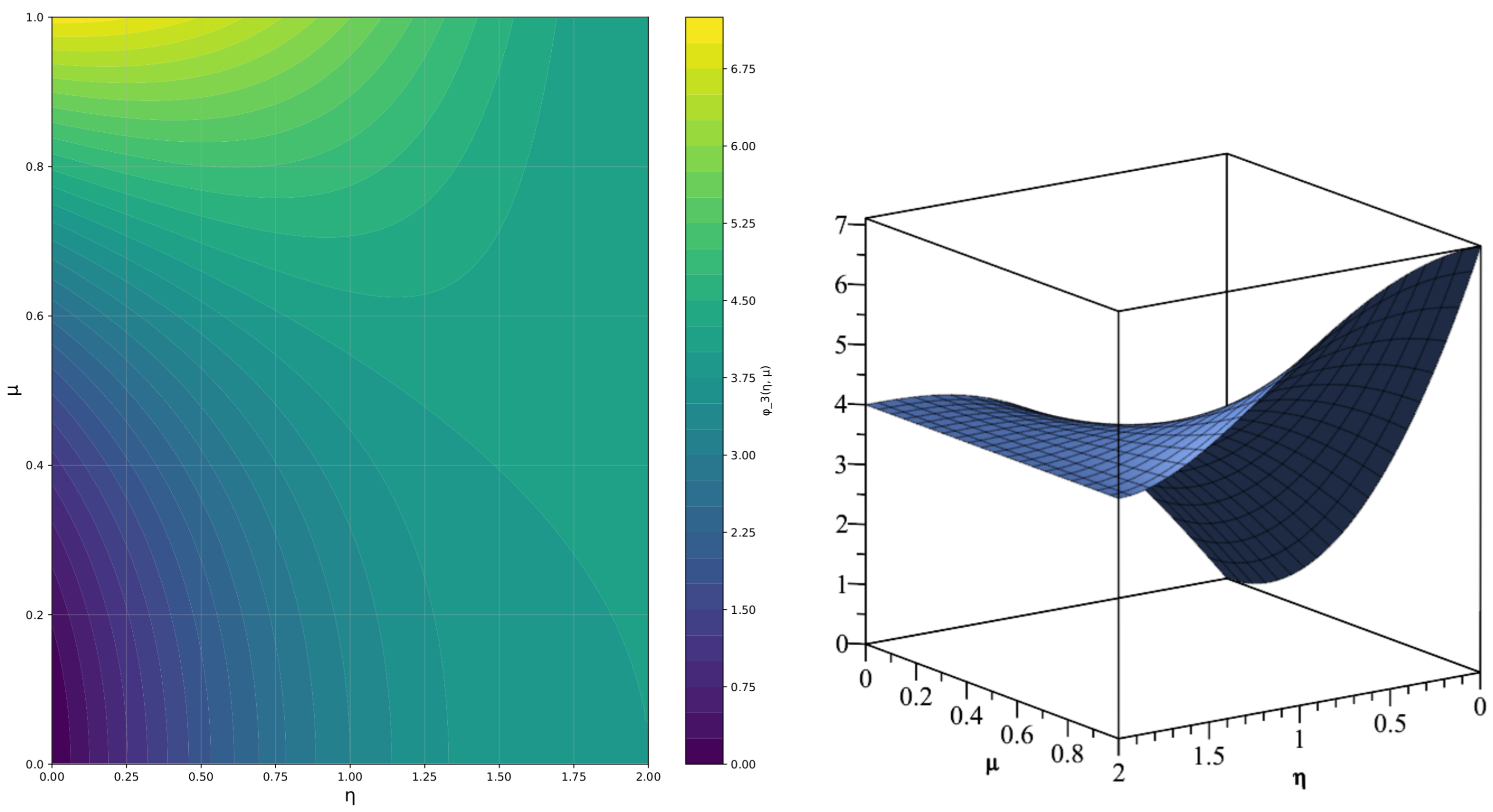
φ 3 ( η , μ ) = 1 4 η 4 1 18 η 4 μ 2 14 9 η 2 μ 2 + 64 9 μ 2 + η 3 μ 2 4 η μ 2 η 3 + 4 η .
Thus,
φ 3 μ = 1 9 μ ( 4 η 2 ) ( η 2 18 η + 32 ) > 0 ( μ ( 0 , 1 ) ) .
Consequently,
φ 3 ( η , μ ) φ 3 ( η , 1 ) = 7 36 η 4 14 9 η 2 + 64 9 .
Let us consider,
ϕ 3 ( η ) = 7 36 η 4 14 9 η 2 + 64 9 .
That is,
d ϕ 3 d η = 7 9 η 3 28 9 η < 0 ( η ( 0 , 2 ) ) ,
which clarifies that ϕ 3 ( η ) is a decreasing function; therefore, the maximum arises at η = 0 as follows:
ϕ 3 ( η ) ϕ 3 ( 0 ) = 64 9 .
Consequently, φ 3 ( η , μ ) leads to its maximum 64 9 at ( η , μ ) = ( 0 , 1 ) , as in Figure 5. Finally, by employing (39), we deduce that
| H 2 , 2 ( ψ ) | 1 36 .
The proof is completed. □

7. Third-Order Hankel Determinant H 3 , 1

Theorem 5.
Let ψ be a member of the family M L . Then,
| H 3 , 1 ( ψ ) | 7 64 .
Proof of Theorem 5.
According to (2), the third order Hankel determinant H 3 , 1 ( ψ ) is given by
H 3 , 1 ( ψ ) = 2 α 2 α 3 α 4 α 2 2 α 5 α 3 3 + α 3 α 5 α 4 2 .
By inserting (21)–(24) into (40), while maintaining η 1 = η for simplicity, we obtain
H 3 , 1 ( ψ ) = 1 1105920 1630 η 6 984 η 2 η 2 792 η 3 η 3 + 1968 η 2 η 2 2 3168 η 2 η 4 2944 η 2 3 + 4608 η 2 η 4 4320 η 3 2 + 5472 η η 2 η 3 .
Making use of Lemma 2 with assuming that | κ | 1 , μ = | μ | , and x = | γ | [ 0 , 1 ] , we can reduce the expressions in (41) as illustrated in Appendix B. Consequently, (41) converts into
| H 3 , 1 ( f ) | 1 1105920 v 1 ( η , μ ) + v 2 ( η , μ ) x + v 3 ( η , μ ) x 2 + v 4 ( η , μ ) ( 1 x 2 ) ; = 1 1105920 Q ( η , μ , x ) ,
where v j ( j = 1 , 2 , 3 , 4 ) is recorded at Appendix B.
In order to establish the maximum value of the function Q ( η , μ , x ) within the cuboid Ω = [ 0 , 2 ] × [ 0 , 1 ] × [ 0 , 1 ] , it is necessary to evaluate the maximum of Q ( η , μ , x ) within the cuboid, on its six faces, and along its twelve edges. We are dividing the analysis into three distinct categories.
 I. 
Interior points of cuboid:
In this step, we are going to evaluate the maximum value of Q ( η , μ , x ) inside of the cuboid Ω . Let ( η , μ , x ) ( 0 , 2 ) × ( 0 , 1 ) × ( 0 , 1 ) .
Setting Q x = 0 provides
x = η 72 η 2 μ 2 + 73 η 2 μ + 540 η 2 288 μ 2 + 1440 μ 144 16 η 2 μ 2 34 η 2 μ + 21 η 2 64 μ 2 + 64 μ 60 = x 1 .
While x 1 is a critical point within Ω ; hence, x 1 ( 0 , 1 ) , which is acceptable only if
η 72 η 2 μ 2 + 73 η 2 μ + 540 η 2 288 μ 2 + 1440 μ 16 η 2 μ 2 + 34 η 2 μ 21 η 2 + 64 μ 2 64 μ + 60 < 0 ,
and
η 2 > 4 ( 16 μ 2 16 μ + 15 ) 16 μ 2 34 μ + 21 .
To detect the critical point, it is necessary to evaluate a solution that fulfills (43) and (44). Let us discuss
ϑ ( μ ) = 4 ( 16 μ 2 16 μ + 15 ) 16 μ 2 34 μ + 21 .
Since ϑ μ > 0 for μ ( 0 , 1 ) , indicating that ϑ ( μ ) is an increasing function. Therefore,
η 2 > 20 7 .
Simple calculations show that (43) is invalid for μ ( 0 , 1 ) . Consequently, it may be inferred that the function Q ( η , μ , x ) does not have critical points inside the cuboid Ω .
 II. 
On the six faces of the cuboid:
We are now going to evaluate the maximum value of the function Q ( η , μ , x ) throughout the six faces of the cuboid Ω .
 (i) 
Regarding the face η = 0 , Q ( η , μ , x ) transforms into
G 1 ( μ , x ) = 18432 μ 4 x 2 + 18432 μ 3 x 2 + 1152 μ 2 x 2 13312 μ 3 18432 μ x 2 + 17280 x 2 + 18432 μ .
Hence,
G 1 x = 36864 μ 4 x + 36864 μ 3 x + 2304 μ 2 x 36864 μ x + 34560 x 0 x ( 0 , 1 ) .
Consequently, G 1 ( μ , x ) has no optimal points in the region ( 0 , 1 ) × ( 0 , 1 ) .
 (ii) 
Regarding the face η = 2 , Q ( η , μ , x ) becomes
Q ( 2 , μ , x ) = 120960 .
 (iii) 
Regarding the face μ = 0 , Q ( η , μ , x ) evolves into
G 2 ( μ , x ) = 1890 η 6 540 η 5 x + 1512 η 4 x 2 432 η 4 + 2160 η 3 x 10368 η 2 x 2 + 1728 η 2 + 17280 x 2 .
Assuming that G 2 x = 0 , which provides
x = 5 η 3 4 ( 7 η 2 20 ) = x 2 .
If x 2 is a critical point, it must concurrently fulfill the subsequent inequalities:
5 η 3 28 η 2 + 80 < 0 and 7 η 2 20 > 0 .
It is obvious that η > 20 7 ; however, fundamental calculations indicate that this condition is not valid for any η ( 0 , 2 ) . Consequently, G 2 ( η , x ) does not possess optimal points in the region ( 0 , 2 ) × ( 0 , 1 ) .
 (iv) 
Regarding the face μ = 1 , Q ( η , μ , x ) transforms into
G 3 ( η , x ) = 1592 η 6 12056 η 4 + 21472 η 2 + 5120 .
Hence,
G 3 η = 16356 η 5 36128 η 3 + 42944 η 0 . ( η ( 0 , 2 ) )
This indicates that an optimal solution does not exist for G 3 ( η , x ) .
 (v) 
Regarding the face x = 0 , Q ( η , μ , x ) converts into G 4 ( η , μ ) recorded at Appendix B. By providing the system G 4 η = 0 and G 4 μ = 0 , which seems to have no solutions within the region ( 0 , 2 ) × ( 0 , 1 ) . Consequently, G 4 ( η , μ ) has no optimal solution.
 (vi) 
Regarding the face x = 1 , Q ( η , μ , x ) evolves into G 5 ( η , μ ) recorded at Appendix B. By establishing the system G 5 η = 0 and G 5 μ = 0 , which appears to have no solutions within the region ( 0 , 2 ) × ( 0 , 1 ) . Consequently, G 5 ( η , μ ) does not possess any optimal solution.
 III. 
On the twelve edges of the cuboid:
At last, it is necessary to evaluate the maximum values of Q ( η , μ , x ) along the twelve edges of the cuboid Ω .
 (i) 
On μ = x = 0 , Q ( η , μ , x ) converts into
G 6 ( η ) = 1890 η 6 432 η 4 + 1728 η 2 .
It is evident that G 6 η 0 for η ( 0 , 2 ) , indicating that G 6 ( η ) is an increasing function, approaching its maximum at η = 2 . As a result,
G 6 ( η ) 120960 .
 (ii) 
On μ = 0 and x = 1 , Q ( η , μ , x ) evolves into
G 7 ( η ) = 1890 η 6 540 η 5 + 1080 η 4 + 2160 η 3 8640 η 2 + 17280 .
By setting G 7 η = 0 , a critical point is identified at η 0.9565086 , displaying a local minimum. The maximum value is derived from the following:
G 7 ( η ) 120960 .
 (iii) 
On η = μ = 0 , Q ( η , μ , x ) reduces to
G 8 ( x ) = 17280 x 2 .
It is noted that G 8 x > 0 for x ( 0 , 1 ) , indicating that G 8 ( x ) is an increasing function; thus, the maximum occurs at x = 1 as follows:
G 8 ( x ) 17280 .
 (iv) 
On μ = 1 and x = 0 (similarly μ = x = 1 ); Q ( η , μ , x ) becomes
G 9 ( η ) = 2726 η 6 9032 η 4 + 21472 η 2 + 5120 .
It is evident that G 9 η > 0 for η ( 0 , 2 ) . Consequently, G 9 ( η ) is an increasing function, thus the maximum is attained at η = 2 exactly as follows:
G 9 ( η ) 120960 .
 (v) 
On μ = 1 and η = 0 , Q ( η , μ , x ) gets
Q ( 0 , 1 , x ) = 5120 .
 (vi) 
On η = 2 ,
Q ( 2 , 0 , x ) = Q ( 2 , 1 , x ) = Q ( 2 , μ , 0 ) = Q ( 2 , μ , 1 ) = 120960 .
 (vii) 
On η = x = 0 , Q ( η , μ , x ) transforms into
G 10 ( μ ) = 13312 μ 3 + 18432 μ .
It is evident that d G 10 d μ = 0 , providing a critical point μ = 78 13 , which refers to a local maximum. That is, G 10 ( μ ) reaches its maximum as illustrated:
G 10 ( μ ) 12288 78 13 8348.0521 .
 (viii) 
On η = 0 and x = 1 , Q ( η , μ , x ) turns to
G 11 ( q ) = 18432 μ 4 + 5120 μ 3 + 1152 μ 2 + 17280 .
Consider G 11 μ = 0 , which provides a critical point μ = 5 + 97 48 , which represents a local maximum. That is, G 11 ( μ ) reaches its maximum as illustrated:
G 11 ( μ ) 1871509 + 485 97 108 17373.0157 .
In conclusion, we declare that
Q ( η , μ , x ) 120960 .
Therefore, from (42), we can deduce that
| H 3 , 1 ( ψ ) | 7 64 .
This completes the proof. □

8. Zalcman Functional Bounds

Theorem 6.
Let ψ be a member of the family M L . Then,
| α 2 α 3 α 4 |   1 8 .
The result is sharp for ψ 3 ( ζ ) , referred by (16).
Proof of Theorem 6.
Since the function ψ belongs to the family M L , and upon using the relations (21), (22) and (23), we have
α 2 α 3 α 4 = η 1 96 η 2 η 1 2 2 1 16 η 3 η 1 η 2 + 3 8 η 1 3 ; = 1 16 η 3 7 6 η 1 η 2 + 11 24 η 1 3 .
Applying Lemma 3 to (46), we get the required result. □
Remark 1.
Since the Zalcman functional Φ 2 , 2 ( ψ ) = α 3 α 2 2 is the same time the Hankel determinant H 2 , 1 ( ψ ) , so
Φ 2 , 2 ( ψ ) 1 6 .

9. Moduli Differences in Logarithmic Coefficients

Theorem 7.
Let ψ be a member of the family M L . Then, the following inequality is fulfilled:
19 38   | β 2 | | β 1 |   1 6 ,
where β 1 , β 2 are the logarithmic coefficients referred by (30) and (31).
Proof of Theorem 7.
In (30) and (31), we have
| β 2 | | β 1 | = 1 12 η 2 19 32 η 1 2 1 16 | η 1 | = Λ + ( η 1 , η 2 ) .
Upon making use of Lemma 4 in (47), we conclude
Λ + ( η 1 , η 2 ) 2 | λ 3 | = 1 6 ,
and,
Λ ( η 1 , η 2 ) 2 λ 1 2 | λ 3 | λ 4 + 2 | λ 3 | = 19 38 .
By combining (48), (49), and the relation Λ + ( η 1 , η 2 ) = Λ ( η 1 , η 2 ) we obtain
Λ + ( η 1 , η 2 ) 1 6 ; Λ + ( η 1 , η 2 ) = Λ ( η 1 , η 2 ) 19 38 ,
which completes the desired proof. □

10. Discussion

The family M L has been placed within the extensive framework of function families based on subordination that have been studied in recent publications. Common image domains that have functions such as the subordinating region include the cardioid domain linked to φ ( ζ ) = 1 + ζ ζ 3 / 3 [25,26,27], the lemniscate domain associated with φ ( ζ ) = 1 + ζ [29,30], the nephroid domain [18,28], and the sine domain produced by 1 + sin ( ζ ) [31]. Every choice generates a geometrically unique image region and results in coefficient boundaries of different properties. The lung-shaped domain L ( D ) holds a special position within this family. The secant function’s presence generates periodic behavior that, when confined to the unit disk, creates a domain with bilateral extensions and bounded curvature.
This investigation has established a comprehensive framework for analyzing univalent analytic functions whose derivatives are subordinate to the lung-shaped domain L ( D ) , where L ( ζ ) = 1 + ζ 2 sec ( ζ ) . By means of the parametric representation and systematic cuboid-optimization techniques, we have obtained the sharp coefficient bounds | α n |   1 n for n = 2 , 3 , 4 , 5 , the Hankel determinant estimates:
| H 2 , 1 ( ψ ) | 1 6 , | H 2 , 2 ( ψ ) | 1 36 , | H 3 , 1 ( ψ ) | 7 64 ,
the logarithmic coefficient bounds | β n | for n = 1 , 2 , 3 , 4 , the sharp moduli-difference estimate | β 2 | | β 1 | , and the Zalcman functional bounds | Φ 2 , 2 | and | Φ 2 , 3 | .
The sharpness of every estimate has been confirmed by explicit extremal functions. These results demonstrate that the lung-shaped domain imposes specific and non-trivial constraints on coefficient growth, with the bounds exhibiting elegant rational forms that reflect the underlying geometric structure of L ( D ) .
The present work naturally suggests several directions for future investigation, of which only a few were mentioned: the study of starlike functions subordinate to L, higher-order Hankel determinants, and bi-univalent functions subordinate to L.
It is appropriate to comment on the scope and limitations of the optimization methodology employed in this work. The cuboid method, which reduces the estimation of a coefficient functional to the analysis of a real polynomial on the boundary of a product of closed discs, is well suited to functionals of degree at most four in parameters η 1 , μ , γ , κ . For such functionals, the critical points on the faces, edges, and vertices of the parameter cuboid are accessible by elementary calculus, and the global extremum can be located with certainty.
In summary, the lung-shaped domain L ( D ) provides a fertile and geometrically interesting setting for coefficient problems in geometric function theory. The results established in this paper represent a first systematic treatment of this family; we hope they will stimulate further investigations into the rich mathematical structure of M L and its natural extensions.

Author Contributions

Conceptualization, R.A., S.A., M.A.M. and A.H.E.-Q.; methodology, M.A.M., S.A., R.A. and A.H.E.-Q.; software, A.H.E.-Q. and S.A.; validation, M.A.M., S.A., A.H.E.-Q. and R.A.; formal analysis, S.A., R.A. and A.H.E.-Q.; investigation, R.A., M.A.M., S.A. and A.H.E.-Q.; resources, A.H.E.-Q., S.A. and M.A.M.; data curation, R.A.; writing—original draft preparation, M.A.M. and A.H.E.-Q.; writing—review and editing, M.A.M., S.A. and R.A.; visualization, R.A. and M.A.M.; supervision, M.A.M. and A.H.E.-Q.; project administration, S.A. and R.A.; funding acquisition, S.A. All authors have read and agreed to the published version of the manuscript.

Funding

This work was supported and funded by the Deanship of Scientific Research at Imam Mohammad Ibn Saud Islamic University (IMSIU) (grant number IMSIU-DDRSP2603).

Institutional Review Board Statement

Not applicable. This study involves purely theoretical mathematical research on analytic functions and does not involve human participants or animal subjects.

Informed Consent Statement

Not applicable.

Data Availability Statement

The original contributions presented in this study are included in the article. Further inquiries can be directed to the corresponding author.

Conflicts of Interest

The authors declare no conflicts of interest.

Appendix A. Expressions in Theorem 2

This appendix represent the expressions of the parametric functions introduced in Theorem 2.
v 1 ( η , μ ) = 235 4096 η 4 , + 1 8 η 2 μ ( 4 η 2 ) μ 2 11 16 μ + 23 12 + 41 288 μ 2 ( 4 η 2 ) η 2 + 20 41 ; v 2 ( η , μ ) = 1 2 η ( 4 η 2 ) ( 1 μ 2 ) μ + 5 32 ; v 3 ( η , μ ) = 1 2 μ ( 4 η 2 ) ( 1 μ 2 ) ; v 4 ( η , μ ) = 1 2 ( 4 η 2 ) ( 1 μ 2 ) .
And also,
ω 1 ( η ) = v 1 η , 27 64 = 235 4096 η 4 + 252711 2097152 ( 4 η 2 ) η 2 + 2882 28079 ; ω 2 ( η ) = v 2 η , 27 64 = 124579 524288 η ( 4 η 2 ) ; ω 3 ( η ) = v 3 η , 27 64 = 90909 524288 ( 4 η 2 ) ; ω 4 ( η ) = v 4 η , 27 64 = 3367 8192 ( 4 η 2 ) .

Appendix B. Expressions in Theorem 5

This appendix provides the full derivation of the mathematical calculations introduced in Theorem 5 after applying Lemma 2 to (41), assuming that 4 η 2 = t .
984 η 4 η 2 = 492 η 6 492 η 4 μ t ; 792 η 3 η 3 = 198 η 6 396 η 4 μ t + 198 η 4 μ 2 t 396 η 3 t γ ( 1 | μ | 2 ) ; 1968 η 2 η 2 2 = 492 η 6 + 984 η 4 μ t + 492 η 2 μ 2 t 2 ; 3168 η 2 η 4 = 396 η 6 1584 η 2 μ 2 t 396 η 4 μ 3 t + 1188 η 4 μ 2 t 1188 η 4 μ t + 1584 η 3 t γ μ ( 1 | μ | 2 ) 1584 η 3 t γ ( 1 | μ | 2 ) + 1584 η 2 t γ 2 μ ( 1 | μ | 2 ) 1584 η 2 t κ ( 1 | μ | 2 ) ( 1 | γ | 2 ) ; 2944 η 2 3 = 368 η 6 368 μ 3 t 3 1104 η 4 μ t 1104 η 2 μ 2 t 2 ; 4608 η 2 η 4 = 288 η 6 + 1152 η 2 μ 2 t + 288 η 4 μ 3 t 864 η 4 μ 2 t + 1152 η 4 μ t 1152 η 3 t μ γ ( 1 | μ | 2 ) + 1152 η 3 t γ ( 1 | μ | 2 ) 288 η 2 γ 2 t μ ( 1 | μ | 2 ) + 1152 η 2 t κ ( 1 | μ | 2 ) ( 1 | γ | 2 ) + 1152 μ 3 t 2 + 288 η 2 μ 4 t 2 864 η 2 μ 3 t 2 + 864 η 2 μ 2 t 2 1152 η γ t 2 μ 2 ( 1 | μ | 2 ) + 1152 η γ μ t 2 ( 1 | μ | 2 ) 1152 μ 2 t 2 γ 2 ( 1 | μ | 2 ) + 1152 μ κ t 2 ( 1 | μ | 2 ) ( 1 | γ | 2 ) ; 4320 η 3 2 = 270 η 6 1080 η 2 t 2 μ 2 270 η 2 t 2 μ 4 1080 t 2 γ 2 ( 1 | μ | 2 ) 2 1080 η 4 t μ + 540 η 4 t μ 2 1080 η 3 t γ ( 1 | μ | 2 ) + 1080 η 2 t 2 μ 3 2160 η t 2 γ μ ( 1 | μ | 2 ) + 1080 η t 2 μ 2 γ ( 1 | μ | 2 ) ; 5472 η η 2 η 3 = 684 η 6 + 2052 η 4 μ t 684 η 4 μ 2 t + 1368 η 3 γ t ( 1 | μ | 2 ) + 1368 η 2 t 2 μ 2 684 η 2 t 2 μ 3 + 1368 η t 2 μ γ ( 1 | μ | 2 ) .
In addition, after substituting by the above expressions in (41) and taking the modulus, we obtain (42), defined in terms of the parametric functions v j ( j = 1 , 2 , 3 , 4 , ) , recorded as follows:
v 1 ( η , μ ) = 1890 η 6 + 2 μ ( 4 η 2 ) 54 η 4 μ 2 189 η 4 μ + 36 η 4 + 216 η 2 μ + μ ( 4 η 2 ) 234 η 2 μ + 270 η 2 + 9 η 2 μ 2 + 160 μ + 184 η 2 μ ; v 2 ( η , μ ) = η ( 4 η 2 ) ( 1 μ 2 ) 433 η 2 μ + 540 η 2 + 72 μ ( 4 η 2 ) ( 5 μ ) ; v 3 ( η , μ ) = 72 ( 4 η 2 ) ( 1 μ 2 ) 18 η 2 μ + ( 4 η 2 ) ( 15 + 16 μ 2 ) ; v 4 ( η , μ ) = 144 ( 4 η 2 ) ( 1 μ 2 ) 8 μ ( 4 η 2 ) + 3 η 2 .
Finally, it provides the full expressions of the parametric functions g 4 ( η , μ ) and g 5 ( η , μ ) , mentioned in Theorem 5.
G 4 ( η , μ ) = 18 η 6 μ 4 + 728 η 6 μ 3 + 162 η 6 μ 2 144 η 4 μ 4 72 η 6 μ 7088 η 4 μ 3 + 1890 η 6 2808 η 4 μ 2 + 288 η 2 μ 4 + 1440 η 4 μ + 20032 η 2 μ 3 432 η 4 + 8640 η 2 μ 2 9216 η 2 μ 13312 μ 3 + 1728 , η 2 + 18432 μ .
G 5 ( η , μ ) = 18 η 6 μ 4 + 728 η 6 μ 3 + 72 η 5 μ 4 + 162 η 6 μ 2 + 73 η 5 μ 3 1296 η 4 μ 4 72 η 6 μ + 468 η 5 μ 2 4640 η 4 μ 3 576 η 3 μ 4 + 1890 η 6 73 η 5 μ 3168 η 4 μ 2 + 1148 η 3 μ 3 + 9504 η 2 μ 4 540 η 5 1008 η 4 μ 1584 η 3 μ 2 + 5632 η 2 μ 3 + 1152 η μ 4 + 1080 η 4 1148 η 3 μ + 9792 η 2 μ 2 5760 η μ 3 18432 μ 4 + 2160 η 3 + 5184 η 2 μ 1152 η μ 2 5120 μ 3 8640 η 2 + 5760 η μ + 1152 μ 2 + 17280 .

References

  1. Duren, P.L. Univalent Functions; Springer Science & Business Media: New York, NY, USA, 2001; Volume 259. [Google Scholar]
  2. Ma, W.; Minda, D. A Unified Treatment of Some Special Classes of Univalent Functions. In Proceedings of the Conference on Complex Analytic; Li, Z., Ren, F., Yang, L., Zhang, S., Eds.; International Press Inc.: New York, NY, USA, 1992; pp. 157–169. [Google Scholar]
  3. El-Qadeem, A.H.; Mamon, M.A.; Elshazly, I.S. Application of Einstein function on bi-univalent functions defined on the unit disc. Symmetry 2022, 14, 758. [Google Scholar] [CrossRef]
  4. El-Qadeem, A.H.; Saleh, S.A.; Mamon, M.A. Bi-univalent function classes defined by using a second Einstein function. J. Funct. Spaces 2022, 2022, 6933153. [Google Scholar] [CrossRef]
  5. Milin, I.M. Univalent Functions and Orthonormal Systems; American Mathematical Society: Providence, RI, USA, 1971. [Google Scholar]
  6. De Branges, L. A proof of the Bieberbach conjecture. Acta Math. 1985, 154, 137–152. [Google Scholar] [CrossRef]
  7. Thomas, D.K. On the logarithmic coefficients of close-to-convex functions. Proc. Amer. Math. Soc. 2016, 144, 1681–1687. [Google Scholar] [CrossRef]
  8. Adegani, E.A.; Jafari, M.; Bulboacă, T.; Cho, N.E. Upper bounds of the logarithmic coefficients for some subclasses of analytic functions. J. Inequal. Appl. 2023, 2023, 143. [Google Scholar] [CrossRef]
  9. Panigrahi, T.; Dhal, S.P. Coefficient estimates for certain a new subclass of univalent functions associated with quotient of cosine hyperbolic and exponential functions. Afr. Mat. 2025, 36, 168. [Google Scholar] [CrossRef]
  10. Lecko, A.; Partyka, D. Successive Logarithmic Coefficients of Univalent Functions. Comput. Methods Funct. Theory 2024, 24, 693–705. [Google Scholar] [CrossRef]
  11. Pommerenke, C. On the coefficients and Hankel determinants of univalent functions. J. Lond. Math. Soc. 1966, 41, 111–122. [Google Scholar] [CrossRef]
  12. Pommerenke, C. On the Hankel determinants of univalent functions. Mathematika 1967, 14, 108–112. [Google Scholar] [CrossRef]
  13. Noonan, J.; Thomas, D. On the second Hankel determinant of areally mean p-valent functions. Trans. Am. Math. Soc. 1976, 223, 337–346. [Google Scholar] [CrossRef]
  14. Fekete, M.; Szegö, G. Eine Bemerkung Uber ungerade schlichte Funktionen. J. Lond. Math. Soc. 1933, s1-8, 85–89. [Google Scholar] [CrossRef]
  15. Alsoboh, A.; Tayyah, A.S.; Amourah, A.; Al-Maqbali, A.A.; Al Mashraf, K.; Sasa, T. Hankel determinant estimates for bi-Bazilevič-type functions involving q-Fibonacci numbers. Eur. J. Pure Appl. Math. 2025, 18, 6698. [Google Scholar] [CrossRef]
  16. Khan, M.G.; Ahmad, B.; Murugusundaramoorthy, G.; Mashwani, W.K.; Yalçin, S.; Shaba, T.G.; Salleh, Z. Third Hankel determinant and Zalcman functional for a class of starlike functions with respect to symmetric points related with sine function. J. Math. Comput. Sci. 2022, 25, 29–36. [Google Scholar] [CrossRef]
  17. Mamon, M.A.; Halouani, B.; Elshazly, I.S.; Murugusundaramoorthy, G.; El-Qadeem, A.H. Second Hankel determinant bound application to certain family of bi-Univalent functions. Axioms 2024, 13, 819. [Google Scholar] [CrossRef]
  18. Srivastava, H.M.; Murugusundaramoorthy, G.; Bulboacă, T. The second Hankel determinant for subclasses of bi-univalent functions associated with a nephroid domain. Rev. Real Acad. Cienc. Exactas Físicas Nat. Ser. A Matemáticas 2022, 116, 145. [Google Scholar] [CrossRef]
  19. Kowalczyk, B.; Lecko, A.; Thomas, D. The sharp bound of the third Hankel determinant for starlike functions. Forum Math. 2022, 34, 1249–1254. [Google Scholar] [CrossRef]
  20. Kowalczyk, B.; Lecko, A. The sharp bound of the third Hankel determinant for functions of bounded turning. Bol. Soc. Mat. Mex. 2021, 27, 69. [Google Scholar] [CrossRef]
  21. Bansal, D.; Sokół, J. Zalcman conjecture for some subclass of analytic functions. J. Fract. Calc. Appl. 2017, 8, 1–5. [Google Scholar]
  22. Ravichandran, V.; Verma, S. Generalized Zalcman conjecture for some classes of analytic functions. J. Math. Anal. Appl. 2017, 450, 592–605. [Google Scholar] [CrossRef]
  23. Goodman, A.W. Univalent Functions; Mariner Publishing Company: Tampa, FL, USA, 1983. [Google Scholar]
  24. Krushkal, S. Univalent functions and holomorphic motions. J. Anal. Math. 1995, 66, 253–275. [Google Scholar] [CrossRef]
  25. Khan, M.F.; Abaoud, M. New applications of fractional q-calculus operator for a new subclass of q-starlike functions related with the cardioid domain. Fractal Fract. 2024, 8, 71. [Google Scholar] [CrossRef]
  26. Kumar, S.S.; Kamaljeet, G. A cardioid domain and starlike functions. Anal. Math. Phys. 2021, 11, 54. [Google Scholar] [CrossRef]
  27. Malik, S.N.; Raza, M.; Xin, Q.; Sokół, J.; Manzoor, R.; Zainab, S. On convex functions associated with symmetric cardioid domain. Symmetry 2021, 13, 2321. [Google Scholar] [CrossRef]
  28. Mondal, S. On the containment of the unit disc image by analytical functions in the lemniscate and nephroid domains. Mathematics 2024, 12, 2869. [Google Scholar] [CrossRef]
  29. Masih, V.S.; Wanas, A.K. On starlike and convex functions associated with booth lemniscate domain. Appl. Math. E-Notes 2024, 24, 150–156. [Google Scholar]
  30. Mondal, S. Mapping properties of associate Laguerre polynomials in leminiscate, exponential and nephroid domain. Symmetry 2022, 14, 2303. [Google Scholar] [CrossRef]
  31. Cho, N.E.; Kumar, V.; Kumar, S.S.; Ravichandran, V. Radius problems for starlike functions associated with the sine function. Bull. Iran. Math. Soc. 2019, 45, 213–232. [Google Scholar] [CrossRef]
  32. Bano, K.; Raza, M. Starlike functions associated with cosine functions. Bull. Iran. Math. Soc. 2021, 47, 1513–1532. [Google Scholar] [CrossRef]
  33. Mendiratta, R.; Nagpal, S.; Ravichandran, V. On a subclass of strongly starlike functions associated with exponential function. Bull. Malays. Math. Sci. Soc. 2015, 38, 365–386. [Google Scholar] [CrossRef]
  34. Breaz, D.; Panigrahi, T.; El-Deeb, S.; Pattnayak, E.; Sivasubramanian, S. Coefficient Bounds for Two Subclasses of Analytic Functions Involving a Limacon-Shaped Domain. Symmetry 2024, 16, 183. [Google Scholar] [CrossRef]
  35. Kwon, O.S.; Lecko, A.; Sim, Y.J. On the fourth coefficient of functions in the Carathéodory class. Comput. Methods Funct. Theory 2018, 18, 307–314. [Google Scholar] [CrossRef]
  36. Libera, R.J.; Zlotkiewicz, E.J. Early coefficients of the inverse of a regular convex function. Proc. Am. Math. Soc. 1982, 85, 225–230. [Google Scholar] [CrossRef][Green Version]
  37. Libera, R.J.; Zlotkiewicz, E.J. Coefficient bounds for the inverse of a function with derivative in P . Proc. Am. Math. Soc. 1983, 87, 251–257. [Google Scholar] [CrossRef]
  38. Rosihan, M.A. Coefficients of the Inverse of Strongly Starlike Functions. Bull. Malays. Math. Sci. Soc. 2003, 26, 63–71. [Google Scholar]
  39. Sim, Y.J.; Thomas, D.K. On the Difference of Inverse Coefficients of Univalent Functions. Symmetry 2020, 12, 2040. [Google Scholar] [CrossRef]
Figure 1. The lung-shaped domain L ( D ) .
Mathematics 14 01240 g001
Figure 2. The 3-D and contour plots show that the behavior of the function φ 1 ( η , x ) , which refers to the maximum nearby, is approximately 1.82 .
Mathematics 14 01240 g002
Figure 3. The 3-D and contour plots show that the behavior of the function φ 2 ( η , x ) , which refers to the maximum nearby, is approximately 1.87 .
Mathematics 14 01240 g003
Figure 4. The 3-D and contour plots show that the behavior of the function Z 5 ( η , μ ) , which refers to the maximum nearby, is approximately 2.26 .
Mathematics 14 01240 g004
Figure 5. The 3-D and contour plots show that the behavior of the function φ 3 ( η , μ ) , which refers to the maximum nearby, is approximately 7.11 .
Mathematics 14 01240 g005
Disclaimer/Publisher’s Note: The statements, opinions and data contained in all publications are solely those of the individual author(s) and contributor(s) and not of MDPI and/or the editor(s). MDPI and/or the editor(s) disclaim responsibility for any injury to people or property resulting from any ideas, methods, instructions or products referred to in the content.