Adaptive Deletion of Gaussian Ellipsoids in 3D Gaussian Splatting


Abstract
1. Introduction
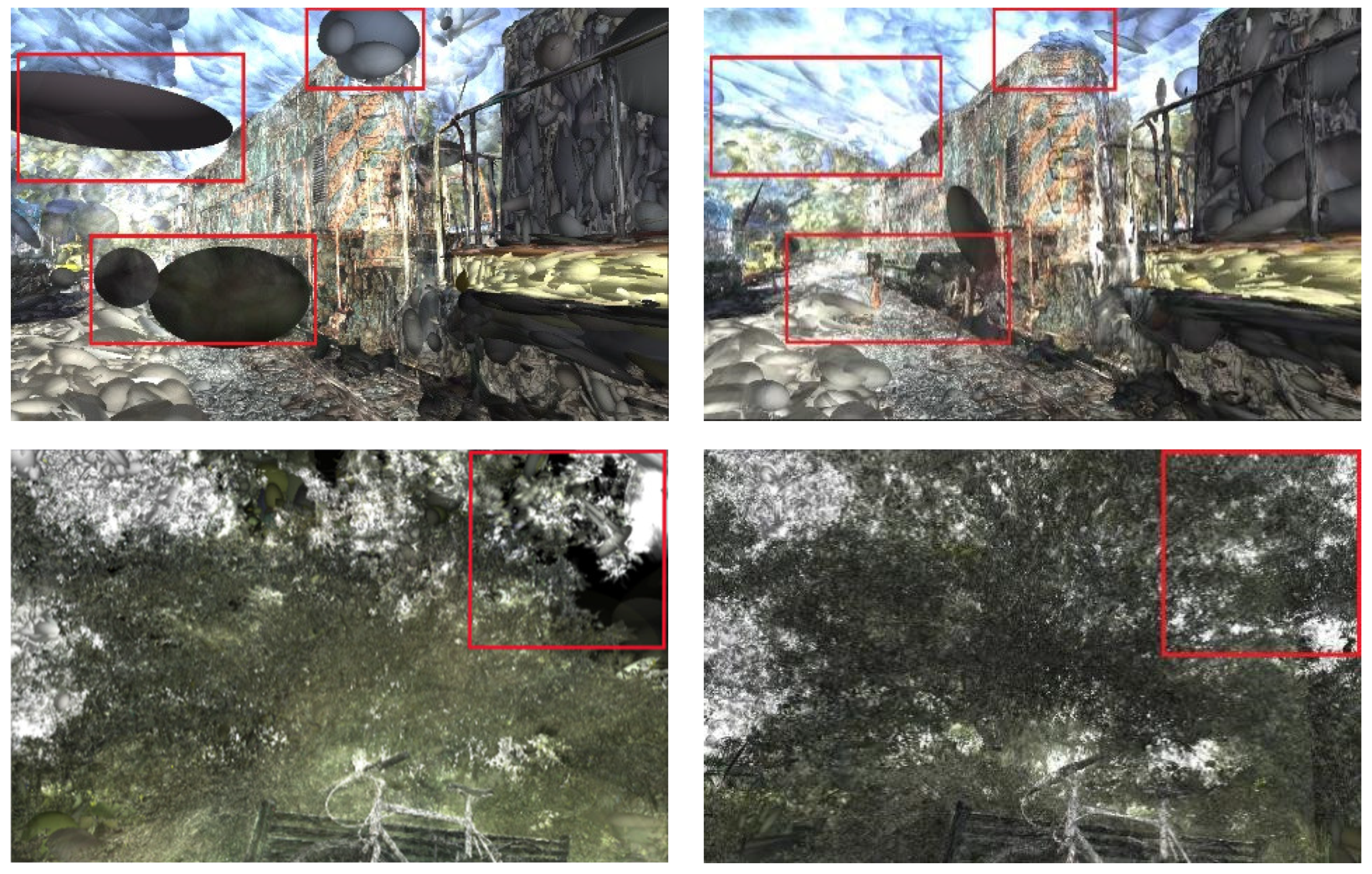
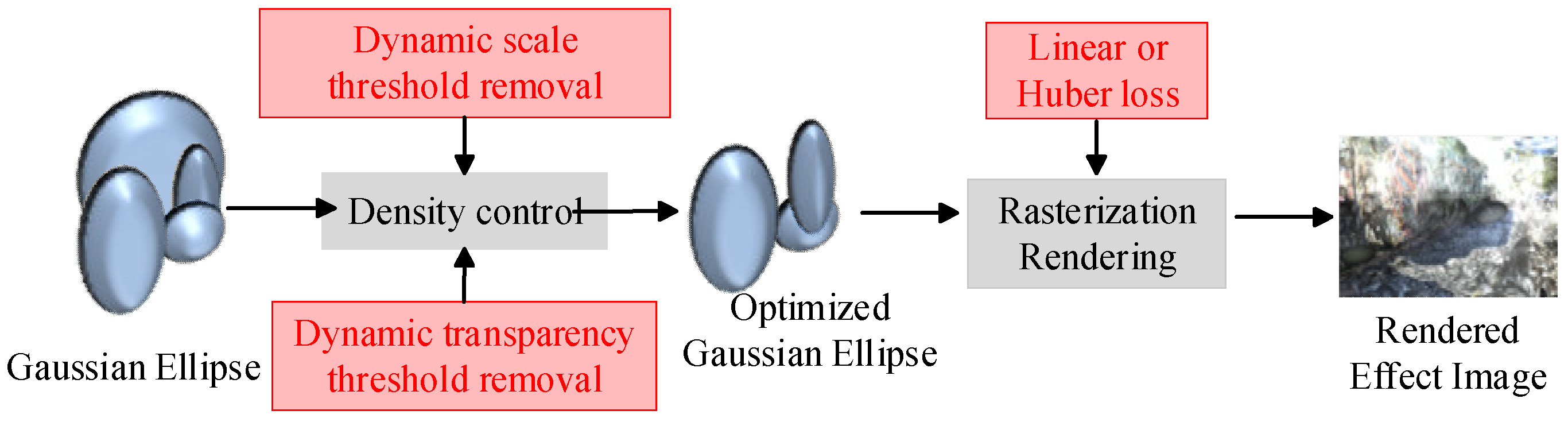
- A dynamic Gaussian deletion mechanism is proposed to adaptively eliminate redundant primitives. For over-reconstruction, coverage of each Gaussian to its surroundings is calculated based on scale, determining customized scale thresholds to eliminate high-coverage Gaussians (Figure 1 right). For under-reconstruction, contribution to reconstruction is evaluated based on transparency, establishing unique transparency thresholds to preserve high-contribution Gaussians (Figure 1 right).
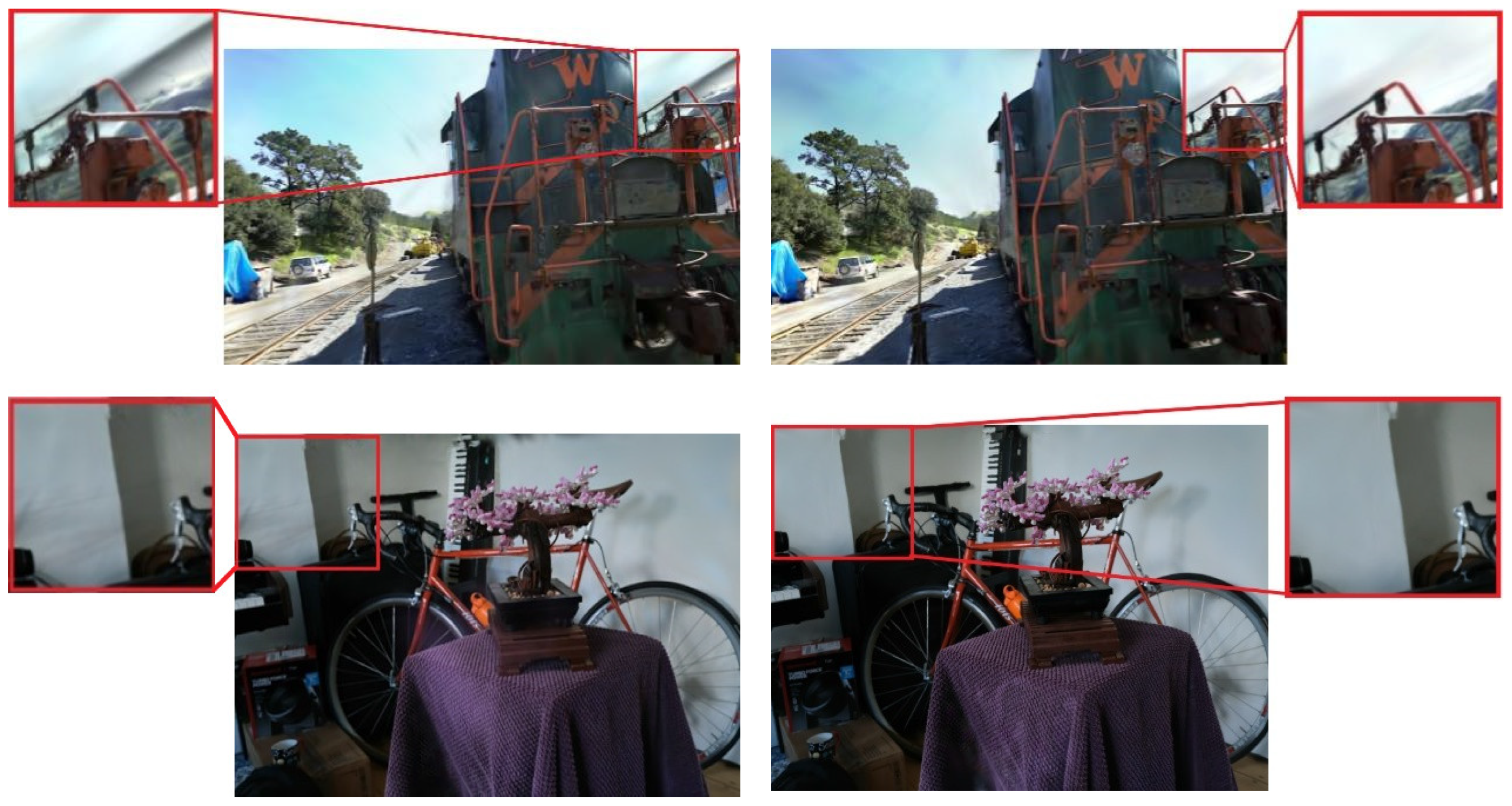
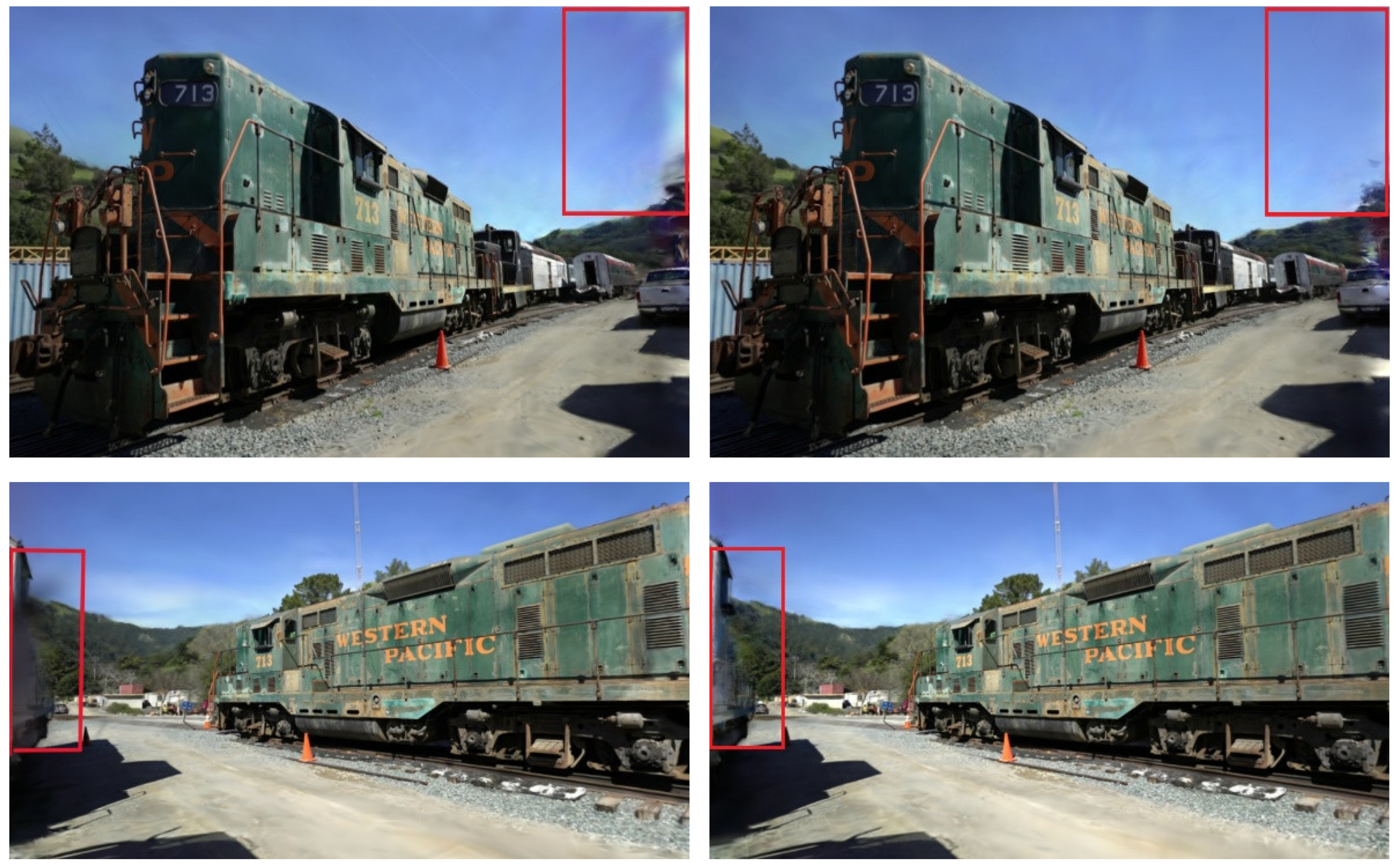
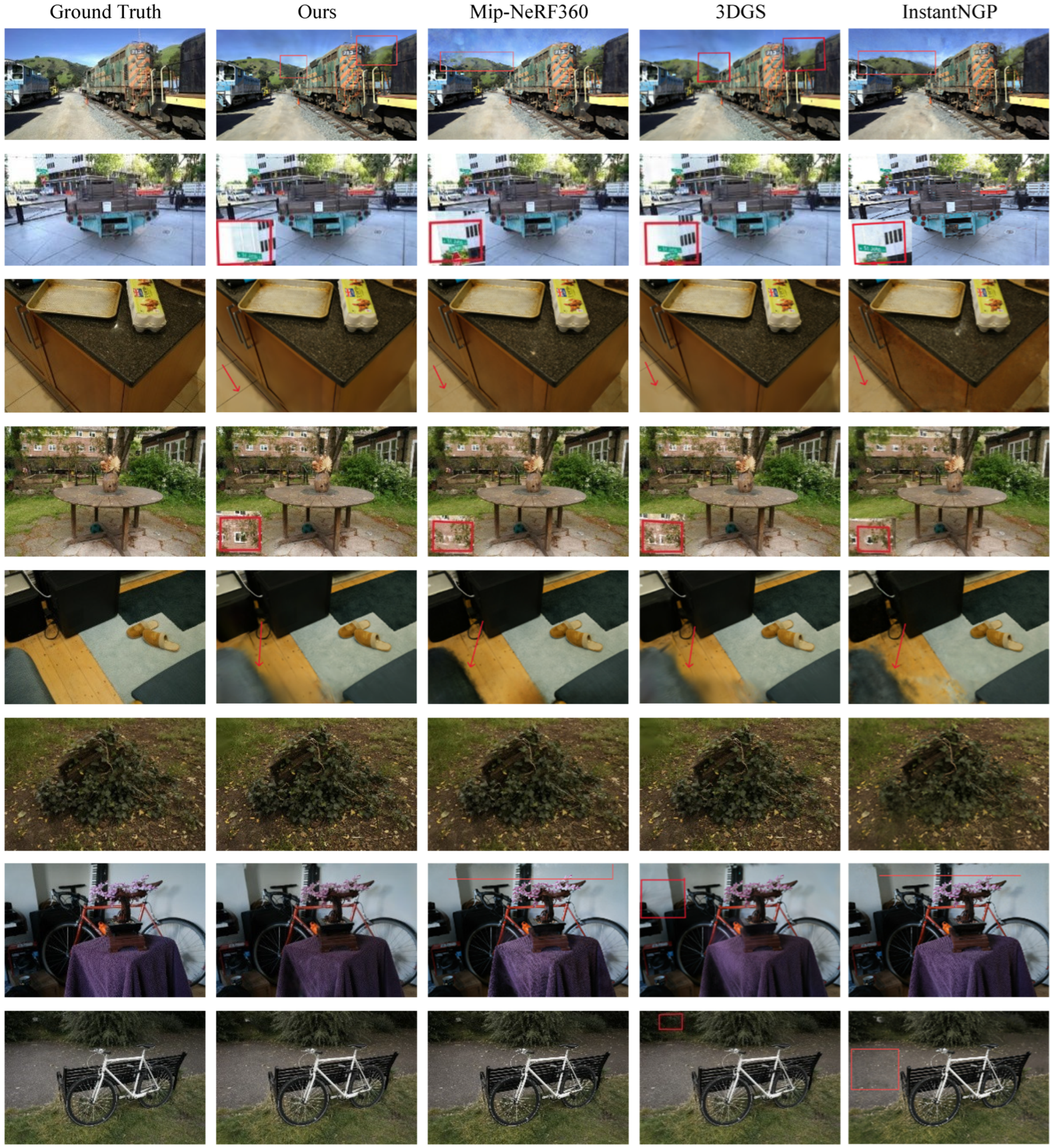
- A novel loss integration strategy is introduced by incorporating the Huber loss during training. This applies quadratic constraints to small errors instead of linear penalties, significantly reducing harsh optimization for severe outliers and alleviating artifacts (Figure 2 left, upper red boxes).
2. Related Work
2.1. Core Innovations of 3DGS
2.2. Mitigation of Over/Under-Reconstruction
2.3. Artifact Reduction Approaches
3. Method Overview
4. Method Detailed Description
4.1. Dynamic Scale Control
4.2. Dynamic Transparency Control
4.3. Loss Function
5. Experimental Analysis
5.1. Selection of the Dataset
5.2. Selection of Evaluation Criteria
5.3. Ablation Experiment Verification
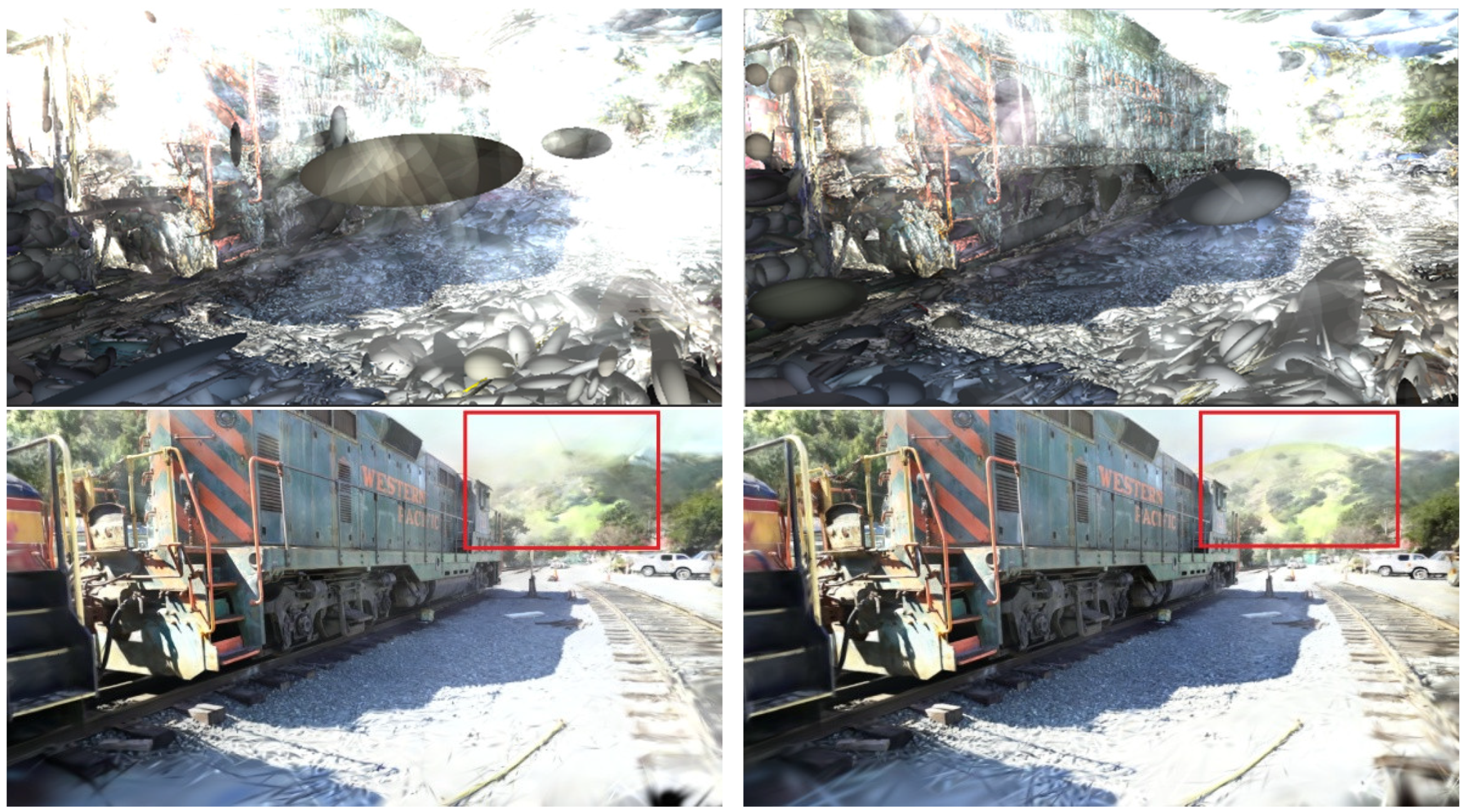
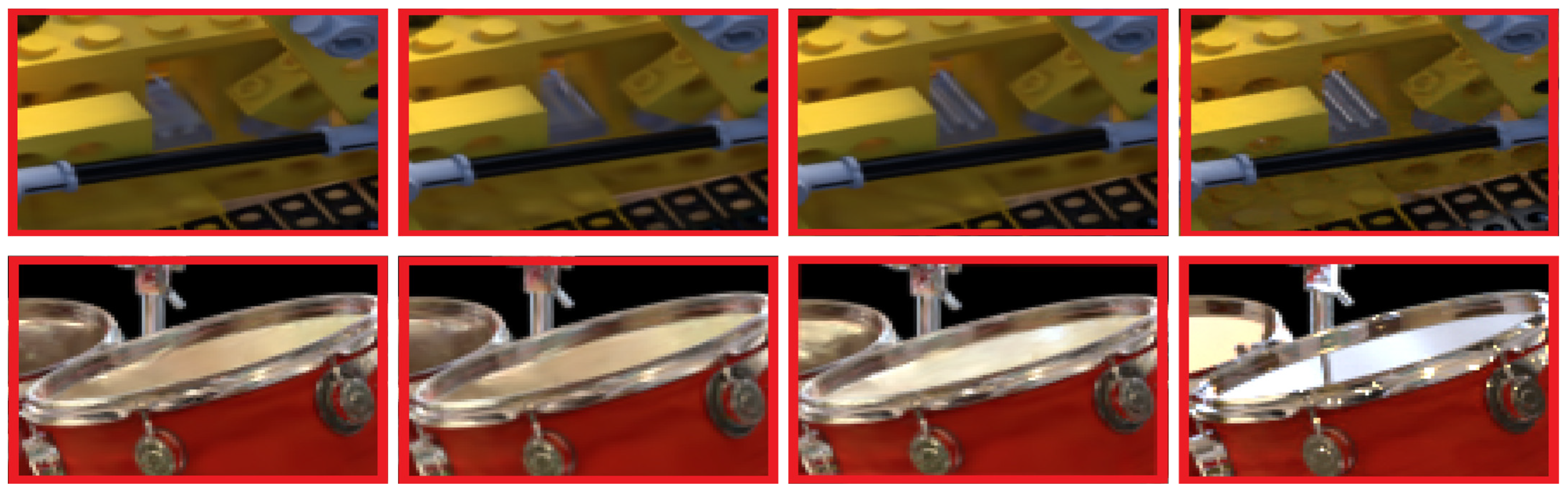
- Loss Function. This section presents the experimental comparison analysis before and after the introduction of the Huber loss function. From the “H, δ = 5” row in Table 1, it can be seen that after adding the new loss function, this method has also improved the PSNR score compared with 3DGS. The specific visualization results are shown in Figure 5. As can be seen from Figure 5, before the introduction of the Huber loss function, the red box area in the upper left graph exhibited a ghosting phenomenon. However, after the introduction of the Huber loss function, the white-like ghosting in the right graph was significantly alleviated. Furthermore, by comparing the two bottom left and bottom right figures in Figure 5, it can be seen that the Huber loss function also has certain effects in removing artifacts and blurring.
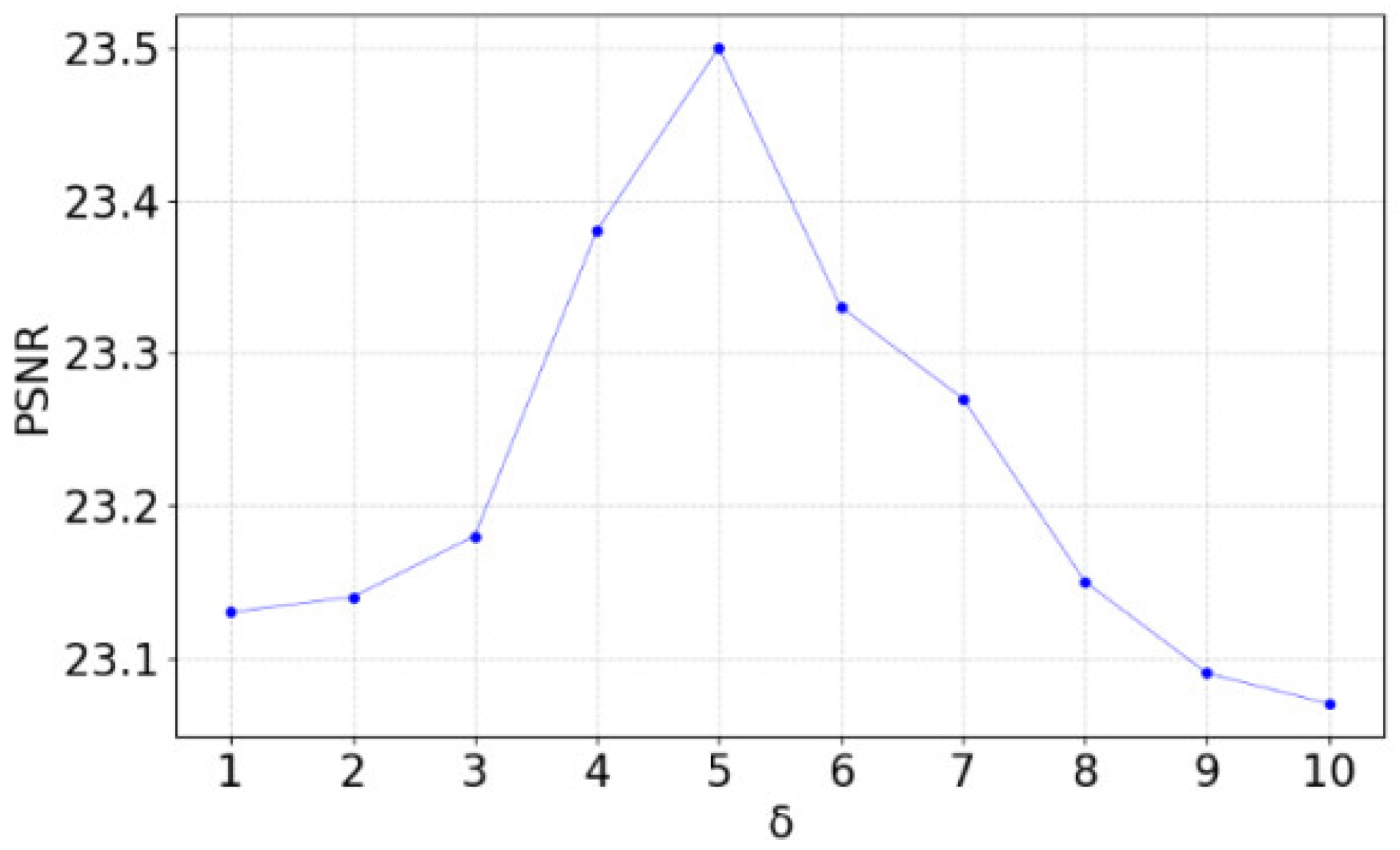
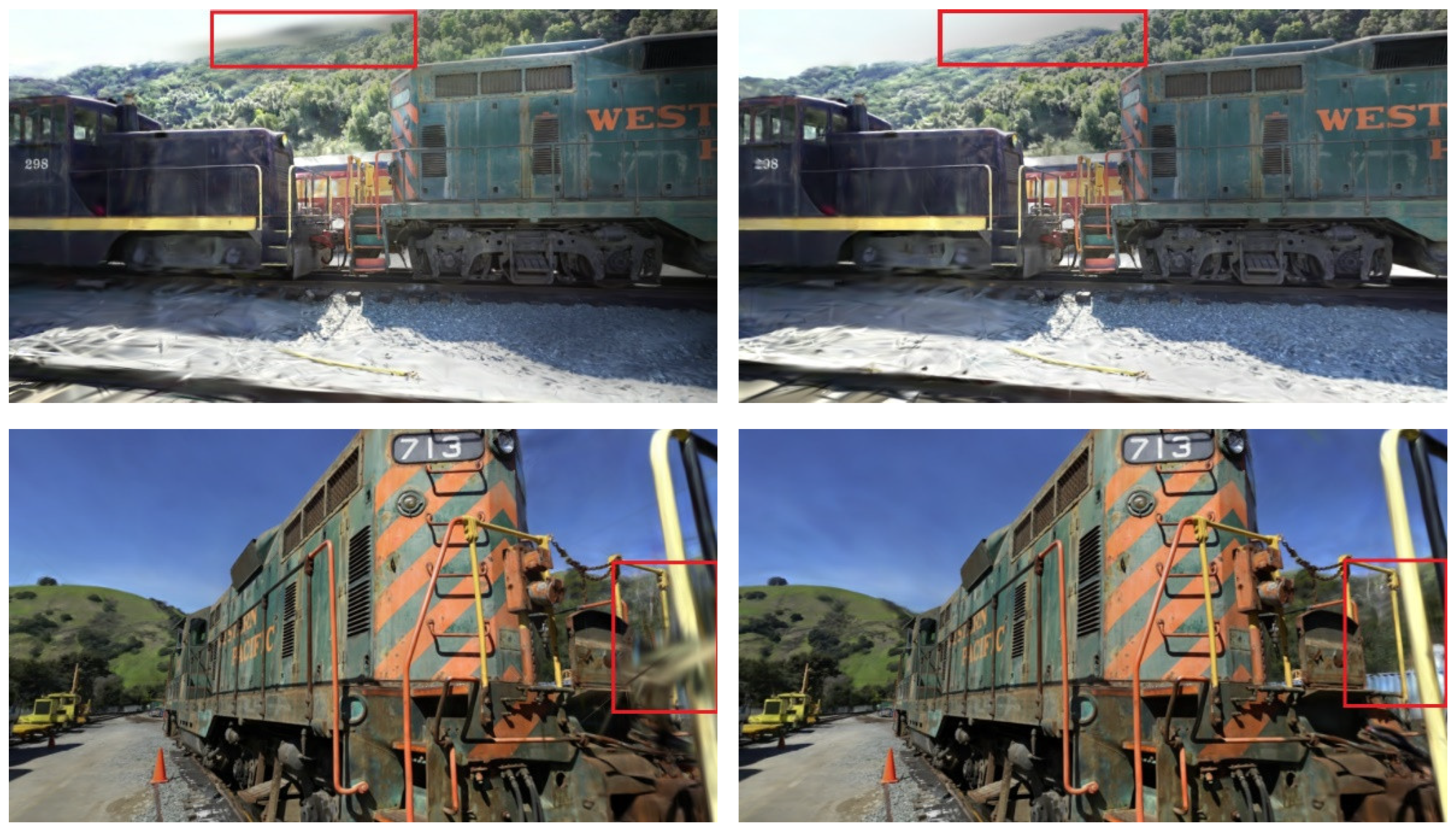
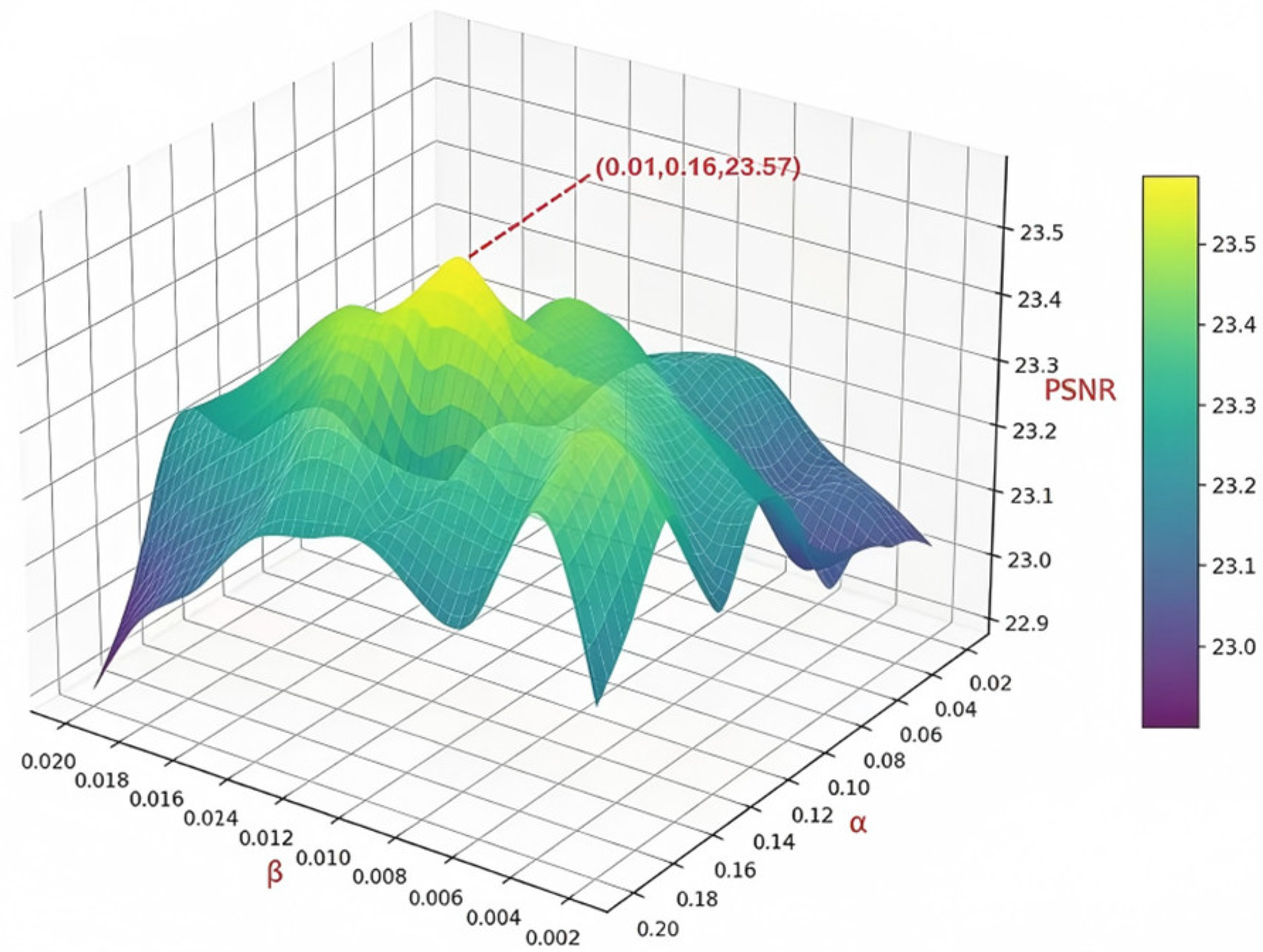
- Parameter Influence. Since the loss function and dynamic Gaussian removal used in this paper employ parameters obtained based on experience, in this ablation experiment, this paper evaluated the impact of different parameter variations on the overall method’s optimization. From the last three rows of Table 1 and Figure 6, it can be observed that when δ = 5, the PSNR reaches its peak. This article has provided a partial visualization of the results obtained through different parameter optimizations, as shown in Figure 7. From Figure 7, it can be observed that when δ is either too large or too small, obvious artifacts will occur. However, when δ is 5, which is a suitable value, this artifact phenomenon does not occur.
5.4. Experimental Comparison
| Algorithm 1: Adaptive 3DGS |
| Input: |
| 1: for each iteration do |
| 2: |
| 3: |
| 4: do |
| 5: |
| 6: |
| 7: Update thresholds: |
| 8: |
| 9: # Eq(4b) |
| 10: then |
| 11: for culling |
| 12: end if |
| 13: end for |
| 14: |
| 15: Remove marked Gaussians |
| 16: end for |
| 17: |
6. Discussion
7. Conclusions
Author Contributions
Funding
Data Availability Statement
Conflicts of Interest
Abbreviations
| PSNR | Peak signal-to-noise ratio |
| NVS | Novel View Synthesis |
| NeRF | Neural Radiance Fields |
| MLP | Multilayer Perceptron |
| 3DGS | 3D Gaussian Splatting |
| SSIM | Structural similarity index measurement |
| LPIPS | Learning perceptual image patch similarity |
References
- Bahirat, K.; Lai, C.; Mcmahan, R.P.; Prabhakaran, B. Designing and evaluating a mesh simplification algorithm for virtual reality. ACM Trans. Multimed. Comput. Commun. Appl. (TOMM) 2018, 14, 1–26. [Google Scholar] [CrossRef]
- Padhy, R.P.; Sa, P.K.; Narducci, F.; Bisogni, C.; Bakshi, S. Monocular vision-aided depth measurement from RGB images for autonomous UAV navigation. ACM Trans. Multimed. Comput. Commun. Appl. 2023, 20, 1–22. [Google Scholar] [CrossRef]
- Zhang, S.; Wang, Y.; Liu, P.; Wang, Y.; Huang, L.; Wang, M.; Atadjanov, I. Capsule endoscopy image enhancement for small intestinal villi clarity. Mathematics 2024, 12, 3317. [Google Scholar] [CrossRef]
- Yu, Z.; Chen, A.; Huang, B.; Sattler, T.; Geiger, A. Mip-splatting: Alias-free 3D Gaussian splatting. In Proceedings of the IEEE/CVF Conference on Computer Vision and Pattern Recognition, New Orleans, LA, USA, 19–21 June 2024; pp. 19447–19456. [Google Scholar]
- Liu, B.; Lei, J.; Peng, B.; Yu, C.; Li, W.; Ling, N. Novel view synthesis from a single unposed image via unsupervised learning. ACM Trans. Multimed. Comput. Commun. Appl. 2023, 19, 1–23. [Google Scholar] [CrossRef]
- Mildenhall, B.; Srinivasan, P.P.; Tancik, M.; Barron, J.T.; Ramamoorthi, R.; Ng, R. Nerf: Representing scenes as neural radiance fields for view synthesis. Commun. ACM 2021, 65, 99–106. [Google Scholar] [CrossRef]
- Kerbl, B.; Kopanas, G.; Leimkühler, T.; Drettakis, G. 3D Gaussian splatting for real-time radiance field rendering. ACM Trans. Graph. 2023, 42, 1–14. [Google Scholar] [CrossRef]
- Chen, A.; Xu, Z.; Geiger, A.; Yu, J.; Su, H. Tensorf: Tensorial radiance fields. In Proceedings of the European Conference on Computer Vision, Tel Aviv, Israel, 23–27 October 2022; pp. 333–350. [Google Scholar]
- Fridovich-Keil, S.; Yu, A.; Tancik, M.; Chen, Q.; Recht, B.; Kanazawa, A. Plenoxels: Radiance fields without neural networks. In Proceedings of the IEEE/CVF Conference on Computer Vision and Pattern Recognition, New Orleans, LA, USA, 19–21 June 2022; pp. 5501–5510. [Google Scholar]
- Liu, L.; Gu, J.; Zaw Lin, K.; Chua, T.S.; Theobalt, C. Neural sparse voxel fields. Adv. Neural Inf. Process. Syst. 2020, 33, 15651–15663. [Google Scholar]
- Müller, T.; Evans, A.; Schied, C.; Keller, A. Instant neural graphics primitives with a multiresolution hash encoding. ACM Trans. Graph. 2022, 41, 1–15. [Google Scholar] [CrossRef]
- Yan, Z.; Low, W.F.; Chen, Y.; Lee, G.H. Multi-scale 3D Gaussian splatting for anti-aliased rendering. In Proceedings of the IEEE/CVF Conference on Computer Vision and Pattern Recognition, Seattle, WA, USA, 17–21 June 2024; pp. 20923–20931. [Google Scholar]
- Huang, B.; Yu, Z.; Chen, A.; Geiger, A.; Gao, S. 2D Gaussian splatting for geometrically accurate radiance fields. In Proceedings of the ACM SIGGRAPH 2024 Conference Papers, Denver, CO, USA, 28 July–1 August 2024; pp. 1–11. [Google Scholar]
- Huang, L.; Guo, J.; Dan, J.; Fu, R.; Li, Y.; Guo, Y. Spectral-GS: Taming 3D Gaussian splatting with spectral entropy. arXiv 2024, arXiv:2409.12771. [Google Scholar]
- Turkulainen, M.; Ren, X.; Melekhov, I.; Seiskari, O.; Rahtu, E.; Kannala, J. Dn-splatter: Depth and normal priors for Gaussian splatting and meshing. In Proceedings of the 2025 IEEE/CVF Winter Conference on Applications of Computer Vision (WACV), Waikoloa, HI, USA, 5–9 January 2025; pp. 2421–2431. [Google Scholar]
- Gross, M.; Pfister, H. (Eds.) Point-Based Graphics; Elsevier: Amsterdam, The Netherlands, 2011. [Google Scholar]
- Grossman, J.P.; Dally, W.J. Point sample rendering. In Proceedings of the Eurographics Workshop, Vienna, Austria, 29 June–1 July 1998; Springer: Vienna, Austria, 1998; pp. 181–192. [Google Scholar]
- Pfister, H.; Zwicker, M.; Van Baar, J.; Gross, M. Surfels: Surface elements as rendering primitives. In Proceedings of the 27th Annual Conference on Computer Graphics and Interactive Techniques, New Orleans, LA, USA, 23–28 July 2000; pp. 335–342. [Google Scholar]
- Lassner, C.; Zollhofer, M. Pulsar: Efficient sphere-based neural rendering. In Proceedings of the IEEE/CVF Conference on Computer Vision and Pattern Recognition, Virtual Event, 19–25 June 2021; pp. 1440–1449. [Google Scholar]
- Prokudin, S.; Ma, Q.; Raafat, M.; Valentin, J.; Tang, S. Dynamic point fields. In Proceedings of the IEEE/CVF International Conference on Computer Vision, Paris, France, 2–6 October 2023; pp. 7964–7976. [Google Scholar]
- Sun, G.; Wong, Y.; Kankanhalli, M.S.; Li, X.; Geng, W. Enhanced 3D shape reconstruction with knowledge graph of category concept. ACM Trans. Multimed. Comput. Commun. Appl. 2022, 18, 1–20. [Google Scholar] [CrossRef]
- Zwicker, M.; Pfister, H.; Van Baar, J.; Gross, M. EWA volume splatting. In Proceedings of the IEEE Visualization, San Diego, CA, USA, 21–26 October 2001; pp. 29–538. [Google Scholar]
- Merrill, D.G.; Grimshaw, A.S. Revisiting sorting for GPGPU stream architectures. In Proceedings of the 19th International Conference on Parallel Architectures and Compilation Techniques, Vienna, Austria, 11–15 September 2010; pp. 545–546. [Google Scholar]
- Max, N. Optical models for direct volume rendering. IEEE Trans. Vis. Comput. Graph. 1995, 1, 99–108. [Google Scholar] [CrossRef]
- Max, N.; Chen, M. Local and Global Illumination in the Volume Rendering Integral; Lawrence Livermore National Lab. (LLNL): Livermore, CA, USA, 2005. [Google Scholar]
- Chen, Z.; Zhang, H. Learning implicit fields for generative shape modeling. In Proceedings of the IEEE/CVF Conference on Computer Vision and Pattern Recognition, Long Beach, CA, USA, 16–20 June 2019; pp. 5939–5948. [Google Scholar]
- Mescheder, L.; Oechsle, M.; Niemeyer, M.; Nowozin, S.; Geiger, A. Occupancy networks: Learning 3D reconstruction in function space. In Proceedings of the IEEE/CVF Conference on Computer Vision and Pattern Recognition, Long Beach, CA, USA, 16–20 June 2019; pp. 4460–4470. [Google Scholar]
- Park, J.J.; Florence, P.; Straub, J.; Newcombe, R.; Lovegrove, S. Deepsdf: Learning continuous signed distance functions for shape representation. In Proceedings of the IEEE/CVF Conference on Computer Vision and Pattern Recognition, Long Beach, CA, USA, 16–20 June 2019; pp. 165–174. [Google Scholar]
- Yu, H.; Long, X.; Tan, P. LM-Gaussian: Boost sparse-view 3D Gaussian splatting with large model priors. arXiv 2024, arXiv:2409.03456. [Google Scholar]
- Zwicker, M.; Pfister, H.; Van Baar, J.; Gross, M. EWA splatting. IEEE Trans. Vis. Comput. Graph. 2002, 8, 223–238. [Google Scholar] [CrossRef]
- Reiser, C.; Peng, S.; Liao, Y.; Geiger, A. Kilonerf: Speeding up neural radiance fields with thousands of tiny mlps. In Proceedings of the IEEE/CVF International Conference on Computer Vision, Montreal, QC, Canada, 11–17 October 2021; pp. 14335–14345. [Google Scholar]
- Kopanas, G.; Philip, J.; Leimkühler, T.; Drettakis, G. Point-based neural rendering with per-view optimization. Comput. Graph. Forum 2021, 40, 29–43. [Google Scholar] [CrossRef]
- Barron, J.T.; Mildenhall, B.; Tancik, M.; Hedman, P.; Martin-Brualla, R.; Srinivasan, P.P. Mip-nerf: A multiscale representation for anti-aliasing neural radiance fields. In Proceedings of the IEEE/CVF International Conference on Computer Vision, Montreal, QC, Canada, 11–17 October 2021; pp. 5855–5864. [Google Scholar]
- Knapitsch, A.; Park, J.; Zhou, Q.Y.; Koltun, V. Tanks and temples: Benchmarking large-scale scene reconstruction. ACM Trans. Graph. 2017, 36, 1–13. [Google Scholar] [CrossRef]
- Barron, J.T.; Mildenhall, B.; Verbin, D.; Srinivasan, P.P.; Hedman, P. Mip-nerf 360: Unbounded anti-aliased neural radiance fields. In Proceedings of the IEEE/CVF Conference on Computer Vision and Pattern Recognition, New Orleans, LA, USA, 19–21 June 2022; pp. 5470–5479. [Google Scholar]



| Title 1 | Train-7k | Garden-7k | Kitchen-7k | Train-30k | Garden-30k | Kitchen-30k | Avg-7k | Avg-30k |
|---|---|---|---|---|---|---|---|---|
| 3DGS | 19.89 | 26.10 | 28.68 | 22.51 | 27.26 | 31.74 | 24.89 | 27.17 |
| D | 20.39 | 26.22 | 29.80 | 23.20 | 27.40 | 32.04 | 25.47 | 27.54 |
| H, δ = 5 | 19.62 | 26.20 | 29.75 | 22.65 | 27.28 | 32.04 | 25.19 | 27.32 |
| H, δ = 1 | 19.60 | 26.18 | 29.41 | 22.62 | 27.33 | 31.89 | 25.06 | 27.28 |
| H, δ = 10 | 19.43 | 26.16 | 29.24 | 22.52 | 27.20 | 31.92 | 24.94 | 27.21 |
| Full, δ = 1 | 20.38 | 26.32 | 30.07 | 23.13 | 27.41 | 32.21 | 25.59 | 27.58 |
| Full, δ = 10 | 20.12 | 26.39 | 30.06 | 23.07 | 27.40 | 32.14 | 25.52 | 27.53 |
| Full, δ = 5 | 20.22 | 26.44 | 30.18 | 23.30 | 27.52 | 32.38 | 25.61 | 27.73 |
| Dataset Method|Metric | Mip-NeRF360 | Tanks&Temples | ||||||
|---|---|---|---|---|---|---|---|---|
| SSIM | PSNR | LPIPS | Train | SSIM | PSNR | LPIPS | Train | |
| Plenoxels [9] | 0.683 | 23.74 | 0.396 | 22 min 14 s | 0.708 | 20.63 | 0.386 | 21 min 28 s |
| InstantNGP [11] | 0.723 | 26.26 | 0.306 | 8 min 34 s | 0.648 | 20.20 | 0.408 | 7 min 22 s |
| Mip-NeRF360 [35] | 0.871 ^ | 29.41 ^ | 0.140 ^ | 43 h | 0.861 | 24.26 | 0.172 | 43 h |
| 3DGS [7] | 0.864 | 29.20 | 0.142 | 33 min 32 s | 0.868 | 24.46 | 0.168 | 26 min 41 s |
| MS-3DGS [12] | 0.837 | 28.29 | 0.182 | 32 min 21 s | 0.865 | 24.42 | 0.169 | 26 min 12 s |
| Mip-Splatting [4] | 0.876 | 29.45 | 0.135 | 33 min 56 s | 0.871 | 25.11 | 0.163 | 27 min 14 s |
| LM-Gaussian [29] | 0.884 | 29.73 | 0.129 | 67 min 12 s | 0.880 | 25.41 | 0.154 | 61 min 08 s |
| Ours | 0.878 | 29.49 | 0.133 | 34 min 44 s | 0.873 | 25.25 | 0.161 | 27 min 24 s |
| Dataset|Method | Bicycle | Garden | Counter | Room | Stump | Bonsai | Kitchen |
|---|---|---|---|---|---|---|---|
| 3DGS [7] | 25.18 | 27.22 | 29.24 | 31.94 | 26.56 | 32.56 | 31.74 |
| MS-3DGS [12] | 25.00 | 27.04 | 26.39 | 28.98 | 26.49 | 32.22 | 31.91 |
| Mip-Splatting [4] | 25.73 | 27.88 | 29.34 | 31.83 | 27.16 | 32.41 | 31.80 |
| Ours | 25.29 | 27.52 | 29.45 | 32.21 | 26.75 | 32.83 | 32.38 |
| Dataset|Method | Chair | Drums | Ficus | Hotdog | Lego | Materials | Mic | Ship | Avg |
|---|---|---|---|---|---|---|---|---|---|
| Plenoxels [9] | 33.68 | 25.42 | 31.54 | 36.22 | 33.91 | 29.07 | 33.26 | 29.43 | 31.56 |
| InstantNGP [11] | 35.40 | 25.80 | 34.00 | 37.10 | 35.60 | 29.40 | 35.90 | 30.30 | 32.93 |
| Mip-NeRF360 [35] | 35.32 | 25.35 | 33.18 | 37.44 | 35.43 | 30.56 | 36.47 | 30.29 | 33.00 |
| 3DGS [7] | 35.52 | 26.27 | 35.49 | 38.08 | 36.04 | 30.49 | 36.70 | 31.67 | 33.78 |
| MS-3DGS [12] | 35.34 | 26.29 | 35.12 | 36.88 | 35.41 | 30.47 | 36.49 | 31.52 | 33.44 |
| Mip-Splatting [4] | 35.75 | 26.33 | 35.88 | 38.11 | 35.91 | 30.52 | 36.87 | 31.63 | 33.86 |
| Ours | 35.99 | 26.44 | 35.61 | 38.15 | 36.24 | 30.67 | 36.72 | 31.84 | 33.95 |
| Dataset|Method | Chair | Drums | Ficus | Hotdog | Lego | Materials | Mic | Ship | Avg |
|---|---|---|---|---|---|---|---|---|---|
| Plenoxels [9] | 0.97630 | 0.93212 | 0.97536 | 0.97895 | 0.97214 | 0.94564 | 0.98368 | 0.88649 | 0.95633 |
| InstantNGP [11] | 0.98533 | 0.95241 | 0.98492 | 0.98367 | 0.98135 | 0.95214 | 0.98829 | 0.89739 | 0.96568 |
| Mip-NeRF360 [35] | 0.98285 | 0.93879 | 0.97924 | 0.98418 | 0.98169 | 0.96012 | 0.99089 | 0.90047 | 0.96477 |
| 3DGS [7] | 0.98766 | 0.95483 | 0.98698 | 0.98528 | 0.98255 | 0.96031 | 0.99252 | 0.90623 | 0.96954 |
| MS-3DGS [12] | 0.98532 | 0.95514 | 0.94841 | 0.98495 | 0.97792 | 0.96016 | 0.99137 | 0.90368 | 0.96336 |
| Mip-Splatting [4] | 0.98791 | 0.95543 | 0.98786 | 0.98527 | 0.98208 | 0.96044 | 0.99268 | 0.90618 | 0.96973 |
| Ours | 0.98825 | 0.96031 | 0.98770 | 0.98541 | 0.98298 | 0.96053 | 0.99250 | 0.90758 | 0.97079 |
Disclaimer/Publisher’s Note: The statements, opinions and data contained in all publications are solely those of the individual author(s) and contributor(s) and not of MDPI and/or the editor(s). MDPI and/or the editor(s) disclaim responsibility for any injury to people or property resulting from any ideas, methods, instructions or products referred to in the content. |
© 2026 by the authors. Licensee MDPI, Basel, Switzerland. This article is an open access article distributed under the terms and conditions of the Creative Commons Attribution (CC BY) license.
Share and Cite
Zhang, F.; Wang, Y.; Yi, B.; Ma, J. Adaptive Deletion of Gaussian Ellipsoids in 3D Gaussian Splatting. Mathematics 2026, 14, 1197. https://doi.org/10.3390/math14071197
Zhang F, Wang Y, Yi B, Ma J. Adaptive Deletion of Gaussian Ellipsoids in 3D Gaussian Splatting. Mathematics. 2026; 14(7):1197. https://doi.org/10.3390/math14071197
Chicago/Turabian StyleZhang, Fei, Yinghui Wang, Bo Yi, and Jiaxin Ma. 2026. "Adaptive Deletion of Gaussian Ellipsoids in 3D Gaussian Splatting" Mathematics 14, no. 7: 1197. https://doi.org/10.3390/math14071197
APA StyleZhang, F., Wang, Y., Yi, B., & Ma, J. (2026). Adaptive Deletion of Gaussian Ellipsoids in 3D Gaussian Splatting. Mathematics, 14(7), 1197. https://doi.org/10.3390/math14071197