1. Introduction
The Sustainable Development Goals (SDGs) represent a global commitment to achieving sustainable development and improving population well-being worldwide [
1]. In particular, SDG 3 emphasizes ensuring healthy lives and promoting well-being for all at all ages, including the control of communicable diseases such as tuberculosis (TB) and the reduction of stunting prevalence as a key indicator of nutritional and public health status. Recognizing the interconnection between TB and stunting may encourage public health researchers, epidemiologists, policymakers, and students to pursue more comprehensive strategies aligned with the objectives of SDG 3.
Tuberculosis (TB) remains one of the leading causes of morbidity and mortality from infectious diseases globally, particularly in low- and middle-income countries [
2]. Despite extensive global control efforts, TB transmission persists due to complex interactions among biological, social, and nutritional factors [
2,
3]. In pediatric populations, TB poses a serious concern because of immature immune systems and heightened vulnerability to environmental risk factors. One fundamental risk factor receiving increasing attention is stunting, defined as chronic growth failure resulting from long-term undernutrition, which adversely affects both physical development and immune function [
1,
4,
5].
Stunting not only impairs linear growth but also compromises immune competence, thereby increasing susceptibility to infectious diseases, including TB. Evidence suggests that children with stunting face a higher risk of developing active TB and may experience poorer treatment outcomes compared to children with normal nutritional status [
3]. Case reports further highlight the interrelationship between pulmonary TB, stunting, and iron deficiency anemia, illustrating a bidirectional interaction between chronic infection and malnutrition [
6]. Moreover, recent literature reviews confirm that a history of infectious diseases significantly contributes to stunting among children under five years of age, reinforcing a vicious infection–malnutrition cycle [
5].
Beyond biological mechanisms, behavioral factors and caregiving practices also play a critical role in preventing both stunting and TB. Educational interventions targeting mothers and caregivers have been shown to improve infant and young child feeding practices, contributing to stunting prevention and indirectly reducing TB risk among children [
7]. Community-based health education programs likewise demonstrate significant impacts on TB prevention efforts among stunted children, particularly at the primary healthcare level [
8]. These findings underscore the role of education as a strategic non-pharmacological intervention capable of simultaneously modifying nutritional and infectious risk factors.
Meanwhile, mathematical modeling of TB transmission has evolved extensively across various structural and intervention-oriented perspectives. Classical deterministic compartmental models have been employed to analyze the stability of disease-free and endemic equilibria through the basic reproduction number,
, as well as to evaluate the effects of treatment and vaccination [
9,
10,
11]. Subsequent developments incorporated imperfect vaccination, waning immunity, and exogenous reinfection, leading to the emergence of backward bifurcation phenomena in which the condition
no longer guarantees disease elimination [
12,
13,
14].
Further extensions addressed biological complexities, such as multiple reinfections and endogenous reactivation [
15,
16], differentiation between first- and second-line treatments [
17], incomplete treatment [
18], and undetected cases [
19]. Data-driven national studies demonstrate that strategies such as DOTS expansion, enhanced diagnosis, and BCG vaccination reduce prevalence but remain insufficient to achieve elimination without more comprehensive interventions [
20,
21,
22]. Population heterogeneity has also been incorporated through contact network models [
23], interregional mobility [
24], labor migration [
25], age structure [
26,
27], and variability in public awareness [
28,
29]. Additionally, TB co-infection models with HIV, COVID-19, and other diseases have been investigated using ODE, PDE, and optimal control approaches [
30,
31,
32,
33]. Collectively, this body of work demonstrates substantial methodological sophistication in stability analysis, bifurcation theory, and intervention optimization.
Nevertheless, a consistent structural limitation persists across most TB models. The determinants incorporated are primarily direct epidemiological factors, such as transmission, vaccination, diagnosis, or treatment efficacy, whereas chronic biological determinants influencing population susceptibility are rarely modeled as endogenous dynamic variables. In particular, chronic malnutrition in the form of childhood stunting has not been explicitly integrated into TB transmission systems, despite empirical evidence indicating a significant bidirectional relationship between the two. Clinical and epidemiological studies reveal that stunting increases susceptibility to TB infection and worsens disease outcomes [
5,
6], while a history of infectious diseases contributes to the development of stunting [
4]. These findings suggest the presence of a biological feedback mechanism that should be explicitly represented within a population-level dynamical framework.
Conversely, research on stunting largely concentrates on nutritional determinants, caregiving practices, and social factors, without being formulated in differential equation systems that capture dynamic interactions with infectious diseases [
4,
5]. As a result, TB modeling and stunting research have evolved in parallel yet disconnected trajectories, despite sharing intertwined biological mechanisms and risk determinants.
Accordingly, a clear conceptual and methodological gap exists: no integrated mathematical framework currently models TB transmission and stunting progression simultaneously within a unified compartmental system while evaluating combined intervention strategies through optimal control. This lack of integration may lead to biased threshold estimates and suboptimal policy recommendations in regions experiencing a dual burden of TB and stunting.
To address this gap, the present study develops an integrated TB–stunting transmission model that incorporates strengthened TB treatment through early detection and improved therapeutic adherence, alongside nutritional improvement and stunting prevention as indirect control strategies. By combining medical, nutritional, and educational interventions within a dynamic system of ordinary differential equations analyzed through optimal control theory, this study evaluates the simultaneous impact of integrated strategies on TB transmission rates and stunting prevalence. The proposed framework not only extends the theoretical structure of classical TB epidemiological models by incorporating nutritional status as an endogenous modifier of disease dynamics but also provides a more realistic analytical foundation for designing effective simultaneous control strategies in high-burden settings.
The integration of tuberculosis (TB) transmission and childhood stunting in a unified model offers a holistic strategy for improving health outcomes in regions burdened by both issues. By combining TB control with stunting prevention, this approach supports more effective public health interventions, such as nutritional programs alongside early TB detection and treatment. The model can guide resource allocation and help policymakers prioritize areas with the highest dual burden, ensuring efficient interventions. This strategy aligns with SDG 3, enhancing global health and well-being, especially for children, and supports evidence-based decision-making.
2. Mathematical Models
This study develops a deterministic compartmental model to describe the transmission dynamics of tuberculosis (TB) in a human population while incorporating the aggregated effect of early childhood stunting. The total population is assumed to be closed, meaning that demographic changes occur only through natural births and natural deaths, with no migration.
The population is divided into two distinct age groups: 0–5 years and ≥5 years. The 0–5 years age group represents the early childhood period, during which individuals are most susceptible to stunting, which may affect immune development and disease susceptibility. The ≥5 years group represents the broader population at risk of tuberculosis transmission.
The first group consists of children aged 0–5 years, within which stunting is modeled as a condition affecting a subset of the population. This group is represented by four compartments:
for stunted children susceptible to TB infection;
for stunted children with latent TB infection;
for stunted children with active TB infection; and
for children who have recovered from TB. The second group includes individuals aged ≥5 years, represented by
for susceptible individuals,
for those with latent infection,
for those actively infected, and
for those who have recovered. This model adopts the slow progression pathway of tuberculosis, in which newly infected individuals first enter the latent compartment before progressing to active infection. The fast progression pathway is not explicitly included, as it occurs in a relatively small proportion of cases [
13,
14,
15]. Thus, the total population size at time
is
The model is based on the following assumptions:
The model assumes a variable population size, with individuals entering the population through recruitment at rate Λ and leaving due to natural mortality at rate μ.
Stunting is modeled implicitly and aggregated within the early childhood population.
The population aged 0–5 years is considered most susceptible to stunting; therefore, the interaction between tuberculosis transmission and stunting is modeled within this group.
Newly infected individuals first enter the latent compartment LSC or LA before potentially becoming infectious.
Stunting increases susceptibility to TB infection and accelerates progression from latent to active TB.
Children are assumed to contribute less to tuberculosis transmission because of their lower infectiousness, as supported by epidemiological evidence [
34,
35].
TB transmission occurs only through infectious individuals in the ≥5-year age group.
Individuals first enter the latent class before progressing to active TB at a rate σ.
Infectious individuals recover through treatment at a rate γ.
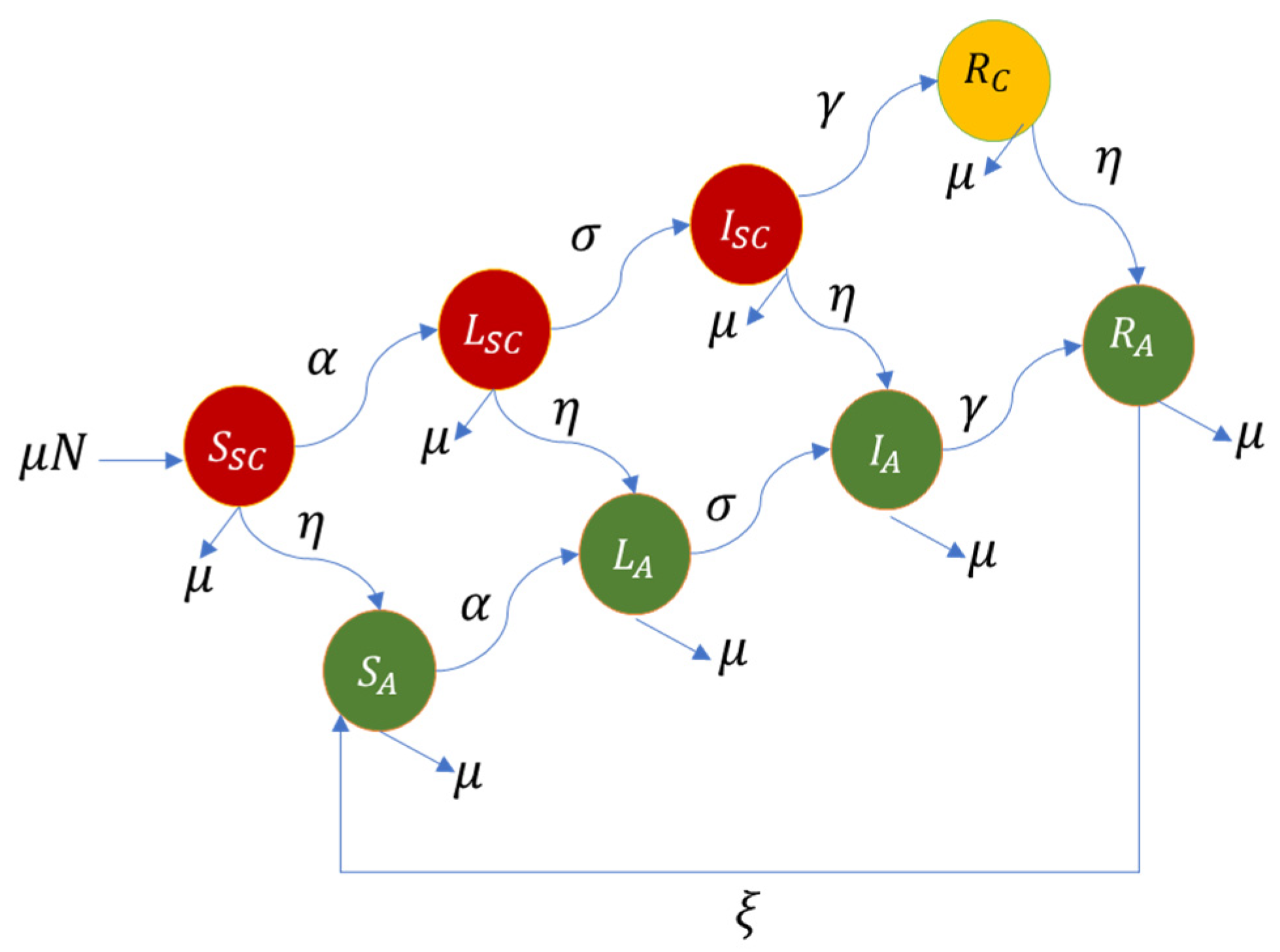
The transition from ISC to IA does not represent a change in infection status but only reflects the aging process between age groups.
Individuals transition from the early childhood group (0–5 years) to the ≥5-year age group at a constant aging rate η.
Recovered individuals do not acquire permanent immunity, and immunity loss is considered only in the ≥5 years population, as waning immunity is generally a long-term process. At the same time, tuberculosis in young children is primarily characterized by rapid progression following primary infection rather than reactivation, which is more common in older populations [
36,
37].
Individuals in RA may lose protection at a rate ξ.
Disease-induced mortality due to tuberculosis is not explicitly included in the model, and all deaths are assumed to occur at the natural mortality rate
μ. This assumption is supported by epidemiological evidence indicating that tuberculosis-related mortality is relatively small compared to the overall population level [
2].
TB transmission follows a density-dependent incidence mechanism, defined by the force of infection
where
denotes the effective transmission rate and
represents the number of infectious individuals in the >5 years population. The infection rate for susceptible individuals is therefore
for early childhood and
for the ≥5 years group. This formulation assumes that infection risk increases with the number of infectious individuals aged ≥5 years in the population. The assumption is motivated by epidemiological evidence indicating that tuberculosis transmission is primarily driven by infectious individuals aged ≥5 years. In contrast, young children rarely contribute significantly to transmission due to lower bacillary loads and less frequent productive coughing. Consequently, individuals aged ≥5 years are considered the dominant source of infection in the population [
38].
Integrating the population structure, modeling assumptions, and force of infection, the schematic diagram in
Figure 1 illustrates the compartmental transitions governing the system. Each arrow represents a specific transition term in the mathematical model, ensuring consistency between the biological assumptions and the corresponding system of differential equations. The schematic highlights interactions between stunted children and individuals aged ≥5 years regarding TB infection.
Based on this framework, the complete mathematical model is formulated in Equations (1)–(8), which describe the dynamics of TB infection and the impact of stunting across all defined population compartments.
with
and
3. Dynamic Analysis
3.1. Mathematical Properties of the Model
Before proceeding with the dynamical analysis, it is essential to establish that system (1)–(8) is mathematically well-posed and biologically meaningful. Specifically, it must be ensured that, for any nonnegative initial conditions, the solution exists globally in time, is unique, remains nonnegative, is bounded, and evolves within a biologically feasible invariant region. These properties prevent negative population values and finite-time blow-up, thereby providing a rigorous foundation for the subsequent stability and nonlinear analysis.
Theorem 1. Consider system (1)-(8) with nonnegative initial conditionsand assume that all model parameters are strictly positive. Then: System (1)-(8) admits a unique global solution for all
.
The solution remains nonnegative for all
.
The solution is uniformly bounded. In particular, the total population satisfies
as
.
Proof of Theorem 1. The right-hand sides of system (1)-(8) are continuously differentiable polynomial functions in the state variables. Hence, the associated vector field is locally Lipschitz continuous in
. By the Cauchy-Lipschitz (Picard-Lindelöf) theorem [
39], a unique local solution exists for any given initial data. □
To establish nonnegativity, observe that each equation satisfies an inward-pointing condition on the boundary of the nonnegative orthant
. For instance,
and analogous relations hold for the remaining components. Therefore, solutions initiated in
cannot cross the coordinate hyperplanes into the negative region. The nonnegative orthant is thus positively invariant.
Next, define the total population
Summing Equations (1)–(8) yields
This linear equation admits the explicit solution:
Consequently, for all and, in particular,
Thus, all state variables are uniformly bounded, which excludes finite-time blow-up and guarantees global existence of the solution.
3.2. Disease-Free Equilibrium
The Disease-Free Equilibrium (DFE) is obtained by assuming that the population is free of infection. To derive the DFE, we set the rate of change of each compartment to zero (the steady-state assumption). This results in the following equilibrium conditions, where the infected compartments are zero. The equilibrium point is then determined by substituting these conditions into Equations (1) to (8) and solving the resulting algebraic equations under the steady-state assumption, that is, by setting all time derivatives equal to zero.
Accordingly, the disease-free equilibrium of system (1)-(8) is given by Equation (9).
Biologically, the disease-free equilibrium represents a state in which tuberculosis (TB) is absent from the population. At this equilibrium, all infection-related compartments, including both latent and active TB among stunted children and individuals aged ≥5 years, are equal to zero, indicating that no disease transmission occurs within the system. The entire population remains in the susceptible classes, with the number of susceptible stunted children given by and the number of susceptible individuals aged ≥5 years given by . The population distribution at this steady state is determined solely by the recruitment rate , the aging rate , and the natural death rate . Therefore, characterizes a disease-free state that serves as the fundamental reference point for stability analysis and the determination of the basic reproduction number of the system.
3.3. Basic Reproduction Numbers
To determine the basic reproduction number
, we apply the next-generation matrix method [
40]. From the model formulation, the vector of new infection terms is given by
while the remaining transition terms are
By evaluating the Jacobian derivatives of
and
at the disease-free equilibrium point
, the matrices
and
are obtained. The
matrix only contains nonzero entries corresponding to transmission from infectious individuals
, while the
matrix is lower triangular and represents progression, aging, recovery, and natural death. After calculating the following generation matrix
, it is found that only one eigenvalue is nonzero. Thus, the basic reproduction number is given by Equation (10).
Biologically, this quantity represents the average number of secondary TB infections generated by a single infectious individual in a wholly susceptible population, accounting for age structure and disease progression dynamics.
The numerator reflects the transmission intensity and the contribution of progression to the infectious stage, as it depends on the effective transmission rate , the progression rate , the aging rate , and the recruitment rate . In contrast, the denominator represents removal mechanisms from the infectious pathway, including recovery , age transition, and natural mortality , which reduce the effective infectious period and limit transmission opportunities.
Therefore, encapsulates the combined effects of transmission, progression, demographic turnover, and recovery in determining whether TB dies out () or persists in the population ().
3.4. Stability Analysis
Theorem 2. The disease-free equilibrium
of the TB transmission model is locally asymptotically stable if
Proof of Theorem 2. To analyze the local stability of
, we linearize the system around the disease-free equilibrium and compute the Jacobian matrix
. The characteristic equation of
can be expressed in factored form as
The first four factors correspond to eigenvalues
which are all strictly negative since all parameters are positive.
The remaining eigenvalues,
to
, are determined by the polynomial
where
By applying the Routh-Hurwitz criterion [
41,
42,
43], the roots of this quadratic have negative real parts if and only if
and
It can be shown that these conditions are satisfied precisely when
. Therefore, the disease-free equilibrium
is locally asymptotically stable if
. □
3.5. Stability Analysis Existence of the Endemic Equilibrium
Theorem 3. Consider the TB-stunting transmission model defined by system (1)-(8). Assume that all parameters are strictly positive. If then the model admits a unique endemic equilibriumsatisfying .
Proof of Theorem 3. To determine the endemic equilibrium, we set
Substituting the above expressions into Equation (7), we get:
The trivial solution
= 0 corresponds to the disease-free equilibrium. Therefore, the existence of an endemic equilibrium reduces to determining positive solutions of
The coefficients are given by
Since a > 0, the sign of the constant term
is determined by the term
that is,
Let
and
denote the roots of
, By Vieta’s formulas [
44],
If , then , indicating a positive product of the roots, meaning no biologically feasible endemic equilibrium exists. Conversely, if , then , implying the product of the roots is negative, thus ensuring the existence of a unique endemic equilibrium. □
3.6. Numerical Simulation
To illustrate the population dynamics of TB infection among stunted children and individuals aged ≥5 years, considering the transmission, progression, and intervention strategies described in models (1)-(8), we perform numerical simulations using the parameter values and variables listed in
Table 1.
Using the parameter values and initial conditions presented in
Table 1,
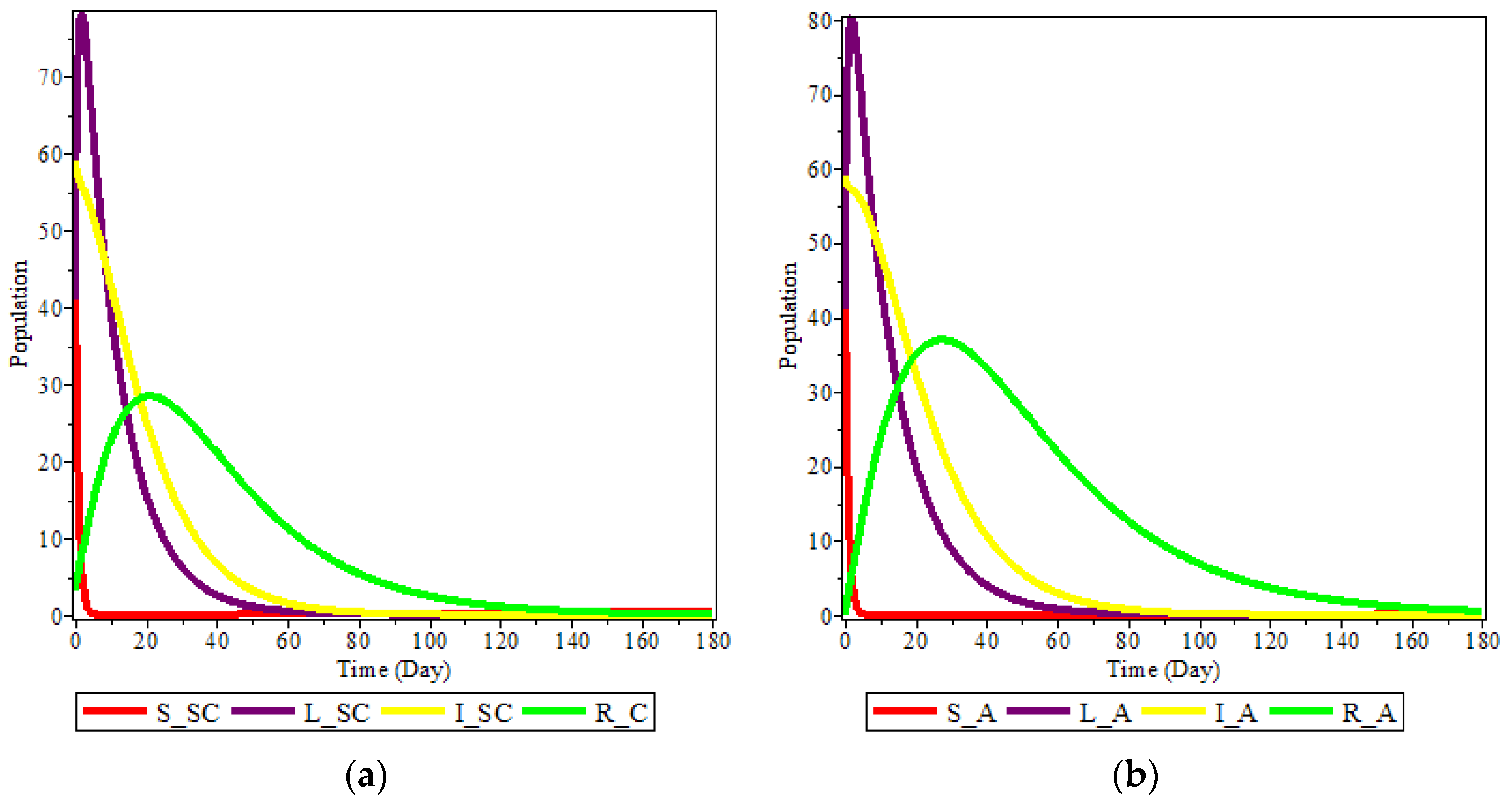
Figure 2 illustrates the dynamics of stunted children and of individual populations aged > 5 years under the scenario where the basic reproduction number
, indicating disease decline. In contrast,
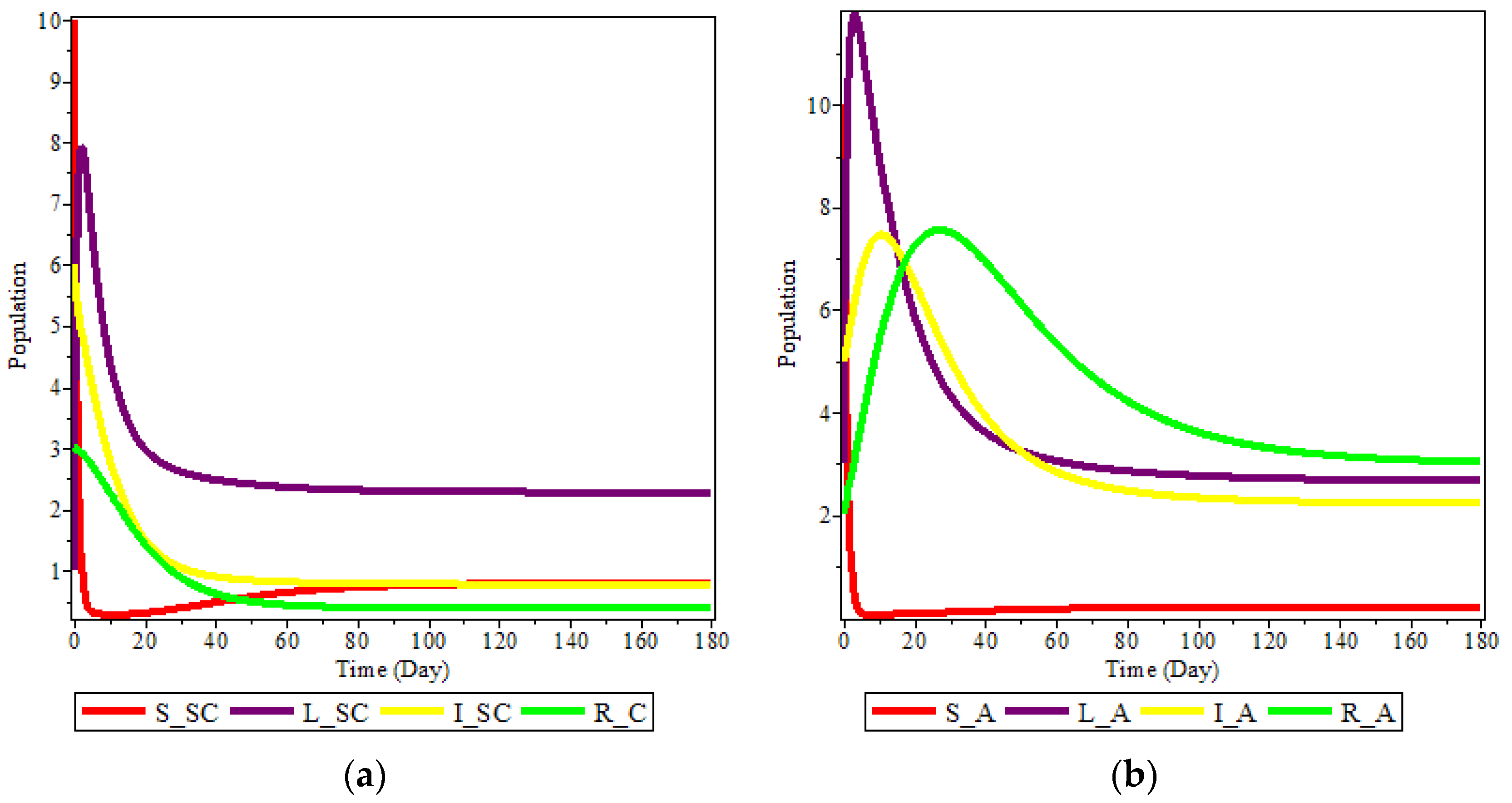
Figure 3 shows the population trajectories when
, highlighting sustained transmission and the critical threshold behavior inherent in TB dynamics.
Figure 2 presents the numerical simulation of the model dynamics under the condition
. As theoretically established in the stability analysis, the disease-free equilibrium is locally asymptotically stable when the basic reproduction number is less than unity. The numerical results strongly support this analytical finding.
In both subpopulations, the infectious compartments and decline rapidly over time and approach zero without exhibiting sustained growth. Although a small initial increase is observed due to initial infections, the number of infectious individuals decreases monotonically thereafter and vanishes within the simulation horizon. This behavior confirms that each infected individual generates, on average, fewer than 1 secondary case, leading to eventual disease elimination.
Similarly, the latent classes and decrease steadily toward zero. The absence of persistent latent accumulation indicates that transmission is insufficient to sustain progression to active TB. The trajectories demonstrate that no endemic equilibrium emerges under this parameter regime.
Meanwhile, the recovered compartments and initially increase as infectious individuals transition to recovery, but eventually stabilize once the infectious population disappears. The susceptible populations tend toward steady-state levels consistent with the disease-free equilibrium. When , the system is expected to converge to the disease-free equilibrium, where the infected compartments vanish, and the susceptible population approaches . However, the relatively low number of susceptible individuals observed in the numerical simulations occurs during the transient phase of the dynamics. This behavior is mainly influenced by the initial distribution of the population across the epidemiological compartments, as well as the temporary transfer of individuals into the latent and recovered classes at the early stage of the simulation.
As time progresses and the infection dies out, these compartments diminish, and the susceptible population gradually increases toward its theoretical steady-state value, consistent with the disease-free equilibrium.
Overall,
Figure 2 illustrates that when
, the infection cannot persist in either subpopulation. The disease naturally dies out over time, and the system converges to the disease-free equilibrium. These numerical findings are fully consistent with the theoretical stability result and confirm that maintaining
below unity is a sufficient condition for long-term disease eradication within the modeled population.
Figure 3 illustrates the numerical dynamics of the system when the basic reproduction number satisfies
. In agreement with the theoretical analysis, this condition implies that the disease-free equilibrium is unstable and the infection persists in the population. As shown in
Figure 3, both infectious compartments
and
initially decrease slightly but subsequently approach positive steady-state levels rather than converging to zero. This behavior indicates the establishment of an endemic equilibrium. The persistence of infectious individuals confirms that each infected individual, on average, generates more than one secondary case, allowing sustained transmission within both subpopulations.
The latent classes and similarly converge to positive equilibrium values. Unlike the scenario, the latent population does not vanish over time but stabilizes at nonzero levels, continuously feeding the infectious compartments through progression dynamics.
The recovered classes and increase during the early phase of the outbreak and then stabilize at higher steady-state values than in disease-free cases. This reflects the ongoing balance between new infections and recovery at the endemic equilibrium.
Meanwhile, the susceptible populations decline from their initial levels and settle at reduced steady states, consistent with sustained transmission pressure in the system.
Overall,
Figure 3 confirms that when
, the infection cannot be eliminated naturally and instead converges to an endemic equilibrium in both subpopulations. These numerical findings validate the analytical result that the threshold parameter
determines whether the disease dies out or persists in the long term.
4. Sensitivity Analysis
A sensitivity analysis was carried out employing the Latin Hypercube Sampling (LHS) approach in conjunction with the Partial Rank Correlation Coefficient (PRCC) method [
46]. A total of 5000 randomly generated parameter combinations were used to assess the influence of variations in each model parameter on the basic reproduction number
, as formulated in Equation (10). All parameters were assumed to follow a uniform distribution within the interval [0, 1]. The computed PRCC values represent the strength and direction of the monotonic relationship between each parameter and
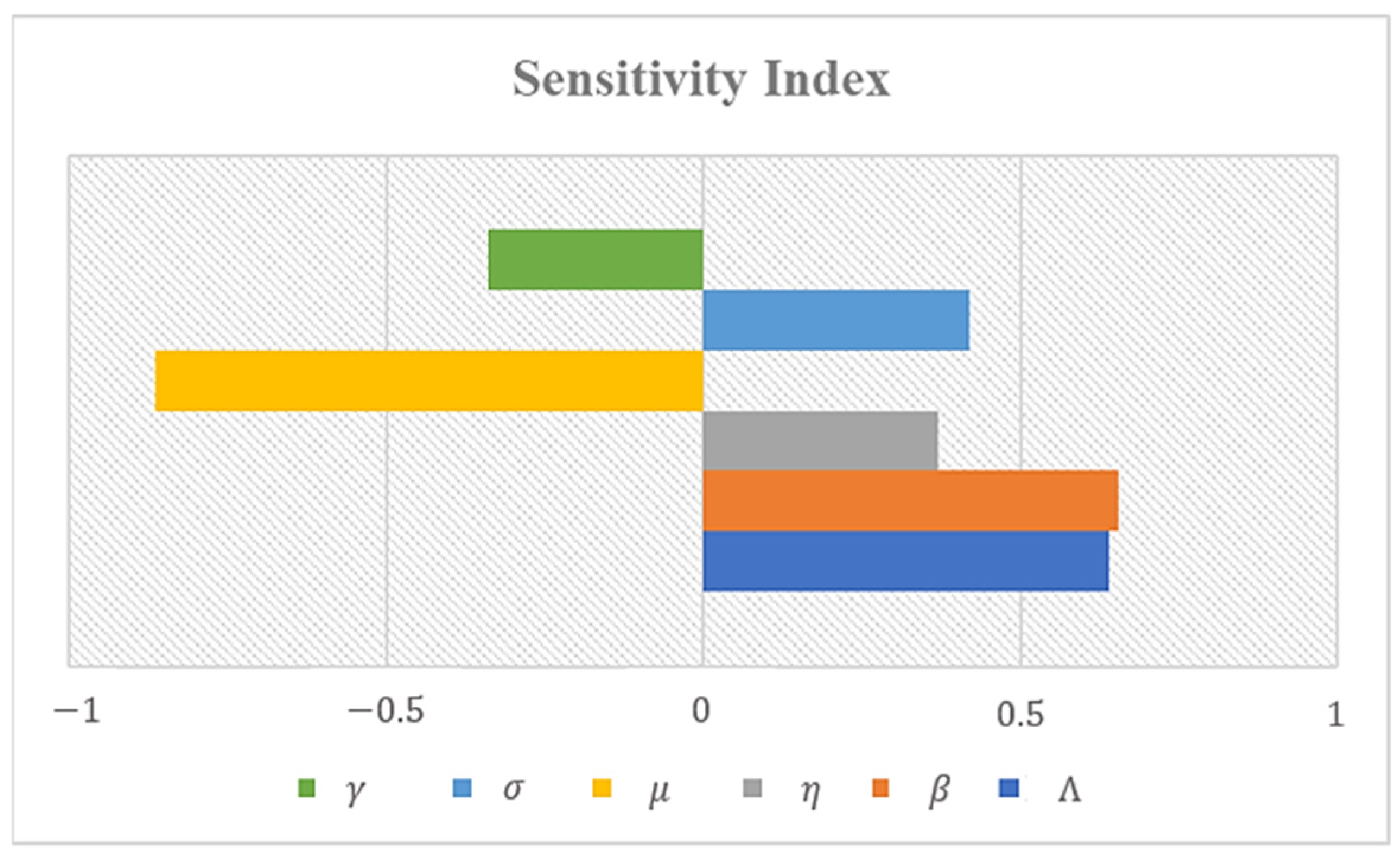
, as shown in
Figure 4. These values help quantify how much each parameter influences disease transmission.
Figure 4 indicates that the transmission rate
, the recovery rate
, and the progression rate from latent to active infection
are key parameters influencing the disease dynamics. The sensitivity indices show that
has the strongest positive correlation with
, meaning that an increase in the transmission rate substantially raises the potential for TB spread within the population. The parameter
also exhibits a positive effect on
, indicating that faster progression from latent to active TB enhances disease persistence. In contrast,
has a negative sensitivity index, implying that a higher recovery rate reduces
and lowers the risk of sustained transmission.
The sensitivity analysis also indicates that the natural death rate and the recruitment rate influence the value of . These parameters represent demographic processes that affect population turnover and, consequently, the dynamics of disease. However, since corresponds to the natural mortality rate and represents the recruitment rate into the population, they are not directly controllable through TB intervention strategies.
Based on these results, , , and were identified as critical control variables in the optimal control analysis for targeted TB interventions. Targeting these parameters is essential for reducing TB transmission, improving treatment effectiveness, and limiting disease spread. Targeting is epidemiologically justified because interventions such as strengthening infection control, reducing effective contact rates, and vaccination can directly suppress transmission. Controlling is practically feasible, as improving treatment effectiveness and expanding coverage accelerate recovery and decrease infectious duration. Meanwhile, controlling is essential to limit the progression of latent cases into active infections, which may be achieved through preventive therapy, immune strengthening, and nutritional interventions among vulnerable groups.
Simultaneous regulation of these three parameters provides a biologically meaningful and operationally realistic strategy, as it addresses transmission reduction, recovery enhancement, and prevention of latent progression within a unified control framework.
5. Optimal Control
5.1. Optimal Control Model
To reduce the prevalence of infection in both subpopulations, two time-dependent control functions, and , are incorporated into the model framework.
The control explicitly represents the intensity of strengthening TB treatment, including enhanced case detection, treatment adherence, and optimized case management to reduce transmission and progression. Epidemiologically, this intervention accelerates the recovery of infectious individuals; mathematically, it increases the recovery rate from to .
The control represents the intensity of stunting-prevention interventions, such as nutritional improvements, immune strengthening, caregiver education, and community-based health programs. In this model, stunting is incorporated implicitly as a risk-modifying factor rather than as a separate epidemiological compartment. From a modeling perspective, this strategy reduces susceptibility to infection and slows disease progression; therefore, the transmission rate and progression rate are modified to and , respectively.
The admissible control set is defined as
Here, indicates the absence of intervention, while represents the maximum feasible implementation intensity of the respective strategy.
Under these controls, the transmission and recovery processes are dynamically adjusted, and the resulting controlled system is governed by the modified state equations previously formulated.
The objective functional is constructed to minimize the total number of infectious individuals in both subpopulations, together with the implementation costs of the control strategies over the finite time horizon
:
subject to
nonnegative initial conditions
In the objective functional,
and
represent the cost weights associated with the infected populations, reflecting the relative importance of reducing infections in the stunted-children and individual-aged ≥ 5 years subpopulations, respectively. Meanwhile,
and
are weights assigned to the cost of implementing the control interventions. The quadratic terms
and
are included to account for the control costs, capturing the nonlinear relationship between the intervention effort and its implementation cost; this ensures that higher control efforts incur disproportionately higher costs, reflecting the assumption that the effect of an intervention on the infected population is not linearly proportional to its cost [
47]. According to Pontryagin’s Minimum Principle [
48], there exist adjoint variables
such that the Hamiltonian function is defined by
Consequently, the Hamiltonian function satisfies the necessary conditions of optimality, which consist of:
The adjoint system is given by
with the transversality conditions
provided that no terminal cost is included in the objective functional.
5.2. Numerical Simulation
To evaluate the effectiveness of the proposed optimal control strategies in reducing TB transmission among stunted children and individuals aged ≥5 years, we conduct numerical simulations of the control optimal model using the parameter values and initial conditions provided in
Table 1.
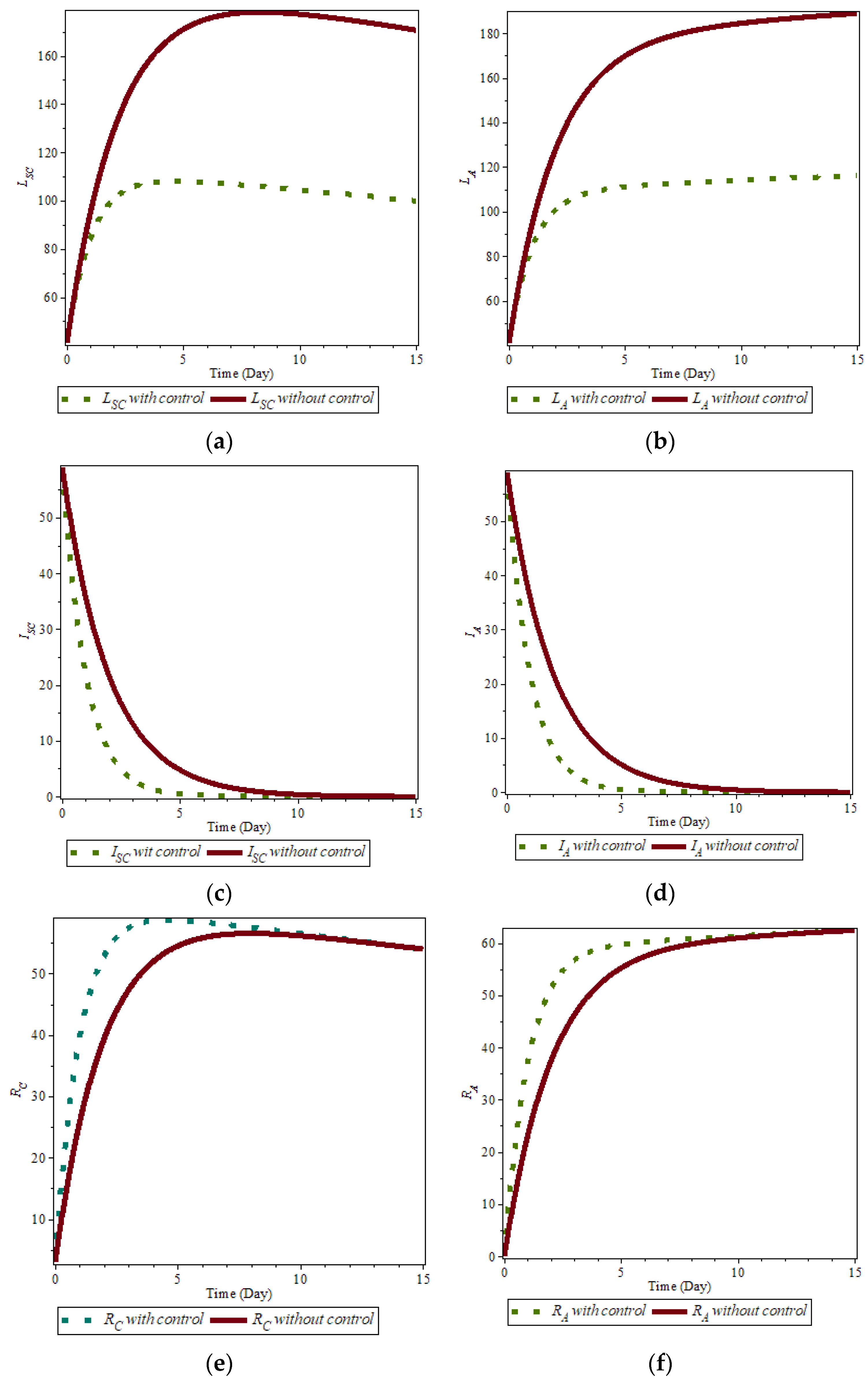
Based on
Figure 5, the optimal control strategy produces a substantial quantitative reduction in both the latent and infectious populations compared to the uncontrolled scenario.
The infectious compartments and show the most pronounced differences. Within the first 5 days, the controlled trajectories decline sharply, approaching near-zero levels by approximately day 8–10. In contrast, without control, both infectious classes remain significantly elevated throughout the 15-day simulation period. Visually, the reduction in the number of peak infectious individuals exceeds 80–90% under the optimal strategy. This indicates that strengthening treatment programs dramatically shortens the infectious period and effectively interrupts transmission chains.
Similarly, the latent classes and exhibit a marked decrease under control. The controlled trajectories stabilize at levels approximately 35–45% lower than those observed without intervention. This reduction reflects the preventive impact of , which lowers effective transmission and progression rates by improving immune resilience among stunted children and reducing population susceptibility.
The recovered compartments and increase more rapidly under control, reaching higher levels earlier in the simulation. This accelerated growth confirms that treatment intensification enhances recovery rates, contributing to a faster decline in active cases. The difference between controlled and uncontrolled recovered populations becomes evident as early as day 3-4, highlighting the immediate benefit of intervention.
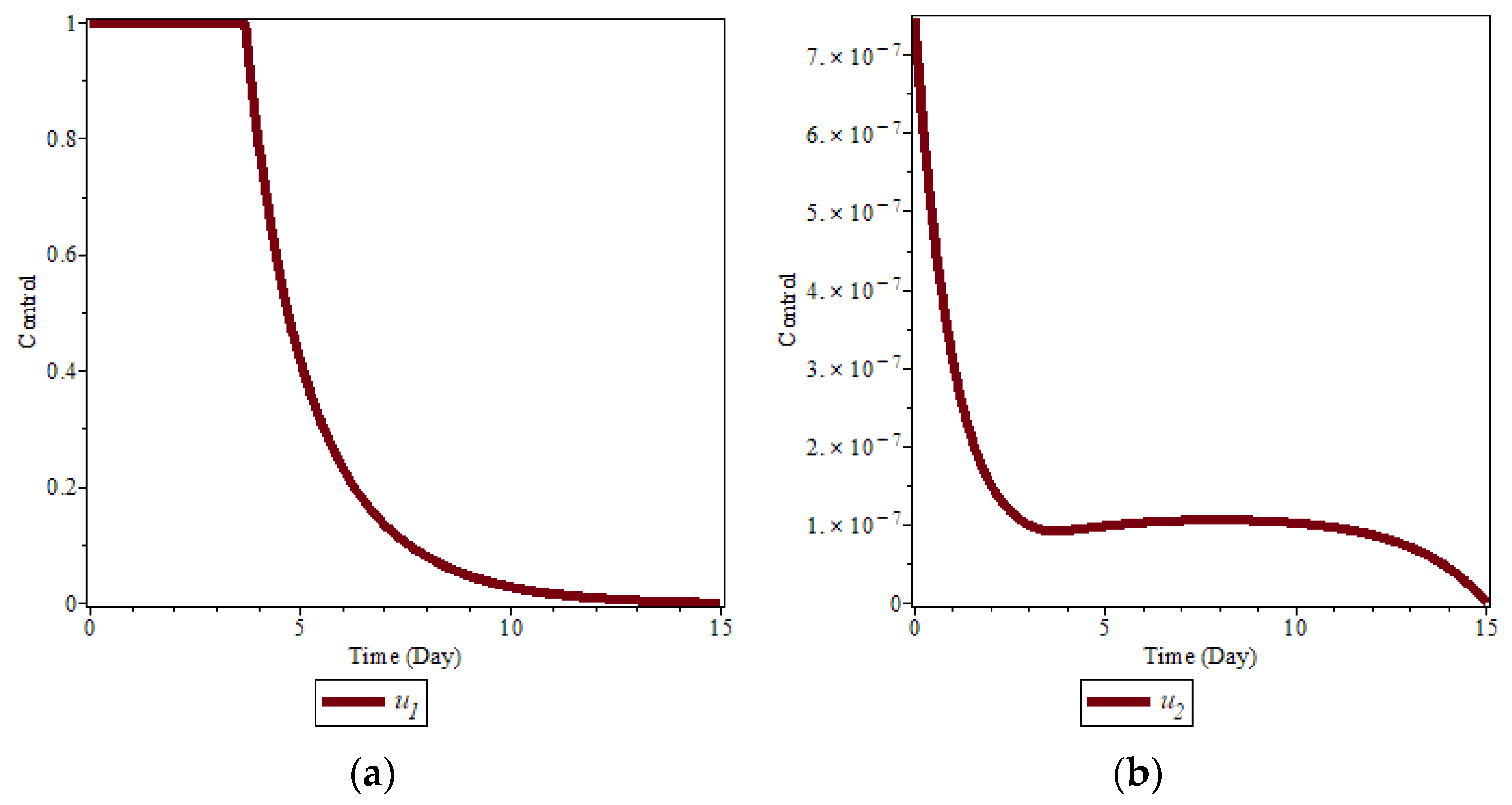
The control profiles themselves further support these outcomes. As shown in
Figure 6, the treatment-related control
reaches or approaches its maximum during the initial phase (approximately days 0–3) and then gradually declines over time. In contrast, the stunting-related control
takes relatively small values throughout the intervention period, on the order of
, with the highest level occurring at the beginning and gradually decreasing toward zero. This behavior arises from the structure of the objective functional, where the quadratic cost term
penalizes large control efforts. Consequently, the optimization procedure selects relatively small values of
to balance the epidemiological benefits with the associated intervention costs. Overall, this front-loaded strategy indicates that early aggressive intervention yields the greatest epidemiological benefit, after which the required control effort decreases as the infectious burden diminishes.
Quantitatively, the results indicate that the integrated implementation of TB treatment strengthening and stunting intervention reduces the prevalence of active TB by more than 80% within a relatively short intervention horizon, as illustrated in
Figure 5. This substantial decline demonstrates that coupling nutritional improvement with conventional TB treatment programs is not merely a complementary strategy, but one that fundamentally alters the disease’s transmission dynamics. By simultaneously enhancing recovery and reducing susceptibility, the combined controls lead to a marked reduction in infectious cases and a faster transition toward epidemiological stabilization.
From a public health perspective, these findings support a policy framework that prioritizes early mass screening and rapid initiation of treatment to shorten the infectious period, alongside targeted nutritional supplementation for vulnerable children to improve immune resilience. Moreover, the results highlight the importance of integrating TB control efforts with stunting prevention programs rather than implementing them as isolated interventions. Overall, the numerical evidence presented in
Figure 5 and
Figure 6 confirms that the combined strategy more effectively suppresses transmission dynamics, accelerates recovery, and stabilizes the epidemiological system compared to the absence of control measures.
6. Conclusions
This study introduces a novel integrated model that simultaneously addresses tuberculosis (TB) transmission and childhood stunting, incorporating nutritional status as an endogenous factor influencing both disease susceptibility and progression. The analytical and numerical results demonstrate that the plays a central role in governing the long-term dynamics of TB transmission, with key parameters such as , , and serving as leverage points for intervention.
Optimal control analysis shows that early and intensive interventions to reduce transmission, suppress disease progression, and enhance recovery can significantly reduce TB prevalence and accelerate the system’s stabilization. These findings emphasize the critical importance of integrating TB control strategies with nutritional interventions to address both TB dynamics and chronic malnutrition. By combining treatment optimization with stunting prevention, this integrated approach offers a more effective and sustainable solution for public health management in regions affected by both TB and malnutrition.
The model’s infection rate focuses on infectious individuals aged ≥5 years, consistent with epidemiological evidence that adults and older children are the primary drivers of TB transmission. In contrast, young children contribute minimally due to lower bacillary loads and less frequent productive coughing [
49]. This modeling approach aligns with previous studies on age-structured TB transmission and global public health observations reported by the World Health Organization.
However, several limitations should be acknowledged. The present model assumes homogeneous mixing within each subpopulation and does not explicitly incorporate additional factors such as heterogeneous contact patterns, environmental influences, or detailed nutritional recovery dynamics. Moreover, some parameters were obtained from the literature rather than being estimated from a specific epidemiological dataset. Future studies may extend this framework by incorporating more detailed nutritional dynamics, age-structured contact patterns, and data-driven parameter estimation to improve the realism and predictive capability.
These results, together with supporting literature, emphasize that targeted interventions focusing on both TB control and nutritional support are critical for reducing infection prevalence and improving population health outcomes.