Article

Belief Reliability Modeling and Assessment Method for IGBTs

1
Sichuan Institute of Aerospace System Engineering, Chengdu 610100, China
2
School of Reliability and Systems Engineering, Beihang University, Beijing 100191, China
*
Author to whom correspondence should be addressed.
Mathematics 2026, 14(7), 1135; https://doi.org/10.3390/math14071135
Submission received: 9 February 2026 / Revised: 22 March 2026 / Accepted: 27 March 2026 / Published: 28 March 2026

Abstract

In current IGBT reliability assessment methods, there is a lack of modeling for overstress failures and insufficient consideration of epistemic uncertainty. To address this, this paper proposes a novel reliability assessment method based on belief reliability theory and uncertainty theory. By establishing an IGBT reliability domain model and an external-stress model, a margin-evaluation framework integrating multi-operating-condition characteristics is constructed. Furthermore, a first-order information-based belief reliability calculation algorithm is developed. This method, for the first time, incorporates overstress failures into a quantitative assessment framework and overcomes the inaccuracy of traditional methods under small-sample testing scenarios, providing a technical basis for IGBT device selection and operational reliability assurance in power electronic systems.

1. Introduction

As one of the most commonly used power semiconductor devices in power electronic systems, the Insulated Gate Bipolar Transistor (IGBT) integrates the advantages of both MOS and bipolar structures. It features easy drive capability, fast switching speed, low conduction loss, and high current carrying capacity, enabling efficient conversion and control of electrical energy [1].
With the widespread adoption of IGBTs, their reliability issues have become increasingly critical. According to failure statistics, power conversion components centered on IGBTs represent the most vulnerable parts in power electronic systems [2,3,4,5]. To address these challenges, researchers have proposed various methods for IGBT reliability analysis and evaluation. In the field of empirical life models, scholars have successively developed several models, including the model based on the Coffin-Manson model [6], the model based on the Coffin-Manson-Arrhenius model [7], the model based on the Norris-Landzberg model [8], the Bayerer model [9], and the Semikron model [10]. Additionally, considering the evolution of microscopic failure mechanisms, researchers have introduced life models based on strain [11], stress [12], fracture [13], and energy [14]. Building upon these life models, the fatigue-accumulation damage theory is employed to evaluate and predict the service life of IGBTs under practical operating conditions [15,16].
However, current IGBT reliability assessment methods still face certain limitations, which hinder their ability to effectively support the design, evaluation, and operation of power electronic systems.
Firstly, there is a lack of reliability assessment methods for IGBT over-stress failures. In current academic research and engineering applications, IGBT reliability assessments focus exclusively on failures caused by packaging structure fatigue damage, providing evaluations primarily in the form of life prediction. For IGBT over-stress failures, no quantitative reliability assessment method has been established yet. However, over-stress-induced failures account for as high as 40% of all IGBT failures [2,5], making it unreasonable to neglect over-stress failures in IGBT reliability assessments.
Secondly, existing methods fail to consider the epistemic uncertainty introduced by insufficient test data. IGBT reliability assessment relies on reliability testing, with analysis and modeling based on test data. However, IGBT products are expensive, and current mainstream power cycling test methods are time-consuming and costly. As a result, most IGBT reliability tests are conducted with small sample sizes [6,7,17], introducing epistemic uncertainty into reliability assessments. Current IGBT reliability assessment methods are grounded in probability theory, which is ineffective in addressing epistemic uncertainty arising from small sample tests, leading to inaccurate and untrustworthy evaluation results [18,19]. Furthermore, in small sample scenarios, integrating mechanism analysis with uncertainty theory effectively bridges the data gap when statistical support is insufficient [20].
In conclusion, to advance IGBT reliability analysis and assessment, it is essential to comprehensively consider all factors influencing IGBT reliability and introduce new mathematical theories to describe the impact of epistemic uncertainty. In the belief reliability theory established based on the principles of reliability science, the belief reliability model composed of interdisciplinary equations, degradation equations, margin equations, and measurement equations, establishes a performance-oriented reliability modeling and analysis framework. Belief reliability theory introduces uncertainty theory to address epistemic uncertainty, enabling the comprehensive reflection of deterministic patterns and uncertainty characteristics and providing a new direction for IGBT reliability assessment [21,22,23]. This paper aims to establish a belief reliability assessment method for IGBTs, using uncertainty theory as the mathematical tool, thereby improving and innovating existing IGBT reliability assessment approaches.

2. IGBT Reliability Domain Analysis and Modeling

2.1. Definition of IGBT Reliability Domain and Margin

In belief reliability theory, the reliability domain refers to the range in which a product remains in a reliable state. Considering the specific characteristics of IGBTs, this paper defines the IGBT reliability domain as the region encompassing all external stress ranges that the device can endure without reaching the failure limit.
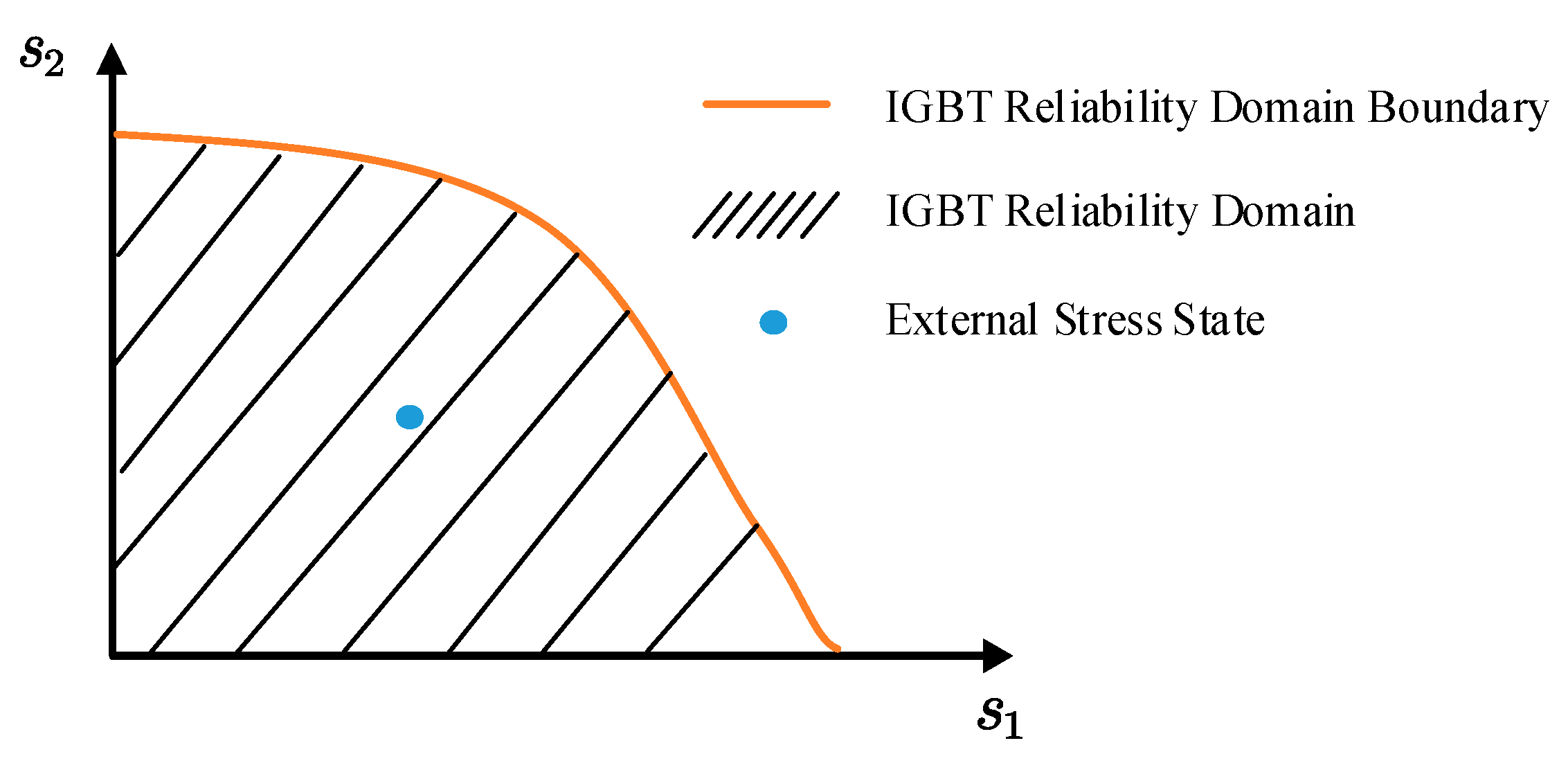
Let s 1 , s 2 , , s n denote all possible external stress types that the IGBT may endure. The IGBT reliability domain is a subset of the n -dimensional real number set formed by s 1 , s 2 , , s n . Denote the IGBT reliability domain as A . If x is an element of the n-dimensional real number set formed by s 1 , s 2 , , s n , and every open neighborhood of x contains both interior points of A and interior points of its complement A C , then x is termed a boundary point of the IGBT reliability domain. The collection of all boundary points constitutes the boundary of the IGBT reliability domain, denoted as A . Figure 1 illustrates the IGBT reliability domain and its boundary when n = 2 .
For a given IGBT product, its reliability domain is determined solely by its intrinsic physical properties, characterizing the device’s capacity to withstand loads and resist failure.
It can be observed that the IGBT reliability domain shares conceptual similarities with the Safe Operating Area (SOA). In the field of power electronics, the SOA of an IGBT refers to the region defined by the current and voltage ranges that the device can endure without failure [24]. While the SOA to some extent reflects the IGBT’s ability to resist failure, it does not account for other external stresses encountered in practical operating conditions, such as switching frequency and environmental temperature. From this perspective, the IGBT SOA can be regarded as a special case of the reliability domain.
Based on the above analysis, a larger reliability domain and a boundary farther from the external stress state corresponding to actual operating conditions indicate a stronger ability of the IGBT to resist failure. Therefore, this paper defines the IGBT margin equation as:
m = d t y , A ,
where m is the margin, A represents the boundary of the IGBT reliability domain, y denotes the external stress state of the IGBT under actual operating conditions, d is the distance function, and t is the degradation time.

2.2. IGBT Reliability Domain Test

This paper refers to the testing method used for exploring the failure limit of IGBT and determining its reliability domain, as the IGBT reliability domain test. The IGBT reliability domain test employs a step-stress method, gradually increasing the external stress level according to specific rules until the external stress level at which the IGBT reaches the failure limit is obtained. Due to constraints such as equipment capabilities, costs, and safety, this paper utilizes a simulation method to conduct the IGBT reliability domain test.
(1)
IGBT Performance Testing and Digital Modeling
The accuracy of the reliability domain simulation test depends on the accuracy of the established simulation digital model. Therefore, adequate IGBT performance testing is conducted prior to reliability domain simulation testing to establish one-to-one IGBT digital models based on measured performance data for each sample. On one hand, constructing digital models using measured performance data ensures that simulation testing accurately reflects the performance and reliability domain of the IGBT. On the other hand, through one-to-one IGBT digital modeling, sample-dimensional uncertainty is introduced into the reliability domain simulation testing, enabling consideration of differences between samples and facilitating subsequent uncertainty analysis and quantification based on the simulation test data.
(2)
Circuit Structure Modeling
The application circuit determines the operating stress of the IGBT. In the application circuit, multiple IGBTs are configured into various topologies to achieve the intended system functions, such as half-bridge, single-phase full-bridge, Buck, and Boost topologies. For IGBT reliability domain testing, simulation circuit models should be established based on actual application scenarios.
(3)
Determination of Stress Types
Based on the topological structure and functional principles of the application circuit, the types of operating stress experienced by IGBT in practical applications can be analyzed. Table 1 shows the operating stress types corresponding to the IGBT in typical application circuits. Regarding environmental stress, this study specifically considers high ambient temperature.
(4)
Step-Stress Testing
Based on engineering experience and a comprehensive trade-off between test cost and accuracy, this paper provides recommended values for the step increment of each stress based on the principle of equal maximum number of steps. On this basis, for operating stress, the single-step increment value is adopted as the initial magnitude, while for ambient temperature, the conventional reference temperature of 25 °C is adopted as the initial magnitude. The step increment and initial magnitude for each IGBT stress type are shown in Table 2.
The sequence of step-stressing is determined as follows:
Step 1: Among the n independent stress variables s 1 , s 2 , , s n , select one stress type s k most convenient for step-stressing as the main step stress variable, denoted as s main .
Step 2: Fix the remaining n 1 stress types at their initial magnitudes and increment s main until all IGBT samples reach the failure limit or the stress cutoff limit is attained.
Step 3: Increment s j ( j k ) to the next magnitude while concurrently stepping s main , until all IGBT samples reach the failure limit or the stress cutoff limit is attained.
Step 4: Repeat Step 3 until s j ( j k ) has reached its maximum magnitude for all variables.
(5)
Acquisition of Reliability Domain Boundary Data
This study primarily considers the failure limits corresponding to three major failure mechanisms of IGBT: collector-emitter breakdown, gate breakdown, and latch-up [25,26,27]. Based on the aforementioned failure modes and mechanisms, the failure limit of the IGBT during reliability domain simulation testing is determined by monitoring the stresses triggering collector-emitter breakdown, gate breakdown, and latch-up, as specified in Table 3.

2.3. IGBT Reliability Domain Modeling

IGBT reliability domain testing is conducted under a step-stress protocol, yielding discrete, staircase-type test data. Such step-stress data can only indicate the number of samples that reach the failure limit within each stress increment, but cannot pinpoint the exact stress level at which any individual sample fails. To construct the IGBT reliability domain model, this paper applies linear interpolation to the step-stress reliability data, thereby generating approximate reliability domain boundary data.
In the absence of additional information, it is assumed that the failure-inducing stress values for individual IGBT samples are uniformly distributed between the current step-stress level and the preceding one. Based on this assumption, the reliability domain boundary data are derived from the step-stress test results. When multiple step-stress variables are involved in the reliability domain test, interpolation is applied exclusively to the main step stress variable s main , while all other step-stress variables are held constant at their assigned magnitudes and do not undergo interpolation.
Based on the above discussion, the linear interpolation method for step-stress data proposed in this paper can be summarized as follows:
Step 1: Let the main step stress variable be s main , the step increment be l , the total number of step levels for the primary stress be b , and the set of main step stress levels be y 1 , y 2 , , y b .
Step 2: For a given non-primary stress level x i , if c j test units reach the failure limit at the j -th level of the main step stress y j , then let y j , k = y j k × l c j + 1 , 1 j b , 1 k c j .
Step 3: Output the reliability domain boundary data points x i , y j , k .
Step 4: Repeat Steps 2 to 3 until all non-primary stress levels have been traversed.
Since all step-stress variables in the reliability domain test are incremented until all test units reach the failure limit, this implies that each step-stress variable has an upper bound constrained by the reliability domain. Therefore, the IGBT reliability domain is a closed set as shown in Figure 1. Consequently, the IGBT reliability domain model can be characterized by two parts: one is the lower bounds of the independent variables in the reliability domain test; the other is a surface (or a curve) in the n-dimensional Euclidean space formed by the independent variables of the reliability domain test, i.e., the reliability domain boundary.
The following sections analyze and model these two parts separately:
(1)
Analysis of independent variable lower bounds
For operating stress, the lower bound of the stress is 0, and the coordinate originates from 0. For environmental stress (high ambient temperature), since the initial magnitude of the high-ambient-temperature step-stress is 25 °C, its lower bound is 25 °C, and the coordinate originates from 25 °C.
(2)
Reliability domain boundary modeling
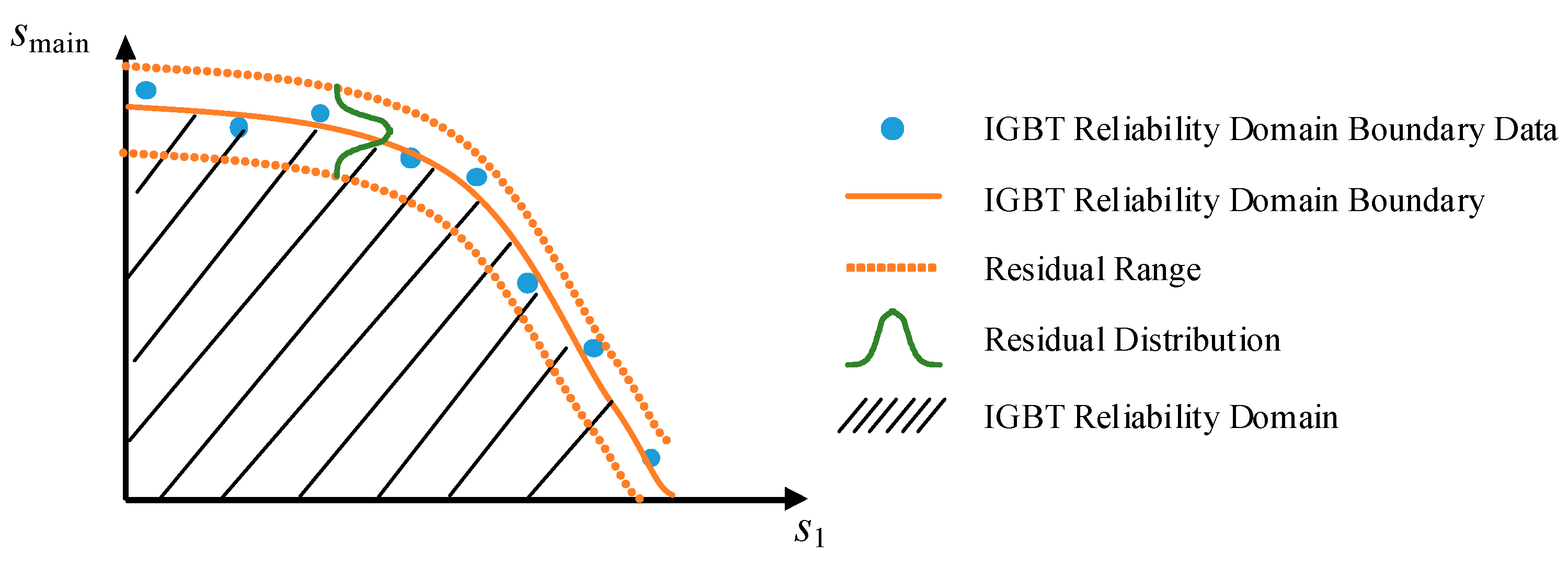
Considering the influence of epistemic uncertainty, this paper employs an uncertain regression analysis method to establish a regression model for the IGBT reliability domain boundary based on the reliability domain test data [28].
Based on the IGBT reliability domain boundary data processed by linear interpolation, uncertain regression analysis is conducted with the main step stress as the response variable and the non-main step stress as the explanatory variable, obtaining the uncertainty regression model of the response variable:
s main = f s 1 , s 2 , , s p | β ^ + N e ^ , σ ^ ,
where s main is the main step stress, s 1 , s 2 , , s p is the non-main step stress, β ^ is the fitting regression model parameters obtained by least squares estimation, N e ^ , σ ^ is the residual term, and f is the fitting regression model function, whose form can be selected as a polynomial function or a piecewise linear function based on the goodness of fit.
Thus, the uncertain regression model of the IGBT reliability domain boundary is as follows:
s main + f s 1 , s 2 , , s p | β ^ + N e ^ , σ ^ = 0 ,   s i > s i L ,   s main > s main L ,
where s i L and s main L are the lower bounds of s i and s main , respectively. Figure 2 illustrates the IGBT reliability domain boundary model when there is only one non-main step stress, i.e., p = 1 .

3. IGBT Margin Modeling and Belief Reliability Assessment

3.1. IGBT External Stress Modeling

Under different operating modes, the magnitude and distribution characteristics of the external stresses experienced by IGBTs differ significantly. To address this, this paper employs n uncertain variables to represent the distribution features of each external stress under n respective operating modes, thereby fully capturing the impact of different operating modes on IGBT external stresses.
On the basis of the above discussion, this paper conducts uncertain statistics using historical operating data to obtain the uncertainty distribution of each IGBT external stress under different operating modes:
Step 1: Analyze operating modes and classify historical operating data of the IGBT according to operating mode based on system functionality.
Step 2: Apply the graduation formula to obtain the uncertainty normal distribution of the j -th external stress under the i -th operating mode of the IGBT [29].
Step 3: Perform an uncertain hypothesis test at a confidence level of 0.05 to determine whether the measured data follow the uncertainty normal distribution [30].
Step 4: If the test is passed, the uncertainty normal distribution derived from the graduation formula is adopted as the distribution function of the external stress; if the test fails, other distribution forms are tested, and the parameters of the candidate distribution are estimated using the method of least squares until the uncertainty hypothesis test is passed [31].
Step 5: Repeat Steps 2 through 4 until the uncertainty distribution functions of all external stresses under all operating modes are obtained.

3.2. IGBT Margin Modeling

Under the operating condition corresponding to the k-th operating mode, the IGBT margin equation is as follows:
m k = d t f A , y k ,
where m k is the IGBT margin under the operating condition of the k -th operating mode, f A = 0 is the uncertain regression model of the IGBT reliability domain boundary, y k is the external stress experienced by the IGBT under the k -th operating mode, d is the distance function, and t is the degradation time. In this study, degradation effects are not considered, i.e., t = 0 .
On the basis of the above, considering the multi-operating-mode characteristics of actual IGBT application scenarios, the IGBT margin is defined as the minimum margin across all operating conditions corresponding to different operating modes. The IGBT margin equation is then expressed as follows:
m = min d t f A , y 1 , d t f A , y 2 , , d t f A , y n mode ,
where m is the IGBT margin, and n mode is the total number of operating modes in the application scenario.
In the IGBT margin equation, both the IGBT reliability domain boundary and the external stresses contain uncertainty. The uncertainty in the reliability domain boundary is characterized by the residual term in the uncertain regression model, while the uncertainty in the external stresses is represented by the uncertainty distribution functions of each stress variable. The uncertainties of the reliability domain boundary and the external stresses are further propagated to the IGBT margin through the distance function.
In the margin model, the distance function is generally adopted as the Euclidean distance. However, considering that the uncertainties of the external stresses across different dimensions vary, the Euclidean distance from the reliability domain boundary to the external stress state point under a given operating condition may not accurately represent the magnitude of the IGBT margin. Therefore, this paper first standardizes each stress dimension in the IGBT margin equation according to the uncertainty level of the corresponding stress variable under the given operating condition:
s ˜ i = s i e i σ i , i = 1 , 2 , , n .
where s i is the coordinate dimension corresponding to the i -th external stress type, e i and σ i are the mean and standard deviation, respectively, of the i -th external stress y i under the given operating condition, and n is the number of external stress types considered. After the transformation, the distribution type of the external stress variables remains unchanged, while their mean and standard deviation become 0 and 1, respectively.
On this basis, the distance function d in the IGBT margin model is defined as follows: the distance in the n -dimensional Euclidean space formed by s ˜ 1 , s ˜ 2 , , s ˜ n between the external stress y ˜ under the given IGBT operating condition and the reliability domain boundary A .

3.3. IGBT Belief Reliability Assessment Algorithm

Considering the influence of epistemic uncertainty, this paper employs an uncertain measure to characterize IGBT reliability. The belief reliability measurement equation of the IGBT is then expressed as follows:
R = M m > 0 ,
where R is the belief reliability, m is the margin, and M is uncertain measure.
To obtain IGBT belief reliability through the above measurement equation, the primary challenge lies in how to propagate uncertainties in the IGBT reliability domain and external stresses to the IGBT margin. Building upon the first-order belief reliability assessment method proposed in [32], this paper further proposes a method for propagating the uncertainty of the residual term and establishes an IGBT belief reliability assessment algorithm.
(1)
First-order belief reliability analysis (FOBRA) method
The core idea of the first-order belief reliability analysis method is to perform a first-order Taylor expansion of the performance function at a specific point, thereby transforming the margin into an explicitly expressed function of the basic variables and then calculating the belief reliability using the operational law of uncertainty theory. In this method, the HLRF algorithm can be employed to search for the first-order Taylor expansion point, which is referred to as the belief degree checking point [32,33,34].
(2)
Uncertainty propagation in the residual term
In the uncertain regression model at the boundary of the reliability domain, the main step stress is regarded as the response variable, and accordingly, the residual term characterizing the uncertainty of the regression model is also represented in the dimension corresponding to the main step stress variable. However, the IGBT margin is a comprehensive representation established in a multidimensional space composed of all types of external stresses. Therefore, how uncertainty in the residual term propagates to the margin is a key issue in the belief reliability assessment for IGBTs.
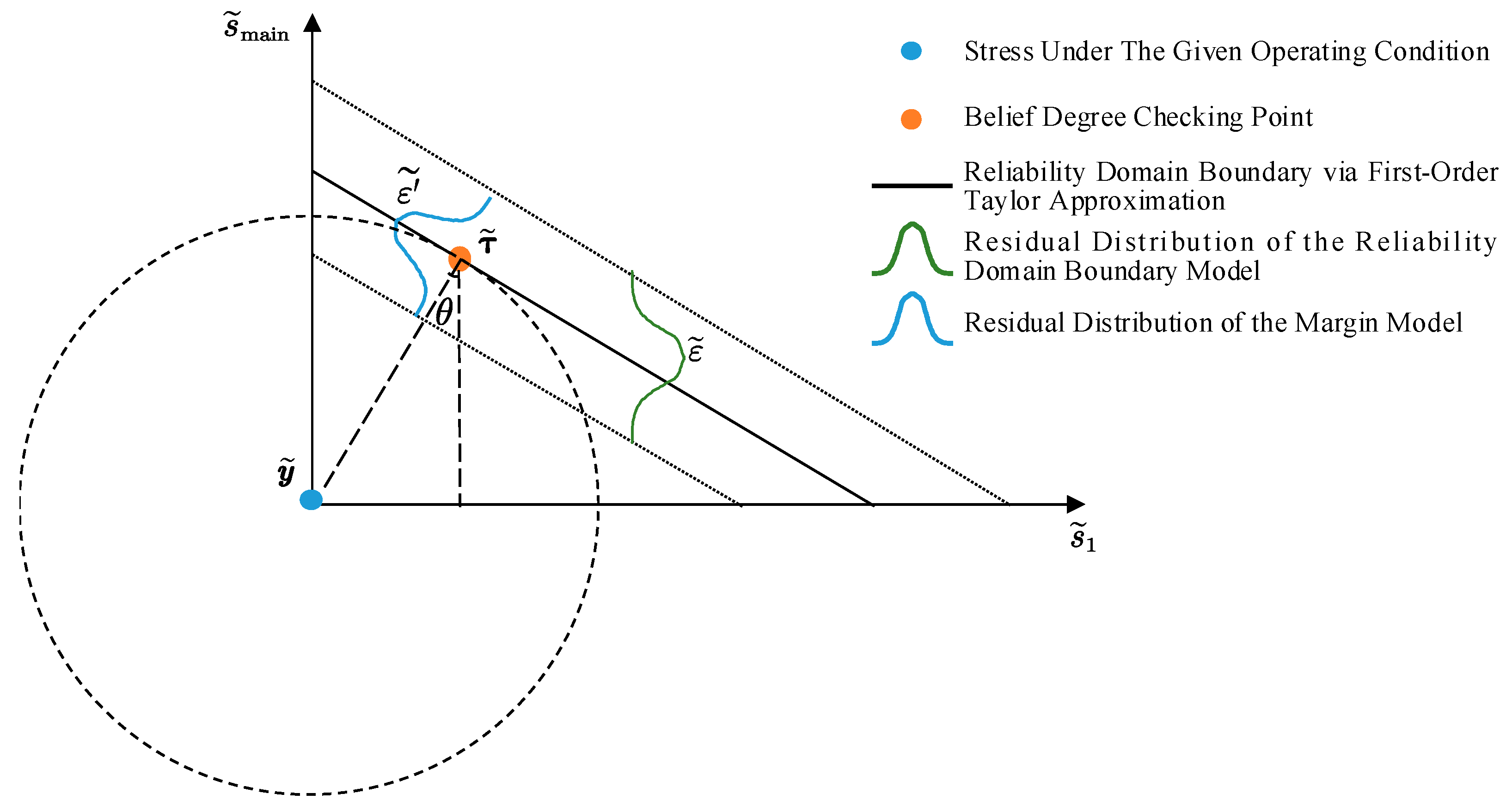
To address the above problem, it is necessary to analyze the influence of the residual term in the reliability domain boundary model on the IGBT margin. In the standardized space shown in Figure 3, after first-order Taylor approximation, the residual term ε ˜ of the reliability domain boundary model is represented in the dimension corresponding to the main step stress s main , while the margin is represented along the direction of the line connecting the external stress y ˜ under given operating conditions and the belief design point τ ˜ on the reliability domain boundary. Clearly, the IGBT margin is affected by the uncertainty introduced by the residual term, and the level of uncertainty propagated from the residual term ε ˜ to the margin is influenced by the angle θ between the normal direction of the first-order Taylor-approximated reliability domain boundary and the coordinate axis direction of the main step stress.
Based on the above discussion, this paper regards the uncertainty propagated from the residual term of the IGBT reliability domain boundary model to the IGBT margin as a normal uncertain variable, denoted as ε ˜ , and its mean and standard deviation satisfy:
e ε ˜ = e ε ˜ , σ ε ˜ = σ ε ˜ cos θ .
where e ε ˜ and σ ε ˜ are the mean and standard deviation of ε ˜ , respectively, e ε ˜ and σ ε ˜ are the mean and standard deviation of ε ˜ , respectively, and θ is the angle between the normal direction of the first-order Taylor-approximated IGBT reliability domain boundary and the coordinate axis direction of the main step stress in the standardized space.
(3)
Algorithm for IGBT belief reliability assessment
Input: The IGBT reliability domain boundary model is f A s = 0 , s = s 1 , s 2 , , s n , the residual term of the reliability domain boundary model ε is represented by the main step stress s main = s k 1 k n , the uncertainty distribution of ε is N e ε , σ ε , the external stress endured by the IGBT under given operating conditions is y = y 1 , y 2 , , y n , and the mean and standard deviation of the i -th external stress are e i and σ i , respectively.
Step 1: Normalize the n -dimensional space composed of s = s 1 , s 2 , , s n :
s ˜ i = s i e i σ i , i = 1 , 2 , , n .
Step 2: Denote the reliability domain boundary model in the standardized space as f ˜ A s ˜ = 0 , the residual term as ε ˜ with its uncertainty distribution as N e ε ˜ , σ ε ˜ , and the external stress endured by the IGBT under given operating conditions as y ˜ = y ˜ 1 , y ˜ 2 , , y ˜ n .
Step 3: Search for the belief degree checking point using the HLRF algorithm, and denote it as τ ˜ = τ ˜ 1 , τ ˜ 2 , , τ ˜ n .
Step 4: Perform a first-order Taylor expansion of the reliability domain boundary model:
f ˜ A , 1 s ˜ f ˜ A τ ˜ + i = 1 n s ˜ i τ ˜ i f ˜ A s ˜ s ˜ i | s ˜ = τ ˜ + ε ˜
Step 5: Let the normal vector of f ˜ A , 1 s ˜ = 0 be a = f ˜ A s ˜ s ˜ 1 | s ˜ = τ ˜ , f ˜ A s ˜ s ˜ 2 | s ˜ = τ ˜ , , f ˜ A s ˜ s ˜ n | s ˜ = τ ˜ , and the coordinate axis direction vector corresponding to the main step stress s ˜ k be b = P 1 , P 2 , , P n , P i = 0 , i k 1 , i = k . Calculate the cosine of the angle between the normal of f ˜ A , 1 s ˜ = 0 and the coordinate axis direction corresponding to the main step stress s ˜ k , denoted as cos θ = a b a b .
Step 6: Calculate the mean and standard deviation of the residuals of the IGBT margin model:
e ε ˜ = e ε ˜ , σ ε ˜ = σ ε ˜ cos θ .
Step 7: Construct the IGBT margin model:
m = f ˜ A τ ˜ + i = 1 n y ˜ i τ ˜ i f ˜ A s ˜ s ˜ i | s ˜ = τ ˜ i = 1 n f ˜ A s ˜ s ˜ i | s ˜ = τ ˜ 2 + N e ε ˜ , σ ε ˜
Step 8: Construct the inverse uncertainty distribution function of the IGBT margin:
Φ m 1 α = f ˜ A τ ˜ + i = 1 n Φ y ˜ i 1 χ i τ ˜ i f ˜ A s ˜ s ˜ i | s ˜ = τ ˜ i = 1 n f ˜ A s ˜ s ˜ i | s ˜ = τ ˜ 2 + Φ ε ˜ 1 α , χ i = a ,   if   f ˜ A s ˜ s ˜ i | s ˜ = τ ˜ > 0 1 a ,   if   f ˜ A s ˜ s ˜ i | s ˜ = τ ˜ < 0 ,
where Φ m 1 , Φ y ˜ i 1 and Φ ε ˜ 1 are the inverse uncertainty distribution functions of the IGBT margin m , the i -th external stress y ˜ i under given operating conditions, and the margin residual ε ˜ , respectively.
Step 9: Let Φ m 1 α = 0 , solve to obtain α a as the IGBT belief reliability R .
Output: The belief reliability R of the IGBT under given operating conditions.
The above algorithmic procedure applies only to the operating condition corresponding to a single operating mode of the IGBT. If the IGBT has multiple operating modes, the corresponding operating conditions must be individually input into the above algorithmic procedure to compute the respective belief reliabilities, and the minimum value is taken to obtain the IGBT belief reliability considering all operating modes:
R IGBT = min R 1 , R 2 , , R n mode
where R i is the belief reliability computed for the operating condition corresponding to the i -th operating mode, and n mode is the total number of operating modes in the application scenario.

4. Case Study

4.1. Test Object

The IGBT margin modeling and belief reliability assessment are conducted on a 34 mm packaged half-bridge IGBT module, with a rated voltage of 1200 V, a rated current of 50 A, and a maximum operating temperature of 150 °C.

4.2. Application Scenario Analysis and External Stress Modeling

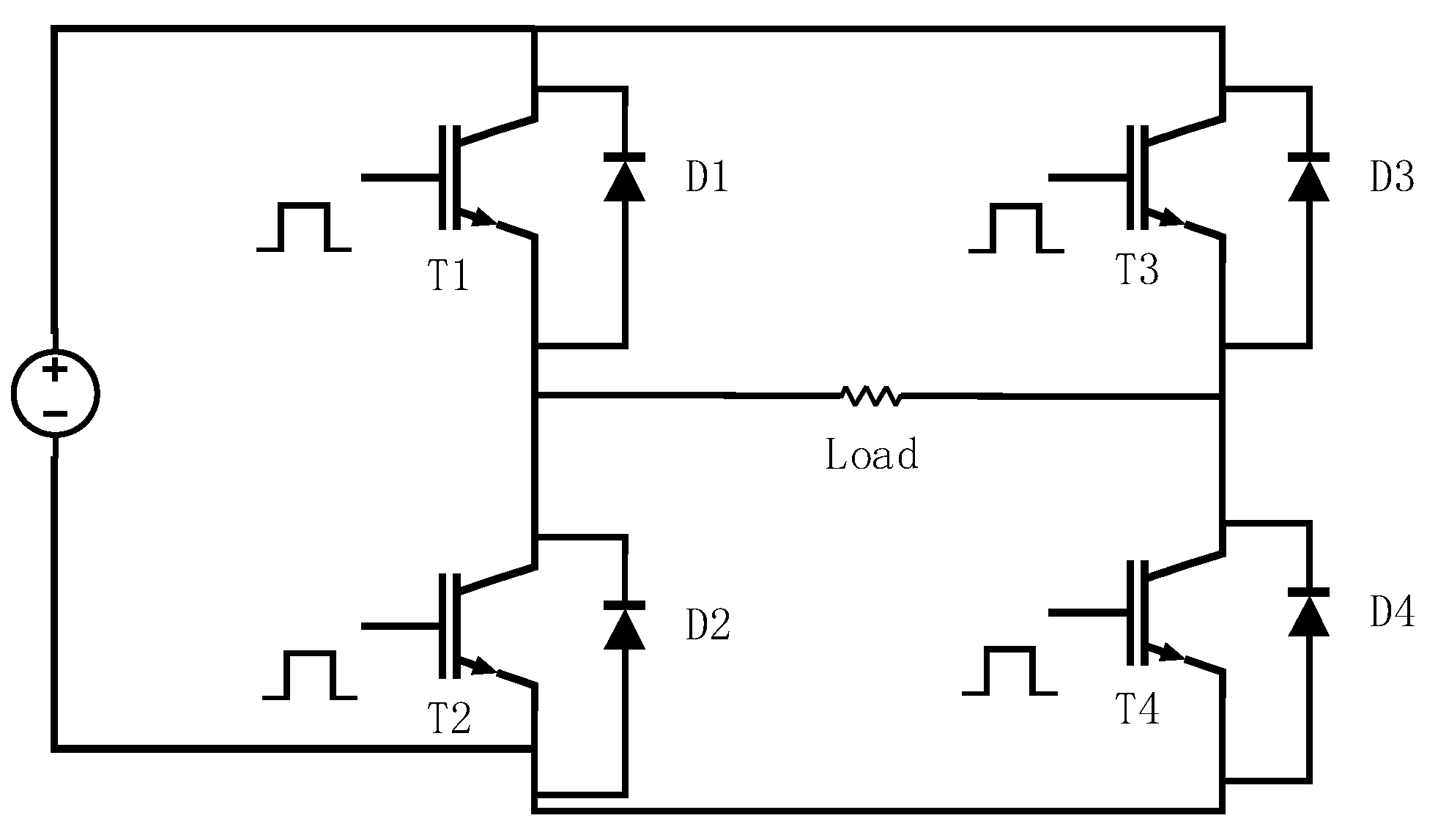
The research object is applied in the grid-side inverter of a wind turbine, with the circuit topology shown in Figure 4 as a full-bridge structure.
Based on whether it is connected to the public grid, the grid-side inverter of a wind turbine has two operating modes: grid-connected mode and off-grid mode. In this case study, it is assumed that the grid-side inverter operates in off-grid mode from 0:00 to 8:00 daily and in grid-connected mode from 8:00 to 24:00.
Regarding environmental stresses, the ambient temperature of the grid-side inverter of the wind turbine is constant at 40 °C.
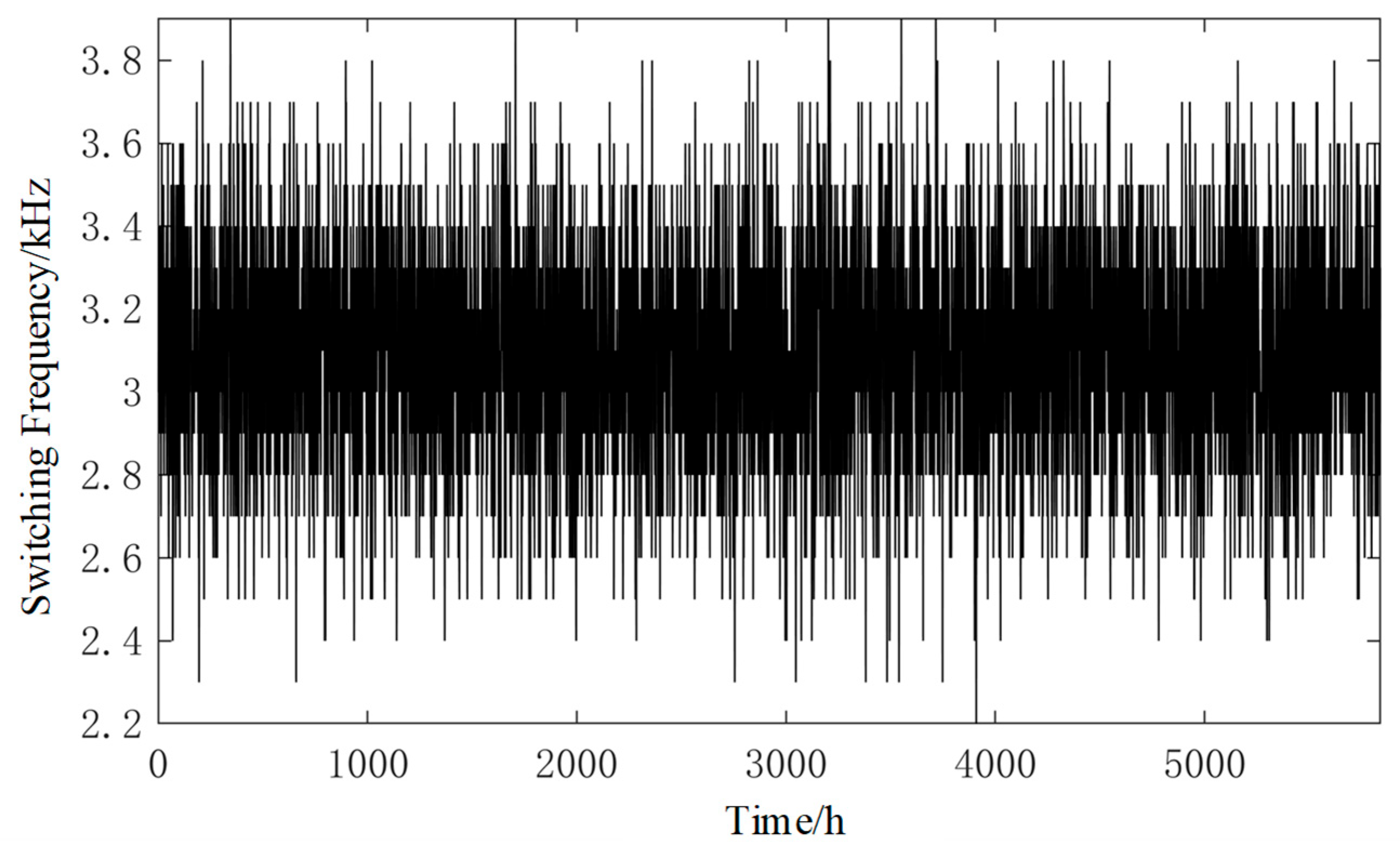
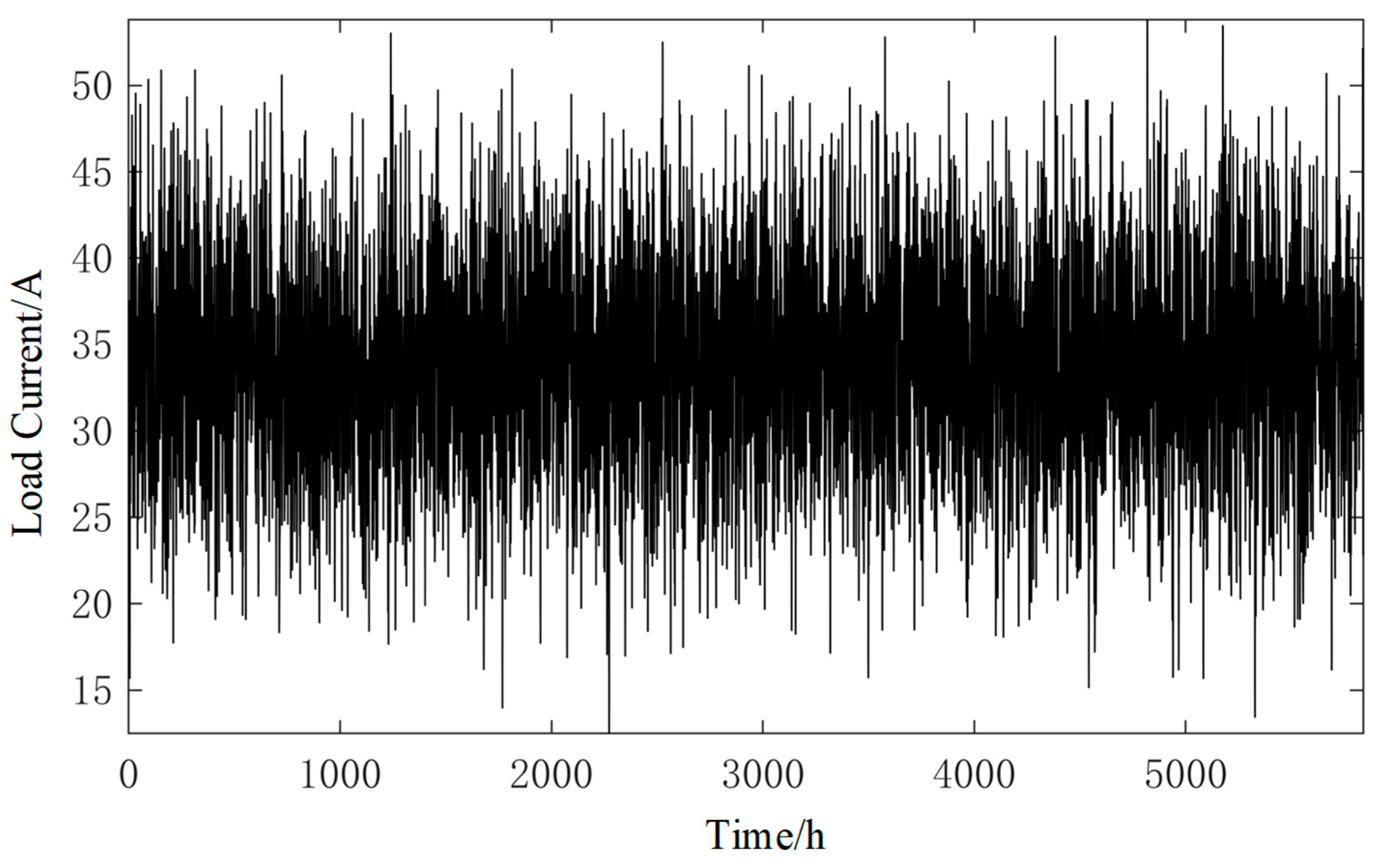
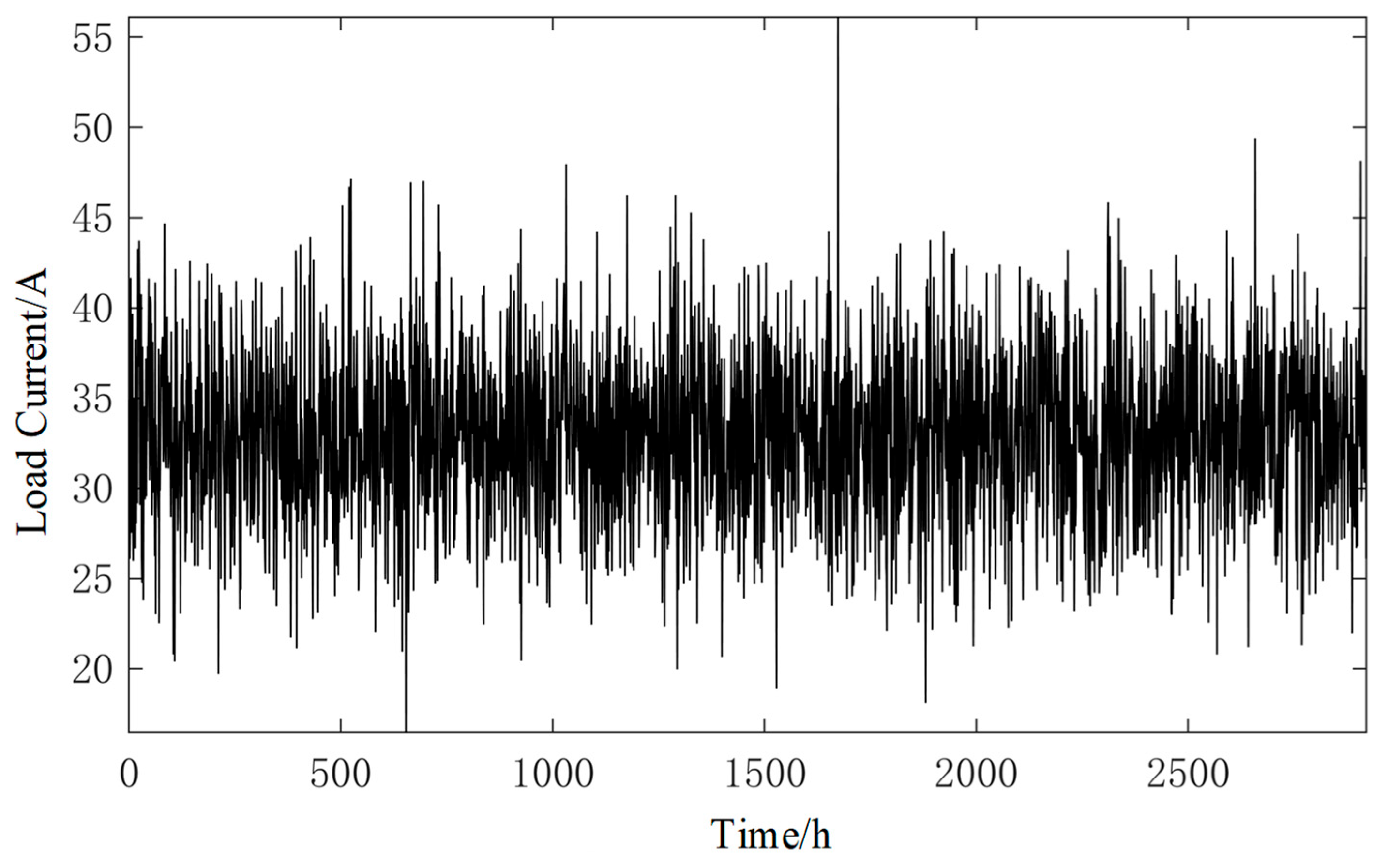
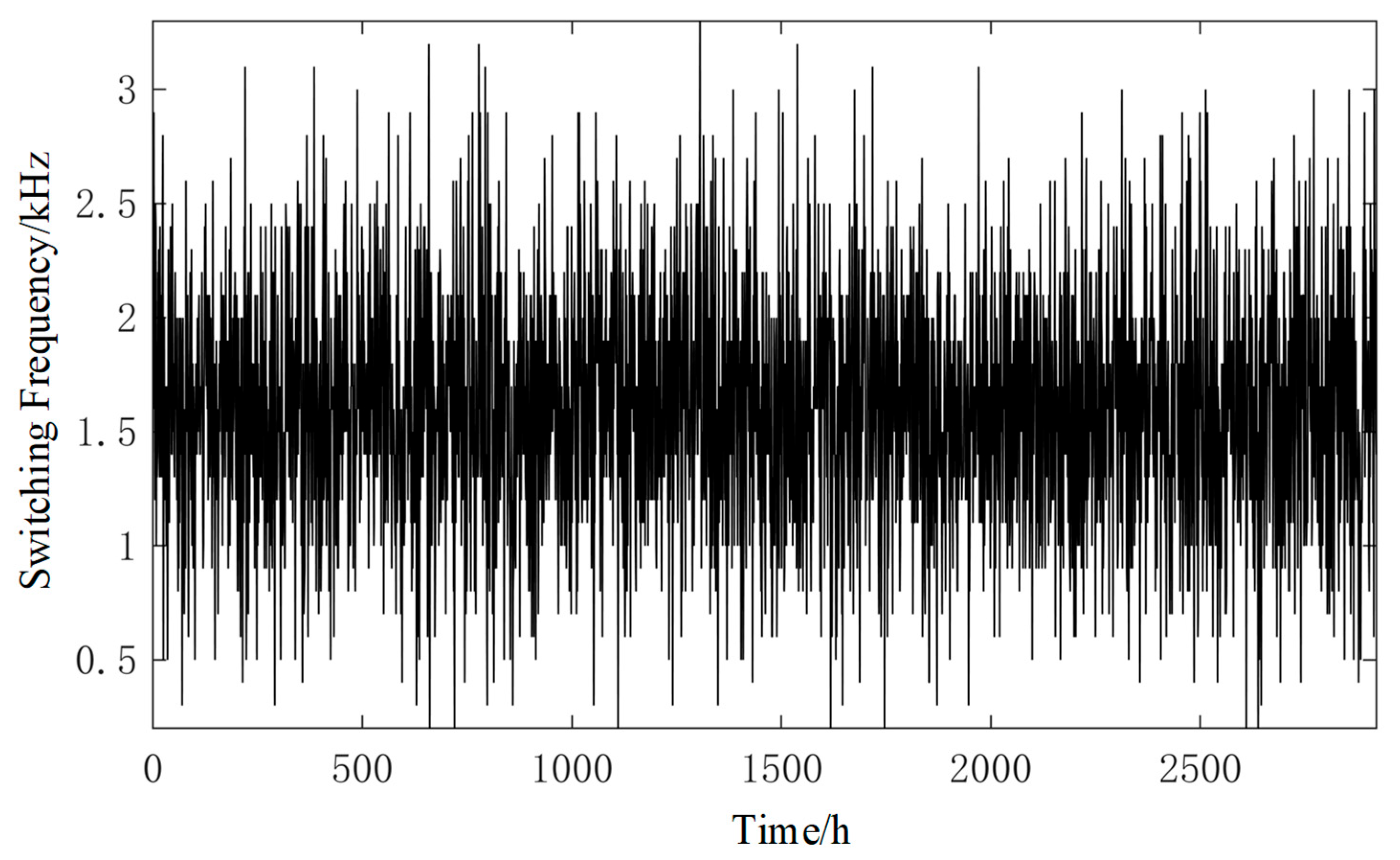
Regarding operational stresses, the fundamental frequency and input voltage of the grid-side inverter of the wind turbine are fixed at 50 Hz and 600 V, respectively; the gate-emitter voltage is ±15 V, and the load current and switching frequency exhibit significant uncertainty. In this paper, simulation data with an hourly granularity over a one-year period are utilized for analysis and modeling, as shown in Figure 5, Figure 6, Figure 7 and Figure 8.
Through uncertain statistics analysis of the historical data shown in Figure 5, Figure 6, Figure 7 and Figure 8, the uncertainty distributions of the load current and switching frequency are obtained, as listed in Table 4.

4.3. Reliability Domain Modeling

The application circuit consists of a full-bridge topology formed by four IGBT units. Therefore, this paper establishes a digital model of the four IGBT units using Simulink, based on measured thermal impedance and electrical performance data from two IGBT modules. In addition, combining measured data and the product datasheet, the failure limit criteria for the reliability domain test of the test object are determined, as shown in Table 5.
Based on the circuit structure and device parameters, a full-bridge inverter circuit simulation model is established on the Simulink platform. In this case study, the load current is selected as the main step stress for the reliability domain test. The step size of the load current is 10 A, with a step starting level of 10 A. The step size of the switching frequency is 10 kHz, with a step starting level of 10 kHz.
Based on the above stress step scheme, reliability domain tests are conducted, and the stress levels that cause the IGBT to reach the failure limit are obtained, as shown in Table 6.
According to the method proposed in this paper, the reliability domain test step data in Table 6 are interpolated, and the results are shown in Table 7.
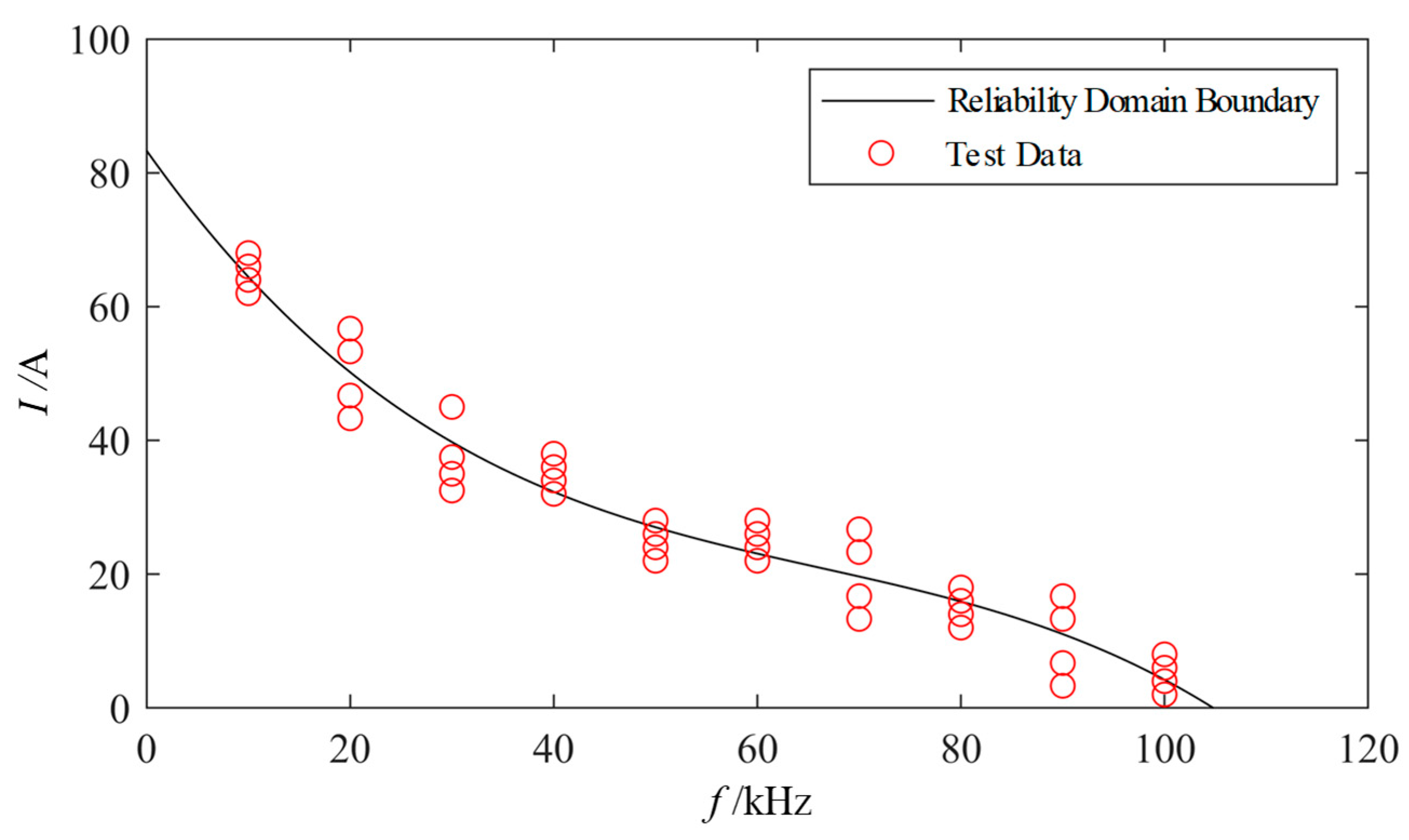
Based on the uncertain regression analysis method, the reliability domain boundary model is obtained as follows:
g A = I 0.00013743 f 3 + 0.0273 f 2 2.1487 f + 83.3333 + ε = 0 , I > 0 , f > 0 , ε ~ N 7.1054 × 10 15 , 3.9834
where I is the load current, and f is the switching frequency.
The IGBT reliability domain boundary data points after linear interpolation and the fitted regression result of the IGBT reliability domain boundary are shown in Figure 9.

4.4. Margin Modeling and Belief Reliability Assessment

First, the belief degree checking point f ˜ * , I ˜ * is searched using the HLRF algorithm, and the results are shown in Table 8.
For the grid-connected mode, perform a first-order Taylor expansion of the reliability domain boundary model at the belief degree checking point:
g ˜ A , grid , 1 = 4.7459 I ˜ 0.5118 f ˜ + 44.6459 + ε ˜ 1 , f ˜ > 11.6225 , I ˜ > 6.8388 , ε ˜ 1 ~ N 1.4972 × 10 15 , 0.8393 .
On this basis, the margin model can be represented as follows:
m grid = 44.6459 4.7459 I ˜ 0.5118 f ˜ 4.7734 + ε ˜ 1 , f ˜ > 11.6225 , I ˜ > 6.8388
The cosine of the angle between the normal of g ˜ A , grid , 1 = 0 and the coordinate axis direction of the main step stress is as follows:
cos θ ε ˜ 1 = 4.7459 4.7459 2 + 0.5118 2 × 1 = 0.994235 .
Therefore, ε ˜ 1 follows a normal uncertain distribution with mean −1.4972 × 10⁻¹⁵ and standard deviation 0.8345.
Based on the above calculation and analysis, the belief reliability of the test object under the given grid-connected operating condition is as follows:
R grid = M m gird > 0 = 0.999842 .
Similarly, for the off-grid mode, perform a first-order Taylor expansion of the reliability domain boundary model at the belief degree checking point:
g ˜ A , off , 1 = 4.6923 I ˜ 0.8172 f ˜ + 40.7649 + ε ˜ 2 , f ˜ > 4.7578 , I ˜ > 8.5725 , ε ˜ 2 ~ N 1.5143 × 10 15 , 0.8489 .
The margin model under off-grid mode is as follows:
m off = 40.7649 4.6923 I ˜ 0.8172 f ˜ 4.7629 + ε ˜ 2 , f ˜ > 4.7578 , I ˜ > 8.5725 , ε ˜ 2 ~ N 1.5143 × 10 15 , 0.8363 .
Further, the belief reliability of the test object under the off-grid operating mode is calculated as follows:
R off = M m off > 0 = 0.999586 .
Finally, the minimum value of the belief reliabilities corresponding to the two operating modes is taken, yielding the belief reliability of the test object under the given composite operating condition as follows:
R IGBT = 0.999586 .
The results indicate that although there are differences in both switching frequency and load current between the grid-connected and off-grid modes, since the switching frequencies in both modes are far below the upper limit that the IGBT can withstand, the load current becomes the dominant factor affecting the reliability. Therefore, under the grid-connected mode with lower load current, the IGBT achieves higher belief reliability.

5. Conclusions

This paper investigates IGBT margin modeling and its uncertainty propagation and quantification based on belief reliability theory. First, the connotation and implementation method of IGBT reliability domain testing are proposed. Based on the reliability domain test data, a linear interpolation method and uncertain regression analysis are employed to establish the IGBT reliability domain boundary model. Second, considering the influence of multiple operating modes and epistemic uncertainty, an external stress modeling method for IGBTs is proposed based on historical operating condition data. Third, combining the IGBT reliability domain boundary model with the external stress model, the specific form of the IGBT margin model is established, and a first-order information-based belief reliability assessment algorithm for IGBTs is proposed to enable rapid calculation of IGBT belief reliability under given operating conditions. Finally, the effectiveness of the proposed method is validated through a case study of the grid-side inverter for a wind turbine. The IGBT belief reliability assessment method proposed in this paper can provide decision-making support for power electronic system design, operation, and maintenance.
Compared with existing methods, the approach proposed in this paper is oriented toward overstress-induced failures and incorporates IGBT operating modes along with multiple external stresses into the reliability assessment model, thereby addressing the shortcoming of insufficient consideration of overstress failure mechanisms in current research. In future studies, integrating the IGBT performance degradation model with the reliability domain model represents a valuable research direction, within which the relationships between the IGBT reliability domain and solder layer cracks, as well as bonding wire crack propagation, will be further explored. Additionally, incorporating Gaussian process regression [35] could enhance the prediction accuracy under epistemic uncertainty. Then the approach proposed in this paper can be further extended to other electronic components and products in the future.

Author Contributions

Conceptualization, Y.C., M.W. and R.K.; methodology, Y.C., X.L. and W.L.; software, X.G. and Z.Z.; validation, Y.C., X.G. and W.L.; investigation, Y.C.; writing—original draft preparation, Y.C.; writing—review and editing, X.L., X.G. and W.L. All authors have read and agreed to the published version of the manuscript.

Funding

This research received no external funding.

Data Availability Statement

The original contributions presented in this study are included in the article. Further inquiries can be directed to the corresponding author.

Conflicts of Interest

The authors declare no conflicts of interest.

References

  1. Yang, S.; Bryant, A.; Mawby, P.; Xiang, D.; Ran, L.; Tavner, P. An industry-based survey of reliability in power electronic converters. IEEE Trans. Ind. Appl. 2011, 47, 1441–1451. [Google Scholar] [CrossRef]
  2. Abuelnaga, A.; Narimani, M.; Bahman, A.S. A review on IGBT module failure modes and lifetime testing. IEEE Access 2021, 9, 9643–9663. [Google Scholar] [CrossRef]
  3. Peyghami, S.; Blaabjerg, F.; Palensky, P. Incorporating power electronic converters reliability into modern power system reliability analysis. IEEE J. Emerg. Sel. Top. Power Electron. 2020, 9, 1668–1681. [Google Scholar] [CrossRef]
  4. Wolfgang, E. Examples for failures in power electronics systems. In Proceedings of the ECPE Tutorial on Reliability of Power Electronic Systems, Nuremberg, Germany, 19–20 April 2007. [Google Scholar]
  5. Yang, S.; Xiang, D.; Bryant, A.; Mawby, P.; Ran, L.; Tavner, P. Condition monitoring for device reliability in power electronic converters: A review. IEEE Trans. Power Electron. 2010, 25, 2734–2752. [Google Scholar] [CrossRef]
  6. Ciappa, M.; Fichtner, W. Lifetime prediction of IGBT modules for traction applications. In Proceedings of the 38th IEEE International Reliability Physics Symposium Proceedings, San Jose, CA, USA, 10–13 April 2000; IEEE: New York, NY, USA, 2000. [Google Scholar]
  7. Held, M.; Jacob, P.; Nicoletti, G.; Scacco, P.; Poech, M.-H. Fast power cycling test of IGBT modules in traction application. In Proceedings of the Second International Conference on Power Electronics and Drive Systems, Singapore, 26–29 May 1997; IEEE: New York, NY, USA, 1997. [Google Scholar]
  8. Xie, W. Modified Norris-Landzberg model for Pb-free solder joint reliability evaluation. Microelectron. Reliab. 2022, 135, 114590. [Google Scholar] [CrossRef]
  9. Bayerer, R.; Herrmann, T.; Licht, T.; Lutz, J.; Feller, M. Model for power cycling lifetime of IGBT modules-various factors influencing lifetime. In Proceedings of the 5th International Conference on Integrated Power Electronics Systems, Nuremberg, Germany, 11–13 March 2008; VDE: Frankfurt am Main, Germany, 2008. [Google Scholar]
  10. Scheuermann, U.; Schmidt, R. A new lifetime model for advanced power modules with sintered chips and optimized Al wire bonds. In Proceedings of the International Exhibition & Conference for Power Electronics, Intelligent Motion, Renewable Energy and Energy Management, Nuremburg, Germany, 14–16 May 2013. [Google Scholar]
  11. Ramminger, S.; Seliger, N.; Wachutka, G. Reliability model for Al wire bonds subjected to heel crack failures. Microelectron. Reliab. 2000, 40, 1521–1525. [Google Scholar] [CrossRef]
  12. Khatibi, G.; Lederer, M.; Weiss, B.; Licht, T.; Bernardi, J.; Danninger, H. Accelerated mechanical fatigue testing and lifetime of interconnects in microelectronics. Procedia Eng. 2010, 2, 511–519. [Google Scholar] [CrossRef][Green Version]
  13. Sasaki, K.; Iwasa, N.; Kurosu, T.; Saito, K.; Koike, Y.; Kamita, Y.; Toyoda, Y. Thermal and structural simulation techniques for estimating fatigue life of an IGBT module. In Proceedings of the 20th International Symposium on Power Semiconductor Devices and IC’s, Orlando, FL, USA, 18–22 May 2008; IEEE: New York, NY, USA, 2008. [Google Scholar]
  14. Celnikier, Y.; Benabou, L.; Dupont, L.; Coquery, G. Investigation of the heel crack mechanism in Al connections for power electronics modules. Microelectron. Reliab. 2011, 51, 965–974. [Google Scholar] [CrossRef]
  15. Mainka, K.; Thoben, M.; Schilling, O. Lifetime calculation for power modules, application and theory of models and counting methods. In Proceedings of the 14th European Conference on Power Electronics and Applications, Birmingham, UK, 30 August–1 September 2011; IEEE: New York, NY, USA, 2011. [Google Scholar]
  16. Ma, K.; Liserre, M.; Blaabjerg, F.; Kerekes, T. Thermal loading and lifetime estimation for power device considering mission profiles in wind power converter. IEEE Trans. Power Electron. 2014, 30, 590–602. [Google Scholar] [CrossRef]
  17. Lai, W.; Chen, M.; Ran, L.; Xu, S.; Jiang, N.; Wang, X.; Alatise, O. Experimental investigation on the effects of narrow junction temperature cycles on die-attach solder layer in an IGBT module. IEEE Trans. Power Electron. 2016, 32, 1431–1441. [Google Scholar] [CrossRef]
  18. Kiureghian, A.D.; Ditlevsen, O. Aleatory or epistemic? Does it matter? Struct. Saf. 2009, 31, 105–112. [Google Scholar] [CrossRef]
  19. Beer, M.; Ferson, S.; Kreinovich, V. Imprecise probabilities in engineering analyses. Mech. Syst. Signal Process. 2013, 37, 4–29. [Google Scholar] [CrossRef]
  20. Li, P.; Wen, M.; Lio, W.; Liu, Y.; Kang, R. Degradation process modeling and data-driven lifetime prediction for BGA specimen during small sample electromigration test. Reliab. Eng. Syst. Saf. 2025, 267, 111953. [Google Scholar] [CrossRef]
  21. Zeng, Z.; Wen, M.; Kang, R. Belief reliability: A new metrics for products’ reliability. Fuzzy Optim. Decis. Mak. 2013, 12, 15–27. [Google Scholar] [CrossRef]
  22. Zhang, Q.; Li, X.; Zu, T.; Kang, R. Belief reliability: A scientific exploration of reliability engineering. J. Syst. Eng. Electron. 2024, 35, 619–643. [Google Scholar] [CrossRef]
  23. Liu, B. Uncertainty Theory, 2nd ed.; Springer: Berlin, Germany, 2007. [Google Scholar]
  24. Baliga, B.J. The IGBT Device: Physics, Design and Applications of the Insulated Gate Bipolar Transistor, 1st ed.; William Andrew: Norwich, CT, USA, 2015. [Google Scholar]
  25. Ishiko, M.; Hotta, K.; Kawaji, S.; Sugiyama, T.; Shouji, T.; Fukami, T.; Hamada, K. Investigation of IGBT turn-on failure under high applied voltage operation. Microelectron. Reliab. 2004, 44, 1431–1436. [Google Scholar] [CrossRef]
  26. Lin, H.; Lee, D.; Lee, C.; Chao, T.; Huang, T.; Wang, T. New insights into breakdown modes and their evolution in ultra-thin gate oxide. In Proceedings of the International Symposium on VLSI Technology, Hsinchu, Taiwan, 18–20 April 2001; IEEE: New York, NY, USA, 2001. [Google Scholar]
  27. Wu, R.; Blaabjerg, F.; Wang, H.; Liserre, M.; Iannuzzo, F. Catastrophic failure and fault-tolerant design of IGBT power electronic converters-an overview. In Proceedings of the 39th Annual Conference of the IEEE Industrial Electronics Society, Vienna, Austria, 10–13 November 2013; IEEE: New York, NY, USA, 2013. [Google Scholar]
  28. Lio, W.; Liu, B. Residual and confidence interval for uncertain regression model with imprecise observations. J. Intell. Fuzzy Syst. 2018, 35, 2573–2583. [Google Scholar] [CrossRef]
  29. Zu, T.; Kang, R.; Wen, M. Graduation formula: A new method to construct belief reliability distribution under epistemic uncertainty. J. Syst. Eng. Electron. 2020, 31, 626–633. [Google Scholar] [CrossRef]
  30. Ye, T.; Liu, B. Uncertain hypothesis test with application to uncertain regression analysis. Fuzzy Optim. Decis. Mak. 2022, 21, 157–174. [Google Scholar] [CrossRef]
  31. Liu, Y.; Liu, B. Estimation of uncertainty distribution function by the principle of least squares. Commun. Stat. Theory Methods 2023, 53, 7624–7641. [Google Scholar] [CrossRef]
  32. Chen, Y.; Wen, M.; Zhang, Q.; Kang, R. Belief reliability-based design optimization method with quantile index under epistemic uncertainty. Maint. Reliab. 2023, 25, 163545. [Google Scholar] [CrossRef]
  33. Hasofer, A.; Lind, N. Exact and Invariant Second-moment Code Format. J. Eng. Mech. 1974, 1, 111–121. [Google Scholar] [CrossRef]
  34. Rackwitz, R.; Flessler, B. Structural reliability under combined random load sequences. Comput. Struct. 1978, 9, 489–494. [Google Scholar] [CrossRef]
  35. Jin, B.; Xu, X. Forecasting residential property prices in Jiaxing City, China: A hybrid machine learning framework integrating Gaussian process regressions and Bayesian optimization. J. Uncertain Syst. 2026, 19, 2550020. [Google Scholar] [CrossRef]
Figure 1. Schematic of the IGBT reliability domain and its boundary.
Mathematics 14 01135 g001
Figure 2. Schematic of IGBT reliability domain boundary model.
Mathematics 14 01135 g002
Figure 3. Schematic of uncertainty propagation of the residual term.
Mathematics 14 01135 g003
Figure 4. Circuit topology of the grid-side inverter for the wind turbine.
Mathematics 14 01135 g004
Figure 5. Load current under grid-connected mode.
Mathematics 14 01135 g005
Figure 6. Switching frequency under grid-connected mode.
Mathematics 14 01135 g006
Figure 7. Load current under off-grid mode.
Mathematics 14 01135 g007
Figure 8. Switching frequency under off-grid mode.
Mathematics 14 01135 g008
Figure 9. Fitted regression result of the IGBT reliability domain boundary.
Mathematics 14 01135 g009
Table 1. Operating stress types for IGBT in typical application circuits.
Application CircuitTopology StructureOperating Stress
InverterHalf-bridge, full-bridge, etc.Load current, reverse-biased voltage, fundamental frequency, and switching frequency
DC ChopperBuck, Boost, etc.Load current, reverse-biased voltage, and switching frequency
RectifierHalf-bridge, full-bridge, etc.Load current, reverse-biased voltage, fundamental frequency, and switching frequency
Frequency ConverterHalf-bridge, full-bridge, etc.Load current, reverse-biased voltage, fundamental frequency, and switching frequency
Solid-State Circuit BreakerSeriesLoad current and reverse-biased voltage
Table 2. Step increments and initial magnitudes for reliability domain testing stresses.
Stress TypeStep IncrementInitial Magnitude
Load Current0.2 × rated continuous DC collector current0.2 × rated continuous DC collector current
Reverse-Biased Voltage0.2 × rated collector-emitter voltage0.2 × rated collector-emitter voltage
Fundamental Frequency10 Hz10 Hz
Switching Frequency10 kHz10 kHz
High Ambient Temperature10 °C25 °C
Table 3. Failure limit criteria for the IGBT reliability domain simulation testing.
Failure ModeDetermination Criteria
Collector-Emitter BreakdownExcessive reverse-biased voltage, excessive voltage spikes, and excessive junction temperature
Gate BreakdownExcessive gate voltage and excessive junction temperature
Latch-UpExcessive junction temperature, excessive voltage change rate, and excessive current change rate
Table 4. Uncertainty distributions of load current and switching frequency.
Operating ModeStressUncertainty Distribution
Grid-connected modeLoad current/A N 32.456 , 4.7459
Switching frequency/kHz N 3.0128 , 0.25922
Off-grid modeLoad current/A N 38.511 , 4.6923
Switching frequency/kHz N 1.9311 , 0.40588
Table 5. Failure limit criteria for the reliability domain test of the test object.
ItemFailure Limit Criterion
Collector-emitter voltage>1410 V
Junction temperature>150 °C
Current rise rate>1300 A/μs
Voltage rise rate>3800 V/μs
Table 6. IGBT reliability domain test data.
Switching
Frequency
Current Limit of IGBT-1Current Limit of IGBT-2Current Limit of IGBT-3Current Limit of IGBT-4
10 kHz70 A70 A70 A70 A
20 kHz60 A60 A50 A50 A
30 kHz50 A40 A40 A40 A
40 kHz40 A40 A40 A40 A
50 kHz30 A30 A30 A30 A
60 kHz30 A30 A30 A30 A
70 kHz30 A30 A20 A20 A
80 kHz20 A20 A20 A20 A
90 kHz20 A20 A10 A10 A
100 kHz10 A10 A10 A10 A
Table 7. Interpolation results of IGBT reliability domain test step data.
Switching
Frequency
Current Limit of IGBT-1Current Limit of IGBT-2Current Limit of IGBT-3Current Limit of IGBT-4
10 kHz62 A64 A66 A68 A
20 kHz53.3 A56.7 A43.3 A46.7 A
30 kHz45 A32.5 A35 A37.5 A
40 kHz32 A34 A36 A38 A
50 kHz22 A24 A26 A28 A
60 kHz22 A24 A26 A28 A
70 kHz23.3 A26.7 A13.3 A16.7 A
80 kHz12 A14 A16 A18 A
90 kHz13.3 A16.7 A3.3 A6.7 A
100 kHz2 A4 A6 A8 A
Table 8. Calculation results of the belief degree checking point.
Operating Mode f ˜ * I ˜ *
Grid-connected mode1.00289.2991
Off-grid mode1.46848.4318
Disclaimer/Publisher’s Note: The statements, opinions and data contained in all publications are solely those of the individual author(s) and contributor(s) and not of MDPI and/or the editor(s). MDPI and/or the editor(s) disclaim responsibility for any injury to people or property resulting from any ideas, methods, instructions or products referred to in the content.