Quality–Diversity and Illumination Algorithms in Discrete Combinatorial Domains: Diversity Metrics and Implications for Resilient Mining Operations



Abstract
1. Introduction
1.1. Motivation and Problem Statement
1.2. Research Objectives and Contribution
- To synthesize the state-of-the-art of Quality–Diversity algorithms (2020–2026), focusing on the transition from purely stochastic methods to hybrid variants integrating deep learning and gradient information.
- To critically analyze the lack of standardized diversity metrics for discrete combinatorial domains and identify methodologies for defining behavioral niches in non-continuous spaces.
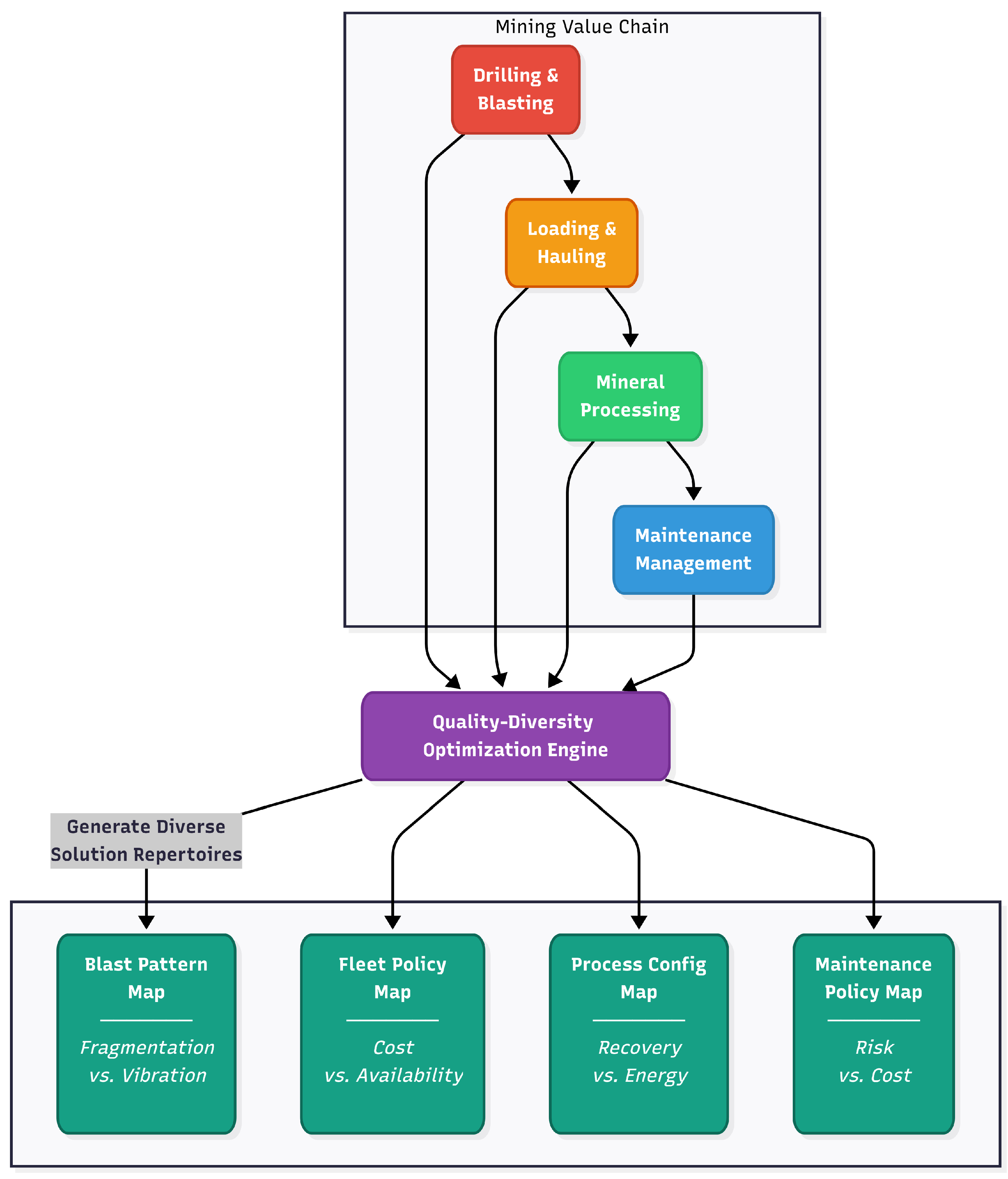
- To propose a novel conceptual framework for applying QD to the mining value chain—specifically in predictive maintenance, mineral processing, and blasting—transferring resilience principles from robotics to industrial operations.
2. Background: The Quality–Diversity Optimization Paradigm
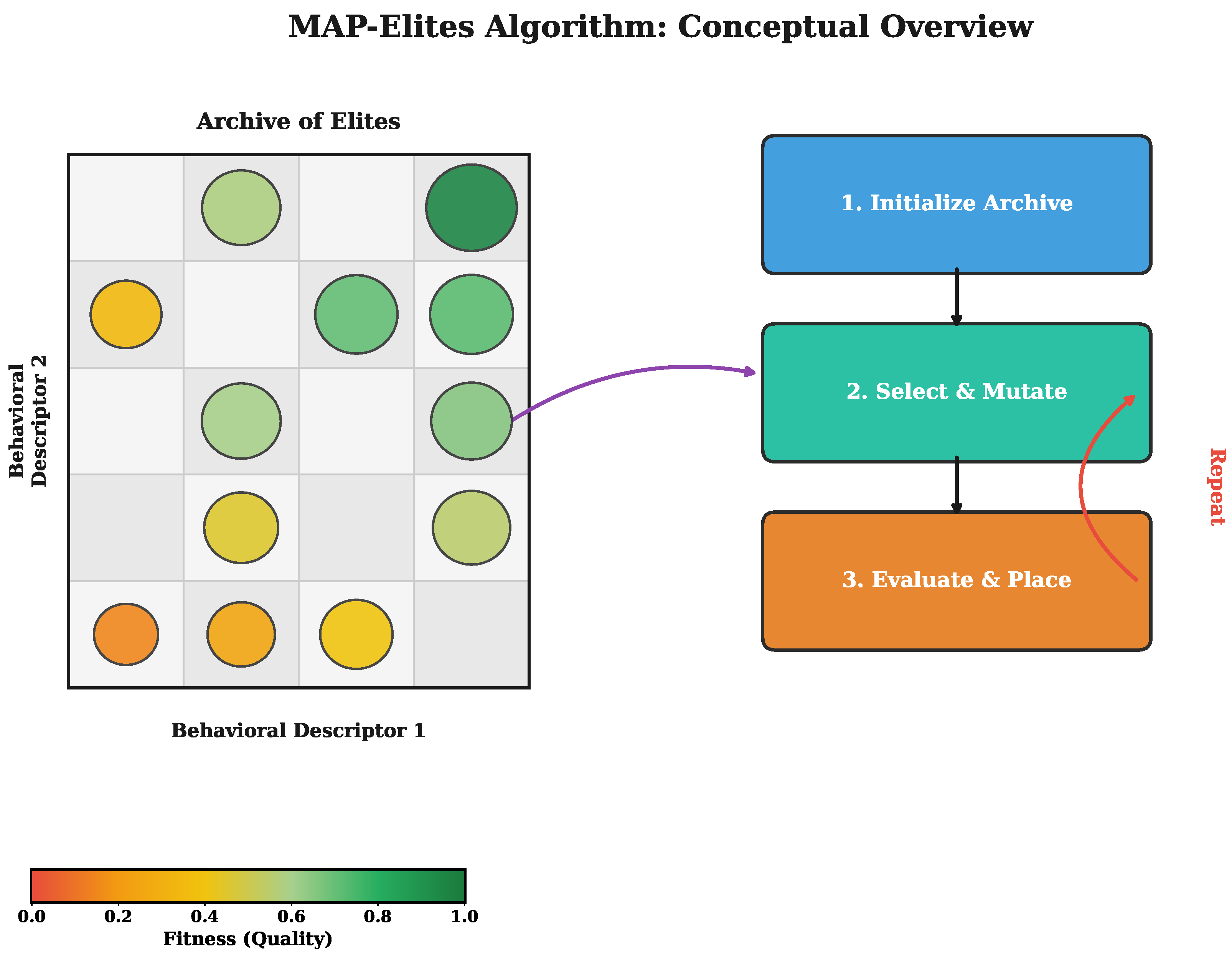
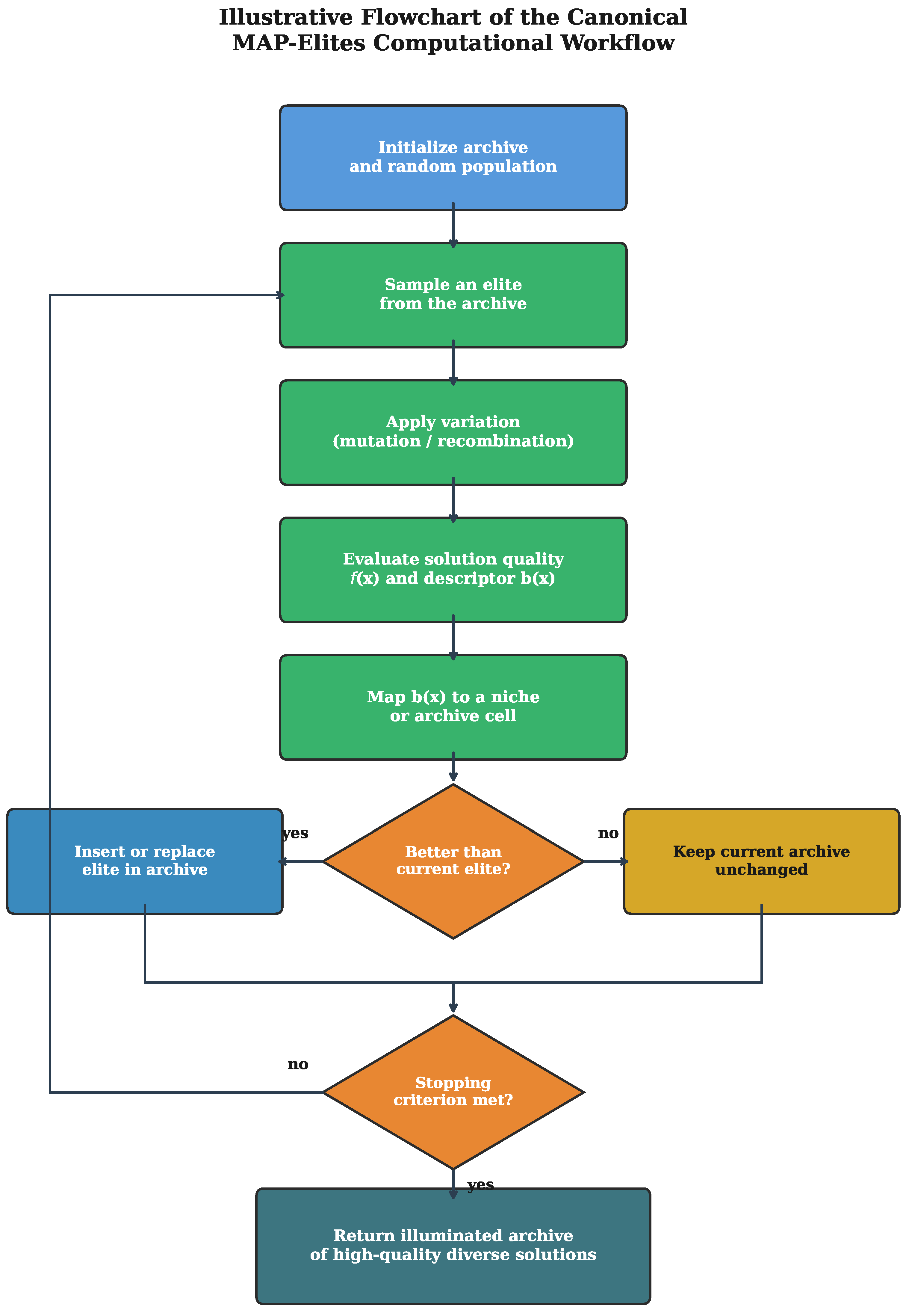
2.1. AlgorithmicEvolution: From MAP-Elites to Gradient-Based Variants
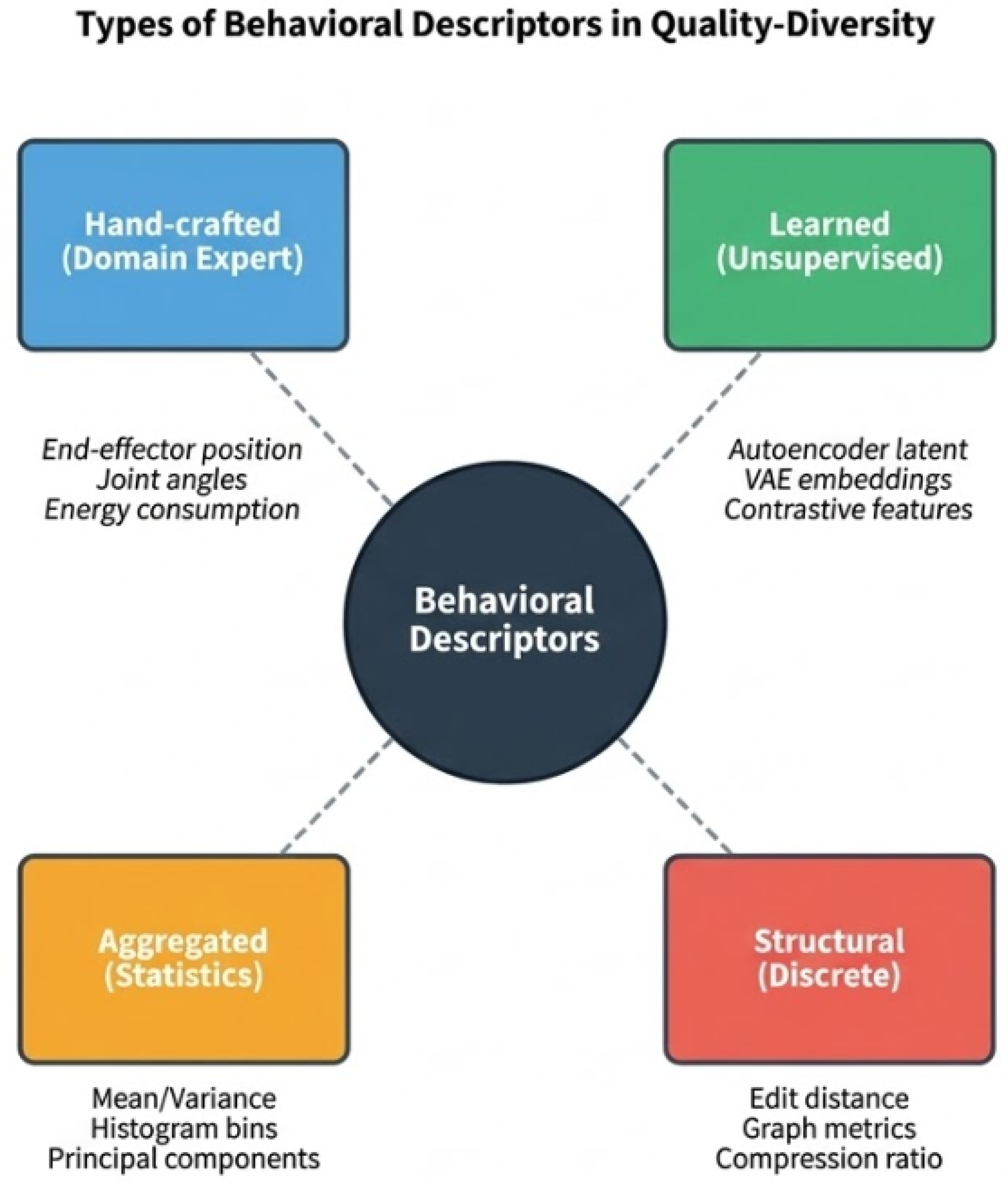
2.2. Behavioral Descriptors and Performance Metrics
3. Materials and Methods
3.1. Eligibility Criteria
- Population: Optimization problems in continuous, discrete, or combinatorial domains.
- Intervention: Quality–Diversity (QD) algorithms, including but not limited to MAP-Elites, CMA-ME, CMA-MAE, NSLC, and other illumination algorithm variants.
- Comparators: Traditional optimization algorithms (e.g., genetic algorithms, CMA-ES), multi-objective optimization (e.g., NSGA-II), or other QD variants.
- Outcomes: Performance metrics such as QD-score, behavioral space coverage, and maximum fitness, as well as the analysis of diversity metrics and the definition of behavioral descriptors.
- Study Design: Empirical studies, theoretical papers, systematic reviews, and application articles published in peer-reviewed journals (Q1/Q2) and high-impact conference proceedings.
3.2. Information Sources and Search Strategy
- (TS=("Quality-Diversity" OR "MAP-Elites" OR "illumination algorithm*" OR
- "behavioral descriptor*") AND TS=("optimization" OR "evolutionary"))
3.3. Selection Process
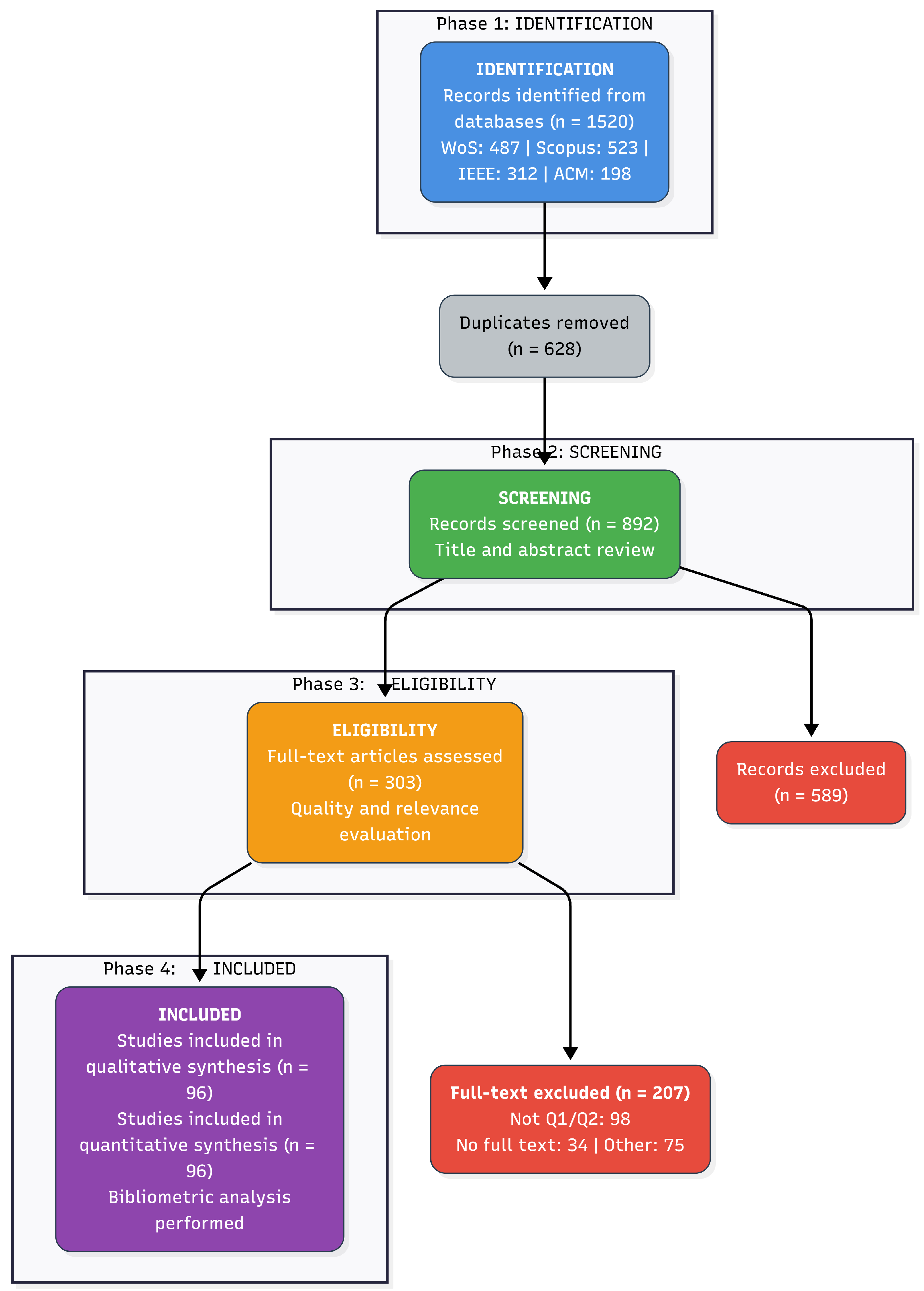
- Phase 1 (Title and Abstract Screening): The titles and abstracts of all identified records were examined based on the eligibility criteria. Articles that clearly did not meet the criteria were excluded.
- Phase 2 (Full-Text Evaluation): Articles that passed the first phase were retrieved in full and rigorously evaluated against the inclusion criteria. Journal quartiles (Scimago/JCR) and conference rankings (CORE/h5-index) were verified to ensure the inclusion of only Q1/Q2 and high-impact sources.
3.4. Data Extraction and Quality Assessment
3.5. Data Coding and Classification Protocol
- The genotype space was explicitly defined as non-continuous (e.g., graphs, permutations, integer sequences).
- The behavioral descriptor involved discrete metrics (e.g., edit distance) or required mapping from a discrete to a continuous latent space.
3.6. Synthesis of Results
- Qualitative Synthesis: A narrative synthesis was performed to summarize and compare the findings of the studies. Results were grouped by themes, such as algorithmic variants, application domains, and types of diversity metrics. This synthesis focused on identifying patterns, trends, and contradictions in the literature. Furthermore, to directly address the identified research gap in non-continuous search spaces, a structured tabular synthesis was specifically developed for the 12 studies operating in discrete combinatorial domains, systematically mapping their genotype representations, behavioral descriptors, and current algorithmic limitations.
- Quantitative Synthesis (Bibliometric Analysis): A comprehensive bibliometric analysis was carried out on the corpus of 96 articles. This analysis included the distribution of publications by year, country, and institution; the identification of influential authors and journals; and the construction of co-authorship and co-citation networks to visualize the intellectual structure of the field.
4. Results, Analysis, and Discussion
4.1. Characteristics of Included Studies
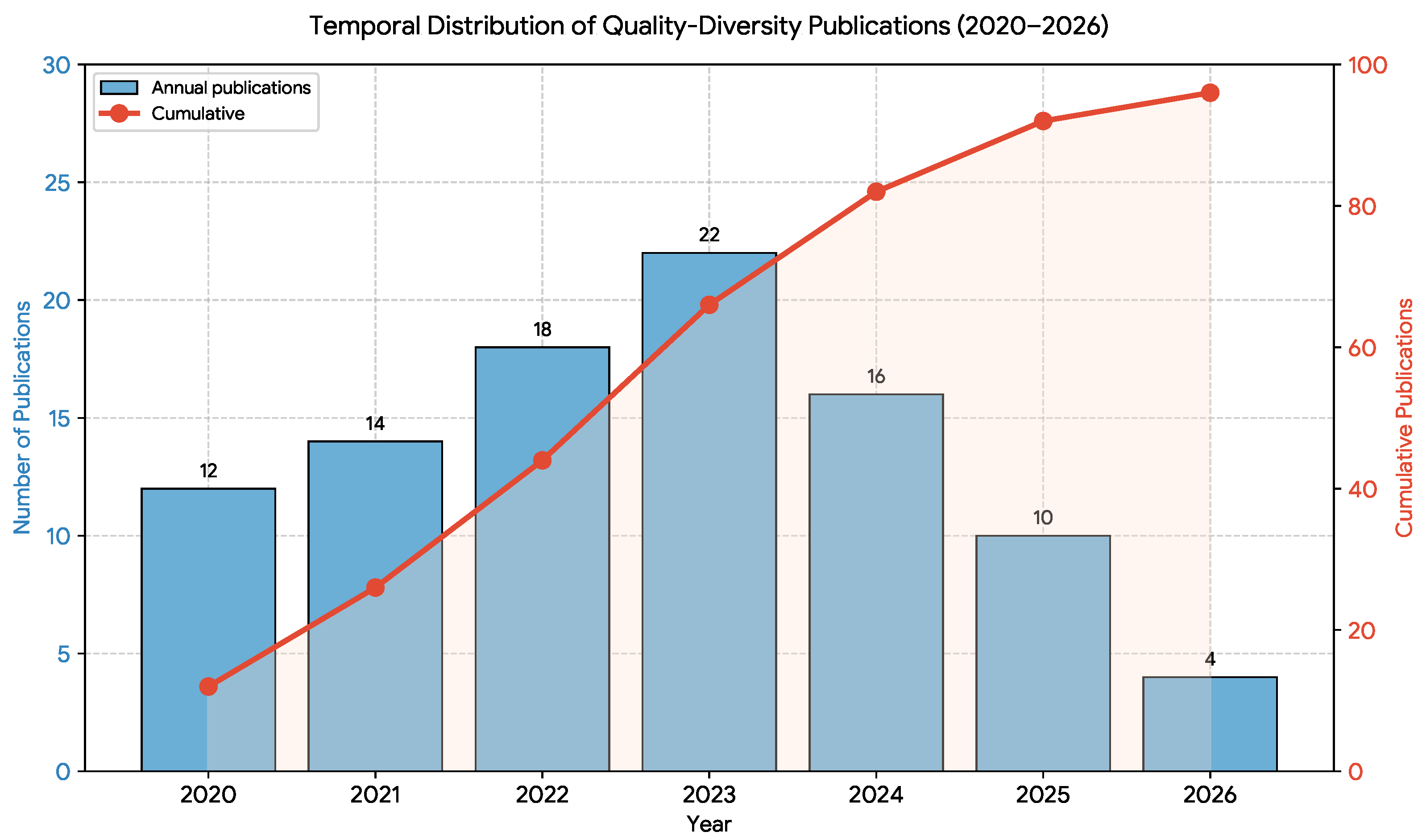
Temporal and Geographic Distribution
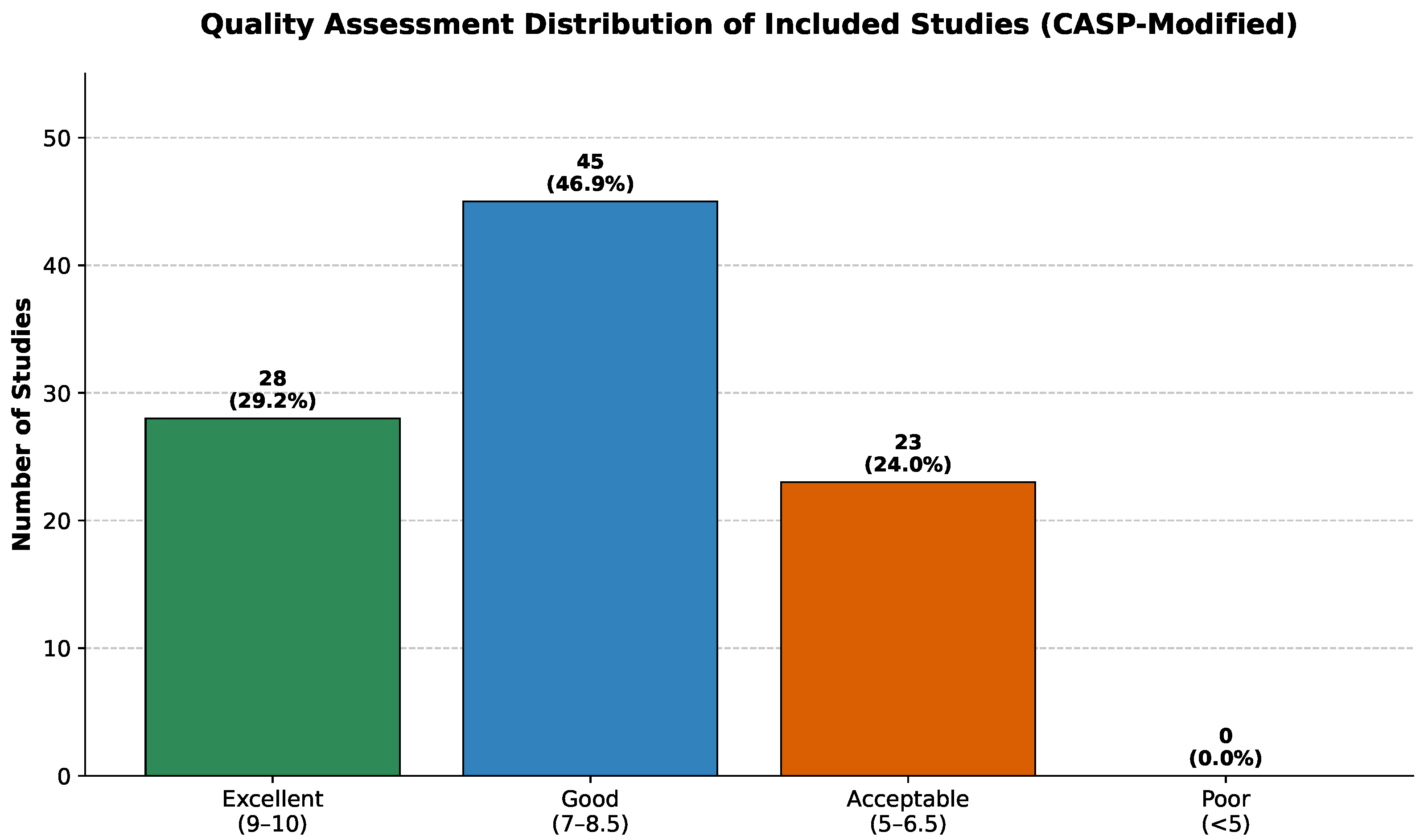
4.2. Sources and Study Quality
4.3. Bibliometric Analysis
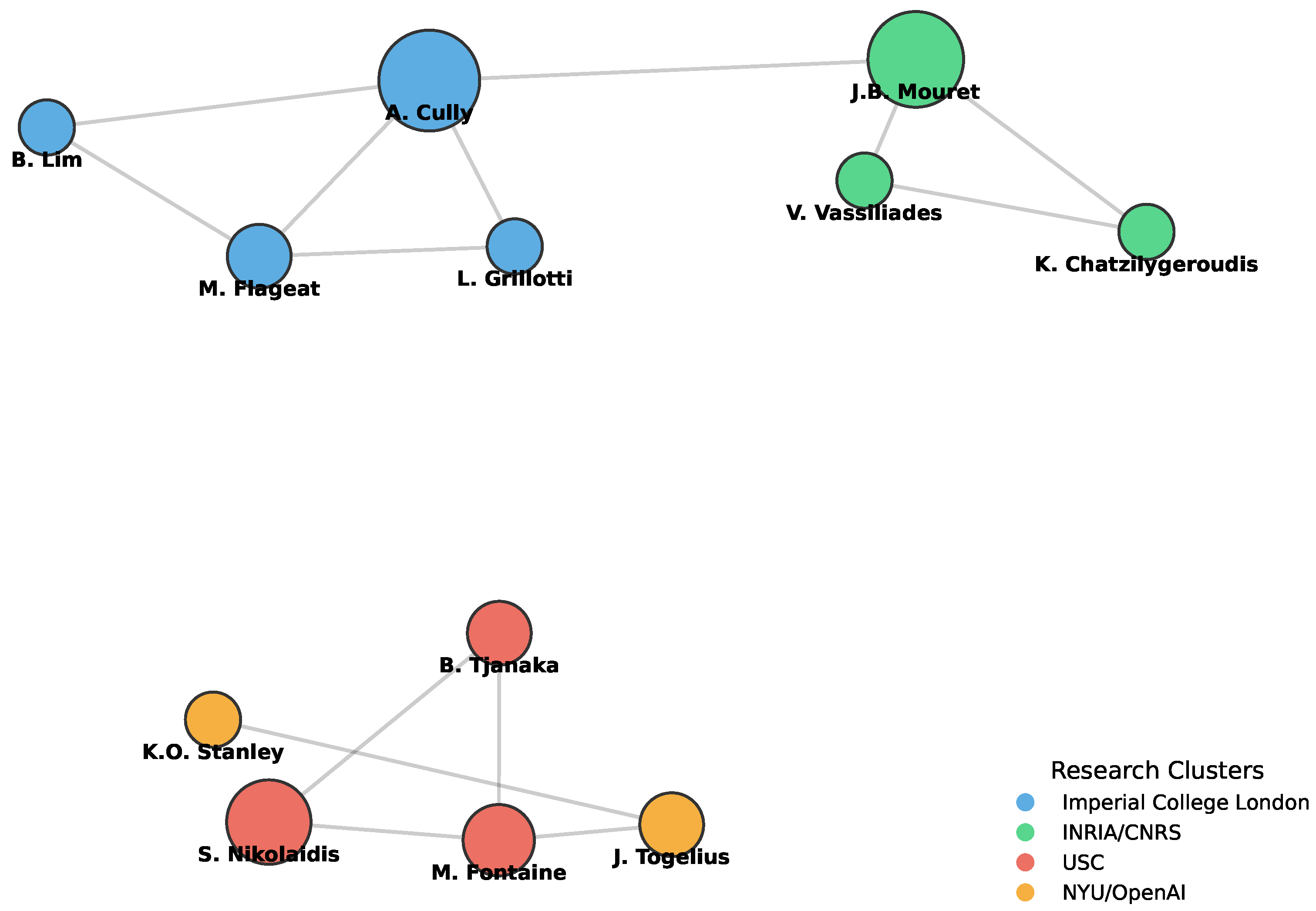
4.3.1. Productivity and Collaboration Analysis
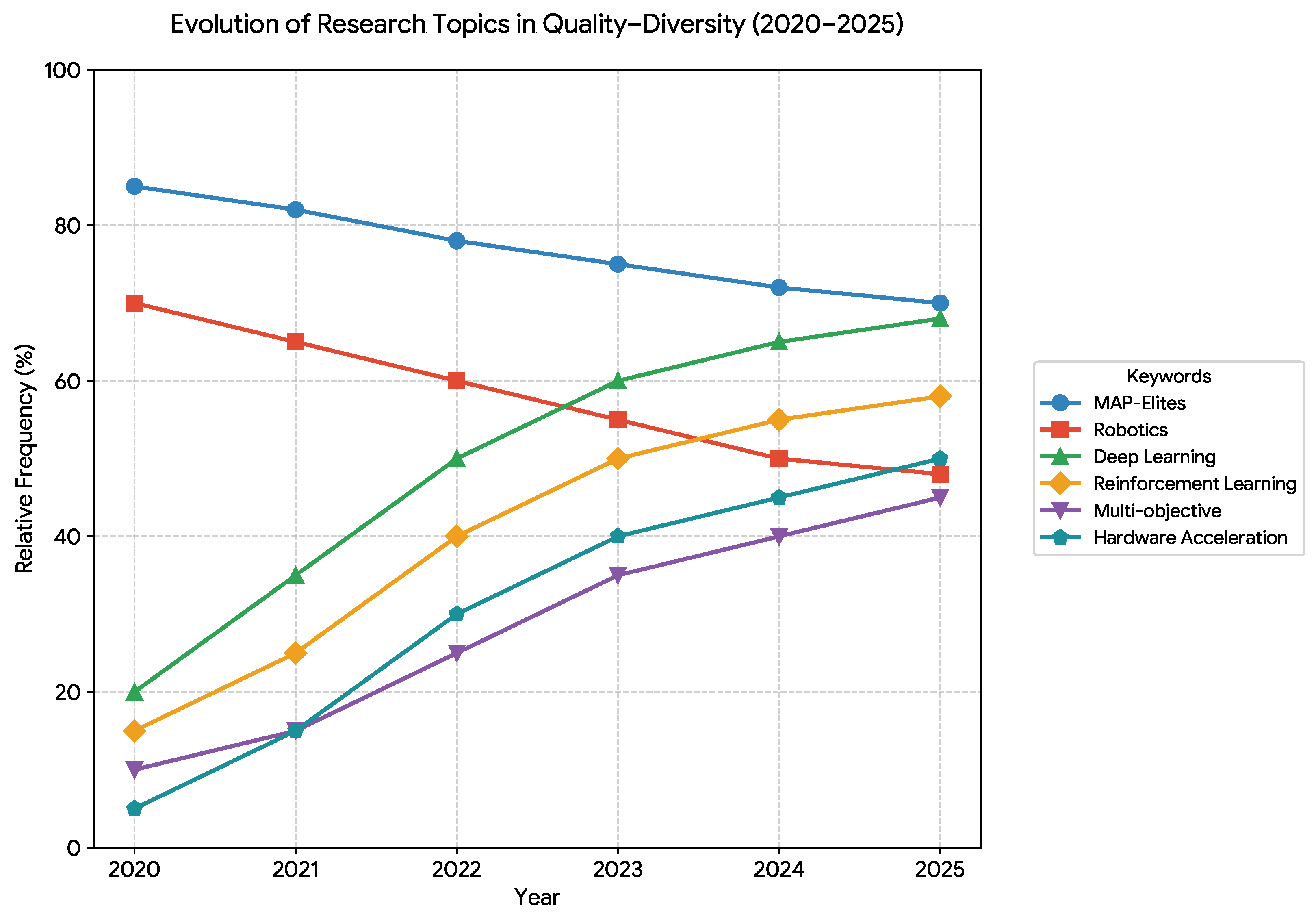
4.3.2. Co-Citation and Keyword Analysis
4.4. Qualitative Synthesis of Findings
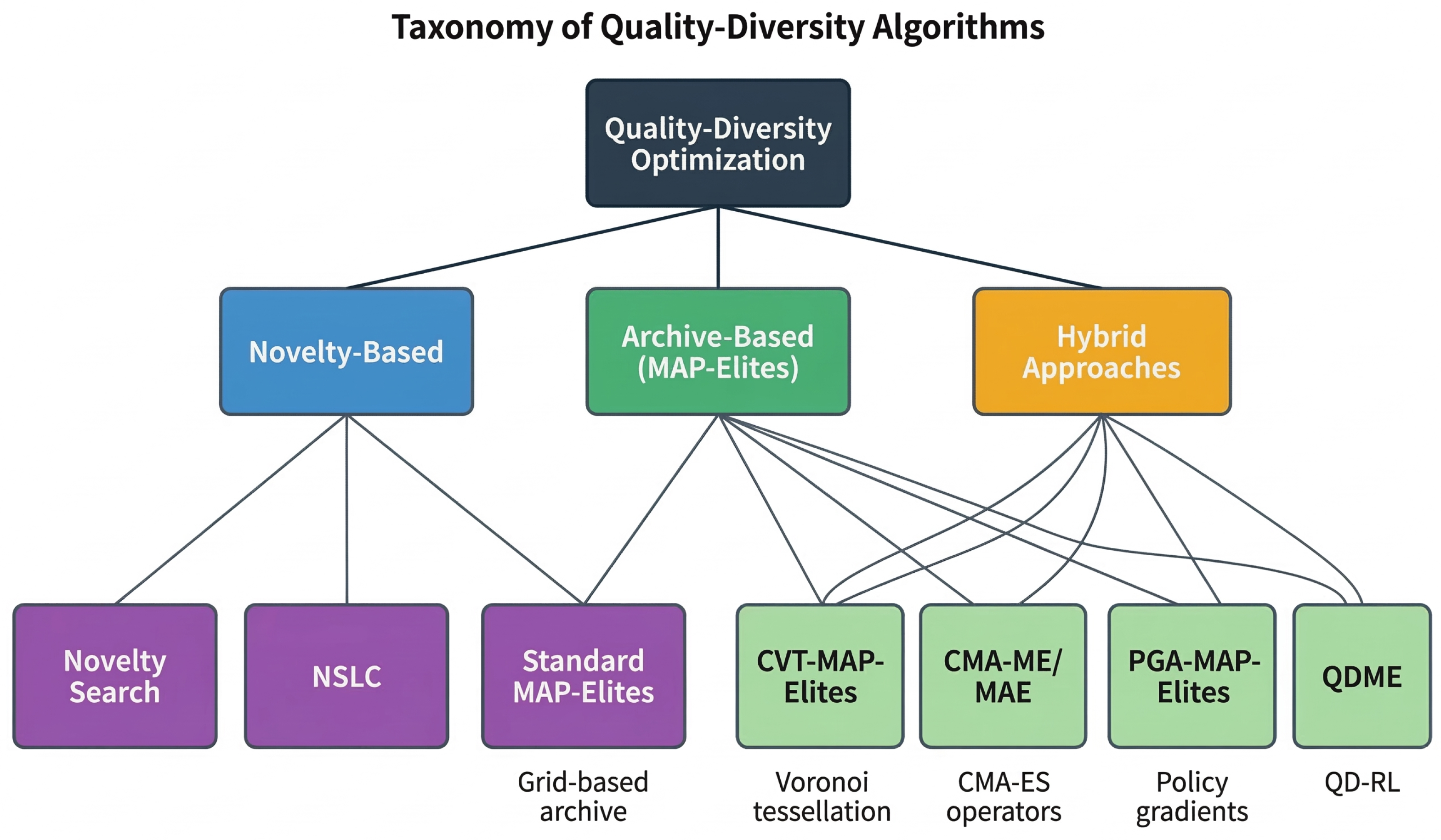
Evolution of Quality–Diversity Algorithms
- Handling Continuous and Unstructured Behavior Spaces: CVT-MAP-Elites [46] uses Voronoi tessellations to handle high-dimensional behavior spaces, removing the need for a predefined grid. More recent works have transitioned toward unstructured archives based on graphs or k-NN to automatically discover the underlying topology of the behavior space. Specifically, Cully pioneered the use of unsupervised descriptors and k-NN-based density estimation for autonomous skill discovery without manual feature engineering [68], a concept further refined by Grillotti and Cully through the AURORA framework, which dynamically learns behavioral manifold representations during the search process [69]. Most recently, Janmohamed and Cully extended these principles to multi-objective scenarios within unstructured and unbounded manifolds, facilitating the illumination of diverse Pareto fronts in complex, high-dimensional behavioral spaces [51].
4.5. Diversity Metrics and Behavioral Descriptors
- Robotics: BDs are typically direct measures of robot behavior. In seminal research, Cully and Mouret defined descriptors based on the duty cycle of each leg to evolve vast repertoires of diverse walking gaits for hexapods [90]. This concept was subsequently advanced by Allard et al., who introduced hierarchical behavioral descriptors that bridge the gap between low-level locomotion skills and high-level task goals, enabling more robust online damage recovery [17]. Most recently, Liu et al. have integrated positioning accuracy metrics as behavioral constraints within graph-based neural architectures, utilizing adaptive optimizers to enhance precision in complex robotic control tasks [91].
- Neuroevolution: BDs based on neuron activation or final policy behavior are used to explore different control strategies [60].
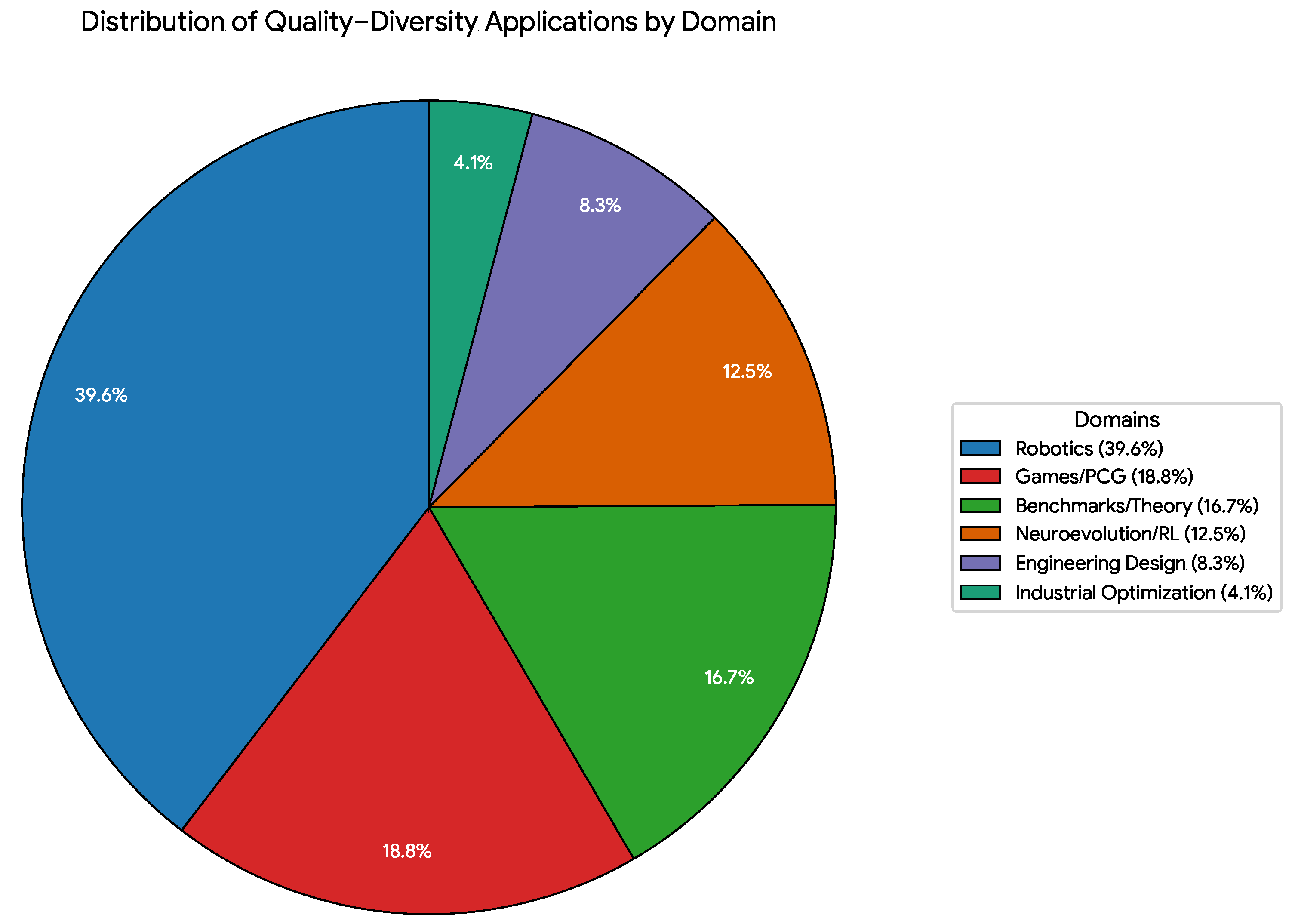
Application Domains
4.6. Summary of Included Studies
4.7. Discussion of Main Findings
4.7.1. Mathematical Formalization of the QD Paradigm
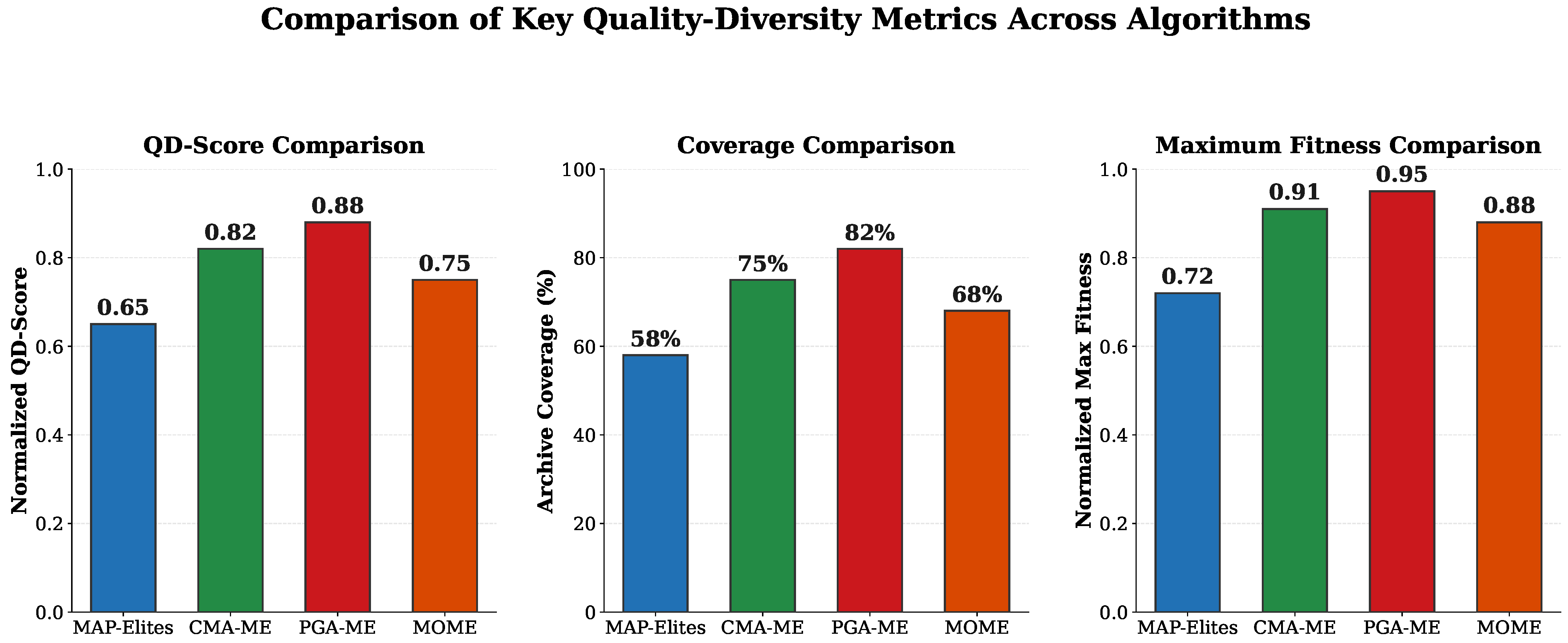
4.7.2. Performance Evaluation Metrics
4.7.3. Technical Characterization of MAP-Elites Variants
4.7.4. Synergistic Convergence Between QD and Deep Learning
4.7.5. Multi-Objective Extensions and Uncertainty Handling
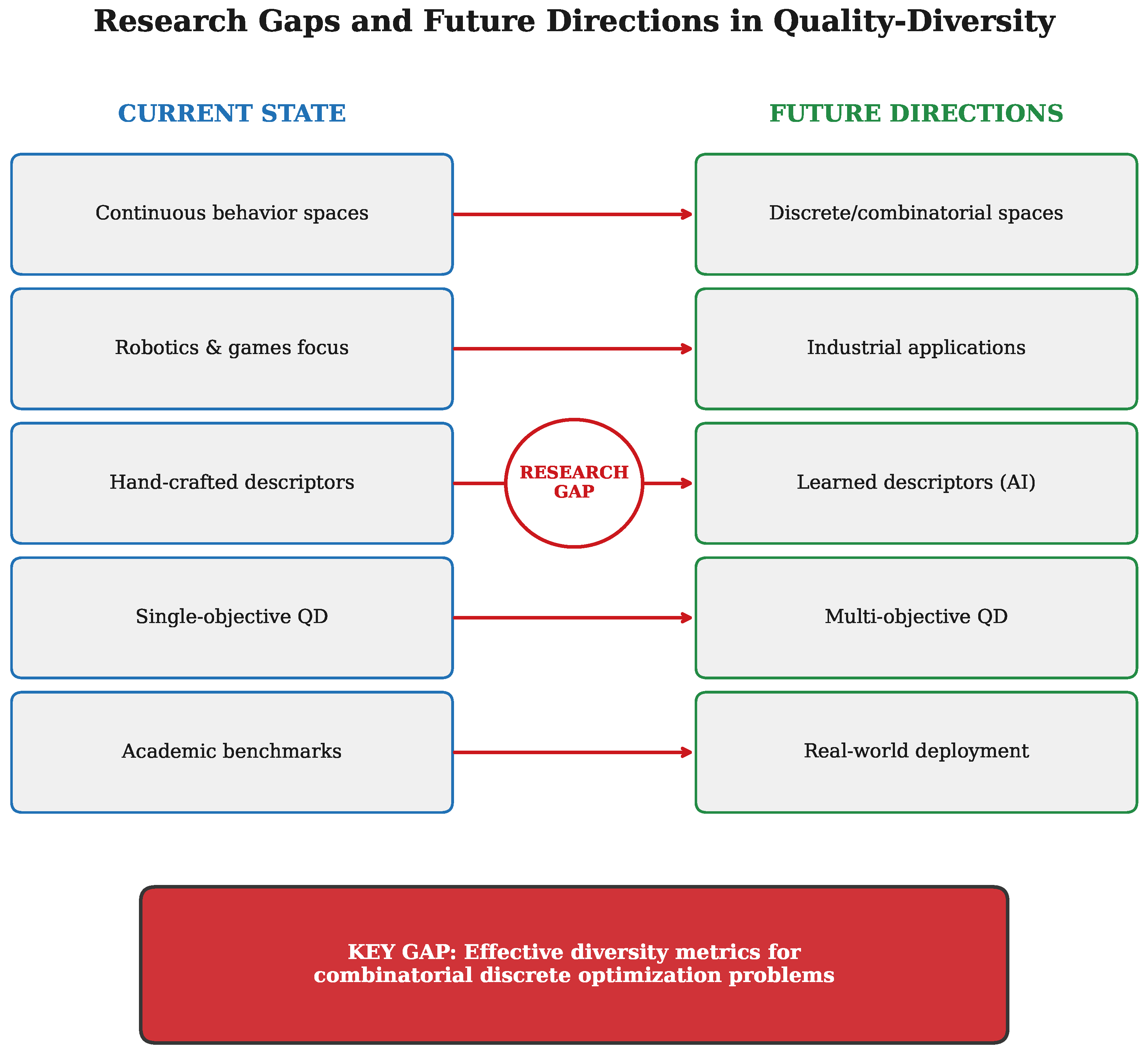
4.8. The Challenge of Diversity in Discrete Combinatorial Domains
4.8.1. Mathematical Foundations of Diversity in Discrete Spaces
4.8.2. Metrics Based on Aggregated Features
4.8.3. Metrics Based on Edit Distance
4.8.4. Metrics Based on Compressibility
4.8.5. Learned Descriptors via Latent Representations
4.8.6. Practical Implications: Domain-Specific vs. Learned Descriptors
4.9. Future Projection: Quality–Diversity in the Mining Industry
4.9.1. Predictive Maintenance and Asset Management
4.9.2. Mineral Processing Optimization
4.9.3. Drilling and Blasting Planning
4.10. Threats to Validity and Limitations
5. Conclusions
Author Contributions
Funding
Data Availability Statement
Acknowledgments
Conflicts of Interest
Abbreviations
| BD | Behavior Descriptor (Descriptor de Comportamiento) |
| CASP | Critical Appraisal Skills Programme |
| CMA-ES | Covariance Matrix Adaptation Evolution Strategy |
| CMA-MAE | Covariance Matrix Adaptation MAP-Annealing |
| CMA-ME | Covariance Matrix Adaptation MAP-Elites |
| CVT | Centroidal Voronoi Tessellation |
| k-NN | k-Nearest Neighbors |
| LLM | Large Language Model |
| MAP-Elites | Multi-dimensional Archive of Phenotypic Elites |
| MOME | Multi-Objective MAP-Elites |
| NID | Normalized Information Distance |
| NSGA-II | Non-dominated Sorting Genetic Algorithm II |
| P80 | 80% Passing Size (Tamaño de paso del 80%) |
| PCG | Procedural Content Generation |
| PGA | Policy Gradient Assisted |
| PPV | Peak Particle Velocity (Velocidad Pico de Partícula) |
| PRISMA | Preferred Reporting Items for Systematic Reviews and Meta-Analyses |
| QD | Quality–Diversity |
| RL | Reinforcement Learning (Aprendizaje por Refuerzo) |
| RSL | Revisión Sistemática de la Literatura |
| SAG | Semi-Autogenous Grinding |
| XAI | Explainable Artificial Intelligence |
References
- Chatzilygeroudis, K.; Cully, A.; Vassiliades, V.; Mouret, J.B. Quality-Diversity Optimization: A Novel Branch of Stochastic Optimization. In Black Box Optimization, Machine Learning, and No-Free Lunch Theorems; Springer: Cham, Switzerland, 2021; pp. 109–135. [Google Scholar] [CrossRef]
- Qin, H.; Xiang, Y.; Zhang, H.; Han, Y.; Wang, Y.; Tao, X.; Liu, Y. A survey on Quality-Diversity optimization: Approaches, applications, and challenges. Swarm Evol. Comput. 2026, 100, 102240. [Google Scholar] [CrossRef]
- Rojas, L.; Yepes, V.; Garcia, J. Complex Dynamics and Intelligent Control: Advances, Challenges, and Applications in Mining and Industrial Processes. Mathematics 2025, 13, 961. [Google Scholar] [CrossRef]
- Pugh, J.K.; Soros, L.B.; Stanley, K.O. Quality Diversity: A New Frontier for Evolutionary Computation. Front. Robot. AI 2016, 3, 40. [Google Scholar] [CrossRef]
- Cully, A.; Demiris, Y. Quality and Diversity Optimization: A Unifying Modular Framework. IEEE Trans. Evol. Comput. 2018, 22, 245–259. [Google Scholar] [CrossRef]
- Neumann, A.; Antipov, D.; Neumann, F. Coevolutionary Pareto Diversity Optimization. In Proceedings of the Genetic and Evolutionary Computation Conference; ACM: New York, NY, USA, 2022; pp. 1149–1157. [Google Scholar] [CrossRef]
- Rojas, L.; Hernandez, B.; Garcia, J. A Systematic Review of Intelligent Agents, Language Models, and Recurrent Neural Networks in Industrial Maintenance: Driving Value Creation for the Mining Sector. Int. J. Intell. Syst. 2025, 2025, 9953223. [Google Scholar] [CrossRef]
- Mouret, J.B.; Clune, J. Illuminating search spaces by mapping elites. arXiv 2015, arXiv:1504.04909. [Google Scholar] [CrossRef]
- Bahlous-Boldi, R.; Faldor, M.; Grillotti, L.; Janmohamed, H.; Coiffard, L.; Spector, L.; Cully, A. Dominated Novelty Search: Rethinking Local Competition in Quality-Diversity. arXiv 2025, arXiv:2502.00593. [Google Scholar] [CrossRef]
- Lehman, J.; Stanley, K.O. Evolving a Diversity of Virtual Creatures Through Novelty Search and Local Competition. In Proceedings of the Genetic and Evolutionary Computation Conference; ACM: New York, NY, USA, 2011; pp. 211–218. [Google Scholar] [CrossRef]
- Lehman, J.; Stanley, K.O. Abandoning Objectives: Evolution Through the Search for Novelty Alone. Evol. Comput. 2011, 19, 189–223. [Google Scholar] [CrossRef] [PubMed]
- Coiffard, L.; Templier, P.; Cully, A. Overcoming Deceptiveness in Fitness Optimization with Unsupervised Quality-Diversity. In Proceedings of the Genetic and Evolutionary Computation Conference; ACM: New York, NY, USA, 2025. [Google Scholar]
- Doncieux, S.; Laflaquière, A.; Coninx, A. Novelty Search: A Theoretical Perspective. In Proceedings of the Genetic and Evolutionary Computation Conference; ACM: New York, NY, USA, 2019; pp. 99–106. [Google Scholar] [CrossRef]
- Cully, A.; Clune, J.; Tarapore, D.; Mouret, J.B. Robots that can adapt like animals. Nature 2015, 521, 503–507. [Google Scholar] [CrossRef] [PubMed]
- Chatzilygeroudis, K.; Vassiliades, V.; Mouret, J.B. Reset-free Trial-and-Error Learning for Robot Damage Recovery. Robot. Auton. Syst. 2018, 100, 236–250. [Google Scholar] [CrossRef]
- Kaushik, R.; Anne, T.; Mouret, J.B. Fast Online Adaptation in Robotics through Meta-Learning Embeddings of Simulated Priors. In Proceedings of the IEEE/RSJ International Conference on Intelligent Robots and Systems; IEEE: Piscataway, NJ, USA, 2020; pp. 5269–5276. [Google Scholar]
- Allard, M.; Smith, S.C.; Chatzilygeroudis, K.; Cully, A. Hierarchical Quality-Diversity for Online Damage Recovery. In Proceedings of the Genetic and Evolutionary Computation Conference; ACM: New York, NY, USA, 2022; pp. 58–67. [Google Scholar] [CrossRef]
- Allard, M.; Smith, S.C.; Chatzilygeroudis, K.; Cully, A. Online Damage Recovery for Physical Robots with Hierarchical Quality-Diversity. ACM Trans. Evol. Learn. Optim. 2023, 3, 1–23. [Google Scholar] [CrossRef]
- Justesen, N.; González-Duque, M.; Cabarcas, D.; Mouret, J.B.; Risi, S. Learning a Behavioral Repertoire from Demonstrations. In Proceedings of the IEEE Conference on Games; IEEE: Piscataway, NJ, USA, 2020; pp. 383–390. [Google Scholar]
- Nygaard, T.F.; Martin, C.P.; Howard, D.; Torresen, J.; Glette, K. Dynamic Mutation in MAP-Elites for Robotic Repertoire Generation. In Proceedings of the Artificial Life Conference Proceedings; MIT Press: Cambridge, MA, USA, 2018; pp. 598–605. [Google Scholar]
- Alvarez, A.; Dahlskog, S.; Font, J.; Togelius, J. Interactive Constrained MAP-Elites: Analysis and Evaluation of the Expressiveness of the Feature Dimensions. IEEE Trans. Games 2020, 14, 202–211. [Google Scholar] [CrossRef]
- Schrum, J.; Gutierrez, J.; Volz, V.; Liu, J.; Lucas, S.; Risi, S. Interactive Evolution and Exploration Within Latent Level-Design Space of Generative Adversarial Networks. In Proceedings of the Genetic and Evolutionary Computation Conference; ACM: New York, NY, USA, 2020; pp. 148–156. [Google Scholar]
- Alvarez, A.; Dahlskog, S.; Font, J.; Togelius, J. Empowering Quality Diversity in Dungeon Design with Interactive Constrained MAP-Elites. In Proceedings of the 2019 IEEE Conference on Games (CoG); IEEE: Piscataway, NJ, USA, 2019; pp. 1–8. [Google Scholar]
- Fontaine, M.C.; Liu, R.; Khalifa, A.; Modi, A.; Togelius, J.; Hoover, A.K.; Nikolaidis, S. Illuminating Mario Scenes in the Latent Space of a Generative Adversarial Network. In Proceedings of the Genetic and Evolutionary Computation Conference; ACM: New York, NY, USA, 2021; pp. 217–225. [Google Scholar]
- Earle, S.; Snider, J.; Fontaine, M.C.; Nikolaidis, S.; Togelius, J. Illuminating Diverse Neural Cellular Automata for Level Generation. In Proceedings of the Genetic and Evolutionary Computation Conference; ACM: New York, NY, USA, 2022; pp. 68–76. [Google Scholar]
- Steckel, J.; Schrum, J. Illuminating the Space of Beatable Lode Runner Levels Produced By Various Generative Adversarial Networks. In Proceedings of the Genetic and Evolutionary Computation Conference Companion; ACM: New York, NY, USA, 2021; pp. 111–112. [Google Scholar]
- Urquhart, N.; Höhl, S.; Hart, E. Optimisation and Illumination of a Real-World Workforce Scheduling and Routing Application via Map-Elites. In Parallel Problem Solving from Nature; Springer: Cham, Switzerland, 2018; pp. 488–499. [Google Scholar] [CrossRef]
- Xiang, Y.; Zhou, Y.; Liu, H.; Zhang, Q. Automated Test Suite Generation for Software Product Lines based on Quality-Diversity Optimisation. ACM Trans. Softw. Eng. Methodol. 2023, 33, 1–52. [Google Scholar] [CrossRef]
- Mouret, J.B.; Maguire, G. Quality Diversity for Multi-task Optimization. In Proceedings of the Genetic and Evolutionary Computation Conference; ACM: New York, NY, USA, 2020; pp. 121–129. [Google Scholar] [CrossRef]
- Anne, T.; Mouret, J.B.; Cully, A. Parametric-Task MAP-Elites. arXiv 2024, arXiv:2402.01275. [Google Scholar] [CrossRef]
- Wickman, R.; Fayek, A.R. Efficient Quality-Diversity Optimization through Diverse Quality Species. In Proceedings of the Genetic and Evolutionary Computation Conference; ACM: New York, NY, USA, 2023; pp. 132–140. [Google Scholar]
- Dixit, G.; Tumer, K. Balancing Teams with Quality-Diversity for Heterogeneous Multiagent Coordination. In Proceedings of the International Conference on Autonomous Agents and Multi-Agent Systems; ACM: New York, NY, USA, 2021; pp. 1–9. [Google Scholar]
- Crawford, B.; Soto, R.; Lemus-Romani, J.; Becerra-Rozas, M.; Lanza-Gutiérrez, J.M.; Caballé, N.; Castillo, M.; Tapia, D.; Cisternas-Caneo, F.; García, J.; et al. Q-learnheuristics: Towards data-driven balanced metaheuristics. Mathematics 2021, 9, 1839. [Google Scholar]
- Martínez-Muñoz, D.; García, J.; Martí, J.; Yepes, V. Discrete swarm intelligence optimization algorithms applied to steel–concrete composite bridges. Eng. Struct. 2022, 266, 114607. [Google Scholar] [CrossRef]
- Martínez-Muñoz, D.; García, J.; Martí, J.; Yepes, V. Deep learning classifier for life cycle optimization of steel–concrete composite bridges. Structures 2023, 57, 105347. [Google Scholar] [CrossRef]
- Lemus-Romani, J.; Ossandón, D.; Sepúlveda, R.; Carrasco-Astudillo, N.; Yepes, V.; García, J. Optimizing retaining walls through reinforcement learning approaches and metaheuristic techniques. Mathematics 2023, 11, 2104. [Google Scholar] [CrossRef]
- Hernández-Romo, K.; Lemus-Romani, J.; Vega, E.; Becerra-Rozas, M.; Romo, A. Robust metaheuristic optimization for algorithmic trading: A comparative study of optimization techniques. Mathematics 2025, 14, 69. [Google Scholar] [CrossRef]
- Elsayed, S.; Sarker, R.; Essam, D.; Coello, C.A.C. Evolutionary Approach for Large-Scale Mine Scheduling. Inf. Sci. 2020, 523, 77–90. [Google Scholar] [CrossRef]
- Pathiranage, I.H.; Neumann, A. Multi-Objective Evolutionary Optimization for Large-Scale Open Pit Mine Scheduling. In Proceedings of the IEEE Congress on Evolutionary Computation; IEEE: Piscataway, NJ, USA, 2024; pp. 1–8. [Google Scholar] [CrossRef]
- Yu, G.; Chai, T.; Luo, X. Multiobjective Production Planning Optimization Using Hybrid Evolutionary Algorithms for Mineral Processing. IEEE Trans. Evol. Comput. 2011, 15, 487–514. [Google Scholar] [CrossRef]
- Gu, X.; Wang, X.; Liu, Z.; Zha, W.; Xu, X.; Zheng, M. A Multi-objective Optimization Model Using Improved NSGA-II for Optimizing Metal Mines Production Process. IEEE Access 2020, 8, 28847–28858. [Google Scholar] [CrossRef]
- Wang, X.; Liu, L.; Duan, L.; Liao, Q. Multi-Objective Optimization for an Industrial Grinding and Classification Process Based on PBM and RSM. IEEE/CAA J. Autom. Sin. 2023, 10, 2124–2135. [Google Scholar] [CrossRef]
- Hagg, A.; Asteroth, A.; Bäck, T. Hierarchical Surrogate Modeling for Illumination Algorithms. arXiv 2017, arXiv:1703.09926. [Google Scholar] [CrossRef]
- Pugh, J.K.; Soros, L.B.; Szerlip, P.A.; Stanley, K.O. Confronting the Challenge of Quality Diversity. In Proceedings of the Genetic and Evolutionary Computation Conference; ACM: New York, NY, USA, 2015; pp. 967–974. [Google Scholar] [CrossRef]
- Salehi, A.; Doncieux, S. Towards QD-suite: Developing a Set of Benchmarks for Quality-Diversity Algorithms. arXiv 2022, arXiv:2205.03207. [Google Scholar] [CrossRef]
- Vassiliades, V.; Chatzilygeroudis, K.; Mouret, J.B. Using Centroidal Voronoi Tessellations to Scale Up the Multidimensional Archive of Phenotypic Elites Algorithm. IEEE Trans. Evol. Comput. 2018, 22, 623–630. [Google Scholar] [CrossRef]
- Tarapore, D.; Clune, J.; Cully, A.; Mouret, J.B. How Do Different Encodings Influence the Performance of the MAP-Elites Algorithm? In Proceedings of the Genetic and Evolutionary Computation Conference; ACM: New York, NY, USA, 2016; pp. 173–180. [Google Scholar] [CrossRef]
- Mouret, J.B. Fast generation of centroids for MAP-Elites. In Proceedings of the GECCO Companion; ACM: New York, NY, USA, 2023; pp. 1–4. [Google Scholar] [CrossRef]
- Vassiliades, V.; Mouret, J.B. A Comparison of Illumination Algorithms in Unbounded Spaces. In Proceedings of the GECCO Companion; ACM: New York, NY, USA, 2017; pp. 1578–1581. [Google Scholar]
- Pierrot, T.; Richard, G.; Beguir, K.; Cully, A. Multi-Objective Quality Diversity Optimization. In Proceedings of the Genetic and Evolutionary Computation Conference; ACM: New York, NY, USA, 2022; pp. 139–147. [Google Scholar] [CrossRef]
- Janmohamed, H.; Cully, A. Multi-Objective Quality-Diversity in Unstructured and Unbounded Spaces. In Proceedings of the Genetic and Evolutionary Computation Conference; ACM: New York, NY, USA, 2025. [Google Scholar] [CrossRef]
- Cully, A.; Clune, J.; Mouret, J.B. Multi-Emitter MAP-Elites: Improving Quality, Diversity and Convergence Speed with Heterogeneous Sets of Emitters. In Proceedings of the Genetic and Evolutionary Computation Conference; ACM: New York, NY, USA, 2021; pp. 84–92. [Google Scholar] [CrossRef]
- Flageat, M.; Lim, B.; Grillotti, L.; Allard, M.; Smith, S.C.; Cully, A. Benchmarking Quality-Diversity Algorithms on Neuroevolution for Reinforcement Learning. arXiv 2022, arXiv:2211.02193. [Google Scholar] [CrossRef]
- Fontaine, M.C.; Togelius, J.; Nikolaidis, S.; Hoover, A.K. Covariance Matrix Adaptation for the Rapid Illumination of Behavior Space. In Proceedings of the Genetic and Evolutionary Computation Conference; ACM: New York, NY, USA, 2020; pp. 94–102. [Google Scholar] [CrossRef]
- Tjanaka, B.; Fontaine, M.C.; Nikolaidis, S. Training Diverse High-Dimensional Controllers by Scaling Covariance Matrix Adaptation MAP-Annealing. IEEE Int. Conf. Robot. Autom. 2023, 8, 6771–6778. [Google Scholar] [CrossRef]
- Tjanaka, B.; Fontaine, M.C.; Togelius, J.; Nikolaidis, S. Approximating Gradients for Differentiable Quality Diversity in Reinforcement Learning. In Proceedings of the Genetic and Evolutionary Computation Conference; ACM: New York, NY, USA, 2022; pp. 1102–1111. [Google Scholar] [CrossRef]
- Fontaine, M.C.; Nikolaidis, S. Covariance Matrix Adaptation MAP-Annealing. In Proceedings of the Genetic and Evolutionary Computation Conference; ACM: New York, NY, USA, 2023; pp. 456–465. [Google Scholar] [CrossRef]
- Zhao, S.; Tjanaka, B.; Fontaine, M.C.; Nikolaidis, S. Covariance Matrix Adaptation MAP-Annealing: Theory and Experiments. ACM Trans. Evol. Learn. Optim. 2025, 5, 1–53. [Google Scholar] [CrossRef]
- Nilsson, O.; Cully, A. Policy Gradient Assisted MAP-Elites. In Proceedings of the Genetic and Evolutionary Computation Conference; ACM: New York, NY, USA, 2021; pp. 866–875. [Google Scholar] [CrossRef]
- Tjanaka, B.; Fontaine, M.C.; Nikolaidis, S. Neuroevolution is a Competitive Alternative to Reinforcement Learning for Skill Discovery. In Proceedings of the International Conference on Learning Representations, Kigali, Rwanda, 1–5 May 2023. [Google Scholar]
- Conti, E.; Madhavan, V.; Such, F.P.; Lehman, J.; Stanley, K.; Clune, J. Improving Exploration in Evolution Strategies for Deep Reinforcement Learning via a Population of Novelty-Seeking Agents. In Proceedings of the Advances in Neural Information Processing Systems; Curran Associates, Inc.: Red Hook, NY, USA, 2018; Volume 31. [Google Scholar]
- Colas, C.; Sigaud, O.; Oudeyer, P.Y. Autotelic Agents with Intrinsically Motivated Goal-Conditioned Reinforcement Learning: A Short Survey. J. Artif. Intell. Res. 2022, 74, 1159–1199. [Google Scholar] [CrossRef]
- Eysenbach, B.; Gupta, A.; Ibarz, J.; Levine, S. Diversity is All You Need: Learning Skills without a Reward Function. In Proceedings of the International Conference on Learning Representations, New Orleans, LA, USA, 6–9 May 2019. [Google Scholar]
- Nasir, M.; Sudhakaran, S.; Glanois, C.; Risi, S. LLMatic: Neural Architecture Search via Large Language Models and Quality Diversity Optimization. In Proceedings of the Genetic and Evolutionary Computation Conference; ACM: New York, NY, USA, 2023. [Google Scholar]
- Sudhakaran, S.; Glanois, C.; Freiberger, M.; Najarro, E.; Risi, S. MarioGPT: Open-Ended Text2Level Generation through Large Language Models. In Proceedings of the Advances in Neural Information Processing Systems; Curran Associates, Inc.: Red Hook, NY, USA, 2023. [Google Scholar]
- Doncieux, S.; Mouret, J.B. Behavioral Diversity Measures for Evolutionary Robotics. In Proceedings of the IEEE Congress on Evolutionary Computation; IEEE: Piscataway, NJ, USA, 2010; pp. 1–8. [Google Scholar] [CrossRef][Green Version]
- Mouret, J.B.; Doncieux, S. Encouraging Behavioral Diversity in Evolutionary Robotics: An Empirical Study. Evol. Comput. 2012, 20, 91–133. [Google Scholar] [CrossRef][Green Version]
- Cully, A. Autonomous Skill Discovery with Quality-Diversity and Unsupervised Descriptors. In Proceedings of the Genetic and Evolutionary Computation Conference; ACM: New York, NY, USA, 2019; pp. 81–89. [Google Scholar] [CrossRef]
- Grillotti, L.; Cully, A. Unsupervised Behavior Discovery with Quality-Diversity Optimization. IEEE Trans. Evol. Comput. 2022, 26, 1539–1552. [Google Scholar] [CrossRef]
- Bossens, D.M.; Mouret, J.B. Quality-Diversity Meta-Evolution: Customizing Behavior Spaces to a Meta-Objective. IEEE Trans. Evol. Comput. 2022, 26, 1171–1181. [Google Scholar] [CrossRef]
- Xie, Y.; Pinskier, J.; Wang, X.; Howard, D. Evolutionary Seeding of Diverse Structural Design Solutions via Topology Optimization. ACM Trans. Evol. Learn. Optim. 2024, 4, 1–23. [Google Scholar] [CrossRef]
- Xie, Y.; Pinskier, J.; Liow, L.; Howard, D. A’MAP’to find high-performing soft robot designs: Traversing complex design spaces using MAP-elites and Topology Optimization. In Proceedings of the IEEE/RSJ International Conference on Intelligent Robots and Systems; IEEE: Piscataway, NJ, USA, 2024; pp. 11408–11415. [Google Scholar] [CrossRef]
- Sfikas, K.; Liapis, A.; Yannakakis, G.N. Diverse Level Generation via Machine Learning of Quality Diversity. In Proceedings of the Foundations of Digital Games; ACM: New York, NY, USA, 2025. [Google Scholar] [CrossRef]
- Grillotti, L.; Flageat, M.; Lim, B.; Cully, A. Don’t Bet on Luck Alone: Enhancing Behavioral Reproducibility of Quality-Diversity Solutions in Uncertain Domains. In Proceedings of the Genetic and Evolutionary Computation Conference; ACM: New York, NY, USA, 2023; pp. 123–131. [Google Scholar] [CrossRef]
- Flageat, M.; Cully, A. Uncertain Quality-Diversity: Evaluation methodology and new methods for Quality-Diversity in Uncertain Domains. In Proceedings of the Genetic and Evolutionary Computation Conference; ACM: New York, NY, USA, 2023; pp. 141–149. [Google Scholar]
- Li, Y.; Wang, Z.; Zhang, Q.; Yuan, B. Measuring Diversity of Game Scenarios. IEEE Trans. Games 2025, 17, 558–581. [Google Scholar] [CrossRef]
- Chalumeau, F.; Lim, B.; Boige, R.; Allard, M.; Grillotti, L.; Flageat, M.; Macé, V.; Richard, G.; Flajolet, A.; Pierrot, T.; et al. QDax: A Library for Quality-Diversity and Population-based Algorithms with Hardware Acceleration. J. Mach. Learn. Res. 2024, 25, 1–16. [Google Scholar]
- Lim, B.; Allard, M.; Grillotti, L.; Cully, A. Accelerated Quality-Diversity through Massive Parallelism. Trans. Mach. Learn. Res. 2022, 1–17. Available online: https://openreview.net/forum?id=znNITCJyTI (accessed on 20 March 2026).
- Page, M.J.; McKenzie, J.E.; Bossuyt, P.M.; Boutron, I.; Hoffmann, T.C.; Mulrow, C.D.; Shamseer, L.; Tetzlaff, J.M.; Akl, E.A.; Brennan, S.E.; et al. The PRISMA 2020 statement: An updated guideline for reporting systematic reviews. BMJ 2021, 372, n71. [Google Scholar] [CrossRef]
- García, J.; Leiva-Araos, A.; Diaz-Saavedra, E.; Moraga, P.; Pinto, H.; Yepes, V. Relevance of machine learning techniques in water infrastructure integrity and quality: A review powered by natural language processing. Appl. Sci. 2023, 13, 12497. [Google Scholar] [CrossRef]
- Gana, B.; Leiva-Araos, A.; Allende-Cid, H.; García, J. Leveraging llms for efficient topic reviews. Appl. Sci. 2024, 14, 7675. [Google Scholar] [CrossRef]
- Khalifa, A.; Lee, S.; Nealen, A.; Togelius, J. Talakat: Bullet Hell Generation through Constrained Map-Elites. In Proceedings of the Genetic and Evolutionary Computation Conference; ACM: New York, NY, USA, 2018; pp. 1047–1054. [Google Scholar] [CrossRef]
- Sarkar, A.; Cooper, S. Generating and Blending Game Levels via Quality-Diversity in the Latent Space of a Variational Autoencoder. arXiv 2021, arXiv:2102.12463. [Google Scholar] [CrossRef]
- Sfikas, K.; Liapis, A.; Hilmersson, J.; Yannakakis, G.N. Design Space Exploration of Shell Structures Using Quality Diversity Algorithms. In Proceedings of the IASS Annual Symposium; IASS: Madrid, Spain, 2023. [Google Scholar]
- Lim, B.; Flageat, M.; Cully, A. QDax: A Library for Quality-Diversity and Population-based Algorithms with Hardware Acceleration. In Proceedings of the GECCO Companion; ACM: New York, NY, USA, 2022. [Google Scholar] [CrossRef]
- Flageat, M.; Cully, A. Empirical Analysis of PGA-MAP-Elites for Neuroevolution in Uncertain Domains. arXiv 2022, arXiv:2210.13156. [Google Scholar] [CrossRef]
- Lim, B.; Cully, A. Understanding the Synergies between Quality-Diversity and Deep Reinforcement Learning. In Proceedings of the Genetic and Evolutionary Computation Conference; ACM: New York, NY, USA, 2023; pp. 456–464. [Google Scholar] [CrossRef]
- Deng, Z.; Wu, Q.; Huang, M. Two-Stage Dam Displacement Analysis Framework Based on Improved Isolation Forest and Metaheuristic-Optimized Random Forest. Buildings 2025, 15, 4467. [Google Scholar] [CrossRef]
- Fioravanzo, S.; Medvet, E. MAP-Elites for Constrained Optimization. In Proceedings of the GECCO Companion; ACM: New York, NY, USA, 2021; pp. 85–86. [Google Scholar] [CrossRef]
- Cully, A.; Mouret, J.B. Evolving a Behavioral Repertoire for a Walking Robot. Evol. Comput. 2016, 24, 59–88. [Google Scholar] [CrossRef]
- Liu, J.; Huang, X.; Deng, Y.; Xiao, C.; Li, Z. Robotic Positioning Accuracy Enhancement via Memory Red Billed Blue Magpie Optimizer and Adaptive Momentum PSO Tuned Graph Neural Network. Machines 2025, 13, 526. [Google Scholar] [CrossRef]
- Gravina, D.; Khalifa, A.; Liapis, A.; Togelius, J.; Yannakakis, G.N. Procedural Content Generation through Quality Diversity. In Proceedings of the IEEE Conference on Games; IEEE: Piscataway, NJ, USA, 2019; pp. 1–8. [Google Scholar]
- Faldor, M.; Chalumeau, F.; Flageat, M.; Cully, A. Synergizing Quality-Diversity with Descriptor-Conditioned Reinforcement Learning. ACM Trans. Evol. Learn. Optim. 2025, 5, 1–35. [Google Scholar] [CrossRef]
- Baraton, L.; Urbano, A.; Brevault, L.; Balesdent, M. Bayesian Quality-Diversity optimization for conditional search-space problems. Optim. Eng. 2025, Early Access. [Google Scholar] [CrossRef]
- Fontaine, M.C.; Nikolaidis, S. Differentiable Quality Diversity. In Proceedings of the Advances in Neural Information Processing Systems; Curran Associates, Inc.: Red Hook, NY, USA, 2021; Volume 34, pp. 10040–10052. [Google Scholar]
- Qin, H.; Xiang, Y.; Liu, Y.; Han, Y.; Wang, Y. Enhancing Quality-Diversity algorithm by reinforcement learning for Flexible Job Shop Scheduling with transportation constraints. Swarm Evol. Comput. 2025, 93, 101849. [Google Scholar] [CrossRef]
- Pierrot, T.; Richard, G.; Beguir, K.; Cully, A. Diversity Policy Gradient for Sample Efficient Quality-Diversity Optimization. In Proceedings of the Genetic and Evolutionary Computation Conference; ACM: New York, NY, USA, 2022; pp. 1102–1110. [Google Scholar] [CrossRef]
- Gomes, J.; Mariano, P.; Christensen, A.L. An Approach to Evolve and Exploit Repertoires of General Robot Behaviours. Swarm Evol. Comput. 2018, 43, 265–283. [Google Scholar] [CrossRef]
- Duarte, M.; Gomes, J.; Oliveira, S.M.; Christensen, A.L. Evolution of Repertoire-based Control for Robots with Complex Locomotor Systems. IEEE Trans. Evol. Comput. 2018, 22, 314–328. [Google Scholar] [CrossRef]
- Preuss, M.; Liapis, A.; Togelius, J. Searching for Good and Diverse Game Levels. In Proceedings of the IEEE Conference on Computational Intelligence and Games; IEEE: Piscataway, NJ, USA, 2014; pp. 1–8. [Google Scholar] [CrossRef][Green Version]
- Such, F.P.; Madhavan, V.; Conti, E.; Lehman, J.; Stanley, K.O.; Clune, J. Deep Neuroevolution: Genetic Algorithms Are a Competitive Alternative for Training Deep Neural Networks for Reinforcement Learning. arXiv 2017, arXiv:1712.06567. [Google Scholar] [CrossRef]
- Zhou, D.; Du, J.; Arai, S. Neuroevolutionary Diversity Policy Search for Multi-objective Reinforcement Learning. Inf. Sci. 2024, 657, 119932. [Google Scholar] [CrossRef]
- Faldor, M.; Cully, A. Discovering Quality-Diversity Algorithms via Meta-Black-Box Optimization. arXiv 2025, arXiv:2502.02190. [Google Scholar] [CrossRef]
- Hedayatian, S.; Nikolaidis, S. AutoQD: Automatic Discovery of Diverse Behaviors with Quality-Diversity Optimization. arXiv 2025, arXiv:2506.05634. [Google Scholar] [CrossRef]
- Pierrot, T.; Richard, G.; Cully, A. Preference-Conditioned Gradient Variations for Multi-Objective Quality-Diversity. arXiv 2025, arXiv:2411.12433. [Google Scholar] [CrossRef]
- Ding, J.; Yang, C.; Xiao, Q.; Chai, T.; Jin, Y. Dynamic Evolutionary Multiobjective Optimization for Raw Ore Allocation in Mineral Processing. IEEE Trans. Emerg. Top. Comput. Intell. 2018, 3, 36–48. [Google Scholar] [CrossRef]
- Rojas, L.; Peña, A.; Garcia, J. AI-Driven Predictive Maintenance in Mining: A Systematic Literature Review on Fault Detection, Digital Twins, and Intelligent Asset Management. Appl. Sci. 2025, 15, 3337. [Google Scholar] [CrossRef]



| Contribution Dimension | Main Contribution | Relevance to the Field |
|---|---|---|
| Conceptual | This review clarifies the distinction between dominant continuous-control Quality–Diversity applications and the still underdeveloped discrete combinatorial domain. | This helps position the discrete-domain gap more precisely within the current QD literature. |
| Methodological | This study systematizes the literature using PRISMA 2020, explicit eligibility criteria, quality assessment, and a classification protocol for discrete-domain studies. | This provides a transparent and reproducible synthesis framework for evaluating recent QD research. |
| Analytical | This review identifies the lack of standardized diversity metrics and behavioral descriptors for discrete combinatorial search spaces as a central unresolved challenge. | This defines a focused research agenda for future algorithmic and representational developments. |
| Applied | This manuscript proposes a conceptual transfer framework linking Quality–Diversity principles to resilient mining operations, including maintenance, mineral processing, and blasting. | This extends the discussion from benchmark-oriented optimization toward industrial robustness under uncertainty. |
| Dimension | Criteria Description |
|---|---|
| 1. Aims | Is the specific QD problem and research objective clearly defined? |
| 2. Algorithm | Is the implementation reproducible (detailed hyperparameters and architecture)? |
| 3. Benchmarks | Are standard benchmarks (e.g., MuJoCo, QDAnt) or real-world datasets used? |
| 4. Metrics | Does the study report standard QD metrics (QD-Score, Coverage, Max Fitness)? |
| 5. Baselines | Is performance compared against appropriate baselines (e.g., MAP-Elites, NSGA-II)? |
| 6. Statistics | Are statistical significance tests (e.g., Wilcoxon, Mann-Whitney) reported? |
| 7. Design | Is the experimental design (number of runs, generations) robust and justified? |
| 8. Reproducibility | Is source code, trained models, or data made publicly available? |
| 9. Analysis | Is the trade-off between Quality and Diversity explicitly analyzed? |
| 10. Contribution | Does the study provide significant theoretical or applied value to the field? |
| Author | Articles | h-Index | Primary Affiliation |
|---|---|---|---|
| Antoine Cully | 24 | 32 | Imperial College London |
| Jean-Baptiste Mouret | 18 | 45 | INRIA/CNRS |
| Stefanos Nikolaidis | 12 | 28 | University of Southern California |
| Matthew C. Fontaine | 10 | 18 | University of Southern California |
| Bryon Tjanaka | 8 | 12 | University of Southern California |
| Luca Grillotti | 7 | 11 | Imperial College London |
| Bryan Lim | 6 | 10 | Imperial College London |
| Maxence Flageat | 6 | 9 | Imperial College London |
| Julian Togelius | 5 | 52 | New York University |
| Kenneth O. Stanley | 4 | 58 | OpenAI |
| Reference | Discrete Domain | Genotype () | Behavioral Descriptor (b) | Core Limitation/Performance Outcome |
|---|---|---|---|---|
| Urquhart et al. [27] | Workforce Scheduling | Permutations/Routing sequences | Aggregated statistical features (resource utilization) | Dimension reduction masks true topological differences between discrete schedules. |
| Xiang et al. [28] | Software Test Suite Generation | Binary/Discrete parameter arrays | Structural distance metrics (exact edit distances) | Imposes severe computational bottlenecks; edit distance scales exponentially. |
| Khalifa et al. [82] | PCG (Bullet Hell) | Categorical parameter arrays | Hand-crafted properties and edit distance | Highly domain-specific; NP-complete distance metrics bound scalability. |
| Alvarez et al. [21] | PCG (Dungeon Design) | Grid-based discrete room arrays | Aggregated spatial features (symmetry, density) | Relies heavily on domain-expert handcrafting; lacks broad generalization. |
| Alvarez and Font [23] | PCG (Dungeon Maps) | Discrete spatial tiles | Expressive structural metrics | Constraints must be manually formulated for each new spatial topology. |
| Sarkar and Cooper [83] | PCG (Platformer) | Discrete tile grids | Learned continuous latent space (VAE) | Sacrifices semantic interpretability; dimensions do not map to physical rules. |
| Fontaine et al. [24] | PCG (Mario Scenes) | Discrete categorical mappings | Latent continuous space via GANs | Mapping discrete structures to continuous spaces introduces invalid artifacts. |
| Schrum et al. [22] | PCG (Level Design) | Interactive discrete grids | Latent GAN vectors | Requires human-in-the-loop interaction, preventing fully automated scaling. |
| Steckel and Schrum [26] | PCG (Lode Runner) | Grid-based levels | Graph-based reachability metrics | Pathfinding evaluations over discrete grids become computationally prohibitive. |
| Earle et al. [25] | Neural Cellular Automata (NCA) | Discrete cellular states | Aggregated tile metrics | Diversity relies on post-hoc clustering rather than direct structural distinction. |
| Sfikas et al. [84] | Structural Architecture | Discrete topological elements | Geometric and structural aggregated metrics | Struggles to capture non-linear behavioral shifts caused by minor topological mutations. |
| Li et al. [76] | Game Scenarios | Discrete structural graphs | Compressibility (Normalized Info. Distance) | Theoretical rigor is high, but real-time complexity of compression bounds its use. |
| Research Category | Included Studies (Citations) | Count |
|---|---|---|
| Fundamentals and Core QD Algorithms | [1,2,4,5,8,9,10,11,12,13,14,44,45,46,48,54,57,58,66,67,68,69,74,93,94] | 25 |
| MAP-Elites Variants and Extensions | [6,29,30,31,43,47,49,50,51,52,55,56,59,70,75,78,88,89,95,96] | 20 |
| Robotics Applications | [15,16,17,18,19,20,53,71,72,77,85,86,87,90,91,97,98,99] | 18 |
| Video Games and PCG Applications | [21,22,23,24,25,26,32,65,73,76,82,83,84,92,100] | 15 |
| Deep Learning and Neuroevolution | [60,61,62,63,64,101,102,103,104,105] | 10 |
| Industrial Optimization and Engineering | [27,28,38,39,40,41,42,106] | 8 |
| Total Included Studies | 96 |
| Mining Operation | Genotype () | Fitness (f) | Behavioral Descriptor (b) | QD Strategy |
|---|---|---|---|---|
| Predictive Maintenance | Maintenance Policy | Availability–Cost | : Risk (Variance of TBF) | PGA-MAP-Elites |
| (Thresholds/Neural Net) | (Simulated) | : Resource Intensity | (Policy Search) | |
| Mineral Processing | Control Parameters | Metallurgical Recovery | : Energy (kWh/t) | CMA-ME |
| (Grinding/Flotation) | (Setpoints) | (Process Model) | : Water Usage (m3/t) | (Continuous Opt) |
| Drilling and Blasting | Pattern Design | Minimize Unit Cost | : Fragmentation () | MAP-Elites |
| (Burden, Spacing) | (Empirical Model) | : Vibration () | (Discrete/Mixed) |
Disclaimer/Publisher’s Note: The statements, opinions and data contained in all publications are solely those of the individual author(s) and contributor(s) and not of MDPI and/or the editor(s). MDPI and/or the editor(s) disclaim responsibility for any injury to people or property resulting from any ideas, methods, instructions or products referred to in the content. |
© 2026 by the authors. Licensee MDPI, Basel, Switzerland. This article is an open access article distributed under the terms and conditions of the Creative Commons Attribution (CC BY) license.
Share and Cite
Rojas, L.; Vega, E.; Jorquera, L.; Garcia, J. Quality–Diversity and Illumination Algorithms in Discrete Combinatorial Domains: Diversity Metrics and Implications for Resilient Mining Operations. Mathematics 2026, 14, 1091. https://doi.org/10.3390/math14071091
Rojas L, Vega E, Jorquera L, Garcia J. Quality–Diversity and Illumination Algorithms in Discrete Combinatorial Domains: Diversity Metrics and Implications for Resilient Mining Operations. Mathematics. 2026; 14(7):1091. https://doi.org/10.3390/math14071091
Chicago/Turabian StyleRojas, Luis, Emanuel Vega, Lorena Jorquera, and José Garcia. 2026. "Quality–Diversity and Illumination Algorithms in Discrete Combinatorial Domains: Diversity Metrics and Implications for Resilient Mining Operations" Mathematics 14, no. 7: 1091. https://doi.org/10.3390/math14071091
APA StyleRojas, L., Vega, E., Jorquera, L., & Garcia, J. (2026). Quality–Diversity and Illumination Algorithms in Discrete Combinatorial Domains: Diversity Metrics and Implications for Resilient Mining Operations. Mathematics, 14(7), 1091. https://doi.org/10.3390/math14071091