1. Introduction
The offshore wind industry has expanded significantly over the past decade. These facilities are often located far from shore and operate in harsh maritime environments. As a result, maintenance logistics becomes a complex operation and a primary driver of total costs [
1]. Operators rely heavily on specialised vessels to transfer personnel and equipment to these sites. Therefore, optimising the routing and scheduling of these vessels is essential to ensure high availability and reduce unnecessary expenses [
2].
Operations and maintenance activities in wind farms primarily rely on Crew Transfer Vessels (CTVs) for the daily transportation of personnel.
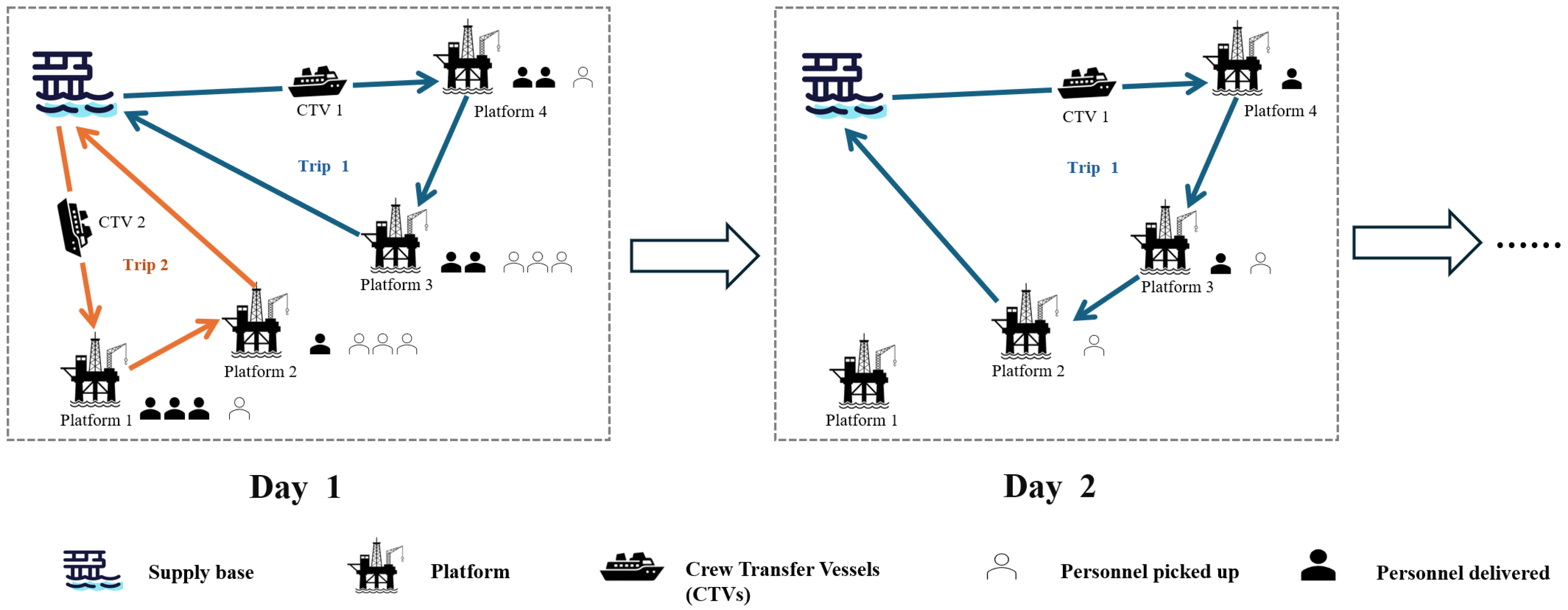
Figure 1 visualises a representative operational scenario involving a fleet of two vessels and four offshore platforms over a multi-period planning horizon. It encompasses two flows, namely the mandatory delivery of on-duty crew to maintain power generation and the retrieval of off-duty personnel returning to the base [
3]. For instance, on Day 1, Crew Transfer Vessel 1 executes a trip visiting Platform 4 and Platform 3. The vessel delivers two technicians and picks up one person at Platform 4 and subsequently delivers two technicians and picks up three personnel at Platform 3. Simultaneously, Crew Transfer Vessel 2 services Platform 1 and Platform 2 with similar operations. This specific routing sequence reflects a core assumption of our model that each vessel visits a specific platform at most once within a single day. Managing these flows faces significant operational difficulties due to strict resource limitations. A critical bottleneck stems from the transfer mechanism itself. In the offshore service operations, the crane basket (personnel transfer carrier) is widely adopted as the standard method for transferring personnel between the vessel deck and the platform. Unlike simple docking, crane-based transfers require a specific amount of time for each lift. Consequently, the service duration at a platform increases directly with the number of passengers. We assume the transfer duration as a linear function of the number of passengers served to reflect these operational characteristics. In practice, vessels perform delivery and pickup operations simultaneously during the same trip. However, when the total passenger count exceeds vessel capacity, the operational priority shifts towards delivery demands. Since delivery demands are mandatory to maintain offshore production, they effectively occupy most of the available vessel seats. Consequently, pickup requests are frequently displaced due to this capacity shortage. These unserved personnel remain on the platform as inventory rather than returning to the base. This accumulation of stranded personnel extends the operational timeline beyond a single day, as the inventory must be cleared in subsequent periods, thereby necessitating a multi-period planning approach.
Several studies have investigated logistics for offshore wind farm operations and maintenance using distinct methodologies. Irawan et al. [
2] proposed a mathematical model to optimise turbine maintenance and vessel routes simultaneously. However, this approach prioritises maintenance task completion over transport efficiency. Consequently, it does not address personnel inventory management across multiple periods. Halvorsen-Weare et al. [
3] determined optimal fleet composition and sailing schedules. Nevertheless, the model assumes all pickup demands are mandatory within the scheduled voyage. This assumption prevents the management of stranded personnel when capacity is limited. Dalgic et al. [
4] utilised a Monte-Carlo approach to analyse fleet planning and operating expenditures. This simulation-based method assesses macro-level performance but does not provide detailed routing decisions for daily personnel flows. Finally, Stålhane et al. [
5] proposed a two-stage stochastic programming model for strategic fleet sizing. This high-level approach simplifies operational details by assuming fixed service durations. It overlooks the correlation between passenger numbers and service time. Ignoring this dynamic factor can lead to infeasible schedules during high-volume transfers in the real operation [
6,
7].
Table 1 presents a comparative summary of studies. This comparison evaluates problem scope and methodology alongside computational performance to highlight the efficiency of the proposed framework. The recent literature indicates a reliance on simulation-based frameworks and heuristic algorithms to manage the inherent complexities of offshore logistics. For instance, Li et al. [
8] utilised discrete-event simulation, which required more than 30 h of processing time to determine strategic fleet configurations. Other researchers, such as Zhao et al. [
9] and Letournel et al. [
10], employ stochastic or physics-based simulations in which the exact computational duration is not explicitly stated. In these studies, the computational complexity is assessed as high based on the iterative nature of the underlying models and the extensive scale of the maritime scenarios analysed. While some specific optimisation models for maintenance tasks achieve rapid convergence, our framework extends this level of efficiency to the integrated multi-period personnel inventory problem. The proposed mixed-integer linear programming model in this study determines optimal routing and scheduling plans within an average of 5.67 s. This performance represents a substantial time saving, particularly when contrasted with the extensive durations required by simulation-heavy or heuristic approaches.
To address these research gaps, we model the offshore personnel transport problem as a Multi-Period Crew Transfer Vessel Routing and Scheduling Problem with Inventory Constraints (MP-CTVRSP-IC). We formulate this problem using mixed-integer linear programming, which is a technique widely used in routing problems [
14,
15,
16,
17,
18]. The model integrates daily vessel routing decisions with multi-day personnel inventory management. It explicitly accounts for the volumetric constraints of vessel capacity and strict time windows. A key feature of our approach is the modelling of service times. We approximate the transfer duration as a linear function of the number of passengers served. This reflects the characteristics of crane-based operations. Personnel transfer via crane basket follows a discrete process: each cycle usually accommodates four passengers and lasts five minutes. Our linear approximation of service time introduces a maximum theoretical underestimation of 3.75 min per platform visit, which occurs only when an odd number of passengers leaves a single occupant requiring a full final cycle. This deviation is operationally insignificant for two reasons. First, platform time windows and daily voyage limits span several hours; this variance is negligible. Secondly, maritime buffer times, such as vessel setup and positioning time, usually exceed this small discrepancy, so this error is insignificant in the real operation scenario. Capturing the exact discrete nature would require binary variables at each node and substantially increase computational complexity; our linear approximation maintains algorithmic efficiency without compromising solution feasibility in practical scenarios. The model allows pickup requests to be postponed and treated as an inventory backlog. The overall objective is to minimise the sum of fixed charter fees, variable fuel consumption, and penalty costs for stranded personnel inventory.
This paper presents three primary contributions to offshore logistics and optimisation:
We propose a novel optimisation framework for crew transfer operations. It captures the trade-off between immediate transport and inventory accumulation. The model treats stranded personnel as inventory rather than unsatisfied demand. This allows for optimal rescheduling across a planning horizon and offers a robust mechanism for managing capacity shortages.
We enhance operational realism by incorporating dynamic service times. Our model calculates service duration based on the actual number of passengers transferred. This addresses the limitations of fixed-time assumptions in the previous literature. We also enable multi-trip operations on the same day. These features ensure that the generated schedules are feasible for crane-based transfers under tight time constraints.
We perform extensive sensitivity analyses to derive managerial insights. The results reveal the impact of fleet size and penalty coefficients on operational costs. We demonstrate that allowing a controlled level of personnel inventory significantly reduces the need for additional chartered vessels. These findings support the development of cost-effective crew transfer strategies. They offer offshore operators a practical decision-support tool for balancing service levels with economic efficiency.
The remainder of this paper is organised as follows.
Section 2 provides a comprehensive review of the relevant literature.
Section 3 details the problem description.
Section 4 presents the mathematical model of the MP-CTVRSP-IC.
Section 5 provides the numerical experiments and sensitivity analyses based on simulated data. Finally,
Section 6 concludes the paper with a summary of findings and potential future research directions.
2. Literature Review
2.1. Optimisation of Offshore Wind Farm Logistics
The optimisation of logistics is a primary method for minimising operational costs in offshore wind farm operations. Research in this domain addresses both strategic fleet composition and tactical vessel scheduling. Research at the strategic level primarily addresses the long-term optimisation of vessel fleet composition. The primary objective of these models is to determine the most efficient size and mix of vessels for a given operational context. Gutierrez-Alcoba et al. [
19] developed a mixed-integer linear programming model to support these decisions by evaluating performance across a set of predefined weather and failure scenarios. Other studies, such as the work by Halvorsen-Weare et al. [
20], employ stochastic programming to determine optimal fleet configurations and weekly sailing schedules. Furthermore, Scheu et al. [
21] utilised simulation to quantify how fleet size directly influences overall wind farm availability, providing a clear link between capital investment and operational output. The primary output of these frameworks informs capital investment decisions rather than guiding daily vessel deployment.
At the tactical level, research concentrates on optimising the daily and weekly routing and scheduling of vessels to minimise operational costs. A considerable body of literature has addressed this problem using various mathematical and heuristic approaches. For example, Irawan et al. [
2] extended the classic routing problem to scenarios involving multiple operations and maintenance bases and wind farms, reflecting the growing scale of offshore operations. Building on this, Si et al. [
22] presented a holistic framework for opportunistic maintenance scheduling that integrates weather forecasts to determine vessel accessibility, thereby optimising routes for both delivery and pickup demands. The concept of opportunistic strategies was also explored by Besnard et al. [
23], who developed a framework to take advantage of unscheduled events. To handle the inherent uncertainties of the maritime environment, Zhong et al. [
24] developed a fuzzy multi-objective programming model. These studies collectively demonstrate sophisticated methods for generating efficient vessel schedules.
Although these frameworks effectively optimise vessel paths, their formulation of personnel flow reveals a common limitation. The models are structured primarily to address the outbound delivery of personnel to turbines in the wind farm [
25]. Consequently, they do not consider the retrieval of personnel in the wind farm, especially the situations where personnel cannot be retrieved on the same day. Such situations arise from various operational constraints, including insufficient vessel capacity, restrictive service time windows, or adverse weather conditions. The unserved personnel must therefore remain at offshore locations, creating a personnel inventory that accumulates over time. This specific challenge of managing stranded personnel as a multi-period inventory has not been explicitly addressed in the logistics optimisation literature. A clear research gap therefore exists for a framework that integrates multi-period personnel inventory management directly into the routing and scheduling problem.
2.2. Multi-Period Routing and Inventory Management
Within the domain of offshore wind farm logistics, multi-period planning has been extensively applied to optimise maintenance grouping and vessel scheduling. For instance, Lua et al. [
26] utilised a rolling horizon method to update maintenance plans dynamically based on short-term information. This approach builds upon foundational work by Wildeman et al. [
27], who proposed dynamic policies for grouping maintenance activities. Furthermore, Ding et al. [
28] investigated opportunistic maintenance strategies to optimise the reliability of turbine systems, while Laggoune et al. [
29] examined the opportunistic replacement of components. Research by Silva et al. [
30] demonstrates that extending the planning horizon allows operators to defer non-critical tasks and optimise resource utilisation over several days. These studies effectively demonstrate the value of multi-period planning for performing maintenance tasks. However, the logistics of personnel transfer also necessitate a multi-period planning framework. This requirement arises because operational constraints frequently prevent the immediate retrieval of personnel, resulting in a backlog that must be managed over subsequent days. Despite this necessity, existing multi-period studies have not sufficiently explored the application of these planning horizons to the management of personnel inventory in the offshore wind farm.
Effective inventory management within offshore wind farm logistics is currently investigated primarily in the context of material resources and spare parts. Research in this domain aims to balance the costs of holding stock against the risk of turbine downtime caused by component unavailability [
31]. For instance, Zhang et al. [
32] integrated spare parts inventory management with opportunistic maintenance strategies to optimise life cycle costs. Similarly, Jin et al. [
33] developed models to coordinate maintenance schedules with the logistics of spares. Broader logistical frameworks proposed by Shafiee et al. [
34] also focus on the efficient organisation and delivery of replacement components to minimise operational cost. These studies collectively treat inventory as a unidirectional flow of consumable goods where the primary operational focus is on the outbound delivery and availability of components [
35]. However, the logistics of offshore personnel present a fundamentally different challenge. Unlike spare parts, technicians represent a bidirectional flow that requires both delivery to the platform and subsequent retrieval. Furthermore, the accumulation of personnel at offshore wind farms incurs penalties related to crew welfare and safety regulations rather than conventional storage costs. Current inventory routing formulations are designed for consumables and are therefore unsuitable to reflect these specifications of personnel logistics.
2.3. Summary and Research Gaps
The existing literature on offshore wind farm logistics has established frameworks for fleet composition and vessel scheduling. These studies effectively optimise the sequence of repair tasks and the inventory of spare parts to reduce operational costs. However, they frequently simplify the specific operational characteristics of personnel transport. Most models treat the movement of personnel as a subsidiary function of maintenance and operation activities rather than a primary logistical flow. Consequently, they do not account for the bidirectional nature of crew transfers or the constraints associated with retrieving personnel. This simplification leads to an inability to manage situations where personnel become stranded at offshore platforms due to limited vessel capacity or strict time windows. The resulting accumulation of personnel creates a backlog that requires management over multiple periods. Therefore, a distinct gap exists for an integrated optimisation framework that addresses these specific personnel inventory constraints within the routing and scheduling problem.
3. Problem Definition
In this paper, we study the MP-CTVRSP-IC. The primary objective is to design an operational logistics plan for transporting personnel between an onshore supply base and a set of offshore platforms over a planning horizon .
Let denote the set of offshore platforms requiring personnel transfer. For each platform on day , the personnel flow is characterised by two distinct types of demand. The first is the delivery demand, denoted by , representing the number of crew members who must be transported from the base to platform i on day t to begin their shift. We assume this demand is mandatory and must be fulfilled on day t to avoid operational disruptions on the platform. The second is the pickup request, denoted by , representing the number of personnel requesting to return to the base from platform i on day t. Unlike delivery, pickup operations are flexible; if the vessel capacity or time is insufficient, these personnel may remain on the platform, effectively becoming personnel inventory. Let be a decision variable that denotes the number of stranded personnel waiting at platform i at the end of day t who request to leave. This inventory is subject to the platform’s accommodation capacity prepared for the stranded personnel who request to leave. The inventory also incurs a daily penalty cost per person, reflecting the operator’s consideration of crew welfare and cost containment.
The logistics operations are performed by a homogeneous fleet of CTVs, denoted by . All vessels possess an identical passenger capacity Q. Regarding the offshore service operations, the crane basket (personnel transfer carrier) is widely adopted as the standard method for transferring personnel between the vessel deck and the platform due to its safety and adaptability to varying deck heights. Consequently, the service time at a platform is not fixed but dynamic, strictly depending on the total number of personnel transferred. Let C denote the capacity of the transfer basket and be the duration required for one full crane cycle (lifting, unloading, and lowering). The total service time at platform i is formulated as the fixed setup time plus the variable time required for personnel transferring. We assumed that each CTV can only visit each platform at most once in a single day.
When a vessel travels between two locations i and j, the total travel time on arc comprises the navigation time and the safe positioning time required before approaching the location. .
We model the problem on a directed graph where the supply base is replicated to facilitate the multi-trip feature, allowing vessels to perform multiple return voyages in a single day. Let denote the set of base nodes for vessel k, structured to enforce sequential trips. A trip is defined as a sequence of visits starting from a base departure node, visiting a subset of platforms to perform simultaneous delivery and pickup, and returning to a base arrival node.
Navigational constraints are strictly enforced. Each vessel has the maximum daily number of trips performed and the maximum operation duration for each vessel in a single trip. Furthermore, operations at platform i on day t must commence within a specific time window . These time windows are also utilised to implicitly model weather constraints: if adverse sea conditions are forecast for day t, the time windows are set to restrict or completely forbid operations for that day.
The goal of the MP-CTVRSP-IC is to determine the optimal routing, scheduling, and personnel inventory levels for the entire fleet over horizon . The objective is to minimise the total cost, which comprises three components: (i) the fixed charter costs incurred whenever a vessel is dispatched each day, covering crew salary, insurance, and administrative fees for that day; (ii) the variable fuel cost composed of the costs for navigation (p per hour) and service (r per hour); the latter arising from the additional fuel consumption required to maintain stable positioning relative to offshore platforms during personnel transfer in dynamic sea conditions; and (iii) the penalty costs associated with the daily inventory of stranded personnel at the platforms.
4. Mathematical Modelling
4.1. Notations
For ease of reading, we summarise the main notations in
Table 2. The problem is modelled on a directed graph
. The node set
comprises the platform nodes and the replicated supply base nodes to accommodate the multi-trip feature of the CTVs.
Recall that
is the total number of offshore platforms. To distinguish the specific depot visits for each vessel
in the homogeneous fleet, we define an index offset
. Since each vessel can perform at most
trips each day, it requires
nodes to represent the sequence of starts and ends of trips (including the initial departure and final arrival). The index offset for vessel
k is defined as
Based on this offset, we define the sets of replicated supply base nodes and the associated network topology.
Supply Base Nodes: Let be the set of all base nodes for vessel k. We distinguish between
- –
Potential departure nodes: ;
- –
Potential arrival nodes: ;
- –
Intermediate turnaround nodes: .
Complete Node Set: Let denote the set of all nodes relevant to vessel k.
Arc Sets: The set of feasible arcs
for vessel
k allows movement between platforms, between base and platforms, and sequentially within base nodes, but prohibits skipping trips. It is defined as
where
and
. The second term in the subtraction ensures that within the base, the states of a vessel change continuously within the supply base.
Idling Arcs: We specifically denote the set of arcs representing the vessel staying at the base as
Global Arc Set: The complete set of arcs in the graph is .
4.2. Model
Routing Constraints. Define a binary variable
to be equal to 1 if vessel
traverses arc
on day
, and 0 otherwise. Constraints (4) and (5) define the binary nature of the routing variables. Constraints (6) and (7) enforce the multi-trip structure. By requiring that every vessel
k departs from every potential starting node in
and arrives at every potential ending node in
, we implicitly ensure flow conservation at the intermediate base nodes and force the execution of all
trips (either real or fictitious). Constraint (8) ensure flow conservation at the offshore platforms. Furthermore, Constraint (9) restrict each vessel to visit a specific platform at most once per day, encouraging each CTV to serve more platforms in the limited time. We introduce a binary decision variable
, which equals 1 if vessel
k is deployed on day
t (performs at least one trip), and 0 otherwise. This is enforced by Constraint (10).
Capacity, Flow, and Inventory Constraints. To strictly distinguish between personnel originating from the base (deliveries) and those heading to the base (pickups), we adopt a double-flow formulation. Let and represent the number of delivery passengers and pickup passengers on board vessel k on arc at day t, respectively.
Constraint (11) define the domain of the variables. Constraint (12) enforce the vessel capacity on the combined flow.
Constraints (13) and (14) enforce the flow conservation for the two streams separately. Constraint (13) states that the delivery flow decreases by the amount dropped off (
) at each platform. Constraint (14) states that the pickup flow increases by the amount picked up (
) at each platform.
Constraints (15) and (16) enforce the boundary condition for the base nodes. Delivery passengers cannot remain on board when returning to the base, and pickup passengers cannot be on board when leaving the base. Furthermore, both flows must be zero on idling arcs.
Constraint (17) define the domain of the variables. Constraint (18) ensure that service operations can only occur if the vessel visits the platform. Constraint (19) ensure that the mandatory delivery demand is fully met.
Constraint (20) defines the domain of the variables. Constraints (21)–(23) govern the inventory dynamics. It is noted that
and at the beginning of the planning horizon, t = 0.
Time Scheduling Constraints. Let be the arrival time of vessel k at node i on day t. To efficiently model the dynamic service time, we approximate the service duration as a linear function of the personnel flow. This is a reasonable assumption for tactical planning. We introduce a continuous variable to represent the linearised crane operation time in the Constraints (26) and (27).
Constraints (24) and (25) define the domain of the variables. Constraint (28) propagates the arrival times along the route. If vessel
k travels from node
i to node
j (i.e.,
), the arrival time at
j must be no less than the arrival time at
i, plus the service time at
i, plus the travel time
. In Constraint (28),
is a sufficiently large constant (Big-M) and the value of it is properly defined in
Appendix A.
Constraint (29) enforces the operational time windows at each node. Constraint (30) ensures that the total duration of any single trip (from a base departure node
to a base arrival node
) does not exceed the maximum limit
.
Objective Function. The objective is to minimize the total cost, defined as Equation (31), which comprises three components: (i) the fixed charter costs incurred whenever a vessel is dispatched for each day in Equation (32); (ii) the active fuel costs in the navigation and service duration in Equation (33); and (iii) the penalty costs associated with the daily inventory of stranded personnel in Equation (34). In Equation (32),
F is the fixed cost incurred for deploying a vessel single day. In Equation (34),
is the penalty cost per person per day for waiting.
where
The entire problem is formulated as follows. This model is a mixed-integer linear programming (MILP) model and can be solved using a commercial solver:
4.3. Theoretical Properties
To analyse the impact of the fleet size constraint and capacity constraint on the optimal solution separately, we reformulate the proposed MP-CTVRSP-IC model into a path-based Master Problem using Dantzig–Wolfe decomposition. This formulation allows us to explicitly observe the role of the fleet size parameter .
4.3.1. Path-Based Reformulation
Let denote the set of all feasible daily schedules for a single vessel. Specifically, each element represents a complete itinerary for a vessel over one day and satisfies the time windows, capacity Q, maximum number of trips, and maximum trip duration constraints. Crucially, since defines the vessel’s activity for the entire day, a physical vessel can strictly execute only one schedule on any given day t.
Let be the total cost associated with executing schedule . Let and be the aggregate number of personnel delivered to and picked up from platform i throughout the entire duration of schedule .
We introduce an integer decision variable , representing the number of vessels assigned to execute schedule on day t. The inventory variable remains as defined in the original model.
The reformulated Master Problem for a given fleet size
N is as follows:
Constraint (35b) ensures that the mandatory delivery demand is fully met. Constraints (35c)–(35e) govern inventory dynamics. Constraint (35f) imposes the fleet size limit. Since each selected schedule occupies one vessel for the entire day t, the sum of selected schedules cannot exceed the total number of available vessels N. Constraint (35g) defines the domain of the variables.
4.3.2. Monotonicity
Proposition 1. Monotonicity with respect to fleet size: The optimal objective value is a non-increasing function of the fleet size N.
Proof. Let
denote the set of feasible integer solutions
satisfying the model constraints with a fleet size of
N. Consider an optimal solution for fleet size
N, denoted as
. This solution satisfies the resource constraint:
Since
, the inequality implies
. Thus,
is a feasible solution within the solution space of a larger fleet, implying
. Since minimising an objective function over a larger feasible set cannot yield a worse optimal value, we conclude
□
Proposition 2. Monotonicity with respect to capacity: The optimal objective value is a non-increasing function of the vessel capacity Q.
Proof. Let denote the set of all feasible daily schedules for a vessel with passenger capacity Q. By definition, any schedule satisfies Constraints (12) and (18). Consider two distinct capacities and such that . Since any schedule feasible under capacity inherently satisfies the relaxed capacity constraint , it follows that .
Let
denote the feasible region of the reformulated Master Problem associated with the schedule set
. The expansion of the column generation space implies
. As the objective function minimizes total cost over a feasible set, solving the problem over the superset
yields an optimal value no worse than solving over
. Therefore, we conclude
□
Both monotonicity properties arise from constraint relaxation. Increasing the fleet size N relaxes the vessel availability constraint, while increasing the capacity Q enlarges the set of feasible schedules. In both cases, the feasible region expands, ensuring that the optimal objective value cannot increase. As N or Q grows sufficiently large, the corresponding constraints become non-binding, and the objective function approaches a saturation point determined by problem structure and demand, beyond which further increases yield no additional cost reduction.
4.3.3. Computational Complexity and Theoretical Positioning
The theoretical contribution of the mathematical formulation extends beyond the fundamental monotonicity properties. The primary mathematical significance resides in formulating a tight representation for an inherently complex combinatorial problem. The proposed framework reduces to the classic capacitated vehicle routing problem when the planning horizon is restricted to a single period, and the inventory penalty cost is configured to infinity. The classic capacitated vehicle routing problem is proven to be strongly NP-hard. The proposed multi-period framework consequently falls into the class of strongly NP-hard problems.
The mathematical complexity of the proposed framework increases exponentially compared to standard routing problems due to the temporal coupling of the personnel inventory. A routing decision executed on the initial day directly alters the demand state and feasible region of the subsequent day. This inter-period dependence expands the mathematical state space significantly. Integrating dynamic multi-period inventory coupling with routing decisions typically results in intractable exact mathematical formulations. The strict time windows and dynamic service durations further restrict the feasible continuous region. The theoretical value of this study lies in constructing a highly tight MILP model that resolves these complexities. The mathematical framework successfully linearises the dynamic service durations and manages the inventory and routing decisions. The precise linearisation mitigates the exponential growth of the solution space and provides a high-quality lower bound for the branch-and-bound procedure. The formulation consequently enables the exact solver to navigate the NP-hard search space rapidly and achieve exact optimality without requiring metaheuristic approximations.
5. Numerical Experiments
This section presents the computational experiments conducted to validate the proposed MP-CTVRSP-IC model and evaluate its performance under various operational scenarios. The mathematical model was implemented in Python 3.11 using Gurobi 12.0.3 as the MILP solver. All experiments were conducted on a personal computer equipped with an Intel Core Ultra 7 155H CPU @ 1.40 GHz (16 cores, 22 threads) and 32 GB of RAM. To assess the computational efficiency, a time limit of 600 s was set for each instance, with a relative MIP gap tolerance of 0.1%.
5.1. Instance Generation
Due to the lack of benchmark instances for the MP-CTVRSP-IC, we generate synthetic datasets to simulate a representative scenario of offshore personnel transportation. The planning horizon is set to 7 days. The experimental instance consists of a homogeneous fleet of CTVs serving a set of five offshore platforms (). The onshore supply base is located at coordinates . The locations of the platforms are generated using uniform distributions within a maritime area of , with x-coordinates selected from and y-coordinates from .
The personnel flow parameters are generated randomly for each platform on each day . The mandatory delivery demand and the pickup request are both drawn as integers from . The system is initialised with a cleared state, assuming zero stranded personnel inventory that request to leave () at all platforms at the beginning of the planning horizon.
To guarantee physical feasibility, a validity check is applied to ensure that pickup requests originate from the actual personnel present on the platform. Although the model explicitly tracks only the inventory of stranded requests that request to leave (), during instance generation, we implicitly monitor the total personnel. We ensure that for any platform i up to day t, the cumulative pickup requests do not exceed the sum of an assumed initial personnel (W) and the cumulative delivery demands ().
The time constraints are configured based on a daily global operation period for the onshore supply base from 07:00 to 21:00, equivalent to 840 min. Within this global timeframe, a specific service time window is assigned to each platform. The length of each window is fixed at 180 min. The start time is selected randomly, ensuring that the entire window falls strictly within the global operating hours.
5.2. Parameter Settings
The parameter values adopted in the experiments are selected to reflect the operational characteristics of real-world offshore logistics systems, grounded in data from the existing literature. The key parameters are summarised in
Table 3.
Regarding the fleet configuration, we model a homogeneous fleet of CTVs. The passenger capacity
Q is set to 12 [
36]. The average vessel speed is set to 30 km/h. The maximum operation duration per trip
is constrained to 600 min (10 h) to comply with crew shift regulations [
37]. The maximum number of trips performed by each vessel in a single day,
, is set to 3.
For the cost parameters, the fixed charter cost F is set to 500 monetary units per day, covering crew salary, insurance, and administrative fees for that day. The variable fuel costs are differentiated by activity: navigation consumes fuel at a rate of per min, while service operations consume fuel at a rate of per min. To prioritise personnel welfare in the harsh offshore environment and ensure compliance with occupational safety regulations, a significant penalty cost per person per day is applied to stranded inventory.
Service operations at the platforms are modelled based on crane-based transfers. The capacity of the personnel transfer carrier is set to
personnel per lift [
38]. The time required for one full cycle
is estimated at 5 min [
39]. Additionally, a fixed setup time
of 10 min is required for docking and preparation at each platform, and a safe positioning time
of 5 min is included for every voyage leg. The maximum accommodation capacity
for stranded personnel at the platform that requests to leave is set to 20.
5.3. Computational Results
To evaluate the computational efficiency of the proposed MP-CTVRSP-IC model, we conducted experiments on 10 randomly generated instances as
Section 5.1 describes using the parameter settings in
Section 5.2. The optimisation process was performed with a time limit of 600 s per instance.
The gap of each instance’s solution, which is calculated as where and refer to the upper bound and lower bound of the solution, respectively.
Table 4 summarises the computational performance across the 10 test instances. The model demonstrates stability and efficiency. All instances were solved to optimal or near-optimal solutions within an average of 5.67 s. The average gap is maintained at 0.03%, confirming that the proposed formulation is effective for solving practical-sized instances.
We evaluate the quality of the bounds by analysing the optimality gap, which measures the percentage difference between the best integer solution and the relaxed lower bound. The computational results in
Table 4 demonstrate a high degree of tightness between the exact solutions and the proposed bounds. For instance, the solver achieved a gap of 0.00% for Instance 1, which indicates that the lower bound matches the optimal integer solution perfectly. Across all ten instances, the average optimality gap remains at a negligible 0.03%. This proximity validates the strength of the mathematical formulation. A tight lower bound effectively prunes the branch-and-bound search tree and directly contributes to the computational efficiency observed in the study. The solver requires an average of only 5.67 s to converge because the lower bounds provide a high-quality guide for the optimisation process. Consequently, the proposed bounds are justified as they ensure both solution accuracy and rapid convergence.
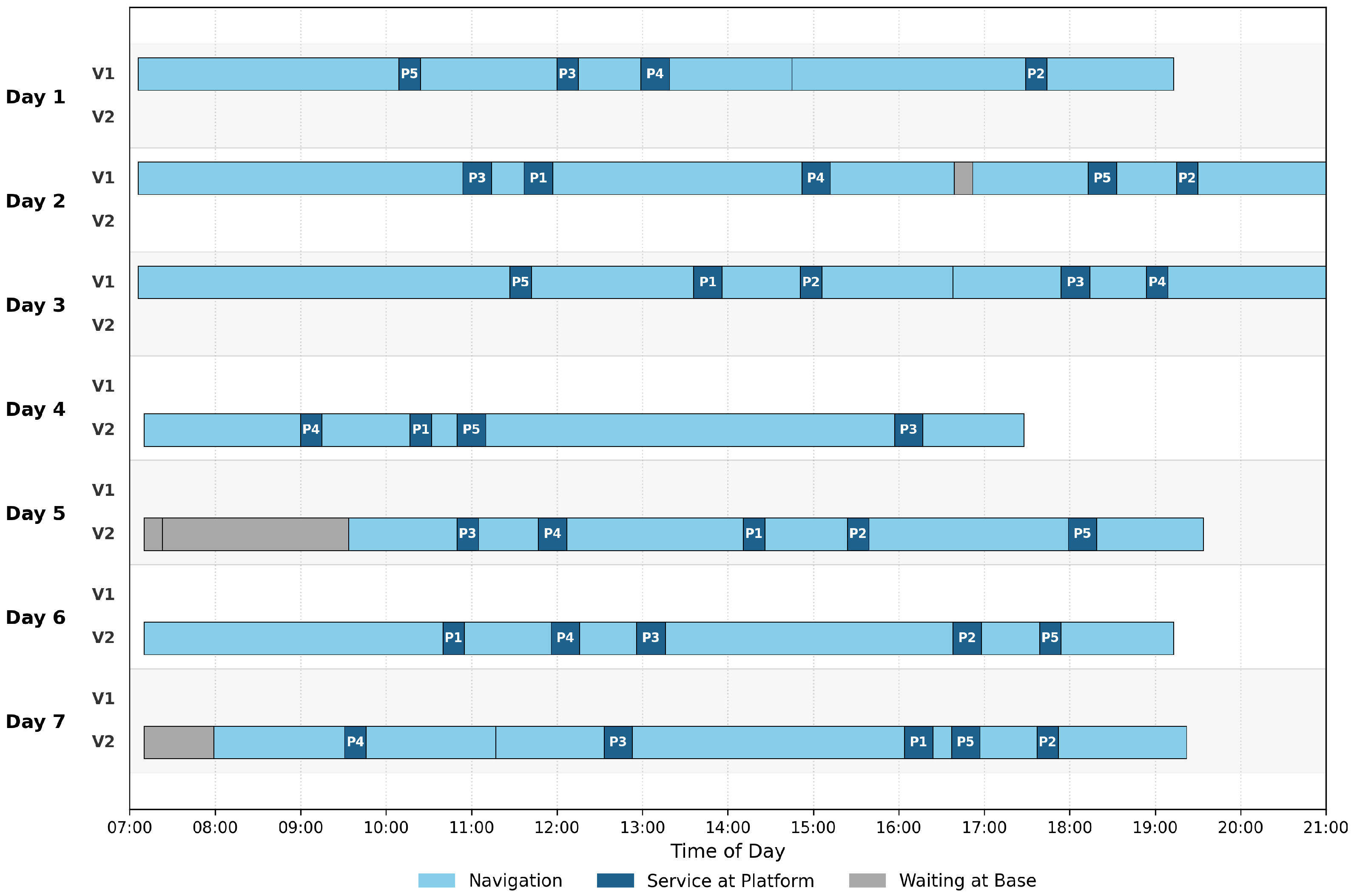
To illustrate the operational logic of the model, we present a detailed analysis of the schedule of Instance 1.
Figure 2 visualises the complete 7-day Gantt chart for the fleet, and
Table 5 details the routing sequence for a representative day (Day 2). The experimental results derived from Instance 1, particularly the schedule for Day 2, underscore the model’s capability to enhance asset utilisation through multi-trip operations while strictly adhering to temporal constraints. As visualised in
Figure 2, the inclusion of turnaround intervals at the base facilitates the execution of sequential trips within a single shift. As
Table 5 shows, Vessel 1 executes a double-run on Day 2, completing an initial high-load trip between 07:00 and 16:39 before initiating a rapid turnaround at 16:52 to service the remaining platforms. This operational flexibility enables the satisfaction of significant aggregated demand using a single vessel, thereby avoiding the fixed costs associated with chartering an additional unit. Furthermore, the schedule adheres strictly to the time constraints, evidenced by the vessel’s final return exactly at the operational cutoff of 21:00, confirming the model’s ability to fully utilise the available time horizon without violating safety regulations.
We further solve a small-scale instance involving five vessels and a seven-day planning horizon. Other parameters keep unchanged. The solver identified an optimal solution with a total cost of 33,983.55. Specific values for all non-zero decision variables are detailed to demonstrate an exact numerical solution.
Table 6 provides a daily breakdown of the objective function and the vessel activation variable
. The results indicate that the optimiser utilised only one vessel per day for the first five days, whereas two vessels were activated on Day 6 and Day 7 to manage increased personnel requirements and accumulated inventory.
The management of personnel inventory across the entire planning horizon is captured by the integer variable
.
Table 7 specifies the values for
at each platform from Day 1 to Day 7. Personnel inventory appears on Day 1 at Platform 5 and on Day 3 at Platform 1 and Platform 4. These backlogs represent deferred pickup requests necessitated by vessel capacity constraints or temporal limitations. The variable
remains at 4 on Day 5 before the introduction of a second vessel on Day 6 facilitates the complete clearance of all stranded personnel.
The complete routing and flow variables for all active vessel trips during the seven-day period are summarised in
Table 8. This table specifies the binary routing variables
for each traversed arc along with the corresponding arrival times
and personnel transfer variables
and
. Furthermore, the arc flow variables
and
represent the cumulative number of delivery and pickup passengers on board the vessel while traversing the network. For instance, on Day 1 Vessel 1 services four platforms and executes a reloading turnaround at the base whereas on Day 6 Vessel 1 and Vessel 5 coordinate to service the fleet requirements. All continuous and integer variable values provided in these tables constitute the exact optimal solution for the specified numerical example.
5.4. Scalability Analysis
This section evaluates the scalability of the proposed mixed-integer linear programming framework on larger network configurations. The expanded computational experiments feature one base, ten offshore platforms and a fleet of four available vessels over a three-day planning horizon. All operational parameters and cost coefficients remain identical to the settings specified in
Section 5.2. Ten independent instances were generated to assess the computational performance.
The selected problem scale reflects the realities of modern offshore wind farm logistics. A network comprising ten platforms and a base constitutes a large offshore cluster. Irawan et al. [
2] validate exact routing methods on baseline networks of eight wind turbines and two vessels over three days. That specific study focuses on routing maintenance vessels to individual wind turbines for independent repair tasks. In contrast, our research addresses the daily bidirectional flow of shift personnel across offshore platforms and the base. Our framework integrates multi-period personnel inventory management alongside dynamic service times and multi-trip operations. These integrated decisions significantly increase the computational complexity of the mathematical formulation. Optimising operations for this network over three days consequently addresses the high complexity of personnel logistics and meets the real requirement for practical offshore scheduling.
The numerical results demonstrate the computational efficiency of the exact formulation on these expanded instances.
Table 9 details the cost components and solver performance for the ten generated scenarios. The solver successfully obtains an optimal solution for every instance. Across all 10 instances, the average computational duration was approximately 8 min. This rapid convergence eliminates the need to employ metaheuristic algorithms such as particle swarm optimisation or genetic algorithms. Metaheuristic algorithms inherently introduce complex parameter calibration challenges and forfeit absolute optimality. The demonstrated capability of the solver to solve the MILP model in the realistic, large-scale instances to optimality within ten minutes provides operators with a reliable and precise decision-support tool.
5.5. Sensitivity Analysis
5.5.1. Sensitivity Analysis on Fleet Size
To evaluate the impact of fleet size on operational costs, we constructed a high-demand test instance. The planning horizon is adjusted to
days. The mandatory delivery demand
and the pickup request
are both drawn as integers from
. The model is solved with fleet sizes
ranging from 1 to 4, and the coordinates of the platforms and supply base are fixed in this analysis. These adjustments ensure that the total demand sufficiently challenges the transport capacity, allowing for a distinct observation of the trade-off between fixed charter costs and inventory penalty costs. Other parameters remain unchanged. The computational results are summarised in
Table 10.
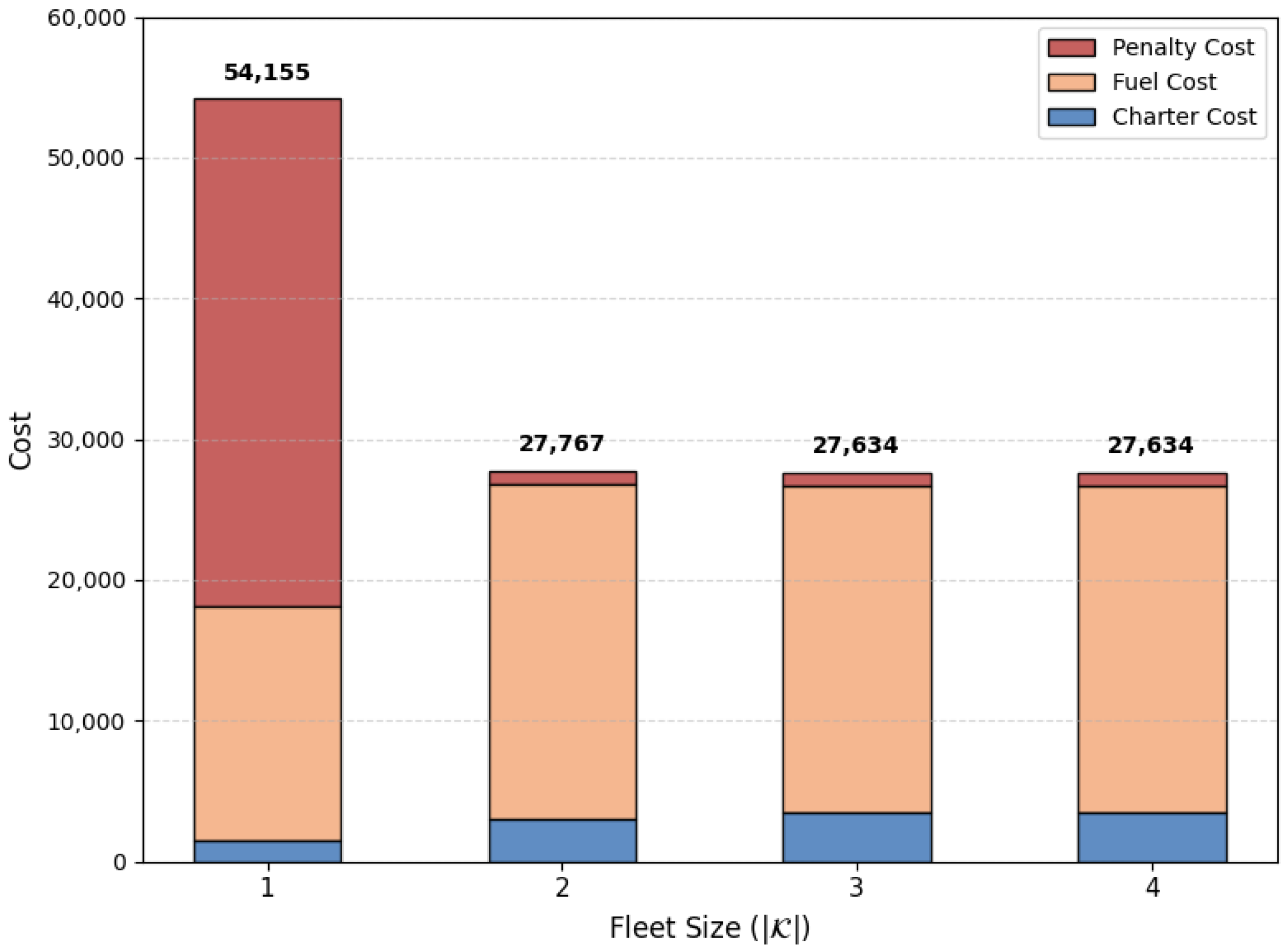
Figure 3 illustrates the sensitivity of total operational costs to fleet size, exhibiting a sharp initial decline that subsequently stabilises as the fleet capacity reaches saturation. With a single vessel, the system capacity is insufficient to meet the aggregated demand. This bottleneck prevents the clearance of inventory, causing penalty costs to constitute the majority of the total cost. Increasing the fleet size to
provides the necessary redundancy, incurring a sharp decrease in total cost by approximately 49%. The additional capacity allows the operator to reduce the penalty component significantly to 1000.
Further expanding the fleet to yields a marginal improvement, reducing the total cost to the global minimum of 27,634.00. Although the fixed charter cost increases by 500, the model utilises the third vessel to optimise routing sequences, resulting in a fuel cost saving. Increasing the fleet size beyond this point to offers no additional operational benefit, as the results remain identical to the three-vessel configuration, indicating that the system capacity has reached saturation.
5.5.2. Sensitivity Analysis on Vessel Capacity
This section investigates the impact of vessel passenger capacity (
Q) on operational performance. We maintained the high-intensity demand profile in
Section 5.5.1. The planning horizon is
days. The mandatory delivery demand
and the pickup request
are both drawn as integers from
and solved the model with a single vessel (
) while varying
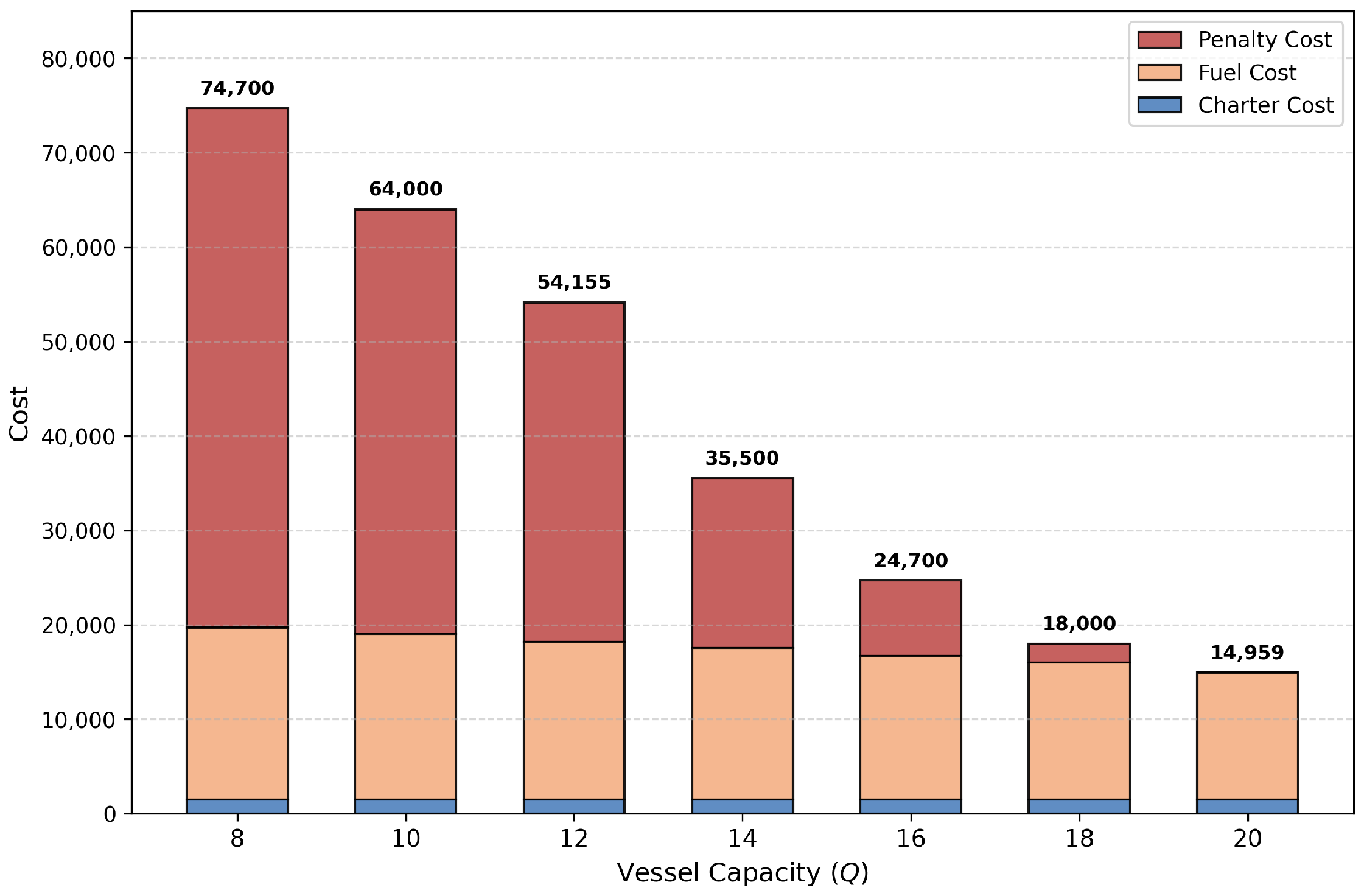
Q from 8 to 20. The results are presented in
Table 11 and visualised in
Figure 4.
The numerical results demonstrate a monotonic and significant improvement in operational efficiency as vessel capacity increases. The increase in the capacity Q yields a continuous reduction in total cost, dropping by approximately 80% as Q increases from 8 to 20. This improvement is primarily driven by the sharp reduction in penalty costs. At lower capacities, the vessel capacity is insufficient to meet the demand, leading to large inventory penalties. However, as capacity expands to , the penalty cost becomes 0, indicating that a single large vessel possesses sufficient throughput to fully satisfy the high-demand scenario without service failure.
Furthermore, larger vessel capacity contributes positively to fuel efficiency. The fuel cost decreases from 18,200 at to 13,459 at . This reduction occurs because a higher payload capacity minimises the frequency of intermediate return trips to the base for reloading. The vessel can service more platforms in a single continuous voyage, thereby optimising the routing sequence and reducing navigation time.
5.5.3. Sensitivity Analysis on Inventory Penalty Cost
This section evaluates the sensitivity of the solution to the inventory penalty cost (
), which quantifies the operator’s tolerance for personnel stranded at platforms. We varied
from 0 to 1000. The planning horizon is
days. The mandatory delivery demand
and the pickup request
are both drawn as integers from
and the fleet consists of two vessels (
). The computational results are summarised in
Table 12 and visualised in
Figure 5.
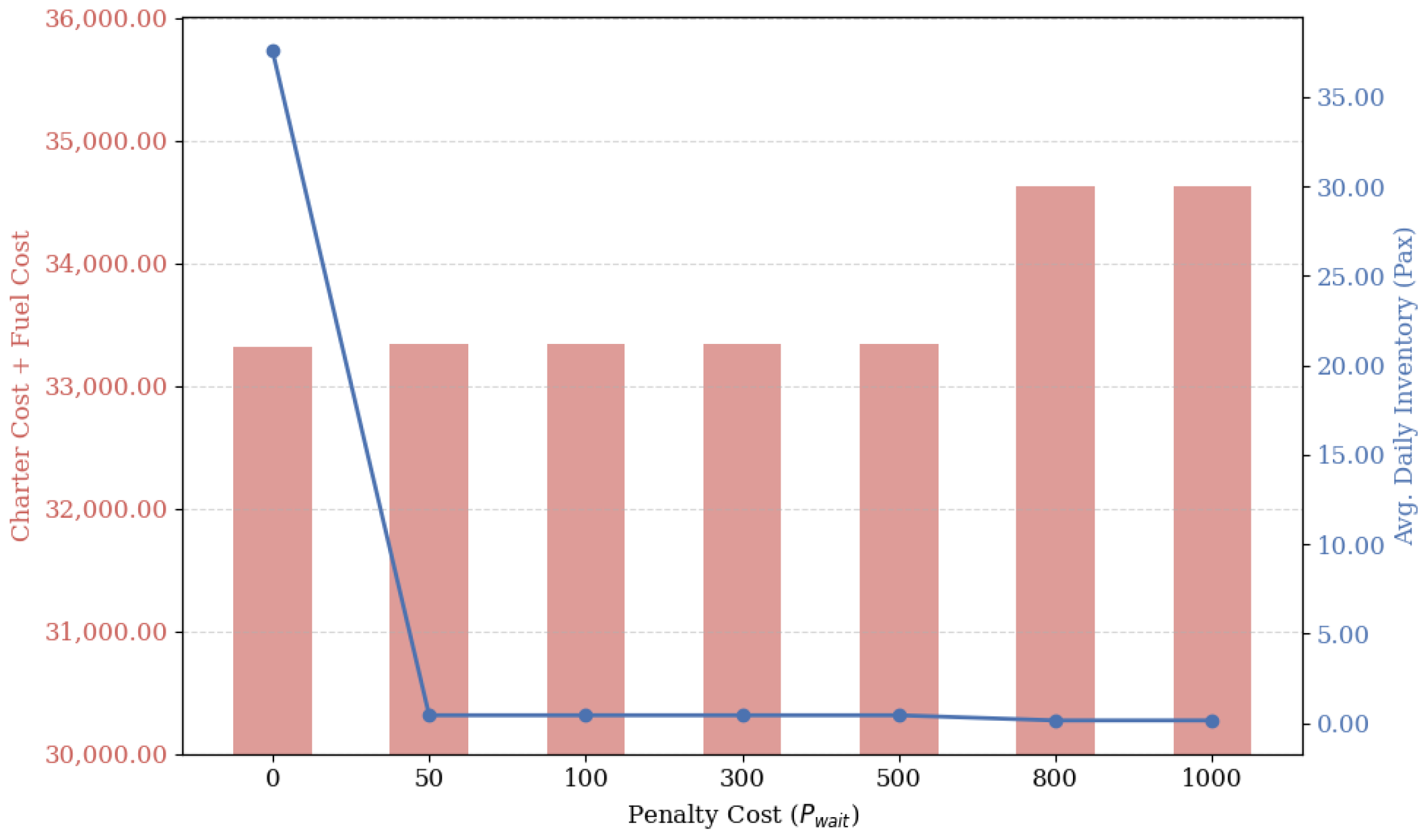
The results show a non-linear relationship between the penalty value and the operational strategy. When is set to 0, the model minimises charter and fuel costs, which leads to a high average daily inventory of 37.57 personnel. Introducing a penalty of 50 significantly improves the service level. The average daily inventory decreases to 0.43, while the fuel cost increases by only 22.50 monetary units. This indicates that most pickup requests can be satisfied through minor route adjustments without requiring additional vessel resources.
When ranges from 50 to 500, the system remains stable. Both the inventory, level charter and fuel costs remain unchanged. This suggests that the remaining stranded personnel are constrained by strict time windows or vessel capacity limitations. The increase in the objective value during this phase is caused solely by the higher penalty fees.
A change in the solution occurs when reaches 800. To reduce the inventory to 0.14, the model selects a different routing plan. This improvement increases the fuel cost by approximately 1282 monetary units. The charter cost remains constant at 3500 throughout the analysis, which implies that the fleet size remains stable with one active vessel daily. The model adapts by extending trip lengths and adjusting service sequences rather than deploying additional vessels. Therefore, a penalty setting of 50 is recommended for practical operations as it achieves a low inventory level while maintaining low fuel cost and charter cost.
5.5.4. Sensitivity Analysis on Maximum Daily Trips
We analyse the impact of the maximum number of trips allowed per vessel per day (
) on the model performance in this section. The parameter
was varied from 1 to 5, while the fleet size was fixed at
and the penalty cost at
. The planning horizon is
days. The mandatory delivery demand
and the pickup request
are both drawn as integers from
. The results are summarised in
Table 13 and visualised in
Figure 6.
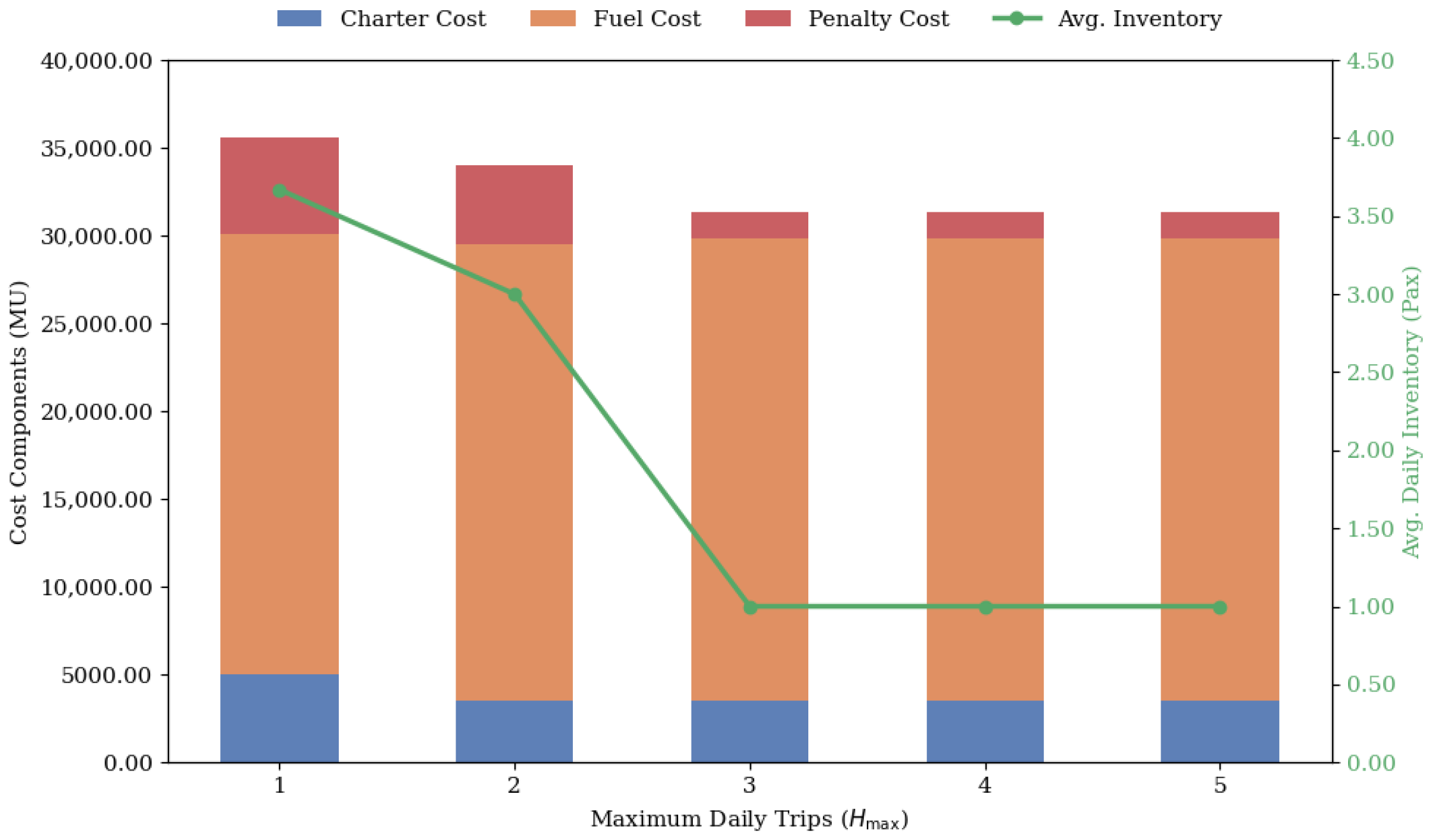
The transition from a single-trip to a multi-trip operation significantly improves operational efficiency. As shown in
Figure 6, when
, the system incurs high charter costs of 5000 and substantial penalties of 5500. The strict single-trip limitation forces the model to charter vessels for more days to meet demands, yet it fails to clear pickup requests, leaving an average of 3.67 personnel stranded per day.
Increasing to 2 triggers a clear trade-off. The charter cost decreases by 30% to 3500 as the vessels are utilised more intensively. However, the fuel cost (orange bar segment) increases from 25,129.31 to 26,015.25. This occurs because the vessels perform return trips to the base to reload and service more platforms in a single day, covering a longer total distance to save on fixed charter fees. Despite this effort, the inventory curve shows that average 3.00 personnel remain stranded per day, resulting in a penalty of 4500.
At , the system reaches a saturation point. The penalty cost decreases to 1500, and the inventory stabilises at 1.00. However, increasing further to 4 or 5 yields no additional improvements. The persistent penalty of 1500 indicates that the remaining stranded personnel are constrained by hard operational limits, such as tight time windows or vessel capacity, which cannot be overcome simply by allowing more trips. This suggests that while multi-trip capabilities are essential for reducing the total cost, the operations are eventually bound by the physical constraints of the offshore network.
5.5.5. Sensitivity Analysis on Time Window Tightness
Finally, we investigated the impact of the time window length (
) on the fleet’s operational efficiency. The window duration was varied from 60 min to 300 min. The parameter
is fixed at 3, while the fleet size was fixed at
and the penalty cost at
. The planning horizon is
days. The mandatory delivery demand
and the pickup request
are both drawn as integers from
. The results are presented in
Table 14 and
Figure 7.
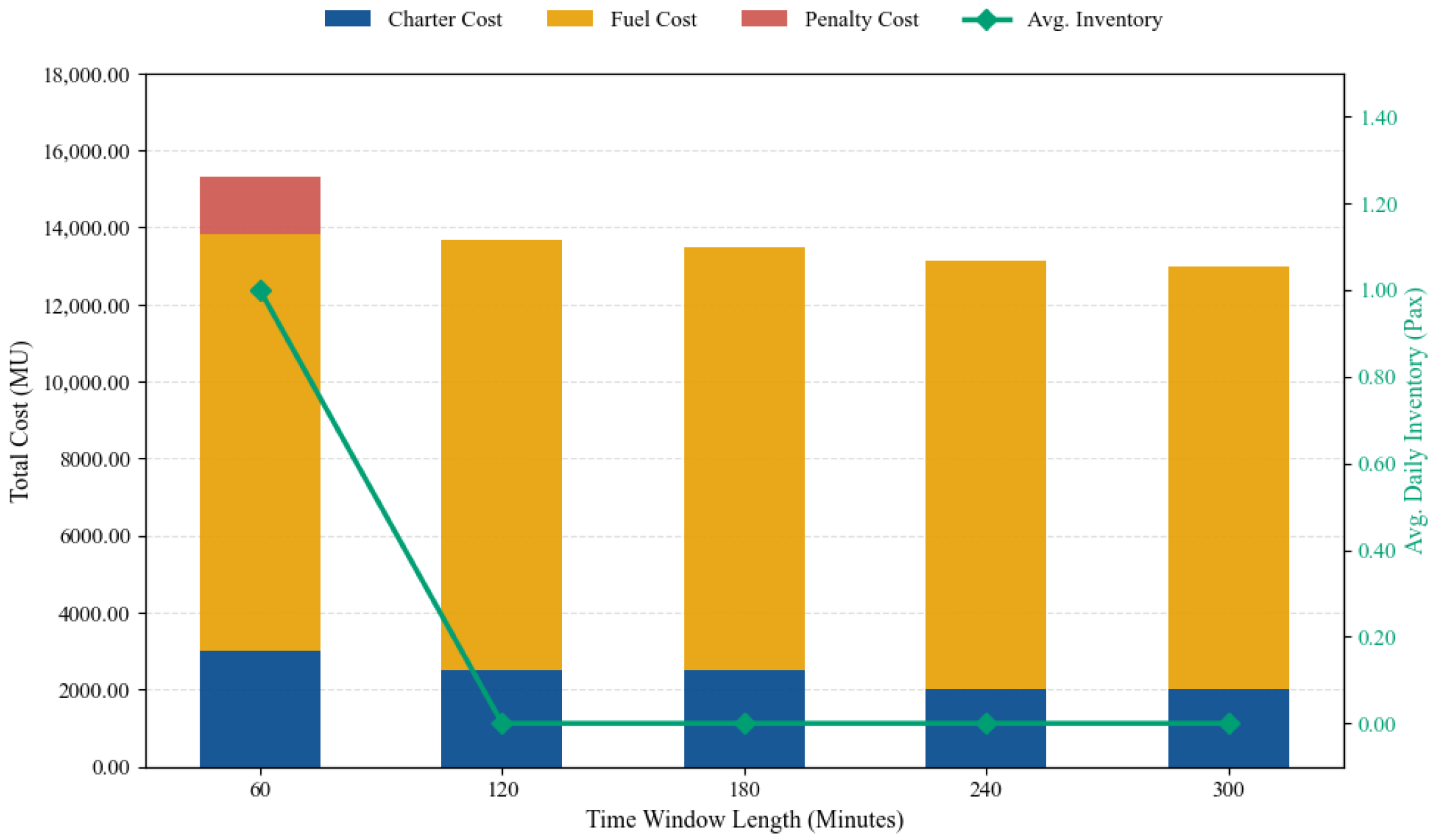
The results demonstrate that extending the time window length improves both service capability and fleet utilisation. When the window length is set to 60 min, the strict constraints prevent the fleet from servicing all platforms efficiently. This leads to a penalty cost of 1500 and an average daily inventory of 1.00. Increasing the window length to 120 min resolves this issue. The additional flexibility allows the vessels to satisfy all pickup requests, reducing the penalty cost and inventory to zero.
A further reduction in operational costs is observed when the window length increases from 180 to 240 min. As shown in
Figure 7, the charter cost decreases from 2500 to 2000. This indicates that a 4 h operating window enables the fleet to complete the mandatory tasks using fewer vessel-days. Although the fuel cost increases slightly to support these optimised routes, the total objective value reaches a minimum of 13,150.00. Extending the window length beyond 240 min yields more flexible routes, thus reducing the fuel cost.
6. Conclusions
This study addresses the crew transfer in offshore wind farms by proposing a mixed-integer linear programming framework for the Multi-Period Crew Transfer Vessel Routing and Scheduling Problem with Inventory Constraints. The formulated model addresses mandatory delivery requirements and flexible pickup requests. It treats unserved pickup personnel as an inventory backlog that incurs a penalty and must be managed over the planning horizon. Furthermore, the framework enhances realism by incorporating the approximation of dynamic service times that depend linearly on the number of passengers transferred. By allowing multi-trip operations within a single day, the model optimises the utilisation of the vessel fleet while strictly adhering to time windows and capacity limitations. The numerical experiments demonstrate the effectiveness and computational efficiency of the proposed approach. The results indicate that enabling multi-trip operations significantly reduces fixed charter costs by approximately 30% compared to single-trip restrictions. Sensitivity analyses reveal a non-linear relationship between fleet size and total operational costs, identifying a saturation point beyond which additional vessels do not reduce costs. Moreover, increasing vessel capacity proves to be a critical factor in cost reduction. The data shows that expanding passenger capacity from 8 to 20 results in an 80% decrease in total expenses, primarily driven by the minimisation of inventory penalty costs. The computational performance remains efficient across instances, with the solver achieving optimal solutions within an average of 5.67 s.
From a managerial perspective, this framework helps offshore operators improve the efficiency of the crew transfer system for the wind farm. The findings suggest that setting a moderate penalty cost for stranded personnel is sufficient to maintain low inventory levels without necessitating excessive fleet expansion. Operators can utilise the model to evaluate the trade-off between incurring immediate charter costs and the penalty of personnel inventory. Additionally, the analysis highlights the value of flexible time windows. Extending the operational window by a few hours significantly enhances routing options and reduces the reliance on additional vessels. Consequently, decision-makers should focus on optimising the scheduling of shifts and vessel capacities to maximise the throughput of the existing fleet.
Future research directions should focus on extending the current framework to accommodate heterogeneous fleets with varying speeds, capacities, and costs. Furthermore, the integration of stochastic factors to account for uncertain weather conditions and wave heights can improve the robustness of the model. Finally, coupling this logistics model with a maintenance task optimisation problem would create a holistic framework that simultaneously schedules repair activities and the necessary transportation resources.
Author Contributions
Conceptualisation, Y.S., Y.G., Y.D. and S.W.; methodology, Y.S., Y.G., Y.D. and S.W.; software, Y.S. and Y.G.; validation, Y.S., Y.G., Y.D. and S.W.; formal analysis, Y.S., Y.G., Y.D. and S.W.; investigation, Y.S., Y.G., Y.D. and S.W.; resources, Y.D. and S.W.; data curation, Y.S. and Y.G.; writing—original draft preparation, Y.S.; writing—review and editing, Y.S., Y.G., Y.D. and S.W.; visualisation, Y.S. and Y.G.; supervision, Y.D. and S.W.; project administration, Y.D. and S.W.; funding acquisition, Y.D. and S.W. All authors have read and agreed to the published version of the manuscript.
Funding
This research received no external funding.
Data Availability Statement
The raw data supporting the conclusions of this article will be made available by the authors on request.
Conflicts of Interest
The authors declare no conflicts of interest.
Appendix A. Derivation of Big-M Parameters
The Time Scheduling Constraint (28) involve a large constant parameter
(Big-M) to deactivate the time propagation inequality when vessel
k does not traverse arc
(i.e., when
). The constraint is formulated as
To ensure the constraint is always valid when
,
must be greater than or equal to the maximum possible value of the left-hand side. Thus, a sufficient condition for
is
We derive the upper bound for each term as follows:
- 1.
Arrival Time at Node
i (
): The latest a vessel can arrive (or start service) at node
i is bounded by the time window’s latest time
.
- 2.
Arrival Time at Node
j (
): The term
is maximized when
is minimized. The earliest a vessel can arrive at node
j is the time window’s earliest time
.
- 3.
Service Time (
): The service time depends on the personnel flow. The maximum possible flow is bounded by the vessel’s capacity
Q. Therefore, the maximum service duration, denoted as
, occurs when a full load of passengers is transferred:
Note that if node i is a base node, the service time is zero.
- 4.
Travel and Setup Times (): These are constant parameters.
Combining these bounds, we define a tight Big-M value for each arc
and day
t to improve the solver’s performance:
For arcs connecting to the base or within the base, we use the global operating time limit or the shift end time as the upper bound for L.
Thus, the value of
used in the computational experiments is calculated as
References
- Shafiee, M. Maintenance logistics organization for offshore wind energy: Current progress and future perspectives. Renew. Energy 2015, 77, 182–193. [Google Scholar] [CrossRef]
- Irawan, C.A.; Ouelhadj, D.; Jones, D.; Stålhane, M.; Sperstad, I.B. Optimisation of maintenance routing and scheduling for offshore wind farms. Eur. J. Oper. Res. 2017, 256, 76–89. [Google Scholar] [CrossRef]
- Halvorsen-Weare, E.E.; Fagerholt, K.; Nonås, L.M.; Asbjørnslett, B.E. Optimal fleet composition and periodic routing of offshore supply vessels. Eur. J. Oper. Res. 2012, 223, 508–517. [Google Scholar] [CrossRef]
- Dalgic, Y.; Lazakis, I.; Turan, O. Investigation of Optimum Crew Transfer Vessel Fleet for Offshore Wind Farm Maintenance Operations. Wind. Eng. 2015, 39, 31–52. [Google Scholar] [CrossRef]
- Stålhane, M.; Halvorsen-Weare, E.E.; Nonås, L.M.; Pantuso, G. Optimizing vessel fleet size and mix to support maintenance operations at offshore wind farms. Eur. J. Oper. Res. 2019, 276, 495–509. [Google Scholar] [CrossRef]
- Shu, Y.; Ng, K.K.; Liu, W.; Jin, Z.; Zhang, C. Optimising last-mile delivery network through locker–drone logistics system design under uncertain demand. J. Air Transp. Manag. 2026, 134, 102984. [Google Scholar] [CrossRef]
- Chan, Y.; Shu, Y.; Chen, W.H.; Ng, K.K. Time-optimal motion planning of cable-suspended payload quadcopters using spatial reformulation. Aerosp. Sci. Technol. 2026, 169, 111460. [Google Scholar] [CrossRef]
- Li, M.; Bijvoet, B.; Wu, K.; Jiang, X.; Negenborn, R.R. Optimal chartering decisions for vessel fleet to support offshore wind farm maintenance operations. Ocean. Eng. 2024, 298, 117202. [Google Scholar] [CrossRef]
- Zhao, C.; Roberts, A.; Cui, Y.; Johanning, L. Strategic Deployment of Service Vessels for Improved Offshore Wind Farm Maintenance and Availability. Mar. Energy Res. 2024, 1, 10003. [Google Scholar] [CrossRef]
- Łebkowski, A.; Koznowski, W. Analysis of the Use of Electric and Hybrid Drives on SWATH Ships. Energies 2020, 13, 6486. [Google Scholar] [CrossRef]
- Xue, M.; Ribas, P.C. Short-Term Scheduling of Support Vessels in Wind Farm Maintenance. In Renewable Energy Resources and Conservation; Pong, P., Ed.; Springer Nature: Cham, Switzerland, 2024; pp. 93–100. [Google Scholar] [CrossRef]
- Ade Irawan, C.; Starita, S.; Chan, H.K.; Eskandarpour, M.; Reihaneh, M. Routing in offshore wind farms: A multi-period location and maintenance problem with joint use of a service operation vessel and a safe transfer boat. Eur. J. Oper. Res. 2023, 307, 328–350. [Google Scholar] [CrossRef]
- Holliday, N.; Otero, L.D. A Simulation Model for the Optimization of Crew Transport Vessels to Service Offshore Wind Farms. In Proceedings of the 2023 IEEE International Systems Conference (SysCon), Vancouver, BC, Canada, 17–20 April 2023; pp. 1–6. [Google Scholar] [CrossRef]
- He, J.; Qi, J.; Yang, L.; Di, Z.; Zhou, H.; Zhang, C. Joint Optimization of Train Timetable and Rolling Stock Circulation Plan with Flexible Composition and Skip-Stop Strategies for Co-Transportation of Passenger and Freight. Engineering 2025, 55, 291–316. [Google Scholar] [CrossRef]
- Jin, Z.; Mao, H.; Chen, D.; Li, H.; Tu, H.; Yang, Y.; Attard, M. Multi-objective optimization model of autonomous minibus considering passenger arrival reliability and travel risk. Commun. Transp. Res. 2024, 4, 100152. [Google Scholar] [CrossRef]
- Yu, Y.; Ouyang, K.; Tian, Q.; Wang, D.Z. Compensation scheme and split delivery in a collaborative passenger-parcel transportation system. Commun. Transp. Res. 2025, 5, 100197. [Google Scholar] [CrossRef]
- Zhen, L.; Yang, Z.; Laporte, G.; Yi, W.; Fan, T. Unmanned Aerial Vehicle Inspection Routing and Scheduling for Engineering Management. Engineering 2024, 36, 223–239. [Google Scholar] [CrossRef]
- Zhou, F.; Arvidsson, A.; Wu, J.; Kulcsár, B. Collaborative electric vehicle routing with meet points. Commun. Transp. Res. 2024, 4, 100135. [Google Scholar] [CrossRef]
- Gutierrez-Alcoba, A.; Hendrix, E.; Ortega, G.; Halvorsen-Weare, E.; Haugland, D. On offshore wind farm maintenance scheduling for decision support on vessel fleet composition. Eur. J. Oper. Res. 2019, 279, 124–131. [Google Scholar] [CrossRef]
- Halvorsen-Weare, E.E.; Gundegjerde, C.; Halvorsen, I.B.; Hvattum, L.M.; Nonås, L.M. Vessel Fleet Analysis for Maintenance Operations at Offshore Wind Farms. Energy Procedia 2013, 35, 167–176. [Google Scholar] [CrossRef]
- Scheu, M.; Matha, D.; Hofmann, M.; Muskulus, M. Maintenance Strategies for Large Offshore Wind Farms. Energy Procedia 2012, 24, 281–288. [Google Scholar] [CrossRef]
- Si, G.; Xia, T.; Gebraeel, N.; Wang, D.; Pan, E.; Xi, L. Holistic opportunistic maintenance scheduling and routing for offshore wind farms. Renew. Sustain. Energy Rev. 2025, 207, 114991. [Google Scholar] [CrossRef]
- Besnard, F.; Patriksson, M.; Strömberg, A.B.; Wojciechowski, A.; Bertling, L. An optimization framework for opportunistic maintenance of offshore wind power system. In Proceedings of the 2009 IEEE Bucharest PowerTech, Bucharest, Romania, 28 June–2 July 2009; pp. 1–7. [Google Scholar] [CrossRef]
- Zhong, S.; Pantelous, A.A.; Goh, M.; Zhou, J. A reliability-and-cost-based fuzzy approach to optimize preventive maintenance scheduling for offshore wind farms. Mech. Syst. Signal Process. 2019, 124, 643–663. [Google Scholar] [CrossRef]
- Tao, Y.; Yang, Y.; Wang, S. A data-driven semi-relaxed MIP model for decision-making in maritime transportation. Mathematics 2025, 13, 2946. [Google Scholar] [CrossRef]
- Lua, Y.; Suna, L.; Kanga, J.; Zhang, X. Maintenance grouping optimization for offshore wind turbine considering opportunities based on rolling horizon approach. Pol. Marit. Res. 2018, 25, 123–131. [Google Scholar] [CrossRef]
- Wildeman, R.E.; Dekker, R.; Smit, A. A dynamic policy for grouping maintenance activities. Eur. J. Oper. Res. 1997, 99, 530–551. [Google Scholar] [CrossRef]
- Ding, F.; Tian, Z. Opportunistic maintenance optimization for wind turbine systems considering imperfect maintenance actions. Int. J. Reliab. Qual. Saf. Eng. 2011, 18, 463–481. [Google Scholar] [CrossRef]
- Laggoune, R.; Chateauneuf, A.; Aissani, D. Opportunistic policy for optimal preventive maintenance of a multi-component system in continuous operating units. Comput. Chem. Eng. 2009, 33, 1499–1510. [Google Scholar] [CrossRef]
- Silva, V.A.; Wang, A.; Ferreira Filho, V.J.M.; Gounaris, C.E. Routing and scheduling of platform supply vessels in offshore oil and gas logistics. Comput. Oper. Res. 2024, 164, 106556. [Google Scholar] [CrossRef]
- Sun, W.; Yang, Y.; Wang, S. A two-stage stochastic optimization model for cruise ship food provisioning with substitution. Mathematics 2025, 13, 3806. [Google Scholar] [CrossRef]
- Zhang, C.; Gao, W.; Yang, T.; Guo, S. Opportunistic maintenance strategy for wind turbines considering weather conditions and spare parts inventory management. Renew. Energy 2019, 133, 703–711. [Google Scholar] [CrossRef]
- Jin, T.; Tian, Z.; Huerta, M.; Piechota, J. Coordinating maintenance with spares logistics to minimize levelized cost of wind energy. In Proceedings of the 2012 International Conference on Quality, Reliability, Risk, Maintenance, and Safety Engineering, Chengdu, China, 15–18 June 2012; pp. 1022–1027. [Google Scholar] [CrossRef]
- Presencia, C.E.; Shafiee, M. Risk analysis of maintenance ship collisions with offshore wind turbines. Int. J. Sustain. Energy 2018, 37, 576–596. [Google Scholar] [CrossRef]
- Hong, Q.; Tian, X.; Jin, Y.; Liu, Z.; Wang, S. Improved fuel consumption estimation for sailing speed optimization: Eliminating log transformation bias. Mathematics 2025, 13, 1987. [Google Scholar] [CrossRef]
- Thomas, B.; Costoya, X.; deCastro, M.; Iglesias, G.; Gómez-Gesteira, M. Levelized cost of energy for various floating offshore wind farm designs in the areas covered by the Spanish maritime spatial planning. Appl. Energy 2025, 381, 125165. [Google Scholar] [CrossRef]
- Lazakis, I.; Khan, S. An optimization framework for daily route planning and scheduling of maintenance vessel activities in offshore wind farms. Ocean. Eng. 2021, 225, 108752. [Google Scholar] [CrossRef]
- Irawan, C.; Jones, D.; Ouelhadj, D. Bi-objective optimisation model for installation scheduling in offshore wind farms. Comput. Oper. Res. 2015, 78. [Google Scholar] [CrossRef]
- Si, G.; Xia, T.; Wang, D.; Gebraeel, N.; Pan, E.; Xi, L. Maintenance scheduling and vessel routing for offshore wind farms with multiple ports considering day-ahead wind-wave predictions. Appl. Energy 2025, 379, 124915. [Google Scholar] [CrossRef]
Figure 1.
An illustration of the Multi-Period Crew Transfer Vessel Routing and Scheduling Problem with Inventory Constraints (MP-CTVRSP-IC).
Figure 1.
An illustration of the Multi-Period Crew Transfer Vessel Routing and Scheduling Problem with Inventory Constraints (MP-CTVRSP-IC).
Figure 2.
Weekly vessel schedule (Instance 1). Note: The chart illustrates the fleet utilisation over the 7-day horizon. Blue bars indicate navigation, dark blue bars represent service operations at platforms, and grey bars indicate waiting or turnaround times at the base. P refers to the platforms served.
Figure 2.
Weekly vessel schedule (Instance 1). Note: The chart illustrates the fleet utilisation over the 7-day horizon. Blue bars indicate navigation, dark blue bars represent service operations at platforms, and grey bars indicate waiting or turnaround times at the base. P refers to the platforms served.
Figure 3.
Impact of fleet size on total operational costs and cost components.
Figure 3.
Impact of fleet size on total operational costs and cost components.
Figure 4.
Impact of fleet capacity on total operational costs and cost components.
Figure 4.
Impact of fleet capacity on total operational costs and cost components.
Figure 5.
Impact of penalty cost () on fuel cost + charter cost and inventory level. Note: The red bars represent the sum of the fuel cost and charter cost (left axis), and the blue line indicates the average daily inventory (right axis).
Figure 5.
Impact of penalty cost () on fuel cost + charter cost and inventory level. Note: The red bars represent the sum of the fuel cost and charter cost (left axis), and the blue line indicates the average daily inventory (right axis).
Figure 6.
Cost structure and inventory levels under varying maximum daily trips (). Note: The stacked bars indicate the composition of charter, fuel, and penalty costs, while the green line represents the inventory level.
Figure 6.
Cost structure and inventory levels under varying maximum daily trips (). Note: The stacked bars indicate the composition of charter, fuel, and penalty costs, while the green line represents the inventory level.
Figure 7.
Impact of time window duration on cost structure and inventory levels. Note: The stacked bars indicate the composition of charter, fuel, and penalty costs, while the green line represents the inventory level.
Figure 7.
Impact of time window duration on cost structure and inventory levels. Note: The stacked bars indicate the composition of charter, fuel, and penalty costs, while the green line represents the inventory level.
Table 1.
Summary of recent studies on offshore wind logistics optimisation (2023–2026).
Table 1.
Summary of recent studies on offshore wind logistics optimisation (2023–2026).
| Reference | Problem Scope | Methodology | Complexity | Computational Time |
|---|
| Li et al. [8] | Strategic fleet chartering and mix optimisation | Discrete-Event Simulation & Optimisation | Large-scale fleet with uncertain weather | 30.3 h (Simulation-based) |
| Zhao et al. [9] | Strategic vessel deployment | Markov Chain Monte Carlo Simulator | Multi-vessel deployment under weather uncertainty | High (Stochastic Simulation) |
| Xue and Ribas [11] | Short-term maintenance routing and scheduling | Mathematical Optimisation Model | Integrated preventive and corrective tasks | 20 s |
| Irawan et al. [12] | Multi-period location and routing | Mixed-Integer Programming & Heuristics | Joint coordination of mother vessel and small boats | 45 s (Heuristic) |
| Holliday and Otero [13] | CTV fleet performance optimisation | Discrete-Event Simulation | Operational modelling under harsh sea conditions | High |
| Letournel et al. [10] | Assessment of safe transfer operability limits | Time-domain Physics Simulation | High-fidelity vessel dynamics and friction | Very High (Physics Simulation) |
| Current Study | Daily CTV routing with personnel inventory | Novel MILP Framework | Multi-period, dynamic service times, inventory penalty | Average 5.67 s |
Table 2.
Notations.
| Notation | Description |
|---|
| Sets | |
| The set of time periods in the planning horizon, . |
| The set of offshore platforms, . |
| The set of available Crew Transfer Vessels, . |
| The set of replicated supply base nodes for vessel k, defined as . |
| The set of potential departure and arrival nodes at the base for vessel k. |
| The set of reachable nodes and feasible arcs for vessel k. |
| Parameters | |
| Q | The maximum passenger capacity of each vessel. |
| The maximum operation duration for each vessel in a single trip. |
| The maximum number of trips performed by each vessel in a single day. |
| F | The fixed cost incurred for deploying a vessel on a single day. |
| The hourly fuel cost of a vessel when navigating and performing service, respectively. |
| The travel time between node i and node j. |
| The fixed setup time required for docking at a platform. |
| C | The capacity of the personnel transfer carrier (crane basket) per lift. |
| The time required for one full cycle of the crane operation. |
| The number of personnel to be delivered to platform i on day t. |
| The number of new personnel requests to return to base from platform i on day t. |
| The initial number of personnel stranded at platform i that request to leave. |
| The maximum accommodation capacity for stranded personnel at the platform that request to leave. |
| The penalty cost per person per day for waiting. |
| The earliest and latest service start times allowed at node i on day t. |
| Decision variables | |
| Binary variable, equals 1 if vessel k traverses arc on day t; 0 otherwise. |
| Integer variable, number of delivery passengers on board vessel k on arc at day t. |
| Integer variable, number of pickup passengers on board vessel k on arc at day t. |
| Binary variable, equals 1 if vessel k is used on day t; 0 otherwise. |
| Integer variable, the number of personnel picked up from platform i by vessel k on day t. |
| Integer variable, the number of personnel delivered to platform i by vessel k on day t. |
| Continuous variable, the arrival time of vessel k at node i on day t. |
| Continuous variable, the work duration of the transfer basket for vessel k at platform i on day t. |
| Integer variable, the number of stranded personnel remaining at platform i at the end of day t that request to leave. |
Table 3.
Parameter settings for the numerical experiments.
Table 3.
Parameter settings for the numerical experiments.
| Parameter | Symbol | Value | Unit |
|---|
| Vessel Specifications | | | |
| Passenger capacity | Q | 12 | Pax |
| Maximum daily trips | | 3 | Trips |
| Maximum trip duration | | 600 | Min |
| Average sailing speed | - | 30 | km/h |
| Service Operations | | | |
| Transfer basket capacity | C | 4 | Pax/lift |
| Crane cycle time | | 5 | Min |
| Platform setup time | | 10 | Min |
| Safe positioning time | | 5 | Min |
| Platform accommodation capacity | | 20 | Pax |
| Cost Coefficients | | | |
| Fixed charter cost | F | 500 | MU/day |
| Fuel cost (navigation) | p | 10 | MU/min |
| Fuel cost (service) | r | 2 | MU/min |
| Inventory penalty cost | | 500 | MU/pax/day |
Table 4.
Computational results for 10 instances.
Table 4.
Computational results for 10 instances.
| Instance | Obj. Value | Lower Bound | Gap (%) | CPU Time (s) | Status |
|---|
| 1 | 37,138.62 | 37,138.62 | 0.00 | 7.53 | Optimal |
| 2 | 29,055.62 | 29,031.20 | 0.08 | 3.39 | Optimal |
| 3 | 27,845.74 | 27,845.74 | 0.00 | 6.04 | Optimal |
| 4 | 31,228.55 | 31,228.55 | 0.00 | 3.66 | Optimal |
| 5 | 34,495.60 | 34,495.60 | 0.00 | 8.30 | Optimal |
| 6 | 28,387.30 | 28,366.97 | 0.07 | 1.58 | Optimal |
| 7 | 33,169.81 | 33,169.81 | 0.00 | 2.86 | Optimal |
| 8 | 32,622.31 | 32,599.40 | 0.07 | 9.59 | Optimal |
| 9 | 25,098.97 | 25,098.97 | 0.00 | 4.73 | Optimal |
| 10 | 31,529.97 | 31,502.39 | 0.09 | 8.99 | Optimal |
| Avg. | 31,057.25 | - | 0.03 | 5.67 | - |
Table 5.
Detailed route sequence for Vessel 1 on Day 2.
Table 5.
Detailed route sequence for Vessel 1 on Day 2.
| Trip | Route Sequence | Arrival Time | Pax Delivered | Pax Picked Up |
|---|
| 1 | Base → P3 → P1 → P4 → Base | 16:39 | 11 | 12 |
| - | Base Turnaround (Reloading) | 16:52 | - | - |
| 2 | Base → P5 → P2 → Base | 21:00 | 5 | 5 |
Table 6.
Daily cost breakdown and vessel activation variables for the seven-day horizon.
Table 6.
Daily cost breakdown and vessel activation variables for the seven-day horizon.
| Parameter | Day 1 | Day 2 | Day 3 | Day 4 | Day 5 | Day 6 | Day 7 |
|---|
| Active Vessels () | V1 | V1 | V1 | V1 | V1 | V1, V5 | V5 |
| Vessel Activation Cost | 500.00 | 500.00 | 500.00 | 500.00 | 500.00 | 1000.00 | 500.00 |
| Fuel and Service Cost | 4833.55 | 4600.00 | 5200.00 | 4400.00 | 4850.00 | 7200.00 | 3400.00 |
| Inventory Penalty Cost | 200.00 | 0.00 | 600.00 | 100.00 | 400.00 | 0.00 | 0.00 |
Table 7.
Values for the personnel inventory decision variable by platform and day.
Table 7.
Values for the personnel inventory decision variable by platform and day.
| Platform ID | Day 1 | Day 2 | Day 3 | Day 4 | Day 5 | Day 6 | Day 7 |
|---|
| Platform 1 | 0 | 0 | 2 | 0 | 0 | 0 | 0 |
| Platform 2 | 0 | 0 | 0 | 0 | 0 | 0 | 0 |
| Platform 3 | 0 | 0 | 0 | 1 | 0 | 0 | 0 |
| Platform 4 | 0 | 0 | 4 | 0 | 4 | 0 | 0 |
| Platform 5 | 2 | 0 | 0 | 0 | 0 | 0 | 0 |
Table 8.
Complete optimal decision variables for active vessel operations over the seven-day period.
Table 8.
Complete optimal decision variables for active vessel operations over the seven-day period.
| Day | Vessel | Arc () | | | | | | |
|---|
| 1 | V1 | Base → P2 → P1 → P4 → Base | 1 | 98.2, 221.1, 372.0, 500.1 | 3, 4, 1, 0 | 2, 1, 3, 0 | 8, 5, 1, 0 | 0, 2, 3, 6 |
| | V1 | Base → P3 → Base | 1 | 600.0, 711.2 | 1, 0 | 1, 0 | 1, 0 | 0, 1 |
| 2 | V1 | Base → P4 → P1 → P2 → P3 → P5 → Base | 1 | 205.0, 266.0, 480.1, 503.8, 550.0, 635.4 | 2, 2, 1, 2, 3, 0 | 0, 3, 1, 1, 3, 0 | 10, 8, 6, 5, 3, 0 | 0, 0, 3, 4, 5, 8 |
| 3 | V1 | Base → P5 → Base → P2 → P3 → Base | 1 | 71.7, 154.6, 351.0, 634.0, 748.9 | 1, 0, 3, 4, 0 | 1, 0, 2, 1, 0 | 1, 0, 7, 4, 0 | 0, 1, 0, 2, 3 |
| 4 | V1 | Base → P1 → P4 → P5 → Base | 1 | 420.0, 483.5, 565.0, 650.4 | 4, 2, 3, 0 | 2, 7, 0, 0 | 9, 5, 3, 0 | 0, 2, 9, 9 |
| 5 | V1 | Base → P5 → P3 → P1 → P2 → Base | 1 | 382.0, 426.9, 555.7, 677.3, 797.3 | 1, 2, 2, 3, 0 | 1, 1, 1, 2, 0 | 8, 7, 5, 3, 0 | 0, 1, 2, 3, 5 |
| 6 | V1 | Base → P4 → P1 → Base | 1 | 68.7, 265.0, 389.0 | 2, 4, 0 | 6, 3, 0 | 6, 4, 0 | 0, 6, 9 |
| | V5 | Base → P5 → P2 → P3 → Base | 1 | 209.9, 254.0, 620.8, 738.2 | 2, 4, 2, 0 | 1, 4, 1, 0 | 8, 6, 2, 0 | 0, 1, 5, 6 |
| 7 | V5 | Base → P5 → P4 → P1 → P2 → P3 → Base | 1 | 247.0, 323.5, 383.3, 506.1, 560.0, 671.2 | 1, 1, 3, 0, 1, 0 | 3, 0, 1, 4, 1, 0 | 6, 5, 4, 1, 1, 0 | 0, 3, 3, 4, 8, 9 |
Table 9.
Computational results for the expanded network configuration comprising 10 platforms, 4 vessels, and 3 days.
Table 9.
Computational results for the expanded network configuration comprising 10 platforms, 4 vessels, and 3 days.
| Instance | Obj. Value | Lower Bound | Gap (%) | Charter Cost | Fuel Cost | Penalty Cost | CPU Time (s) | Status |
|---|
| 1 | 16,787.45 | 16,787.45 | 0.00 | 3000.00 | 12,787.45 | 1000.00 | 469.20 | Optimal |
| 2 | 17,210.50 | 17,196.73 | 0.08 | 3500.00 | 13,210.50 | 500.00 | 512.45 | Optimal |
| 3 | 17,000.80 | 17,000.80 | 0.00 | 3000.00 | 12,500.80 | 1500.00 | 420.10 | Optimal |
| 4 | 18,100.25 | 18,091.20 | 0.05 | 4000.00 | 14,100.25 | 0.00 | 535.80 | Optimal |
| 5 | 17,450.40 | 17,450.40 | 0.00 | 3500.00 | 12,950.40 | 1000.00 | 488.60 | Optimal |
| 6 | 16,800.90 | 16,790.82 | 0.06 | 3000.00 | 11,800.90 | 2000.00 | 395.20 | Optimal |
| 7 | 18,400.60 | 18,400.60 | 0.00 | 4000.00 | 13,900.60 | 500.00 | 545.30 | Optimal |
| 8 | 17,050.15 | 17,036.51 | 0.08 | 3500.00 | 13,550.15 | 0.00 | 501.90 | Optimal |
| 9 | 16,600.75 | 16,600.75 | 0.00 | 3000.00 | 12,100.75 | 1500.00 | 450.75 | Optimal |
| 10 | 17,050.30 | 17,040.07 | 0.06 | 3500.00 | 13,050.30 | 500.00 | 480.20 | Optimal |
| Avg. | 17,245.21 | 17,239.53 | 0.03 | 3400.00 | 12,995.21 | 850.00 | 479.95 | N/A |
Table 10.
Sensitivity analysis results for varying fleet sizes.
Table 10.
Sensitivity analysis results for varying fleet sizes.
| Fleet Size () | Obj. Value | Charter Cost | Penalty Cost | Fuel Cost |
|---|
| 1 | 54,155.00 | 1500 | 36,000 | 16,655 |
| 2 | 27,767.00 | 3000 | 1000 | 23,767 |
| 3 | 27,634.00 | 3500 | 1000 | 23,134 |
| 4 | 27,634.00 | 3500 | 1000 | 23,134 |
Table 11.
Sensitivity analysis results for varying vessel capacities.
Table 11.
Sensitivity analysis results for varying vessel capacities.
| Capacity (Q) | Obj. Value | Charter Cost | Penalty Cost | Fuel Cost |
|---|
| 8 | 74,700.00 | 1500 | 55,000 | 18,200 |
| 10 | 64,000.00 | 1500 | 45,000 | 17,500 |
| 12 | 54,155.00 | 1500 | 36,000 | 16,655 |
| 14 | 35,500.00 | 1500 | 18,000 | 16,000 |
| 16 | 24,700.00 | 1500 | 8000 | 15,200 |
| 18 | 18,000.00 | 1500 | 2000 | 14,500 |
| 20 | 14,959.00 | 1500 | 0 | 13,459 |
Table 12.
Sensitivity analysis results for varying inventory penalty costs.
Table 12.
Sensitivity analysis results for varying inventory penalty costs.
| Penalty () | Obj. Value | Charter Cost | Fuel Cost | Avg. Daily Inventory |
|---|
| 0 | 33,316.12 | 3500 | 29,816.12 | 37.57 |
| 50 | 33,488.62 | 3500 | 29,838.62 | 0.43 |
| 100 | 33,638.62 | 3500 | 29,838.62 | 0.43 |
| 300 | 34,238.62 | 3500 | 29,838.62 | 0.43 |
| 500 | 34,838.62 | 3500 | 29,838.62 | 0.43 |
| 800 | 35,420.29 | 3500 | 31,120.29 | 0.14 |
| 1000 | 35,620.29 | 3500 | 31,120.29 | 0.14 |
Table 13.
Sensitivity analysis results for maximum daily trips.
Table 13.
Sensitivity analysis results for maximum daily trips.
| Max Trips () | Obj. Value | Charter Cost | Fuel Cost | Penalty Cost | Avg. Daily Inventory |
|---|
| 1 | 35,629.31 | 5000 | 25,129.31 | 5500 | 3.67 |
| 2 | 34,015.25 | 3500 | 26,015.25 | 4500 | 3.00 |
| 3 | 31,300.50 | 3500 | 26,300.50 | 1500 | 1.00 |
| 4 | 31,300.50 | 3500 | 26,300.50 | 1500 | 1.00 |
| 5 | 31,300.50 | 3500 | 26,300.50 | 1500 | 1.00 |
Table 14.
Sensitivity analysis results for time window length.
Table 14.
Sensitivity analysis results for time window length.
| Window Length (Minutes) | Obj. Value | Charter Cost | Fuel Cost | Penalty Cost | Avg. Daily Inv. |
|---|
| 60 | 15,310.73 | 3000 | 10,810.73 | 1500 | 1.00 |
| 120 | 13,673.95 | 2500 | 11,173.95 | 0 | 0.00 |
| 180 | 13,499.49 | 2500 | 10,999.49 | 0 | 0.00 |
| 240 | 13,150.00 | 2000 | 11,150.00 | 0 | 0.00 |
| 300 | 12,999.49 | 2000 | 10,999.49 | 0 | 0.00 |
| Disclaimer/Publisher’s Note: The statements, opinions and data contained in all publications are solely those of the individual author(s) and contributor(s) and not of MDPI and/or the editor(s). MDPI and/or the editor(s) disclaim responsibility for any injury to people or property resulting from any ideas, methods, instructions or products referred to in the content. |