1. Introduction
Maritime shipping is the backbone of global trade, carrying about 80% of the world’s goods by volume and serving as a critical enabler of international economic connectivity and resource mobility [
1,
2,
3]. The efficiency and reliability of the shipping sector directly affect global supply chains, industrial productivity, and trade competitiveness. In particular, the deployment of shipping fleets and the determination of sailing speeds are fundamental to the operational performance of liner shipping companies. These two decisions jointly determine service frequency, voyage duration, fuel consumption, and emission levels, thereby influencing both cost efficiency and environmental sustainability [
4]. With the International Maritime Organization (IMO) setting ambitious decarbonization targets to reduce Greenhouse Gas (GHG) emissions by at least 50% by 2050 compared to 2008 levels [
5], the shipping industry is under growing pressure to lower carbon intensity. Consequently, balancing economic profitability with environmental responsibility has become one of the most pressing challenges facing maritime transport systems worldwide [
6,
7].
Among the various operational and policy drivers, fluctuations in fuel prices and the uncertainty of carbon taxation have emerged as two of the most influential factors shaping maritime decision-making. Bunker fuel typically accounts for 50–70% of total voyage costs, and its volatility—driven by geopolitical dynamics, crude oil markets, and energy transition policies—can significantly alter optimal operational speeds and routing strategies [
8,
9,
10]. Simultaneously, the introduction of carbon pricing mechanisms, such as carbon taxes and Emission Trading Schemes (ETS), adds an additional layer of uncertainty to cost management and investment planning [
11]. Carbon price variability stems from evolving regulatory frameworks, dynamic allowance allocations, and fluctuating market demand for emission permits [
12]. These uncertainties can jointly reshape the economics of fleet deployment and operational speed, complicating shipowners’ long-term strategic planning under environmental regulations. Understanding how shipping companies can remain resilient and cost-efficient under volatile fuel markets and uncertain carbon taxes has thus become a critical issue for both researchers and practitioners [
13,
14,
15].
The need for integrated planning of fleet deployment and sailing speed is especially pronounced given the long-term and interdependent nature of shipping operations. While speed reduction (slow steaming) can meaningfully curb fuel use and emissions, it often requires additional vessels to maintain service levels—thereby influencing vessel-capital and operating cost structures [
2]. Moreover, the task of balancing sailing speed and service levels becomes even more challenging under the dual uncertainties of fuel price volatility and carbon tax. Thus, a joint optimization framework that aligns fleet size, assignment, route service, and speed decisions under uncertainty is of strategic importance for shipping companies.
The existing body of research provides valuable but fragmented insights into the separate components of liner shipping optimization. Gao and Hu [
4] model speed optimization for container ships considering fuel consumption and cargo payload effects; however, their study does not account for the uncertainty in future fuel prices or carbon taxes. Xing et al. [
14] integrate fleet deployment and speed decisions under carbon-emission-policy settings, using mixed-integer nonlinear programming to assess the impact of carbon taxes and cap-and-trade schemes; a key limitation is that their model assumes deterministic cost parameters. Gu et al. [
15] examine the impact of bunker-fuel heterogeneity on deployment and speed choices across different ship types; nevertheless, their work does not incorporate a strategic fleet composition model under dual uncertainties. Cullinane and Yang [
6] comprehensively review the cost implications of decarbonization in shipping, highlighting fuel and carbon cost as central levers for change, but their review does not propose a stochastic optimization framework. Wang and Meng [
10] establish a fundamental bunker consumption-speed relationship and develop a mixed-integer nonlinear programming model for sailing speed optimization. However, their model assumes deterministic cost parameters and focuses solely on operational-level decisions, without incorporating strategic fleet deployment under fuel price volatility or carbon tax uncertainty. Consequently, a significant research gap persists in the simultaneous integration of stochastic fuel price dynamics and carbon tax uncertainty within a unified strategic framework for joint fleet deployment and speed optimization.
Based on the research context and literature review presented above, this study develops a two-stage stochastic programming model to jointly optimize fleet deployment and sailing speed decisions while incorporating both fuel price volatility and stochastic carbon taxes. The model structure separates decisions into two sequential stages: the first stage determines the long-term strategic fleet composition by selecting the number of ships of each type to acquire, while the second stage, executed after observing the realizations of stochastic parameters, makes operational decisions on vessel assignment to specific routes and sailing speeds on individual voyage legs. To enhance computational tractability, we employ piecewise linearization techniques to approximate the nonlinear fuel consumption function and reformulate nonlinear terms in the constraints through auxiliary variable substitution. The resulting model is then solved using the Sample Average Approximation (SAA) method, which approximates the expected cost by generating multiple scenarios for the uncertain parameters and solving the corresponding deterministic equivalent problem using commercial optimization solvers.
The key innovations of this research are outlined below:
We develop a two-stage stochastic programming model that integrates strategic fleet deployment with operational sailing speed optimization under dual uncertainties. The framework captures both fuel price volatility and carbon tax uncertainty through scenario-based modeling, combining first-stage fleet investment decisions with second-stage operational adjustments after observing stochastic parameter realizations. This approach enables shipping companies to make resilient strategic decisions while maintaining operational flexibility.
We solve the stochastic optimization problem using the SAA method. The solution incorporates piecewise linearization of nonlinear fuel consumption functions and applies big-M methods to linearize mixed-integer terms. This methodology maintains computational tractability while providing reliable solutions for large-scale strategic planning problems.
We conduct comprehensive sensitivity analyses to extract crucial managerial implications. The results demonstrate that carbon tax levels significantly influence optimal fleet composition, with methanol-fueled vessels becoming economically superior when carbon taxes exceed approximately $100 per ton. Based on these findings, we recommend that shipping companies adopt two strategic approaches: first, maintain a diversified fleet portfolio including both conventional and alternative-fuel vessels to hedge against market uncertainties; second, implement adaptive speed optimization strategies that balance service frequency requirements with environmental compliance, particularly under high carbon taxation scenarios. For policymakers, our findings suggest that carbon taxes set near or above the $100/ton threshold can effectively accelerate the adoption of low-carbon vessel technologies, and that implementing graduated tax schemes or combining carbon pricing with green infrastructure support could facilitate a more orderly transition toward sustainable shipping.
Finally, the remainder of the paper is organised as follows:
Section 2 reviews relevant literature and formulates the research gap;
Section 3 presents the model formulation and variable definitions;
Section 4 discusses the data, numerical experiments and sensitivity results;
Section 5 interprets managerial implications and concludes future research directions.
2. Literature Review
A comprehensive review is conducted from three perspectives: strategic fleet deployment, operational sailing speed optimization, and their integrated planning. The following subsections systematically analyze the research progress and identify knowledge gaps within each domain.
2.1. Fleet Deployment Optimization
The literature on liner shipping optimization is extensive, and we begin by reviewing foundational and recent works that focus specifically on the strategic problem of fleet deployment. This stream of research primarily addresses the long-term planning of vessel allocation across a shipping network.
Christiansen et al. [
16] provide a seminal review of ship routing, scheduling, and fleet deployment problems, emphasizing mixed-integer programming formulations and decomposition methods that form the methodological basis for later research. Powell [
17] formulates an integer-programming model for liner fleet deployment considering service frequency, vessel compatibility, and route constraints, demonstrating how optimization techniques can support practical fleet allocation. Gelareh et al. [
18] integrate fleet deployment with network and hub-location decisions, showing that joint design of networks and fleets improves both operational efficiency and cost performance. Hong et al. [
19] proposed a sample distribution approximation framework for ship fleet deployment under random demand, outperforming traditional methods in data-scarce environments. Wu et al. [
20] developed a multi-fuel engine selection model integrating fleet deployment and speed optimization, identifying low-sulfur fuel oil as the most economical option. Wen et al. [
21] formulated a bi-objective fuzzy programming model for vessel scheduling that balances economic and environmental objectives under ECA regulations and weather uncertainty. Monemi and Gelareh [
22] extend this line of research by incorporating empty-container repositioning and developing matheuristics to handle large-scale problems. Zhen et al. [
23] propose a chance-constrained stochastic programming model to address the container fleet deployment and demand fulfillment problem, incorporating risks from uncertain container weights and key operational constraints. Their developed solution algorithms demonstrate high efficiency and accuracy, solving large-scale real-world instances with 19 ports to within a 0.5% optimality gap in approximately one hour. Zhao et al. [
24] further apply fleet deployment models to container and LNG shipping under uncertain demand and fuel-related constraints, revealing that integrating environmental and economic factors can significantly affect optimal deployment strategies.
Despite these advancements, fleet deployment literature predominantly focuses on strategic vessel allocation while treating operational parameters like sailing speed as exogenous inputs [
18,
22]. Most models assume deterministic operating conditions [
17] or address limited sources of uncertainty [
23,
24], overlooking the critical interactions between fleet composition decisions and volatile economic and regulatory factors.
2.2. Sailing-Speed Optimization
Complementing the strategic perspective of fleet deployment, a parallel body of research has evolved to tackle the operational-level problem of sailing speed optimization. These studies focus on optimizing vessel speeds on specific voyage legs to minimize costs and emissions, often taking the fleet composition as given.
Fagerholt et al. [
25] propose one of the first operational frameworks for sailing-speed optimization, modeling fuel consumption as a nonlinear function of speed and demonstrating that optimized speed profiles can substantially reduce emissions and fuel costs. Corbett et al. [
26] analyze the cost-effectiveness of speed reduction (“slow steaming”) for emission mitigation in international shipping, providing empirical evidence of the economic feasibility of reduced-speed operations. Norstad et al. [
27] extend speed optimization to tramp shipping, accounting for voyage-specific constraints and showing how speed flexibility affects profitability. Hong et al. [
28] address estimation bias in fuel consumption modeling for sailing speed optimization by developing transformation-free fitting methods that enhance prediction accuracy. Wang et al. [
29] establish an integer programming model for inland waterway transportation that optimizes sailing speeds and time windows, effectively reducing operational costs and emissions while meeting schedule constraints. Kim [
30] develops a mathematical model to determine optimal ship speeds under multiple time windows, proving that leg-specific speed decisions outperform constant-speed policies. Goicoechea et al. [
31] further investigate cost–emission trade-offs in container shipping, suggesting that optimal slow steaming not only reduces CO
2 but also balances freight rates and schedule reliability.
The sailing-speed optimization literature has made significant progress in modeling fuel consumption dynamics and environmental trade-offs [
25,
26]. However, these studies typically treat fleet composition as predetermined [
27,
30] and fail to capture how speed decisions interact with strategic fleet investment choices under uncertain market conditions [
31].
2.3. Joint Optimization of Fleet Deployment and Sailing Speed
Recognizing the inherent interdependence between strategic fleet planning and operational speed decisions, a growing stream of literature has emerged to integrate these two problems. This subsection reviews studies on joint optimization, which aim to capture the synergistic effects of coordinating deployment and speed choices, thereby bridging the gap between the two previously discussed research domains.
Wang and Meng [
10] establish a fundamental bunker consumption-speed relationship and develop a mixed-integer nonlinear programming model for sailing speed optimization. Xia et al. [
32] develop an integrated model that jointly optimizes fleet deployment, sailing speed, and cargo allocation for liner shipping, transforming nonlinear fuel-consumption relationships into tractable MILP formulations and demonstrating substantial cost savings from joint optimization. Wu et al. [
33] expand the framework by incorporating bunkering and dual-fuel refueling decisions while accounting for methane slip, highlighting the link between energy systems and operational planning. Wetzel et al. [
34] propose matheuristics that integrate fleet deployment, vessel scheduling, and repositioning decisions, showing that simultaneous optimization yields superior solutions compared with sequential approaches. Gu et al. [
15] examine heterogeneous fuel consumption across vessels and show that integrated speed–deployment models outperform separate optimization. Recent studies such as Zhao et al. [
35] extend joint optimization to include carbon taxes, green fuel availability, and stochastic demand, marking a shift toward sustainable and low-carbon liner planning.
The emerging literature on joint optimization has made valuable progress in integrating strategic and operational decisions [
15,
32,
33,
35]. For instance, Xia et al. [
32] develop a joint mixed-integer linear programming model for fleet deployment, speed optimization, and cargo allocation, solved using a column generation-based algorithm. Wu et al. [
33] formulate a nonlinear optimization model that integrates dual-fuel fleet deployment, refueling, and speed decisions, which is linearized and solved with commercial solvers. Zhao et al. [
35] propose a bi-objective mixed-integer nonlinear model for heterogeneous fleet deployment and speed optimization under carbon policies, employing an epsilon-constraint method and a genetic algorithm. While these studies advance the integration of fleet and speed decisions with alternative fuel considerations, they predominantly assume deterministic cost parameters [
10,
32,
33,
34] or address limited sources of uncertainty [
35]. Consequently, a critical gap remains in simultaneously modeling the dual uncertainties of fuel price volatility and carbon tax, particularly from a strategic planning perspective that considers heterogeneous vessel technologies. Our work directly addresses this gap by proposing a two-stage stochastic programming framework that jointly optimizes strategic fleet composition and operational sailing speeds under both fuel price and carbon tax uncertainties, enabling resilient investment decisions in diverse fuel technologies alongside adaptive operational adjustments.
2.4. Research Gap
As evidenced by the literature review, existing research has made substantial contributions to individual components of liner shipping optimization. Fleet deployment studies [
18,
22,
23] have developed sophisticated models for vessel allocation but typically neglect operational speed adjustments. Speed optimization research [
25,
27,
30] has advanced our understanding of fuel consumption dynamics but treats fleet composition as fixed. While joint optimization approaches [
15,
32,
33] represent significant methodological progress, they largely assume deterministic operating environments [
10] or, when considering uncertainty, fail to simultaneously model the critical interplay between fuel price volatility and carbon tax variability.
Specifically, few studies incorporate both fuel-price volatility and carbon tax uncertainty into a unified fleet-deployment and speed-optimization model, especially from a strategic planning perspective that considers long-term fleet investment in alternative fuel technologies. This gap is particularly critical given the shipping industry’s transition toward decarbonization and the increasing volatility in both energy markets and environmental regulations. The stochastic programming framework developed in this paper addresses this research void by simultaneously optimizing strategic fleet composition and operational sailing speeds under the dual uncertainties of fuel price fluctuations and carbon tax variability.
3. Problem Formulation
3.1. Problem Description
This study addresses a two-stage stochastic programming problem for a liner shipping company operating on a fixed shipping network. The network consists of multiple fixed routes that form cyclic services connecting major ports across different regions.
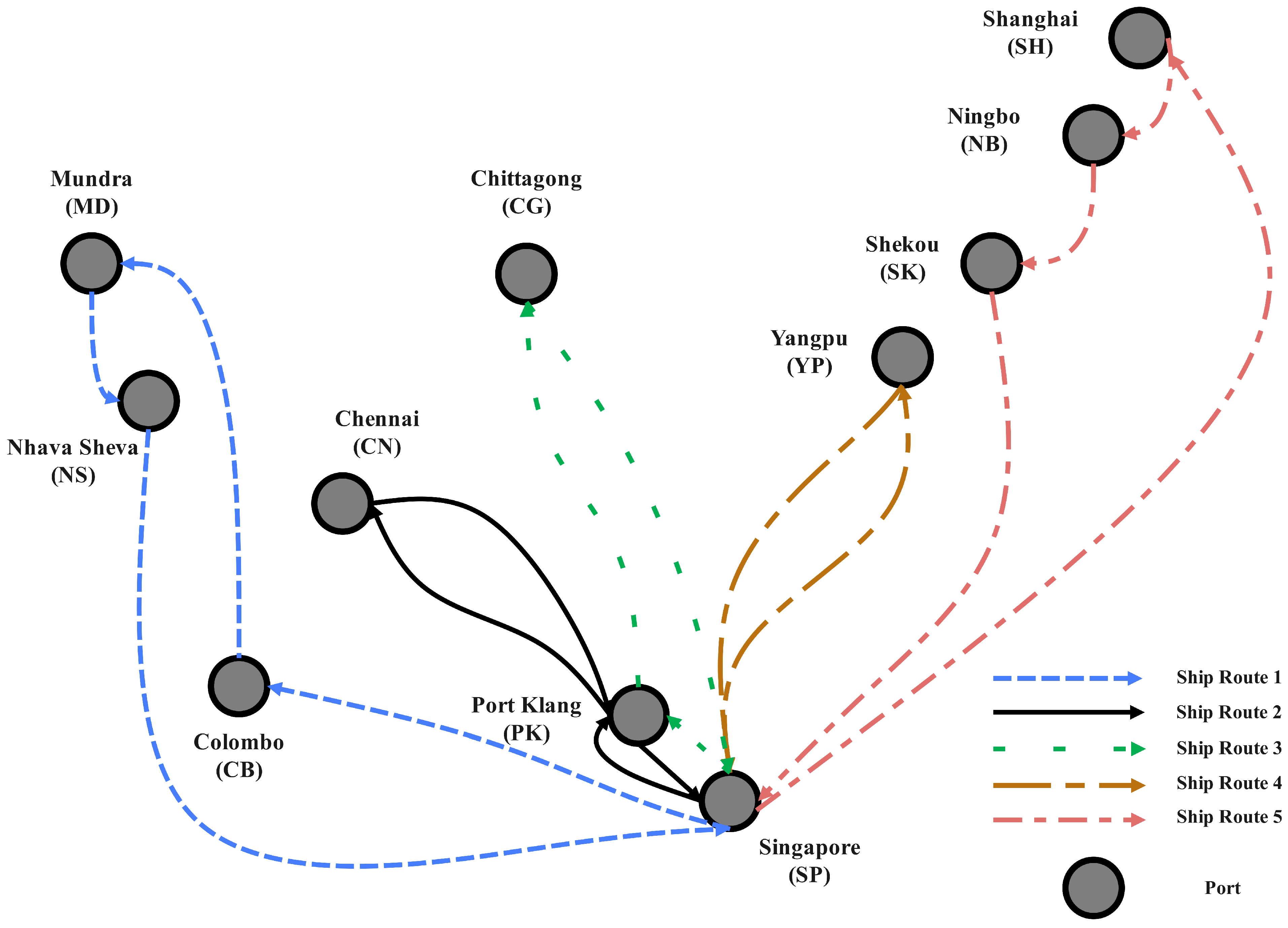
Figure 1 illustrates a representative network structure, where circular nodes represent individual ports and colored lines represent voyage legs between consecutive ports of call.
The model incorporates deterministic parameters including route configurations, leg distances, weekly container demand between origin-destination (O-D) port pairs, and technical characteristics of available ship types. Ships are categorized by fuel type (including Heavy Fuel Oil, Liquefied Natural Gas, and Methanol), each with distinct features in capacity, speed range, and fuel efficiency. Future fuel prices and carbon tax rates are treated as random variables to capture market uncertainties.
The decision-making process is structured into two sequential phases: the strategic phase determines long-term fleet composition by selecting the number of ships of each type to acquire, while the operational phase, executed after observing the realizations of stochastic cost parameters, involves assigning specific ship types to each route and optimizing sailing speeds on individual voyage legs. All decisions are constrained by the requirement to maintain weekly service frequency on each route, with the integrated objective of minimizing total expected costs comprising capital investment, fuel consumption, carbon tax, and container handling expenses.
The notations used in this study are summarized in
Table 1. Key sets include
, representing all container routes serving O-D pair
, and
, denoting the complete set of all container routes.
In the first stage, the company must decide on the long-term fleet composition before observing the future fuel prices (USD/ton) and carbon tax (USD/ton CO2). The strategic decision involves determining the number of ships of each type to acquire. Each ship type is characterized by its weekly capital cost (USD/week)—representing the amortized investment cost including construction, financing, and depreciation—capacity (TEUs), emission factor (ton CO2/ton fuel), and feasible speed range (knots). The total acquisition number of each ship type s is constrained by a maximum availability .
In the second stage, after observing the realized values of the random variables , the company makes operational decisions. Let denote the set of voyage legs on route . Fleet deployment is determined through binary variables , which equal 1 if exactly j ships of type s are deployed on route r, subject to the constraints that the total deployed ships of each type cannot exceed the acquired fleet size, and the total ships deployed on each route must equal the predetermined number . Simultaneously, the company optimizes the sailing speed (knots) for each leg of route r, which directly affects the fuel consumption rate (ton/n mile). Following the standard literature in maritime transportation, the fuel consumption function takes the form , where is a fuel consumption coefficient coefficient and b is the exponent (typically taken as 3). Additionally, the company assigns the weekly container flow (TEUs/week) to each predefined container route to satisfy the demand (TEUs/week) for all origin-destination (O-D) port pairs , incurring a handling cost (USD/TEU) for container loading and unloading operations.
The operational decisions are subject to several physical and service constraints. The weekly service frequency must be maintained on each route r, requiring that the sum of the total sailing time per ship (where denotes the distance of leg i on route r in nautical miles), total container handling time , and fixed port time (hours, including pilotage and other mandatory port activities) does not exceed hours. The ship capacity constraint must be respected on every leg of every route, ensuring that the total weekly container flow on a leg does not exceed the total weekly capacity of ships deployed on the corresponding route .
The objective is to minimize the total expected cost, which is the sum of the first-stage capital cost and the expected second-stage weekly operational cost. The operational cost comprises the fuel cost, the carbon tax cost, and the container handling cost , making the overall problem a large-scale stochastic mixed-integer nonlinear program.
3.2. Model Formulation
3.2.1. Two-Stage Stochastic Programming Formulation
The problem is formulated as the following two-stage stochastic program.
The mathematical model formulated above represents the first-stage problem of a two-stage stochastic programming framework. The objective function (1) aims to minimize the sum of the total capital cost for acquiring the fleet and the expected value of the second-stage operational cost , where and are the random fuel prices and carbon tax, respectively. Constraint (2) ensures that the number of acquired ships for each type does not exceed its maximum availability. Finally, constraint (3) enforces the non-negativity and integrality of the first-stage decision variables .
Second-Stage Problem: For given realizations
and
of the random fuel prices and carbon tax, the second-stage problem
is:
The second-stage model, defined after the observation of the specific fuel price and carbon tax realizations and , determines the optimal fleet deployment and operation. The objective function (4) minimizes the total operational cost, which includes the fuel cost, the carbon tax cost, and the container handling cost.
Constraint (5) is the weekly service frequency constraint for each route, ensuring the total round-trip time (sailing time, container handling time, and fixed port time) does not exceed 168 h multiplied by the number of ships on the route. Constraint (6) guarantees that the number of ships deployed across all routes for each type does not exceed the number acquired in the first stage. Constraint (7) imposes the ship capacity constraint on every leg of every route, ensuring that the container flow does not exceed the average weekly capacity. Constraint (8) requires that all container shipment demands are satisfied. Constraint (9) ensures that the total number of ships deployed on each route equals the predetermined number . Constraint (10) ensures that for each route and ship type, only one deployment configuration is selected. Constraint (11) defines the feasible sailing speed range for all ship types. Finally, constraints (12) and (13) enforce the binarity of deployment variables and the non-negativity of container flow variables, respectively.
3.2.2. Linearization of the Fuel Consumption Function
The fuel consumption rate of a ship is a highly nonlinear function of its sailing speed. Following the established literature in maritime transportation, Wang & Meng [
10] commonly model the daily fuel consumption
Q (tons/day) for a ship as a power function of its speed
v (knots):
While the exponent b can be calibrated from data, a value of is widely adopted as a standard approximation based on engine propulsion principles, reflecting the cubic relationship between power and speed. This study employs this cubic assumption (), which strikes a balance between model accuracy and tractability.
The relevant cost in the objective function, however, is the fuel consumption per nautical mile,
, as it is multiplied by the leg distance
. This is derived as follows:
where
is the modified fuel consumption coefficient for ship type
s.
Thus, the nonlinear term that appears in the objective function is . To handle this nonlinearity, the function is approximated using a piecewise linear function.
The feasible speed range
for all ship types is uniformly divided into
K segments, where
is the number of segments. This defines
breakpoints
for
:
The corresponding function values at these breakpoints are .
Let
denote the piecewise linear approximation of
. It is defined segment by segment as follows:
where for each segment
l (
) and ship type
s, connecting breakpoints
and
, the slope
and intercept
are given by:
To integrate this piecewise linear function into the optimization model, for each ship leg , we introduce binary variables for indicating which segment the speed falls into, and a continuous variable representing the approximated value of .
The linearized model includes the original constraints with the objective function now using
instead of
. Additionally, the following constraints are added to enforce the piecewise linear relationship:
Constraints (17)–(19) ensure that the speed variable lies within exactly one of the K segments. Constraints (20) and (21) then force to equal the linear function corresponding to the active segment l, where M is a sufficiently large constant.
3.2.3. SAA Model
To solve the two-stage stochastic programming problem presented in
Section 3, we employ the SAA method. The SAA approach is particularly suitable for this problem due to the continuous distribution of fuel prices and carbon taxes, which makes exact computation of the expected value in the objective function computationally intractable.
The fundamental idea of SAA is to approximate the expected value of the second-stage cost by averaging over a finite number of randomly generated scenarios. This transformation converts the original stochastic programming problem into a deterministic optimization problem that can be solved using standard mathematical programming techniques. The SAA method has been widely adopted in stochastic optimization literature due to its convergence properties and practical applicability.
For our ship fleet planning problem, the uncertainty primarily stems from fuel prices
and carbon tax
, which are modeled as random variables with known probability distributions. Let
represent the fuel price and carbon tax realization in scenario
n, for
, where
N is the total number of sampled scenarios. The Sample Average Approximation formulation of the two-stage stochastic program is presented as follows:
This formulation presents the SAA approach for solving the two-stage stochastic optimization problem. The fundamental concept involves approximating the expected second-stage cost by averaging over a finite collection of N independently generated scenarios for fuel prices and carbon taxes.
The objective function (22) seeks to minimize the aggregate cost, which consists of the first-stage capital investment for vessel acquisition and the mean operational cost across all sampled scenarios. The second-stage cost function in (23) computes the operational expenditure for each individual scenario, encompassing fuel consumption costs, carbon tax liabilities, and container handling charges. The fuel consumption component employs the piecewise linear approximation to represent the squared speed term.
Constraint (24) maintains the weekly service frequency requirement for each shipping route across all scenarios. The fleet deployment limitation is enforced by constraint (25), which guarantees that the total number of vessels allocated to routes does not surpass the acquired fleet capacity. Constraint (26) imposes vessel capacity restrictions on every leg of each route. The fulfillment of all container transportation demands is ensured by constraint (27).
Constraint (28) specifies that the total vessel count deployed on each route must match the predetermined number . The condition that only one deployment configuration can be selected for each route and vessel type is imposed by constraint (29). The operational speed boundaries for all vessel types are defined by constraint (30).
Constraints (31) through (35) implement the piecewise linear approximation for the fuel consumption function across all scenarios, ensuring that the speed variable falls within exactly one segment and that the approximation variable equals the corresponding linear function. Finally, constraints (36)–(40) establish the binary nature of deployment and segment selection variables, along with the non-negativity of container flow and approximation variables.
3.2.4. Linearization of the Second-Stage Cost Function
The second-stage cost function in constraint (23) contains a nonlinear term involving the product of binary and continuous variables: . This nonlinearity can be eliminated by introducing auxiliary variables and applying the big-M method.
We introduce a new continuous variable
to represent the product
. The linearized formulation replaces constraint (23) with:
where
M is a sufficiently large constant that upper-bounds the possible values of
.
3.2.5. Linearization of the Service Frequency Constraint
Constraint (24) contains a nonlinear term due to the reciprocal of the speed variable. This nonlinearity is addressed by introducing an auxiliary variable to represent the reciprocal of speed, and reformulating the constraint accordingly.
The linearized service frequency constraint is expressed as:
This reformulation maintains the exact mathematical relationship between speed and its reciprocal while eliminating the nonlinear fraction term from the service frequency constraint. The equality constraint ensures consistency between the original speed variable and its reciprocal counterpart throughout the optimization model.
3.2.6. Complete Linearized SAA Model
This section presents the complete linearized Sample Average Approximation model that integrates all the linearization techniques discussed in previous sections. The model transforms the original stochastic nonlinear optimization problem into a deterministic mixed-integer nonlinear programming (MINLP) formulation.
Objective Function and Core Constraints:
Piecewise Linear Approximation Constraints:
Product Linearization Constraints:
Variable Domain Constraints:
The complete linearized SAA model presented above encompasses the entire optimization framework. Equations (49) and (50) define the two-stage objective function, minimizing the sum of capital costs and expected operational costs across all scenarios. Constraints (51)–(53) establish the core operational requirements, including service frequency, reciprocal speed relationship, and speed boundaries. Constraints (54)–(58) cover fleet deployment, capacity limitations, and demand fulfillment.
The piecewise linear approximation system is implemented through constraints (59)–(63), which ensure accurate representation of the fuel consumption function. The linearization of product terms is achieved via constraints (64)–(66), eliminating nonlinearities in the objective function. Finally, variable domain definitions are specified in constraints (67)–(74), ensuring proper mathematical formulation integrity.
The complete linearized SAA model exhibits a highly favorable mathematical structure for computational solution. The objective function defined in Equations (49) and (50) is entirely linear, consisting of capital costs and the expected operational costs across all sampled scenarios. All constraints in the model are linear with the single exception of the reciprocal relationship constraint (52).
This remaining nonlinear constraint is well-structured and can be efficiently handled by modern commercial optimization solvers. State-of-the-art solvers such as Gurobi incorporate advanced algorithms specifically designed to manage this type of constraint effectively. The presence of only one simple nonlinear constraint ensures that the overall model maintains computational tractability while accurately capturing the essential physical relationship between vessel speed and its reciprocal. This balanced approach enables practical application of the model to real-world ship fleet planning problems under uncertainty.
4. Computational Experiments
4.1. Parameter Settings
The key parameters employed in our computational experiments are summarized in
Table 2 and
Table 3, based on industry data and realistic operating conditions [
9]. The major ports considered in the shipping network are illustrated in
Figure 1, with their full names and corresponding abbreviations listed in the caption for reference.
Table 2 presents the technical and economic characteristics of three ship types utilizing different fuel technologies: Heavy Fuel Oil (HFO), Liquefied Natural Gas (LNG), and Methanol [
13]. Following the benchmark study by Wang & Meng [
10], all vessel types are configured with identical operational parameters including a speed range of 20–26 knots, a container capacity of 5000 TEUs, and a container handling rate of 95 TEUs/h. The pilotage time of 4 h per port call represents the mandatory time required for navigation in and out of any port.
Significant differences emerge in environmental performance metrics. HFO vessels exhibit the highest carbon content (85%) and CO
2 emission factor
(3.11 tons per ton fuel). LNG vessels show improved performance with reduced carbon content (75%) and emission factor (2.75 tons per ton fuel). Methanol-powered vessels demonstrate superior environmental characteristics with significantly lower carbon content (37%) and the lowest emission factor (0.65 tons per ton fuel) [
12].
Economic parameters reveal distinct operational cost structures. Weekly operating costs are 115,400 USD for HFO, 240,120 USD for LNG, and 185,150 USD for Methanol vessels [
10,
36]. The fuel mass required for equivalent propulsion energy varies substantially, with Methanol requiring 2.00 tons per ton of HFO equivalent, while LNG requires only 0.80 tons [
37,
38].
The fuel consumption coefficient
in the function
takes values of
,
, and
for HFO, LNG, and Methanol ships, respectively. These coefficients are calculated based on the relative fuel mass required to provide the same propulsion energy:
where
is the base coefficient for HFO ships [
10].
The handling cost is set at 50 USD/TEU for base container handling operations, with an additional 30 USD/TEU surcharge applied when containers require transshipment between different shipping routes, reflecting the extra operational complexity. Acquisition limits are set at 5 ships for each vessel type respectively.
To address uncertainties in future market conditions, fuel prices are modeled as random variables with mean values of 634, 583, and 313 USD/ton for HFO, LNG, and Methanol ships, respectively [
39]. Carbon tax rates follow a normal distribution with mean value of 53 USD/ton CO
2 [
40], with standard deviations equal to 10% of respective mean values. For the SAA method, we generate 40 independent scenarios to approximate the expected second-stage cost, ensuring computational tractability while adequately capturing the underlying uncertainty.
The shipping network configuration comprises five cyclic routes originating from the hub port of Singapore [
41], as detailed in
Table 3. The set of O-D pairs with demand
W is constructed by randomly selecting one-quarter of the 110 possible O-D pairs, resulting in 28 O-D pairs with positive demand. For instance, Route R1 (Singapore (SP) → Shanghai (SH) → Ningbo (NB) → Shekou (SK) → Singapore (SP)) forms a major East Asian loop with individual leg distances of 2058, 83, 1045, and 1286 nautical miles, requiring 3 ships to maintain weekly service frequency. The predetermined number of ships deployed on each route
is configured based on the total voyage distance and the 168-h weekly time budget to ensure service frequency requirements. Other routes follow similar configuration principles, with leg distances detailed in
Table 3 and ship deployments from 1 to 3 ships per route.
Additional parameters include fuel consumption following the established quadratic relationship with sailing speed, ensuring comprehensive operational realism in our analysis.
4.2. Big-M Parameter Selection Strategy
The linearization techniques employed in this study, particularly the piecewise linear approximation of the fuel consumption function and the linearization of cost function, utilize the big-M method. This method requires careful selection of the M parameters to ensure both mathematical correctness and numerical stability. Improper selection can lead to either invalid constraints (if M is too small) or numerical ill-conditioning (if M is too large). This subsection details our rigorous methodology for determining appropriate M values based on the physical bounds of the decision variables.
4.2.1. Theoretical Foundations
The big-M method transforms nonlinear or logical constraints into linear form by introducing binary variables. For our model, two distinct M parameters are required:
Both parameters must satisfy the fundamental requirement: when the associated binary variable is 0, the constraint must be non-binding for all feasible values of the continuous variables.
4.2.2. Calculation of for Piecewise Linear Approximation
The piecewise linear approximation of the fuel consumption function
employs binary variables
to indicate which segment is active. The linearized constraints are:
When , these constraints enforce . When , they must be non-binding.
The maximum possible value of
occurs at maximum speed
knots:
Using the fuel consumption coefficients from
Table 3, we compute:
For each linear segment
l, the approximation
has extreme values at segment endpoints. Analysis reveals that the most restrictive case occurs for Methanol ships, where:
To ensure constraints are non-binding when
, we require:
where
provides a safety margin. Substituting numerical values:
We conservatively select .
4.2.3. Calculation of for Cost Function Linearization
The product term
in the objective function is linearized via auxiliary variables
with constraints:
These enforce : when , ; when , .
The minimum theoretical requirement is:
However, to ensure numerical stability and account for multiplicative factors in the objective function (distance
and fuel prices
), we apply a conservative scaling:
The constant 10.0 provides additional robustness against numerical issues.
Table 4 summarizes the implemented
M values. These were computed automatically in our Python implementation based on the ship parameters from
Table 2.
4.3. Error Analysis of Piecewise Linear Approximation
To rigorously justify the choice of five segments for the piecewise linear approximation of the fuel consumption function , this section provides a theoretical error analysis. The analysis quantifies the approximation error introduced by different numbers of segments and demonstrates that five segments achieve an optimal balance between model accuracy and computational tractability for this specific application.
Consider the convex quadratic fuel consumption function defined on the speed interval knots. When this interval is divided into K equal segments, the segment width is knots. Let denote the linear approximation on segment l, connecting the points and .
For a convex function, the maximum approximation error within each segment occurs where the derivative of
equals the slope of the linear approximation. This condition yields the error maximization point:
The maximum absolute error at this point can be derived analytically:
This closed-form expression provides a tight upper bound on the approximation error for any segment and any ship type s.
To assess the approximation quality, we compute the relative error at the worst-case point. At the midpoint of the first segment, the true function value is:
The maximum relative error percentage for ship type
s with
K segments is:
Table 5 presents the theoretical error bounds for different numbers of segments using the fuel consumption coefficients
from
Table 2.
The selection of five segments for the piecewise linear approximation represents a significant improvement over the conventional two-segment approach. Compared to two segments, the five-segment configuration reduces the maximum approximation error for HFO vessels from to , achieving an 84% error reduction.
4.4. Container Route Generation Algorithm
To systematically construct the container routing matrix , which indicates whether container route h utilizes leg i on shipping route r, we develop a two-phase network-based approach. Algorithm 1 serves as the main driver that orchestrates container route generation for all origin-destination (O-D) pairs, while Algorithm 2 implements the core path-finding mechanism using Breadth-First Search (BFS).
The overall procedure begins with Algorithm 1 constructing a directed graph , where (all ports) and E contains all consecutive port connections derived from the given shipping routes. The algorithm initializes the container route set H and leg usage record set A as empty sets.
For each O-D pair
, Algorithm 1 first checks if
and skips such self-pairs. For valid pairs, it generates a unique route identifier
h (e.g., “SH_NB” for Shanghai to Ningbo) and adds it to
H. The algorithm then invokes Algorithm 2 to find the shortest path from
o to
d in graph
G. If no path exists, it continues to the next O-D pair.
| Algorithm 1 Container Route Generation |
- 1:
Build a directed graph where and E contains all consecutive port connections from all routes - 2:
Initialize , {A: set of tuples} - 3:
for each O-D pair do - 4:
if then - 5:
continue {Skip self-pairs} - 6:
end if - 7:
- 8:
- 9:
- 10:
if then - 11:
continue {Skip if no path found} - 12:
end if - 13:
{Group path segments by route} - 14:
for each shipping route r in do - 15:
for each leg index i used from route r in path do - 16:
{Set matrix element} - 17:
{Record usage} - 18:
end for - 19:
end for - 20:
end for - 21:
return
|
Algorithm 2 implements the BFS-based shortest path finding. It initializes a queue Q with the tuple , representing the current port, accumulated path segments, and current shipping route. The algorithm explores the graph by dequeuing states and checking neighbors. For each unvisited neighbor port (next_port, route, leg_index), it creates a new path by appending the route segment (route, leg_index, current_port, next_port) and enqueues the new state. When the destination d is reached, the complete path sequence is returned.
Upon receiving a valid path from Algorithm 2, Algorithm 1 processes the path by grouping segments according to the shipping routes used. For each shipping route r appearing in the path and each leg index i utilized from route r, the algorithm sets and adds the tuple to the record set A. This establishes the mapping between container route h and the specific legs of shipping routes it employs.
This approach automatically handles transshipment operations by allowing container routes to span multiple shipping routes through the BFS mechanism. The algorithm ensures that all feasible container routes are captured while maintaining the physical connectivity constraints of the shipping network, ultimately generating the complete container routing matrix
required for the subsequent optimization model.
| Algorithm 2 BFS-Based Shortest Path Finding |
Require: Origin o, Destination d, Graph G Ensure: Shortest path as a sequence of route segments or ∅ if no path exists
- 1:
Initialize queue Q, visited set V - 2:
{(current port, path segments, current route)} - 3:
- 4:
while Q is not empty do - 5:
- 6:
if then - 7:
return path {Found destination} - 8:
end if - 9:
for each neighbor of in G do - 10:
if then - 11:
{Create a copy of current path} - 12:
- 13:
- 14:
- 15:
end if - 16:
end for - 16:
end while - 17:
return ∅ {No path found}
|
4.5. Analysis of Scenario Number Selection for SAA
Determining an appropriate number of scenarios for the SAA method requires balancing statistical accuracy against computational burden. To identify a suitable scenario count for our two-stage stochastic fleet planning model, we systematically evaluate the performance of the SAA algorithm under varying scenario sizes, ranging from 20 to 100. For each scenario count, we solve independent SAA problems to estimate the lower bound (LB) of the expected cost, while the upper bound (UB) is evaluated using a large reference sample of size , ensuring a reliable statistical benchmark. All reported results are derived with 95% confidence intervals.
Table 6 summarizes the computational outcomes, including the lower and upper bounds of the objective value, the corresponding optimality gap, the percentage standard deviations of both bounds, and the average solution time.
Based on the convergence trends observed in
Table 6, we select 60 scenarios as the preferred setting for our SAA framework. This choice is justified by the following considerations. The optimality gap at 60 scenarios is 0.24%, which is substantially lower than the 1.51% gap obtained with 40 scenarios and remains competitive with the gaps from 20 scenarios (0.17%) and 100 scenarios (0.29%). This demonstrates that 60 scenarios provide a sufficiently accurate approximation of the true stochastic program. Regarding statistical stability, the variability in both lower and upper bounds is well controlled at 60 scenarios, with standard deviations of 0.48% and 0.95%, respectively. These values indicate a stable estimation process, avoiding the high upper-bound variability seen with 40 scenarios (2.80%) while maintaining a reasonable level of precision relative to the lower variability achieved with 80 scenarios (0.41% for LB). In terms of computational trade-off, although solution time grows with scenario count, the runtime of 101.47 s for 60 scenarios is acceptable for a strategic planning application. Further increasing the number of scenarios to 100 raises the computational cost to 174.59 s without delivering a commensurate improvement in the optimality gap or stability. Thus, 60 scenarios represent an efficient compromise between computational effort and solution fidelity. In summary, the use of 60 scenarios enables the SAA method to adequately capture the uncertainties in fuel prices and carbon taxes while keeping computational resources within practical limits. This configuration supports robust and reliable decision-making in stochastic fleet deployment and speed optimization for liner shipping operations.
4.6. Computational Results and Analysis
All computational experiments were performed using Python 3.5 on an x64 personal computer (manufactured by ASUSTeK COMPUTER INC., Taipei, Taiwan, China) equipped with an Intel i7-12700H 2.3,GHz six-core CPU (manufactured by Intel Corporation, Santa Clara, CA, USA) and 16.0,GB of RAM. The SAA-based stochastic programming model was solved using Gurobi 12 (Gurobi Optimization, LLC, Beaverton, OR, USA). The algorithm obtained an optimal solution within 10 s, achieving a total expected cost of 5.94 × 10⁶ USD per week.
The optimal fleet configuration and deployment plan are summarized in
Table 7. The optimal solution includes eleven vessels in total, consisting of five HFO vessels, five LNG vessels, and one methanol-fueled vessel, with a combined weekly capital cost of 1.96 × 10
6 USD. The deployment results reveal a clear differentiation among fuel technologies: HFO vessels are primarily deployed on Routes R1 and R5, LNG vessels are distributed across Routes R2, R3, R4 and R5, while methanol vessels operate only on Route R5. This distribution suggests that each propulsion technology finds its optimal application under specific route characteristics. Notably, methanol vessels demonstrate limited deployment under the current carbon tax price of 53 USD/ton CO
2, indicating their economic advantage remains constrained at this taxation level.
The speed optimization results are presented in
Table 8. The results demonstrate that slow steaming at 20.00 knots is the dominant strategy across most routes (R1, R3, R4, and R5), effectively reducing both fuel consumption and environmental impact. This aligns with established industry practices for managing operational costs under fuel price volatility and carbon tax pressures. Route R2 presents a notable exception, operating at an average speed of 25.27 knots to maintain the required weekly service frequency with only one deployed vessel. This trade-off illustrates that when fleet deployment is constrained, higher sailing speeds become necessary to meet service commitments, even at the expense of increased fuel consumption. These findings highlight the model’s capacity to adaptively balance operational constraints with efficiency objectives across heterogeneous route characteristics.
Table 9 summarizes the cost structure under the optimal solution. Fuel costs account for 74.6% of total operational expenses, underscoring the dominant influence of fuel efficiency on operational economics. This reinforces the critical role of speed optimization and fuel technology selection in cost management strategies. Carbon tax costs constitute 18.2% of operational expenses, highlighting the substantial financial impact of emission regulations and emphasizing the value of adopting lower-emission vessel technologies. The handling cost represents the smallest proportion at approximately 7.0%, reflecting the relative stability of port-related expenses compared to the volatility of fuel and carbon markets. The capital cost of
$1.96 M per week indicates the significant investment required to maintain a mixed-fuel fleet of eleven vessels, while the total expected cost of
$5.94 M per week provides a comprehensive benchmark for evaluating the economic performance of the optimized shipping operations.
The environmental performance results are presented in
Table 10. HFO vessels account for 53.8% of total emissions while comprising 45.5% of the fleet. LNG vessels contribute 41.1% of emissions with an equal fleet proportion of 45.5%. Methanol vessels demonstrate superior carbon efficiency, contributing only 5.1% of total emissions despite representing 9.1% of the fleet. However, the limited deployment of methanol vessels under the current carbon tax regime confirms that their environmental advantages are insufficient to offset economic considerations at the 53 USD/ton CO
2 taxation level.
4.7. Sensitivity Analysis
This section presents a comprehensive sensitivity analysis to evaluate the robustness of our proposed two-stage stochastic optimization model under various uncertainty scenarios. We systematically examine the impacts of carbon tax volatility, fuel price fluctuations, and carbon tax mean values on various system indicators, such as fleet composition, cost structure, and environmental performance. The analysis demonstrates the model’s capability to generate resilient fleet planning strategies that maintain both economic efficiency and environmental sustainability under different market conditions.
4.7.1. Sensitivity Analysis on Carbon Tax Volatility
To evaluate the impact of carbon tax uncertainty on fleet planning decisions, a sensitivity analysis was performed by varying the standard deviation of the carbon tax from 0.1 to 0.3 times its mean, with increments of 0.05. The analysis reveals significant variations in fleet composition and performance indicators across different volatility levels.
The fleet composition demonstrates notable sensitivity to carbon tax volatility, as shown in
Table 11. At the lowest volatility level (0.10), the optimal fleet consists of five HFO vessels, five LNG vessels, and one methanol vessel. As volatility increases to 0.15, methanol adoption increases to two vessels while LNG decreases to four. At volatility level 0.20, methanol vessels further increase to three while LNG decreases to three. At volatility levels 0.25 and 0.30, methanol vessels dominate with five units while LNG vessels are reduced to only one unit, with HFO vessels remaining constant at five units across all scenarios.
Table 12 presents the corresponding performance indicators. The total expected cost decreases from 5.94 to 5.86 ×
USD/week as volatility increases from 0.10 to 0.25, then shows a marginal increase to
USD/week at the highest volatility level (0.30). Capital costs exhibit a decreasing trend from 1.96 to
USD/week as volatility increases, stabilizing at 1.74 ×
USD/week at volatility levels 0.25 and 0.30. Operational costs show an increasing trend from 3.98 to 4.13 ×
USD/week.
CO2 emissions demonstrate a consistent decreasing trend from 3.13 to tons/week as volatility increases from 0.10 to 0.25, with emissions remaining stable at tons/week at volatility level 0.30. The emission distribution analysis reveals that HFO vessels contribute 53.8% to 63.4% of total emissions across all scenarios, methanol vessels’ emission share increases from 5.1% to 29.0% as their fleet share increases, and LNG vessels’ emission share decreases from 41.1% to 8.5% as their deployment decreases.
The cost structure analysis indicates that fuel costs constitute 50.0% to 55.5% of operational expenses across different volatility levels, while carbon tax costs range from 10.1% to 12.2%. This highlights the continued importance of fuel costs in operational decision-making.
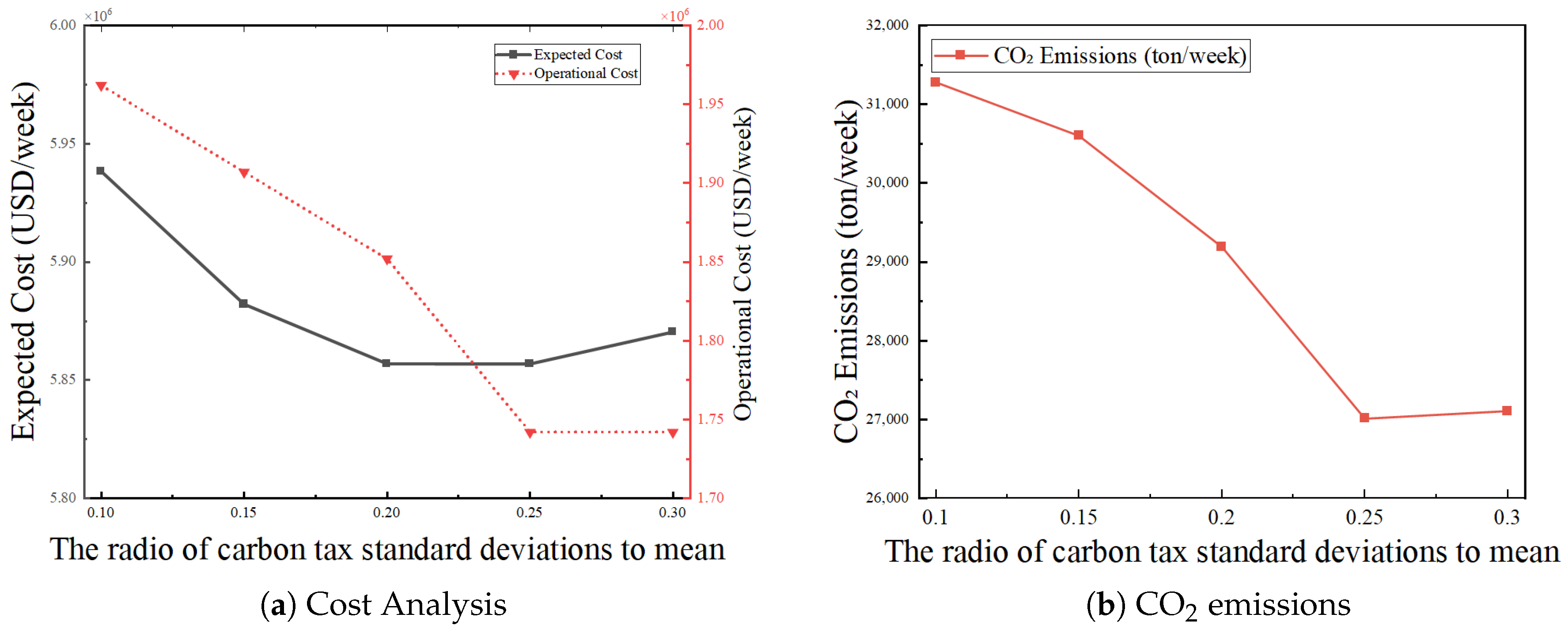
Figure 2a illustrates the cost pattern under different carbon tax volatility levels, showing cost reduction from volatility level 0.10 to 0.25 with a slight increase at level 0.30.
Figure 2b demonstrates the consistent decrease in CO
2 emissions with increasing volatility from 0.10 to 0.25, with emissions stabilizing at the highest volatility level.
The results indicate that carbon tax volatility significantly influences fleet composition decisions, with methanol vessel adoption increasing as volatility rises. The optimal fleet configuration shifts from LNG-dominated to methanol-dominated as carbon tax uncertainty increases, while HFO vessels maintain a consistent presence across all volatility scenarios.
4.7.2. Sensitivity Analysis on Fuel Price Volatility
To examine the impact of fuel price uncertainty on optimal fleet planning decisions, we conduct a sensitivity analysis by progressively increasing the fuel price volatility from 0.1 to 0.3 times the mean value in increments of 0.05, where the coefficient represents the ratio of standard deviation to mean. The results demonstrate how varying levels of fuel price uncertainty influence fleet composition and operational performance.
The fleet composition analysis in
Table 13 reveals a consistent pattern across different fuel price volatility levels. HFO vessels maintain a stable presence of five units, demonstrating their resilience to fuel price uncertainty due to established operational advantages and infrastructure. Methanol vessel adoption increases from four to five units as fuel price volatility rises from 0.10 to 0.15, and remains stable at this level. LNG deployment decreases from two to one unit with increasing uncertainty, indicating its sensitivity to fuel price fluctuations.
The performance metrics in
Table 14 show that total expected cost decreases from
USD/week to
USD/week as fuel price volatility increases, representing a 1.5% cost reduction. Operational costs fluctuate within a narrow range of
to
USD/week, while capital costs remain relatively stable. CO
2 emissions show a decreasing trend from
to
tons/week at the 0.15 volatility level, then gradually increase to
tons/week.
As shown in
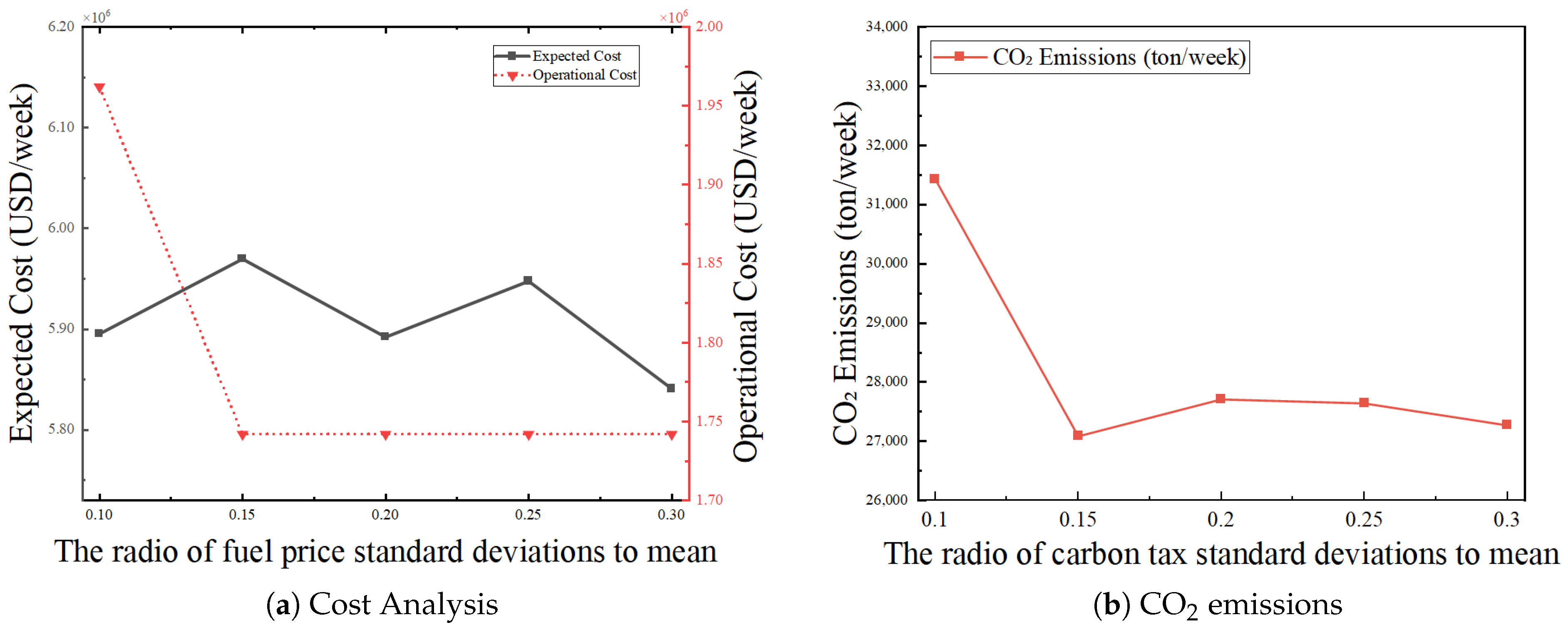
Figure 3a, the cost analysis reveals a gradual decline in total expected costs with increasing fuel price volatility.
Figure 3b illustrates the corresponding CO
2 emissions pattern, showing an initial reduction followed by a maintaining stability at higher volatility levels.
The results indicate that fuel price volatility has a moderate impact on fleet optimization decisions compared to carbon tax uncertainty. The stable HFO vessel deployment across all scenarios suggests that conventional fuel technology maintains its competitive position despite fuel price fluctuations. The increased methanol adoption under higher volatility demonstrates its role in hedging against fuel price uncertainty, while LNG’s reduced deployment reflects its vulnerability to price instability in fuel markets.
4.7.3. Sensitivity Analysis on Carbon Tax Mean Value
To investigate the influence of carbon tax levels, the mean carbon price is progressively increased from 53 to 103 USD/ton CO
2. The resulting fleet configurations are presented in
Table 15.
As shown in
Table 15, a gradual transition in vessel selection is observed as carbon tax levels increase. At the baseline tax level of 53 USD/ton, the optimal fleet consists of five HFO vessels, five LNG vessels, and one methanol vessel. As the carbon tax increases to 63 USD/ton, methanol vessel adoption increases to four while LNG vessels decrease to two. At tax levels of 73 USD/ton and above, methanol vessels dominate with five units while LNG vessels are reduced to one. The most significant shift occurs at the carbon tax level of 103 USD/ton, where all HFO vessels are replaced by methanol-fueled ships, resulting in a fleet of ten methanol vessels and one LNG vessel.
Table 16 presents the corresponding performance indicators. Total expected cost increases from 5.90 to
USD/week as the carbon tax rises from 53 to 103 USD/ton, representing a 10.0% increase. Capital costs show a decreasing trend from 1.96 to
USD/week as the tax increases from 53 to 73 USD/ton, then rise to
USD/week at the highest tax level due to the complete transition to methanol vessels. Operational costs increase from 3.93 to
USD/week as the tax rises from 53 to 93 USD/ton, then decrease to
USD/week at 103 USD/ton.
CO2 emissions demonstrate a consistent decreasing trend from 3.14 to tons/week as the carbon tax increases from 53 to 103 USD/ton, representing a 45.2% reduction. The most significant emission reduction occurs at the highest tax level, where emissions drop from approximately 2.70 to tons/week, corresponding to the complete replacement of HFO vessels with methanol vessels.
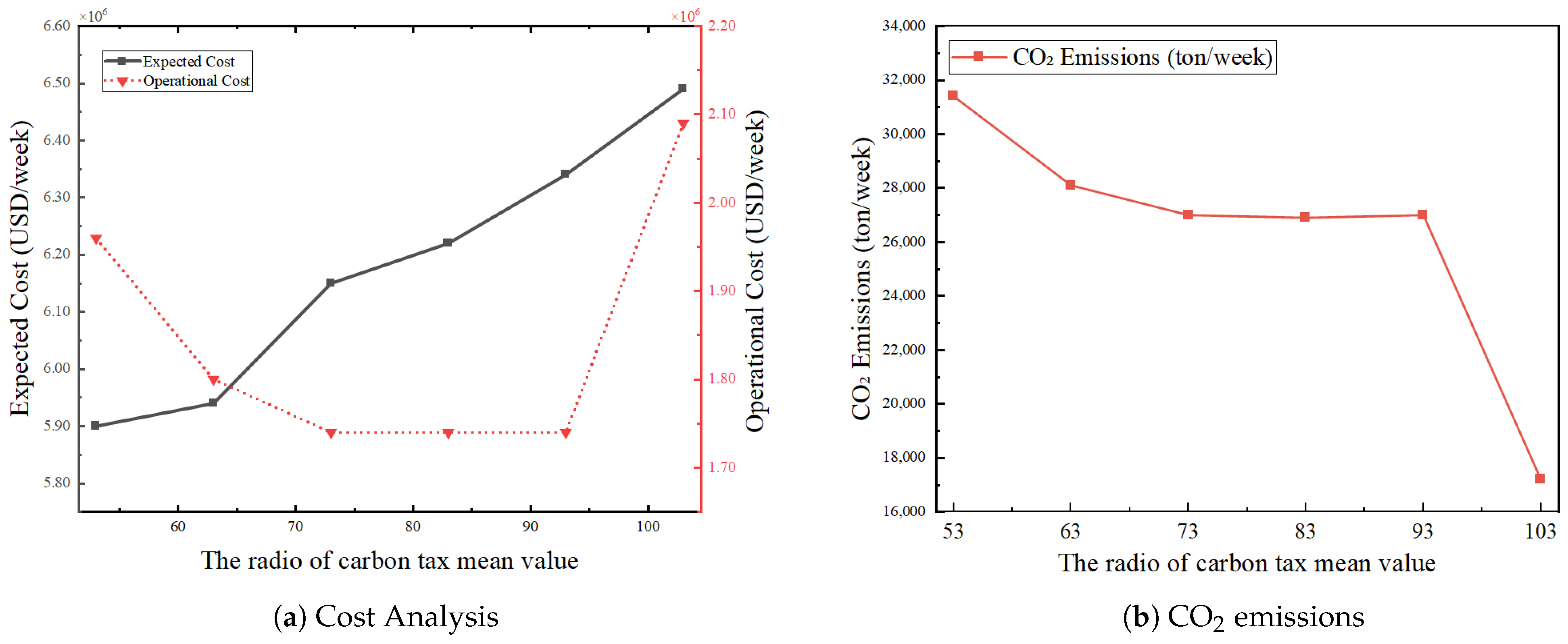
Figure 4a shows the progressive increase in total expected costs with rising carbon tax levels, while
Figure 4b illustrates the substantial reduction in CO
2 emissions, particularly at the highest tax level. The results demonstrate that carbon taxation serves as an effective policy instrument for achieving sustainable maritime fleet transitions, with a critical carbon price threshold near 100 USD/ton beyond which conventional HFO vessels become economically infeasible.
The results clearly demonstrate the advantages of methanol-fueled vessels in carbon-constrained environments. As carbon tax levels increase, methanol ships show superior environmental performance with significantly lower CO2 emissions, contributing only 5.1% of total emissions while representing 9.1% of the fleet at baseline taxation. Their competitive edge becomes particularly pronounced when carbon taxes exceed approximately $100 per ton, at which point they completely replace conventional HFO vessels in the optimal fleet composition. Methanol vessels offer an effective balance between environmental compliance and operational feasibility, providing a viable pathway for shipping companies to transition toward low-carbon operations while maintaining service reliability. These findings underscore methanol’s potential as a transitional fuel in the maritime industry’s decarbonization journey, especially in regulatory environments with stringent carbon pricing mechanisms.
4.8. Discussion of Results
The numerical experiments conducted in this study provide valuable insights into the integrated optimization of fleet deployment and sailing speed under fuel price and carbon tax uncertainties. The results reveal the complex interplay between strategic investment decisions, operational adjustments, and environmental performance, highlighting the practical relevance of the proposed stochastic programming framework.
The optimal fleet composition, consisting of five HFO, five LNG, and one methanol vessel, demonstrates a strategic preference for diversified fuel technologies under baseline carbon tax levels (53 USD/ton CO2). This mix balances the lower capital and operating costs of conventional HFO vessels with the environmental advantages of LNG and methanol, reflecting a risk-averse approach to dual uncertainties in fuel prices and carbon taxation. Notably, the limited deployment of methanol vessels under moderate carbon tax conditions suggests that their economic viability remains constrained unless regulatory pressure intensifies.
Sensitivity analyses further illuminate how fleet composition adapts to changing market and regulatory conditions. As carbon tax volatility or mean levels increase, methanol adoption grows substantially, eventually dominating the fleet at tax levels above approximately 100 USD/ton. This transition underscores methanol’s role as a transitional fuel in decarbonizing maritime operations, particularly in high-carbon-price scenarios. Conversely, HFO vessels maintain a stable presence across most volatility scenarios, indicating their resilience due to established infrastructure and lower capital costs.
The speed optimization results consistently favor slow steaming (20 knots) on most routes (R1, R3, R4, R5), aligning with industry practices to reduce fuel consumption and emissions. However, Route R2 operates at a higher average speed (25.27 knots) to meet weekly service frequency constraints with only one deployed vessel. This highlights a critical trade-off: when fleet deployment is limited, higher speeds become necessary to maintain service levels, even at the expense of increased fuel use and emissions.
The model’s ability to adjust speeds on individual voyage legs, rather than enforcing uniform speeds across routes, demonstrates its operational flexibility. Such granular speed optimization is particularly valuable under uncertain fuel prices and carbon taxes, allowing shipping companies to dynamically balance schedule adherence with cost and emission minimization.
The cost breakdown reveals that fuel expenses constitute the largest share of operational costs (74.6%), followed by carbon taxes (18.2%) and handling costs (7.0%). This structure underscores the financial significance of fuel efficiency and carbon pricing in operational decision-making. As carbon tax levels rise, the share of carbon-related costs increases, further incentivizing investments in low-emission technologies.
Environmental performance analysis shows that HFO vessels account for over half of total CO2 emissions despite comprising less than half of the fleet, whereas methanol vessels contribute only 5.1% of emissions with a 9.1% fleet share. This disparity highlights the environmental superiority of methanol as a marine fuel. The sensitivity analysis confirms that higher carbon taxes drive significant emission reductions—up to 45.2% when the tax reaches 103 USD/ton—primarily through fleet transition toward methanol vessels.
The findings offer actionable insights for both shipping managers and policymakers. For shipping companies, maintaining a mixed-fuel fleet provides a hedge against fuel price and carbon tax volatility. Adopting methanol vessels becomes increasingly advantageous as carbon prices approach or exceed 100 USD/ton. Implementing adaptive speed optimization, and prioritizing slow steaming where feasible can further reduce costs and emissions without compromising service reliability.
For policymakers, the results suggest that carbon pricing can be an effective lever to accelerate the adoption of green shipping technologies. A carbon tax threshold around 100 USD/ton appears to be a critical tipping point where methanol vessels become economically preferable to conventional HFO ships. Graduated tax schemes or hybrid policies combining carbon pricing with infrastructure support for alternative fuels could facilitate a smoother and more equitable transition toward maritime decarbonization.
5. Conclusions
This paper tackles the integrated optimization of fleet deployment and sailing speed in liner shipping under fuel price volatility and carbon tax uncertainty. The global shipping industry, responsible for moving over 80% of world trade, faces mounting pressure to reduce its environmental footprint while maintaining economic viability. Traditional planning methods often treat fleet composition and speed decisions separately, leading to suboptimal solutions in today’s uncertain operating environment. Our research bridges this gap by simultaneously addressing strategic investment in diverse vessel technologies and operational speed adjustments, providing a comprehensive framework that captures the complex interdependencies between long-term fleet planning and short-term operational efficiency. The proposed methodology enables shipping companies to develop resilient strategies that effectively navigate market uncertainties while progressing toward sustainability goals.
Methodologically, this paper builds a two-stage stochastic programming framework where the first stage determines long-term investment portfolios for different fuel types, while the second stage optimizes vessel assignment and sailing speed decisions after observing the realization of stochastic parameters. To address nonlinear complexities, the study employs piecewise linearization techniques for fuel consumption functions, utilizes the SAA method with 60 scenarios—a number justified by convergence analysis for balancing accuracy and computational burden—and applies big-M methods to linearize mixed-integer terms. The fuel consumption function is approximated using five segments, a choice supported by theoretical error analysis, which shows it achieves an optimal balance between model accuracy and computational tractability. Computational experiments demonstrate that the model achieves high-quality solutions within reasonable time frames, exhibiting excellent computational performance and application potential.
The research findings reveal that mixed-fuel fleet configurations achieve the optimal balance between economic and environmental objectives, with methanol-fueled vessels demonstrating significant competitive advantages in carbon-constrained environments. Sensitivity analysis further reveals that a carbon tax threshold of approximately $100 per ton of CO2 significantly enhances the competitiveness of methanol-fueled vessels, making them markedly superior to conventional HFO vessels in terms of both economic and environmental performance. Under higher carbon tax uncertainty or mean levels, the optimal fleet composition shifts towards greater adoption of methanol vessels.
These insights provide crucial guidance for shipping companies formulating long-term investment strategies. First, maintaining a diversified fleet portfolio including both conventional and alternative-fuel vessels is recommended to hedge against market uncertainties. Specifically, increasing the deployment of methanol-fueled vessels serves as an effective strategy to mitigate risks associated with both fuel price fluctuations and carbon tax volatility. Second, implementing adaptive speed optimization strategies, primarily slow steaming, can effectively reduce both operational costs and emission levels while maintaining required service frequencies. Shipping companies should therefore integrate strategic fleet diversification with operational speed adjustments to navigate the evolving regulatory and economic landscape.
The identification of a carbon tax threshold near $100/ton CO2 offers a valuable point of reference for policymakers. This threshold is primarily governed by the fundamental cost and emission parameters of different vessel technologies, making it a stable benchmark under the economic conditions examined. It is important to note that while specific route characteristics have a minor influence, the threshold’s core value provides a clear signal for long-term planning. To promote the transition to green shipping without imposing excessive economic disruption, policymakers could consider designing graduated tax schemes that approach this threshold over a defined period, providing a clear and predictable signal for long-term investment. Alternatively, hybrid policy instruments combining a moderate carbon price with complementary measures, such as subsidies for green fuel bunkering infrastructure or support for first-movers, could be explored. These findings underscore the potential of well-calibrated carbon pricing as a powerful instrument to align the industry’s economic incentives with decarbonization objectives.
Future research could extend this work in several directions:
Algorithmic improvements: Developing advanced heuristic algorithms to obtain high-quality solutions more efficiently for large-scale and more complex network instances of the proposed model.
Model extensions with uncertainty: Expanding the framework to incorporate additional sources of uncertainty, particularly demand volatility and port congestion stochasticity. The impact of different probability distributions for these stochastic parameters on optimal decisions could also be explored. Multi-period dynamic decision-making models would further enhance the model’s practicality and adaptability.
Policy analysis: Investigating the synergistic effects of different environmental policy instruments, such as emissions trading systems, green subsidies, and fuel carbon content regulations, to provide more comprehensive decision support.
Technological integration: Incorporating emerging shipping technologies, including wind-assisted propulsion, battery-hybrid systems, and other alternative fuels, to assess their impact on optimal fleet composition and operational strategies.
Market correlation analysis: Exploring the effects of correlations between different fuel prices and between fuel prices and carbon markets on optimal fleet planning strategies under uncertainty.