1. Introduction and Background Literature
The study of summability theory and its subfields has long been of interest to researchers in engineering sciences, applied mathematics, and especially functional analysis. Investigating summability methods, sequence spaces and their transformations plays a crucial role in understanding the convergence of series and their broader applications. This theory frequently intersects with various disciplines, including calculus, approximation theory, quantum mechanics, probability theory, and Fourier analysis.
Over time, the theory of summability has developed significantly, not only through the construction of summability methods over classical matrices such as Hölder, Fibonacci, Euler, Cesàro, Lucas, Hausdorff, and Nörlund, as well as the associated sequence spaces generated by these methods, but also through the study of matrix transformations and their rich topological and algebraic properties. More recently, research has increasingly focused on absolute summability methods and the new sequence spaces they generated, bringing new perspectives and insights to this expanding field. These developments have significantly enriched the structure of summability theory for both single and double series (see [
1,
2,
3,
4,
5,
6,
7,
8,
9,
10,
11,
12,
13,
14,
15,
16]). In particular, double sequence summability has gained attention due to its broad applicability in mathematical analysis and related disciplines. The literature in this area covers a wide range of topics, from fundamental concepts to advanced research. Given the field’s dynamic nature, ongoing studies continue to introduce new methods and theoretical advancements, further diversifying its applications. Future research is expected to expand the knowledge base and explore emerging techniques in mathematical and applied analysis. For instance, prior studies have addressed various aspects of double sequence summability. The equivalence characterization of
for double sequences has been examined by Sarıgöl [
17], while necessary and sufficient conditions for absolute weighted mean summability of doubly infinite series were established in [
18]. Additionally, the equivalence of summability methods such as
,
has been explored in [
19] (see also [
20,
21,
22,
23,
24,
25]).
Parallel to these advances,
q-analysis has emerged as an important generalization of classical analysis. Its systematic foundations were established by Kac and Cheung in [
26] and later expanded by Ernst in [
27], demonstrating that
q-calculus introduces a deformation parameter that yields a more flexible analytical framework. The
q-analogue approach has found widespread applications in approximation theory, operator theory, special functions, quantum algebra, and engineering-related models. One of its key advantages lies in its ability to interpolate smoothly between classical structures (as
) and genuinely new behaviors for other values of
q.
Within this framework, summability methods based on
q-Cesàro matrices have attracted growing attention. Aktuğlu and Bekar introduced a
q-Cesàro matrix in connection with
q-statistical convergence, marking one of the earliest systematic studies in this direction [
28]. Subsequently, the space
has been defined as the domain of the
q-analog of the Cesàro matrix in the space
[
29], and Erdem and Demiriz [
30] have introduced a new Banach space
as the domain of a four-dimensional
q-Cesàro matrix in the space
. Also, Çınar and Et [
31] have introduced double
q-Cesàro matrices to study statistical convergence in double sequences, and Yaying et al. in [
32] have developed new
q-Cesàro spaces and investigated their operators. All of these studies illustrate the expanding scope of
q-analysis in sequence space theory.
In the context of absolute summability, Gökçe and Sarıgöl in [
8] introduced generalized absolute Cesàro spaces and investigated associated matrix transformations, whereas a further study by Gökçe [
33] addressed the properties and matrix characterizations of absolute
q-Cesàro series spaces for single series. However, despite these advances, the literature reveals that absolute summability methods derived from double-indexed
q-Cesàro matrices have not been systematically compared and analyzed within a unified framework.
Motivated by this gap, the present paper introduces a new absolute
q-Cesàro summability method for double sequences, denoted by
. This method is fundamentally defined by the convergence of the series
where
is the double
q-Cesàro matrix,
represents any positive sequence,
represents the sequence of partial sums of the double series
and
is the power index. We aim to establish the necessary and sufficient conditions for
,
and
, where the methods
and
are obtained by changing the basic parameters and indices as above and
, thereby extending several known results in the literature. The incorporation of the
q-analogue yields a deformation-dependent structure that generalizes classical absolute Cesàro summability and provides additional flexibility in controlling convergence behavior. To complement the theoretical results, illustrative examples and graphical representations are provided. In particular, we demonstrate how the absolute
q-Cesàro method achieves enhanced stabilization for oscillatory sequences and double-indexed data when compared with classical approaches. This feature indicates that the proposed framework may be relevant in applied and engineering-oriented contexts, such as two-dimensional signal processing, image reconstruction, and numerical schemes for discretized partial differential equations, where adaptive convergence control is essential.
2. Preliminaries, Definitions and Examples
Let us now recall some of the concepts that will be used frequently in the study:
A double sequence is defined as a function
, where
is a non-empty set and
denotes the set of natural numbers including zero. The function is expressed as
, where
. The concept of convergence for double sequences of real numbers was first introduced by Pringsheim [
34] in the early 20th century. Pringsheim’s sense of convergence (P-convergence) requires that for a double sequence
, the limit
exists and is finite. Building on this foundation, Hardy [
35] later developed the notion of regular convergence (r-convergence), which imposes the additional condition that the sequence must converge for each index separately in addition to satisfying Pringsheim’s convergence criteria.
Further advancements were made by Zeltser [
36], who systematically investigated the topological properties of double sequences and their associated spaces. The notations
are commonly used to represent spaces of all
P-convergent,
s-absolutely summable and bounded double sequences. It is important to note that a
P-convergent double sequence can be either bounded or unbounded. The subset of double sequences that are both
P-convergent and bounded is represented by
. Let us consider the space
which is the set of double sequences corresponding to the well-known space
of single sequences [
21], where
is the set of all double sequences of complex numbers. Also, in the case
, the space reduces to
studied by Zeltser [
36]. On the other hand,
is a Banach space [
21] according to its natural norm
and
is the space of all bounded double sequences, which is a Banach space with the norm
.
Let
be a doubly infinite series with partial sum
,
be any positive sequence and
denote an infinite four-dimensional matrix of complex numbers. Then it is said that the double series
is summable by
, if
where
and
is the transformation sequence of
defined by
The
q-analogue of a mathematical expression, which is one of the important concepts of the study, refers to the generalization of this expression by adding a parameter
q. This generalized form reduces to the original expression as
. The study of
q-calculus dates back to Euler’s time and has evolved into an interesting and active field of research in recent decades. Due to its extensive applications in mathematics, physics and engineering sciences, q-calculus has attracted great interest from researchers. It is widely used in mathematics in areas such as approximation theory, combinatorics, hyper-electronics geometric functions, operator theory, special functions, quantum algebra and more [
29,
30,
31,
32,
37,
38,
39]. The double
q-Cesàro matrix
, given in [
31], constitutes the basis of this study, together with the concept of absolute summability method defined as follows:
where
is the
q-analogue of a non-negative number
m and identified by
or equivalently (for
),
refs. [
28,
40].
While most existing research in the literature on q-Cesàro summability focuses on non-absolute summability methods and sequence spaces, the present paper differs by being based on an absolute summability approach. This study incorporates absolute convergence into the q-summability framework, which is particularly relevant for applications that require stronger forms of convergence.
A notable feature of absolute q-Cesàro summability methods is that they are more flexible compared to classical absolute Cesàro methods. The presence of the parameter q allows the weighting of terms within a sum. When , the method recovers classical Cesàro summability; for other values of q ( or ), the weights change, allowing convergence for sequences that usually do not converge with classical methods. This flexibility offers advantages in contexts such as statistical convergence, approximation theory and the analysis of q-difference equations.
Although the main focus of this paper is on double series and absolute q-Cesàro summability methods, we also present a graphical illustration for a single series in order to visually demonstrate the behavior and comparative performance of the considered summability methods. This simplification enhances the clarity and interpretability of the figure without affecting the generality of the underlying summability framework.
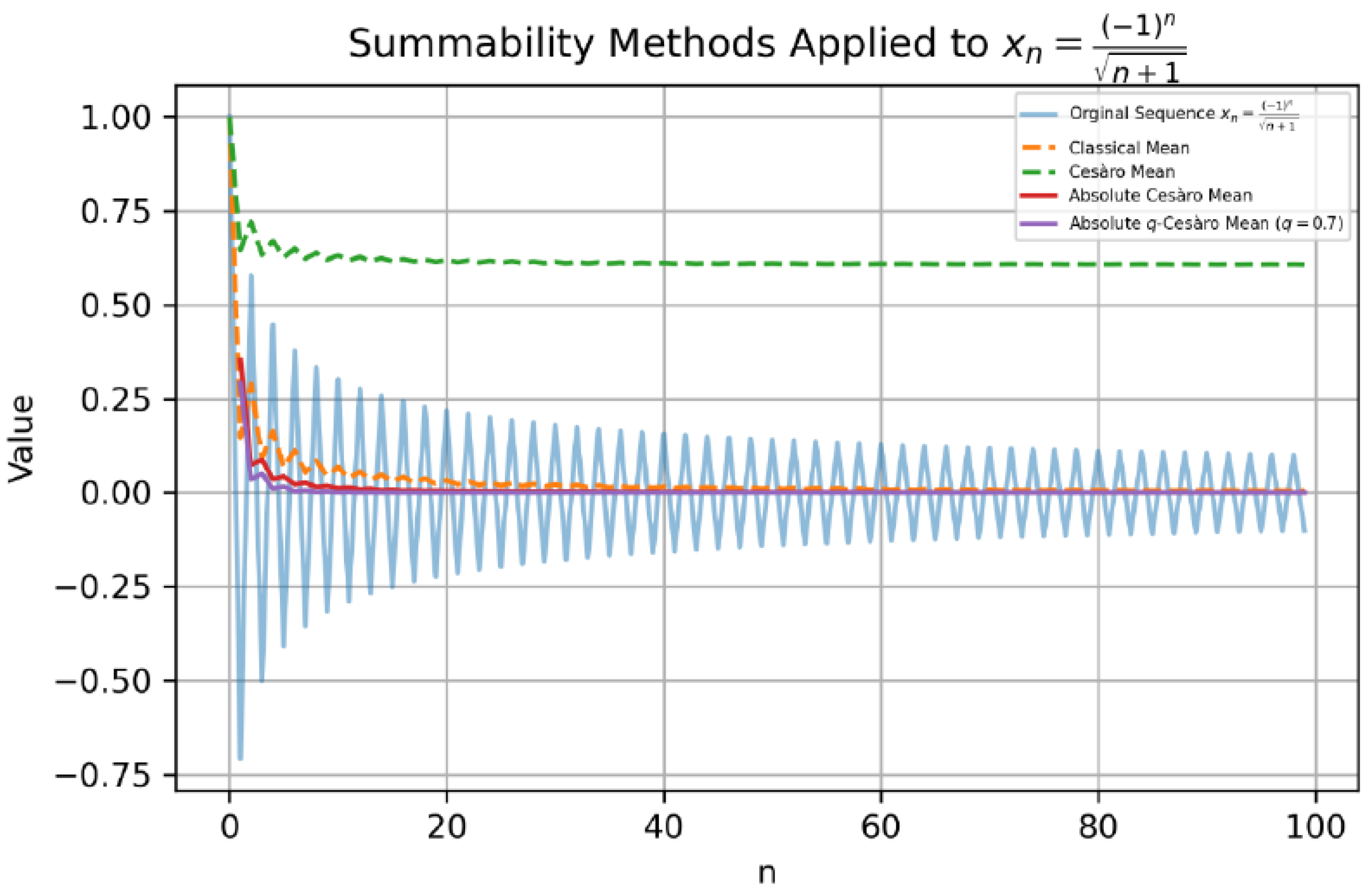
Figure 1 presents a comparison between other means and the proposed absolute
q-Cesàro mean applied to the sequence
. It illustrates how the classical methods are less effective in suppressing oscillations, while the
q-Cesàro approach with
significantly accelerates stabilization by assigning appropriate weights to the early terms. This behavior is particularly promising for real-world applications. In areas such as signal processing or data compression, it is essential to smooth noisy or rapidly varying data. Traditional methods use uniform weighting and may fail to adapt to non-uniform fluctuations. In contrast, the
q-Cesàro method allows more control through the parameter
q, offering customizable smoothing without sacrificing key signal features. Choosing
dampens initial oscillations more aggressively, which may be beneficial for detecting underlying trends or removing noise efficiently.
Recently, double-indexed data structures have gained importance not only in pure summability theory but also in applied fields such as image processing, numerical solutions of partial differential equations, lattice-based quantum models, and two-dimensional signal filtering. In such applications, controlling oscillatory behavior and convergence acceleration in two independent directions is crucial. Summability methods for double sequences provide a theoretical framework to analyze and stabilize such structures. In this context, q-analogue-based summability methods offer an additional degree of freedom via the deformation parameter q, enabling adaptive weighting mechanisms that classical methods cannot capture.
In order to further illustrate the applicability and flexibility of the proposed absolute
q-Cesàro summability method for double sequences, we complement the one-dimensional example presented above with two genuinely double-indexed sequences, denoted by
and
The sequence
exhibits strong oscillatory behavior in both indices and is neither absolutely summable nor rapidly convergent.
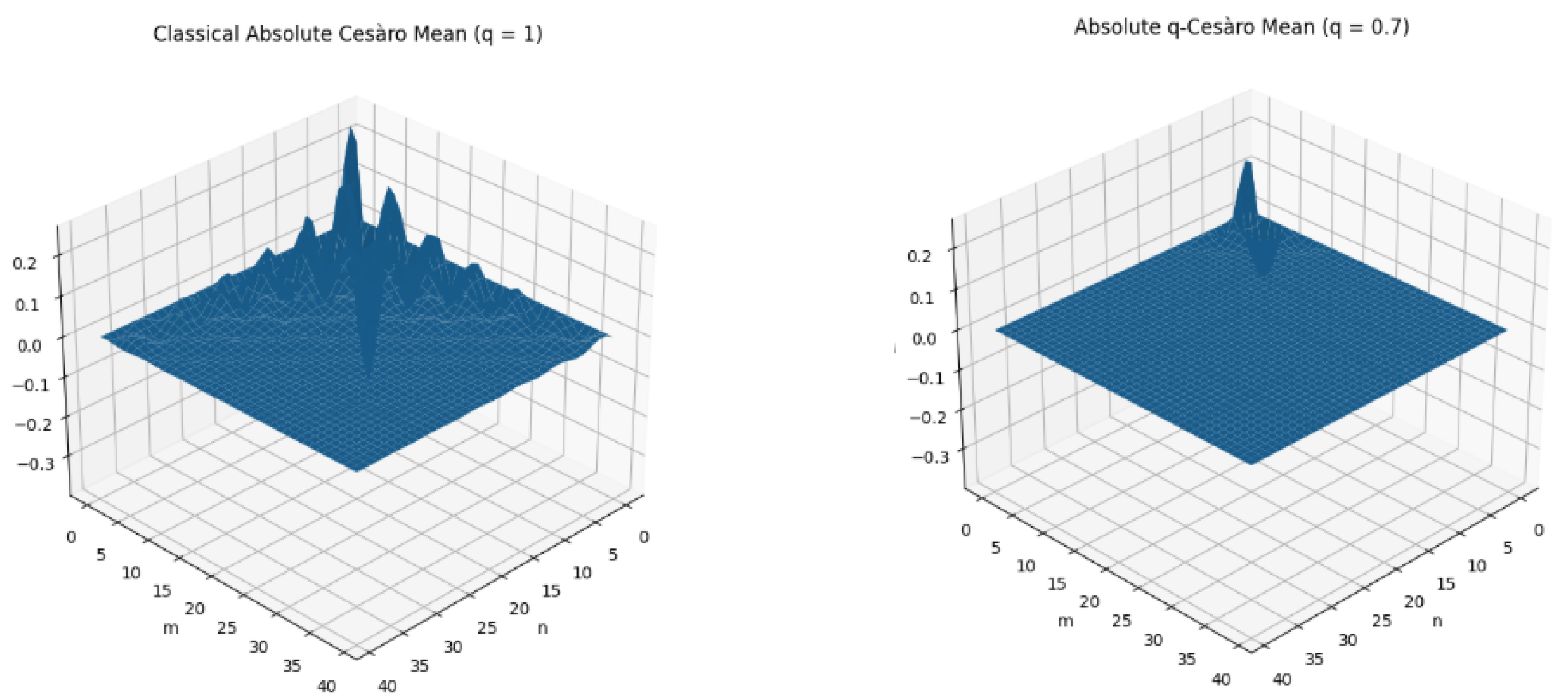
Figure 2 illustrates the surface plot of this sequence. The slow decay combined with alternating signs makes it a suitable candidate for testing the effectiveness of absolute summability methods for double sequences.
Also, the sequence
models a two-dimensional oscillatory signal with exponential damping, which naturally arises in signal processing, numerical solutions of partial differential equations, and surface data analysis.
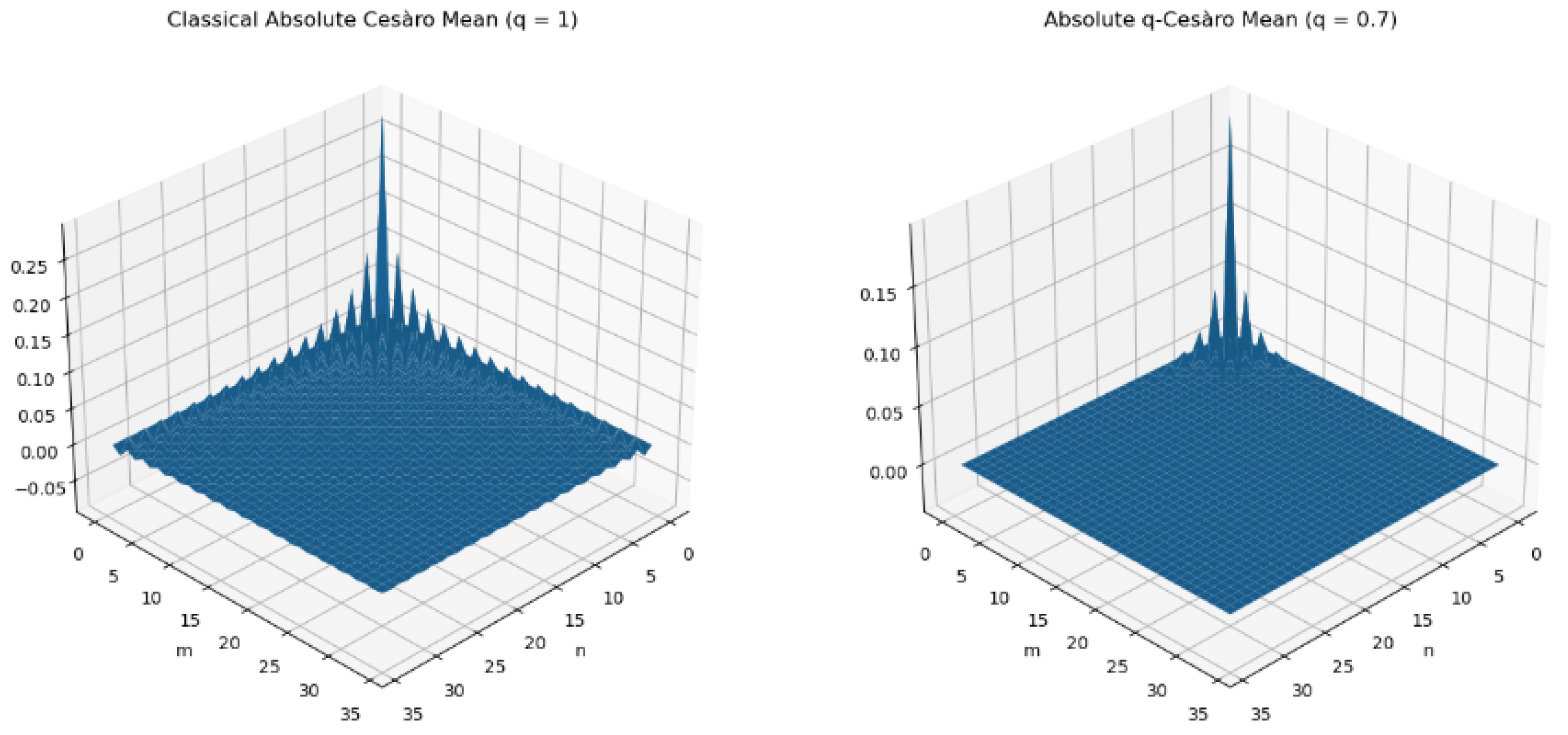
Figure 3 presents the surface plot of this sequence, revealing oscillations along both indices combined with gradual decay. Such structures are typical in engineering applications where stabilization and convergence acceleration are required.
The corresponding graphical representations of their classical absolute Cesàro means
and absolute
q-Cesàro means
are displayed in
Figure 2 and
Figure 3. As observed from the
Figure 2 and
Figure 3, while the classical Cesàro method partially reduces oscillations, it fails to provide sufficient stabilization for highly oscillatory or slowly decaying two-dimensional data. In contrast, the absolute
q-Cesàro means associated with
and
exhibit a significantly stronger damping and smoothing effect, leading to faster convergence toward the limiting behavior.
From an applied perspective, double sequences naturally arise in engineering contexts such as two-dimensional signal processing, image reconstruction, and spatial filtering. In these settings, the deformation parameter q acts as a tunable regularization mechanism, enabling a refined balance between smoothing effects and fidelity to the original data. While the q-analogue introduces higher algebraic complexity compared to classical analysis, this structure provides an adaptive weighting mechanism that is particularly effective for stabilizing sequences with non-uniform fluctuations. By selecting q based on the oscillatory nature or decay rate of the data, one can achieve an optimal balance between convergence acceleration and data fidelity, offering a level of optimization that traditional uniform-weighting methods cannot provide.
Let us start by giving some lemmas to be used in the proofs of the theorems and note that is used instead of for simplicity in notation throughout the paper.
Lemma 1 ([
24]).
Let and be a four-dimensional infinite matrix of complex numbers. Then, if and only if Lemma 2 ([
25]).
Let and be a four-dimensional infinite matrix of complex numbers. Define and by where M and N are finite subsets of natural numbers. Then, the following statements are equivalent: 3. Main Result
In this section, the absolute q-Cesàro summability method for double sequences if first defined, and then the relationship between the methods is examined.
As a first step, let us substitute
q-Cesàro matrix for
in (
1); then
summability method becomes the absolute
q-Cesàro summability. To put it more clearly, take
which is a sequence of partial sum of
. So, we have
and so, we get for all
So, if
the double series
is summable by the method
. Additionally, taking into account the sequence
, it is clear that a sequence
is summable by
if and only if
where, for
,
With a few calculations, the inverse transformation of
is immediately obtained for
,
Here and throughout the whole paper, indicates the conjugate of s, i.e., for , and for . Also, it is straightforward to observe that, in the cases and , some of the terms become zero and, therefore, some terms in the given equations disappear.
At this stage, it should be noted that in the case of
and
for all
, the summability method
is reduced to the well-known classical absolute Cesàro method
[
22].
On the other hand, it is also worth noting that the introduced absolute q-Cesàro summability method for double sequences naturally embeds the conditions of single-indexed absolute q-summability. If one of the indices is held constant for instance, by fixing , the double sequence reduces to a single-indexed slice sequence . Under this restriction, the summability conditions of for the double sequence simplify to the requirements of the absolute q-Cesàro summability for single series, as established. This structural consistency ensures that the results obtained in this study are not only extensions but also compatible analogues of the single-indexed framework, where the joint variation of the double sequence includes the individual variation of its row and column sections.
In view of this structural consistency, the main theorems presented below encapsulate a wide range of results regarding these relations when specific choices of parameters and weight sequences are made. Notably, the general characterizations established herein not only provide novel insights for double sequences but also encompass reduced forms that address existing gaps in the literature concerning the absolute q-Cesàro summability of single sequences. Consequently, our findings offer a comprehensive and unifying framework for both classical and q-deformed summability structures, where the established necessary and sufficient conditions serve as a foundation for various special cases.
Theorem 1. is a four-dimensional infinite matrix of complex components. if and only if the following condition holds: Proof. Assume that the condition (
3) holds. It should be shown that
whenever
. So, with condition (
3), the following can be written:
This concludes the first part of the proof. To prove the second part of the theorem, let us take
. Since
and
are two Banach spaces [
21], it can be written that there exists a constant
M such that
or, to put it more clearly,
for all
. If we take the sequence
whose terms are given by
otherwise
, as a special choice for
, we get
for all
, that is,
which completes the proof. □
Lemma 3. Let and let be a doubly infinite matrix. In order for the condition (3) is necessary. Proof. It is clear that . If , then A is also in the matrix class . So, together with Theorem 1, the proof is completed. □
Theorem 2. Let , and be two double sequences for positive numbers. Every series summable by the method is also summable by the method , i.e., , if and only ifwhere Proof. Let and be the double sequences of and means of the series , respectively.
Assume that the series
can be summable by the method
. Using the inverse transformation of
given by (
2), it is obtained that for all
,
So, it is written that
where
Thus, it can be easily written that
whenever
or equivalently, the matrix
A belongs to the matrix class
. On the other hand, if the series can be written as a telescopic series as follows
and analyzed separately according to the states of
p, then a sum for each state is found
Taking into consideration this result, if Lemma 2 is applied to matrix
A, the conditions (
4)–(
7) are obtained. This completes the proof. □
Theorem 3. Let , and be two double sequences for positive numbers. Every series summable by the method is also summable by the method , i.e., , if and only if Proof. Let
and
be the double sequences of
and
means of the series
, respectively, as in the Theorem 2. From the Equation (
2), it is obtained that for all
,
where
It can be immediately written that
whenever
and also the matrix
. With Lemma 1, the conditions (
8)–(
11) are obtained. □
Corollary 1. Let and and be two double sequences for positive numbers. if and only if the conditions (3)–(10) hold.
Theorem 4. Assume that and and are two double sequences for positive numbers. In order for every series summable by the method to also be summable by the method , i.e., , the conditions are necessary. Additionally, if the conditions (12) andhold, it is said that . Proof. Let and be the double sequences of and means of the series , respectively. Also, assume that the series is summable by the methods .
At this step, with a few calculations, the following is immediately obtained
where
It is clear that the matrix
. So, with Lemma 3, the conditions (
12)–(
15) are obtained. On the other hand, by Minkowsky inequality, it is obtained that
If
,
, then
or equivalently,
. So, using (
12) and (
16)–(
18), we have
. Hence, the proof is completed. □
Corollary 2. Let , be a double sequence for positive numbers. Every series summable by the method is also summable by the method , i.e., if and only if Corollary 3. Let , be a double sequence for positive numbers. Every series summable by the method is also summable by the method if and only ifwhere Example 1. To evaluate the efficiency of the proposed method, we consider the following rapidly oscillating double sequence, which serves as a model for high-frequency fluctuations in discrete signal processing: The alternating signs make this sequence inherently unstable and non-absolutely summable in the classical sense. For , the initial terms of the sequence , its classical absolute Cesàro transformation , and the proposed absolute q-Cesàro transformation (for ) are computed as follows: Numerical results confirm that the proposed q-analogue method achieves a significantly faster stabilization rate than the classical operator. Specifically, at the index , the q-Cesàro value (0.0035) is approximately 27 times smaller than the classical result (0.0970), effectively dampening the oscillations. As illustrated in the algorithmic framework (Figure 4), this stabilization is governed by the structural constraints (parameters ) derived in our main theorems. These constraints act as a formal regulatory layer that ensures absolute convergence, thereby validating the practical utility of our theoretical results. 4. Conclusions
In the present study, the necessary and sufficient conditions regarding the inclusion relations between the absolute q-Cesàro summability methods have been established and analyzed in the context of double series. The use of the q-analogue provides a generalized and more flexible approach that extends classical summability methods. The results not only generalize several known findings in the literature but also yield new insights and special cases, thereby enhancing the understanding of summability behavior under q-deformed structures.
Compared to classical Cesàro summability methods, the proposed q-Cesàro framework offers a more flexible and powerful structure by incorporating the deformation parameter q. This feature enables finer control over the convergence behavior of divergent or slowly converging sequences.
In particular, we demonstrated via a numerical illustration that the absolute q-Cesàro method accelerates convergence more effectively than classical methods when applied to oscillatory sequences. This observation, rooted in the adaptive convergence control provided by the q-parameter, suggests that the method offers a robust framework for multidimensional data analysis. Such an approach is particularly valuable in two-dimensional signal processing, image reconstruction, and the numerical treatment of q-difference equations, where preserving structural integrity while reducing irregularities is essential. Thus, the presented results may serve as a comprehensive mathematical foundation for future interdisciplinary applications involving discretized surfaces.
Furthermore, the results established in this study offer a significant contribution to the unifying nature of summability theory. By establishing necessary and sufficient conditions for , we have provided a framework that not only generalizes double sequence spaces but also encapsulates classical single-indexed summability as a special case. As demonstrated throughout the characterizations, when the double sequence is restricted to its slice components and the q-parameter is taken to the limit , our findings are in complete alignment with the well-known inclusion theorems for absolute Cesàro summability . This bridge between single and double sequence spaces emphasizes that the method is a robust and comprehensive tool, capable of addressing both classical and q-deformed structures within a single, integrated theoretical approach.
Future research may extend this framework to double sequences, modular sequence spaces, or generalized Orlicz spaces. Moreover, the interplay between q-summability and statistical convergence or approximation theory could be a rich direction to explore. Additionally, the summability method could be applied to interdisciplinary applications such as noise reduction, signal filtering, or compressed data reconstruction, where preserving essential structure while reducing irregularities is critical.