1. Introduction
The structure of finite-dimensional quadratic spaces has been a central topic in the theory of quadratic forms since the foundational works of O’Meara [
1] and Lam [
2]. A cornerstone of the theory is Witt decomposition, which expresses every regular quadratic space as an orthogonal sum of hyperbolic planes and an anisotropic component. In particular, it is well known that every finite-dimensional regular quadratic space admits an orthogonal basis [
1].
Beyond orthogonality, however, other geometric configurations have received comparatively little attention. One such configuration is given by the
tangency condition
which is equivalent to the vanishing of the Gram determinant of
. Geometrically, this condition corresponds to a rank-one degeneracy and arises naturally in classical geometry, for instance, in the theory of conics and tangent lines. From the algebraic point of view, it describes a precise form of quadratic dependence between two nonzero vectors.
While isotropic vectors and hyperbolic planes play a fundamental role in the classical structure theory, the systematic study of bases formed by mutually tangential vectors appears to be largely unexplored. Recent algorithmic approaches have investigated the anisotropic part of quadratic forms [
3,
4], but the existence and explicit construction of tangential or isotropic bases have not been treated in a unified and constructive manner.
The purpose of this paper is to investigate the following problems:
Under what structural conditions does a finite-dimensional regular quadratic space admit a basis consisting of mutually tangential vectors?
When can such a basis be chosen to be normalized or anti-normalized?
Under what circumstances can a basis be composed entirely of isotropic vectors?
Our approach is constructive. Using vectorial determinant techniques, we develop explicit formulas for generating vectors that are orthogonal or tangent to a prescribed family. Although reminiscent of the classical Gram-Schmidt process [
5], the method operates in arbitrary regular quadratic spaces over fields of characteristic different from 2, and it relies fundamentally on the behavior of Gram determinants.
The main results show that the existence of tangential bases is governed by the presence of hyperbolic components in the Witt decomposition. In particular, we prove that regular quadratic spaces of positive index admit normalized or anti-normalized tangential bases and establish criteria that link their existence to the structure of the anisotropic complement. We also analyze the hyperbolic case and formulate conjectures concerning the non-existence of certain tangential configurations.
These results provide a new geometric perspective on quadratic spaces, complementing both the classical structure theory [
1,
2] and recent algorithmic developments [
3,
4,
6].
2. Preliminary Facts
For the sake of simplicity and convenience to the reader, we will begin this section with some basic and necessary concepts for understanding this work.
Definition 1 (See [
5], 6.2)
. Let V be a vector space over a field . A symmetric bilinear form on V is a bilinear mapsatisfying, for all and :- 1.
;
- 2.
;
- 3.
.
In what follows, we write instead of . A quadratic space is a vector space V equipped with a symmetric bilinear form. We say that V is regular if the associated bilinear form is non-degenerate.
Definition 2. Let be a vector in a quadratic space V. Then, the following apply:
A subspace S of V is totally isotropic if for all .
Definition 3. Let V be a finite-dimensional quadratic space. The index of V, denoted , is the maximal dimension of a totally isotropic subspace of V. Thus, if and only if V is anisotropic.
Given a basis of V, the Gram matrix of is the is the matrix , and its determinant is denoted by .
Two vectors
are called
orthogonal if
and
tangent if:
Algebraically, this condition characterizes the degeneracy of the Gram matrix of , and thus encodes a rank-one interaction between the vectors.
The following classical theorems will be used throughout this paper. Proofs may be found in [
1].
Theorem 1 (See [
1], Theorem 42.1)
. Every finite-dimensional quadratic space admits an orthogonal basis. Theorem 2 (See [
1], Theorem 42.2–4)
. Let V be a finite-dimensional quadratic space. The following statements are equivalent:- 1.
V is regular;
- 2.
V has an orthogonal anisotropic basis;
- 3.
For every basis of V, .
- 4.
There exists a basis of V such that .
For any subset
, define the orthogonal complement of
A as
It is well known that is a subspace of V.
Theorem 3 (See [
1], Theorem 42.6)
. If is any subspace, then: Corollary 1. If V is regular, then for every subspace , we have Definition 4. A quadratic space V is a hyperbolic plane if the following apply:
- (i)
;
- (ii)
V is regular;
- (iii)
V contains a nonzero isotropic vector.
Theorem 4 (See [
1], Theorems 42.7–42.9)
. If V is a hyperbolic plane, then there exist bases , such that- (i)
, , .
- (ii)
, .
Definition 5. A quadratic space V is a
hyperbolic space if there exist hyperbolic planes such that In this case, V is regular and is even.
Theorem 5 (See [
1], Theorems 42.10–11)
. Every regular quadratic space V of dimension n and index s admits an orthogonal decomposition:where H is a hyperbolic space of dimension and U is an anisotropic subspace of dimension . 3. Tangency and Orthogonality
The concepts of orthogonality and tangency are traditionally studied in the context of inner product spaces, yet the extension of tangency to general quadratic spaces is not well documented in the literature. This section provides determinant-based constructions for vectors that are either orthogonal or tangent to a given family.
The vectorial determinant construction used here generalizes ideas from multilinear algebra ([
5], Ch. 8) to the setting of quadratic forms.
Let
V be a vector space over a field
. A vectorial determinant is an expression of the form
where
and each
, for
,
. The determinant is developed along the first row, so we can write:
where
is the cofactor of the
i-th entry in the top row of the associated scalar matrix
where
for each
.
Theorem 6 (Orthogonality via Vectorial Determinant). Let V be a regular, a basis, and linearly independent. Define Then
- 1.
;
- 2.
for ;
- 3.
.
Proof. Since
are linearly independent and
V is regular, their Gram matrix
is nonsingular; hence
.
By construction, v is defined as a vectorial determinant whose coefficients are minors of the matrix formed by the scalar products . If , then all these minors would vanish, which would imply that the rows corresponding to the vectors are linearly dependent. This contradicts the nonsingularity of . Hence .
Fix
. Taking the scalar product of
v with
amounts to replacing the first row of the defining determinant by
But this row already appears among the remaining rows of the matrix. Therefore, the determinant has two identical rows, and by alternating multilinearity, it vanishes. Thus
- (3)
Computation of
.
To compute
, we expand the vectorial determinant in the basis
. Using bilinearity of the scalar product and the Cauchy-Binet formula, one obtains
This follows from the fact that the construction of v is precisely the classical adjugate-type expression for a vector orthogonal to , and the quadratic norm is governed by the product of the two Gram determinants.
This completes the proof.
□
Corollary 2. The family is orthogonal to an anisotropic vector if and only if .
Theorem 7 (Construction of Tangent Vectors). Let V be a finite-dimensional regular quadratic space over a field , and Let be a basis of V. Let be scalars and definewhere is a root of the polynomialLet . Then, the following apply: for each ;
;
.
In particular, if , then the vector v is tangent to each of the vectors .
Proof. - (1)
Computation of
for .
By bilinearity of the scalar product and the definition of the vectorial determinant, taking the scalar product of
v with
amounts to replacing the first row of the defining determinant by
Expanding along the last column (the column containing
), all entries vanish except the one corresponding to
. Hence the Laplace expansion yields
- (2)
Computation of
.
The same argument applies when taking the scalar product with
. In this case the only nonzero contribution in the Laplace expansion comes from the entry
in the last row, giving
- (3)
Computation of
.
To compute
, consider the determinant
Substituting the expressions obtained in Equations (1) and (2), the first row becomes
Factoring
from that row, the determinant becomes
Expanding again along the last column and using the defining condition
, we obtain
This completes the proof.
□
From the previous theorem, we can obtain the following two corollaries.
Corollary 3 (Roots of the Tangency Polynomial). Let be a vector such that for all , and define the symmetric matrix:and the row vector . Then the roots of the polynomial from Theorem 7 areThese roots lie in if and only if there exists such that . Proof. We compute the determinant defining
by expanding along the last row. The expansion yields
where
S is the determinant of
Let
. Subtracting from the first row the linear combination
, we obtain
Substituting into the expression for
, we get
Solving
, we find
□
Corollary 4 (Number of Tangent Vectors). Assume that for each , the scalar satisfies . Then there exist at most choices for the sequence , and consequently, at most distinct vectors tangent to the family .
Furthermore, if and the vector is such that for all , and with , then the number of linearly independent tangent vectors to is as follows:
Two, if ;
One, if ;
None, if .
In this case, the tangent vector v constructed in Theorem 7 has the form: Proof. Each must satisfy , which admits exactly two square roots in an algebraically closed field (or at most two in , one if zero). Thus, there are possible sequences for .
In the real case , the number of real roots of the tangency polynomial depends on the sign of the discriminant:
If , has two real roots.
If the expression equals zero, we have a double root (one solution).
If the expression is negative, has no real roots, and hence no tangent vector exists.
This completes the proof. □
4. Tangential and Anisotropic Bases
We begin by introducing terminology regarding the normalization of bases in quadratic spaces.
Definition 6. Let V be a quadratic space of dimension n. A basis is said to be as follows:
The following result provides sufficient conditions for the existence of a normalized (or anti-normalized) tangential basis in certain regular spaces.
Theorem 8. Let V be a regular quadratic space over with . Then V admits a tangential basis that is either normalized or anti-normalized.
Proof. By Theorem 5,
V decomposes as
where
, and each
, while
(we assume
since
V is regular over
).
Define the following:
It is straightforward to verify the following:
Thus, the set
is a tangential basis of
V, normalized if
and anti-normalized if
. □
Before generalizing this theorem, we need the next lemma.
Lemma 1 (Auxiliary). Let be a real number, and let be an anisotropic quadratic space over , for each (positive case) or (negative case) for all i. Suppose are linearly independent vectors such that the following apply:
for ;
(positive case), or (negative case).
Then there exists a vector such that the family is linearly independent and the following apply:
, , in the positive case;
, , in the negative case.
Proof. Let
such that
for each
and
, (
in the positive case and
in the negative case). Let
We see that
Hence
Since
, we conclude that
. Then, if
is the vector we were looking for. In the negative case we have
for each
and
Clearly since . Therefore, . Defining , the vector satisfies and for each . □
The next theorem is the most important result of this paper.
The idea of the proof is to construct a tangential basis on a maximal regular subspace and then extend it to the full space by carefully controlling the interaction with the anisotropic component.
Theorem 9. Let V be a regular quadratic space over with and . Then V admits a tangential basis which is either normalized or anti-normalized.
Proof. Let
. By Witt decomposition,
V splits orthogonally as
where each
is a hyperbolic plane and
according to the signature.
Consider the non-degenerate subspace
Since
and
, Theorem 8 ensures that
admits a normalized (or anti-normalized) tangential basis.
The remaining summand
is anisotropic. By Lemma 1, we may construct vectors
in
W whose scalar products satisfy the required tangency relations relative to a fixed vector in
.
Choose a vector
compatible with the tangential structure constructed in Step 1. Then the family
forms a basis of
V.
Orthogonality of the Witt decomposition guarantees that the only nontrivial scalar products arise within and within the constructed combinations . By construction and by Lemma 1, all required Gram determinants of pairs vanish, so the vectors are mutually tangent. Moreover, the normalization (or anti-normalization) property is preserved.
Hence, V admits a tangential basis that is normalized or anti-normalized. □
We conclude this section by presenting an explicit example in dimension 4, corresponding to the minimal case of positive index, which concretely illustrates the existence of a tangential basis predicted by Theorem 9.
Example 1 (Dimension 4)
. Consider the quadratic space withwhose Gram matrix is . Then and .Each vector is isotropic since . Moreover, the family forms a basis of .
Because for all i, the tangency conditionholds for every pair. Hence this is a tangential basis in dimension 4. The following theorem gives us the necessary and sufficient conditions for a quadratic space to have a tangential base.
Theorem 10 (Tangency Inheritance in Direct Sums). Let , where is a regular subspace. Then V admits a tangential basis if and only if U does.
Proof. Suppose
and
. Suppose
V has a tangential basis
, every
can be written in the form
,
and
. We claim the vectors
generate
U. Indeed, if
is arbitrary, we have scalars
such that
Therefore,
. Since
, we have
as was to be proved. Therefore, a subfamily of
with
n elements is a basis for
U, say
. Observe now,
Therefore,
is a tangential basis
U.
Suppose now that
U has a tangential basis
. Let
be a basis for
. Denote
, for each
. We calculate
and
:
Since
,
is a tangential basis for
V. □
Example 2. Let be a field of characteristic and let .
V is a regular space of dimension 4. If , then V has index 1, but if , V has index 2. If , we can establish a one-to-one correspondence between subspaces of V of the form , and circles in the plane . represents a real circle if and only if and . Orthogonality and tangency between vectors correspond here to orthogonality and tangency between circles as usually defined in Euclidean geometry.
We will finish this work with the definition of isometries.
Definition 7. Two quadratic spaces over the same field are isometric if there exists an isomorphism such that for each pair of vectors . Such mapping ψ is called an isometry between and .
The following theorem will be very useful for our purposes; its proof can be consulted in detail in ([
1], Theorem 42.16).
Theorem 11. Let U and V be isometric regular subspaces of a quadratic space W. Then and are isometric too.
The problem of the existence of an isotropic basis of a regular space V over the field of real numbers is solved with the following theorem.
Theorem 12 (Existence of Isotropic Bases). Let V be a regular quadratic space over , with index . Then V admits an isotropic basis.
Proof. If V is a hyperbolic space and we keep the notation of Theorem 8, it is clear that is the desired basis. Suppose now that . Let us consider the extension where for each . By Theorem 10, has a tangential basis where or for each . We define the vectors , where and the is taken if and the is taken if . It is clear that every is isotropic and .
Since the subspaces and of are isometric, Theorem 11 implies that their orthogonal complements are isometric too. Therefore, is isometric to and V has an isotropic basis. □
Corollary 5. If , U is regular and , then V has an isotropic basis.
Proof. By Theorem 12, U has an isotropic basis . If any basis of , then is an isotropic basis of V. □
5. Examples and Applications
The following are some representative examples that illustrate the construction and use of tangential and anisotropic bases in different analytical and geometric contexts.
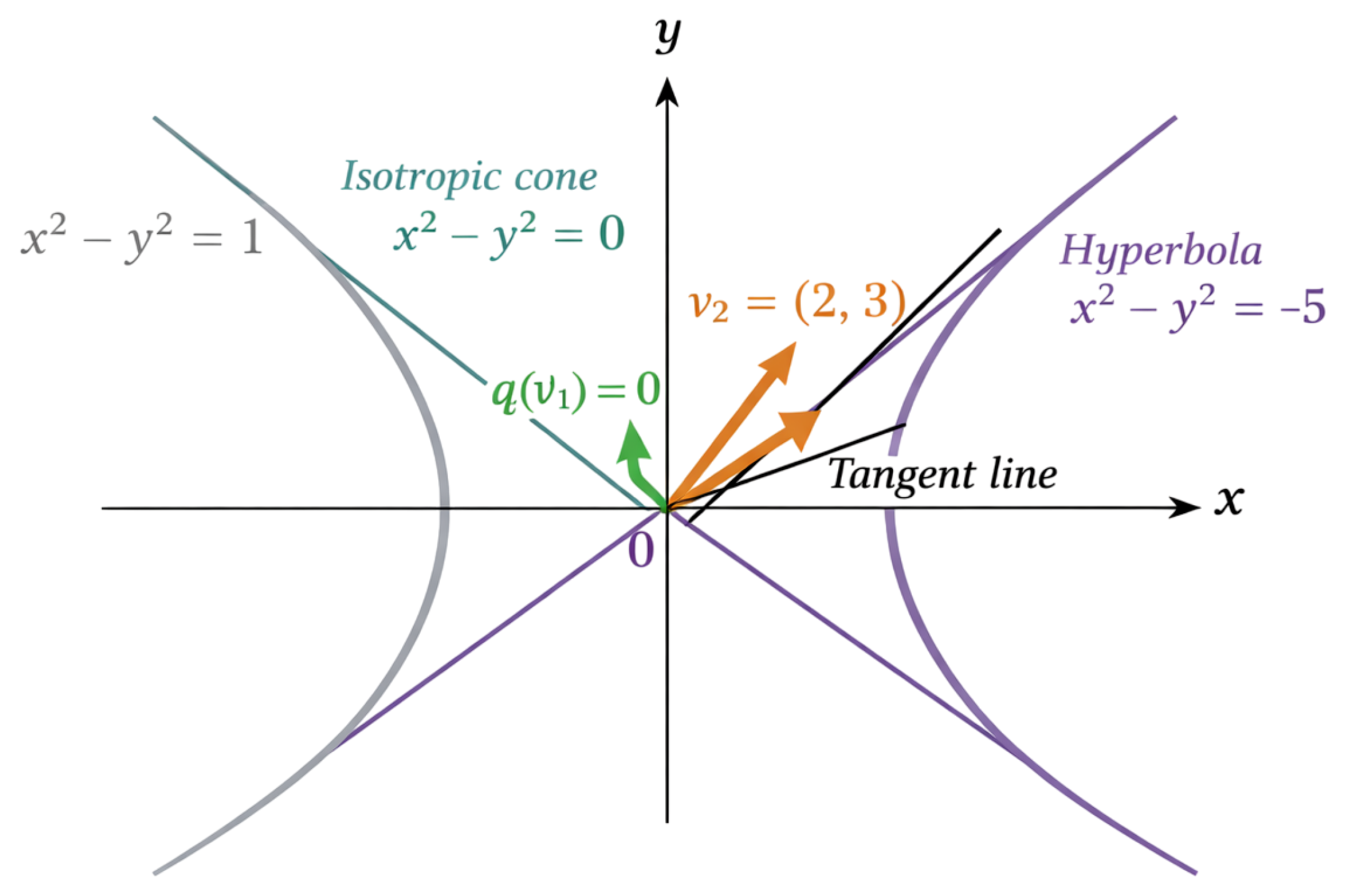
Example 3 (Tangential bases in a two-dimensional quadratic space). Let endowed with the quadratic formand associated bilinear formThen V is a regular quadratic space of dimension 2 and index 1. Consider first the standard orthogonal basis This basis reflects the classical orthogonal decomposition of V, but it does not exhibit any tangential interaction.
A direct computation shows that Although the vectors are neither orthogonal nor both anisotropic, they satisfy the tangency conditionHence, and are tangent vectors in the sense of Definition (1). Since is linearly independent, it forms a tangential basis of V. This example illustrates that, even in the lowest nontrivial dimension, tangential bases differ fundamentally from orthogonal ones and may involve isotropic vectors.
Geometrically, the vectors and lie on the light cone defined by and on a time-like branch of the hyperbola , respectively, meeting the tangency condition algebraically encoded by the quadratic form. See Figure 1. The next example illustrates that, even in the presence of an orthogonal basis, one may construct a tangential basis exhibiting a radically different geometric structure, involving both isotropic and anisotropic vectors.
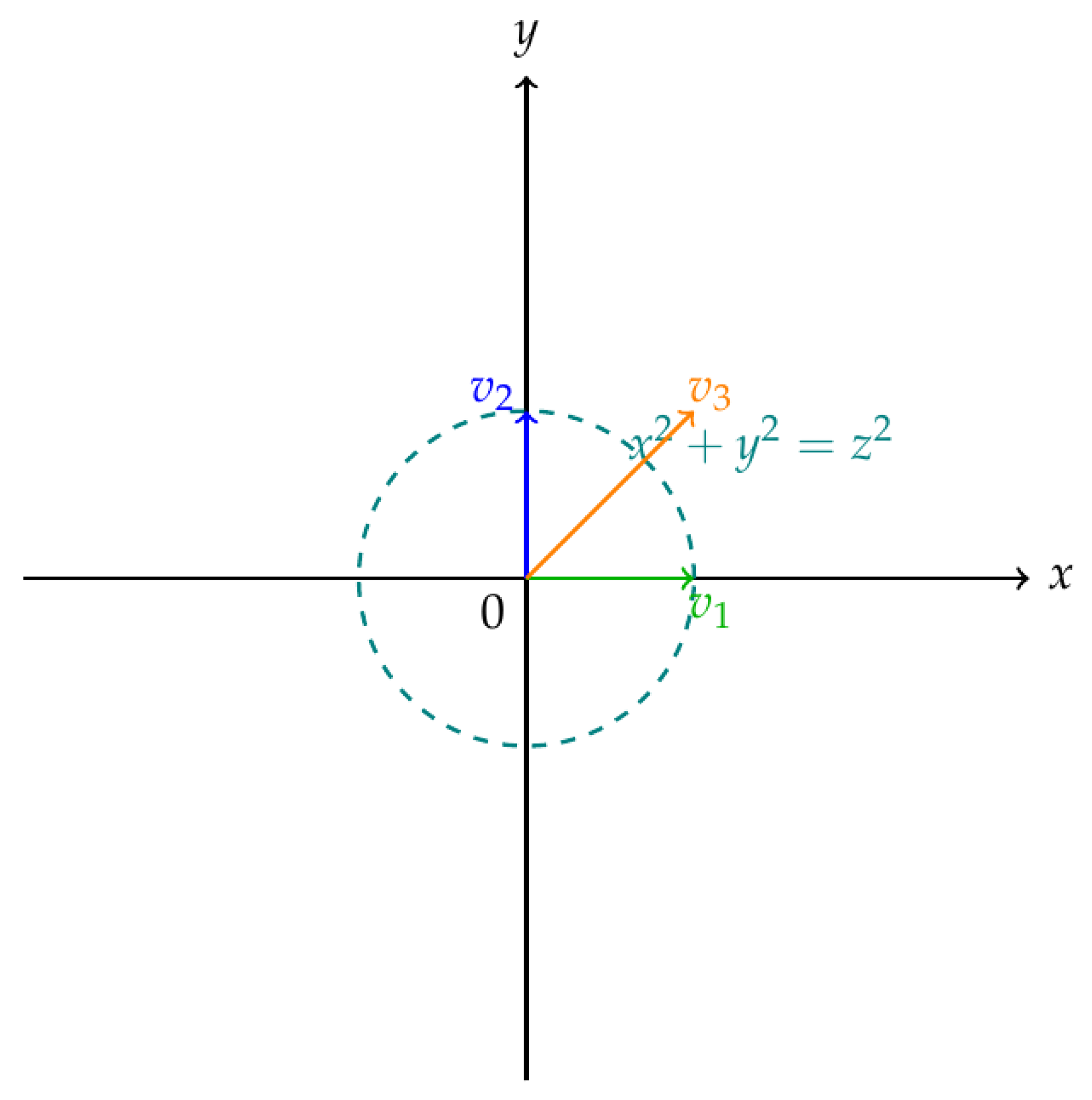
Example 4 (Tangential bases in a three-dimensional quadratic space). Let endowed with the quadratic formand associated bilinear formThen V is a regular quadratic space of dimension 3 and index 1. The standard basisis orthogonal, with This basis reflects the classical orthogonal decomposition , but does not capture any tangential interaction.
A direct computation yieldsand Therefore, the vectors, and are isotropic and tangent to each other, while is anisotropic and tangent to both and (See Figure 2). Since is linearly independent, it forms a tangential basis of V.
Figure 2.
Projection of a tangential basis in the quadratic space onto the plane . The circle represents the isotropic cone, while and are isotropic and tangent to the anisotropic vector .
Figure 2.
Projection of a tangential basis in the quadratic space onto the plane . The circle represents the isotropic cone, while and are isotropic and tangent to the anisotropic vector .
The following examples are intended to illustrate potential geometric interpretations of tangency in applied settings, rather than to provide a complete application framework.
Example 5 (Reproducing kernel Hilbert spaces and anisotropic geometry). Let be a nonempty set and letbe a positive definite kernel. Denote by the reproducing kernel Hilbert space (RKHS) associated with K. For each , define the feature vectorBy the reproducing property, the inner product in satisfiesConsider the anisotropic Gaussian kernelwhere is a symmetric positive definite matrix. The matrix A induces different scales and preferred directions in the feature space .
Let be two data points such that Then the corresponding feature vectors and satisfyand are therefore tangent vectors in the quadratic space . This condition expresses a perfect alignment between feature representations, reflecting a strong geometric dependence between the data points along the anisotropic directions determined by A.
Problem 1. Let be a dataset consisting of two classesand consider the anisotropic Gaussian kernelwhereAssume that differ mainly in the second coordinate, while differs primarily in the first coordinate: - (a)
Show that for sufficiently large , - (b)
Interpret this result in terms of tangential vectors in the reproducing kernel Hilbert space .
- (c)
Explain the effect of this phenomenon on the margin of a support vector machine trained with the kernel .
Similar effects of anisotropic kernel design on the geometry of feature spaces have been observed in margin-based learning algorithms; see, for instance [
7].
5.1. Applications to Machine Learning
The theory of reproducing kernel Hilbert spaces provides the mathematical foundation of many kernel-based learning algorithms, including support vector machines and kernel principal component analysis [
7]. In this framework, kernels induce implicit feature maps into (possibly infinite-dimensional) Hilbert spaces, where geometric properties of the data become accessible through inner products.
Anisotropic kernels, which assign different weights to distinct directions in the data space, have been extensively studied in the context of metric learning and adaptive kernel design. The present example shows that such anisotropy may also be interpreted geometrically in terms of tangential phenomena in the associated reproducing kernel Hilbert space.
Anisotropic Kernels and Tangential Effects in RKHS
Let
be a dataset and let
be an anisotropic Gaussian kernel, where
A is a symmetric positive definite matrix. Denote by
the associated reproducing kernel Hilbert space and by
the canonical feature map.
Problem 2. Consider two data points such that their difference lies predominantly in a direction weakly weighted by A. Show that, as the anisotropy ratio of A increases,and interpret this limit in terms of tangential vectors in . Proposition 1 (Geometric interpretation). Under the assumptions of Problem 2, the feature vectors and become asymptotically tangential in the quadratic space .
Consequently, the effective dimension of the span Proof. By the reproducing property,
Since
for all
i, the claim follows directly from the limiting equality
which is precisely the tangency condition. □
Remark 1 (Implications for learning algorithms). From the viewpoint of kernel methods [8], tangential collapse corresponds to a degeneration of the Gram matrix and reflects a loss of effective dimensionality in the feature space. 6. Conclusions
In this paper, we have established new theoretical results concerning the existence and construction of tangential and anisotropic bases in finite-dimensional quadratic spaces over fields of characteristic different from 2. Our work builds upon the classical foundations laid out by O’Meara [
1] and Lam [
2], as well as recent algorithmic developments in the theory of quadratic forms over number fields [
3,
4].
Specifically, we performed the following:
These results provide new tools for understanding how geometric properties such as tangency and isotropy manifest within the algebraic structure of quadratic forms. The methods introduced are constructive and may be applicable in algorithmic settings, complementing existing approaches in symbolic computation and algebraic geometry [
3,
4].
Although we have provided affirmative answers in several cases, important questions remain open. In particular, we pose the following:
Problem 3. If V is a regular quadratic space over of arbitrary finite dimension, then it does not admit a tangential basis unless its index is strictly positive.
Problem 4. No hyperbolic space over , admits a tangential basis.
These conjectures align with the structural rigidity observed in the decomposition of regular spaces into hyperbolic and anisotropic parts, as characterized in ([
1], Thm. 42.10–42.11). If true, they imply the following refinement:
In the context of geometric representation, our results have a concrete interpretation. For instance, in Example 2, the correspondence between quadratic forms and circles in
suggests that tangency between vectors corresponds to Euclidean tangency between circles. This reinforces the idea also hinted at in [
2] that certain algebraic conditions reflect deeper geometric relationships.
Therefore, the concept of tangency in quadratic spaces is not merely formal; it has rich interpretative value in both pure mathematics and applications, such as geometry, physics, and even machine learning (where inner product structures appear in kernel methods). Future investigations might explore these connections more deeply, possibly using the computational techniques proposed in [
3,
4,
5,
6].