From Layout to Data: AI-Driven Route Matrix Generation for Logistics Optimization



Abstract
1. Introduction
2. Materials and Methods
2.1. Systematic Literature Review
2.2. Research Objectives
3. Results
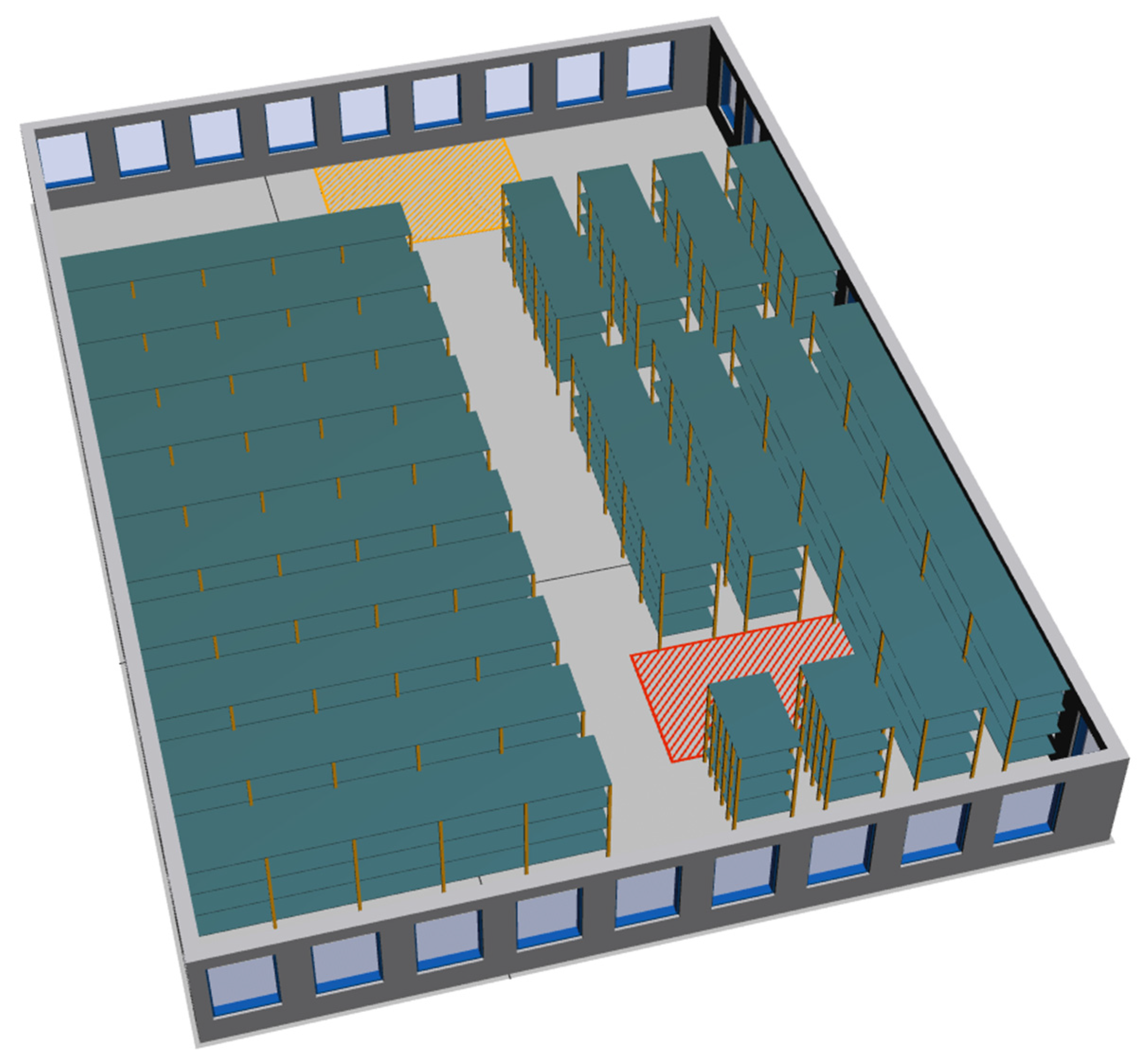
3.1. Layout Generation
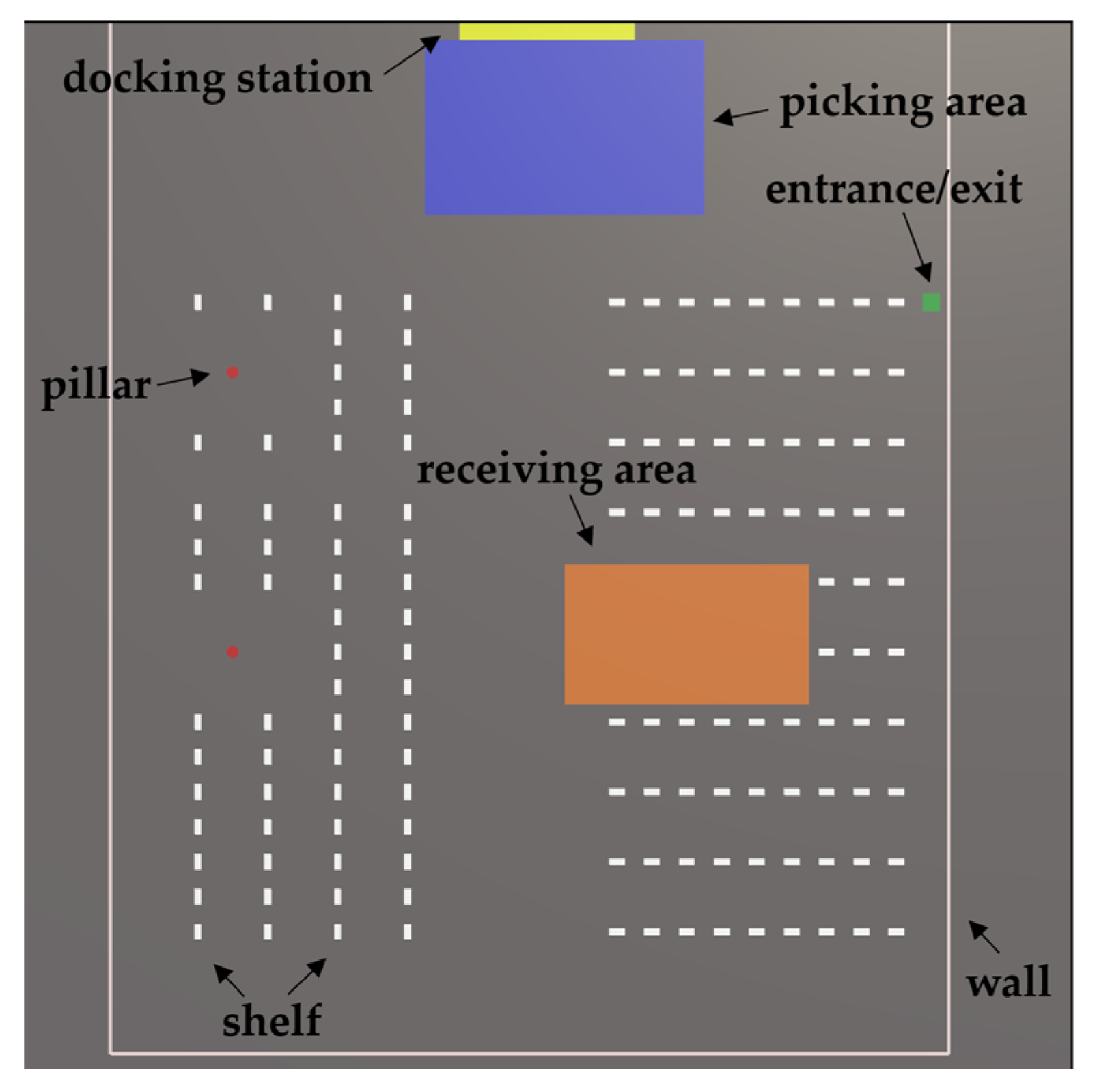
- wall: the object surrounding the warehouses, its purpose is to enclose and close off the area;
- shelf: the main element of the warehouse, the storage location for materials; this object is the main element of optimization, as the route must reach the shelves;
- pillar: a fundamental obstacle in the warehouse that must be avoided during the route;
- receiving area: the place where received products are stored before storage; it does not have an important role in the optimization process;
- picking area: the picking point, which serves as both the starting and ending location of the optimized route, thereby formulating the TSP;
- entrance/exit: an important element of the layout, but not relevant in optimization
- docking station: an important element of the layout, but not relevant to optimization.
3.2. Image Segmentation
3.2.1. Problem Formulation
- The model converts the input image into structured spatial data, resulting in a discrete grid whose values represent objects and whose size is determined by the size of the grid’s rows and columns:
- Due to the transformation, the input and output dimensions are not equal.
- Network parameterized mapping with learned weights:
3.2.2. Model Selection
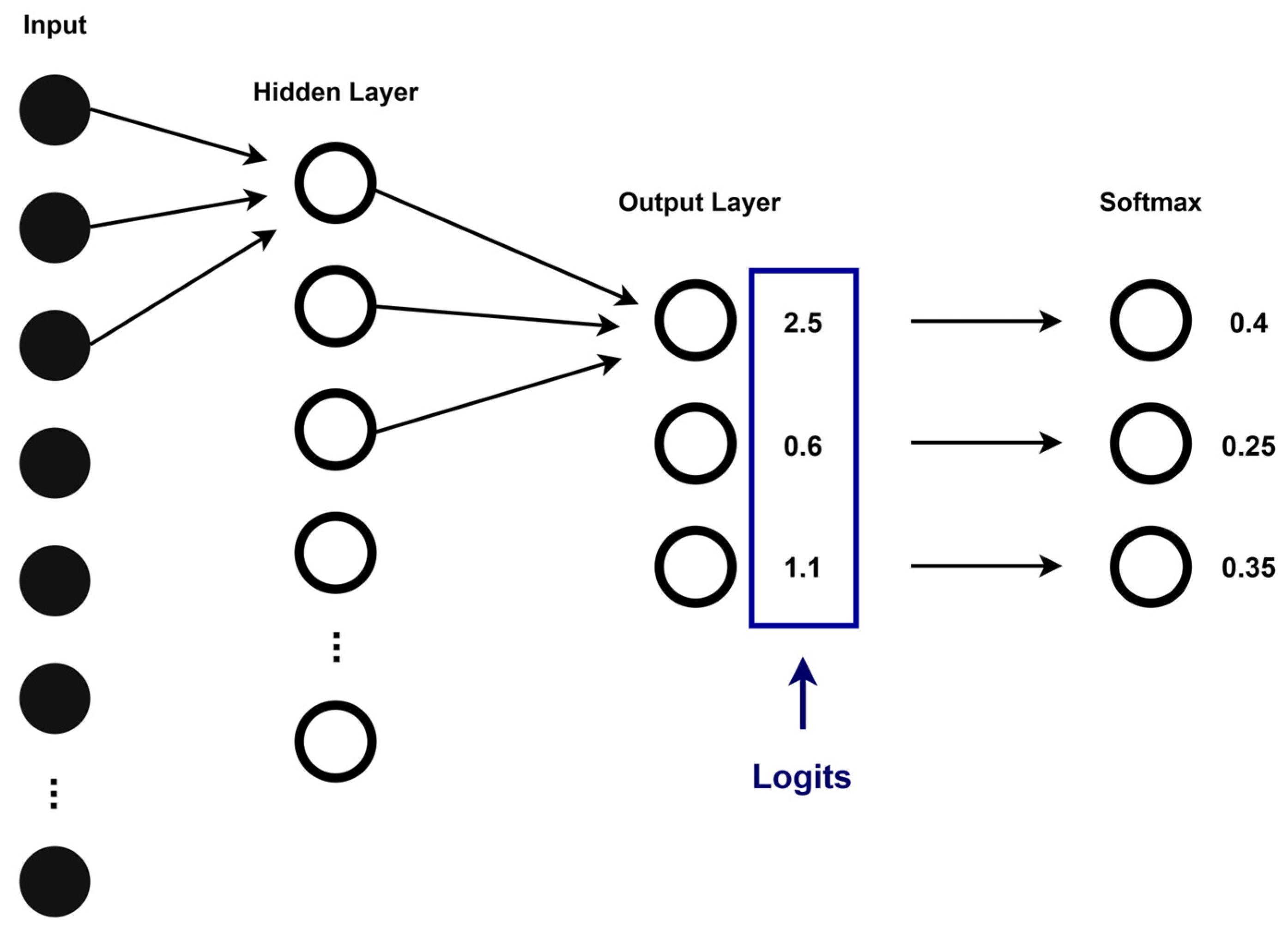
- where every contains convolutional and pooling layers. However, this model has several limitations, which are critical given the structure of the current task. The purpose of pooling layers is to subsample the input image in order to reduce the computational load, memory usage, and number of parameters (thereby limiting the risk of overfitting) [44]. Repeated pooling causes localization to be lost, and this uncertainty is intolerable in a segmentation model. If we use L pooling layers, then the height and width of the image is
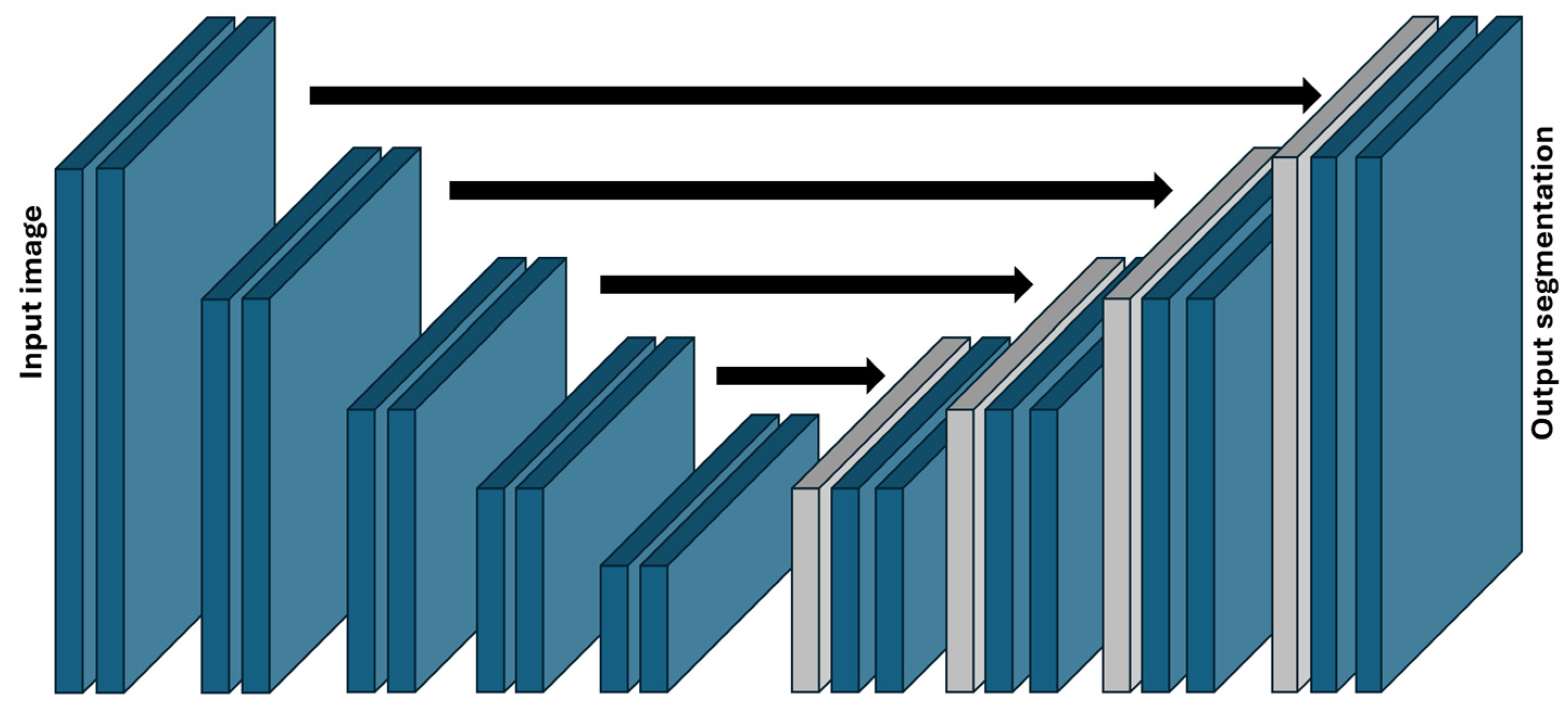
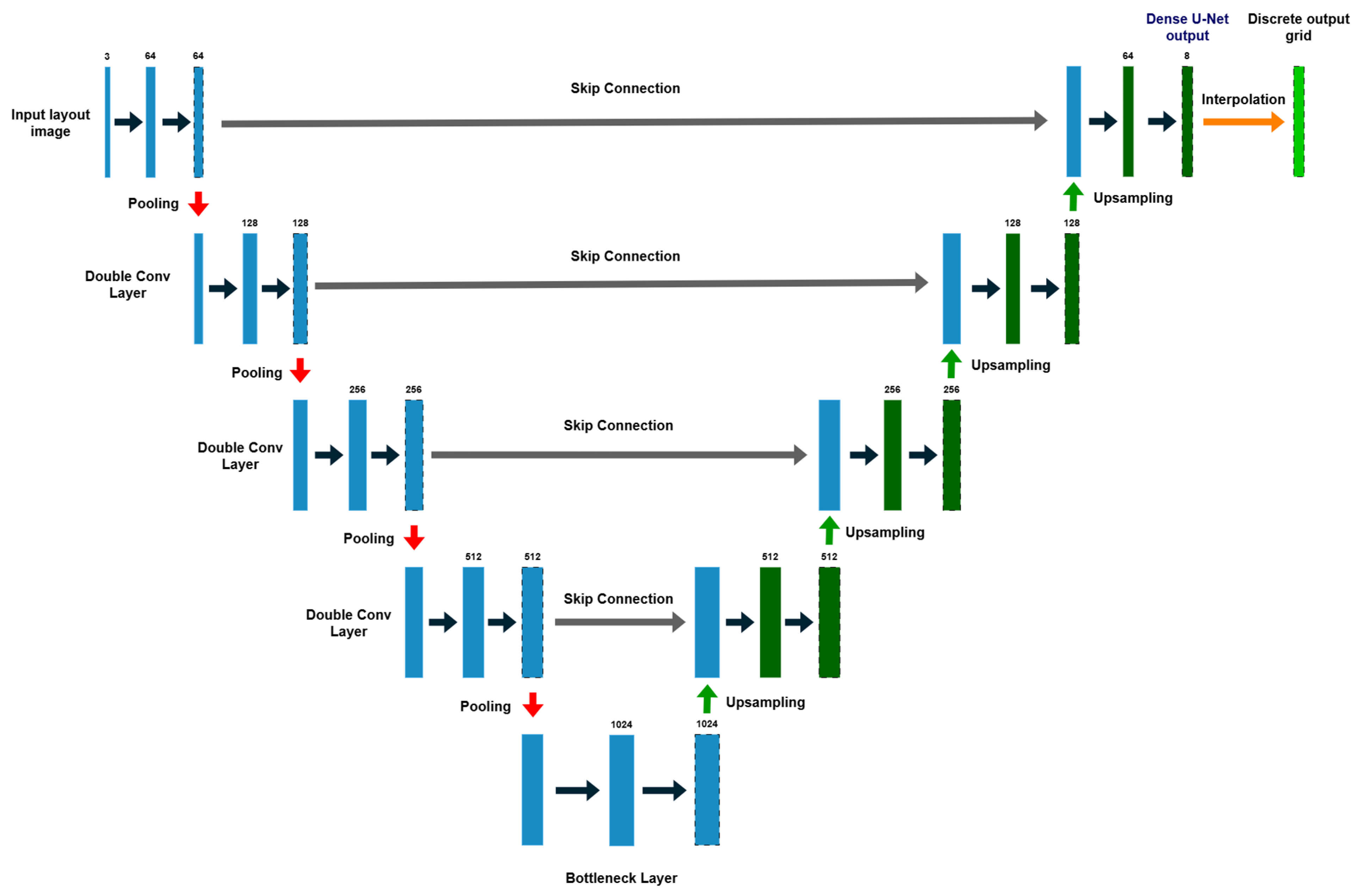
3.2.3. U-Net Architecture Overview
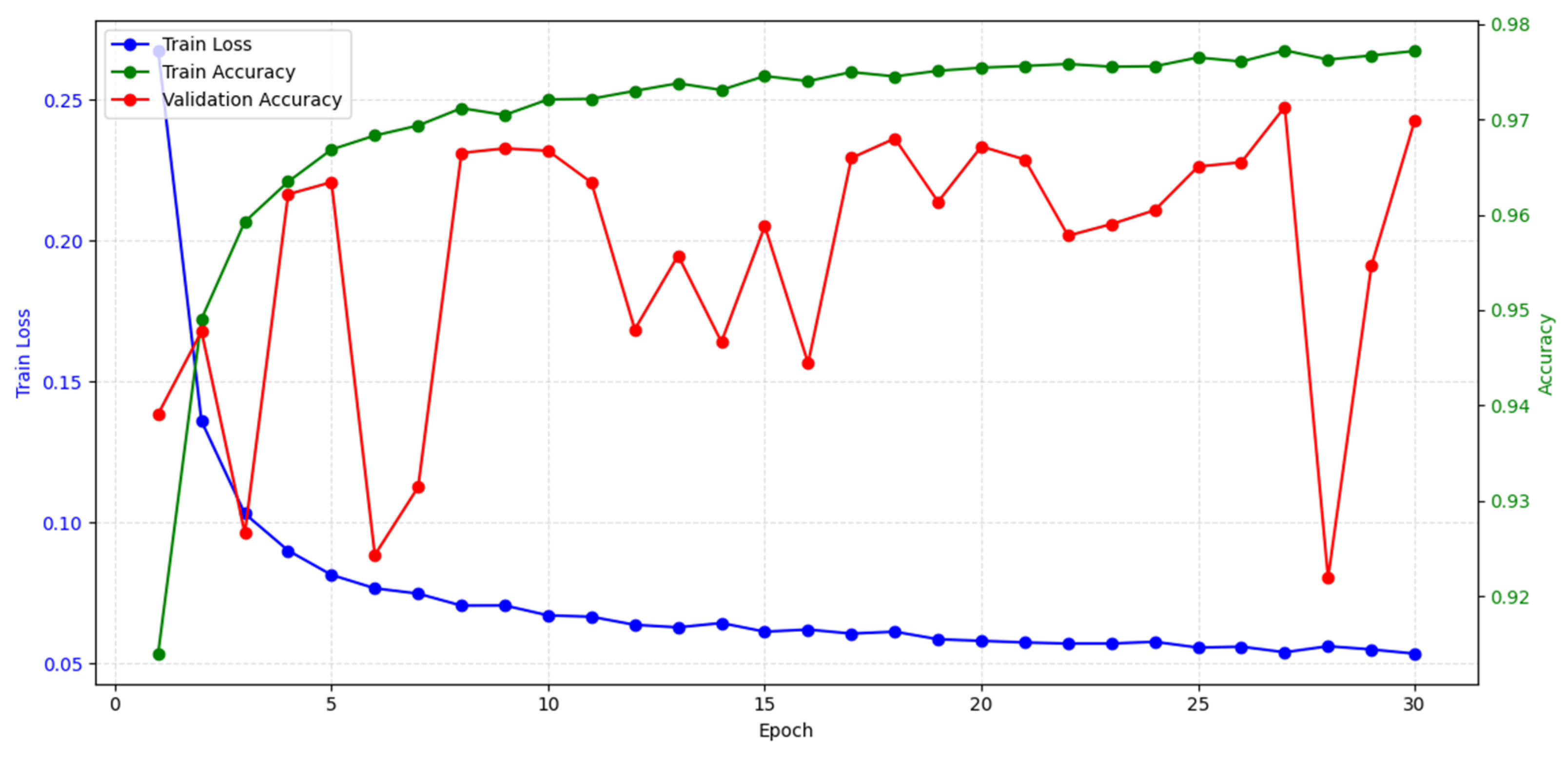
3.2.4. Training Configuration and Optimization
4. Optimization
5. Conclusions
6. Discussion
Author Contributions
Funding
Data Availability Statement
Acknowledgments
Conflicts of Interest
Abbreviations
| AGV | Automated Guided Vehicle |
| AI | Artificial Intelligence |
| BFS | Breadth-First Search |
| CAD | Computer-Aided Design |
| CNN | Convolutional Neural Network |
| CUDA | Compute Unified Device Architecture |
| CSV | Comma-Separated Values |
| DL | Deep Learning |
| FCN | Fully Convolutional Network |
| GA | Genetic Algorithm |
| GML | Geography Markup Language |
| GPU | Graphics Processing Unit |
| HRC | Human–Robot Collaboration |
| IoT | Internet of Things |
| LBS | Location-Based Service |
| ML | Machine Learning |
| MR | Mixed Reality |
| NN | Neural Network |
| R-CNN | Region-based Convolutional Neural Network |
| ReLU | Rectified Linear Unit |
| RFID | Radio Frequency Identification |
| RGB | Red, Green, Blue |
| RL | Reinforcement Learning |
| SA | Simulated Annealing |
| SCM | Supply Chain Management |
| TS | Tabu Search |
| TSP | Travelling Salesman Problem |
| UAV | Unmanned Aerial Network |
References
- Chen, W.; Men, Y.; Fuster, N.; Osorio, C.; Juan, A.A. Artificial Intelligence in Logistics Optimization with Sustainable Criteria: A Review. Sustainability 2024, 16, 9145. [Google Scholar] [CrossRef] [Scilit]
- Garey, M.R.; Johnson, D.S. Computers and Intractability: A Guide to the Theory of NP-Completeness; W.H. Freeman: New York, NY, USA, 1979; ISBN 0716710447. [Google Scholar]
- Toaza, B.; Esztergár-Kiss, D. A Review of Metaheuristic Algorithms for Solving TSP-Based Scheduling Optimization Problems. Appl. Soft Comput. 2023, 148, 110908. [Google Scholar] [CrossRef] [Scilit]
- Albert, P.-W.; Rönnqvist, M.; Lehoux, N. Trends and New Practical Applications for Warehouse Allocation and Layout Design: A Literature Review. SN Appl. Sci. 2023, 5, 378. [Google Scholar] [CrossRef] [Scilit]
- Mahroof, K. A Human-Centric Perspective Exploring the Readiness towards Smart Warehousing: The Case of a Large Retail Distribution Warehouse. Int. J. Inf. Manag. 2019, 45, 176–190. [Google Scholar] [CrossRef] [Scilit]
- Mohsen, A. Framework for the Design of Warehouse Layout. Facilities 2002, 20, 432–440. [Google Scholar] [CrossRef] [Scilit]
- de Koster, R.; Le-Duc, T.; Roodbergen, K.J. Design and Control of Warehouse Order Picking: A Literature Review. Eur. J. Oper. Res. 2007, 182, 481–501. [Google Scholar] [CrossRef] [Scilit]
- Drezner, Z.; Hamacher, H. Facility Location: Applications and Theory; Springer: Berlin/Heidelberg, Germany, 2004; ISBN 9783540213451. [Google Scholar]
- Baker, B.M.; Ayechew, M.A. A Genetic Algorithm for the Vehicle Routing Problem. Comput. Oper. Res. 2003, 30, 787–800. [Google Scholar] [CrossRef] [Scilit]
- Valda, D.T.; Yasuda, M.; Tagaro, J. Logistics Optimization: A Literature Review of Techniques for Streamlining Land Transportation in Supply Chain Operations. In Proceedings of the ICPR 2025: International Conference on Production Research, New York, NY, USA, 7–8 August 2025. [Google Scholar]
- Gunasekaran, A.; Ngai, E.W.T. Decision Support Systems for Logistics and Supply Chain Management. Decis. Support Syst. 2012, 52, 777–778. [Google Scholar] [CrossRef] [Scilit]
- Martinho, J.L.; Gomes, C.F.; Yasin, M.M. Information Technology and the Supply Chain Integration: A Business Executives’ Context. Int. J. Bus. Inf. Syst. 2019, 30, 277. [Google Scholar] [CrossRef] [Scilit]
- Mahmoudinazlou, S.; Sobhanan, A.; Charkhgard, H.; Eshragh, A.; Dunn, G. Deep Reinforcement Learning for Dynamic Order Picking in Warehouse Operations. Comput. Oper. Res. 2025, 182, 107112. [Google Scholar] [CrossRef] [Scilit]
- Racha, B.; Yousra, E.K.; Mahdi, B.E.; Lotfi, S.; Soufiane, E.; Bachir, E.K. Artificial Intelligence in Logistic Warehousing: A Case Study on Stock Management Optimization. J. Eur. Syst. Autom. 2025, 58, 1995–2007. [Google Scholar] [CrossRef] [Scilit]
- Waller, M.A.; Fawcett, S.E. Data Science, Predictive Analytics, and Big Data: A Revolution That Will Transform Supply Chain Design and Management. J. Bus. Logist. 2013, 34, 77–84. [Google Scholar] [CrossRef] [Scilit]
- Choi, T.; Wallace, S.W.; Wang, Y. Big Data Analytics in Operations Management. Prod. Oper. Manag. 2018, 27, 1868–1883. [Google Scholar] [CrossRef] [Scilit]
- Kritzinger, W.; Karner, M.; Traar, G.; Henjes, J.; Sihn, W. Digital Twin in Manufacturing: A Categorical Literature Review and Classification. IFAC-PapersOnLine 2018, 51, 1016–1022. [Google Scholar] [CrossRef] [Scilit]
- Lasi, H.; Fettke, P.; Kemper, H.-G.; Feld, T.; Hoffmann, M. Industry 4.0. Bus. Inf. Syst. Eng. 2014, 6, 239–242. [Google Scholar] [CrossRef] [Scilit]
- Tang, Y.M.; Kuo, W.T.; Lee, C.K.M. Real-Time Mixed Reality (MR) and Artificial Intelligence (AI) Object Recognition Integration for Digital Twin in Industry 4.0. Internet Things 2023, 23, 100753. [Google Scholar] [CrossRef] [Scilit]
- Atzori, L.; Iera, A.; Morabito, G. The Internet of Things: A Survey. Comput. Netw. 2010, 54, 2787–2805. [Google Scholar] [CrossRef] [Scilit]
- Levine, S.; Finn, C.; Darrell, T.; Abbeel, P. End-to-End Training of Deep Visuomotor Policies. J. Mach. Learn. Res. 2016, 17, 1–40. [Google Scholar]
- Krizhevsky, A.; Sutskever, I.; Hinton, G.E. ImageNet Classification with Deep Convolutional Neural Networks. Commun. ACM 2017, 60, 84–90. [Google Scholar] [CrossRef] [Scilit]
- Carbonneau, R.; Laframboise, K.; Vahidov, R. Application of Machine Learning Techniques for Supply Chain Demand Forecasting. Eur. J. Oper. Res. 2008, 184, 1140–1154. [Google Scholar] [CrossRef] [Scilit]
- Min, H. Artificial Intelligence in Supply Chain Management: Theory and Applications. Int. J. Logist. Res. Appl. 2010, 13, 13–39. [Google Scholar] [CrossRef] [Scilit]
- Kumar, D.; Kr Singh, R.; Mishra, R.; Fosso Wamba, S. Applications of the Internet of Things for Optimizing Warehousing and Logistics Operations: A Systematic Literature Review and Future Research Directions. Comput. Ind. Eng. 2022, 171, 108455. [Google Scholar] [CrossRef] [Scilit]
- Mahmood, N.H.; Marchenko, N.; Gidlund, M.; Popovski, P. (Eds.) Wireless Networks and Industrial IoT: Applications, Challenges and Enablers; Springer: Berlin/Heidelberg, Germany, 2021; ISBN 9783030514730. [Google Scholar]
- Soumpenioti, V.; Panagopoulos, A. AI Technology in the Field of Logistics. In Proceedings of the 2023 18th International Workshop on Semantic and Social Media Adaptation & Personalization (SMAP 2023), Limassol, Cyprus, 25–26 September 2023; IEEE: Piscataway, NJ, USA, 2023; pp. 1–6. [Google Scholar]
- Terra, A.; Riaz, H.; Raizer, K.; Hata, A.; Inam, R. Safety vs. Efficiency: AI-Based Risk Mitigation in Collaborative Robotics. In Proceedings of the 2020 6th International Conference on Control, Automation and Robotics (ICCAR), Singapore, 20–23 April 2020; IEEE: Piscataway, NJ, USA, 2020; pp. 151–160. [Google Scholar]
- Kalkha, H.; Khiat, A.; Bahnasse, A.; Ouajji, H. Enhancing Warehouse Efficiency With Time Series Clustering: A Hybrid Storage Location Assignment Strategy. IEEE Access 2024, 12, 52110–52126. [Google Scholar] [CrossRef] [Scilit]
- Pikner, H.; Sell, R.; Karjust, K.; Malayjerdi, E.; Velsker, T. Cyber-Physical Control System for Autonomous Logistic Robot. In Proceedings of the 2021 IEEE 19th International Power Electronics and Motion Control Conference (PEMC), Gliwice, Poland, 25–29 April 2021; IEEE: Piscataway, NJ, USA, 2021; pp. 699–704. [Google Scholar]
- Shamsuddoha, M.; Khan, E.A.; Chowdhury, M.M.H.; Nasir, T. Revolutionizing Supply Chains: Unleashing the Power of AI-Driven Intelligent Automation and Real-Time Information Flow. Information 2025, 16, 26. [Google Scholar] [CrossRef] [Scilit]
- Miao, Z.; Cai, S.; Xu, D. Applying an Adaptive Tabu Search Algorithm to Optimize Truck-Dock Assignment in the Crossdock Management System. Expert Syst. Appl. 2014, 41, 16–22. [Google Scholar] [CrossRef] [Scilit]
- Kalinov, I.; Petrovsky, A.; Ilin, V.; Pristanskiy, E.; Kurenkov, M.; Ramzhaev, V.; Idrisov, I.; Tsetserukou, D. WareVision: CNN Barcode Detection-Based UAV Trajectory Optimization for Autonomous Warehouse Stocktaking. IEEE Robot. Autom. Lett. 2020, 5, 6647–6653. [Google Scholar] [CrossRef] [Scilit]
- Tavakoli, M.J.; Fazl, F.; Sedighi, M.; Naseri, K.; Ghavami, M.; Taghipour-Gorjikolaie, M. Enhancing Pharmacy Warehouse Management With Faster R-CNN for Accurate and Reliable Pharmaceutical Product Identification and Counting. Int. J. Intell. Syst. 2025, 2025, 8883735. [Google Scholar] [CrossRef] [Scilit]
- Xu, D.; Jin, P.; Zhang, X.; Du, J.; Yue, L. Extracting Indoor Spatial Objects from CAD Models: A Database Approach. In Database Systems for Advanced Applications; Springer: Cham, Switzerland, 2015; pp. 273–279. [Google Scholar]
- Jang, H.; Yu, K.; Yang, J. Indoor Reconstruction from Floorplan Images with a Deep Learning Approach. ISPRS Int. J. Geoinf. 2020, 9, 65. [Google Scholar] [CrossRef] [Scilit]
- The Role of CAD in Modern Warehouse Layout Design. Available online: https://ecseco.com/blog/the-role-of-cad-in-modern-warehouse-layout-design/ (accessed on 1 January 2026).
- Warehouse Racking Layout & Design Experts. 3D Storage Systems. Available online: https://www.3dstoragesystems.com/the-warehouse-layout-experts/ (accessed on 1 January 2026).
- Warehouse Layout & CAD Design Services. American Surplus. Available online: https://www.americansurplus.com/services/layout-design-cad-drawings/?srsltid=AfmBOoreqOPoOYeacMQRwdt1rvFMzzfocrwUMnl2c8Ap9fuRvl0RvgeR (accessed on 1 January 2026).
- Warehouse Layout. Available online: https://www.inventoryops.com/consulting-services/services-provided/warehouse-layout.html (accessed on 1 January 2026).
- Warehouse Layout Design—AK Material Handling Systems. Available online: https://www.akequipment.com/system/warehouse-layout-design/ (accessed on 1 January 2026).
- Illuri Sandeep Logits vs. Probabilities: Understanding Neural Network Outputs Clearly. Available online: https://illuri-sandeep5454.medium.com/logits-vs-probabilities-understanding-neural-network-outputs-clearly-0e86a4256a0e (accessed on 3 January 2026).
- Syrris, V.; Hasenohr, P.; Delipetrev, B.; Kotsev, A.; Kempeneers, P.; Soille, P. Evaluation of the Potential of Convolutional Neural Networks and Random Forests for Multi-Class Segmentation of Sentinel-2 Imagery. Remote Sens. 2019, 11, 907. [Google Scholar] [CrossRef] [Scilit]
- Géron, A. Hands-on Machine Learning with Scikit-Learn, Keras and TensorFlow: Concepts, Tools, and Techniques to Build Intelligent Systems; O’Reilly Media, Inc.: Sebastopol, CA, USA, 2023; ISBN 9781098125974. [Google Scholar]
- Ronneberger, O.; Fischer, P.; Brox, T. U-Net: Convolutional Networks for Biomedical Image Segmentation. In Medical Image Computing and Computer-Assisted Intervention—MICCAI 2015; Springer: Cham, Switzerland, 2015; pp. 234–241. [Google Scholar]
- Shibuya, E.; Hotta, K. Cell Image Segmentation by Using Feedback and Convolutional LSTM. Vis. Comput. 2022, 38, 3791–3801. [Google Scholar] [CrossRef] [Scilit]
- Long, J.; Shelhamer, E.; Darrell, T. Fully Convolutional Networks for Semantic Segmentation. In Proceedings of the 2015 IEEE Conference on Computer Vision and Pattern Recognition (CVPR), Boston, MA, USA, 7–12 June 2015; IEEE: Piscataway, NJ, USA, 2015; pp. 3431–3440. [Google Scholar]
- Lecun, Y.; Bottou, L.; Bengio, Y.; Haffner, P. Gradient-Based Learning Applied to Document Recognition. Proc. IEEE 1998, 86, 2278–2324. [Google Scholar] [CrossRef] [Scilit]
- Simonyan, K.; Zisserman, A. Very Deep Convolutional Networks for Large-Scale Image Recognition. arXiv 2015, arXiv:1409.1556. [Google Scholar] [CrossRef] [Scilit]
- He, K.; Zhang, X.; Ren, S.; Sun, J. Deep Residual Learning for Image Recognition. arXiv 2015, arXiv:1512.03385. [Google Scholar] [CrossRef] [Scilit]
- Kingma, D.P.; Ba, J. Adam: A Method for Stochastic Optimization. arXiv 2017, arXiv:1412.6980. [Google Scholar] [CrossRef] [Scilit]
- Cormen, T.H.; Leiserson, C.E.; Rivest, R.L.; Stein, C. Introduction to Algorithms; The MIT Press: Cambridge, MA, USA, 2022; ISBN 9780262046305. [Google Scholar]





| Approach | Main Focus | Limitations | Novelty |
|---|---|---|---|
| CNN-based barcode detection with UAV trajectory optimization [33] | Autonomous warehouse stocktaking using barcode-driven UAV localization and path planning | UAV energy limits; barcode dependency | Barcodes used as localization landmarks for optimized UAV trajectories |
| Faster R-CNN visual object detection [34] | Accurate identification and counting of pharmaceutical products in warehouses | High computational and data requirements | Application of Faster R-CNN with extensive comparison to classical and modern detectors |
| CNN-based floorplan segmentation and vectorization [36] | Automatic extraction of walls and doors from floorplan images and conversion to IndoorGML/CityGML | Sensitive to floorplan quality; static environments only | Standard-compliant indoor models with preserved wall thickness from images |
| Database-driven CAD model processing [35] | Extraction of indoor spatial objects from CAD for indoor LBS queries | Requires structured CAD data; no learning capability | High-precision indoor map generation via database modeling |
| This research | Transforming warehouse layout images into graph/matrix representations for route optimization | Synthetic layouts; real-world generalization under study | End-to-end pipeline from images to optimization-ready representations, enabling automated logistics benchmarking |
Disclaimer/Publisher’s Note: The statements, opinions and data contained in all publications are solely those of the individual author(s) and contributor(s) and not of MDPI and/or the editor(s). MDPI and/or the editor(s) disclaim responsibility for any injury to people or property resulting from any ideas, methods, instructions or products referred to in the content. |
© 2026 by the authors. Licensee MDPI, Basel, Switzerland. This article is an open access article distributed under the terms and conditions of the Creative Commons Attribution (CC BY) license.
Share and Cite
Francuz, Á.; Bányai, T. From Layout to Data: AI-Driven Route Matrix Generation for Logistics Optimization. Mathematics 2026, 14, 910. https://doi.org/10.3390/math14050910
Francuz Á, Bányai T. From Layout to Data: AI-Driven Route Matrix Generation for Logistics Optimization. Mathematics. 2026; 14(5):910. https://doi.org/10.3390/math14050910
Chicago/Turabian StyleFrancuz, Ádám, and Tamás Bányai. 2026. "From Layout to Data: AI-Driven Route Matrix Generation for Logistics Optimization" Mathematics 14, no. 5: 910. https://doi.org/10.3390/math14050910
APA StyleFrancuz, Á., & Bányai, T. (2026). From Layout to Data: AI-Driven Route Matrix Generation for Logistics Optimization. Mathematics, 14(5), 910. https://doi.org/10.3390/math14050910