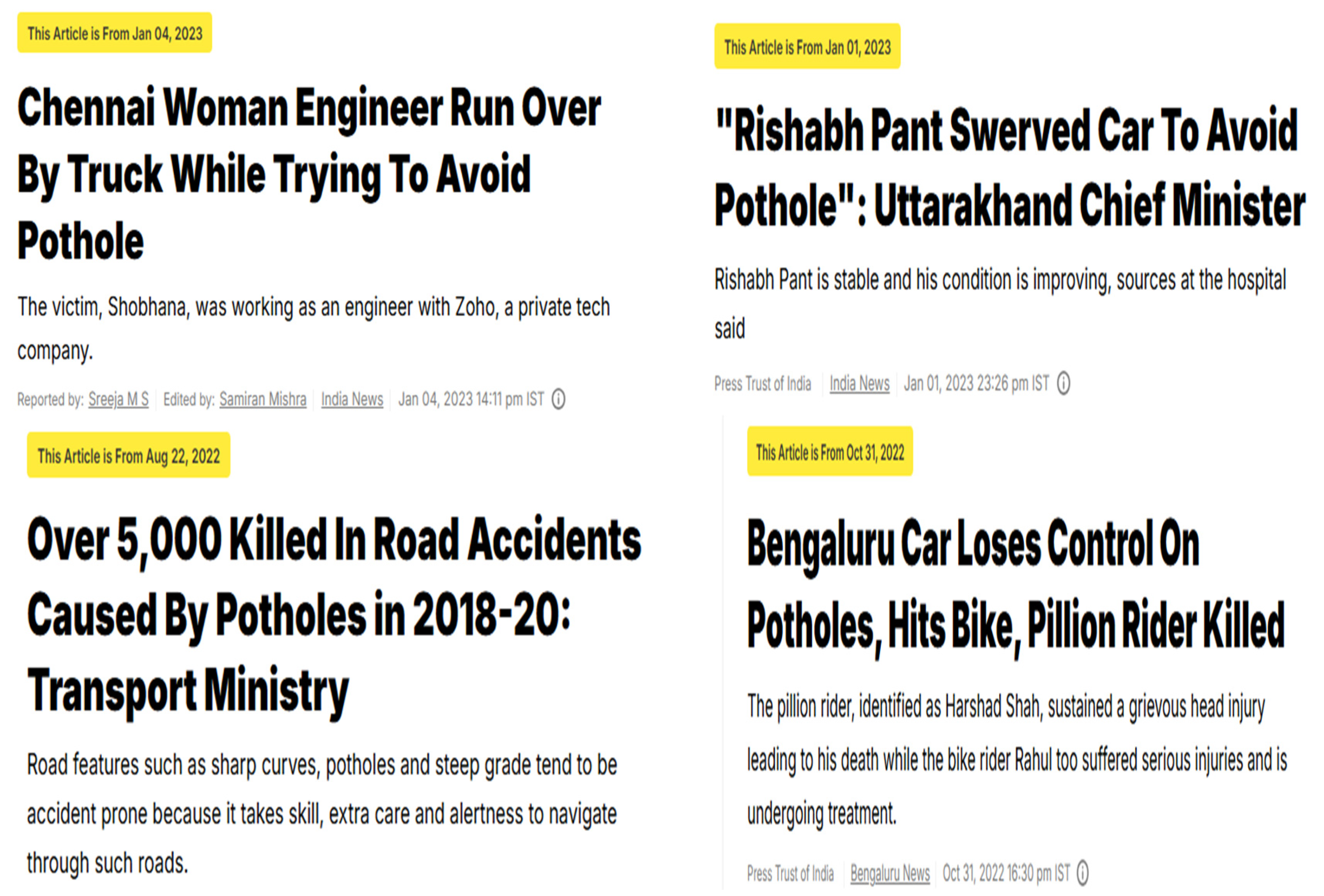
A Deep Learning Framework for Real-Time Pothole Detection from Combined Drone Imagery and Custom Dataset Using Enhanced YOLOv8 and Custom Feature Extraction

 ,
,
Abstract
1. Introduction
2. Literature
- 1.
- Low-Light and Adverse Weather Conditions
- 2.
- Small and Occluded Pothole Detection
- 3.
- High False Positives from Road Artefacts
- 4.
- Complex and Dynamic Environment Challenges
- 5.
- Limitations in Real-Time Aerial Adaptability
3. Methodology
3.1. Objectives
- To enhance image quality under poor lighting and adverse weather conditions using contrast and noise enhancement techniques.
- To accurately detect small and partially occluded potholes through multi-scale feature extraction and attention mechanisms.
- To reduce false positives caused by road artefacts, such as patches, stains, and shadows, we use contextual feature learning.
- To enhance detection performance in complex and dynamic road environments, such as multi-lane roads and pedestrian areas.
- To ensure robustness against variations in lighting and image quality through a comprehensive preprocessing pipeline.
- To develop a real-time drone-based pothole detection framework using aerial imagery and deep learning for accurate and efficient detection under diverse environmental conditions.
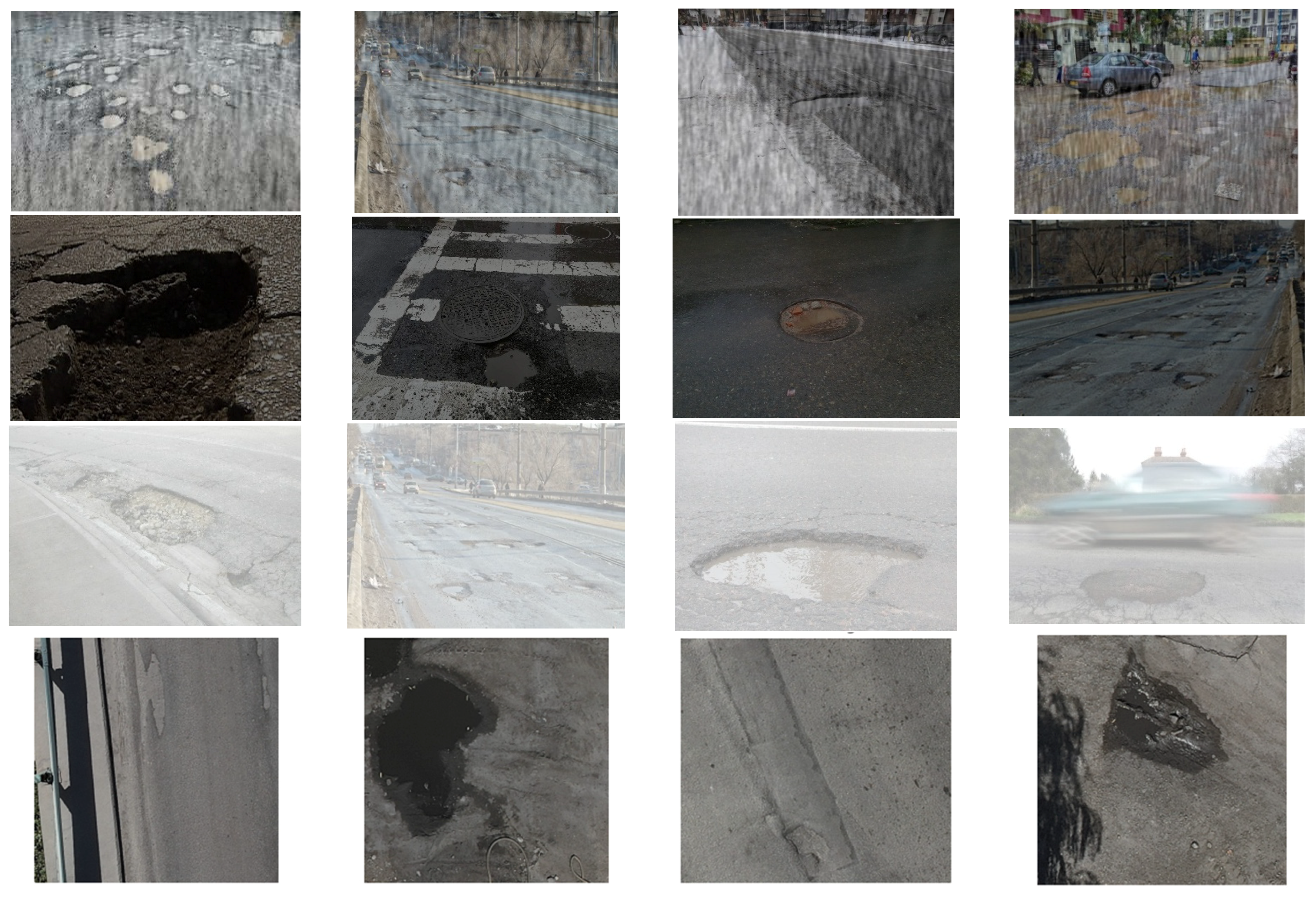
3.2. Dataset
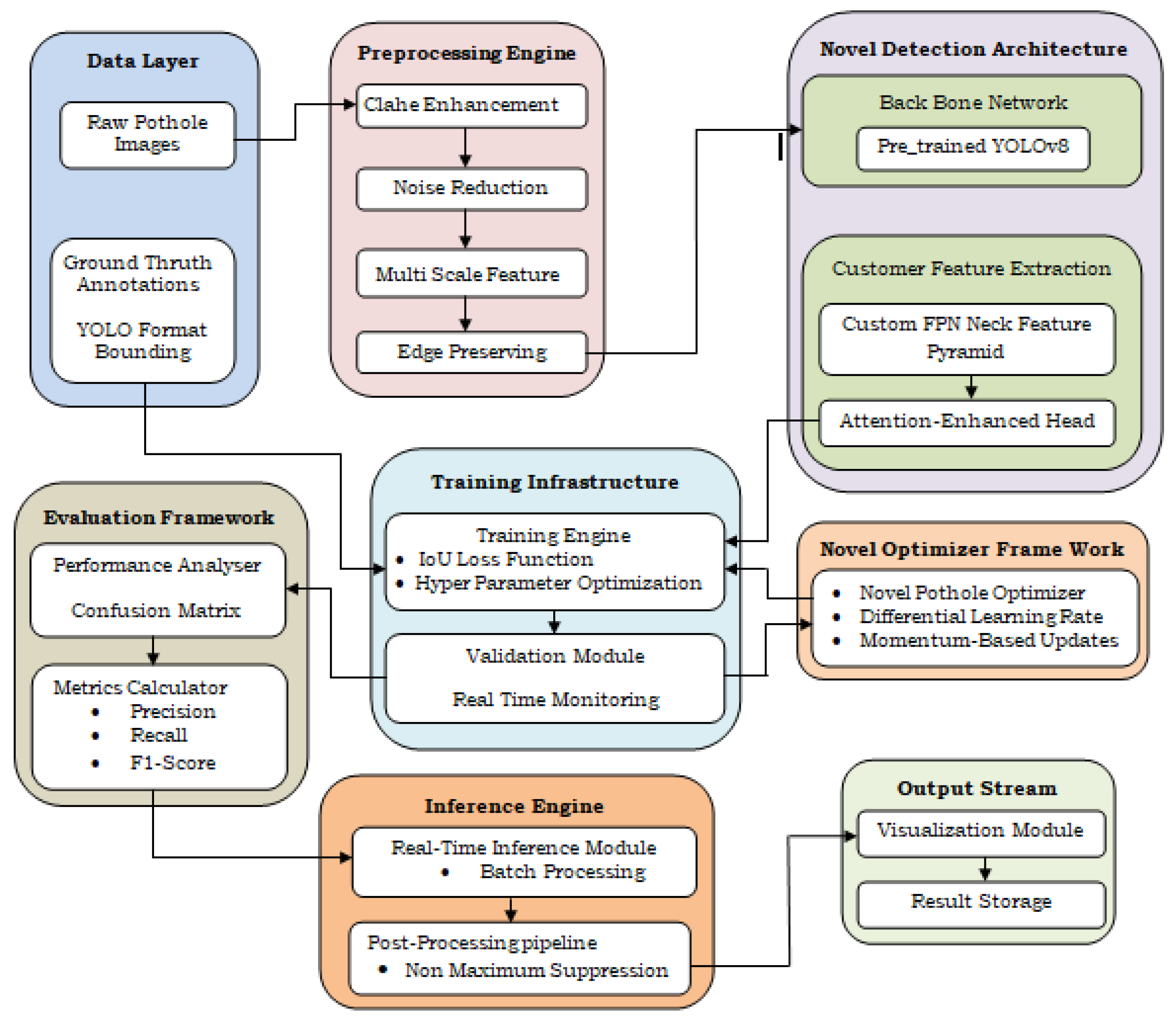
3.3. Proposed Work
- A.
- Data Layer
- B.
- Preprocessing Engine
- is the current pixel and are its neighbours;
- : spatial Gaussian kernel based on pixel distance;
- : range Gaussian kernel based on intensity difference;
- : intensity at neighbouring pixel qq;
- : normalization factor to ensure the result stays in a valid range.
- C.
- Novel Detection Architecture
- i.
- Backbone Network: This is a deep convolutional neural network that identifies features of images on which the images are drawn in the form of a visual pattern. It converts the preprocessed image into a rich hierarchical representation across many convolutional layers. Different levels of abstraction, such as simple edges and complex shapes, are learned by each layer and are important for correct object recognition. The backbone of this architecture is YOLOv8 due to its robust transfer learning capabilities.
- ii
- Customer Feature Extraction: This module enhances YOLOv8’s base model’s generalization by introducing two critical improvements: a Feature Pyramid Network (FPN) and an Attention-Enhanced Head.
- is the output feature at pyramid level iii;
- is the higher-level (semantically stronger but spatially coarser) feature map;
- is the lower-level (spatially richer but semantically weaker) feature map;
- is typically nearest-neighbour or bilinear interpolation to match resolutions;
- Conv() denotes a 1 × 1 convolution to match the channel dimensions.
- : attention weight for feature ;
- : trainable matrices;
- : bias term.
- represents the refined feature representation that emphasizes pothole-relevant regions while reducing the influence of noise or distractions.
- D.
- Novel Optimizer Framework
- E.
- Training Infrastructure
- i.
- Training Engine: The training engine is built on top of the Ultralights YOLOv8 framework and additionally develops customized components, thereby supporting training on any GPUs or CPUs and multi-scale inputs, as well as adaptive learning. The training loop repeats through phases of annotated image batches, processing the images and updating the model weights using backpropagation with the Adam optimizer, whilst tracking training statistics in real time. The model provides predicted bounding boxes and the classification probability for detected potholes at every forward pass. Such predictions are checked against the ground truth wires, and the loss is computed to inform parameter rewrites. The model weights are then updated by the optimizer according to the calculated gradients, using differential learning rates, cosine annealing schedules, and exponential moving averages to achieve smooth convergence and generalization.
- Learning rate;
- Weight decay;
- Momentum;
- Warm-up epochs;
- Batch size;
- Confidence threshold.
- Grid Search: Exhaustively tries combinations of predefined hyperparameter values.
- Random Search: Randomly samples hyperparameters and configurations within specified ranges.
- ii.
- Validation Module
- Validation Loss: Total loss on the validation set, including IoU and classification losses.
- IoU Score: Average Intersection over Union between predicted and actual boxes.
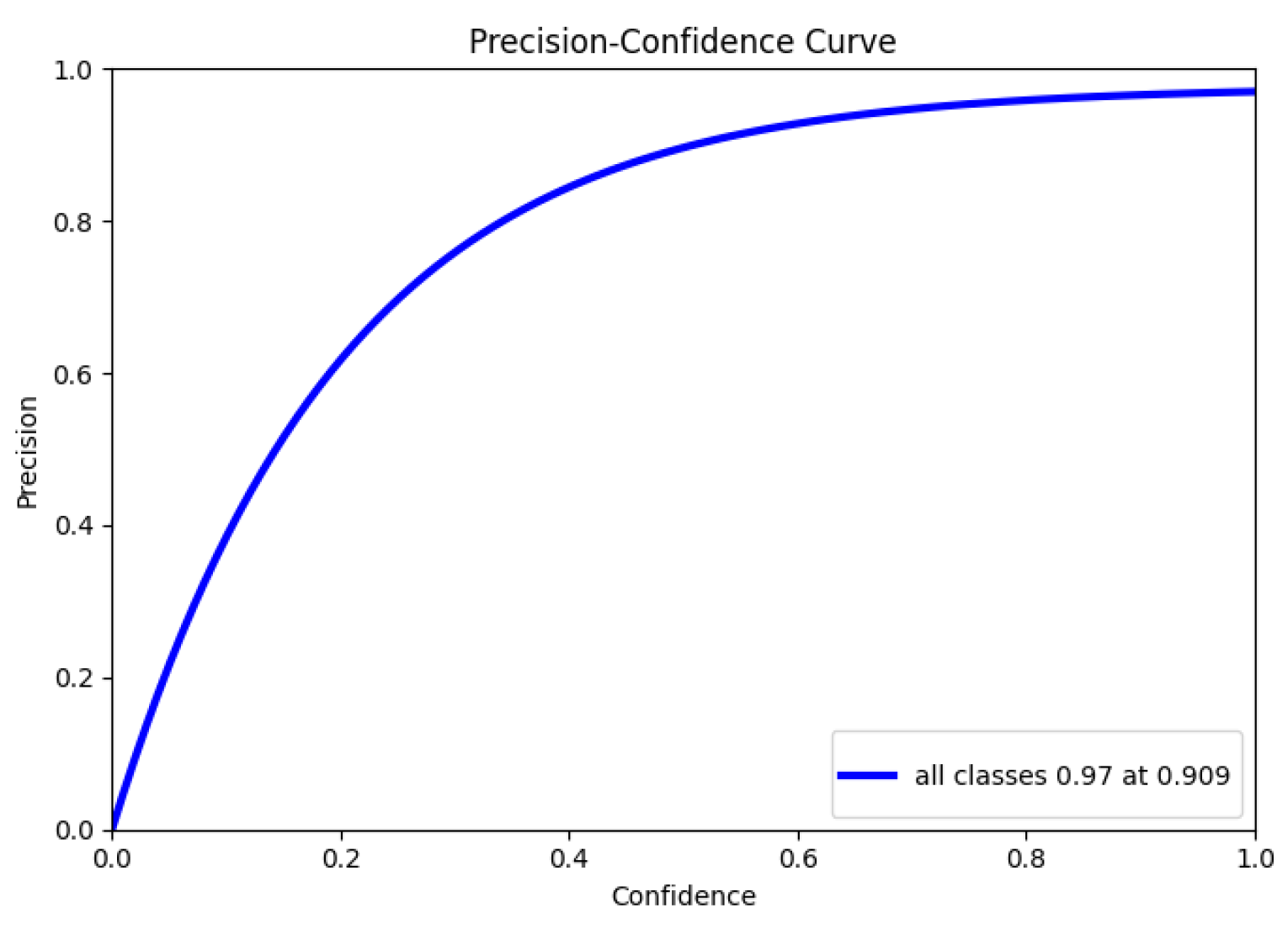
- Precision: Proportion of correctly predicted pothole boxes out of all predicted boxes.
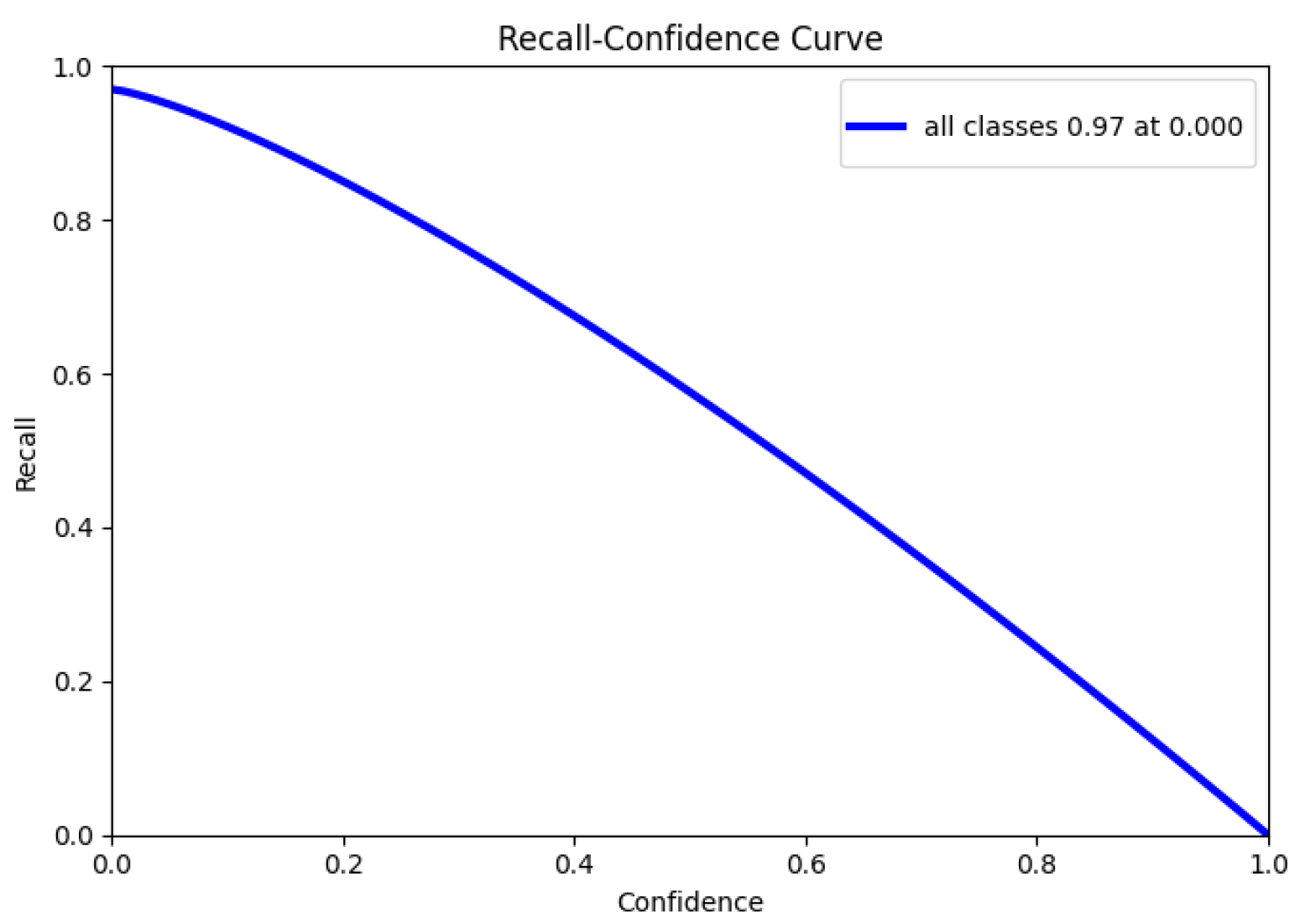
- Recall: Proportion of actual potholes correctly identified.
- F.
- Evaluation Framework
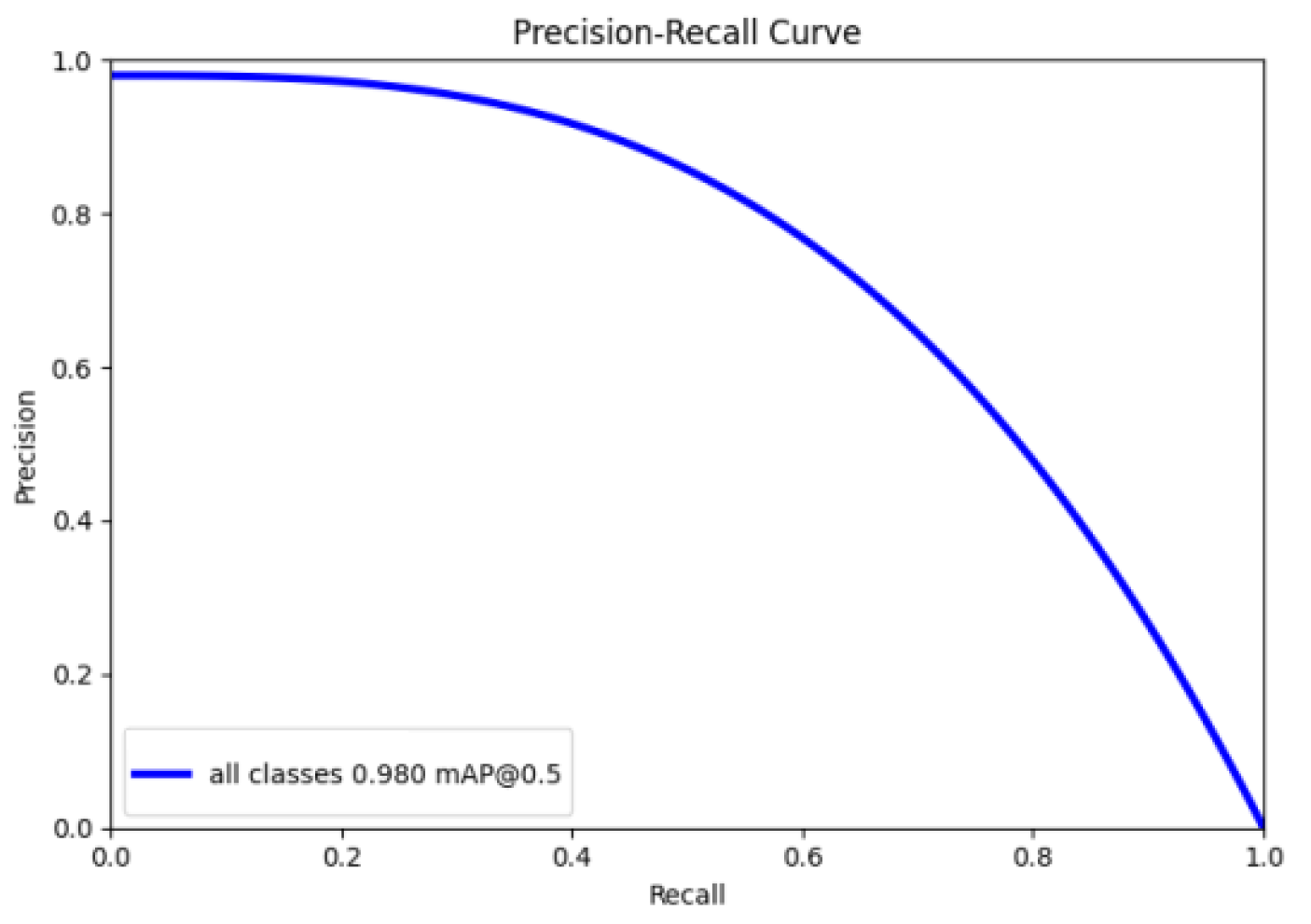
- Mean average precision (mAP) at different IoU thresholds (e.g., mAP@0.5, mAP@0.5:0.95);
- IoU Accuracy: Average Intersection over Union between predicted and ground truth boxes;
- Number of detections per image;
- False-positive rate and false-negative rate.
- G.
- Inference Engine
- Batch Inference: Efficient for testing and offline evaluation.
- Single-Image or Stream-Based Inference: Suitable for real-time deployment on embedded devices, edge servers, or cloud platforms.
- H.
- Output Stream
- The class label (e.g., “pothole”);
- The confidence score of the prediction.
- Used for further downstream analytics (e.g., GIS mapping, maintenance scheduling);
- Streamed to a cloud dashboard or local web UI;
- Exported in formats like JSON, CSV, or YOLO label files.
| Algorithm 1. DPD-Net: Deep Pothole Detection Network | |
| Input Parameters: Image Output Parameters: Predicted bounding boxes with class labels. | |
| Step 1: | Collect raw pothole images and ground truth bounding box annotations in YOLO format. The input dataset contains labelled images with bounding boxes around potholes. The YOLO format uses normalized values for object centre coordinates, width, and height. |
| Step 2: | Enhance image quality through preprocessing techniques such as contrast enhancement, noise reduction, and edge preservation. CLAHE improves local contrast using Equation (1); noise reduction filters remove image noise using Equation (2); and multi-scale enhancement and edge preservation, as outlined in Equation (3), enhance the visibility of potholes in challenging conditions such as fog, glare, or low-light. |
| Step 3: | Extract features using a pre-trained YOLOv8 backbone network, as described in Equation (4). The YOLOv8 model includes a convolutional backbone pre-trained with Equations (5) and (6) on large datasets to extract spatial features that represent road textures and pothole structures. |
| Step 4: | Enhance spatial features using a custom neck and attention-based detection head. A customized Feature Pyramid Network (FPN) aggregates features at multiple scales using Equation (7). Attention modules guide the model to focus on relevant regions, such as cracks or potholes, using Equations (7) and (8). |
| Step 5: | Train the model using IoU-based loss and optimized training strategies. The IoU (Intersection over Union) loss helps align predicted and ground truth bounding boxes, which is crucial for accurate localization. |
| Step 6: | Apply the novel optimizer with differential learning rates and momentum-based updates, as described in Equations (10) and (11). The optimizer groups parameters and assigns learning rates using Equation (12) differently for backbone, neck, and head layers. EMA helps stabilize training and accelerate convergence, as shown in Equation (13). |
| Step 7: | Validate the model using a separate module to monitor loss (as in Equation (14)) and accuracy metrics. The validation module is used to validate the model after every epoch using metrics such as loss, precision, recall, etc., which help track overall learning and prevent overfitting. |
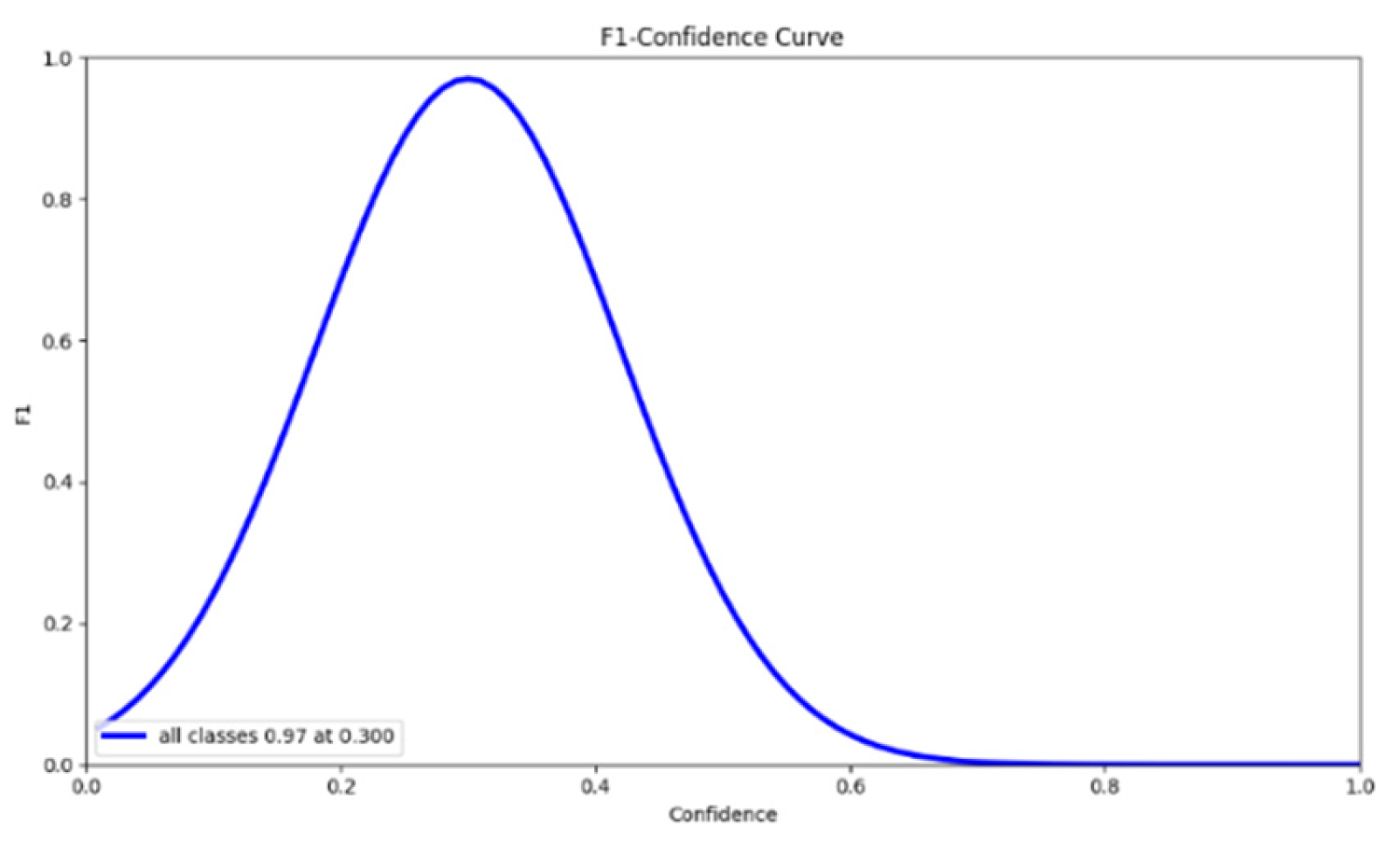
| Step 8: | Evaluate the model’s performance using the confusion matrix and calculate precision, recall, and F1-score. The confusion matrix illustrates true positives (TP), false positives (FP), and false negatives (FN). |
| Step 9: | Perform inference tests on new images or batches of images (using the trained model). The trained YOLOv8 model processes images it has not seen before, either individually or in bulk, predicts whether they are potholes, and then determines the location of that object. |
| Step 10: | Use the non-maximum suppression function to filter overlapping bounding boxes. NMS is used to compare the overlapping predictions using IoU. The boxes with an IoU threshold greater than the threshold value (e.g., 0.5) are treated as duplicates and suppressed; the most confident prediction is kept using Equation (15). |
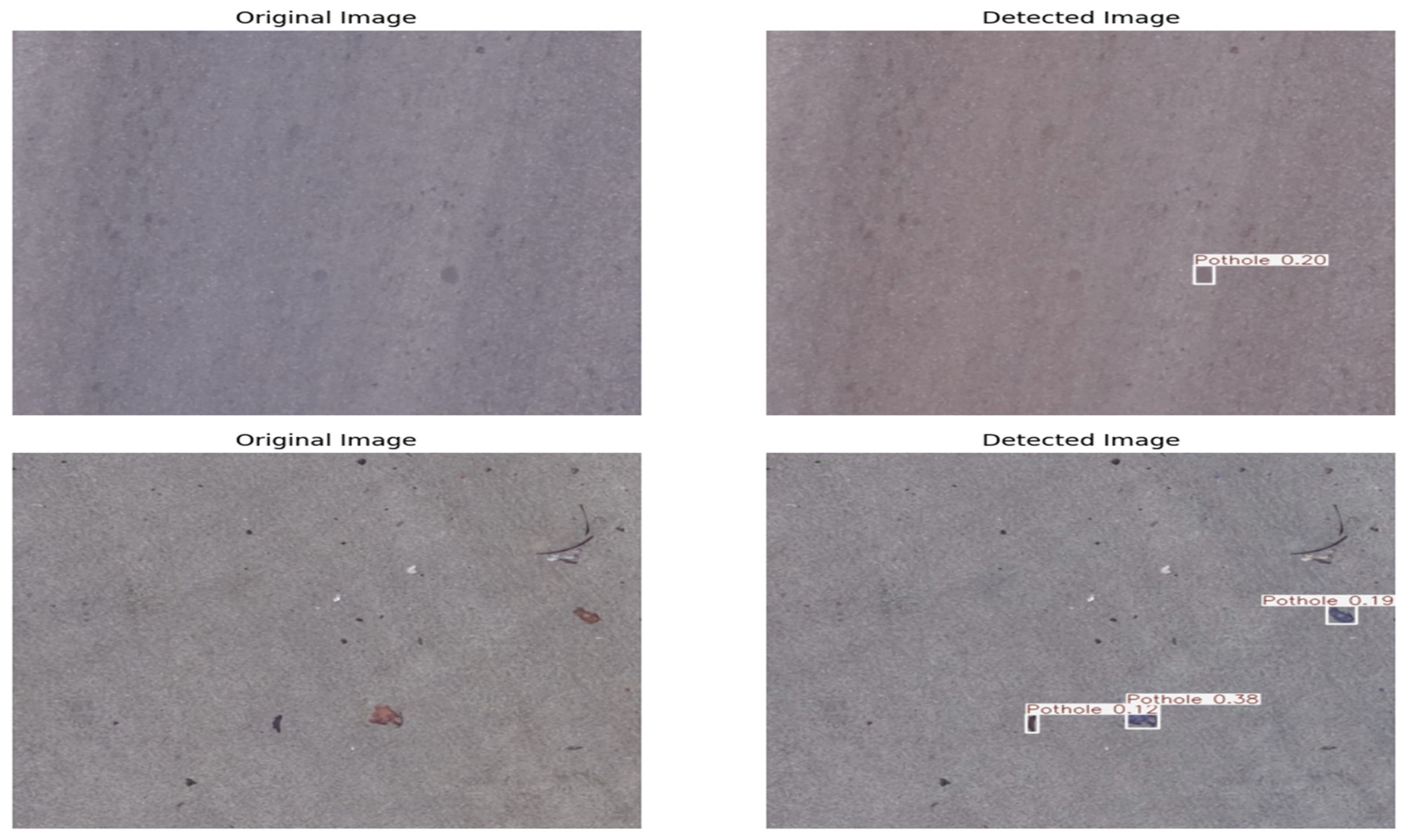
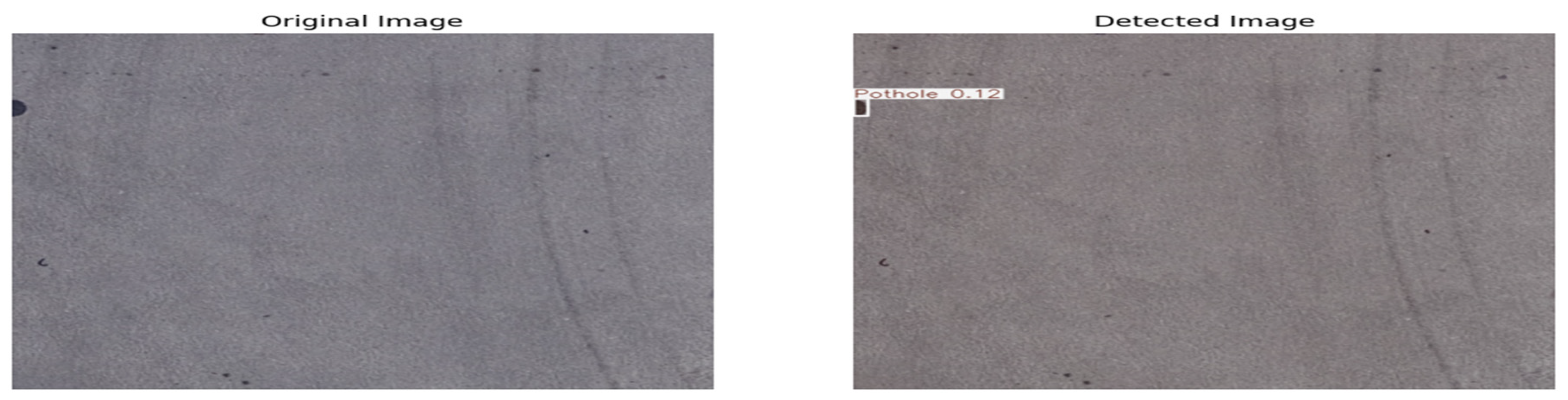
| Step 11: | Visualize the detected potholes by annotating them on the original images. Bounding boxes and labels are drawn on the input images for human validation or deployment for monitoring systems. |
| Step 12: | Store the output images and detection results for further analysis or deployment. Results in the form of labelled images as well as bounding box data are saved in structured directories and formats (e.g., for release as a final product, e.g., in a dashboard or maintenance plan, e.g., as a json or text file). |
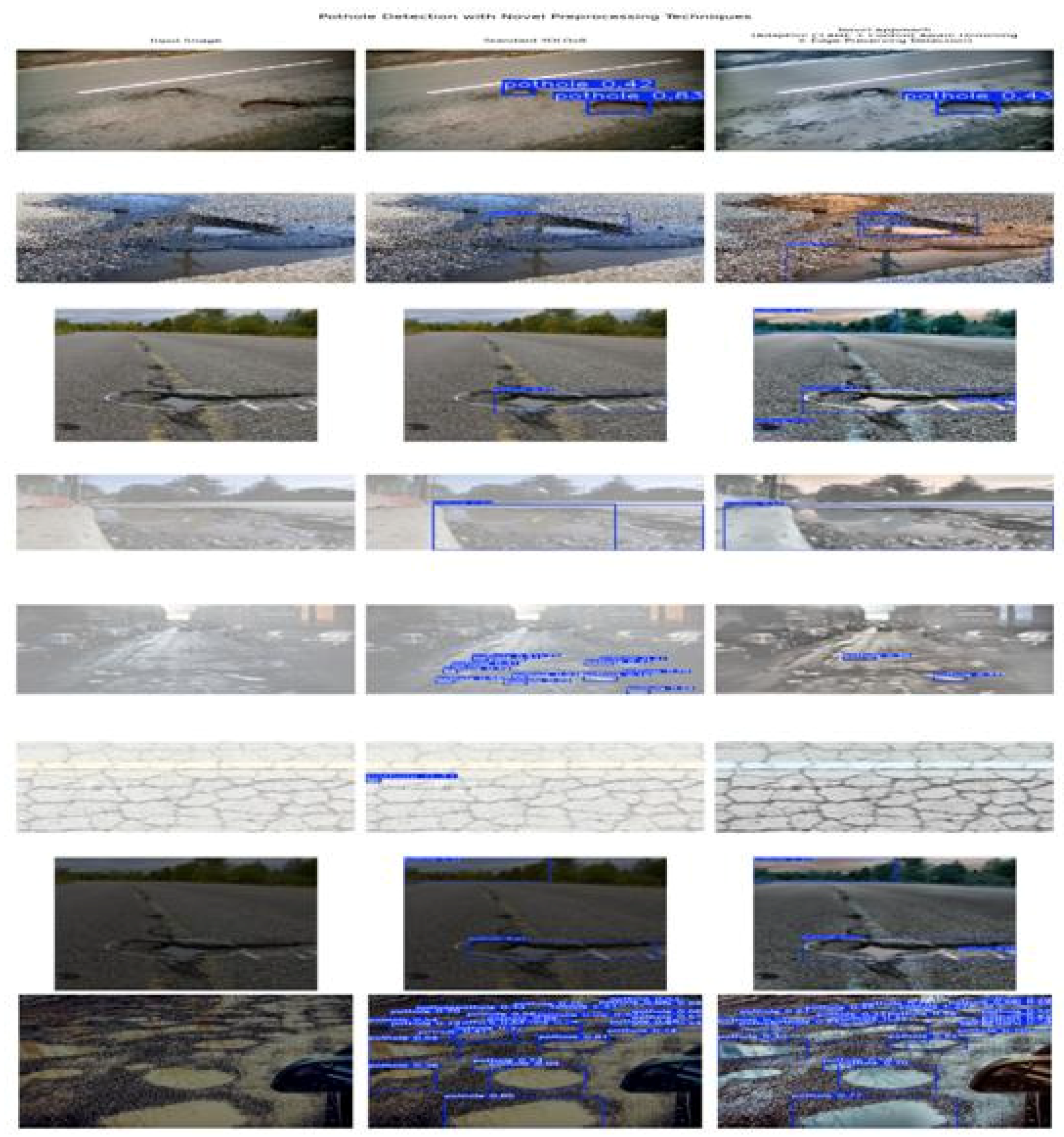
4. Result Analysis
5. Conclusions
Author Contributions
Funding
Data Availability Statement
Conflicts of Interest
References
- Zhang, R.; Peng, J.; Gou, W.; Ma, Y.; Chen, J.; Hu, H.; Li, W.; Yin, G.; Li, Z. A robust and real-time lane detection method in low-light scenarios to advanced driver assistance systems. Expert Syst. Appl. 2024, 256, 124923. [Google Scholar] [CrossRef]
- Liu, Y.; Wang, Y.; Li, Q. Lane detection based on real-time semantic segmentation for end-to-end autonomous driving under low-light conditions. Digit. Signal Process. 2024, 155, 104752. [Google Scholar] [CrossRef]
- Li, D.; Yang, Z.; Nai, W.; Xing, Y.; Chen, Z. A road lane detection approach based on the reformer model. Egypt. Inform. J. 2025, 29, 100625. [Google Scholar] [CrossRef]
- Patil, O.; Nair, B.B.; Soni, R.; Thayyilravi, A.; Manoj, C. BoostedDim attention: A novel data-driven approach to improving LiDAR-based lane detection. Ain Shams Eng. J. 2024, 15, 102887. [Google Scholar] [CrossRef]
- Zhang, Y.; Zheng, Y.; Tu, Z.; Wu, C.; Zhang, T. CFFM: Multi-task lane object detection method based on cross-layer feature fusion. Expert Syst. Appl. 2024, 257, 125051. [Google Scholar] [CrossRef]
- Yaamini, H.S.G.; Swathi, K.J.; Manohar, N.; Ajay Kumar, G. Lane and Traffic Sign Detection for Autonomous Vehicles: Addressing Challenges on Indian Road Conditions. MethodsX 2025, 14, 103178. [Google Scholar] [CrossRef]
- Yu, B.; Zhu, Z.; Chen, Y.; Wang, J.; Gao, K.; Qian, X. A Diffusion model-based intelligent optimization method of rural road environments. Int. J. Transp. Sci. Technol. 2025. [Google Scholar] [CrossRef]
- Lourenço, B.; Silvestre, D. Enhancing truck platooning efficiency and safety—A distributed Model Predictive Control approach for lane-changing manoeuvres. Control Eng. Pract. 2025, 154, 106153. [Google Scholar] [CrossRef]
- Yik, M. YOLOv3-based real-time pothole detection with Google Maps visualization. Int. J. Image Graph. 2019, 19, 1950030. [Google Scholar]
- Al Shaghouri, O.; Al Kalaoni, S.; Al Nsour, M. Evaluation of Deep Learning Models for Pothole Detection: YOLOv4 vs. Others. In International Joint Conference on Neural Networks (IJCNN); IEEE: New York, NY, USA, 2021; pp. 1–8. [Google Scholar]
- Silva, L.A.; Leithardt, V.R.Q.; Batista, V.F.L.; González, G.V.; De Paz Santana, J.F. Automated Road Damage Detection Using UAV Images and Deep Learning Techniques. IEEE Access 2023, 11, 62918–62932. [Google Scholar] [CrossRef]
- Doycheva, S.; Koch, C.; Koch, R. Real-time pavement distress detection using deep learning and computer vision. In IEEE Conference on Big Data; IEEE: New York, NY, USA, 2022; pp. 551–559. [Google Scholar]
- SLee, S.Y.; Lee, J.; Lee, S. Improved Regression Modeling for Pothole Prediction in Urban Pavements Considering Climate and Traffic. Dev. Built Environ. 2023, 13, 100109. [Google Scholar]
- Fortin, L.V.; Santos, A.R.V.D.; Cagud, P.J.B.; Castor, P.R.; Llantos, O.E. Eyeway: An Artificial Intelligence of Things Pothole Detection System with Map Visualization. Procedia Comput. Sci. 2024, 251, 216–223. [Google Scholar] [CrossRef]
- Alzamzami, O.; Babour, A.; Baalawi, W.; Al Khuzayem, L. PDS-UAV: A deep learning-based pothole detection system using unmanned aerial vehicle images. Sustainability 2024, 16, 9168. [Google Scholar] [CrossRef]
- Available online: https://www.ndtv.com/topic/pothole-accident (accessed on 5 October 2025).
- Kuttah, D.; Waldemarson, A. Next generation gravel road profiling—The potential of advanced UAV drones in comparison with road surface testers and rotary laser levels. Transp. Eng. 2024, 17, 100260. [Google Scholar] [CrossRef]
- Jiang, T.Y.; Liu, Z.Y.; Zhang, G.Z. YOLOv5s-road: Road surface defect detection under engineering environments based on CNN-transformer and adaptively spatial feature fusion. Measurement 2025, 242, 115990. [Google Scholar] [CrossRef]
- Arishi, A.; Ahuja, P. Multi-Agent Reinforcement Learning for truck–drone routing in smart logistics: A comprehensive review. Comput. Electr. Eng. 2025, 127, 110529. [Google Scholar] [CrossRef]
- Yaqoob, S.; Ullah, A.; Awais, M.; Katib, I.; Albeshri, A.; Mehmood, R.; Raza, M.; ul Islam, S.; Rodrigues, J.J. Novel congestion-avoidance scheme for the Internet of Drones. Comput. Commun. 2021, 169, 202–210. [Google Scholar] [CrossRef]
- Rayamajhi, A.; Jahanifar, H.; Mahmud, M.S. Measuring ornamental tree canopy attributes for precision spraying using drone technology and self-supervised segmentation. Comput. Electron. Agric. 2024, 225, 109359. [Google Scholar] [CrossRef]
- Luo, H.; Li, C.; Wu, M.; Cai, L. An enhanced lightweight network for road damage detection based on deep learning. Electronics 2023, 12, 2583. [Google Scholar] [CrossRef]
- Kaya, Ö.; Çodur, M.Y. Automatic detection and classification of road defects on a global scale: Embedded system. Measurement 2025, 243, 116453. [Google Scholar] [CrossRef]
- Fan, L.; Wang, D.; Wang, J.; Li, Y.; Cao, Y.; Liu, Y.; Chen, X.; Wang, Y. Pavement defect detection with deep learning: A comprehensive survey. IEEE Trans. Intell. Veh. 2023, 9, 4292–4311. [Google Scholar] [CrossRef]
- Wang, J.; Meng, R.; Huang, Y.; Zhou, L.; Huo, L.; Qiao, Z.; Niu, C. Road defect detection based on an improved YOLOv8s model. Sci. Rep. 2024, 14, 16758. [Google Scholar] [CrossRef] [PubMed]
- Wu, C.; Ye, M.; Zhang, J.; Ma, Y. YOLO-LWNet: A lightweight road damage object detection network for mobile terminal devices. Sensors 2023, 23, 3268. [Google Scholar] [CrossRef] [PubMed]
- Darmawan, M.A.; Mukti, S.N.; Tahar, K.N. Pothole Detection Based on UAV Photogrammetry. Rev. Int. De Geomat. 2025, 34, 21–35. [Google Scholar] [CrossRef]
- Han, Z.; Cai, Y.; Liu, A.; Zhao, Y.; Lin, C. MS-YOLOv8-based object detection method for pavement diseases. Sensors 2024, 24, 4569. [Google Scholar] [CrossRef]
- Upadhyay, M.R.; Ushasukhanya, S.; Teja, V.R.; Malleswari, T.N.; Mahendra, K.V. A Deep Learning Approach for Pothole Detection Using Yolov8 Model. In Proceedings of the International Conference on Advancement in Renewable Energy and Intelligent Systems (AREIS), Hyderabad, India, 5 December 2024; IEEE: New York, NY, USA, 2024; pp. 1–6. [Google Scholar]
- Raj, R.; Vadapu, B.K.; Gundu, S.; Lekshmi, R.R. An Artificial Intelligence-Based Assistant to Detect, Notify and Update Potholes. In Proceedings of the IEEE International Conference on Interdisciplinary Approaches in Technology and Management for Social Innovation (IATMSI), Chennai, India, 14 March 2024; IEEE: New York, NY, USA, 2024; Volume 2, pp. 1–6. [Google Scholar]
- Chaaban, O.; Daher, L.; Ghaddar, Y.; Zantout, N.; Asmar, D.; Daher, N. An End-to-End Pothole Detection and Avoidance System for Autonomous Ground Vehicles. In Proceedings of the International Conference on Control, Automation, and Instrumentation (IC2AI), Dubai, United Arab Emirates, 11–13 February 2025; IEEE: New York, NY, USA, 2025; pp. 1–6. [Google Scholar]
- Thakkar, K.; Shah, S.; Mulchandani, B.; Katre, N.; Dalvi, H. Automated Pothole Detection using Transfer Learning. In Proceedings of the IEEE 9th International Conference for Convergence in Technology (I2CT), Mumbai, India, 5–7 April 2024; IEEE: New York, NY, USA, 2024; pp. 1–8. [Google Scholar]
- Gaikwad, V.; Hepat, O.; Humne, S.; Heda, K.; Ingawale, V.; Bhadke, H.; Inani, H. Automated Pothole Detection and Mapping for Road Maintenance. In Proceedings of the 4th International Conference on Advance Computing and Innovative Technologies in Engineering (ICACITE), Pune, India, 14–15 May 2024; IEEE: New York, NY, USA, 2024; pp. 1806–1812. [Google Scholar]
- Dhanvanth Prasath, M.P.; Avinash, M.; Prabu, M. Comparative Analysis of Machine Learning Models for Smart Pothole Detection: Enhancing Road Safety and Maintenance Efficiency. In Proceedings of the Global Conference on Communications and Information Technologies (GCCIT), Dubai, United Arab Emirates, 25–27 October 2024; IEEE: New York, NY, USA, 2024; pp. 1–6. [Google Scholar]
- Karukayil, A.; Quail, C.; Cheein, F.A. Deep Learning Enhanced Feature Extraction of Potholes Using Vision and LiDAR Data for Road Maintenance. IEEE Access 2024, 12, 184541–184549. [Google Scholar] [CrossRef]
- Murty, P.S.; Sree, P.K.; Sree, G.P.; Gubbala, D.M.; Bezawada, D.P.; Vineetha, D. Detection and Classification of Potholes using CNN. In Proceedings of the Sixth International Conference on Computational Intelligence and Communication Technologies (CCICT), Hyderabad, India, 19–20 April 2024; IEEE: New York, NY, USA, 2024; pp. 83–90. [Google Scholar]
- Shalen, S. Distributed Framework for Pothole Detection and Monitoring Using Federated Learning. In Proceedings of the Second International Conference on Advances in Information Technology (ICAIT), Bangalore, India, 24–25 July 2024; IEEE: New York, NY, USA, 2024; Volume 1, pp. 1–7. [Google Scholar]
- Kumar, A.; Reddy, R.M. Efficient Pothole Detection in Video Sequences Using YOLOv4 with Cosine Similarity: A Road Safety Solution. In Proceedings of the International Conference on Intelligent and Innovative Technologies in Computing, Electrical and Electronics (IITCEE), Delhi, India, 16–17 January 2025; IEEE: New York, NY, USA, 2025; pp. 1–6. [Google Scholar]
- Chen, S.; Laefer, D.F.; Zeng, X.; Truong-Hong, L.; Mangina, E. Volumetric pothole detection from UAV-based imagery. J. Surv. Eng. 2024, 150, 05024001. [Google Scholar] [CrossRef]
- Singh, A.; Mehta, A.; Padaria, A.A.; Jadav, N.K.; Geddam, R.; Tanwar, S. Enhanced pothole detection using YOLOv5 and federated learning. In Proceedings of the 14th International Conference on Cloud Computing, Data Science & Engineering (Confluence), Noida, India, 18–19 January 2024; IEEE: New York, NY, USA, 2024; pp. 549–554. [Google Scholar]
- Meier, J.; Welborn, E.; Diamantas, S. Pothole segmentation and area estimation with thermal imaging using deep neural networks and unmanned aerial vehicles. Mach. Vis. Appl. 2025, 36, 17. [Google Scholar] [CrossRef]
- Wijaya, J.; Abiyyu’Ammaar, M.; Kusuma, I.K.; Gunawan, A.A. Enhancing Infrastructure Monitoring: Pothole Detection in Road Images Using YOLOv8 and Open Datasets. In Proceedings of the 6th International Conference on Cybernetics and Intelligent System (ICORIS), Surabaya, Indonesia, 29–30 November 2024; IEEE: New York, NY, USA, 2024; pp. 1–6. [Google Scholar]
- Bhatt, R.; Shah, J.; Patel, S. Enhancing Transportation Infrastructure: A Deep Learning Approach for Pothole Detection. In Proceedings of the 15th International Conference on Computing Communication and Networking Technologies (ICCCNT), Kanpur, India, 24–26 June 2024; IEEE: New York, NY, USA, 2024; pp. 1–6. [Google Scholar]
- Vasanthi, R.; Reshmy, A.K.; Praveen, D.S. Improving Road Maintenance and Safety through Weighted Ensemble of Deep Convolutional Neural Networks: Focus on Pothole Detection. In Proceedings of the 7th International Conference on Circuit Power and Computing Technologies (ICCPCT), Kollam, India, 8–9 August 2024; IEEE: New York, NY, USA, 2024; Volume 1, pp. 1900–1905. [Google Scholar]
- Shasikala, Y.; Kantha, M.R.; Dinesh, M.; Nagamani, K. INCL: An Effective Deep Learning Model to Identify Road Potholes by Using Image Based Neural Classification Logic. In Proceedings of the International Conference on Innovative Computing, Intelligent Communication and Smart Electrical Systems (ICSES), Coimbatore, India, 12–13 December 2024; IEEE: New York, NY, USA, 2024; pp. 1–6. [Google Scholar]
- Huang, X.; Cheng, J.; Xiang, Q.; Dong, J.; Wu, J.; Fan, R.; Tang, X. LEPS: A Lightweight and Effective Single-Stage Detector for Pothole Segmentation. IEEE Sens. J. 2023, 24, 22045–22055. [Google Scholar] [CrossRef]
- Reddy, S.S.; Rao, V.V.; Priyadarshini, V.; Nrusimhadri, S. You only look once model-based object identification in computer vision. IAES Int. J. Artif. Intell. 2024, 13, 827–838. [Google Scholar] [CrossRef]
- Liu, J.; Wang, H.; Wei, J.; Nan, J. Research on Road Pothole Recognition Based on Deep Convolutional Neural Networks. In Proceedings of the IEEE 2nd International Conference on Image Processing and Computer Applications (ICIPCA), Zhangjiakou, China, 28–30 June 2024; IEEE: New York, NY, USA, 2024; pp. 1420–1424. [Google Scholar]
- Saranya, E.; Nivetha, R.; Abirami, S.; MohaideenArsath, M.; Dharaneesh, S. Revolutionizing Road Maintenance: YOLO Based Pothole Detection System. In Proceedings of the 10th International Conference on Advanced Computing and Communication Systems (ICACCS), Coimbatore, India, 14–16 March 2024; IEEE: New York, NY, USA, 2024; Volume 1, pp. 1991–1997. [Google Scholar]
- Cui, H.; Lin, K.; Li, X.; Qian, J.; Hu, H. Road Pothole Detection Model Based on AlexNet Convolutional Neural Network and Confusion Matrix. In Proceedings of the 2024 IEEE 2nd International Conference on Electrical, Automation and Computer Engineering (ICEACE), Shenzhen, China, 29–30 December 2024; IEEE: New York, NY, USA, 2024; pp. 284–287. [Google Scholar]
- Cai, Y.; Deng, M.; Xu, X.; Wang, W.; Xu, X. Road Pothole Recognition and Size Measurement Based on the Fusion of Camera and LiDAR. IEEE Access 2025, 13, 46210–46227. [Google Scholar] [CrossRef]
- Bharadwaj, D.V.; Korapati, P.; Varshitha, S.; Babu, V.L.; Sai, K.L. Smart Pothole Detection and Real-Time Monitoring Using GPS Technology. In Proceedings of the International Conference on Multi-Agent Systems for Collaborative Intelligence (ICMSCI), Bangalore, India, 20–21 January 2025; IEEE: New York, NY, USA, 2025; pp. 1020–1026. [Google Scholar]
- Wang, A.; Lang, H.; Chen, Z.; Peng, Y.; Ding, S.; Lu, J.J. The two-step method of pavement pothole and raveling detection and segmentation based on deep learning. IEEE Trans. Intell. Transp. Syst. 2024, 25, 5402–5417. [Google Scholar] [CrossRef]
- Wang, D.; Xu, Y.; Zhu, H.; Liu, K. A Novel Framework for Pothole Area Estimation Based on Object Detection and Monocular Metric Depth Estimation. In Proceedings of the IEEE International Conference on Signal, Information and Data Processing (ICSIDP), Chongqing, China, 22–24 November 2024; IEEE: New York, NY, USA, 2024; pp. 1–6. [Google Scholar]
- Suhas, A.; Pavan, T.; Sandeep, R.P.; Shreyas, B.; Mahendra, M. Advanced Pothole Detection Using Image Processing. In Proceedings of the International Conference on Signal Processing, Computation, Electronics, Power and Telecommunication (IConSCEPT), Mangalore, India, 4–5 July 2024; IEEE: New York, NY, USA, 2024; pp. 1–6. [Google Scholar]
- Hamed, H.; Khan, M.R. AI-based Detection of Potholes Ahead of a Visually Impaired Person Using Ultrasonic Sensors Array and Camera for Blind Navigation. In Proceedings of the 9th International Conference on Mechatronics Engineering (ICOM), Karachi, Pakistan, 13–14 August 2024; IEEE: New York, NY, USA, 2024; pp. 448–453. [Google Scholar]
- Faisal, A.; Gargoum, S. Cost-effective LiDAR for pothole detection and quantification using a low-point-density approach. Autom. Constr. 2025, 172, 106006. [Google Scholar] [CrossRef]
- Wang, Z.; Ma, Z.; Wang, Z.; Gao, S.; Peng, J. A novel road damage detection model with efficient attention and Dynamic Snake Convolution. Eng. Appl. Artif. Intell. 2026, 163, 112618. [Google Scholar] [CrossRef]
- Singh, P.; Wijethunga, R.; Sadhu, A.; Samarabandu, J. Expert evaluation system for pothole defect detection. Expert Syst. Appl. 2025, 277, 127280. [Google Scholar] [CrossRef]
- Nath, N.D.; Cheng, C.S.; Behzadan, A.H. Drone mapping of damage information in GPS-Denied disaster sites. Adv. Eng. Inform. 2022, 51, 101450. [Google Scholar] [CrossRef]
- Fortin, L.V.; Llantos, O.E. Performance Analysis of YOLO versions for Real-time Pothole Detection. Procedia Comput. Sci. 2025, 257, 77–84. [Google Scholar] [CrossRef]
- Parvez, M.S.; Moridpour, S. Application of smart technologies in safety of vulnerable road users: A review. Int. J. Transp. Sci. Technol. 2024, 18, 285–304. [Google Scholar] [CrossRef]
- Ejaz, N.; Alam, A.B.; Choudhury, S. Generative AI-Driven Edge-Cloud System for Intelligent Road Infrastructure Inspection. Results Eng. 2025, 27, 105844. [Google Scholar] [CrossRef]
- He, J.; Gong, L.; Xu, C.; Wang, P.; Zhang, Y.; Zheng, O.; Su, G.; Yang, Y.; Hu, J.; Sun, Y. HighRPD: A high-altitude drone dataset of road pavement distress. Data Brief 2025, 59, 111377. [Google Scholar] [CrossRef]
- Mirajkar, R.; Yenkikar, A.; Nawalkar, S.; Kaul, R.; Rokade, A.; Rothe, K. Enhanced Pothole Detection in Road Condition Assessment Using YOLOv8. In Proceedings of the IEEE International Conference for Women in Innovation, Technology & Entrepreneurship (ICWITE), Pune, India, 16–17 February 2024; IEEE: New York, NY, USA, 2024; pp. 429–433. [Google Scholar]
- Sengupta, S.; Gupta, P.; Verma, M. Enhancement of Potholes Images using Luminosity Based Enhancement Technique. In Proceedings of the IEEE International Conference on Computing, Power and Communication Technologies (IC2PCT), Allahabad, India, 9–10 February 2024; IEEE: New York, NY, USA, 2024; Volume 5, pp. 362–365. [Google Scholar]
- Widodo, H.; Taufiqurrohman, H.; Muis, A.; Wijayanto, Y.N.; Prihantoro, G.; Dwiyanti, H.; Cahya, Z.; Widaryanto, A.; Nugroho, T.H. Experimental Evaluation of Pothole Detection and Its Dimension Estimation Using YOLOv8 and Depth Camera for Road Surface Analysis. In Proceedings of the International Conference on Radar, Antenna, Microwave, Electronics, and Telecommunications (ICRAMET), Bandung, Indonesia, 12–13 November 2024; IEEE: New York, NY, USA, 2024; pp. 339–344. [Google Scholar]
- Available online: https://data.mendeley.com/datasets/sywswj7djj/1 (accessed on 15 June 2025).
- Reddy, S.S.; Khan, I.U. Weather and Monsoon Resilient Pothole Detection: A YOLO Based Real-Time Application for Diverse Road Conditions. SGS-Eng. Sci. 2025, 1. Available online: https://spast.org/techrep/article/view/5240 (accessed on 3 March 2026).





| Ref | Year | Models Used | Results | Limitations |
|---|---|---|---|---|
| [48] | 2024 | EfficientNetB0, CNN | Accuracy > 90% | Limited generalization in certain lighting and road conditions |
| [49] | 2024 | YOLOv7, YOLOv3, YOLOv4 | High accuracy, fast processing, and real-time pothole detection | Challenges in varied road conditions and weather scenarios |
| [50] | 2024 | AlexNet CNN | Accuracy > 93% | Performance drops under poor lighting conditions, struggles with complex backgrounds such as multi-lane roads, and is affected by pedestrian interference |
| [51] | 2025 | Fusion of Camera and LiDAR, Mean-shift clustering | 27.4% improvement in accuracy, 88.2% reduction in processing time, and real-time processing at 45.6 ms per frame | Performance drops with complex environments, limited to scenarios with significant depth contrast |
| [52] | 2025 | Arduino, Ultrasonic sensor, GPS, GSM | Real-time pothole detection reduces vehicle damage, improves road safety | Accuracy depends on sensor calibration and is susceptible to false positives in complex environments |
| [53] | 2024 | YOLOX (improved), DSASNet | Recall of potholes at 87.71%, ravelling at 54.97%, F1-score for potholes at 83.96%, mAP of 0.842 | Issues with ravelling misclassification, challenges in noisy and complex environments |
| [54] | 2024 | YOLOv5n-p6, ZoeDepth (monocular depth estimation) | High accuracy in pothole detection with a 2.6% improvement in mAP@50, and real-time pothole area estimation | Challenges in detecting minor potholes and varying lighting conditions. |
| [55] | 2024 | YOLOv5, K-means clustering, Random Forest | Accuracy of 86.7%, precision: 83%, recall: 87.5%, detects potholes in real-time with good precision | Sensitive to lighting conditions, challenges with large datasets |
| [56] | 2024 | CNN, YOLOv3 | 93% accuracy in pothole detection, adequate for both large and small potholes, integrated with ultrasonic sensors | Challenges with water-filled potholes, inconsistencies in complex environments |
| [57] | 2025 | Curvature-based LiDAR algorithm using voxelization and statistical analysis | Achieved 3–10% error margin even with 205 points/m2 density; processing speed 23–88 s/km | Limited to LiDAR datasets; does not include aerial (drone) data or real-time implementation |
| [58] | 2026 | YOLOv8 + Bi-level Routing Attention + Dynamic Snake Convolution | mAP@0.5 = 90.5%, outperforming baseline YOLO models | High computational cost; trained on ground images, not drone datasets |
| [59] | 2025 | IoT-enabled vibration sensors + thresholding algorithm | Detected and measured potholes accurately in field tests with nine pothole samples | Focused on UGVs (ground vehicles); no aerial/drone-based sensing |
| [60] | 2022 | Scale-Invariant Feature Mapping + Homography estimation | Achieved RMS error of 32.7–36.9 ft in mapping without GPS; effective in unstructured disaster scenes | Focused on disaster mapping, not road-specific distress; moderate spatial error |
| [61] | 2025 | YOLOv9-tiny, YOLOv10-nano, YOLOv11-nano | Dataset of 16,054 images; improved real-time performance and detection accuracy with nano/tiny models | Lacks aerial/drone deployment; only ground-level camera-based |
| [62] | 2025 | Various smart techs, including drones, cameras, and sensors | Highlights drones as key tools for collecting real-time road safety data on cyclists and pedestrians | Focused on VRU safety; does not directly analyze pothole detection performance |
| [63] | 2025 | Edge AI (MobileNetV3) + Cloud AI (EfficientNet-B4, MiDaS, T5-XL) | 50–70% reduced bandwidth, 30–50 ms edge inference, and automated text report generation | Needs extensive computational setup; drone integration mentioned but not evaluated |
| [64] | 2025 | Dataset (11,696 UAV images annotated for cracks, potholes, block distress) | Provides a large-scale UAV dataset (8192 × 5460 px resolution, YOLO-format annotations) | Dataset only; no detection model proposed or evaluated |
| [65] | 2024 | YOLOv8 | Accuracy: 78.27%, mAP@0.5: 78.27%, effective in real-time pothole detection with low computational cost | Struggles with small potholes, challenges under varying weather conditions |
| [66] | 2024 | Luminosity-based enhancement, Histogram Equalization | Entropy values for enhanced images: 7.77, improved clarity and accuracy in pothole detection | Limited by image quality and environmental lighting conditions, sensitivity to background noise |
| [67] | 2024 | YOLOv8, Intel RealSense D455 Depth Camera | mAP@0.5 = 78.27% | Low F1-score (0.41), difficulty distinguishing patched potholes from real ones |
| Model Variant | Precision | Recall | F1-Score | mAP@0.5 |
|---|---|---|---|---|
| YOLOv8 (Baseline) | 0.89 | 0.86 | 0.875 | 0.87 |
| +Preprocessing | 0.92 | 0.90 | 0.915 | 0.91 |
| +FPN | 0.93 | 0.93 | 0.92 | 0.94 |
| +Attention Head | 0.958 | 0.96 | 0.95 | 0.96 |
| Full Proposed Model | 0.97 | 0.97 | 0.97 | 0.98 |
| Ref | Year | Model Used | Results |
|---|---|---|---|
| [40] | 2024 | AlexNet CNN | Accuracy > 93% |
| [43] | 2024 | YOLOX (improved), DSASNet | Recall 87.71%, F1-score 83.96%, mAP of 0.842 |
| [45] | 2024 | YOLOv5, K-means clustering, Random Forest | Accuracy of 86.7%, precision: 83%, recall: 87.5% |
| [46] | 2024 | CNN, YOLOv3 | 93% accuracy |
| [47] | 2024 | YOLOv4, R-CNN | 80% detection accuracy |
| [48] | 2024 | SE-ResNet-18 with CycleGAN for pseudosample generation | F1-score: 0.86 |
| [49] | 2024 | CNN, faster R-CNN | Accuracy: 92.19% |
| [50] | 2024 | YOLOv8 | Accuracy: 88.6% |
| [52] | 2024 | VGG16 + CNN, MLP, SVM | Accuracy: 75%, precision: 68.23%, F1-score: 0.73 |
| [55] | 2024 | YOLOv8 | Accuracy: 78.27%, mAP@0.5: 78.27% |
| [57] | 2024 | YOLOv8, Intel Real Sense D455 Depth Camera | mAP@0.5 = 78.27% |
| Proposed Model | Recall 0.97, F1-score 0.97, mAP of 0.98 | ||
Disclaimer/Publisher’s Note: The statements, opinions and data contained in all publications are solely those of the individual author(s) and contributor(s) and not of MDPI and/or the editor(s). MDPI and/or the editor(s) disclaim responsibility for any injury to people or property resulting from any ideas, methods, instructions or products referred to in the content. |
© 2026 by the authors. Licensee MDPI, Basel, Switzerland. This article is an open access article distributed under the terms and conditions of the Creative Commons Attribution (CC BY) license.
Share and Cite
Reddy, S.S.; Janarthanan, M.; Khan, I.U.; Amrutha, K. A Deep Learning Framework for Real-Time Pothole Detection from Combined Drone Imagery and Custom Dataset Using Enhanced YOLOv8 and Custom Feature Extraction. Mathematics 2026, 14, 898. https://doi.org/10.3390/math14050898
Reddy SS, Janarthanan M, Khan IU, Amrutha K. A Deep Learning Framework for Real-Time Pothole Detection from Combined Drone Imagery and Custom Dataset Using Enhanced YOLOv8 and Custom Feature Extraction. Mathematics. 2026; 14(5):898. https://doi.org/10.3390/math14050898
Chicago/Turabian StyleReddy, Shiva Shankar, Midhunchakkaravarthy Janarthanan, Inam Ullah Khan, and Kankanala Amrutha. 2026. "A Deep Learning Framework for Real-Time Pothole Detection from Combined Drone Imagery and Custom Dataset Using Enhanced YOLOv8 and Custom Feature Extraction" Mathematics 14, no. 5: 898. https://doi.org/10.3390/math14050898
APA StyleReddy, S. S., Janarthanan, M., Khan, I. U., & Amrutha, K. (2026). A Deep Learning Framework for Real-Time Pothole Detection from Combined Drone Imagery and Custom Dataset Using Enhanced YOLOv8 and Custom Feature Extraction. Mathematics, 14(5), 898. https://doi.org/10.3390/math14050898