Efficient Time-Domain Dimension Reduction Methods for Simulating Stationary Stochastic Processes

Abstract
1. Introduction
2. Random Orthogonal Variable Representation of Stationary Processes in Time-Domain
2.1. Time-Domain Representation via Spectral Decomposition
2.2. Discrete Time-Domain Representation for Strategy I
2.3. Discrete Time-Domain Representation for Strategy II
3. Proposed Dimension Reduction Methods
3.1. Random Function Representation of Orthogonal Random Variables
3.2. Point-Selection Method
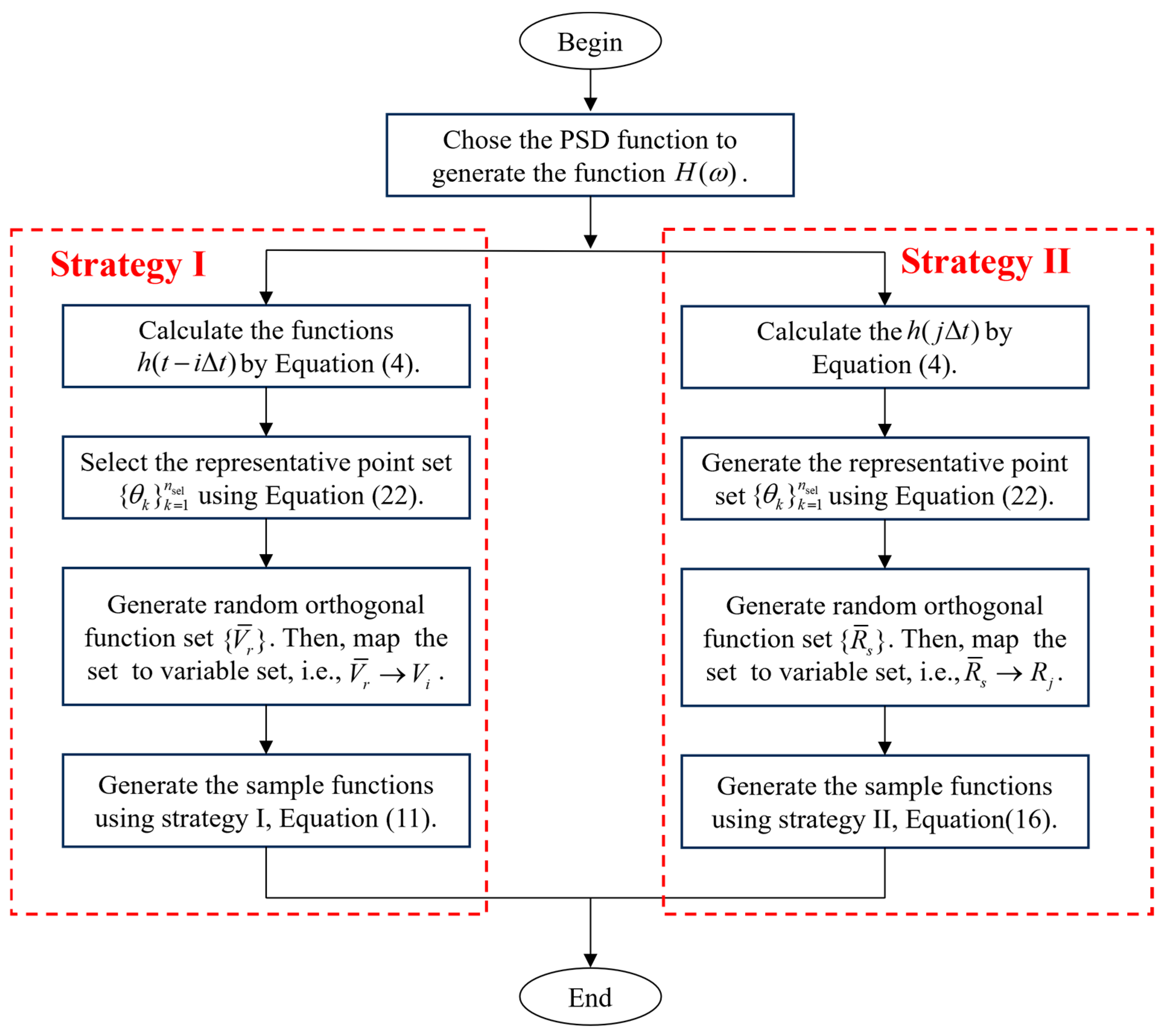
3.3. Implementation Procedure
4. Numerical Example
5. Conclusions
- Time-domain simulation methods of stochastic processes are proposed based on spectral decomposition. The derivation clearly reveals that random variables involved in the time-domain formulations are non-independent, and the only constraint required is that they satisfy prescribed orthogonality conditions.
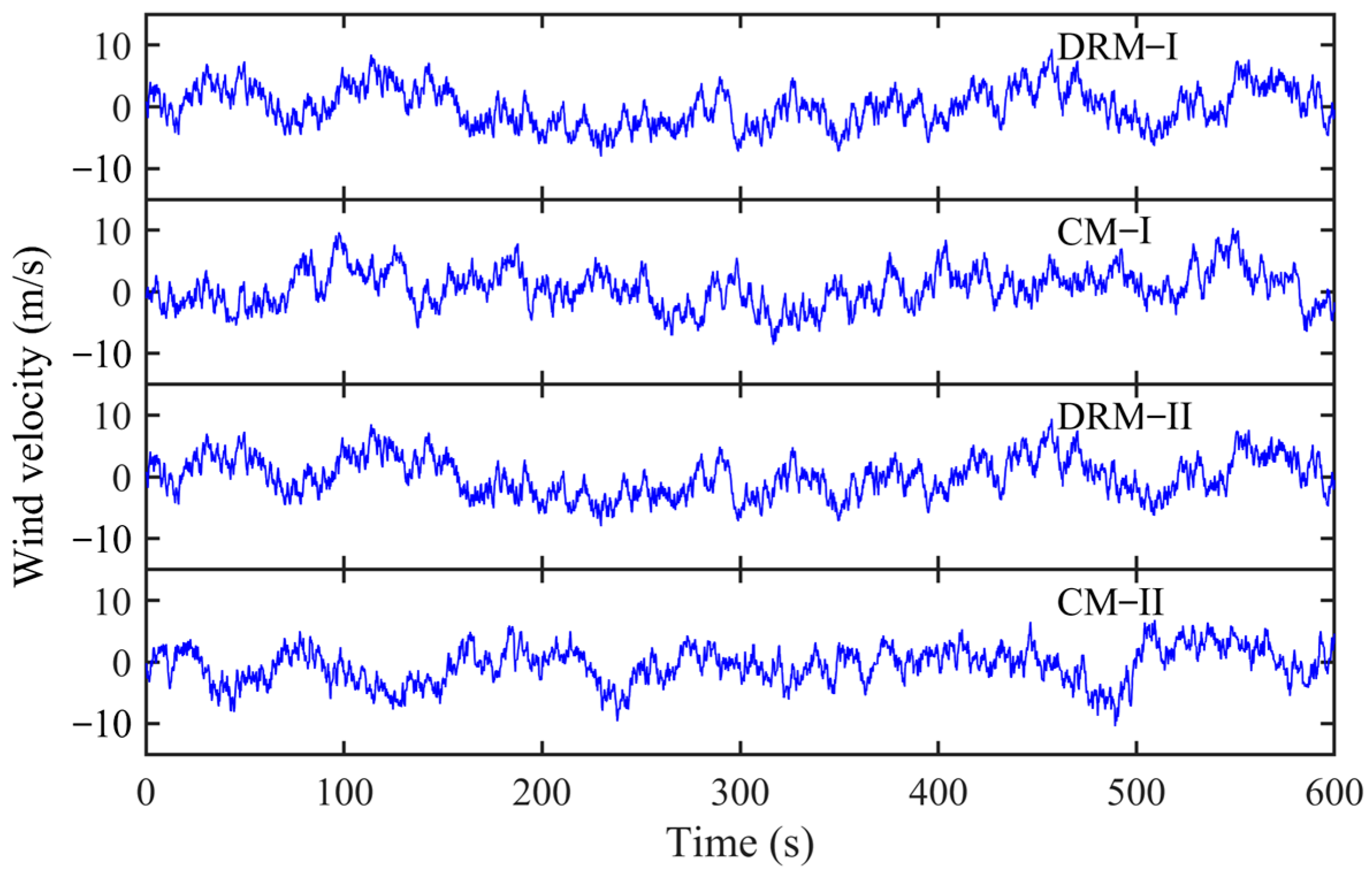
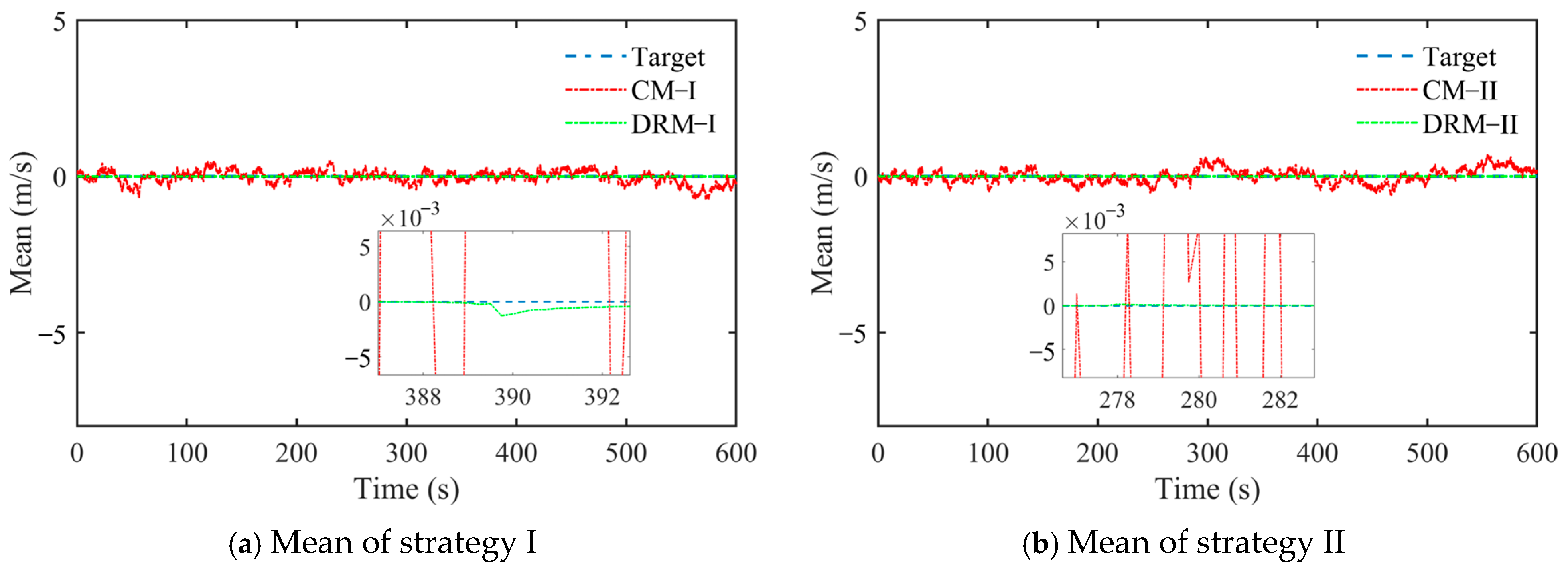
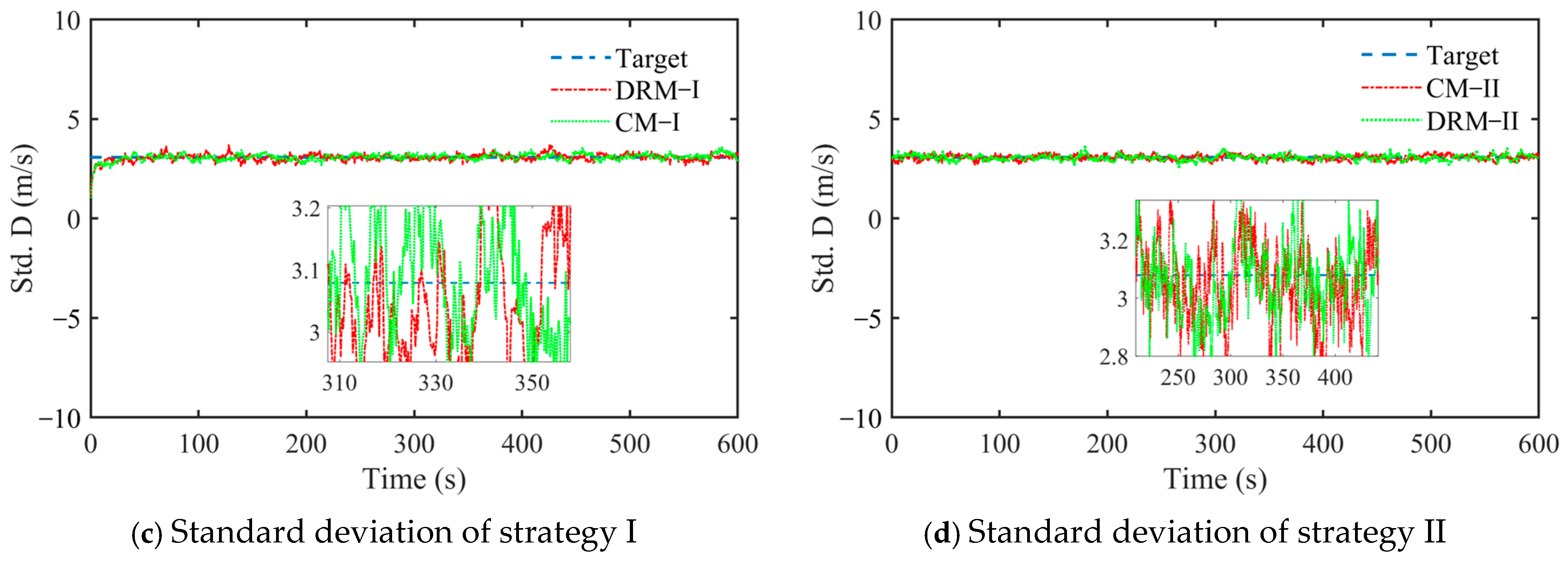
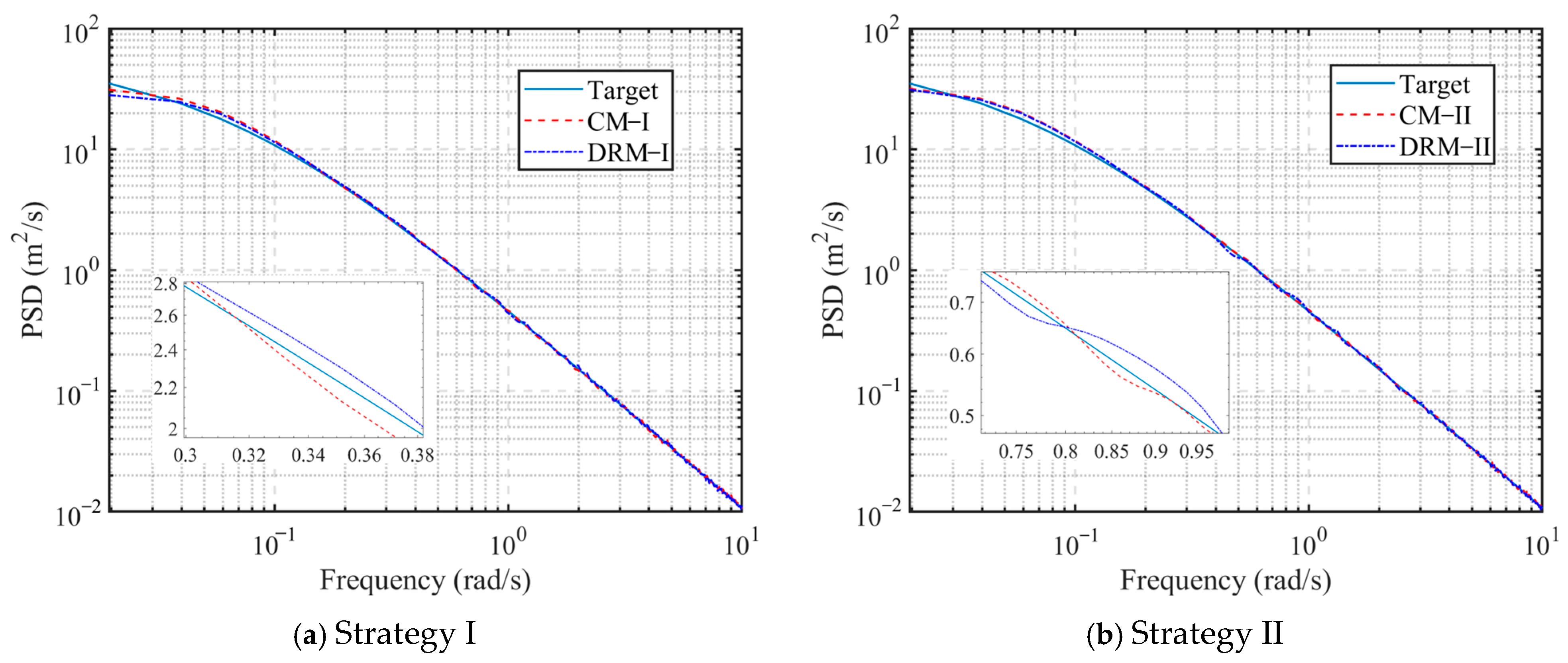
- The proposed time-domain dimension reduction methods reduce the stochastic dimension from 2400 to 1 (99.95% reduction), while the PSD error remains below 2%. Compared with conventional Monte Carlo-based time-domain methods, the computational time is reduced by approximately 4%. The methods effectively alleviate the high-dimensional random-variable problem in conventional time-domain methods, thereby improving the practicality of stochastic excitation modeling for dynamic response and reliability analysis in engineering applications.
- Compared with Strategy I, Strategy II more sufficiently accounts for the physical characteristics of the process, particularly the decay property of the impulse response function, which significantly improves computational efficiency. Numerical results indicate that both strategies maintain a similar PSD error below 2%, while the computational time of Strategy II is reduced by approximately one order of magnitude.
- The proposed framework integrating dimension reduction techniques into time-domain simulation methods generates sample functions with well-defined assigned probabilities, i.e., . In addition, the resulting samples constitute a complete probabilistic information set of the stochastic process, i.e., . Therefore, these features enable accurate quantitative analysis of stochastic process-induced hazards.
Author Contributions
Funding
Data Availability Statement
Acknowledgments
Conflicts of Interest
References
- Chen, J.B.; Chen, Y.W.; Peng, Y.B.; Zhu, S.Y.; Beer, M.; Comerford, L. Stochastic harmonic function based wind field simulation and wind-induced reliability of super high-rise buildings. Mech. Syst. Signal Process. 2019, 133, 106264. [Google Scholar] [CrossRef]
- Liu, Z.X.; Liu, Z.J.; Ruan, X.X.; Xu, B.H. Advances in dimension-reduction methods for simulating univariate and multivariate non-stationary stochastic processes via spectral representation. Probabilistic Eng. Mech. 2025, 79, 103720. [Google Scholar] [CrossRef]
- Liu, Z.J.; Xu, B.H.; Liu, Z.X.; Ruan, X.X. Dimension-reduction representation of stochastic wind-wave fields. Ocean Eng. 2025, 318, 120120. [Google Scholar] [CrossRef]
- Liu, Z.H.; Chen, J.B.; Peng, Y.B. An efficient stochastic harmonic function approach for the simulation of 3-directional wind field of large wind turbines based on physical turbulent spectral model. Mech. Syst. Signal Process. 2025, 229, 112530. [Google Scholar] [CrossRef]
- Liu, Z.J.; Liu, M.; Xu, B.H.; Fan, Y.F.; Ruan, X.X. Time-domain dimension-reduction representation for stochastic ground motion utilizing filtered white noise. Probabilistic Eng. Mech. 2024, 77, 103678. [Google Scholar] [CrossRef]
- Liu, Z.J.; Xu, B.H.; Ruan, X.X.; Hao, J.; Liu, Z.X. Dimension-reduction representations for stationary and non-stationary stochastic processes in time domain. Mech. Syst. Signal Process. 2025, 241, 113541. [Google Scholar] [CrossRef]
- Kareem, A. Numerical simulation of wind effects: A probabilistic perspective. J. Wind Eng. Ind. Aerodyn. 2008, 96, 1472–1497. [Google Scholar] [CrossRef]
- Deodatis, G.; Shinozuka, M. Auto-regressive model for nonstationary stochastic processes. J. Eng. Mech. 1988, 114, 1995–2012. [Google Scholar] [CrossRef]
- Spanos, P.D.; Mignolet, M. ARMA Monte Carlo Simulation in Probabilistic Structural Analysis; National Center for Earthquake Engineering Research: Buffalo, NY, USA, 1989. [Google Scholar]
- Spanos, P.D.; Zeldin, B.A. Monte Carlo treatment of random fields: A broad perspective. Appl. Mech. Rev. 1998, 51, 219–237. [Google Scholar] [CrossRef]
- Box, G.E.; Jenkins, G.M.; Reinsel, G.C.; Ljung, G.M. Time Series Analysis: Forecasting and Control; John Wiley & Sons: Hoboken, NJ, USA, 2015. [Google Scholar]
- Yule, G.U. VII. On a method of investigating periodicities disturbed series, with special reference to Wolfer’s sunspot numbers. Philos. Trans. A Math. Phys. Eng. Sci. 1927, 226, 267–298. [Google Scholar] [CrossRef]
- Walker, G.T. On periodicity in series of related terms. Proc. R. Soc. A 1931, 131, 518–532. [Google Scholar] [CrossRef]
- Wold, H. A Study in the Analysis of Stationary Time Series; Almqvist & Wiksell: Stockholm, Sweden, 1938. [Google Scholar]
- Fu, X.D.; He, X.Y.; Ding, L.Q. Stochastic Flood Simulation Method Combining Flood Intensity and Morphological Indicators. Sustainability 2023, 15, 14032. [Google Scholar] [CrossRef]
- Spanos, P.D.; Eberle, R.R.; Hamilton, D.; Mushung, L. Trivariate spectral modeling of space shuttle flight data. J. Aerosp. Eng. 1995, 8, 148–155. [Google Scholar] [CrossRef]
- Rigby, A.; Baker, U.; Lindley, B.; Wagner, M. Generation and validation of comprehensive synthetic weather histories using auto-regressive moving-average models. Renew. Energy 2024, 224, 120157. [Google Scholar] [CrossRef]
- Chen, J.; Rabiti, C. Synthetic wind speed scenarios generation for probabilistic analysis of hybrid energy systems. Energy 2017, 120, 507–517. [Google Scholar] [CrossRef]
- Ochi, M.K. Ocean Waves; Cambridge University Press: Cambridge, UK, 1998. [Google Scholar]
- Mignolet, M.P.; Spanos, P.D. Recursive simulation of stationary multivariate random processes—Part I. J. Appl. Mech. 1987, 54, 674–680. [Google Scholar] [CrossRef]
- Conte, J.P.; Pister, K.S.; Mahin, S.A. Nonstationary ARMA modeling of seismic motions. Soil Dyn. Earthq. Eng. 1992, 11, 411–426. [Google Scholar] [CrossRef]
- Brockwell, P.J.; Davis, R.A. Introduction to Time Series and Forecasting; Springer: New York, NY, USA, 2002. [Google Scholar]
- Sudret, B. Global sensitivity analysis using polynomial chaos expansions. Reliab. Eng. Syst. Saf. 2008, 93, 964–979. [Google Scholar] [CrossRef]
- Ghanem, R.G.; Spanos, P.D. Stochastic Finite Elements: A Spectral Approach; Springer: Berlin/Heidelberg, Germany, 2003. [Google Scholar]
- Li, J.; Chen, J.B. Stochastic Dynamics of Structures; John Wiley & Sons: Singapore, 2009. [Google Scholar]
- Li, J. Probability density evolution method: Background, significance and recent developments. Probabilistic Eng. Mech. 2016, 44, 111–117. [Google Scholar] [CrossRef]
- Chen, J.B.; Sun, W.L.; Li, J.; Xu, J. Stochastic harmonic function representation of stochastic processes. J. Appl. Mech. 2013, 80, 011001. [Google Scholar] [CrossRef]
- Chen, J.B.; Kong, F.; Peng, Y.B. A stochastic harmonic function representation for non-stationary stochastic processes. Mech. Syst. Signal Process. 2017, 96, 31–44. [Google Scholar] [CrossRef]
- Liu, Z.J.; Liu, W.; Peng, Y.B. Random function based spectral representation of stationary and non-stationary stochastic processes. Probabilistic Eng. Mech. 2016, 45, 115–126. [Google Scholar] [CrossRef]
- Liu, Z.J.; Liu, Z.H. Dimension reducton based spectral representation of stochastic fluctuation wind field simulation. J. Vib. Eng. 2018, 31, 49–56. [Google Scholar]
- Priestley, M. Power spectral analysis of non-stationary random processes. J. Sound Vib. 1967, 6, 86–97. [Google Scholar] [CrossRef]
- Papoulis, A. Random Variables and Stochastic Processes; McGraw Hill: New York, NY, USA, 1991. [Google Scholar]
- Kang, C.L. Theory and Application of Monte Carlo Method; Science Press: Beijing, China, 2015. [Google Scholar]
- Liu, Z.H.; Liu, Z.J.; He, C.G.; Lu, H.L. Dimension-reduced probabilistic approach of 3-D wind field for wind-induced response analysis of transmission tower. J. Wind Eng. Ind. Aerodyn. 2019, 190, 309–321. [Google Scholar] [CrossRef]
- Liu, Z.J.; Liu, Z.H. Random function representation of stationary stochastic vector processes for probability density evolution analysis of wind-induced structures. Mech. Syst. Signal Process. 2018, 106, 511–525. [Google Scholar] [CrossRef]
- Liu, Z.J.; Liu, Z.H.; Peng, Y.B. Simulation of multivariate stationary stochastic processes using dimension-reduction representation methods. J. Sound Vib. 2018, 418, 144–162. [Google Scholar] [CrossRef]
- Fang, K.T.; Wang, Y. Number-Theoretic Methods in Statistics; Chapman and Hall: London, UK, 1993. [Google Scholar]
- Zhou, T.; Peng, Y. Structural reliability analysis via dimension reduction, adaptive sampling, and Monte Carlo simulation: Structural reliability analysis via dimension reduction, adaptive sampling, and Monte Carlo simulation. Struct. Multidiscip. Optim. 2020, 62, 2629–2651. [Google Scholar] [CrossRef]
- Kaimal, J.C.; Wyngaard, J.C.; Izumi, Y.; Coté, O.R. Spectral characteristics of surface-layer turbulence. Q. J. R. Meteorol. Soc. 1972, 98, 563–589. [Google Scholar] [CrossRef]
- Simiu, E.; Scanlan, R.H. Wind Effects on Structures: Fundamentals and Applications to Design; John Wiley: New York, NY, USA, 1996. [Google Scholar]
- Tsoukalas, I.; Kossieris, P.; Makropoulos, C. Simulation of non-Gaussian correlated random variables, stochastic processes and random fields: Introducing the anySim R-Package for environmental applications and beyond. Water 2020, 12, 1645. [Google Scholar] [CrossRef]



| Parameters | Values |
|---|---|
| Duration time | 600 |
| Time interval | 0.25 |
| Number of time intervals | 2400 |
| Number of the representative points | 233 |
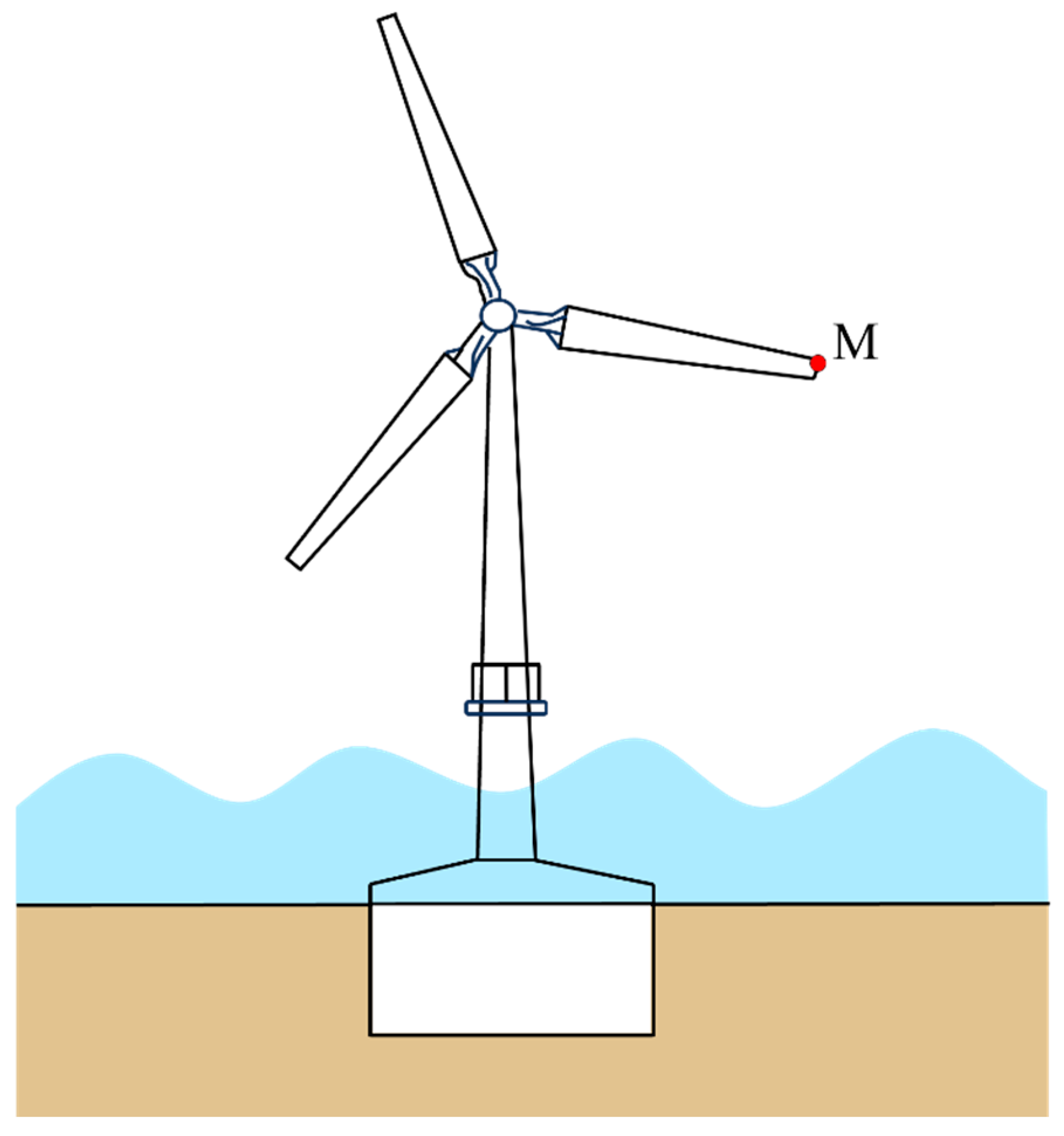
| Height of point M | 90 |
| Mean wind velocity | 42 |
| Surface roughness length | 0.0002 |
| Order of the first method | 500 |
| Simulation Methods | Mean Errors | Std. D Errors | PSD Errors | Computational Time (s) | |
|---|---|---|---|---|---|
| Strategy I | CM-I | 47.53 | |||
| DRM-I | 45.73 | ||||
| Strategy II | CM-II | 4.89 | |||
| DRM-II | 4.51 | ||||
Disclaimer/Publisher’s Note: The statements, opinions and data contained in all publications are solely those of the individual author(s) and contributor(s) and not of MDPI and/or the editor(s). MDPI and/or the editor(s) disclaim responsibility for any injury to people or property resulting from any ideas, methods, instructions or products referred to in the content. |
© 2026 by the authors. Licensee MDPI, Basel, Switzerland. This article is an open access article distributed under the terms and conditions of the Creative Commons Attribution (CC BY) license.
Share and Cite
Liu, G.; Yin, S.; Fu, X.; Liu, Z. Efficient Time-Domain Dimension Reduction Methods for Simulating Stationary Stochastic Processes. Mathematics 2026, 14, 875. https://doi.org/10.3390/math14050875
Liu G, Yin S, Fu X, Liu Z. Efficient Time-Domain Dimension Reduction Methods for Simulating Stationary Stochastic Processes. Mathematics. 2026; 14(5):875. https://doi.org/10.3390/math14050875
Chicago/Turabian StyleLiu, Guoyu, Shiwei Yin, Xiaojiao Fu, and Zixin Liu. 2026. "Efficient Time-Domain Dimension Reduction Methods for Simulating Stationary Stochastic Processes" Mathematics 14, no. 5: 875. https://doi.org/10.3390/math14050875
APA StyleLiu, G., Yin, S., Fu, X., & Liu, Z. (2026). Efficient Time-Domain Dimension Reduction Methods for Simulating Stationary Stochastic Processes. Mathematics, 14(5), 875. https://doi.org/10.3390/math14050875