Article

A Comprehensive Integral-Form Framework for the Stress-Driven Non-Local Model: The Role of Convolution Kernel, Regularization and Boundary Effects


Department of Civil Engineering, University of Salerno, 84084 Fisciano, Italy
*
Author to whom correspondence should be addressed.
Mathematics 2026, 14(5), 872; https://doi.org/10.3390/math14050872
Submission received: 19 January 2026 / Revised: 19 February 2026 / Accepted: 27 February 2026 / Published: 4 March 2026
(This article belongs to the Special Issue Advanced Computational Mechanics)

Abstract

This manuscript presents a study of the Stress-Driven integral Model (SDM) for the bending response of Bernoulli–Euler nanobeams. Unlike conventional approaches that reformulate the nonlocal integral problem into an equivalent differential form, a direct numerical strategy is developed to solve the integral equation. The proposed framework enables a systematic comparison of six different convolution kernels (Helmholtz, Gaussian, Lorentzian, triangular, Bessel and hyperbolic cosine), highlighting how their mathematical properties influence the structural response. To address issues related to long-range interactions and the potential ill-posedness of the integral operator, an adaptive regularization procedure based on the Morozov discrepancy principle is introduced. Furthermore, a local clipping and renormalization technique is proposed to properly account for boundary effects while preserving the weighted averaging property of the kernels. Validation against available analytical solutions for the Helmholtz kernel demonstrates high accuracy, with errors below 1%. The results show that the nonlocal parameter significantly affects structural rigidity depending on the kernel shape and that the proposed approach ensures consistent convergence to the local solution as the nonlocal parameter tends to zero.

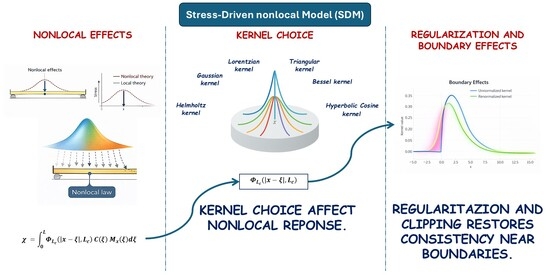
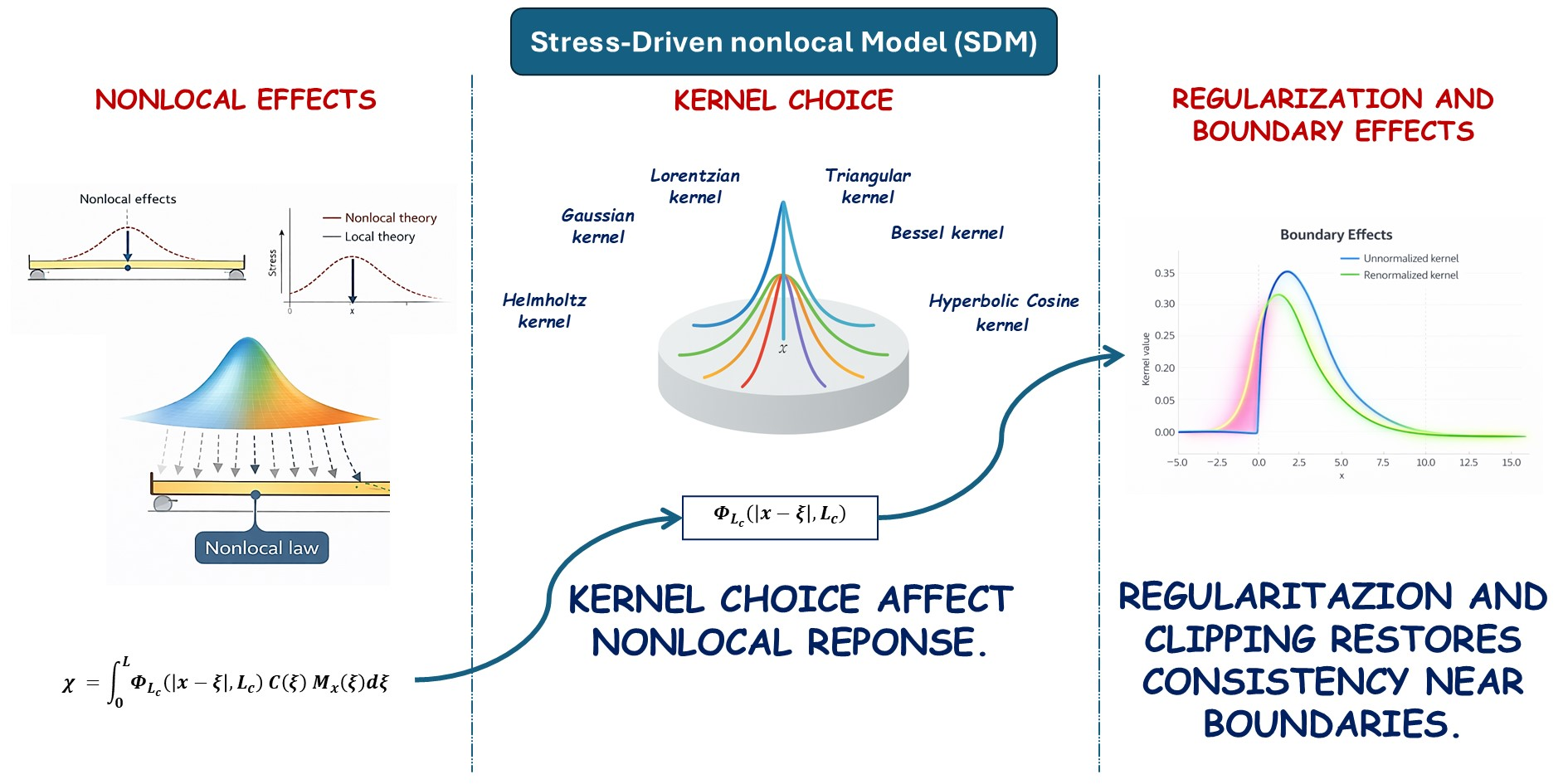
Graphical Abstract

1. Introduction

In recent years, the advent of nanotechnology has pushed scientific research to the study and design of nanoscale materials including Nano-Electro-Mechanical Systems (NEMS), force nanosensors, biosensors, nanoactuators, piezoresistors and components for nanoelectronics [1,2,3,4]. In this context, nanobeams represent one of the most commonly used systems and play a crucial role in the design of such devices. Due to their small size, nanobeams do not obey the laws of local classical mechanics, as scaling effects, surface forces and interactions with electromagnetic fields become relevant, necessitating more advanced theoretical and numerical models. As is well documented in the literature, some material properties such as Young’s modulus, strength and stiffness can vary significantly with decreasing size [5,6,7,8,9]. Consequently, classical continuum mechanics, based on the locality assumption, is inadequate to accurately predict the mechanical response of nanostructures. These behaviours have been confirmed both by experimental techniques (e.g., bending and tensile tests on nanobeams) and by molecular dynamics (MD) simulations, which provide an atomistic description of the material response [10,11,12,13]. Nonetheless, both methodologies are computationally intensive and empirically intricate, constraining their scalability and universal applicability. To address these constraints, nonlocal continuum mechanics has emerged over time as a credible alternative to atomistic simulations. Unlike local theories, nonlocal models account for long-range interactions between material points, allowing for a more realistic description of scaling effects. These models have proven effective in analysing the mechanical response of nanobeams, significantly reducing the computational cost compared to molecular methods. As is well known, the milestone of nonlocal elasticity theory is represented by the Strain-Driven integral model proposed by Eringen [14], together with its equivalent differential formulation [15], where the stress state at a point depends not only on the strain at that point but also on the surrounding points. However, in recent years, the scientific community has highlighted several limitations of Eringen’s theory, particularly in finite domains, where it can produce physically inconsistent results. Such inconsistencies, now known as nanomechanical paradoxes, are related to mathematically ill-posed formulations of equilibrium conditions and constitutive boundary conditions [16,17,18,19]. To overcome these mathematical discrepancies, alternative nonlocal models have been proposed, including the Stress-Driven Integral Model (SDM) [20] and the Gradient Stress-Driven Model (L/NStressG) [21]. The latter couples the SDM with the Mindlin gradient model [22,23,24] and with the Eringen mixture model [25], allowing the description of both work hardening and softening behaviours, as a function of the choice of the nonlocal parameter, the mixture parameter and the characteristic length of the gradient. The nonlocal models just mentioned have been successfully employed in recent years for the study of the static, dynamic and buckling (buckling) behavior of nanobeams under different loading and constraint conditions. Barretta et al. [26] derived exact analytical solutions for functionally graded nanobeams within the integral elasticity framework, providing benchmark results widely adopted for validation purposes. Subsequently, Vaccaro et al. [27] extended the integral formulation to third-order small-scale beam theories, incorporating higher-order kinematics into the SDM framework. Applications of the SDM to bending and buckling problems have also been developed using enriched kernel formulations. Ren and Qing [28] investigated bending and buckling of functionally graded Euler–Bernoulli beams employing a bi-Helmholtz kernel, while Ussorio et al. [29] studied buckling behaviour through iterative computational procedures within the SDM setting. More recently, Das et al. [30] proposed physics-informed neural network approaches for solving nonlocal beam eigenvalue problems governed by the SDM, expanding the range of numerical strategies available for integral formulations. Further developments have addressed gradient enhancements and complex boundary interactions. Barretta et al. [31] introduced nonlocal gradient mechanics for nanobeams with non-smooth fields, whereas Barretta et al. [32] investigated the mechanics of nanobeams resting on nonlocal elastic foundations. Large-deflection effects and nonlinear behaviors were examined in [33], while torsional and dynamic responses of functionally graded nanobeams were analysed in [34,35]. Caporale et al. [36] developed a local–nonlocal stress-driven model for multi-cracked Euler–Bernoulli nanobeams, introducing Dirac delta functions in the bending flexibility to model damaged cross-sections and highlighting the regularizing effect of the pure nonlocal phase. Kadioglu and Yayli [37] investigated the free vibration behavior of triple-walled viscoelastic nanotubes within the stress-driven framework, incorporating van der Waals interactions and Kelvin–Voigt damping. Faraji Oskouie and Rouhi [38] proposed a hybrid strain- and stress-driven integral nonlocal model capable of simultaneously capturing stiffening and softening size effects in nanoscale beams. Ouakad et al. [39] analysed nonlinear vibration and static deflection of actuated hybrid nanotubes within the integral SDM framework.
Recently, the Surface Stress-Driven model [40] has been introduced, which combines SDM with the surface elasticity theory of Gurtin and Murdoch (SET) [41,42]. This formulation allows for the simultaneous modelling of nonlocal and surface effects, both of which are fundamental at the nanoscale. This model has proven to be well-posed and consistent for the study of static and dynamic compounding of functionally graded nanorods even in the presence of electro-mechanical loads [43,44,45]. Despite the diversity of applications and numerical approaches, the majority of the aforementioned studies adopt the Helmholtz (or bi-Helmholtz) kernel, mainly due to its favorable mathematical properties and its compatibility with differential reformulations of the integral model. A systematic investigation of alternative convolution kernels within a fully integral SDM framework, including stabilization procedures and explicit boundary renormalization strategies, remains largely unexplored. A systematic investigation of different kernels is thus necessary to evaluate how the assumed attenuation law influences both the predicted mechanical response and the mathematical well-posedness of the integral model. Recently, several authors have addressed the SDM directly in its integral form by employing analytical techniques such as the Laplace transform. In particular, Nazmul and Devnath and co-workers [46,47,48] derived exact or semi-analytical solutions for bending and vibration of nonlocal and bi-directional functionally graded nanobeams, including axial load effects. Zhang and Qing [49] extended the integral SDM to cracked nanobeams with discontinuities, while Zhang et al. [50] investigated buckling under thermal effects within local/nonlocal mixture integral models using a bi-Helmholtz kernel. Although these contributions represent significant advances in solving the SDM in integral form without differential reformulation, they consistently rely on bi-Helmholtz kernel, whose exponential decay ensures the well-posedness and mathematical stability of the integral operator. The mathematical properties of the convolution kernel play a decisive role in guaranteeing existence, uniqueness and numerical robustness of the solution. While the Helmholtz-type kernels naturally satisfy such requirements, alternative kernels-potentially more suitable for describing specific nanoscale interaction mechanisms-may lead to ill-conditioned or unstable operators. For this reason, the systematic assessment of different kernel functions within a fully integral SDM framework remains an open and relevant research issue. In light of the above considerations, the aim of the present work is to address the existing limitations in the literature concerning the fully integral formulation of the Stress-Driven Model. A direct numerical strategy is developed for the bending analysis of Bernoulli–Euler nanobeams without resorting to differential reformulations. Unlike traditional approaches, which exploit the Helmholtz kernel to transform the integral problem into an equivalent differential equation, the proposed framework solves the SDM directly in its original integral form. To this end, six different convolution kernels-Helmholtz, Gaussian, Lorentzian, Triangular, Bessel and Hyperbolic Cosine-are systematically investigated in order to assess how their intrinsic properties (decay rate, support and smoothness) influence the structural response and the mathematical behaviour of the model. Particular attention is devoted to boundary effects, which are often overlooked but become crucial in finite domains, especially when kernels with infinite support or slow decay are adopted [51]. A local clipping and kernel renormalization strategy is introduced to preserve the weighted-averaging property of the convolution operator near the edges, thereby ensuring physical consistency and convergence to the local limit. In addition, the numerical solution is stabilized through the Morozov discrepancy principle [52,53,54,55], which enables the adaptive determination of the regularization parameter and enhances the robustness of the integral formulation in the presence of potentially ill-posed operators. The spatial discretization is further optimized to minimize the normalized residual, ensuring both numerical stability and physical reliability of the solution.
The manuscript is organized into seven Sections. Section 1 introduces the scientific context of the work, highlighting the main critical issues associated with the integral formulation of the SDM and motivating the need for a more in-depth analysis, particularly regarding the choice of the nonlocal kernel and the treatment of edge effects. Section 2 recalls the theoretical formulation of SDM in integral form and presents its corresponding differential formulation, obtained using the Helmholtz kernel, widely used in the literature. Section 3 proposes a detailed analysis of the six convolution kernels considered-Helmholtz, Gaussian, Lorentzian, Triangular, Bessel, and Hyperbolic Cosine-discussing their mathematical properties, influence on the physical response of the model and applicability in the nonlocal context, filling a gap in the literature. Section 4 is devoted to the developed numerical strategy, based on the Morozov discrepancy principle, which allows to effectively handle the malposition of the integral operator. Section 5 addresses the correction of edge effects using a local clipping and kernel renormalization procedure. Section 6 summarizes numerical simulations on the bending response of nanobeams, for each type of kernel used, highlighting how edge effects can influence and alter the solutions. Finally, Section 7 reports the conclusions and summarizes the main theoretical and numerical contributions of the work.

2. Stress-Driven Nonlocal Integral Model (SDM)

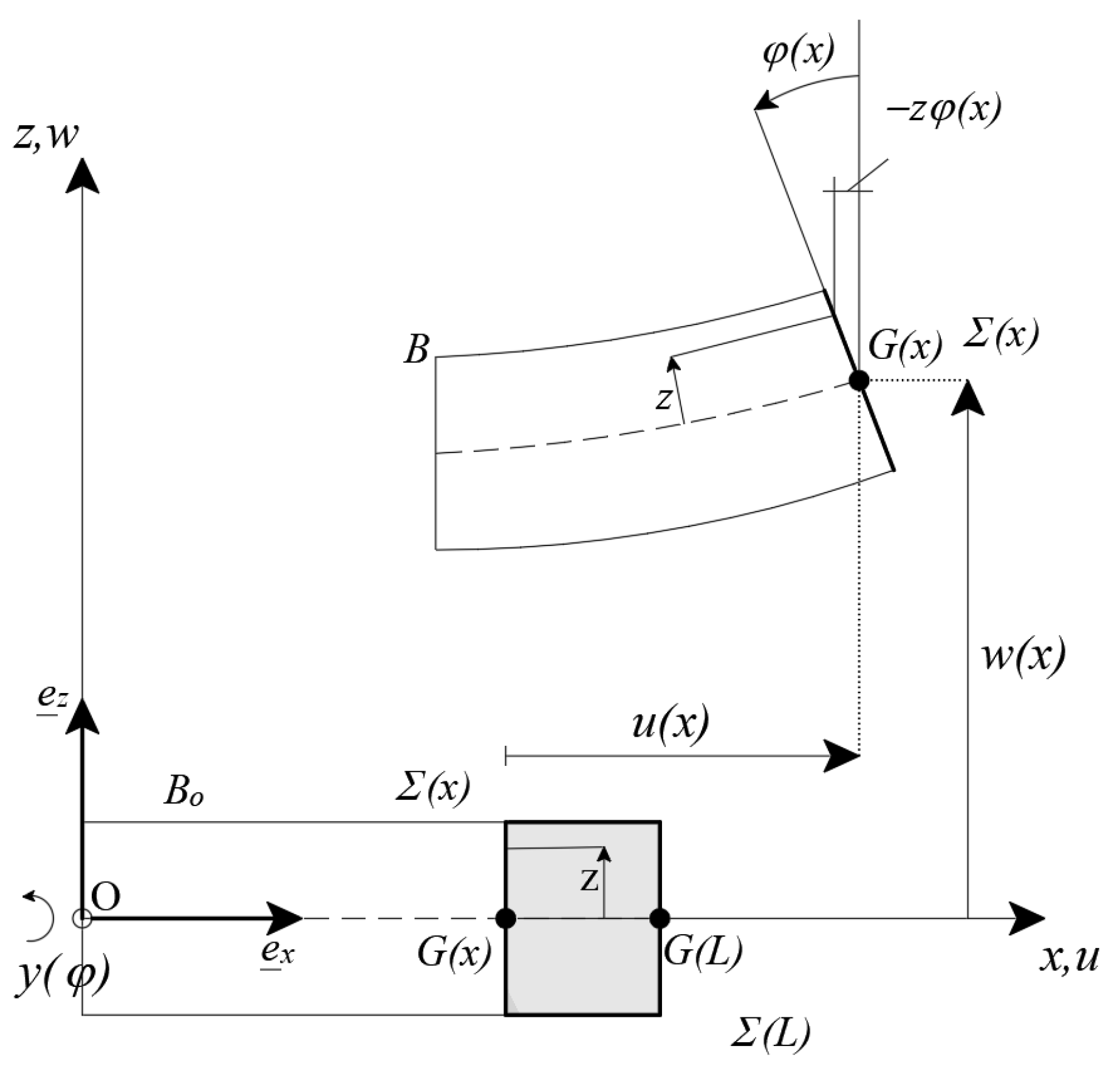
Let us consider a nanobeam occupying the reference configuration B 0 , of length L  and generic cross-section Σ , as shown in Figure 1. Upon deformation, the beam occupies the current configuration B . A Cartesian coordinate system x z is introduced, with origin at point O , while G denotes the geometric center of each cross-section along the beam axis (see Figure 1).
According to the Bernoulli–Euler beam theory, the displacement field is assumed to be of the form
u x , t = u x x , z , t e ^ x + u z x , z , t e ^ z
where e ^ x and e ^ z are, respectively, the unit vectors along x- and z-axes; u x x , z , t   a n d   u z x , z , t indicate the Cartesian components of the displacement field along x and z . Under the classical kinematic assumption that cross-sections remain plane and orthogonal to the deformed centroidal axis, the displacement components read
u x x , z = u x z   φ x         w i t h         φ x = w x x
u z x , z = w x
where u x = u and w x = w are the axial and transverse displacements of the geometric center G, respectively. Within the assumptions of the small strain and displacement theory, the simplified Green–Lagrange strain tensor is
E ε = ε x x   e ^ x e ^ x
where
ε x x = ε x x x , z = z 2 w x 2
with 2 w x 2 is the geometric bending curvature χ .
The use of principle of virtual work allows us to obtain the governing equation of the bending problem:
2 M x x 2 + q z = 0
where M x = M x ( x ) and q z = q z ( x ) are the resultant bending moment and the transverse distributed load, respectively. The Stress-Driven nonlocal Model (SDM) proposed by Romano and Barretta [20] assumes purely elastic behavior and for this reason, the geometric and elastic bending curvature fields are coincident:
χ χ e l =   2 w x 2
According to the SDM, the elastic bending curvature is described by the following convolution law as
χ = 0 L Φ L c x ξ , L c   C ξ   M x ξ d ξ
where x and ξ are the positions of points of the domain of the Euclidean space occupied by nanobeam; Φ L c is the scalar averaging kernel, depending on the internal characteristic length defined as L c = λ c L where λ c denotes the nonlocal parameter and characterizes the intensity of nonlocal effects; and the term C = C ξ denotes the local elastic compliance whose inverse corresponds to the bending stiffness C 1 = I E .
I E   : = Σ E z 2 d Σ
where E is the Young modulus.
In nonlocal models widely employed in the literature [26,27,28,29,30,31,32,33,34,35,36,37,38,39,40,43,44,45,46,47,48,49,50,51], the Helmholtz averaging kernel Φ H is typically chosen as the convolution kernel within the integral formulation:
Φ H = 1 2 L c e x ξ L c
Specifically, the problem can be reformulated as solving the differential equation equipped with the constitutive boundary conditions at the free end of nanobeams (0, L):
1 + L c 2 χ = C   M x
χ x 0 , L = ± 1 L c χ 0 , L
which corresponds to the classical Green’s differential problem. Transforming the integral problem into a differential equation makes possible the use of standard numerical methods for PDEs, reducing computational complexity compared to the direct integration of the convolution operator. Moreover, the special Helmholtz averaging kernel possesses several notable properties, including symmetry, positivity and limited impulsivity:
Φ L c x ξ = Φ L c ξ x 0   x = δ x    
with δ is the Dirac unit impulse at 0 R and the limit being intended in terms of distributions:
+ Φ L c x ξ · f ξ d ξ   = f x
for any continuous function f = f x :   R   R .
As demonstrated in the literature in [46,47,48,49,50], the use of the Helmholtz kernel not only allows us to switch to an equivalent differential formulation (Equation (11)) but also to obtain an integral solution of Equation (8) using Laplace transforms. The use of alternative kernels with different mathematical properties (e.g., Gaussian, power-law, anisotropic) is of fundamental importance. Using kernels other than the classical Helmholtz kernel not only fails to obtain an equivalent differential formulation but also results in a transformation that does not produce a closed-form solution that is easily invertible, giving rise to ill-posed mathematical problems.

3. Kernels: Influence and Properties

The different kernels adopted in this work exhibit distinct mathematical properties in terms of decay rate, continuity and support, which in turn influence the stability and computational efficiency of the numerical solution. This chapter summarizes the main characteristics and properties of the kernels considered. The types of kernels studied in this work are:
  • Helmholtz Kernel;
  • Gaussian Kernel;
  • Lorentzian (Cauchy) Kernel;
  • Bessel Kernel;
  • Triangular kernel;
  • Hyperbolic Cosine Kernel.

3.1. Helmholtz Kernel

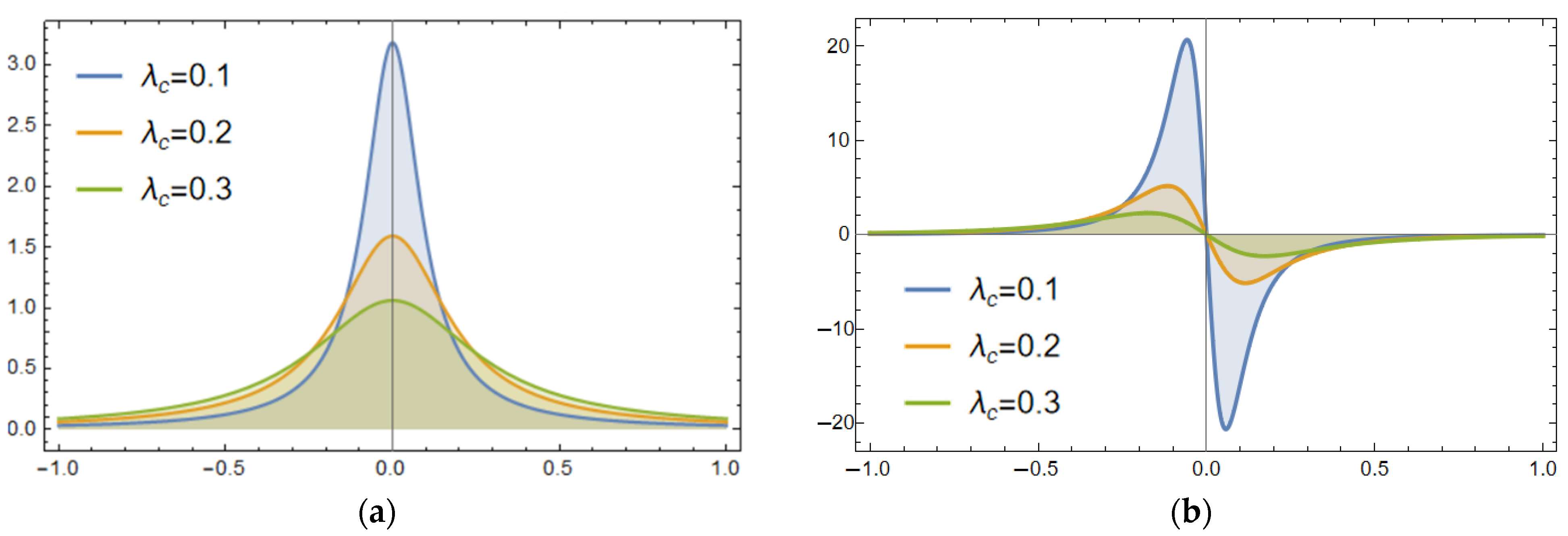
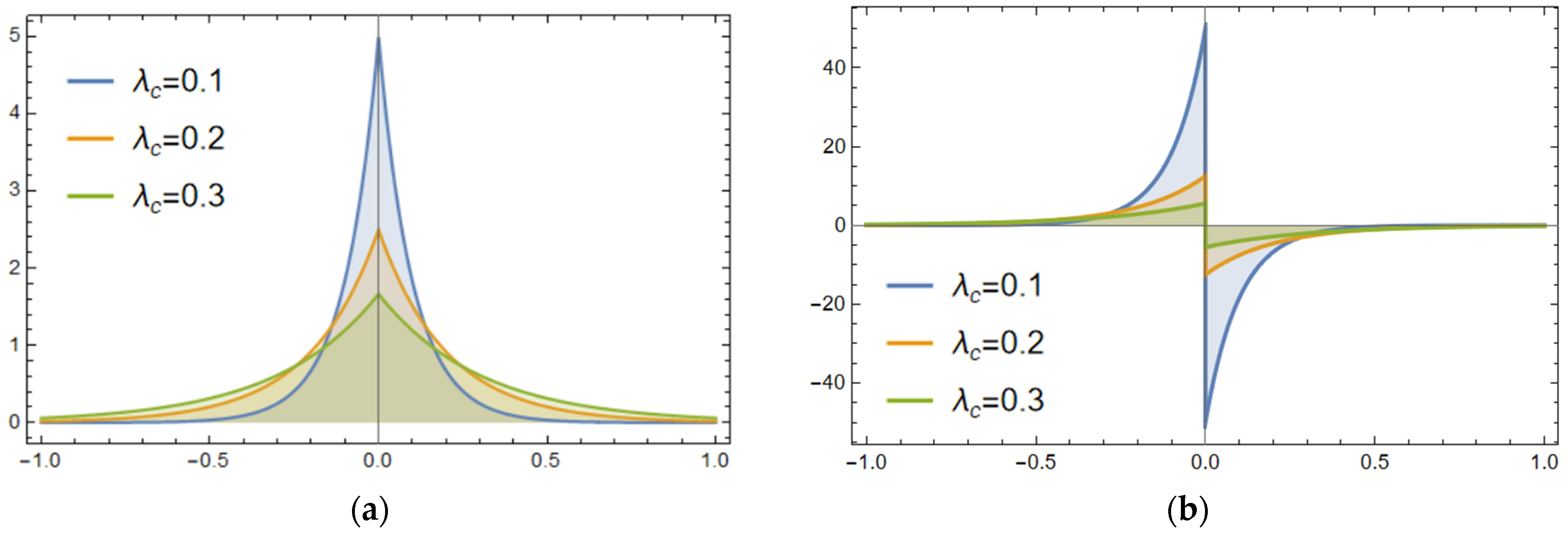
The analytical expression of the special Helmholtz averaging kernel is given by Equation (10), while its behavior and its first derivative are depicted in Figure 2a and Figure 2b, respectively.
As discussed above, the Helmholtz kernel is often used because, due to its special properties Equations (12) and (13), it allows us to transform a nonlocal integral problem into an equivalent differential problem. Furthermore, this type of kernel is useful for problems requiring localized interactions with rapid decay. This is also confirmed by Figure 2b, which shows the derivative of the Helmholtz kernel; indeed, as the nonlocal parameter, λ c , increases, the interaction is less localized and broader, confirming that as λ c     increases, long-range interactions increase.

3.2. Gaussian Kernel

The Gaussian kernel is defined as
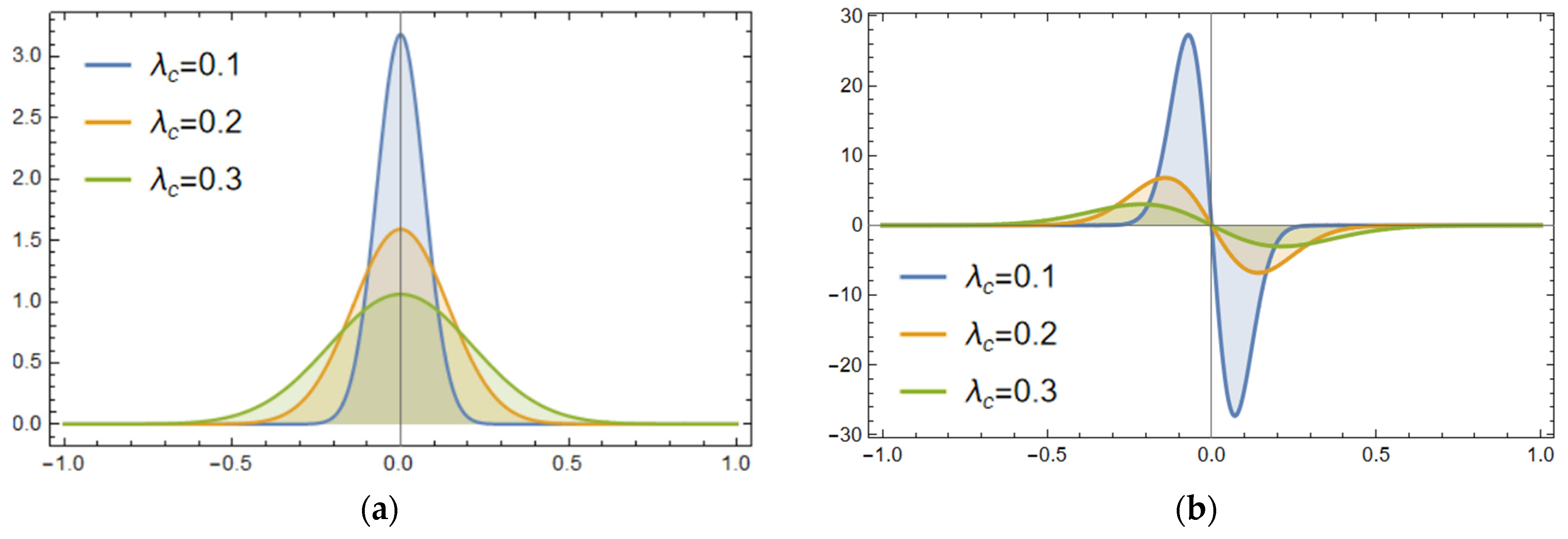
Φ G = 1 L c   π e x ξ L c 2
while its behavior and its first derivative are illustrated in Figure 3a and Figure 3b, respectively.
This kernel is used in problems that require high regularity, continuity and fast decay. The derivative of the Gaussian kernel in Figure 3b reveals a nonlocal field with long-range interactions and a smooth gradient. It has no singularities. As λ c increases, the gradients become smoother and the nonlocal effect becomes larger, consistent with a more diffuse mechanical reaction.

3.3. Lorentzian (or Cauchy) Kernel

The Lorentzian (or Cauchy) kernel is defined as
Φ L = L c π   x ξ 2 + L c 2
while its behavior and its first derivative are shown in Figure 4a and Figure 4b, respectively.
Unlike the Gaussian kernel, the Lorentzian kernel has heavy tails, which is useful in cases where nonlocal effects occur at larger distances. Figure 4b shows that the derivative of the Lorentzian kernel has an antisymmetric structure, with a fast change near the origin and a slower decay in the tails. The rise in λ c weakens the central peak and spreads the spatial effect, which means that the nonlocal reaction is long-range but not very localized.

3.4. Bessel Kernel

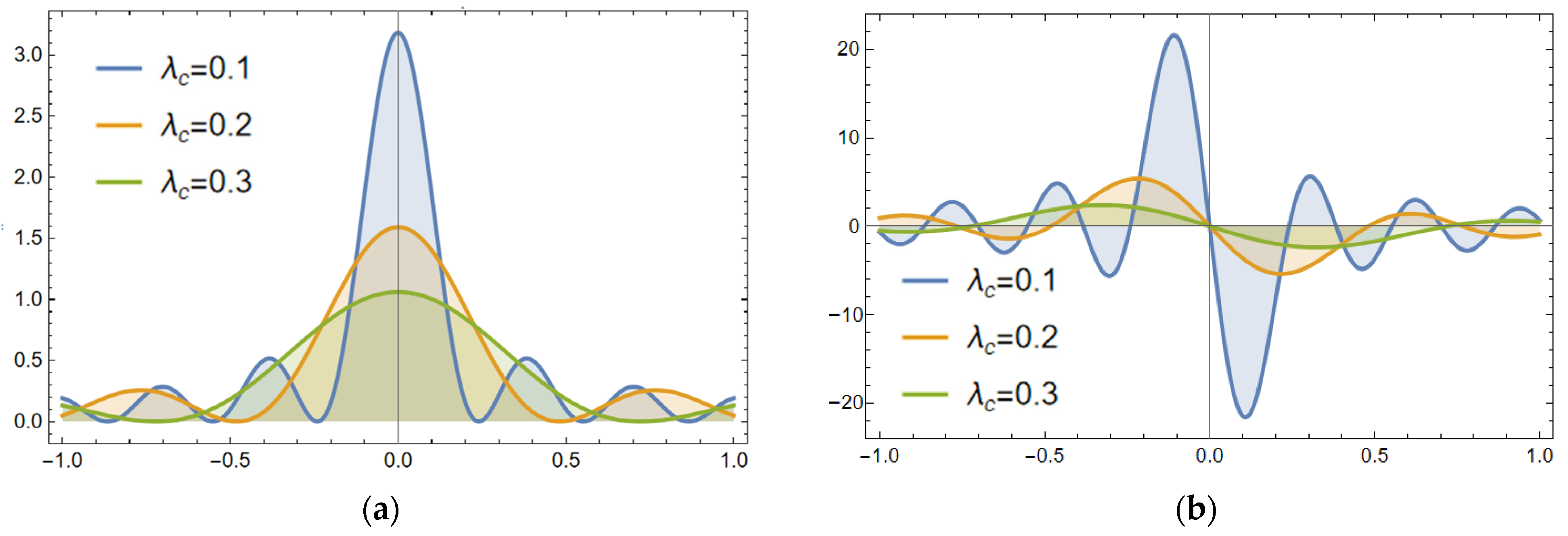
The Bessel kernel, depicted in Figure 5 together with its first derivative, is commonly expressed as
Φ B = 1 π   L c J 0 x ξ L c   2
where J 0 denotes the Bessel function of the first kind.
This kernel exhibits long-range interactions and is particularly useful in models requiring oscillatory behavior as also demonstrated by the oscillatory and antisymmetric profile of its derivative.

3.5. Triangular Kernel

The triangular kernel is a piecewise linear function given by
Φ T = 1 π   L c 0 , 1 x ξ L c  
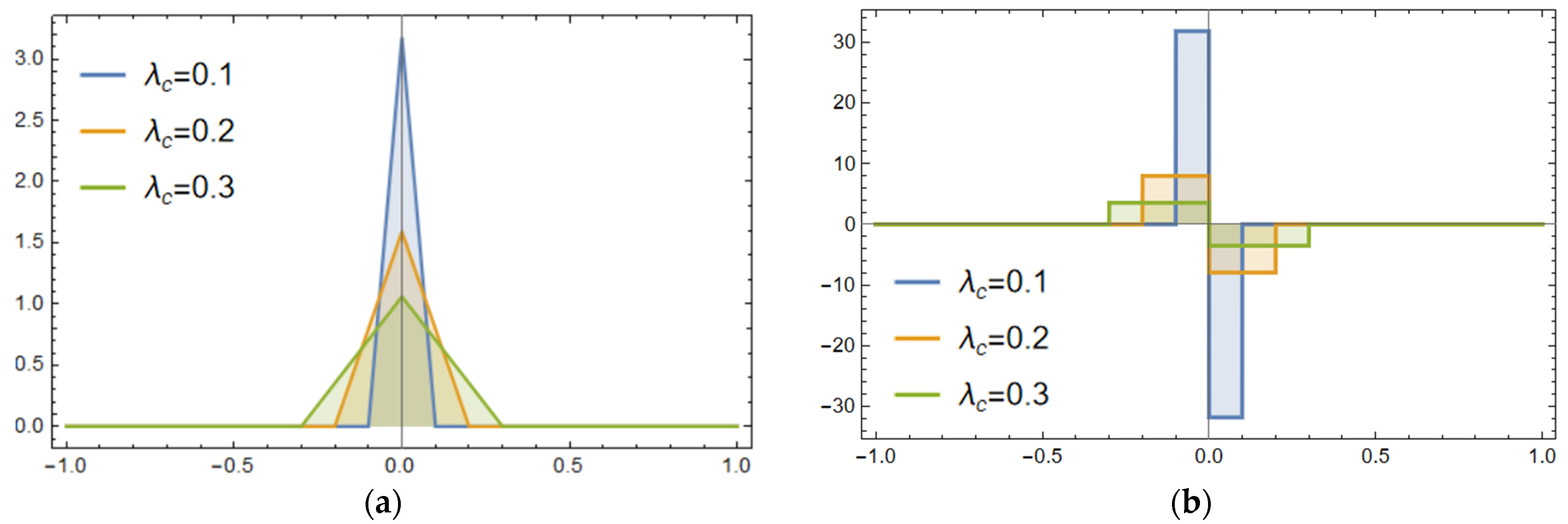
while its behavior and its first derivative are shown in Figure 6a and Figure 6b, respectively.
This kernel is often used in numerical applications where a balance between local and nonlocal effects is required and consists of finite support. Figure 6b shows the derivative of the triangular core, which has an antisymmetric and piecewise constant profile. As λ c increases, the amplitude decreases and the region of influence widens, which corresponds to a larger nonlocal interaction. Furthermore, the triangular kernel is C 1 , meaning it is continuous and differentiable, but its derivative is discontinuous at the boundaries of the support x = λ c .

3.6. Hyperbolic Cosine Kernel

The hyperbolic cosine kernel is defined as
Φ C H = 1 π   L c x ξ L c
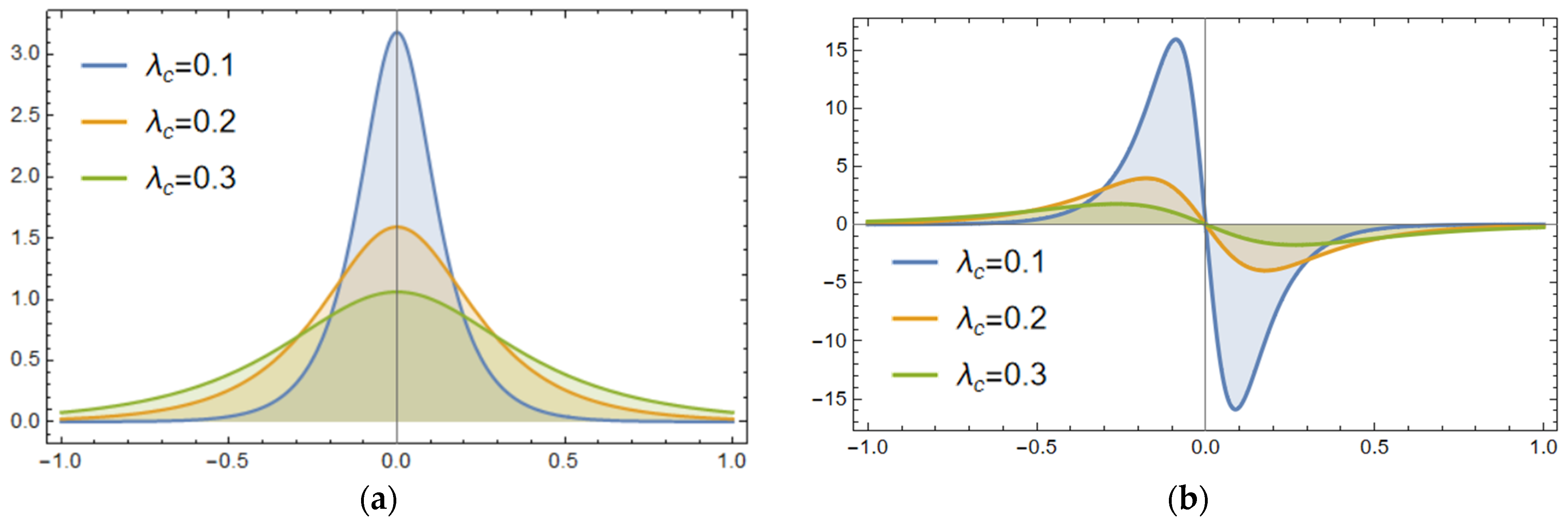
while its behavior and its first derivative are shown in Figure 7a and Figure 7b, respectively.
This kernel has an intermediate decay rate between the Gaussian and Helmholtz kernels and can be useful in models where fast interactions but with non-exponential decay are required. The derivative of the hyperbolic kernel, shown in Figure 7b, shows an antisymmetric profile with a strong variation near the origin. Increasing λ c attenuates the central gradient and extends the influence range, indicating a more gradual nonlocal response.

3.7. Main Remarks

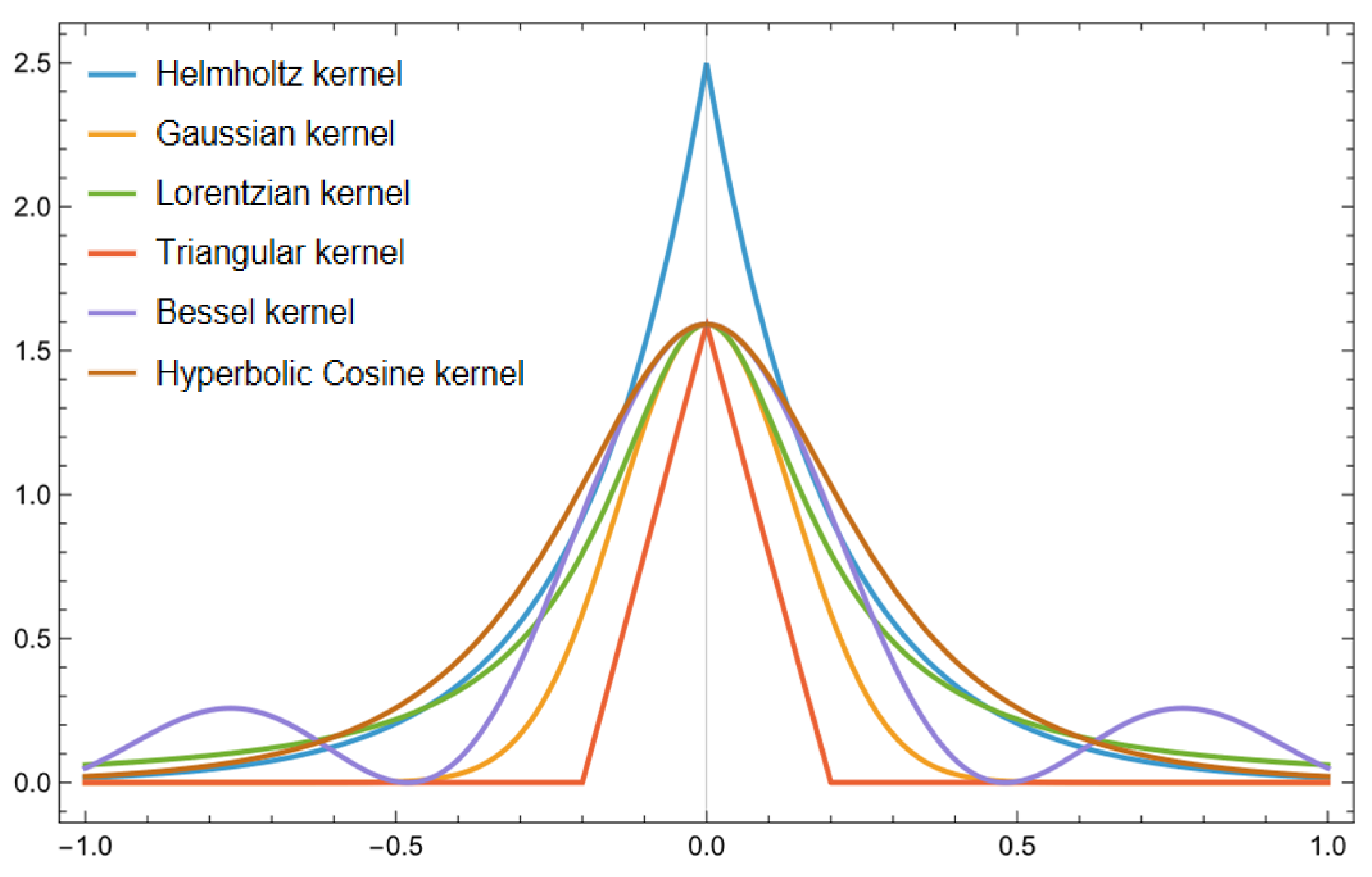
All the kernels considered are symmetric and positive. It is therefore possible to note that the choice of kernel is not simply a mathematical choice but also a physical one, since the kernel governs the spatial attenuation of nonlocal interactions and the way boundary effects are transmitted throughout the structure. The six adopted kernels have been deliberately chosen to represent a broad spectrum of mathematical behaviors commonly encountered in nonlocal elasticity. In particular, they differ in terms of decay rate (exponential, power-law, and linear), support (finite versus infinite), and smoothness class. This variety enables a systematic investigation of how these intrinsic properties influence the structural response predicted by the SDM. The main characteristics of each kernel are summarized in Table 1.
From a mechanical standpoint, kernels with fast exponential decay (e.g., Helmholtz and Triangular) generate more localized interactions, leading to behavior closer to classical local elasticity for small nonlocal parameters. Conversely, kernels characterized by slower decay exhibit stronger long-range effects, resulting in more pronounced deviations from the local response. Figure 8 illustrates the different kernel profiles for a nonlocal parameter equal to 0.20. It clearly shows how the decay rate and amplitude vary significantly among kernels, directly affecting the extent of nonlocal interactions. Faster-decaying kernels present narrower influence zones, while slower-decaying kernels display heavier tails.
From a computational perspective, all kernels are implemented within the same numerical framework and discretization strategy, as detailed in the following sections. Although kernels with infinite support formally involve broader interaction domains, the adopted regularization, truncation, and solution procedures ensure comparable computational effort across the different cases. Consequently, the comparison is conducted within a fully consistent integral setting, so that the observed differences in structural response can be attributed exclusively to the intrinsic mathematical properties of the kernels rather than to algorithmic variations.

4. Proposed Numerical Solution Procedure

This section summarizes the main steps of the proposed numerical procedure. In particular, the convolution integral Equation (8), with the six different kernels used, was solved using Morozov’s discrepancy principle [52,53]. To overcome the numerical instability problems of the integral equation, this method introduces an optimal regularization parameter α that guarantees the best trade-off between accuracy and stability. The main steps of the proposed numerical strategy are summarized in Box 1.
Box 1. Flow chart of the solution procedure of the nonlocal integral stress-driven model using.
 
STEP 1. Discretization of the domain
 
The spatial domain [0, L] is divided into N points.
 
STEP 2. Construction of the Convolution Kernel Matrix K
 
The integral operator is discretized by constructing a kernel matrix K. In particular, for each kernel, it is possible to obtain
K H i , j = 1 2 L c e x i x j L c d x
K G i , j = 1 L c   π e x i x j L c 2 d x
K L i , j = L c π x i x j 2 + L c 2 d x
K B i , j = 1 π   L c J 0 x i x j L c d x
K T i , j = 1 π   L c 0 , 1 x i x j L c   d x
K C H i , j = 1 π   L c x i x j L c   d x
where d x = x j x i
 
STEP 3. Finite Difference Approximation of the Differential Operator
 
The second derivative 2 w x 2  is discretized using a central difference scheme, leading to a sparse matrix representation D2.
 
STEP 4. Optimization of the Regularization Parameter α using Morozov’s Method
 
After STEP 1 and 2, the system to be solved is
I E   D 2 + α   I   w = K   M x
where I  is the identity matrix N x N.
The optimal parameter α is selected through a binary search algorithm, ensuring that the residual norm satisfies Morozov’s discrepancy principle
K w M x n o i s e   l e v e l
The MATLAB function findBest() implements a binary search to find the best α within a predefined range α m i n , α m a x . In this case, an initial range is set as 10 6 , 10 1 . α is adjusted based on the residual:
-
If K w M x  exceeds the noise level, α  is increased;
-
If K w M x  is too small, α is decreased.
The iteration stops when convergence is achieved, i.e., when ( α m a x α m i n ) < 10 6 .
 
STEP 5. Optimization of discretization parameter N
 
Since the choice of N affects both accuracy and computational cost, an adaptive optimization strategy has been implemented. The procedure evaluates solveMorozov() in MATLAB R2024b for different values of N  within the range [50, 5000] with a step of 50, selecting the value that minimizes the residual norm K w M x .
 
STEP 6. Choosing the noise of the data
 
In the data analysis phase, the parameter σ N o i s e  represents the estimated noise level in the data and is used as a stopping criterion during the regularization process. In this study, we adopted σ N o i s e = 0.001 , a conservative choice consistent with the scientific literature [52,53,54,55].
 
STEP 7. Solution of the Regularized System:
 
Once α and N are determined, the regularized system is solved using MATLAB’s sparse linear solvers.
 

5. Boundary Effects in Nonlocal Models: Clipping and Re-Normalization

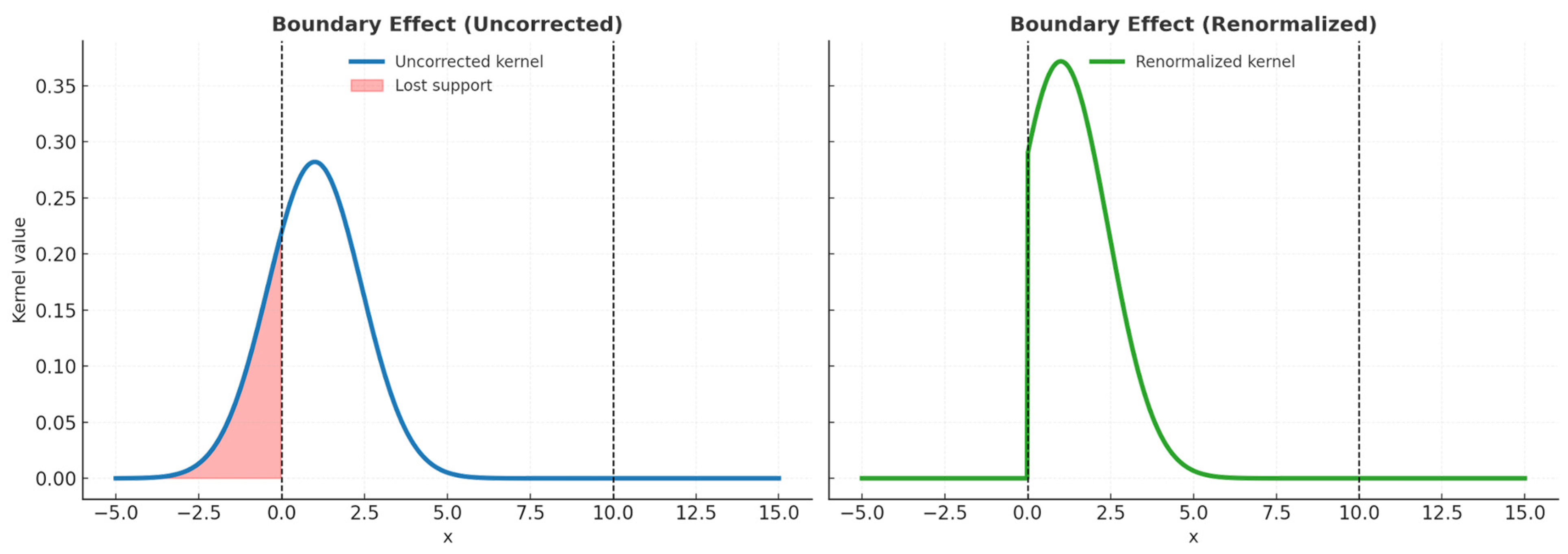
In the nonlocal SDM, the elastic curvature χ is calculated, as from Equation (8), by means of a convolution integral involving a kernel Φ L c x ξ , L c such as to also take into account the influences of the surrounding points. As can be seen from Figure 8, how close the point x is to the boundary of the physical domain [0, L] part of the kernel support extends beyond the domain and in fact for values of > 0 or ξ > L the contribution of χ should not be taken into account when the function is not defined outside the domain.
As a result, the truncated kernel no longer satisfies the normalization condition, and the convolution operator no longer represents a proper weighted average near the boundaries. This may artificially weaken the interaction and lead to inaccurate predictions, especially preventing the correct recovery of the local limit as L c 0 .
To address this problem, the present work adopts a strategy where kernels are explicitly truncated in the physical domain and locally renormalized (Figure 9). This correction is particularly relevant for kernels with infinite support or slow decay, which are more sensitive to edge effects. For each point xi in the domain, a row-wise renormalization of the nonlocal matrix K is applied, defined in discrete form as:
K i , j = Φ L c x i x j , L c j Φ L c x i x j , L c d x d x
where Φ L c is the chosen kernel.
This procedure ensures that each row of the matrix K adds to one, thus preserving the interpretation of a valid weighted average, even near domain boundaries, and maintaining consistency with local modelling assumptions. Indeed, the kernel is renormalized locally to recover the expected integral property despite boundary truncation. Through this procedure, the discrete operator is locally rescaled so that each row of the matrix K sums to one, thereby restoring the normalization property of the kernel within the truncated domain. Although the analytical shape of the original kernel is locally modified near the boundaries, its essential properties for the SDM formulation, namely positivity, consistency of the weighted averaging process and convergence to the classical local solution as L c 0 , are preserved. Generally, in the literature many theoretical studies do not make any edge corrections and no kernel renormalizations as they assume that the domain is R. This condition is acceptable for very small values of the nonlocal parameter and close to zero. Instead, as discussed in a recent study [52] edge effects can lead to important numerical distortions and therefore it would be appropriate to consider them. To demonstrate this, a comparative analysis was performed in this work: first, the nonlocal model was evaluated without any edge correction; and then, for each kernel under study, the clipping and renormalization procedure defined in Equation (27) was applied.

6. Results and Discussion

A numerical investigation on the bending response of Simply Supported (S-S) Bernoulli–Euler nanobeam has been developed by using the nonlocal integral Stress-Driven model together with the proposed numerical strategy. The analysis is structured to highlight the role of the six convolution kernels, the influence of boundary effects and the impact of the proposed clipping and renormalization treatment. Dimensionless variables are used in the plots and tables by introducing the following quantities
X = x L ,     λ c = L c L ,     W = w I E q   L 4

6.1. Results Without Clipping and Renormalization Strategy

Table 2 reports the dimensionless midpoint deflection W ( 1 / 2 ) as the nonlocal parameter λ c varies in the range {0.00–0.50} for all the considered kernels, without applying clipping or renormalization.
As a preliminary verification step, the numerical predictions obtained with the unclipped Helmholtz kernel were compared with the analytical closed-form solution by Barretta et al. [26]. The agreement is excellent, with errors well below 1%, confirming the correctness and consistency of the implemented numerical scheme. However, the results in Table 2 demonstrate that, in the absence of clipping and renormalization, several kernels—including Gaussian, Triangular and Bessel-fail to recover the local value (0.0130208) as λ c → 0. This behaviour arises from the distortion of the kernel averaging mechanism near the beam edges, which becomes particularly significant for kernels with infinite support or slow decay.
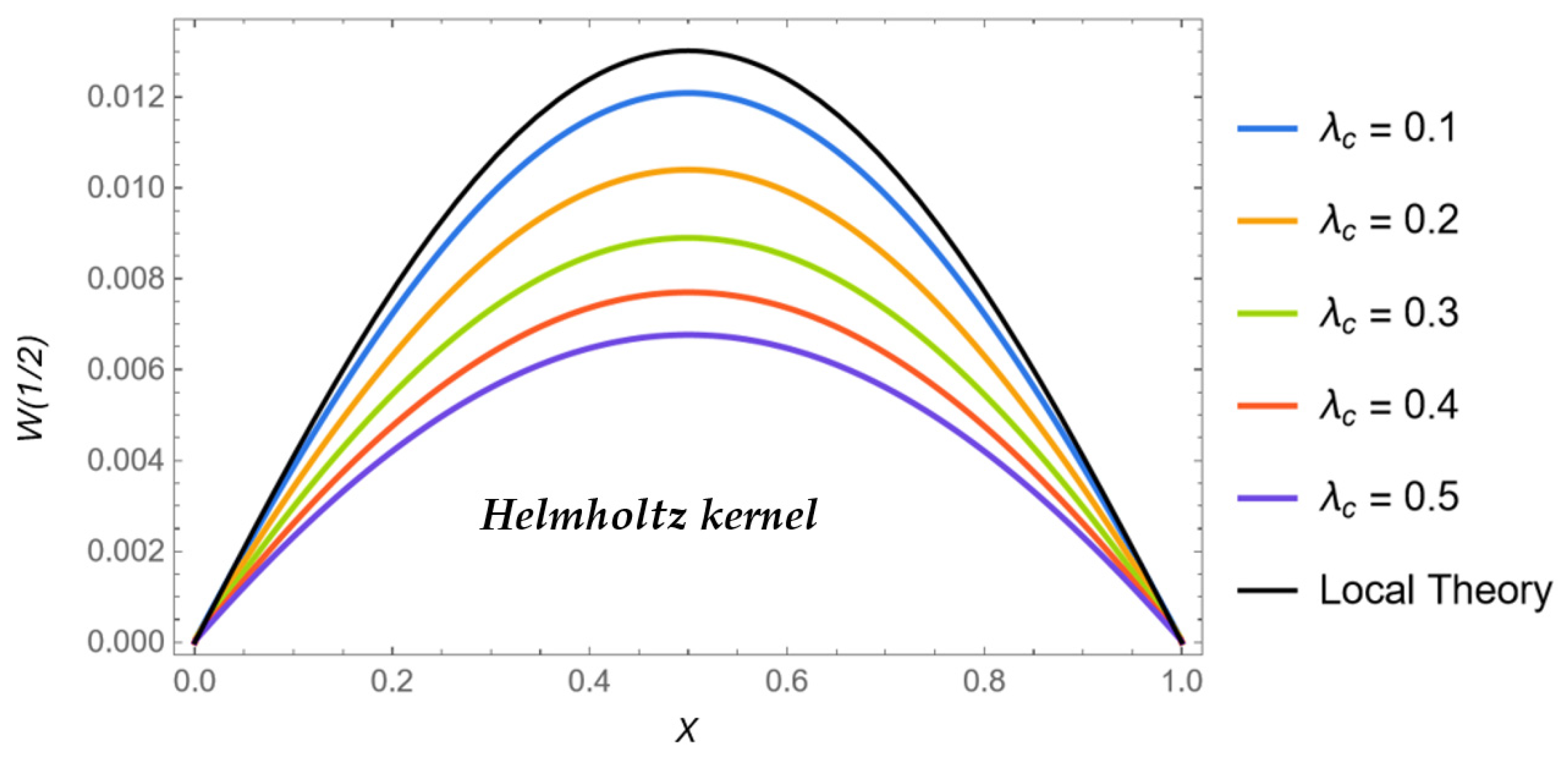
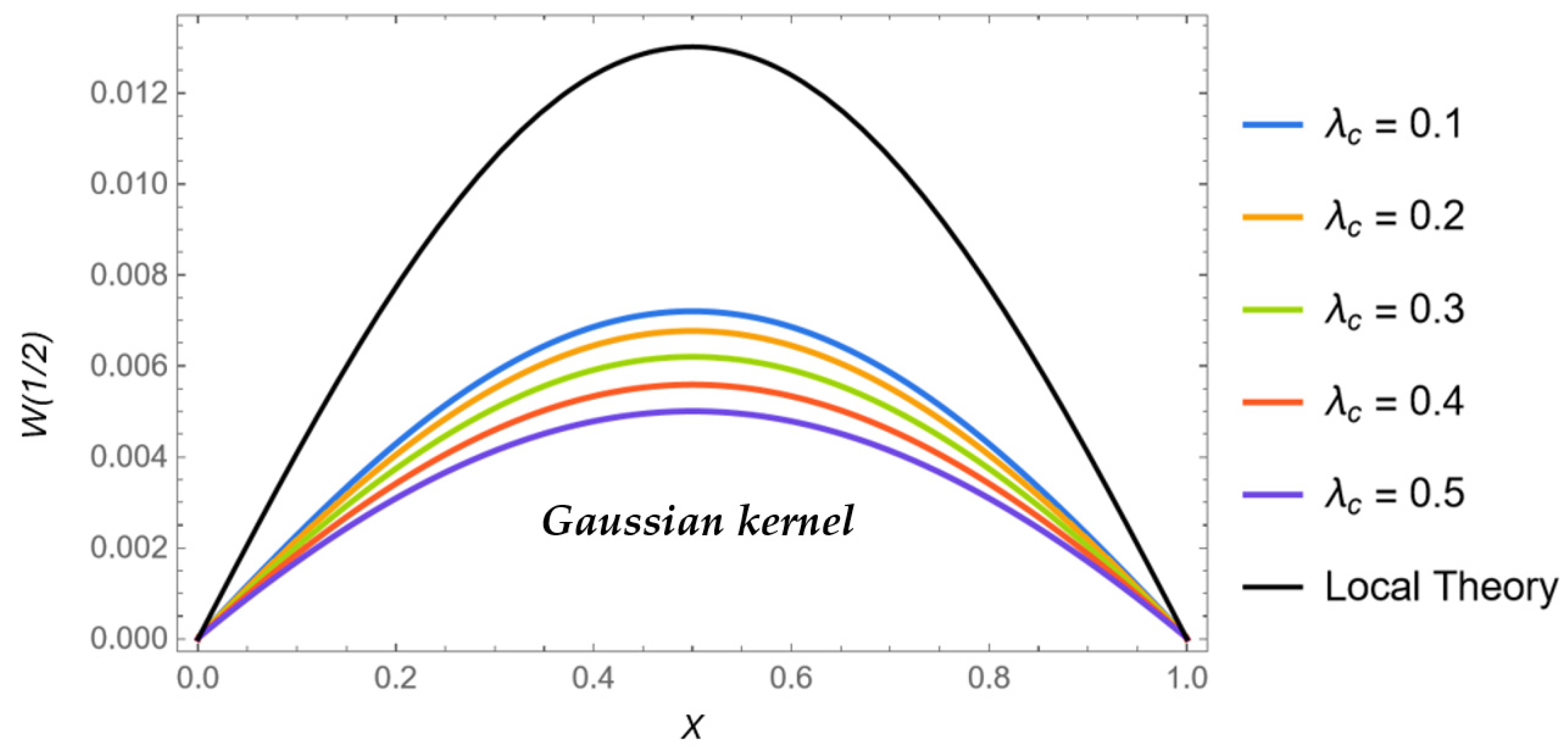
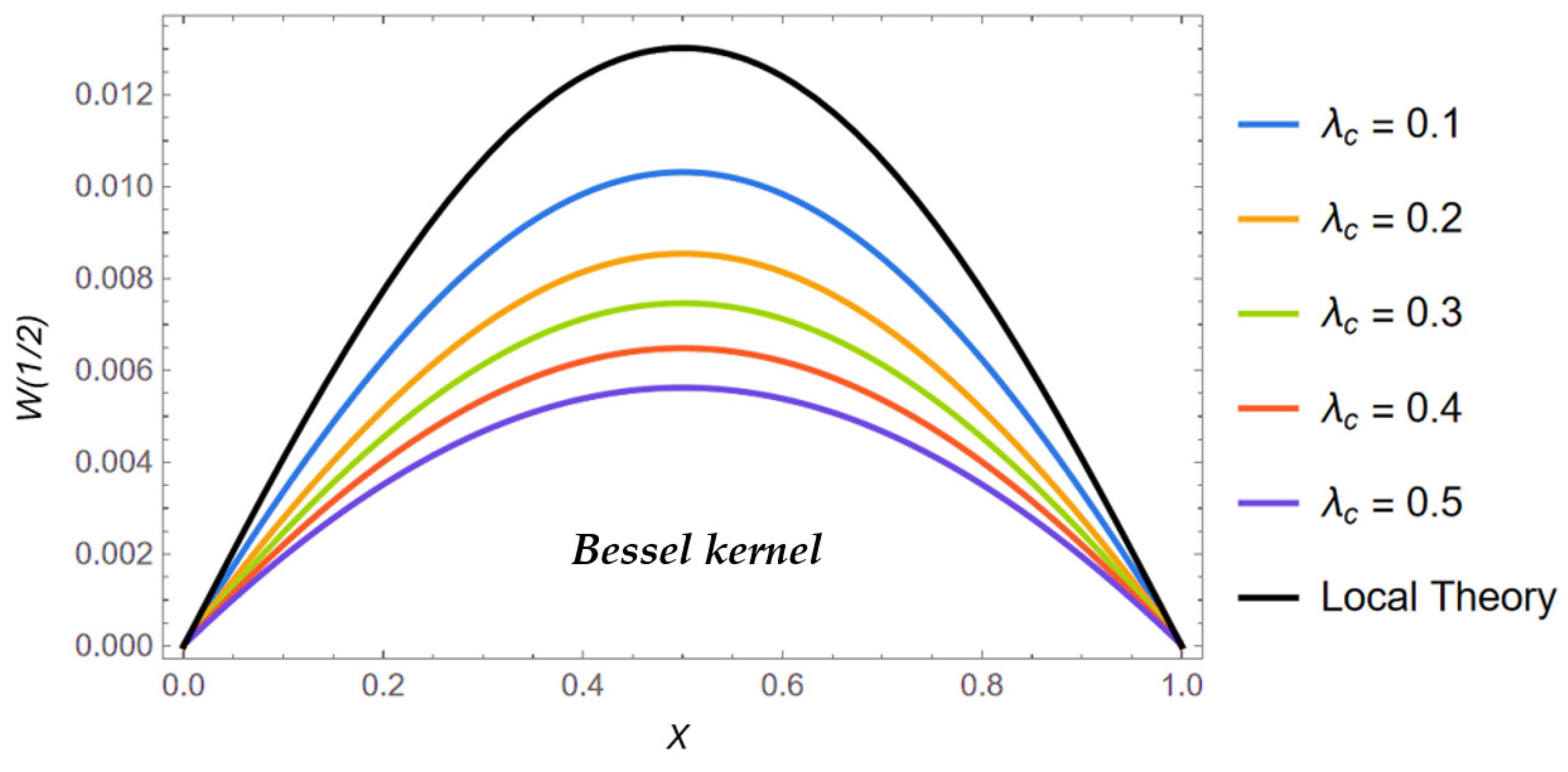
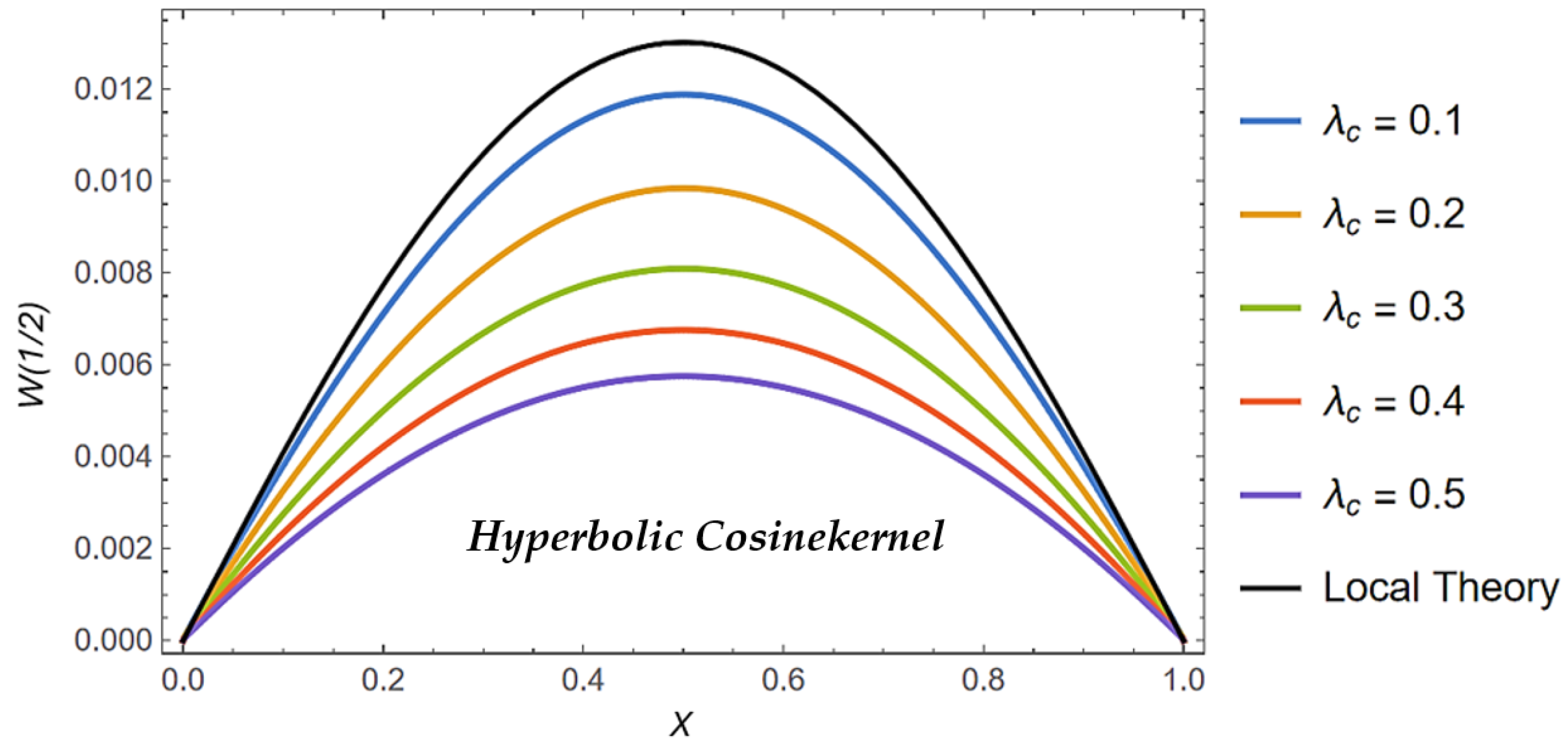
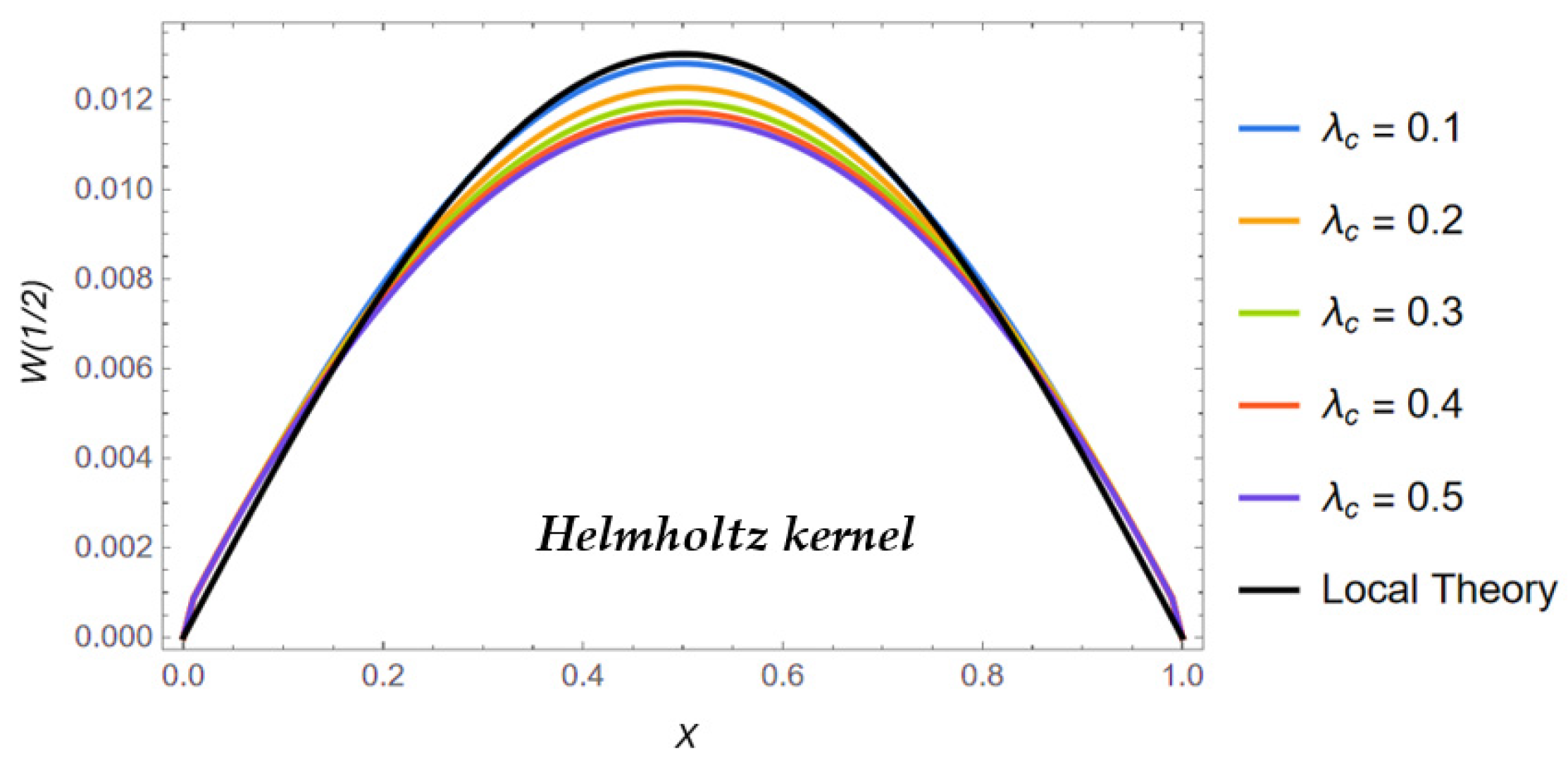
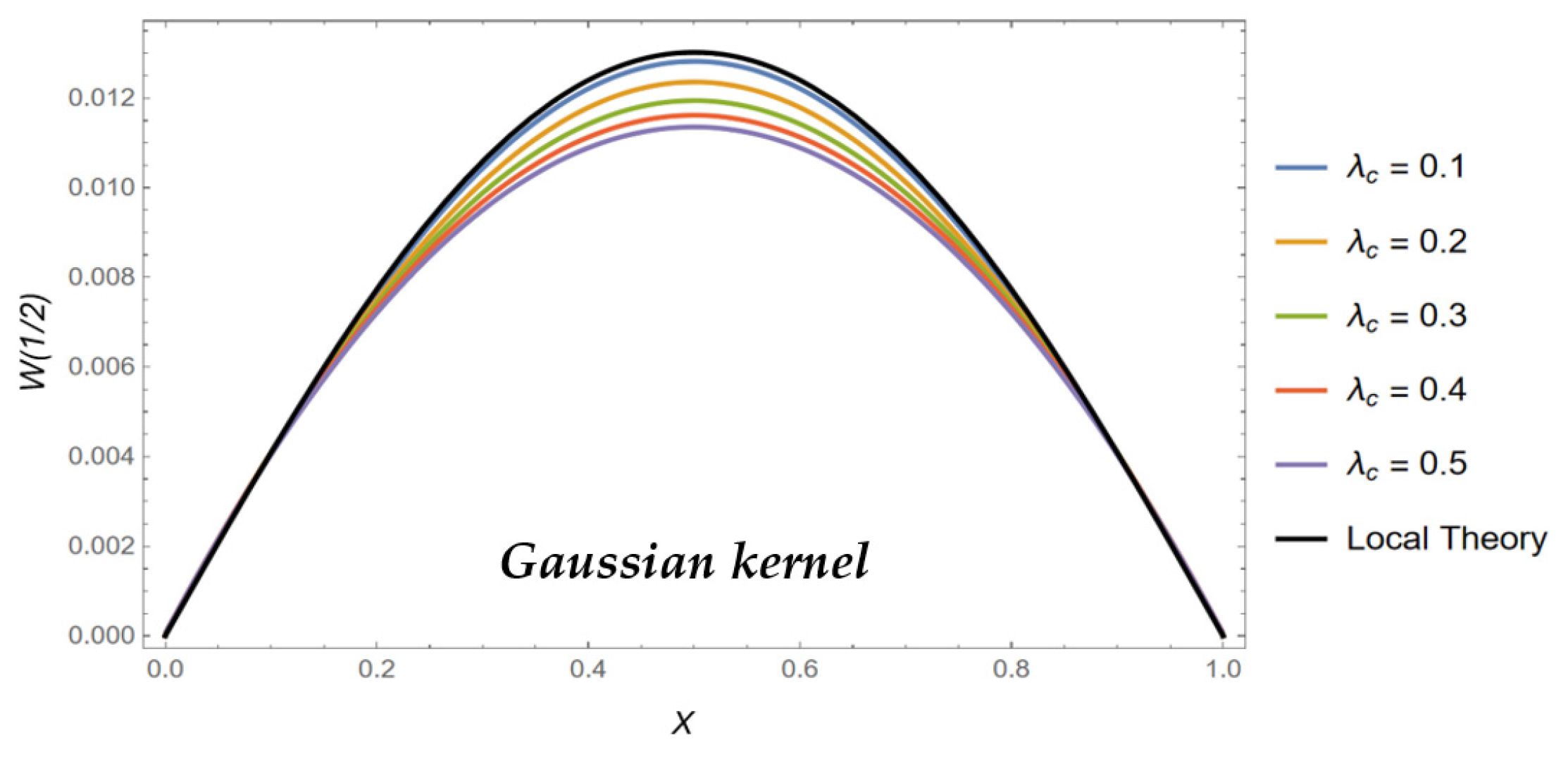
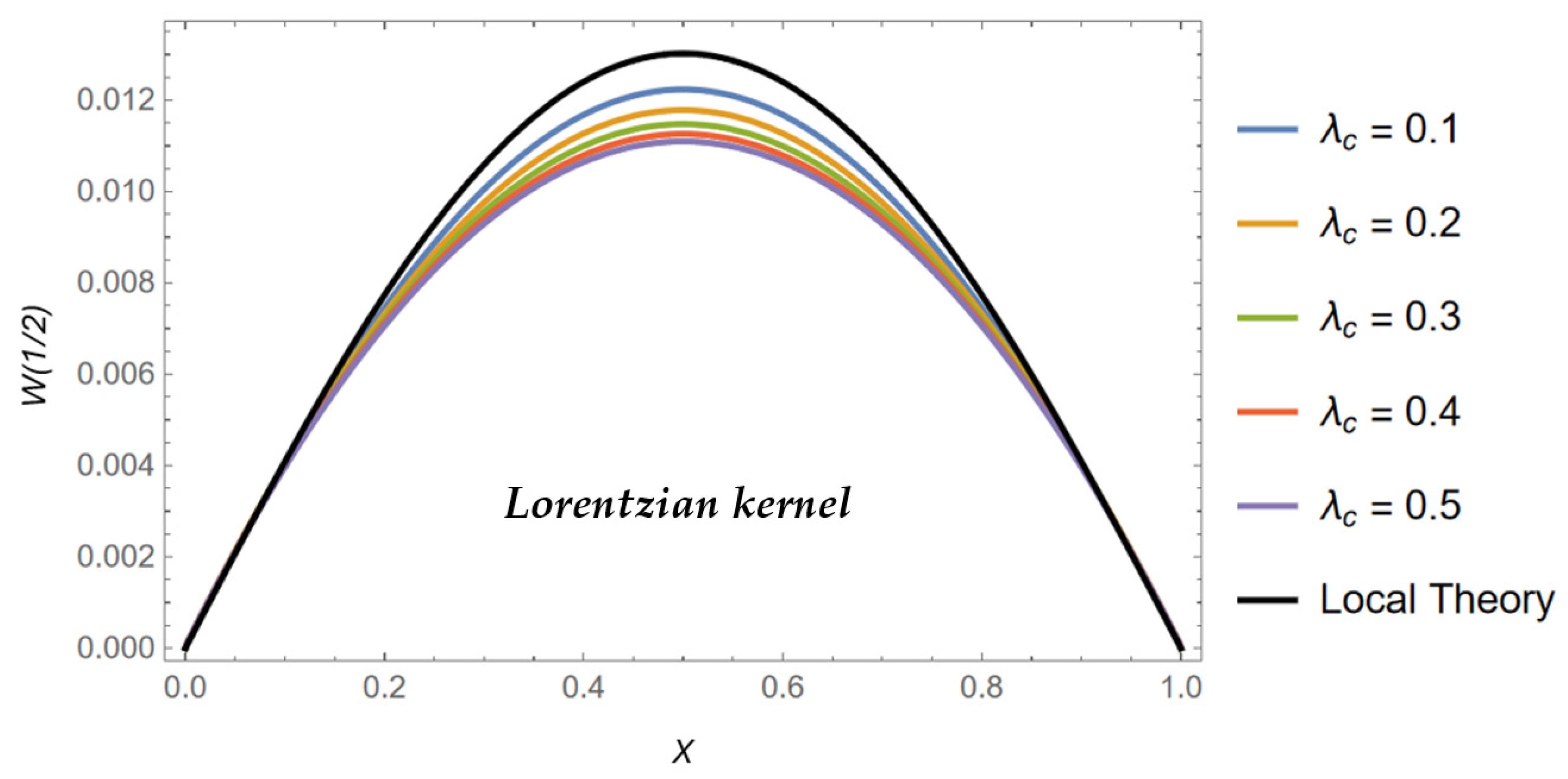
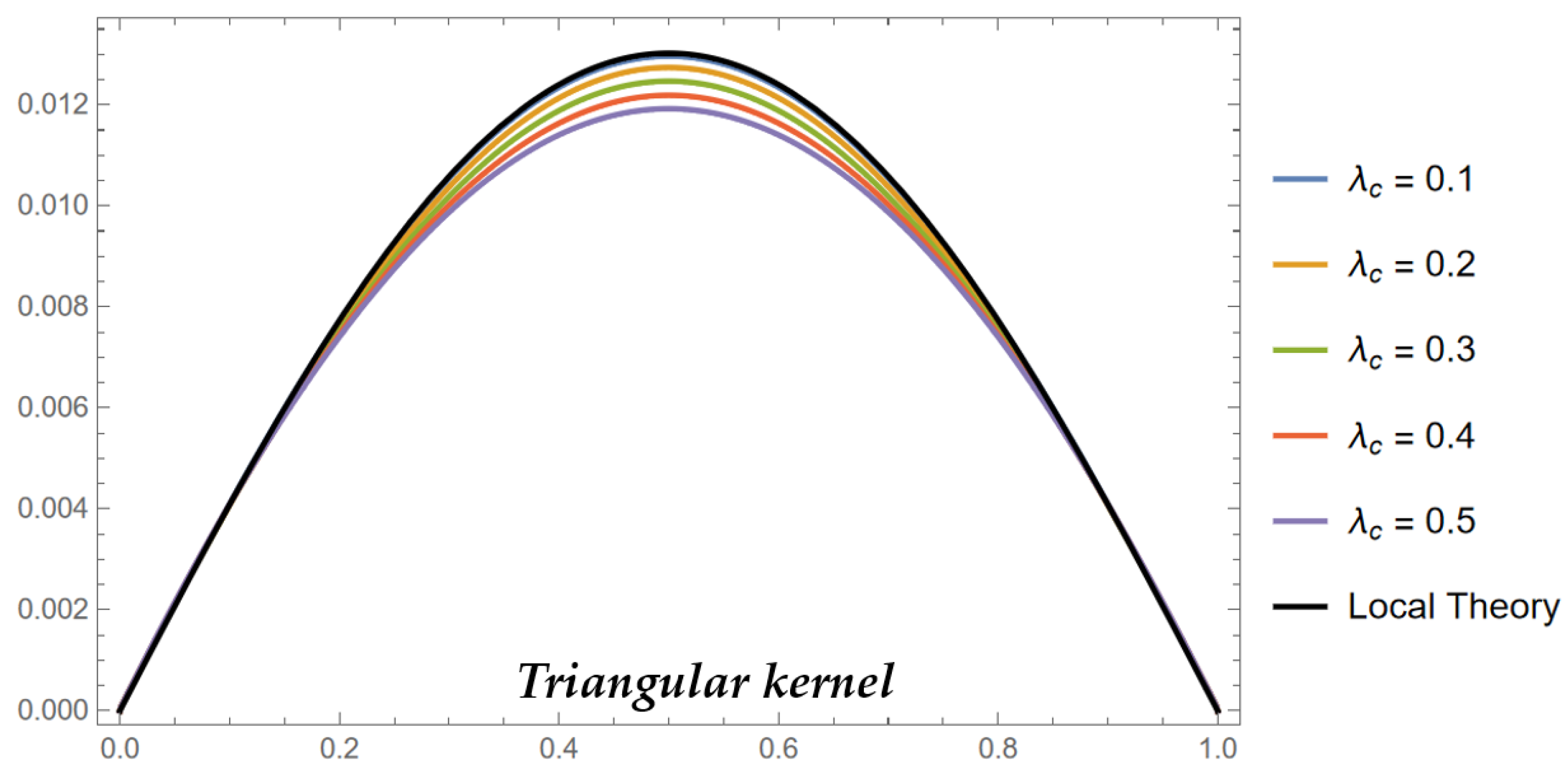
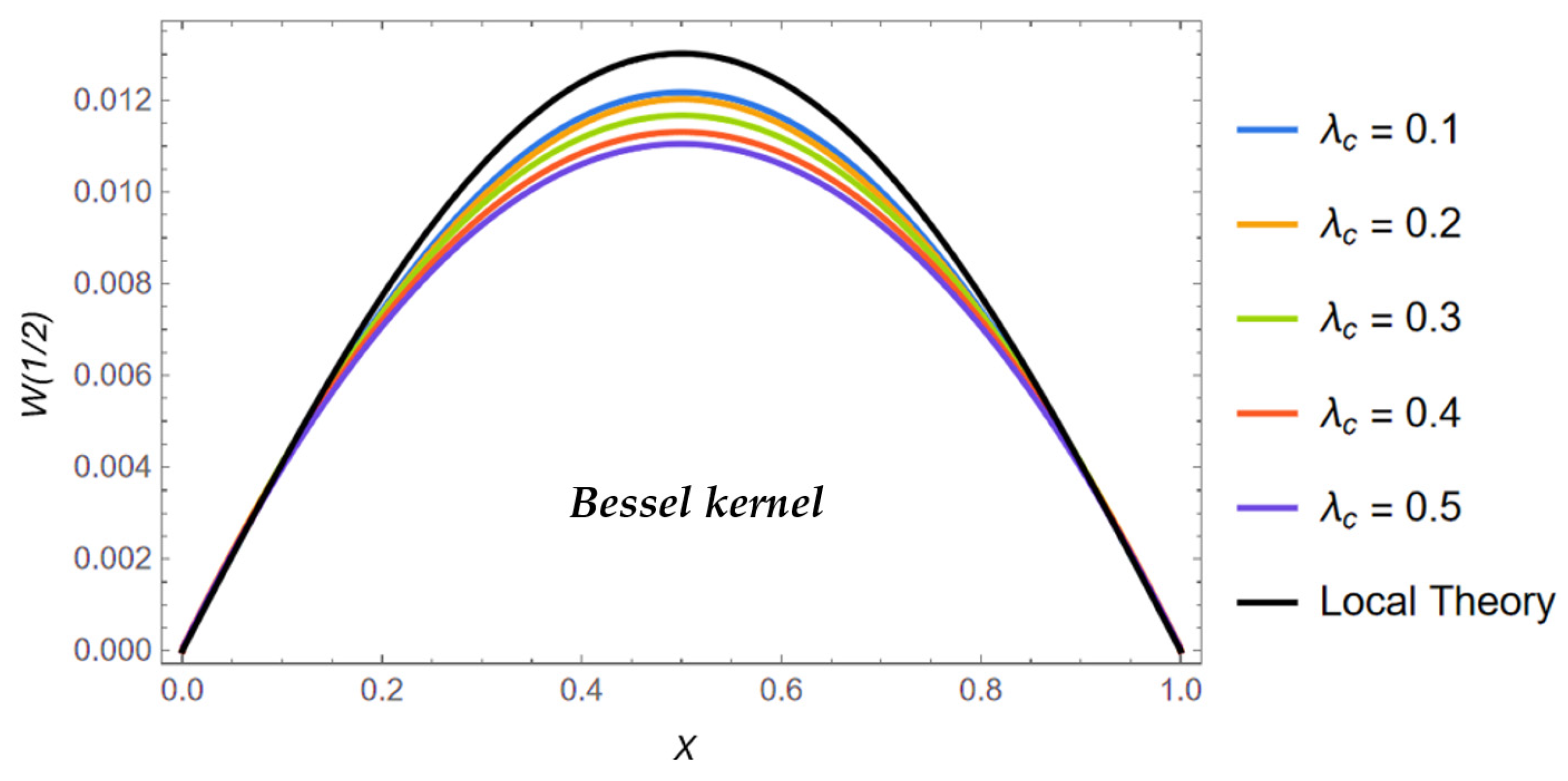
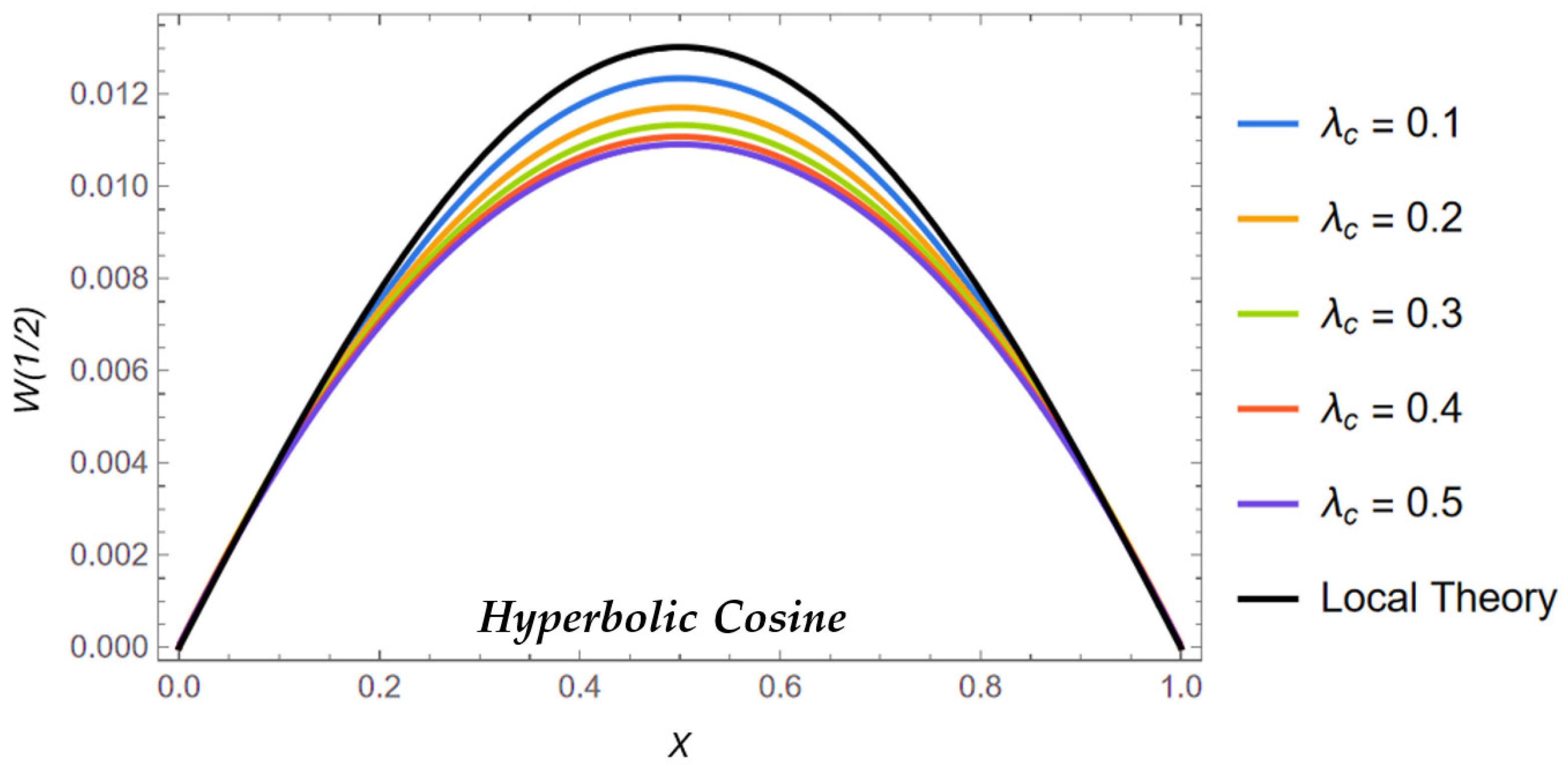
The influence of the nonlocal parameter λ c on the dimensionless deflection W is clearly shown in Figure 10, Figure 11, Figure 12, Figure 13, Figure 14 and Figure 15, where all kernels display the characteristic stiffening associated with the SDM.
As can be seen from Figure 10, for the Helmholtz kernel, the deflection decreases monotonically as λ c increases, showing the characteristic stiffening effect of the SDM.
The Gaussian kernel (Figure 11) exhibits a similar monotonic trend; however, in the absence of clipping and renormalization, a severe reduction in the deflection is already observed for small values of the nonlocal parameter λ c compared to the local solution.
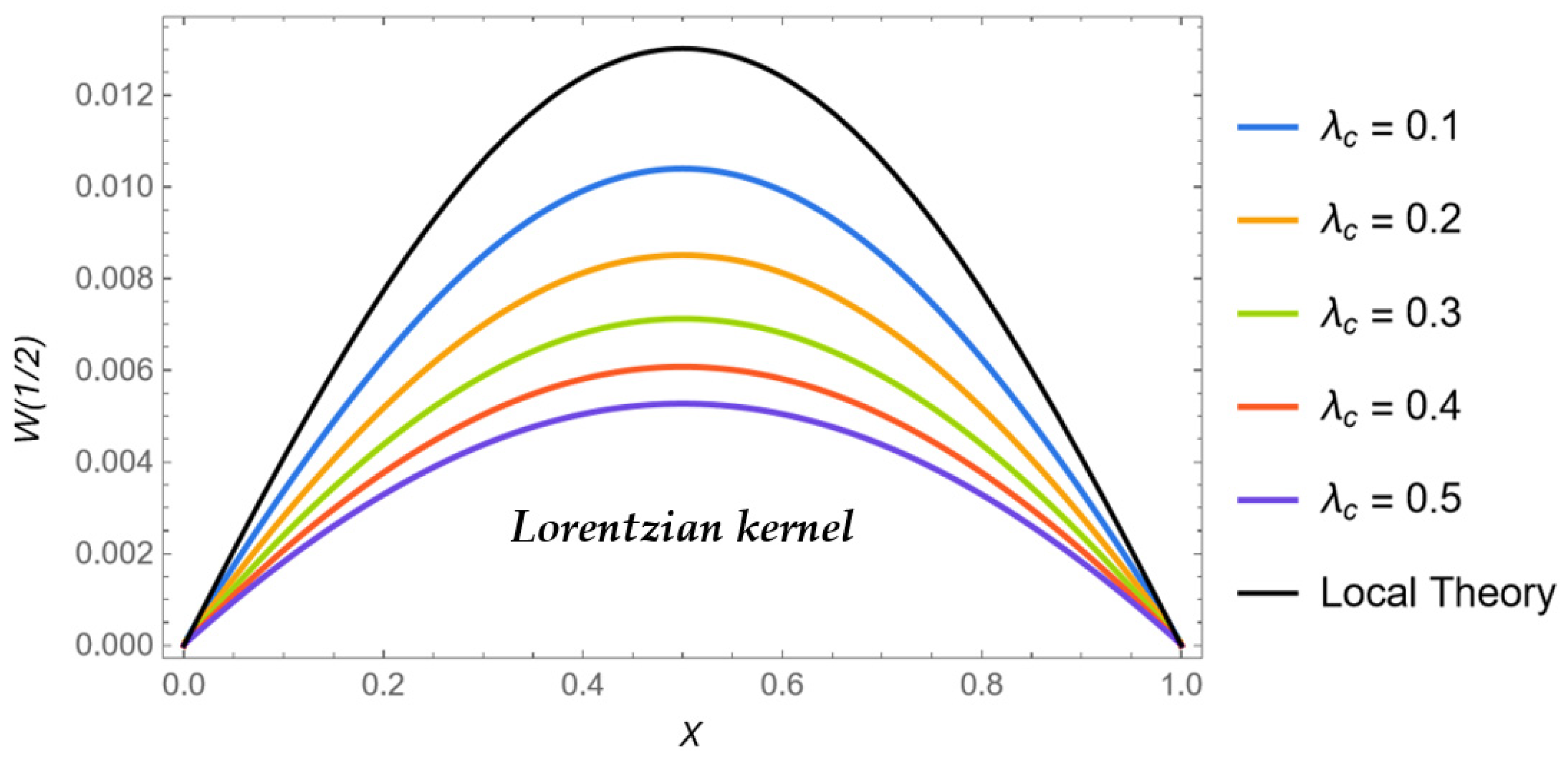
It is noted that from Figure 12, the Lorentzian kernel provides an intermediate behaviour between the Helmholtz kernel (Figure 10) and the Gaussian kernel (Figure 11), while still clearly capturing the stiffening effect as the nonlocal parameter λ c increases.
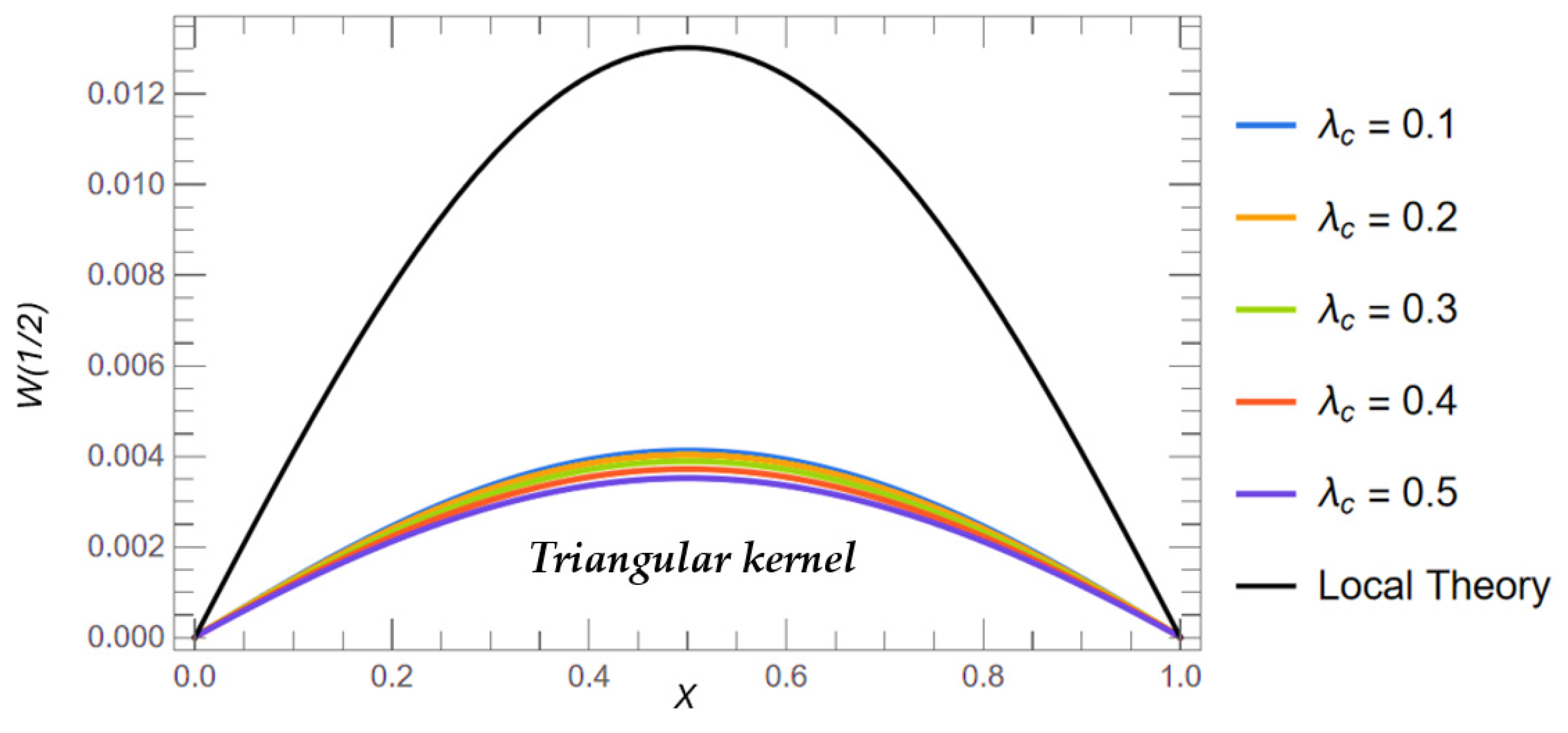
The Triangular kernel (Figure 13) consistently provides the lowest deflection values for all λ c , indicating a stronger apparent stiffening.
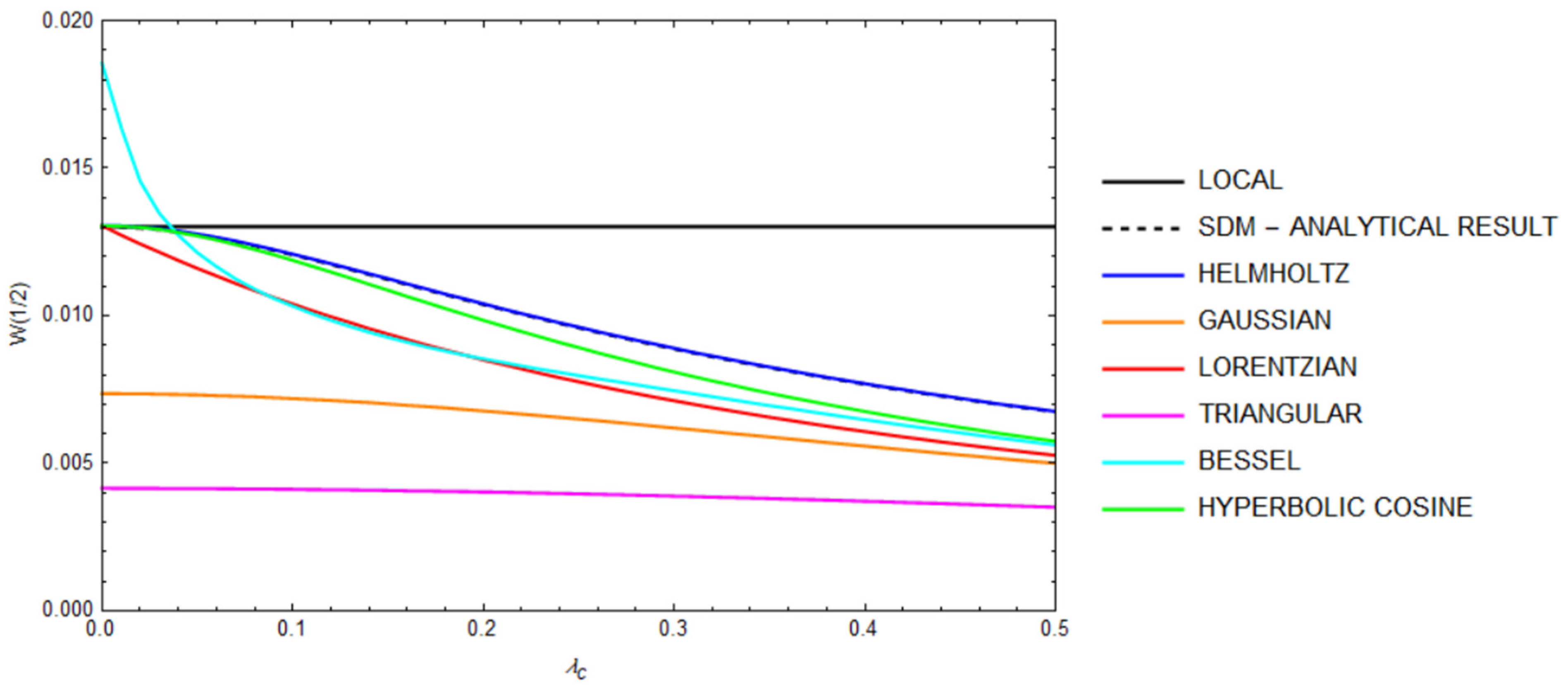
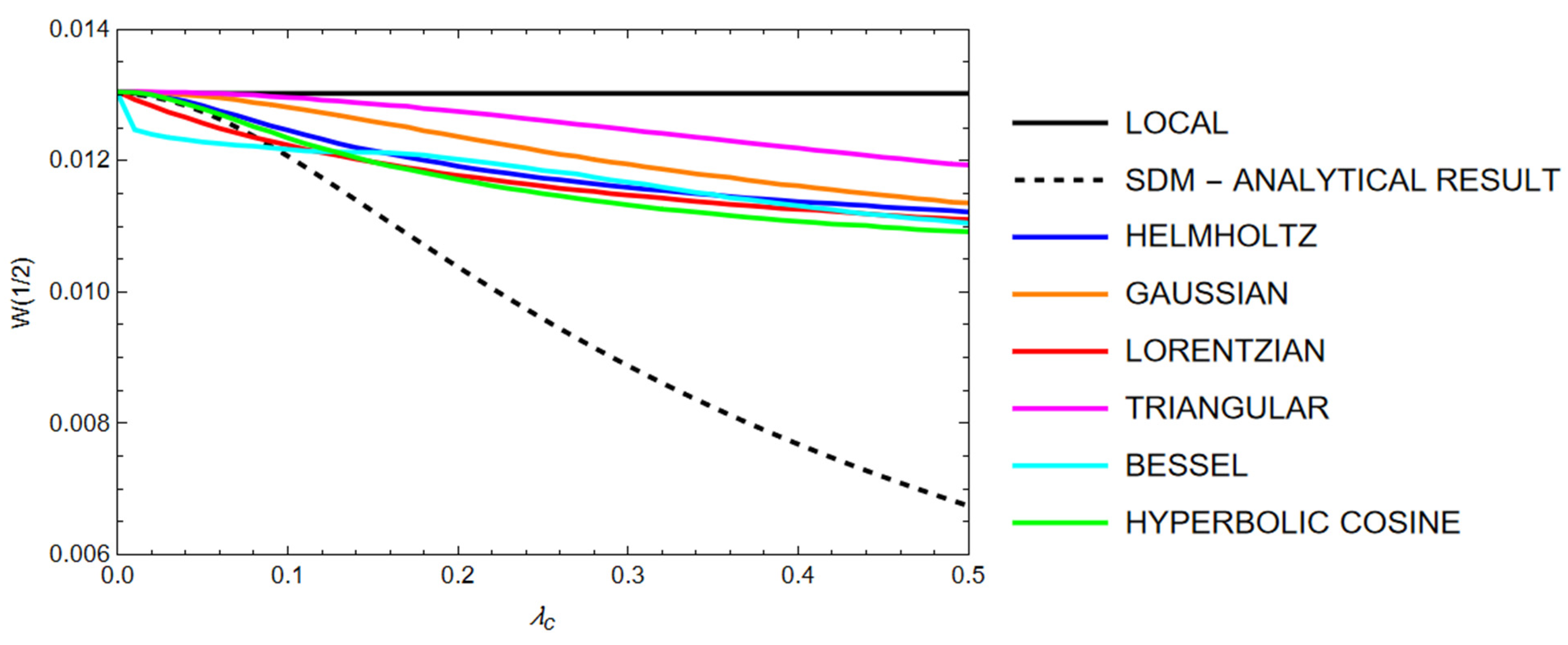
As can be seen from Figure 14, the Bessel kernel, as previously discussed, is characterized by an oscillatory weighting function. From Figure 14, it appears to exhibit a behaviour qualitatively similar to the other kernels, showing an overall stiffening trend as the nonlocal parameter λ c increases. However, a more detailed inspection of Table 2 and Figure 17 reveals that, for small values of λ c (0 < λ c < 0.10), the Bessel kernel predicts deflection values that are slightly higher than the local solution. This behaviour reflects the oscillatory nature of the kernel, which locally modifies the effective interaction mechanism, especially in the absence of clipping and renormalization.
The Hyperbolic Cosine kernel (Figure 15) provides deflection values very close to those obtained with the Helmholtz kernel. This similarity can be attributed to the comparable shape and decay characteristics of the two kernels, both exhibiting smooth profiles and rapidly attenuating interactions over the domain.
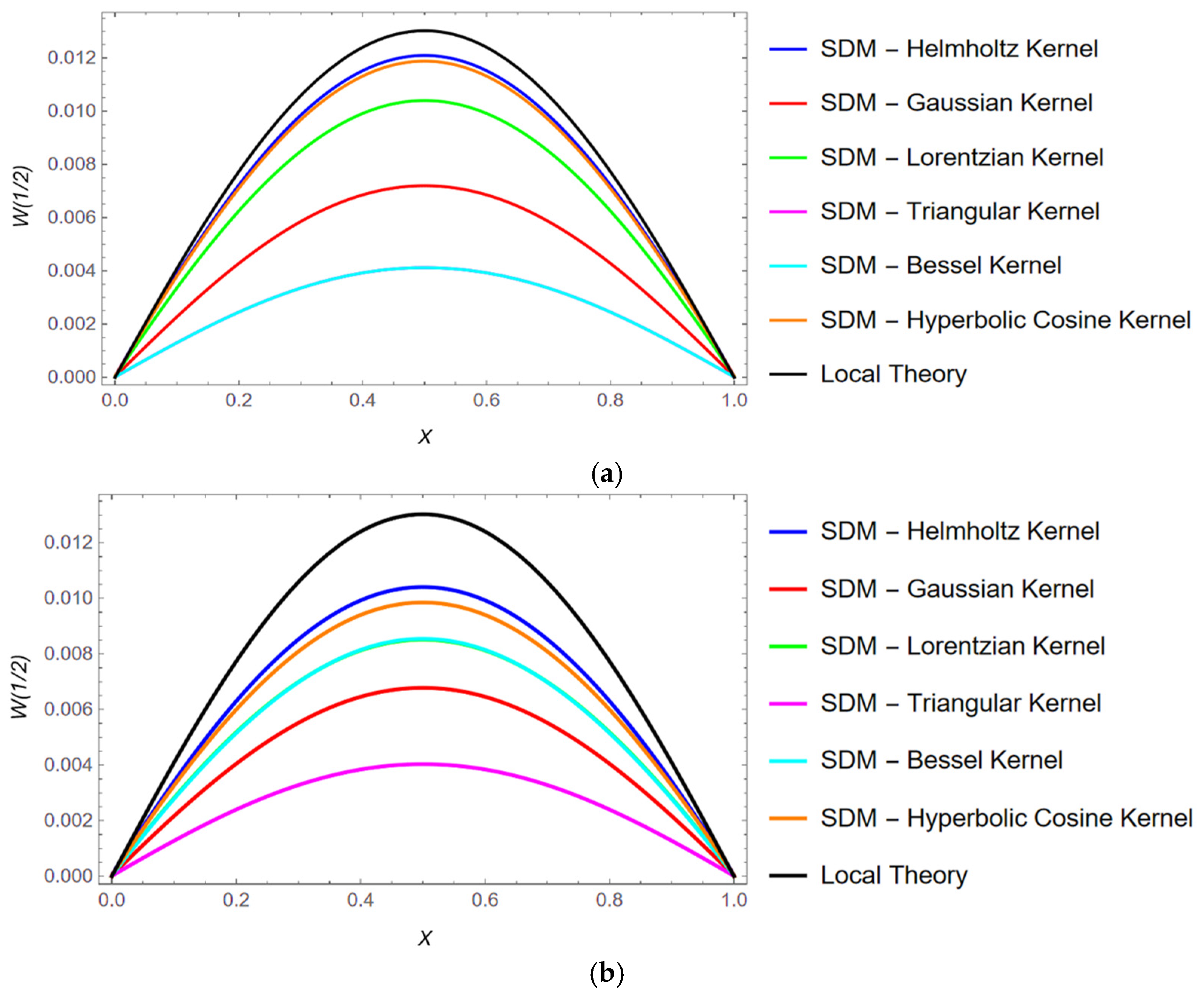
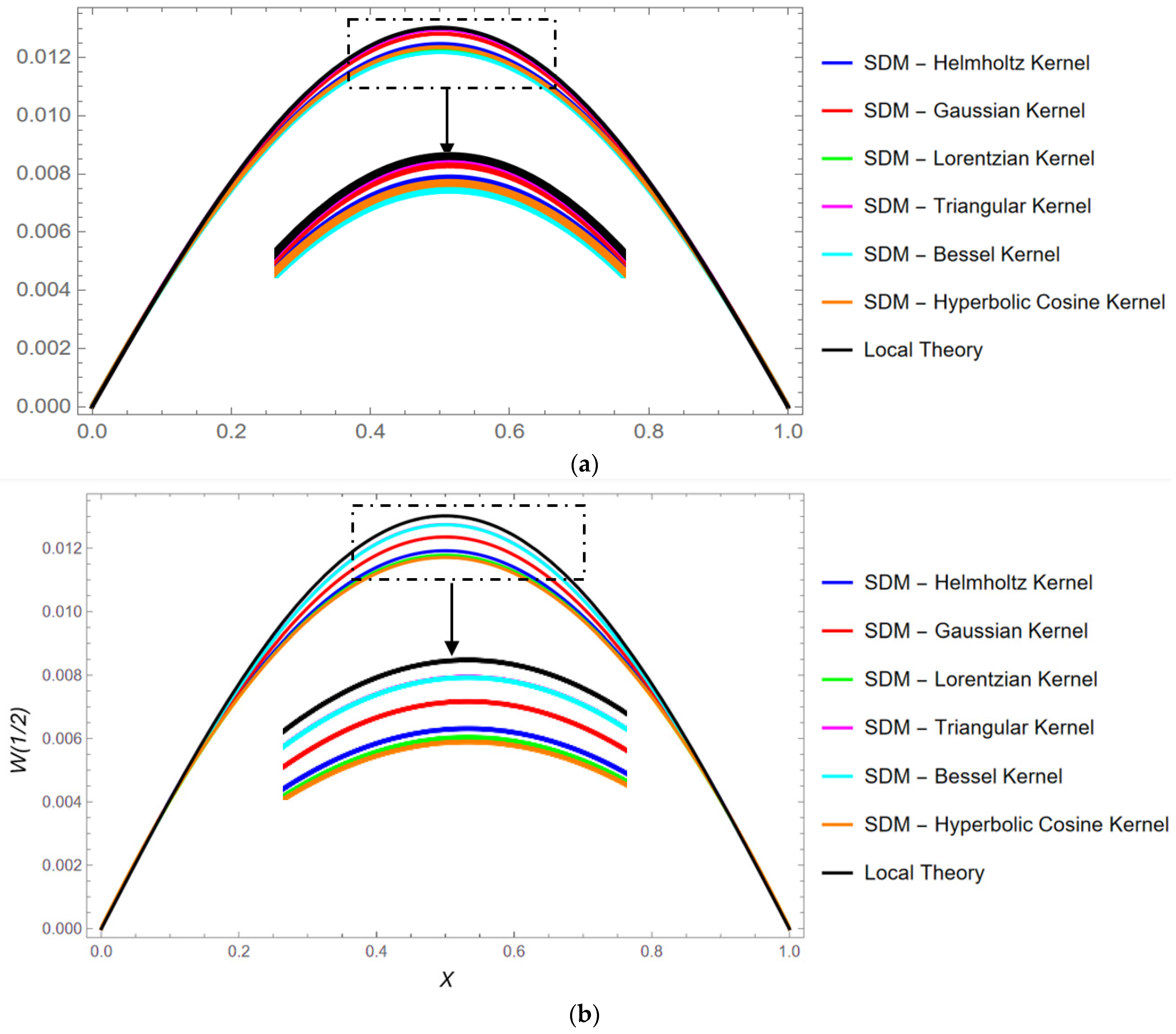
Figure 16 compares all kernels for fixed values λ c = 0.10 and λ c = 0.20 . The ranking among kernels is evident: the Triangular kernel yields the lowest midpoint deflection, while the Helmholtz kernel provides the highest values.
Figure 17 clearly illustrates the behaviour of the midpoint deflection as a function of the nonlocal parameter λ c . The analytical solution of the SDM (black dashed line) almost perfectly overlaps with the numerical solution obtained using the Helmholtz kernel, confirming the excellent agreement previously discussed and validating the accuracy of the proposed numerical implementation. However, in the absence of clipping and renormalization, several kernels fail to recover the local solution as λ c 0 . In addition, the Bessel kernel exhibits a softening behaviour for small values of λ c , providing deflection values slightly higher than the local solution.

6.2. Results with Clipping and Renormalization Strategy

Table 3 summarizes the results of the midpoint deflection after applying the clipping and local renormalization procedure.
In contrast to the unclipped case, all kernels now correctly converge to the local solution as λ c 0 , demonstrating that the renormalization of the truncated kernel effectively restores the consistency of the integral operator. Furthermore, the comparison with the analytical results of Romano and Barretta [26] indicates discrepancies below 5% for λ c < 0.12 .
Figure 18 shows that the stiffening trend is preserved for increasing λ c ; however, for larger values of the nonlocal parameter, the reduction in deflection is less pronounced than in the unclipped case. This indicates that clipping and renormalization effectively control boundary-induced distortions.
Figure 19 shows that the Gaussian kernel exhibits a consistent and physically coherent response after clipping and renormalization. The excessive reduction in deflection previously observed for small values of the nonlocal parameter is no longer present, indicating that the boundary treatment restores the correct normalization of the averaging process.
The Lorentzian kernel (Figure 20) exhibits a response almost overlapping with that of the Helmholtz kernel throughout the investigated range of λ c , reflecting the similarity in their smoothness and long-range decay properties.
Figure 21 shows that, after clipping and renormalization, the Triangular kernel converges properly to the local solution and follows a consistent monotonic stiffening trend. The boundary correction restores the normalization of the truncated kernel near the edges, thereby eliminating the distortions previously observed in the unclipped case.
Figure 22 highlights that the Bessel kernel maintains its intrinsic oscillatory character; however, the exaggerated deviations observed without boundary correction are significantly mitigated. The apparent softening behaviour for small λ c is reduced, and the response becomes consistent with the expected SDM nonlocal stiffening trend.
Figure 23 confirms that the Hyperbolic Cosine kernel produces results very close to those obtained with the Helmholtz kernel. After renormalization, the two kernels exhibit almost overlapping responses, reflecting the similarity in their smoothness and decay characteristics.
Figure 24 shows that the relative behaviour of the kernels is modified after applying clipping and renormalization. In particular, the Triangular kernel now yields the highest midpoint deflection, while the Lorentzian and Hyperbolic Cosine kernels exhibit markedly lower values. Moreover, the overall spread of deflection values among the different kernels is significantly reduced compared to the unclipped case. The range of variation is now much narrower, indicating that a substantial part of the previously observed discrepancies was induced by boundary effects rather than by intrinsic differences in kernel properties.
Figure 25 confirms the observations already reported in Table 3. All kernels correctly converge to the local solution in the limit λ c 0 , and all of them exhibit the classical stiffening behaviour characteristic of the SDM as the nonlocal parameter increases [26].
However, for values of λ c > 0.10 , the numerical solutions obtained with the proposed clipping and renormalization strategy progressively deviate from the analytical closed-form SDM solution derived for the Helmholtz kernel. This discrepancy highlights the influence of boundary effects in finite domains, showing that edge treatment and domain truncation may significantly alter the predicted response when the internal characteristic length becomes comparable to the structural dimensions.

6.3. Quantification of Boundary Influence

The sensitivity of the kernels to boundary effects is quantified in Table 4, which reports the percentage variation in W induced by clipping and renormalization strategy.
The Gaussian and Triangular kernels are the most affected-even for small λ c -whereas the Helmholtz and Hyperbolic Cosine kernels show variations below 5% for λ c < 0.12 . The Lorentzian kernel exhibits strong sensitivity due to its long-range tails, while the Bessel kernel shows oscillatory behaviour with increasing λ c , consistent with the oscillatory nature of its weighting function. In summary, the results obtained highlight that edge effects play a crucial and non-negligible role, especially when the internal characteristic length assumes values of the same order of magnitude as the structural dimensions. In these cases, edge treatment and kernel renormalization are essential to obtain physically acceptable solutions.

7. Conclusions

This work has presented a comprehensive and fully integral numerical framework for the Stress-Driven Model (SDM) applied to the bending analysis of Bernoulli–Euler nanobeams. The study integrates: (i) the theoretical formulation of the SDM, (ii) a systematic investigation of six different convolution kernels, (iii) a regularization strategy based on Morozov’s discrepancy principle to stabilize the ill-posed integral operator, and (iv) a boundary-aware clipping and renormalization procedure that restores the physical meaning of the averaging kernel in finite domains. The combined methodology provides a general, accurate and robust approach for solving the SDM directly in integral form, overcoming limitations commonly encountered in literature.
The main conclusions of the present work can be summarized as follows:
-
The integral SDM can be accurately solved without differential reformulation, achieving excellent agreement with analytical benchmarks;
-
All considered kernels reproduce the characteristic stiffening behaviour of the SDM as the nonlocal parameter increases, provided that proper boundary correction is applied;
-
In finite domains, the absence of clipping and renormalization may prevent recovery of the local limit and lead to distorted structural responses;
-
The proposed clipping–renormalization strategy restores kernel normalization near the boundaries and ensures physically consistent and mathematically reliable predictions;
-
Kernel selection and boundary treatment are intrinsically coupled aspects of integral nonlocal modelling and must be addressed simultaneously.
Overall, this study demonstrates that the accurate numerical treatment of boundary effects is an indispensable requirement for the integral SDM, especially when kernels with infinite support-or slow decay-are employed. The proposed framework enhances stability, ensures convergence to the local model and improves the physical interpretability of the SDM across a broad class of kernels. The integral strategy developed herein significantly expands the applicability of the SDM, providing a general, robust and physically consistent computational tool for modelling nanobeams and, more broadly, nanostructured and advanced materials governed by nonlocal interactions.

Author Contributions

Conceptualization, L.F., G.L. and R.P.; methodology, L.F., G.L. and R.P.; software, L.F., G.L. and R.P.; validation, L.F., G.L. and R.P.; formal analysis, L.F., G.L. and R.P.; investigation, L.F., G.L. and R.P.; resources, L.F., G.L. and R.P.; data curation, L.F., G.L. and R.P.; writing—original draft preparation, L.F., G.L. and R.P.; writing—review and editing, L.F., G.L. and R.P.; visualization, L.F., G.L. and R.P.; supervision, L.F. and R.P.; project administration, L.F., G.L. and R.P.; funding acquisition, L.F., G.L. and R.P. All authors have read and agreed to the published version of the manuscript.

Funding

The authors gratefully acknowledge the financial support of the Italian Ministry of University and Research (MUR): Research Grant PRIN 2020 No. 2020EBLPLS on Opportunities and challenges of nanotechnology in advanced and green construction materials, by the National Recovery and Resilience Plan (NRRP), Mission 4, Component 2, Investment 1.1, Call for tender No. 104 published on 2 February 2022 by the Italian Ministry of University and Research (MUR), funded by the European Union NextGenerationEU Project Titles: Intelligent Systems for Infrastructural Diagnosis in smart-concretE (ISIDE) Grant number: 2022S88WAY.

Data Availability Statement

The original contributions presented in this study are included in the article. Further inquiries can be directed to the corresponding author.

Conflicts of Interest

The authors declare no conflicts of interest.

Nomenclature

In this section, general notation and some geometric terminology that will be needed later are introduced.
LLength of the nanobeam
ΣCross-Section
GGeometric center of Σ
(O, x, z)Cartesian coordinate system
[0, L]Spatial domain
w Transverse displacement of G
χ Geometrical elastic bending curvature
M x Resultant bending moment
q z Transverse distributed load
Φ H Special Helmholtz averaging kernel
Φ G Gaussian kernel (Error function)
Φ L Lorentzian (or Cauchy) kernel
Φ B Bessel kernel
Φ T Triangular kernel
Φ C H Hyperbolic Cosine kernel
KConvolution Kernel Matrix

References

  1. Dang, X.-T.; Nguyen, V.-L.; Tran, M.-T.; Nguyen-Thi, B.-P.; Le, T.-T. Buckling and bending analysis of FGP nanoplates resting on Pasternak foundation considering non-local and surface effects simultaneously using pb2-Ritz method. Compos. Struct. 2025, 359, 118971. [Google Scholar] [CrossRef]
  2. Lun, Y.; Zhou, H.; Yao, D.; Wang, X.; Hong, J. Screening piezoelectricity in determination of flexoelectric coefficient at nanoscale. Mech. Mater. 2020, 150, 103591. [Google Scholar] [CrossRef]
  3. Farsiani, M.; Shodja, H.M. An augmented surface impedance theory for acoustically actuated magneto-electro-elastic nanospheres with terahertz nanoantenna applications. Mech. Mater. 2026, 212, 105515. [Google Scholar] [CrossRef]
  4. Penna, R.; Landi, G.; Lovisi, G.; Lambiase, A.; Feo, L. Micromechanical modeling of the piezoelectric behavior of CNT cement-matrix composites. Compos. Part B Eng. 2025, 306, 112810. [Google Scholar] [CrossRef]
  5. Chen, C.Q.; Shi, Y.; Zhang, Y.S.; Zhu, J.; Yan, Y.J. Size dependence of Young’s modulus in ZnO nanowires. Phys. Rev. Lett. 2006, 96, 075505. [Google Scholar] [CrossRef]
  6. Shaat, M. Size-dependence of Young’s modulus and Poisson’s ratio: Effects of material dispersion. Mech. Mater. 2019, 133, 111–119. [Google Scholar] [CrossRef]
  7. Stan, G.; Ciobanu, C.V.; Parthangal, P.M.; Cook, R.F. Diameter-dependent radial and tangential elastic moduli of ZnO nanowires. Nano Lett. 2007, 7, 3691–3697. [Google Scholar] [CrossRef]
  8. Agrawal, R.; Peng, B.; Gdoutos, E.E.; Espinosa, H.D. Elasticity size effects in ZnO nanowires—A combined experimental–computational approach. Nano Lett. 2008, 8, 3668–3674. [Google Scholar] [CrossRef] [PubMed]
  9. Zhang, Y.; Hong, J.; Liu, B.; Fang, D. Strain effect of ferroelectric behaviors of BaTiO3 nanowires: A molecular dynamics study. Nanotechnology 2010, 21, 015701. [Google Scholar] [CrossRef]
  10. Ebrahimi-Nejad, S.; Shokuhfar, A.; Zare-Shahabadi, A.; Heydari, P. Molecular dynamics simulation of carbon nanotubes under elevated temperatures. Molekulardynamische simulation von kohlenstoff-nanoröhren bei erhöhten temperature. Mater. Werkst. 2010, 41, 314–319. [Google Scholar] [CrossRef]
  11. Attia, M.A.; Mahmoud, F.F. Modeling and analysis of nanobeams based on nonlocal-couple stress elasticity and surface energy theories. Int. J. Mech. Sci. 2016, 105, 126–134. [Google Scholar] [CrossRef]
  12. Ansari, R.; Sahmani, S. Prediction of biaxial buckling behavior of single-layered graphene sheets based on nonlocal plate models and molecular dynamics simulations. Appl. Math. Model. 2013, 37, 7338–7351. [Google Scholar] [CrossRef]
  13. Darban, H. MD benchmarks: Size-dependent tension, bending, buckling, and vibration of nanobeams. Int. J. Mech. Sci. 2025, 296, 110316. [Google Scholar] [CrossRef]
  14. Eringen, A. Linear theory of nonlocal elasticity and dispersion of plane waves. Int. J. Eng. Sci. 1972, 10, 425–435. [Google Scholar] [CrossRef]
  15. Eringen, A. On differential equations of nonlocal elasticity and solutions of screw dislocation and surface waves. J. Appl. Phys. 1983, 54, 4703–4710. [Google Scholar] [CrossRef]
  16. Peddieson, J.; Buchanan, G.R.; McNitt, R.P. Application of nonlocal continuum models to nanotechnology. Int. J. Eng. Sci. 2003, 41, 305–312. [Google Scholar] [CrossRef]
  17. Romano, G.; Barretta, R. Comment on the paper “Exact solution of Eringen’s nonlocal integral model for bending of Euler–Bernoulli and Timoshenko beams by Meral Tuna & Mesut Kirca”. Int. J. Eng. Sci. 2016, 109, 240–242. [Google Scholar] [CrossRef]
  18. Romano, G.; Barretta, R.; Diaco, M.; de Sciarra, F.M. Constitutive boundary conditions and paradoxes in nonlocal elastic nano-beams. Int. J. Mech. Sci. 2017, 121, 151–156. [Google Scholar] [CrossRef]
  19. Romano, G.; Barretta, R.; Diaco, M. On nonlocal integral models for elastic nano-beams. Int. J. Mech. Sci. 2017, 131–132, 490–499. [Google Scholar] [CrossRef]
  20. Romano, G.; Barretta, R. Nonlocal elasticity in nanobeams: The stress-driven integral model. Int. J. Eng. Sci. 2017, 115, 14–27. [Google Scholar] [CrossRef]
  21. Barretta, R.; de Sciarra, F.M. Variational nonlocal gradient elasticity for nano-beams. Int. J. Eng. Sci. 2019, 143, 73–91. [Google Scholar] [CrossRef]
  22. Mindlin, R.D. Micro-structure in linear elasticity. Arch. Ration. Mech. Anal. 1964, 16, 51–78. [Google Scholar] [CrossRef]
  23. Mindlin, R.D. Second gradient of strain and surface-tension in linear elasticity. Int. J. Solids Struct. 1965, 1, 417–438. [Google Scholar] [CrossRef]
  24. Lim, C.; Zhang, G.; Reddy, J. A higher-order nonlocal elasticity and strain gradient theory and its applications in wave propagation. J. Mech. Phys. Solids 2015, 78, 298–313. [Google Scholar] [CrossRef]
  25. Eringen, A.C. Theory of nonlocal elasticity and some applications. Res. Mech. 1987, 21, 313–342. [Google Scholar]
  26. Barretta, R.; Čanadija, M.; Feo, L.; Luciano, R.; de Sciarra, F.M.; Penna, R. Exact solutions of inflected functionally graded nano-beams in integral elasticity. Compos. Part B Eng. 2018, 142, 273–286. [Google Scholar] [CrossRef]
  27. Vaccaro, M.S.; Barretta, R.; de Sciarra, F.M.; Reddy, J.N. Nonlocal integral elasticity for third-order small-scale beams. Acta Mech. 2022, 233, 2393–2403. [Google Scholar] [CrossRef]
  28. Ren, Y.M.; Qing, H. Bending and buckling analysis of functionally graded Euler–Bernoulli beam using stress-driven nonlocal integral model with bi-Helmholtz kernel. Int. J. Appl. Mech. 2021, 13, 2150041. [Google Scholar] [CrossRef]
  29. Ussorio, D.; Vaccaro, M.S.; Barretta, R.; Luciano, R.; de Sciarra, F.M. On Timoshenko’s iterative method in buckling of nanobeams. Compos. Struct. 2026, 377, 119867. [Google Scholar] [CrossRef]
  30. Das, B.; Barretta, R.; Čanađija, M. Physics-informed neural networks for nonlocal beam eigenvalue problems. Thin-Walled Struct. 2026, 222, 114530. [Google Scholar] [CrossRef]
  31. Barretta, R.; Caporale, A.; Luciano, R.; Vaccaro, M.S. Nonlocal gradient mechanics of nanobeams for non-smooth fields. Int. J. Eng. Sci. 2023, 189, 103879. [Google Scholar] [CrossRef]
  32. Barretta, R.; Čanađija, M.; Luciano, R.; de Sciarra, F.M. On the mechanics of nanobeams on nano-foundations. Int. J. Eng. Sci. 2022, 180, 103747. [Google Scholar] [CrossRef]
  33. Ussorio, D.; Vaccaro, M.S.; Barretta, R.; Luciano, R.; de Sciarra, F.M. Large deflection of a nonlocal gradient cantilever beam. Int. J. Eng. Sci. 2025, 206, 104172. [Google Scholar] [CrossRef]
  34. Barretta, R.; Luciano, R.; de Sciarra, F.M.; Vaccaro, M.S. On torsion of FG elastic nanobeams on nonlocal foundations. Compos. Struct. 2024, 340, 118146. [Google Scholar] [CrossRef]
  35. Das, B.; Ussorio, D.; Vaccaro, M.S.; Barretta, R.; Luciano, R. Dynamics of FG nanobeams on nonlocal medium. Compos. Struct. 2025, 366, 119057. [Google Scholar] [CrossRef]
  36. Caporale, A.; Luciano, R.; Scorza, D.; Vantadori, S. Local–nonlocal stress-driven model for multi-cracked nanobeams. Int. J. Solids Struct. 2023, 273, 112230. [Google Scholar] [CrossRef]
  37. Kadioglu, H.G.; Yayli, M.O. Free vibration characteristics of triple-walled viscoelastic nanotubes using the stress-driven model. Acta Mech. 2026. [Google Scholar] [CrossRef]
  38. Oskouie, M.F.; Rouhi, H. Hybrid strain- and stress-driven integral non-local model. Eur. Phys. J. Plus 2021, 136, 823. [Google Scholar] [CrossRef]
  39. Ouakad, H.M.; Valipour, A.; Żur, K.K.; Sedighi, H.M.; Reddy, J.N. On the nonlinear vibration and static deflection problems of actuated hybrid nanotubes based on the stress-driven nonlocal integral elasticity. Mech. Mater. 2020, 148, 103532. [Google Scholar] [CrossRef]
  40. Penna, R. Bending analysis of functionally graded nanobeams based on stress-driven nonlocal model incorporating surface energy effects. Int. J. Eng. Sci. 2023, 189, 103887. [Google Scholar] [CrossRef]
  41. Gurtin, M.; Murdoch, A. A continuum theory of elastic material surfaces. Arch. Ration. Mech. Anal. 1975, 57, 291–323. [Google Scholar] [CrossRef]
  42. Gurtin, M.; Murdoch, A. Surface stress in solids. Int. J. Solids Struct. 1977, 14, 431–440. [Google Scholar] [CrossRef]
  43. Lovisi, G.; Feo, L.; Lambiase, A.; Penna, R. Application of Surface Stress-Driven Model for Higher Vibration Modes of Functionally Graded Nanobeams. Nanomaterials 2024, 14, 350. [Google Scholar] [CrossRef]
  44. Penna, R.; Lovisi, G.; Feo, L. Buckling analysis of functionally graded nanobeams via surface stress-driven model. Int. J. Eng. Sci. 2024, 205, 104148. [Google Scholar] [CrossRef]
  45. Penna, R.; Lovisi, G. Surface and nonlocal effects in piezoelectric nanobeams. Eur. J. Mech.-A/Solids 2025, 113, 105715. [Google Scholar] [CrossRef]
  46. Devnath, I.; Islam, M.N. Axial load induced vibrational changes in nonlocal stress-driven beams. Appl. Eng. Sci. 2025, 22, 100223. [Google Scholar] [CrossRef]
  47. Nazmul, I.M.; Nahid, S.; Indronil, D. Analytical solutions for vibration of Bi-directional functionally graded nonlocal nanobeams. Results Eng. 2023, 18, 101046. [Google Scholar] [CrossRef]
  48. Nazmul, I.; Devnath, I. Exact analytical solutions for bending of bi-directional functionally graded nanobeams by the nonlocal beam theory using the Laplace transform. Forces Mech. 2020, 1, 100002. [Google Scholar] [CrossRef]
  49. Zhang, P.; Qing, H. Stress-driven nonlocal integral model with discontinuity for size-dependent buckling and bending of cracked nanobeams using Laplace transform. Mech. Based Des. Struct. Mach. 2024, 52, 8063–8085. [Google Scholar] [CrossRef]
  50. Zhang, P.; Schiavone, P.; Qing, H. Exact solutions for buckling loads of nanobeams under thermal effect based on local/nonlocal mixture integral models with bi-Helmholtz kernel. J. Therm. Stress. 2022, 45, 493–515. [Google Scholar] [CrossRef]
  51. Ding, W.; Patnaik, S.; Sidhardh, S.; Semperlotti, F. Displacement-driven Approach to nonlocal elasticity. In Nanomechanics of Structures and Materials; Żur, K.K., Faghidian, S.A., Eds.; Elsevier: Amsterdam, The Netherlands, 2024; pp. 277–317. [Google Scholar]
  52. Scherzer, O. The use of Morozov’s discrepancy principle for Tikhonov regularization for solving nonlinear ill-posed problems. Computing 1993, 51, 45–60. [Google Scholar] [CrossRef]
  53. Bonesky, T. Morozov’s discrepancy principle and Tikhonov-type functionals. Inverse Probl. 2009, 25, 015015. [Google Scholar] [CrossRef]
  54. Engl, H.W.; Hanke, M.; Neubauer, A. Regularization of Inverse Problems; Springer Science & Business Media: Berlin/Heidelberg, Germany, 1996. [Google Scholar]
  55. Tikhonov, A.N.; Arsenin, V.Y. Solutions of Ill-Posed Problems; Winston & Sons: Glasgow, UK, 1977. [Google Scholar]
Figure 1. Reference and deformed configurations of the Bernoulli–Euler nanobeam and associated kinematic quantities.
Mathematics 14 00872 g001
Figure 2. Special Helmholtz averaging kernel (a) and its derivative (b) for different values of nonlocal parameter λc.
Mathematics 14 00872 g002
Figure 3. Gaussian kernel (a) and its derivative (b) for different values of nonlocal parameter λc.
Mathematics 14 00872 g003
Figure 4. Lorentzian kernel (a) and its derivative (b) for different values of nonlocal parameter λc.
Mathematics 14 00872 g004
Figure 5. Bessel kernel (a) and its derivative (b) for different values of nonlocal parameter λc.
Mathematics 14 00872 g005
Figure 6. Triangular kernel (a) and its derivative (b) for different values of nonlocal parameter λc.
Mathematics 14 00872 g006
Figure 7. Hyperbolic cosine kernel (a) and its derivative (b) for different values of nonlocal parameter λc.
Mathematics 14 00872 g007
Figure 8. Illustration of different types of kernels for a value of nonlocal parameter equal to 0.20.
Mathematics 14 00872 g008
Figure 9. Illustration of the kernel clipping and renormalization strategy.
Mathematics 14 00872 g009
Figure 10. Effect of the nonlocal parameter on the non-dimensional deflection, W, of a Simply Supported (S-S) nanobeam subjected to a uniformly distributed transverse load, according to the SDM with the Helmholtz kernel, without clipping or renormalization.
Mathematics 14 00872 g010
Figure 11. Effect of the nonlocal parameter on the non-dimensional deflection, W, of a Simply Supported (S-S) nanobeam subjected to a uniformly distributed transverse load, according to the SDM with the Gaussian kernel, without clipping or renormalization.
Mathematics 14 00872 g011
Figure 12. Effect of the nonlocal parameter on the non-dimensional deflection, W, of a Simply Supported (S-S) nanobeam subjected to a uniformly distributed transverse load, according to the SDM with the Lorentzian kernel, without clipping or renormalization.
Mathematics 14 00872 g012
Figure 13. Effect of the nonlocal parameter on the non-dimensional deflection, W, of a Simply Supported (S-S) nanobeam subjected to a uniformly distributed transverse load, according to the SDM with the Triangular kernel, without clipping or renormalization.
Mathematics 14 00872 g013
Figure 14. Effect of the nonlocal parameter on the non-dimensional deflection, W, of a Simply Supported (S-S) nanobeam subjected to a uniformly distributed transverse load, according to the SDM with the Bessel kernel, without clipping or renormalization.
Mathematics 14 00872 g014
Figure 15. Effect of the nonlocal parameter on the non-dimensional deflection, W, of a Simply Supported (S-S) nanobeam subjected to a uniformly distributed transverse load, according to the SDM with the Hyperbolic cosine kernel, without clipping or renormalization.
Mathematics 14 00872 g015
Figure 16. Dimensionless deflection, W, of a Simply Supported (S-S) nanobeam subjected to a uniformly distributed transverse load, according to the SDM, for different nonlocal kernels without clipping or renormalization and for two distinct values of the nonlocal parameter: (a) λc = 0.10 and (b) λc = 0.20.
Mathematics 14 00872 g016
Figure 17. Effect of the nonlocal parameter on the dimensionless midpoint deflection, W(1/2), of a Simply Supported (S-S) nanobeam subjected to a uniformly distributed transverse load, according to the SDM, for varying nonlocal kernels without clipping and renormalization.
Mathematics 14 00872 g017
Figure 18. Effect of the nonlocal parameter on the non-dimensional deflection, W, of a Simply Supported (S-S) nanobeam subjected to a uniformly distributed transverse load, according to the SDM with the Helmholtz kernel, with clipping and renormalization.
Mathematics 14 00872 g018
Figure 19. Effect of the nonlocal parameter on the non-dimensional deflection, W, of a Simply Supported (S-S) nanobeam subjected to a uniformly distributed transverse load, according to the SDM with the Gaussian kernel, with clipping and renormalization.
Mathematics 14 00872 g019
Figure 20. Effect of the nonlocal parameter on the non-dimensional deflection, W, of a Simply Supported (S-S) nanobeam subjected to a uniformly distributed transverse load, according to the SDM with the Lorentzian kernel, with clipping and renormalization.
Mathematics 14 00872 g020
Figure 21. Effect of the nonlocal parameter on the non-dimensional deflection, W, of a Simply Supported (S-S) nanobeam subjected to a uniformly distributed transverse load, according to the SDM with the Triangular kernel, with clipping and renormalization.
Mathematics 14 00872 g021
Figure 22. Effect of the nonlocal parameter on the non-dimensional deflection, W, of a Simply Supported (S-S) nanobeam subjected to a uniformly distributed transverse load, according to the SDM with the Bessel kernel, with clipping and renormalization.
Mathematics 14 00872 g022
Figure 23. Effect of the nonlocal parameter on the non-dimensional deflection, W, of a Simply Supported (S-S) nanobeam subjected to a uniformly distributed transverse load, according to the SDM with the Hyperbolic cosine kernel, with clipping and renormalization.
Mathematics 14 00872 g023
Figure 24. Dimensionless deflection, W, of a Simply Supported (S-S) nanobeam subjected to a uniformly distributed transverse load, according to the SDM, for different nonlocal kernels with clipping and renormalization and for two distinct values of the nonlocal parameter: (a) λc = 0.10 and (b) λc = 0.20.
Mathematics 14 00872 g024
Figure 25. Effect of the nonlocal parameter on the dimensionless midpoint deflection, W(1/2), of a Simply Supported (S-S) nanobeam subjected to a uniformly distributed transverse load, according to the SDM, for varying nonlocal kernels with clipping and renormalization.
Mathematics 14 00872 g025
Table 1. Mathematical properties of various types of nonlocal kernels.
KernelSymmetryDecay RateSupportSmoothness
HelmholtzYesExponential (fast)Infinite C
GaussianYesExponential (moderate)InfiniteC∞ (smooth)
LorentzianYesExponential (moderate)InfiniteC
BesselYesPower-law (slow)InfiniteC
TriangularYesLinear (fast)FiniteC1
Hyperbolic CosineYesIntermediateInfinite C
Table 2. Dimensionless midpoint deflection of (S-S) nanobeam vs. nonlocal parameter λc, varying the types of nonlocal kernels, without clipping or renormalization.
W(1/2)
λcHelmholtzGaussianLorentzianTriangularBesselHyperbolic Cosine
Present Work[26]ΔError [%]
0.000.01304590.01302080.1920.00736470.01305750.00415840.01855870.0130476
0.010.0130449--0.00736260.01273390.00415350.01638410.0130323
0.020.0130040--0.00735880.01243460.00415230.01455860.0129950
0.030.0129504--0.00734600.01215720.00415210.01347520.0129284
0.040.0128727--0.00733430.01187510.00414830.01272980.0128206
0.050.0127716--0.00732060.01160620.00414500.01213790.0127081
0.060.0126622--0.00729510.01135110.00414340.01166720.0125696
0.070.0125357--0.00727830.01109550.00413740.01125060.0124130
0.080.0123922--0.00725770.01085710.00413370.01090460.0122473
0.090.0122445--0.00722590.01061830.00412890.01059010.0120721
0.100.01208750.01206680.1710.00719660.01039950.00412340.01032800.0118802
0.110.0119298--0.00716630.01017710.00411360.01007470.0116830
0.120.0117659--0.00713430.00996910.00410810.00984750.0114825
0.130.0115982--0.00709710.00977200.00410220.00963920.0112810
0.140.0114256--0.00706210.00956490.00409600.00944620.0110690
0.150.0112609--0.00701560.00937900.00408430.00926930.0108655
0.160.0110802--0.00696820.00919400.00407130.00910670.0106530
0.170.0109129--0.00692480.00901000.00406580.00894650.0104534
0.180.0107349--0.00688090.00884250.00405350.00880790.0102466
0.190.0105772--0.00682830.00867570.00404560.00866690.0100478
0.200.01040660.01038000.2560.00677710.00850220.00403160.00854370.0098491
0.210.0102380--0.00672480.00835490.00402450.00842130.0096562
0.220.0100752--0.00666960.00820070.00400910.00830270.0094668
0.230.0099221--0.00661600.00804820.00399620.00818830.0092804
0.240.0097617--0.00655910.00790090.00398270.00808330.0090949
0.250.0096179--0.00650230.00776610.00397000.00797540.0089243
0.260.0094622--0.00644730.00762610.00395480.00786770.0087459
0.270.0093187--0.00638590.00749390.00394080.00777150.0085793
0.280.0091765--0.00632480.00736760.00392490.00766690.0084168
0.290.0090414--0.00626150.00724140.00391100.00756620.0082484
0.300.00890360.00887640.3050.00619980.00712310.00389330.00746240.0080955
0.310.0087596--0.00614010.00700570.00388050.00736210.0079413
0.320.0086388--0.00607940.00688800.00386000.00725980.0077952
0.330.0085134--0.00601560.00677850.00384490.00716150.0076581
0.340.0083858--0.00595710.00667170.00382890.00705760.0075139
0.350.0082661--0.00589390.00656440.00381030.00695710.0073791
0.360.0081495--0.00583340.00646390.00379140.00686710.0072481
0.370.0080325--0.00577210.00636160.00377560.00676610.0071253
0.380.0079168--0.00570630.00626410.00375810.00667100.0069992
0.390.0078095--0.00564730.00616710.00373920.00657520.0068800
0.400.00770010.00768220.2330.00558670.00608000.00371780.00648050.0067601
0.410.0075968--0.00552680.00598610.00370170.00639040.0066459
0.420.0075028--0.00546560.00589840.00367900.00629650.0065362
0.430.0073946--0.00540650.00581480.00365970.00620960.0064261
0.440.0073007--0.00534600.00572850.00364230.00612410.0063251
0.450.0072079--0.00528710.00564830.00361980.00603830.0062182
0.460.0071097--0.00523090.00557000.00360060.00594840.0061241
0.470.0070163--0.00517140.00549170.00357830.00586630.0060207
0.480.0069324--0.00511090.00541650.00355790.00578480.0059311
0.490.0068481--0.00505610.00534360.00353900.00570260.0058401
0.500.00676080.00674360.2550.00500070.00527140.00351790.00562570.0057498
Table 3. Dimensionless midpoint deflection of (S-S) nanobeam vs. nonlocal parameter λc, varying the types of nonlocal kernels, with clipping and renormalization.
W(1/2)
λcHelmholtzGaussianLorentzianTriangularBesselHyperbolic Cosine
Present Work[26]Present Work
0.000.01304910.01302080.2170.01304650.01304930.01305280.01302090.0130453
0.010.0130460--0.01304450.01292710.01304860.01246800.0130371
0.020.0129995--0.01303710.01283450.01304280.01239860.0130024
0.030.0129546--0.01302190.01273440.01303700.01234930.0129360
0.040.0129016--0.01299870.01265730.01303680.01231700.0128627
0.050.0128339--0.01297860.01256910.01302190.01228070.0127861
0.060.0127522--0.01295570.01248780.01301980.01225750.0127028
0.070.0126851--0.01292400.01242040.01300520.01223270.0126113
0.080.0126064--0.01288100.01235190.01299800.01221850.0125142
0.090.0125275--0.01285100.01229330.01297370.01219280.0124375
0.100.01246210.01206683.1720.01281030.01223490.01295900.01217020.0123421
0.110.0123915--0.01277130.01217300.01294870.01214590.0122586
0.120.0123270--0.01272840.01212250.01291850.01213550.0121865
0.130.0122563--0.01268680.01207510.01290550.01213000.0121179
0.140.0121966--0.01263990.01202260.01288070.01212550.0120457
0.150.0121492--0.01259340.01197770.01286060.01212500.0119764
0.160.0121013--0.01255100.01193530.01283890.01211610.0119161
0.170.0120515--0.01251190.01189060.01282680.01209950.0118691
0.180.0120037--0.01245150.01185390.01278990.01208290.0118148
0.190.0119631--0.01241240.01180590.01277050.01204790.0117638
0.200.01191230.010380012.8630.01236450.01177110.01274640.01201850.0117118
0.210.0118710--0.01231720.01174230.01272100.01198860.0116656
0.220.0118353--0.01227330.01170740.01269610.01195820.0116148
0.230.0118039--0.01223000.01167120.01266680.01192330.0115727
0.240.0117663--0.01218780.01164190.01263710.01188980.0115384
0.250.0117305--0.01213690.01161080.01261060.01184700.0114946
0.260.0117071--0.01209290.01157500.01258190.01182080.0114614
0.270.0116753--0.01206280.01155040.01255050.01179520.0114227
0.280.0116455--0.01201460.01152940.01252710.01174490.0113882
0.290.0116157--0.01197500.01149520.01249890.01170280.0113578
0.300.01159040.008876423.4160.01194550.01147220.01246920.01166920.0113230
0.310.0115630--0.01190290.01145280.01243630.01163970.0112915
0.320.0115447--0.01186940.01142950.01241350.01159400.0112591
0.330.0115206--0.01183380.01140130.01238430.01155400.0112390
0.340.0114957--0.01179580.01137620.01235460.01151240.0112149
0.350.0114764--0.01176780.01135580.01232890.01148280.0111899
0.360.0114501--0.01174290.01133110.01229870.01143140.0111615
0.370.0114277--0.01170140.01131430.01226870.01140800.0111361
0.380.0114128--0.01166950.01129500.01224090.01137460.0111154
0.390.0113938--0.01163440.01127090.01221390.01134090.0110909
0.400.01137170.007682232.4450.01161590.01125750.01218980.01131100.0110725
0.410.0113571--0.01158250.01124730.01215660.01127900.0110557
0.420.0113462--0.01155580.01122750.01213400.01125310.0110320
0.430.0113278--0.01152380.01120830.01210770.01121670.0110206
0.440.0113152--0.01149860.01118860.01207880.01118690.0110111
0.450.0112912--0.01147230.01116870.01204830.01116750.0109835
0.460.0112767--0.01144870.01115530.01202780.01113910.0109716
0.470.0112635--0.01141830.01113530.01199890.01111350.0109490
0.480.0112505--0.01139920.01112620.01197140.01109740.0109358
0.490.0112367--0.01136530.01111180.01194620.01107020.0109252
0.500.01121540.006744439.8650.01135360.01110150.01193190.01104700.0109163
Table 4. Percentage influence of the clipping and renormalization strategy for different kernels.
λcHelmholtzGaussianLorentzianTriangularBesselHyperbolic Cosine
0.000.02%43.55%0.06%68.14%42.53%0.02%
0.010.01%43.56%1.49%68.17%31.41%0.04%
0.020.03%43.55%3.12%68.16%17.42%0.06%
0.030.03%43.59%4.53%68.15%9.12%0.06%
0.040.22%43.58%6.18%68.18%3.35%0.33%
0.050.49%43.59%7.66%68.17%1.16%0.61%
0.060.71%43.69%9.10%68.18%4.82%1.05%
0.071.18%43.68%10.67%68.19%8.03%1.57%
0.081.70%43.66%12.10%68.20%10.75%2.13%
0.092.26%43.77%13.63%68.17%13.14%2.94%
0.103.01%43.82%15.00%68.18%15.14%3.74%
0.113.73%43.89%16.40%68.23%17.05%4.70%
0.124.55%43.95%17.76%68.20%18.85%5.78%
0.135.37%44.06%19.07%68.21%20.53%6.91%
0.146.32%44.13%20.44%68.20%22.10%8.11%
0.157.31%44.29%21.70%68.24%23.55%9.28%
0.168.44%44.48%22.97%68.29%24.84%10.60%
0.179.45%44.65%24.23%68.30%26.06%11.93%
0.1810.57%44.74%25.40%68.31%27.10%13.27%
0.1911.58%44.99%26.51%68.32%28.06%14.59%
0.2012.64%45.19%27.77%68.37%28.91%15.90%
0.2113.76%45.40%28.85%68.36%29.76%17.23%
0.2214.87%45.66%29.95%68.42%30.57%18.49%
0.2315.94%45.90%31.04%68.45%31.33%19.81%
0.2417.04%46.18%32.13%68.48%32.02%21.18%
0.2518.01%46.43%33.11%68.52%32.68%22.36%
0.2619.18%46.69%34.12%68.57%33.44%23.69%
0.2720.18%47.06%35.12%68.60%34.11%24.89%
0.2821.20%47.36%36.10%68.67%34.72%26.09%
0.2922.16%47.71%37.01%68.71%35.35%27.38%
0.3023.18%48.10%37.91%68.78%36.05%28.50%
0.3124.24%48.42%38.83%68.80%36.75%29.67%
0.3225.17%48.78%39.73%68.90%37.38%30.77%
0.3326.10%49.17%40.55%68.95%38.02%31.86%
0.3427.05%49.50%41.35%69.01%38.70%33.00%
0.3527.97%49.92%42.19%69.09%39.41%34.06%
0.3628.83%50.32%42.95%69.17%39.93%35.06%
0.3729.71%50.67%43.77%69.23%40.69%36.02%
0.3830.63%51.10%44.54%69.30%41.35%37.03%
0.3931.46%51.46%45.28%69.39%42.02%37.97%
0.4032.29%51.90%45.99%69.50%42.71%38.95%
0.4133.11%52.28%46.78%69.55%43.34%39.89%
0.4233.87%52.70%47.46%69.68%44.05%40.75%
0.4334.72%53.08%48.12%69.77%44.64%41.69%
0.4435.48%53.51%48.80%69.85%45.26%42.56%
0.4536.16%53.91%49.43%69.96%45.93%43.39%
0.4636.95%54.31%50.07%70.06%46.60%44.18%
0.4737.71%54.71%50.68%70.18%47.21%45.01%
0.4838.38%55.16%51.32%70.28%47.87%45.76%
0.4939.06%55.51%51.91%70.38%48.49%46.54%
0.5039.72%55.95%52.52%70.52%49.08%47.33%
Disclaimer/Publisher’s Note: The statements, opinions and data contained in all publications are solely those of the individual author(s) and contributor(s) and not of MDPI and/or the editor(s). MDPI and/or the editor(s) disclaim responsibility for any injury to people or property resulting from any ideas, methods, instructions or products referred to in the content.