Article

Solving the High-Speed Railway Crew Matching Problem: From the Group Skill Balance and Crew Member Preference Perspective

1
School of Traffic and Transportation, Lanzhou Jiaotong University, Lanzhou 730070, China
2
Key Laboratory of Railway Industry on Plateau Railway Transportation Intelligent Management and Control, Lanzhou 730070, China
3
School of Transportation and Logistics, Southwest Jiaotong University, Chengdu 611756, China
4
School of Computer Science, Chongqing University, Chongqing 400044, China
*
Authors to whom correspondence should be addressed.
Mathematics 2026, 14(5), 845; https://doi.org/10.3390/math14050845
Submission received: 2 February 2026 / Revised: 23 February 2026 / Accepted: 24 February 2026 / Published: 2 March 2026

Abstract

The crew matching problem (CMP) is a fundamental component of the crew scheduling problem, serving as a core element that determines the service quality of crew operations and the satisfaction of crew members. It refers to the planning of forming crew teams by combining chief stewards and stewards. However, existing studies have not sufficiently explored this issue. Based on this, this study constructs a multi-objective optimization model for the crew matching plan from the dual perspectives of skill balance and crew team collaboration preferences. The GUROBI solver is employed to obtain exact solutions to the problem, and the model’s effectiveness is validated through small-scale numerical examples. Tests are further conducted from dimensions such as weight variation and problem scale, clarifying the maximum tractable problem size within acceptable computation time. A comparative analysis is performed against manually formulated crew matching plans. The results show that, compared with manually formulated plans, the crew matching plan improves the skill balance of crew team services by 5% and increases satisfaction by 80%, providing a quantitative basis for decision-making for high-speed railway crew management departments.

1. Introduction

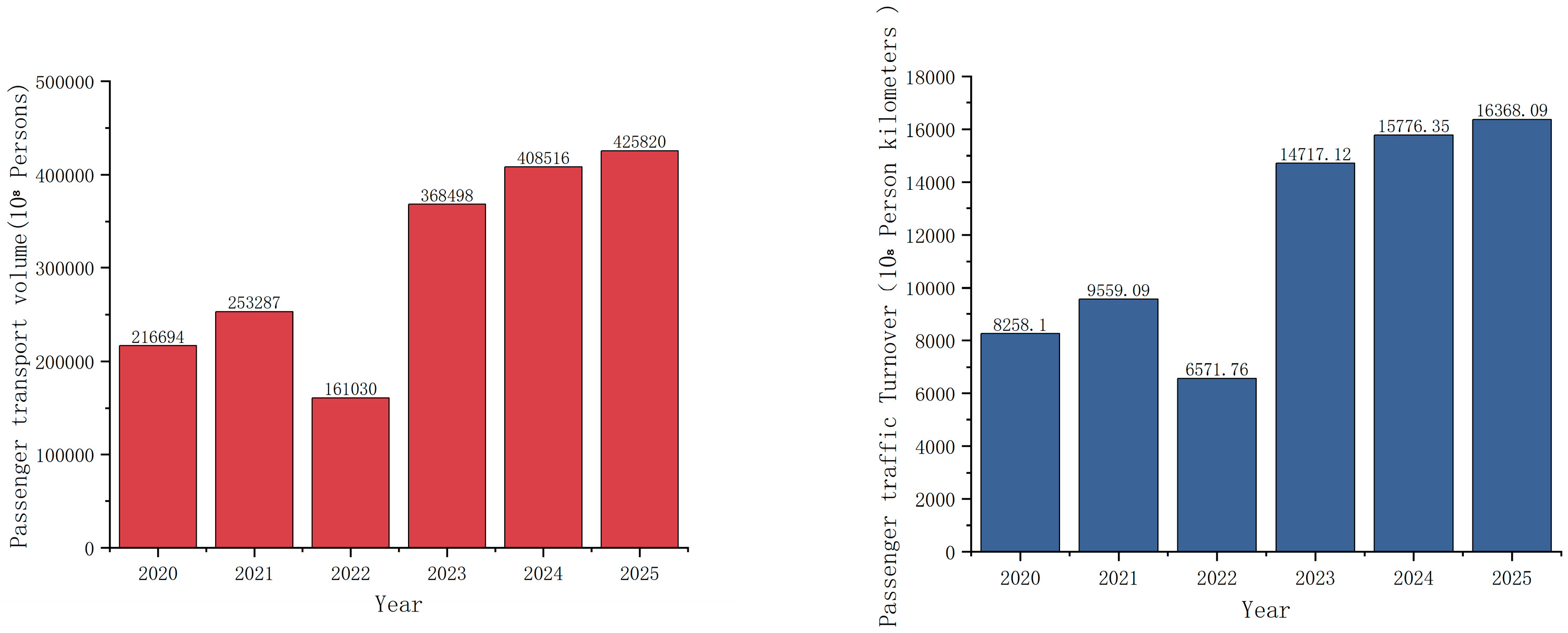
In recent years, China’s high-speed railway (HSR) system has undergone unprecedented expansion, with operational mileage exceeding 50,000 km by the end of 2025. Its operational mileage ranks first in the world, exceeding the sum of other countries’ HSR operational mileage, and it covers 97% of China’s cities with an urban population of over 500,000. During the period from January to December 2025, China’s railways recorded a total passenger transport volume of 4.258 billion trips, representing a year-on-year growth of 4.2%. Notably, high-speed railway constituted 80% of the national railway passenger transport volume and 69% of passenger traffic turnover [1] (Figure 1). On a daily average, China’s high-speed railway operates 9346 high-speed EMU trains, transporting 9.36 million passengers.
The dual pressures of large-scale network operations and growing passenger volume have posed unprecedented challenges to crew management. The continuous expansion of the network has led to an exponential increase in the complexity of crew resource allocation. Establishing a scientific crew management mechanism while ensuring extensive service coverage has currently become the most prominent management issue. Furthermore, upgraded passenger demands and elevated service standards have introduced new pressures on crew management. With the transition of high-speed railway services from basic transportation to end-to-end service experiences, passengers’ expectations for professional services are continuously rising. This shift requires crew members not only to master fundamental service skills but also to possess diverse capabilities—including cross-cultural communication and emergency medical response—thus raising the bar for overall professional competencies.
The current high-speed railway crew management system also faces deep-seated contradictions in human resource allocation, which have formed systemic bottlenecks constraining the improvement of service quality. First, the absence of a person-position matching mechanism leads to a structural imbalance between service capabilities and task requirements. Under the current management model, core capability elements of crew members—including professional skill reserves, emergency response experience, and service qualification levels—lack a scientific matching mechanism with the complexity of specific duty tasks, service standard requirements, and potential risk levels. Such matching imbalance not only causes some crew teams to perform inadequately when responding to emergencies or special service demands, directly affecting the stability and reliability of service delivery, but also, from a systemic perspective, reduces operational efficiency and may trigger safety hazards, becoming the primary cause of service quality fluctuations. Second, the lag in standardization construction results in significant differences in service outputs on the same route. Due to the lack of a unified capability assessment system, scientific crew team formation guidelines, and systematic service quality control standards, different crew teams operating in the same section exhibit notable performance differences in aspects such as service process execution, emergency response speed, and passenger communication. Such inconsistency in service output not only undermines the stability of passenger experiences but also poses challenges to the professional image building of high-speed railway service brands. Especially in the context of cross-line transportation and networked operations, regional differences in service standards further amplify the scope of this issue’s impact.
The Crew Scheduling Plan is a systematic framework for scientifically managing crew members, serving as a key management approach to enhance the refinement level of crew management and support the normal operation of the transportation system. Its core objective is to optimize the allocation of human resources and task arrangements, thereby ensuring the efficient and orderly operation of crew work. As a core tool in crew management, its functions are primarily manifested in two aspects: First, it addresses interpersonal collaboration management issues—for example, rationally forming crew teams based on personnel skills, experience, and collaboration requirements to maximize team effectiveness. Second, it achieves person-position matching, which involves precisely assigning work content to crew members in accordance with task requirements such as task times, task characteristics, and service standards to guarantee service quality and safety.
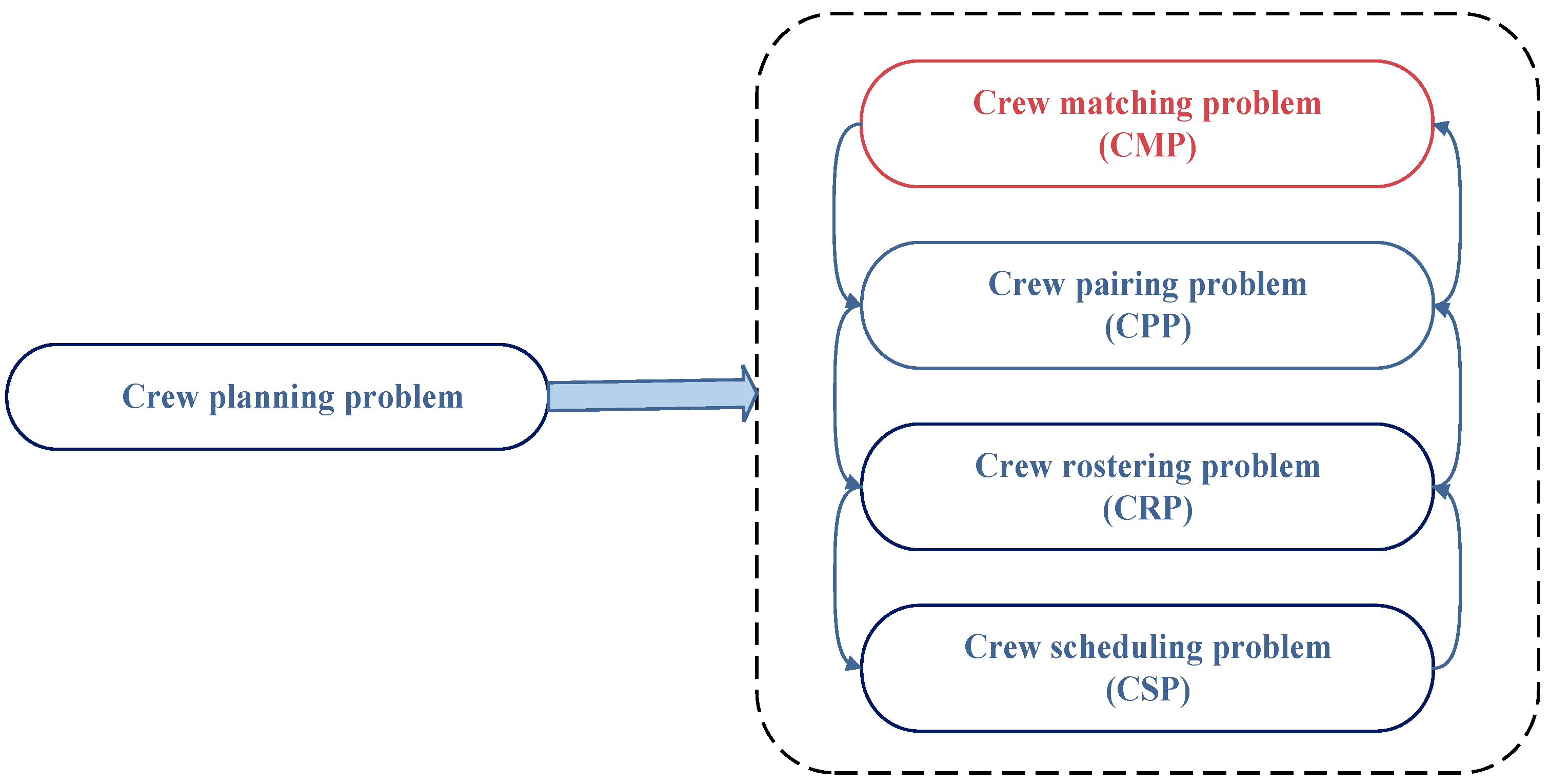
From an operational research perspective, the crew planning process is typically decomposed into four hierarchical phases: crew matching planning (CMP), determining optimal crew team configurations; crew pairing planning (CPP), designing duty sequence routes; crew rostering planning (CRP), establishing shift rotation patterns; and crew scheduling planning (CSP), generating integrated shift assignments and rest, as shown in Figure 2. Notably, the crew matching planning phase serves as the foundational personnel configuration layer, directly determining the safety of crew operations and service quality.
This paper investigates the crew matching problem (CMP) in high-speed railway crew planning, focusing on crew skill levels and preference issues in the process of crew team formation, and provides precision management solutions for high-speed railway crew management departments. The remainder of the paper is organized as follows: Section 2 is devoted to the previous research related to the crew scheduling problem of China’s HSRs, and we comprehensively analyze the various restrictions and requirements that need to be considered in the process of making a CMP plan. Section 3 is devoted to the establishment of the multi-objective optimization mathematical model. In Section 4, we use the commercial optimization solver GUROBI to solve the model and analyze the results in various cases. Finally, we summarize the results in Section 5 and list some future work.
Crew planning research has garnered widespread attention across multiple transportation sectors. Among these, the urban rail transit sector has emerged as a current research hotspot due to the complexity of its operational scenarios and large-scale demand. In contrast, the aviation sector stands out for its representation of research challenges and cutting-edge advancements in this field. Sydney C. K. et al. [2] achieved automated decision-making for crew scheduling plans by effectively decomposing the subway crew scheduling problem and designing a corresponding heuristic algorithm, reducing the time required for Hong Kong Metro’s crew scheduling from one month to half an hour. Manuel Fuente et al. [3] investigated the crew scheduling problem in Madrid’s high-density urban rail lines in Spain. Addressing the high computational complexity of the set covering model in large-scale problems, they proposed a hybrid model based on network flow and task sequencing, which directly models crew tasks. A solution method combining clustering decomposition and heuristic algorithms was designed; validation with real-world data showed that the algorithm performed well in both solution speed and quality. Jue Zhou et al. [4] constructed a multi-commodity network flow model on a multi-layer spatiotemporal network, with minimum cost as the optimization objective, and proposed an integrated optimization approach for subway crew scheduling and shift rotation, solved using a Lagrangian relaxation algorithm. Hua Jin et al. [5] formulated the subway crew scheduling problem as an extended set covering problem with additional constraints on the proportion of different shift types, and solved it using a column generation algorithm, validating the method with Beijing Subway as a case study. Tao Feng et al. [6] established an integrated optimization model for urban rail transit crew scheduling and shift planning based on a partitioned set decomposition model, where decision variables simultaneously determine tasks to be executed and personnel assignments. A column generation algorithm was designed that leveraged the structure of the underlying spatiotemporal network and was combined with a heuristic branching strategy to obtain high-quality solutions. Yifan Xu et al. [7] proposed a novel cross-line crew scheduling (CLCS) method enabling collaborative optimization of multiple lines to minimize operating costs, solved using a column generation algorithm. Validation with Beijing Subway system data showed that the resulting crew schedules were more suitable for scenarios with significant travel time differences. Mengjiao Zhao et al. [8] developed an integer linear optimization model to jointly optimize the task assignment and task generation stages, with the equity of crew working time as an optimization objective. Computational results using the column generation algorithm indicated that this method reduced human resource costs and average working time while effectively meeting crew fairness requirements.
Existing studies in the urban rail transit sector have focused on two core objectives: cost control and workload balance, with particular emphasis on the construction of integrated scheduling models and computational optimization methods for large-scale problems. Scholars have explored multi-objective collaborative scheduling schemes by integrating crew routes and working hour constraints, such as incorporating crew rotations, standby duties, and emergency responses, into a unified framework to enhance overall operational efficiency. These studies provide important methodological support for crew scheduling but tend to focus on system-level resource allocation, with relatively limited consideration of individual needs. Karla L. Hoffman and Manfred Padberg [9], using a set covering model with the objective of minimizing crew costs, designed a branch-and-cut algorithm to solve large-scale instances, and tested it on 68 real-world crew scheduling problems. Compared to traditional heuristic methods, the approach significantly reduced airline costs and improved crew satisfaction. Pamela H. Vance et al. [10] proposed a two-stage optimization model based on duty periods, with total cost minimization as the objective. They designed a dynamic column generation algorithm with subproblems for generating duty period sets and crew rotations and introduced critical sets to improve computational efficiency. Results showed that the method provided a superior solution set, though there remained room for improvement in solution efficiency. Elena Marchiori and Adri Steenbeek [11] addressed the solving of set covering models in aviation crew scheduling by designing an adaptive heuristic evolutionary algorithm for large-scale conditions, which dynamically updates during computation. Compared with existing solutions, their results were competitive and demonstrated the ability to handle large-scale problems. Diego Klabjan et al. [12] tackled complex cost functions and numerous crew tasks in crew scheduling by establishing a set decomposition model with the objectives of cost minimization and maximizing the regularity of assigned tasks. They designed algorithms to solve weekly crew scheduling problems, improving existing airline solutions. For large-scale problems, a greedy randomized adaptive search algorithm and a two-stage optimization framework were developed; testing showed that this method significantly outperformed branch-and-price algorithms, with a total execution time of 8–15 h. Yufeng Guo et al. [13] focused on the integrated optimization of crew pairing chain generation and assignment under multi-base and pre-scheduled activities, with the objectives of cost reduction and workload balance improvement. They established a state-expanded multi-commodity spatiotemporal network flow model and solved it using CPLEX, while designing a heuristic algorithm for the assignment problem. Testing with data from a European airline showed reduced operational costs and improved workload balance. Broos Maenhout and Mario Vanhoucke studied [14] personalized crew scheduling in airlines, aiming to generate personalized monthly schedules for each crew member with the objectives of cost minimization, workload balance, and preference satisfaction. They formulated a set covering model and designed a hybrid scatter search heuristic algorithm, validated with real data from Brussels Airlines. Results showed an 80% reduction in overtime hours, a 40% improvement in workload balance, and satisfaction of preferences for 81% of employees. Guang-Feng Deng and Woo-Tsong Lin [15] treated crew scheduling as a shortest path problem based on the traveling salesman problem, with total crew cost minimization as the objective, and designed an ant colony algorithm. Comparison with genetic algorithm results showed advantages in solution quality, robustness, and computational efficiency. David Antunes et al. [16] addressed the neglect of uncertainty in traditional research by developing a robust optimization model considering both planned and delay costs, using robust parameters to control conservatism. An iterative column generation-based algorithm was designed, embedding robustness constraints in the pricing subproblem. Validation with data from Virgin America showed that as robustness increased, planned costs rose slightly, but system robustness was significantly enhanced. Frédéric Quesnel [17] considered crew route preferences by defining six groups of pairing characteristics related to preferences. With the objective of minimizing total cost including preference features, he established a set decomposition-based mathematical model and designed a column generation-based solution framework, including a pricing subproblem method for feature attributes. Extensive computational experiments with real data from a North American airline and randomly generated preference scenarios showed that the method significantly improved preference satisfaction rates with minimal cost increase. Bahareh Shafipour-Omrani et al. [18] incorporated crew personal preferences and seniority into scheduling decisions, establishing a multi-objective mixed integer programming model with crew satisfaction as the goal. The model prohibited assigning conflicting crew members to the same flight and required inexperienced co-pilots to pair with experienced captains. Given the NP-hard nature of the problem, a genetic algorithm was used as the core solver and compared with exact solutions from GAMS. Results showed that the genetic algorithm achieved an average optimality gap of only 0.5% across 30 test cases, found high-quality solutions in shorter time, and provided a more humanized crew scheduling solution. Xin Wen [19] focused on multi-class crew members and heterogeneous manpower demands in crew scheduling, proposing a personalized crew pairing method. A multi-class individual crew pairing problem considering availability and controlled personnel substitution was established, with total cost minimization as the objective and a set covering model. Column generation and genetic algorithms were designed for different problem scales, validated with real data from Cathay Pacific. Compared to traditional models, this method nearly eliminated manpower waste and reduced operating costs by 8.4%. George Kozanidis [20] studied vacation scheduling in crew rostering, aiming to maximize satisfaction of specific vacation preferences and minimize unallocated vacation entitlements across the crew group. A two-stage integrated solution framework was constructed: the first stage used a bid award model solved with CPLEX, and the second stage employed an automatic assignment model solved via branch-and-price. Collaboration with an airline management software company validated the framework’s effectiveness and performance using real data.
As the longest-standing and most comprehensive sector in crew scheduling research, aviation exhibits a distinct trajectory of in-depth development. Early studies focused on cost, workload balance, and computational quality/efficiency. With growing emphasis on service quality and personnel experience, recent research has gradually expanded to include crew personalized needs such as vacation preferences, work shift inclinations, and job preferences. The research objective has evolved from “system optimization” to “dynamic adaptation of the human position system,” making scheduling schemes more precise and humanized, and providing new research directions for other transportation sectors. Alberto Caprara et al. [21] studied the railway locomotive crew scheduling problem, establishing models for crew dispatching and scheduling with the objective of minimizing the number of locomotive crew members. They discussed and compared two main modeling approaches—set decomposition/set covering models and arc-flow models—and proposed an efficient heuristic algorithm for large-scale problems, validated with an Italian railway company case study. Results showed significant reductions in operating costs and improved management efficiency. Erwin Abbink et al. [22] addressed the diverse demands of management, unions, and crew members in Dutch railway crew scheduling, with the objectives of minimizing crew numbers, improving task allocation fairness, and punctuality. Using a set covering model framework, they applied an efficient heuristic algorithm combining column generation and Lagrangian relaxation, providing a methodology for other large railways to achieve multi-objective optimization at the management, employee, and passenger levels. Dennis Huisman [23] considered automated update mechanisms for railway crew plans during temporary train suspensions, modeling the problem as a large-scale set packing problem with additional constraints to minimize total costs. A solution framework combining column generation and Lagrangian relaxation was adopted, with the Lagrangian dual problem solved using a subgradient optimization algorithm. Validation with two suspension cases from Dutch Railways showed near-perfect feasible solutions for medium-scale problems. Abbink et al. [24] focused on large-scale locomotive crew scheduling in Dutch Railways, proposing the LUCIA algorithm for global optimization of weekly crew plans, further reducing total costs and shortening planning time. Raymond S. K. Kwan [25] concentrated on British railway operations, establishing an integer linear programming model to minimize the total number of shifts and costs. A two-stage framework, comprising generation and selection stages, was designed: the generation stage used column generation to solve the linear relaxation, and the second stage used branch-and-bound to find integer solutions. Validation showed 5–10% cost savings. Güvenç Şahin and Birol Yüceoğlu [26] addressed the actual needs of Turkish State Railways by using spatiotemporal networks to represent crew movements and activities, formulating the problem as a minimum flow problem with lower bound constraints. Sequential and integrated methods for adding rest days were designed; validation showed that the integrated method outperformed the sequential method in solution quality. Zhiqiang Tian and Qi Song [27] established a set covering model for high-speed railway crew scheduling with total cost minimization, using a two-stage algorithm and an improved dual-pheromone ant colony algorithm to avoid combinatorial explosion from generating all feasible solutions. Validation with the Beijing–Tianjin intercity line confirmed the model and algorithm’s effectiveness and practicality. Kirsten Hoffmann [28,29] et al. focused on attendance rates of German railway crew members, establishing a multi-period set covering model with attendance rates and total cost minimization. A hybrid column generation algorithm was designed, using a genetic algorithm to solve the pricing subproblem. Validation with real data from German Railways showed 15.5–35.3% cost reductions compared to traditional methods, with good robustness but longer solution times. Silke Jütte [30] considered fairness preferences in railway crew scheduling, quantifying “shift popularity” and “scheduling fairness.” An extended set covering problem was designed, solved using a column generation-based heuristic algorithm. Real data validation showed that this method significantly improved popularity and fairness at a small cost. Sarah Frisch et al. [31] addressed practical issues in Austrian railway crew dispatching, establishing a set decomposition model to minimize working hours while considering traction requirements, working hour limits, night shift conditions, and employee satisfaction. A two-stage heuristic algorithm was designed: the first stage used breadth-first search for shift construction, and the second stage used a commercial solver for the set decomposition problem. Validation with real Austrian railway data showed high-quality solutions, with shift length limits being the most critical factor for feasibility. Gattermann-Itschert et al. [32] focused on crew preferences in railway dispatching, using machine learning to learn preferences and replace complex penalty term structures in traditional models, simplifying parameter settings. An integrated model combining machine learning and optimization was established, with a PAP algorithm process developed on a traditional column generation framework. Integration of machine learning and optimization stages was validated with real data, showing that the average acceptance probability of schedules by crew members increased from 63% to 72%.
The railway sector’s crew scheduling research focuses on high-speed railway crew scheduling, covering multi-position types such as locomotive and passenger service crew members. The research perspective has gradually shifted from management-level objectives such as cost minimization, workload balance, and solution efficiency to employee-level considerations such as fairness, satisfaction, and preference fulfillment, aligning more closely with practical operational needs. Notably, in addition to traditional optimization methods, emerging technologies like machine learning have been introduced, driving the evolution of research from static optimization to dynamic adaptation. Existing studies generally indicate that the research paradigm for crew scheduling has gradually shifted from the traditional orientation of “cost minimization and workload balance” towards a refined and personalized exploration centered on crew members. Field research on China’s railway passenger crew departments reveals that the formulation of high-speed railway crew scheduling must start from the crew team formation phase—a process that not only requires coordinating crew members’ personalized characteristics, such as specialized skills and work preferences, with practical needs but also necessitates comprehensively evaluating the team’s overall skill level and collaborative efficiency. This phase serves as both the starting point for implementing crew scheduling and a key breakthrough for achieving research refinement. At the theoretical level, existing research has predominantly concentrated on crew scheduling optimization (CSP) and dispatch command systems, while systematically neglecting the foundational crew matching problem (CMP)—the critical first step that fundamentally determines subsequent scheduling quality. In light of this, this paper will focus on the crew matching problem as a core phase for investigation, aiming to address the gap in existing research regarding the consideration of personalization and skill synergy in crew team formation.


2. Problem Statements and Assumptions

The CMP refers to the process of forming a crew by assembling a chief steward and stewards. Typically, a crew team consists of one chief steward and a fixed number of stewards. All crew members possess different essential skills, including emergency response capabilities, passenger service skills, foreign language proficiency, communication abilities, and so on. Due to differences in individual skill levels, when forming a crew, it is necessary to rationally match stewards with varying skill levels to ensure that each crew team has a comprehensive and balanced skill set, thereby guaranteeing consistent high-quality service for passengers. At the same time, it is crucial to consider team collaboration preferences among members within the crew. If a combination that aligns with the matching preferences of all crew members can be identified, it will not only significantly enhance job satisfaction and team collaboration efficiency but also improve staff stability and reduce training costs associated with personnel turnover.
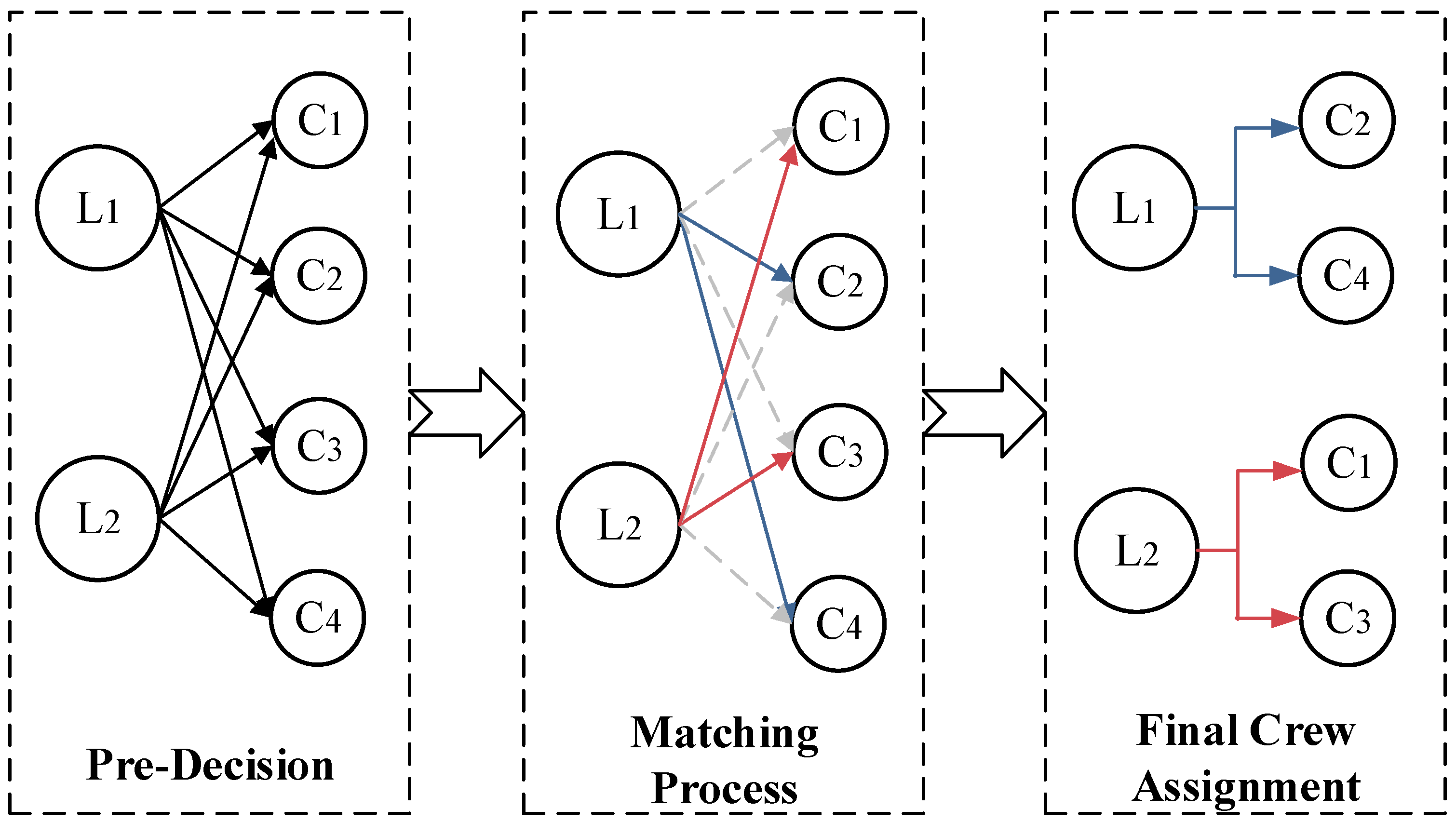
The process of matching crew members is illustrated in Figure 3. The connections between chief steward 1, chief steward 2, and stewards 1, 2, 3, and 4 represent potential matches. After comprehensive decision-making by management, the final matching results are as follows: chief steward 1 is matched with stewards 2 and 4, and chief steward 2 is matched with stewards 1 and 3.
This study investigates the optimization framework for crew team formation in high-speed railway operations. By establishing a theoretical foundation that integrates organizational needs with individual considerations, this study aims to formulate matching principles that could potentially enhance both operational efficiency through optimized team structures and human resource outcomes by better accommodating personal preferences.

3. Model Construction

We establish a multi-objective optimization model from the group skill balance and crew member personnel preference perspective. The theoretical model is structured under two fundamental assumptions:
Assumption 1.
In the routine operations of high-speed railway systems, crew teams typically maintain fixed formation assignments. The model established in this study is based on a static personnel allocation framework, which temporarily excludes consideration of complex working conditions involving dynamic crew reorganization.
Assumption 2.
The crew configuration in high-speed railway operations typically employs a standard composition of one chief steward and three stewards. This study operates under the static personnel configuration premise, which explicitly excludes variable factors such as dynamic adjustments to team size.

3.1. Notations

Notation already means the Table 1.

3.2. Model Formulation

Incorporating key operational parameters including competency metrics of chief stewards L j and stewards C i , along with preference compatibility indices P C , P L , we systematically formulate a multi-objective optimization framework with dual targets:
(1)
Skill disparity minimization;
(2)
Preference order reduction.
Let x i j be a binary decision variable, where i = 1 ,   2 , … m denotes stewards, j = 1 ,   2 , … n denotes chief stewards, and x i j ∈ 0 ,   1 . If x i j = 1 , it indicates that stewards C i are matched with chief stewards L j ; otherwise, x i j = 0 .
min Z 1 = ∑ j = 1 n ∑ k = 1 q l j k + ∑ i = 1 m c i k x i j − S ¯
Objectives (1) indicates minimizing the discrepancy between the crew team’s the average skill level, S ¯ means the average skill level of the crew teams.
min Z 2 = ∑ i = 1 m ∑ j = 1 n p j i L x i j + ∑ i = 1 m ∑ j = 1 n p i j C x i j
Objectives (2) indicates minimizing the variance of preference order between chief stewards and stewards.
Skill Level Constraints:
l j k + ∑ i = 1 m x i j c i k ≥ 1     ∀ j = 1 ,   2 … n ,   ∀ k = 1 ,   2 … q
Constraint (3) indicates that the level of each skill in every crew team must meet at least a value of 1.
Matching Constraints:
∑ j = 1 n x i j = 1     ∀ i = 1 ,   2 , … m
Constraint (4) indicates that each steward can only be matched with one chief steward.
∑ i = 1 m x i j = U     ∀ j = 1 ,   2 , … n
Constraint (5) indicates that each chief steward can only be matched with a specific number of stewards.
S ¯ = ∑ j = 1 n ∑ k = 1 q l j k + ∑ i = 1 m c i k x i j n q
Constraint (6) defines the average skill level of the crew teams.
In summary, we establish a multi-objective optimization model for crew matching, denoted as M1.

3.3. Complexity Analysis of the Model

Model M1 is a multi-objective 0–1 integer programming model, and the objective function Z 1 is a nonlinear objective function. To better solve this problem, the nonlinear objective is linearized. Specifically, auxiliary variables ξ j k , μ are introduced. Let ξ j k = l i k + ∑ i = 1 m c i k x i j ; then μ = ∑ j = 1 n ∑ k = 1 q ξ j k n q . The transformed objective function (1) is denoted as min Z 1 = ∑ j = 1 n ∑ k = 1 q ξ j k − μ . Constraint (3) is transformed into ξ j k ≥ 1   ∀ j = 1 ,   2 … n ,   ∀ k = 1 ,   2 … q . It is then linearized again by letting Z j k = ξ j k − μ ; then the mathematical model M1 can be transformed into the following form, denoted as M2:
min Z 1 = ∑ j = 1 n ∑ k = 1 q Z j k min Z 2 = ∑ i = 1 m ∑ j = 1 n p j i L x i j + ∑ i = 1 m ∑ j = 1 n p i j C x i j s . t . ξ j k ≥ 1     ∀ j = 1 ,   2 … n ,   ∀ k = 1 ,   2 … q Z j k ≥ ξ j k − u   ∀ j = 1 ,   2 … n ,   ∀ k = 1 ,   2 … q Z j k ≥ u − ξ j k   ∀ j = 1 ,   2 … n ,   ∀ k = 1 ,   2 … q x i j ∈ 0 , 1   i = 1 ,   2 … m ,   j = 1 ,   2 … n ( 4 ) − ( 6 )
Mathematical model M2 is a multi-objective integer programming model. To facilitate solution and calculation, the model is transformed into a single-objective optimization model for solution. The transformed model is integrated into M3:
min Z = ω 1 ∑ j = 1 ′ n ∑ k = 1 q Z j k + ω 2 ∑ i = 1 m ∑ j = 1 n p j i L x i j + ∑ i = 1 m ∑ j = 1 n p i j C x i j s . t . ξ j k ≥ 1     ∀ j = 1 ,   2 … n ,   ∀ k = 1 ,   2 … q Z j k ≥ ξ j k − u   ∀ j = 1 ,   2 … n ,   ∀ k = 1 ,   2 … q Z j k ≥ u − ξ j k   ∀ j = 1 ,   2 … n ,   ∀ k = 1 ,   2 … q x i j ∈ 0 , 1   i = 1 ,   2 … m ,   j = 1 ,   2 … n ( 4 ) − ( 6 )
The model M3 constructed in this paper is a mixed integer programming model, and its computational complexity mainly depends on the number of crew members and the crew skills. The computational complexity analysis of the model is presented in Table 2.
In practical operational management, the passenger transport section, as the fundamental organizational unit in railway transportation systems, typically maintains a staffing scale ranging from 5000 to 15,000 personnel. As frontline operational units, crew groups generally operate with a stable workforce of 200 to 300 members. Consequently, problem-solving scales vary significantly across different application scenarios: when studying passenger transport sections, the variable dimensions involved may reach tens of thousands, whereas focusing on crew team-level applications reduces the problem scale to hundreds of variables. This research adopts a typical crew group scenario, employing the GUROBI mathematical optimization solver to construct computational models, and conducts solving efficiency tests through controlled experimental groups.

4. Computational Results

Based on the computational complexity of practical problems, we employed the commercial solver GUROBI to solve this problem. In this section, a series of numerical calculation results are presented to demonstrate the real-world performance of the established multi-objective optimization model. Small-scale test cases are used to verify the effectiveness of the proposed model, with comparative analyses conducted for computational results under different weight configurations. Computational performance tests are also performed to evaluate the model’s scalability. Finally, a comparative study is carried out between the model’s outputs and the manual matching results from the high-speed rail crew team of the Lanzhou Passenger Transport Section. All the implementations are carried out on a Windows 10 workstation with two Intel Core i5-11300H CPUs and 4G RAM.

4.1. A Small-Scale Case Study

It is assumed that there are three chief stewards and nine stewards. The number of skills considered for the crew members is six. The specific skill information is shown in Table 3 and Table 4.
The preference order of the chief stewards for the stewards and the preference order of the stewards for the chief stewards are shown in Table 5 and Table 6. Assuming that skill balance and crew member preference have equal importance in the crew matching process, let ω 1 = ω 2 = 1 .
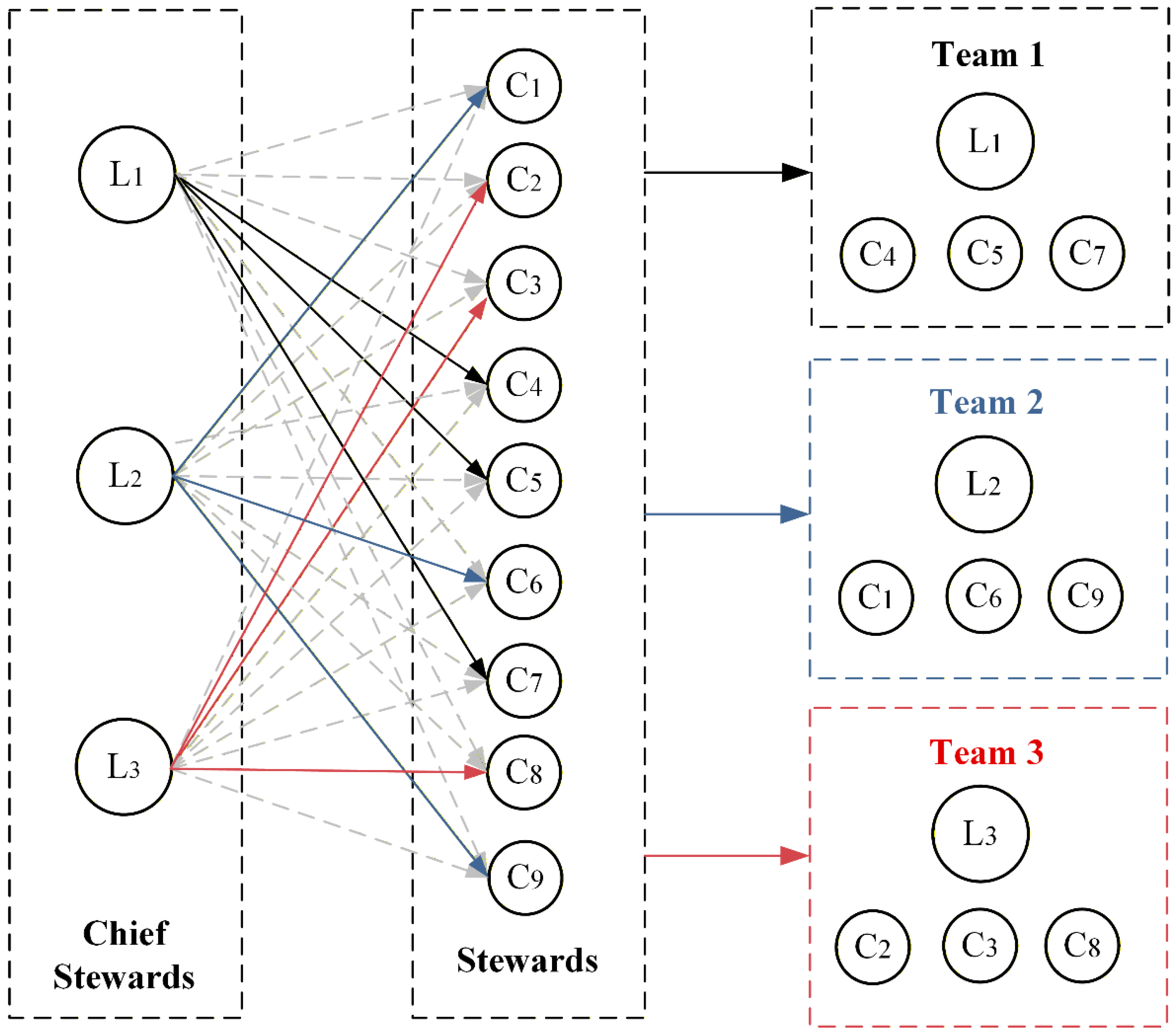
The calculation results and crew matching plan are shown in Table 7 and Figure 4.
The calculation results are verified by the exhaustive method, and the objective function and solution results are consistent, which proves that the calculation method designed in this paper is effective.

4.2. Sensitivity Analysis

In the multi-objective optimization model, we need to consider both the skill balance between the crew and the matching preferences between the crew members. In the optimization process, the weights of Z 1 and Z 2 may have different effects on the solution of Z , so it is necessary to perform numerical analysis on the solution under different weights. We first let ω 1 > ω 2 , and obtain the calculation results when ω 1 : ω 2 = 0 : 1 , ω 1 : ω 2 = 10 : 1 , ω 1 : ω 2 = 50 : 1 , ω 1 : ω 2 = 100 : 1 , ω 1 : ω 2 = 500 : 1 , ω 1 : ω 2 = 2500 : 1 , ω 1 : ω 2 = 12500 : 1 . We then obtain the value of the objective function Z 1 and Z 2 under the matching result, and perform comparative analysis. The results are shown in Table 8.
According to the data in the table, when ω 1 : ω 2 = 0 : 1 , the value of the objective function for skill balance is 25.00, and the value of the objective function for preference order is 44.00. At this point, the value of the objective function Z equals the preference ordinal value. As the weight of ω 1 and ω 2 increases, the value of the objective function Z gradually increases. The objective function value of the established model remains stable at 11.33, while the preference order value remains stable at 49.00. When the weight ratio increases to ω 1 : ω 2 = 2500 : 1 , the preference order value rises from 44.00 to 49.00 and then stabilizes at 49.00, with no further changes occurring.
Then let ω 1 < ω 2 , and obtain the calculation results for ω 1 : ω 2 = 1 : 0 , ω 1 : ω 2 = 1 : 10 , ω 1 : ω 2 = 1 : 50 , ω 1 : ω 2 = 1 : 100 , ω 1 : ω 2 = 1 : 500 , ω 1 : ω 2 = 1 : 2500 , ω 1 : ω 2 = 1 : 12500 respectively. The values of the objective functions Z 1 and Z 2 are obtained under the matching results for comparative analysis (Table 9).
According to the data in the table, when ω 1 : ω 2 = 1 : 0 , the objective function value Z 1 of the established model is 11.33, and the objective function value Z 2 of the established model is 65. The objective function value Z gradually increases as the weight ratio expands. When the weight ratio is ω 1 : ω 2 = 1 : 10 , the objective function value Z 1 is 15.11, and the preference order value of the objective function is 44.00 and reaches stability, no longer changing with variations in the weight ratio.

4.3. Computational Performance Test

The scope of the high-speed railway crew matching problem can be a single duty line, multiple duty lines, a single crew workshop, or even the entire passenger section. Therefore, the calculation time of the problem under different scales is tested. The calculation time of the problem when the skill index is 6 and the number of crew chiefs is 10, 20, 40, 50, 75, 80, 160, 320, 400, and 450 is tested. The results are shown in Table 10.
It can be seen from the above table that when the number of chief stewards is 450, that is, the number of stewards reaches 1350, a memory overflow occurs, and the calculation scale cannot meet the matching calculation of all high-speed railway crew members in a passenger section, but it can meet the calculation scale of multiple passenger crew workshops.
The general scale of a high-speed railway fleet is that the total number of crew members in a small fleet is about 200 (including about 50 chief stewards), and the total number of crew members in a large fleet is about 300 (including about 75 chief stewards). The impact of different numbers of skills on computing power when the number of chief stewards is 50 and 75 is tested respectively, and the number of skills is selected as 3, 6, 12, and 24 respectively. The test results are shown in Table 11 and Table 12.
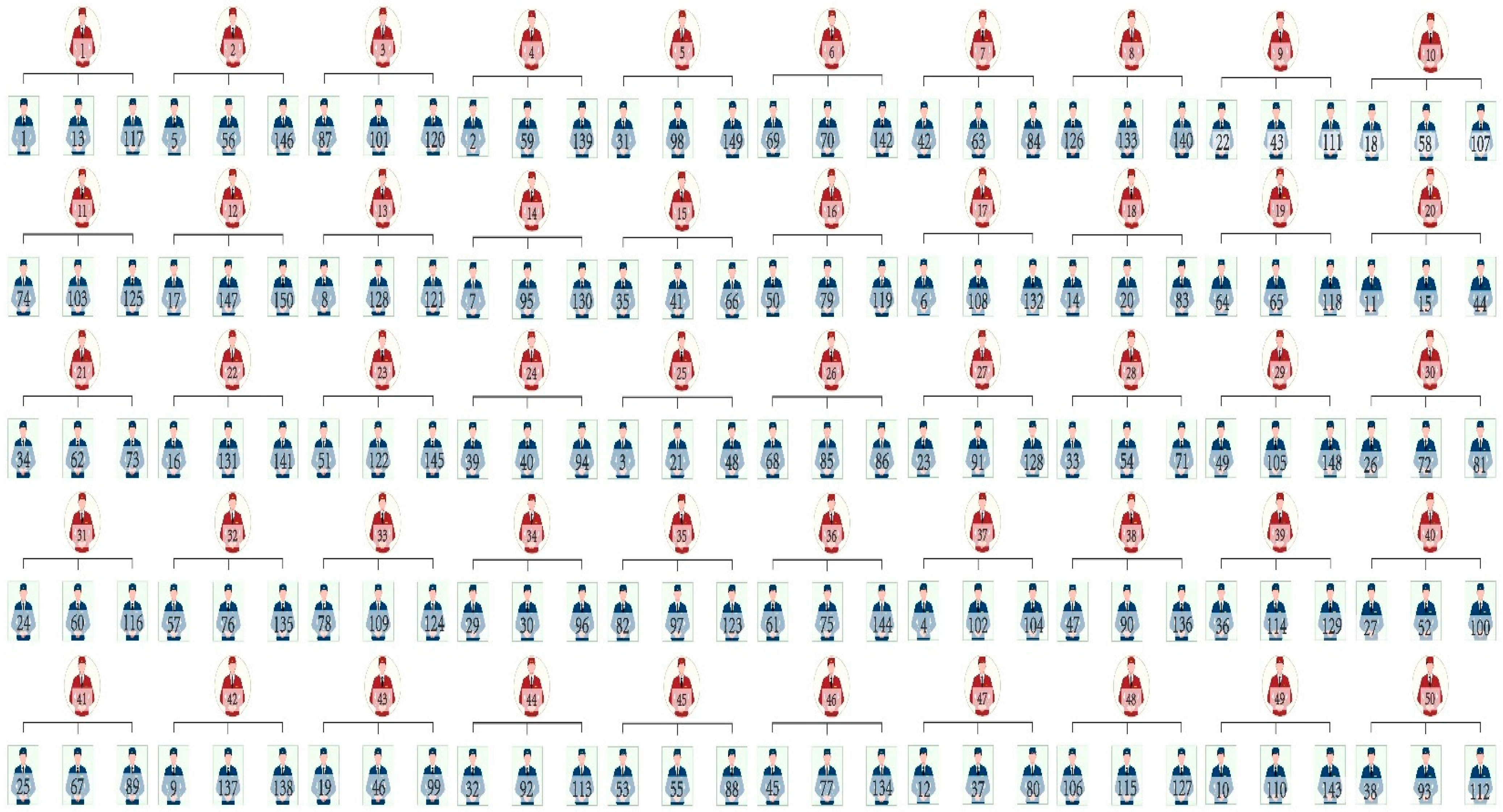
As can be seen from the table, the calculation time of the crew matching problem increases with the number of crew skills. When the number of chief stewards is 50, that is, the number of stewards is 150, and the number of skills considered reaches 24, the calculation time is 167.23 s, which can meet the daily work needs. When the number of chief stewards is 75, that is, the number of stewards is 245, and the number of skills considered reaches 24, the calculation time is 293.97 s, which can also meet the daily work needs of the crew fleet.
The matching result diagram obtained by calculating this problem for a small crew fleet size in practical work is as follows.

4.4. Real-World Case Study

The proposed crew team two-sided matching model was validated using the EMU crew team of the Lanzhou Passenger Transport Section as an empirical case. Based on the position competency parameters presented in Table 13 and Table 14, combined with the matching preference values shown in Table 15 and Table 16, comparisons were made between traditional manual scheduling and the model with computational methods designed in this study for crew team matching.
The matching results of crew teams obtained through manual scheduling and the computational model proposed in this study are presented in Table 17, with corresponding solution outputs shown in Table 18. Comparative analysis between manual scheduling outcomes and the proposed methodology reveals a 5% improvement in crew team skill balance and an 80% enhancement in crew member preference satisfaction rate. These findings demonstrate the effectiveness of the matching model and methodology specifically designed for crew team formation in this research.
The final crew team matching solution derived through the model and computational methods developed in this study is demonstrated in Table 19 and Figure 5.

5. Conclusions

This study focuses on the comprehensive optimization of high-speed railway crew matching, with the optimization objectives of crew skill balance and personal matching preference. A multi-objective optimization model is constructed, and the commercial solver Gurobi is employed to solve the model. Numerical analysis is conducted on the results under different scenarios. The main research conclusions are as follows:
(1)
For the first time, this study focuses on the crew matching problem in high-speed railway operations and incorporates the skill attributes of crew members into the framework for solving it. By quantitatively considering the skill balance of each crew team, the equitable distribution of skills among teams is effectively ensured, thereby enhancing the service quality of each crew team and optimizing the overall operational service level.
(2)
On the basis of ensuring skill balance, this study further integrates the individual matching preferences of crew members to construct an employee preference-oriented crew team pairing scheme. This scheme not only meets the needs of management departments but also considers the personalized needs of crew members, enhancing the precision of crew management and achieving the precise allocation of human resources.
(3)
This study proposes a high-speed railway crew matching model based on skill balance and personnel preferences. The model is precisely solved using a commercial optimization solver, yielding an optimal team matching scheme. By analyzing the impact of weight changes in the multi-objective functions on the optimization results, the effectiveness and robustness of the model are validated. Furthermore, simulation tests under different team sizes and skill combinations demonstrate that the proposed matching scheme can effectively meet the operational demands of crew fleets.
Future research will focus on high-speed railway crew matching under complex conditions such as uncertain information and multi-attribute information. Additionally, more practical operational constraints, such as flexible scheduling mechanisms and dynamic task allocation, will be incorporated to enhance the practicality and adaptability of the problem.

Author Contributions

Conceptualization, W.L.; Methodology, W.L., Y.L., T.F. and R.X.; Software, G.L.; Investigation, W.L.; Data curation, X.W.; Writing—original draft, W.L.; Supervision, Y.L. All authors have read and agreed to the published version of the manuscript.

Funding

This research was supported by the National Natural Science Foundation of China (No. 72361018), the Natural Science Foundation of Gansu Province (23JRRA858), the Science and Technology Program (Joint Research Fund) Project of Gansu Province (24JRRA868), and the Lanzhou Jiaotong University Gansu Provincial Key Laboratory Open Project (2024064), Technology Commissioner Project of Gansu Provincial Department of Science and Technology: 25CXGA037.

Data Availability Statement

The raw data supporting the conclusions of this article will be made available by the authors on request.

Conflicts of Interest

The authors declare that there are no competing interests regarding the publication of this paper.

References

  1. China State Railway Group Co., Ltd. Available online: http://www.china-railway.com.cn/wnfw/sjfw/ (accessed on 17 February 2026).
  2. Chu, S.C.; Chan, E.C. Crew scheduling of light rail transit in Hong Kong: From modeling to implementation. Comput. Oper. Res. 1998, 25, 887–894. [Google Scholar] [CrossRef] [Scilit]
  3. Fuentes, M.; Cadarso, L.; Marín, Á. A hybrid model for crew scheduling in rail rapid transit networks. Transp. Res. Part B Methodol. 2019, 125, 248–265. [Google Scholar] [CrossRef] [Scilit]
  4. Zhou, J.; Xu, X.; Long, J.; Ding, J. Integrated optimization approach to metro crew scheduling and rostering. Transp. Res. Part C Emerg. Technol. 2021, 123, 102975. [Google Scholar] [CrossRef] [Scilit]
  5. Jin, H.; Chen, S.; Ran, X.; Liu, G.; Liu, S. Column generation-based optimum crew scheduling incorporating network representation for urban rail transit systems. Comput. Ind. Eng. 2022, 169, 108155. [Google Scholar] [CrossRef] [Scilit]
  6. Feng, T.; Lusby, R.M.; Zhang, Y.; Tao, S.; Zhang, B.; Peng, Q. A branch-and-price algorithm for integrating urban rail crew scheduling and rostering problems. Transp. Res. Part B Methodol. 2024, 183, 102941. [Google Scholar] [CrossRef] [Scilit]
  7. Xu, Y.; Yin, H.; Yang, S.; Zheng, H.; Chang, X.; Wu, J. Cross-line crew scheduling optimization in urban rail transit systems. Comput. Ind. Eng. 2025, 201, 110896. [Google Scholar] [CrossRef] [Scilit]
  8. Zhao, M.; Yang, S.; Cao, D.; Sun, L.; Wu, J. A synchronous crew scheduling problem with time fairness based on a two-phrase assignment strategy in an urban rail transit network. Comput. Ind. Eng. 2025, 205, 111160. [Google Scholar] [CrossRef] [Scilit]
  9. Hoffman, K.L.; Padberg, M. Solving airline crew scheduling problems by branch-and-cut. Manag. Sci. 1993, 39, 657–682. [Google Scholar] [CrossRef] [Scilit]
  10. Vance, P.H.; Barnhart, C.; Johnson, E.L.; Nemhauser, G.L. Airline crew scheduling: A new formulation and decomposition algorithm. Oper. Res. 1997, 45, 188–200. [Google Scholar] [CrossRef] [Scilit]
  11. Marchiori, E.; Steenbeek, A. An evolutionary algorithm for large scale set covering problems with application to airline crew scheduling. In Real-World Applications of Evolutionary Computing; Cagnoni, S., Ed.; Springer: Berlin/Heidelberg, Germany, 2000; Volume 1803, pp. 370–384. [Google Scholar] [CrossRef] [Scilit]
  12. Klabjan, D.; Johnson, E.L.; Nemhauser, G.L.; Gelman, E.; Ramaswamy, S. Solving large airline crew scheduling problems: Random pairing generation and strong branching. Comput. Optim. Appl. 2001, 20, 73–91. [Google Scholar] [CrossRef] [Scilit]
  13. Guo, Y.; Mellouli, T.; Suhl, L.; Thiel, M.P. A partially integrated airline crew scheduling approach with time-dependent crew capacities and multiple home bases. Eur. J. Oper. Res. 2006, 171, 1169–1181. [Google Scholar] [CrossRef] [Scilit]
  14. Maenhout, B.; Vanhoucke, M. A hybrid scatter search heuristic for personalized crew rostering in the airline industry. Eur. J. Oper. Res. 2010, 206, 155–167. [Google Scholar] [CrossRef] [Scilit]
  15. Deng, G.-F.; Lin, W.-T. Ant colony optimization-based algorithm for airline crew scheduling problem. Expert Syst. Appl. 2011, 38, 5787–5793. [Google Scholar] [CrossRef] [Scilit]
  16. Antunes, D.; Vaze, V.; Antunes, A.P. A robust pairing model for airline crew scheduling. Transp. Sci. 2019, 53, 1751–1771. [Google Scholar] [CrossRef] [Scilit]
  17. Quesnel, F.; Desaulniers, G.; Soumis, F. Improving air crew rostering by considering crew preferences in the crew pairing problem. Transp. Sci. 2020, 54, 97–114. [Google Scholar] [CrossRef] [Scilit]
  18. Shafipour-Omrani, B.; Rashidi Komijan, A.; Sadjadi, S.J.; Khalili-Damghani, K.; Ghezavati, V. A fuzzy crew rostering model based on crew preferences and seniorities considering training courses: A robust optimization approach. Comput. Intell. Neurosci. 2022, 2022, 8415169. [Google Scholar] [CrossRef] [Scilit] [PubMed]
  19. Wen, X.; Sun, X.; Sun, Y.; Yue, X. Airline crew scheduling: Models and algorithms. Transp. Res. Part E Logist. Transp. Rev. 2021, 149, 102304. [Google Scholar] [CrossRef] [Scilit]
  20. Kozanidis, G. An integrated column generation solution framework for optimal aircrew vacation planning subject to seniority ranking and priority preference satisfaction. Omega 2025, 135, 103324. [Google Scholar] [CrossRef] [Scilit]
  21. Caprara, A.; Fischetti, M.; Toth, P.; Vigo, D.; Guida, P.L. Algorithms for railway crew management. Math. Program. 1997, 79, 125–141. [Google Scholar] [CrossRef] [Scilit]
  22. Abbink, E.; Fischetti, M.; Kroon, L.; Timmer, G.; Vromans, M. Reinventing crew scheduling at Netherlands railways. Interfaces 2005, 35, 393–401. [Google Scholar] [CrossRef] [Scilit]
  23. Huisman, D. A column generation approach for the rail crew re-scheduling problem. Eur. J. Oper. Res. 2007, 180, 163–173. [Google Scholar] [CrossRef] [Scilit]
  24. Abbink, E.J.W.; Albino, L.; Dollevoet, T.; Huisman, D.; Roussado, J.; Saldanha, R.L. Solving large scale crew scheduling problems in practice. Public Transp. 2011, 3, 149–164. [Google Scholar] [CrossRef] [Scilit]
  25. Kwan, R.S.K. Case studies of successful train crew scheduling optimisation. J. Sched. 2011, 14, 423–434. [Google Scholar] [CrossRef] [Scilit]
  26. Şahin, G.; Yüceoğlu, B. Tactical crew planning in railways. Transp. Res. Part E Logist. Transp. Rev. 2011, 47, 1221–1243. [Google Scholar] [CrossRef] [Scilit]
  27. Tian, Z.; Songa, Q. Modeling and algorithms of the crew scheduling problem on high-speed railway lines. Procedia-Soc. Behav. Sci. 2013, 96, 1443–1452. [Google Scholar] [CrossRef] [Scilit]
  28. Hoffmann, K.; Buscher, U. Valid inequalities for the arc flow formulation of the railway crew scheduling problem with attendance rates. Comput. Ind. Eng. 2019, 127, 1143–1152. [Google Scholar] [CrossRef] [Scilit]
  29. Hoffmann, K.; Buscher, U.; Neufeld, J.S.; Tamke, F. Solving practical railway crew scheduling problems with attendance rates. Bus. Inf. Syst. Eng. 2017, 59, 147–159. [Google Scholar] [CrossRef] [Scilit]
  30. Jütte, S.; Müller, D.; Thonemann, U.W. Optimizing railway crew schedules with fairness preferences. J. Sched. 2017, 20, 43–55. [Google Scholar] [CrossRef] [Scilit]
  31. Frisch, S.; Hungerländer, P.; Jellen, A. On a real-world railway crew scheduling problem. Transp. Res. Procedia 2022, 62, 824–831. [Google Scholar] [CrossRef] [Scilit]
  32. Gattermann-Itschert, T.; Poreschack, L.M.; Thonemann, U.W. Using machine learning to include planners’ preferences in railway crew scheduling optimization. Transp. Sci. 2023, 57, 796–812. [Google Scholar] [CrossRef] [Scilit]
Figure 1. Railway passenger transport volume and traffic turnover of recent years.
Mathematics 14 00845 g001
Figure 2. Crew planning process of high-speed railway.
Mathematics 14 00845 g002
Figure 3. Illustration of high-speed railway crew matching problem.
Mathematics 14 00845 g003
Figure 4. Diagram of crew assignment results.
Mathematics 14 00845 g004
Figure 5. Illustration of matching results for a small crew fleet.
Mathematics 14 00845 g005
Table 1. Notations and their meanings.
NotationsDefinitions
x i j x i j ∈ 0 ,   1 , a binary decision variable. If x i j = 1 , it indicates that stewards C i are matched with chief stewards L j ; otherwise, x i j = 0 .
C Set of stewards, where C i denotes stewards i , i = 1 ,   2 , … m .
L Set of chief stewards, where L j denotes the chief stewards j , j = 1 ,   2 , … n .
S Set of skills of crew members, where S k denotes the skill k , k = 1 ,   2 , … q .
c i k c i k ∈ 0 ,   1 , a binary decision variable. If c i k = 1 , it indicates that steward i has a “good” level of skill k , otherwise it indicates a “fair” level.
l j k l j k ∈ 0 , 1 , a binary decision variable. If l j k = 1 , it indicates chief steward k has a “good” level of skill k ; otherwise means a “fair” level.
P C The complete preference order matrix of stewards for chief stewards.
P L The complete preference order matrix of chief stewards for stewards.
P i j C p i 1 c ,   p i 2 c , … p i m c , where p i j c denotes the position of chief stewards L j in the preference order of stewards c i is p i j c .
P j i L The complete preference order value vector of chief stewards for stewards p j 1 c ,   p j 2 c , … p j m c , where p j i L denotes the position of stewards C i in the preference order of chief stewards L j is p j i L .
U The maximum number of stewards that each chief steward can be matched with, typically 3.
S ¯ The average skill level of all crew teams.
Table 2. Number of variables and constraints in formulation M3.
Variables or ConstraintsMaximum Total Number
Binary variables x i j O n 2
Skill level constraints O n 2
Linear constraints O n 2
Matching constraints (4)–(6) O m , O n
Table 3. Skill information of chief stewards.
l 1 l 2 l 3 l 4 l 5 l 6
L 1 010101
L 2 101010
L 3 101001
Table 4. Skill information of stewards.
c 1 c 2 c 3 c 4 c 5 c 6
C 1 011101
C 2 010101
C 3 000010
C 4 011101
C 5 001100
C 6 110101
C 7 110011
C 8 010001
C 9 011101
Table 5. Matching preference ordinal information of chief stewards to stewards.
C 1 C 2 C 3 C 4 C 5 C 6 C 7 C 8 C 9
L 1 597146283
L 2 153862974
L 3 237489615
Table 6. Matching preference ordinal information of stewards to chief stewards.
L 1 L 2 L 3
C 1 321
C 2 123
C 3 213
C 4 132
C 5 312
C 6 321
C 7 231
C 8 312
C 9 312
Table 7. Calculation results and crew matching plan.
Z Z 1 Z 2 Crew Matching Plan
58.213.245 ( L 3 , C 1 ) ,   ( L 2 , C 2 ) ,   ( L 3 , C 3 ) ,   ( L 1 , C 4 ) ,   ( L 1 , C 5 ) ,   ( L 2 , C 6 ) ,   ( L 1 , C 7 ) ,   ( L 3 , C 8 ) ,   ( L 2 , C 9 )
Table 8. Statistical calculation results under different weights.
Z Z 1 Z 2
ω 1 : ω 2 = 0 : 1 44.0025.0044.00
ω 1 : ω 2 = 10 : 1 162.3311.3349.00
ω 1 : ω 2 = 50 : 1 615.6711.3349.00
ω 1 : ω 2 = 100 : 1 1182.3311.3349.00
ω 1 : ω 2 = 500 : 1 5715.6711.3349.00
ω 1 : ω 2 = 2500 : 1 28,382.3311.3349.00
ω 1 : ω 2 = 12500 : 1 141,715.6711.3349.00
Table 9. Statistical results under different weights.
Z Z 1 Z 2
ω 1 : ω 2 = 1 : 0 11.3311.3365.00
ω 1 : ω 2 = 1 : 10 455.0015.1144.00
ω 1 : ω 2 = 1 : 50 2215.1115.1144.00
ω 1 : ω 2 = 1 : 100 4415.1115.1144.00
ω 1 : ω 2 = 1 : 500 22,015.1115.1144.00
ω 1 : ω 2 = 1 : 2500 110,015.1115.1144.00
ω 1 : ω 2 = 1 : 12500 550,015.1115.1144.00
Table 10. Calculation time under different crew fleet sizes.
Number of Chief StewardsNumber of SkillsRun Time (s)
1060.11
2060.44
4061.90
50 (Small crew fleet size)65.14
75 (Large crew fleet size)67.35
8068.00
160635.97
3206353.17
40061445.17
4506out of memory
Table 11. Calculation time for different numbers of skills under a small crew fleet.
Number of Chief StewardsNumber of Skills Run Time (s)
5031.27
5065.14
50126.34
5024167.23
Table 12. Calculation time for different numbers of skills under a large crew fleet.
Number of Chief StewardsNumber of SkillsRun Time (s)
7532.78
7567.35
751223.09
7524293.97
Table 13. Skill information of chief stewards.
l 1 l 2 l 3 l 4 l 5 l 6
L 1 110101
L 2 100110
L 3 100001
L 4 111000
⋮ ⋮ ⋮ ⋮ ⋮ ⋮ ⋮
L 46 000011
L 47 101101
L 48 100010
L 49 111100
L 50 010111
Table 14. Skill information of stewards.
c 1 c 2 c 3 c 4 c 5 c 6
C 1 011101
C 2 010101
C 3 000010
C 4 110101
⋮ ⋮ ⋮ ⋮ ⋮ ⋮ ⋮
C 146 100010
C 147 110110
C 148 110011
C 149 010011
C 150 101110
Table 15. Matching preference ordinal information of chief stewards to stewards.
C 1 C 2 … C 148 C 149 C 150
L 1 7136 … 2912067
L 2 80126 … 166891
L 3 4473 … 4137116
L 4 4616 … 1279861
⋮ ⋮ ⋮ ⋮ ⋮ ⋮ ⋮
L 46 2092 … 7214549
L 47 13432 … 6168106
L 48 14084 … 12391114
L 49 9757 … 1196761
L 50 119119 … 1183979
Table 16. Matching preference ordinal information of stewards to chief stewards.
L 1 L 2 … L 48 L 49 L 50
C 1 923 … 39208
C 2 2146 … 47719
C 3 4823 … 2108
C 4 431 … 142116
⋮ ⋮ ⋮ ⋮ ⋮ ⋮ ⋮
C 147 4831 … 222620
C 149 1442 … 93140
C 150 1130 … 41340
L 49 9757 … 1196761
L 50 119119 … 1183979
Table 17. Comparison of different crew matching plans.
Compilation ApproachCompilation Results
Manually compiled results ( 1 , 1 ) ,   ( 2 , 1 ) ,   ( 3 , 1 ) ,   ( 4 , 2 ) ,   ( 5 , 2 ) ,   ( 6 , 2 ) …   ( 148 , 50 ) ,   ( 149 , 50 ) ,   ( 150 , 50 )
GUROBI computed results ( 1 , 1 ) ,   ( 2 , 4 ) ,   ( 3 , 25 ) ,   ( 4 , 37 ) ,   ( 5 , 2 ) ,   ( 6 , 17 ) …   ( 148 , 29 ) ,   ( 149 , 5 ) ,   ( 150 , 12 )
Table 18. Calculation results.
ZZ1Z2
Manually compiled results14,459.43227.4314,232
GUROBI computed results2948.89215.892733
Table 19. GUROBI-computed results.
Crew TeamChief StewardsStewards
111/13/117
225/56/146
3387/101/120
442/59/139
5531/98/149
⋮ ⋮ ⋮
474712/37/80
4848106/115/127
494910/110/143
505038/93/112
Disclaimer/Publisher’s Note: The statements, opinions and data contained in all publications are solely those of the individual author(s) and contributor(s) and not of MDPI and/or the editor(s). MDPI and/or the editor(s) disclaim responsibility for any injury to people or property resulting from any ideas, methods, instructions or products referred to in the content.