Article

Fractional Stochastic Piecewise Approach to Study Hybrid Crossover Dynamics of Corruption Dynamical System: Mathematical and Statistical Analysis with Real Data Simulations


Department of Mathematical Sciences, College of Science, Princess Nourah bint Abdulrahman University, P.O. Box 84428, Riyadh 11671, Saudi Arabia
Mathematics 2026, 14(5), 819; https://doi.org/10.3390/math14050819
Submission received: 4 February 2026 / Revised: 21 February 2026 / Accepted: 25 February 2026 / Published: 28 February 2026

Abstract

Recently, piecewise differential operators have been introduced to capture crossover dynamics in physical systems. In the evolution of corruption, the underlying dynamics can shift across different regimes. These crossovers occur due to policy changes, economic shocks, or shifts in social behavior. To demonstrate the crossover dynamics of a corruption mathematical system, we use a piecewise operator. The piecewise operator is divided into three pieces: a classic or integer order operator, a fractional operator, and a stochastic operator. For the fractional order case, we use the constant proportional Caputo (CPC) operator, which is a straightforward linear combination of the Riemann–Liouville (RL) integral and the Caputo derivative. Theoretical analysis such as existence and uniqueness of solutions for the fractional case under CPC derivative, is elucidated via notions of fixed point theory, specifically the implication of Perov’s fixed point result and for the stochastic model using Ito calculus. Numerical results are presented for the proposed model. Graphical analysis of the corruption model is performed using PW operators across three distinct intervals to portray the crossover dynamics of the considered system. Also, the influence of various parameters on the crossover dynamics of the corruption model is illustrated via numerical simulations. Sensitivity of parameters is demonstrated via some statistical experiments, such as scatter plots and Pearson correlation coefficients, quantifying the relationship between key parameters of the system. The validity of the result is verified by comparing the system dynamics with real data dynamics via 2D graphs.

1. Introduction

In the mathematical world, modeling has become a vital tool in understanding, predicting, and managing physical phenomena across various fields, from epidemiology to social sciences. The power of these mathematical models lies in their capability to present complex biological phenomena into systematic, quantitative framework. Through differential equations, agent-based simulations, or stochastic models, they capture dynamic processes and predict disease progression and their impact over time. In short, mathematical models have been the basis in studying infectious diseases like COVID-19, where the models have guided public health responses with estimation of infection rates, predicting health-care demand, and evaluating the importance of strategies like social distancing and vaccinations [1,2]. Besides them some other works include bifurcation approaches on prey-predator population among others [3,4]. Similarly, the HIV disease, tumor immune interactions, and leptospirosis disease are studied in [5,6,7,8].
Corruption is a pervasive social dilemma that undermines economic development, erodes trust in institutions, and hampers social welfare. Corruption has a detrimental effect on both the economy and society. In common usage, the term “corruption” carries a strong sense of moral condemnation. Corruption is a serious global issue, and no country in the world is entirely immune to its pervasive influence. According to Caulkins et al., corruption involves misusing one’s position, or encouraging others to do so, in order to gain unearned benefits, advantages, or favors. Mathematical tools have been used to predict and analyze corruption dynamics. The earliest mathematical model specifically addressing corrupt structures was introduced by Rose-Ackerman in 1975. Later on, various mathematical models of corruption and in other fields have been introduced, which are listed in [9,10,11,12,13,14,15]. The authors proposed the mathematical model [16], which classifies the population into five distinct compartments: susceptible individuals (S), corrupt individuals (C), poverty individuals ( P ), imprisoned individuals ( I ), and honest individuals ( H ). Each class plays a vigorous role in capturing the dynamic interaction between corruption, poverty, and societal integrity.
d S d t = Π μ 1 ( 1 κ 1 ) S C N μ 2 ( 1 κ 2 ) P S N ( η + ν ) S , d C d t = μ 1 ( 1 κ 1 ) S C N + α 2 P S N + Φ ( 1 σ ) I ( α 1 + ϱ + γ c + ν ) C , d P d t = μ 2 ( 1 κ 2 ) P S N + α 1 C α 2 P S N ( γ p + ν ) P , d I d t = ϱ C ( Φ ( 1 σ ) + Φ σ + ν ) I , d H d t = γ c C + γ p P + Φ σ I + η S ν H .
Susceptible people represented by S , refers to individuals who have never participated in corrupt activities that could negatively impact a country’s economic growth. Corrupt people denoted by C , represents individuals who regularly engage in corrupt activities and are able to persuade susceptible individuals to also become involved in corruption. Poor people given by P , denotes individuals who do not possess the typical or socially acceptable level of financial resources or material possessions, and who also lack the means to meet their basic needs. Prosecuted or jailed people represented by I , refers to individuals who have been found guilty of corrupt activities and are incarcerated for a certain period, during which they are unable to participate in corruption or influence others. Honest people denoted by H , represents individuals who remain incorruptible under any circumstances, regardless of the situations they encounter. The parameter N represents the total population. The parameter’s description of model (1) is described in Table 1.
The detailed flowchart of the proposed model is presented in Figure 1.
Nowadays, fractional calculus has motivated many researchers to use fractional order differential equations due to their many applications in various fields of science [17,18,19]. Researchers have actively proposed new fractional operators to address issues including memory effects, locality, and singularities [20,21]. Theoretical investigations of fractional differential equations, such as multiplicity of positive solutions, have been portrayed in the literature [22]. A fractional order system has been used to investigate the dynamical behavior of the Hartley oscillator [23]. Abdulwasaa et al. studied a fractional version of the model (1) under the Caputo operator [24]. Stochastic differential equations (SDEs) have been utilized when systems portray random dynamics. SDEs have many applications in different fields of science [25,26,27,28,29]. Recently, Abdon et al. [30] proposed a novel nonlocal operator utilizing a piecewise (PW) function framework. This piecewise operator works by splitting the interval into three sub-intervals, with the authors introducing several kinds of PW operators via integrating distinct derivatives within each sub-interval. However, these operators have not been extensively utilized in mathematical model analysis, and only a limited number of physical systems have been reported under the PW operators [31,32]. Motivated by the above, we use the PW concept to investigate the model (1). Piecewise operators are crucial for analyzing the corruption system because they offer a flexible and accurate way to model dynamic systems that change across different phases or regimes. In the case of corruption dynamics, the system’s behavior can shift due to factors such as policy changes, economic shocks, or shifts in social behavior. These changes may occur over time, requiring a model that can account for varying influences at different intervals. By using PW operators in different intervals, the model reflects the fact that the corruption system is not static but evolves as conditions change. This approach allows for a more realistic representation of the complex and evolving nature of corruption dynamics. The main contributions of the paper are given as follows:
  • In this study, we adopt a novel approach by applying the PW operator in a hybrid framework: the classical operator is used over one subinterval, the CPC over a second subinterval, and the stochastic operator over a third. This structure is employed to investigate the dynamics of the proposed model (1). We establish results concerning the existence and uniqueness of solutions for model (1) under fractional order and stochastic approaches.
  • The numerical results are developed by using the Euler method for the integer order case, the Grunwald–Letnikov NFD numerical approach for the fractional case, and the NMEM numerical method for the stochastic case. Numerical simulations are conducted for the model (1) using PW operators in three intervals. The crossover dynamics are portrayed using these simulations. Also, the effect of some parameters on the crossover dynamics of the corruption model is provided. The validity is affirmed by comparing the simulated results with real cases.
  • Statistical analysis via scatter plots is studied to show effect of key parameters on the maximum value of the corrupt population, average poverty levels, and the honest population. Also, pearson correlation between the key parameters μ 1 , α 2 , ϱ and three output objectives: the maximum level of corruption, the average level of poverty, and the final size of the honest population, to provide sensitivity of the key parameters.
The paper is structured as follows: Section 2 presents the basic concepts of fractional calculus, including the definitions of the Riemann–Liouville and Caputo operators. Section 3 introduces the proposed model, which combines classical, fractional, and stochastic approaches within a piecewise framework. Also, theoretical analysis of the considered system is discussed in this section. Section 4 describes the numerical methods used to solve the model, including the Euler method for integer-order equations, Grunwald-Letnikov nonstandard finite difference for the fractional-order system, and nonstandard modified Euler–Maruyama for the stochastic model. Numerical simulations and graphical results are presented in Section 5, illustrating the behavior of the system under various parameter settings, and comparing the simulated results with real-world data to validate the model. It also explores the sensitivity of the model by conducting statistical analysis, including Pearson correlation coefficients to quantify the relationship between key parameters and system outcomes. Section 6 represents the conclusion part, which discusses the key findings, highlights the impact of structural factors like poverty and corruption rates, and suggests future directions for the research.

2. Basic Concepts

At this stage, we present several essential definitions and concepts that will serve as the foundation for our proposed analysis.
Definition 1
([33]). Let h ( t ) be a continuous function defined on the interval Ψ = [ ω , τ ] , where < ω < τ < + , and θ C with Re ( θ ) > 0 . The RL derivative of order θ can be expressed in both the left-sided and right-sided forms as follows:
D t θ ω h ( t ) = 1 Γ ( n θ ) d d t n ω t h ( s ) ( t s ) 1 n + θ d s , t > ω , D τ θ t h ( t ) = 1 Γ ( n θ ) d d t n t τ h ( s ) ( s t ) 1 n + θ d s , t < τ ,
where n = [ R ( θ ) ] + 1 .
Definition 2
([33]). Let h ( t ) be a continuous function defined on the interval Ψ = [ ω , τ ] , where < ω < τ < + , and θ C with Re ( θ ) > 0 . For 0 < θ < 1 , the RL integrals of order θ can be formulated in both left-sided and right-sided forms as follows:
I t θ ω R L h ( t ) = D t θ ω h ( t ) = 1 Γ ( θ ) ω t h ( s ) ( t s ) θ 1 d s , t > ω , I τ θ t R L h ( t ) = D τ θ t h ( t ) = 1 Γ ( θ ) t τ h ( s ) ( t s ) θ 1 d s , t < τ .
Definition 3
([33]). Let h ( t ) be a function in C (the space of continuous functions). The Caputo derivative of order θ (with 0 < θ < 1 ) is given by:
D ω + θ C h ( t ) = D t θ ω C h ( t ) = 1 Γ ( 1 θ ) ω t h ( s ) ( t s ) θ d s , t > ω , D τ θ C h ( t ) = D τ θ t C h ( t ) = 1 Γ ( 1 θ ) t τ h ( s ) ( s t ) θ d s , t < τ .
Definition 4
([34]). The non-integer order Caputo proportional derivative, denoted by (CP), is expressed as follows:
D t θ 0 CP g ( t ) = ( 0 t ( g ( s ) Z 1 ( s , θ ) + g ( s ) Z 0 ( s , θ ) ) ( t s ) θ d s ) 1 Γ ( 1 θ ) = ( Z 1 ( t , θ ) g ( t ) + Z 0 ( t , θ ) g ( t ) ) t θ Γ ( 1 θ ) ,
where Z 0 ( θ , t ) = θ t 1 θ , Z 1 ( θ , t ) = ( 1 θ ) t θ .
Definition 5
([34]). The fractional Caputo proportional constant derivative, denoted as (CPC), is mathematical expressed by:
D t θ 0 CPC g ( t ) = ( 0 t ( t s ) θ ( g ( s ) Z 1 ( θ ) + g ( s ) Z 0 ( θ ) ) d s ) 1 Γ ( 1 θ ) = Z 1 ( θ ) 0 R L I t 1 θ g ( t ) + Z 0 ( θ ) 0 C D t θ g ( t ) ,
where Z 0 ( θ ) = θ Q 1 θ , Z 1 ( θ ) = ( 1 θ ) Q θ , denote kernels and Q represents a constant.
Where Q > 0 is a proportionality (scaling) constant introduced to ensure dimensional consistency of the operator and to regulate the balance between the Riemann–Liouville and Caputo fractional components.

3. Analysis of the Suggested Mathematical Model Using a Hybrid Piece Wise Framework

In this section, we analyze the considered model (1) within the framework of the piecewise approach as described in [35]. Accordingly, the proposed model is reformulated in piecewise form as follows:
1 λ 1 θ D t θ 0 CPC S ( t ) = Π μ 1 ( 1 κ 1 ) S C N μ 2 ( 1 κ 2 ) P S N ( η + ν ) S , 1 λ 1 θ D t θ 0 CPC C ( t ) = μ 1 ( 1 κ 1 ) S C N + α 2 P S N + Φ ( 1 σ ) I ( α 1 + ϱ + γ c + ν ) C , 1 λ 1 θ D t θ 0 CPC P ( t ) = μ 2 ( 1 κ 2 ) P S N + α 1 C α 2 P S N ( γ p + ν ) P , 0 < t T 1 , 0 < θ < 1 1 λ 1 θ D t θ 0 CPC I ( t ) = ϱ C ( Φ ( 1 σ ) + Φ σ + ν ) I , 1 λ 1 θ D t θ 0 CPC H ( t ) = γ c C + γ p P + Φ σ I + η S ν H ,
along with initial conditions:
S ( 0 ) = S 0 0 , C ( 0 ) = C 0 0 , P ( 0 ) = P 0 0 , I ( 0 ) = I 0 0 , H ( 0 ) = H 0 0 .
The stochastic representation of model (1) is presented as follows:
d S ( t ) = Π μ 1 ( 1 κ 1 ) S C N μ 2 ( 1 κ 2 ) P S N ( η + ν ) S d t + ς 1 S ( t ) d F 1 Q , d C ( t ) = μ 1 ( 1 κ 1 ) S C N + α 2 P S N + Φ ( 1 σ ) I ( α 1 + ϱ + γ c + ν ) C d t + ς 2 C ( t ) d F 2 Q , d P ( t ) = μ 2 ( 1 κ 2 ) P S N + α 1 C α 2 P S N ( γ p + ν ) P d t + ς 3 H ( t ) d F 3 Q , d I ( t ) = ϱ C ( Φ ( 1 σ ) + Φ σ + ν ) I d t + ς 4 I ( t ) d F 4 Q , T 2 < t T f d H ( t ) = γ c C + γ p P + Φ σ I + η S ν H d t + ς 5 H ( t ) d F 5 Q ,
with initial values
S ( T 2 ) = S 2 0 , C ( T 2 ) = C 2 0 , P ( T 2 ) = P 2 0 , I ( T 2 ) = I 2 0 , H ( T 2 ) = H 2 0 .
In the above model F i ( t ) f o r i = 1 ,   2 ,   ,   5 denote the densities randomness and ς i f o r i = 1 ,   2 ,   ,   5 give the stochastic noise intensities, and Q denotes the Hurst index.
The parameter Q , called the Hurst index, characterizes the memory property of the process. If Q = 1 2 , the process reduces to classical Brownian motion; if Q > 1 2 , it exhibits long-range dependence; and if Q < 1 2 , it shows anti-persistent behavior.

3.1. Theoretical Demonstration of Model (7)

Theoretical analysis of dynamical systems has attracted tremendous attention from researchers [36,37,38]. In this section, we examine the existence and uniqueness of the proposed models (7) and (8). To this end, we establish a version of Perov’s theorem as outlined in [36]. Before presenting the proof, we introduce some fundamental concepts related to the theorem. For a deeper understanding, the reader is encouraged to consult [36]. Let the functions S ( t ) , C ( t ) , P ( t ) , I ( t ) , H ( t ) are assumed to be continuous, bounded, and measurable over the interval [ 0 , T ] .
Definition 6.
Let ϝ represent a vector space over the field V , where V can be either C or R . In this setting, a function referred to as a generalized norm, which has been defined on ϝ as:
| | . | | M : ϝ [ 0 , + ) n and Θ | | Θ | | M = | | Θ | | 1 | | Θ | | n ,
with:
(i)
For all Θ ϝ ; if | | Θ | | M = 0 R + n , then Θ = 0 ϝ ;
(ii)
| | b Θ | | M = | b | | | Θ | | M for all Θ ϝ and b V , and
(iii)
| | Θ + λ | | M | | Θ | | M + | | λ | | M for all Θ , λ ϝ .
In this context, let ( ϝ , | | · | | M ) denote a generalized normed space. Moreover, if the corresponding metric space (MS) is complete, then ( ϝ , | | · | | M ) forms a generalized Banach space. In such a setting, the metric satisfies ω M ( Θ 1 , Θ 2 ) = | | Θ 1 Θ 2 | | M for all Θ 1 , Θ 2 ϝ .
Definition 7.
Given a matrix Δ M n × n ( R + ) , it is considered to converge to zero when
Δ m O n , a s m ,
O is denoted as the zero n × n matrix.
Definition 8.
Let ( ϝ , ω M ) denote a generalized MS, and suppose Z is a mapping from ϝ to itself. The operator Z formed is a Δ-contraction, accompanied by a matrix Δ from M n × n ( R + ) that tends to O n . Under this setup, for any a , b ϝ , the following condition holds:
ω M Z ( a ) , Z ( b ) Δ ω M ( a , b ) .
The following result extends the classical Banach contraction principle.
Theorem 1
(Perov’s Fixed Point Theorem [39]). Let ( ϝ , d ) be a complete generalized metric space (MS), where d : ϝ × ϝ R + n is a vector-valued metric. Assume that the operator Z : ϝ ϝ satisfies
d ( Z x , Z y ) M d ( x , y ) , x , y ϝ ,
where M R + n × n is a nonnegative matrix with spectral radius ρ ( M ) < 1 . Then Z has a unique fixed point in ϝ. Moreover, for any initial point x 0 ϝ , the Picard iteration x k + 1 = Z x k converges to the unique fixed point.
Theorem 2
([36]). Let ϝ be a complete generalized MS, and let Z : ϝ ϝ be an M -contraction operator. Then, Z has a unique fixed point in ϝ. Moreover, models (7) and (8) can be expressed as:
D t θ C P C Y ( t ) = ψ 1 θ Z ( Y ( t ) ) , Y ( 0 ) = Y 0 0 < t < T 1 < ,
in the above equation, Y ( t ) denotes a vector, defined by Y ( t ) = ( S 0 , C 0 , P 0 , I 0 , H 0 ) t also Z operator is given below,
Z ( Y ) = Z 1 ( Y ) Z 2 ( Y ) Z 3 ( Y ) Z 4 ( Y ) Z 5 ( Y ) = Π μ 1 ( 1 κ 1 ) S C N μ 2 ( 1 κ 2 ) P S N ( η + ν ) S μ 1 ( 1 κ 1 ) S C N + α 2 P S N + Φ ( 1 σ ) I ( α 1 + ϱ + γ c + ν ) C μ 2 ( 1 κ 2 ) P S N + α 1 C α 2 P S N ( γ p + ν ) P ϱ C ( Φ ( 1 σ ) + Φ σ + ν ) I γ c C + γ p P + Φ σ I + η S ν H .
Let ϝ = i = 1 5 C ( [ 0 , t ] , R ) denote the Cartesian product of five copies of the space of continuous real-valued functions on [ 0 , t ] . This space becomes a generalized Banach space when equipped with the following generalized norm:
| | . | | M : ϝ R + 5
Y | | Y | | M = | | S | | | | C | | | | P | | | | I | | | | H | | .
The norm is applied to the vector Y ( t ) = ( S ( t ) , C ( t ) , P ( t ) , I ( t ) , H ( t ) ) , which represents the state variables of the system over time. The component-wise form of the norm (14) is computed as:
| | S | | = sup t | S ( t ) | , | | C | | = sup t | C ( t ) | , | | P | | = sup t | P ( t ) | , | | I | | = sup t | I ( t ) | , | | H | | = sup t | H ( t ) | .
Now by applying the integral representation of the CPC-Caputo fractional derivative to the corresponding differential equation in model (1). Using the equivalence between the CPC-Caputo derivative and its Riemann-Liouville-type integral form, the solution can be expressed as a Volterra-type integral equation:
Y ( t ) = Y ( 0 ) + λ 1 θ V 0 ( θ ) 0 t exp V 1 ( θ ) V 0 ( θ ) ( t s ) D s 1 θ 0 R L Z ( Y ( s ) ) d s ,
which directly leads to the following equation.
Now, to demonstrate that model (7) admits unique solutions, we reformulate it as a fixed point problem involving the operator Q , which is defined as follows: Q : Π i = 1 5 C ( [ 0 , t ] , R ) Π i = 1 5 C ( [ 0 , t ] , R ) ,
Q ( Y ( t ) ) = Y ( 0 ) + λ 1 θ V 0 ( θ ) 0 t exp V 1 ( θ ) V 0 ( θ ) ( t ) ( t s ) D t 1 θ 0 R L Z ( Y ( s ) ) d s .
Here, V 0 ( θ ) and V 1 ( θ ) are normalization constants associated with the CPC fractional operator, defined by
V 0 ( θ ) = 1 θ Γ ( 1 θ ) , V 1 ( θ ) = θ Γ ( 1 θ ) , 0 < θ < 1 .
The term V 0 ( θ ) t ensures the correct scaling of the memory kernel in the CPC formulation.
Furthermore, we proceed to state and prove the following lemma, which will be essential for our subsequent analysis.
Lemma 1.
Let Δ be a vector in R 5 that satisfies the following conditions:
Δ = Δ 1 Δ 2 Δ 3 Δ 4 Δ 5 λ 1 θ Ψ ( θ ) max Φ ( θ ) max Γ ( 1 θ ) | V 0 ( θ ) | | Π μ 1 ( 1 κ 1 ) Δ 1 Δ 2 N μ 2 ( 1 κ 2 ) Δ 3 Δ 1 N ( η + ν ) Δ 1 | | μ 1 ( 1 κ 1 ) Δ 1 Δ 2 N + α 2 Δ 1 Δ 3 N + Φ ( 1 σ ) Δ 4 ( α 1 + ϱ + γ c + ν ) Δ 2 | | μ 2 ( 1 κ 2 ) Δ 1 Δ 3 N + α 1 Δ 2 α 2 Δ 1 Δ 3 N ( γ p + ν ) Δ 3 | | ϱ Δ 2 ( Φ ( 1 σ ) + Φ σ + ν ) Δ 4 | | γ c Δ 2 + γ p Δ 3 + Φ σ Δ 4 + η Δ 1 ν Δ 5 | .
So, Q maps B ( Y 0 , Δ ) ϝ into itself, where B ( Y 0 , Δ ) denotes a generalized ball. Next, we show that Q is G -Lipschitz.
Proof. 
Let Y B ( Y 0 , Δ ) , then
Q ( Y ) Y 0 G = λ 1 θ V 0 ( θ ) 0 t exp V 1 ( θ ) V 0 ( θ ) ( t s ) D t 1 θ 0 R L Q ( Y ( s ) ) d s G λ 1 θ V 0 ( θ ) 0 t exp V 1 ( θ ) V 0 ( θ ) ( t s ) D t 1 θ 0 R L Q ( Y ( s ) ) G d s λ 1 θ Ψ ( θ ) max Γ ( 1 θ ) V 0 ( θ ) 0 t ( t s ) θ 2 Q ( Y ( t ) ) d s G λ 1 θ Ψ ( θ ) max Φ ( θ ) max Γ ( 1 θ ) V 0 ( θ ) C Q
where
C Q = sup Y B ( Y 0 , Δ ) Q ( Y ) M λ 1 θ Ψ ( θ ) max Φ ( θ ) max Γ ( 1 θ ) | V 0 ( θ ) | | Π μ 1 ( 1 κ 1 ) Δ 1 Δ 2 N μ 2 ( 1 κ 2 ) Δ 3 Δ 1 N ( η + ν ) Δ 1 | | μ 1 ( 1 κ 1 ) Δ 1 Δ 2 N + α 2 Δ 1 Δ 3 N + Φ ( 1 σ ) Δ 4 ( α 1 + ϱ + γ c + ν ) Δ 2 | | μ 2 ( 1 κ 2 ) Δ 1 Δ 3 N + α 1 Δ 2 α 2 Δ 1 Δ 3 N ( γ p + ν ) Δ 3 | | ϱ Δ 2 ( Φ ( 1 σ ) + Φ σ + ν ) Δ 4 | | γ c Δ 2 + γ p Δ 3 + Φ σ Δ 4 + η Δ 1 ν Δ 5 | .
Which is the required result. □
Lemma 2
([39]). The operator Z introduced in Theorem 1 is G -Lipschitz, i.e., there exists Ξ N 5 ( R + ) such that the following condition holds:
| | Z ( Y ) Z ( Y ¯ ) | | G Ξ | | Y Y ¯ | | G , Y 1 , Y 2 U ( Y 0 , Δ ) ,
is a local Lipschitz on U ( Y 0 , Δ ) . This set is a bounded set that consists of state vectors Y ( t ) = ( S ( t ) , C ( t ) , P ( t ) , I ( t ) , H ( t ) ) whose components are restricted by the bounds specified by Y 0 and Δ (a parameter defining the region of interest). In the above inequality the G-Lipschitz norm is a vector-valued norm defined componentwise using the sup norm:
Z ( Y ) Z ( Y ¯ ) G : = Z 1 ( Y ) Z 1 ( Y ¯ ) Z 5 ( Y ) Z 5 ( Y ¯ ) R + 5 .
With respect to this norm, the operator Z satisfies the matrix Lipschitz inequality:
Z ( Y ) Z ( Y ¯ ) G Ξ Y Y ¯ G ,
where Ξ R + 5 × 5 is a non-negative matrix that captures the Lipschitz constants of each component and their interactions.
Proof. 
Assume Y = S , C , P , I , H , Y ¯ = S ¯ , C ¯ , P ¯ , I ¯ , H ¯ U ¯ ( Y 0 , Δ ) and we get,
Z 1 ( Y ) Z 1 ( Y ¯ ) = Π μ 1 ( 1 κ 1 ) S C μ 2 ( 1 κ 2 ) P S ( η + ν ) S Φ + μ 1 ( 1 κ 1 ) S ¯ C ¯ + μ 2 ( 1 κ 2 ) P ¯ S ¯ ( η + ν ) S ¯ μ 1 ( 1 κ 1 ) S ¯ C ¯ S C + μ 2 ( 1 κ 2 ) PS ¯ P S + ( η + ν ) S ¯ S | | S ¯ S | | .
We know that for any a 1 , a 2 , b 1 , b 2 R , we have
a 1 b 1 a 2 b 2 = 1 2 ( a 1 a 2 ) ( b 1 + b 2 ) + ( a 1 + a 2 ) ( b 1 b 2 ) .
Consider
Z 1 ( Y ) Z 1 ( Y ¯ ) μ 1 ( 1 κ 1 ) 2 ( S ¯ S ) ( C ¯ + C ) + ( C ¯ C ) ( S ¯ + S ) + μ 2 ( 1 κ 2 ) 2 ( S ¯ S ) ( P ¯ + P ) + ( P ¯ P ) ( S ¯ + S ) + ( η + ν ) | | S ¯ S | | μ 1 ( 1 κ 1 ) Δ 1 ( C ¯ C ) + Δ 2 ( S ¯ S ) + μ 2 ( 1 κ 2 ) Δ 1 ( P ¯ P ) + Δ 3 ( S ¯ + S ) + ( η + ν ) | | S ¯ S | | Δ 1 μ 1 ( 1 κ 1 ) C ¯ C + μ 2 ( 1 κ 2 ) P ¯ P + μ 1 ( 1 κ 1 ) Δ 2 + μ 2 ( 1 κ 2 ) Δ 3 + ( η + ν ) | | S ¯ S | | .
Likewise;
Z 2 ( Y ) Z 2 ( Y ¯ ) = Δ 1 μ 1 ( 1 κ 1 ) C C ¯ + α 2 P P ¯ + Φ ( 1 σ ) I I ¯ + ( α 1 + ϱ + γ c + ν ) C ¯ C + μ 1 ( 1 κ 1 ) Δ 2 + α 2 Δ 2 S S ¯ .
Z 3 ( Y ) Z 3 ( Y ¯ ) = Δ 1 μ 2 ( 1 κ 2 ) P P ¯ + α 2 P P ¯ + α 1 C C ¯ + ( γ P + ν ) P ¯ P + Δ 3 μ 2 ( 1 κ 2 ) + α 2 S S ¯ .
| | Z 4 ( Y ) Z 4 ( Y ¯ ) | | = ϱ C C ¯ + ϕ ( 1 σ ) + ϕ σ + ν I ¯ I
| | Z 5 ( Y ) Z 5 ( Y ¯ ) | | = γ C C C ¯ + γ P P P ¯ + ϕ σ I I ¯ + η S S ¯ + ν H ¯ H .
The equation can be represented in matrix form as follows:
Z 1 ( Y ) Z 1 ( Y ¯ ) Z 2 ( Y ) Z 2 ( Y ¯ ) Z 3 ( Y ) Z 3 ( Y ¯ ) Z 4 ( Y ) Z 4 ( Y ¯ ) Z 5 ( Y ) Z 5 ( Y ¯ ) Ξ S S ¯ C C ¯ P P ¯ I I ¯ H H ¯ .
where
Ξ = μ 1 ( 1 κ 1 ) Δ 2 + μ 2 ( 1 κ 2 ) Δ 3 + η + ν μ 1 ( 1 κ 1 ) Δ 1 μ 2 ( 1 κ 2 ) 0 0 μ 1 ( 1 κ 1 ) Δ 2 + α 2 Δ 2 Δ 1 μ 1 ( 1 κ 1 ) ( α 1 + ϱ + γ C + ν ) α 2 ϕ ( 1 σ ) 0 Δ 3 μ 2 ( 1 κ 2 ) + α 2 α 1 Δ 1 ( μ 2 ( 1 κ 2 ) + α 2 ) 0 0 0 ϱ 0 ϕ ( 1 σ ) + ϕ σ + ν 0 η γ C γ P ϕ σ ν .
Theorem 3.
Let
L = λ 1 θ Ψ ( θ ) max Φ ( θ ) max Γ ( 1 θ ) | V 0 ( θ ) | Ξ .
If the spectral radius satisfies ρ ( L ) < 1 , then the operators associated with systems (7) and (8) are contractions on B ( Y 0 , Δ ) . Consequently, systems (7) and (8) admit a unique solution for all t > 0 in the domain B ( Y 0 , Δ ) .
Proof. 
For any Y , Y ¯ U ¯ ( Y 0 , Δ ) , using Lemma 2, we obtain
Q ( Y ) Q ( Y ¯ ) G λ 1 θ | V 0 ( θ ) | 0 t exp V 1 ( θ ) V 0 ( θ ) ( t s ) D 1 θ 0 R L ( Z ( Y ) Z ( Y ¯ ) ) G d s λ 1 θ Ψ ( θ ) max Φ ( θ ) max Γ ( 1 θ ) | V 0 ( θ ) | Z ( Y ) Z ( Y ¯ ) G L Y Y ¯ G .
Since ρ ( L ) < 1 , the operator Q is a G -contraction. By Perov’s fixed point theorem, system (7) admits a unique solution in B ¯ ( Y 0 , Δ ) . □

3.2. Analysis Stochastic Model (9)

In this section, we aim to establish a theoretical result [25] for the proposed stochastic model (9). For notational convenience, we define the state vector
Θ ( t ) : = S ( t ) , C ( t ) , P ( t ) , I ( t ) , H ( t ) R + 5 ,
with initial value
Θ ( 0 ) : = S ( 0 ) , C ( 0 ) , P ( 0 ) , I ( 0 ) , H ( 0 ) .
Furthermore, we introduce the scalar functional
Ξ ( Θ ) : = S + C + P + I + H .
And
Θ = ( S , C , P , I , H )
This compact vector notation is used solely for simplification and clarity.
Theorem 4.
The solution Θ ( t ) 0 exists for the stochastic corruption system over the interval t 0 , with initial condition (IC) Θ ( 0 ) R + 5 . Moreover, the solution remains in R + 5 with probability one.
Proof. 
Suppose the coefficients in the system (9) satisfy the Lipschitz condition. Then, there exists a non-negative solution Θ ( t ) for all t [ 0 , T e ) , where T e indicates the maximal interval of existence (explosion time). The IC is specified as Θ ( 0 ) R + 5 . To establish the global existence of the solution to system (9), it is necessary to show that T e = , indicating that the solution exists for all time without exhibiting finite-time blow-up.
Let q ¯ 0 be a sufficiently large non-negative real number such that all ICs lie within the interval 1 q ¯ 0 , q ¯ 0 . Based on this, a stopping time can be defined for any q ¯ q ¯ 0 .
T q ¯ = t [ 0 , T e ) : min Θ ( t ) 1 q ¯ o r q ¯ max Θ ( t ) ,
for all q ¯ q ¯ 0 .
We adopt the convention that inf = , where ⌀ represents the empty set. Let T q ¯ be a sequence of stopping times that increases as q ¯ . Furthermore, we consider that lim q ¯ T q ¯ = T . Our objective is to prove that T = for all t [ 0 , ) , which implies that the explosion time T e = , and the solution Θ ( t ) R + 5 remains within the non-negative domain for all time.
On the contrary, there exists a positive constant F > 0 and a real number ξ ( 0 , 1 ) such that:
P { T F } > ξ
Next, let us consider an operator W ¯ : R + 5 R + , where W ¯ C 2 space, expressed by:
W ¯ Θ = W ¯ Ξ ( Θ ) 5 log S + log C + log P + log I + log H .
Using the inequality 1 + y log y 0 for all y > 0 , it follows that W ¯ 0 . Now, assuming q ¯ q ¯ 0 and F F 0 , and applying Itô’s formula to Equation (27), we arrive at:
d W ¯ Θ = L W ¯ Θ d t + ς 1 ( S 1 ) d F 1 ( t ) + ς 2 ( C 1 ) d F 2 ( t ) + ς 3 ( P 1 ) d F 3 ( t ) + ς 4 ( I 1 ) d F 4 ( t ) + + ς 5 ( H 1 ) d F 5 ( t ) .
It follows from the above equation that the mapping L W ¯ : R + 5 R + is given by:
L W ¯ Θ = 1 1 S Π μ 1 ( 1 κ 1 ) S C N μ 2 ( 1 κ 2 ) P S N ( η + ν ) S + 1 1 C μ 1 ( 1 κ 1 ) S C N + α 2 P S N + Φ ( 1 σ ) I ( α 1 + ϱ + γ c + ν ) C + 1 1 P μ 2 ( 1 κ 2 ) P S N + α 1 C α 2 P S N ( γ p + ν ) P + 1 1 I ϱ C ( Φ ( 1 σ ) + Φ σ + ν ) I + 1 1 H γ c C + γ p P + Φ σ I + η S ν H + ξ 1 2 + ξ 2 2 + ξ 3 2 + ξ 4 2 + ξ 5 2 2 = Π μ 1 ( 1 κ 1 ) S C N μ 2 ( 1 κ 2 ) P S N ( η + ν ) S Π S + μ 1 ( 1 κ 1 ) C N + μ 2 ( 1 κ 2 ) P N + ( η + ν ) + ξ 1 2 2 + μ 1 ( 1 κ 1 ) S C N + α 2 P S N + Φ ( 1 σ ) I ( α 1 + ϱ + γ c μ 1 + μ ) P μ 1 ( 1 κ 1 ) S N α 2 S P N C Φ ( 1 σ ) I C + ( α 1 + ϱ + γ c μ 1 + μ ) + ξ 2 2 2 + μ 2 ( 1 κ 2 ) P S N + α 1 C α 2 P S N ( γ p + ν ) P μ 2 ( 1 κ 2 ) S N α 1 C P + α 2 S N + ( γ p + ν ) + ξ 3 2 2 + ϱ C ( Φ ( 1 σ ) + Φ σ + ν ) I ϱ C I + ( Φ ( 1 σ ) + Φ σ + ν ) + ξ 4 2 2 + γ c C + γ p P + Φ σ I + η S ν H γ c C H γ p P H Φ σ I H η S H + ν + ξ 5 2 2 η + ν + α 1 + ϱ + γ c μ 1 + ν + γ P + ν + Φ ( 1 σ ) + Φ σ + ν + ν + ξ 1 2 + ξ 2 2 + ξ 3 2 + ξ 4 2 + ξ 5 2 2 η + 4 ν + α 1 + ϱ + γ c μ 1 + γ P + Φ + ξ 1 2 + ξ 2 2 + ξ 3 2 + ξ 4 2 + ξ 5 2 2 = V ¯ .
An important aspect of V ¯ 0 is that it stays constant, since it does not rely on any particular state or variable.
d W ¯ Θ = V ¯ d t + ς 1 ( S 1 ) d F 1 ( t ) + ς 2 ( C 1 ) d F 2 ( t ) + ς 3 ( P 1 ) d F 3 ( t ) + ς 4 ( I 1 ) d F 4 ( t ) + ς 5 ( H 1 ) d F 5 ( t ) .
Performing integration on Equation (30) yields:
U ¯ [ S ( T q ¯ F ) , C ( T q ¯ F ) , P ( T q ¯ F ) , I ( T q ¯ F ) , H ( T q ¯ F ) ] W ¯ ( S ( 0 ) , C ( 0 ) , P ( 0 ) , I ( 0 ) , H ( 0 ) + U ¯ 0 T q ¯ F V ¯ W ¯ ( Θ ( 0 ) ) + F V ¯ .
Let Φ q ¯ denote the set of all ϖ Φ for which F T q ¯ ( ϖ ) = T q ¯ holds. This condition is satisfied whenever q ¯ q ¯ 1 . Accordingly, Equation (26) can be expressed as P ( Φ q ¯ ) ξ .
Moreover, it is readily seen that, for each fixed value of ϖ , there exists at least one corresponding element among S ( T q ¯ , ϖ ) , C ( T q ¯ , ϖ ) , P ( T q ¯ , ϖ ) , I ( T q ¯ , ϖ ) , or H ( T q ¯ , ϖ ) that is equal to either q ¯ or its reciprocal, 1 q ¯ .
W ¯ ( S ( T q ¯ , ϖ ) , C ( T q ¯ , ϖ ) , P ( T q ¯ , ϖ ) , I ( T q ¯ , ϖ ) , H ( T q ¯ , ϖ ) 1 q ¯ 1 + log q ¯ ( q ¯ 1 log q ¯ ) .
Combining Equations (31) and (32), we obtain:
W ¯ ( Θ 0 ) + F V ¯ U ¯ ( I Φ q ¯ ( ϖ ) W ¯ ( S ( T q ¯ , ϖ ) , C ( T q ¯ , ϖ ) , P ( T q ¯ , ϖ ) , I ( T q ¯ , ϖ ) , H ( T q ¯ , ϖ ) ) ) ξ ( q ¯ log q ¯ 1 ) 1 q ¯ + log q ¯ 1 .
The function I Φ q ¯ ( ϖ ) serves as an indicator with respect to Φ ( t ) , determining whether a given condition is satisfied. In the limiting case as q ¯ , we observe:
> W ¯ ( Θ 0 ) + F V ¯ = .
At this stage, a contradiction emerges, resulting in T q ¯ = . Hence, the proof is concluded within the framework of the given argument. This marks a pivotal moment where further logical development is no longer necessary, thereby satisfying the objectives of the proof. □

4. Numerical Scheme for Crossover Model

Let the total time domain be [ 0 , T ] , divided into three subintervals given by
  • Phase I: Integer-order ODEs for t [ 0 , T 1 ] ;
  • Phase II: CPC fractional-order dynamics for t ( T 1 , T 2 ] ;
  • Phase III: Stochastic dynamics for t ( T 2 , T ] .
To ensure the well-posedness and physical consistency of the piecewise system, the state variables are required to satisfy continuity conditions at the switching times T 1 and T 2 :
X ( T 1 ) = X ( T 1 + ) ,
X ( T 2 ) = X ( T 2 + ) , X { S , C , P , I , H } .
These continuity conditions ensure smooth transitions between the integer-order, fractional-order, and stochastic phases and eliminate artificial discontinuities in the system dynamics.
Let Δ t be the step size. The state variables are approximated at t n = n Δ t . For Phase I, we use the Euler method. For t n [ 0 , T 1 ] we have
S n + 1 = S n + Δ t · f 1 ( t n , S n , C n , P n ) , C n + 1 = C n + Δ t · f 2 ( t n , S n , C n , P n , I n ) , P n + 1 = P n + Δ t · f 3 ( t n , S n , C n , P n ) , I n + 1 = I n + Δ t · f 4 ( t n , C n , I n ) , H n + 1 = H n + Δ t · f 5 ( t n , S n , C n , P n , I n ) ,
where f 1 through f 5 denote the right-hand sides of the corresponding equations.
Now, we derive a numerical scheme for CPC using Grunwald–Letnikov NFD strategy.
D t θ 0 C P C u ( t ) = ϑ u ( t ) , 0 < t T 1 , 0 < θ 1 , ϑ < 0 , u ( 0 ) = u 0 .
D t θ 0 C P C u ( t ) = ϑ u ( t ) , T 1 < t T 2 , 0 < θ ( t ) 1 , ϑ < 0 , u ( T 1 ) = u 1 .
u ( t ) = ϑ u ( t ) + ς u ( t ) d F Q ( t ) , T 2 < t T f , u ( T 2 ) = u 2 .
Remark 1.
Although the Grünwald–Letnikov (GL) formula is classically associated with Riemann–Liouville fractional derivatives, it can be consistently employed for Caputo proportional constant (CPC)–Caputo operators after rewriting them in an equivalent Riemann–Liouville–type form. In this framework, the GL discretization is used to approximate the convolution kernel of the fractional operator, while the effects of the proportional constants and Caputo-type initial conditions are properly incorporated through the nonstandard finite difference structure. Consequently, the proposed numerical scheme preserves the memory properties and dynamical consistency of the underlying CPC fractional model.
The system (7) can thus be rewritten as:
D t θ 0 C P C u ( t ) = 1 Γ ( 1 θ ) 0 t ( t s ) θ V 1 ( θ ) u ( s ) + V 0 ( θ ) u ( s ) d s , = V 1 ( θ ) I t 1 θ 0 R L u ( t ) + V 0 ( θ ) D t θ 0 C u ( t ) , = V 1 ( θ ) I t 1 θ 0 R L u ( t ) + V 0 ( θ ) D t θ 0 C u ( t ) ,
here, V 0 ( θ ) and V 1 ( θ ) are kernels that depend on θ , where V 0 ( θ ) = θ Q 1 θ and V 1 ( θ ) = ( 1 θ ) Q θ . In this context, Q represents a constant. Using the GLNFDM approach, Equation (39) can be discretized as:
D t θ 0 C P C u ( t ) | t = t n = V 1 ( θ ) Π ( Δ t ) 1 θ u n + 1 + i = 1 n + 1 ϖ i u n + 1 i + V 0 ( θ ) Π ( Δ t ) θ u n + 1 i = 1 n + 1 κ i u n + 1 i r n + 1 u 0 ,
where:
Π ( Δ t ) = Δ t + O ( Δ t ) 2 , 0 < Π ( Δ t ) < 1 , Δ t 0 .
Furthermore, Equation (36) can also be discretized as below:
V 1 ( θ ) Π ( Δ t ) 1 θ u n + 1 + i = 1 n + 1 ϖ i u n + 1 i + V 0 ( θ ) Π ( Δ t ) θ u n + 1 i = 1 n + 1 κ i u n + 1 i r n + 1 u 0 = ϑ u ( t n ) ,
in the above expression, ϖ 0 = 1 , ϖ 1 = ( 1 θ i ) ϖ i 1 , t n = n ( Π ( Δ t ) ) , Δ t = T f N n , N n represent a natural number. κ i = ( 1 ) i 1 θ i , κ 1 = θ , r i = i θ Γ ( 1 θ ) , where i = 1 , 2 , 3 , n + 1 . Furthermore, we extend our analysis for:
0 < κ i + 1 < κ i < < κ 1 = θ < 1 0 < r i + 1 < r i < < r 1 = 1 Γ ( 1 θ ) .
Thus, if in Equation (41) we set V 0 ( θ ) = 1 and V 1 ( θ ) = 0 , the Caputo operator can be readily discretized in the light of the finite difference method.
For the stochastic system, we use Nonstandard Modified Euler–Maruyama Method. For t n ( T 2 , T ] , let W n denote Brownian motions Δ W n = W ( t n + 1 ) W ( t n ) .
S n + 1 = S n + f 1 ( t n , S n , C n , P n ) 1 + λ 1 Δ t Δ t + ξ 1 S n Δ W n , C n + 1 = C n + f 2 ( t n , S n , C n , P n , I n ) 1 + λ 2 Δ t Δ t + ξ 2 C n Δ W n , P n + 1 = P n + f 3 ( t n , S n , C n , P n ) 1 + λ 3 Δ t Δ t + ξ 3 P n Δ W n , I n + 1 = I n + f 4 ( t n , C n , I n ) 1 + λ 4 Δ t Δ t + ξ 4 I n Δ W n , H n + 1 = H n + f 5 ( t n , S n , C n , P n , I n ) 1 + λ 5 Δ t Δ t + ξ 5 H n Δ W n .
Here, λ i are stabilizing parameters and ξ i represent noise intensities.

5. Numerical Simulations and Physical Interpretations

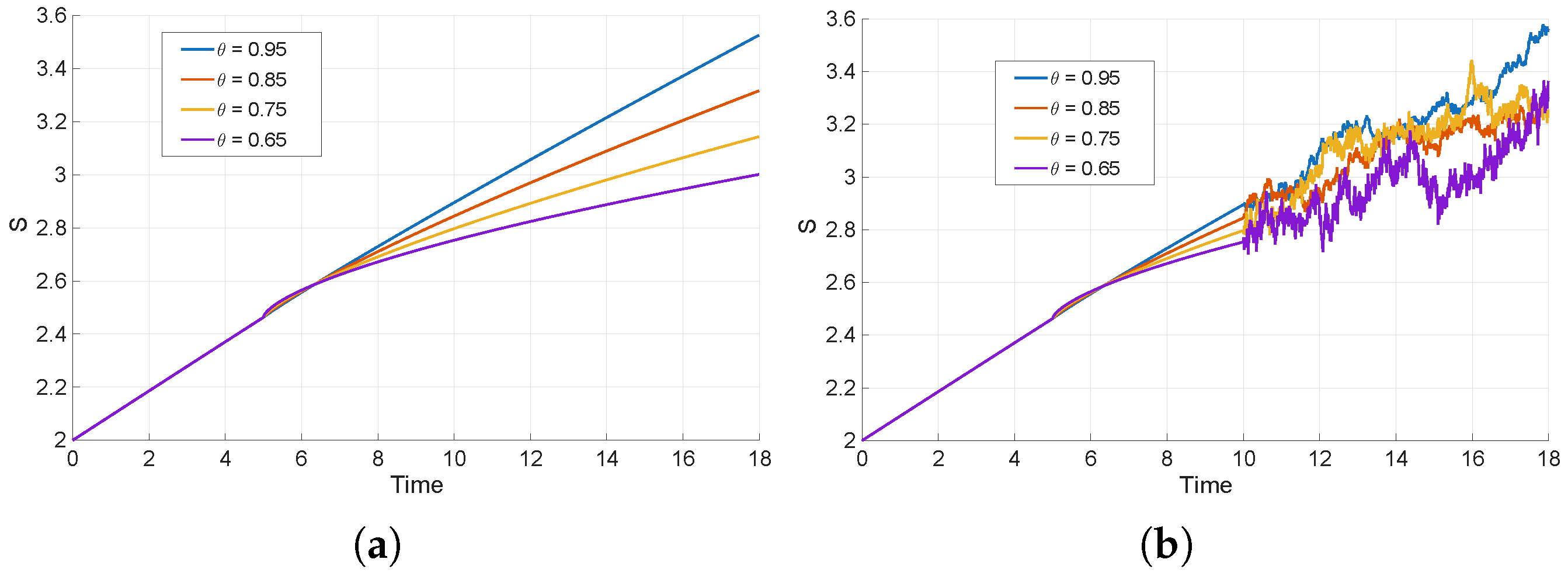
Figure 2 presents the temporal evolution of the susceptible population S under the classical-Caputo-stochastic framework using different fractional orders, specifically θ = 0.95 ,   0.85 ,   0.75 , and 0.65 . The figure shows how the number of people who have never taken part in corruption changes over time. In Figure 2a, where the stochastic component is absent, all trajectories demonstrate a monotonic increase, highlighting the memory-dependent behavior inherent in the fractional-order model. This subplot indicates how S grows when everything happens predictably, with no random surprises. Notably, higher fractional orders such as θ = 0.95 result in a steeper increase, indicating more prominent long-memory effects. In contrast, lower fractional orders reduce the growth rate of the susceptible population. Figure 2b, which incorporates stochasticity, maintains the same ordering of trajectories but introduces fluctuations. The higher the value of θ , the larger the amplitude of the fluctuations observed. This indicates that noise has a more pronounced impact when the memory effects are stronger.
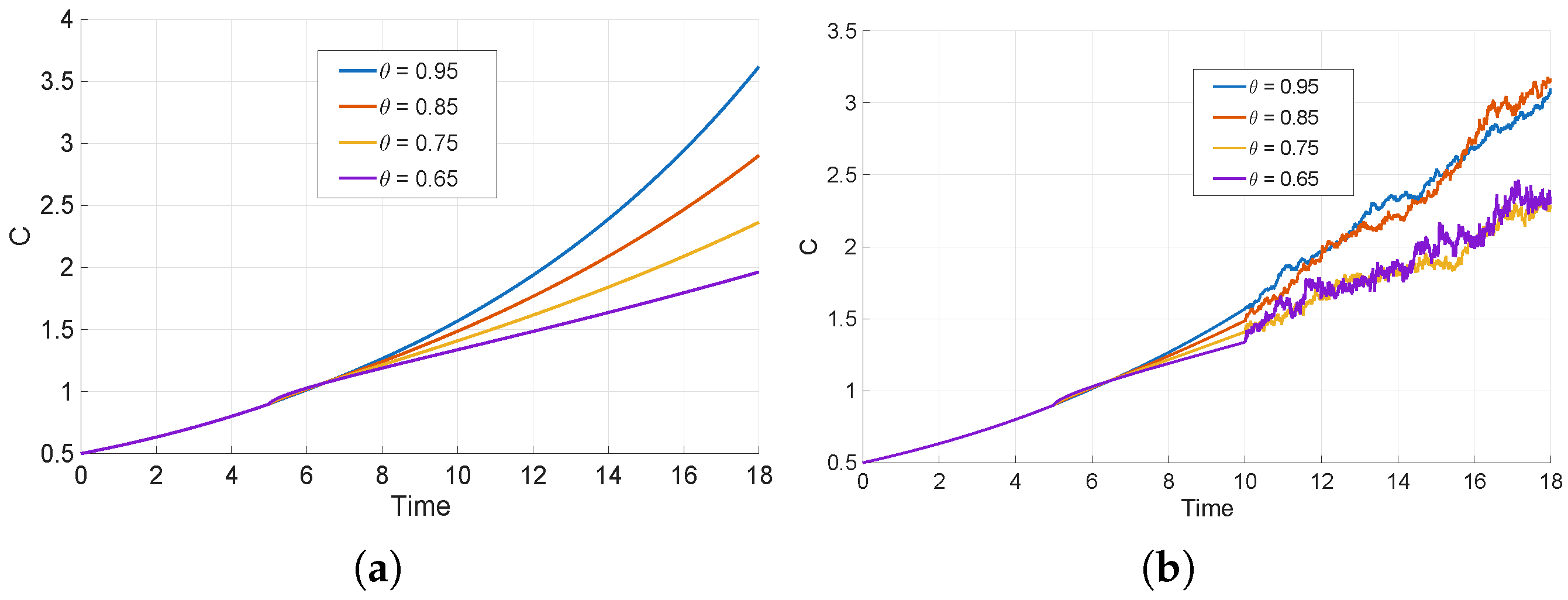
Figure 3 is devoted to the behavior of the corrupt population across the θ = 0.95 ,   0.85 ,   0.75 , and 0.65 . Figure 3a reveals dynamics of C with no noise, shows that the corrupt population increases exponentially, and the growth is sharper when θ increases. This aligns with the interpretation that higher memory effects amplify corruption propagation due to accumulated impact from past states. In Figure 3b, stochastic effects are introduced, and the trajectories exhibit noise-induced variability, yet they maintain the same general trend. It is evident that noise slightly dampens the exponential rise, particularly for higher θ values, indicating that randomness imposes a corrective effect on runaway corruption under long memory dynamics.
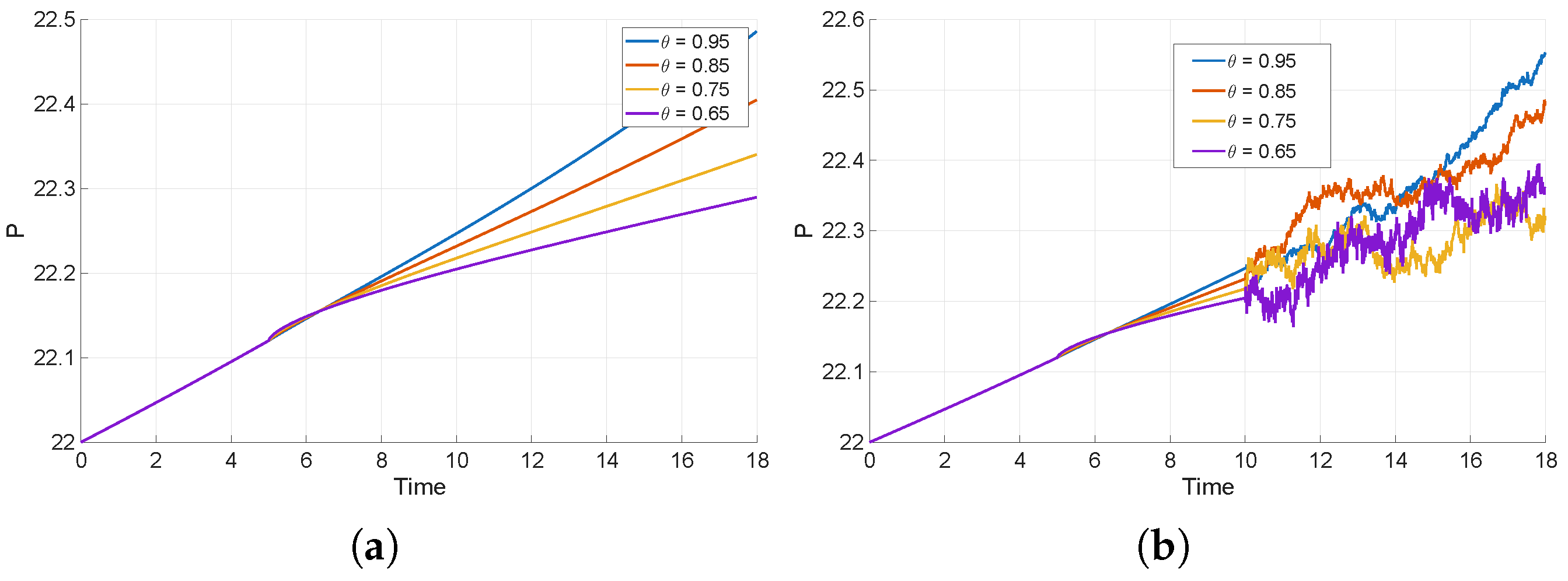
Figure 4 depicts how the poor population P evolves in both without noise and with noise cases. In the deterministic case depicted in Figure 4a, the poor population increases almost linearly with respect to time, and the slope of the increase is more pronounced for higher θ . This reflects the interconnectedness of poverty with corruption and susceptibility, both of which exhibit memory-dependent dynamics. When stochastic effects are introduced in Figure 4b, the population trajectories remain increasing but now exhibit oscillatory behavior. These fluctuations are relatively minor compared to those in the corrupt population, highlighting that the poor population is less sensitive to noise. However, the order of the trajectories based on the values of θ remains unchanged.
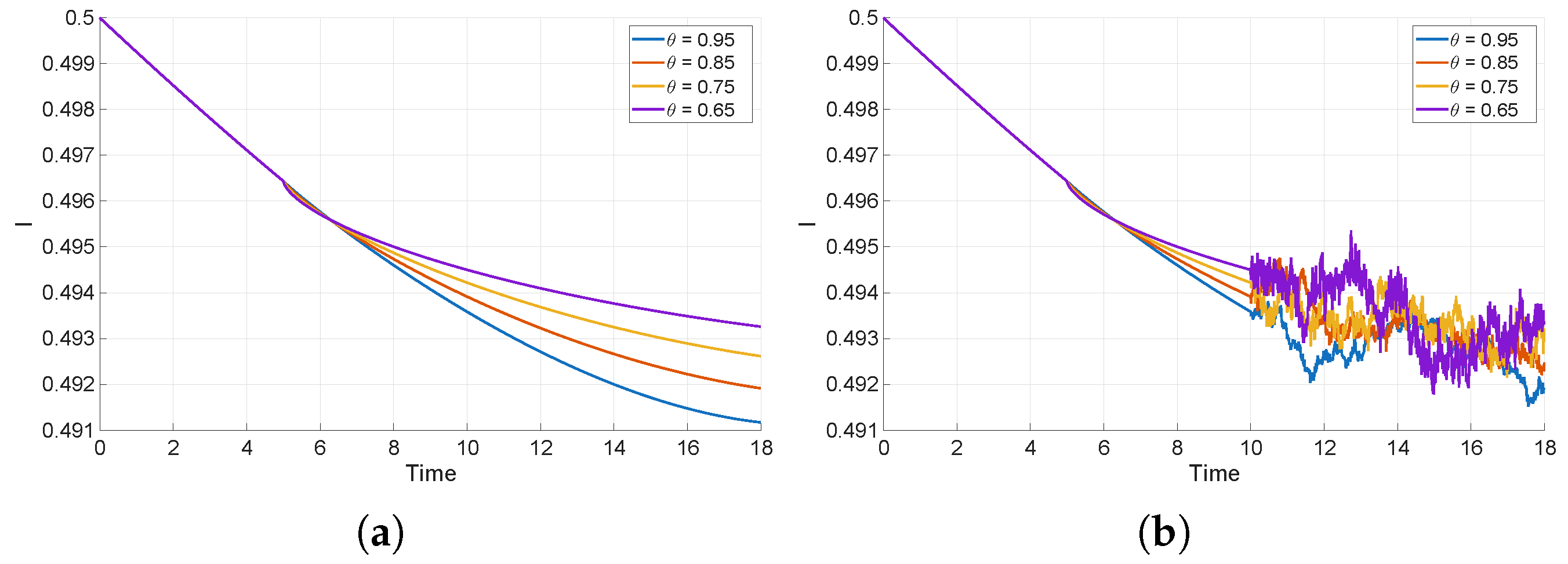
Figure 5 examines the evolution of the imprisoned or jailed population over time without noise and with noise scenarios. Figure 5a where no noise is involved, reveals a mild decay of the jailed population over time, with higher θ values corresponding to slower rates of decline. This result highlights that memory effects can extend the effect of incarceration over time within the system. If noise is considered as shown in Figure 5b, the declining trend remains but is overlaid with small-scale fluctuations. The jailed population I appears to stabilize around a lower bound, and the gap between distinct θ values becomes less discernible.
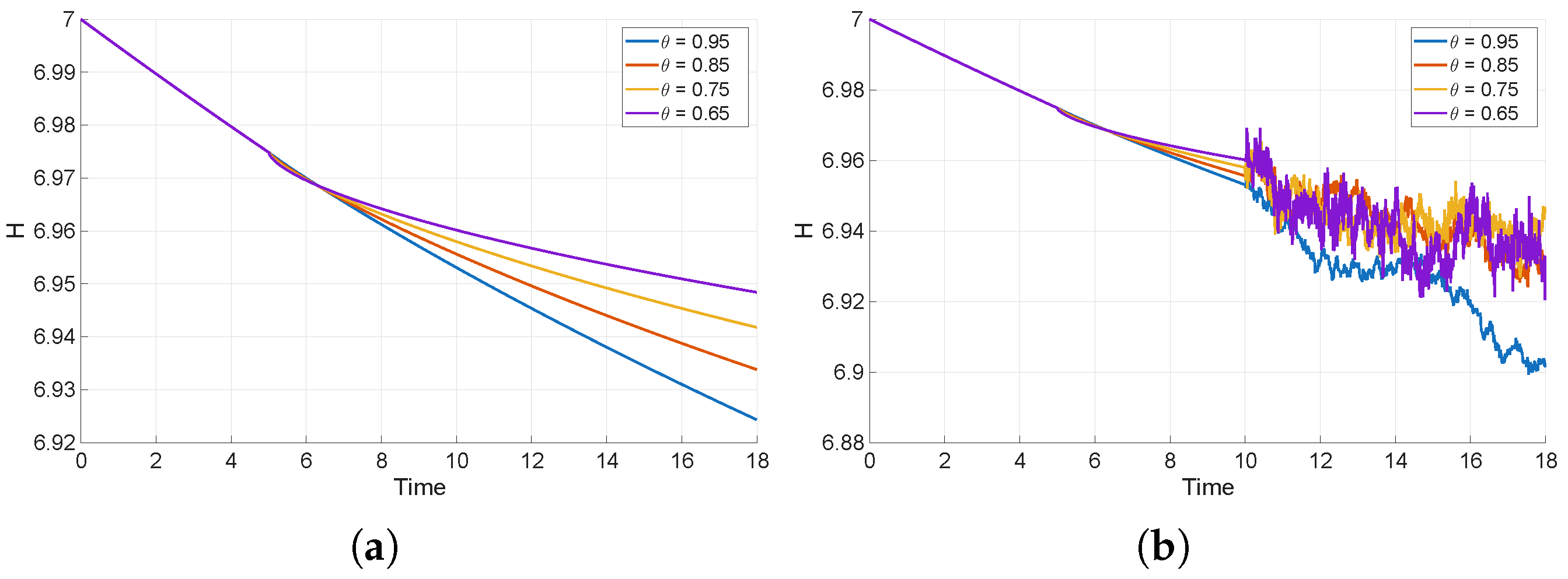
The deterministic and stochastic crossover dynamics of honest population H are displayed in Figure 6. In the left panel Figure 6a, when no noise is involved, results in a gradual but steady decrease in the honest population H , with faster decay occurring at higher values of θ . This states that when memory effects are stronger, the erosion of honesty within the society is more rapid, possibly due to the prolonged impact of exposure to corrupt or poor individuals. Now considering noise as shown in the Figure 6b, studies a distinct divergence from the smooth trends in the deterministic case. The honest population H fluctuates significantly, especially for higher values of θ , showing that random shocks strongly influence the stability of societal honesty when long-term memory is present.
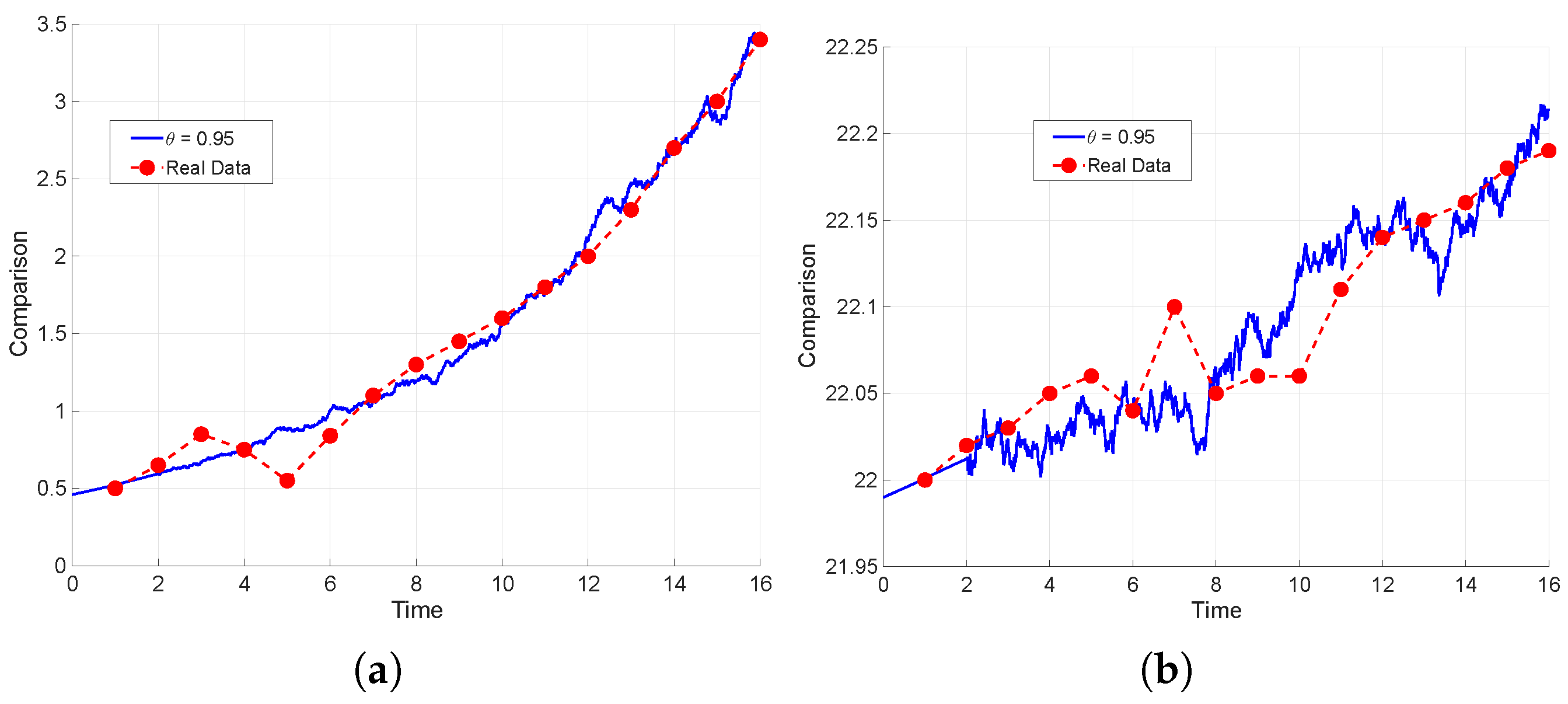
The comparison of real data observation with model crossover dynamics is displayed in Figure 7 for θ = 0.95 . Figure 7a focuses on the corrupt population over the interval [ 1 , 2 ] , while Figure 7b examines the poor population over the extended interval [ 2 , 16 ] . The obtained outcomes of the model, shown as a continuous blue line, are compared with discrete red data points that represent actual observed values. In the left panel, Figure 7a, the model’s outcomes closely mirror the general trend of the real data. Although some discrepancies exist at intermediate time steps, the model effectively captures the nonlinearity and acceleration in corruption growth, particularly in the latter half of the interval. The influence of memory effects at θ = 0.95 appears to enhance the model’s capacity to follow the cumulative nature of corruption phenomena, where past states significantly influence current behavior. The inclusion of the stochastic component introduces minor fluctuations around the real data curve, indicating that the model remains responsive to disturbances while still following its main deterministic path. In the right panel, Figure 7b presents the model’s performance in simulating the poor population. Here, the simulated line shows reasonable agreement with the real data, especially in tracking the incremental rise in poverty levels. However, some deviations are visible, particularly in the mid-interval region (around t = 6 to t = 10 ), where the model exhibits higher variance due to the stochastic component. Despite these deviations, the overall agreement remains strong, particularly toward the end of the interval. Despite these variations, the overall fit remains robust, especially near the end of the time interval.
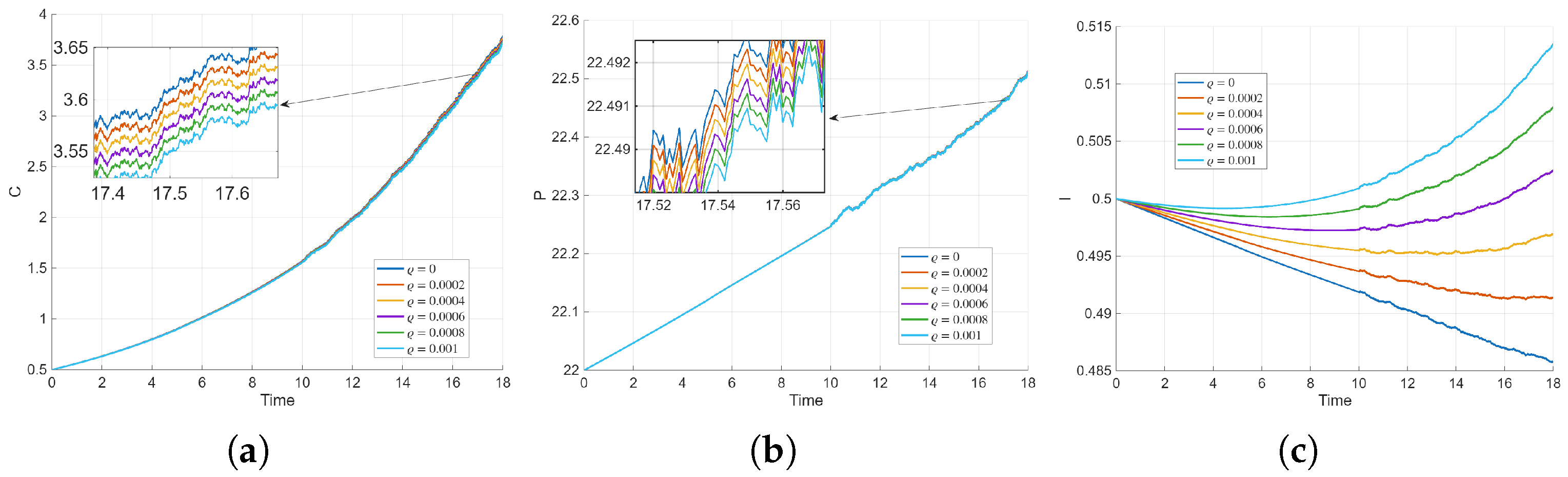
Figure 8 examines the sensitivity of the model with respect to the parameter ϱ , which governs the rate at which corrupt individuals are prosecuted and sent to jail. Figure 8a shows the evolution of the corrupt population C . As ϱ increases from 0 to 0.001, a visible decline in corruption is observed, particularly at later stages of the simulation ( t > 10 ), showing the efficacy of legal enforcement mechanisms. The inset magnification at t [ 17.4 , 17.6 ] illustrates finer distinctions among the trajectories, further revealing that even slight increases in ϱ result in significant suppression of corruption. Figure 8b focuses on the poor population (P), which also decreases slightly with higher ϱ , suggesting a secondary benefit of prosecuting corruption in reducing poverty levels. Again, an inset zoom demonstrates small variations in results. Figure 8c tracks the imprisoned/jailed population ( I ). We noticed that increasing ϱ leads to a notable rise in incarceration rates. This pattern confirms the expected result of intensified judicial measures and shows the balance between reducing corruption and the associated penal costs to society.
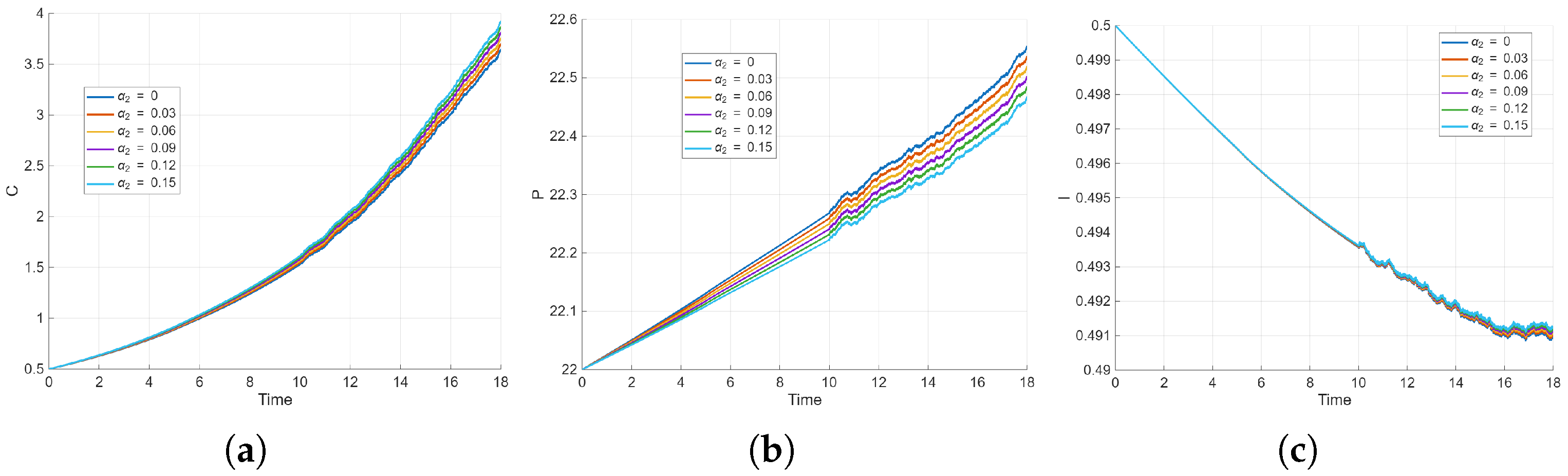
The effect of the parameter α 2 , which denotes the rate at which poor people become corrupt, on the dynamics of corrupt, poor and imprisoned individuals is demonstrated in Figure 9. Figure 9a indicates the crossover dynamics of the corrupt population C for various values of α 2 . As α 2 increases from 0 to 0.15, the growth of corruption accelerates substantially, highlighting the susceptibility of economically vulnerable groups to engage in corrupt practices under socio-economic pressure. Figure 9b demonstrated crossover behavior of the poor population P for various values of α 2 . Here, we observe a flattening of the curves with higher α 2 values, showing that more poor individuals are transitioning into the corrupt class, thus reducing the count of those categorized as strictly poor. In Figure 9c, the imprisoned/jailed population I slightly reduces as α 2 increases, possibly due to a larger portion of individuals escaping penal consequences by being reclassified as corrupt rather than poor.
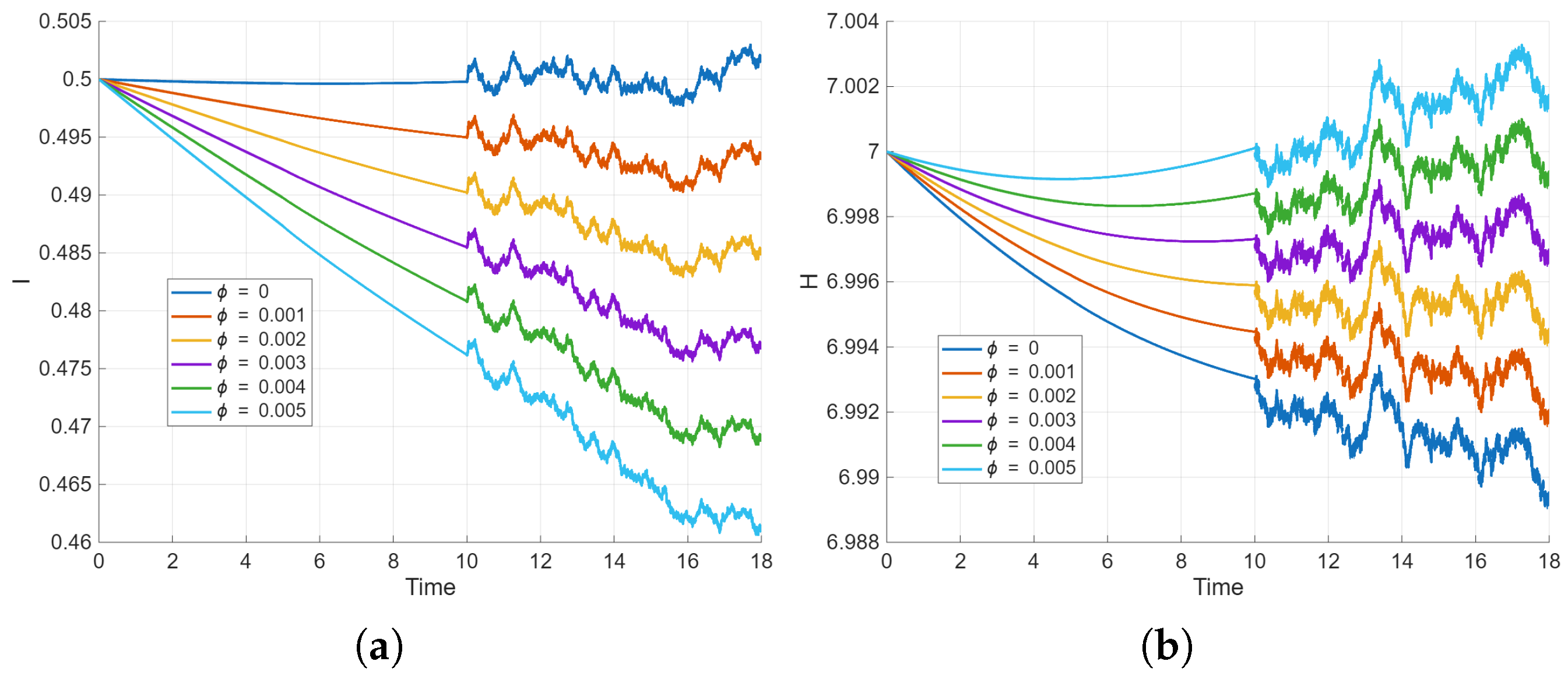
The effect of the parameter ϕ , denoting the transition rate from imprisonment to other states (honest or corrupt), is graphically displayed in Figure 10 for various values of ϕ . Figure 10a gives the effect of ϕ on the crossover dynamics of imprisoned class ( I ). As ϕ increases from 0 to 0.005, a sharper reduction in the I is observed, showing the enhanced rate of release or reintegration. The stochastic effects post t = 10 portray increased variance, with the trajectories diverging more significantly at higher ϕ values. In Figure 10b, which tracks the honest population ( H ), increasing ϕ corresponds with an elevated baseline, verifying that a greater portion of released individuals transition into the honest compartment H . This mechanism reflects a process of societal rehabilitation, where incarceration functions not only as punishment but also as an opportunity for correction and reform. However, the stochastic variations are more pronounced here, highlighting that reintegration outcomes are more sensitive to random influences compared to imprisonment dynamics.
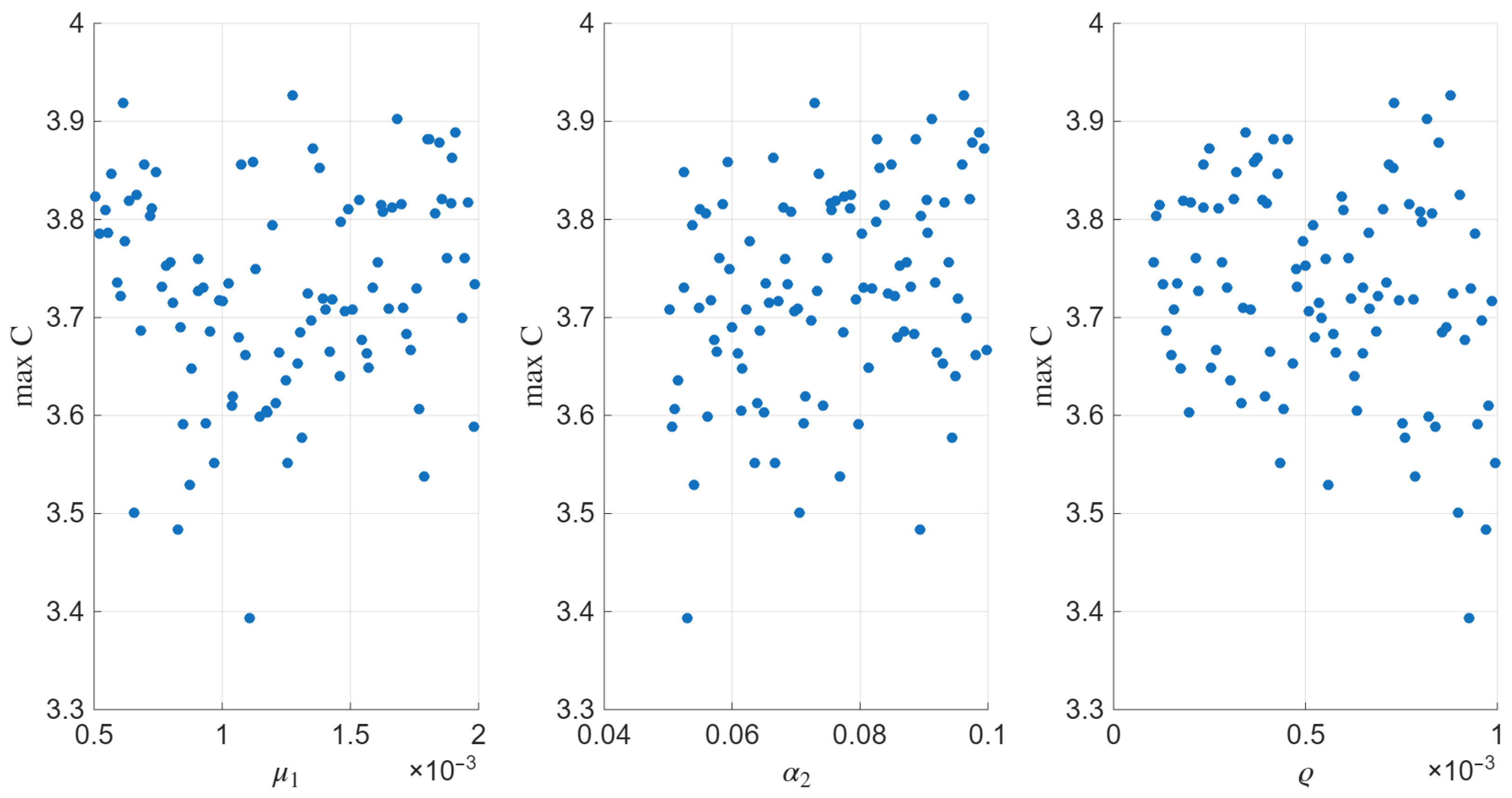
Figure 11 explores the impact of three key parameters, such as μ 1 , which denotes natural exit from corruption, α 2 which denotes poverty-induced corruption, and ϱ , which represents rate of prosecution, on the maximum value of the corrupt population C over the time interval [ 0 , 18 ] . Each subgraph shows a scatter plot generated from 100 Latin Hypercube samples. The first subplot (left) elucidates a weak negative correlation between μ 1 and the peak corruption level, which means that improving natural transition out of corruption slightly curbs its spread. The second subplot, which varies α 2 , demonstrates a clearer positive trend: higher values of α 2 contribute directly to increased corruption owing to the enhanced risk of poverty-induced transitions. In the last subfigure (right) of Figure 11, ϱ appears to exert a mild inverse effect on C , though the correlation is not strongly linear. This verifies the intuition that anti-corruption enforcement plays a stabilizing role, but may be partially mitigated by other system dynamics.
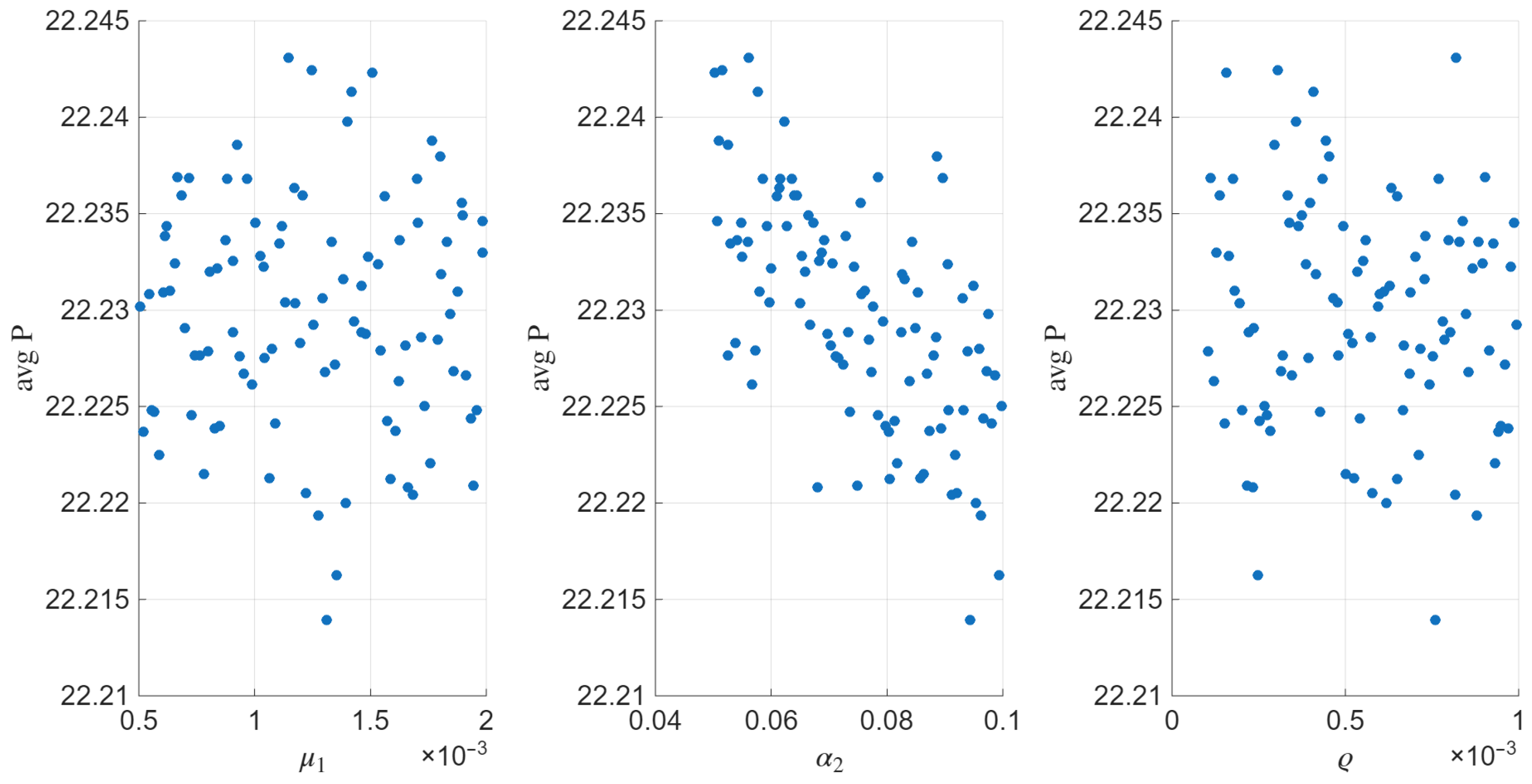
Figure 12 studies average poverty levels ( P ) and their sensitivity to the same parameters as Figure 11. The left subgraph elucidates that variations in μ 1 have a negligible impact on average poverty. In contrast, the middle subplot demonstrates a noticeable negative trend between α 2 and P , revealing that an increased rate of P entering corruption slightly declines the average poor population. The rightmost subplot concerning ϱ indicates no clear directional trend, showing that legal prosecution predominantly affects corruption and imprisonment dynamics more than it impacts poverty directly.
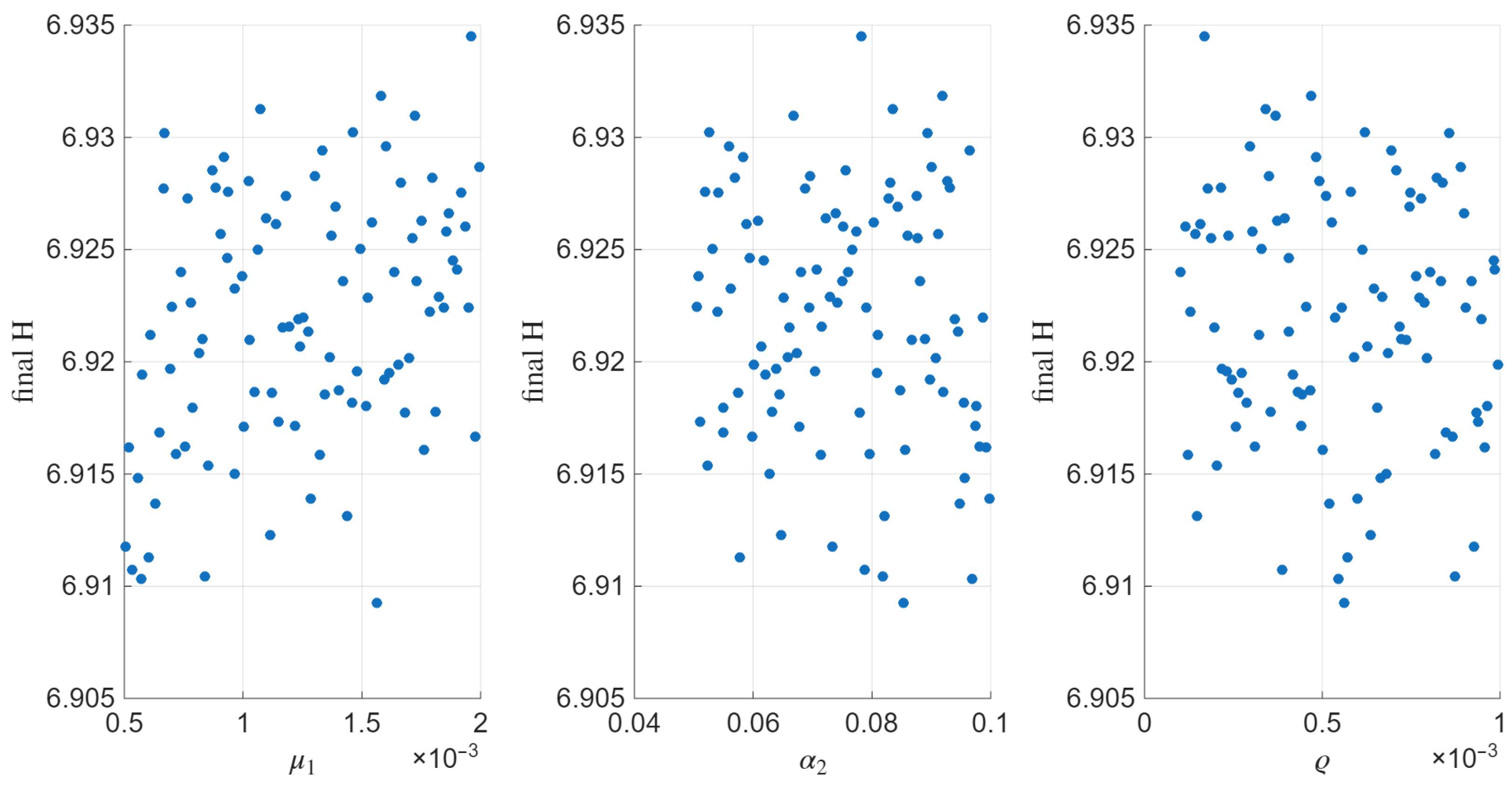
The final size of the honest population, H , under variation of μ 1 , α 2 , and ϱ is displayed in Figure 13. Each subplot shows scatter plots from 100 simulations. The outcomes depict minimal direct dependency on μ 1 and ϱ , as the points remain fairly dispersed without a discernible pattern. Nonetheless, the subplot for α 2 predicts a subtle inverse relationship: higher values of α 2 tend to decline the final H , consistent with the idea that socioeconomic stress (poverty) encourages transitions away from honesty. While all three parameters have a great impact on the evolution of the system, α 2 appears to be the most influential in modulating the erosion of honesty in the population.
Table 2 demonstrates Pearson correlation coefficients quantifying the relationship between three key model parameters, such as μ 1 , α 2 , and ϱ and three output objectives: the maximum level of corruption ( max C ), the average level of poverty ( avg P ), and the final size of the honest population ( final H ). These values offer a concise summary of the sensitivity analysis and validate trends observed in Figure 11, Figure 12 and Figure 13. For max C , α 2 exhibits a moderate positive correlation (+0.318), confirming that increases in the rate of poverty-induced corruption significantly elevate the peak corruption level. In contrast, μ 1 has a slight negative correlation (−0.142), consistent with its mild mitigating effect. The parameter ϱ demonstrates a negligible influence (+0.038), predicting that while legal action affects other dynamics, it does little to constrain the peak of corruption. Regarding avg P , α 2 again emerges as a dominant factor, but with a strong negative correlation (−0.645), showing that as more poor individuals become corrupt, the recorded average poverty level reduces owing to population reclassification. μ 1 has a minimal positive effect (+0.088), and ϱ exhibits a small negative correlation (−0.109), supporting the earlier inference that anti-corruption efforts have modest indirect impacts on poverty. For final H , μ 1 illustrates a moderate positive correlation (+0.326), which means that higher natural disengagement from corruption helps replenish the H . Meanwhile, α 2 (−0.094) and ϱ (−0.086) display weak negative correlations, highlighting their respective roles in shifting individuals away from honesty either through socioeconomic stress or systemic churn caused by enforcement dynamics.

6. Conclusions

This paper has investigated a thorough analysis of a corruption dynamics model using classical-Caputo stochastic fractional calculus, uncovering crossover dynamics of the corruption model. Incorporating memory effects via a fractional derivative has elucidated the inertia present in sociopolitical systems, where historical behaviors, economic pressures, and institutional weaknesses have continued to shape current dynamics over time. Theoretical investigations such as existence and uniqueness of solutions of the fractional order case under constant proportional Caputo operator, has been investigated with the aid of fixed point theory and Perov’s result, and for a stochastic corruption system using Ito calculus. Numerical simulations have been studied via numerical methods for each case. Also, the validity of the achieved outcomes has been confirmed by comparison of real data with the model’s behavior via graphical analysis. Through numerical simulations, statistical and sensitivity analysis, we have studied that even small changes in parameters related to social mobility and economic pressure can lead to noticeable shifts in the overall system.
A particularly notable outcome is the observed interplay between repression measures like imprisonment, denoted by ϱ , and socio-economic changes such as the influence of poverty on corruption represented by α 2 . While legal enforcement exerts only modest impact on suppressing peak corruption levels, structural factors, specifically the pathway from poverty to corruption, emerge as primary drivers of systemic behavior. This shows a fundamental physical reality, i.e, corruption behaves not merely as a discrete social choice but as an emergent property of stress propagation and cumulative social forces within a memory-embedded medium.
On top of that, the system’s pronounced responsiveness to α 2 , which consistently aligns with shifts in corruption, poverty, and honesty, determines the importance of interpreting corruption as a thermodynamically dissipative process. In such systems, economic pressure introduces entropy that can only be countered via targeted energy (policy) input aimed at breaking the cycle of poverty and restoring structural order. In contrast, the honest population H is sustained via increased natural disengagement from corruption ( μ 1 ), showing a relaxation mechanism that reflects societal resilience. Table 2 reinforces the model’s finding that α 2 has a crucial role in modulating both corruption and poverty metrics, while μ 1 substantially supports honesty retention. The prosecution rate ϱ , although structurally relevant, appears to exert less direct influence on the key aggregate outcomes.
Future direction includes the extension of the model to incorporate spatial heterogeneity and diffusion effects. Also, empirical calibration using country-specific data would enhance the model’s applicability for policy design. By fitting the model to time-series data from diverse socio-political environments, one could uncover universal behaviors versus context-specific dynamics, thus paving the way for informed, data-driven anti-corruption strategies. From a mathematical perspective, future work can be the rigorous stability analysis of the stochastic fractional system under various noise structures. Exploring Lévy noise or non-Gaussian perturbations may uncover new regimes of system behavior, particularly under crisis scenarios or sudden shocks. Similarly, optimization techniques could be employed to identify parameter regimes that minimize corruption while maintaining economic stability.

Funding

The authors extend their appreciation to the Deanship of Scientific Research and Libraries in Princess Nourah bint Abdulrahman University for funding this research work through the Supporting Publication in Top-Impact Journals Initiative (SPTIF-2026).

Data Availability Statement

The original contributions presented in this study are included in the article. Further inquiries can be directed to the corresponding author.

Acknowledgments

The authors extend their appreciation to the Deanship of Scientific Research and Libraries in Princess Nourah bint Abdulrahman University for funding this research work through the Supporting Publication in Top-Impact Journals Initiative (SPTIF-2026).

Conflicts of Interest

The author declares no conflicts of interest.

References

  1. Brauer, F.; Castillo-Chavez, C.; Feng, Z. Mathematical Models in Epidemiology; Springer: New York, NY, USA, 2019; Volume 32. [Google Scholar]
  2. Senapati, A.; Rana, S.; Das, T.; Chattopadhyay, J. Impact of intervention on the spread of COVID-19 in India: A model based study. J. Theor. Biol. 2021, 523, 110711. [Google Scholar] [CrossRef]
  3. Lin, J.; Xu, C.; Xu, Y.; Zhao, Y.; Pang, Y.; Liu, Z.; Shen, J. Bifurcation and controller design in a 3D delayed predator–prey model. AIMS Math. 2024, 9, 33891–33929. [Google Scholar] [CrossRef]
  4. Baber, M.Z.; Yasin, M.W.; Xu, C.; Ahmed, N.; Iqbal, M.S. Numerical and analytical study for the stochastic spatial dependent prey–predator dynamical system. J. Comput. Nonlinear Dyn. 2024, 19, 101003. [Google Scholar] [CrossRef]
  5. Ahmad, S.; Ullah, A.; Partohaghighi, M.; Saifullah, S.; Akgül, A.; Jarad, F. Oscillatory and complex behaviour of Caputo-Fabrizio fractional order HIV-1 infection model. AIMS Math. 2021, 7, 4778–4792. [Google Scholar] [CrossRef]
  6. Xu, C.; Alhejaili, W.; Saifullah, S.; Khan, A.; Khan, J.; El-Shorbagy, M.A. Analysis of Huanglongbing disease model with a novel fractional piecewise approach. Chaos Solitons Fractals 2022, 161, 112316. [Google Scholar] [CrossRef]
  7. Saifullah, S.; Ahmad, S.; Jarad, F. Study on the dynamics of a piecewise tumor-immune interaction model. Fractals 2022, 30, 2240233. [Google Scholar] [CrossRef]
  8. Qu, H.; Saifullah, S.; Khan, J.; Khan, A.; Rahman, M.U.; Zheng, G. Dynamics of leptospirosis disease in context of piecewise classical-global and classical-fractional operators. Fractals 2022, 30, 2240216. [Google Scholar] [CrossRef]
  9. Caulkins, J.P.; Feichtinger, G.; Grass, D.; Hartl, R.F.; Kort, P.M.; Novak, A.J.; Seidl, A.; Wirl, F. A dynamic analysis of Schelling’s binary corruption model: A competitive equilibrium approach. J. Optim. Theory Appl. 2014, 161, 608–625. [Google Scholar] [CrossRef]
  10. Rose-Ackerman, S. The economics of corruption. J. Public Econ. 1975, 4, 187–203. [Google Scholar] [CrossRef]
  11. Wei, C.-Y.; Dann, C.; Zimmert, J. A model selection approach for corruption robust reinforcement learning. In Proceedings of the International Conference on Algorithmic Learning Theory, Paris, France, 29 March–1 April 2022; pp. 1043–1096. [Google Scholar]
  12. Tabassum, S.; Ur Rahman, M. Exploring corruption dynamics through Caputo fractional models with deep neural network interventions. J. Appl. Math. Comput. 2025, 71, 2703–2726. [Google Scholar] [CrossRef]
  13. Gutema, T.W.; Wedajo, A.G.; Koya, P.R. A mathematical analysis of the corruption dynamics model with optimal control strategy. Front. Appl. Math. Stat. 2024, 10, 1387147. [Google Scholar] [CrossRef]
  14. Zhu, X.; Xia, P.; He, Q.; Ni, Z.; Ni, L. Coke price prediction approach based on dense GRU and opposition-based learning salp swarm algorithm. Int. J. Bio-Inspired Comput. 2023, 21, 106–121. [Google Scholar] [CrossRef]
  15. Zhang, X.; Yang, X.; He, Q. Multi-scale systemic risk and spillover networks of commodity markets in the bullish and bearish regimes. North Am. J. Econ. Financ. 2022, 62, 101766. [Google Scholar] [CrossRef]
  16. Eguda, F.Y.; James, A.; Oguntolu, F.A.; Onah, D. Mathematical analysis of a model to investigate the dynamics of poverty and corruption. Abacus Math. Sci. Ser. 2019, 44, 352–367. [Google Scholar]
  17. Ur Rahman, M. Generalized fractal–fractional order problems under non-singular Mittag-Leffler kernel. Results Phys. 2022, 35, 105346. [Google Scholar] [CrossRef]
  18. Waseem, S.A.; Ur Rahman, M. Analysis of Ebola virus model using intelligent computing of a new stochastic neural network. Int. J. Biomath. 2025, 2450162. [Google Scholar] [CrossRef]
  19. Zhang, L.; Rahman, M.U.; Ahmad, S.; Riaz, M.B.; Jarad, F. Dynamics of fractional order delay model of coronavirus disease. AIMS Math. 2022, 7, 4211–4232. [Google Scholar] [CrossRef]
  20. Odibat, Z. On two-parameter Mittag-Leffler type fractional derivative models with non-singular and singular kernels. J. Appl. Math. Comput. 2025, 71, 217–234. [Google Scholar] [CrossRef]
  21. Hattaf, K. A new mixed fractional derivative with applications in computational biology. Computation 2024, 12, 7. [Google Scholar] [CrossRef]
  22. Zhao, K.; Zhao, X.; Lv, X. A general framework for the multiplicity of positive solutions to higher-order Caputo and Hadamard fractional functional differential coupled Laplacian systems. Fractal Fract. 2025, 9, 701. [Google Scholar] [CrossRef]
  23. Kanagaraj, S.; Muni, S.S.; Karthikeyan, A.; Rajagopal, K. A chaotic Hartley oscillator with fractional-order JFET and its network behaviors. Eur. Phys. J. Spec. Top. 2023, 232, 2539–2548. [Google Scholar] [CrossRef]
  24. Abdulwasaa, M.A.; Kawale, S.V.; Abdo, M.S.; Albalwi, M.D.; Shah, K.; Abdalla, B.; Abdeljawad, T. Statistical and computational analysis for corruption and poverty model using Caputo-type fractional differential equations. Heliyon 2024, 10, e25440. [Google Scholar] [CrossRef]
  25. Din, A.; Li, Y. Stationary distribution extinction and optimal control for the stochastic hepatitis B epidemic model with partial immunity. Phys. Scr. 2021, 96, 074005. [Google Scholar] [CrossRef]
  26. Zhao, K. A generalized stochastic Nicholson blowfly model with mixed time-varying lags and harvest control: Almost periodic oscillation and global stable behavior. Adv. Contin. Discret. Model. 2025, 2025, 171. [Google Scholar] [CrossRef]
  27. Ahmad, S.; Saifullah, S.; Ventre, V. Stochastic dynamical analysis, Monte-Carlo simulations, and waves dynamics of a coupled volatility and option pricing model under Brownian motion. Chin. J. Phys. 2025, 94, 9–29. [Google Scholar] [CrossRef]
  28. Tesfaye, A.W.; Alemneh, H.T. Analysis of a stochastic model of corruption transmission dynamics with temporary immunity. Heliyon 2023, 9, e12752. [Google Scholar] [CrossRef] [PubMed]
  29. Sahebi Fard, H.; Dastranj, E.; Jajarmi, A. A Novel Fractional Stochastic Model Equipped With ψ-Caputo Fractional Derivative in a Financial Market. Math. Methods Appl. Sci. 2025, 48, 9653–9661. [Google Scholar] [CrossRef]
  30. Atangana, A.; Araz, S.I. Piecewise Differential Equations: Theory, Methods and Applications; HAL: Villeurbanne, France, 2022. [Google Scholar]
  31. Ahmad, S.; Yassen, M.F.; Alam, M.M.; Alkhati, S.; Jarad, F.; Riaz, M.B. A numerical study of dengue internal transmission model with fractional piecewise derivative. Results Phys. 2022, 39, 105798. [Google Scholar] [CrossRef]
  32. Abdelmohsen, S.A.M.; Yassen, M.F.; Ahmad, S.; Abdelbacki, A.M.M.; Khan, J. Theoretical and numerical study of the rumours spreading model in the framework of piecewise derivative. Eur. Phys. J. Plus 2022, 137, 738. [Google Scholar] [CrossRef]
  33. Podlubny, I. Fractional Differential Equations: An Introduction to Fractional Derivatives, Fractional Differential Equations, to Methods of Their Solution and Some of Their Applications; Elsevier: Amsterdam, The Netherlands, 1998. [Google Scholar]
  34. Baleanu, D.; Fernandez, A.; Akgül, A. On a fractional operator combining proportional and classical differintegrals. Mathematics 2020, 8, 360. [Google Scholar] [CrossRef]
  35. Raza, A.; Baleanu, D.; Cheema, T.N.; Fadhal, E.; Ibrahim, R.I.H.; Abdelli, N. Artificial intelligence computing analysis of fractional order COVID-19 epidemic model. AIP Adv. 2023, 13, 085017. [Google Scholar] [CrossRef]
  36. Tuan, N.H.; Tri, V.V. Existence and uniqueness of the solution to Caputo-Hadamard differential equations with delay and nonlocal conditions. Commun. Anal. Mech. 2025, 17, 725–748. [Google Scholar] [CrossRef]
  37. Gambera, L.; Marano, S.A. Fractional Dirichlet problems with singular and non-locally convective reaction. Adv. Nonlinear Anal. 2025, 14, 20250082. [Google Scholar] [CrossRef]
  38. Diblik, J.; Galewski, M.; Šmarda, Z. Existence results for non-coercive problems. Adv. Nonlinear Anal. 2025, 14, 20250071. [Google Scholar] [CrossRef]
  39. Alalhareth, F.K.; Al-Mekhlafi, S.M.; Boudaoui, A.; Laksaci, N.; Alharbi, M.H. Numerical treatment for a novel crossover mathematical model of the COVID-19 epidemic. AIMS Math. 2024, 9, 5376–5393. [Google Scholar] [CrossRef]
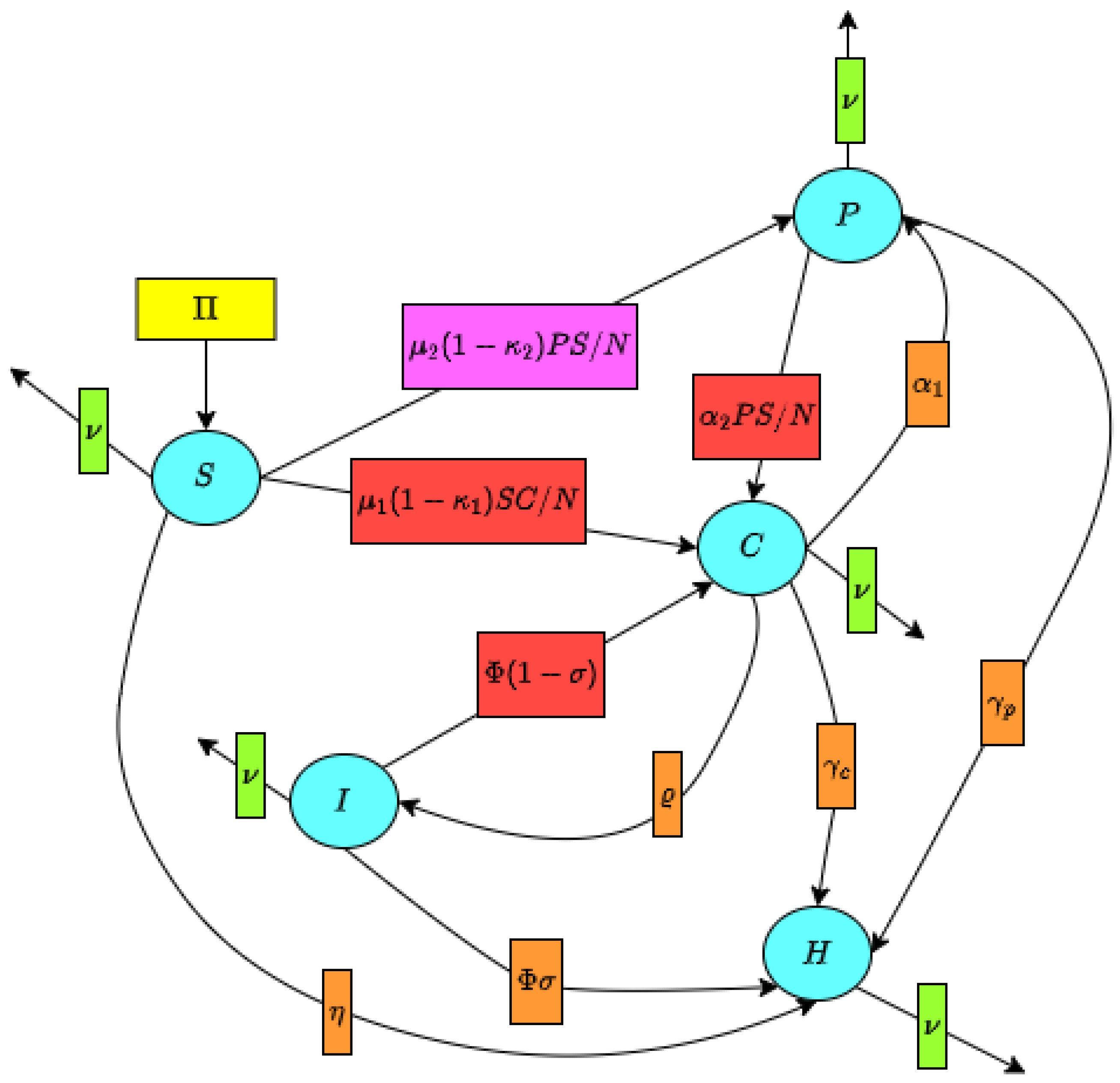
Figure 1. The flowchart of the system’s state variables.
Mathematics 14 00819 g001
Figure 2. The dynamics of susceptible population in classical-Caputo-stochastic sense with and without noise under different fractional orders in interval (5,10) and (10,18).
Mathematics 14 00819 g002
Figure 3. The dynamics of corrupt population in classical-Caputo-stochastic sense with and without noise under different fractional orders in interval (5,10) and (10,18).
Mathematics 14 00819 g003
Figure 4. The dynamics of poor population in classical-Caputo-stochastic sense with and without noise under different fractional orders in interval (5,10) and (10,18).
Mathematics 14 00819 g004
Figure 5. The dynamics of imprisoned population in classical-Caputo-stochastic sense with and without noise under different fractional orders in interval (5,10) and (10,18).
Mathematics 14 00819 g005
Figure 6. The dynamics of honest population in classical-Caputo-stochastic sense with and without noise under different fractional orders in interval (5,10) and (10,18).
Mathematics 14 00819 g006
Figure 7. The comparison of real data with simulated data of corrupt and poor population in classical-Caputo-stochastic sense with noise under fractional order 0.95 in interval (1,2) and (2,16).
Mathematics 14 00819 g007
Figure 8. The dynamics of influence of the parameter ϱ on corrupt, poor and imprisoned individuals with fractional order 0.95 in the interval (5,10) and (10,18).
Mathematics 14 00819 g008
Figure 9. The dynamics of influence of the parameter α 2 on corrupt, poor and imprisoned individuals with θ = 0.95 in the interval (5,10) and (10,18).
Mathematics 14 00819 g009
Figure 10. The dynamics of influence of the parameter ϕ on imprisoned and honest individuals with θ = 0.95 in the interval (5,10) and (10,18).
Mathematics 14 00819 g010
Figure 11. Scatter plots showing the influence of parameters μ 1 , α 2 , and ϱ on the maximum value of the corrupt population (C) over the time interval [ 0 , 18 ] . The analysis is based on 100 Latin Hypercube sampled parameter sets.
Mathematics 14 00819 g011
Figure 12. Scatter plots depicting the sensitivity of average poverty levels (P) to variations in μ 1 , α 2 , and ϱ . The average is computed over the full simulation horizon using 100 Latin Hypercube samples.
Mathematics 14 00819 g012
Figure 13. Scatter plots illustrating how the final size of the honest population ( H ( T f ) ) depends on the sampled values of μ 1 , α 2 , and ϱ . The results are based on 100 simulations using different parameter sets.
Mathematics 14 00819 g013
Table 1. Nomenclatures and values of parameters of the model (1).
ParametersDescriptionValueReference
Π The per-capita birth rate governing recruitment into the susceptible compartment0.097[16]
ν Rate describing loss of individuals via death0.00099[16]
μ 1 Corruption transmission probability per contact0.0011[16]
μ 2 Poverty transmission probability per contact0.0098[16]
κ 1 Effort rate against corruption0.0001[16]
κ 2 Effort rate against poverty0.0001[16]
μ 1 ( 1 κ 1 ) Effective corruption contact rate0.00109989[16]
μ 2 ( 1 κ 2 ) Effective poverty contact rate0.00979902[16]
α 1 How often corrupt persons transition into poverty0.0058[16]
α 2 Rate at which poor persons become corrupt0.0701[16]
ϱ Portion of those engaged in corruption who are tried and sentenced to jail0.00019[16]
1 Φ Average period prosecuted individuals spend in prison 7.01 × 10 4 [16]
Φ ( 1 σ ) Transition rate from jailed to corrupt0.000700606739[16]
Φ σ Transition rate from jailed to honest0.000000393261[16]
γ C The portion of individuals engaged in corruption that enter H 0.000000701[16]
γ P The portion of those classified as poor who transition to the H compartment0.0000013[16]
η The portion of individuals classified as susceptible entering H 0.000833[16]
Table 2. Pearson correlation between key model parameters and output objectives. Interpretations are based on the magnitude and direction of correlation.
ObjectiveParameterCorrelationInterpretation
max C μ 1 0.142 Slight negative effect on max corruption
α 2 +0.318Moderate positive effect
ϱ +0.038Negligible effect
avg P μ 1 +0.088Very weak positive effect
α 2 −0.645Strong negative effect (more α 2 → less poverty)
ϱ −0.109Small negative effect
final H μ 1 +0.326Moderate positive effect (higher μ 1 → more honest)
α 2 −0.094Weak negative effect
ϱ −0.086Weak negative effect
Disclaimer/Publisher’s Note: The statements, opinions and data contained in all publications are solely those of the individual author(s) and contributor(s) and not of MDPI and/or the editor(s). MDPI and/or the editor(s) disclaim responsibility for any injury to people or property resulting from any ideas, methods, instructions or products referred to in the content.