1. Introduction
The theory of asymptotic boundaries in Hadamard manifolds, introduced by Eberlein and O’Neill [
1], established a robust geometric framework for analyzing the behavior of geodesics at infinity. This compactification has allowed for classical problems in differential geometry to be extended to broader settings, most notably the asymptotic Plateau problem: given a Jordan curve in the asymptotic boundary, find a surface of constant mean curvature that spans it.
In the specific context of the product space
, the existence of minimal surfaces with prescribed asymptotic boundaries has been a central topic of research. Foundational to this field is the work of Jenkins and Serrin [
2], who established necessary and sufficient conditions for the existence of minimal graphs over polygonal domains with infinite boundary values. This analytical program was significantly extended to
by Nelli and Rosenberg [
3], proving existence results for general continuous curves. Subsequently, the theory was expanded to constant mean curvature (CMC) surfaces, with key results on vertical ends [
4], uniqueness properties [
5], and investigations into the general CMC asymptotic Plateau problem [
6].
In recent years, the study of CMC surfaces in product spaces has remained a highly active area of research, as evidenced by recent investigations into entire CMC graphs [
7] and the development of slab and half-space theorems in
[
8]. Furthermore, the characterization of invariant surfaces continues to be refined; notably, Del Prete and Gimeno i Garcia (2024) [
9] characterized the parabolicity of invariant surfaces in ambient spaces admitting Killing vector fields, while recent work by Del Prete (2024) [
10] addresses Dirichlet problems for CMC graphs with prescribed asymptotic values. These developments highlight the ongoing relevance of understanding boundary behavior in product manifolds.
While the aforementioned classical and recent results primarily rely on analytical methods—such as partial differential equations and maximum principles—our approach in this paper is fundamentally
constructive. By utilizing rotationally invariant surfaces (parabolic and hyperbolic), we explicitly generate geometric barriers. This method offers significant adaptability; unlike conjugate surface methods, which are technically involved for
due to the lack of a simple Weierstrass representation, our approach focuses on the
relative asymptotic height (following the framework in [
11]). This provides a clear geometric intuition of how boundary height is controlled by the curvature parameter
H, allowing us to generalize existence results for
without exclusive reliance on complex PDE existence theories.
This work complements the classification of screw motion surfaces by Sa Earp and Toubiana [
12,
13,
14] and the recent characterizations of parabolicity in product spaces. We distinguish between the product boundary and the geodesic boundary [
15], working with the latter as defined by equivalence classes of rays. Finally, we provide an alternative proof for the existence of minimal surfaces with rectangular boundaries and generalize this to
for rectangles of arbitrary height.
2. Geodesic and Product Compactification in
Let
M be a Hadamard manifold. A geodesic ray in
M is a geodesic
with
. Moreover, we say that two geodesic rays
are asymptotic if there exists
such that
The asymptotic relation ∼ is an equivalence relation. In this sense, the
asymptotic boundary of
M is defined as
referred to as the
geodesic boundary throughout the text (initially defined in [
1]). The equivalence classes will be denoted as
. The following Proposition 1 implies that the asymptotic boundary is well-defined, and moreover, fixing
, there exists a bijective correspondence between the unit sphere
in
and
, namely,
, where
, Theorem
of [
1].
Proposition 1 (Theorem 1.2 of [
1]).
Given geodesic ray and , there exists a unique geodesic ray with and . The above is a construction aimed at defining a topological compactification on Hadamard manifolds. For this purpose, it is necessary to define a topology on the asymptotic boundary; in this case, it will be the cone topology (Definition 2.2 of [
1]). A cone with vertex at
, aperture
, and axis
has the form
and additionally, a truncated cone is defined as
where
is the closed ball centered at
p with radius
. Finally, the open balls of
M and the truncated cones are a topological basis for the set
, and
has the subspace topology.
In [
1], it is shown that
and
are homeomorphic; consequently,
is compact. This topological compactification will be referred to as the geodesic compactification, and more details can be found in [
1].
In this text, we focus on the Hadamard manifold , where is the hyperbolic space of dimension two, i.e., the unique complete, simply connected, two-dimensional manifold with constant sectional curvature equal to .
Two well-known models of
are the upper half-plane model
equipped with the metric
The other is the disk model
with the metric
Throughout the text, illustrations and drawings refer to the disk model. In this context, we present the product metric in
:
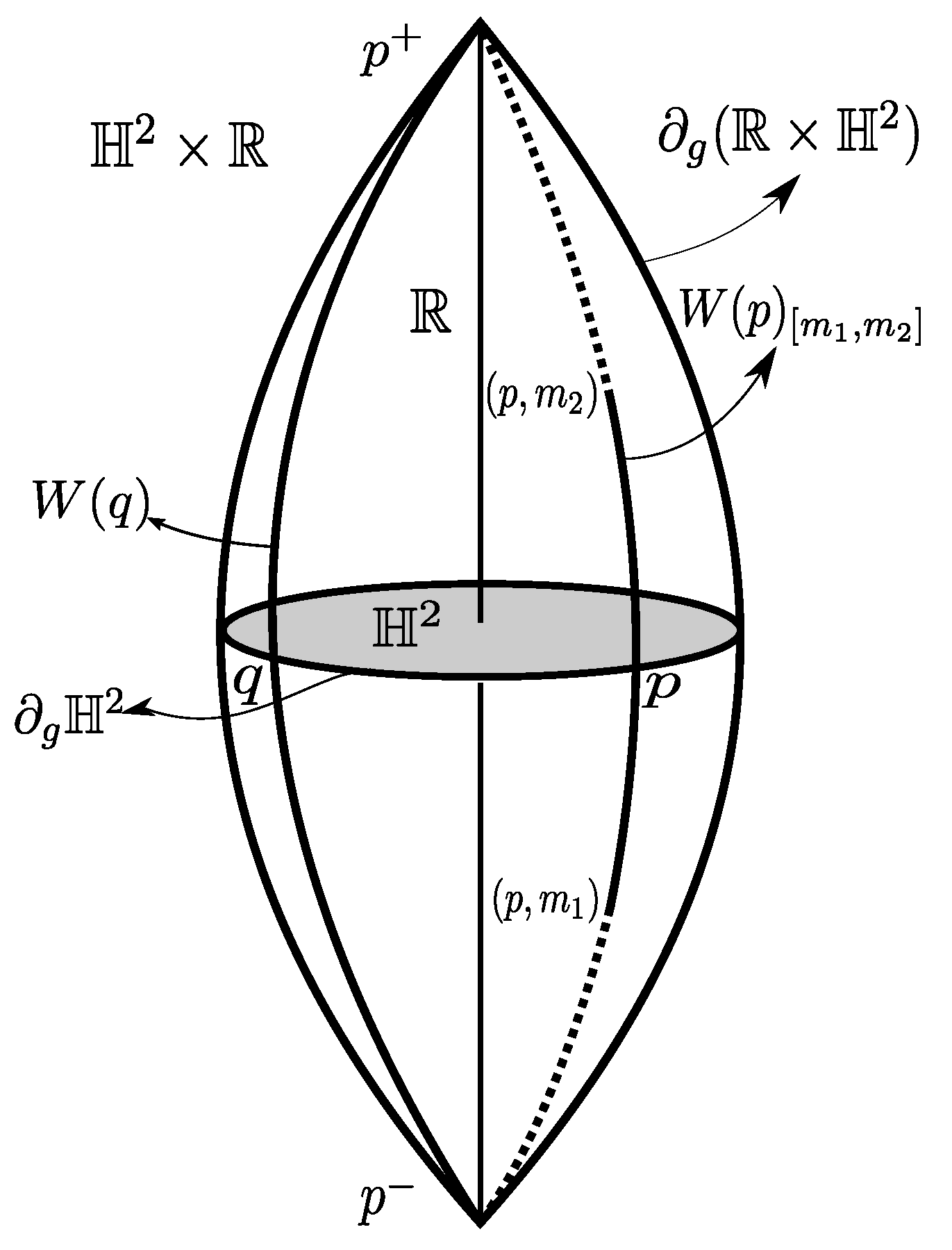
We will describe the geodesic compactification
Each geodesic ray
in
takes the form
, where
are geodesic rays in
and
, respectively. For example, fixing a point in
, we have the geodesic rays
which will be called poles and denoted as
. Another example of a geodesic ray is the product
where
is a geodesic in
and
is a constant. Also, observe that
, which means that such geodesic rays form the boundary of the slice
denoted by
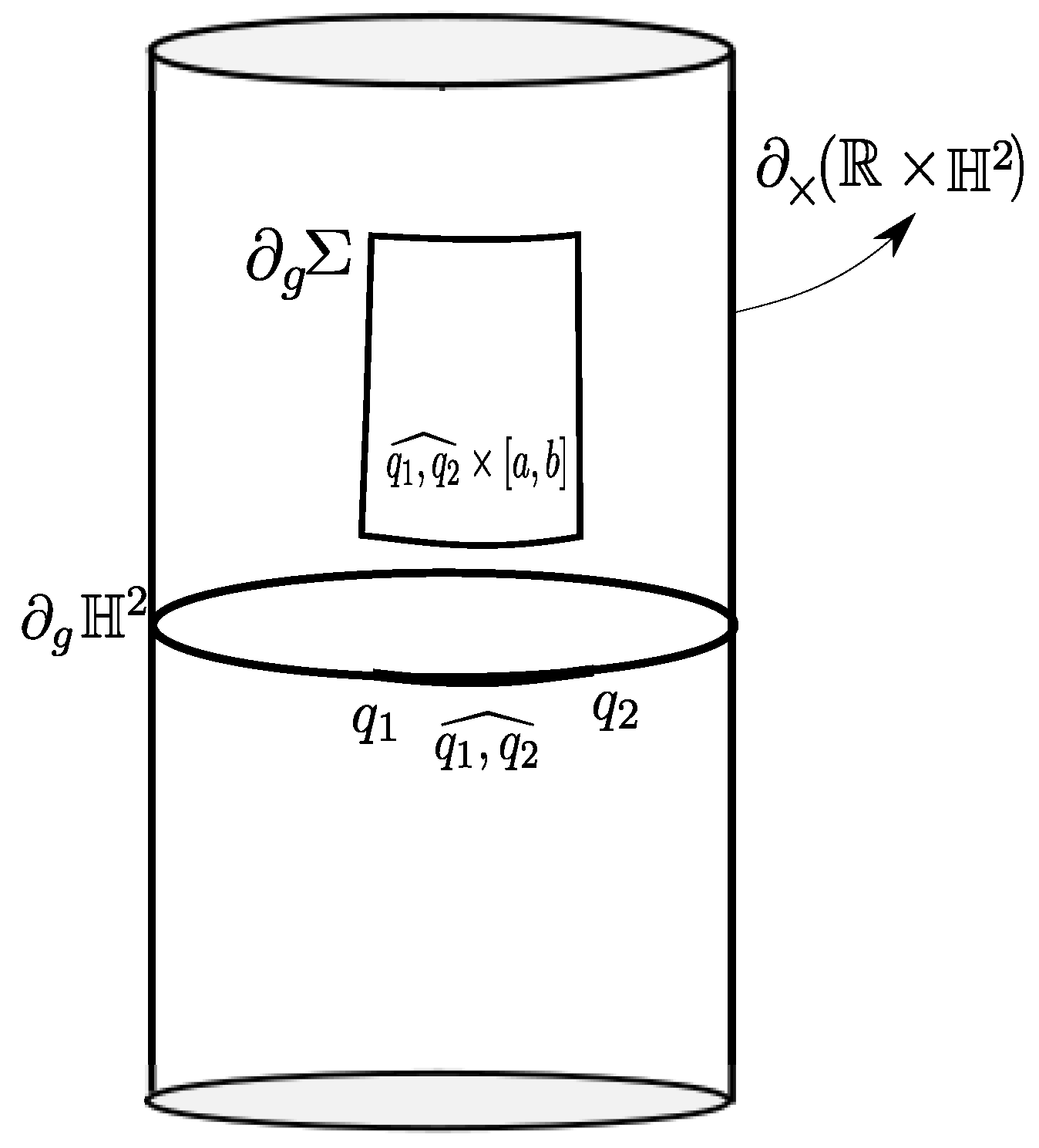
and called the “equator”, as shown in
Figure 1.
An important observation regarding notation is that poles can be denoted as . Moreover, geodesic rays in are of the form , so equivalence classes can be identified with the slope of the geodesic ray, i.e., . Thus, any element of can be denoted as , where is a geodesic in and m is the slope of a geodesic in .
The “vertical lines” in
connecting
with
passing through
are called Weyl chambers (introduced in [
16]) and will be denoted as
, i.e., given
,
Similarly, we define
is defined analogously but with slopes going towards
.
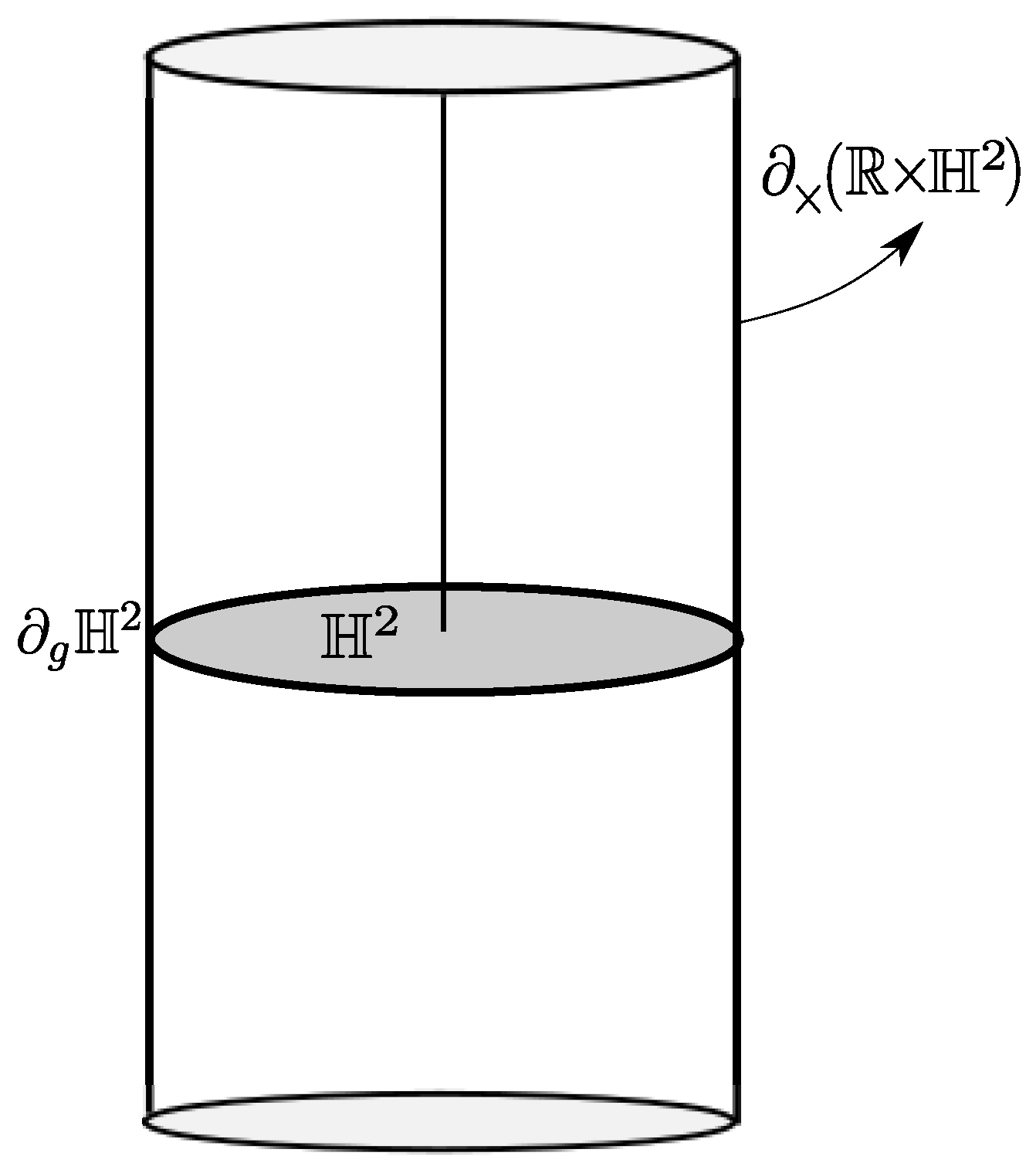
Note that while the manifold
is non-compact, its product compactification
is compact under the product topology. Consequently, the product boundary
is well-defined. Although the geodesic boundary
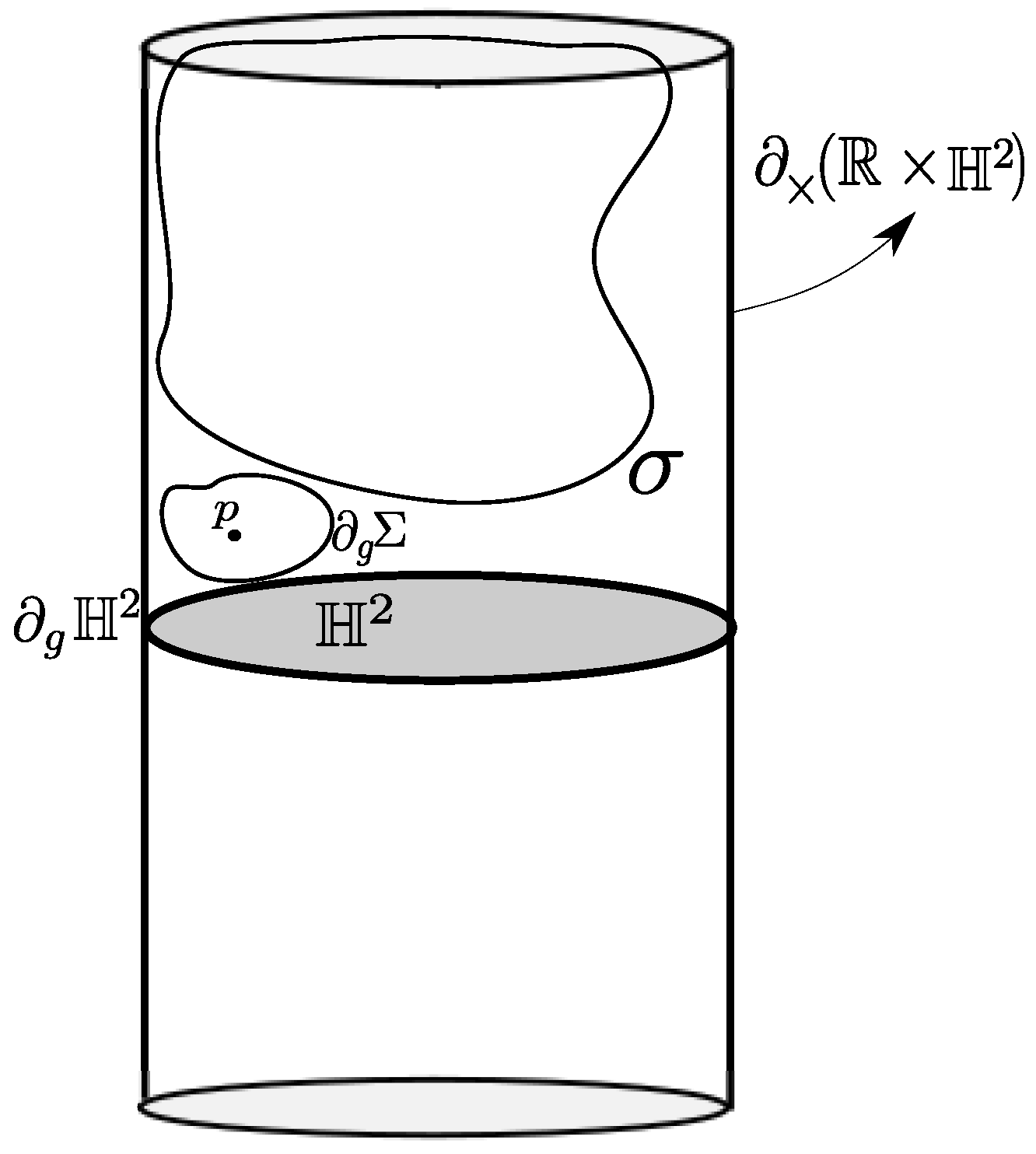
and the product boundary are topologically distinct, for the vertical graphs considered in this work, there is a natural identification. The “equator” corresponds to geodesic rays lying in the slice
, i.e., points of the form
, see
Figure 2.
3. Invariant Surfaces
In a Riemannian manifold
M of dimension
n, the mean curvature
H of an oriented hypersurface
with normal vector
at each point
is defined as
is the shape operator, defined at
as
where the term
denotes the tangential component of the vector to the hypersurface,
S is a local extension of
to the manifold, and
is the connection of the manifold.
There is the particular case of a manifold of the form
and for a hypersurface
S which is the graph of a function
, where
. Defining
orienting the graph upwards, i.e., taking the normal vector as
, and making the necessary calculations, we obtain that the mean curvature equation
where
and ∇ are the divergence and gradient operators in
M.
In the manifold
, the mean curvature equation formula obtained with a function
will be used, where
s is defined on a domain of
and
is a real function defined on an interval
. Thus, the divergence (
3) becomes
In
, there are three types of families of 1-parameter isometries: the elliptic ones, which are rotations around a common point in
; the parabolic isometries, which can be considered as rotations around a point
; and the hyperbolic isometries. In the work of P. Klaser, R. Soares, and M. Telichevesky [
17], we can find constant mean curvature (CMC) surfaces in
that are invariant under each type of 1-parameter isometry family in
and extended to
.
3.1. Unduloid
Revolution surfaces are the first surfaces in
invariant under a 1-parameter isometry family constructed in work [
17], in this case, elliptic isometries. These surfaces are graphs of functions defined in domains like
(the exterior of a ball in
centered at
with radius
) and symmetric with respect to the axis
, i.e., graphs of functions of the form
, where
is the distance function to the circle
, and
is a real function.
As was mentioned, the mean curvature equation for the graph of
u oriented with the normal vector
is
but the graph has the form
. Therefore, we can rewrite the mean curvature equation using Equation (
4) and the fact that
and
, obtaining that the equation reduces to
satisfying the following ODE:
Thus, fixing
, constant
H, and solving the ODE (
6) with the initial condition
, we obtain the unduloid H-und
r, which is a rotational constant mean curvature surface (CMC
) tangent to the cylinder
. Its corresponding general expression is
defined on
, where
, and the complete unduloid is obtained by joining H-und
r with −H-und
r on the sphere
.
3.2. Horonduloids
The
horonduloids are graphs of functions defined in the exterior of a horodisc, whose level curves are the horocycles passing through point
on the boundary of
. Although the function H-und
∞ that provides the parabolic surfaces can be obtained by letting
in the expression H-und
r, it is also possible to find it by solving (
5) but in this case assuming that the solution depends on the distance
s to a fixed horocycle
containing
a. Thus, the distance function
s satisfies again
, and we obtain the equation
Again, fixing the constant
H and solving the ordinary differential Equation (
8) with the initial condition
we obtain the following explicit expression:
where
is such that
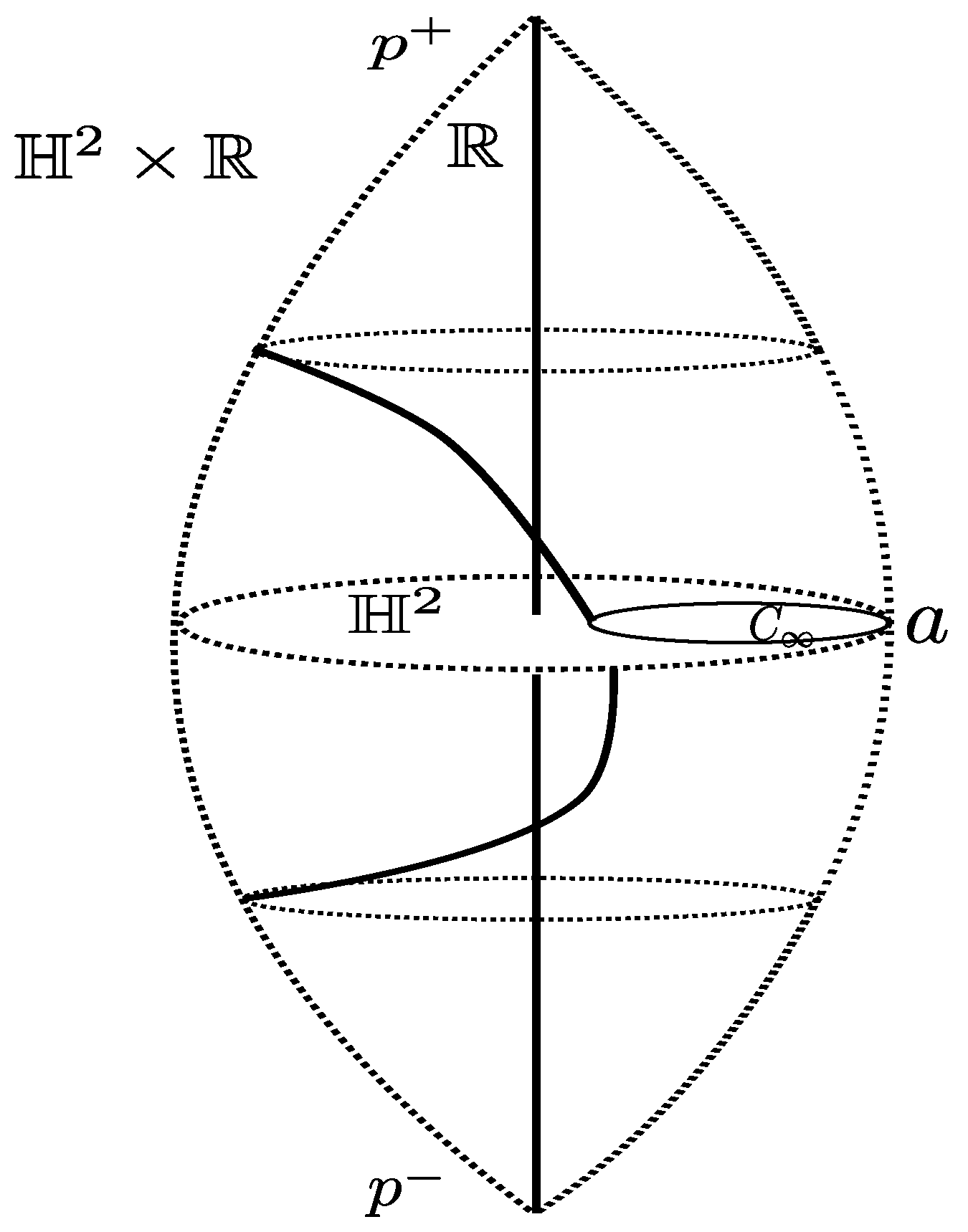
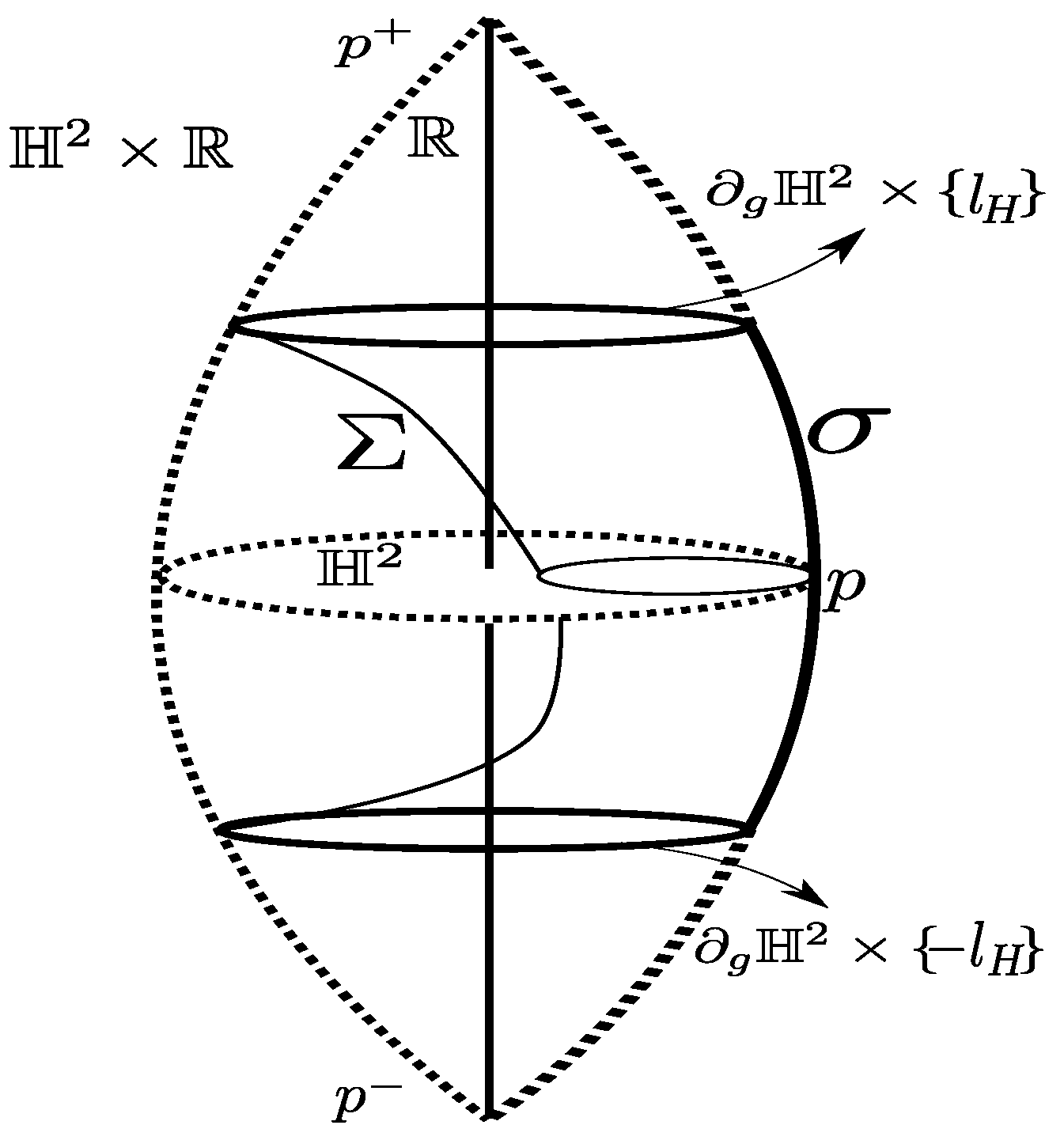
In the same way as with the unduloids, the
of a fixed
is the surface obtained by joining the graph of
with the graph of
, the horocycles passing through point
a, as illustrated in
Figure 3. More details in [
17].
4. Geodesic Boundary of Invariant Surfaces
This work will focus on the study of curves on the geodesic boundary of
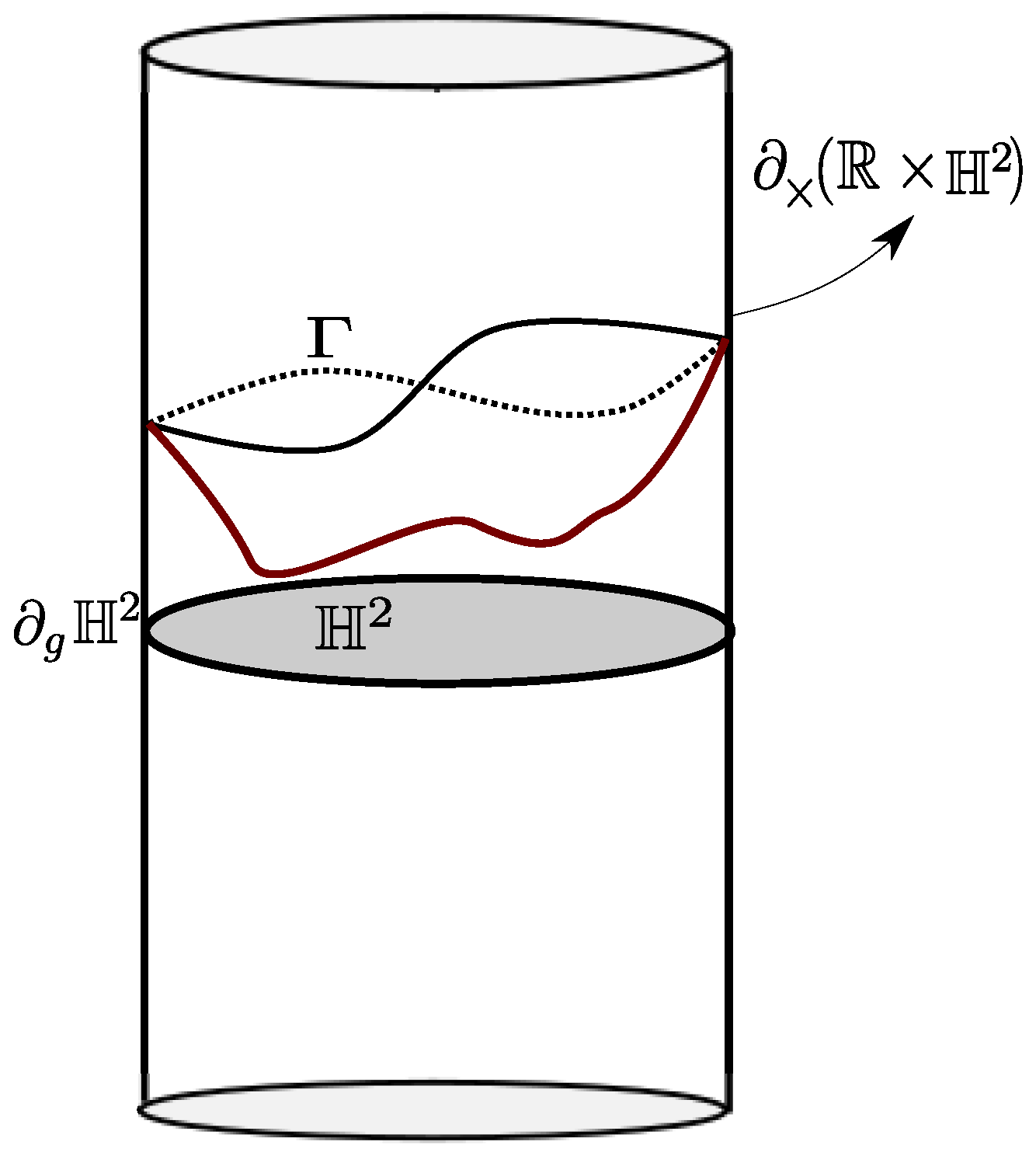
that are boundaries of properly embedded surfaces with constant mean curvature. This problem can be interpreted as an “asymptotic H-Plateau problem”. The most relevant reference regarding curves that are boundaries of CMC surfaces in
comes from the work of B. Nelli and H. Rosenberg [
3], specifically Theorem 4. See
Figure 4.
Theorem 1 (Theorem 4 of [
3]).
Let Γ
be a continuous Jordan curve in , which is a vertical graph over . Then, there exists a minimal vertical graph Σ
over such that Γ
is the asymptotic boundary of Σ.
The graph is unique. It is important to note that, in this case, the Plateau problem occurs on the boundary product of
, and the solution is a minimal surface with a continuous curve as boundary, which is a graph over the geodesic boundary of
. Another important reference is the work of R. Sa Earp and E. Toubiana [
13], where curves are presented on the boundary product of
that are boundaries of minimal surfaces, see
Figure 5.
Proposition 2 (Proposition 2.1 of [
13]).
Let be and , an arc in with and , and there exists a properly embedded minimal surface Σ such that its asymptotic boundary is the rectangle . The curves presented in the previous works are the geodesic boundary of minimal surfaces in
. In this sense, B. Kloeckner and R. Mazzeo in
Section 4 of work [
15] give a definition for these types of curves.
Definition 1 (Minimally Fillable). A curve is minimally fillable if it is the asymptotic boundary of a properly embedded minimal surface in , where “curve” means a Jordan curve or a disjoint union of Jordan curves.
Kloeckner and Mazzeo initially construct curves on the boundary product of
to generalize Theorem 4 by B. Nelli and H. Rosenberg [
3], as shown in the following proposition. See
Figure 6.
Proposition 3 (Proposition 4.1 of [
15]).
Let be a curve, and suppose that each can be separated from σ by the boundary of a properly embedded minimal surface . Then, σ is minimally fillable. However, their main goal is to classify all minimally fillable curves on the geodesic boundary
in Theorem 5.1 and Corollary 5.2 of the same work [
15]. Following this idea, in work [
11] they define curves in
that are the geodesic boundaries of surfaces with constant mean curvature
H for
, generalizing the minimally fillable curves.
Definition 2 (Definition 3.1 of [
11]).
A curve is H-fillable if it is the geodesic boundary of a properly embedded surface in with constant mean curvature H, where , and “curve” means a Jordan curve or a disjoint union of Jordan curves. It is important to note that the orientation considered in this case is the one pointing “inwards” in when it reaches the curve at infinity. We observe that the only situation where “inwards” does not make sense is when the mean curvature vector is parallel to the factor of on the prescribed geodesic boundary. However, in this case, we would have a surface reaching the boundary parallel to a section , where c is a real constant.
4.1. Geodesic Boundary of Parabolic Surfaces
The following result characterizes the curves on the geodesic boundary
that are geodesic boundaries of surfaces invariant under parabolic isometries (parabolic surfaces) in
. The following proposition shows the geodesic boundary of the horocylinder, which turns out not to be an example of an H-fillable curve. To simplify writing, the subsets of
given by all geodesic rays of
with a fixed slope
m in the
factor will be called circles and denoted as
. An important constant that was defined by [
18] and used throughout the text is
Proposition 4. Let , where and is the constant defined in Equation (10). Then, there exists a properly embedded surface Σ
with constant mean curvature H () such that its geodesic boundary is . Proof. Let
. Consider the parabolic surface
defined as the graph of
over the exterior of a horodisc
C centered at
p. Recall from Equation (
11) that
To determine the boundary of
, we analyze the asymptotic behavior of the graph along geodesic rays
in
starting from
C. It is a known result (see Proposition 3.1 in [
11]) that if a graph
over a geodesic ray satisfies
, then the ray
in
converges to the point
in the geodesic boundary
.
Differentiating the integral expression with respect to the distance
s,
Thus, the graph approaches the boundary with a vertical slope exactly equal to
. This implies that the asymptotic boundary of the graph contains the set
.
Furthermore, since the construction is invariant under parabolic isometries fixing
p, and considering the convexity of the domain, the vertical segments over
p are filled up to the maximum slope. Specifically, using the same argument as in Proposition 3.11 of [
11], the surface fills the Weyl chamber
. By symmetry (Alexandrov reflection), the surface also fills the lower part. Therefore, the geodesic boundary is exactly the union of these sets:
This completes the proof, see
Figure 7. □
4.2. Geodesic Boundary of Tall Rectangles
The study of tall rectangles on the product boundary
was initiated by Sa Earp and Toubiana [
13], who proved that rectangles with height at least
are minimally fillable curves. In this section, we provide an alternative proof of this classical result (Proposition 2.1 of [
13]) by employing the geometric framework of Klaser, Soares, and Telichevesky [
17]. This constructive approach not only recovers the minimal case but also serves as the necessary foundation for our main result: the generalization to constant mean curvature surfaces and the analysis of their relative asymptotic height.
Hyperbolic surfaces can be constructed by modifying the domain using the level curves of the distance function. Geometrically, this implies considering the distance to an equidistant curve (a hypercycle) instead of a geodesic. The mathematical advantage of using equidistant curves as the domain boundary is that the distance parameter s extends to . In contrast, for elliptic surfaces (unduloids), the domain is bounded between spheres, and for surfaces based on geodesics, the geometry restricts the asymptotic behavior. The non-compact domain provided by the hypercycle is essential for our construction because it allows for the invariant family to “reach” the asymptotic boundary at infinity, which is necessary to define the parabolic and hyperbolic invariant families that solve the asymptotic Plateau problem.
Choosing
and
, the ODE (
6) is rewritten:
Taking
as an initial condition, the solution to the ODE (
13) is
The theorem refers only to minimal surfaces, so the surfaces considered will all have zero mean curvature (), i.e., and .
Theorem 2 (Proposition 2.1 de [
13]).
For and given, an arc in with and , there exists an embedded minimal surface Σ
with its asymptotic boundary at the boundary of the rectangle . Proof. The idea of the proof is to calculate the lower and upper limits of the heights of
on the boundary of the product
as
r varies, where
is the minimal graph generated around the geodesic connecting
with
. The geodesic boundary of
is an equatorial arc, so the boundary of the product
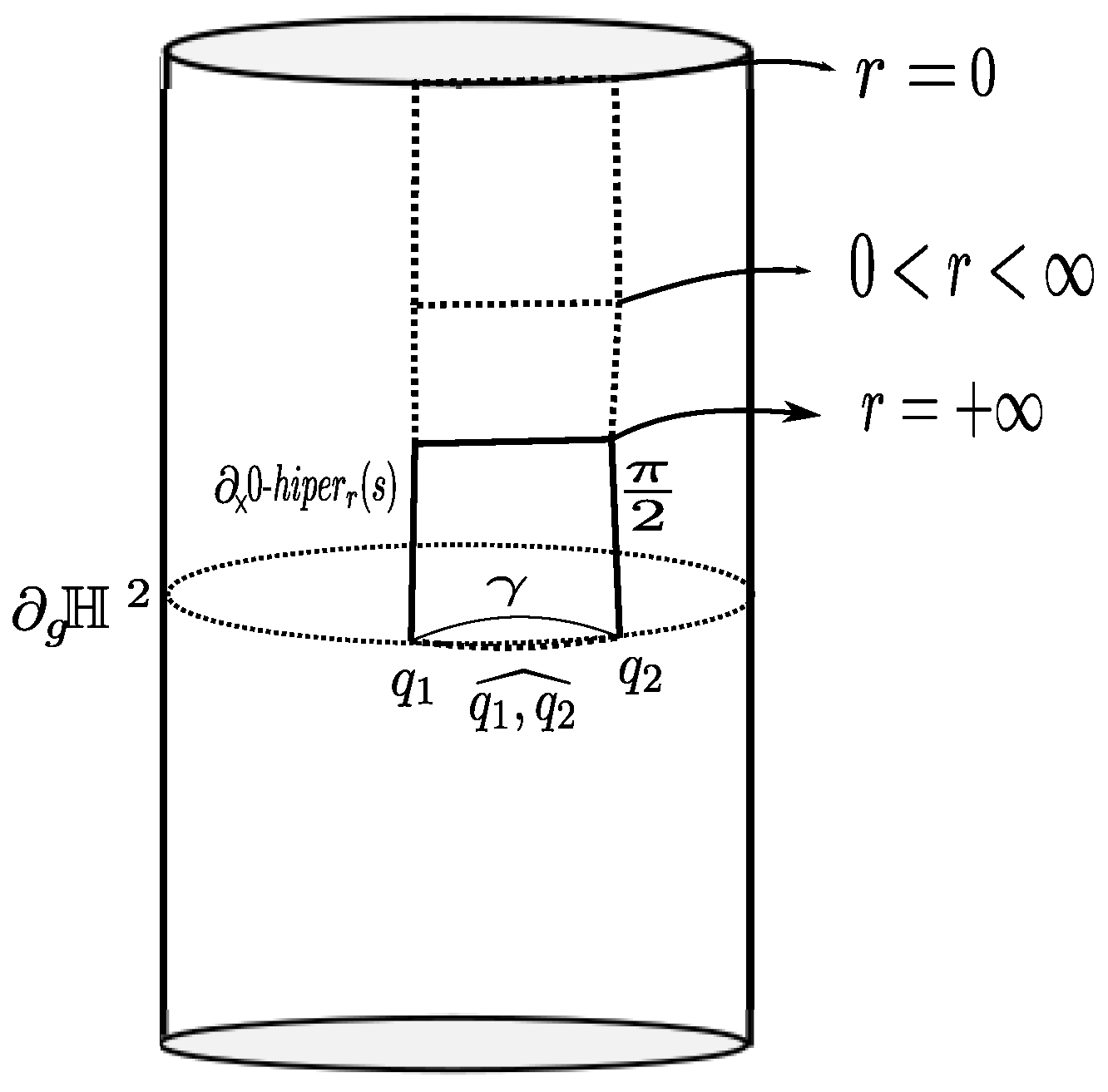
will describe half of a rectangle in the boundary of the product
(see
Figure 8), and the limitations of these halves will be calculated. First, observe that
, so
; also note that from Equation (
9),
where
is such that
, i.e., if
, then
, so
.
Next, we show that the family of minimal surfaces
is strictly decreasing with respect to the parameter
. Differentiating the integrand with respect to
r,
Since
, this derivative is strictly negative. Thus,
for all
s, proving the monotonicity.
Combining this with the fact that , we confirm the lower bound .
On the other hand, we analyze the behavior as
. In the minimal case (
), the parameter
r can approach 0. The integral becomes
This confirms that the family sweeps all heights from
(at
) to
(at
). Combining these limits with the Aleksandrov reflection, we obtain the desired result, which will describe half of a rectangle in the boundary (see
Figure 8). □
4.3. Existence of H-Fillable Curves with Arbitrary Height
In this section, we generalize the previous existence result for surfaces with constant mean curvature
. Unlike the minimal case, the asymptotic slope
is strictly positive. Following the definition introduced in [
11], we measure the
asymptotic height of a surface relative to a fixed reference.
Let
be the graph of a rotationally symmetric H-cap centered at the origin. Since all hyperbolic invariant surfaces
(for
) share the same asymptotic slope
as the H-cap, the difference between their graphs at infinity is finite. We define the relative asymptotic height
as follows:
Let be the relative asymptotic height of the parabolic surface , defined as .
Remark 1 (Continuity of the Height Function).
The relative asymptotic height function is defined in Equation (18) as an integral depending on the parameter r. Its continuity with respect to is a direct consequence of the theorem on continuous dependence of solutions to ordinary differential equations (ODEs) with respect to initial conditions and parameters. Specifically, the function is the solution to the ODE Equation (13), which has smooth coefficients for . Since the integrand in the definition of is a composition of continuous functions of r and , the resulting integral varies continuously with r. This ensures that the image of is connected, allowing for the use of the Intermediate Value Theorem. Theorem 3. Let . For any value , there exists a properly embedded surface invariant under hyperbolic isometries with mean curvature H and relative asymptotic height .
Proof. The proof relies on the continuity of the height function
and an analysis of its behavior at the boundaries of the domain
, as well as its monotonic variation with respect to the parameter
r. We first aim to show that the relative height
is a strictly decreasing function. Since the reference term
does not depend on
r, it suffices to study the derivative of the hyperbolic surface integral
given in Equation (
13). Let us denote the integrand by
. Its structure is of the form
, where
and
are the numerator and the hyperbolic cosine term in the denominator, respectively. Since this function is increasing with respect to the ratio
, the sign of
is determined by the sign of the derivative of this ratio:
Substituting the expressions
and
, and computing the partial derivatives with respect to
r, the numerator of the derivative becomes
. For any
, we have
, making the first term negative. Similarly, since
and
, the second term
is strictly negative. Consequently,
for all
, which implies that the asymptotic height
decreases strictly as
r increases.
Having established monotonicity, we now determine the range of the function by evaluating its limits. Geometrically, as the parameter r grows indefinitely (), the neck of the hyperbolic surface widens and recedes. In this limit, the functions defining the hyperbolic family converge uniformly on compact sets to the generating function of the parabolic surface . Since the relative height is defined by the difference at infinity, we obtain that . This confirms that the interval of attainable heights is bounded below by the height of the parabolic solution.
On the other hand, we analyze the behavior of the integral defining the surface height near the critical value . The convergence or divergence of the height depends on the behavior of the integrand near . Let be the term inside the square root in the denominator. Performing a Taylor expansion of with respect to t around , we observe that the critical behavior is governed by the linear coefficient, which is given by . For any , since , this linear coefficient is positive, ensuring the integral converges. However, as r approaches the critical value , we have , causing the linear term to vanish. In this critical limit, the dominant term of the expansion becomes quadratic (). Consequently, the denominator behaves like , leading to a logarithmic integral of the form , which diverges to . Thus, we have proven that .
Since is a continuous function on that is strictly decreasing, and its image covers the range , by the Intermediate Value Theorem, for any prescribed height , there exists a unique r such that the surface has exactly that asymptotic height. Applying the Alexandrov reflection principle, we obtain the complete surface with total asymptotic height . □
5. Conclusions
In this work, we have provided a complete geometric characterization of the geodesic boundary for surfaces invariant under parabolic isometries in the product space . By utilizing a constructive approach, we established the existence of properly embedded surfaces with constant mean curvature whose boundaries at infinity are rectangles of arbitrary height, provided they exceed a specific lower bound determined by the parabolic solution. The primary advantage of this constructive proof, as opposed to traditional analytical methods based on the existence theory of partial differential equations, lies in its directness and geometric intuition. Our method explicitly generates geometric barriers that allow for a clear visualization of how the boundary height is controlled by the curvature parameter H, which is particularly relevant for where Weierstrass-type representations are technically complex.
The characterization and existence theorems presented here open several avenues for further mathematical applications. These constructive families can serve as essential barriers to solve more general Plateau problems for non-invariant curves by providing necessary height estimates. Furthermore, the analysis of the relative asymptotic height offers a potential path toward a more comprehensive classification of vertical ends for CMC surfaces, complementing the uniqueness results currently available in the literature. It is also important to note that this construction can be naturally extended to higher-dimensional manifolds by considering hyperspheres instead of geodesic circles. However, the analysis of the geodesic boundary in higher dimensions becomes more involved as is a sphere , leaving the precise characterization of H-fillable boundaries as a fertile ground for future research.