1. Introduction
Breast cancer is the most common cancer among women, with incidence rates continuing to increase worldwide [
1]. Malignancy in breast tissue predominantly arises from cellular changes within breast ducts; these lesions are termed ductal carcinoma in situ (DCIS), and in a portion of cases, this progresses to invasive ductal carcinoma [
2]. There is increasing interest in considering DCIS as an opportunity for breast cancer prevention rather than considering it as a breast cancer that requires aggressive treatment [
3]. Emerging research suggests artificial intelligence approaches can detect early changes in mammograms, which precede breast cancer, providing new opportunities to identify those at high risk for targeted prevention approaches [
4]. However, more research is needed to explore these very early small-scale changes in breast ducts that are associated with DCIS.
Biomechanical features of biological tissues can be used for early diagnosis of diseases such as ectasia [
5], osteoarthritis [
6], solid tumours [
7] and coronary artery disease [
8]. Furthermore, mechanical properties have also been investigated for the assessment and classification of Parkinson’s disease [
6]. It has been shown that combining biomechanical analysis approaches with machine learning can provide a powerful computational platform for early diagnosis of keratoconus [
9]. More recently, biomechanical models integrated with machine learning have been successfully employed for the detection of breast tumours [
10], breast cancer therapeutic strategies [
11], personalized orthopaedic implants [
12], and the estimation of rupture and growth likelihood of small abdominal aortic aneurysms [
13].
Among the biomechanical features of biological tissues, wave propagation properties are of high importance due to their widespread application in medicine and their non-invasive nature [
14,
15]. Non-invasive waves can be induced along different directions of the tissue. Overall, there are three main types of wave propagation: (1) longitudinal, (2) shear, and (3) flexural. Clinically, one common tool used to create waves within an organ or tissue is an ultrasound transducer. Longitudinal waves are built when the displacement direction of tissue points is along the same direction as the wave propagation. However, in shear waves, the displacements are perpendicular to the direction that the waves propagate [
16,
17]. Shear wave properties are related to the shear elasticity modulus, while flexural wave features are linked to the bending stiffness of the biological tissue [
18,
19]. Each wave propagation modality provides insightful clinical data that can be used for disease risk prediction, diagnosis, and treatment monitoring [
20,
21].
Mathematical models, including cell mechanics and continuum mechanics, play a vital role in understanding and interpreting mechanical features, particularly wave dispersion assessment. In biomedical imaging tools such as ultrasound elastography [
22] and optical elastography [
23], mathematical models are used to convert raw data experimentally measured by the system into medical images [
24]. In recent decades, an attempt has been made to develop accurate and clinically adaptable mathematical models to predict the biomechanical features of biological tissues with a particular focus on disease understanding [
25], treatment monitoring [
26], and early detection [
27,
28]. In one of the pioneering research works in the field of breast cancer biomechanics, Samani and his co-workers [
29] performed finite element simulations to estimate the Young’s modulus of breast lesions. They extracted the biomechanical elasticity modulus of healthy tissue and breast lesions, including normal fat, fibroglandular tissue, ductal carcinoma, and fibrocystic tissue. They concluded that the elasticity modulus of healthy fat and fibroglandular tissues is almost the same, whereas fibroadenomas exhibit approximately twice the elasticity modulus. They also showed that malignancy leads to a 3–6-fold increase in the Young’s modulus, and high-grade invasive ductal carcinoma has up to a 13-fold higher stiffness compared to fibroglandular tissue [
29]. In another study, a mathematical framework was introduced to improve motion tracking in ultrasound elastography imaging in a quasi-static mode [
30]. Moreover, a poroelastography model was developed to capture the influence of interstitial fluid pressure and fluid velocity on mechano-pathological parameters of cancers [
31]. A linear discriminant analytical approach, together with a classification model, was introduced by Adebiyi et al. [
32] for breast malignancy detection. Machine learning (ML) models, such as random forest and support vector machine, integrated with a feature extraction method of linear discriminant analysis (LDA), were applied to an open-source dataset (Wisconsin breast cancer dataset). The LDA-enhanced algorithms led to accuracy scores of 96.4% for the support vector machine and 95.6% for the random forest, respectively [
32]. More recently, a finite element simulation technique was developed to analyse the dynamic response of breast tissue during various physical activities [
33].
The appropriate selection of the fundamental model and basic governing equations is crucial for ensuring the accuracy of a biomechanical model. As a general rule, cell mechanics and molecular dynamics are used at the cellular [
34] and sub-cellular level [
35,
36], respectively. On the other hand, continuum mechanics models are applicable at large-scale levels [
37]. To bridge the gap between cell mechanics and continuum mechanics, several approaches have been introduced, including but not limited to multi-scale modelling [
38] and scale-dependent modified continuum mechanics [
39]. Multi-scale modelling approaches are highly computationally expensive with respect to scale-dependent continuum mechanics as they require concurrent finite element and molecular dynamics simulations. However, size-dependent continuum models are developed based on a single continuum model, with additional stress or strain terms that allow for the incorporation of length dependency in the mechanical behaviour, requiring limited computational resources [
40,
41,
42,
43,
44]. Reducing computational time allows for the real-time deployment of biomechanical models in clinical settings, facilitating their practicality and utility.
In this paper, an integral scale-dependent continuum model has been developed to examine the flexural wave properties of breast ducts by considering the effects of various ductal layers, such as the basement membrane, myoepithelial cells, and luminal epithelial cells. The advanced mathematical model is established based on two-phase local/nonlocal mixture continuum mechanics. The effects of the different breast ductal layers are incorporated using surface energy theory. The analysis assumes that the small-scale duct is surrounded by a two-parameter stromal matrix, which is simulated based on a Pasternak model. To improve the model’s integrability and flexibility, a deep learning algorithm is also developed and trained, allowing for fine-tuning and hyperparameter adjustment on both theoretical and clinical data. To validate the model, the estimated phase velocity of flexural waves propagated within small-scale tubular structures is compared to that of molecular dynamics, and an excellent agreement is found. The influences of different parameters, such as phase fractions, length parameter, basement membrane, myoepithelial cells, and luminal epithelial cells, on the flexural wave propagation in breast ducts are discussed in detail.
2. Two-Phase Nonlocal Integral Model
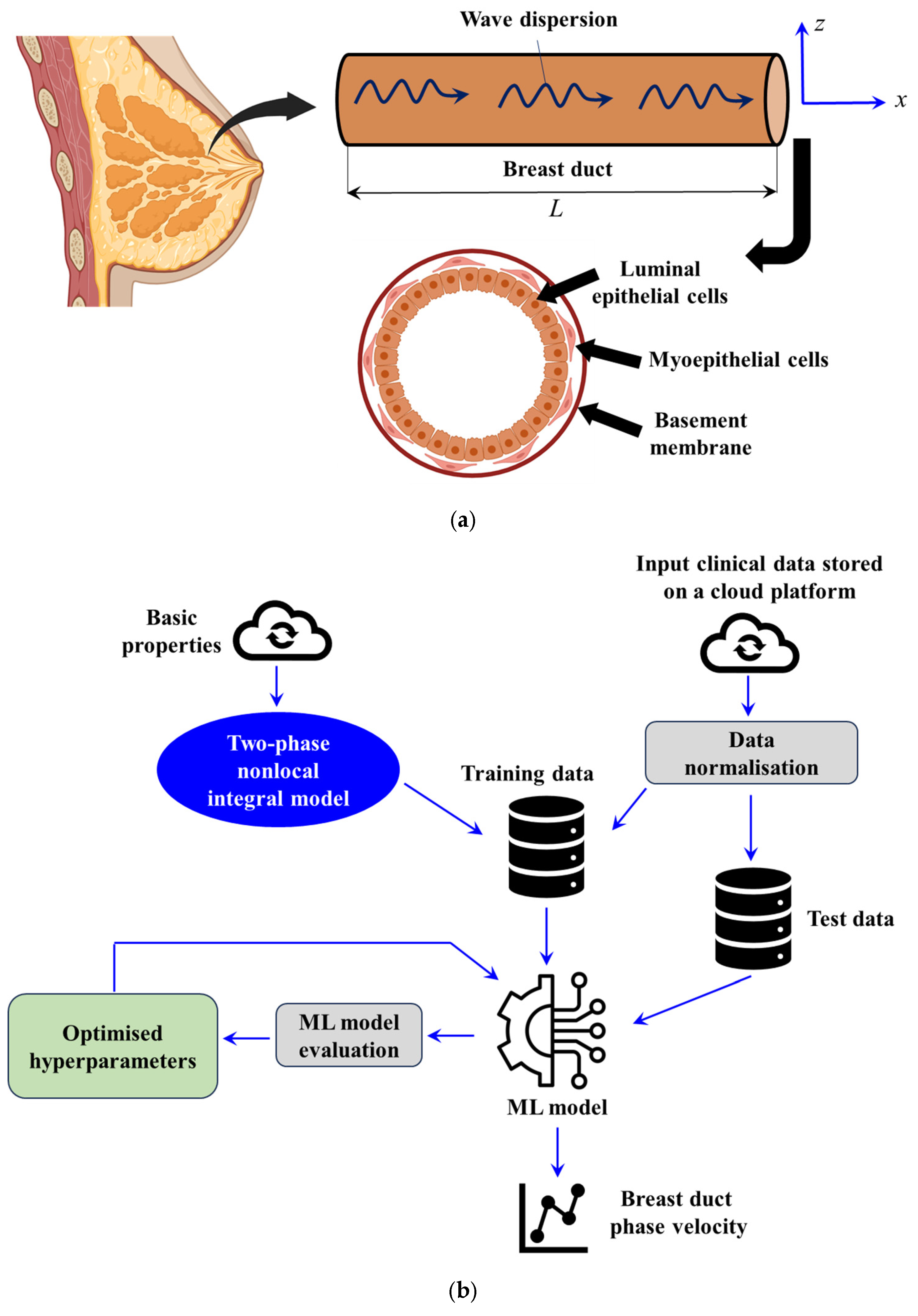
In this analysis, a two-phase nonlocal integral continuum approach is utilised to present an advanced mathematical model for wave dispersion analysis in small-scale breast ducts (
Figure 1a). The ductal biological structure is surrounded by a two-parameter stromal matrix. The fundamental relation of this model is expressed as [
45]
in which
,
and
represent the nonlocal, local, and mixture stresses, respectively. Also, nonlocal and local volume fractions are denoted by
and
, respectively. The stress components are given by
where
Here, the calibration parameter, internal characteristic size, mechanical strain, and elasticity modulus are, respectively, denoted by
e0,
,
, and
E [
42,
46]. Moreover,
a indicates the external structural length and
is the distance between two points (
,
) in the domain [
43,
47]. The nonlocal parameter, in this analysis, is shown by
.
The nonlocal length-scale parameter is defined as e0lint, as given in Equation (3), where e0 is a dimensionless calibration parameter, and lint denotes the internal characteristic length. The internal characteristic length is typically chosen to be comparable to a representative microstructural length scale of the material. In this study, lint is selected as 1 µm, which lies between the thickness of the basement membrane (BM, 0.445 µm) and the luminal epithelial cell layer (LEC, 2 µm). Accordingly, the associated nonlocal length scale range is taken as 0–1 µm, consistent with these structural dimensions.
The nonlinear stress–strain behavior (i.e., geometrical nonlinearity) is not considered in this study. The analysis is restricted to small deformations induced by wave propagation. This assumption is consistent with clinical settings where gentle, pain-free mechanical forces are applied. One practical example is elastography imaging of breast tissue [
22]. Additionally, fluid–solid interactions within the breast duct are not incorporated. The current model assumes the ductal layers as solid media. Furthermore, thermal effects are neglected, and the model assumes isothermal conditions. Finally, the effects of geometrical imperfections and structural irregularities of breast ducts are ignored. The mechanical strain is associated with the axial and transverse displacement components (
u,
w) by [
43,
48]
Substituting Equations (2) and (4) into Equation (1) yields
The mixture force and couple resultants are defined as [
49]
where
A is the cross-sectional area of the breast duct. Employing Equations (5) and (6), one can obtain
where
in which
RBM and
RLEC stand for the outer radius of the breast basement membrane (BM), and the inner radius of the luminal epithelial cell (LEC) layer, respectively.
and
are the surface stiffness coefficients of the BM and the LEC, respectively. Moreover,
and
are the BM (outer layer) and LEC (inner layer) surface factors, respectively. These factors take a value of 0 or 1 depending on the consideration of the corresponding biological surface layer. For instance, when the influence of just the BM thin layer is taken into account, we have
and
while both surface factors are equal to one when the effects of both BM and LEC are incorporated into the model. To study the role of the surface residual stress in the wave dispersion response, stress jumps over the BM and LEC layers are given by [
50]
where (
nk,
nl) and
indicate the components of the surface normal vector and tube curvature, respectively. In view of Equation (9), the following relation is obtained for the extra transverse loading caused by the surface residual stress:
where
Here
and
represent the surface energy density in the BM and the LEC, respectively.
and
are, respectively, the surface residual stress in the BM and the LEC layers. Based on the two-phase integral model of nonlocal mechanics, the biological system’s potential energy is
The kinetic energy of the system is expressed by
in which
and
. The abbreviation “
sbd” stands for the small-scale breast duct. The mass density of the duct is denoted by
in the above formulation. The work done by the residual surface stresses and the force of the surrounding stromal matrix is
Here,
kn(ssm) and
ks(ssm) are the normal stiffness and shear foundation parameters of the surrounding stromal matrix (SSM), respectively. Using Hamilton’s formula given by
and the kinetic, work, and potential energy expressions given by Equations (12)–(14), the differential equations of the wave dispersion in the small-scale breast duct are derived as described in
Appendix A.
It is supposed that the frequency, wave number, and wave dispersion amplitude are denoted by
,
and
Aamp, respectively. The transverse deflection of flexural waves is
Substituting Equation (16) into Equation (A14) leads to
Solving the above-mentioned equation for
, an exact solution for the wave frequency of the biological multi-layer system is determined as
An exact solution is also obtained for the non-classical phase velocity of the small-scale breast duct with surface effects as
Equations (18) and (19) describe the wave frequency and phase velocity of small-scale breast ducts obtained by a scale-dependent integral continuum model with two local/nonlocal phases incorporating surface effects. Ignoring the influence of surface layers, the wave frequency of the system is reduced to
Furthermore, the non-classical phase velocity of the system without surface layers is given by
3. Machine Learning Modelling
Five different machine learning algorithms are developed in this section to examine the scale-dependent biomechanical response of breast ducts under flexural waves. ML algorithms such as deep neural networks and random forests are able to incorporate complicated mechanical behaviour, size effects, and hidden trends in clinical data [
51,
52]. Moreover, ML models allow for the integration of experimental clinical data with those of scale-dependent continuum mechanics, leading to more robust and accurate modelling platforms. Experimentally measured wave characteristics can be further augmented by integrating results from the two-phase nonlocal integral model, enabling the ML model to learn complex continuum mechanics patterns.
Figure 1b shows a systematic approach to integrate the two-phase nonlocal integral model with a machine learning algorithm for clinical applications.
Table 1 lists the architecture and hyperparameters of each ML model used in this analysis. These hyperparameters were chosen based on a combination of established best practices reported in the literature [
53] and preliminary sensitivity analyses conducted in this study to achieve robust generalization performance. For the neural network model, the number of hidden layers and neurons was selected to balance architectural complexity/overfitting risk and generalization capacity, while the learning rate (0.001) and mean squared error loss function were selected to ensure stable training for regression tasks. For the tree-based models (i.e., random forest and gradient boosting), the commonly adopted hyperparameters, including 300 estimators, were used. These hyperparameters were found to provide consistent performance without excessive complexity that may lead to overfitting. Regularization parameters in linear models (Ridge and logistic regression) were selected using standard default values to prevent overfitting while maintaining numerical stability.
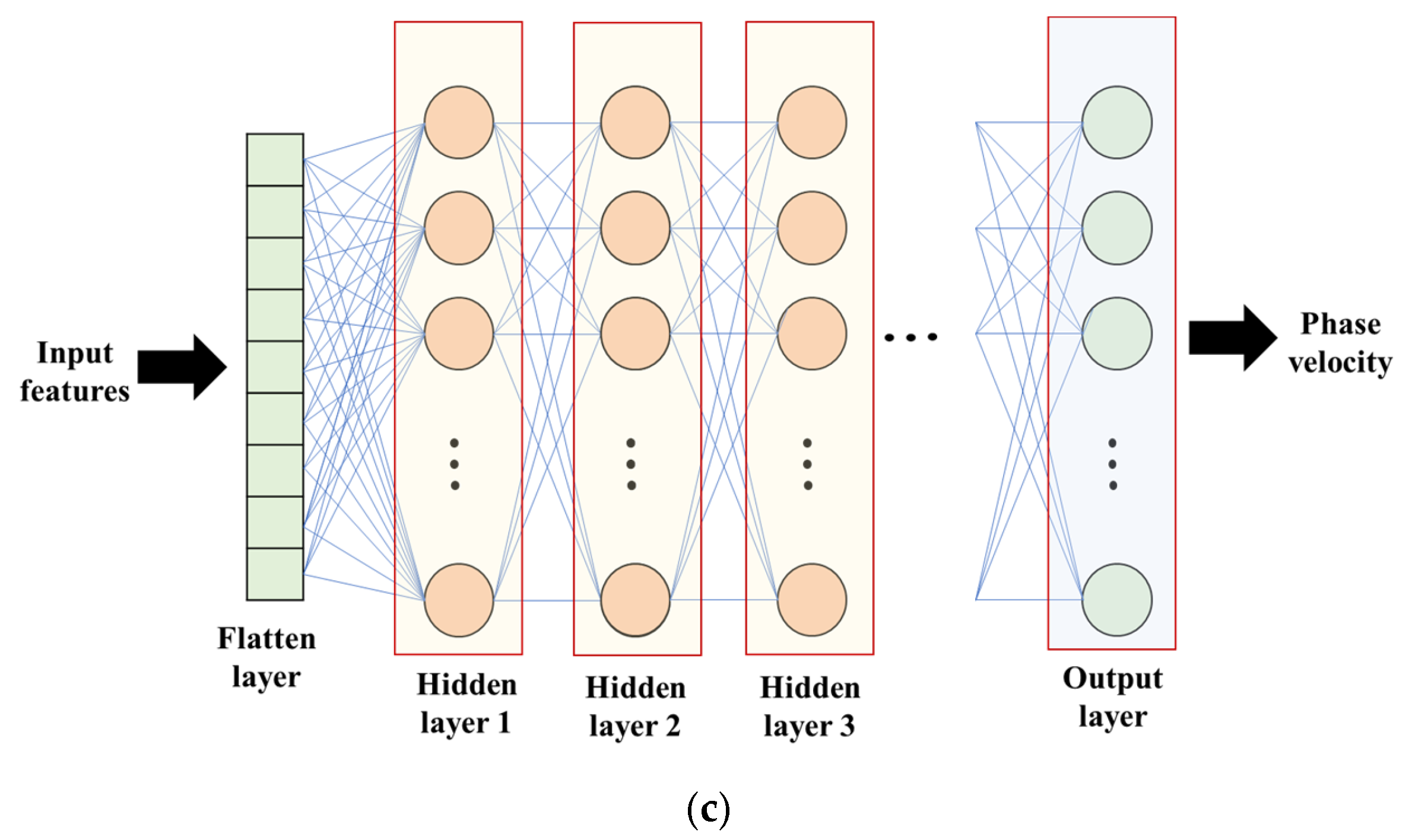
The neural network is composed of one flattened layer, three hidden layers, and one output layer. The three hidden layers contain 512, 128, and 10 neurons (units), respectively. To capture nonlinear patterns and complex behaviours, the rectified linear unit (ReLU) activation function is used. The output layer consists of only one neuron, as the NN model is designed to predict the phase velocity value (a single float number). During model training, the Adam optimiser (learning rate = 0.001) is employed. The loss function is set to the mean squared error during the training process. Keras, as the TensorFlow high-level application programming interface (API), is used to build the neural network. It allows us to stack various dense and flatten layers in a sequential manner with a customised number of neurons in each layer. The random forest model is built with 300 estimators. There is no limitation for the maximum depth (i.e., max_depth = None). It means that random forest trees can grow as deep as the data allows. The model configuration was performed assuming min_samples_split = 2, which allows a node to split as long as it has at least two samples. Moreover, the minimum sample leaf is set to 1 in the random forest model. The configuration of the gradient boosting model was completed by setting the number of estimators, learning rate, and maximum depth to 300, 0.05, and 3, respectively. The subsampling rate is assumed to be 1.0. This indicates that the whole training data is utilized in each gradient boosting iteration. The Ridge regression model is designed assuming the regularization strength parameter alpha = 1.0. In addition, the model includes an intercept term, and no limitation is imposed on the number of iterations (max_iter = None). Furthermore, the convergence tolerance is set to 0.0001, and the solver is chosen automatically based on the data type (solver = ‘auto’). Finally, the logistic regression model is built with the following assumptions: inclusion of an intercept term, operation on a copied version of the training dataset, a convergence tolerance of 1 × 10⁻⁶, and assuming model coefficients can take both negative and positive numbers.
Using experimentally measured mechanical and geometrical properties of small-scale breast ducts reported in the literature, a training dataset consisting of 100 sample points was prepared for machine learning (ML) model development. The reason for choosing a relatively small sample size was to be more consistent with real scenario clinical applications, where only limited data would be available for training. Wavelengths ranging from 0.1 to 10 microns were taken into account in order to generate the training dataset. The phase velocity was selected as the target variable, whereas the wavelength was used as the predictor. It has been demonstrated that hidden patterns governing wave propagation in small-scale breast ducts can be learned using ML models such as neural networks, random forests, and gradient boosting. The experimentally measured mechanical and geometrical features of the breast basement membrane were extracted from Ref. [
54]. Additionally, Poisson’s ratio of the breast tissue was adopted from Ref. [
55], while the mechanical features of luminal epithelial cells (LECs) were obtained from the research work conducted by Guo et al. [
56]. The bulk elastic modulus of the LECs was estimated by averaging across the isolated cellular components. Additional fundamental features, including mass density and duct geometrical features used in dataset preparation, were taken from Ref. [
57]. The dataset was randomly divided into training (70%) and test (30%) subsets. To mitigate the risk of overfitting, unnecessary model complexity was removed during the ML model design procedure. Model generalization performance was evaluated by comparing the mean squared error (MSE) and R
2 score between the training and test datasets. Input numerical values are normalized by dividing each value by its corresponding maximum amount. For example, the wavelength parameter is normalized by “dimensionless wavelength = wavelength/(maximum wavelength)”.
In the present study, the training and test datasets are generated using an advanced continuum-based theoretical framework informed by experimentally measured mechanical and geometrical properties of breast ducts reported in the literature. The fundamental parameters are derived from external experimental observations, and not purely theoretical simulations. The main aim of this research is to demonstrate the feasibility of integrating a theoretically grounded two-phase nonlocal integral model with machine learning to capture and predict wave propagation behaviour in small-scale breast ducts. Several validations, including train-test splits, cross-validation, and learning-curve analysis, will be conducted to assess generalization and mitigate overfitting. External validation using real clinical measurements or publicly available datasets would be an important next step to translate this advanced computational framework into clinical settings. However, to the best of our knowledge, such datasets containing accurate measurements of wave propagation characteristics of small-scale breast ducts, taking into account all ductal layers, are currently not available.
Python libraries, including Numpy and Pandas, are used for data pre-processing and organization. All deep learning modelling tasks have been conducted using Keras [
53]. Additionally, random forest modelling, gradient boosting regression, Ridge, and logistic regression are performed using the Scikit-learn machine learning library [
58]. To test models’ performance, three metrics,
R2 score, mean absolute error (MAE), and mean squared error (MSE), are used. The MSE is
in which
N represents the number of samples. Keywords “sur”, “predicted”, and “test” indicate surface effects, predicted by an ML model, and ground truth test value, respectively. Moreover, the MAE is calculated by
The Python libraries and their corresponding versions used in this analysis are NumPy (version: 2.0.2), TensorFlow (version: 2.19.0), Pandas (version: 2.2.2), Scikit-learn (version: 1.6.1), and Keras (version: 3.10.0).
4. Results
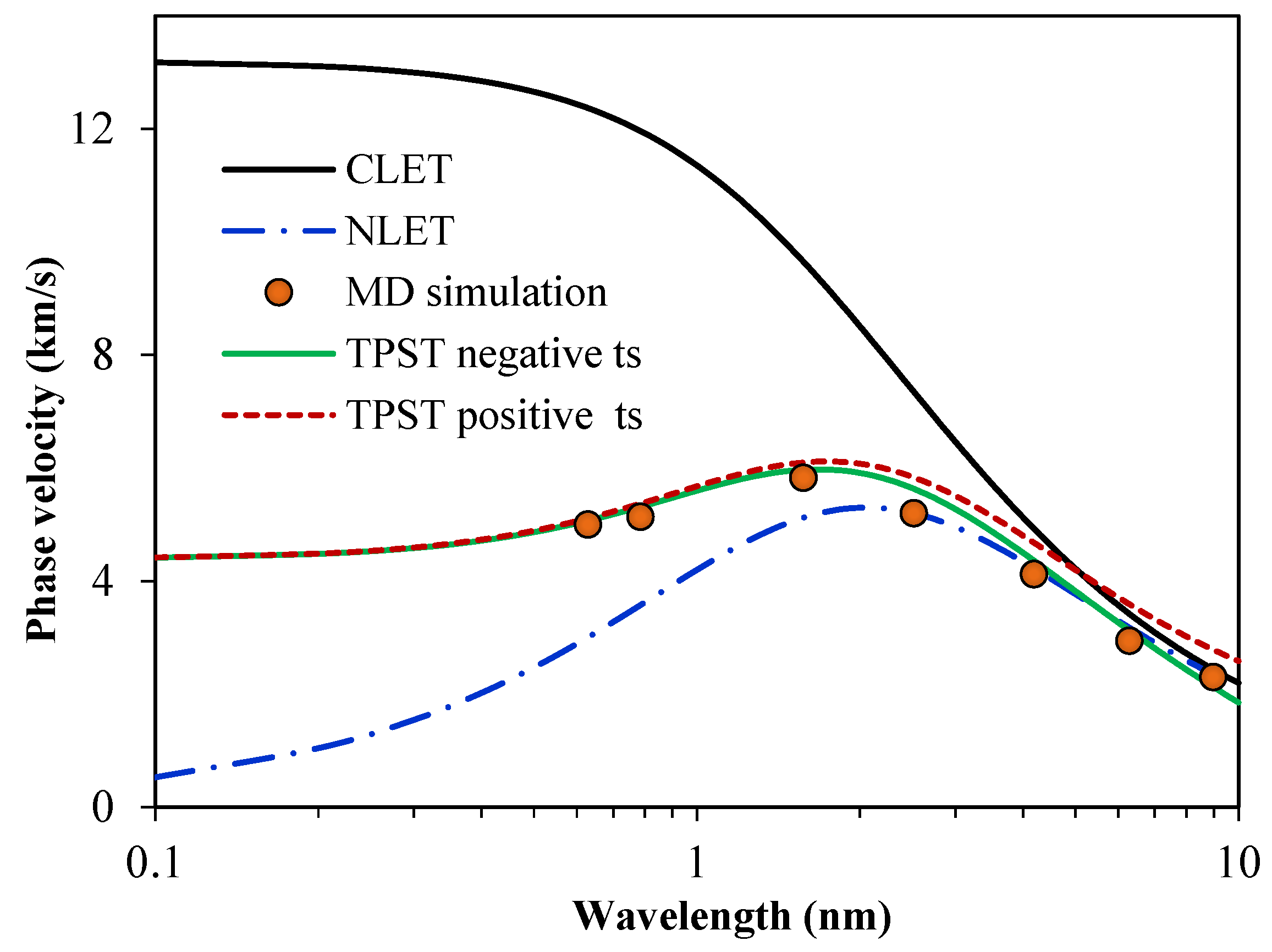
To validate the two-phase nonlocal integral model, the phase velocity of flexural waves propagated within a small-scale tubular structure is plotted against the wavelength parameter in
Figure 2. The material properties of the small-scale hollow tubular structure are adopted from Ref. [
59] for comparison purposes. For verification, the results of the molecular dynamics (MD) simulation conducted by Wang and Hu [
59] are also plotted in
Figure 2. The predictions made by various scale-dependent models, including the classical elasticity theory (CLET), the nonlocal elasticity theory (NLET), and the two-phase surface theories (TPST) with both negative and positive residual tension in the surface layer (
ts), are taken into consideration. The nonlocal parameter is set to 0.4 nm for the NLET and the TPST, where stress nonlocality is captured. The surface elasticity parameter is assumed to be 5 N/m in the TPST. The residual surface stress is equal to 1 and −1 in the TPST with positive and negative
ts, respectively. The normal and shear effects of the surrounding Pasternak matrix are neglected. The local volume fraction of the TPST is 0.1 in this verification study. From
Figure 2, it can be concluded that the CLET fails to predict the wave characteristics of tabular structures at small scales due to the inability to capture size effects. The NLET underestimates the phase velocity of flexural waves, particularly at small wavelengths. However, the results of the TPST are in good agreement with those of the MD simulations across different wavelengths.
Positive and negative residual surface stresses correspond to tensile and compressive stresses, respectively, that remain in the surface layers of the breast duct due to prior loading, growth, or physiological conditions. As shown in
Figure 2, there is a slight difference between the responses with positive and negative residual surface stresses. This difference becomes more pronounced at larger wavelengths. Positive residual surface stress results in slightly higher phase velocities since tensile surface stress increases surface stiffness and wave propagation speed.
Table 2 lists the results of the MD simulation discussed above as a reference to evaluate the accuracy of the theoretical models for various wavelengths. Among all models, TPST− (TPST with a negative residual surface stress) exhibits the lowest root mean squared error (RMSE), indicating the closest agreement with MD results, while using the CLET leads to the highest RMSE. In general, the inclusion of surface effects together with scale influences based on the TPST significantly improves predictive accuracy compared to classical and nonlocal elasticity models.
To calculate the surface elasticity properties of the breast duct, the experimentally measured biomechanical features for three different ductal layers are implemented. The bulk modulus of the breast basement membrane is 1402 N/m
2 [
54]. Moreover, Poisson’s ratio of the breast tissue is 0.47 [
55]. The stiffness modulus is related to the bulk modulus and Poisson’s ratio by
EBM = 3(1−2
v)
KBM, where
EBM stands for the elasticity coefficient of the basement membrane (BM),
v is Poisson’s ratio, and
KBM denotes the bulk modulus of the BM. The average thickness of the layer for low- and highly matured BMs is 230 nm and 660 nm, respectively [
54]. Therefore, the thickness of the BM layer is estimated by taking the mean of these two values:
hBM = 445 nm. The surface elasticity coefficient is calculated by (
Esurf)
BM=
hBMEBM. Another layer of the breast duct is composed of luminal epithelial cells (LEC). To estimate the surface elasticity coefficient of this layer, we have (
Esurf)
LEC=
hLEC × ELEC, where the thickness and bulk elasticity modulus are experimentally obtained as
hLEC = 2 micron and
ELEC = 640 Pa, respectively, for small-scale ducts [
56]. The estimated value for the bulk elasticity modulus of the LEC is obtained by averaging across the isolated cell components.
The nonlocal stress parameter is assumed to be 1 micron in all analyses unless otherwise explicitly stated. The mass density of the breast duct is taken as 1.01 g/cm
3. The breast duct length and diameter are set to 100 and 35 micrometres, respectively [
57]. The effects of the surrounding matrix and the residual surface tension are not taken into account. The local volumetric fraction is set to 0.1.
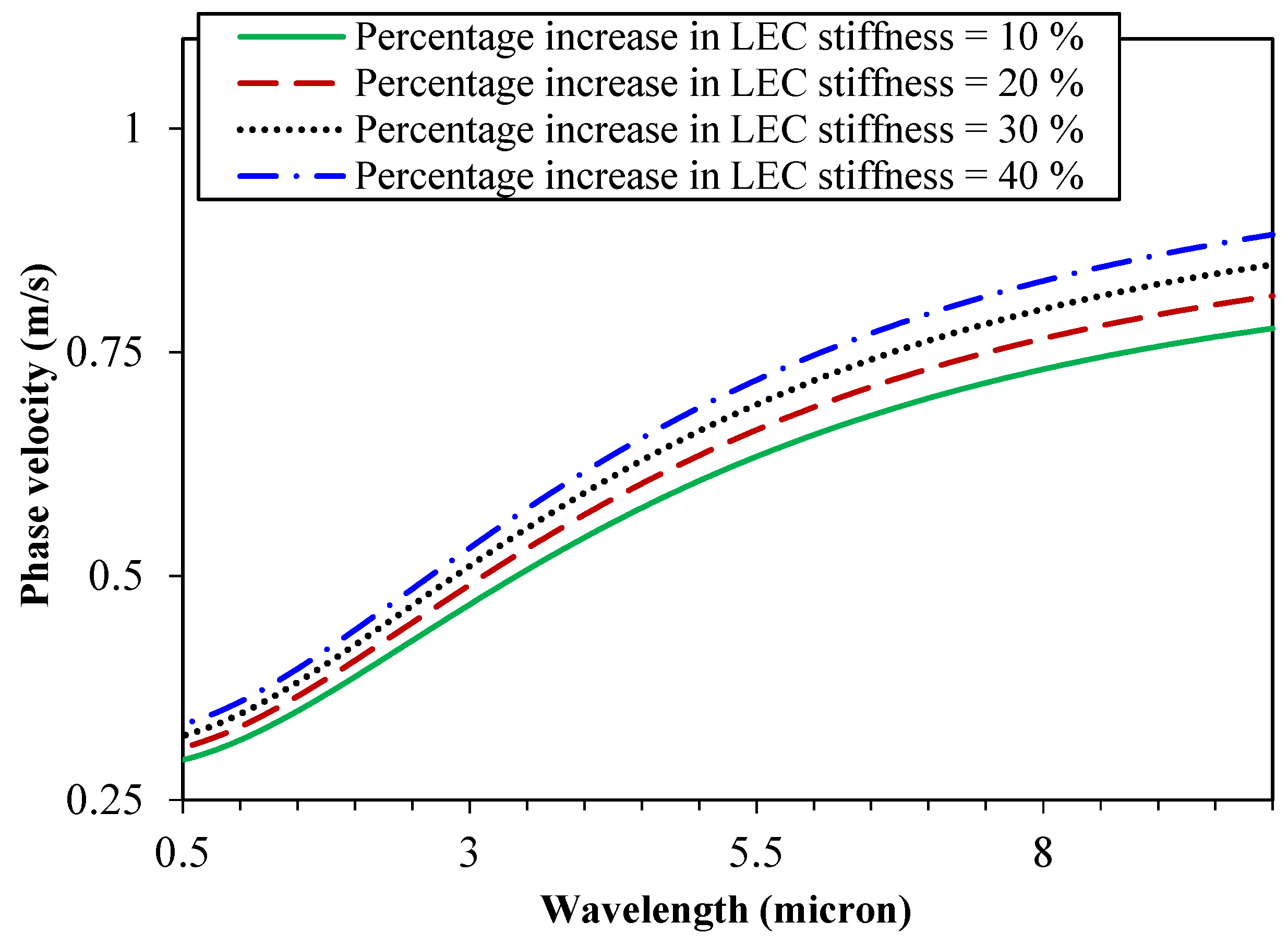
Figure 3 illustrates the impact of the wavelength on the phase velocity of flexural waves propagated within the breast duct. The results are shown for various values of the LEC stiffness. The default bulk elasticity modulus of the LEC layer is
ELEC = 640 Pa [
56]. It is found that increasing this stiffness modulus gradually increases the phase velocity. Moreover, higher values of wavelengths are associated with higher phase velocities.
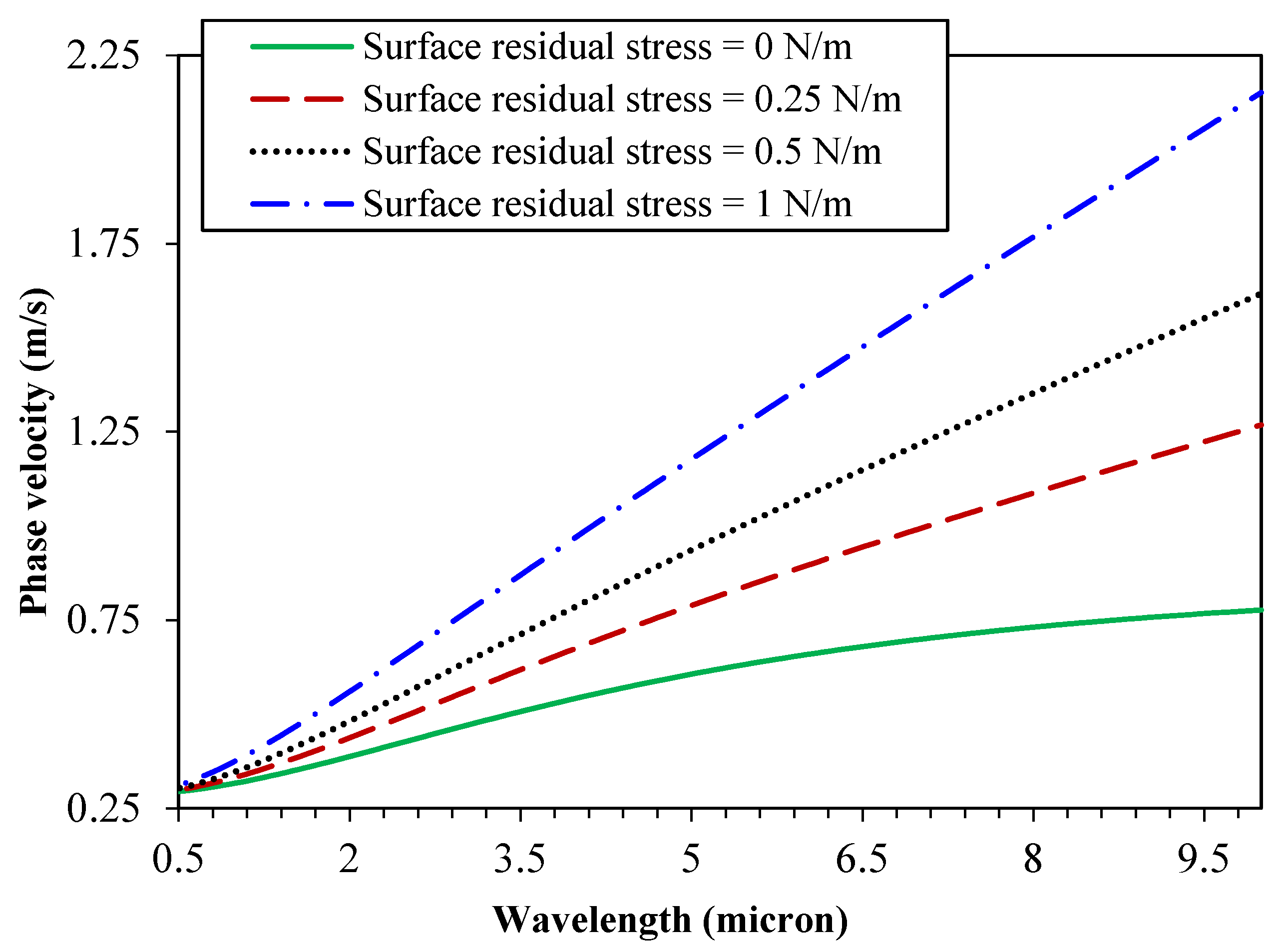
Figure 4 shows the influence of the surface residual tension on the phase velocity magnitude of flexural waves propagated within the breast duct. It can be seen that when there is a higher residual surface tension in either the luminal epithelial cells or the breast basement membrane, the phase velocity is significantly enhanced. This enhancement pattern is even more pronounced for higher wavelengths. For example, at a wavelength of 5 microns, the phase velocity is estimated as 0.61 m/s in the absolute absence of residual surface tension, while it increases to 0.79 m/s when a surface residual stress of 0.25 N/m is applied.
Phase velocity is plotted in
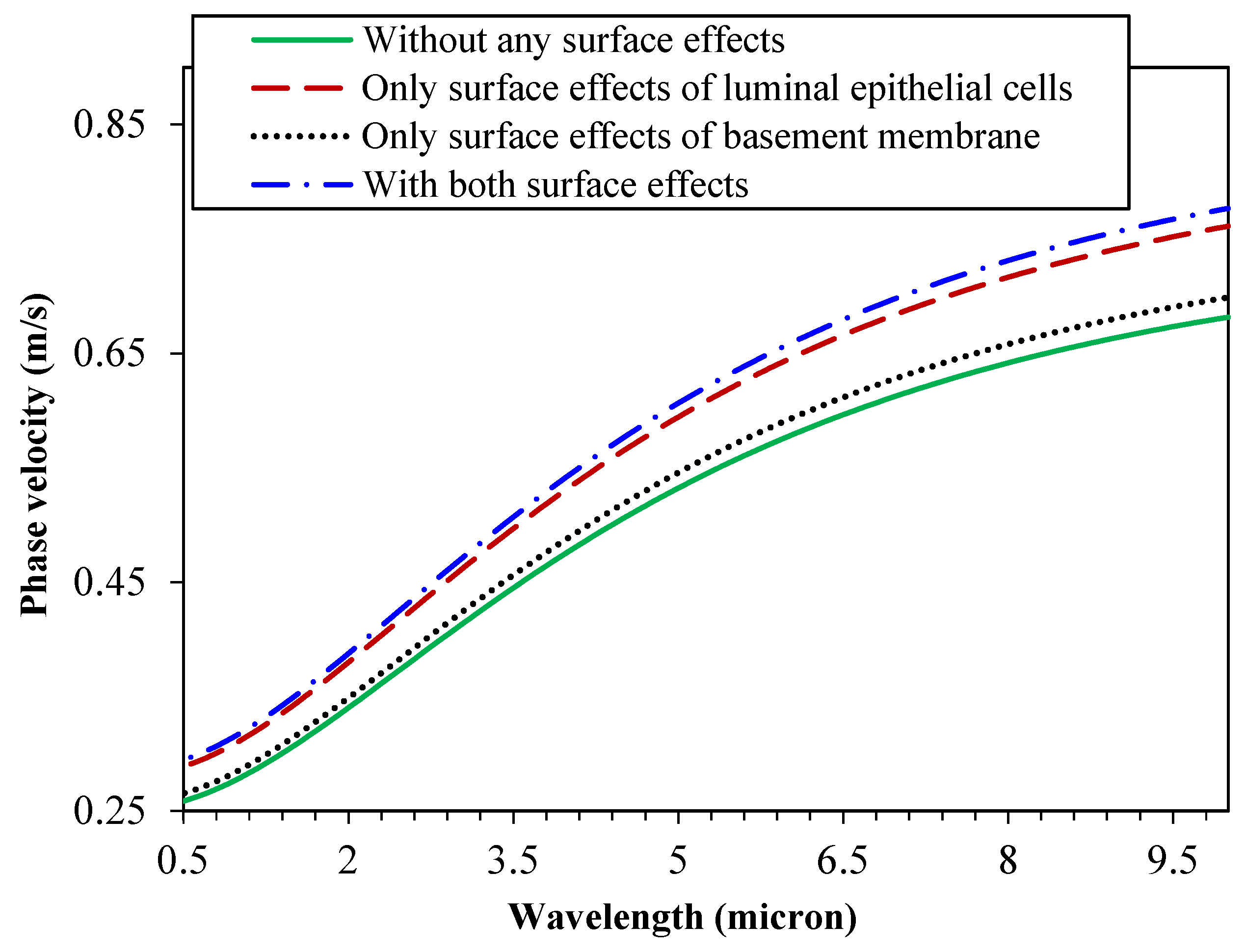
Figure 5 for a wide range of flexural wavelengths and also for various surface effects associated with luminal epithelial cells and the basement membrane. Overall, we considered four different case studies as follows:
- (1)
Without any surface effects: The impact of both surface elastic coefficients of luminal epithelial cells and basement membrane is ignored, namely, (Esurf)BM= (Esurf)LEC = 0.
- (2)
Only surface effects of luminal epithelial cells: The surface stiffness coefficient of the LEC layer is incorporated (i.e., (Esurf)LEC ≠ 0) while the surface elasticity coefficient of the basement membrane is neglected (i.e., (Esurf)BM= 0).
- (3)
Only surface effects of basement membrane: The surface stiffness coefficient of the BM is implemented in the modelling procedure ((Esurf)BM ≠ 0), whereas the luminal epithelial cell surface coefficient is neglected ((Esurf)LEC= 0).
- (4)
With both surface effects: the surface stiffness coefficients of both the LEC and BM layers are taken into account in the modelling procedure (i.e., (Esurf)BM ≠ 0 and (Esurf)LEC ≠ 0).
From
Figure 5, it is observed that when surface effects associated with the stiffness of both the BM and LEC layers are incorporated, the phase velocity is enhanced. Neglecting surface effects leads to an underestimated phase velocity. Compared to the BM surface layer, the LEC layer has a greater impact on the phase velocity.
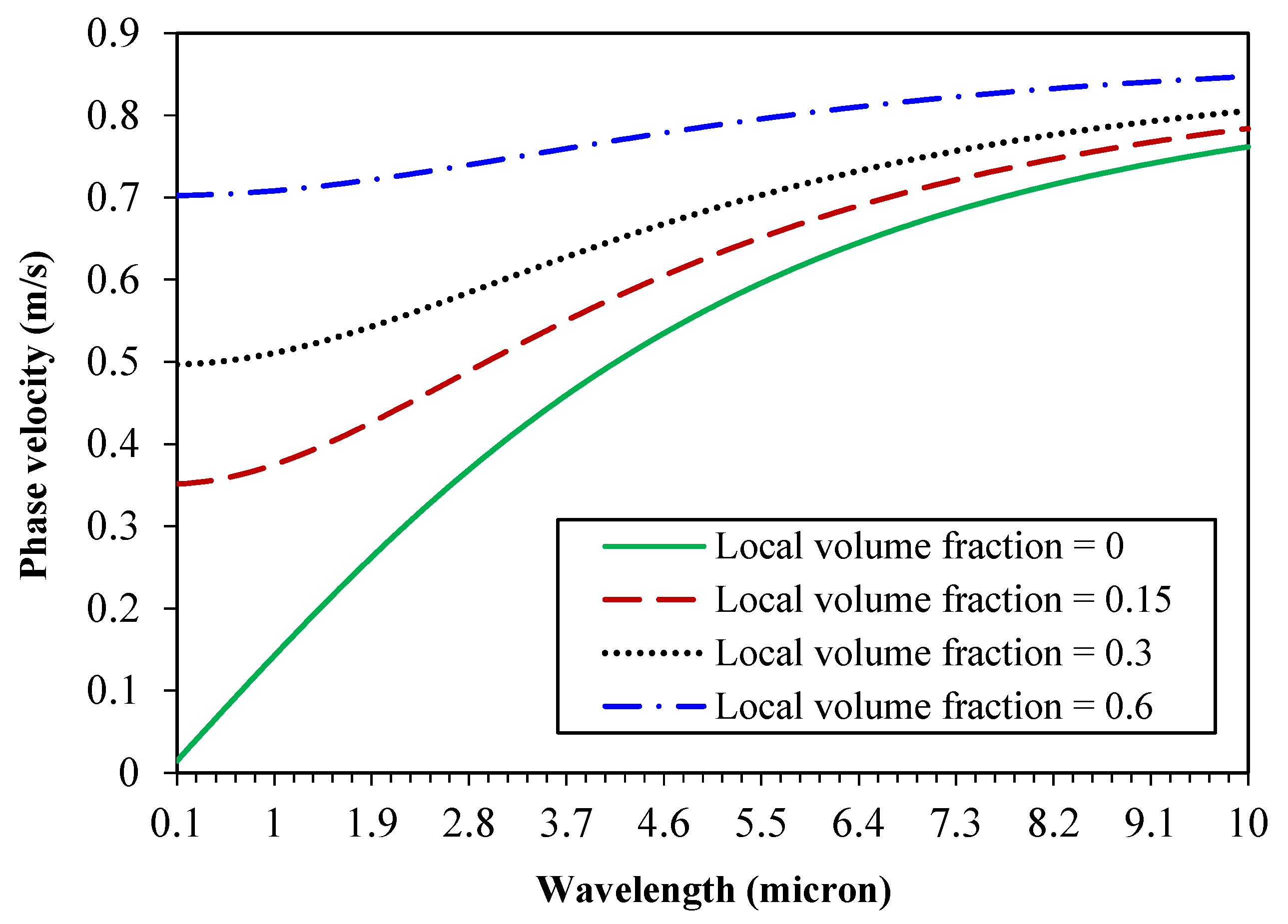
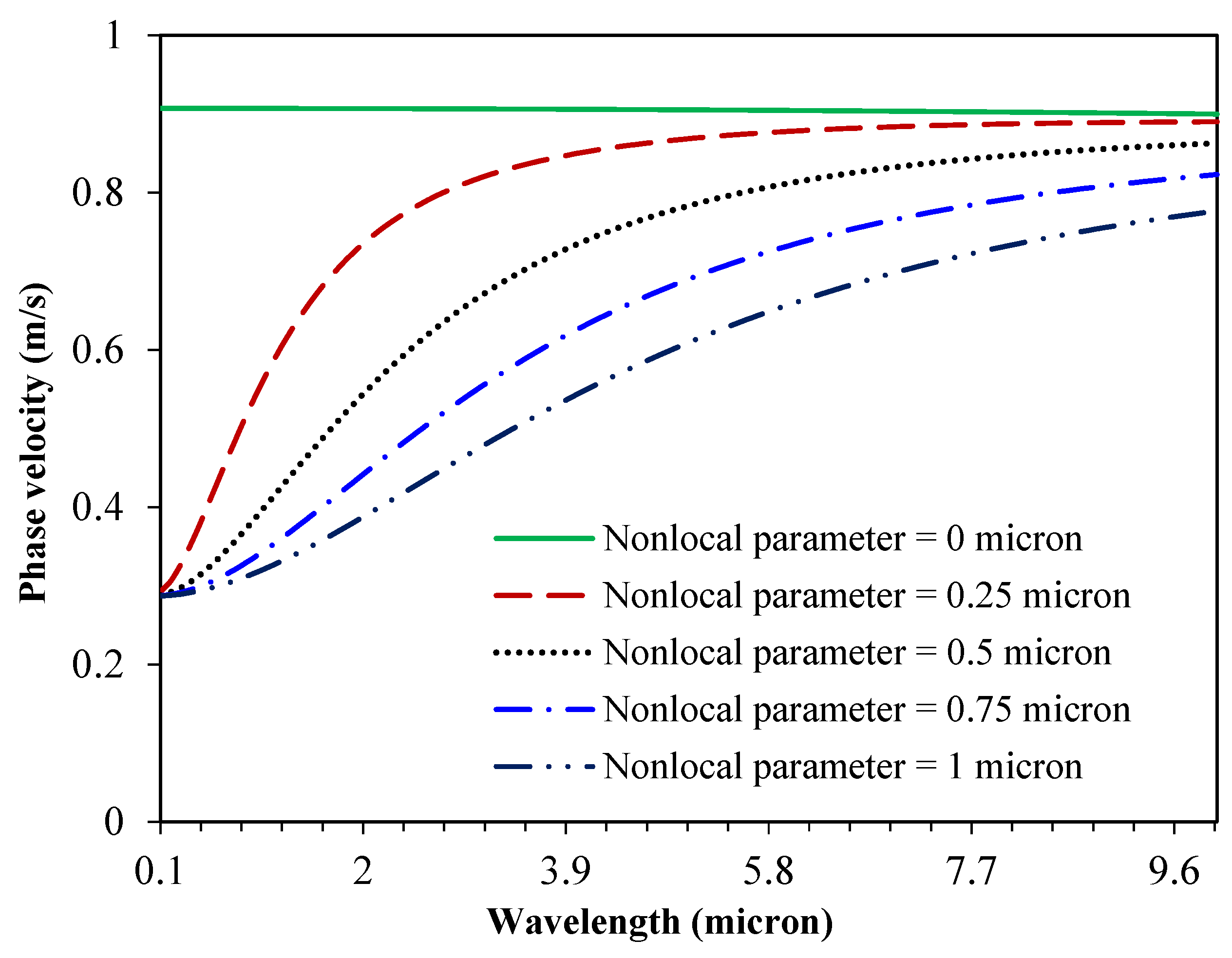
The effects of the local volume fraction and the nonlocal stress parameter on the phase velocity of flexural waves propagated within the breast duct are depicted in
Figure 6 and
Figure 7, respectively. Surface effects of both the luminal epithelial cell layer and the basement membrane are captured. Surface residual tension and stromal matrix coefficients are set to zero to purely investigate the effect of local volume fraction and nonlocal parameter. It can be concluded that the local volume fraction has an increasing impact on the phase velocity, while increasing the stress nonlocality results in a significant reduction in the phase velocity. Additionally, the effects of both local volume fraction and nonlocal stress parameter are more pronounced at lower wavelengths.
Figure 8 and
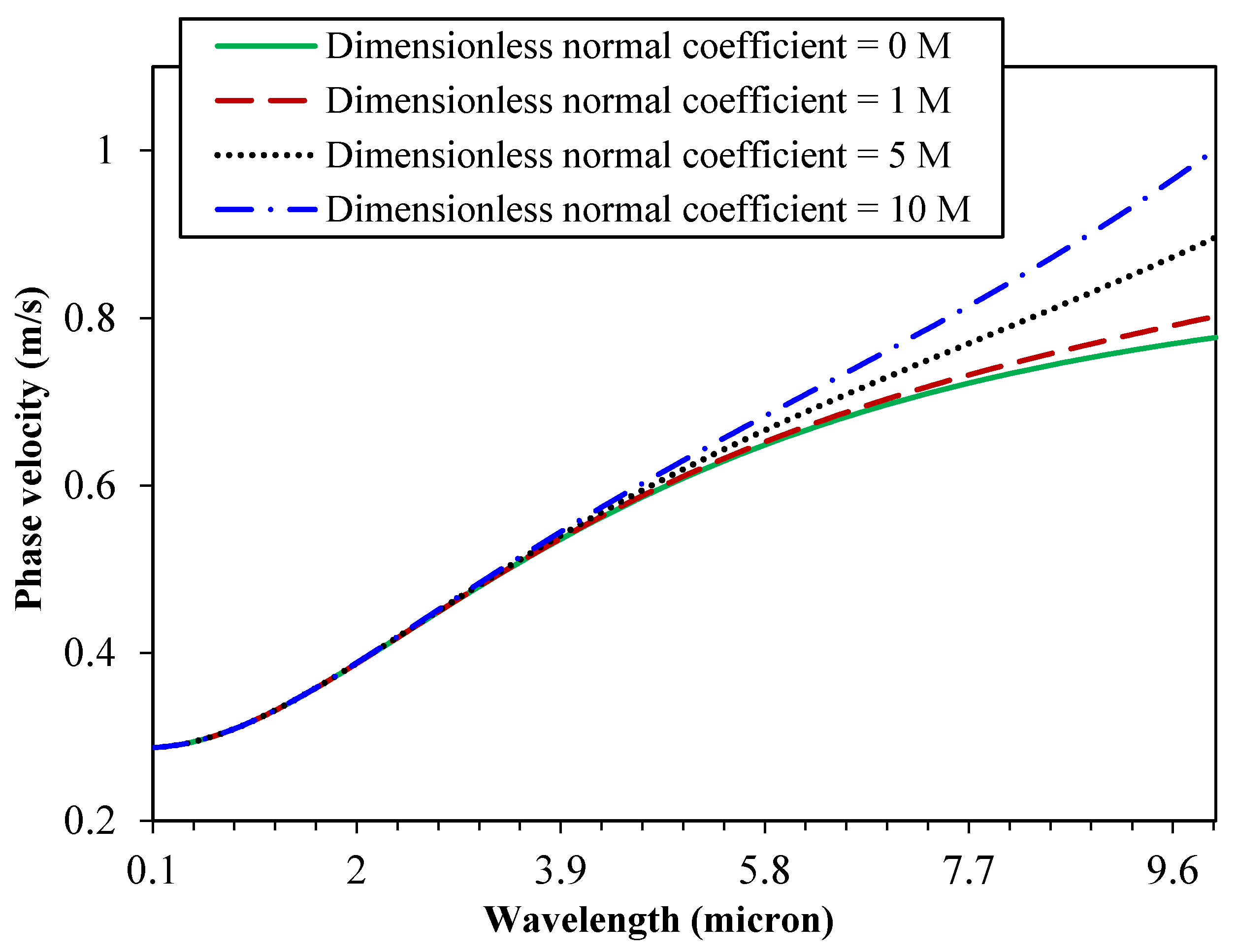
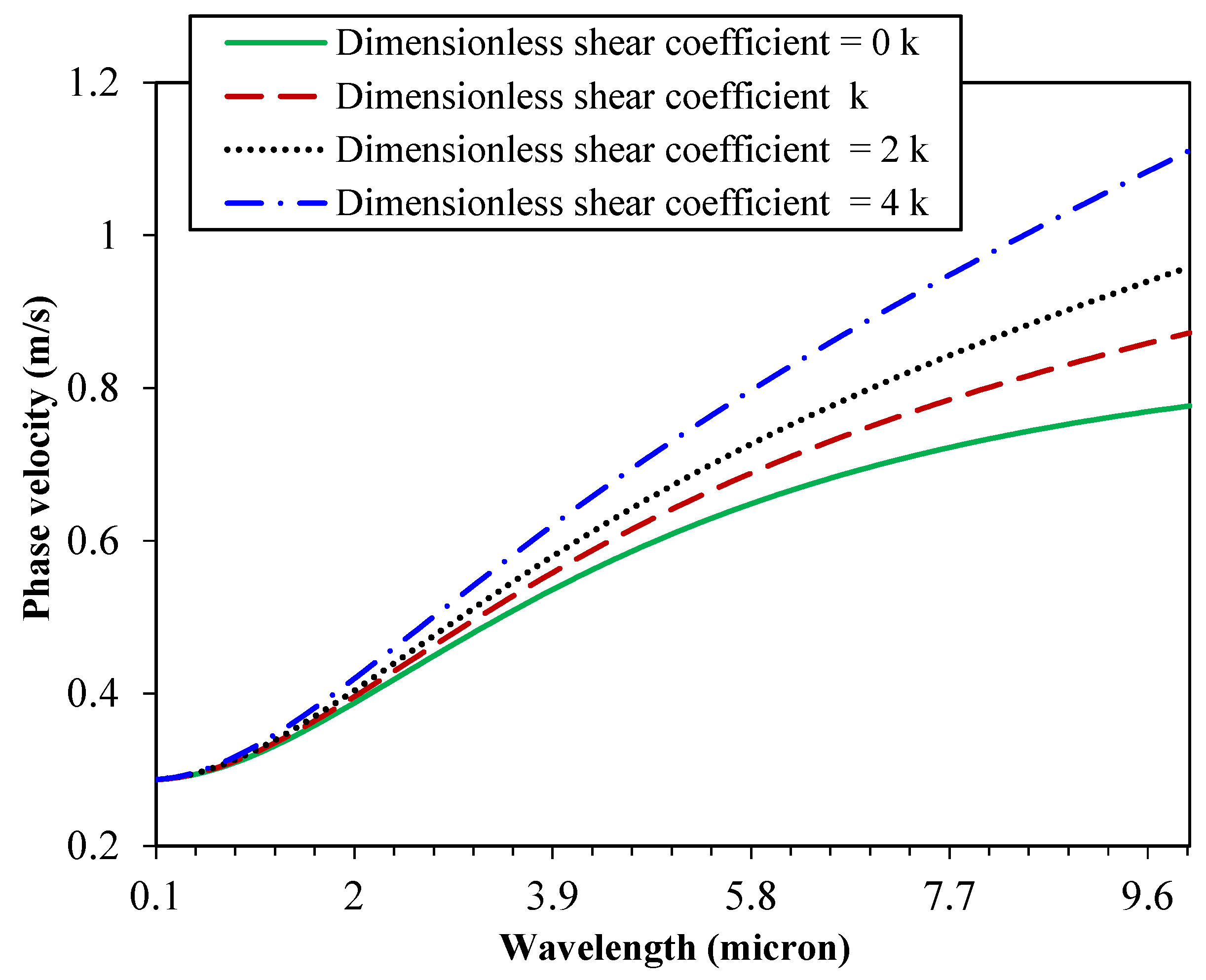
Figure 9 show the effects of normal stiffness and shear coefficient of the stromal matrix that surrounds the small-scale breast duct on the phase velocity of flexural waves, respectively. The surface residual stress is set to zero. The nonlocal stress coefficient and the nonlocal volume fraction are respectively taken as 1 micron and 0.9. Other biomechanical and geometrical properties of the breast duct are assumed to be the same as those mentioned above at the beginning of this section. It is found that at shorter wavelengths, the impact of the normal stiffness coefficient of the surrounding stromal matrix is not strong, particularly compared to higher wavelengths, where this effect becomes more pronounced. Both the normal stiffness coefficient and the shear coefficient of the stromal matrix have an increasing effect on the phase velocity of flexural wave propagation within the small-scale breast duct.
Table 3 lists the dimensionless phase velocity for two different epochs (50 and 200) and a range of non-dimensional wavelength parameters. The prediction made by the neural network model is compared with those of the ground truth ones. The percentage error is calculated by 100 × (Predicted value − Ground truth value)/(Ground truth value). Thirty percent of the dataset is considered the test, and the remaining is used for training. The NN architecture is made of a flattened layer followed by three distinct hidden layers and an output layer. A total of 512, 128, and 10 neurons are implemented in the first, second, and third hidden layers, respectively. All hidden layers use the ReLU activation function, enabling the incorporation of nonlinear patterns in the biomechanical data. The NN model is configured to estimate the phase velocity, and thus the output layer contains a single neuron. The deep learning modelling is conducted using Keras (version: 3.10.0) [
53]. A reasonable agreement is found between the results of the deep learning model and those of the advanced two-phase nonlocal integral model, indicating that a well-designed neural network made of several hidden layers can learn complex biomechanical patterns. The maximum percentage error when the model is only trained for 50 epochs is 6.7264%, while the maximum percentage error reduces to 4.1611% when we train the model for another 150 epochs.
In addition to the NN model, ML modelling is performed using other approaches, including random forest, gradient boosting, Ridge, and logistic regressors for comparison purposes (refer to
Table 4). Both random forest and gradient boosting models have been trained using 300 estimators. The learning rate is taken as 0.05 for the gradient boosting model (
Table 1). In both logistic regression and Ridge models, an intercept term (bias term) is taken into account during training. In the Ridge model, the solver is automatically chosen based on the type of data. No restriction is imposed on the total number of iterations. The tolerance value of the logistic regression and Ridge model is 1 × 10
−6 and 0.0001, respectively. The random forest modelling, gradient boosting regression, Ridge, and Logistic regression are conducted using Scikit-learn library version 1.6.1 [
58]. From
Table 4, it is found that the maximum percentage error of the random forest model is 1.0228%, while the gradient boosting model shows a maximum percentage error of 2.0881%. In comparison with the random forest and gradient boosting, the maximum error is higher for the Ridge regression and logistic regression, reaching to 11.696% and 6.00%, respectively.
Table 5 shows the mean absolute error (MAE),
R2 score, and mean squared error (MSE) for all ML models developed in this study and for both the training and test datasets. These metrics and parameters allow for a reasonable overall comparison between all models, considering the entire dataset. The neural network, random forest, and gradient boosting models all exhibit an
R2 score of 0.99 or above for the training data. However, when evaluated on the training data, this score is lower for the Ridge (
R2-score = 0.95) and logistic (
R2-score = 0.97) regressors. The
R2 score of the test data for the NN, random forest, and gradient boosting is
R2-score > 0.98, indicating their validity for the prediction of the wave characteristics of small-scale breast ducts. The
R2 scores of the Ridge and logistic regressors on the test data are 0.95 and 0.96, respectively. A similar evaluation is performed using the mean squared error. The gradient boosting and random forest algorithms exhibit the lowest MSE, while the Ridge regression model possesses the maximum MSE on both the training and test datasets. Furthermore, the mean absolute error of the gradient boosting and random forest algorithms on both the test and training datasets is lower than 0.0069. For the NN model, the MAE is 0.0195 and 0.0209 on the test and training datasets, respectively. The Ridge model displays a higher MAE of 0.0336 and 0.0423 on the test and training data, respectively. The MAE of the logistic regression on both the test and training data is about 0.033.
To evaluate the risk of potential overfitting and reduce sensitivity to a single training/test data split, 5-fold cross-validation was performed using consistent folds across all models. Performance was evaluated using RMSE, MAE, and R
2 score. Each metric score is listed as mean ± standard deviation (SD). The mean and SD are calculated for each metric score across all folds. The results of the cross-validation study for the random forest model are shown in
Table 6. Close agreement between training and validation metrics is found with a low variance across the five different folds. This indicates the stable generalization capacity of the ML model despite the limited sample size.
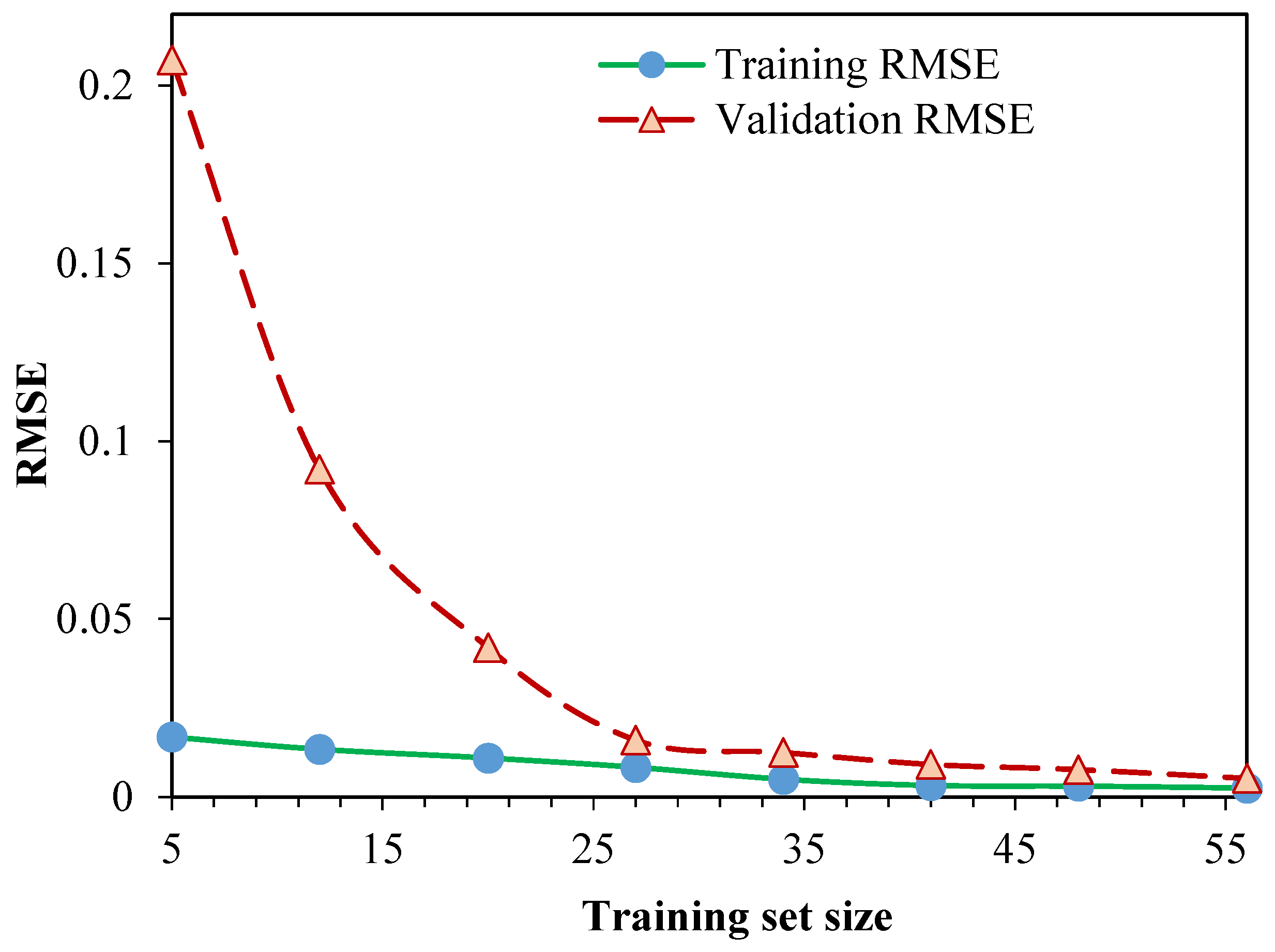
In
Figure 10, the learning curves of the random forest model are plotted in order to show the variation of root mean squared error (RMSE) as a function of training set size. When smaller training sizes are used, the validation RMSE is substantially higher than the training RMSE. This implies restricted generalization capacity due to inadequate data for training. As the training set size increases, the validation RMSE gradually decreases and converges towards the training RMSE. The close agreement between the two curves at larger training sizes indicates high generalization capacity and shows that the model does not suffer from overfitting. These results confirm the robustness of the random forest model despite the limited dataset size.
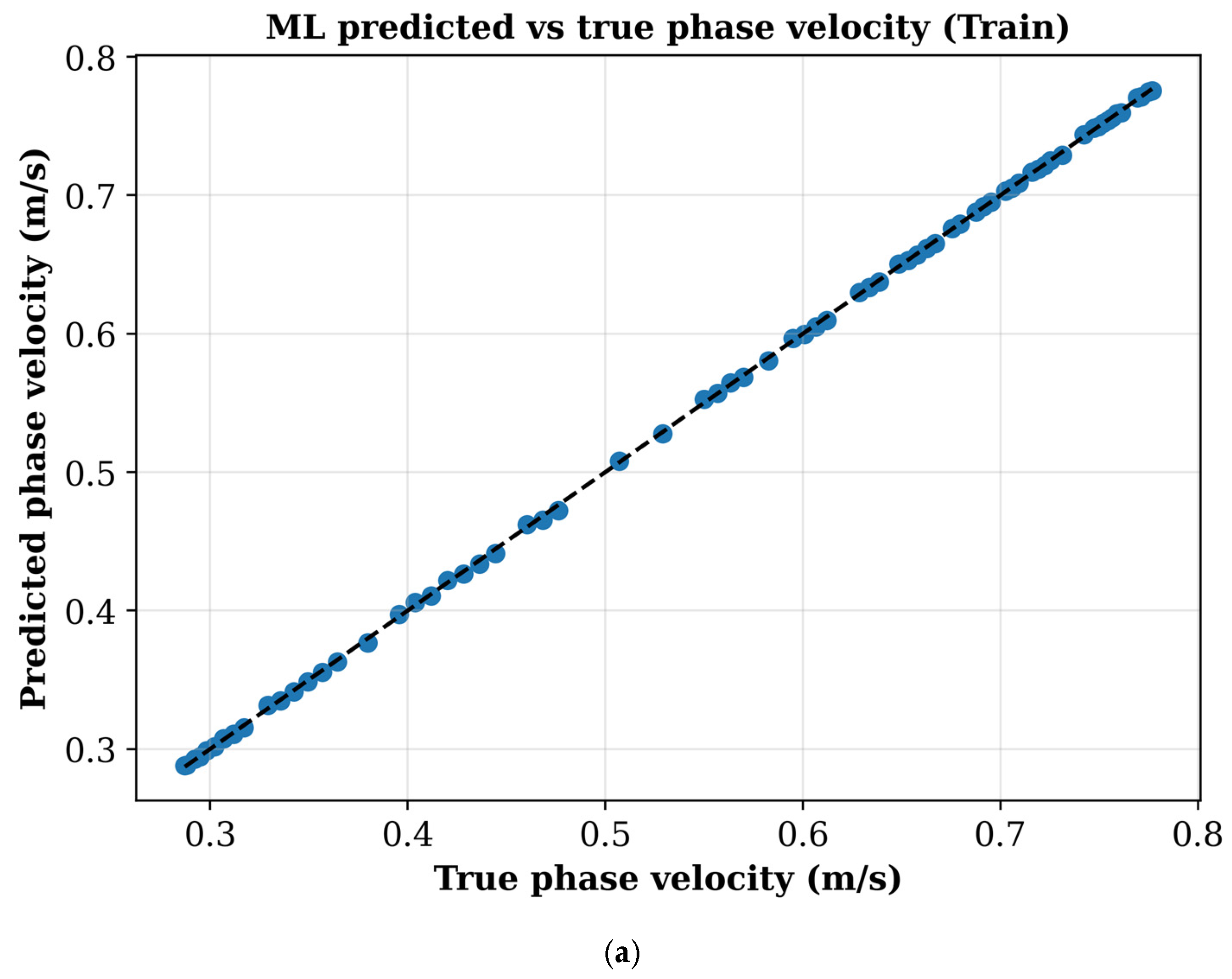
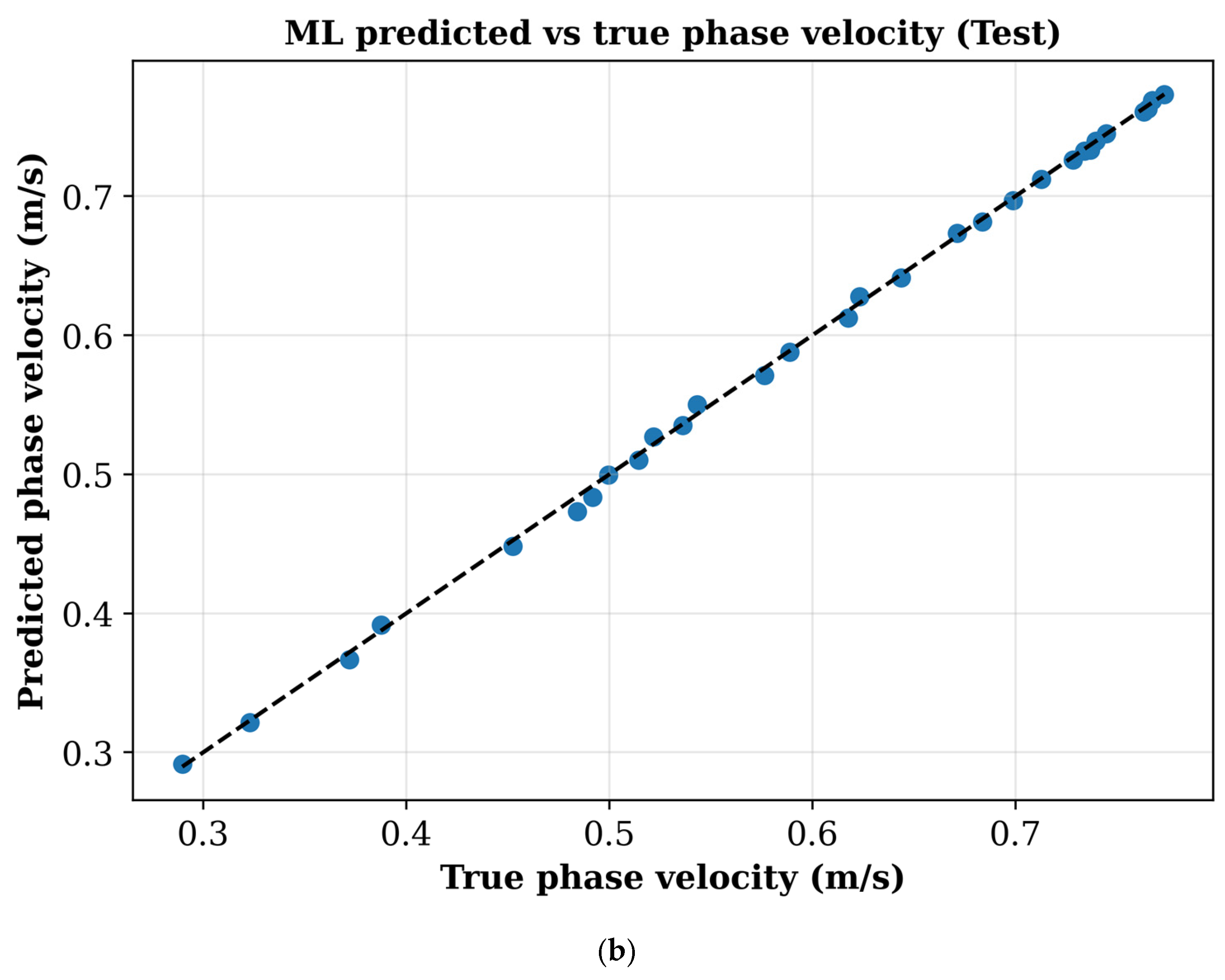
Figure 11 shows the phase velocities predicted by the random forest model versus the true phase velocities used for training and test datasets. The ML model’s predictions generally follow the one-to-one reference line (i.e., the ideal line), indicating reasonable agreement between the model results and the true values obtained by the experimentally-enhanced two-phase nonlocal integral approach. No clear systematic bias is observed across different points. This demonstrates that the random forest model is capable of capturing the overall trend of data without potential overfitting.
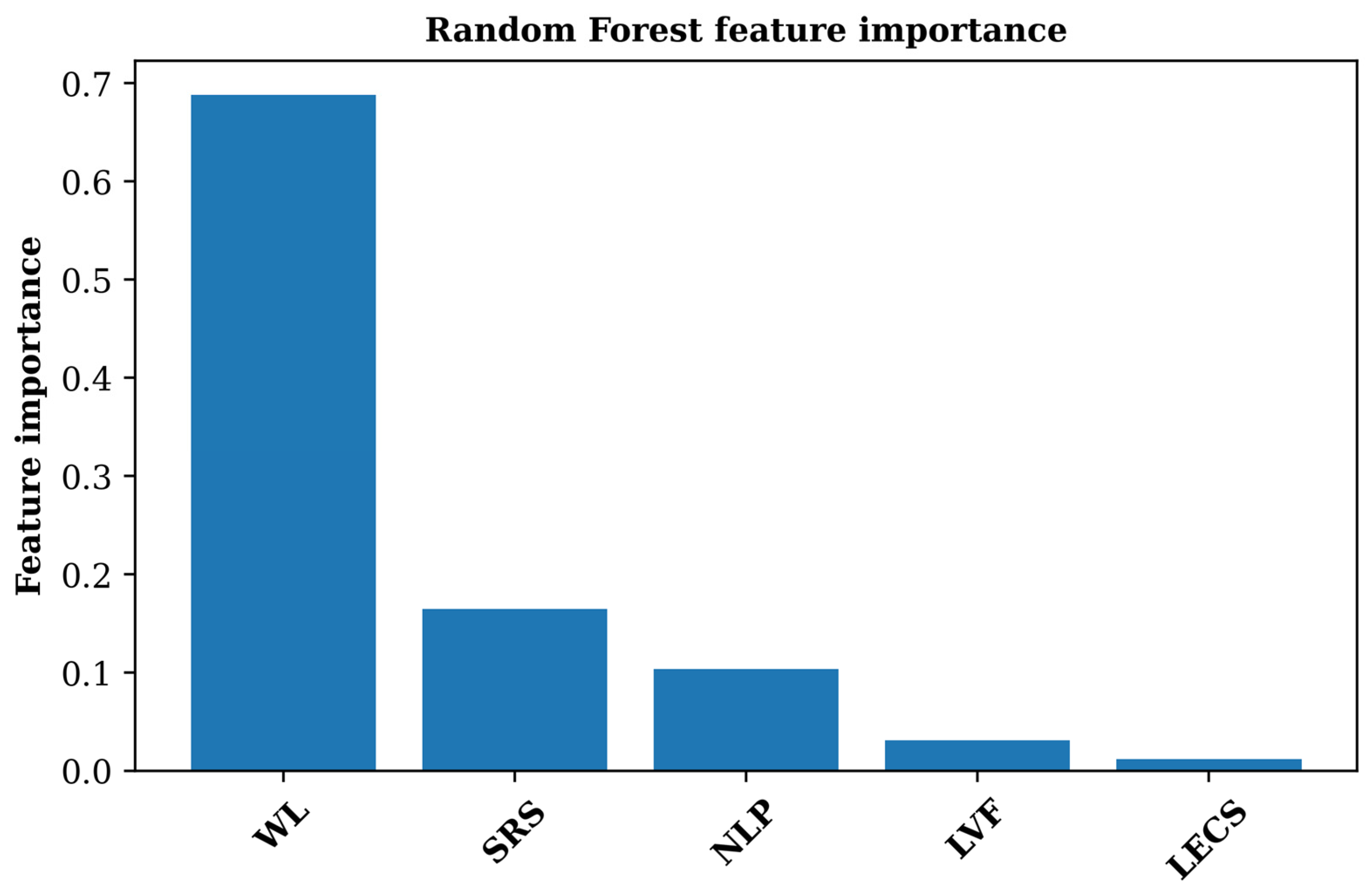
Figure 12 depicts a feature importance analysis based on the random forest model. It is found that wavelength (WL) is the dominant predictor of phase velocity, accounting for approximately 69% of the total importance. This demonstrates the primary role of wavelength in the propagation response of small-scale breast ducts. Surface residual stress (SRS) and the nonlocal parameter (NLP) contribute moderately to the predicted phase velocities, indicating that surface effects and nonlocal stresses also influence wave propagation characteristics. In contrast, local volume fraction (LVF) and the percentage increase in luminal epithelial cell (LEC) stiffness exhibit relatively small contributions.
5. Discussion
Ductal carcinoma in situ (DCIS) is a non-invasive malignant condition in which abnormal cells grow within the breast milk duct. These abnormal cells are confined to the duct and have not spread past the basement membrane. These abnormal cells usually appear at the inner surface of the luminal epithelial cell layer of the breast duct, leading to an increase in its mechanical stiffness [
29]. DCIS is currently treated surgically; however, research is underway to de-escalate treatment, as many DCIS cases do not progress to invasive breast cancer [
60]. Experimental and clinical studies indicate that biomechanical features can be used as a promising tool for the detection of DCIS [
29,
61] which could assist in active surveillance if surgical removal is not conducted. In this study, it is found that an increase in the stiffness of the luminal epithelial cell layer results in a gradual increase in the phase velocity of flexural wave propagation within the breast duct (
Figure 3). This increasing effect is due to the enhancement of the overall rigidity of the duct. When the elasticity coefficient of any surface layer is increased, the flexural rigidity is proportionally increased in a direct mathematical relationship (see Equation (8)).
The surface residual tension in both the basement membrane and the luminal epithelial cell layer is linked to a significant enhancement in the phase velocity of the breast duct (
Figure 4). When the residual surface tension increases in either of these layers, it amplifies the corresponding transverse loading caused by that surface layer. This consequently elevates the breast duct resistance to deformation and yields a greater phase velocity. This finding is well supported by the studies conducted in the field of surface energy and its influence on the biomechanical features of biological components [
62].
The luminal epithelial cell layer has a greater impact on the flexural wave characteristics of the breast duct, as can be concluded from
Figure 5. When only surface effects associated with the basement membrane are incorporated into the two-phase nonlocal integral model, the phase velocity is slightly higher than that of the model with no surface effects. However, the continuum model with only surface effects of luminal epithelial cells exhibits a dramatically greater phase velocity, which is close to that of the model with both surface effects of the BM and LEC layers. One reason the luminal epithelial cell layer has a higher impact on the phase velocity than the basement membrane is that its thickness is several orders of magnitude greater [
54]. Greater thicknesses improve the small-scale flexural structural rigidities and lead to higher phase velocities.
The two-phase nonlocal integral continuum model presented in this study is capable of incorporating both local and nonlocal stresses. When the local volume fraction is set to zero (
), the influence of the local stress vanishes, and the total stress is equal to the nonlocal stress. On the other side, the stress nonlocality effect disappears when the nonlocal volume fraction is zero, and the two-phase nonlocal integral model reduces to that of classical continuum mechanics. Increasing the local volume fraction increases the phase velocity, as a reduction in the nonlocality of the mechanical stress is linked to stiffness enhancement that consequently increases the phase velocity [
63]. Furthermore, the influence of the local volume fraction on the phase velocity of the breast duct is more pronounced at small wavelengths (
Figure 6). This is because the nonlocal interactions between individual cells within the breast duct are enhanced by reducing the wavelength.
The effect of the nonlocal parameter on the phase velocity of small-scale breast ducts is crucial. When the nonlocal parameter is increased, scale effects become more dominant, indicating the growing contribution of cellular-level interactions that classical continuum theory cannot model. Nevertheless, when this parameter is set to zero, the stress nonlocality influence vanishes, and the two-phase model reduces to the local continuum model with surface effects. Higher nonlocal parameters systematically reduce the duct phase velocity (
Figure 7), reflecting that stress nonlocality weakens the duct’s effective resistance to the deformation associated with flexural wave propagation at small scales. This behaviour highlights the importance of nonlocal stresses in accurately predicting the biomechanical behaviour of small-scale breast ducts. Additionally, the impact of nonlocal stresses becomes more significant at smaller wavelengths (
Figure 7). This phenomenon occurs since decreasing the wavelength amplifies ultrasmall-level interactions, hence strengthening the nonlocal stress contribution on the phase velocity.
The roles of the stromal matrix’s normal stiffness and shear coefficients in the phase velocity response of flexural waves propagating along a small-scale breast duct are presented in
Figure 8 and
Figure 9, respectively. The normal stiffness of the surrounding stromal matrix has a wavelength-dependent influence on the phase velocity. At shorter wavelengths, its effect is relatively negligible. However, as the wavelength increases, the effect of the normal stiffness gradually becomes more important. Longer wavelengths involve larger parts of the duct–matrix interface; therefore, it enhances the contribution of normally distributed load induced by the surrounding stroma. Moreover, it can be concluded that a stiffer stromal matrix, which is numerically simulated by a greater normal stiffness coefficient, increases the duct’s resistance to lateral dynamic deformation. This enhanced resistance consequently increases the phase velocity. A similar trend is found for the shear stiffness of the stromal matrix (
Figure 9). When the shear coefficient is raised, the phase velocity increases, highlighting the enhanced resistance of the surrounding matrix to shear-induced deformation of the breast duct.
The results of the ML modelling conducted in this study demonstrate that NN- and ensemble-based models provide highly accurate predictions of the phase velocity of small-scale breast ducts across a wide range of wavelengths (
Table 3,
Table 4 and
Table 5). The NN, random forest, and gradient boosting models all exhibit high
R2 scores with low MAE and MSE for both the training and test datasets. This indicates that these models have a high capability of generalization and do not exhibit overfitting, although they possess a complex architecture with a high number of estimators or neurons. The consistency of the metrics scores found for multiple ML models, including random forest, gradient boosting, and neural network, shows the ability of these approaches to effectively capture the nonlocal stress and the surface stiffness influences on the phase velocity. These patterns and effects are difficult to detect using simpler ML techniques such as Ridge regression and logistic regression. The reduced
R2 score and relatively higher MSEs observed for the Ridge and logistic regressors indicate the restrictions of linear models in predicting the intrinsic biomechanical response of breast ducts at small scales. In contrast, it is found that deep learning and ensemble ML models offer powerful and computationally efficient platforms to simulate the biomechanical behaviour of small-scale biological components.
The use of ML models in biomechanical applications is practically restricted by the limited availability of quality clinical observations and experimentally measured data. Precise measurements at the cellular scale are time-consuming, costly, and complex, which limits the ability to achieve a large, diverse training dataset required for deep learning and ensemble-based ML approaches. This insufficiency raises the risk of overfitting in the machine learning model, limiting the robustness of discovered patterns, and reducing the model’s generalization capability, particularly on unseen data obtained from another laboratory or clinical setting. To mitigate this, augmenting training data by the incorporation of computationally generated data, derived from accurate continuum models, provides an effective tool for enhancing and diversifying training datasets. By enabling machine learning models to learn from underlying biomechanical relations, training datasets are strengthened, model generalization is improved, and the performance of ML models trained under data-constrained conditions is enhanced.
Table 7 compares the computational cost, scalability, and predictive capability of various theoretical frameworks for modeling wave propagation in small-scale breast ducts. Classical elasticity-based models offer excellent computational efficiency and scalability but fail to capture nonlocal and surface effects. While nonlocal elasticity and two-phase nonlocal integral theories improve physical modeling capability by accounting for long-range stress/strain interactions, their predictive accuracy remains limited in the absence of surface energy effects. On the other side, surface elasticity theory addresses size effects through the incorporation of surface energy and surface residual stress; however, its precision remains limited due to the lack of stress nonlocality. The TPST framework incorporates both nonlocal stress effects and surface energy, leading to substantially improved accuracy, while being associated with higher computational costs and moderate scalability. Integrating TPST with machine learning significantly reduces computational cost while preserving high physical modeling capability.
Table 8 lists the training time, inference performance, and deployment metrics of the neural network model. Training time increases approximately in a linear relationship with the number of epochs, while inference latency remains low, indicating suitability for efficient prediction once the training job is completed.
The main aim of this work is to develop a computational framework to describe the wave propagation response of small-scale breast ducts using the fundamental geometrical and biomechanical features of the ductal layers, including the basement membrane (BM) and the luminal epithelial cell (LEC) layer. These fundamental features are used as input parameters. For this purpose, we have developed an advanced two-phase nonlocal integral model integrated with machine learning. Variables such as age, race, and body mass index (BMI) may influence the fundamental biomechanical properties of the breast duct and, consequently, the input parameters of the proposed model. However, to the best of our knowledge, there are currently no experimental studies that systematically quantify age-, race-, or BMI-dependent biomechanical properties of the breast basement membrane and luminal epithelial cell layers at small scales. As a result, these effects could not be explicitly incorporated into the present analysis. These limitations show a potential research gap and motivate future experimental studies aimed at characterizing the biomechanical properties of breast ductal layers across different demographic groups. Such data would enable the proposed framework to be extended to investigate the influence of age, race, and BMI on wave propagation behavior.
In this research study, the deep learning model is intentionally implemented as a fully connected feed-forward neural network since the main aim is to learn the relationship between wavelength parameter and phase velocity obtained from the two-phase nonlocal integral model, rather than to model full spatiotemporal wavefields. The input of the NN consists of low-dimensional scalar features (e.g., wavelength, nonlocal parameter, and surface parameters), and the output is a single scalar quantity (i.e., the phase velocity). For this type of data, convolutional, recurrent, or attention-based architectures are not required, as these techniques are commonly used to analyse images or spatiotemporal signals. The selected architecture provides the required capability to capture the underlying patterns that govern the phase velocity response of a single breast duct. This is supported by the close agreement between training, validation, and test results, as well as the learning-curve analysis. More advanced deep learning architectures, including convolutional, recurrent, or attention-based structures, could be highly valuable when spatial or temporal wavefield data are available. Approaches such as the generative adversarial and self-supervised dehazing network [
65] are therefore considered a promising direction for future work, but their implementation would require high-resolution spatiotemporal measurements.
The proposed two-phase nonlocal integral model can also be described using a variational approach, in which the biomechanical response of breast ducts is governed by energy-based functionals. From this point of view, wave propagation, surface effects, and nonlocal interactions can be interpreted using the minimization of appropriately defined variational principles. Variational approaches have been employed to provide a mathematically consistent and physically interpretable framework for modelling complex systems [
66,
67,
68]. Recently, a variational nighttime dehazing framework (VNDHR) has been proposed to improve image visibility by addressing multiple degradations such as haze, glow, noise, and weak illumination [
67]. This framework integrates a physically motivated degradation model with hybrid regularization to recover structure-aware illumination and noise-suppressed reflectance.
6. Conclusions
A two-phase nonlocal integral model has been developed to examine the flexural wave propagation characteristics of small-scale breast ducts. By incorporating residual surface tension, surface energy, stromal matrix effects, as well as local and nonlocal stresses, the proposed modified continuum model was capable of capturing a wide range of small-scale structural and biomechanical features that traditional continuum models were unable to simulate. The breast duct was modelled as a multi-layered biological component consisting of basement membrane, myoepithelial cells, and luminal epithelial cells. The surface properties of the LEC and the BM were incorporated in the constitutive equations. The model results showed an excellent agreement with available MD simulations, indicating the capability of the two-phase nonlocal integral approaches to describe cellular-level biomechanical behaviour. An increase in the surface stiffness of the LEC and basement membrane layers resulted in higher phase velocities by improving the flexural rigidity of the breast duct. By contrast, higher nonlocal stresses reduced the phase velocity because of the softening impact of nonlocal stresses on the overall flexural rigidity. The normal and shear stiffness coefficients of the surrounding stromal matrix significantly influenced wave propagation characteristics, particularly at larger wavelengths where matrix–duct interactions became more pronounced.
In addition to the theoretical framework, several machine learning models, including deep neural networks, random forest, gradient boosting, Ridge regression, and logistic regression, were developed and integrated with the two-phase nonlocal integral approach to enhance computational efficiency and provide flexible and clinically adjustable modelling tools. The deep learning and ensemble-based ML models accurately estimated the phase velocity of breast ducts across a broad range of wavelengths, achieving a high R2 score of 0.98 or above and a low MSE of 0.0006 or less on both training and test datasets. The close agreement of performance metrics for the training and test datasets for the NN, random forest, and gradient boosting models indicated strong generalization capability with no sign of overfitting. However, linear ML algorithms such as the Ridge model and logistic regression exhibited relatively lower R2 scores and higher MSE, highlighting their restrictions in the simulation of nonlinear patterns caused by the surface energy and nonlocal effects.
To address the challenge of the limited availability of quality experimental data in clinical settings, the proposed approach could enable continuum mechanics-based data augmentation generated from the governing nonlocal integral equations. By enabling ML models to learn from fundamental biomechanical relationships derived from advanced continuum theories, model robustness and predictive capability can be enhanced, particularly under data-constrained conditions. The two-phase nonlocal integral model integrated with machine learning provides a powerful mathematical platform for understanding the biomechanical characterization of breast ducts and contributes toward the development of imaging tools to detect changes associated with DCIS at the cellular level.