Article

Improved Approximation and Theory of Solutions to Squeezing of Fluid Between Two Plates
by
Anjum Mustafa Khan Abbasi
1 and
Christopher C. Tisdell
2,*
1
School of Natural Science, National University of Sciences and Technology, Islamabad 44000, Pakistan
2
School of Mathematics and Statistics, The University of New South Wales, UNSW, Sydney, NSW 2052, Australia
*
Author to whom correspondence should be addressed.
Mathematics 2026, 14(4), 707; https://doi.org/10.3390/math14040707
Submission received: 16 December 2025 / Revised: 22 January 2026 / Accepted: 15 February 2026 / Published: 17 February 2026
(This article belongs to the Special Issue Applied Mathematics in Fluid Mechanics and Flows)

Abstract

Despite the significant interest from research communities in understanding the squeezing flow of fluid between two plates, important qualitative and quantitative questions regarding solutions to these squeezing flow models still remain unanswered, including existence, uniqueness, location, approximation, and convergence. Thus, the purpose of the present paper is to construct a firm mathematical basis that establishes the above knowledge for the squeezing flow model and its boundary value problem.

1. Introduction

Squeezing flow involves fluid dynamics between two moving boundaries. Due to numerous applications, squeezing flow models have received considerable interest from scientific and engineering communities. For instance, pioneering scholars include Stefan [1] and Reynolds [2], while more modern contributors include Rashidi et al. [3], Tisdell [4,5], Qayyum et al. [6], Ullah et al. [7], Fathollahi et al. [8], Ghoneim et al. [9], Mumammad et al. [10], Velisoju and Murthy [11], Ozeki at al [12], Mandal and Ghosh [13] and include the case of porous boundaries [14].
Wang [15] derived a boundary value problem (BVP) involving an ordinary differential equation for the unsteady squeezing of a viscous fluid between two plates, and applied perturbation methods to generate approximations to the fluid’s velocity field. More recently, Khan et al. [16] developed polynomial approximations for the fluid’s velocity components via shooting methods for said boundary value problem.
Despite the aforementioned progress and high levels of interest ([15] has in excess of 150 citations according to Google Scholar at the time of writing), important qualitative and quantitative aspects of solutions to the squeezing flow problem still remain unknown, such as: existence; uniqueness; location; approximation; and convergence. Thus, the purpose the present paper is to construct a firmer mathematical basis that establishes the above knowledge for the squeezing flow model and its boundary value problem.
Our strategy involves a sequential approach. In particular, we introduce a recursively-defined sequence of functions involving a nonlinear integral based on Picard iterations ([17], Section 2), [18,19]. We compare these iterations with previous approximations in the literature, such as perturbations and shooting techniques. We discover that our truncated second-order iterants provide better approximations than previous forms. We then prove that, for sufficiently low squeezing number, our sequence of functions is guaranteed to converge, and that the limit function will be a solution to our original squeezing flow boundary value problem.

2. Problem Formulation

Let us briefly introduce the model and the particular equations that will be considered, drawing on the literature of Wang [15] and Khan et al. [16] where additional details can be found.
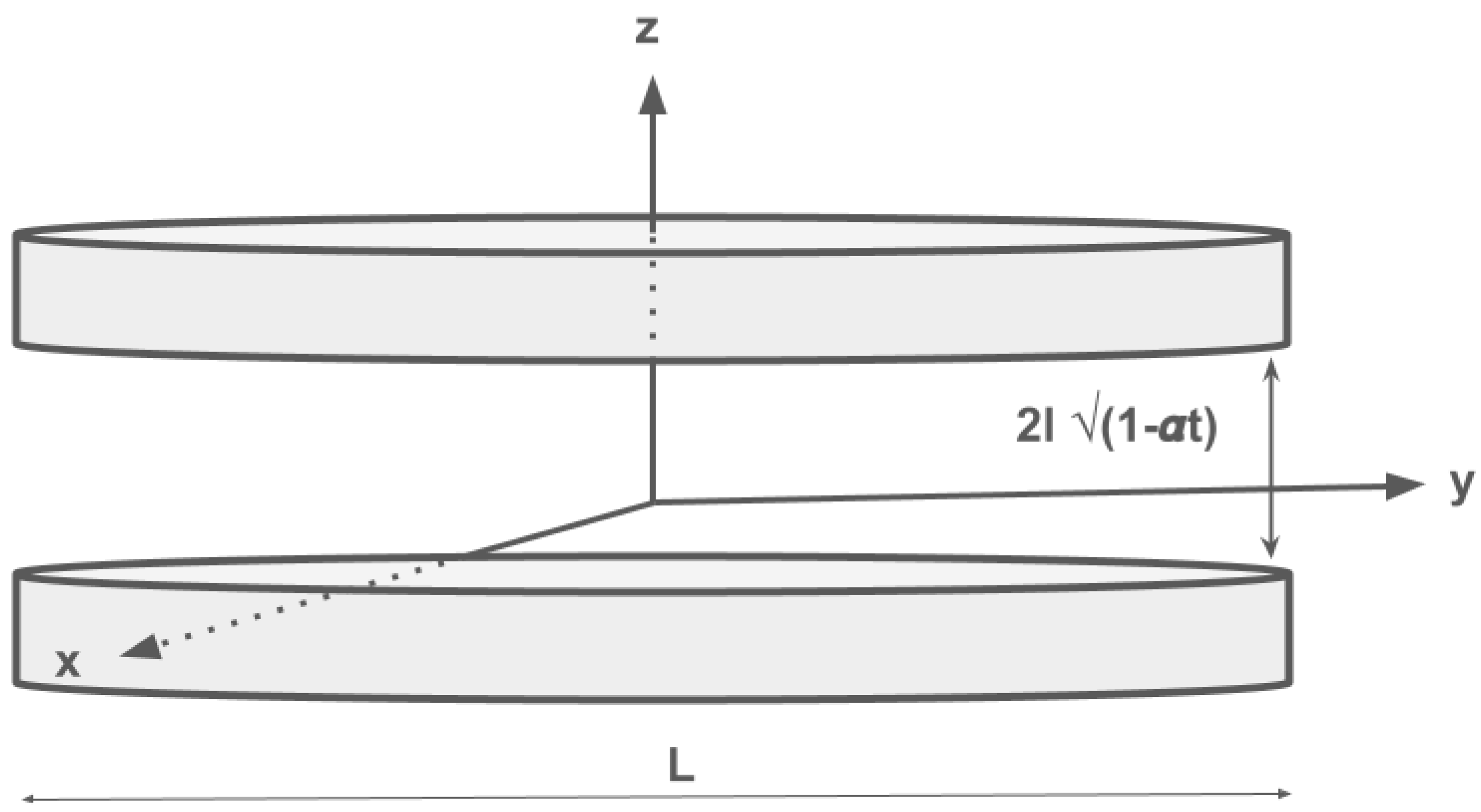
Consider two plates that are both parallel to the x y plane and lie at z = ± l 1 α t , where ± l signifies their positions at time t = 0 , and α is a constant that designates the unsteadiness of the plates, see Figure 1.
For positive values of α , the two plates move closer together and touch when t = 1 / α . For negative values of α , the two plates move apart. The gap between the plates is assumed to be much smaller than their diameter (L in the instance of axisymmetric flow; d in the case of two-dimensional flow) and so any end effects can be disregarded. The lateral velocity of the fluid will be proportional to the distance from the center when considering continuity ([15], p. 579).
For two-dimensional flow, the following forms were introduced by Wang [15]:
λ = z l 1 α t , u = α x 2 ( 1 α t ) F ( λ ) , w = α l 2 1 α t F ( λ ) ,
where u and w represent the velocity field components in the x and z directions, and F is a sufficiently smooth, unknown function that is to be determined or approximated.
The forms in (1) were substituted into the two-dimensional Navier–Stokes equations to produce the nonlinear differential equation
F = S ( λ F + 3 F + F F F F )
where S : = α l 2 / 2 ν is known as the non-dimensionalized squeeze number, and ν is the kinematic viscosity.
For the axisymmetric flow case, and with v the velocity component in the y direction, the following substitutions
λ = z l 1 α t , u = α x 4 ( 1 α t ) F ( λ ) , v = α y 4 ( 1 α t ) F ( λ ) , w = α l 2 1 α t F ( λ ) ,
produced the differential equation
F = S ( λ F + 3 F F F ) .
The differential Equations (2) and (4) thus fell under the general problem
F = S ( λ F + 3 F + β F F F F ) ,
where β = 0 gives the axisymmetric case, and β = 1 gives the two-dimensional case.
For both of the above cases, the lateral velocities of the plate were zero, and the normal velocity was identical to the velocity of the plate, yielding boundary data:
F ( 0 ) = 0 , F ( 0 ) = 0 , F ( 1 ) = 1 , F ( 1 ) = 0 .

3. Preliminary Results

The following preliminary results involve establishing an equivalent integral form, and lists some helpful bounds on the Green’s function that will support our investigation.
Theorem 1.
The BVP (5), (6) is equivalent to the integral equation
F ( λ ) = 0 1 H ( λ , r ) S r F ( r ) + 3 F ( r ) + β F ( r ) F ( r ) F ( r ) F ( r ) d r + F 0 ( λ ) , λ [ 0 , 1 ] .
Above: H ( λ , r ) is a Green’s function
H ( λ , r ) : = 1 12 r ( 1 λ ) 2 [ ( r 2 3 ) λ + 2 r 2 ] , f o r 0 r λ 1 , λ ( 1 r ) 2 [ ( λ 2 3 ) r + 2 λ 2 ] , f o r 0 λ r 1 ;
and F 0 is given by
F 0 ( λ ) = 1 2 ( 3 λ λ 3 ) .
Proof. 
Although the specific form (7) is new, the Green’s function in (8) is found in ([20], Theorem 2.1), with the proof of Theorem 1 following similar lines. We thus omit it for brevity. □
There exist constants β i such that for i = 0 , 1 , 2 , 3
β i : = max λ [ 0 , 1 ] 0 1 ( i ) λ ( i ) H ( λ , r ) d r , for all λ [ 0 , 1 ] ,
see ([20], Section 3).

4. Main Results

4.1. Improving Approximation

Let us construct some Picard iterants ([5], Section 2). We introduce the sequence of functions F n for n = 0 , 1 , 2 , and defined on [ 0 , 1 ] via
F 0 ( λ ) : = 1 2 ( 3 λ λ 3 ) ,
F n + 1 ( λ ) : = 0 1 H ( λ , r ) S r F n ( r ) + 3 F n ( r ) + β F n ( r ) F n ( r ) F n ( r ) F n ( r ) d r + F 0 ( λ ) .
Let us calculate the approximations F 1 and F 2 to give a sense of what the above sequence produces, to wit:
F 1 ( λ ) = 3 2 λ 1 2 λ 3 S 37 560 λ 73 560 λ 3 + 1 16 λ 5 + 1 560 λ 7 S β 3 112 λ 33 560 λ 3 + 3 80 λ 5 3 560 λ 7 ;
and
F 2 ( λ ) = 3 2 λ 1 2 λ 3 37 560 λ S 3 112 β λ S + 73 560 λ 3 S + 33 560 β λ 3 S 1 16 λ 5 S 3 80 β λ 5 S 1 560 λ 7 S + 3 560 β λ 7 S + 115 68992 β 2 λ S 2 + 42263 5174400 β λ S 2 + 2551 258720 λ S 2 4111 862400 β 2 λ 3 S 2 6779 323400 β λ 3 S 2 34901 1552320 λ 3 S 2 + 57 11200 β 2 λ 5 S 2 + 29 1600 β λ 5 S 2 + 41 2800 λ 5 S 2 51 19600 β 2 λ 7 S 2 233 39200 β λ 7 S 2 51 39200 λ 7 S 2 + 3 4480 β 2 λ 9 S 2 + 1 1920 β λ 9 S 2 1 1440 λ 9 S 2 1 17600 β 2 λ 11 S 2 + 17 184800 β λ 11 S 2 3 123200 λ 11 S 2 + 93407 18834816000 λ S 3 41963 6278272000 β 3 λ S 3 648059 18834816000 β 2 λ S 3 2397977 56504448000 β λ S 3 9259249 56504448000 λ 3 S 3 + 216143 6278272000 β 3 λ 3 S 3 + 247489 1712256000 β 2 λ 3 S 3 + 4567337 56504448000 β λ 3 S 3 + 2701 6272000 λ 5 S 3 1821 6272000 β 2 λ 5 S 3 11 179200 β λ 5 S 3 99 1254400 β 3 λ 5 S 3 18279 43904000 λ 7 S 3 + 2911 8780800 β 2 λ 7 S 3 + 7397 131712000 β λ 7 S 3 + 4317 43904000 β 3 λ 7 S 3 + 383 2257920 λ 9 S 3 367 11289600 β λ 9 S 3 17 250880 β 3 λ 9 S 3 757 3763200 β 2 λ 9 S 3 4811 206976000 λ 11 S 3 + 10867 206976000 β 2 λ 11 S 3 + 241 9856000 β 3 λ 11 S 3 907 124185600 β λ 11 S 3 9 5125120 λ 13 S 3 + 499 76876800 β λ 13 S 3 59 25625600 β 2 λ 13 S 3 3 732160 β 3 λ 13 S 3 1 48921600 λ 15 S 3 + 37 244608000 β λ 15 S 3 29 81536000 β 2 λ 15 S 3 + 3 11648000 β 3 λ 15 S 3 .
Thus, our new approximations to the velocity field of our fluid may be computed by substituting our F 0 , F 1 or F 2 into the velocity field’s components in (1) or (3), depending on which flow case is of interest. We have included the degrees of the terms involving β in F 2 for completeness, noting that β = β 2 = β 3 since β is 0 or 1.
Now we have an idea of what the above sequence can produce, let us compare it with existing approximations from the literature.
Wang [15] used perturbation methods to obtain the following first-order approximation for solutions to the BVP (5), (6):
F 0 ( λ ) + S f 1 ( λ ) , where : f 1 ( λ ) = 1 560 λ 7 + 35 λ 5 73 λ 3 + 37 λ , β = 0 , 1 280 λ 7 28 λ 5 + 53 λ 3 26 λ , β = 1 ;
and the second-order approximation
F 0 ( λ ) + S f 1 ( λ ) + S 2 f 2 ( λ ) ,
where:
f 2 ( λ ) = 1 140 3 880 λ 11 + 7 72 λ 9 + 51 280 λ 7 41 20 λ 5 + 34901 11088 λ 3 2551 1848 λ , β = 0 , 1 280 1 330 λ 11 + 5 36 λ 9 193 70 λ 7 + 53 5 λ 5 9355 693 λ 3 + 25477 4620 λ , β = 1 .
If we compare, for example, our F 1 with Wang’s first order approximation with β = 0 then we see that they are identical forms. However, a similar comparison between our F 2 and Wang’s second order approximation (13) shows differences in the degree of λ and S , that is, our F 2 is a (higher order) polynomial in λ of degree 15 and in S of degree 3. This suggests that our F 2 may be a more accurate approximation to solutions due to the flexibility associated with higher-degree polynomials. Indeed, this is the case for a range of squeezing numbers. Say, for β = 0 , and for small values of S there is little difference between Wang’s form (13) and F 2 , with both providing good approximations to F. However as S grows, the differences between (13) and F 2 become more significant and F 2 offers a better approximation to the solution F than (13) for cases | S | 5 . Furthermore, for much larger values of S neither our F 2 nor Wang’s (13) can provide a reasonable approximation to the solution.
In Table 1, we compared our F 2 and Wang’s (13) with the numerical solution, which has been generated by Maple’s dsolve with numeric option and trapezoid method in the axisymmetric case, and where the plates move together with S = 3 . Figures have been rounded to 10 significant digits. We see that our F 2 provides a better approximation to F than Wang’s form.
In Table 2, we compared our F 2 and Wang’s (13), with the numerical solution and trapezoid method generated by Maple’s dsolve with numeric option, in the axisymmetric case and where the plates are moving apart with S = 4 . Figures have been rounded to 10 significant digits. Once again, we see that our F 2 provides a better approximation to F than Wang’s form.
Synthesizing the above, our form F 2 provides a better approximation to the squeezing flow solution for a larger range of S values than Wang’s form (13).
Khan et al. [16] used shooting methods for initial value problems to obtain the following general forms for first and second order approximations:
F 0 ( λ ) = A 2 λ + A 4 λ 3 6 ; F 1 ( λ ) = A 2 λ + A 4 λ 3 6 1 30 S A 4 1 120 S A 2 A 4 + 1 120 S β A 2 A 4 λ 5 1 5040 S A 4 2 1 1680 S β A 4 2 λ 7 ; F 2 ( λ ) = A 2 λ + A 4 λ 3 6 1 30 S A 4 1 120 S A 2 A 4 + 1 120 S β A 2 A 4 λ 5 1 5040 S A 4 2 1 1680 S β A 4 2 1 5040 S 2 β 2 A 2 2 A 4 1 504 S 2 β A 2 A 4 + 1 280 S 2 A 2 A 4 1 1680 S 2 A 2 2 A 4 1 120 S 2 A 4 λ 7 + 1 20160 S 2 β 2 A 2 A 4 2 1 8640 S 2 β A 2 A 4 2 + 1 22680 S 2 A 2 A 4 2 + 1 4320 S 2 β A 4 2 13 90720 S 2 A 4 2 λ 9 +
Above, the constants A 2 and A 4 were to be determined from the boundary conditions F ( 1 ) = 1 , F ( 1 ) = 0 . However, this raises several questions, as the following discussion shows. Using the first order approximation F 1 with β = 0 and S = 1 , the two equations for A 2 and A 4 are:
F 1 ( 1 ) = A 2 + A 4 6 1 30 A 4 + 1 120 A 2 A 4 1 5040 A 4 2 = 1 , F 1 ( 1 ) = A 2 + A 4 2 5 1 30 A 4 1 120 A 2 A 4 7 · 1 5040 A 4 2 = 0 ,
which leads to the analysis of a cubic equation, and to three pairs of solutions with decimal approximations, namely:
( A 2 , A 4 ) = ( 1257.905465 , 50.9013460 ) , ( 3.890232410 , 1.572684654 ) , ( 61.79569704 , 4.278481516 ) .
Thus, questions arise regarding the definiteness, uniqueness, and multiplicity in the generation of the approximative sequence F n of Khan et al. [16], and their relationship with solutions to the BVP (5), (6).
Furthermore, Wang did not discuss ideas such as existence or uniqueness solutions, or the convergence of his approximations.

4.2. A Firmer Mathematical Basis

The above discussion naturally motivates interest in understanding the nature of the Picard iterations (11), (12) to our squeezing flow problem (5), (6). We shall now investigate their location, their convergence, and their relationship, if any, with the original squeezing problem (5), (6). Our strategy will rely on two important ideas: uniform convergence of a sequence of functions [21] and completeness of a metric space [22].
Let R > 0 be a constant. For the set of thrice-differentiable functions defined in [ 0 , 1 ] with continuous third derivative denoted by C 3 ( [ 0 , 1 ] ) , we introduce the subset
D R : = { F C 3 ( [ 0 , 1 ] ) : d ( F , F 0 ) R }
and the metric
d ( f , g ) : = max max λ [ 0 , 1 ] | f ( λ ) g ( λ ) | , β 0 β 1 max λ [ 0 , 1 ] | f ( λ ) g ( λ ) | , β 0 β 2 max λ [ 0 , 1 ] | f ( λ ) g ( λ ) | , β 0 β 3 max λ [ 0 , 1 ] | f ( λ ) g ( λ ) | ,
where the β i are defined in (10). Observe that D R is complete with repsect to d because D R is a closed subspace of C 3 ( [ 0 , 1 ] ) .
The following new result provides a location for each of our approximations F n defined via (11), (12).
Theorem 2.
For any given R > 0 and for all sufficiently small | S | we have each F n D R .
Proof. 
We draw on induction. It is obvious that d ( F 0 , F 0 ) = 0 R . Thus, F 0 D R . Now assume F n D R for some n 1 . From the definition of F n + 1 we see that for all λ [ 0 , 1 ] we have
| F n + 1 ( i ) ( λ ) F 0 ( i ) ( λ ) | | S | M β i , i = 0 , 1 , 2 , 3 ;
where M = M ( R , β , β 0 , β 1 , β 2 , β 3 ) is a bound on the polynomial
g ( λ , F n , F n , F n , F n ) = y F n + F n + β F n F n F n F n
on
D : = ( λ , u 0 , u 1 , u 2 , u 3 ) R 5 : λ [ 0 , 1 ] , | u 0 F 0 ( λ ) | R , | u 1 F 0 ( λ ) | β 1 β 0 R , | u 2 F 0 ( λ ) | β 2 β 0 R , | u 3 F 0 ( λ ) | β 3 β 0 R .
We note that such a bound M exists because the polynomial g is continuous on the closed and bounded set D with g dependent on β , and D depends on R and on the β i . Hence M will depend on R, β and the β i as claimed. For the purposes of our work, it is not necessary to have an explicit bound at hand; rather, it is sufficient to know that a bound exists. An explicit bound may be calculated using the triangle inequality.
As a result, we see
d ( F n + 1 , F 0 ) | S | M β 0 R
provided | S | is sufficiently small. Thus, F n + 1 D R and the result holds by induction. □
The following new result illustrates that F n is a Cauchy sequence, which has important implications regarding its convergence.
Theorem 3.
For any given R > 0 and for all sufficiently small | S | , the sequence F n is a Cauchy sequence on D R with respect to d.
Proof. 
Observe that the integrand in the definition of F n + 1 involves a polynomial g defined in (16). A polynomial is continuous and Lipschitz, and so there exists a γ = γ ( R , β , β 0 , β 1 , β 2 , β 3 ) such that for each k
(17) d ( F k + 1 , F k ) | S | γ d ( F k , F k 1 ) (18) | S | γ k d ( F 1 , F 0 ) .
Once again, for the purposes of our work, it is not necessary to have an explicit value of γ at hand, rather it is sufficient to know that such a value exists.
Now, for m > n , the triangle inequality gives
d ( F m , F n ) d ( F m , F m 1 ) + d ( F m 1 , F m 2 ) + + d ( F n + 1 , F n ) | S | γ m d ( F 1 , F 0 ) + | S | γ m 1 d ( F 1 , F 0 ) + + | S | γ n d ( F 1 , F 0 ) = | S | γ n d ( F 1 , F 0 ) i = 0 m n 1 | S | γ i | S | γ n d ( F 1 , F 0 ) 1 1 | S | γ
where | S | γ < 1 for all sufficiently small | S | , and thus the above is treated as a convergent geometric sum.
Now, given any ε > 0 we can choose an N such that
| S | γ N < ε ( 1 | S | γ ) d ( F 1 , F 0 )
so that
d ( F m , F n ) < ε , for all m > n > N .
Hence, F n is Cauchy for all | S | sufficiently small. □
The following new result shows that the sequence F n converges, and illustrates the relationship between its limit and the BVP (5), (6).
Theorem 4.
For any given R > 0 and for all sufficiently small | S | , the sequence F n converges with respect to d, and its limit F satisfies: F D R and is a solution to (7), and hence to the BVP (5), (6).
Proof. 
The set C 3 ( [ 0 , 1 ] ) is complete with respect to d and so must be the closed subset D R . Since our sequence F n is Cauchy, it must converge to a function F with F D R .
Now, taking limits on both sides with respect to d in (12) and applying continuity, we see that
F ( λ ) = lim n F n + 1 ( λ ) = 0 1 H ( λ , r ) S r F ( r ) + F ( r ) + β F ( r ) F ( r ) F ( r ) F ( r ) d r + F 0 ( λ )
and so we obtain (7). □
The following new result ensures the non-multiplicity of solutions to (7) and hence to the BVP (5), (6).
Theorem 5.
For any given R > 0 and for all sufficiently small | S | , there is only one solution to (7) lying in D R , and hence there is only one solution to BVP (5), (6) whose graph lies in D.
Proof. 
From the previous theorem, Equation (7) has at least one solution in D R for all sufficiently small | S | . Now assume that there are two solutions F and G in D R . We then have
d ( F , G ) | S | γ d ( F , G ) < d ( F , G )
for all sufficiently small | S | and we have a contradiction. □
Bringing our new results together, we thus see that for all sufficiently small squeezing numbers:
  • our Picard iterations F n remain in the set D R and are convergent
  • the limit function is a solution to the squeezing BVP (5), (6)
  • the solution is unique within the set D R .
Remark 1.
Our above mathematical results may be physically interpreted as guaranteeing that squeezing flow problems are well-posed for all sufficiently small values (positive or negative) of the squeeze number S . That is, we discover that squeezing flow problems admit unique solutions when the squeezing number is sufficiently small, which is ensured when α or l are small, or when the kinematic viscosity is large.

5. Conclusions

Herein, we put forth a sequence of functions designed to approximate solutions to the squeezing flow BVP that compared more favorably than existing approximations in the literature. We established a firmer mathematical basis for the problem under consideration, and showed that for sufficiently low values of the squeezing number, our sequence of functions converged to a solution of the squeezing flow model and ensured that the solution was unique.

Author Contributions

Conceptualization, A.M.K.A. and C.C.T.; methodology, A.M.K.A. and C.C.T.; validation, A.M.K.A. and C.C.T.; formal analysis, A.M.K.A. and C.C.T.; investigation, A.M.K.A. and C.C.T.; resources, C.C.T.; writing—original draft, A.M.K.A. and C.C.T.; writing—review and editing, A.M.K.A. and C.C.T.; supervision, C.C.T.; project administration, C.C.T.; funding acquisition, A.M.K.A. All authors have read and agreed to the published version of the manuscript.

Funding

This research was funded by Higher Education Commission, Pakistan.

Data Availability Statement

No new data were created or analyzed in this study.

Conflicts of Interest

The authors declare no conflicts of interest.

References

  1. Stefan, M. Versuch über die scheinbare Adhäsion, Sitzungsber. Abt. II Österr. Akad. Wiss. Math.-Naturwiss. Kl 1874, 69, 713–721. [Google Scholar]
  2. Reynolds, O., IV. On the theory of lubrication and its application to Mr. Beauchamp tower’s experiments, including an experimental determination of the viscosity of olive oil. Philos. Trans. R. Soc. Lond. 1886, 177, 157–234. [Google Scholar] [CrossRef]
  3. Rashidi, M.M.; Shahmohamadi, H.; Dinarvand, S. Analytic approximate solutions for unsteady two-dimensional and axisymmetric squeezing flows between parallel plates. Math. Probl. Eng. 2008, 2008, 935095. [Google Scholar] [CrossRef]
  4. Tisdell, C.C. Improved perturbation solution for two-dimensional viscous flow between expanding or contracting permeable walls. J. Biomech. 2023, 155, 111642. [Google Scholar] [CrossRef] [PubMed]
  5. Tisdell, C.C. Improved perturbation solution for viscous flow in a dilating-contracting permeable channel with velocity slip. Phys. Fluids 2023, 35, 061708. [Google Scholar] [CrossRef]
  6. Qayyum, M.; Afzal, S.; Ahmad, E.; Riaz, M.B. Fractional modeling and analysis of unsteady squeezing flow of Casson nanofluid via extended He-Laplace algorithm in Liouville-Caputo sense. Alex. Eng. J. 2023, 73, 579–591. [Google Scholar] [CrossRef]
  7. Ullah, H.; Ullah, K.; Raja, M.A.Z.; Shoaib, M.; Nisar, K.S.; Islam, S.; Weera, W.; Al-Harbi, N. Numerical treatment of squeezed MHD Jeffrey fluid flow with Cattaneo Chrisstov heat flux in a rotating frame using Levnberg-Marquard method. Alex. Eng. J. 2023, 66, 1031–1050. [Google Scholar] [CrossRef]
  8. Fathollahi, R.; Alizadeh, A.; Kamaribidkorpeh, P.; M. Abed, A.; Pasha, P. Analyzing the effect of radiation on the unsteady 2D MHD Al2O3-water flow through parallel squeezing sheets by AGM and HPM. Alex. Eng. J. 2023, 69, 207–219. [Google Scholar] [CrossRef]
  9. Ghoneim, M.E.; Khan, Z.; Zuhra, S.; Ali, A.; Tag-Eldin, E. Numerical solution of Rosseland’s radiative and magnetic field effects for Cu-Kerosene and Cu-water nanofluids of Darcy-Forchheimer flow through squeezing motion. Alex. Eng. J. 2023, 64, 191–204. [Google Scholar] [CrossRef]
  10. Muhammad, K.; Hayat, T.; Momani, S.; Asghar, S. FDM analysis for squeezed flow of hybrid nanofluid in presence of Cattaneo-Christov (C-C) heat flux and convective boundary condition. Alex. Eng. J. 2022, 61, 4719–4727. [Google Scholar] [CrossRef]
  11. Velisoju, S.; Ramana Murthy, J.V. Piezo-viscous flows of couple stress fluids in squeeze film in an annular circular discs. Phys. Fluids 2025, 37, 016145. [Google Scholar] [CrossRef]
  12. Ozeki, H.; Azuma, N.; Fukuzawa, K.; Itoh, S.; Zhang, H.; Song, Y. Interfacial slip quantification in nanogaps using squeeze flow velocimetry. Phys. Fluids 2025, 37, 051703. [Google Scholar] [CrossRef]
  13. Mandal, S.; Ghosh, S. Lie-group method solutions for a viscous flow in a dilating-squeezing permeable channel with velocity slip. Phys. Fluids 2023, 35, 047121. [Google Scholar] [CrossRef]
  14. Jin, Y.; Kuznetsov, A.V. Multiscale modeling and simulation of turbulent flows in porous media. Int. J. Fluid Eng. 2024, 1, 010601. [Google Scholar] [CrossRef]
  15. Wang, C.Y. The Squeezing of a Fluid Between Two Plates. J. Appl. Mech. 1976, 43, 579–583, Erratum in J. Appl. Mech. 1978, 45, 706.. [Google Scholar] [CrossRef]
  16. Khan, U.; Ahmed, N.; Khan, S.I.; Zaidi, Z.A.; Xiao-Jun, Y.; Mohyud-Din, S.T. On unsteady two-dimensional and axisymmetric squeezing flow between parallel plates. Alex. Eng. J. 2014, 53, 463–468. [Google Scholar] [CrossRef]
  17. Tisdell, C.C. On Picard’s iteration method to solve differential equations and a pedagogical space for otherness. Int. J. Math. Educ. Sci. Technol. 2019, 50, 788–799. [Google Scholar] [CrossRef]
  18. Mawhin, J. Boundary value problems for nonlinear ordinary differential equations: From successive approximations to topology. Dev. Math. 1900, 1950, 443–477. [Google Scholar] [CrossRef][Green Version]
  19. Picard, É. Memoire sur la theorie des equations aux derivees partielles et la methode des approximations successives. J. Math. Pures Appl. 1890, 6, 145–210. [Google Scholar]
  20. Almuthaybiri, S.S.; Tisdell, C.C. Laminar flow in channels with porous walls: Advancing the existence, uniqueness and approximation of solutions via fixed point approaches. J. Fixed Point Theory Appl. 2022, 24, 55. [Google Scholar] [CrossRef]
  21. Ferrar, W.L. A Text-Book of Convergence; Oxford University Press: Oxford, UK, 1938. [Google Scholar]
  22. Copson, E.T. Metric Spaces; Number 57; Cambridge University Press: Cambridge, CA, USA, 1988. [Google Scholar]
Figure 1. Squeezing flow model.
Mathematics 14 00707 g001
Table 1. Comparison of forms for case: S = 3 , β = 0 .
λ F 2 ( λ ) (13) F ( λ )
0.0000
0.10.13874988900.13103143850.1360420895
0.20.27559198790.26122246550.2705703752
0.30.40856081550.38952411000.4019511237
0.40.53556096270.51446682050.5283029788
0.50.65426498310.63394126480.6473527924
0.60.76196417520.74496770690.7562640881
0.70.85535123100.84344891220.8514232256
0.80.93020687960.92390040360.9281612152
0.90.98095101670.97915041400.9803764037
1.0111
Table 2. Comparison of forms for case: S = 4 , β = 0 .
λ F 2 ( λ ) (13) F ( λ )
0.0000
0.10.19080685820.17637331480.2155167591
0.20.37352686010.34656262550.4198114628
0.30.54062301240.50470246870.6025185557
0.40.68566129990.64556730050.7550401697
0.50.80386256080.76489829610.8715279882
0.60.89263361980.85973762690.9498702673
0.70.95203693710.92877146600.9925008184
0.80.98513227220.97268184361.006734428
0.90.99809624110.99450600031.004312331
1.0111
Disclaimer/Publisher’s Note: The statements, opinions and data contained in all publications are solely those of the individual author(s) and contributor(s) and not of MDPI and/or the editor(s). MDPI and/or the editor(s) disclaim responsibility for any injury to people or property resulting from any ideas, methods, instructions or products referred to in the content.