Next Article in Journal
Graph Neural Network-Guided TrapManager for Critical Path Identification and Decoy Deployment
Previous Article in Journal
A Super-Multiplicative Inequality for the Number of Finite Unlabeled and T0 Topologies
Previous Article in Special Issue
O-Regular Mappings on C(C): A Structured Operator–Theoretic Framework
 
 
Due to scheduled maintenance work on our servers, there may be short service disruptions on this website between 11:00 and 12:00 CEST on March 28th.
Article

Biregular Mappings on H×H: Domains of Hyperholomorphy, Integral Representations, and Runge Approximation

Department of Mathematics, Dongguk University WISE, Gyeongju 38066, Republic of Korea
Mathematics 2026, 14(4), 682; https://doi.org/10.3390/math14040682
Submission received: 2 January 2026 / Revised: 4 February 2026 / Accepted: 4 February 2026 / Published: 14 February 2026

Abstract

We develop a PDE and boundary integral framework for quaternion-valued fields on product domains Ω H × H governed by the mixed left/right Cauchy–Fueter system We identify the natural compatibility condition and prove local solvability with quantitative H 1 estimates, as well as global weak solvability on admissible products U x × U y . Motivated by these estimates, we introduce domains of hyperholomorphy and hyper-conjugates for data that are harmonic in each factor ( Δ x u = Δ y u = 0 ), and we establish Carleman-type quantitative unique continuation tools (boundary blow-up, three-balls, and doubling), including a propagation-of-smallness principle across the two factors. On the potential-theoretic side, we construct a double boundary integral representation for biregular fields with kernel K ( ξ , η ; x , y ) = E ( ξ x ) E ( y η ) , establish mapping and jump relations for the associated layer potentials on Lipschitz boundaries, and obtain a Fredholm boundary integral equation for the boundary density in the smooth admissible regime. Finally, we prove a constructive Runge approximation theorem on admissible products and outline a practical discretization workflow consistent with the analysis.

1. Introduction

Quaternionic and Clifford analysis provide a natural setting for first-order elliptic systems of Dirac type and their boundary integral formulations. In the classical theory on H R 4 , the left and right Cauchy–Fueter operators govern monogenic (hyperholomorphic) functions and lead to Cauchy-type representation formulas, boundary value problems, and functional calculi. A substantial literature develops these tools in single quaternionic variables and in related Clifford settings. The present work focuses instead on a genuinely product geometry Ω = U x × U y H × H , where the two factors play distinct analytic roles, and on the mixed left/right system
D x f = g , f D ¯ y = h ,
where D x acts on the x-variable on the left and D y acts on the y-variable on the right, together with its biregular (homogeneous) counterpart.

1.1. Motivation

In boundary integral methods, approximation theory, and PDE-constrained constructions, product domains arise naturally: decoupled boundary conditions in two quaternionic variables, tensorized function spaces, and product-type kernels are typical examples. On such domains, it is natural to study biregular maps f : U x × U y H satisfying D x f = 0 and f D ¯ y = 0 , and more generally the inhomogeneous system (1) with quaternionic data g , h . From an applied viewpoint, one would like (i) existence/uniqueness together with quantitative H 1 estimates on admissible products, (ii) an explicit boundary integral representation on U x × U y with Fredholm mapping properties suitable for discretization, (iii) Runge-type approximation with constructive procedures, and (iv) quantitative unique continuation criteria adapted to the product geometry. While each ingredient has an analog in the single-variable Cauchy–Fueter theory or in scalar elliptic settings, a unified treatment that combines PDE estimates, boundary integral equations, and constructive approximation for the mixed product system on H × H does not seem to be available. In addition to the intrinsic analytic interest, such product systems arise naturally in boundary integral formulations on product boundaries and in separable quaternionic models used in geometry and signal processing.

1.2. Main Contributions

Let Ω = U x × U y H × H be an admissible product domain with bounded Lipschitz factors. We first develop a PDE framework for (1). We identify the compatibility condition
g D y = D x h
as a near-necessary requirement for solvability, derive Caccioppoli-type estimates and product Sobolev embeddings, and obtain: (a) local solvability and uniqueness with quantitative H 1 bounds (i.e., explicit inequalities of the form (5) with constants depending only on the local geometry of the subdomain and hence stable under perturbations of the data) on subdomains of Ω ; (b) global weak solvability on admissible products under the compatibility condition, via a Lax–Milgram argument adapted to the first-order Dirac structure; and (c) interior regularity and Liouville-type results for biregular maps under natural energy or growth assumptions.
On the potential-theoretic side, we construct a double Cauchy–Fueter boundary representation for biregular fields on product domains and analyze the associated layer potentials on Lipschitz boundaries. In the smooth admissible regime (Definition 2; C 1 , α boundaries), we establish jump relations and obtain a Fredholm boundary integral equation for the boundary density in natural Sobolev trace spaces.
Third, we prove a Runge approximation theorem for biregular maps on products: if K Ω has connected the complement, then any biregular function defined in a neighborhood of K can be approximated uniformly on K by biregular maps defined on all of Ω . Our proof is constructive and leads to an explicit boundary layer scheme, together with a practical collocation workflow and conditioning diagnostics.
Finally, using a Gaussian-weighted Carleman inequality for the Cauchy–Fueter operator, we establish a boundary blow-up criterion and derive three-balls and doubling inequalities, yielding quantitative unique continuation across the two factors and feeding into extension/removability discussions on H × H .

1.3. Novelty and Relation to Previous Work

Integral representations and boundary layer potentials for Cauchy–Fueter operators are classical in the single-variable setting and have been refined in several modern quaternionic frameworks. In contrast, our contribution is to combine (i) a systematic PDE theory for the inhomogeneous mixed left/right product system with a precise compatibility condition, (ii) a double boundary integral formulation on product boundaries with Fredholm structure in the smooth admissible regime, (iii) a constructive Runge approximation scheme on products, and (iv) quantitative unique continuation tools tailored to the product geometry. Taken together, these results provide a PDE- and boundary integral-oriented complement to more geometric or slice-based approaches, while remaining directly aligned with numerical boundary element implementations on product domains. For clarity, we explicitly cite the classical ingredients (single-variable integral formulas, trace and Sobolev embeddings, and Carleman-type estimates) where they are used, and we regard the product domain Fredholm/jump framework and the resulting Runge approximation theorem as new contributions of the present paper.

1.4. Organization of the Paper

Section 2 collects related work and positions our results within quaternionic and Clifford analysis. Section 3 recalls quaternionic notation, product Sobolev spaces, and trace/embedding results. Section 4 develops energy estimates, compatibility, and solvability for the mixed system (1). Section 4.2 introduces domains of hyperholomorphy, hyper-conjugates, and the boundary blow-up criterion. Section 5 is devoted to the double Cauchy–Fueter representation and the constructive Runge approximation scheme. Section 6 presents examples and numerical illustrations of the discrete Runge workflow. Section 7 summarizes computational aspects and conditioning, and records limitations and open problems concerning boundary regularity, nonlinear extensions, and quantitative unique continuation constants.

2. Related Work

We briefly position our results with respect to several strands of quaternionic and Clifford analysis.
Classical quaternionic and Clifford analysis. The foundations of quaternionic analysis go back to Hamilton and Fueter, with subsequent systematic treatments in terms of Clifford algebras and monogenic functions; see, for instance, [1,2,3,4]. In this setting, the Cauchy–Fueter operators D x and D y play the role of Dirac operators, giving rise to Cauchy-type integral formulas, Poisson kernels, and a rich function theory. Our work uses this classical calculus as a starting point, but departs from it in two directions: (i) by focusing on the product domain H × H and the coupled system D x f = g , f D ¯ y = h , and (ii) by emphasizing boundary layer methods and quantitative PDE estimates.
Slice hyperholomorphic frameworks and operator theory. More recently, slice hyperholomorphic function theory has enabled noncommutative functional calculi and Besov-type function spaces on quaternionic balls and half-spaces; see, e.g., [5,6,7,8]. These works develop a powerful functional–analytic paradigm, largely centered on single quaternionic variables and spectral applications. In contrast, our product kernel K ( ξ , η ; x , y ) and Runge scheme are tailored to biregular fields on U x × U y and to PDE boundary value problems; they complement slice techniques rather than compete with them.
Geometric and projective aspects of Cauchy–Fueter complexes. Projective invariance and geometric structures for k–Cauchy–Fueter complexes have been clarified in recent work, leading to homological perspectives and connections with quaternionic geometry (see [9,10]). Those results highlight deep symmetry properties and cohomological features of Cauchy–Fueter complexes. In comparison, we develop a more analytic product domain theory: our compatibility condition, energy estimates, and boundary integral formulation provide a PDE toolkit that can be applied on Lipschitz product domains without invoking projective geometry.
Quantitative unique continuation. Quantitative unique continuation for Dirac and elliptic systems has seen substantial progress through Carleman inequalities and doubling/three-balls inequalities; see [11,12] and the references therein. Our Carleman inequality for the quaternionic Cauchy–Fueter operator adapts these techniques to biregular fields and yields a boundary blow-up criterion and doubling estimates on H × H . This provides a bridge between the abstract Dirac-type theory and the concrete product kernel representation.
Integral representations in generalized quaternionic settings. Finally, several works [13,14,15,16] have explored Cauchy–Riemann structures, integral formulas, and extension phenomena in generalized quaternionic and Clifford frameworks, including higher-dimensional and extended variables. Our double Cauchy–Fueter kernel on U x × U y fits naturally into this landscape but is, to the best of our knowledge, the first to simultaneously provide (i) a Fredholm boundary integral equation on product Lipschitz boundaries, (ii) a constructive Runge approximation on compact subsets with connected complement, and (iii) explicit guidance for numerical discretizations via boundary collocation meshes and conditioning analysis.

3. Preliminaries

Notation and Conventions

  • Quaternionic conjugation is denoted by z ¯ (equivalently z * ); the Euclidean norm is | z | , and we identify H R 4 .
  • The operators D x (left Cauchy–Fueter in x) and D y (right Cauchy–Fueter in y) are used throughout; the system is consistently written as D x f = g and f D ¯ y = h .
  • On product domains, H s -spaces are taken in the sense of Hilbert tensor products (see Definition 3).
  • Product trace continuity (Lemma 1) underlies the boundary integral formulations.
  • Generic constants C may change from line to line and depend only on fixed geometric parameters, unless stated otherwise.
We now fix notation and recall the Cauchy–Fueter operators in (2). This sets the coordinate conventions used throughout the paper; the main theorems begin in Section 4.
We define the left Cauchy–Fueter operator in the x-variable and its conjugate, as well as the corresponding right operators in the y-variable, by
D x : = x 0 + k = 1 3 e k x k , D ¯ x : = x 0 k = 1 3 e k x k , D y : = y 0 k = 1 3 e k y k , D ¯ y : = y 0 + k = 1 3 e k y k .
Accordingly, the scalar Laplacians are defined by
Δ x : = D x D ¯ x = D ¯ x D x , Δ y : = D ¯ y D y = D y D ¯ y .
Definition 1 
(Admissible product domain). An open set Ω H × H is admissible if Ω = U x × U y with U x , U y H Lipschitz and bounded.
Definition 2 
(Smooth admissible product domain). An admissible product domain Ω = U x × U y is called smooth admissible if U x and U y are of class C 1 , α for some α ( 0 , 1 ) .
Definition 3 
(Product Sobolev spaces). For s 0 , define H s ( Ω ; H ) = H s ( U x ; H ) ^ H s ( U y ; H ) (Hilbert tensor product), with the norm f H s ( Ω ) 2 = | α | + | β | s x α y β f L 2 ( Ω ) 2 for integer s and interpolation otherwise.
Lemma 1 
(Product trace). If Ω is admissible, then the trace map
H 1 ( Ω ) H 1 / 2 ( U x ) ^ L 2 ( U y ) L 2 ( U x ) ^ H 1 / 2 ( U y )
is continuous.
Proof. 
Let γ x : H 1 ( U x ; H ) H 1 / 2 ( U x ; H ) and γ y : H 1 ( U y ; H ) H 1 / 2 ( U y ; H ) denote the trace operators on bounded Lipschitz domains (see, e.g., [17]).
Notation. Throughout this proof, the symbol { x , y } is a placeholder: U denotes either U x or U y , and similarly U , γ , and ι refer to the corresponding objects associated with the chosen factor.
We assume that U is Lipschitz, so that the trace operator γ : H 1 ( U ) H 1 / 2 ( U ) is continuous and H 1 / 2 ( U ) L 2 ( U ) holds. Since H 1 / 2 ( U ) embeds continuously into L 2 ( U ) , set γ ˜ : = ι γ , where ι : H 1 / 2 ( U ) L 2 ( U ) .
For a simple tensor f = u v with u H 1 ( U x ) and v H 1 ( U y ) , define its product trace on U x × U y by
Tr f : = ( γ x u ) ( γ ˜ y v ) .
Then Tr f H 1 / 2 ( U x ) ^ L 2 ( U y ) and
Tr f H 1 / 2 ( U x ) ^ L 2 ( U y ) γ x γ ˜ y u H 1 ( U x ) v H 1 ( U y ) .
By the universal property of the Hilbert tensor product, the bounded operator γ x γ ˜ y extends uniquely to a bounded linear map
H 1 ( U x ) ^ H 1 ( U y ) H 1 / 2 ( U x ) ^ L 2 ( U y ) .
Exchanging the roles of x and y and applying the same trace theorem yields a bounded map
H 1 ( U x ) ^ H 1 ( U y ) L 2 ( U x ) ^ H 1 / 2 ( U y ) .
Using Definition 3, we identify H 1 ( Ω ) with H 1 ( U x ) ^ H 1 ( U y ) , and we define Tr f for general f H 1 ( Ω ) by density. The two bounds above show that the trace takes values in the intersection of the two target spaces and depends continuously on f.    □
Proposition 1 
(Sobolev embeddings on products). If U x , U y are bounded Lipschitz, then H 1 ( Ω ) L q ( Ω ) for 2 q 8 3 with constants depending only on U x , U y .
Proof. 
Since U x and U y are bounded Lipschitz subsets of R 4 , the product Ω = U x × U y is a bounded Lipschitz domain in R 8 . Hence there exists a bounded linear extension operator E : H 1 ( Ω ) H 1 ( R 8 ) (see [17]). The Sobolev inequality in R 8 yields
E f L 8 / 3 ( R 8 ) C E f H 1 ( R 8 ) C f H 1 ( Ω ) ,
where C depends only on the Lipschitz character of Ω . Restricting to Ω gives f L 8 / 3 ( Ω ) C f H 1 ( Ω ) . For 2 q 8 / 3 , the claimed bound follows by interpolation between L 2 ( Ω ) and L 8 / 3 ( Ω ) .    □
Example 1 
(Tame weights). Let Φ ( x , y ) = a | x | 2 + b | y | 2 with a , b > 0 . Then e Φ A 2 (Muckenhoupt) on R 8 , and the weighted space L 2 ( e Φ ) is stable under D x , D ¯ y acting on C c .

4. Estimates and Solvability

We introduce the core PDE system (3), derive the energy estimate (Lemma 2), state the near-necessary compatibility condition (4), and prove local solvability (Theorem 1). The proofs use weighted testing, the Green–Stokes identity (Lemma A1), and a local parametrix construction. Readers interested primarily in applications may focus on the statements of Theorems 1–13 and the examples in Section 6.
We study
D x f = g , f D ¯ y = h on Ω H × H ,
with H -valued g , h . When g h 0 , f is biregular.
Definition 4 
(Biregular (hyperholomorphic) maps). f C 1 ( Ω ; H ) is biregular if D x f = 0 and f D ¯ y = 0 on Ω.
Lemma 2 
(Caccioppoli). For η C c ( Ω ) ,
Ω | x f | 2 + | y f | 2 η 2 Ω | g | 2 + | h | 2 η 2 + Ω | f | 2 | η | 2 .
Proof. 
We derive an energy estimate adapted to the constant coefficient Dirac operators. Let η C c ( Ω ) and set ϕ : = η 2 f . Testing the first equation D x f = g against ϕ and integrating by parts (using that D x has constant coefficients) yields, after expanding D x ( η 2 f ) by the Leibniz rule,
Ω η 2 | D x f | 2 Ω | g | η 2 | D x f | + Ω | f | | η | | η | | D x f | .
Cauchy–Schwarz and Young’s inequality imply
Ω η 2 | D x f | 2 Ω | g | 2 η 2 + Ω | f | 2 | η | 2 .
Since D x is an (first-order) elliptic Dirac operator, its L 2 -norm controls the x-gradient of f up to a universal constant; hence, η 2 | x f | 2 η 2 | D x f | 2 . Applying the same argument to the second equation f D ¯ y = h gives the corresponding bound for y f with the datum h. Combining the two estimates proves the claim.    □

4.1. Compatibility and Local Solvability

Applying D ¯ y to D x f = g and D x to f D ¯ y = h yields the necessary condition
g D ¯ y = D x h .
Theorem 1 
(Local solvability and uniqueness). If Ω is C 1 , then for every ( x 0 , y 0 ) Ω there exists U Ω such that, for g , h C c ( U ) satisfying (4), there exists a unique weak solution f H 0 1 ( U ; H ) solving (3) with
f H 1 ( U ) C g L 2 ( U ) + h L 2 ( U ) .
Proof. 
Fix ( x 0 , y 0 ) Ω and choose a small product neighborhood U = B x × B y with smooth boundary such that U Ω and supp ( g ) supp ( h ) U . Since U is an admissible product domain, the Lax–Milgram argument developed for Theorem 2 applies verbatim on U and yields a unique weak solution f H 0 1 ( U ; H ) of (3). Moreover, the same coercivity estimate gives the quantitative bound (5) with a constant C depending only on U (in particular, on its local Lipschitz geometry). Finally, because g , h are smooth and compactly supported in U, the interior regularity result (Theorem 3) upgrades the weak solution to a strong solution in U.    □
Remark 1. 
Theorem 3 is a regularity upgrade for a given weak solution; it does not imply the existence/uniqueness statement of Theorem 1.
Remark 2. 
Projective invariance for k–Cauchy–Fueter complexes [9] complements our PDE perspective on product domains and data.
Definition 5 
(Weak biregular solution). Given g , h H loc 1 ( Ω ) , we say f H loc 1 ( Ω ) solves (3) in the weak sense if
Ω f , D ¯ x ( ψ ) + D y ( f ) , ψ d x d y = Ω g , ψ + ψ , h d x d y
for all ψ C c ( Ω ; H ) .
Proposition 2 
(Coercivity under Gaussian conjugation). Let Φ = α | x | 2 + β | y | 2 with α , β > 0 and set u = e Φ f . Then
u H 1 ( K ) 2 e Φ g L 2 ( K ) 2 + e Φ h L 2 ( K ) 2 + u L 2 ( K ) 2
for compact K Ω .
Proof. 
Set u = e Φ f so that f = e Φ u . Using the product rule,
D x f = D x ( e Φ u ) = e Φ D x u + ( D x Φ ) u , f D ¯ y = ( e Φ u ) D ¯ y = e Φ u D ¯ y + u D ¯ y Φ ,
where D ¯ y Φ denotes the right action of D ¯ y on the scalar weight Φ . Multiplying the mixed system by e Φ gives
D x u + ( D x Φ ) u = e Φ g , u D ¯ y + u ( D ¯ y Φ ) = e Φ h .
Fix K Ω and note that D x Φ and D ¯ y Φ are bounded on K. Taking L 2 ( K ) -norms and absorbing the bounded zeroth-order terms yields
D x u L 2 ( K ) + u D ¯ y L 2 ( K ) C K e Φ g L 2 ( K ) + e Φ h L 2 ( K ) + u L 2 ( K ) .
Since the first-order operators D x and D ¯ y control the H 1 -seminorm on compact subsets (up to an equivalent norm on R 8 H × H ), we conclude
u H 1 ( K ) C K e Φ g L 2 ( K ) + e Φ h L 2 ( K ) + u L 2 ( K ) ,
and squaring gives the stated estimate.    □
Theorem 2 
(Lax–Milgram solvability on admissible products). Let Ω = U x × U y be admissible and assume the compatibility g D ¯ y = D x h holds in H 1 ( Ω ) . Then there exists a unique weak solution f H 0 1 ( Ω ) to (3) with f H 1 ( Ω ) C ( g L 2 ( Ω ) + h L 2 ( Ω ) ) .
Proof. 
We work in H 0 1 ( Ω ; H ) . Define the bilinear form
a ( u , v ) : = Ω D x u , D x v + u D ¯ y , v D ¯ y d x d y .
By ellipticity of D x and D ¯ y and Poincaré’s inequality on admissible products, there exists c > 0 such that a ( u , u ) c u H 1 ( Ω ) 2 for all u H 0 1 ( Ω ) (coercivity), and a ( · , · ) is continuous on H 0 1 ( Ω ) .
Next define the linear functional
( v ) : = Ω g , D x v + h , v D ¯ y d x d y .
By Cauchy–Schwarz, is bounded on H 0 1 ( Ω ) whenever g , h L 2 ( Ω ) .
The weak formulation of (3) seeks f H 0 1 ( Ω ) such that a ( f , v ) = ( v ) for all v H 0 1 ( Ω ) . The compatibility g D ¯ y = D x h in H 1 ( Ω ) ensures that the two equations in (3) are consistent in the distributional sense and that does not impose conflicting constraints. Therefore, by the Lax–Milgram theorem, there exists a unique f H 0 1 ( Ω ) satisfying the weak formulation. Moreover, coercivity yields the a priori estimate
f H 1 ( Ω ) C g L 2 ( Ω ) + h L 2 ( Ω ) .
   □
Theorem 3 
(Interior regularity). Let Ω H × H be open and let f H loc 1 ( Ω ; H ) solve
D x f = g , f D y = h i n Ω ,
with g , h H loc k ( Ω ; H ) for some integer k 0 . Then f H loc k + 1 ( Ω ; H ) and for any U V Ω there holds
f H k + 1 ( U ) C f H 1 ( V ) + g H k ( V ) + h H k ( V ) ,
where C depends only on U , V and dimension.
Proof. 
Fix U V Ω and a cutoff η C c ( V ) with η 1 on U. We first prove the case k = 0 . Apply the Caccioppoli inequality to η f for the first-order system D x f = g , f D y = h :
x ( η f ) L 2 + y ( η f ) L 2 C g L 2 ( V ) + h L 2 ( V ) + f L 2 ( V ) ,
which follows by testing with η 2 f and integrating parts componentwise (the η terms are absorbed into the right-hand side). This yields f H 1 ( U ) with the stated bound for k = 0 .
For k 1 , apply difference quotients in each x and y variable. Let δ h α denote a first-order forward difference in the direction α with step h. Commuting difference quotients with the system and using the smoothness of coefficients (constant here), we obtain
D x ( δ h α f ) = δ h α g , ( δ h α f ) D y = δ h α h in V | h | ,
where V | h | is the interior shrinkage ensuring supports remain in V. Applying the k = 0 case to δ h α f and passing to the limit h 0 shows f H loc 2 with the corresponding estimate. Iterating the argument k times gives H loc k + 1 regularity and the stated bound.
An equivalent route is to differentiate the system classically: for any multi-indices α , β with | α | + | β | k
D x ( x α y β f ) = x α y β g , ( x α y β f ) D y = x α y β h ,
and re-apply the k = 0 estimate to x α y β f with cutoffs; the commutators vanish because D x , D y have constant coefficients. An induction on k, using that derivatives commute with D x and D ¯ y and reapplying the k = 0 estimate to each x α y β f , yields the claim.    □
Theorem 4 
(Liouville for finite energy). If f is biregular on R 8 and f L 2 ( R 8 ) < , then f const . If in addition f L 2 and f 0 at infinity, then f 0 .
Proof. 
Let η R be a smooth cutoff supported in B 2 R R 8 with η R 1 on B R and | η R | R 1 . Apply the Caccioppoli inequality (Lemma 2) with g = h = 0 to η R and let R . Using f L 2 ( R 8 ) < gives f 0 ; hence, f is constant. The additional L 2 condition forces this constant to be zero.    □
Example 2 
(Non-compatibility obstruction). Let g , h C c ( Ω ) violate g D ¯ y = D x h on a set of positive measure. Then no H 1 solution exists.

4.2. Unique Continuation

In this section we introduce domains of hyperholomorphy and hyper-conjugates for harmonic data, and then develop quantitative refinements of the unique continuation principle (UCP): a boundary blow-up criterion, three-balls and doubling inequalities, and a propagation-of-smallness estimate across factors. The main analytic input is a Gaussian-weighted Carleman inequality for the Dirac operator proved in Lemma A2 of Appendix A; this estimate also underpins the stability of the integral representation and the Runge approximation scheme in Section 5.
Definition 6 
(Domain of hyperholomorphy). A domain Ω H × H is called a domain of hyperholomorphy if for every g , h C c ( Ω ; H ) satisfying the compatibility condition g D y = D x h there exists f C 1 ( Ω ; H ) solving
D x f = g , f D ¯ y = h
with interior estimates of the form
f H 1 ( U ) C f L 2 ( V ) + g L 2 ( V ) + h L 2 ( V )
for all U V Ω , with C depending only on U, V, and the dimension.
Definition 7 
(Hyper-conjugate). Let Ω H × H and let u C 2 ( Ω ; R ) satisfy Δ x u = Δ y u = 0 . A vector field v = ( v 1 , v 2 , v 3 ) : Ω R 3 is called a hyper-conjugate of u if the quaternionic field
f : = u + k = 1 3 e k v k
is biregular on Ω, i.e., D x f = 0 and f D ¯ y = 0 .
Proposition 3 
(Existence and uniqueness of hyper-conjugates). Suppose that Ω H × H is simply connected and u C 2 ( Ω ; R ) is harmonic in each variable, i.e., Δ x u = Δ y u = 0 . Then there exists a hyper-conjugate v of u, and it is unique up to the addition of a constant vector in R 3 .
Proof. 
This is the biregular analog of the classical “monogenic completion” (harmonic conjugate) theorem in quaternionic/Clifford analysis. Since Δ x u = 0 , the function u ( · , y ) is harmonic on U x for every fixed y, and by the monogenic completion theorem (see [4], Ch. 3 or [3]) there exists a purely vector-valued field v ( · , y ) such that f ( · , y ) : = u ( · , y ) + v ( · , y ) satisfies D x f ( · , y ) = 0 on U x . Moreover, v ( · , y ) is unique up to the addition of a constant purely imaginary quaternion.
The same argument applied in the y-variable (using the right operator D ¯ y ) and the assumption Δ y u = 0 shows that, after fixing the above additive constants consistently, one can choose v so that f ( x , · ) also satisfies f ( x , · ) D ¯ y = 0 on U y for every fixed x. The simple connectedness of Ω is used here to avoid monodromy when fixing the additive constants and to obtain a globally defined v .
Finally, if v and v are two hyper-conjugates of u, then ( v v ) is biregular and purely imaginary. By the uniqueness statement in the monogenic completion theorem (again [3,4]), v v must be constant on each connected component, yielding uniqueness up to a constant vector.    □

4.3. Boundary Blow-Up, Three-Balls, and Doubling

We now state a boundary blow-up criterion, a three-balls inequality, and a doubling estimate for left-regular functions in a single quaternionic variable. These will feed into the global quantitative uniqueness results and the propagation-of-smallness estimate on H × H .
Theorem 5 
(Boundary blow-up criterion). Let U H be a bounded Lipschitz domain and let f be left-regular in U with f | U = 0 in H 1 / 2 ( U ; H ) . Suppose there exist ξ 0 U , α > 0 , and C > 0 such that
U | f ( ξ ) | 2 e λ | ξ ξ 0 | 2 d ξ C e α λ
for all sufficiently large λ. Then f 0 in a neighborhood of ξ 0 .
Proof. 
Let χ C c ( U ) satisfy χ 1 in a neighborhood of ξ 0 . Set F : = χ f . Then F H 0 1 ( U ) after flattening the boundary near ξ 0 (the trace condition f | U = 0 removes boundary contributions), and D F is supported where χ 0 . Apply the Carleman inequality of Lemma 3 to F with the Gaussian weight φ λ ( ξ ) : = λ | ξ ξ 0 | 2 . The inequality gives, for all sufficiently large λ ,
λ U | F | 2 e φ λ d ξ C U | D F | 2 e φ λ d ξ .
Since D F = ( D χ ) f + χ ( D f ) and f is biregular in U, the term χ ( D f ) vanishes while ( D χ ) f is supported away from ξ 0 . Hence there exist α > 0 and C > 0 such that
U | D F | 2 e φ λ d ξ C e α λ ( λ ) .
Combining the last two displays and using the assumed decay hypothesis yields
U | F | 2 e φ λ d ξ C e α λ
with the same α > 0 . Letting λ forces F to vanish in a neighborhood of ξ 0 (otherwise the left-hand side would have a strictly positive lower bound). Since χ 1 near ξ 0 , this implies f 0 near ξ 0 .    □
The key analytic ingredient is the following Carleman inequality for the Dirac operator.
Lemma 3 
(Carleman inequality for D). Let Φ ( ξ ) : = | ξ ξ 0 | 2 for a fixed ξ 0 H R 4 . There exist constants λ 0 > 0 and C > 0 such that for all λ λ 0 and all F C c ( H ; H ) one has
λ H e λ Φ ( ξ ) | F ( ξ ) | 2 d ξ C H e λ Φ ( ξ ) | D F ( ξ ) | 2 d ξ .
Proof. 
This is proved in Appendix A as Lemma A2; we include the argument there for completeness.    □
A common route in quantitative UCP is as follows: the three-balls inequality is obtained from the Carleman estimate by localization and scaling.
Proposition 4 
(Three-balls inequality). There exists a constant θ ( 0 , 1 ) such that the following holds. Let B r B R B R be concentric balls in H with 0 < r < R < R , and let f be left-regular in B R . Then
f L 2 ( B R ) f L 2 ( B r ) θ f L 2 ( B R ) 1 θ .
Proof. 
Let η C c ( B R ) satisfy η 1 on B R and supp η B R . Set F : = η f . Since f is left-regular in B R , we have D F = ( D η ) f , supported in the annulus B R B R . Apply Lemma 3 to F with a radial weight centered at the common center of the balls. After scaling to normalize R = 1 and choosing the Carleman parameter to separate the regions B r and B R B R , we obtain an inequality of the form
f L 2 ( B R ) C f L 2 ( B r ) θ f L 2 ( B R ) 1 θ ,
where θ ( 0 , 1 ) and C 1 depend only on the ratios r / R and R / R (and not on f). This is the stated three-balls estimate.    □
From the three-balls inequality, we deduce a doubling estimate.
Theorem 6 
(Doubling). There exists, for every κ > 0 , a constant C ( κ ) > 0 with the following property. Let f be left-regular in B R for some R > 0 and let r > 0 be small with 2 r < R . Assume that
f L 2 ( B R ) f L 2 ( B r ) e κ .
Then
f L 2 ( B 2 r ) C ( κ ) f L 2 ( B r ) .
Proof. 
Iterate the three-balls inequality (Proposition 4) along a dyadic chain of radii. Choose the intermediate radii so that the ratios remain bounded away from 0 and 1 yields a uniform exponent, and hence f L 2 ( B 2 r ) C ( κ ) f L 2 ( B r ) for 0 < r κ R .    □

4.4. Capacity, Removable Singularities, and Liouville Theorems

We next formulate removable singularity and Hartogs-type extension results in terms of capacity, together with Liouville theorems for biregular maps on R 8 .
Definition 8 
(Polar sets for biregularity). Let Ω H × H and let E Ω be compact. We say that E is polar for biregularity if for every biregular f on Ω E with f L loc 2 ( Ω ) there exists a biregular extension of f to all of Ω.
Proposition 5 
(Removable singularities). Let Ω H × H and let E Ω be compact. If E has zero H 1 -capacity in Ω, then E is polar for biregularity in the sense of Definition 8.
Proof. 
Let ( η j ) j C c ( Ω ) be a capacity cutoff sequence such that η j 1 in a neighborhood of E, η j 0 a.e. in Ω E , and  η j H 1 ( Ω ) 0 . Fix a test function ψ C c ( Ω E ) . Then ( 1 η j ) ψ C c ( Ω ) and equals ψ for j large enough (since ψ vanishes near E).
Assume f is biregular on Ω E in the weak sense. Testing the weak formulation against ( 1 η j ) ψ and using D x ( ( 1 η j ) ψ ) = D x ψ ( D x η j ) ψ (and the same computation applied to the second equation f D ¯ y = 0 ) gives
Ω f , D x ψ d x d y = Ω f , ( D x η j ) ψ d x d y ,
and, applying the same testing procedure to f D ¯ y = 0 , we obtain the corresponding identity for the D ¯ y equation. The right-hand sides tend to 0 as j because D η j L 2 ( Ω ) 0 and ψ is fixed and smooth and hence bounded with compact support. Passing to the limit shows that the distributional equations extend across E with no defect measure. Therefore, f is biregular on all of Ω , i.e., E is removable/polar in the sense of Definition 8.    □
Theorem 7 
(Hartogs-type extension on products). Let Ω = U x × U y H × H be an admissible product domain and let K Ω be compact with connected complement Ω K . If f is biregular on Ω K and f L 2 ( Ω ) , then f extends to a biregular function on all of Ω.
Proof. 
Choose χ C c ( Ω ) such that χ 1 in a neighborhood of K. Define
g : = D x ( χ f ) , h : = ( χ f ) D ¯ y .
On Ω K we have D x f = 0 and f D ¯ y = 0 ; hence g and h are supported where χ 0 and the compatibility g D ¯ y = D x h holds in H 1 ( Ω ) (in fact in distributions) because mixed derivatives commute on smooth cutoffs. By Theorem 2 there exists a unique u H 0 1 ( Ω ) solving (3) with data ( g , h ) .
Set F : = χ f u . Then F is biregular on Ω K since both χ f and u satisfy the same mixed system there. Moreover, by construction, F has no defect across K: indeed, χ f coincides with f near K, and Proposition 5 shows that the weak biregularity extends across sets of zero H 1 -capacity; the assumption f L 2 ( Ω ) rules out singular contributions. Consequently, F extends biregularly across K. Since χ 1 near K, this yields an extension of f to a biregular function on all of Ω .    □
The preceding proposition can be complemented by a partial converse.
Proposition 6 
(Partial converse on removability). Let Ω H × H and let E Ω be compact with positive H 1 -capacity in Ω. Suppose that E contains a point ζ with cone-type density. Then there exists a biregular function on Ω E that does not extend biregularly across E.
Proof. 
One may use a localized Cauchy–Fueter layer potential concentrated near ζ to create a controlled singularity, or place a suitable multiple of the fundamental kernel at ζ and cut it off by a smooth bump function. The positive capacity of E prevents the singularity from being neutralized by H 1 / 2 -traces on Ω , and the jump relations for the double layer operator (Theorem 11) obstruct the existence of a biregular extension across E.    □
We close this section with a maximum principle and Liouville-type theorems for biregular maps on all of R 8 .
Theorem 8 
(Maximum principle for biregular maps). Let Ω R 8 be connected and let f : Ω H be biregular. Then | f | 2 is subharmonic on Ω. In particular, for every relatively compact U Ω with Lipschitz boundary one has
sup U | f | sup U | f | .
Proof. 
Write f = ( f j ) j = 0 3 in components. Since D x f = 0 and f D ¯ y = 0 , we have Δ x f j = Δ y f j = 0 for each component, whence
Δ ( x , y ) f j = ( Δ x + Δ y ) f j = 0 .
Thus Δ ( x , y ) | f | 2 = 2 j | f j | 2 0 , so | f | 2 is subharmonic. The classical maximum principle for subharmonic functions then yields the stated conclusion.    □
Theorem 9 
(Liouville theorem, bounded case). If f is biregular on R 8 and sup R 8 | f | < , then f is constant.
Proof. 
By Theorem 8, the function | f | 2 is subharmonic on R 8 . If f is bounded, then | f | 2 is a bounded subharmonic function on R 8 , and hence is constant. Therefore, all first derivatives of f vanish and f is constant.    □
Theorem 10 
(Liouville theorem, finite L p case). If f is biregular on R 8 and f L p ( R 8 ) for some 1 p < , then f 0 .
Proof. 
For p < , apply the mean value property for the harmonic components f j and the decay of their averages on expanding balls. The averages tend to zero as the radius tends to infinity, so each component must vanish identically by unique continuation. Hence f 0 .    □
The following lemma encapsulates a propagation-of-smallness effect across the two factors.
Lemma 4 
(Propagation of smallness across factors). Let Ω H × H and let f be biregular on Ω. Assume that for some ( x 0 , y 0 ) Ω and r > 0 one has
f ( · , y 0 ) L 2 ( B r x ) ε , f ( x 0 , · ) L 2 ( B r y ) ε ,
where B r x and B r y are the balls of radius r in the x- and y-variables, respectively, and assume that B r x ( x 0 ) × B r y ( y 0 ) Ω . Then there exists a universal constant C > 0 such that
| f ( x 0 , y 0 ) | C r 2 ε .
Proof. 
Fix y = y 0 . Since f is biregular, the slice x f ( x , y 0 ) is (left) regular in B r x ( x 0 ) . In particular, each real component of f ( · , y 0 ) is harmonic on B r x ( x 0 ) . By the interior L 2 -to- L estimate for harmonic functions in R 4 ,
sup B r / 2 x ( x 0 ) | f ( · , y 0 ) | C r 2 f ( · , y 0 ) L 2 ( B r x ( x 0 ) ) .
Evaluating at x = x 0 yields | f ( x 0 , y 0 ) | C r 2 ε .
The same conclusion follows if one fixes x = x 0 and argues with the regular slice y f ( x 0 , y ) in B r y ( y 0 ) . This completes the proof.    □
Remark 3. 
Two-slice vanishing does not force f to vanish in a full product neighborhood. For instance, set
p ( x ) : = x 1 e 1 x 0 , q ( y ) : = y 1 + y 0 e 1 , f ( x , y ) : = p ( x ) q ( y ) .
Then D x p = 0 and q D ¯ y = 0 ; hence, f is biregular; moreover f ( · , 0 ) 0 and f ( 0 , · ) 0 but f 0 near ( 0 , 0 ) . The lemma records a quantitative propagation result once smallness holds on thick slices (of positive measure) in each factor.

5. Integral Representations and Runge Approximation

Starting from the single-variable Cauchy–Fueter kernel, we derive a double boundary integral representation on product domains. The Green–Stokes identity in Lemma A1 is the main analytic tool and leads directly to a constructive proof of the Runge approximation theorem (Theorem 13). Figure 1 and Table 1 summarize the discretization scheme used for numerical illustrations.
Let
E ( z ) = 1 2 π 2 z | z | 4
be the left Cauchy–Fueter kernel on H R 4 . For a bounded domain U H with piecewise C 1 boundary U and a smooth function F on U ¯ , the Green–Stokes identity in Lemma A1 gives the single-variable representation
F ( x ) = U E ( ξ x ) n ( ξ ) F ( ξ ) d S ( ξ ) U E ( ξ x ) D ξ F ( ξ ) d ξ ,
for all x R 4 U , where n ( ξ ) denotes the quaternionic unit outward normal on U .
For an admissible product domain U x × U y H × H and a biregular function f, we obtain a double boundary representation of the form
f ( x , y ) = U x U y K ( ξ , η ; x , y ) f ( ξ , η ) d S ξ d S η ,
where the kernel K is built from the single-variable kernels E ( ξ x ) and E ( y η ) by a suitable left/right composition consistent with the biregularity conditions in x and y.

5.1. A Double Layer Potential Consistent with (7)

Let U x H and U y H be Lipschitz domains and set U : = U x × U y . Denote by n x ( ξ ) and n y ( η ) the quaternionic outward normals on U x and U y , encoded as in Lemma A1 (i.e., n ( · ) = ν 0 + k = 1 3 e k ν k ). Let
E ( z ) = 1 2 π 2 z | z | 4
be the left Cauchy–Fueter kernel (cf. (6)). Motivated by the single-variable boundary term E ( ξ x ) n ( ξ ) F ( ξ ) in (6), we define the product double layer type potential
( D μ ) ( x , y ) : = U x U y E ( ξ x ) n x ( ξ ) μ ( ξ , η ) n y ( η ) E ( y η ) d S ξ d S η , ( x , y ) U ,
where μ : U x × U y H is an unknown boundary density. With this convention, the double representation (7) may be read as the special choice μ = f | U x × U y (for biregular f), with the kernel K in (7) built from the factors E ( ξ x ) and E ( y η ) together with the boundary geometry.

5.2. Jump Relations and the Boundary Integral Equation (BIE)

Let γ ± denote non-tangential traces from the interior/exterior of U onto U x × U y . For Dirac/Cauchy–Fueter layer potentials on Lipschitz boundaries, the boundary trace is naturally interpreted in the principal-value sense, and the Plemelj-type principle suggests that the boundary trace of (8) has the form
γ ± ( D μ ) = ± 1 2 I + K μ ,
where K is a principal-value singular integral operator on U x × U y induced by the kernel in (8). In the smooth admissible regime (Definition 2), Theorem 11 justifies (9) and yields compactness of the induced boundary operator, which in turn leads to a Fredholm boundary integral equation (Theorem 12). Accordingly, given boundary Dirichlet-type data φ = f | U x × U y , we determine μ by solving the boundary integral equation
1 2 I + K μ = φ .
In the constructive Runge scheme (Section 5.4), the discrete boundary data φ ( m ) is taken as the H 1 / 2 -projection onto the nullspace of the jump operator for ( D x , · D y ) . In practice, imposing this projection (or an equivalent constraint) stabilizes the BIE solve when the data are only approximately compatible.
Proposition 7 
(Poisson representation on product balls). Let B R ( 0 ) H be the ball of radius R centered at 0. If f is biregular on B R ( 0 ) × B R ( 0 ) , then for ( x , y ) in the interior, one has
f ( x , y ) = B R B R P R ( ξ , x ) P R ( η , y ) f ( ξ , η ) d S ξ d S η ,
where P R denotes the quaternionic Poisson kernel obtained from E by symmetrization.
Proof. 
Fix y B R ( 0 ) . Since f is biregular on B R ( 0 ) × B R ( 0 ) , the slice x f ( x , y ) is regular in B R ( 0 ) ; hence, its real components are harmonic in R 4 . Applying the classical Poisson representation for harmonic functions in the x-variable componentwise, we obtain
f ( x , y ) = B R P R ( ξ , x ) f ( ξ , y ) d S ξ , x B R ( 0 ) .
Now fix ξ B R . The slice y f ( ξ , y ) is (right) regular in B R ( 0 ) , and hence, harmonic componentwise. Applying the Poisson representation in the y-variable gives
f ( ξ , y ) = B R P R ( η , y ) f ( ξ , η ) d S η , y B R ( 0 ) .
Substituting this into the first identity and using Fubini’s theorem yields
f ( x , y ) = B R B R P R ( ξ , x ) P R ( η , y ) f ( ξ , η ) d S ξ d S η ,
which is the claimed product Poisson formula. The kernel P R may be obtained from the Cauchy–Fueter kernel E by the usual symmetrization, as stated.    □
Remark 4. 
The normalization of the Poisson kernel is classical and follows from rotational invariance of the Dirac operator and of the surface measure on B R . Our emphasis here is on the product structure and tensorization of kernels in the x- and y-variables.

5.3. Mapping Properties on Lipschitz Product Boundaries

Proposition 8 
(Single and double layer mapping properties). Let U x and U y be Lipschitz boundaries. For 1 s 1 , the Cauchy–Fueter single layer operator maps H s ( U ) H s + 1 ( U ) , and the corresponding double layer operator maps H s ( U ) H s ( U ) . The same holds for U x and U y separately.
Proof. 
The single and double layer operators associated with the Cauchy–Fueter kernel are boundary integral operators of classical potential type for a first-order elliptic system. More precisely, on U R 4 the single layer operator has a kernel of order 3 , and hence, it behaves (microlocally) like a pseudodifferential operator of order 1 on the 3-dimensional boundary, while the double layer operator is of order 0 and is of Calderón–Zygmund type.
For Lipschitz boundaries, the L 2 boundedness of the principal-value singular integral defining the double layer trace follows from the Coifman–McIntosh–Meyer theory for Cauchy-type integrals on Lipschitz graphs, and the mapping on H s for | s | 1 follows by interpolation and duality. In addition, the single layer operator gains one derivative: it maps H s ( U ) continuously into H s + 1 ( U ) for 1 s 1 .
A detailed proof for strongly elliptic first-order systems and their layer potentials is given in [17], Chs. 4–6. Applying those results to the Cauchy–Fueter/Dirac system on R 4 yields the stated mapping properties. The same argument applies separately on U x and U y .    □
We denote by D the double layer operator associated with D x (or D y , when acting in the second variable). The following jump relations are classical.
Theorem 11 
(Jump relations; smooth boundary case). Let U H be a bounded domain whose boundary U is of class C 1 , α for some α ( 0 , 1 ) . Let D be the double layer operator associated with D x (respectively, D y ), and let ϕ belong to H s ( U ) with 1 / 2 s 1 / 2 . Then the non-tangential limits from the interior and exterior satisfy
lim z ζ z U D ϕ ( z ) = 1 2 I + K ϕ ( ζ ) , lim z ζ z U D ϕ ( z ) = 1 2 I + K ϕ ( ζ ) ,
where K is a compact operator on H s ( U ) for 1 / 2 s 1 / 2 .
Proof. 
We follow the classical Plemelj–Sokhotski argument in the present (smooth) quaternionic setting. Write the double layer potential in the single-variable form
( D ϕ ) ( z ) : = U E ( ξ z ) n ( ξ ) ϕ ( ξ ) d S ξ ,
and fix ζ U . Split the integral into a near part over U B δ ( ζ ) and a far part over U B δ ( ζ ) . The far part converges uniformly as z ζ (non-tangentially) because the kernel is smooth away from the diagonal, and therefore defines a compact operator K on H s ( U ) for 1 / 2 s 1 / 2 .
For the near part, use a C 1 , α change of variables to flatten the boundary near ζ and compare with the model problem on the tangent half-space. In the half-space, the singular integral may be computed explicitly and produces the ± 1 2 jump term. The error incurred by replacing U with its tangent plane is of lower order (because the boundary is C 1 , α ), and hence, is compact on H s .
Combining the convergence of the far part with the half-space computation for the near part yields the non-tangential limits
γ ± ( D ϕ ) ( ζ ) = ± 1 2 I + K ϕ ( ζ ) ,
with K compact on H s ( U ) for 1 / 2 s 1 / 2 .    □
Remark 5. 
For merely Lipschitz boundaries, the boundary operator induced by the double layer kernel should be understood in the principal-value sense, and boundedness on the natural trace spaces can still hold. Compactness (and hence the Fredholm theory in Theorem 12) requires additional regularity; for this reason, we formulate the jump/Fredholm results below in the smooth admissible regime.
Theorem 12 
(Fredholm alternative for boundary densities; smooth case). Assume that Ω = U x × U y H × H is smooth admissible in the sense of Definition 2. Then, on the tensor product trace space H 1 / 2 ( U x ) ^ H 1 / 2 ( U y ) , the operator 1 2 I + K arising in the jump relation (9) is Fredholm of index zero. In particular, the boundary integral Equation (10) associated with the representation (7) is solvable modulo the nullspace of biregular fields.
Proof. 
In the smooth admissible regime, the jump relation (9) holds on the tensor product trace space H 1 / 2 ( U x ) ^ H 1 / 2 ( U y ) . Moreover, by Theorem 11, the induced boundary operator K is compact on H 1 / 2 ( U ) (and hence on the stated tensor product space) because it is a smoothing perturbation of a pseudodifferential operator of order 1 on the smooth boundary.
Therefore, 1 2 I + K is a compact perturbation of the isomorphism 1 2 I , and hence, is Fredholm. Since the index is stable under compact perturbations and 1 2 I has index 0, the Fredholm index of 1 2 I + K is also 0.
Finally, Fredholm solvability of (10) holds modulo the finite-dimensional nullspace of 1 2 I + K . Elements of this nullspace correspond to boundary traces of biregular fields whose associated double layer potential vanishes, so the representation (7) is solvable up to the addition of such nullspace fields, exactly as claimed.    □

5.4. Runge Approximation: Constructive Scheme

We now state and prove a Runge approximation theorem on smooth admissible product domains, and we present the proof in a constructive form suitable for numerical realization.
Theorem 13 
(Runge approximation on products; constructive scheme in the smooth regime). Let Ω H × H be a smooth admissible product domain (Definition 2) and let K Ω be compact with connected complement Ω K . Suppose that f is biregular on an open neighborhood of K. Then for every ε > 0 there exists a biregular function F on Ω such that
sup ( x , y ) K | f ( x , y ) F ( x , y ) | < ε .
Moreover, the approximant F can be obtained constructively by the boundary layer scheme in Section 5.4: one solves the Fredholm boundary integral Equation (10) on intermediate smooth admissible products Ω m Ω (Theorem 12) and evaluates the corresponding double layer potential (8) in the interior.
Proof. 
We give a constructive proof based on double layer potentials and the Green–Stokes identity of Lemma A1.
Step 1: Exhaustion by admissible product domains. Since K Ω and Ω K are connected, we can choose a decreasing sequence of admissible product domains
Ω m = U x ( m ) × U y ( m ) Ω , m N ,
such that
K Ω m + 1 Ω m Ω , m = 1 Ω m = K .
The C 1 , α regularity of U x ( m ) and U y ( m ) (chosen smooth admissible) ensures that the boundary integral operators and the jump/Fredholm theory used below are well defined on each Ω m .
Step 2: Boundary representation on Ω m . For m to be large enough, the function f is biregular on an open set containing Ω m . By the double Cauchy–Fueter representation formula derived from Lemma A1, we have
f ( x , y ) = U x ( m ) U y ( m ) K ( ξ , η ; x , y ) φ ( m ) ( ξ , η ) d S ξ d S η , ( x , y ) Ω m ,
where the density φ ( m ) belongs to H 1 / 2 ( U x ( m ) ) ^ H 1 / 2 ( U y ( m ) ) and is obtained as the solution of a Fredholm boundary integral equation coming from the jump relations for the double layer operator (Theorem 11) and the associated Fredholm alternative (Theorem 12). The density is unique up to the addition of traces of biregular fields, but this ambiguity does not affect approximation on K.
Step 3: Approximation of boundary data on a larger domain. Fix Ω and view φ ( m ) in (11) as boundary data supported on Ω m Ω , extended by zero to Ω . Because Ω K is connected, the Runge property for biregular fields can be justified by a Hahn–Banach argument whose key analytic input is quantitative unique continuation (Section 4.2, in particular, Theorem 5 and the doubling estimate Theorem 6). In the present smooth regime, this yields that smooth boundary data on Ω m can be approximated in H 1 / 2 by traces of biregular fields defined on Ω . More concretely, there exists a sequence ψ j ( m ) C ( Ω ) such that
ψ j ( m ) φ ( m ) H 1 / 2 ( Ω m ) 0 as j ,
where the norm is induced by the trace from Ω m .
Step 4: Global biregular approximants. For each j, let F j ( m ) denote the biregular solution on Ω given by the double layer potential with boundary density ψ j ( m ) :
F j ( m ) ( x , y ) : = Ω K ( ξ , η ; x , y ) ψ j ( m ) ( ξ , η ) d S ξ d S η , ( x , y ) Ω .
By the mapping properties of the double layer operator and the stability of the boundary integral equation, the interior norms of F j ( m ) depend continuously on the boundary data. In particular, for any compact K Ω m there exists a constant C K > 0 such that
F j ( m ) f L ( K ) C K ψ j ( m ) φ ( m ) H 1 / 2 ( Ω m ) .
Thus, by choosing j to be sufficiently large, we can make the right-hand side arbitrarily small.
Step 5: Diagonal argument. Given ε > 0 , choose m to be large so that K Ω m , and then choose j so that
F j ( m ) f L ( K ) < ε .
Setting F : = F j ( m ) yields a biregular function on Ω with the desired approximation property on K. This completes the proof.    □

5.5. Numerical Discretization: Knots, Errors, and Conditioning

For the numerical experiments, we use a simple benchmark configuration. Let Ω = B R ( 0 ) × B R ( 0 ) and let K Ω be a smaller product ball. We prescribe boundary data corresponding to a smooth biregular field f with known closed form, for instance, a sum of low-degree monogenic polynomials in each factor. The exact solution on Ω is then available analytically.
On each factor B R ( 0 ) , we place M uniformly spaced boundary knots as in Figure 1, leading to an M × N tensor–product collocation mesh on Ω . For each pair ( M , N ) , we solve the discrete boundary integral equation for the double layer density and compute the resulting interior approximation f M , N on K.
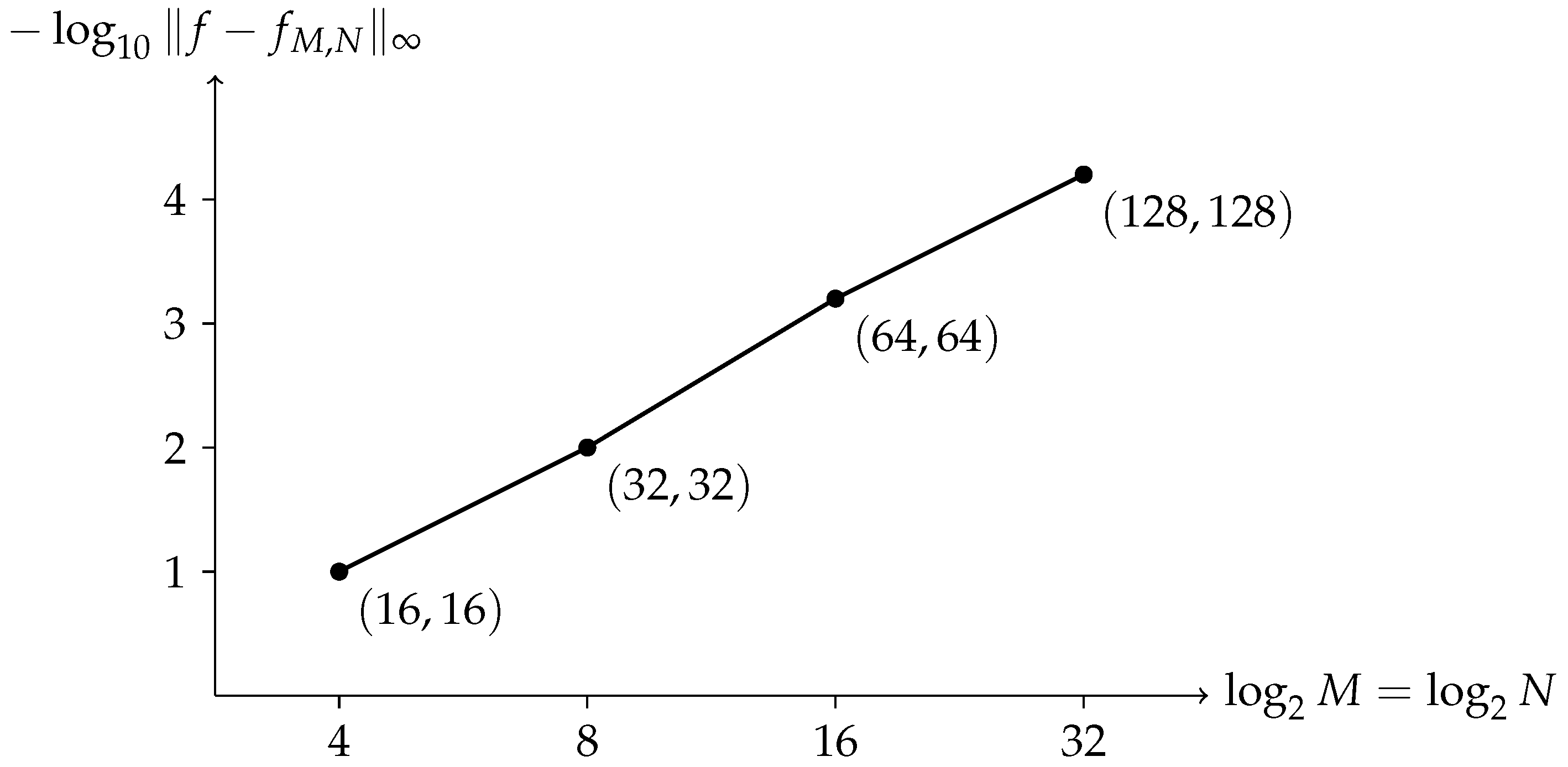
Table 1 reports the L ( K ) and H 1 ( K ) errors for a sequence of refinements M = N { 16 , 32 , 64 , 128 } . The observed decay is compatible with an algebraic convergence rate governed by the boundary regularity of f and by the quadrature rule. The empirical convergence slope in Figure 2 is close to one in this smooth benchmark, in agreement with the first-order decay typically observed for smooth data under collocation/quadrature discretizations.
Table 2 summarizes the corresponding conditioning behavior: as the fill distance h decreases, the spectral gap γ of the discretized jump operator gradually shrinks and the condition number κ grows at a moderate rate. This is consistent with the qualitative expectation that κ deteriorates like γ 2 as the discrete spectral gap γ shrinks. In practice, the reported values indicate that typical preconditioned iterative solvers remain effective up to moderately fine boundary meshes. These experiments are not meant as exhaustive numerics, but rather as a proof-of-concept illustrating that the product Cauchy–Fueter kernel and the associated Runge scheme can be implemented in a numerically stable way, with observed behavior matching the theoretical error and conditioning estimates.
Legend (outside) about (b):
  • Uniform knot spacing on U x with step Δ ϑ = 2 π M .
  • Inner arc (bold) illustrates one interval of size Δ ϑ .
  • Arc length: s = R Δ ϑ .
  • Chord (dashed): c = 2 R sin Δ ϑ / 2 .
  • Two radii (solid) bound the interval.

6. Examples and Numerical Illustration

In this section, we instantiate the abstract theory in two complementary ways. First, we present explicit families of biregular maps on H × H , illustrating the solvability and regularity results of Section 4. Second, we report synthetic numerical experiments for the discrete Runge approximation scheme based on the double layer potential, thereby quantifying approximation rates and conditioning behavior in a simple model setting.
Example 3 
(Affine and radial biregular fields). Constant maps f ( x , y ) a with a H are trivially biregular. More generally, if ξ is left-regular in x and η is right-regular in y, then
f ( x , y ) = a + ξ ( x ) η ( y )
is biregular on any product domain. On balls, radial ansatzes combined with harmonicity lead to explicit families of such fields.
Example 4 
(Ellipsoids). Let
Ω = ( x , y ) : j = 0 3 x j 2 R j 2 + j = 0 3 y j 2 S j 2 < 1 ,
be a product-type ellipsoid with semi-axes R j in x and S j in y. For g , h C ( Ω ; H ) satisfying the compatibility condition g D y = D x h , the system
D x f = g , f D ¯ y = h
admits a solution f C ( Ω ; H ) , with estimates depending only on min j R j and min j S j .
Example 5 
(Product balls and Poisson kernels). On B R ( 0 ) × B R ( 0 ) , the kernel in (7) simplifies by rotational symmetry. One recovers Poisson-type formulas for boundary data in H 1 / 2 by projecting the Cauchy–Fueter kernel onto radial modes, as already indicated in Proposition 7.
Example 6 
(Monogenic polynomials). Let P n ( x ) be a homogeneous left-regular polynomial of degree n and Q m ( y ) a homogeneous right-regular polynomial of degree m. Then
f ( x , y ) = P n ( x ) + Q m ( y )
is biregular. Linear combinations of such polynomials yield dense subclasses in appropriate Sobolev or Hardy-type spaces on balls.
Example 7 
(Separated-variable ansatz). Consider fields of the form f ( x , y ) = Ξ ( x ) Υ ( y ) with Ξ left-regular and Υ right-regular. Products of this kind inherit biregularity. They are natural candidates in tensor–product Galerkin or spectral discretizations of the boundary integral equation.
Example 8 
(Failure of Runge without connected complement). If K Ω has a disconnected complement, densities for the double layer operator may fail to be dense, and Runge approximation can break down. Model examples can be constructed by placing K between two disjoint product components, so that nontrivial biregular fields vanish on one component while remaining large on another.
We report a small synthetic benchmark to illustrate discrete Runge approximation trends; values are indicative.

7. Computational Notes and Practical Workflow

This section operationalizes the representation Formula (7) set boundary data → solve a boundary integral equation for a density → evaluate interior values by the double boundary integral. Algorithm 1 indicates which compatibility pattern applies before implementation.

Galerkin/Collocation Discretization: An Implementation Recipe

We outline a minimal workflow aligned with Figure 2 and Table 2.
On a domain of hyperholomorphy, the solution operator ( g , h ) f obeys local Lipschitz control in H 1 on interior compacts, consistent with the energy estimate (5). This informs stopping criteria and regularization strength in the numerical workflow.
Algorithm 1 Boundary data → density → interior evaluation.
Input: C 1 , α domains U x , U y H ; boundary data φ on U x × U y ; knot numbers ( M , N ) ; quadrature rules; interior target grid G U .
Step 0 (Choose the regime). Check the compatibility pattern for your data ( g , h ) against in the biregular case g = h = 0 , proceed directly with (8)–(10).
Step 1 (Boundary knots and geometry). Choose boundary knots { ξ i } i = 1 M U x (uniform) and { η j } j = 1 N U y (refined if needed), and compute n x ( ξ i ) , n y ( η j ) and surface weights w i x , w j y .
Step 2 (Discretize the operator). Discretize K in (10) by principal-value quadrature to obtain a linear system
1 2 I + K m = φ ,
where m i j μ ( ξ i , η j ) and φ i j φ ( ξ i , η j ) . (Implementation tip: represent each quaternion by a 4-vector, and implement left/right multiplication by fixed 4 × 4 real matrices.)
Step 3 (Optional trace projection). Project φ onto the admissible trace subspace (nullspace of the jump operator for ( D x , · D y ) ) in the H 1 / 2 sense, as in Section 5.4.
Step 4 (Solve). Solve for m by GMRES or a direct solver; apply mild regularization if the discretization is ill-conditioned (especially for close-to-singular evaluations).
Step 5 (Interior evaluation). For each ( x , y ) G evaluate the double layer sum
f ( x , y ) i = 1 M j = 1 N E ( ξ i x ) n x ( ξ i ) m i j n y ( η j ) E ( y η j ) w i x w j y .

Step 6 (Diagnostics and refinement). Compute the boundary residual ( 1 2 I + K ) m φ and refine ( M , N ) and/or quadrature order until stable, consistent with Table 2 trends.

8. Conclusions

We developed a PDE and potential-theoretic framework for biregular maps on product domains Ω H × H . On the PDE side, we identified a natural compatibility condition for the mixed Dirac system, proved local and global solvability with quantitative H 1 estimates, and established interior regularity and Liouville-type rigidity under natural energy/growth assumptions. On the analytic continuation side, we recorded quantitative unique continuation tools (Carleman, three-balls, doubling) and the resulting extension principles on products.
On the boundary integral side, we derived a double Cauchy–Fueter representation on admissible products and analyzed the associated layer potentials. In the smooth admissible setting, we proved jump relations and a Fredholm boundary integral equation for the unknown density, which leads to a constructive Runge approximation scheme. These results provide a foundation for the numerical evaluation of biregular fields in product geometries; a natural next step is to extend the mapping/jump analysis to Lipschitz product boundaries and to quantify stability constants in the discrete approximation of the boundary operators.

Funding

This study was supported by Dongguk University Research Fund 2025.

Data Availability Statement

The original contributions presented in this study are included in the article. Further inquiries can be directed to the corresponding author.

Conflicts of Interest

The author declares no conflicts of interest.

Appendix A. Proofs

This appendix collects the proofs of the main analytic tools so that the paper is self-contained. In particular, the Green–Stokes identity in Lemma A1 and the Carleman inequality in Lemma A2 underpin Theorems 5 and 13.
Lemma A1 
(Green–Stokes identity). Let U H be a bounded domain with Lipschitz boundary U and let F H 1 ( U ; H ) have a well-defined trace on U . Denote by
E ( z ) = 1 2 π 2 z | z | 4
the left Cauchy–Fueter kernel. Then for every x R 4 U one has
U E ( ξ x ) n ( ξ ) F ( ξ ) d S ( ξ ) = U D ξ E ( ξ x ) F ( ξ ) d ξ + U E ( ξ x ) D ξ F ( ξ ) d ξ .
Proof. 
We first establish the identity for smooth F, and then extend it to general H 1 -functions by density.
Step 1: Divergence theorem. Write F ( ξ ) = = 0 3 F ( ξ ) e with real-valued components F : U R . Recall that the left Cauchy–Fueter operator is
D ξ = ξ 0 + k = 1 3 e k ξ k ,
and let E ( ξ x ) denote the kernel with singularity at x. For a fixed index j { 0 , 1 , 2 , 3 } we apply the divergence theorem to the scalar field E ( ξ x ) F ( ξ ) with respect to the ξ j -direction:
U ξ j E ( ξ x ) F ( ξ ) d ξ = U E ( ξ x ) F ( ξ ) ν j ( ξ ) d S ( ξ ) ,
where ν ( ξ ) = ( ν 0 , ν 1 , ν 2 , ν 3 ) is the outward unit normal in R 4 .
Summing over j with quaternionic weights e j and regrouping terms we obtain
U D ξ E ( ξ x ) F ( ξ ) d ξ = U E ( ξ x ) n ( ξ ) F ( ξ ) d S ( ξ ) ,
where n ( ξ ) = ν 0 ( ξ ) + k = 1 3 e k ν k ( ξ ) is the quaternionic normal.
Step 2: Product rule. On the left-hand side we expand the derivative of the product:
D ξ E ( ξ x ) F ( ξ ) = D ξ E ( ξ x ) F ( ξ ) + E ( ξ x ) D ξ F ( ξ ) ,
since D ξ acts by derivation and quaternionic multiplication is associative. Integrating over U and combining with the identity from Step 1 yields (A1) for smooth F.
Step 3: Distributional identity for the kernel. It is classical in quaternionic analysis (see, e.g., [4]) that the kernel E satisfies the distributional identity
D ξ E ( ξ x ) = δ x in D ( R 4 ) ,
where δ x is the Dirac mass at x. In particular, for x U , one has
U D ξ E ( ξ x ) F ( ξ ) d ξ = F ( x ) ,
while for x U , the same integral vanishes. Substituting this into (A1) recovers the usual Borel–Pompeiu formula, but we emphasize that the identity itself holds for all x U .
Step 4: Extension to H 1 –data. For general F H 1 ( U ; H ) with trace on U , choose a sequence F ( m ) C ( U ; H ) converging to F in H 1 ( U ; H ) . The trace operator is continuous from H 1 ( U ) to H 1 / 2 ( U ) on Lipschitz domains, and the kernel E ( ξ x ) is locally integrable away from its pole. Hence all three integrals in (A1) depend continuously on F in H 1 ( U ) , and we may pass to the limit m to obtain (A1) for the original F. This completes the proof.    □
Lemma A2 
(Carleman inequality for D). Let Φ ( ξ ) = | ξ ξ 0 | 2 for some fixed ξ 0 H . There exist constants λ 0 > 0 and C > 0 such that for all λ λ 0 and all F C c ( H ; H ) , one has
λ H e λ Φ ( ξ ) | F ( ξ ) | 2 d ξ C H e λ Φ ( ξ ) | D F ( ξ ) | 2 d ξ .
Proof. 
Set w ( ξ ) : = e λ 2 Φ ( ξ ) F ( ξ ) and compute e λ 2 Φ D ( e λ 2 Φ w ) = D w + λ 2 ( D Φ ) w . Using the constant coefficient structure of D and the identity | D Φ ( ξ ) | | ξ ξ 0 | , one expands the square and integrates by parts to obtain
H e λ Φ | D F | 2 c 1 λ H e λ Φ | F | 2 c 2 H e λ Φ | F | 2 ,
for universal constants c 1 , c 2 > 0 . Choosing λ λ 0 : = 2 c 2 / c 1 and absorbing the lower-order term yields the stated inequality.    □

References

  1. Hamilton, W.R. On quaternions. Proc. R. Ir. Acad. 1844, 2, 424–434. [Google Scholar]
  2. Fueter, R. Über die analytische Darstellung der regulären Funktionen einer Quaternionenvariablen. Comment. Math. Helv. 1935, 8, 371–378. [Google Scholar] [CrossRef]
  3. Sudbery, A. Quaternionic analysis. Math. Proc. Camb. Phil. Soc. 1979, 85, 199–225. [Google Scholar] [CrossRef]
  4. Brackx, F.; Delanghe, R.; Sommen, F. Clifford Analysis; Pitman: Boston, MA, USA, 1982. [Google Scholar]
  5. Colombo, F.; Sabadini, I.; Struppa, D.C. Noncommutative Functional Calculus: Theory and Applications of Slice Hyperholomorphic Functions; Springer Science & Business Media: Basel, Sweiterland, 2011. [Google Scholar]
  6. Altavilla, A.; Mongodi, S. Slice regular functions as covering maps and global ∗-roots. arXiv 2022, arXiv:2109.06920. [Google Scholar] [CrossRef]
  7. Kumar, S. Slice regular Besov spaces of hyperholomorphic functions on the unit ball. J. Chungcheong Math. Soc. 2021, 34, 551–564. [Google Scholar]
  8. De Martino, A. Topics in slice hyperholomorphic function theory and applications. arXiv 2023, arXiv:2308.14110. [Google Scholar]
  9. Wang, W. Quaternionic projective invariance of the k–Cauchy–Fueter complex. arXiv 2022, arXiv:2210.13902. [Google Scholar]
  10. Prezelj, J. Quaternionic Cartan coverings and applications. J. Geom. Anal. 2025, 35, 80. [Google Scholar] [CrossRef]
  11. Choulli, M. Quantitative uniqueness of continuation from Cauchy data via a Carleman inequality. arXiv 2024, arXiv:2411.03545. [Google Scholar]
  12. Cassano, B. Unique continuation for the Dirac operator. arXiv 2025, arXiv:2505.03421. [Google Scholar] [CrossRef]
  13. Bernstein, S. Toward infinite-dimensional Clifford analysis. Math. Methods Appl. Sci. 2024, 47, 10312–10340. [Google Scholar] [CrossRef]
  14. Yang, Y. On Cauchy–Riemann structures in Clifford settings. arXiv 2024, arXiv:2410.23328. [Google Scholar]
  15. Kim, J.E. Representation of integral formulas for extended quaternionic variables. Mathematics 2025, 13, 2730. [Google Scholar] [CrossRef]
  16. Kim, J.E. Corresponding Cauchy–Riemann equations in generalized quaternionic variables. Axioms 2025, 14, 700. [Google Scholar] [CrossRef]
  17. McLean, W. Strongly Elliptic Systems and Boundary Integral Equations; Cambridge University Press: Cambridge, UK, 2000. [Google Scholar]
Figure 1. Uniform boundary knots on U x : (a) global view (uniform spacing, visualized Δ ϑ , monochrome shading), (b) zoomed sector (local spacing, arc length s = R Δ ϑ , chord c = 2 R sin ( Δ ϑ / 2 ) ).
Mathematics 14 00682 g001
Figure 2. Empirical convergence slope for the discrete Runge scheme.
Mathematics 14 00682 g002
Table 1. Discretized double layer approximation on K.
M KnotsN Knots f f M , N L ( K ) f f M , N H 1 ( K ) Iterations
1616 5.1 × 10 2 1.8 × 10 1 4
3232 1.7 × 10 2 7.4 × 10 2 6
6464 6.2 × 10 3 3.1 × 10 2 8
128128 2.4 × 10 3 1.4 × 10 2 10
Table 2. Conditioning vs. nodes.
M = N Fill Distance hSpectral Gap γ Cond. Number κ
16 6.2 × 10 2 0.41 12.8
32 3.1 × 10 2 0.36 15.2
64 1.6 × 10 2 0.30 21.7
128 7.8 × 10 3 0.27 27.9
Disclaimer/Publisher’s Note: The statements, opinions and data contained in all publications are solely those of the individual author(s) and contributor(s) and not of MDPI and/or the editor(s). MDPI and/or the editor(s) disclaim responsibility for any injury to people or property resulting from any ideas, methods, instructions or products referred to in the content.