Mathematical Programming for Optimal Evacuation in Industrial Facilities


Abstract
1. Introduction
2. Related Works
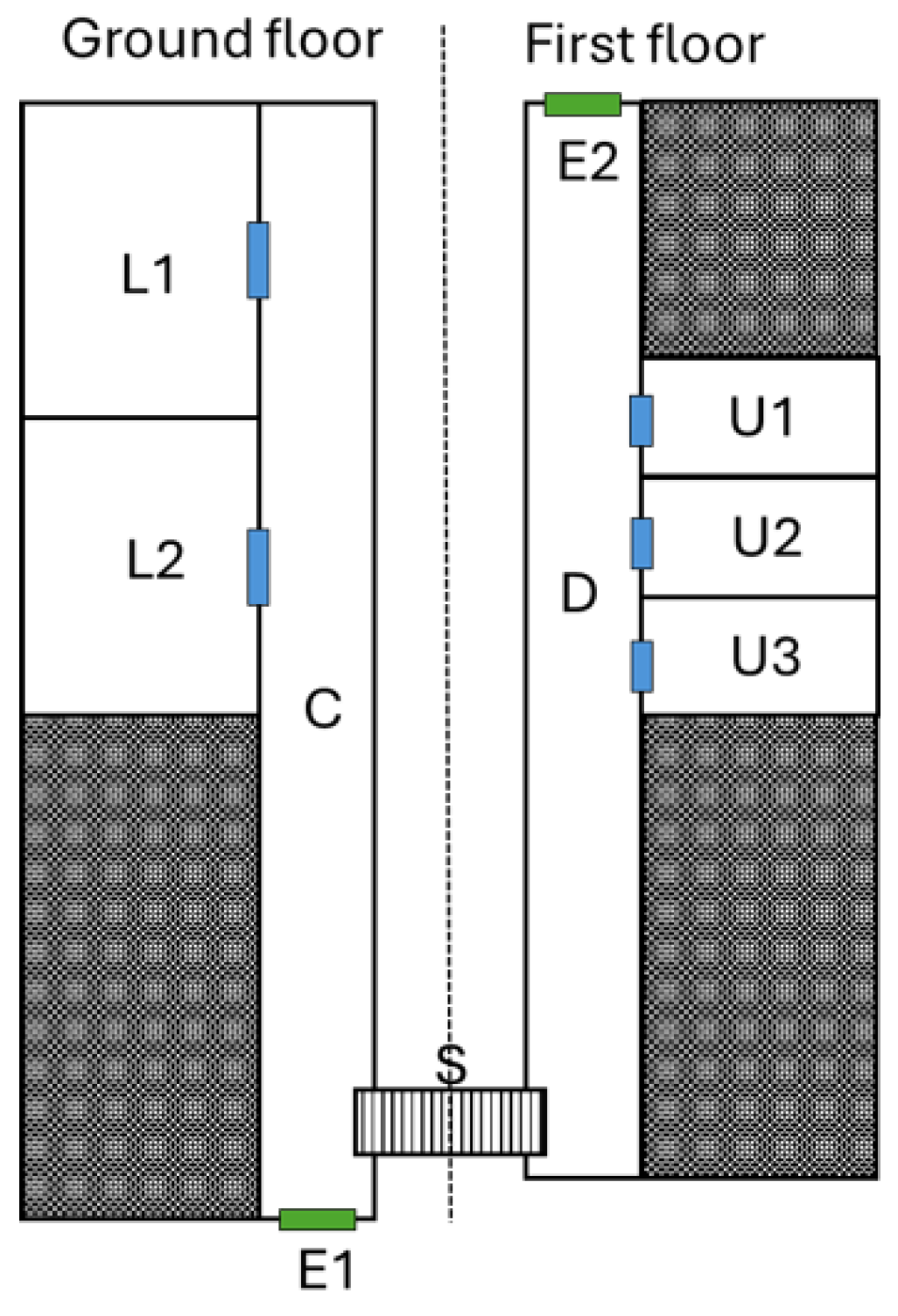
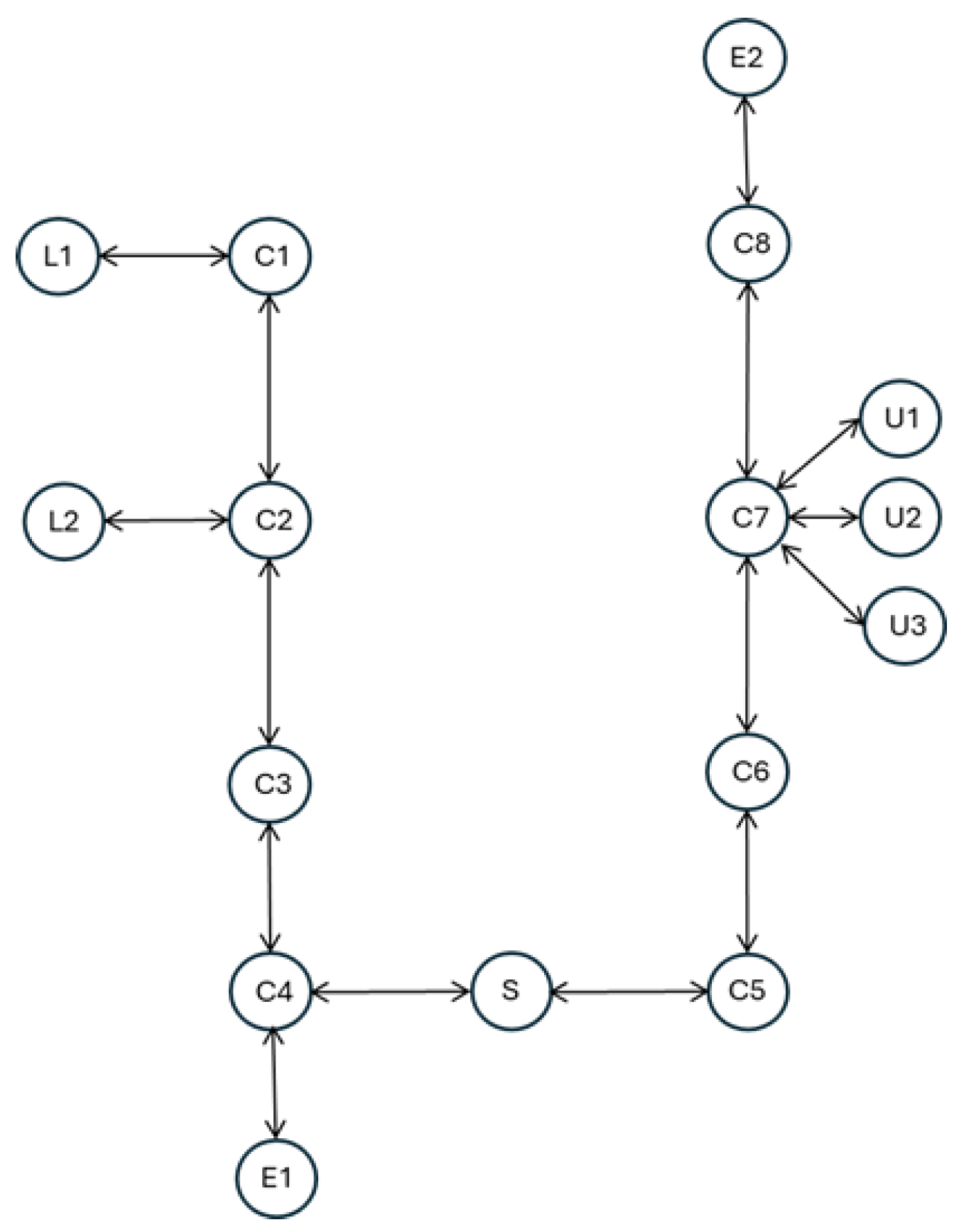
3. The Model: Layout Graph and Timed Flow Network
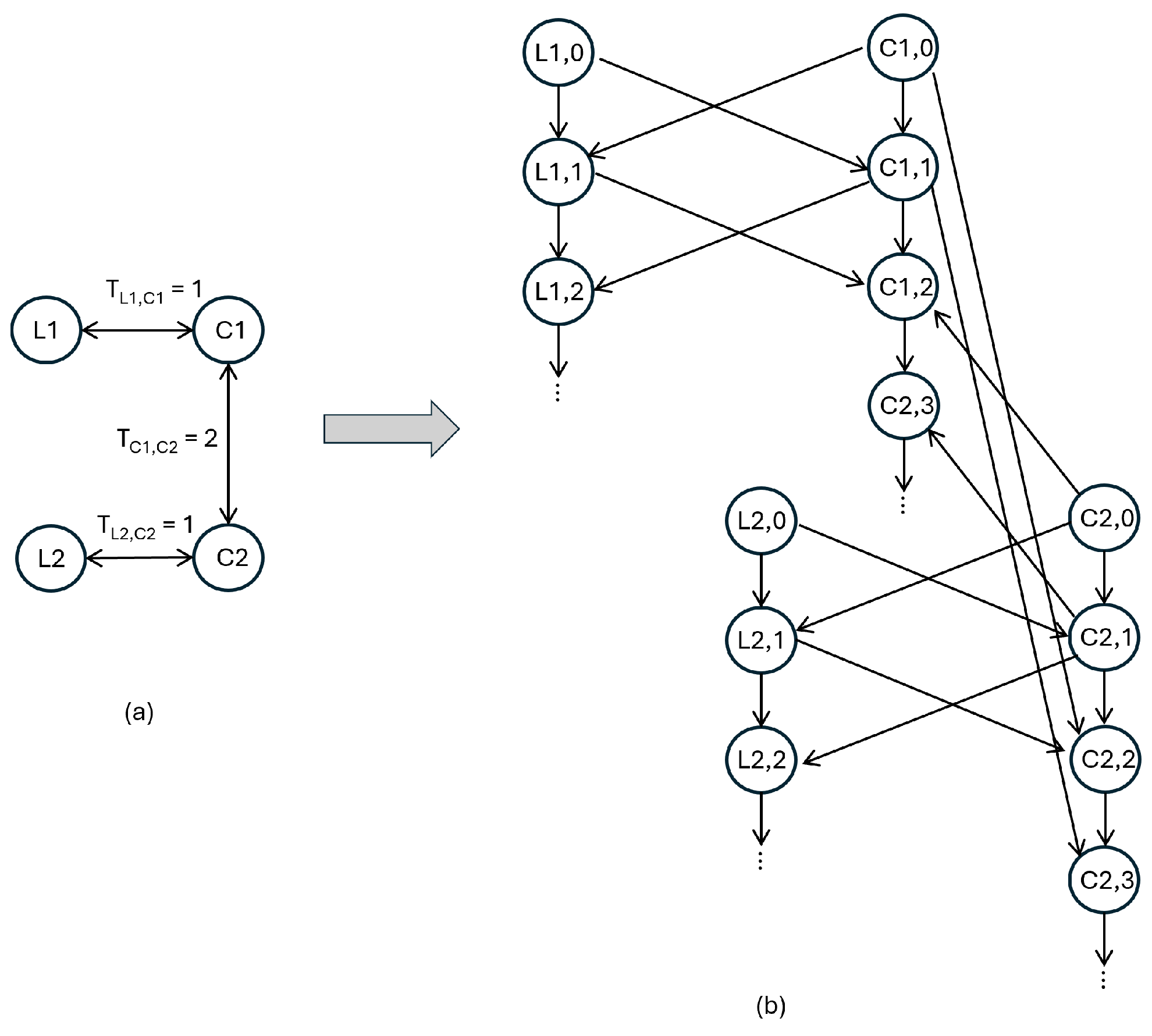
- Waiting arcs, , model the flow of people remaining in a location (e.g., a room) and correspond to arcs between two successive timed nodes for the same physical location;
- Movement arcs, , model the transfer of people between different physical locations (e.g., from an office to a corridor or between two locations in a corridor if the corridor is sufficiently long).
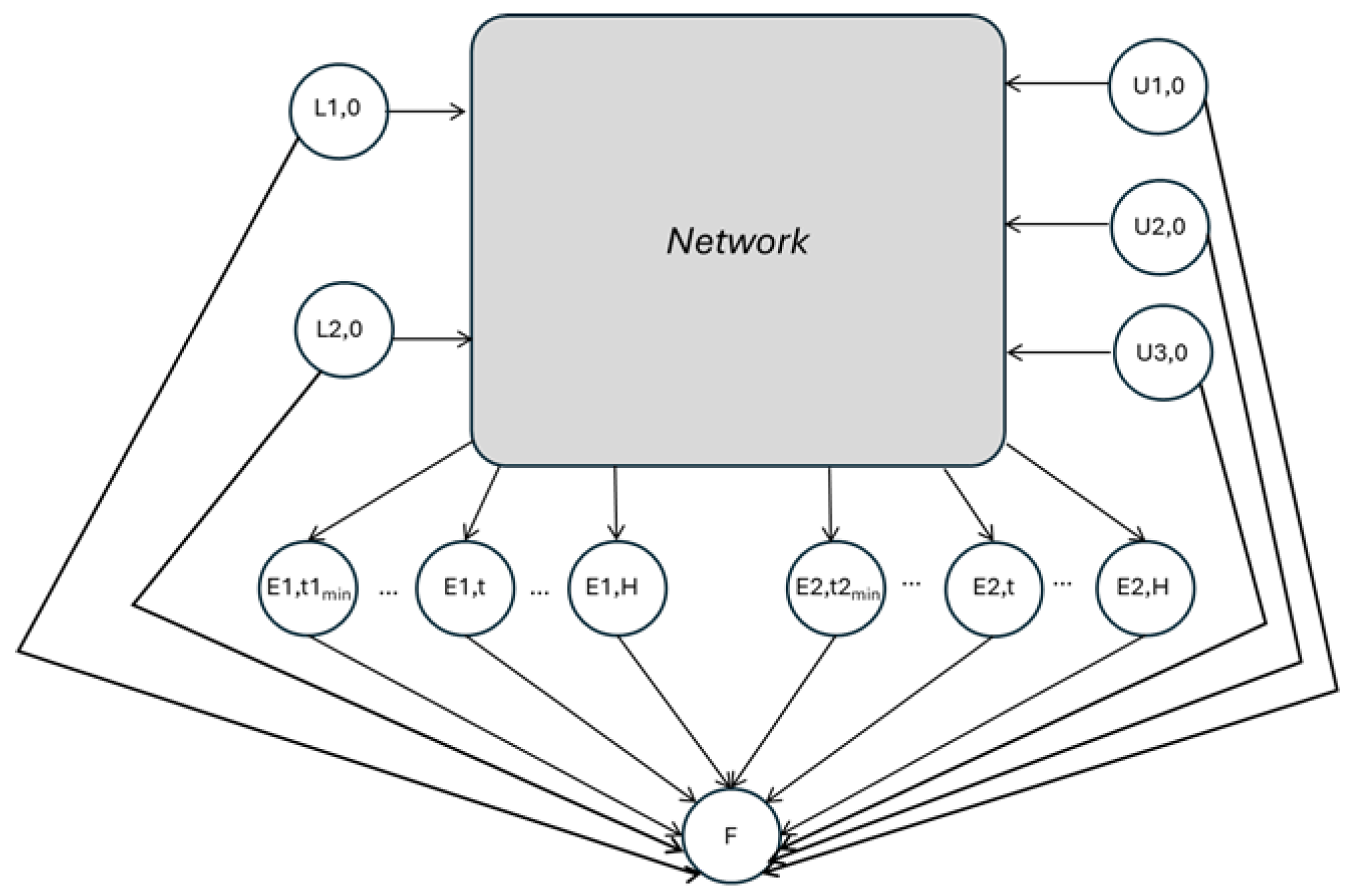
3.1. The Timed Flow Network
3.2. Mathematical Model for the Timed Flow Network
- Sets
- V: Set of physical locations in the layout (nodes).
- : Subset of safety exits or safe areas.
- E: Set of direct connections between physical locations (arcs).
- T: Time horizon.
- : Set of timed nodes extended with the final fictitious node F.
- : Set of timed waiting arcs.
- : Set of timed movement arcs.
- : Set of all timed arcs in the network.
- Parameters
- : Flow parameter for timed nodes (number of people present in physical locations at time t).
- : Flow parameter for the fictitious final node.
- : Transfer time between two physical locations connected by arc .
- : Capacity of movement arcs.
- M: big-M, sufficiently large constant.
- Variables
- : Flow variables.
- : Flow variables for the arcs between nodes where people are initially present and the final node F.
- Formulation
- Constraints (2) and (3) express the flow conservation conditions for all network nodes of type , that is, for all nodes except the fictitious final node F.Constraint (4) instead enforces the flow conservation for node F.Constraints (5) impose the maximum flow capacity for both waiting and movement arcs.Finally, constraints (6) define the model variables and their non-negativity conditions.
3.3. An Alternative Formulation
- : The last time step when the final person reaches a safe location.
- : A binary variable indicating whether there is positive flow in arc .
4. Real-Time Model Application
- The current location of individuals within the facility at time ;
- One or more locations are no longer accessible;
- One or more locations will become inaccessible after a certain time instant;
- One or more connections between locations are no longer passable;
- One or more connections between locations will become impassable after a certain moment in time.
- 1.
- The flows determined by the prior resolution of the model, before the event altering the scenario, are considered. Subsequently, the temporal network and the individuals’ locations within it are updated as of time . Let and represent, respectively, the nodes and edges of the temporal network remaining after updating at time , with the following steps undertaken:
- Any node with is removed from as these nodes represent past moments;
- Any edge in with is removed from since it also connects past nodes;
- For each node associated with an area that has become, or will become, inaccessible at time or later at time , the nodes with or are removed, along with all outbound edges ;
- For each edge corresponding to a connection between areas that has become, or will become, impassable at or at a later time , the edges with or are removed.
- 2.
- For updating the current position of individuals at time , if received via field sensors, the values of parameters for each node should be adjusted based on the received information.In the absence of such field data, as described below, the parameters of the temporally indexed nodes can be updated by assuming that until time , individuals have followed the flows determined by the prior optimization model. The parameters for each node are then updated as follows:
- For eachwhere represents the flow along edges from previous nodes;
- For edges such that and , the node parameter for the destination node is updated as
- If there is a flow of people starting from node i at time toward a node j that becomes inaccessible after and that would be reached at time , then it is assumed that such people must return to the departure node i, which will be reached again at time , provided that i remains accessible after . In this case, the node parameter will be updated as
- The same update must be performed if, in the evacuation plan determined by the previous solution of the model, there exists a non-zero flow on an arc that is no longer accessible, with and ;
- Finally, in the previous situation, if the node i also becomes inaccessible, the model signals the impossibility of bringing to safety the people located on the arc that has become inaccessible.
5. Experimental Results
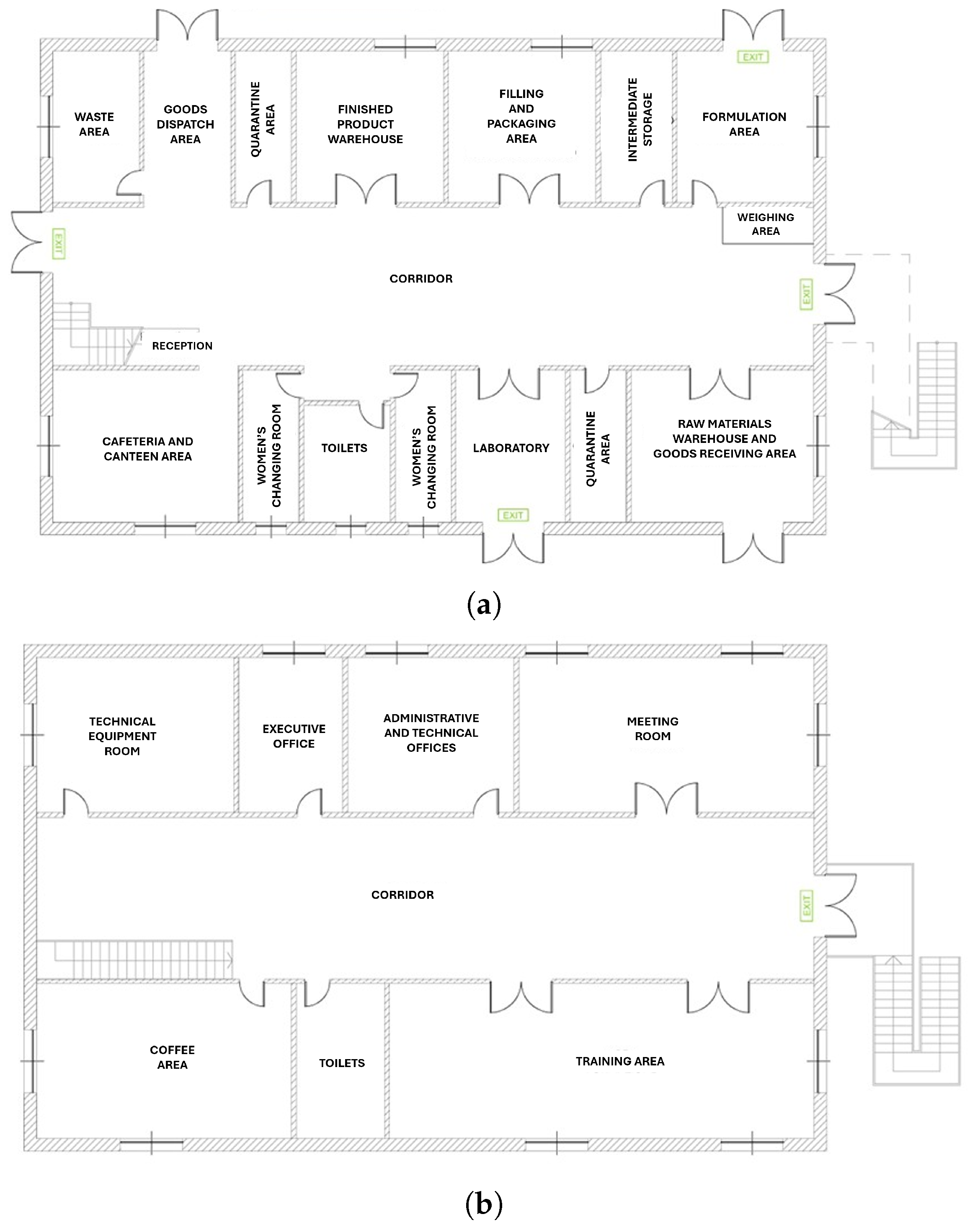
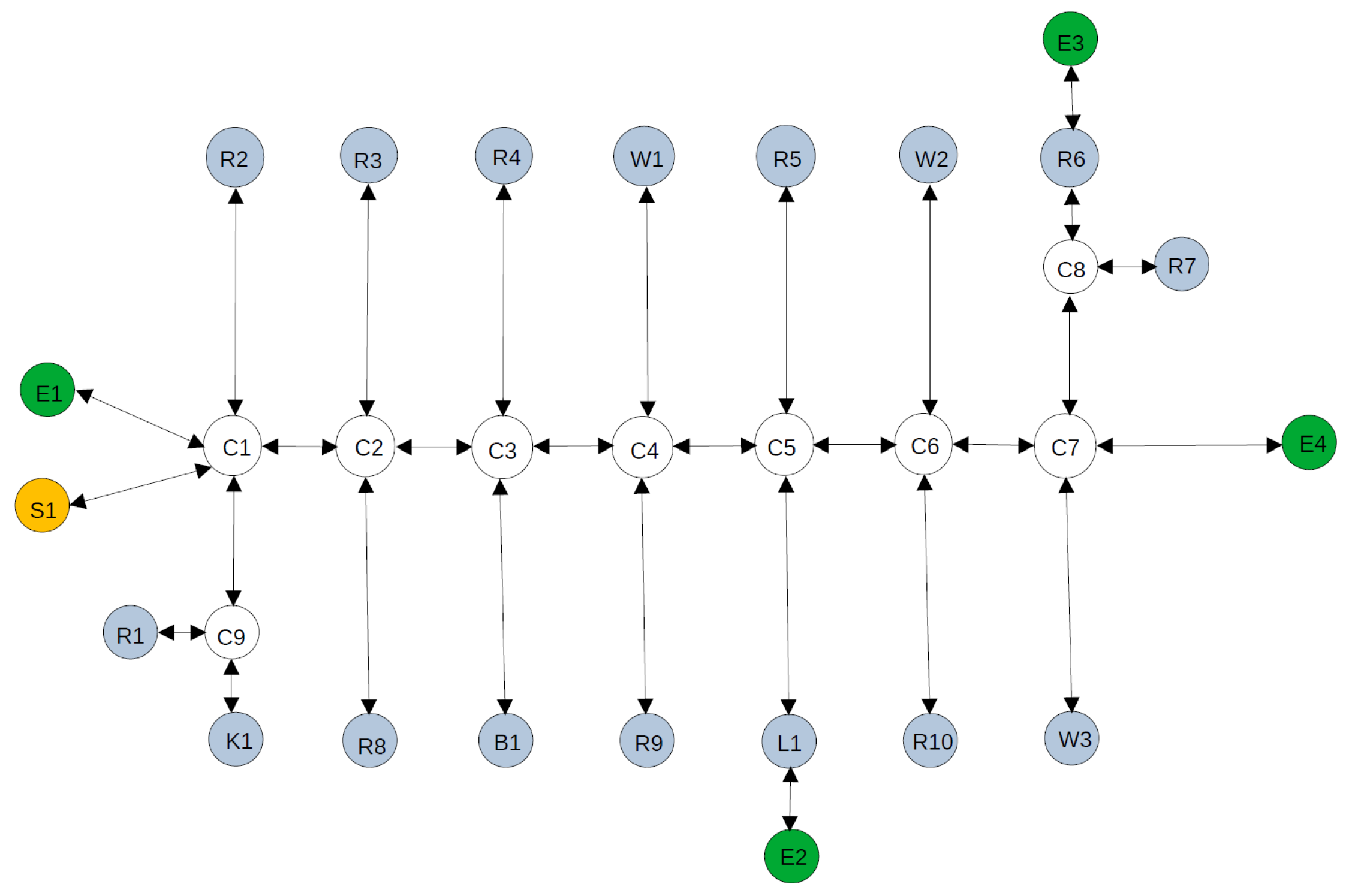
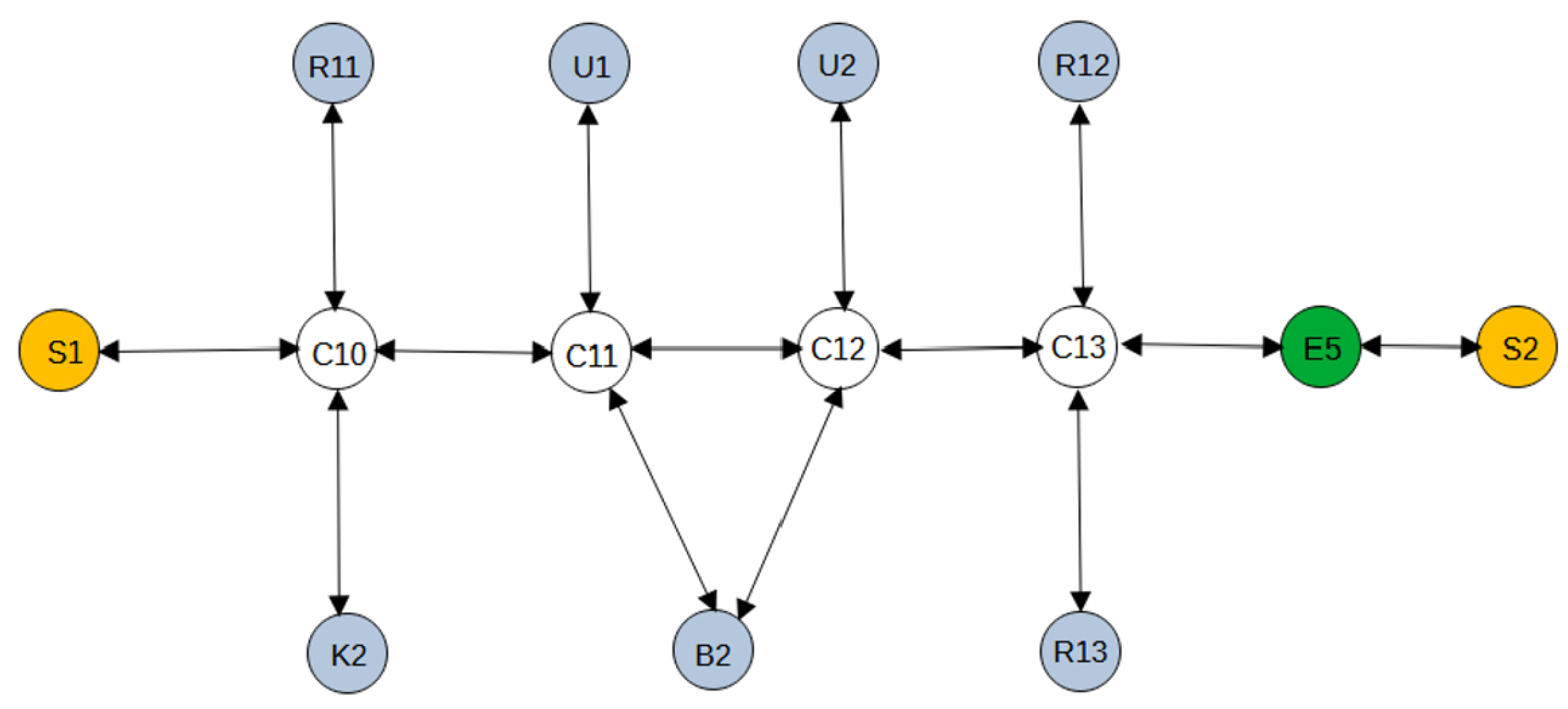
5.1. An Industrial Test Case
- C are the corridors;
- B are the bathrooms;
- E are the emergency exits;
- K are the bar/canteen areas;
- L are the laboratories;
- R are the rooms;
- S are the staircases;
- U are the offices;
- W are the warehouses.
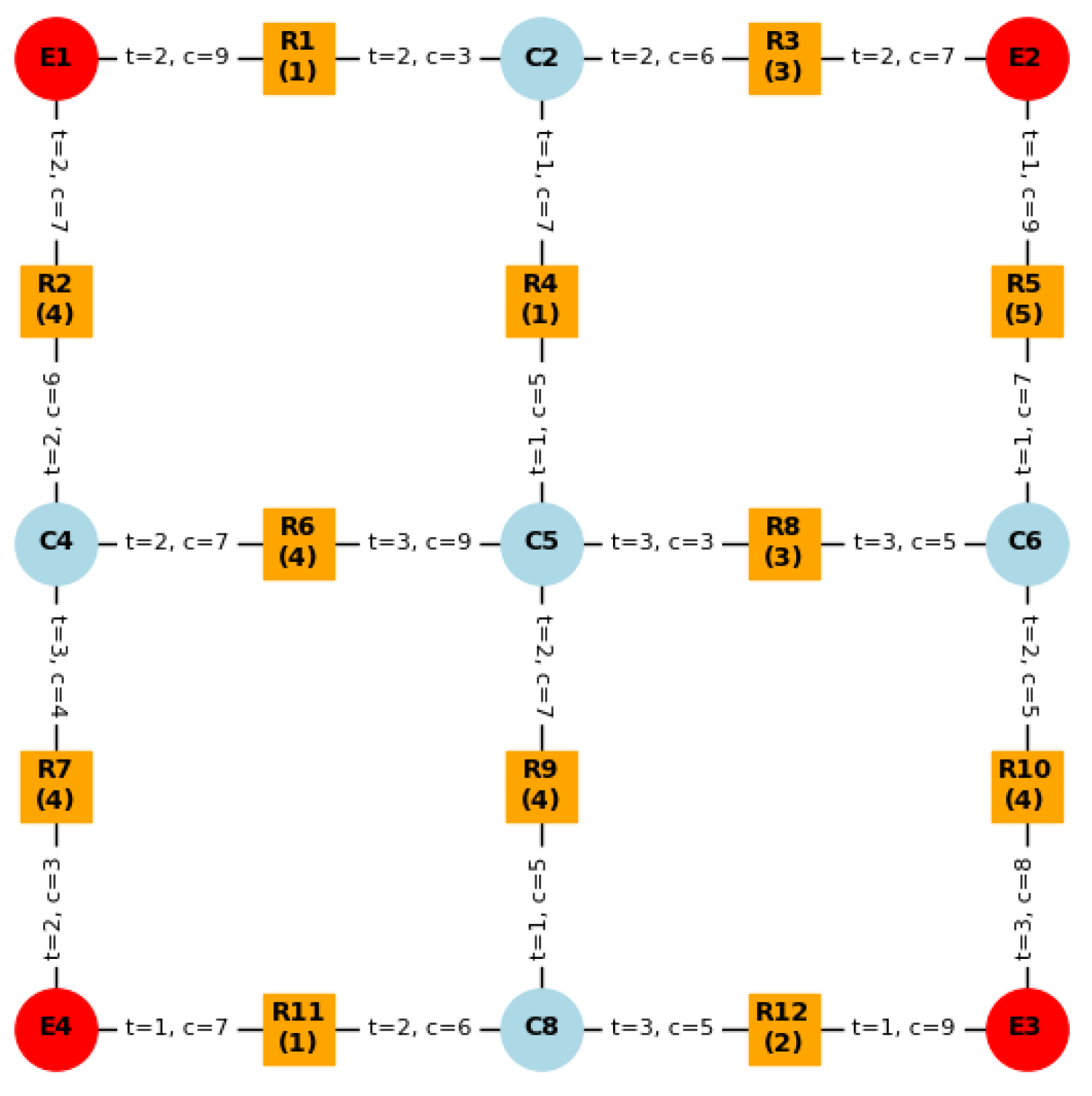
- , the traversal time between nodes i and j;
- , the maximum capacity of the connection (people simultaneously traversing it).
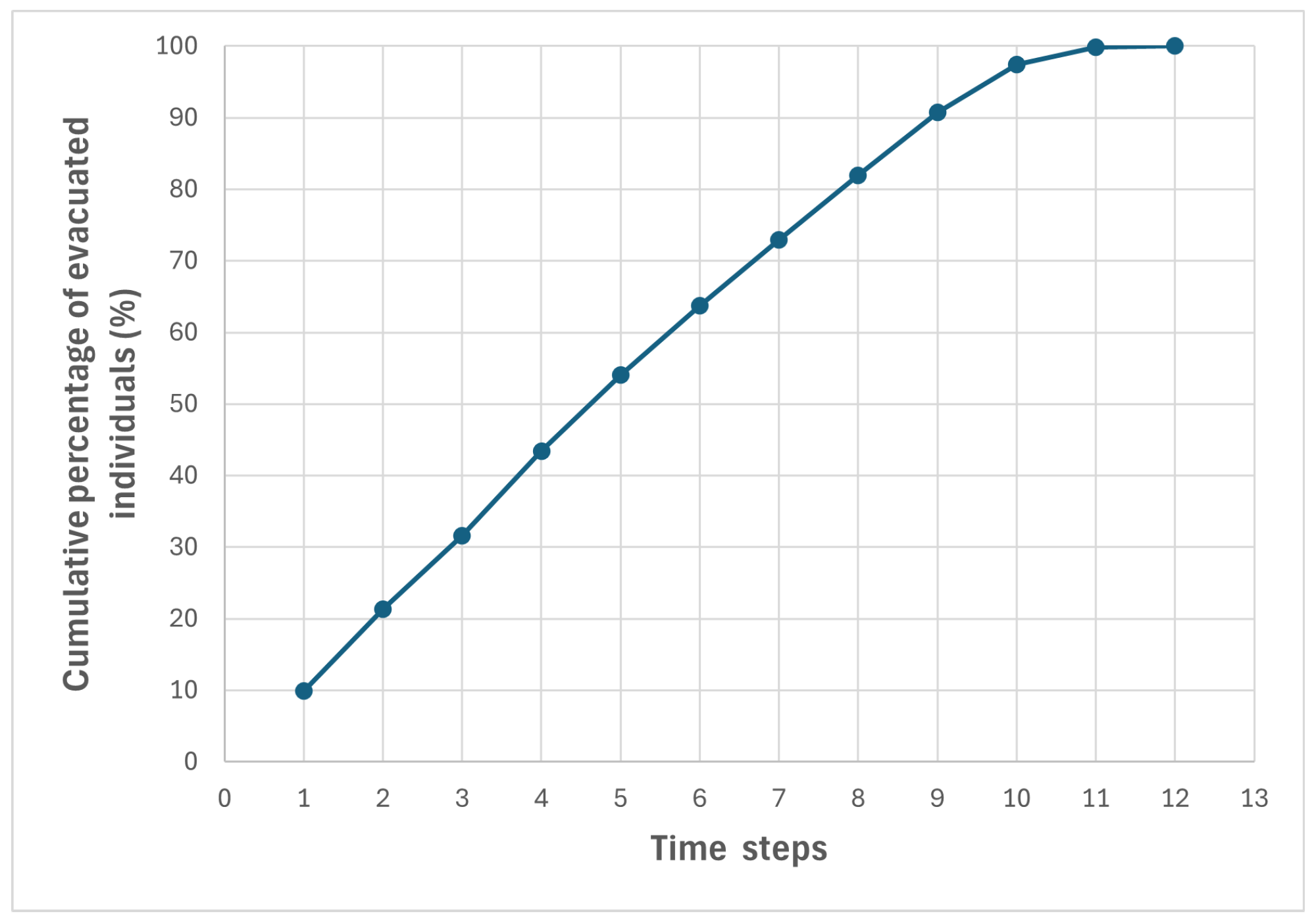
- A portion of the first floor corridor providing access to exit E5 becomes unavailable (node C13 is removed) starting from time step 3;
- The same situation occurs starting from time step 5;
- The staircase S1 cannot be accessed starting from time step 1.
5.2. Random Instance Generator and Computational Experiments
6. Discussion
Author Contributions
Funding
Data Availability Statement
Conflicts of Interest
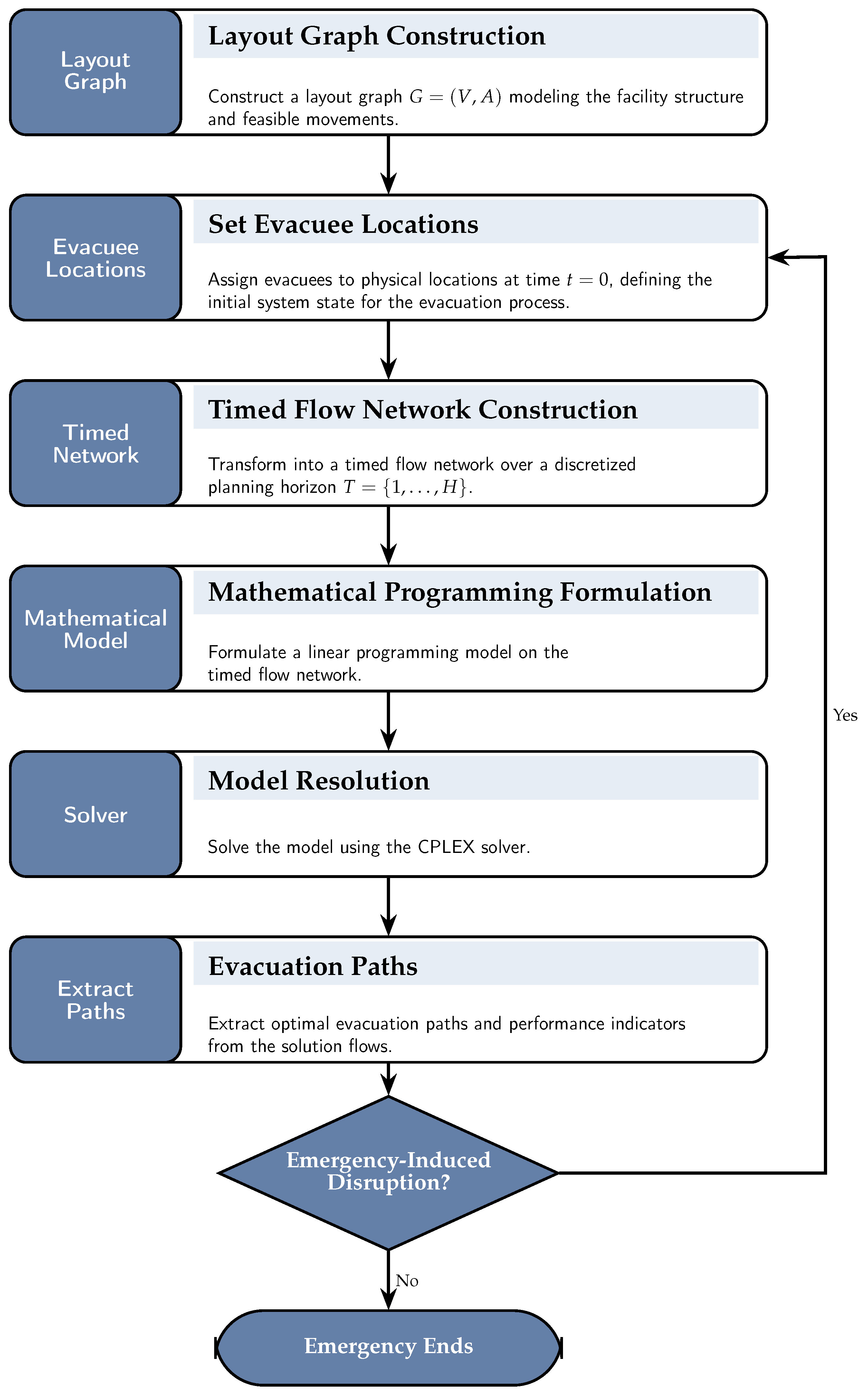
Appendix A. Flowchart Description of the Evacuation Optimization Algorithm
- 1.
- Layout Graph Construction. The process starts by building the layout graph , which represents the facility topology. Nodes correspond to physical locations (e.g., rooms, corridors, staircases), and directed arcs represent feasible movements between locations. Each arc is associated with traversal-time and capacity information, capturing the static constraints of the environment.
- 2.
- Set Evacuee Locations. Evacuees are assigned to physical locations at the beginning of the emergency, i.e., at time . This step defines the initial system state and corresponds to setting the initial node supplies (e.g., ) used by the subsequent time-expanded formulation.
- 3.
- Timed Flow Network Construction. Given a discretized planning horizon , the layout graph is transformed into a timed (time-expanded) flow network. In this representation, each physical node is replicated across time and arcs are expanded accordingly, allowing the temporal evolution of evacuation flows to be explicitly modeled (including both waiting and movement dynamics).
- 4.
- Mathematical Programming Formulation. An optimization model is then formulated on the timed network as a (network) linear programming model. The formulation enforces flow conservation at timed nodes and capacity constraints on arcs, and it includes an objective function that promotes fast evacuation while penalizing evacuees who cannot reach a safe exit (or safe area) within the considered horizon.
- 5.
- Model Resolution. The resulting mathematical program is solved using the CPLEX solver. The solution returns optimal flow values on the timed network, thereby determining the recommended evacuation routing over time.
- 6.
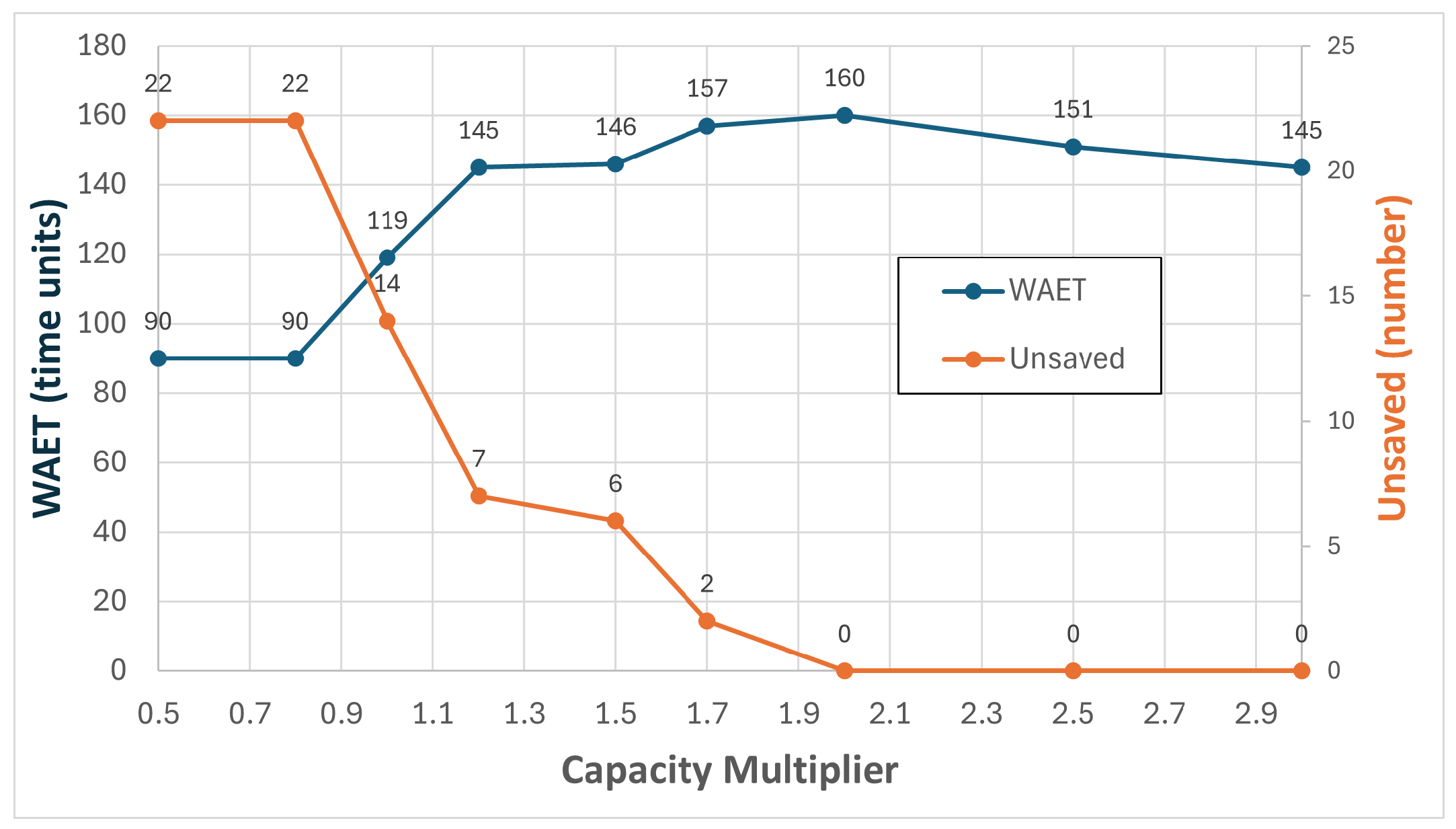
- Evacuation Paths. Evacuation routes are extracted from the optimal flow solution and translated into actionable paths for groups of evacuees. In addition, performance indicators are derived from the solution, such as the weighted evacuation time and the number of unsaved individuals (and, when relevant, the evacuation makespan).
- 7.
- Emergency-Induced Disruption? (Decision block). During the emergency, the system checks whether an emergency-induced disruption has occurred, including: (i) changes in evacuee locations with respect to the expected plan, and/or (ii) changes in network availability (e.g., locations becoming inaccessible, connections becoming impassable). If a disruption is detected, the algorithm loops back to Set Evacuee Locations, updates the current system state using the available information, and re-runs Steps 3–6 to compute updated evacuation paths.
- 8.
- Emergency Ends. If no disruption is detected (or the emergency is declared terminated), the algorithm stops.
References
- Vermuyten, H.; Beliën, J.; De Boeck, L.; Reniers, G.; Wauters, T. A review of optimisation models for pedestrian evacuation and design problems. Saf. Sci. 2016, 87, 167–178. [Google Scholar] [CrossRef] [Scilit]
- National Fire Protection Association (NFPA). Fire Loss in the United States During 2023. Statistical Report, 2024. Available online: https://www.nfpa.org/education-and-research/research/nfpa-research/fire-statistical-reports/fire-loss-in-the-united-states (accessed on 3 December 2025).
- Khakzad, N. Optimal firefighting to prevent domino effects: Methodologies based on dynamic influence diagram and mathematical programming. Reliab. Eng. Syst. Saf. 2021, 212, 107577. [Google Scholar] [CrossRef] [Scilit]
- Huang, P.; Chen, M.; Chen, K.; Ye, S.; Yu, L. Study on an emergency evacuation model considering information transfer and rerouting: Taking a simplified H-shape metro station hall as an example. Tunn. Undergr. Space Technol. 2022, 124, 104485. [Google Scholar] [CrossRef] [Scilit]
- Goerlandt, F.; Li, J.; Reniers, G.; Boustras, G. Safety science: A bibliographic synopsis of publications in 2020. Saf. Sci. 2021, 139, e105242. [Google Scholar] [CrossRef] [Scilit]
- Fu, L.; Qin, H.; Shi, Q.; Zhang, Y.; Shi, Y. An experimental study on evacuation dynamics including individuals with simulated disabilities. Saf. Sci. 2022, 155, 105878. [Google Scholar] [CrossRef] [Scilit]
- Balboa, A.; González-Villa, J.; Cuesta, A.; Abreu, O.; Alvear, D. Testing a real-time intelligent evacuation guiding system for complex buildings. Saf. Sci. 2020, 132, 104970. [Google Scholar] [CrossRef] [Scilit]
- Zhang, P.; Yang, L.; Lo, S.; Wang, D.; Li, M.; Jiang, J.; Jiang, N. Experimental study on evacuation behavior with guidance under high and low urgency conditions. Saf. Sci. 2022, 154, 105865. [Google Scholar] [CrossRef] [Scilit]
- Chen, J.; Liu, C.; Meng, Y.; Zhong, M. Multi-Dimensional evacuation risk evaluation in standard subway station. Saf. Sci. 2021, 142, 105392. [Google Scholar] [CrossRef] [Scilit]
- Cepolina, E.M. Phased evacuation: An optimisation model which takes into account the capacity drop phenomenon in pedestrian flows. Fire Saf. J. 2009, 44, 532–544. [Google Scholar] [CrossRef] [Scilit]
- Khakzad, N. A methodology based on Dijkstra’s algorithm and mathematical programming for optimal evacuation in process plants in the event of major tank fires. Reliab. Eng. Syst. Saf. 2023, 236, 109291. [Google Scholar] [CrossRef] [Scilit]
- Zhang, W.; Liu, X.; Huang, Z.; Zhu, J. Dynamic parameters identification for sliding joints of surface grinder based on deep neural network modeling. Adv. Mech. Eng. 2021, 13, 1687814021992181. [Google Scholar] [CrossRef] [Scilit]
- Mirahadi, F.; McCabe, B.Y. EvacuSafe: A real-time model for building evacuation based on Dijkstra’s algorithm. J. Build. Eng. 2021, 34, 101687. [Google Scholar] [CrossRef] [Scilit]
- Liu, L.; Zhang, H.; Shi, J.; Geng, J. Real-time evacuation route optimization in the fire scenarios of cruise ships. Simul. Model. Pract. Theory 2023, 129, 102843. [Google Scholar] [CrossRef] [Scilit]
- Jiang, Y.; Xu, K.; Gai, W.; Salhi, S. Emergency response for tackling major accidental toxic gas releases: What should be done and when? Saf. Sci. 2022, 154, 105819. [Google Scholar] [CrossRef] [Scilit]
- Deng, K.; Zhang, Q.; Zhang, H.; Xiao, P.; Chen, J. Optimal emergency evacuation route planning model based on fire prediction data. Mathematics 2022, 10, 3146. [Google Scholar] [CrossRef] [Scilit]
- He, Z.; Shen, K.; Lan, M.; Weng, W. An evacuation path planning method for multi-hazard accidents in chemical industries based on risk perception. Reliab. Eng. Syst. Saf. 2024, 244, 109912. [Google Scholar] [CrossRef] [Scilit]
- Chen, P.; Chen, G.; Wang, L.; Reniers, G. Optimizing emergency rescue and evacuation planning with intelligent obstacle avoidance in a chemical industrial park. J. Loss Prev. Process Ind. 2018, 56, 119–127. [Google Scholar] [CrossRef] [Scilit]
- Kurdi, H.; Almulifi, A.; Al-Megren, S.; Youcef-Toumi, K. A balanced evacuation algorithm for facilities with multiple exits. Eur. J. Oper. Res. 2021, 289, 285–296. [Google Scholar] [CrossRef] [Scilit]
- Huang, P.; Lin, X.; Liu, C.; Fu, L.; Yu, L. A real-time automatic fire emergency evacuation route selection model based on decision-making processes of pedestrians. Saf. Sci. 2024, 169, 106332. [Google Scholar] [CrossRef] [Scilit]
- Tavares, R.M.; Galea, E.R. Evacuation modelling analysis within the operational research context: A combined approach for improving enclosure designs. Build. Environ. 2009, 44, 1005–1016. [Google Scholar] [CrossRef] [Scilit]
- Wang, K.; Yuan, W.; Liang, W.; Yao, Y. An optimal guidance strategy for fire evacuations: A hybrid modeling approach. J. Build. Eng. 2023, 73, 106796. [Google Scholar] [CrossRef] [Scilit]
- Georgiadou, P.S.; Papazoglou, I.A.; Kiranoudis, C.T. Multi objective evolutionary emergency response optimization in industrial accident scenarios. Comput. Oper. Res. 2010, 37, 1257–1267. [Google Scholar]
- Yuan, J.; Sun, B. Multi-Objective Optimization Model for Emergency Evacuation Based on Adaptive Ant Colony Algorithm. AI 2025, 6, 203. [Google Scholar] [CrossRef] [Scilit]
- Lin, J.R.; Chen, K.Y.; Song, S.Y.; Cai, Y.H.; Pan, P.; Deng, Y.C. Digital twin of buildings and occupants for emergency evacuation: Framework, technologies, applications and trends. Adv. Eng. Inform. 2025, 66, 103419. [Google Scholar] [CrossRef] [Scilit]
- Han, Y.; Bian, R.; Meng, X. Improving a Regional-Scale Hurricane Evacuation Traffic Simulation Framework for Digital Twin Creation. Transp. Res. Rec. 2025, 2679, 171–185. [Google Scholar] [CrossRef] [Scilit]
- Kim, Y.J.; Kim, H.; Ha, B.; Kim, W.T. Advanced fire emergency management based on potential fire risk assessment with informative digital twins. Autom. Constr. 2024, 167, 105722. [Google Scholar] [CrossRef] [Scilit]
- Ding, Y.; Zhang, Y.; Huang, X. Intelligent emergency digital twin system for monitoring building fire evacuation. J. Build. Eng. 2023, 77, 107416. [Google Scholar] [CrossRef] [Scilit]
- Alghamdi, M.; Abadleh, A.; Mnasri, S.; Alrashidi, M.; Alkhazi, I.S.; Alghamdi, A.; Albelwi, S. Hazard- and Fairness-Aware Evacuation with Grid-Interactive Energy Management: A Digital-Twin Controller for Life Safety and Sustainability. Sustainability 2026, 18, 133. [Google Scholar] [CrossRef] [Scilit]
- Sorensen, J.H.; Shumpert, B.L.; Vogt, B.M. Planning for protective action decision making: Evacuate or shelter-in-place. J. Hazard. Mater. 2004, 109, 1–11. [Google Scholar] [CrossRef] [Scilit]
- Bolia, N.B. Robust scheduling for large scale evacuation planning. Socio-Econ. Plan. Sci. 2020, 71, 100756. [Google Scholar]
- Huang, Y.; Yu, H.; Ju, X.; Pan, X. Safety Evaluation and Management Optimization Strategies for Building Operations Under the Integrated Metro Station–Commercial Development Model: A Case Study. Systems 2025, 13, 1081. [Google Scholar] [CrossRef] [Scilit]
- Feng, Z.; Hou, H.; Chen, H.; Liu, Y. Fire simulation and evacuation optimization for metro stations with interpretability: A hybrid BIM, fire dynamics simulator and multiobjectives optimization algorithm approach. J. Build. Eng. 2026, 117, 114798. [Google Scholar] [CrossRef] [Scilit]
- Reniers, G.; Audenaert, A.; Pauwels, N.; Soudan, K. Empirical validation of a real options theory based method for optimizing evacuation decisions within chemical plants. J. Hazard. Mater. 2011, 186, 779–787. [Google Scholar] [CrossRef] [Scilit] [PubMed]
- Song, Y.; Wang, B.; Wang, X.; Zhang, Y.; Zhang, J.; Wang, Y. Hazardous Chemical Accident Evacuation Simulation and Analysis of Results. Sustainability 2025, 17, 6415. [Google Scholar] [CrossRef] [Scilit]
- Yuan, F.; Han, L.D.; Chin, S.M.; Hwang, H. Integrated network approach of evacuation simulation for large complex buildings. Saf. Sci. 2009, 47, 698–706. [Google Scholar] [CrossRef] [Scilit]
- Liu, C.; Mao, Z.L.; Fu, Z.M. Emergency evacuation model and algorithm in the building with several exits. Procedia Eng. 2016, 135, 12–18. [Google Scholar] [CrossRef] [Scilit]
- Vanumu, L.D.; Ramachandra Rao, K.; Tiwari, G. Fundamental diagrams of pedestrian flow characteristics: A review. Eur. Transp. Res. Rev. 2017, 9, 49. [Google Scholar] [CrossRef] [Scilit]







| Population | Horizon | Variables | Constraints | WAET | Unsaved | MKS | CPU |
|---|---|---|---|---|---|---|---|
| 50 | 5 | 529 | 799 | 2.38 | 14 | 5 | 0.09 |
| 50 | 15 | 1549 | 2299 | 4.16 | 0 | 7 | 0.27 |
| 50 | 25 | 2569 | 3799 | 4.16 | 0 | 7 | 0.63 |
| 100 | 15 | 1549 | 2299 | 6.16 | 0 | 12 | 0.25 |
| Scenario | Initial Population | Percentage of Moved People | Horizon | WAET | Unsaved | Makespan | CPU Time |
|---|---|---|---|---|---|---|---|
| 1 | 50 | 0.0 | 15 | 4.4 | 0 | 8 | 0.16 |
| 2 | 50 | 0.2 | 15 | 4.1 | 1 | 7 | 0.14 |
| 3 | 50 | 0.2 | 15 | 3.8 | 1 | 7 | 0.17 |
| Scenario | Disruption Instant | Unavailable Nodes | People in at Disruption | WAET | Unsaved | Makespan | CPU Time |
|---|---|---|---|---|---|---|---|
| 1 | 3 | C13 | 33 | 7.7 | 0 | 13 | 0.30 |
| 2 | 3 | C13 | 31 | 7.7 | 2 | 13 | 0.22 |
| 3 | 3 | C13 | 28 | 7.8 | 1 | 13 | 0.20 |
| 1 | 5 | C13 | 16 | 10.4 | 0 | 13 | 0.16 |
| 2 | 5 | C13 | 14 | 11.1 | 1 | 13 | 0.17 |
| 3 | 5 | C13 | 11 | 12.0 | 1 | 13 | 0.17 |
| 1 | 1 | S1 | 44 | 5.2 | 0 | 9 | 0.24 |
| 2 | 1 | S1 | 44 | 4.8 | 1 | 9 | 0.24 |
| 3 | 1 | S1 | 42 | 4.6 | 1 | 8 | 0.24 |
| Percentage of Moved People | WAET | Unsaved | Makespan | CPU Time |
|---|---|---|---|---|
| 0.0 | 17.79% | 0.0% | 0.0% | 141.8% |
| 0.1 | 19.96% | 0.0% | 0.0% | 1150.7% |
| 0.3 | 21.07% | 0.0% | 0.0% | 794.3% |
| 0.5 | 22.52% | 0.0% | 0.0% | 391.6% |
| 0.7 | 25.42% | 0.0% | 0.0% | 916.7% |
| 0.9 | 24.97% | 0.0% | 0.0% | 233.5% |
| Average | 21.95% | 0.0% | 0.0% | 604.8% |
Disclaimer/Publisher’s Note: The statements, opinions and data contained in all publications are solely those of the individual author(s) and contributor(s) and not of MDPI and/or the editor(s). MDPI and/or the editor(s) disclaim responsibility for any injury to people or property resulting from any ideas, methods, instructions or products referred to in the content. |
© 2026 by the authors. Licensee MDPI, Basel, Switzerland. This article is an open access article distributed under the terms and conditions of the Creative Commons Attribution (CC BY) license.
Share and Cite
Cerrone, C.; Paolucci, M.; Sciomachen, A. Mathematical Programming for Optimal Evacuation in Industrial Facilities. Mathematics 2026, 14, 632. https://doi.org/10.3390/math14040632
Cerrone C, Paolucci M, Sciomachen A. Mathematical Programming for Optimal Evacuation in Industrial Facilities. Mathematics. 2026; 14(4):632. https://doi.org/10.3390/math14040632
Chicago/Turabian StyleCerrone, Carmine, Massimo Paolucci, and Anna Sciomachen. 2026. "Mathematical Programming for Optimal Evacuation in Industrial Facilities" Mathematics 14, no. 4: 632. https://doi.org/10.3390/math14040632
APA StyleCerrone, C., Paolucci, M., & Sciomachen, A. (2026). Mathematical Programming for Optimal Evacuation in Industrial Facilities. Mathematics, 14(4), 632. https://doi.org/10.3390/math14040632