1. Introduction and Terminology
A directed graph (or simply digraph) is a pair , where is a nonempty finite set of elements called vertices, and is a finite set of ordered pairs of distinct vertices of V called arcs. An arc in D is said to be an arc from vertex u to vertex v; we indicate this by writing . In this case, u is the tail and v is the head of the arc .
Given , denote by (resp. ) the set of vertices u of D such that (resp. ) is an arc of D. The number of vertices in (resp. ) is called the out-degree of v (resp. in-degree of v) and it is denoted by (resp. ). A vertex v in D is called a sink vertex if and is called a source vertex if . If , then v is an isolated vertex of D.
A digraph D is symmetric if , then , where . Symmetric digraphs are identified with graphs (each edge in the graph G is replaced by a pair of symmetric arcs and ). On the other hand, a digraph containing no symmetric pair of arcs is called an oriented graph. Thus, an oriented graph D is obtained from a graph G by replacing each edge of G by an arc or , but not both; in this case, D also will be called an orientation of G.
Throughout this paper we use some known operations on digraphs that we next describe. If , then we denote by as the digraph obtained from D by removing all vertices in S. In particular, if is a single vertex, then we simply write . Let and be digraphs with no common vertices. The disjoint union of and , denoted by , is the digraph with vertex set and arc set . In general, denotes the disjoint union of digraphs . Lastly, the underlying graph of a digraph D is the graph G with vertex , and is an edge in G if and only if or is an arc in D.
Assume that
and let
be the
adjacency matrix of
D defined as
if
, and 0 otherwise. The energy of
D is defined as follows:
where
are the singular values of
A. We refer the reader to [
1,
2,
3,
4,
5] for results on the energy of digraphs. Recall that
was proposed by V. Nikiforov [
6] as a natural generalization of the energy of a graph
G, defined in terms of the eigenvalues of its adjacency matrix as follows [
7,
8]:
Note that in this case, the eigenvalues of
are
, and so the singular values of
A are precisely
.
Recently [
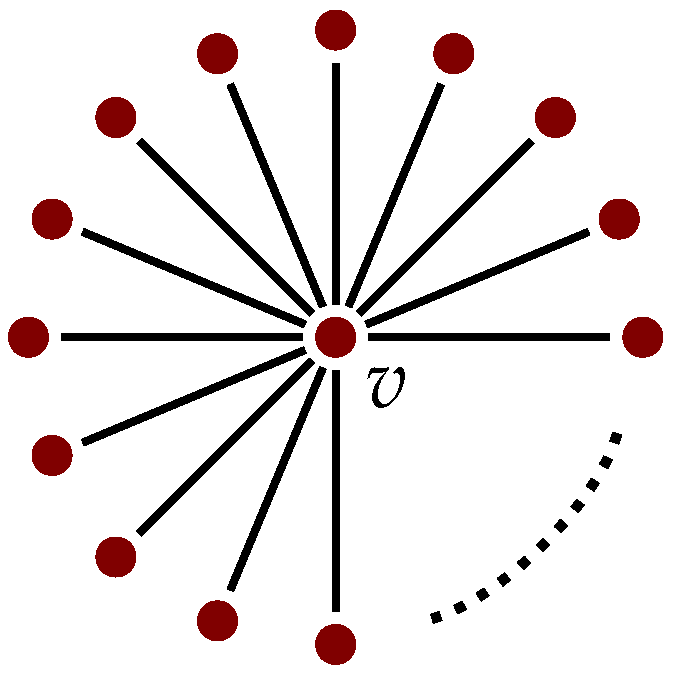
9], the variation in the energy of a graph due to vertex deletion was obtained, and vertices that produce the greatest variation in energy when removed were characterized. Specifically, it was found that if
G is a graph and
, then the following is calculated:
where
denotes the degree of the vertex
. Moreover, equality holds in (
1) if and only if
v is the center of a star tree. This motivated the concept of local energy of
G at vertex
v, as a measure of the contribution of the vertex
v to the energy of
G. It was defined as follows:
and the study of its mathematical properties were initiated in [
9,
10,
11].
Despite these advances, extending local energy to digraphs is far from straightforward. Unlike the undirected case, the presence of directionality introduces an inherent asymmetry between incoming and outgoing arcs, and it is not clear a priori how the contribution of a vertex to the energy of a digraph should be quantified.
Existing results on digraph energy mainly address global spectral properties of the adjacency matrix, while local, vertex-based descriptions remain largely unexplored. This motivates the search for a framework that captures local contributions in a way that is consistent with the directed structure and reduces to the classical notion when the digraph is symmetric.
Based on these considerations, we develop a systematic framework for local energy in digraphs. Our approach combines vertex deletion techniques with the singular value formulation of digraph energy, leading to new bounds involving both the in-degree and the out-degree of vertices. Moreover, the equality cases are characterized through a new structural notion, namely star-vertices, which has no direct analogue in the undirected setting.
To this end, we first analyze the variation of the energy of a graph
G when two vertices
are removed from
G. This is done in Theorem 1, when
are non-adjacent vertices such that
, where
denotes the set of adjacent vertices to
u. As a consequence, we show in Theorem 3 that the local energy of a digraph
D at a vertex
v satisfies the following:
Moreover, the equality condition holds if and only if
v is a star-vertex, a special type of vertex in a digraph introduced and studied in
Section 3.
Finally, in
Section 5, we extend the concept of local energy of a graph to digraphs as
, and show in Theorem 4 that
. Equality holds if
D is a disjoint union of directed paths and directed cycles.
Recall that the Randić index of
D, denoted by
, is defined as follows [
12]:
This is a generalization to digraphs of the graph-based molecular structure descriptor most widely applied in chemistry [
13,
14]. In Theorem 5 we find an upper bound for the local energy of a digraph in terms of the Randić index and characterize digraphs that attain the upper bound.
3. Star-Vertices in a Digraph
In this section we introduce a special type of vertex in a digraph, called a star-vertex, which plays an important role in our study.
Definition 1. Let D be a digraph. A vertex v of D is called a star-vertex if it satisfies the following conditions:
- 1.
for all ;
- 2.
for all .
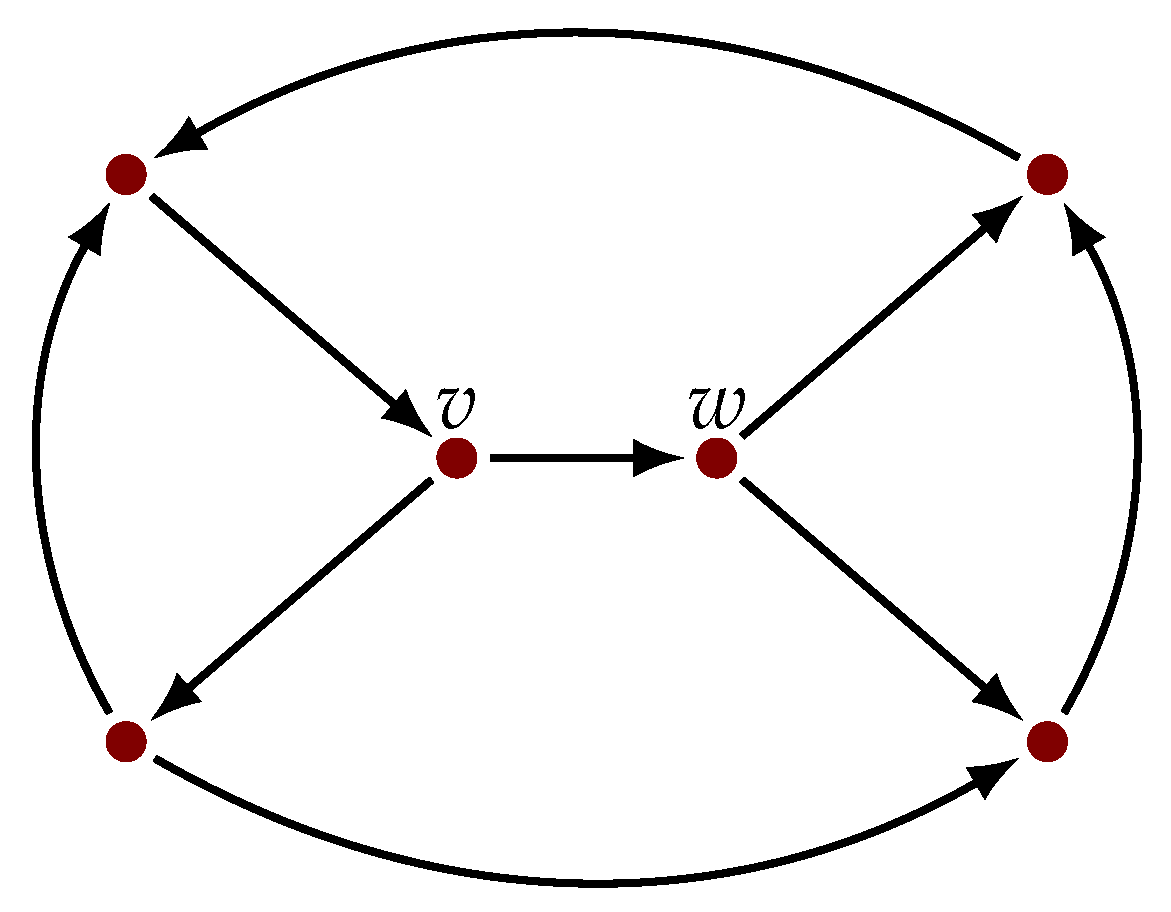
Example 1. Consider the digraph depicted in Figure 2. The vertex v is a star-vertex. However, vertex w is not a star-vertex. The name
star-vertex in Definition 1 is justified by its properties in the splitting digraph, an operation introduced in [
3] that has been very useful in the study of digraph spectra. Recall that if
D is a digraph with vertex set
V and
, the digraph
is obtained from
D by splitting the vertex
v into a pair of vertices
and
, in such a way that every arc
of
D is replaced by an arc
in
, and every arc
in
D is replaced by an arc
in
. If
D is a digraph, then we denote by
the digraph obtained from
D after we split all vertices of
D.
is called the splitting digraph of
D, and
denotes the underlying graph of
. More specifically,
and
if and only if
. Consequently, the neighbors of
in
correspond exactly to the heads of arcs leaving
v in
D, while the neighbors of
correspond to the tails of arcs entering
v.
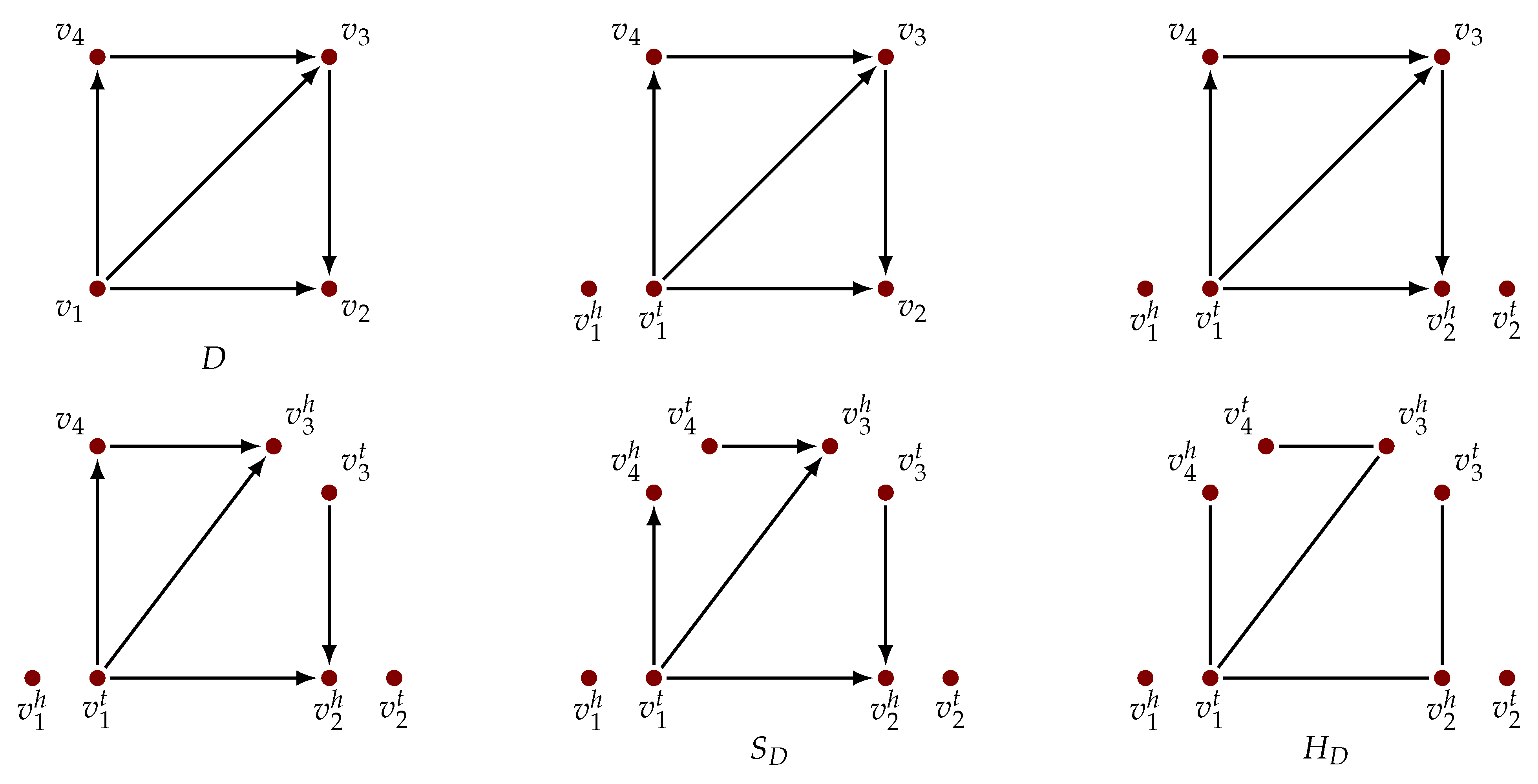
Example 2. In Figure 3, we illustrate how to obtain the splitting digraph and underlying graph after splitting all vertices of the digraph D. Remark 2. Our definition of the splitting digraph differs from that considered in [4,15] in one relevant aspect. In this work, every vertex of the digraph is split, including sources, sinks, and isolated vertices, whereas in [4,15] only vertices with positive in-degree and out-degree are split. As a consequence, the splitting digraph defined here always has exactly vertices. It is important to note that this uniform splitting does not affect the energy or the subsequent spectral arguments used in the paper. Indeed, if v is a source vertex, then its head copy is an isolated vertex of , while if v is a sink vertex, then its tail copy is isolated. Since isolated vertices do not contribute to graph energy, their presence has no impact on the study of energy or on the vertex-deletion arguments developed throughout the paper.
This effect can be seen explicitly in Figure 3, where the additional vertices created by splitting source or sink vertices appear as isolated vertices in and . Hence, the only difference with respect to the constructions in [4,15] lies in the presence of isolated vertices, which do not contribute to the energy. We have the following characterization of a star-vertex in a digraph D in terms of its splitting vertices in .
Proposition 1. Let D be a digraph. The following conditions are equivalent:
- 1.
is a star-vertex of D;
- 2.
and are centers of star trees in .
Proof. Note that for , is a center of a star tree in if and only if for all , and this is equivalent to for all . Similarly, is a center of a star tree in if and only if for all , which is equivalent to for all . □
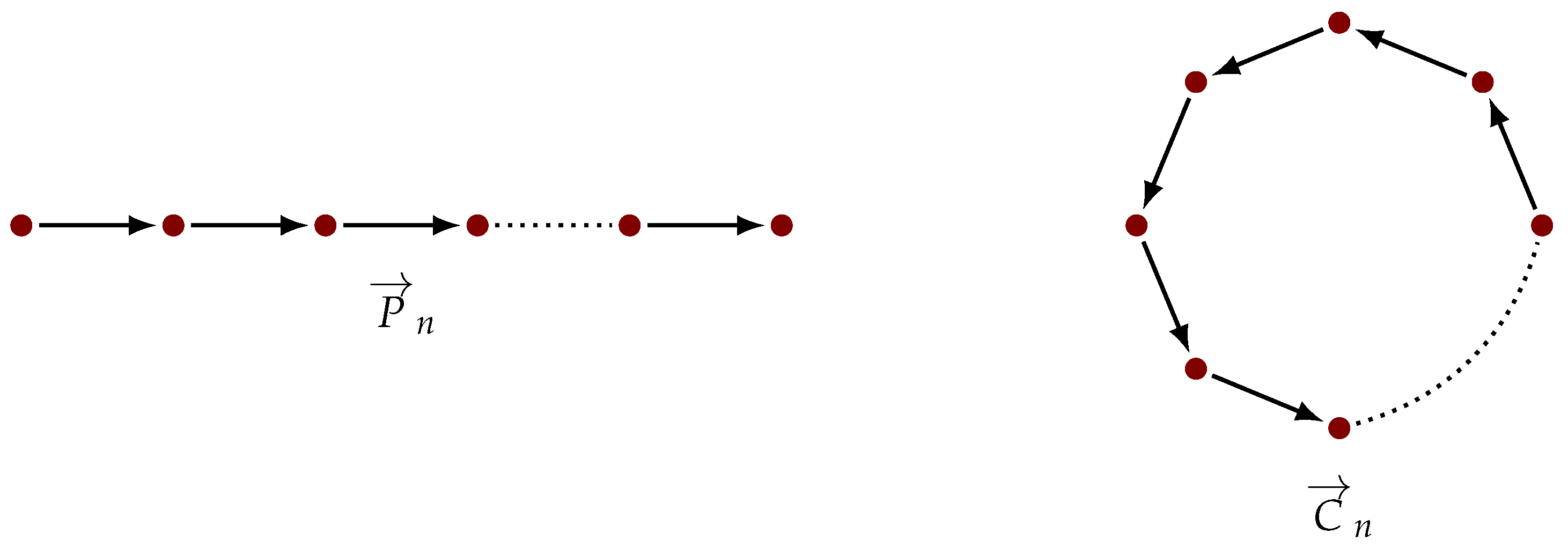
For each integer
, let
be the directed cycle on
n vertices depicted in
Figure 4. In particular,
is interpreted as an isolated vertex. For an integer
, let
be the directed cycle on
n vertices depicted in
Figure 4.
Lemma 1. Every vertex of a digraph D is a star-vertex if and only if D is a disjoint union of directed paths () and directed cycles ().
Proof. It is easy to see that v is a star-vertex for all if and only if and for all , and this is equivalent to the fact that D is a disjoint union of directed paths () and directed cycles (). □
Now we can find an upper bound for the energy of a digraph in terms of the degrees of the vertices in
D. The idea is to transfer the digraph problem to graphs via ([
4], Theorem 3.3),
and then apply the upper bound for a graph
G given in ([
9], Theorem 5):
Equality holds in (
6) if and only if
G is a disjoint union of copies of
(paths of length 2) and some isolated vertices.
Theorem 2. Let D be a digraph. ThenEquality occurs in (7) if and only if D is a disjoint union of directed paths () and directed cycles (). Proof. It follows from (
5) and (
6) that
If equality occurs in (
7) then by (
8),
and so by the equality condition in (
6),
is a disjoint union of copies of
, plus some isolated vertices. In particular, every vertex in
is a center of a star tree. Consequently, by Proposition 1, every vertex in
is a star-vertex, and by Lemma 1,
D is a disjoint union of directed paths
(
) and directed cycles
(
).
Conversely, assume that
D is a disjoint union of directed paths
, where
for every
, and directed cycles
, where
for every
. It is well known that
and
, for all
. Consequently,
On the other hand, it is clear that
and
for all
. Hence,
□
4. Local Energy of a Digraph at a Vertex
Motivated by the concept of local energy of a graph at a vertex given in [
9], we now extend it to digraphs. We keep the notation as in
Section 3.
Definition 2. Let D be a digraph and . We define the local energy of D at v as As in the case of graphs, the local energy of a digraph D at a vertex v measures the contribution of the vertex v to the energy .
Lemma 2. Let D be a digraph and . Then
- 1.
and are non-adjacent vertices in and .
- 2.
.
Proof. - 1.
By definition, and are non-adjacent vertices in . Furthermore, assume that . Then satisfies and . However, this leads to a contradiction, since every vertex in is either a sink vertex or a source vertex.
- 2.
Clearly, . Also, if and only if , , and , which is equivalent to . Hence .
□
Now we can show our main result of this section.
Theorem 3. Let D be a digraph and . ThenMoreover, equality in (10) occurs if and only if v is a star-vertex of D. Proof. By (
5), Lemma 2, and Theorem 1 we deduce that
Assume that equality holds in (
10). It follows from (
11) that
By Lemma 2,
and
are non-adjacent vertices in
and
. It follows from Theorem 1 that
and
are centers of star trees in
, and by Proposition 1,
v is a star-vertex of
D.
Conversely, if
v is a star-vertex of
D, then by Proposition 1,
and
are centers of star trees in
, and by Lemma 2,
and
are non-adjacent vertices of
such that
. It follows from Theorem 1, that (
12) holds and the result follows from (
11). □
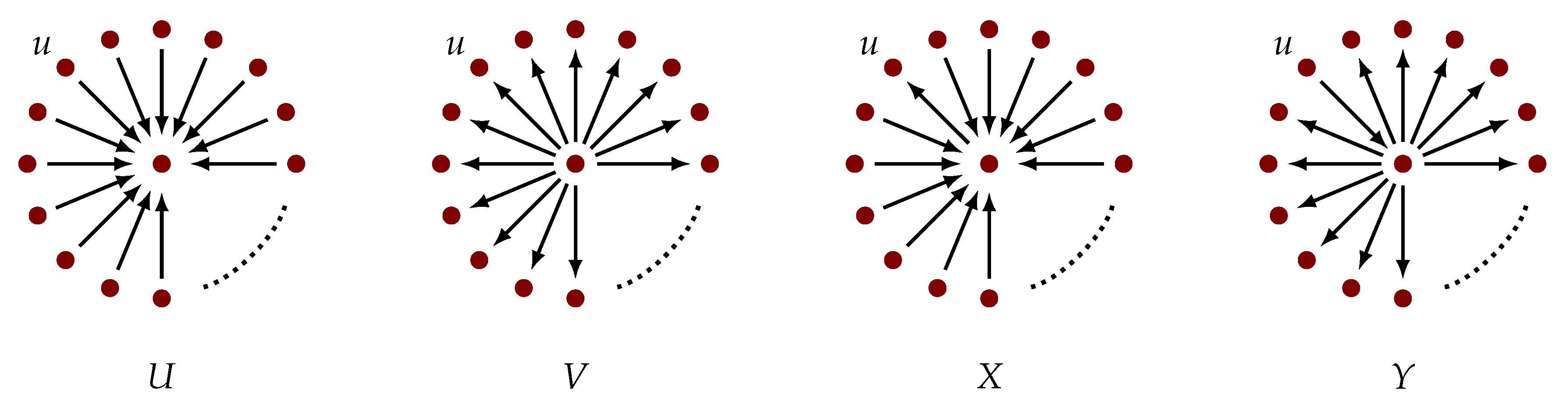
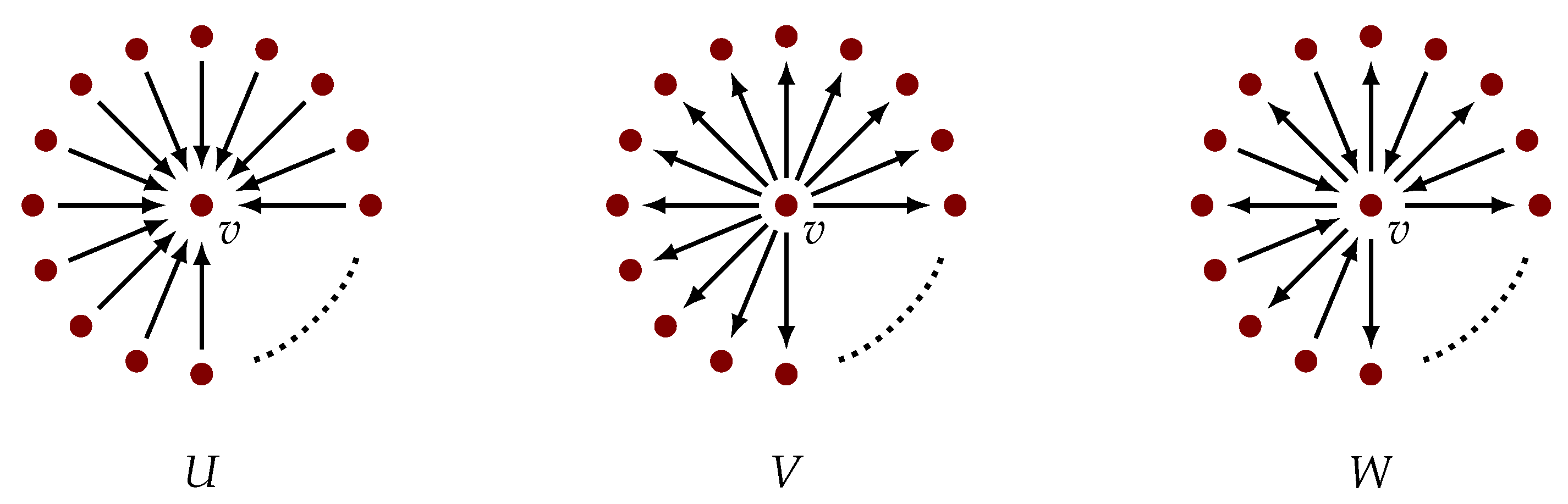
Example 3. Consider the directed cycle on n vertices. Since all vertices are star-vertices, it follows from Theorem 3 thatfor all . Example 4. Consider the directed path on n vertices. Again, all vertices in are star-vertices. Then, as a consequence of Theorem 3,and for all , The following problem naturally arises: given a graph G and , find the extremal values of among all orientations D of G. In our next example we give an answer in the case G is the star tree.
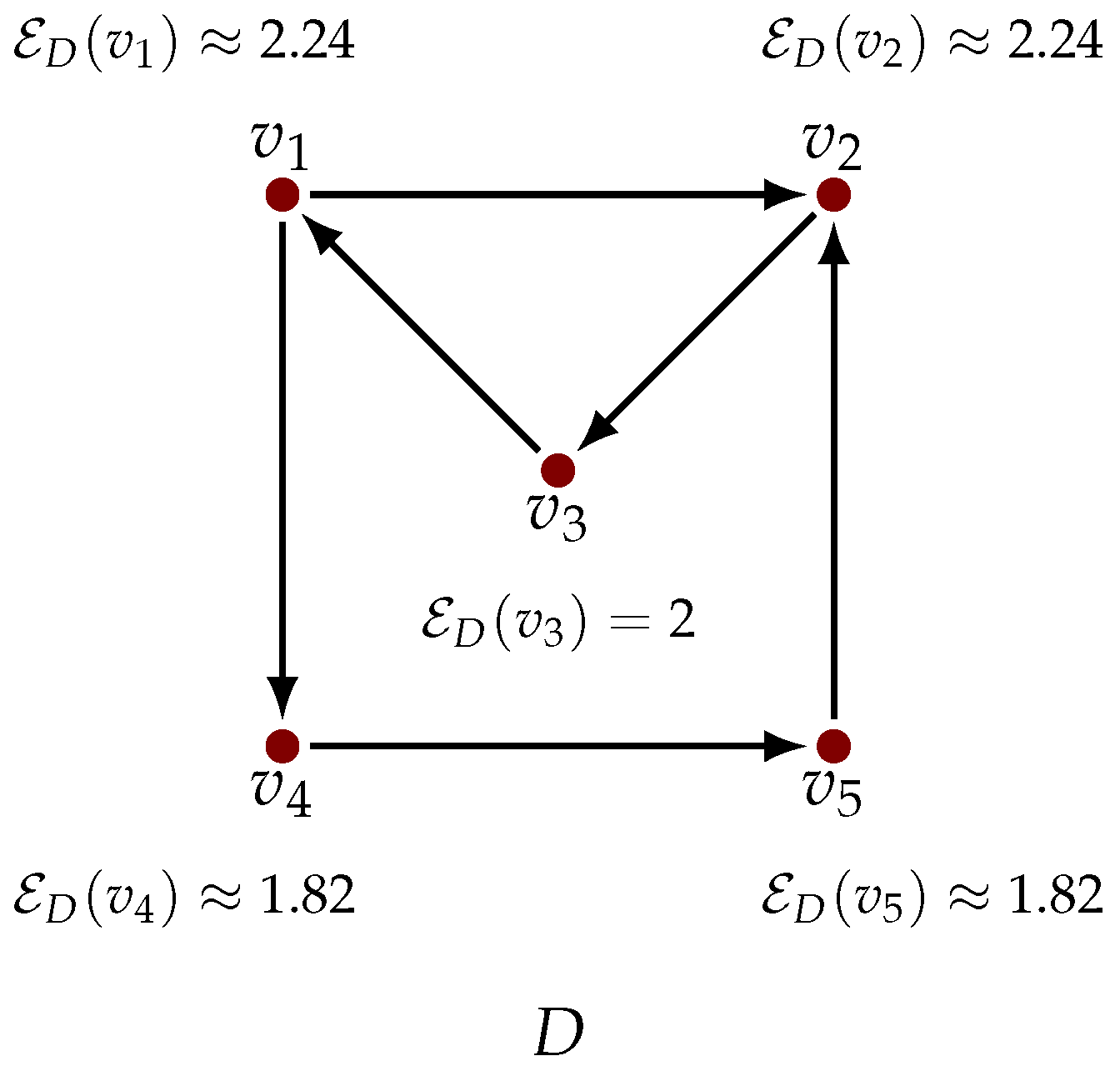
Example 5. Let v be the center of the star tree . Let D be any orientation of . Assume that and , where are non-negative integers and . Since v is a star-vertex of D, by Theorem 3,where . It is easy to show that this function attains its minimal value at and , and attains its maximal value at and . Consequently, the orientations of with minimal value of local energy at v are the sink–source orientations of (i.e., and , or and ), while the maximal value are the balanced orientations of (i.e., ). In Figure 5 are depicted the orientations of for which the local energy at the center is extremal. On the other hand, assume that u is a pendent vertex of and let F be an orientation of . Assume that and (the other case is similar). Let v be the center vertex of F, with and , where and . ThenSince the function is strictly decreasing for , we deduce that the maximal value of f occurs when and the minimal value occurs when . In Figure 6, we see the orientations of for which the local energy at a pendent vertex is extremal. Example 6. Consider the digraph D depicted in Figure 7. The vertex is a star-vertex of D, and therefore, by Theorem 3, its local energy attains the upper bound,In contrast, for the remaining vertices , , which are not star-vertices, the local energy satisfies the strict inequalityThis example illustrates that the bound in Theorem 3 is sharp and that equality occurs precisely at star-vertices. Let D be a digraph and . By we denote the set of all adjacent vertices to v, that is, . Adapting to digraphs the ideas from the proof of Theorem 1, and reasoning inductively, we obtain the following generalization of Theorem 3.
Corollary 2. Let D be a digraph and . ThenMoreover, assume that S is a set of non-adjacent vertices such that , for all with . Then, equality holds in (13) if and only if all vertices in S are star-vertices in D. 5. Local Energy of Digraphs
We can extend the concept of local energy of a graph to digraphs.
Definition 3. Let D be a digraph. We define the local energy of D, denoted by , as A sharp upper bound for the local energy of a digraph is given in our next result.
Theorem 4. Let D be a digraph. ThenMoreover, equality in (14) occurs in a disjoint union of directed paths () and directed cycles (). Proof. The proof of inequality (
14) is similar to the proof of ([
9], Theorem 5) adapted to digraphs. So we now show that this upper bound is sharp. Assume that
D is a disjoint union of directed paths
, where
for every
, and directed cycles
, where
for every
. Let
.
We already know that
(see proof of Theorem 2). Also, since all vertices in
D are star-vertices, it follows from Theorem 3, Example 3 and Example 4, that
and
for all
. Hence,
□
We next find an upper bound for the local energy of a digraph in terms of the Randić index. In what follows, by a component of a digraph we mean a weakly connected component of the digraph (i.e., a maximal subdigraph such that its underlying graph is connected).
With this in mind, we first give a general result on local energy of digraphs.
Lemma 3 Let D be a digraph and such that u and v are in different components of D. Then, .
Proof. Since
u and
v are in different components of
D, there exist subdigraphs
H and
K such that
,
, and
. Therefore
,
, and
. Hence,
and
□
Proposition 2. Let D be a digraph and such that and are in different components of . Then, Proof. Since
and
belong to different connected components of
, the deletion of these vertices affects two disjoint components. Consequently, the underlying graph
decomposes as a disjoint union, and the corresponding energy difference splits additively. Using (
5) and Lemma 3, we obtain
□
In view of our previous result, we are interested in digraphs D for which and are in different components of , for all .
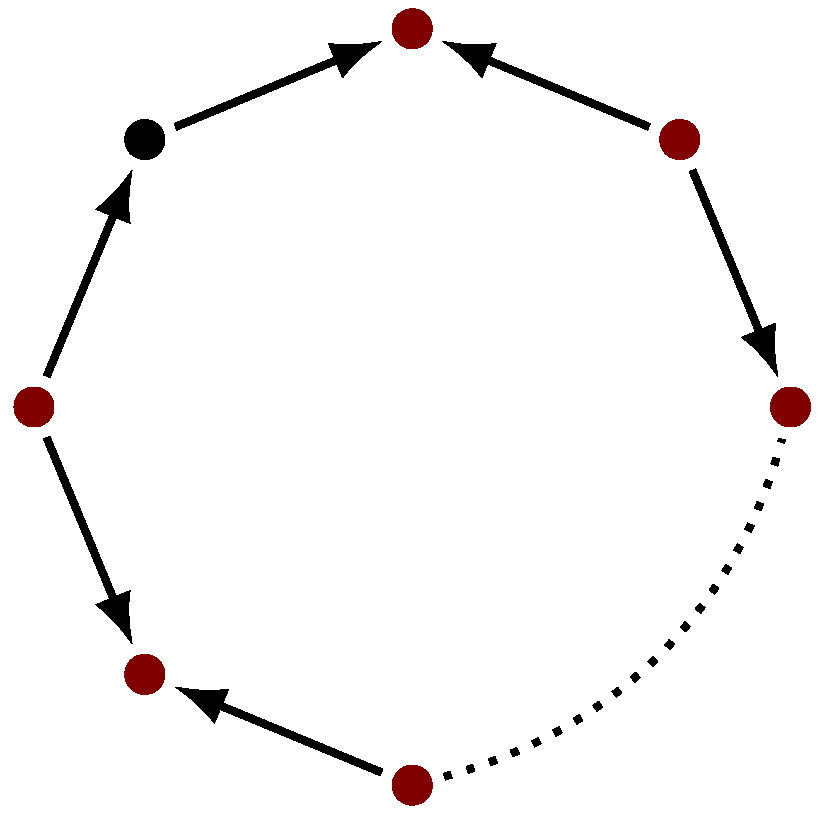
Recall that a quasi-sink–source cycle is a directed cycle in which all vertices, except one, are sink vertices or source vertices (see
Figure 8). Note that a quasi-sink–source cycle has odd order.
Proposition 3. Let D be a digraph. The following conditions are equivalent:
- 1.
For all , and belong to different components of ;
- 2.
D contains no quasi-sink–source cycles.
Proof. Suppose that for all , and belong to different components of . If D has a quasi-sink–source cycle C with , then there exists a path from to ; this is a contradiction.
Conversely, suppose that D does not contain quasi-sink–source cycles and that there exists a vertex such that and are in the same component of . Let u be one of these vertices such that the path from to has the shortest length. Then, the cycle C with is a quasi-sink–source cycle, which is a contradiction. □
So now we have characterized digraphs D such that and are in different components of , for all . We will give a name to these digraphs.
Definition 4. A digraph D splits disjointly if D contains no quasi-sink–source cycles.
There are abundant examples of digraphs that split disjointly, as we can see in our next example.
Example 7. A digraph whose underlying graph is a bipartite graph splits disjointly. In particular, any orientation of a bipartite graph splits disjointly. This is a consequence of the fact that a quasi-sink–source cycle has odd order.
Let D be a digraph. We denote the maximum out-degree of D by and the maximum in-degree of D by .
Theorem 5. Let D be a digraph that splits disjointly. Then,Equality holds if and only if D is a disjoint union of directed paths () and directed cycles (). Proof. Since
D splits disjointly, relation (
15) holds for all
. Hence, by (
1),
Assume that equality holds in (
16). Then by (
17),
Since
and
, for all
, we conclude that
and
, for all
. Hence, by the equality condition in (
1), every vertex in
is a center of a star tree, which implies by Proposition 1 that every vertex in
D is a star-vertex, and so by Lemma 1,
D is a disjoint union of directed paths
(
) and directed cycles
(
).
Conversely, if
D is a disjoint union of directed paths
, where
for every
, and directed cycles
, where
, for every
then clearly
,
for all
, and
for all
. Let
. Then
Now the result follows from the proof of Theorem 4, where we showed that
□
6. Conclusions
In this paper, we introduced and studied the notion of local energy for digraphs, extending the classical concepts of graph energy and local vertex energy from the undirected to the directed setting. The proposed definition is natural and consistent with the spectral properties of the adjacency matrix of a digraph, and it reduces to the known notion of local energy in graphs when the digraph is symmetric.
A key step in our approach was the analysis of the variation of graph energy under the deletion of a set of vertices, which provides the foundation for the definition and study of local energy in digraphs. Building on this result, we established several fundamental properties of local energy in digraphs and derived sharp bounds in terms of vertex degrees and global spectral parameters. In particular, we characterized the extremal cases in which these bounds are attained by means of a structural notion specific to the directed setting, namely star-vertices.
The examples included in the paper illustrate the sharpness of the bounds and clarify the behavior of local energy in different classes of digraphs. They also show that local energy provides refined information that cannot be captured solely by global spectral invariants.
Several directions for future research naturally follow from this work. One possible line is the study of local energy for other matrix representations of digraphs, such as the Laplacian or normalized matrices. Another interesting direction is the investigation of extremal problems for local energy within specific families of digraphs, as well as potential applications to network analysis where directionality plays a fundamental role.