1. Introduction
Statistics is a branch of mathematics that deals with collecting, organizing, analyzing, interpreting, and presenting data. It is broadly classified into descriptive statistics and inferential statistics, which together provide a framework for understanding data and making informed conclusions about a population based on sample observations. Descriptive statistics focus on summarizing and presenting the key features of a dataset in a clear and structured way, using numerical measures and graphical displays. Among descriptive measures, the mean (or average) is a fundamental statistic that represents the central tendency of quantitative data and is widely used due to its mathematical simplicity and practical usefulness. Inferential statistics, on the other hand, extends data analysis by allowing conclusions about a population to be drawn from sample data using probability theory. Key inferential tools include point estimation, confidence intervals, and hypothesis testing, with the population mean being a central parameter of interest. These methods account for sampling variability and provide a basis for reliable statistical inference beyond descriptive summaries.
The Rayleigh distribution has been widely used to model nonnegative data across a broad range of disciplines, including acoustics, medical research, quality control, communications engineering, reliability analysis, and aerospace applications. Owing to its practical relevance and mathematical simplicity, numerous extensions of the Rayleigh distribution have been introduced in the literature to improve its flexibility and modeling capability for complex real-world data. Notable contributions in this area include the works of Bashir and Rasul [
1], Abdulhakim [
2], Krishnamoorthy [
3], and Almongy et al. [
4], among others.
Data that contain a substantial proportion of zero values along with positively skewed nonzero observations commonly arise in areas such as reliability engineering, environmental science, biomedical research, and actuarial studies. In these settings, conventional continuous distributions are often inadequate because they fail to accommodate the excess zeros resulting from structural or process-related factors. Consequently, zero-inflated models have become an essential modeling framework as they explicitly incorporate a point mass at zero together with a continuous distribution to describe the positive outcomes.
The zero-inflated Rayleigh (ZIR) distribution offers a flexible and effective framework for modeling nonnegative data characterized by an excess number of zero observations. In this distribution, positive outcomes are modeled using a Rayleigh distribution, while a mixing parameter controls the probability of structural zeros. This dual-component structure enables the ZIR distribution to capture both the frequency of zero occurrences and the distributional behavior of positive measurements. Owing to its parsimonious formulation and interpretable parameters, the ZIR distribution is well suited for applications in lifetime and reliability analysis, signal amplitude modeling, and environmental studies, where zero values commonly occur alongside positively skewed data. A notable advantage of the ZIR distribution is that its mean reflects contributions from both the zero-inflation mechanism and the positive component, thereby summarizing the overall level of the underlying process. In comparative analyses involving multiple populations or experimental conditions, differences between the means of ZIR distributions provide a natural and informative measure for assessing group effects. Such comparisons allow researchers to simultaneously evaluate changes in the likelihood of zero outcomes and the expected magnitude of positive observations, offering a more comprehensive assessment than approaches based solely on the positive component. Consequently, statistical inference for differences between ZIR means is of considerable practical importance in many applied settings. Several studies have investigated properties and applications of the ZIR distribution, including those by Fuxiang et al. [
5] and Kijsason et al. [
6].
In studies that compare multiple populations or treatment groups, the primary focus is often on differences between group means rather than on individual mean estimates. When multiple groups are examined simultaneously, constructing separate pairwise confidence intervals can result in an inflated family-wise error rate. Simultaneous confidence intervals (SCIs) for all pairwise differences of means offer a coherent approach to joint inference, providing reliable conclusions while appropriately controlling for multiple comparisons. Although inferential methods for zero-inflated models have gained increasing attention, the development of SCIs for all differences of means within the framework of ZIR distributions remains relatively unexplored. This difficulty stems from the involvement of multiple parameters—specifically, the zero-inflation proportion and the Rayleigh scale parameter—which together define the mean and complicate its sampling behavior. Consequently, standard normal approximation techniques may yield unsatisfactory performance, particularly in settings with small to moderate sample sizes or substantial zero inflation.
Motivated by these issues, this study proposes the construction of SCIs for all pairwise differences of means of ZIR distributions using a range of inferential techniques, where simultaneous refers to the concurrent construction of confidence intervals for all pairwise contrasts within a unified inferential framework. Specifically, SCIs are developed based on the generalized confidence interval (GCI) method, the parametric bootstrap (PB) method, the method of variance estimates recovery (MOVER), and the delta-method normal approximation. In addition, a Bayesian framework is considered, with simultaneous inference conducted using highest posterior density (HPD) credible intervals for all pairwise contrasts. The performance of the proposed frequentist and Bayesian methods is systematically evaluated through extensive Monte Carlo simulations, with emphasis on the marginal coverage probability (CP) of individual pairwise intervals and the average interval length (AL) for various parameter settings and sample sizes. An application to road accident fatality counts is presented to demonstrate the practical effectiveness and applicability of the proposed methods.
2. Methods
The Rayleigh distribution is adopted for modeling the positive values of X because the observed nonzero data are continuous, nonnegative, and right-skewed, rendering discrete distributions inappropriate. As a member of the Weibull family, the Rayleigh distribution offers analytical tractability and computational efficiency, which are beneficial for statistical inference and simulation-based construction of simultaneous confidence intervals. Therefore, the zero-inflated Rayleigh model constitutes a flexible and theoretically sound framework for data exhibiting both excess zeros and continuous positive measurements.
Let
X be a random variable following a ZIR distribution with parameters
p and
, where
denotes the probability of an additional point mass at zero and
is the scale parameter of the Rayleigh component. The probability density function (PDF) of
X is given by
This distribution represents a mixture of a degenerate distribution at zero with probability
p and a Rayleigh distribution with mixing weight
. The corresponding cumulative distribution function (CDF) is
The mean of
X is
where
denotes the mathematical constant.
In this study, inference for the mean of the ZIR distribution across multiple groups is considered. Let
be the population mean of the ZIR distribution in the
i-th group, for
. The mean
is defined as
where
and
are the zero-inflation probability and the Rayleigh scale parameter for group
i, respectively.
A plug-in estimator of
is given by
where
and
are the corresponding MLEs.
The asymptotic variance of
is denoted by
To compare group means, consider the vector of mean parameters
For any two groups
i and
l , the difference in means is defined as
The estimator of
is
In
Appendix A, assuming independence between groups, the asymptotic variance of
is
2.1. Generalized Confidence Interval Method
The GCI method, introduced by Weerahandi, provides an effective inferential framework for complex models in which the exact sampling distributions of estimators are analytically intractable. Unlike classical confidence intervals, the GCI method is constructed using generalized pivotal quantities (GPQs), whose distributions are free of unknown parameters. This method is particularly advantageous for mixture models and zero-inflated distributions, such as the ZIR distribution, where standard asymptotic approximations may perform poorly, especially in small or moderate samples.
Let
be the mean of the ZIR distribution for the
i-th group, where
. Let
be its estimator. The GPQ for
is
Similarly, let
be the difference between the means of groups
i and
l. The corresponding GPQ is defined as
It should be noted that the proposed GPQs are constructed using plug-in estimators for the zero-inflation probability and therefore constitute approximate GPQs. As a result, the corresponding GCI-based intervals are approximate and may exhibit deviations from nominal coverage, particularly in settings with high zero inflation or small sample sizes.
The distribution of
is free of unknown parameters and can be approximated via Monte Carlo simulation. Consequently, a
two-sided confidence interval for
based on the GCI method is given by
where
and
denote the
-th and
-th quantile of the simulated GPQ distribution, respectively. The detailed steps are presented in Algorithm 1.
| Algorithm 1 GCI. |
Estimates , , and , ; Number of GPQ draws m; Significance level ; For do For do If then Draw Set Else set Set End for For all do Set End for End for For all do Set and End for
|
2.2. Parametric Bootstrap Method
Bootstrapping is a widely used resampling technique for assessing the sampling distribution of estimators and constructing confidence intervals when analytic results are difficult or unavailable. Among bootstrap methods, the parametric bootstrap is particularly effective when the underlying data-generating mechanism can be reasonably modeled by a parametric family.
In the parametric bootstrap, it is assumed that the observed data arise from a distribution indexed by an unknown parameter vector . The parameter is first estimated from the original sample, yielding . Bootstrap samples are then generated from the fitted parametric model , rather than directly resampling from the empirical distribution. This procedure allows the bootstrap samples to preserve structural features implied by the assumed model, such as skewness, tail behavior, or zero inflation.
Let denote a statistic of interest computed from the original data . For each bootstrap replication, a synthetic sample is generated from , and the corresponding bootstrap statistic is calculated. Repeating this process a large number of times yields an empirical approximation to the sampling distribution of T, which can be used to estimate bias, variance, and confidence intervals.
Parametric bootstrap confidence intervals are commonly constructed using the percentile method, where the interval endpoints are obtained from the empirical quantiles of the bootstrap distribution. Compared with the nonparametric bootstrap, the parametric bootstrap often exhibits improved efficiency and smoother sampling distributions when the assumed model is correctly specified. However, its performance depends critically on the validity of the parametric assumption; model misspecification may lead to biased inference.
Due to its flexibility and computational simplicity, the parametric bootstrap has been widely applied in complex inference problems, including small-sample settings, censored or zero-inflated data, and situations involving nonlinear estimators or functions of multiple parameters.
Generating a bootstrap sample, let
be i.i.d. observations from a ZIR distribution with parameters
and
. Define
,
. The bootstrap estimators of
and
are
and
The bootstrap parameter of the mean for group
i is
In the parametric bootstrap framework, the fitted ZIR model with parameter estimates
and
is employed as a plug-in approximation to the unknown true distribution, from which bootstrap samples are subsequently generated. The bootstrap parameter of the mean is defined as the corresponding population mean evaluated at these fitted parameters and is treated as fixed conditional on the observed data, thereby serving as the true parameter within the bootstrap resampling scheme. Equation (
7) is standard in parametric bootstrap inference and ensures coherence between the original estimation problem and its bootstrap counterpart.
The bootstrap difference of the means is
Therefore, a
two-sided confidence interval for
based on the parametric bootstrap method is given by
where
and
denote the
-th and
-th quantile of the simulated bootstrap replication, respectively. Algorithm 2 presents the detailed procedure.
| Algorithm 2 Parametric Bootstrap Confidence Interval. |
Estimates ; Number of bootstrap samples m; Significance level ; For do For do Generate bootstrap sample of size Compute Compute Set End for For all do Set End for End for For all do Set and End for
|
2.3. Method of Variance Estimates Recovery
The MOVER is a general methodology for constructing confidence intervals for functions of parameters when direct variance estimation or joint distributional assumptions are impractical. The core principle of MOVER is that the uncertainty of a target function can be recovered from marginal confidence intervals of the individual parameters and combined in a least favorable configuration to ensure nominal coverage.
The MOVER was extended by Donner and Zou [
7], who demonstrated that valid closed-form confidence intervals for nonlinear functions of scale parameters, such as the normal standard deviation, can be obtained using endpoint-based constructions. Their work establishes a unifying theoretical framework in which confidence intervals for both linear and nonlinear functions can be derived directly from marginal confidence limits.
Consider a ZIR distribution with parameters
, where
denotes the probability of a structural zero and
is the Rayleigh scale parameter. The mean of the distribution for group
i is
Let
be the marginal
two-sided confidence interval for
. The lower confidence limit
and upper confidence limit
are defined as
and
where
denotes the
q-th quantile of the Beta
distribution.
Let
be the marginal
two-sided confidence interval for
. The lower confidence limit
and upper confidence limit
are defined as
and
where
is the upper
-quantile of the standard normal distribution.
Following the endpoint-based MOVER principle, the confidence interval for
is constructed as
and
Under the MOVER variance recovery principle, the variance of
at the lower and upper confidence limits can be approximated by
and
These recovered variances implicitly account for the combined uncertainty arising from both the zero-inflation parameter and the scale parameter , without requiring their joint sampling distribution.
For
k independent groups
i and
l, define the difference
. Given the marginal MOVER confidence intervals
and
, the endpoint-based MOVER confidence interval for
is
and
From the variance recovery perspective, the recovered variance of at the lower and upper limits is given by
and
assuming independence between the two samples (
i and
l).
This leads to the closed-form endpoint-based MOVER confidence interval. Therefore, in
Appendix B, the
two-sided confidence interval for
based on the MOVER method is given by
The complete procedure is described in Algorithm 3.
| Algorithm 3 MOVER Confidence Interval. |
Estimates and , ; Significance level ; For do Obtain confidence interval for Obtain confidence interval for Set and End for For all do Set and End for
|
2.4. Delta-Method Normal Approximation
The delta method is a widely used asymptotic technique for approximating the sampling distribution of a function of an estimator. It is particularly useful when the parameter of interest is a nonlinear function of one or more parameters whose estimators are asymptotically normal. The delta-method normal approach relies on a first-order Taylor series expansion to obtain a normal approximation for the transformed estimator.
The delta-method normal approximation is used to construct confidence intervals for pairwise differences of parameters. The method relies on asymptotic normality and variance approximation obtained via the delta method.
Let
be the estimator of
for group
i. Using the delta method, the asymptotic variance of
is approximated by
Assuming independence between estimators from different groups, the variance of the difference
is approximated by
Therefore, in
Appendix C, the
two-sided confidence interval for
based on the delta-method normal approximation is given by
Algorithm 4 presents the detailed procedure.
| Algorithm 4 Delta-Method Normal Approximation Confidence Interval. |
Estimates and , ; Significance level ; For do If then Set Else set End for For all do Set Set Set End for
|
2.5. Highest Posterior Density Method
The Bayesian method is a probabilistic framework for statistical inference and decision-making. In contrast to frequentist methodology, which assumes model parameters are fixed but unknown constants, the Bayesian paradigm treats parameters as random variables and quantifies uncertainty through probability distributions.
Bayesian inference is founded on Bayes’ theorem, which provides a systematic way to revise prior assumptions about unknown parameters in light of observed data. Prior beliefs are expressed through a prior distribution, while the information contained in the data is captured by the likelihood function. The combination of these elements results in the posterior distribution, representing updated knowledge about the parameters after the data have been observed.
A key strength of the Bayesian framework is its ability to formally incorporate prior information or expert knowledge into the analysis. This feature is especially advantageous when dealing with small samples or complex statistical models. Moreover, Bayesian methods yield a comprehensive probabilistic characterization of uncertainty, enabling direct probability statements about parameters and derived quantities, such as percentiles or reliability indices.
Bayesian inference also supports interval estimation via credible intervals, including both equal-tailed intervals and HPD credible intervals, which are often easier to interpret than classical confidence intervals. Furthermore, modern computational tools, particularly Markov Chain Monte Carlo (MCMC) algorithms, have greatly expanded the applicability of Bayesian methods to problems where closed-form solutions are not available.
In summary, the Bayesian method provides a flexible and robust alternative to traditional statistical techniques and has been widely applied in areas such as reliability engineering, survival analysis, and numerous other scientific disciplines.
For
, let
be independent samples from
k populations. For each population, the model is characterized by a mixing probability
and a scale parameter
. The parameters are assigned independent prior distributions given by
and
where
denotes the inverse-gamma distribution.
Let
be the sample size in group
i,
the number of zero observations, and
the number of positive observations. Conditional on the observed data, the posterior distribution of
is
When
, the posterior distribution of
is
whereas if
, the posterior of
coincides with its prior.
Posterior samples
are generated by Monte Carlo simulation. For each draw, the parameter of interest is defined as
For any pair of groups
, posterior samples of the difference are obtained as
Therefore, the
two-sided credible interval for
based on the HPD method is given by
where
and
are obtained using the
HPD interval function in R software (version 2024.12.0 + 467). The complete procedure is described in Algorithm 5.
| Algorithm 5 HPD Credible Interval. |
Priors and ; Number of posterior draws m; Credibility level ; For do For do Draw Draw Set End for For all do Set End for End for For all do Compute and End for
|
3. Simulation Studies
A detailed simulation study was conducted to evaluate the performance of the proposed SCIs. The investigation focused on two main performance metrics: coverage probability (CP) and average interval length (AL). All computational experiments were performed in R software, with each scenario replicated a sufficiently large number of times to ensure stable and reliable results. For each interval estimation method, the empirical CP was calculated as the proportion of simulated intervals that contained the true parameter value, while the AL was defined as the mean width of the intervals across replications. These measures formed the basis for comparing the efficiency and robustness of the SCIs with various parameter settings and sample sizes.
To determine the most suitable interval method, preference was given to methods achieving an empirical CP at or above the nominal confidence level of 0.95. Among the methods satisfying this criterion, the one yielding the smallest AL was regarded as the most efficient. This dual evaluation framework ensures that both the accuracy and precision of the interval estimators are appropriately considered.
The SCIs were constructed using five different methods: the GCI method, the PB method, the MOVER method, the delta-method normal approximation, and the HPD method. The simulation study examined three scenarios corresponding to
and 10 groups. The sample sizes were denoted by
; the probabilities of zero inflation by
; and the Rayleigh scale parameters by
. Note that
,
, and
indicate that the same values
n,
p, and
, respectively, are repeated across the
k groups. For every sample generated, an additional 1000 simulations were carried out following Algorithms 1, 2 and 5. For each set of parameter values, 1000 random samples were generated using Algorithm 6.
| Algorithm 6 CP and AL. |
True pairwise difference ; Coverage indicators ; Interval lengths ; for each method For each method do Compute average coverage probability Compute average interval length End for
|
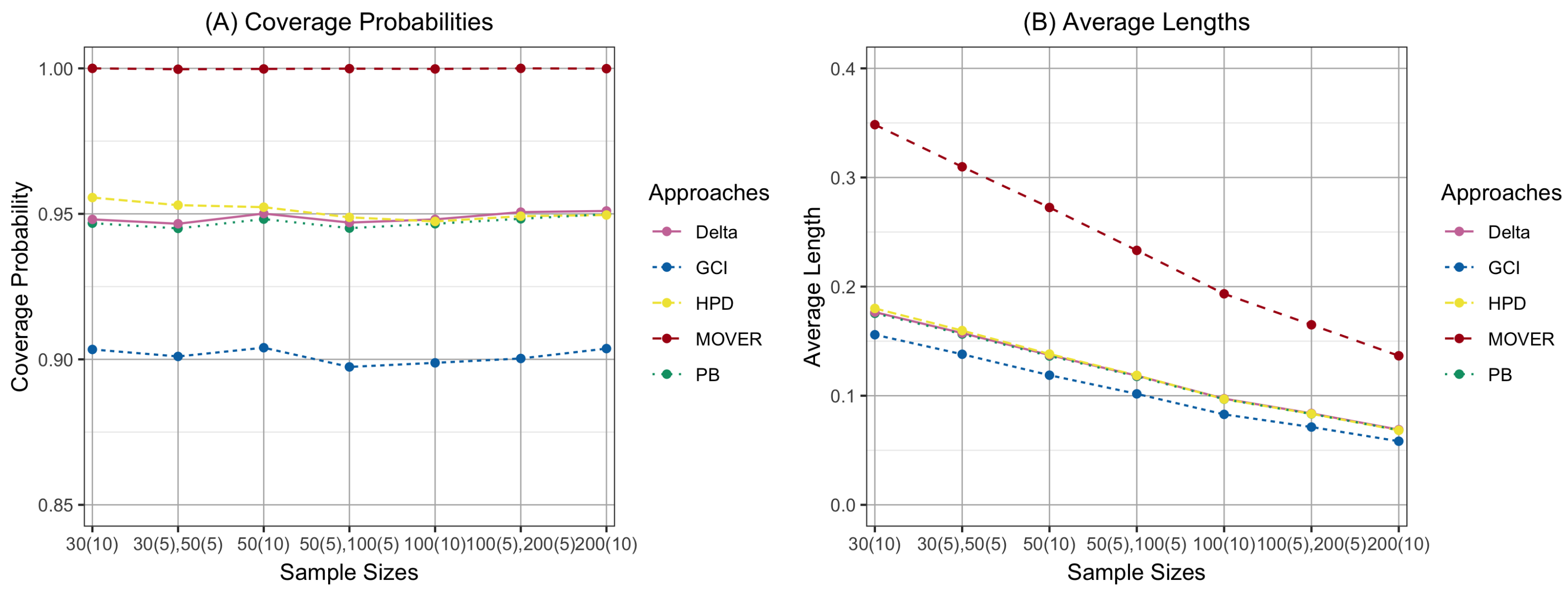
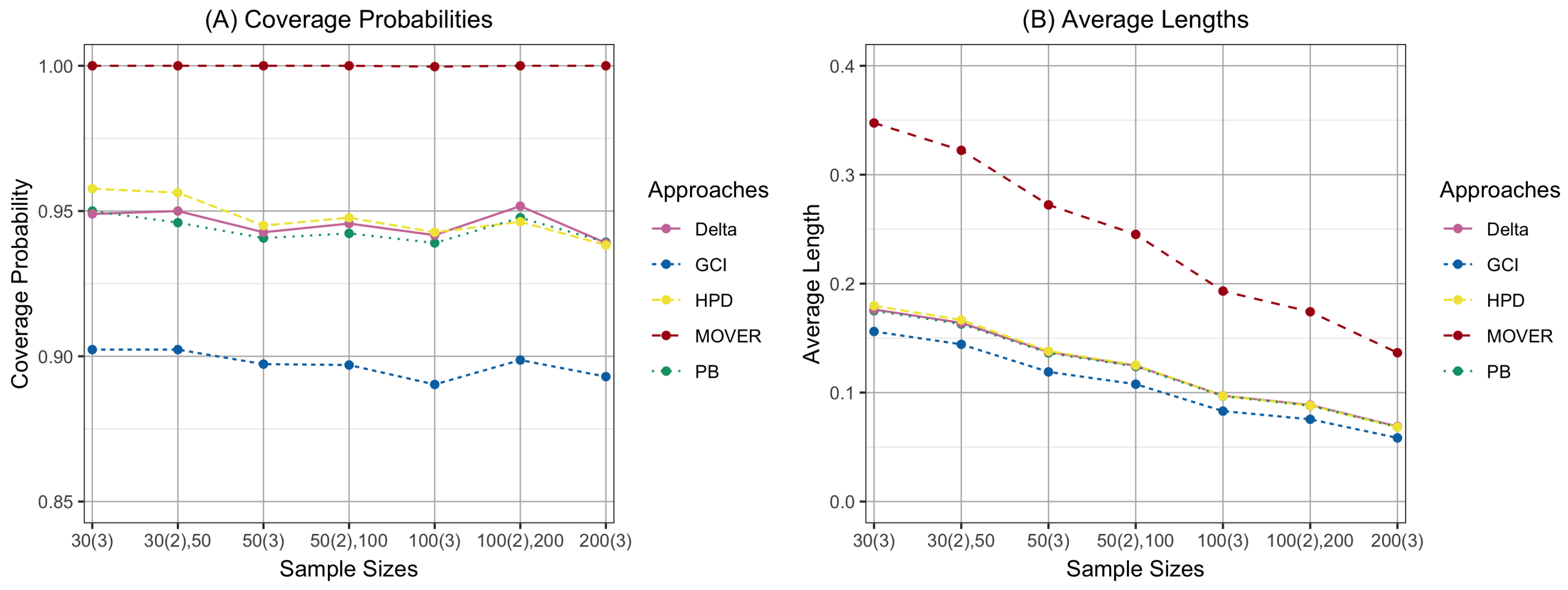
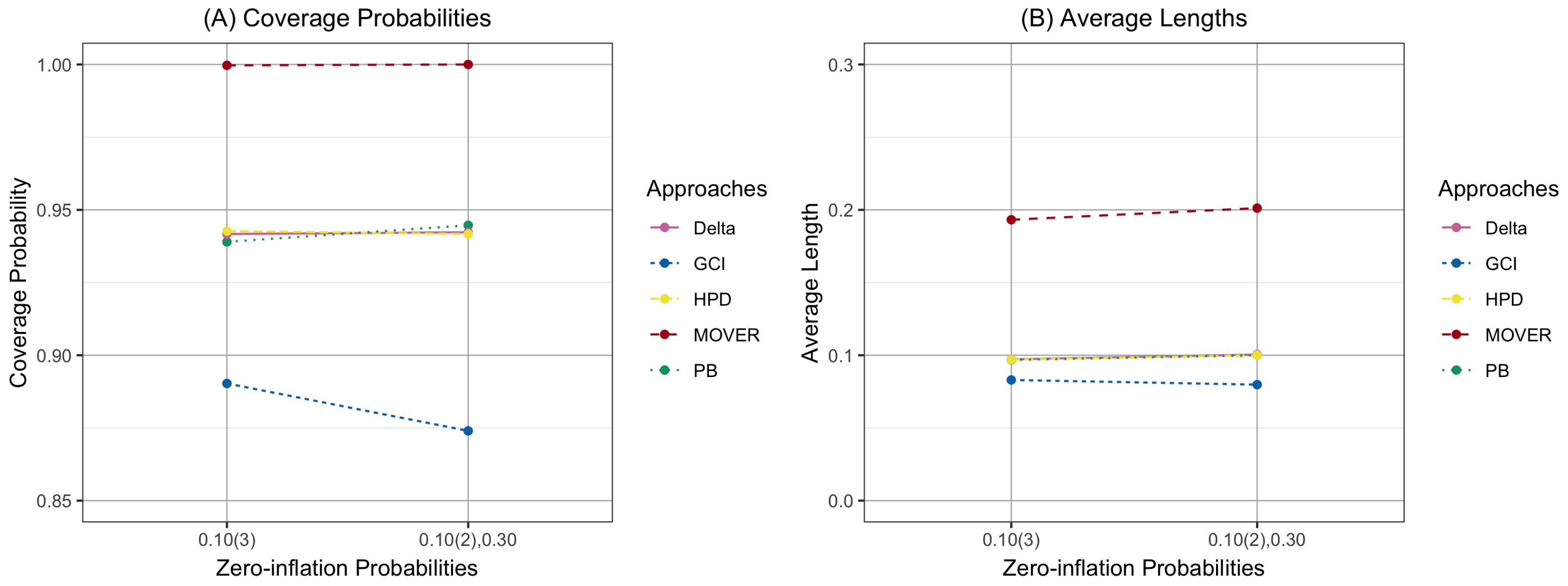
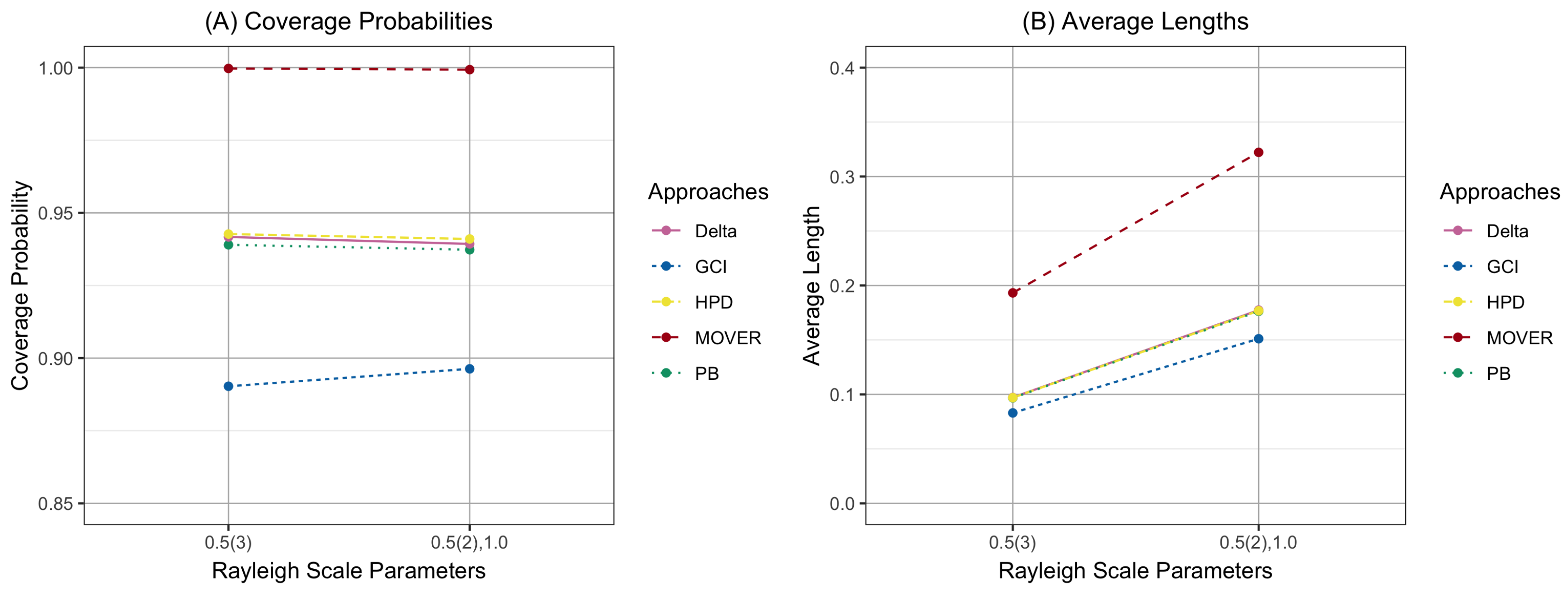
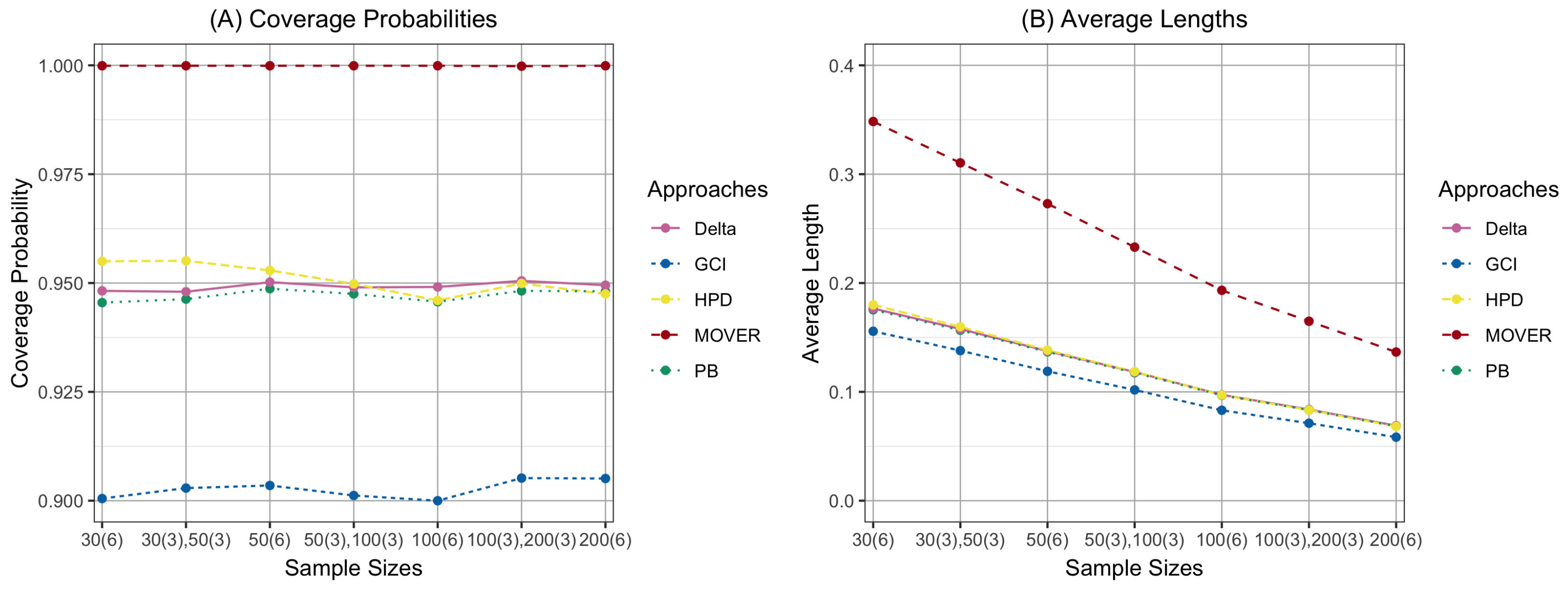
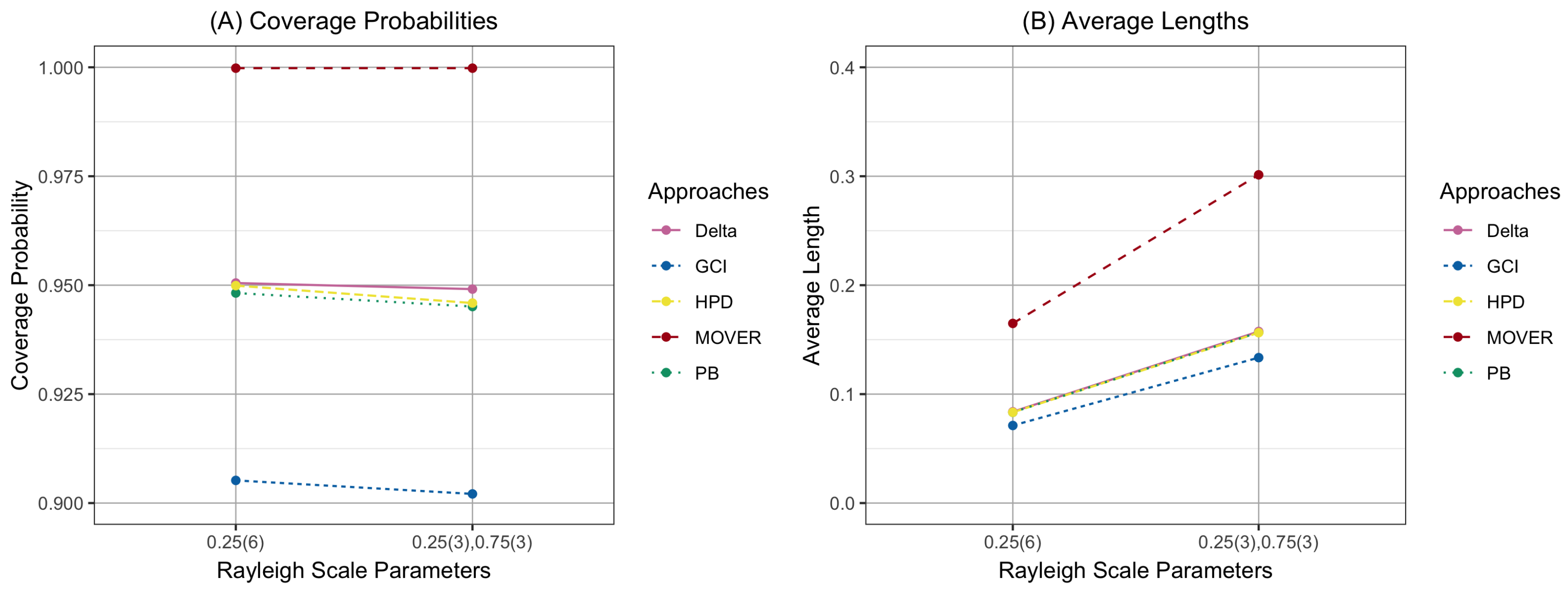
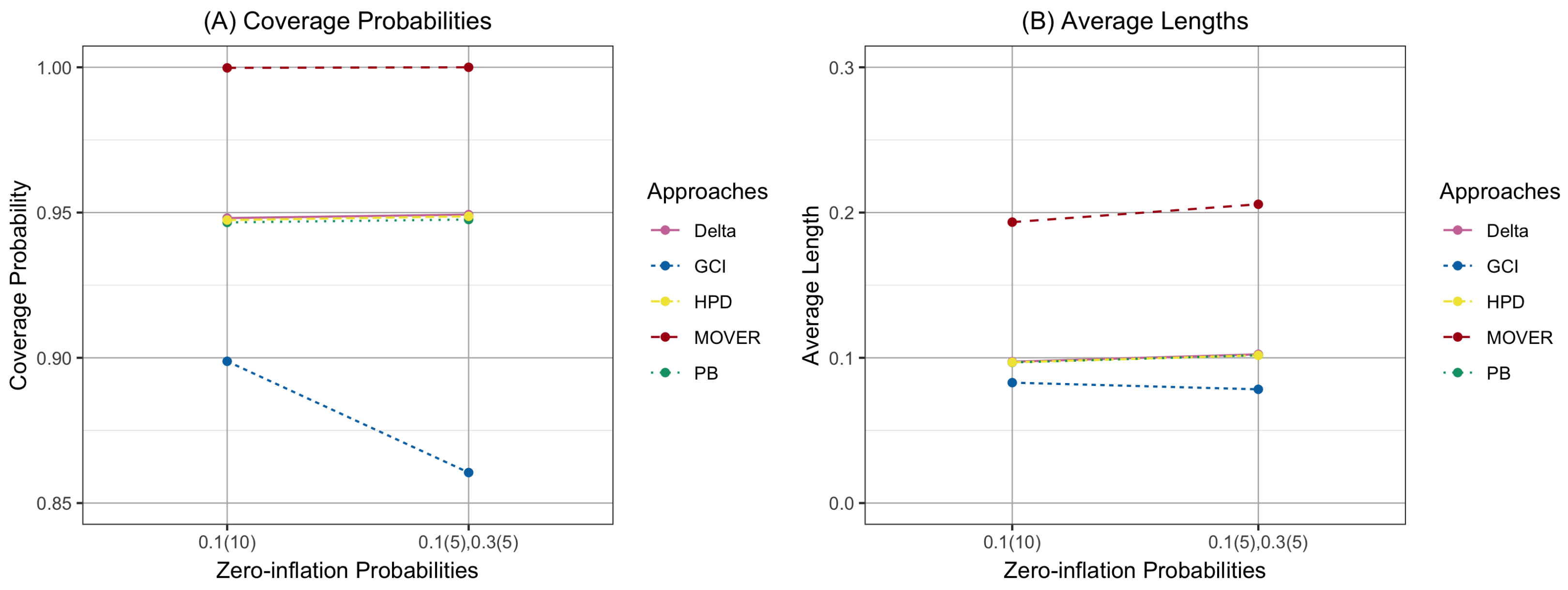
From
Figure 1,
Figure 2 and
Figure 3, the results for
indicate that the GCI method consistently produced the lowest CPs, with values typically falling below the nominal 0.95 level. This under-coverage became more pronounced when the third group exhibited higher zero-inflation probabilities or when the scale parameter showed greater heterogeneity. Although the GCI yielded relatively narrow ALs, these intervals were often too short to achieve nominal coverage.
In contrast, both the PB method and delta-method normal approximation attained CPs close to the targeted 0.95 across nearly all parameter settings. Their CP performance improved as sample sizes increased while still maintaining moderate ALs. Between the two, the PB method generally produced slightly shorter intervals for a given CP, particularly in balanced sample-size scenarios.
The MOVER method consistently achieved CPs equal to or near 1.0000 in every configuration, indicating substantial over-coverage. However, this gain in CP came at the expense of much wider intervals—often more than double the ALs of the PB method and delta-method normal approximation, especially with greater scale disparities. Although the MOVER method is the most conservative method, its excessive interval lengths make it less efficient for practical applications.
The Bayesian method performed similarly to the PB method and delta-method normal approximation, with CPs typically ranging from 0.94 to 0.96 depending on the scenario. Its ALs were also comparable to those of the PB method and delta-method normal approximation and consistently far shorter than those of the MOVER method. Moreover, the HPD method maintained stable CP and AL behavior across variations in sample size and zero-inflation probability, demonstrating robustness.
Increasing sample sizes led to improved CPs for all approaches except the MOVER method (which had already attained 1.0000) and generally reduced ALs. This trend was especially noticeable for the PB method, delta-method normal approximation, and HPD method, whose CPs approached the nominal level more closely as n increased to 100 or 200.
Overall, the PB method, delta-method normal approximation, and HPD method provided the most favorable balance between coverage accuracy and interval length. The MOVER method offered the highest CPs but at the cost of substantially inflated ALs, whereas the GCI method persistently under-covered across most settings. These patterns identify the PB method, delta-method normal approximation, and HPD method as the most efficient SCI procedures for the three-sample ZIR scenarios.
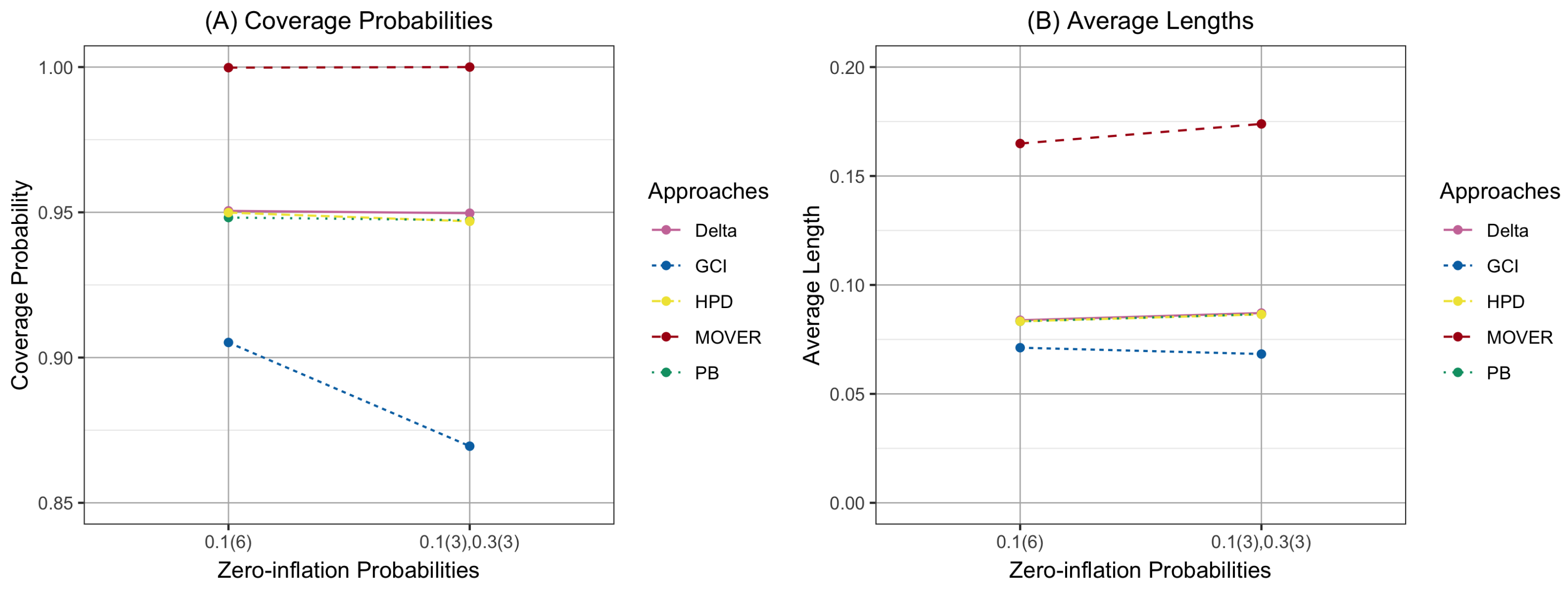
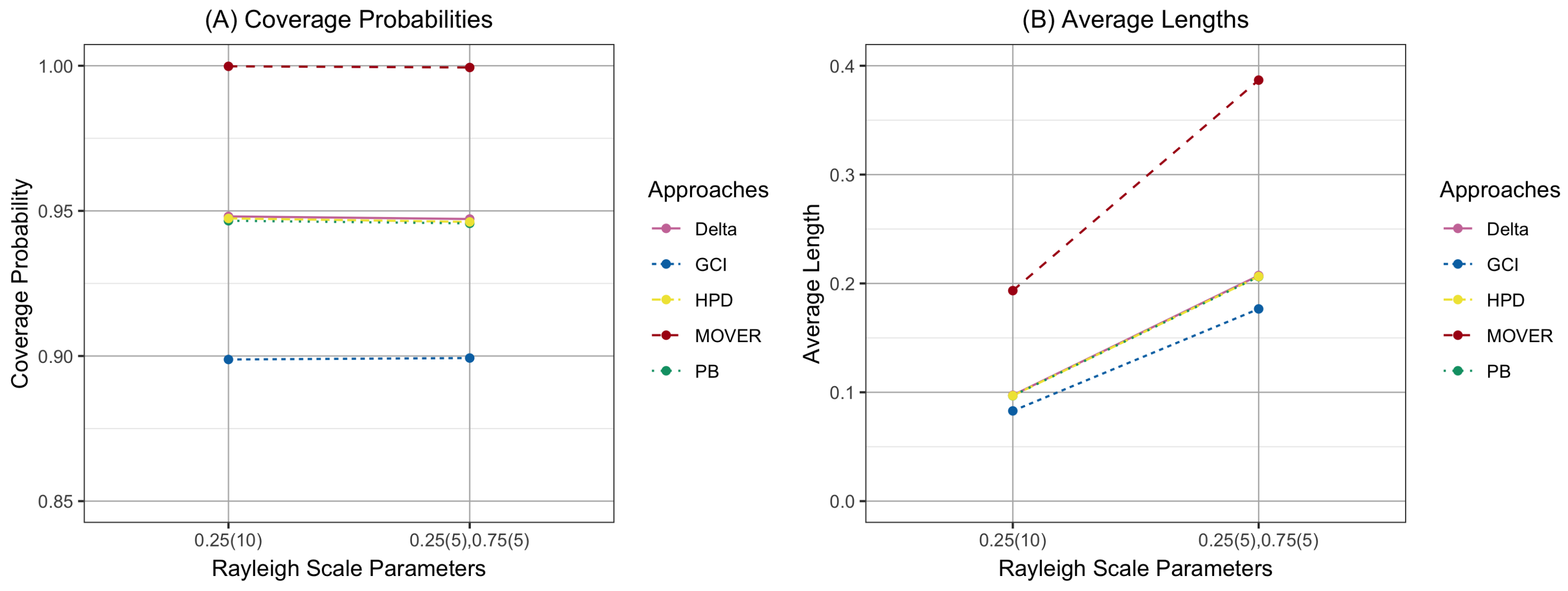
Figure 4,
Figure 5 and
Figure 6 summarize the empirical CPs and ALs of the 95% two-sided SCIs for all pairwise mean differences in various six-sample configurations. The overall trends observed in the three-sample setting remain consistent and become even more pronounced when extended to six samples.
Across every parameter setup, the GCI method produced the lowest CPs, typically ranging from 0.83 to 0.91. Its under-coverage worsened in scenarios where the latter groups had higher zero-inflation probabilities (e.g., ) or when scale heterogeneity was substantial (e.g., ). Although the GCI method generated the shortest intervals among all methods, this gain in precision came at the cost of inadequate coverage, demonstrating that its intervals were too narrow to maintain the nominal 0.95 confidence level.
The MOVER interval again displayed extreme conservatism, yielding CPs essentially equal to 1.0000 in every scenario. However, this was accompanied by substantially inflated ALs, often two to three times larger than those of the PB, delta-method normal approximation, and HPD intervals. The effect was particularly evident when the scale parameters increased from 0.25 to 0.75, producing noticeably wider MOVER intervals. Although MOVER interval ensures near-certainty in coverage, its inefficiency renders it the least practical option.
Sample size played a major role in shaping CP and AL across all methods. As sample sizes increased from 30 to 200, CPs improved and ALs consistently decreased. The PB, delta-method normal approximation, and HPD method showed the greatest gains, exhibiting highly stable CPs close to the nominal level and substantially shorter intervals with larger samples. In contrast, the GCI method continued to under-cover even with larger n, whereas the MOVER method persistently over-covered regardless of sample size.
Overall, the six-sample results reinforce the conclusions drawn from smaller-sample analyses. The PB, delta-method normal approximation, and HPD methods provide the most effective balance between achieving nominal coverage and maintaining reasonably short intervals. The GCI remains overly liberal, while MOVER interval remains excessively conservative. Thus, PB, delta-method normal approximation, and HPD procedures stand out as the most dependable and efficient SCI approaches for six-sample ZIR scenarios.
Figure 7,
Figure 8 and
Figure 9 report the empirical CPs and ALs of the 95% SCIs for all pairwise mean differences when
. The general trends observed in the three- and six-sample situations persist and become even more pronounced as the dimensionality increases.
Across every configuration, the GCI procedure again produced CPs well below the nominal level, with values roughly between 0.83 and 0.90. Its under-coverage intensified when the last five groups exhibited higher zero-inflation probabilities (i.e., ) or when the scale parameters were larger (e.g., ). Although the GCI continued to yield the shortest intervals, these reduced ALs did not offset the considerable loss in coverage, reaffirming its overly liberal nature.
The PB, delta-method normal approximation, and HPD methods exhibited strong and consistent performance across nearly all settings. Their CPs remained close to the desired 0.95 level, with only minor decreases under higher zero-inflation conditions. These three methods also showed clear gains from increased sample size, with improvements in both CP and AL as the smallest group size rose from 30 to 200. Regarding interval width, PB, delta-method normal approximation, and HPD intervals stayed within a moderate range—substantially shorter than those of MOVER interval yet appropriately wider than the GCI—making them practical and efficient options.
As in the previous figures, the MOVER method produced CPs essentially equal to 1.0000 across all scenarios, underscoring its conservativeness. However, this came with extremely large interval lengths, often two to three times greater than those obtained from the PB, delta-method normal approximation, and HPD methods. The inefficiency of MOVER interval became even more pronounced when scale parameters increased, resulting in notably wider intervals.
Sample size exerted a strong and consistent influence. As sample sizes increased from to , all methods produced shorter intervals, with PB, delta-method normal approximation, and HPD showing the most substantial improvements in precision and stability. The GCI continued to under-cover even in the largest samples, while MOVER persistently over-covered across all settings.
In summary, the findings for the ten-sample case reinforce the conclusions from
Figure 7,
Figure 8 and
Figure 9. The PB, delta-method normal approximation, and HPD methods provide the best compromise between nominal coverage and reasonable interval widths. The GCI remains overly liberal and unreliable, whereas MOVER interval, although ensuring high CP, is excessively conservative and inefficient. Therefore, in high-dimensional ZIR scenarios, PB, delta-method normal approximation, and HPD methods stand out as the most dependable and effective procedures for constructing SCIs.
4. Empirical Application
Global road traffic accidents represent a critical public health crisis, serving as a major contributor to premature death and injury. Beyond the immediate human suffering, these incidents impose substantial economic burdens through rising healthcare expenditures, reduced workforce productivity, and the long-term costs associated with disability rehabilitation. The causes of road traffic accidents are multifaceted, arising from a complex interplay between risky driving behaviors—such as speeding and alcohol impairment—and external factors including inadequate infrastructure and weak law enforcement. Mitigating this challenge requires an integrated strategy that combines legislative reforms, public education initiatives, and infrastructure improvements. Consequently, robust statistical modeling is essential for developing evidence-based interventions aimed at reducing both the frequency and severity of traffic crashes.
This study examines fatality data obtained from the Road Accident Victims Protection Company Limited (Thai RSC) (
https://www.thairsc.com/, accessed on 25 December 2025) for the period from 1 January to 24 December 2025, as presented in
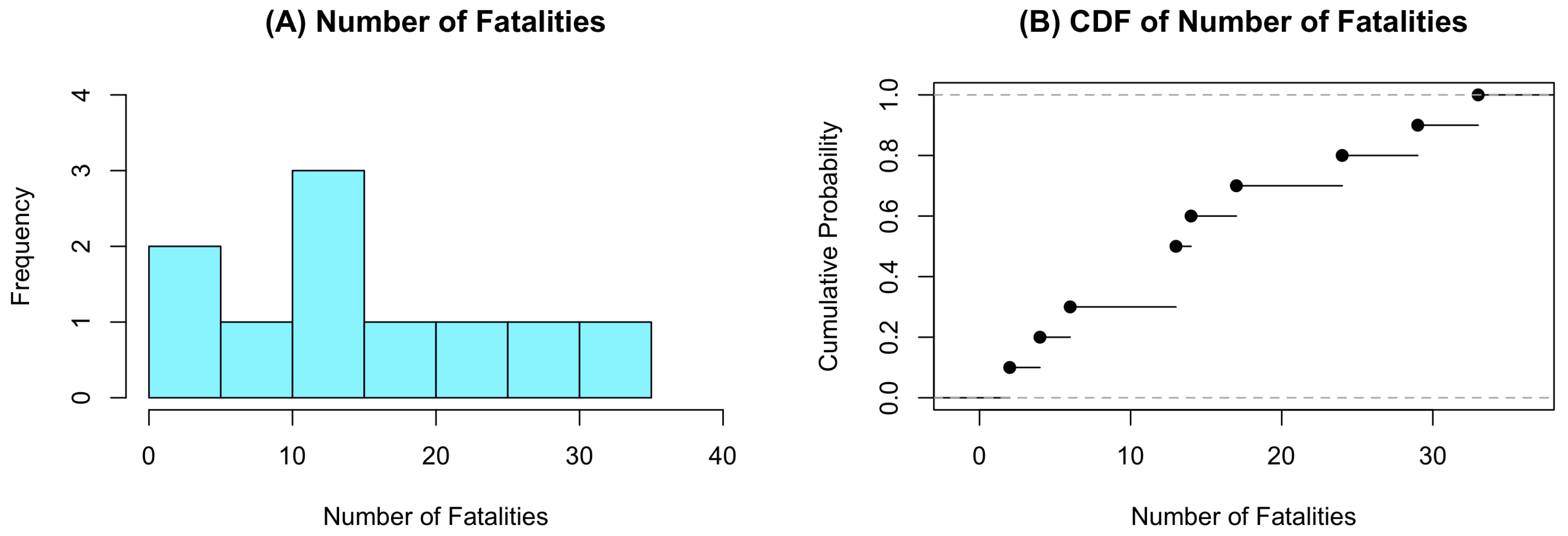
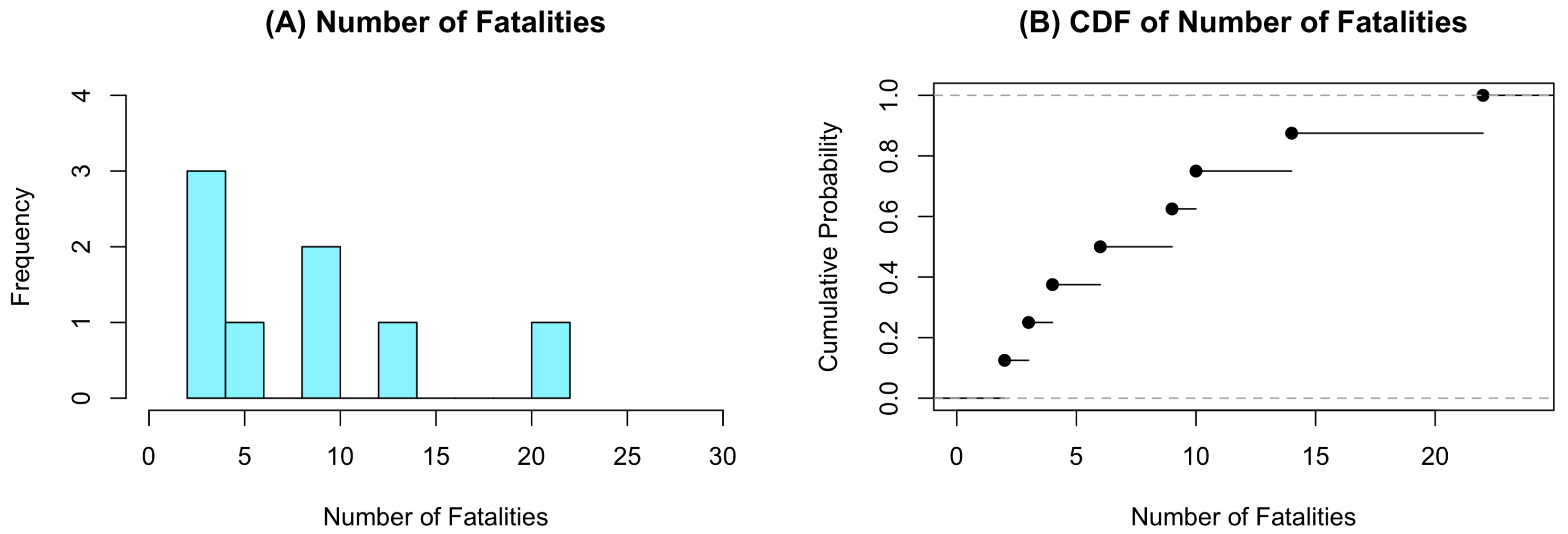
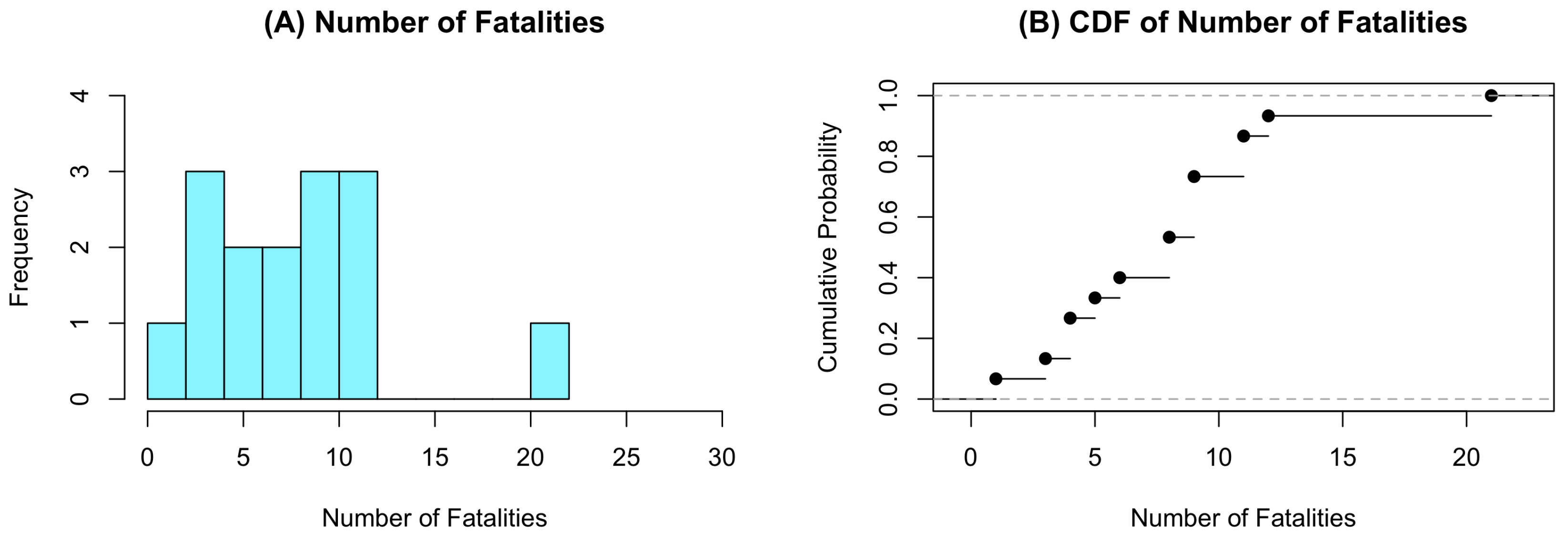
Table 1. The analysis encompasses 36 districts across Chachoengsao, Uttaradit, and Chaiyaphum provinces. As shown in
Figure 10,
Figure 11 and
Figure 12, preliminary analysis indicates that the distributions of non-zero fatalities in these regions are markedly right-skewed. As shown in
Table 2, model selection based on the Akaike Information Criterion (AIC) shows that the Rayleigh distribution provides the best fit for the non-zero observations. However, to accommodate the substantial proportion of zero-fatality reports, the ZIR model is identified as the most appropriate framework for modeling the complete dataset.
Table 3 reports the descriptive statistics of fatality counts for Chachoengsao, Uttaradit, and Chaiyaphum provinces. The estimated pairwise mean differences are 6.3476 (Chachoengsao–Uttaradit), 7.0852 (Chachoengsao–Chaiyaphum), and 0.7376 (Uttaradit–Chaiyaphum). As shown in
Table 4, the 95% SCIs produced by all considered methods contain the true mean differences. The MOVER approach yields the widest intervals, in agreement with the simulation results presented in the previous section. In contrast, the GCI, PB, and delta intervals are shorter than the HPD credible interval.
It is important to note that, unlike the simulation study based on 1000 replications, this analysis corresponds to a single empirical dataset. The simulation results indicate that the CPs of the GCI, PB, and delta intervals fall below the nominal 0.95 level, rendering them unsuitable for constructing reliable 95% SCIs for mean differences in this setting. Conversely, the HPD interval consistently attains CPs exceeding the nominal level. Therefore, the HPD interval is recommended for constructing 95% SCIs for pairwise mean differences in fatalities among the three provinces.
It should be noted that the empirical analysis serves to demonstrate the practical implementation of the proposed simultaneous interval estimation procedures, while detailed model diagnostics and causal interpretation are beyond the scope of the present study.
5. Discussion
Overall, the simulation study reveals clear and systematic performance differences among the competing SCI methods across all scenarios. The GCI method consistently under-covered, with empirical coverage probabilities falling well below the nominal 0.95 level, particularly with higher zero inflation, greater scale heterogeneity, and increasing numbers of groups. Although the GCI produced the shortest intervals, these were generally too narrow to support reliable inference. In contrast, the MOVER method was highly conservative, achieving coverage probabilities close to 1.0000 in all settings but at the cost of substantially inflated interval widths, which severely limited its practical efficiency.
By comparison, the PB, delta-method normal approximation, and HPD methods provided the most favorable trade-off between coverage accuracy and interval length. Their CPs remained close to the nominal level across a broad range of sample sizes, zero-inflation levels, and dimensions while yielding intervals that were moderate in length and markedly shorter than those of the MOVER method. Moreover, their performance improved with increasing sample size, leading to greater stability and precision. These results identify the PB, delta-method normal approximation, and HPD methods as the most reliable and efficient approaches for constructing SCIs for pairwise mean differences in ZIR distributions.
6. Conclusions
In this work, SCIs for all pairwise differences of means in ZIR distributions were investigated in a variety of sampling and distributional settings. Several competing methods were examined, including the GCI, PB, delta-method normal approximation, MOVER, and HPD methods. Extensive simulation studies were conducted to evaluate their performance in terms of empirical CP and AL across different sample sizes, probabilities of zero inflation, scale parameters, and numbers of groups.
The results indicate substantial differences among the methods. The GCI method consistently failed to achieve nominal coverage, particularly in scenarios with higher zero inflation and increased scale heterogeneity, despite producing relatively short intervals. In contrast, the MOVER method was overly conservative, yielding near-unit coverage probabilities at the expense of excessively wide intervals. Among the methods considered, the PB, delta-method normal approximation, and HPD methods demonstrated the most favorable performance, providing CPs close to the nominal level with moderate interval lengths and improved stability as sample sizes increased, even in higher-dimensional settings.
Overall, the PB, delta-method normal approximation, and HPD methods are recommended for constructing SCIs for pairwise mean differences in ZIR distributions due to their reliability and efficiency. These findings contribute to the growing literature on inference for zero-inflated models and offer practical guidance for applied researchers working with skewed data containing excess zeros. Future research may extend the proposed framework to other zero-inflated distributions, assess robustness under model misspecification conditions, and explore computational enhancements for large-scale applications.