Change Point Monitoring in Wireless Sensor Networks Under Heavy-Tailed Sequence Environments


Abstract
1. Introduction
1.1. Related Works
1.2. Contributions
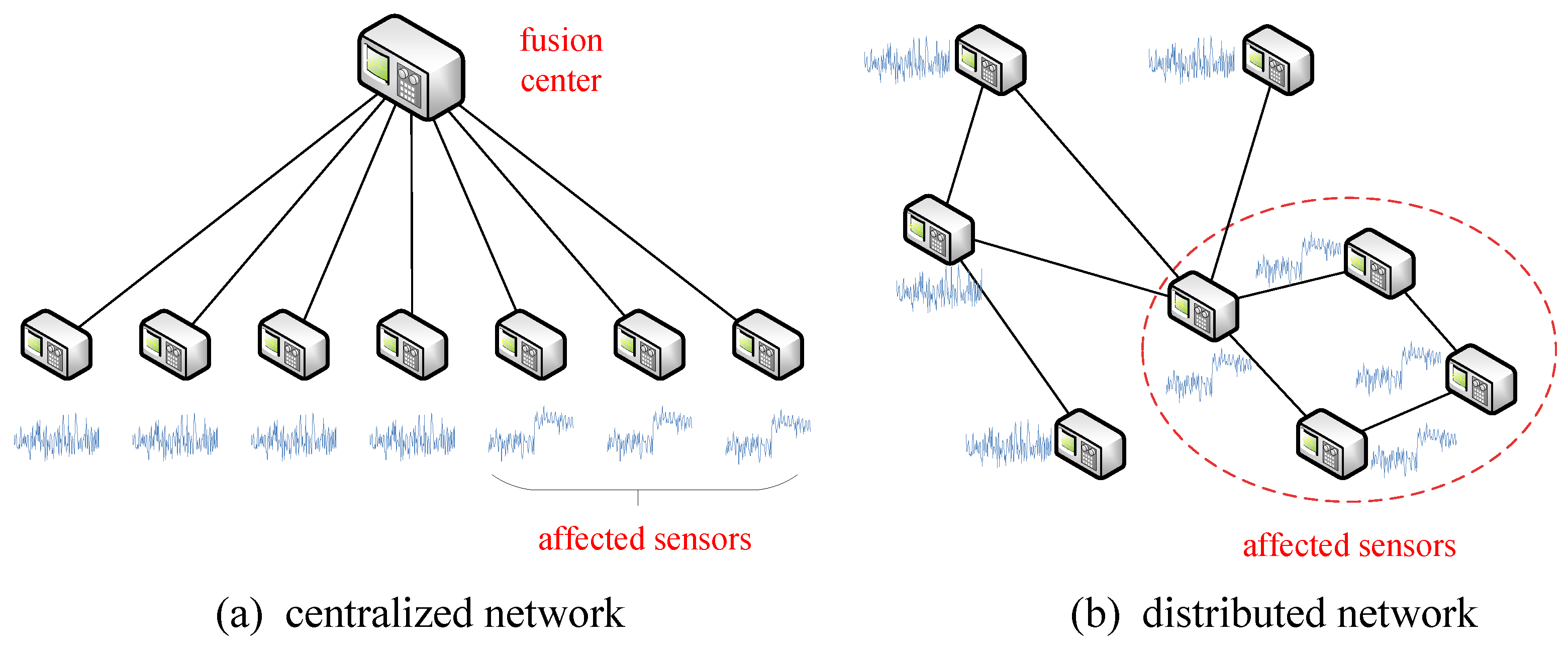
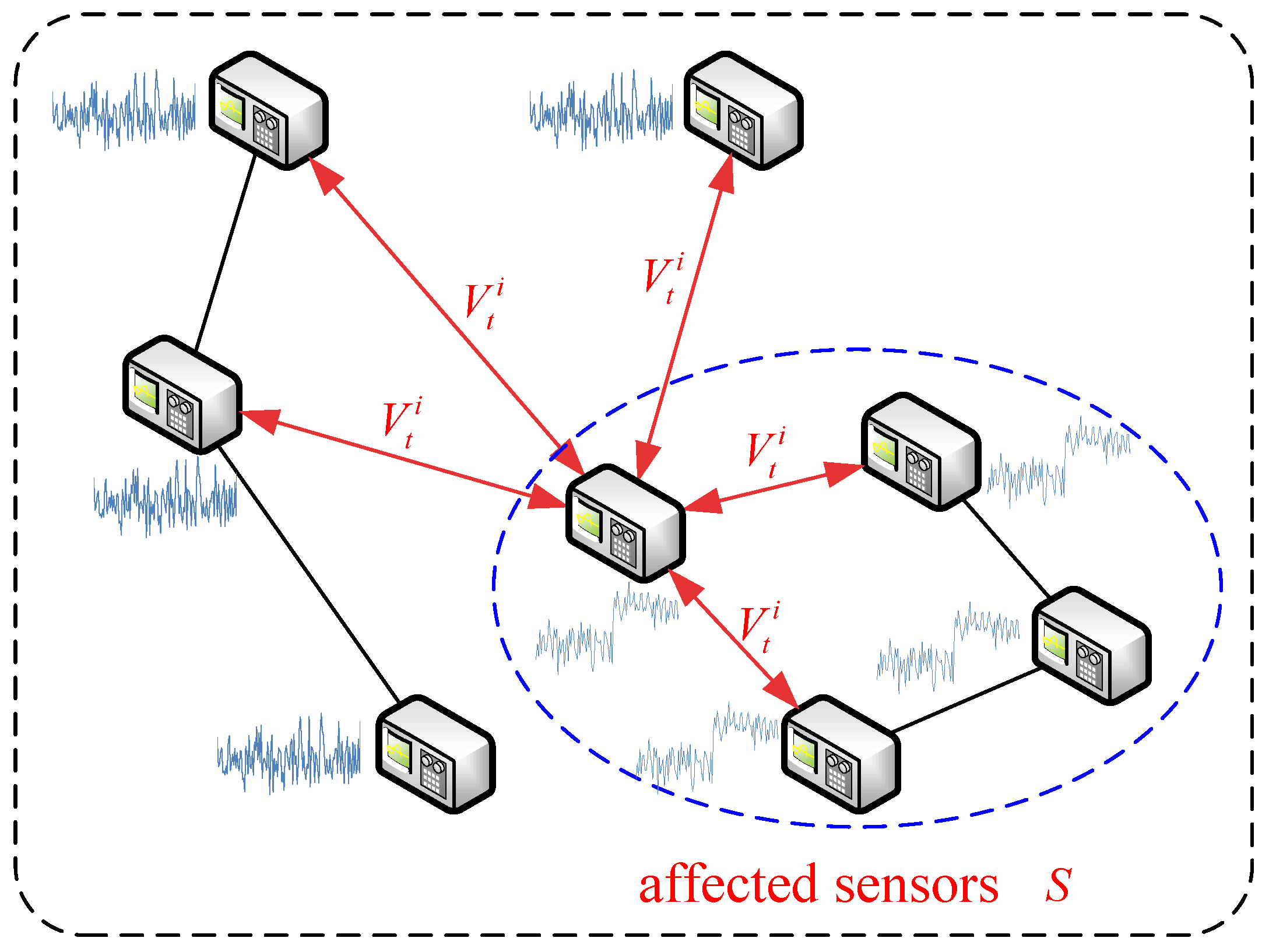
- Synergy of Low Energy and Robustness: In wireless sensor networks, achieving robustness usually comes at the cost of high communication overhead. DRM-CPM breaks this trade-off through a distributed event-triggered architecture. Unlike centralized robust methods that require transmitting raw data, each sensor node i exchanges only local statistical information with its immediate neighbors j, and strictly only when necessary (when ). This significantly reduces energy consumption by avoiding the quadratic path loss of long-range transmission while maintaining the statistical rigor required for heavy-tailed detection.
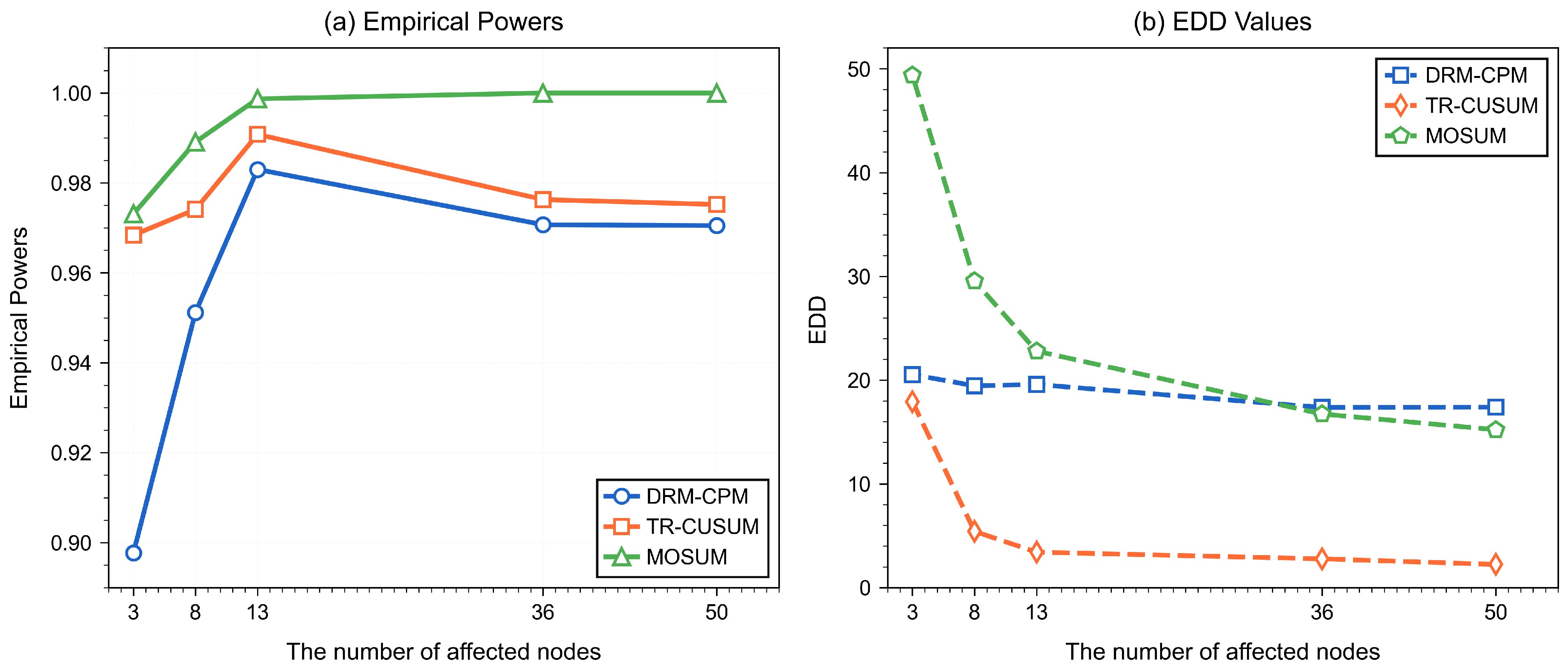
- Robustness to Change Sparsity: A key achievement is the algorithm’s consistent performance across various levels of change sparsity. As demonstrated in the subsequent analysis, the detection remains satisfactory regardless of whether the change is local or global, addressing the challenge of sparse change capture.
- Unknown Change Parameters: A DRM-CPM online detection algorithm based on ratio-type statistics is developed. The algorithm does not need to know the pre- and post-change distributions. Addressing the problem of change point detection under unknown probability density functions is one of the advantages of the proposed algorithm.
- Robustness to Heavy-tailed Data: The primary theoretical contribution is breaking the reliance on Gaussian assumptions inherent in traditional distributed detection methods. By generalizing distributed CPM to heavy-tailed sequences via bounded M-estimation, the algorithm resolves the detection failure issue in non-Gaussian environments—a capability that standard energy-efficient protocols typically lack.
- Detection Accuracy and Robustness: The DRM-CPM algorithm obtains high detection accuracy and shows robust, rapid and precise change point monitoring performance for different kinds of data sequences.
1.3. Organization
2. Materials and Methods
- (1)
- ;
- (2)
- , for some ;
- (3)
- and for some , ;
- (4)
- .
- (1)
- (the -th entry of is positive);
- (2)
- , indicating that the weight of information flow from sensor j to sensor i is the same as that from sensor i to sensor j;
- (3)
- , for all i, representing a row stochastic normalization.
3. Distributed Change Point Detection Method
| Algorithm 1 Robust ratio-type distributed change point detection (DRM-CPM). |
|
Complexity Analysis
4. Theoretical Properties
5. Simulations
5.1. Asymptotic Critical Values
5.2. Performance Evaluation
5.3. The Numerical Dependency on Parameters
6. Empirical Applications
7. Conclusions
Author Contributions
Funding
Data Availability Statement
Conflicts of Interest
Appendix A
References
- Yu, Z.; Liang, H.; Ye, O.; Zhang, Y. ESOD-YOLOv8: Small object detection enhanced with auto-disturbance rejection convolution. Expert Syst. Appl. 2025, 296, 129046. [Google Scholar] [CrossRef]
- Page, E.S. Continuous inspection schemes. Biometrika 1954, 41, 100–115. [Google Scholar] [CrossRef]
- Hemraj, D.A.; Carstensen, J. Towards ecosystem-based techniques for tipping point detection. Biol. Rev. 2025, 100, 892–919. [Google Scholar] [CrossRef]
- Moradi, M.; Montesino-SanMartin, M.; Ugarte, M.D.; Militino, A.F. Locally adaptive change-point detection (LACPD) with applications to environmental changes. Stoch. Environ. Res. Risk Assess. 2022, 36, 251–269. [Google Scholar] [CrossRef]
- Wu, Z.; Li, Y.; Hu, L. A synchronous multiple change-point detecting method for manufacturing process. Comput. Ind. Eng. 2022, 169, 108114. [Google Scholar] [CrossRef]
- Li, M.; Gao, L.; Lv, G.; Tong, X. Random change point model with an application to the China Household Finance Survey. Sci. China Math. 2024, 67, 2373–2386. [Google Scholar] [CrossRef]
- Jiang, F.; Zhao, Z.; Shao, X. Time series analysis of COVID-19 infection curve: A change-point perspective. J. Econom. 2023, 232, 1–17. [Google Scholar] [CrossRef]
- Mei, Y. Information bounds and quickest change detection in decentralized decision systems. IEEE Trans. Inf. Theory 2005, 51, 2669–2681. [Google Scholar] [CrossRef]
- Tabella, G.; Ciuonzo, D.; Yilmaz, Y.; Wang, X.; Rossi, P.S. Time-aware distributed sequential detection of gas dispersion via wireless sensor networks. IEEE Trans. Signal Inf. Process. Netw. 2023, 9, 721–735. [Google Scholar] [CrossRef]
- Quarisa, M.W.; Blostein, S.D. Change Detection for Large Distributed Sensor Networks with Multitriggered Local Sensors. IEEE Access 2022, 10, 44789–44803. [Google Scholar] [CrossRef]
- Ciuonzo, D.; Salvo Rossi, P. DECHADE: Detecting slight changes with hard decisions in wireless sensor networks. Int. J. Gen. Syst. 2018, 47, 535–548. [Google Scholar] [CrossRef]
- Kurt, M.N.; Yılmaz, Y.; Wang, X. Distributed quickest detection of cyber-attacks in smart grid. IEEE Trans. Inf. Forensics Secur. 2018, 13, 2015–2030. [Google Scholar] [CrossRef]
- Yang, Z.; Eckley, I.A.; Fearnhead, P. A communication-efficient, online changepoint detection method for monitoring distributed sensor networks. Stat. Comput. 2024, 34, 115. [Google Scholar] [CrossRef]
- Biswas, S.; Dey, S. Asymptotic performance analysis of distributed non-Bayesian quickest change detection with energy harvesting sensors. IEEE Trans. Aerosp. Electron. Syst. 2022, 58, 3697–3707. [Google Scholar] [CrossRef]
- Sun, Z.; Zou, S.; Zhang, R.; Li, Q. Quickest change detection in anonymous heterogeneous sensor networks. IEEE Trans. Signal Process. 2022, 70, 1041–1055. [Google Scholar] [CrossRef]
- Braca, P.; Marano, S.; Matta, V.; Willett, P. Consensus-based Page’s test in sensor networks. Signal Process. 2011, 91, 919–930. [Google Scholar] [CrossRef]
- Liu, Q.; Zhang, R.; Xie, Y. Distributed change detection via average consensus over networks. In Proceedings of the Stochastic Models, Statistics and Their Applications, Dresden, Germany, 6–8 March 2019; Springer: Cham, Switzerland, 2019; pp. 177–192. [Google Scholar] [CrossRef]
- Chen, F.; Guo, L.; Chen, C. A survey on energy management in the wireless sensor networks. IERI Procedia 2012, 3, 60–66. [Google Scholar] [CrossRef]
- Meena, S.B.; Patil, P.R.; Kandharkar, S.; Hemalatha, N.; Khade, A.; Dixit, K.K.; Chinthamu, N. The Evolution of Smart Grid Technologies: Integrating Renewable Energy Sources, Energy Storage, and Demand Response Systems for Efficient Energy Distribution. Nanotechnol. Perceptions 2024, 20, 1098–1109. [Google Scholar] [CrossRef]
- Hsu, M.X.; Huang, Y.C.; Li, W.H.; Chu, C.F.; Wu, P.J. An efficient algorithm and quantization for fully distributed sequential change detection. IEEE Trans. Commun. 2023, 71, 6088–6099. [Google Scholar] [CrossRef]
- Gu, Y.; Jiao, Y.; Xu, X.; Yu, Q. Request–response and censoring-based energy-efficient decentralized change-point detection with IoT applications. IEEE Internet Things J. 2020, 8, 6771–6788. [Google Scholar] [CrossRef]
- Fellouris, G.; Sokolov, G. Second-order asymptotic optimality in multisensor sequential change detection. IEEE Trans. Inf. Theory 2016, 62, 3662–3675. [Google Scholar] [CrossRef]
- Jiao, Y.; Meng, L.; Li, Y.; Yu, Q.; Gu, Y. Efficient Change-Point Detection Over Fully Decentralized Wireless Networks with Low Communication Rate. IEEE Trans. Veh. Technol. 2024, 74, 1626–1642. [Google Scholar] [CrossRef]
- Liu, K.; Zhang, R.; Mei, Y. Scalable sum-shrinkage schemes for distributed monitoring large-scale data streams. Stat. Sin. 2019, 29, 1–22. [Google Scholar] [CrossRef]
- Dutfoy, A. Estimation of tail distribution of the annual maximum earthquake magnitude using extreme value theory. Pure Appl. Geophys. 2019, 176, 527–540. [Google Scholar] [CrossRef]
- Kim, G. Holistic In-Network Acceleration for Heavy-Tailed Storage Workloads. IEEE Access 2023, 11, 77416–77428. [Google Scholar] [CrossRef]
- Arslan, S.S.; Zeydan, E. On the distribution modeling of heavy-tailed disk failure lifetime in big data centers. IEEE Trans. Reliab. 2020, 70, 507–524. [Google Scholar] [CrossRef]
- Reyes, J.; Rojas, M.A.; Venegas, O.; Gómez, H.W. Nakagami distribution with heavy tails and applications to mining engineering data. J. Stat. Theory Pract. 2020, 14, 55. [Google Scholar] [CrossRef]
- Zhang, X.; Jin, H.; Yang, Y. Quasi-autocorrelation coefficient change test of heavy-tailed sequences based on M-estimation. AIMS Math. 2024, 9, 19569–19596. [Google Scholar] [CrossRef]
- Peštová, B.; Pešta, M. Abrupt change in mean using block bootstrap and avoiding variance estimation. Comput. Stat. 2018, 33, 413–441. [Google Scholar] [CrossRef]
- Jin, H.; Tian, S.; Hu, J.; Zhu, L.; Zhang, S. Robust ratio-typed test for location change under strong mixing heavy-tailed time series model. Commun. Stat.-Theory Methods 2025, 54, 5760–5783. [Google Scholar] [CrossRef]
- Jin, H.; Hu, J.; Zhu, L.; Tian, S.; Zhang, S. M-procedures robust to structural changes detection under strong mixing heavy-tailed time series models. J. Stat. Plan. Inference 2025, 239, 106295. [Google Scholar] [CrossRef]
- Olfati-Saber, R.; Fax, J.A.; Murray, R.M. Consensus and cooperation in networked multi-agent systems. Proc. IEEE 2007, 95, 215–233. [Google Scholar] [CrossRef]
- Boyd, S.; Diaconis, P.; Xiao, L. Fastest mixing Markov chain on a graph. SIAM Rev. 2004, 46, 667–689. [Google Scholar] [CrossRef]
- Qin, R.; Liu, W. A robust test for mean change in dependent observations. J. Inequalities Appl. 2015, 2015, 48. [Google Scholar] [CrossRef]
- Hušková, M.; Picek, J. Bootstrap in detection of changes in linear regression. Sankhyā Indian J. Stat. 2005, 67, 200–226. [Google Scholar] [CrossRef]
- Zhang, S.; Jin, H.; Su, M. Modified block bootstrap testing for persistence change in infinite variance observations. Mathematics 2024, 12, 258. [Google Scholar] [CrossRef]
- Jin, H.; Wang, A.; Zhang, S.; Liu, J. Subsampling ratio tests for structural changes in time series with heavy-tailed AR (p) errors. Commun. Stat.-Simul. Comput. 2024, 53, 3721–3747. [Google Scholar] [CrossRef]
- Nolan, J.P. Numerical calculation of stable densities and distribution functions. Commun. Statistics. Stoch. Model. 1997, 13, 759–774. [Google Scholar] [CrossRef]
- Horváth, L.; Horváth, Z.; Hušková, M. Ratio tests for change point detection. In Beyond Parametrics in Interdisciplinary Research: Festschrift in Honor of Professor Pranab K. Sen; Institute of Mathematical Statistics: Beachwood, OH, USA, 2008; Volume 1, pp. 293–305. [Google Scholar] [CrossRef]
- Herrndorf, N. A Functional Central Limit Theorem for Weakly Dependent Sequences of Random Variables. Ann. Probab. 1984, 12, 141–153. [Google Scholar] [CrossRef]





| 2.0 | 1.9135 | 2.0624 | 1.8336 | 1.9597 | 1.7764 | 1.8917 | 1.7553 | 1.8837 |
| 1.6 | 1.9010 | 2.0685 | 1.8177 | 1.9411 | 1.7654 | 1.8801 | 1.7587 | 1.8776 |
| 1.2 | 1.9081 | 2.0438 | 1.8292 | 1.9440 | 1.7728 | 1.8962 | 1.7496 | 1.8794 |
| 0.8 | 1.8849 | 2.0068 | 1.8047 | 1.9493 | 1.7624 | 1.8730 | 1.7532 | 1.8719 |
| 0.4 | 1.9209 | 2.0822 | 1.7937 | 1.9464 | 1.7484 | 1.8798 | 1.7431 | 1.8848 |
| DRM-CPM | TR-CUSUM | MOSUM | DRM-textbf | TR-CUSUM | MOSUM | |
| 2.0 | 0.0818 | 0.0434 | 0.0218 | 0.0507 | 0.0434 | 0.0365 |
| 1.6 | 0.0683 | – | 0.0947 | 0.0661 | – | 0.2471 |
| 1.2 | 0.0538 | – | 0.1076 | 0.0369 | – | 0.1360 |
| 0.8 | 0.0625 | – | 0.3864 | 0.0207 | – | 0.4625 |
| 0.6 | 0.0982 | – | 0.3163 | 0.0254 | – | 0.2125 |
| DRM-CPM | TR-CUSUM | MOSUM | DRM-CPM | TR-CUSUM | MOSUM | |
| 2.0 | 0.0456 | 0.0434 | 0.0131 | 0.0205 | 0.0434 | 0.0157 |
| 1.6 | 0.0318 | – | 0.1087 | 0.0317 | – | 0.1952 |
| 1.2 | 0.0241 | – | 0.2392 | 0.0193 | – | 0.3164 |
| 0.8 | 0.0337 | – | 0.1097 | 0.0146 | – | 0.3631 |
| 0.6 | 0.0184 | – | 0.2738 | 0.0093 | – | 0.2065 |
| k | EDD | ||||||
|---|---|---|---|---|---|---|---|
| DRM-CPM | R-CUSUM | MOSUM | DRM-CPM | TR-CUSUM | MOSUM | ||
| 2.0 | 24.06 | 10.67 | 23.86 | 0.2738 | 0.2251 | 0.0758 | |
| 1.6 | 23.81 | – | 36.72 | 0.2809 | – | 0.1010 | |
| 1 | 1.2 | 24.22 | – | 19.09 | 0.2902 | – | 0.1792 |
| 0.8 | 24.51 | – | 20.64 | 0.3021 | – | 0.2117 | |
| 0.6 | 25.31 | – | 17.11 | 0.3277 | – | 0.2153 | |
| 2.0 | 19.96 | 5.21 | 22.57 | 0.2533 | 0.2281 | 0.0531 | |
| 1.6 | 19.88 | – | 14.95 | 0.2577 | – | 0.0932 | |
| 1.5 | 1.2 | 20.19 | – | 25.27 | 0.2588 | – | 0.1076 |
| 0.8 | 21.07 | – | 16.59 | 0.2634 | – | 0.1645 | |
| 0.6 | 21.09 | – | 7.21 | 0.2864 | – | 0.1032 | |
| 2.0 | 18.97 | 3.41 | 25.97 | 0.2548 | 0.2289 | 0.0493 | |
| 1.6 | 18.66 | – | 37.82 | 0.2501 | – | 0.1082 | |
| 2 | 1.2 | 18.59 | – | 35.08 | 0.2511 | – | 0.0625 |
| 0.8 | 18.64 | – | 20.63 | 0.2523 | – | 0.0994 | |
| 0.6 | 18.83 | – | 9.58 | 0.2553 | – | 0.1133 | |
Disclaimer/Publisher’s Note: The statements, opinions and data contained in all publications are solely those of the individual author(s) and contributor(s) and not of MDPI and/or the editor(s). MDPI and/or the editor(s) disclaim responsibility for any injury to people or property resulting from any ideas, methods, instructions or products referred to in the content. |
© 2026 by the authors. Licensee MDPI, Basel, Switzerland. This article is an open access article distributed under the terms and conditions of the Creative Commons Attribution (CC BY) license.
Share and Cite
Wang, L.; Hu, H.; Jin, H. Change Point Monitoring in Wireless Sensor Networks Under Heavy-Tailed Sequence Environments. Mathematics 2026, 14, 523. https://doi.org/10.3390/math14030523
Wang L, Hu H, Jin H. Change Point Monitoring in Wireless Sensor Networks Under Heavy-Tailed Sequence Environments. Mathematics. 2026; 14(3):523. https://doi.org/10.3390/math14030523
Chicago/Turabian StyleWang, Liwen, Hongbo Hu, and Hao Jin. 2026. "Change Point Monitoring in Wireless Sensor Networks Under Heavy-Tailed Sequence Environments" Mathematics 14, no. 3: 523. https://doi.org/10.3390/math14030523
APA StyleWang, L., Hu, H., & Jin, H. (2026). Change Point Monitoring in Wireless Sensor Networks Under Heavy-Tailed Sequence Environments. Mathematics, 14(3), 523. https://doi.org/10.3390/math14030523