Article

High-Dimensional Delayed Cyclic-Coupled Chaotic Model with Time-Varying Parameter Control for Counteracting Finite-Precision Degradation

School of Software, Nanchang University, Nanchang 330029, China
*
Author to whom correspondence should be addressed.
Mathematics 2026, 14(3), 519; https://doi.org/10.3390/math14030519
Submission received: 24 December 2025 / Revised: 26 January 2026 / Accepted: 29 January 2026 / Published: 1 February 2026
(This article belongs to the Section C2: Dynamical Systems)

Abstract

Digital chaotic systems suffer severe dynamical degradation under finite computational precision, compromising their randomness and unpredictability in security-critical applications. To address this challenge, we introduce the High-Dimensional Delayed Cyclic-Coupled Chaotic Model (HD-DCCCM), a unified framework that integrates high-dimensional coupling, delayed feedback, and time-varying parameter control. In this synergistic design, dynamic perturbations from delays and time-varying signals continuously excite the high-dimensional structure, effectively preventing the collapse into short periodic orbits typical of low-precision environments. Systematic numerical analyses confirm that the HD-DCCCM generates stable hyperchaos with significantly extended periods, consistently outperforming classical maps and representative anti-degradation methods. Moreover, the framework demonstrates strong robustness and flexibility across both homogeneous (identical maps) and heterogeneous (hybrid maps) configurations. These results position the HD-DCCCM as a general and powerful paradigm for constructing degradation-resilient chaotic systems, with broad potential for next-generation secure communications and cryptographic applications.

1. Introduction

Owing to ergodicity, sensitivity to initial conditions and control parameters, and pseudo-random behavior, chaotic systems have become core primitives in secure communications [1,2], random number generation [3,4], and multimedia security [5,6,7]. In particular, their ability to generate complex yet deterministic signals makes them attractive for engineering scenarios in which unpredictability to adversaries and reproducibility under fixed settings are both essential.
However, when chaotic systems are implemented on digital platforms such as computers or hardware circuits, their dynamical properties are often degraded by the limitations of finite-precision arithmetic [8,9]. Specifically, quantization and round-off errors discretize the trajectories, rendering the state space of digital chaotic maps finite and discontinuous [10,11], which fundamentally underlies the dynamical degradation observed in finite-precision environments [12]. As a result, the trajectories eventually collapse into short periodic orbits or fixed points, a phenomenon commonly known as dynamical degradation [13,14]. Such degradation not only diminishes the entropy and randomness of the system, but also severely undermines its effectiveness in practical applications [15], particularly in secure communications and cryptographic encryption.
To counteract this degradation, extensive research efforts can be broadly divided into two directions. The first seeks to enhance the dynamics of existing maps through supplementary control mechanisms. Representative approaches include introducing time delays to exploit historical states for parameter perturbation [16,17], applying internal perturbations based on the current state [18,19], or switching and cascading multiple maps to enrich system dynamics [20,21]. A notable hybrid example is the PP&DF method [22], which combines parameter disturbance with delayed feedback. However, these approaches often function as external adjustments rather than fundamentally altering the intrinsic structure of the map [23], and thus the extent of performance improvement remains constrained by the low dimensionality and simplicity of the original system [22,24]. The second direction emphasizes the direct design of structurally complex chaotic systems, particularly high-dimensional and hyperchaotic models. This line of research has yielded frameworks such as the N-dimensional chaotic map (nD-CM) [25] and various cross-coupled hyperchaotic maps [8,11,26], which expand chaotic intervals and increase complexity. Recent developments include high-dimensional memristive systems with promising hardware potential [27,28] and non-degeneracy models sustaining long periods [29,30,31]. While structurally robust, these systems are often computationally demanding and dynamically rigid. More importantly, even high-dimensional systems are not immune to degradation; without sufficient and continuous perturbation, their trajectories may still degenerate into short periodic orbits under finite-precision constraints [24,32].
Motivated by these limitations, this paper proposes a High-Dimensional Delayed Cyclic-Coupled Chaotic Model with Time-Varying Parameter Control (HD-DCCCM). The framework integrates three mutually reinforcing mechanisms: (1) high-dimensional cyclic coupling to provide a structurally rich foundation; (2) delayed states to incorporate historical memory and enhance unpredictability; and (3) time-varying parameter modulation to introduce non-stationarity into the dynamics. By continuously perturbing a complex high-dimensional structure with delayed and time-varying signals, the proposed system resists degeneration into low-dimensional periodic orbits, thereby maintaining robust chaotic behavior even under finite precision. Furthermore, a bounded parameter-mapping mechanism ensures that parameters remain within designated chaotic ranges.
The main contributions of this work are as follows:
  • A Novel Synergistic Framework. We introduce the HD-DCCCM, a new class of chaotic system that, to the best of our knowledge, is among the first to simultaneously unify high-dimensional coupling, delayed feedback, and time-varying parameter control with the explicit goal of counteracting digital degradation.
  • Demonstrated Performance Advantages. Through systematic numerical analysis, we show that the proposed framework produces stable hyperchaos and substantially longer periods. It consistently surpasses classical maps and representative anti-degradation methods across key dynamical metrics, particularly under stringent low-precision conditions.
  • Generality and Flexibility. We validate the robustness of the HD-DCCCM under both homogeneous (identical coupled maps) and heterogeneous (hybrid coupled maps) configurations, demonstrating its effectiveness as a flexible platform for constructing diverse high-performance digital chaotic systems.
The rest of this paper is organized as follows. Section 2 details the mathematical formulation of the proposed HD-DCCCM framework. Section 3 presents a comprehensive performance analysis of a three-dimensional homogeneous system based on coupled Logistic maps to validate the model’s effectiveness. To further demonstrate the framework’s generality and robustness, Section 4 extends the analysis to a high-dimensional heterogeneous system constructed from hybrid chaotic maps. Finally, Section 5 concludes the paper.

2. The Proposed HD-DCCCM Framework

2.1. General Digital Chaotic Map

A discrete chaotic map can be generally expressed as:
x i + 1 = f x i , a
where x i   is the state variable, a is the control parameter, and f denotes a nonlinear function. When a lies within the chaotic region, the system exhibits aperiodic trajectories and sensitive dependence on initial conditions.
In digital implementations, however, finite-precision arithmetic inevitably introduces quantization and rounding errors. This process can be modeled as:
x i + 1 = F L [ f x i , a ]
In our numerical implementation, the operation defined in Equation (2) is applied at every iteration step of the dynamical evolution. Specifically, the state variable is updated as x k + 1 = floor ( f ( x k ) 2 L ) 2 L . This formulation primarily models the dynamical degradation caused by finite storage precision (i.e., the limited bit-width of state registers). While this approach effectively captures the discretization of the phase space, we acknowledge that practical hardware implementations (e.g., FPGAs or DSPs) also impose quantization constraints on intermediate arithmetic operations. To address this, we primarily use the state-quantization model (Equation (2)) for the general performance analysis in Section 3.1, Section 3.2, Section 3.3 and Section 3.4 and Section 4.1, Section 4.2, Section 4.3 and Section 4.4. Furthermore, to verify the system’s robustness under the strictest hardware constraints, a Strict Fixed-Point Arithmetic (SFPA) model—where quantization is applied after every elementary operation—is explicitly introduced and evaluated in Section 3.4.5.
Equation (2) reveals a crucial insight: dynamical degradation is an inherent consequence of applying the quantization operator F L to a structurally simple nonlinear function f . This implies that strategies relying solely on external perturbations of the system’s output provide only limited improvement, as they do not alter the fundamental simplicity of f itself. A more profound and robust solution must therefore address the problem at its root—by designing a new, structurally complex mapping, denoted as F , which is intrinsically more resilient to the quantization effects imposed by F L .
This observation motivates the core principle of our work: to construct a high-dimensional, interconnected chaotic framework where the required complexity emerges from the structure of F itself, rather than from external modifications. The following section details the formulation of such a framework.

2.2. Formulation of the HD-DCCCM

In this section, we construct the HD-DCCCM, a framework designed to be structurally complex and intrinsically resilient to digital degradation. The design begins with a general formulation, which is then progressively refined into a practical and elegant final model.

2.2.1. General Model Formulation

A general N -dimensional coupled chaotic model can be expressed as
x i + 1 ( 1 ) = f 1 x i ( 1 ) , p 1 x i τ 1 , 1 ( 2 ) , x i τ 1 , 2 ( 3 ) , , x i τ 1 , N 1 ( N ) x i + 1 ( 2 ) = f 2 x i ( 2 ) , p 2 x i τ 2 , 1 ( 1 ) , x i τ 2 , 3 ( 3 ) , , x i τ 2 , N ( N ) x i + 1 ( N ) = f N x i ( N ) , p N x i τ N , 1 ( 1 ) , x i τ N , 2 ( 2 ) , , x i τ N , N 1 ( N 1 )
where f i i   =   1 ,   2 ,     ,   N denotes the chaotic mappings, which may be identical or distinct. The state variable of the k-th subsystem is x i ( k ) , and its parameter-control function p k is dynamically determined by the delayed states of other subsystems. The delay τ i , j represents the influence from subsystem j to subsystem i , which may be uniform or heterogeneous.
While theoretically comprehensive, the fully connected topology of Equation (3) introduces substantial computational and tuning challenges. Managing N N 1 coupling interactions often yields diminishing returns in dynamical performance. This motivates a simplification to balance complexity with efficiency.

2.2.2. Simplification to a Directed Coupling Structure

We first consider a simplified case in which each subsystem is controlled by only one designated subsystem. The model reduces to
x i + 1 ( 1 ) = f 1 x i ( 1 ) , p 1 x i τ 1 ( m 1 ) x i + 1 ( 2 ) = f 2 x i ( 2 ) , p 2 x i τ 2 ( m 2 ) x i + 1 ( N ) = f N x i ( N ) , p N x i τ N ( m N )
where m i { 1 , 2 , , N } , m i i . Here, the control parameter of subsystem i is regulated solely by a delayed state of subsystem m i . This reduction preserves the essential cross-subsystem modulation while significantly reducing structural complexity.

2.2.3. The Final HD-DCCCM with Cyclic Coupling

To achieve an optimal balance between dynamical richness and implementation simplicity, we refine the topology to a unidirectional ring (cyclic) coupling. In this structure, subsystem 2 controls subsystem 1, subsystem 3 controls subsystem 2, …, and subsystem 1 controlling subsystem N. A uniform delay τ is further assumed for all couplings, since variations in τ have limited impact on overall dynamics.
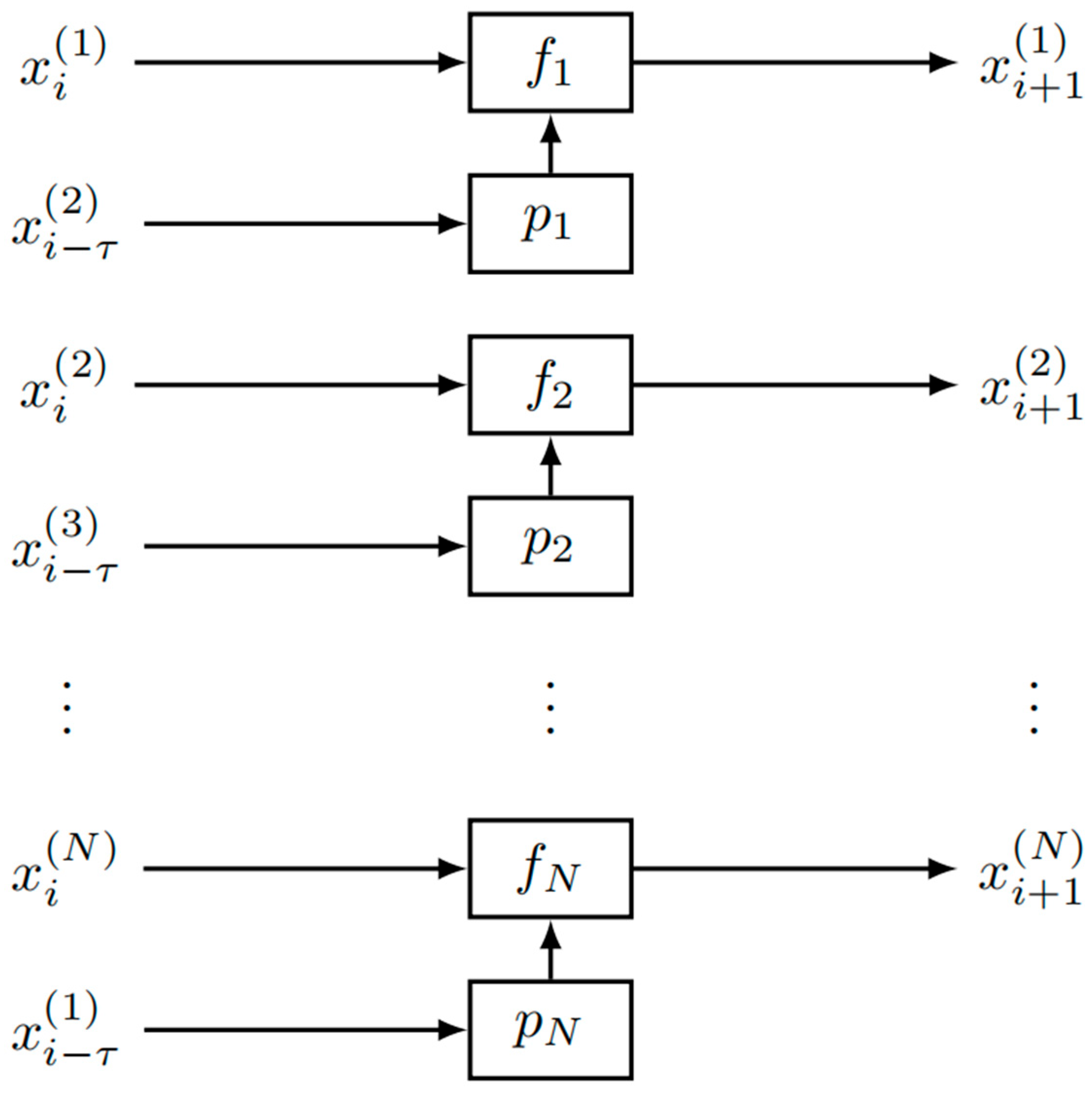
The overall architecture of the proposed HD-DCCCM is illustrated in Figure 1, which highlights its three core components: circular coupling, delayed state feedback, and dynamic parameter perturbation. As shown in Figure 1, each subsystem f j (for j = 1 , , N ) evolves according to its own state x i ( j ) , while its control parameter x i ( j ) is continuously adjusted by the perturbation function p j ( ) . The input of p j is the delayed state of the next subsystem in the cyclic chain (with x i τ ( N + 1 ) interpreted as x i τ ( 1 ) . This cyclic dependence, together with the delayed feedback, constitutes the backbone of the model’s enhanced dynamical complexity. Formally, the final HD-DCCCM is given by
x i + 1 ( 1 ) = f 1 x i ( 1 ) , p 1 x i τ ( 2 ) x i + 1 ( 2 ) = f 2 x i ( 2 ) , p 2 x i τ ( 3 ) x i + 1 ( N ) = f N x i ( N ) , p N x i τ ( 1 )
This formulation embodies the synergy of three mechanisms:
  • High-dimensional cyclic coupling, which establishes a complex, interwoven state space.
  • Delayed state feedback, which introduces historical memory.
  • Time-varying parameter modulation, which injects persistent non-stationarity.
Crucially, the cyclic topology forms a global closed feedback loop that reshapes error propagation under finite precision. Instead of remaining local as in independent or purely cascaded maps, quantization noise generated at any node is transported around the ring, nonlinearly transformed by the subsequent chaotic maps, and finally fed back to the origin. This continuous circulation of microscopic errors prevents specific patterns from stabilizing into short periodic orbits. Together with the delayed state feedback and time-varying modulation, these mechanisms enable the HD-DCCCM to sustain complex, hyperchaotic behaviors and remain inherently resilient to finite-precision degradation.

2.3. Implementation Considerations and Framework Generality

The practical implementation and broad applicability of the HD-DCCCM framework are underpinned by two essential features:
  • Bounded Parameter Mapping: The output of each parameter-control function P i must remain within the chaotic parameter interval of its corresponding subsystem. Since different chaotic maps typically exhibit distinct chaotic ranges, the parameter-control functions must be carefully tailored to each subsystem. When identical chaotic maps are employed across all subsystems, a uniform control function can be applied consistently. Both cases will be demonstrated in subsequent sections.
  • Generality and Extensibility: The framework exhibits strong generality. Each subsystem f i may be either a one-dimensional or a high-dimensional chaotic map. In the latter case, only a single state variable is required to regulate neighboring subsystems. This design flexibility makes the HD-DCCCM a powerful and extensible platform for constructing diverse, structurally complex, and high-performance chaotic systems—a capability that will be exemplified later in the paper.

2.4. Engineering Implementation and Application Scenarios

From an engineering perspective, the proposed HD-DCCCM is inherently suitable for digital implementation on both software and hardware platforms. Since the model is formulated as a discrete-time iterative mapping composed of basic arithmetic operations, it can be efficiently realized using fixed-point arithmetic on microcontrollers, digital signal processors (DSPs), field-programmable gate arrays (FPGAs), or application-specific integrated circuits (ASICs).
In practical implementations, the cyclic coupling and delayed feedback structure can be naturally mapped to parallel or pipelined architectures, while the bounded parameter control ensures that all control parameters remain within predefined chaotic intervals, preventing numerical overflow or instability. Compared with continuous-time chaotic systems, the discrete structure of the HD-DCCCM significantly simplifies hardware realization and reduces implementation cost.
In terms of applications, the HD-DCCCM can serve as a robust chaotic sequence generator for security-oriented engineering systems, including stream cipher design, image and multimedia encryption, pseudo-random number generation, and chaos-based secure communications. The strong resistance to finite-precision degradation demonstrated in this work makes the proposed framework particularly attractive for resource-constrained digital environments, where low-precision arithmetic is unavoidable.
Therefore, the proposed HD-DCCCM is not only a theoretical chaotic framework but also a practical and scalable engineering model with direct applicability in digital security systems.

3. A Three-Dimensional Homogeneous HD-DCCCM and Its Performance

3.1. Case Study: A 3D Logistic-Based HD-DCCCM

To validate the effectiveness of the HD-DCCCM framework in a homogeneous configuration, as outlined in Section 2.3, we construct a three-dimensional example using the one-dimensional Logistic map as the base subsystem for all f i . The standard Logistic map is defined as:
x i + 1 = a x i 1 x i
where a is the control parameter and xi denotes the state variable. The system exhibits chaotic behavior for a ( 3.5699 , 4 ] . To satisfy the bounded parameter mapping requirement discussed in Section 2.3, we design a parameter control function p x whose output remains within the chaotic range. For practical implementation, a unified linear form is adopted as follows:
p x = a + 8 2 a x 0.5
With a ( 3.5699 , 4 ) , the function p ( x ) always yields values in the interval a , 4 for any x ( 0 , 1 ) , thereby ensuring the persistent chaoticity of each subsystem. By substituting the Logistic map Equation (6) and the parameter control function Equation (7) into the HD-DCCCM framework Equation (5), and incorporating the finite-precision operator F L , we obtain the final three-dimensional Logistic-based HD-DCCCM:
x i + 1 ( 1 ) = F L a + 8 2 a x i τ ( 2 ) 0.5 x i ( 1 ) 1 x i ( 1 ) x i + 1 ( 2 ) = F L a + 8 2 a x i τ ( 3 ) 0.5 x i ( 2 ) 1 x i ( 2 ) x i + 1 ( 3 ) = F L a + 8 2 a x i τ ( 1 ) 0.5 x i ( 3 ) 1 x i ( 3 )
For the subsequent experiments, the parameters are set as τ =   1 ,   a =   3.99 , with initial conditions x 0 ( 1 ) = 0.1 , x 1 ( 1 ) = 0.3 , x 0 ( 2 ) = 0.4 , x 1 ( 2 ) = 0.7 , x 0 ( 3 ) = 0.8 , x 1 ( 3 ) = 0.9 . The minimum computational precision is chosen as 12 bits (i.e., F L corresponds to a quantization of 2−12).
To provide a rigorous comparative analysis, we benchmark this three-dimensional HD-DCCCM against the standard one-dimensional Logistic map under the same finite-precision conditions, which is expressed as:
x i + 1 = F L [ r × x i ( 1 x i ) ]
Unless otherwise specified, the initial condition is set to x0 = 0.16582, and the control parameter is fixed at r = 3.98.
To provide a rigorous comparative framework, six representative anti-degradation schemes are adopted as comparison methods in all subsequent experiments. These include the delayed exponent coupling (DEC) map [11], the delay-coupling (DC) method [16], the perturbation–feedback (PF) hybrid control scheme [23], the N-dimensional chaotic map (ND) [25], the ideal chaotic sequence (ICS) generation method [33], and the bit-reversal (BR) based enhanced chaotic map [34]. Together, these models cover the main strategies proposed in the recent literature—such as delayed-state reinforcement, perturbation feedback, dimensional expansion, and bit-level scrambling—and serve as unified references for the parameter-domain and precision-domain evaluations presented in Section 3.2, Section 3.3 and Section 3.4. To ensure a comprehensive evaluation, the comparative analysis includes both low-dimensional and multidimensional benchmarks. The N-dimensional chaotic map (ND) [25] and other coupled schemes [11,16] are selected as multidimensional benchmarks (configured in 2D) to test the system’s structural advantage. Second, classic 1D maps (e.g., Logistic map) are retained. These 1D models serve as standard references for analyzing finite-precision degradation rather than as dimensionally equivalent competitors. Including them allows us to quantify the framework’s effectiveness in mitigating the intrinsic degradation of the base components.

3.2. Basic Chaotic Characteristics of 3D Logistic

3.2.1. Trajectories and Phase Diagrams

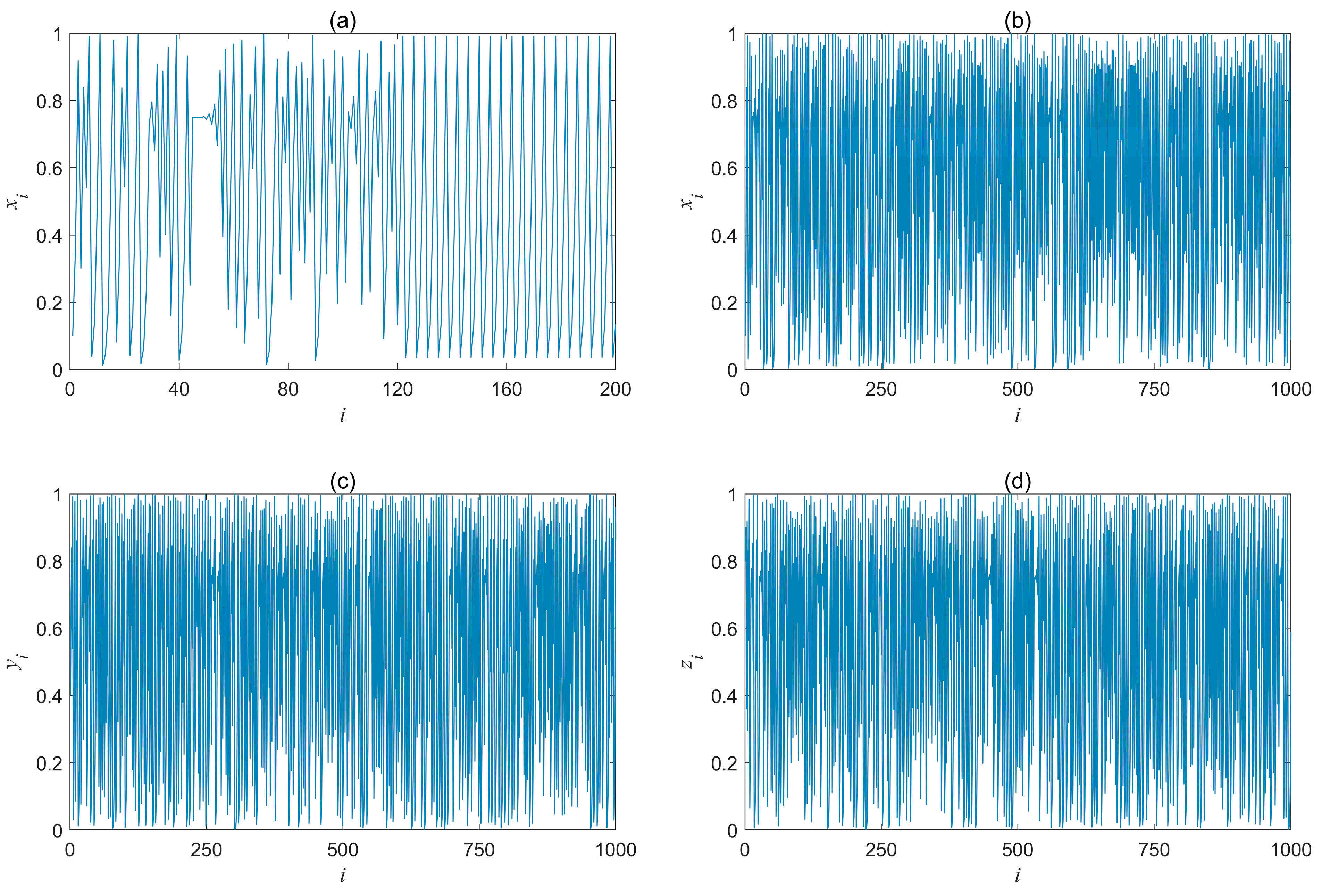
Trajectory plots and phase portraits are indispensable tools for characterizing chaotic systems, as they, respectively, capture temporal evolution and geometric attractor structures [35]. To assess the effectiveness of the proposed 3D Logistic-based HD-DCCCM, we benchmark it against the standard Logistic map under 12-bit precision. As illustrated in Figure 2a, the standard Logistic map rapidly degrades, collapsing into a periodic orbit within 150 iterations. In sharp contrast, the state variables of the HD-DCCCM (Figure 2b–d) maintain sustained, non-periodic oscillations beyond 1000 iterations, demonstrating both stronger resistance to precision-induced degradation and more persistent chaoticity.
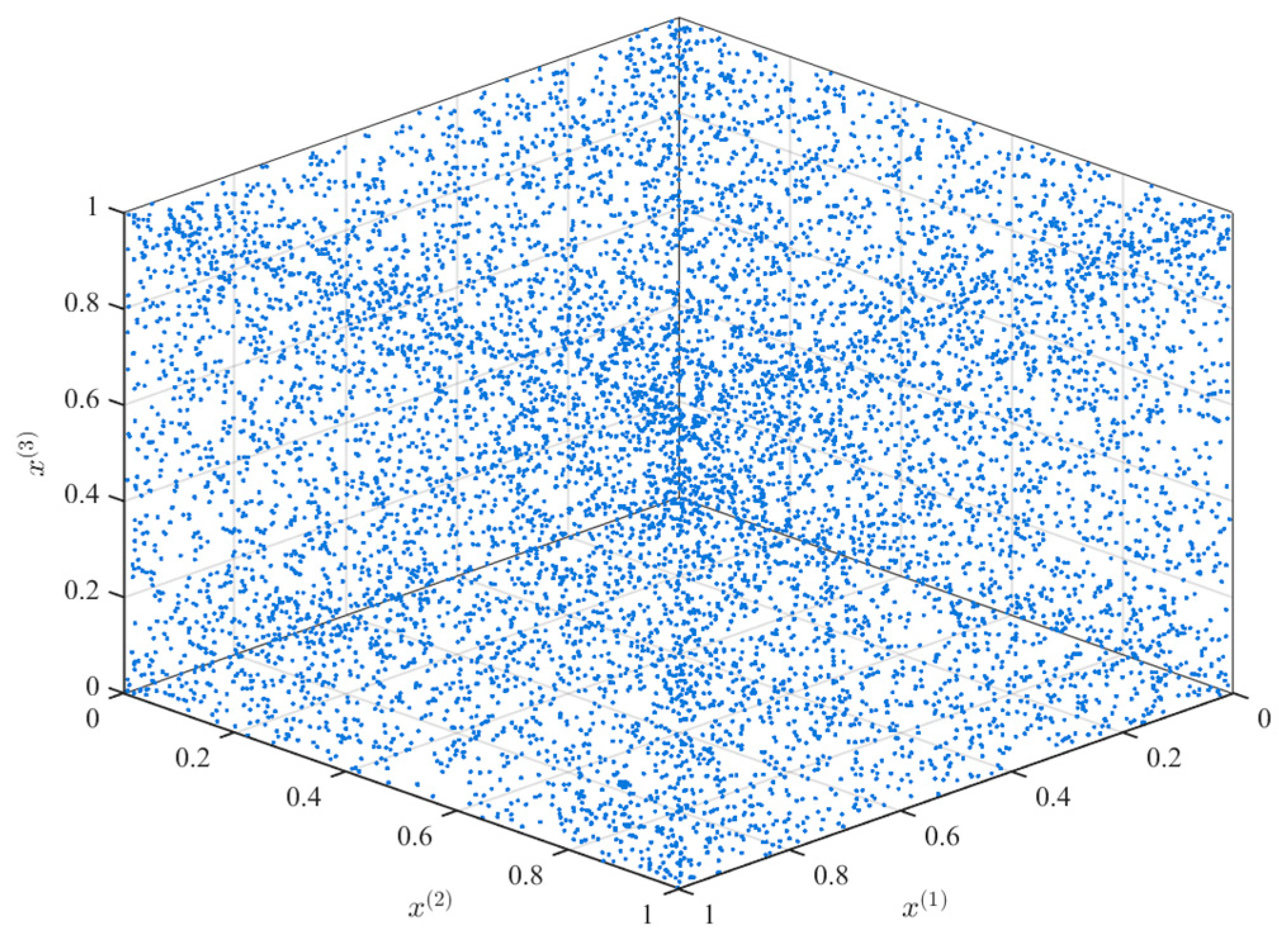
The system’s attractor structure further corroborates this advantage. The three-dimensional phase portrait of the HD-DCCCM (Figure 3) reveals a densely distributed, non-periodic, and non-symmetric pattern that thoroughly fills the state space—hallmarks of a high-dimensional chaotic attractor. This robustness arises from the synergistic interplay of cyclic coupling, delayed states, and time-varying parameters, which collectively prevent the dynamics from collapsing into low-period orbits. These observations provide the first qualitative evidence that the HD-DCCCM inherently enhances dynamical richness while maintaining stability under coarse quantization.

3.2.2. Sensitivity Analysis

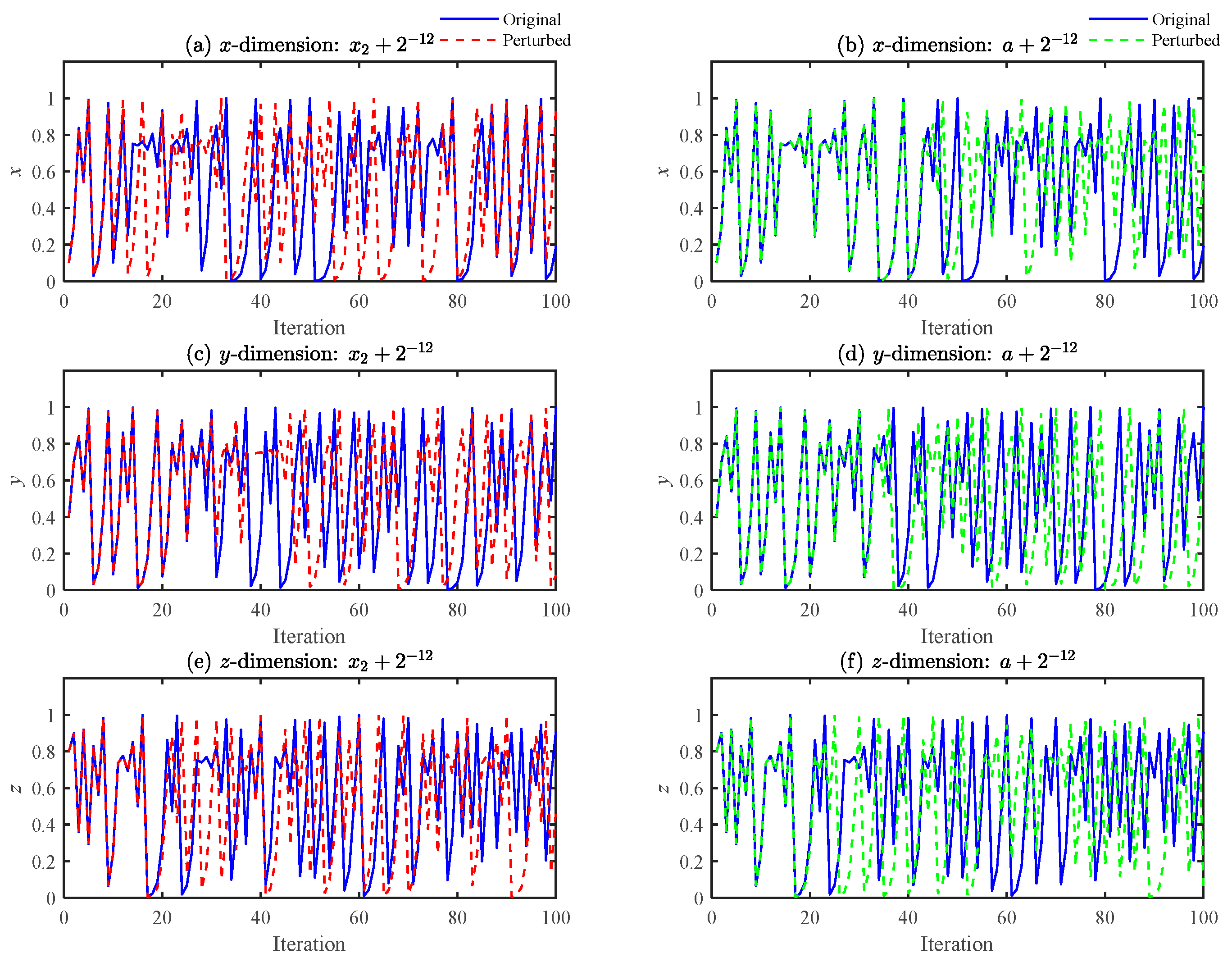
Sensitivity to infinitesimal perturbations is a fundamental indicator of chaotic dynamics. Figure 4 verifies this property in the proposed 3D Logistic-based HD-DCCCM (Equation (8)). As illustrated, applying a perturbation as small as 10 12 to either the initial condition (Figure 4a,c,e) or the control parameter (Figure 4b,d,f) leads to a rapid divergence of trajectories within only 100 iterations, even under different fixed-point precision levels. Despite the extremely small disturbance, the perturbed and unperturbed trajectories separate almost immediately, revealing a strong amplification of microscopic variations. These results demonstrate that the HD-DCCCM preserves its inherent chaotic sensitivity and maintains instability characteristics even under coarse quantization—an essential property for avoiding precision-induced degradation in digital implementations.

3.3. Enhanced Robustness Against Parameter Degradation

3.3.1. Bifurcation Analysis

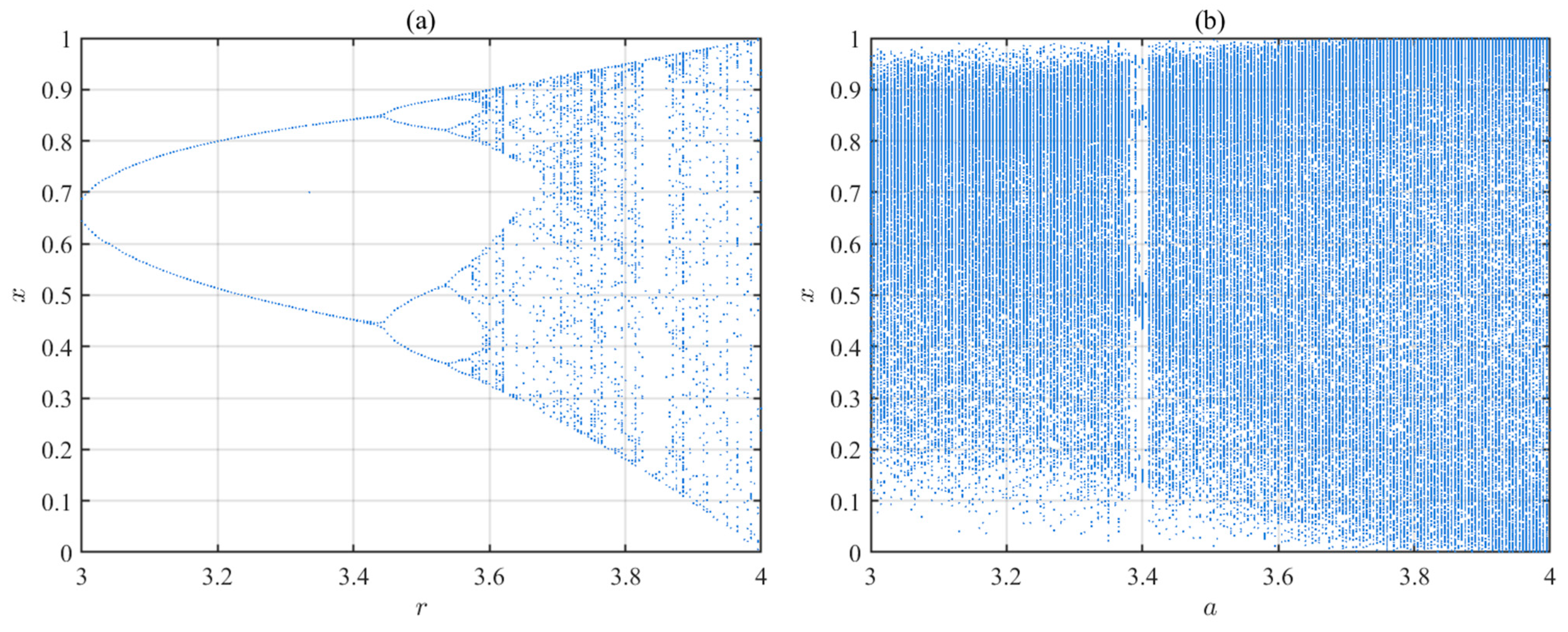
The bifurcation diagram is an essential tool for visualizing a system’s dynamical response to parameter variations, revealing its chaotic regions and periodic windows [36]. To evaluate the parameter sensitivity of the proposed HD-DCCCM, we plot its bifurcation diagram under a fixed precision of 2 12 and compare it with the counterpart of the standard Logistic map. As shown in Figure 5a, the Logistic map follows the classic period-doubling route to chaos, with the onset of chaos occurring at a 3.569 . However, its chaotic regime is fragmented by numerous periodic windows, indicating high sensitivity to parameter fluctuations. In contrast, the proposed 3D HD-DCCCM exhibits a markedly different behavior (Figure 5b). Across the entire parameter range a 3 , 4 , the system maintains a broad and continuous chaotic regime, with periodic windows largely absent and trajectories distributed more densely and asymmetrically. This reflects enhanced chaoticity and stronger resistance to parameter-induced degradation compared with the Logistic map.

3.3.2. Entropy Analysis

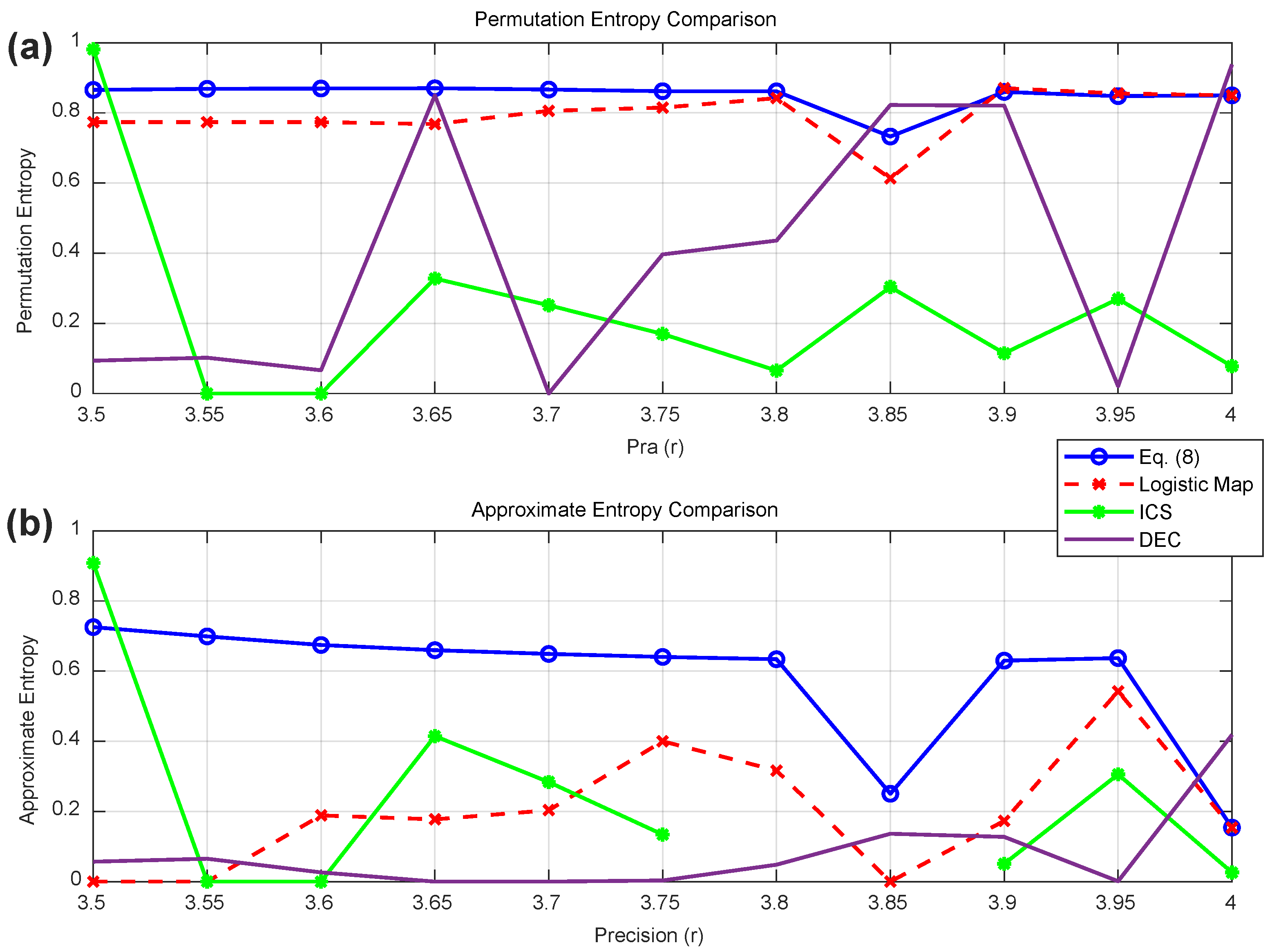
Entropy serves as an important indicator of the randomness and structural complexity of chaotic sequences. To evaluate the proposed 3D Logistic-based HD-DCCCM (Equation (8)), we compute permutation entropy (PE) and approximate entropy (ApEn) under a fixed precision of 2 12 , and compare the results with the classical Logistic map (Equation (9)) as well as two representative enhanced methods, ICS [33] and DEC [11]. All systems are tested over the parameter range r [ 3.5 , 4 ] for a consistent comparison framework.
As shown in Figure 6, the proposed model exhibits consistently higher and more stable entropy values across the entire parameter range for both PE and ApEn. In contrast, the classical Logistic map displays frequent drops and large fluctuations, particularly when r approaches the chaotic boundary. The ICS method shows strong instability with sharp oscillations, while DEC performs more smoothly but still remains notably below our model in most regions. These results demonstrate that the HD-DCCCM generates sequences with stronger randomness, higher structural complexity, and greater robustness against parameter variations compared with existing methods.

3.3.3. Correlation Dimension Analysis

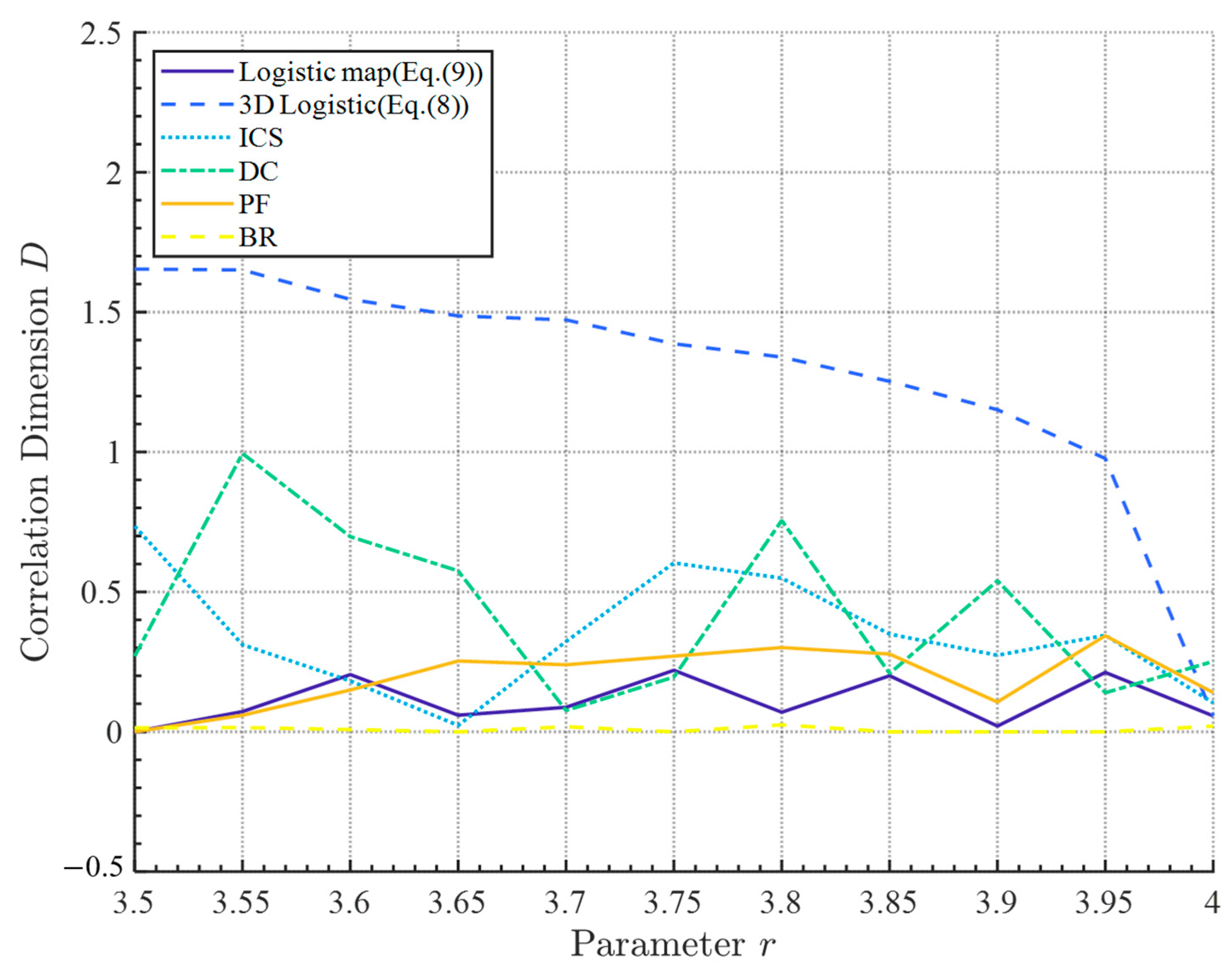
Correlation dimension (CD) is a fundamental metric for characterizing the geometric complexity of chaotic attractors, reflecting how densely and uniformly trajectories occupy the phase space. A higher CD typically indicates stronger chaoticity and richer dynamical structures. To evaluate the attractor complexity of the proposed 3D Logistic-based HD-DCCCM (Equation (8)), we compute its correlation dimension using the Grassberger–Procaccia algorithm and compare it with the standard Logistic map (Equation (9)) and four representative anti-degradation models [16,23,33,34]. The analysis was performed over r [ 3.5 , 4.0 ] , with a sequence length of 10 4 and precision 2 12 , focusing on the main variable of each system.
As shown in Figure 7, the Logistic map (Equation (9)) exhibits a clear decrease in dimension as r increases, indicating weakened chaos. In contrast, the proposed system (Equation (8)) maintains consistently higher values across most of the range, reflecting stronger attractor complexity and better chaos preservation. The reference models [16,23,33,34] show more fluctuations and occasional degradation. Overall, the proposed system demonstrates superior robustness in both chaotic intensity and geometric complexity.

3.4. Anti-Degradation Performance Under Finite Precision

3.4.1. Lyapunov Exponent Analysis

The Lyapunov exponent (LE) serves as a rigorous quantitative indicator of chaotic dynamics, where a positive exponent reflects the exponential divergence of nearby trajectories. In particular, the largest Lyapunov exponent (LLE) is widely adopted as the primary metric to verify the existence and intensity of chaos in digital systems under finite-precision arithmetic; a strictly positive LLE confirms exponential divergence of nearby trajectories.
To thoroughly evaluate the resilience of the proposed HD-DCCCM against finite-precision degradation, we compute the LLEs estimated from the generated scalar sequences under different fixed-point precision levels ( p [ 12 , 24 ] ) and compare them with those of the standard Logistic map and representative anti-degradation models [11,23,25,33]. As shown in Figure 8, the estimated LLE of the proposed system (e.g., from the x ( 1 ) state sequence) stabilizes at approximately 0.78, remaining strictly positive across the tested precision range. For reference, the theoretical LLE of the fully chaotic Logistic map at r   =   4 equals l n 2 . In contrast, the canonical Logistic map exhibits a sharp decline in its LLE when the precision falls below 16 bits, rapidly approaching weak chaos. Furthermore, the reference methods—DEC [11], PF [23], ND [25], and ICS [33]—show significantly lower and more fluctuating LLEs (generally within 0.1–0.55), with the PF model displaying pronounced instability at several precision levels. These observations demonstrate that the high-dimensional delayed cyclic-coupling mechanism of the proposed HD-DCCCM effectively suppresses precision-induced degradation, enabling the system to sustain strong chaotic dynamics under aggressive quantization.

3.4.2. Auto-Correlation Analysis

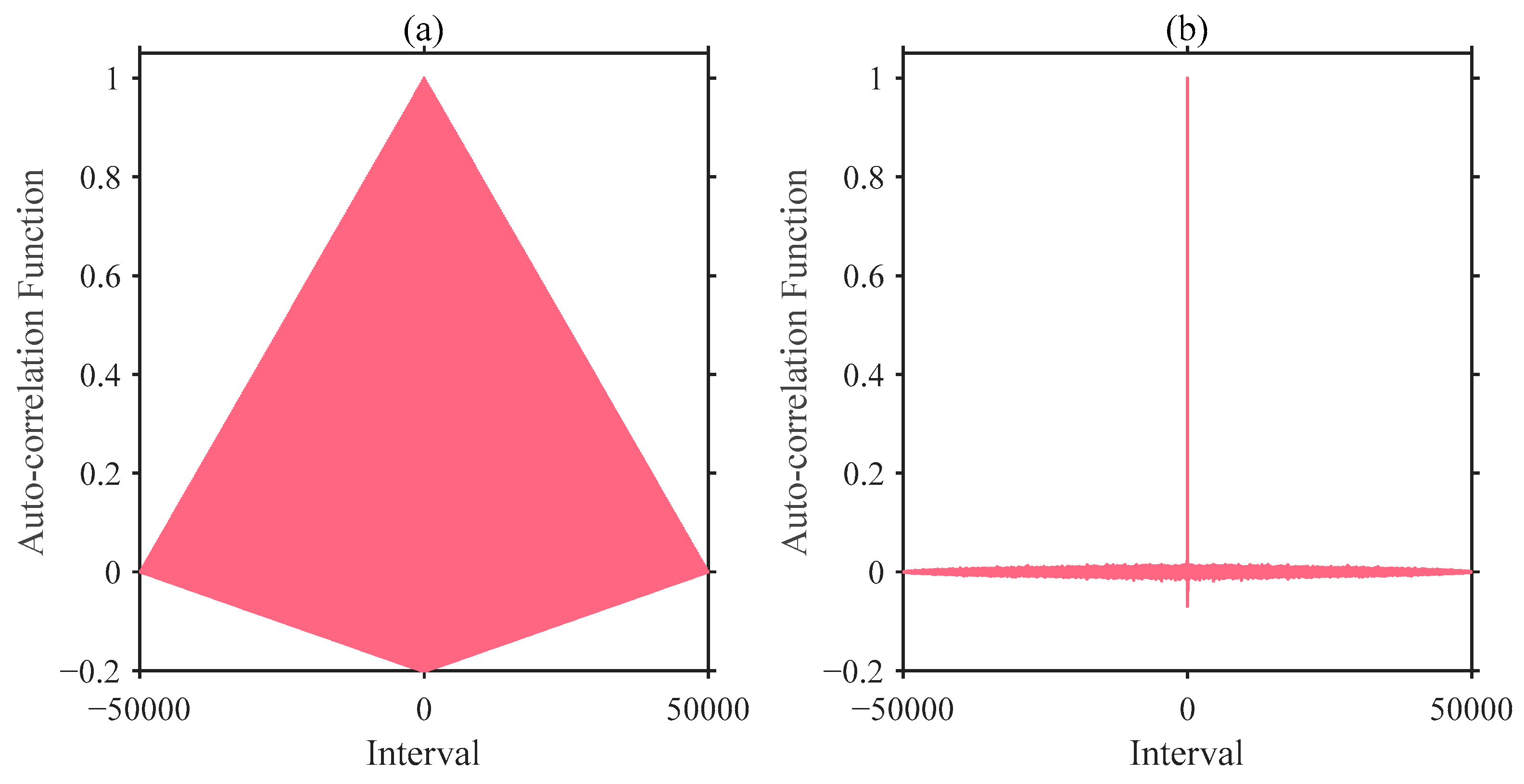
The auto-correlation function (ACF) characterizes the randomness of chaotic sequences. For an ideal chaotic signal, the ACF should rapidly decay to zero at all non-zero lags, indicating minimal temporal dependence. As shown in Figure 9a, the Logistic map under low-precision arithmetic exhibits a symmetric triangular ACF with slow decay, reflecting pronounced periodic correlations and finite-precision degradation. In contrast, the proposed HD-DCCCM in Figure 9b presents an almost impulse-like ACF that collapses sharply to zero. This behavior demonstrates that the framework’s intrinsic self-perturbation mechanism effectively disrupts quantization-induced dependencies, thereby preserving high pseudo-randomness and sustained chaotic complexity.

3.4.3. Period Analysis

To evaluate finite-precision robustness, we analyze the cycle length and the first-entry iteration of the proposed HD-DCCCM and compare it with the Logistic map and several representative anti-degradation methods [23,25,33,34]. For our model, the three state variables are merged into a single sequence for unified period detection. Comparative analysis with representative anti-degradation schemes highlights the superior stability of the proposed HD-DCCCM. As shown in Table 1, existing methods are prone to catastrophic degradation at specific precisions. Specifically, the multidimensional ND map [25] collapses to periods of 18, 14, and 61 at precisions p = 12 , 14 , and 16, respectively, and drops to 298 at p = 21 . Similarly, the BR [34] and PF [23] maps exhibit extremely short cycles (often < 1000 ) across most low-precision levels, and the ICS [33] method fails completely at low precisions (period = 1). In sharp contrast, the proposed HD-DCCCM consistently maintains periods exceeding 10 5 or remains undetected (“U”) across the same range.
The results in Table 2 further confirm this advantage. The Logistic map enters periodicity after only a small number of iterations, whereas the HD-DCCCM delays the onset of periodic behavior by several orders of magnitude, and in multiple cases no periodic entry is detected within the search limit. The other improved methods provide only partial enhancement and still exhibit significantly earlier periodic collapse.
The results in Table 1 and Table 2 are based on the state-quantization model. For a more rigorous verification under strict arithmetic constraints, please refer to the Strict Fixed-Point Arithmetic (SFPA) analysis in Section 3.4.5.

3.4.4. Computational Efficiency Analysis

To evaluate the trade-off between performance and cost, we conducted a real-time efficiency test defining the Computational Efficiency Ratio ( R e f f = L p e r i o d / T c p u ). Tests were performed on a standard PC with a unified total data length of N = 300 , 000 at precision p = 16 . To ensure a fair comparison across dimensions, the target length N represents the total number of state values. For an n -dimensional system, we performed N / n iterations and concatenated all state variables into a single 1D sequence for unified period detection (e.g., for the 3D HD-DCCCM, 10 5 iterations of x , y , z were flattened into a vector of length 3 × 10 5 ).
As shown in Table 3, the BR map [34] exhibits both a high time cost (0.4415 s) and a collapsed period (39), resulting in the lowest efficiency. While the PF map [23] achieves a saturated period ( 3 × 10 5 ), its complex perturbation logic leads to the longest generation time (0.7124 s), which lowers its efficiency ratio. The ND [25] and ICS [33] maps perform relatively well, achieving periods of 150,000 and 42,948, respectively. However, the proposed HD-DCCCM (Equation (8)) demonstrates the best overall performance. It combines a fast generation speed (0.0401 s, comparable to the simple Logistic map) with a robust effective period (194,882). Consequently, it achieves the highest efficiency ratio ( 4.86 × 10 6 ) among all tested systems, outperforming the second-best benchmark (ND) by approximately 1.65 times and the classic Logistic map by over 3 orders of magnitude. This confirms it is a highly cost-effective solution for resource-constrained applications.

3.4.5. Robustness Verification Under Strict Fixed-Point Arithmetic

To further evaluate the system’s robustness under practical hardware constraints, a Strict Fixed-Point Arithmetic (SFPA) test was conducted. In this stringent test, the quantization operator FL ( ) is applied immediately after every elementary arithmetic operation, including addition, subtraction, and multiplication, to prevent any floating-point precision leakage. As summarized in Table 4, such strict arithmetic constraints cause severe performance degradation in most existing chaotic systems. In particular, when the precision drops below 14 bits, both the standard Logistic map and the BR map [34] rapidly collapse into extremely short periodic cycles ( P e r i o d 22 ), indicating a pronounced loss of chaotic behavior. In sharp contrast, the proposed HD-DCCCM maintains strong robustness, sustaining a period length of 5449 even at 12-bit precision, which is several orders of magnitude larger than those of the benchmark models. This result confirms that the superior anti-degradation capability of the HD-DCCCM arises from its intrinsic high-dimensional cyclic coupling structure rather than from numerical artifacts.

4. High-Dimensional Heterogeneous HD-DCCCM and Its Performances

4.1. Construction of the Heterogeneous HD-DCCCM (Logistic–Chebyshev–Henon)

The analysis in Section 3 validated the effectiveness of the proposed HD-DCCCM framework in a homogeneous configuration using only Logistic maps. However, real-world chaotic systems often involve structurally different nonlinear components, and the ability of a digital chaotic framework to accommodate heterogeneous dynamics is crucial for demonstrating its generality and robustness. To assess this capability, we construct a heterogeneous version of the HD-DCCCM that integrates three structurally distinct chaotic maps: the 1D Logistic map (Equation (6)), the 1D Chebyshev map, and the 2D Henon map. This formulation allows us to examine the performance of the framework in higher-dimensional, mixed-topology chaotic environments.

4.1.1. Component Chaotic Maps

The one-dimensional Chebyshev map is defined as
x i + 1 = cos c arccos x i
where x i ( 1 , 1 ) , the system exhibits chaotic behavior for c 2 .
The two-dimensional Henon map is given by
x i + 1 = 1 a x i 2 + y i y i + 1 = b x i
with canonical chaotic parameters a =   1.4 and b [ 0.2 , 0.3 ] .

4.1.2. Construction of the Hybrid Time-Delayed Cyclic-Coupled Model

To build a heterogeneous hybrid chaotic system, we embed the Logistic, Chebyshev, and Henon maps into a unified delayed-coupled architecture. The resulting system, denoted 3D-LCH, operates on a four-dimensional state space x ( 1 ) , x ( 2 ) , x ( 3 ) , and y ( 3 ) , corresponding to the Logistic state, the Chebyshev state, and the two Henon states, respectively. Following the HD-DCCCM architecture, the control parameters of each subsystem are modulated by the delayed state of another subsystem, forming a cyclic interaction among the three maps.
The model is formulated as
x i + 1 ( 1 ) = p 1 x i τ ( 2 ) x i ( 1 ) 1 x i ( 1 ) x i + 1 ( 2 ) = cos p 2 x i τ ( 3 ) arccos x i ( 2 ) x i + 1 ( 3 ) = 1 1.4 x i ( 3 ) 2 + y i ( 3 ) y i + 1 ( 3 ) = p 3 x i τ ( 1 ) x i ( 3 )
which realizes the following interaction chain:
  • The Chebyshev map modulates the Logistic parameter.
  • The Henon-x state modulates the Chebyshev parameter.
  • The Logistic state modulates the Henon b-parameter.
This cyclic structure allows heterogeneous chaotic components to influence one another through time-delayed feedback, constructing a flexible and strongly coupled dynamical platform.

4.1.3. Time-Varying Parameter Scaling

As the three component maps operate under substantially different parameter regimes, directly employing a unified modulation strategy is infeasible. To ensure that each subsystem remains within its own chaotic domain, the parameter functions p 1 , p 2 , and p 3 are individually designed as:
p 1 x = a 1 + 4 a 1 x p 2 x = a 2 + x p 3 x = a 3 + 0.3 a 3 x
To maintain chaotic evolution across all subsystems, the base parameters satisfy a 1 ( 3.5699 , 4 ] , a 2 [ 2 , + ) , and a 3 [ 0.2 , 0.3 ] . This design guarantees that the delayed modulation remains compatible with the intrinsic dynamical characteristics of each sub-map.

4.1.4. Final Hybrid Model Under Finite Precision

Combining the scaled parameter functions with the fixed-precision operator F L ( ) the heterogeneous HD-DCCCM is implemented as
x i + 1 ( 1 ) = F L a 1 + 4 a 1 x i τ ( 2 ) x i ( 1 ) 1 x i ( 1 ) x i + 1 ( 2 ) = F L cos a 2 + x i τ ( 3 ) arccos x i ( 2 ) x i + 1 ( 3 ) = F L 1 1.4 x i ( 3 ) 2 + y i ( 3 ) y i + 1 ( 3 ) = F L a 3 + 0.3 a 3 x i τ ( 1 ) x i ( 3 )
With τ = 1, a1 = 3.99, a2 = 2, a3 = 0.21, and initial conditions x 0 ( 1 ) = 0.1 , x 1 ( 1 ) = 0.3 , x 0 ( 2 ) = 0.4 , x 1 ( 2 ) = 0.7 , x 0 ( 3 ) = 0.3 , x 1 ( 3 ) = 0.4 , y 1 ( 3 ) = 0.1 , under a minimum precision of 2 12 .

4.2. Basic Chaotic Characteristics of 3D-LCH

4.2.1. Trajectories and Phase Diagrams

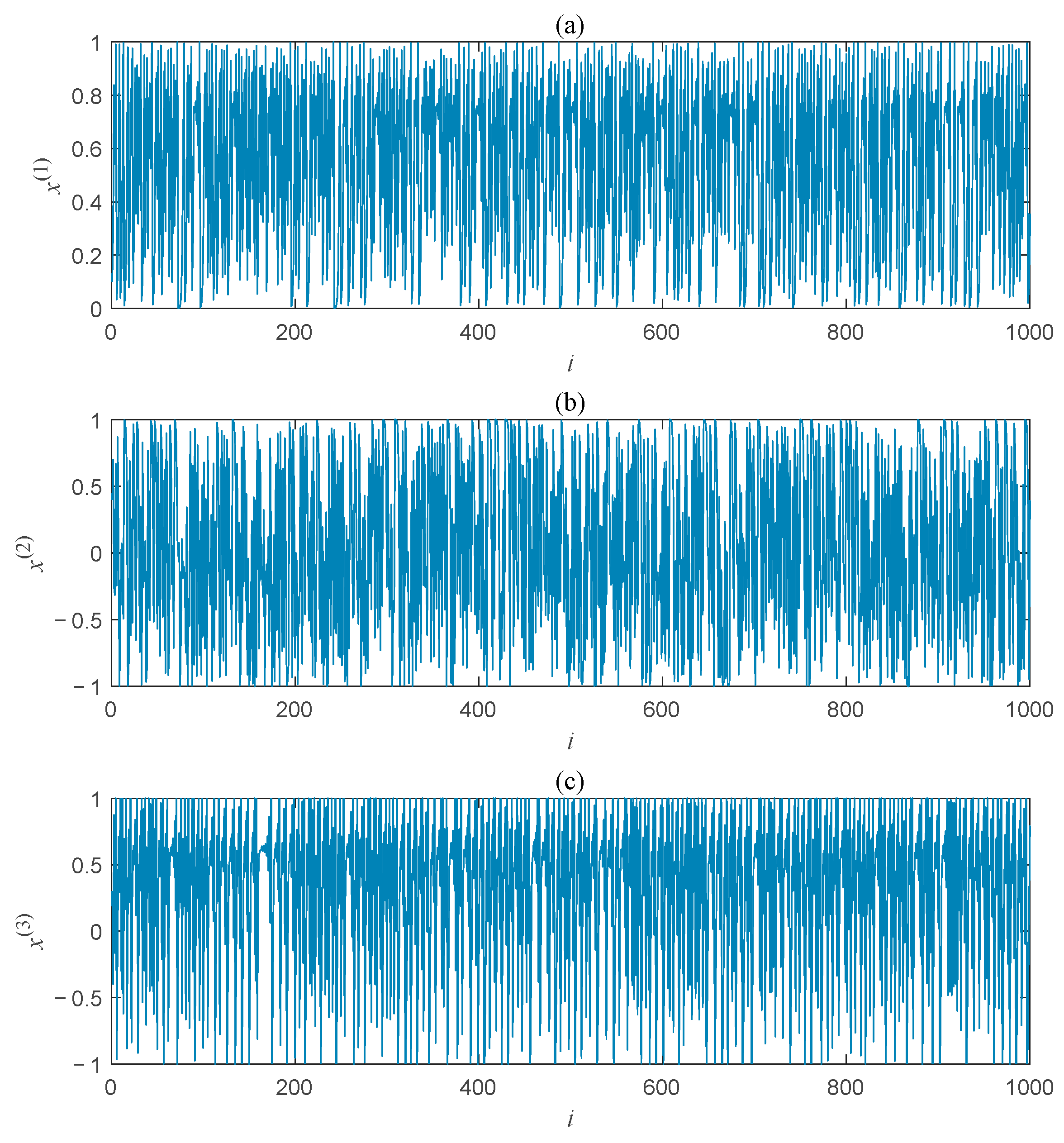
Figure 10 presents the time series of the three principal state variables x ( 1 ) , x ( 2 ) , x ( 3 ) . The system was iterated for 1000 steps with a numerical precision of 2 12 . All three sequences exhibit sustained, high-frequency, and non-periodic oscillations. The absence of convergence to fixed points or simple periodic cycles provides strong evidence that the heterogeneous coupling mechanism successfully preserves robust chaotic dynamics.
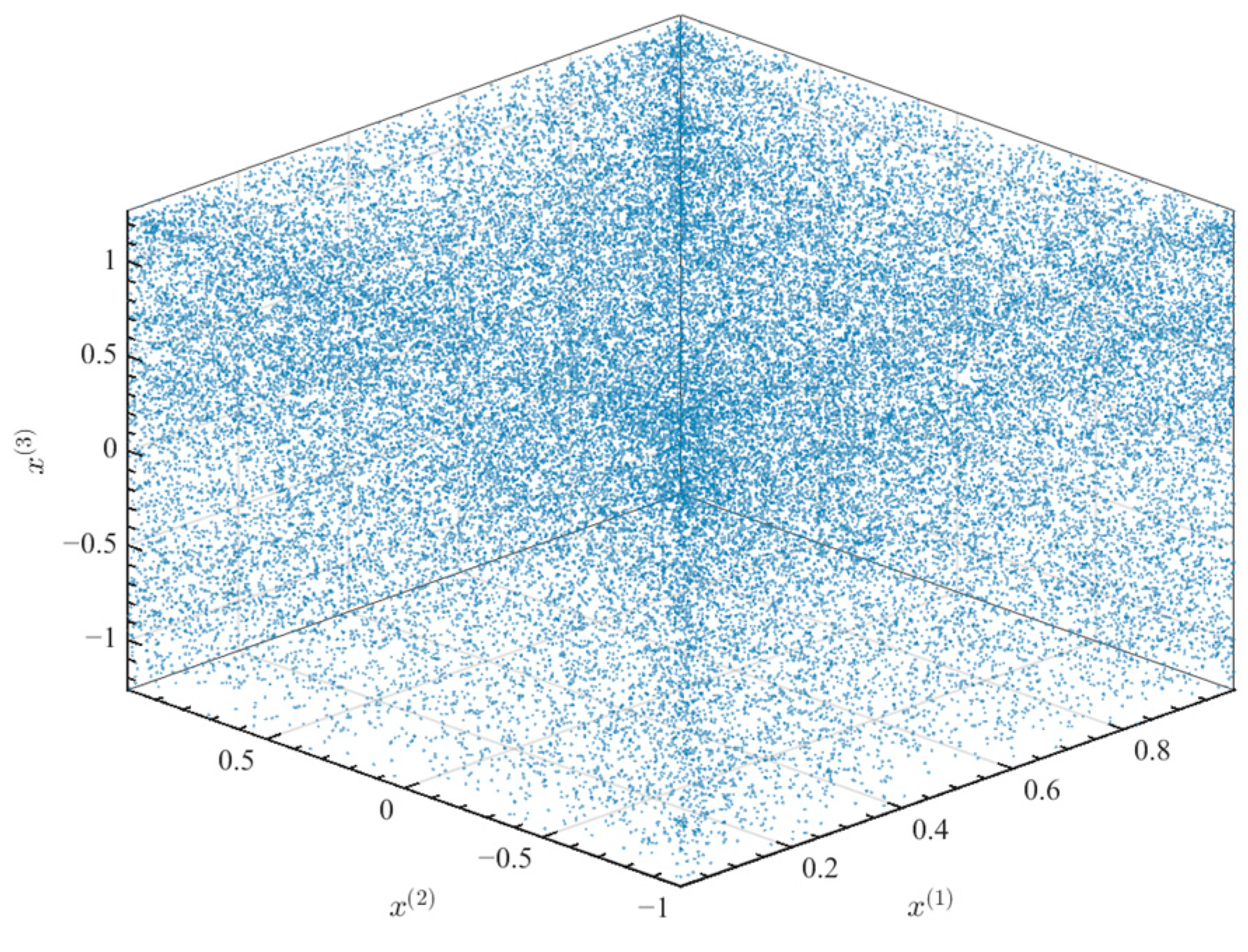
To further characterize the geometric structure of the system, Figure 11 shows the 3D phase portrait of the 3D-LCH model in the ( x ( 1 ) , x ( 2 ) , x ( 3 ) ) state space. The attractor, generated from 50,000 iterations after discarding 1000 transient steps, forms a dense and non-repetitive point cloud. Rather than collapsing onto a closed orbit or low-dimensional manifold, the trajectory fills a complex volumetric region, displaying the hallmark topology of a strange attractor. The broad spread along all three axes confirms that the heterogeneous HD-DCCCM framework maintains rich, high-dimensional chaotic dynamics under the specified configuration.

4.2.2. Sensitivity Analysis

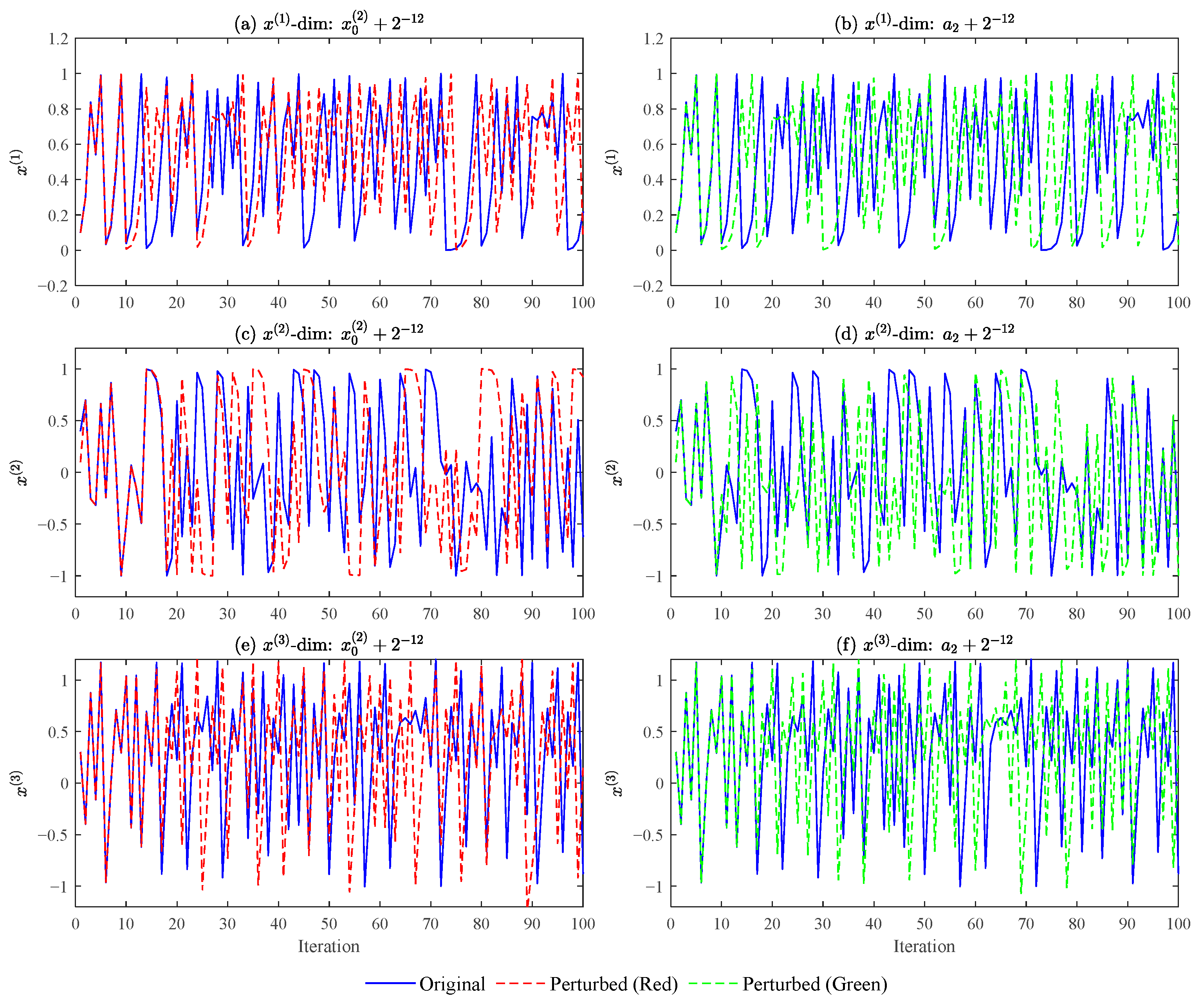
To assess the sensitivity of the 3D-LCH system, slight perturbations were introduced to the initial condition ( x 0 ( 1 ) + 2 12 ) and control parameter ( a 2 + 2 12 ) under precision p = 2 12 . Figure 12 shows the trajectory divergence under both cases. The results clearly show that even slight perturbations lead to rapid divergence between trajectories, indicating the system’s high sensitivity—an essential characteristic of chaotic dynamics.

4.3. Enhanced Robustness Against Parameter Degradation

4.3.1. Bifurcation Analysis

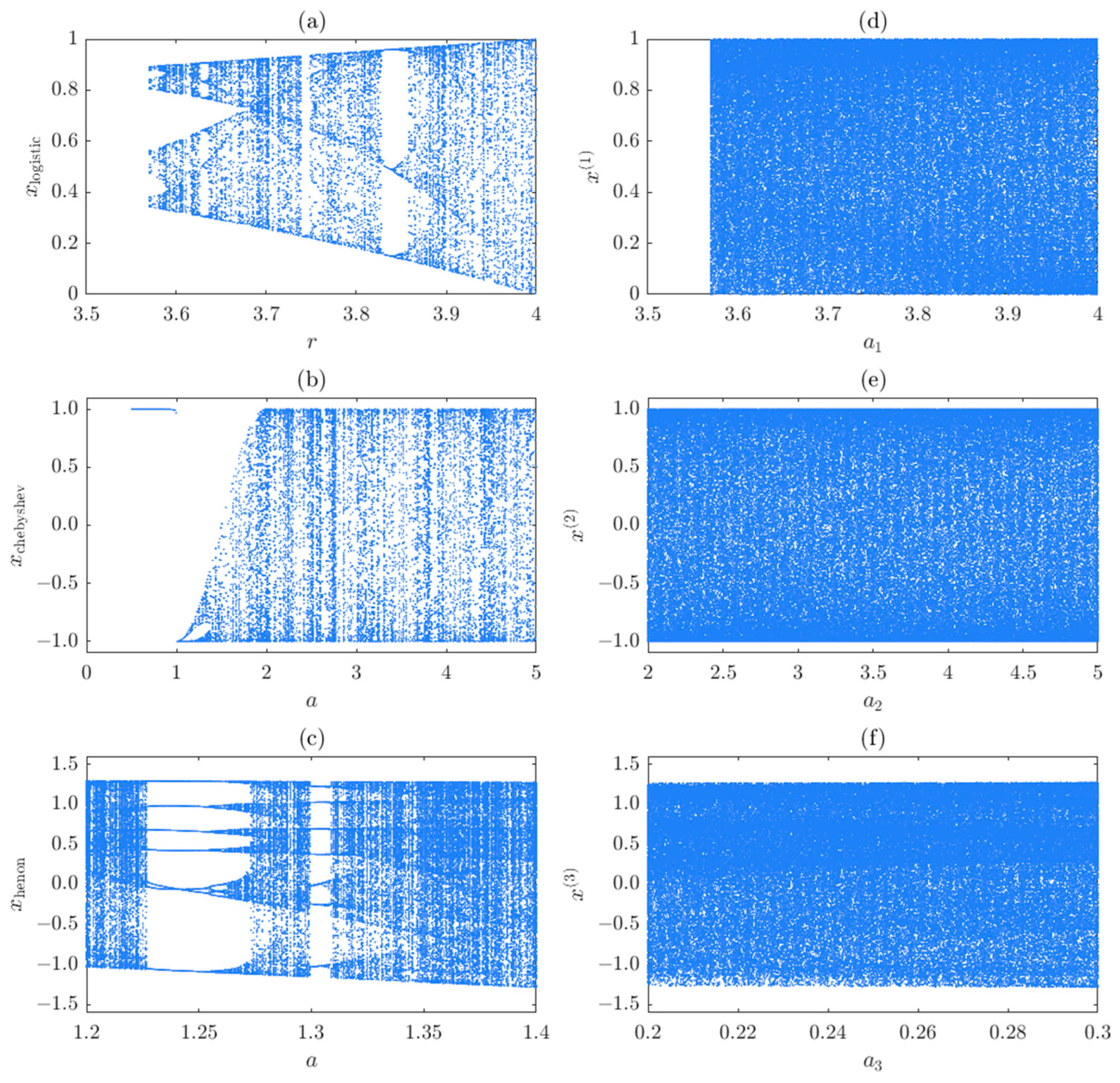
To assess the parameter robustness of the heterogeneous HD-DCCCM, Figure 13 provides a comparative bifurcation analysis under a fixed precision of 2 12 . The original uncoupled Logistic, Chebyshev, and Henon maps (Figure 13a–c) are used as reference systems, each exhibiting clear vulnerabilities—dense periodic windows in the Logistic and Henon maps, and a narrow chaotic regime in the Chebyshev map. In contrast, all three state variables of the 3D-LCH model (Figure 13d–f) display uniformly dense, high-frequency non-periodic distributions across all tested parameter ranges. These results demonstrate that the proposed heterogeneous HD-DCCCM effectively eliminates periodic windows and achieves markedly enhanced parameter robustness.

4.3.2. Entropy Analysis

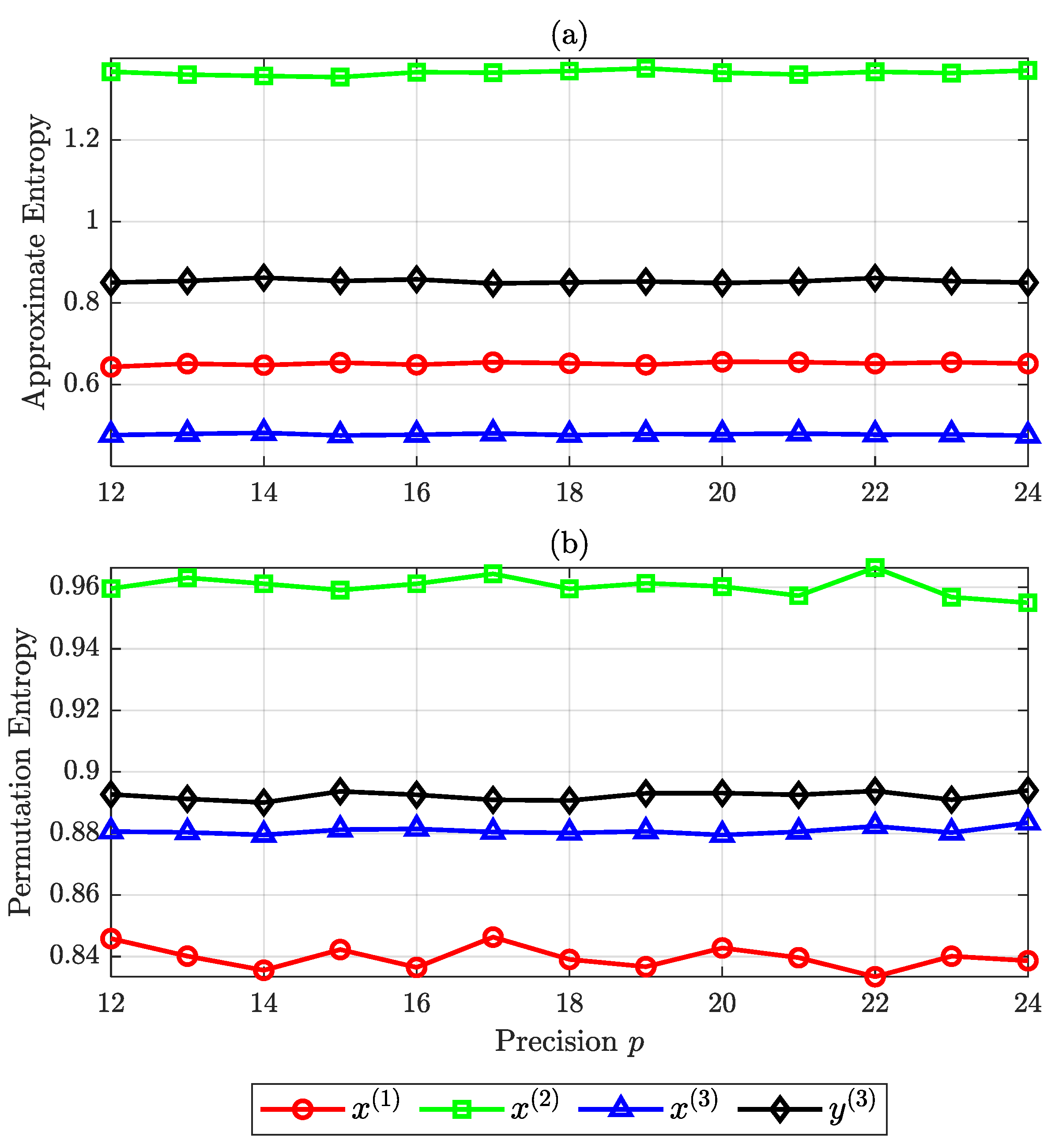
Permutation entropy (PE) and approximate entropy (ApEn) of the 3D-LCH system were computed under precision levels 2 12 2 24 using the last 9000 samples of each steady-state sequence. Figure 14a,b show the ApEn and PE results for x ( 1 ) , x ( 2 ) , x ( 3 ) , y ( 3 ) . All state variables exhibit highly stable entropy values across the entire precision range. Among them, x ( 2 ) achieves the highest ApEn and PE, reflecting its richer structure, while x ( 1 ) , x ( 3 ) and y ( 3 ) maintain entropy levels consistent with strong chaotic behavior. Overall, the 3D-LCH system preserves high and nearly invariant entropy under increasing quantization, demonstrating strong resistance to finite-precision degradation and a reliable ability to generate complex chaotic sequences.

4.3.3. Correlation Dimension Analysis

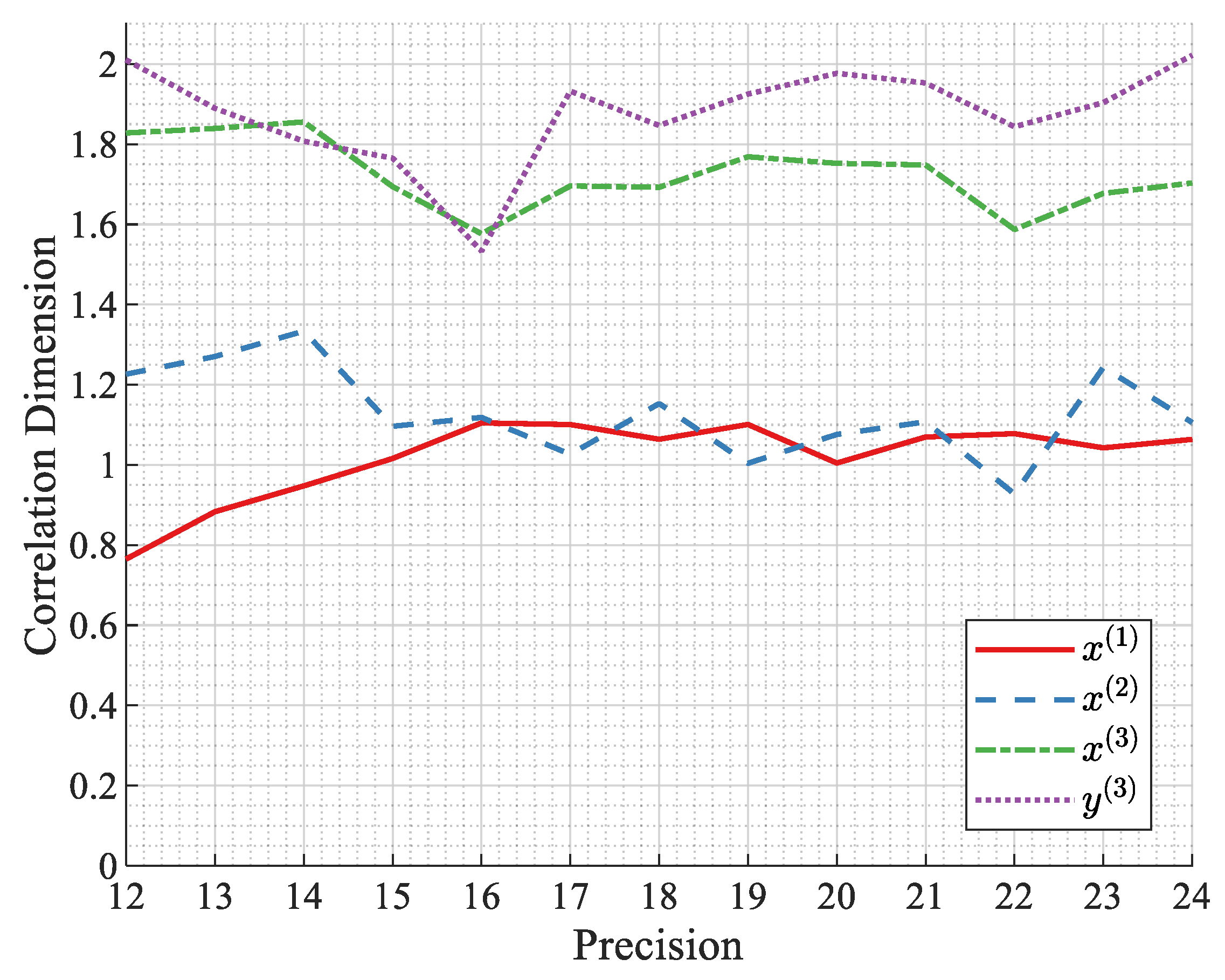
We computed the correlation dimension of the four state variables x ( 1 ) ,   x ( 2 ) ,   x ( 3 ) ,   y ( 3 ) under precision levels 2 12 ~ 2 24 . As shown in Figure 15, all variables maintain consistently high dimensions throughout the entire precision range, with values mostly between 1.0 and 2.0. The components x ( 3 ) and y ( 3 ) exhibit the highest dimensions, reflecting richer spatial structures and stronger high-dimensional chaotic behavior. Moreover, the dimension curves vary only slightly with increasing precision and show no signs of numerical degradation. These results demonstrate that the 3D-LCH system preserves strong dynamical complexity under finite-precision constraints.

4.4. Anti-Degradation Performance Under Finite Precision

4.4.1. Lyapunov Analysis

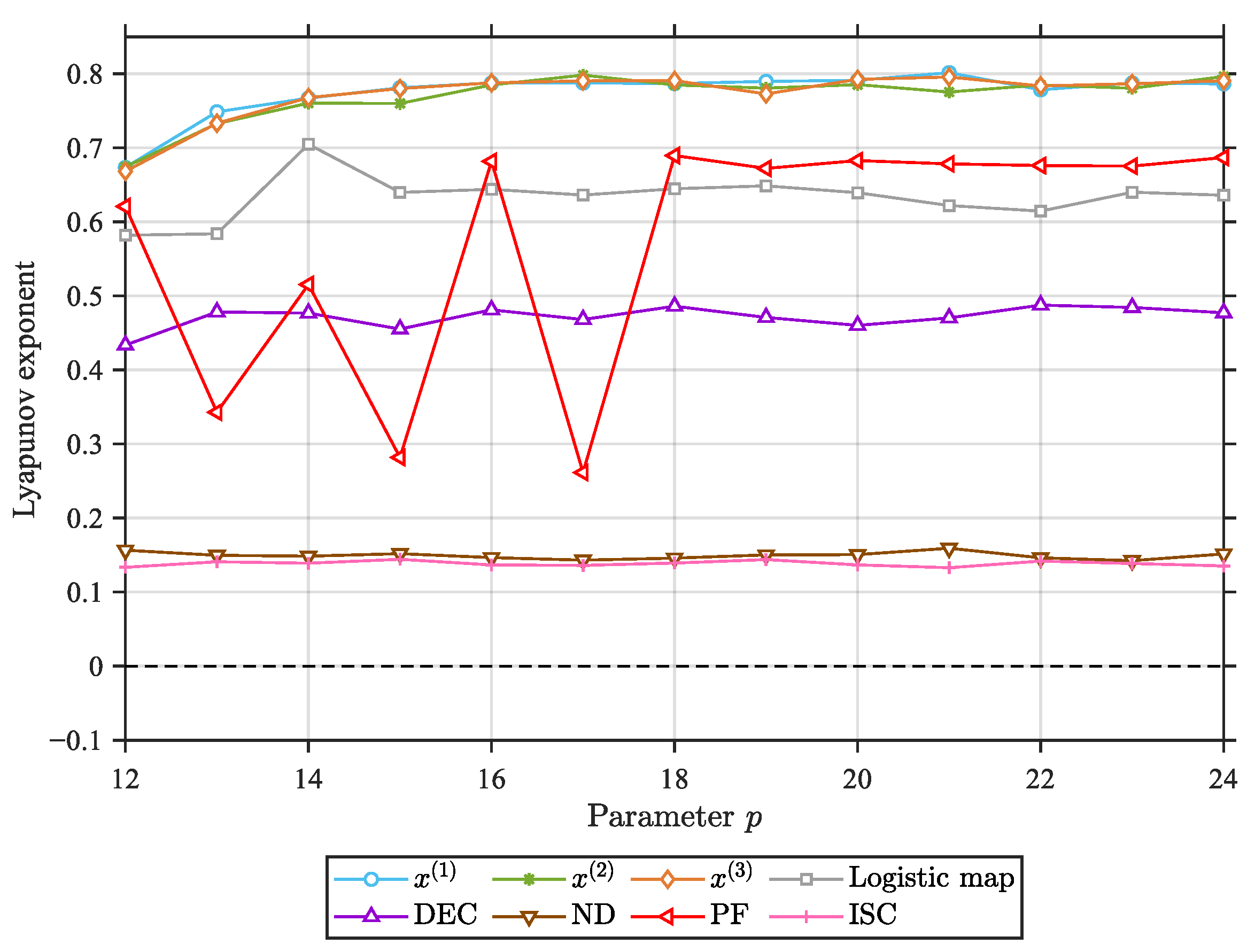
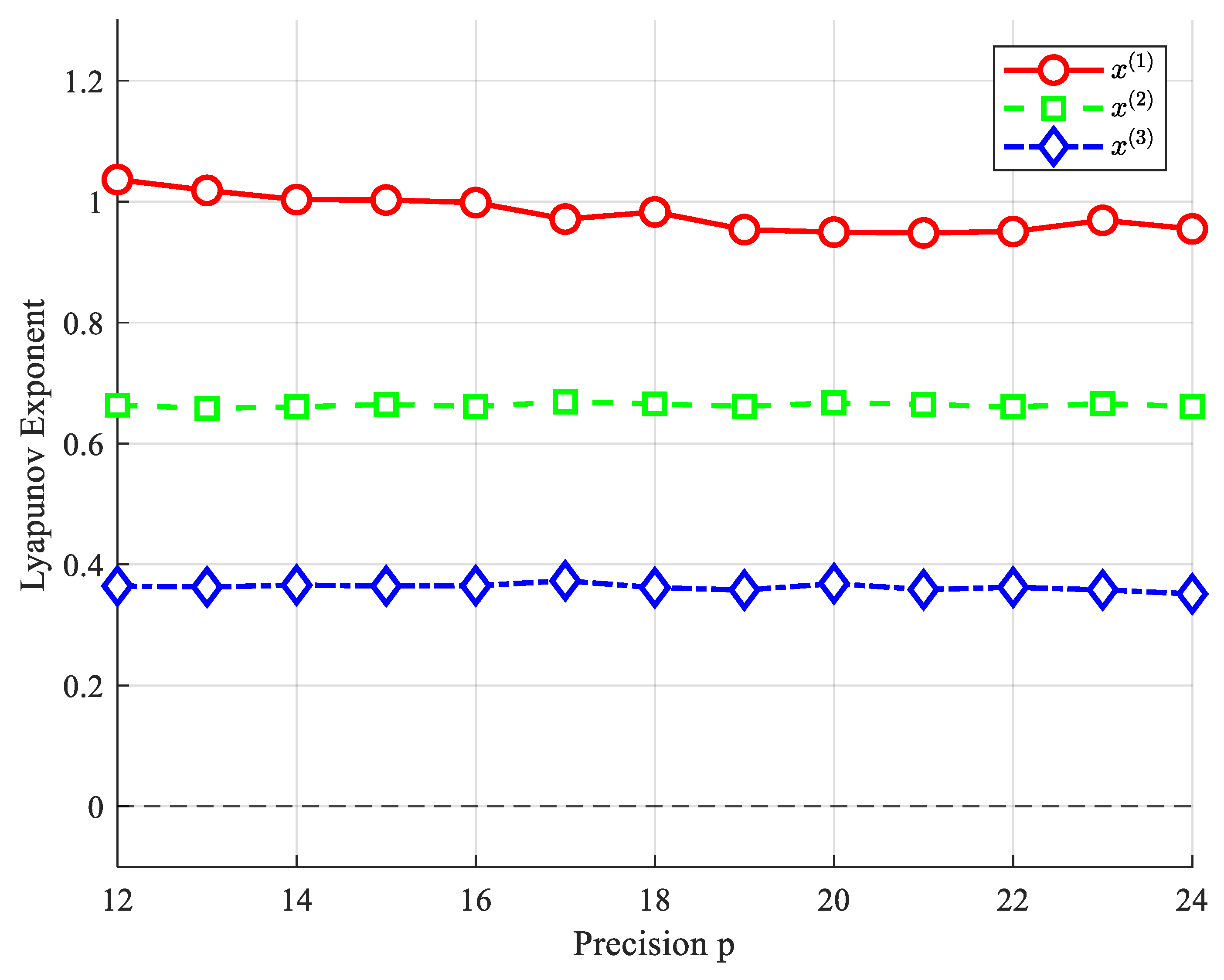
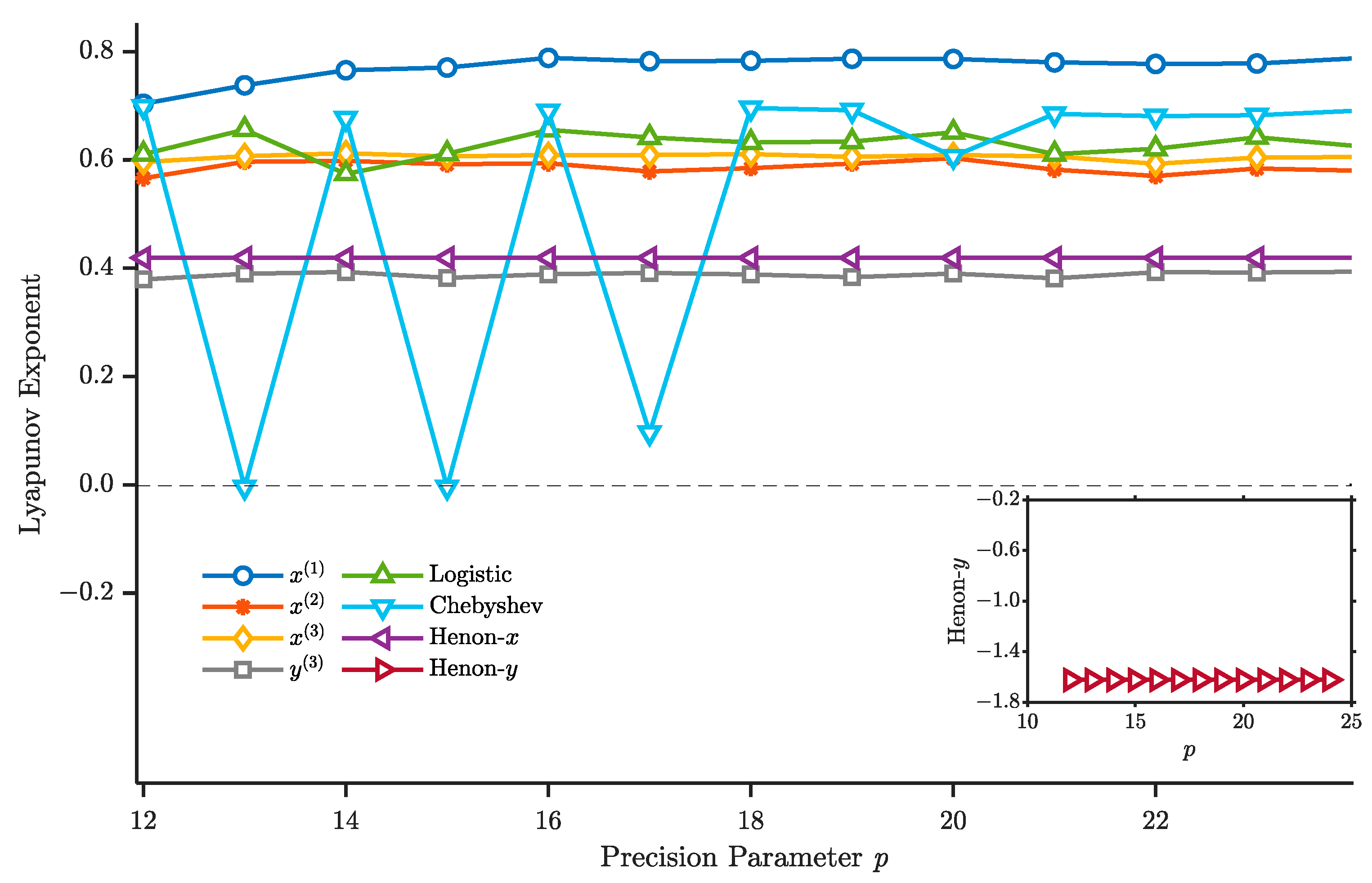
We computed the Lyapunov exponents (LEs) of the 3D-LCH system under fixed-point precisions with fractional lengths p ranging from 12 to 24 bits ( 2 12 to 2 24 ). To quantitatively verify hyperchaotic behavior, we analyze the full Lyapunov spectrum. While the largest Lyapunov exponent (LLE) confirms the fundamental chaotic nature, the presence of additional positive exponents serves as the definitive proof of hyperchaos.
As shown in Figure 16, the leading Lyapunov exponents remain strictly positive across the entire tested precision range. Specifically, the LLE of the system (observed in the x ( 1 ) component) stabilizes at approximately 1.0, staying well above zero under all tested precisions. Meanwhile, the exponents of the other coupled variables also remain strictly positive (e.g., L E 0.67 for x ( 2 ) and L E 0.38 for x ( 3 ) ), indicating that the system preserves hyperchaotic dynamics without finite-precision degradation. Overall, the weak dependence of these leading exponents on the precision parameter confirms the strong robustness of the heterogeneous cyclic delayed coupling mechanism.
A dimension-wise comparison with the original uncoupled maps (Figure 17) further highlights the effect of heterogeneous cyclic coupling. The leading exponents of the coupled system are consistently higher and more stable than those of the uncoupled Logistic and Henon maps, while the strong fluctuations observed in the standalone Chebyshev map under low precision are effectively suppressed after coupling. For the 2D Henon map, one exponent is positive and the other is negative, reflecting its dissipative nature; nevertheless, the coupled framework maintains multiple positive leading exponents and thus sustains robust hyperchaotic behavior under severe precision constraints.

4.4.2. Auto-Correlation Analysis

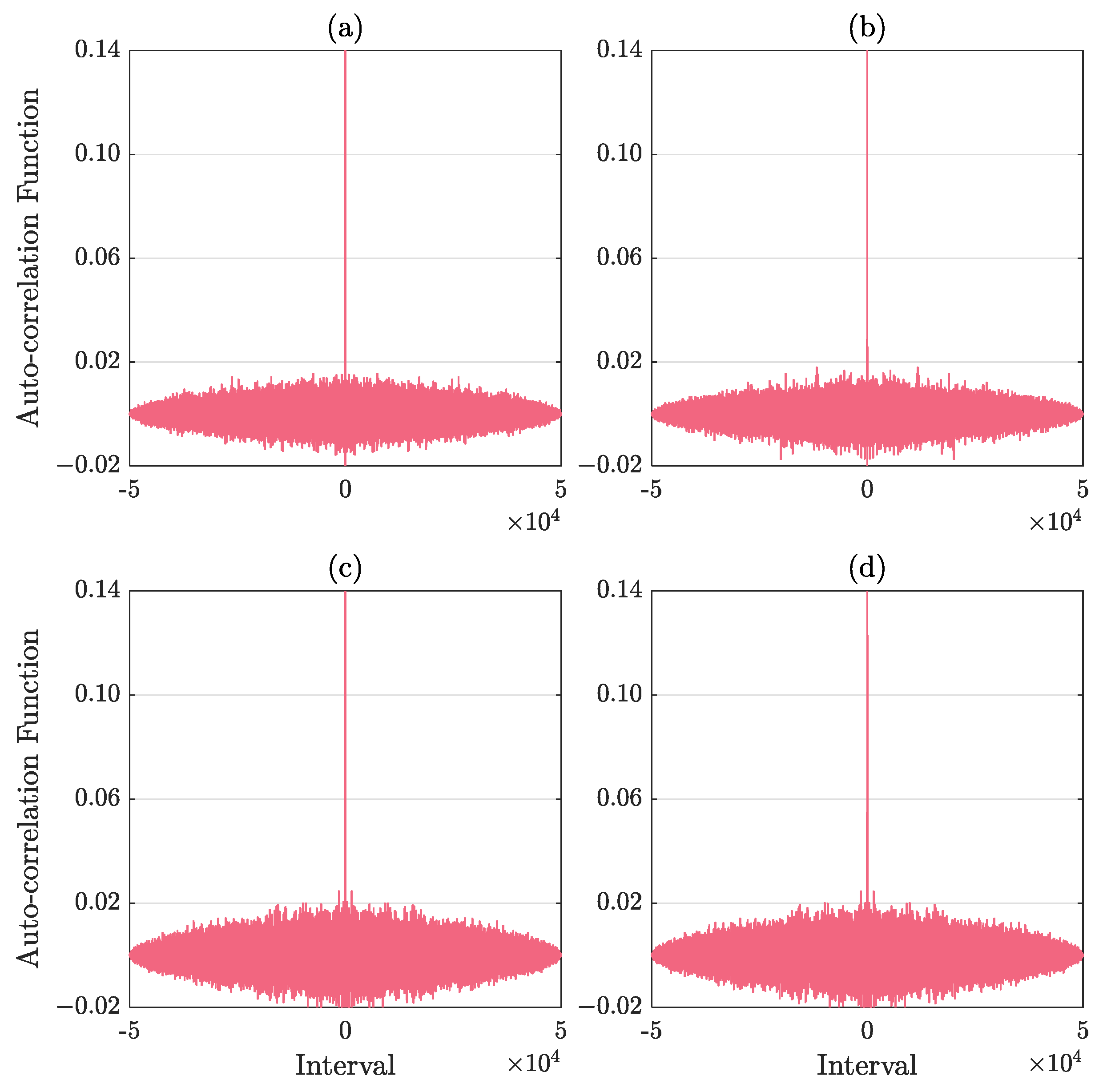
We computed the auto-correlation functions of the 3D-LCH system’s four state variables under a precision of 2 12 . As shown in Figure 18, all variables exhibit the ideal short-range structure: a sharp peak at zero lag followed by an immediate drop to near-zero correlation, with only low-level fluctuations at non-zero lags. The variables x ( 3 ) and y ( 3 ) show nearly identical patterns due to their structural coupling. Overall, the 3D-LCH system generates sequences with strong short-term decorrelation and non-periodic behavior under finite precision.

4.4.3. Period Analysis

To assess the dynamic complexity and finite-precision resistance of the heterogeneous 3D-LCH system, we performed a comprehensive period analysis over precision levels p = 2 12 ~ 2 24 . For each precision, the final period length and the first-entry iteration were recorded, with the maximum iteration limit set to 10 5 ; undetected periodicity is marked as “U”.
Table 5 shows the measured period lengths. Variables x ( 2 ) , x ( 3 ) , y ( 3 ) remain aperiodic at all precisions above 2 13 , while x ( 1 ) also maintains non-periodicity down to 2 19 . This indicates strong resistance to finite-precision degradation. In contrast, the original Logistic, Chebyshev, and Henon maps enter short cycles extremely early—often within a few tens to hundreds of iterations at low-precision levels. Table 6 further reports the iterations at which periodicity first occurs. Under p = 2 12 2 18 , most original maps fall into periodic orbits within several hundred to several thousand steps. By comparison, x ( 1 ) sustains non-periodic behavior for tens of thousands of iterations at certain precisions, and x ( 2 ) , x ( 3 ) , y ( 3 ) consistently outperform their uncoupled counterparts.
Overall, the 3D-LCH model exhibits significantly longer aperiodic lifetimes and markedly delayed periodic collapse relative to traditional low-dimensional maps, confirming its superior resistance to numerical degradation and its ability to preserve chaotic structures under finite-precision constraints.

4.4.4. Computational Efficiency Analysis

To evaluate the cost-effectiveness of the 3D-LCH system, we conducted a real-time efficiency test ( N = 300 , 000 , p = 16 ) using the Period/Time Ratio ( R e f f = L p e r i o d / T c p u ). As shown in Table 7, the 1D Chebyshev map exhibits a higher time cost (0.0546 s) due to complex trigonometric operations. The 2D Henon map, despite its simple structure, suffers from rapid period collapse ( L p e r i o d = 383 ). In contrast, the proposed 3D-LCH system effectively integrates the advantages of its components. It maintains a competitive generation speed (0.0553 s) comparable to the Chebyshev map but significantly extends the effective period to 4583, which is over 10 times longer than that of the Henon map. Consequently, its efficiency ratio ( 8.28 × 10 4 ) is approximately one order of magnitude higher than the base maps, demonstrating a superior balance between dynamical complexity and implementation cost.

5. Conclusions

In this paper, we proposed the HD-DCCCM with time-varying parameter control to mitigate the dynamical degradation of digital chaotic systems under finite-precision arithmetic. By integrating high-dimensional cyclic coupling, delayed state feedback and bounded time-varying parameter modulation into a unified mapping, the framework enhances internal structural complexity and error circulation, thereby suppressing the formation of short periodic orbits.
A three-dimensional Logistic-based HD-DCCCM was first constructed to validate the basic properties of the model. Numerical results show that, even at low precision, it preserves long-term hyperchaotic behavior, exhibits broad chaotic parameter regions with few periodic windows, and generates sequences with high entropy, large correlation dimension, positive Lyapunov exponents and strongly reduced short periods, outperforming the standard Logistic map and several representative anti-degradation methods. To further demonstrate generality, a heterogeneous HD-DCCCM (3D-LCH) combining Logistic, Chebyshev and Henon maps was developed. This hybrid system maintains robust hyperchaos and favorable randomness indicators across a wide range of precision levels and effectively alleviates the degradation of fragile dimensions in its component maps. Overall, the HD-DCCCM offers a compact and flexible paradigm for constructing degradation-resilient digital chaotic systems.
Despite the demonstrated advantages, the proposed HD-DCCCM still has several limitations that merit further investigation. First, the introduction of high-dimensional cyclic coupling and delayed feedback inevitably increases computational complexity compared with classical low-dimensional chaotic maps, which may impose additional resource requirements in extremely constrained hardware environments [37]. Second, although extensive numerical results confirm strong robustness against finite-precision degradation, a rigorous theoretical analysis of the underlying hyperchaotic mechanism and error propagation in delayed cyclic-coupled structures remains an open problem. In addition, the selection of coupling topology and delay parameters may influence system performance, and systematic optimization strategies for different application scenarios have not yet been fully explored.
Future work will address more rigorous theoretical analysis of the hyperchaotic mechanism [38], exploration of alternative coupling and delay configurations, and hardware-oriented implementations for secure communications, cryptography and pseudo-random sequence generation.

Author Contributions

Conceptualization, L.L.; methodology, Q.H.; software, Q.H.; formal analysis, J.B.; data curation, Q.H. and J.B.; writing—original draft preparation, Q.H.; writing—review and editing, Q.H. and L.L.; funding acquisition, L.L. and Q.H. All authors have read and agreed to the published version of the manuscript.

Funding

This work is supported by the Key Research and Development Program of Jiangxi Province (Grant No. 20252BCE310020); Key Research and Development Program of Ganzhou City (Grant No. 2025GPCY0010); Open Fund Project of Jiangxi Provincial Key Laboratory of Data Security Technology (Grant No. DSTKL-2025-B001); National Natural Science Foundation of China (Grant No. 62262039); Scientific Research Fundation of the Education Department of Jiangxi Province (Grant No. GJJ2503601); Major Project of Jiangxi Provincial Natural Science Foundation (Grant No. 20232ACB202009, 20252BAC250129); Graduate Innovation Special Fund Project of Jiangxi Province (Grant No. YC2025-S023).

Data Availability Statement

All data generated or analyzed during this study are included in this published article.

Conflicts of Interest

The authors declare no conflicts of interest.

References

  1. Vaidyanathan, S.; Volos, C. (Eds.) Advances and Applications in Chaotic Systems; Studies in Computational Intelligence; Springer International Publishing: Cham, Switzerland, 2016; Volume 636. [Google Scholar]
  2. Moskalenko, O.; Koronovskii, A.A.; Hramov, A.E. Generalized Synchronization of Chaos for Secure Communication: Remarkable Stability to Noise. Phys. Lett. A 2010, 374, 2925–2931. [Google Scholar] [CrossRef]
  3. May, R.M. Simple Mathematical Models with Very Complicated Dynamics. Nature 1976, 261, 459–467. [Google Scholar] [CrossRef]
  4. Bakiri, M.; Couchot, J.-F.; Guyeux, C. CIPRNG: A VLSI Family of Chaotic Iterations Post-Processings for F2-Linear Pseudorandom Number Generation Based on Zynq MPSoC. IEEE Trans. Circuits Syst. I 2018, 65, 1628–1641. [Google Scholar] [CrossRef]
  5. Zhang, Y. Image Encryption Algorithm Based on Butterfly Module and Chaos. Math. Comput. Simul. 2025, 232, 382–407. [Google Scholar] [CrossRef]
  6. Zhou, S.; Wang, X.; Zhang, Y. Novel Image Encryption Scheme Based on Chaotic Signals with Finite-Precision Error. Inf. Sci. 2023, 621, 782–798. [Google Scholar] [CrossRef]
  7. Zhou, W.; Li, X.; Xin, Z. Image Encryption Algorithm Based on an Improved Tent Map and Dynamic DNA Coding. Entropy 2025, 27, 796. [Google Scholar] [CrossRef]
  8. Huang, Q.; Liu, L. Counteracting Dynamic Degradation with an N-Dimensional Time-Varying Delay Coupled Chaotic Map. Phys. Scr. 2025, 100, 095223. [Google Scholar] [CrossRef]
  9. Abdelkrim, S.; Hocine, M.; Lahcene, M.; Özer, Ö.; Larbi, T.; Adda, A.-P. Secure Chaos-Based PRNG for Low-Power and Resource-Constrained Devices. Nonlinear Dyn. 2025, 113, 32877–32907. [Google Scholar] [CrossRef]
  10. Lyu, P.; Jin, B.; Liu, L. A Predecessor Value XOR Method for Improving Chaotic Maps and Its Application in Pseudo-Random Bit Generators. Phys. Scr. 2025, 100, 085203. [Google Scholar] [CrossRef]
  11. Zhang, B.; Liu, L. A Novel Delayed Exponent Coupled Chaotic Map with Countering Dynamical Degradation. AIMS Math. 2024, 9, 99–121. [Google Scholar] [CrossRef]
  12. Huang, S.; Wang, Q.; Xiong, X.; Cai, S.; Guyeux, C. Designing Higher-Dimensional Digital Chaotic Systems via Reverse Derivation of Iterative Function from Strongly Connected Graph and Its Application. Expert Syst. Appl. 2024, 255, 124638. [Google Scholar] [CrossRef]
  13. Luo, Y.; Liu, Y.; Liu, J.; Tang, S.; Harkin, J.; Cao, Y. Counteracting Dynamical Degradation of a Class of Digital Chaotic Systems via Unscented Kalman Filter and Perturbation. Inf. Sci. 2021, 556, 49–66. [Google Scholar] [CrossRef]
  14. Tutueva, A.; Butusov, D. Avoiding Dynamical Degradation in Computer Simulation of Chaotic Systems Using Semi-Explicit Integration: Rossler Oscillator Case. Fractal Fract. 2021, 5, 214. [Google Scholar] [CrossRef]
  15. Chen, Y.; Lu, T.; Wang, Q. The Chaotic Properties and Circuit Design of a Generalized High-Dimensional Integer-Domain System. Chaos Solitons Fractals 2024, 181, 114610. [Google Scholar] [CrossRef]
  16. Tang, J.; Yu, Z.; Liu, L. A Delay Coupling Method to Reduce the Dynamical Degradation of Digital Chaotic Maps and Its Application for Image Encryption. Multimed. Tools Appl. 2019, 78, 24765–24788. [Google Scholar] [CrossRef]
  17. Zhang, C.; Wang, H.; Zhang, Y. A Novel 3D Hyperchaotic Map Coupled with Discrete Tangent Memristor: Dynamic Analysis, DSP Implementation, and Image Encryption Application. Expert Syst. Appl. 2025, 286, 128091. [Google Scholar] [CrossRef]
  18. Li, B.; Sun, K.; Wang, H.; Liu, W. An Internal Perturbation Method to Counteract the Dynamical Degradation of Digital Chaotic Maps and Its Application. Nonlinear Dyn. 2024, 112, 9603–9615. [Google Scholar] [CrossRef]
  19. Dong, C.; Rajagopal, K.; He, S.; Jafari, S.; Sun, K. Chaotification of Sine-Series Maps Based on the Internal Perturbation Model. Results Phys. 2021, 31, 105010. [Google Scholar] [CrossRef]
  20. Rosales-Infante, F.; Romero-Amezcua, M.L.; Álvarez-Rios, I.; Guzman, F.S. Plain Convolution Encryption as an Alternative to Overcoming the Limitations of Synchronization-Based Methods. Rev. Mexicana Fís. 2025, 71, 4. [Google Scholar] [CrossRef]
  21. Hua, Z.; Zhou, Y. One-Dimensional Nonlinear Model for Producing Chaos. IEEE Trans. Circuits Syst. I-Regul. Pap. 2018, 65, 235–246. [Google Scholar] [CrossRef]
  22. Li, B.; Sun, K.; Wang, H.; Liu, W. A Delay-Disturbance Method to Counteract the Dynamical Degradation of Digital Chaotic Systems and Its Application. Chaos Solitons Fractals 2024, 182, 114843. [Google Scholar] [CrossRef]
  23. Xiang, H.; Liu, L. A New Perturbation-Feedback Hybrid Control Method for Reducing the Dynamic Degradation of Digital Chaotic Systems and Its Application in Image Encryption. Multimed. Tools Appl. 2021, 80, 19237–19261. [Google Scholar] [CrossRef]
  24. Li, S.; Chen, G.; Mou, X. On the Dynamical Degradation of Digital Piecewise Linear Chaotic Maps. Int. J. Bifurc. Chaos 2005, 15, 3119–3151. [Google Scholar] [CrossRef]
  25. Cao, W.; Cai, H.; Hua, Z. N -Dimensional Chaotic Map with Application in Secure Communication. Chaos Solitons Fractals 2022, 163, 112519. [Google Scholar] [CrossRef]
  26. Xing, H.; Min, R.; Li, S.; Yang, Z.; Yang, Y. Hyperchaotic Hashing: A Chaotic Hash Function Based on 2D Linear Cross-Coupled Map with Parallel Feedback Structure. Sci. Rep. 2025, 15, 5462. [Google Scholar] [CrossRef]
  27. Benkouider, K.; Bouden, T.; Sambas, A.; Lekouaghet, B.; Mohamed, M.A.; Ibrahim Mohammed, S.; Mamat, M.; Ibrahim, M.A.H.; Ahmad, M.Z. A New 10-D Hyperchaotic System with Coexisting Attractors and High Fractal Dimension: Its Dynamical Analysis, Synchronization and Circuit Design. PLoS ONE 2022, 17, e0266053. [Google Scholar] [CrossRef]
  28. Zhang, X.; Xu, J.; Moshayedi, A.J. Design and FPGA Implementation of a Hyperchaotic Conservative Circuit with Initial Offset-Boosting and Transient Transition Behavior Based on Memcapacitor. Chaos Solitons Fractals 2024, 179, 114460. [Google Scholar] [CrossRef]
  29. Nazish, M.; Javid, M.; Banday, M.T. Enhanced Logistic Map with Infinite Chaos and Its Applicability in Lightweight and High-Speed Pseudo-Random Bit Generation. Cybersecurity 2025, 8, 24. [Google Scholar] [CrossRef]
  30. Liu, H.; Niu, Y.; Zhao, M. Constructing a Non-Degeneracy nD Chaotic Map Model and Counteracting Dynamic Degradation through Adaptive Impulsive Perturbation. Expert Syst. Appl. 2024, 251, 123933. [Google Scholar] [CrossRef]
  31. Zhao, M.; Liu, H. A Non-Degenerate n-Dimensional Integer Domain Chaotic Map Model with Application to PRNG. Integration 2024, 97, 102200. [Google Scholar] [CrossRef]
  32. Klöwer, M.; Coveney, P.V.; Paxton, E.A.; Palmer, T.N. Periodic Orbits in Chaotic Systems Simulated at Low Precision. Sci. Rep. 2023, 13, 11410. [Google Scholar] [CrossRef] [PubMed]
  33. Zhang, S.; Liu, L. Generation of Ideal Chaotic Sequences by Reducing the Dynamical Degradation of Digital Chaotic Maps. Soft Comput. 2024, 28, 4471–4487. [Google Scholar] [CrossRef]
  34. Alawida, M.; Samsudin, A.; Teh, J.S. Enhanced Digital Chaotic Maps Based on Bit Reversal with Applications in Random Bit Generators. Inf. Sci. 2020, 512, 1155–1169. [Google Scholar] [CrossRef]
  35. Selvaraju, C.; Sabari, S.; Lekeufack, O.T.; Kenmogne, F.; Athavan, N. Chaotic Dynamics of Bose-Einstein Condensates in a Tilted Optical Lattice. arXiv 2025, arXiv:2506.00341. [Google Scholar] [CrossRef]
  36. Karimov, T.I.; Druzhina, O.S.; Andreev, V.S.; Tutueva, A.V.; Kopets, E.E. Bifurcation Spectral Diagrams: A Tool for Nonlinear Dynamics Investigation. In Proceedings of the 2021 IEEE Conference of Russian Young Researchers in Electrical and Electronic Engineering (ElConRus), St. Petersburg, Moscow, Russia, 26–29 January 2021; IEEE: New York, NY, USA, 2021; pp. 119–123. [Google Scholar]
  37. Yogi, B.; Khan, A.K.; Roy, S. HL-CAIoT: Hybrid Lightweight Cipher for IoT with Chaotic Maps and Cellular Automata. IEEE Access 2025, 13, 168067–168086. [Google Scholar] [CrossRef]
  38. Li, S.; Du, S.; Shen, Y.; Yang, Z. N-Dimensional Ring-Coupled Hyperchaotic Map and Its FPGA-Based High-Throughput Pseudorandom Number Generator. Phys. Scr. 2025, 100, 085247. [Google Scholar] [CrossRef]
Figure 1. Conceptual framework of the proposed High-Dimensional Delayed Cyclic-Coupled Chaotic Map (HD-DCCCM).
Mathematics 14 00519 g001
Figure 2. Trajectory comparison under 12-bit precision: (a) the standard Logistic map; (bd) the state variables x ( 1 ) , x ( 2 ) , and x ( 3 ) of the proposed 3D Logistic-based HD-DCCCM.
Mathematics 14 00519 g002
Figure 3. The chaotic attractor of the proposed 3D Logistic-based HD-DCCCM in the ( x ( 1 ) , x ( 2 ) , x ( 3 ) ) state space.
Mathematics 14 00519 g003
Figure 4. Sensitivity analysis: (a,c,e) perturbation = x 2 + 2 12 , (b,d,f) perturbation = a + 2 12 .
Mathematics 14 00519 g004
Figure 5. Bifurcation diagrams of (a) the standard Logistic map ( r 3 ,   4 ) and (b) the x ( 1 ) state variable of the proposed 3D HD-DCCCM ( a 3 ,   4 ).
Mathematics 14 00519 g005
Figure 6. Entropy comparison: (a) PE, (b) ApEn. The comparison models include ICS [33] and DEC [11].
Mathematics 14 00519 g006
Figure 7. Comparison of Correlation Dimensions. The comparison models include ICS [33], DC [16], PF [23], and BR [34].
Mathematics 14 00519 g007
Figure 8. Comparison of LEs across different fixed-point precision levels. The comparison includes the proposed method and existing methods: DEC [11], PF [23], ND [25], and ICS [33].
Mathematics 14 00519 g008
Figure 9. Auto-correlation functions under 12-bit precision for (a) the standard Logistic map and (b) the x(1) state variable of the proposed 3D HD-DCCCM. The solid curves represent the normalized auto-correlation coefficients, highlighting the low correlation characteristics.
Mathematics 14 00519 g009
Figure 10. Trajectories diagram of 3D-LCH. (a) the trajectory of state variable x ( 1 ) ; (b) the trajectory of state variable x ( 2 ) ; and (c) the trajectory of state variable x ( 3 ) .
Mathematics 14 00519 g010
Figure 11. Phase diagrams of 3D-LCH.
Mathematics 14 00519 g011
Figure 12. Sensitivity analysis, (a,c,e) The perturbation is x 0 ( 2 ) + 2 12 , (b,d,f) The perturbation is a 2 + 2 12 .
Mathematics 14 00519 g012
Figure 13. Bifurcation diagrams of the original maps and the improved 3D-LCH system under parameter variation. (ac): Logistic, Chebyshev, and Henon maps; (df): Bifurcation of x ( 1 ) , x ( 2 ) , x ( 3 ) in the improved system.
Mathematics 14 00519 g013
Figure 14. Entropy values of the 3D-LCH system at varying precision levels: (a) Approximate Entropy, (b) Permutation Entropy.
Mathematics 14 00519 g014
Figure 15. Correlation dimension of 3D-LCH state variables under varying precision.
Mathematics 14 00519 g015
Figure 16. LEs of the 3D-LCH system under varying fixed-point precision levels. The black dashed line indicates the baseline where the Lyapunov exponent is zero.
Mathematics 14 00519 g016
Figure 17. Comparison of LEs between the 3D-LCH system and the original uncoupled maps under different precision levels. The black dashed line indicates the baseline where the Lyapunov exponent is zero ( L E = 0 ).
Mathematics 14 00519 g017
Figure 18. Auto-correlation functions of 3D-LCH state variables at p = 2 12 , (a): x ( 1 ) , (b): x ( 2 ) , (c): x ( 3 ) , (d): y ( 3 ) .The solid curves represent the normalized auto-correlation coefficients, highlighting the low correlation characteristics.
Mathematics 14 00519 g018
Table 1. Period comparison (U denotes undetected).
PrecisionLogistic MapEquation (8)ND [25]BR [34]PF [23]ICS [33]
2 12 4111,56418121261
2 13 35104,45010,10620841
2 14 3713,1281436301
2 15 50223,094198471201
2 16 109194,88261394741
2 17 178265,21233073158,355
2 18 392202,83643302062940186,874
2 19 83158,17284,61539232801
2 20 989U242,2137176671
2 21 399U298141637U
2 22 1021UU252818,620U
2 23 3715UU175379,413U
2 24 100UU76016,864U
Table 2. Comparison of the number of iterations for the first entry cycle (U denotes undetected).
PrecisionLogistic MapEquation (8)ND [25]BR [34]PF [23]ICS [33]
2 12 67111853231533656
2 13 31676232521676
2 14 19395035567485777
2 15 1243955853613242,034
2 16 59436879131431052,850
2 17 200132122,68440335556,929
2 18 160825616,353252376713,927
2 19 438115,13615,2611920,81872,131
2 20 972U35,7224113,680259,788
2 21 483U147,7693029722U
2 22 625UU13010,082U
2 23 715UU58148,656U
2 24 1287UU27865379U
Table 3. Computational efficiency analysis of 3D-Logistic and its component maps.
SystemDimTime(s)PeriodEfficiency
Logistic10.03932536.44 × 103
ND [25]20.0510150,0002.94 × 106
PF [23]10.7124300,0004.21 × 105
ICS [33]20.038842,9481.11 × 106
BR [34]10.4415398.83 × 10
Equation (8)30.0401194,8824.86 × 106
Table 4. Period comparison under Strict Fixed-Point Arithmetic ( N = 100 , 000 ).
PrecisionLogistic MapEquation (8)PF [23]ICS [33]BR [34]
2 12 1154497256814
2 14 2741,553106822
2 16 9245,51912912,954109
2 18 18263,74512320,38321
2 20 610U10926,97047
2 22 431U615U250
2 24 588U1482U121
Table 5. Period analysis (U denotes undetected).
Precision x ( 1 ) x ( 2 ) x ( 3 ) y ( 3 ) LogisticChebyshevHenon-xHenon-y
2 12 21,849U17,37317,373487233233
2 13 17,404UUU30112951295
2 14 5218UUU3755891891
2 15 81,405UUU50110131013
2 16 4583UUU253168383383
2 17 60,500UUU131121342134
2 18 79,026UUU3927168106810
2 19 UUUU8397013,38013,380
2 20 UUUU141110,74710,747
2 21 UUUU399113,88513,885
2 22 UUUU10213012,73012,730
2 23 UUUU371550510,03110,031
2 24 UUUU1001UU
Table 6. Iterations when first entering the period (U denotes undetected).
Precision x ( 1 ) x ( 2 ) x ( 3 ) y ( 3 ) LogisticChebyshevHenon-xHenon-y
2 12 13U40,45740,457120223535
2 13 403UUU1127122122
2 14 122UUU70103181181
2 15 18UUU1388810471047
2 16 1459UUU5420319321932
2 17 18,594UUU1321810011001
2 18 2992UUU8562774957494
2 19 UUUU92733214,12014,119
2 20 UUUU49429216,21516,215
2 21 UUUU61940220,75020,750
2 22 UUUU8167925,00925,008
2 23 UUUU21545976,04976,049
2 24 UUUU13473952UU
Table 7. Computational efficiency analysis of 3D-LCH and its component maps.
SystemDimTime(s)PeriodEfficiency
Logistic10.03971192.99 × 103
Chebyshev10.05461803.29 × 103
Henon20.04173839.19 × 103
3D-LCH40.055345838.28 × 104
Disclaimer/Publisher’s Note: The statements, opinions and data contained in all publications are solely those of the individual author(s) and contributor(s) and not of MDPI and/or the editor(s). MDPI and/or the editor(s) disclaim responsibility for any injury to people or property resulting from any ideas, methods, instructions or products referred to in the content.