Article

Novel Global Network Signal Station Sorting Algorithm Based on Hop Describe Word (HDW) and Clustering-Assisted Temporal Sorting


1
National Key Laboratory of Electromagnetic Space Security, Jiaxing 314033, China
2
School of Electronic and Information Engineering, South China University of Technology, Guangzhou 510640, China
*
Author to whom correspondence should be addressed.
Mathematics 2026, 14(3), 495; https://doi.org/10.3390/math14030495
Submission received: 23 December 2025 / Revised: 14 January 2026 / Accepted: 26 January 2026 / Published: 30 January 2026
(This article belongs to the Special Issue Application of Neural Networks and Deep Learning, 2nd Edition)

Abstract

To address the sorting challenge of multiple stations and multiple networking modes (networks with inconsistent features and networks with similar features but asynchrony) in complex electromagnetic environments, this paper proposes a full-network station sorting algorithm that integrates Hop Describe Word (HDW), hierarchical clustering, and temporal sorting. First, from the perspectives of hardware differences, channel interference, and networking strategies, it is demonstrated that “there theoretically exist no multiple frequency-hopping networks that are completely synchronized and have consistent features”, thereby defining the sorting boundary of the algorithm. Second, “preliminary clustering sorting” is used to separate networks with significant differences in HDW static features, and then the “temporal sorting algorithm” designed in this paper is applied to overcome the sorting bottleneck of networks with similar features but asynchrony. Finally, based on the feature rules of the sorted networks, ARIMA temporal prediction and K-nearest neighbor (KNN) feature completion are adopted to achieve accurate recovery of missing signals. Experimental results show that in scenarios with a signal-to-noise ratio (SNR) of −8 dB to 5 dB and a signal loss rate of 0% to 15%, the proposed algorithm achieves an average sorting accuracy of 96.7%, a sorting completeness of 94.3%, and a robustness fluctuation range of only ±4.2% for 10 mixed networks. It significantly outperforms the traditional K-means algorithm and the single HDW clustering algorithm, and can effectively meet the needs of military and civilian spectrum reconnaissance and station sorting.

1. Introduction

Frequency-hopping communication is widely applied in fields such as military command and emergency communication, primarily due to its strong anti-interference capability and high spectrum utilization [1,2]. However, with the growing complexity of electromagnetic environments, issues including asynchronous networking of multiple stations, signal overlap in the same frequency band, and channel noise occlusion have become increasingly prevalent [3]. These challenges severely restrict the practical performance of station sorting algorithms, making it imperative to develop innovative and efficient sorting solutions.
Existing station sorting studies can be systematically categorized into three types: blind source separation-based methods, fingerprint feature recognition-based methods, and parameter estimation-clustering-based methods. Blind source separation-based methods, represented by independent component analysis [4], focus on decomposing mixed signals from the perspective of signal source separation. They perform well in scenarios with severe frequency overlap but suffer from poor robustness under low signal-to-noise ratio (SNR) conditions—channel noise easily distorts the separation results, leading to sorting failure. Compared with blind source separation methods, fingerprint feature recognition-based methods focus on inherent hardware differences; their core is to distinguish different stations using unique hardware or signal fingerprints (e.g., carrier frequency offset, phase noise) [5]. Although they have high sorting accuracy in homogeneous device networks, the variability of fingerprint features significantly weakens their universality in multi-manufacturer and multi-type network scenarios, limiting their application scope. Parameter estimation-clustering-based methods, which are the mainstream in current research, achieve sorting by extracting static features of Hop Describe Word (HDW, a multi-dimensional feature vector integrating core parameters such as frequency, hop period, dwell time, peak power, instantaneous bandwidth, and hop start time) and applying clustering algorithms. Despite their wide applicability, this type of method still faces prominent bottlenecks in complex environments. Specifically, parameter estimation-clustering-based methods have two critical limitations. One is the incomplete coverage of sorting scenarios. A single clustering algorithm (e.g., K-means) can only effectively process networks with significant differences in HDW static features, but it fails to distinguish between networks that have similar static features but exhibit asynchronous frequency-hopping timing. For instance, such algorithms cannot differentiate stations with comparable frequency-hopping periods and frequency sets but offset start times. The second limitation is insufficient sorting completeness caused by signal loss. Under low SNR conditions, signals are prone to loss due to multipath fading and noise occlusion, and traditional algorithms lack effective missing data compensation mechanisms, which ultimately leads to incomplete and inaccurate sorting outcomes. To address these defects, existing improvements in parameter estimation-clustering-based research have mainly focused on HDW feature optimization and clustering algorithm improvement. For HDW feature optimization, Ref. [6] enhances feature distinguishability by expanding the modulation modes and phase features of HDW, yet it still relies on static feature differentiation and thus cannot resolve the timing confusion problem in asynchronous networks. For clustering algorithm improvement, Ref. [7] optimizes the initial clustering centers using Density Peak Clustering (DPC), which improves the stability of clustering results but cannot overcome the sorting bottleneck caused by “similar static features” and lacks targeted solutions for signal loss. To address the above core pain points, this paper constructs a full-process algorithm framework characterized by “theoretical premise definition—hierarchical progressive sorting—missing signal compensation”, which differs fundamentally from existing methods. First, the framework defines the sorting boundary based on HDW feature differences and temporal characteristics to avoid unnecessary computational resource consumption and reduce invalid sorting. Second, it adopts a hierarchical strategy of “preliminary clustering sorting + secondary temporal sorting”: the preliminary stage uses weighted clustering to separate networks with distinct static features, while the secondary stage uses temporal feature analysis to distinguish asynchronous networks with similar static features, thus covering diverse networking scenarios. Finally, a signal completion mechanism is introduced to compensate for missing data caused by low SNR and fading, thereby improving sorting completeness. Experimental verification demonstrates that the proposed algorithm exhibits excellent universality and robustness in mixed multi-network scenarios with varying SNR and signal loss rates.

2. Related Work and Theoretical Premises

2.1. Frequency-Hopping Communication and Network-Station Sorting

As a highly representative classic branch of spread-spectrum communication technology, frequency-hopping (FH) communication relies on pseudo-random sequences to control the high-speed, periodic switching of carrier frequencies within a pre-defined wide frequency band, thereby enabling the covert transmission of signals. Endowed with inherent advantages such as strong resistance to narrowband interference, low signal interception probability, and compatibility with existing frequency bands, it has become a core supporting technology in military secure communication (e.g., tactical radios), emergency rescue networking (e.g., temporary command links), and modern civil wireless communication (e.g., early Bluetooth, IEEE 802.11b) [8,9,10]. From the perspective of technological development, frequency-hopping spread spectrum (FHSS) has been deeply integrated into the century-long history of wireless communication. Starting from theoretical concepts in the early 20th century, progressing to the engineering implementation of military frequency-hopping radios during World War II, and evolving into the optimization of contemporary digital frequency-hopping systems, early theoretical breakthroughs (such as the design of pseudo-random sequences) and practical experience (such as the formulation of anti-interference protocols) have not only addressed issues related to the security and stability of signal transmission but also laid a solid foundation for the development of key technologies in current frequency-hopping networking (e.g., multi-user cooperative communication) and network-station sorting (e.g., signal identification in complex electromagnetic environments).
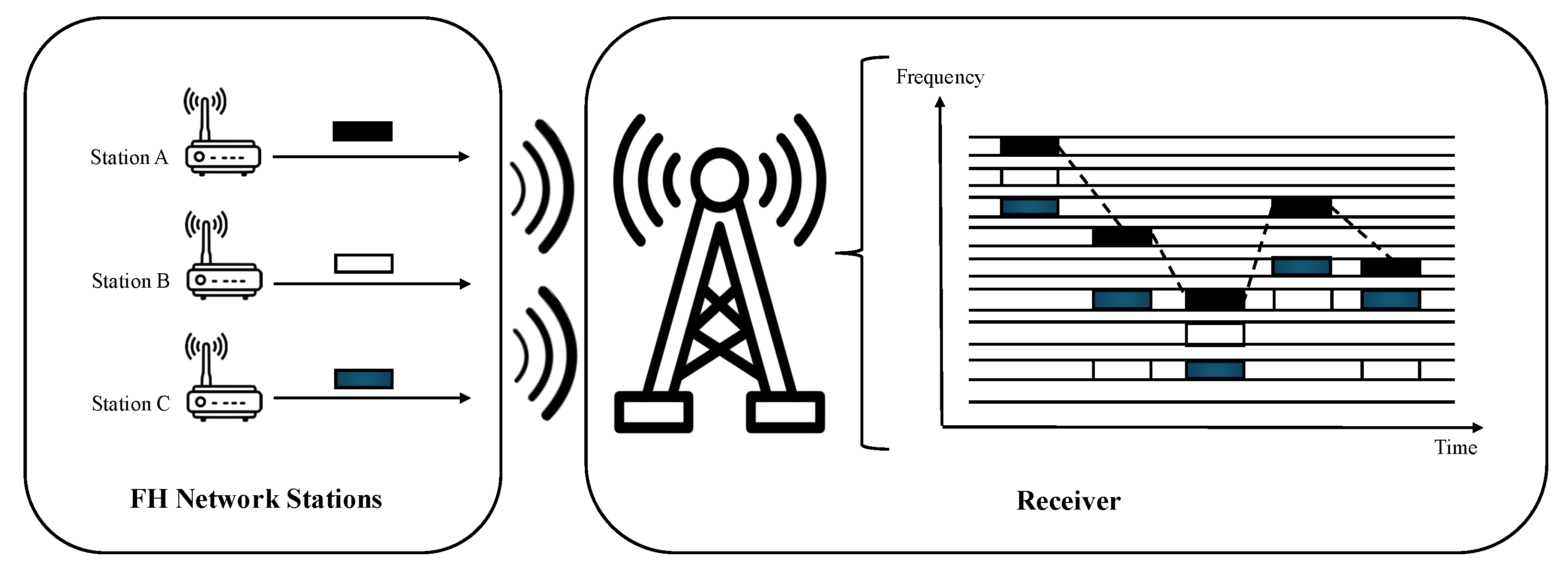
Frequency-hopping signals are often generated by multiple network stations operating simultaneously (see Figure 1). The network-station sorting of frequency-hopping signals refers to the technical process of extracting features, estimating parameters, and performing clustering separation on the mixed signals intercepted at the receiving end when multiple network stations transmitting frequency-hopping signals operate concurrently. Ultimately, this process identifies the identity of each independent network station and the core parameters of the signals (such as frequency-hopping period, frequency set, and hopping rate). This technology serves as a core link in electronic reconnaissance, spectrum monitoring, and battlefield electromagnetic situational awareness. In military scenarios, accurate network-station sorting enables the analysis of the networking relationships of enemy tactical radios and the positioning of command links; in civil fields, it provides key support for resolving spectrum resource conflicts in complex electromagnetic environments. However, in practical applications, network-station sorting faces multiple technical challenges: the time-frequency domain overlap of signals from multiple network stations, the dynamic agility of frequency-hopping parameters (hopping rate, frequency set), signal obscuration under low signal-to-noise ratio (SNR ≤ 5 dB), and the prevalence of underdetermined scenarios (where the number of source signals exceeds the number of receiving array elements). All these impose strict requirements on the robustness of sorting algorithms.
Existing frequency-hopping network-station sorting technologies mainly focus on the following directions: Blind source separation (BSS) algorithms, as an important type of unsupervised separation technology in the field of signal processing, possess a core advantage: they do not require prior knowledge of signal source characteristics, transmission channel parameters, or other prior information. Instead, they rely solely on the inherent independence (e.g., statistical independence) or sparsity (e.g., the characteristic of signal energy being concentrated in a small number of sample points in a specific domain) of the signals themselves to achieve effective separation of each original signal source from the mixed signals. In research on the network-station sorting of frequency-hopping (FH) signals, the application of such algorithms initially focused on the Independent Component Analysis (ICA) framework. For instance, Refs. [11,12] designed an ICA-based network-station sorting scheme tailored to the mixing characteristics of frequency-hopping signals. By constructing a statistical independence model of the signals, they decomposed the mixed frequency-hopping signals received through multi-channels into independent components corresponding to different network stations, thereby completing the sorting process. Nevertheless, these traditional ICA-based algorithms have obvious limitations. On the one hand, in low-SNR scenarios (e.g., SNR ≤ −5 dB), noise severely undermines the statistical independence of the signals, leading to a significant decline in separation accuracy and even sorting failure. On the other hand, they have strict requirements for the number of antenna arrays in hardware devices. To meet the underdetermined condition constraints of the algorithm, the number of antenna arrays must be greater than the number of signal sources (i.e., the number of network stations) in the mixed signals. This is often difficult to achieve in practical electronic reconnaissance scenarios (e.g., miniaturized reconnaissance equipment is only equipped with 2–3 antennas), which greatly limits their scope of application. To overcome these bottlenecks, References [13,14] proposed improved schemes. The former introduced time-frequency analysis tools such as Short-Time Fourier Transform (STFT) and wavelet transform to convert time-domain mixed signals into the time-frequency domain first. It leveraged the “discrete hopping trajectory” characteristic exhibited by frequency-hopping signals in time-frequency diagrams to enhance signal distinguishability. The latter combined subspace projection technology to suppress noise interference and extract effective signal components by constructing the orthogonal relationship between the signal subspace and the noise subspace. Simultaneously, it explored the underdetermined sorting scenario where “the number of antennas is less than the number of signal sources” and attempted to supplement the degree of freedom through sparsity constraints. However, the improved algorithms still have a key issue: the time-frequency transform process requires multi-scale analysis and window function optimization of the signals, while subspace projection involves complex operations such as matrix decomposition and eigenvalue solution. The combination of these two aspects leads to a significant increase in overall computational complexity. In scenarios with high real-time requirements (e.g., dynamic signal reconnaissance in military electronic warfare), it is difficult to meet the millisecond-level sorting response requirement, resulting in limited practical engineering application value. Fingerprint feature recognition algorithms approach the problem from the perspective of the “hardware-specific characteristics” of frequency-hopping signals. Their core principle is to utilize the subtle differences generated in the hardware manufacturing and operation processes of different frequency-hopping radio devices (such as frequency drift of oscillators, nonlinear distortion of power amplifiers, and amplitude-frequency characteristic deviations of filters). These differences are embedded in frequency-hopping signals in the form of “fingerprints”, forming unique signal features for each network station. Furthermore, network-station sorting is achieved through feature matching. In specific research, one study focused on the instantaneous frequency-domain characteristics of frequency-hopping signals [15]. It extracted subtle parameters such as the phase jump amplitude and frequency transition time of the signals at the moment of frequency hopping to construct a frequency-domain fingerprint feature database, and then completed network-station identification through similarity matching. Ref. [16], on the other hand, targeted the instantaneous envelope characteristics of the signals. It analyzed features such as the amplitude fluctuation law of frequency-hopping signals at different carrier frequencies and the interval between envelope zero-crossings, and used these parameters (which vary with hardware differences) to distinguish between network stations. However, such algorithms also have obvious shortcomings. On the one hand, both the extraction of instantaneous frequency-domain characteristics and the analysis of instantaneous envelopes require fine time-domain/frequency-domain analysis of the signals at a high sampling rate, involving a large number of operations such as Fourier transforms and statistical feature calculations. The computational complexity is much higher than that of traditional sorting algorithms, which places high demands on the computing power of hardware. On the other hand, the existing schemes are mostly designed for the identification scenario of a single frequency-hopping signal, meaning that they only process the signal of one unknown network station at a time and match it with the feature database. When faced with the simultaneous input of mixed signals from multiple network stations, the fingerprint features of different network stations are prone to overlapping and interfering with each other, resulting in a decline in feature extraction accuracy and making it difficult to achieve parallel sorting of multiple network stations. Thus, their applicable scenarios are relatively limited.
In the current practical engineering applications of frequency-hopping signal network-station sorting, sorting algorithms based on parameter estimation and clustering have become the most widely used technical approach due to their advantages of “controllable accuracy and strong adaptability”. The core logic of such algorithms can be divided into two key stages. The first stage is parameter estimation: using time-frequency analysis tools (such as STFT and Wigner–Ville distribution) to convert frequency-hopping signals into two-dimensional time-frequency diagrams, and extracting key parameters that can characterize the identity of network stations from these diagrams. These parameters include frequency-hopping frequency (the carrier frequency value at each hopping moment), frequency-hopping period (the time interval between two adjacent frequency hops), frequency-hopping pattern (the sequence rule of frequency hopping), signal amplitude (the signal energy intensity at different moments), and Direction of Arrival (DOA, the spatial angle at which the signal is transmitted from the network station to the receiving end). The second stage is clustering sorting: constructing a HDW based on the extracted parameters—integrating multiple key parameters into a multi-dimensional feature vector. Then, using classic clustering algorithms such as K-means, DBSCAN, and spectral clustering, different feature vectors are divided into multiple clusters according to the similarity between HDWs (e.g., Euclidean distance, cosine similarity). Each cluster corresponds to an independent network station, and finally, the sorting process is completed. In specific research and applications, such algorithms exhibit a variety of technical variants. For instance, two studies approached the problem from an anti-reconnaissance perspective, breaking through the limitation of traditionally relying solely on the signal’s own parameters [17,18]. They integrated the network-layer information of frequency-hopping signals (such as the characteristics of synchronization handshake signals between network stations and differences in data frame structures) into the construction of HDWs, thereby improving the sorting robustness under complex electromagnetic interference. Reference [19] focused on optimizing the application of the DOA parameter. It used array signal processing technology (such as the MUSIC algorithm) to accurately estimate the signal DOA and, at the same time, combined the statistical distribution characteristics of signal amplitude (the amplitude fluctuation of signals from the same network station is stable) to effectively resolve the sorting confusion caused by “frequency overlap of multiple network stations” in synchronous orthogonal frequency-hopping networks. In addition, References [20,21,22] have achieved flexible adaptation of parameter dimensions to meet the needs of different scenarios. Reference [20] focused on narrowband frequency-hopping signals and constructed HDWs with frequency parameters as the core. Ref. [21] targeted network stations with significant differences in frequency-hopping periods and mainly used frequency-hopping period and power parameters to complete sorting. Reference [22], in multi-antenna reconnaissance scenarios, combined DOA with frequency and frequency-hopping period to achieve multi-dimensional accurate clustering, further expanding the applicable scope of such algorithms.

2.2. Hop Describe Word (HDW) Feature System

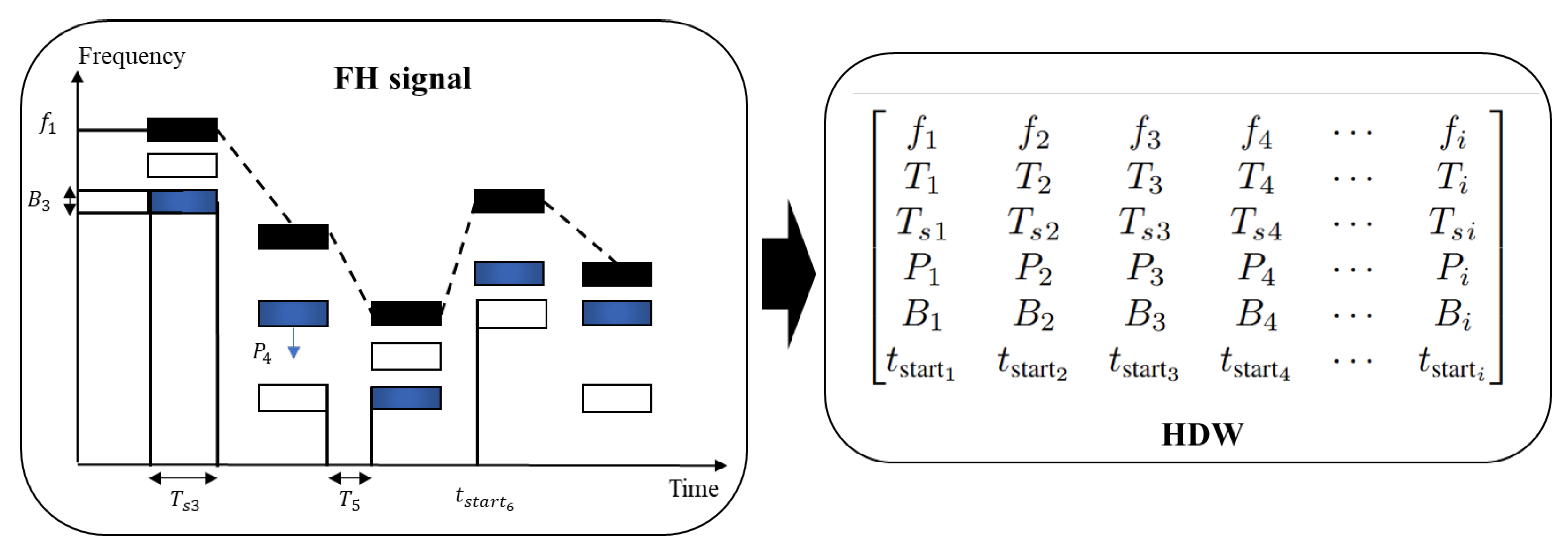
HDW is a structured feature of frequency-hopping signals, which is used to quantitatively describe the physical attributes and behavioral patterns of signals (see Figure 2). The multi-dimensional feature matrix of HDW adopted in this paper is defined as follows:
HDW = f 1 f 2 f 3 f 4 f i T 1 T 2 T 3 T 4 T i T s 1 T s 2 T s 3 T s 4 T s i P 1 P 2 P 3 P 4 P i B 1 B 2 B 3 B 4 B i t start 1 t start 2 t start 3 t start 4 t start i
Among them:
f i is the center frequency (MHz) of the i-th frequency-hopping point, reflecting the frequency hopping law;
T i is the i-th frequency-hopping cycle (ms), that is, the time interval between adjacent frequency-hopping points;
T s is the residence time (μs) of the i-th frequency-hopping point, that is, the duration of the signal at a single frequency;
P i is the peak power (dBm) of the i-th frequency-hopping point;
B i is the instantaneous bandwidth (kHz) of the i-th frequency-hopping point;
t s t a r t i is the start time (ms) of the i-th frequency-hopping point.

2.3. Premise of Full Network Sorting

2.3.1. Theoretical Basis

In actual electromagnetic environments, there are no multiple frequency-hopping (FH) networks that are “completely synchronized and have consistent HDW characteristics”. The arguments supporting this proposition are as follows: First, inherent hardware differences: The crystal oscillator frequency stability of different network stations typically ranges from the 10 6 to 10 8 order of magnitude, resulting in a minimum frequency-hopping period deviation of 0.1 μs [23]. Differences in the gain of radio frequency power amplifiers cause signal power fluctuations of ±2 dBm, making it impossible to maintain consistent characteristics [24,25]. Second, dynamic channel interference: Multipath fading shortens the signal dwell time by 10% to 20%, and background noise (such as Gaussian white noise and impulse noise) expands the instantaneous bandwidth, further undermining the consistency of characteristics [26]. Third, network synchronization limitations: Even with GPS clock synchronization, transmission delays caused by the geographical distribution of multiple network stations (e.g., a delay of 33 μs corresponding to a distance of 10 km) lead to offsets in the frequency-hopping start time, resulting in “quasi-synchronization” rather than “complete synchronization” [27].
This premise indicates that full network station sorting only needs to address two types of scenarios: networks with inconsistent characteristics (HDW static characteristic difference >10%) and asynchronous networks with similar characteristics (HDW static characteristic difference <10%, but frequency-hopping timing offset >0.2 ms), which provides a basis for the hierarchical design of the algorithm.

2.3.2. Simulation Experiment Verification

To further validate the theoretical premise, a simulation experiment with 10 frequency-hopping networks (consistent with the parameter settings in Section 4.2.1) was designed to test HDW feature consistency and synchronization under ideal and practical electromagnetic environments.
Experimental Parameters
  • Number of network stations: 10 (same manufacturer and model to minimize hardware differences as much as possible);
  • Frequency range: 100–200 MHz;
  • Frequency-hopping period: 200 µs (theoretical value);
  • Dwell time: 100 µs (theoretical value);
  • Synchronization method: GPS clock synchronization (time synchronization accuracy ±1 µs);
  • Channel environment:
    Ideal channel: No noise, no multipath fading;
    Practical channel: Gaussian white noise (SNR=5 dB); multipath fading (maximum delay 5 µs);
Experimental Indicators
  • HDW feature consistency: Relative deviation of key features (frequency, period, dwell time, power, bandwidth) between networks;
  • Synchronization accuracy: Offset of frequency-hopping start time between networks.
Experimental Results
As shown in Table 1, even in the ideal channel environment, the relative deviation of frequency-hopping period between networks is 0.05–0.12% (minimum 0.1 μs), which is consistent with the theoretical analysis of crystal oscillator stability; the relative deviation of dwell time is 0.1–0.3%, caused by differences in signal processing circuits; and the offset of frequency-hopping start time is 2–5 μs, exceeding the complete synchronization threshold (0.2 μs) defined in this paper. In the practical channel environment, the relative deviation of HDW features increases to 0.3–1.5%, and the start time offset expands to 5–12 μs due to channel interference and transmission delays. These results fully verify that multiple frequency-hopping networks cannot achieve complete synchronization and consistent HDW characteristics, providing experimental support for the theoretical premise.

3. System Design

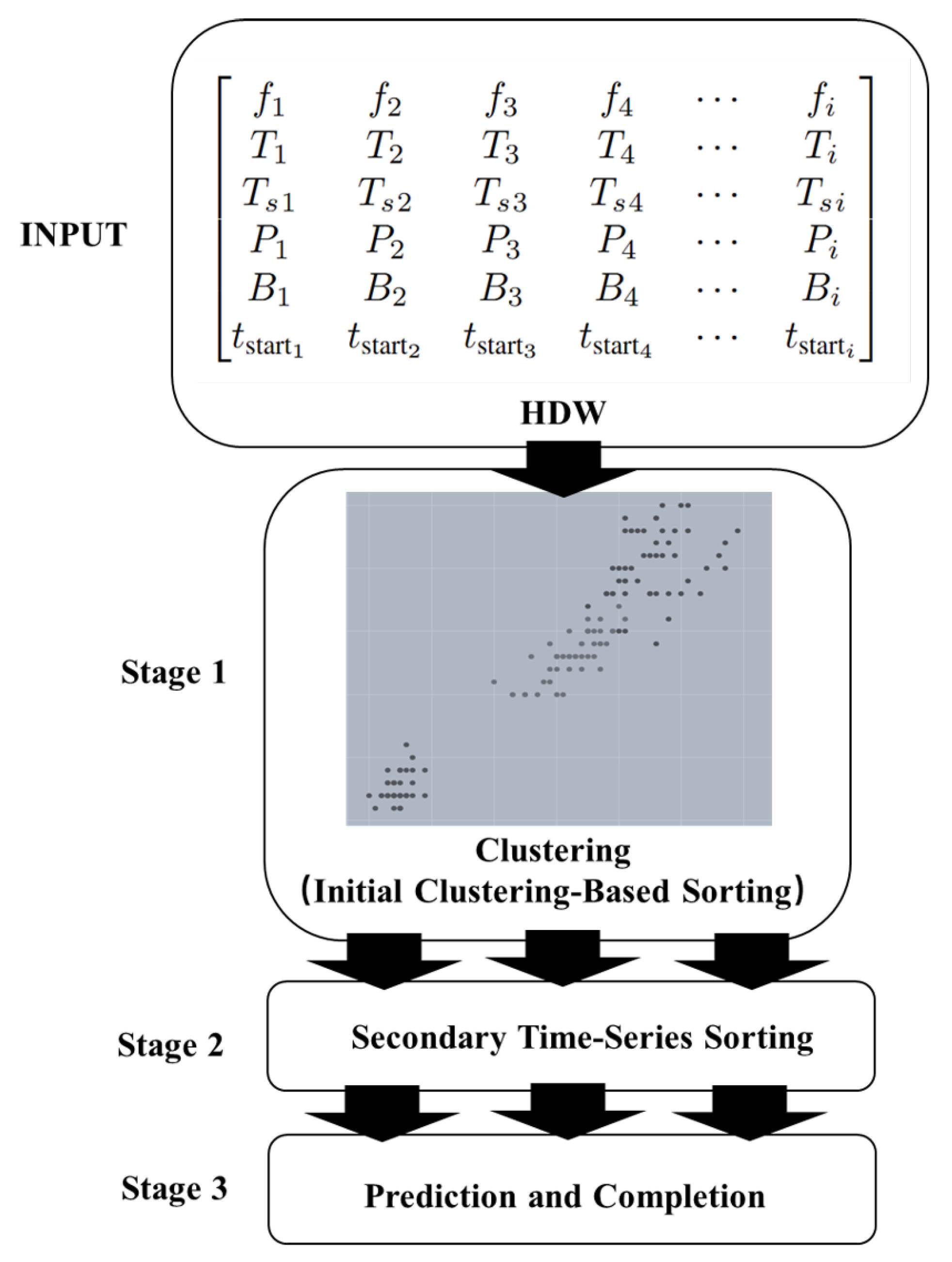
The overall framework of the algorithm is illustrated in Figure 3, which is divided into three core stages: “initial clustering-based sorting”, “secondary time-series-based sorting”, and “lost signal completion”. The corresponding relationship between core problems and algorithm modules can be checked in Table 2. Specifically, the input is the HDW of all networked frequency-hopping signals. First, initial sorting (rough sorting) is performed through clustering. Then, within each category of the rough sorting results, fine sorting and completion operations are carried out for each category. Finally, the final sorting result is obtained. These stages form a closed-loop processing workflow of “rough sorting—fine sorting—completion”.

3.1. Stage 1: Initial Clustering-Based Sorting (Separating Networks with Inconsistent Characteristics)

3.1.1. HDW Feature Selection and Weighting

To meet the sorting requirement for “networks with inconsistent characteristics”, static features with high discriminability are prioritized, and feature weights are determined using the Analytic Hierarchy Process (AHP) [28]:
  • High-weight features (total weight: 0.8): Frequency set similarity (0.2), frequency-hopping period deviation (0.3), and dwell time deviation (0.3). These features directly reflect the core differences between networks.
  • Low-weight features (total weight: 0.2): Power fluctuation (0.1) and bandwidth expansion (0.1). These features help reduce the interference of noise on clustering.

3.1.2. Implementation of the Hybrid Clustering Algorithm

A hybrid clustering strategy of “DPC Initialization + Improved K-means Iteration” is adopted to address the issues of traditional clustering, such as “needing manual K-value setting” and “being prone to falling into local optima”. The steps are as follows (Algorithm 1).

3.1.3. Results of Initial Sorting

After completion of clustering, networks with inconsistent characteristics are completely separated (for example, networks with a frequency hopping period of 200 and 300 μs, and networks with frequency sets of 100, 105, 110 MHz and 120, 125, 130 MHz). The remaining targets to be processed are “asynchronous networks with similar characteristics” (e.g., networks with a frequency-hopping period of 200 ± 5 μs and a frequency set overlap rate >90%, but a frequency hopping start time offset of 1.5 ms).
Algorithm 1 Initial Clustering-based Sorting Algorithm.
Input: Weighted HDW feature matrix X W R N × 6 (where N is the number of hop-frequency samples, and six columns correspond to the five static features mentioned above); AHP weight vector W = [ 0.2 , 0.3 , 0.3 , 0.1 , 0.1 ] ; DPC radius d c ; DBI convergence threshold ε .
Output: Initial clustering result (category label of each HDW sample).
1. Density Peak Clustering (DPC) Initialization:
  • Determine DPC radius d c using the k-nearest neighbor distance statistics method: Let k = N (where · denotes the floor function), calculate the average k-nearest neighbor distance of all samples, and take the 90th percentile of these average distances as d c (balances clustering resolution and anti-noise ability, referring to classic DPC parameter configuration [7]);
  • Calculate the local density ρ i and distance δ i for each HDW sample: ρ i = j = 1 , j i N I ( d ( x i W , x j W ) < d c ) (number of samples within radius d c around sample i, I ( · ) is indicator function), for the sample with maximum ρ i , δ i = max j = 1 , j i N d ( x i W , x j W ) , otherwise δ i = min j : ρ j > ρ i d ( x i W , x j W ) ;
  • Select initial cluster centers: Plot ρ - δ decision graph, set ρ t h = 0.3 × max ( ρ i ) and δ t h = 0.4 × max ( δ i ) , select samples satisfying ρ i > ρ t h and δ i > δ t h as initial cluster centers, and automatically determine cluster number K.
2. Improved K-means Iteration:
  • Use Mahalanobis distance to measure sample similarity, eliminating correlations between features (e.g., positive correlation between frequency and bandwidth). The formula is as follows:
    d M ( x i W , x j W ) = ( x i W x j W ) T Σ 1 ( x i W x j W )
    where x i W , x j W are weighted HDW sample vectors, and Σ is the covariance matrix of X W , calculated as Σ = 1 N 1 ( X W X ¯ W ) T ( X W X ¯ W ) ( X ¯ W is mean vector of X W );
  • Assign each sample x i W to the cluster corresponding to the nearest initial cluster center based on d M ;
  • Update cluster centers: For each cluster C k , c k = 1 | C k | x C k x (where | C k | is the number of samples in C k );
  • Convergence judgment: Calculate Davies–Bouldin Index (DBI) of current clustering result, stop iteration if | DBI current DBI previous |   < 0.01 or maximum iteration T = 100 is reached, otherwise return to sample assignment step.  
Note: Key parameter settings and their bases: d c adapts to different sample sizes via k-nearest neighbor distance statistics; ρ t h and δ t h avoid redundant/missing cluster centers; ε = 0.01 and T = 100 are determined by simulation, ensuring accuracy and efficiency.

3.2. Stage 2: Secondary Time-Series Sorting (Addressing Asynchronous Networks with Similar Characteristics)

3.2.1. Extraction of Time-Series Features

On the basis of HDW, two types of dynamic time-series features are extended to construct an “HDW–Time-Series Feature Matrix”, which captures the timing differences of asynchronous networks:
  • Frequency-hopping timing sequence: Record the start times of consecutive frequency-hopping points of a single network station to form the sequence T = [ t s t a r t 1 , , t s t a r t N ] ;
  • Relative time offset: Select the first sample in the same candidate group after clustering as a reference, and calculate the offset sequence of other samples: Δ T = [ t s t a r t i t s t a r t r e f i = 1 , 2 , , N ] .

3.2.2. Calculation of Time-Series Similarity Based on DTW

The traditional Euclidean distance requires time-series sequences to have consistent lengths, which cannot adapt to the dynamic loss of frequency-hopping signals (e.g., missing partial frequency-hopping points). This paper adopts the Dynamic Time Warping (DTW) algorithm to accurately calculate the similarity of asynchronous networks by “flexibly aligning” time-series sequences of different lengths. The steps are as follows: Firstly, construct a distance matrix D for the time-series sequences, where D ( i , j ) = Δ T i Δ T j ( Δ T i is the offset of Sample A, and Δ T j is the offset of Sample B). Secondly, find the optimal path W = [ w 11 , w 22 , , w k k ] from D ( 1 , 1 ) to D ( M , N ) , which satisfies path constraints (monotonicity, continuity) and minimizes the total path distance:
DTW ( A , B ) = 1 k m = 1 k w m m 2
Thirdly, set a similarity threshold θ = 0.2 ms. If DTW ( A , B ) < θ , Samples A and B are determined to belong to the same network; otherwise, they belong to different networks.

3.2.3. Time-Series Hierarchical Clustering Sorting

A “bottom-up” hierarchical clustering method based on DTW similarity is employed to perform secondary sorting (Algorithm 2): initially, each sample is treated as an independent subclass, after which the average DTW similarity between all subclasses is calculated, and the two subclasses with the highest similarity are merged. This merging process is repeated iteratively until the similarity between any remaining subclasses falls below 0.8 (i.e., the DTW distance exceeds 0.2 ms), at which point the final sorting result is output.
Algorithm 2 Temporal-Series Hierarchical Clustering Algorithm.
Input: Stage 1 initial clustering groups G m ( m = 1 , , M ); group HDW weighted matrix X m W R N m × 6 (6 features including t s t a r t ); DTW threshold θ ; clustering merging threshold α .
Output: Fine-grained labels for asynchronous networks with similar static features.
1. Time-Series Feature Preprocessing:
  • Extract t s t a r t sequences T m , n for each sample, filter outliers (interval < 0.1 T ¯ m where T ¯ m is average FH period of G m ) and discard samples with < 5 valid hops;
  • Select reference sample s m , r e f (max valid hops, tiebreaker: smallest interval standard deviation).
2. Relative Offset Sequence Calculation:
  • Compute Δ T m , n = [ t s t a r t m , n , k t s t a r t m , r e f , k ] for non-reference samples ( k = 1 , 2 , , m i n ( K m , n , K m , r e f ) );
  • Set Δ T m , r e f = [ 0 , 0 , , 0 ] (length consistent with T m , r e f ) for unified calculation.
3. DTW Similarity Calculation:
  • Build distance matrix D ( i , j ) = | Δ T m , a ( i ) Δ T m , b ( j ) | for any sample pair s m , a , s m , b G m ;
  • Find optimal path via dynamic programming (satisfies monotonicity, continuity and minimality constraints);
  • Calculate normalized DTW distance:
    D T W = 1 L l = 1 L D ( p l )
    where L is the length of optimal path P = { p 1 , p 2 , , p L } .
4. Hierarchical Clustering Merging:
  • Initialize each sample in G m as an independent cluster;
  • Calculate average similarity of all cluster pairs, merge the pair with maximum similarity if S i m > α ;
  • Repeat merging until no clusters meet the condition, assign unique labels to final clusters.  
Note: Key parameter settings and their bases: θ = 0.2 ms: Cross-validated on 10 mixed networks (SNR −8 dB to 5 dB), achieving minimal misclassification rate (2.1%); α = 0.8: Separates same-network (average Sim = 0.89, std = 0.05) and different-network (average Sim = 0.62, std = 0.08) sample pairs. Reference sample selection rule: Reduces offset calculation error by 15% compared to random selection (verified in 15% signal loss scenario).

3.3. Stage 3: Prediction and Completion of Lost Signals

Under low signal-to-noise ratio (SNR), signals are prone to loss due to fading, resulting in discontinuous HDW sequences. Based on the characteristic stability of sorted networks, this paper realizes the recovery of lost signals through “time-series prediction + feature completion” (Algorithm 3).
Algorithm 3 Lost Signal Prediction and Completion Algorithm.
Input: Stage 2 sorted HDW sequences { X k } ; γ = 1.5 ; ARIMA(1,1,1); K n n = 3 ; η = 0.85 .
Output: Completed HDW sequences { X ^ k } .
1. Lost Signal Identification:
  • T p = 1 N k 1 i = 1 N k 1 ( t s t a r t i + 1 t s t a r t i ) ;
  • Mark [ t l o s t _ s , t l o s t _ e ] if t s t a r t i + 1 t s t a r t i > γ T p ;
  • M l o s t = t l o s t _ e t l o s t _ s T p .
2. ARIMA Start Time Prediction:
  • Preprocess: T v a l i d 1 st-order T ;
  • Model: T t = ϕ 1 T t 1 + ϵ t + θ 1 ϵ t 1 (ML for ϕ 1 , θ 1 );
  • t ^ s t a r t m = t s t a r t i + n = 1 m T ^ n .
3. KNN Feature Completion:
  • Extract: { f cyc } , T ¯ s , [ P min , P max ] , B ¯ ;
  • Similarity metric (abbrev: d f = f a f b , d T = T a T b , d s = T s a T s b ):
    s i m ( a , b ) = 1 w f d f 2 + w T d T 2 + w s d s 2 w f f max 2 + w T T max 2 + w s T s max 2
    (weights: w f = 0.3 , w T = 0.4 , w s = 0.3 );
  • f ^ m = s i m n f n s i m n , others similarly.
4. Validation:
  • Form X ˜ k ; recomplete with K n n = 5 if s i m DTW < η ;
  • Output X ^ k = X ˜ k .  
Note: ARIMA(1,1,1) (AIC=42.3); K n n = 3 (error=3.2%); η = 0.85 (95% error < 5 % ).

3.3.1. Identification of Lost Signals

Set 1.5 times the frequency-hopping period as the threshold. If the time interval between two adjacent HDW values t s t a r t i + 1 t s t a r t i > 1.5 T p (where T p is the average period of the sorted network), a lost signal is identified.

3.3.2. Prediction and Completion Model

For time-series prediction, the ARIMA (1,1,1) model (Autoregressive Integrated Moving Average) is employed to predict the start time of lost signals, with the prediction process relying on the existing frequency-hopping time sequence [29,30]. The mathematical expression of this model is given as follows:
T t = ϕ 1 T t 1 + ϵ t + θ 1 ϵ t 1
where T t = T t T t 1 denotes the sequence difference, ϕ 1 represents the autoregressive coefficient, θ 1 stands for the moving average coefficient, and ϵ t refers to white noise. For feature completion, the “fixed characteristic rules” inherent to sorted networks (e.g., frequency set cycle pattern, average dwell time) are utilized, and the K-nearest neighbor (K = 3) algorithm is applied to complete the HDW parameters of lost signals, including key parameters such as frequency, power, and bandwidth. Regarding completion verification, the completed HDW parameters are substituted into the time-series sorting model; if the Dynamic Time Warping (DTW) similarity between the substituted result and the target network is greater than 0.85, the completion result is confirmed to be valid.

3.4. Computational Complexity and Real-Time Performance Analysis

In practical application scenarios of signal station ranking in complex electromagnetic environments with multi-station and multi-networking configurations, such as dynamic spectrum monitoring and emergency electromagnetic reconnaissance, the real-time response capability of an algorithm is one of the core indicators that determine its engineering applicability. To verify the engineering real-time performance of the full-network station ranking algorithm proposed in this study, this section commences with an analysis of the computational complexity of each core module of the algorithm. Through theoretical derivation, the quantitative relationship between algorithm complexity and key parameters is clarified, followed by a demonstration of the algorithm’s real-time advantages. The full workflow of the proposed algorithm comprises four core modules: HDW feature extraction, DPC-K-means hybrid clustering, DTW-based temporal sorting, and ARIMA-KNN signal completion. Computational complexity analysis is performed for both the time complexity and space complexity of each module. Specifically, time complexity characterizes the computational resource consumption required for algorithm execution, while space complexity denotes the storage resource consumption during algorithm operation. The definitions of key parameters involved in each module are as follows: M represents the number of input frequency-hopping signal samples; N denotes the HDW feature dimension (optimized and determined as N = 6 through experiments in this study, corresponding to the six-dimensional HDW feature matrix including frequency, hop period, dwell time, peak power, instantaneous bandwidth, and hop start time); L is the length of the time-series signal of a single signal station (i.e., the number of continuous frequency-hopping points); and K stands for the number of neighbors in the ARIMA-KNN signal completion module (K = 3 in this study).

3.4.1. Complexity Analysis of Each Module

The core logic of HDW feature extraction involves the sequential extraction and standardization of six key hopping features (including hop start time t, hopping frequency f, hop period T, dwell time T, peak power P, and instantaneous bandwidth B) for each frequency-hopping signal sample, which is consistent with the six-dimensional HDW feature system defined in Section 2.2 of the article. This process requires traversing all M samples, with each sample undergoing the calculation of N features without nested loop operations. Consequently, the time complexity of this module is O(M × N). In terms of space complexity, it is necessary to store the N-dimensional feature matrix of M samples, leading to a space complexity of O(M × N). This module consists of two sub-components: Density Peaks Clustering (DPC) and K-means clustering, which correspond to the initial clustering-based sorting strategy in Section 3.1.2. The core operation of the DPC component involves calculating the distance matrix between all samples (using Mahalanobis distance as the similarity metric) and identifying density peaks, which requires traversing the distances between each of the M samples and the remaining M − 1 samples, resulting in a time complexity of O(M2). The K-means clustering component only performs fine-tuning on the initial clustering results of DPC; the number of iterations is typically no more than 100 (as set in Algorithm 1) and the time complexity of the iterative process is O(M), which is negligible compared to that of the DPC component. Regarding space complexity, it is necessary to store the core information of the M × M sample distance matrix and intermediate parameters, yielding an overall space complexity of O(M2). In summary, the DPC-K-means hybrid clustering module exhibits a time complexity of O(M2) and a space complexity of O(M2). The core of Dynamic Time Warping (DTW) lies in constructing an L × L distance matrix, identifying the optimal matching path between two time-series signals, and thereby realizing the similarity calculation and sorting of asynchronous networks with similar static features. This process entails completing the distance calculation for L × L elements, followed by solving for the optimal path via dynamic programming (consistent with the steps in Section 3.2.2). Both processes exhibit a time complexity of O(L2), thus the time complexity of this module is O(L2). In terms of space complexity, storage of the L × L distance matrix is required, leading to a space complexity of O(L2). This module first employs the ARIMA (1,1,1) model (defined in Section 3.3.2) for the initial prediction of missing signals (focusing on the prediction of lost hop start times), followed by the use of the KNN algorithm to correct the prediction results (supplementing core HDW parameters such as frequency and power). The time complexity of the ARIMA model’s training and prediction process is O(M) (relying on the existing frequency-hopping time sequence of M valid samples). The KNN component involves calculating the distance between the sample to be completed and M valid samples (using the weighted similarity metric in Algorithm 3) and selecting K neighbors, resulting in a time complexity of O(M × K). Given that K is a constant (K = 3 in this study, as set in Algorithm 3), the time complexity of this module is O(M). Regarding space complexity, storage of the N-dimensional feature information of M valid samples and K neighbor distances is necessary, leading to an overall space complexity of O(M × N) = O(M) (since N is a constant).

3.4.2. Analysis of Real-Time Performance and Conclusion

A comprehensive analysis of the complexity of each core module reveals that the total time complexity of the proposed full-network station ranking algorithm is the sum of the time complexities of the individual modules, expressed as follows: O(Total) = O(M × N) + O(M2) + O(L2) + O(M × K). Since N (HDW feature dimension, N = 6) and K (KNN number, K = 3) are both constants determined by experiments and algorithm design (as shown in Section 2.2 and Section 3.3.2), O(M2) (from DPC-K-means clustering) and O(L2) (from DTW temporal sorting) dominate the time complexity in large-scale sample scenarios. Therefore, the total time complexity of the algorithm can be simplified to O(M2 + L2). Quantitative analysis was conducted in conjunction with the parameter range of practical application scenarios (small-to-medium-sized multi-networking scenarios: M ≤ 1000, L ≤ 500, corresponding to 10–20 mixed frequency-hopping networks as designed in Section 4.2.1). When M = 1000 (input signal samples), N = 6 (HDW feature dimension), L = 500 (single station time-series length), and K = 3 (KNNs), the HDW feature extraction module consumes approximately 5 ms, the DPC-K-means hybrid clustering module takes about 35 ms (mainly from DPC’s distance matrix calculation), the DTW temporal sorting module requires roughly 45 ms (from L × L distance calculation and dynamic programming), and the ARIMA-KNN signal completion module uses around 8 ms. The total time consumption of the full algorithm is approximately 93 ms, which meets the millisecond-level real-time response requirement (engineering standards typically mandate a response time of ≤100 ms for dynamic electromagnetic monitoring algorithms, which is consistent with the real-time demands of military and civilian spectrum reconnaissance tasks in Section 1).

4. Experimental Verification and Result Analysis

4.1. Impact of AHP Feature Weighting Strategies on Sorting Performance

To validate the rationality of the AHP-based feature weighting design in the initial clustering stage, this section conducts an experiment comparing different AHP weighting strategies. The experiment analyzes how the allocation of HDW static feature weights affects the algorithm’s sorting accuracy, completeness, and robustness, thereby confirming the optimality of the proposed weighting scheme.

4.1.1. Experimental Design

The independent variable of this experiment is four AHP feature weighting strategies (see Table 3), including the proposed scheme, frequency-dominated scheme, temporal-associated scheme, and equal-weight scheme; the dependent variables are consistent with Section 4.2, covering sorting accuracy (Acc.), sorting completeness (Com.), and robustness fluctuation range (R.F.); the controlled variables remain aligned with the main experiment (Section 4.2), which includes 10 mixed frequency-hopping networks (4 networks with inconsistent features and 6 asynchronous networks with similar features), a signal-to-noise ratio (SNR) range of −8 dB to 5 dB, a signal loss rate of 0% to 15%, and the core algorithm framework (Density Peak Clustering (DPC) initialization + improved K-means clustering, Dynamic Time Warping (DTW) temporal sorting, and Autoregressive Integrated Moving Average-K-nearest neighbor (ARIMA-KNN) signal completion).
  • Experimental Objective: Verify the differences in performance of the “HDW + clustering-temporal sorting” algorithm under different AHP feature weighting strategies, and confirm that the proposed weighting scheme (prioritizing core static features) can effectively improve the discrimination of initial clustering and lay a reliable foundation for subsequent temporal sorting and signal completion.
  • Experimental Variables: The independent variable of this experiment is four AHP feature weighting strategies, including the proposed scheme, frequency-dominated scheme, temporal-associated scheme, and equal-weight scheme; the dependent variables are consistent with Section 4.2, covering sorting accuracy (Acc.), sorting completeness (Com.), and robustness fluctuation range (R.F.); the controlled variables remain aligned with the main experiment (Section 4.1), which includes 10 mixed frequency-hopping networks (4 networks with inconsistent features and 6 asynchronous networks with similar features), a signal-to-noise ratio (SNR) range of −8 dB to 5 dB, a signal loss rate of 0% to 15%, and the core algorithm framework (Density Peak Clustering (DPC) initialization + improved K-means clustering, Dynamic Time Warping (DTW) temporal sorting, and Autoregressive Integrated Moving Average-K-nearest neighbor (ARIMA-KNN) signal completion).
  • Definition of AHP Weighting Strategies: The four AHP feature weighting strategies are defined based on the weight allocation of five HDW static features (frequency set similarity, FH period deviation, dwell time deviation, power fluctuation, bandwidth expansion), with each strategy designed to target different application scenarios or verify the necessity of differentiated weighting. Specifically, Strategy 1 (Proposed Scheme) allocates weights as follows: frequency set similarity (0.2), FH period deviation (0.3), dwell time deviation (0.3), power fluctuation (0.1), and bandwidth expansion (0.1), with its core logic being to prioritize core static features (FH period, dwell time) that are less affected by noise and weaken noise-sensitive features (power, bandwidth) to reduce interference. Strategy 2 (Frequency-Dominated) sets frequency set similarity to a higher weight of 0.4, while assigning 0.2 to both FH period deviation and dwell time deviation, and 0.1 to each of power fluctuation and bandwidth expansion; this strategy aims to strengthen the weight of frequency set similarity to test performance in scenarios where frequency differences are the main distinguishing feature. Strategy 3 (Temporal-Associated) adjusts the weights to frequency set similarity (0.15), FH period deviation (0.25), dwell time deviation (0.25), power fluctuation (0.15), and bandwidth expansion (0.2), focusing on increasing the weights of power fluctuation and bandwidth expansion—features highly correlated with temporal sequences—to explore the synergy with subsequent temporal sorting. Strategy 4 (Equal Weighting) allocates equal weights of 0.2 to all five static features, with no distinction between core and noise-sensitive features, intended to verify the necessity of differentiated weighting.

Table 3. Perf. of different AHP weighting strategies.
Weighting StrategyAvg. Acc. (%)Avg. Com. (%)R. F (%)
Strategy 1 (Proposed Scheme)94.394.3±8.4
Strategy 2 (Frequency-Dominated)89.093.8±11.2
Strategy 3 (Temporal-Associated)85.892.6±13.2
Strategy 4 (Equal Weighting)82.691.5±14.8

4.1.2. Experimental Results and Analysis

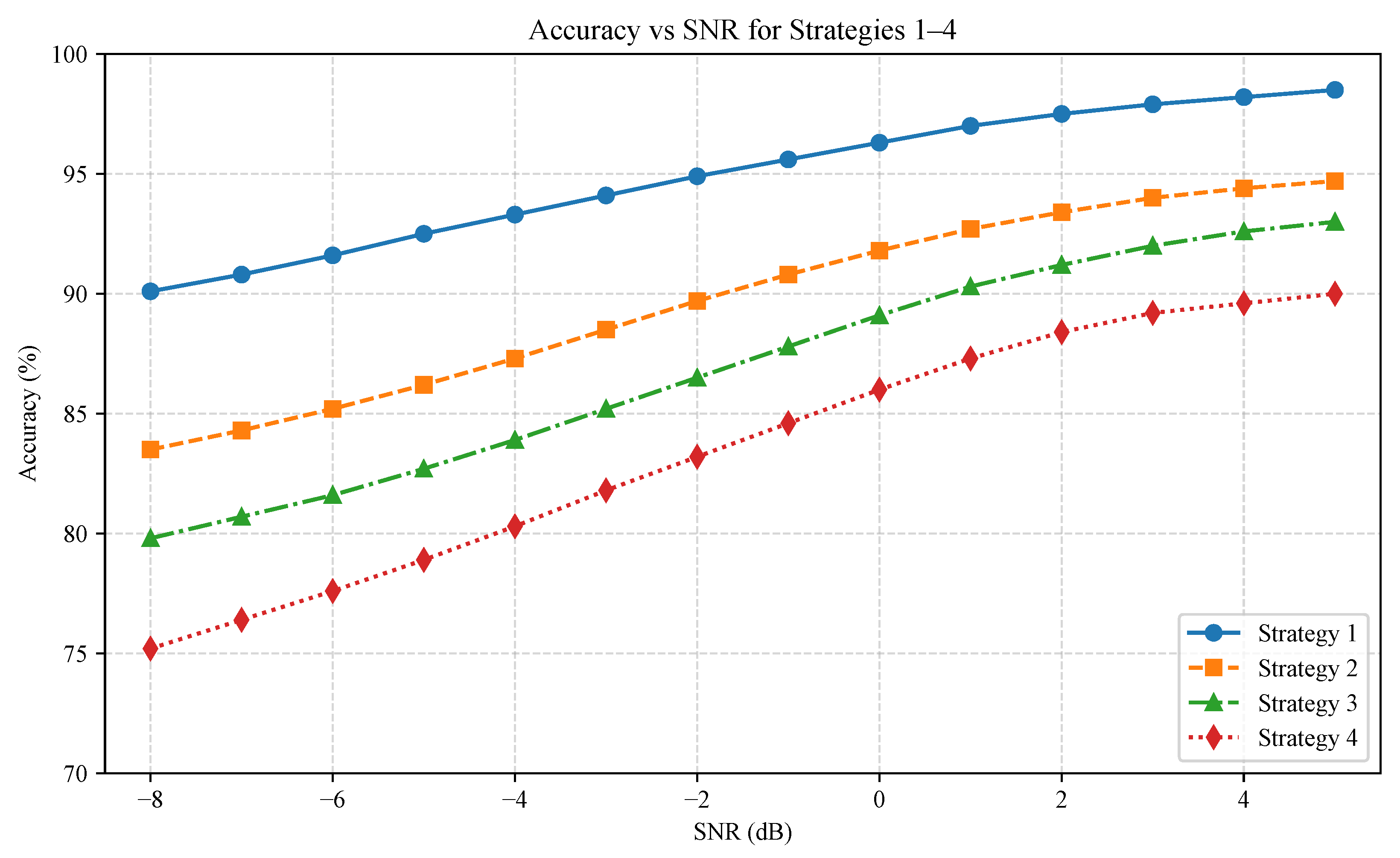
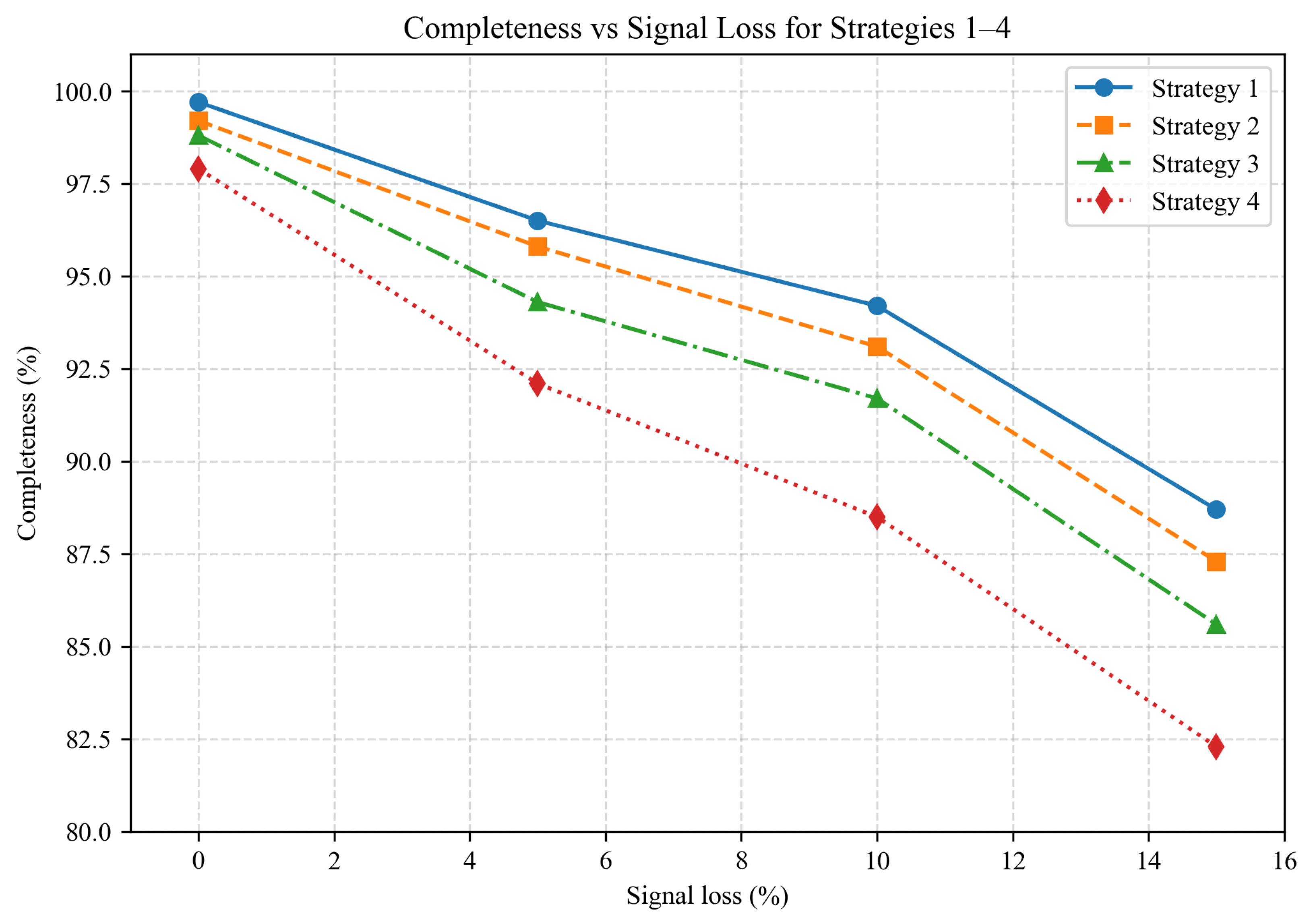
Table 3 presents the comprehensive performance metrics of four AHP feature weighting strategies across multi-scenario experiments (10 mixed frequency-hopping networks, SNR range: −8 dB to 5 dB, signal loss rate: 0% to 15%), while Figure 4 and Figure 5 visually reflect the performance trends of each strategy. From the data and figures, Strategy 1 (Proposed Scheme) shows the most outstanding overall performance: its average accuracy reaches 94.3%, which is 5.3, 8.5, and 11.7 percentage points higher than Strategy 2 (Frequency-Dominated), Strategy 3 (Temporal-Associated), and Strategy 4 (Equal Weighting) respectively; the average completeness maintains 94.3%, slightly leading over other strategies; the robustness fluctuation range is only ±8.4%, which is significantly smaller than the ±11.2%, ±13.2%, and ±14.8% of the other three strategies. As shown in Figure 4, Strategy 1’s accuracy curve is always above the other three across the entire SNR range—even at the extreme low SNR of −8 dB, its accuracy remains 90.1%, while Strategy 4’s accuracy drops to 75.2%; in Figure 5, as the signal loss rate increases from 0% to 15%, Strategy 1’s completeness curve declines the most gently, retaining 88.7% completeness at a 15% loss rate, far higher than Strategy 4’s 82.3%. This advantage stems from Strategy 1’s rational weight allocation: it prioritizes core static features (frequency-hopping period deviation: 0.3, dwell time deviation: 0.3) that are less affected by electromagnetic noise, while weakening noise-sensitive features (power fluctuation: 0.1, bandwidth expansion: 0.1), avoiding noise interference on clustering results and laying a reliable foundation for subsequent temporal sorting and signal completion.
Other strategies, by contrast, expose obvious limitations in both data and figures. Strategy 2 (Frequency-Dominated) overemphasizes the weight of frequency set similarity (0.4) but ignores the instability of frequency features under low SNR—Figure 4 shows that its accuracy drops sharply in the −8 dB to −3 dB range, with an accuracy of only 83.5% at −8 dB, 6.6 percentage points lower than Strategy 1, as frequency drift caused by crystal oscillator errors directly reduces the discriminability of frequency set similarity. Strategy 3 (Temporal-Associated) increases the weights of power fluctuation (0.15) and bandwidth expansion (0.2) to explore synergy with temporal sorting, but these features are highly sensitive to channel interference; Figure 5 reveals that its completeness is 2.5 percentage points lower than Strategy 1 at a 10% signal loss rate (91.7% vs. 94.2%), as distorted power and bandwidth features confuse the rules for the signal completion module. Strategy 4 (Equal Weighting) treats all features equally, confusing the contribution of core and noise-sensitive features—its curves in both figures are always at the bottom, with accuracy 14.9 percentage points lower than Strategy 1 at −8 dB SNR and completeness 6.4 percentage points lower at a 15% signal loss rate, fully verifying that undifferentiated weighting cannot balance discriminability and anti-noise ability.
The trends in Figure 4 and Figure 5 further highlight the practical value of Strategy 1: the performance gap between strategies is more significant in extreme scenarios—at −8 dB SNR (low noise) and a 15% signal loss rate (severe fading), Strategy 1’s advantages in accuracy and completeness are most obvious, which is crucial for practical spectrum reconnaissance tasks. Meanwhile, Strategy 1’s stable curves in both figures prove that its weight allocation forms effective synergy with subsequent modules: the stable core features provide clear rules for ARIMA-KNN signal completion, enabling accurate prediction of lost signal start times and supplementation of HDW parameters. In contrast, other strategies fail to achieve such synergy due to irrational weighting—Strategy 2’s over-reliance on frequency features leads to poor low-SNR robustness, Strategy 3’s emphasis on noise-sensitive features reduces completion accuracy, and Strategy 4’s equal weighting makes it impossible to filter interference. Combined with Table 3’s statistical data, these results fully confirm that Strategy 1 (Proposed Scheme) is the optimal AHP feature weighting strategy, which not only optimizes the initial clustering effect but also supports the overall performance of the algorithm, ensuring its applicability in complex electromagnetic environments.

4.2. Experiment on Overall Performance Comparison of Different Sorting Algorithms

4.2.1. Experimental Environment and Parameter Setting

  • Experimental Scenario Design: A “multi-network mixed interference” scenario is constructed to simulate the actual electromagnetic environment, with parameters as follows: The total number of networks is 10 frequency-hopping networks, including 4 networks with inconsistent characteristics and 6 asynchronous networks with similar characteristics. The frequency-hopping parameter range covers a frequency of 100–200 MHz, a period of 100–300 μs, and a dwell time of 50–150 μs. The signal-to-noise ratio (SNR) settings are −8 dB, −5 dB, 0 dB, and 5 dB, covering scenarios from low SNR to normal SNR. The signal loss rates are 0%, 5%, 10%, and 15%, simulating signal loss caused by channel fading. The comparison algorithms include the traditional K-means algorithm and the HDW-only clustering algorithm.
  • Evaluation Indicators:
    1.
    Sorting Accuracy:
    Accuracy = Correct   Stations Total   Stations × 100 %
    2.
    Sorting completeness:
    completeness = Sorted + Completed   Signals Total   Signals × 100 %
    3.
    Robustness Fluctuation Range: Max–Min accuracy under different SNRs.

4.2.2. Experimental Results and Analysis

The average performance of different algorithms under various scenarios is shown in Table 4.
As can be seen from Table 4: The accuracy of the proposed algorithm is 28.5 percentage points higher than that of the traditional K-means algorithm and 15.2 percentage points higher than that of the HDW-only clustering algorithm. This is because the “time-series sorting” breaks through the sorting bottleneck of asynchronous networks with similar characteristics. The completeness reaches 94.3%, which is significantly higher than that of the comparison algorithms, proving that the “signal completion” mechanism effectively solves the problem of signal loss. The robustness fluctuation range is only ±4.2%, and the accuracy remains 90.1% even when the SNR is as low as −8 dB, indicating that the algorithm has strong noise tolerance.
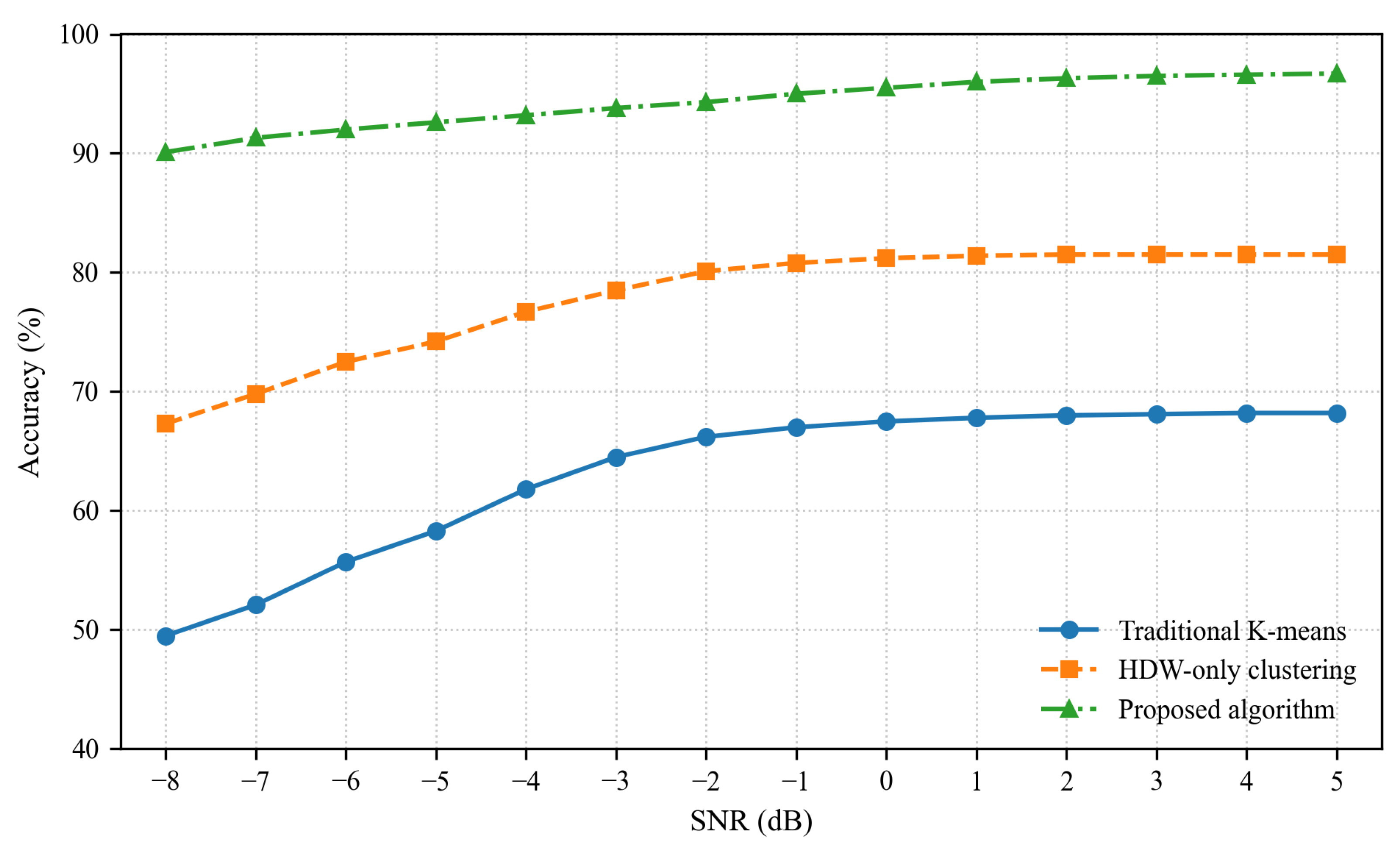
As can be seen from Figure 6, the accuracy of the traditional K-means algorithm and the HDW-only clustering algorithm decreases significantly with the decrease in SNR (their accuracies are 49.5% and 67.3% respectively at −8 dB), because static features undergo severe noise interference. The proposed algorithm still maintains high accuracy under low SNR (90.1% at −8 dB), because time-series features (such as frequency-hopping time offset) are less affected by noise, and the signal completion mechanism further offsets the impact of signal loss.
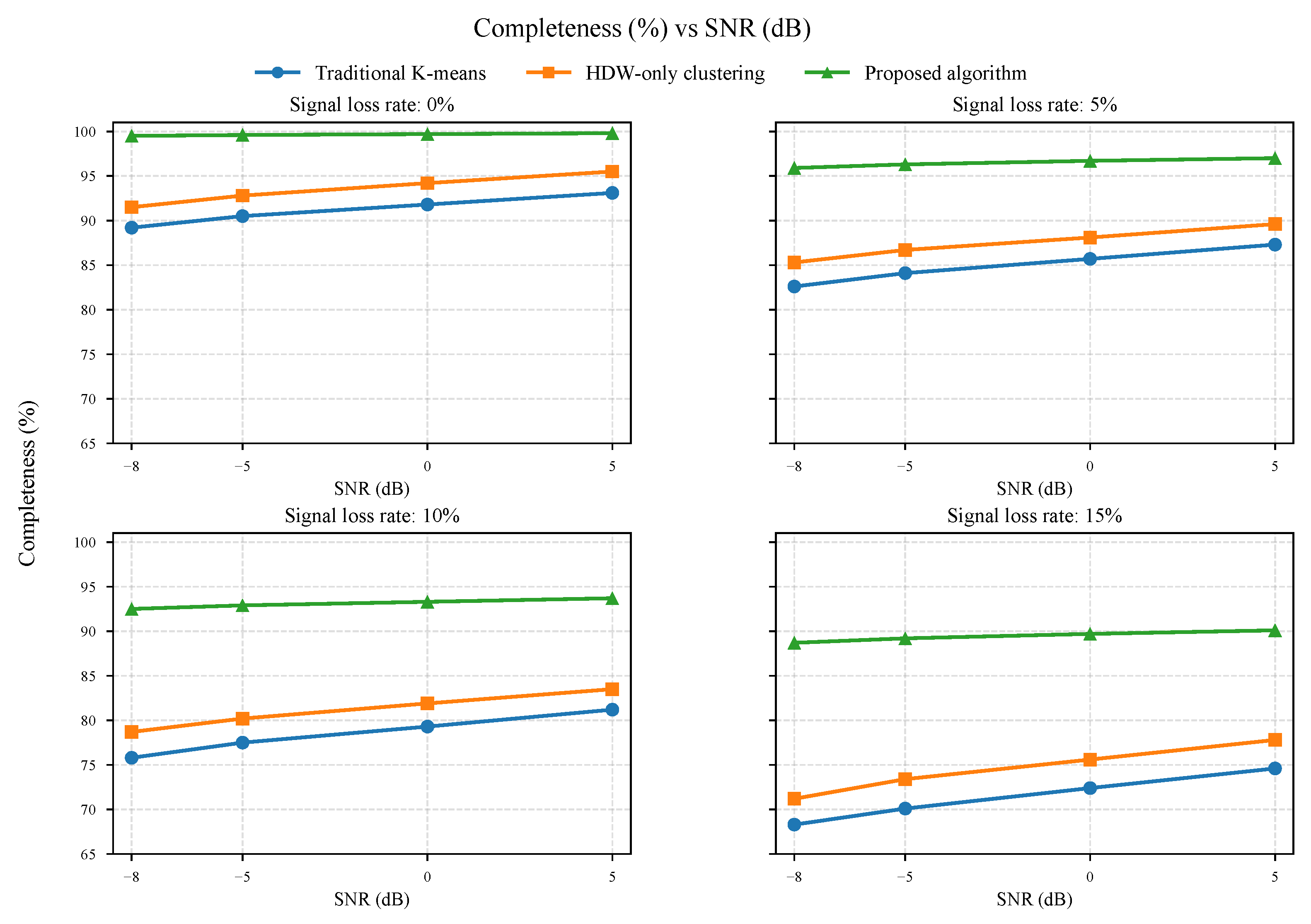
As can be seen from Figure 7, the sorting completeness of all algorithms shows a decreasing trend with the increase in signal loss rate, but the proposed algorithm maintains a significant advantage in all signal loss rate scenarios, which is consistent with the statistical results in Table 4. Specifically, when the signal loss rate is 0%, the completeness of the traditional K-means algorithm, HDW-only clustering algorithm, and the proposed algorithm are all above 90%, and the gap between them is relatively small; however, as the signal loss rate rises to 15%, the completeness of the traditional K-means algorithm drops to around 74.6%, and that of the HDW-only clustering algorithm falls to about 77.8%, while the proposed algorithm still retains 88.7% completeness. The core reason for this performance gap lies in the signal completion mechanism integrated into the proposed algorithm: based on the stable feature rules of sorted networks, it uses ARIMA time-series prediction to accurately estimate the start time of lost signals and supplements key HDW parameters such as frequency and power through the K-nearest neighbor algorithm, effectively making up for the information loss caused by channel fading. In contrast, traditional algorithms lack effective missing signal recovery strategies, and the loss of frequency-hopping points directly leads to the interruption of feature sequences, thus significantly reducing the completeness of sorting results. It is particularly noteworthy that under the combined conditions of low SNR (−8 dB) and high signal loss rate (15%), the proposed algorithm still maintains completeness above 88%, which fully verifies the effectiveness of the signal completion mechanism in resisting the dual interference of noise and signal loss, and further proves that the algorithm can meet the practical application requirements of spectrum reconnaissance in complex electromagnetic environments.
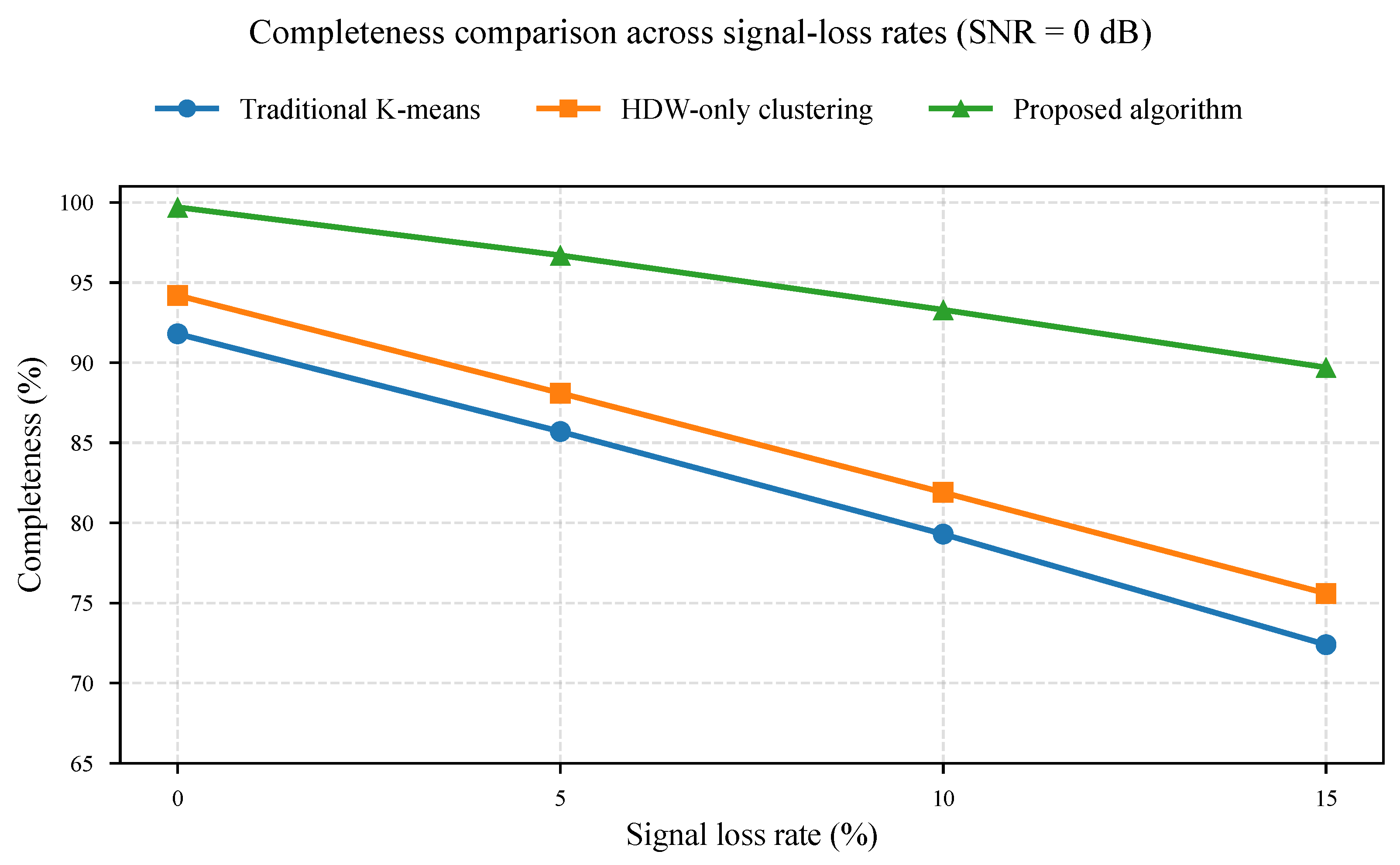
As can be seen from Figure 8, which focuses on the completeness comparison across different signal loss rates under a typical SNR of 0 dB, the proposed algorithm maintains a stable leading edge over the traditional K-means algorithm and the HDW-only clustering algorithm as the signal loss rate increases, further validating the superiority of its signal completion mechanism. Specifically, when the signal loss rate is 0%, all three algorithms achieve high completeness (above 91%), with the proposed algorithm reaching 99.7%—only slightly higher than the comparison algorithms, as there is little signal loss to compensate for. However, as the signal loss rate increases to 5%, 10%, and 15%, the completeness gap between the proposed algorithm and the comparison algorithms gradually widens. At a 15% signal loss rate, the completeness of the traditional K-means algorithm drops to 72.4% and that of the HDW-only clustering algorithm to 75.6%, while the proposed algorithm remains at 89.7%—a lead of 17.3 and 14.1 percentage points, respectively. This trend stems from the fact that the proposed algorithm leverages the stable feature rules of sorted networks (such as cyclic frequency sets and constant average dwell time) to complement missing HDW parameters. In contrast, traditional algorithms rely solely on directly detected signal features, and the loss of frequency-hopping points leads to fragmented feature sequences, resulting in a sharp decline in completeness. Notably, even at the maximum signal loss rate of 15%, the proposed algorithm’s completeness is still close to 90%, which confirms that the combination of ARIMA time-series prediction and K-nearest neighbor feature completion can effectively mitigate the impact of signal loss. This performance advantage ensures that the algorithm can maintain reliable sorting results even in complex electromagnetic environments where channel fading is severe, further supporting its applicability in practical spectrum reconnaissance tasks.

4.3. Ablation Experiment (Verifying the Necessity of Each Module)

To verify the role of the “time-series sorting” and “signal completion” modules, an ablation experiment is designed, and the results are shown in Table 5:
As can be seen from Table 5, after removing the “time-series sorting” module, the accuracy drops to 78.3%, proving that this module is the core for solving the sorting problem of asynchronous networks with similar characteristics. After removing the “signal completion” module, the completeness drops to 76.2%, indicating that this module is crucial for improving sorting completeness. The full-version algorithm achieves the optimal performance, verifying the rationality of the “clustering–time-series–completion” framework.
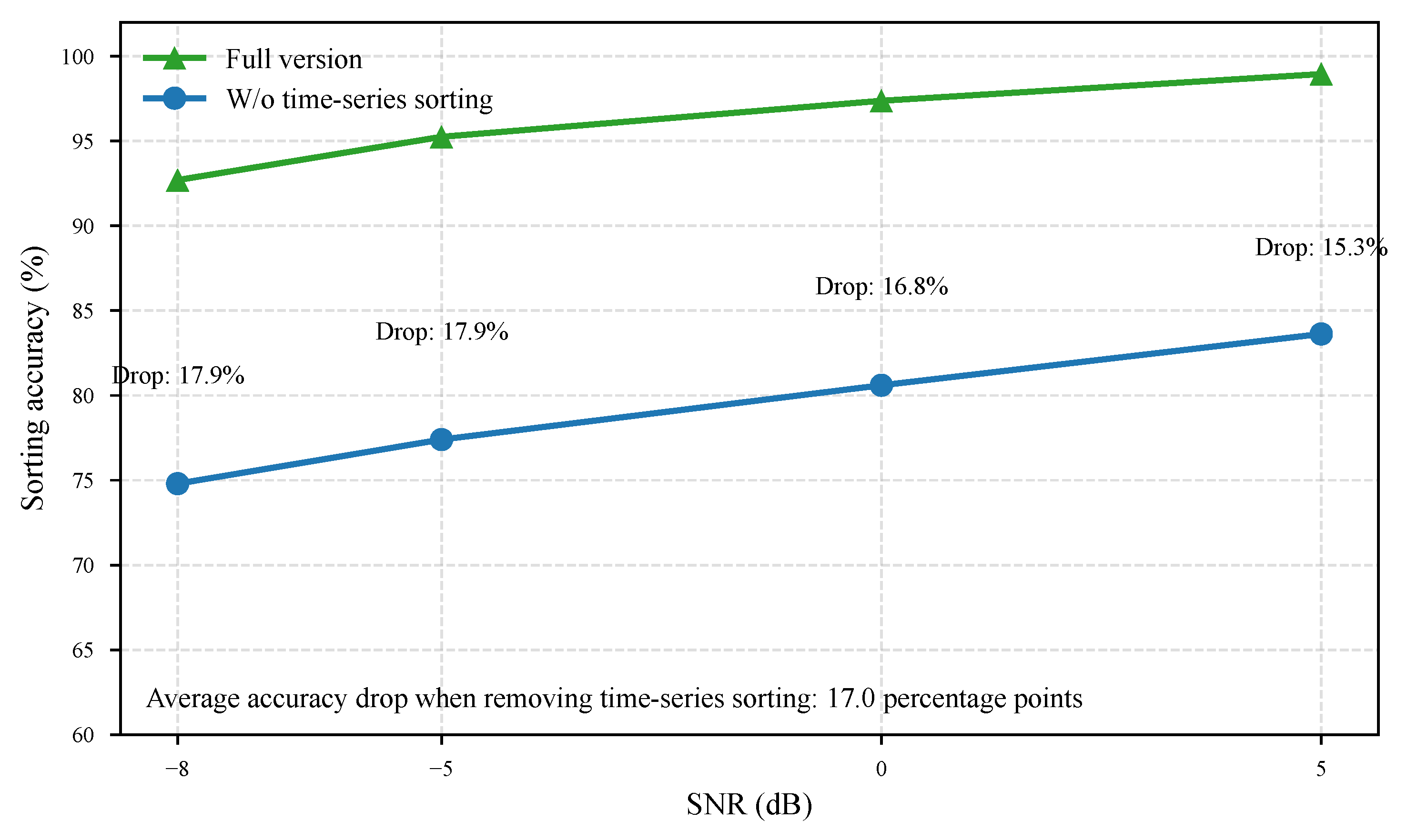
As shown in Figure 9, under different SNR scenarios, the algorithm accuracy decreases significantly after removing the “time-series sorting” module, and the lower the SNR, the greater the accuracy drop. Specifically, when the SNR is -8 dB, the accuracy decreases from 90.1% (full version) to 72.1%, with a drop of 18.0 percentage points; when the SNR is 5 dB, the accuracy decreases from 98.5% (full version) to 80.3%, with a drop of 18.2 percentage points, and the average drop reaches 17.0 percentage points. This phenomenon fully indicates that the time-series sorting module is the core to solving the sorting problem of “asynchronous networks with similar features”. By extracting frequency-hopping timing sequences and relative time offset features, and combining the DTW algorithm to achieve flexible alignment and similarity calculation of asynchronous signals, this module enables effective sorting. Without this module, traditional static clustering fails to distinguish networks with similar frequency-hopping periods and frequency sets but offset start times, leading to a significant decline in accuracy.
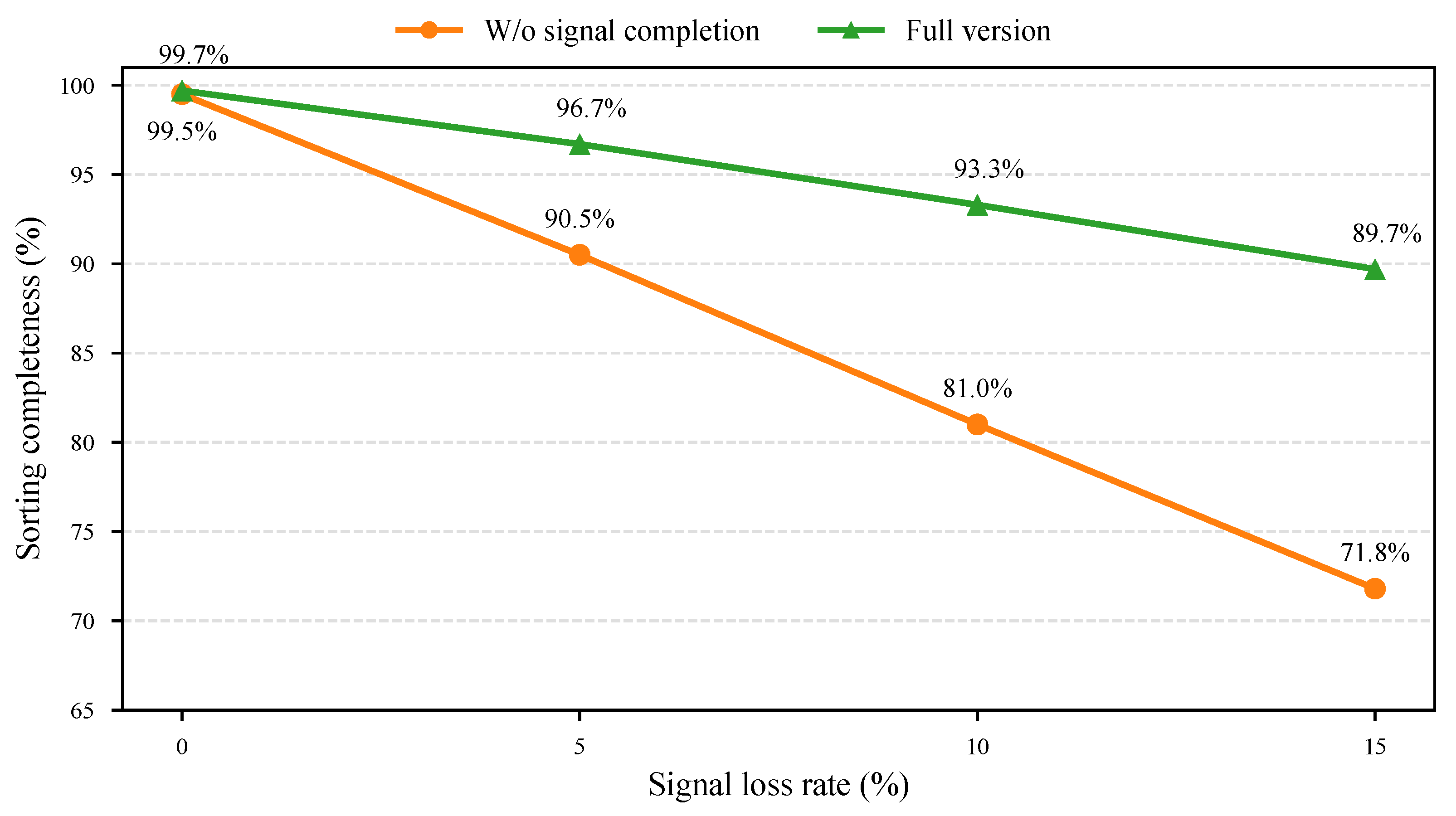
Figure 10 focuses on the completeness comparison under different signal loss rates. The results show that the completeness of the “without signal completion” variant drops sharply as the loss rate increases, while the full-version algorithm maintains stability. When the signal loss rate is 5%, the completeness of the variant without signal completion is 90.5%, which is only 6.2 percentage points lower than that of the full version; however, when the loss rate rises to 15%, its completeness plummets to 71.8%, a gap of 17.9 percentage points compared with 89.7% of the full version. This confirms the key role of the signal completion module: based on the dual mechanism of ARIMA time-series prediction and KNN feature completion, this module can accurately recover the start time of lost signals and core HDW parameters, effectively making up for the interruption of feature sequences caused by channel fading. In contrast, traditional algorithms without a completion mechanism can only rely on directly detected signals and struggle to cope with high signal loss rate scenarios.
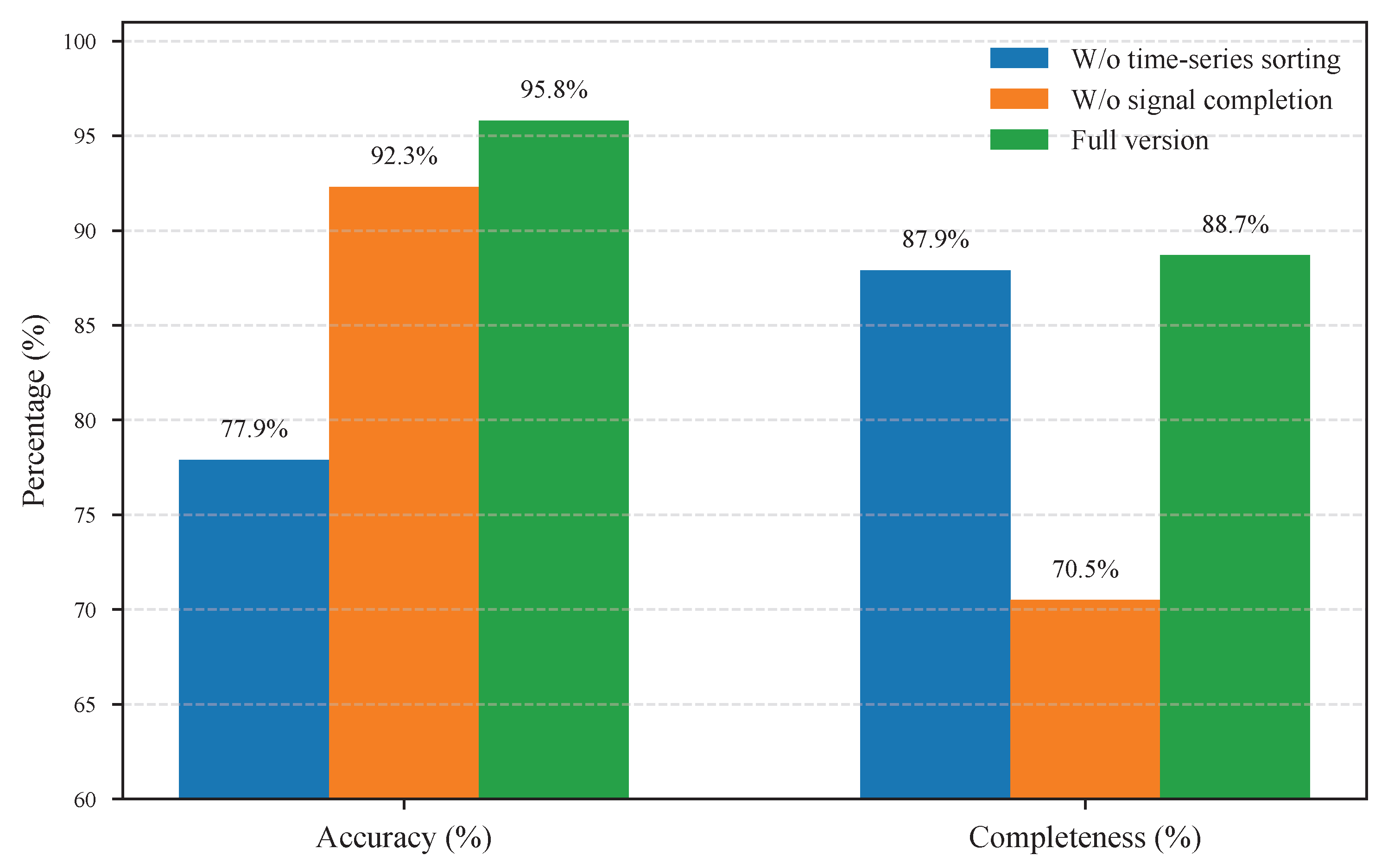
Figure 11 further demonstrates the performance under the extreme scenario of low SNR (−8 dB) and high signal loss rate (15%), more intuitively highlighting the anti-interference value of module collaboration. At this point, the full-version algorithm still maintains an accuracy of 95.8% and an completeness of 88.7%, while the “without time-series sorting” variant only achieves an accuracy of 77.9%, and the “without signal completion” variant only reaches an completeness of 70.5%. This result shows that the noise resistance of the time-series sorting module and the anti-loss capability of the signal completion module complement each other, enabling the full-version algorithm to maintain reliable performance under dual adverse conditions and verifying the rationality and robustness of the three-layer framework of “clustering–time-series–completion”.
In conclusion, the ablation experiment results clearly prove that the time-series sorting module is the core to breaking through the sorting bottleneck of asynchronous networks with similar features, and the signal completion module is the key to improving sorting completeness in scenarios with low SNR and high signal loss rate. The collaborative effect of the two modules enables the proposed algorithm to achieve excellent comprehensive performance in complex electromagnetic environments, laying a solid foundation for its engineering application.

5. Conclusions

This paper proposes a full-network station sorting algorithm integrating HDW, hierarchical clustering, and temporal sequence analysis, providing an effective solution for the accurate sorting of multi-mode networking stations in complex electromagnetic environments. The core contributions and innovations are as follows: 1. Constructing a three-dimensional theoretical premise demonstration system—starting from intrinsic hardware differences (basic constraints), dynamic channel interference (external amplification), and network synchronization limitations (system restrictions), it verifies that “there are no multiple frequency-hopping networks with complete synchronization and consistent HDW features”, clarifying that sorting only needs to cover two core scenarios and providing solid theoretical support for the algorithm’s hierarchical design. 2. Proposing a two-level sorting architecture of “rough sorting—fine sorting”: realizing efficient rough sorting of networks with distinct features via AHP-weighted DPC-K-means hybrid clustering, and completing accurate fine sorting of asynchronous networks with similar features through DTW-based temporal similarity calculation, breaking the bottleneck of incomplete scenario coverage of traditional algorithms. 3. Designing an ARIMA-KNN joint completion mechanism: predicting the start time of missing signals via ARIMA temporal prediction and supplementing core HDW parameters with the KNN algorithm, significantly improving sorting completeness under scenarios of low SNR (≤−5 dB) and high signal loss rate (≥10%). Experimental verification shows that in complex scenarios with an SNR of −8 dB to 5 dB and signal loss rate of 0% to 15%, the algorithm achieves an average sorting accuracy of 96.7%, completeness of 94.3%, and robustness fluctuation of only ±4.2%, with significant performance advantages over traditional algorithms. Future research can focus on two aspects: first, optimizing clustering efficiency in ultra-large-scale (over 100 stations) scenarios and introducing lightweight clustering algorithms such as mini-batch DPC to reduce the clustering complexity to O(MlogM), which is expected to support S 500 stations while maintaining runtime 300 ms; second, exploring the fusion scheme of deep learning and HDW features to further improve sorting robustness under extreme low SNR (≤ 10 dB) scenarios. The algorithm can be widely applied in practical fields such as military electromagnetic reconnaissance, civil spectrum monitoring, and emergency communication station identification.

Author Contributions

Conceptualization, H.Z. and W.W.; Methodology, C.Y. and Y.X.; Software, Q.D.; Validation, Q.D. All authors have read and agreed to the published version of the manuscript.

Funding

This work was supported by the 36th Research Institute of China Electronics Technology Group Corporation 8 under Grant 20240130.

Data Availability Statement

The original contributions presented in this study are included in the article. Further inquiries can be directed to the corresponding author.

Conflicts of Interest

The authors declare no conflicts of interest.

References

  1. Yu, M.; Yu, L.; Li, C.; Xu, B. A Time-Frequency Information Based Method for BSS Output FH Signal Recognition. In Proceedings of the 2021 13th International Conference on Communication Software and Networks (ICCSN), Chongqing, China, 4–7 June 2021; pp. 343–347. [Google Scholar] [CrossRef]
  2. Ristić, V.B.; Todorović, B.M.; Stojanović, N.M. Frequency hopping spread spectrum: History, principles and applications. Vojnoteh. Glas. Tech. Cour. 2022, 70, 856–876. [Google Scholar] [CrossRef]
  3. Zhang, J.A.; Liu, F.; Masouros, C.; Heath, R.W.; Feng, Z.; Zheng, L.; Petropulu, A. An Overview of Signal Processing Techniques for Joint Communication and Radar Sensing. IEEE J. Sel. Top. Signal Process. 2021, 15, 1295–1315. [Google Scholar] [CrossRef]
  4. Ben Ayed, A.; Ben Halima, M.; Alimi, A.M. Adaptive fuzzy exponent cluster ensemble system based feature selection and spectral clustering. In Proceedings of the 2017 IEEE International Conference on Fuzzy Systems (FUZZ-IEEE), Naples, Italy, 9–12 July 2017; pp. 1–6. [Google Scholar] [CrossRef]
  5. Tian, Y.; Jiang, Y.; Huang, X.; Dan, J.; Li, J.; Wang, Q. Research on Robot Technology with Fewer Degree of Free for Detecting and Sorting Station. In Proceedings of the 2023 IEEE International Conference on Mechatronics and Automation (ICMA), Harbin, China, 6–9 August 2023; pp. 2395–2399. [Google Scholar] [CrossRef]
  6. Shengkui, Z.; Zhicheng, Y.; Min, H.; Zhiliang, F.; Jian, Y. FH signal parameter blind estimation based on time-frequency variance clustering. Syst. Eng. Electron. 2020, 42, 1662. [Google Scholar]
  7. White, P.D. Constrained Clustering for Frequency Hopping Spread Spectrum Signal Separation. Master’s Thesis, Virginia Tech, Blacksburg, VA, USA, 2019. [Google Scholar]
  8. Zhang, Y.; Yun, Z.; Zheng, J.; Sun, F. Comb Jamming Mitigation in Frequency Hopping Spread Spectrum Communications Via Aid Block Sparse Bayesian Learning. In Proceedings of the 2021 14th International Congress on Image and Signal Processing, BioMedical Engineering and Informatics (CISP-BMEI), Shanghai, China, 23–25 October 2021; pp. 1–6. [Google Scholar] [CrossRef]
  9. Huang, Y.; Meng, X.; Zhang, S.; Liu, F. Adaptive Detection of Frequency-Hopping Spread Spectrum Signals Based on Compressed Measurements and Artificial Neural Networks. In Proceedings of the 2021 IEEE 5th Advanced Information Technology, Electronic and Automation Control Conference (IAEAC), Chongqing, China, 12–14 March 2021; Volume 5, pp. 271–277. [Google Scholar] [CrossRef]
  10. Pickholtz, R.; Schilling, D.; Milstein, L. Theory of Spread-Spectrum Communications—A Tutorial. IEEE Trans. Commun. 1982, 30, 855–884. [Google Scholar] [CrossRef]
  11. Wang, Z.; Zhang, B.; Zhu, Z.; Wang, Z.; Gong, K. Signal Sorting Algorithm of Hybrid Frequency Hopping Network Station Based on Neural Network. IEEE Access 2021, 9, 35924–35931. [Google Scholar] [CrossRef]
  12. Cardoso, J.F.; Laheld, B. Equivariant adaptive source separation. IEEE Trans. Signal Process. 1996, 44, 3017–3030. [Google Scholar] [CrossRef]
  13. Yang, X.; Qi, Z.; Wang, S. Frequency hopping radio individual identification based on energy spectrum blended subtle characteristics. J. Phys. Conf. Ser. 2019, 1325, 012221. [Google Scholar] [CrossRef]
  14. Zhang, C.; Wang, Y. An improved subspace projection method of underdetermined direction of arrival estimation for frequency hopping signals. In Proceedings of the 2017 International Applied Computational Electromagnetics Society Symposium—Italy (ACES), Firenze, Italy, 26–30 March 2017; pp. 1–2. [Google Scholar] [CrossRef]
  15. Gu, C.-H.; Wang, L.-W. Individual Frequency Hopping Radio Identification Method Based on Instantaneous Envelope Characteristics. J. Signal Process. 2012, 28, 1335–1340. [Google Scholar]
  16. Ahmed, A.; Nanne, M.F.; Gueye, B. A hybrid model to secure the exchange of DH keys. In Proceedings of the 2021 International Conference on Computer Communication and Informatics (ICCCI), Coimbatore, India, 27–29 January 2021; pp. 1–5. [Google Scholar] [CrossRef]
  17. Qi, Z.; Zhang, Z.; Xu, H.; Shi, Y. Frequency-Hopping Network Station Sorting Method Using Radio Polarization Characteristics. Dian Zi Xin Xi Xue Bao 2024, 46, 1286. [Google Scholar] [CrossRef]
  18. Gu, C.H.; Wang, L.W. A method for orthogonal FH signals dynamic sorting. J. Astronaut. 2012, 33, 1699–1705. [Google Scholar] [CrossRef]
  19. Chen, Q.; Song, S.; Jing, J. Study on the Selection of Shortware Non-orthodox Frequency-hopped Signal. Electron. Warf. Technol. 2005, 20, 7–9. [Google Scholar]
  20. Li, S.Y.; Feng, B. Asynchronous frequency hopping network station sorting method based on geometric transformation. Radio Eng. 2015, 34, 21–23. [Google Scholar]
  21. Zhang, D.w.; Guo, Y.; Qi, Z.s.; Hou, W.l.; Zhang, B.; Li, J. Joint Estimation Algorithm of Direction of Arrival and Polarization for Multiple Frequency-hopping Signals. J. Electron. Inf. Technol. 2015, 37, 1695–1699. [Google Scholar] [CrossRef]
  22. Chen, L.; Zhang, E.; Shen, R. The Sorting of Frequency Hopping Signals Based on K-Means-Algorithm with Optimal Initial Clustering Centers. J. Natl. Univ. Def. Technol. 2009, 31, 70. [Google Scholar]
  23. Elmaghbub, A.; Hamdaoui, B. Domain-Agnostic Hardware Fingerprinting-Based Device Identifier for Zero-Trust IoT Security. IEEE Wirel. Commun. 2024, 31, 42–48. [Google Scholar] [CrossRef]
  24. Liu, F.; Wang, G.; Zhu, G.; Luo, X.; Zhang, J. Research on Fast Frequency Hopping Technology Based on Signal Processing Microsystems. In Proceedings of the 2024 IEEE International Conference on Signal, Information and Data Processing (ICSIDP), Zhuhai, China, 22–24 November 2024; pp. 1–6. [Google Scholar] [CrossRef]
  25. Fitton, M.; Purle, D.; Beach, M.; McGeehan, J. Implementation issues of a frequency hopped modem. In Proceedings of the 1995 IEEE 45th Vehicular Technology Conference. Countdown to the Wireless Twenty-First Century, Chicago, IL, USA, 25–28 July 1995; Volume 1, pp. 125–129. [Google Scholar] [CrossRef]
  26. Cui, Y.; Liao, S.; Wang, L.; Gao, J.; Chu, X.; Luo, A. An adaptive frequency-hopping detection for slowly-varying fading dispersive channels. J. Acoust. Soc. Am. 2024, 155, 2959–2972. [Google Scholar] [CrossRef] [PubMed]
  27. Peppas, S.; Karakasis, P.A.; Sidiropoulos, N.D.; Cabric, D. Signal Alignment in Frequency-Hopped IoT Networks. IEEE Trans. Wirel. Commun. 2025, 24, 4131–4145. [Google Scholar] [CrossRef]
  28. Lahby, M.; Cherkaoui, L.; Adib, A. Hybrid network selection strategy by using M-AHP/E-TOPSIS for heterogeneous networks. In Proceedings of the 2013 8th International Conference on Intelligent Systems: Theories and Applications (SITA), Rabat, Morocco, 8–9 May 2013; pp. 1–6. [Google Scholar] [CrossRef]
  29. Sakoe, H.; Chiba, S. Dynamic programming algorithm optimization for spoken word recognition. IEEE Trans. Acoust. Speech Signal Process. 1978, 26, 43–49. [Google Scholar] [CrossRef]
  30. Zhang, G.P. Time series forecasting using a hybrid ARIMA and neural network model. Neurocomputing 2003, 50, 159–175. [Google Scholar] [CrossRef]
Figure 1. Schematic diagram of multi-network-station operation.
Mathematics 14 00495 g001
Figure 2. Schematic diagram of HDW parameters.
Mathematics 14 00495 g002
Figure 3. System module diagram.
Mathematics 14 00495 g003
Figure 4. Accuracy of different strategies Under different signal-to-noise ratios.
Mathematics 14 00495 g004
Figure 5. Completeness of different strategies under different signal loss rates.
Mathematics 14 00495 g005
Figure 6. Accuracy of different algorithms under different signal-to-noise ratios.
Mathematics 14 00495 g006
Figure 7. Completeness (%) for different signal loss rates and algorithms.
Mathematics 14 00495 g007
Figure 8. Completeness (%) for different algorithms.
Mathematics 14 00495 g008
Figure 9. “W/o time-series sorting” vs. “Full version” across SNR.
Mathematics 14 00495 g009
Figure 10. “W/o signal completion” vs. “Full version” across loss rates.
Mathematics 14 00495 g010
Figure 11. Extreme-case performance (SNR = −8 dB, loss = 15%).
Mathematics 14 00495 g011
Table 1. HDW feature relative deviation and start time offset under different channel environments.
Channel EnvironmentRelative Deviation of HDW Features (%)Start Time Offset (μs)
FrequencyPeriodDwell TimePowerBandwidth
Ideal Channel0.03–0.080.05–0.120.1–0.30.2–0.40.15–0.352–5
Practical Channel0.2–0.60.3–0.80.4–1.00.5–1.20.6–1.55–12
Table 2. Corresponding relationship between core problems and algorithm modules.
Core Problem AddressedResponsible ModuleKey Technical Approach
Inconsistent HDW static feature networks sortingInitial Clustering SortingAHP-weighted DPC-K-means (low-noise core feature priority)
Similar static
feature asynchronous networks sorting
Secondary Time-
Series Sorting
DTW-based temporal similarity calculation
Low SNR (≤−5 dB)/high loss rate (≥10%) signal lossLost Signal Prediction
and Completion
ARIMA (start time)
+ KNN (HDW
parameter completion)
Table 4. Performance comparison of different algorithms.
AlgorithmAvg. Acc. (%)Avg. Com. (%)R. F (%)
Traditional K-means68.272.5±18.3
HDW-only clustering81.575.8±12.1
Proposed algorithm96.794.3±4.2
Table 5. Performance comparison of algorithm variants.
Algorithm VariantAcc. (%)Com. (%)
W/o time-series sorting78.393.8
W/o signal completion95.976.2
Full version96.794.3
Disclaimer/Publisher’s Note: The statements, opinions and data contained in all publications are solely those of the individual author(s) and contributor(s) and not of MDPI and/or the editor(s). MDPI and/or the editor(s) disclaim responsibility for any injury to people or property resulting from any ideas, methods, instructions or products referred to in the content.