1. Introduction
The standard normal cumulative distribution function (CDF), denoted by
, is a cornerstone of probability theory and mathematical statistics. It gives the probability that a standard normally distributed random variable assumes a value less than or equal to
x:
The function plays a central role in statistical inference, including hypothesis testing, confidence interval construction, and maximum likelihood estimation, and its ubiquity across disciplines is largely due to the Central Limit Theorem [
1]. In applied work, inference is often summarized via confidence intervals and power considerations; see, e.g., [
2,
3,
4].
Despite its theoretical importance,
does not admit a closed-form expression in terms of elementary functions, a fact that follows from classical results in differential algebra [
5]. As a consequence, practical evaluation of
relies on numerical approximations, polynomial expansions, or algorithmic approximants such as rational functions and error-function-based representations [
6,
7,
8,
9]. While these approaches can achieve high accuracy, they typically require numerical routines or auxiliary approximations for evaluation and inversion.
A commonly used representation expresses
in terms of the error function,
which is elegant but still necessitates numerical approximation in most computational environments. As a result, the normal CDF remains a computational bottleneck in settings where repeated evaluation or analytic inversion is required, including symbolic computation and inverse transform sampling [
10].
Numerous approximation strategies for
have been proposed, differing in accuracy, complexity, and analytic properties. Rational approximations, such as those originating with Hastings [
7], can achieve high numerical fidelity but are not analytically invertible. Polynomial approximations, including those of Marsaglia [
8], are compact and efficient but likewise lack symbolic reversibility. Recent work has produced increasingly accurate closed-form approximations [
11,
12], underscoring ongoing efforts to balance numerical precision with analytic simplicity.
In contrast, logistic sigmoid-based approximations provide closed-form, strictly monotone, and analytically invertible surrogates for
. The classical logistic approximation
is attractive for its simplicity and symbolic tractability [
13], but exhibits poor tail accuracy due to its limited curvature flexibility. This limitation motivates the introduction of nonlinear extensions that preserve invertibility while improving approximation quality.
While logistic approximations of the standard normal cumulative distribution function (CDF) are well established in the literature, the contribution of the present work is not the logistic form itself, but the systematic augmentation of the logistic argument with a cubic term. This extension yields a closed-form, invertible approximation with substantially improved accuracy while preserving analytic simplicity and computational efficiency. Related approximation approaches based on series expansions have also been proposed [
14]. While such methods can achieve high precision by increasing expansion order or using additional correction terms, the present work emphasizes a single closed-form cubic–logistic expression with low parametric complexity, global smoothness, and analytic invertibility.
In this work, we introduce a closed-form logistic–cubic approximation to the standard normal CDF, defined by
where the coefficients
a and
b are determined via hybrid numerical optimization combining Differential Evolution with Nelder–Mead refinement. The resulting approximation preserves symmetry, global monotonicity, and analytic invertibility, while achieving uniformly low absolute and root-mean-square error over a wide domain.
The proposed approximation is evaluated from three complementary perspectives:
- 1.
Mathematical structure and constraints: analysis of symmetry, monotonicity, and admissible parameter ranges.
- 2.
Numerical accuracy: comparison with established approximations using maximum absolute error and RMSE.
- 3.
Illustrative applications: demonstration of performance on representative empirical datasets.
All numerical comparisons are benchmarked against the reference implementation
scipy.stats.norm.cdf [
15].
2. Materials and Methods
This section defines the proposed cubic–logistic approximation, states its structural constraints (symmetry, monotonicity, and invertibility), and describes the numerical procedure used to fit its parameters.
2.1. Mathematical Framework and Structural Constraints
Let
denote the logistic sigmoid
We consider approximations to the standard normal CDF of the form
where
is a smooth scalar function.
The target
satisfies (i)
symmetry , (ii)
strict monotonicity, and (iii) limits
as
and
as
. The approximation (
6) inherits the correct limits whenever
as
. Moreover,
is strictly increasing whenever
f is strictly increasing, since
for all
x.
A particularly convenient constraint is analytic invertibility. Since
is invertible with
, the approximation admits an explicit inverse whenever
f is invertible:
We therefore seek a simple choice of
f that (a) preserves symmetry, (b) is strictly increasing on
, and (c) remains analytically tractable.
2.2. Cubic–Logistic Functional Form
Symmetry of the normal distribution implies that the log-odds transformation of
is an odd function. Motivated by this structure, we take
f to be an odd polynomial. The minimal nonlinear odd polynomial is cubic,
with real parameters
a and
b.
Optimizing the parameters with respect to the mean squared error over
yields the coefficients
Accordingly, the proposed Logistic–Cubic approximation is given explicitly by
For comparison, the classical logistic approximation corresponds to
with
.
Table 1 summarizes the parameterizations of the logistic-based normal CDF approximations considered in this work.
The cubic term introduces additional curvature relative to the classical linear–logistic approximation
, improving tail behavior while maintaining closed-form simplicity. Higher odd degrees (e.g., quintic) can marginally reduce error but substantially increase symbolic complexity and raise the risk of producing unnecessary oscillation. For the cubic form, the derivative is
Lemma 1 (Monotonicity). If and , then for all , and hence is strictly increasing on .
Proof. If and , then for all we have . Thus, f is strictly increasing, and since for all x, is strictly increasing. □
This sufficient condition is used to ensure that the approximation defines a valid CDF and remains invertible.
Table 2 summarizes key symbolic properties of the proposed cubic–logistic approximation relative to common alternatives.
2.3. Optimization Criteria and Error Metrics
The parameters
are chosen to match
over a prescribed domain using two error criteria: the root-mean-square error (RMSE) and the maximum absolute error. Given a uniform grid
on
, define
Remark on evaluation intervals. The interval
is used for global RMSE evaluation to include extreme tail behavior of the normal distribution, whereas the interval
reflects the effective numerical support of
in most practical applications, where values outside this range are already numerically indistinguishable from 0 or 1. The qualitative conclusions of the error analysis are not sensitive to this choice of interval.
Since these criteria emphasize complementary aspects of accuracy, we adopt a lexicographic objective: We first minimize , and among solutions with near-minimal , we select the one with minimal RMSE. (In practice, “near-minimal” is defined by a small tolerance relative to the best observed on the grid). This choice yields uniform control of the worst-case deviation while retaining good average fidelity.
2.4. Numerical Optimization Algorithm
The resulting optimization problem is non-convex over
, motivating a hybrid global–local search. We first apply Differential Evolution [
16] over bounded intervals
and
, followed by Nelder–Mead refinement [
17] initialized at the best global candidate. The bounds enforce
and
, which (by Lemma 1) guarantee monotonicity of
on
.
Table 3 summarizes the evaluation domain, grid resolution, objective criteria, and optimization procedures used in fitting the cubic–logistic approximation.
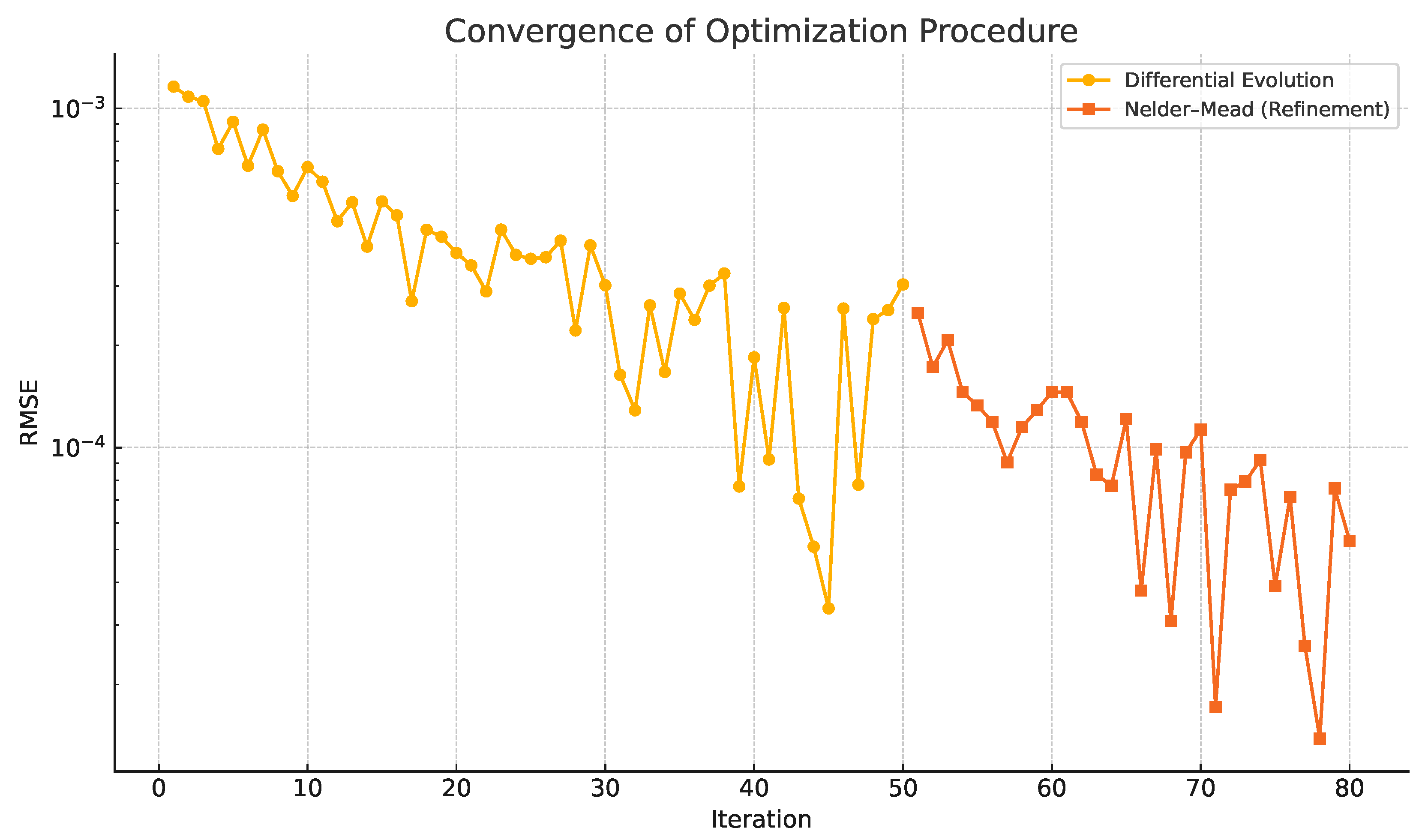
Figure 1 illustrates the representative convergence behavior of the global and local optimization phases.
The fitted parameter values obtained from this procedure are reported in
Section 3.
3. Results
This section reports numerical results for the proposed logistic–cubic normal CDF approximation. Accuracy is evaluated using the error metrics defined in
Section 2, including the maximum absolute error and the root-mean-square error (RMSE). All results are obtained by direct comparison with a high-precision reference implementation of the standard normal CDF.
3.1. Evaluation Setup and Baseline Methods
All approximations are evaluated on a uniform grid of 1000 points over the interval
which contains more than
of the probability mass of the standard normal distribution [
14]. This domain captures both the central region and the extreme tails while remaining representative of typical computational use.
The proposed logistic–cubic approximation is compared against three commonly used baseline methods: (i) the classical logistic approximation
[
13], (ii) Hastings’ rational approximation [
7], and (iii) Marsaglia’s polynomial approximation [
8]. These methods span a range of analytic complexity and accuracy characteristics and provide representative benchmarks.
In addition to classical approximations, we also compare the proposed model with representative closed-form normal CDF approximations, including recent explicitly invertible and high-accuracy forms reported in Refs. [
12,
18]. These models are selected due to their analytic tractability and their frequent use as benchmarks in the literature.
All approximations are evaluated relative to the reference implementation
scipy.stats.norm.cdf from the SciPy library [
15,
19], which computes
to machine precision. For each method, pointwise absolute errors are computed on the evaluation grid, and global summary metrics are derived from these values. The resulting numerical comparisons are presented in the following subsections.
3.2. Quantitative Accuracy Metrics
We report numerical accuracy results for the logistic–cubic normal CDF approximation using the maximum absolute error and the root-mean-square error (RMSE) defined in
Section 2. These metrics respectively quantify the worst-case deviation and the average squared deviation over the evaluation domain.
Remark on tail behavior. For sufficiently large , the normal cumulative distribution function rapidly saturates, with for large positive x and for large negative x. In many numerical settings, hard truncation outside a finite interval (e.g., ) may therefore be sufficient. Nevertheless, a smooth closed-form approximation defined on remains valuable for analytical manipulation, automatic differentiation, and inverse-CDF-based methods, where continuity and global invertibility are desirable.
Table 4 summarizes the numerical performance of the proposed approximation relative to the baseline methods described in
Section 3.1. Over the interval
, the logistic–cubic approximation attains a maximum absolute error of
and an RMSE of
. These values represent a substantial reduction in error relative to the classical logistic approximation and are comparable to those obtained by Hastings’ rational approximation and Marsaglia’s polynomial fit.
Table 5 compares the proposed approximation with representative closed-form normal CDF approximations using standard goodness-of-fit and error metrics.
For Refs. [
12,
18], we report closed-form and invertibility properties here; numerical error summaries for those specific approximations are given in the original articles and are discussed in the accompanying text.
Across both error criteria, the cubic–logistic form markedly improves upon the classical logistic approximation and remains competitive with higher-accuracy rational and polynomial methods. Additional insight into the spatial distribution of approximation error is provided by the pointwise error analysis presented in the following subsection.
3.3. Higher-Order Odd Polynomial Extensions
To assess whether additional accuracy can be achieved through increased model order, we also considered higher-order odd polynomial extensions of the logistic argument. In particular, a quintic model of the form
was optimized using the same numerical criteria applied to the cubic model.
For the quintic extension
, optimization over the same evaluation grid (
,
) yields
Table 6 summarizes performance comparisons using the Akaike Information Criterion (AIC), Bayesian Information Criterion (BIC), and Kolmogorov–Smirnov (KS) statistic.
For the quintic extension
, optimization over the same grid yields
Although the quintic extension yields marginal numerical improvements, these gains are small relative to the increase in model complexity. The cubic formulation therefore represents an effective balance between accuracy, parsimony, and analytic tractability.
3.4. Visual Error Structure and Tail Behavior
To complement the global accuracy metrics reported above, we examine the pointwise absolute error of each approximation across the evaluation domain. This analysis highlights how approximation error varies with x and provides insight into tail behavior that may not be fully captured by aggregate error measures.
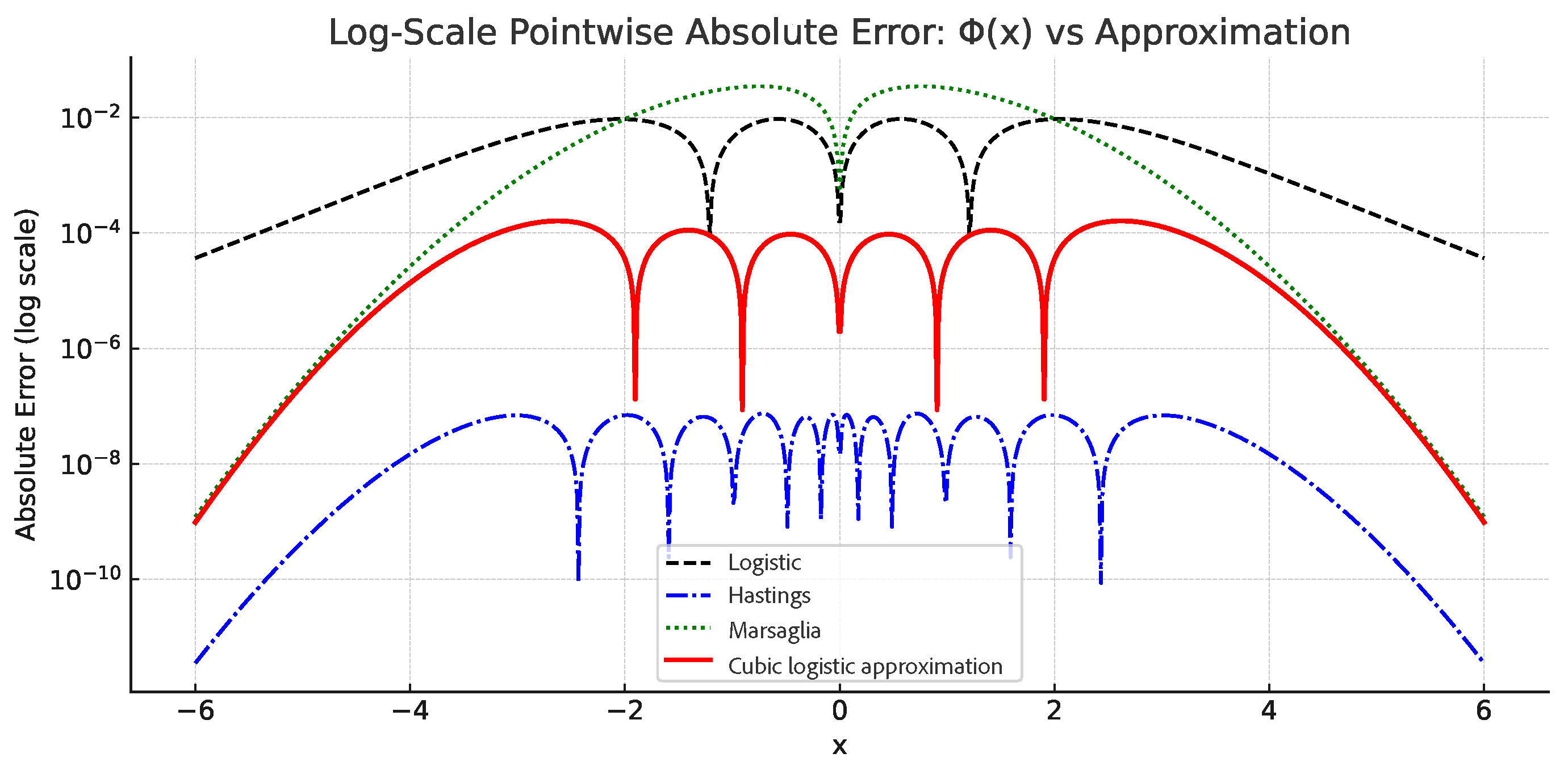
Figure 2 shows the absolute error
on a logarithmic scale for all methods over
. The logarithmic scale facilitates comparison of error magnitudes spanning several orders and emphasizes behavior in the tails of the distribution.
The classical logistic approximation exhibits increasing error magnitude as grows, reflecting limitations of a purely linear exponent in capturing tail curvature. Hastings’ rational approximation and Marsaglia’s polynomial fit achieve low error near the center of the distribution but display progressively larger deviations toward the boundaries of the evaluation domain.
The cubic–logistic approximation maintains uniformly low error across the full interval, with symmetric behavior in both tails. In particular, the maximum absolute error remains below
throughout the domain, consistent with the quantitative results reported in
Table 4.
3.5. Symbolic Tractability and Invertibility
Beyond numerical accuracy, analytic properties such as symbolic tractability and explicit invertibility are important considerations in the selection of normal CDF approximations. These properties are particularly relevant in contexts involving symbolic manipulation, inverse transform sampling, and analytic differentiation.
Table 7 summarizes key symbolic characteristics of the cubic–logistic approximation in comparison with several commonly used alternatives. While all methods considered are smooth and admit closed-form expressions, only the classical logistic approximation and the proposed cubic–logistic form are analytically invertible.
The absence of analytic invertibility in rational and polynomial approximations generally necessitates numerical root-finding procedures or conditional logic for inversion, which can increase computational complexity and limit symbolic use. In contrast, the cubic–logistic approximation admits an explicit inverse through solution of a depressed cubic equation following application of the logit transformation. This property enables closed-form evaluation of quantiles and facilitates analytic manipulation.
In addition to invertibility, the simplicity of the cubic–logistic functional form supports straightforward symbolic differentiation and integration. Unlike piecewise or iterative approximations, the approximation remains globally smooth and algebraically compact, which can simplify analytic derivations and symbolic computation workflows.
These analytic considerations complement the numerical results presented in
Section 3. Together, they illustrate how the cubic–logistic approximation balances accuracy with analytic simplicity, positioning it as a useful alternative in settings where both numerical fidelity and symbolic accessibility are desired.
4. Applications
The purpose of the examples in this section is to illustrate the numerical behavior and practical performance of the proposed cubic–logistic approximation in representative applied settings. These examples are not intended to redefine the primary objective of the paper, which remains the accurate approximation of the normal cumulative distribution function. To illustrate the numerical behavior of the cubic–logistic normal CDF approximation beyond synthetic test functions, we present several empirical case studies. These examples are intended to demonstrate how the approximation behaves when fitted to real-world data exhibiting skewness and heavy-tailed structure, rather than to provide domain-specific modeling conclusions. These examples are intended to illustrate numerical behavior under non-Gaussian empirical distributions rather than to assert domain-specific generative models.
4.1. Overview and Relevance of Empirical Domains
The empirical examples considered here are chosen to reflect common distributional features encountered in practice, including skewness, excess kurtosis, and tail asymmetry. Such features often lead to systematic deviations from the standard normal distribution and provide a useful testbed for evaluating approximation behavior.
All datasets are standardized to zero mean and unit variance prior to fitting. This normalization isolates shape characteristics and allows direct comparison between the standard normal CDF, the classical logistic approximation, and the proposed cubic–logistic approximation. Model comparisons are based on goodness-of-fit measures including the Kolmogorov–Smirnov statistic and information criteria (AIC and BIC).
4.2. Environmental Data—PM2.5 Air Quality Index
As a first empirical example, we consider daily PM2.5 measurements obtained from the U.S. Environmental Protection Agency monitoring station at Huntsville Old Airport [
20]. The association between long-term PM2.5 exposure and adverse cardiopulmonary outcomes is well established [
21]. PM2.5 data are well known to exhibit right skewness and heavy tails, making them a representative example of non-Gaussian environmental measurements [
20,
22].
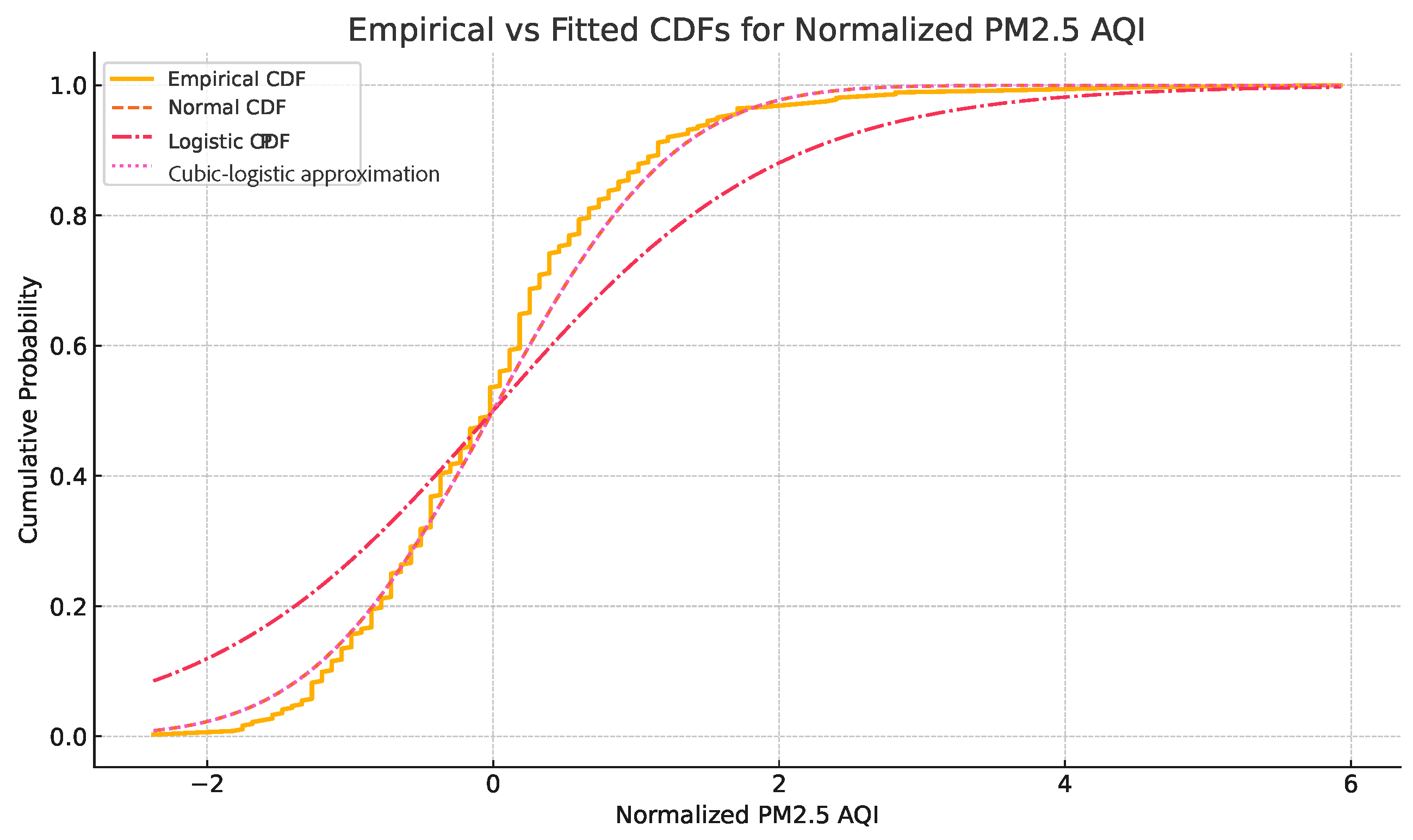
After standardization, three models are fitted to the empirical distribution: the standard normal CDF, the classical logistic approximation, and the cubic–logistic approximation.
Figure 3 shows the empirical CDF alongside the fitted models.
Goodness-of-fit statistics are summarized in
Table 8. The cubic–logistic approximation yields the smallest Kolmogorov–Smirnov statistic among the three models, indicating improved agreement in the tails, while incurring only a modest increase in model complexity as reflected by AIC and BIC.
4.3. Financial Data—S&P 500 Daily Returns
As a second empirical example, we consider daily log returns of the S&P 500 index, which are known to exhibit deviations from Gaussian behavior, including excess kurtosis and heavy tails [
23,
24]. We analyze ten years of daily returns (2013–2023) obtained from the Stooq database. The data are standardized to zero mean and unit variance prior to fitting.
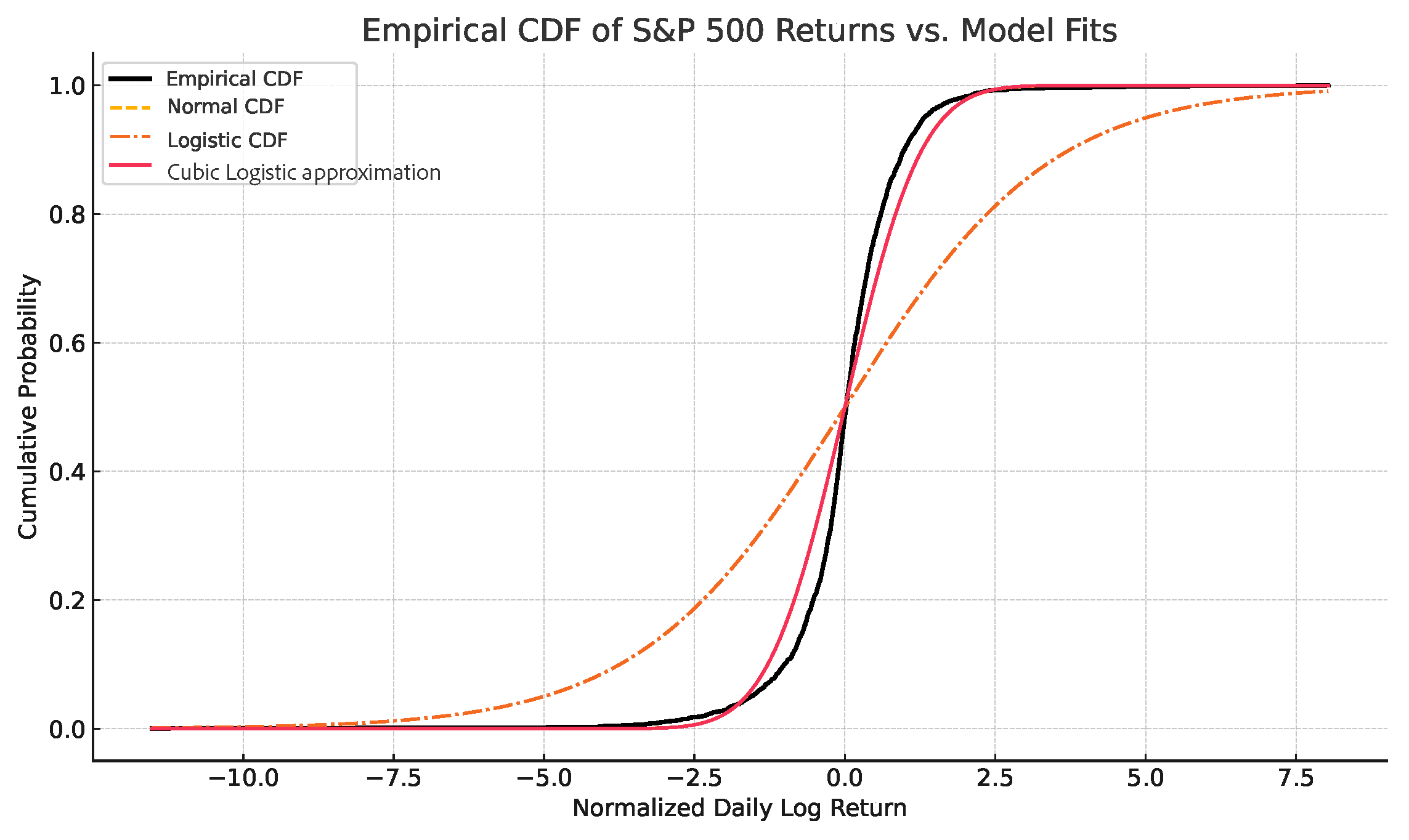
Following standardization, we compare three models fitted to the empirical distribution: the standard normal CDF, the classical logistic approximation, and the proposed cubic–logistic approximation.
Figure 4 shows the empirical CDF together with the fitted curves.
Goodness-of-fit statistics are reported in
Table 9. Over this dataset, the cubic–logistic approximation achieves the smallest KS statistic among the three models and yields improved information criteria relative to the normal and logistic fits, indicating closer agreement with the empirical distribution under these summary measures.
4.4. Biomedical Data—Glucose and Triglycerides
As a third empirical example, we consider two continuous biomarker distributions from the National Health and Nutrition Examination Survey (NHANES): fasting glucose (LBXGLU) and triglycerides (LBXTR). These variables commonly exhibit right-skewness and heavy-tail structure [
22,
25,
26].
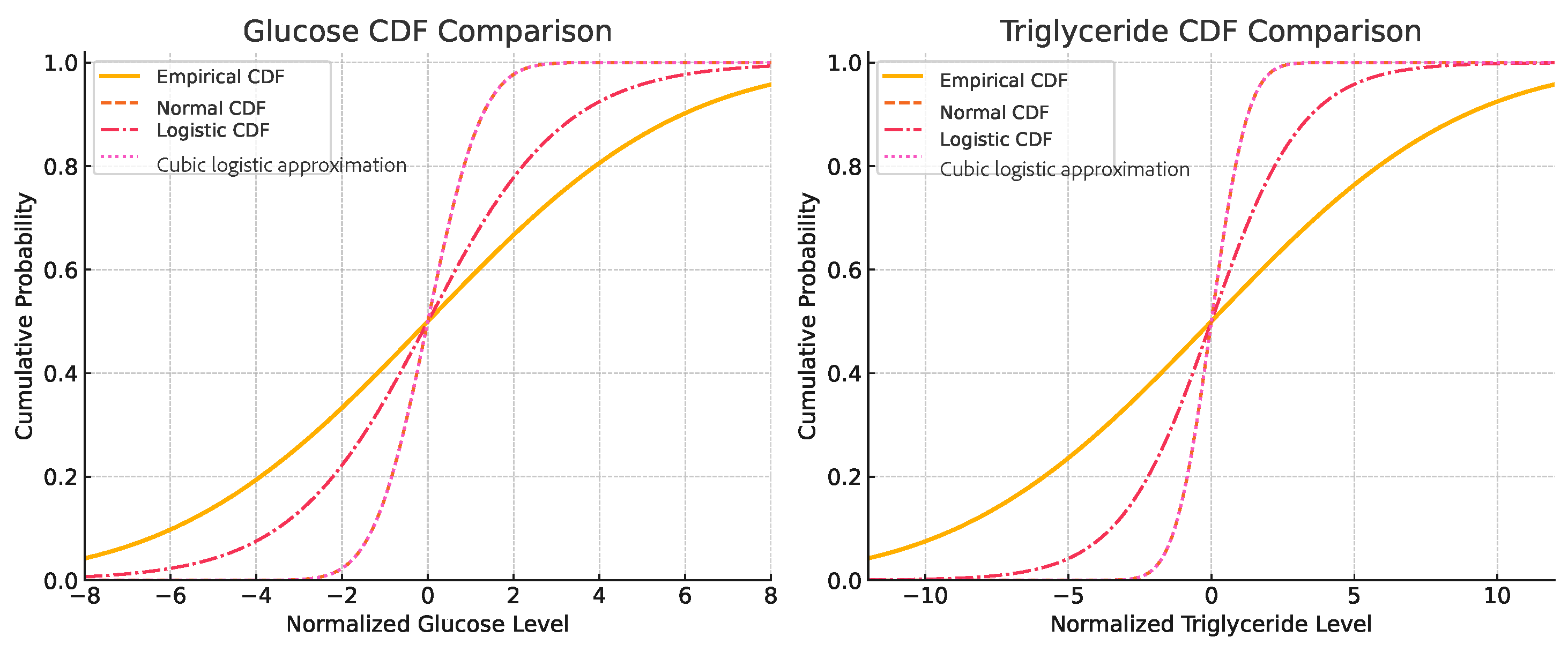
We fit the same three models as above—standard normal, classical logistic, and cubic–logistic—to the empirical distributions.
Figure 5 shows the empirical CDFs together with fitted curves for both biomarkers.
Table 10 reports AIC, BIC, and KS statistics for the three models. For these data, the cubic–logistic approximation attains the lowest AIC and BIC and substantially reduces the KS statistic relative to the normal and logistic fits, consistent with improved agreement with the empirical distribution across the full support.
4.5. Small-Sample Behavior of the Cubic–Logistic Approximation
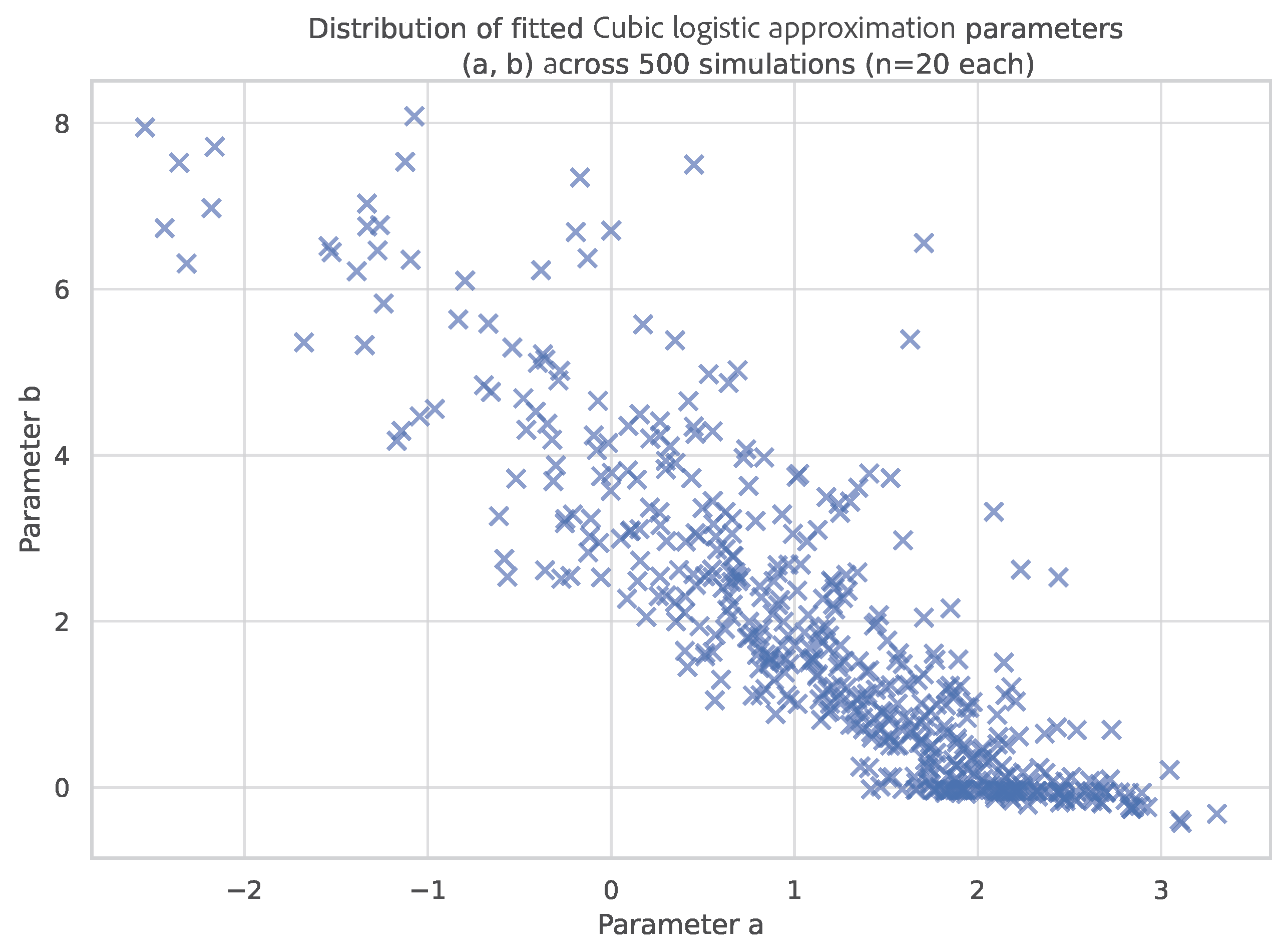
To assess parameter stability under limited sample sizes, we perform a Monte Carlo resampling study based on the standardized PM2.5 dataset used above. We generate 500 subsets of size drawn without replacement from the full dataset. For each subset, the cubic–logistic parameters are re-estimated using the Nelder–Mead algorithm, initialized at the full-sample estimates.
Figure 6 shows the empirical distributions of the fitted parameters across the 500 trials. The distribution of
is approximately symmetric and concentrated around the full-sample value, while
exhibits slightly greater dispersion with mild right-skewness. Both parameters remain well-behaved, with no evidence of multimodality or extreme outliers.
Overall, these results indicate that the cubic–logistic approximation exhibits stable parameter behavior even under small-sample conditions, with variability consistent with expected sampling uncertainty. This stability supports the practical use of the approximation in settings where data availability is limited.
5. Discussion
Having established the numerical performance of the logistic–cubic normal CDF approximation, we now discuss the broader implications of these results, focusing on practical applications and computational benefits.
The logistic–cubic normal CDF approximation developed in this work occupies a unique and practical middle ground between classical logistic sigmoid approximations and highly accurate numerical approximations such as rational or polynomial approximations. Unlike simpler logistic forms, which are analytically convenient but numerically limited, or highly accurate rational and polynomial methods, which lack invertibility, the logistic–cubic normal CDF approximation offers a balanced combination of symbolic simplicity, computational efficiency, and numerical precision. Its closed-form analytic structure is particularly valuable in modern computational and probabilistic frameworks, such as those employed in probabilistic machine learning, neural network modeling, and symbolic computation, where interpretability and analytic manipulation of functions are crucial [
27,
28].
The proposed logistic–cubic model should be viewed as an optimal low-order extension of the classical logistic approximation rather than a replacement. By incorporating a cubic term, the model achieves a marked improvement in accuracy while preserving closed-form invertibility, a property not shared by many higher-accuracy approximations.
Crucially, the practical advantages of the logistic–cubic normal CDF approximation extend beyond numerical accuracy alone. Its carefully chosen functional form—a logistic function with an embedded cubic polynomial—results in a smooth, strictly monotonic, and symmetric approximation that faithfully replicates key statistical properties of the standard normal cumulative distribution function. These structural properties are essential in applications where higher-order statistical moments and symmetry properties have analytical significance, such as higher-order statistical modeling, inference techniques sensitive to distribution shape, and analytical derivations of cumulative probability models.
Moreover, the logistic–cubic normal CDF approximation maintains full differentiability and invertibility across its entire domain. This differentiability is particularly beneficial in computational settings requiring automatic differentiation, such as gradient-based optimization algorithms, Bayesian inference frameworks, and neural network training procedures. Analytic invertibility significantly simplifies inverse computations, such as inverse transform sampling, cumulative quantile modeling, and probabilistic inference. It also ensures straightforward integration into symbolic algebra and computational statistics software, thereby enhancing its practical applicability and flexibility. The unique combination of symbolic simplicity, analytic invertibility, and numerical accuracy makes the logistic–cubic normal CDF approximation especially suited for diverse real-world scenarios. These advantages are most relevant in settings where analytic invertibility, smoothness, and symbolic tractability are required alongside reasonable numerical accuracy.
Thus, while more complex rational or polynomial approximations might occasionally deliver marginal improvements in numerical precision within narrowly defined contexts, the logistic–cubic normal CDF approximation provides an elegant and widely generalizable solution that successfully balances numerical performance, analytic convenience, and symbolic flexibility. Its potential use cases span a broad range of disciplines and computational scenarios, from symbolic artificial intelligence and statistical simulation to embedded analytics and analytical modeling frameworks, demonstrating that a closed-form and analytically invertible structure is not merely advantageous but often essential for practical and efficient real-world applications.
6. Conclusions
This paper introduced a closed-form cubic–logistic approximation to the standard normal cumulative distribution function. The proposed approximation augments the classical logistic sigmoid with a cubic polynomial term, yielding a simple two-parameter form that preserves symmetry, strict monotonicity, and analytic invertibility.
From a mathematical perspective, the approximation was constructed to satisfy key structural properties of a valid CDF while remaining analytically tractable. Numerical optimization was used to determine optimal parameters under combined uniform and average error criteria. The resulting approximation achieves substantially improved accuracy relative to the classical logistic model and performance comparable to established rational and polynomial approximations, while retaining a closed-form inverse.
Numerical experiments and illustrative empirical case studies demonstrated that the cubic–logistic approximation exhibits stable behavior across a range of distributional shapes, including skewed and heavy-tailed data. These results indicate that the approximation provides a useful balance between numerical fidelity and analytic simplicity, particularly in settings where invertibility or symbolic manipulation is required.
The proposed method is not intended to replace highly specialized numerical approximations optimized solely for minimizing approximation error over restricted domains. Rather, its contribution lies in showing that a low-degree, closed-form approximation can achieve competitive accuracy while offering analytic advantages unavailable to more complex alternatives.
Several directions for future research remain. These include extensions to multivariate settings, formal analysis of approximation error under transformations, and adaptation of the cubic–logistic framework to asymmetric or heavy-tailed target distributions. Such extensions may further expand the applicability of analytically invertible CDF approximations in computational and theoretical contexts.