Article

Feedback-Controlled Manipulation of Multiple Defect Bands of Phononic Crystals with Segmented Piezoelectric Sensor–Actuator Array


Department of Mechanical, Robotics, and Energy Engineering, Dongguk University, Seoul 04620, Republic of Korea
Mathematics 2026, 14(2), 361; https://doi.org/10.3390/math14020361
Submission received: 9 December 2025 / Revised: 18 January 2026 / Accepted: 20 January 2026 / Published: 21 January 2026
(This article belongs to the Special Issue Analytical Methods in Wave Scattering and Diffraction, 3rd Edition)

Abstract

Defect modes in phononic crystals (PnCs) provide strongly localized resonances that are essential for frequency-dependent wave filtering and highly sensitive sensing. Their functionality increases greatly when their spectral characteristics can be externally tuned without altering the structural configuration. However, existing feedback control strategies rely on laminated piezoelectric defects, which have uniform electromechanical loading that causes voltage cancellation for even-symmetric defect modes. Consequently, only odd-symmetric defect bands can be manipulated effectively, which limits multi-band tunability. To overcome this constraint, we propose a segmented piezoelectric sensor–actuator design that enables symmetry-dependent feedback at the defect site. We develop a transfer-matrix analytical framework to incorporate complex-valued feedback gains directly into dispersion and transmission calculations. Analytical predictions demonstrate that real-valued feedback yields opposite stiffness modifications for odd- and even-symmetric modes. This enables the simultaneous tuning of both defect bands and induces an exceptional-point-like coalescence. In contrast, imaginary feedback preserves stiffness but modulates effective damping, generating a parity-dependent amplification-suppression response. The analytical results closely match those of fully coupled finite-element simulations, reducing computation time by more than two orders of magnitude. These findings demonstrate that segmentation-enabled feedback provides an efficient and scalable approach to tunable, multi-band, non-Hermitian wave control in piezoelectric PnCs.

1. Introduction

Phononic crystals (PnCs) are periodic, artificially engineered structures designed to manipulate the propagation of elastic waves through mechanisms such as Bragg scattering or local resonance [1,2,3]. When periodicity is imposed at subwavelength scales, PnCs exhibit band gaps, during which elastic wave transmission is strongly suppressed or entirely inhibited. These properties enable functionalities, such as vibration isolation [4], frequency-selective filtering [5], wave guidance [6], and energy concentration [7], that are unattainable with conventional homogeneous media. Over the past two decades, PnC research has advanced rapidly from fundamental wave physics to practical applications in structural health monitoring [8], ultrasonic imaging [9], and energy harvesting [10]. These paradigms underscore the potential of PnCs as multifunctional platforms for adaptive, high-performance wave manipulation.
PnCs become more versatile beyond their intrinsic band-gap characteristics when deliberate defects are introduced into their periodic arrangement [11,12]. Defect engineering in periodic wave systems was first extensively explored in photonic crystals, where localized defect states were exploited to achieve wave confinement and filtering functionalities [13,14]. Inspired by these conceptual advances, similar defect-based strategies have been extended to PnCs. These structural or material imperfections create defect bands within the band gap where elastic waves resonate intensely around the defect site [15,16,17]. Unlike propagating passband modes, defect modes exhibit pronounced spatial confinement and high spectral selectivity [18,19,20]. This defect-induced resonance can be used for applications such as frequency-selective filters [21], ultrasensitive ultrasonic sensors [22], and high-efficiency energy harvesters [23]. This enables the realization of highly sensitive, multifunctional devices. In this context, the ability to manipulate and tailor defect bands flexibly is crucial for advancing practical PnC-based devices [24,25].
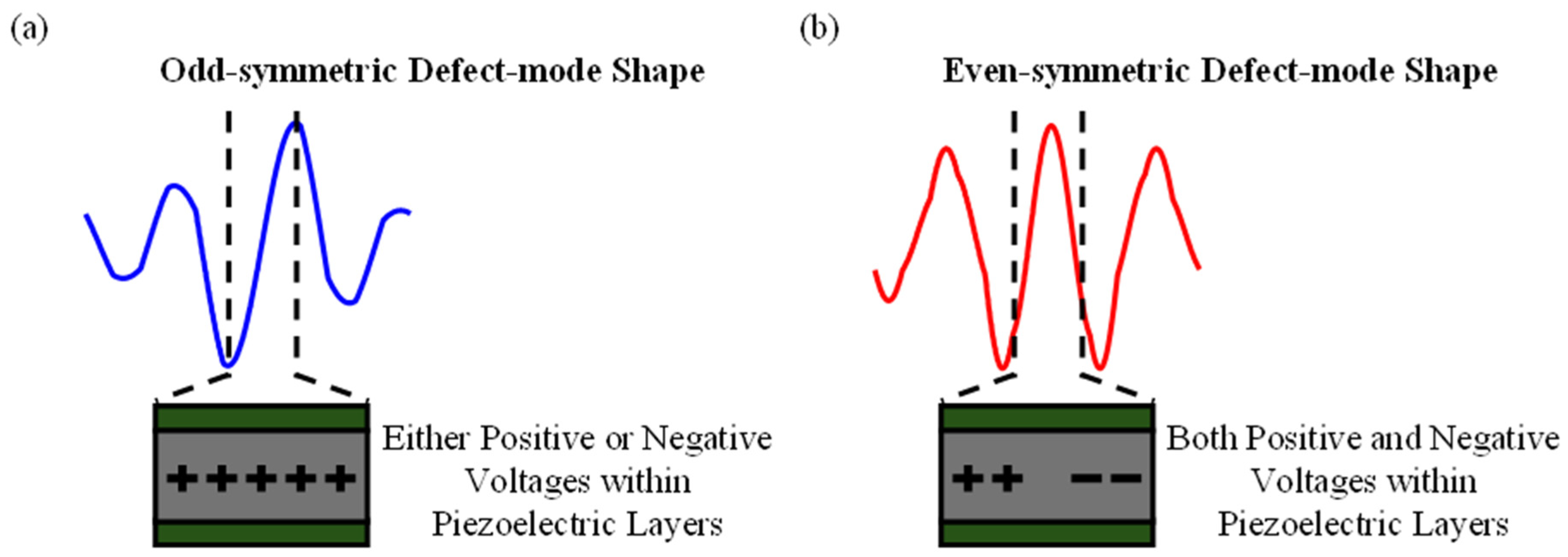
Despite their promise, the development of defective PnCs is limited by the inability to control defect bands at will. For example, in one-dimensional systems under longitudinal waves, defect modes (displacement fields) are typically classified as odd- or even-symmetric relative to the defect center, as illustrated in Figure 1. Odd-symmetric modes can be tuned via coupling piezoelectric defects with passive inductive circuits [26] or semi-active synthetic negative capacitors [27]. However, even-symmetric modes are largely insensitive to electrical control, as nearly zero net charge is induced across the electrodes. This leads to voltage cancellation, which effectively nullifies the electromechanical coupling. Consequently, most existing approaches render even-symmetric defect modes inaccessible, severely limiting the functional versatility of defective PnCs.
Additionally, passive and semi-active approaches are limited by fixed circuit parameters and cannot adapt to dynamic operating conditions. These limitations hinder the practical deployment of PnC-based devices in realistic, time-varying environments, which require robust, reconfigurable control. To overcome these barriers, active feedback systems that employ laminated piezoelectric sensor–actuator pairs around the defect have been recently explored [28]. In these designs, one layer acts as a sensor that monitors vibrations, while the other acts as an actuator that delivers compensatory control forces [29,30]. These systems offer real-time adaptability and enable dynamic tuning of odd-symmetric defect modes across the band gap. However, voltage cancellation still compromises laminated architectures, making even-symmetric defect modes difficult to control.
Within this context, we propose a feedback-controlled, segmented piezoelectric sensor–actuator array embedded at the defect site of a one-dimensional PnC. Unlike conventional laminated piezoelectric configurations, in which a single continuous piezoelectric pair is uniformly bonded over the defect region, the proposed design spatially divides the piezoelectric layers into independently wired segments that form separate sensing and actuation channels. This segmentation alleviates the voltage cancellation inherent to laminated architectures and enables symmetry-resolved electromechanical coupling with the spatial characteristics of defect modes. Within a closed-loop control framework, voltages measured at the sensor segments are processed through single- or multi-gain feedback pathways and subsequently supplied to the actuation segments. This distributed feedback modifies the local electromechanical stiffness at the defect, providing a versatile means of tuning multiple defect bands without altering the underlying mechanical structure.
To rigorously establish this concept, we formulate a mathematical framework, based on transfer matrices, with electromechanical coupling. This framework incorporates segment-level feedback directly into dispersion and transmittance analyses. We then assess the framework’s predictions using finite-element simulations. Our results demonstrate that combining segmentation with feedback restores the controllability of even-symmetric defect modes by eliminating symmetry-induced voltage cancellation. This approach also enables the concurrent manipulation of multiple defect bands. Additionally, it allows for the construction of reconfigurable narrow bandpass responses. These capabilities surpass those of conventional laminated active designs, demonstrating a robust, multi-band control strategy suitable.
The main novelties of this work are as follows:
  • A segmented piezoelectric sensor–actuator architecture that enables symmetry-resolved electromechanical coupling and active control of both odd- and even-symmetric defect modes by eliminating voltage cancellation
  • A feedback-enabled framework for simultaneously manipulating multiple defect bands within a single PnC.
  • An analytical transfer-matrix formulation incorporating complex-valued feedback gains to efficiently predict manipulated defect-band frequencies and transmittances.
The remainder of the paper is organized as follows: Section 2 introduces the segmented piezoelectric sensor–actuator configuration and its associated feedback architecture. Section 3 presents a mathematical framework that embeds segment-level feedback into dispersion and transmission analyses. Section 4 presents finite-element simulations that verify the analytical model and demonstrate feedback-enabled tuning across multiple defect bands. Section 5 concludes the study and discusses potential future work.

2. Description of Phononic Crystals with Segmented Piezoelectric Sensor–Actuator Array

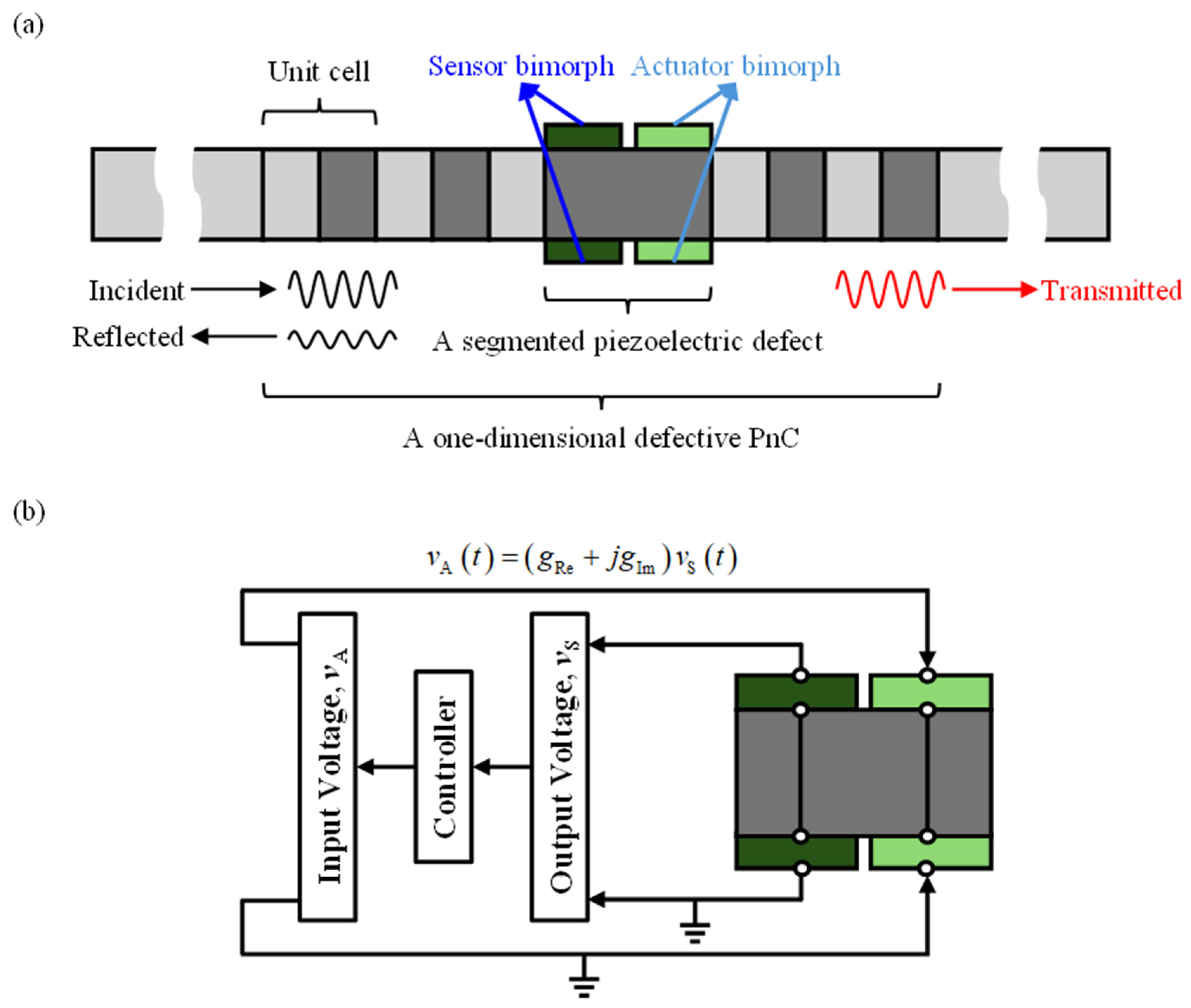
As illustrated in Figure 2a, each unit cell consists of two distinct metallic materials that are stacked alternately along the longitudinal axis. This arrangement gives rise to phononic band gaps through Bragg scattering. The host structure is modeled as a slender rod with a uniform cross-sectional area (A). It is characterized geometrically by its length (d), height (h), and width (b), The elastic properties of the constituents are defined by their mass density (ρ) and Young’s modulus (Y). Note that the analysis is restricted to longitudinal motion.
A structural defect is introduced at the D-th unit cell by altering its geometry or material composition. In a subsequent study, the length of the dark gray rod is altered. This generates one or more defect bands within the phononic band gap. Piezoelectric layers are mounted on the top and bottom surfaces of the defective rod. Each piezoelectric layer is cut in half, creating four electrically isolated segments, two on each side. The left pair of segments is connected in series to form a bimorph that functions as a sensor [31,32]. The right pair is connected to form a bimorph that functions as an actuator.
The piezoelectric layers operate in the 31-mode, in which an electric field (E) applied in the thickness direction induces in-plane strain (S). Conversely, in-plane strain generates an electric field. The electromechanical description is completed by the corresponding stress (T) and electric displacement (D) [33,34]. Additional material properties considered are the piezoelectric coupling coefficient (eP) in the 31-mode and the dielectric constant ( ε P S ) under constant strain. The layers are assumed to be thin enough to ensure a uniform electric field distribution. Perfect bonding between the piezoelectric layers and the host structure is also assumed, as are stress-free outer surfaces of the piezoelectric layers. Thin metallic electrodes are attached to the outer surfaces of the piezoelectric layers to enable electrical sensing and actuation. The equivalent parameters do not explicitly include their mass and stiffness because the electrodes are much thinner than the host structure and piezoelectric layers, and their mechanical contribution is negligible within the considered frequency range.
Mathematically, the sensing voltage can be interpreted as the inner product of the strain field and the electrode’s spatial weighting function. For a laminated electrode, the weighting function is usually assumed to be uniform. In this case, the sensing operation reduces to an L2 inner product over the defect region. Consequently, defect modes whose strain distributions exhibit sign changes over symmetric subdomains yield vanishing or near-zero voltage due to cancellation. In the segmented configuration, each electrode segment introduces a localized weighting function supported on a subdomain of the defect. Consequently, the actuating and sensing operations becomes a set of localized inner products that preserve the contribution of local strain polarity and remain nonzero for both odd- and even-symmetric defect modes.
When a longitudinal wave passes through a defective PnC, the localized strain around the defect creates voltages in the sensor bimorph. The sensor voltage is proportional to the average strain across the corresponding segments. An external feedback controller processes these voltages, weights them by predefined gain values, and applies them to the actuator bimorph. The actuator bimorph then injects compensatory strain into the defective region. The basic relationship can be expressed as vA(t) = (gRe + jgIm)vS(t), where vA(t) is the actuator input voltage, vS(t) is the sensor output voltage, and gRe + jgIm is the complex-formed feedback gain. This description is schematically provided in Figure 2b. In addition, the feedback gains considered in this study are introduced to analyze steady-state frequency-domain responses under bounded harmonic excitation within a linearized framework. Accordingly, the analysis is restricted to purely real and purely imaginary gains and does not constitute a comprehensive time-domain closed-loop stability analysis.
For clarity, subscripts are summarized in Table 1. Note that this work employs a single midline segmentation; thus, a scalar feedback gain is sufficient to describe the sensor–actuator relationship. However, incorporating multiple segmentation lines would transform the framework into vector-matrix form, enabling independent feedback control across all segments [35,36]. Although the single-segmentation configuration can resolve modal parity and control the first two defect bands, higher-order defect modes with more complex spatial strain distributions may require multi-segment architectures to fully exploit spatially selective electromechanical coupling.

3. Transfer Matrix-Based Analytical Formulation

3.1. Governing Equations and Corresponding Solutions

The analytical formulation begins with the establishment of the electromechanically coupled governing equations for the piezoelectric defect. According to classical rod theory, the axial displacement field is uniform across any cross-section parallel to the yz-plane. Thus, the displacements of the sensing and actuating segments are written as uPD,L(xPD,L, t) and uPD,R(xPD,R, t), where x represents the spatial coordinate and t denotes time. The electric currents in response to sensing and actuation voltages are represented by iS(t) and iA(t), respectively.
The extended form of Hamilton’s principle is used [37,38,39]. Since the electric fields (EPD,L and EPD,R) are spatially uniform, incorporating them directly into the variational formulation would cause their spatial derivatives, and further the piezoelectric coupling terms, to vanish. To retain the spatial electromechanical forcing, each electric field is multiplied by a boxcar function that restricts the fields to the physical extent of the piezoelectric layers. They are expressed by EPD,LΠPD,L(xPD,L; 0, dPD,L) and EPD,RΠPD,R(xPD,R; 0, dPD,R). This representation has been widely used and validated in previous PnC studies [40,41]. In the variational formulation based on Hamilton’s principle, the spatial derivatives of the electric field are reflected through the distributional derivative of the boxcar function. This gives rise to Dirac delta terms at the boundaries of the piezoelectric defects, as detailed in the cited literature. The resulting variational formulation includes kinetic energy, strain energy, dielectric energy, and piezoelectric coupling energy of the piezoelectric defect. Referring to previous studies on defect-incorporated piezoelectric sensors [42] and actuators [43], the following set of coupled field equations is employed to describe the mechanical and electrical responses:
( ρ A ) PD 2 u PD , L t 2 YA PD 2 u PD , L x PD , L 2 = κ P v S d PD , L d x PD , L 0 = C PD , L 2 d v S dt + κ P t u PD , L d PD , L , t u PD , L 0 , t
( ρ A ) PD 2 u PD , R t 2 YA PD 2 u PD , R x PD , R 2 = κ P g Re + j g Im v S d PD , R d x PD , R i A t = C PD , R g Re + j g Im 2 d v S dt + κ P g Re + j g Im t u PD , R d PD , R , t u PD , R 0 , t
where 0 < xPD,L < dPD,L and 0 < xPD,R < dPD,R. In this context, the controller gain, gRe + jgIm, enters directly into the actuation terms. For brevity, the governing equations are written using equivalent mechanical and electrical parameters. These parameters are defined as follows: the equivalent mass per unit length ((ρA)PD), the equivalent axial stiffness ((YA)PD), the equivalent mechanical impedance (ZPD), the equivalent wavenumber (βPD), the capacitances of the left and right piezoelectric layers (CPD,L and CPD,R), and the electromechanical coupling coefficient (κP). Their explicit expressions are given below:
ρ A PD = b PnC ρ D h PnC + 2 ρ P h P YA PD = b PnC Y D h PnC + 2 Y P h P Z PD = b PnC ρ D h PnC + 2 ρ P h P Y D h PnC + 2 Y P h P β PD = ω ρ D h PnC + 2 ρ P h P Y D h PnC + 2 Y P h P C PD , L = ε S w PnC d PD , L h P , C PD , R = ε S w PnC d PD , R h P κ P = e P b PnC
The left sides of Equations (1) and (2) describe longitudinal wave dynamics. Unlike laminated configurations, where both piezoelectric layers contribute to a single excitation, the segmented architecture maintains the electrical independence of the sensor and actuator bimorphs. Consequently, the mechanical responses of the two segments are driven separately by the voltages of the sensor and actuator on the right sides. The second lines of Equations (1) and (2) characterize the electrical responses of the sensor and actuator bimorphs. In the sensor bimorph, the open-circuit condition eliminates electrical current, reducing the electrical circuit equation to a voltage expression driven solely by deformation. In contrast, the actuator bimorph produces current. However, this current does not influence the mechanical equations or the feedback law. Therefore, it is included here only for completeness.
A key aspect of the present formulation is the two-stage analysis. First, solving Equation (1) yields the sensor-segment displacement and sensing voltage. Then, the sensing voltage is used through the feedback relation to prescribe the actuation voltage in Equation (2). Consequently, the dynamics of the actuator segment become an explicit function of the sensor-segment solution. To derive closed-form expressions, all field variables are expressed in time-harmonic form (^) as follows:
u PD , L x PD , L , t = u ^ PD , L x PD , L e j ω t u PD , R x PD , R , t = u ^ PD , R x PD , R e j ω t v S t = v ^ S e j ω t
This representation converts the first lines of Equations (1) and (2) into ordinary differential equations in space. The resulting displacement field naturally separates into homogeneous and nonhomogeneous parts. The homogeneous part corresponds to the standard longitudinal wave propagation. The nonhomogeneous part originates from two piezoelectrically induced forces acting at each boundary. Due to the spatial localization introduced by the boxcar function, these forces appear as spatially concentrated Dirac impulses. Thus, the nonhomogeneous contribution can be obtained analytically using the Green’s function of the longitudinal wave operator [44]. Superposing Green’s solution with the homogeneous wave components yields the complete displacement field:
u ^ PD , L x PD , L = P PD , L e - j β PD x PD , L + Q PD , L e j β PD x PD , L + κ P v ^ S 2 j ω Z PD e - j β PD x PD , L e j β PD x PD , L d PD , L u ^ PD , R x PD , R = P PD , R e - j β PD x PD , R + Q PD , R e j β PD x PD , R + κ P g Re + j g Im v ^ S 2 j ω Z PD e - j β PD x PD , R e j β PD x PD , R d PD , R
To determine the sensor voltage, the displacement solution in first line of Equation (5) is substituted into the electrical circuit equation from the second line of Equation (1). Under time-harmonic motion, the time derivative simplifies to . This causes the voltage to depend solely on the displacement difference between the two ends of the sensing segment. Thus, the voltage represents the net extension of the sensing segment induced by the superposition of the homogeneous and nonhomogeneous components, as summarized in:
v ^ S = P PD , L e j β PD d PD , L 1 + Q PD , L e j β PD d PD , L 1 C PD , L 2 κ P + κ P 1 e j β PD d PD , L j ω Z PD
Complete time-harmonic solutions are obtained for both segments after substituting the voltage expression from Equation (6) into the displacement field from Equation (5). The sensor segment contains only two undetermined coefficients (PPD,L and QPD,L), while the actuator segment introduces two additional coefficients (PPD,R and QPD,R), which are associated with its independent longitudinal propagation. The next section covers handling these additional coefficients.
Subsequently, the displacement field for the remaining rods adheres to the standard longitudinal wave form, as these regions lack electromechanical coupling. Each rod supports homogeneous wave propagation, which is composed of right- and left-traveling components. This is expressed as follows:
u ^ i x = P i e j β i x i + Q i e j β i x i β i = ω ρ i Y i
where 0 < xi < di and i belongs to {UL, UD, SL, SD} [13,14].

3.2. Predictions in Band Structure and Transmittance Analyses

The band-structure and transmittance characteristics are evaluated using the transfer-matrix framework. Each substructure is described by a 2 × 2 velocity–force transfer relation, which propagates the state vector across the corresponding substructure. Multiplication of these substructure-level matrices in their physical order yields the transfer matrix of the unit cell or defective supercell. This matrix is then used to compute the dispersion relation via the Bloch–Floquet condition (band-structure analysis) [45] and evaluate the frequency-dependent transmittance value (transmittance analysis).
In this formulation, the time-harmonic displacement fields are converted into velocity ( w ^ x ) through temporal differentiation and into axial force ( f ^ x ) through spatial differentiation. This conversion is straightforward for metallic substructures, which only support longitudinal motion. In contrast, the piezoelectric defect introduces an additional electromechanical contribution to the axial force through the coupled voltage field [44,46]. The resulting state expressions are summarized below:
w ^ i x i = j ω u ^ i , f ^ i x i = Y i A PnC d u ^ i d x i w ^ PD , L x PD , L = j ω u ^ PD , L , f ^ PD , L x PD , L = YA PD d u ^ PD , L d x PD , L + κ P v ^ S w ^ PD , R x PD , R = j ω u ^ PD , R , f ^ PD , R x PD , R = YA PD d u ^ PD , R d x PD , R + κ P g Re + j g Im v ^ S
The velocity–force pair forms the state vector [ w ^ x , f ^ x ]T. For a substructure of length d, this state vector propagates according to the transfer relation:
w ^ d f ^ d = TM w ^ 0 f ^ 0
In Equation (8), the displacement field of each metallic substructure is written as a linear combination of the wave coefficients Pi and Qi, where the exponential terms carry the spatial variation. For the sensing segment, the voltage v ^ S in Equation (6) is itself a linear combination of PPD,L and QPD,L. Hence, its displacement field depends only on these two coefficients. The actuating segment contains a homogeneous contribution with its own coefficients (PPD,R and QPD,R) and a nonhomogeneous contribution driven by v ^ S , but continuity of axial velocity and force across the sensor–actuator interface eliminates the apparent independence of the actuator-side coefficients. This reduces them to linear combinations of the sensing-side coefficients. Consequently, the entire displacement field of the piezoelectric defect region—including the sensing and actuating segments—is governed exclusively by the two coefficients, PPD,L and QPD,L. The corresponding axial velocity and axial force can therefore be expressed in terms of these displacement coefficients as follows:
w ^ i x i f ^ i x i = FM i x i P i Q i w ^ PD , L x PD , L f ^ PD , L x PD , L = FM PD , L x PD , L P PD , L Q PD , L w ^ PD , L x PD , L f ^ PD , R x PD , R = FM PD , R x PD , R g Re g Im P PD , L Q PD , L
where FM(x) is the field-mapping matrix relating the displacement coefficients to the local velocity–force state. For a substructure of length d, the state vectors at x = 0 and x = d are expressed in terms of the same displacement-coefficient vector. Eliminating these coefficients yields the standard transfer representation as follows:
TM i = FM i d i FM i 0 1 TM PD , L = FM PD , L d PD , L FM PD , L 0 1 TM PD , R g Re , g Im = FM PD , R d PD , R FM PD , R 0 1
Once the transfer matrices at the substructure level are established, the transfer matrix of a pristine unit cell can be obtained by multiplying the matrices of its metallic substructures in physical order. This yields the unit cell-level matrix TMunit in Equation (12). Similarly, for the defective configuration, the corresponding supercell-level matrix, TMPnC, is constructed. These unit-cell and supercell-level matrices serve as the building blocks for determining the band gaps and defect bands. Applying the Bloch–Floquet conditions to each matrix yields the eigenvalue problems in Equation (13). The band gap and feedback-dependent defect bands are obtained from these problems given below [47,48]:
TM unit = TM UD TM UL TM PnC g Re , g Im = TM unit N L TM PD , R g Re , g Im TM PD , L TM UL TM unit L 1
TM unit e j β l unit w ^ unit 0 f ^ unit 0 = 0 TM PnC g Re , g Im e j β l PnC w ^ PnC 0 f ^ PnC 0 = 0
To characterize the dispersion relations, the eigenvalues from Equation (13) are evaluated over the normalized Bloch wavenumber, (βl)unit and (βl)PnC, from zero to π. For the pristine unit cell, the first line of Equation (13) determines the frequency intervals in which no real Bloch wavenumber exists. This identifies the band-gap regions. After identifying the band gaps, the second line of Equation (13) is used to determine the defect-band frequencies of the defective supercell. These frequencies appear as isolated eigenvalues that remain invariant with respect to the real normalized Bloch wavenumber. This sequential evaluation—first identifying band gaps through the compact unit cell model, then locating defect states in the supercell—is a computationally efficient alternative to a full-scale dispersion analysis over a broad frequency range [49,50].
For each defect-band frequency obtained from the second line of Equation (13), the corresponding eigenvector determines the axial velocity and force at the left boundary of the defective supercell. These boundary quantities determine the two displacement-coefficient amplitudes in the first substructure, which define its displacement field uniquely. Enforcing velocity and force continuity across interfaces yields the boundary conditions for the next substructure, enabling evaluation of its displacement field in the same manner. Repeating this process for all substructures reconstructs the complete displacement field, called the defect mode. Other field quantities, such as strain or stress, can be computed in a similar manner once the full displacement distribution is obtained.
Next, we evaluate the transmission behavior using an S-parameter method, coupling the defective PnC to two semi-infinite host media. This configuration eliminates unwanted reflections from truncated boundaries, ensuring that the resulting spectrum reflects only the intrinsic response of the PnC. In the left host medium (SL), the displacement field decomposes into incident and reflected components. In the right host medium (SR), only a transmitted component exists:
u ^ SL x SL = P SL e j β SL x SL + Q SL e j β SL x SL u ^ SR x SR = P SR e j β SR x SR
where xSL < 0 and xSR > 0. The wave amplitudes (PSL, QSL, and PSR) are related by the following equation, which is obtained by enforcing continuity of axial velocity and force across the structure [51,52]:
P SR 0 = FM SR 1 TM PnC FM SL P SL Q SL = SM PnC P SL Q SL
According to the standard S-parameter definition, transmittance and reflectance are defined as the ratio of the transmitted (T) and reflected (R) mechanical power to the incident mechanical power:
T = P SR P SL 2 = det SM PnC SM PnC 2 , 2 2 R = Q SL P SL 2 = SM PnC 2 , 1 SM PnC 2 , 2 2
The global scattering matrix explicitly incorporates feedback gains. Thus, the resulting S-parameter response captures shifts in defect-band frequencies dependent on complex-valued gain, variations in inter-mode spacing, changes in transmittance values, and relevant sharpness. This scattering-based formulation is a compact, robust tool for analyzing the tunability of multi-bands in feedback-controlled defective PnCs.

4. Validation of Feedback-Induced, Multi-Band Tunability

4.1. Numerical Setting

To validate the proposed feedback-controlled segmented architecture, a one-dimensional defective PnC composed of alternating aluminum and steel rods is considered. This structure alternates between light gray aluminum rods, with a density of ρUL = 2700 kg·m−3 and a Young’s modulus of YUL = 70 GPa, and dark gray steel rods, with a density of ρUD = 7850 kg·m−3 and a Young’s modulus of YUD = 200 GPa. A defect is introduced at the third unit cell, and PZT-5H layers are attached to the upper and lower surfaces of the defective rod. The material parameters are ρP = 7500 kg·m−3, YP = 60.6 GPa, eP = −16.6 C·m−2, and ε P S = 25.55 nF·m−1. These values are extracted from the COMSOL Multiphysics 6.1 datasheet. Owing to the strong electromechanical coupling of PZT-5H, both odd- and even-symmetric defect modes can interact with the segmented bimorph configuration.
The pristine PnC consists of five unit cells (N = 5), with each rod measuring lUL = lUD = 50 mm in length. A defect is introduced in the third unit cell (L = 3), setting the total piezoelectric defect length to lPD = 140 mm. In this context, the sensor and actuator portions occupy lPD,L = lPD,R = 70 mm, respectively. The defective PnC has a cross-sectional width of wPnC = 10 mm and a height of hPnC = 10 mm, and the piezoelectric layers have a thickness of hP = 0.5 mm.
The proposed formulation is implemented in MATLAB R2025a to compute dispersion curves, defect-band frequencies, defect-mode shapes, and transmission responses under various feedback gains. To benchmark and validate the results, a fully coupled finite-element model is developed in COMSOL Multiphysics 6.1. Due to its high-fidelity multiphysics coupling and well-established numerical accuracy, the COMSOL-based finite-element model is adopted as the reference solution. All computations are performed on a workstation equipped with an Intel® Core™ i9-13900KF CPU, a GeForce RTX 3060 GPU (12 GB), 32 GB of DDR5-4800 MHz memory, and a Gigabyte B760M Aorus Elite motherboard. By comparing analytical predictions with reference finite-element results, we can systematically assess the predictive accuracy, computational efficiency, and physical validity of the transfer-matrix formulation and the proposed segmented piezoelectric sensor–actuator architecture under feedback control.
In COMSOL Multiphysics 6.1, two-dimensional models are used for eigenfrequency and frequency-domain analyses. Linear elastic materials are modeled using isotropic elasticity, and piezoelectric sensors and actuators are described by fully coupled piezoelectric constitutive relations. The solid mechanics, electrostatics, and electric circuit modules are solved simultaneously through the multiphysics coupling interface. Quadratic finite elements are used to discretize the displacement and electric potential fields. The mapped mesh strategy is adopted, and mesh convergence is verified by progressively refining the element size until variations in defect-band frequencies and transmission amplitudes fall below 1%. Based on this convergence study, a maximum element size of 1 mm is used in all simulations. Unless otherwise specified, all external boundaries are treated as traction-free. For eigenfrequency analysis, Floquet periodic boundary conditions are applied to represent the periodic PnC. In frequency-domain simulations, the incident, reflected, and transmitted regions are modeled explicitly, and continuity conditions are enforced at all interfaces. Perfectly matched layers are introduced at the domain boundaries to suppress artificial wave reflections. Their lengths are chosen to be several times the unit cell length to ensure accurate wave attenuation. The electrostatic module incorporates charge conservation, ground, and terminal conditions to model segmented piezoelectric sensing and actuation. The electric circuit module implements electrical feedback using voltage-controlled voltage sources, enabling independent control of the real- and imaginary-valued feedback gains. Note that, for eigenfrequency analysis, dispersion relations are computed by discretizing the wavenumber domain into 50 uniformly spaced points within the first Brillouin zone. In frequency-domain analysis, transmission responses are obtained by sweeping the excitation frequency with a 10 Hz resolution.
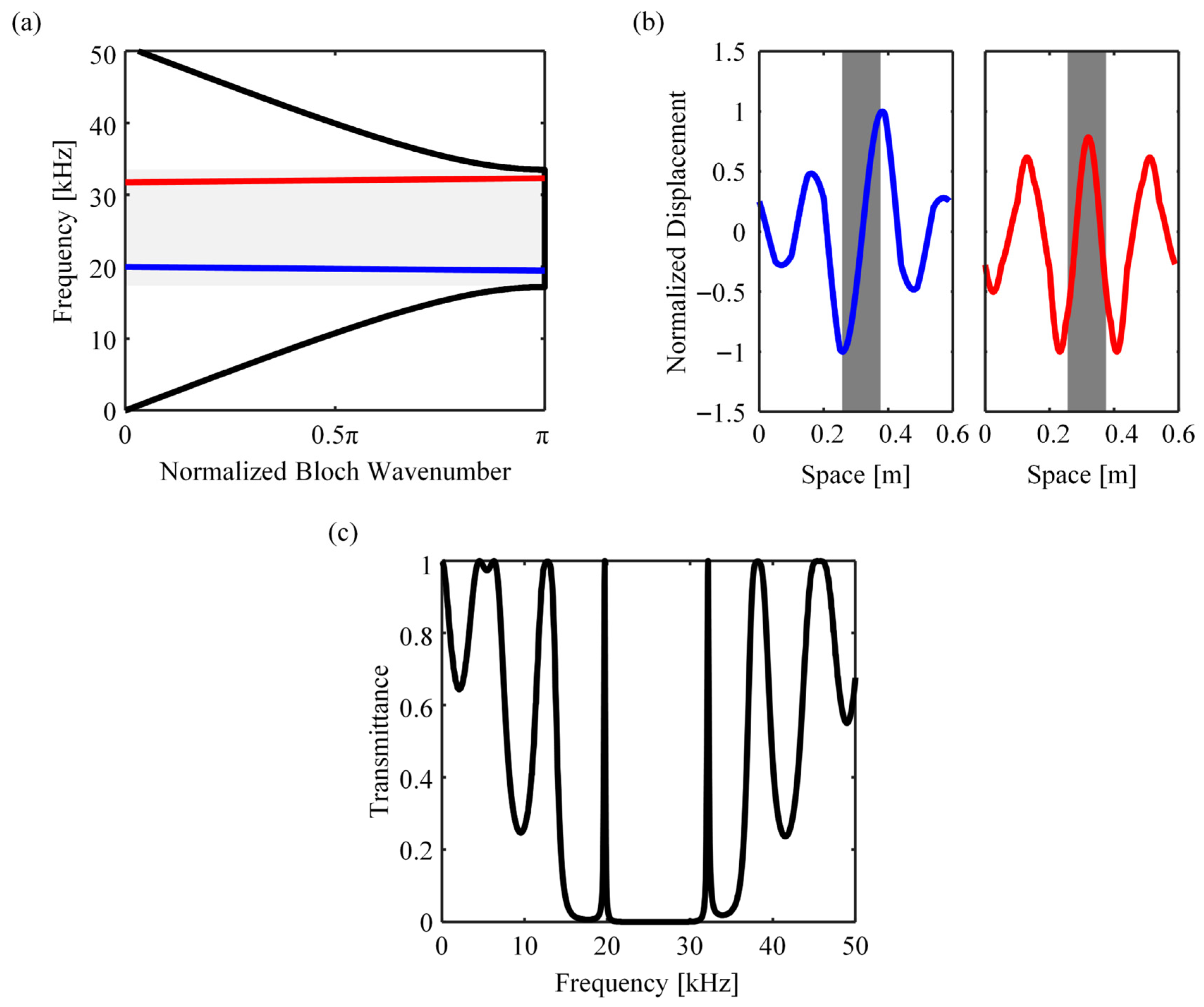
Before applying feedback control, the passive short-circuit condition is examined to establish a baseline response. Figure 3a shows the analytically predicted band structure of the pristine configuration. A distinct band gap appears between 17.2 kHz and 33.5 kHz. Within this gap, two isolated eigenfrequencies emerge: 19.7 kHz and 32.2 kHz. These eigenfrequencies correspond to the localized defect modes. Their associated spatial distributions are plotted in Figure 3b. The lower-frequency mode exhibits odd symmetry, while the upper-frequency mode exhibits even symmetry about the defect center. Figure 3c illustrates the transmission spectrum, which shows two sharp resonance peaks within the band gap at frequencies that match the defect bands.
The impedance mismatch between the constituent materials determines the depth and width of the band gap, as well as the degree of defect-mode localization. Although a larger impedance contrast can enhance localization and increase the magnitude of defect-band frequency shifts, the tuning mechanisms and trends demonstrated in this study are governed by defect properties and the segmented feedback architecture. Therefore, they are robust to variations in impedance contrast.

4.2. Validation Result and Discussion

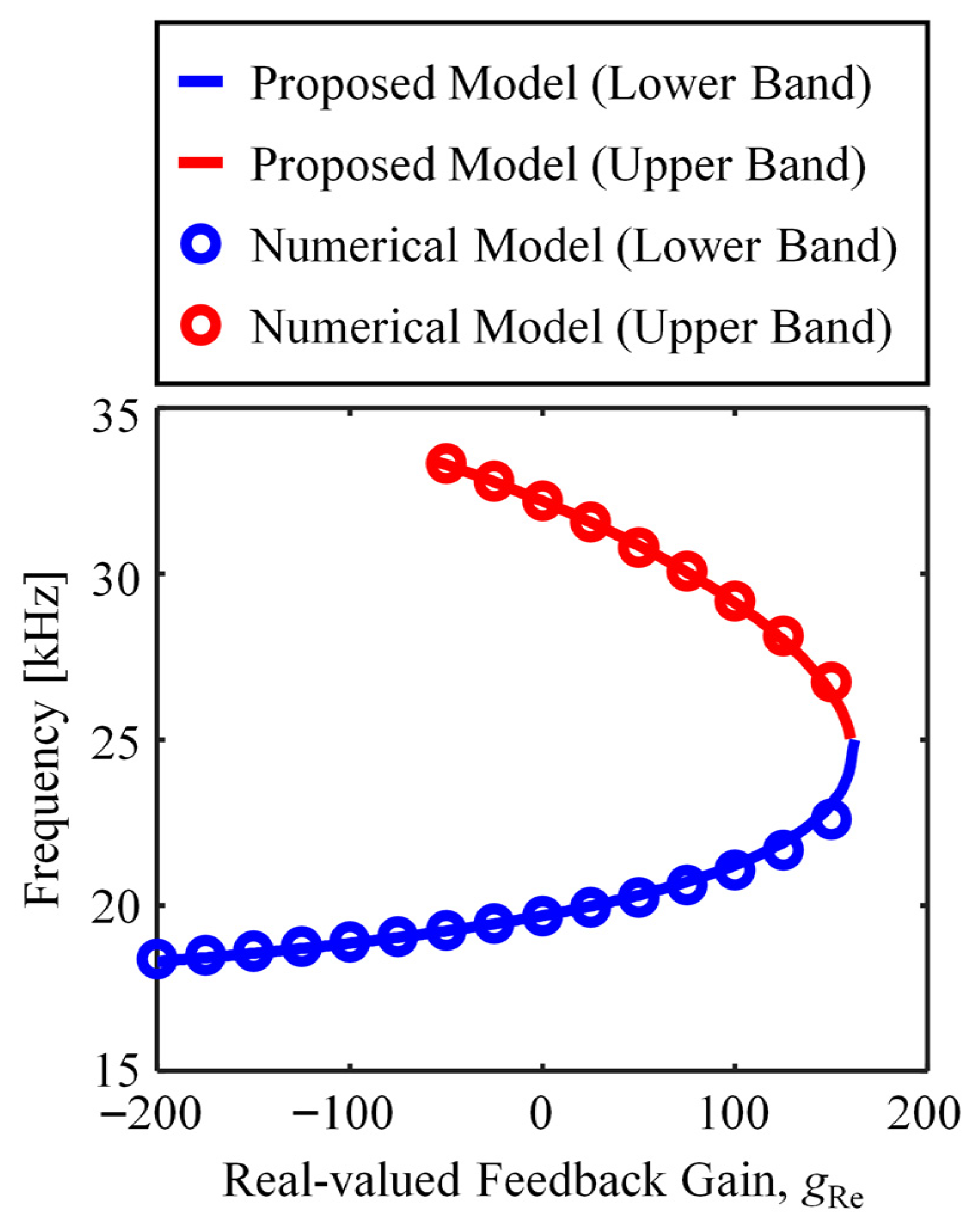
In Figure 4, the two bands exhibit contrasting tuning trends: the lower-frequency band increases monotonically with positive gain, while the higher-frequency band decreases. These contrasting trajectories stem directly from the strain symmetries of the two modes and how the real-valued feedback modifies the effective stiffness of the piezoelectric defect. The lower defect band exhibits an even-symmetric strain field. Therefore, both piezoelectric segments experience nearly identical deformation and generate sensor voltages of the same sign. Under positive real gain, the actuator voltage follows this polarity. However, because PZT-5H has a negative piezoelectric coefficient (eP = −16.6 C·m−2), the resulting electromechanical force opposes the measured strain. This effectively stiffens the defect region and raises the associated defect-band frequency. In contrast, the upper defect band has an odd-symmetric strain field, producing strains of opposite signs in the two segments. With the same real gain, the actuator voltage reverses sign across the defect, reinforcing the antisymmetric deformation and reducing the effective stiffness. This lowers the corresponding defect-band frequency. Thus, real-valued feedback imposes mode-selective stiffness modulation, driving the two defect bands in opposite directions.
As these opposing trends increase, the two defect bands gradually converge. Eventually, they merge at a non-Hermitian degeneracy, or exceptional point, where the eigenvalues and eigenvectors collapse into a single defect state. This indicates a loss of modal orthogonality [53,54]. Beyond the exceptional point, the Bloch wavenumber associated with the merged state becomes purely imaginary. This marks a transition from a propagating-type localized resonance to an evanescent defect mode. Thus, the disappearance of the defect bands in the dispersion relation reflects the collapse of the resonant pathways supported by the defect due to the non-Hermitian interaction induced by real feedback.
It is important to note that this symmetry-dependent tuning behavior cannot be achieved in conventional laminated piezoelectric designs. In laminated configurations, a single continuous piezoelectric layer integrates strain across the entire defect region. This causes the sensor outputs associated with even-symmetric modes to cancel out due to opposing strain contributions. Consequently, the even-symmetric defect mode becomes largely insensitive to real-valued feedback gain, and only odd-symmetric modes can be effectively tuned. In contrast, the proposed segmented architecture preserves local strain polarity by sensing and actuating each segment independently. This symmetry-resolved electromechanical coupling allows for the simultaneous tuning of both defect bands, which is essential for achieving multi-band active control and highlights the importance of segmentation.
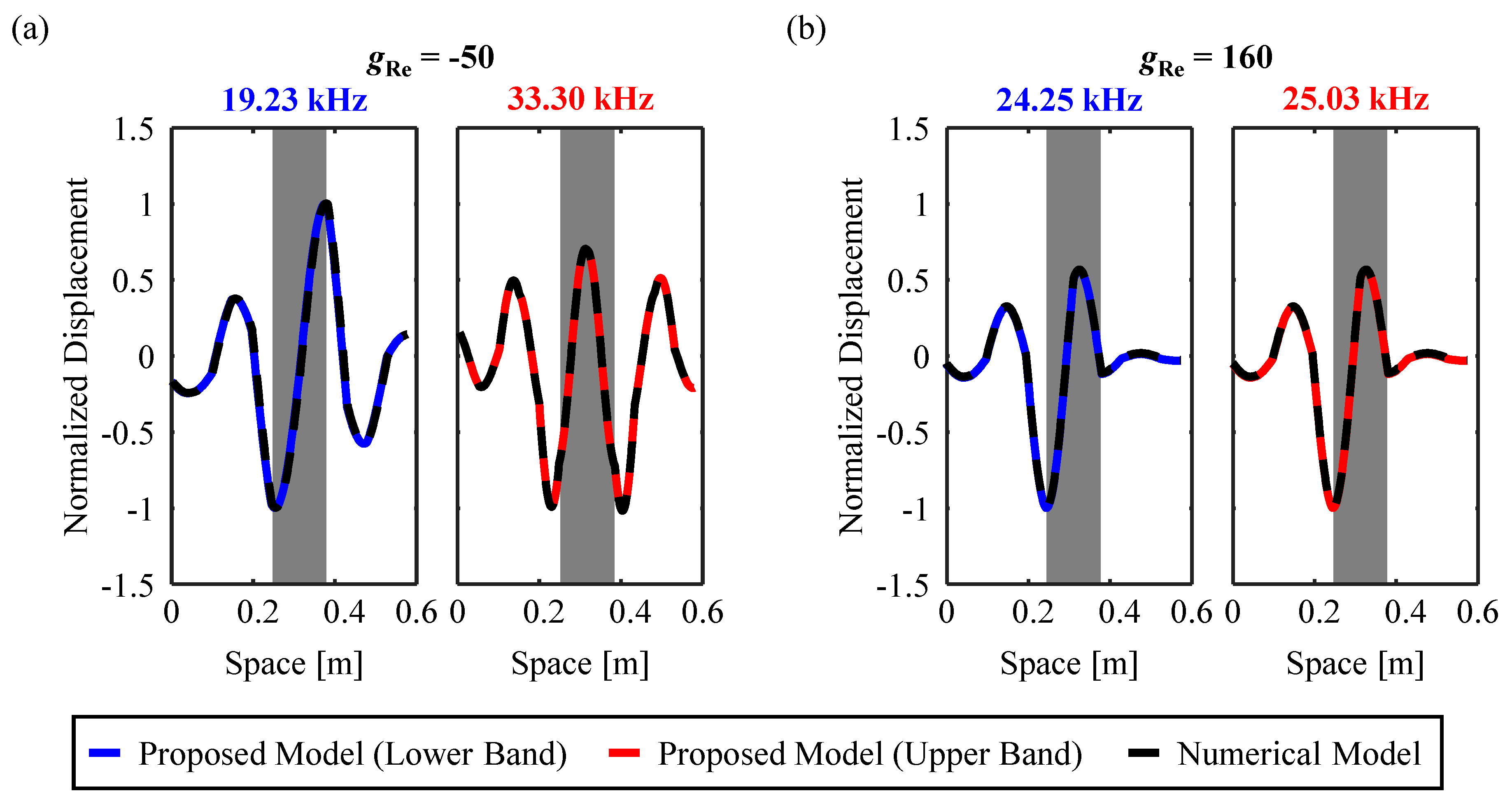
Figure 5a depicts the defect-mode shapes at a modest gain level (e.g., gRe = −50). In this regime, feedback has a minimal impact, and both modes predominantly maintain their passive short-circuit characteristics (see Figure 3b). The lower-frequency mode remains odd-symmetric, and the higher-frequency mode remains even-symmetric. There are only slight variations due to the small feedback-induced stiffness perturbation. In contrast, Figure 5b shows that the defect-mode shapes significantly deform as gRe approaches the exceptional point. The feedback-modified stiffness landscape becomes indistinguishable between the two patterns, eliminating the mechanical contrast that originally separated the modes. Consequently, their spatial distributions converge to a common shape immediately before modal collapse. This eigenvector coalescence is a defining signature of non-Hermitian modal degeneracy. This demonstrates that the proposed segmented architecture permits exceptional-point physics, despite not being explicitly PT-symmetric. To the author’s knowledge, this is the first comprehensive demonstration of feedback-induced, exceptional-point-like behavior in defective PnCs. Note that the term ‘exceptional-point-like’ indicates a phenomenological similarity observed in the frequency-domain wave response under real-valued excitation. Since the transfer-matrix formulation adopted in this study treats frequency as an input parameter rather than an eigenvalue, rigorously identifying an exceptional point based on complex eigenfrequency branch points is beyond its scope.
This exceptional point-driven collapse is fundamentally unattainable in conventional laminated piezoelectric designs. Laminated actuators apply a uniform electromechanical load across the defect, which prevents the left-right differential response necessary for opposite stiffness modulation. Without this spatial asymmetry, odd- and even-symmetric modes experience identical stiffness perturbations and cannot be driven toward coalescence. The segmented architecture overcomes this limitation by coupling the feedback force directly to the strain parity of each mode to produce opposite stiffness adjustments. Therefore, segmentation is not only a mechanism that enhances tunability; it is also a structural prerequisite for achieving non-Hermitian mode collapse and exceptional point-like behavior in piezoelectric defective PnCs.
Note that the exceptional-point-like coalescence observed in this study does not originate from a single, precisely tuned parameter value, but rather from the continuous interaction of odd- and even-symmetric defect modes, which is induced by feedback-controlled electromechanical coupling. As the real-valued feedback gain varies, the two defect bands approach, coalesce, and separate over a finite gain range. This indicates that moderate parameter variations primarily shift the location of coalescence rather than suppressing the underlying interaction. The close agreement between analytical predictions and finite-element simulations confirms the robustness of the proposed model against modeling uncertainties.
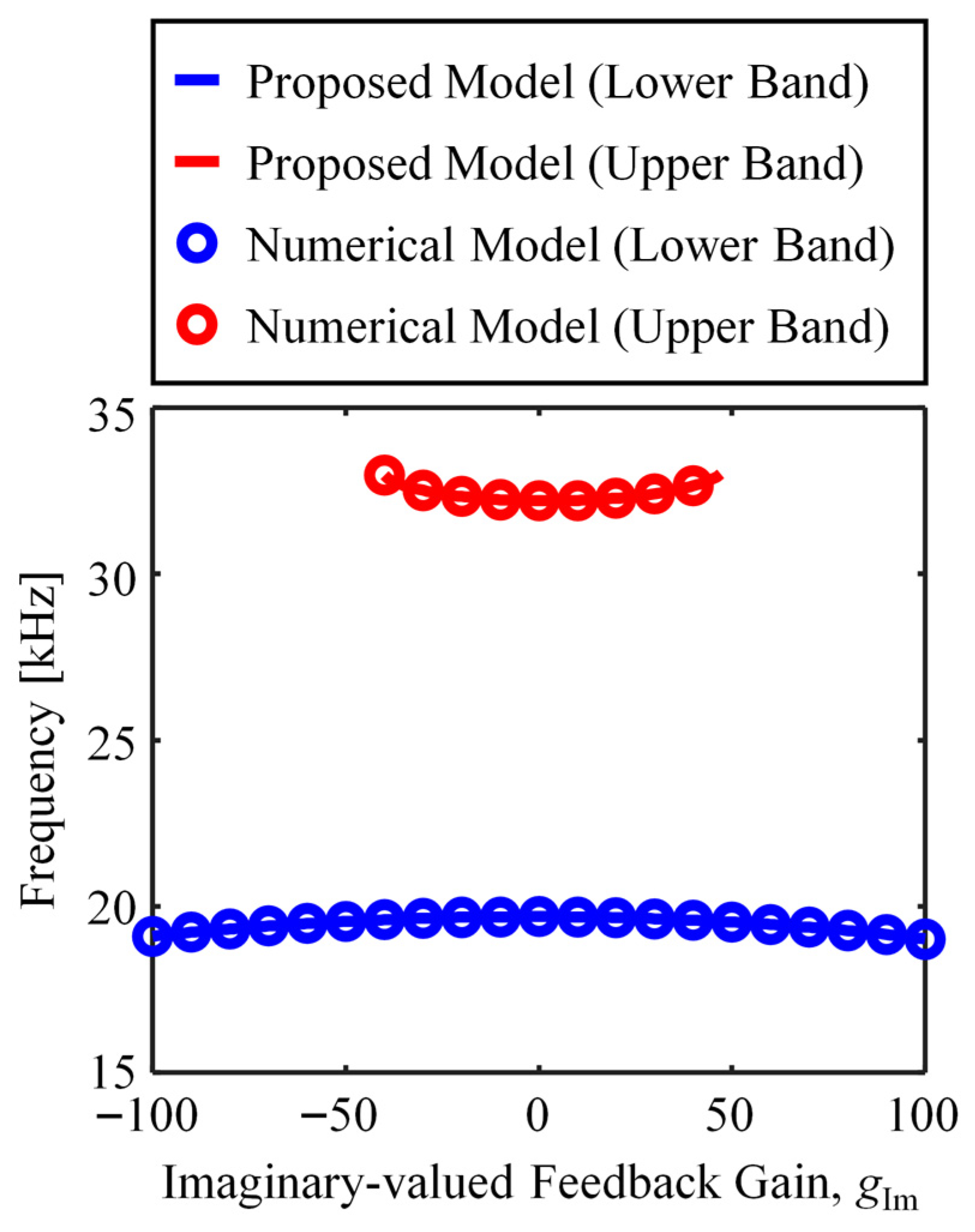
Figure 6 shows that sweeping the imaginary component of the feedback gain, gIm produces minor variations in the defect-band frequencies, typically several hundred hertz. This behavior occurs because imaginary feedback enters the electromechanical coupling as a velocity-dependent, anti-Hermitian term. This term modifies modal damping, but it does not alter the stiffness operator. The defect-band frequencies are primarily determined by the effective stiffness distribution of the defective rod. Therefore, imaginary gain can influence them only indirectly, through higher-order coupling between temporal damping and spatial evanescence. These effects are weak; therefore, the resulting frequency shifts are small compared with the stiffness-driven variations induced by real-valued gain. In conventional laminated piezoelectric defect designs, the response of even-symmetric modes to imaginary-valued feedback is further suppressed due to voltage cancellation. This renders them effectively insensitive, even at the damping level. However, the proposed segmented architecture preserves symmetry-resolved electromechanical coupling. This ensures that both defect modes remain responsive to imaginary-valued feedback, albeit with modest frequency shifts.
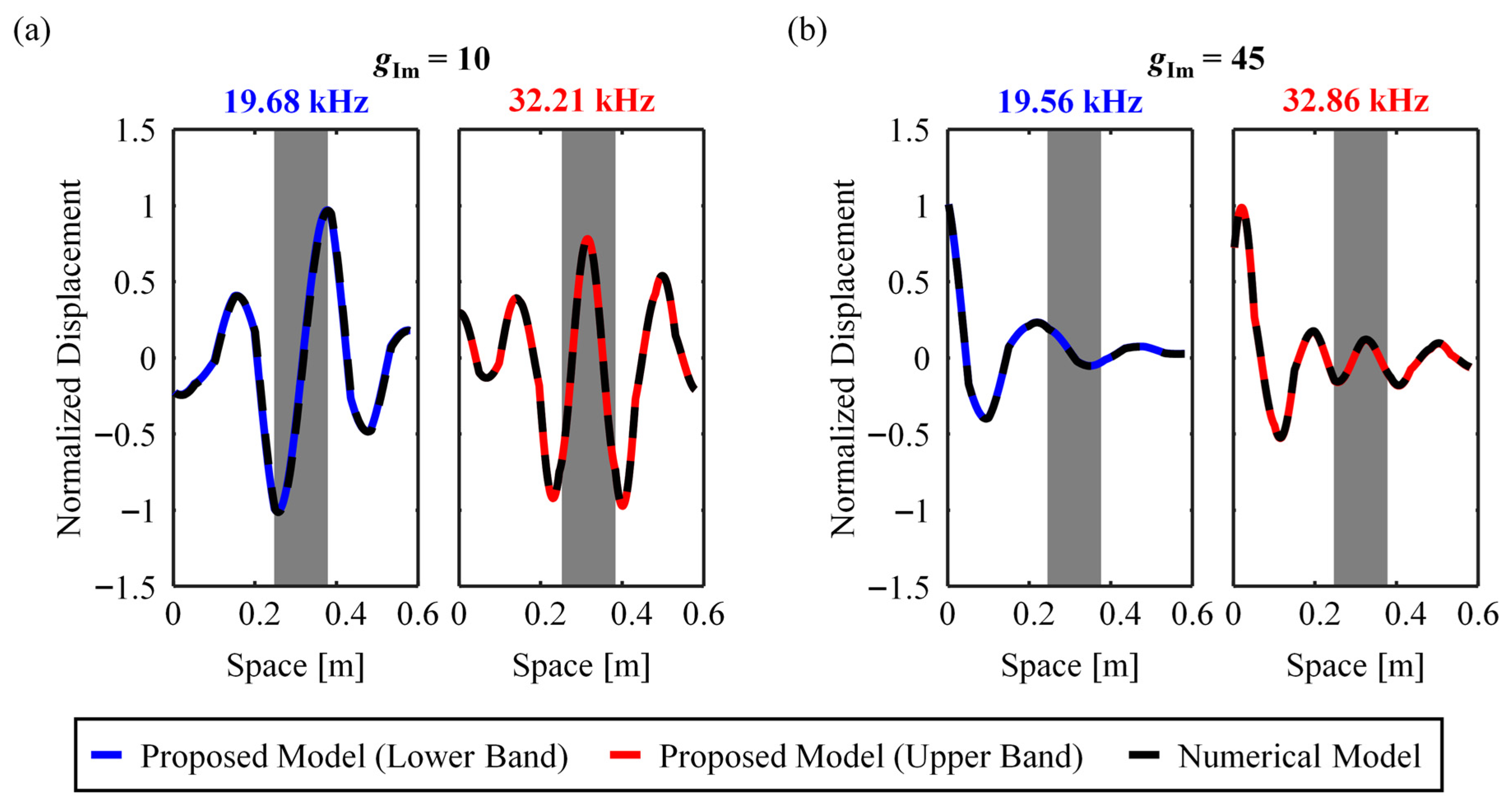
Figure 7 shows the defect-mode shapes for two values of imaginary gain: gIm = 10 and gIm = 45. In both cases, the odd- and even-symmetric modes maintain their intrinsic parity. This confirms that imaginary feedback neither modifies the stiffness operator nor induces eigenmode coalescence. The visible differences in amplitude and spatial decay are solely due to the anti-damping contribution. This anti-Hermitian term alters the effective decay balance of the evanescent field, yet it leaves the underlying eigenvector topology unchanged. Therefore, the resulting variations do not constitute true eigenvector deformation, and the structural mode shapes remain fundamentally unchanged. This observation reinforces the idea that imaginary gain only influences the dissipation pathway of the system, a mechanism that manifests as amplification-collapse behavior in transmission.
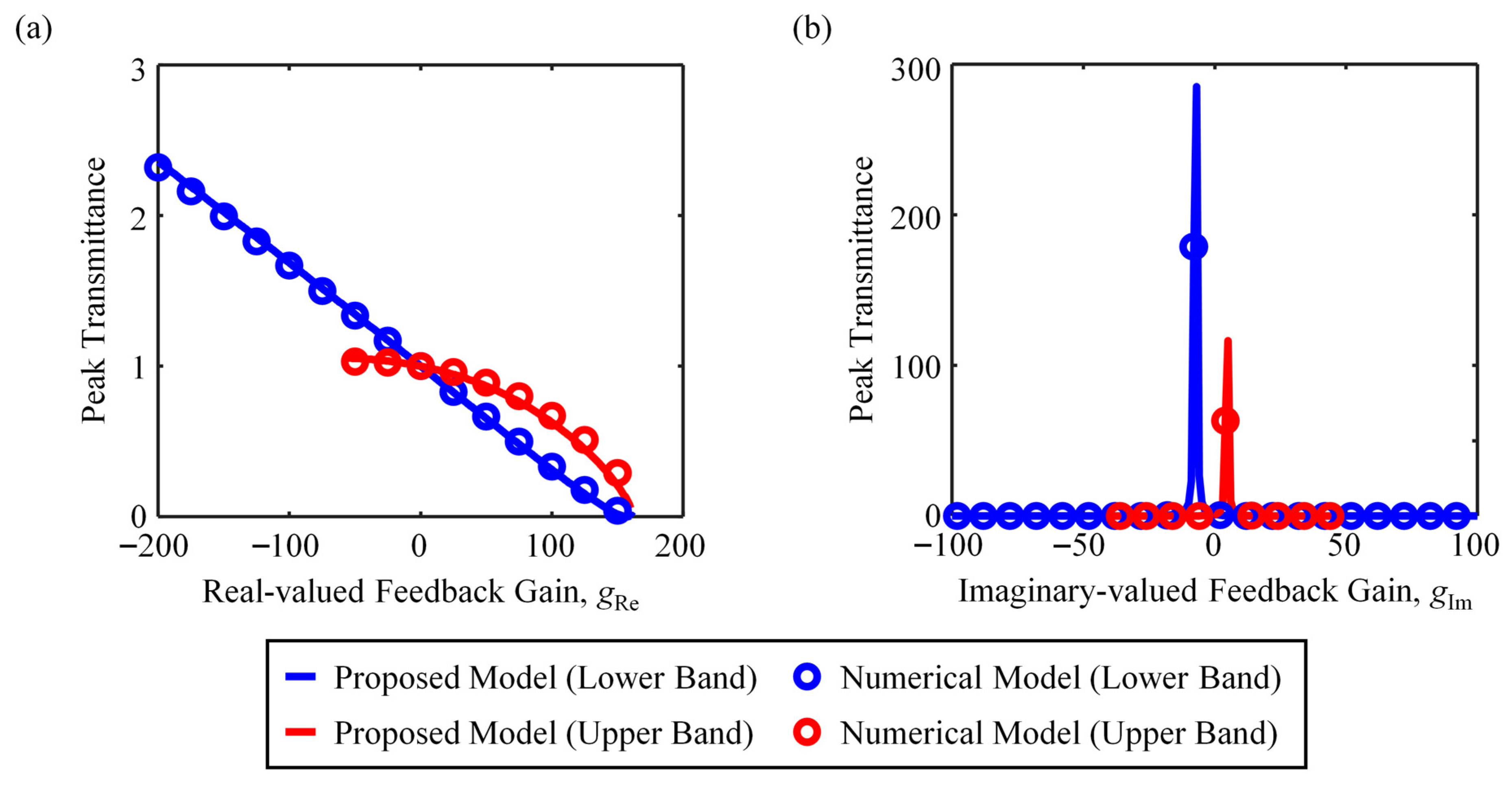
Figure 8a illustrates how real-valued feedback reshapes the resonant pathways supported by the defect modes by showing the transmission response of the defective PnC. Note that the peak frequency results are omitted, as are the defect-band frequencies presented in Figure 4 and Figure 6. As gRe increases, the peak transmittance associated with each defect band decreases in mode-dependent ways reflecting their strain symmetries and non-Hermitian interactions. For the lower-frequency defect mode with an odd-symmetric displacement field, the peak transmission amplitude decreases nearly linearly due to monotonic stiffening produced by the real feedback. This stiffening progressively weakens the mode’s ability to convert incident waves into localized energy. In contrast, the upper defect mode exhibits a strongly nonlinear reduction in peak transmittance. As the system approaches the exceptional point, real-valued feedback induces softening, parity degradation, and increasing hybridization with the even-symmetric mode. These effects enhance energy leakage and distort the resonant pathway, yielding a nonlinear attenuation profile that accelerates near the exceptional point. Finally, as gRe approaches the exceptional point, the peak transmittance of both resonances collapses to zero. Once their eigenvalues and eigenvectors coalesce, neither mode can sustain a resonance-enabled transmission channel. At the exceptional point, the merged defect mode acquires a purely imaginary Bloch wavenumber. This eliminates the real-phase progression required for tunneling through the defective rod. Consequently, the defect region no longer supports any localized resonance within the band gap. Beyond this point, the transmission spectrum contains no identifiable peaks, indicating a full transition from resonance-assisted transmission to a purely evanescent response.
Figure 8b shows that purely imaginary feedback produces a distinct, damping-driven transmission response. In the band-gap regime, wave motion inside the defective rod is evanescent by nature, and the associated spatial decay behaves as an effective damping mechanism. As gIm increases, feedback introduces anti-damping, which partially cancels the evanescent decay. Near a critical value, the effective damp approaches zero, the Q-factor increases sharply, and the transmission peak is strongly amplified, often exceeding unity due to active energy injection. The sign of the required gIm differs for the two modes. The even-symmetric mode amplifies under positive gIm because its velocity fields are in phase across the segments. In contrast, the odd-symmetric mode amplifies under negative gIm due to its out-of-phase velocity fields, which reverse the net anti-damping effect. Beyond the amplification point, excessive anti-damping pushes the mode toward negative effective damping. This results in a loss of phase coherence, suppressing resonance-assisted tunneling and broadening the response while collapsing the transmission peak. This amplification-collapse behavior arises solely from damping modulation. Thus, imaginary feedback produces a narrow, parity-dependent amplification window governed by the competition between evanescent decay and feedback-induced anti-damping. Here, it is noted that the effective damping modulated by imaginary-valued feedback represents an electronically induced control effect and does not imply the physical elimination of intrinsic structural damping.
The analytical and numerical results show excellent agreement in trend and magnitude across defect-band frequencies, defect-mode shapes, and transmission responses. This validates the robustness of the proposed transfer-matrix framework. Despite this high level of accuracy, however, the computational cost differs drastically between the two approaches. The analytical model used for defect-band analysis evaluates eigenfrequencies at every integer gain value. It completes a full sweep in approximately 220 s for real-valued feedback gains and 110 s for imaginary-valued feedback gains. In contrast, the finite-element model takes more than three hours. Similar disparities are observed in transmission calculations. The analytical framework computes the complete transmittance spectrum for each gain value in less than one second. In contrast, finite-element simulations, which require frequency sweeps and steady-state harmonic solves, take nearly ten minutes per gain value. As a result, the proposed analytical approach can complete a full parametric sweep in under two minutes, whereas this process requires 62 h of finite-element-based computation. These comparisons highlight the framework’s computational efficiency and predictive reliability. The framework’s ability to reproduce numerical results accurately while reducing computation time by more than two orders of magnitude demonstrates its suitability for rapid parameter sweeps, optimization studies, and real-time feedback design in active defective PnCs.
This study treats the feedback gains as prescribed parameters to elucidate the physical mechanisms underlying the manipulation of defect modes driven by stiffness and damping. This approach allows for systematic analysis of defect-band tuning and transmission control. However, it does not explicitly address inaccuracies in the gains or parameter drift that may arise in practical implementations. From an application-oriented perspective, the proposed framework lends itself naturally to extension through the incorporation of higher-level control algorithms. In an extended scheme, defect-band frequencies and transmission characteristics, as measured via external sensing, could adaptively update the feedback gains. This would compensate for modeling uncertainties and maintain the desired operational targets. Thus, the present results establish a physics-based foundation for feedback-enabled defect manipulation. Developing adaptive gain-tuning strategies is a logical and necessary step toward creating robust, autonomous PnC platforms.

5. Conclusions

This study presented a segmented piezoelectric sensor–actuator architecture for actively controlling defect modes in one-dimensional phononic crystals (PnCs). Unlike laminated piezoelectric designs, which cannot distinguish modal parity and thus could actuate or sense even-symmetric defect modes, the proposed segmentation strategy enabled electromechanical coupling resolved by symmetry. This allowed for the simultaneous manipulation of multiple defect bands.
Analytical and numerical results revealed that real-valued feedback could selectively stiffen or soften the defective region depending on the modal symmetry. This process steered the odd- and even-symmetric defect bands in opposite directions, producing exceptional point-like coalescence through non-Hermitian modal interaction. In contrast, imaginary-valued feedback preserved stiffness but modulated effective damping. This resulted in a parity-dependent amplification-suppression response in transmission. The analytical model showed excellent agreement with fully coupled finite-element simulations across analyses of defect-band evolution, mode-shape deformation, and transmission characteristics, while reducing computation time by more than two orders of magnitude.
This work contributes significantly to the field by: (i) establishing segmentation as a prerequisite for multi-band, symmetry-dependent active control; (ii) revealing non-Hermitian behaviors driven by stiffness and damping within defective PnC structures; and (iii) providing a rapid analytical framework suitable for real-time parameter sweeps and optimization. These results are a significant step toward creating actively tunable and rigorously predictable PnC platforms.
Despite these advantages, there are several practical limitations that should be noted. For example, the segmented piezoelectric configuration presents fabrication challenges such as precise electrode patterning, reliable bonding between the piezoelectric layers and the host structure, and strict alignment tolerances at the defect site. Additionally, dielectric losses and losses associated with the feedback circuitry may reduce the effective tuning range and limit the achievable transmission amplification. Furthermore, practical implementations may introduce interfacial compliance, shear lag, and additional damping through adhesive layers. These effects primarily modify the effective electromechanical coupling strength and resonance amplitudes, while preserving the tuning mechanisms and modal interactions dependent on symmetry, which were identified in this study.
As a next step, experimental validation will be conducted by fabricating laminated and segmented piezoelectric PnC samples and comparing their tuning and transmission responses under identical real- and imaginary-valued feedback laws. Monitoring mode symmetry, frequency shifts, and transmittance variations using standard harmonic excitation and sensing techniques will directly verify the predicted voltage cancellation in laminated designs and the enhanced control capabilities enabled by segmentation. In practical implementations, sensing in the 31-mode of slender piezoelectric rods may involve relatively low voltage levels and signal-to-noise challenges. In the present framework, the feedback-induced compensatory strain is intended to introduce localized, incremental modifications of effective stiffness or damping, rather than large-amplitude actuation, so that the required voltage levels remain within standard operating ranges. Importantly, the segmented electrode configuration mitigates voltage cancellation effects, thereby enhancing sensitivity and improving signal-to-noise characteristics. Standard techniques such as charge amplification and lock-in detection can further facilitate reliable measurements.
Finally, although real and imaginary feedback gains were examined separately in this study, the use of a general complex-valued gain represents a more practical control strategy. The real part governs defect-band frequency tuning, while the imaginary part adjusts resonance sharpness and transmission sensitivity. Their combined use enables simultaneous control of frequency and amplitude responses, offering a promising route toward highly tunable and adaptive PnC-based devices.

Funding

This work was supported by the Basic Science Research Program through the National Research Foundation of Korea (NRF), funded by the Ministry of Education under Grant 2022R1I1A1A01056406.

Data Availability Statement

The original contributions presented in this study are included in the article. Further inquiries can be directed at the corresponding author.

Conflicts of Interest

The author declares no conflicts of interest.

References

  1. Chen, J.; Huang, J.; An, M.; Hu, P.; Xie, Y.; Wu, J.; Chen, Y. Application of machine learning on the design of acoustic metamaterials and phonon crystals: A review. Smart Mater. Struct. 2024, 33, 073001. [Google Scholar] [CrossRef]
  2. Jin, Y.; Torrent, D.; Rouhani, B.D.; He, L.; Xiang, Y.; Xuan, F.-Z.; Gu, Z.; Xue, H.; Zhu, J.; Wu, Q. The 2024 phononic crystals roadmaproadmap. J. Phys. D Appl. Phys. 2025, 58, 113001. [Google Scholar] [CrossRef]
  3. Lee, J.; Kim, Y.Y. Anisotropic elastic metamaterials for novel wave manipulation: A review. Eur. J. Mech.-A/Solids 2025, 113, 105696. [Google Scholar] [CrossRef]
  4. Yang, S.; Chang, H.; Wang, Y.; Yang, M.; Sun, T. A phononic crystal suspension for vibration isolation of acoustic loads in underwater gliders. Appl. Acoust. 2024, 216, 109731. [Google Scholar] [CrossRef]
  5. Muhammad; Lim, C. Phononic metastructures with ultrawide low frequency three-dimensional bandgaps as broadband low frequency filter. Sci. Rep. 2021, 11, 7137. [Google Scholar] [CrossRef]
  6. Yang, S.; Zhou, X.; Wang, Y.-F. Tunable band gap and wave guiding in periodic grid structures with thermal sensitive materials. Compos. Struct. 2022, 290, 115536. [Google Scholar] [CrossRef]
  7. Lin, H.; Tol, S. Piezoelectric metastructures for simultaneous broadband energy harvesting and vibration suppression of traveling waves. Smart Mater. Struct. 2021, 30, 075037. [Google Scholar] [CrossRef]
  8. Aslam, M.; Boris, I.; Lee, J. Eliminating pzt-induced harmonics using metasurface-based filters for enhanced nonlinear guided wave structural health monitoring. Mech. Syst. Signal Process. 2025, 235, 112885. [Google Scholar] [CrossRef]
  9. Park, C.I.; Choe, S.; Lee, W.; Choi, W.; Kim, M.; Seung, H.M.; Kim, Y.Y. Ultrasonic barrier-through imaging by Fabry-Perot resonance-tailoring panel. Nat. Commun. 2023, 14, 7818. [Google Scholar] [CrossRef]
  10. Lee, G.; Lee, D.; Park, J.; Jang, Y.; Kim, M.; Rho, J. Piezoelectric energy harvesting using mechanical metamaterials and phononic crystals. Commun. Phys. 2022, 5, 94. [Google Scholar] [CrossRef]
  11. Jian, Y.; Wang, K.; Xia, C.; Huang, D.; Han, H.; Hu, G. Higher-order defective metamaterial for multi-band low-frequency vibration localization. Int. J. Mech. Sci. 2025, 306, 110859. [Google Scholar] [CrossRef]
  12. Jian, Y.; Tang, L.; Huang, D.; Han, H.; Liu, W.; Hu, G. Designing an electromechanical metamaterial beam with arbitrary decoupled defect modes for multi-band wave localization. Smart Mater. Struct. 2025, 34, 035015. [Google Scholar] [CrossRef]
  13. Bommer, S.P.; Panuski, C.; Guilhabert, B.; Xia, Z.; Smith, J.A.; Dawson, M.D.; Englund, D.; Strain, M.J. Transfer printing micro-assembly of silicon photonic crystal cavity arrays: Beating the fabrication tolerance limit. Nat. Commun. 2025, 16, 5994. [Google Scholar] [CrossRef] [PubMed]
  14. Manasvi, R.; Deepa, V.; Balaji, V.; Soroosh, M.; Hegde, G. Numerical Investigation of Dual-Cavity DWDM Optical Filters for Ultra-Narrowband C-Band 6G Applications. Silicon 2025, 1–16. [CrossRef]
  15. Cao, D.-X.; Li, S.-S.; Guo, X.-Y.; Chen, X.-M.; Lai, S.-K. Buckling-driven piezoelectric defect-induced energy localization and harvesting using a Rubik’s cube-inspired phononic crystal structure. Smart Mater. Struct. 2024, 33, 035036. [Google Scholar] [CrossRef]
  16. Zaky, Z.A.; Al-Dossari, M.; Hendy, A.S.; Bouazzi, Y.; Boudjemline, A.; Aly, A.H. Coupling between topological edge state and defect mode-based biosensor using phononic crystal. Sci. Rep. 2025, 15, 2216. [Google Scholar] [CrossRef]
  17. Fang, T.-Y.; Sun, X.-W.; Wen, X.-D.; Li, Y.-X.; Liu, X.-X.; Song, T.; Song, Y.-Z.; Liu, Z.-J. High-performance phononic crystal sensing structure for acetone solution concentration sensing. Sci. Rep. 2023, 13, 7057. [Google Scholar] [CrossRef]
  18. Alrowaili, Z.; Fathy, H.M.; Elsayed, H.A.; Aouassa, M.; Mahmoud, M.; El-Nasser, K.S.; Taha, T.; Mehaney, A. Heavy metals biosensor based on defective one-dimensional phononic crystals. Ultrasonics 2023, 130, 106928. [Google Scholar] [CrossRef]
  19. Bicer, A.; Cicek, A. Liquid concentration sensing via weakly coupled point defects in a phononic crystal. J. Mol. Liq. 2024, 409, 125487. [Google Scholar] [CrossRef]
  20. Katch, L.; Moghaddaszadeh, M.; Willey, C.; Juhl, A.; Nouh, M.; Argüelles, A. Analysis of geometric defects in square locally resonant phononic crystals: A comparative study of modeling approaches. J. Acoust. Soc. Am. 2023, 154, 3052–3061. [Google Scholar] [CrossRef]
  21. Lee, D.; Kim, T.; Han, J.H.; Kim, S.; Youn, B.D.; Jo, S.-H. Transformer-based prediction of dispersion relation and transmittance in phononic crystals. Int. J. Mech. Sci. 2025, 154, 110880. [Google Scholar] [CrossRef]
  22. Xiao, J.; Ding, X.; Wang, Y.; Huang, W.; He, Q.; Shao, Y. Gear fault detection via directional enhancement of phononic crystal resonators. Int. J. Mech. Sci. 2024, 278, 109453. [Google Scholar] [CrossRef]
  23. Cao, Z.; Wang, K.; Wang, B. Energy harvesting performance of acoustic energy harvesters consisting of flexoelectric plates and defect-state phononic crystals. J. Vib. Eng. Technol. 2024, 12, 5101–5117. [Google Scholar] [CrossRef]
  24. Zhang, S.; Su, L. Multi-field induced reconfigurable point defect state of flexural waves in magnetostrictive phononic crystals plates. Mech. Mater. 2025, 208, 105415. [Google Scholar] [CrossRef]
  25. Zhang, S.; Bian, X. Tunable defect states of flexural waves in magnetostrictive phononic crystal beams by magneto-mechanical-thermal coupling loadings. Thin-Walled Struct. 2024, 199, 111848. [Google Scholar] [CrossRef]
  26. Jo, S.-H. Electrically controllable and reversible coupling degree in a phononic crystal with double piezoelectric defects. Thin-Walled Struct. 2024, 204, 112328. [Google Scholar] [CrossRef]
  27. Jo, S.-H.; Park, M.; Kim, M.; Yang, J. Tunable bandpass filters using a defective phononic crystal shunted to synthetic negative capacitance for longitudinal waves. J. Appl. Phys. 2024, 135, 164502. [Google Scholar] [CrossRef]
  28. Jo, S.-H. Active feedback-driven defect-band steering in phononic crystals with piezoelectric defects: A mathematical approach. Mathematics 2025, 13, 2126. [Google Scholar] [CrossRef]
  29. Gao, Y.; Wang, L. Nonlocal active metamaterial with feedback control for tunable bandgap and broadband nonreciprocity. Int. J. Mech. Sci. 2022, 219, 107131. [Google Scholar] [CrossRef]
  30. Bera, K.K.; Banerjee, A. Active metadamping: A phenomenon of damping enhancement in metamaterial via feedback control. J. Sound Vib. 2023, 546, 117452. [Google Scholar] [CrossRef]
  31. Askari, M.; Brusa, E.; Delprete, C. Vibration energy harvesting via piezoelectric bimorph plates: An analytical model. Mech. Adv. Mater. Struct. 2023, 30, 4764–4785. [Google Scholar] [CrossRef]
  32. Mhiri, M.T.; Chouchane, M.; Guerich, M.; Larbi, W. Modeling and analysis of a macro-fiber piezoelectric bimorph energy harvester operating in d33-Mode using Timoshenko theory. Mech. Adv. Mater. Struct. 2024, 31, 13021–13035. [Google Scholar] [CrossRef]
  33. Al Muhammadi, M.F.; Al Mukahal, F.H.; Sobhy, M. A higher-order theory for nonlinear dynamic of an FG porous piezoelectric microtube exposed to a periodic load. Mathematics 2024, 12, 3422. [Google Scholar] [CrossRef]
  34. Liu, T.; Li, C.; Wang, C.; Lai, J.W.; Cheong, K.H. A simple-FSDT-based isogeometric method for piezoelectric functionally graded plates. Mathematics 2020, 8, 2177. [Google Scholar] [CrossRef]
  35. Li, Q.; Zhou, X.; Lin, F.; Yang, Y.; Zhang, J. Novel proportional–integral–derivative control framework on continuous-time positive systems using linear programming. Mathematics 2024, 12, 617. [Google Scholar] [CrossRef]
  36. Luo, M.; Yang, B.; Yan, Z.; Shen, Y.; Hu, M. The dynamic event-based non-fragile H∞ state estimation for discrete nonlinear systems with dynamical bias and fading measurement. Mathematics 2024, 12, 2957. [Google Scholar] [CrossRef]
  37. Abdelrahman, A.A.; Abdelwahed, M.S.; Ahmed, H.M.; Hamdi, A.; Eltaher, M.A. Investigation of size-dependent vibration behavior of piezoelectric composite nanobeams embedded in an elastic foundation considering flexoelectricity effects. Mathematics 2023, 11, 1180. [Google Scholar] [CrossRef]
  38. Hamdan, C.; Allport, J.; Sajedin, A. Piezoelectric power generation from the vortex-induced vibrations of a semi-cylinder exposed to water flow. Energies 2021, 14, 6964. [Google Scholar] [CrossRef]
  39. Guo, X.; Wang, Y.; Xu, C.; Wei, Z.; Ding, C. Influence of the Schottky junction on the propagation characteristics of shear horizontal waves in a piezoelectric semiconductor semi-infinite medium. Mathematics 2024, 12, 560. [Google Scholar] [CrossRef]
  40. Leonardi, G.; Dessi, D.; Venturi, A.; Ruta, G. Optimal design of unimorph and segmented piezoelectric cantilevers for energy harvesting. Smart Mater. Struct. 2025, 34, 025036. [Google Scholar] [CrossRef]
  41. He, X.; Li, D.; Zhou, H.; Hui, X.; Mu, X. Theoretical and experimental studies on MEMS variable cross-section cantilever beam based piezoelectric vibration energy harvester. Micromachines 2021, 12, 772. [Google Scholar] [CrossRef]
  42. Jo, S.-H. Temperature-controlled defective phononic crystals with shape memory alloys for tunable ultrasonic sensors. Crystals 2025, 15, 412. [Google Scholar] [CrossRef]
  43. Jo, S.-H.; Lee, D.; Yoon, H.; Youn, B.D. Double piezoelectric defects in phononic crystals for ultrasonic transducers. J. Phys. D Appl. Phys. 2023, 56, 074002. [Google Scholar] [CrossRef]
  44. Jo, S.-H.; Youn, B.D. An improved analytical model that considers lateral effects of a phononic crystal with a piezoelectric defect for elastic wave energy harvesting. Int. J. Mech. Sci. 2021, 205, 106593. [Google Scholar] [CrossRef]
  45. Shen, W.; Cong, Y.; Gu, S.; Yin, H.; Zhang, G. A generalized supercell model of defect-introduced phononic crystal microplates. Acta Mech. 2024, 235, 1345–1360. [Google Scholar] [CrossRef]
  46. Jo, S.-H.; Yoon, H.; Shin, Y.C.; Youn, B.D. An analytical model of a phononic crystal with a piezoelectric defect for energy harvesting using an electroelastically coupled transfer matrix. Int. J. Mech. Sci. 2021, 193, 106160. [Google Scholar] [CrossRef]
  47. Guo, Y.; Li, L.; Chuang, K.-C. Analysis of bending waves in phononic crystal beams with defects. Crystals 2018, 8, 21. [Google Scholar] [CrossRef]
  48. Aly, A.H.; Mehaney, A. Phononic crystals with one-dimensional defect as sensor materials. Indian J. Phys. 2017, 91, 1021–1028. [Google Scholar] [CrossRef]
  49. Li, J.; Guo, J.; Zhang, Z. Enhanced energy localization and harvesting by design of phononic crystal defects. Int. J. Mod. Phys. B 2024, 38, 2450244. [Google Scholar] [CrossRef]
  50. Wang, K.; Li, X.-S.; Cao, L.; Guo, P.; Fan, G.; Qin, J.; Ma, T.-X. Enhancement of piezoelectric energy harvesting for flexural waves by a metasurface-assisted phononic cavity. Results Phys. 2024, 63, 107870. [Google Scholar] [CrossRef]
  51. Lee, J.; Kweun, M.; Lee, W.; Park, C.I.; Kim, Y.Y. Perfect transmission of elastic waves obliquely incident at solid–solid interfaces. Extrem. Mech. Lett. 2022, 51, 101606. [Google Scholar] [CrossRef]
  52. Lee, J.; Kweun, M.J.; Lee, W.; Seung, H.M.; Kim, Y.Y. Perfect circular polarization of elastic waves in solid media. Nat. Commun. 2024, 15, 992. [Google Scholar] [CrossRef]
  53. Zhu, W.; Fang, X.; Li, D.; Sun, Y.; Li, Y.; Jing, Y.; Chen, H. Simultaneous observation of a topological edge state and exceptional point in an open and non-Hermitian acoustic system. Phys. Rev. Lett. 2018, 121, 124501. [Google Scholar] [CrossRef] [PubMed]
  54. Yi, J.; Wu, Z.; Xia, R.; Li, Z. Reconfigurable metamaterial for asymmetric and symmetric elastic wave absorption based on exceptional point in resonant bandgap. Appl. Math. Mech. 2023, 44, 1–20. [Google Scholar] [CrossRef]
Figure 1. Schematic illustration of defect-mode shapes and the corresponding voltage distributions in a conventional non-segmented piezoelectric layer. (a) Odd-symmetric defect mode: The antisymmetric displacement field generates a nearly uniform voltage of either positive or negative polarity throughout the piezoelectric layer. (b) Even-symmetric defect mode: The symmetric displacement field produces positive and negative voltages within the same layer.
Mathematics 14 00361 g001
Figure 2. Schematic illustration of the proposed active one-dimensional PnC with a segmented piezoelectric defect and complex feedback architecture. (a) Configuration of the periodic rod with a single segmented piezoelectric defect where two piezoelectric bimorph pairs are bonded to the defective rod and wired as a sensor and an actuator. (b) The feedback-control loop in which the sensor voltage vS(t) is processed by a controller that implements a complex gain (gRe + jgIm) to generate the actuator voltage vA(t).
Mathematics 14 00361 g002
Figure 3. The passive characteristics of the one-dimensional defective PnC under the short-circuit condition. (a) Dispersion relation showing the formation of two defect bands (red and blue) inside the band gap. (b) Normalized displacement profiles of the odd-symmetric (left, blue) and even-symmetric (right, red) defect modes corresponding to the two defect bands. (c) Transmission spectrum of the finite defective PnC, exhibiting two pronounced resonant peaks associated with the defect modes inside the band gap.
Mathematics 14 00361 g003
Figure 4. Variation in the lower and upper defect-band frequencies with respect to the real-valued feedback gain, gRe, ranging from −200 to 200. The analytical predictions (solid lines) closely align with the finite-element results (circle markers).
Mathematics 14 00361 g004
Figure 5. A comparison of the defect-mode shapes predicted by the proposed analytical model and numerical simulations under real-valued feedback. (a) Normalized displacement profiles at gRe = −50. (b) Normalized displacement profiles at gRe = 160 near the exceptional point-like regime. In both cases, the analytical predictions (blue/red) closely match the numerical results (black).
Mathematics 14 00361 g005
Figure 6. Variation in the lower and upper defect-band frequencies with respect to the imaginary-valued feedback gain, gIm, ranging from −100 to 100. The analytical predictions (solid lines) closely align with the finite-element results (circle markers).
Mathematics 14 00361 g006
Figure 7. A comparison of the defect-mode shapes predicted by the proposed analytical model and numerical simulations under real-valued feedback. (a) Normalized displacement profiles at gIm = 10. (b) Normalized displacement profiles at gIm = 45. In both cases, the analytical predictions (blue/red) closely match the numerical results (black).
Mathematics 14 00361 g007
Figure 8. Variation in the peak transmittances, which correspond to lower and upper defect-band frequencies, with respect to (a) the real-valued feedback gain, gRe, ranging from −200 to 200 and (b) the imaginary-valued feedback gain, gIm, ranging from −100 to 100. The analytical predictions (solid lines) closely align with the finite-element results (circle markers).
Mathematics 14 00361 g008
Table 1. Summary of subscripts used in the analytical model.
SubscriptsMeaning
ULLight rod of the unit cell
UDDark rod of the unit cell
DDefect
SLSemi-infinite left host media
SRSemi-infinite right host media
PPiezoelectric layer
UUnit cell
PDPiezoelectric defect
PnCPhononic crystal
PDLLeft-segmented piezoelectric defects
PDRRight-segmented piezoelectric defects
Disclaimer/Publisher’s Note: The statements, opinions and data contained in all publications are solely those of the individual author(s) and contributor(s) and not of MDPI and/or the editor(s). MDPI and/or the editor(s) disclaim responsibility for any injury to people or property resulting from any ideas, methods, instructions or products referred to in the content.