1. Introduction
In the field of epidemiology, a lot of mathematical models have been developed to study many infectious diseases. Among these, the compartment models are the most commonly used models for describing the transmission of infectious diseases. They classify the total population into a few classes. The interactions between these classes can be described by some mathematical relationships in terms of rate transfers. For instance, according to the standard Susceptible-Infected-Recovered (SIR) model in epidemiology [
1], first proposed by Kermack and McKendrick in 1927 [
2], the class of individuals who are healthy but can contract the disease is called susceptible individuals or susceptible, usually denoted by
S; the class of individuals who have contracted the disease and are also infectious is called infected individuals or infected, usually denoted by
I; and the class of individuals who have recovered and cannot contract the disease again is called recovered individuals, usually denoted by
R. The model is given by the following systems of ODEs:
where the parameter
c is the constant of proportionality called the transmission rate or contact rate, and the parameter
is called the recovery rate for the infected individuals. The term
is called mass action incidence and
is the number of infected individuals per unit of time who recover. The susceptible individuals who become infected by contact with infected individuals move to the class
I and individuals who recover leave the infectious class and move to the recovered class. In general, the outbreak of an infectious disease goes through the following phases: an initial exponential increase in the number of infected cases, followed by an inflection point, then a maximum point, and lastly an equilibrium state. The dynamic behavior of the SIR model is not complicated.
The COVID-19 pandemic, which is a severe outbreak of respiratory illness caused by severe acute respiratory syndrome coronavirus 2 (SARS-CoV-2), started in December 2019 and then resulted in large-scale social disruption, economic loss, and general hardship throughout the world. There is a large and rapidly growing body of mathematical models developed to study the dynamics of COVID-19, including compartmental, delay, and behaviorally adaptive frameworks, particularly for the U.S. pandemic (see, e.g., [
3,
4,
5,
6,
7,
8,
9,
10,
11,
12,
13,
14,
15,
16,
17,
18,
19,
20] and references therein).
The main purpose of modeling is in its application. But there is a fundamental difference between modeling a process that can be produced in a lab and a process like infectious disease transmission that is out in the open. For the COVID-19 pandemic, the number of susceptible (S) and the infected (I) are unknown, or known-unknown. These state variables must be used for a model, but cannot be measured in reality. This can present a pitfall for modeling, mistaking, for example, the infected I for the daily case number, which is collected by human efforts through diagnostic means, collectively referred to as testing.
Standard epidemiological models typically treat testing as a function of the infected population (
I), assuming a passive detection process. However, this ignores the reflexive nature of public health interventions. We posit that testing capacity is an active variable driven by visible metrics. The true infected population (
I) is unobservable; policy decisions and resource allocation are driven by Confirmed cases (
C) [
21]. As
C rises, societal risk perception increases, triggering a ’sociological feedback loop’: increased visibility of the pandemic mobilizes political and economic capital to expand testing infrastructure (e.g., new sites, procurement of rapid tests). This expanded capacity leads to a higher rate of confirmation, further elevating
C and reinforcing the cycle. By modeling the saturation term as dependent on
C, we capture this endogenous control loop, which introduces the necessary nonlinearity and delay to destabilize the endemic equilibrium. Therefore, for mathematical models of epidemiology to have a real impact, they must include testing. Without testing, neither
S nor
I from the SIR model can be estimated. With testing, we do not obtain the number of susceptible or the number of infected directly. Instead, what we do obtain is the number of test positives, also referred to as the confirmed class, which we will denote by compartment
C, as previously mentioned.
The interjection by testing has consequences: first, test-positive patients are most likely to go into some forms of isolation, which can be described as a class of isolated/monitored individuals and denoted by a new compartment M, therefore changing the transmission dynamics between susceptible and infected; second, our knowledge of confirmed cases almost certainly moderates our behaviors to mitigate the transmission, thus further changing the outbreak dynamics. That is, our measures to monitor and mitigate the pandemic through testing change the dynamics we would like to know. Most of the current mathematical models have not considered the testing compartment for COVID-19 transmission or its dynamic behaviors. More precisely, for mathematical models to have real-world fidelity, they must account for the observation process. As pointed out before, in a managed pandemic, the “Infected” class (I) is unobservable; policy and resource allocation are driven by the “Confirmed” class (C). This creates a feedback loop: rising confirmed cases trigger alarm, leading to the mobilization of testing resources (pop-up sites, rapid tests), which in turn increases confirmation rates. This reflexive dynamic, constrained by physical capacity limits, acts as a nonlinear delay oscillator.
Recent advances in nonlinear dynamics have highlighted how memory and saturation can induce chaos in networked systems. For instance, ref. [
22] demonstrated how memristive Hopfield neural networks can generate complex multi-scroll attractors suitable for image encryption, while ref. [
23] explored hyperchaotic dynamics and synchronization in fractional-order systems. In these systems, the interplay between hysteresis (memory) and activation limits (saturation) creates multi-scroll attractors. We argue that the public health testing apparatus acts similarly to a “societal memristor”—it possesses memory (delayed policy response) and saturation (capacity limits), creating a nonlinear feedback loop that destabilizes the epidemic curve.
In this paper, we extend the SIR model to the SICMR model (Susceptible-Infected-Confirmed-Monitored-Recovered). We introduce a Holling Type II function to model testing saturation driven by confirmed cases. We prove that this mechanism generates a Shilnikov saddle-focus bifurcation and validate the results against U.S. Omicron data.
2. Model Formulation
The model is an expansion of the standard SIR model by introducing two intermediate compartments:
The first modification is the adoption of the ‘openness hypothesis’ from [
24], that assumes there is always an effective susceptible population,
, rather than a fixed total population,
N, as conventionally considered for the standard SIR model. While the classical SIR models assume a monotonically depleting susceptible pool leading to herd immunity, the epidemiology of the Omicron variant (late 2021) necessitates an open-system approach. This assumption is justified by three concurrent mechanisms active during the 200-day observational window:
Rapid Immune Evasion: The Omicron variant exhibited significant escape from neutralizing antibodies generated by prior infection or vaccination [
25], effectively recycling individuals from the Removed (
R) class back into the Susceptible (
S) class at a rate comparable to the infection rate.
Waning Immunity: Empirical data suggests protection against symptomatic infection wanes substantially within 4–6 months [
26]. This creates a continuous influx
, balancing the depletion
.
Spatial Heterogeneity: In a metapopulation like the United States, the epidemic wavefront propagates asynchronously across regions. As local pools of susceptibility are exhausted in one distinct geographic cluster, new clusters become accessible. The aggregate effective susceptible population available to the virus at the national level thereby approximates a dynamic equilibrium rather than a depletion curve [
27].
Thus, represents not the census population, but the thermodynamic-like capacity of the system to sustain transmission, maintained by the high turnover of immune status.
This hypothesis is based on the observation that an outbreak in New York City does not instantaneously make everyone in Alaska susceptible. As a result, the number of susceptible individuals is
represented dimensionlessly by
, with
t in days.
The second modification to the SIR model is not new. We simply include demography in the model [
1,
2] because we are interested in the long-term behavior of our new model with a large population size. The demographic terms are the natural birth and death rates, or the influx rate and the per-capita efflux rate.
The third modification is to include two new compartments. The first compartment is the class of confirmed cases or tested positive cases, . The second compartment is the class of those confirmed who are eventually cleared as recovered by re-testing. This class is referred to as the monitored, . Death from the infection comes from the confirmed class , not from , as such confirmation is too obvious to require a re-test.
Let
denote the infected class, and let
with
X being the dimensionless counterpart of
and
. Then, the expanded dimensionless model takes the following form:
with time in days and all rates being daily rates. Here are the definitions for the parameters: the parameter
is the dimensionless influx rate (the natural per-capita birth rate plus immigration), the parameter
is the dimensionless efflux rate (the natural per-capita death rate plus emigration), and the parameter
is the recovery rate at which infected individuals are missed by testing and eventually recovered. The parameter
c is the standard contact rate for infection, the parameter
m is the removal rate from the confirmed class to the monitored class, the parameter
d is the death rate from confirmed infections, and the parameter
q is the removal/recovery rate from the confirmed class to the recovered class. All parameters are considered nonnegative constants. Last, the function
is for the dimensionless rate at which infected individuals test positive. To model its form, we can start with the simple mass action law by which the number of infected individuals who test positive is proportional to the product
. This means that the more there are infected individuals, the more there are confirmed cases, and the more there are confirmed cases, the greater the scope by which testing is carried out. But this functional form is simplistic because it ignores an obvious and important factor that testing takes time. As a consequence, the core innovation is the testing rate function
. We utilize a Holling Type II functional response:
where
p is the maximum testing rate per confirmed case. Critically, the rate is proportional to
C in the numerator. In this models, the sociological feedback: existing confirmed cases (
C), are the signal that drives the deployment of testing resources. The denominator models the saturation (or “handling time”) effect: as the burden of infection (
I) grows, the system becomes congested, and the per-capita confirmation rate declines.
We note that although Holling’s Type II functional form is derived from predation in theoretical ecology, it is universal to all processes involving two entities, one of which must take time to change the encounter of both into something else. We refer readers to the reference [
28] for more details about Holling’s Type II functional form. In our case, the confirmed cases
C, as a proxy for the test apparatus set up for pandemics, transfer the infected class into the monitored class. It is characterized by a saturated effect with the increasing number of infected, which follows from the assumption that the number of tests is limited by its capacity to process the tests. Specifically, the function
is derived from its dimensional form
where
is the daily ’discovery’ rate of infection by testing entities,
h is the ‘handling’ time that each test requires to result in a confirmation on record, and
is the daily proportion of re-testing those individuals under monitoring before they are released to the recovered class after being tested negative. After re-scaling,
is the saturation rate per confirmed case,
, and
is fixed as a small parameter because, for pandemic modeling, the effective susceptible population
is usually very large. Thus, our model could take the form as follows:
and the biological domain can be defined in the usual way as the positively invariant subset of
:
We note that the choice of this Holling’s Type II functional form, borrowed from predation ecology [
28], is unconventional in epidemiology. A rigorous justification is therefore warranted. The function
makes two key assumptions. First, it assumes that the rate of new confirmations saturates with respect to the number of infected individuals (
I), reflecting the finite ‘handling time’ (
h) or capacity of the testing apparatus. Second, and more critically, it uses the number of currently confirmed cases (
C) as a proxy for the overall testing effort and infrastructure. This assumption, while a simplification, is rooted in the observable feedback loop of a managed pandemic: a rising number of confirmed cases (
C) triggers increased public awareness, media reporting, and policy-driven resource allocation, which in turn expands the testing effort. Simpler saturation models, such as a Michaelis–Menten term proportional to
, would model saturation with respect to
I but would fail to capture this crucial, reflexive feedback loop driven by the known confirmed population (
C). Thus, our chosen form models testing not as a static parameter, but as a dynamic component of the system, which is the central mechanism this paper seeks to investigate. Equation (
6) is referred to as the SICMR model. Note that it can be reduced to a 4-dimensional system because the recovered class
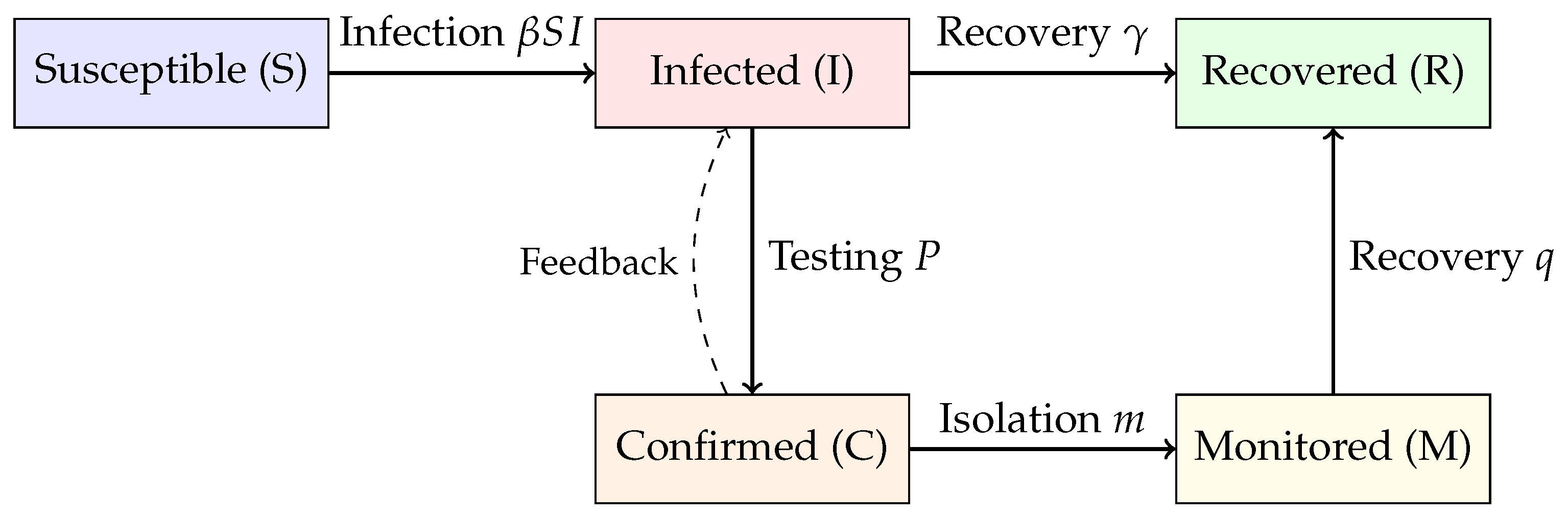
R can be decoupled from the rest equations. The interactions between compartments are visualized in
Figure 1.
3. Analysis and Results
By some standard and straightforward computations from theoretical epidemiology, i.e., setting the right side of Equation (
6) to be 0, we can find the following equilibria for the system (
6).
The disease-free equilibrium (when
) is
and the basic reproduction number
, which can be obtained by calculating the spectral radius of the next-generation matrix [
29], is
The testing-free endemic equilibrium (when
and
) is denoted by
,
The interior endemic equilibrium (when
and
) is denoted by
with
,
,
,
, and
, where
is the positive root of
with
These results can be verified directly by Equation (
6). Note that we can see from the expression of
that it exists if and only if the basic reproduction number
for which
and
. Dynamics for the reduced SIR model without testing (
) is completely known in [
1]. For example, when
, the disease-free equilibrium solution
for the reduced SIR model is globally stable in its biological domain; when
, the endemic equilibrium solution
for the reduced SIR model is globally stable in the interior of its biological domain.
For the SICMR model with confirmed class and monitored class (
and
), one can verify that if
and
, then
are unique and all positive; the detailed analysis of the existence and stability of the testing-free equilibrium state
and the endemic equilibrium state
can be found in [
24]. For example, the disease-free equilibrium
is globally asymptotically stable in
for
and it is unstable for
; if
and
, the testing-free endemic equilibrium
is locally asymptotically stable and also globally asymptotically stable in the interior of
; if
and
, the testing-free endemic equilibrium
is globally asymptotically stable in the interior of
; if
and
, the testing-free endemic equilibrium
is unstable. We are particularly interested in one of the results for the testing-free endemic equilibrium
, that is, under the following conditions:
there exists a unique endemic equilibrium
and the testing-free equilibrium
becomes unstable, having exactly one positive real eigenvalue
for its Jacobian
Also, a corresponding eigenvector can be chosen so that it has a positive entry for the variable
C, meaning that testing will always initially increase the number of test positives.
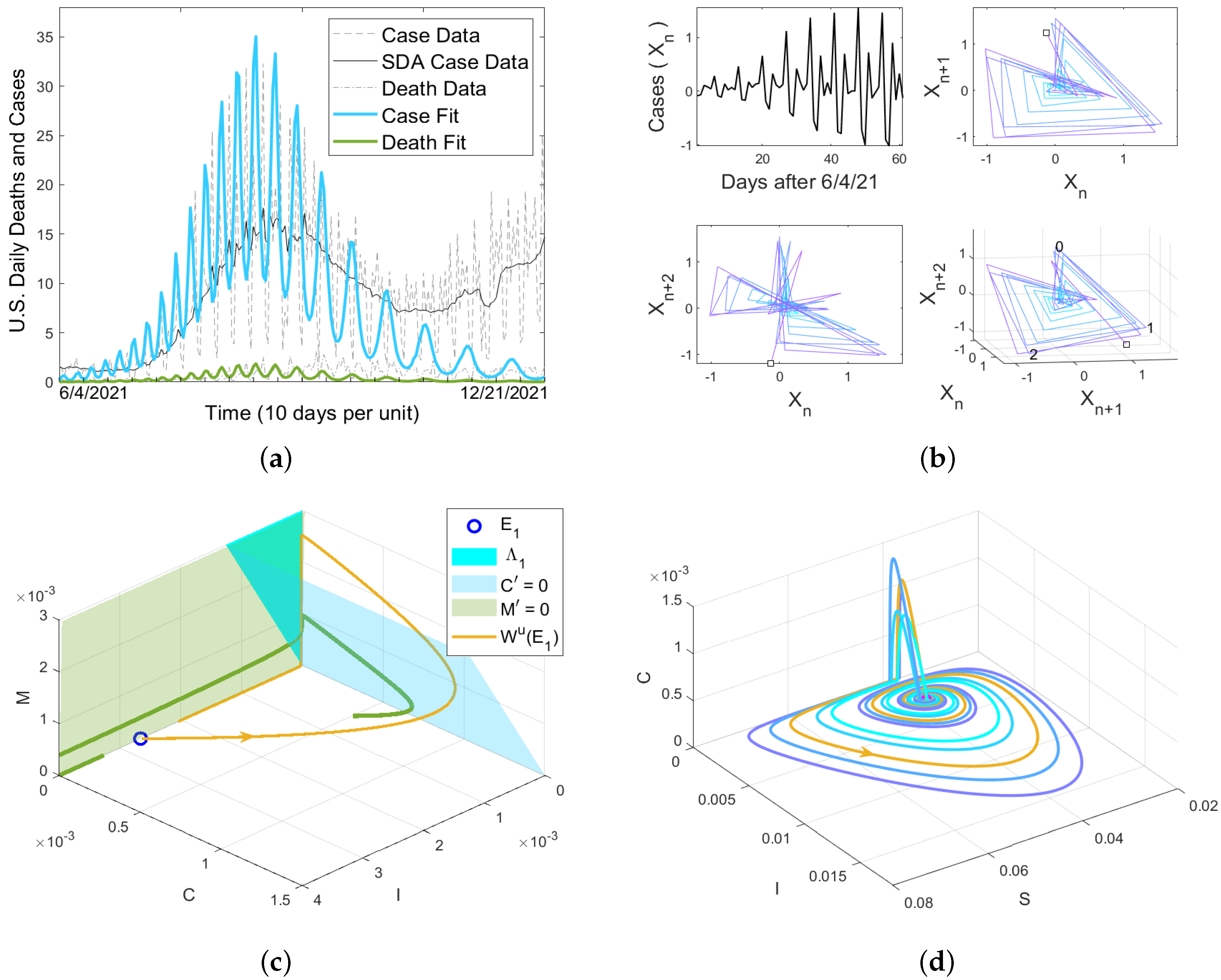
Figure 2 shows the main result when we apply the SICMR model to the pandemic data of the United States. It is for the Omicron variant outbreak. Analysis is also carried out for the Delta variant outbreak, and the same result holds as well. In
Table 1 and
Table 2 are the detailed descriptions.
Figure 2a shows a best fit of the model to the case and death numbers by Newton’s gradient descent method [
30,
31]. Five hundred local minima are found for the loss function between the model and the data over five different variants. Without exception, all best-fit parameters satisfy the instability condition (
14). The plot is for the best fit for the Omicron variant outbreak over a period of 200 days from 4 June 2021 to 21 December 2021. The best-fitted parameter and initial values are given in
Table 2, along with initial conditions
. One can check directly that the parameter values satisfy the instability condition (
14). The dimensions of the parameters can be easily inferred from the model and the time dimension in days. For example,
per day means, on average, each infectious individual passes on the virus to 1 susceptible individual every 3.125 (=
) days. Moreover, from the rate,
per day, at which individuals under monitoring are eventually tested negative, we can derive the average days that infected individuals carry the virus to be about
days. If we assume that 1/3 of that time an infected individual is infectious, then each infected individual would pass on the virus to about 3.52 (=
) people. For another example,
per day means that each test on average takes
day or
1 h 30 min to change an individual’s status from susceptible to confirmed if the individual is infected and tests positive.
We fitted the model to U.S. data (7-day moving averages of cases and deaths) for the Omicron wave (4 June 2021 to 21 December 2021). The fitting was performed using a Weighted Sum of Squared Errors (
W-SSE) minimization algorithm (‘fmincon’ in MATLAB
® R2024b (MathWorks, Natick, MA, USA).) with 500 Latin Hypercube Sampling initializations to ensure global optimality. The best-fit parameter for testing capacity was
day
−1, which implies an effective handling time of
h. While individual PCR test turnaround times were often significantly longer (24–72 h) during the Omicron surge, this parameter represents the aggregate effective rate of the detection system. This high rate captures two key factors: (1) the widespread availability and instantaneous nature of Rapid Antigen Tests (RATs) [
32], and (2) the parallel processing capacity of the national infrastructure, which allows for high throughput despite individual sample latencies. Last but not least, from the death rate
d, we can estimate that, on average, death takes about
days for those who test positive and die from the infection.
As stated, the best-fit parameters satisfy condition (
14), making the testing-free equilibrium
unstable. For the analysis to be credible, we must explicitly present the eigenvalues of the Jacobian matrix
for the best-fit parameters. The Jacobian
is block-triangular. The eigenvalues are therefore the eigenvalues of the
block, plus the diagonal elements
,
, and
.
. This is the complex conjugate pair with a negative real part. Thus, is a stable focus within the invariant manifold. We identify the stable eigenvalue’s real part as .
. This is the single real, positive eigenvalue. We identify this unstable eigenvalue as .
. This is a stable real eigenvalue.
. This is the (decoupled) stable real eigenvalue for the R compartment.
That is, linearization around the testing-free endemic equilibrium for the best-fit parameters yields the Jacobian eigenvalues. We find:
This configuration defines
as a saddle-focus. The system exhibits stiffness (ratio
), necessitating the use of stiff ODE solvers (MATLAB ‘ode15s’ with Tol =
). We verify the Shilnikov condition for complex dynamics:
Substituting our values:
The condition holds strongly. This implies that the system is topologically structured to support spiral chaos or homoclinic orbits if perturbed or driven. This is a significant finding. It demonstrates that while we have not proven the existence of a true homoclinic orbit, the system’s best-fit dynamics possess the necessary ingredients for generating complex, chaotic-like behavior in the neighborhood of the
equilibrium.
Figure 2b is a Takens’ delayed embedding (TDE, [
33,
34]) plot for the daily case data over the 200 days from 4 June 2021 to 21 December 2021. We first obtain the seven-day average (SDA,
) from the daily cases
. We then find the variations of the daily cases from the SDA means, and finally scale the differences by
to obtain the data
.
Takens’ delayed embedding is a diagnostic tool to detect the possibility of complex dynamics, chaotic attractors in particular. For the time-series
shown in
Figure 2b, the delayed plot with
suggests that the embedding dimension for the system’s asymptotic dynamics should be greater than 2 because there is superimposing of trajectories. The delayed plot with
suggests that the embedding dimension can be 3 because a non-self-crossing, 3-dimensional structure can be inferred rather than a projection of a higher-dimensional object, even though the SICMR model is an essential 4-dimensional model. The
plot is simply for a projected view of the 3-dimensional
plot.
By following the direction of the 3-dimensional embedding orbit,
, we can see that the embedded orbit spirals towards a fixed point only to rise up again to repeat the behavior. This visual pattern is a generic feature of many complex oscillatory systems. While this TDE plot does not, by itself, prove the existence of any specific dynamic structure, its complex, non-periodic, and spiraling nature motivates a deeper investigation into our model for inherent instabilities that could produce such oscillations. This motivates the phase-portrait analysis in
Figure 2c,d.
Both
Figure 2c,d are phase-portrait plots for the 4-dimensional SICMR model, projected to two 3-dimensional subspaces. For
Figure 2c, it is for a phase-space analysis of the model projected to the
subspace. It shows the following: the test-free invariant space
along the
I-axis with
, in which
lies; the
C-nullcline surface:
; the
M-nullcline surface:
; and the 1-dimensional unstable manifold
of
. On
, we see that the test-positive cases (
C) and those under monitoring (
M) increase first, make a U-turn on the
C-nullcline surface (
), make another downward U-turn on the
M-nullcline surface (
), and then approach the
region on the testing-free surface (
). By definition,
on the invariant manifold
consists of points at which the Jacobian of the vector field has a negative eigenvalue whose eigenvector is transversal to the invariant manifold
. It attracts orbits nearby by Fenichel’s geometric theory of singular perturbations [
24,
35,
36]. The same eigenvalue changes to positive outside of
, or on the other side of the
C-nullcline
. As we can see,
happens to be in this complementary region of
and it repels orbits into the
C-direction. The unstable manifold of
does not form a homoclinic connection in the deterministic system. However, its trajectory brings it arbitrarily close to the
invariant manifold. This suggests that in a real-world system with inherent stochasticity, noise could perturb trajectories onto this manifold, leading to a dynamic that resembles a homoclinic return. A formal investigation of this possibility within a stochastic differential equation framework is a promising avenue for future research. We note that the existence of such dynamics is not just for one particular set of parameters, but for every set of parameters we have checked, and for other variants’ best fits as well. This is because the dynamical structure described above is structurally stable and not subject to small perturbations. One of such outbreak orbits (with
) is also shown in the plot with initial conditions
.
Figure 2d shows the same unstable manifold (in orange) in the
-space. Clearly, one sees that the unstable manifold arises from the testing-free equilibrium
into the test-positive space (
), and then falls when the number of infected
I becomes small, eventually approaching the testing-free invariant
-subspace. Any re-introduction of testing near the equilibrium will set off the ensuing dynamic. However, as one can see from the plot, with a small difference in the initials, the transient dynamics can be very different in terms of the gaps between the spirals on the
-subspace. This sensitivity can be attributed to the fact that the eigenvalues of the linearization at
are of the Shilnikov type (
16), for which the third strong negative eigenvalue corresponds to an eigenvector on the
invariant space that points from the region
side toward
on the
-subspace. In other words, the trajectory from
behaves as if it were part of a Shilnikov-type structure [
37,
38,
39,
40]. We note that for all best-fit parameters, the testing-free endemic state
is of Shilnikov’s type, satisfying both conditions (
14) and (
16).
5. Discussion
The SICMR model introduces a novel epidemic framework by explicitly modeling diagnostic testing with limited capacity. In particular, by adding “Confirmed” (
C) and “Monitored” (
M) compartments and using a Holling Type II functional response for testing, the SICMR model captures realistic testing saturation as infections rise. This induces a nonlinear feedback loop (“societal memristor”) in which delayed behavioral responses and resource limits act as system memory and saturation. Consequently, unlike standard SIQR models [
42,
43] with linear quarantine (which predict a globally stable endemic equilibrium for
), the SICMR dynamics can undergo a Hopf bifurcation and generate a Shilnikov saddle-focus. In other words, as infection prevalence grows and testing saturates, the per-capita confirmation rate drops, bending the nullclines and yielding the complex oscillatory skeleton seen in
Figure 2. In short, we find that testing is not a passive control parameter but a core dynamical component of the system (much like a memristor in a circuit) that can fundamentally alter epidemic behavior.
Our main findings, based on fitting the model to U.S. Omicron-wave data, include the following: First, capacity-limited testing produces sharp, relaxation-type epidemic waves in the model. The simulated daily cases have steep peaks (
Figure 2a) because the hard saturation of Holling II enforces rigid limits on case confirmation. In contrast, the empirical waves are smoother—an effect likely due to spatial averaging of asynchronous outbreaks and reporting delays. Nonetheless, the model accurately captures the fundamental frequency and timing of the waves, as the weighted SSE fit prioritized outbreak magnitude and onset over fine morphological smoothness. The remaining post-peak mismatch (a “fatigue” decay) suggests that our static parameter set cannot fully replicate the real-world behavioral relaxation that follows an outbreak, highlighting a model limitation.
Second, we emphasize that testing-induced feedback destabilizes the endemic equilibrium (
). The best-fit parameter set yields
as a saddle-focus whose unstable eigenvalue exceeds the magnitude of the stable pair (
). This fulfills the Shilnikov condition (see Equation (
16)), meaning the system has the necessary ingredients for chaos. In fact, we explicitly verified the eigenvalue spectrum to confirm this structure. The linear instability arises from confirmed cases driving more testing: when
I grows, resource limits kick in, and the testing loop “feeds back” on itself. This provides a clear mathematical mechanism for the persistent, oscillatory waves observed during COVID-19.
Third, we compared deterministic versus stochastic outcomes. The model’s Time-Delay Embedding (TDE) predicts a simple limit cycle, but the empirical TDE (
Figure 2b) shows a thick, spiraling attractor. We interpret this as noise-induced bursting: demographic and environmental stochasticity “kick” the trajectory off the stable manifold of
, producing large-amplitude epidemic waves before returning toward equilibrium [
41,
44]. This phenomenon is consistent with theory for excitable saddle-foci. In a purely deterministic simulation the system would settle to a periodic orbit; instead, real-world fluctuations combine with the Shilnikov saddle-focus skeleton to yield the mixed-mode, irregular cycles seen in the data.
Finally, our synthesis underscores that simple SIR-type models miss key complexity. By including the testing compartments and Holling II saturation, the SICMR predicts instabilities that standard models cannot (the tested-endemic becomes a saddle-focus). However, we note limitations: we did not prove the existence of an actual chaotic attractor (no true homoclinic orbit was found), so the autonomous model may remain periodic without noise. Moreover, our deterministic fit does not fully reproduce the empirical attractor complexity.
Comparative Performance with Memristive and Fractional Systems
Memory and Hysteresis: As noted in prior nonlinear dynamics work, systems with internal memory and saturation readily exhibit chaos. For example, Hopfield neural networks with memristors can generate complex multi-scroll attractors due to their built-in hysteresis. The SICMR model has an analogous mechanism: the testing response possesses memory (a delayed policy reaction to rising cases) and saturation (finite capacity), effectively acting as a “societal memristor”. In this view, confirmed cases feed back into future infection dynamics just as memristive elements do in circuits, creating similar nonlinear loops. Capacity Limits vs. Holling II: In memristive and fractional-order systems, physical or mathematical limits on activation enforce nonlinear responses. Lekshmi et al. studied a fractional-order hyperchaotic system where the fractional derivative imparted memory effects and saturation in the dynamics. Likewise, the SICMR’s Holling Type II term models a capacity limit on testing: as infections I increase, the per-capita confirmation rate falls off (a saturating gain). This is conceptually similar to a memristor’s conductance limit. Both approaches bend phase-space nullclines and create oscillatory behavior, but the SICMR does so through epidemiological feedback rather than engineered circuit elements.
Attractor Complexity: Memristive neural networks often produce high-dimensional, multi-scroll chaotic attractors. Fractional systems can exhibit hyperchaos with multiple positive Lyapunov exponents. By comparison, our 5-dimensional SICMR ODE yields a simpler limit cycle in the absence of noise, but it is primed for chaos. The key similarity is that all these systems combine memory and nonlinearity to amplify perturbations. In fact, our equilibrium is a Shilnikov saddle-focus (satisfying ), which places the SICMR in the same broad class of systems ready to generate irregular bursts when noise is added.
Implementation Context: A practical difference is that memristive/fractional systems are often artificial constructs (e.g., neural nets or maps) designed to encrypt or simulate chaos, whereas the SICMR model arises from disease dynamics. Nevertheless, the comparison highlights a unifying principle: feedback with memory and limits can drive chaos. Our results suggest that chaotic-like epidemic waves can emerge not only in abstract systems with fractional derivatives or memristors, but also in real-world epidemiology whenever behavioral and resource feedback loops have similar properties.
The integrated analysis demonstrates that saturating COVID-19 testing can turn a simple SIR process into a complex, potentially chaotic system. The main implications are clear: public health interventions (testing, isolation) can no longer be treated as static parameters; they may induce instabilities if capacity limits are reached. Our results are data-supported and mathematically rigorous, showing that a Holling-II testing function causes the endemic equilibrium to become a Shilnikov saddle-focus. Limitations include the model’s sensitivity to static parameters and its failure to capture every empirical detail (e.g., stochastic effects must be explicitly modeled).
Looking ahead, two promising directions arise. First, it remains an open problem whether the SICMR ODE can admit a true Shilnikov homoclinic orbit and genuine chaos; future work should explore parameter regimes and perhaps more complex compartment structures. Second, incorporating stochasticity formally (via SDEs or spatial coupling) could yield deeper insight into the noise-driven bursts we observe. In particular, our findings suggest that epidemic control strategies must be designed carefully: spatially coupled models and control theory should be used to devise testing protocols that avoid triggering these resonances. Despite its simplicity, the SICMR framework provides a crucial first step toward understanding how testing constraints can induce rich dynamics. By highlighting the “active” role of testing in epidemic stability, this work lays the groundwork for more sophisticated models and control policies that can manage pandemic waves without unintentionally spawning chaotic oscillations.