1. Introduction
Fractional differential equations have emerged as a powerful tool for modeling economic and environmental processes, particularly in agricultural and resource-based systems, since their ability to capture memory and hereditary effects makes them especially suitable for describing long-term dependencies, delayed responses, and cumulative dynamics in economic activities such as investment behavior, production dynamics, market evolution, and risk-controlled financial systems [
1,
2], as well as in environmental and agricultural applications including crop growth, pest population control, soil moisture evolution, irrigation dynamics, and sustainable resource management, where the nonlocal structure of fractional derivatives accurately reflects historical environmental influences on long-term ecological balance and productivity [
3,
4]. From a theoretical perspective, the applicability and reliability of fractional models depend critically on the existence and uniqueness of their solutions. In this context, fixed point theory provides one of the most effective analytical frameworks for establishing well-posedness results for fractional differential equations. A wide range of existence and uniqueness results for fractional models has been obtained using fixed point techniques [
5,
6]. Consequently, the qualitative analysis of fractional differential equations via fixed point methods has become a central topic in modern applied mathematics, forming a rigorous foundation for their use in economic and environmental applications.
Over the past decades, fixed point theory has experienced substantial growth through the introduction of new geometric and algebraic structures that extend the classical metric framework. In a standard metric space, the distance function satisfies non-negativity, symmetry, and the usual triangle inequality, and Banach’s contraction principle guarantees the existence and uniqueness of a fixed point for contraction mappings on complete metric spaces, making it one of the most fundamental tools in nonlinear analysis. To broaden this classical setting, Czerwik [
7] introduced in 1993 the notion of a
b-metric space by relaxing the strict triangle inequality via a multiplicative constant
, a generalization that has proved particularly effective in problems involving nonstandard contractions and irregular geometric structures, as defined in Definition 1.
Definition 1 ([
7])
. Let X be a nonempty set. A function is called a b-metric on X if, for all and for some constant , it satisfies the following conditions:- •
if and only if ,
- •
,
- •
Additionally, the pair is known as a b-metric space.
As a result, a wide range of fixed point results has been established in
b-metric spaces, offering enhanced flexibility for existence and uniqueness theory. It is worth observing that every classical metric space is a particular case of a
b-metric space corresponding to the choice
. Subsequently, in 1998, Czerwik [
8] extended the analytical structure of
b-metric spaces by introducing appropriate notions of Cauchy sequences, convergence, and completeness.
Definition 2 ([
8])
. Let be a b-metric space and let be a sequence in X. For any and .- •
The sequence is said to be Cauchy if there exists such that for all .
- •
The sequence is said to converge to if there exists such that for all .
- •
The space is called complete if every Cauchy sequence in X converges to a point of X.
While classical fixed point theorems guarantee the existence of points that remain invariant under a given mapping, many practical problems, particularly in optimization and approximation theory, arise in settings where such mappings do not possess fixed points. In these situations, the theory of best proximity points becomes indispensable, as it ensures the existence of points that minimize the distance between the domain and codomain, especially in the case of cyclic mappings or disjoint sets. Consequently, best proximity theory has emerged as a natural and powerful extension of classical fixed point methods. Alongside this development, fixed point theory has continued to expand through the introduction of new geometric and algebraic structures. In particular, the incorporation of graph-theoretic frameworks has provided a flexible and effective setting for dealing with discontinuous operators, order-type relations, and complex interaction systems. In this direction, Jachymski [
9] made a significant contribution in 2008 by establishing fixed point results in metric spaces endowed with a directed graph
and by introducing the notion of
-continuity, which allows the classical Banach contraction principle to be extended to mappings defined along graph edges. As a result, numerous authors have developed graph-based fixed point theorems that refine and generalize the classical results of Banach and others, thereby broadening the applicability of fixed point techniques to differential and fractional equations. More recently, the use of auxiliary functions, including altering distance functions, simulation functions, and admissible control functions, has further enriched both fixed point and best proximity point theory by enabling the formulation of more general and unifying contraction conditions.
Motivated by the growing interest in fixed point theory on metric-type spaces equipped with graph structures, several recent works have explored the interplay between auxiliary functions, generalized metrics, and directed graphs. In particular, Karapınar et al. [
10] employed auxiliary function techniques to establish fixed point results for fractional differential equations, highlighting their effectiveness in nonlocal and nonlinear settings. Building on this idea, Suebcharoen et al. (2023) [
6] investigated fixed point theorems in spaces endowed with directed graphs, demonstrating that graph-based structures provide a flexible framework for handling complex dependencies in generalized metric spaces, including
b-metric spaces. On the applied side, fractional differential models have received increasing attention due to their ability to capture memory and hereditary effects; for instance, recent works in [
11,
12] illustrate the relevance of fractional dynamics in realistic biological systems. Collectively, these developments underscore the importance of graph-based fixed point techniques and auxiliary functions in both theoretical and applied contexts. Motivated by these advances, we introduce a new class of proximal connected-image contractions in
b-metric spaces endowed with directed graphs and investigate the existence of best proximity points. Our results yield explicit fixed point criteria and are further applied to fractional differential equations, demonstrating the effectiveness of the proposed framework.
2. Main Results
In this section, we develop the theoretical framework needed to establish the existence of best proximity points and fixed points for proximal connected-image contractions in b-metric spaces endowed with directed graphs. Our main goal is to combine the geometric structure of b-metric spaces, the order structure induced by the graph, and the flexibility provided by auxiliary functions into a unified analytical setting. Throughout this work, let denote a structure satisfying the following assumptions:
- •
, and is a b-metric space with ,
- •
X is endowed with a directed graph , where denotes the vertex set and denotes the edge set, which contains all loops but no parallel edges,
- •
is a mapping from A to B, where A and B are nonempty closed subsets of X.
The distance between
A and
B is measured by the standard infimum distance
In many applications, this minimal distance is not zero, which prevents the existence of fixed points. This motivates the introduction of best proximity points, which serve as natural substitutes for fixed points in such settings. To facilitate their study, we also define the sets
and
These sets consist precisely of the points that attain the minimal distance between the two sets. To incorporate both the
b-metric structure and the graph framework into a single object, we now introduce the notion of a proximal connected-image set, which plays a central role in our approach.
Definition 3. Given , for each , we call the setthe proximal connected-image set of x if the mapping μ has the property , that is, Property
guarantees that whenever a point
x is connected to its image
, every proximal point
a of
remains connected to its own image
. This condition plays a key role in preserving graph admissibility along proximal sequences. Motivated by the notion of
-continuity in [
9] and adapted to our framework, we introduce the following modified concept of continuity for the mapping
.
Definition 4. Given , the mapping μ is said to be -continuous if, for every , there exists a sequence such that for all , and This definition ensures that
preserves the convergence of sequences that respect the edge structure of the graph, which is essential for passing to the limit in iterative constructions. In particular, if the sequence
satisfies
for all
, then
-continuity coincides with the classical notion of
-continuity. In this case, the sequence
consists of edges of
, and the preservation of convergence reduces exactly to
-continuity in the sense of [
9]. Therefore,
-continuity extends
-continuity to the proximal and non-self framework.
We now recall the notion of a best proximity point, which generalizes the concept of a fixed point when the domain and codomain do not intersect. A point
is called a best proximity point of
if it satisfies
The set of all best proximity points of
is denoted by
Remark 1. Given , if , then .
In order to ensure that the iterative procedure leading to best proximity points can be properly initiated, we introduce the following initial connected-image set.
Definition 5. Given , the initial connected-image set is defined as The following lemma guarantees that such an iterative process is always well-defined and converges to a best proximity point under suitable continuity assumptions.
Lemma 1. Given , if there exists and μ has the property , then there exists a sequence such that belongs to the proximal connected-image set for all . Moreover, if μ is -continuous and in A, then
Proof. By the assumption, there exists
such that
and
. Since
, there exists
such that
which implies that
. Moreover, from
and
has the property
, it follows that
. Then
is the proximal connected-image set. By iterating this argument, we obtain a sequence
such that, for every
,
that is,
. Consequently, we also have
Then
is the proximal connected-image set for all
. Now, assume that
is
-continuous and that
in
A. From (
2) and the definition of
-continuity, it follows that
. Passing to the limit in (
1) as
, we obtain
Therefore,
. □
We next introduce a class of auxiliary functions that plays a central role in formulating the contractive condition for proximal connected-image mappings and in establishing our main existence results. Let
be the class of all auxiliary functions
satisfying
for all sequences
,
,
, and
in
X such that the sequences
and
are decreasing, where
is a
b-metric space with
.
Example 1. The following are examples of functions when , which illustrate both simple and nonlinear choices of auxiliary functions.
- (1)
for
- (2)
Classical contraction principles are often inadequate in graph-based and non-self settings, where proximity is realized through best proximity pairs rather than fixed points. To overcome this limitation, we introduce R- and M-type proximal connected-image contractions, which generalize and refine existing contraction conditions by combining auxiliary control functions with structured distance comparisons on proximal connected-image sets. The R-type contraction measures contractiveness through rational and additive combinations of distances involving both domain and image points, while the M-type contraction further extends this framework by employing a maximum-based control function that allows greater flexibility and covers a wider class of nonlinear behaviors. This distinction enables our approach to unify several known contraction principles and adapt them effectively to b-metric spaces endowed with a directed graph.
Definition 6. Given , a mapping μ is said to be a proximal connected-image contraction of type if, for each with , where and are proximal connected-image sets. Then there exists such thatwhere is defined by This definition extends classical contraction conditions by incorporating both the auxiliary function and the geometric structure induced by the proximal connected-image sets and the b-metric. The following lemma describes the fundamental behavior of the iterative sequence generated under such contractive mappings and serves as a key step toward proving the main results.
Lemma 2. Given , if μ is a proximal connected-image contraction of type and there exists and μ has the property , then there exists a sequence such that
- (i)
if for some , then ,
- (ii)
if for all , then .
Proof. By Lemma 1, the sequence satisfies for all . Suppose that for some . Then , and hence . By Remark 1, it follows that .
By Lemma 1, there exists a sequence
such that
and
are proximal connected-image sets, and
Since
is a proximal connected-image contraction of type
, for each
and
, we obtain
Moreover, a direct computation shows that
Let us define
Since
is a
b-metric space with constant
, we have
Hence, it follows that
Assume that the sequence
is not decreasing. Then there exists some
such that
Consequently, we obtain
Using inequality (
4), we deduce
Since
for all
, we have
, which implies
However, since
, this yields
which is a contradiction. Therefore, the sequence
must be decreasing; that is,
As a result, we obtain
Since
is decreasing and bounded below, it converges. Thus,
Now, suppose that
. Then
From inequality (
4), it follows that
Taking the limit as
in the above inequality, we obtain
Therefore,
By the definition of the auxiliary function
, this implies that either
or
Both alternatives contradict our earlier assumption that
. Hence, we must have
□
To prove the existence of best proximity points, we combine proximal connected-image contractions with -continuity. The following result guarantees the existence of at least one best proximity point for .
Theorem 1. Let be a given structure, where μ is a proximal connected-image contraction of type and is -continuous. If there exists and μ has the property , then .
Proof. By Lemma 1, there exists a sequence
such that, for all
,
that is,
. Consequently,
Then
is the proximal connected-image set for all
. If
for some
, then by Lemma 2 we immediately obtain
. Hence, we may assume that
Again by Lemma 2, we have
We now show that
is a Cauchy sequence. Suppose, on the contrary, that
is not Cauchy. Then there exists
such that for every
, there are integers
with
minimal satisfying
From (
8) and the
b-triangular inequality, we have
Rewriting this yields
Letting
and using (
7), we obtain
Next, we have
Applying the
b-triangular inequality gives
Substituting (
8) and (
10) into (
9) gives
Thus,
From (
5) and (
6),
and hence,
Since (
7), letting
gives
Thus,
which yields
Finally, using (
8) and the
b-triangular inequality,
and similarly,
Letting
and using (
7) and (
11), we obtain
contradicting (
8). Therefore,
is Cauchy. By the completeness of
X and
A is closed, there exists
such that
By the
-continuity of
and Lemma 1, we conclude that
a is a best proximity point of
, that is,
. □
To capture a contractive behavior governed by rational and mixed distance expressions, we define another class of proximal connected-image contractions of type as follows.
Definition 7. Given , a mapping μ is said to be a proximal connected-image contraction of type if, for each with , where and are proximal connected-image sets. Then there exists such thatwhere is defined by The following lemma establishes two fundamental properties of the iterative sequence generated by a proximal connected-image contraction of type .
Lemma 3. Given , if μ is a proximal connected-image contraction of type and there exists and μ has the property , then there exists a sequence such that
- (i)
if for some , then ,
- (ii)
if for all , then .
Proof. The proof is identical to that of Lemma 2.
By Lemma 1, there exists a sequence
such that
and
are proximal connected-image sets, and
Since
is a proximal connected-image contraction of type
, for each
and
, we obtain
Moreover, a direct computation shows that
Let us define
We have
Assume that the sequence
is not decreasing. Then there exists an integer
such that
. Consequently, we obtain
Using inequality (
12), we have
By applying the same argument as in the proof of Lemma 2, it follows that
must be a decreasing sequence, that is,
for all
. Hence, we obtain
Since
is bounded below, the sequence converges, and therefore
which implies
Suppose, on the contrary, that
. Then
From inequality (
12), we obtain
Taking the limit as
in the above inequality yields
Therefore,
By the definition of auxiliary functions, it follows that
or
which contradicts the assumption that
. Hence,
□
Using the convergence properties established in the previous lemma for proximal connected-image contractions of type , we now prove the existence of best proximity points under the additional assumption of -continuity.
Theorem 2. Let be a given structure, where μ is a proximal connected-image contraction of type and is -continuous. If there exists and μ has the property , then .
Proof. The proof follows the same framework as that of Theorem 1. Hence, there exists a sequence
such that,
is the proximal connected-image set for all
. If
for some
, then by Lemma 3 we immediately obtain
. Hence, we may assume that
Again by Lemma 3, we have
We now show that
is a Cauchy sequence. Suppose, on the contrary, that
is not Cauchy. Then there exists
such that for every
, there are integers
with
minimal satisfying
By applying the same line of reasoning as in the proof of Theorem 1, we obtain that
Using (
13), we deduce that
We observe that
. Hence, we conclude that
Since (
13), letting
in the above inequality yields
Following the same arguments as those used in the proof of Theorem 1, it follows that the sequence
is a Cauchy sequence in
. By the completeness of the
b-metric space and
A is closed, there exists an element
such that
By the
-continuity of
and Lemma 1, we conclude that
a is a best proximity point of
, that is,
. □
The following theorem establishes the uniqueness of the best proximity point under the hypotheses of Theorem 1 or Theorem 2, provided an additional coincidence condition is satisfied.
Theorem 3. Assume that all the hypotheses of Theorem 1 (or equivalently, Theorem 2) hold. Suppose further that with . Then μ admits a unique best proximity point.
Proof. Let
. Suppose, by contradiction, that
; then
Since
, we obtain
Hence, it follows that
, which implies
. This contradicts the assumption that
x and
y are distinct points. Therefore, we must have
, and thus
has a unique best proximity point. □
To further illustrate and validate our main results, we now present the following example.
Example 2. Consider the following setting:
- (i)
Let be a b-metric space endowed with the directed graph defined by where the b-metric is given by - (ii)
- (iii)
Define the mapping by
Since
, we have
Moreover, since
, it follows that
. Clearly, the mapping
is
-continuous. Next, we show that
and
are proximal connected-image sets for all
. Let
. Since
we obtain
for all
. If
, then
which implies
. For all
, we have
then
Therefore,
and hence
is a proximal connected-image set. Likewise,
satisfies the same property. Now, define the function
by
Let
, where
such that
, that is,
It follows that
where
. If
or
, the contraction inequality is trivial. Assume
and
. Then
are all distinct. Consequently, we have the following calculation
Hence,
is a proximal connected-image contraction of type
. By Theorem 1, we conclude that
, and
is the best proximity point of
.
Finally, we consider a special case of our main results by assuming that . Under this assumption, the best proximity point problem reduces to a fixed point problem. Consequently, the results obtained in the previous sections yield corresponding fixed point theorems. Moreover, in the next section, we shall illustrate the applicability of these fixed point results to fractional differential equations. Under this reduced framework, we introduce the following concepts.
Definition 8. Given , a mapping μ is said to be a -contraction of type if the property holds for all and there exists a function such thatwhere is defined by Definition 9. Given , a mapping μ is said to be a -contraction of type if the property holds for all and there exists a function such thatwhere is defined by For a self-mapping
, let
denote the set of all fixed points of
. In this particular case, since
, it is clear that
We are now in a position to derive the corresponding fixed point consequences of our main results.
Corollary 1. Let be given. Suppose that μ is a -contraction of type and is -continuous. If there exists , then .
Corollary 2. Let be given. Suppose that μ is a -contraction of type and is -continuous. If there exists , then .
3. Applications to Nonlinear Fractional Differential Equations
In this section, we extend the fixed point results established earlier to the setting of fractional differential equations. Fractional models naturally arise in diverse scientific fields and are well known for their nonlocal behavior, which makes classical analytical techniques difficult to apply directly. By reformulating the fractional differential equation as an equivalent integral equation and invoking the fixed point theorems developed in the previous sections, we obtain conditions guaranteeing the existence of solutions in the fractional framework. This demonstrates that the fixed point approach remains effective not only for standard differential and integral equations but also for their fractional counterparts, further emphasizing the broad applicability of the theory.
To make the fixed point method applicable to the fractional problem, we introduce the structural requirements that the operator must satisfy. These assumptions ensure that the solution map behaves well enough for the existence theory to hold. Let X be a nonempty set, and let be a given mapping. Define as the collection of all functions satisfying:
For every , if , then ,
For every , if and , then .
For each
, we define a directed graph
This graph structure forms the basis for the subsequent application of our fixed point theorems. In the fractional setting, a fractional differential equation can be rewritten as an equivalent Volterra-type integral equation. We therefore study the problem in the space
equipped with the
b-metric
which is complete for
. This framework allows us to apply the abstract fixed point results established earlier and to prove the existence of solutions to fractional differential equations. The following consequence illustrates this application in detail.
Here, we discuss the following nonlinear fractional differential equations with nonlocal integral boundary condition of order
, where
. Specifically, we consider
where
,
,
is a given function, and
denotes the Riemann-Liouville fractional derivative of order
, that is,
Next, we derive the Green’s function associated with the nonlinear fractional Equation (
16). This representation will be useful for establishing the existence of solutions.
Lemma 4. Let , , and let . Considerwith . Then the problem has a unique solutionwhere the Green function is Proof. Since
, it is well known (see [
13]) that the general solution of
is
Using the conditions
we directly obtain
, for
. Thus
To compute
, we note that
and
By reversing the order of integration gives
Using the boundary condition
we have
which implies
where
. Splitting according to the four possible orders of
,
t, and
produces the piecewise Green function in (
18). This completes the proof. □
Remark 2. It is worth noting that when , the integral boundary condition reduces to a local one and the nonlocal effect disappears. In this case, for our result reduces to Theorem 2.1 of [14]. Moreover, when , our result recovers Theorem 3.1 of [15] under the corresponding parameter identification. The following lemma provides an essential estimate for the Green’s function associated with problem (
16). This bound will be used later to establish the properties required for the existence results.
Lemma 5. Let , , and be such that . The Green function defined by Equation (
18)
satisfieswhere Proof. Let
. We consider in a first case of
that
. In this case, we have
Using the triangle inequality and the fact that
, we have
where
The same estimates can be carried out for the other three cases in (
18), yielding the identical bound as
This implies that
which proves the desired estimate. □
Let us consider the mapping
given by
The kernel
denotes the Green function associated with the fractional boundary-value problem, while the function
f characterizes the nonlinear effects. Rather than working directly with the differential Equation (
16), it is often more convenient to interpret a solution as a function that is reproduced by this integral transformation. A function
satisfies the fractional problem exactly when it satisfies the fixed point relation
. In this way, the boundary-value problem reduces to locating a fixed point of the operator
.
Lemma 6. Consider the space and the operator is defined in (
19).
Assume that one of the following conditions holds. (H1) For every and all , there exists such that (H2) For every and all , there exists such thatWhen condition (H1) is imposed, the operator becomes a CI-contraction of type ; on the other hand, if (H2) is used, then acts as a CI-contraction of type . Proof. Using the definition of the operator
, we have
which implies
By applying assumption
(H1) to the nonlinear term
, it follows that
Using Lemma 5, we get
By the definition of a CI-contraction of type
, condition
(H1) ensures that the operator
possesses this property. When
(H2) is invoked instead, the same argument shows that
operates as a CI-contraction of type
. The proof is complete. □
We are now ready to present the main existence result for the nonlinear fractional differential problem (
16), obtained as a consequence of the fixed point framework developed above and Corollaries 1 and 2.
Theorem 4. Consider the space , where and the operator is given by (
19).
Assume that one of the conditions (H1) or (H2) is fulfilled. Suppose further that there exists a function for which for all . Under these hypotheses, the operator possesses a fixed point , and this fixed point provides a solution of the nonlinear fractional differential problem (
16).
Although conditions
(H1) and
(H2) are stated in a general form, their effectiveness relies on concrete and verifiable choices of the auxiliary function
. In the absence of such structure, these assumptions may become overly flexible and difficult to verify in practice. Therefore, in applications, the function
should be specified explicitly in advance and chosen in accordance with the structure of the operator
. In what follows, we apply our results to study the existence of solutions for the nonlinear fractional differential Equation (
16).
Example 3. Consider the following nonlocal integral boundary-value problem:with the boundary conditions: Proof. We observe that
and
, which satisfy condition
and by Lemma 5 we obtain
By applying the Cauchy-Schwarz inequality, we have
We let
by
. We note that
and
by continuity. Hence
is non-decreasing on
. Direct differentiation yields
We note that the denominator is strictly positive for
, so the sign of
depends on the numerator. Let
and define
We also have
and
Hence
for all
, which implies
is concave on
, and by continuity at
, it is concave on
. Since
is concave on
and
, it follows that
is sub-additive, that is,
for all
. Since
is non-decreasing and sub-additive, using the fact
, we obtain
That is
Consequently, this implies that
By taking the supremum over
, one has
This suggests us to introduce
Therefore, we arrive at
due to the fact that
Hence, by applying Theorem 4,
has a fixed point
, which is a solution to the problem. □
After establishing existence results for problem (
16), we proceed to study positivity of the solutions. The key ingredient in this analysis is the positivity of the Green function associated with the fractional boundary-value problem.
Lemma 7. Let , , and . Assume that . Then the Green function given by (
18)
is a non-negative function for all Proof. Since and , it suffices to show that the numerator in each branch of is nonnegative.
Case 1:
. Consider
Here, for
, we define
by
We claim that
for
To prove this, we consider
This suggests us to show that
. We let
by
By taking differential of
, we see that
Since
, we can conclude that
is strictly increasing. Therefore, we arrive at
as expected. That is
for
We observe that
For
, we note that
, which implies
.
Case 2:
. In this region, we see that
which directly implies that
.
Case 3:
. Here, we consider
As before,
for
and
, we obtain
hence
.
Case 4:
. In the last region, we have
Since all factors are nonnegative, then
. This completes the proof. □
Let
be the class of positive function
as
Based on Lemma 7, it is clear that
, when
f is positive. Therefore, based on the setting of Theorem 4, we obtain the existence of a positive solution of the nonlinear fractional differential Equation (
16).
Theorem 5. Consider the space and the operator is given by (
19).
Assume that and one of the conditions (H1) or (H2) is fulfilled. Suppose further that there exists a function for which for all . Under these hypotheses, the operator ; possesses a fixed point , and this fixed point provides a positive solution of the boundary-value problem (
16).
Example 4. Consider the following nonlocal integral boundary-value problem:wheretogether with the boundary conditions: Proof. We observe that here
and
, which satisfy condition
and by Lemma 5 we obtain
Based on the fact that
, we see that
By applying the Cauchy-Schwarz inequality, we have
Let us consider
Using the fact that
, for
, we get
By taking the supremum over
, one has
Here, we define
Therefore, we arrive at
due to the fact that
Hence, by applying Theorem 5,
has a fixed point
, which is a positive solution to the problem. □
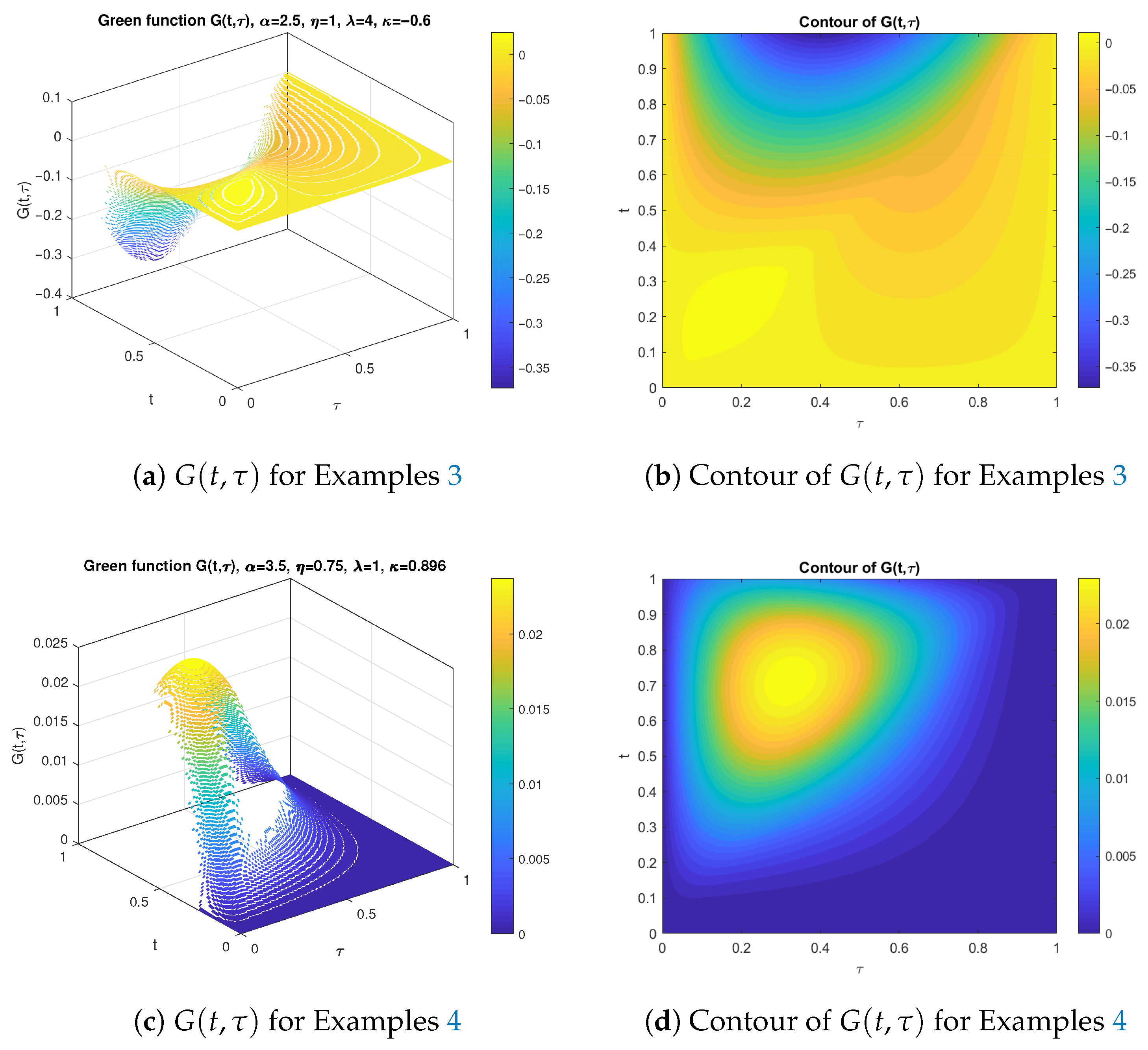
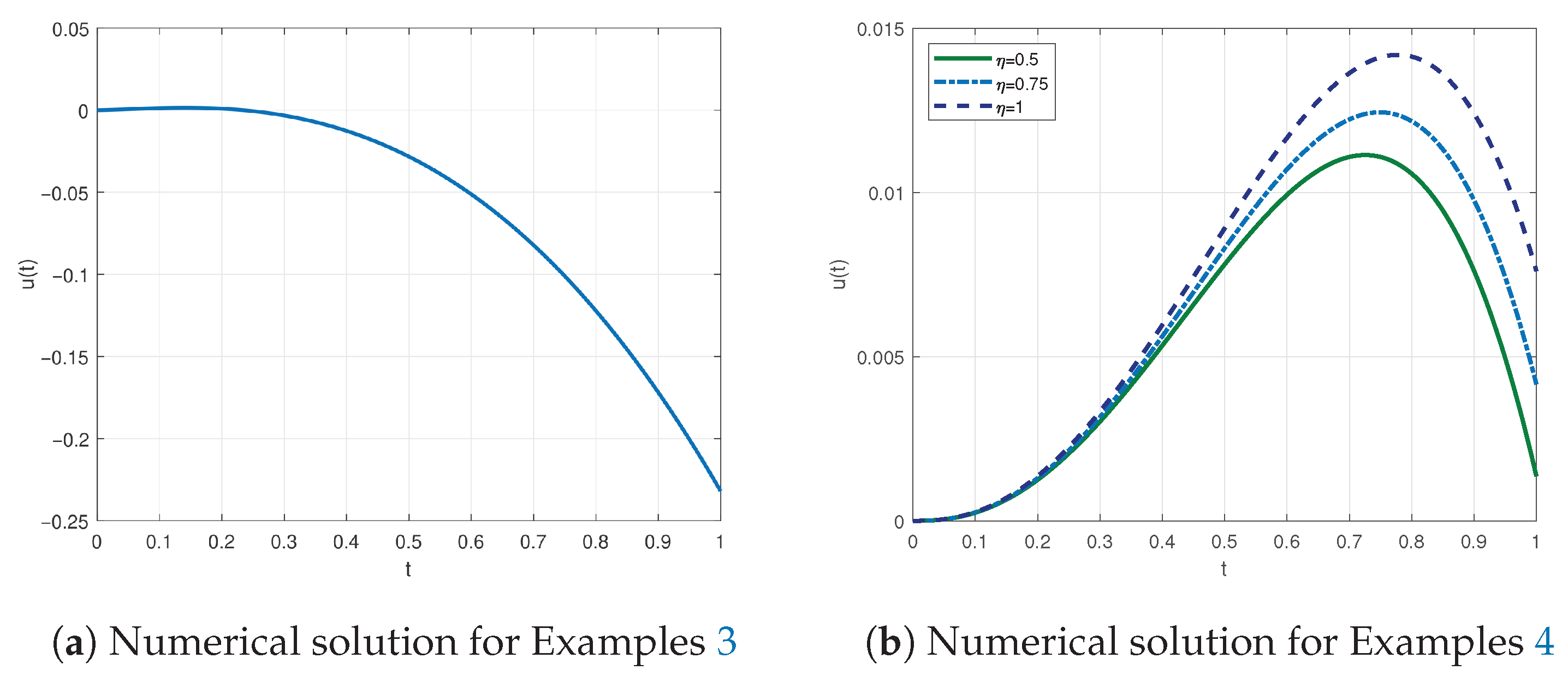
Remark 3. To further illustrate the role of the Green function in the existence of positive solutions, Figure 1 presents a graphical comparison of the Green functions corresponding to Examples 3 and 4. For the parameters in Example 3, the Green function changes sign on , and therefore the associated integral operator does not preserve positivity. In contrast, for the parameters in Example 4, the Green function is nonnegative for all , in agreement with Lemma 7. This comparison explains why the additional assumption is required to obtain positive solutions in Theorem 5. More generally, it illustrates that the positivity of solutions is governed by the sign of the associated Green’s function. To illustrate the theoretical results, we compute numerical solutions of the integral equation using a standard Picard fixed point iteration. The integral equation is discretized by a quadrature-based scheme on a uniform grid, and the iteration is performed until convergence in the supremum norm with tolerance
or until a maximum of 1000 iterations is reached. The numerical solutions reflect the qualitative properties of the underlying Green’s function and the nonlocal boundary condition
which couples the endpoint value to the integral of the solution over the interval
, with the parameter
controlling the strength of the nonlocal effect. The numerical results are consistent with the theoretical analysis. In Example 3, where
, the associated Green’s function changes sign and the numerical solution is not positive. In contrast, in Example 4, where
, the Green’s function is nonnegative and the numerical solutions remain positive for
,
, and 1, as shown in
Figure 2.




 ,
,