


Abstract
In this study, an adaptive event-driven coordination paradigm is proposed for achieving consensus in nonlinear multi-agent systems (MASs) over directed networks. First, a newly dynamic event-triggered mechanism with single-point historical information is introduced to minimize unnecessary network communication. And a more general form of an event triggering mechanism with moving window historical information is designed for further saving network resources. Considering that the use of historical information over a long period of time may cause deviations, an event-triggered mechanism that can adjust the maximum memory length is proposed in this work to minimize unnecessary network communication. Secondly, the unknown nonlinearities in the MAS model are addressed using the universal approximation capability of neural networks. Then, a methodology for distributed adaptive control under event-triggered mechanisms is introduced leveraging the memory-based command-filtered backstepping methodology, and the proposed scheme resolves the complexity explosion problem. Finally, a case study is conducted to validate the feasibility of the proposed method.
MSC:
93C10
1. Introduction
Distributed consensus control has been a central theme in MAS research for the past ten years [1,2,3]. A pivotal area within this field is consensus tracking, often realized through a leader–follower framework. The importance of this problem is driven by its critical applications across various advanced domains, including cooperative UAVs, spacecraft formation, distributed networks of sensors, and robotic swarming [4,5,6,7,8,9]. In comparison with single-system trajectory tracking [10], the primary challenge of consensus tracking control lies in the design of a local-information-based distributed controller, achieving consensus tracking of the desired trajectory (i.e., the leader). Furthermore, a notable feature of the works discussed above is their consideration of relatively simple system models, often confined to linear systems. However, numerous control systems in practical engineering involve unknown nonlinear dynamics, which presents even greater challenges for controller design. To handle fully unknown nonlinear dynamics within these systems, neural networks (NNs) have been introduced and successfully applied [11,12,13,14].
Importantly, the control strategies established in prior work undergo periodic updates at fixed time intervals, resulting in excessive update frequencies and substantial communication costs. In many MAS applications, each agent has finite capacity in both its energy reserve and communication capabilities. Thus, the creation of adaptive control mechanisms is imperative to economize network resources and augment the efficiency of control systems. Recently, event-triggered control (ETC) has emerged as an effective means to tackle this issue by updating the control input only when an event condition is satisfied [15]. Under such a control scheme, control tasks are initiated solely when the predefined triggering criterion is satisfied. Recent research has increasingly focused on leveraging advanced event-triggered sampling for consensus in MASs [16,17,18,19,20]. For instance, utilizing a state-shifting transformation to convert constrained states into unconstrained variables within a predefined time, ref. [21] introduced an adaptive event-triggered consensus protocol featuring a relative threshold for nonlinear pure-feedback MASs subject to delayed full-state constraints. Moreover, existing ETC approaches have not fully utilized historical information (memory) to enhance resource efficiency. In fact, long-term memory in the human brain can guide future behavior. Inspired by this idea, a memory-based dynamic triggering mechanism was incorporated into the ETC design for a class of nonlinear systems in [22], yet the potential of leveraging long-term memory to guide the triggering mechanism remains unexplored. Therefore, designing a novel memory-based ETC scheme for MASs without increasing system complexity remains a challenging problem that warrants further investigation.
Building on the above analysis, an event-triggered control scheme is presented, utilizing a memory-based command filter approach and a historical information-based dynamic triggering mechanism for enhanced resource conservation. The key novelties of our method are outlined below.
- For multi-agent systems, this paper proposes a novel distributed adaptive control scheme integrating command filters and historical information. This scheme not only avoids the explosion of complexity but also ensures the boundedness of closed-loop signals. Compared with existing studies, the proposed scheme indirectly incorporates historical information into the controller design process, providing a new approach for memory to guide the behavior of followers.
- Distinct from the ETC scheme presented in [22,23], this paper draws inspiration from the human brain’s ability to make decisions by leveraging memory and proposes a single-point historical triggering mechanism, which capitalizes on memory at a specific moment, and a moving window-based historical triggering mechanism, which incorporates memory over a time interval, where the maximum memory length is constrained by a dynamic parameter, to mitigate potential deviations induced by long-term memory. The proposed framework provides an alternative approach to adaptively designing ETC through historical information.
2. Problem Formulation
This work investigates the problem of coordinated tracking for nonlinear MASs driven by a leader’s trajectory and N followers (denoted as ), where the ith follower’s motion is governed by
with the state vector denoted as and system input and output denoted as and , respectively. The function is continuous and uncertain. The communication among followers is formulated as a weighted oriented graph , represented by a graph with node set and edge set . In this graph, an edge signifies a directed information flow from agent j to agent i. Accordingly, the neighbor set of agent i is given by . The weighted adjacency matrix is defined by the following rule: if and otherwise. From B, the in-degree matrix is computed as , which ultimately gives the Laplacian matrix .
The leader’s trajectory satisfies Assumption 1. Additionally, the communication from the leader to the followers is encoded by a diagonally structured matrix , where if and only if agent i has direct access to the leader’s information.
Assumption 1
([24]). The desired trajectories and are continuous, bounded, and available.
Assumption 2
([25]). The directed communication graph forms a directed spanning tree; i.e., the leader node is reachable from all follower nodes.
The primary objective of this work is to devise an event-triggered distributed controller for the consensus tracking of followers to the leader , with the dual objectives of ensuring the exclusion of Zeno behavior and that all closed-loop signals are bounded and of reducing the control update frequency to conserve resources. For the rigor of the content, some necessary lemmas are given below.
Lemma 1
([26]). For any and Ξ, it holds that
Lemma 2
([27]). Assume that is absolutely continuous and for . The following fact is established.
with the continuous bounded functions , and . Then for every ,
where , , and .
Lemma 3
([28]). The domain of continuous function ϕ is a compact set, which can be reconstructed as
where is the optimal weight vector, the reconstruction error , and denotes the basis function vector.
Lemma 4
([25]). For a directed spanning tree, the matrix is a nonsingular matrix.
3. Controller Design and Theoretical Analysis
3.1. Event-Triggered Mechanism with Memory
Firstly, the control law is implemented on a digital computational platform. We formulate the ETC protocol as
where is the control input at the triggering instants . The triggering error of (1) is expressed as . are positive constants. The dynamic parameter is designed as the following two cases.
Case 1: In this case, the dynamic parameters provide a dynamic minimum time interval by their boundedness and the property of for the triggering mechanism. The dynamic equation of is
which utilizes the single-point historical information with positive constant and positive initial value . Note that if we chose and take the derivative of , there is
where . By the Generalized Halanay inequality [27], the boundedness of can be obtained. To prove , we first assume that there exists such that . If , then . Meanwhile in , which leads to a contradiction. Then, over is proved by repeated analysis for .
Case 2: It is noted that memory or historical experience can be used as a basis for learning when some situations in the human brain do not have prior knowledge. Based on this idea, we give a dynamic event condition based on single-point historical information, such as case.1, but experience often occurs over a period of time. Therefore, the following dynamic mechanism based on the historical information of moving windows is expressed as
where the Lipschitz continuous function belongs to class and is a positive function, is a positive constant, and h is the memory span. As in the analysis of Case 1, since the last two terms of the above equation are greater than zero, can be obtained with a positive initial value. To prove its boundedness, let us first define , where is of class , and is a continuous nondecreasing function. If for all positive times, then there exists . According to and Proposition 3 in [29], we can get , which guarantees the boundedness of .
However, the long-term memory of the human brain is not only limited in capacity but also exhibits inherent biases in its representations. Based on this consideration, we will give the following dynamic mechanism by limiting the memory term for a multi-agent system:
where the initial value and are positive constants; other parameters have the same meaning as in case.1. For (6), if , there is , which implies that and bounded by selecting as in case.1. If , (6) turns into . Since , we derive from and the above statement. From (6), there is . Then, according to [27,29], the boundedness of obtained by , where ,, and .
Remark 1.
Remark 2.
The two memory-based event-triggered mechanisms proposed in this section only indirectly use the historical information of the triggering error. The historical information-based triggering mechanism used to evaluate system performance and resource saving will be further considered in the future.
3.2. Distributed Control Protocol
This section details the design of the controller; we first construct the memory-based auxiliary signal defined by the dynamic equation
where are known positive constants, the positive constant h is the length of preserved historical information, and is the initial function . Moreover,
This mechanism serves to mitigate the inaccuracy arising from the first-order command filter governed by
where is the later-defined positive constant and is the virtual controller derived using the backstepping procedure, whereby the consensus tracking error of the ith follower is given by
with .
Remark 3.
Meanwhile, the memory span h in the triggering condition and the auxiliary signal are design constants that can be set per system requirements. The relationship between h and system state will be further discussed in future work.
To this end, a recursive control design is carried out as follows to obtain the explicit form of the controller.
Step 1: The following function is employed as a Lyapunov candidate:
with denoting the filtered tracking error and denoting the estimation error of , where .
From (1), (7a) and (9a), is given by
where is an uncertain function with . From Lemma 3, there exists an NN such that .
Then, based on the following inequality derived from Lemma 1,
it holds that
where possesses integrability and is positive for all time and is a positive constant. Choose the virtual controller and the NN learning law of as
where and are positive constants. According to Lemma 3, if , it follows that
Step j : Take the Lyapunov candidate function as
where is the compensated error signal given by , is the unknown parameter estimation error, and is positive design parameter.
Use the NN to estimate and devise the virtual controller and updating law as
Based on (7b), (15), (16), (17), and the following inequality derived from Lemma 1,
If , we could further obtain
where denotes a positive, integrable, time-varying function and denotes the upper bound of .
Step n: In this final step, from (1) and (9), the dynamics of can be obtained:
Select a Lyapunov function candidate as
where is definable constant. Taking the derivative of (20), there is
Using (7c), (19), Lemma 3, and a similar argument to that in step i, design
where , , and is an integrable time-varying function.
Use the following inequality:
Based on the following inequality derived from Lemma 1,
and together with ETM (4), satisfies
where , , and is the bound of according to case.1 and case.2. By selecting the parameters , the boundedness of signals and are proved because .
Remark 4.
Recently, a dynamically adjusted ETM was proposed in [23], which avoids the conservatism in control design caused by the ETM proposed in [28], which has a residual term. However, neither of them considers the exploration of historical information. The new controller devised in this paper avoids the use of the residual term in [28] and also utilizes historical information for further saving resources.
Remark 5.
It is noted that the function introduced in control design induces inherent chattering due to its intrinsic non-smoothness and can be replaced by a function or other functions with equivalent control properties. For selection of the upper bound of , only a relatively conservative large upper bound is adopted in the simulation. Both aspects are ultimately subsumed into the second term of inequality (23) and thus do not affect the stability analysis.
3.3. System Stability and Zeno Behavior Analysis
For depicting the tracking performance of the controller, we also need to characterize the bounded nature of the auxiliary signal and the tracking error .
Proposition 1.
Utilizing the fact that , where are positive constants, the boundedness of the auxiliary signal defined in (7a), (7b), and (7c) can be obtained.
Proof.
Define as a Lyapunov function of . Along the solution of (7a), (7b), and (7c), is obtained, where
Noting that , by Young’s inequality, we can get
where ,, and .
In view of [22] and the Generalized Halanay inequality [27], the boundedness of can be obtained by selecting with . □
Remark 6.
The condition is common, as in [24,31] and the reference therein.
The following theorem describes the key conclusions of this paper and proves the stability of system (1) under the execution of control tasks.
Theorem 1.
Proof.
From (23), the boundedness of signals is obtained. Together with the boundedness of , from the definition , we can conclude that . By defining , we have
where with , , and denotes the stacked tracking error vector between followers’ outputs and the leader output . . Combining Assumption 2 and the result from Lemma 4, which establishes the nonsingularity of , it follows that .
Then, we prove that infinite sampling does not occur. From , we have
With the analysis mentioned above and [22], we know that is bounded because is composed of bounded signals. Thus, there is since , where is a positive constant. Then, we have . And together with the event-triggered protocol defined in (4), it is obtained that , from which follows that . If , then from the above expression, we get , which is a contradiction. Thus, we can conclude that . This indicates that Zeno behavior is excluded. This completes the proof. □
4. Simulation
To evaluate the performance of the proposed scheme, we examine a multi-agent system comprising one leader and five followers, each modeled as [32]
And the leader’s trajectory is generated by .
The multi-agent system adopts a directed communication topology. The adjacency and leader-coupling matrices are
In the simulations, a Gaussian RBF is adopted to approximate the unknown nonlinearities. The NN input is the local state , and Gaussian nodes are used per backstepping layer (the same RBF configuration is applied to both layers). The centers are fixed at , , , , , , and , with the common width . The scalar adaptive parameters are initialized as , and the learning gains/leakage coefficients are chosen as and . Moreover, the regularization parameters are set as , , and .
The chosen values for the design parameters are , , , , and , and the command filter parameter is . The history-based compensation weights and their exponential decay rates are selected as and . The auxiliary-signal gains are chosen as . The event-trigger threshold coefficients are set as , and the input saturation bound is chosen as . The delay length is set to .
To explicitly encode a memoryless configuration by parameter choice, we set a constant threshold . For case 1, the parameters are , , , and . For case 2, the parameters are , , , , , , and . The initial states are selected as , , , , and , with initial velocities . The initial auxiliary signals and command ilter states are set to and for all i. The initial adaptive parameters are chosen as . Simulation results are presented in Figure 1, Figure 2, Figure 3, Figure 4, Figure 5, Figure 6, Figure 7, Figure 8, Figure 9, Figure 10 and Figure 11.
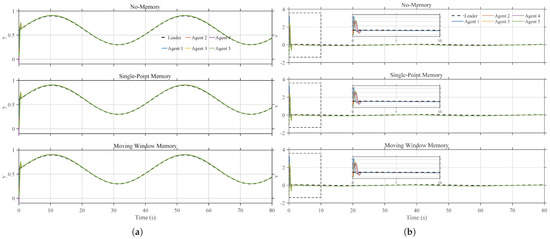
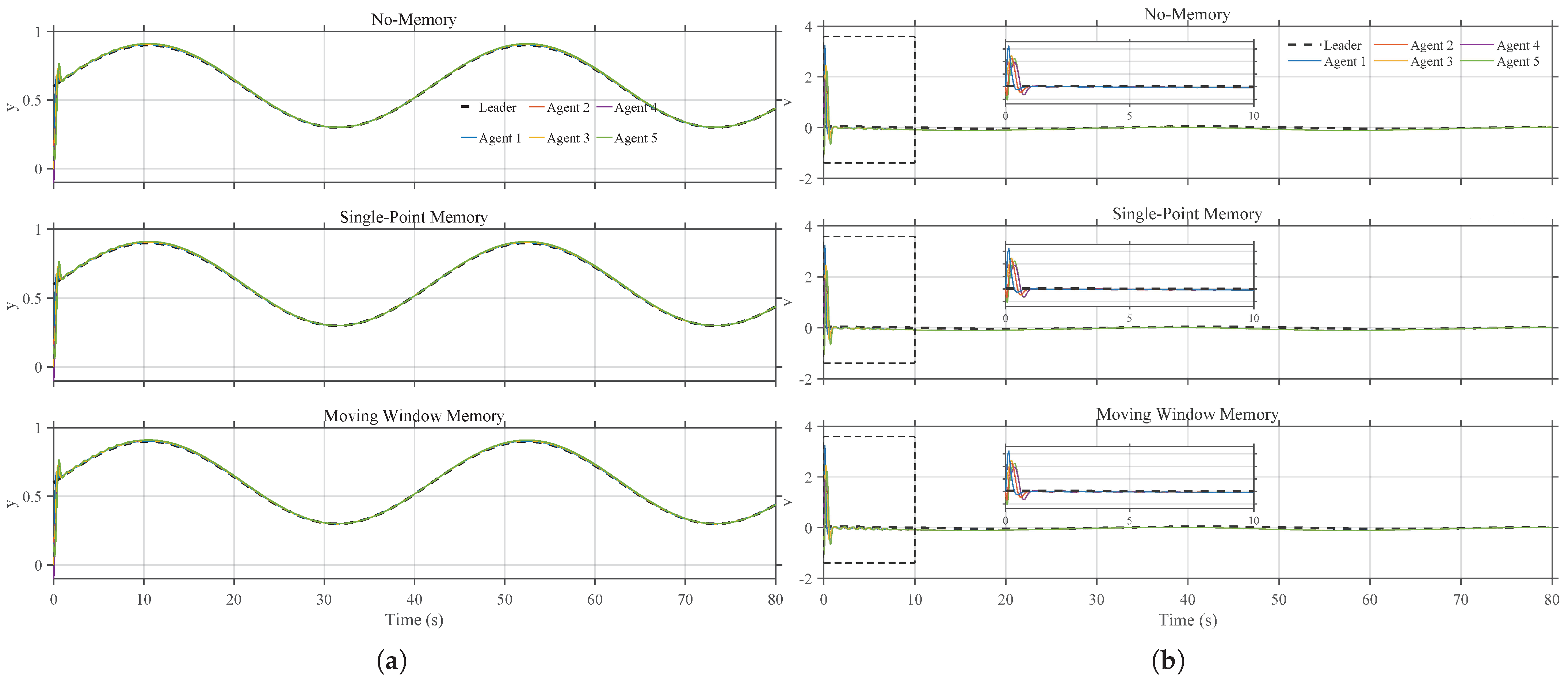
Figure 1.
Paths of and : (a) The path tracking of . (b) The speed path tracking of .
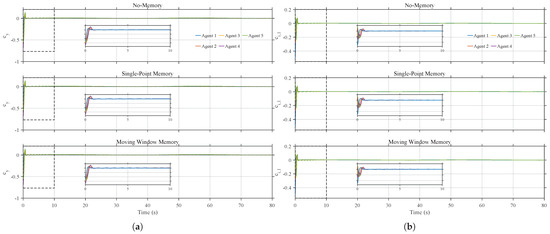
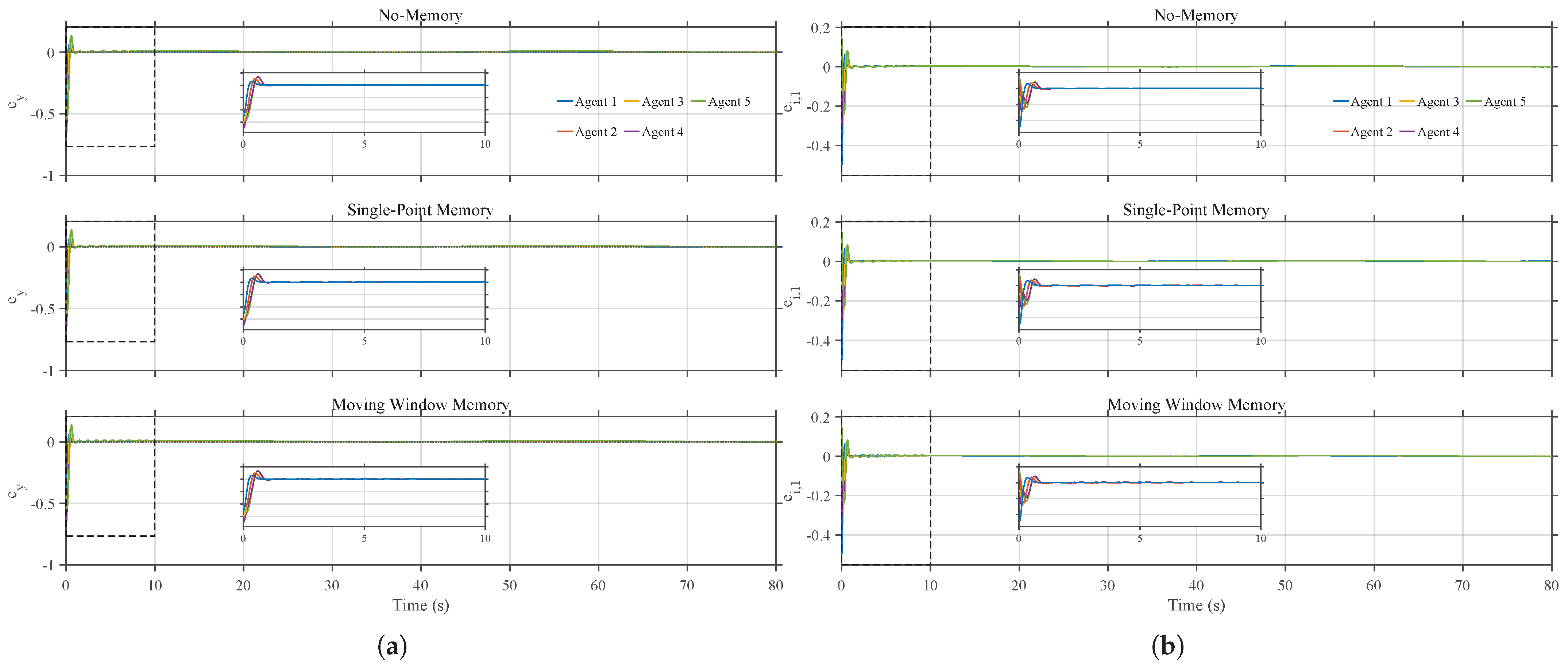
Figure 2.
Tracking error of and : (a) Tracking error of . (b) Tracking error of .
Figure 3.
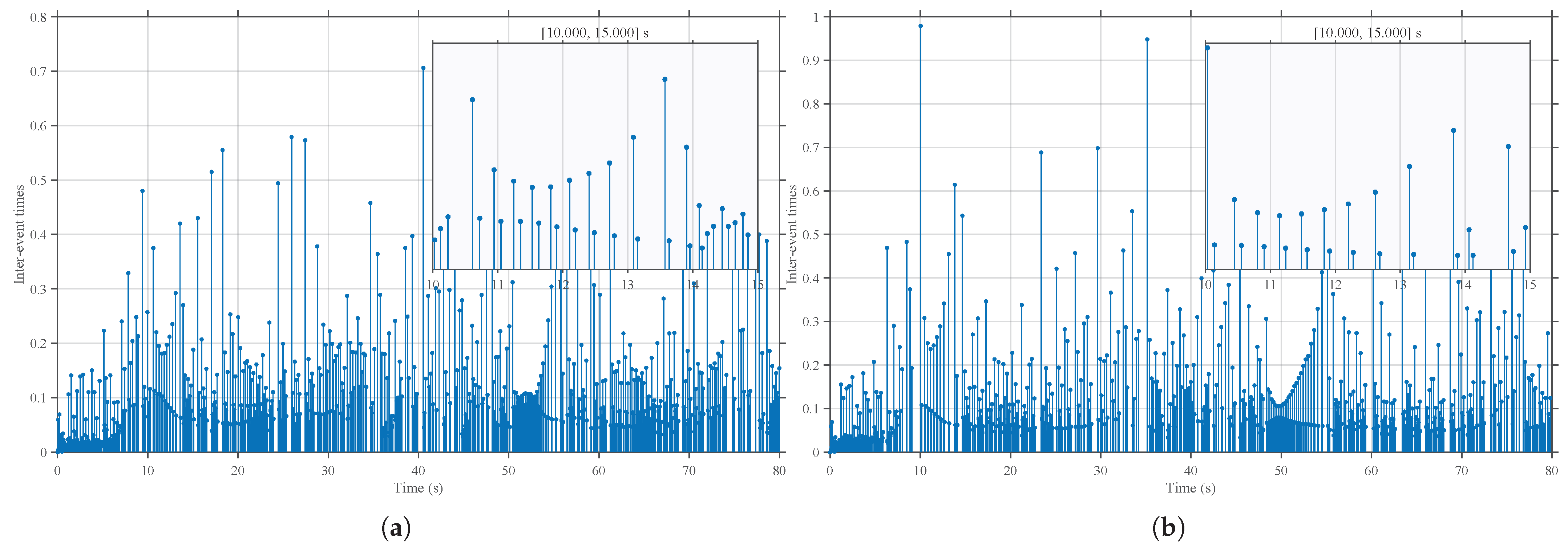
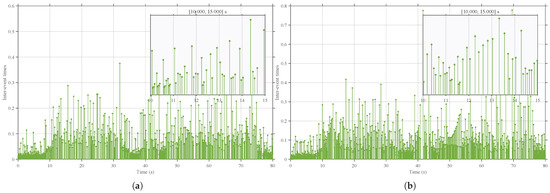
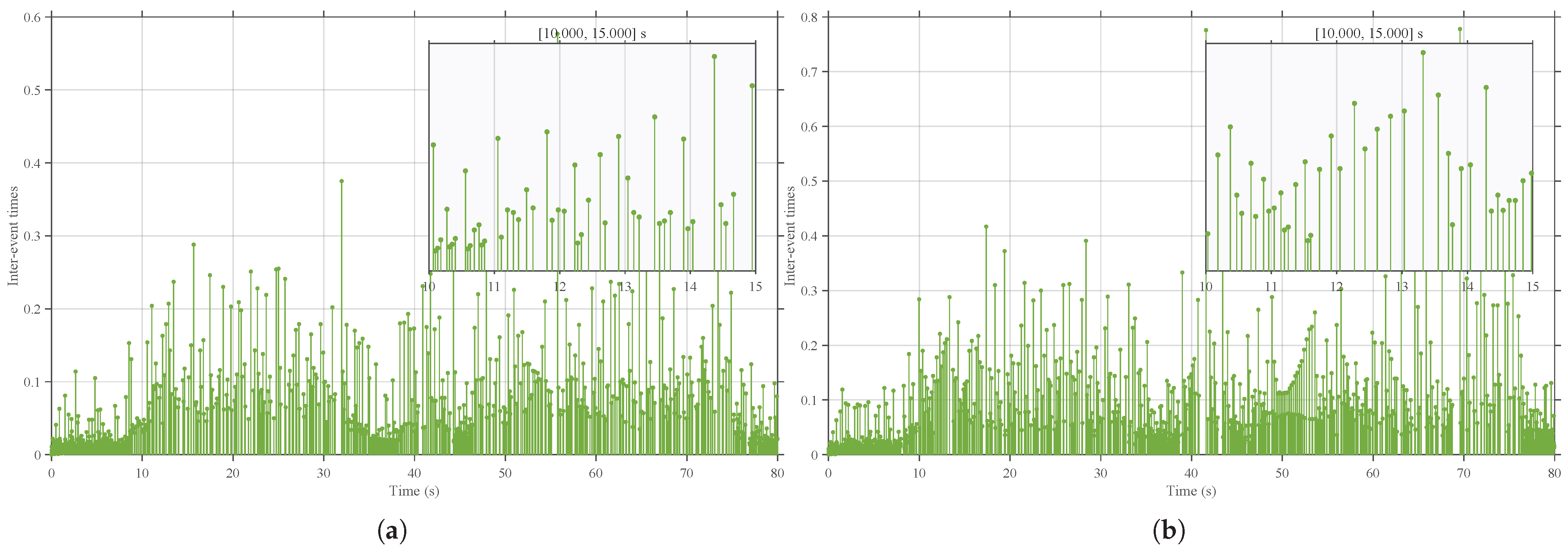
Triggering time intervals of agent 1: (a) Triggering time intervals of agent 1 without memory. (b) Triggering time intervals of agent 1 for case 1 with memory.
Figure 4.
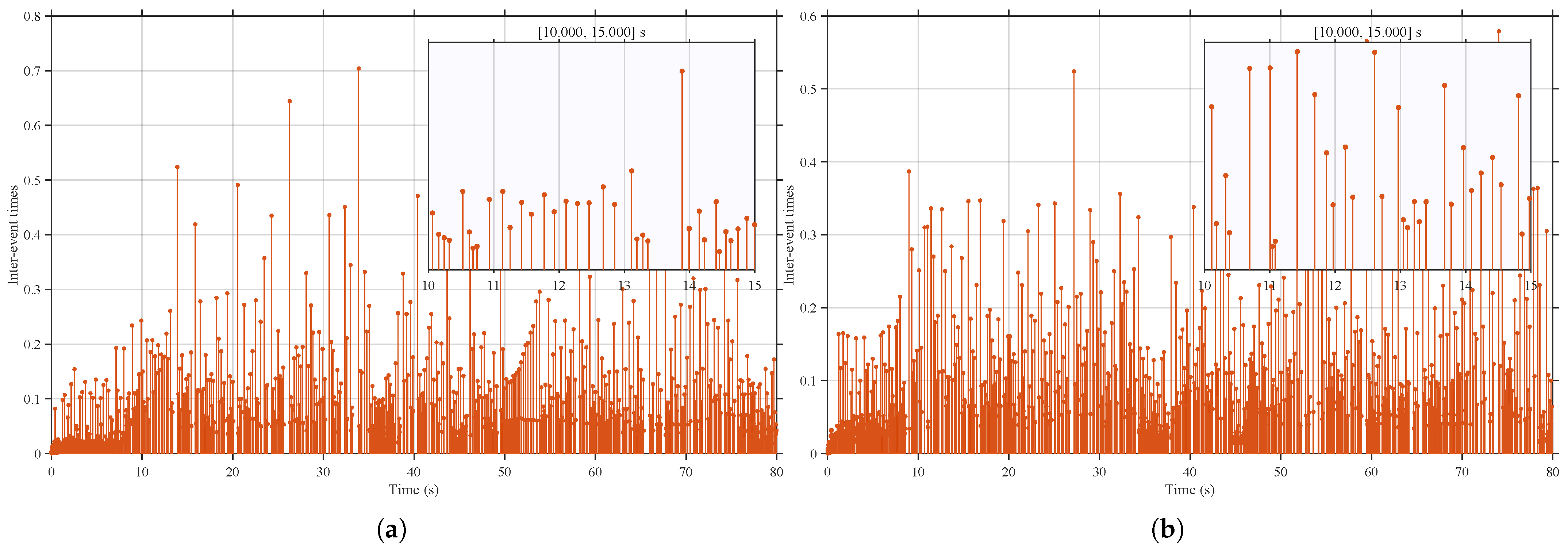
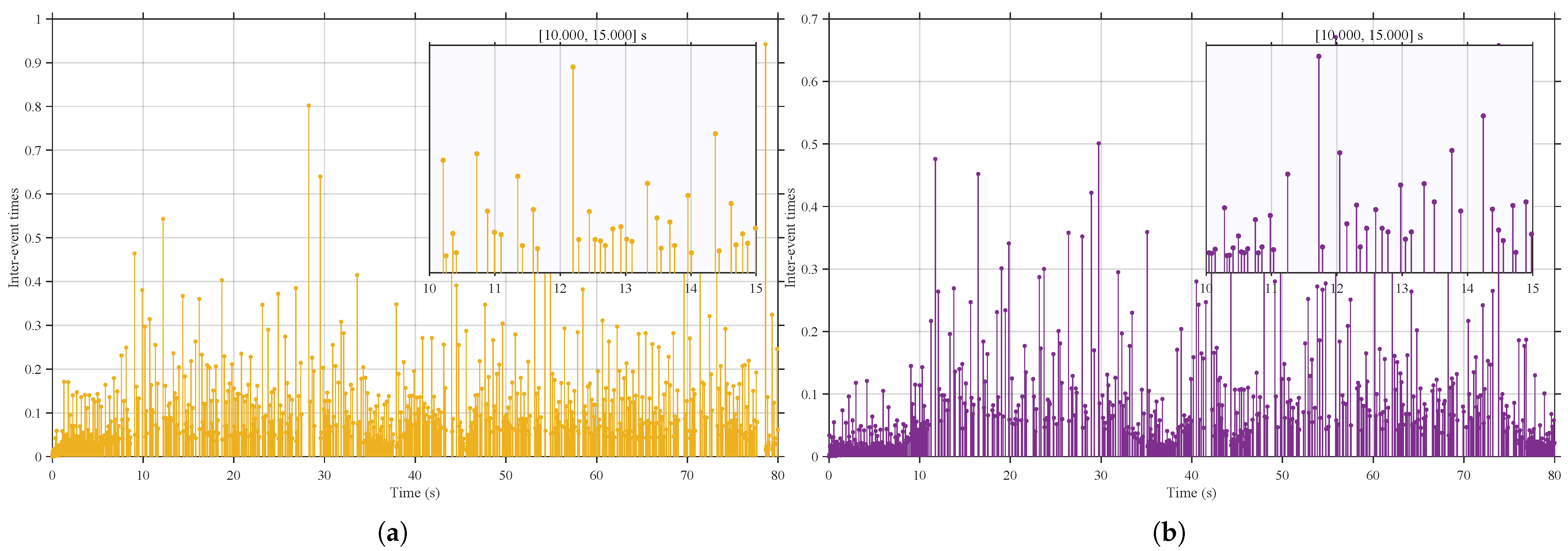
Triggering time intervals of agent 1 and agent 2: (a) Triggering time intervals of agent 1 for case 2 with memory. (b) Triggering time intervals of agent 2 without memory.
Figure 5.
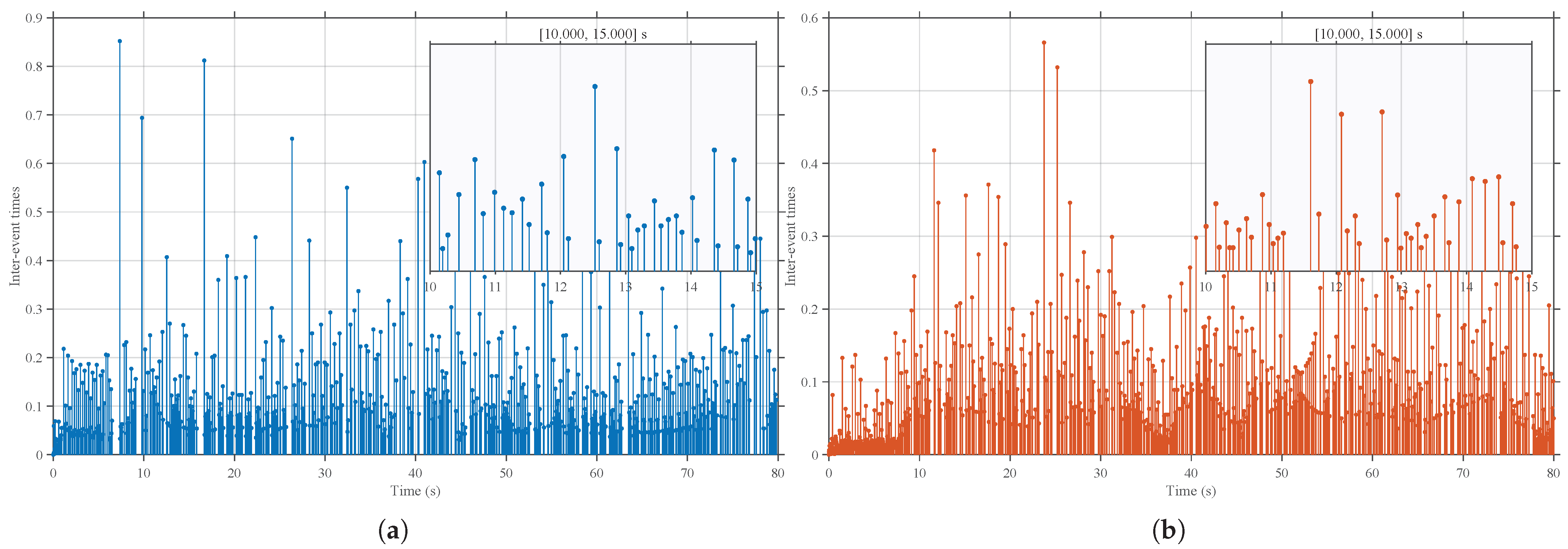
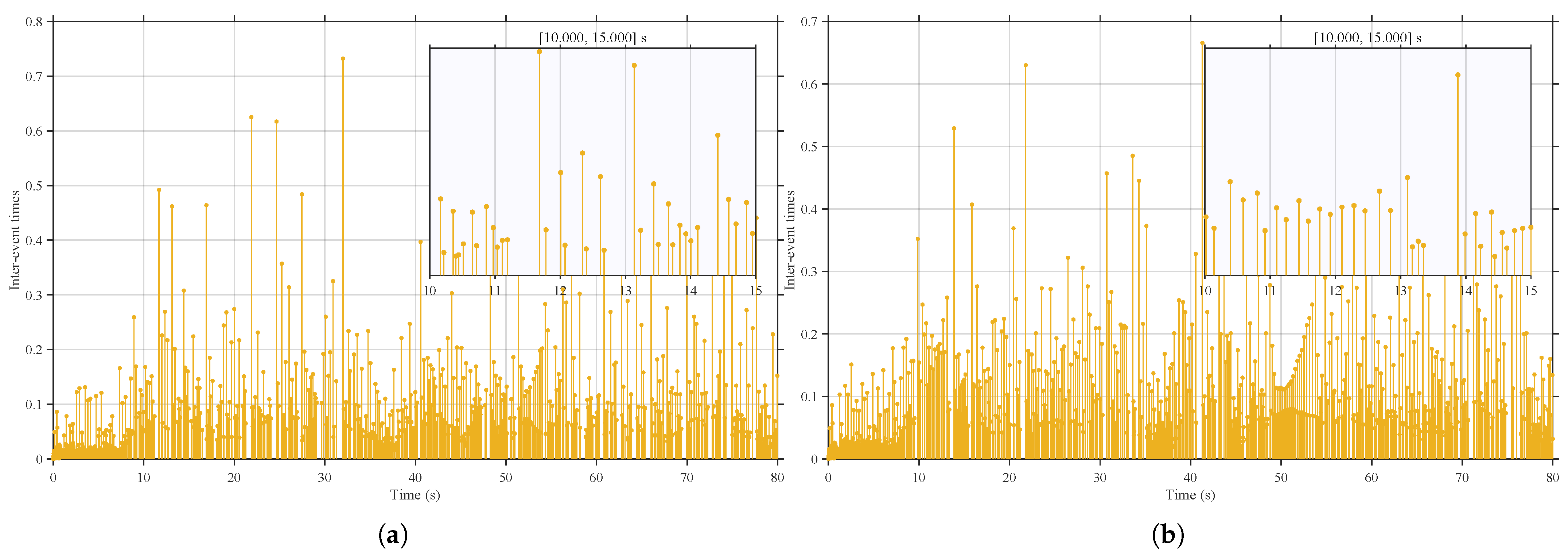
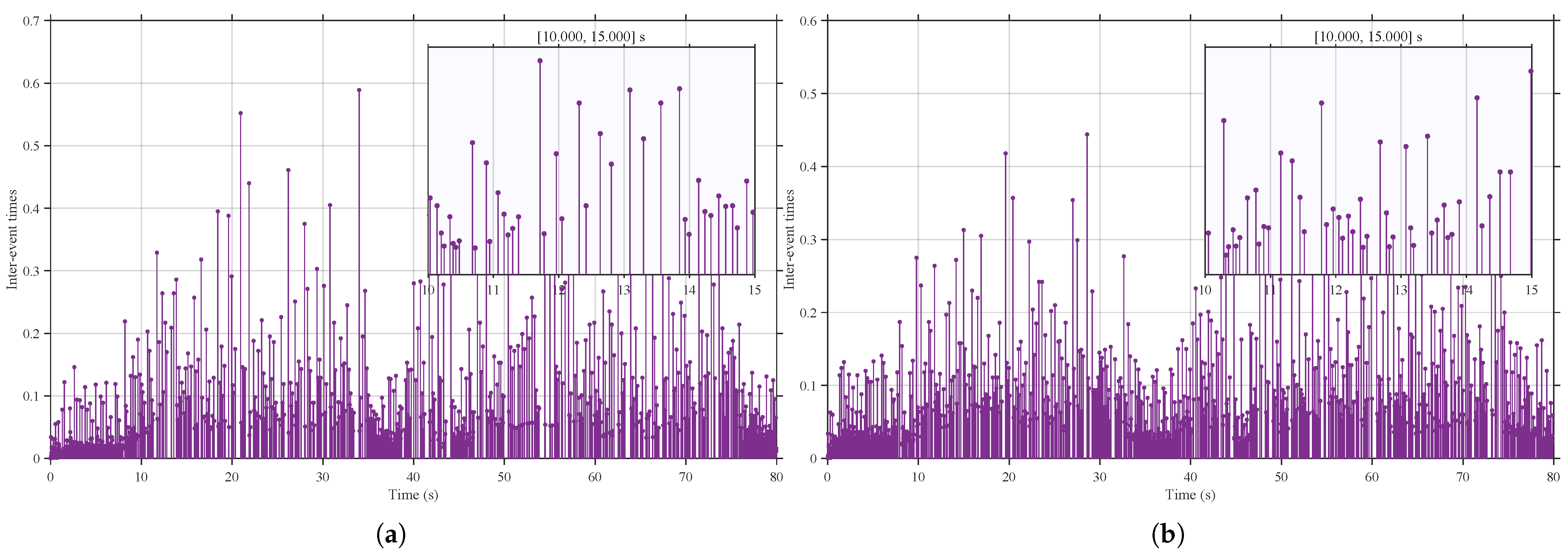
Triggering time intervals of agent 2: (a) Triggering time intervals of agent 2 for case 1 with memory. (b) Triggering time intervals of agent 2 for case 2 with memory.
Figure 6.
Triggering time intervals of agent 3: (a) Triggering time intervals of agent 3 without memory. (b) Triggering time intervals of agent 3 for case 1 with memory.
Figure 7.
Triggering time intervals of agent 3 and agent 4: (a) Triggering time intervals of agent 3 for case 2 with memory. (b) Triggering time intervals of agent 4 without memory.
Figure 8.
Triggering time intervals of agent 4: (a) Triggering time intervals of agent 4 for case 1 with memory. (b) Triggering time intervals of agent 4 for case 2 with memory.
Figure 9.
Triggering time intervals of agent 5: (a) Triggering time intervals of agent 5 without memory. (b) Triggering time intervals of agent 5 for case 1 with memory.
Figure 10.
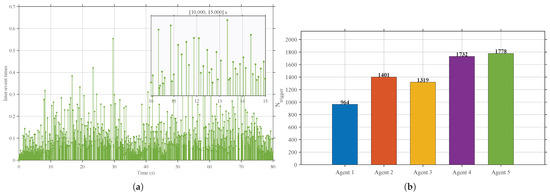
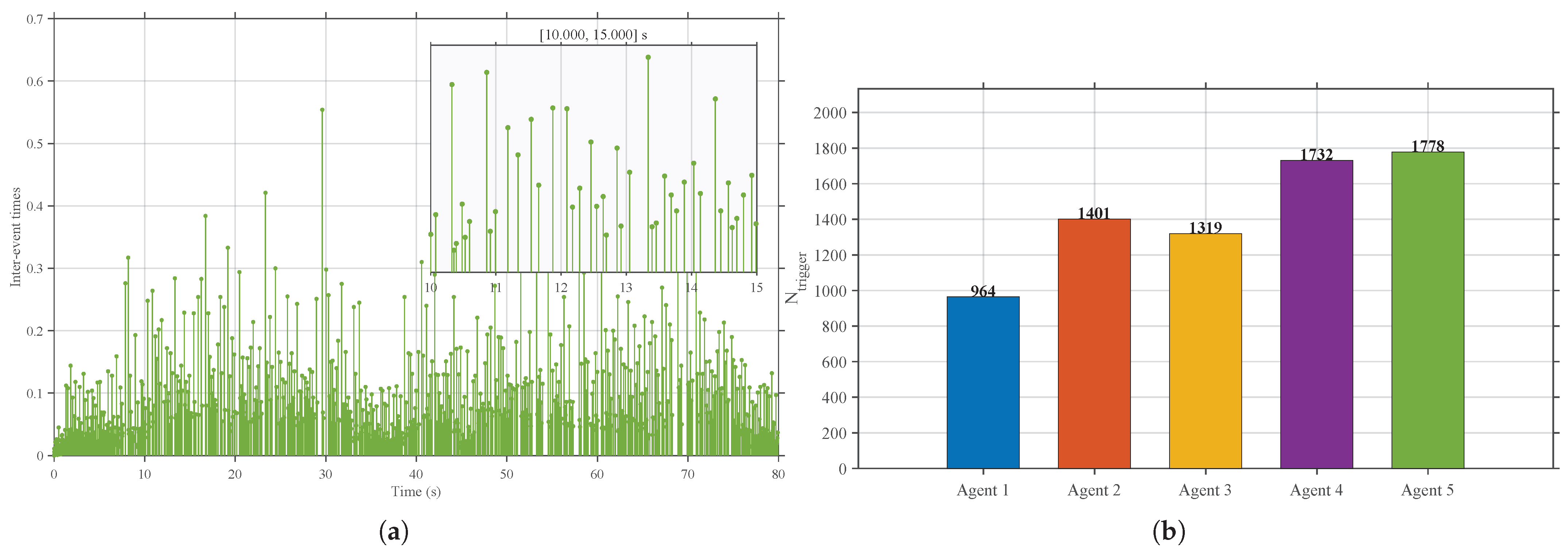
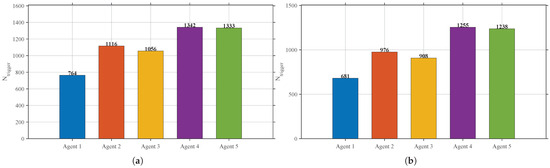
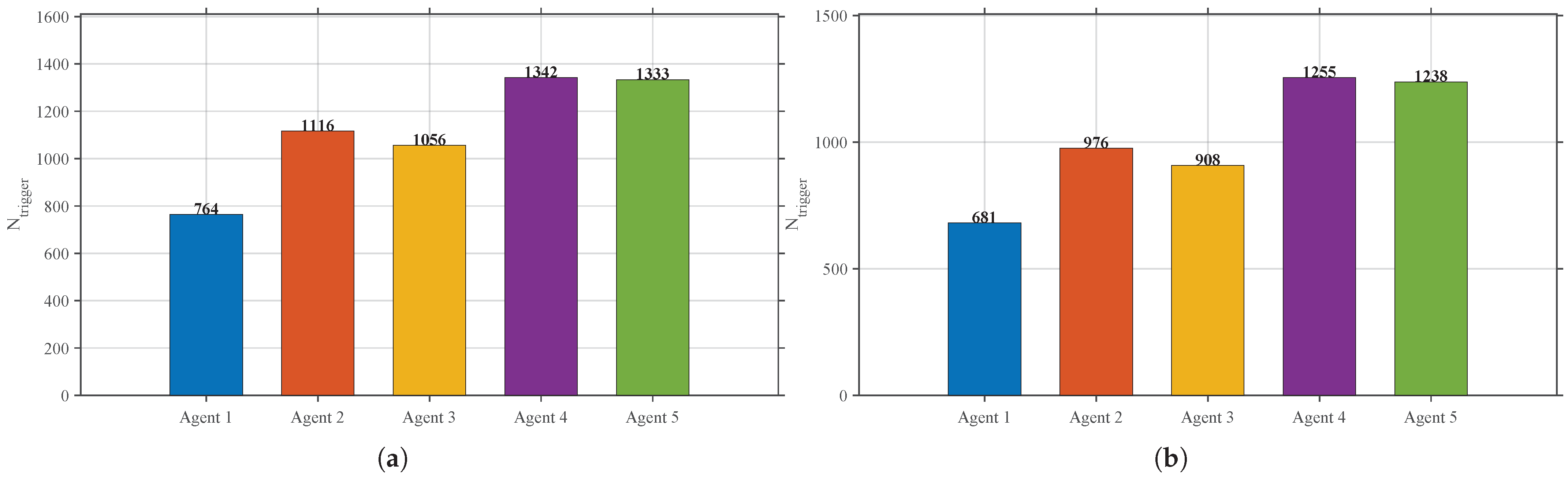
Triggering time intervals of agent 5 and total count of triggering events: (a) Triggering time intervals of agent 5 for case 2 with memory. (b) Total count of triggering events without memory.
Figure 11.
Total count of triggering events: (a) Total count of triggering events for case 1 with memory. (b) Total count of triggering events for case 2 with memory.
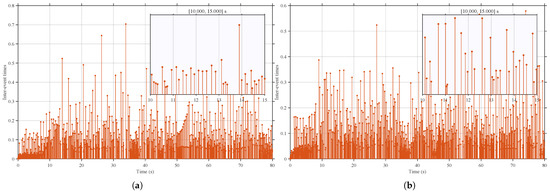
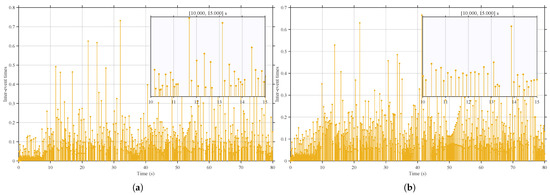
In this numerical experiment, to validate the practicability of the devised control scheme and to benchmark its performance against a memoryless mechanism, numerical investigations are carried out on a family of nonlinear multi-agent systems. Figure 1 and Figure 2 show the tracking effect of the system and prove that the control system’s output is capable of tracking the leader’s trajectory. Figure 3, Figure 4, Figure 5, Figure 6, Figure 7, Figure 8, Figure 9 and Figure 10 show that the Zeno phenomenon does not occur in the proposed ETM based on historical information. Figure 10 and Figure 11 present a comparison of the total count of triggering events. Compared with the no-memory mechanism in Figure 10b, the introduction of single-point historical information in Figure 11a can reduce the number of trigger times. Comparing Figure 11a with Figure 11b shows that the introduction of moving window historical information can further reduce the number of trigger times, thereby validating the efficacy of the proposed method in enhancing resource efficiency.
Table 1 first reports the parameter sensitivity results. In case 2, varying the limiter initial value leads to only a slight change in the total number of triggering events (from 4967 to 5058), while the average inter-event time remains around – s, indicating a weak influence of within the tested range. A similar limited variation is observed when sweeping the memory length : for case 1, decreases from 5692 to 5545 and increases slightly; for case 2, varies between 4902 and 5058 and stays around – s. Table 2 summarizes the overall and per-agent statistics. Compared with the no-memory scheme (), case 1 reduces to 5611 (22.0% saving), and case 2 further reduces it to 5058 (29.7% saving); all agents exhibit fewer triggering events, and case 2 achieves higher savings in general. Meanwhile, the minimum inter-event time is s for all three schemes (equal to the simulation step size), whereas the average inter-event time increases from s to s (case 1) and s (case 2), consistent with the reduction in triggering events.
Table 1.
Parametric studies of triggering performance.
Table 2.
Summary triggering statistics (overall and per-agent).
5. Conclusions
This work addresses the consensus tracking problem for multi-agent systems with uncertainties. A distributed event-driven control protocol based on historical data is proposed to achieve the control objective. First, a dynamic event-triggered scheme with single-point memory is devised. To further exploit historical information, a dynamic event-triggered mechanism incorporating moving window memory is developed, where a dynamic parameter is introduced to constrain the maximum memory length, thereby mitigating potential deviations induced by long-term memory. Second, by constructing a novel error compensation mechanism, virtual control signals and a distributed control law are designed to ensure the boundedness of all closed-loop signals. Finally, simulation results validate the effectiveness of the proposed historical-data-based event-triggered control method in reducing the number of triggering events. Future work will focus on extending the proposed method to more complex scenarios, aiming at the safe control of multiple UAVs.
Author Contributions
X.L.: conceptualization, methodology, writing—original draft preparation, and funding acquisition. H.W.: writing—reviewing and Editing. Q.-Y.F.: writing—reviewing and editing, and responsible for ensuring that the descriptions are accurate and agreed upon by all authors. All authors have read and agreed to the published version of the manuscript.
Funding
This research was funded by the Young Scientists Fund of the National Natural Science Foundation of China under Grant 62403391 as well as the Young Scientists Fund of Sichuan Natural Science Foundation under Grant 2025ZNSFSC1516. It was funded in part by the National Natural Science Foundation of China under Grant 62473313 and Grant U23A20337 and in part by the Shaanxi Provincial Natural Science Basic Research Program under Grant 2024JC-YBMS-469.
Data Availability Statement
The original contributions presented in this study are included in the article. Further inquiries can be directed to the corresponding author.
Conflicts of Interest
The authors declare no conflicts of interest.
Abbreviations
| Symbol | Meaning |
| N | Number of followers; is the agent index. |
| State of agent i; n is the system order. | |
| Output and continuous control input of agent i. | |
| Leader/reference trajectory. | |
| Stacked follower outputs. | |
| Output tracking error vector. | |
| Directed communication graph. | |
| Adjacency/weight matrix ( if ). | |
| In-degree matrix, . | |
| Laplacian matrix. | |
| Pinning (leader-coupling) gain matrix. | |
| First-layer consensus tracking error (neighbor differences + pinning). | |
| Stacked error satisfying . | |
| Auxiliary/history-based compensation signal at layer j. | |
| Compensated (filtered) error at layer j. | |
| Virtual control and its command-filtered version. | |
| k-th triggering instant of agent i. | |
| Applied/held input between events. | |
| Triggering measurement error. | |
| Trigger threshold coefficients. | |
| Dynamic triggering parameter (Cases 1–2). | |
| Memory limiter/weight (used in Case 2). | |
| RBF basis vector; M is the number of neurons. | |
| NN approximation error, bounded by . | |
| Adaptive parameter (minimal learning) at layer j. |
References
- Ren, Y.; Wang, Q.; Duan, Z. Optimal Distributed Leader-Following Consensus of Linear Multi-Agent Systems: A Dynamic Average Consensus-Based Approach. IEEE Trans. Circuits Syst. II 2022, 69, 1208–1212. [Google Scholar] [CrossRef] [Scilit]
- Su, S.; Lin, Z. Distributed Consensus Control of Multi-Agent Systems with Higher Order Agent Dynamics and Dynamically Changing Directed Interaction Topologies. IEEE Trans. Autom. Control 2016, 61, 515–519. [Google Scholar] [CrossRef] [Scilit]
- Wang, Q.; Duan, Z.; Wang, J. Distributed Optimal Consensus Control Algorithm for Continuous-Time Multi-Agent Systems. IEEE Trans. Circuits Syst. II 2020, 67, 102–106. [Google Scholar] [CrossRef] [Scilit]
- Kada, B.; Khalid, M.; Shaikh, M.S. Distributed Cooperative Control of Autonomous Multi-agent UAV Systems Using Smooth Control. J. Syst. Eng. Electron. 2020, 31, 1297–1307. [Google Scholar] [CrossRef] [Scilit]
- Cui, Y.; Liang, Y.; Luo, Q.; Shu, Z.; Huang, T. Resilient Consensus Control of Heterogeneous Multi-UAV Systems with Leader of Unknown Input Against Byzantine Attacks. IEEE Trans. Autom. Sci. Eng. 2025, 22, 5388–5399. [Google Scholar] [CrossRef] [Scilit]
- Wang, X.; Wu, J.; Wang, X. Distributed Attitude Consensus of Spacecraft Formation Flying. J. Syst. Eng. Electron. 2013, 24, 296–302. [Google Scholar] [CrossRef] [Scilit]
- Olfati-Saber, R.; Shamma, J.S. Consensus Filters for Sensor Networks and Distributed Sensor Fusion. In Proceedings of the 44th IEEE Conference on Decision and Control, Seville, Spain, 15 December 2005; pp. 6698–6703. [Google Scholar]
- Yu, W.; Chen, G.; Wang, Z.; Yang, W. Distributed Consensus Filtering in Sensor Networks. IEEE Trans. Syst. Man Cybern. B 2009, 39, 1568–1577. [Google Scholar]
- Abbasi, M.; Marquez, H.J. Observer-Based Event-Triggered Consensus Control of Multi-Agent Systems with Time-Varying Communication Delays. IEEE Trans. Autom. Sci. Eng. 2024, 21, 6336–6346. [Google Scholar] [CrossRef] [Scilit]
- Zou, H.; Zhang, G. Dynamic Event-Triggered-Based Single-Network ADP Optimal Tracking Control for the Unknown Nonlinear System with Constrained Input. Neurocomputing 2023, 518, 294–307. [Google Scholar] [CrossRef] [Scilit]
- Wang, P.; Wang, Z.; Xu, H. Integral-Based Memory Event-Triggered Controller Design for Uncertain Neural Networks with Control Input Missing. Mathematics 2025, 13, 791. [Google Scholar] [CrossRef] [Scilit]
- Ren, X.M.; Rad, A.B. Identification of Nonlinear Systems with Unknown Time Delay Based on Time-Delay Neural Networks. IEEE Trans. Neural Netw. 2007, 18, 1536–1541. [Google Scholar] [CrossRef] [Scilit] [PubMed]
- Li, T.; Li, Z.; Wang, D.; Chen, C.L. Output-Feedback Adaptive Neural Control for Stochastic Nonlinear Time-Varying Delay Systems with Unknown Control Directions. IEEE Trans. Neural Netw. Learn. Syst. 2015, 26, 1188–1201. [Google Scholar] [CrossRef] [Scilit] [PubMed]
- Liu, Y.; Liu, Y.; Wu, J.; Tao, J.; Li, M.; Su, C.; Lu, R. Adaptive Neural Network Tracking Control for Unknown High-Order Nonlinear Systems: A Constructive Approximation Set Based Approach. Eng. Appl. Artif. Intell. 2025, 162, 112371. [Google Scholar] [CrossRef] [Scilit]
- Gao, S.; Wang, J.; Ren, S.; Peng, B. Performance-Barrier-Based Event-Triggered Leader–Follower Consensus Control for Nonlinear Multi-Agent Systems. Neurocomputing 2025, 657, 131664. [Google Scholar] [CrossRef] [Scilit]
- Shi, J. Cooperative Control for Nonlinear Multi-Agent Systems Based on Event-Triggered Scheme. IEEE Trans. Circuits Syst. II 2021, 68, 1977–1981. [Google Scholar] [CrossRef] [Scilit]
- Choi, Y.H.; Yoo, S.J. Neural-Network-Based Distributed Asynchronous Event-Triggered Consensus Tracking of a Class of Uncertain Nonlinear Multi-Agent Systems. IEEE Trans. Neural Netw. Learn. Syst. 2022, 33, 2965–2979. [Google Scholar] [CrossRef] [Scilit]
- Tong, S.; Zhou, H.; Li, Y. Neural Network Event-Triggered Formation Fault-Tolerant Control for Nonlinear Multiagent Systems With Actuator Faults. IEEE Trans. Syst. Man Cybern. Syst. 2023, 53, 7571–7582. [Google Scholar] [CrossRef] [Scilit]
- Gao, F.; Chen, W.; Li, Z.; Li, J.; Xu, B. Neural Network-Based Distributed Cooperative Learning Control for Multiagent Systems via Event-Triggered Communication. IEEE Trans. Neural Netw. Learn. Syst. 2020, 31, 407–419. [Google Scholar] [CrossRef] [Scilit]
- Peng, Z.; Luo, R.; Hu, J.; Shi, K.; Ghosh, B.K. Distributed Optimal Tracking Control of Discrete-Time Multiagent Systems via Event-Triggered Reinforcement Learning. IEEE Trans. Circuits Syst. I 2022, 69, 3689–3700. [Google Scholar] [CrossRef] [Scilit]
- Wang, X.A.; Zhang, G.J.; Niu, B.; Wang, D.; Wang, X.M. Event-Triggered-Based Consensus Neural Network Tracking Control for Nonlinear Pure-Feedback Multiagent Systems with Delayed Full-State Constraints. IEEE Trans. Autom. Sci. Eng. 2024, 21, 7390–7400. [Google Scholar] [CrossRef] [Scilit]
- Liu, Y.; Chen, Y. Dynamic Memory Event-triggered Adaptive Control for a Class of Strict-Feedback Nonlinear Systems. IEEE Trans. Circuits Syst. II Express Briefs 2022, 69, 3470–3474. [Google Scholar] [CrossRef] [Scilit]
- Li, Y.; Li, Y.X.; Tong, S. Event-Based Finite-Time Control for Nonlinear Multiagent Systems with Asymptotic Tracking. IEEE Trans. Autom. Control 2023, 68, 3790–3797. [Google Scholar] [CrossRef] [Scilit]
- Li, Y.X. Command Filter Adaptive Asymptotic Tracking of Uncertain Nonlinear Systems with Time-Varying Parameters and Disturbances. IEEE Trans. Autom. Contr. 2022, 67, 2973–2980. [Google Scholar] [CrossRef] [Scilit]
- Ren, W.; Cao, Y. Distributed Coordination of Multi-Agent Networks: Emergent Problems, Models, and Issues; Springer Science Business Media: Berlin/Heidelberg, Germany, 2010. [Google Scholar]
- Li, Y.X.; Yang, G.H. Adaptive Asymptotic Tracking Control of Uncertain Nonlinear Systems with Input Quantization and Actuatorfaults. Automatica 2016, 72, 177–185. [Google Scholar] [CrossRef] [Scilit]
- Cai, Z.; Huang, L. Generalized Lyapunov Approach for Functional Differential Inclusions. Automatica 2020, 113, 108740. [Google Scholar] [CrossRef] [Scilit]
- Liang, H.; Liu, G.; Zhang, H.; Huang, T. Neural-Network-Based Event-Triggered Adaptive Control of Nonaffine Nonlinear Multiagent Systems With Dynamic Uncertainties. IEEE Trans. Neural Netw. Learn. Syst. 2021, 32, 2239–2250. [Google Scholar] [CrossRef] [Scilit]
- Davó, M.A.; Prieur, C.; Fiacchini, M. Stability Analysis of Output Feedback Control Systems with a Memory-Based Event-Triggering Mechanism. IEEE Trans. Autom. Contr. 2017, 62, 6625–6632. [Google Scholar] [CrossRef] [Scilit]
- Girard, A. Dynamic Triggering Mechanisms for Event-Triggered Control. IEEE Trans. Autom. Contr. 2015, 60, 1992–1997. [Google Scholar] [CrossRef] [Scilit]
- Zhao, L.; Yu, J.; Lin, C.; Ma, Y. Adaptive Neural Consensus Tracking for Nonlinear Multiagent Systems using Finite-Time Command Filtered Backstepping. IEEE Trans. Syst. Man Cybern. Syst. 2018, 48, 2003–2012. [Google Scholar] [CrossRef] [Scilit]
- Liu, R.; Xing, L.; Zhong, Y.; Deng, H.; Zhong, W. Adaptive Fixed-Time Fuzzy Containment Control for Uncertain Nonlinear Multiagent Systems with Unmeasurable States. Sci. Rep. 2024, 14, 15785. [Google Scholar] [CrossRef] [Scilit]

Disclaimer/Publisher’s Note: The statements, opinions and data contained in all publications are solely those of the individual author(s) and contributor(s) and not of MDPI and/or the editor(s). MDPI and/or the editor(s) disclaim responsibility for any injury to people or property resulting from any ideas, methods, instructions or products referred to in the content. |
© 2026 by the authors. Licensee MDPI, Basel, Switzerland. This article is an open access article distributed under the terms and conditions of the Creative Commons Attribution (CC BY) license.