Abstract
Shared manufacturing platforms improve the utilization of manufacturing resources by digitally matching demand with competing manufacturers and providing value-added services (VAS). Because VAS is costly and its benefits are jointly created, an appropriate cooperation mechanism between the platform and manufacturers is essential for achieving sustainable profitability. This study explores three cooperation strategies: (1) no-cooperation strategy (Model N); (2) cost-sharing strategy (Model CS); and (3) revenue-sharing (Model RS) strategy. This study establishes a shared supply chain model for each strategy, derives the equilibrium results, and compares the optimal performances. The results show that neither cost sharing nor revenue sharing guarantees a Pareto improvement: both parties benefit only when the negotiated cost-sharing ratio or revenue-sharing rate lies within a feasible range that properly balances the platform’s service cost burden and the manufacturers’ participation incentives. Additionally, equilibrium profits for both manufacturers and the sharing platform are decreasing as the value-added services (VAS) cost coefficient increases. Thus, the sharing platform should endeavor to decrease the VAS cost efficiency to reduce the VAS cost and enhance profits for all participants. These findings provide actionable guidance for selecting cooperation strategies and setting sharing parameters to achieve mutually beneficial outcomes in platform-enabled shared manufacturing.
Keywords:
shared manufacturing; platform supply chain management; value-added services; cooperation strategies MSC:
91A30; 91B16; 90B50
1. Introduction
In recent years, the sharing economy has become widespread, and information technologies, such as big data, the Internet of Things, and cloud computing, have advanced rapidly [1]. Influenced by social and economic factors [2], the manufacturing industry has developed a new model known as shared manufacturing. Shared manufacturing is an advanced manufacturing model, which allocate idle manufacturing resources and capabilities to the demand side in a modular, flexible, and intelligent manner [3]. Many countries have issued policy documents to promote shared manufacturing, including Strategy for American Leadership in Advanced Manufacturing, National Industrial Strategy 2030: Strategic Guidelines for a German and European Industrial Policy, and China’s Guiding Opinions on Accelerating the Cultivation of a New Model of Shared Manufacturing and Further Promoting Service-oriented Manufacturing. Shared manufacturing not only facilitates resource sharing among enterprises [4] but also improves the utilization of manufacturing equipment. It fosters win–win cooperation within the industry and reduces the cost of products and services for customers [5,6]. Nowadays, many firms still lack the capital to purchase production equipment or technology, resulting in an inability to produce enough products to meet customer needs [7]. Meanwhile, some enterprises have invested heavily to buy production equipment, but due to the limited ability to receive orders, the equipment remains idle [8]. Therefore, shared manufacturing can be an effective mechanism for these two types of enterprises to balance the supply and demand of production capacity, which also helps to improve their profits.
Sharing platforms serve as intermediaries in shared manufacturing, connecting manufacturers and customers to facilitate transactions. There are several well-known sharing platform operators including XoMetry.com, MFG and Alibaba (1688.com in China), among others. Customers provide the sharing platform with their production specifications and requirements, and the platform finds suitable manufacturers to produce and deliver the products. Manufacturers are required to pay a commission to the platform [9,10]. Through the platform, customers can streamline the procurement process and reduce procurement cost as the platform can quickly find capable manufacturers for them and deliver high-quality products on time [11]. In order to attract more manufacturers and customers, more and more sharing platforms offer value-added services (VAS), including search, match, payment security, and quality inspection [12,13]. From the manufacturers’ perspective, VAS directly affects order acquisition efficiency, transaction risk, and customer experience, which in turn influences their demand and pricing power. However, VAS-related charges (commission, cost-sharing, or revenue-sharing arrangements) can materially affect manufacturers’ margins and may discourage participation if the burden becomes excessive. From the platform’s perspective, higher VAS levels can expand market demand and strengthen competitiveness, but they also entail substantial and increasing service costs (e.g., IT infrastructure, system maintenance, and service operations). If these costs are not properly allocated, platforms may face financial pressure and may underinvest in VAS, which can weaken user retention and the sustainability of the platform ecosystem [14]. Therefore, explicitly incorporating VAS provisioning is crucial for understanding why some cooperation arrangements fail to generate win–win outcomes and under what conditions cost-sharing or revenue-sharing contracts can be mutually beneficial.
In addition, we interpret the sharing platform as an ecosystem governor that shapes market performance through two coupled governance levers: (i) the level of value-added services (VAS), which reduces transaction frictions (e.g., matching, verification, and quality assurance) and expands effective demand, and (ii) contractual terms (commission/cost-sharing/revenue-sharing rules), which determine how service costs and market surplus are allocated and thus shape participation incentives. This governance problem becomes nontrivial when manufacturers compete on the platform, because the demand gains created by VAS can be partially transformed into intensified price competition and margin erosion. Accordingly, the platform must jointly design service intensity and sharing terms to balance market expansion, cost recovery, and ecosystem stability, i.e., maintaining manufacturers’ willingness to participate while sustaining profitable VAS provision.
To address the financial issues of sharing platforms and improve the total profitability of supply chains, this study investigates whether the sharing platform can cooperate with manufacturers to achieve a win–win situation. We focus on three cooperation strategies. (1) The no-cooperation strategy: the sharing platform and manufacturers do not adopt any cooperation strategies. (2) The cost-sharing strategy: the sharing platform and manufacturers jointly undertake the VAS cost, i.e., sign a cost-sharing contract. For example, Shaanxi Drum Group and Shenzhen Skyworth have developed a remote online equipment inspection and fault diagnosis system to provide users with intelligent equipment monitoring services. (3) The revenue-sharing strategy: the sharing platform does not charge manufacturers a commission fee, and manufacturers share their revenue with the sharing platform, i.e., a revenue-sharing contract is signed. For example, [15] proposed that a manufacturer with additional capacity can sign a revenue-sharing contract with a manufacturer with limited capacity. Then, the former helps the latter produce products, and the latter sells products and shares its revenue with the former according to a certain sharing rate. On this basis, the following research questions are proposed: (1) What are the equilibrium outcomes for manufacturers and the sharing platform under each strategy? How do the main parameters affect these equilibrium outcomes? (2) Do the cost-sharing and revenue-sharing strategies help to increase the profits of manufacturers and the sharing platform compared to the no-cooperation strategy? If so, what are the optimal ranges of the cost-sharing ratio and revenue-sharing rate? (3) How do manufacturers and the sharing platform choose the optimal cooperation strategy? We depart from the existing literature in three structural dimensions that jointly generate nontrivial insights. First, we endogenize platform VAS provisioning, which simultaneously expands market demand and imposes an increasing service cost, creating a fundamental trade-off for the platform. Second, we allow the platform’s commission fee to be endogenous decision variables rather than exogenously given, which makes the contract choice and service investment mutually dependent. Third, we incorporate competition among manufacturers on the platform, which alters the pass-through of VAS benefits into prices/quantities and reshapes the feasibility of win–win cooperation.
To investigate the above research questions, we consider a model with two manufacturers and a sharing platform. Customers submit production requirements and specifications to the platform, which then coordinates with manufacturers to produce the products. Customers pay manufacturers for purchasing products, and the sharing platform receives commission from manufacturers. The two manufacturers are in competition. First, this paper focuses on the equilibrium decisions of manufacturers and the sharing platform under each cooperation strategy, and derives the optimal results of manufacturers’ selling prices, the platform’s commission fee, the VAS level, the market demand, manufacturers’ profits, the platform’s profit, and the total profit of the supply chain. Second, this paper analyses the influence of each parameter on the equilibrium results and examines whether the cost-sharing and revenue-sharing contract enhances the profits of manufacturers and the sharing platform. It also determines the optimal range of the cost-sharing ratio and revenue-sharing rate. Third, this paper investigates how manufacturers and the sharing platform choose the optimal cooperation strategy and constructs the optimal cooperation strategy diagrams.
The main contributions of this study are threefold. Firstly, this paper studies the optimal performances of manufacturers and the sharing platform under three cooperation strategies and derive the corresponding equilibrium decisions and profits in closed form, which helps manufacturers and the sharing platform to achieve a win–win situation through cooperation. Secondly, we establish explicit comparative statics results that characterize how key parameters (e.g., the VAS cost coefficient, demand responsiveness to VAS, and the intensity of manufacturer competition) affect equilibrium outcomes, thereby revealing the structural channels through which VAS and competition reshape pricing, service provision, and profitability. Thirdly, this paper provides analytical dominance and feasibility conditions—parameter regions for the cost-sharing ratio and revenue-sharing rate—under which cooperation yields a Pareto improvement and under which one contract dominates the other, offering tractable guidance for selecting cooperation strategies under different market environments.
The remainder of the paper is organized as follows. Section 2 reviews three streams of related literature. The problems and the assumptions are described in Section 3. Section 4 presents the models and discusses the equilibrium results. Section 5 performs numerical experiments. Section 6 presents the conclusions and limitations. All proofs are included in Appendix A.
2. Literature Review
This paper is closely relevant to three streams of literature: shared manufacturing, sharing platform and VAS, and cooperation strategies in supply chain.
2.1. Shared Manufacturing
Shared manufacturing is essentially the sharing of idle manufacturing resources and capabilities, which embodies the competition and cooperation among enterprises [16]. Some scholars focused on architecture and operational mode [17,18], equipment sharing [19], scheduling issues [20,21], and so forth. However, the sharing arrangement between manufacturer(s) and the platform remain under-explored, and only a few studies attempted to give an initial conclusion [22]. For example, ref. [15] considered a model in which two competing manufacturers enter a revenue-sharing contract and found that capacity sharing can help the manufacturer with insufficient capacity increase profit. However, the profit of the manufacturer with underutilized capacity increases when the revenue-sharing rate is small but decreases when it becomes relatively large. Ref. [23] proposed a model with two manufacturers and a shared manufacturing firm to examine how product differentiation and capacity constraints affect equilibrium outcomes. They found that shared manufacturing affects the degree of overcapacity, the supply chain’s profit, consumer surplus, and social welfare. Ref. [24] examined the cooperation between suppliers and the cloud platform operator, exploring three cooperation strategies: sharing independently, sharing as an alliance, and sharing by cooperating with the operator. They found that sharing by cooperating with the operator can maximize the supply chain’s profit. Sharing as an alliance benefits manufacturers by increasing their profits but can reduce the operator’s profit, leading to strong opposition from the operator.
In addition, the current study of shared manufacturing is mainly about horizontal capacity sharing among manufacturers [6,23,25]. For example, ref. [26] investigated capacity sharing among vertical enterprises in the supply chain. They explored the competitive patterns of downstream firms and the impact of government policies on capacity sharing. Ref. [25] investigated capacity sharing among competing manufacturers and examined optimal sharing service fee policies, considering factors such as external markets, internal operations, and specific relationships. Ref. [27] investigated how capacity constraints and sharing on ride-sourcing platforms affect platform profitability, customer surplus, and labor welfare. They found that capacity constraints would alleviate price competition, benefiting platforms with sufficient capacity while disadvantaging those facing labor shortages. Therefore, existing studies predominantly examine horizontal capacity pooling, while research on vertical capacity coordination is relatively scattered, especially when incorporating VAS provisioning and platform incentive issues. This paper differs by examining capacity sharing between manufacturers and customers through a sharing platform which belongs to vertical capacity sharing in the supply chain. In addition, this paper considers the competition between manufacturers.
2.2. Sharing Platform and VAS
The sharing platform is a new type of service intermediary that uses cloud computing to connect capacity suppliers with demanders. It integrates and transforms vertical or horizontal manufacturing resources into capacity that can be centrally managed to provide customized products or services based on customer demand. Due to its low cost and broad coverage, the sharing platform facilitates instant communication between geographically dispersed manufacturers [28] and enhances the connection between capacity suppliers and demanders [29]. Ref. [30] designed a sharing platform structure for managing multiple manufacturers and orders, exploring how platforms use order tracking and automated search to facilitate collaboration between enterprises. Ref. [31] summarized platform functions based on their ability to meet business needs, provide quality information services, and ensure security and privacy. Ref. [32] investigated capacity sharing in a supply chain consisting of a sharing platform and a manufacturer, finding that the capacity supplier can gain more profit by colluding with the platform for information. Ref. [33] constructed a CSP ecosystem consisting of a manufacturer and a car-sharing platform (CSP). They analyzed optimal decisions of system members in asset-heavy and asset-light modes, finding that these decisions were influenced by the CSP’s scheduling capability, service cost coefficient, and the performance of new energy vehicles. Ref. [34] examined the interaction of network effects by establishing a dynamic model and analyzed the impact of network effects on multi-value chain collaboration and platforms revenue. Ref. [35] formulated a bi-level multi-objective optimization model with the objective functions of maximizing manufacturers’ matching rate and the sharing platform’s commission revenue. They proposed a method to solve the model, which combines ε-constraint and a three-stage solution algorithm.
To boost competitiveness and attract more users, more and more sharing platforms provide their customers with VAS in addition to basic services like information dissemination and browsing [36]. Ref. [37] summarized the main business models of sharing platforms through multi-case analysis. They described the services that platforms should provide to enterprises before, during, and after purchase. Ref. [38] studied the pricing strategies for services like search and authentication offered by sharing platforms to both suppliers and demanders. Ref. [34] studied bilateral VAS investment and pricing decisions for sharing platforms with horizontal network utility. With reference to the above literature, many models treat value-added services (VAS) as an exogenous attribute or abstract from the platform’s endogenous service provision decision, even though VAS simultaneously expands demand and generates nontrivial service costs. This paper investigates cooperation strategies between manufacturers and the sharing platform. The platform offers VAS to both manufacturers and customers, which increases market demand for products. Under the cost-sharing strategy, this paper discusses a scenario where manufacturers and the sharing platform share the VAS cost. Under the revenue-sharing strategy, this paper discusses a scenario where the sharing platform does not charge manufacturers commission fee, and manufacturers share sales revenue with the platform.
2.3. Cooperation Strategies in Supply Chain
There are relevant studies on the cooperation strategies in the supply chain, which can be used to improve the profitability of manufacturers and sharing platforms. For example, the revenue-sharing arrangements can better align incentives when demand expansion is sensitive to service effort (e.g., platform VAS level), but it may increase monitoring/verification needs and expose the manufacturer to higher marginal sharing burden under high realized revenue. Ref. [39] discussed revenue-sharing and wholesale-price contracts in assembly systems with stochastic demand. Ref. [40] studied revenue-sharing contracts in a general supply chain model, where the supplier’s revenue is determined by each retailer’s purchase quantity and retail price. Ref. [41] discussed two types of contracts that address horizontal capacity coordination issues: the capacity contract and the capacity reservation contract. Ref. [42] analyzed the revenue-sharing contract for a three-tier supply chain consisting of a manufacturer, a distributor, and a retailer. It has been shown that two-way contracts for capacity sharing can equally increase the profits of two non-competing firms [43]. Another important collaboration form is the cost-sharing arrangements. Cost-sharing can lower the platform’s service investment barrier and provide predictable cost allocation, but it may weaken demand-side incentive alignment and may not fully internalize the demand-expansion benefit generated by VAS. For example, ref. [44] suggested that contracts involving fixed costs, unit costs, or a combination of both are widely used in areas such as supply chain management. Cooperation between manufacturers and the Internet service platform can enhance the goodwill of both firms and their products [45]. Ref. [46] investigated the problem of choosing cooperation strategies in a competing supply chain consisting of a retailer, a manufacturer, and a recycler. Two-part tariff contracts can facilitate capacity sharing [47]. Ref. [47] investigated the capacity-sharing problem with the introduction of a revenue-sharing contract, assuming homogeneous products and variable marginal costs. Ref. [13] explored the blockchain construction problem in a vaccine supply chain. They used a cost-sharing contract and a two-part tariff contract to facilitate cooperation between a vaccine manufacturer and a vaccination unit. They found that the cost-sharing contract improves the supply chain’s performance, while the two-part tariff contract maximizes the supply chain’s profit.
Unlike the above literature, this paper discusses and compares three cooperation strategies: no-cooperation strategy, cost-sharing strategy, and revenue-sharing strategy. We analyze whether these strategies can enhance the profits of both manufacturers and the sharing platform, as well as how they choose the optimal cooperation strategy. We strengthened the gap statement by emphasizing that existing studies rarely provide clear guidance on optimal parameter combinations (e.g., sharing ratios, service investment levels, and feasibility regions) that guarantee a win–win outcome for both manufacturers and platforms, particularly in shared manufacturing contexts with VAS provisioning. Our study addresses this gap by deriving the conditions/regions under which each strategy can achieve Pareto improvements and by identifying the parameter ranges that support a stable win–win equilibrium. The differences between this paper and other studies are summarized in Table 1. Among them, [15,23,25] studied capacity sharing between two manufacturers, without involving sharing platforms. In contrast, this paper investigates a scenario where manufacturers share production resources with customers through a sharing platform that also provides VAS for both sides. Ref. [48] focused mainly on the pricing and replenishment of seasonal and non-seasonal products. Ref. [19] studied the sharing of production equipment, but they did not explore the cooperation between manufacturers and the sharing platform, while this paper focuses on the cooperation strategies between them. Ref. [16] concentrated solely on the pricing strategy of the sharing platform and did not deal with the production decisions of manufacturers. In contrast, this paper examines both the pricing decision of the sharing platform and production decisions of manufacturers. Refs. [33,49] focused on the sharing mode selection in the car-sharing platform ecosystem. Ref. [24] examined decentralized and centralized decision-making for suppliers and the cloud platform operator, exploring three strategies: sharing independently, sharing as an alliance, and sharing by cooperating with the operator. In contrast, this paper explores three cooperation strategies between manufacturers and the sharing platform: no-cooperation strategy, cost-sharing strategy, and revenue-sharing strategy.
Table 1.
Comparison of this study with prior studies.
Furthermore, this paper advances the theory by integrating these three elements into a unified Stackelberg framework and by providing a tractable equilibrium characterization under alternative cooperation regimes. Beyond offering managerial implications, our analysis yields nontrivial structural insights: it identifies explicit parameter regions (sharing ratios and cost conditions) under which cost-sharing or revenue-sharing delivers a Pareto improvement over non-cooperation, and it shows how these regions shift with the VAS cost coefficient and competition intensity. In this way, the paper moves beyond “whether” cooperation can help to “when and under what conditions” specific contracts dominate, thereby extending existing shared manufacturing and platform-contracting models with analytically grounded contract-selection guidance.
3. Problem Description and Assumptions
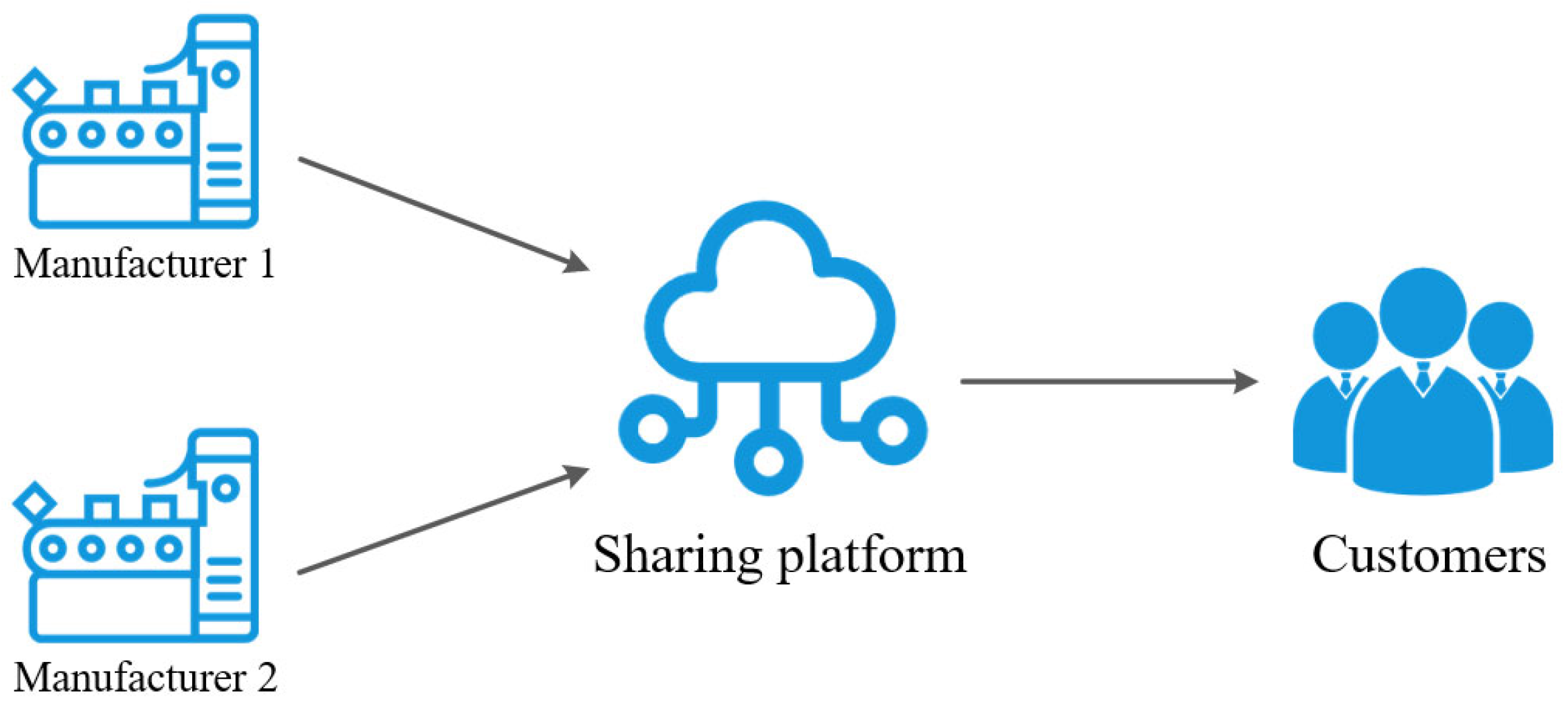
To help manufacturers and the sharing platform improve their profits and achieve mutual benefits, this paper focuses on the cooperation strategies between them. We consider three models under each cooperation strategy: the no-cooperation (Model N) model, the cost-sharing (Model CS) model, and the revenue-sharing (Model RS) model. In Model N, the sharing platform and manufacturers do not adopt any cooperation strategies. In Model CS, the sharing platform and manufacturers negotiate a cost-sharing ratio and jointly undertake the VAS cost. In Model RS, the sharing platform negotiates a revenue-sharing rate with manufacturers, who then share their revenue with the platform. Subsequently, we establish a shared supply chain structure including a sharing platform, two manufacturers, and customers, which is also used in [24]. Customers submit manufacturing requirements and specifications to the sharing platform. The sharing platform then finds manufacturers capable of producing products according to customers’ requirements and specifications. The shared supply chain structure and the relation between its members are illustrated in Figure 1.
Figure 1.
The structure of the shared supply chain.
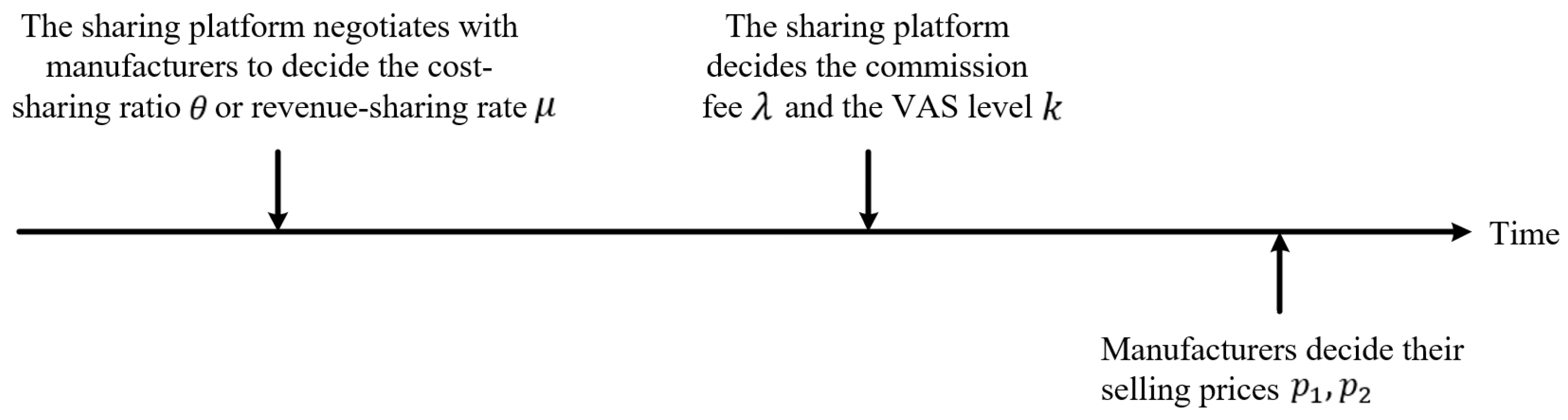
Manufacturer 1 and Manufacturer 2 are supposed to provide two types of substitutable products (denoted as ). They decide their products’ selling prices and . Manufacturers need pay commission fee to the sharing platform based on the number of products sold so that manufacturers can use the services provided by the sharing platform [50]. The commission fee is decided by the sharing platform. To facilitate cooperation and encourage users to participate, more and more sharing platforms provide VAS [36] such as search, match, payment security, quality inspection, and so on. We assume that the sharing platform provides VAS for manufacturers and customers. The VAS level decided by the sharing platform is . The VAS cost is , where represents the VAS cost coefficient [16]. Note that our baseline assumes a common VAS level that improves the platform’s overall transaction environment (matching, verification, quality assurance) and therefore benefits the market as a whole; this is consistent with many platform settings where service investments are largely non-excludable across sellers. The cost allocation structure is simplified to isolate the core incentive-alignment mechanism of cost sharing versus revenue sharing. We model the leader–follower relationship between the sharing platform and two manufacturers as a Stackelberg game, where the sharing platform is the leader and manufacturers are the followers. The decision sequence is shown in Figure 2.
Figure 2.
Sequence of events.
In our model, platform governance is operationalized through endogenous decisions on VAS level and Commission fee . The VAS level affects demand by improving matching efficiency and transaction reliability, while incurring an increasing service cost captured by the VAS cost coefficient. Commission fees govern the distribution of the VAS cost burden and the incremental revenue generated by VAS, thereby altering each party’s incentives to support (or resist) higher service provision. Under this governance structure, feasible cooperation requires that the chosen sharing terms satisfy both parties’ participation constraints; otherwise, cooperation becomes unstable and the ecosystem reverts to non-cooperation. We further interpret variations ε as different VAS cost environments (e.g., operational/technology cost shocks), which allows us to derive governance-relevant decision rules on when the platform should switch between cost sharing and revenue sharing to preserve participation and profitability.
Referring to the previous literature [15,33], the inverse demand function is
is the index for manufacturers, . is the index for models, . is the positive market potential. is the competition intensity, which measures substitutability/competition intensity; the admissible range ensures a well-behaved demand system and interior equilibria, . Higher implies stronger strategic interaction and greater margin erosion, which affects how VAS-driven demand expansion translates into profits and thus reshapes the feasibility of cooperative contracts. . is the sensitivity of demand to the VAS level. With respect to nonlinear demand, the comparative static magnitudes may change, and closed-form thresholds may no longer be available, but the core trade-off (VAS expands demand but increases service cost) and the contract-induced incentive alignment mechanisms remain operative. Following [24,25,48], we add some assumptions to strengthen the model:
Assumption 1.
Supply and demand are balanced in the shared supply chain.
Assumption 2.
Manufacturers can trade with customers only through the sharing platform.
Assumption 3.
The information is symmetric for manufacturers and the sharing platform, i.e., in the sequential game where the sharing platform enters early and manufacturers wait, the commission fee and VAS level is public information for manufacturers.
Assumption 4.
Manufacturer 1 and Manufacturer 2 are perfectly symmetric. They engage in a simultaneous subgame and complete the manufacturing tasks at a marginal cost c. With heterogeneous manufacturers (e.g., different marginal costs, capacities, or market power), the equilibrium will generally involve asymmetric outputs/prices and potentially different participation incentives, which can shift the boundaries of the win–win regions and may lead to differentiated contract preferences across manufacturers. However, the main qualitative insights, namely that cooperation does not automatically generate mutual gains and that the dominance of cost sharing versus revenue sharing depends on market and cost conditions, which are expected to remain, while the feasibility intervals may become manufacturer specific.
The model assumptions are intended to capture stylized but realistic features of shared manufacturing platforms. In practice, platforms such as XoMetry.com and Alibaba.com provide value-added services, including supplier screening, quotation support, demand–supply matching, payment security, quality inspection, and logistics/dispute resolution, which reduce transaction friction and improve buyer trust. The platform’s commission or contract terms represent the pricing rules through which these services are financed and through which costs and surplus are allocated between the platform and suppliers. Manufacturer competition reflects the fact that multiple qualified suppliers typically bid/compete for orders, and the intensity of competition depends on substitutability and market thickness. Finally, the decision variables and parameters used in this study are presented in Table 2.
Table 2.
Notations and definitions.
4. Model and Analysis
In this section, we use the backwards induction method to derive the optimal decisions under the three models: Model N, Model CS, and Model RS. Specifically, given the commission fee and VAS level set by the sharing platform, suppose that manufacturers accept them and then decide selling prices to maximize their profits. Subsequently, given the selling prices, the sharing platform faces the problem of maximizing its own profit by determining the commission fee and VAS level. Finally, we can derive the equilibrium outcomes.
4.1. Model N
In Model N, manufacturers and the sharing platform do not adopt any cooperation strategies. The revenue of the sharing platform is the commission fee charged to Manufacturer 1 and Manufacturer 2. The cost of the sharing platform is the VAS cost. Therefore, the profit function of the sharing platform in Model N is:
Manufacturers’ revenue is from the sale of products. Manufacturers’ cost includes the production cost and the commission fee paid to the sharing platform. Therefore, the profit functions of Manufacturer 1 and Manufacturer 2 in Model N are
Next, we use the backwards induction method to derive the equilibrium. We can conclude that when (second-order conditions for profit maximization), the equilibrium results are presented in Table A1 (in Appendix B). In addition, proofs of the equilibrium results are given in Appendix A.
4.2. Model CS
In Model CS, the sharing platform signs a cost-sharing contract with manufacturers. The sharing platform and manufacturers negotiate a cost-sharing ratio. They jointly undertake the VAS cost. Each manufacturer bears the portion of the VAS cost, and the sharing platform bears the portion of the VAS cost, .
The profit function of the sharing platform in Model CS is
The profit functions of Manufacturer 1 and Manufacturer 2 in Model CS are
Next, we use the backwards induction method to derive the equilibrium. We can conclude that when , the equilibrium results are presented in Table A2 (in Appendix B).
4.3. Model RS
In Model RS, the sharing platform signs a revenue-sharing contract with manufacturers. In addition to paying commissions to the shared manufacturing platform, manufacturers will also share the revenue from selling their products with the shared manufacturing platform. Manufacturers receive the portion of the sales revenue, and the sharing platform receives the portion of the sales revenue, where . The income of the shared manufacturing platform includes commission income and product sales revenue. Similar to [27,51], the profit function of the sharing platform in Model RS is
The profit functions of Manufacturer 1 and Manufacturer 2 under Model RS are
Next, we use the backwards induction method to derive the equilibrium. We can get that when , the equilibrium results are presented in Table A3 (in Appendix B).
4.4. Analysis of the Equilibrium Results
In this section, we focus on main parameters and their effects on equilibrium results of the sharing platform and manufacturers. Additionally, we compare the equilibrium results of three models. Finally, we construct a series of optimal cooperation strategy structures for manufacturers and the sharing platform.
4.4.1. Main Parameters Effects on the Equilibrium Results
Based on the findings presented in Table A1, Table A2 and Table A3, we examine the effects of main parameters on the three models’ equilibrium results in Propositions 1–4.
Proposition 1.
The impact of the VAS cost coefficient on the equilibrium results:
Under the above three models, the equilibrium results of commission fee, VAS level, selling price, market demand and the sharing platform’s profit are negatively related to the VAS cost coefficient. Additionally, in Model N, the equilibrium profits of manufacturers and the supply chain are also negatively related to the VAS cost coefficient. Proposition 1 suggests that as the VAS cost coefficient increases, the sharing platform will reduce the VAS level to lower the VAS cost. Since it is not possible to provide as high VAS level as it used to, the commission fee set by the sharing platform will also decrease, which is consistent with [24] in that the commission fee is positively related to the VAS level. In addition, a lower VAS level also weakens the service support provided by the platform, deteriorating both manufacturers’ selling efficiency and customers’ purchasing experience. This reduction in service quality suppresses market demand. In response, manufacturers cut selling prices to partially offset the demand loss.
Proposition 2.
The impact of the sensitivity of demand to the VAS level on the equilibrium results:
Across the three models, the equilibrium commission fee, VAS level, selling price, market demand, and the platform’s profit all increase with the sensitivity of demand to the VAS level. Moreover, under Model N, manufacturers’ profit and total supply-chain profit are also increasing in this sensitivity. As stated in Proposition 2, a higher demand sensitivity implies that customers place greater value on the platform’s VAS. By improving the purchasing experience, VAS becomes more effective at stimulating purchases, which expands market demand. Anticipating stronger demand, manufacturers optimally raise selling prices, and the platform increases the commission fee to capture part of the enlarged surplus. Meanwhile, higher demand typically comes with stronger service requirements, prompting the platform to invest more in VAS, which results in a higher equilibrium VAS level.
Proposition 3.
The impact of market potential on the equilibrium results:
Across the three models, the equilibrium commission fee, VAS level, selling price, market demand, and the platform’s profit are all increasing in market potential. Moreover, under Model N, manufacturers’ profit and total supply-chain profit also rise with market potential. As stated in Proposition 3, a larger market potential expands customers’ willingness to purchase, thereby increasing market demand. Facing a larger demand base, manufacturers optimally raise selling prices, and the platform increases the commission fee to capture a greater share of the expanded surplus. At the same time, stronger market potential typically translates into higher service requirements and transaction volume, which induces the platform to invest more in VAS, leading to a higher equilibrium VAS level.
Proposition 4.
The impact of manufacturer’s unit production cost on the equilibrium results:
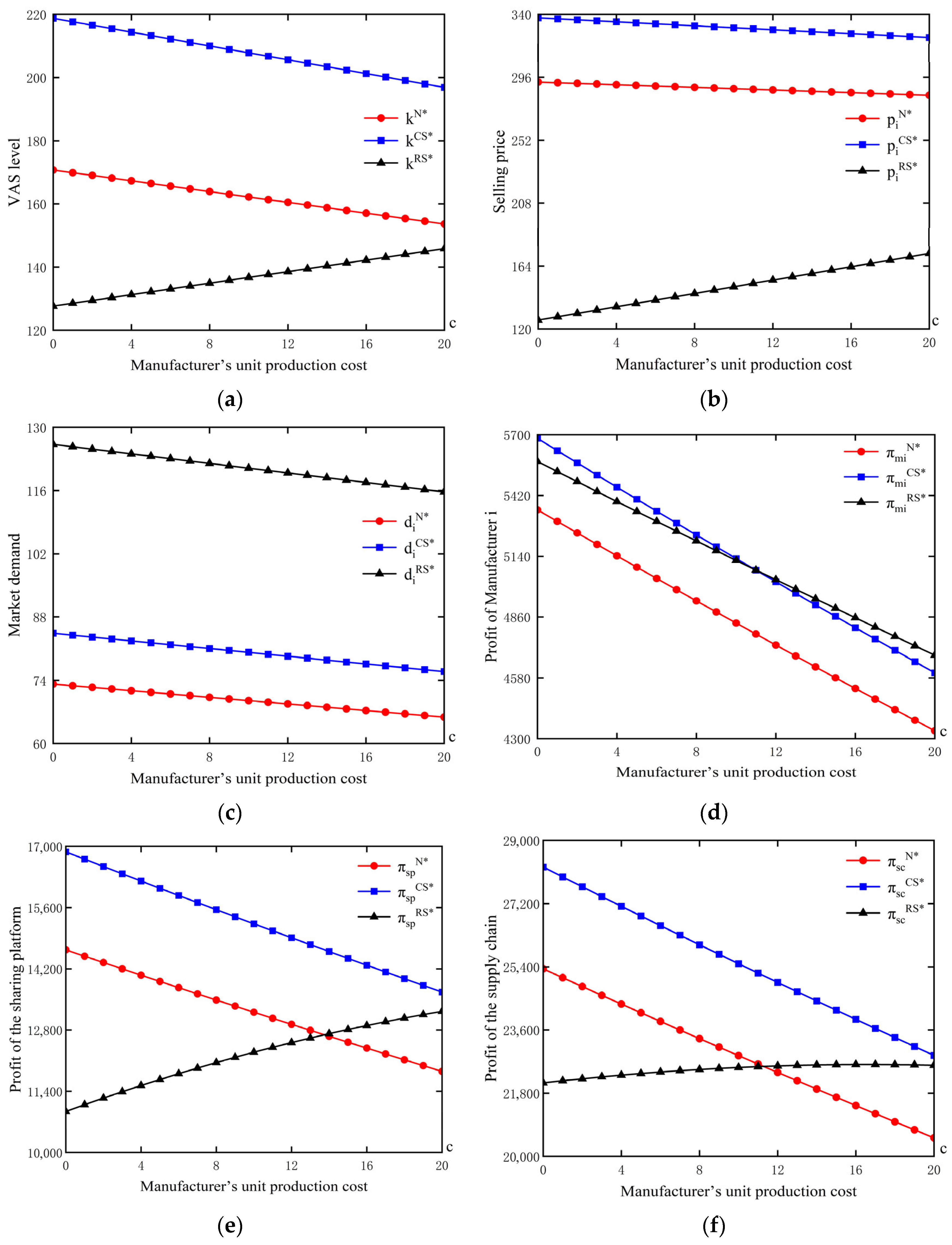
Under Model N and Model CS, the equilibrium results of commission fee, VAS level, market demand, and the sharing platform’s profit are negatively related to manufacturer’s unit production cost. In addition, in Model N, the equilibrium profits of manufacturers and the supply chain are also negatively related to manufacturer’s unit production cost. In contrast, in Model RS, the equilibrium results of VAS level and selling price are positively related to manufacturer’s unit production cost. Proposition 4 indicates that as the production cost increases, the sharing platform in Model N and Model CS reduces the commission fee to prevent excessive increases in manufacturers’ selling prices. This is because without a reduction in the commission fee, manufacturers would raise prices to secure sufficient profits. Consequently, market demand will decrease, reducing the platform’s profitability. Therefore, the platform reduces commission fees to prevent manufacturers from raising prices, thereby maintaining market demand and ensuring its profitability. In addition, the VAS level will decrease due to the lower commission fee. It is worth noting that in Model RS, where no commission fee is charged, manufacturers will raise prices as production cost increases. With a fixed revenue-sharing rate, the platform’s revenue rises as selling prices increase. To stimulate market demand, the sharing platform will be willing to provide higher VAS level.
4.4.2. Comparative Analysis
In this subsection, we compare the equilibrium results among the three models. Moreover, we investigate the effects of cooperation strategies on the optimal profits of the sharing platform and manufacturer. Thus, Propositions 5 and 6 are obtained in the following:
Proposition 5.
In Model N and Model CS, the following results are held:
Compared with Model N, Model CS has higher equilibrium results of commission fee, VAS level, selling price, market demand, and platform profit. In addition, When the manufacturers’ cost-sharing ratio is lower than a certain threshold, their profits in Model CS exceed those in Model N. Proposition 5 suggests that with a cost-sharing contract, the sharing platform is more likely to enhance VAS level to stimulate market demand. This is because manufacturers share part of the VAS cost, reducing the cost burden on the platform. As market demand grows, manufacturers and the sharing platform will take the opportunity to raise selling prices and commission fees, thus earning more profits. When manufacturers’ cost-sharing ratio is relatively low, the profits of both manufacturers and the sharing platform are improved. Therefore, both sides are willing to accept the cost-sharing contract. However, if the cost-sharing ratio exceeds a certain threshold, manufacturers’ profits will fall below those in Model N. Then manufacturers will be unwilling to enter a cost-sharing contract with the platform.
Proposition 6.
In Model RS, there exists a feasible revenue-sharing rate interval, denoted as . Manufacturers and the sharing platform negotiate the revenue-sharing rate within this interval based on their respective bargaining power. Then both manufacturers and the sharing platform will achieve higher profits compared to Model N.
Proposition 6 suggests that manufacturers and the sharing platform will agree to a revenue-sharing contract only if it increases their profits compared to Model N. Otherwise, they will reject the contract. Therefore, the revenue-sharing rate should satisfy the following constraints: , , . Owing to the complexity of the profit functions, we cannot compare the equilibrium profits in Model RS with that in Model N. Hence, following [15], we discuss this issue in Section 5.
4.4.3. Selection of Cooperation Strategy
According to the optimal profits of manufacturers and the sharing platform presented in Table A1, Table A2 and Table A3, we construct a series of optimal cooperation strategy structures by introducing data that satisfies the basic assumptions. Although closed-form equilibria are available under each contract, a closed-form global dominance comparison is generally infeasible because the profit differences are high-order nonlinear rational functions in multiple parameters and the comparison must be conducted over the intersection of contract-specific feasible regions. Therefore, we complement partial analytical comparisons (special cases/sufficient conditions) with systematic numerical dominance mapping. The structures help manufacturers and the platform select the best cooperation strategy based on varying cost-sharing ratios and revenue-sharing rates.
Corollary 1.
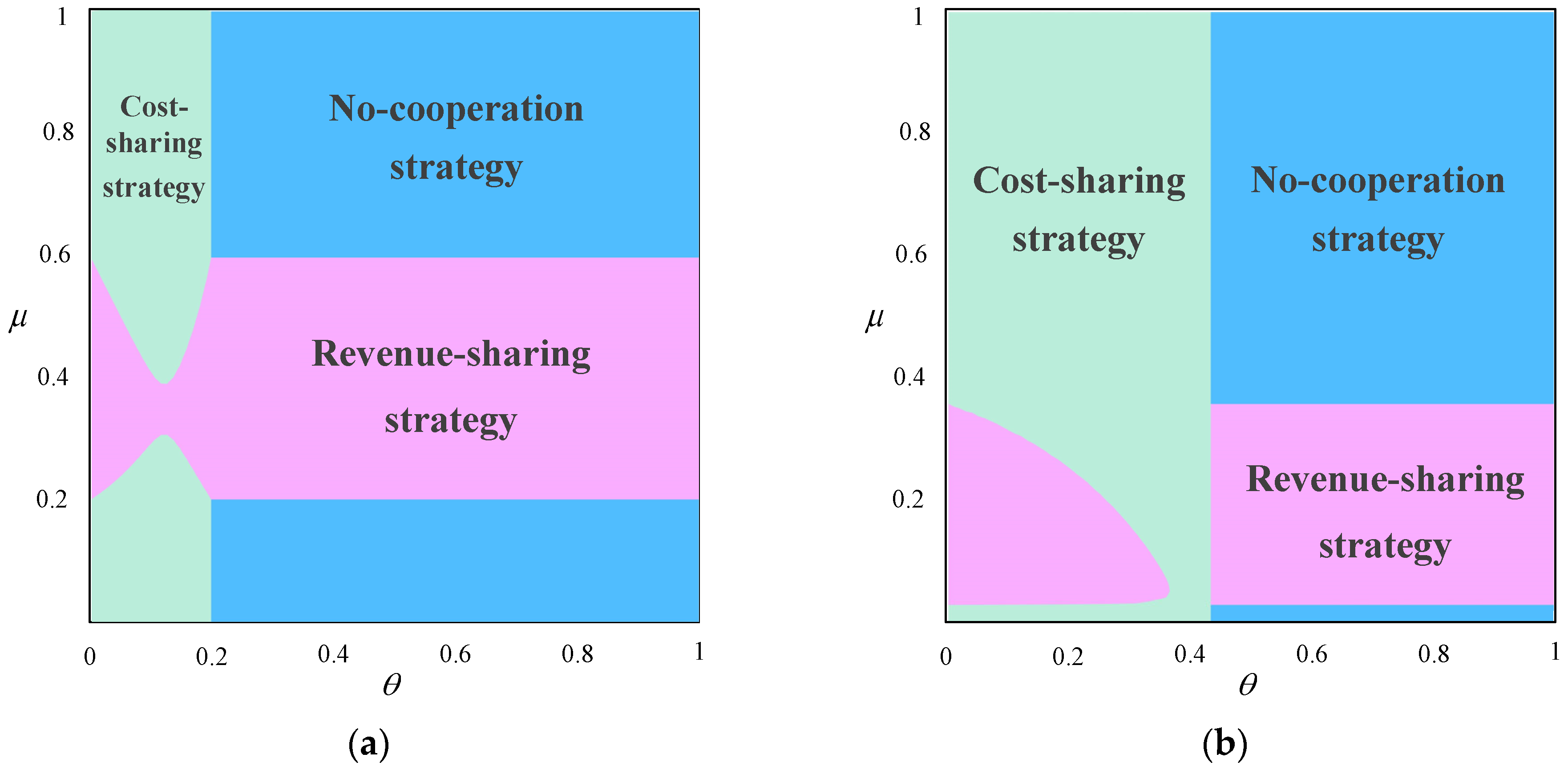
We plot the equilibrium profit functions for manufacturers and the platform in the three models, using the cost-sharing ratio as the x-axis, the revenue-sharing rate as the y-axis, and the equilibrium profit as the z-axis. We then extract their top views. This reveals the optimal cooperation strategies for manufacturers and the platform when , , as illustrated in Figure 3.
Figure 3.
Optimal cooperation strategies of manufacturers and the sharing platform. (a) Optimal cooperation strategies of manufacturers. (b) Optimal cooperation strategies of the sharing platform.
To ensure that the dominant conclusions are not driven by specific parameter choices, we perform extensive sensitivity analyses by jointly varying key parameters and report dominance maps and threshold shifts. In addition, we impose standard regularity conditions to ensure a well-behaved demand system and interior equilibria (positive demand and concavity of objective functions). Accordingly, (or an economically meaningful interval), , , and the admissible range of follows from the requirement that equilibrium quantities and profits remain nonnegative. Referring to the previous literature [7,24,49], we set ,,,,. Through the graphs, manufacturers and the sharing platform can clearly know what their respective optimal cooperation strategies are when the cost-sharing ratio and the revenue-sharing rate take different values. If their optimal strategies align, both sides will enter cooperation. If their optimal strategies differ, both sides will negotiate to decide whether to cooperate and which strategy to adopt. This leads to Corollary 2.
Corollary 2.
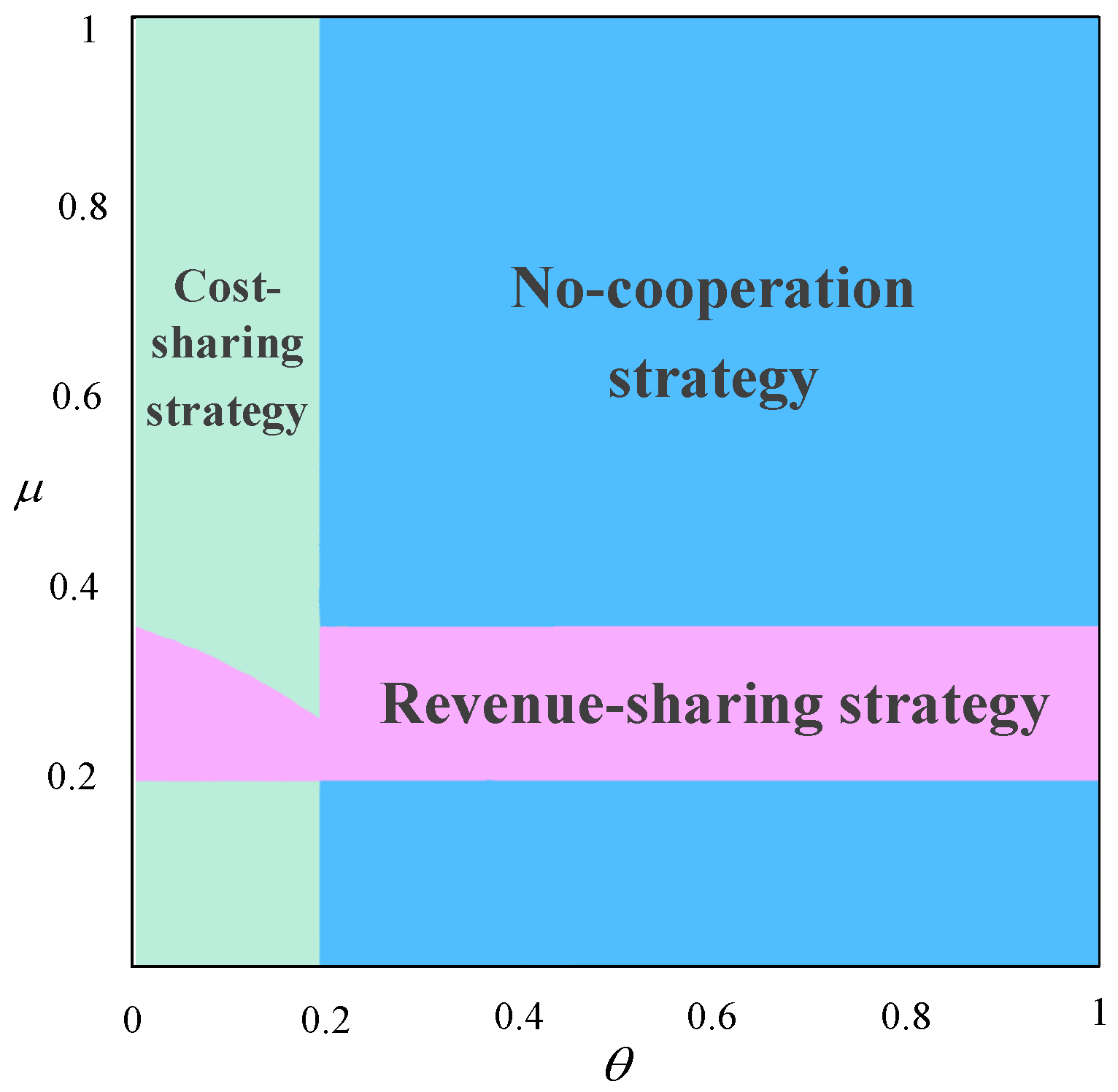
Overlapping Figure 3a,b, the graph of optimal supply chain cooperation strategies can be obtained, as shown in Figure 4.
Figure 4.
Optimal cooperation strategies of the supply chain.
The sharing platform and manufacturers choose the cooperation strategy through negotiation; it is not unilaterally decided. By overlapping Figure 3a,b, we identify areas with the same color, indicating that both sides have chosen the same optimal strategy. Then, two sides will reach cooperation. Areas with different colors indicate disagreements between two sides. For example, if manufacturers choose the no-cooperation strategy while the sharing platform chooses the revenue-sharing strategy, two sides will not reach cooperation, and the optimal strategy of the supply chain will be the no-cooperation strategy. If manufacturers choose the cost-sharing strategy and the sharing platform chooses the revenue-sharing strategy, their strategies will not align. Since the platform is the leader of the Stackelberg game, manufacturers should obey its leadership. If manufacturers’ equilibrium profits in Model RS exceed those in Model N, they will accept the platform’s leadership, making the revenue-sharing strategy the optimal supply chain strategy. Conversely, if manufacturers’ equilibrium profits in Model RS are less than in Model N, they will reject the platform’s leadership. The platform will then decide whether to compromise with manufacturers. If the equilibrium profit of the platform in Model CS is more than that in Model N, it will agree to a cost-sharing strategy with manufacturers. Conversely, if the equilibrium profit of the platform in Model CS is less than that in Model N, it will not reach an agreement with manufacturers. In this case, both sides will adopt the no-cooperation strategy. In summary, Figure 4 illustrates the optimal cooperation strategies of the supply chain.
5. Numerical Analysis
In this section, we conduct experiments to numerically validate our models and develop insights. According to the derivation of three models in the previous sections, it is known that profits of manufacturers and the sharing platform in each model have maximum value when , , are satisfied. Therefore, we assign specific values to the parameters under the above constraints, according to the previous literature [7,24,49]. The initial values of parameters are shown in Table 3.
Table 3.
Initial values of parameters.
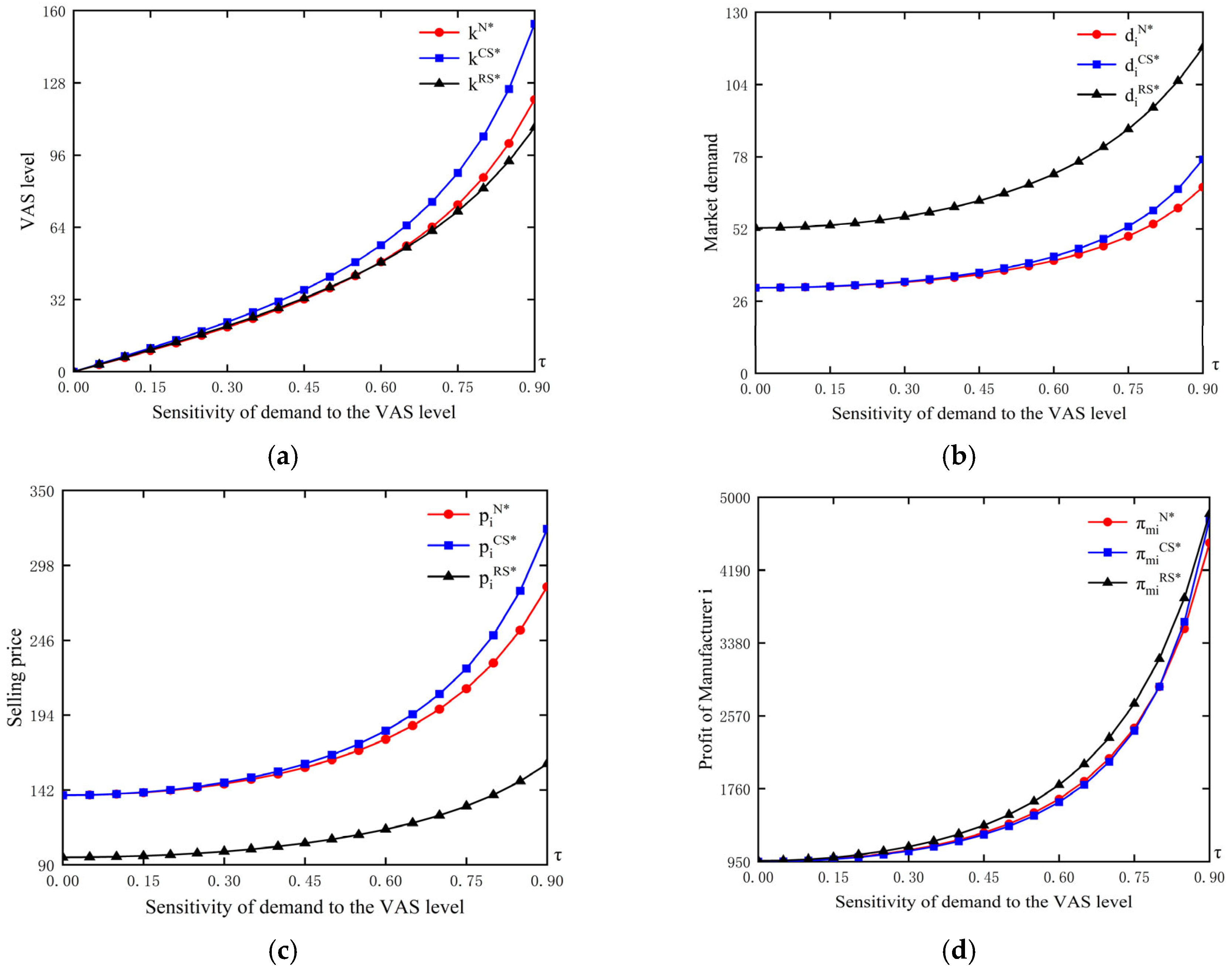
5.1. The Impact of VAS Cost Coefficient
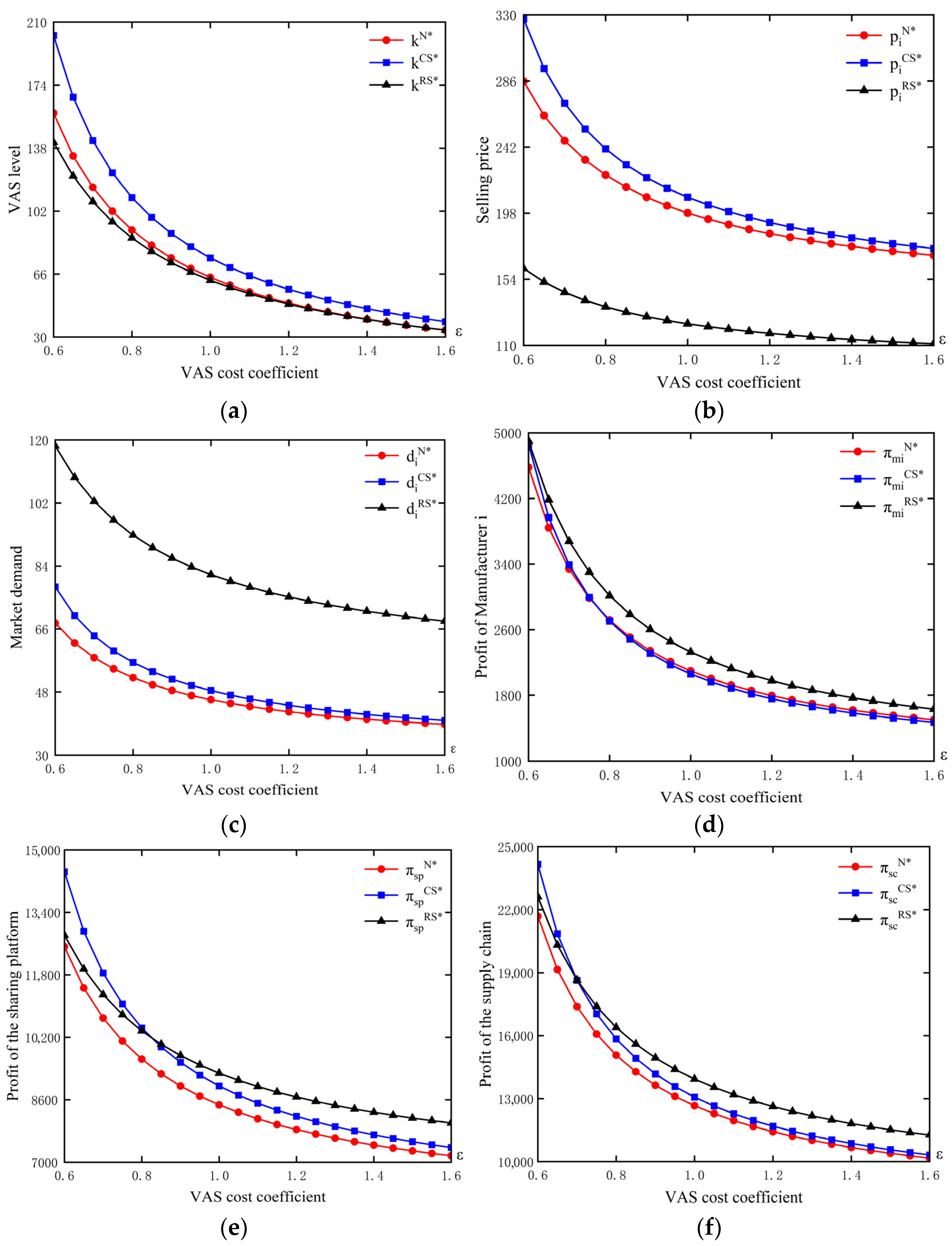
We set to study the impact of VAS cost coefficient on the equilibrium results (see Figure 5).
Figure 5.
Impact of VAS cost coefficient on the equilibrium results. (a) Impact of VAS cost coefficient on VAS level. (b) Impact of VAS cost coefficient on selling price. (c) Impact of VAS cost coefficient on market demand. (d) Impact of VAS cost coefficient on manufacture’s profit. (e) Impact of VAS cost coefficient on sharing platform’s profit. (f) Impact of VAS cost coefficient on supply chain’s profit.
From Figure 5, all equilibrium outcomes deteriorate as the VAS cost coefficient increases, reflecting the fact that higher service cost progressively erodes the surplus generated by platform-enabled matching and VAS provisioning. A noteworthy implication is that cooperation does not necessarily benefit manufacturers once VAS becomes sufficiently costly. As shown in Figure 5d, the manufacturer’s profit under cost sharing (Model CS) is higher than that under non-cooperation (Model N) only when the VAS cost coefficient is relatively small. However, Model CS yields lower manufacturer profit than Model N. This counterintuitive reversal occurs because a larger raises the total VAS cost, and the cost-sharing rule transfers an increasing portion of this burden to manufacturers; the resulting cost burden can dominate the demand-expansion benefit brought by VAS, ultimately making “cooperation” worse than “no cooperation” for manufacturers. In contrast, Figure 5b indicates that Model RS produces the lowest selling price among the three strategies, suggesting that revenue sharing induces more aggressive market expansion and intensifies price competition. Importantly, Figure 5d further shows that manufacturers can still earn higher profits under Model RS than under Models N and CS in the examined range, despite the lower price level highlighting that the contract form can reshape how the VAS-generated surplus is created and allocated.
From the platform’s perspective (Figure 5e), both cooperative strategies (Model RS and CS) outperform non-cooperation (Model N), but the preferred contract depends on the VAS cost environment. When VAS cost coefficient is small, Model CS can dominate Model RS for the platform because cost sharing more effectively mitigates the platform’s service-cost burden. As VAS cost coefficient increases, the platform’s preference can switch toward Model RS, as revenue sharing better leverages the expanded transaction volume to compensate for the higher service cost. Overall, these results underscore a nontrivial managerial insight: the optimal cooperation strategy is state-dependent, and the feasibility of a win–win outcome hinges on whether the sharing terms can balance the demand-expansion gains against the escalating VAS cost. These observations are summarized in Remark 1.
Remark 1.
The profits of manufacturers and the supply chain are also negatively related to the VAS cost coefficient in both Model CS and Model RS, which is consistent with the conclusions in Model N.
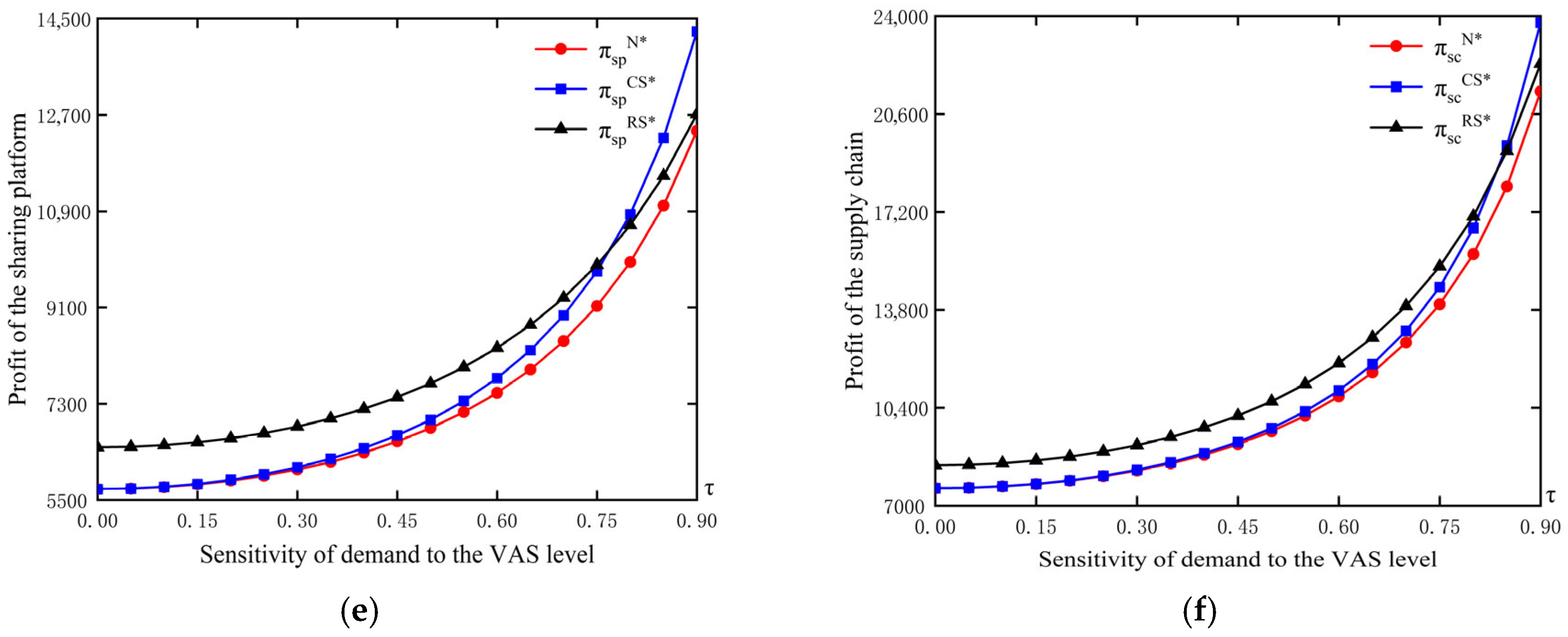
5.2. The Impact of Sensitivity of Demand to the VAS Level
We set to study the impact of sensitivity of demand to the VAS level on the equilibrium results. Through numeric analysis as shown in Figure 6, we also uncover some observations as summarized in Remark 2.

Figure 6.
Impact of sensitivity of demand to the VAS level on the equilibrium results. (a) Impact of demand to the VAS level on VAS level. (b) Impact of demand to the VAS level on market demand. (c) Impact of demand to the VAS level on selling price. (d) Impact of demand to the VAS level on manufacture’s profit. (e) Impact of demand to the VAS level on sharing platform’s profit. (f) Impact of demand to the VAS level on supply chain’s profit.
Remark 2.
The profits of manufacturers and the supply chain are also positively related to sensitivity of demand to the VAS level in both Model CS and Model RS, which is consistent with the conclusions in Model N.
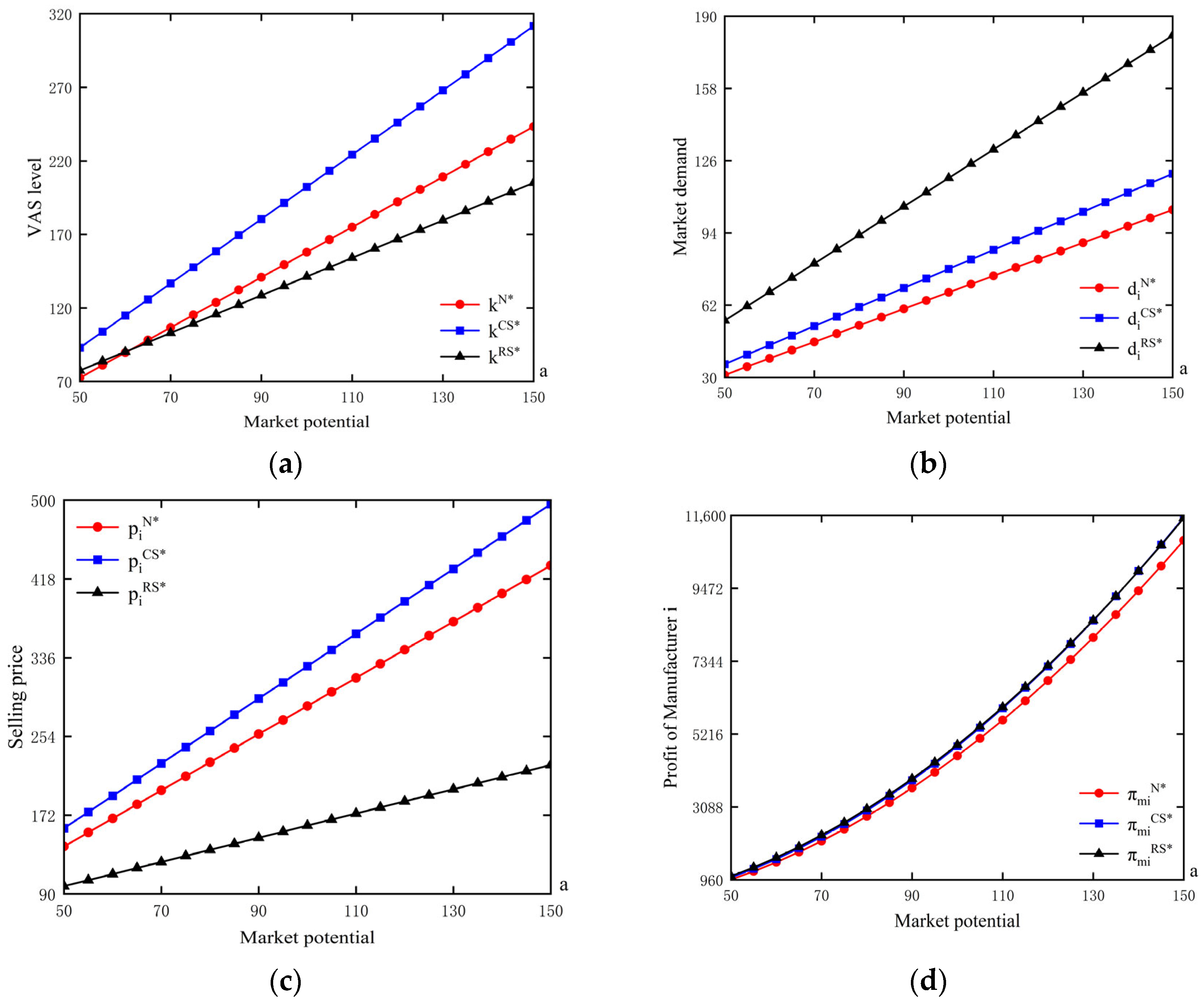
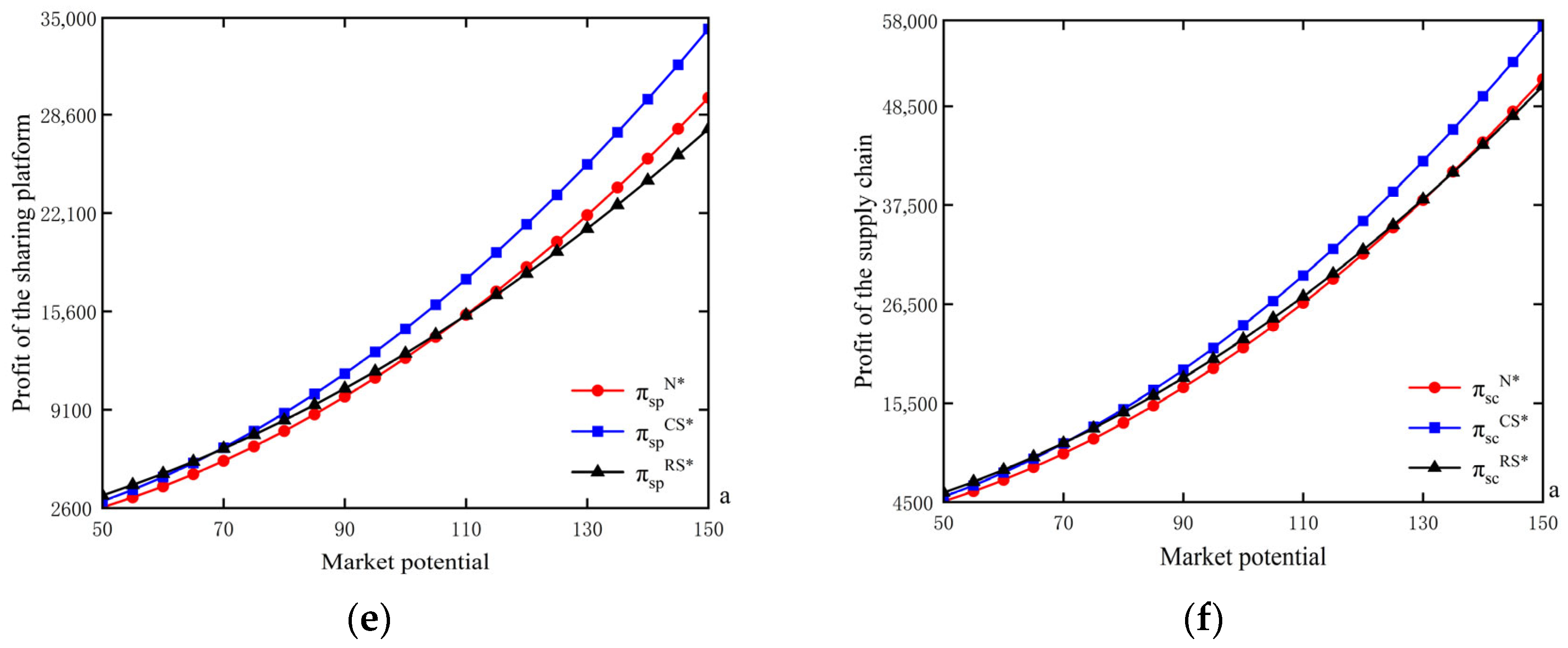
5.3. The Impact of Market Potential
We set to study the impact of market potential on the equilibrium results. Through numeric analysis as shown in Figure 7, we also uncover some observations as summarized in Remark 3.

Figure 7.
Impact of market potential on the equilibrium results. (a) Impact of market potential on VAS level. (b) Impact of market potential on market demand. (c) Impact of market potential on selling price. (d) Impact of market potential on manufacture’s profit. (e) Impact of market potential on sharing platform’s profit. (f) Impact of market potential on supply chain’s profit.
Remark 3.
The profits of manufacturers and the supply chain are also positively related to market potential in both Model CS and Model RS, which is consistent with the conclusions in Model N.
Firstly, the expansion of the potential market leads to a typical scale amplification effect. Since the VAS level enhances effective demand by improving matching efficiency, transaction security, and trust, the marginal response of demand to VAS will be amplified as the market size increases. Secondly, the potential market will alter the comparison between the marginal revenue and marginal cost of VAS investment, thereby generating a threshold effect. When the potential market is small, the VAS costs cannot be diluted by the limited transaction volume, resulting in an optimal VAS level that is too low and making it more difficult for the cooperation contract to simultaneously improve the profits of both parties; while when increases to a certain extent, the expansion of demand benefits exceed the growth of service costs, and the optimal VAS level and total profit undergo a non-linear transition and promote the significant expansion of the win–win area. Thirdly, the greater the market potential, the more significant this difference becomes. Revenue sharing directly links platform revenue to transaction volume, enabling the platform to internalize the incremental revenue brought by VAS, thereby having a stronger motivation to enhance VAS and drive system profit growth in high market potential scenarios. Conversely, cost sharing mainly alleviates the platform’s cost pressure, but has a weaker internalization effect on demand-expansion revenue, and may encounter problems such as insufficient service investment or incomplete incentives in high market potential situations.
Compared to the existing literature [7,24,49], our numerical results on market potential provide several connections to existing research. First, the finding that a larger potential market increases the optimal VAS level and expands total demand is consistent with the platform/service-investment literature emphasizing the demand-expansion role of service quality. Second, the observed enlargement of the Pareto-improving region as market potential grows aligns with the contracting literature suggesting that incentive-aligned schemes are more likely to generate mutual gains when the incremental market surplus is sufficiently large. Importantly, our analysis extends prior studies by explicitly characterizing how market potential shifts the boundary conditions under which revenue-sharing/cost-sharing dominates, and by identifying feasible parameter regions that support win–win outcomes in shared manufacturing with VAS provisioning.
5.4. The Impact of Manufacturer’s Unit Production Cost
We set to study the impact of manufacturer’s unit production cost on the equilibrium results (see Figure 8).
Figure 8.
Impact of manufacturer’s unit production cost on the equilibrium results. (a) Impact of manufacturer’s unit production cost on VAS level. (b) Impact of manufacturer’s unit production cost on market demand. (c) Impact of manufacturer’s unit production cost on selling price. (d) Impact of manufacturer’s unit production cost on manufacture’s profit. (e) Impact of manufacturer’s unit production cost on sharing platform’s profit. (f) Impact of manufacturer’s unit production cost on supply chain’s profit.
As shown in Figure 8b,c, a counterintuitive pattern emerges in Models N and CS: the selling price and market demand remain relatively stable even as production costs increase. This stability does not arise because manufacturers are unaffected by cost shocks, but because the platform endogenously absorbs part of the shock by reducing the commission fee. Without such a fee adjustment, manufacturers would have a stronger incentive to pass rising costs through to prices to protect margins, which would depress demand and, in turn, reduce the platform’s profit. Hence, the platform strategically cuts the commission fee to curb price increases and stabilize demand—effectively “subsidizing” the market to protect its own payoff. Importantly, this adjustment comes with a trade-off: as the platform lowers the commission fee and its per-transaction margin shrinks, it correspondingly reduces the VAS level, which weakens service provision even though demand is preserved in the short run.
In contrast, Figure 8a,b,e indicate an even more striking outcome in Model RS: as production costs rise, the platform’s profit and chosen VAS level increase, along with the selling price. This occurs because the platform does not charge a commission fee in Model RS; manufacturers therefore respond to higher production costs by increasing prices, which reduces demand and manufacturers’ profits. However, since the revenue-sharing rate is fixed and the platform’s payoff is tied to the sales revenue generated at the higher prices, the platform can benefit from price increases even when market demand softens. Moreover, to counteract the demand reduction induced by higher prices and to expand the revenue base, the platform has an incentive to raise the VAS level. Overall, these results reveal a nontrivial mechanism: under revenue sharing, a negative cost shock can strengthen the platform’s incentives to invest in VAS and can even raise platform profitability, whereas under commission-based settings the platform primarily relies on fee reductions to stabilize the market at the expense of lower VAS provision.
6. Conclusions
With the advancement of information technology and the advent of the industry 4.0 era, shared manufacturing has greatly benefited many enterprises. In shared manufacturing, customers submit production requirements to the sharing platform, which then identifies manufacturers with the capacity to fulfill these requirements. This creates a win–win situation for manufacturers, sharing platforms, and customers. To enhance supply chain profits, it is crucial for manufacturers and sharing platforms to cooperate. This paper develops a supply chain model involving two manufacturers and a sharing platform and explores three cooperation strategies: no-cooperation strategy (Model N), cost-sharing strategy (Model CS), and revenue-sharing strategy (Model RS). We solve the equilibrium results under each strategy and compare them.
The main research findings are summarized as follows. First, this paper investigates the effects of each parameter on equilibrium results. It finds that these results are negatively related to the VAS cost coefficient, positively related to the sensitivity of demand to the VAS level, and positively related to market potential. Second, the cost-sharing contract can improve the sharing platform’s profit. However, it may not benefit manufacturers unless the cost-sharing ratio is below a certain threshold. Additionally, when the revenue-sharing ratio falls within a certain range, the revenue-sharing contract can enhance profits for both manufacturers and the sharing platform. Third, this paper compares profits of manufacturers and the sharing platform under three cooperation strategies and presents a graph showing the optimal cooperation strategy for the supply chain. Using this graph, manufacturers and the sharing platform can select the optimal cooperation strategy based on the revenue-sharing rate and cost-sharing ratio.
This paper provides several important managerial insights. First, manufacturers and sharing platforms should engage in close cooperation to boost profits for both sides. They should negotiate the revenue-sharing rate and cost-sharing ratio. Generally, when the cost-sharing ratio is relatively low, both sides should choose the cost-sharing strategy; when the revenue-sharing rate falls within a reasonable range, they should adopt the revenue-sharing strategy. Cooperation is most likely to fail when (a) the negotiated cost-sharing ratio or revenue-sharing rate is outside the feasible interval, (b) the VAS cost coefficient is sufficiently large that cost sharing imposes an excessive cost burden on manufacturers, making their participation constraint bind even if the platform benefits. (c) If the demand uplift from VAS is weak or manufacturer competition erodes margins substantially, the surplus created by VAS may be too small to compensate for service costs under either contract, narrowing the feasible region and increasing the likelihood of cooperation failure. Second, if the optimal strategies of manufacturers and the sharing platform differ, manufacturers should follow the sharing platform’s lead, as it is the Stackelberg leader. Both sides give priority to choosing the optimal strategy of the sharing platform. However, if the sharing platform’s optimal strategy results in lower profits for manufacturers than the no-cooperation strategy, the platform should compromise with manufacturers. In this case, both sides should choose the manufacturers’ optimal strategy. But if manufacturers’ optimal strategy results in lower profits for the sharing platform compared to the no-cooperation strategy, both sides should choose the no-cooperation strategy. Finally, from a sustainability perspective, platforms should prioritize cooperation designs that preserve manufacturers’ participation and maintain adequate VAS provision, because these conditions support stable transaction volume and, by implication, higher capacity utilization and lower idling in shared manufacturing. Practically, platforms should monitor VAS cost efficiency and renegotiate sharing terms when the realized cost environment threatens to push the system outside the win–win feasible region, as governance failure may reduce platform activity and undermine both economic and sustainability objectives.
There are limitations to our study, and it could be extended in several directions. First, this paper assumes that the sharing platform is the leader in the Stackelberg game, while there are scenarios in which manufacturers become the leaders. For example, refs. [27,49] established models in which manufacturers are leaders of the Stackelberg game and the sharing platform is the follower. Therefore, future research can also consider how manufacturers and the sharing platform cooperate when manufacturers become leaders. Second, the platform, manufacturers, and VAS providers may hold different private information regarding demand potential, service cost, and operational capacity/quality, which motivates extending our model to an incomplete-information setting. Third, future research can extend our framework to a multi-platform setting in which platforms compete for manufacturers and demand (e.g., via VAS level, commission/sharing terms, and matching efficiency). Such competition may alter cooperation incentives and equilibrium outcomes. Fourth, platforms often hold significant bargaining power in setting fees or sharing mechanisms. The manuscript treats the sharing platform and manufacturers as symmetric negotiators, which contradicts real-world dynamics. Including at least a discussion of this asymmetry would enhance the conceptual robustness.
Author Contributions
Conceptualization, H.Z., J.L. and S.W.; methodology, H.Z. and J.L.; software, H.Z. and J.Y.; formal analysis, J.L. and J.Y.; writing—original draft preparation, H.Z., J.Y. and T.S.; writing—review and editing, J.L., H.Z. and T.S.; visualization, H.Z., J.L. and J.Y.; supervision, T.S. and S.W.; funding acquisition, T.S. and S.W.; validation, T.S. and S.W. All authors have read and agreed to the published version of the manuscript.
Funding
This research was supported by the National Natural Science Foundation of China under Grant No. 71771080.
Data Availability Statement
The original contributions presented in this study are included in the article. Further inquiries can be directed to the corresponding author.
Conflicts of Interest
The authors declare no conflicts of interest.
Appendix A
Appendix A.1. Proof of the Equilibrium Outcomes
Proof of the Equilibrium Outcomes in Table A1.
According to the backwards induction method, we can solve the dynamic game problem and derive the equilibrium outcomes of the chain members. The selling prices come first, followed by the commission fee decision and the VAS level.
With the use of Equation (1), the market demand of Manufacturer 1 and Manufacturer 2 are
Substituting and into Equations (3) and (4), we restate manufacturers’ profits:
We can conclude that the second derivatives of the manufacturers’ profits with respect to the selling prices are as follows:
Thus, the manufacturers’ profits are concave with the selling prices. There exists an optimal pricing strategy ().
Assuming , we can thus obtain
Then, putting them into Equation (2), we restate the sharing platform’s profit:
Checking the Hessian matrix, we can find that is concave in and if , because the Hessian matrix is and the determinant is . The optimal commission fee and VAS level can be solved by the respective first order conditions. So, we can obtain
Putting them into , we obtain
□
Appendix A.2. Proof of Propositions
Proof of Proposition 1.
Due to , we can get that . So, , .
Because , , , we can derive the following from Table A1:
The proofs of the remaining statements in Proposition 1 are similar to the above. Therefore, these proofs are omitted here. □
Proof of Proposition 2.
The proofs of the remaining statements in Proposition 2 are similar to the above. Therefore, these proofs are omitted here. □
Because , , , we can derive the following from Table A1:
Proof of Proposition 3.
The proofs of the remaining statements in Proposition 3 are similar to the above. Therefore, these proofs are omitted here. □
Because , , , we can derive the following from Table A1:
Proof of Proposition 4.
The proofs of the remaining statements in Proposition 4 are similar to the above. Therefore, these proofs are omitted here. □
Because , , , we can derive the following from Table A1:
Proof of Proposition 5.
Next, we need to judge the value of . Let . Let , we can obtain . Taking the first-order derivative of with , we have
Due to , we can obtain that . So . As a result, when , , , Manufacturers are more profitable in Model CS than in Model N. Else when , , , Manufacturers are more profitable in Model N than in Model CS. □
Appendix B
Table A1.
Equilibrium results in Model N.
Table A1.
Equilibrium results in Model N.
| Variable | Optimal Solutions | Variable | Optimal Solutions |
|---|---|---|---|
Table A2.
Equilibrium results in Model CS.
Table A2.
Equilibrium results in Model CS.
| Variable | Optimal Solutions | Variable | Optimal Solutions |
|---|---|---|---|
Table A3.
Equilibrium results in Model RS.
Table A3.
Equilibrium results in Model RS.
| Variable | Optimal Solutions |
|---|---|
References
- Xiang, W.; Yu, K.; Han, F.; Fang, L.; He, D.; Han, Q.-L. Advanced manufacturing in industry 5.0: A survey of key enabling technologies and future trends. IEEE Trans. Ind. Inf. 2023, 20, 1055–1068. [Google Scholar] [CrossRef]
- Yu, C.; Xu, X.; Yu, S.; Sang, Z.; Yang, C.; Jiang, X. Shared manufacturing in the sharing economy: Concept, definition and service operations. Comput. Ind. Eng. 2020, 146, 106602. [Google Scholar] [CrossRef]
- Jiang, Z.-Z.; Feng, G.; Yi, Z.; Guo, X. Service-oriented manufacturing: A literature review and future research directions. Front. Eng. Manag. 2022, 9, 71–88. [Google Scholar] [CrossRef]
- Wang, T.; Li, C.; Yuan, Y.; Liu, J.; Adeleke, I.B. An evolutionary game approach for manufacturing service allocation management in cloud manufacturing. Comput. Ind. Eng. 2019, 133, 231–240. [Google Scholar] [CrossRef]
- Guo, L.; Wu, X. Capacity sharing between competitors. Manag. Sci. 2018, 64, 3554–3573. [Google Scholar] [CrossRef]
- Chen, J.; Wang, X.; Chu, Z. Capacity sharing, product differentiation and welfare. Econ. Res.-Ekon. Istraživanja 2020, 33, 107–123. [Google Scholar] [CrossRef]
- Han, C.-Q.; Hu, Z.-H.; Ma, H.-W.; Liu, F. Dynamic cooperative value-added service strategies of the smart manufacturing platform considering the network effect and altruism preference. Comput. Ind. Eng. 2023, 184, 109560. [Google Scholar] [CrossRef]
- He, J.; Zhang, J.; Gu, X. Research on sharing manufacturing in Chinese manufacturing industry. Int. J. Adv. Manuf. Technol. 2019, 104, 463–476. [Google Scholar] [CrossRef]
- Gebauer, J.; Buxmann, P. Assessing the value of interorganizational systems to support business transactions. Int. J. Electron. Commer. 2000, 4, 61–82. [Google Scholar] [CrossRef]
- Tai, Y.-M.; Ho, C.-F.; Wu, W.-H. The performance impact of implementing web-based e-procurement systems. Int. J. Prod. Res. 2010, 48, 5397–5414. [Google Scholar] [CrossRef]
- Chaudhuri, A.; Datta, P.P.; Fernandes, K.J.; Xiong, Y. Optimal pricing strategies for manufacturing-as-a service platforms to ensure business sustainability. Int. J. Prod. Econ. 2021, 234, 108065. [Google Scholar] [CrossRef]
- Zhu, W.; Xie, J.; Xia, Y.; Wei, L.; Liang, L. Getting more third-party participants on board: Optimal pricing and investment decisions in competitive platform ecosystems. Eur. J. Oper. Res. 2023, 307, 177–192. [Google Scholar] [CrossRef]
- Liu, R.; Tan, C.; Wu, D.D.; Zhao, C. Strategies choice for blockchain construction and coordination in vaccine supply chain. Comput. Ind. Eng. 2023, 182, 109346. [Google Scholar] [CrossRef]
- Tan, B.; Anderson, E.G., Jr.; Parker, G.G. Platform pricing and investment to drive third-party value creation in two-sided networks. Inf. Syst. Res. 2020, 31, 217–239. [Google Scholar] [CrossRef]
- Qin, J.; Wang, K.; Wang, Z.; Xia, L. Revenue sharing contracts for horizontal capacity sharing under competition. Ann. Oper. Res. 2020, 291, 731–760. [Google Scholar] [CrossRef]
- Zhang, X.; Li, H.; Wang, J. Energy storage capacity optimization of non-grid-connected wind-hydrogen systems: From the perspective of hydrogen production features. Power Eng. Eng. Thermophys. 2022, 1, 48–63. [Google Scholar] [CrossRef]
- Yu, C.; Jiang, X.; Yu, S.; Yang, C. Blockchain-based shared manufacturing in support of cyber physical systems: Concept, framework, and operation. Robot. Comput. Manuf. 2020, 64, 101931. [Google Scholar] [CrossRef]
- Moghaddam, M.; Cadavid, M.; Kenley, R.; Deshmukh, A. Reference architectures for smart manufacturing: A critical review. J. Manuf. Syst. 2018, 49, 215–225. [Google Scholar] [CrossRef]
- Hu, J.; Wang, K.; Liu, Y. Economic implications of equipment sharing under cloud manufacturing. Int. J. Prod. Econ. 2022, 254, 108627. [Google Scholar] [CrossRef]
- Liu, Y.; Wang, L.; Wang, X.V.; Xu, X.; Zhang, L. Scheduling in cloud manufacturing: State-of-the-art and research challenges. Int. J. Prod. Res. 2019, 57, 4854–4879. [Google Scholar] [CrossRef]
- Wei, Q.; Wu, Y.; Cheng, T.; Sun, F.; Jiang, Y. Online hierarchical parallel machine scheduling in shared manfacturing to minimize the total completion time. J. Oper. Res. Soc. 2022, 74, 2432–2454. [Google Scholar] [CrossRef]
- Gao, J.; Cui, Z.; Li, H.; Jia, R. Optimization and coordination of the fresh agricultural product supply chain considering the freshness-keeping effort and inforation sharing. Mathematics 2023, 11, 1922. [Google Scholar] [CrossRef]
- Chen, J.; Sun, C.; Liu, J. Shared manufacturing in a differentiated duopoly with capacity constraints. Soft Comput. 2023, 27, 8107–8135. [Google Scholar] [CrossRef]
- Cao, X.; Bo, H.; Liu, Y.; Liu, X. Effects of different resource-sharing strategies in cloud manufacturing: A Stackelberg game-based approach. Int. J. Prod. Res. 2023, 61, 520–540. [Google Scholar] [CrossRef]
- Chen, X.; Peng, Y.; Wang, X.; Wang, P. Capacity sharing between competing manufacturers: A collective good or a detrimental effect? Int. J. Prod. Econ. 2024, 268, 109107. [Google Scholar] [CrossRef]
- Chen, J.; Xie, X.; Liu, J. Capacity sharing with different oligopolistic competition and government regulation in a supply chain. Manag. Decis. Econ. 2020, 41, 79–92. [Google Scholar] [CrossRef]
- Li, X.; Li, X.; Shi, J. Capacity sharing for ride-sourcing platforms under competition. Transp. Res. Part E Logist. Transp. Rev. 2024, 182, 103397. [Google Scholar] [CrossRef]
- Charro, A.; Schaefer, D. Cloud Manufacturing as a new type of Product-Service System. Int. J. Comput. Integr. Manuf. 2018, 31, 1018–1033. [Google Scholar] [CrossRef]
- Markman, G.D.; Lieberman, M.; Leiblein, M.; Wei, L.Q.; Wang, Y. The distinctive domain of the sharing economy: Definitions, value creation, and implications for research. J. Manag. Stud. 2021, 58, 927–948. [Google Scholar] [CrossRef]
- Song, T.; Liu, H.; Wei, C.; Zhang, C. Common engines of cloud manufacturing service platform for SMEs. Int. J. Adv. Manuf. Technol. 2014, 73, 557–569. [Google Scholar] [CrossRef]
- Thitimajshima, W.; Esichaikul, V.; Krairit, D. A framework to identify factors affecting the performance of third-party B2B e-marketplaces: A seller’s perspective. Electron. Mark. 2018, 28, 129–147. [Google Scholar] [CrossRef]
- Zhao, D.; Han, H.; Shang, J.; Hao, J. Decisions and coordination in a capacity sharing supply chain under fixed and quality-based transaction fee strategies. Comput. Ind. Eng. 2020, 150, 106841. [Google Scholar] [CrossRef]
- Cai, J.; Jia, L.; Hu, X. Operation decision model in a platform ecosystem for car-sharing service. Electron. Commer. Res. Appl. 2023, 59, 101262. [Google Scholar] [CrossRef]
- Sui, R.; Zhang, X.; Dan, B.; Zhang, H.; Liu, Y. Bilateral value-added service investment in platform competition with cross-side network effects under multihoming. Eur. J. Oper. Res. 2023, 304, 952–963. [Google Scholar] [CrossRef]
- Zhang, X.; Li, J.; Dan, B. Match of the cross-period capacity on the third-party shared manufacturing platform with demand delay. Expert Syst. Appl. 2024, 240, 122479. [Google Scholar] [CrossRef]
- Liu, W.; Yan, X.; Wei, W.; Xie, D. Pricing decisions for service platform with provider’s threshold participating quantity, value-added service and matching ability. Transp. Res. Part E Logist. Transp. Rev. 2019, 122, 410–432. [Google Scholar] [CrossRef]
- Balocco, R.; Perego, A.; Perotti, S. B2b eMarketplaces: A classification framework to analyse business models and critical success factors. Ind. Manag. Data Syst. 2010, 110, 1117–1137. [Google Scholar] [CrossRef]
- Basu, A.; Bhaskaran, S.; Mukherjee, R. An analysis of search and authentication strategies for online matching platforms. Manag. Sci. 2019, 65, 2412–2431. [Google Scholar] [CrossRef]
- Gerchak, Y.; Wang, Y. Revenue-sharing vs. wholesale-price contracts in assembly systems with random demand. Prod. Oper. Manag. 2004, 13, 23–33. [Google Scholar] [CrossRef]
- Cachon, G.P.; Lariviere, M.A. Supply chain coordination with revenue-sharing contracts: Strengths and limitations. Manag. Sci. 2005, 51, 30–44. [Google Scholar] [CrossRef]
- Wu, X.; Kouvelis, P.; Matsuo, H. Horizontal capacity coordination for risk management and flexibility: Pay ex ante or commit a fraction of ex post demand? Manuf. Serv. Oper. Manag. 2013, 15, 458–472. [Google Scholar] [CrossRef]
- Hou, Y.; Wei, F.; Li, S.X.; Huang, Z.; Ashley, A. Coordination and performance analysis for a three-echelon supply chain with a revenue sharing contract. Int. J. Prod. Res. 2017, 55, 202–227. [Google Scholar] [CrossRef]
- Roels, G.; Tang, C.S. Win-win capacity allocation contracts in coproduction and codistribution alliances. Manag. Sci. 2017, 63, 861–881. [Google Scholar] [CrossRef]
- Cheng, J.; Gong, B.; Li, B. Cooperation strategy of technology licensing based on evolutionary game. Ann. Oper. Res. 2018, 268, 387–404. [Google Scholar] [CrossRef]
- Xiang, Z.; Xu, M. Dynamic cooperation strategies of the closed-loop supply chain involving the internet service platform. J. Clean. Prod. 2019, 220, 1180–1193. [Google Scholar] [CrossRef]
- Jung, S.H.; Kouvelis, P. On co-opetitive supply partnerships with end-product rivals: Information asymmetry, dual sourcing and supply market efficiency. Manuf. Serv. Oper. Manag. 2022, 24, 1040–1055. [Google Scholar] [CrossRef]
- Chen, J.; Shi, J.; Liu, J. Capacity sharing strategy with sustainable revenue-sharing contracts. Technol. Econ. Dev. Econ. 2022, 28, 76–100. [Google Scholar] [CrossRef]
- Sun, Z.; Xu, Q.; Liu, J. Pricing and replenishment decisions for seasonal and nonseasonal products in a shared supply chain. Int. J. Prod. Econ. 2021, 233, 108011. [Google Scholar] [CrossRef]
- Guo, D.; Fan, Z.-P.; Sun, M. B2C car-sharing services: Sharing mode selection and value-added service investment. Transp. Res. Part E Logist. Transp. Rev. 2022, 165, 102836. [Google Scholar] [CrossRef]
- Zhang, J.; Cao, Q.; He, X. Contract and product quality in platform selling. Eur. J. Oper. Res. 2019, 272, 928–944. [Google Scholar] [CrossRef]
- Xie, L.; Ma, J.; Goh, M. Supply chain coordination in the presence of uncertain yield and demand. Int. J. Prod. Res. 2021, 59, 4342–4358. [Google Scholar] [CrossRef]
Disclaimer/Publisher’s Note: The statements, opinions and data contained in all publications are solely those of the individual author(s) and contributor(s) and not of MDPI and/or the editor(s). MDPI and/or the editor(s) disclaim responsibility for any injury to people or property resulting from any ideas, methods, instructions or products referred to in the content. |
© 2026 by the authors. Licensee MDPI, Basel, Switzerland. This article is an open access article distributed under the terms and conditions of the Creative Commons Attribution (CC BY) license.