


Abstract
Nobel Laureate Markowitz originates portfolio selection as the birth of modern finance. Nobel Laureate Sharpe implements portfolio selection and originates capital asset pricing models. Nobel Laureate Fama also implements portfolio selection and originates zero-covariance capital asset pricing models. After these feats, researchers have gradually realized additional objectives and have promisingly extended portfolio selection into multiple-objective portfolio selection. However, there hardly exists research to leap from multiple-objective portfolio selection to multiple-objective capital asset pricing models (as initiated by Markowitz and Sharpe in finance). Moreover, the extension is basically confined to the branches of mathematics, operations research, optimization, and computer sciences. Many researchers sufficiently review multiple-objective portfolio selection. However, the reviews are extensive. Instead, we intensively criticize and envision the research on multiple-objective portfolio selection from the perspective of capital asset pricing models by crystallizing the research limitations and heralding future directions. Specifically, we emphasize seven research limitations for multiple-objective portfolio optimization, multiple-objective capital asset pricing models, and multiple-objective zero-covariance capital asset pricing models. We also generalize from common three-objective portfolio selection to k-objective portfolio selection. Visually, we orchestrate figures to delineate the complexity. Theoretically, this paper heralds challenging but encouraging future directions. Pragmatically, this paper proposes a formulation for the multiple-objective nature of practical convolution in finance.
Keywords:
portfolio selection; capital asset pricing models; zero-covariance capital asset pricing models; multiple-objective portfolio selection; multiple-objective capital asset pricing models; multiple-objective zero-covariance capital asset pricing models MSC:
90C29; 91G10; 91G30
1. Introduction
To initially present this paper’s theme and highlights (as blazed by Markowitz [1], Sharpe [2], and Fama [3]), we delineate a graphical abstract. It vertically contains seven gradually shaded panels that illustrate the research progress. It horizontally contains Columns 1–5 despite some overlap among them.
- For the structure, Panels A, B, and C jointly illustrate the leap from portfolio selection to capital asset pricing models and zero-covariance capital asset pricing models.
- Then, as extensions, Panels D, E, and F jointly illustrate the extension and potential leap from multiple-objective portfolio selection to multiple-objective capital asset pricing models and multiple-objective zero-covariance capital asset pricing models.
- Individually, Panel D extends Panel A, Panel E extends Panel B, Panel F extends Panel C, and Panel G further extends Panel D.
We will elaborate on the graphical abstract in the following subsections and explicitly refer to its content by stating that, for instance, “Particularly, in Columns 2–3 of Panel A of the graphical abstract, we depict the mapping by and depict S and Z as shaded regions”.
1.1. Multiple-Objective Optimization
Scholars (e.g., Steuer [4]) formulate multiple-objective optimization as follows:
where is a decision vector in decision space. (For notations, bold-face symbols (e.g., or ) denote vectors or matrices. We designate for portfolios in criterion space. can bear subscripts (e.g., in some figure.) The subscripts of denote which portfolios (instead of elements). Normal italic symbols (e.g., k) denote scalars. in (1) are scalars. The subscripts of denote which elements. Please consider the difference between a vector (with bold-face ) and an element (with normal italic symbol z). are objective functions. k is the number of objectives. is a criterion vector in criterion space. S is the feasible region in decision space. is the feasible region in criterion space. Scholars launch the following definitions:
Definition 1.
For and , that dominates is defined as with at least one strict inequality.
Definition 2.
is nondominated if there does not exist a such that dominates . Then, if is an inverse image of (i.e., ), is efficient.
Definition 3.
is properly efficient if is efficient and there exists a scalar such that, for each , for some such that whenever and . Then, if is the criterion vector of , is properly nondominated.
One purpose of multiple-objective optimization is to compute the
- set of efficient decision vectors as efficient set;
- set of nondominated criterion vectors as nondominated set;
- set of properly efficient decision vectors as properly efficient set;
- set of properly nondominated criterion vectors as properly nondominated set.
Scholars often solve (1) by e-constraint methods. (Some scholars (e.g., Steuer [4] (p. 202) and Qi et al. [5] (p. 163)) call the methods e-constraint methods, while others (e.g., Ehrgott [6] (p. 98)) may call them -constraint methods). By the methods, only one objective function is retained, while the others are transformed into constraints as follows:
where are the parameters.
Scholars also solve (1) by weighted-sum methods. By the methods, scholars maximize the following model by a weighting vector :
where is a vector of zeros.
1.2. Portfolio Selection as the Birth of Modern Finance
Portfolio selection is universally recognized as the birth of modern finance (as claimed by Rubinstein [7] (p. 1041) and Fabozzi et al. [8] (p. 2)). Nobel Laureate Markowitz [9] (p. 6) accentuates both risk and return. Markowitz [1] (p. 83) originates portfolio selection as the following two-objective optimization:
where, for n stocks, is the covariance matrix of stock returns. is a vector of the expectations of stock returns. A portfolio is fixed by its weight vector . measures the portfolio return’s variance. measures the portfolio return’s expectation. is a feasible region. Z is the feasible region in space.
(4) maps S to Z. Particularly, in Columns 2 and 3 of Panel A of the graphical abstract, we depict the mapping by and depict S and Z as shaded regions. (Our depiction for Column 2 is hypothetical because we engage in n-dimensional space, which resists visualization.)
A minimum-variance frontier is the boundary of Z and contains the nondominated set (i.e., as a superset of the nondominated set). The minimum-variance frontier is formulated in the following model:
where is a parameter. As varies, the optimal solutions of (5) form the minimum-variance frontier in space. Particularly, for the portfolio selection depicted in Columns 2–3 of Panel A of the graphical abstract, we depict its nondominated set in Column 4 of Panel A and its minimum-variance frontier in Column 5 of Panel A. (Due to the financial implications, the horizontal axis of Column 4 of Panel A is standard deviation (instead of variance ). Usually, in an optimization problem, is employed (instead of ) for computational reasons.)
Sharpe [10] (pp. 59–62), Merton [11], and Campbell [12] (p. 34) dissect the following model:
where is a vector of ones. They analytically derive the efficient set and minimum-variance frontier and prove the frontier as a parabola. Particularly, in Column 1 of Panel A of the graphical abstract, we depict (6).
1.3. Capital Asset Pricing Models
By portfolio selection, Nobel Laureate Sharpe [2] originates capital asset pricing models as one of the centerpieces of finance (as claimed by Bodie et al. [13] (p. 283)). Capital asset pricing models render a precise relationship between a stock’s risk and its expected return as follows: Firstly, Sharpe [2] pursues portfolio selection (6) and locates the nondominated set (as illustrated in Column 4 of Panel A of the graphical abstract). Secondly, Sharpe [2] delineates a line that passes through the risk-free asset and is tangent to the nondominated set. Thirdly, by homogeneous-expectation assumptions, Sharpe [2] discerns the tangent portfolio as the market portfolio (as defined by Bodie et al. [13] (pp. 115, 285)). Lastly, Sharpe [2] deduces the pricing model by and as follows:
where is the expectation of a stock return. is the expectation of the market portfolio’s return. is the stock’s risk and measured as the covariance between r and over the variance of .
Particularly, in Columns 1 and 4 of Panel B of the graphical abstract, we depict (7) and the tangency.
1.4. Zero-Covariance Capital Asset Pricing Models
Alternatively, for (6), Black [14] and Fama [3] (pp. 266–268) contend with the difficulty in empirically identifying the market portfolio, bypass the market portfolio, and prove the existence of a unique zero-covariance portfolio on the minimum-variance frontier typically for any portfolio on the minimum-variance frontier as follows:
Fama [3] (pp. 266–268) and Roll [15] further prove the following zero-covariance capital asset pricing models by and :
where is the stock’s risk and measured as the covariance between r and over the variance of .
Particularly, in Columns 1 and 5 of Panel C of the graphical abstract, we depict (9), the minimum-variance frontier, , and .
1.5. The Rise of Multiple-Objective Portfolio Selection as Extensions of Portfolio Selection
Markowitz [16] (pp. 471, 476) perceives extra objectives after his feat (4). So does Sharpe [17]. Markowitz [18] acknowledges short-run portfolio variance and long-run portfolio variance. Fama [19] (pp. 445–447) and Cochrane [20] (pp. 1081–1082) consider multiple factors for asset pricing models. Harvey and Siddique [21] consider skewness. Lo et al. [22] inspect liquidity. Pedersen et al. [23] explore ESG. Chow [24] focuses on tracking errors.
Ehrgott et al. [25], Steuer et al. [26], Dorfleitner et al. [27], Hirschberger et al. [28], Utz et al. [29], Qi et al. [5], Qi and Steuer [30], and Utz and Steuer [31] extend (4) and instigate multiple-objective portfolio selection as follows:
where are vectors of the expectations of general stock objectives (e.g., ESG). measure the expectations of general portfolio objectives. Z is the feasible region in space.
Researchers typically assume that the S of (10) is formed by linear constraints because the S thus enjoys favorable properties (e.g., as a closed and convex set). Particularly, linear programming and quadratic programming are based on the assumption. In contrast, some researchers commence nonlinear constraints (e.g., integer variables and cardinality constraints of Chang et al. [32]) and can channel heuristic algorithms to resolve.
(10) maps S to Z. Particularly, in Columns 2–3 of Panel D of the graphical abstract, we depict the mapping by and depict S and Z as shaded regions. For visualization reasons, we depict space (instead of space). Z is a solid set (instead of a shell).
A minimum-variance surface extends minimum-variance frontiers, is the boundary of Z of (10), and contains the nondominated set (i.e., as a superset of the nondominated set). The minimum-variance surface is formulated in the following model:
where are parameters. As vary, the optimal solutions of (11) form the minimum-variance surface in space.
Particularly, for the multiple-objective portfolio selection depicted in Columns 2–3 of Panel D of the graphical abstract, we depict its nondominated set in Column 4 of Panel D and its minimum-variance surface in Column 5 of Panel D.
(6) is the simplest portfolio selection because it carries only the necessary constraint . Similarly, (12) is the simplest 3-objective portfolio selection. Despite the “simplest”, Sharpe [10] (pp. 59–62), Merton [11], Campbell [12] (p. 34), and Qi et al. [5] analytically decipher (6) and (12) and extract implications (as endorsed by Huang and Litzenberger [33] (p. 60)).
Qi et al. [5] make the following assumption for (12):
Assumption 1.
Matrix with dimension has full column rank 3. Matrix Σ with dimension is invertible.
Qi et al. [5] analytically derive the efficient set and minimum-variance surface and prove the surface as an elliptic paraboloid. Particularly, in Column 1 of Panel D of the graphical abstract, we depict (12).
1.6. The Research Limitations of Multiple-Objective Portfolio Selection: Not Extending Capital Asset Pricing Models
Overall, researchers have been promisingly advancing multiple-objective portfolio selection (as noted by Zopounidis et al. [34] (p. 343)). Broadly, researchers deploy multiple criteria decision-making methodologies in finance due to the mounting convolution of finance. Spronk and Hallerbach [35], Bana e Costa and Soares [36], Steuer and Na [37], Zopounidis et al. [38], Aouni et al. [39], La Torre et al. [40], Kandakoglu et al. [41], Ehrgott et al. [42], and Xidonas et al. [43] sufficiently survey the area.
For the multiple-objective methodology, some scholars investigate the area of multiple-criteria decision analysis (as elucidated by Greco et al. [44]), and other scholars investigate the area of multiple-objective optimization (typically as continuous formulation). Some scholars (e.g., Doumpos and Zopounidis [45], Al-Shammari and Masri [46], and Masri et al. [47]) review both areas. We explore multiple-objective optimization in this paper.
Despite the promising advancement of multiple-objective portfolio selection, the literature is basically confined to the branches of mathematics, operations research, optimization, and computer sciences. There hardly exists research to leap from multiple-objective portfolio selection to multiple-objective capital asset pricing models (as initiated by Markowitz [1] and Sharpe [2] in finance). For the survey above, the researchers typically neither document the research on multiple-objective capital asset pricing models nor even enlist the research as future directions.
1.7. This Paper’s Highlights: Crystallizing the Research Limitations and Heralding Future Directions
As capital asset pricing models act as one of the centerpieces of finance, multiple-objective capital asset pricing models are equally central by rendering a precise relationship between a stock’s risk and its expected return and other expected objectives.
We fully respect the survey above. Instead of the survey’s extensive review style, we intensively criticize and envision the research on multiple-objective portfolio selection from the perspective of capital asset pricing models by crystallizing the research limitations and heralding future directions.
Research limitations 2 to 6 concern the leap from multiple-objective portfolio selection to multiple-objective capital asset pricing models. Particularly, in Panels D, E, and F of the graphical abstract, we depict the extension from portfolio selection to multiple-objective portfolio selection and research limitations 2 to 6. To the best of our knowledge, research limitations 2 to 6 and the graphical presentation of Panels D, E, and F have not been covered by previous reviews.
Additionally, Sharpe [2] seamlessly adopts portfolio selection (6) and addresses capital asset pricing models (7). Similarly, Fama [3] (pp. 266–268) and Roll [15] seamlessly adopt portfolio selection (6) and address zero-covariance capital asset pricing models (9). Therefore, the methodology from Markowitz [1] to Sharpe [2] and to Fama [3] (pp. 266–268) and Roll [15] is integral. Particularly, in Panels A, B, and C of the graphical abstract, we depict the integrity.
Consequently, we try to extend the integrity of this methodology in Panels D, E, and F of the graphical abstract. The integrity of this methodology is the advantage of multiple-objective capital asset pricing models and multiple-objective zero-covariance capital asset pricing models. In contrast, many scholars (e.g., Fama and French [48], Fama and French [49], and Fama and French [50]) empirically document models for asset pricing. However, empirical studies arguably lack a systematic theoretical foundation and can vary by sample period.
1.7.1. Research Limitation 1: Insufficiently Full Optimization of Multiple-Objective Portfolio Selection (10)
The full optimization of portfolio selection (4) is the foundation of capital asset pricing models (7). Likewise, the full optimization of multiple-objective portfolio selection (10) is the foundation of multiple-objective capital asset pricing models. We label research limitation 1 in Column 1 of Panel D of the graphical abstract.
1.7.2. Research Limitation 2: How to Fix the Tangent Plane Passing Through
We extend the tangency in Column 4 of Panel B in the graphical abstract into the tangency in Column 4 of Panel E. One complexity is that there exist uncountably many planes that pass through and are tangent to the nondominated set. How do we fix the (unique) tangent plane? We label research limitation 2 in Column 1 of Panel E of the graphical abstract.
1.7.3. Research Limitation 3: How to Fix the Tangent Portfolio as the Market Portfolio by the Tangent Plane
Research limitation 3 is demanding for the following reasons: Firstly, at the beginning, there barely exists the full expression of the nondominated set (as highlighted in research limitation 1), so how do we determine the tangency?
Secondly, Qi et al. [5] (p. 169) resolve the simplest three-objective portfolio selection (12). The nondominated set even contains six groups of items, and each item contains nine groups of subitems (we will address the items and subitems in (24)–(31)). Therefore, computing the tangency even for the simplest 3-objective portfolio selection (12) is daunting. Particularly, in Column 4 of Panel E of the graphical abstract, we depict . We label research limitation 3 in Column 1 of Panel E of the graphical abstract.
1.7.4. Research Limitation 4: How to Extend (7) and Price for (10)
1.7.5. Research Limitation 5: How to Fix the Zero-Covariance Portfolio
We extend the minimum-variance frontier and in Column 5 of Panel C in the graphical abstract into the minimum-variance surface and in Column 5 of Panel F. Similarly to the intricacy of research limitation 3, research limitation 5 is taxing for the following reasons: Firstly, at the beginning, there barely exists the full expression of the minimum-variance surface.
Secondly, Qi et al. [5] (p. 169) resolve the simplest three-objective portfolio selection (12), and the minimum-variance surface contains six groups of items and each item contains nine groups of subitems. Therefore, computing the zero-covariance portfolio even for the simplest three-objective portfolio selection (12) is daunting.
Lastly, Qi et al. [51] prove that there exists a whole set of zero-covariance portfolios for the simplest three-objective portfolio selection (12). Then, how do we pinpoint the unique zero-covariance portfolio from this set? Particularly, in Column 5 of Panel F of the graphical abstract, we depict this set as a thick curve. In Column 1 of Panel F, we label research limitation 5.
1.7.6. Research Limitation 6: How to Extend (9) and Price for (10)
1.7.7. Research Limitation 7: How to Generalize 3-Objective Portfolio Selection into K-Objective Portfolio Selection Even with Several Quadratic Objectives
Research limitations 2–6 hinge on three-objective portfolio selection. As a pivotal convenience, we visualize the analyses in three-dimensional spaces. For theoretical generalization and practical operation, we shall ultimately explore the following k-objective portfolio selection as extensions of (12):
Qi and Steuer [30] make the following assumption for (13):
Assumption 2.
Matrix with dimension has full column rank k. Matrix Σ with dimension is invertible.
We generalize (13) by imposing more constraints than in (13) as follows:
where is an constraint matrix. is an m-vector for the right-hand parameters.
Qi and Steuer [30] make the following assumption for (14):
Assumption 3.
Matrix with dimension has full column rank . Matrix Σ with dimension is invertible.
Additionally, multiple-objective portfolio selection (10) typically carries only one quadratic objective for the portfolio return’s variance. We generalize (14) by incorporating several quadratic objectives as follows:
where . are covariance matrices of other stock objectives. measure the portfolio objectives’ variances. Investors dramatically control multiple risks (variances) by cogitating pairs of variances and expectations.
Qi and Steuer [52] make the following assumption for (15):
Assumption 4.
Matrix with dimension has full column rank . Matrices with dimension are all invertible.
1.8. Summarization and Paper Structure
We contemplate systematically extending
- portfolio selection;
- capital asset pricing models;
- zero-covariance capital asset pricing models;
into
- multiple-objective portfolio selection;
- multiple-objective capital asset pricing models;
- multiple-objective zero-covariance capital asset pricing models.
Using the integral methodology from portfolio selection to capital asset pricing models and zero-covariance capital asset pricing models, the integrity of this extension is the advantage of multiple-objective capital asset pricing models and multiple-objective zero-covariance capital asset pricing models.
Specifically, we address seven research limitations and future directions for the extension. We also display the challenges in handling the research limitations.
The rest of this paper is organized as follows: In Section 2, we appraise research limitation 1. In Section 3, we appraise research limitations 2–4 for multiple-objective capital asset pricing models. In Section 4, we appraise research limitations 5–6 for multiple-objective zero-covariance capital asset pricing models. In Section 5, we appraise research limitation 7. We discuss the findings, limitations, and practical implications in Section 6. We conclude in Section 7. We prove the proposition and conjecture in Appendix A and Appendix B. We try to reconcile the normative methods and positive methods in Appendix C. We list the symbols in Appendix D.
2. Appraising Research Limitation 1: Insufficiently Full Optimization of Multiple-Objective Portfolio Selection (10)
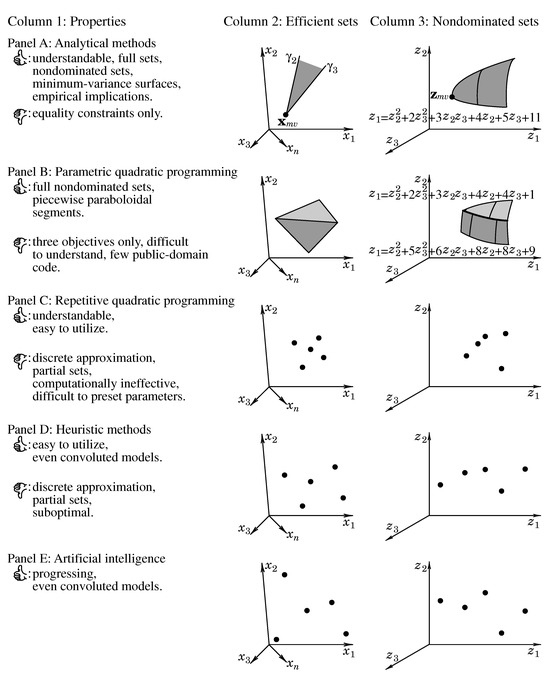
We criticize major methods of multiple-objective portfolio optimization for (10) and compare them in Figure 1. It vertically contains five panels for the methods. It horizontally contains Columns 1–3. We depict the methods’ properties in Column 1, efficient sets in Column 2, and nondominated sets in Column 3.
Figure 1.
Major methods of multiple-objective portfolio optimization (10).
2.1. Analytical Methods
For (6), Merton [11] and Sharpe [10] (pp. 59–62) analytically derive the minimum-variance frontier and efficient set. “Analytical” means closed-form formulae. Sharpe [2] anchors his capital asset pricing model on (6).
Qi et al. [5] extend (6) into (12) and analytically derive the minimum-variance surface as follows:
By Assumption 1, Qi et al. [5] prove the following matrix in (16) as invertible:
Qi et al. [5] prove the minimum-variance surface as an elliptic paraboloid. Because the nondominated set is a subset of the minimum-variance surface, the nondominated set is a paraboloidal segment. In Column 3 of Panel A of Figure 1, we depict a nondominated set of the following elliptic paraboloid:
Qi et al. [5] analytically derive the efficient set of (12) as follows:
where
is the minimum-variance portfolio. We depict it in Column 3 of Panel A of Figure 1. is its portfolio weight vector. Further, (17) is a 2-dimensional translated cone. Namely, the cone is generated by and at the origin of and translated to . We depict the efficient set’s structure in Column 2 of Panel A of Figure 1.
Qi and Steuer [30] and Qi and Steuer [52] further extend (12) into (14) and (15) and analytically derive the efficient sets.
However, analytical methods serve models with equality constraints only. Thus, unpractically unbounded portfolio weight vectors are allowed. Nevertheless, with virtually all results in formulae, analytical methods bypass the need for mathematical programming and provide convenience in research and instruction. Huang and Litzenberger [33] (p. 60) endorse (6) for its analyticity and empirical implications. Moreover, by formulae, the computational complexity of analytical methods is very low.
We depict the properties of analytical methods in Column 1 of Panel A of Figure 1.
2.2. Parametric Quadratic Programming
Bank et al. [53] expound parametric quadratic programming and propound the resolution methods for (10). Best [54], Goh and Yang [55], Hirschberger et al. [28], Jayasekara et al. [56], and Jayasekara et al. [57] advocate their parametric quadratic programming algorithms.
Hirschberger et al. [28] discern the nondominated set of (10) with and suggest that the set is piecewise composed of connected paraboloidal segments. For instance, we depict a nondominated set in Column 3 of Panel B of Figure 1. The set consists of two segments. The lower segment is a portion of the following elliptic paraboloid:
The upper segment is a portion of the following elliptic paraboloid:
Hirschberger et al. [28] suggest that the efficient set is piecewise composed of connected linear segments. For example, a set consists of two segments in Column 2 of Panel B of Figure 1.
In addition, Dietz et al. [58] resolve multiple-objective complex systems with inter-connected subsystems. Jauny et al. [59] instigate an infeasible interior-point technique and generate the nondominated set.
However, parametric quadratic programming is typically difficult to understand and practically solves (10) with only.
Moreover, the researchers rarely prove the efficient sets’ structure. Best [54] and Goh and Yang [55] execute active-set algorithms but do not prove the structure. Hirschberger et al. [28] acquire the efficient sets but do not prove the structure. Jayasekara et al. [56] review common scalarization methods, especially for parametric optimization, suggest modified hybrid scalarization methods, and investigate multiple-objective portfolio optimization. Jayasekara et al. [56] (pp. 191–193) generalize weighted-sum methods into scalarization methods. Moreover, Jayasekara et al. [57] further extend scalarization methods and recount computational studies. However, Jayasekara et al. [56] and Jayasekara et al. [57] document the results for individual problems but do not prove the general structure of nondominated sets or efficient sets. In contrast, Qi et al. [5] prove (12).
To the best of our knowledge, the researchers barely furnish public-domain software, so practical optimization is still absent. Hirschberger et al. [28] code general software for (10) with just three objectives but have not released the software.
We depict the properties of parametric quadratic programming in Column 1 of Panel B of Figure 1.
2.3. Repetitive Quadratic Programming
2.3.1. The Procedure
In classic textbooks, scholars (e.g., Bodie et al. [13] (pp. 238–250), Elton et al. [60] (pp. 95–120), Best [61] (pp. 139–164), Palomar [62] (pp. 180–199), and Alonso et al. [63] (pp. 35–49)) often commission repetitive quadratic programming in the following four steps:
- The scholars assume the group of the optimal solutions as the efficient set of (4) or 3-objective portfolio selection. The scholars also assume the group of the optimal solutions’ criterion vectors as the nondominated set.
To illustrate the result of repetitive quadratic programming, we depict a group of dots in Columns 2–3 of Panel C of Figure 1.
Repetitive quadratic programming hinges on (ordinary) quadratic programming and is much easier to understand than parametric quadratic programming. Moreover, repetitive quadratic programming is easy to utilize because some software (e.g., Python, Java, C++, Microsoft Excel, and Matlab) provides quadratic solvers.
However, repetitive quadratic programming obtains only partial information of efficient sets or nondominated sets by discrete approximations. Therefore, repetitive quadratic programming cannot reveal the sets’ structure, while analytical methods can.
2.3.2. The Computational Ineffectiveness
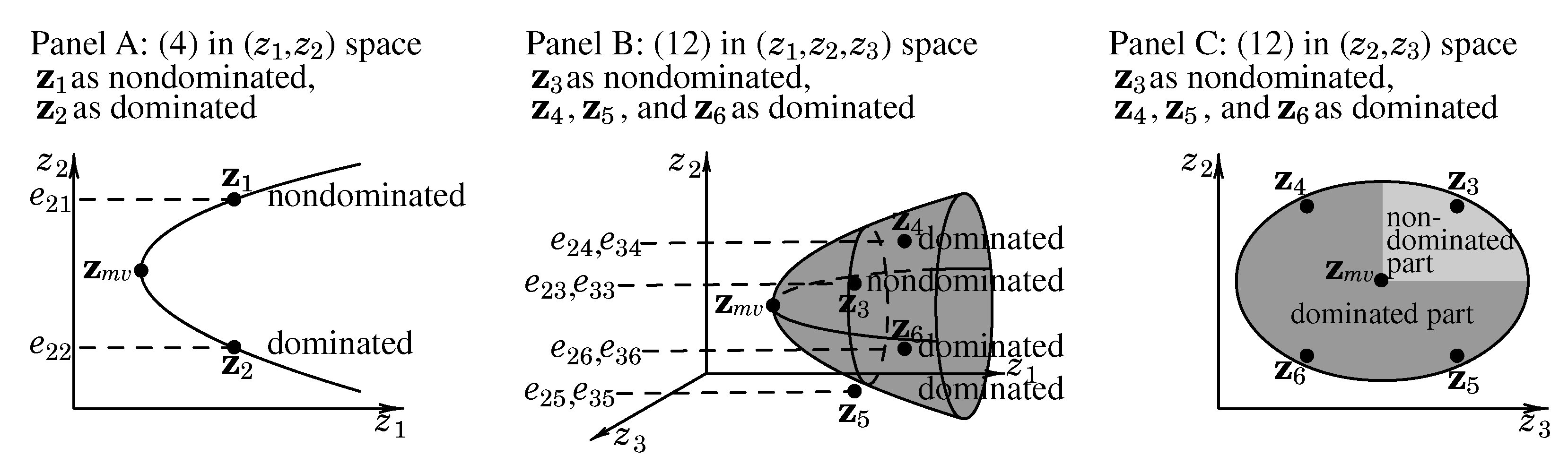
Moreover, repetitive quadratic programming is typically computationally ineffective (as argued by Steuer [4] (p. 203)) because it primarily locates dominated criterion vectors (instead of nondominated criterion vectors). (Repetitive quadratic programming by weighted-sum methods (3) can also suffer from computational ineffectiveness because there exists an upper bound of the weighting vector and weighting vectors exceeding the upper bound yield the same optimal solution. Moreover, the upper bound is difficult to trace in advance.) We illustrate the ineffectiveness in Figure 2. In Panel A of Figure 2, repetitive quadratic programming (21) locates and for and , respectively. is nondominated, but is dominated.
Figure 2.
The computational ineffectiveness of repetitive quadratic programming.
In Panel B of Figure 2, repetitive quadratic programming (22) locates for and , and , and , and and , respectively. is nondominated, but are dominated. The nondominated and dominated status may be hardly perceptible in 3-dimensional space. Fortunately, the status becomes perceptible after we project space onto space in Panel C of Figure 2. The minimum-variance surface of Panel B of Figure 2 is projected as an elliptic area (as proved by Qi et al. [5] (pp. 169–170)). The area exhaustively and exclusively consists of a nondominated part and a dominated part. falls in the nondominated part and is nondominated, but fall in the dominated part and are dominated.
To the best of our knowledge, there barely exists research to systematically investigate the computational effectiveness for resolving (10) and (23). For instance, Steuer and Na [37], Zopounidis et al. [38], Aouni et al. [39], and Ehrgott et al. [42] do not survey such research. Therefore, we experiment with the following assumptions:
Assumption 5.
Assumption 6.
Individually, we assume the probability for prespecifying in Assumption 5. However, we shall jointly prespecify , … and for (10) and (23). Jointly, we assume that prespecifying , … and is independent.
Assumption 7.
We justify Assumptions 5–7 as follows: Firstly, even the feasible region Z of (4) in space is typically unknown because we need to maximize as a convex function of in computing Z. Secondly, as the more difficult model than (4), the feasible region Z of (10) in space is typically unknown. Lastly, launching Assumptions 5–7 can be arguably acceptable because Z is unknown and effectively prespecifying depends on Z.
We experimentally present the computational ineffectiveness of repetitive quadratic programming in the following conjecture under Assumptions 5–7:
Conjecture 1.
For multiple-objective portfolio optimization for (10) by repetitive quadratic programming, approximately only of the resolutions are nondominated, while approximately overwhelmingly of the resolutions are dominated. Therefore, the computational effectiveness of repetitive quadratic programming exponentially deteriorates with k.
2.4. Heuristic Methods
Heuristic methods can handle convoluted models and thus become important provisional tools. Evolutionary algorithms, simulated annealing, and tabu search can be common approaches (as reported by Woodside-Oriakhi et al. [64] and Ehrgott et al. [42]). Zhao et al. [65] reveal a co-evolutionary particle swarm optimization algorithm. Leung and Wang [66] present a collaborative neurodynamic optimization approach for cardinality-constrained models. There exist several software for evolutionary algorithms (e.g., evolutionary-algorithm packages of Python, Java, Microsoft Excel, and Matlab).
However, heuristic methods inherently provide suboptimal solutions. Moreover, heuristic methods obtain only partial information of efficient sets or nondominated sets by discrete approximations. Therefore, heuristic methods cannot reveal the sets’ structure, while analytical methods can.
2.5. Artificial Intelligence
As one of the latest and developing methods, Artificial Intelligence opens new avenues for cracking (10). Türkoğlu and Kutlu [67] and Huang et al. [68] present promising results.
3. For Multiple-Objective Capital Asset Pricing Models, Appraising Research Limitations 2–4
3.1. The Literature
3.1.1. Utility Function Approaches for Portfolio Selection
von Neumann and Morgenstern [69] pioneer mathematical formulations for economics and finance by utility functions as follows:
where Huang and Litzenberger [33] (pp. 14, 19) define as increasing and concave. Bodie et al. [13] (pp. 196–199) tailor portfolio selection by utility function as follows:
where is a vector of stock returns. Markowitz [70] (p. 100) contends that maximizing expected utility functions above is much more complicated than portfolio selection (4) because of the hurdle of categorizing utility functions, estimating stock return joint distributions, and maximizing expected utility functions.
3.1.2. Asset Pricing by the First Four Moments
Overall, there is limited research on multiple-objective capital asset pricing models. Ingersoll [71] reflects skewness, presumes the efficient surface, presumes a tangent line between one risk-free asset and the surface, and deduces multiple-objective capital asset pricing models.
Alternatively, researchers explore capital asset pricing models with skewness and kurtosis typically by utility functions (instead of portfolio selection). Jean [72], Jean [73], Kraus and Litzenberger [74], Harvey and Siddique [21], Jurczenko and Maillet [75], and Harvey and Siddique [76] contemplate skewness and kurtosis, invent utility functions for the first four moments, address four-moment portfolio selection by maximizing expected utility functions, and obtain four-moment capital asset pricing models.
Researchers in this area could unfortunately suffer from the following shortcomings: Firstly, Markowitz [70] (p. 100) contends that maximizing expected utility functions is much more complicated than portfolio selection (4). Secondly, researchers restrictively calculate the nondominated sets. For instance, Jean [73] and Harvey and Siddique [21] imagine the nondominated sets but barely calculate them. Jurczenko and Maillet [75] discretely and thus partially calculate by shortage functions. Thirdly, without calculating the nondominated sets at the beginning, researchers presume tangent lines that pass through one risk-free asset and are tangent to the nondominated sets. Lastly, researchers could have difficulties in transcending the first four moments because the higher moments are computationally demanding. Meanwhile, Menegatti [77] encouragingly proves simplification conditions for third-order stochastic dominance and, more importantly, for general nth-order stochastic dominance. Equally encouragingly, Colasante and Riccetti [78] and Colasante and Riccetti [79] advocate higher odd moments, emphasize the importance of the gap between moments, contemplate risk attitude in financial and nonfinancial contexts, and discover important determinants of risk propensity.
3.1.3. Asset Pricing by Empirical Models
Broadly, many scholars (e.g., Fama and French [48], Fama and French [49], and Fama and French [50]) empirically document models for asset pricing. However, empirical studies arguably lack systematic theoretical foundation and can vary by sample period. Particularly, Fama and French [48] and Fama and French [49] vary their documentation from three factors to five factors. Instead, we respect that Markowitz [1] and Sharpe [2] theoretically (instead of empirically) establish capital asset pricing models. Therefore, we strive to extend this theoretical research methodology.
3.2. Research Limitation 2: How to Fix the Tangent Plane Passing Through
3.2.1. How to Fix the Tangent Line Among Uncountably Many Tangent Lines
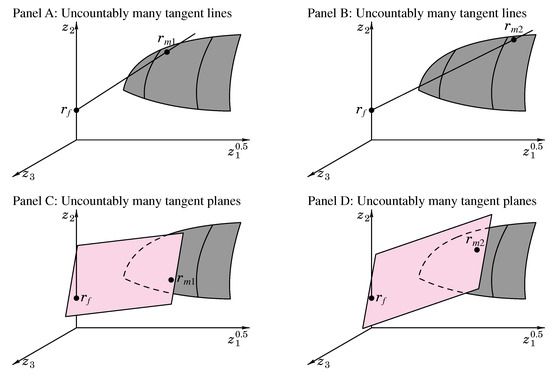
If we strictly follow the tangent line of Sharpe [2], we encounter difficulties. Namely, there actually exist uncountably many lines that pass through and are tangent to the nondominated set of (12). We depict the situation in Figure 3. In Panel A of Figure 3, we delineate a tangent line and trace as the tangent point. Alternatively, in Panel B of Figure 3, we delineate another tangent line and trace as the tangent point. Therefore, we encounter the difficulties of how to fix the tangent line among uncountably many tangent lines. Pedersen et al. [23] address the difficulties by harnessing Sharpe ratios.
Figure 3.
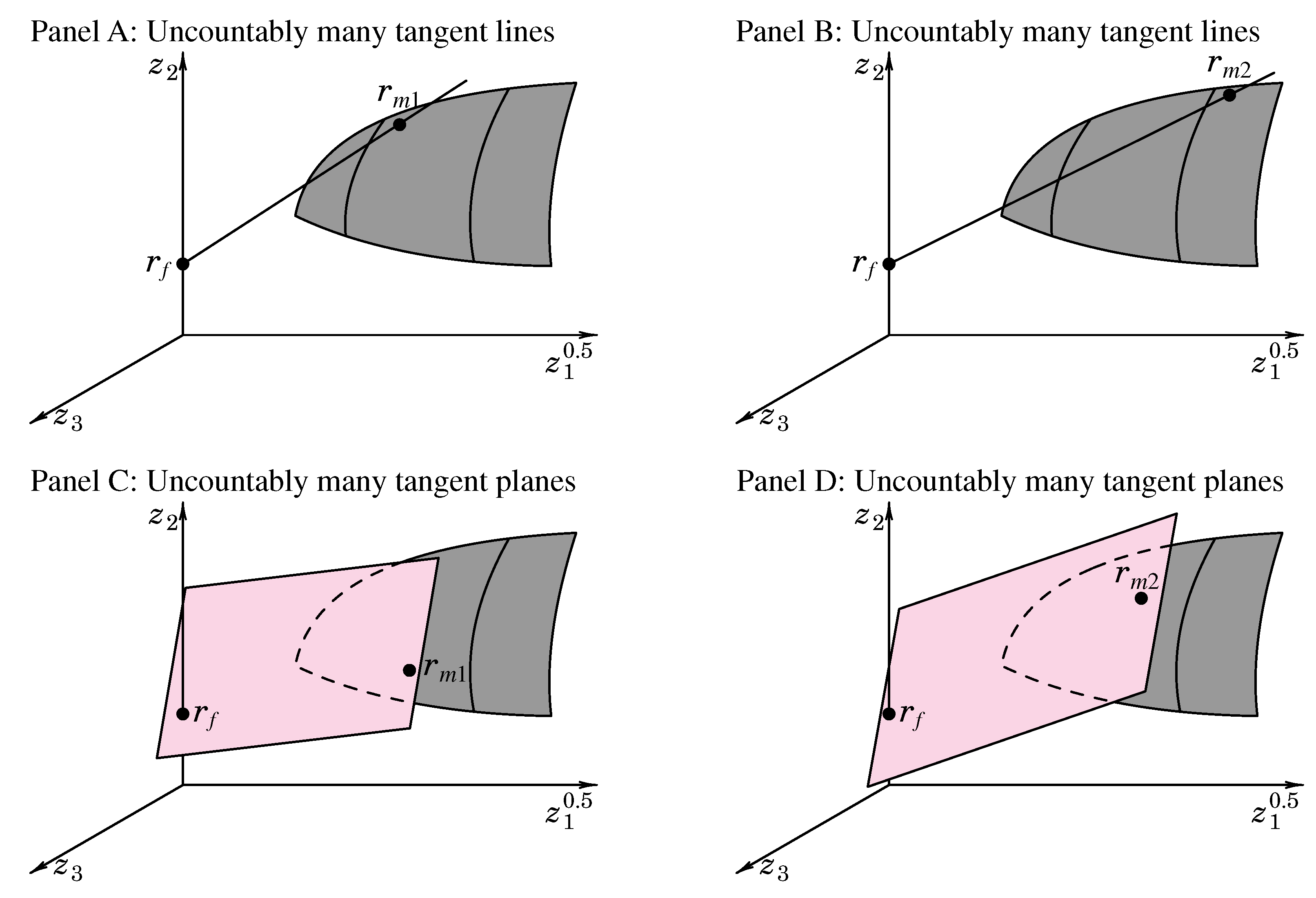
For research limitation 2, uncountably many tangent lines and tangent planes.
3.2.2. How to Fix the Tangent Plane Among Uncountably Many Tangent Planes
One solution for the difficulties above is extending tangent lines into tangent planes. However, there also exist uncountably many planes that pass through and are tangent to the nondominated set of (12). We depict the situation in Figure 3. In Panel C of Figure 3, we delineate a tangent plane and trace as the tangent point. Alternatively, in Panel D of Figure 3, we delineate another tangent plane and trace as the tangent point. Therefore, we encounter difficulties in how to fix the tangent plane among uncountably many tangent planes.
3.3. Research Limitation 3: How to Fix the Tangent Portfolio as the Market Portfolio by the Tangent Plane for (12)
3.3.1. Evaluating the Nondominated Set
For (12), Qi et al. [5] (p. 169) operationalize the minimum-variance surface (11) as follows (from Qi et al. [5], we inherit the style of applying as the coefficients for (24). The style illuminates the source (e.g., as the matrix multiplications for ). For conciseness, we skip the illustration for , , and (as illustrated by Qi et al. [5] (p. 168)):
where
We rephrase (24) into standard deviation instead of variance as follows:
Qi et al. [5] prove the nondominated set of (12) as a segment of (32).
3.3.2. Rephrasing the Nondominated Set (32) as
As a preparation for tracing tangent planes to the nondominated set, we follow Larson and Edwards [80] (p. 932) and restate (32) in the form of as follows:
3.3.3. Assessing the Part Derivatives for (33)
3.3.4. Perplexing Computation for a Tangent Plane
3.3.5. Exploding Computation for Associating the Tangent Plane (38) with
More perplexingly, we need to associate the tangent plane (39) with , and the computation for the association explodes.
3.3.6. Inferring the Tangent Point (37) as the Market Portfolio
We can extend the homogeneous-expectation assumptions of Sharpe [2] and infer the tangent point (37) as the market portfolio .
3.4. Research Limitation 4: How to Extend (7) and Price for (10)
Sharpe [2] and Bodie et al. [13] (p. 284) make the following assumption to leap from portfolio selection (6) to capital asset pricing models (7):
Assumption 8.
All investors are homogenous and stock markets function well as follows:
By Assumption 8, Sharpe [2] and Bodie et al. [13] (pp. 288–291) infer the market portfolio as all investors’ final choice, evaluate a stock’s contribution to the risk premium of the market portfolio, and conclude capital asset pricing models (7).
We could extend Assumption 8 to try leaping from multiple-objective portfolio selection to multiple-objective capital asset pricing models as follows:
Assumption 9.
All investors are homogenous and stock markets function well as follows:
- Investors all deploy multiple-objective portfolio selection (12).
- Investors all focus on a common time horizon and collect a common set of information for the input parameters for (12).
- Stock markets function without friction. Namely, investors can unlimitedly short, and there is neither trading cost nor taxes.
By Assumption 9, we progress from multiple-objective portfolio selection to multiple-objective capital asset pricing models and reach an equilibrium. However, the journey is arduous because we need to extend (7) and price for (12). The extending and pricing are prohibitive because we need to endure research limitations 2–3.
Specifically, by Assumption 9, we could infer the market portfolio as all investors’ final choice, but we shall evaluate a stock’s contribution to the risk premium of the market portfolio, associate the contribution with the other objectives (i.e., and in (12)), and conclude multiple-objective capital asset pricing models. The evaluation, association, and conclusion are arduous.
3.5. Utility Function Approaches for Multiple-Objective Portfolio Selection
We can adopt utility function approaches for multiple-objective portfolio selection by designing utility functions for the multiple objectives and maximizing the expected utility. The advantage is these approaches’ fundamentality. Regarding disadvantages, Markowitz [70] (p. 100) contends that maximizing expected utility functions is much more complicated than portfolio selection (4) (as reviewed in Section 3.1). Moreover, in Section 2, we have already testified to the insufficiently full optimization of multiple-objective portfolio selection. Therefore, how to master the nondominated sets and design utility functions under this insufficiently full optimization can be a challenge.
4. For Multiple-Objective Zero-Covariance Capital Asset Pricing Models, Appraising Research Limitations 5–6
To the best of our knowledge, research is lacking on multiple-objective zero-covariance capital asset pricing models. Therefore, researchers enter uncharted areas when exploring research limitations 5–6.
4.1. The Existence of a Whole Set of Zero-Covariance Portfolios for (12)
Qi et al. [5] prove in (25) as invertible and determine the inverse matrix as follows:
Qi et al. [51] prove the covariance in the following theorem:
Theorem 1.
On the minimum-variance surface of (12), for any two surface portfolios with return and with return , their covariance is finalized as follows:
Qi et al. [51] prove that there exists a whole set of zero-covariance portfolios for (12) in the following theorem:
4.2. The Assumption for Multiple-Objective Zero-Covariance Capital Asset Pricing Models
Black [14], Fama [3] (pp. 266–268), and Roll [15] implicitly make the following assumption to leap from portfolio selection (6) to zero-covariance capital asset pricing models (9):
Assumption 10.
All investors are homogenous and stock markets function well as follows:
- Investors all deploy portfolio selection (6).
- Investors all locate the same and its zero-covariance portfolio on the minimum-variance frontier.
- Investors all focus on a common time horizon and collect a common set of information for the input parameters for (6).
- Stock markets function without friction. Namely, investors can unlimitedly short, and there is neither trading cost nor taxes.
We could extend Assumption 10 to try leaping from multiple-objective portfolio selection to multiple-objective capital asset pricing models as follows:
Assumption 11.
All investors are homogenous and stock markets function well as follows:
- Investors all deploy multiple-objective portfolio selection (12).
- On the minimum-variance surface, investors all locate the same and its zero-covariance portfolio of Theorem 2.
- Investors all focus on a common time horizon and collect a common set of information for the input parameters for (12).
- Stock markets function without friction. Namely, investors can unlimitedly short, and there is neither trading cost nor taxes.
4.3. Appraising Research Limitations 5–6
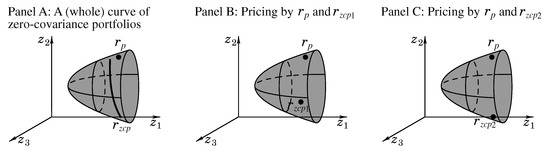
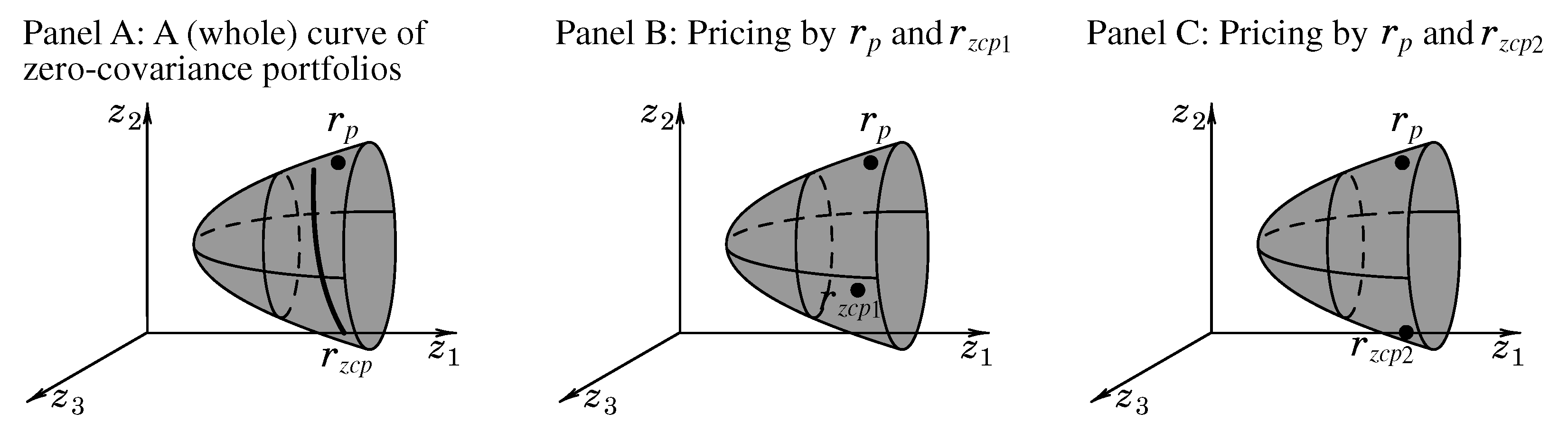
We depict the set in Theorem 2 as a thick curve in Panel A of Figure 4. We can locate a zero-covariance portfolio in Panel B of Figure 4. Alternatively, we can locate another zero-covariance portfolio in Panel C of Figure 4. Then, how do we pinpoint the unique zero-covariance portfolio from this set? Theoretically, the pinpointing is burdening because we try to select uniqueness from a set.
Figure 4.
A (whole) curve of zero-covariance portfolios and how to fix the zero-covariance portfolio.
Conveniently, we can hand-pick a portfolio with some zero elements so we will benefit from computational convenience.
5. Appraising Research Limitation 7: How to Generalize 3-Objective Portfolio Selection for K-Objective Portfolio Selection Even with Several Quadratic Objectives
For arguably individual objectives, Markowitz [18] targets short-run portfolio variance and long-run portfolio variance. Chow [24] focuses on tracking errors. Fama [19] (pp. 445–447) and Cochrane [20] (pp. 1081–1082) consider multiple factors for asset pricing models. Lo et al. [22] inspect liquidity. Pedersen et al. [23], Dorfleitner et al. [27], and Utz and Steuer [31] explore ESG.
Theoretically, we could jointly contemplate the objective as follows:
Generally, we could contemplate (13)–(15) for more objectives.
In this section, we broaden the critique for k-objective portfolio selection and widen research limitations 3–6.
5.1. Initially Optimizing K-Objective Portfolio Selection
There barely exists research to systematically optimize k-objective portfolio selection (10) (as criticized in Section 2). Encouragingly, there exists research to resolve (10) with equality constraints only.
5.1.1. Optimizing (13)
Qi and Steuer [30] analytically derive the minimum-variance surface of (13) as follows:
By Assumption 2, Qi and Steuer [30] prove the following matrix in (40) as invertible:
Qi and Steuer [30] analytically derive the efficient set of (13) as follows:
where
To keep consistent meanings, we employ the same symbols and in (17)–(20) and (41)–(44) despite different computation in (17)–(20) and (41)–(44).
Structurally, (41) is a -dimensional translated cone. Namely, the cone is generated by at the origin of and translated to .
5.1.2. Optimizing (14)
Qi and Steuer [30] analytically derive the minimum-variance surface of (14) as follows:
Qi and Steuer [30] analytically derive the efficient set of (14) as follows:
where
In (48) and (49), is an identity matrix. By Assumption 3, Qi and Steuer [30] prove the following matrix in (45) as invertible:
Further, (46)–(49) extend (41)–(44) as follows:
5.1.3. Optimizing (15)
With , Qi and Steuer [52] exploit weighted-sum methods (3) to (15) as follows:
Qi and Steuer [52] analytically derive the properly efficient set of (15) as follows:
where
By Assumption 4, Qi and Steuer [52] prove the following matrix in (53)–(55) as invertible:
Qi and Steuer [52] prove that the properly efficient set of (15) is structured as sequences of translated cones. By (51)–(55), Qi and Steuer [52] obtain the parametric expression of the properly nondominated set of (15) but do not determine the set’s structure.
5.2. Complexity of Achieving Multiple-Objective Capital Asset Pricing Models for (13)–(15)
Firstly, the computation, proof, and analysis for k objectives are much more complex than those for 3 objectives. Therefore, research limitation 7 (for k objectives) is much more perplexing than research limitations 2–6 (for 3 objectives). Especially, for the minimum-variance surface (40) of (13), we lose the analytical expression of the following matrix:
Similarly, for the minimum-variance surface (45) of (14), we lose the analytical expression of the following matrix:
In contrast, for the minimum-variance surface (16) of (12), Qi et al. [5] (p. 169) achieve the analytical expression (24)–(31) of the following matrix by the favorable trait of matrices:
Secondly, due to the convolution of (15), Qi and Steuer [52] do not prove the properties of the properly nondominated set. Therefore, gauging a tangent plane to the properly nondominated set with unidentified properties is challenging. In contrast, Qi and Steuer [30] prove the paraboloidal property of the nondominated set of (13) and (14). Therefore, we have already identified the paraboloidal property before advancing research limitations 2–3.
6. Discussion
6.1. Findings
We contemplate systematically extending
- portfolio selection;
- capital asset pricing models;
- zero-covariance capital asset pricing models;
into
- multiple-objective portfolio selection;
- multiple-objective capital asset pricing models;
- multiple-objective zero-covariance capital asset pricing models.
Using the integral methodology from portfolio selection to capital asset pricing models and zero-covariance capital asset pricing models, the integrity of this extension is the advantage of multiple-objective capital asset pricing models and multiple-objective zero-covariance capital asset pricing models.
We address seven research limitations and future directions for the extension. Research limitations 1 and 7 are for multiple-objective portfolio optimization. Research limitations 2, 3, and 4 are for multiple-objective capital asset pricing models. Research limitations 5 and 6 are for multiple-objective zero-covariance capital asset pricing models.
6.2. Limitations
The theme of this paper is overall reviewing, criticizing, and envisioning. Therefore, we do not delve into individual research limitations and exhibit definite results.
6.3. Practical Implications
Overall, this paper is theoretical and thus could fit broad scenarios. Particularly, Fama [19] (pp. 445–447) and Cochrane [20] (pp. 1081–1082) consider multiple factors for asset pricing models. We could trace their research and develop multiple-objective portfolio selection models (e.g., at the beginning of Section 5) and study multiple-objective capital asset pricing models and multiple-objective zero-covariance capital asset pricing models.
Moreover, Fama and French [48], Fama and French [49], and Fama and French [50] fundamentally document empirical models for asset pricing. We could correspondingly orchestrate multiple-objective portfolio selection models, multiple-objective capital asset pricing models, and multiple-objective zero-covariance capital asset pricing models. We could compare multiple-objective capital asset pricing models and multiple-objective zero-covariance capital asset pricing models against the models of Fama and French [48], Fama and French [49], and Fama and French [50].
7. Conclusions
7.1. Future Directions
Firstly, we could intensively pursue each research limitation and try to secure decisive results. Secondly, we could theoretically extend the classical methodology of Markowitz [1], Sharpe [2], Fama [3] (pp. 266–268), and Roll [15]. We could harness the methodology for other purposes. Meanwhile, we also recognize the latest research on portfolio selection (e.g., the special issues of the European Journal of Operational Research, as hosted by Zopounidis et al. [34], the Journal of Portfolio Management, as hosted by Fabozzi et al. [8], and the Annals of Operations Research, as hosted by Guerard [81]). In one special issue, Markowitz [82] approximates expected utility by and of (4). We envision that we could extend utility functions for multiple-objective portfolio selection (10) and approximate the expected utility by objective functions of (10).
7.2. Highlights
We envision systematically extending
- portfolio selection;
- capital asset pricing models;
- zero-covariance capital asset pricing models;
into
- multiple-objective portfolio selection;
- multiple-objective capital asset pricing models;
- multiple-objective zero-covariance capital asset pricing models.
We emphasize seven research limitations and future directions for further work as follows:
- Insufficiently full optimization of multiple-objective portfolio selection (10).
- How to fix the tangent plane passing through .
- How to fix the tangent portfolio as the market portfolio by the tangent plane.
- How to fix the zero-covariance portfolio.
- How to generalize three-objective portfolio selection into k-objective portfolio selection even with several quadratic objectives.
We tentatively illustrate the challenges regarding the research limitations.
Researching multiple-objective portfolio selection is prohibitively challenging but prohibitively rewarding. Gradually but steadily, researchers are progressing.
Author Contributions
Conceptualization, Y.Q.; methodology, Y.Q.; software, J.H.; validation, Y.Z.; formal analysis, J.H.; investigation, Y.Z.; resources, Y.Q.; data curation, J.H.; writing—original draft preparation, Y.Q.; writing—review and editing, Y.Q.; visualization, Y.Z.; supervision, J.H.; project administration, Y.Z. All authors have read and agreed to the published version of the manuscript.
Funding
This research received no external funding.
Data Availability Statement
No new data were created or analyzed in this study. Data sharing is not applicable to this article.
Acknowledgments
We would very much like to thank three anonymous referees for their highly constructive comments.
Conflicts of Interest
The authors declare no conflicts of interest.
Appendix A. The Proof of Proposition 1
Appendix B. Idea of Conjecture 1
Proof.
We need to effectively prespecify for a nondominated solution, so, by Assumptions 5–7, the probability is . Complementarily, the probability for a dominated solution is . Conjecture 1 is proved. □
Appendix C. Normative Methods and Positive Methods
Markowitz [9] and Markowitz and Todd [83] propose a general portfolio selection model (4) that incorporates various types of constraints. They commission parametric quadratic programming (as reviewed in Section 2.2) to resolve (4). Markowitz [70] (p. 99) and Sharpe [2] (p. 426) call these general-model methods “normative”. The advantage of normative methods is their generality and broad application. The disadvantage is that the general model (4) may preclude capital asset pricing models. Markowitz and Todd [83] (pp. 281–282) record such a precluding example.
By a particular portfolio selection model (6), Sharpe [2] conducts Assumption 8 and deduces capital asset pricing models (7). Despite the over-simplicity of (6), Sharpe [2] theoretically illuminates the fundamental relationship between a stock’s risk and expected return. Sharpe [2] (p. 434) justifies his methods by accentuating the implication instead of the assumption. Sharpe [2] (p. 425) and Markowitz [70] (p. 99) call these methods of unrealistic assumptions but profound theoretical results “positive”.
Conducting Assumption 8 can be an approach to reconcile portfolio selection (as normative) with capital asset pricing models (as positive). Similarly, conducting Assumption 9 can be an approach to reconcile multiple-objective portfolio selection (as normative) with multiple-objective capital asset pricing models (as positive).
Appendix D. Lists of Major Symbols
Appendix D.1. English Symbols
- is a vector of zeros and introduced in Section 1.1.
- is a vector of ones and introduced in Section 1.2.
- is a matrix and introduced in Section 1.7.
- is a vector and introduced in Section 1.7.
- is a vector and introduced in Section 3.3.
- is a vector and introduced in Section 3.3.
- are scalars and introduced in Section 1.1.
- is an expectation and introduced in Section 1.3.
- are objective functions and introduced in Section 1.1.
- is a function and introduced in Section 3.3.
- is a matrix and introduced in Section 5.1.
- M is a scalar and introduced in Section 1.1.
- n is a scalar and introduced in Section 1.1.
- is a vector and introduced in Section 3.1.
- is a scalar and introduced in Section 1.3.
- is a scalar and introduced in Section 1.3.
- is a scalar and introduced in Section 1.4.
- is a scalar and introduced in Section 1.4.
- S is a set and introduced in Section 1.1.
- is a function and introduced in Section 3.1.
- is a vector and introduced in Section 1.1.
- is a vector and introduced in Section 2.1.
- is a vector and introduced in Section 1.1.
- is a vector and introduced in Section 2.1.
- Z is a set and introduced in Section 1.1.
Appendix D.2. Greek Symbols
- is a scalar and introduced in Section 1.3.
- and are vectors and introduced in Section 2.1.
- is a matrix and introduced in Section 5.1.
- are scalars and introduced in Section 1.1.
- is a vector and introduced in Section 1.2.
- are vectors and introduced in Section 1.5.
- is a matrix and introduced in Section 1.2.
- are matrices and introduced in Section 1.7.
References
- Markowitz, H.M. Portfolio Selection. J. Financ. 1952, 7, 77–91. [Google Scholar]
- Sharpe, W.F. Capital asset prices: A theory of market equilibrium. J. Financ. 1964, 19, 425–442. [Google Scholar]
- Fama, E.F. Foundations of Finance: Portfolio Decisions and Securities Prices, 1st ed.; Basic Books, Inc.: New York, NY, USA, 1976. [Google Scholar]
- Steuer, R.E. Multiple Criteria Optimization: Theory, Computation, and Application; John Wiley & Sons: New York, NY, USA, 1986. [Google Scholar]
- Qi, Y.; Steuer, R.E.; Wimmer, M. An analytical derivation of the efficient surface in portfolio selection with three criteria. Ann. Oper. Res. 2017, 251, 161–177. [Google Scholar] [CrossRef] [Scilit]
- Ehrgott, M. Multicriteria Optimization, Volume 491 of Lecture Notes in Economics and Mathematical Systems, 2nd ed.; Springer: Berlin/Heidelberg, Germany, 2005. [Google Scholar]
- Rubinstein, M. Markowitz’s “portfolio selection”: A fifty-year retrospective. J. Financ. 2002, 57, 1041–1045. [Google Scholar] [CrossRef] [Scilit]
- Fabozzi, F.J.; Jacobs, B.I.; Levy, K.N. Editors’ introduction: The birth of portfolio theory. J. Portf. Manag. 2024, 50, 2–5. [Google Scholar] [CrossRef] [Scilit]
- Markowitz, H.M. Portfolio Selection: Efficient Diversification in Investments, 1st ed.; John Wiley & Sons: New York, NY, USA, 1959. [Google Scholar]
- Sharpe, W.F. Portfolio Theory and Capital Markets, 1st ed.; McGraw-Hill: New York, NY, USA, 1970. [Google Scholar]
- Merton, R.C. An analytical derivation of the efficient portfolio frontier. J. Financ. Quant. Anal. 1972, 7, 1851–1872. [Google Scholar] [CrossRef] [Scilit]
- Campbell, J.Y. Financial Decisions and Markets: A Course in Asset Pricing, 1st ed.; Princeton University Press: Princeton, NJ, USA, 2018. [Google Scholar]
- Bodie, Z.; Kane, A.; Marcus, A.J. Investments, 13th ed.; McGraw Hill LLC: New York, NY, USA, 2024. [Google Scholar]
- Black, F. Capital market equilibrium with restricted borrowing. J. Bus. 1972, 45, 444–455. [Google Scholar] [CrossRef] [Scilit]
- Roll, R. A critique of the asset pricing theory’s tests Part I: On past and potential testability of the theory. J. Financ. Econ. 1977, 4, 129–176. [Google Scholar] [CrossRef] [Scilit]
- Markowitz, H.M. Foundations of portfolio selection. J. Financ. 1991, 46, 469–477. [Google Scholar] [CrossRef]
- Sharpe, W.F. Optimal Portfolios Without Bounds on Holdings; Graduate School of Business, Stanford University: Stanford, CA, USA, 2001; Available online: https://web.stanford.edu/~wfsharpe/mia/opt/mia_opt2.htm (accessed on 24 November 2025).
- Markowitz, H.M. How to represent mark-to-market possibilities with the general portfolio selection model. J. Portf. Manag. 2013, 39, 1–3. [Google Scholar] [CrossRef] [Scilit]
- Fama, E.F. Multifactor portfolio efficiency and multifactor asset pricing. J. Financ. Quant. Anal. 1996, 31, 441–465. [Google Scholar] [CrossRef] [Scilit]
- Cochrane, J.H. Presidential address: Discount rates. J. Financ. 2011, 66, 1047–1108. [Google Scholar] [CrossRef] [Scilit]
- Harvey, C.R.; Siddique, A. Conditional skewness in asset pricing tests. J. Financ. 2000, 55, 1263–1296. [Google Scholar] [CrossRef] [Scilit]
- Lo, A.W.; Petrov, C.; Wierzbicki, M. It’s 11pm – do you know where your liquidity is? The mean-variance-liquidity frontier. J. Investig. Manag. 2003, 1, 55–93. [Google Scholar]
- Pedersen, L.H.; Fitzgibbons, S.; Pomorski, L. Responsible investing: The ESG-efficient frontier. J. Financ. Econ. 2021, 142, 572–597. [Google Scholar] [CrossRef] [Scilit]
- Chow, G. Portfolio selection based on return, risk, and relative performance. Financ. Anal. J. 1995, 51, 54–60. [Google Scholar] [CrossRef] [Scilit]
- Ehrgott, M.; Klamroth, K.; Schwehm, C. An MCDM Approach to Portfolio Optimization. Eur. J. Oper. Res. 2004, 155, 752–770. [Google Scholar] [CrossRef] [Scilit]
- Steuer, R.E.; Qi, Y.; Hirschberger, M. Suitable-portfolio investors, nondominated frontier sensitivity, and the effect of multiple objectives on standard portfolio selection. Ann. Oper. Res. 2007, 152, 297–317. [Google Scholar] [CrossRef] [Scilit]
- Dorfleitner, G.; Leidl, M.; Reeder, J. Theory of social returns in portfolio choice with application to microfinance. J. Asset Manag. 2012, 13, 384–400. [Google Scholar] [CrossRef] [Scilit]
- Hirschberger, M.; Steuer, R.E.; Utz, S.; Wimmer, M.; Qi, Y. Computing the nondominated surface in tri-criterion portfolio selection. Oper. Res. 2013, 61, 169–183. [Google Scholar] [CrossRef] [Scilit]
- Utz, S.; Wimmer, M.; Steuer, R.E. Tri-criterion modeling for constructing more-sustainable mutual funds. Eur. J. Oper. Res. 2015, 246, 331–338. [Google Scholar]
- Qi, Y.; Steuer, R.E. On the analytical derivation of efficient sets in quad-and-higher criterion portfolio selection. Ann. Oper. Res. 2020, 293, 521–538. [Google Scholar]
- Utz, S.; Steuer, R.E. Empirical analysis of the trade-offs among risk, return, and climate risk in multi-criteria portfolio optimization. Ann. Oper. Res. 2025, 353, 53–76. [Google Scholar] [CrossRef] [Scilit]
- Chang, T.; Meade, N.; Beasley, J.E.; Sharaiha, Y.M. Heuristics for Cardinally Constrained Portfolio Optimisation. Comput. Oper. Res. 2000, 27, 1271–1302. [Google Scholar] [CrossRef] [Scilit]
- Huang, C.; Litzenberger, R.H. Foundations for Financial Economics; Prentice Hall: Englewood Cliffs, NJ, USA, 1988. [Google Scholar]
- Zopounidis, C.; Doumpos, M.; Fabozzi, F.J. Preface to the Special Issue: 60 years following Harry Markowitz’s contributions in portfolio theory and operations research. Eur. J. Oper. Res. 2014, 234, 343–345. [Google Scholar] [CrossRef] [Scilit]
- Spronk, J.; Hallerbach, W.G. Financial modelling: Where to go? With an illustration for portfolio management. Eur. J. Oper. Res. 1997, 99, 113–127. [Google Scholar] [CrossRef] [Scilit]
- Bana e Costa, C.A.; Soares, J.O. Multicriteria approaches for portfolio selection: An overview. Rev. Financ. Mark. 2001, 4, 19–26. [Google Scholar]
- Steuer, R.E.; Na, P. Multiple criteria decision making combined with finance: A categorized bibliography. Eur. J. Oper. Res. 2003, 150, 496–515. [Google Scholar]
- Zopounidis, C.; Galariotis, E.; Doumpos, M.; Sarri, S.; Andriosopoulos, K. Multiple criteria decision aiding for finance: An updated bibliographic survey. Eur. J. Oper. Res. 2015, 247, 339–348. [Google Scholar] [CrossRef] [Scilit]
- Aouni, B.; Doumpos, M.; Pérez-Gladish, B.; Steuer, R.E. On the increasing importance of multiple criteria decision aid methods for portfolio selection. J. Oper. Res. Soc. 2018, 69, 1525–1542. [Google Scholar] [CrossRef] [Scilit]
- La Torre, D.; Boubaker, S.; Pérez-Gladish, B.; Zopounidis, C. Preface to the special issue on multidimensional finance, insurance, and investment. Int. Trans. Oper. Res. 2023, 30, 2137–2138. [Google Scholar] [CrossRef] [Scilit]
- Kandakoglu, M.; Walther, G.; Amor, S.B. The use of multi-criteria decision-making methods in project portfolio selection: A literature review and future research directions. Ann. Oper. Res. 2024, 332, 807–830. [Google Scholar] [CrossRef] [Scilit]
- Ehrgott, M.; Köksalan, M.; Kadziński, M.; Deb, K. Fifty years of multi-objective optimization and decision-making: From mathematical programming to evolutionary computation. Eur. J. Oper. Res. 2025, in press. [Google Scholar] [CrossRef] [Scilit]
- Xidonas, P.; Thomakos, D.; Samitas, A. On the integration of multiple criteria decision aiding and forecasting: Does it create value in portfolio selection? Eur. J. Oper. Res. 2025, 321, 516–528. [Google Scholar] [CrossRef] [Scilit]
- Greco, S.; Ehrgott, M.; Figueira, J.R. Multiple Criteria Decision Analysis: State of the Art Surveys, 2nd ed.; Springer: New York, NY, USA, 2016. [Google Scholar]
- Doumpos, M.; Zopounidis, C. Multicriteria Analysis in Finance; Springer: Berlin/Heidelberg, Germany, 2014. [Google Scholar]
- Al-Shammari, M.; Masri, H. (Eds.) Multiple Criteria Decision Making in Finance, Insurance and Investment; Springer International Publishing: Cham, Switzerland, 2015. [Google Scholar]
- Masri, H.; Pérez-Gladish, B.; Zopounidis, C. (Eds.) Financial Decision Aid Using Multiple Criteria: Recent Models and Applications; Springer: Cham, Switzerland, 2018. [Google Scholar]
- Fama, E.F.; French, K.R. Common risk factors in the returns on stocks and bonds. J. Financ. Econ. 1993, 33, 3–56. [Google Scholar] [CrossRef] [Scilit]
- Fama, E.F.; French, K.R. International tests of a five-factor asset pricing model. J. Financ. Econ. 2017, 123, 441–463. [Google Scholar] [CrossRef] [Scilit]
- Fama, E.F.; French, K.R. Choosing factors. J. Financ. Econ. 2018, 128, 234–252. [Google Scholar] [CrossRef] [Scilit]
- Qi, Y.; Qi, Z.; Zhang, S.; Wang, Y. Discovering zero-covariance-portfolio curves for capital asset pricing models of multiple-objective portfolio selection. J. Ind. Manag. Optim. 2024, 21, 1910–1930. [Google Scholar] [CrossRef] [Scilit]
- Qi, Y.; Steuer, R.E. An analytical derivation of properly efficient sets in multi-objective portfolio selection. Ann. Oper. Res. 2025, 346, 1573–1595. [Google Scholar] [CrossRef] [Scilit]
- Bank, B.; Guddat, J.; Klatte, D.; Kummer, B.; Tammer, K. Non-Linear Parametric Optimization; Birkhäuser: Basel, Switzerland, 1983. [Google Scholar]
- Best, M.J. An algorithm for the solution of the parametric quadratic programming problem. In Applied Mathematics and Parallel Computing: Festschrift for Klaus Ritter; Fischer, H., Riedmüller, B., Schäffler, S., Eds.; Physica: Heidelberg, Germany, 1996; pp. 57–76. [Google Scholar]
- Goh, C.; Yang, X. Analytic efficient solution set for multi-criteria quadratic programs. Eur. J. Oper. Res. 1996, 92, 166–181. [Google Scholar] [CrossRef] [Scilit]
- Jayasekara, P.L.; Adelgren, N.; Wiecek, M.M. On convex multiobjective programs with application to portfolio optimization. J.-Multi-Criteria Decis. Anal. 2019, 27, 189–202. [Google Scholar] [CrossRef] [Scilit]
- Jayasekara, P.L.; Pangia, A.C.; Wiecek, M.M. On solving parametric multiobjective quadratic programs with parameters in general locations. Ann. Oper. Res. 2023, 320, 123–172. [Google Scholar] [CrossRef] [Scilit]
- Dietz, T.; Klamroth, K.; Kraus, K.; Ruzika, S.; Schäfer, L.E.; Schulze, B.; Stiglmayr, M.; Wiecek, M.M. Introducing multiobjective complex systems. Eur. J. Oper. Res. 2020, 280, 581–596. [Google Scholar] [CrossRef] [Scilit]
- Jauny; Ghosh, D.; Ansari, Q.H.; Ehrgott, M.; Upadhayay, A. An infeasible interior-point technique to generate the nondominated set for multiobjective optimization problems. Comput. Oper. Res. 2023, 155, 106236. [Google Scholar] [CrossRef] [Scilit]
- Elton, E.J.; Gruber, M.J.; Brown, S.J.; Goetzmann, W.N. Modern Portfolio Theory and Investment Analysis, 9th ed.; John Wiley & Sons: New York, NY, USA, 2014. [Google Scholar]
- Best, M.J. Portfolio Optimization; CRC Press: Boca Raton, FL, USA, 2010. [Google Scholar]
- Palomar, D.P. Portfolio Optimization: Theory and Application; Cambridge University Press: Cambridge, UK, 2025. [Google Scholar]
- Alonso, M.N.; Camarena, J.A.; Guerrero, A.B. Quantitative Portfolio Optimization: Advanced Techniques and Applications; John Wiley & Sons: Hoboken, NJ, USA, 2025. [Google Scholar]
- Woodside-Oriakhi, M.; Lucas, C.; Beasley, J. Heuristic algorithms for the cardinality constrained efficient frontier. Eur. J. Oper. Res. 2011, 213, 538–550. [Google Scholar] [CrossRef] [Scilit]
- Zhao, H.; Chen, Z.G.; Zhan, Z.H.; Kwong, S.; Zhang, J. Multiple populations co-evolutionary particle swarm optimization for multi-objective cardinality constrained portfolio optimization problem. Neurocomputing 2021, 430, 58–70. [Google Scholar]
- Leung, M.F.; Wang, J. Cardinality-constrained portfolio selection based on collaborative neurodynamic optimization. Neural Netw. 2022, 145, 68–79. [Google Scholar] [CrossRef] [Scilit]
- Türkoğlu, D.; Kutlu, M. Machine Learning in Portfolio Optimization. In Machine Learning in Finance: Trends, Developments and Business Practices in the Financial Sector; Gün, M., Kartal, B., Eds.; Springer Nature: Cham, Switzerland, 2025; pp. 187–199. [Google Scholar]
- Huang, M.; Dang, S.; Bhuiyan, M.A. Multi-objective portfolio optimization for stock return prediction using machine learning. Expert Syst. Appl. 2026, 298, 129672. [Google Scholar]
- von Neumann, J.; Morgenstern, O. Theory of Games and Economic Behavior, 3rd ed.; Princeton University Press: Princeton, NJ, USA, 1953. [Google Scholar]
- Markowitz, H.M. Normative portfolio analysis: Past, present, and future. J. Econ. Bus. 1990, 42, 99–103. [Google Scholar] [CrossRef] [Scilit]
- Ingersoll, J. Multidimensional security pricing. J. Financ. Quant. Anal. 1975, 10, 785–798. [Google Scholar]
- Jean, W.H. The extension of portfolio analysis to three or more parameters. J. Financ. Quant. Anal. 1971, 6, 505–515. [Google Scholar] [CrossRef] [Scilit]
- Jean, W.H. More on multidimensional portfolio analysis. J. Financ. Quant. Anal. 1973, 8, 475–490. [Google Scholar]
- Kraus, A.; Litzenberger, R.H. Skewness preference and the valuation of risk assets. J. Financ. 1976, 31, 1085–1100. [Google Scholar]
- Jurczenko, E.; Maillet, B. (Eds.) Multi-moment Asset Allocation and Pricing Models; John Wiley & Sons Ltd.: Chichester, UK, 2006. [Google Scholar]
- Harvey, C.R.; Siddique, A. Conditional Skewness in Asset Pricing: 25 Years of Out-of-Sample Evidence. Crit. Financ. Rev. 2023, 12, 355–366. [Google Scholar] [CrossRef] [Scilit]
- Menegatti, M. A note on portfolio selection and stochastic dominance. Decis. Econ. Financ. 2016, 39, 327–331. [Google Scholar] [CrossRef] [Scilit]
- Colasante, A.; Riccetti, L. Risk aversion, prudence and temperance: It is a matter of gap between moments. J. Behav. Exp. Financ. 2020, 25, 100262. [Google Scholar] [CrossRef] [Scilit]
- Colasante, A.; Riccetti, L. Financial and non-financial risk attitudes: What does it matter? J. Behav. Exp. Financ. 2021, 30, 100494. [Google Scholar]
- Larson, R.; Edwards, B. Calculus, 12th ed.; Cengage Learning, Inc.: Boston, MA, USA, 2023. [Google Scholar]
- Guerard, J.B. Investments: The (almost) century of Markowitz Harry Markowitz: Portfolio selection scholar, simulation creator, and applied investment researcher and consultant extraordinaire. Ann. Oper. Res. 2025, 346, 1–8. [Google Scholar] [CrossRef] [Scilit]
- Markowitz, H.M. Mean–variance approximations to expected utility. Eur. J. Oper. Res. 2014, 234, 346–355. [Google Scholar] [CrossRef] [Scilit]
- Markowitz, H.M.; Todd, G.P. Mean-Variance Analysis in Portfolio Choice and Capital Markets; Frank, J., Ed.; Fabozzi Associates: New Hope, PA, USA, 2000. [Google Scholar]
Disclaimer/Publisher’s Note: The statements, opinions and data contained in all publications are solely those of the individual author(s) and contributor(s) and not of MDPI and/or the editor(s). MDPI and/or the editor(s) disclaim responsibility for any injury to people or property resulting from any ideas, methods, instructions or products referred to in the content. |
© 2026 by the authors. Licensee MDPI, Basel, Switzerland. This article is an open access article distributed under the terms and conditions of the Creative Commons Attribution (CC BY) license.