
Next Article in Journal
Prediction of Blade Root Loads for Wind Turbine Based on RBMO-VMD and TCN-BiLSTM-Attention
Previous Article in Journal
On Intensively Criticizing and Envisioning the Research on Multiple-Objective Portfolio Selection from the Perspective of Capital Asset Pricing Models
error_outline You can access the new MDPI.com website here. Explore and share your feedback with us.
 
 
Article

Investigation into Thermoelastic Issues Arising from Temperature Shock in Spacecraft Solar Panels


by
Andrey V. Sedelnikov
* and
Alexandra S. Marshalkina
Institute of Aerospace Engineering, Samara National Research University, 34 Moskovskoye Shosse, 443086 Samara, Russia
*
Author to whom correspondence should be addressed.
Mathematics 2026, 14(2), 217; https://doi.org/10.3390/math14020217
Submission received: 4 December 2025 / Revised: 28 December 2025 / Accepted: 5 January 2026 / Published: 6 January 2026

Abstract

This paper investigates the thermal shock response of a spacecraft solar panel. The panel is represented as a thin homogeneous plate. The governing equations are derived from the coupled thermoelasticity theory for a homogeneous medium, combining the heat equation with compressibility effects and the Lamé equations for the displacement vector. The aim of the paper is to analyze new properties of a specific formulation of the coupled thermoelasticity problem and to establish a justified simplification. New properties follow from a specific formulation of the thermoelasticity problem for a real physical object (a solar panel). They are subjective properties of this formulation and allow, in particular, to reduce the coupled thermoelasticity problem to a simpler, uncoupled problem, with certain limitations. This simplification is driven by the physics of the thermal shock process and the resulting plate deformation, which allows the thermal problem to be reduced to a one-dimensional formulation. The main result is a simplified thermoelasticity model that reveals several new properties. Notably, in the region where longitudinal displacements are negligible, the coupled problem generates into an uncoupled one. This result can be applied to model disturbances caused by thermal shock on spacecraft.
MSC:
35Q49; 35Q74; 35Q79; 74F05; 74K20; 80A21

1. Introduction

The formulation of coupled thermoelasticity problems originated in the works of V. I. Danilovskaya [1] (pp. 23–37) [2,3]. The specific problem presented in [3] later became known as the “Danilovskaya problem” [4,5]. Then M. A. Biot subsequently developed the general theory of coupled thermoelasticity in his work [6].
Dynamic problems occupy a special place in thermoelasticity, as they require accounting for inertial terms in addition to thermoelastic coupling. The necessity of including these inertial terms was highlighted in the works of V. I. Danilovskaya [2], though the conceptual groundwork had been laid in earlier research. For instance, the equation of plate motion within the uncoupled Germain-Lagrange thermoelastic problem is attributed to Lagrange, who supplemented and corrected the work presented by Sophie Germain to the Paris Academy of Sciences in 1811 [7,8].
Thermal shock represents a class of dynamic thermoelasticity problems characterized by a high rate of thermal loading on a body [9,10]. Numerous studies, both historical and ongoing, have analyzed the behavior of semi-infinite bodies under thermal shock [11,12,13]. In [11], a boundary value problem for a one-dimensional semi-infinite rod was studied, where one boundary is subjected to a sudden heat source. Analytical expressions for displacement, temperature, and stress fields were derived. In [12], the finite element method was applied to solve the thermoelasticity problem for a semi-infinite, homogeneous, isotropic body under a time-dependent zonal thermal shock. In [13], the influence of a thermophysical property known as thermal effusivity on the temperature increase at the surface of a semi-infinite body subjected to a uniform heat flux was investigated. A common feature of these and similar studies is that they yield semi-analytical solutions for idealized semi-infinite bodies.
Another research direction involves studying the properties of real materials [14,15,16]. In [14], an isothermal theory for porous viscoelastic mixtures is presented. The uniqueness and continuity of solutions for various classes of initial boundary-value problems in such mixtures are investigated. The mixture consists of two components: a porous elastic solid and a porous Kelvin–Voigt material. In [15], the cracking of a functionally graded plate under thermal shock is investigated. The analysis considers the plate’s cooling from a high temperature to the ambient temperature. Continuous, position-dependent functions are used to model the plate’s mechanical and thermal properties, and a linear quasi-static thermoelastic problem under plane strain is solved. In [16], a model is presented for the influence of thermal shock on the natural vibration characteristics of a plate made of MA2 magnesium alloy. A common feature of these and similar studies is that they present results based on numerical modeling or physical experiments.
A review of the literature on this topic reveals a trend of increasing complexity in thermoelasticity models for thermal shock [17,18,19,20,21,22,23,24]. These complexities arise from moving beyond Fourier’s law to account for the finite speed of heat propagation [17,18], modeling variable thermophysical properties [19,20] and evolving boundary conditions [21,22], and solving complex, mixed thermoelasticity problems in three dimensions [23,24], etc. Many of these studies are purely theoretical and are not motivated by specific practical applications.
However, the advancement of modern technology, particularly in space applications, necessitates a shift from theoretically oriented research to practical solutions [25,26,27]. Addressing modern Earth remote sensing challenges requires extremely precise spacecraft orientation [28,29,30]. Consequently, when modeling the angular motion of such spacecraft, it is essential to account for key disturbing factors, including thermal shock [31,32,33]. The limited computational resources of an onboard spacecraft computer make it imperative to use simplified, approximate formulations of thermoelasticity problems [34,35,36] rather than resource-intensive commercial software packages [37,38,39].
Developing such simplified thermoelasticity formulations and studying their properties is a pressing contemporary challenge. However, any simplification must be rigorously justified in each specific case. For instance, studies on the uncoupled thermoelasticity problem exist, and approximate analytical solutions for the displacement vector components in such a formulation have been derived [10,25]. This paper investigates a coupled thermoelasticity problem for a thin homogeneous plate using a model that is more complex than those in [10,25]. We present new properties of this specific coupled formulation and propose a rigorously justified simplification.

2. Problem Statement

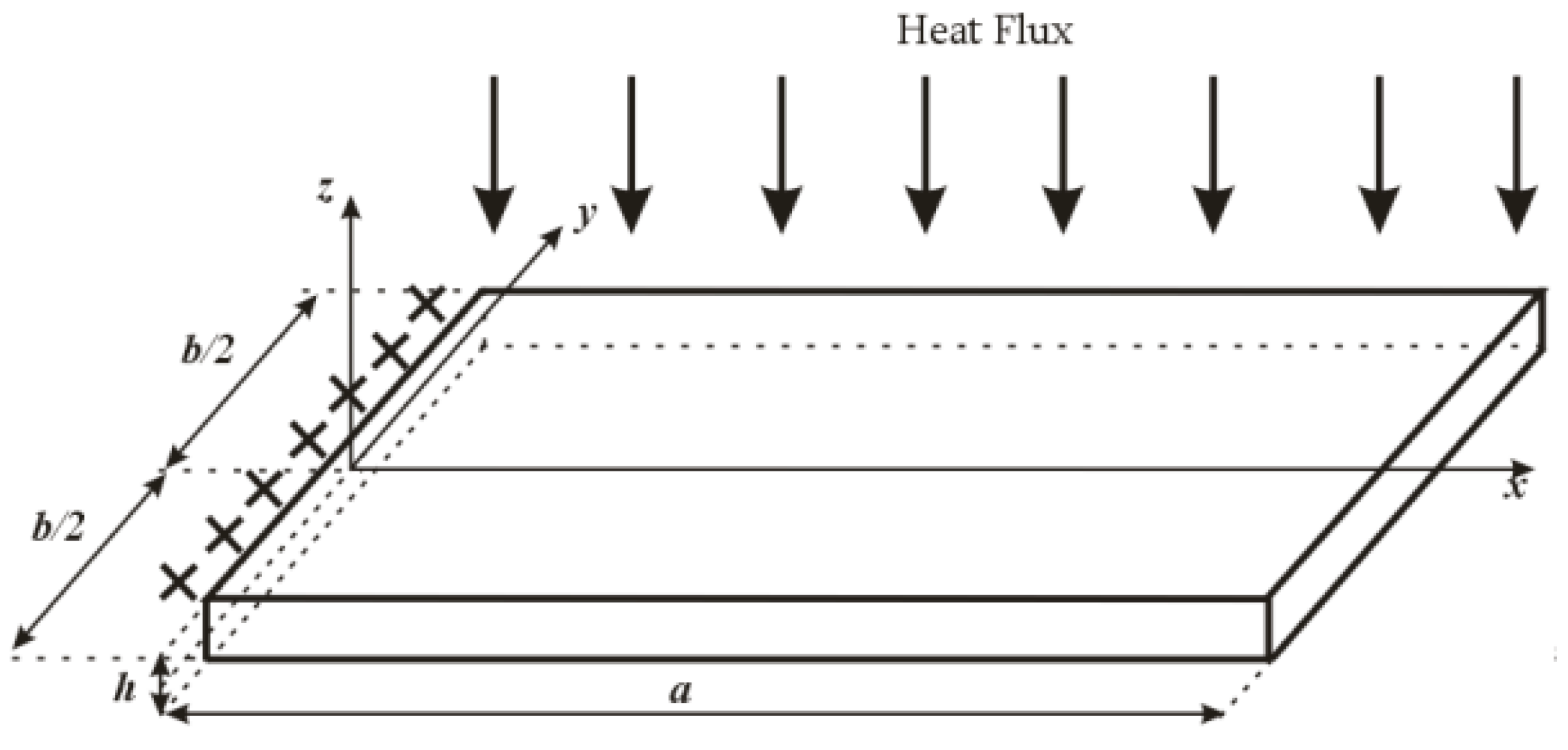
Let us consider the one-dimensional heat conduction problem for a thin, homogeneous plate subjected to a thermal shock (Figure 1) [10].
In Figure 1, the “×” sign denotes a rigidly clamped edge of the plate (embedment). Changes in the coordinates of the plate points: 0 < x < a; −b/2 < y < b/2; −h/2 < z < h/2.
Unlike in reference [10], we account for the compressibility of the plate material. Consequently, the analysis of the plate’s stress–strain state leads to a coupled thermoelasticity problem [40].
Let the displacement vector of the plate points under a thermal shock be of the form: u u x ,   u y ,   u z .
The core concept of this formulation is to partition the stress–strain state into two regions. The first region (near the embedment) is characterized by the condition that the ux component can be neglected (ux ≡ 0), whereas this assumption does not hold in the second region. The dimensions of region ux ≡ 0 depend on the plate material, primarily on the coefficient of linear expansion and specific heat capacity. In [41], the authors performed a numerical simulation of thermal shock for various materials. Based on the results of [41], it can be assumed that for AISI 304 steel, this region is approximately half the plate length (0 < x< a/2). For magnesium alloy MA2, the region size is approximately one-third the plate length (0 < x< a/3). However, these estimates are very approximate. In practice, a more thorough analysis is required to establish the dimensions of the region ux ≡ 0.
This approach enables a new method for solving the coupled thermoelasticity problem in the region where ux ≡ 0 by reducing the original problem to an equivalent uncoupled formulation. Consequently, the computational procedure for analyzing the plate’s stress–strain state is significantly simplified. This simplification can be particularly useful for applications such as developing control laws for small spacecraft that account for thermal shock [25], especially under constraints imposed by limited onboard computing resources. The obtained approximate analytical solutions for particular cases of thermoelasticity problems prove to be useful for conducting engineering calculations and designing various structures and devices [42,43,44,45,46].

3. Mathematical Model

3.1. For the Region ux ≡ 0

The heat conduction process is described using the heat equation, which is modified to incorporate compressibility [40]:
T t + 3 λ + 2 μ α T c ρ t d i v   u = a   Δ T ,
where T is temperature; t is time; c and ρ are, respectively, the specific heat capacity and density of the body; a is thermal diffusivity coefficient; Δ is the Laplace operator; α is coefficient of linear thermal expansion of the body; λ and μ are Lamé coefficients.
The paper [40] notes the possibility of using (1) over a wide temperature range. It is also suitable for fast processes (such as thermal shock). The papers [23,40] indicates the possibility of neglecting the second term of (1) for solids. However, in this problem, the displacements immediately after the thermal shock are significant. Therefore, the second term of (1) was retained in further analysis.
For a homogeneous medium, the Lamé equations of thermoelasticity are written in the following form [40]:
ρ 2 u t 2 = μ   Δ   u + λ + μ g r a d   d i v   u 3 λ + 2 μ   α   g r a d   T .
We project Equation (2) onto the x-axis:
ρ 2 u x t 2 = μ   2 u x x 2 + 2 u x y 2 + 2 u x z 2 + λ + μ   2 u x x 2 + 2 u y x y + 2 u z x z 3 λ + 2 μ   α   T x .
For the part of the plate where ux ≡ 0 and the temperature is governed by a one-dimensional heat conduction problem T = T(z; t), Equation (3) can be rewritten as follows:
0 = λ + μ   2 u y x y + 2 u z x z
Or:
2 u y x y = 2 u z x z .
We project Equation (2) onto the y-axis:
ρ 2 u y t 2 = μ 2 u y x 2 + 2 u y y 2 + 2 u y z 2 + λ + μ 2 u x x y + 2 u y y 2 + 2 u z y z 3 λ + 2 μ   α   T y .
Taking into account simplifications:
ρ 2 u y t 2 = μ   2 u y x 2 + 2 u y y 2 + 2 u y z 2 + λ + μ 2 u y y 2 + 2 u z y z .
We project Equation (2) onto the z-axis:
ρ 2 u z t 2 = μ 2 u z x 2 + 2 u z y 2 + 2 u z z 2 + λ + μ 2 u x x z + 2 u y y z + 2 u z z 2 3 λ + 2 μ   α   T z .
Taking into account simplifications:
ρ 2 u z t 2 = μ   2 u z x 2 + 2 u z y 2 + 2 u z z 2 + λ + μ   2 u y y z + 2 u z z 2 3 λ + 2 μ   α   T z .
Therefore, the mathematical model for the coupled thermoelasticity problem in the region ux ≡ 0 is:
T t + 3 λ + 2 μ α T c ρ t u y y + u z z = a   2 T z 2 ; 2 u y x y = 2 u z x z ; ρ 2 u y t 2 = μ   2 u y x 2 + 2 u y y 2 + 2 u y z 2 + λ + μ   2 u y y 2 + 2 u z y z ; ρ 2 u z t 2 = μ   2 u z x 2 + 2 u z y 2 + 2 u z z 2 + λ + μ   2 u y y z + 2 u z z 2 3 λ + 2 μ   α   T z .

3.2. For the Region ux ≠ 0

The mathematical model of thermoelasticity in this case has the following general form:
T t + 3 λ + 2 μ α T c ρ t u x x + u y y + u z z = a   2 T z 2 ; ρ 2 u x t 2 = μ   2 u x x 2 + 2 u x y 2 + 2 u x z 2 + λ + μ   2 u x x 2 + 2 u y x y + 2 u z x z ; ρ 2 u y t 2 = μ   2 u y x 2 + 2 u y y 2 + 2 u y z 2 + λ + μ   2 u x x y + 2 u y y 2 + 2 u z y z ; ρ 2 u z t 2   =   μ   2 u z x 2   +   2 u z y 2   +   2 u z z 2   +   λ   +   μ   2 u x x z   +   2 u y y z   + 2 u z z 2     3 λ   + 2 μ   α   T z .
This paper addresses the transition from a coupled to an uncoupled formulation of the thermoelasticity problem for a thin, homogeneous plate under thermal shock.

4. Results and Discussion

4.1. For the Region ux ≡ 0

Based on the constraints of the one-dimensional heat conduction problem, we can assume that the displacement vector component uz is independent of y. This assumption is valid under two conditions:
-
a uniform and steady heat flow Q (Figure 1);
-
negligible heat transfer through the plate’s lateral faces.
Problems of a similar nature were solved under the same assumptions in [10,25], which justifies the use of these simplifications. For a thin plate, the dependence of uy on z can be neglected. In this case, the plate’s deformation field effectively represents the deformation of its midsurface.
Analysis of the second Equation (9) gives:
u y = y   f 1 ( x ;   t ) + f 2 ( y ;   t ) ; u z = z   f 3 ( x ;   t ) + f 4 ( z ;   t ) .
Let us apply the boundary conditions for uy:
u y x = 0 = 0 ; u y y x = 0 = 0 .
We obtain from the first Equation (12) after substituting into the first Equation (11):
0 = y   f 1 0 ;   t + f 2 ( y ;   t )
or
f 2 ( y ;   t ) = y   f 1 0 ;   t .
The second Equation (12) gives:
0 = f 1 0 ;   t + f 2 ( y ;   t ) y .
Taking into account (13), it turns into an identity. We apply the symmetry condition for uy:
u y ( y = 0 ) = 0 .
After substituting (14) into the first Equation (11), we have:
f 2 ( 0 ;   t ) = 0 .
Let us apply the boundary conditions for uz:
u z x = 0 = 0 ; u z z x = 0 = 0 .
We obtain from the first Equation (15) after substituting into the second Equation (11):
0 = z   f 3 0 ;   t + f 4 ( z ;   t )
or
f 4 ( z ;   t ) = z   f 3 0 ;   t .
The second Equation (15) gives:
0 = f 3 0 ;   t + f 4 ( z ;   t ) z .
Taking into account (16), it turns into an identity. Thus, the system of Equation (11), taking into account (13) and (16), can be rewritten as:
u y = y   u y * ( x ;   t ) ; u z = z   u z * ( x ;   t ) . .
In (18) the following notations are introduced:
u y * ( x ;   t ) = f 1 x ;   t f 1 0 ;   t ;   u z * ( x ;   t ) = f 3 x ;   t f 3 0 ;   t .
We transform the system of Equation (9) taking into account (17):
T t + 3 λ + 2 μ α T c ρ u y * t + u z * t = a   2 T z 2 ; u y * x = u z * x ; ρ 2 u y * t 2 = μ 2 u y * x 2 ; ρ   z 2 u z * t 2 = μ   z 2 u z * x 2 3 λ + 2 μ   α   T z .
Let us analyze the resulting system of Equation (18). From the second Equation (18), it is clear that, in addition to the sign, uy and uz can differ by some function ψ(t). Moreover, it is non-zero for large values of t. This can be proven by the results of studies [10]. In them, the quantities uy and uz differ significantly from each other. Then the heat conduction equation (the first Equation (18)) remains related, since it contains components of the displacement vector.
However, at t = 0, the plate is not deformed. Thus, it is obvious that uy(t = 0) = uz(t = 0) = 0. Then ψ(0) = 0. Consequently, there is some time interval for which uy and uz differ only in sign. In this case, the second term of the heat conduction equation (the first Equation (18)) vanishes. Then the system of Equation (18) will represent an uncoupled heat conduction problem. This suggests that near the embedment (ux ≡ 0), the compressibility of the plate material can be correctly neglected (when we can assume that ψ(t) ≈ 0).
It should be noted, however, that even in this case the system of Equation (18) still differs from the classical formulation of the uncoupled thermoelasticity problem. A key feature is the presence of a third Equation (18) relating the derivatives of the displacement vector component uy. For ux ≠ 0, it would serve to determine the function ux. However, under the assumption that ux ≡ 0, it does not degenerate, but rather becomes an additional constraint on the form of the function uy. This constraint is related to the compressibility of the plate material.
The deflection equation (the fourth equation in the system of Equation (18)) retains a structure similar to the classical Sophie-Germain Equation [10] when compressibility is considered, but it is not identical. For example, the fourth equation in the system of Equation (18) does not permit a linear temperature approximation across the plate thickness ( T z ;   t = z   φ t ). Since in this case   T   z = ϕ t . Then, at z = 0, it turns out that ϕ t = 0 . Since the remaining terms of the fourth equation in the system of Equation (18) contain the multiplier z. Thus, it turns out that the second term on the right-hand side of the fourth equation in the system of Equation (18) is equal to zero. This means that the temperature gradient across the plate thickness has no effect on the deflection function with a linear approximation of the temperature with respect to z. This is physically inconsistent because the temperature gradient is the very cause of the plate’s deflection. The classical Sophie-Germain Equation [10] imposes no such limitation.
Therefore, one cannot claim that the coupled thermoelasticity problem under certain conditions reduces to the classical uncoupled case in the region where ux ≡ 0. Only the heat conduction equation (the first equation of system of Equation (18)) has become fully uncoupled for the case ψ(t) ≈ 0.

4.2. For the Region ux ≠ 0

We will assume that ux has the following structure:
u x = u x x ;   t .
As in the case of uy, for a thin plate the dependence of ux on z can be neglected. The dependence of ux on y will lead to a complex deformation pattern. For example, the free edge of the plate opposite the clamp (Figure 1) will no longer be rectilinear after deformation. However, this is not consistent with the physical formulation of the problem.
If (19) is valid, we obtain instead of (4) based on Equation (3):
ρ 2 u x t 2 = μ   2 u x x 2 + λ + μ   2 u x x 2 + 2 u y x y + 2 u z x z .
Transforming Equation (5) yields instead of (6):
ρ 2 u y t 2 = μ   2 u y x 2 + 2 u y y 2 + λ + μ   2 u y y 2 .
We introduce the additional assumption that in the region ux ≠ 0 the following inequalities hold:
u y t < <   min u x t ; u z t ; 2 u y t 2 < <   min 2 u x t 2 ; 2 u z t 2 .
Then (21) can be transformed to the form:
λ + 2 μ   2 u y y 2 = μ   2 u y x 2 .
Transforming Equation (7) yields instead of (8):
ρ 2 u z t 2 = μ   2 u z x 2 + 2 u z z 2 + λ + μ   2 u z z 2 3 λ + 2 μ   α   T z .
The heat conduction Equation (1) will have the form:
T t + 3 λ + 2 μ T c ρ α 2 u x x t + 2 u z z t = a   2 T z 2 .
To determine the structure of the uz function, we examine Equation (20). We take the partial derivative with respect to the z coordinate of the left-hand and right-hand sides of (20):
ρ 3 u x z t 2 = μ   3 u x x 2 z + λ + μ   3 u x x 2 z + 3 u y x y z + 3 u z x z 2 .
Since ux and uy are independent of z, we have:
3 u x z t 2 = 3 u x x 2 z = 3 u y x y z = 0 .
Substituting (27) into (26), we obtain:
3 u z x z 2 = 0 .
Integrating (28) with respect to the z coordinate:
2 u z x z = f 4 x ; t .
The y coordinate is excluded from the right-hand side of (29), since it was previously indicated that uz is independent of y.
Integrating (29) with respect to the z coordinate:
u z x = z f 4 x ; t + f 5 x ; t .
Applying the embedment boundary conditions: uz (x = 0) ≡ 0. Therefore, u z x x = 0 0 . Substituting into (30), we obtain:
0 = z f 4 0 ; t + f 5 0 ; t .
From (31) at z = 0, we derive f5(0; t) = 0. Small values of the x-coordinate indicate proximity to the embedment (Figure 1). This region was described above as ux ≡ 0. In it we can assume that f5(x; t) ≡ 0. Then, the structure of the function uz will be the same as in (14). In the region under consideration (ux ≠ 0), it is incorrect to neglect f5(x; t). Therefore, after integrating (30) with respect to x, we derive:
u z = z u z * * x ; t + f 6 x ; t + f 7 z ; t .
Moreover, it is obvious that the function f6(x; t) retains the property: f6(0; t) = 0, since it is the integral of the function f5(x; t). We apply the embedment boundary conditions: uz (x = 0) ≡ 0. Substituting this condition into (32) yields:
f 7 z ; t = z u z * * 0 ; t .
We transform (32) taking into account (33), denoting u z * x ; t = u z * * x ; t u z * * 0 ; t :
u z = z u z * x ; t + f 6 x ; t .
Then, instead of (14), we have:
u x = u x ( x ; t ) u y = u y x ,   y ;   t ; u z = z u z * x ;   t + f 6 x ;   t ; f 6 0 ;   t = 0 .
In this case, the thermoelasticity model, instead of (10), takes the form:
T t + 3 λ + 2 μ α T c ρ 2 u x x t + u z * t = a   2 T z 2 ; ρ 2 u x t 2 = μ   2 u x x 2 + λ + μ   2 u x x 2 + 2 u y x y + u z * x ; λ + 2 μ 2 u y y 2 = μ   2 u y x 2 ; ρ z 2 u z * t 2 + 2 f 6 t 2   =   μ z 2 u z * x 2 + 2 f 6 x 2     3 λ   + 2 μ   α   T z .
The system of Equation (36) also imposes restrictions on the form of the function T = T(z; t). We take the second partial derivative of the fourth Equation (36) with respect to z and derive:
3 T z 3 = 0 .
We then take the partial derivative of the first Equation (36) with respect to z and derive:
2 T z t + 3 λ + 2 μ α c ρ T z 2 u x x t + u z * t + T z 2 u x x t + u z * t = a   3 T z 3 .
Taking into account (37) and the fact that z 2 u x x t + u z * t = 0 , we have:
2 T z t = 3 λ + 2 μ α c ρ T z 2 u x x t + u z * t .
We express the derivative from the fourth equation T z :
  T z =   1 3 λ   + 2 μ   α μ z 2 u z * x 2 + 2 f 6 x 2     ρ z 2 u z * t 2 + 2 f 6 t 2 .
We take the partial derivative of (40) with respect to time:
  2 T z t =   1 3 λ   + 2 μ   α μ z 3 u z * x 2 t + 3 f 6 x 2 t     ρ z 3 u z * t 3 + 3 f 6 t 3 .
We substitute (40) and (41) into (39):
t μ z 2 u z * x 2 + 2 f 6 x 2     ρ z 2 u z * t 2 + 2 f 6 t 2 = = 3 λ   + 2 μ   α c ρ μ z 2 u z * x 2 + 2 f 6 x 2     ρ z 2 u z * t 2 + 2 f 6 t 2 2 u x x t + u z * t .
We denote the expression in square brackets (42) by f8 and rewrite this equation:
t ln f 8 = t 3 λ   + 2 μ   α c ρ u x x + u z * .
We integrate (43):
ln f 8 = 3 λ   + 2 μ   α c ρ u x x + u z * + f 9 x , z .
Assume the plate is flat at the initial moment. Thus, all components of the displacement vector, as well as their first and second derivatives with respect to spatial coordinates, are zero at the initial moment. Let us substitute this into (44):
ln f 8 x , z ;   0 = f 9 x , z .
Then we have:
ln   f 8 x , z ;   t   f 8 x , z ;   0 = 3 λ   + 2 μ   α c ρ u x x + u z * .
Rewrite system of Equation (36) taking into account the transformations performed:
ln   f 8 x , z ;   t   f 8 x , z ;   0 = 3 λ   + 2 μ   α c ρ u x x + u z * ; ρ 2 u x t 2 = μ   2 u x x 2 + λ + μ 2 u x x 2 + 2 u y x y + u z * x ; λ + 2 μ 2 u y y 2 = μ   2 u y x 2 ; T z   = 1 3 λ   + 2 μ   α f 8   .
Now it is obvious that taking the partial derivative with respect to x of the fourth equation in (47) leads to f 8 x = 0 . On the other hand:
μ x z 2 u z * x 2 + 2 f 6 x 2 = ρ x z 2 u z * t 2 + 2 f 6 t 2 .
Next, we note that if f 8 x = 0 , then ln f 8 x = 0 . Using the first equation in (47), we can derive:
2 u x x 2 = u z * x .
We rewrite Equation (47), taking into account the obtained results:
2 u x x 2 = u z * x ; ρ 2 u x t 2 = μ   2 u x x 2 + λ + μ 2 u y x y ; λ + 2 μ 2 u y y 2 = μ   2 u y x 2 ; μ x z 2 u z * x 2 + 2 f 6 x 2 = ρ x z 2 u z * t 2 + 2 f 6 t 2   .
The four equations in the system of Equation (50) contain four unknown functions. Supplementing (50) can determine them with initial and boundary conditions.

5. Conclusions

In this paper, using the constructed model, it was possible to move from the general formulation of the coupled thermoelasticity problem, taking into account compressibility to a particular formulation. The key was distinguishing between two regions (ux ≡ 0 and ux ≠ 0), which led to significant simplification. In the region where ux ≡ 0, the problem was reduced to an uncoupled one for the case ψ(t) ≈ 0. It was proven that for the one-dimensional heat conduction problem, the heat equation in this region is independent of plate displacements. Consequently, this research identified a new property of this specific thermoelastic formulation. It consists of the fact that in the region ux ≡ 0 and small values of t, the problem is analytically reduced to an uncoupled heat conduction problem. It is completely identical to it. This important property allows for a significant simplification of the analysis of the thermoelasticity model. Note that the characteristic time of the temperature shock is also quite short, approximately 1 s. Therefore, in the region ux ≡ 0, it is possible to use an uncoupled thermoelasticity problem throughout this entire time. However, the dimensions of the region ux ≡ 0 and the critical value t at which the uncoupled thermoelasticity problem can be used must be correctly determined. These values depend on the properties of the plate material and the magnitude of the heat flux. Incorrect determination of these values can lead to significant errors in the results obtained using the proposed model.
The results are applicable to modeling thermal shock in solar panels in space. The simplified models developed here are computationally less demanding than the general formulation, a critical advantage given the limited processing power of a spacecraft’s onboard computer.

Author Contributions

Conceptualization, A.V.S.; methodology, A.V.S. and A.S.M.; software, A.V.S. and A.S.M.; validation, A.V.S. and A.S.M.; formal analysis, A.V.S.; investigation, A.V.S. and A.S.M.; resources, A.V.S.; data curation, A.V.S. and A.S.M.; writing—original draft preparation, A.V.S. and A.S.M.; writing—review and editing, A.V.S. and A.S.M.; visualization, A.V.S. and A.S.M.; supervision, A.V.S.; project administration, A.V.S.; funding acquisition, A.V.S. All authors have read and agreed to the published version of the manuscript.

Funding

The research was carried out at the expense of the grant of the Ministry of Education and Science of Russia for the implementation of a major scientific project within the framework of priority areas of scientific and technological development (agreement No. 075–15-2024–558 of 25.04.24).

Data Availability Statement

No new data were created or analyzed in this study.

Conflicts of Interest

The authors declare no conflicts of interest.

References

  1. Danilovskaya, V.I. Some Problems on Thermal Stresses in the Theory of Elasticity and Plasticity. Ph.D. Thesis, Moscow State University named after M.V. Lomonosov, Moscow, Russia, 1949. [Google Scholar]
  2. Danilovskaya, V.I. Thermal Stress in the Elastic Semi-Space Due to a Sudden Heating of the Surface. Prikl. Math. Mekh. 1950, 14, 316–318. [Google Scholar]
  3. Danilovskaya, V.I. On a dynamical problem of thermoelasticity. Prikl. Mat. Mekh. 1952, 16, 341–344. [Google Scholar]
  4. Jordan, P.M.; Puri, P. Revisiting the Danilovskaya Problem. J. Therm. Stress. 2006, 29, 865–878. [Google Scholar] [CrossRef]
  5. Gawinecki, J.A.; Rafa, J.; Łazuka, J. The solution to the Lamb–Danilovskaya problem and analysis of waves in a thermo-viscoelastic medium with memory. Wave Motion 2021, 106, 102769. [Google Scholar] [CrossRef]
  6. Biot, M.A. Thermoelasticity and Irreversible Thermodynamics. J. Appl. Phys. 1956, 27, 240–253. [Google Scholar] [CrossRef]
  7. Todhunter, I. History of the Theory of Elasticity and of Strength of Materials, from Galilei to the Present Time; Pearson, K., Ed.; Cambridge University Press: London, UK, 2014. [Google Scholar]
  8. Timoshenko, S.P.; Woinowsky-Krieger, S. Theory of Plates and Shells, 2nd ed.; McGraw-Hill: New York, NY, USA, 1959. [Google Scholar]
  9. Kartashov, E.M. New model representations of dynamic thermoviscoelasticity in the problem of heat shock. J. Eng. Phys. Thermophys. 2012, 85, 1102–1113. [Google Scholar] [CrossRef]
  10. Sedelnikov, A.V.; Orlov, D.I.; Serdakova, V.V.; Nikolaeva, A.S. Investigation of the stress-strain state of a rectangular plate after a temperature shock. Mathematics 2023, 11, 638. [Google Scholar] [CrossRef]
  11. Ailawalia, P.; Kumar, L. One-dimensional thermal shock problem for a semi-infinite hygrothermoelastic rod. Int. J. Appl. Mech. Eng. 2023, 28, 1–12. [Google Scholar] [CrossRef]
  12. Xiong, Q.; Tian, X. Response of a Semi-Infinite Microstretch Homogeneous Isotropic Body Under Thermal Shock. J. Appl. Mech. 2011, 78, 044503. [Google Scholar] [CrossRef]
  13. Campo, A. The role of thermal effusivity on the incipient growth of the surface temperature in a semi-infinite region absorbing heat flux at the surface. Therm. Sci. Eng. 2023, 6, 2487. [Google Scholar] [CrossRef]
  14. Hetnarski, R.B. Coupled one-dimensional thermal shock problem for small times. Arch. Mech. Stosow. 1961, 13, 295–306. [Google Scholar]
  15. Burlayenko, V.N.; Altenbach, H.; Sadowski, T.; Dimitrova, S. Computational simulations of thermal shock cracking by the virtual crack closure technique in a functionally graded plate. Comput. Mater. Sci. 2015, 116, 38. [Google Scholar] [CrossRef]
  16. Sedelnikov, A.; Glushkov, S.; Skvortsov, Y.; Evtushenko, M.; Nikolaeva, A. Computer Simulation of the Natural Vibrations of a Rigidly Fixed Plate Considering Temperature Shock. Computation 2025, 13, 49. [Google Scholar] [CrossRef]
  17. Delouei, A.A.; Emamian, A.; Ghorbani, S.; Khorrami, A.; Jafarian, K.; Sajjadi, H.; Atashafrooz, M.; Jing, D.; Tarokh, A. A Review on Analytical Heat Transfer in Functionally Graded Materials, Part II: Non-Fourier Heat Conduction. J. Therm. Sci. 2025, 34, 1387–1407. [Google Scholar] [CrossRef]
  18. Li, J.; Qian, H.; Lu, C. Thermo-Mechanical Analysis for Composite Cylindrical Shells with Temperature-Dependent Material Properties Under Combined Thermal and Mechanical Loading. Materials 2025, 18, 1391. [Google Scholar] [CrossRef]
  19. Tan, C.-H.; Jiang, W.-W.; Zhou, Y.-T.; Zhang, S.-Q.; Yang, K.; Gao, X.-W. A new method for simultaneous identification of thermal-mechanical loading and thermophysical properties in dynamic coupled thermoelasticity problems based on Levenberg-Marquardt method. Int. Commun. Heat Mass Transf. 2025, 169, 109869. [Google Scholar] [CrossRef]
  20. Al-Lehaibi, E.A.N. Fractional Heat Conduction with Variable Thermal Conductivity of Infinite Annular Cylinder under Thermoelasticity Theorem of Moore–Gibson–Thompson. Fractal Fract. 2025, 9, 272. [Google Scholar] [CrossRef]
  21. Kumar, P.; Prasad, R. Theorems in the generalized thermoelasticity based on the thermomass motion in the modified Green–Lindsay theory. Acta Mech. 2025, 1–17. [Google Scholar] [CrossRef]
  22. Chistyakov, A.E.; Kuznetsova, I.Y. A Finite Difference Scheme with Improved Boundary Approximation for the Heat Conduction Equation with Third-Type Boundary Conditions. Comput. Math. Inf. Technol. 2025, 9, 7–31. [Google Scholar] [CrossRef]
  23. Kupradze, V.D.; Tegelia, T.G.; Bashelejshvili, M.O.; Burchuladze, T.V. Threedimensional Problems of Mathematical Theory of Elasticity and Theroelasticity; Nauka: Moskow, Russia, 1976; p. 664. [Google Scholar]
  24. Revenko, V.P. Construction of three-dimensional solutions of equations of the theory of thermoelasticity in the cylindrical coordinate system. Mater. Sci. 2025, 60, 665–672. [Google Scholar] [CrossRef]
  25. Sedelinkov, A.; Nikolaeva, A.; Serdakova, V.; Khnyryova, E. Technologies for Increasing the Control Efficiency of Small Spacecraft with Solar Panels by Taking into Account Temperature Shock. Technologies 2024, 12, 207. [Google Scholar] [CrossRef]
  26. Johnston, J.D.; Thornton, E.A. Thermally Induced Attitude Dynamics of a Spacecraft with a Flexible Appendage. J. Guid. Control Dyn. 2008, 21, 581–587. [Google Scholar] [CrossRef]
  27. Gadalla, M.; Ghommem, M.; Bourantas, G.; Miller, K. Modeling and Thermal Analysis of a Moving Spacecraft Subject to Solar Radiation Effect. Processes 2019, 7, 807. [Google Scholar] [CrossRef]
  28. Liu, F.; Zhu, D.; Li, S.; Li, H.; Guo, Y.N.; Qi, N.; Wang, B.; Feng, K.P.; Sun, J. Research progress on dynamics modeling and high-precision form-attitude cooperative control of ultra-large-scale flexible spacecraft. Sci. Sin. Phys. Mech. Astron. 2025, 55, 224502. [Google Scholar] [CrossRef]
  29. Zhang, L.; Ren, H.; Zhou, P.; Fan, W. Dynamic modeling and high-precision attitude slew maneuver with extended disturbance observer for flexible spacecraft. Nonlinear Dyn. 2025, 113, 24849–24866. [Google Scholar] [CrossRef]
  30. Sedelnikov, A.V.; Orlov, D.I.; Bratkova, M.E.; Khnyryova, E.S. Estimating the Inertia Tensor Components of an Asymmetrical Spacecraft When Removing It from the Operational Orbit at the End of Its Active Life. Sensors 2023, 23, 9615. [Google Scholar] [CrossRef]
  31. Nikolaeva, A.S.; Evtushenko, M.A.; Manukyan, L.A. Investigation of the accuracy of an approximate solution of the initial boundary value problem of thermal conductivity with boundary conditions of the third kind. Int. J. Math. Model. Numer. Optim. 2025, 15, 52–63. [Google Scholar] [CrossRef]
  32. Belousova, D.A.; Serdakova, V.V. Modeling the temperature shock of elastic elements using a one-dimensional model of thermal conductivity. Model. Simul. Manuf. 2025, 51–59. [Google Scholar] [CrossRef]
  33. Liu, H.; Zhao, Y.; Luo, F.; Tian, H.; Xie, W. Thermal Vibrations and Buckling Analysis of Bidirectional Functionally Graded Beams Under Axial and Transverse Temperature Gradients. Acta Mech. Solida Sin. 2025, 1–14. [Google Scholar] [CrossRef]
  34. Liu, Y.; Han, Y.; Li, H.; Gu, S.; Qiu, J.; Li, T. Computing over Space: Status, Challenges, and Opportunities. Engineering 2025, 54, 20–25. [Google Scholar] [CrossRef]
  35. Jiang, L.; Yang, G.; Li, H.; Hu, W.; Xu, P. Reliability research and design of on-board computers of micro-satellite. J. Syst. Eng. Electron. 2009, 31, 238–240. [Google Scholar]
  36. Gao, Y.; Chien, S. Review on space robotics: Toward top-level science through space exploration. Sci. Robot. 2017, 2, eaan5074. [Google Scholar] [CrossRef]
  37. Khaldjigitov, A.; Tilovov, O.; Djumayozov, U. Numerical solution of the plane problem of thermal elasticity in stresses. Probl. Comput. Appl. Math. 2025, 6, 94–103. [Google Scholar]
  38. Chen, T.; Zhou, Z.; Hu, W.; Hao, R.; Zhao, Y.; He, J. Global modes dynamic analysis and experimental verification for spacecraft solar panels with adjustable-stiffness magnetic joints. J. Phys. Conf. Ser. 2025, 3109, 012003. [Google Scholar] [CrossRef]
  39. Sekkal, M.; Tebboune, W.; Taleb, O.; Bouiadjra, R.B.; Benyoucef, S.; Tounsi, A. Free vibration, Buckling and Bending investigation of bidirectional FG curved sandwich beams. J. Comput. Appl. Mech. 2025, 56, 641–662. [Google Scholar] [CrossRef]
  40. Samarsky, A.A.; Vabishchevich, V.P. Computational Heat Transfer; Editorial USSR: Moskow, Russia, 2003; p. 784. [Google Scholar]
  41. Sedelnikov, A.V.; Evtushenko, M.A.; Marshalkina, A.S. Analytical solution for thermoelastic response of a thin plate subjected to temperature shock. Int. Commun. Heat Mass Transfer 2025, 169, 109737. [Google Scholar] [CrossRef]
  42. Lurie, S.; Volkov-Bogorodskii, D.B.; Belov, P.A. Analytical Solution of Stationary Coupled Thermoelasticity Problem for Inhomogeneous Structures. Mathematics 2021, 10, 90. [Google Scholar] [CrossRef]
  43. Kothule, C.B.; Holambe, T.L.; Khavale, S.; Sontakke, B.R. Fractional Order Three-Dimensional Generalized Boundary Value Problem for Rectangular Plate Moving with Heat Source. Commun. Appl. Nonlinear Anal. 2025, 32, 3528–3544. [Google Scholar]
  44. Levina, L.V.; Pen’kov, V.B.; Lavrentieva, M.A. Current state and prospects of research in thermoelasticity. Contemp. Math. Fundam. Dir. 2025, 71, 240–252. [Google Scholar] [CrossRef]
  45. Ismail, M.F.; Ahmed, H.; Safwat, S.; Ramadan, M.E.; Abdalla, N.; Soliman, M. Analytical wave solutions in thermoelastic media with temperature-dependent properties via IMETF method. Sci. Rep. 2025, 15, 32553. [Google Scholar] [CrossRef] [PubMed]
  46. Bayandin, Y.V. Verification and validation of methods of numerical simulation of thermoelastic deformation of a solid. Perm Sci. Cent. J. 2025, 6–17. [Google Scholar] [CrossRef]
Figure 1. There is the temperature shock scheme (cited by [10]).
Mathematics 14 00217 g001
Disclaimer/Publisher’s Note: The statements, opinions and data contained in all publications are solely those of the individual author(s) and contributor(s) and not of MDPI and/or the editor(s). MDPI and/or the editor(s) disclaim responsibility for any injury to people or property resulting from any ideas, methods, instructions or products referred to in the content.