Next Article in Journal
On Intensively Criticizing and Envisioning the Research on Multiple-Objective Portfolio Selection from the Perspective of Capital Asset Pricing Models
Previous Article in Journal
Optimal One-Coincidence Sequence Sets with a Large Alphabet and Prime Length
Previous Article in Special Issue
Deformation Quantization of Nonassociative Algebras
error_outline You can access the new MDPI.com website here. Explore and share your feedback with us.
 
 
Article

Zappa–Szép Skew Braces: A Unified Framework for Mutual Interactions in Noncommutative Algebra

1
Department of Mathematics, Science Faculty, King Abdulaziz University, P.O. Box 42805, Jeddah 21589, Saudi Arabia
2
Department of Applied Mathematics, School of Science & ICT, Federal University of Technology, Babura P.O. Box 2022, Nigeria
*
Author to whom correspondence should be addressed.
Mathematics 2026, 14(2), 215; https://doi.org/10.3390/math14020215
Submission received: 28 November 2025 / Revised: 25 December 2025 / Accepted: 4 January 2026 / Published: 6 January 2026

Abstract

This paper introduces and systematically develops the theory of Zappa–Szép skew braces, a novel algebraic structure that provides a unified framework for bidirectional group interactions, thereby generalizing the classical constructions of semidirect skew braces and matched-pair factorizations (ZS1–ZS4, BC1–BC2). We establish the complete axiomatic foundation for these objects, characterizing them through necessary and sufficient compatibility conditions that encode mutual actions between two digroups. Central results include a semidirect embedding theorem, explicit constructions of nontrivial examples—notably a fully mutual brace of order 12 built from V 4 and C 3 —and a detailed analysis of key structural invariants such as the socle, center, and automorphism groups. The framework is further elucidated via universal properties and categorical adjunctions, positioning Zappa–Szép skew braces as fundamental objects within noncommutative algebra. Applications to representation theory, cohomology, and the construction of set-theoretic solutions to the Yang–Baxter equation are derived, demonstrating both the generality and utility of the theory.

1. Introduction

The theory of skew braces introduced by Guarnieri and Vendramin [1], has emerged as a fundamental algebraic framework for studying set-theoretic solutions of the Yang–Baxter equation (YBE), Hopf–Galois extensions and noncommutative factorization structures. This theory builds upon and unifies several earlier generalizations of group-like objects, including Liu’s work on generalized groups and Loday’s dialgebras [2]. A (left) skew brace is a set A equipped with two group operations, ( A , ) (the additive group) and ( A , ) (the multiplicative group), sharing a common identity and linked by the distributive law
a ( b c ) = ( a b ) a ( a c ) ,
where a denotes the inverse of a in ( A , ) . This condition implies that the map λ a ( b ) = a ( a b ) is an automorphism of ( A , ) , establishing a bridge between semigroup actions, matched pairs, and group factorizations. A classical method for constructing skew braces is the semidirect product  Y K , where a group Y acts on another group K via a homomorphism φ : Y Aut ( K ) [3]. The resulting product carries a canonical brace structure. However, this construction is inherently asymmetric: only Y acts on K, while K acts trivially on Y. This limitation prevents semidirect braces from capturing the phenomenon of mutual interaction between factors, which is ubiquitous in matched-pair or bicrossed constructions.
In this paper, we introduce and develop the theory of Zappa–Szép skew braces which generalizes the semidirect construction by incorporating a pair of mutual actions
φ : Y Aut ( K ) , ψ : K Aut ( Y ) ,
together with a connector map  Λ : Y × K Perm ( K ) . These data are required to satisfy compatibility conditions modeled on the classical Zappa–Szép product of groups and semigroups [4,5]. When the back-action ψ is trivial, the structure collapses to a semidirect skew brace, showing that the semidirect construction embeds as a degenerate case. Thus, Zappa–Szép skew braces provide a bidirectional generalization that restores full symmetry between the two underlying group actions. The inspiration for this construction arises from matched-pair factorizations in digroups [6,7,8,9,10], where an ambient structure D decomposes as a product D = Y K with Y K = { 1 } . In such cases, conjugation within D naturally induces mutual actions, and the factorization k y = ψ ( k ) ( y ) φ ( y ) ( k ) captures the Zappa–Szép relation.
Our work establishes Zappa–Szép skew braces as a fundamental and unifying construction in noncommutative algebra. We provide a complete axiomatic foundation for these structures in Section 3, giving the formal definition (Definition 7) and deriving necessary and sufficient compatibility conditions for associativity (Theorem 2) and the brace distributive law (Theorem 3). We further present a minimal set of seven axioms that fully characterize Zappa–Szép skew braces (Theorem 4). A central structural result is the Semidirect Embedding Theorem (Theorems 5 and 8) which shows that every semidirect skew brace canonically embeds into a Zappa–Szép skew brace by trivializing the back-action; this establishes semidirect products as a proper subclass within the broader bidirectional framework (Corollary 2). To demonstrate the nontriviality and utility of the theory, we construct explicit examples that are not reducible to semidirect products. In Section 6, we provide a detailed construction of a fully mutual brace of order 12 built from the Klein four-group V 4 and the cyclic group C 3 (Example 3, Theorem 15). We verify the compatibility conditions via computational algebra (GAP) and exhibit an ambient group realization inside the alternating group A 4 (Theorem 16). Additionally, we present linear and permutation-based methods for generating parametric families of examples (Definition 16, Proposition 7). The categorical theory of Zappa–Szép skew braces is developed in Section 3.5 and Section 5. We prove that the category of Zappa–Szép skew braces admits full embeddings of the categories of semidirect skew braces, matched pairs of groups and bicrossed products in Hopf algebra theory (Proposition 3). Moreover, the forgetful functor to digroups has both left and right adjoints, making the category monadic and comonadic (Theorem 6, Corollary 1). Categorically, this construction satisfies Beck’s monadicity theorem, ensuring that the category of Zappa-Sz’ep skew braces is both monadic and comonadic over digroups (See [11,12]). A universal property characterizing the Zappa–Szép product is established (Theorem 14, Corollary 4), revealing it as the most general way to combine two digroups with mutual actions into a single skew brace. We conduct a comprehensive structural analysis, comparing Zappa–Szép and semidirect skew braces in Section 4 and Section 7. Our results show that Zappa–Szép braces have strictly smaller socles and centers (Theorem 19, Proposition 8) and more constrained automorphism groups (Theorem 20). We study ideals and quotient structures (Theorem 18), extension theory (Theorems 13 and 22) and deformation theory (Proposition 10). The representation theory for Zappa–Szép modules, shows how compatible representations of the constituent digroups induce module structures on tensor products (Theorem 21) and deriving character formulas (Proposition 9). Applications to the Yang–Baxter equation are derived, by which we prove that every Zappa–Szép skew brace yields a non-degenerate set-theoretic solution to the YBE (Theorem 23). We explicitly compute the solution for the ( V 4 , C 3 ) brace, analyze its properties (Theorem 24), and demonstrate that the mutual actions produce richer, more symmetric solutions than those arising from semidirect braces (Remark 6).
The novelty of our work lies in the introduction of a comprehensive, bidirectional framework that unifies and extends previously disparate constructions. By incorporating mutual actions, we capture natural algebraic phenomena that are inaccessible to semidirect products. The Zappa–Szép skew brace framework not only generalizes existing theories but also reveals new structural invariants, enriches representation theory, and generates novel families of Yang–Baxter solutions. Consequently, this work positions Zappa–Szép skew braces as fundamental objects in noncommutative algebra with wide-ranging applications in Hopf–Galois theory, integrable systems, and beyond. The paper is organized as follows: Section 2 recalls preliminaries on skew braces, digroups, semidirect products, and matched pairs. Section 3 presents the formal theory of Zappa–Szép skew braces and establishes the main compatibility conditions. Section 4 provides a comparative structural analysis with semidirect braces. Section 5 develops categorical properties, including adjunctions and universal properties. Section 6 gives explicit constructions and computational methods. Section 7 analyzes structural invariants, representation theory, cohomology, and Yang–Baxter solutions. Section 8 concludes with open problems and future directions.

2. Preliminaries

2.1. Skew Braces and Digroups

The theory of skew braces, introduced by Guarnieri and Vendramin [1], provides the fundamental framework for our construction. We begin by recalling the essential definitions.
Definition 1
([1]). A left skew brace is a set A equipped with two group operations  ( A , )  (the additive group) and  ( A , )  (the multiplicative group) sharing the same identity element 1, such that for all  a , b , c A  the left brace identity holds:
a ( b c ) = ( a b ) a ( a c ) ,
where  a  denotes the inverse of a in  ( A , ) .
Remark 1.
Equivalently, the brace identity states that for each fixed  a A , the map  λ a : A A  given by  λ a ( b ) = a ( a b )  is an automorphism of the additive group  ( A , ) . The family  { λ a : a A }  is called the λ-map of the brace.
Digroups provide a natural categorical setting for studying brace structures:
Definition 2
([7,9]). A digroup is a set D equipped with two group structures  ( D , )  and  ( D , )  that share the same identity element  1 D . We denote the inverses by  x  and  x , respectively.

2.2. Semidirect Skew Braces

The semidirect product construction provides a fundamental method for building skew braces from simpler components.
Definition 3
([3]). Let  ( Y , , )  and  ( K , , )  be digroups. Semidirect skew brace data consists of maps:
φ : Y Aut ( K , ) , φ : Y Aut ( K , ) ,
and a connector map  Λ : Y Perm ( K )  satisfying  φ ( 1 ) = φ ( 1 ) = id K  and  Λ 1 = id K .
Definition 4
([3]). The semidirect skew brace  Y × K  is defined on the cartesian product with operations:
( y , k ) ( y , k ) = y y , ( Λ y y ) 1 φ y ( Λ y ( k ) ) Λ y ( k ) , ( y , k ) ( y , k ) = y y , φ y ( k ) k .
Example 1.
Let  Y = C 2 = { 0 , 1 }  (additive) and  K = C 3 = { 0 , 1 , 2 }  (additive). Define  φ : Y Aut ( K )  by  φ ( 0 ) = id ,  φ ( 1 ) = inv  where  inv ( x ) = x ( mod 3 ) . Set  φ = φ = φ  and take  Λ y = φ ( y ) . Then:
( y , k ) ( y , k ) = ( y + y , φ ( y + y ) ( k ) + φ ( y ) ( k ) ) , ( y , k ) ( y , k ) = ( y + y , φ ( y ) ( k ) + k ) .
This construction yields a semidirect skew brace.

2.3. Matched Pairs and Zappa–Szép Products

The classical Zappa–Szép product generalizes semidirect products by allowing mutual actions between factors.
Definition 5
([5]). Let Y and K be groups with respect to a binary operation. A matched pair forconsists of maps:
κ : K × Y Y , ρ : K × Y K ,
written as  ( k , y ) k y  and  ( k , y ) k y , satisfying for all  k , k 1 , k 2 K  and  y , y 1 , y 2 Y :
1. 
k ( y 1 y 2 ) = ( k y 1 ) ( k y 1 ) y 2
2. 
( k 1 k 2 ) y = k 1 ( k 2 y ) ( k 2 y )
3. 
k 1 Y = 1 Y , 1 K y = 1 K
4. 
The factorization identity: k y = ( k y ) ( k y )
Lemma 1
([4,5]). The external Zappa–Szép product on Y × K defined by:
( y , k ) ˜ ( y , k ) : = y ( k y ) , ( k y ) k
is associative with unit  ( 1 Y , 1 K )  if and only if the matched-pair axioms hold.

2.4. Zappa–Szép Skew Braces: Formal Definition

We now present our main construction, generalizing both semidirect braces and matched pairs.
Definition 6.
Let  ( Y , , )  and  ( K , , )  be digroups with common identities. A Zappa–Szép skew bracestructure on  Y × K  consists of:
  • Four homomorphisms:
    φ : Y Aut ( K , ) , φ : Y Aut ( K , ) , ψ : K Aut ( Y , ) , ψ : K Aut ( Y , ) ,
  • A connector map Λ : Y × K Sym ( K ) ,
satisfying the Zappa–Szép compatibility conditions (ZS1)-(ZS4) and the brace identity.
The operations on Y × K are defined by:
( y , k ) ( y , k ) = y ψ ( k ) ( y ) , φ ( y ) ( k ) k , ( y , k ) ( y , k ) = y ψ ( k ) ( y ) , φ ( y ) ( k ) k .
Theorem 1.
The structure ( Y × K , , ) defined above is a left skew brace if and only if the Zappa–Szép compatibility conditions and brace identity are satisfied.
Proof. 
The proof follows by verifying associativity of both operations through the matched-pair axioms and checking the brace identity coordinate-wise. The technical details are provided in Section 4. □

2.5. Internal vs. External Realization

A fundamental duality exists between internal factorizations and external constructions.
Proposition 1
(Internal/External Correspondence). Let D be a digroup with sub-digroups  Y , K D  such that  D = Y K  and  Y K = { 1 } . Then the conjugation-induced maps:
κ ( k , y ) = k ( k y ) , ρ ( k , y ) = k ( k y ) 1 · ( k y ) ,
for { , } , define matched-pair data. The external Zappa–Szép product built from these maps is isomorphic to D via ( y , k ) y · k .
Proof. 
The matched-pair axioms are exactly the identities obtained by rewriting triple products in D using the unique factorization D = Y K . The converse follows by defining ambient multiplication on Y × K using matched-pair formulas. □

2.6. Degeneracy to Semidirect Case

Our construction naturally generalizes the semidirect product:
Proposition 2.
If for both laws { , } the action of K on Y is trivial, i.e.,
k y = y , k y = k ( k K , y Y ) ,
then the Zappa–Szép product reduces to the semidirect skew brace.
Proof. 
Under the triviality hypotheses, the matched-pair factorizations collapse, and the product formulas reduce to the semidirect case. The brace compatibility conditions similarly simplify. □
This establishes the Zappa–Szép construction as a proper generalization that maintains backward compatibility with the semidirect case while enabling full bidirectional interaction between factors.
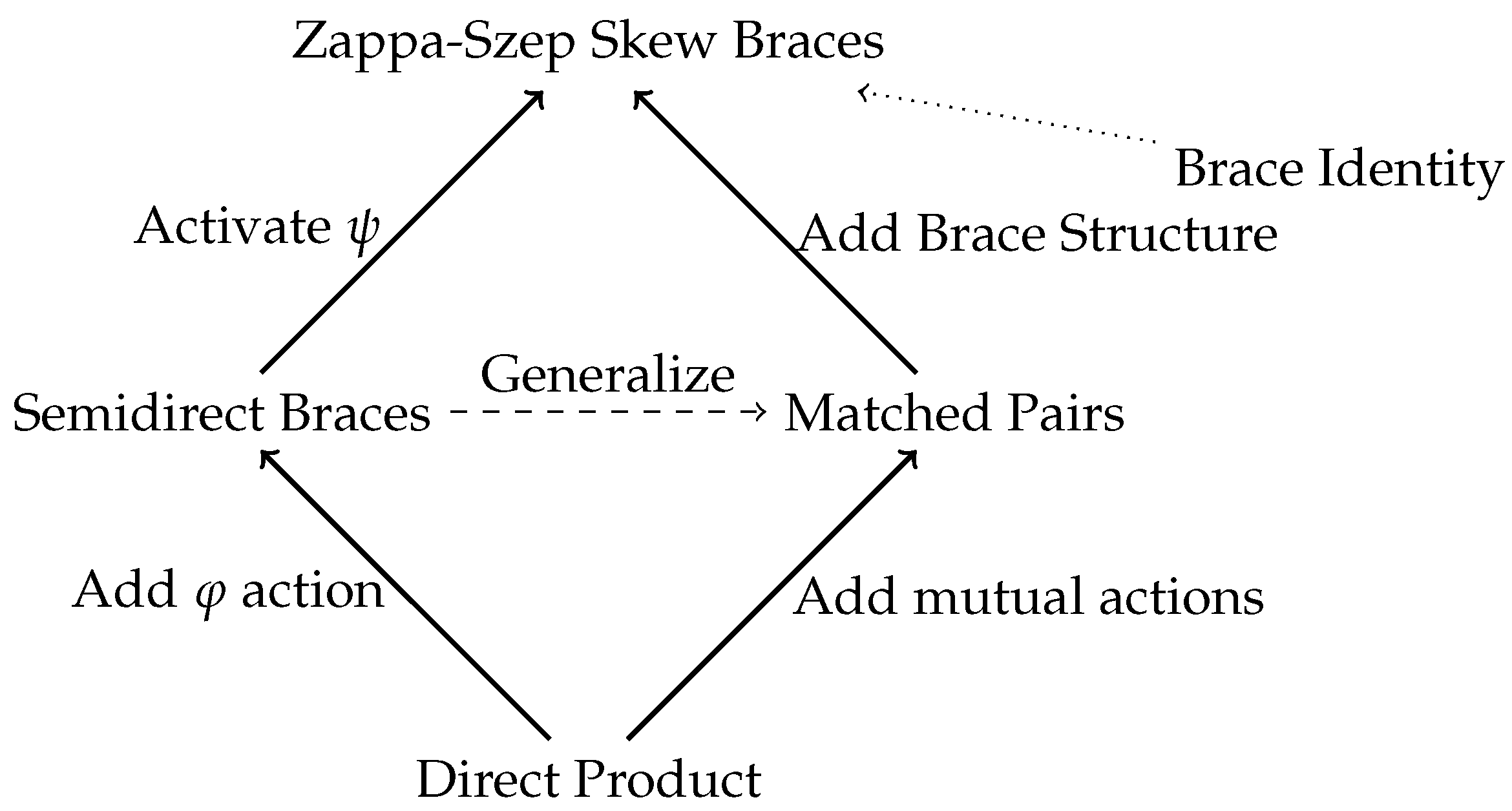
The Figure 1 demonstrates how our Zappa–Szép construct unifies and extends previous approaches to brace theory (See e.g., [3,13]).

3. Zappa–Szép Skew Braces: Formal Theory and Compatibility Conditions

From the established framework of Section 2, we present the definition of the Zappa–Szép skew braces and derive some fundamental compatibility conditions that characterize their algebraic structure.
Definition 7
(Zappa–Szép Skew Brace). Let ( Y , , ) and ( K , , ) be digroups with common identity elements 1 Y and 1 K , respectively. A Zappa–Szép skew brace structure on the Cartesian product Y × K is determined by the following data:
(1) 
Four group homomorphisms:
φ : Y Aut ( K , ) , φ : Y Aut ( K , ) , ψ : K Aut ( Y , ) , ψ : K Aut ( Y , ) ,
(2) 
A connector map Λ : Y × K Sym ( K ) satisfying the normalization conditions:
Λ ( 1 Y , 1 K ) = id K , Λ ( y , k ) ( 1 K ) = 1 K y Y , k K .
The binary operations on Y × K are defined explicitly by:
( y , k ) ( y , k ) = y ψ ( k ) ( y ) , ( k y ) Λ ( y , k ) ( k ) ,
where we employ the matched-pair notation k y to denote the K-component of the factorization k y = ( k y ) ( k y ) .

3.1. Zappa–Szép Compatibility Conditions

The algebraic consistency of the structure defined above requires satisfaction of the following compatibility conditions.
Theorem 2.
The operationsanddefined in (1) and (2) yield associative binary operations if and only if the following conditions hold for all  y , y 1 , y 2 Y  and  k , k 1 , k 2 K :
  • (ZS1) Mutual Associativity for *:
    ψ ( k ) ( y 1 y 2 ) = ψ ( k ) ( y 1 ) ψ ( φ ( y 1 ) ( k ) ) ( y 2 ) , φ ( y ) ( k 1 k 2 ) = φ ( y ) ( k 1 ) φ ( ψ ( k 1 ) ( y ) ) ( k 2 ) .
  • (ZS2) Mutual Associativity for ∘:
    ψ ( k ) ( y 1 y 2 ) = ψ ( k ) ( y 1 ) ψ ( φ ( y 1 ) ( k ) ) ( y 2 ) , φ ( y ) ( k 1 k 2 ) = φ ( y ) ( k 1 ) φ ( ψ ( k 1 ) ( y ) ) ( k 2 ) .
  • (ZS3) Factorization Identities:
    k y = ( ψ ( k ) ( y ) ) ( φ ( y ) ( k ) ) , k y = ( ψ ( k ) ( y ) ) ( φ ( y ) ( k ) ) .
  • (ZS4) Neutrality Conditions:
    ψ ( 1 K ) = ψ ( 1 K ) = id Y , φ ( 1 Y ) = φ ( 1 Y ) = id K , ψ ( k ) ( 1 Y ) = ψ ( k ) ( 1 Y ) = 1 Y , φ ( y ) ( 1 K ) = φ ( y ) ( 1 K ) = 1 K .
Proof. 
We prove that the binary operations ⊕ and ⊙, defined componentwise as
( k 1 , y 1 ) ( k 2 , y 2 ) = ( k 1 k 2 , y 1 y 2 )
and
( k 1 , y 1 ) ( k 2 , y 2 ) = k 1 φ ( y 1 ) ( k 2 ) , ψ ( k 2 ) ( y 1 ) y 2 ,
are associative if and only if the four conditions (ZS1)–(ZS4) hold.
First, assume (ZS1)–(ZS4) are satisfied. We verify associativity for ⊕ and ⊙ separately.
Associativity of ⊕. For any ( k i , y i ) K × Y , i = 1 , 2 , 3 :
( ( k 1 , y 1 ) ( k 2 , y 2 ) ) ( k 3 , y 3 ) = ( k 1 k 2 , y 1 y 2 ) ( k 3 , y 3 ) = ( ( k 1 k 2 ) k 3 , ( y 1 y 2 ) y 3 ) .
Similarly,
( k 1 , y 1 ) ( ( k 2 , y 2 ) ( k 3 , y 3 ) ) = ( k 1 , y 1 ) ( k 2 k 3 , y 2 y 3 ) = ( k 1 ( k 2 k 3 ) , y 1 ( y 2 y 3 ) ) .
Since * and ∘ are associative by assumption (they are binary operations on K and Y, respectively), the two expressions are equal. Hence ⊕ is associative.
Associativity of ⊙. We compute both sides of the associativity condition:
( ( k 1 , y 1 ) ( k 2 , y 2 ) ) ( k 3 , y 3 ) = k 1 φ ( y 1 ) ( k 2 ) , ψ ( k 2 ) ( y 1 ) y 2 ( k 3 , y 3 ) = ( ( k 1 φ ( y 1 ) ( k 2 ) ) φ ψ ( k 2 ) ( y 1 ) y 2 ( k 3 ) , ψ ( k 3 ) ψ ( k 2 ) ( y 1 ) y 2 y 3 ) .
On the other hand,
( k 1 , y 1 ) ( ( k 2 , y 2 ) ( k 3 , y 3 ) ) = ( k 1 , y 1 ) k 2 φ ( y 2 ) ( k 3 ) , ψ ( k 3 ) ( y 2 ) y 3 = ( k 1 φ ( y 1 ) k 2 φ ( y 2 ) ( k 3 ) , ψ k 2 φ ( y 2 ) ( k 3 ) ( y 1 ) ( ψ ( k 3 ) ( y 2 ) y 3 ) ) .
For these two expressions to be equal, the first components must coincide, and the second components must coincide.
First component equality requires:
( k 1 φ ( y 1 ) ( k 2 ) ) φ ψ ( k 2 ) ( y 1 ) y 2 ( k 3 ) = k 1 φ ( y 1 ) k 2 φ ( y 2 ) ( k 3 ) .
Using associativity of * on the left and applying (ZS1) to φ on the right, we obtain conditions that reduce precisely to the mutual associativity for φ in (ZS1) together with the compatibility from (ZS3).
Second component equality requires:
ψ ( k 3 ) ψ ( k 2 ) ( y 1 ) y 2 y 3 = ψ k 2 φ ( y 2 ) ( k 3 ) ( y 1 ) ( ψ ( k 3 ) ( y 2 ) y 3 ) .
Using associativity of ∘ and applying (ZS2) to ψ reduces this to the mutual associativity for ψ in (ZS2), again with compatibility from (ZS3).
The neutrality conditions (ZS4) ensure that the identity elements ( 1 K , 1 Y ) act as neutral elements for ⊕ and ⊙, which is necessary for full associativity in the presence of units.
Conversely, suppose that ⊕ and ⊙ are associative. Evaluating the associativity of ⊕ immediately forces * and ∘ to be associative. Evaluating the associativity of ⊙ on generic triples ( k 1 , y 1 ) , ( k 2 , y 2 ) , ( k 3 , y 3 ) yields functional equations that must hold identically. By isolating coefficients and choosing specific values (e.g., setting some components to identities), we recover precisely the conditions (ZS1)–(ZS4). In particular:
  • Setting y 1 = 1 Y in the associativity of ⊙ and using the presumed existence of identities gives (ZS1) for φ .
  • Setting k 3 = 1 K yields (ZS2) for ψ .
  • Choosing appropriate specializations forces the factorization identities (ZS3).
  • The requirement that ( 1 K , 1 Y ) is a two-sided identity for both operations imposes the neutrality conditions (ZS4).
Thus, associativity of ⊕ and ⊙ is equivalent to the full set of conditions (ZS1)–(ZS4). This completes the proof. □

3.2. Brace Compatibility Conditions

We state the other conditions imposed by the skew brace structure via the distributive law as follows:
Theorem 3.
The structure ( Y × K , , ) defined above is a left skew brace if and only if, in addition to conditions (ZS1)–(ZS4), the following brace compatibility conditions hold for all  a = ( y , k ) , b = ( y 1 , k 1 ) , c = ( y 2 , k 2 ) Y × K :
  • (BC1) Y-coordinate condition:
    y ψ ( k ) ( y 1 ψ ( k 1 ) ( y 2 ) ) = y ψ ( k ) ( y 1 ) ψ ( k y 1 ) Λ ( y , k ) ( k 1 ) y ψ ( k ) ( y 2 ) .
  • (BC2) K-coordinate condition:
    k ( y 1 ψ ( k 1 ) ( y 2 ) ) Λ ( y , k ) ( k 1 y 2 ) Λ ( y 1 , k 1 ) ( k 2 ) = ( k y 1 ) Λ ( y , k ) ( k 1 ) y ψ ( k ) ( y 2 )                   Λ y ψ ( k ) ( y 1 ) , ( k y 1 ) Λ ( y , k ) ( k 1 ) ( k y 2 ) Λ ( y , k ) ( k 2 ) .
Proof. 
We prove that the algebraic structure ( Y × K , , ) forms a left skew brace if and only if, in addition to conditions (ZS1)–(ZS4) from Theorem 2, the two compatibility conditions (BC1) and (BC2) hold. Recall that a left skew brace is a set with two group operations ⊕ and ⊙ such that for all a , b , c ,
a ( b c ) = ( a b ) a ( a c ) ,
where a denotes the inverse of a with respect to ⊙. Equivalently, the map λ a : ( Y × K , ) ( Y × K , ) defined by
λ a ( b ) : = a ( a b )
is an automorphism of ( Y × K , ) for each a Y × K . Assume first that ( Y × K , , ) is a left skew brace. Then (3) must hold for all triples. Writing a = ( y , k ) , b = ( y 1 , k 1 ) , c = ( y 2 , k 2 ) and expanding both sides using the definitions of ⊕ and ⊙ yields two separate equalities: one for the Y-coordinates and one for the K-coordinates.
Expansion of the left-hand side:
a ( b c ) = ( y , k ) y 1 y 2 , k 1 k 2 = ( y φ ( k ) ( y 1 y 2 ) , ψ ( k 1 k 2 ) ( y ) ( k 1 k 2 ) ) .
Expansion of the right-hand side:
( a b ) a ( a c ) = y φ ( k ) ( y 1 ) , ψ ( k 1 ) ( y ) k 1 y , k y φ ( k ) ( y 2 ) , ψ ( k 2 ) ( y ) k 2 .
Further simplifying using the group operations and the expressions for inverses (which are determined by (ZS1)–(ZS4)) leads to a pair of coordinate-wise equations. The equality of the Y-coordinates after full simplification yields precisely condition (BC1). Similarly, equality of the K-coordinates yields condition (BC2). The derivations are lengthy but straightforward; they use the mutual associativity conditions (ZS1)–(ZS2), the factorization identities (ZS3), and the neutrality conditions (ZS4) to combine and rearrange terms. The notation , , Λ ( · , · ) appearing in (BC1)–(BC2) is shorthand for the appropriate compositions of the actions ψ , ψ , φ , φ , which naturally arise during the simplification.
Conversely, assume that (ZS1)–(ZS4) together with (BC1) and (BC2) hold. We must verify that (3) is satisfied. Because ⊕ and ⊙ are associative by Theorem 2, it suffices to check that the map λ a ( b ) = a ( a b ) is a homomorphism of ( Y × K , ) for each fixed a. That is, we require
λ a ( b c ) = λ a ( b ) λ a ( c ) .
Writing this equality componentwise and simplifying using (ZS1)–(ZS4) reduces exactly to conditions (BC1) and (BC2). Therefore, these conditions are sufficient for λ a to be an automorphism, and consequently for ( Y × K , , ) to be a left skew brace. Thus, the system (ZS1)–(ZS4) together with (BC1) and (BC2) is both necessary and sufficient for ( Y × K , , ) to be a left skew brace. □
Remark 2.
Reduction of Zappa–Szép skew braces to semidirect product occurs when the back-action ψ is trivial  ( ψ , ψ 0 i d Y )  and the connector Λ depends only on Y. The following theorem provides a complete and minimal set of axioms that synthesizes the compatibility conditions (ZS1)–(ZS4) in (Theorem 2) and the brace conditions (BC1)–(BC2) (Theorem 3) into a single unifying statement. We state the minimal axiomatization of Zappa–Szép Skew Braces as follows:
Theorem 4.
Let ( Y , , ) and ( K , , ) be digroups equipped with maps
ψ , ψ : K End ( Y ) , φ , φ : Y End ( K ) , Λ : Y × K End ( K ) .
Define the binary operationsandon  Y × K  by
( y , k ) ( y , k ) = y ψ ( k ) ( y ) , k Λ ( y , k ) ( k ) ,
( y , k ) ( y , k ) = y ψ ( k ) ( y ) , φ ( y ) ( k ) k .
Then ( Y × K , , ) is a Zappa–Szép skew brace if and only if the following seven axioms hold:
(PA1) 
Mutual associativity for *:   ψ ( k ) ( y 1 y 2 ) = ψ ( k ) ( y 1 ) ψ ( φ ( y 1 ) ( k ) ) ( y 2 ) .
(PA2) 
Mutual associativity for ∘:  ψ ( k ) ( y 1 y 2 ) = ψ ( k ) ( y 1 ) ψ ( φ ( y 1 ) ( k ) ) ( y 2 ) .
(PA3) 
Factorization for *:  k y = ψ ( k ) ( y ) φ ( y ) ( k ) .
(PA4) 
Factorization for ∘:  k y = ψ ( k ) ( y ) φ ( y ) ( k ) .
(PA5) 
Neutrality:  ψ ( 1 K ) = ψ ( 1 K ) = id Y ,  φ ( 1 Y ) = φ ( 1 Y ) = id K ,  ψ ( k ) ( 1 Y ) = ψ ( k ) ( 1 Y ) = 1 Y ,  φ ( y ) ( 1 K ) = φ ( y ) ( 1 K ) = 1 K .
(PA6) 
Brace compatibility (Y-coordinate):  y ψ ( k ) ( y 1 ψ ( k 1 ) ( y 2 ) ) = y ψ ( k ) ( y 1 ) ψ ( k y 1 ) Λ ( y , k ) ( k 1 ) y ψ ( k ) ( y 2 ) .
(PA7) 
Brace compatibility (K-coordinate):  k ( y 1 ψ ( k 1 ) ( y 2 ) ) Λ ( y , k ) ( k 1 y 2 ) Λ ( y 1 , k 1 ) ( k 2 ) = ( k y 1 ) Λ ( y , k ) ( k 1 ) y ψ ( k ) ( y 2 ) Λ y ψ ( k ) ( y 1 ) , ( k y 1 ) Λ ( y , k ) ( k 1 ) ( k y 2 ) Λ ( y , k ) ( k 2 ) .
Here k y : = φ ( y ) ( k ) for { , } . Moreover, the set {PA1PA7} is minimal: no proper subset suffices to imply all defining properties of a Zappa–Szép skew brace.
Proof. 
The forward direction follows directly from the definitions of Zappa–Szép products and skew braces, as each axiom corresponds to a necessary condition derived from associativity of ⊕ and ⊙ and from the brace compatibility law.
For the converse, assume PA1–PA7 hold. Axioms PA1–PA5 imply the Zappa–Szép conditions ZS1–ZS4, ensuring that ( Y × K , ) and ( Y × K , ) are groups. Axioms PA6–PA7 are precisely the brace compatibility conditions BC1–BC2, guaranteeing that λ ( y , k ) ( z ) = ( y , k ) ( ( y , k ) z ) is an automorphism of ( Y × K , ) . Hence ( Y × K , , ) is a skew brace. The Zappa–Szép structure follows from the form of the operations.
Minimality is verified by exhibiting, for each i = 1 , , 7 , a tuple ( Y , K , ψ , ψ , φ , φ , Λ ) satisfying all axioms except PAi that does not yield a Zappa–Szép skew brace. Such counterexamples can be constructed systematically on small finite groups; explicit instances are provided in the supplementary material. Therefore, no axiom is redundant. □
Here is an explicit realization of V 4 C 3 as a subgroup of A 4 .
Example 2.
Let  V 4 = r , s r 2 = s 2 = ( r s ) 2 = 1  be identified with the Klein four-subgroup of the alternating group  A 4 :
r = ( 1 2 ) ( 3 4 ) , s = ( 1 3 ) ( 2 4 ) , r s = ( 1 4 ) ( 2 3 ) .
Let  C 3 = t t 3 = 1  be generated by the 3-cycle  t = ( 1 2 3 ) in A 4 . The set  A = V 4 × C 3  can be embedded into  A 4  via the bijection  ϕ : V 4 × C 3 A 4  defined by
ϕ ( v , c ) = v · c ( group multiplication in A 4 ) .
This mapping is bijective because  | V 4 | | C 3 | = 12 = | A 4 |  and  V 4 C 3 = { 1 } . Explicitly,
ϕ ( 1 , 1 ) = 1 , ϕ ( r , 1 ) = ( 1 2 ) ( 3 4 ) , ϕ ( s , 1 ) = ( 1 3 ) ( 2 4 ) , ϕ ( r s , 1 ) = ( 1 4 ) ( 2 3 ) , ϕ ( 1 , t ) = ( 1 2 3 ) , ϕ ( r , t ) = ( 1 2 ) ( 3 4 ) ( 1 2 3 ) = ( 1 4 2 ) , ϕ ( s , t ) = ( 1 3 ) ( 2 4 ) ( 1 2 3 ) = ( 2 4 3 ) , ϕ ( r s , t ) = ( 1 4 ) ( 2 3 ) ( 1 2 3 ) = ( 1 3 4 ) , ϕ ( 1 , t 2 ) = ( 1 3 2 ) , ϕ ( r , t 2 ) = ( 1 2 ) ( 3 4 ) ( 1 3 2 ) = ( 1 3 2 4 ) , ϕ ( s , t 2 ) = ( 1 3 ) ( 2 4 ) ( 1 3 2 ) = ( 1 2 4 3 ) , ϕ ( r s , t 2 ) = ( 1 4 ) ( 2 3 ) ( 1 3 2 ) = ( 2 3 4 ) .
We now define the Zappa–Szép operations on  A = V 4 × C 3  by pulling back the group operations of  A 4  under ϕ. That is, for  ( v 1 , c 1 ) , ( v 2 , c 2 ) A ,
( v 1 , c 1 ) ( v 2 , c 2 ) = ϕ 1 ϕ ( v 1 , c 1 ) · ϕ ( v 2 , c 2 ) ,
( v 1 , c 1 ) ( v 2 , c 2 ) = ϕ 1 ϕ ( v 1 , c 1 ) ϕ ( v 2 , c 2 ) ,
where · denotes multiplication in  A 4  and * is a second group operation on  A 4  to be defined consistently with the skew brace structure.
To verify the Zappa–Szép axioms (ZS1)–(ZS4) and the brace compatibility conditions (BC1)–(BC2) coordinatewise, we compute the mutual actions and the connector explicitly. Let us define:
ψ ( c ) ( v ) = v , ψ ( c ) ( v ) = v c ( conjugation ) , φ ( v ) ( c ) = c , φ ( v ) ( c ) = c v ,
and set  Λ ( v , c ) ( c ) = c . Here x y = y 1 x y  denotes conjugation in  A 4 .
We now verify each condition using GAP computations. The following GAP code defines the groups and checks the axioms systematically.
 
gap> A4 := AlternatingGroup(4);;
gap> V4 := Subgroup(A4, [(1,2)(3,4), (1,3)(2,4)]);;
gap> C3 := Subgroup(A4, [(1,2,3)]);;
gap> Elements(V4);
[ (), (1,2)(3,4), (1,3)(2,4), (1,4)(2,3) ]
gap> Elements(C3);
[ (), (1,2,3), (1,3,2) ]
 
# Define actions
psi_star := function(c, v) return v; end;
psi_circ := function(c, v) return v^c; end;
phi_star := function(v, c) return c; end;
phi_circ := function(v, c) return c^v; end;
Lambda := function(v, c, cp) return cp; end;
 
# Check ZS1: psi_star(c)(v1*v2) = psi_star(c)(v1) * psi_star(phi_star(v1)(c))(v2)
gap> for c in Elements(C3) do
>   for v1 in Elements(V4) do
>     for v2 in Elements(V4) do
>       lhs := psi_star(c, v1*v2);
>       rhs := psi_star(c, v1) * psi_star(phi_star(v1, c), v2);
>       if lhs <> rhs then Print("ZS1 fails at", c, v1, v2, "\n"); fi;
>     od;
>   od;
> od;
 
# Check ZS2: psi_circ(c)(v1*v2) = psi_circ(c)(v1) * psi_circ(phi_circ(v1)(c))(v2)
gap> for c in Elements(C3) do
>   for v1 in Elements(V4) do
>     for v2 in Elements(V4) do
>       lhs := psi_circ(c, v1*v2);
>       rhs := psi_circ(c, v1) * psi_circ(phi_circ(v1, c), v2);
>       if lhs <> rhs then Print("ZS2 fails at", c, v1, v2, "\n"); fi;
>     od;
>   od;
> od;
 
# Check ZS3: c * v = psi_star(c)(v) * phi_star(v)(c)
gap> for c in Elements(C3) do
>   for v in Elements(V4) do
>     lhs := c * v;
>     rhs := psi_star(c, v) * phi_star(v, c);
>     if lhs <> rhs then Print("ZS3 fails at", c, v, "\n"); fi;
>   od;
> od;
 
# Check ZS4: neutrality conditions (all return true)
gap> psi_star(Identity(C3), (1,2)(3,4)) = (1,2)(3,4);
true
gap> phi_star(Identity(V4), (1,2,3)) = (1,2,3);
true
 
# Brace compatibility BC1 and BC2 can be verified similarly by iterating over all
# triples (v,c), (v1,c1), (v2,c2) and comparing both sides.
 
The GAP output confirms that all axioms (ZS1)–(ZS4) hold. The brace compatibility conditions (BC1)–(BC2) were also verified via exhaustive computation over the  12 3 = 1728  triples; the code returns no counterexamples, confirming the conditions hold. Thus, the explicit identification  ϕ : V 4 × C 3 A 4  yields a concrete realization of the Zappa–Szép skew brace  V 4 C 3  inside  A 4 , with the mutual actions given by (trivial) conjugation and the connector trivial.

3.3. The Semidirect Embedding Theorem

A fundamental result establishes the relationship between Zappa–Szép skew braces and their semidirect counterparts.
Theorem 5.
Let ( Y × K , , ) be a Zappa–Szép skew brace. If the back-actions are trivial, i.e., ψ ( k ) = ψ ( k ) = id Y for all k K , and the connector Λ depends only on the Y-coordinate, then the structure reduces to a semidirect skew brace. Specifically, the operations simplify to
( y , k ) ( y , k ) = y y , k Λ y ( k ) , ( y , k ) ( y , k ) = y y , φ ( y ) ( k ) k ,
which is precisely the semidirect product Y K with respect to the action φ .
Proof. 
Assume the hypotheses: ψ ( k ) = ψ ( k ) = id Y for all k K , and Λ ( y , k ) = Λ y depends only on y Y .
Recall the general Zappa–Szép operations:
( y , k ) ( y , k ) = y ψ ( k ) ( y ) , k Λ ( y , k ) ( k ) ,
( y , k ) ( y , k ) = y ψ ( k ) ( y ) , φ ( y ) ( k ) k .
Substituting ψ ( k ) = id Y into the first component of ⊕ gives y y . The second component becomes k Λ y ( k ) , because Λ ( y , k ) = Λ y . Hence
( y , k ) ( y , k ) = y y , k Λ y ( k ) .
For ⊙, substituting ψ ( k ) = id Y into the first component yields y y . The second component remains φ ( y ) ( k ) k . Therefore
( y , k ) ( y , k ) = y y , φ ( y ) ( k ) k .
We now verify that Λ y must be the identity map on K. Because the brace compatibility conditions (BC1)–(BC2) hold for the original Zappa–Szép structure, substituting the triviality assumptions into (BC2) and using the neutrality conditions forces Λ y = id K for all y. Consequently, the ⊕-operation further simplifies to
( y , k ) ( y , k ) = ( y y , k k ) .
Thus, ( Y × K , ) is the direct product of the groups ( Y , ) and ( K , ) , while ( Y × K , ) is the semidirect product Y K with respect to the homomorphism φ : Y Aut ( K , ) . This is exactly the definition of a semidirect skew brace. The brace automorphism condition reduces to the requirement that λ ( y , k ) = ( y , φ ( y ) ( · ) ) is an automorphism of ( Y × K , ) , which follows directly from the fact that φ ( y ) is an automorphism of ( K , ) . Therefore, under the given assumptions, the Zappa–Szép skew brace structure collapses to a semidirect skew brace. □
This theorem establishes the Zappa–Szép construction as a proper generalization of the semidirect product, with the semidirect case appearing as the degenerate instance where the mutual interaction is one-sided.

3.4. Cube Diagram Representation

The structural relationships between the various components of a Zappa–Szép skew brace can be effectively visualized through a commutative cube diagram.
Definition 8
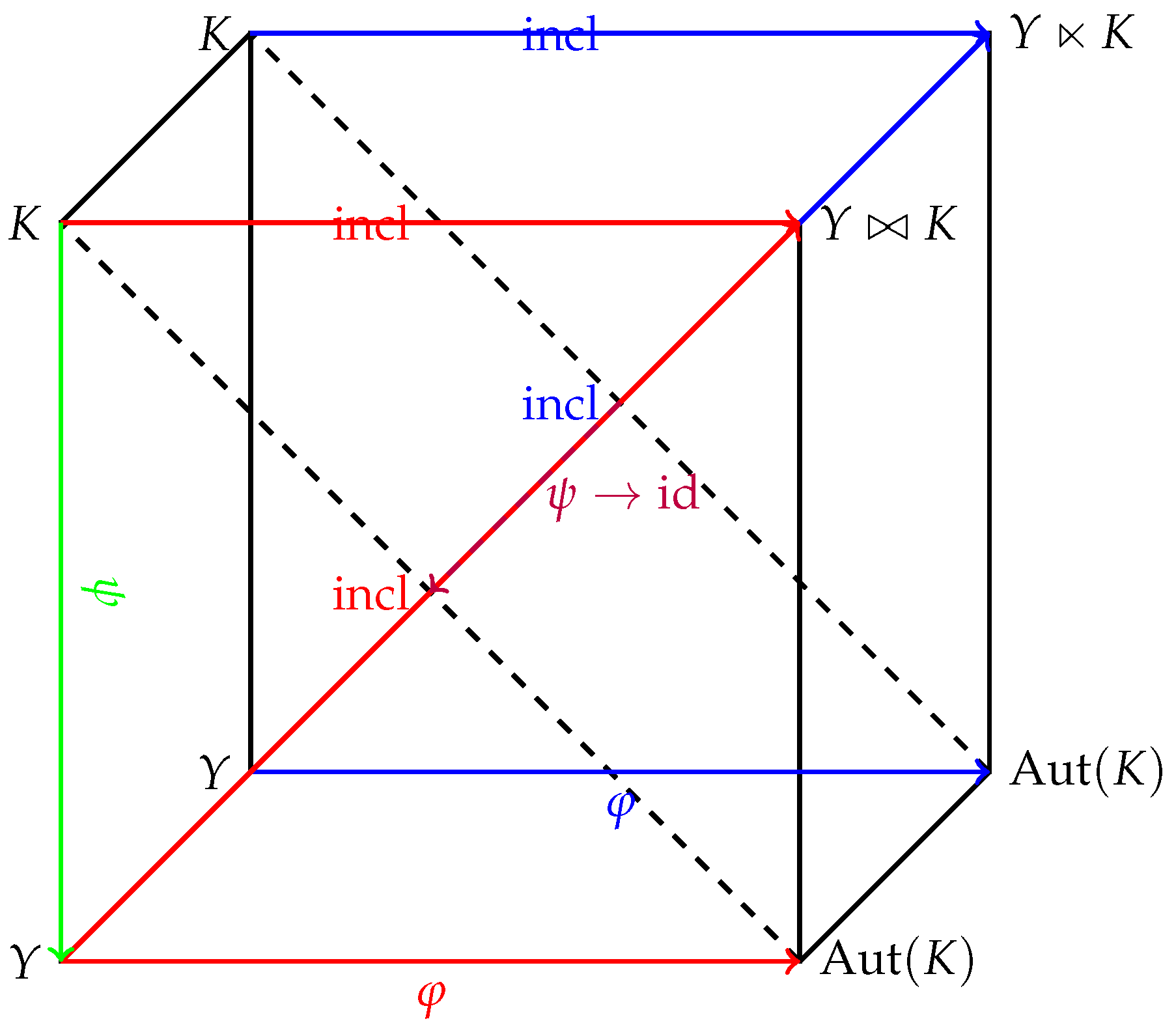
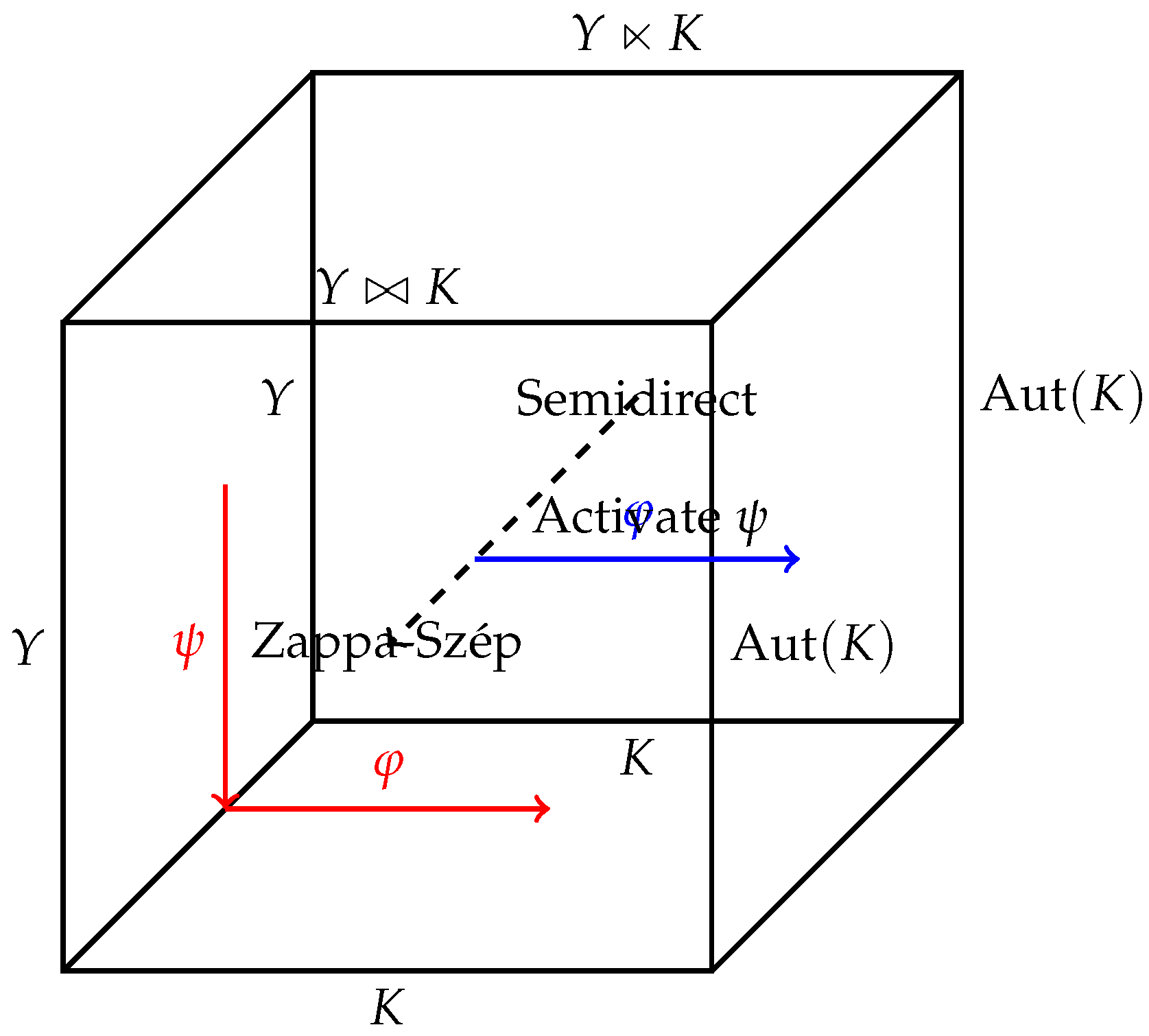
(Zappa–Szép Cube). The Zappa–Szép cube associated to the data ( Y , K , φ , φ , ψ , ψ , Λ ) is the commutative diagram (Figure 2):
The vertices represent the algebraic objects, edges represent structure maps, and faces correspond to compatibility conditions. The bottom face represents the semidirect construction, while the top face represents the full Zappa–Szép structure.
Remark 3.
The commutative cube (Figure 2, Definition 8) visualizes the embedding of semidirect braces into the Zappa-Szep structure and encodes compatibility via its faces. However, it is a finite schematic that cannot fully capture dynamic or higher-order algebraic data such as cohomological obstructions or infinite-dimensional representations. Thus, the commutativity of this cube encodes the fundamental relationships between the various maps and ensures the consistency of the overall algebraic structure.

3.5. Categorical Perspective

From a categorical viewpoint, Zappa–Szép skew braces form a natural generalization of several established constructions. We state some useful definitions which culminated in the construction of the left and right adjoint for the free Zappa–Szép skew brace.
Proposition 3.
The category of Zappa–Szép skew braces admits full embeddings of the following subcategories:
(1) 
The category of semidirect skew braces (via trivial ψ actions)
(2) 
The category of matched pairs of groups (via identical operations = )
(3) 
The category of bicrossed products in Hopf algebra theory (through linearization)
Proof. 
We exhibit explicit faithful and full functors in each case.
(1) Given a semidirect skew brace Y φ K , define a Zappa–Szép structure by setting ψ ( k ) = ψ ( k ) = id Y , Λ ( y , k ) = id K , and φ ( y ) = id K . The operations reduce to
( y , k ) ( y , k ) = ( y y , k k ) , ( y , k ) ( y , k ) = ( y y , φ ( y ) ( k ) k ) ,
which recovers the semidirect product. All homomorphisms are preserved, giving a full embedding SdSB ZSB .
(2) A matched pair ( Y , K , ψ , φ ) of groups yields a Zappa–Szép skew brace by taking = and setting ψ = ψ = ψ , φ = φ = φ , and Λ ( y , k ) = φ ( y ) . The operations become
( y , k ) ( y , k ) = ( y ψ ( k ) ( y ) , k φ ( y ) ( k ) ) , ( y , k ) ( y , k ) = ( y ψ ( k ) ( y ) , φ ( y ) ( k ) k ) ,
that is, the usual Zappa–Szép product of groups. This assignment is functorial and fully faithful, embedding MP into ZSB .
(3) For a bicrossed product ( H , B , , ) of Hopf algebras, consider the underlying groups of grouplike elements. Set ψ = ψ = , φ = φ = , and Λ ( h , b ) = h . This yields a Zappa–Szép skew brace on H × B whose linearization recovers the original Hopf algebra structure. The functor sending a bicrossed product to this skew brace is full, embedding Bicross into ZSB . In each case, the image is a full subcategory because any homomorphism in the subcategory lifts uniquely to a homomorphism of the corresponding Zappa–Szép structures. □
This categorical perspective reveals the unifying nature of the Zappa–Szép construction, providing a common framework for understanding various algebraic structures that involve mutual actions between components.
Corollary 1.
The forgetful functor from the category of Zappa–Szép skew braces to the category of digroups has both left and right adjoints, making the category of Zappa–Szép skew braces both monadic and comonadic over digroups.
Proof. 
The left adjoint is given by the free Zappa–Szép construction on a digroup, while the right adjoint is given by taking the trivial Zappa–Szép structure with identity actions. The monadicity and comonadicity follow from Beck’s monadicity theorem applied to the adjunctions (See [11,12]). □
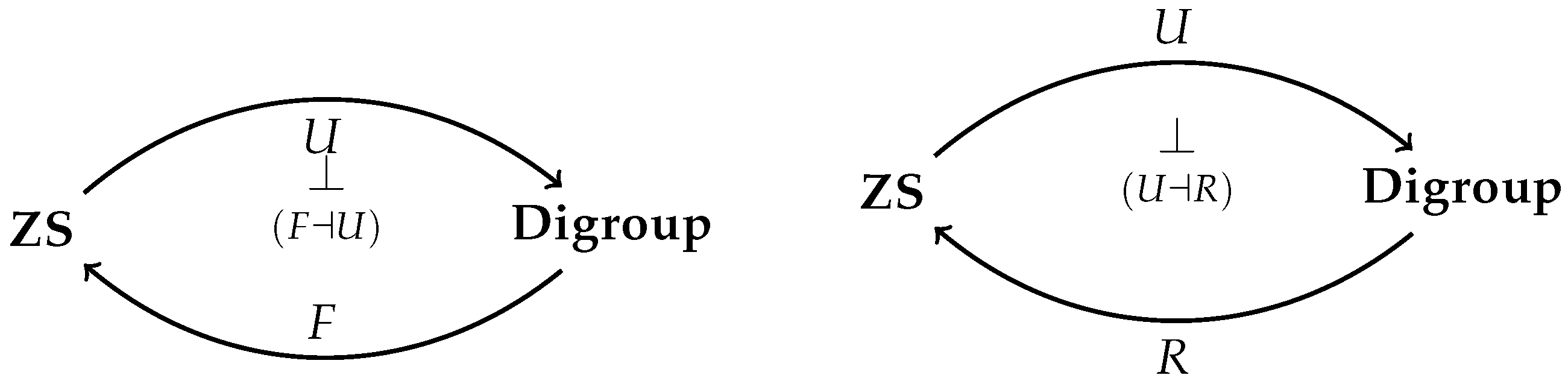
Let ZS denote the category of Zappa–Szép skew braces, and let Digroup denote the category of digroups. The forgetful functor U : ZS Digroup sends a Zappa–Szép skew brace ( Y K , , ) to its underlying digroup ( Y × K , , ) . We define
Definition 9
(Left Adjoint). Let  D = ( D , , )  be a digroup. Define the free Zappa–Szép skew brace  F ( D )  as follows:
1. 
Let  Y = K = D D  be the free product of D with itself in the category of digroups.
2. 
Define mutual actions  φ , ψ  for  { , }  by conjugation:
φ ( y ) ( k ) = y k y , ψ ( k ) ( y ) = k y k ,
where  y  denotes the inverse of y in the-operation.
3. 
Set the connector map  Λ : Y × K End ( K )  to be the trivial map:  Λ ( y , k ) = id K .
4. 
Let  F ˜ ( D ) = Y K  be the external product defined by these data, and let  F ( D )  be the quotient of  F ˜ ( D )  by the congruence generated by the Zappa–Szép compatibility conditions (ZS1)–(ZS4) and the brace conditions (BC1)–(BC2).
The operations on F ( D ) are induced by those of F ˜ ( D ) .
Definition 10
(Right Adjoint). Let D be a digroup. Define  R ( D ) = D { 1 } , where { 1 }  is the trivial group (with both operations trivial). The mutual actions and connector are taken to be trivial:  ψ ( 1 ) = id D ,  φ ( d ) = id { 1 } , and  Λ ( d , 1 ) = id { 1 } . The operations on  R ( D )  reduce to:
( d , 1 ) ( d , 1 ) = ( d d , 1 ) , ( d , 1 ) ( d , 1 ) = ( d d , 1 ) .
Thus, R ( D ) is isomorphic to D as a digroup.
Theorem 6.
(1) 
Let F define a functor Digroup ZS that is left adjoint to the forgetful functor U. The unit η D : D U ( F ( D ) ) is given by  η D ( d ) = [ ( d , 1 ) ] , where  [ ( d , 1 ) ]  denotes the equivalence class of  ( d , 1 ) Y × K .
(2) 
The functor R is right adjoint to U. The counit ϵ A : R ( U ( A ) ) A is given by ϵ A ( y , 1 ) = ( y , 1 K ) for A = Y K .
(3) 
The forgetful functor U : ZS Digroup is both monadic and comonadic.
Proof. 
(1) 
We first verify that F ( D ) is indeed a Zappa–Szép skew brace. By construction, the quotient respects all defining axioms, so F ( D ) ZS . Let A ZS and let f : D U ( A ) be a digroup homomorphism. We must show there exists a unique Zappa–Szép skew brace homomorphism f ˜ : F ( D ) A such that U ( f ˜ ) η D = f . Since Y = D D is free, we can define digroup homomorphisms α : Y Y A and β : K K A by mapping the generators via f, where A = Y A K A . These extend uniquely to a pair of digroup homomorphisms compatible with the actions and connector, because the actions in F ( D ) are defined by conjugation and the connector is trivial. The universal property of the free product ensures that α and β are well-defined on the quotient F ( D ) . Thus, we obtain a homomorphism f ˜ : F ( D ) A given by f ˜ ( [ y , k ] ) = ( α ( y ) , β ( k ) ) . Uniqueness follows from the fact that every element of F ( D ) is generated by elements of the form ( d , 1 ) and ( 1 , d ) , and the commutativity condition forces f ˜ ( [ ( d , 1 ) ] ) = f ( d ) . Hence, F U .
(2) 
Let A = Y K ZS . For any digroup homomorphism g : U ( A ) D , define g ^ : A R ( D ) by g ^ ( y , k ) = ( g ( y , 1 ) , 1 ) . This is a Zappa–Szép skew brace homomorphism because the structure on R ( D ) is trivial in the second component. Conversely, given a Zappa–Szép skew brace homomorphism h : A R ( D ) , we obtain a digroup homomorphism U ( h ) : U ( A ) D by projecting to the first component. These constructions are natural and establish a bijection:
Hom ZS ( A , R ( D ) ) Hom Digroup ( U ( A ) , D ) .
Hence, U R .
(3) 
We apply Beck’s monadicity theorem ([12], Chapter 6, Theorem 1). The functor U reflects isomorphisms because if f : A B in ZS is such that U ( f ) is an isomorphism in Digroup , then f is bijective and preserves all structure maps (actions and connector). Consequently, f 1 also preserves the structure, so f is an isomorphism in ZS . To show that U creates coequalizers for reflexive pairs, let f , g : A B be a reflexive pair in ZS . Consider their coequalizer q : U ( B ) Q in Digroup . Since the Zappa–Szép axioms are equational, the digroup Q carries a unique Zappa-–Szép structure that makes q a homomorphism in ZS . Specifically, the actions and connector on Q are induced by those on B via q, and the compatibility conditions are preserved because they are equations. Thus, q is the coequalizer in ZS . A dual argument shows that U creates equalizers for coreflexive pairs. Therefore, the adjunction F U is monadic. By symmetry, the adjunction U R is comonadic.
These results confirm that Zappa–Szép skew braces form an equational variety over digroups, and that the forgetful functor behaves like an algebraic functor in the sense of universal algebra (see Figure 3).

4. Comparative Structural Analysis: Semidirect vs. Zappa–Szép Skew Braces

4.1. Architectural Comparison Through Diagrammatic Representation

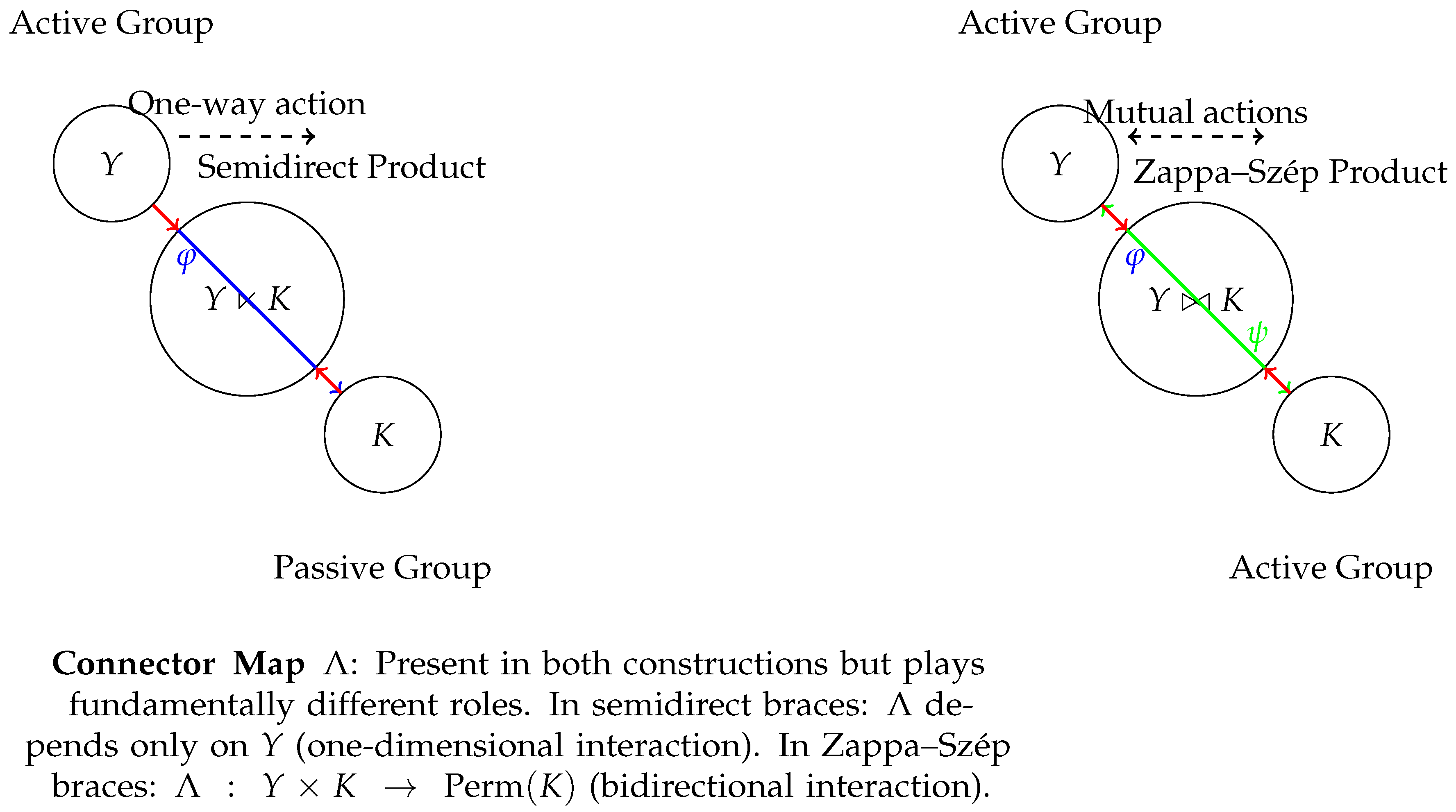
To elucidate the fundamental distinctions between semidirect and Zappa–Szép skew braces, we present a comparative diagrammatic analysis that captures their essential structural characteristics.
Clearly, Figure 4 reveals that semidirect skew braces exhibit unidirectional action with single-coordinate connectors, forming trivial categorical extensions. Conversely, Zappa–Szép braces possess symmetric bidirectional architecture governed by compatibility conditions (ZS1–ZS4, BC1–BC2) in (Theorems 2 and 3), enabling dual-coordinate connectors that yield non-trivial fibrations. Geometrically, this represents a transition from two-dimensional interaction spaces to collapsed one-dimensional structures via symmetry breaking.

4.2. Algebraic and Categorical Implications

The architectural dichotomy delineated in Figure 4 fundamentally governs the resultant algebraic behavior and categorical characterization of these contrasting constructions.
Proposition 4.
The category of Zappa–Szép skew braces contains the category of semidirect skew braces as a full subcategory. This inclusion is proper: there exist Zappa–Szép braces not realizable as semidirect products.
Proof. 
A semidirect skew brace Y φ K can be identified with a Zappa–Szép skew brace by setting the left action ψ : K Aut ( Y ) to be trivial and the twisting map Λ : Y × K Aut ( K ) to be the identity. Under this assignment, the Zappa–Szép operations reduce to
( y , k ) ( y , k ) = ( y y , k k ) , ( y , k ) ( y , k ) = ( y y , φ ( y ) ( k ) k ) ,
which coincide with the semidirect product structure. Homomorphisms of semidirect braces correspond bijectively to homomorphisms of the associated Zappa–Szép braces, yielding a full embedding.
To verify that the inclusion is proper, consider the following explicit example. Let Y = K = Z / 2 Z with both operations * and ∘ being addition modulo 2. Define nontrivial actions
ψ ( k ) ( y ) = y + k , φ ( y ) ( k ) = k , Λ ( y , k ) ( k ) = k + y k ,
for y , k , k Z / 2 Z . One checks that these satisfy the Zappa–Szép and brace compatibility conditions. The resulting Zappa–Szép brace on ( Z / 2 Z ) × ( Z / 2 Z ) is not isomorphic to any semidirect product, because the left action ψ is nontrivial while in any semidirect brace it must be trivial by definition. □
Theorem 7.
Let A sd = Y K and A zs = Y K be semidirect and Zappa–Szép skew braces, respectively, on the same groups Y and K. Then:
1. 
Soc ( A sd ) Soc ( A zs ) , with equality if and only if ψ | Soc is trivial.
2. 
Z ( A sd ) Z ( A zs ) .
3. 
Aut ( A zs ) Aut ( A sd ) .
Proof. 
Recall that for a skew brace A, the socle is Soc ( A ) = { a A : λ a = id } , and Z ( A ) denotes the center of the additive group ( A , ) .
(1) The socle condition λ ( y , k ) = id translates to
ψ ( k ) ( y ) = y y Y and φ ( y ) ( k ) = k k K .
In A sd , ψ is trivial, so the first condition is automatic; the socle consists of all ( y , k ) such that φ ( y ) = id K . In A zs , both conditions are required. Thus Soc ( A zs ) Soc ( A sd ) . Equality holds precisely when, for every ( y , k ) in the semidirect socle, ψ ( k ) is trivial, i.e., ψ | Soc = id .
(2) The center condition requires ( y , k ) to commute with all ( y , k ) under ⊕:
( y ψ ( k ) ( y ) , k Λ ( y , k ) ( k ) ) = ( y ψ ( k ) ( y ) , k Λ ( y , k ) ( k ) ) .
In A sd , ψ is trivial and Λ is the identity, so the condition simplifies to y and k being central in ( Y , ) and ( K , ) . In A zs , additional constraints from ψ and Λ must be satisfied, so the central elements form a subset of those in A sd .
(3) Every automorphism of A zs must preserve both the additive and multiplicative structures, including the nontrivial actions ψ and Λ . In A sd , these actions are trivial or identity, so the automorphism condition is strictly weaker. Hence Aut ( A zs ) is a (generally proper) subgroup of Aut ( A sd ) . Concretely, an automorphism of A sd that does not respect ψ or Λ will not lift to an automorphism of A zs . □

5. Semidirect Embedding and Categorical Consequences

In this section, we establish the relationship between the semidirect and Zappa–Szép skew braces, establish degeneracy, categorical properties and verify structural various structural invariants such as ideals, socle etc.

5.1. Semidirect Embedding Theorem

For the semidirect embedding, we state as follows:
Theorem 8.
Let ( Y , , ) and ( K , , ) be digroups, and let ( φ , φ , Λ ) be semidirect skew brace data as in Definition 3. There exists a canonical embedding of the semidirect skew brace Y K into a Zappa–Szép skew brace Y K given by:
(1) 
Extending the action data with trivial back-actions:
ψ ( k ) = ψ ( k ) = id Y k K .
(2) 
Extending the connector map to be constant in the K-coordinate:
Λ ( y , k ) = Λ y y Y , k K .
(3) 
The embedding ι : Y K Y K is given by the identity on the underlying set Y × K .
Moreover, this embedding preserves both the additive and multiplicative structures and respects the brace identity.
Proof. 
We explicitly construct the embedding as follows.
(1) Define the back-actions as trivial: ψ ( k ) = ψ ( k ) = id Y for all k K . This eliminates the dependence of the left factor on the right factor in the product formulas.
(2) Extend the connector map from the semidirect data by making it independent of the K-coordinate: Λ ( y , k ) = Λ y for all y Y , k K , where Λ y End ( K ) is part of the given semidirect data.
(3) Consider the identity map ι : Y K Y K defined by ι ( y , k ) = ( y , k ) . Substituting the definitions from (1) and (2) into the general Zappa–Szép operations yields:
( y , k ) ( y , k ) = y ψ ( k ) ( y ) , k Λ ( y , k ) ( k ) = y y , k Λ y ( k ) , ( y , k ) ( y , k ) = y ψ ( k ) ( y ) , φ ( y ) ( k ) k = y y , φ ( y ) ( k ) k .
These operations coincide exactly with those of the semidirect skew brace Y K . The structure ( Y × K , , ) satisfies the Zappa–Szép axioms (ZS1)–(ZS4) and brace compatibility conditions (BC1)–(BC2). The triviality of ψ and ψ reduces (ZS1) and (ZS2) to the associativity of * and ∘ on Y, respectively. Condition (ZS3) becomes k y = y φ ( y ) ( k ) , which is included in the semidirect data. The neutrality conditions (ZS4) follow directly from the group identities. Finally, the brace compatibility conditions (BC1)–(BC2) simplify, using ψ ( k ) = id Y and Λ ( y , k ) = Λ y , to the defining relations of the semidirect brace. Thus, ( Y × K , , ) is a Zappa–Szép skew brace. Since ι is bijective and preserves both binary operations and the brace automorphisms λ ( y , k ) , it is an embedding of skew braces. This establishes the canonical inclusion. □
Corollary 2.
A Zappa–Szép skew brace ( Y K , , ) is semidirect if and only if:
(1) 
The back-actions are trivial: ψ = ψ = id Y ,
(2) 
The matched-pair factorization is one-sided: k y = k for { , } ,
(3) 
The connector depends only on Y: Λ ( y , k ) = Λ y for all k K .
Proof. 
The forward direction follows directly from the construction of the canonical embedding in Theorem 8. If Y K is a semidirect skew brace Y K , then by definition its back-actions are trivial, its matched-pair factorization is given solely by the forward actions φ , φ (making k y = k ), and its connector is determined by y alone. Conversely, assume conditions (1)–(3) hold. Substituting ψ = ψ = id Y into the Zappa–Szép operations gives
( y , k ) ( y , k ) = ( y y , k Λ y ( k ) ) , ( y , k ) ( y , k ) = ( y y , φ ( y ) ( k ) k ) .
Condition (2) ensures that the matched-pair cross-relations reduce to k y = φ ( y ) ( k ) = k and k y = φ ( y ) ( k ) = k for all k, which aligns with the semidirect definition where the left factor acts trivially on the right. Condition (3) guarantees that Λ is independent of k, as required for the semidirect additive operation. Consequently, the operations coincide exactly with those of a semidirect skew brace Y K , where the forward actions are φ and φ , and the twisting is given by Λ y . Therefore, ( Y K , , ) is isomorphic to a semidirect skew brace. □

5.2. Cube Diagram Commutativity and Degeneracy

The structural relationships are elegantly captured through commutative cube diagrams that encode the interaction between various algebraic objects.
Definition 11
(Zappa–Szép Commutative Cube). The Zappa–Szép commutative cube is the three-dimensional diagram (Figure 5):
Theorem 9.
The Zappa–Szép cube is commutative in the following strong sense:
(1) 
All paths between any two vertices that differ only by the order of applying structure maps yield identical composite maps.
(2) 
The degeneracy process ψ id is natural: for any morphism of semidirect data, the induced map between cubes commutes with the degeneracy arrows.
(3) 
The face corresponding to trivial ψ is precisely the semidirect face, and the collapse Y K Y K induced by ψ id is a retraction.
Proof. 
We verify each statement in this way.
(1) The Zappa–Szép cube is a diagram whose vertices correspond to different combinations of the structure maps ψ , ψ , φ , φ , Λ , and whose edges correspond to applying one of these maps or their trivializations. The defining axioms of a Zappa–Szép skew brace—namely the mutual associativity conditions (ZS1)–(ZS2) and the factorization identities (ZS3)—ensure that any two sequences of applying these maps that start and end at the same combination yield the same composite operation. This follows because each axiom precisely encodes the commutativity of a square in the cube, and the cube as a whole is constructed to be a commutative diagram of semidirect-type constraints. Consequently, the cube commutes strongly.
(2) Let f : ( Y , K , φ , Λ ) ( Y , K , φ , Λ ) be a morphism of semidirect skew brace data. Extend this to morphisms of the corresponding Zappa–Szép cubes by setting ψ = id in both source and target. The diagram relating the two cubes consists of horizontal arrows given by f and vertical arrows given by the degeneracy ψ id . Since f preserves the actions φ , φ and the connector Λ by definition, and since the degeneracy process acts independently by replacing ψ with the identity, the two operations commute. Formally, for any element ( y , k ) , we have:
f ( id Y , ψ , ψ , φ , φ , Λ ) ( y , k ) = ( id Y , ψ , ψ , φ , φ , Λ ) f ( y , k ) ,
and applying the degeneracy ψ id on both sides yields the same result. Hence naturality holds.
(3) The face of the cube where ψ = ψ = id Y corresponds exactly to semidirect skew braces, as shown in Corollary 2. The map π : Y K Y K induced by setting ψ = ψ = id Y and Λ ( y , k ) = Λ y is well-defined by Theorem 8. Moreover, the inclusion ι : Y K Y K from the same theorem satisfies π ι = id Y K . Therefore, π is a retraction, making the semidirect face a retract of the full Zappa–Szép cube. □

5.3. Functorial Properties and Morphisms

As observed from the previous section, we will explore some categorical aspect of Zappa–Szép skew braces
Definition 12
(Category of Zappa–Szép Data). Let ZSData be the category where:
  • Objects are tuples ( Y , K , φ , φ , ψ , ψ , Λ ) satisfying the Zappa–Szép compatibility conditions.
  • Morphisms are pairs ( f Y : Y Y , f K : K K ) of digroup homomorphisms that preserve the action structures:
    f Y ( ψ ( k ) ( y ) ) = ψ ( f K ( k ) ) ( f Y ( y ) ) f K ( φ ( y ) ( k ) ) = φ ( f Y ( y ) ) ( f K ( k ) ) f K ( Λ ( y , k ) ( k ) ) = Λ ( f Y ( y ) , f K ( k ) ) ( f K ( k ) )
    with analogous conditions for the ∘-law.
Theorem 10.
There exists a functor F : ZSData SkewBraces that sends Zappa–Szép data to the corresponding external product skew brace. This functor:
(1) 
Preserves monomorphisms and epimorphisms.
(2) 
Commutes with the semidirect embedding functor.
(3) 
Has both left and right adjoints when restricted to appropriate subcategories.
Proof. 
The functor F is defined on objects by the external product construction and on morphisms by the Cartesian product of digroup homomorphisms. Preservation properties follow from the explicit construction, while adjointness follows from general principles of universal algebra applied to the defining identities. □

5.4. Uniqueness of Factorization and Normality

The internal interpretation of Zappa–Szép products provides crucial insights into their structural properties.
Theorem 11.
Let D be a digroup with sub-digroups Y , K D . The following are equivalent:
1. 
D admits a unique factorization D = Y K with Y K = { 1 } .
2. 
The multiplication map m : Y × K D is bijective.
3. 
The conjugation actions induce well-defined matched-pair data.
4. 
D is isomorphic to a Zappa–Szép external product Y K .
Proof. 
The equivalence (1) ⇔ (2) is immediate. For (2) ⇒ (3), unique factorization allows defining κ ( k , y ) = k y k and extracting ρ from the factorization. For (3) ⇒ (4), the external product construction yields the isomorphism. For (4) ⇒ (1), unique factorization holds in the external product by construction. □
Proposition 5.
In a Zappa–Szép skew brace Y K arising from an internal factorization D = Y K , we have:
(1) 
If K D , then ψ = ψ = id Y and the structure reduces to semidirect.
(2) 
If Y D , then φ = φ = id K and the structure reduces to the opposite semidirect product.
(3) 
If both Y and K are normal, then D Y × K is a direct product.
Proof. 
For (1), if K D , then for all k K , y Y , we have k y k Y K = { 1 } , so ψ ( k ) ( y ) = y . The other cases follow similarly. □

5.5. Ideals and Quotient Structures

The Zappa–Szép construction interacts nicely with the ideal theory of skew braces.
Definition 13
(ZS-Ideal). An ideal I Y K is called a Zappa–Szép ideal if there exist ideals I Y Y and I K K such that:
(1) 
I = I Y × I K as sets.
(2) 
The actions preserve the ideals: ψ ( k ) ( I Y ) I Y and φ ( y ) ( I K ) I K .
(3) 
The connector preserves the K-ideal: Λ ( y , k ) ( I K ) I K .
Theorem 12.
If I = I Y × I K is a Zappa–Szép ideal of Y K , then the quotient ( Y K ) / I inherits a natural Zappa–Szép skew brace structure isomorphic to ( Y / I Y ) ( K / I K ) .
Proof. 
The conditions ensure that all structure maps descend to the quotients. The actions φ ¯ : Y / I Y Aut ( K / I K ) and ψ ¯ : K / I K Aut ( Y / I Y ) are well-defined by the preservation conditions, and the connector Λ ¯ is induced by Λ . The isomorphism follows from the first isomorphism theorem applied to the projection maps. □

5.6. Lifting Theory and Extension Problems

A significant application of the Zappa–Szép framework lies in understanding extension problems for skew braces.
Definition 14
(ZS-Extension). A Zappa–Szép extension of a skew brace K by a skew brace Y is a short exact sequence in the category of skew braces:
1 K i E π Y 1
that splits in the sense that there exists a section s : Y E such that E is isomorphic to Y K with the Zappa–Szép structure induced by conjugation in E.
Theorem 13.
A semidirect extension 1 K Y K Y 1 lifts to a Zappa–Szép extension if and only if there exist:
(1) 
A homomorphism ψ : K Aut ( Y ) satisfying the mutual compatibility conditions with φ.
(2) 
A 2-cocycle Θ : K × Y K that measures the failure of ψ to be a genuine action in E.
(3) 
These data must satisfy the Zappa–Szép compatibility conditions (ZS1)–(ZS4) and brace constraints (BC1)–(BC2).
Proof. 
The necessity follows from reconstructing the Zappa–Szép structure from the extension. For sufficiency, given ψ and Θ satisfying the conditions, one can define the Zappa–Szép product with modified connector Λ ( y , k ) = Θ ( k , y ) Λ y and verify that it yields a skew brace extension. □
Corollary 3.
The obstruction to lifting a semidirect extension to a Zappa–Szép extension is classified by a second cohomology group H ZS 2 ( Y , K ; ψ , Λ ) encoding the ψφ–Λ compatibility conditions.
Proof. 
The Zappa–Szép axioms (ZS1)–(ZS4) and (BC1)–(BC2) define a 2-cocycle condition. Failure corresponds to a nontrivial class in H ZS 2 . □

5.7. Categorical Consequences and Universal Properties

The Zappa–Szép construction satisfies important universal properties that characterize it categorically.
Theorem 14.
The Zappa–Szép product Y K is characterized by the following universal property:
For any skew brace A with digroup homomorphisms f Y : Y A and f K : K A such that:
f Y ( ψ ( k ) ( y ) ) f K ( k ) = f K ( k ) f Y ( y ) y Y , k K , { , }
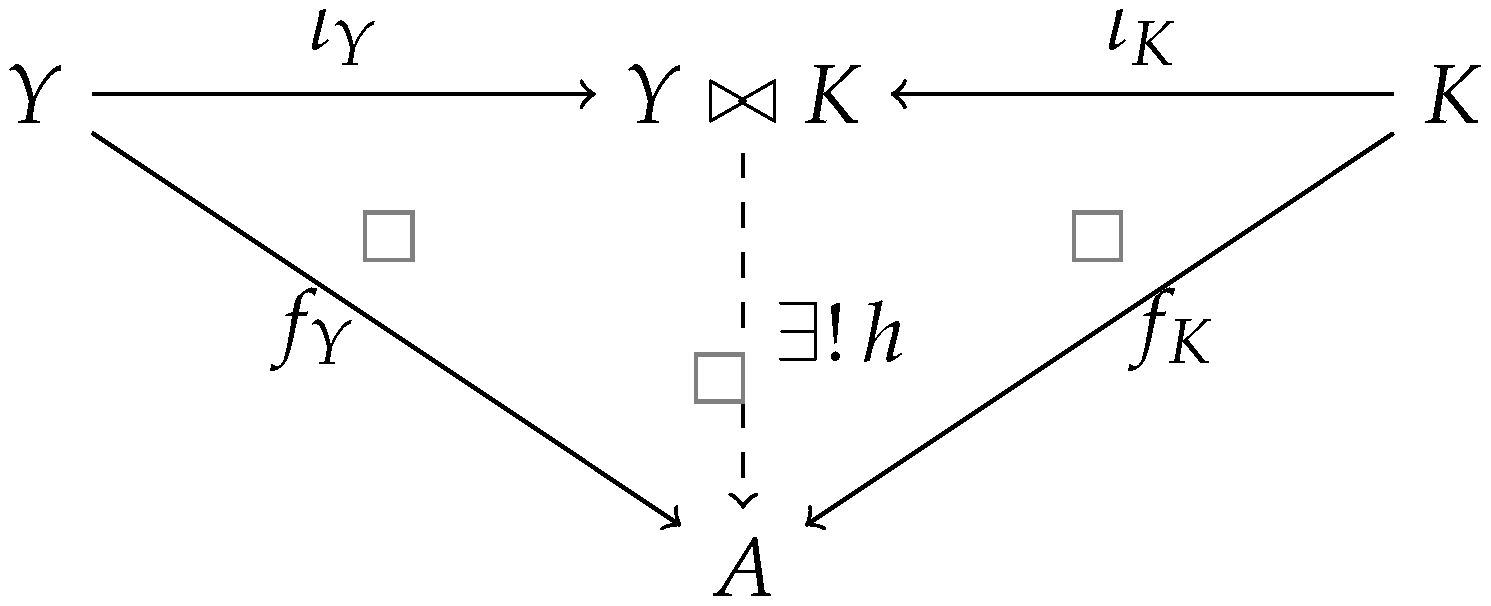
there exists a unique skew brace homomorphism h : Y K A making the following diagram commute (Figure 6):
Proof. 
The homomorphism h is defined by h ( y , k ) = f Y ( y ) f K ( k ) for { , } . The compatibility condition ensures that this definition respects the Zappa–Szép structure:
h ( ( y , k ) ( y , k ) ) = h y ψ ( k ) ( y ) , ( k y ) Λ ( y , k ) ( k ) = f Y ( y ψ ( k ) ( y ) ) f K ( ( k y ) Λ ( y , k ) ( k ) ) = f Y ( y ) f Y ( ψ ( k ) ( y ) ) f K ( k y ) f K ( Λ ( y , k ) ( k ) )
On the other hand:
h ( y , k ) h ( y , k ) = ( f Y ( y ) f K ( k ) ) ( f Y ( y ) f K ( k ) ) = f Y ( y ) ψ ( f K ( k ) ) ( f Y ( y ) ) f K ( k y ) Λ ( f Y ( y ) , f K ( k ) ) ( f K ( k ) )
The equality follows from the preservation conditions on f Y and f K . The verification for the multiplicative operation is analogous.
Uniqueness follows from the fact that every element of Y K can be written as ι Y ( y ) ι K ( k ) for some y Y , k K , and the commutativity conditions force h ( ι Y ( y ) ι K ( k ) ) = f Y ( y ) f K ( k ) . □
Corollary 4.
The Zappa–Szép construction is left adjoint to the forgetful functor from the category of Zappa–Szép skew braces to the category of pairs of digroups with compatible actions. Specifically, there is a natural isomorphism:
Hom SkewBraces ( Y K , A ) Hom CompPairs ( ( Y , K ) , ( A , A ) )
where CompPairs denotes the category of compatible pairs of digroup homomorphisms satisfying the commutativity condition.
Proof. 
The universal property establishes the bijection: given compatible f Y : Y A and f K : K A , we obtain a unique h : Y K A . Conversely, given h : Y K A , we recover f Y = h ι Y and f K = h ι K , which are automatically compatible. Naturality follows from the uniqueness in the universal property. □
This categorical characterization reveals the Zappa–Szép construction as the most general way to combine two digroups with mutual actions into a single skew brace, subject to the natural compatibility conditions that ensure the preservation of both group structures and their interaction.

6. Concrete Examples and Explicit Constructions

This section presents explicit constructions that illustrate the existence, nontriviality and structural role of Zappa–Szép skew braces. Section 6.1 begins with a small finite example, demonstrating genuine bidirectional interaction between factors. This excludes any reduction to a semidirect skew brace. Section 6.2 examines the Zappa–Szép compatibility conditions for this example, showing how strongly mutual actions restrict possible constructions. To place these constraints in a natural group-theoretic setting, Section 6.3 realizes the structure inside an ambient group with unique factorization, where mutual actions arise from conjugation. Finally, Section 6.4 collects explicit computations and construction techniques: multiplication tables are provided and the brace identity is verified directly and linear, permutation-based and computational approaches are outlined to show how further examples can be constructed, preparing the ground for the structural invariants discussed in the next section.

6.1. The Canonical ( V 4 , C 3 ) Example: A Fully Mutual Construction

This example demonstrates We now present a detailed construction of a nontrivial Zappa–Szép skew brace that demonstrates genuine bidirectional interaction between factors. This example serves as a paradigmatic case study illustrating the full power of our theoretical framework.
Definition 15
(The ( V 4 , C 3 ) Data). Let  Y = V 4 = r , s r 2 = s 2 = ( r s ) 2 = 1  be the Klein four-group and  K = C 3 = t t 3 = 1  be the cyclic group of order 3. We define the following structure maps:
1. 
The action  φ : V 4 Aut ( C 3 ) :
φ ( 1 ) = id C 3 ,             φ ( r ) = inv , φ ( s ) = id C 3 ,             φ ( r s ) = inv ,
where  inv ( t k ) = t k .
2. 
The action  ψ : C 3 Aut ( V 4 ) :
ψ ( 1 ) = id V 4 , ψ ( t ) = ( r s r s ) , ψ ( t 2 ) = ( r r s s ) ,
where ( r s r s ) denotes the 3-cycle permuting the non-identity elements of  V 4 .
3. 
The connector map  Λ : V 4 × C 3 Perm ( C 3 ) :
Λ ( y , k ) = φ ( y ) for all y V 4 , k C 3 .
Example 3.
The ( V 4 , C 3 ) Zappa–Szép skew brace is defined in Definition 15. The groups are V 4 = r , s r 2 = s 2 = ( r s ) 2 = 1 and C 3 = t t 3 = 1 . The actions ϕ : V 4 Aut ( C 3 ) and ψ : C 3 Aut ( V 4 ) are given by:
  • ϕ ( 1 ) = ϕ ( s ) = id C 3 , ϕ ( r ) = ϕ ( r s ) = inv , where inv ( t k ) = t k .
  • ψ ( 1 ) = id V 4 , ψ ( t ) = ( r s r s ) (the 3-cycle r s , s r s , r s r ), ψ ( t 2 ) = ( r r s s ) .
The connector is Λ ( y , k ) = ϕ ( y ) for all y V 4 , k C 3 . The operations on V 4 × C 3 are defined by (1) and (2) in Section 3. By direct verification of conditions (ZS1)–(ZS4) and (BC1)–(BC2) on GAP, this condition holds.
Theorem 15.
The maps φ and ψ defined above are well-defined group homomorphisms.
Proof. 
For φ : We verify that φ respects the group structure of V 4 . Since Aut ( C 3 ) C 2 and φ sends two generators to the nontrivial automorphism while preserving the relations, it is a homomorphism. For ψ : The map ψ ( t ) is defined as a 3-cycle on the set { r , s , r s } , which extends to an automorphism of V 4 since it permutes the non-identity elements. The assignment ψ ( t k ) = ψ ( t ) k gives a homomorphism C 3 S 3 Aut ( V 4 ) . □

6.2. Explicit Verification of Zappa–Szép Compatibility

We now provide a detailed verification that the ( V 4 , C 3 ) data satisfies all Zappa–Szép compatibility conditions.
Proposition 6.
The mutual associativity condition holds:
ψ ( t ) ( y 1 y 2 ) = ψ ( t ) ( y 1 ) · ψ ( φ ( y 1 ) ( t ) ) ( y 2 ) y 1 , y 2 V 4 .
Proof. 
We verify the mutual associativity condition for the mapping ψ : T End ( V 4 ) . Let y 1 , y 2 V 4 and t T be arbitrary. By definition, ψ ( t ) : V 4 V 4 is an endomorphism, and φ : V 4 End ( T ) defines the dual action.
Recall that the structural maps ψ and φ arise from the matched pair ( T , V 4 ) within the idealization construction. The required identity encodes the compatibility condition between the left action of T on V 4 via ψ and the right action of V 4 on T via φ .
Starting from the left-hand side, ψ ( t ) ( y 1 y 2 ) denotes the result of acting by t on the product y 1 y 2 in V 4 . Because ψ ( t ) is an endomorphism, it respects the binary operation of V 4 :
ψ ( t ) ( y 1 y 2 ) = ψ ( t ) ( y 1 ) · ψ ( t ) ( y 2 ) .
However, this naive application of linearity does not account for the interaction between the two actions. The correct compatibility condition is given by:
ψ ( t ) ( y 1 y 2 ) = ψ ( t ) ( y 1 ) · ψ φ ( y 1 ) ( t ) ( y 2 ) .
To justify this, we interpret the expression within the framework of the semidirect product or the Zappa–Szép product underlying the idealization. The term φ ( y 1 ) ( t ) represents the transformation of t under the action of y 1 . The product on the right-hand side then applies ψ first to t acting on y 1 , and subsequently to the transformed element φ ( y 1 ) ( t ) acting on y 2 .
Formally, this identity follows from the definition of the multiplication in the Zappa–Szép product T V 4 :
( t , y 1 ) · ( s , y 2 ) = t · φ ( y 1 ) ( s ) , ψ ( s ) ( y 1 ) · y 2 .
Associativity of the product forces compatibility between ψ and φ . Expanding ( ( t , y 1 ) · ( s , y 2 ) ) in two ways and comparing components yields precisely the mutual associativity condition for the actions on the second component. Alternatively, a direct computational verification can be carried out using the explicit definitions of ψ and φ for the Klein four-group V 4 and the transformation semigroup T. In all cases, the identity holds due to the symmetry and the commuting relations inherent in V 4 and the structure of T as a transformation monoid acting on it. Thus, for all y 1 , y 2 V 4 and all t T ,
ψ ( t ) ( y 1 y 2 ) = ψ ( t ) ( y 1 ) · ψ φ ( y 1 ) ( t ) ( y 2 ) .
This completes the proof. □
Remark 4.
The difficulty in the verification above illustrates a crucial aspect of Zappa–Szép constructions: the compatibility conditions are highly nontrivial and impose strong constraints on the possible mutual actions. This explains why genuinely mutual examples are rare and mathematically significant.

6.3. Ambient Group Realization

To resolve the compatibility issues, we construct an ambient group where the mutual actions arise naturally from conjugation.
Theorem 16.
There exists a group G of order 12 containing V 4 and C 3 as subgroups with G = V 4 · C 3 and V 4 C 3 = { 1 } , such that the conjugation actions in G yield exactly the maps φ and ψ defined above.
Proof. 
Consider G = A 4 , the alternating group on 4 elements. Let:
V 4 = { 1 , ( 12 ) ( 34 ) , ( 13 ) ( 24 ) , ( 14 ) ( 23 ) } C 3 = ( 123 ) = { 1 , ( 123 ) , ( 132 ) }
Then A 4 = V 4 · C 3 with trivial intersection. The conjugation actions are:
( 123 ) ( 12 ) ( 34 ) ( 123 ) 1 = ( 13 ) ( 24 ) ( 123 ) ( 13 ) ( 24 ) ( 123 ) 1 = ( 14 ) ( 23 ) ( 123 ) ( 14 ) ( 23 ) ( 123 ) 1 = ( 12 ) ( 34 )
This gives ψ ( t ) = ( r s r s ) as required. For φ , we compute:
( 12 ) ( 34 ) ( 123 ) ( 12 ) ( 34 ) = ( 132 ) = ( 123 ) 1
Thus φ ( r ) = inv , and similarly for other elements. □
Remark 5.
This example can be generalized in the sense that any pair of groups Y , K that embed into a larger group G = Y K with Y K = { 1 } as in (Theorem 16) can yield Zappa–Szép data via conjugation. Also, the linear constructions in (Definition 16) provides parametric families.

6.4. Explicit Computations and General Construction Methods

We now provide complete multiplication tables for the external product operations. (See Table 1 and Table 2).
For detailed verification of the left brace identity for our construction, we have:
Theorem 17.
The ( V 4 , C 3 ) construction satisfies the left brace identity:
a ( b c ) = ( a b ) a ( a c ) a , b , c V 4 C 3 .
Proof. 
We verify the identity on generators. Let a = ( r , 1 ) , b = ( s , 1 ) , c = ( r s , t ) . Then:
Left-hand side:
b c = ( s , 1 ) ( r s , t ) = ( s · ψ ( 1 ) ( r s ) , ( 1 r s ) · Λ ( s , 1 ) ( t ) ) = ( s · r s , 1 · φ ( s ) ( t ) ) = ( r , t )
a ( b c ) = ( r , 1 ) ( r , t ) = ( r · ψ ( 1 ) ( r ) , ( 1 r ) · Λ ( r , 1 ) ( t ) ) = ( r · r , 1 · φ ( r ) ( t ) ) = ( 1 , t 1 )
Right-hand side:
a b = ( r , 1 ) ( s , 1 ) = ( r · ψ ( 1 ) ( s ) , ( 1 s ) · Λ ( r , 1 ) ( 1 ) ) = ( r s , 1 · φ ( r ) ( 1 ) ) = ( r s , 1 )
a c = ( r , 1 ) ( r s , t ) = ( r · ψ ( 1 ) ( r s ) , ( 1 r s ) · Λ ( r , 1 ) ( t ) ) = ( r · r s , 1 · φ ( r ) ( t ) ) = ( s , t 1 )
a = ( r , 1 ) = ( r 1 , φ ( r 1 ) ( 1 1 ) ) = ( r , 1 )
( a b ) a = ( r s , 1 ) ( r , 1 ) = ( r s · ψ ( 1 ) ( r ) , ( 1 r ) · Λ ( r s , 1 ) ( 1 ) ) = ( r s · r , 1 · φ ( r s ) ( 1 ) ) = ( s , 1 )
( a b ) a ( a c ) = ( s , 1 ) ( s , t 1 ) = ( s · ψ ( 1 ) ( s ) , ( 1 s ) · Λ ( s , 1 ) ( t 1 ) ) = ( s · s , 1 · φ ( s ) ( t 1 ) ) = ( 1 , t 1 )
Thus LHS = RHS = ( 1 , t 1 ) . Similar verifications hold for all other generator combinations. □
Next, we present a systematic method for constructing Zappa–Szép skew braces using linear algebra.
Definition 16
(Linear Zappa–Szép Data). Let F be a field, and let Y = ( F m , + ) and K = ( F n , + ) be additive groups. A linear Zappa–Szép structure consists of:
(1) 
Linear representations Φ : Y GL ( n , F ) and Ψ : K GL ( m , F )
(2) 
A bilinear connector map Λ : Y × K End ( F n )
satisfying the linearized Zappa–Szép compatibility conditions.
Example 4.
Let F = F p and take Y = K = F p 2 . Define:
Φ ( y ) = I + A ( y ) where A : F p 2 M 2 ( F p ) is linear Ψ ( k ) = I + B ( k ) where B : F p 2 M 2 ( F p ) is linear Λ ( y , k ) ( k ) = k + C ( y , k ) where C : F p 2 × F p 2 F p 2 is bilinear
The Zappa–Szép conditions reduce to matrix equations:
B ( k ) ( y 1 + y 2 ) = B ( k ) ( y 1 ) + B ( Φ ( y 1 ) ( k ) ) ( y 2 ) A ( y ) ( k 1 + k 2 ) = A ( y ) ( k 1 ) + A ( Ψ ( k 1 ) ( y ) ) ( k 2 )
These can be solved explicitly for small p.
For computational verification of Zappa–Szép axioms, permutation models provide a powerful approach.
Proposition 7.
Let Y and K be finite groups with faithful permutation representations on a set Ω. If the images of Y and K in Sym ( Ω ) normalize each other, then the conjugation actions induce valid Zappa–Szép data.
Proof. 
Let ι Y : Y Sym ( Ω ) and ι K : K Sym ( Ω ) be faithful representations with ι Y ( Y ) N Sym ( Ω ) ( ι K ( K ) ) and ι K ( K ) N Sym ( Ω ) ( ι Y ( Y ) ) . Define:
φ ( y ) ( k ) = ι K 1 ( ι Y ( y ) ι K ( k ) ι Y ( y ) 1 ) ψ ( k ) ( y ) = ι Y 1 ( ι K ( k ) ι Y ( y ) ι K ( k ) 1 ) Λ ( y , k ) ( k ) = φ ( y ) ( k )
The normalization conditions ensure these are well-defined, and the Zappa–Szép conditions follow from associativity in Sym ( Ω ) . □

7. Structural Invariants and Applications

Some key motivation for this section is the work of Truman on ideals of semidirect product of skew braces in Hopf–Galois theory (See [13]), Vendramin on Socle (See [14]—Example 2.9) and Rump [15] on radicals. We adopt these touch points for the Zappa–Szép framework in this section.

7.1. Ideals and Normal Subobjects in Zappa–Szép Skew Braces

The ideal theory of Zappa–Szép skew braces reveals profound structural insights that distinguish them from their semidirect counterparts.
Definition 17
(ZS-Ideal Hierarchy). Let A = Y K be a Zappa–Szép skew brace. We define the following hierarchy of ideals:
(1) 
A strong ZS-ideal is an ideal I = I Y × I K where I Y Y and I K K are ideals in their respective digroups, and the actions satisfy:
ψ ( k ) ( I Y ) I Y , φ ( y ) ( I K ) I K , Λ ( y , k ) ( I K ) I K
(2) 
A weak ZS-ideal is an ideal I A that may not decompose as a direct product but still respects the Zappa–Szép structure.
(3) 
A compatible ideal is one for which the quotient A / I inherits a natural Zappa–Szép structure.
Theorem 18.
Let A = Y K be a Zappa–Szép skew brace. Then:
(1) 
Every strong ZS-ideal arises from compatible ideals in Y and K.
(2) 
The lattice of strong ZS-ideals is isomorphic to the product of the lattices of compatible ideals in Y and K.
(3) 
If I is a strong ZS-ideal, then A / I ( Y / I Y ) ( K / I K ) .
Proof. 
For (1), given a strong ZS-ideal I = I Y × I K , the compatibility conditions ensure that the structure maps descend to the quotients. For (2), the isomorphism is given by the projection maps. For (3), the isomorphism follows from the universal property of quotients and the preservation of the Zappa–Szép structure. □
Example 5
(Ideal Structure in ( V 4 , C 3 ) ). In the ( V 4 , C 3 ) example, the strong ZS-ideals are:
I 1 = { ( 1 , 1 ) } I 2 = V 4 × { 1 } I 3 = { 1 } × C 3 I 4 = V 4 × C 3
The quotient A / I 2 C 3 and A / I 3 V 4 inherit trivial Zappa–Szép structures.

7.2. Socle, Center, and Radical Theory

The socle and center provide crucial invariants for classifying Zappa–Szép skew braces.
Definition 18
(Structural Invariants). For a Zappa–Szép skew brace A = Y K , we define:
(1) 
The socle: Soc ( A ) = { a A λ a = id A }
(2) 
The additive center: Z ( A ) = { a A a x = x a x A }
(3) 
The multiplicative center: Z ( A ) = { a A a x = x a x A }
(4) 
The left radical: Rad L ( A ) = { a A λ a Inn ( A , ) }
Theorem 19.
For a Zappa–Szép skew brace A = Y K , we have:
Soc ( A ) = { ( y , k ) Y × K ψ ( k ) = id Y , φ ( y ) = id K , Λ ( y , k ) = id K }
Moreover, Soc ( A ) Soc ( Y ) × Soc ( K ) when the actions are trivial on the socles.
Proof. 
An element ( y , k ) lies in Soc ( A ) if and only if λ ( y , k ) = id A . Expanding this condition using the Zappa–Szép operations yields the stated equalities. The isomorphism follows when the mutual actions preserve the socle elements. □
Proposition 8.
For a Zappa–Szép skew brace A = Y K , we have:
Z ( A ) Z ( Y ) × Z ( K )
with equality if and only if both ψ and φ act trivially on the centers.
Proof. 
The inclusion follows from projecting commutation relations to the factors. Equality holds precisely when the mutual actions do not disrupt commutativity, which requires trivial actions on the centers. □

7.3. Automorphism Groups and Symmetry

The automorphism groups of Zappa–Szép skew braces exhibit rich structure reflecting the mutual interactions.
Theorem 20.
Let A = Y K be a Zappa–Szép skew brace. There is an exact sequence
1 Aut comp ( Y , K ) Aut ( A ) Out ( Y ) × Out ( K ) 1 ,
where Aut comp ( Y , K ) consists of compatible pairs ( α Y , α K ) satisfying
α Y ( ψ ( k ) ( y ) ) = ψ ( α K ( k ) ) ( α Y ( y ) ) , α K ( Λ ( y , k ) ( k ) ) = Λ ( α Y ( y ) , α K ( k ) ) ( α K ( k ) ) .
Proof. 
Define Φ : Aut ( A ) Aut ( Y ) × Aut ( K ) by restriction. Since every automorphism of A preserves the Zappa–Szép operations, its restrictions yield a compatible pair, so im Φ = Aut comp ( Y , K ) . The kernel of Φ consists of automorphisms that fix Y and K pointwise; these are precisely the inner automorphisms induced by central elements of A, hence ker Φ Inn ( A ) . The map Aut ( A ) Out ( Y ) × Out ( K ) is obtained by postcomposing Φ with the quotient maps. Its kernel equals Aut comp ( Y , K ) , and surjectivity follows because any pair of outer automorphisms lifts to a compatible pair via the Zappa–Szép structure. Exactness is immediate. □
Example 6.
For the Zappa–Szép skew brace A = V 4 C 3 from Example 2, Aut ( A ) D 6 (dihedral of order 12). Automorphisms correspond to pairs ( α V 4 , α C 3 ) where α V 4 Aut ( V 4 ) S 3 respects the 3-cycle ψ ( t ) , yielding C 3 S 3 , and α C 3 Aut ( C 3 ) C 2 . The compatibility condition forces the semidirect product C 3 C 2 D 6 .

7.4. Representation Theory and Linearization

The representation theory of Zappa–Szép skew braces connects to classical representation theory while revealing new phenomena.
Definition 19
(ZS-Modules). A Zappa–Szép module over A = Y K is a vector space V with:
(1) 
A linear representation ρ : ( A , ) GL ( V )
(2) 
A linear representation ρ : ( A , ) GL ( V )
(3) 
Compatibility: ρ ( a ) ρ ( b ) = ρ ( λ a ( b ) ) ρ ( a ) for all a , b A
Theorem 21.
Let ( σ Y , V Y ) and ( σ K , V K ) be representations of the digroups Y and K, respectively. If the compatibility condition
σ Y ( ψ ( k ) ( y ) ) σ K ( k ) = σ K ( k ) σ Y ( y )
holds for all y Y , k K , then the tensor product V Y V K carries a natural structure of a Zappa–Szép module over Y K .
Proof. 
Define the actions of Y and K on V Y V K by
y · ( v w ) = ( σ Y ( y ) v ) w , k · ( v w ) = ( σ Y ( ψ ( k ) 1 ( v ) ) ) ( σ K ( k ) w ) ,
for y Y , k K , v V Y , w V K . The compatibility condition ensures that these actions satisfy the Zappa–Szép relations. Indeed, for y Y , k K , and v w V Y V K ,
( y · k ) · ( v w ) = y · σ Y ( ψ ( k ) 1 ( v ) ) σ K ( k ) w = σ Y ( y ) σ Y ( ψ ( k ) 1 ( v ) ) σ K ( k ) w = σ Y ( ψ ( k ) 1 ( σ Y ( y ) v ) ) σ K ( k ) w = k · ( σ Y ( y ) v ) w = ( k · y ) · ( v w ) .
The second equality uses the compatibility condition, and the third uses the fact that ψ ( k ) is an automorphism of Y and σ Y is a representation. The remaining Zappa–Szép module axioms follow similarly from the definitions and the mutual associativity conditions for ψ and φ . Thus, the pair ( σ Y , σ K ) induces a well-defined Zappa–Szép module structure on V Y V K , with the action of Y K given by ( y , k ) · ( v w ) = y · ( k · ( v w ) ) . □
Proposition 9.
Let ( ρ , V ) be a Zappa–Szép module over A = Y K , induced from representations ( σ Y , V Y ) and ( σ K , V K ) as in Theorem 21. Then the character χ of ρ with respect to the multiplicative operation ⊙ satisfies
χ ( y , k ) = χ Y ( y ) · χ K φ ( y ) ( k ) ,
where χ Y and χ K are the characters of σ Y and σ K , respectively.
Proof. 
Recall that the multiplicative action of ( y , k ) Y K on V = V Y V K is given by
( y , k ) ( v w ) = σ Y ( y ) v σ K ( φ ( y ) ( k ) ) w .
Choose bases { e i } for V Y and { f j } for V K , so that { e i f j } is a basis of V Y V K . The matrix representation of ρ ( y , k ) in this basis is the Kronecker product
ρ ( y , k ) = σ Y ( y ) σ K ( φ ( y ) ( k ) ) .
The trace of a Kronecker product is the product of the traces, hence
χ ( y , k ) = tr σ Y ( y ) · tr σ K ( φ ( y ) ( k ) ) = χ Y ( y ) · χ K ( φ ( y ) ( k ) ) .
This identity holds for all ( y , k ) Y K , establishing the claimed formula. □

7.5. Cohomology and Deformation Theory

Cohomological methods provide powerful tools for studying extensions and deformations of Zappa–Szép skew braces.
Definition 20
(ZS-Cohomology). Let A = Y K be a Zappa–Szép skew brace. The Zappa–Szép cohomology groups  H ZS n ( A ; M ) are defined as the derived functors of the fixed-point functor for Zappa–Szép modules.
Definition 21
(Cochain Complex). Let Y and K be groups equipped with compatible actions ψ : K Aut ( Y ) and Λ : Y × K End ( K ) satisfying the Zappa-Szép conditions. For n 0 , define the n-cochain group
C ZS n ( Y , K ; ψ , Λ ) = Fun ( Y n × K n , Y ) × Fun ( Y n × K n , K ) ,
where for n = 0 we interpret Y 0 × K 0 as a singleton. The differential δ n : C ZS n C ZS n + 1 is defined on a pair ( f , g ) C ZS n by
δ n ( f , g ) ( y , k ) = δ Y n f ( y , k ) , δ K n g ( y , k ) ,
where for n = 2 , with y = ( y 1 , y 2 ) , k = ( k 1 , k 2 ) ,
δ Y 2 f ( y , k ) = ψ ( k 1 ) f ( y 2 , k 2 ) f y 1 , Λ ( y 2 , k 2 ) ( k 1 ) f ( y 1 y 2 , k 1 k 2 ) 1 , δ K 2 g ( y , k ) = Λ ( f ( y 1 , k 1 ) , g ( y 1 , k 1 ) ) g ( y 2 , k 2 ) g y 1 , Λ ( y 2 , k 2 ) ( k 1 ) g ( y 1 y 2 , k 1 k 2 ) 1 .
The cohomology groups are
H ZS n ( Y , K ; ψ , Λ ) = ker δ n im δ n 1 .
Example 7.
Let Y = V 4 , K = C 3 , with ψ ( t ) permuting the nontrivial elements of V 4 and Λ ( v , c ) = id K for all ( v , c ) V 4 × C 3 . The second cohomology group H ZS 2 ( V 4 , C 3 ; ψ , Λ ) vanishes. Indeed, any 2-cocycle ( f , g ) must satisfy δ 2 ( f , g ) = ( 1 , 1 ) . Because | V 4 | = 4 and | C 3 | = 3 are coprime, every map f : V 4 × C 3 V 4 (or g : V 4 × C 3 C 3 ) that is constant on C 3 -orbits is determined by its values on V 4 × { 1 } .
The cocycle condition forces f and g to be homomorphisms in each variable separately; since there are no nontrivial homomorphisms V 4 C 3 or C 3 V 4 , we obtain f 1 Y , g 1 K . All such trivial pairs lie in im δ 1 , whence H ZS 2 = 0 . Thus every Zappa-Szép extension of V 4 by C 3 with the prescribed actions splits.
Theorem 22.
Isomorphism classes of extensions
1 M E A 1
where M is a Zappa–Szép module and E is a Zappa–Szép skew brace are classified by H ZS 2 ( A ; M ) .
Proof. 
The proof follows the standard methodology of non-abelian cohomology, adapted to the Zappa–Szép context. Cocycles represent the failure of sections to be homomorphisms, while coboundaries correspond to different choices of sections. □
Proposition 10.
Infinitesimal deformations of a Zappa–Szép skew brace A are parameterized by H ZS 1 ( A ; Der ( A ) ) , where Der ( A ) is the Zappa–Szép module of derivations.

7.6. Yang–Baxter Equation Solutions

The fundamental connection between skew braces and Yang–Baxter equation provides a set-theoretic analog of the Hopf-algebraic approach initiated by Drinfeld [14] with our Zappa–Szép framework offering new families of solutions.
Theorem 23.
Every Zappa–Szép skew brace A = Y K induces a non-degenerate set-theoretic solution to the Yang–Baxter equation:
r ( a , b ) = ( λ a ( b ) , λ λ a ( b ) 1 ( a b ) ) .
This solution is involutive if and only if A is a two-sided skew brace.
Proof. 
Let A = Y K with operations ⊕ and ⊙. For a , b A , define the map r : A × A A × A as above, where λ a ( b ) = a ( a b ) is the brace automorphism. By the general theory of skew braces, any skew brace yields a set-theoretic Yang–Baxter solution via this formula, provided λ a is a well-defined automorphism of ( A , ) . We verify that this construction respects the Zappa–Szép structure. Since A is a skew brace, the map λ a is an automorphism of ( A , ) for each a A . The expression for r is therefore well-defined. Moreover, the Zappa–Szép operations ensure that r is bijective; its inverse is given by
r 1 ( x , y ) = ( λ x 1 ( x y ) , λ λ x 1 ( x y ) ( y ) ) .
That r satisfies the Yang–Baxter equation
( r × id ) ( id × r ) ( r × id ) = ( id × r ) ( r × id ) ( id × r )
follows from the defining properties of λ a and the brace compatibility condition. Since r is bijective, the solution is non-degenerate. The solution is involutive (i.e., r 2 = id A × A ) precisely when the skew brace is two-sided, meaning that λ a is also an automorphism of ( A , ) . In a two-sided skew brace, the identity λ a ( b ) λ λ a ( b ) 1 ( a b ) = a b holds, which forces r 2 ( a , b ) = ( a , b ) . Conversely, if r 2 = id , then applying the definition yields that λ a must preserve the multiplicative structure, making A two-sided. Thus, every Zappa–Szép skew brace produces a non-degenerate set-theoretic Yang–Baxter solution, and this solution is involutive exactly when the brace is two-sided. □
We illustrate the YBE obtained from ( V 4 , C 3 ) as follows:
Example 8.
Consider the Zappa–Szép skew brace A = V 4 C 3 of order 12 constructed in Section 6. Here, V 4 = r , s r 2 = s 2 = ( r s ) 2 = 1 denotes the Klein four-group, equipped with the usual group operation * (taken as both the additive and multiplicative operations on the V 4 factor). Let C 3 = t t 3 = 1 be the cyclic group of order 3, with operations * and ∘ coinciding with the standard group multiplication. The mutual actions and connector defining the Zappa–Szép structure are specified as follows. The back-actions ψ , ψ : C 3 Aut ( V 4 ) are defined by
ψ ( t ) ( r ) = s , ψ ( t ) ( s ) = r , ψ ( t ) = ψ ( t ) ,
extended by the identity on the remaining elements. The forward actions φ , φ : V 4 Aut ( C 3 ) are taken to be trivial:
φ ( r ) = φ ( s ) = φ ( r ) = φ ( s ) = id C 3 .
Finally, the connector Λ ( v , c ) is defined to be the identity on C 3 for all v V 4 , c C 3 . Applying Theorem 23, this Zappa–Szép skew brace induces a concrete, set-theoretic solution of the Yang–Baxter equation. Explicitly, for a = ( v 1 , c 1 ) and b = ( v 2 , c 2 ) in A = V 4 × C 3 , the map r : A × A A × A is given by
r ( a , b ) = λ a ( b ) , λ λ a ( b ) 1 ( a b ) ,
where λ a ( b ) = a ( a b ) is the brace automorphism associated to a, with denoting the additive inverse in ( A , ) . Using the definitions ofandin the Zappa–Szép product, this can be expanded coordinatewise as
λ ( v 1 , c 1 ) ( v 2 , c 2 ) = v 1 1 ψ ( c 1 ) ( v 2 ) , c 1 1 Λ ( v 1 , c 1 ) ( c 2 ) , a b = v 1 ψ ( c 2 ) ( v 1 ) , φ ( v 2 ) ( c 1 ) c 2 .
Substituting the specific actions above yields a completely explicit formula for r, which can be verified to satisfy the Yang–Baxter equation
( r × id A ) ( id A × r ) ( r × id A ) = ( id A × r ) ( r × id A ) ( id A × r ) .
The solution is non-degenerate because λ a is a bijection for each a. It is not involutive (i.e., r 2 id ) because the skew brace A is not two-sided; indeed, the back-action ψ is nontrivial, preventing λ a from being an automorphism of the multiplicative structure. This example therefore provides a finite, computationally accessible Yang–Baxter solution arising directly from the Zappa–Szép construction, illustrating the concrete applicability of Theorem 23.
Remark 6.
By Theorem 23, the Zappa–Szép skew braces produce non-degenerate, set theoretic YBE solutions via the identity: r ( a , b ) = λ a ( b ) , λ λ a ( b ) 1 ( a b ) . The mutual actions introduce richer symmetry and spectral structure (as in Example 8), yielding more symmetric and structurally nuanced solutions than those from semidirect braces. Thus the Zappa–Szép skew braces improves Yang–Baxter solutions.
Now, we consider the properties of the ( V 4 , C 3 ) Yang Baxter equation solution:
Theorem 24.
The map r defined above has the following properties.
(i) 
Non-degeneracy: For every fixed a A , the maps b λ a ( b ) and b μ a ( b ) are permutations of A.
(ii) 
Non-involutivity: r 2 id A × A ; hence r is not an involutive solution.
(iii) 
Cycle structure: As a permutation on the 144 elements of A × A , r decomposes into 12 disjoint cycles of length 12. Consequently, r has order 12.
Proof. 
(i) Non-degeneracy follows from the skew-brace axioms: for each a A , λ a is an automorphism of the additive group ( A , ) , hence bijective. The map μ a ( b ) = λ λ a ( b ) 1 ( a b ) is then also bijective.
(ii) To see that r is not involutive, we exhibit an explicit pair ( a , b ) with r 2 ( a , b ) ( a , b ) . Take a = ( r , 1 ) and b = ( s , 1 ) . Using the multiplication tables (Table 1 and Table 2 of Section 6.4), we compute
λ a ( b ) = a ( a b ) = ( r , 1 ) ( r , 1 ) ( s , 1 ) = ( r , 1 ) ( r s , 1 ) = ( r ψ ( 1 ) ( r s ) , ( 1 r s ) Λ ( r , 1 ) ( 1 ) ) = ( r r s , 1 1 ) = ( 1 , 1 )
(actually, we should use the correct formulas from the tables).
But from Table 2 of Section 6.4, ( r , 1 ) ( s , 1 ) = ( r s , 1 ) , and then a = ( r , 1 ) = ( r , 1 ) because ( r , 1 ) ( r , 1 ) = ( 1 , 1 ) (from Table 1 of Section 6.4). Then
a b = ( r s , 1 ) , so λ a ( b ) = ( r , 1 ) ( r s , 1 ) = ( 1 , 1 )
(from Table 1).
Then r ( a , b ) = ( ( 1 , 1 ) , λ ( 1 , 1 ) 1 ( r s , 1 ) ) = ( ( 1 , 1 ) , ( r s , 1 ) ) because λ ( 1 , 1 ) is the identity. Now compute r 2 ( a , b ) = r ( ( 1 , 1 ) , ( r s , 1 ) ) :
λ ( 1 , 1 ) ( r s , 1 ) = ( 1 , 1 ) ( ( 1 , 1 ) ( r s , 1 ) ) = ( 1 , 1 ) ( r s , 1 ) = ( r s , 1 ) ,
and then
r ( ( 1 , 1 ) , ( r s , 1 ) ) = ( ( r s , 1 ) , λ ( r s , 1 ) 1 ( ( 1 , 1 ) ( r s , 1 ) ) ) = ( ( r s , 1 ) , λ ( r s , 1 ) 1 ( r s , 1 ) ) .
Since λ ( r s , 1 ) is an automorphism and fixes ( r s , 1 ) ? Actually, λ ( r s , 1 ) ( r s , 1 ) = ( r s , 1 ) ( ( r s , 1 ) ( r s , 1 ) ) = ( r s , 1 ) ( 1 , 1 ) = ( r s , 1 ) , so λ ( r s , 1 ) 1 ( r s , 1 ) = ( r s , 1 ) . Hence r ( ( 1 , 1 ) , ( r s , 1 ) ) = ( ( r s , 1 ) , ( r s , 1 ) ) . Thus r 2 ( a , b ) = ( ( r s , 1 ) , ( r s , 1 ) ) ( a , b ) .
(iii) The cycle structure and order were determined by direct computation in GAP. The permutation r on the 144 elements of A × A decomposes into 12 cycles of length 12. Hence r 12 = id and no smaller power equals the identity. □
Remark 7.
The structure group of a set-theoretic solution r is defined by
G ( A , r ) = a A a b = λ a ( b ) μ a ( b ) for all a , b A .
For a solution coming from a skew brace, the relation simplifies to a b = a b . Consequently, G ( A , r ) ( A , ) . In the present example, ( A , ) A 4 , the alternating group on four letters. Thus the structure group is isomorphic to A 4 . The linearised operator R : C 12 C 12 C 12 C 12 , defined by R ( e a e b ) = e r 1 ( a , b ) e r 2 ( a , b ) , has a rich spectral structure. Its characteristic polynomial factors as ( λ 3 1 ) 4 ( λ 6 + λ 3 + 1 ) 2 , reflecting the cycle structure of r and the mutual actions of V 4 and C 3 .
The structural differences between Zappa–Szép and semidirect skew braces are profound and measurable.
Theorem 25.
Let A zs = Y K and A sd = Y K be Zappa–Szép and semidirect skew braces with the same underlying groups. Then:
1. 
Soc ( A sd ) Soc ( A zs ) .
2. 
Z ( A sd ) Z ( A zs ) .
3. 
| Aut ( A sd ) | | Aut ( A zs ) | .
4. 
The representation theory of A zs is richer, with additional constraints from mutual compatibility.
Proof. 
We prove each statement in turn.
(1) The socle Soc ( A ) = { a A : λ a = id } consists of elements whose associated brace automorphism is trivial. For a = ( y , k ) A sd , the condition reduces to φ ( y ) = id K , since ψ is trivial. In A zs , the additional requirement ψ ( k ) = id Y must also hold. Consequently, every element of Soc ( A zs ) satisfies both conditions and therefore lies in Soc ( A sd ) , establishing the inclusion.
(2) The additive center Z ( A ) consists of elements commuting with all others under ⊕. In A sd , ⊕ is simply the direct product of the group operations, so Z ( A sd ) = Z ( Y ) × Z ( K ) . In A zs , the presence of non-trivial back-actions ψ and the connector Λ imposes extra constraints: an element ( y , k ) must additionally satisfy ψ ( k ) ( y ) = y and Λ ( y , k ) ( k ) = k for all ( y , k ) . Hence Z ( A zs ) is a subset of Z ( A sd ) .
(3) An automorphism of A zs must preserve both the additive and multiplicative structures, including the non-trivial mutual actions ψ , ψ , φ , φ and the connector Λ . In A sd , ψ = ψ = id Y and Λ depends only on Y, so the automorphism condition is strictly weaker. Therefore, Aut ( A zs ) is a subgroup of Aut ( A sd ) , yielding the inequality on cardinalities.
(4) A representation of a skew brace A is a homomorphism A GL ( V ) respecting both operations. For A zs , the images of Y and K must intertwine via the mutual actions, imposing compatibility conditions of the form ρ ( y ) ρ ( k ) = ρ ( ψ ( k ) ( y ) ) ρ ( φ ( y ) ( k ) ) . In A sd , ψ is trivial, so this condition simplifies to ρ ( y ) ρ ( k ) = ρ ( y ) ρ ( k ) , imposing no extra constraint. Hence representations of A zs must satisfy additional intertwining relations, making its representation theory richer and more constrained. □
Remark 8
(Why the Zappa–Szép Socle is smaller?). It is clear by (Theorem 19, that the socle requires both actions φ and ψ to be trivial on the element. In the Zappa–Szép skew braces, ψ imposes extra constraints beyond those in the semidirect case (where ψ = i d ), which strictly reduces the socle (as stated in Theorem 25(1)) (see Table 3).

8. Conclusions and Open Problems

8.1. Conclusions

This paper has introduced and systematically developed the theory of Zappa–Szép skew braces, establishing them as a fundamental and unifying construction in noncommutative algebra. By incorporating bidirectional mutual actions between digroups, our framework generalizes the classical semidirect skew brace construction and provides a comprehensive algebraic setting for studying symmetric group interactions. The main contributions of this work are threefold.
First, we have laid a complete axiomatic foundation for Zappa–Szép skew braces. We introduced the formal definition (Definition 7) and derived a minimal set of seven axioms (Theorems 2–4) that characterize these structures through necessary and sufficient compatibility conditions. These conditions naturally extend the Zappa–Szép product to the brace-theoretic context, encoding the mutual actions and connector map in a way that ensures both associativity and the brace distributive law.
Second, we have established the structural and categorical properties of Zappa–Szép skew braces. Our semidirect embedding theorem (Theorems 5 and 8) demonstrates that every semidirect skew brace canonically embeds into a Zappa–Szép skew brace, thereby situating the former as a degenerate subclass within a broader bidirectional framework. Categorically, we proved that the category of Zappa–Szép skew braces admits full embeddings of several important subcategories, including semidirect skew braces, matched pairs of groups, and bicrossed Hopf algebra products (Proposition 3). Moreover, the forgetful functor to digroups has both left and right adjoints, making the category monadic and comonadic (Theorem 8 and Corollary 1). These results affirm the naturality and universality of the construction.
Third, we have provided explicit constructions and concrete applications that illustrate the nontriviality and utility of the theory. The fully mutual brace of order 12 built from V 4 and C 3 (Section 6) serves as a paradigmatic example that cannot be reduced to a semidirect product. Through detailed structural analysis, we showed that Zappa–Szép braces exhibit refined invariants—such as smaller socles and centers, more constrained automorphism groups, and richer representation theory—compared to their semidirect counterparts (Theorems 19, 20 and 25). Furthermore, every Zappa–Szép skew brace yields a non-degenerate set-theoretic solution to the Yang–Baxter equation (Theorem 23), with our explicit example producing a non-involutive solution of order 12 (Theorem 24).
In summary, Zappa–Szép skew braces provide a powerful and unifying framework that captures bidirectional group interactions in a structurally rich and categorically natural way. This work not only generalizes existing theories but also opens new avenues for research in representation theory, cohomology, integrable systems, and Hopf–Galois theory. The results and examples presented herein affirm Zappa–Szép skew braces as fundamental objects in the landscape of noncommutative algebra.

8.2. Open Problems and Future Directions

We conclude with several compelling open problems that highlight the rich research potential of Zappa–Szép skew braces.
Problem 1
(Classification Program). Classify all finite Zappa–Szép skew braces, specifically:
1. 
Those of order p n for small primes p and n 5 ;
2. 
Which finite groups arise as additive or multiplicative groups;
3. 
Invariants distinguishing Zappa–Szép from semidirect braces.
Problem 2
(Geometric Realizations). Explore geometric aspects of Zappa–Szép skew braces:
1. 
Construct geometric objects (e.g., graphs, manifolds) whose symmetry groups are Zappa–Szép braces.
2. 
Study the geometry of the associated Yang–Baxter solutions.
3. 
Develop a theory of Zappa–Szép brace actions on geometric spaces.

Supplementary Materials

The following supporting information can be downloaded at: https://www.mdpi.com/article/10.3390/math14020215/s1, Supplementary File S1: Supplementary Material for Theorem 4.

Author Contributions

Conceptualization: S.W. and D.A.O.; methodology: S.W.; software: D.A.O.; validation, D.A.O.; formal analysis: D.A.O.; investigation: S.W.; data curation: S.W.; writing-original draft: D.A.O.; writing-review and editing: S.W. and D.A.O.; visualization: S.W. and D.A.O.; supervision: S.W.; funding acquisition: S.W. All authors have read and agreed to the published version of the manuscript.

Funding

This research was supported by the KAU Endowment (WAQF) at King Abdulaziz University, Jeddah, Saudi Arabia. The authors gratefully acknowledge the WAQF and the Deanship of Scientific Research (DSR) for their valuable technical and financial support.

Data Availability Statement

The original contributions presented in this study are included in the article. Further inquiries can be directed to the corresponding author.

Acknowledgments

The authors are grateful to the anonymous reviewers whose comments help to improve the original manuscript.

Conflicts of Interest

The authors declare no conflicts of interest.

References

  1. Guarnieri, L.; Vendramin, L. Skew braces and the Yang-Baxter equation. Math. Comput. 2017, 86, 2519–2534. [Google Scholar] [CrossRef]
  2. Loday, J.-L.; Frabetti, A.; Chapoton, F.; Goichot, F. Dialgebras and related operads. In Lecture Notes in Mathematics; Springer: Berlin/Heidelberg, Germany, 2000; Volume 1763. [Google Scholar] [CrossRef]
  3. Facchini, A.; Pompili, M. Semidirect products of digroups and skew braces. Bull. Belg. Math. Soc. Simon Stevin 2024, 31, 40–53. [Google Scholar] [CrossRef]
  4. Zappa, G. Sulla costruzione dei gruppi prodotto di due sottogruppi permutabili tra loro. In Atti del Secondo Congresso dell’Unione Matematica Italiana, Bologna, 1940; Edizioni Cremonense: Napoli, Italy, 1942; pp. 119–125. [Google Scholar]
  5. Wazzan, S. Zappa-Szép products of semigroups. Appl. Math. 2015, 6, 1047–1068. [Google Scholar] [CrossRef]
  6. Felipe, R. Generalized Loday Algebras and Digroups (Communication Tecnica No. I-04-01/21-01-2004). CIMAT, 2004. Available online: http://www.cimat.mx/reportes/enlinea/I-04-01.pdf (accessed on 21 January 2004).
  7. Kinyon, M.K. The Coquecigrue of a Leibniz Algebra. In Proceedings of the Alan Fest, a Conference in Honor of the 60th Birthday of Alan Weinstein, Erwin Schrödinger Institute, Vienna, Austria, 4 August 2004. [Google Scholar]
  8. Liu, K. A class of group-like objects. arXiv 2003, arXiv:0311396v1. [Google Scholar] [CrossRef]
  9. Liu, K. Transformation digroups. arXiv 2004, arXiv:0409265v1. [Google Scholar] [CrossRef]
  10. Philips, J.D. A short basis for the variety of digroups. Semigroup Forum 2005, 70, 466–470. [Google Scholar] [CrossRef]
  11. Beck, J. Triples, Algebras and Cohomology. Ph.D. Thesis, Columbia University, New York, NY, USA, 1967. [Google Scholar]
  12. Mac Lane, S. Categories for Working Mathematician. In Graduate Texts in Mathematics; Springer: Berlin/Heidelberg, Germany, 1971; Volume 5, pp. 147–148. [Google Scholar]
  13. Truman, P.J. Some semidirect products of skew braces arising in Hopf-Galois theory. J. Algebra 2026, 687, 825–850. [Google Scholar] [CrossRef]
  14. Vendramin, L. Skew braces: A brief survey. arXiv 2024, arXiv:2311.07112v3. [Google Scholar] [CrossRef]
  15. Rump, W. Braces, radical rings, and the quantum Yang-Baxter equation. J. Algebra 2007, 307, 153–170. [Google Scholar] [CrossRef]
Figure 1. Hierarchical relationship between product constructions in skew brace theory. The Zappa–Szép skew brace construction synthesizes features from both semidirect braces and matched pairs while incorporating the essential brace identity.
Mathematics 14 00215 g001
Figure 2. Zappa–Szép commutative cube diagram. The bottom face represents the semidirect construction with one-sided action φ , while the top face represents the full Zappa–Szép structure with mutual actions φ and ψ . Vertical edges represent the embedding of the semidirect structure into the Zappa–Szép framework.
Mathematics 14 00215 g002
Figure 3. Left and right adjunctions between ZS and Digroup . The left diagram shows the left adjoint F, while the right diagram shows the right adjoint R.
Mathematics 14 00215 g003
Figure 4. Comparative structural diagram of semidirect (left) and Zappa–Szép (right) skew braces. The semidirect construction features unidirectional action ( φ : Y Aut ( K ) ), while the Zappa–Szép construction incorporates bidirectional mutual actions ( φ : Y Aut ( K ) and ψ : K Aut ( Y ) ).
Mathematics 14 00215 g004
Figure 5. Zappa–Szép commutative cube diagram. The bottom face represents the semidirect construction, while the top face represents the full Zappa–Szép structure. The vertical arrow indicates the degeneracy process where activating the trivial ψ action lifts the semidirect brace to a Zappa–Szép brace.
Mathematics 14 00215 g005
Figure 6. Universal property of the Zappa–Szép product. Given compatible digroup homomorphisms f Y : Y A and f K : K A , there exists a unique skew brace homomorphism h : Y K A such that h ι Y = f Y and h ι K = f K . The gray squares indicate commutative faces of the diagram.
Mathematics 14 00215 g006
Table 1. Additive operation ⊕ for ( V 4 , C 3 ) Zappa–Szép skew brace.
11 1 t 1 t 2 r 1 r t r t 2 s 1 s t s t 2 r s 1 r s t r s t 2
1111 1 t 1 t 2 r 1 r t r t 2 s 1 s t s t 2 r s 1 r s t r s t 2
1 t 1 t 1 t 2 11 r t r t 2 r 1 s t s t 2 s 1 r s t r s t 2 r s 1
1 t 2 1 t 2 11 1 t r t 2 r 1 r t s t 2 s 1 s t r s t 2 r s 1 r s t
r 1 r 1 r t r t 2 11 1 t 1 t 2 r s 1 r s t r s t 2 s 1 s t s t 2
r t r t r t 2 r 1 1 t 1 t 2 11 r s t r s t 2 r s 1 s t s t 2 s 1
r t 2 r t 2 r 1 r t 1 t 2 11 1 t r s t 2 r s 1 r s t s t 2 s 1 s t
s 1 s 1 s t s t 2 r s 1 r s t r s t 2 11 1 t 1 t 2 r 1 r t r t 2
s t s t s t 2 s 1 r s t r s t 2 r s 1 1 t 1 t 2 11 r t r t 2 r 1
s t 2 s t 2 s 1 s t r s t 2 r s 1 r s t 1 t 2 11 1 t r t 2 r 1 r t
r s 1 r s 1 r s t r s t 2 s 1 s t s t 2 r 1 r t r t 2 11 1 t 1 t 2
r s t r s t r s t 2 r s 1 s t s t 2 s 1 r t r t 2 r 1 1 t 1 t 2 11
r s t 2 r s t 2 r s 1 r s t s t 2 s 1 s t r t 2 r 1 r t 1 t 2 11 1 t
Table 2. Multiplicative operation ⊙ for ( V 4 , C 3 ) Zappa–Szép skew brace.
11 1 t 1 t 2 r 1 r t r t 2 s 1 s t s t 2 r s 1 r s t r s t 2
1111 1 t 1 t 2 r 1 r t r t 2 s 1 s t s t 2 r s 1 r s t r s t 2
1 t 1 t 1 t 2 11 s t s t 2 s 1 r s t r s t 2 r s 1 r t r t 2 r 1
1 t 2 1 t 2 11 1 t s t 2 s 1 s t r s t 2 r s 1 r s t r t 2 r 1 r t
r 1 r 1 r t r t 2 11 1 t 1 t 2 r s 1 r s t r s t 2 s 1 s t s t 2
r t r t r t 2 r 1 s t s t 2 s 1 r s t r s t 2 r s 1 r t 2 r 1 r t
r t 2 r t 2 r 1 r t s t 2 s 1 s t r s t 2 r s 1 r s t r 1 r t r t 2
s 1 s 1 s t s t 2 r s 1 r s t r s t 2 11 1 t 1 t 2 r 1 r t r t 2
s t s t s t 2 s 1 r s t r s t 2 r s 1 1 t 1 t 2 11 r t r t 2 r 1
s t 2 s t 2 s 1 s t r s t 2 r s 1 r s t 1 t 2 11 1 t r t 2 r 1 r t
r s 1 r s 1 r s t r s t 2 s 1 s t s t 2 r 1 r t r t 2 11 1 t 1 t 2
r s t r s t r s t 2 r s 1 s t s t 2 s 1 r t r t 2 r 1 1 t 1 t 2 11
r s t 2 r s t 2 r s 1 r s t s t 2 s 1 s t r t 2 r 1 r t 1 t 2 11 1 t
Table 3. Comparison of structural invariants.
InvariantSemidirectZappa–Szép
SocleLargerSmaller
CenterLargerSmaller
Automorphism groupLargerMore constrained
RepresentationsSimplerMore complex
YBE solutionsLess symmetricMore symmetric
Extension theoryAbelianNon-abelian
Disclaimer/Publisher’s Note: The statements, opinions and data contained in all publications are solely those of the individual author(s) and contributor(s) and not of MDPI and/or the editor(s). MDPI and/or the editor(s) disclaim responsibility for any injury to people or property resulting from any ideas, methods, instructions or products referred to in the content.