1. Introduction
The growth of digital art galleries, virtual museums, and multimedia collections has made image aesthetic assessment (IAA) an important problem in computer vision and multimedia analysis [
1,
2,
3]. Reliable aesthetic assessment can support art curation, image retrieval, content moderation, and personalized recommendation [
4,
5,
6,
7,
8,
9,
10]. Early methods relied on handcrafted cues, including color harmony, spatial layout, edge complexity, and photographic composition rules [
11,
12,
13]. Subsequent work adopted data-driven neural models trained on large photographic datasets such as AVA and AADB [
14,
15]. Representative systems such as NIMA further modeled the distribution of human opinion scores rather than predicting only a single mean value, highlighting the inherently subjective nature of aesthetic judgment [
16].
Models developed for ordinary photographs do not necessarily transfer well to fine art. Artistic image aesthetics assessment (AIAA) must consider style, brushwork, material, historical context, and formal organization, whereas generic feature extractors often emphasize photographic realism or object content [
17,
18,
19]. The limited availability of fine-grained, expert-annotated artwork datasets further constrains the development and evaluation of specialized methods [
20].
Multimodal large language models (MLLMs) and Large Vision-Language Models (LVLMs) provide a new basis for high-level visual analysis. Architectures such as BLIP-2 connect pretrained visual encoders with large language models [
21], while visual instruction tuning enables models such as LLaVA to follow open-ended image-language instructions [
22]. These advances motivate the use of off-the-shelf LVLMs for zero-shot aesthetic scoring and critique generation [
23].
Recent work has also explored teaching LMMs to express subjective visual judgments through text-defined rating levels instead of unconstrained numerical regression [
24]. This approach improves score alignment but does not explicitly encode the art-historical criteria needed for style-sensitive critique. In fine-art settings, direct LVLM prompting can still produce generic praise, unstable scores, or descriptions dominated by object recognition [
25]. We refer to the misapplication of photographic or cross-style standards as
aesthetic misinterpretation. For example, a model may penalize visible Pointillist brushstrokes as noise or interpret the unpainted space in an ink-wash composition as missing detail.
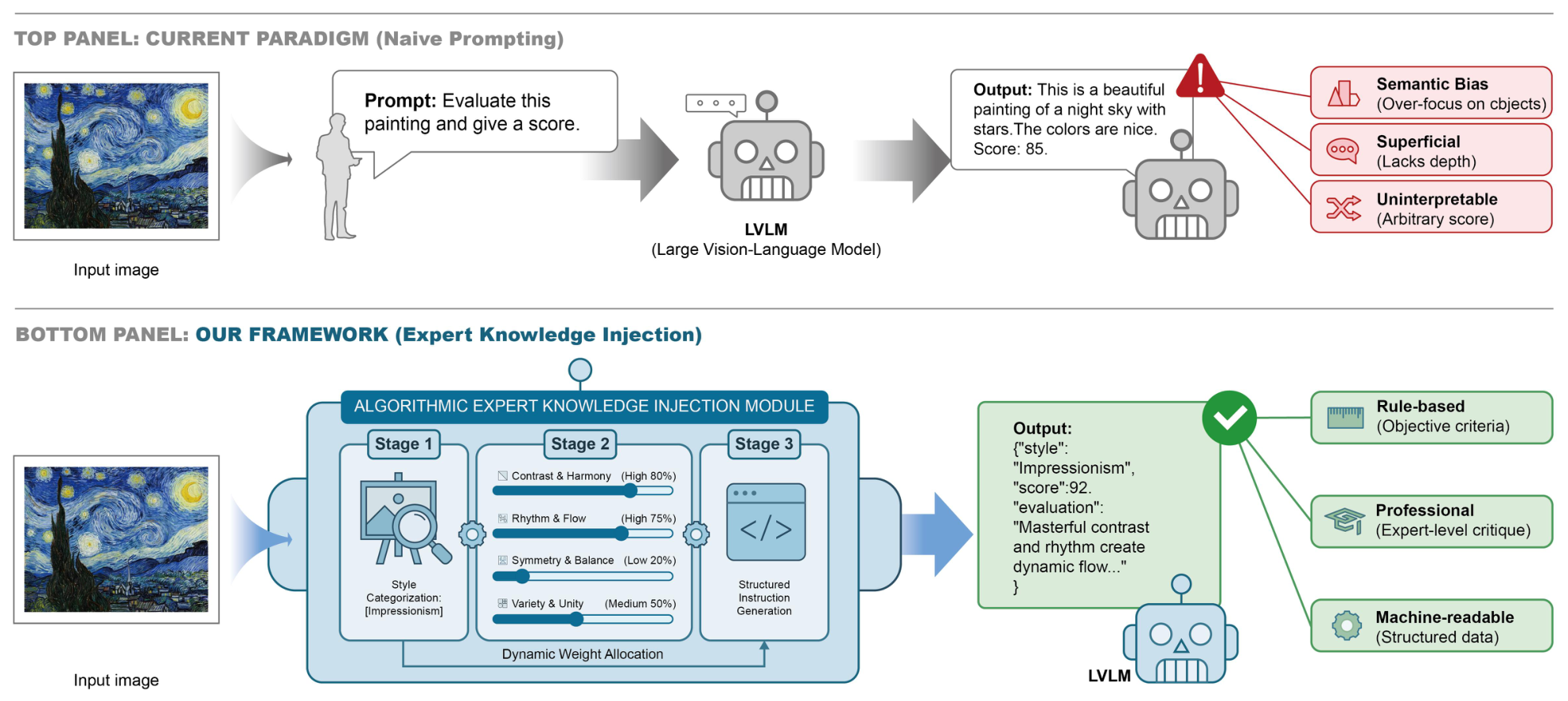
Figure 1 illustrates this gap between semantic description and formal-aesthetic analysis.
To address this gap, we treat prompt construction as a rule-based expert knowledge layer rather than ad hoc text manipulation. The proposed AEKI Framework translates four formal-art dimensions-Contrast & Harmony, Rhythm & Flow, Symmetry & Balance, and Variety & Unity-into sequential, machine-executable instructions [
26,
27].
Because artistic traditions prioritize these dimensions differently, AEKI uses a dynamic weighting mechanism rather than a universal rubric. As shown in the bottom panel of
Figure 1, Stage 1 anchors the media category and style, Stage 2 retrieves a corresponding expert-weight vector, and Stage 3 compiles these variables into a structured instruction. The LVLM then produces a numerical score and a principle-based critique in a machine-readable JSON format.
This design converts heuristic prompt generation into a structured and interpretable multimedia pipeline. We evaluate it using a multi-category painting collection, human-reference annotations, and quantitative and qualitative comparisons with zero-shot LVLM baselines [
28].
In summary, the main contributions of this paper are fundamentally threefold:
Structured aesthetic evaluation: We combine LVLM reasoning with explicit formal art principles to reduce semantic bias and cross-style aesthetic misinterpretation.
Transparent expert knowledge injection: We define a reproducible weight matrix for 16 artistic categories and compile the selected style prior and weights into structured instructions.
Multi-model evaluation: We compare four LVLM backbones using human-reference scoring, ablation analysis, qualitative cases, and output-format compliance.
2. Proposed Method
This section presents the architecture, mathematical formulation, and inference pipeline of the Aesthetic Expert Knowledge Injection (AEKI) Framework. Directly prompting an LVLM for fine-art evaluation can produce unconstrained outputs dominated by semantic description. AEKI instead uses a deterministic template for prompt construction, making the requested evaluation criteria explicit, measurable, and machine-interpretable while leaving the LVLM generation process stochastic.
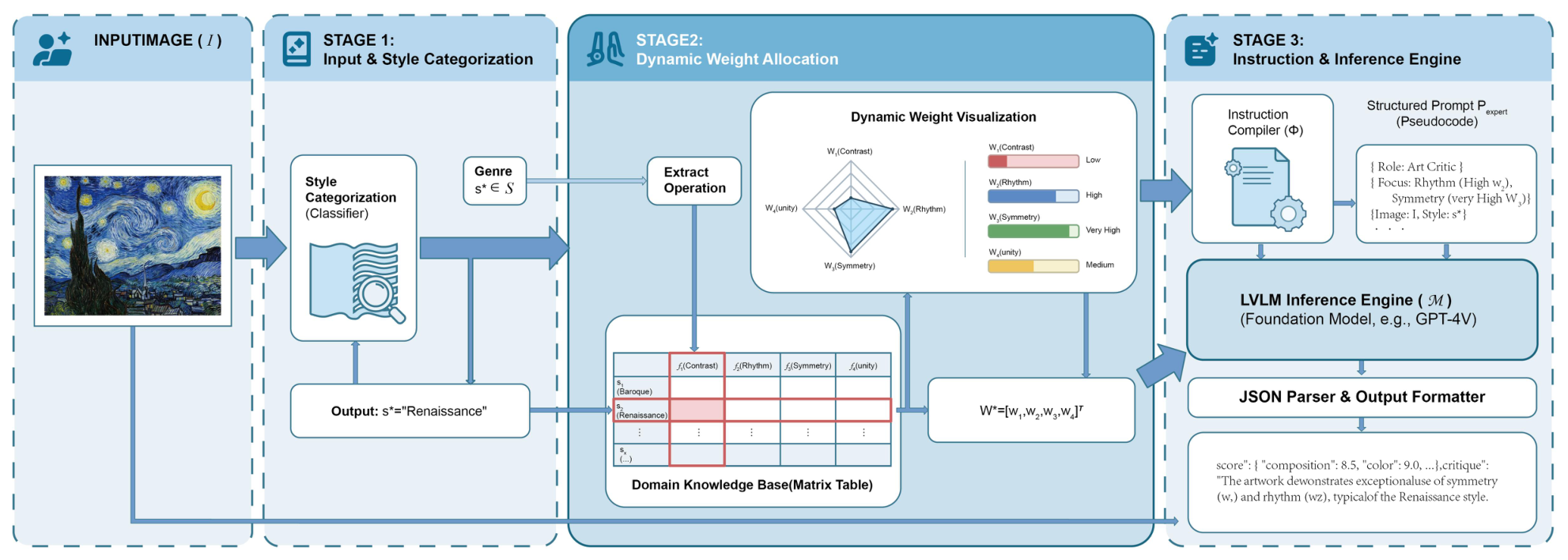
As illustrated in
Figure 2, AEKI acts as an intermediate layer between the artwork and the LVLM. The pipeline contains three stages:
Style Categorization,
Dynamic Weight Allocation of Formal Beauty Principles, and
Structured Instruction Generation. Rather than applying one universal template, the framework selects criteria according to the inferred medium and style. Each stage progressively specifies the evidence that the model should examine, encouraging analysis of formal structure instead of object enumeration alone.
2.1. Problem Formulation and System Abstract
To provide a rigorous analytical foundation for our AEKI Framework, we first formally define the aesthetic evaluation task mathematically. Let denote the input visual media (e.g., a digitized fine art painting) with height H, width W, and C color channels. Let represent the off-the-shelf multimodal Large Vision-Language Model serving as the foundational reasoning engine.
In a conventional, naive zero-shot paradigm (as illustrated in the top panel of
Figure 1), the aesthetic evaluation
is generated by simply feeding the image and a static, generic prompt
into the model:
Due to the unconstrained nature of
,
frequently devolves into a superficial description of the image content. Conversely, our framework constructs a highly complex, dynamically assembled expert instruction, denoted as
.
We define as a predefined set of K distinct artistic styles and genres (e.g., Renaissance, Impressionism, Cubism, Traditional Chinese Painting). Furthermore, we establish a core formal aesthetic vector , representing four selected formal beauty principles: (Contrast & Harmony), (Rhythm & Flow), (Symmetry & Balance), and (Variety & Unity).
Our system first predicts the target style
of the input image
I. Subsequently, we introduce a style-dependent weight mapping function
, which structurally assigns a specific attention weight vector
prioritized for the detected style
:
By orchestrating these dynamically allocated weights, our framework compiles the structured prompt
via an algorithmic template generator
. Finally, the explicit knowledge-injected evaluation output
is computed as:
To support downstream compatibility and interpretability, the final output
is constrained to a standardized, machine-readable JSON structure.
2.2. Stage 1: Contextual Style and Genre Categorization
The premise of the Aesthetic Expert Knowledge Injection (AEKI) framework is that visual art evaluation criteria are heterogeneous and context-dependent. Unlike blind Image Quality Assessment (IQA), which typically uses low-level physical criteria such as exposure, sensor noise, sharpness, and photometric balance, fine art does not follow a single aesthetic rubric. A feature treated as a flaw in one movement may be intentional in another. For instance, the symmetry and linear perspective associated with Renaissance Classicism are deliberately reconfigured in Cubism and de-emphasized in Abstract Expressionism. A static evaluation template can therefore create cognitive misalignment when applied across artistic domains. The first operational unit of the pipeline addresses this issue through a contextual style anchoring module.
The objective of this stage is to identify the semantic, material, and historical context of the input image I before aesthetic scoring. We define a taxonomic space containing artistic media and stylistic categories. The taxonomy covers material media (e.g., oil painting, watercolor, traditional Chinese ink, and digital illustration) and stylistic movements (e.g., Impressionism, Post-Impressionism, Fauvism, Realism, and Surrealism). Mapping an artwork to one of these anchors reduces the risk of applying inappropriate cross-domain criteria, such as penalizing a Pointillist painting for its visible, disconnected brushstrokes.
Stage 1 is implemented at the model interface rather than by directly accessing an LVLM’s internal visual encoder, text embeddings, or logits. This distinction is important for proprietary APIs, which do not expose these representations. A fixed zero-shot classification prompt
presents the same 16 candidate labels to each evaluated model and requests one label together with a confidence value
. For model
m, the operational mapping is
where
validates the returned label against
. The same prompt-and-parse procedure is used for GPT-4o, Gemini-1.5-Pro, Qwen-VL-Max, and LLaVA-1.5; only the model-specific API or inference wrapper differs. Thus, the equations describe observable input-output behavior and do not assume access to hidden model states.
The unified inference procedure is: (1) submit I and to the selected LVLM; (2) parse the style label and confidence; (3) if the output is invalid or , mark the image as uncertain and use the neutral vector ; otherwise retrieve the row of indexed by ; (4) compile the evaluation prompt; and (5) request the four sub-scores and critique, then compute the overall score in post-processing. The present experiments did not separately record the fallback trigger rate, so the reported results should not be interpreted as an empirical evaluation of uncertainty handling.
Once the discrete categorical anchor is resolved, it is retained as a Semantic Prior for Stage 2, where the Formal Beauty Principles are mapped and weighted according to the selected context.
2.3. Stage 2: Dynamic Weight Allocation of Formal Beauty Principles
Once the semantic prior (i.e., the target stylistic genre) is successfully anchored in Stage 1, the computational pipeline immediately transitions to translating this discrete categorical anchor into a continuous, multidimensional evaluation metric. Human expert art critics do not evaluate a painting as an undifferentiated whole; rather, they intuitively decompose visual stimuli into foundational structural components. To computationally replicate this rigorous analytical framework, our system maps the abstract concept of “aesthetics” into a quantifiable formal feature space . However, statically applying uniform evaluation criteria across all artistic styles fundamentally contradicts the evolutionary history of visual art. Therefore, the core innovation of Stage 2 lies in the formulation of an Algorithmic Expert Knowledge Injection mechanism that dynamically allocates attention weights to distinct aesthetic principles based on the anchored style .
2.3.1. Deconstruction of the Formal Beauty Space
Grounded in visual art theory and Gestalt principles, we organize the evaluation into four complementary formal beauty principles [
29]. We define the feature set as
, where each dimension specifies a distinct focus of analysis:
: Contrast and Harmony: This principle dictates the evaluation of luminance gradients, color wheel oppositions, and chiaroscuro (light–dark transitions). It instructs the model to scrutinize how complementary colors (e.g., warm vermilion against cool ultramarine) create visual tension, and how overall tonal harmony resolves this tension into a cohesive palette [
30].
: Rhythm and Flow: This dimension governs the temporal perception of static spatial images. It directs the foundation model to analyze the kinetic energy of brushstrokes (e.g., impasto textures), the directional flow of leading lines, and the geometric repetition of motifs that actively guide the viewer’s focal trajectory across the canvas.
: Symmetry and Balance: As a foundational spatial metric, this principle evaluates the distribution of visual weight. It differentiates between rigid axial symmetry (often signifying solemnity or classical divinity) and complex asymmetrical balance (where a small, high-contrast object mathematically balances a massive, low-contrast negative space).
: Variety and Unity: Serving as the holistic Gestalt metric, this dimension measures the delicate structural equilibrium between visual complexity and overarching cohesion. It assesses whether diverse textual and structural elements within the frame are effectively synthesized by a dominating overarching structural schema without collapsing into monotonous repetition.
2.3.2. Expert Knowledge Matrix and Dynamic Mapping Function
A naive, uncalibrated evaluation system would ostensibly assign uniform cognitive attention to all four principles (i.e., a static weight of for each ). Such an approach is mathematically simplistic and phenomenologically flawed. For instance, holding an Action Painting (which overwhelmingly prioritizes dynamic Rhythm) to the same stringent Symmetry standards as a High Renaissance altarpiece would result in a heavily skewed, hallucinated penalty score.
To mitigate this domain bias, we construct an explicit, hand-specified (non-trainable) Expert Knowledge Prior Matrix, denoted as , where corresponds to the complete set of predefined media and stylistic categories in space . Each row k is a fixed heuristic weight combination derived from the formal interpretation of the four principles and encoded as a transparent rule before evaluation, rather than estimated or optimized on the test set.
Let
be the raw, unnormalized expert salience scores associated with style
. We require
for every
i and
for every row
k; these conditions make the normalization well-defined and guarantee bounded non-negative weights. Once the target style
(with corresponding index
) is anchored by Stage 1, the framework retrieves
and applies
normalization to compute
:
By mathematical definition, this allocation satisfies the conservation of constraint attention:
To make the relationship between the expert weights and the four schema-constrained principle scores mathematically explicit, let
denote the score returned for principle
in the
Sub_Scores field. We normalize these already available outputs as
The corresponding expert-weighted formal-beauty aggregation functional is defined as
This linear composite functional follows the standard weighting–aggregation structure used for interpretable composite indices [
31]. It is introduced as a transparent reference aggregation of the four returned sub-scores, rather than as an additional learned predictor or a replacement for the human alignment score (HAS) used in
Section 3. Thus, the mathematical definition clarifies the action of
without altering any reported experimental result.
Table 1 reports the exact operational settings used by the framework. The values encode relative priority rather than empirical effect sizes: larger entries cause the compiler to allocate more analytical emphasis to the associated principle. They were fixed before the evaluation phase and were not tuned against
. For example, the Impressionism row gives the greatest priority to contrast and color harmony, whereas Traditional Chinese Ink Wash emphasizes rhythm and flow. The matrix was specified as a previously author-defined design rather than elicited through a formal multi-expert rating study; therefore, the entries should not be interpreted as empirically validated or uniquely optimal. Publishing all values nevertheless makes the mapping reproducible and allows future studies to replace or calibrate the matrix without retraining the underlying LVLM.
By parameterizing the conceptual art criticism process, this mechanism provides a consistent and interpretable allocation of analytical emphasis. For example, if is predicted as Impressionism, the mapping function retrieves , directing the LVLM to prioritize lighting and color contrast while retaining secondary consideration of rhythm and compositional balance. The generated vector is subsequently passed to Stage 3 as the algebraic basis for generating the natural-language instruction constraints.
2.4. Stage 3: Structured Instruction Compilation and Machine-Readable Output
The preceding stages produce the semantic context and the continuous weight vector . Because LVLMs operate on discrete language tokens rather than direct parameter updates at inference time, Stage 3 translates these variables into text. We define an Instruction Compiler that deterministically maps the expert priors to a structured prompt . This deterministic compilation step does not make the underlying LVLM deterministic; repeated generations can still vary unless model-side decoding controls are fixed.
Unlike conventional prompt engineering, which relies on heuristic “trial-and-error” syntax, our compilation function operates as a template instantiation engine. To reduce the stochastic “aesthetic hallucination” observed in unconstrained LVLM outputs, is dynamically assembled through three complementary linguistic constraints:
- 1.
System Role Projection: The LVLM is instructed to adopt a specific professional role (e.g., “Assume the role of a professional art historian and aesthetic critic”), encouraging terminology appropriate to formal art analysis.
- 2.
Categorical Anchoring: The previously deduced style is explicitly hardcoded into the premise (e.g., “Evaluate this artwork under the strict historical and technical criteria of ”). This structurally prevents the model from attempting to classify the image’s style autonomously, thereby suppressing semantic drift.
- 3.
Attention Vector Translation: The core numerical weights are mapped into categorical linguistic intensifiers. For instance, if a specific principle’s weight (an empirically predefined threshold), the compiler injects a high-priority directive: “Extensively analyze and heavily weight the role of in your final score.” Conversely, if , the compiler issues a suppression directive: “Provide minimal consideration to , as it is not a primary structural objective of this stylistic genre.”
Through this multi-tiered compilation process, the framework generates . When the base LVLM processes I alongside , it is prompted to address the designated formal beauty dimensions rather than relying only on superficial object recognition. The weights guide the requested emphasis but do not directly modify or expose the model’s internal attention mechanism.
Furthermore, a computational aesthetic pipeline is difficult to integrate at scale if its output requires manual parsing. Native LVLMs typically produce unstructured prose, which creates a practical barrier for downstream multimedia systems such as museum database retrieval, algorithmic curation, and personalized recommendation. To improve systemic interoperability, the final component of Stage 3 enforces a structural parsing constraint on the generative output layer.
Within the terminal block of , the LVLM is requested to return the evaluation object in a predefined JSON format without conversational wrappers. The standardized output schema comprises four key-value pairs:
- 1.
“Style_Anchor”: A string replication of to ensure alignment validation.
- 2.
“Sub_Scores”: A nested dictionary containing four independent numerical scores explicitly corresponding to each formal principle .
- 3.
“Overall_Aesthetic_Score”: The final scalar representation , calculated by the deterministic post-processing module from the four model-generated sub-scores and the selected style weights.
- 4.
“Professional_Critique”: A structured, concise string containing the textual aesthetic argument defending the assigned quantitative scores.
Specifically, after the LVLM returns the four sub-scores, the overall aesthetic score is computed outside the generative model as
Thus, the LVLM is responsible for producing the principle-specific evidence, sub-scores, and critique, whereas the program inserts the value of
S into the final JSON object. This separation removes ambiguity from the aggregation step: identical sub-scores and style weights always yield the same overall score.
The weighted sum is adopted as a transparent and easily auditable baseline aggregation rule. It assumes additive contributions among the four principles and does not model possible non-linear interactions, such as one principle compensating for another. We therefore do not claim that Equation (
9) is a psychological model of aesthetic perception; evaluating multiplicative, interaction-based, or fuzzy-integral alternatives remains future work.
The expert-inference mapping in Equation (
3) is implemented with the JSON schema described above, with the overall score inserted by deterministic post-processing.
Together, the three stages provide a structured bridge between unconstrained multimodal generation and machine-readable computational aesthetic assessment.
2.5. Parallel Batch Inference and Aggregation Algorithm
The three-stage inference procedure is separable at the image level: each image reads the same immutable expert matrix
, while style anchoring, weight retrieval, prompt compilation, LVLM inference, and schema validation do not require intermediate results from any other image. The batch therefore admits a task-parallel map–aggregate organization analogous to large-scale independent data processing [
32]. For a batch of
N images, let
collect the normalized sub-score vectors from Equation (
7), and let
collect the corresponding style-dependent weight vectors. The complete vector of transparent reference aggregation scores is
where ⊙ denotes element-wise multiplication and
is a four-dimensional all-ones vector. Algorithm 1 summarizes the implementation without introducing trainable parameters or cross-image dependencies.
| Algorithm 1: Parallel expert-guided batch inference and aggregation. |
Input: images {I_n}_{n=1}ˆN, shared expert matrix M_expert, formal principles F, frozen LVLM M, P workers Output: validated JSON objects {O_n}_{n=1}ˆN and reference scores a
parallel for n = 1, ..., N do 1. Predict the style anchor s_n from I_n. 2. Retrieve and normalize the corresponding row of M_expert to w_n. 3. Compile the structured instruction P_n = Phi(s_n, w_n, F). 4. Run O_n = M(I_n, P_n). 5. Validate the required JSON fields and numerical ranges. 6. Normalize the four returned sub-scores to q_n and set a_n = w_nˆT q_n. end parallel for Aggregate {(O_n, a_n)}_{n=1}ˆN in the original image order. |
For a theoretical cost accounting, let
,
,
,
, and
denote the per-image costs of style anchoring, weight retrieval, prompt compilation, LVLM inference, and validation/aggregation, respectively. The sequential time and the idealized
P-worker time are
where
represents scheduling and result-aggregation overhead. The associated theoretical speedup and parallel efficiency are
These expressions provide a scalability model rather than a measured runtime claim. In particular, they make explicit that synchronization and the serial components bound the achievable speedup, consistent with Amdahl’s classical analysis [
33].
3. Experimental and Analysis
This section evaluates the effectiveness, interpretability, and robustness of AEKI through quantitative, qualitative, ablation, and system-level experiments. The analysis is organized around the following research questions (RQs):
RQ1 (Human–Machine Alignment): How do the aggregate human-alignment scores of AEKI-generated evaluations compare with those of zero-shot baseline LVLMs?
RQ2 (Ablation & Module Efficacy): What is the independent impact of the contextual style anchoring (Stage 1) and the dynamic weight allocation (Stage 2) modules? Can the isolated extraction of formal beauty principles mitigate the semantic bias observed in foundation models?
RQ3 (Qualitative Interpretability): Does the AEKI Framework successfully mitigate “aesthetic hallucination” and produce professional, structurally argued critiques rather than superficial object recognition?
RQ4 (Output-Format Robustness): How does the instruction compiler () affect the valid-JSON parsing rate of the structured output layer (Stage 3)?
RQ5 (Cross-Model Transfer): Are the observed improvements consistent across the evaluated proprietary and open-weights LVLMs?
3.1. Experimental Setup
3.1.1. Dataset Curation: ArtAesthetics-25K
A primary challenge in computational art evaluation is the limited availability of genre-diverse datasets annotated for formal aesthetic principles. We therefore construct a proprietary image collection named ArtAesthetics-25K (AA-25K). It contains 24,879 high-resolution artwork images spanning the categories in the taxonomic space . The collection covers multiple media and historical periods to provide visual diversity across the evaluated categories.
Due to the inherently subjective nature of aesthetic scoring and the high cognitive cost of professional human annotation, evaluating the entire large-scale dataset manually is computationally and practically infeasible. Therefore, we sample an approximately category-balanced expert evaluation subset () consisting of 498 representative images. This subset serves as the human-reference set for our subsequent quantitative and qualitative evaluations.
3.1.2. Stage 1 Classification Evaluation
The three evaluators confirmed one reference category from the predefined 16-category taxonomy for each image in
. The Stage 1 output used in the subsequent AEKI experiments was then compared with these expert-confirmed labels. Of the 498 images, 445 were assigned to the correct category, corresponding to an overall accuracy of
. Category-wise accuracy ranged from
for Abstract Expressionism/Action Painting to
for Renaissance Classicism and Realism (
Table 2). The complete confusion matrix is reported in
Table 3; the remaining errors were concentrated primarily among visually or historically related categories.
3.1.3. Baseline Foundation Models and Inference Configurations
To examine whether AEKI transfers across model families rather than depending on one backbone, we select four LVLMs covering proprietary APIs and an open-weights model:
- 1.
GPT-4o (OpenAI, San Francisco, CA, USA): A proprietary multimodal model used for general visual reasoning, called with the API model identifier gpt-4o.
- 2.
Gemini-1.5-Pro (Google, Mountain View, CA, USA): A proprietary model supporting long-context multimodal analysis, called with the API model identifier gemini-1.5-pro.
- 3.
LLaVA-1.5 (Open Source): An open-weights model that connects a vision encoder with a language model. We used the 7B version with checkpoint liuhaotian/llava-v1.5-7b, running locally through the LLaVA project code with PyTorch and Transformers.
- 4.
Qwen-VL-Max (Alibaba, Hangzhou, China): A proprietary multimodal model with multilingual and zero-shot capabilities, called with the API model identifier qwen-vl-max.
The three online models were accessed through HTTP requests between 1 July and 20 December 2025, without vendor-specific SDKs. The identifiers above are the model aliases used in the request code. The software environment comprised Python 3.10.13, PyTorch 2.1.2, Transformers 4.37.2, NumPy 1.26.4, pandas 2.2.2, Matplotlib 3.8.4 and Requests 2.31.0. Data aggregation used pandas and NumPy, and plotting used Matplotlib.
For each of the four designated models, we execute two distinct inference configurations, yielding a comprehensive experimental matrix:
Baseline (Naive Zero-Shot Prompting): The LVLM is presented with the input image I and a direct, unconstrained prompt (e.g., “Act as an art critic. Score this image’s aesthetics from 0 to 100 and explain why.”). This represents the standard usability and inherent biases of current foundation models.
Ours (AEKI Framework): The LVLM receives the semantic prior , the dynamic formal beauty weight vector , and a structured request for the JSON-formatted response .
3.1.4. Human Evaluation Protocol and Metrics
To quantify the perceived quality of the machine-generated aesthetic outputs, three independent external experts participated in the evaluation. The panel comprised three professors from three universities outside the authors’ institution. Two specialized in Chinese painting and one specialized in oil painting; each had more than 20 years of relevant teaching experience. Each expert independently reviewed all 498 images in and the associated outputs from four models under the Baseline and AEKI settings. Thus, each expert reviewed model–condition outputs and provided two dimension-specific ratings per output, yielding 7968 categorical judgments per expert. The three experts completed their evaluations separately: they did not discuss individual cases, view one another’s ratings, or reconcile scores before all ratings were finalized and submitted for aggregation.
Each image was indexed by a unique case identifier, and all outputs were presented using the same evaluation form, category definitions, and scoring criteria. The evaluation sheet presented all cases in a fixed order rather than using a separately randomized order for each evaluator. Model and condition labels remained visible to ensure that each rating was matched to the correct output; accordingly, the study does not claim full blinding of model identity or Baseline/AEKI condition. These procedural conditions were applied consistently to all three evaluators.
The evaluation captures two complementary dimensions:
- 1.
Score Alignment Dimension (): Does the numerical score accurately reflect the structural and aesthetic integrity of the artwork within its specific stylistic genre?
- 2.
Critique Professionalism Dimension (): Is the textual justification logically sound, free of “hallucinated” object recognition errors, and anchored in professional formal beauty principles (e.g., describing rhythm rather than merely counting distinct objects)?
For both dimensions, we institute a stringent Three-Point Likert Scale ():
The evaluation is accurate, professional, and directly addresses the core aesthetic value of the piece.
The evaluation is acceptable but generic and lacks domain-specific insight.
The evaluation is fundamentally flawed, exhibits severe aesthetic hallucination, or applies the wrong stylistic standards.
Consequently, for each model
under setting
, we compute the average human alignment score (
) for dimension
over the test set
and
evaluators:
where
denotes evaluator
r’s judgment for image
i. Thus, each reported model–condition–dimension value aggregates
expert judgments. The theoretical bounds of this metric are
. Higher
values indicate greater agreement with the expert ratings.
3.2. Quantitative Evaluation of Human-Machine Aesthetic Alignment (RQ1)
To answer RQ1, we systematically compare the human alignment score (HAS) of the four selected Large Vision-Language Models (LVLMs) operating under the naive baseline prompting against those driven by our proposed Aesthetic Expert Knowledge Injection (AEKI) framework. The evaluation is conducted on the 498 images from the expert evaluation subset (
). The results for both the Score Alignment Dimension (
) and the Critique Professionalism Dimension (
) are comprehensively summarized in
Table 4.
As shown in
Table 4, AEKI has higher aggregate HAS values than the corresponding baseline for all four assessed models. Several observations can be drawn from the reported results:
1. Mitigation of Aesthetic Misalignment: Under the Baseline setting, all models exhibit modest or, for LLaVA-1.5, negative agreement scores relative to the human-reference judgments. For instance, LLaVA-1.5 produces a baseline of , indicating that human evaluators predominantly disagreed with its numerical scoring. This is consistent with our hypothesis that unconstrained LVLMs may apply generic evaluation criteria (e.g., penalizing an Impressionist painting for blurriness). With AEKI, LLaVA-1.5’s score alignment increases to (↑0.66). By anchoring the semantic style (Stage 1) and allocating heuristic weights (Stage 2), the framework guides the model toward evaluation within the relevant art-historical context.
2. Elevation of Critique Professionalism: The improvement is more pronounced in the textual domain (). GPT-4o achieves a baseline of ; human evaluators noted that its baseline critiques often focused on object enumeration rather than compositional structure. Under the AEKI constraint, GPT-4o achieves . This high alignment provides evidence that translating the formal beauty space into a structured instruction compiler (Stage 3) can reduce aesthetic misinterpretation and promote more terminology-rich artistic analysis.
3. Reduced Disparity Across Models: GPT-4o outperforms LLaVA-1.5 in the baseline setting, but the performance gap becomes smaller under AEKI. By defining the reasoning trajectory and output schema, the method helps models with lower baseline alignment improve substantially; for example, Qwen-VL-Max increases from to in Critique Professionalism. This comparison suggests that explicit priors can partially compensate for differences in baseline model capability.
Overall, the quantitative results indicate that AEKI contributes more than output formatting alone: its style and weighting constraints are associated with improved alignment between machine-generated evaluations and the human-reference judgments used in this study.
3.3. Ablation Study and Module Efficacy Analysis (RQ2)
To answer RQ2, we conduct an ablation study that separates the core modules of the three-stage pipeline and estimates their individual contributions to aesthetic alignment and critique professionalism.
3.3.1. Ablation Configurations
We define three distinct algorithmic variants of our framework. To maintain consistency, we conduct this architectural ablation using the GPT-4o backbone and evaluate it against the human-reference expert evaluation subset ():
Variant A (w/o Stage 1—Contextual Style Anchoring): Stage 1 is bypassed, so the four formal beauty principles () are evaluated without the semantic style prior .
Variant B (w/o Stage 2—Dynamic Weight Allocation): Stage 1 retains , but the expert weight matrix is disabled and the four principles use uniform weights ().
Full AEKI (Ours): Both contextual style anchoring and dynamic expert weight allocation are enabled.
3.3.2. Impact Analysis and Discussion
The ablation results in
Table 5 show that both Stage 1 and Stage 2 contribute to the observed performance of the full pipeline under the tested GPT-4o setting. They do not establish that the same component effects are necessary for every model or dataset.
The Contribution of Stylistic Anchoring (Stage 1): Comparing Variant A with the Full AEKI pipeline reveals a performance decrease ( changes from to ) when the stylistic context is removed. Without Stage 1, the model tends to apply a “one-size-fits-all” aesthetic criterion, often defaulting to classical realism standards. For example, when evaluating a Cubist or Abstract Expressionist artwork, the absence of can lead the model to penalize structural deconstruction as “anatomically disproportionate” or “distorted.” These results provide evidence that genre context contributes materially to the evaluated aesthetic judgments.
The Contribution of Dynamic Prioritization (Stage 2): The transition from Variant B to the full AEKI design isolates the contribution of the dynamic weight vector . Under Variant B, uniform constraints () allocate equal emphasis to rhythm, color, symmetry, and unity. Stage 2 instead reflects the differing priorities of art-historical contexts; for example, color harmony is emphasized in Impressionist critique, whereas geometric balance is more prominent in Neoclassicism. Activating Stage 2 increases from to and produces more explicitly prioritized textual analysis.
3.4. Qualitative Analysis of Interpretability and Hallucination Mitigation (RQ3)
Quantitative metrics summarize aggregate behavior, but RQ3 requires a qualitative examination of the generated text. We therefore conduct a comparative case study to assess whether AEKI reduces aesthetic misinterpretation, defined here as the application of photographic realism standards to stylized art or the conflation of object recognition with formal aesthetic value.
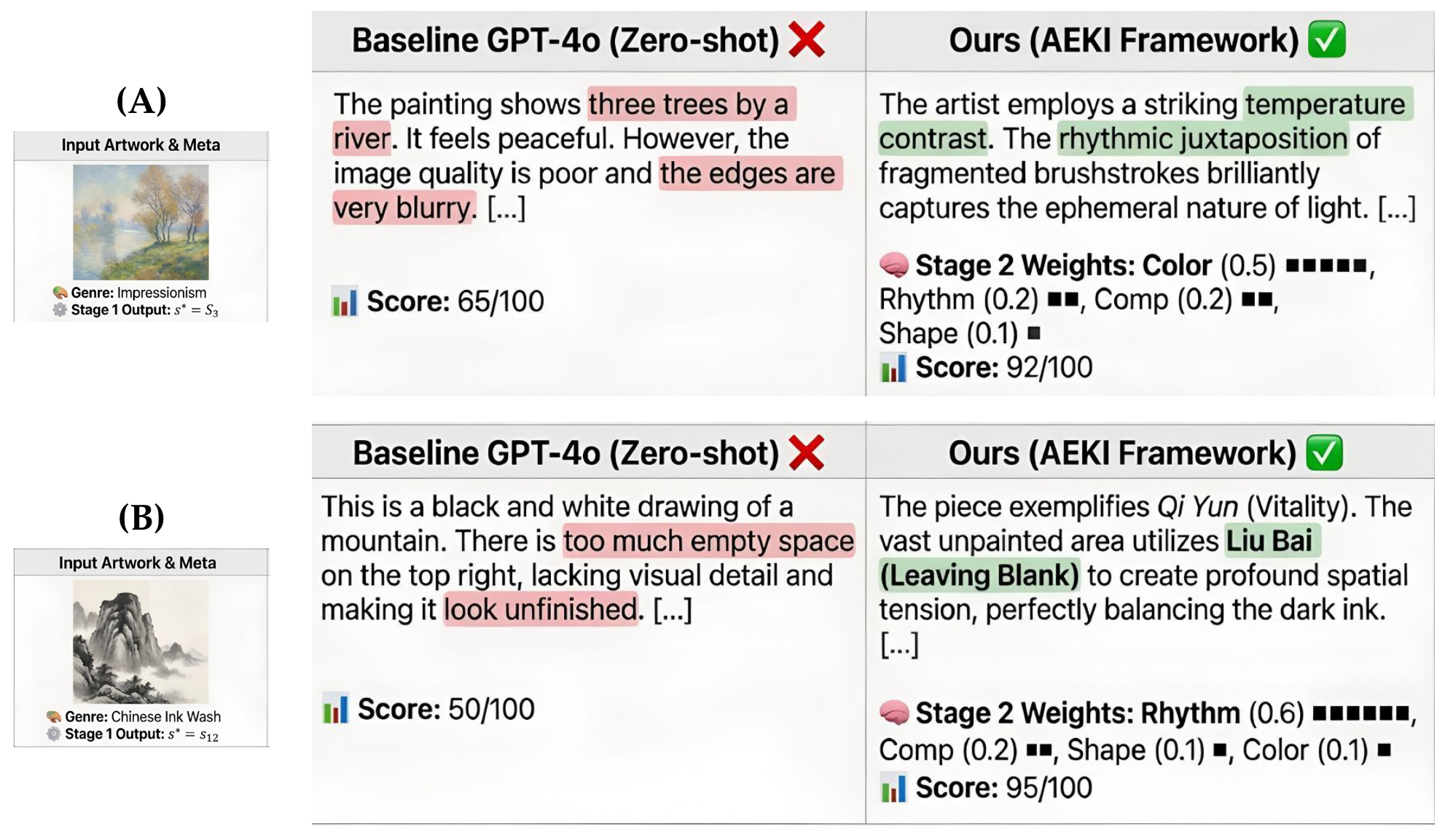
Figure 3 illustrates a representative qualitative comparison utilizing the GPT-4o backbone on two distinct artistic genres: Impressionism and Traditional Chinese Ink Wash Painting.
3.4.1. Overcoming Superficial Semantic Parsing
As depicted in the qualitative examples (
Figure 3), the zero-shot Baseline naturally defaults to a semantic parsing paradigm. When presented with the Impressionist landscape, the Baseline critique allocates over 70% of its token trajectory to object enumeration (e.g., “
I can see three trees, a river, and a small boat in the foreground”). The aesthetic judgment is appended as an afterthought, relying on generic adjectives like “
beautiful” or “
colorful.”
In contrast, the output formulated through AEKI substantially reduces this semantic bias in the illustrated cases. Guided by the explicit JSON execution layer (Stage 3), the model places less emphasis on describing what is in the painting and more emphasis on analyzing how it is expressed. The AEKI critique discusses the “temperature contrast of the palette,” the “rhythmic juxtaposition of short, fragmented brushstrokes,” and the “asymmetrical compositional balance.”
3.4.2. Reducing Aesthetic Misinterpretations
The qualitative results also illustrate a reduction in “aesthetic hallucinations.” Without the contextual style anchoring () from Stage 1, the baseline model can assume the implicit role of a “photographic quality inspector.” For instance, when evaluating the Chinese Ink Wash piece, the baseline penalizes large areas of unpainted paper as “empty space lacking visual detail” and interprets the flowing ink as “blurry edges.”
By injecting the expert weight vector () tailored for traditional East Asian art, where “Rhythm & Vitality” or Qi Yun receives the highest weight, the AEKI-driven model interprets these features as the deliberate technique of “Leaving Blank” (Liu Bai). It identifies the spatial tension and fluidity of the ink using terminology appropriate to the style.
These cases provide evidence for RQ3: principle-guided constraints can reduce generic visual-language reasoning and encourage critiques that are more consistent with domain-specific art terminology. The result should nevertheless be interpreted as mitigation rather than elimination of aesthetic misinterpretation.
3.5. System Robustness and Output-Format Consistency (RQ4)
To address RQ4, we evaluate one engineering property of the AEKI framework: output-format consistency. Generative models can add prose around a requested object or produce malformed fields, which complicates automated parsing. We therefore quantify the proportion of responses that conform to the requested JSON schema. This measure concerns syntactic compliance and should not be interpreted as determinism of the underlying LVLM.
3.5.1. Syntactic Constraint and Format Compliance
Much like how linguistic syntax governs the ways different constituents are combined to form acceptable sentences, Stage 3 acts as a syntactic constraint for machine generation. We define the Formal Formatting Compliance Rate () as the percentage of inferences that produce a valid, parsable, strictly typed JSON string without extraneous conversational tokens.
Let
be the total number of inference attempts, and
be the number of outputs that pass a rigorous structural parsing check. The rate is defined as:
As illustrated in
Table 6, relying on naive baseline prompts (i.e., merely asking the model to “output JSON”) results in frequent formatting failures, especially in open-weights models like LLaVA-1.5 (
). Models tend to add conversational wrappers (e.g., “
Here is the requested JSON...”). In contrast, the instruction compiler yields substantially higher structural consistency across all evaluated models.
3.5.2. Traceability and API Considerations
Beyond structural syntax, the explicit weight vector and the four reported sub-scores make the aggregation path inspectable: a reader can trace how the reported overall score follows from the selected style prior and component scores. This is procedural traceability, not evidence of a causal explanation for the LVLM’s internal reasoning.
The fixed schema also makes response parsing and retry handling more predictable in an API pipeline. However, this study does not report controlled measurements of latency, token usage, rate-limit behavior, or cost, so operational scalability beyond output-format compliance remains to be evaluated.
3.6. Cross-Model Results Across Foundation LVLMs (RQ5)
To address RQ5, we compare the observed effect of AEKI across heterogeneous model families. Prompt-based methods can behave differently across systems because of distinct training and decoding procedures. We therefore examine whether the direction of the observed change is consistent across the four tested backbones, without treating this limited model set as proof of model-agnostic generalization.
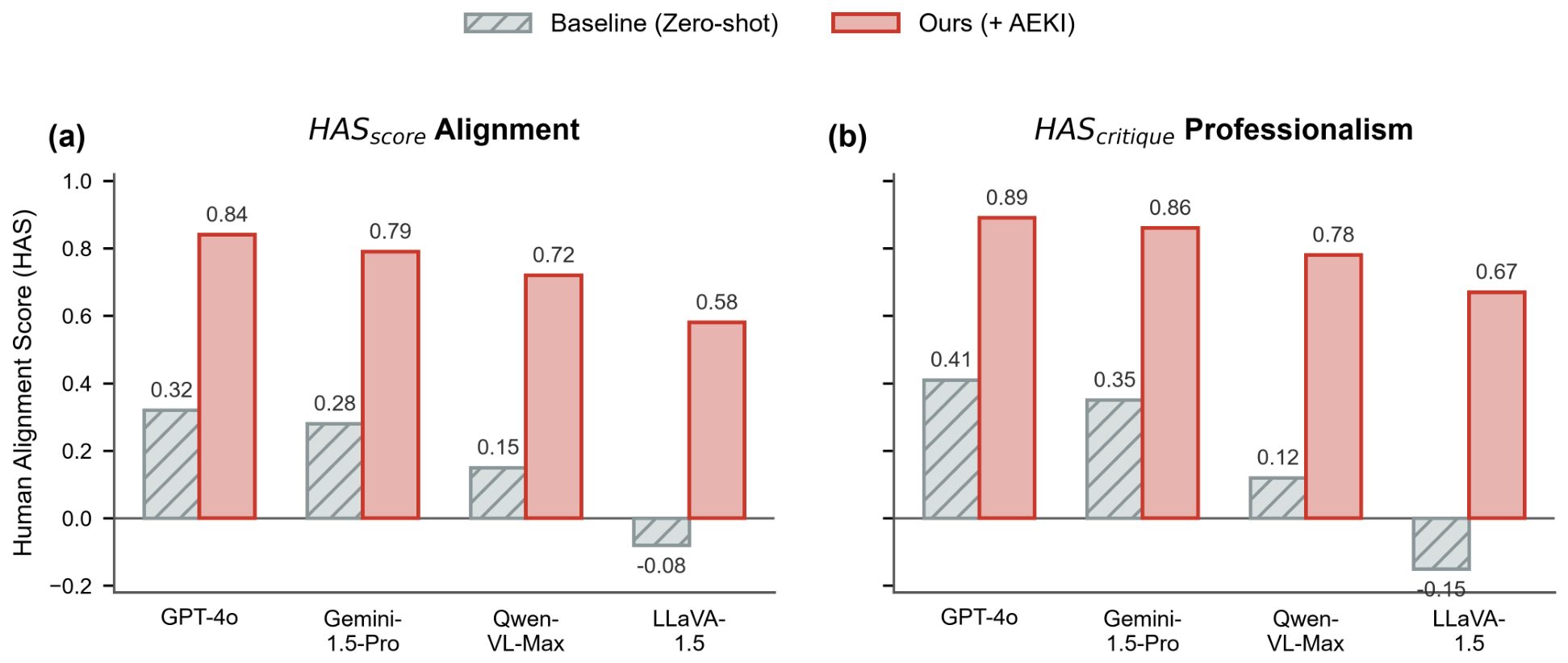
To visualize this cross-architecture pattern,
Figure 4 presents the baseline and AEKI results side by side for the four selected LVLMs, encompassing closed-source APIs (GPT-4o, Gemini-1.5-Pro and Qwen-VL-Max) and an open-weights model (LLaVA-1.5).
3.6.1. Observed Pattern Across the Tested Model Scales
The grouped bars in
Figure 4 show higher AEKI values for both evaluation dimensions across every tested model. For Gemini-1.5-Pro, AEKI is associated with a change in
from
to
. A positive score-alignment difference greater than
is also observed for the other evaluated models, showing a consistent direction within this model set; broader testing is needed before claiming architecture-independent generalization.
3.6.2. Implications for Intermediate-Scale Models
From a computational efficiency perspective, the structured formulation can also support intermediate-scale open-weights models. In the reported experiments, LLaVA-1.5 with AEKI attains human alignment scores that approach or exceed the zero-shot GPT-4o baseline.
This observation suggests that improved aesthetic evaluation does not depend solely on increasing model scale; structurally injecting domain-specific priors ( and ) offers a potentially efficient approach for specialized multimedia evaluation tasks. The results support transfer across the four tested architectures but do not establish universal model independence.
4. Conclusions and Future Work
This paper investigated how Large Vision-Language Models can be guided to evaluate artistic images using explicit, style-sensitive criteria. Although LVLMs provide strong semantic descriptions, they may treat stylized artistic choices as photographic defects or focus on objects rather than formal structure. The proposed Aesthetic Expert Knowledge Injection (AEKI) framework addresses this issue through style anchoring, expert-weight allocation, and structured instruction compilation.
Across the four evaluated proprietary and open-weights backbones, AEKI improved both score alignment and critique professionalism relative to zero-shot prompting. The average increase in exceeded , and formatting compliance was above for several tested models. The ablation results indicate that style anchoring and dynamic weighting make complementary contributions, while the cross-model results suggest that explicit domain priors can benefit models with different architectures and scales.
The main practical contribution is a transparent layer that can be applied without retraining the underlying LVLM. Because the scoring rule and output schema are explicit, the framework is easier to inspect and integrate into automated multimedia pipelines than an unconstrained natural-language prompt.
Several limitations should be considered. First, Stage 1 assigns a discrete style anchor, so classification errors can propagate to the weight matrix and subsequent critique. Hybrid or transitional works may not be adequately represented by a single category. Second, the 16-category taxonomy and hand-specified weights encode a particular formal-art perspective. The matrix was not derived from a multi-expert elicitation study, and no perturbation or sensitivity analysis was conducted. Third, the weighted sum assumes linear additivity and does not capture interactions among formal principles. Fourth, the framework evaluates static two-dimensional features and does not model temporal aesthetics in video or cinematic sequences. Finally, the four formal principles do not fully capture subjective emotional resonance, personal memory, or culturally situated interpretation.
Future work should validate the expert matrix with multiple specialists and test weight perturbations and non-linear aggregation alternatives. It should also extend the matrix to temporal media, evaluate culturally diverse annotation panels, and study soft or multi-label style assignments. These extensions would clarify how well the framework transfers beyond the current artwork categories, evaluators, and LVLM backbones.