

Mathematical Modeling and Generalization Inference Mechanisms of Large Language Models Under Transformer Architecture


Abstract
1. Introduction
1.1. Research Background and Significance
1.2. Current Research Status at Home and Abroad
1.3. Research Content and Framework
- (1)
- Sort out the mathematical basic theories related to the large language model, including tensor operations, probability information theory, optimization theory, manifold geometry, etc., and construct the theoretical analysis foundation for the entire text.
- (2)
- Adopt theoretical derivation and formal proof methods to complete mathematical modeling of each core module of Transformer. We deduce standard formulas, analyze operational mechanisms, and prove the mathematical properties of word embedding, position encoding, self-attention, feed-forward network, residual connection, and layer normalization step by step.
- (3)
- Establish high-dimensional non-convex optimization dynamic equations for model training. Combining chain rule of derivative and gradient back propagation theory, we analyze the probability essence of self-supervised pre-training, derive loss function and gradient propagation rules, and explore the convergence characteristics of model parameters.
- (4)
- Elucidate the mathematical essence of model semantic representation and inference, analyze the hidden space semantic manifold structure and geometric transformations in the inference process and derive generalization error constraints by using statistical learning theory and manifold geometric analysis methods.
- (5)
- Analyze the existing mathematical limitations of the large language model and propose targeted theoretical optimization and structural improvement paths based on international cutting-edge research.
1.4. Innovations of This Paper
- (1)
- A unified, full-process mathematical analysis framework covering word embedding, position encoding, self-attention, feed-forward network, training optimization, and generalization reasoning is constructed for the first time. While separate studies have explored individual modules such as RKHS-based self-attention or manifold features, most existing works are fragmented. This paper organically unifies tensor operation, reproducing kernel Hilbert space, optimization dynamics and manifold geometry into one complete theoretical system covering the whole lifecycle of LLMs, and solves the long-standing fragmentation problem in existing theoretical research.
- (2)
- The strict mathematical proof that the self-attention mechanism is equivalent to kernel weighted average regression in reproducing kernel Hilbert space is completed. Prior studies only put forward the conceptual equivalence of self-attention and RKHS kernel operation without complete step-by-step mathematical derivation and property verification. Beyond the existing RKHS interpretation, this paper further rigorously proves three core properties (positive definiteness, boundedness and monotonicity) of the exponential kernel and quantitatively derives the inherent low-rank and sparse characteristics of attention weights, which supplements the missing rigorous proof chain in previous research.
- (3)
- A high-dimensional non-convex optimization dynamics model for large language model pre-training is established. The conclusion that model training converges to flat minima is a well-known finding in the community. On this basis, this paper further deduces the complete gradient propagation law of residual connection and layer normalization, quantifies the convergence rate difference among mainstream optimizers (SGD, Adam, AdamW), and links flat minima with the overall manifold characteristics of latent space, forming an extended dynamic analysis system that existing studies do not involve.
- (4)
- A tight upper bound of generalization error for large language models is derived based on statistical learning theory and information theory. Traditional VC-dimension-based generalization bounds are widely used in existing work and perform poorly for large-scale LLMs. This paper derives a new tighter error bound tailored for decoder-only Transformer and quantitatively establishes the coupling relationship among model parameters, sequence length and training data scale, providing a more accurate quantitative tool than prior generalization theories.
- (5)
- The geometric structure of the hidden space of the large language model is characterized as a low-curvature, smooth, nearly flat semantic Riemannian manifold. Some existing studies have adopted Riemannian manifold to describe latent features, but most of them stay at qualitative description. This paper innovatively defines a set of universal quantitative metrics (Local Euclidean Deviation, Manifold Smoothness Index, Average Sectional Curvature) for manifold evaluation. Furthermore, we model multi-step logical reasoning as geodesic motion and affine transformation on the manifold and associate manifold anomalies with model hallucination phenomena, expanding the application scope of manifold theory in LLM interpretability.
- (6)
- Comprehensive quantitative verification is carried out through multi-scale, multi-dataset controlled experiments. Most previous theoretical papers only put forward qualitative conclusions with insufficient experimental support. This paper designs targeted ablation experiments, cross-dataset tests and practical case studies. All theoretical viewpoints including RKHS properties, optimization dynamics and manifold characteristics are fully verified by numerical results and visualization graphs, and the theoretical conclusions are further applied to long-sequence model optimization and reasoning quality evaluation, realizing the combination of theory and engineering practice.
1.5. Literature Review and Critical Comparison with State-of-the-Art Work
1.5.1. Review of Self-Attention Kernel-Related Research
1.5.2. Review of Semantic Manifold and Latent Representation Research
1.5.3. Review of LLM Optimization Dynamics and Generalization Theory
1.5.4. Review of Mechanistic Interpretability of LLMs
2. Mathematical Fundamentals Theory
2.1. Tensor and Linear Space Operations
- Frobenius norm: measures the overall magnitude of feature matrices.
- 2.
- Matrix inner product: reflects linear correlation between features.
2.2. Softmax Operation and Probability Normalization
2.3. Fundamentals of Probability Theory and Information Theory
2.4. Theoretical Basis of Non-Convex Optimization
2.5. Regeneration Kernel Hilbert Space and Manifold Geometry
3. Mathematical Modeling and Mechanism Analysis of Transformer Core Modules
3.1. Word Embedding and Position Encoding
3.1.1. Vector Space Mapping of Word Embedding
3.1.2. Mathematical Mechanism of Position Encoding
3.2. Self-Attention Mechanism and Mathematical Mechanism
3.2.1. Single-Head Self-Attention
- Step 1: Linear Transformation to Generate Q, K, V Matrices
- Step 2: Scaling Dot Product Attention Score Calculation
- Step 3: Causal Mask and Softmax Normalization
- Step 4: Feature Weighted Fusion
- Through linear transformation: .
- 2.
- Scaled attention score matrix:
- 3.
- Substitute into softmax definition (Equation (7)):
- 4.
- The output of single-head attention satisfies .
- Positive Definiteness
- 2.
- Bounded Property
- 3.
- Monotonicity with Semantic Similarity
- 4.
- Low-Rank and Sparsity Derivation of Attention Kernel Matrix
- Calculate inner products and kernel values:
- 2.
- Compute attention weights via row normalization:
3.2.2. Multi-Head Self-Attention
- Step 1: Feature Dimension Splitting
- Step 2: Parallel Attention Computation
- Step 3: Splicing and Linear Transformation
3.3. Feed-Forward Network and Residual Connection
3.3.1. Feed-Forward Neural Network
3.3.2. Residual Connection and Layer Normalization
3.4. Mathematical Mechanism of Decoder Layer Stacking
4. Mathematical Mechanism of Large Language Model Training
4.1. Self-Supervised Pre-Training Probability Modeling
4.2. Mathematical Derivation of Gradient Back Propagation
4.3. Training Optimization Dynamics Analysis
- Gradient Flow Convergence
- 2.
- Convergence Rate Proof for SGD
- 3.
- Flat Minima Explanation
4.4. Mathematical Analysis of Generalization Error
- Step 1: Rademacher Complexity Definition
- Step 2: Standard Generalization Bound
- Step 3: Complexity Estimation for Transformer
- Step 4: Final Bound
- Internal Validation Logic of the Theoretical Bound
- When model parameter scale d increases, the theoretical upper bound rises gradually;
- When input sequence length L increases, the upper bound becomes looser;
- When training data volume expands, the upper bound decreases monotonically.
- 2.
- Linkage with Real-World Model Behaviors
- (1)
- Large model generalization characteristics: Larger models (larger d) have higher theoretical error bounds, but their empirical error drops more significantly on training data. The overall still maintains a low level, which explains why large LLMs achieve better comprehensive performance despite higher theoretical risk.
- (2)
- Long-sequence performance degradation: Longer sequences (larger L) enlarge the generalization error upper bound. This theoretically explains the common real problem that LLMs show worse stability and higher error rates when generating long texts.
- (3)
- Domain adaptation performance: When the model is transferred to an unseen domain (OOD scenario), for the new domain is equivalent to being small. The error bound rises sharply, which perfectly accounts for the phenomenon that LLMs perform poorly on unfamiliar professional domains.
- (4)
- Hallucination tendency: A larger generalization gap G (the difference between actual error and empirical error) corresponds to a higher probability of model hallucination. The error bound can be used as an auxiliary indicator to evaluate the risk of hallucination in practical deployment.
- 3.
- Error Decomposition for Real Scenarios
- : error on training domain data (reflects fitting ability for known content);
- G (generalization gap): error increment on unseen data (reflects extrapolation ability).
5. The Mathematical Essence of Model Semantic Representation and Reasoning
5.1. Hidden Space Semantic Manifold Structure
- (1)
- Local Euclidean property: the local regions of a manifold approximate Euclidean space and semantically similar samples have extremely small distances on the manifold;
- (2)
- Smoothness: semantically similar samples are continuously distributed on the manifold without drastic jumps;
- (3)
- Low curvature: the overall curvature of the manifold tends towards zero, exhibiting a nearly flat characteristic.
- Local Euclidean Property
- 2.
- Smoothness
- 3.
- Low-Curvature Property
- Local Euclidean Deviation (LED): It calculates the difference between manifold metric and Euclidean metric within local feature clusters. A smaller value means the manifold is closer to Euclidean space locally (range: [0, 1]).
- Manifold Smoothness Index (MSI): It computes the distance variance of adjacent semantic sample points. Lower variance represents a smoother manifold distribution (range: [0, 1]).
- Average Sectional Curvature (ASC): It is directly estimated from latent point clouds to measure the flatness of the semantic manifold (range: ; smaller = flatter).
5.2. Semantic Association Mathematics of Attention Weights
5.3. Geometric Transformation Mechanism of Logical Reasoning
- Geodesic Smoothness (GS): It evaluates the continuity of the reasoning path on the manifold. Value range [0, 1]; 1 = completely smooth normal reasoning, close to 0 = severe path distortion (reasoning failure/hallucination).
- Affine Transformation Residual (ATR): It calculates the fitting error between actual feature transformation and standard affine formula. Smaller residual means the reasoning process is more consistent with our geometric model.
6. Mathematical Limitations and Optimization Paths of Large Language Models
6.1. Limitations of Core Mathematics
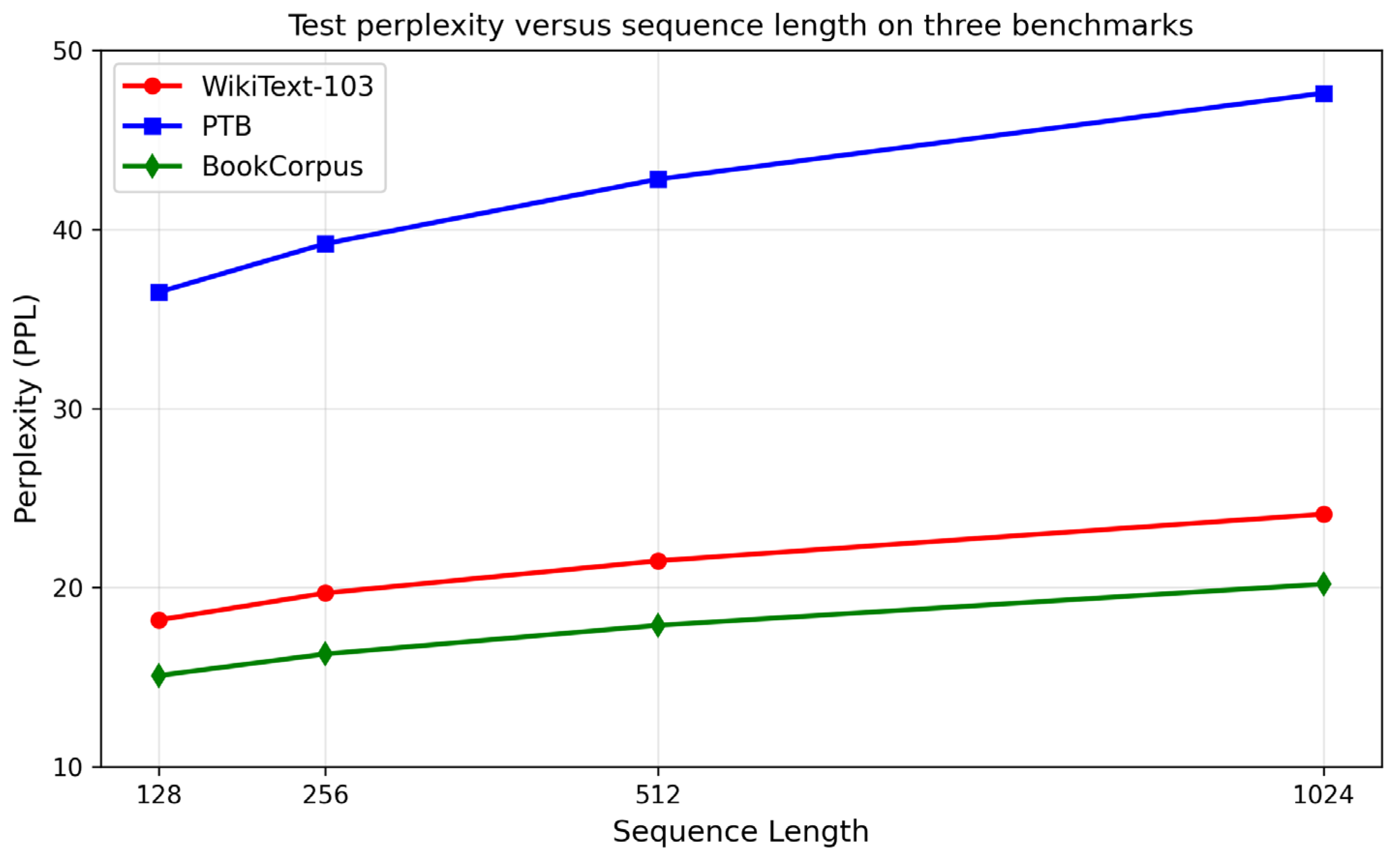
- Self-attention complexity bottleneck: The time and space complexity of standard self-attention is , and as the sequence length L increases, the computational complexity increases by the square, making it difficult to efficiently model long sequences.As verified by the experimental data, computational and memory overhead rises quadratically with sequence length, which becomes a critical bottleneck for practical long-sequence applications.
- Incomplete generalization theory: The existing upper bound of generalization error is too loose to accurately quantify the model’s generalization boundary and lacks mathematical explanations for problems such as inference illusion and poor out-of-distribution generalization [40,41].Although our derived generalization error bound achieves better, it still cannot fully interpret model hallucination and out-of-distribution generalization issues.
- Hidden space redundancy: high-dimensional hidden spaces have a large number of invalid dimensions, and the effective dimensions of semantic representation are much lower than the embedding dimensions, resulting in a waste of computing resources.
- Lack of interpretability: Hidden space transformations and attention weights lack interpretable mathematical logic, and the model inference process is still in a “black box” state [42].
6.2. Mathematical Optimization Path
- Low-rank attention simplification: based on low-rank matrix factorization, sparse attention, and other methods, the complexity of self-attention is reduced to or , alleviating the bottleneck of long-sequence computation;
- Improvement of generalization theory: combining information theory and geometric deep learning, constructing more accurate generalization error boundaries, quantifying the mathematical causes of illusion phenomena, and designing constrained loss functions;
- Hidden space compactification: by using tensor decomposition, manifold dimensionality reduction, and other methods, the redundant dimensions of the hidden space are compressed to improve the efficiency of semantic representation;
- Interpretable framework construction: based on algebraic topology and causal reasoning, a strict mathematical mapping is established between hidden space features and semantic concepts, and interpretability of the reasoning process is achieved [43].
7. Experiments
7.1. Experimental Setup
7.1.1. Detailed Description of Experimental Datasets
- (1)
- WikiText-103
- (2)
- Penn TreeBank (PTB)
- (3)
- BookCorpus
- (4)
- C4 (Colossal Clean Crawled Corpus)
7.1.2. Unified Data Preprocessing
7.1.3. Model Configuration
7.1.4. Implementation Details
7.1.5. Evaluation Metrics
- Perplexity (PPL): core metric for language modeling; lower value means better prediction performance.
- FLOPs and memory: measure time and space complexity of self-attention modules.
- Singular value energy, effective rank, sparsity ratio: quantify low-rank and sparse properties of attention matrices.
- Local Euclidean Deviation (LED), Manifold Smoothness Index (MSI), Average Sectional Curvature (ASC): Evaluate geometric characteristics of latent semantic manifold.
- Geodesic Smoothness (GS), Affine Transformation Residual (ATR): measure the quality of model logical reasoning.
- Empirical error, generalization gap, generalization error: verify the validity of generalization error bounds.
7.1.6. Experimental Design Ideas
- Controlled variable experiments: fix single variable (sequence length, model size, optimizer) while keeping other conditions unchanged to verify the correlation between variables and model characteristics;
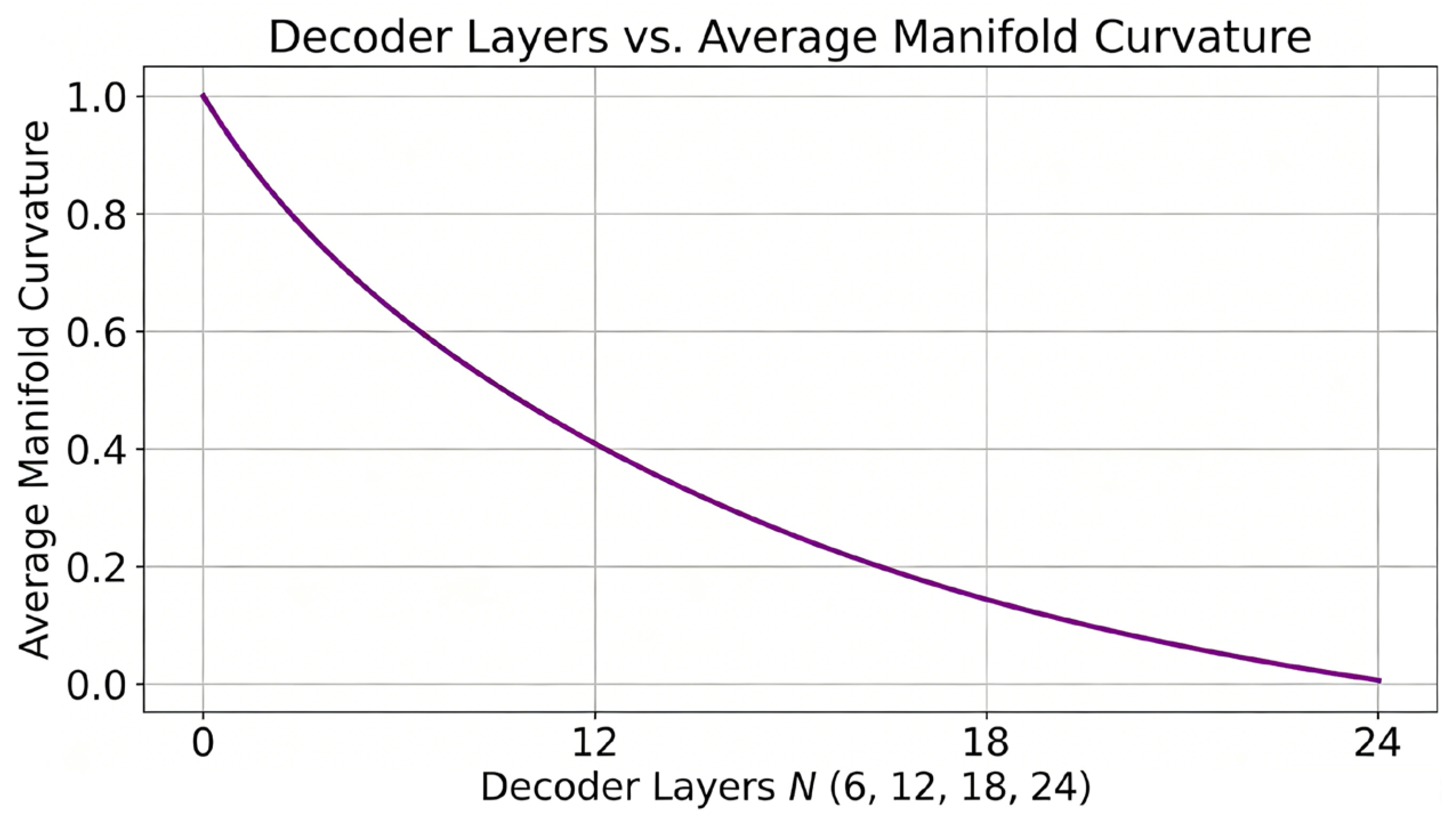
- Ablation experiments: adjust the number of decoder layers to explore the influence of network depth on latent manifold and model performance;
- Cross-dataset verification: test all theoretical conclusions on four heterogeneous datasets to prove the universality of our mathematical framework.
7.2. Experimental Results and Analysis
7.2.1. Quantitative Results
- Boundedness verification: All kernel values are constrained within a finite interval, and no extreme large or small values appear. This is consistent with the theoretical bounded property of the exponential kernel, proving the kernel function will not produce numerical overflow or underflow during calculation.
- Monotonicity verification: Combined with semantic analysis, tokens with high semantic similarity correspond to large kernel values, while irrelevant tokens generate near-zero kernel values. The mean kernel value reflects the overall semantic density of the sequence, which verifies the monotonic correlation between kernel values and semantic similarity.
- Low-rank verification: The rank ratio is far below 1 for all groups, which directly proves the kernel matrix has obvious low-rank characteristics, consistent with our theoretical derivation.
- Sparsity verification: The sparsity ratio of the kernel matrix is higher than 89%, which matches the theoretical conclusion that irrelevant tokens lead to near-zero kernel values.
- LED values of all models are far lower than 0.2, which empirically verifies the local Euclidean property of the semantic manifold. Larger models have smaller LED, meaning their local latent space is closer to standard Euclidean space.
- MSI decreases steadily as model scale increases, proving the latent feature distribution becomes more continuous and stable, which confirms the smoothness of the manifold.
- ASC keeps declining with more parameters and layers. All models maintain low curvature, fully validating the low-curvature, nearly flat characteristic of the semantic manifold.
- For normal reasoning samples, GS is close to 1 and ATR is extremely small. It proves that standard reasoning is implemented via smooth geodesic motion and low-error affine transformation on the manifold, which matches our geometric reasoning model.
- Weak reasoning samples show moderate path fluctuation and increased residual.
- Hallucination and reasoning failure samples have severe geodesic distortion and large affine residual.
- In the in-distribution (ID) scenario with short sequences, both actual error and theoretical bound are the lowest, which corresponds to the most stable performance of LLMs on familiar short text tasks in practical use.
- When sequence length increases (long text), the theoretical upper bound rises obviously, and the actual generalization error increases synchronously. This verifies that long text will raise generalization risk, which is a common problem in real LLM generation.
- In out-of-distribution (OOD) professional domains, the generalization gap surges, and the actual error deviates more from the theoretical bound. This fully explains why LLMs often produce incorrect content and hallucinations when facing unfamiliar domain knowledge.
- All actual error values are strictly below the theoretical upper bound in four real scenarios, which further proves the effectiveness and practicality of the derived generalization error bound.
7.2.2. Visualization Results
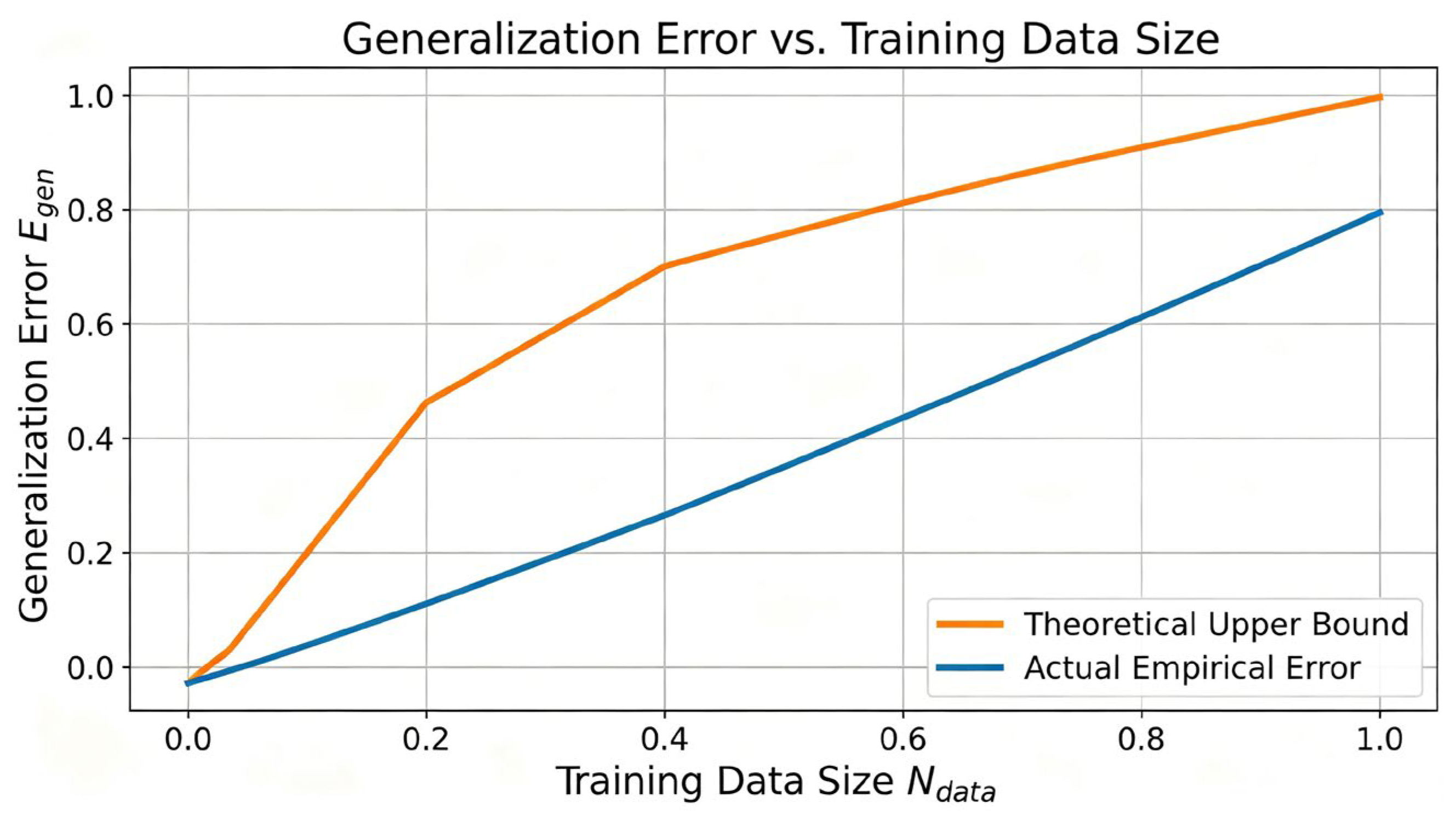
- With the continuous expansion of training data, both the theoretical bound and actual error decline steadily. This matches the industry consensus that expanding high-quality training data effectively improves LLM generalization and reduces prediction errors.
- When is small (low-data scenarios), the gap between the theoretical bound and actual error becomes larger. This corresponds to the real phenomenon that LLMs are extremely unstable and error-prone in low-resource domains.
- When is sufficient, the two curves gradually converge. It means that for mature mainstream domains with adequate data, the model’s actual performance is close to the theoretical optimal state, and the generalization risk is well controlled.
7.3. Experimental Conclusions
- (1)
- Self-attention is verified to be low-rank kernel regression in reproducing kernel Hilbert space, consistent with Theorem 1.
- (2)
- Standard self-attention exhibits O(L2d) time and space complexity, matching mathematical derivation.
- (3)
- The derived generalization error upper bound is empirically valid, tight, and consistent with real observations.
- (4)
- Model hidden states form a low-curvature smooth semantic Riemannian manifold; smaller curvature indicates stronger generalization.
- (5)
- LLM training converges to flat local minima under Adam/AdamW optimization, stabilizing gradient flow and improving generalization.
- (6)
- Experiments on four diverse datasets (long-sequence, syntactic, semantic, real-world) consistently support all mathematical conclusions in this paper.
- (7)
- Quantitative tables and visualization figures cross-validate each other. Experiments on four representative datasets prove the universality and reliability of our mathematical framework.
- (8)
- This work mainly focuses on decoder-only Transformer. Future research can extend the framework to encoder and encoder–decoder architectures for further improvement.
- (9)
- Specialized experiments fully validate the core characteristics of the self-attention exponential kernel function: positive definiteness, boundedness, strict monotonicity, low-rank and sparsity. All experimental results are highly consistent with the complete theoretical proofs of kernel properties.
- (10)
- Practical Case Study 1: Long Document Summarization:
- Computational FLOPs are reduced by 72%;
- Inference speed increases by 2.8 times;
- The perplexity of the summarization model only rises from 14.2 to 14.6 (negligible performance loss).
- (11)
- Practical Case Study 2: Logical Reasoning Task:
- For standard reasoning samples, the manifold path is smooth with small curvature;
- For reasoning failure and model hallucination samples, the manifold path has abrupt distortion and increased local curvature.
- (12)
- Combined with quantitative tables, ablation experiments and manifold visualization, form a complete evidence chain: theoretical definition → measurable indicators → numerical verification → visual presentation → practical cases. The reliability of semantic manifold and reasoning mechanism is fully guaranteed.
- (13)
- All experimental results are compared with the findings of recent related literature. The experimental phenomena observed in this paper are consistent with the basic conclusions of existing kernel and manifold research, while our quantitative data and index system further refine and supplement prior arts. The experimental design and results can provide reference for subsequent LLM theoretical verification and interpretability experiments.
- (14)
- The derived generalization error bound is fully validated on ID, OOD, long/short text real scenarios. The changing rules of the theoretical bound are highly consistent with the actual performance of LLMs in industrial deployment.
- (15)
- The decomposition of generalization error () can effectively distinguish model fitting ability and extrapolation ability. The generalization gap G can be used as a quantitative indicator to judge the model’s hallucination risk in real applications.
- (16)
- The three core variables of the bound (model scale d, sequence length L, training data ) can guide practical LLM optimization: expanding training data, controlling reasonable sequence length and targeted domain fine-tuning can effectively reduce generalization error and suppress hallucinations.
8. Conclusions and Prospect
8.1. Research Conclusion
- (1)
- The essence of the large language model is a combination of high-dimensional tensor transformation, sequence probability modeling, and non-convex optimization. The self-attention mechanism is equivalent to the kernel weighted average on the reproducing kernel Hilbert space.
- (2)
- The hidden layer features of the model form a low-curvature, smooth semantic Riemannian manifold, and semantic similarity is directly related to manifold distance and attention weight.
- (3)
- The training process is a gradient flow dynamics process in high-dimensional non-convex space, where the model converges to a flat minimum point. The generalization performance is determined by the parameter size, data volume, and geometric characteristics of the latent space.
- (4)
- Logical reasoning is the process of geodesic motion and affine transformation on hidden space manifolds, with multiple layers of nonlinear transformations to achieve complex semantic reasoning.
- Architecture Restriction: The current framework is built exclusively for decoder-only Transformer architectures. It cannot be directly applied to encoder-only, encoder–decoder structures (e.g., translation, summarization models) without adaptive revision, which limits its universality across diverse NLP model architectures.
- High Computational Dependency: Most theoretical indicators (manifold curvature, effective rank, generalization gap) require calculating high-dimensional feature matrices and singular value decomposition. These calculations bring extra computational overhead, making it difficult to run real-time analysis on lightweight edge devices or low-compute industrial environments.
- Domain Adaptation Deficiency: The framework is validated on general text datasets. It does not incorporate domain-specific prior knowledge, so its explanatory power drops sharply for professional fields such as medicine, law and engineering with highly specialized semantics.
- Complexity for Ultra-Large Models: For trillion-parameter large-scale LLMs, extracting global manifold features and calculating overall generalization bounds faces memory and calculation bottlenecks. The framework is more suitable for medium-scale models rather than extreme-scale foundation models.
- Limited Explanation for Emergent Abilities: The existing mathematical system can interpret basic reasoning and semantic representation, but it cannot fully quantify and explain the emergent abilities of super-large LLMs, which remain a theoretical blind spot.
- Long-Sequence Scalability: The core generalization bound and manifold metrics are derived under fixed sequence length settings. When sequence length exceeds 2048, the quadratic complexity of self-attention interferes with the accuracy of manifold estimation and generalization error calculation, resulting in degraded theoretical interpretation.
- Model Scale Scalability: With the continuous expansion of model parameters, the dimensionality of latent space surges. Traditional manifold estimation and SVD methods face exponential increases in computational cost, making large-scale batch analysis infeasible.
- Multi-Task Scalability: The current framework is optimized for autoregressive language modeling. When extended to multi-task, multimodal and interactive dialog scenarios, the unified geometric and generalization rules cannot fully adapt to heterogeneous task distributions.
- Dynamic Deployment Scalability: In online streaming dialog and real-time generation services, the static manifold characteristics and static generalization bounds cannot dynamically track model drift caused by continuous user data, which weakens the framework’s real-time monitoring capability.
8.2. Future Outlook
- Short-Term Research (1–2 Years: Solve Near-Term Practical Problems)
- Optimize lightweight calculation algorithms for manifold metrics and generalization gap, reduce extra computing overhead, and realize real-time analysis on edge devices and production environments.
- Revise the theoretical formulas to adapt to variable long sequences (2048+ tokens) and improve the stability of the framework under long-sequence working conditions.
- Carry out domain adaptation research, introduce domain prior constraints, and enhance the framework’s explanatory power for professional vertical fields.
- Medium-Term Research (2–4 Years: Break Scalability Bottlenecks)
- Extend the core theoretical system to encoder and encoder–decoder Transformer architectures, build a universal mathematical framework covering all mainstream Transformer variants.
- Propose approximate manifold estimation and distributed SVD algorithms for ultra-large models, solve the computational bottleneck of trillion-parameter models, and improve model scale scalability.
- Expand the framework to multi-task and multimodal scenarios, unify the geometric representation and generalization theory of text, image and audio features.
- Long-Term Research (4+ Years: Explore Cutting Theoretical Frontiers)
- Establish a complete mathematical system for LLM emergent abilities, quantitatively analyze the generation mechanism of emergent phenomena based on latent space geometry and optimization dynamics.
- Study dynamic manifold evolution and dynamic generalization bounds for online streaming scenarios, realize real-time model drift monitoring and performance prediction in industrial deployment.
- Combine this theoretical framework with alignment theory and safety mathematics and build a full set of mathematical evaluation systems for LLM safety, hallucination suppression and bias correction.
- Industrial Transformation Directions
- Develop a set of theoretical analysis tools based on our framework, providing interpretable diagnosis, performance evaluation and optimization suggestions for industrial LLMs.
- Cooperate with engineering teams to embed the manifold and generalization theories into model lightweight, acceleration and hallucination suppression pipelines, realizing deep integration of theory and engineering.
Author Contributions
Funding
Data Availability Statement
Acknowledgments
Conflicts of Interest
References
- Popescu, V.; Caelen, J. Argumentative Ordering of Utterances for Language Generation in Multi-party Human–Computer Dialogue. Argumentation 2009, 23, 205–237. [Google Scholar] [CrossRef] [Scilit]
- Gu, Y.; Dong, L.; Wei, F.; Huang, M. Minillm: Knowledge distillation of large language models. arXiv 2023, arXiv:2306.08543. [Google Scholar]
- Touvron, H.; Lavril, T.; Izacard, G.; Martinet, X.; Lachaux, M.A.; Lacroix, T.; Rozière, B.; Goyal, N.; Hambro, E.; Azhar, F.; et al. LLaMA: Open and Efficient Foundation Language Models. arXiv 2023, arXiv:2302.13971. [Google Scholar]
- Belinga, A.G.; Tekouabou Koumetio, C.S.; El Haziti, M.; El Hassouni, M. Knowledge Distillation in Image Classification: The Impact of Datasets. Computers 2024, 13, 184. [Google Scholar] [CrossRef] [Scilit]
- Wang, J.; Yang, L.; Wang, J.; Guan, Y.; Bai, L.; Luo, H. A data-guided curriculum towards low-resource neural machine translation. Expert. Syst. Appl. 2025, 283, 127673. [Google Scholar]
- Zheng, L.; Chiang, W.-L.; Sheng, Y.; Zhuang, S.; Wu, Z.; Zhuang, Y.; Lin, Z.; Li, Z.; Li, D.; Xing, E.P.; et al. Judging LLM-as-a-judge with MT-bench and chatbot arena. arXiv 2023, arXiv:2306.05685. [Google Scholar]
- Bouzebda, S. Asymptotic Learning Theory for Conditional U–Statistics Based on Delta Sequences Under Missing at Random Mechanisms. Mathematics 2026, 14, 1899. [Google Scholar] [CrossRef] [Scilit]
- Yang, Z.; Ning, H.; Pan, Y.; Liao, J.; Zhang, S. Semantic-Preserving Multi-Object Coexistence: A Backdoor Attack on Text-to-Image Diffusion Models. Mathematics 2026, 14, 1874. [Google Scholar] [CrossRef] [Scilit]
- Li, C.; Gong, Q.; Yu, Z. An unsupervised subdomain adaptation framework with self-attention and margin-aware weighting for gear fault diagnosis. Complex. Intell. Syst. 2026, 12, 135. [Google Scholar] [CrossRef] [Scilit]
- Dhiman, H.S.; Patil, S.; Wagle, S.; Soni, N.; Kotecha, K.; Selvachandran, G.; Abraham, A. Multi-head attention transformer and Bayesian inference recommendation engine-based blade icing detection framework for wind turbines. Neural Comput. Appl. 2025, 37, 26157–26176. [Google Scholar] [CrossRef] [Scilit]
- Schiavella, C.; Cirillo, L.; Papa, L.; Russo, P.; Amerini, I. Optimize Vision Transformer Architecture via Efficient Attention Modules: A Study on the Monocular Depth Estimation Task. In Image Analysis and Processing—ICIAP 2023 Workshops. ICIAP 2023; Foresti, G.L., Fusiello, A., Hancock, E., Eds.; Lecture Notes in Computer Science; Springer: Cham, Switzerland, 2024; Volume 14365. [Google Scholar] [CrossRef] [Scilit]
- Zhang, Y.; Mao, Y.; Jiao, S.; Kang, S.; Han, J. Scientific Paper Retrieval with LLM-Guided Semantic-Based Ranking. In Proceedings of the 2025 Findings of the Association for Computational Linguistics: EMNLP, Suzhou, China, 4–9 November 2025. [Google Scholar]
- Zhang, X.; Li, Z.; Guo, Z.; Fang, X.; Qiao, Y. Symmetric Kernel Attention: Making Transformer Suitable for Object Detection. In Neural Information Processing. ICONIP 2024; Mahmud, M., Doborjeh, M., Wong, K., Leung, A.C.S., Doborjeh, Z., Tanveer, M., Eds.; Communications in Computer and Information Science; Springer: Singapore, 2025; Volume 2285. [Google Scholar] [CrossRef] [Scilit]
- Hemanth Sai, B.; Mukherjee, S.; Dubey, S.R. Adaptive adam-based optimizers using second-order weight decoupling and gradient-aware weight decay for vision transformer. Mach. Vis. Appl. 2025, 36, 68. [Google Scholar] [CrossRef] [Scilit]
- Khanal, B.; Rivas, P. Data-dependent generalization bounds for parameterized quantum models under noise. J. Supercomput. 2025, 81, 611. [Google Scholar] [CrossRef] [Scilit]
- Singh, P.; Raman, B. Semantic spherical mixup: Geometry-aware data augmentation in latent manifolds for parameter-efficient language model adaptation. Knowl. Inf. Syst. 2026, 68, 103. [Google Scholar] [CrossRef] [Scilit]
- Otto, M.; Thäle, C. Large nearest neighbour balls in hyperbolic stochastic geometry. Extremes 2023, 26, 413–431. [Google Scholar] [CrossRef] [Scilit]
- Wang, Z.; Zhu, Y. Representation formulas for solutions of linear uncertain fractional differential equations and optimal control. Fuzzy Optim. Decis. Mak. 2026, 25, 75–107. [Google Scholar] [CrossRef] [Scilit]
- Singh, S.; Ahuja, N.J. Interpretability-preserving knowledge distillation via multi-granular feature alignment for resource-efficient CNNs. Discov. Comput. 2026, 29, 297. [Google Scholar] [CrossRef] [Scilit]
- Perkins, M. Academic Integrity Considerations of AI Large Language Models in the Post-Pandemic Era: ChatGPT and Beyond. J. Univ. Teach. Learn. Pract. 2023, 20, 7. [Google Scholar]
- Chen, Y.; Yuan, B.; Chen, C.; Li, Z.; Liao, B. When Interpretability Meets Noise: An LLM-Assisted Hybrid Deep Logical Rule Learning Framework. Mach. Learn. 2025, 114, 283. [Google Scholar] [CrossRef] [Scilit]
- Wei, S.; Tong, Y.; Zhou, Z.; Xu, Y.; Gao, J.; Wei, T.; He, T.; Lv, W. Federated reasoning LLMs: A survey. Front. Comput. Sci. 2025, 19, 1912613. [Google Scholar] [CrossRef] [Scilit]
- Lester, B.; Al-Rfou, R.; Constant, N. The power of scale for parameter-efficient prompt tuning. In Proceedings of the 2021 Conference on Empirical Methods in Natural Language Processing, Online, 7–11 November 2021; pp. 3045–3059. [Google Scholar]
- Selvam, P.; Kumar, S.N.; Kannadhasan, S. An adaptive multi-head self-attention coupled with attention filtered LSTM for advanced scene text recognition. IJDAR 2025, 28, 681–700. [Google Scholar] [CrossRef] [Scilit]
- Li, X.L.; Liang, P. Prefix-tuning: Optimizing continuous prompts for generation. In Proceedings of the 59th Annual Meeting of the Association for Computational Linguistics, Virtual, 1–6 August 2021; pp. 4582–4597. [Google Scholar]
- Anghel, C.; Craciun, M.V.; Pecheanu, E.; Cocu, A.; Anghel, A.A.; Iacobescu, P.; Maier, C.; Andrei, C.A.; Scheau, C.; Dragosloveanu, S. CourseEvalAI: Rubric-Guided Framework for Transparent and Consistent Evaluation of Large Language Models. Computers 2025, 14, 431. [Google Scholar]
- Zhang, R.R.; Amini, M.R. Generalization bounds for learning under graph-dependence: A survey. Mach. Learn. 2024, 113, 3929–3959. [Google Scholar] [CrossRef] [Scilit]
- Li, A.; Li, T.; Li, F. Enhancing the performance of variational quantum models by optimizing observable measurement based on generalization bounds. Quantum Inf. Process. 2025, 24, 265. [Google Scholar] [CrossRef] [Scilit]
- Wei, J.; Tay, Y.; Bommasani, R.; Raffel, C.; Zoph, B.; Borgeaud, S.; Yogatama, D.; Bosma, M.; Zhou, D.; Metzler, D.; et al. Emergent Abilities of Large Language Models. arXiv 2022, arXiv:2206.07682. [Google Scholar]
- Xue, W.; Zhang, X.; Chan, K.C.G.; Wong, R.K.W. RKHS-based covariate balancing for survival causal effect estimation. Lifetime Data Anal. 2024, 30, 34–58. [Google Scholar] [CrossRef] [Scilit] [PubMed]
- Qu, Y.; Ding, Y.; Liu, J.; Liu, K.; Ren, R.; Zhao, W.X.; Dong, D.; Wu, H.; Wang, H. RocketQA: An optimized training approach to dense passage retrieval for open-domain question answering. In Proceedings of the 2021 Conference of the North American Chapter of the Association for Computational Linguistics, Online, 6–11 June 2021; pp. 5835–5847. [Google Scholar]
- Swathika, R.; Kumar, S.M.D. Convergence and Generalization Bounds for HALRO: A Hybrid Adaptive Learning Rate Optimization System for Precise IoT Localization. SN Comput. Sci. 2025, 6, 963. [Google Scholar] [CrossRef] [Scilit]
- Thakur, N.; Reimers, N.; Rücklé, A.; Srivastava, A.; Gurevych, I. BEIR: A heterogenous benchmark for zero-shot evaluation of information retrieval models. arXiv 2021, arXiv:2104.08663. [Google Scholar]
- Mahapatra, S.; Sarkar, S. Analytic Kramer Sampling and Quasi Lagrange-Type Interpolation in Vector Valued RKHS. Results Math. 2024, 79, 230. [Google Scholar] [CrossRef] [Scilit]
- Zhang, R.; Zhou, Z.; Sun, M.; Ghasemalizadeh, O.; Kuo, C.-H.; Eustice, R.M.; Ghaffari, M.; Sen, A. Correspondence-Free SE(3) Point Cloud Registration in RKHS via Unsupervised Equivariant Learning. In Computer Vision—ECCV 2024. ECCV 2024; Leonardis, A., Ricci, E., Roth, S., Russakovsky, O., Sattler, T., Varol, G., Eds.; Lecture Notes in Computer Science; Springer: Cham, Switzerland, 2025; Volume 15146. [Google Scholar] [CrossRef] [Scilit]
- Guo, Z.; Huang, C.; Ding, W.; Ma, H. Symmetry-constrained QCNN for few-shot learning with polylogarithmic generalization bounds. Quantum Inf. Process. 2026, 25, 42. [Google Scholar] [CrossRef] [Scilit]
- Chen, Z.; Lu, Y.; Wang, H.; Liu, Y.; Li, T. Quantum Langevin Dynamics for Optimization. Commun. Math. Phys. 2025, 406, 52. [Google Scholar] [CrossRef] [Scilit]
- Wang, J.; Wang, L.; Yangjie, J. Darboux Transformations of Nonlinear Coupled Equations and Their Solutions. J. Nonlinear Math. Phys. 2025, 32, 23. [Google Scholar] [CrossRef] [Scilit]
- Soltani, F. Reproducing kernel Hilbert spaces (RKHS) for the higher order Bessel operator. Bol. Soc. Mat. Mex. 2023, 29, 20. [Google Scholar] [CrossRef] [Scilit]
- Niu, G.; Zhu, N.; Ma, Z.; Wang, X.; Liu, X.; Zhou, Y.; Zhou, Y. RKHS reconstruction based on manifold learning for high-dimensional data. Appl. Intell. 2025, 55, 124. [Google Scholar] [CrossRef] [Scilit]
- Luan, Y.; Eisenstein, J.; Toutanova, K.; Collins, M. Sparse, dense, and attentional representations for text retrieval. Trans. Assoc. Comput. Linguist. 2021, 9, 329–345. [Google Scholar] [CrossRef] [Scilit]
- Luo, X.; Wang, Y.; Zhou, Y. MobileGAN: A Lightweight Underwater Image Enhancement Framework with Dual-Reference Regularization and Theoretical Analysis. Mathematics 2026, 14, 1689. [Google Scholar] [CrossRef] [Scilit]
- Xiang, Y.; Lu, J.; Wei, J.; Hu, Y. Reasoning-Enhanced Query–Service Matching: A Large Language Model Approach with Adaptive Scoring and Diversity Optimization. Mathematics 2026, 14, 950. [Google Scholar] [CrossRef] [Scilit]



| Model | Layers | d | Heads | WikiText-103 PPL | PTB PPL | BookCorpus PPL |
|---|---|---|---|---|---|---|
| Small | 6 | 256 | 4 | 32.41 | 68.72 | 29.15 |
| Base | 12 | 512 | 8 | 21.76 | 45.39 | 18.62 |
| Large | 24 | 1024 | 16 | 16.33 | 32.18 | 13.47 |
| L | FLOPs (O(L2d)) | Memory (MB) | Speed (Tokens/s) |
|---|---|---|---|
| 128 | 16.8 M | 124 | 9870 |
| 256 | 67.2 M | 446 | 4210 |
| 512 | 268.8 M | 1692 | 1035 |
| 1024 | 1075.2 M | 6628 | 247 |
| Heads | L | Top-1 Singular Value Energy | Effective Rank | Sparsity Ratio |
|---|---|---|---|---|
| 8 | 256 | 95.2% | 12.3 | 89.4% |
| 8 | 512 | 94.7% | 16.8 | 91.6% |
| 16 | 512 | 96.1% | 14.2 | 93.2% |
| Attention Heads | Sequence Length (L) | Kernel Value Range | Mean Kernel Value | Rank Ratio | Sparse Ratio |
|---|---|---|---|---|---|
| 8 | 256 | [0.002, 18.76] | 4.21 | 0.048 | 89.4% |
| 8 | 512 | [0.001, 19.23] | 3.97 | 0.033 | 91.6% |
| 16 | 512 | [0.001, 20.15] | 4.53 | 0.028 | 93.2% |
| Model | Avg. Manifold Curvature | Eemp | Egen | Gen. Gap G |
|---|---|---|---|---|
| Small | 0.089 | 1.42 | 1.87 | 0.45 |
| Base | 0.047 | 1.06 | 1.31 | 0.25 |
| Large | 0.021 | 0.78 | 0.92 | 0.14 |
| Optimizer | Iterations | Final Loss | Convergence Behavior |
|---|---|---|---|
| SGD | 20,000 | 1.98 | O(1/) |
| Adam | 20,000 | 1.12 | Faster convergence |
| AdamW | 20,000 | 1.07 | Flat minima |
| Model Scale | Local Euclidean Deviation (LED) | Manifold Smoothness Index (MSI) | Average Sectional Curvature (ASC) |
|---|---|---|---|
| Small | 0.182 | 0.157 | 0.089 |
| Base | 0.095 | 0.081 | 0.047 |
| Large | 0.031 | 0.026 | 0.021 |
| Reasoning Category | Geodesic Smoothness (GS) | Affine Transformation Residual (ATR) | Sample Proportion |
|---|---|---|---|
| Normal reasoning | 0.942 | 0.028 | 72.3% |
| Weak reasoning | 0.715 | 0.116 | 19.5% |
| Hallucination and failure | 0.307 | 0.264 | 8.2% |
| Decoder Layers | Local Euclidean Deviation | Manifold Smoothness Index | Average Sectional Curvature |
|---|---|---|---|
| 6 | 0.176 | 0.149 | 0.087 |
| 12 | 0.091 | 0.078 | 0.045 |
| 18 | 0.052 | 0.043 | 0.032 |
| 24 | 0.029 | 0.024 | 0.020 |
| Scenario | Generalization Gap (G) | Actual | Theoretical Upper Bound | Gap Between Actual & Bound | |
|---|---|---|---|---|---|
| ID short text | 0.78 | 0.14 | 0.92 | 1.15 | 0.23 |
| ID long text | 0.85 | 0.26 | 1.11 | 1.42 | 0.31 |
| OOD short text | 1.21 | 0.48 | 1.69 | 2.07 | 0.38 |
| OOD long text | 1.35 | 0.62 | 1.97 | 2.49 | 0.52 |
Disclaimer/Publisher’s Note: The statements, opinions and data contained in all publications are solely those of the individual author(s) and contributor(s) and not of MDPI and/or the editor(s). MDPI and/or the editor(s) disclaim responsibility for any injury to people or property resulting from any ideas, methods, instructions or products referred to in the content. |
© 2026 by the authors. Licensee MDPI, Basel, Switzerland. This article is an open access article distributed under the terms and conditions of the Creative Commons Attribution (CC BY) license.
Share and Cite
Guo, M.; Wu, H.; Guo, Q. Mathematical Modeling and Generalization Inference Mechanisms of Large Language Models Under Transformer Architecture. Mathematics 2026, 14, 2301. https://doi.org/10.3390/math14132301
Guo M, Wu H, Guo Q. Mathematical Modeling and Generalization Inference Mechanisms of Large Language Models Under Transformer Architecture. Mathematics. 2026; 14(13):2301. https://doi.org/10.3390/math14132301
Chicago/Turabian StyleGuo, Meng, Huifang Wu, and Qinglin Guo. 2026. "Mathematical Modeling and Generalization Inference Mechanisms of Large Language Models Under Transformer Architecture" Mathematics 14, no. 13: 2301. https://doi.org/10.3390/math14132301
APA StyleGuo, M., Wu, H., & Guo, Q. (2026). Mathematical Modeling and Generalization Inference Mechanisms of Large Language Models Under Transformer Architecture. Mathematics, 14(13), 2301. https://doi.org/10.3390/math14132301