Article

Advanced Negative-Derivative Feedback Control for Nonlinear Resonance Suppression in 2-DOF AFM Systems


by
Khalid Alluhydan
1,* and
M. N. Abd EL-Salam
2
1
Department of Mechanical Engineering, College of Engineering, King Saud University, Riyadh 12372, Saudi Arabia
2
Basic Sciences Department, Common First Year Deanship, King Saud University, Riyadh 12373, Saudi Arabia
*
Author to whom correspondence should be addressed.
Mathematics 2026, 14(12), 2235; https://doi.org/10.3390/math14122235 (registering DOI)
Submission received: 19 May 2026 / Revised: 18 June 2026 / Accepted: 21 June 2026 / Published: 22 June 2026

Abstract

A Negative Derivative Feedback (NDF) controller is designed for vibrations suppression of an atomic force microscope (AFM) model. The controlled system is modeled as a two-degree-of-freedom (2-DOF) closed-loop dynamic system. The average method was used to derive approximate analytical solutions. All possible resonance conditions were identified, with particular attention given to the simultaneous resonance case Ω = ω 1 ,   Ω 1 = 2 ω 1 ,   ω 2 = ω 1 , identified as the most critical. For validation and proper insights, the system was also solved numerically using the fourth-order Rung–Kutta method. The time response of the AFM system in contact mode was analyzed before and after applying the NDF controller under the worst-case resonance conditions. A comprehensive parametric study was conducted to evaluate the controller’s robustness and effectiveness. The results demonstrate a high degree of agreement between the numerical simulations and the analytical approximations, confirming the reliability of the approach.
MSC:
34C15; 70H03; 34C46; 34F15; 74G10

1. Introduction

The atomic force microscope (AFM) is an essential tool in engineering, physics, and chemistry, widely used to characterize material properties through various probe–sample interaction modes. AFM enables the measurement of magnetic, optical, electrical (capacitance, electrostatic forces, work, and current), and mechanical characteristics (adhesion, stiffness, friction, and dispersion). The development of scanning probe microscopy in the 1980s, for which Gerd Binnig and Heinrich Rohrer received the 1986 Nobel Prize in Physics [1], marked a major milestone in this field. Numerous studies have examined AFM dynamics both computationally and experimentally. Rützel et al. [2] analyzed the near-resonant nonlinear response of AFM using Lennard–Jones potentials, while Abdel-Rahman and Nayfeh [3] demonstrated nonlinear phenomena around the 1:2 subharmonic resonance case using the multiple scales method. Arafat et al. [4] investigated surface characterization at 2:1 auto-parametric resonance between the second and third modes, also applying the multiple scales method for approximate solutions. Salarieh and Alasty [5] applied time-delayed feedback for vibration suppression, a technique later validated experimentally by Yamasue et al. [6] in studies of non-periodic cantilever vibrations. Bahrami and Nayfeh [7] explored nonlinear dynamics through numerical simulations, while Kirrou and Belhaq [8] examined frequency response shifts using perturbation and partitioning techniques. Analytical studies [9,10] assessed the effect of contact stiffness modulation on resonance behavior, comparing analytical and numerical results. Further contributions include Bahrami and Nayfeh [11], who modeled AFM micro-cantilever dynamics in tapping mode using differential quadrature techniques, and Kirrou and Belhaq [12], who studied bistability control in non-contact AFM with time-delayed feedback. Control strategies have also been explored extensively; Hamed et al. [13] implemented a proportional-derivative (PD) controller with moderate efficiency, while a time-delayed positive position feedback (PPF) controller [14] achieved significant vibration reduction, improving efficiency from 16 (without delay) to 193 (with delay). Broader applications of vibration control strategies have been reported for various nonlinear systems, including oscillators, beams, actuators, and rotors [15,16,17,18,19,20]. The effectiveness of the Negative Derivative Feedback (NDF) controller has also been demonstrated for suppressing vibrations in oscillators and cantilever beams [21,22]. Reinforcement learning has become an effective approach for controlling nonlinear robotic systems under uncertainties. Tam et al. [23] proposed a disturbance observer-based actor–critic reinforcement learning (DOB–ACRL) framework with adaptive reward shaping, achieving improved tracking accuracy, enhanced robustness, reduced energy consumption, and faster convergence compared with conventional actor–critic methods.
In the present work, the NDF controller is employed to suppress vibrations in the AFM model under both external and parametric excitations. Approximate analytical solutions are obtained using the average method. The results showed strong agreements between analytical predictions and numerical simulation runs, confirming the robustness of the proposed controller design.

2. Modeling and Description of the AFM Mode

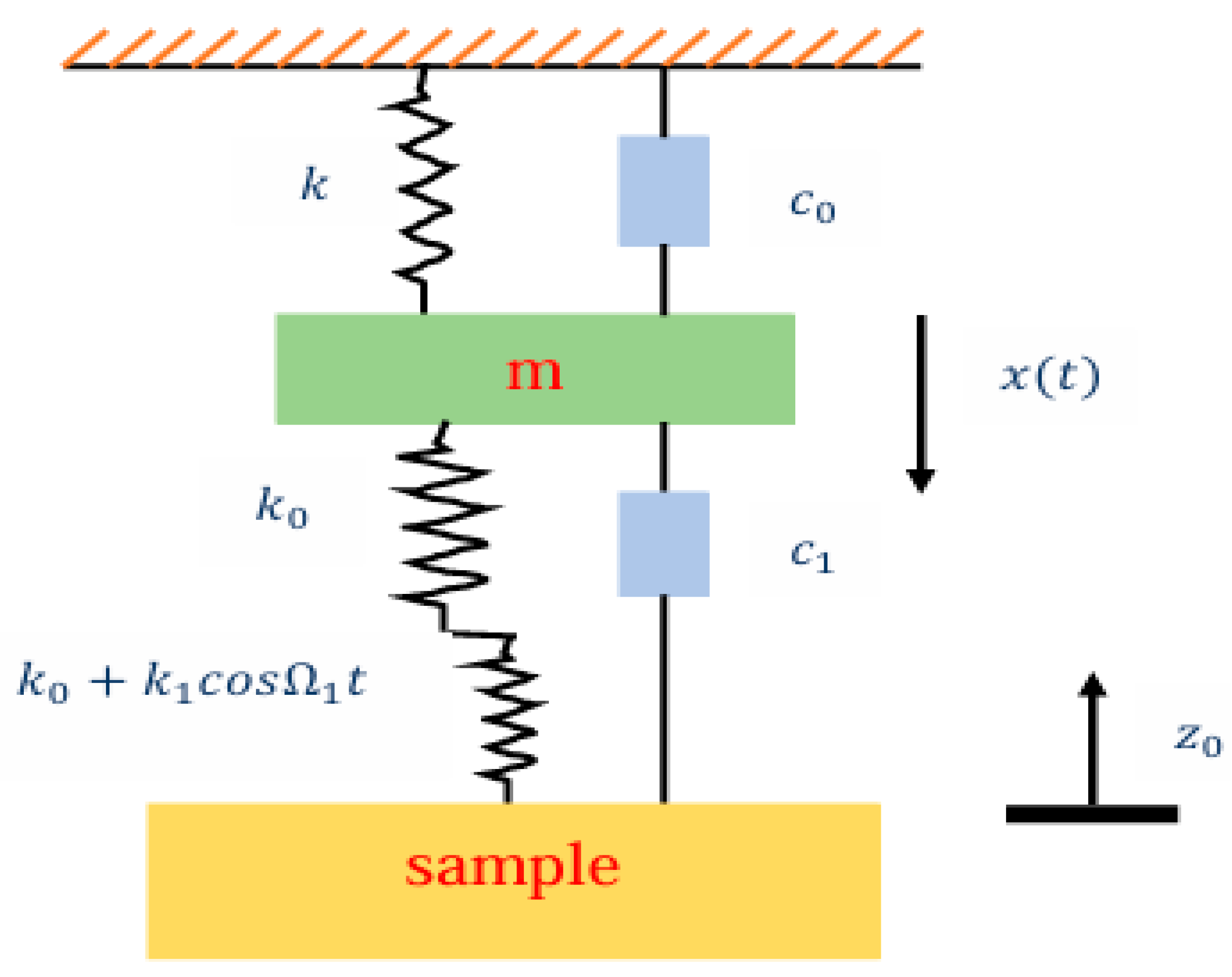
As shown in Figure 1, a contact-mode AFM model is formulated as a lumped-parameter dynamic system. The cantilever-tip assembly is idealized as a mass ( m ) attached to a linear spring of stiffness ( k ) and a viscous damper ( c 0 ), representing the elastic and dissipative characteristics of the cantilever. The vertical displacement of the mass is denoted by x ( t ) . A secondary damping element c 1 is included to capture additional energy losses in the tip–sample interaction region. The interaction force between the tip and the sample is modeled by a nonlinear spring with a stiffness composed of a constant term ( k 0 ) and a harmonically varying component ( k 1 c o s Ω 2 t ), introducing parametric excitation into the system. This nonlinear element depends on the relative separation between the tip and the sample, reflecting contact mechanics behaviour. The bottom block represents the sample surface, and the overall configuration captures the essential features of cantilever dynamics coupled with nonlinear, time-dependent tip–sample interactions. According to [13], the equation of motion of the AFM model is formulated as
m x ¨ + c 1 x ˙ + k x = k 0 + k 1 cos ( Ω 1 t ) z 0 x 3 2 + m g + F cos ( Ω t )
To simplify Equation (1), suppose that, x = z 0 v
v ¨ + μ 1 v ˙ + ω 1 2 v β 1 v + β 2 v 2 β 3 v 3 + r β β 1 v + β 2 v 2 β 3 v 3 cos ( Ω 1 t ) = f cos ( Ω t )
The steps for obtaining Equation (2) from Equation (1) are explained in detail in Appendix A.

3. Analytical Modeling of the Controlled System

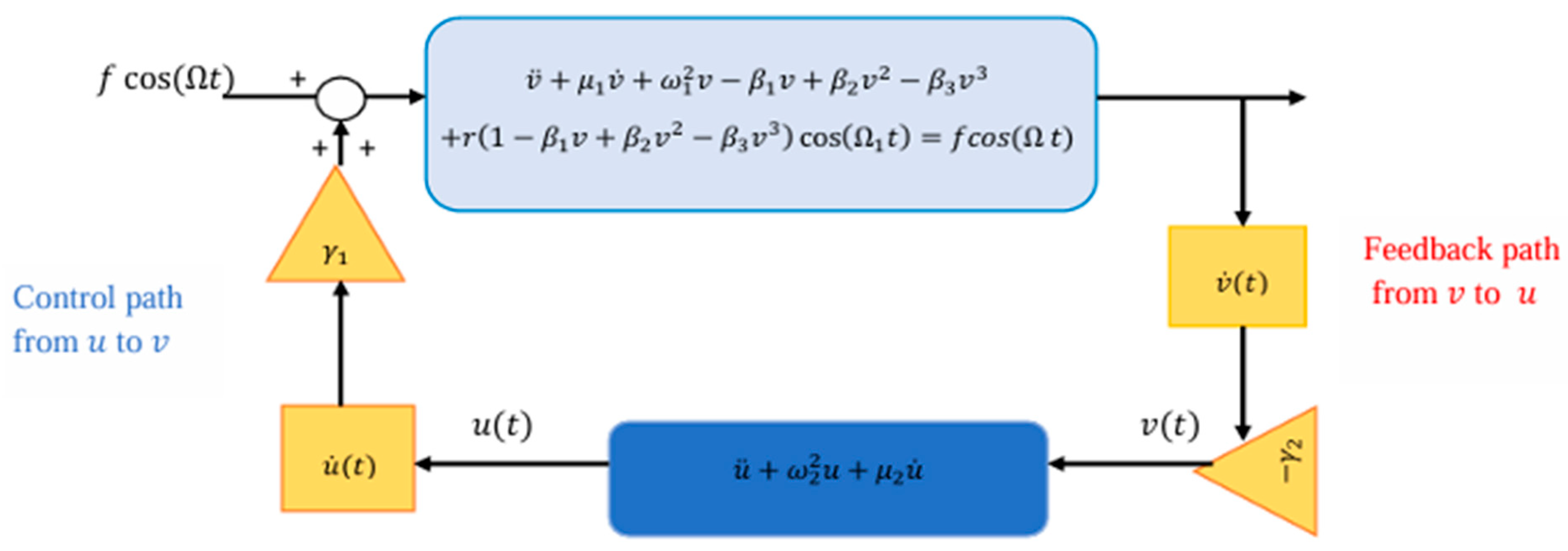
With a view to scrutinize the dynamic behavior of the AFM under the NDF controller, the closed-loop system is worked out mathematically. The model incorporates the cantilever dynamics, tip–surface interaction forces, and the influence of the NDF controller. By combining these elements, the governing equations of motion are established, where both linear and nonlinear contributions are considered. In practical implementations, the FM system may be affected by electronic noise, thermal drift, and environmental disturbances. To enhance measurement accuracy and reliability, low-noise amplifiers, proper shielding, and signal filtering techniques should be employed. Furthermore, repeated experimental trials and averaging of the measured data can reduce random errors and improve the consistency of the results. This closed-loop (see Figure 2) representation provides the foundation for analyzing system stability, resonance characteristics, and the effectiveness of control strategies in suppressing unwanted vibrations. The novelty of the proposed NDF controller stems from its negative velocity feedback strategy, which increases the effective damping of the system and accelerates energy dissipation. Consequently, the controller provides superior vibration suppression and faster stabilization compared with existing control schemes. The dynamic response of the closed-loop system is represented by the following coupled two-degree-of-freedom second-order differential equations:
v ¨ + μ 1 v ˙ + ω 1 2 v β 1 v + β 2 v 2 β 3 v 3 + r β β 1 v + β 2 v 2 β 3 v 3 cos ( Ω 1 t ) = F cos ( Ω t ) + α 1 u ˙
u ¨ + μ 2 u ˙ + ω 2 2 u = α 2 v ˙
where α 1 is the control gain and α 2 is the feedback gain. To obtain the approximate solutions of Equations (3) and (4), we will use the average method as follows [24,25]
v ( t ) = a 1   cos ω 1 t + γ 1 , u ( t ) = a 2   cos ω 2 t + γ 2
where a i and γ i   ( i = 1 , 2 ) are constants. Evaluate the first and the second derivatives by differentiating with respect to the time t as
v ˙ ( t ) = ω 1 a 1   sin ω 1 t + γ 1 , u ˙ ( t ) = ω 2 a 2   sin ω 2 t + γ 2
v ¨ ( t ) = ω 1 2 a 1   cos ω 1 t + γ 1 , u ¨ ( t ) = ω 2 2 a 2   cos ω 2 t + γ 2
where a i and γ i   ( i = 1,2 ) are the amplitudes and the phases of the mean system and the control. The solutions of Equations (3) and (4) take the form shown in Equation (5), subjected to the constraint in Equation (6). Now, a i and γ i are time-varying. Once again, differentiate Equation (5) with respect to the time t
v ˙ ( t ) = a ˙ 1   cos ω 1 t + γ 1 a 1 γ ˙ 1 sin ω 1 t + γ 1 a 1 ω 1 sin ω 1 t + γ 1 , u ˙ ( t ) = a ˙ 2   cos ω 2 t + γ 2 a 2 γ ˙ 2 sin ω 2 t + γ 2 a 2 ω 2 sin ω 2 t + γ 2
By comparing Equations (6) and (8), we get the following
a ˙ 1   cos ω 1 t + γ 1 a 1 γ ˙ 1 sin ω 1 t + γ 1 = 0
a ˙ 2   cos ω 2 t + γ 2 a 2 γ ˙ 2 sin ω 2 t + γ 2 = 0
Again, we will differentiate Equation (6) with respect to the time t
v ¨ + ω 1 2 v = ω 1 a ˙ 1   sin ω 1 t + γ 1 a 1 ω 1 γ ˙ 1 cos ω 1 t + γ 1 , u ¨ + ω 2 2 u = ω 2 a ˙ 2   sin ω 2 t + γ 2 a 2 ω 2 γ ˙ 2 cos ω 2 t + γ 2
Inserting Equations (5) and (6) in Equations (3) and (4), we get the following
v ¨ + ω 1 2 v = f cos Ω t ω 2 α 1 a 2   sin ω 2 t + γ 2 + μ 1 ω 1 a 1   sin ω 1 t + γ 1 + β 1 a 1   cos ω 1 t + γ 1                             β 2 a 1 2   cos 2 ω 1 t + γ 1 + β 3 a 1 3   cos 3 ω 1 t + γ 1 r β + r β 1 a 1   cos ω 1 t + γ 1 cos Ω 1 t                         r β 2 a 1 2   cos 2 ω 1 t + γ 1 cos Ω 1 t + r β 3 a 1 3   cos 3 ω 1 t + γ 1 cos Ω 1 t
u ¨ + ω 2 2 u = μ 2 ω 2 a 2   sin ω 2 t + γ 2 + ω 1 α 2 a 1   sin ω 1 t + γ 1
By comparing Equations (11)–(13), we will obtain the following
ω 1 a ˙ 1   sin ω 1 t + γ 1 a 1 ω 1 γ ˙ 1 cos ω 1 t + γ 1 = f cos Ω t ω 2 α 1 a 2   sin ω 2 t + γ 2                                                                                                 + μ 1 ω 1 a 1   sin ω 1 t + γ 1 + β 1 a 1   cos ω 1 t + γ 1                                                                                                 β 2 a 1 2   cos 2 ω 1 t + γ 1 + β 3 a 1 3   cos 3 ω 1 t + γ 1                                                                                                 r β + r β 1 a 1   cos ω 1 t + γ 1 cos Ω 1 t                                                                                                 r β 2 a 1 2   cos 2 ω 1 t + γ 1 cos Ω 1 t + r β 3 a 1 3   cos 3 ω 1 t + γ 1 cos Ω 1 t
ω 2 a ˙ 2   sin ω 2 t + γ 2 a 2 ω 2 γ ˙ 2 cos ω 2 t + γ 2 = μ 2 ω 2 a 2   sin ω 2 t + γ 2 + ω 1 α 2 a 1   sin ω 1 t + γ 1

3.1. Periodic Solution

In this subsection, for the simultaneous resonance case: Ω = ω 1 ,   Ω 1 = 2 ω 1 ,   ω 2 = ω 1 .
The simultaneous resonance condition represents the most critical operating regime because multiple resonance mechanisms occur at the same time, resulting in maximum energy input to the system. The constructive interaction of the resonant terms yields the largest steady-state amplitudes and strongest nonlinear effects, thereby defining the worst-case scenario for vibration and stability performance.
We will recommend detuning parameters. σ j ;   j = 1 , 2 , so that
Ω = ω 1 + σ 1 , Ω 1 = 2 ω 1 + 2 σ 1 , ω 2 = ω 1 + σ 2
Inserting Equation (16) into Equations (14) and (15)
ω 1 a ˙ 1   sin ω 1 t + γ 1 a 1 ω 1 γ ˙ 1 cos ω 1 t + γ 1 = f cos ω 1 t + γ 1 + ϕ 1 ω 2 α 1 a 2   sin ω 1 t + γ 1 + ϕ 2 + μ 1 ω 1 a 1   sin ω 1 t + γ 1                                                                                                                                                             + β 1 a 1   cos ω 1 t + γ 1 β 2 a 1 2   cos 2 ω 1 t + γ 1 + β 3 a 1 3   cos 3 ω 1 t + γ 1                                                                                                                                                             r β cos 2 ( ω 1 t + γ 1 ) + 2 ϕ 1 + r β 1 a 1   cos ω 1 t + γ 1 cos 2 ( ω 1 t + γ 1 ) + 2 ϕ 1                                                                                                                                                       r β 2 a 1 2   cos 2 ω 1 t + γ 1 cos 2 ( ω 1 t + γ 1 ) + 2 ϕ 1 + r β 3 a 1 3   cos 3 ω 1 t + γ 1 cos 2 ( ω 1 t + γ 1 ) + 2 ϕ 1
ω 2 a ˙ 2   sin ω 2 t + γ 2 a 2 ω 2 γ ˙ 2 cos ω 2 t + γ 2 = μ 2 ω 2 a 2   sin ω 2 t + γ 2 + ω 1 α 2 a 1   sin ω 2 t + γ 2 ϕ 2
Equations (17) and (18) can be resolved as follows
a ˙ 1   sin ω 1 t + γ 1 + a 1 γ ˙ 1 cos ω 1 t + γ 1 = f ω 1 cos ω 1 t + γ 1 cos ϕ 1 + f ω 1 sin ω 1 t + γ 1 sin ϕ 1 + ω 2 α 1 ω 1 a 2   sin ω 1 t + γ 1 cos ϕ 2                                                                                                                                                   + ω 2 α 1 ω 1 a 2   cos ω 1 t + γ 1 sin ϕ 2 μ 1 a 1   sin ω 1 t + γ 1 β 1 ω 1 a 1   cos ω 1 t + γ 1                                                                                                                                               + β 2 ω 1 a 1 2   cos 2 ω 1 t + γ 1 β 3 ω 1 a 1 3   cos 3 ω 1 t + γ 1 + r β ω 1 cos 2 ( ω 1 t + γ 1 ) cos 2 ϕ 1                                                                                                                                             r β ω 1 sin 2 ( ω 1 t + γ 1 ) sin 2 ϕ 1 r β 1 ω 1 a 1   cos ω 1 t + γ 1 cos 2 ( ω 1 t + γ 1 ) cos 2 ϕ 1                                                                                                                                           + r β 1 ω 1 a 1   cos ω 1 t + γ 1 sin 2 ( ω 1 t + γ 1 ) sin 2 ϕ 1 + r β 2 ω 1 a 1 2   cos 2 ω 1 t + γ 1 cos 2 ( ω 1 t + γ 1 ) cos 2 ϕ 1                                                                                                                                         r β 2 ω 1 a 1 2   cos 2 ω 1 t + γ 1 sin 2 ( ω 1 t + γ 1 ) sin 2 ϕ 1 r β 3 ω 1 a 1 3   cos 3 ω 1 t + γ 1 cos 2 ( ω 1 t + γ 1 ) cos 2 ϕ 1                                                                                                                                             + r β 3 ω 1 a 1 3   cos 3 ω 1 t + γ 1 sin 2 ( ω 1 t + γ 1 ) sin 2 ϕ 1
a ˙ 2   sin ω 2 t + γ 2 + a 2 γ ˙ 2 cos ω 2 t + γ 2 = ω 1 α 2 ω 2 a 1   sin ω 2 t + γ 2 cos ϕ 2 + ω 1 α 2 ω 2 a 1   cos ω 2 t + γ 2 sin ϕ 2                                                                                                                                         μ 2 a 2   sin ω 2 t + γ 2
where ϕ 1 = σ 1 t γ 1 , ϕ 2 = σ 2 t + γ 2 γ 1 . By applying the standard averaging method in the interval [ 0 , 2 π ] .
a ˙ 1 = f 2 π ω 1 cos ϕ 1 0 2 π cos ω 1 t + γ 1 sin ω 1 t + γ 1 d γ 1 + f 2 π ω 1 sin ϕ 1 0 2 π sin 2 ω 1 t + γ 1   d γ 1 + ω 2 α 1 a 2 2 π ω 1 cos ϕ 2 0 2 π sin 2 ω 1 t + γ 1   d γ 1                 + ω 2 α 1 a 2 2 π ω 1 sin ϕ 2 0 2 π cos ω 1 t + γ 1 sin ω 1 t + γ 1   d γ 1 μ 1 2 π a 1   0 2 π sin 2 ω 1 t + γ 1   d γ 1 β 1 2 π ω 1 a 1   0 2 π cos ω 1 t + γ 1 sin ω 1 t + γ 1   d γ 1               + β 2 2 π ω 1 a 1 2   0 2 π cos 2 ω 1 t + γ 1 sin ω 1 t + γ 1   d γ 1 β 3 2 π ω 1 a 1 3   0 2 π cos 3 ω 1 t + γ 1 sin ω 1 t + γ 1   d γ 1             + r β 2 π ω 1 cos 2 ϕ 1 0 2 π cos 2 ( ω 1 t + γ 1 ) sin ω 1 t + γ 1   d γ 1 r β 2 π ω 1 sin 2 ϕ 1 0 2 π sin 2 ( ω 1 t + γ 1 ) sin ω 1 t + γ 1   d γ 1           r β 1 a 1 2 π ω 1 cos 2 ϕ 1 0 2 π cos ω 1 t + γ 1 cos 2 ( ω 1 t + γ 1 ) sin ω 1 t + γ 1   d γ 1 + r β 1 a 1 2 π ω 1 sin 2 ϕ 1 0 2 π cos ω 1 t + γ 1 sin 2 ( ω 1 t + γ 1 ) sin ω 1 t + γ 1   d γ 1           + r β 2 a 1 2 2 π ω 1 cos 2 ϕ 1 0 2 π cos 2 ω 1 t + γ 1 cos 2 ( ω 1 t + γ 1 ) sin ω 1 t + γ 1   d γ 1 r β 2 a 1 2 2 π ω 1 sin 2 ϕ 1 0 2 π cos 2 ω 1 t + γ 1 sin 2 ( ω 1 t + γ 1 ) sin ω 1 t + γ 1   d γ 1           r β 3 a 1 3 2 π ω 1 cos 2 ϕ 1 0 2 π cos 3 ω 1 t + γ 1 cos 2 ( ω 1 t + γ 1 ) sin ω 1 t + γ 1   d γ 1 + r β 3 a 1 3 2 π ω 1 sin 2 ϕ 1 0 2 π cos 3 ω 1 t + γ 1 sin 2 ( ω 1 t + γ 1 ) sin ω 1 t + γ 1   d γ 1
a 1 γ ˙ 1 = f 2 π ω 1 cos ϕ 1 0 2 π cos 2 ω 1 t + γ 1   d γ 1 + f 2 π ω 1 sin ϕ 1 0 2 π cos ω 1 t + γ 1 sin ω 1 t + γ 1   d γ 1                         + ω 2 α 1 a 2 2 π ω 1 cos ϕ 2   0 2 π cos ω 1 t + γ 1 sin ω 1 t + γ 1   d γ 1 + ω 2 α 1 a 2 2 π ω 1 sin ϕ 2 0 2 π cos 2 ω 1 t + γ 1   d γ 1                       μ 1 a 1 2 π 0 2 π cos ω 1 t + γ 1   sin ω 1 t + γ 1   d γ 1 β 1 2 π ω 1 a 1   0 2 π cos 2 ω 1 t + γ 1   d γ 1 + β 2 2 π ω 1 a 1 2   0 2 π cos 3 ω 1 t + γ 1   d γ 1                     β 3 2 π ω 1 a 1 3   0 2 π cos 4 ω 1 t + γ 1   d γ 1 + r β 2 π ω 1 cos 2 ϕ 1 0 2 π cos ω 1 t + γ 1 cos 2 ( ω 1 t + γ 1 )   d γ 1                       r β 2 π ω 1 sin 2 ϕ 1 0 2 π cos ω 1 t + γ 1 sin 2 ( ω 1 t + γ 1 )   d γ 1 r β 1 a 1 2 π ω 1 cos 2 ϕ 1 0 2 π cos 2 ω 1 t + γ 1 cos 2 ( ω 1 t + γ 1 )   d γ 1                       + r β 1 a 1 2 π ω 1 sin 2 ϕ 1 0 2 π cos 2 ω 1 t + γ 1 sin 2 ( ω 1 t + γ 1 )   d γ 1 + r β 2 a 1 2 2 π ω 1 cos 2 ϕ 1 0 2 π cos 3 ω 1 t + γ 1 cos 2 ( ω 1 t + γ 1 )   d γ 1                       r β 2 a 1 2 2 π ω 1 sin 2 ϕ 1 0 2 π cos 3 ω 1 t + γ 1 sin 2 ( ω 1 t + γ 1 )   d γ 1 r β 3 a 1 3 2 π ω 1 cos 2 ϕ 1 0 2 π cos 4 ω 1 t + γ 1 cos 2 ( ω 1 t + γ 1 )   d γ 1                     + r β 3 a 1 3 2 π ω 1 sin 2 ϕ 1 0 2 π cos 4 ω 1 t + γ 1 sin 2 ( ω 1 t + γ 1 )   d γ 1
a ˙ 2 = ω 1 α 2 cos ψ 2 2 π ω 2 a 1   0 2 π sin 2 ω 2 t + γ 2 d γ 2 + ω 1 α 2 sin ψ 2 2 π ω 2 a 1   0 2 π cos ω 2 t + γ 2 sin ω 2 t + γ 2 d γ 2 μ 2 2 π a 2   0 2 π sin 2 ω 2 t + γ 2 d γ 2
a 2 γ ˙ 2 = ω 1 α 2 cos ψ 2 2 π ω 2 a 1   0 2 π sin ω 2 t + γ 2 cos ω 2 t + γ 2 d γ 2 + ω 1 α 2 sin ψ 2 2 π ω 2 a 1   0 2 π cos 2 ω 2 t + γ 2 d γ 2                         μ 2 2 π a 2   0 2 π sin ω 2 t + γ 2 cos ω 2 t + γ 2 d γ 2
For clarity, the intermediate steps involved in evaluating the integrals appearing in Equations (21)–(24) are provided in Appendix A. After evaluating all integrals in Equations (21)–(24), we will get the following system of differential equations
a ˙ 1 = f 2 ω 1 sin ϕ 1 + ω 2 α 1 a 2 2 ω 1 cos ϕ 2 μ 1 2 a 1 + r β 1 a 1 4 ω 1 sin 2 ϕ 1 + r β 3 a 1 3 8 ω 1 sin 2 ϕ 1
a 1 γ ˙ 1 = f 2 ω 1 cos ϕ 1 + ω 2 α 1 a 2 2 ω 1 sin ϕ 2 β 1 2 ω 1 a 1 3 β 3 8 ω 1 a 1 3 r β 1 a 1 4 ω 1 cos 2 ϕ 1 r β 3 a 1 3 4 ω 1 cos 2 ϕ 1
a ˙ 2 = μ 2 2 a 2 ω 1 α 2 2 ω 2 a 1 cos ϕ 2
a 2 γ ˙ 2 = ω 1 α 2 2 ω 2 a 1 sin ϕ 2
By using the values of ϕ 1 = σ 1 t γ 1 , ϕ 2 = σ 2 t + γ 2 γ 1 , we can rewrite Equations (26) and (28) as follows
ϕ ˙ 1 = σ 1 + f 2 ω 1 a 1 cos ϕ 1 ω 2 α 1 a 2 2 ω 1 a 1 sin ϕ 2 + β 1 2 ω 1 + 3 β 3 8 ω 1 a 1 2 + r β 1 4 ω 1 cos 2 ϕ 1 + r β 3 a 1 2 4 ω 1 cos 2 ϕ 1
ϕ ˙ 2 = σ 2 + ω 1 α 2 2 ω 2 a 2 a 1 sin ϕ 2 + f 2 ω 1 a 1 cos ϕ 1 ω 2 α 1 a 2 2 ω 1 a 1 sin ϕ 2 + β 1 2 ω 1                 + 3 β 3 8 ω 1 a 1 2 + r β 1 4 ω 1 cos 2 ϕ 1 + r β 3 a 1 2 4 ω 1 cos 2 ϕ 1
Equations (25), (27), (29) and (30) represent the steady-state formulation of a four-dimensional slow-flow (amplitude-phase modulation) model describing the AFM under simultaneous resonance conditions. By setting the time derivatives of amplitudes and phases to zero, the system is reduced to a set of nonlinear algebraic equations that govern the equilibrium behavior of the oscillations.
0 = f 2 ω 1 sin ϕ 1 + ω 2 α 1 a 2 2 ω 1 cos ϕ 2 μ 1 2 a 1 + r β 1 a 1 4 ω 1 sin 2 ϕ 1 + r β 3 a 1 3 8 ω 1 sin 2 ϕ 1
0 = σ 1 + f 2 ω 1 a 1 cos ϕ 1 ω 2 α 1 a 2 2 ω 1 a 1 sin ϕ 2 + β 1 2 ω 1 + 3 β 3 8 ω 1 a 1 2 + r β 1 4 ω 1 cos 2 ϕ 1 + r β 3 a 1 2 4 ω 1 cos 2 ϕ 1
0 = μ 2 2 a 2 ω 1 α 2 2 ω 2 a 1 cos ϕ 2
0 = σ 2 + ω 1 α 2 2 ω 2 a 2 a 1 sin ϕ 2 + f 2 ω 1 a 1 cos ϕ 1 ω 2 α 1 a 2 2 ω 1 a 1 sin ϕ 2 + β 1 2 ω 1 + 3 β 3 8 ω 1 a 1 2           + r β 1 4 ω 1 cos 2 ϕ 1 + r β 3 a 1 2 4 ω 1 cos 2 ϕ 1
The resulting set of nonlinear algebraic equations are typically solved using numerical techniques, since closed-form solutions are generally not feasible due to the strong coupling and trigonometric nonlinearities. Iterative methods such as Newton–Raphson are used to determine the steady-state amplitudes and phase angles for specified system parameters.

3.2. Stability Behavior of the Nonlinear System

The stability of the nonlinear autonomous dynamical system presented in Equations (25), (27), (29) and (30) can be investigated by using the first (indirect) method of Lyapunov as follows:
a ˙ 1 ϕ ˙ 1 a ˙ 2 ϕ ˙ 2 = η 11 η 12 η 13 η 14 η 21 η 22 η 23 η 24 η 31 η 32 η 33 η 34 η 41 η 42 η 43 η 44 a 1 ϕ 1 a 2 ϕ 2
where the entries η m n ; m , n = 1 , 2 , 3 , 4 are included in “Appendix A”. The eigenvalues of the system are given by resolving the following determinant:
η 11 λ η 12 η 13 η 14 η 21 η 22 λ η 23 η 24 η 31 η 32 η 33 λ η 34 η 41 η 42 η 43 η 44 λ = 0
This is the characteristic equation of the matrix J = η i j . The eigenvalues are the roots of the following polynomial
λ 4 + χ 1 λ 3 + χ 2 λ 2 + χ 3 λ + χ 4 = 0
where χ i ; i = 1 , 2 , 3 , 4 are included in “Appendix A”. Based on the Routh–Hurwitz criterion, this requirement is stable if
χ 1 > 0 , χ 1 χ 2 χ 3 > 0 , χ 3 χ 1 χ 2 χ 3 χ 1 2 χ 4 > 0 , χ 4 > 0

4. Numerical Results

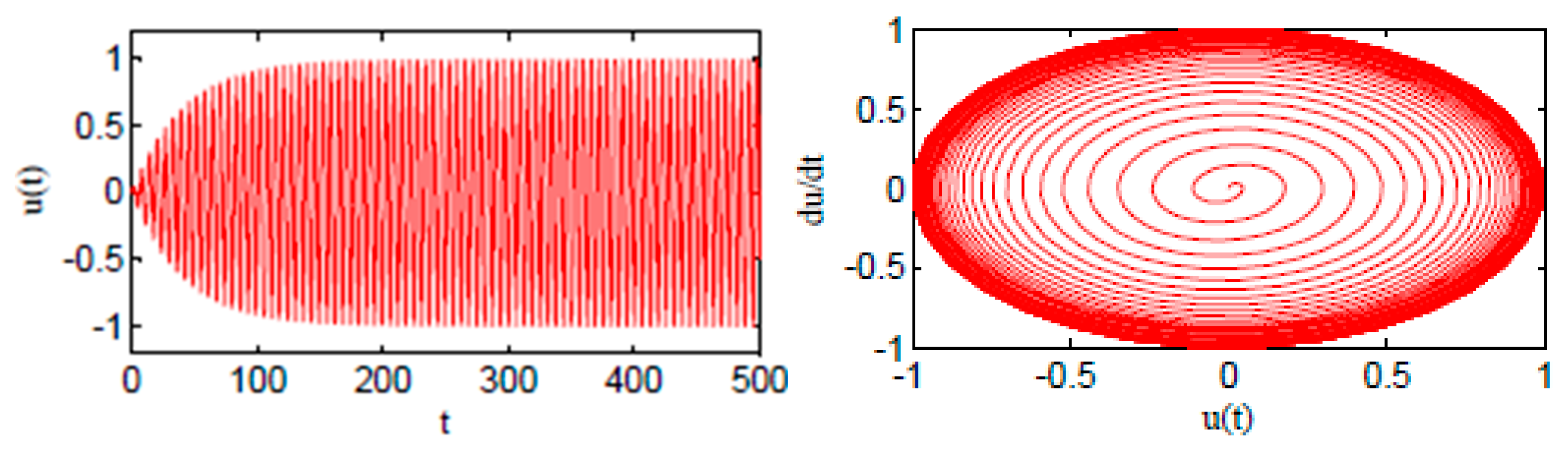
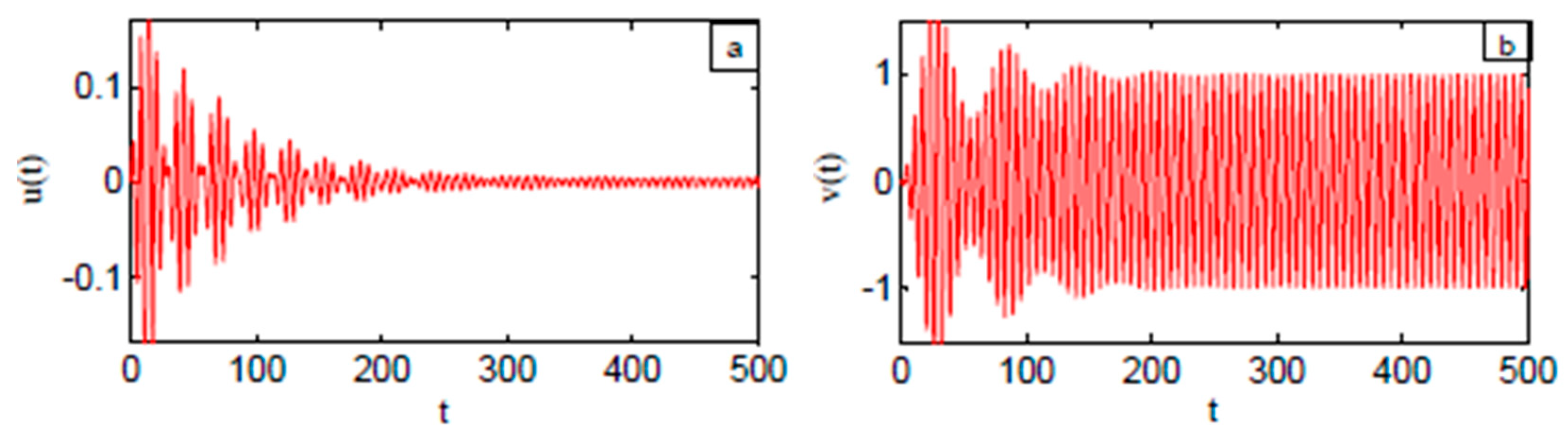
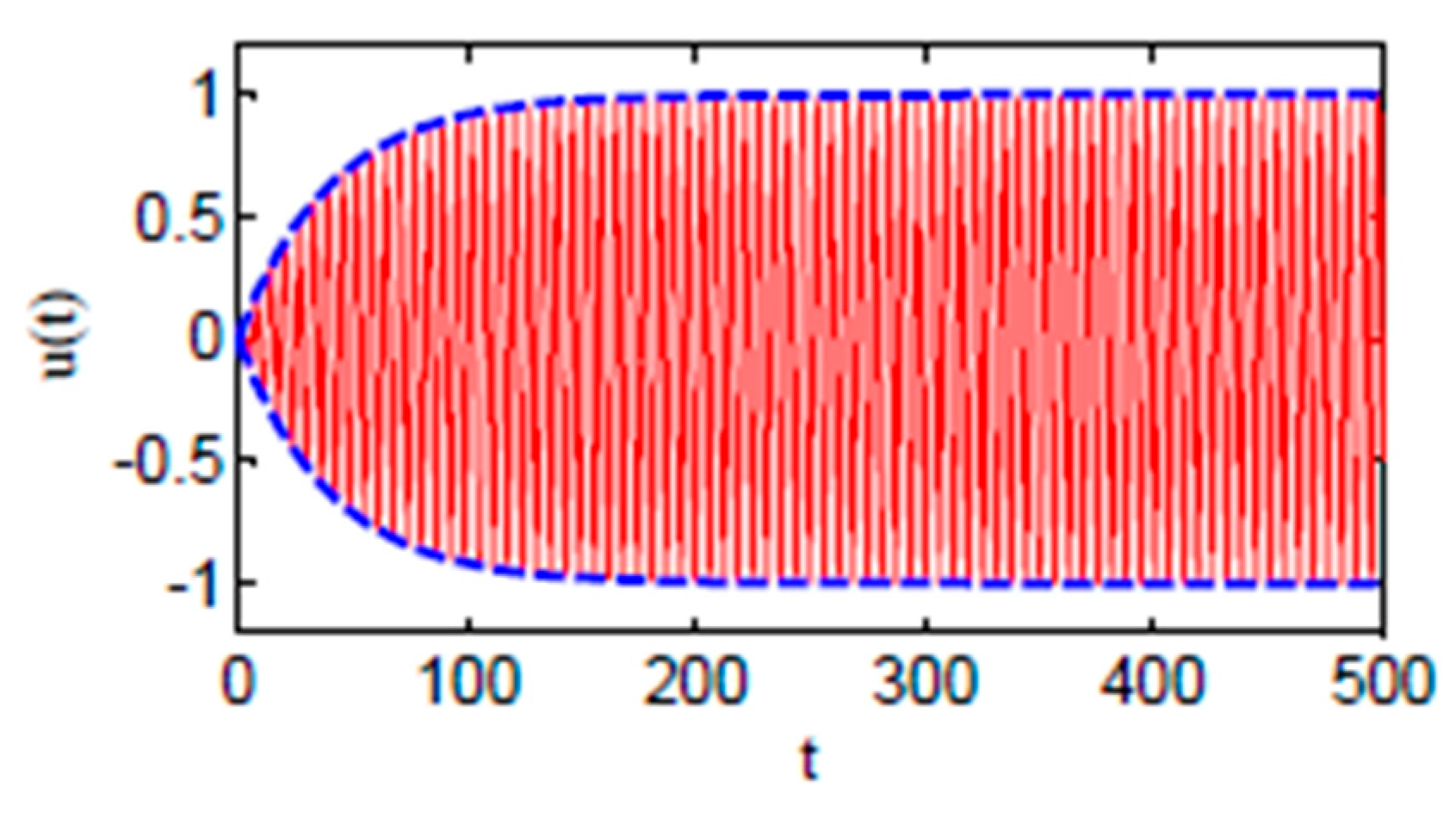
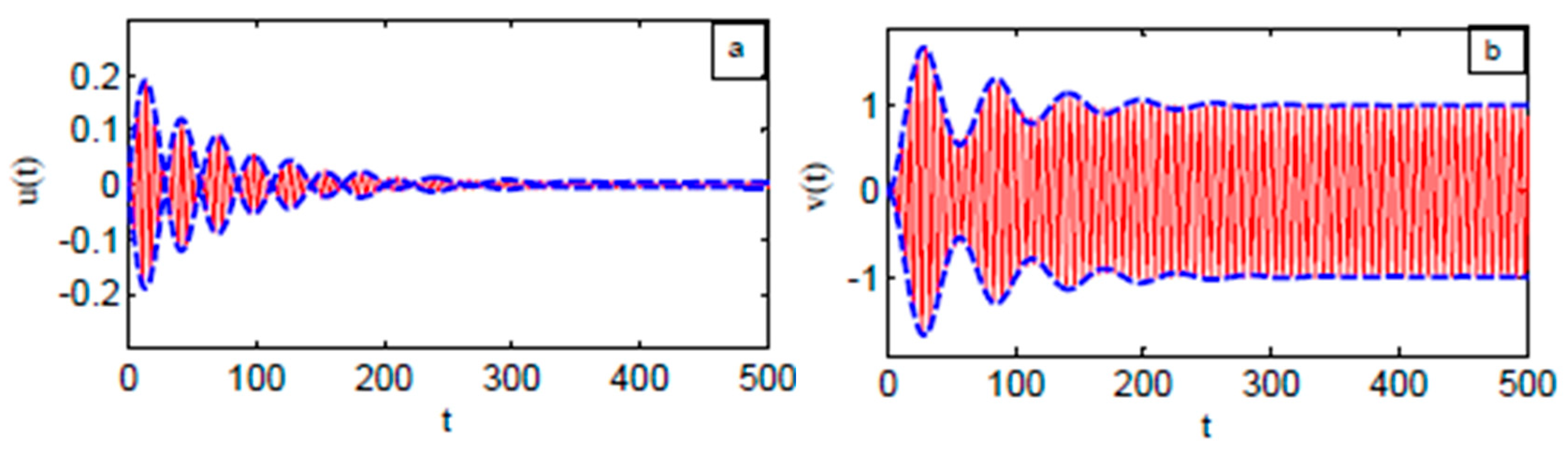
In this section, the fourth-order Runge–Kutta method was applied to solve Equations (3) and (4), and MATLAB 2014a’s ODE45 solver was used to validate the results. The system parameters were selected as μ 1 = 0.05 ,   μ 2 = 0.005 ,   β = 0.01 ,   β 1 = 0.005 ,   β 2 = 0.0004 ,   r = 0.2 ,   ω 1 = 1 ,   Ω 1 = ω 2 = ω 1 ,   Ω 2 = 2 ω 1 ,   f = 0.05 , α 1 = 0.05 , and α 2 = 1 , following Ref. [14]. The uncontrolled AFM system, tested at the worst resonance case ( Ω 1 = ω 1 ,   Ω 2 = 2 ω 1 ), is shown in Figure 3. The amplitude is approximately unity, and the phase-plane response reveals multiple stable limit cycles. When the NDF controller is applied under the same resonance condition, the system amplitude is suppressed to nearly 0.005 (Figure 4). The corresponding efficiency factor E a , defined as the ratio of the uncontrolled to controlled amplitudes, reaches about 200, indicating a vibration reduction of 99%.

4.1. Averaged Response Curves

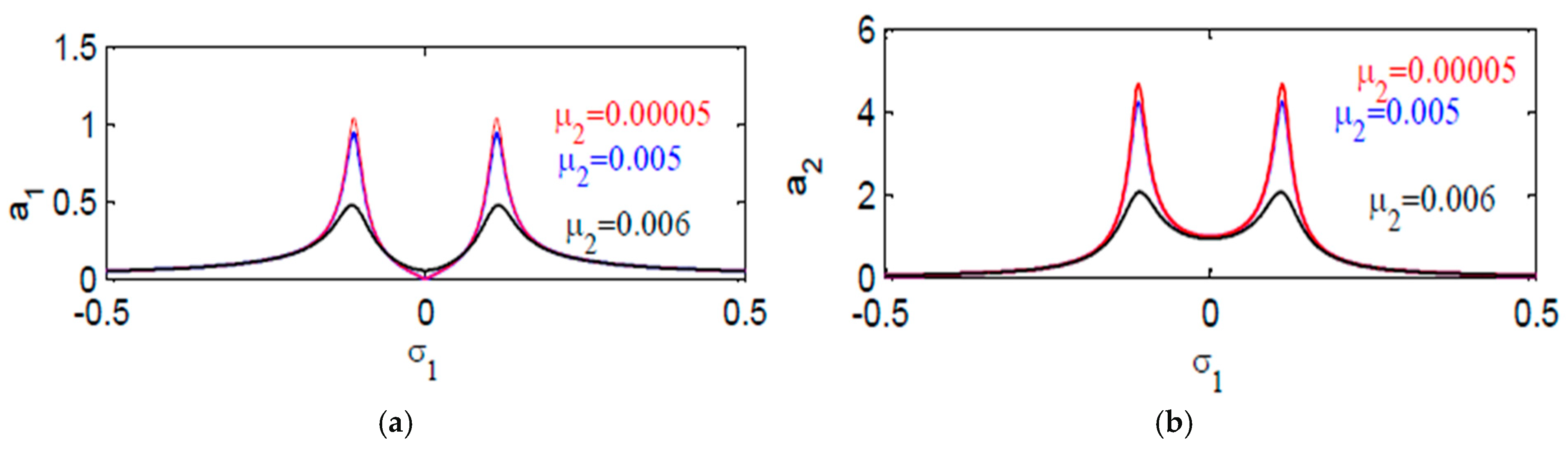
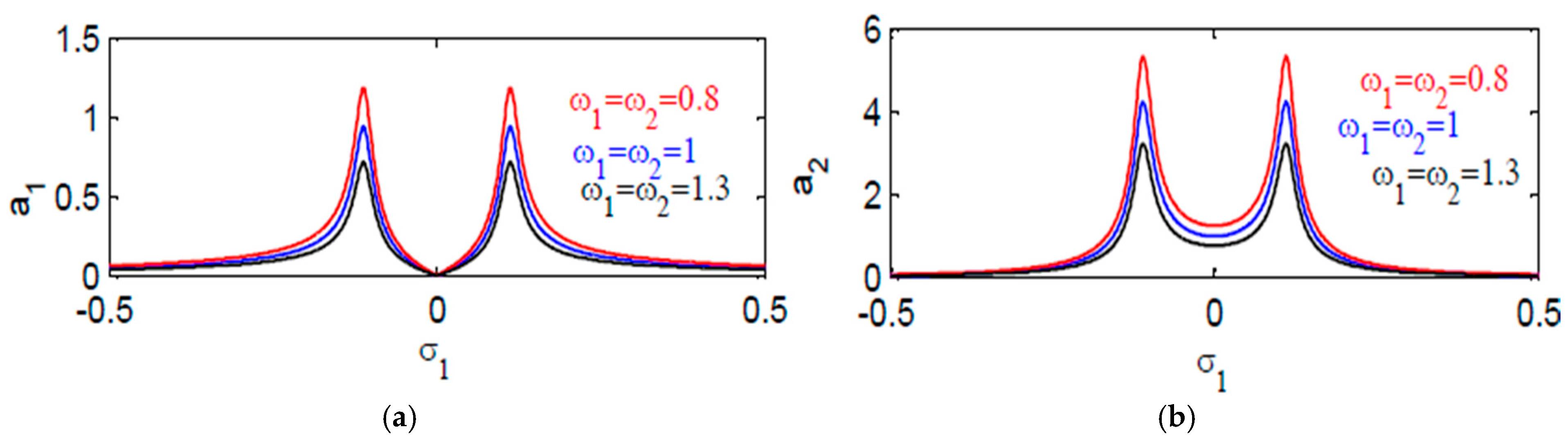
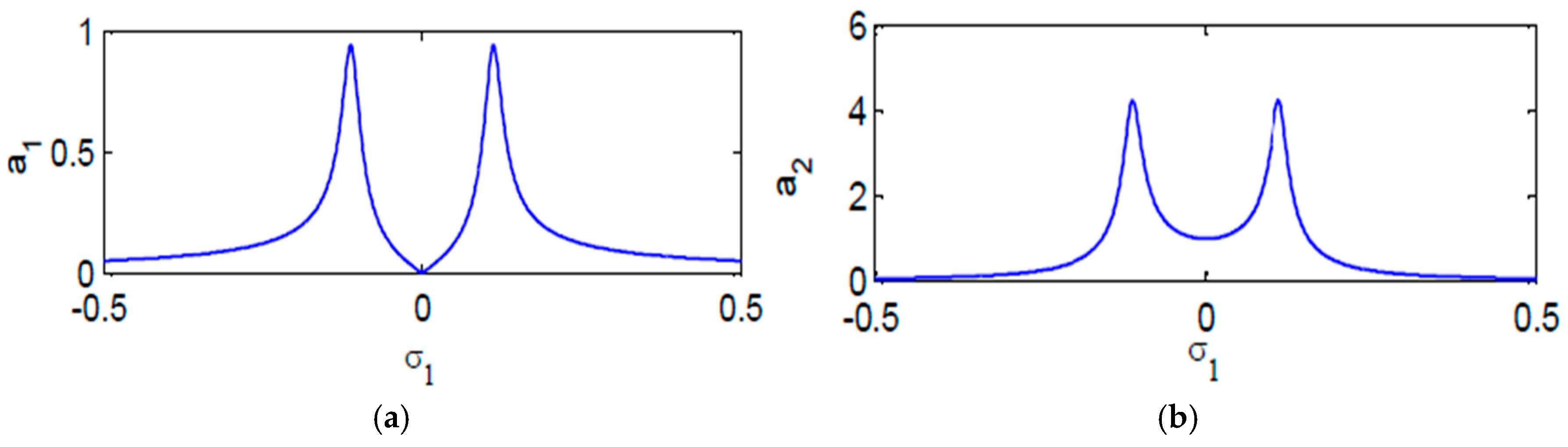
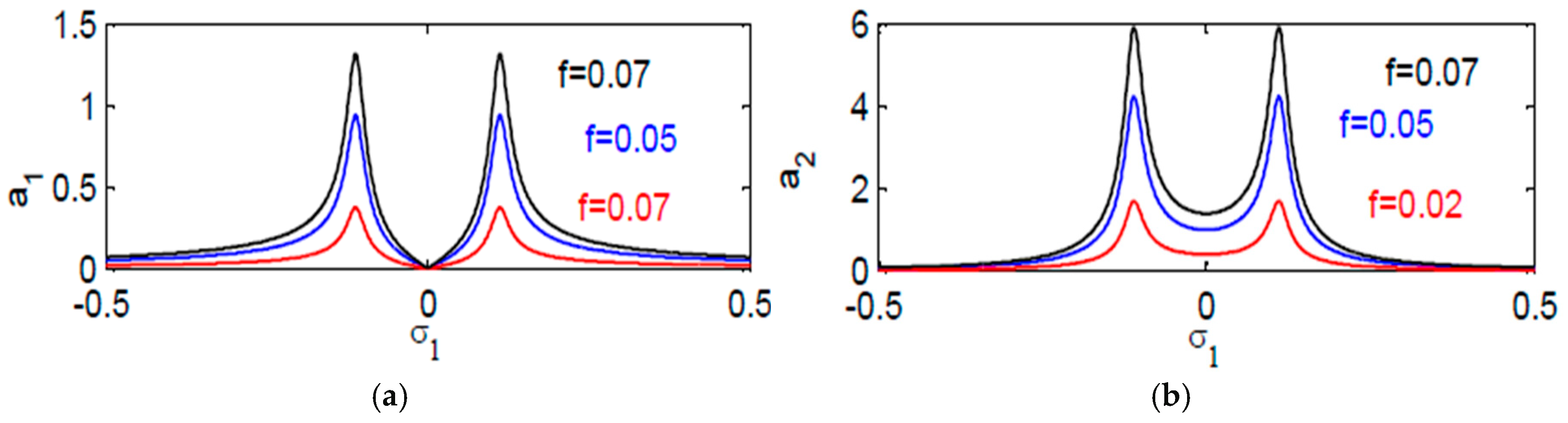
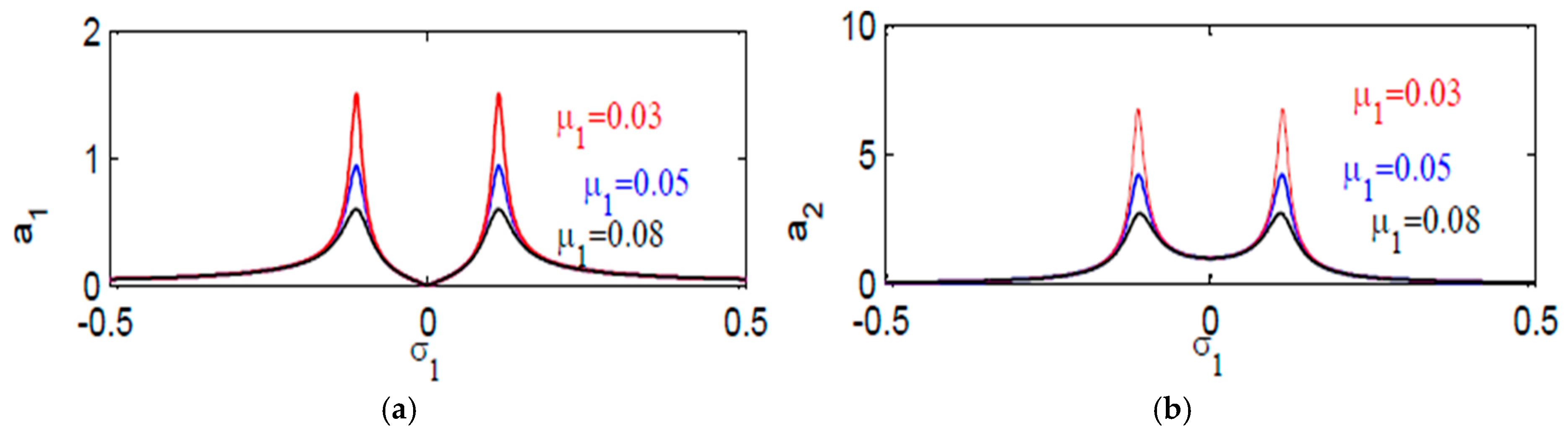
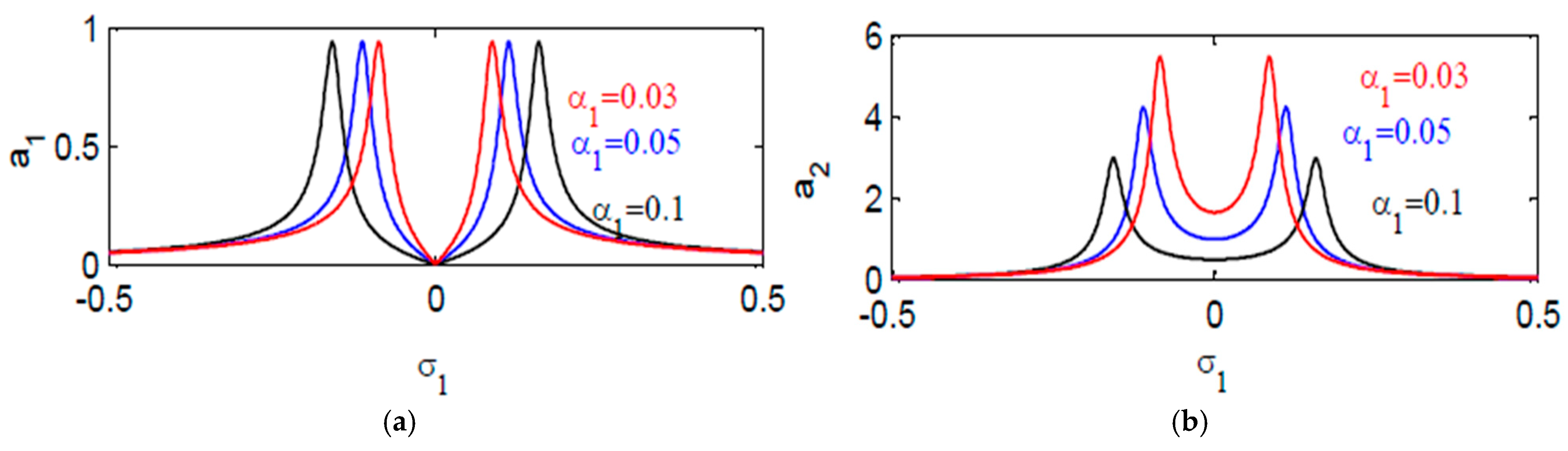
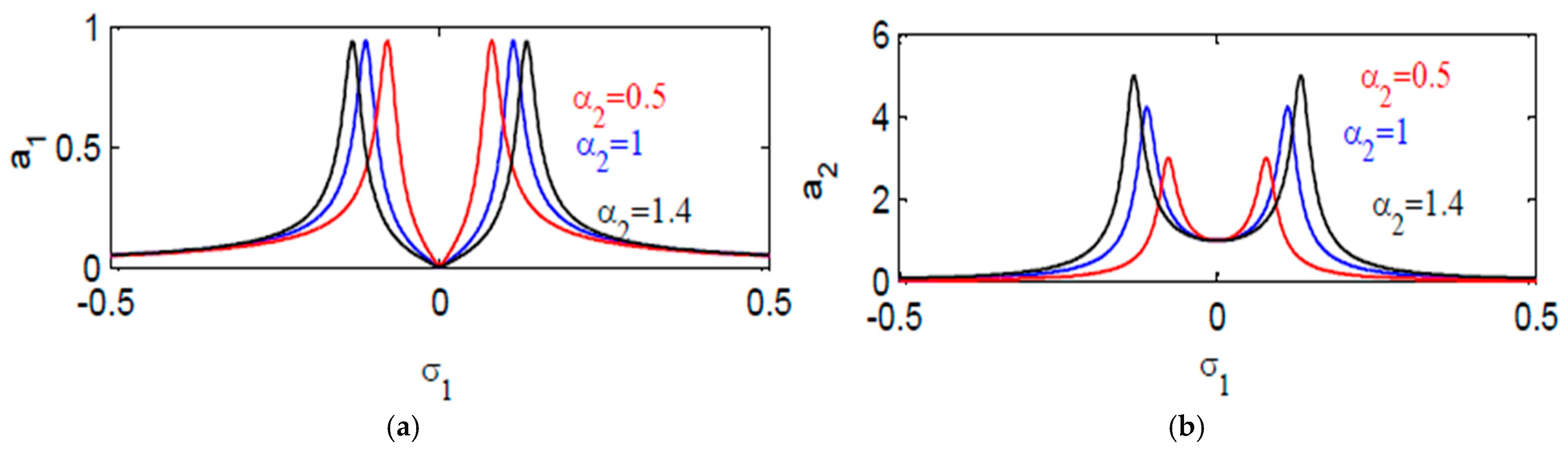
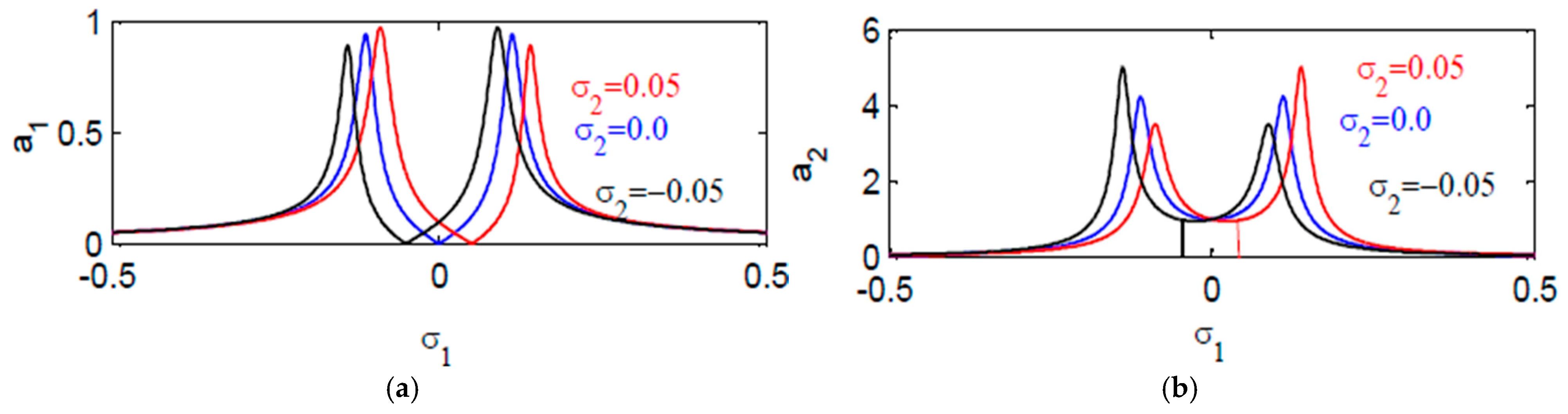
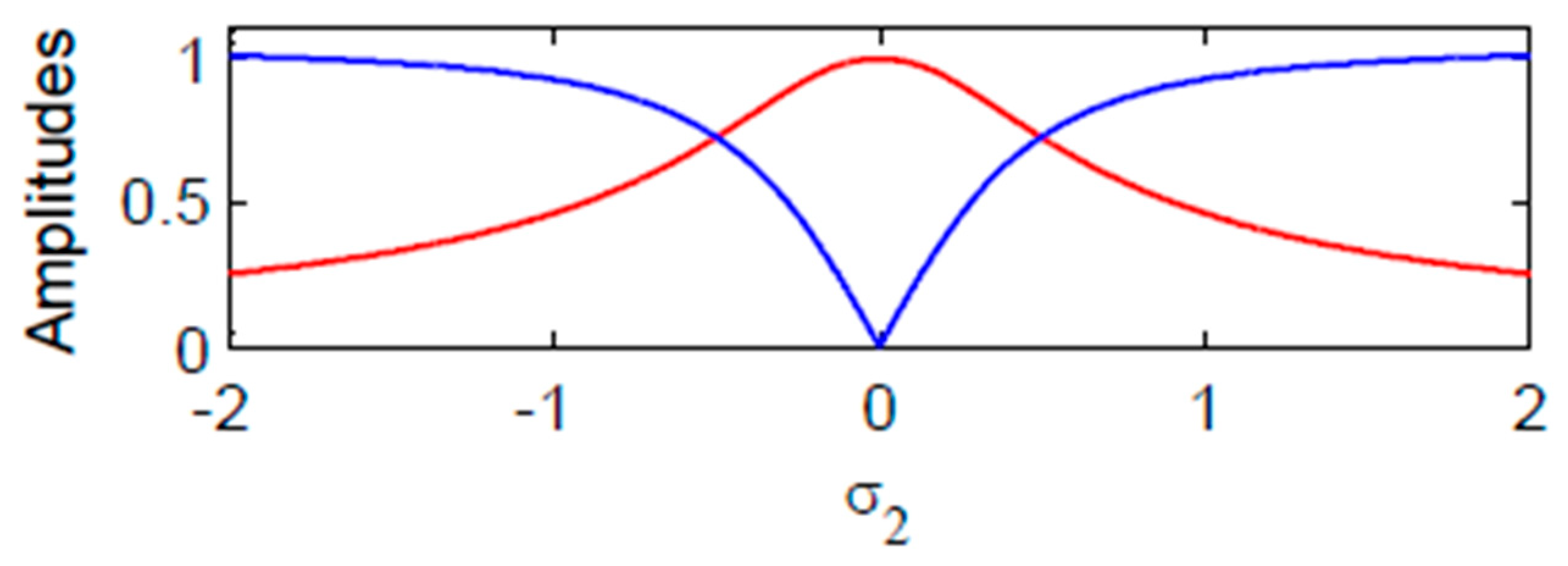
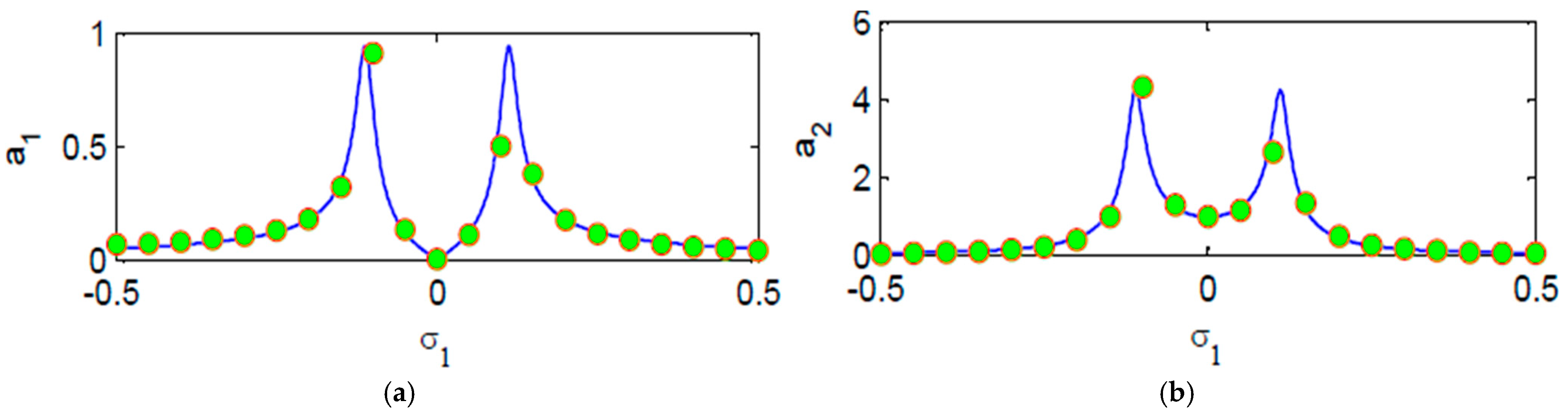
Steady-state amplitudes were obtained from the perturbation Equations (31)–(34). Figure 5 shows that the AFM system and controller responses exhibit two resonance peaks and achieve minimum amplitudes at σ 1 = 0 , confirming the effectiveness of the NDF controller. The resonance bandwidth, defined as the separation between peaks, widens as the controller effectiveness improves. The influence of external excitation is illustrated in Figure 6, where increasing the force amplitude raises the system and controller responses while narrowing the bandwidth. The damping values used in the simulations are nominal. In practice, system identification can be employed to estimate actual damping parameters, while adaptive or robust control methods can improve tolerance to parameter uncertainties. As shown in Figure 7, increasing the damping coefficient μ 1 decreases the amplitudes without affecting the bandwidth. Figure 8 and Figure 9 demonstrate that larger values of μ 2 and ω 1 both reduce amplitudes and increase bandwidth, enhancing stability. The effect of the control and feedback gains is presented in Figure 10 and Figure 11. Increasing α 1 reduces the controller amplitude and enlarges the bandwidth (Figure 10), demonstrating its beneficial role in vibration suppression. In contrast, α 2 increases the controller amplitude (Figure 11), owing to its negative sign, which acts as an additional excitation. To investigate detuning effects, responses were plotted for σ 2 = −0.005, 0, and 0.05 (Figure 12). Minimum amplitudes occur when σ 1 = σ 2 , i.e., when the controller frequency ω2 matches the excitation frequency Ω . Figure 13 further shows that, at σ 2 = 0 , energy is transferred from the AFM system ( a 1 decreases) to the controller ( a 2 increases). Figure 14 and Figure 15 compare the time histories obtained from numerical integration (solid red lines) with the perturbation solutions (dashed blue lines). The close agreement between the two confirms the validity of the analytical approximation. Figure 16 further verifies this by comparing peak amplitudes extracted from time histories with those predicted by perturbation analysis, demonstrating strong consistency across both methods.

4.2. Comparison with Some Previous Studies

To evaluate the effectiveness of the proposed controller, a comparison is conducted with previously reported vibration control techniques for AFM systems. Table 1 summarizes the performance of different controllers in terms of vibration reduction and efficiency factor. The comparison demonstrates the superior performance of the proposed NDF controller over earlier control approaches.
Table 1 compares different vibration control techniques for AFM systems. The proposed NDF controller achieves the best performance, reducing vibrations by nearly 99 % with an efficiency factor of approximately E a = 200 , outperforming the PD and time-delayed PPF controllers reported in previous studies.

5. Conclusions

A contact-mode atomic force microscope (AFM) operating under simultaneous resonance conditions ( Ω = ω 1 , Ω 1 = 2 ω 1 ) and subjected to both external harmonic and parametric excitations was comprehensively investigated in this study. To suppress the undesirable nonlinear vibrations generated near resonance, a Negative Derivative Feedback (NDF) controller was designed and incorporated into the coupled AFM dynamic model. The averaging method was employed to derive approximate closed-loop modulation equations governing the amplitude and phase evolution of the controlled system, while extensive numerical simulations were performed to validate the obtained analytical solutions. The obtained results demonstrated that the proposed NDF controller significantly reduces the vibration amplitudes and improves the overall dynamic stability of the AFM system under severe resonance conditions. It was observed that the controller exhibits maximum effectiveness when its natural frequency ω 2 is properly tuned to coincide with both the excitation frequency Ω and the AFM primary natural frequency ω 1 , leading to optimal resonance suppression and enhanced energy dissipation. Furthermore, the controller achieved a remarkably high efficiency factor of approximately E a = 200 , indicating a substantial reduction in oscillation amplitude and demonstrating superior performance compared with conventional proportional-derivative (PD) and positive position feedback (PPF) controllers reported in previous studies. The parametric analysis further revealed that the AFM vibration amplitude increases with increasing external excitation force, whereas it decreases significantly with larger damping coefficients μ 1 and μ 2 , as well as higher natural frequencies ω 1 and ω 2 . In addition, increasing the control and feedback α 1 and α 2 was found to broaden the effective operational bandwidth of the system and improve the vibration attenuation capability over a wider frequency range. Excellent agreement between the analytical predictions and numerical simulation results confirmed the validity, accuracy, and robustness of the perturbation-based averaging approach in describing the nonlinear dynamic behavior of the controlled AFM system.

Author Contributions

Conceptualization, K.A. and M.N.A.E.-S.; methodology, K.A. and M.N.A.E.-S.; software, K.A. and M.N.A.E.-S.; validation, K.A. and M.N.A.E.-S.; formal analysis, K.A. and M.N.A.E.-S.; investigation, K.A. and M.N.A.E.-S.; resources, K.A. and M.N.A.E.-S.; data curation, K.A. and M.N.A.E.-S.; writing—original draft preparation, K.A. and M.N.A.E.-S.; writing—review and editing, K.A. and M.N.A.E.-S.; visualization, K.A. and M.N.A.E.-S.; supervision, K.A. and M.N.A.E.-S.; project administration, K.A. and M.N.A.E.-S.; funding acquisition, K.A. All authors have read and agreed to the published version of the manuscript.

Funding

This research was funded by the Ongoing Research Funding program, (ORF-2026-588), King Saud University, Riyadh, Saudi Arabia.

Data Availability Statement

The original contributions presented in this study are included in the article. Further inquiries can be directed to the corresponding author.

Acknowledgments

The authors extend their appreciation to the Ongoing Research Funding program, (ORF-2026-588), King Saud University, Riyadh, Saudi Arabia.

Conflicts of Interest

The authors declare that they have no known competing financial interests or personal relationships that could have appeared to influence the work reported in this paper.

Appendix A

The steps for obtaining Equation (2) from Equation (1)
m x ¨ + c 1 x ˙ + k x = k 0 + k 1 cos ( Ω 1 t ) z 0 x 3 2 + m g + F cos ( Ω t )
Let x = z 0   v , then substituting in Equation (A1)
m   z 0 v ¨ + c 1 z 0 v ˙ + k z 0 v = k 0 + k 1 cos ( Ω 1 t ) z 0 z 0 v 3 2 + m g + F cos ( Ω t )
Divided by m   z 0
v ¨ + c 1 m v ˙ + k m v = k 0 z 0 1 / 2 m 1 + k 1 k 0 cos ( Ω 1 t ) 1 v 3 2 + g z 0 + F m   z 0 cos ( Ω t )
Let, μ 1 = c 1 m , ω 1 = k m ,   β = k   z 0 1 / 2 m ,   f = F m   z 0 , r = k 1 k 0 .
v ¨ + μ 1 v ˙ + ω 1 2 v = β 1 + r   cos ( Ω 1 t ) 1 v 3 2 + g z 0 + f cos ( Ω t )
Taylor expansion of 1 v 3 2 can be written as
1 v 3 2 1 3 2 v + 3 8 v 2 + 1 16 v 3 +
Substituting in Equation (A4),
v ¨ + μ 1 v ˙ + ω 1 2 v = β 1 + r   cos ( Ω 1 t ) 1 3 2 v + 3 8 v 2 + 1 16 v 3 + g z 0 + f cos ( Ω t )
The system is assumed to oscillate around a static equilibrium position, so all constants must be canceled so
m   g = k 0   z 0 3 / 2 β = g z 0
So, Equation (A6) tacks the following form
v ¨ + μ 1 v ˙ + ω 1 2 v + 3 β 2 v + 3 β 8 v 2 + β 16 v 3 + r   β 3 β 2 v + 3 β 8 v 2 + β 16 v 3 cos ( Ω 1 t ) = f cos ( Ω t )
So, Equation (A8) can be written as
v ¨ + μ 1 v ˙ + ω 1 2 v β 1 v + β 2 v 2 β 3 v 3 + r β β 1 v + β 2 v 2 β 3 v 3 cos ( Ω 1 t ) = f cos ( Ω t )
where
β 1 = 3 2 β ,   β 2 = 3 8 β ,   β 3 = 1 16 β
We evaluate all integrations in Equations (20)–(23) as
0 2 π cos ω 1 t + γ 1 sin ω 1 t + γ 1 d γ 1 = 0 , 0 2 π sin 2 ω 1 t + γ 1   d γ 1 = π , 0 2 π cos 2 ω 1 t + γ 1 sin ω 1 t + γ 1   d γ 1 = 0 0 2 π cos 2 ( ω 1 t + γ 1 ) sin ω 1 t + γ 1   d γ 1 = 0 2 π 2 cos 2 ( ω 1 t + γ 1 ) sin ω 1 t + γ 1   d γ 1 0 2 π sin ω 1 t + γ 1   d γ 1 = 0 0 2 π cos 3 ω 1 t + γ 1 sin ω 1 t + γ 1   d γ 1 = 0 , 0 2 π sin 2 ( ω 1 t + γ 1 ) sin ω 1 t + γ 1   d γ 1 = 0 0 2 π cos ω 1 t + γ 1 cos 2 ( ω 1 t + γ 1 ) sin ω 1 t + γ 1   d γ 1 = 0 , 0 2 π cos ω 1 t + γ 1 sin 2 ( ω 1 t + γ 1 ) sin ω 1 t + γ 1   d γ 1 = π 2 0 2 π cos 2 ω 1 t + γ 1 cos 2 ( ω 1 t + γ 1 ) sin ω 1 t + γ 1   d γ 1 = 0 , 0 2 π cos 2 ω 1 t + γ 1 sin 2 ( ω 1 t + γ 1 ) sin ω 1 t + γ 1   d γ 1 = 0 0 2 π cos 3 ω 1 t + γ 1 cos 2 ( ω 1 t + γ 1 ) sin ω 1 t + γ 1   d γ 1 = 0 , 0 2 π cos 3 ω 1 t + γ 1 sin 2 ( ω 1 t + γ 1 ) sin ω 1 t + γ 1   d γ 1 = π 4
f 2 π ω 1 cos ϕ 1 0 2 π cos 2 ω 1 t + γ 1   d γ 1 = π , 0 2 π cos 3 ω 1 t + γ 1   d γ 1 = 0 , 0 2 π cos 4 ω 1 t + γ 1   d γ 1 = π 4 0 2 π cos ω 1 t + γ 1 cos 2 ( ω 1 t + γ 1 )   d γ 1 = 0 , 0 2 π cos ω 1 t + γ 1 sin 2 ( ω 1 t + γ 1 )   d γ 1 = 0 0 2 π cos 2 ω 1 t + γ 1 cos 2 ( ω 1 t + γ 1 )   d γ 1 = π 2 , 0 2 π cos 2 ω 1 t + γ 1 sin 2 ( ω 1 t + γ 1 )   d γ 1 = 0 0 2 π cos 3 ω 1 t + γ 1 cos 2 ( ω 1 t + γ 1 )   d γ 1 = 0 , 0 2 π cos 3 ω 1 t + γ 1 sin 2 ( ω 1 t + γ 1 )   d γ 1 = 0 0 2 π cos 4 ω 1 t + γ 1 cos 2 ( ω 1 t + γ 1 )   d γ 1 = π 2 , 0 2 π cos 4 ω 1 t + γ 1 sin 2 ( ω 1 t + γ 1 )   d γ 1 = 0
0 2 π sin 2 ω 2 t + γ 2 d γ 2 = π , 0 2 π cos ω 2 t + γ 2 sin ω 2 t + γ 2 d γ 2 = 0
η 11 = a ˙ 1 a 1 = μ 1 2 + r β 1 4 ω 1 sin 2 ϕ 1 + 3 r β 3 a 1 2 8 ω 1 sin 2 ϕ 1 η 12 = a ˙ 1 ϕ 1 = f 2 ω 1 cos ϕ 1 + r β 1 a 1 2 ω 1 cos 2 ϕ 1 + r β 3 a 1 3 4 ω 1 cos 2 ϕ 1 η 13 = a ˙ 1 a 2 = ω 2 α 1 2 ω 1 cos ϕ 2 η 14 = a ˙ 1 ϕ 2 = ω 2 α 1 a 2 2 ω 1 sin ϕ 2
η 21 = ϕ ˙ 1 a 1 = f 2 ω 1 a 1 2 cos ϕ 1 + ω 2 α 1 a 2 2 ω 1 a 1 2 sin ϕ 2 + 3 β 3 4 ω 1 a 1 + r β 3 a 1 2 ω 1 cos 2 ϕ 1 η 22 = ϕ ˙ 1 ϕ 1 = f 2 ω 1 a 1 sin ϕ 1 r β 1 2 ω 1 sin 2 ϕ 1 r β 3 a 1 2 2 ω 1 sin 2 ϕ 1 η 23 = ϕ ˙ 1 a 2 = ω 2 α 1 2 ω 1 a 1 sin ϕ 2 η 24 = ϕ ˙ 1 ϕ 2 = ω 2 α 1 a 2 2 ω 1 a 1 cos ϕ 2
η 31 = a ˙ 2 a 1 = ω 1 α 2 2 ω 2 cos ϕ 2 η 32 = a ˙ 2 ϕ 1 = 0 η 33 = a ˙ 2 a 2 = μ 2 2 η 34 = a ˙ 2 ϕ 2 = ω 1 α 2 2 ω 2 a 1 sin ϕ 2
η 41 = ϕ ˙ 2 a 1 = ω 1 α 2 2 ω 2 a 2 sin ϕ 2 f 2 ω 1 a 1 2 cos ϕ 1 + ω 2 α 1 a 2 2 ω 1 a 1 2 sin ϕ 2 + 3 β 3 4 ω 1 a 1 + r β 3 a 1 2 ω 1 cos 2 ϕ 1 η 42 = ϕ ˙ 2 ϕ 2 = f 2 ω 1 a 1 sin ϕ 1 r β 1 2 ω 1 sin 2 ϕ 1 r β 3 a 1 2 2 ω 1 sin 2 ϕ 1 η 43 = ϕ ˙ 2 a 2 = ω 1 α 2 2 ω 2 a 2 2 a 1 sin ϕ 2 ω 2 α 1 2 ω 1 a 1 sin ϕ 2 η 44 = ϕ ˙ 2 ϕ 2 = ω 1 α 2 2 ω 2 a 2 a 1 cos ϕ 2 ω 2 α 1 a 2 2 ω 1 a 1 cos ϕ 2
χ 1 = t r J = η 11 + η 22 + η 33 + η 44 χ 2 = 1   < i   < j   < 4 η i i η j j η i j η j i         = η 11 η 22 η 12 η 21 + η 11 η 33 η 13 η 31 + η 11 η 44 η 14 η 41         + η 22 η 33 η 23 η 32 + η 22 η 44 η 24 η 42 + η 33 η 44 η 34 η 43
χ 3 = η 11 η 22 η 33 η 23 η 32 η 12 η 21 η 33 η 23 η 31 + η 13 η 21 η 32 η 22 η 31         + η 11 η 22 η 44 η 24 η 42 η 12 η 21 η 44 η 24 η 41 + η 14 η 21 η 42 η 22 η 41         + η 11 η 33 η 44 η 34 η 43 η 13 η 31 η 44 η 34 η 41 + η 14 η 31 η 42 η 33 η 41         + η 22 η 33 η 44 η 34 η 43 η 23 η 32 η 44 η 34 η 42 + η 24 η 32 η 43 η 33 η 42
χ 4 = η 11 η 22 η 23 η 24 η 32 η 33 η 34 η 42 η 43 η 44 η 12 η 21 η 23 η 24 η 31 η 33 η 34 η 41 η 43 η 44 + η 13 η 21 η 22 η 24 η 31 η 32 η 34 η 41 η 42 η 44 η 14 η 21 η 22 η 23 η 31 η 32 η 33 η 41 η 42 η 43

References

  1. Binnig, G.; Quate, C.F. Atomic force microscope. Phys. Rev. Lett. 1986, 56, 930–933. [Google Scholar] [CrossRef] [PubMed]
  2. Rützel, S.; Lee, S.I.; Raman, A. Nonlinear dynamics of atomic–force–microscope probes driven in Lennard–Jones potentials. Proc. R. Soc. Lond. Ser. A Math. Phys. Eng. Sci. 2003, 459, 1925–1948. [Google Scholar] [CrossRef]
  3. Abdel-Rahman, E.M.; Nayfeh, A.H. Contact force identification using the subharmonic resonance of a contact-mode atomic force microscopy. Nanotechnology 2005, 16, 199–207. [Google Scholar] [CrossRef] [PubMed]
  4. Arafat, H.N.; Nayfeh, A.H.; Abdel-Rahman, E.M. Modal interactions in contact-mode atomic force microscopes. Nonlinear Dyn. 2008, 54, 151–166. [Google Scholar] [CrossRef]
  5. Salarieh, H.; Alasty, A. Control of chaos in atomic force microscopes using delayed feedback based on entropy minimization. Commun. Nonlinear Sci. Numer. Simul. 2009, 14, 637–644. [Google Scholar] [CrossRef]
  6. Yamasue, K.; Kobayashi, K.; Yamada, H.; Matsushige, K.; Hikihara, T. Controlling chaos in dynamic-mode atomic force microscope. Phys. Lett. A 2009, 373, 3140–3144. [Google Scholar] [CrossRef]
  7. Bahrami, A.; Nayfeh, A.H. On the dynamics of tapping mode atomic force microscope probes. Nonlinear Dyn. 2012, 70, 1605–1617. [Google Scholar] [CrossRef]
  8. Kirrou, I.; Belhaq, M. Frequency shift and hysteresis suppression in contact-mode AFM using contact stiffness modulation. MATEC Web Conf. 2012, 1, 04003. [Google Scholar] [CrossRef]
  9. Kirrou, I.; Belhaq, M. Contact stiffness modulation in contact-mode atomic force microscopy. Int. J. Non-Linear Mech. 2013, 55, 102–109. [Google Scholar] [CrossRef]
  10. Kirrou, I.; Belhaq, M. Effect of contact stiffness modulation in contact-mode AFM under subharmonic excitation. Commun. Nonlinear Sci. Numer. Simul. 2013, 18, 2916–2925. [Google Scholar] [CrossRef]
  11. Bahrami, A.; Nayfeh, A.H. Nonlinear dynamics of tapping mode atomic force microscopy in the bistable phase. Commun. Nonlinear Sci. Numer. Simul. 2013, 18, 799–810. [Google Scholar] [CrossRef]
  12. Kirrou, I.; Belhaq, M. Control of bistability in non-contact mode atomic force microscopy using modulated time delay. Nonlinear Dyn. 2015, 81, 607–619. [Google Scholar] [CrossRef]
  13. Hamed, Y.S.; Albogamy, K.M.; Sayed, M. A proportional derivative (PD) controller for suppression the vibrations of a contact-mode AFM model. IEEE Access 2020, 8, 214061–214070. [Google Scholar] [CrossRef]
  14. Hamed, Y.S.; Albogamy, K.M.; Sayed, M. Nonlinear vibrations control of a contact-mode AFM model via a time-delayed positive position feedback. Alex. Eng. J. 2021, 60, 963–977. [Google Scholar]
  15. Amer, Y.A.; EL-Sayed, A.T.; Abd EL-Salam, M.N. On controlling of vibrations of a suspended cable via positive position feedback controller. Int. J. Dyn. Control 2023, 11, 370–384. [Google Scholar] [CrossRef]
  16. Amer, Y.A.; EL-Sayed, A.T.; Abd EL-Salam, M.N. A suitable active control for suppression the vibrations of a cantilever beam. Sound. Vib. 2022, 56, 89–104. [Google Scholar] [CrossRef]
  17. El-Sayed, A.T.; Bauomy, H.S. Nonlinear analysis of vertical conveyor with positive position feedback (PPF) controllers. Nonlinear Dyn. 2016, 83, 919–939. [Google Scholar] [CrossRef]
  18. Hamed, Y.S.; Alharthi, M.R.; AlKhathami, H.K. Nonlinear vibration behavior and resonance of a Cartesian manipulator system carrying an intermediate end effector. Nonlinear Dyn. 2018, 91, 1429–1442. [Google Scholar] [CrossRef]
  19. Hamed, Y.S.; Aly, A.A.; Saleh, B.; Alogla, A.F.; Aljuaid, A.M.; Alharthi, M.M. Nonlinear structural control analysis of an offshore wind turbine tower system. Processes 2019, 8, 22. [Google Scholar] [CrossRef]
  20. Kandil, A.; Kamel, M. Vibration control of a compressor blade using position and velocity feedback. Int. J. Acoust. Vib. 2019, 24, 97–112. [Google Scholar] [CrossRef]
  21. Abd El-Salam, M.N.; Amer, Y.A.; Darwesh, F.O. Effect of negative velocity feedback control on the vibration of a nonlinear dynamical system. Int. J. Dyn. Control 2023, 11, 2842–2855. [Google Scholar] [CrossRef]
  22. Moatimid, G.M.; El-Sayed, A.T.; Salman, H.F. Different controllers for suppressing oscillations of a hybrid oscillator via non-perturbative analysis. Sci. Rep. 2024, 14, 307. [Google Scholar] [CrossRef] [PubMed]
  23. Tam, L.T.M.; Ngu, N.V.; Pham, D.H.; Mai, V.T. Disturbance Observer-Based Actor–Critic Reinforcement Learning with Adaptive Reward for Energy-Efficient Control of Robotic Manipulators. Actuators 2026, 15, 167. [Google Scholar] [CrossRef]
  24. Nayfeh, A.H. Problems in Perturbation; John Wiley: New York, NY, USA, 1979. [Google Scholar]
  25. Nayfeh, A.H.; Mook, D.T. Nonlinear Oscillations; John Wiley: New York, NY, USA, 1985. [Google Scholar]
Figure 1. Schematic model of a Contact-Mode AFM.
Mathematics 14 02235 g001
Figure 2. Closed-loop block diagram for controlled AFM model.
Mathematics 14 02235 g002
Figure 3. Response and phase of uncontrolled AFM mode at simultaneous resonance case Ω 1 = ω 1 ,   Ω 2 = 2 ω 1 .
Mathematics 14 02235 g003
Figure 4. Response of controlled AFM mode at simultaneous resonance case Ω 1 = ω 1 ,   Ω 2 = 2 ω 1 , ω 2   = ω 1 . (a) the main system, and (b) the NDF controller.
Mathematics 14 02235 g004
Figure 5. The frequency response curves of (a) controlled AFM mode and (b) the NDF control.
Mathematics 14 02235 g005
Figure 6. The frequency response curves of (a) controlled AFM mode and (b) the NDF control at different values of external force f .
Mathematics 14 02235 g006
Figure 7. The frequency response curves of (a) controlled AFM mode and (b) the NDF control at different values of main system’s damping coefficient μ 1 .
Mathematics 14 02235 g007
Figure 8. The frequency response curves of (a) controlled AFM mode and (b) the NDF control at different values of controller’s damping coefficient μ 2 .
Mathematics 14 02235 g008
Figure 9. The frequency response curves of (a) controlled AFM mode and (b) the NDF control at different values of natural frequencies ω 1 , ω 2 .
Mathematics 14 02235 g009
Figure 10. The frequency response curves of (a) controlled AFM mode and (b) the NDF control at different values of control signal α 1 .
Mathematics 14 02235 g010
Figure 11. The frequency response curves of (a) controlled AFM mode and (b) the NDF control at different values of feedback signal α 2 .
Mathematics 14 02235 g011
Figure 12. The frequency response curves of (a) controlled AFM mode and (b) the NDF control at different values of detuning parameter σ 2 .
Mathematics 14 02235 g012
Figure 13. The amplitude of AFM mode (blue line) and NDF controller (red line) against detuning parameter σ 2 .
Mathematics 14 02235 g013
Figure 14. Comparison between the numerical solution (ـــــــــــــــ) and the approximate solution (---------) of uncontrolled AFM mode.
Mathematics 14 02235 g014
Figure 15. Comparison between the numerical solution (ـــــــــــــــ) and the approximate solution (---------) of (a) AFM mode, and (b) NDF controller.
Mathematics 14 02235 g015
Figure 16. Comparison between the frequency response curves (ـــــــــــــــ) and the numerical solution (oooooo) (a) AFM mode, and (b) NDF controller.
Mathematics 14 02235 g016
Table 1. Comparison between previous controllers and the proposed NDF controller for AFM systems.
ReferenceControl TechniqueVibration ReductionEfficiency Factor E a
Ref. [13]Proportional–Derivative (PD) Controller 25 % 50
Ref. [14]Time-Delayed Positive Position Feedback (PPF) Controller 94 % Increased from ≈ 16 to ≈ 193
Present StudyNegative Derivative Feedback (NDF) Controller 99 % ≈200
Disclaimer/Publisher’s Note: The statements, opinions and data contained in all publications are solely those of the individual author(s) and contributor(s) and not of MDPI and/or the editor(s). MDPI and/or the editor(s) disclaim responsibility for any injury to people or property resulting from any ideas, methods, instructions or products referred to in the content.