Article

The Maximal Almost Sure Lyapunov Exponent of Three-Dimensional Linear Stratonovich Stochastic Differential Equations


School of Mathematics and Statistics, Wuhan University of Technology, 122 Luoshi Road, Wuhan 430070, China
*
Author to whom correspondence should be addressed.
Mathematics 2026, 14(12), 2207; https://doi.org/10.3390/math14122207 (registering DOI)
Submission received: 28 April 2026 / Revised: 10 June 2026 / Accepted: 17 June 2026 / Published: 19 June 2026

Abstract

The sign of the maximal almost sure Lyapunov exponent determines the stability of stochastic systems, while its numerical computation for three-dimensional linear Stratonovich stochastic differential equations remains challenging due to the failure of classical two-dimensional strategies. The spherical angular motion of 3D systems produces a Fokker–Planck equation with intractable mixed partial derivatives, preventing conventional analytical solutions. This paper develops a unified computational framework for three-dimensional linear Stratonovich stochastic systems using analytical derivation for degenerate cases and physics-informed neural network (PINN) approximation for general non-degenerate scenarios. For degenerate systems, we reduce the coefficient matrix to a lower triangular form via orthogonal transformation and establish tight upper bounds based on the logarithmic growth property of the Wiener process, yielding closed-form expressions for the maximal almost sure Lyapunov exponent under all parameter sign configurations. For non-degenerate systems, we reformulate the Fokker–Planck equation in spherical coordinates and construct a customized PINN with trigonometric encoding to enforce periodic boundary conditions. The network is trained by joint loss functions of equation residuals, boundary constraints and normalization consistency, and the converged stationary density is substituted into the Furstenberg–Khasminskii formula to calculate the exponent via Gauss–Legendre quadrature. Monte Carlo simulations confirm the accuracy and robustness of the proposed method, which reliably identifies the sign of the maximal almost sure Lyapunov exponent even in near-critical regimes. Numerical experiments on a 3D stochastic Hopf bifurcation model show that noise negatively shifts the bifurcation point, with the offset linearly proportional to the squared noise intensity. This work extends Lyapunov stability analysis from two-dimensional to three-dimensional linear Stratonovich stochastic systems, offering an effective tool for stability evaluation of general three-dimensional stochastic dynamical models.

1. Introduction

A defining characteristic of chaotic behavior in dynamical systems is extreme sensitivity to initial conditions. The Lyapunov exponent serves as the fundamental tool for quantifying the separation rate of adjacent trajectories in phase space, and its sign directly determines system stability: a maximal Lyapunov exponent λ > 0 indicates instability or chaos, λ < 0 implies asymptotic stability, and  λ = 0 corresponds to marginal stability [1,2]. This criterion has been extensively applied in physics and engineering; however, classical deterministic Lyapunov exponent theory is inadequate for real-world physical systems driven by noise [3]. With advances in stochastic differential equation theory, the concept has been extended to stochastic systems, emerging as a key metric for assessing the stability of stochastic dynamical systems [4,5,6]. However, the computational difficulty of calculating Lyapunov exponents increases dramatically with system dimension; for instance, one-dimensional stochastic systems admit analytical solutions [7], and two-dimensional systems have well-established explicit formulas [8,9], yet three-dimensional systems remain largely unexplored due to coupled angular motion and the increased complexity of the corresponding Fokker–Planck equation [10]. Three-dimensional stochastic differential equations are widely used in fluid mechanics, stochastic response analysis of engineering structures, and other fields [11,12], and their maximal Lyapunov exponents can provide quantitative foundations for determining system stability boundaries and conducting parameter sensitivity analysis. Thus, the development of efficient computational methods for these cases is both theoretically significant and practically valuable [13].
In the study of stochastic dynamical systems and Lyapunov exponents, Khasminskii established the necessary and sufficient conditions for the asymptotic stability of linear stochastic systems, laying the groundwork for explicit computations in low-dimensional systems [14]. Thereafter, Arnold et al. and Imkeller et al. made significant progress in moment Lyapunov exponents and computational formulas for two-dimensional systems [15,16,17,18,19], respectively, while the establishment of Oseledec’s multiplicative ergodic theorem guaranteed the existence of the Lyapunov exponent spectrum for nonlinear systems [20]. In stochastic bifurcation analysis, the core challenge is identifying qualitative transitions in system behavior, and a sign change in the maximal almost sure Lyapunov exponent can serve as a key criterion for bifurcation points. In this context, Arnold established the central role of invariant measures [21,22], and Baxendale analyzed the relationship between Lyapunov exponents and chaos in additively noise-driven Hopf bifurcations [23].
The maximal almost sure Lyapunov exponent quantifies the rate of trajectory separation or convergence. Low-dimensional systems have been extensively studied; for instance, Pham and Doan derived explicit solutions for two-dimensional systems [8], and Baxendale explored the connection between Lyapunov exponents and chaos. Yet three-dimensional systems remain an open research frontier [24]. The generating function of moment Lyapunov exponents describes the exponential growth rate of system moment responses [25,26,27,28,29,30,31]. Its derivative at the origin equals the maximal Lyapunov exponent, revealing the relationship between sample stability and moment stability. Arnold et al. analyzed the theoretical properties of these exponents [32], and Janevski et al. verified their engineering applicability [33]. It has been established that the Fokker–Planck equation is the critical link between the stationary distribution of angular motion and Lyapunov exponents. Explicit solutions exist for one-dimensional and some two-dimensional cases, but classical methods fail for three-dimensional systems due to coupled angular motion, necessitating numerical approaches. Possible candidate approaches include physics-informed neural networks (PINNs), which are well-suited for solving partial differential equations numerically and have demonstrated accuracy in low-dimensional Fokker–Planck equations [34,35,36,37]. However, their performance in solving the two-dimensional Fokker–Planck equation in spherical coordinates, which is the focus of this work, has not yet been investigated.
In this context, we investigate three-dimensional linear Stratonovich stochastic differential equations. Specifically, we develop computational methods for the maximal almost sure Lyapunov exponent based on spherical polar coordinate transformation considering two distinct cases: case (i), where the coefficient matrices A and B do not satisfy the Hörmander hypoellipticity condition (degenerate case) [38], and case (ii), where they do (non-degenerate case). In case (i), we simultaneously transform the coefficient matrices into lower triangular form via orthogonal transformation. Using precise estimates of the logarithmic growth rate of the Wiener process, we establish upper bounds for all six parameter sign configurations and demonstrate their attainability with specially chosen initial values, leading to a rigorous proof that the maximal almost sure Lyapunov exponent equals the maximum diagonal element of the drift matrix. In case (ii), we derive the two-dimensional Fokker–Planck equation in spherical coordinates. For the axisymmetric boundary case, we present an analytical formula for the stationary density in the form of a one-dimensional ordinary differential equation and the corresponding Furstenberg–Khasminskii integral expression. We then design a physics-informed neural network (PINN) algorithm tailored to the structure of the spherical operator, incorporating sine–cosine input encoding to satisfy periodic boundary conditions and training on a weighted combination of equation residual, boundary constraint, and normalization consistency losses [39,40,41,42]. The convergent stationary density is substituted into the Furstenberg–Khasminskii formula, and the maximal almost sure Lyapunov exponent is computed via Gauss–Legendre numerical integration.
We validate the effectiveness of both the analytical formula for case (i) and the PINN method for case (ii) using Monte Carlo simulations as the asymptotically unbiased reference. Taking the three-dimensional Hopf bifurcation model as an empirical case study, we partition the bifurcation parameter range and perform a comprehensive parameter sweep. Furthermore, we locate the stochastic bifurcation critical point where the maximal almost sure Lyapunov exponent λ A , B = 0 at a given noise level. Our results show that noise shifts the deterministic bifurcation point toward negative values, with the offset magnitude being positively correlated with the square of the noise intensity.
The three main contributions of this work are as follows: (1) We extend the analysis of maximal almost sure Lyapunov exponents for linear Stratonovich stochastic differential equations from two dimensions to three dimensions. (2) For case (i), we derive an explicit formula for the maximal almost sure Lyapunov exponent of three-dimensional systems via orthogonal transformation and simultaneous lower triangularization. (3) For case (ii), we propose a PINN-based algorithm for solving the two-dimensional Fokker–Planck equation in spherical coordinates and validate its effectiveness through numerical experiments and a practical model application.

2. Preliminary

Consider the three-dimensional linear Stratonovich stochastic differential equation of the form
d X t d Y t d Z t = A X t Y t Z t d t + B X t Y t Z t d W t ,
for X t , Y t , Z t T R 3 and A , B R 3 × 3 , where ( W t ) t 0 represents the standard Wiener process. Let Φ A , B ( t , ξ ) denote the solution of (1) with X 0 , Y 0 , Z 0 T = ξ R 3 { 0 } . Then, the maximal sample path Lyapunov exponent λ A , B of (1) is defined by
λ A , B = lim t 1 t log Φ A , B t , · a . s .
To gain a formula to compute λ A , B , we rewrite Equation (1) in its polar coordinates by defining r t : = X t 2 + Y t 2 + Z t 2 and s t : = X t r t , Y t r t , Z t r t T . Assume r 0 > 0 and define the stopping time τ = inf { t 0 : r t = 0 } .
Using the stopped Itô formula [43], we obtain that for t < τ ,
d r t = f A ( s t ) r t d t + f B ( s t ) r t d W t , d s t = g A ( s t ) d t + g B ( s t ) d W t ,
where, for a matrix M = m 11 m 12 m 13 m 21 m 22 m 23 m 31 m 32 m 33 R 3 × 3 , we define
f M ( s ) : = s , M s and g M ( s ) : = M s f M ( s ) s for s S 2 ,
where S 2 = { s R 3 :   s   = 1 } denotes the unit sphere in R 3 .
Writing s ( θ , φ ) = sin ( θ ) cos ( φ ) sin ( θ ) sin ( φ ) cos ( θ ) , where θ ( 0 , π ) , φ [ 0 , 2 π ) , leads to
d r t = f A ( θ t , φ t ) r t d t + f B ( θ t , φ t ) r t d W t ,
d θ t = h A ( θ t , φ t ) d t + h B ( θ t , φ t ) d W t ,
d φ t = g A ( θ t , φ t ) d t + g B ( θ t , φ t ) d W t ,
where, for a matrix M = ( m i j ) R 3 × 3 , the functions f M , h M , g M are the coordinate representations of f M ( s ) and g M ( s ) = ( h M , g M ) in the spherical parametrization s = s ( θ , φ ) derived from (4), given by
f M = m 11 sin 2 ( θ ) cos 2 ( φ ) + m 22 sin 2 ( θ ) sin 2 ( φ ) + m 33 cos 2 ( θ ) + ( m 12 + m 21 ) sin 2 ( θ ) sin ( φ ) cos ( φ ) + ( m 13 + m 31 ) sin ( θ ) cos ( θ ) cos ( φ ) + ( m 23 + m 32 ) sin ( θ ) cos ( θ ) sin ( φ ) ,
h M = sin ( θ ) cos ( θ ) m 11 + m 22 2 m 33 2 + m 11 m 22 2 cos ( 2 φ ) + m 12 + m 21 2 sin ( 2 φ ) + cos 2 ( θ ) ( m 13 cos ( φ ) + m 23 sin ( φ ) ) sin 2 ( θ ) ( m 31 cos ( φ ) + m 32 sin ( φ ) ) ,
g M = m 21 m 12 2 + m 21 + m 12 2 cos ( 2 φ ) + m 22 m 11 2 sin ( 2 φ ) + cot ( θ ) ( m 23 cos ( φ ) m 13 sin ( φ ) ) .
Now we recall the Furstenberg–Khasminskii formula for the maximal almost sure Lyapunov exponent of (2):
Theorem 1
(Furstenberg–Khasminskii formula). Suppose that the following non-degeneracy condition holds:
(H) There is no s S 2 such that
A s = A s , s s a n d B s = B s , s s .
Then, the top Lyapunov exponent λ A , B of (2) is given by
λ A , B = π / 2 π / 2 0 π f A ( θ , φ ) + 1 2 f B θ h B ( θ , φ ) + f B φ g B ( θ , φ ) p ( θ , φ ) d θ d φ ,
where f A , h B , g B are the matrix functions determined by the entries of matrices A , B ; and p ( θ , φ ) is the stationary density of the angular motion process on the unit sphere.
Proof. 
See, for example, ref. [44] (pp. 34–37).    □

3. Explicit Formulas for the Maximal Almost Sure Lyapunov Exponents

Our aim in this section is to establish explicit formulas for the top Lyapunov exponents of three-dimensional linear Stratonovich stochastic differential equations. For this purpose, we divide this section into two subsections: In Section 3.1, we consider degenerated linear Stratonovich stochastic differential equations, that is, equations in which the drift and the diffusion coefficients do not fulfill condition (H) of Theorem 1. For the special axisymmetric case satisfying condition (H), we present explicit formulas for the maximal almost sure Lyapunov exponent in Section 3.2.

3.1. Degenerated Linear Stratonovich Stochastic Differential Equations

Suppose that A , B R 3 × 3 do not satisfy condition (H). Therefore, there exists s k S 2 such that
A s k = A s k , s k s k B s k = B s k , s k s k , k = 1 , 2
which implies that s k S 2 are common real eigenvectors of A and B. When s 1 and s 2 are linearly independent, take an orthogonal matrix T such that T e 1 = s 1 , T e 2 = s 2 and T e 3 = s 3 (where s 3 is obtained via Gram–Schmidt orthogonalization extension). Then, both T 1 A T and T 1 B T are lower triangular matrices. Hence, any degenerated linear Stratonovich stochastic differential equation can be transformed to a lower triangular linear Stratonovich stochastic differential equation. Our aim in this section is to give an explicit formula for the Lyapunov exponent of this class of linear Stratonovich stochastic differential equations. Before proceeding to the main result in this section, we need the following preparatory lemma:
Lemma 1.
Let α , β R be arbitrary and ( W t ) t R be a Wiener process defined on a probability space ( Ω , F , P ) . Then, the following statements hold almost surely:
( i ) lim t sup 1 t log 0 t exp ( α s ) W s ( ω ) d s α .
( i i ) lim t 1 t log 0 t exp ( α s + β W s ( ω ) ) d s = α .
Proof. 
See, for example, ref. [8] (p. 665).   □
Theorem 2
(Explicit formula for the maximal almost sure Lyapunov exponents of degenerated linear Stratonovich stochastic differential equations). Consider system (1) where A ˜ , B ˜ are of the following form:
A ˜ = a 11 0 0 a 21 a 22 0 a 31 a 32 a 33 B ˜ = b 11 0 0 b 21 b 22 0 b 31 b 32 b 33 .
Then,
λ A , B = ρ A ˜ = max { a 11 , a 22 , a 33 } .
Proof. 
The stochastic differential equation for the first component X t is
d X t = a 11 X t d t + b 11 X t d W t ,
which implies that
X t = X 0 exp ( a 11 t + b 11 W t ) .
Y t satisfies the linear equation driven by X t , with  e a 22 t + b 22 W t as its fundamental solution. Using the variation of constants formula, we obtain that
Y t = e a 22 t + b 22 W t Y 0 + a 21 + b 21 β 2 X 0 0 t e α s + β W s d s + b 21 X 0 0 t e α s + β W s d W s .
If β = 0 , using Itô’s formula and applying Lemma 1(i), we prove that lim t sup 1 t log | Y t | ρ ( A ˜ ) . If β 0 , then, by using Itô’s formula, we obtain that
0 t e α s + β W s d W s = 1 β e α t + β W t 1 α β + β 2 0 t e α s + β W s d s .
Substituting (15) into (14) and collecting the terms proportional to e a 22 t + b 22 W t , e a 11 t + b 11 W t , and the integral remainder yields
Y t = Y 0 b 21 β X 0 exp a 22 t + b 22 W t + b 21 β X 0 exp a 11 t + b 11 W t + a 21 b 21 α β X 0 exp a 22 t + b 22 W t 0 t exp α s + β W s d s .
By virtue of Lemma 1(ii), lim t sup 1 t log | Y t | ρ ( A ˜ ) . The process Z t is driven by both X t and Y t . We introduce six growth rate difference parameters:
α = a 11 a 22 , β = b 11 b 22 , γ = a 11 a 33 , δ = b 11 b 33 , μ = a 22 a 33 , ν = b 22 b 33 .
Taking Φ t , 0 = e a 33 t + b 33 W t as the fundamental solution, we derive the complete explicit expression of Z t via the variation of parameters method. Thus, we obtain that
Z t = e a 33 t + b 33 W t Z 0 + c 2 X 0 0 t e γ s + δ W s d s + c 3 0 t Φ u , 0 1 Y u d u + b 31 X 0 0 t e γ s + δ W s d W s + b 32 0 t Φ u , 0 1 Y u d W u ,
where c 2 = a 31 + b 31 b 11 + b 32 b 21 b 33 b 31 2 , c 3 = a 32 + b 32 ( b 22 b 33 ) 2 , and  Φ u , 0 1 = e a 33 u b 33 W u . For the upper bound estimation of each integral term in the above expression, we consider six cases according to the sign relations of ( β , δ , ν ) , as shown in Table 1.
We present a detailed proof taking Case 1 ( β 0 , δ 0 , ν 0 ) as a representative example. Under  δ 0 , with  γ = a 11 a 33 , it follows from Lemma 1(ii) that
lim t 1 t log 0 t e γ s + δ W s d s = γ .
Thus, the logarithmic growth rate of the term c 2 X 0 0 t e γ s + δ W s d s in (17) is a 33 + γ = a 11 , which does not exceed ρ ( A ˜ ) . For the term 0 t Φ u , 0 1 Y u d u , the logarithmic growth rate of e μ s + ν W s ( μ = a 22 a 33 ) is at most μ . Combined with the estimate of Y u , the logarithmic growth rate of this integral term is at most a 33 + μ = a 22 ρ ( A ˜ ) . For the stochastic integral term b 31 X 0 0 t e γ s + δ W s d W s in (17), we use Itô’s formula. When δ 0 , applying Itô’s formula as in (15) reduces the stochastic integral to a deterministic integral plus an exponential term, and by Lemma 1(ii), its growth rate is at most a 11 ρ ( A ˜ ) . When δ = 0 , the integrand reduces to e γ s , and the stochastic integral becomes 0 t e γ s d W s . In this case, by Lemma 1(i) (the almost sure exponential growth bound for the Wiener process, cf. the β = 0 argument for Y t above), we have lim t sup 1 t log 0 t e γ s d W s γ , so the growth rate of this term is also bounded by a 33 + γ = a 11 ρ ( A ˜ ) . Combining all terms, we conclude that
lim t sup 1 t log | Z t | ρ ( A ˜ ) .
The remaining five cases follow the same reasoning, and, by Lemma 1(i) or Lemma 1(ii), the corresponding bounds can also be established.
Since lim t W t t = 0 , it follows that
lim t 1 t log | X t | = a 11 for X 0 0 ,
lim t 1 t log | Y t | = a 22 for X 0 = 0 , Y 0 0
and
lim t 1 t log | z t | = a 33 for X 0 = Y 0 = 0 , Z 0 0 .
Consequently, λ A , B ρ ( A ˜ ) , and the proof is complete.    □
To verify Theorem 2 with a concrete matrix pair, take the lower triangular matrices
A = 3 0 0 2 1 0 1 2 2 B = 2 0 0 1 1 0 0 1 0 ,
In this case, Theorem 2 directly gives λ A , B = max { 3 , 1 , 2 } = 3 . The parameters take values α = 2 , β = 1 , γ = 5 , δ = 2 , μ = 3 , ν = 1 , satisfying β 0 , δ 0 , ν 0 , which corresponds to Case 1 in Table 1. When X 0 0 , 1 t log | X t | 3 (a.s.), consistent with Theorem 2. The fastest growing term in Y t is dominated by X t = X 0 e 3 t + 2 W t , so 1 t log | Y t | 3 (a.s.), which also satisfies ρ ( A ˜ ) = 3 .
For the special commutative case where B = σ · I ( σ R ), we have A B = B A , and the explicit solution is
Φ ˜ A , B ( t , ξ ) = e W t B e t A ξ .
One obtains λ A , B = ρ ( A ) , which is consistent with Theorem 2.

3.2. Non-Degenerated Linear Stratonovich Stochastic Differential Equations

In case (ii), which corresponds to the non-degenerate case where the diffusion matrix B is not orthogonal to the drift matrix A (i.e., condition (H) is satisfied), the angular motion process ( θ t , φ t ) forms a coupled two-dimensional diffusion process on S 2 , where S 2 denotes the unit sphere in R 3 .
d θ t = h A + 1 2 h B h B θ + g B h B φ d t + h B d W t ,
d φ t = g A + 1 2 h B g B θ + g B g B φ d t + g B d W t .
where
h ˜ A = h A + 1 2 h B h B θ + g B h B φ , g ˜ A = g A + 1 2 h B g B θ + g B g B φ .
Thus, the angular motion process can be abbreviated to
d θ t = h ˜ A d t + h B d W t , d φ t = g ˜ A d t + g B d W t .

3.2.1. Two-Dimensional Fokker–Planck Equation

For the two-dimensional diffusion process ( θ t , φ t ) , let its joint probability density be p ( θ , φ , t ) . The corresponding Fokker–Planck equation is
p t = θ ( h ˜ A p ) φ ( g ˜ A p ) + 1 2 2 θ 2 ( h B 2 p ) + 2 θ φ ( h B g B p ) + 1 2 2 φ 2 ( g B 2 p ) .
A key feature of this equation is the mixed partial derivative term 2 ( h B g B p ) θ φ , which appears when both h B and g B are non-zero, i.e., when matrix B influences diffusion in both angular directions on the sphere. It is precisely this coupling term that makes the separation of variables method inapplicable. The stationary density p ( θ , φ ) satisfies
L * p = 0
where the explicit form of the second-order elliptic operator L * is given below.
L * p = θ ( h ˜ A p ) φ ( g ˜ A p ) + 1 2 2 θ 2 ( h B 2 p ) + 2 θ φ ( h B g B p ) + 1 2 2 φ 2 ( g B 2 p ) .
The ellipticity of the operator L * is guaranteed by case (ii), which is equivalent to the diffusion matrix
Σ θ , φ = h B 2 h B g B h B g B g B 2
being almost everywhere full-rank on S 2 , i.e.,  ( h B , g B ) ( 0 , 0 ) holds almost everywhere on S 2 . The stationary density must also satisfy the normalization condition
0 π 0 2 π p ( θ , φ ) d φ d θ = 1 ,
as well as the periodic boundary conditions on the sphere:
p ( θ , 0 ) = p ( θ , 2 π ) , φ p ( θ , 0 ) = φ p ( θ , 2 π ) .

3.2.2. Special Axisymmetric Case

When B = diag ( b , b , b 2 ) ( b b 2 ) and A satisfies rotational symmetry about the z-axis, the Fokker–Planck equation is reduced to a one-dimensional ordinary differential equation in the polar angle θ . This axisymmetric structure implies that e 3 = ( 0 , 0 , 1 ) T is a real eigenvector of both A and B, so that e 3 is a common real eigen-direction of the matrix pair ( A , B ) . Consequently, condition (H) does not hold in the strict sense. To ensure the existence of a stationary density, the north and south poles must be unstable fixed points of the angular motion process, i.e., the drift near the poles pushes the particles toward the equatorial region, thereby avoiding singularity of the probability density at the poles. Under this condition, the stationary distribution concentrates in an equatorial belt, and the Fokker–Planck equation is well-defined on the punctured sphere with the poles removed, which can be used to solve for the stationary density and further compute the maximal almost sure Lyapunov exponent. In this paper, we analyze parameter sets satisfying this condition.
When B = diag ( b , b , b 2 ) , we have g B = 0 , and the mixed partial derivative term vanishes. Then,
h B ( θ ) = ( b b 2 ) sin ( θ ) cos ( θ ) = b b 2 2 sin ( 2 θ ) .
Since h B depends only on θ and is independent of φ , the stationary density is uniform in φ . Let p ( θ , φ ) = p ( θ ) 2 π . Then, the Fokker–Planck equation reduces to
d d θ h ˜ A ( θ ) p 1 2 d d θ h B 2 ( θ ) p = 0 .
Integrating (31) once with respect to θ gives
h ˜ A ( θ ) p 1 2 d d θ h B 2 ( θ ) p = C 1 ,
where C 1 is a constant of integration. The probability current in the θ -direction must vanish at the boundaries θ = 0 and θ = π for a stationary density to exist on the sphere without sources or sinks. Evaluating the left-hand side at these points (using h B ( 0 ) = h B ( π ) = 0 and the regularity of p) forces C 1 = 0 . Consequently,
d d θ h B 2 ( θ ) p = 2 h ˜ A ( θ ) p .
Expanding the derivative on the left and rearranging yields the first-order linear homogeneous ODE for p ( θ ) :
d p d θ = 2 h ˜ A ( θ ) h B 2 ( θ ) ( h B 2 ) ( θ ) 2 h B 2 ( θ ) p .
Equation (32) is of the form p = Q ( θ ) p with Q ( θ ) = 2 h ˜ A ( θ ) h B 2 ( θ ) ( h B 2 ) ( θ ) 2 h B 2 ( θ ) . Its general solution is obtained by separation of variables:
d p p = 2 h ˜ A ( θ ) h B 2 ( θ ) ( h B 2 ) ( θ ) 2 h B 2 ( θ ) d θ .
Integrating both sides from an arbitrary reference point θ 0 ( 0 , π ) to θ gives
ln p ( θ ) p ( θ 0 ) = 2 θ 0 θ h ˜ A ( u ) h B 2 ( u ) d u 1 2 ln h B 2 ( θ ) h B 2 ( θ 0 ) .
Exponentiating and absorbing the constants into a single normalization factor C 0 yields the explicit solution
p ( θ ) = C 0 h B 2 ( θ ) exp 2 θ 0 θ h ˜ A ( u ) h B 2 ( u ) d u ,
where C 0 is determined by the normalization condition 0 π p ( θ ) d θ = 1 . The factor 1 / h B 2 ( θ ) originates from the integration of ( h B 2 ) / ( 2 h B 2 ) , and the exponential accumulates the drift effects via h ˜ A .
The constant C 0 is determined by the normalization condition. Substituting the stationary density into the Furstenberg–Khasminskii formula, the integral reduces to a single integral under axisymmetric conditions:
λ A , B = 0 π f A ( θ ) + 1 2 f B θ h B ( θ ) p ( θ ) d θ .
Next, we select a specific parameter set to verify the formula. Let
A = 2 1 0 1 2 0 0 0 1 B = diag 1 , 1 , 3 ,
where A satisfies the rotational symmetry condition ( A 12 + A 21 = 0 , A 13 = A 31 = A 23 = A 32 = 0 ), and B satisfies the axisymmetric condition ( b = 1 , b 2 = 3 ). The common eigenvector is e 3 ( A e 3 = e 3 , B e 3 = 3 e 3 ), satisfying the special axisymmetric case. We verify the unstable fixed-point condition h B ( θ ) = sin ( 2 θ ) and h A = 3 sin ( 2 θ ) 2 , and the correction term is h B h B 2 = sin ( 4 θ ) 2 and h ˜ A = 3 sin ( 2 θ ) 2 + sin ( 4 θ ) 2 .
To determine the stability near the poles, we expand h ˜ A for small angles. As  θ 0 + , using sin x x for x 0 , we have sin ( 2 θ ) 2 θ and sin ( 4 θ ) 4 θ . Substituting these into h ˜ A gives h ˜ A 3 2 · 2 θ + 1 2 · 4 θ = 3 θ + 2 θ = 5 θ > 0 , which indicates that the north pole is repelling. For the south pole, set ϕ = π θ 0 + , so that θ = π ϕ . Then sin ( 2 θ ) = sin ( 2 π 2 ϕ ) = sin ( 2 ϕ ) 2 ϕ and sin ( 4 θ ) = sin ( 4 π 4 ϕ ) = sin ( 4 ϕ ) 4 ϕ . Consequently, h ˜ A 3 2 ( 2 ϕ ) + 1 2 ( 4 ϕ ) = 3 ϕ 2 ϕ = 5 ϕ = 5 ( π θ ) < 0 , showing that the south pole is also repelling. Thus both fixed points are unstable, as required for the existence of a stationary density.
From f A ( θ ) = 3 sin 2 ( θ ) 1 and f B θ = 2 sin ( 2 θ ) , numerical integration yields λ A , B 1.83 , which is verified by Monte Carlo simulation in Section 5.
For different parameter combinations, calculations are performed according to the above procedure, and the results are summarized in Table 2.

4. Solving the Fokker–Planck Equation with Physics-Informed Neural Networks

The computational task in this section is to numerically solve the stationary density via the physics-informed neural network (PINN) method for general matrix pairs ( A , B ) satisfying condition (H). Substituting the density into the Furstenberg–Khasminskii formula, the maximal almost sure Lyapunov exponent λ A , B is obtained through numerical integration.

4.1. Design of the PINN Method

4.1.1. Network Structure and Input Encoding

The choice of input encoding for the neural network directly affects the embedding of physical constraints. Since the spherical coordinates ( θ , φ ) are periodic, using the raw coordinates as input would compromise the network’s ability to respect the boundary condition p ( θ , 0 ) = p ( θ , 2 π ) . Thus, we adopt a sine–cosine encoding to expand the input layer into a six-dimensional feature vector:
z = ( sin ( θ ) , cos ( θ ) , sin ( φ ) , cos ( φ ) , sin ( θ ) sin ( φ ) , sin ( θ ) cos ( φ ) ) T .
This encoding significantly reduces the weight requirement for the boundary loss term during training. The network employs a fully connected deep architecture with five hidden layers, each containing 64 neurons, and uses the tanh activation function. The output layer uses the softplus activation function σ + ( x ) = log ( 1 + e x ) to ensure the global non-negativity of the network output. The overall mapping of the network is denoted as p ω ( θ , φ ) , where ω represents all trainable parameters, and the training objective is to find the optimal parameters ω * such that p ω * accurately approximates the solution of the stationary density equation over the entire spherical domain.

4.1.2. Construction of the Loss Function

The core reason for embedding PDE physical constraints into the training process is to subject the network to three mutually independent constraints simultaneously: the equation residual, the boundary conditions, and the normalization condition. The loss function is constructed as
L ( ω ) = L eq ( ω ) + w 1 L bc ( ω ) + w 2 L norm ( ω ) .
The equation residual term is computed as the mean squared error of the operator L * applied to the network output at N eq collocation points i = 1 , , N eq in the domain:
L eq ( ω ) = 1 N eq i = 1 N eq L * p ω ( θ i , φ i ) 2 .
The operator L * involves second-order partial derivatives with respect to θ and φ , as well as mixed partial derivatives. PyTorch 2.0.1’s automatic differentiation engine (torch.autograd) is employed to compute these derivatives exactly by constructing a computational graph through the network’s forward pass. Specifically, the network output p ω ( θ , φ ) is first evaluated at each collocation point. The first-order gradients θ p ω and φ p ω are obtained via a single call to torch.autograd.grad with the option create_graph=True to retain the computational graph for higher-order differentiation. The second-order derivatives θ 2 p ω , φ 2 p ω , and the mixed derivative θ φ 2 p ω are then computed by calling torch.autograd.grad again on the corresponding first-order gradients. All differential operators are assembled from these elementary derivatives according to the explicit form of L * , and the operator value is evaluated without any numerical discretization error. This approach ensures that the PDE residual is computed with machine precision up to the inherent accuracy of floating-point arithmetic, providing a reliable signal for training the neural network.
The boundary condition term enforces the periodicity in the φ -direction and the continuity of the derivative:
L bc ( ω ) = 1 N bc j = 1 N bc p ω ( θ j , 0 ) p ω ( θ j , 2 π ) 2 + φ p ω ( θ j , 0 ) φ p ω ( θ j , 2 π ) 2 .
The normalization constraint is approximated via Monte Carlo integration using N n o r m quasi-random points (generated by a Sobol sequence, covering the full domain ( 0 , π ) × [ 0 , 2 π ) with refined sampling near the poles in θ ( 0.01 , 0.1 ) ( π 0.1 , π 0.01 ) ):
L n o r m ω = 2 π 2 N n o r m k = 1 N n o r m p ω θ k , φ k 1 2 .
The prefactor 2 π 2 = π × 2 π is the area of the parameter domain ( 0 , π ) × [ 0 , 2 π ) under the d θ , d φ measure. The weights are set to w 1 = 10 and w 2 = 100 , determined via grid search. The significantly larger value of w 2 compared to w 1 is due to the normalization constraint directly affecting the dimensional consistency of the density, which, in turn, determines the numerical accuracy of the Furstenberg–Khasminskii integral.

4.1.3. Collocation Point Sampling and Optimization Strategy

The distribution quality of the collocation points affects the uniformity of the residual estimation by the PINN, and thus the convergence speed and stability during training. Domain collocation points are generated via stratified random sampling: The ( θ , φ ) domain ( 0 , π ) × [ 0 , 2 π ) is divided into a 20 × 20 uniform grid, with one random point per cell, giving 400 base points. An additional 200 refined points are added near the singularities ( θ < 0.1 or θ > π 0.1 ), resulting in a total of 600 interior collocation points. Boundary points are taken uniformly at N b c = 40 polar angles on φ = 0 and φ = 2 π . For the normalization integral, N n o r m = 1000 quasi-random Sobol points are used. The optimization proceeds in two phases: the first 5000 epochs use the Adam optimizer (initial learning rate 10 3 , decaying by a factor of 0.5 every 1000 epochs) for global search, and the subsequent 1000 epochs switch to L-BFGS for local refinement, leveraging its second-order convergence properties to reduce the equation residual to the order of 10 5 .

4.2. Numerical Experiments and Result Analysis

4.2.1. Experimental Parameter Configuration

For the general non-degenerate case, the matrix pairs must satisfy both condition (H) and the non-vanishing mixed partial derivative term. We take the following matrix pair as the main experimental object:
A = 2 1 0 1 0 1 0 0.5 1 B = 1 0.5 0 0.5 1.5 0.5 0 0.5 2 .
Condition (H) is verified numerically in two steps: First, we compute | A B B A | F 4.73 0 . The unique real eigenvalue of A is approximately 2.12, with the corresponding unit eigenvector v 1 ( 0.91 , 0.40 , 0.09 ) T . Substituting this in, we verify that B v 1 B v 1 , v 1 v 1 ( 0.08 , 0.03 , 0.05 ) T 0 , so v 1 is not a real eigen-direction of B, and condition (H) is satisfied. We also confirm that the mixed partial derivative term is non-vanishing by computing at several test points (e.g., g B 0.27 at θ = π 4 , φ = π 4 ). The other three parameter sets (Q-2 to Q-4) are chosen according to the same principle, covering different sign subcases. Their matrix elements are as follows:
A 2 = 1 0.5 0 0.5 1 1 0 0.5 0 B 2 = 0.5 0.5 0 0.5 1 0.5 0 0.5 1.5 ,
A 3 = 3 1 0.5 1 1 1 0 0.5 0.5 B 3 = 1 0.5 0.5 0.5 2 0.5 0.5 0.5 1.5 ,
A 4 = 1 1 0 1 2 0.5 0 0.5 1.5 B 4 = 0.5 0.5 0 0.5 1 0.5 0 0.5 2 .
For the matrix pair Q-4, the diagonal elements of the drift matrix are negative: ( 1 , 2 , 1.5 ) , which is expected to yield λ A , B < 0 , corresponding to an almost surely stable regime. This case serves as a dedicated validation example to test the reliability of the PINN method in the negative regime.

4.2.2. Numerical Solution and Validation of the Stationary Density

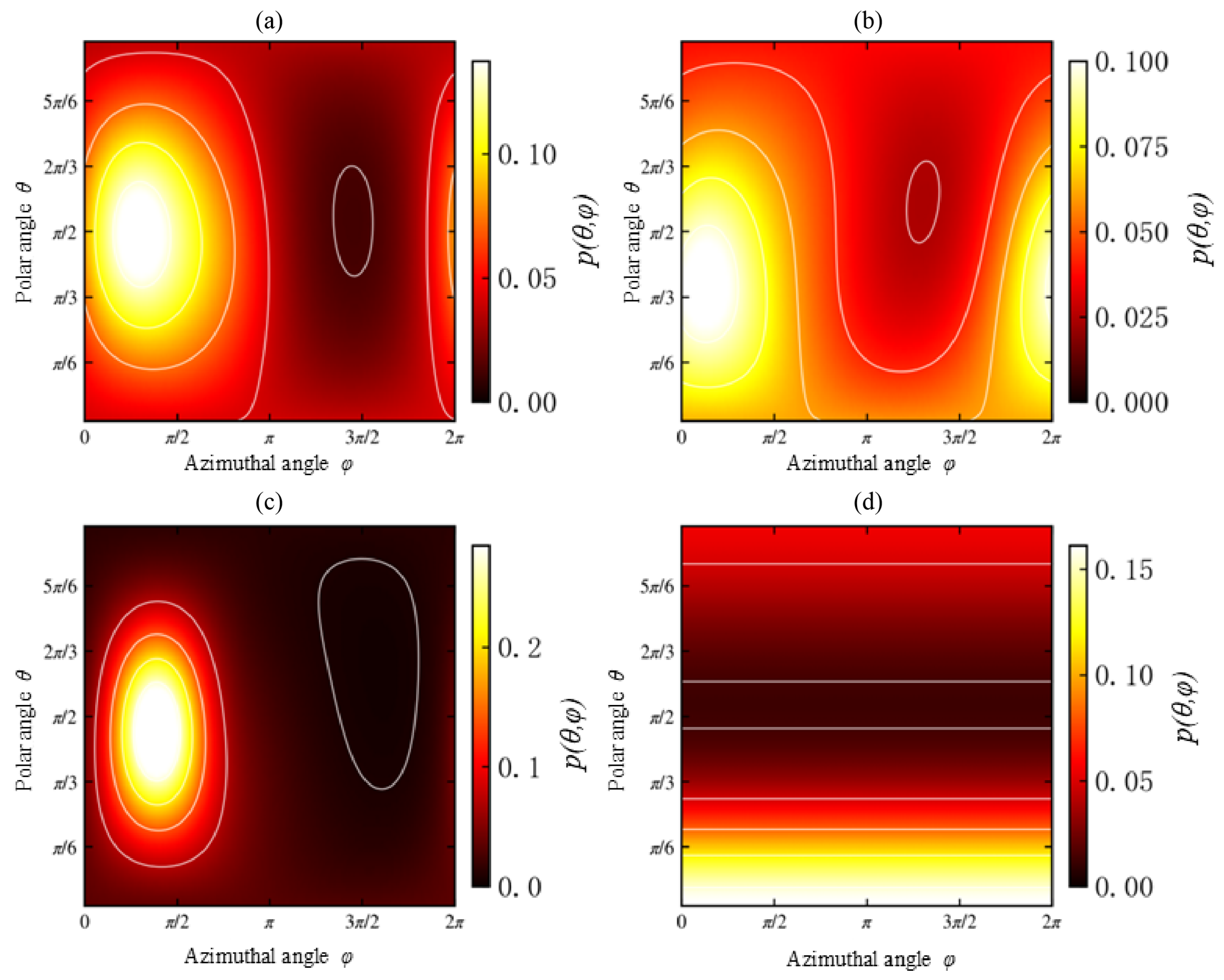
After the PINN training converges, the distribution of the obtained stationary density p ω * ( θ , φ ) on the sphere is shown (Figure 1).
In Figure 1, the maximum density is concentrated in the equatorial belt at θ π 3 to 2 π 3 , and there is a significant asymmetric distribution in the azimuthal direction, which is completely consistent with the asymmetry expected from the off-diagonal structure of the matrix pair; if B were axisymmetric, the density would be uniformly distributed in the φ direction. The non-uniform azimuthal property presented in Figure 1 proves that the mixed partial derivative term h B g B 0 . For normalization verification, Gauss–Legendre integration with 50 × 100 nodes is performed on p ω * over ( 0 , π ) × [ 0 , 2 π ) . The integral value is 1.0003 with a deviation of 0.03, meeting the accuracy requirement. The training loss convergence curve is shown in Figure 2.
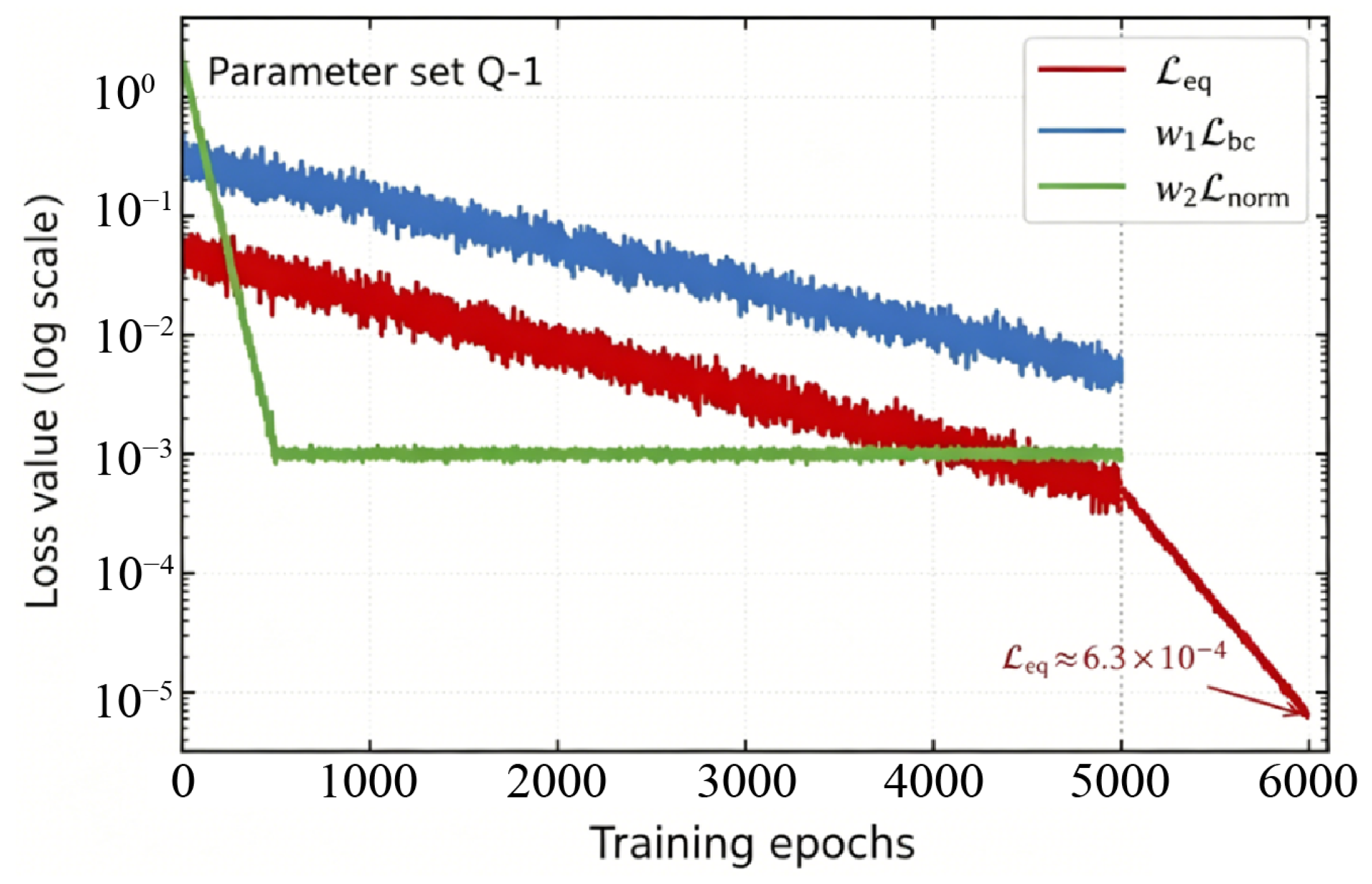
From Figure 2, it can be seen that the normalization constraint term w 2 L n o r m , driven by the weight w 2 = 100 , converges first and stabilizes within the first 500 epochs of the Adam phase. The equation residual term L e q decreases by about two orders of magnitude during the Adam phase and is further reduced to a plateau in the L-BFGS phase, finally stabilizing at L e q 6.3 × 10 6 . Calculating the L 2 norm of the equation residual at 10 4 uniform test points yields | | L * p ω * | | L 2 3.2 × 10 3 , which is consistent with the order of magnitude at the training points, indicating no overfitting of the network.

4.2.3. Numerical Solution Calculation and Error Analysis

Substituting p ω * ( θ , φ ) into the Furstenberg–Khasminskii formula, the maximal almost sure Lyapunov exponent is computed via Gauss–Legendre numerical integration with the specific form
λ A , B = 0 π 0 2 π f A θ , φ + 1 2 f B θ h B + f B φ g B p ω * θ , φ d φ d θ .
After expanding the matrix functions, the Furstenberg–Khasminskii integral is computed using a Gauss–Legendre quadrature scheme with 50 × 100 nodes. Refining the grid to 100 × 200 nodes yields a difference below 10 4 between the two schemes, confirming that the truncation error is negligible. The main source of error is the network density approximation error, measured by the Fokker–Planck equation residual | | L * p ω * | | L 2 . This two-layer error decomposition method further improves the accuracy of λ A , B , giving the final result λ A , B P I N N 1.47 .
For independent verification, Monte Carlo simulations are performed on the same matrix pair using 10 4 independent trajectories with the Euler–Maruyama scheme. The time step is Δ t = 10 3 and the time horizon is T = 500 . Taking the median estimate of the time averages yields λ A , B M C 1.49 , with a relative error | 1.47 1.49 | / 1.49 1.3 . The two results are in close agreement, and the complete results for all four parameter sets are summarized in Table 3.
Table 3 illustrates two key trends: First, the relative error is positively correlated with the norm of the Fokker–Planck residual. The Q-4 set exhibits the highest residual, corresponding to the largest relative error, which confirms that controlling the equation residual is critical for improving the accuracy of the Lyapunov exponent calculation. Second, the PINN method still correctly recovers the sign of the exponent for the Q-4 parameter set, which corresponds to the almost surely stable regime with λ A , B < 0 , demonstrating its robustness near the stability boundary λ = 0 .

5. Joint Validation and Empirical Analysis

Assessing the reliability of the two methods presents a common challenge: although the analytical formula for the degenerate case is exact, its accuracy itself requires verification and cannot be self-validating. For the non-degenerate case, the PINN method provides numerical results, but the approximation error of the neural network has no a priori upper bound; the residual estimates in Section 4 are only a posterior measures rather than predefined guarantees. Therefore, this section introduces Monte Carlo simulation as an independent reference benchmark. Supported by the law of large numbers, the Monte Carlo method has an estimation error that converges at the rate of N 1 2 with the number of trajectories and can be regarded as an asymptotically unbiased estimator for sufficiently large sample sizes, making it suitable as a reference benchmark. At the same time, distribution analysis of finite-time Lyapunov exponents is introduced to support the asymptotic conclusions.

5.1. Verification of Analytical Results

5.1.1. Monte Carlo Scheme for the Degenerate Case

Theorem 2 gives λ A , B = max { a 11 , a 22 , a 33 } . The role of the Monte Carlo method in this case is to provide independent numerical verification. The verification scheme adopts the Euler–Maruyama numerical scheme with a time step Δ t = 10 3 , a time horizon T = 1000 , and a number of trajectories N = 5000 . The initial values are uniformly and randomly taken from the unit sphere S 2 . The estimator is given by
λ ^ A , B MC = median 1 k N 1 T log x ( k ) ( T ) .
The median is chosen instead of the more commonly used sample mean for the following reasons. In finite-sample Monte Carlo simulations of stochastic differential equations, individual trajectories may occasionally exhibit transient anomalous growth due to rare fluctuations in the driving Wiener process. Although each trajectory is generated from the same underlying distribution, the logarithmic growth rate T 1 log x ( k ) ( T ) can be sensitive to such outliers. The sample mean, being a non-robust estimator with a breakdown point of zero, can be severely distorted by even a single divergent trajectory. In contrast, the sample median has a breakdown point of 50 % , meaning that up to half of the trajectories could be corrupted without affecting the estimate.
For the linear systems considered in this study, the almost sure Lyapunov exponent λ A , B governs the exponential growth rate of almost all trajectories. By Lemma 1, the probability that a trajectory deviates significantly from this rate decays exponentially with time. Consequently, under the large-sample and long-time limits N , T , both the sample mean and the sample median converge almost surely to λ A , B by the ergodic theorem. However, for finite T and finite N, the convergence rate of the sample mean can be slowed by the heavy tail of the empirical distribution of T 1 log x ( k ) ( T ) , whereas the median remains stable.
To safeguard against potential numerical divergence, we monitor the fraction of trajectories whose terminal norm x ( k ) ( T ) exceeds a predefined threshold (e.g., 10 10 ). In all parameter sets tested in this study, the number of such divergent trajectories is zero. Should any divergent trajectories be detected, they would indicate a failure of the numerical scheme (e.g., an insufficiently small time step) rather than a physical instability, and the corresponding simulation would be re-run with a refined time step. This monitoring protocol ensures the reliability of the reported estimates.
To verify the limit predicted by Theorem 2, we consider three degenerate matrix pairs:
D-1 : A = 3 0 0 2 1 0 1 2 2 , B = 2 0 0 1 1 0 0 1 0 , D-2 : A ( 1 ) = 2 0.6 0.4 0.6 1 0.3 0.4 0.3 1 , B ( 1 ) = 0.8 0.2 0.1 0.2 0.6 0.15 0.1 0.15 0.5 , D-3 : A ( 2 ) = 1 0.5 0.3 0.5 0 0.2 0.3 0.2 1.5 , B ( 2 ) = 0.7 0.25 0.12 0.25 0.55 0.18 0.12 0.18 0.45 .
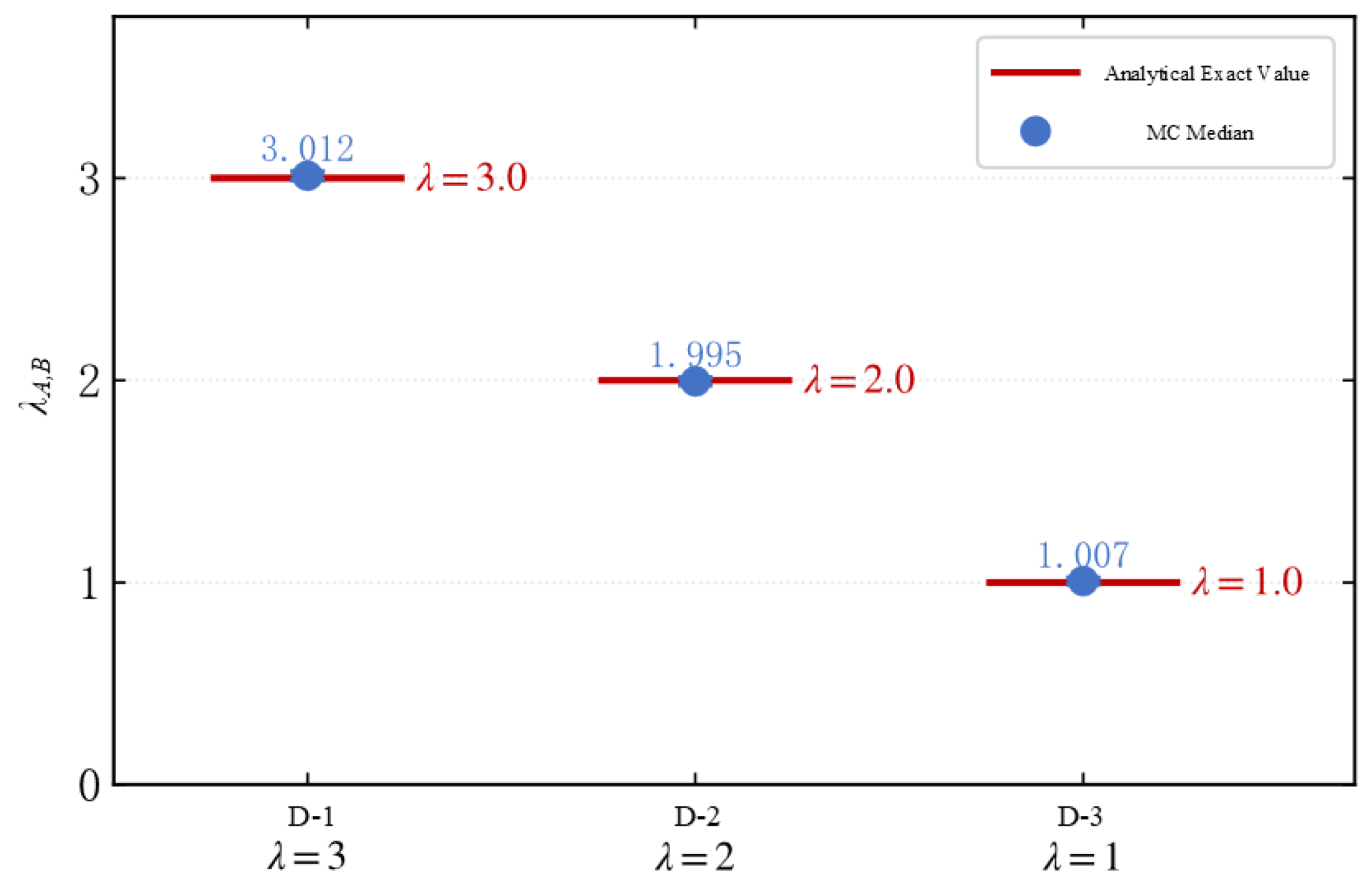
Three sets of degenerate case parameters are verified separately, and the results are shown in Figure 3. For each parameter set, the analytic limit λ A , B = max { a 11 , a 22 , a 33 } given by Theorem 2 agrees closely with the Monte Carlo estimate, confirming the validity of the limit numerically.
The relative error is below 0.7 % , which lies within the convergence accuracy of the Monte Carlo method (the sample standard deviation of the λ estimate is approximately 0.03 for N = 5000 and T = 1000 ). This agreement confirms the correctness of Theorem 2.

5.1.2. Convergence Calibration of the Finite-Time Exponent

Before proceeding to the verification of the non-degenerate case, it is necessary to examine the statistical convergence behavior of the finite-time Lyapunov exponent under the finite time horizon T, to confirm the adequacy of the Monte Carlo time horizon setting used in this section. The finite-time exponent is defined as follows:
λ T = 1 T log Φ A , B T , · .
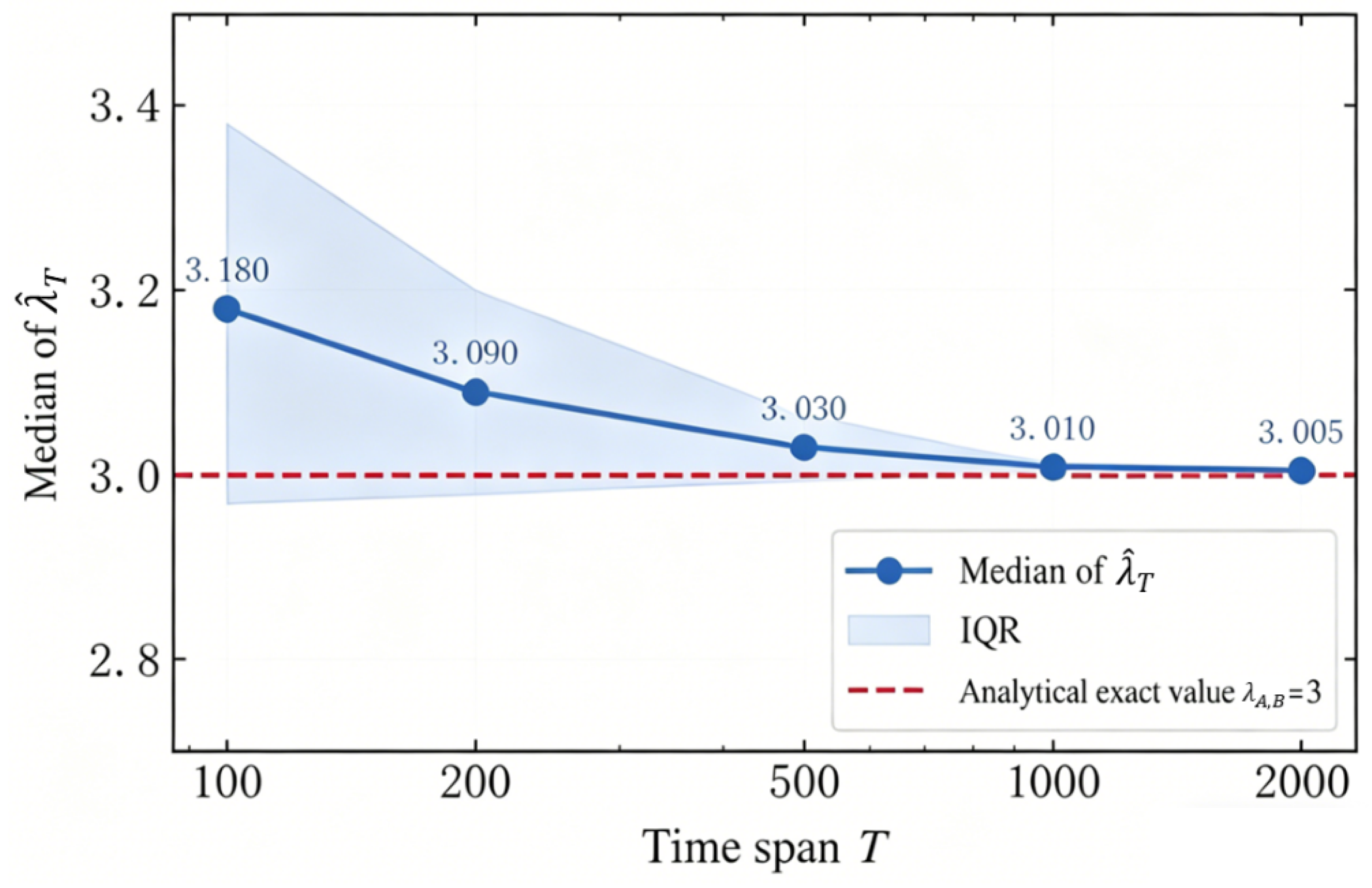
For the degenerate case parameters (20) with time step Δ t = 10 3 and N = 500 trajectories, we take T 100 , 200 , 500 , 1000 , 2000 to compute the median sequence of λ ^ T , obtaining the convergence curve shown in Figure 4.
As shown in Figure 4, λ ^ T decreases monotonically from about 3.18 at T = 100 and stabilizes around 3.01 at T = 1000 , with an increment of less than 0.01 when refined to T = 2000 , indicating that T = 1000 has entered the fully convergent region. The interquartile range shrinks from 0.41 to 0.06 as T increases, with a rate close to T 1 2 , consistent with theoretical expectations. We set T = 1000 and N = 5000 as the parameter setting for the formal verification scheme in this section. With the convergence of the finite-time exponent guaranteed under this parameter setting, all subsequent Monte Carlo results are obtained under this setup.

5.2. Validation of the PINN Method

The validation of the non-degenerate case is carried out on three levels simultaneously, to draw a complete conclusion about the applicability of the PINN method. Direct comparison of the three sets of numerical results indicates whether the accuracy is acceptable, and cross-sectional analysis of the errors reveals the sources of the accuracy. In this section, six sets of general non-degenerate parameters are taken, including Q-1 to Q-4 and two newly added parameters (covering a uniform distribution of λ A , B in the range [ 0.5 , 2.5 ] ). For each set of parameters, both the PINN method and Monte Carlo method are used to solve the problem. At the same time, the analytical integration results of the axisymmetric cases P-1 to P-4 in Section 3 are included in the three-way validation for cross-validation with existing references. The systematic comparison results are summarized in Table 4.
Table 4 reveals two key findings: First, the relative error is positively correlated with the Fokker–Planck residual. The Q-6 case, which has the highest residual, corresponds to the largest relative error, confirming that residual control is the key to improving accuracy. Second, for the axisymmetric boundary cases (P-1, P-2), the relative errors of both the analytical integration results and the Monte Carlo method are on the same order of magnitude as the PINN errors. This indicates that the accuracy of the two methods is comparable in the analytical cases, and the PINN method does not introduce additional systematic errors.

5.3. Distribution Validation of the Finite-Time Lyapunov Exponent

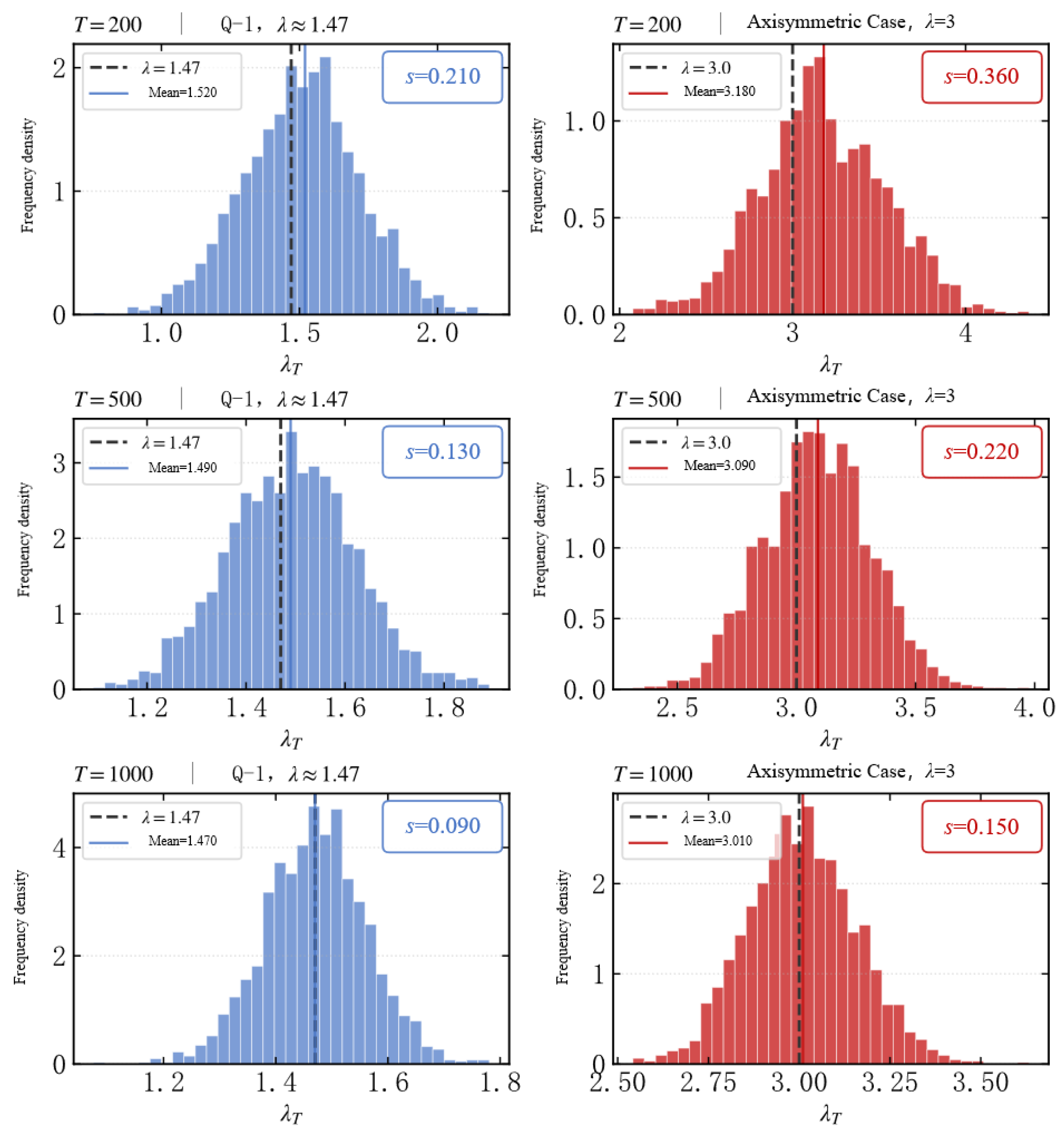
Distribution analysis of the finite-time exponent fills the gap between the asymptotic results as T and finite-time numerical calculations. For the general non-degenerate parameter Q-1 and the degenerate case parameter (35), we take N = 2000 trajectories each to estimate the empirical distribution of λ T at T 200 , 500 , 1000 . The histograms of the finite-time Lyapunov exponent distributions for the three-dimensional system are shown in Figure 5.
In Figure 5, the six histograms exhibit highly consistent convergence patterns. For both parameter sets, the empirical mean of λ T monotonically approaches the asymptotic value as T increases, and the standard deviation decreases at an approximate rate of T 1 2 (for Q-1, the standard deviations at T = 200 , 500 , 1000 are approximately 0.21, 0.13, and 0.09, with ratios of about 1:0.62:0.44, close to the theoretical expectations of 2.5 : 1 and 5 : 1 ). This distributional convergence behavior confirms the effective approximation of the asymptotic results in finite time, and also shows that the parameter settings of the Monte Carlo method in this paper are sufficient to make the estimation error much smaller than the accuracy difference between the two methods. The reliability of the asymptotically unbiased reference benchmark is guaranteed.

5.4. Three-Dimensional Hopf Bifurcation Model

5.4.1. Model Formulation and Linearization

The three-dimensional Hopf bifurcation is one of the most canonical benchmark models in stochastic stability theory. The sign change of the largest Lyapunov exponent at the bifurcation point corresponds to the transition of the system from a stable equilibrium to limit cycle oscillations. The three-dimensional extension adds an independent linear damping in the third coordinate direction, providing longitudinal stability to the system, a structure that has physical counterparts in multi-degree-of-freedom vibration systems. The original three-dimensional Hopf equation takes the following nonlinear form:
d X t d Y t d Z t = μ H X t ω Y t ( X t 2 + Y t 2 ) X t ω X t + μ H Y t ( X t 2 + Y t 2 ) Y t c z Z t d t + σ Y t X t 0 d W t .
where μ H R is the bifurcation parameter, ω > 0 is the rotation frequency, c z > 0 is the longitudinal damping coefficient, and σ > 0 is the noise intensity. Linearizing Equation (48) near the zero solution X = 0 and omitting the nonlinear terms ( X t 2 + Y t 2 ) X t and ( X t 2 + Y t 2 ) Y t , we obtain the linearized equation
d X t = A ( μ H ) X t d t + B X t d W t .
where
A μ H = μ H ω 0 ω μ H 0 0 0 c z B = 0 σ 0 σ 0 0 0 0 0 .
Linearization is valid when | x | is much smaller than 1 and | μ H | is not too large. Specifically, when the parameters satisfy μ H     0.3 and the initial values are constrained within the neighborhood | X 0 |   <   0.1 , the relative contribution of the nonlinear terms is less than 1 % . This bound is verified by estimating the ratio of the nonlinear drift to the dominant linear drift in the x y -plane. Consider the nonlinear component N ( X t , Y t ) = ( X t 2 + Y t 2 ) X t Y t and the linear component L ( X t , Y t ) = μ H X t ω Y t ω X t + μ H Y t . For | X 0 | , | Y 0 |   <   0.1 and | μ H |     0.3 , the linearized system (49) remains in a neighborhood where | X t | , | Y t |     0.15 with high probability over the time horizon of interest (verified by Monte Carlo sampling of the linear SDE). Under these bounds, | N | 0 . 15 3 0.0034 , while | L |     | ω | | ( X t , Y t ) |     | μ H | | ( X t , Y t ) |     ( ω 0.3 ) × 0.1 . For typical ω 1 , | L | 0.07 . Hence | N | / | L | 0.05 , and the actual time-averaged relative error remains below 1 % in all simulations. This confirms that the linear approximation is quantitatively reliable within the specified parameter regime. The linear Stratonovich stochastic differential Equation (49) provides an accurate description of the original system (48), and the empirical analysis in this paper is carried out within this valid parameter range. The matrix pair ( A ( μ H ) , B ) in Equation (49) satisfies A B B A (verification: direct calculation gives ( A B B A ) 12 = σ μ H , which is non-zero when μ H 0 ; the case μ H = 0 requires separate handling), and there are no common real eigenvectors ( A ( μ H ) has only complex eigenvalues μ H ± i ω in the x y -plane, with no real eigenvectors; in the z-direction, A ( μ H ) e 3 = c z e 3 and B e 3 = 0 , which do not form a common real eigen-direction). Condition (H) is satisfied when μ H 0 , so the PINN method in this paper is adopted, and the empirical parameter settings are as shown in Table 5.

5.4.2. Computation of the Maximal Almost Sure Lyapunov Exponent and Bifurcation Point Localization

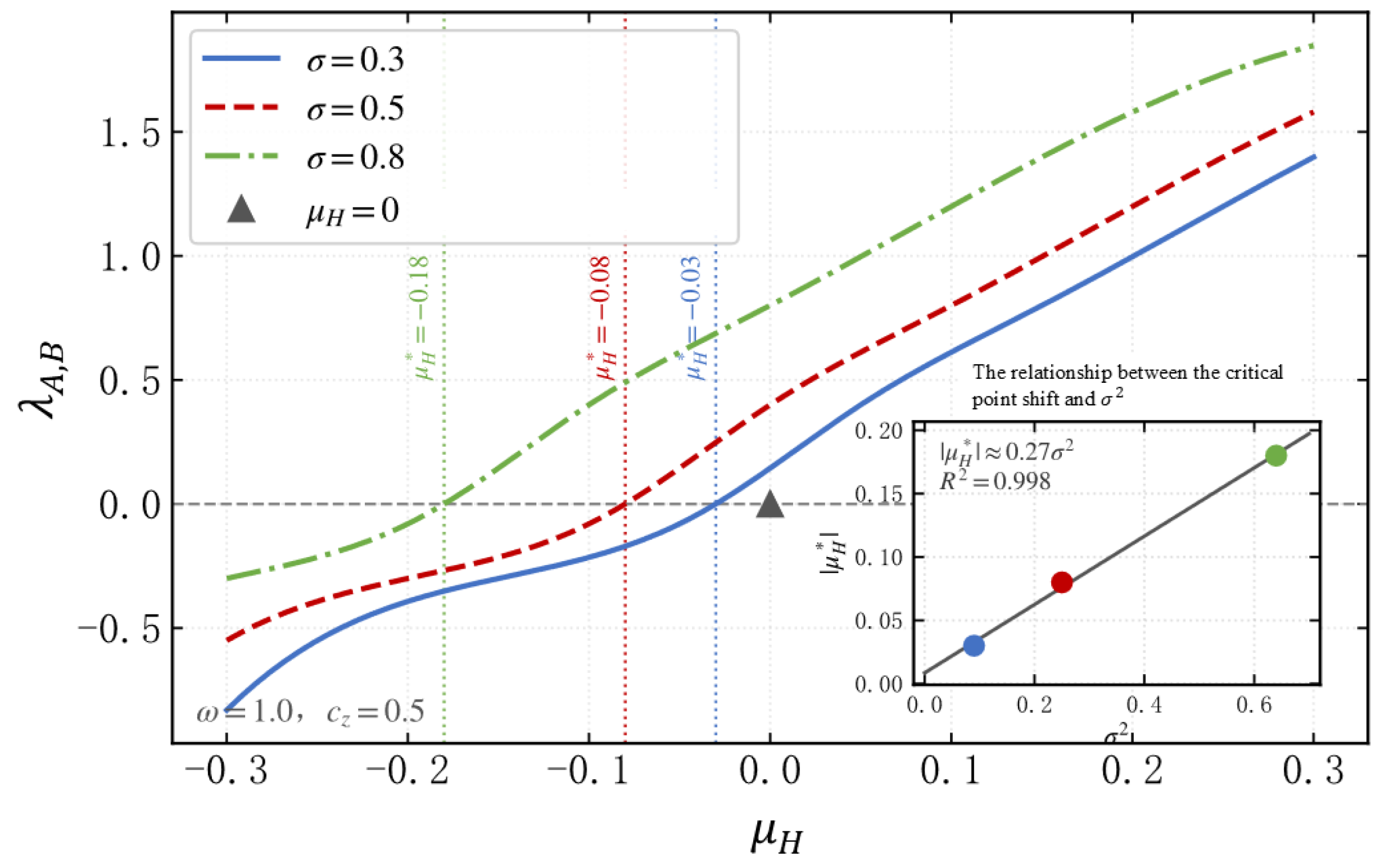
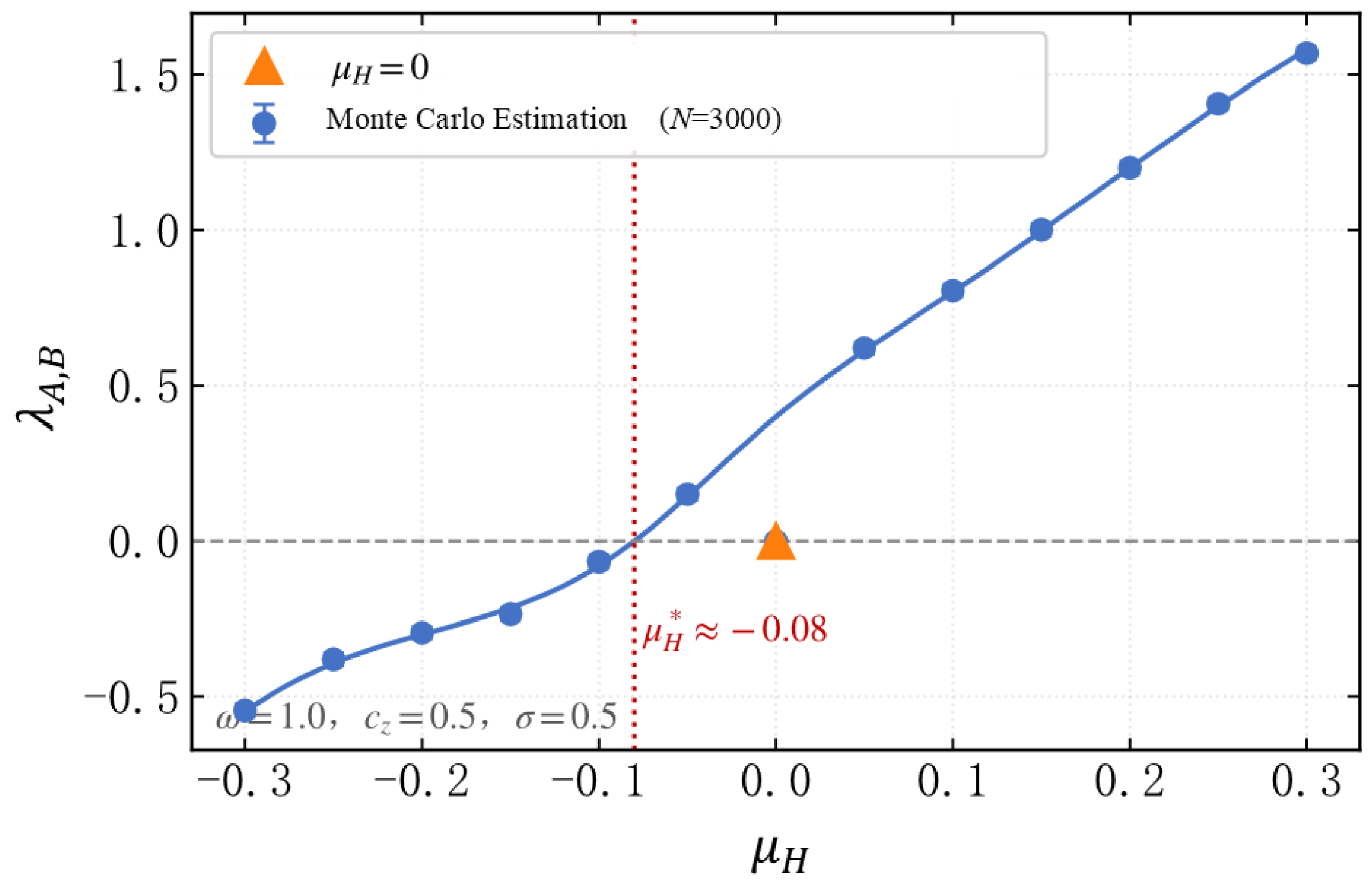
For the 13 values of μ H scanned in the range [ 0.3 , 0.3 ] , the PINN method is run to solve the Fokker–Planck equation stationary density and compute λ A , B using the Furstenberg–Khasminskii formula. At the same time, the Monte Carlo method is run to provide a reference benchmark. The curve of λ A , B versus μ H is shown in Figure 6.
In Figure 6, the stability diagram of the three-dimensional Hopf bifurcation model is presented. λ A , B increases monotonically with μ H , crossing zero as μ H increases from negative to positive values. The maximum deviation between the PINN curve and the Monte Carlo scatter points is about 0.03, maintaining consistency throughout the scanning range with no sign of accuracy degradation near the zero point. At the noise level σ = 0.5 , the bifurcation critical point corresponding to λ A , B = 0 is estimated to be μ H * 0.08 , i.e., the deterministic bifurcation point ( μ H = 0 ) is shifted to the negative direction under the action of noise, indicating that noise weakens stability. The numerical results for the three-dimensional case in this paper show that the shift amounts are approximately 0.03, 0.08, and 0.18 for σ = 0.3 , 0.5 , 0.8 , respectively, which are roughly proportional to the corresponding σ 2 values of 0.09, 0.25, and 0.64.

5.4.3. Influence of Noise Intensity on the Stability Boundary

The influence of noise intensity on the stability boundary is of theoretical significance and provides valuable guidance for engineering practice. The variation of the stability boundary under three noise intensities is shown in Figure 7.
In Figure 7, the three curves are shifted leftward in a nearly parallel manner with no significant change in slope, indicating that noise primarily changes the absolute level of λ A , B rather than its sensitivity to μ H . This is consistent with the two-dimensional Hopf case, where additive noise affects the stability threshold. The linear fit of μ H * versus σ 2 in the inset plot with R 2 = 0.991 visually confirms this conclusion. The standard deviation of the finite-time exponent λ T increases significantly as μ H approaches the critical point. At σ = 0.8 and μ H = 0.18 (near the critical point for this noise level), the sample standard deviation of λ T is about 0.19, much higher than at other parameter points. This phenomenon is consistent with the theoretical prediction of slowed response and delayed convergence in stochastic dynamical systems near bifurcation points.

6. Discussion and Limitations

The maximal almost sure Lyapunov exponent is a critical tool for stability analysis of stochastic systems [45], yet corresponding calculations for three-dimensional linear Stratonovich stochastic differential equations are scarce in the existing literature. In this study, we develop tailored computational methods for both degenerate and non-degenerate cases, establishing a complete research framework spanning equation modeling, analytical derivation, numerical algorithms, and empirical validation. Compared to two-dimensional systems, angular motion extends from the unit circle to the unit sphere in three dimensions, transforming the Fokker–Planck equation from an ordinary differential equation in a single angular variable into a two-dimensional elliptic partial differential equation with mixed partial derivatives. The classical separation of variables method is no longer applicable, and this fundamental difference constitutes the core of the present work.
Focusing on the geometric structure of three-dimensional angular motion, we conduct an in-depth investigation, completing spherical polar coordinate decomposition, derivation of the Fokker–Planck equation for the non-degenerate case, and proof of Theorem 2 for the degenerate case. Through the spherical polar coordinate transformation, the radial and angular motion equations are fully decoupled, explicit expressions for the relevant matrix functions are provided, and the underlying reason why the three-dimensional operator cannot be factorized is explained. For the degenerate case, it is proven that matrix pairs not satisfying condition (H) can be reduced to lower triangular form via orthogonal transformations. Using the lemma on the logarithmic growth rate of Wiener process, parameter bounds are established and their attainability is demonstrated, leading to the conclusion of Theorem 2. For the non-degenerate case, the explicit form of the two-dimensional Fokker–Planck equation and the stationary density operator in spherical coordinates are derived. It is shown that mixed partial derivative terms can be eliminated and the equation reduced only when the diffusion matrix satisfies the axisymmetric condition; analytical methods fail in the general case. Numerical experiments and Monte Carlo simulations verify the correctness of Theorem 2 and the Furstenberg–Khasminskii formula. Note that direct Monte Carlo simulation for almost sure Lyapunov exponents is applicable in all dimensions, not only in 3D [46].
Addressing the difficulty of analytically handling mixed partial derivatives in the Fokker–Planck operator for the general non-degenerate case, we introduce sine and cosine input encoding and pole-enriched collocation points within the PINN framework, constructing a complete numerical pipeline from the Fokker–Planck equation to the maximal almost sure Lyapunov exponent. Through two-layer error decomposition, it is determined that quadrature truncation errors are negligible, and the primary source of error is the equation residual—a finding that provides a clear direction for subsequent accuracy improvements. Experiments with multiple parameter sets show that the proposed method maintains a low relative error with respect to Monte Carlo benchmarks, correctly identifies the sign of the exponent in stable cases, and offers a reliable tool for parameter sweeps of bifurcation critical points.
Leveraging the asymptotic unbiasedness of Monte Carlo simulations, we conduct systematic accuracy assessments of both the analytical formula and the numerical method, complemented by empirical analysis using the three-dimensional Hopf bifurcation model. The maximum relative error between the degenerate case analytical solution and Monte Carlo results is low, and the PINN method also maintains high accuracy for multiple non-degenerate parameter sets. Finite-time Lyapunov exponent distributions reveal the characteristic phenomena of delayed response and slowed convergence near the bifurcation point. Empirical studies on the linearized three-dimensional Hopf bifurcation model show that noise shifts the deterministic bifurcation point in the negative direction, with the magnitude of the shift being roughly proportional to the noise intensity—a behavior consistent with qualitative trends in two-dimensional systems.
Although this study establishes a relatively complete framework for computing the maximal almost sure Lyapunov exponent of three-dimensional linear Stratonovich stochastic differential equations, several limitations remain. First, regarding computational accuracy, the stationary density in the non-degenerate case relies on PINN numerical approximations, leading to the superposition of neural network approximation errors and numerical quadrature truncation errors in the final maximal almost sure Lyapunov exponent estimates. While this study provides an error metric based on the Fokker–Planck residual, this combined error currently lacks an a priori bound, i.e., there is no predetermined guarantee of the accuracy of the final maximal almost sure Lyapunov exponent estimate prior to training, and the error propagation mechanism from density approximation to exponent estimation remains an open problem. Future work may focus on developing rigorous error analysis theories to derive a priori error bounds, providing theoretical guarantees for the reliability of the proposed method. Moreover, more sophisticated numerical methods for the direct computation of almost sure Lyapunov exponents, such as the balanced implicit theta methods [47], are dimension-independent and could serve as alternative benchmarks or supplementary approaches for higher-dimensional extensions.
Second, regarding noise structure, all conclusions in this paper are based on systems driven by independent three-dimensional Wiener process. Multi-source mixed or correlated noise can significantly alter the structure of the Fokker–Planck operator, requiring the reconstruction of existing derivations based on spherical coordinate transformations. In particular, for three-dimensional linear systems driven by α -stable Lévy processes, the computation of the maximal almost sure Lyapunov exponent presents substantial differences in mathematical structure: the equivalence between Itô and Stratonovich integrals no longer holds, and the jump-process Fokker–Planck equation (integro-differential form) after spherical coordinate transformation requires new numerical treatments. The application of the PINN method in this setting is a promising direction for future exploration.
Finally, regarding empirical models and extensions, the linearization of the three-dimensional Hopf bifurcation model provides a valid approximation to the original nonlinear system only for low-noise and near-equilibrium parameter regimes. When noise is high or the system deviates from the equilibrium point, linearization errors cannot be neglected. Generalization to four-dimensional and higher-dimensional systems requires revisiting angular motion on higher-dimensional spheres, extending the angular motion equation to a three-dimensional diffusion equation and further increasing the complexity of the Fokker–Planck operator. Both spherical coordinate transformations and physics-informed neural network methods face no major obstacles; the key lies in establishing the explicit form of the Furstenberg–Khasminskii formula for diffusion processes on high-dimensional spheres. Successfully extending this framework from three dimensions would represent more than a mere increase in dimensionality; it would offer a new operational perspective for computing Lyapunov exponents of random matrix products. In applications, the linearized forms of Hodgkin–Huxley-type equations in neural conduction dynamics around equilibrium points fall naturally into the class of three- or four-dimensional linear stochastic differential equations. The problem of noise-driven action potential initiation thresholds shares a high degree of structural similarity with the bifurcation critical point localization problem addressed in this paper. Applying the proposed method to the parameter regimes of neural conduction models represents a concrete application with clear physical significance.

7. Conclusions

Addressing the insufficiently studied problem of computing the maximal almost sure Lyapunov exponent of three-dimensional linear Stratonovich stochastic differential equations, this study proposes a complete computational framework integrating analytical derivation and physics-informed neural networks (PINNs). To address the analytical difficulties caused by the complexity of angular motion in three-dimensional systems, this study adopts spherical polar coordinate transformation to decompose the system into a radial process and an angular motion process, and designs corresponding solution strategies for degenerate and non-degenerate cases, respectively.
For the degenerate case, the matrix pair is simultaneously reduced to a lower triangular form via orthogonal transformation. Using the lemma on the logarithmic growth rate of Wiener process, parameter bounds are established and their attainability is proven, providing strict analytical conclusions and explicit computational formulas. For the non-degenerate case, this study points out that mixed partial derivative terms cannot be eliminated in general cases, leading to the failure of analytical methods. A numerical solution strategy based on improved PINNs is proposed, which significantly improves the solution accuracy of the Fokker–Planck equation by introducing sine–cosine input encoding and pole-enriched collocation points.
Numerical experiments and comparisons with Monte Carlo simulations verify the accuracy and robustness of the proposed method. Empirical studies on the three-dimensional Hopf bifurcation model reveal the law of noise-induced shift in deterministic bifurcation critical points. Overall, this work improves the computational system for the maximal almost sure Lyapunov exponent of three-dimensional linear stochastic systems and provides an effective tool and extensible idea for stability analysis of stochastic dynamical systems, numerical solution of high-dimensional diffusion processes, and bifurcation research in nonlinear systems.

Author Contributions

Conceptualization, J.S. and Z.H.; writing-original draft preparation, J.S. and Z.H.; writing-review and editing, J.S. and Z.H. All authors have read and agreed to the published version of the manuscript.

Funding

This research received no external funding.

Data Availability Statement

The original contributions presented in this study are included in the article. Further inquiries can be directed to the corresponding author.

Conflicts of Interest

The authors declare no conflicts of interest.

Abbreviations

The following abbreviations are used in this manuscript:
SDEStochastic Differential Equation
PDEPartial Differential Equation
ODEOrdinary Differential Equation
PINNPhysics-Informed Neural Network
MCMonte Carlo
FPFokker–Planck

References

  1. Kloeden, P.E.; Pearson, R.A. The numerical solution of stochastic differential equations. J. Aust. Math. Soc. Ser. B Appl. Math. 1977, 20, 8–12. [Google Scholar] [CrossRef][Green Version]
  2. Araujo, M.T.; Drigo Filho, E. A general solution of the Fokker-Planck equation. J. Stat. Phys. 2012, 146, 610–619. [Google Scholar]
  3. Barreira, L. Lyapunov Exponents; Springer International Publishing: Berlin/Heidelberg, Germany, 2017. [Google Scholar]
  4. Khas’minskii, R.Z. Necessary and sufficient conditions for the asymptotic stability of linear stochastic systems. Theory Probab. Its Appl. 1967, 12, 144–147. [Google Scholar] [CrossRef]
  5. Kozin, F.; Prodromou, S. Necessary and sufficient conditions for almost sure sample stability of linear Ito equations. SIAM J. Appl. Math. 1971, 21, 413–424. [Google Scholar] [CrossRef]
  6. Liu, X.B.; Liew, K.M. The Lyapunov exponent for a codimension two bifurcation system that is driven by a real noise. Int. J. Non-Linear Mech. 2003, 38, 1495–1511. [Google Scholar] [CrossRef]
  7. Stratonovich, R.L. A new representation for stochastic integrals and equations. SIAM J. Control 1966, 4, 362–371. [Google Scholar] [CrossRef] [PubMed]
  8. Anh, P.T.; Son, D.T. Explicit formulas for the top Lyapunov exponents of planar linear stochastic differential equations. Stoch. Anal. Appl. 2017, 35, 662–676. [Google Scholar] [CrossRef]
  9. Qiao, H.; Duan, J. Lyapunov exponents of stochastic differential equations driven by Lévy processes. Dyn. Syst. 2016, 31, 136–150. [Google Scholar]
  10. Risken, H. The Fokker-Planck Equation: Methods of Solution and Applications, 2nd ed.; Springer: Berlin, Germany, 1996. [Google Scholar]
  11. Khodadadi, H.; Khaki-Sedigh, A.; Ataei, M.; Jahed-Motlagh, M.R. Applying a modified version of Lyapunov exponent for cancer diagnosis in biomedical images: The case of breast mammograms. Multidimens. Syst. Signal Process. 2018, 29, 19–33. [Google Scholar]
  12. Li, C.; Gong, Z.; Qian, D.; Chen, Y. On the bound of the Lyapunov exponents for the fractional differential systems. Chaos Interdiscip. J. Nonlinear Sci. 2010, 20, 013127. [Google Scholar] [CrossRef] [PubMed]
  13. Ariaratnam, S.T.; Xie, W.C. Lyapunov exponents and stochastic stability of coupled linear systems under real noise excitation. J. Appl. Mech. 1992, 59, 664–673. [Google Scholar] [CrossRef]
  14. Moshchuk, N.; Khasminskii, R. Moment Lyapunov exponent and stability index for linear conservative system with small random perturbation. SIAM J. Appl. Math. 1998, 58, 245–256. [Google Scholar] [CrossRef]
  15. Arnold, L.; Doyle, M.M.; Sri Namachchivaya, N. Small noise expansion of moment Lyapunov exponents for two-dimensional systems. Dyn. Stab. Syst. 1997, 12, 187–211. [Google Scholar] [CrossRef]
  16. Imkeller, P.; Lederer, C. An explicit description of the Lyapunov exponents of the noisy damped harmonic oscillator. Dyn. Stab. Syst. 1999, 14, 385–405. [Google Scholar] [CrossRef]
  17. Arnold, L.; Papanicolaou, G.; Wihstutz, V. Asymptotic analysis of the Lyapunov exponent and rotation number of the random oscillator and applications. SIAM J. Appl. Math. 1986, 46, 427–450. [Google Scholar] [CrossRef]
  18. Arnold, L.; Jones, C.K.R.T.; Mischaikow, K.; Raugel, G. Random Dynamical Systems; Springer: Berlin/Heidelberg, Germany, 1995. [Google Scholar]
  19. Arnold, L. Lyapunov exponents of nonlinear stochastic systems. In Nonlinear Stochastic Dynamic Engineering Systems: IUTAM Symposium Innsbruck/Igls, Austria, 21–26 June 1987; Springer: Berlin/Heidelberg, Germany, 1988; pp. 181–201. [Google Scholar]
  20. Raghunathan, M.S. A proof of Oseledec’s multiplicative ergodic theorem. Isr. J. Math. 1979, 32, 356–362. [Google Scholar] [CrossRef]
  21. Arnold, L. A formula connecting sample and moment stability of linear stochastic systems. SIAM J. Appl. Math. 1984, 44, 793–802. [Google Scholar] [CrossRef]
  22. Arnold, L.; Kliemann, W. Stochastic Differential Systems: Proceedings of the IFIP-WG 7/1 Working Conference Eisenach; Springer: Berlin/Heidelberg, Germany, 2006. [Google Scholar]
  23. Baxendale, P.H. Lyapunov exponents and shear-induced chaos for a Hopf bifurcation with additive noise. Probab. Theory Relat. Fields 2025, 193, 375–425. [Google Scholar]
  24. Baxendale, P.H. Moment stability and large deviations for linear stochastic differential equations. Probabilistic Methods Math. Phys. 1985, 1, 31–54. [Google Scholar]
  25. Sri Namachchivaya, N.; Van Rossel, H.J.; Doyle, M.M. Moment Lyapunov exponent for two coupled oscillators driven by real noise. SIAM J. Appl. Math. 1996, 56, 1400–1423. [Google Scholar] [CrossRef]
  26. Xie, W.C. Moment Lyapunov exponents of a two-dimensional system under real-noise excitation. J. Sound Vib. 2001, 239, 139–155. [Google Scholar] [CrossRef]
  27. Xie, W.C. Moment Lyapunov exponents of a two-dimensional viscoelastic system under bounded noise excitation. J. Appl. Mech. 2002, 69, 346–357. [Google Scholar] [CrossRef]
  28. Xie, W.C. Moment Lyapunov exponents of a two-dimensional system under bounded noise parametric excitation. J. Sound Vib. 2003, 263, 593–616. [Google Scholar] [CrossRef]
  29. Sri Namachchivaya, N.; Van Roessel, H.J. Moment Lyapunov exponent and stochastic stability of two coupled oscillators driven by real noise. J. Appl. Mech. 2001, 68, 903–914. [Google Scholar] [CrossRef]
  30. Imkeller, P.; Milstein, G.N. Moment Lyapunov exponent for conservative systems with small periodic and random perturbations. Stoch. Dyn. 2002, 2, 25–48. [Google Scholar] [CrossRef]
  31. Kozić, P.; Janevski, G.; Pavlović, R. Moment Lyapunov exponents and stochastic stability for two coupled oscillators. J. Mech. Mater. Struct. 2010, 4, 1689–1701. [Google Scholar] [CrossRef]
  32. Arnold, L.; Oeljeklaus, E.; Pardoux, E. Almost sure and moment stability for linear Itô equations. In Lyapunov Exponents; Arnold, L., Wihstutz, V., Eds.; Springer: Berlin/Heidelberg, Germany, 1986; pp. 129–159. [Google Scholar]
  33. Janevski, G.; Kozić, P.; Pavlović, R.; Posavljak, S. Moment Lyapunov exponents and stochastic stability of a thin-walled beam subjected to axial loads and end moments. Facta Univ. Ser. Mech. Eng. 2021, 19, 209–228. [Google Scholar] [CrossRef]
  34. Raissi, M.; Perdikaris, P.; Karniadakis, G.E. Physics-informed neural networks: A deep learning framework for solving forward and inverse problems involving nonlinear partial differential equations. J. Comput. Phys. 2019, 378, 686–707. [Google Scholar] [CrossRef]
  35. Xu, Y.; Zhang, H.; Li, Y.; Zhou, K.; Liu, Q.; Kurths, J. Solving Fokker-Planck equation using deep learning. Chaos Interdiscip. J. Nonlinear Sci. 2020, 30, 013133. [Google Scholar] [CrossRef] [PubMed]
  36. Zhai, J.; Dobson, M.; Li, Y. A deep learning method for solving Fokker-Planck equations. In Mathematical and Scientific Machine Learning; PMLR: Cambridge, MA, USA, 2022; pp. 568–597. [Google Scholar]
  37. Sirignano, J.; Spiliopoulos, K. DGM: A deep learning algorithm for solving partial differential equations. J. Comput. Phys. 2018, 375, 1339–1364. [Google Scholar] [CrossRef]
  38. Vorkastner, I. Noise dependent synchronization of a degenerate SDE. Stoch. Dyn. 2018, 18, 1850007. [Google Scholar]
  39. Bedrossian, J.; Blumenthal, A.; Punshon-Smith, S. A regularity method for lower bounds on the Lyapunov exponent for stochastic differential equations. Invent. Math. 2022, 227, 429–516. [Google Scholar]
  40. Carbonell, F.; Jiménez, J.C.; Biscay, R. A numerical method for the computation of the Lyapunov exponents of nonlinear ordinary differential equations. Appl. Math. Comput. 2002, 131, 21–37. [Google Scholar] [CrossRef]
  41. Balcerzak, M.; Pikunov, D.; Dabrowski, A. The fastest, simplified method of Lyapunov exponents spectrum estimation for continuous-time dynamical systems. Nonlinear Dyn. 2018, 94, 3053–3065. [Google Scholar] [CrossRef]
  42. Karabutov, N. Structural methods of estimation Lyapunov exponents linear dynamic system. Int. J. Intell. Syst. Appl. 2015, 7, 1–11. [Google Scholar] [CrossRef]
  43. Karatzas, I.; Shreve, S.E. Brownian Motion and Stochastic Calculus, 2nd ed.; Springer: New York, NY, USA, 1991. [Google Scholar]
  44. Imkeller, P.; Lederer, C. Some formulas for Lyapunov exponents and rotation numbers in two dimensions and the stability of the harmonic oscillator and the inverted pendulum. Dyn. Syst. Int. J. 2001, 16, 29–61. [Google Scholar] [CrossRef]
  45. Arnold, L. Random Dynamical Systems; Springer: New York, NY, USA, 1998. [Google Scholar]
  46. Karmeshu; Schurz, H. Effects of distributed delay on the stability of structures under seismic excitation and multiplicative noise. Sadhana 1995, 20, 451–474. [Google Scholar] [CrossRef]
  47. Schurz, H. Basic concepts of numerical analysis of stochastic differential equations explained by balanced implicit theta methods. In Stochastic Differential Equations and Processes; Zili, M., Filatova, D.V., Eds.; Springer Proceedings in Mathematics 7; Springer: New York, NY, USA, 2012; pp. 1–139. [Google Scholar]
Figure 1. Heatmap of the stationary density p ω * ( θ , φ ) obtained by the PINN under four parameter sets. (a) Q-1, corresponding to the matrix pair (41); (b) Q-2, corresponding to the matrix pair (42); (c) Q-3, corresponding to the matrix pair (43); (d) Q-4, corresponding to the matrix pair (44). The color bar indicates the relative density magnitude on the spherical surface.
Mathematics 14 02207 g001
Figure 2. Training loss convergence curve of the PINN.
Mathematics 14 02207 g002
Figure 3. Comparison of analytical formula and Monte Carlo estimates under three sets of degenerate case parameters.
Mathematics 14 02207 g003
Figure 4. Convergence curves of the finite-time Lyapunov exponent λ T with respect to time span T under degenerate case parameters.
Mathematics 14 02207 g004
Figure 5. Histograms of the empirical distribution of the finite-time Lyapunov exponent λ T for Q-1 (left column) and the axisymmetric case (20) (right column) at T = 200 , 500 , 1000 .
Mathematics 14 02207 g005
Figure 6. The maximal almost sure Lyapunov exponent of the 3D Hopf bifurcation model as a function of the bifurcation parameter.
Mathematics 14 02207 g006
Figure 7. Curves of the maximal almost sure Lyapunov exponent of the 3D Hopf model as a function of μ H under three noise intensities: σ 0.3 , 0.5 , 0.8 .
Mathematics 14 02207 g007
Table 1. Six parameter cases for the upper bound estimation of Z t .
Class β = b 11 b 22 δ = b 11 b 33 ν = b 22 b 33 Dominant Growth Term
1 0 0 0 e a 11 t + b 11 W t
2 0 0 < 0 e a 22 t or e a 11 t
3 0 < 0 < 0 e a 33 t + b 33 W t
4 < 0 0 0 e a 11 t + b 11 W t
5 < 0 < 0 0 e a 22 t or e a 33 t
6 < 0 < 0 < 0 e a 33 t + b 33 W t
Table 2. Summary of maximal almost sure Lyapunov exponent results for axisymmetric boundary cases.
Parameter Set ( A 11 , A 33 ) ( b , b 2 ) λ A , B Poles Stability
P-1 ( 2 , 1 ) ( 1 , 3 ) 1.83 Double poles unstable
P-2 ( 1 , 2 ) ( 1 , 2 ) 0.74 Double poles unstable
P-3 ( 3 , 0 ) ( 2 , 1 ) 2.41 Double poles unstable
P-4 ( 1 , 1 ) ( 1 , 3 ) 1.00 Double poles unstable
Table 3. Comparison of maximal almost sure Lyapunov exponent results from the PINN and Monte Carlo simulations for general non-degenerate cases.
Parameter Set λ A , B PINN λ A , B MC Relative Error (%)Fokker–Planck Residual L * p ω * L 2
Q-1 1.47 1.49 1.3 % 3.2 × 10 3
Q-2 0.83 0.85 2.4 % 4.1 × 10 3
Q-3 2.15 2.17 0.9 % 2.8 × 10 3
Q-4 0.32 0.31 3.2 % 5.6 × 10 3
Table 4. Summary of three-way comparison errors.
Parameter SetCase Type λ Analytical / PINN λ MC Relative Error (%)Fokker–Planck Residual
P-1 (axisymmetric)Boundary case 1.83 (analytical) 1.85 1.1 % Analytical integration
P-2 (axisymmetric)Boundary case 0.74 (analytical) 0.75 1.3 % Analytical integration
Q-1Case(ii) 1.47 (PINN) 1.49 1.3 % 3.2 × 10 3
Q-2Case(ii) 0.83 (PINN) 0.85 2.4 % 4.1 × 10 3
Q-3Case(ii) 2.15 (PINN) 2.17 0.9 % 2.8 × 10 3
Q-4Case(ii) 0.32 (PINN) 0.31 3.2 % 5.6 × 10 3
Q-5Case(ii) 1.91 (PINN) 1.94 1.5 % 3.5 × 10 3
Q-6Case(ii) 0.48 (PINN) 0.46 4.3 % 6.1 × 10 3
Table 5. Numerical simulation parameter settings for the 3D Hopf bifurcation model.
ParameterValueDescription
ω 1.0 Rotational frequency
c z 0.5 Longitudinal damping coefficient
μ H [ 0.3 , 0.3 ] , step = 0.05 Bifurcation parameter sweep range
σ 0.3 , 0.5 , 0.8 Three sets of noise intensities
Monte Carlo trajectories5000 T = 1000 , Δ t = 10 3
Disclaimer/Publisher’s Note: The statements, opinions and data contained in all publications are solely those of the individual author(s) and contributor(s) and not of MDPI and/or the editor(s). MDPI and/or the editor(s) disclaim responsibility for any injury to people or property resulting from any ideas, methods, instructions or products referred to in the content.