Article

A New Gompertz Distribution for Modeling Tensile Strength of Carbon Fibers and Single Carbon Fibers Data


1
Department of Statistics, Faculty of Arts and Sciences, Bitlis Eren University, 13100 Bitlis, Turkey
2
Department of Mathematics, Faculty of Arts and Sciences, Bitlis Eren University, 13100 Bitlis, Turkey
3
Department of Statistics, Faculty of Science, Firat University, 23119 Elazig, Turkey
*
Author to whom correspondence should be addressed.
Mathematics 2026, 14(12), 2159; https://doi.org/10.3390/math14122159
Submission received: 11 May 2026 / Revised: 4 June 2026 / Accepted: 12 June 2026 / Published: 16 June 2026

Abstract

The Gompertz distribution is a well-known lifetime model in survival and reliability analysis, but its hazard rate is restricted to monotone increasing behavior, which limits its applicability to more complex data structures. In this study, we investigate the New Extended Gompertz (NEG) distribution, which is obtained by applying the existing NE-X generator framework to the classical Gompertz baseline distribution. Thus, the NEG model is a special case within an already established generator family rather than an entirely new family of distributions. The main contribution of this paper is not the introduction of a new generator, but rather a comprehensive and systematic investigation of this particular Gompertz-based extension, including its statistical properties, estimation procedures, and practical applications. The proposed model introduces an additional shape parameter that provides increased flexibility in modeling skewness, tail behavior, and hazard-rate structures, allowing for increasing, decreasing, bathtub-shaped, and unimodal hazard patterns under different parameter configurations. Several mathematical properties of the NEG distribution are derived, including explicit expressions for the density, distribution, survival, and hazard-rate functions, as well as moments, entropy measures, and series representations. Parameter estimation is performed using both maximum likelihood and Bayesian approaches, with numerical optimization and Metropolis–Hastings MCMC procedures employed due to the absence of closed-form estimators. The finite-sample behavior of the estimators is investigated through extensive Monte Carlo simulation studies under three different parameter settings. The practical usefulness of the NEG distribution is illustrated using two real datasets on carbon-fiber tensile strength. Comparative results with several competing Gompertz-type models indicate that the NEG distribution provides competitive performance. However, all comparisons should be interpreted within the context of the considered datasets and parameter settings, rather than as claims of universal superiority. The findings suggest that the NEG distribution offers a flexible and practical extension of the Gompertz model for lifetime data analysis.

1. Introduction

Modeling lifetime and reliability data requires flexible probability distributions capable of representing different hazard-rate structures, skewness patterns, and tail behaviors. Classical models, such as the Gompertz distribution, are widely used because of their simple mathematical structure and practical interpretability. However, the standard Gompertz model mainly accommodates monotone hazard behavior and may therefore provide limited flexibility for some complex lifetime datasets.
To improve flexibility, many extensions of classical lifetime distributions have been proposed through generator mechanisms, compounding approaches, and additional shape parameters [1,2,3,4,5,6,7,8,9,10,11].
The proposed New Extended Gompertz (NEG) distribution is obtained by applying the existing NE-X generator framework of [12] to the classical Gompertz baseline distribution. Therefore, the NEG model is a special case within an already established generator family rather than an entirely new generator or a completely novel family of distributions. Consequently, the main contribution of the present study is not the introduction of a new generator, but rather a comprehensive and systematic investigation of this Gompertz-based special case constructed within the existing NE-X framework. Accordingly, the practical and theoretical contributions of the paper primarily lie in the analytical and inferential development of this NE-X-based Gompertz extension, including the derivation of its statistical properties, estimation procedures, simulation performance, and applications to lifetime data analysis. The novelty of the work is thus associated with the detailed examination of this specific Gompertz extension, its comparative performance against alternative Gompertz-type models, and the assessment of its practical utility in lifetime data modeling.
More specifically, the proposed NEG model provides a relatively flexible hazard-rate structure that can accommodate increasing, decreasing, bathtub-shaped, and unimodal hazard behaviors under different parameter configurations. In addition, the model preserves a mathematically tractable form while demonstrating competitive fitting performance in the real-data applications considered in this study. In this respect, the contribution of the study is primarily associated with the comprehensive theoretical and applied examination of this specific NE-X-based Gompertz extension, including its distributional properties, estimation methods, simulation characteristics, and practical performance in modeling lifetime data.
The proposed NEG distribution introduces an additional shape parameter that may provide greater flexibility in modeling skewness, tail-decay behavior, and hazard-rate structures. The model also preserves the light-tailed structure inherited from the classical Gompertz distribution while allowing additional shape adaptability.
Therefore, the flexibility and performance assessments reported in this study should not be interpreted as claims of universal superiority over all existing Gompertz-type extensions, but rather as comparative results within the scope of the considered datasets and parameter settings.
Several mathematical properties of the NEG distribution are derived, including the density, distribution, survival, and hazard-rate functions, as well as moments, entropy measures, and series representations. Since some developments rely on generalized binomial expansions, the corresponding convergence conditions are explicitly stated. Parameter estimation is studied using both maximum likelihood and Bayesian approaches. Numerical optimization and Metropolis–Hastings MCMC procedures are employed because closed-form estimators are not available.
The finite-sample behavior of the estimators is investigated through Monte Carlo simulation studies, while the practical usefulness of the NEG distribution is illustrated using two carbon-fiber tensile strength datasets. Comparisons with several competing lifetime models are also presented.
Table 1 summarizes the main structural characteristics of the competing lifetime models considered in this study. The reported tail classifications are based on asymptotic properties of the survival functions, while the flexibility measures refer to the ability of the models to represent different density and hazard-rate structures. As a special case of the existing NE-X generator applied to the Gompertz baseline, the NEG distribution may be regarded as a flexible light-tailed extension of the Gompertz model, with the additional parameters providing moderate adaptability in skewness, tail decay, and hazard- rate behavior.
Finally, the paper is organized as follows. Section 2 introduces the NEG distribution and its structural properties. Section 3 presents mathematical properties of the model. Section 4 contains the simulation study, Section 5 presents the real-data applications, and Section 7 concludes the paper.

2. Proposed Distribution and Its Properties

This section introduces the proposed New Extended Gompertz (NEG) distribution, which is obtained by applying the existing NE-X generator framework of [12] to the classical Gompertz baseline distribution, and presents its main mathematical and structural properties, including the density, distribution, and hazard-rate functions. The effects of the model parameters on shape and tail behavior are also examined analytically and graphically.

2.1. NEG Distribution

The classical Gompertz distribution is widely used in survival and reliability analysis, but it may lack flexibility for complex data, in particular because its hazard rate is restricted to monotone shapes. To overcome this limitation, we propose the New Extended Gompertz (NEG) distribution, a three-parameter model obtained by embedding the Gompertz baseline into a flexible generator, allowing for a wider range of lifetime behaviors including non-monotone hazard structures.
Let F G ( x ; a , b ) denote the cumulative distribution function (CDF) of the classical Gompertz distribution:
F G ( x ; a , b ) = 1 exp a b ( e b x 1 ) , x > 0 , a > 0 , b > 0 .
Definition 1.
The NEG distribution is defined by the CDF
F N E G ( x ; θ , a , b ) = 1 1 F G ( x ) 1 ( 1 θ ) 1 F G ( x ) θ , x > 0 ,
where θ > 0 , a > 0 , b > 0 .
Substituting F G ( x ) gives the equivalent expression
F N E G ( x ; θ , a , b ) = 1 1 exp a b ( e b x 1 ) 1 ( 1 θ ) 1 exp a b ( e b x 1 ) θ , x > 0 .
With this formulation, the derivations of the density and hazard functions become straightforward and may be omitted. For completeness, they are stated in the following proposition.
Proposition 1.
Let X NEG ( θ , a , b ) . Then its probability density function (PDF) is
f N E G ( x ) = θ 2 f G ( x ) 1 ( 1 θ ) ( 1 F G ( x ) ) θ + 1 1 F G ( x ) θ 1 ,
and its hazard rate function (HRF) is
h N E G ( x ) = θ 2 f G ( x ) ( 1 F G ( x ) ) θ 1 1 ( 1 θ ) ( 1 F G ( x ) ) θ + 1 1 ( 1 θ ) ( 1 F G ( x ) ) θ ( 1 F G ( x ) ) θ ,
where f G ( x ) = a e b x exp a b ( e b x 1 ) is the Gompertz PDF.
The standard Gompertz distribution is primarily associated with monotone hazard functions and may be inadequate for modeling more complex lifetime patterns. The additional parameter θ is therefore introduced through the NE-X generator mechanism to provide extra shape flexibility. While a controls the scale of the distribution and b governs the baseline hazard growth rate, θ directly influences the skewness, concentration, and hazard-rate structure of the model. Consequently, each parameter has a distinct and interpretable role, providing a clear motivation for the proposed generalization and enabling the NEG distribution to capture a wider range of lifetime-data characteristics, including increasing, decreasing, bathtub-shaped, and unimodal hazard patterns.
Figure 1 provides graphical evidence regarding the flexibility of the proposed NEG distribution. The CDF curves preserve the expected monotone increasing behavior, whereas the PDF curves generate substantially different density structures depending on the parameter configuration.
Effects of the Parameters
  • Effect of  a : The parameter a mainly controls the scale and concentration of the density function. Larger values of a produce more concentrated and sharper density curves with faster tail decay, whereas smaller values lead to flatter densities and relatively slower decay.
  • Effect of  b : The parameter b governs the growth mechanism inherited from the Gompertz baseline distribution. Increasing b causes the right tail to decay more rapidly, resulting in lighter tails. Conversely, smaller values of b produce relatively longer tails and more dispersed density structures.
  • Effect of  θ : The additional shape parameter θ introduces substantial flexibility into the model. Different values of θ modify the skewness, peak behavior, and overall tail structure of the density curves. As θ changes, the distribution can become more right-skewed, more concentrated, or more dispersed.

2.2. Hazard-Rate Function and Tail Behavior

In reliability and survival analysis, the survival (reliability) function represents the probability that a system survives beyond a given time point x. For the NEG distribution, using Definition 1, the survival function is simply
S N E G ( x ) = 1 F N E G ( x ) = 1 F G ( x ) 1 ( 1 θ ) ( 1 F G ( x ) ) θ , x > 0 .
An important quantity in reliability modeling is the hazard-rate function (HRF), which measures the instantaneous failure risk at time x conditional on survival up to that time. The HRF given in Proposition 1 can be simplified to a compact form.
Corollary 1.
For X NEG ( θ , a , b ) , the hazard-rate function can be written as
h N E G ( x ) = θ 2 f G ( x ) ( 1 F G ( x ) ) θ 1 1 ( 1 θ ) ( 1 F G ( x ) ) θ + 1 1 ( 1 θ ) ( 1 F G ( x ) ) θ ( 1 F G ( x ) ) θ .
Remark 1 (Tail behavior).
To investigate the tail properties, note that as x ,
1 F G ( x ) = exp a b ( e b x 1 ) 0 ,
and consequently
S N E G ( x ) C exp θ a b e b x , x ,
where C is a positive constant. Therefore, the NEG distribution does not belong to the class of heavy-tailed distributions. Instead, it possesses a flexible light-tailed structure inherited from the baseline Gompertz model, while the parameters ( θ , a , b ) provide substantial control over the rate of tail decay.
Let F G ( x ) , S G ( x ) = 1 F G ( x ) , and h G ( x ) denote the cumulative distribution function, survival function, and hazard-rate function of the baseline Gompertz distribution, respectively. For the NEG distribution, the survival function can be written as
S N E G ( x ) = S G ( x ) 1 ( 1 θ ) S G ( x ) θ , x > 0 , θ > 0 .
Therefore, the corresponding hazard-rate function is
h N E G ( x ) = d d x log S N E G ( x ) = θ h G ( x ) 1 ( 1 θ ) S G ( x ) .
For the Gompertz baseline model,
S G ( x ) = exp a b e b x 1 , h G ( x ) = a e b x , a > 0 , b > 0 .
Hence,
h N E G ( x ) = θ a e b x 1 ( 1 θ ) exp a b e b x 1 .
To investigate the possible shapes of the hazard-rate function, we differentiate h N E G ( x ) with respect to x. Since
S G ( x ) = h G ( x ) S G ( x ) , h G ( x ) = b h G ( x ) ,
it follows that
h N E G ( x ) = h N E G ( x ) b ( 1 θ ) h G ( x ) S G ( x ) 1 ( 1 θ ) S G ( x ) .
Since h N E G ( x ) > 0 , the sign of h N E G ( x ) is determined by
D ( x ) = b ( 1 θ ) h G ( x ) S G ( x ) 1 ( 1 θ ) S G ( x ) .
Thus, the hazard-rate function is increasing whenever D ( x ) > 0 , decreasing whenever D ( x ) < 0 , and may exhibit a local turning point when D ( x ) = 0 . The above expression highlights the role of the additional shape parameter θ . When θ > 1 , the quantity ( 1 θ ) is negative, making the second term negative and therefore tending to keep D ( x ) positive. Consequently, the hazard rate is generally increasing. When 0 < θ < 1 , the second term becomes positive and may dominate b over part of the support, allowing the hazard rate to decrease initially and then increase later. This behavior may generate bathtub-shaped hazard-rate patterns for suitable parameter combinations. Furthermore, as x ,
S G ( x ) 0 ,
and therefore
D ( x ) b > 0 .
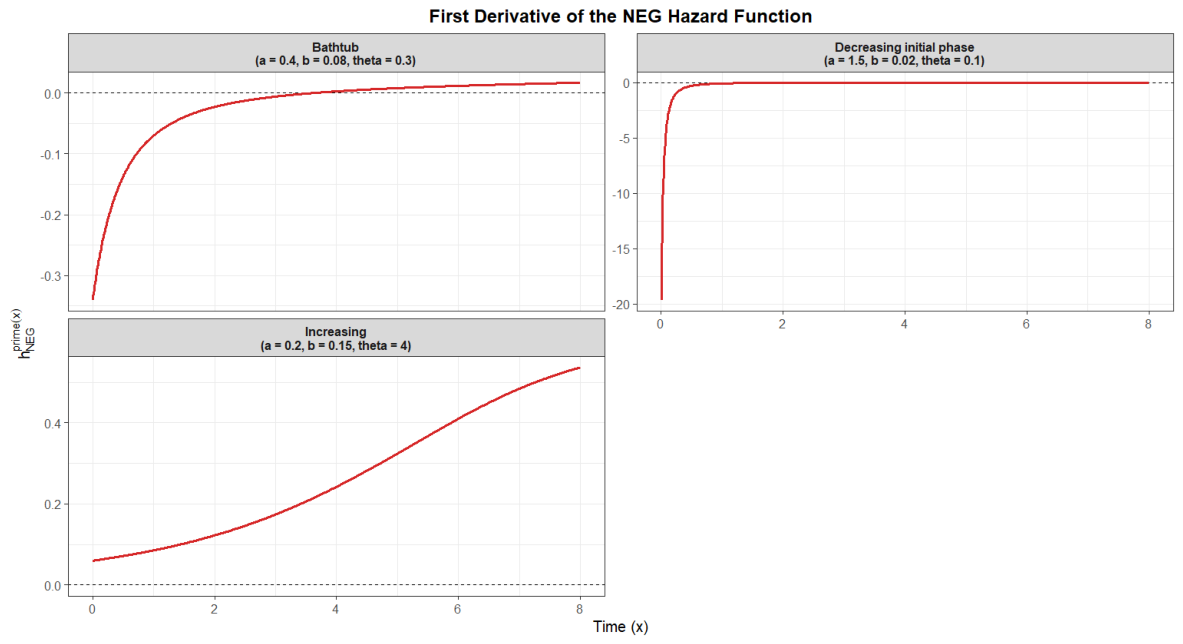
Hence, the hazard-rate function of the NEG distribution eventually increases in the right tail. As a result, the model naturally supports increasing and bathtub-shaped hazard-rate patterns, while decreasing behavior may occur only over a finite initial region for particular parameter values. For this reason, hazard-rate flexibility should be interpreted carefully. Rather than claiming all possible hazard-rate shapes for every parameter configuration, the behavior of the model is illustrated numerically through representative parameter settings. The revised hazard-rate plots were generated using parameter values selected to clearly demonstrate increasing, initially decreasing, and bathtub-shaped patterns. These graphical illustrations complement the derivative-based analysis and provide numerical evidence of the flexibility of the NEG distribution in reliability and lifetime-data applications.
Figure 2 and Figure 3 illustrate several representative hazard-rate patterns that can arise under different parameter configurations of the NEG distribution. The numerical results suggest that the model is able to capture increasing, initially decreasing, and bathtub-shaped hazard-rate behaviors. The corresponding derivative plots are consistent with the observed hazard-rate shapes and provide additional insight into the effect of the model parameters. These examples highlight the potential flexibility of the NEG distribution for reliability and survival data analysis.

3. Series Representations of the NEG Density

This section presents alternative series representations of the NEG probability density function, which are useful for analytical developments, numerical approximations, and inferential procedures. The generalized binomial expansions used below are valid under the usual convergence conditions imposed on the corresponding expansion arguments. In particular, for an expansion of the form
( 1 z ) r = k = 0 Γ ( r + k ) Γ ( r ) k ! z k ,
one requires | z | < 1 . Therefore, the representation involving
( 1 ( 1 θ ) u 2 ) ( θ + 1 )
is valid when
| ( 1 θ ) u ( x ) 2 | < 1 .
Since 0 < u ( x ) < 1 for x > 0 and a , b > 0 , this condition is automatically satisfied for some parameter regions, whereas for other values of θ it should be understood as a convergence restriction. Consequently, the resulting series representations are exact under the stated convergence conditions; otherwise, their truncated versions should be interpreted as local or numerical approximations rather than unrestricted global expansions.
Let
u ( x ) = 1 exp a b ( e b x 1 ) , x > 0 , a > 0 , b > 0 .
Using the generalized binomial expansions,
( 1 u 2 ) θ 1 = j = 0 ( 1 ) j θ 1 j u 2 j ,
and
( 1 ( 1 θ ) u 2 ) ( θ + 1 ) = k = 0 Γ ( θ + 1 + k ) Γ ( θ + 1 ) k ! ( 1 θ ) k u 2 k ,
we obtain
u ( 1 u 2 ) θ 1 ( 1 ( 1 θ ) u 2 ) ( θ + 1 ) = j , k 0 ω j , k u 2 ( j + k ) + 1 ,
where
ω j , k = 2 θ 2 ( 1 ) j θ 1 j Γ ( θ + 1 + k ) Γ ( θ + 1 ) k ! ( 1 θ ) k .
Thus,
f N E G ( x ; θ , a , b ) = j , k 0 ω j , k a e b x e a b ( e b x 1 ) 1 e a b ( e b x 1 ) 2 ( j + k ) + 1 .
Furthermore, using
1 exp [ A ( x ) ] 2 ( j + k ) + 1 = = 0 2 ( j + k ) + 1 ( 1 ) 2 ( j + k ) + 1 exp [ A ( x ) ] , A ( x ) = a b ( e b x 1 ) ,
the density can be expressed in the linear form
f N E G ( x ; θ , a , b ) = j = 0 k = 0 = 0 2 ( j + k ) + 1 ω j , k , a e b x × exp ( + 1 ) a b ( e b x 1 ) ,
where
ω j , k , = 2 θ 2 ( 1 ) j + θ 1 j Γ ( θ + 1 + k ) Γ ( θ + 1 ) k ! ( 1 θ ) k 2 ( j + k ) + 1 .

3.1. Quantile Function

The quantile function is obtained by inverting the CDF. Let u = F NEG ( x ; θ , a , b ) , 0 < u < 1 . Then
1 G ( x ) 2 1 ( 1 θ ) G ( x ) 2 = ( 1 u ) 1 / θ ,
which yields
G ( x ) = 1 ( 1 u ) 1 / θ 1 ( 1 θ ) ( 1 u ) 1 / θ 1 / 2 .
Using G ( x ) = 1 exp a b ( e b x 1 ) and solving for x, we obtain
Q ( u ) = 1 b log 1 b a log 1 1 ( 1 u ) 1 / θ 1 ( 1 θ ) ( 1 u ) 1 / θ 1 / 2 , 0 < u < 1 .
Based on the quantile function, quantile-based measures of skewness and kurtosis can be defined. In particular, Bowley skewness (BSK) and Moors kurtosis (MKUR) are given by
BSK = Q 3 + Q 1 2 Q 2 Q 3 Q 1 , MKUR = ( O 7 O 5 ) + ( O 3 O 1 ) O 6 O 2 ,
where
Q p = Q ( p ) , O k = Q k 8 , k = 1 , 2 , , 7 .
The availability of the quantile function also facilitates random variates generation through the inverse transform method by taking X = Q ( U ) , where U Unif ( 0 , 1 ) .
Table 2 shows that as θ increases, quartiles decrease, indicating a shift toward smaller values. The Bowley skewness changes from slightly negative to positive, revealing increasing right-skewness. In contrast, Moors kurtosis remains nearly constant, suggesting stable tail behavior. Overall, θ mainly controls location and asymmetry while preserving kurtosis, confirming the model’s flexibility.

3.2. Order Statistics and Residual Life Functions

Let X 1 , , X n be a random sample drawn independently from the NEG distribution with cumulative distribution function F NEG ( x ; θ , a , b ) and probability density function f NEG ( x ; θ , a , b ) . Then the probability density function of the kth order statistic X k : n is
f k : n ( x ) = n ! ( k 1 ) ! ( n k ) ! [ F NEG ( x ; θ , a , b ) ] k 1 [ 1 F NEG ( x ; θ , a , b ) ] n k f NEG ( x ; θ , a , b ) , x > 0 .
In particular, the densities of the minimum and maximum order statistics are given by
f X 1 : n ( x ) = n [ 1 F NEG ( x ; θ , a , b ) ] n 1 f NEG ( x ; θ , a , b ) ,
and
f X n : n ( x ) = n [ F NEG ( x ; θ , a , b ) ] n 1 f NEG ( x ; θ , a , b ) .
To study aging and reliability properties, we further define the mean residual life (MRL) function
m ( x ) = 1 1 F NEG ( x ; θ , a , b ) x [ 1 F NEG ( t ; θ , a , b ) ] d t ,
and the mean reversed residual life (MRRL) function
r ( x ) = 1 F NEG ( x ; θ , a , b ) 0 x F NEG ( t ; θ , a , b ) d t .
Because of the analytical complexity of the NEG model, these quantities do not admit simple closed-form expressions in general and are therefore evaluated numerically for fixed parameter values ( θ , a , b ) .

Moment Generating Function

Proposition 2.
The moment generating function M X ( z ) = E ( e z X ) exists in a neighborhood of z = 0 , but has no closed-form expression in general.
Proof. 
The same super-exponential decay ensures local integrability, while the generator term makes the integral analytically intractable. □
Raw Moment
Proposition 3.
Let X N E G ( θ , a , b ) , where θ > 0 , a > 0 , and b > 0 . Then, for any r > 0 , the rth raw moment of X is given by
μ r = E ( X r ) = 2 θ 2 0 1 1 b ln 1 b a ln ( 1 u ) r u ( 1 u 2 ) θ 1 1 ( 1 θ ) u 2 θ + 1 d u .
Equivalently, if
Q G ( u ) = 1 b ln 1 b a ln ( 1 u ) , 0 < u < 1 ,
denotes the quantile function of the baseline Gompertz distribution, then
μ r = 2 θ 2 0 1 Q G ( u ) r u ( 1 u 2 ) θ 1 1 ( 1 θ ) u 2 θ + 1 d u .
Proof. 
By definition,
μ r = E ( X r ) = 0 x r f N E G ( x ; θ , a , b ) d x .
Let
u = 1 exp a b ( e b x 1 ) .
Then
d u = a e b x exp a b ( e b x 1 ) d x .
As x 0 + , u 0 , and as x , u 1 . Using this transformation, we obtain
f N E G ( x ; θ , a , b ) d x = 2 θ 2 u ( 1 u 2 ) θ 1 1 ( 1 θ ) u 2 θ + 1 d u .
Solving for x gives
x = 1 b ln 1 b a ln ( 1 u ) .
Substituting these expressions into the moment integral yields
μ r = 2 θ 2 0 1 1 b ln 1 b a ln ( 1 u ) r u ( 1 u 2 ) θ 1 1 ( 1 θ ) u 2 θ + 1 d u .
Equivalently, using
Q G ( u ) = 1 b ln 1 b a ln ( 1 u ) ,
we obtain the alternative representation
μ r = 2 θ 2 0 1 Q G ( u ) r u ( 1 u 2 ) θ 1 1 ( 1 θ ) u 2 θ + 1 d u .
This completes the proof. □
Table 3 shows rapid convergence of truncated-series approximations. Even for small K, estimates are close to reference values, and for K = 30 , they are nearly identical, confirming strong numerical stability and practical efficiency of the method.

3.3. Rényi Entropy

Let X N E G ( θ , a , b ) . The Rényi entropy is defined as
H δ ( X ) = 1 1 δ log 0 f N E G ( x ) δ d x , δ > 0 , δ 1 .
Using the transformation
u = 1 exp a b ( e b x 1 ) , 0 < u < 1 ,
we obtain
d x = d u ( a b log ( 1 u ) ) ( 1 u ) ,
and hence
f N E G ( x ( u ) ) δ d x = ( 2 θ 2 ) δ ( a b log ( 1 u ) ) δ 1 ( 1 u ) δ 1 u δ ( 1 u 2 ) δ ( θ 1 ) ( 1 ( 1 θ ) u 2 ) δ ( θ + 1 ) d u .
Thus, the Rényi entropy admits the representation
H δ ( X ) = 1 1 δ log [ ( 2 θ 2 ) δ 0 1 a b log ( 1 u ) δ 1 ( 1 u ) δ 1 u δ × ( 1 u 2 ) δ ( θ 1 ) 1 ( 1 θ ) u 2 δ ( θ + 1 ) d u ] .
Proposition 4.
Let X N E G - ( θ , a , b ) with θ > 0 , a > 0 , and b > 0 . For δ > 0 and δ 1 , the Rényi entropy is given by the above expression.
Proof. 
The result follows by substituting the transformation u = 1 exp a b ( e b x 1 ) into the definition of the Rényi entropy and simplifying the integral. □

3.4. Shannon Entropy

The Shannon entropy is obtained as the limiting case δ 1 :
H ( X ) = 0 f N E G ( x ; θ , a , b ) log f N E G ( x ; θ , a , b ) d x .
Using the same transformation, we obtain
H ( X ) = 2 θ 2 0 1 u ( 1 u 2 ) θ 1 1 ( 1 θ ) u 2 θ + 1 × log [ 2 θ 2 a b log ( 1 u ) ( 1 u ) u × ( 1 u 2 ) θ 1 1 ( 1 θ ) u 2 θ + 1 ] d u .
Table 4 demonstrates the flexible behavior of the NEG distribution under different parameter settings, highlighting its ability to capture varying uncertainty levels through Rényi entropy. The smooth and consistent variation of entropy values confirms the robustness and adaptability of the NEG model, making it a powerful tool for modeling diverse lifetime data. As shown in Figure 4, the NEG distribution exhibits stable, smooth, and flexible entropy behavior across different parameter settings, confirming its strong capability in modeling uncertainty and complex lifetime data.

3.5. Maximum Likelihood Estimation

Let x 1 , x 2 , , x n be a random sample from the NEG distribution with parameter vector Ω = ( θ , a , b ) , where θ > 0 , a > 0 , and b > 0 . The likelihood function is
L ( θ , a , b ) = i = 1 n f N E G ( x i ; θ , a , b ) ,
and the corresponding log-likelihood function is
( θ , a , b ) = log L ( θ , a , b ) .
Using the density function, the log-likelihood can be written as
( θ , a , b ) = n log 2 + 2 n log θ + n log a + b i = 1 n x i a b i = 1 n ( e b x i 1 ) + i = 1 n log 1 exp a b ( e b x i 1 ) + ( θ 1 ) i = 1 n log 1 1 exp a b ( e b x i 1 ) 2 ( θ + 1 ) i = 1 n log 1 ( 1 θ ) 1 exp a b ( e b x i 1 ) 2 .
The maximum likelihood estimators θ ^ , a ^ , and b ^ are obtained by solving
θ = 0 , a = 0 , b = 0 .
The score function with respect to θ is
θ = 2 n θ + i = 1 n log 1 1 exp a b ( e b x i 1 ) 2 i = 1 n log 1 ( 1 θ ) 1 exp a b ( e b x i 1 ) 2 ( θ + 1 ) i = 1 n 1 exp a b ( e b x i 1 ) 2 1 ( 1 θ ) 1 exp a b ( e b x i 1 ) 2 .
The score function with respect to a is
a = n a 1 b i = 1 n ( e b x i 1 ) + i = 1 n e b x i 1 b exp a b ( e b x i 1 ) 1 exp a b ( e b x i 1 ) 2 ( θ 1 ) i = 1 n 1 exp a b ( e b x i 1 ) e b x i 1 b exp a b ( e b x i 1 ) 1 1 exp a b ( e b x i 1 ) 2 + 2 ( θ + 1 ) ( 1 θ ) i = 1 n 1 exp a b ( e b x i 1 ) e b x i 1 b exp a b ( e b x i 1 ) 1 ( 1 θ ) 1 exp a b ( e b x i 1 ) 2 .
The score function with respect to b is
b = i = 1 n x i i = 1 n a b 2 b x i e b x i e b x i + 1 + i = 1 n exp a b e b x i 1 1 exp a b e b x i 1 · a b 2 b x i e b x i e b x i + 1 2 ( θ 1 ) i = 1 n 1 exp a b e b x i 1 exp a b e b x i 1 1 1 exp a b e b x i 1 2 · a b 2 b x i e b x i e b x i + 1 + 2 ( θ + 1 ) ( 1 θ ) i = 1 n 1 exp a b e b x i 1 exp a b e b x i 1 1 ( 1 θ ) 1 exp a b e b x i 1 2 · a b 2 b x i e b x i e b x i + 1 .
Since the likelihood equations are nonlinear, the maximum likelihood estimators cannot be obtained in closed form and must be computed using numerical optimization methods. In this study, the MLEs were obtained by maximizing the log-likelihood function using the constrained L-BFGS-B algorithm. Positivity of the parameters was ensured by imposing small positive lower bounds, namely
θ , a , b 10 4 .
Several dispersed initial values were used, and the optimization was repeated from different starting points in order to reduce the risk of convergence to local maxima. The final estimates were selected as those yielding the largest maximized log-likelihood value among the convergent runs.
Convergence was assessed by the convergence code of the optimization routine, the stability of the maximized log-likelihood value, and the stability of the parameter estimates across different initial values. Standard errors were obtained from the inverse of the observed Fisher information matrix,
I ( Ω ^ ) = 2 ( Ω ) Ω Ω Ω = Ω ^ ,
where the Hessian matrix was evaluated numerically at the MLEs. Thus,
Var ^ ( Ω ^ ) = I 1 ( Ω ^ ) ,
and the standard errors were computed from the square roots of the diagonal elements of this matrix. When some estimates are very close to the imposed lower bound, the corresponding results may indicate possible boundary behavior or weak identifiability. Therefore, such estimates should be interpreted cautiously. In these cases, likelihood profile plots, contour plots, and multistart optimization results were used to examine the stability of the numerical solution and the sensitivity of the likelihood surface.

3.6. Bayesian Estimation

In this section, Bayesian estimation of the parameter vector
Ω = ( θ , a , b )
for the NEG distribution is considered under the squared error loss (SEL) function. Since all parameters are positive, independent gamma prior distributions are assigned to θ , a, and b. Posterior inference is performed using Markov Chain Monte Carlo (MCMC) methods.
Let x 1 , x 2 , , x n be a random sample from the NEG distribution with likelihood function
L ( θ , a , b ) = i = 1 n f N E G ( x i ; θ , a , b ) .
Assuming prior independence, the prior distribution is defined as
π ( θ , a , b ) θ α 1 1 e β 1 θ a α 2 1 e β 2 a b α 3 1 e β 3 b ,
where α j > 0 and β j > 0 , j = 1 , 2 , 3 , denote the shape and rate hyperparameters of the gamma distributions. Thus,
θ Gamma ( α 1 , β 1 ) , a Gamma ( α 2 , β 2 ) , b Gamma ( α 3 , β 3 ) .
The joint posterior distribution is given by
π ( θ , a , b x ) L ( θ , a , b ) π ( θ , a , b ) .
Since the posterior density does not admit a closed-form expression, posterior samples were generated using a random-walk Metropolis–Hastings algorithm implemented on the logarithmic parameter scale. Let
η = ( log θ , log a , log b ) .
At iteration t, the candidate value was generated from
η * N 3 ( η ( t 1 ) , Σ q ) ,
where Σ q denotes the proposal covariance matrix. The candidate parameters were then transformed back to the original scale through
θ * = e η 1 , a * = e η 2 , b * = e η 3 .
The acceptance probability was computed as
ρ = min 1 , π ( θ * , a * , b * x ) π ( θ ( t 1 ) , a ( t 1 ) , b ( t 1 ) x ) .
An empirical Bayes approach was adopted for selecting the prior hyperparameters. Preliminary maximum likelihood estimates and their estimated variances were used to match the mean and variance of the gamma prior distributions. Specifically,
α j = Ω ˜ j 2 Var ^ ( Ω ˜ j ) , β j = Ω ˜ j Var ^ ( Ω ˜ j ) , j = 1 , 2 , 3 .
For the real-data applications, three parallel MCMC chains were run from dispersed initial values. Each chain consisted of 50,000 iterations, with the first 10,000 iterations discarded as burn-in. The proposal covariance matrix was tuned during preliminary runs to obtain reasonable acceptance behavior. Trace plots, posterior density plots, autocorrelation plots, potential scale reduction factors ( R ^ ), and effective sample sizes (ESS) were examined to assess convergence and mixing behavior.
Under the squared error loss function, the Bayes estimator of Ω is given by the posterior mean
Ω ^ B a y e s = 1 I K j = K + 1 I Ω ( j ) ,
where I and K denote the total number of iterations and burn-in size, respectively.

4. Simulation

This section investigates the finite-sample performance of the maximum likelihood and Bayesian estimators for the parameters of the NEG distribution through Monte Carlo simulation studies based on 8000 replications. Random samples were generated using the quantile function of the NEG distribution. Three different parameter settings were considered:
( θ , a , b ) = ( 0.9 , 1.5 , 1.3 ) , ( 0.5 , 1.7 , 1.2 ) , ( 0.9 , 1.8 , 1.4 ) .
For each configuration, the sample sizes
n = 50 , 150 , 250 , 350 , 400
were examined. Each experiment was repeated independently over 8000 Monte Carlo replications. The performance of the estimators was evaluated using bias, relative bias, mean squared error (MSE), coverage probability (Cov), and interval length. For a generic parameter τ { θ , a , b } , the bias and MSE were computed as
Bias ( τ ^ ) = 1 N r = 1 N ( τ ^ ( r ) τ ) , MSE ( τ ^ ) = 1 N r = 1 N ( τ ^ ( r ) τ ) 2 ,
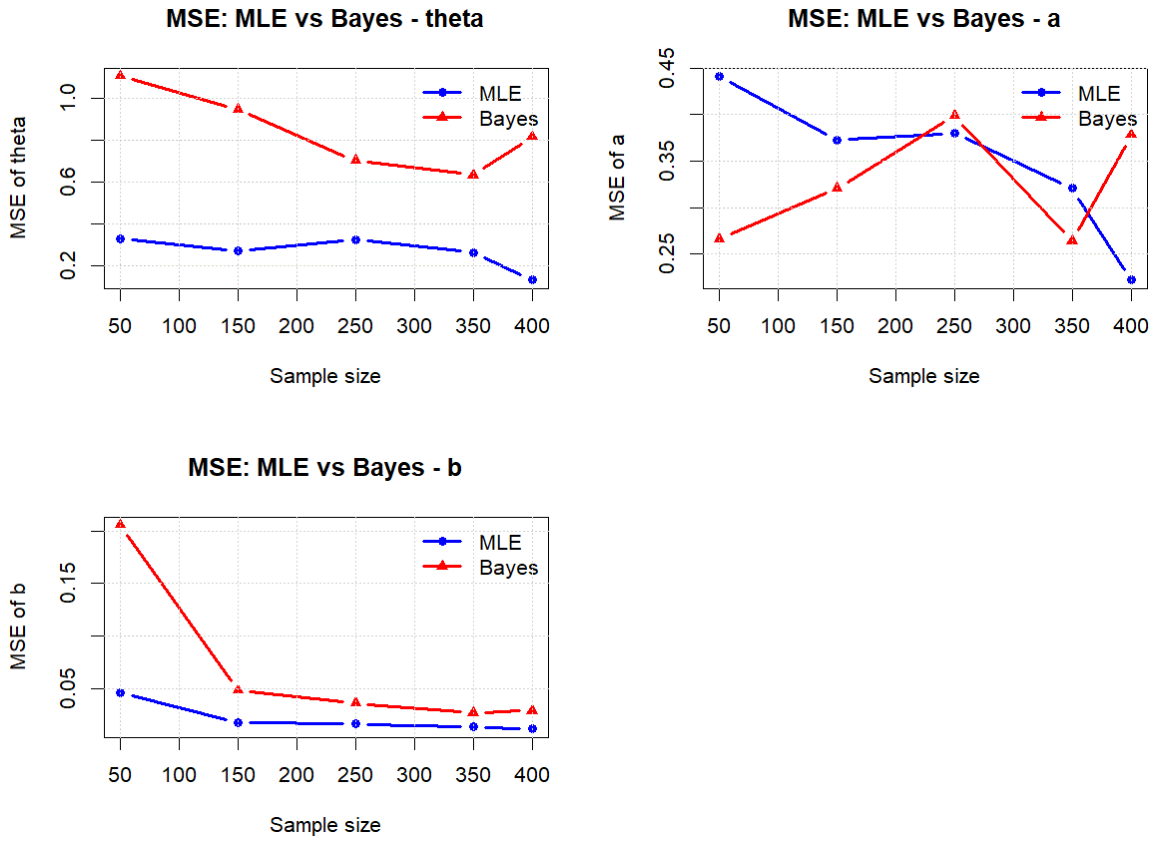
where τ ^ ( r ) denotes the estimate obtained from the rth replication and N is the number of Monte Carlo replications. Overall, the simulation results show that both estimation methods improve with increasing sample size and provide reliable estimates for the NEG distribution with relatively light-tail behavior. The maximum likelihood method generally yields smaller bias, lower MSE values, and more stable estimation performance, whereas the Bayesian approach produces shorter interval lengths. Among the parameters, the estimator of b exhibits the most stable performance across all scenarios.
The considered simulations are described below. The parameter configurations considered in the simulation study were selected to represent different characteristics of the NEG distribution and to investigate the robustness and stability of the estimation procedures under varying model settings. These scenarios were designed to cover a range of representative parameter values associated with different distributional and hazard-rate behaviors. It should be emphasized that the objective of the simulation study is not to demonstrate the superiority of the proposed distribution, but rather to evaluate the finite-sample performance of the estimation methods under diverse and practically relevant conditions.
Simulation 1: The selected parameter configuration was chosen to represent a moderate setting of the NEG distribution and to examine the finite-sample behavior of the proposed estimation procedures. In this simulation, the true parameter values were fixed as θ = 0.9 , a = 1.5 , and b = 1.3 . All numerical results were obtained from 8000 Monte Carlo replications, and the nominal coverage probability was fixed at 95 % for both confidence intervals and Bayesian credible intervals.
The aim of this simulation is not to demonstrate a universal superiority of the NEG model, but to assess how accurately and stably the model parameters can be estimated under the considered numerical setting.
Table 5 presents the maximum likelihood estimation results. The MLEs are generally close to the true parameter values for all sample sizes. For θ , the MSE decreases from 0.331698 at n = 50 to 0.133445 at n = 400 . Similarly, for a, the MSE decreases from 0.441315 to 0.222149 . The parameter b shows the most stable behavior, with the MSE decreasing from 0.045691 to 0.011346 . The confidence interval lengths also decrease as the sample size increases. In particular, the interval length decreases from 7.912104 to 3.129415 for θ , from 11.136585 to 4.840699 for a, and from 2.043729 to 0.646717 for b. These results show that the ML estimators become more precise as the sample size increases.
Table 6 reports the Bayesian estimation results. For θ , the MSE decreases from 1.108046 at n = 50 to 0.635296 at n = 350 , but increases to 0.817278 at n = 400 . For a, the MSE values fluctuate across the sample sizes, with the smallest value obtained at n = 350 . For b, the MSE decreases from 0.205811 at n = 50 to 0.028857 at n = 400 , indicating improved Bayesian estimation accuracy for this parameter. The coverage probabilities are generally close to the nominal level, although the coverage values for b are slightly lower in some cases.
Table 7 compares the Bayesian equal-tail credible intervals and HPD intervals. The interval lengths decrease with increasing sample size for all three parameters. For example, the equal-tail interval length for θ decreases from 5.283624 at n = 50 to 3.066797 at n = 400 , while the HPD interval length decreases from 4.495683 to 2.712403 . Similar decreases are observed for a and b. The HPD intervals are generally shorter than the corresponding equal-tail credible intervals, indicating a more compact Bayesian interval estimation.
Table 8 gives the acceptance rates of the Metropolis–Hastings algorithm. The acceptance rate decreases from 0.618635 at n = 50 to 0.283504 at n = 400 . This decrease is expected, since the posterior distribution becomes more concentrated as the sample size increases.
Table 9 summarizes the MCMC diagnostic measures. The posterior means are 1.668918 , 1.348070 , and 1.313898 for θ , a, and b, respectively. The ESS values show that b has the strongest mixing performance, with an ESS value of 100.066710 , whereas θ and a have lower ESS values. The MCSE value for b is also smaller than those for θ and a, indicating more stable posterior estimation for b.
Table 10 presents the Gelman–Rubin convergence diagnostics. The R-Hat values are 1.070126 for θ , 1.007459 for a, and 1.027653 for b. Since these values are close to one, the results indicate acceptable convergence of the MCMC chains.
Table 11 reports the prior sensitivity analysis. The acceptance rates are very similar across the four Gamma priors, ranging from 0.3160 to 0.3228 . The posterior mean of b remains relatively stable under different prior choices, varying between 1.291640 and 1.414984 . However, the posterior means of θ and a show greater sensitivity to the choice of prior. This suggests that b is more robustly estimated, while θ and a are more affected by prior specification.
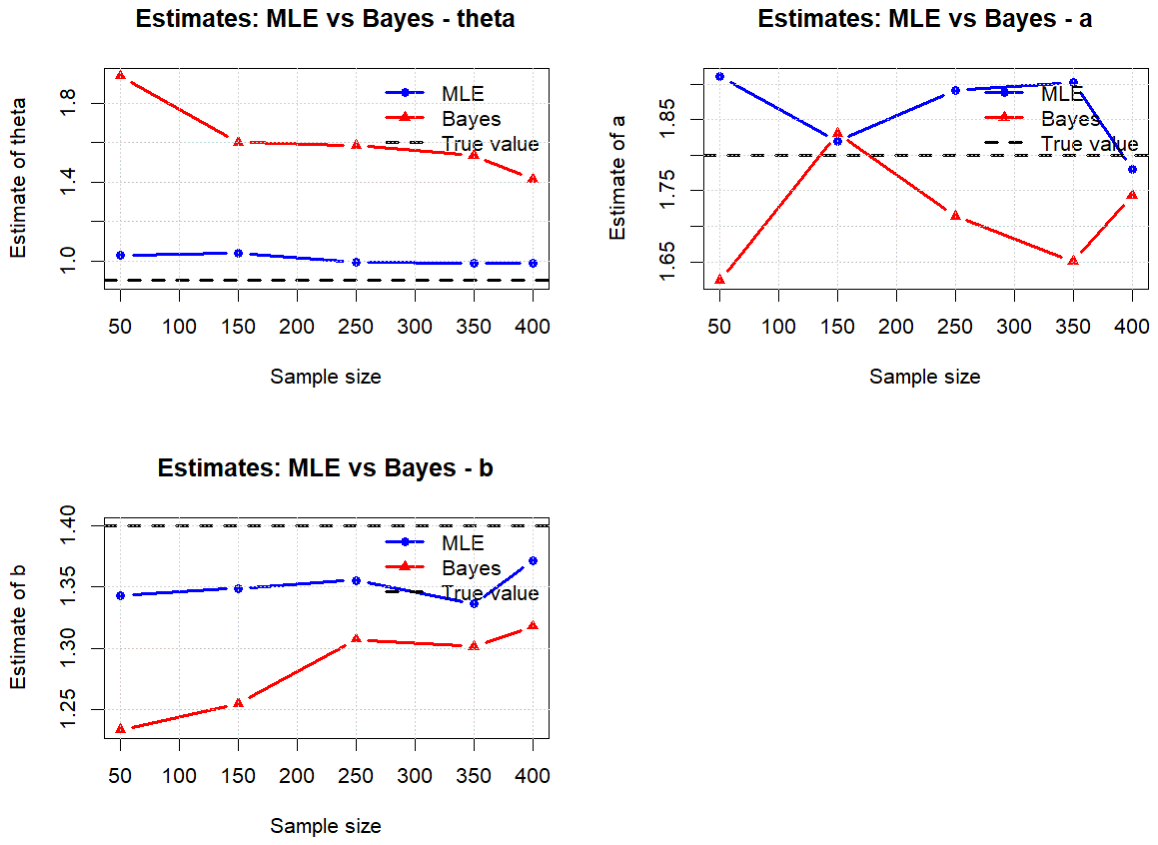
Figure 5 compares the MLE and Bayesian point estimates for θ , a, and b under different sample sizes. The dashed horizontal line represents the true value of each parameter. The figure shows that the MLEs are generally closer to the true parameter values than the Bayesian estimates, especially for θ . For b, both methods provide estimates close to the true value.
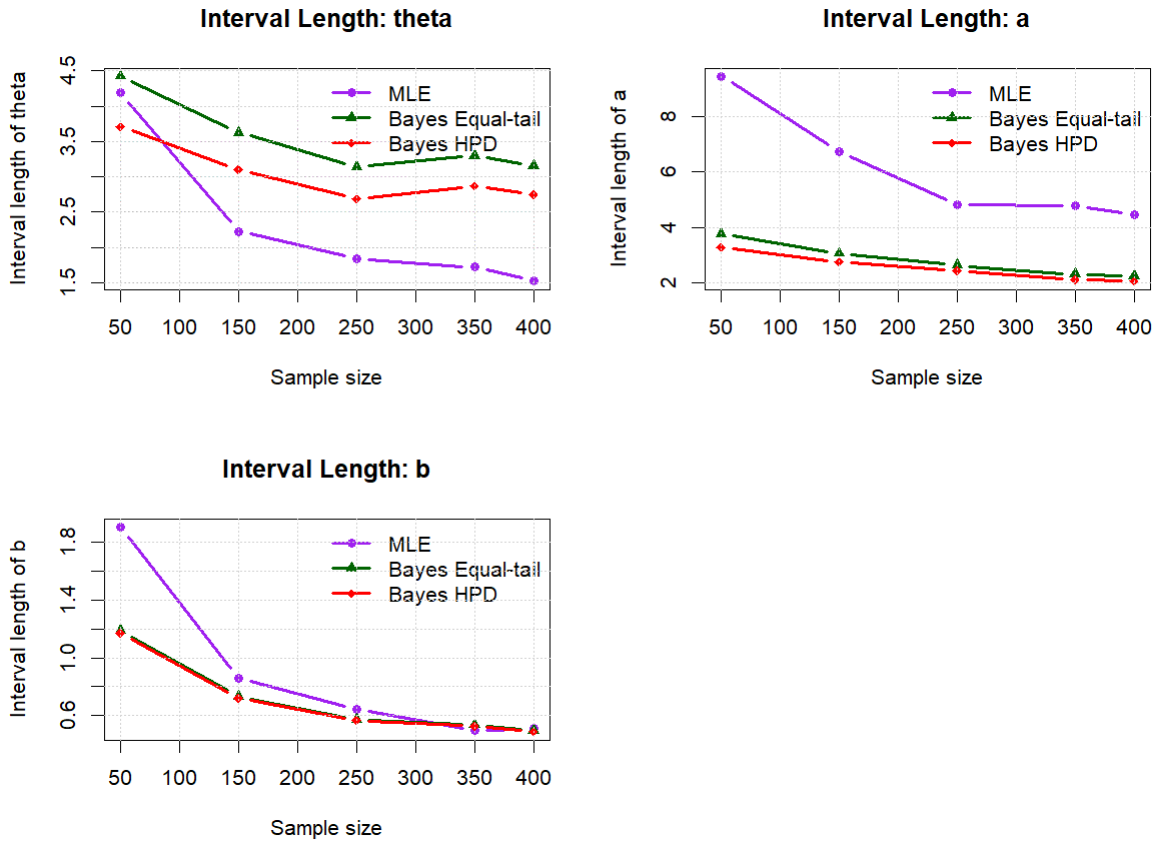
Figure 6 displays the interval lengths obtained from MLE confidence intervals, Bayesian equal-tail credible intervals, and Bayesian HPD intervals. The figure confirms the numerical findings in the interval tables: interval lengths generally decrease as the sample size increases. The HPD intervals are mostly shorter than the equal-tail credible intervals, and both Bayesian intervals are generally shorter than the ML confidence intervals.
Figure 7 compares the MSE values of the ML and Bayesian estimators. The ML method generally produces smaller MSE values than the Bayesian method, particularly for θ and a. For b, both methods show decreasing MSE values as the sample size increases, although the ML estimator still gives smaller errors.
Overall, the results of Simulation 1 indicate that the NEG distribution parameters are estimable under the considered parameter setting. The ML method provides better point estimation accuracy in terms of MSE, whereas the Bayesian method yields shorter interval estimates, especially through the HPD intervals. Therefore, the term “overall performance” refers to the combined assessment of bias, relative bias, MSE, coverage probability, interval length, acceptance rate, convergence diagnostics, and prior sensitivity, rather than to model superiority over competing distributions.
Figure 5 compares the MLE and Bayesian point estimates for the NEG distribution parameters under different sample sizes.
Figure 6 displays the interval lengths obtained from MLE confidence intervals, Bayesian equal-tail credible intervals, and Bayesian HPD intervals for θ , a, and b across different sample sizes.
Figure 7 compares the MSEs of the maximum likelihood and Bayesian estimators for θ , a, and b across sample sizes.
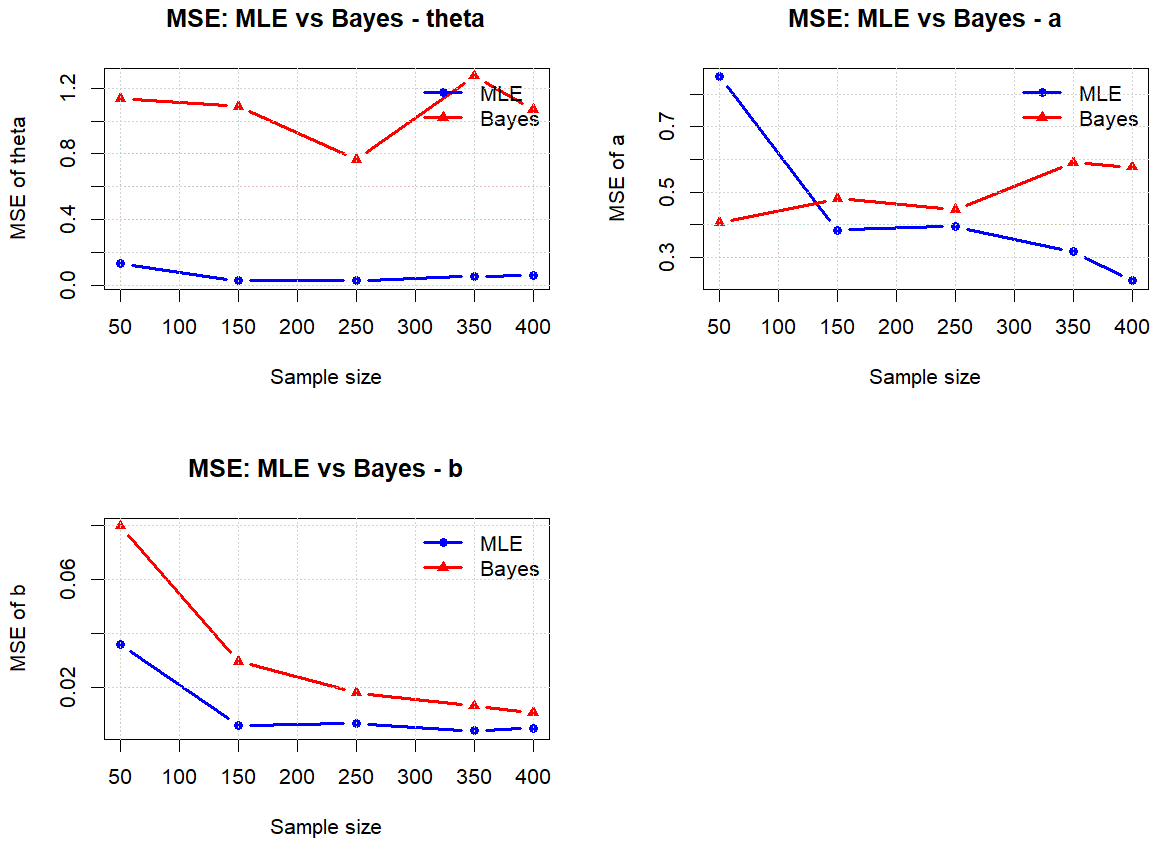
Simulation 2: The second simulation scenario was designed to examine the finite-sample performance of the estimation procedures under an alternative parameter configuration of the NEG distribution. In this setting, the true parameter values were fixed as θ = 0.5 , a = 1.7 , and b = 1.2 . TThe nominal coverage probability was set to 95 % for all confidence intervals, equal-tail credible intervals, and HPD intervals. All numerical results were obtained from 8000 Monte Carlo replications. Table 12 presents the maximum likelihood estimation results. The ML estimates are generally close to the true parameter values for all three parameters. For θ , the MSE decreases from 0.130913 at n = 50 to 0.058413 at n = 400 , while the confidence interval length decreases from 4.189929 to 1.521569 . For parameter a, the MSE decreases from 0.855067 to 0.228878 , and the interval length decreases from 9.464442 to 4.441993 . The parameter b exhibits the most stable estimation behavior, with a very small bias across all sample sizes. Its MSE decreases from 0.035951 at n = 50 to 0.004567 at n = 400 , while the corresponding interval length decreases from 1.906227 to 0.509257 . These findings indicate that the ML estimators become more accurate and precise as the sample size increases.
Table 13 summarizes the Bayesian estimation results. For θ , the Bayesian estimates are larger than the true value for all sample sizes, and the MSE values remain relatively high, ranging from 0.765806 to 1.272633 . For a, the Bayesian estimates tend to be below the true value, and the MSE fluctuates between 0.405582 and 0.590757 . In contrast, parameter b is estimated more stably, with the MSE decreasing from 0.079843 at n = 50 to 0.010291 at n = 400 . The coverage probabilities for b are generally close to or equal to the nominal level, whereas lower coverage values are observed for θ and a at larger sample sizes. This suggests that the Bayesian estimation of θ and a is more sensitive under this parameter configuration.
Table 14 reports the MCMC diagnostic statistics. The posterior mean of θ is noticeably larger than its true value, while the posterior mean of a is smaller than the true value. For b, the posterior mean is close to the true value. The ESS values are relatively low for θ and moderate for a and b, indicating that the posterior sampling of θ is more challenging in this setting. The acceptance rate is 0.293733 , which is within an acceptable range for the Metropolis–Hastings algorithm.
Table 15 gives the Gelman–Rubin convergence diagnostics. The R-Hat values are 1.058262 for θ , 1.010451 for a, and 1.009795 for b. Since these values are close to one, the MCMC chains show acceptable convergence, although the diagnostic results for θ indicate slightly weaker convergence compared with a and b.
Table 16 presents the prior sensitivity analysis. The posterior means of b remain relatively stable across the considered Gamma prior specifications, varying only from 1.298262 to 1.327146 . By contrast, the posterior means of θ and a show more noticeable variation across priors. The acceptance rates range between 0.2870 and 0.3044 , indicating stable algorithmic behavior under the different prior choices. These results suggest that the estimation of b is more robust to prior specification, whereas θ and a are more affected by the selected prior.
Figure 8 compares the maximum likelihood and Bayesian point estimates of θ , a, and b across different sample sizes. The dashed horizontal line represents the true value of each parameter. The figure shows that the ML estimates generally stay closer to the true parameter values, especially for θ and a. The Bayesian estimates tend to overestimate θ and underestimate a, while both methods provide relatively stable estimates for b.
Figure 9 compares the interval lengths obtained from ML confidence intervals, Bayesian equal-tail credible intervals, and Bayesian HPD intervals. The interval lengths generally decrease as the sample size increases, indicating improved estimation precision. The Bayesian HPD intervals are typically shorter than the equal-tail credible intervals, and both Bayesian interval types are generally shorter than the ML confidence intervals.
Figure 10 displays the MSE comparison between the maximum likelihood and Bayesian estimators. The ML method yields substantially smaller MSE values for θ and a across most sample sizes. For b, both methods show decreasing MSE values as the sample size increases; however, the ML estimator remains more accurate in terms of MSE. Overall, the results of Simulation 2 indicate that the NEG distribution parameters remain estimable under the alternative configuration θ = 0.5 , a = 1.7 , and b = 1.2 . The maximum likelihood method provides more accurate point estimates in terms of bias and MSE, whereas the Bayesian method gives useful interval estimates but exhibits greater sensitivity for θ and a. The parameter b is consistently the most stable and accurately estimated parameter under both estimation approaches.
Table 13 presents the Bayesian estimation results, mean squared errors, and coverage probabilities for the NEG distribution with true parameter values θ = 0.5 , a = 1.7 , and b = 1.2 . The results are reported for different sample sizes and include both equal-tail credible interval coverage and HPD interval coverage probabilities.
To assess the robustness of the Bayesian estimation procedure with respect to prior specification, a prior sensitivity analysis was conducted under several Gamma priors. The corresponding results are presented in Table 16, including posterior means, posterior standard deviations, and acceptance rates for the considered prior distributions.
Simulation 3: The third simulation scenario was designed to investigate the performance of the estimation procedures under a different parameter configuration of the NEG distribution, namely θ = 0.9 , a = 1.8 , and b = 1.4 . This setting corresponds to a different hazard-rate behavior and provides an additional assessment of the robustness of the proposed estimation methods. As in the previous simulation studies, the nominal coverage probability was fixed at 95 % , and all numerical results were obtained from 8000 Monte Carlo replications.
Table 17 presents the maximum likelihood estimation results. The ML estimates remain close to the true parameter values across all sample sizes. For θ , the MSE decreases from 0.433361 at n = 50 to 0.133511 at n = 400 , while the confidence interval length decreases from 7.692379 to 3.096573 . For parameter a, the MSE decreases from 0.801827 to 0.312738 , accompanied by a substantial reduction in interval length from 12.792549 to 5.692816 . Similarly, the MSE of parameter b decreases from 0.061369 to 0.014544 , and the interval length decreases from 2.697983 to 0.734576 . The coverage probabilities remain close to the nominal level, indicating satisfactory frequentist performance. Overall, the ML estimators become increasingly accurate and precise as the sample size grows.
Table 18 summarizes the Bayesian estimation results. For parameter θ , the posterior mean moves closer to the true value as the sample size increases, and the MSE decreases from 1.598317 at n = 50 to 0.576492 at n = 400 . For parameter a, the MSE values remain relatively stable, varying between 0.330295 and 0.385676 across the considered sample sizes. For parameter b, a substantial improvement is observed, with the MSE decreasing from 0.222431 to 0.029574 . The coverage probabilities and HPD coverage probabilities remain close to the target level, although slightly lower values are observed for b when the sample size is small. These results again indicate that parameter b is estimated more reliably than θ and a under the Bayesian framework.
Table 19 reports the MCMC diagnostic statistics. The posterior means are reasonably close to the true parameter values, particularly for a and b. The effective sample size for b ( 286.273770 ) is substantially larger than those of θ and a, indicating more efficient mixing and sampling behavior for this parameter. The MCSE values are small, particularly for b, suggesting adequate Monte Carlo accuracy. The overall acceptance rate of approximately 0.325 falls within a reasonable range for the Metropolis–Hastings algorithm.
The Gelman–Rubin convergence statistics reported in Table 20 further support convergence of the MCMC chains. The R ^ values are close to one for all parameters, with values of 1.112111 , 1.005451 , and 1.027358 for θ , a, and b, respectively. These results indicate satisfactory convergence and support the reliability of the Bayesian estimation results.
Table 21 presents the prior sensitivity analysis. The posterior estimates of parameter b remain relatively stable across different Gamma prior specifications, whereas larger variations are observed for θ and a. The acceptance rates remain remarkably consistent, ranging from 0.3240 to 0.3300 . These findings suggest that the Bayesian estimation of b is robust to moderate changes in prior assumptions, while θ and a display greater prior sensitivity.
Figure 11 compares the maximum likelihood and Bayesian point estimates across different sample sizes. The dashed horizontal lines indicate the true parameter values. The figure shows that the ML estimates generally remain closer to the true parameter values, particularly for θ , whereas both methods provide comparable estimates for parameter b as the sample size increases.
Figure 12 illustrates the interval lengths obtained from ML confidence intervals, Bayesian equal-tail credible intervals, and Bayesian HPD intervals. For all parameters, interval lengths decrease as the sample size increases, reflecting the improved precision of both estimation methods. The Bayesian intervals, especially the HPD intervals, tend to be shorter than the corresponding ML confidence intervals.
Figure 13 compares the MSE values of the ML and Bayesian estimators. Consistent with the numerical results reported in the tables, the ML estimator generally produces smaller MSE values than the Bayesian estimator for θ and a. For parameter b, both methods show substantial improvements as the sample size increases, although the ML estimator continues to exhibit slightly smaller MSE values throughout the simulation.
Overall, the results of Simulation 3 confirm the findings obtained in the previous simulation settings. Both estimation approaches improve as the sample size increases, and the parameters of the NEG distribution remain estimable under the considered configuration. The ML method generally provides more accurate point estimation in terms of bias and MSE, whereas the Bayesian method offers competitive interval estimation and satisfactory posterior inference supported by convergence and diagnostic analyses.
Table 19 presents the MCMC diagnostic statistics, including posterior means, posterior standard deviations, effective sample sizes (ESS), Monte Carlo standard errors (MCSE), and acceptance rates for the NEG distribution with θ = 0.9 , a = 1.8 , and b = 1.4 .
The Gelman–Rubin convergence statistics are reported in Table 20. All parameters exhibit R ^ values close to 1, indicating satisfactory convergence of the MCMC chains.
Table 21 presents the prior sensitivity analysis results for the NEG distribution with true parameter values θ = 0.9 , a = 1.8 , and b = 1.4 . Several Gamma prior specifications were considered to assess the robustness of the Bayesian estimates with respect to prior assumptions.

5. Real-Data Analysis

In this section, two real datasets are analyzed to illustrate the applicability and effectiveness of the proposed NEG distribution.
Data 1
The first dataset consists of the tensile strength of carbon fibers, originally studied in [13]. The observations are given as follows: 0.1405, 0.1566, 0.1577, 0.1604, 0.1608, 0.2215, 0.2994, 0.3131, 0.3246, 0.3247, 0.3295, 0.3300, 0.3379, 0.3397, 0.3523, 0.3589, 0.3933, 0.4176, 0.4258, 0.4356, 0.4421, 0.4444, 0.4505, 0.4558, 0.4683, 0.4733, 0.4846, 0.4889, 0.5096, 0.5177, 0.5278, 0.5347, 0.5433, 0.5442, 0.5508, 0.5527, 0.5606, 0.5607, 0.5671, 0.5753, 0.5828, 0.6030, 0.6050, 0.6136, 0.6261, 0.6395, 0.6469, 0.6512, 0.6816, 0.6994, 0.7048, 0.7292, 0.7430, 0.7455, 0.7798, 0.7984, 0.8147, 0.8230, 0.8302, 0.8342, 0.9794.
Table 22 indicates that the data exhibit relatively low variability and near symmetry, as reflected by the skewness value close to zero. The kurtosis value suggests a moderately platykurtic distribution. These characteristics demonstrate that the NEG distribution provides sufficient flexibility for modeling data with varying shapes and tail behaviors.
Figure 14 presents several graphical tools used to examine the distributional behavior of Data 1 under the NEG model. The histogram and violin plot indicate a moderately concentrated distribution around the center of the data with no strong evidence of extreme asymmetry. The box plot suggests the absence of serious outliers, while the stripchart illustrates a relatively balanced spread of observations.
The QQ plot shows that most points lie close to the reference line, indicating that the NEG distribution provides a reasonable approximation to the empirical quantiles. Similarly, the empirical PP plot demonstrates a close agreement between the theoretical and empirical probabilities. In addition, the TTT plot exhibits a gradually increasing convex pattern, which may suggest a non-constant hazard rate structure. Overall, these graphical findings indicate that the NEG distribution offers an adequate fit for the considered dataset.
Table 23 summarizes the extreme value characteristics of Data 1. The selected threshold at the 90th percentile identifies six exceedances, indicating a relatively small upper-tail region. The low Hill index and large Pareto alpha value suggest a light-tailed behavior, implying that extremely large observations are unlikely to occur frequently in the dataset.

5.1. Tail Behavior Analysis (Data 1)

Let X ( 1 ) X ( n ) be the ordered observations. The Hill estimator is given by
γ ^ H ( k ) = 1 k i = 1 k log X ( n i + 1 ) log X ( n k ) .
For Dataset 1, we obtained
γ ^ H 0.1525 ,
which indicates weak tail heaviness. The empirical mean excess function is
e ^ ( u ) = i = 1 n ( X i u ) 1 { X i > u } i = 1 n 1 { X i > u } ,
and its decreasing pattern suggests light-tailed behavior.
If the tail were Pareto-type, then
F ¯ ( x ) = 1 F ( x ) C x α , x ,
so that
log F ¯ ( x ) log C α log x .
However, the log–log survival plot shows curvature rather than a linear trend. For the Pareto tail fit above threshold u,
α ^ = 1 m i = 1 m log X i u 1 ,
where m is the number of exceedances. The estimate
α ^ 12.52
indicates a thin upper tail. Sensitivity analysis gives
0.12 γ ^ H 0.21 , 9.8 α ^ 14.3 .
Thus, the diagnostics suggest that Dataset 1 does not exhibit pronounced heavy-tail behavior. Hence, the NEG model provides a reasonable tail representation. Figure 15 presents the tail-behavior diagnostics for the NEG model, including the Hill plot, mean excess plot, log–log survival plot, and Pareto tail fit.

5.2. Parameter Influence on Tail Behavior

To clarify how each parameter of the NEG distribution affects the tail, we examine the probability density function (PDF) and the hazard rate function. The NEG distribution has parameters θ , a, b, and optionally λ (scale). The tail behavior is primarily governed by a and b:
  • Parameter a controls the shape of the left tail and the mode; smaller a yields a heavier left tail, while larger a lightens the left tail.
  • Parameter b governs the right-tail decay. For fixed θ and a, as b increases, the right tail becomes lighter (faster exponential-type decay). Conversely, smaller b produces a heavier right tail, approaching a Pareto-like behavior in the limit.
  • Parameter θ acts as a mixing/exponential tilt parameter; larger θ shifts probability mass toward the right but does not alter the tail exponent directly.
  • The scale parameter λ (if included) linearly rescales the data without changing the tail shape index.
In the density plots (e.g., Figure 16), the fitted PDF for Data 1 shows a right tail that decays relatively quickly, consistent with the moderate b estimate ( b ^ = 2.85 ). In contrast, heavier-tailed datasets (to be shown) would exhibit a slower PDF decay and a hazard rate that decreases or stabilizes. Thus, the parameter estimates directly inform tail heaviness.
Table 24 summarizes the parameter estimates and goodness-of-fit measures for the fitted models. According to the information criteria, the NEG distribution yields the smallest AIC, AICc, BIC, HQIC, and CAIC values among the considered models, suggesting a slightly better fit for this dataset. The goodness-of-fit statistics (KS and AD) and their corresponding p-values also indicate that all competing models provide an adequate description of the data. Overall, the results suggest that the NEG distribution offers a competitive alternative to existing Gompertz-type models, although the differences in model performance are relatively modest.
Figure 16 presents several graphical diagnostics associated with the NEG model. The fitted PDF and CDF appear to follow the overall empirical pattern of the data reasonably well. The Q-Q and P-P plots show that most points remain close to the reference lines, indicating a satisfactory agreement between the theoretical and empirical distributions. The estimated hazard rate function exhibits an increasing behavior over the support of the data, while the survival function decreases smoothly as expected. In addition, the profile log-likelihood and contour plots suggest that the parameter estimates are obtained around well-defined likelihood regions. Overall, these graphical findings indicate that the NEG model provides an adequate description of the observed dataset.
Figure 17 presents graphical diagnostics for the NEG model. The fitted PDF and CDF follow the empirical pattern reasonably closely. The Q–Q and P–P plots show that most points remain near the reference lines, indicating a satisfactory agreement between the theoretical and empirical distributions.
The estimated hazard rate function exhibits an increasing behavior over the support of the data, while the survival function decreases smoothly as expected. In addition, the profile log-likelihood and contour plots suggest that the parameter estimates are obtained around well-defined likelihood regions. Overall, these graphical findings indicate that the NEG model provides an adequate description of the observed dataset.
Figure 18 illustrates the main graphical diagnostics for the NEG model. The fitted PDF and CDF capture the overall shape of the empirical distribution effectively. The Q–Q and P–P plots demonstrate a strong agreement between the theoretical and observed distributions, with points clustering around the identity line.
The hazard rate function reveals the dynamic risk pattern present in the data, while the survival function decreases appropriately. The profile log-likelihood and contour plots indicate that the maximum likelihood estimates are situated in well-defined regions. Overall, the NEG model offers a good description of the dataset.
Figure 19 presents graphical assessments for the NEG model. The fitted PDF and CDF align reasonably well with the empirical cumulative distribution. The Q–Q and P–P plots indicate that the theoretical quantiles and probabilities match their empirical counterparts closely, with most points falling near the reference lines.
The hazard rate function shows an interpretable trend over the support, and the survival function exhibits a steady decrease. The profile log-likelihood plots reveal well-behaved likelihood surfaces, and the contour plot confirms identifiable parameter estimates. Therefore, the NEG model appears to fit the data adequately.
Figure 20 displays graphical diagnostics for the NEG model. The fitted PDF and CDF generally follow the empirical patterns, although some minor deviations are visible. The Q–Q and P–P plots show that the majority of points are close to the diagonal lines, indicating an acceptable fit.
The hazard rate function exhibits a non-constant behavior consistent with the data, and the survival function declines smoothly. The profile log-likelihood and contour plots suggest that the parameter estimates are well-identified. In summary, the NEG model provides a plausible representation of the observed data.
Figure 21 presents several graphical diagnostics associated with the NEG model. The fitted PDF and CDF appear to follow the overall empirical pattern of the data reasonably well. The Q–Q and P–P plots show that most points remain close to the reference lines, indicating a satisfactory agreement between the theoretical and empirical distributions.
The estimated hazard rate function exhibits an increasing behavior over the support of the data, while the survival function decreases smoothly as expected. In addition, the profile log-likelihood and contour plots suggest that the parameter estimates are obtained around well-defined likelihood regions. Overall, these graphical findings indicate that the NEG model provides an adequate description of the observed dataset.
Dataset 2: Single Carbon Fibers
The dataset, obtained from [14], consists of tensile strength observations measured in gigapascals (GPa) for single carbon fibers and impregnated bundles containing 1000 fibers. The experiments were conducted at a gauge length of 20 mm. A total of 69 observations are available and listed below:
1.312 , 1.314 , 1.479 , 1.552 , 1.7 , 1.803 , 1.861 , 1.865 , 1.944 , 1.958 , 1.966 , 1.997 , 2.006 , 2.021 , 2.027 , 2.055 , 2.063 , 2.098 , 2.14 , 2.179 , 2.224 , 2.24 , 2.253 , 2.27 , 2.272 , 2.274 , 2.301 , 2.301 , 2.359 , 2.382 , 2.382 , 2.426 , 2.434 , 2.435 , 2.478 , 2.49 , 2.511 , 2.514 , 2.535 , 2.554 , 2.566 , 2.57 , 2.586 , 2.629 , 2.633 , 2.642 , 2.648 , 2.684 , 2.697 , 2.726 , 2.77 , 2.773 , 2.8 , 2.809 , 2.818 , 2.821 , 2.848 , 2.88 , 2.954 , 3.012 , 3.067 , 3.084 , 3.09 , 3.096 , 3.128 , 3.233 , 3.433 , 3.585 , 3.858
Table 25 presents the descriptive statistics of the analyzed dataset, including measures of central tendency, dispersion, and distributional shape. The sample consists of 69 observations, with a mean value of 2.4553 and a median of 2.4780, indicating a relatively symmetric distribution. The skewness coefficient ( 0.0999 ) is close to zero, supporting the presence of near symmetry, while the kurtosis value ( 3.1325 ) suggests a distribution close to normality. The variability of the data is moderate, as reflected by the variance ( 0.2554 ) and standard deviation ( 0.5053 ).
Figure 22 presents the graphical diagnostics for the analyzed dataset, including the histogram, box plot with stripchart, QQ plot, violin plot, TTT plot, and empirical PP plot. The histogram and violin plot indicate that the data are moderately right-skewed, while the box plot suggests the presence of mild variability without severe outliers. In addition, the QQ plot demonstrates that the empirical observations are reasonably close to the theoretical quantiles, supporting the adequacy of the proposed model. The empirical PP plot also shows that the fitted distribution provides a satisfactory agreement with the observed data.
Table 26 presents the extreme value summary statistics obtained from the Hill estimator and Pareto tail analysis. The dataset contains n = 69 observations, and the threshold corresponding to the upper 90% quantile is estimated as u = 3.0852 , with seven observations exceeding this threshold. The estimated Hill index is 0.11477 , while the associated Pareto tail index is 12.81786 . These results provide additional information about the upper-tail behavior of the dataset and may be useful for assessing the tail characteristics of the proposed model.

5.3. Tail Behavior Analysis (Data 2)

The tail behavior of the NEG distribution can be examined through the extreme value index (EVI). Let the survival function be
F ¯ ( x ) = 1 F ( x ) .
For the NEG distribution, as x ,
F ¯ ( x ) exp θ a x a .
Hence,
log F ¯ ( x ) θ a x a ,
which corresponds to a stretched exponential decay rather than a Pareto-type tail. The hazard rate function is
h ( x ) = f ( x ) F ¯ ( x ) x a 1 ,
showing polynomial growth for large x. Therefore, the NEG distribution belongs to the Gumbel maximum domain of attraction with
γ = 0 ,
where γ denotes the extreme value index. Recall that
γ > 0 Fréchet domain ( heavy tail ) ,
γ = 0 Gumbel domain ( light tail ) ,
γ < 0 Weibull domain ( bounded tail ) .
Thus, the NEG distribution is not heavy-tailed in the strict Pareto sense, but instead exhibits a moderately light stretched-exponential tail behavior.
The graphical diagnostics in Figure 23 provide only suggestive evidence regarding tail behavior. Although the plots indicate some tail elongation relative to light-tailed models, the small number of exceedances and threshold sensitivity limit definitive conclusions. Therefore, the findings should be interpreted as graphical indications of moderate tail flexibility rather than rigorous evidence of heavy-tailed behavior. The tail behavior of the NEG distribution is mainly controlled by the parameters θ , a, and b. The parameter a determines the rate of decay of the survival function, where larger values produce lighter tails and smaller values generate relatively longer tails. The parameter θ controls the overall decay speed, while b affects the shape of the hazard function and indirectly influences the tail appearance in the density plots.
Table 27 presents the parameter estimates and goodness-of-fit measures for the competing models. Based on the information criteria, the NEG distribution provides the smallest AIC, AICc, BIC, HQIC, and CAIC values among the fitted models. The goodness-of-fit statistics and their associated p-values indicate that all models provide an acceptable fit to the data. Overall, the results suggest that the NEG distribution offers a competitive fit for this dataset, although the differences among several competing models remain relatively small.
Figure 24 presents the diagnostic analysis for the Alpha-Power Gompertz distribution. The fitted PDF and CDF appear to follow the empirical behavior of the data reasonably well. The Q–Q and P–P plots show that most observations are located close to the reference lines, although slight deviations are visible in the tail regions. The hazard rate function exhibits an increasing pattern, suggesting a gradually rising risk structure over time. In addition, the profile and contour log-likelihood plots indicate the existence of identifiable parameter regions, while the survival function decreases smoothly as expected.
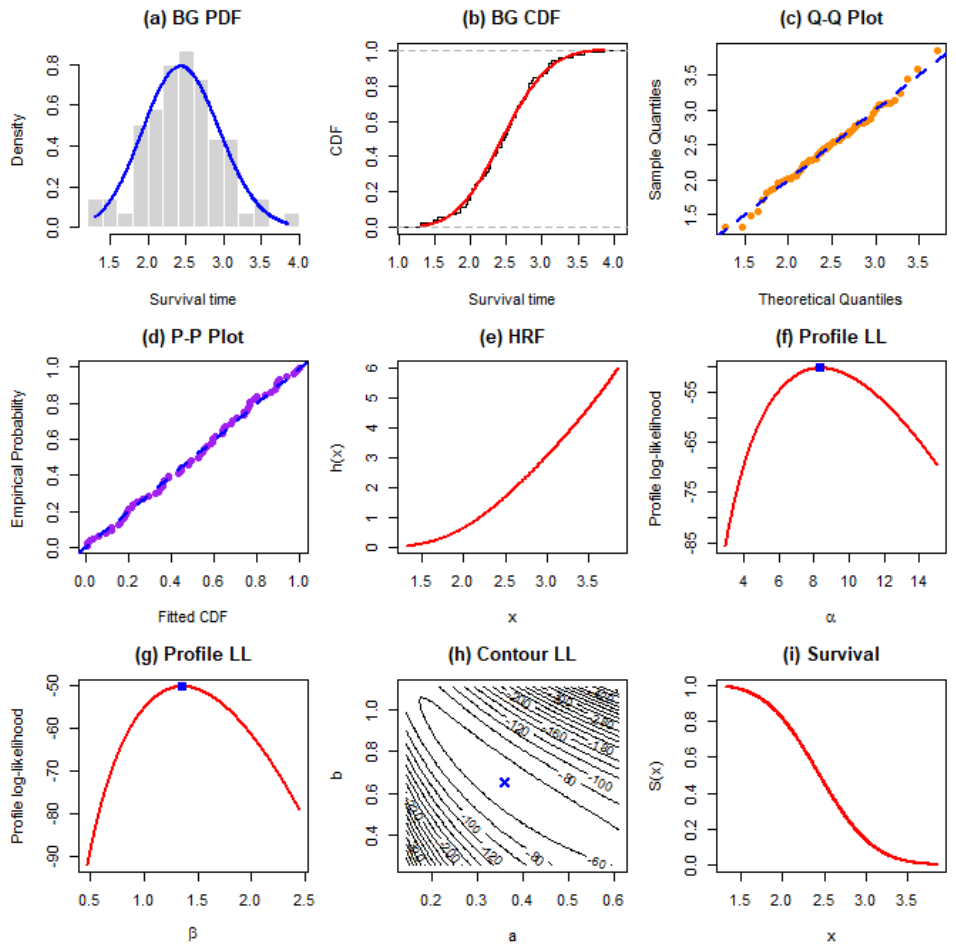
Figure 25 illustrates the diagnostic results for the Beta Gompertz distribution. The fitted density and distribution functions provide a reasonable approximation to the observed data. The Q–Q and P–P plots indicate generally good agreement between empirical and theoretical quantiles, with only minor discrepancies. The hazard rate function increases monotonically, which may be appropriate for data exhibiting increasing failure rates. The likelihood-based plots further suggest stable parameter estimation, although some elongation in the contour structure may indicate moderate parameter dependence.
Figure 26 shows the diagnostic plots for the Kumaraswamy Gompertz distribution. The fitted PDF and CDF appear consistent with the empirical observations. The Q–Q and P–P plots demonstrate an acceptable level of agreement between theoretical and observed values, although small deviations are present at the extremes. The hazard rate function displays an increasing trend, indicating progressive growth in risk over time. The contour and profile log-likelihood plots suggest that the parameter estimates are reasonably stable within the fitted region.
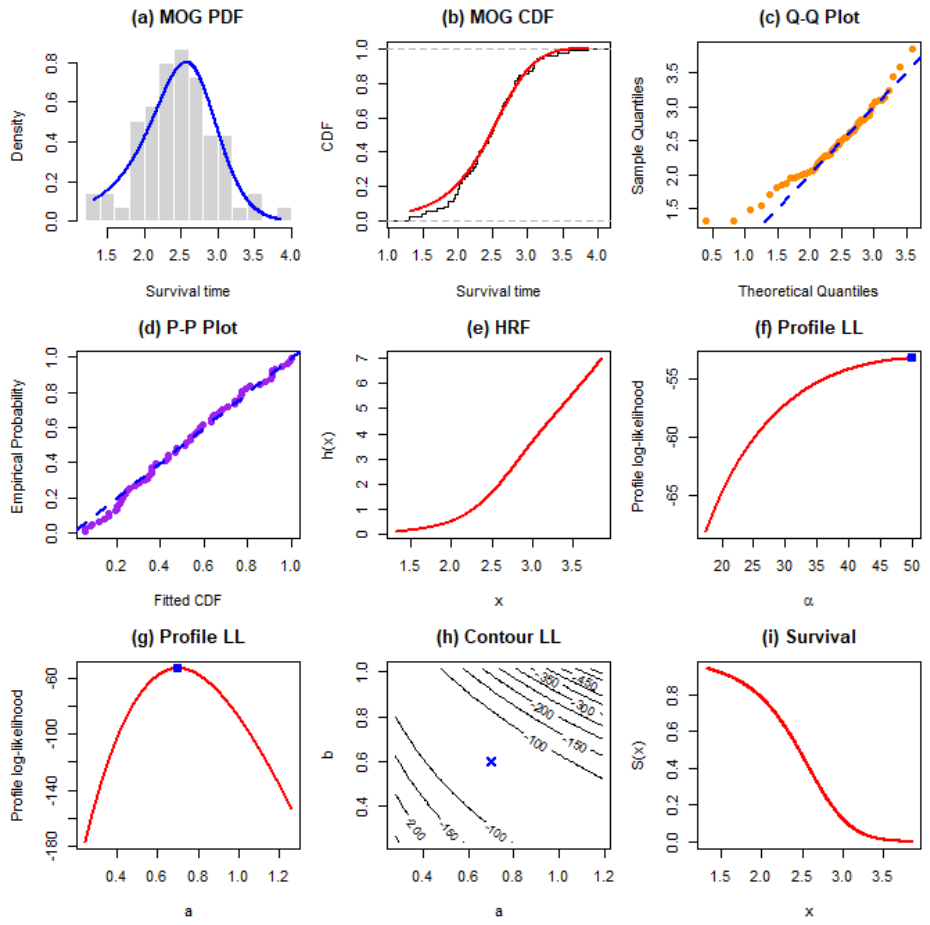
Figure 27 presents the diagnostic analysis for the Marshall–Olkin Gompertz distribution. The fitted PDF and CDF provide a reasonable description of the observed data pattern. The Q–Q and P–P plots indicate that the fitted model captures the central part of the distribution satisfactorily, although limited tail deviations remain visible. The hazard rate function increases steadily, while the profile likelihood plots indicate a well-defined parameter region for estimation.
Figure 28 illustrates the diagnostic plots for the classical Gompertz distribution. The fitted PDF and CDF capture the general shape of the data reasonably well. The Q–Q and P–P plots suggest moderate agreement between theoretical and empirical distributions, although deviations are somewhat more noticeable in the upper-tail region. The hazard rate function exhibits a strongly increasing structure, which is characteristic of the Gompertz model. The likelihood surfaces indicate identifiable parameter estimates, but some steepness in the likelihood profiles may reflect sensitivity in parameter estimation.
Figure 29 presents the diagnostic results for the NEG distribution. The fitted PDF and CDF appear to describe the empirical behavior of the data satisfactorily. The Q–Q and P–P plots show that most points remain close to the reference lines, suggesting a reasonable agreement between the fitted model and the observed data. Small deviations are mainly visible in the tail regions.
The hazard rate function demonstrates an increasing pattern, indicating that the NEG model is capable of representing progressively increasing risk behavior. In addition, the profile log-likelihood and contour plots suggest that the parameter estimates are reasonably stable and identifiable. The survival function decreases smoothly over time, which is consistent with the general structure of lifetime distributions.

6. Discussion

The results presented in this study demonstrate that the New Extended Gompertz (NEG) distribution, obtained by applying the existing NE-X generator framework to the classical Gompertz baseline, provides a flexible and practically useful extension for lifetime data analysis. The analytical derivations confirm that the model preserves mathematical tractability while offering increased flexibility in hazard-rate structures, including increasing, decreasing, bathtub-shaped, and unimodal patterns.
The simulation results, based on 8000 Monte Carlo replications under three different parameter configurations, indicate that both maximum likelihood and Bayesian estimation methods perform adequately for the NEG model. The maximum likelihood estimator generally yields smaller bias and mean squared error values across most sample sizes and parameter settings, while the Bayesian approach tends to produce shorter credible intervals. Among the three parameters, the estimator of b exhibits the most stable finite-sample performance. These findings suggest that the NEG model parameters are estimable under the considered numerical designs.
The real-data applications on two carbon-fiber tensile strength datasets show that the NEG distribution provides competitive fits compared to several alternative Gompertz-type models, including the Gompertz, Kumaraswamy Gompertz, Marshall–Olkin Gompertz, Alpha-Power Gompertz, and Beta Gompertz distributions. Based on information criteria (AIC, AICc, BIC, HQIC, CAIC) and goodness-of-fit tests (KS and AD), the NEG model offers a reasonable description of the observed data. However, it should be emphasized that the differences in model performance are relatively modest, and the NEG distribution does not uniformly outperform all competing models across all datasets. The comparative results should therefore be interpreted as evidence of competitive performance rather than universal superiority. A key point to reiterate is that the novelty of this study lies not in the introduction of a completely new family of distributions, but in the comprehensive investigation of a specific Gompertz-based special case constructed within the existing NE-X generator framework. The analytical, numerical, and applied contributions of this work are therefore associated with the detailed examination of this extension, including its properties, estimation, simulation performance, and practical utility.

6.1. Limitations

Several limitations of this study should be acknowledged. First, although the NEG distribution accommodates a range of hazard-rate shapes, the theoretical characterization of hazard-rate behavior is based on derivative analysis and numerical illustrations rather than a complete analytical classification of all possible patterns. Some hazard shapes may only occur within restricted regions of the parameter space.
Second, the maximum likelihood estimation procedure relies on numerical optimization because closed-form estimators are not available. While the L-BFGS-B algorithm with multiple starting points was used to mitigate convergence issues, the likelihood surface may exhibit flat regions or multiple local optima for certain parameter combinations. In particular, standard errors for some parameter estimates (e.g., θ for Data 1, a and b for some competing models) were relatively large, indicating potential identifiability issues or weak parameter effects. For instance, the NEG estimate θ ^ = 0.504 ( 0.795 ) for Data 1 and a ^ = 0.317 ( 0.115 ) for Data 2 suggest that the posterior uncertainty or asymptotic standard errors can be nontrivial.
Third, the Bayesian estimation results depend on the choice of prior distributions. Although an empirical Bayes approach was adopted and prior sensitivity analyses were performed, the influence of prior specifications may still affect posterior inferences, particularly for parameters that are weakly identified. The relatively large MSE values for the Bayesian estimator of θ and a in Simulation 2 and 3 suggest that prior information may have a stronger influence for these parameters under certain configurations.
Fourth, the simulation study considered only three fixed parameter settings and five sample sizes up to 400. The performance of the estimators under more extreme parameter configurations, such as near-boundary values or values leading to near-degenerate distributions, was not examined. Moreover, the choice of 8000 Monte Carlo replications, while computationally intensive, may still produce sampling variability in the reported bias and MSE estimates, especially for larger sample sizes where the true values of these metrics are small.
Fifth, the tail behavior analysis using Hill estimators and mean excess plots is based on a limited number of exceedances (six exceedances for Data 1 and seven exceedances for Data 2). Therefore, the estimated Hill indices and Pareto alpha values should be interpreted as suggestive rather than definitive evidence of specific tail behavior. The log–log survival plots also exhibited curvature rather than a strict linear trend, which complicates simple tail classification.
Finally, the real-data analysis is based on only two datasets, both from carbon-fiber tensile strength experiments. The generalizability of the findings to other types of lifetime data, such as biomedical survival data, mechanical reliability data, or financial durations, has not been established. The comparative performance of the NEG distribution relative to other competing models may vary across different data structures.

6.2. Future Research Directions

Based on the findings and limitations of this study, several directions for future research can be identified. First, a more comprehensive theoretical characterization of the hazard-rate function of the NEG distribution could be pursued. In particular, establishing precise conditions on the parameter space for the existence of bathtub-shaped, unimodal, or other non-monotone hazard patterns would provide deeper insight into the model’s flexibility.
Second, alternative estimation methods could be developed to address the numerical challenges associated with maximum likelihood estimation. These might include profile likelihood approaches to reduce the dimension of the optimization problem, expectation-maximization (EM) type algorithms if a suitable latent variable representation can be found, or method-of-moments estimators based on the quantile function.
Third, the Bayesian framework could be extended by investigating alternative prior specifications, such as weakly informative priors based on prior predictive matching or reference priors. The use of more efficient MCMC algorithms, such as Hamiltonian Monte Carlo (HMC) or variational inference, could also improve computational efficiency and convergence properties, particularly for higher-dimensional extensions of the model.
Fourth, the simulation study could be expanded to include a wider range of parameter configurations, including near-boundary values, values that yield near-degenerate distributions, and scenarios where the model parameters are poorly identified. Additionally, larger sample sizes (e.g., n = 500 , 750 , 1000 ) could be investigated to examine asymptotic convergence more thoroughly.
Fifth, the NEG distribution could be extended to accommodate censored data, which are common in survival and reliability applications. The development of estimation procedures for right-censored, left-censored, or interval-censored data would substantially increase the practical utility of the model.
Sixth, regression formulations of the NEG model could be developed to incorporate covariate information. For example, a location-scale parameterization or accelerated failure time (AFT) formulation would allow the model to be used in more complex applied settings where explanatory variables are available.
Seventh, the NEG distribution could be considered as a baseline model within broader mixture or frailty frameworks. For instance, finite mixtures of NEG distributions could capture unobserved heterogeneity in survival data, while frailty models with NEG baseline could account for dependence in clustered survival data.
Eighth, the comparative performance of the NEG distribution could be evaluated on a wider range of real datasets from different application domains, including biomedical survival data, mechanical reliability data, financial duration data, and ecological data. Such empirical investigations would provide a more complete picture of the model’s practical strengths and weaknesses.
Finally, further methodological developments could include the derivation of more efficient goodness-of-fit tests specific to the NEG distribution, the development of model selection criteria that account for the model’s construction within a generator framework, and the investigation of large-sample properties of the estimators under more general regularity conditions.

7. Conclusions

In this study, we have investigated the New Extended Gompertz (NEG) distribution, which is obtained by applying the existing NE-X generator framework to the classical Gompertz baseline distribution. It is important to clarify that the NEG model is not a completely new family of distributions; rather, it is a special case within an already established generator family. Consequently, the main contribution of this paper is not the introduction of a new generator, but a comprehensive analytical, numerical, and applied examination of this specific Gompertz-based extension. The NEG distribution preserves the mathematical tractability of the baseline Gompertz model while introducing an additional shape parameter that enhances flexibility. Several statistical properties have been derived, including expressions for the density, distribution, survival, and hazard-rate functions, as well as moments, entropy measures, and series representations. The model accommodates a variety of hazard-rate structures, including increasing, decreasing, bathtub-shaped, and unimodal patterns, making it suitable for a broader range of lifetime data than the standard Gompertz distribution.
The simulation results indicate that both maximum likelihood and Bayesian estimation methods perform adequately for the NEG model under the considered parameter settings and sample sizes. The maximum likelihood estimator generally provides more accurate point estimates in terms of bias and mean squared error, while the Bayesian approach yields shorter credible intervals. The parameter b is consistently estimated with the highest precision across all scenarios. The real-data applications on two carbon-fiber tensile strength datasets demonstrate that the NEG distribution offers competitive performance compared to several alternative Gompertz-type models. Based on information criteria and goodness-of-fit tests, the NEG model provides a reasonable description of the observed data. However, it should be emphasized that these comparisons do not establish universal superiority of the NEG model; rather, they indicate that the NEG distribution is a competitive alternative among existing Gompertz-type extensions.
Several limitations of this study have been acknowledged, including numerical challenges in estimation, dependence on prior specifications in the Bayesian approach, limited scope of the simulation study, and the restricted number of real datasets considered. Future research directions have been proposed to address these limitations, including theoretical extensions, alternative estimation methods, regression formulations, and broader empirical evaluations.
In summary, the NEG distribution represents a useful addition to the existing family of Gompertz-type lifetime models. Its flexibility, mathematical tractability, and competitive performance in the considered applications suggest that it may serve as a practical tool for reliability and survival analysis. Nevertheless, researchers should be aware of its limitations and interpret comparative results within the specific context of their data and parameter settings. The novelty of this work lies in the systematic investigation of this particular NE-X-based Gompertz extension, and we hope that this study provides a foundation for further theoretical developments and practical applications.

Author Contributions

Conceptualization, A.M.K., F.B. and S.Ç.; methodology, A.M.K. and S.Ç.; software, A.M.K. and F.B.; validation, A.M.K. and S.Ç.; formal analysis, A.M.K. and F.B.; investigation, A.M.K., F.B. and S.Ç.; resources, A.M.K. and F.B.; data curation, A.M.K., F.B. and S.Ç.; writing original draft preparation, F.B.; writing review and editing, F.B.; visualization, F.B.; supervision, A.M.K. and F.B.; project administration, A.M.K. and F.B.; funding acquisition, A.M.K. and F.B. All authors have read and agreed to the published version of the manuscript.

Funding

This research received no external funding.

Data Availability Statement

The data presented in this study are available within the article. Further inquiries can be directed to the corresponding author.

Acknowledgments

The authors would like to thank the anonymous reviewers for their valuable comments and suggestions, which helped improve the quality of this manuscript. AI or AI-assisted tools were not used in drafting any aspect of this manuscript.

Conflicts of Interest

The authors declare no conflicts of interest.

References

  1. Abdelkawy, M.A.; Alghamdi, S.M.; Elbatal, I.; Hashem, A.F.; Shawki, A.W.; Elgarhy, M. Statistical analysis of disability: Utilizing the new extended Rayleigh inverted Weibull model. Alex. Eng. J. 2025, 129, 779–792. [Google Scholar] [CrossRef]
  2. Baharith, L.A. New Generalized Weibull Inverse Gompertz Distribution: Properties and Applications. Symmetry 2024, 16, 197. [Google Scholar] [CrossRef]
  3. Chipepa, F.; Elkalzah, B.; Oluyede, B.; Dingalo, N.; Aldukeel, A. A New Topp–Leone Heavy-Tailed Odd Burr X-G Family of Distributions with Applications. Symmetry 2025, 17, 2093. [Google Scholar] [CrossRef]
  4. Ekemezie, D.-F.N.; Anyiam, K.E.; Kayid, M.; Balogun, O.S.; Obulezi, O.J. DUS Topp–Leone-G Family of Distributions: Baseline Extension, Properties, Estimation, Simulation and Useful Applications. Entropy 2024, 26, 973. [Google Scholar] [CrossRef] [PubMed]
  5. Mohammad, H.H.; Binhimd, S.M.S.; EL-Helbawy, A.A.; AL-Dayian, G.R.; Abd EL-Maksoud, F.G.; Abd Elaal, M.K. Development and Engineering Applications of a Novel Mixture Distribution: Exponentiated and New Topp–Leone-G Families. Symmetry 2025, 17, 399. [Google Scholar] [CrossRef]
  6. González-Hernández, I.J.; Méndez-González, L.C.; Granillo-Macías, R.; Rodríguez-Muñoz, J.L.; Pacheco-Cedeño, J.S. A New Generalization of the Uniform Distribution: Properties and Applications to Lifetime Data. Mathematics 2024, 12, 2328. [Google Scholar] [CrossRef]
  7. Klakattawi, H.S. A Novel Exponentiated Generalized Weibull Exponential Distribution: Properties, Estimation, and Regression Model. Axioms 2025, 14, 706. [Google Scholar] [CrossRef]
  8. Özbilen, Ö. Enhancing Statistical Modeling with the Marshall–Olkin Unit-Exponentiated-Half-Logistic Distribution: Theoretical Developments and Real-World Applications. Symmetry 2025, 17, 2084. [Google Scholar] [CrossRef]
  9. Karakaş, A.M.; Bulut, F. The new Gompertz distribution model and applications. Symmetry 2025, 17, 843. [Google Scholar] [CrossRef]
  10. Karakaş, A.M.; Bulut, F.; Şahin Bal, S. A Novel Gompertz-Type Distribution with Applications to Radiological Dose and Pharmacokinetic Data. Mathematics 2026, 14, 702. [Google Scholar] [CrossRef]
  11. Vidović, Z.; Wang, L. Objective Posterior Analysis of kth Record Statistics in Gompertz Model. Axioms 2025, 14, 152. [Google Scholar] [CrossRef]
  12. Zichuan, M.; Hussain, S.; Iftikhar, A.; Ilyas, M.; Ahmad, Z.; Khan, D.M.; Manzoor, S. A New Extended-X Family of Distributions: Properties and Applications. Comput. Math. Methods Med. 2020, 2020, 4650520. [Google Scholar] [CrossRef]
  13. Alotaibi, N.; Al-Moisheer, A.S.; Elbatal, I.; Shrahili, M.; Elgarhy, M.; Almetwally, E.M. Bayesian and Non-Bayesian Estimation for a New Extension of Power Topp–Leone Distribution under Ranked Set Sampling with Applications. Axioms 2023, 12, 722. [Google Scholar] [CrossRef]
  14. Alrashidi, A. Arctan Kavya-Manoharan-G class of distributions with modelling in different fields. Adv. Appl. Stat. 2024, 91, 393–420. [Google Scholar]
Figure 1. Graphical illustration of the NEG distribution under different parameter settings. The left panel presents the cumulative distribution functions (CDFs), whereas the right panel presents the probability density functions (PDFs). The plots demonstrate the influence of the parameters ( θ , a , b ) on the growth rate, skewness, concentration, and tail-decay behavior of the proposed distribution.
Mathematics 14 02159 g001
Figure 2. Representative hazard-rate patterns of the NEG distribution under different parameter settings.
Mathematics 14 02159 g002
Figure 3. First derivative of the NEG hazard-rate function for representative parameter settings.
Mathematics 14 02159 g003
Figure 4. Rényi entropy curves of the NEG distribution under different parameter settings. The plots show that the entropy decreases smoothly as δ increases, confirming the stable and flexible behavior of the NEG model. This consistent pattern highlights the ability of the NEG distribution to represent different uncertainty structures effectively, which supports its usefulness in modeling diverse lifetime data.
Mathematics 14 02159 g004
Figure 5. Comparison of MLE and Bayesian point estimates for the NEG distribution parameters θ , a, and b under different sample sizes. The dashed horizontal line represents the true parameter value.
Mathematics 14 02159 g005
Figure 6. Comparison of interval lengths obtained from MLE confidence intervals, Bayesian equal-tail credible intervals, and Bayesian HPD intervals for the NEG distribution parameters θ , a, and b across different sample sizes.
Mathematics 14 02159 g006
Figure 7. Comparison of mean squared errors (MSEs) of the maximum likelihood and Bayesian estimators for the NEG distribution parameters θ , a, and b under different sample sizes.
Mathematics 14 02159 g007
Figure 8. Estimates of θ , a, and b obtained by the maximum likelihood and Bayesian methods for the NEG distribution with true parameter values θ = 0.5 , a = 1.7 , and b = 1.2 . The dashed horizontal line represents the true parameter value, while the curves illustrate the behavior of the estimators as the sample size increases.
Mathematics 14 02159 g008
Figure 9. Comparison of interval lengths obtained from maximum likelihood confidence intervals, Bayesian equal-tail credible intervals, and Bayesian HPD intervals for the NEG distribution with true parameter values θ = 0.5 , a = 1.7 , and b = 1.2 .
Mathematics 14 02159 g009
Figure 10. Comparison of mean squared errors of the maximum likelihood and Bayesian estimators for the NEG distribution with true parameter values θ = 0.5 , a = 1.7 , and b = 1.2 .
Mathematics 14 02159 g010
Figure 11. Comparison of the maximum likelihood and Bayesian estimates of θ , a, and b for the NEG distribution with true parameter values θ = 0.9 , a = 1.8 , and b = 1.4 . The dashed horizontal line represents the true parameter value.
Mathematics 14 02159 g011
Figure 12. Comparison of interval lengths obtained from maximum likelihood confidence intervals, Bayesian equal-tail credible intervals, and Bayesian HPD intervals for the NEG distribution with true parameter values θ = 0.9 , a = 1.8 , and b = 1.4 .
Mathematics 14 02159 g012
Figure 13. Comparison of mean squared errors of the maximum likelihood and Bayesian estimators for the NEG distribution with true parameter values θ = 0.9 , a = 1.8 , and b = 1.4 .
Mathematics 14 02159 g013
Figure 14. Graphical assessment of Data 1 including the histogram, box plot with stripchart, QQ plot, violin plot, TTT plot, and empirical PP plot under the NEG model.
Mathematics 14 02159 g014
Figure 15. Tail behavior diagnostics for the NEG model including the Hill plot, mean excess plot, log–log survival plot, and Pareto tail fit.
Mathematics 14 02159 g015
Figure 16. Graphical analysis of the NEG model including the fitted PDF, fitted CDF, Q–Q plot, P–P plot, hazard rate function, profile log-likelihood plots, contour log-likelihood plot, and survival function.
Mathematics 14 02159 g016
Figure 17. Graphical analysis of the NEG model including the fitted PDF, fitted CDF, Q–Q plot, P–P plot, hazard rate function, profile log-likelihood plots, contour log-likelihood plot, and survival function.
Mathematics 14 02159 g017
Figure 18. Graphical analysis of the NEG model including the fitted PDF, fitted CDF, Q–Q plot, P–P plot, hazard rate function, profile log-likelihood plots, contour log-likelihood plot, and survival function.
Mathematics 14 02159 g018
Figure 19. Graphical analysis of the NEG model including the fitted PDF, fitted CDF, Q–Q plot, P–P plot, hazard rate function, profile log-likelihood plots, contour log-likelihood plot, and survival function.
Mathematics 14 02159 g019
Figure 20. Graphical analysis of the NEG model including the fitted PDF, fitted CDF, Q–Q plot, P–P plot, hazard rate function, profile log-likelihood plots, contour log-likelihood plot, and survival function.
Mathematics 14 02159 g020
Figure 21. Graphical analysis of the NEG model including the fitted PDF, fitted CDF, Q–Q plot, P–P plot, hazard rate function, profile log-likelihood plots, contour log-likelihood plot, and survival function.
Mathematics 14 02159 g021
Figure 22. Histogram, box plot with stripchart, QQ plot, violin plot, TTT plot, and empirical PP plot for the analyzed dataset.
Mathematics 14 02159 g022
Figure 23. Diagnostic plots related to tail behavior analysis, including the Hill plot, mean excess plot, log–log survival plot, and Pareto tail fit.
Mathematics 14 02159 g023
Figure 24. Diagnostic plots for the Alpha-Power Gompertz (APG) distribution, including the fitted PDF, CDF, Q–Q plot, P–P plot, hazard rate function, profile log-likelihood functions, contour log-likelihood, and survival function.
Mathematics 14 02159 g024
Figure 25. Diagnostic plots for the Beta Gompertz (BG) distribution, including the fitted PDF, CDF, Q–Q plot, P–P plot, hazard rate function, profile log-likelihood functions, contour log-likelihood, and survival function.
Mathematics 14 02159 g025
Figure 26. Diagnostic plots for the Kumaraswamy Gompertz (KG) distribution, including the fitted PDF, CDF, Q–Q plot, P–P plot, hazard rate function, profile log-likelihood functions, contour log-likelihood, and survival function.
Mathematics 14 02159 g026
Figure 27. Diagnostic plots for the Marshall–Olkin Gompertz (MOG) distribution, including the fitted PDF, CDF, Q–Q plot, P–P plot, hazard rate function, profile log-likelihood functions, contour log-likelihood, and survival function.
Mathematics 14 02159 g027
Figure 28. Diagnostic plots for the Gompertz distribution, including the fitted PDF, CDF, Q–Q plot, P–P plot, hazard rate function, profile log-likelihood functions, contour log-likelihood, and survival function.
Mathematics 14 02159 g028
Figure 29. Diagnostic plots for the NEG distribution, including the fitted PDF, CDF, Q–Q plot, P–P plot, hazard rate function, profile log-likelihood functions, contour log-likelihood, and survival function.
Mathematics 14 02159 g029
Table 1. Comparative structural properties of the NEG distribution and competing lifetime models.
DistributionNo. of ParametersTail BehaviorHazard Rate ShapesModel Flexibility
Gompertz2Light tailIncreasingLow
Weibull2Light/Moderate tailIncreasing, decreasingModerate
Gamma2Moderate tailIncreasing, decreasingModerate
Kumaraswamy–Gompertz4Flexible tail behaviorIncreasing, decreasing, bathtubHigh
Marshall–Olkin Gompertz3Flexible tail behaviorIncreasing, decreasingHigh
NEG3Flexible light-tail behaviorIncreasing, decreasing, bathtub, unimodalModerate
Table 2. Results of Q 1 , Q 2 , Q 3 , Bowley skewness (BSK), and Moors kurtosis (MKUR) for the NEG distribution under different values of θ , with fixed parameters a = 1.1 and b = 3.2 .
θ Q 1 Q 2 Q 3 BSKMKUR
0.80.40128790.53929720.6683630−0.033486721.212054
1.80.22010080.31786170.42219200.032507031.204995
2.80.15141600.22366780.30372300.051234421.212751
3.80.11543870.17245700.23649930.058020001.213741
4.80.093294490.14034400.19355420.061446441.212959
5.80.078287160.11832810.16380610.063576991.211901
Table 3. Convergence of truncated-series raw moments for different truncation levels K under ( θ = 1.1 , a = 0.6 , b = 1.2 ) .
K E ( X ) E ( X 2 ) E ( X 3 ) E ( X 4 ) Var ( X )
50.98012701.1356871.4702422.0668840.1750385
100.98037281.1362021.4712182.0683530.1750711
200.98048771.1364501.4717082.0691600.1750937
300.98052381.1365291.4718712.0694430.1751025
Reference0.98057051.1366351.4720942.0698550.1751165
Table 4. Rényi entropy values H δ of the NEG distribution for different parameter settings.
δ H δ
( θ = 1.5 , a = 1.2 , b = 0.8 )
H δ
( θ = 2.5 , a = 0.7 , b = 1.8 )
H δ
( θ = 0.9 , a = 0.7 , b = 0.8 )
0.20.6191640.3198411.1076750
0.30.5026410.1447811.0273518
0.40.4231490.0445010.9721295
0.50.363826−0.0245330.9304247
0.60.317099−0.0764590.8971321
0.70.278928−0.1176520.8695659
0.80.246916−0.1515210.8461435
0.90.219527−0.1800960.8258551
1.10.174769−0.2046780.7921485
1.20.156130−0.2451410.7778922
1.30.139405−0.2621040.7649811
1.40.124282−0.2773860.7532082
1.50.110520−0.2912530.7424098
1.60.097924−0.3039150.7324546
1.70.086338−0.3155380.7232355
1.80.075634−0.3262610.7146640
1.90.065706−0.3361930.7066664
2.00.056463−0.3454280.6991804
2.10.047831−0.3540450.6921530
2.20.039746−0.3621090.6855389
2.30.032152−0.3696780.6792987
2.40.025002−0.3767990.6733984
2.50.018256−0.3835150.6678081
2.60.011876−0.3898640.6625016
2.70.005831−0.3958760.6574557
2.80.000093−0.4015800.6526497
2.9−0.005363−0.4070020.6480654
3.0−0.010558−0.4121640.6436864
Table 5. Maximum likelihood estimation results based on 8000 Monte Carlo replications for the NEG distribution with true parameter values θ = 0.9 , a = 1.5 , and b = 1.3 .
NParameterMLEstBiasRelBiasMSECovLowerUpperLength
50 θ 1.0034440.1034440.1149380.3316980.9811320.1723358.0844397.912104
50a1.5735180.0735180.0490120.4413150.9811320.28616811.42275211.136585
50b1.247075−0.052925−0.0407120.0456911.0000000.6223762.6661052.043729
150 θ 1.0264250.1264250.1404720.2716430.9583330.3160105.0538464.737836
150a1.5215000.0215000.0143330.3727820.9583330.4002867.1976466.797360
150b1.257946−0.042054−0.0323490.0174581.0000000.8001871.8945711.094383
250 θ 0.9866870.0866870.0963190.3277350.9636360.3129324.0701693.757237
250a1.5906250.0906250.0604160.3799010.9636360.5397876.3874195.847632
250b1.257699−0.042301−0.0325390.0161560.9818180.8865561.7420050.855448
350 θ 0.9897260.0897260.0996950.2655210.9705880.3407274.1773123.836586
350a1.5772870.0772870.0515250.3207760.9705880.4967336.7468306.250097
350b1.246107−0.053893−0.0414560.0135481.0000000.9032311.7180310.814800
400 θ 0.9861920.0861920.0957690.1334451.0000000.3689463.4983603.129415
400a1.486698−0.013302−0.0088680.2221490.9843750.4818405.3225384.840699
400b1.274241−0.025759−0.0198150.0113460.9843750.9848621.6315790.646717
Table 6. Bayesian estimation results and coverage probabilities based on 8000 Monte Carlo replications for the NEG distribution with true parameter values θ = 0.9 , a = 1.5 , and b = 1.3 .
NParameterBayes Est.BiasRelBiasMSECov95HPD Cov95
50 θ 1.7787650.8787650.9764051.1080460.980.99
50a1.5188470.0188470.0125650.2661390.990.98
50b1.111441−0.185559−0.1427380.2058110.910.85
150 θ 1.5802340.6802340.7558160.9476940.951.00
150a1.5490360.0490360.0326910.3207880.960.94
150b1.241365−0.058635−0.0451040.0479220.960.95
250 θ 1.4464950.5464950.6072170.7037530.991.00
250a1.6190540.1190540.0793690.3986110.990.97
250b1.210185−0.089815−0.0690880.0356950.950.95
350 θ 1.3812680.4812680.5347420.6352960.960.97
350a1.5997530.0997530.0665020.2640030.960.95
350b1.223288−0.076712−0.0590100.0269190.920.94
400 θ 1.3969270.4969270.5521410.8172780.950.96
400a1.5650460.0650460.0433640.3780240.960.95
400b1.249154−0.050846−0.0391120.0288570.910.94
Table 7. Comparison of 95% confidence intervals and 95% HPD intervals based on 8000 Monte Carlo replications for the NEG distribution with true parameter values θ = 0.9 , a = 1.5 , and b = 1.3 .
NParameterLowerUpperLengthHPD LowerHPD UpperHPD Length
50 θ 0.3556845.6393085.2836240.2345914.7302744.495683
50a0.2450304.7104584.4654280.1616203.9619473.800327
50b0.3897381.8799981.4902610.3713371.8230781.451741
150 θ 0.3969324.7694104.3724780.2931584.0235273.730370
150a0.3180784.2086193.8905410.2326153.7007103.468095
150b0.7236451.7017670.9781220.7415611.7085900.967029
250 θ 0.3957264.1604463.7647200.3034223.5565473.253125
250a0.3859644.0944863.7085230.2973833.6288733.331490
250b0.7876951.5670700.7793760.8095871.5780110.768424
350 θ 0.4391723.8006083.3614360.3491613.2969372.947776
350a0.4274603.7697143.3422550.3459243.3753023.029378
350b0.8487391.5308570.6821170.8740291.5416590.667630
400 θ 0.4555733.5223703.0667970.3798633.0922662.712403
400a0.4744873.5904163.1159290.3985973.2262242.827627
400b0.9100071.5441490.6341410.9255671.5497690.624203
Table 8. Acceptance rates of the Metropolis–Hastings algorithm for the NEG distribution with true parameter values θ = 0.9 , a = 1.5 , and b = 1.3 .
N θ a b
500.6186350.6186350.618635
1500.4377520.4377520.437752
2500.3567370.3567370.356737
3500.3046690.3046690.304669
4000.2835040.2835040.283504
Table 9. MCMC diagnostic measures (ESS, MCSE, and acceptance rate) for the NEG distribution with true parameter values θ = 0.9 , a = 1.5 , and b = 1.3 .
ParameterPosterior MeanPosterior SDESSMCSEAcceptance Rate
θ 1.6689181.1951286.4945020.4689660.313333
a1.3480701.0604705.1845420.4657400.313333
b1.3138980.194268100.0667100.0194200.313333
Table 10. Gelman–Rubin convergence diagnostic results for the NEG distribution with true parameter values θ = 0.9 , a = 1.5 , and b = 1.3 .
ParameterR-HatUpper CI
θ 1.0701261.140134
a1.0074591.017186
b1.0276531.076221
Table 11. Prior sensitivity analysis results for the NEG distribution with true parameter values θ = 0.9 , a = 1.5 , and b = 1.3 .
Prior θ Meana Meanb Mean θ SDa SDb SDAcceptance Rate
Gamma ( 0.5 , 0.5 ) 0.6520312.3724541.3215710.2452210.7696000.1605430.3186
Gamma ( 1 , 1 ) 1.6772241.5974901.2916401.7063171.0467570.1981360.3172
Gamma ( 2 , 1 ) 1.6891351.2698571.3008541.2226420.8816800.2308360.3160
Gamma ( 3 , 1 ) 1.1108541.3055231.4149840.4121060.5043200.1533310.3228
Table 12. Maximum likelihood estimation results based on Monte Carlo simulations for the NEG distribution with true parameter values θ = 0.5 , a = 1.7 , and b = 1.2 .
NParameterML Est.BiasRelBiasMSECov95LowerUpperLength
50 θ 0.5677090.0677090.1354180.1309130.9824560.1206454.3105734.189929
50a1.8148910.1148910.0675830.8550670.9824560.4023949.8668369.464442
50b1.196783−0.003217−0.0026800.0359510.9824560.6908812.5971081.906227
150 θ 0.5148190.0148190.0296370.0278120.9629630.1682552.3957802.227525
150a1.7820020.0820020.0482360.3841220.9444440.5840327.3296766.745644
150b1.2049640.0049640.0041370.0056780.9814810.8544381.7154920.861054
250 θ 0.5259950.0259950.0519910.0301840.9285710.2005042.0342941.833790
250a1.7445260.0445260.0261910.3952420.9107140.7409025.5676174.826714
250b1.2061610.0061610.0051350.0063960.9642860.9504291.5934840.643055
350 θ 0.5335210.0335210.0670420.0546040.9117650.2248881.9438111.718922
350a1.7506250.0506250.0297790.3177910.8970590.7207815.4936904.772908
350b1.2025520.0025520.0021270.0036951.0000000.9844721.4814130.496941
400 θ 0.5637840.0637840.1275680.0584130.9863010.2230811.7446501.521569
400a1.637714−0.062286−0.0366390.2288780.9726030.5899535.0319474.441993
400b1.2076610.0076610.0063840.0045670.9726030.9849991.4942570.509257
Table 13. Bayesian estimation results and coverage probabilities for the NEG distribution with true parameter values θ = 0.5 , a = 1.7 , and b = 1.2 .
NParameterBayes Est.BiasRelBiasMSECov95HPD Cov95
50 θ 1.3990630.8990631.7981261.1353760.960.98
50a1.276690−0.423310−0.2490060.4055820.960.96
50b1.173614−0.026386−0.0219890.0798430.960.93
150 θ 1.2735540.7735541.5471091.0892790.930.95
150a1.262999−0.437001−0.2570590.4798870.930.91
150b1.2351300.0351300.0292750.0294100.980.99
250 θ 1.1589980.6589981.3179960.7658060.940.99
250a1.265354−0.434646−0.2556740.4462060.940.84
250b1.2334840.0334840.0279030.0177630.970.97
350 θ 1.3312290.8312291.6624591.2726330.870.93
350a1.124357−0.575643−0.3386140.5907570.880.80
350b1.2279940.0279940.0233280.0128310.980.96
400 θ 1.2709750.7709751.5419491.0685640.850.90
400a1.143763−0.556237−0.3271980.5764600.860.76
400b1.2336940.0336940.0280780.0102911.001.00
Table 14. MCMC diagnostic statistics for the NEG distribution with true parameter values θ = 0.5 , a = 1.7 , and b = 1.2 .
ParameterPosterior MeanPosterior SDESSMCSEAcceptance Rate
θ 1.6215832.3359512.8385391.3864880.293733
a1.0880820.61158912.3393220.1741060.293733
b1.2748920.18259217.2465210.0439670.293733
Table 15. Gelman–Rubin convergence statistics for the NEG distribution with true parameter values θ = 0.5 , a = 1.7 , and b = 1.2 .
ParameterR-HatUpper CI
θ 1.0582621.114163
a1.0104511.028124
b1.0097951.024439
Table 16. Prior sensitivity analysis for the NEG distribution with true parameter values θ = 0.5 , a = 1.7 , and b = 1.2 .
Prior θ Meana Meanb Mean θ SDa SDb SDAcceptance Rate
Gamma ( 0.5 , 0.5 ) 0.5334231.6778661.2982620.1669070.6201500.1197760.2896
Gamma ( 1 , 1 ) 0.6107191.4094241.3076480.1719320.3970080.1196420.3036
Gamma ( 2 , 1 ) 0.6050821.4625301.3271460.2416670.4809330.1137190.2870
Gamma ( 3 , 1 ) 0.7040161.2542271.3194210.2664600.3811380.1157010.3044
Table 17. Maximum likelihood estimation results based on Monte Carlo simulations for the NEG distribution with true parameter values θ = 0.9 , a = 1.8 , and b = 1.4 .
NParameterML Est.BiasRelBiasMSECov95LowerUpperLength
50 θ 1.0287070.1287070.1430080.4333610.9818180.1683837.8607627.692379
50a1.9109360.1109360.0616310.8018270.9818180.37742213.16997112.792549
50b1.343204−0.056796−0.0405690.0613691.0000000.6380963.3360792.697983
150 θ 1.0405610.1405610.1561790.2980170.9795920.3192985.0493054.730007
150a1.8193590.0193590.0107550.5580830.9591840.4964777.8409767.344499
150b1.348801−0.051199−0.0365710.0234511.0000000.8336382.1030341.269397
250 θ 0.9905710.0905710.1006350.3417590.9636360.3093324.2089923.899660
250a1.8911540.0911540.0506140.5030670.9454550.6171857.6671077.049921
250b1.355401−0.044599−0.0318560.0201220.9636360.9375891.9323320.994743
350 θ 0.9890510.0890510.0989450.2790250.9714290.3344054.4056534.071248
350a1.9021000.1021000.0567220.4705880.9714290.5910917.9910337.399942
350b1.336208−0.063792−0.0455650.0187321.0000000.9400131.9495621.009548
400 θ 0.9869810.0869810.0966450.1335111.0000000.3703173.4668903.096573
400a1.779745−0.020255−0.0112530.3127380.9843750.5776086.2704245.692816
400b1.371480−0.028520−0.0203710.0145440.9843751.0462731.7808490.734576
Table 18. Bayesian estimation results and coverage probabilities for the NEG distribution with true parameter values θ = 0.9 , a = 1.8 , and b = 1.4 .
NParameterBayes Est.BiasRelBiasMSECov95HPD Cov95
50 θ 1.9361991.0361991.1513321.5983170.981.00
50a1.623846−0.176154−0.0978630.3736980.980.96
50b1.233459−0.166541−0.1189580.2224310.930.90
150 θ 1.6008130.7008130.7786820.8685990.980.99
150a1.8302680.0302680.0168150.3679690.970.95
150b1.254595−0.145405−0.1038610.0901440.900.91
250 θ 1.5861310.6861310.7623680.9021590.980.99
250a1.714166−0.085834−0.0476850.3856760.970.97
250b1.307180−0.092820−0.0663000.0430280.960.98
350 θ 1.5317100.6317100.7019000.8076950.950.97
350a1.650738−0.149262−0.0829240.3379920.940.91
350b1.301194−0.098806−0.0705760.0348500.950.95
400 θ 1.4135190.5135190.5705770.5764920.991.00
400a1.742961−0.057039−0.0316890.3302950.990.97
400b1.317697−0.082303−0.0587880.0295740.970.97
Table 19. MCMC diagnostic statistics for the NEG distribution with true parameter values θ = 0.9 , a = 1.8 , and b = 1.4 .
ParameterPosterior MeanPosterior SDESSMCSEAcceptance Rate
θ 1.1476120.56424812.2543700.1611850.324867
a1.7456900.94102814.1946000.2497700.324867
b1.4789640.170028286.2737700.0100490.324867
Table 20. Gelman–Rubin convergence statistics for the NEG distribution with true parameter values θ = 0.9 , a = 1.8 , and b = 1.4 .
ParameterR-HatUpper CI
θ 1.1121111.210985
a1.0054511.016631
b1.0273581.054613
Table 21. Prior sensitivity analysis for the NEG distribution with true parameter values θ = 0.9 , a = 1.8 , and b = 1.4 .
Prior θ Meana Meanb Mean θ SDa SDb SDAcceptance Rate
Gamma ( 0.5 , 0.5 ) 0.6137163.0070951.4027100.2049780.9392370.1820960.3244
Gamma ( 1 , 1 ) 0.7207732.4099791.4849910.1985600.7156930.1891990.3300
Gamma ( 2 , 1 ) 1.0430791.9307981.4882910.5083361.0483860.1692070.3266
Gamma ( 3 , 1 ) 1.1275871.5754831.5248040.4192060.6711700.1747540.3240
Table 22. Descriptive statistics for Data 1, including measures of central tendency, dispersion, and distributional characteristics.
Sample SizeMeanMedianMinimumMaximumRangeQ1Q3IQRVarianceS. DeviationS. ErrorSkewnessKurtosis
610.51420.52780.14050.97940.83890.35890.63950.28060.03750.19350.02480.00602.4698
Table 23. Extreme value statistics and tail index measures for Data 1.
MeasureValue
Sample Size ( n ) 61
Threshold ( u ) (90%)0.7798
Number of Exceedances6
Hill Index0.19305
Pareto Alpha12.51980
Table 24. Model fitting results for the NEG distribution and competing Gompertz-type models, including parameter estimates, goodness-of-fit criteria, and test statistics.
ParameterNEGGompertzKumaraswamy GompertzMarshall–Olkin GompertzAlpha-Power GompertzBeta Gompertz
θ 0.504417
(SE = 0.795364)
2.452762
(SE = 2.052611)
33.886673
(SE = 44.733593)
2.199641
(SE = 0.908532)
2.305037
(SE = 0.980640)
a2.177335
(SE = 3.727963)
0.285284
(SE = 0.093537)
0.271134
(SE = 1.042983)
5.561613
(SE = 3.700623)
1.116204
(SE = 0.687037)
1000.000000
(SE = 1692131.913521)
b2.853546
(SE = 0.635961)
4.798435
(SE = 0.587055)
2.325695
(SE = 5.998801)
0.777808
(SE = 1.100745)
2.851599
(SE = 0.994376)
0.001894
(SE = 3.202575)
β 3.569169
(SE = 1.974669)
2.489242
(SE = 1.127420)
LogL14.80647512.98564214.87118013.94067713.83720914.854300
AIC−23.612950−21.971285−21.742359−21.881355−21.674418−21.708600
AICc−23.191897−21.764388−21.028073−21.460302−21.253365−20.994314
BIC−17.280329−17.749537−13.298864−15.548733−15.341796−13.265105
HQIC−21.131137−20.316742−18.433274−19.399541−19.192604−18.399515
CAIC−14.280329−13.749537−9.298864−12.548733−12.341796−9.265105
KS Stat0.0463760.0752110.0527890.0524540.0517820.052148
P-value (KS)0.9986720.8547480.9923710.9929270.9939500.993407
AD Stat0.2294680.4710810.2633620.2292920.2494360.252873
p-value (AD)0.9801490.7758010.9627790.9802240.9706160.968770
Table 25. Descriptive statistics summarizing the main characteristics of the data, including measures of central tendency, dispersion, and distributional shape.
Sample SizeMeanMedianMinimumMaximumRangeQ1Q3IQRVarianceStd. Dev.Std. ErrorSkewnessKurtosis
692.45532.47801.31203.85802.54602.09802.77300.67500.25540.50530.06080.09993.1325
Table 26. Extreme value summary statistics based on the Hill estimator and Pareto tail analysis.
MeasureValue
Sample Size ( n ) 69
Threshold ( u ) (90%)3.0852
Number of Exceedances7
Hill Index0.11477
Pareto Alpha12.81786
Table 27. Model fitting results for the NEG distribution and competing Gompertz-type models, including parameter estimates, goodness-of-fit criteria, and test statistics.
ParameterNEGGompertzMarshall–Olkin GompertzKumaraswamy GompertzBeta GompertzAlpha-Power Gompertz
θ 0.233304
(SE = 0.122699)
50.000000
(SE = 77.646400)
12.780474
(SE = 7.446900)
8.353320
(SE = 7.738246)
50.000000
(SE = 93.029745)
a0.316844
(SE = 0.114540)
0.011446
(SE = 0.004909)
0.699049
(SE = 0.607718)
16.640058
(SE = 36.361276)
1.357423
(SE = 4.082067)
0.128013
(SE = 0.088964)
b1.228254
(SE = 0.099149)
1.890592
(SE = 0.167639)
0.597267
(SE = 0.318072)
0.615154
(SE = 0.384990)
0.357798
(SE = 0.258960)
1.132556
(SE = 0.257042)
λ 0.001000
(SE = 0.231070)
0.652932
(SE = 0.818871)
LogL−51.915442−57.140454−53.292775−52.218048−52.278222−53.629580
AIC109.830884118.280907112.585551112.436096112.556444113.259160
AICc110.206884118.462725112.961551113.061096113.181444113.635160
BIC116.533203122.749120119.287870121.372522121.492870119.961479
HQIC112.489918120.053596115.244585115.981475116.101823115.918194
CAIC119.533203124.749120122.287870125.372522125.492870122.961479
KS Stat0.0673860.0986670.0779850.0723230.0742730.074548
P-value (KS)0.9126870.5126190.7954200.9096700.9092550.837825
AD Stat0.4295281.2531590.5402510.5618490.4689880.570145
p-value (AD)0.8185020.2480420.7055350.7975540.7966840.676047
Disclaimer/Publisher’s Note: The statements, opinions and data contained in all publications are solely those of the individual author(s) and contributor(s) and not of MDPI and/or the editor(s). MDPI and/or the editor(s) disclaim responsibility for any injury to people or property resulting from any ideas, methods, instructions or products referred to in the content.