TriDA: Privacy-Aware and Efficient Multimodal AI for Disaster Assessment




Abstract
1. Introduction
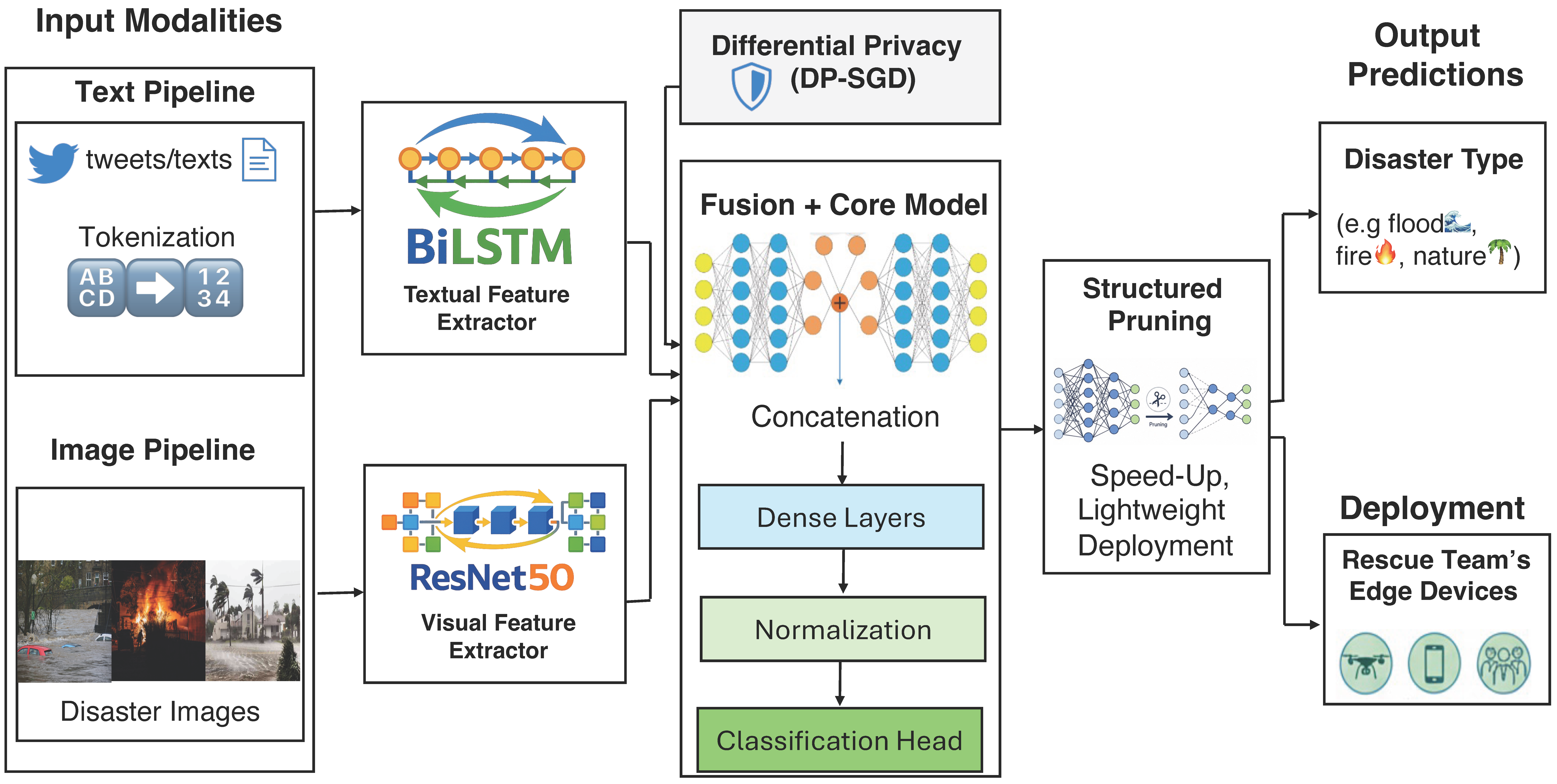
- A compact late-fusion multimodal architecture is developed to integrate visual and textual cues for disaster classification, reducing the limitations of single-modality modeling.
- DP-SGD is incorporated to report training-record-level differential privacy accounting for paired image–text samples under the specified optimization procedure.
- Structured neuron pruning is applied to the classifier head, and its effect is quantified through retained hidden units, head-parameter reduction, and head-level efficiency analysis.
- A detailed empirical analysis is provided across multimodal utility, class-wise behavior under data imbalance, privacy–utility trade-offs, pruning-based efficiency trade-offs, and repeated-run variability.
2. Related Work
2.1. Multimodal Deep Learning for Disaster Assessment
2.2. Privacy-Preserving Deep Learning in Disaster Contexts
2.3. AI Model Compression Mechanisms
3. Methodology
3.1. Multimodal AI Architecture
3.2. Privacy-Enhanced Multimodal AI Training
3.3. Structured Pruning for Efficiency
4. Experiments
4.1. Experiment Settings
4.1.1. Dataset
4.1.2. Data Preprocessing
4.1.3. Training Configuration and Model Selection
4.1.4. Evaluation Metrics
4.2. Baseline Comparisons
4.3. Privacy–Utility Trade-Off
4.4. Efficiency–Utility Trade-Off
5. Discussion and Limitations
6. Conclusions
Author Contributions
Funding
Data Availability Statement
Acknowledgments
Conflicts of Interest
References
- Coppola, D. Introduction to International Disaster Management; Elsevier: Amsterdam, The Netherlands, 2006. [Google Scholar]
- Cutter, S.L. The changing nature of hazard and disaster risk in the Anthropocene. Ann. Am. Assoc. Geogr. 2021, 111, 819–827. [Google Scholar]
- Cheng, C.S.; Luo, L.; Murphy, S.; Lee, Y.C.; Leite, F. A framework to enhance disaster debris estimation with AI and aerial photogrammetry. Int. J. Disaster Risk Reduct. 2024, 107, 104468. [Google Scholar] [CrossRef]
- Voigt, S.; Giulio-Tonolo, F.; Lyons, J.; Kučera, J.; Jones, B.; Schneiderhan, T.; Platzeck, G.; Kaku, K.; Hazarika, M.K.; Czaran, L.; et al. Global trends in satellite-based emergency mapping. Science 2016, 353, 247–252. [Google Scholar] [CrossRef]
- Imran, M.; Castillo, C.; Diaz, F.; Vieweg, S. Processing social media messages in mass emergency: A survey. ACM Comput. Surv. (CSUR) 2015, 47, 1–38. [Google Scholar] [CrossRef]
- Alam, F.; Sajjad, H.; Imran, M.; Ofli, F. CrisisBench: Benchmarking crisis-related social media datasets for humanitarian information processing. In Proceedings of the International AAAI Conference on Web and Social Media, Virtual, 7–10 June 2021; Volume 15, pp. 923–932. [Google Scholar]
- Gupta, R.; Shah, M. Rescuenet: Joint building segmentation and damage assessment from satellite imagery. In Proceedings of the 2020 25th International Conference on Pattern Recognition (ICPR); IEEE: New York, NY, USA, 2021; pp. 4405–4411. [Google Scholar]
- Oaphy, M.A.; Hu, D.; Khalid, A.; Xu, H. Lightweight and Privacy-Enhanced Detection Model on Aerial Imagery for Post-Disaster Building Damage Reconnaissance. In Proceedings of the 59th Hawaii International Conference on System Sciences; University of Hawaii at Manoa: Honolulu, HI, USA, 2026; pp. 7058–7067. [Google Scholar] [CrossRef]
- Abdullahil-Oaphy, M.; Bhuiyan, M.R.; Islam, M.S. Classifying the Usual Leaf Diseases of Paddy Plants in Bangladesh Using Multilayered CNN Architecture. In Soft Computing Techniques and Applications: Proceedings of the International Conference on Computing and Communication; Springer: Singapore, 2020; pp. 389–397. [Google Scholar]
- Bhuiyan, M.R.; Abdullahil-Oaphy, M.; Khanam, R.S.; Islam, M.S. MediNET: A Deep Learning Approach to Recognize Bangladeshi Ordinary Medicinal Plants Using CNN. In Soft Computing Techniques and Applications: Proceedings of the International Conference on Computing and Communication; Springer: Singapore, 2020; pp. 371–380. [Google Scholar]
- Zahra, K.; Imran, M.; Ostermann, F.O. Automatic identification of eyewitness messages on twitter during disasters. Inf. Process. Manag. 2020, 57, 102107. [Google Scholar] [CrossRef]
- Xu, P.; Zhu, X.; Clifton, D.A. Multimodal learning with transformers: A survey. IEEE Trans. Pattern Anal. Mach. Intell. 2023, 45, 12113–12132. [Google Scholar] [CrossRef]
- Shokri, R.; Stronati, M.; Song, C.; Shmatikov, V. Membership inference attacks against machine learning models. In Proceedings of the 2017 IEEE Symposium on Security and Privacy (SP); IEEE: New York, NY, USA, 2017; pp. 3–18. [Google Scholar]
- Jayaraman, B.; Evans, D. Evaluating differentially private machine learning in practice. In Proceedings of the 28th USENIX Security Symposium (USENIX Security 19), Santa Clara, CA, USA, 14–16 August 2019; pp. 1895–1912. [Google Scholar]
- Abadi, M.; Chu, A.; Goodfellow, I.; McMahan, H.B.; Mironov, I.; Talwar, K.; Zhang, L. Deep learning with differential privacy. In Proceedings of the 2016 ACM SIGSAC Conference on Computer and Communications Security, Vienna, Austria, 24–28 October 2016; pp. 308–318. [Google Scholar]
- Han, S.; Pool, J.; Tran, J.; Dally, W. Learning both weights and connections for efficient neural network. Adv. Neural Inf. Process. Syst. 2015, 28, 1135–1143. [Google Scholar]
- Frankle, J.; Carbin, M. The lottery ticket hypothesis: Finding sparse, trainable neural networks. arXiv 2018, arXiv:1803.03635. [Google Scholar]
- Mouzannar, H.; Rizk, Y.; Awad, M. Damage Identification in Social Media Posts using Multimodal Deep Learning. In Proceedings of the ISCRAM, Rochester, NY, USA, 20–23 May 2018. [Google Scholar]
- Hossain, E.; Hoque, M.M.; Hoque, E.; Islam, M.S. A deep attentive multimodal learning approach for disaster identification from social media posts. IEEE Access 2022, 10, 46538–46551. [Google Scholar] [CrossRef]
- Ofli, F.; Alam, F.; Imran, M. Analysis of social media data using multimodal deep learning for disaster response. arXiv 2020, arXiv:2004.11838. [Google Scholar] [CrossRef]
- Hao, H.; Wang, Y. Leveraging multimodal social media data for rapid disaster damage assessment. Int. J. Disaster Risk Reduct. 2020, 51, 101760. [Google Scholar] [CrossRef]
- Zou, Z.; Gan, H.; Huang, Q.; Cai, T.; Cao, K. Disaster image classification by fusing multimodal social media data. ISPRS Int. J.-Geo-Inf. 2021, 10, 636. [Google Scholar] [CrossRef]
- Kota, S.; Haridasan, S.; Rattani, A.; Bowen, A.; Rimmington, G.; Dutta, A. Multimodal Combination of Text and Image Tweets for Disaster Response Assessment. In Proceedings of the D2R2, Leipzig, Germany, 6 July 2022. [Google Scholar]
- Abavisani, M.; Wu, L.; Hu, S.; Tetreault, J.; Jaimes, A. Multimodal categorization of crisis events in social media. In Proceedings of the IEEE/CVF Conference on Computer Vision and Pattern Recognition, Vancouver, BC, Canada, 3–7 June 2020; pp. 14679–14689. [Google Scholar]
- Sosea, T.; Sirbu, I.; Caragea, C.; Caragea, D.; Rebedea, T. Using the image-text relationship to improve multimodal disaster tweet classification. In Proceedings of the 18th International Conference on Information Systems for Crisis Response and Management (ISCRAM 2021), Virtual, 23–26 May 2021. [Google Scholar]
- Shetty, N.P.; Bijalwan, Y.; Chaudhari, P.; Shetty, J.; Muniyal, B. Disaster assessment from social media using multimodal deep learning. Multimed. Tools Appl. 2025, 84, 18829–18854. [Google Scholar] [CrossRef]
- Dar, S.S.; Rehman, M.Z.U.; Bais, K.; Haseeb, M.A.; Kumar, N. A social context-aware graph-based multimodal attentive learning framework for disaster content classification during emergencies. Expert Syst. Appl. 2025, 259, 125337. [Google Scholar] [CrossRef]
- Basit, M.; Alam, B.; Fatima, Z.; Shaikh, S. Natural disaster tweets classification using multimodal data. In Proceedings of the 2023 Conference on Empirical Methods in Natural Language Processing, Singapore, 6–10 December 2023; pp. 7584–7594. [Google Scholar]
- Zhang, J.; Liao, M.; Wang, Y.; Huang, Y.; Chen, F.; Makiko, C. Multi-modal deep learning framework for damage detection in social media posts. PeerJ Comput. Sci. 2024, 10, e2262. [Google Scholar] [CrossRef] [PubMed]
- Li, S.; Liu, Q.; Pan, Z.; Wu, X. CLIP-BCA-Gated: A Dynamic Multimodal Framework for Real-Time Humanitarian Crisis Classification with Bi-Cross-Attention and Adaptive Gating. Appl. Sci. 2025, 15, 2076–3417. [Google Scholar] [CrossRef]
- Li, X.; Liu, H.; Lin, Q.; Sun, Q.; Jiang, Q.; Su, S. LPDi GAN: A license plate DE-identification method to preserve strong data utility. Sensors 2024, 24, 4922. [Google Scholar] [CrossRef]
- Du, L.; Ling, H. Preservative license plate de-identification for privacy protection. In Proceedings of the 2011 International Conference on Document Analysis and Recognition; IEEE: New York, NY, USA, 2011; pp. 468–472. [Google Scholar][Green Version]
- Andrés, M.E.; Bordenabe, N.E.; Chatzikokolakis, K.; Palamidessi, C. Geo-indistinguishability: Differential privacy for location-based systems. In Proceedings of the 2013 ACM SIGSAC Conference on Computer & Communications Security, Berlin, Germany, 4–8 November 2013; pp. 901–914. [Google Scholar]
- Löchner, M.; Fathi, R.; Schmid, D.; Dunkel, A.; Burghardt, D.; Fiedrich, F.; Koch, S. Case study on privacy-aware social media data processing in disaster management. ISPRS Int. J.-Geo-Inf. 2020, 9, 709. [Google Scholar] [CrossRef]
- Zhang, Z.; He, N.; Li, D.; Gao, H.; Gao, T.; Zhou, C. Federated transfer learning for disaster classification in social computing networks. J. Saf. Sci. Resil. 2022, 3, 15–23. [Google Scholar] [CrossRef]
- El-Niss, A.; Alzu’Bi, A.; Abuarqoub, A. Multimodal fusion for disaster event classification on social media: A deep federated learning approach. In Proceedings of the 7th International Conference on Future Networks and Distributed Systems, Dubai, United Arab Emirates, 21–22 December 2023; pp. 758–763. [Google Scholar]
- Deng, S.; Zhang, L.; Yue, D. Data-driven and privacy-preserving risk assessment method based on federated learning for smart grids. Commun. Eng. 2024, 3, 154. [Google Scholar] [CrossRef] [PubMed]
- Kurniawan, H.; Mambo, M. Homomorphic encryption-based federated privacy preservation for deep active learning. Entropy 2022, 24, 1545. [Google Scholar] [CrossRef]
- Fang, H.; Qian, Q. Privacy preserving machine learning with homomorphic encryption and federated learning. Future Internet 2021, 13, 94. [Google Scholar] [CrossRef]
- Alkhelaiwi, M.; Boulila, W.; Ahmad, J.; Koubaa, A.; Driss, M. An efficient approach based on privacy-preserving deep learning for satellite image classification. Remote Sens. 2021, 13, 2221. [Google Scholar] [CrossRef]
- Zhang, Z.; Ma, X.; Ma, J. Local differential privacy based membership-privacy-preserving federated learning for deep-learning-driven remote sensing. Remote Sens. 2023, 15, 5050. [Google Scholar] [CrossRef]
- Zhang, J.; Lei, J.; Xie, W.; Li, Y.; Yang, G.; Jia, X. Guided Hybrid Quantization for Object Detection in Remote Sensing Imagery via One-to-One Self-Teaching. IEEE Trans. Geosci. Remote Sens. 2023, 61, 5614815. [Google Scholar] [CrossRef]
- Mahmoudi, S.A.; Gloesener, M.; Benkedadra, M.; Lerat, J.S. Edge AI System for Real-Time and Explainable Forest Fire Detection Using Compressed Deep Learning Models. Proc. Copyr. 2025, 847, 847–854. [Google Scholar]
- Bai, Y.; Su, J.; Zou, Y.; Adriano, B. Knowledge distillation based lightweight building damage assessment using satellite imagery of natural disasters. Geoinformatica 2022, 27, 237–261. [Google Scholar] [CrossRef]
- El-Madafri, I.; Peña, M.; Olmedo-Torre, N. Real-time forest fire detection with lightweight CNN using hierarchical multi-task knowledge distillation. Fire 2024, 7, 392. [Google Scholar] [CrossRef]
- Himeur, Y.; Aburaed, N.; Elharrouss, O.; Varlamis, I.; Atalla, S.; Mansoor, W.; Ahmad, H.A. Applications of Knowledge Distillation in Remote Sensing: A Survey. arXiv 2024, arXiv:2409.12111. [Google Scholar] [CrossRef]
- Xing, S.; Xing, J.; Ju, J.; Hou, Q.; Ding, X. Collaborative Consistent Knowledge Distillation Framework for Remote Sensing Image Scene Classification Network. Remote Sens. 2022, 14, 5186. [Google Scholar] [CrossRef]
- Seidel, L.; Gehringer, S.; Raczok, T.; Ivens, S.N.; Eckardt, B.; Maerz, M. Advancing early wildfire detection: Integration of Vision Language Models with Unmanned Aerial Vehicle remote sensing for enhanced situational awareness. Drones 2025, 9, 347. [Google Scholar] [CrossRef]
- Deng, X.; Shi, M.; Khan, B.; Choo, Y.H.; Ghaffar, F.; Lim, C.P. A lightweight CNN model for UAV-based image classification. Soft Comput. 2025, 29, 2363–2378. [Google Scholar] [CrossRef]
- Akagic, A.; Buza, E. LW-FIRE: A lightweight wildfire image classification with a deep convolutional neural network. Appl. Sci. 2022, 12, 2646. [Google Scholar] [CrossRef]
- Liu, C.; Sui, H.; Wang, J.; Ni, Z.; Ge, L. Real-time Ground-level building damage detection based on lightweight and accurate YOLOv5 using terrestrial images. Remote Sens. 2022, 14, 2763. [Google Scholar] [CrossRef]
- Zhang, Y.; Lin, Q.; Qin, C.; Ge, H. Forest fire smoke detection method based on MoAm-YOLOv4 algorithm. J. Comput. Commun. 2022, 10, 1–14. [Google Scholar] [CrossRef]
- Hu, Y.; Chen, N.; Hou, Y.; Lin, X.; Jing, B.; Liu, P. Lightweight deep learning for real-time road distress detection on mobile devices. Nat. Commun. 2025, 16, 4212. [Google Scholar] [CrossRef]
- Zhao, D.; Mo, B. UAV-Based Real-Time Object Detection Network Using Structured Pruning Strategy. Electron. Lett. 2025, 61, 70206. [Google Scholar] [CrossRef]
- Baltrušaitis, T.; Ahuja, C.; Morency, L.P. Multimodal machine learning: A survey and taxonomy. IEEE Trans. Pattern Anal. Mach. Intell. 2018, 41, 423–443. [Google Scholar] [CrossRef]
- Devlin, J.; Chang, M.W.; Lee, K.; Toutanova, K. BERT: Pre-training of Deep Bidirectional Transformers for Language Understanding. arXiv 2019, arXiv:1810.04805. [Google Scholar] [CrossRef]
- Kim, Y. Convolutional Neural Networks for Sentence Classification. arXiv 2014, arXiv:1408.5882. [Google Scholar] [CrossRef]
- Liu, Y.; Ott, M.; Goyal, N.; Du, J.; Joshi, M.; Chen, D.; Levy, O.; Lewis, M.; Zettlemoyer, L.; Stoyanov, V. RoBERTa: A Robustly Optimized BERT Pretraining Approach. arXiv 2019, arXiv:1907.11692. [Google Scholar] [CrossRef]
- Simonyan, K.; Zisserman, A. Very Deep Convolutional Networks for Large-Scale Image Recognition. arXiv 2015, arXiv:1409.1556. [Google Scholar] [CrossRef]
- Huang, G.; Liu, Z.; van der Maaten, L.; Weinberger, K.Q. Densely Connected Convolutional Networks. arXiv 2018, arXiv:1608.06993. [Google Scholar] [CrossRef]
- Szegedy, C.; Vanhoucke, V.; Ioffe, S.; Shlens, J.; Wojna, Z. Rethinking the Inception Architecture for Computer Vision. arXiv 2015, arXiv:1512.00567. [Google Scholar] [CrossRef]
- Fan, K.; Hua, K.; Yang, M.; Fang, C. Multimodal Disaster Information Detection Method Based on Privacy-Preserving Federated Learning. In Proceedings of the 2025 7th International Conference on Electronic Engineering and Informatics (EEI); IEEE: New York, NY, USA, 2025; pp. 720–725. [Google Scholar]




| Class Names | Train | Test |
|---|---|---|
| Damage nature | 459 | 55 |
| Damage infrastructure | 1246 | 144 |
| Human damage | 219 | 21 |
| Fires | 309 | 37 |
| Flood | 348 | 36 |
| Non-damage | 2666 | 291 |
| Total | 5247 | 584 |
| Class | Total Words | Max Tweet Length | Avg. Words/Tweet |
|---|---|---|---|
| Damage nature | 13,230 | 345 | 28.82 |
| Damage infrastructure | 35,202 | 363 | 28.25 |
| Human damage | 8800 | 354 | 40.18 |
| Fires | 11,809 | 382 | 38.21 |
| Flood | 11,774 | 290 | 33.83 |
| Non-damage | 111,686 | 382 | 41.89 |
| Model | Opt. | LR/Schedule | Max Ep. | FT | ES |
|---|---|---|---|---|---|
| BERT | AdamW | 5 | T1 | 2 | |
| RoBERTa | AdamW | 5 | T1 | 2 | |
| TextCNN | Adam | 40 | T2 | 6 | |
| VGG16 | Adam | / | 50 | V1 | 6 |
| DenseNet121 | Adam | / | 50 | V1 | 6 |
| Inception-v3 | Adam | / | 50 | V1 | 6 |
| EarlyFusion-CNNTr | AdamW | // | 40 | M1 | 6 |
| HybridRes-BERT | AdamW | // | 40 | M2 | 6 |
| DualCNN-Align | Adam | / | 50 | M3 | 6 |
| TriDA | Adam | / | 50 | M4 | 6 |
| TriDA DP-SGD head | DP-SGD | 6 | D1 | – |
| (a) Text Models | ||||
| Model | Acc (%) | P (%) | R (%) | F1 (%) |
| BERT [56] | 82.6 | 79.8 | 77.5 | 78.7 |
| TextCNN [57] | 84.1 | 81.9 | 79.2 | 80.5 |
| RoBERTa [58] | 84.9 | 83.8 | 80.6 | 82.2 |
| TriDA-Text (Ours) | 86.4 | 84.2 | 81.1 | 82.6 |
| (b) Image Models | ||||
| Model | Acc (%) | P (%) | R (%) | F1 (%) |
| VGG16 [59] | 78.4 | 75.1 | 72.8 | 73.9 |
| DenseNet121 [60] | 81.3 | 78.3 | 76.0 | 77.1 |
| Inception-v3 [61] | 82.9 | 80.1 | 77.8 | 78.9 |
| TriDA-Image (Ours) | 83.7 | 80.8 | 79.1 | 79.9 |
| Model | Acc (%) | P (%) | R (%) | F1 (%) |
|---|---|---|---|---|
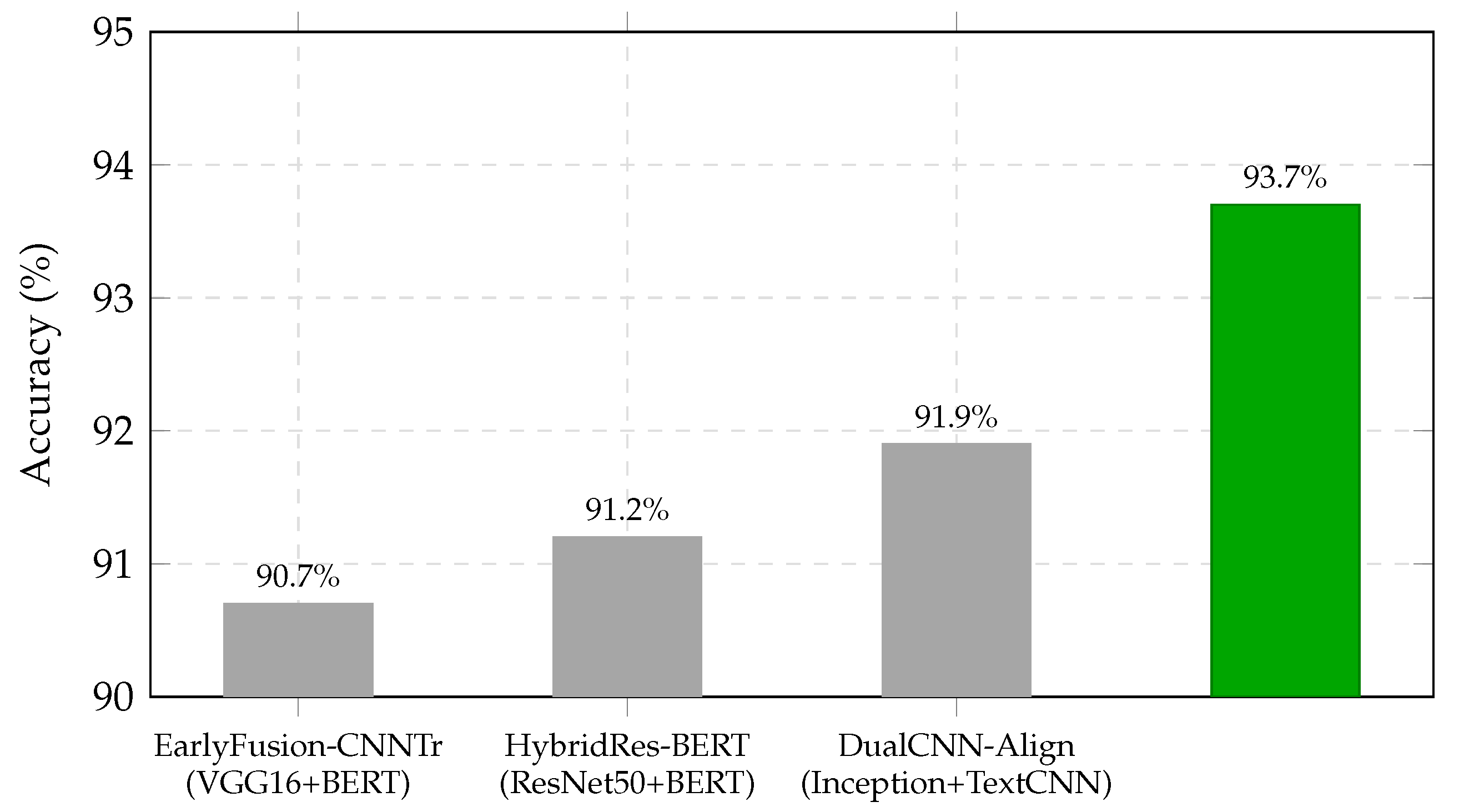
| EarlyFusion-CNNTr (VGG16 + BERT) | 90.7 | 89.5 | 87.3 | 88.2 |
| HybridRes-BERT (ResNet50 + BERT) | 91.2 | 89.2 | 87.8 | 88.5 |
| DualCNN-Align (IncepCNN + TextCNN) | 91.9 | 90.8 | 88.6 | 89.7 |
| TriDA (Ours) | 93.7 | 92.5 | 90.6 | 91.6 |
| Class | Test Samples | P (%) | R (%) | F1 (%) |
|---|---|---|---|---|
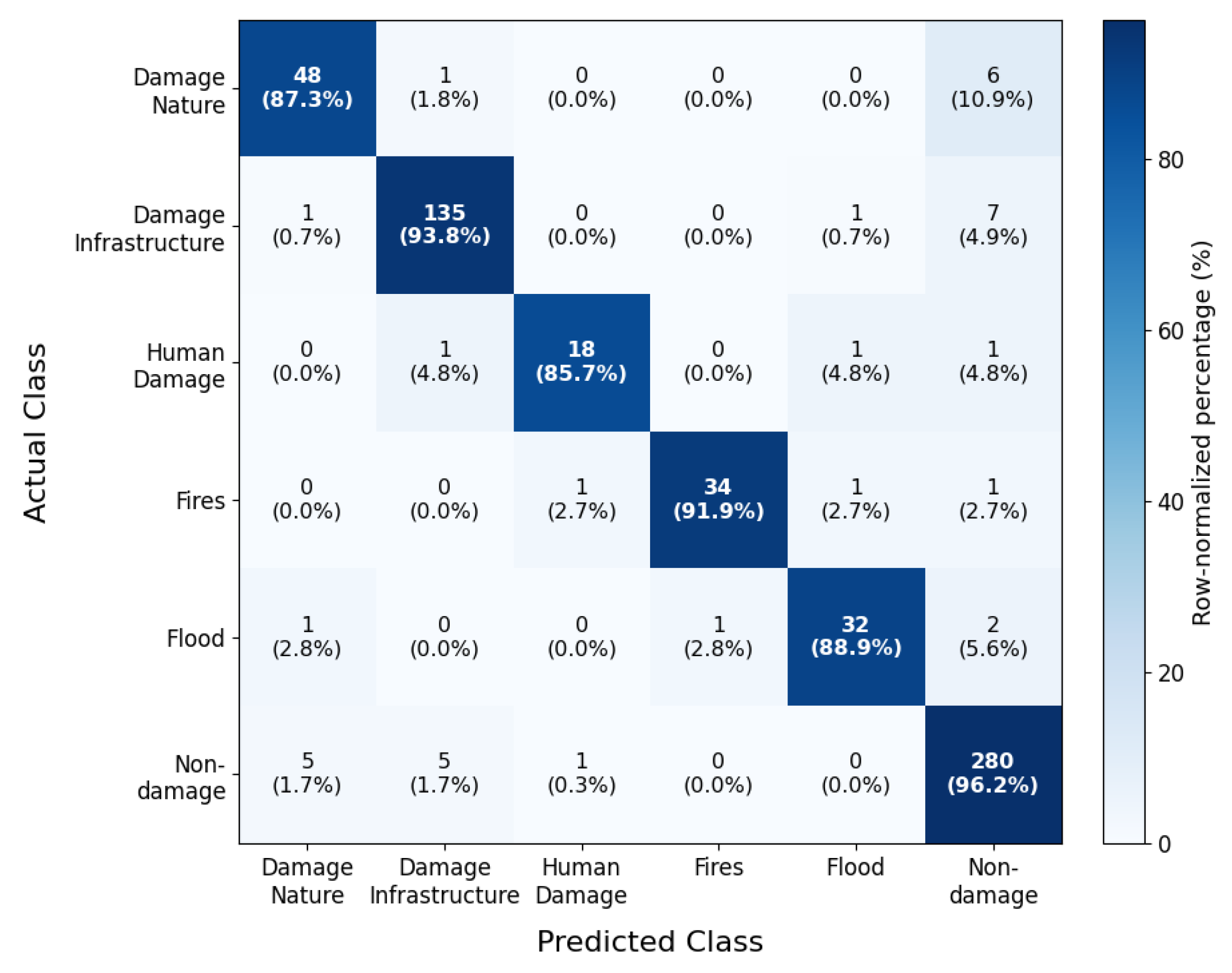
| Damage nature | 55 | 87.3 | 87.3 | 87.3 |
| Damage infrastructure | 144 | 95.1 | 93.8 | 94.4 |
| Human damage | 21 | 90.0 | 85.7 | 87.8 |
| Fires | 37 | 97.1 | 91.9 | 94.4 |
| Flood | 36 | 91.4 | 88.9 | 90.1 |
| Non-damage | 291 | 94.3 | 96.2 | 95.2 |
| Macro Average | – | 92.5 | 90.6 | 91.6 |
| Weighted Average | – | 93.7 | 93.7 | 93.7 |
| Model | Acc (%) | P (%) | R (%) | F1/WF (%) |
|---|---|---|---|---|
| CNN + Text Fusion (Mouzannar et al. [18]) | 92.62 | NR | NR | NR |
| ResNet50 + BiLSTM + Attn (Hossain et al. [19]) | NR | NR | NR | 93.21 (WF) |
| BERT + CNN Multimodal (Zhang et al. [29]) | 84.73 | NR | NR | 79.47 |
| TriDA (Ours) | 93.7 | 92.5 | 90.6 | 91.6 |
| Noise () | Acc. (%) | F1 (%) | Acc. Drop | F1 Drop | Acc. Ret. (%) | F1 Ret. (%) | |
|---|---|---|---|---|---|---|---|
| 0.0 | – | 0.00 | 0.0 | 100.00 | 100.00 | ||
| 0.5 | 22.6 | 2.33 | 2.5 | 97.51 | 97.26 | ||
| 1.0 | 17.1 | 5.49 | 6.5 | 94.14 | 92.87 | ||
| 1.5 | 13.4 | 9.06 | 10.7 | 90.33 | 88.27 | ||
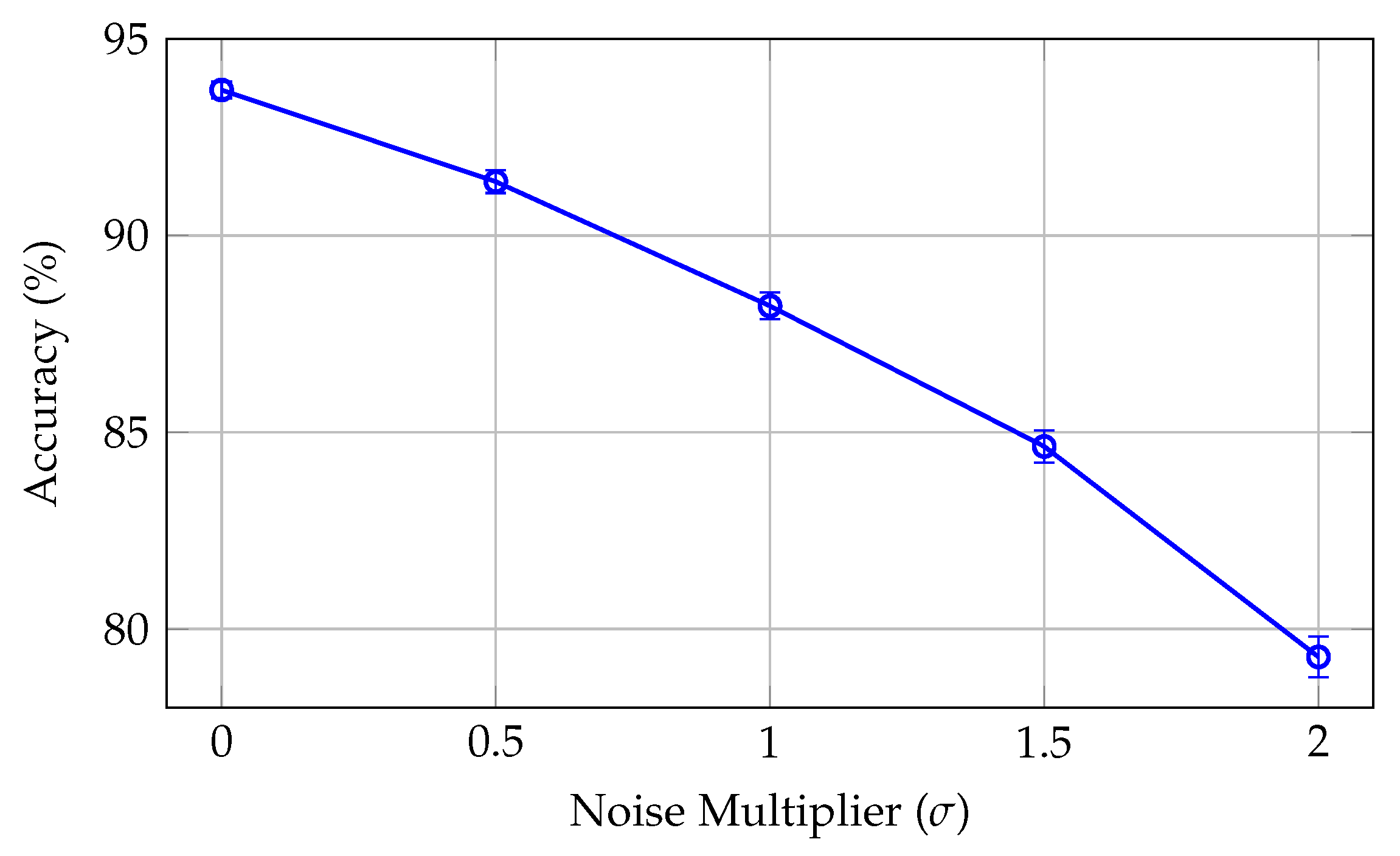
| 2.0 | 8.3 | 14.41 | 17.4 | 84.62 | 80.92 |
| Study | Dataset/Modality | Privacy Mechanism | Formal DP Evidence | Reported Utility Evidence |
|---|---|---|---|---|
| Zhang et al. [35] | MDI disaster images; 5879 samples; image-only | FedTL with Paillier homomorphic encryption and AES-secured communication. | No -DP budget; CPA-security analysis for encrypted updates. | Acc. 83.68%, P 83.44%, R 83.68%, F1 83.56% †. |
| El-Niss et al. [36] | MEDIC/UCI image–tweet pairs; 5831 samples; image + text | Federated ResNet + BERT late-fusion learning. | No -DP budget; privacy mainly through decentralized FL. | Acc. 85.1%, P 85.6%, R 85.1%, F1 85.2%. |
| Fan et al. [62] | CrisisMMD disaster detection; image + text | FL with adaptive DP, vertical clipping, and dynamic privacy-budget allocation. | Evaluates ; full accounting not tabulated. | Task 1: Acc. 92.3%, R 91.8%, F1 91.4%; Task 2: Acc. 91.4%, R 90.9%, F1 90.6%. |
| TriDA (Ours) | UCI/MEDIC image–text pairs; 5831 samples; image + text | Classifier-head DP-SGD with RDP accounting over paired records. | Explicit -DP accounting for the classifier-head stage. | : Acc. 88.21%, F1 84.7%; : Acc. 79.29%, F1 73.8%. |
| Target Neuron Drop (%) | Acc (%) | P (%) | R (%) | F1 (%) |
|---|---|---|---|---|
| 0 | ||||
| 5 | ||||
| 10 | ||||
| 15 | ||||
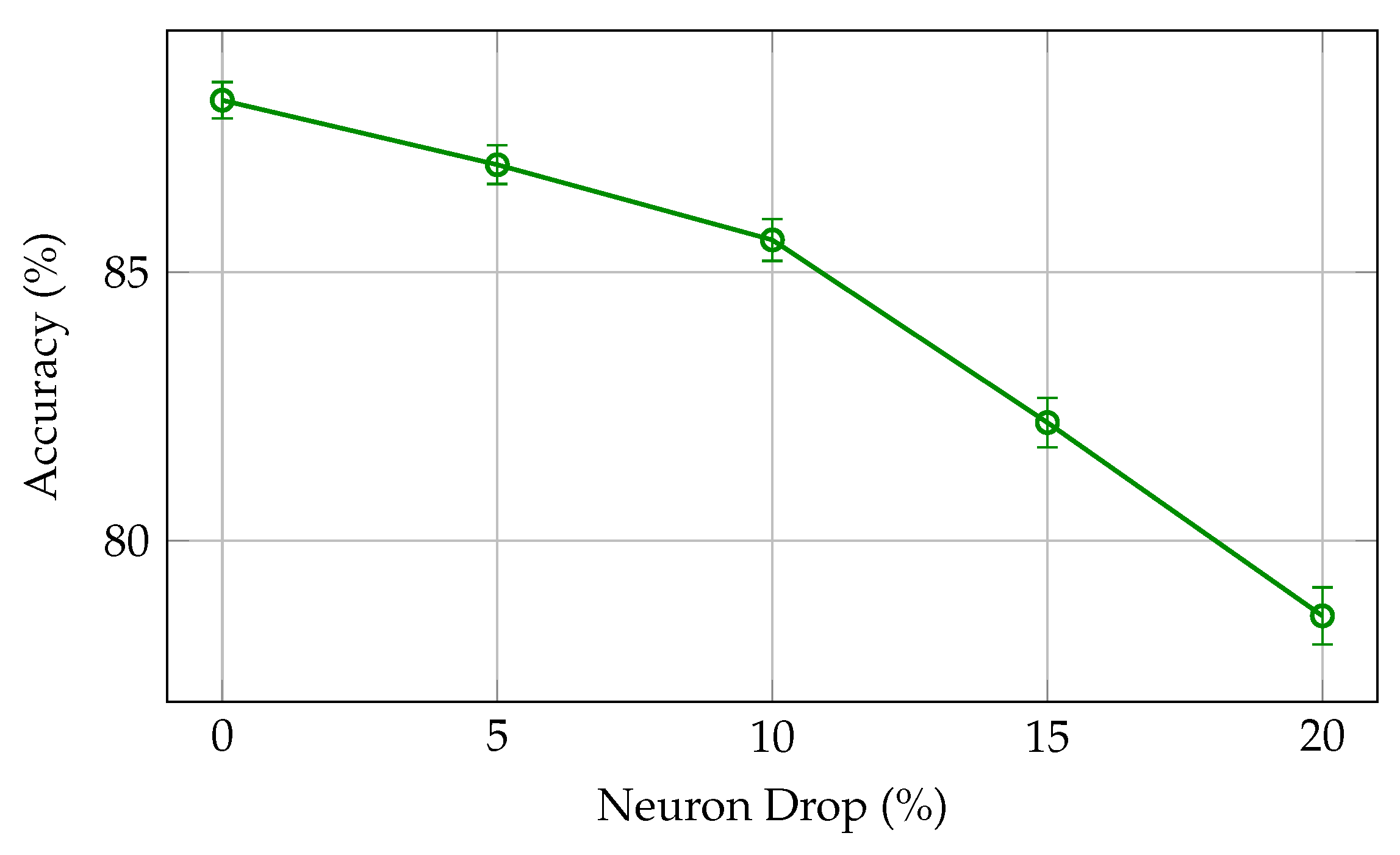
| 20 |
| Drop (%) | Hidden Units | Head Params | Head Red. (%) | Head MACs | MAC Speed-Up | Est. Total Params | Head Share (%) | Full Red. (%) |
|---|---|---|---|---|---|---|---|---|
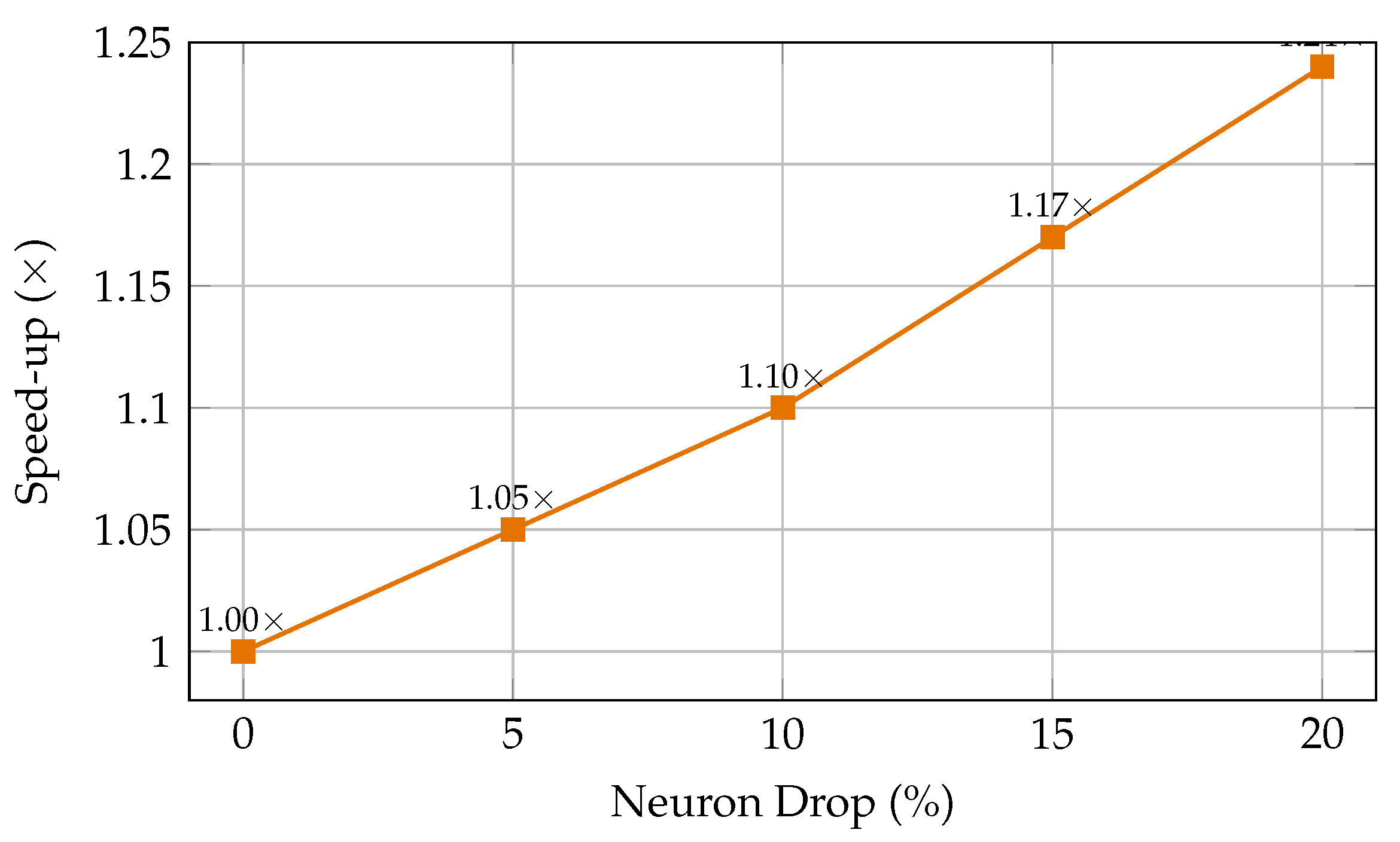
| 0 | 128 | 295,814 | 0.00 | 295,680 | 24,327,430 | 1.216 | 0.000 | |
| 5 | 122 | 281,948 | 4.69 | 281,820 | 24,313,564 | 1.160 | 0.057 | |
| 10 | 116 | 268,082 | 9.37 | 267,960 | 24,299,698 | 1.103 | 0.114 | |
| 15 | 109 | 251,905 | 14.84 | 251,790 | 24,283,521 | 1.037 | 0.181 | |
| 20 | 103 | 238,039 | 19.53 | 237,930 | 24,269,655 | 0.981 | 0.238 |
Disclaimer/Publisher’s Note: The statements, opinions and data contained in all publications are solely those of the individual author(s) and contributor(s) and not of MDPI and/or the editor(s). MDPI and/or the editor(s) disclaim responsibility for any injury to people or property resulting from any ideas, methods, instructions or products referred to in the content. |
© 2026 by the authors. Licensee MDPI, Basel, Switzerland. This article is an open access article distributed under the terms and conditions of the Creative Commons Attribution (CC BY) license.
Share and Cite
Oaphy, M.A.; Khalid, A.; Hu, D.; Xu, H. TriDA: Privacy-Aware and Efficient Multimodal AI for Disaster Assessment. Mathematics 2026, 14, 2064. https://doi.org/10.3390/math14122064
Oaphy MA, Khalid A, Hu D, Xu H. TriDA: Privacy-Aware and Efficient Multimodal AI for Disaster Assessment. Mathematics. 2026; 14(12):2064. https://doi.org/10.3390/math14122064
Chicago/Turabian StyleOaphy, Md Abdullahil, Adeel Khalid, Da Hu, and Honghui Xu. 2026. "TriDA: Privacy-Aware and Efficient Multimodal AI for Disaster Assessment" Mathematics 14, no. 12: 2064. https://doi.org/10.3390/math14122064
APA StyleOaphy, M. A., Khalid, A., Hu, D., & Xu, H. (2026). TriDA: Privacy-Aware and Efficient Multimodal AI for Disaster Assessment. Mathematics, 14(12), 2064. https://doi.org/10.3390/math14122064