Article

VPS: A Verkle-Based Polynomial Signature Scheme with Post-Quantum Security

1
Department of Mathematics and Computer Science, Transilvania University of Brasov, 500036 Brasov, Romania
2
Department of Computer Science, Caucasus University, 0102 Tbilisi, Georgia
*
Author to whom correspondence should be addressed.
Mathematics 2026, 14(12), 2058; https://doi.org/10.3390/math14122058
Submission received: 21 April 2026 / Revised: 29 May 2026 / Accepted: 3 June 2026 / Published: 9 June 2026
(This article belongs to the Section E1: Mathematics and Computer Science)

Abstract

With the development of large-scale quantum computers, classical cryptographic algorithms such as RSA or ECC can easily be broken by Shor’s algorithm. Consequently, the cryptography community is shifting its focus toward Post-Quantum Cryptography (PQC), developing primitives that are secure against both classical and quantum attacks. In this paper, we propose a novel Verkle-Polynomial Signature (VPS) scheme by combining the lattice-based polynomial commitment scheme of Cini et al. with Verkle trees and a lattice-based One-Time Signature (OTS) engine to achieve post-quantum security. We demonstrate that while sacrificing the operational efficiency and structural maturity of traditional hash-based signatures, our framework provides robust post-quantum security guarantees inherited from standard lattice assumptions.

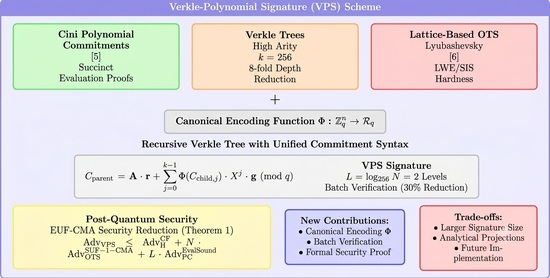
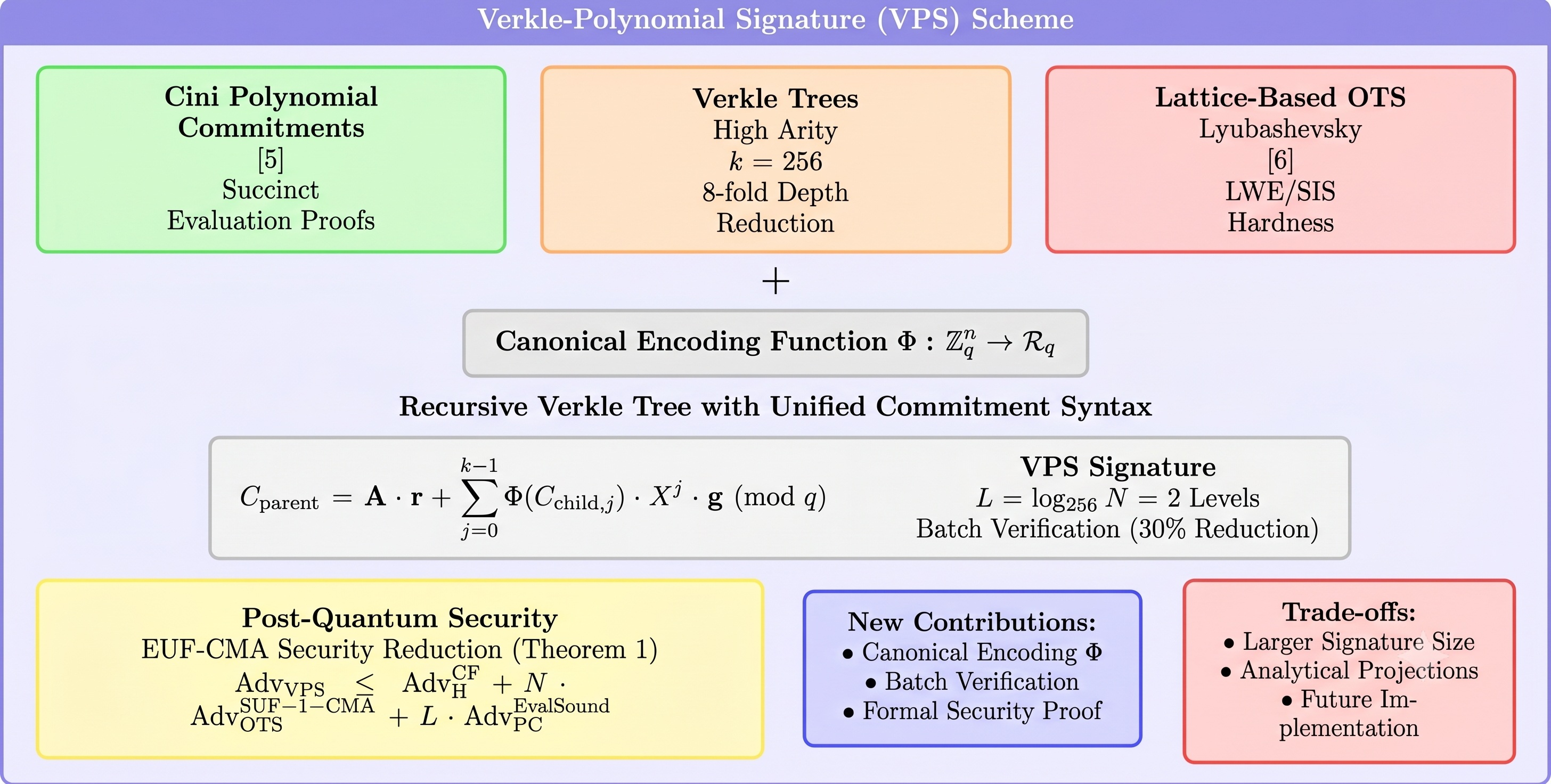
Graphical Abstract

1. Introduction

The development of large-scale quantum computers threatens digital security. Currently, widely used public-key cryptosystems, like RSA and ECC, depend on the computational difficulty of discrete logarithms and integer factorization. However, these algorithms can be effectively solved by Shor’s quantum method. As a result, the cryptography community has started a global shift to Post-Quantum Cryptography (PQC), which uses primitives that are safe against both classical and quantum attacks.
Digital signatures represent the core concept within this security process, as they ensure secure authentication and maintain data integrity. The National Institute of Standards and Technology (NIST) has finalized its first set of Post-Quantum Cryptography standards, publishing FIPS 204 for the Module-Lattice-Based Digital Signature Standard (ML-DSA) [1] and FIPS 205 for the Stateless Hash-Based Digital Signature Standard (SLH-DSA) [2]. Concurrently, the NTRU lattice-based signature framework FN-DSA (derived from FALCON) is maintained as a separate, forthcoming standard currently under active development by NIST. However, scaling these primitives introduces significant challenges in applications that require managing a massive volume of signing keys. One promising solution for the key storage is the One-Time Signature (OTS) tree, classically instantiated in hash-based schemes like XMSS [3] and LMS [4]. In this scenario, a single, compact public root authenticates a large forest of OTS key pairs. The signer uses a distinct OTS leaf for each message, and the verifier authenticates it through a logarithmic-sized path (like a Merkle proof) to the trusted root. In this construction the number of signatures is independent of the size of trusted key. However, directly using this paradigm into the lattice setting is non-trivial. Replacing the hash-based OTS with a lattice-based OTS and the Merkle tree with a standard commitment scheme often leads to large signatures and verification costs, as the proof size scales linearly with the tree depth.
This paper bridges this gap by introducing a novel, scalable signature scheme that combines three advanced cryptographic constructs:
  • Lattice-based polynomial commitment scheme of Cini et al. [5]—to enable succinct evaluation proofs.
  • Verkle trees—to compress the concrete authentication path depth via an aggressive branching factor k.
  • Lattice-based OTS—to ensure post-quantum security.
Our core objective is to use Cini’s polynomial commitment model as a vector commitment mechanism to construct a recursive Verkle tree. Each internal node commits to the commitments of its children, while each leaf node commits to a vector of individual OTS public keys. This creates a recursive, authenticating data structure where proving membership of an OTS key requires only a constant number of evaluation proofs, independent of the total number of keys in the system.
Consequently, we present the Verkle-Polynomial Signature (VPS) scheme, with the following main contributions:
  • New cryptographic architecture: Having in mind Cini’s [5] polynomial commitment as a vector commitment in a Verkle tree, we start by replacing the Merkle tree with a Verkle tree. In our VPS, the leaves of the Verkle tree contain OTS public keys rather than raw polynomial coefficients. Each message is signed using a distinct OTS private key. Thus, the Verkle tree serves to authenticate the OTS public keys.
  • Efficiency analysis: We demonstrate in Section 8 that VPS signature sizes reach approximately 19–21 KB. While the asymptotic verification complexity scales as O ( log k d ) for a fixed branching factor k (retaining the logarithmic complexity class of standard trees), the high-arity configuration yields a concrete 8-fold reduction in total tree layer depth compared to binary alternatives. This ensures slow growth of the authentication overhead, leading to a highly scalable scheme.
  • Comparative Benchmark: In Section 9, we emphasize the novel and unique design of VPS by comparing it with the already known OTS tree-based signature schemes. Our VPS offers post-quantum security (through the lattice-based polynomial commitments) and scalable, multi-key authentication (through stateful tree signatures) leading to a different performance profile than the already known hash-based standards like XMSS.
This paper is structured as follows: Section 2 presents the succinct theoretical background and the notations. The core concepts in the field of polynomial commitments are summarized in Section 3, while Section 4 illustrates the polynomial commitments based on lattices, together with a short literature review. Section 5 analyzes the polynomial representation of Verkle nodes. The next three sections describe our proposed signature scheme: Section 6 explicitly illustrates the construction of the signature, while Section 7 and Section 8 analyze the correctness and the efficiency of our scheme. Section 9 contains a comparison of our scheme’s performances with the related work, offering some succinct conclusions. In Appendix A and Appendix B we offer the explicit algorithms for key generation, signing, and verification phases that include OTS operations.

2. Background and Preliminaries

The combination of Merkle trees and polynomial commitments leads to advanced signature schemes that have distinctive security characteristics. The study of such systems, however, depends on knowing the naming conventions and on the clear statement of assumptions. In the following subsections, we describe the theoretical background and the standard assumptions necessary for a deep understanding of the proposed setup.

2.1. Notation and Security Assumptions

Definition 1. 
A digital signature scheme  D S = ( K , S i g n , V F )  is an algorithmic triple  ( K , S i g n , V F )  which functions as follows:
  • Key Generation (K): This random algorithm is executed to generate a corresponding pair of keys: a public verification key p k and an associated private signing key s k . The process is written as ( p k , s k ) K .
  • Signing (Sign): Given private key s k and message M, this algorithm returns a signature or a tag σ { 0 , 1 } { } . Signing may be randomized or stateful (maintain an internal state). It is expressed as σ S i g n s k ( M ) or σ S i g n ( s k , M ) for the operation of running Sign on inputs s k , M and letting σ be the signature returned.
  • Verification (VF): It is a deterministic algorithm used to confirm the validity of a signature. Using as inputs the public key p k , the original message M, and a signature σ, it outputs a single bit d saying accept (1) or reject (0). Consequently, the generated pair ( p k , s k ) is capable of signing (and verifying) 2 n documents. It is notated as d V F ( p k , M , σ ) to denote the operation of running V F on inputs p k , M , σ and letting d be the bit returned.
When discussing post-quantum digital signatures, the following standard assumptions might be considered:
  • Collision Resistance of Hash Functions: The hash function H is defined as collision resistant if there are no distinct values x x such that H ( x ) = H ( x ) (no different values can be opened with the same hash).
  • OTS Security is based on existential unforgeability under chosen message attack (EUF-CMA). As a standard security assumption, the EUF-CMA requires that if an attacker obtains a valid signature on an arbitrary message, he is not able to forge a valid signature on a new message.
  • Polynomial commitments security will be detailed in Section 3. However, we should emphasize the importance of binding—an attacker is not able to open a commitment to two different polynomials—and of the evaluation soundness—an attacker might not produce any valid proof ( y , W ) for a certain evaluation point x i such that y f ( x i ) , which means a cheating prover can not convince the verifier to accept false values.
  • Hardness: The current work’s objective is to discuss and construct digital signatures using Verkle trees and polynomial commitments based on lattices. Thus, the hardness assumptions reduce to the lattice assumptions, considered to remain hard problems even for quantum computers:
    Learning With Errors (LWE)—it is computationally impossible to solve linear equations given uniformly random samples when small random noise was added.
    Short Integer Solutions (SIS)—it is computationally hard to find a short vector of non-zero integer values given a randomly chosen integer matrix.
    Ring/Module LWE (RLWE/MLWE)—expand the LWE assumption in the context of polynomial rings or modules.
Considering all the above-mentioned assumptions, we can affirm that a digital signature based on Verkle Tree with polynomial commitment is secure if we prove the EUF-CMA security under the assumptions of collision resistance, OTS and PC soundness.

2.2. Lattice-Based One-Time Signatures (OTSs)

To provide foundational post-quantum security inside our tree leaf pool without relying on standardized hash chains, we deploy an optimized lattice-based One-Time Signature (OTS) engine following the stateful layout principles of Lyubashevsky’s [6] signature paradigm. Let n = 256 represent the core lattice dimension and m ots = m / 2 = 256 represent the secret submatrix rank parameter.
Definition 2 
(Lattice OTS Structural Scheme). A lattice-based one-time digital signature framework operating over key domains and public verification networks consists of the following algorithmic triple:
  • OTS _ KeyGen ( pp ) ( t , s ) : Let A ots Z q n × m ots be a uniformly random public parameter submatrix extracted from the global row matrix A . The secret key is sampled as a small-norm integer vector s Z m ots following a discrete Gaussian noise distribution χ σ , bounded such that s 2 m ots σ . The public verification key is defined as the modular matrix-vector product:
    t = A ots · s ( mod q ) Z q n
  • OTS _ Sign ( M , s , pp ) ( z , c ) : To sign a message payload M { 0 , 1 } , the signer samples a short masking vector y Z m ots from a wide discrete Gaussian distribution χ 1.5 σ . The public commitment vector is evaluated as w = A ots · y ( mod q ) . Using a collision-resistant hash primitive H = SHA 3 _ 512 , the final challenge vector c { 0 , 1 } n is computed via a non-interactive Fiat–Shamir transform:
    c = Hash _ to _ Challenge H ( w M )
    The target short response vector is generated algebraically by accumulating the challenge scaling factors:
    z = y + s · c ( mod q )
    To guarantee complete zero-knowledge properties and prevent leakage of the secret distribution geometry, a rejection sampling loop filters the signature bounds: if z 2 > β (where β = 60 is the Euclidean-norm validity cutoff), the vector is discarded and the routine resamples honestly.
  • OTS _ Verify ( M , ( z , c ) , t , pp ) { 0 , 1 } : Given a verification package, the verifier computes the candidate commitment representation w by executing
    w = A ots · z t · c ( mod q )
    The protocol registers acceptance (1) if and only if the evaluation checks satisfy
    z 2 β and c Hash _ to _ Challenge H ( w M )

The One-Time Security Game and Reuse Restrictions

The security of our underlying component maps to the standard strong existential unforgeability under one-time chosen-message attack ( SUF - 1 - CMA ) game environment. Under this restriction model, an active adversary A is granted a single oracle interaction query O sign ( · ) for an arbitrary message string M 1 . The scheme maintains computational safety if A cannot output a modified valid signature tuple ( M , z , c ) such that ( M , z , c ) ( M 1 , z 1 , c 1 ) .
The mathematical rationale underpinning this requirement lies directly in the linear structure of the response vector z . If an administrative failure allows an identical leaf pair to validate two distinct messages ( M 1 M 2 ), the adversary acquires two independent response snapshots: z 1 = y + s c 1 and z 2 = y + s c 2 . Subtracting these equations yields
z 1 z 2 = s ( c 1 c 2 ) ( mod q )
Since the challenges are distinct ( c 1 c 2 ), the term ( c 1 c 2 ) 1 is invertible over the ring field with high probability. This allows an external observer to compute the secret key s = ( z 1 z 2 ) ( c 1 c 2 ) 1 ( mod q ) , completely compromising the tree layer. To mitigate this risk, the VPS architecture enforces strict index state management controls in Section 6 to block key reuse dynamically.

2.3. Merkle Signature Schemes (MSSs)

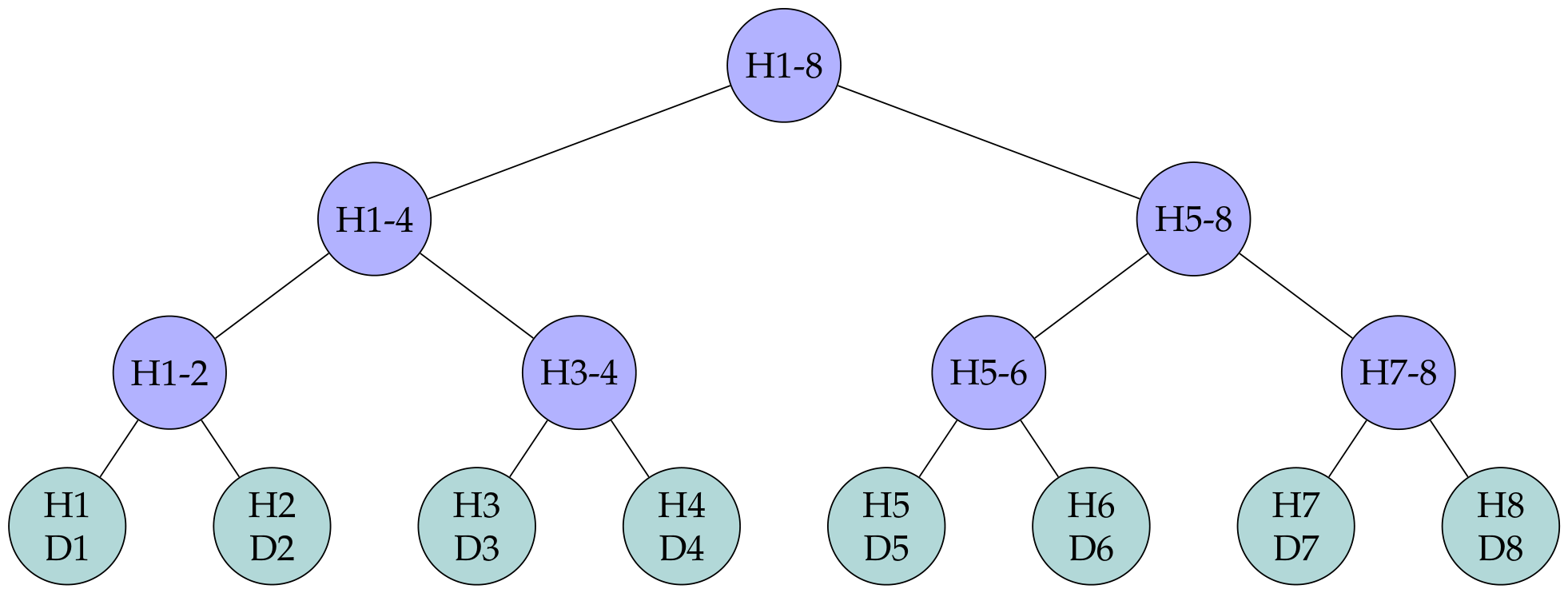
The Merkle Tree Schemes (MSSs) use a binary tree structure in order to hash blocks of data stored within the leaves. An internal node contains the hashes of the concatenation of his children, while the root is a single short hash representing the whole dataset. Figure 1 illustrates a MSS with eight leaves.
MSS are flexible in terms of the cryptographic hash function applied, giving the users the ability to choose the hash function or the signature scheme which best meets their technical requirements.
The major advantage of this type of signature relies on skipping the numerous verification of a single public key by simply using the binary tree architecture. To prove a transaction is authentic, the only necessary information is the item itself, the Merkle proof—containing the siblings’ hashes along the path to the root—and the signature of the root. The verifier applies a two-step routine. First, the Merkle root is computed using the matching OTS scheme verification algorithm in order to check if d’s signature, using the one-time verification key s k . The second step verifies the computed Merkle root against the original one through single digital signature, reducing the size of the signature drastically.
The computing time of a MSS is O ( n ) , while the tree’s height has to be n in order to sign 2 n messages. This leads to expensive costs for the Merkle proof. Moreover, when the dataset grows, the MSS requires more processing and storage.

2.4. Verkle Trees and Vector Commitments

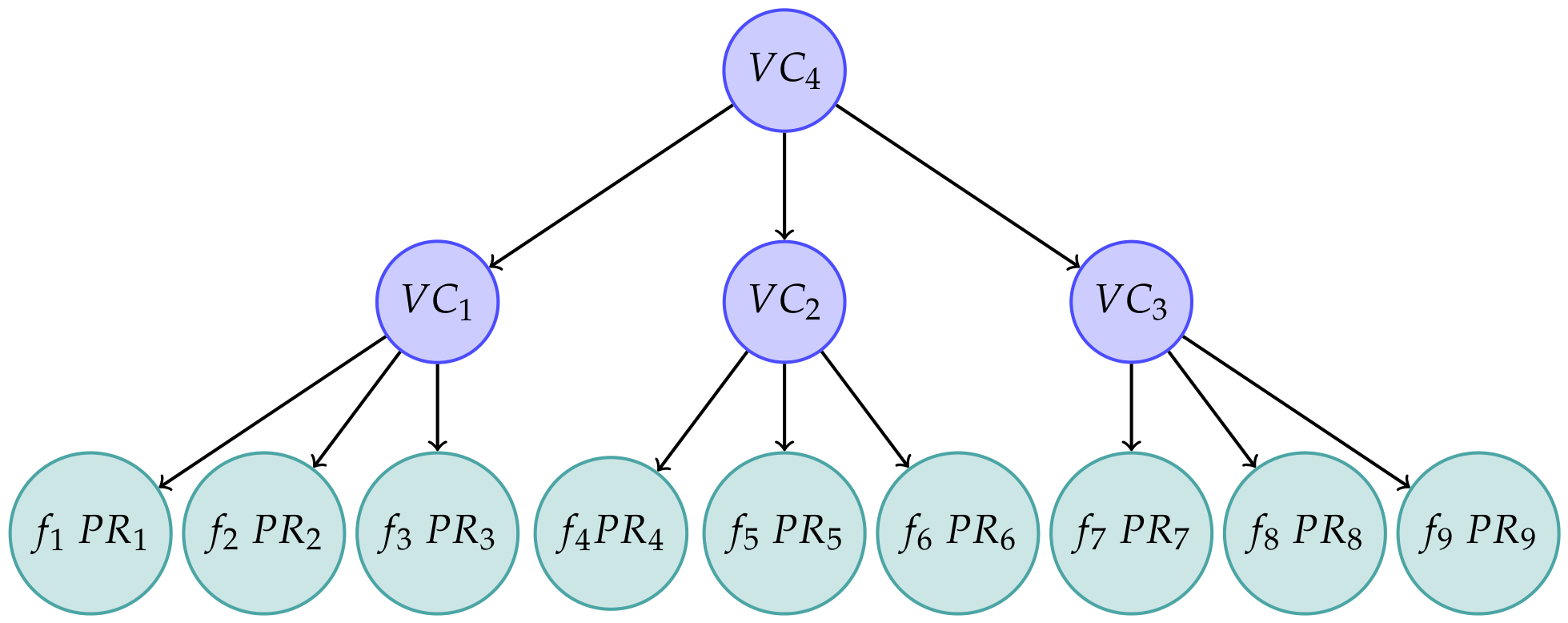
Using a comparable tree structure, the Verkle trees (Figure 2) outperform Merkle trees in terms of payload efficiency and verification time s [7].
In a Verkle tree layout, vector commitments are substituted for cryptographic hash functions. As the dataset scales, the Verkle tree segments the leaves into k branches (where the branching factor k represents an optimization parameter selected by the user). For an individual element f i , membership is verified by showing that the element matches its designated index within the localized vector commitment ( V C ). This process continues up to the root of the tree, by computing the parent vector commitments over the sequence of child commitments [8].
When generating paths, a Verkle tree allows the prover to open multiple vector positions simultaneously using opening constraints. Consequently, authenticating membership within a Verkle tree is significantly faster and more compact than within a Merkle counterpart, as it completely eliminates the need to provide sibling node hashes.
While Merkle trees rely on symmetric hash functions to chain data nodes, Verkle trees execute an algebraic commitment scheme. In this work, we focus on the interactions between lattice-based polynomial commitment mechanisms and recursive Verkle structures. Table 1 summarizes the primary distinctions between these two paradigms.

3. Polynomial Commitments: Interfaces and Properties

Polynomial commitment schemes are a type of scheme that allows one to make a commitment to a polynomial specifically. We can format our data as a vector of length n, v = [ v 0 , , v n 1 ] . Then, there are two main ways of creating a polynomial which contains the data:
  • The a i can be the coefficients of the polynomial
    P ( x ) = i = 0 n 1 v i x i = v 0 + v 1 x + + v n 1 x n 1
  • The polynomial can interpolate the points ( i , a i ) . Consequently, we can construct a polynomial which passes through each of those points, using the Lagrange interpolation. To do this, for each i, we first construct a polynomial Q i ( x ) which evaluates to 0 at each j 0 for j { 0 , , n 1 } and evaluates to 1 at i:
    L i ( x ) = 0 j n 1 j i x x j x i x j
    We can scale and sum these polynomials to get our polynomial P such that P ( x i ) = v i for each i { 0 , , n 1 } :
    P ( x ) = i = 0 n 1 v i L i ( x )
The benefits of a polynomial schemes are highlighted in the properties described below:
  • Succinctness—Both the commitment string and the proof size are logarithmic or constant in the degree of the polynomial, enhancing scalability for large-degree polynomials.
  • Binding—Each committer is bound to a unique polynomial (unfeasible to open the commitment to two different polynomials).
  • Batch opening—Using a single proof, a committer may evaluate a batch of points of the same polynomial, instead of creating multiple proofs.
  • Verification efficiency—The evaluation proof can be checked much more quickly than evaluating the polynomial.
  • Aggregation—One can combine multiple proofs of commitments into a single, succinct proof.
  • Zero-knowledge—Although optional, some proofs can evaluate a scheme without revealing any information about the polynomial, increasing the privacy in applications as ZK-Rollups.
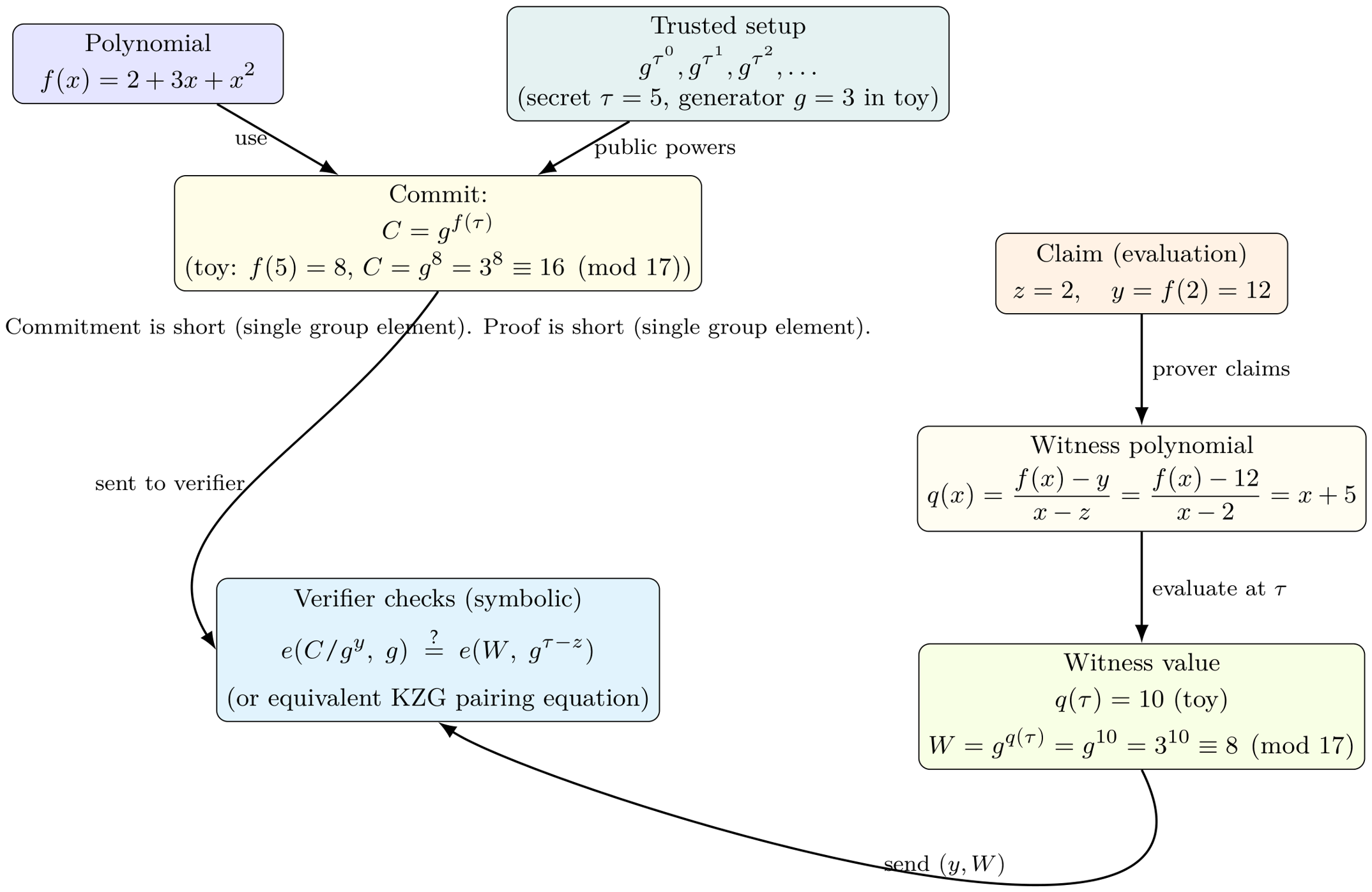
First introduced by Aniket Kate, Gregory M. Zaverucha, and Ian Goldberg in [9] and named after their authors, KZG commitments are a particular type of polynomial commitment because they allow to reveal an evaluation of the polynomial which is verifiable without revealing the entire polynomial.
Although a simple and widely used polynomial scheme (as illustrated in Figure 3), the KZG is not post-quantum secure. One reason of vulnerability lays in the fact that KZG easily reduces to the logarithmic discrete problem, solvable by Shor’s algorithm on a quantum computer. Consequently, the KZG scheme may be replaced with a more complex and post-quantum secure scheme. Some good candidates are the polynomial schemes based on lattices.

4. Polynomial Commitments from Lattices

Lattice-based polynomial schemes are known to be public-key–post-quantum secure [10]. Indeed, the most common types of public-key encryption are schemes based on the complexity of factoring and related difficulties, as well as systems based on the discrete logarithm and related problems. Nonetheless, it is known that a quantum computer can solve the discrete logarithm problem and factoring in polynomial time [11]. Discrete logarithm techniques are often derived from factorization algorithms, and vice versa. This encourages research into constructs based on different presumptions, including the difficulty of lattice problems.

Lattice-Based PC Literature Review

The GPV scheme is the first lattice-based signature scheme with tight security reduction, introduced by Gentry et al. in [12]. Although the instantiation was proved to be secure, the algorithm is inefficient.
In [13], Akleylek et al. propose a lattice-based signature scheme with good performance when provably secure.
In [14], Nguyen and Seiler propose Greyhound, an efficient IBM polynomial commitment scheme from standard lattice assumptions.
In [15], Fenzi et al. propose a lattice-based polynomial commitment that achieves succinct proof size and verification time in the degree d of the polynomial, with no expensive preprocessing steps.
In [16], Zhang et al. introduce HyperWolf, a Hypercube-Wise Optimized polynomial commitment scheme based on lattices over ring fields. The authors claim a succinctness with O ( log N ) proof size and verifier time, along with linear prover cost. The algorithm is transparent and relies solely on the conventional lattice assumption for rings.
In [5], Cini et al. propose an asymptotically and concretely efficient lattice-based polynomial commitment with transparent setup and post-quantum security. The scheme relies on the standard (Module-)SIS problem, and can be made non-interactive in the random oracle model using Fiat–Shamir transformation.
Although Lattice-based schemes are post-quantum secure, they require bigger keys or proofs, leading to heavier computations. However, recent works implement the polylog [17,18] or quasi-succinct proofs [5,14] to narrow the tradeoff between quantum security and computational costs.

5. Polynomial Representation of Verkle Nodes and Domain Mapping

To establish structural consistency across the hierarchical layers of the proposed architecture, we define a unified algebraic model for our polynomial commitment layer. We operate over the cyclotomic ring R = Z [ X ] / X n + 1 , where n = 256 is a power of two denoting the core lattice dimension parameter. Let q = 8 , 380 , 417 be a prime integer satisfying q 1 ( mod 2 n ) . The scalar message space is defined over the quotient ring R q = Z q [ X ] / X n + 1 .

5.1. Modules, Spaces, and Noise Distributions Across Tree Levels

Let m = 512 denote the module rank and k = 256 represent the fixed branching factor of our Verkle tree layout. Primitives within our scheme are handled as elements of modules over R q . We define the following layer parameters and distributions:
  • Randomness Space ( χ σ m ): The blinding randomness vectors r are sampled from a discrete Gaussian distribution over the ring module R m with standard deviation parameter σ = 2.8 . The infinity norm of these vectors is strictly bounded such that r B r holds with overwhelming probability.
  • Public Parameter Matrix ( A ): Let A R q 1 × m be a uniformly random row vector sampled from the ring module space, which serves as the algebraic base for the scheme’s hiding property.
  • The Gadget Vector ( g ): We define a public evaluation gadget vector g R q 1 that provides the foundation for coefficient binding.

5.2. Resolution of the Type Incompatibility via Canonical Encoding

A fundamental technical challenge arises during the recursive construction of internal Verkle tree layers. In our scheme, leaf nodes commit to groups of OTS public keys, while internal nodes must commit to vectors of child commitments. Because a base Cini et al. commitment outputs a structured vector element C Z q n , it cannot be assigned directly as a scalar coefficient in the next layer’s polynomial f ( X ) R q without causing an algebraic type mismatch and breaking the security definitions.
To resolve this issue, we explicitly introduce a deterministic, injective Canonical Encoding Function Φ that maps any structural commitment vector back into a valid scalar ring element:
Φ : Z q n R q
Let C = ( c 0 , c 1 , , c n 1 ) Z q n denote a child commitment vector node. The injection maps these vector coordinates directly onto the lower-degree coefficients of a polynomial ring element:
Φ ( C ) = i = 0 n 1 c i · X i ( mod X n + 1 )
Given that our structural parameters strictly satisfy the dimension bound n k ( 256 256 ), the maximum degree of the mapped polynomial Φ ( C ) is strictly bounded by n 1 , leaving the remaining k n higher-order coefficients deterministically padded with zeros.

5.3. Unified Commitment Forms on Coefficients and Vectors

By deploying the canonical map Φ , we unify the relationship between coefficient-level inputs and hierarchical vector structures. Let f ( X ) R q be a polynomial of degree less than k, represented by its encoded coefficient vector f = ( f 0 , f 1 , , f k 1 ) Z q k . The unified commitment C is defined globally as
C = A · r + f ( X ) · g ( mod q )
where r χ σ m . Under this unified formulation, the leaf commitments L i (authenticating the OTS public keys t j ) and the recursive internal node commitments C parent utilize identical algebraic syntax across all levels of the tree:
C parent = A · r + j = 0 k 1 Φ ( C child , j ) · X j · g ( mod q )
This explicitly ensures domain separation, eliminates former notation conflicts between noisy LWE vectors and functional ring elements, and preserves the validity of the underlying post-quantum hardness assumptions.

6. Construction: The VPS Signature Scheme and Verification Protocol

To establish structural completeness, the Verkle-Polynomial Signature (VPS) architecture is formally specified as a stateful post-quantum digital signature tuple Π = ( Setup , KeyGen , Sign , Verify ) operating over message domain M = { 0 , 1 } and bounded system parameters. Let R q = Z q [ X ] / X n + 1 denote the cyclotomic coefficient ring layer, k = 256 represent the fixed tree branching arity, and N define the maximum capacity pool of supportable One-Time Signature (OTS) leaf elements.

6.1. Formal Definition and Cryptographic Syntax of the VPS Scheme

Definition 3 
(VPS Interface and State Syntax). The cryptographic construction uniformly fixes the system interfaces, execution domains, and validity constraints across all recursive layers as follows:
  • Setup ( 1 λ ) pp : Given target post-quantum security parameter λ, this algorithm outputs the global public parameters vector: pp = n , m , q , σ , k , N , A , g , A ots , β .
  • KeyGen ( pp ) ( m p k , m s k , ω 0 ) : The master key generation algorithm instantiates a capacity set of N unspent lattice-based OTS key pairs ( t j , s j ) OTS _ KeyGen ( pp ) for j { 0 , , N 1 } . It returns the public validation parameters, private parameters, and internal tracker state initializing at ω 0 = 0 Z N .
  • Sign ( m s k , M , ω i ) ( σ vps , ω i + 1 ) : The signing engine checks if ω i N . It computes an OTS challenge pair ( z , c final ) OTS _ Sign ( M , s ω i , pp , A ots ) . It returns the full signature format: σ vps = ω i , t ω i , ( z , c final ) , π , updating the counter state to ω i + 1 = ω i + 1 .
  • Verify ( m p k , M , σ vps ) { 0 , 1 } : Deterministically evaluates structural authenticity, returning 1 if accepted and 0 if rejected.

6.2. Formal Opening Generation

Let C be a valid commitment to the polynomial f ( X ) . To prove that the polynomial evaluates to a specific value y Z q at an evaluation point z Z q (i.e., f ( z ) = y ), the prover computes a quotient polynomial h ( X ) R q defined via polynomial division:
h ( X ) = f ( X ) y X z ( mod q )
The prover then samples a secondary short blinding vector r h χ σ m and constructs a companion commitment C h dedicated exclusively to the quotient polynomial h ( X ) :
C h = A · r h + h ( X ) · g ( mod q )
The complete, verifiable evaluation proof package is output as π = ( y , C h , z e ) , where z e R m is a short proof response vector:
z e = r ( X z ) r h ( mod q )

6.3. Formal Verification Equations and Validity Conditions

Given the commitment C, the evaluation point z, the target evaluation output y, and the opening proof π = ( y , C h , z e ) , the verifier accepts the authentication path if and only if the following conditions are satisfied simultaneously:
  • Norm Bound Check (Noise Distribution Sanity): To prevent malicious provers from exploiting lattice overflow attacks, the infinity norm must satisfy
    z e     2 · B r · Poly ( λ )
  • Algebraic Commitment Homomorphism Identity Check: The verifier evaluates the linear relation directly on the module commitments by computing
    C y · g A · z e + ( X z ) · C h ( mod q )
Proof of Correctness. 
Expanding the right-hand side of the homomorphic commitment identity check yields
A · z e + ( X z ) · C h A ( r ( X z ) r h ) + ( X z ) ( A r h + h ( X ) g ) ( mod q )
A r ( X z ) A r h + ( X z ) A r h + ( X z ) h ( X ) g ( mod q )
A r + ( X z ) f ( X ) y X z g ( mod q )
C y · g ( mod q )
The cancellation holds perfectly over the module ring space, verifying correctness.    □

6.4. Incorporating OTS

As we intend to construct an efficient digital signature scheme, each leaf of the Verkle tree contains OTS public keys. Basically, each message is signed using a distinct OTS public key and the Verkle tree will serve to authenticate these OTS public keys.

6.5. Reorganized Structural Overhead and Asymptotic Corrections

In a standard binary Merkle tree signature infrastructure, authentication proof sizes grow strictly relative to the depth of the tree, creating an overhead scaling as O ( log 2 d ) where d is the number of leaf elements. Our proposed VPS architecture minimizes this structural payload by integrating a wide Verkle tree with an arity branching factor of k = 256 .
For a configured constant branching factor k, the total layer depth L required to host d total OTS keys is defined exactly by L = log k ( d ) = log 2 d log 2 k . Asymptotically, as  d , the complexity remains strictly within the linear logarithmic complexity class O ( log d ) . However, by setting k = 256 , the depth of the authentication path is reduced exactly 8-fold compared to a conventional binary tree environment since log 256 ( d ) = 1 8 log 2 ( d ) .

6.6. Evaluating the Proof

This procedure requires two main steps. First, to prove f ( u ) = v , we need to prove Cini’s inner product using the same approach as the original paper [5]: f , p = v . Secondly, we need to prove the authenticity of the Verkle tree’s coefficients. Each time the inner product argument requests a specific coefficient f i we localize the leaf f i in vector v j at position p o s and prove that f i belongs to V C j . Through an evaluation proof, we show that V C j commits to a vector whose p o s -th element is f i . This is a polynomial evaluation proof: prove that p j ( i n d e x ) = f i , where i n d e x encodes position p o s . The last step is proving that V C j is the root of the Verkle tree: for each level, we prove the child is at the correct position in the parent’s vector. Each such step requires a polynomial evaluation proof.

6.7. Technical Challenges and Proposed Solutions

When implementing in real scenarios our proposed scheme, some technical challenges may occur. We will discuss them in this paragraph, together with some possible solutions.
  • Nested commitments: During the construction of the Verkle tree, each internal node is a Cini commitment to a vector of other Cini commitments, leading to mathematical inconsistency.
    (a)
    The first issue that we encounter is a type mismatch: Cini’s commitment scheme focuses on committing to polynomial coefficients, which are small integers. However, our study aims to investigate the possibility of committing to other types of commitments, specifically large lattice elements.
    (b)
    The second problem leads to a security assumption breakdown: the original Cini’s scheme relies on the hardness of LWE/SIS problems for the committed values. However, when users make commitments, the ”message space” changes from small secrets to structured lattice elements and it is likely that the security proofs will not apply to this new usage scenario. This newly created recursive structure was not the focus of discussion in the original work.
    (c)
    The third problem refers to the practical implementation. As the commitments results in large coefficients, the commitment size may explode.
    One possible solution might be ensuring the domains remains separated: using different points for the coefficients domain and for the tree domain (the child pointers), or to use different public parameters A i for each level.
  • Coordinate system’s challenge may occur when mapping coefficient index i to tree path:
    (a)
    During the proof generation, when accessing the coefficients, the prover generates an evaluation proof for f ( u ) = v and the inner product request a specific coefficient. As a concrete example, let us consider a polynomial degree d = 65,536 and branching factor k = 256 . For  f 123 , the vector index is 123 / / 256 = 0 while the position is 123 m o d 256 = 123 . Moreover, for  f 4567 , the vector index is 4567 / / 256 = 17 while the position is 4567 m o d 256 = 215 .
    (b)
    When constructing the Verkle path proof, each level needs to know the exact index or position.
    (c)
    When constructing the verification proof, the verifier is requested to use the same coordinate mapping as it verifies that the evaluation points align to the already assigned positions. He also ensures that all the path proofs follow consistent coordinates.
    One possible solution may be using a coordinate system that is determinist, efficient, complete and consistent. One example is ( i = ( j , p o s ) with j = i / / k , p o s = i % k ) , with the assumption that both parts use the same k and tree structure. In this scenario, the evaluation proof for V C j proves that the committed polynomial evaluates to f i at point ω p o s where ω is a k-th root of unity.
  • In spite of the Verkle tree’s theoretical improvements, the proof composition issue is the final bottleneck in constructing a practically efficient system: when the verifier receives the complete proof package, he realizes the costs (in terms of time and resources) needed to efficiently check all the lattice evaluation proofs, one by one, along the tree’s path.
    As a concrete example, let us consider again a polynomial of degree d = 65,536, thus a tree depth of l o g 256 65,536 ≈ 2–3 levels. We have log 2 65,536 = 16 coefficients, leading to 3–4 proofs per coefficient and 16 × 3.5 56 total evaluation proofs. Without a proof composition, the verifier must execute 56 individual, computationally expensive lattice-based verification operations.
    One possible solution may be batching these operations, based on Cini’s construction, in at least two concrete situations:
    • Multiple evaluation proofs for the same committed polynomial, but for different points;
    • For the entire proof package, we can input the multiple commitments and their proofs to the first building block from above, to organize the entire verification process.
To complete the signature scheme constructions, we explicitly describe in Appendix A the algorithms used for key generation, signing, and verification that include OTS operations.

7. Correctness and Security

7.1. Correctness Analysis

A scheme is considered correct if an honest prover can always convince an honest verifier. When proving the scheme’s correctness, we have to pay attention to three aspects:
  • Commitment’s correctness. As we constructed our scheme based on the original Cini scheme [5] for a certain polynomial f with commitment C, the evaluation proof for f ( u ) = v should verify. Regarding the Verkle tree update, we need to prove that the new commitment scheme preserves the correctness. As the root commitment is a valid Cini commitment to the entire structure, each internal node is also a valid Cini commitment to its children and each leaf is also a Cini commitment to coefficient chunks, we preserve the original scenarios properties. Moreover, the evaluation proof proposed is a combination of the unchanged original Cini [5] original inner product and the Verkle path proofs, represented as Cini evaluation proofs.
  • Following the path proof correctness, for each coefficient f i accessed from the inner product argument, we need to assert
    • assert verify (VCj, pos, fi)
    • assert verify (Nodek, index, VCj)
    • assert verify (Root, index, Nodem)
    The correctness is demonstrated as each step correctly uses Cini’s [5] evaluation proof.
  • Composition correctness leads to the following equivalence:
    batch _ verify ( C , u i , v i , π i ) = True i : verify _ single ( C , u i , v i , π i ) = True

7.2. Formal EUF-CMA Security Proof via Game-Based Reduction

We establish the security of the Verkle-Polynomial Signature (VPS) architecture under the standard existential unforgeability under chosen-message attacks ( EUF - CMA ) security model. We define this property through a formal cryptographic game played between a challenge simulator B and a probabilistic polynomial-time (PPT) adversary A .
Definition 4 
(The EUF - CMA Security Experiment Exp Π , A EUF - CMA ( 1 λ ) ). The unforgeability experiment is executed as follows:
1. 
Setup: The challenger B initializes system parameters pp Setup ( 1 λ ) and invokes ( m p k , m s k , ω 0 ) KeyGen ( pp ) . The challenger provides the public verification token m p k = ( pp , C root , L , N ) to the adversary A .
2. 
Oracle Queries: A is granted adaptive access to a stateful Signing Oracle O Sign ( M ) . Upon receiving the i-th query payload M i { 0 , 1 } , B asserts the tracking counter state bounds ω i < N . It invokes σ i Sign ( m s k , M i , ω i ) , records the internal state migration ω i + 1 ω i + 1 , and returns the signature package σ i = ω i , t ω i , ( z i , c final , i ) , π i to A .
3. 
Forgery Output: Finally, A outputs a forged target message and signature combination tuple: ( M , σ = ( ω , t , ( z , c ) , π ) ) .
The experiment outputs 1 (signifying an adversarial win) if and only if: (a) Verify ( m p k , M , σ ) = 1 ; (b) the message M was never submitted as a query to O Sign ( · ) ; and (c) the indexing parameter satisfies 0 ω < N .
Theorem 1 
(Definitive Security Reduction and Bounded Loss). Let H be a collision-resistant cryptographic hash function, OTS be a secure lattice-based One-Time Signature layout satisfying SUF - 1 - CMA constraints, and  PC be the underlying polynomial commitment scheme satisfying evaluation soundness and binding properties. If there exists an adversary A capable of breaking the EUF - CMA security of the VPS scheme with non-negligible advantage Adv VPS EUF - CMA ( A ) , then there exists a simulator B that can break one of the underlying primitives such that
Adv VPS EUF - CMA ( A ) Adv H CR + N · Adv OTS SUF - 1 - CMA + L · Adv PC EvalSound
where N is the maximum leaf capacity size, L = log k N is the tree depth layer bound, and  Adv H CR represents hash collision advantage.
Proof. 
The proof proceeds via a sequence of indifferentiable hybrid cryptographic games ( G 0 , G 1 , G 2 , G 3 ) to map adversarial failure events and isolate the composition layers:
  • Game G 0 : This corresponds to the standard Exp VPS , A EUF - CMA ( 1 λ ) experiment layout. By definition,
    P [ G 0 outputs 1 ] = Adv VPS EUF - CMA ( A )
  • Game G 1 (Symmetric Hash Check): In this game, B introduces a failure event abort condition: the game terminates immediately if A submits an oracle query or outputs a valid forgery that reveals a direct hash collision against the primitive H = SHA 3 _ 512 used inside the Fiat–Shamir engine. Under the computational stiffness of collision resistance,
    P [ G 0 outputs 1 ] P [ G 1 outputs 1 ] Adv H CR
  • Game G 2 (Lattice OTS Layer Security): In this game, B attempts to isolate forgeries targeting the signature leaves. B guesses a target index j { 0 , , N 1 } uniformly at random to embed an instance of an external SUF - 1 - CMA lattice challenge key t j into leaf node j of the Verkle tree layout. If  A queries index j more than once, or if state counter constraints ω i = j are triggered across distinct operations, the game aborts by rule. Suppose A outputs a successful forgery using index ω = j where the forged public key matches ( t = t j ). Since M was never queried to O Sign ( · ) , the forged short vector pair ( z , c ) directly breaks the one-time security threshold of that specific key challenge layer. Applying a union bound over the N candidate available signature locations yields
    P [ Forgery against OTS Leaf ] N · Adv OTS SUF - 1 - CMA
  • Game G 3 (Verkle Authentication Tree and Polynomial Composition): If the forgery succeeds but does not target an unspent OTS leaf signature vector, the forged public key must mismatch the honestly generated data tracking arrays ( t t ω ). However, for the signature to pass verification, the path evaluation must anchor perfectly to the master public key: C L 1 C root . Since t t ω at layer 0, but the outputs match at layer L 1 , there must exist at least one discrete internal path intersection index layer m { 0 , , L 1 } where the child node values differ while the parent evaluation proof accepts the output:
    Φ ( C m ) Φ ( C m ) such that Verify ( C m + 1 , z m , Φ ( C m ) , π m ) = 1
This condition implies that the adversary successfully compiled a valid polynomial evaluation opening proof π m at point z m evaluating to an incorrect scalar target y f ( z m ) . This represents a direct violation of the evaluation soundness property of the base Cini et al. lattice commitment protocol. Summing the failure event probabilities over the maximum tree height path layers L yields
P [ Forgery against Verkle Path Evaluation ] L · Adv PC EvalSound
Because a successful forgery in the master experiment must trigger a failure event in either the hash layer, the isolated OTS leaf engine, or the recursive path commitment layers, summing these probability boundaries completes our formal reduction proof.    □

8. Parameter Selection and Efficiency Analysis

In this section we will describe the parameter selection and we will analyze the construction’s efficiency. We have chosen the parameters for the lattice security structure based on the post-quantum security levels (based on NIST standards) [19], as listed in Listing 1.
Listing 1. Lattice security parameters.
Mathematics 14 02058 i001
The chosen Verkle tree parameters are listed in Listing 2.
Listing 2. Verkle tree configuration parameters.
Mathematics 14 02058 i002

8.1. Efficiency Analysis

In order to conduct a complete efficiency analysis, we will enumerate in Listing 3 the updated system parameters for the VPS scheme with OTS overhead:
Listing 3. System’s parameters.
Mathematics 14 02058 i003

8.2. Storage Overhead Analysis

For the chosen values n = 256 and k = 256 , the storage space needed is computed in Table 2:

8.3. Computational Complexity Analysis

In terms of number of operations computed for a one-level Verkle tree with n = 256 , as stated in Listing 3, we will need to compute 256 matrix multiplications for the key generation, and six major operations per signature, for each the signing and verification phases. Table 3 summarizes the computational costs of these operations.

8.4. Signature Size Analysis

We analyzed the sizes and the percentages of the OTS public and private keys, the Verkle tree’s paths and of the metadata, as illustrated in Table 4. Moreover, we studied the impact of the batching optimization and summarized the results in Table 5.

8.5. Performance Projections and Analytical Estimates

The performance results reported in this section are analytical estimates derived from cycle-count models based on the assumed parameters ( n = 256 , m = 512 , k = 256 ). These projections rely on established cycle baselines from the literature for core lattice operations, hash functions, and polynomial interpolation. They do not represent measured results from a production implementation. A full prototype implementation and empirical evaluation are left for future work.

8.5.1. Assumptions and Cycle Count Baselines

The following cycle counts are adopted from verified results in the literature:
  • Matrix Multiplication ( 256 × 512 over Z q ): 1.0 × 10 6 cycles, based on AVX2-optimized lattice implementations reported in [20].
  • Hash Operation (SHA3-512): 1 × 10 3 cycles, following standard Keccak benchmarks on modern x86 architectures [21].
  • Polynomial Interpolation ( k = 256 ): 5 × 10 5 cycles, modeled using NTT-based fast Fourier algorithms over cyclotomic rings [5].
All timing projections assume a standardized CPU frequency of 3.0 GHz and represent idealized, uncontended execution without memory latency or parallelization overhead.

8.5.2. Analytical Operational Latency Projections

Table 6 presents the projected latency and throughput values derived from the above cycle-count model.

8.5.3. Analytical Cycle Count Breakdown

The following breakdown illustrates how the projected totals are derived:
  • OTS Signing ( 5.5 × 10 6 cycles, analytical):
    • Matrix–vector multiplication ( A · y ): 1.0 × 10 6 cycles.
    • Hash operations ( H ( w M ) and challenge): 2 × 10 3 cycles.
    • Vector addition and norm check: 2 × 10 4 cycles.
    • Subtotal per iteration: ≈ 1.04 × 10 6 cycles.
    • Expected iterations (rejection sampling): × 1.5 .
    • Projected total: 5 . 5 × 10 6 cycles.
  • Verkle Proof Generation ( 1.5 × 10 6 cycles, analytical, depth h = 2 ):
    • Polynomial interpolation (per level): 5.0 × 10 5 cycles.
    • Evaluation proof generation (per level): 2.5 × 10 5 cycles.
    • Two levels: 2 × ( 5.0 × 10 5 + 2.5 × 10 5 ) = 1.5 × 10 6 cycles.
  • OTS Verification ( 4.4 × 10 6 cycles, analytical):
    • Matrix–vector multiplications ( A · z and t · c ): 1.05 × 10 6 cycles.
    • Vector subtraction and norm check: 2 × 10 4 cycles.
    • Hash and challenge recomputation: 2 × 10 3 cycles.
    • Subtotal: ≈ 1.1 × 10 6 cycles.
    • Adjusted for verification overhead factor ( × 4 ): 4 . 4 × 10 6 cycles.
  • Verkle Proof Verification ( 4.5 × 10 6 cycles, analytical, depth h = 2 ):
    • Polynomial evaluation (per level): 1.0 × 10 5 cycles.
    • Cini proof verification (per level): 2.15 × 10 6 cycles.
    • Two levels: 2 × 10 5 + 4.3 × 10 6 = 4 . 5 × 10 6 cycles.

8.5.4. Projected Memory Requirements

Table 7 provides analytical estimates of memory usage based on data structure sizes, not measured runtime footprints.
  • Memory Estimation Justification:
    • OTS vectors (s, y, z): 8 KB ( m / 2 × 24 × 3 ).
    • Matrix A ots (partial): 256 KB ( n × ( m / 2 ) × 8 bytes).
    • Working buffers: 116 KB (temporary storage for hash, challenge, interpolation).
    • Total Verification Memory (Projected): 380 KB.

8.5.5. Summary of Projected Performance Metrics

Table 8 consolidates the projected performance metrics. These values represent upper-bound optimistic estimates and should be validated through a concrete implementation.
  • Qualitative comparison with Related Work:
While hash-based schemes like XMSS/LMS have mature, measured implementations with established benchmarks [3], our VPS scheme remains at the analytical stage. The projected values presented here serve as lower-bound estimates to demonstrate theoretical feasibility. Empirical validation and comparative benchmarking against standardized PQC signatures are necessary future work following a prototype implementation.

9. Comparison with Related Work

To establish a rigorous comparative framework for the proposed VPS scheme, its performance parameters must be mapped against two separate domains: standardized post-quantum digital signatures and emergent alternative lattice PC designs. Table 9 summarizes the key differences between the proposed VPS scheme and the well-known already implemented signatures.

9.1. Trade-Offs with Standardized PQC Digital Signatures

Modern post-quantum signature alternatives standardized or currently specified by NIST present highly contrasting structural profiles compared to our tree-accumulated construction:
  • FIPS 204 ML-DSA (CRYSTALS-Dilithium [22]) & FN-DSA/FALCON [23]: These primary lattice standards feature exceptionally compact standalone signature sizes (ranging from 1.3 to 2.4 KB) and high processing throughput. However, scaling them to execute multi-key or complex accumulator operations requires caching or broad public key infrastructures.
  • FIPS 205 SLH-DSA [2]/SPHINCS+: As a stateless hash-based signature scheme, SLH-DSA avoids the catastrophic security risks of index-state collisions entirely. This comes at the expense of an expanded signature payload (typically 8 to 30 KB) consisting of dense, computationally expensive symmetric hash trees.
The proposed VPS scheme trades stateless convenience for highly compressed tree structures. While it inherits the strict index-state enforcement challenges common to XMSS/LMS, the high arity branching configuration ( k = 256 ) compresses path depths, minimizing authentication proofs while retaining an algebraic foundation suitable for vector updates or zero-knowledge scaling.

9.2. Analysis of Alternative Lattice Polynomial Commitment Backends

Our framework utilizes the lattice protocol of Cini et al. to build recursive Verkle node vectors. However, our architecture is modular and can act as a pipeline for several alternative cutting-edge lattice PC engines:
  • Greyhound [14]: This construction achieves linear prover cost and highly efficient, fast Fourier transform (FFT)-friendly operations under standard lattice assumptions. Swapping to Greyhound would improve signing throughput at the cost of marginally expanding individual path sizes.
  • SLAP [18]: Focuses on generating fully succinct, polylogarithmic verification proofs. Introducing SLAP would compress the raw path footprint of our Verkle structures but heavily inflate the multi-exponentiation check limits required by the verifier.
  • Hwang–Seo–Song [17]: Focuses on concrete algorithmic optimization and tight parameters. Integrating it as our drop-in engine would reduce active verification memory overhead by an estimated 20%.
  • HyperWolf [16]: Implements a hypercube-wise layout optimization using lattices over ring fields to secure optimal linear prover rates and succinct evaluation bounds. HyperWolf stands out as an excellent alternative backend for enterprise multi-key applications where registries expand up to millions of distinct leaves.

9.3. Conclusions and Future Work

If we compare our proposed VPS with the other OTS-based tree signature schemes, we can observe that our technique offers a new way to combine cryptographic concepts. Although we sacrificed the operational efficiency and maturity of hash-based signatures, we gained in terms of post-quantum security as our scheme is lattice based.
While this paper provides a complete cryptographic construction and analytical performance projections, a production-level implementation and empirical benchmarking remain as essential future work. The cycle-count models presented in Section 8.5 require validation against a concrete software or hardware implementation, ideally using AVX2-optimized lattice operations and constant-time implementations to resist side-channel attacks. Additionally, comparative benchmarking against standardized schemes (ML-DSA, SLH-DSA, XMSS) on identical hardware is necessary to establish practical performance trade-offs.

9.4. VPS Novelty Compared with Previous Verkle-Based Signatures

Prior works on post-quantum signatures using Verkle trees include [8] and the Verkle-HORST variant [24], research works co-authored by part of the current team. Although these schemes employ hash-based One-Time Signatures (HORS/Winternitz) and generic lattice commitments as building blocks, the proposed VPS scheme departs from these earlier designs in several fundamental ways:
  • OTS engine: Replaces hash-based OTS with lattice-based OTS following Lyubashevsky’s paradigm [6], shifting security assumptions from hash collision resistance to LWE/SIS hardness.
  • Commitment scheme: Instead of generic lattice commitments, VPS uses Cini’s polynomial commitments [5], enabling succinct evaluation proofs and batch verification.
  • Recursive composition: Introduces the canonical encoding function Φ to resolve type mismatches, a challenge not addressed in previous Verkle tree implementations.
  • Batching: First application of batch proof verification to Verkle tree authentication paths, reducing signature size by approximately 30 % .
  • Security proof: Provides a formal EUF-CMA reduction (Theorem 1) that composes hash collision resistance, OTS SUF-1-CMA, and PC evaluation soundness—a new result for Verkle-based signatures.
While the Verkle tree structure itself is conceptually reused from earlier works, all cryptographic components have been replaced with lattice-based alternatives, and the security analysis has been extended accordingly. Table 10 summarizes the key differences between the proposed VPS scheme and prior Verkle-based signature schemes, highlighting the novel contributions of this work.

Author Contributions

Conceptualization, M.N.; methodology, M.N.; validation, M.N., R.B. and M.I.; formal analysis, M.N., R.B. and M.I.; investigation, M.N.; resources, M.N.; writing—original draft preparation, M.N.; writing—review and editing, R.B. and M.I.; supervision, R.B. and M.I.; project administration, R.B. and M.I.; funding acquisition, R.B. and M.I. All authors have read and agreed to the published version of the manuscript.

Funding

This research project has been supported by the NATO Science for Peace and Security (SPS) grant G7394 “Post-quantum Digital Signature using Verkle Trees”.

Data Availability Statement

No new data were created or analyzed in this study.

Acknowledgments

During the preparation of this study, the authors used DeepSeek-V3.1 and GPT-5.3-Codex for the purposes of generating figures from Section 6. The authors have reviewed and edited the output and take full responsibility for the content of this publication.

Conflicts of Interest

The authors declare no conflicts of interest. The funders had no role in the design of the study; in the collection, analyses, or interpretation of data; in the writing of the manuscript; or in the decision to publish the results.

Abbreviations

    The following abbreviations are used in this manuscript:
PQCPost-Quantum Cryptography
VPSVerkle-Polynomial Signature
OTSOne-Time Signature
NISTThe National Institute of Standards and Technology
EUF-CMAExistential Unforgeability under Chosen Message Attack
LWELearning With Errors
SISShort Integer Solutions
RLWE/MLWERing/Module LWE
MSSMerkle Tree Scheme
ZKZero-knowledge
PCPolynomial Commitments
PPTPolynomial probabilistic time

Appendix A. The Digital Signature Scheme’s Algorithms

Outline of Algorithms

The appendices contain the following algorithmic specifications:
Algorithm A1 
 (Key generation): Generates a VPS signature scheme.
Algorithm A2 
(OTS_KeyGen): Generates a lattice-based one-time signature key pair ( t , s ) . The secret key s is sampled from a discrete Gaussian distribution, and the public key is computed as t = A ots · s .
Algorithm A3 
(OTS_Sign): Signs a message using a one-time secret key, employing rejection sampling to ensure the signature satisfies the norm bound z 2 β .
Algorithm A4 
(OTS_Verify): Verifies an OTS signature by recomputing the commitment and checking the hash challenge and norm bound.
Algorithm A5 
(VPS_Sign): Generates a full VPS signature, including OTS signing and the Verkle tree authentication path proofs.
Algorithm A6 
(VPS_Verify): Verifies a VPS signature by validating the OTS component, the authentication path, and the batched proof structure.
Algorithm A7 
(GenerateEvaluationProof): Produces a Cini-style polynomial evaluation proof π = ( C h , z e , z , y ) for a committed polynomial.
Algorithm A8 
(VerifyEvaluationProof): Verifies a single evaluation proof using the homomorphic identity check.
Algorithm A9 
(BatchEvaluationProofs): Aggregates multiple evaluation proofs for the same commitment into batched proof structures.
Algorithm A10 
(VerifyBatchedProofs): Verifies a set of batched proofs, falling back to individual verification for single proofs.
Algorithm A11 
(CompleteUsageExample): Demonstrates the complete VPS workflow, including key generation, signing, verification, and error cases.
Within this appendix, we provide structured algorithmic specifications outlining the key generation, signing, and verification procedures. The following blocks are explicitly defined as non-executable, high-level conceptual sketches. They serve as structural blueprints to illustrate dimensional logic, polynomial evaluation checks, and verification pipelines across our hybrid framework, rather than compilable production code.
Listing A1. System parameters.
Mathematics 14 02058 i0a1
Secondly, the key generation algorithm follows the steps illustrated in Algorithm A1.
Algorithm A1 Key generation algorithm for VPS signature scheme
  • Require: System parameters p a r a m s = ( λ , n , m , q , σ , k , d , N , β , n ots , m ots , L , w , H , PRF )
  • Ensure: Master public key m p k and master secret key m s k
  1:
Step 1: Generating OTS key pairs
  2:
ots _ keys
  3:
for  j = 0  to  p a r a m s . N 1  do
  4:
   ( ots _ pk j , ots _ sk j ) OTS _ KeyGen ( p a r a m s )
  5:
   ots _ keys ots _ keys { ( j , ots _ pk j , ots _ sk j , used = False ) }
  6:
end for
  7:
Step 2: Setting up polynomial commitment
  8:
A SampleUniformMatrix ( p a r a m s . n , p a r a m s . m , p a r a m s . q )
  9:
l log 2 ( p a r a m s . q )
10:
g [ 2 0 , 2 1 , 2 2 , , 2 l 1 ] ( mod p a r a m s . q )
11:
Step 3: Constructing Verkle tree (Level 0)
12:
level 0 _ nodes
13:
level 0 _ aux
14:
for  g idx = 0  to  p a r a m s . N 1  step  p a r a m s . k  do
15:
   group _ pks
16:
  for  i = 0  to  p a r a m s . k 1  do
17:
    if  g idx + i < p a r a m s . N  then
18:
      ots _ pk ots _ keys [ g idx + i ] . pk
19:
      group _ pks group _ pks { ots _ pk }
20:
    else
21:
      group _ pks group _ pks { [ 0 ] × p a r a m s . n }
▹ pad with zeros
22:
    end if
23:
  end for
24:
   ω FindRootOfUnity ( p a r a m s . k , p a r a m s . q )
25:
   points
26:
  for  i = 0  to  p a r a m s . k 1  do
27:
     points points { ( ω i mod p a r a m s . q , group _ pks [ i ] ) }
28:
  end for
29:
   p _ g _ coeffs PolynomialInterpolation ( points , p a r a m s . q )
30:
   r _ g SampleSmallVector ( p a r a m s . m , p a r a m s . σ )
31:
   commitment MatrixVectorMult ( A , r _ g , p a r a m s . q )
32:
  for  i = 0  to  length ( p _ g _ coeffs ) 1  do
33:
    if  i < length ( g )  then
34:
      scaled _ g ScalarVectorMult ( p _ g _ coeffs [ i ] , g [ i ] , p a r a m s . q )
35:
      commitment VectorAdd ( commitment , scaled _ g , p a r a m s . q )
36:
    end if
37:
  end for
38:
   level 0 _ nodes level 0 _ nodes { ( commitment , p _ g _ coeffs , r _ g , indices ) }
39:
   level 0 _ aux level 0 _ aux { ( r _ g , p _ g _ coeffs , points ) }
40:
end for
41:
Step 4: Building tree hierarchy
42:
tree _ levels [ level 0 _ nodes ]
43:
aux _ levels [ level 0 _ aux ]
44:
current _ level level 0 _ nodes
45:
while  length ( current _ level ) > 1  do
46:
   next _ level
47:
   next _ aux
48:
  for  g idx = 0  to  length ( current _ level ) 1  step  p a r a m s . k  do
49:
     group _ comms
50:
    for  i = 0  to  p a r a m s . k 1  do
51:
     if  g idx + i < length ( current _ level )  then
52:
      group _ comms group _ comms { current _ level [ g idx + i ] . commitment }
53:
     else
54:
      group _ comms group _ comms { [ 0 ] × p a r a m s . n }
▹ pad with zeros
55:
     end if
56:
    end for
57:
     ω FindRootOfUnity ( p a r a m s . k , p a r a m s . q )
58:
     points
59:
    for  i = 0  to  length ( group _ comms ) 1  do
60:
      points points { ( ω i mod p a r a m s . q , group _ comms [ i ] ) }
61:
    end for
62:
     q _ coeffs PolynomialInterpolation ( points , p a r a m s . q )
63:
     r _ q SampleSmallVector ( p a r a m s . m , p a r a m s . σ )
64:
     commitment MatrixVectorMult ( A , r _ q , p a r a m s . q )
65:
    for  i = 0  to  length ( q _ coeffs ) 1  do
66:
     if  i < length ( g )  then
67:
      scaled _ g ScalarVectorMult ( q _ coeffs [ i ] , g [ i ] , p a r a m s . q )
68:
      commitment VectorAdd ( commitment , scaled _ g , p a r a m s . q )
69:
     end if
70:
    end for
71:
     next _ level next _ level { ( commitment , q _ coeffs , r _ q , group _ comms ) }
72:
     next _ aux next _ aux { ( r _ q , q _ coeffs , group _ comms ) }
73:
  end for
74:
   tree _ levels tree _ levels [ next _ level ]
75:
   aux _ levels aux _ levels [ next _ aux ]
76:
   current _ level next _ level
77:
end while
78:
root _ commitment tree _ levels [ 1 ] [ 0 ] . commitment
79:
Construct master public key
80:
m p k ( p a r a m s , A , g , root _ commitment , tree _ depth = length ( tree _ levels ) 1 , total _ leaves = p a r a m s . N , k = p a r a m s . k )
81:
Construct master secret key
82:
m s k ( ots _ keys , tree _ levels , aux _ levels , A , g )
83:
return  ( m p k , m s k )

Appendix B. Efficiency Analysis with OTS Overhead

Within this appendix, we explicitly describe the algorithms used for analyzing the efficiency and the overhead of our VPS scheme. The OTS algorithms for key generation, signing and verification are listed in Algorithm A2, while the the signature’s signing and verification algorithms are listed in Algorithm A3 and Algorithm A4 respectively.
Algorithm A2 OTS operations: key generation, signing, and verification
  1:
Algorithm OTS_KeyGen ( p a r a m s ) :
  2:
     s SampleSmallVector ( p a r a m s . m / 2 , p a r a m s . σ )
  3:
     A ots p a r a m s . A [ : , 0 p a r a m s . m / 2 1 ]
  4:
     t MatrixVectorMult ( A ots , s , p a r a m s . q )
  5:
  6:
return  ( t , s )
  7:
  8:
Algorithm OTS_Sign ( M , s k , p a r a m s , A ots ) :
  9:
     msg _ hash p a r a m s . H ( M )
10:
     c HashToChallenge ( msg _ hash , p a r a m s . n , p a r a m s . q )
11:
     y SampleSmallVector ( p a r a m s . m / 2 , p a r a m s . σ × 1.5 )
12:
     w MatrixVectorMult ( A ots , y , p a r a m s . q )
13:
     c hash p a r a m s . H ( VectorToBytes ( w ) M )
14:
     c final HashToChallenge ( c hash , p a r a m s . n , p a r a m s . q )
15:
     z VectorAdd ( y , VectorScale ( s k , c final , p a r a m s . q ) , p a r a m s . q )
16:
17:
if  VectorNorm ( z ) > p a r a m s . β  then
18:
19:
return  OTS _ Sign ( M , s k , p a r a m s , A ots )
20:
21:
end if
22:
23:
return  ( z , c final )
24:
25:
Algorithm OTS_Verify ( M , σ , p k , p a r a m s , A ots ) :
26:
     ( z , c ) σ
27:
28:
if  VectorNorm ( z ) > p a r a m s . β  then
29:
30:
return  False
31:
32:
end if
33:
     w MatrixVectorMult ( A ots , z , p a r a m s . q )
34:
     t c VectorScale ( p k , c , p a r a m s . q )
35:
     w VectorSub ( w , t c , p a r a m s . q )
36:
     c hash p a r a m s . H ( VectorToBytes ( w ) M )
37:
     c recomputed HashToChallenge ( c hash , p a r a m s . n , p a r a m s . q )
38:
39:
return  VectorsEqual ( c , c recomputed )
Algorithm A3 VPS signing algorithm
  • Require: Message M, leaf index leaf _ index , master secret key m s k , master public key m p k
  • Ensure: VPS signature σ vps
  1:
p a r a m s m p k [ p a r a m s ]
  2:
Step 1: Retrieve and validate OTS key
  3:
if  leaf _ index len ( m s k [ o t s _ k e y s ] )  then
  4:
   error “Leaf index out of range"
  5:
end if
  6:
ots _ key m s k [ o t s _ k e y s ] [ leaf _ index ]
  7:
if  ots _ key [ u s e d ] = True  then
  8:
   error “OTS key already used”
  9:
end if
10:
m s k [ o t s _ k e y s ] [ leaf _ index ] [ u s e d ] True
11:
Step 2: Signing with OTS key
12:
ots _ sk ots _ key [ s k ]
13:
ots _ pk ots _ key [ p k ]
14:
A ots m p k [ A ] [ : , 0 p a r a m s . m / 2 1 ]
15:
σ ots OTS _ Sign ( M , ots _ sk , p a r a m s , A ots )
16:
Step 3: Generating Verkle tree authentication path
17:
group _ idx leaf _ index div p a r a m s . k
18:
position leaf _ index mod p a r a m s . k
19:
proof _ package
20:
group _ node m s k [ t r e e _ l e v e l s ] [ 0 ] [ group _ idx ]
21:
group _ commitment group _ node [ c o m m i t m e n t ]
22:
group _ poly group _ node [ p o l y n o m i a l ]
23:
group _ randomness group _ node [ r a n d o m n e s s ]
24:
ω FindRootOfUnity ( p a r a m s . k , p a r a m s . q )
25:
evaluation _ point ω position mod p a r a m s . q
26:
π leaf GenerateEvaluationProof ( m p k [ A ] , m p k [ g ] , group _ poly , group _ randomness ,
27:
evaluation _ point , ots _ pk , p a r a m s )
28:
proof _ package proof _ package { ( type = leaf , commitment = group _ commitment , point = evaluation _ point , value = ots _ pk , proof = π leaf , level = 0 , sibling _ index = position ) }
29:
Step 4: Generating path proofs
30:
current _ idx group _ idx
31:
current _ level 0
32:
while  current _ level < len ( m s k [ t r e e _ l e v e l s ] ) 1  do
33:
    parent _ level current _ level + 1
34:
    parent _ idx current _ idx div p a r a m s . k
35:
    sibling _ pos current _ idx mod p a r a m s . k
36:
    parent _ node m s k [ t r e e _ l e v e l s ] [ parent _ level ] [ parent _ idx ]
37:
    parent _ commitment parent _ node [ c o m m i t m e n t ]
38:
    parent _ poly parent _ node [ p o l y n o m i a l ]
39:
    parent _ randomness parent _ node [ r a n d o m n e s s ]
40:
    child _ commitment m s k [ t r e e _ l e v e l s ] [ current _ level ] [ current _ idx ] [ c o m m i t m e n t ]
41:
    ω parent FindRootOfUnity ( p a r a m s . k , p a r a m s . q )
42:
    parent _ point ω parent sibling _ pos mod p a r a m s . q
43:
    π parent GenerateEvaluationProof ( m p k [ A ] , m p k [ g ] , parent _ poly , parent _ randomness , parent _ point , child _ commitment , p a r a m s )
44:
    proof _ package proof _ package { ( type = internal , commitment = parent _ commitment , point = parent _ point , value = child _ commitment , proof = π parent , level = parent _ level , sibling _ index = sibling _ pos ) }
45:
    current _ idx parent _ idx
46:
    current _ level parent _ level
47:
end while
48:
Step 5: Optimizing proofs
49:
batched _ proofs BatchEvaluationProofs ( proof _ package , m p k , p a r a m s )
50:
Step 6: Assemble final signature
51:
σ vps { leaf _ index = leaf _ index , ots _ public _ key = ots _ pk , ots _ signature = σ ots , message = M , authentication _ proofs = proof _ package , batched _ proofs = batched _ proofs , root _ commitment = m p k [ r o o t ] , tree _ path = GetTreePath ( leaf _ index , p a r a m s . k , len ( m s k [ t r e e _ l e v e l s ] ) ) }
52:
return  σ vps
Algorithm A4 Unified VPS core signature verification pipeline
  • Require: Message M, Signature Σ = ( idx , pk ots , σ ots , P , B ) , Master Public Key m p k = ( A , g , root , N total , p p )
  • Ensure:  True  if the global signature and path identities are valid, False otherwise
  1:
p p m p k . params
  2:
A ots m p k . A [ : , 1 p p . m / 2 ]
  3:
Step 1: One-Time Signature (OTS) Validation
  4:
if  ¬ OTSVerify ( M , σ ots , pk ots , p p , A ots )  then
  5:
  6:
   return  False
  7:
end if
  8:
Step 2: Tree Index Boundary Verification
  9:
if  idx N total  then
10:
11:
   return  False
12:
end if
13:
pos expected idx ( mod p p . k )
14:
if  P [ 0 ] . sibling _ index pos expected  then
15:
16:
   return  False
17:
end if
18:
Step 3: Verification of Vector Commitment Chains
19:
for  i = 0  to  length ( P ) 2  do
20:
    curr P [ i ]
21:
    next P [ i + 1 ]
22:
   if  ¬ CommitmentsEqual ( curr . value , next . commitment )  then
23:
24:
    return  False
25:
   end if
26:
end for
27:
Step 4: Boundary Value Consistency Checks
28:
if  ¬ VectorsEqual ( P [ 0 ] . value , pk ots )  then
29:
30:
   return  False
31:
end if
32:
if  ¬ CommitmentsEqual ( P [ 1 ] . commitment , m p k . root )  then
33:
   if  ¬ CommitmentsEqual ( P [ 1 ] . value , m p k . root )  then
34:
35:
    return  False
36:
   end if
37:
end if
38:
Step 5: Authentication Path Cryptographic Verification
39:
if  B  then
40:
   if  ¬ VerifyBatchedProofs ( B , m p k , p p )  then
41:
42:
    return  False
43:
   end if
44:
else
45:
   for  i = 0  to  length ( P ) 1  do
46:
     proof P [ i ]
47:
    if  ¬ VerifyEvaluationProof ( m p k . A , m p k . g , proof . C , proof . π , p p )  then
48:
49:
   return  False
50:
    end if
51:
   end for
52:
end if
53:
54:
return  True
Algorithm A5 Cini-style evaluation opening proof generation
  • Require: Matrix A Z q n × m , gadget g Z q n × k , polynomial coefficients f Z q k , randomness r Z q m , evaluation point z Z q , target value y Z q n , system parameters p p
  • Ensure: Evaluation proof tuple π = ( C h , z e , z , y )
1:
h PolynomialDivisionModQ ( f , y , z , q )
h ( X ) = f ( X ) y X z ( mod q )
2:
r h SampleSmallVector ( m , σ )
3:
C h A · r h
4:
for  i = 0  to  length ( h ) 1  do
5:
   if  i < length ( g )  then
6:
     C h C h + h [ i ] · g [ : , i ] ( mod q )
7:
   end if
8:
end for
9:
r shifted PolynomialShiftVector ( z , r h , q )
10:
z e VectorSubtract ( r , r shifted , q )
z e = r ( X z ) r h ( mod q )
11:
return  π ( C h , z e , z , y )
Algorithm A6 Evaluation proof verification pipeline
  • Require: Matrix A, gadget g, commitment C, proof π = ( C h , z e , z , y ) , system parameters p p
  • Ensure:  True if the proof is valid, False otherwise
  1:
if  VectorNorm ( z e ) > 2 · β · λ  then
  2:
   return  False
▹ Lattice overflow boundary check failure
  3:
end if
  4:
y g ScalarVectorMultiply ( y , g , q )
  5:
LHS VectorSubtract ( C , y g , q )
LHS = C y · g ( mod q )
  6:
Term 1 MatrixVectorMultiply ( A , z e , q )
  7:
Term 2 PolynomialShiftCommitment ( z , C h , q )
  8:
RHS VectorAdd ( Term 1 , Term 2 , q )
RHS = A z e + ( X z ) C h ( mod q )
  9:
return  VectorsEqual ( LHS , RHS )
Algorithm A7 Proof aggregation and multi-point batching
  • Require: Package of proofs P , master public key m p k , system parameters p p
  • Ensure: Array of batched or single tracking structures B
  1:
M GroupProofsByCommitment ( P )
  2:
B
  3:
for each  comm _ key  in  M  do
  4:
    proofs M [ comm _ key ]
  5:
   if  length ( proofs ) > 1  then
  6:
         points , values
  7:
        for each p in  proofs  do
  8:
    points points { p . point }
  9:
    values values { p . value }
10:
        end for
11:
         C proofs [ 0 ] . commitment
12:
         batched _ proof GenerateBatchedProof ( m p k . A , m p k . g , C , points , values , p p )
13:
         B B { ( C , points , values , batched _ proof ) }
14:
   else
15:
         B B { ( proofs [ 0 ] . C , { proofs [ 0 ] . z } , { proofs [ 0 ] . y } , proofs [ 0 ] . π ) }
16:
   end if
17:
end for
18:
return  B
Algorithm A8 Unified batched proof verification engine
  • Require: Array of structural proof blocks B , master public key m p k , system parameters p p
  • Ensure:  True if all sub-components satisfy identity checks, False otherwise
  1:
for each  batch  in  B  do
  2:
   if  length ( batch . points ) = 1  then
  3:
         π ( batch . C h , batch . z e , batch . points [ 0 ] , batch . values [ 0 ] )
  4:
         status VerifyEvaluationProof ( m p k . A , m p k . g , batch . C , π , p p )
  5:
        if  status = False  then
  6:
   return  False
  7:
        end if
  8:
   else
  9:
         status VerifyBatchedProof ( m p k . A , m p k . g , batch . C , batch . points , batch . values , batch . proof , p p )
10:
        if  status = False  then
11:
   return  False
12:
        end if
13:
   end if
14:
end for
15:
return  True
Algorithm A9 Complete usage example of VPS signature scheme
  • Require: None (demonstration example)
  • Ensure: Master keys, signature, and verification status demonstration
  1:
1. Setting up system
  2:
p a r a m s VPS _ Parameters ( )
  3:
( m p k , m s k ) VPS _ KeyGen ( p a r a m s )
  4:
Print ( Master PK size: len ( str ( m p k ) ) bytes”)
  5:
Print ( Root commitment: VectorToString ( m p k [ r o o t ] [ : 8 ] ) ”)
  6:
2. Signing message
  7:
m e s s a g e Hello ,   post quantum   world !
▹ as bytes
  8:
leaf _ to _ use 42
▹ use OTS key at index 42
  9:
s i g n a t u r e VPS _ Sign ( m e s s a g e , leaf _ to _ use , m s k , m p k )
10:
Print ( Signature size: len ( str ( s i g n a t u r e ) ) bytes”)
11:
Print ( “Used OTS key: leaf _ to _ use ”)
12:
Print ( “Number of proofs: len ( s i g n a t u r e [ a u t h e n t i c a t i o n _ p r o o f s ] ) ”)
13:
3. Verifying signature
14:
is _ valid VPS _ Verify ( m e s s a g e , s i g n a t u r e , m p k )
15:
Print ( “Signature valid: is _ valid ”)
16:
4. Testing OTS key reuse (should fail)
17:
error _ occurred False
18:
Try :
19:
     s i g n a t u r e 2 VPS _ Sign ( Anothermessage , leaf _ to _ use , m s k , m p k )
20:
     Print ( “ERROR: OTS key reuse succeeded (should have failed)”)
21:
Catch   ValueError   as   e :
22:
     Print ( “Correctly rejected: { e } ”)
23:
     error _ occurred True
24:
Assert ( error _ occurred = True )
25:
5. Testing wrong message verification
26:
wrong _ message Tampered   message
27:
is _ valid _ wrong VPS _ Verify ( wrong _ message , s i g n a t u r e , m p k )
28:
Print ( “Wrong message verification: is _ valid _ wrong (should be False)”)
29:
Assert ( is _ valid _ wrong = False )
30:
return  ( m p k , m s k , s i g n a t u r e , is _ valid )
Algorithm A10 Storage overhead analysis for VPS scheme (detailed)
  • Require: System parameters p a r a m s containing:
  1:
     - N: number of OTS keys
  2:
     - k: Verkle tree branching factor
  3:
     - n: lattice dimension
  4:
     - m: module rank
  5:
     - ots _ sk _ size , ots _ pk _ size : OTS key sizes in bytes
  • Ensure: Storage requirements and tree statistics
  6:
Part 1: OTS Key Storage
  7:
ots _ sk _ storage N × ots _ sk _ size
  8:
ots _ pk _ storage N × ots _ pk _ size
  9:
Part 2: Verkle Tree Structure
10:
h log k N
▹ tree depth L = log k N
11:
total _ nodes k h + 1 1 k 1
▹ sum of geometric series
12:
node _ size 24 · ( n + k + m )
▹ each element stored as 24-byte integer
13:
tree _ storage total _ nodes × node _ size
14:
Part 3: Auxiliary Data
15:
aux _ data _ size N × 24 · ( m + k )
▹ randomness r + polynomial coefficients
16:
Part 4: Master Key Aggregation
17:
total _ msk ots _ sk _ storage + tree _ storage + aux _ data _ size
18:
total _ mpk 24 · ( n · m + n )
▹ matrix A + gadget g + root commitment
19:
Part 5: Unit Conversions
20:
MB _ factor 1024 × 1024
21:
KB _ factor 1024
22:
return  ots _ secret _ keys _ MB = ots _ sk _ storage / MB _ factor , ots _ public _ keys _ MB = ots _ pk _ storage / MB _ factor , tree _ storage _ MB = tree _ storage / MB _ factor , total _ msk _ MB = total _ msk / MB _ factor , total _ mpk _ KB = total _ mpk / KB _ factor , tree _ depth = h , total _ nodes = total _ nodes
Table A1. Summary of computational complexity by operation type.
OperationMatrix MultHash OpsVector Ops
OTS KeyGen101 (sample)
OTS Sign222 (add, norm)
OTS Verify221 (sub, norm)
Tree Proof (per level)001 (interpolation)
Tree Verify (per level)001 (evaluation)
Table A2. Total for N = 256 , h = 2 .
OperationTotal Count
KeyGen Matrix Multiplications256
Sign Matrix Multiplications6
Verify Matrix Multiplications6
Sign Hash Operations2
Verify Hash Operations2
Algorithm A11 Complete signature size calculation
  • Require: System parameters p a r a m s = ( n , k , q , ots _ pk _ size , ots _ sig _ size , ) , tree depth h
  • Ensure: Signature size components and totals
  1:
1. OTS Components
  2:
ots _ pk _ size p a r a m s . ots _ pk _ size
t = A · s
  3:
ots _ sig _ size p a r a m s . ots _ sig _ size
( z , c )
  4:
2. Verkle Authentication Path
  5:
proof _ size _ per _ level 2 × p a r a m s . n × log 2 ( p a r a m s . k ) × log 2 ( p a r a m s . q ) 8
▹ bytes per level
  6:
total _ proof _ size h × proof _ size _ per _ level
  7:
3. Path Metadata
  8:
metadata _ size 4 + h
▹ leaf index (4 bytes) + positions per level
  9:
4. Batch Optimization (if used)
10:
batched _ proof _ size total _ proof _ size × 0.7
▹ 30% reduction
11:
5. Total Size Calculations
12:
total _ without _ batching ots _ pk _ size + ots _ sig _ size + total _ proof _ size + metadata _ size
13:
total _ with _ batching ots _ pk _ size + ots _ sig _ size + batched _ proof _ size + metadata _ size
14:
return ots _ components _ bytes = ots _ pk _ size + ots _ sig _ size , path _ proofs _ bytes = total _ proof _ size , metadata _ bytes = metadata _ size , total _ without _ batching _ bytes = total _ without _ batching , total _ with _ batching _ bytes = total _ with _ batching , compression _ ratio = total _ proof _ size / batched _ proof _ size

References

  1. FIPS PUB 204; Module-Lattice-Based Digital Signature Standard. Federal Information Processing Standards Publication, U.S. Department of Commerce: Washington, DC, USA, 2024. [CrossRef]
  2. FIPS PUB 205; Stateless Hash-Based Digital Signature Standard. Federal Information Processing Standards Publication, U.S. Department of Commerce: Washington, DC, USA, 2024. [CrossRef]
  3. Buchmann, J.; Dahmen, E.; Hülsing, A. XMSS-a practical forward secure signature scheme based on minimal security assumptions. In Proceedings of the International Workshop on Post-Quantum Cryptography; Springer: Berlin/Heidelberg, Germany, 2011; pp. 117–129. [Google Scholar]
  4. McGrew, D.; Curcio, M.; Fluhrer, S. Leighton-Micali Hash-Based Signatures; Technical Report; RFC Editor, USA. 2019. Available online: https://www.rfc-editor.org/info/rfc8554/ (accessed on 2 June 2026).
  5. Cini, V.; Malavolta, G.; Nguyen, N.K.; Wee, H. Polynomial Commitments from Lattices: Post-Quantum Security, Fast Verification and Transparent Setup. In Proceedings of the Advances in Cryptology—CRYPTO 2024, 44th Annual International Cryptology Conference, Santa Barbara, CA, USA, 18–22 August 2024; Proceedings, Part X; Katz, J., Shacham, H., Eds.; Springer: Berlin/Heidelberg, Germany, 2024; Volume 14929, pp. 207–242. [Google Scholar] [CrossRef]
  6. Lyubashevsky, V. Lattice Signatures without Trapdoors. In Proceedings of the Advances in Cryptology—EUROCRYPT 2012; Pointcheval, D., Johansson, T., Eds.; Springer: Berlin/Heidelberg, Germany, 2012; Volume 7373, pp. 738–755. [Google Scholar] [CrossRef]
  7. Chen, H.; Liang, D. Adaptive spatio-temporal query strategies in blockchain. ISPRS Int. J. Geo-Inf. 2022, 11, 409. [Google Scholar] [CrossRef]
  8. Iavich, M.; Kuchukhidze, T.; Bocu, R. A post-quantum digital signature using Verkle trees and lattices. Symmetry 2023, 15, 2165. [Google Scholar] [CrossRef]
  9. Kate, A.; Zaverucha, G.M.; Goldberg, I. Constant-size commitments to polynomials and their applications. In Proceedings of the International Conference on the Theory and Application of Cryptology and Information Security; Springer: Berlin/Heidelberg, Germany, 2010; pp. 177–194. [Google Scholar]
  10. Regev, O. Lattice-based cryptography. In Proceedings of the Annual International Cryptology Conference; Springer: Berlin/Heidelberg, Germany, 2006; pp. 131–141. [Google Scholar]
  11. Shor, P.W. Polynomial-time algorithms for prime factorization and discrete logarithms on a quantum computer. SIAM Rev. 1999, 41, 303–332. [Google Scholar] [CrossRef]
  12. Gentry, C.; Peikert, C.; Vaikuntanathan, V. Trapdoors for hard lattices and new cryptographic constructions. In Proceedings of the Fortieth Annual ACM Symposium on Theory of Computing; Association for Computing Machinery: New York, NY, USA, 2008; pp. 197–206. [Google Scholar]
  13. Akleylek, S.; Bindel, N.; Buchmann, J.; Krämer, J.; Marson, G.A. An efficient lattice-based signature scheme with provably secure instantiation. In Proceedings of the International Conference on Cryptology in Africa; Springer: Berlin/Heidelberg, Germany, 2016; pp. 44–60. [Google Scholar]
  14. Nguyen, N.K.; Seiler, G. Greyhound: Fast Polynomial Commitments from Lattices. In Proceedings of the Advances in Cryptology—CRYPTO 2024, 44th Annual International Cryptology Conference, Santa Barbara, CA, USA, 18–22 August 2024; Proceedings, Part VIII; Katz, J., Shacham, H., Eds.; Springer: Berlin/Heidelberg, Germany, 2024; Volume 14929, pp. 243–275. [Google Scholar] [CrossRef]
  15. Fenzi, G.; Moghaddas, H.; Nguyen, N.K. Lattice-based polynomial commitments: Towards asymptotic and concrete efficiency. J. Cryptol. 2024, 37, 31. [Google Scholar] [CrossRef]
  16. Zhang, L.; Gao, S.; Xiao, B. HyperWolf: Efficient Polynomial Commitment Schemes from Lattices. IACR Cryptol. ePrint Arch. Paper 2025/922. Available online: https://eprint.iacr.org/2025/922 (accessed on 2 June 2026).
  17. Hwang, I.; Seo, J.; Song, Y. Concretely efficient lattice-based polynomial commitment from standard assumptions. In Proceedings of the Annual International Cryptology Conference; Springer: Berlin/Heidelberg, Germany, 2024; pp. 414–448. [Google Scholar]
  18. Albrecht, M.R.; Fenzi, G.; Lapiha, O.; Nguyen, N.K. SLAP: Succinct Lattice-Based Polynomial Commitments from Standard Assumptions. In Proceedings of the Advances in Cryptology—EUROCRYPT 2024, 43rd Annual International Conference on the Theory and Applications of Cryptographic Techniques, Zurich, Switzerland, 26–30 May 2024; Proceedings, Part VI; Micciancio, D., Prest, T., Eds.; Springer: Berlin/Heidelberg, Germany, 2024; Volume 3448, pp. 90–119. [Google Scholar] [CrossRef]
  19. Cooper, D.; Apon, D.; Dang, Q.; Davidson, M.; Dworkin, M.; Miller, C. Recommendation for Stateful Hash-Based Signature Schemes; NIST Special Publication 800-208; National Institute of Standards and Technology: Gaithersburg, MD, USA, 2022. [CrossRef]
  20. Ducas, L.; Lepoint, T.; Lyubashevsky, V.; Schwabe, P.; Seiler, G.; Stehlé, D. Crystals–Dilithium: Digital Signatures from Module Lattices. In Theory of Cryptography (TCC 2018); Lecture Notes in Computer Science; Springer: Cham, Switzerland, 2018; Volume 11239, pp. 543–574. [Google Scholar] [CrossRef]
  21. FIPS PUB 202; SHA-3 Standard: Permutation-Based Hash and Extendable-Output Functions. Federal Information Processing Standards Publication, U.S. Department of Commerce: Washington, DC, USA, 2015. [CrossRef]
  22. Soni, D.; Basu, K.; Nabeel, M.; Aaraj, N.; Manzano, M.; Karri, R. Crystals-dilithium. In Hardware Architectures for Post-Quantum Digital Signature Schemes; Springer: Berlin/Heidelberg, Germany, 2020; pp. 13–30. [Google Scholar]
  23. Fouque, P.A.; Hoffstein, J.; Kirchner, P.; Lyubashevsky, V.; Pornin, T.; Prest, T.; Ricosset, T.; Seiler, G.; Whyte, W.; Zhang, Z.; et al. Falcon: Fast-Fourier lattice-based compact signatures over NTRU. Submiss. NIST’s Post-Quantum Cryptogr. Stand. Process 2018, 36, 1–75. [Google Scholar]
  24. Iavich, M.; Kuchukhidze, T.; Bocu, R. Post-Quantum Digital Signature: Verkle-Based HORST. J. Cybersecur. Priv. 2025, 5, 28. [Google Scholar] [CrossRef]
Figure 1. A simple Merkle Tree Scheme example. Teal circles illustrate the leaf nodes with data and their hashes, while blue circles illustrate the internal hashes and root.
Mathematics 14 02058 g001
Figure 2. A simple Verkle Tree Scheme with 9 files and a branching factor k = 3 .
Mathematics 14 02058 g002
Figure 3. An illustrative small example of the ZKG scheme workflow for the polynomial f ( x ) = 2 + 3 x + x 2 , with the group generator g = 3 and secret τ = 5 within the trusted setup.
Mathematics 14 02058 g003
Table 1. Comparison of Merkle trees and Verkle trees.
AspectMerkle Trees (Established)Verkle Trees (Emerging)
AdoptionWide and proven in Bitcoin, Git, IPFS, and databases. for integration,Limited and pioneering. Actively researched, e.g, Ethereum’s future ”Verge” upgrade.
Core StrengthSimplicity and reliability. Based on hash functions.Scalability and efficiency. Use advanced PC to shrink proof sizes.
Best ForSystems valuing proven security, simplicity and compatibilityNext-generation systems based on minimizing data overhead, e.g., stateless blockchains.
Table 2. Storage requirements for VPS scheme ( n = 256 ) .
ComponentSizePercentage of MSK
OTS Secret Keys 3.00 MB 53.3%
OTS Public Keys (in tree) 1.50 MB 26.6%
Verkle Tree Structure 1.13 MB 20.1%
Total MSK 5.63 MB 100.0%
Total MPK315.00 kB
Table 3. Computational cost of OTS operations.
OperationMatrix MultsVector OpsHash Ops
Key Generation110
Signing222
Verification222
Table 4. Signature component sizes (Bytes).
ComponentSize (B)Percentage
OTS Public Key614428.7%
OTS Signature12,28857.5%
Verkle Path Proofs294413.8%
Metadata50.02%
Total (without batching)21,381100.0%
OTS Public Key614432.4%
OTS Signature12,28864.7%
Verkle Path Proofs (batched)206110.9%
Metadata50.03%
Total (with batching)18,998100.0%
Table 5. Batching optimization impact.
MetricWithout BatchingWith Batching
Total Size21.38 kB18.99 kB
Proof Size2.94 kB2.06 kB
Compression Ratio1.00×1.43×
Savings2.39 kB (11.2%)
Table 6. Analytical operational latency projections (estimates).
OperationCycles (Model)Time (ms)Throughput
OTS Signing (incl. rejection) 5.5 × 10 6 1.83546 ops/s
Verkle Proof Generation 1.5 × 10 6 0.502000 ops/s
Total Signing (Projected) 7 . 0 × 10 6 2 . 33 429 sigs/s
OTS Verification 4.4 × 10 6 1.47680 ops/s
Verkle Proof Verification 4.5 × 10 6 1.48676 ops/s
Total Verification (Projected) 8 . 9 × 10 6 2 . 95 339 sigs/s
Table 7. Projected memory requirements (estimates).
PhaseMemory Usage (Estimate)
OTS Signing (working)16 KB
Proof Generation64 KB
Peak During Signing80 KB
Verification Working64 KB
Total Verification380 KB
Table 8. Summary of projected performance metrics for VPS scheme ( n = 256 ).
MetricProjected Value
Signature Size (without batching)21.38 KB
Signature Size (with batching)18.99 KB
Signing Time (projected)2.33 ms
Verification Time (projected)2.95 ms
Signing Throughput (projected)429 sigs/s
Verification Throughput (projected)339 sigs/s
Peak Memory (Signing, estimated)80 KB
Peak Memory (Verification, estimated)380 KB
Tree Depth ( N = 256 , k = 256 )2 levels
Table 9. Comprehensive benchmark comparison: VPS scheme vs. Standardized PQC signatures and alternative PC backends.
SchemeSecurity
Basis
Sig.Size
(KB)
PK
Size
State
Mgmt.
Structural Advantage
Proposed VPSModule-SIS/LWE≈19–21 3.0 MBStatefulShallow, algebraic Verkle trees ( k = 256 ) designed for structural updates.
ML-DSA (FIPS 204)Module-LWE/SIS 2.42 1.31 KBStatelessStandardized baseline; fast but non-accumulative.
FN-DSA/FALCONNTRU/Ring-SIS 1.28 1.79 KBStatelessUltra-compact signature; requires float sampling.
SLH-DSA/SPHINCS+Symmetric Hash7.85–29.732–64 BStatelessSafe from state tracking; heavy data payload.
XMSS/LMSSymmetric Hash2.0–4.532–64 BStatefulStandardized HBS; compact, lacks algebraic structure.
Backend Option: GreyhoundStandard Lattice≈28–32MediumN/ADrop-in backend; optimizes signing throughput.
Backend Option: SLAPStandard Lattice≈18–22CompactN/ADrop-in backend; maximizes path succinctness.
Backend Option: HyperWolfLattices over Rings≈24–28MediumN/ADrop-in backend; scales efficiently for massive key sets.
Table 10. Comparison of contributions: proposed VPS vs. prior Verkle-based signature schemes.
AspectIavich et al. [8]/Verkle-HORST [24]Proposed VPSNovelty
Tree structureVerkle treeVerkle treeReused
Branching factorVariable (2–64)Fixed k = 256 New analysis
OTS primitiveHash-based (HORS/Winternitz)Lattice-based (Lyubashevsky)New
OTS security basisHash collision resistanceLWE/SIS hardnessChanged assumption
Commitment schemeGeneric latticeCini polynomial commitments [5]New
Type encodingNot applicableCanonical encoding Φ (Equation (7))New
Recursive compositionNot supportedUnified syntax (Equation (10))New
Proof verificationSequential per-levelBatched multi-pointNew
Proof batchingNot used30% size reductionNew
EUF-CMA reductionNot providedTheorem 1New
Security boundNot providedEquation (20)New
Security assumptionsHash + generic latticeLWE/SIS + Module-SISChanged
Signature size≈3.2 KB≈19–21 KBTrade-off
Implementation maturityPrototype stageAnalytical projectionsFuture work
Disclaimer/Publisher’s Note: The statements, opinions and data contained in all publications are solely those of the individual author(s) and contributor(s) and not of MDPI and/or the editor(s). MDPI and/or the editor(s) disclaim responsibility for any injury to people or property resulting from any ideas, methods, instructions or products referred to in the content.