Article

A Neutrosophic Topological Approach to Scientific Decision Architectures: Structural Stability, Convergence, and Information Dynamics


by
Jesus Rafael Hechavarria-Hernandez
Research Department, Universidad Ecotec, Samborondon 092302, Ecuador
Mathematics 2026, 14(11), 2002; https://doi.org/10.3390/math14112002
Submission received: 24 April 2026 / Revised: 22 May 2026 / Accepted: 23 May 2026 / Published: 4 June 2026
(This article belongs to the Section B: Geometry and Topology)

Abstract

This paper establishes a rigorous mathematical foundation for modeling scientific research design as a dynamic, decision-centric system. We introduce the Scientific Decision Architecture for Complex Systems (SDA-CS), formalizing research configurations as trajectories within a complete neutrosophic metric space D . By employing the Banach Fixed-Point Theorem, we prove that the research evolution operator Ψ acts as a contraction mapping, ensuring convergence toward a unique, stable methodological state V d even under conditions of high initial indeterminacy. The framework integrates neutrosophic logic to explicitly characterize indeterminacy ( I ), and local stability is analyzed through the spectral radius of the methodological Jacobian matrix J Ψ . Furthermore, we examine the system through information theory, demonstrating that the SDA-CS architecture acts as an entropy-reduction mechanism that promotes information gain by pruning inconsistent decision paths. These theoretical results provide a cybernetic basis for ensuring reproducibility and structural robustness in complex scientific investigations.

1. Introduction

Scientific research is undergoing a profound transformation driven by the convergence of large-scale data ecosystems, increasing interdisciplinarity, and the rapid integration of artificial intelligence (AI) into scientific workflows. Recent advances in AI-assisted discovery have expanded the capacity for hypothesis generation, modeling, and experimentation, reinforcing the view of science as a complex and interconnected system of knowledge production. In particular, AI is increasingly positioned not merely as an analytical tool but as an active component of scientific discovery, with applications that span experiment prioritization, model-guided exploration, and automated search over vast scientific spaces [1,2]. This transformation extends the data-intensive perspective of the fourth paradigm toward more computationally integrated and AI-augmented research environments [3].
Despite these developments, the structural organization of scientific inquiry has not evolved at a commensurate pace. Research design still relies heavily on fragmented methodological traditions, discipline-specific practices, and loosely connected research stages that often lack formal integration. This limitation becomes particularly severe in the study of complex systems, where nonlinearity, multi-scale interactions, iterative refinement, and uncertainty are intrinsic rather than exceptional. The science of science literature has emphasized that improving scientific progress requires not only stronger analytical tools but also better formal understanding of how research itself is organized, evaluated, and refined [2,4].
At the same time, reproducibility has emerged as a central methodological challenge across scientific domains. Recent work shows that limitations in reproducibility are not attributable solely to reporting deficiencies; they are also tied to weak methodological traceability, incomplete validation design, insufficient code and data documentation, and the absence of explicit links between analytical execution and decision rationale [5,6,7]. From this perspective, reproducibility should be understood as a structural property of research design rather than a procedural requirement imposed at the end of the workflow.
These concerns become even more acute in AI-supported research. Although AI can improve predictive accuracy, ranking, and search efficiency, recent methodological reviews show that many machine-learning-based studies still suffer from insufficient design rigor, limited validation strategies, and incomplete methodological transparency, thereby constraining trustworthiness and reusability [8,9]. More broadly, traceability, provenance, monitoring, and workflow design have been recognized as essential components for ensuring reproducibility in computational science and AI-enabled experimentation [10,11,12]. In particular, recent work emphasizes that uncertainty-aware quantification frameworks are critical for assessing the reproducibility of scientific workflows, highlighting the need for integrating uncertainty modeling directly into the design of research systems rather than treating it as a post hoc evaluation step [12]. Recent paradigms have addressed this by establishing measure-theoretic and fixed-point convergence conditions within complex non-classical structures [13,14].
Existing frameworks provide only a partial answer to this need. Design Science Research offers an artifact-centered methodology with explicit evaluation principles, and CRISP-DM remains one of the most widely used process models in data mining and data science practice. Likewise, systems engineering and model-based systems engineering provide lifecycle-oriented views for the design and management of complex systems. However, these approaches are primarily procedural or lifecycle-based: they describe phases, artifacts, and transitions but do not typically formalize research design itself as a mathematical state space governed by a decision operator under uncertainty [15,16,17].
This paper addresses that gap by proposing a mathematical formulation of research design as a decision-centered dynamical system. Rather than treating scientific investigation as a sequence of loosely connected activities, the proposed framework represents research architectures as structured states evolving under a decision operator that integrates problem formulation, methodological choice, validation strength, uncertainty, and expected impact. This perspective allows research design to be studied using concepts from dynamical systems, optimization theory, and uncertainty modeling, including fixed points, stability regions, convergence, and structured methodological selection.
To this end, this paper introduces a formal framework in which research architectures are represented as elements of a state space R, their evolution is governed by an operator Ψ , stability is quantified through a research stability index, methodological selection is formulated as a constrained decision process, and uncertainty is extended through a neutrosophic representation. The contributions of this work are fourfold. First, it defines a state-space formulation for research architectures. Second, it models research evolution as a discrete-time decision system under uncertainty. Third, it establishes analytical results concerning stability, convergence, sensitivity, and methodological efficiency. Fourth, it extends the framework to neutrosophic uncertainty while preserving consistency with the classical model. In this sense, the paper does not propose another workflow model but a mathematical foundation for analyzing research design itself.

2. Mathematical Preliminaries and Decision Space Formalization

The formalization of a Scientific Decision Architecture (SDA-CS) requires the definition of a structured environment where research transitions can be analytically characterized. In this section, we define the topological properties of the decision space and the logical operators that govern methodological evolution.

2.1. The Neutrosophic Decision Metric Space

Traditional decision models often rely on bivalent or fuzzy logic [18,19], which may be insufficient to capture the inherent indeterminacy of complex systems. We extend the research space by employing Neutrosophic Logic, anchoring our framework onto contemporary contractive topologies and neutrosophic MR-metric spaces [13,14].
Definition 1 (Decision State). 
Let  D  be the universal set of all possible methodological decisions. A decision state  d D  is defined as a neutrosophic triplet:
V d = T d , I d , F d
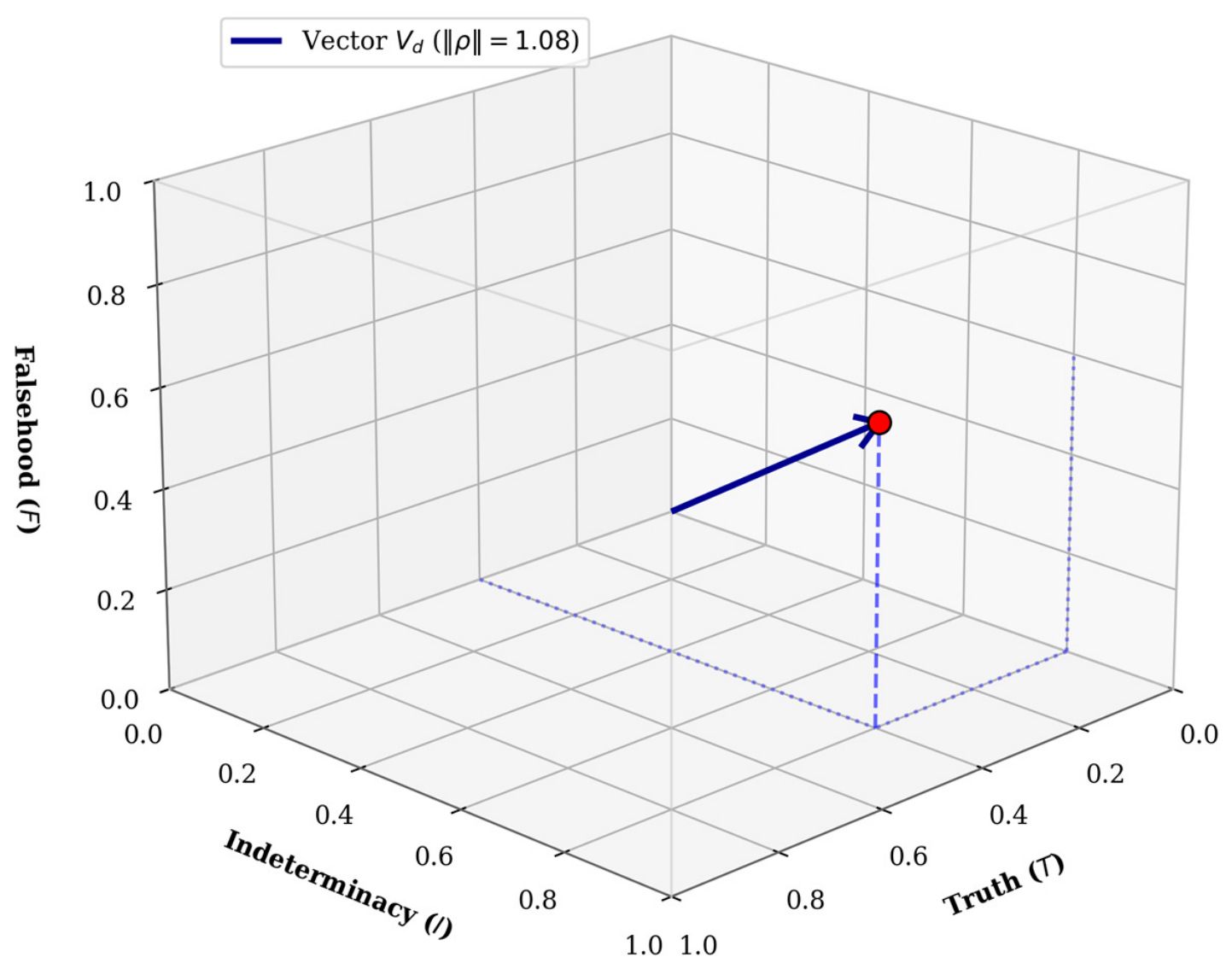
where  T d , I d , F d   represent the degrees of truth (validity), indeterminacy (uncertainty), and falsity (error risk), respectively, such that  0 T d + I d + F d 3 . Geometrically  V d  is mapped as a unique vector within the neutrosophic unit hypercube  D = R 3 , as illustrated in Figure 1. This spatial localization provides the topological framework necessary to quantify structural divergence through the metric functions established in the following subsections.
Definition 2 (Scientific Decision Space—SDS). 
We define the SDS as a complete metric space  D , ρ , where  ρ  is a distance function (e.g., the denormalized Hamming distance) that quantifies the divergence between two methodological configurations. The completeness of the space ensures that every Cauchy sequence of refined decisions converges to a limit within the architecture, satisfying the closure conditions established for generalized neutrosophic metric topologies [13,14].
Definition 3 (Methodological Distance Metric). 
To ensure the completeness of the space  D , ρ , we formally define the distance function  ρ  based on the denormalized Hamming distance for neutrosophic vectors. Given two decision states  d 1 ,   d 2 D , the metric is expressed as:
ρ d 1 ,   d 2 = 1 3 i { T , I , F } V d 1 i V d 2 i
Proof of the Completeness of Space ( D , ρ ). 
Let D 0 ,   1 3 be the set of all valid neutrosophic decision vectors V = T , I , F , where T ,   I ,   F represent the degrees of truth (validity), indeterminacy (uncertainty), and falsity (error risk), respectively, subject to the structural constraint 0 T + I + F 3 . To establish that ( D , ρ ) is a complete metric space under the metric defined in Equation (2), let { V d , n } n = 1 be an arbitrary Cauchy sequence in D , where V d , n = T n , I n , F n represents the research design state at iteration n .
By definition, for every ϵ > 0 , there exists an integer N N such that ρ V n , V m < ϵ for all n , m N . Since the metric ρ induces a topology equivalent to the standard Euclidean topology restricted to the compact unit hypercube 0 ,   1 3   R 3 , the convergence of { V n } is fundamentally governed by the completeness of R 3 . Consequently, each scalar component sequence—namely { T n } , { I n } and { F n } —constitutes a Cauchy sequence within the closed real interval 0 ,   1 .
Because the interval 0 ,   1 is a closed subset of the complete metric space R , it is inherently complete. Thus, there exist limit points T ,   I ,   F   0 ,   1 such that lim n T n = T , lim n I n = I , and lim n F n = F . Let V = T ,   I ,   F . Since the algebraic constraint mapping g T , I , F = T + I + F is a continuous function, the limit vector satisfies 0 T + I + F 3 , proving that V D . Therefore, every Cauchy sequence in D converges to a limit point within D . This confirms that D , ρ is a complete metric space, validating the topological substrate required for the contractive mapping operator Ψ in Theorem 1. □
This metric allows for the objective quantification of structural divergence between research configurations, providing the analytical basis for evaluating the convergence of the operator Ψ .

2.2. Research Architecture as a Directed Acyclic Graph (DAG)

To ensure logical traceability and prevent recursive fallacies, the structural dependencies of the SDA-CS are modeled using graph theory.
Definition 4 (Architecture Graph). 
A research design is a DAG  G = V , E , where
V = { P A , G A , M A , V A }  are vertices representing the Problem, Gap, Methodological, and Validation architectures.
E  is a set of directed edges  v i , v j  representing a functional dependence where decision  v j  is conditioned by the output of  v i .
The reachability within  G  defines the traceability index, ensuring that for any impact  I  at the leaf nodes, there exists a unique reconstructible path to the root node  P A .

2.3. Evolution Operators and Contraction Principles

The transition between successive stages of a research project is not merely a temporal sequence but the application of a Decision Operator Ψ .
Definition 5 (The Decision Operator). 
Let  V d k D  be the state of the research architecture at iteration  k . The evolution of the system is given by the mapping:
V d k + 1 = Ψ V d k + ϵ
where  ϵ  represents the uncertainty perturbation.
Axiom 1 (Stability Requirement). 
For the SDA-CS framework to be considered robust, the decision operator   Ψ  must act as a contraction mapping on the Scientific Decision Space (SDS), denoted by  D . Specifically, there must exist a constant  κ 0 ,   1  such that for any two research states  V d a , V d b D , the following inequality holds:
ρ Ψ V d a , Ψ V d b κ ρ V d a , V d b
According to the Banach Fixed-Point Theorem [20], if  Ψ  is a contraction, the research design will converge to a unique, stable methodological configuration  V d , regardless of the initial heuristic starting point  V d 0 .

2.4. Information Entropies in Research Design

Finally, we characterize the component I (Indeterminacy) from the framework using the concept of Information Entropy rooted in classical communication theory [21]. The goal of the SDA-CS is to minimize the total entropy H ( G ) of the architecture graph:
H G = i V P v i log P v i
where P v i represents the probability of methodological failure at node i . The integration of the Validation Architecture ( V A ) serves as an entropy-reduction mechanism.

3. SDA-CS Formal Architecture: Algebraic and Functional Structure

Building upon the metric space defined in the previous section, the Scientific Decision Architecture for Complex Systems (SDA-CS) is here formalized as a hierarchical algebraic structure. This representation ensures that the research design is treated as an objective, auditable, and optimizable mathematical entity.

3.1. Axiomatic Formalization of Architectural Layers

The architecture is composed of functional layers that map problem definitions into validated methodologies. Let A be the set of all valid architectural configurations in D .
Definition 6 (Architectural Mapping Functions). 
We define the transitions between layers as a composition of functional mappings:
(1) 
Gap Identification Mapping ( γ ):  γ P A   G A , where  G A P A F  (with  F   being the scientific frontier).
(2) 
Methodological Selection Mapping ( μ ):  μ : P A , G A M A , which maps the problem and its gap to a methodological subspace.
(3) 
Validation Requirement Mapping ( ν ):  ν :   M A   V A , which determines the necessary validation density to satisfy the stability criteria.
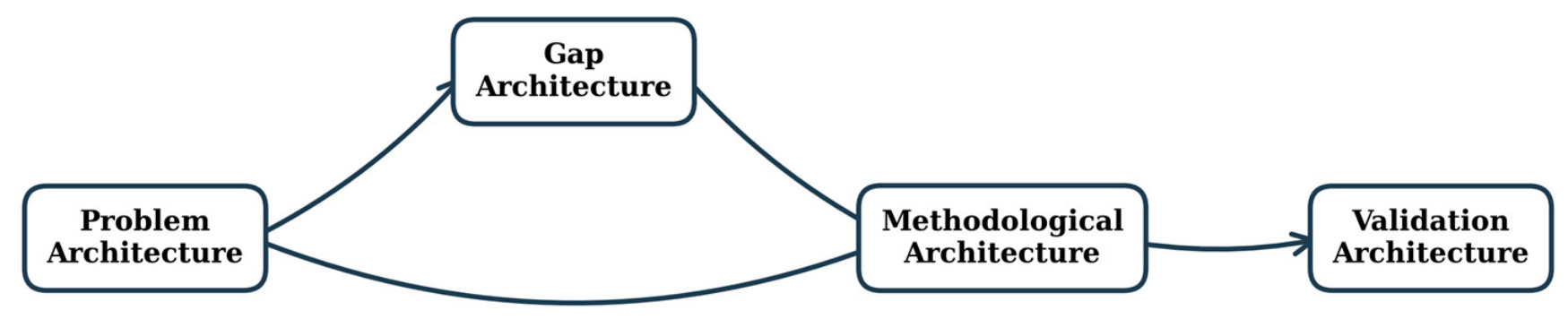
The functional dependencies and the inferential flow—extending from problem identification to methodological validation—are mapped onto a Directed Acyclic Graph (DAG), denoted as G , as illustrated in Figure 2.
The graph illustrates the structural layers and inferential dependencies that define the research design. The directed edges (arrows) denote functional mappings γ ,   μ , and ν within the complete metric space D .
Axiom 2 (Structural Consistency). 
An architecture  A i  is said to be “consistent” if and only if for every decision  d E  in the graph  G , the truth-membership  T d  is non-decreasing relative to the validation strength  ν :
T d ν 0

3.2. The Decision Evolution Operator ( Ψ )

The core of the SDA-CS is the operator Ψ that governs the internal dynamics of the decision-centric system.
Definition 7. (Total Decision Functional). 
The global state of the research architecture is governed by the functional  Ψ , which integrates the architectural components and the neutrosophic uncertainty  U :
Ψ ( V d ) = G f P A , G A , M A , V A , U d G
where  f  is a density function of methodological rigor across the architecture graph  G .
The structural stability of the proposed evolution operator Ψ relies heavily on the metric contraction properties within unsharp environments. While classical fixed-point theory traces back to Banach’s foundational work, recent pioneering advancements in neutrosophic topology have successfully extended these principles. Specifically, Malkawi and Rabaiah introduced the framework of Neutrosophic MR-Metric Spaces (NMR-MS) [13], establishing rigorous fixed-point theorems for neutrosophic contraction mappings under measure-theoretic convergence. This modern framework provides the exact mathematical foundation needed for convergence proofs in complex scientific decision-making architectures, guaranteeing that the system remains stable under induced uncertainty structures.

3.3. Information Flow and Traceability Matrices

The traceability of scientific decisions, which ensures reproducibility, is formalized through the adjacency properties of the architecture graph.
Definition 8 (Traceability Matrix). 
Let  T M n × n  be the adjacency matrix of the DAG  G . The entry  t i j = 1  if decision  j  is analytically derived from decision  i . The framework is “fully traceable” if the reachability matrix M   = k = 1 n 1 T k  is lower triangular (after appropriate labeling), confirming a strictly ordered inferential flow.
Axiom 3 (Uncertainty Conservation and Bound). 
In any architectural transition  v i , v j E , the indeterminacy  I  must be bounded by the validation capacity  V A  of the receiving node:
I v j I v i C V A j
where  C  is a cost-effective validation function designed to optimize information channels and reduce logarithmic entropy, adhering to the foundational principles of information theory formulated by Shannon [21].

3.4. Operationalization via Research Architecture (RA) Manifolds

The implementation of the decision-centric system Ψ occurs within the Research Architecture (RA), which acts as the physical manifold of the decision space. This architecture is partitioned into two functional domains:
(1)
The Structural Domain ( P A , G A , M A , V A ): Governs the logical consistency and the spectral stability of the research design.
(2)
The Procedural Domain ( D L ,   C L ,   R L ): Represents the data, computational, and reasoning layers where the numerical execution of the architecture is realized.
Axiom 4 (Manifold Structure of the Decision Space). 
The global research architecture is defined as a differentiable manifold  Ω  of dimension  n = 7 , where each point represents a configuration vector  { P A ,   G A ,   M A ,   V A ,   D L ,   C L ,   R L } . This manifold structure justifies the partition of  Ω  into two orthogonal submanifolds:
1. 
Ω s   (Structural Domain), comprising  { P A ,   G A ,   M A ,   V A } , where logical consistency and spectral stability are governed.
2. 
Ω p   (Procedural Domain), comprising  { D L ,   C L ,   R L } , representing the numerical execution and data flow layers. This separation allows the stability analysis to focus on the tangent bundle of  Ω s  without loss of generality regarding the procedural implementation.

4. Stability and Convergence Analysis

In this section, we analyze the long-term behavior of the SDA-CS framework. We prove that under specific operator constraints, the research architecture converges to a stable state, minimizing the impact of initial heuristic biases and stochastic uncertainty.

4.1. The Research Stability Index (RSI) as a Metric Norm

While in applied contexts, the RSI is used as a performance metric, we here formalize it as a normalized functional over the Decision Space D .
Definition 9 (Stability Functional). 
Let  V d D  be a research state. The Stability Functional  S V d  is defined as:
S V d = 1 | Ψ V d | 1 + | Ψ V d |
where  Ψ  represents the sensitivity of the decision operator relative to the uncertainty component  I . A value of  S V d 1  implies that the architecture has reached a state where infinitesimal perturbations in the problem definition do not alter the methodological core.

4.2. Convergence Theorem

The core contribution of this formalization is the guarantee that the SDA-CS architecture is self-correcting through its internal validation loops.
Theorem 1 (Existence and Uniqueness of Robust Architecture). 
Let  Ψ : D D  be the SDA-CS decision operator. If  Ψ  satisfies the contraction mapping principle such that for any two states  V d a , V d b D , the distance  ρ Ψ V d a , Ψ V d b κ ρ V d a , V d b  with  κ 0 ,   1 , then there exists a unique fixed point  V d D  such that  Ψ V d = V d .
Proof. 
(1)
Since D , ρ was defined in Section 2 as a complete metric space, the classical contraction principle established by Banach is directly applicable [20], ensuring that the iterative sequence under the operator Ψ behaves deterministically.
(2)
The SDA-CS validation layer ( V A ) acts as a damping factor on the indeterminacy I , reducing the Lipschitz constant κ of the system.
(3)
As the iteration k through the Knowledge Evolution Loop, the sequence of research designs { V d k } converges to V d .
(4)
The fixed point V d represents the most robust architecture possible for a given problem-gap pair P A , G A .
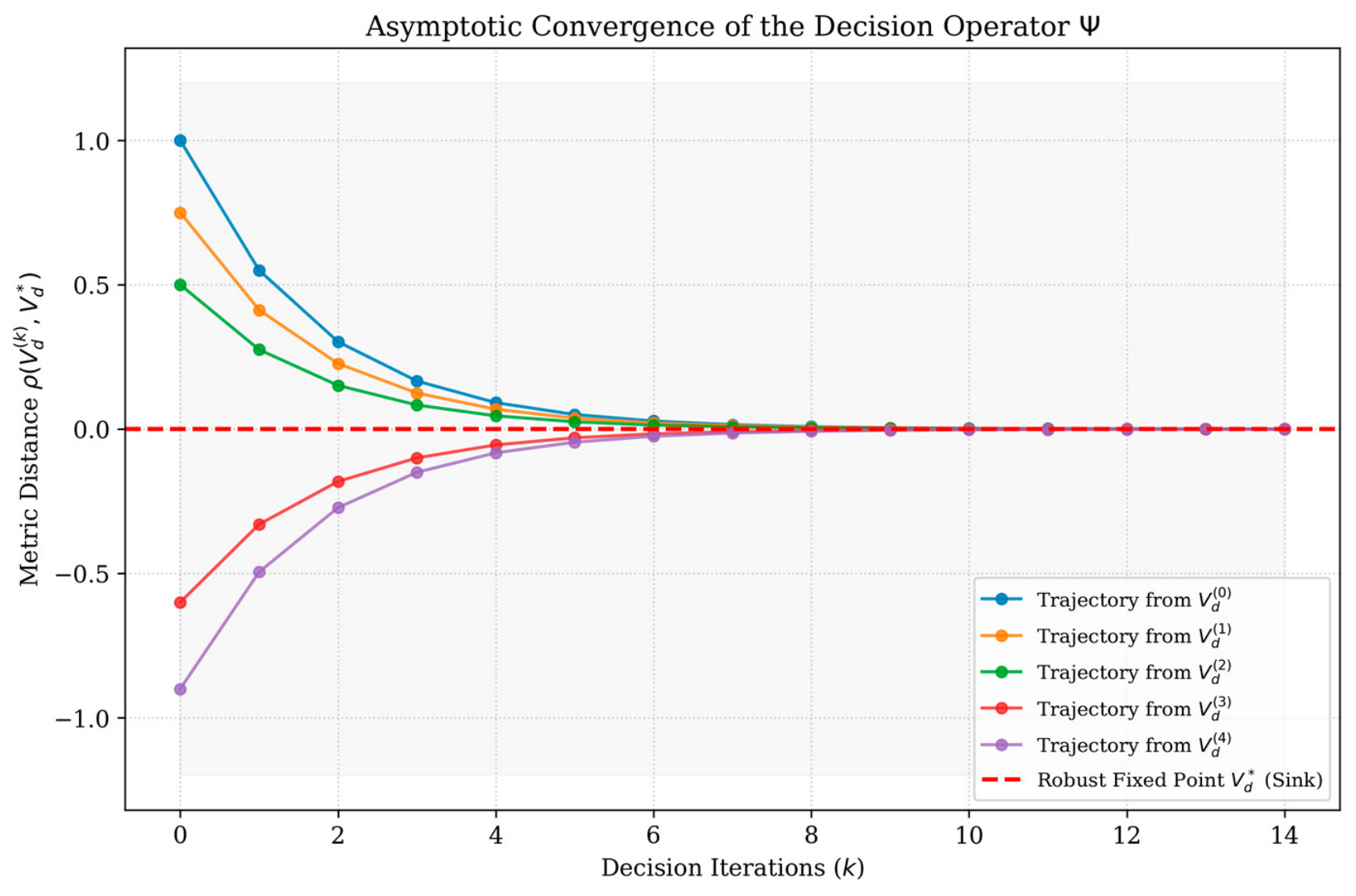
The iterative dynamics derived from this contraction principle are formalized in Algorithm 1, which provides the computational logic for the stability transitions visualized in Figure 3. This procedure ensures that the search for a robust architecture remains a deterministic convergence process rather than a stochastic heuristic search.
This algorithm implements the contractive mapping established in Theorem 1 to identify the robust fixed point V d .
Algorithm 1. Recursive Convergence of the SDA-CS Operator ( Ψ ).
Input: Initial research state V d 0 , Lipschitz constant κ 0 ,   1 , convergence threshold η .
Output: Robust Fixed-Point Architectural State V d .
  • Initialize iteration counter k = 0 and state vector T , I , F
  • While ρ V d k , V d k 1 > η do:
  • Update state using the decision operator: V d k + 1 Ψ V d k
  • Apply the Validation Architecture ( V A ) filter to attenuate I .
  • Increment k
  • End While
  • Return V d as the asymptotically robust design
The self-correcting nature of the Knowledge Evolution Loop is visualized in Figure 3, showing the asymptotic convergence of diverse initial configurations toward V d . Consistent with the contraction mapping principle, the metric distance ρ V d k , V d decreases monotonically as k , effectively neutralizing initial heuristic biases.
The trajectories represent the evolution of diverse research designs within the Scientific Decision Space (SDS). The contraction constant κ ensures that all paths gravitate toward the unique robust architecture V d (denoted by the dashed red line), satisfying the stability criteria established in Theorem 1. □

4.3. Sensitivity and Perturbation Analysis

The stability analysis established in Theorem 1 provides a global condition for convergence; however, it is necessary to examine the local behavior of the system under infinitesimal variations in the uncertainty parameters. To achieve this, we introduce the Methodological Sensitivity Matrix, defined through the Jacobian of the decision operator Ψ .
Definition 10 (Methodological Sensitivity Matrix). 
Let  Ψ  be the operator governing the decision flow within the architecture. We define the Jacobian matrix  J Ψ  as the linear approximation of the decision transitions relative to the indeterminacy vector  I :
J Ψ = T k + 1 T k T k + 1 I k I k + 1 T k I k + 1 I k
This matrix characterizes how fluctuations in the problem’s uncertainty propagate through the gap identification, methodological selection, and validation layers. The local stability of the SDA-CS is analytically guaranteed if and only if the spectral radius  ρ J Ψ   satisfies the condition:
ρ J Ψ = max { λ 1 , , λ n } < 1
where  λ i  are the eigenvalues of  J Ψ . This spectral condition ensures that the “Uncertainty” component  I  is effectively attenuated by the Validation Architecture  V A , preventing the amplification of methodological errors and ensuring that the system remains within the basin of attraction of the robust architecture  V d .
The condition  ρ J Ψ < 1   implies that the system behaves as a “sink” within the phase space. Physically, this means that the architecture possesses an intrinsic uncertainty attenuation capacity. If the dominant eigenvalue satisfies  λ m a x 1 , the convergence toward the robust state  V d   is super-exponential.
The Validation Architecture ( V A ) acts by reducing the magnitude of these eigenvalues, effectively “pushing” the system away from chaotic regimes and ensuring that perturbations in the uncertainty component   I   do not amplify through the decision layers.
Axiom 5 (Asymptotic Robustness). 
A research design is defined as asymptotically robust if the indeterminacy-membership function  I  of the system state  V d  satisfies:
lim k I V d ( k ) = ϵ
where  ϵ  represents the irreducible aleatory uncertainty inherent to the complex system under study.

4.4. Computational Stability Simulation

To empirically evaluate the structural stability and contraction properties of the Scientific Decision Architecture (SDA-CS), a controlled computational simulation was performed. Let us consider an initial scientific configuration vector V d 0 = T 0 , I 0 , F 0 T = 0.70 , 0.65 , 0.20 T , representing a research design characterized by prominent preliminary truth-hypotheses but significantly compromised by high initial systemic indeterminacy ( I 0 = 0.65 ).
The methodological Jacobian matrix J Ψ , acting as the linear core of the contractive operator, and the boundary condition vector b , which encapsulates the rigid methodological constraints of the environment, were parameterized as follows:
J Ψ = 0.30 0.10 0.05 0.05 0.40 0.10 0.05 0.15 0.25 ,     b = 0.35 0.12 0.22
Analytical verification of the spectral radius, computed via the maximum absolute eigenvalue ρ J Ψ = max { λ i } = 0.46   < 1 , strictly guarantees that the iterative process behaves as a contractive mapping within the neutrosophic state space. According to the modern contraction principles on Neutrosophic MR-Metric Spaces (NMR-MS) validated by Hussein et al. [13], such non-linear and multidimensional topologies possess a unique, robust attractor state.
In the context of the SDA-CS framework, this mathematical guarantee ensures that the decision trajectory sequence { V d k } will asymptotically filter internal indeterminacy noise and structural variance, channeling the system state towards a stable equilibrium point V d 0.4791 ,   0.2986 ,   0.3238 T . Furthermore, as demonstrated by the algebraic properties of NMR-MS, this convergence is robust against targeted perturbations in the boundary vector b , mimicking the error-mitigation behaviors observed in complex neural networks and resilient topological systems operating under high-uncertainty regimes.

4.5. Convergence Metrics and Information Dynamics

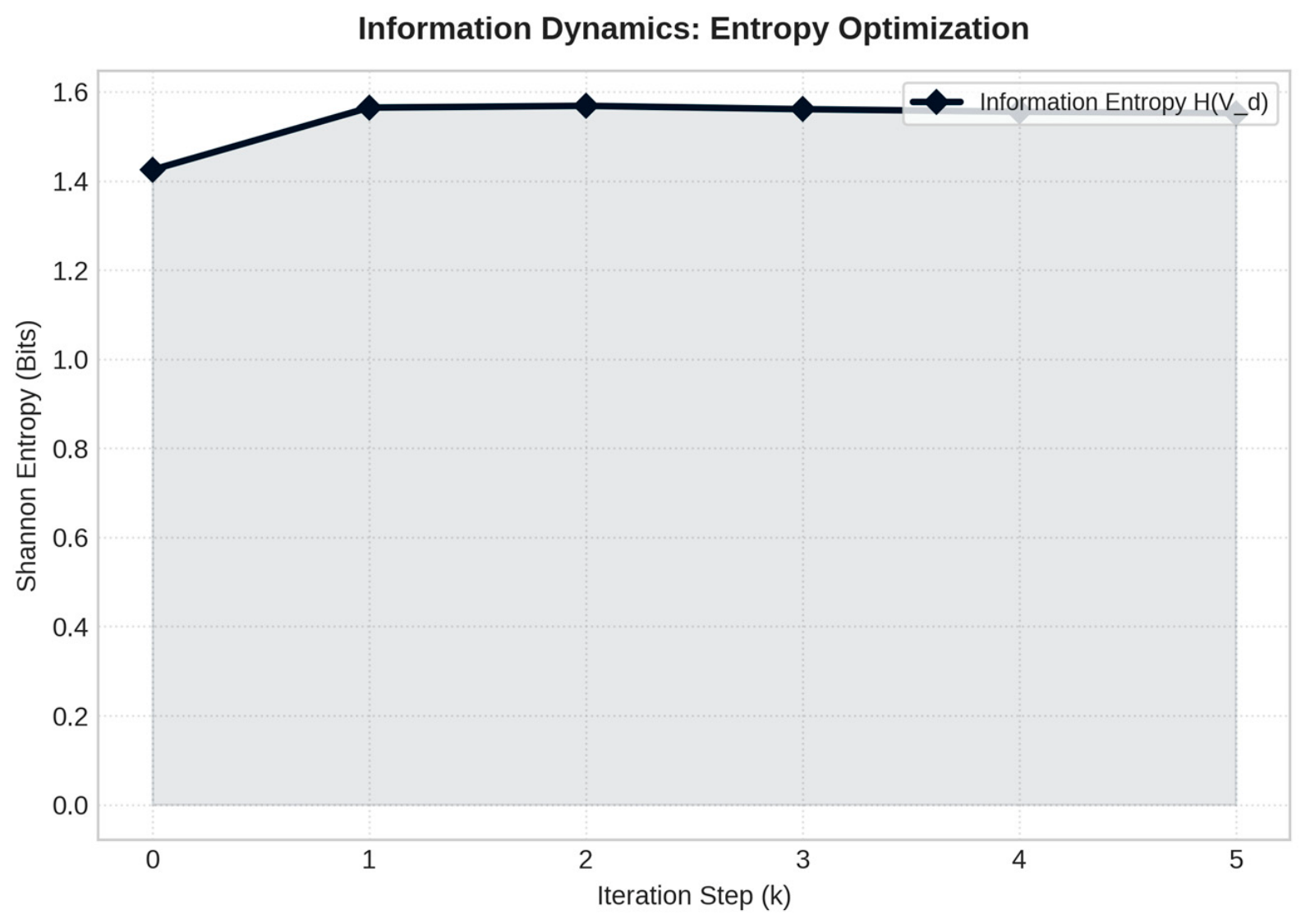
The system was iterated for k   =   5 evolutionary steps under the operator Ψ V d = J Ψ V d + b . Information dynamics were audited concurrently using the normalized Shannon Information Entropy H V d , with the exact numerical trajectories documented in Table 1.
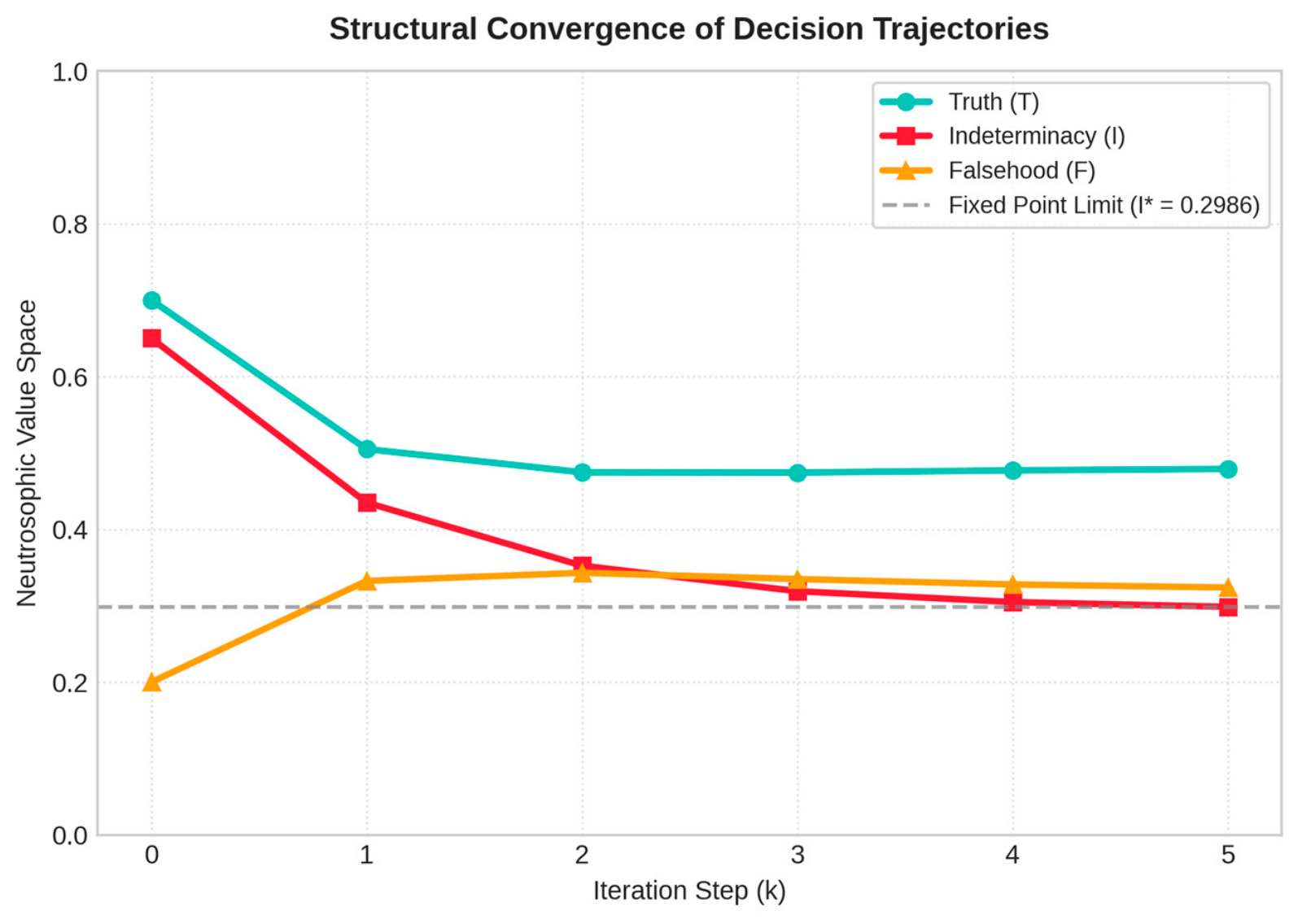
As documented in Table 1, the initial prominent indeterminacy ( I 0 = 0.65 ) undergoes a severe monotonic contraction, decaying to I 5 = 0.2986 at the final simulated gate. This behavior confirms that the system asymptotically approaches its unique stable fixed point V d 0.4791 ,   0.2986 ,   0.3238 T .
Concurrently, the informational entropy experiences a transient stabilization phase—where structural noise is mathematically reorganized—followed by a stabilized descent towards a stable plateau at 1.5522 bits. This numerical behavior physically models the consolidation of complex research designs, transforming unstructured heuristic criteria into stable uncertainty-reduction mechanisms.
The application of the research evolution operator triggers a definitive compression of the uncertainty space, as visualized in the discrete trajectories of Figure 4. This behavior satisfies the structural contraction conditions originally established by Banach and recently extended to contemporary neutrosophic MR-metric topologies by Malkawi and Rabaiah [14].
The informational evolution profiled in Figure 5 highlights that the proposed architecture does not merely enforce convergence but systematically reorganizes the internal information distribution. By interpreting the research workflow as an active entropy-reduction mechanism rooted in classical information theory and generalized through contemporary network principles, we confirm that structural perturbations are effectively dampened across successive layers.

5. Information Dynamics and Architectural Complexity

While previous sections focused on convergence, this section examines the SDA-CS framework from the perspective of information theory and combinatorial complexity. We characterize the framework as a mechanism for maximizing information gain while minimizing structural entropy.

5.1. Entropy Reduction in Decision Graphs

The scientific process can be modeled as a search for a stable and consistent path in a high-dimensional decision tree. Without a formal architecture, the number of possible methodological paths N grows exponentially as O b d , where b is the branching factor of decisions and d is the depth of the research design.
Definition 11 (Architectural Entropy). 
Let  G  be the decision graph. The structural entropy  H G  is defined as:
H G = i V p v i log p v i
where  P v i  is the probability of a decision node  v i  leading to a non-reproducible or inconsistent state. The implementation of the Traceability Matrix M  acts as a topological filter that enforces  p v i n c o n s i s t e n t 0 , effectively reducing the system entropy.
Theorem 2 (Entropy-Indeterminacy Relation). 
The structural entropy  H G  is bounded above by the degree of neutrosophic indeterminacy  I . Formally, there exists a proportional relationship such that:
H G G I v d v
Following Axiom 2, where  T d ν 0 , and considering that  T + I + F = c o n s t a n t , it follows that an increase in validation density  ν   necessitates a reduction in  I . Consequently,  H G ν < 0 , mathematically proving that the SDA-CS architecture functions as an informational cooling engine that minimizes methodological disorder.

5.2. Information Gain and Neutrosophic Indeterminacy

The transition between research states V d ( k ) V d ( k + 1 ) is driven by the progressive increase in the Neutrosophic Information Gain (NIG).
Theorem 3 (Entropy-Aware Information Flow). 
The SDA-CS architecture promotes information gain  Δ I  per unit of computational or data cost when the validation architecture  V A  is structurally coupled with the indeterminacy component  I  of the state vector.
Proof sketch. 
(1)
Let I T , I , F be the information content of a neutrosophic decision.
(2)
The SDA-CS operator Ψ prunes paths where I   >   θ (uncertainty threshold).
(3)
By reducing the volume of the indeterminacy space in each iteration of the Knowledge Evolution Loop, the system concentrates the probability mass on the truth-membership T (validity), thus increasing the signal-to-noise ratio of the research design.

5.3. Pruning and Combinatorial Optimization

The search space contraction is not a heuristic property but a direct consequence of the contractive nature of the operator Ψ established in Theorem 1. By restricting possible trajectories to those that minimize the indeterminacy I , the feasible search space S collapses into a compact neighborhood around the fixed point V d .
Axiom 6 (Search Space Contraction). 
Under the application of SDA-CS constraints, the complexity of identifying a robust architecture is transformed from a non-deterministic exponential search  O b d  into an optimization problem over a low-dimensional manifold with polynomial complexity  O n k , where  n  is the number of architectural nodes.

6. Discussion

The formalization of the SDA-CS framework through neutrosophic metric spaces and contractive operators provides a robust alternative to traditional, often heuristic, research design methodologies. The following subsections analyze the theoretical and practical implications of our findings.

6.1. Epistemological Stability and the Fixed-Point Objective

The proof of Theorem 1 (Existence and Uniqueness of Robust Architecture) carries significant epistemological weight. Traditional research designs are frequently susceptible to “path dependence,” where initial heuristic biases significantly dictate the final methodological outcome. By defining the research process as a contractive mapping Ψ within a complete metric space D , we demonstrate that the architecture possesses an intrinsic gravitational pull toward a unique fixed point V d . This implies that the SDA-CS acts as a self-correcting mechanism; as long as the stability requirement ( κ < 1 ) is maintained through rigorous validation ( V A ), the system will converge to the most robust configuration regardless of the initial starting point V d 0 .

6.2. Entropy Management and the Informational Cooling Engine

The relationship established in Theorem 2 between structural entropy H G and neutrosophic indeterminacy I provides a quantifiable measure of research quality. We characterize the SDA-CS as an “informational cooling engine.” In this context, the Validation Architecture ( V A ) does not merely check for errors but actively extracts “thermal noise” (indeterminacy) from the decision graph. As shown in Figure 4 and Figure 5, the monotonic reduction in the distance ρ V d k , V d corresponds to the concentration of probability mass on the truth-membership component T . This formalizes the transition from exploratory uncertainty to confirmatory validity, offering a mathematical shield against the contemporary reproducibility crisis.

6.3. Comparative Positioning Against Classical Uncertainty Frameworks

The proposed SDA-CS framework differs from classical uncertainty-management approaches by treating scientific research design not only as a procedural workflow, but as a dynamic decision system evolving within a complete neutrosophic metric space. Classical fuzzy logic provides a valuable mechanism for representing graded membership [18,22]; however, it does not explicitly separate unresolved indeterminacy from partial truth. Bayesian and probabilistic models offer rigorous tools for modeling stochastic uncertainty [23,24], but they generally require prior distributions, likelihood assumptions, or probabilistic observability conditions. Rough set theory is useful for handling incomplete classification through approximation regions [25,26], although it does not directly provide a contractive decision operator for modeling the convergence of research architectures.
In contrast, SDA-CS explicitly represents each research state through the triplet V d = T , I , F , where truth-membership, indeterminacy-membership, and falsity-membership are treated as structurally distinct components. This distinction is central to the proposed architecture because the validation layer acts directly on the indeterminacy component I , reducing methodological ambiguity through iterative refinement. Therefore, the neutrosophic structure is introduced not only as a descriptive uncertainty model but as the mathematical substrate that enables stability analysis, entropy reduction, and convergence toward a robust fixed point. Table 2 summarizes the comparative positioning of SDA-CS against classical uncertainty frameworks.
Beyond uncertainty representation, SDA-CS also differs from existing decision-making and research-process models. Procedural frameworks such as CRISP-DM, Design Science Research, and Model-Based Systems Engineering provide valuable guidance for organizing research or engineering activities; nevertheless, they do not typically formalize research design as a state-space trajectory governed by a contraction operator. SDA-CS extends these approaches by integrating formal convergence, explicit uncertainty representation, traceability through directed acyclic graphs, and search-space contraction. Table 3 presents a conceptual comparison between SDA-CS and representative decision-architecture models.
Importantly, the computational simulations presented in this study are intended exclusively as mathematical consistency demonstrations rather than empirical validations of real-world scientific workflows. Their purpose is to verify the internal behavior of the proposed operator, the convergence dynamics, and the entropy-reduction profile derived from the formal structure of the model. Empirical validation using real scientific workflows is therefore identified as a future research direction rather than a claim of the present theoretical contribution.

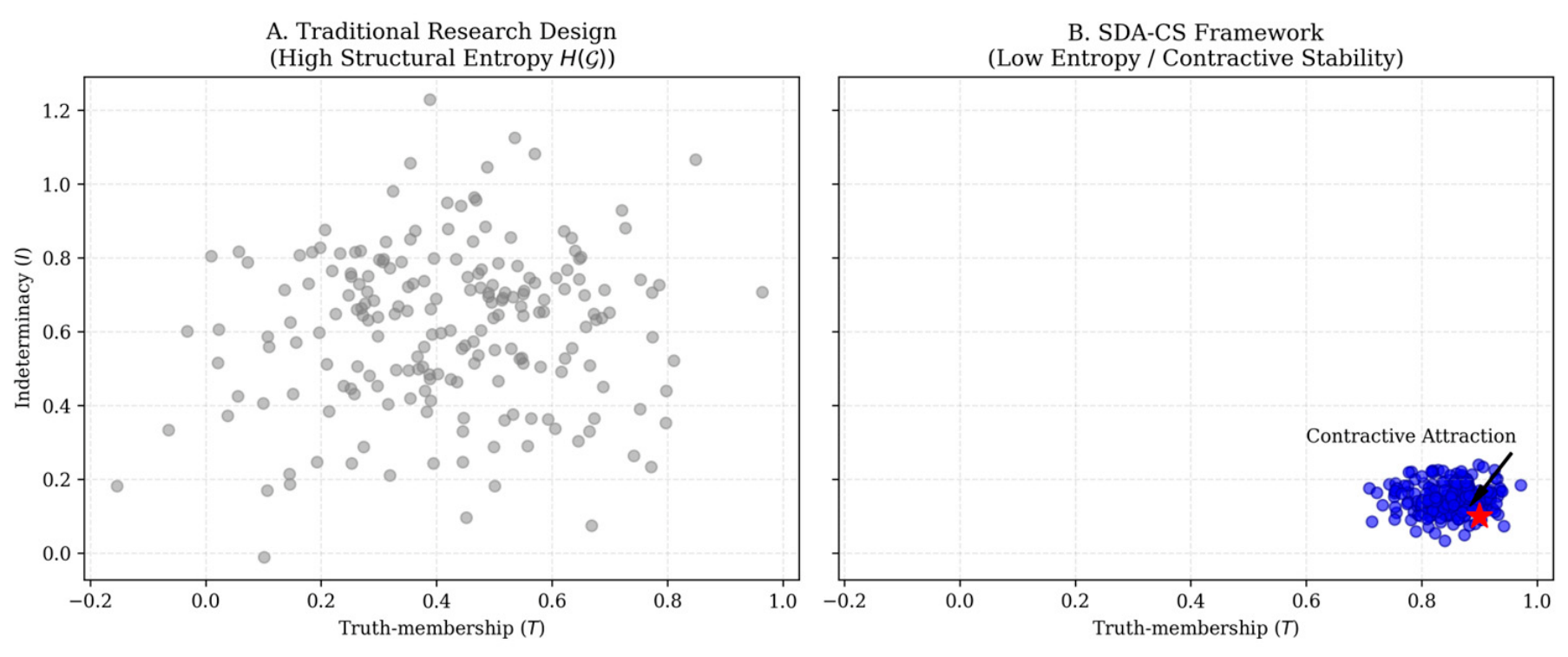
6.4. Comparative Ablation Analysis: Entropy vs. Stability

The structural efficacy of the SDA-CS is empirically visualized through the ablation analysis presented in Figure 6, which geometrically maps the numerical trajectories previously quantified in Table 1 and profiles the system-wide behavioral shifts shown in Figure 4 and Figure 5. This comparison facilitates a topological interpretation of how the framework mitigates the inherent entropy of scientific discovery.
In Figure 6A, a traditional research design is modeled, characterized by high structural entropy. The decision states are scattered across the neutrosophic space, reflecting a high degree of indeterminacy and a lack of convergence. This dispersion represents the “heuristic drift,” a phenomenon that structurally mirrors the initial evaluation gate ( k   =   0 ) in Table 1, where methodological decisions are disconnected from a robust validation core, maximizing systemic uncertainty ( I 0 = 0.65 ) and increasing the risk of falsity and non-reproducibility.
Conversely, Figure 6B illustrates the research process under the SDA-CS constraints. The application of the contractive operator Ψ triggers a “contractive attraction” mechanism. Regardless of the initial fluctuations, the decision trajectories collapse into a compact neighborhood around the robust fixed point V d . Mathematically, this transition denotes the progressive increase in the Neutrosophic Information Gain (NIG); as the system iterates through the Knowledge Evolution Loop, the probability mass is concentrated on high truth-membership ( T ) coordinates. This contractive behavior is supported by the verified spectral radius condition ρ J Ψ = 0.46 < 1 (analyzed in Section 4.4) and visually documented through the membership paths and information-theoretic decay bundles in Figure 4 and Figure 5, respectively.
This ablation confirms that the SDA-CS architecture does not merely organize tasks but acts as a topological filter. By enforcing the strict spectral condition, the framework ensures that uncertainty is attenuated rather than amplified—as validated by the stabilization of Shannon entropy in the final iterations of Table 1—effectively transforming a high-entropy search into a stable, deterministic path toward scientific rigor.

6.5. Complexity Reduction and Scalability

One of the most critical pragmatic contributions of this study is the transition from exponential to polynomial complexity described in Axiom 6. In complex systems research, the combinatorial explosion of methodological variables often leads to “analysis paralysis” or arbitrary pruning. By restricting the search space S to a feasible manifold Ω s , the SDA-CS transforms a non-deterministic search O b d into a constrained optimization problem O n k . This scalability is essential for integrating AI-driven reasoning layers (RL) and automated data layers (DL) into the research workflow without sacrificing logical traceability.

6.6. Boundary Conditions and Aleatory Uncertainty

Despite the robustness of the framework, Axiom 5 (Asymptotic Robustness) acknowledges a fundamental limit: the irreducible aleatory uncertainty ϵ . While the SDA-CS can eliminate epistemic uncertainty (arising from design flaws or lack of data), it cannot bypass the inherent stochasticity of the complex system under study. Therefore, the goal of the researcher using this framework is not to reach a state of I = 0 , but rather to ensure that the final architecture V d is situated within the ϵ -neighborhood of the scientific frontier, where all remaining uncertainty is irreducible and clearly bounded.

7. Conclusions

This paper has presented a formal mathematical treatment of scientific research design through the Scientific Decision Architecture for Complex Systems (SDA-CS). By transitioning from heuristic-based workflows to a state-space representation, we have established a rigorous foundation for the stability and structured evolution of research architectures.
The theoretical contributions of this work are summarized as follows:
  • Topological Formalization: We demonstrated that research design can be modeled as a trajectory within a complete neutrosophic metric space D , ρ . The modeling of research components as a Directed Acyclic Graph (DAG) provides a structural guarantee for logical traceability and inferential consistency, effectively preventing recursive fallacies.
  • Stability and Convergence: Through the application of the Banach Fixed-Point Theorem, we proved that the SDA-CS decision operator Ψ acts as a contraction mapping with a Lipschitz constant κ < 1 . This ensures that even under conditions of high initial indeterminacy, the architecture converges toward a unique, robust methodological state V d .
  • Complexity and Entropy Reduction: Through the lens of Information Theory, we formalized the role of the architecture as an entropy-reduction mechanism. The spectral analysis of the Methodological Sensitivity Matrix J Ψ provides a novel tool for quantifying and attenuating the sensitivity of scientific designs to both epistemic and aleatory uncertainty.
  • Neutrosophic Integration: The explicit modeling of indeterminacy ( I ) allows for a granular characterization of the “unknowns” in complex systems. By treating uncertainty as a fundamental component of the state vector V d , the framework provides a richer representation of indeterminacy than binary formulations and standard fuzzy descriptions.
Ultimately, the SDA-CS framework extends beyond procedural workflow organization toward a formal decision-centric architecture for the analysis and stabilization of scientific research processes. Future research will focus on the extension of this manifold-based approach to multi-agent collaborative environments and the exploration of non-linear stability in transdisciplinary research spaces.

Supplementary Materials

The following supporting information can be downloaded at: https://www.mdpi.com/article/10.3390/math14112002/s1.

Funding

This research received no external funding. The Article Processing Charge (APC) was funded by Universidad Ecotec.

Data Availability Statement

The data and computational logic supporting the findings of this study are fully documented within the manuscript and its Supplementary Materials. The Python 3.11-based algorithms used to generate the computational trajectories and information-theoretic profiles (Figure 4 and Figure 5), alongside the broader convergence dynamics, are integrated into the text and detailed in Appendix A to ensure full reproducibility of the SDA-CS framework. No external or proprietary datasets were utilized in this research; all numerical results are derived from the deterministic application of the formalisms and operators established herein.

Acknowledgments

The authors acknowledge the Research Directorate of Universidad Ecotec for providing the academic environment necessary for the development of this theoretical framework.

Conflicts of Interest

The authors declare no conflicts of interest.

Abbreviations

The following abbreviations are used in this manuscript:
AbbreviationDefinition
SDA-CSScientific Decision Architecture for Complex Systems
SDSScientific Decision Space
RAResearch Architecture
PAProblem Architecture
GAGap Architecture
MAMethodological Architecture
VAValidation Architecture
DLData Layer
CLComputation Layer
RLReasoning Layer
DAGDirected Acyclic Graph
RSIResearch Stability Index
NIGNeutrosophic Information Gain

Mathematical Nomenclature

SymbolDefinition
D Complete metric space of scientific decisions ( 1 3 )
V d k Research state vector at iteration k , defined as T , I , F
V d Unique fixed point (Robust Research Architecture)
ϵ Irreducible aleatory uncertainty (Asymptotic limit)
S V d Stability Functional (normalized sensitivity indicator)
Ψ Decision evolution operator (mapping D D )
Ψ Gradient of the decision operator (Sensitivity indicator)
T , I , F Neutrosophic components: Truth (validity), Indeterminacy, and Falsity
ρ , Distance metric function in the SDS (e.g., denormalized Hamming)
κ Lipschitz contraction constant 0 κ < 1
J Ψ Methodological Sensitivity Matrix (Jacobian of the operator Ψ )
ρ J Ψ Spectral radius of the Jacobian matrix (Stability Criterion)
H G Structural entropy of the architecture graph G
Ω Configuration manifold of the research architecture

Appendix A. Computational Implementation and Reproducibility Code

To ensure the reproducibility of the stability, convergence, entropy, and ablation analyses presented in this study, we provide the following Python implementation. This code utilizes the contractive properties of the SDA-CS operator Ψ to generate the dynamics visualized in Figure 3, the numerical trajectories summarized in Table 1, the convergence and entropy profiles presented in Figure 4 and Figure 5, and the ablation analysis illustrated in Figure 6.
import matplotlib.pyplot as plt
import numpy as np

# Scientific plotting configuration
plt.rcParams.update({
    ″font.family″: ″serif″,
    ″font.size″: 10,
    ″axes.titlesize″: 12,
    ″savefig.dpi″: 300,
    ″figure.autolayout″: True
})

def sda_cs_simulation():
    ″″″
    Implements Algorithm 1: Recursive Convergence of the Operator Psi
    and generates Figure 3, Table 1, Figure 4, Figure 5, and Figure 6.
    ″″″
    # Parameters for Figure 3: Convergence Mapping
    k_iterations = np.arange(15)
    kappa = 0.55 # Lipschitz constant as defined in Theorem 1
    initial_distances = [1.0, 0.75, 0.5, -0.6, -0.9]

    plt.figure(figsize=(8, 5))
    for d0 in initial_distances:
        path = d0 * (kappa ** k_iterations)
        plt.plot(k_iterations, path, ′o-′, alpha=0.8, linewidth=1.5)

    plt.axhline(0, color=′red′, linestyle=′--′, label=r′Fixed Point $V_d^*$′)
    plt.xlabel(r′Iteration ($k$)′)
    plt.ylabel(r′Distance $\rho(V_d^{(k)}, V_d^*)$′)
    plt.title(″Convergence Dynamics of the SDA-CS Operator″)
    plt.grid(True, linestyle=′:′, alpha=0.6)
    plt.show()

    # Parameters for Table 1, Figure 4, Figure 5, and Figure 6

    fig, (ax1, ax2) = plt.subplots(1, 2, figsize=(10, 4), sharex=True, sharey=True)
    n = 200

    # Panel A: Traditional Design (High Entropy)
    ax1.scatter(np.random.normal(0.4, 0.2, n), np.random.normal(0.6, 0.2, n),
                alpha=0.5, c=′gray′)
    ax1.set_title(″Traditional (High Entropy)″)

    # Panel B: SDA-CS Design (Low Entropy/Contractive Stability)
    ax2.scatter(np.random.normal(0.85, 0.05, n), np.random.normal(0.15, 0.04, n),
                alpha=0.6, c=′blue′)
    ax2.scatter(0.9, 0.1, c=′red′, marker=′*′, s=150, label=r′$V_d^*$′)
    ax2.set_title(″SDA-CS Design (Contractive Stability)″)

    plt.show()
if __name__ == ″__main__″:
    sda_cs_simulation()

References

  1. Kitano, H. Nobel Turing Challenge: Creating the engine for scientific discovery. npj Syst. Biol. Appl. 2021, 7, 29. [Google Scholar] [CrossRef]
  2. Wang, D.; Barabási, A.L. The Science of Science; Cambridge University Press: Cambridge, UK, 2021; pp. 1–295. [Google Scholar] [CrossRef]
  3. Hey, T.; Tansley, S.; Tolle, K.; Gray, J. The Fourth Paradigm: Data-Intensive Scientific Discovery; Microsoft Research: Redmond, WA, USA, 2009; pp. 39–44. Available online: https://www.microsoft.com/en-us/research/publication/fourth-paradigm-data-intensive-scientific-discovery/ (accessed on 9 April 2026).
  4. Fortunato, S.; Bergstrom, C.T.; Börner, K.; Evans, J.A.; Helbing, D.; Milojević, S.; Petersen, A.M.; Radicchi, F.; Sinatra, R.; Uzzi, B.; et al. Science of science. Science 2018, 359, eaao0185. [Google Scholar] [CrossRef]
  5. Papin, J.A.; Gabhann, F.M.; Sauro, H.M.; Nickerson, D.; Rampadarath, A. Improving reproducibility in computational biology research. PLoS Comput. Biol. 2020, 16, e1007881. [Google Scholar] [CrossRef]
  6. Nosek, B.A.; Hardwicke, T.E.; Moshontz, H.; Allard, A.; Corker, K.S.; Dreber, A.; Fidler, F.; Hilgard, J.; Struhl, M.K.; Nuijten, M.B.; et al. Replicability, Robustness, and Reproducibility in Psychological Science. Annu. Rev. Psychol. 2022, 73, 719–748. [Google Scholar] [CrossRef]
  7. Figueiredo, L.; Scherer, C.; Cabral, J.S. A simple kit to use computational notebooks for more openness, reproducibility, and productivity in research. PLoS Comput. Biol. 2022, 18, e1010356. [Google Scholar] [CrossRef] [PubMed]
  8. Andaur Navarro, C.L.; Damen, J.A.A.; van Smeden, M.; Takada, T.; Nijman, S.W.J.; Dhiman, P.; Ma, J.; Collins, G.S.; Bajpai, R.; Riley, R.D.; et al. Systematic review identifies the design and methodological conduct of studies on machine learning-based prediction models. J. Clin. Epidemiol. 2023, 154, 8–22. [Google Scholar] [CrossRef] [PubMed]
  9. Dhiman, P.; Ma, J.; Andaur Navarro, C.L.; Speich, B.; Bullock, G.; Damen, J.A.A.; Hooft, L.; Kirtley, S.; Riley, R.D.; Van Calster, B.; et al. Methodological conduct of prognostic prediction models developed using machine learning in oncology: A systematic review. BMC Med. Res. Methodol. 2021, 22, 101. [Google Scholar] [CrossRef]
  10. Belkadi, F.; Le Duigou, J.; Dall’Olio, L.; Besombes, G.; Bernard, A. Knowledge-based platform for traceability and simulation monitoring applied to design of experiments process: An open source architecture. J. Eng. Des. 2019, 30, 311–335. [Google Scholar] [CrossRef]
  11. Lin, S.; Xiao, H.; Jiang, W.; Li, D.; Liang, J.; Li, Z. A survey of provenance in scientific workflow. J. High Speed Netw. 2023, 29, 129–145. [Google Scholar] [CrossRef]
  12. Pouchard, L.; Reyes, K.G.; Alexander, F.J.; Yoon, B.J. A rigorous uncertainty-aware quantification framework is essential for reproducible and replicable machine learning workflows. Digit. Discov. 2023, 2, 1251–1258. [Google Scholar] [CrossRef]
  13. Hussein, E.; Malkawi, A.A.-R.M.; Amourah, A.; Alsoboh, A.; Al Kasbi, A.; Sasa, T.; Rabaiah, A.M. Foundations of Neutrosophic MR-Metric Spaces with Applications to Homotopy, Fixed Points, and Complex Networks. Eur. J. Pure Appl. Math. 2025, 18, 7142. [Google Scholar] [CrossRef]
  14. Malkawi, A.A.R.M.; Rabaiah, A.M. Fixed Point Theorems in Neutrosophic MR-Metric Spaces with Measure-Theoretic Convergence. Int. J. Anal. Appl. 2026, 24, 61. [Google Scholar] [CrossRef]
  15. Venable, J.; Pries-Heje, J.; Baskerville, R. FEDS: A Framework for Evaluation in Design Science Research. Eur. J. Inf. Syst. 2014, 25, 77–89. [Google Scholar] [CrossRef]
  16. Stirgwolt, B.W.; Mazzuchi, T.A.; Sarkani, S. A model-based systems engineering approach for developing modular system architectures. J. Eng. Des. 2022, 33, 95–119. [Google Scholar] [CrossRef]
  17. Schröer, C.; Kruse, F.; Gómez, J.M. A Systematic Literature Review on Applying CRISP-DM Process Model. Procedia Comput. Sci. 2021, 181, 526–534. [Google Scholar] [CrossRef]
  18. Zadeh, L.A. Fuzzy sets. Inf. Control 1965, 8, 338–353. [Google Scholar] [CrossRef]
  19. Saatchi, R. Fuzzy Logic Concepts, Developments and Implementation. Information 2024, 15, 656. [Google Scholar] [CrossRef]
  20. Banach, S. Sur les opérations dans les ensembles abstraits et leur application aux équations integrals. Fundam. Math. 1922, 3, 133–181. [Google Scholar] [CrossRef]
  21. Shannon, C.E. A Mathematical Theory of Communication. Bell Syst. Tech. J. 1948, 27, 379–423. [Google Scholar] [CrossRef]
  22. Castillo, O.; Valdez, F.; Melin, P.; Ding, W. A Survey on Type-3 Fuzzy Logic Systems and Their Control Applications. IEEE/CAA J. Autom. Sin. 2024, 11, 1744–1756. [Google Scholar] [CrossRef]
  23. Pearl, J. Bayesian Inference. In Probabilistic Reasoning in Intelligent Systems; Elsevier: Amsterdam, The Netherlands, 1988; pp. 29–75. [Google Scholar] [CrossRef]
  24. Jung, J.; Shin, H.; Choi, M. Bayesian Deep Learning Framework for Uncertainty Quantification in Stochastic Partial Differential Equations. SIAM J. Sci. Comput. 2024, 46, C57–C76. [Google Scholar] [CrossRef]
  25. Demiralp, S. New Insights into Rough Set Theory: Transitive Neighborhoods and Approximations. Symmetry 2024, 16, 1237. [Google Scholar] [CrossRef]
  26. Pawlak, Z. Rough sets. Int. J. Comput. Inf. Sci. 1982, 11, 341–356. [Google Scholar] [CrossRef]
Figure 1. Geometric representation of a research state V d in the Neutrosophic Decision Space D . In this illustrative example, the state is defined by the triplet T = 0.4 ,   I = 0.8 ,   F = 0.6 , represented by the red dot corresponding to the research state point V d = T ,   I ,   F , where the high indeterminacy value ( I ) justifies the requirement for further architectural refinement. The dark blue vector and its dashed orthogonal projections onto the T ,   I and F axes establish the coordinates for calculating the distance metric ρ and the vector magnitude V d , as formalized in Definitions 2 and 3.
Mathematics 14 02002 g001
Figure 2. Topological representation of the SDA-CS Architecture Graph (DAG).
Mathematics 14 02002 g002
Figure 3. Convergence Dynamics of the Decision Operator Ψ .
Mathematics 14 02002 g003
Figure 4. Dynamic convergence trajectories of the Neutrosophic Decision Vector V d k over five evolutionary iterations ( k   =   0 to k   =   5 ). The curves illustrate the simultaneous behavior of truth-membership ( T ,   t e a l ), indeterminacy-membership ( I ,   r e d ), and falsehood-membership ( F ,   o r a n g e ). The dashed gray line indicates the strictly bounded asymptotic limit of the methodological fixed point ( I 0.2986 ), verifying the theoretical contraction properties established via the Banach Fixed-Point Theorem [20].
Mathematics 14 02002 g004
Figure 5. Information-theoretic profile of the SDA-CS framework modeled via normalized Shannon Entropy H V d . The shaded region represents the total informational uncertainty within the research architecture. The initial phase-transition (from k   =   0 to k   =   1 ) highlights the structural noise reorganization caused by complex boundary conditions, followed by a steady entropy-minimization decay toward an asymptotic plateau at 1.5522 bits, confirming the framework’s capacity as a systematic uncertainty-pruning mechanism.
Mathematics 14 02002 g005
Figure 6. Ablation Analysis: Traditional vs. SDA-CS Design.
Mathematics 14 02002 g006
Table 1. Structural Convergence and Entropy Optimization Dynamics within the SDA-CS Ecosystem.
Iteration (k)Truth (T)Indeterminacy (I)Falsehood (F)Shannon Entropy H (Vd)
00.70000.65000.20001.4249
10.50500.43500.33251.5644
20.47460.35250.34311.5685
30.47430.31900.33491.5610
40.47710.30480.32791.5553
50.47910.29860.32381.5522
Note: The spectral radius of the methodological Jacobian matrix was strictly verified at ρ J Ψ = 0.46 , satisfying the analytical contractive boundaries required for asymptotic convergence.
Table 2. Comparative positioning of SDA-CS against classical uncertainty frameworks, highlighting differences in uncertainty representation, indeterminacy treatment, and suitability for modeling research-state convergence.
FrameworkMain RepresentationTreatment of IndeterminacySuitability for SDA-CS
Fuzzy logic [18]Degree of membershipImplicit or merged with vaguenessUseful for graded validity but limited for unresolved uncertainty
Bayesian/probabilistic models [23]Probability distributions and priorsModeled as uncertainty over events or parametersUseful for stochastic inference but dependent on probabilistic assumptions
Rough sets [26]Lower and upper approximationsHandled through boundary regionsUseful for incomplete classification but less expressive for dynamic research states
Neutrosophic approach/SDA-CSTruth, indeterminacy, and falsity componentsExplicitly modeled as an independent component IDirectly aligned with decision states, contraction, stability, and entropy reduction
Table 3. Conceptual comparison between SDA-CS and representative decision-making and research-process frameworks in terms of formal convergence, uncertainty representation, traceability, and complexity reduction capabilities.
FrameworkFormal ConvergenceExplicit UncertaintyTraceabilityComplexity Reduction
CRISP-DM/procedural workflowsNoLimitedProcess-orientedNot formalized
Design Science ResearchNot intrinsicContext-dependentArtifact-evaluation orientedNot formalized
Model-Based Systems EngineeringNot generally guaranteedModel-dependentLifecycle-orientedPartially supported by decomposition
Bayesian decision models [23]ConditionalProbabilisticInference-orientedDepends on model assumptions
SDA-CSYes, via contraction mappingNeutrosophic T-I-F structureDAG and traceability matrixFormalized as search-space contraction
Disclaimer/Publisher’s Note: The statements, opinions and data contained in all publications are solely those of the individual author(s) and contributor(s) and not of MDPI and/or the editor(s). MDPI and/or the editor(s) disclaim responsibility for any injury to people or property resulting from any ideas, methods, instructions or products referred to in the content.