1. Introduction
Since the 1970s, the optimization of cable layouts has been extensively studied in shipbuilding, aerospace, and other industrial fields [
1]. Key challenges in this domain include limited wiring space, a large number of cables, and dense electrical equipment. In many practical applications, confined spaces are often densely packed with numerous electrical devices, such as in nuclear power plants, nuclear propulsion systems, aircraft, and aviation instruments. With the continuous advancement of technology, the core components of these systems have shown an increasingly pronounced trend toward compactness: reduced available space, a growing number of cables, and increasingly complex electronic equipment. In this context, interactions between cables, such as electromagnetic interference and heat accumulation, may pose threats to system safety and reliability, potentially leading to economic losses or safety accidents. Therefore, research on optimizing cable layouts within confined spaces is of great theoretical and engineering significance, as it can provide effective support for improving system performance and reducing potential risks.
Traditional cable layout methods mainly rely on manual wiring, where workers develop layout plans based on personal experience. This approach is not only inefficient and time-consuming but also highly dependent on individual expertise, lacking systematic and consistent quality control, which results in low reliability. With technological advancements, the spatial structures of modern buildings and equipment have become increasingly complex. At the same time, higher standards for construction quality and equipment performance are being demanded. Cable layout must now meet basic functional requirements while also taking into account multiple safety challenges and environmental constraints. Under these circumstances, traditional layout techniques are increasingly unable to meet current demands due to their inherent limitations. Meanwhile, rapid developments in computer technology have driven the transition toward digital and intelligent cable layout solutions. In recent years, an increasing number of researchers have focused on cable layout under various environmental conditions. Zhang et al. [
2] developed a mathematical model for multi-branch cable harness layout optimization based on Steiner tree theory and proposed a path search strategy using the Theta* algorithm, significantly improving the smoothness and overall quality of cable routing. Hu et al. [
3] employed the Information Sharing and Feedback-based Optimization (INFO) algorithm, incorporating all feasible solutions of the model into the search range to finally obtain the optimal cable connection layout scheme. Zhao et al. [
4] proposed a routing method for bundled cables in aircraft engines based on Multi-Objective Particle Swarm Optimization (MOPSO), successfully identifying Pareto-optimal solutions for cable bundling at the routing level, thereby saving space and enhancing system stability. Taylor et al. [
5] proposed a new optimization method based on the Ant Colony Optimization (ACO) to solve the cable layout problem of complex offshore wind farm array. This method improved computing performance by introducing decomposition technology designed according to the characteristics of the problem. This new algorithm could obtain near-optimal solutions with limited computing resources. Duvnjak et al. [
6] applied a reliability-centered Mixed-Integer Linear Programming (MILP) approach to optimize cable layout in onshore wind farms, reducing cable costs and significantly improving operational stability and system reliability. Gritzbach et al. [
7] proposed a solution based on MILP to solve the cost optimal cable layout scheme in solar power plants.
From the perspective of generalized topology optimization, path-planning problems in discretized spaces can be reformulated as layout optimization problems. This theoretical linkage establishes the mathematical foundation for the paradigm shift of integer programming methods in path planning. Current research predominantly constructs MILP models [
8,
9,
10,
11,
12,
13,
14,
15] based on Minimum-Cost Multi-Commodity Network Flow (MCMCNF) theory and graph-theoretic frameworks, through the definition of binary connection variables and flow conservation constraints between nodes. Such models explicitly incorporate constraints including edge capacity limitations and node throughput capacities during formulation, thereby ensuring comprehensive characterization of the solution space.
Beyond edge-driven MCMCNF formulations, an alternative family of integer linear programming models represents paths using node-occupancy or node-order variables, typically coupled with degree constraints or other connectivity-enforcing mechanisms. Such node-based formulations have been widely used in grid-based path planning and coverage problems in robotics and related fields [
13,
14,
15], and they motivate variable reduction strategies for improving solver tractability. Motivated by these ideas, the present work develops a task-specific node-driven formulation for multi-cable routing in confined spaces. Unlike most existing node-based models that focus on single-agent shortest paths or coverage, our formulation jointly optimizes multiple cables under non-violable engineering constraints and incorporates a composite cost field capturing wall-hugging preferences and thermal interference, as well as a bundling term to encourage tray sharing (
Section 2).
From a theoretical perspective, the proposed node-driven formulation differs from the conventional edge-driven MCMCNF model in the granularity of decision variables and constraint structure. Specifically, MCMCNF introduces flow variables for each edge–cable pair and enforces flow conservation constraints at nodes, leading to a variable count that scales with |E| × n and a corresponding proliferation of coupling constraints. In contrast, the proposed model defines binary selection variables solely at the node–cable level and enforces s–t connectivity via neighborhood-based node-degree constraints, thereby reducing the decision variable count to the order of |V| × n. In a 3D 6-connected grid graph, |E| is typically several times larger than |V|; therefore, this structural difference directly explains the observed reductions in both decision variables and constraints and underpins the improved solvability under a fixed time limit.
However, MCMCNF presents dual limitations:
- (1)
To maintain computational tractability, models typically handle only linear-separable constraints while requiring approximate relaxation of nonlinear-kinematic constraints;
- (2)
As an edge-driven model, the computational complexity of MCMCNF models grows combinatorially with problem scale. Despite its theoretical significance, the prohibitively high computational time for solving medium-to-large-scale scenarios severely restricts its engineering applicability.
Existing studies have adopted a variety of algorithms for cable layout optimization, among which intelligent meta-heuristic algorithms are the most widely used. While these algorithms are capable of efficient searching in complex constrained spaces, they lack strict theoretical support, easily fall into local optima during iteration, and cannot guarantee the global optimality of the generated path. This drawback becomes extremely severe in large-scale, high-complexity engineering scenarios. Meanwhile, the mainstream mixed-integer linear programming models based on MCMCNF theory suffer from explosive growth of decision variables and combinatorial computational complexity with the expansion of problem scale, resulting in poor engineering applicability for medium-to-large-scale instances.
In contrast, this paper proposes a mathematically rigorous cable path planning model. The main contributions and novelties of this work are presented below:
- (1)
Methodological Rigor: Proposes a mathematically rigorous cable path planning model and solves it using exact mathematical programming techniques, yielding a best feasible solution together with solver-provided optimality bounds (lower bound and optimality gap) under a prescribed time limit;
- (2)
Variable Efficiency: Employs a node-driven variable definition that streamlines the modeling process, reducing the dimensionality of the solution space by approximately 83%;
- (3)
Computational Scalability: Successfully mitigates the exponential growth of computational complexity, making exact mathematical optimization feasible for complex confined-space scenarios;
- (4)
Convergence and Optimality Certification: The proposed formulation enables convergence to the model’s optimum when the solver proves optimality; otherwise, it reports the incumbent solution quality together with the optimality gap under time limits, providing a more reliable alternative to traditional swarm intelligence or random-search methods.
By describing the problem from a global perspective, this method searches for high-quality solutions within the discretized spatial domain. While the model serves as a discrete approximation of the continuous problem, the optimality of the discretized model can be certified only when the solver converges; under a fixed time limit, the solver returns the best feasible solution found with an associated optimality gap.
The remainder of this paper is organized as follows.
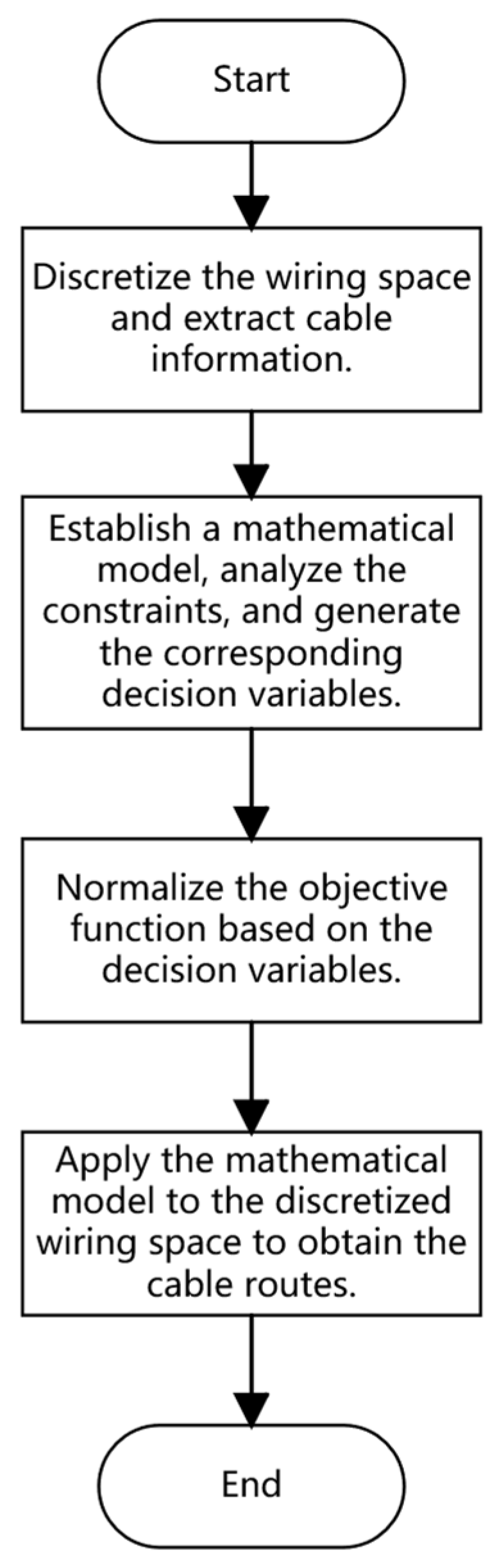
Section 2 establishes the mathematical programming-based model, detailing the definitions of decision variables, the construction of the composite objective function, and the formulation of both violable and non-violable engineering constraints.
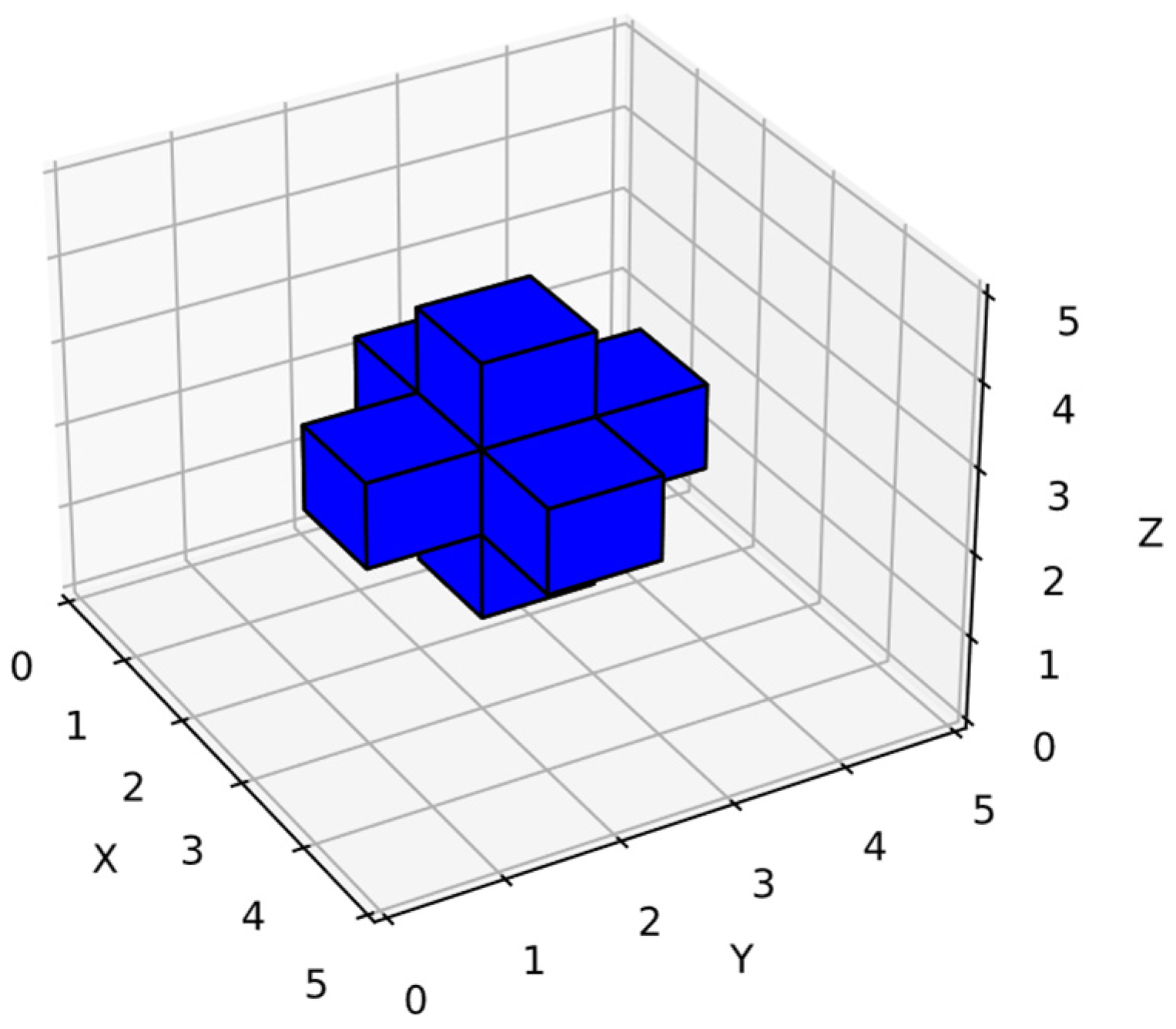
Section 3 delineates the problem-solving methodology, focusing on the linear indexing system for spatial discretization and the systematic handling of constraints within the optimization framework. In
Section 4, the effectiveness and scalability of the proposed model are rigorously validated based on six distinct scenarios. Among them, Scenario 6 is a large-scale real-world case study, and comparative analyses with classical heuristic and exact algorithms are also conducted. Finally,
Section 5 concludes this paper by summarizing the key findings and outlining potential directions for future research.
4. Experiment and Comparison
Simulations were conducted using MATLAB R2021a to validate the effectiveness of the proposed mathematical model. The experiments were carried out in the following environment: Gurobi Toolbox version 11.0.3, an Intel(R) Xeon(R) Platinum 8375C CPU running at 2.90 GHz, 256 GB of RAM, and a Windows 10 64-bit operating system. For comparative analysis, several existing algorithms were also tested, including A* algorithm [
20], Dijkstra’s algorithm [
21], RRT [
22], PSO [
23], the GA [
24], ILP [
8], and MCF [
9].
To ensure a fair and reproducible comparison, all algorithms were implemented and executed under the same hardware and software environment described above. For each scenario and each trial, the voxel grid, obstacle configuration, composite cost field parameters, and the cable start/end coordinates were kept identical across all methods [
25,
26]. Wall-clock runtime was measured in a unified manner, excluding visualization, and using the same timing scope for all algorithms. For stochastic methods, the random seed was fixed for each trial to ensure repeatability, and the stopping criteria were applied consistently as reported. For exact models, the same solver settings and time-limit policy were used to ensure comparability.
In the experiments, this paper optimizes the perception logic of the A* and Dijkstra’s algorithms. The revised logic prioritizes minimizing the total cost rather than minimizing path length. For the GA, the hyperparameters are set as follows: population size of 100, number of generations of 50, number of intermediate control points of 10, and mutation rate of 0.01. For the PSO algorithm, the hyperparameters are configured as: swarm size of 50 particles, maximum number of iterations of 300, inertia weight of 0.7, cognitive (individual) learning factor of 1.4, social learning factor of 1.4, and number of intermediate control points of 10. In all experiments, the start and end points were randomly generated for each trial, and the same generated start/end points were used for all compared algorithms in that trial, thereby avoiding cases where no valid path exists.
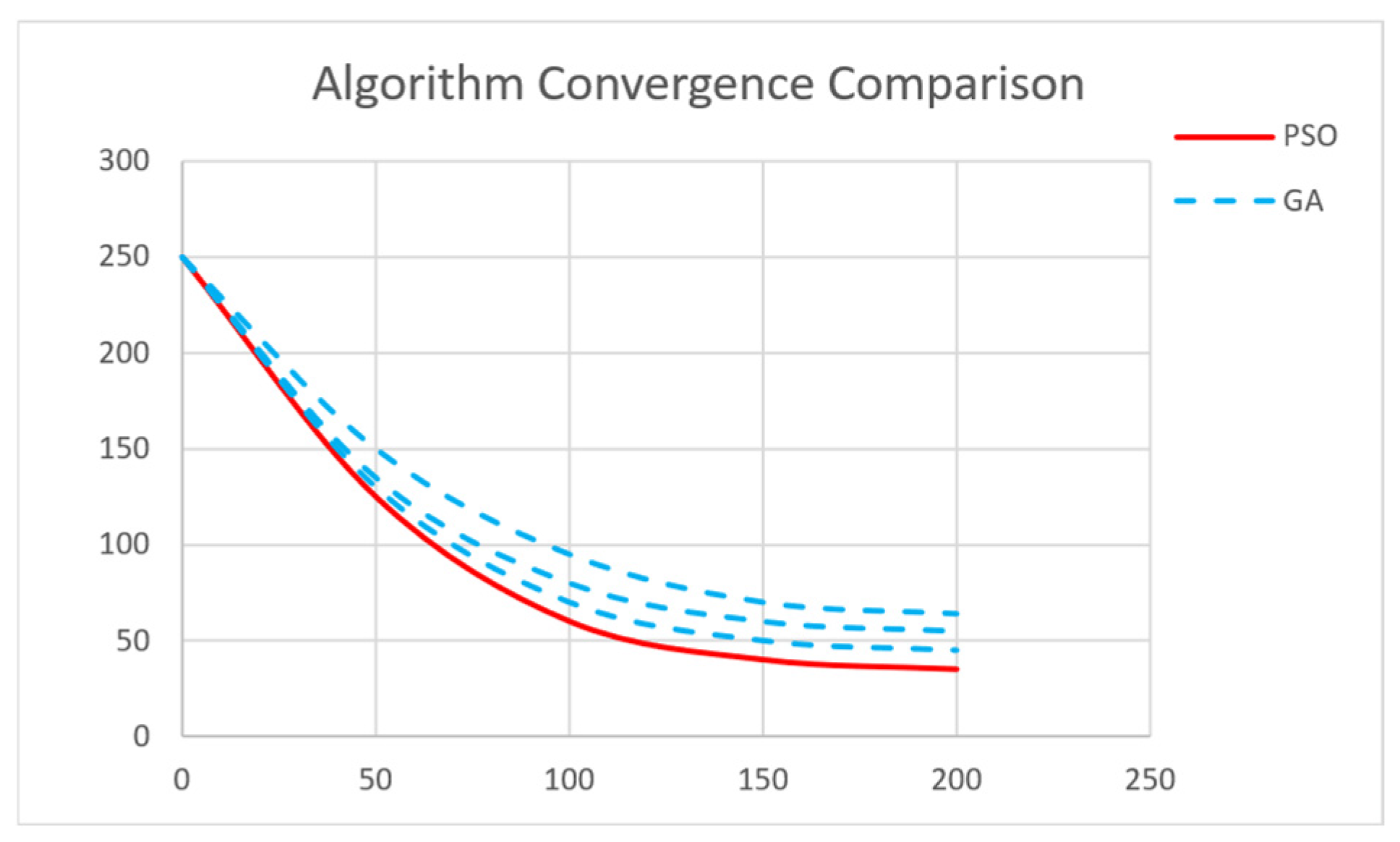
The convergence theories of different path planning algorithms differ fundamentally. Deterministic search algorithms such as A* and Dijkstra possess completeness and optimality guarantees, inevitably converging to the global optimum within a finite number of steps. In contrast, RRT, as a sampling-based probabilistically complete algorithm, primarily aims to rapidly identify a feasible collision-free path within the solution space; provided that a solution exists and sampling time approaches infinity, the algorithm is guaranteed to converge. Meanwhile, for metaheuristic optimization algorithms such as PSO and GA, the convergence process manifests as an iterative approximation dynamic, with specific convergence characteristics illustrated in
Figure 7.
In Scenarios 1–5, Gurobi terminates with MIPGap = 0, meaning that the solver certifies global optimality within the imposed time limit for all tested instances. Therefore, for these scenarios the optimization process converges to a proven optimum rather than a time-limited incumbent solution. We additionally report the time when the gap first reaches zero to characterize solver convergence speed.
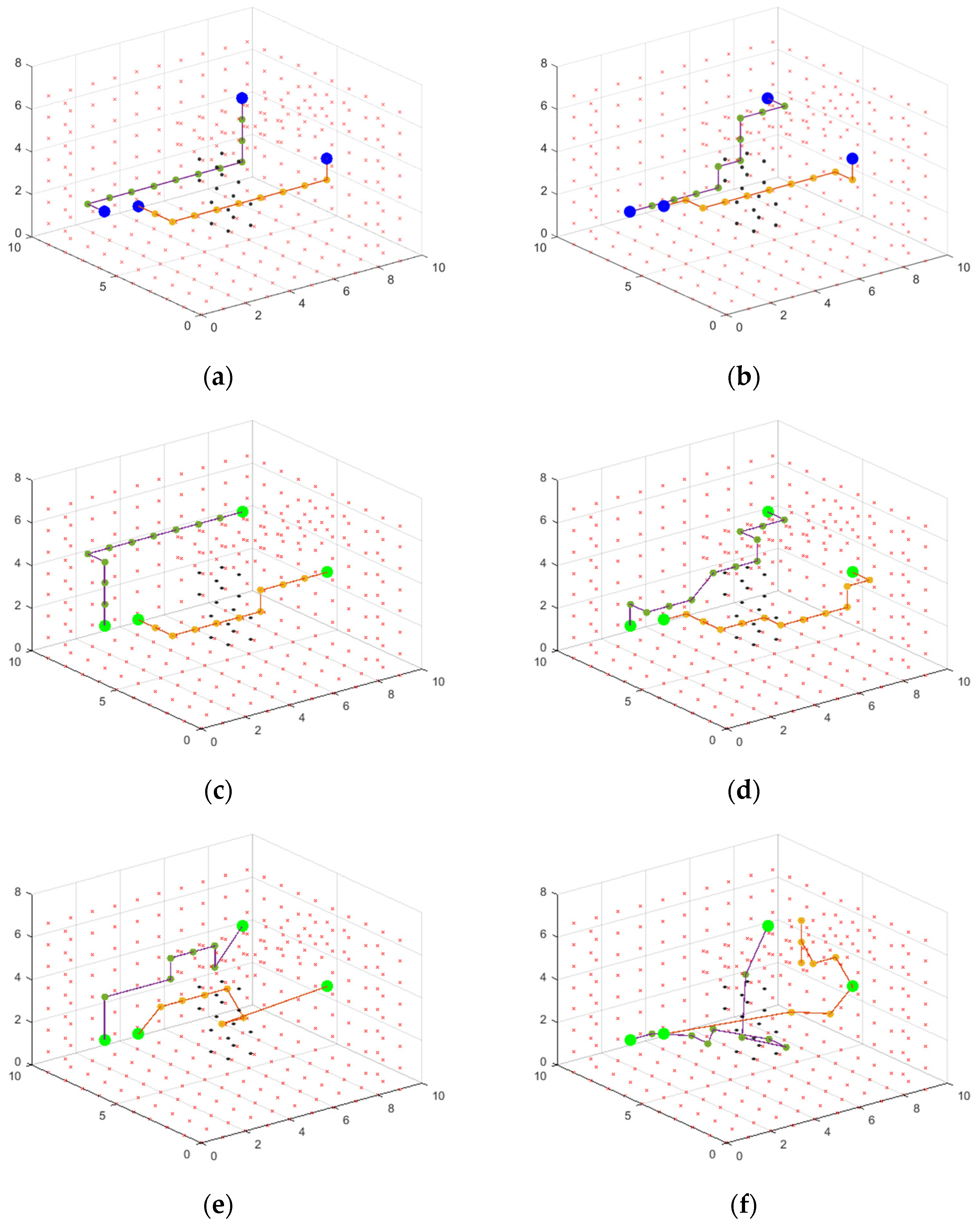
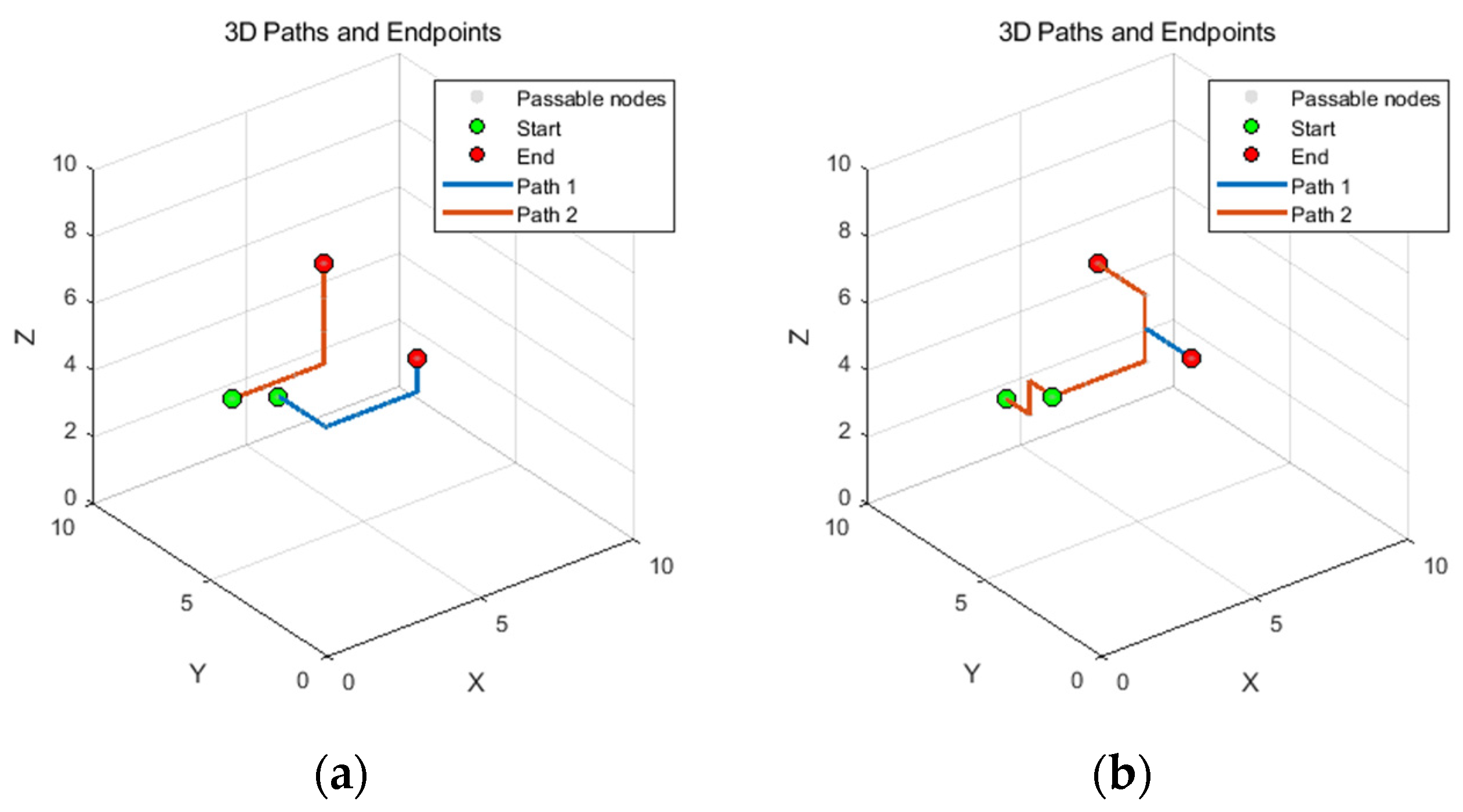
Scenario 1: The wiring space dimensions were 10 × 10 × 10, with two cables involved. The starting coordinates of the cables are (1, 5, 3) and (1, 7, 2), respectively, whereas their ending coordinates are (8, 3, 4) and (8, 8, 5), respectively. Planning was conducted using both the mathematical model proposed in this paper and the A*, Dijkstra’s, RRT, PSO, and GA algorithms, with the results presented in
Figure 8.
To reduce the impact of randomness while keeping the starting and ending coordinates as well as the wall obstacles fixed, the positions of the randomly generated obstacles within the enclosed space were varied across trials. A total of 1000 simulations were conducted, with one additional obstacle introduced into the environment every 50 iterations. Statistical analysis was performed on the results from these 1000 runs, and the comparative outcomes are summarized in
Table 2.
The experimental results fully verify the comprehensive superiority of the proposed algorithm in the task of 3D complex environment cable layout. In terms of geometric path quality, the algorithm achieves an average path length of 22.662, compared to other algorithms, it achieves an average reduction of 21.96%. This demonstrates its good performance in avoiding path redundancy and oscillation. Regarding comprehensive optimization, the proposed algorithm attains the lowest average objective function value of 2779.989, representing reductions of approximately 22.38%, 24.32%, 37.80%, 23.00%, and 51.50% compared to A*, Dijkstra’s, RRT, PSO, and GA, respectively. This strongly proves its exceptional capability in balancing path length, obstacle avoidance safety, and thermal environment constraints. Most notably, in terms of computational efficiency, the average solving time is only 0.65 s. This is not only significantly faster than traditional and intelligent algorithms such as A*, Dijkstra’s, PSO, and GA, but also approximately 27% faster than the RRT algorithm, showcasing favorable real-time performance. In summary, while effectively balancing path quality and comprehensive cost, the proposed algorithm achieves a faster solving speed, making it an efficient and robust path planning method for certain engineering applications.
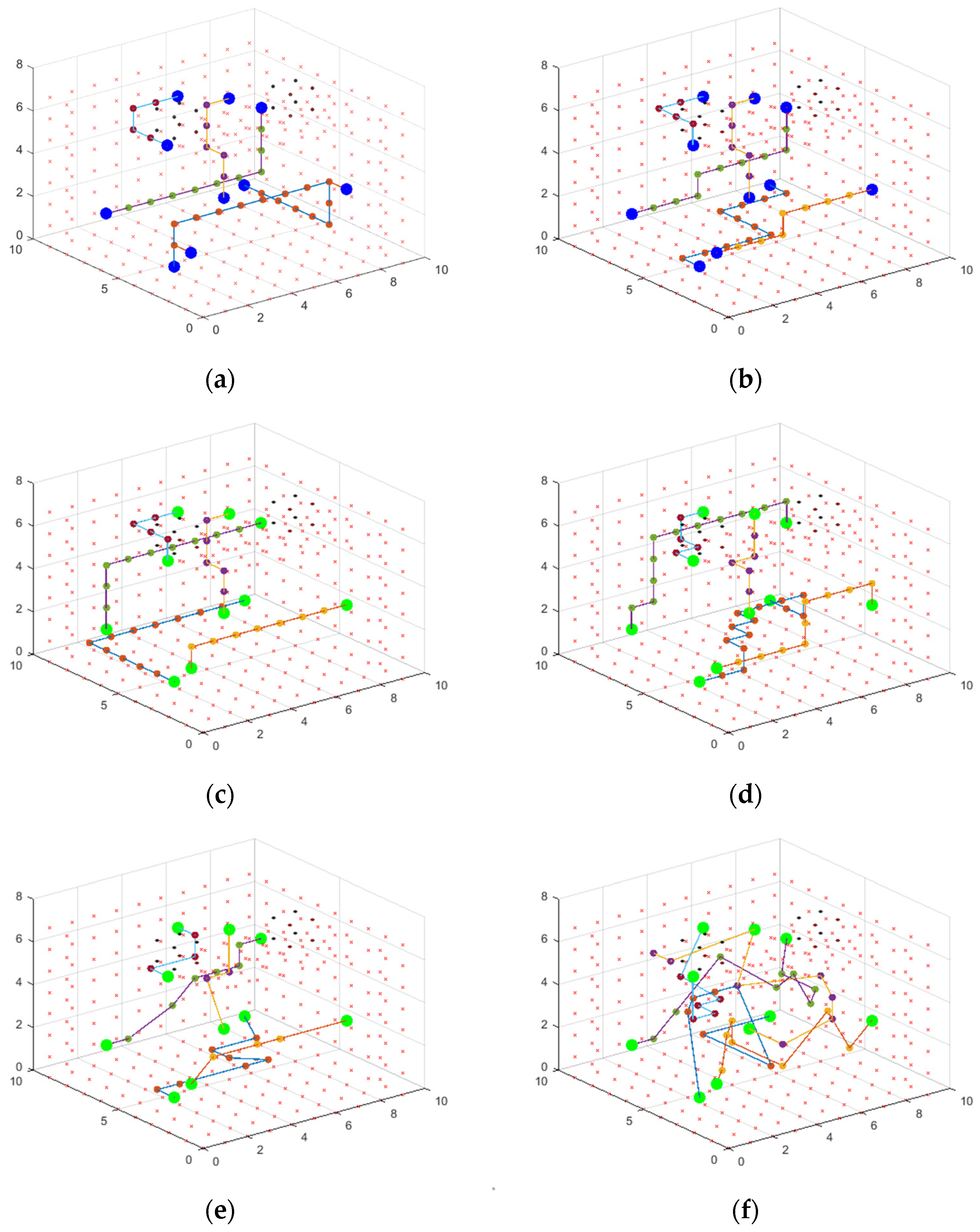
Scenario 2: Identical to Scenario 1, the wiring space dimensions were still 10 × 10 × 10, but the number of cables increases to five. The starting coordinates of the cables are (1, 2, 2), (1, 7, 2), (3, 6, 5), (1, 3, 1), and (4, 4, 3), while their ending coordinates are (8, 2, 3), (8, 7, 5), (5, 8, 6), (8, 8, 1), and (5, 5, 7), respectively. Planning was conducted using both the mathematical model proposed in this paper and the A*, Dijkstra’s, RRT, PSO, and GA algorithms, with the results presented in
Figure 9.
To avoid the effects of randomness and to maintain the same settings as in Scenario 1, the number of trials was changed to 500. An obstacle was added to the wall space every 50 trials. The results of these 500 experiments were statistically analyzed, and the comparison results are presented in
Table 3.
In the five-cable laying task, the algorithm proposed in this paper continues to demonstrate significant comprehensive superiority. Specifically, regarding geometric path quality, the algorithm achieves an average path length of 51.236, which is significantly better than the RRT and GA algorithms, with reductions of 4.27% and 51.51%, respectively. In terms of the average number of nodes, the proposed model (52.236) exhibits greater stability compared to RRT (65.824). For the core metric of average objective function value, the proposed model leads other algorithms by a large margin with a score of 6271.451. It reduces the objective value by 16.78%, 14.77%, 34.22%, 8.09%, and 57.20% compared to A* (7536.365), Dijkstra’s (7358.534), RRT (9534.256), PSO (6823.320), and GA (14,651.583), respectively. This fully highlights its robust capability in comprehensively optimizing path costs and environmental constraints in multi-cable layouts. Furthermore, regarding computational efficiency, the proposed model requires an average computation time of only 2.36 s, which is substantially faster than A* (7.43 s), Dijkstra’s (7.59 s), RRT (4.51 s), PSO (11.38 s), and GA (15.49 s), demonstrating highly efficient real-time solving capabilities. Overall, in complex multi-cable scenarios, the proposed model not only ensures superior path quality and comprehensive optimization but also possesses outstanding computational efficiency, providing a more effective solution for multi-cable layout problems.
Scenario 3: This experiment aims to systematically evaluate the influence of weighting parameters in a weighted objective function on the outcomes of multi-cable path planning. The wiring space dimensions are still 10 × 10 × 10, with the number of cables set to 2. To eliminate confounding effects arising from environmental variability, all comparative trials employ an identical obstacle configuration and share the same start and end coordinates for each cable. For enhanced clarity and improved visual interpretability, obstacles are omitted from the illustrative figures. Two distinct weight configurations are compared: (i)
, which balances path length minimization and collision avoidance; and (ii)
, which exclusively prioritizes collision avoidance while disregarding path length optimization. The experimental results are shown in
Figure 10.
In the formulated objective function, the parameter represents the weight assigned to the voxel cost term: a higher value of places greater emphasis on routing cables through low-cost voxels. Conversely, the parameter governs the weight associated with path-sharing among multiple cables: increasing encourages the co-location of multiple cable trajectories within fewer voxels, thereby promoting spatial consolidation of routes. Experimental results demonstrate that as increases, the optimized cable paths exhibit a stronger tendency toward spatial overlap, resulting in a more pronounced bundling effect. In contrast, elevating prioritizes avoidance of high-cost regions—even at the expense of reduced path-sharing length. These observations align precisely with the theoretical intent of the objective function, confirming that the relative magnitudes of and enable a principled, interpretable, and controllable trade-off between the competing objectives of minimizing traversal cost and maximizing multi-cable path sharing.
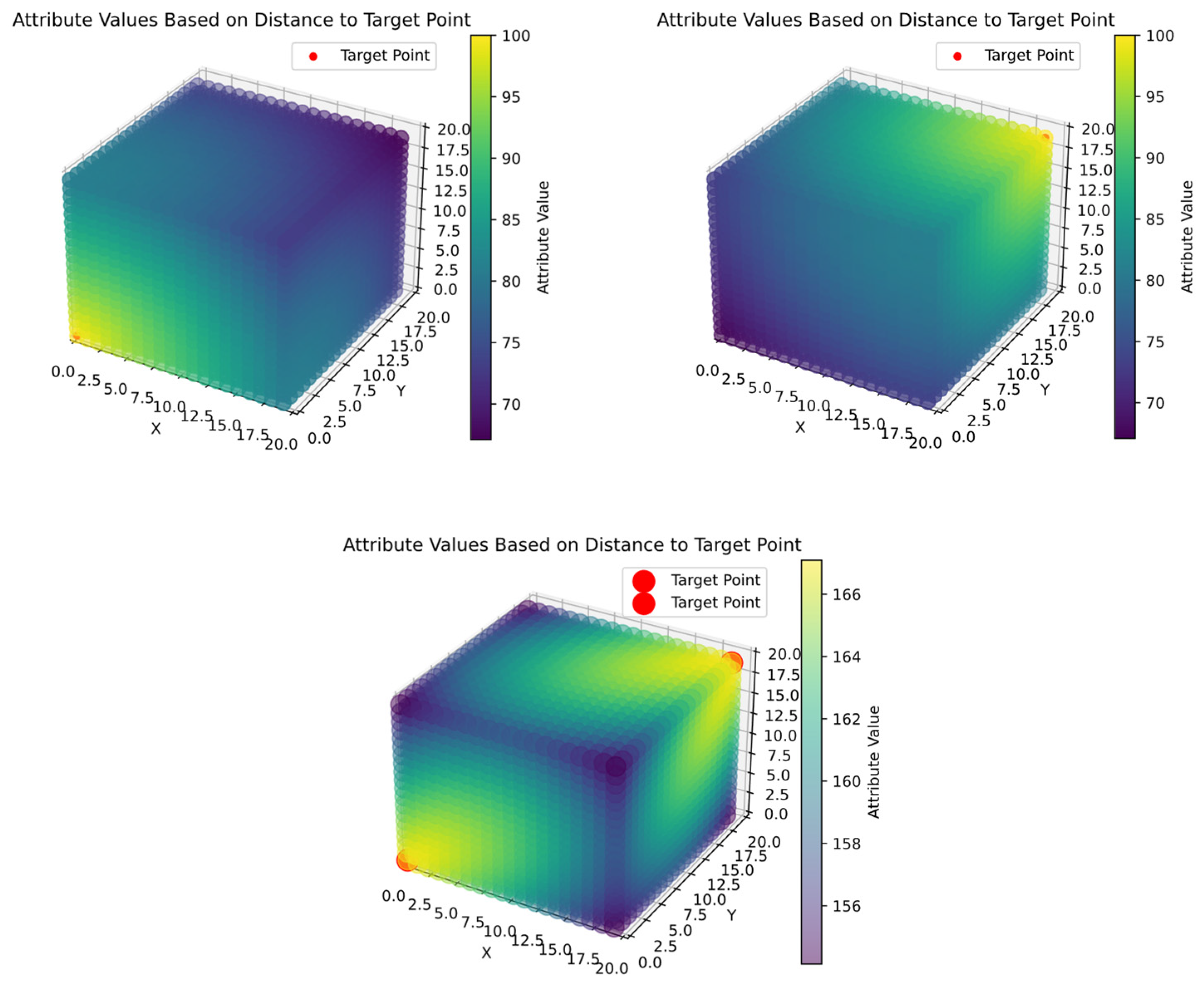
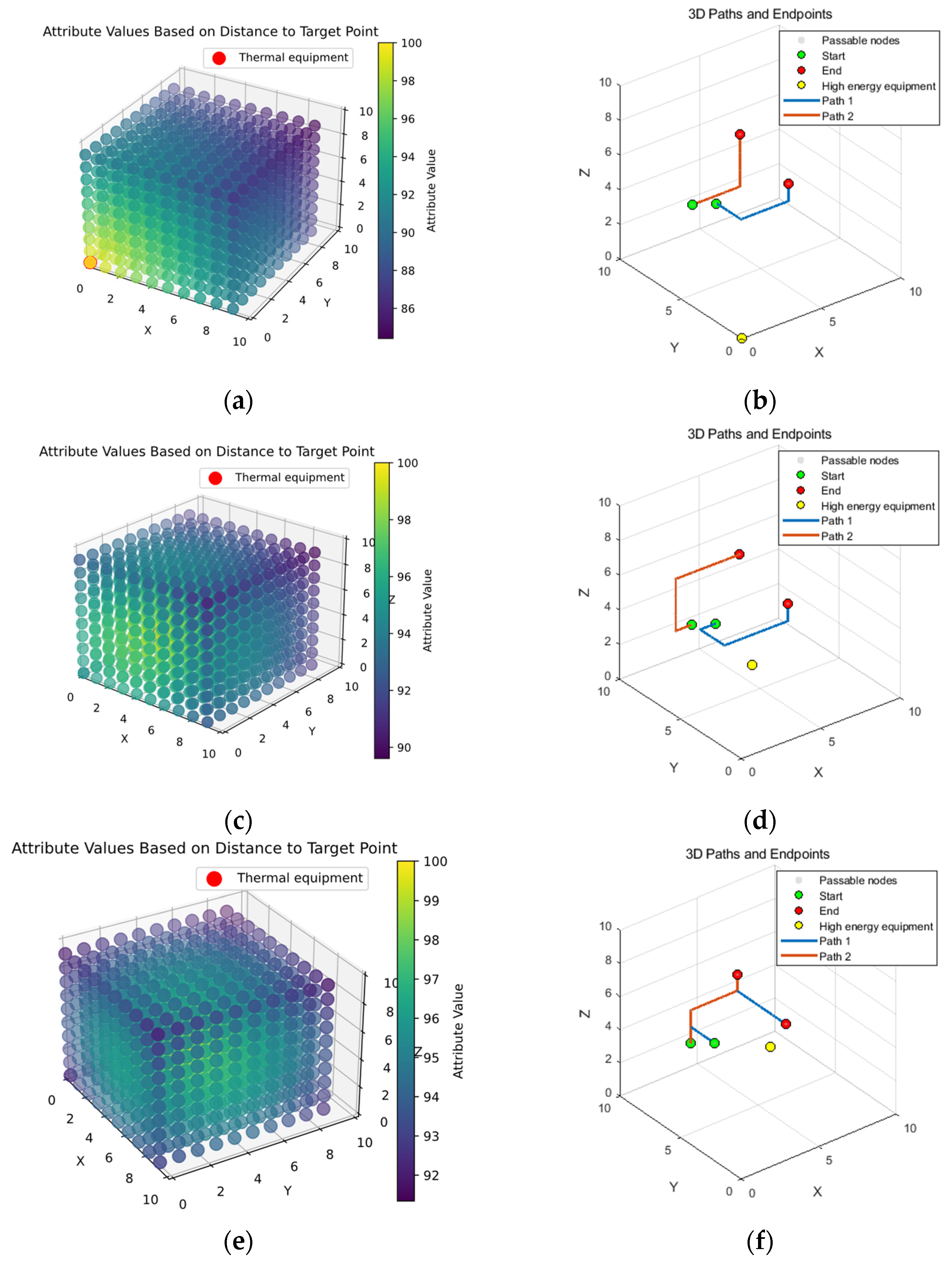
Scenario 4: This experiment aims to quantitatively evaluate the impact of thermal field distribution on the outcomes of multi-cable path planning. The experimental setup strictly adheres to the configuration established in Scenario 1, ensuring methodological consistency. To guarantee comparability across all comparative trials, an identical obstacle configuration and consistent start–end coordinates for each cable are employed throughout. Although obstacles are omitted from the visualizations to emphasize spatial variations in the thermal field, their geometric constraints are fully retained in all computational planning processes. Furthermore, to systematically investigate the influence of heat source placement on path planning behavior, three representative thermal source layouts are selected, each giving rise to a distinct thermal field configuration. These three configurations serve as the foundation for the controlled comparative analysis. The experimental results are shown in
Figure 11.
In the formulated objective function, the thermal value of each voxel is incorporated as a thermal risk cost term and participates in the weighted optimization process. Experimental results demonstrate that, across all three distinct thermal source configurations, the planned cable trajectories consistently exhibit a pronounced tendency to actively avoid high-temperature regions, preferentially routing through voxels with lower thermal values—a behavior that aligns closely with the theoretical expectations of the model design. Although circumventing high-heat zones may entail increased geometric complexity—manifested as greater path curvature or extended route length—it yields a substantial reduction in thermal exposure risk. These findings collectively underscore that the spatial distribution of the thermal field constitutes a critical environmental factor governing path planning decisions in multi-cable systems. Moreover, by appropriately tuning the weighting parameter associated with the thermal risk term in the objective function, a principled, interpretable, and controllable trade-off can be achieved between the competing objectives of thermal safety and path length/traversal cost.
Scenario 5: This experiment is designed to systematically compare two distinct path planning modeling approaches in terms of scalability and computational efficiency. The first approach is a Binary Integer Linear Programming (BILP) model grounded in binary selection variables and capacity constraints, whose mathematical structure bears formal resemblance to the classical 0–1 knapsack problem. The second approach is a graph-theoretic Minimum-Cost Multi-Commodity Network Flow (MCMCNF) model with multiple cost metrics, which explicitly represents the routing of each cable through edge-based flow variables. To ensure a fair and rigorous comparison, both models are evaluated under identical experimental conditions. Specifically, problem instances are constructed on cubic voxel grids with side lengths of 10, 20, 30, and 40, respectively, enabling a progressive assessment of scalability. Across all instances, the obstacle configuration, cable start and end coordinates, and cost parameters—including traversal costs and capacity limits—are held strictly constant to eliminate confounding factors. Furthermore, to guarantee solution completeness and comparability in the optimization process, a uniform solver time limit of
s is imposed for all runs. The experimental results are shown in
Table 4.
Experimental results demonstrate that, compared to the MCF model, the formulation proposed in this work reduces the number of decision variables by up to 83.3% across the tested problem scales. This substantial reduction stems from a fundamental distinction in the granularity of variable definition between the two modeling paradigms. Specifically, the MCF model introduces decision variables at the edge–commodity level, assigning a distinct flow variable to every combination of edge and cable. In a three-dimensional 6-connected voxel grid, each node is incident to at most six neighboring edges; consequently, the total number of variables scales linearly with both the number of edges and the number of cables. In contrast, the proposed model defines binary selection variables solely at the node or node–cable level, directly indicating whether a given node is occupied by a specific cable, without explicitly modeling edge-wise flows. As a result, its variable count scales linearly with the number of nodes (or the product of nodes and cables). In a typical 3D 6-connected cubic lattice, the number of edges is generally 3 to 6 times that of nodes—depending on whether the graph is directed or undirected and on the specific edge-counting convention. Therefore, under identical spatial resolution and cable count, the edge-based flow formulation of the MCF model inevitably incurs an order-of-magnitude increase in decision variables, accompanied by a proportional proliferation of constraints related to flow conservation, capacity limits, and coupling conditions. This structural disparity not only leads to substantially higher memory consumption but also imposes a severe computational burden on optimization solvers. Consequently, the proposed formulation exhibits clear advantages in terms of variable compactness and scalability, particularly in large-scale 3D path planning scenarios.
Given that integer programming is theoretically NP-Hard, its practical solution time is highly sensitive to the number of decision variables and constraints; specifically, within the Branch-and-Bound framework, the size of the search tree typically grows superlinearly—often exponentially—with respect to problem dimensionality. Consequently, a substantial reduction in the number of decision variables directly translates into a significant decrease in computational time. Experimental results further demonstrate that as the problem scale—such as grid resolution or the number of cables—continues to increase, this computational advantage exhibits a pronounced and amplifying marginal gain. This behavior robustly validates that the proposed model exhibits favorable scalability and computational efficiency in large-scale multi-cable path planning tasks, making it a potential candidate for real-world applications with certain real-time or resource constraints.
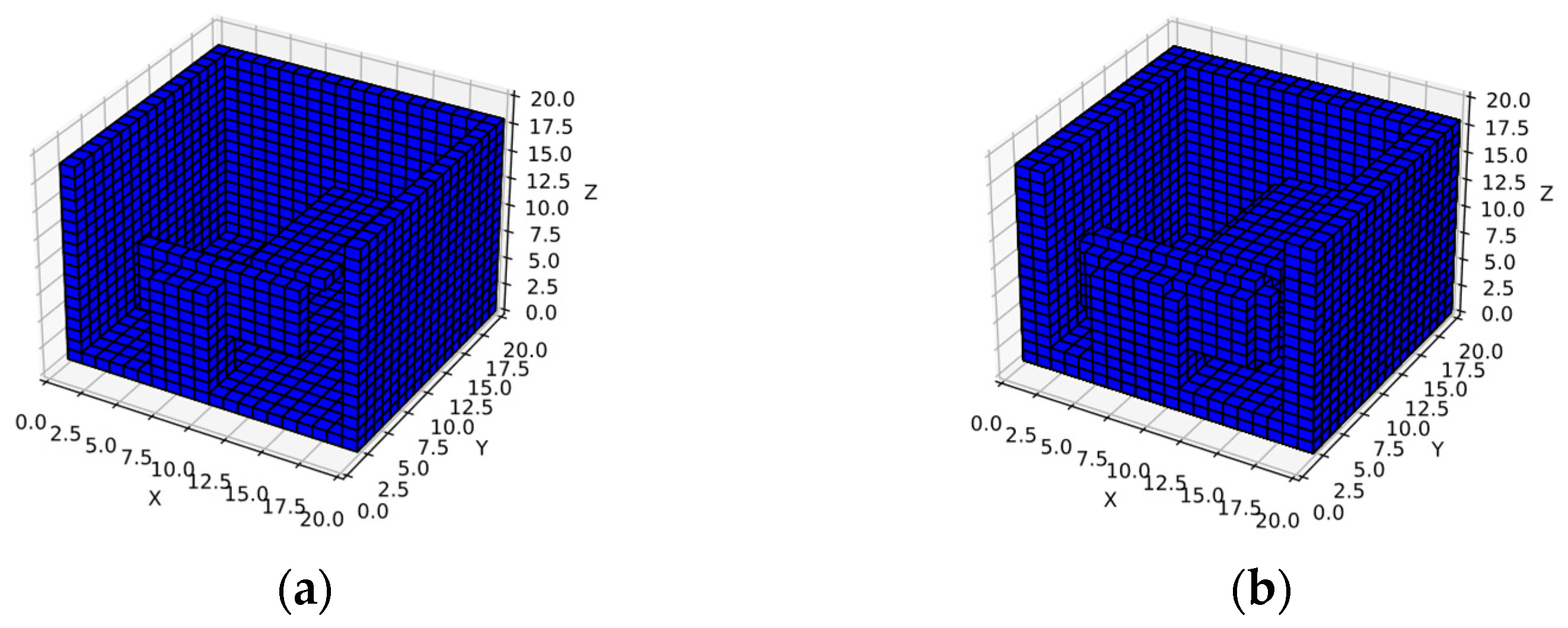
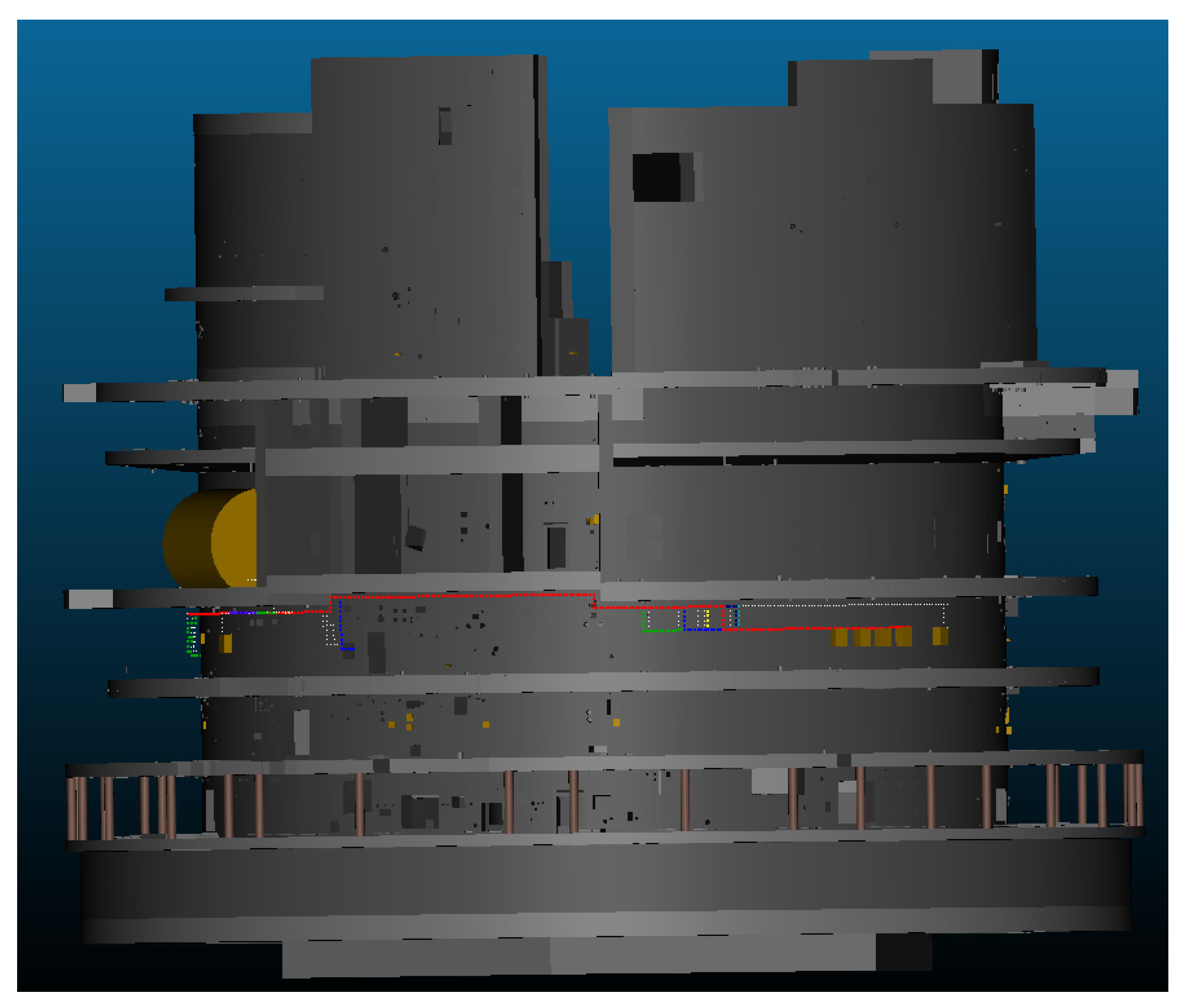
Scenario 6: In this experiment, a real-world case study was conducted using nuclear island data provided by the China Nuclear Power Research Institute (CNPRI). One layer of the nuclear island was selected as the solution space to perform empirical research on nuclear-grade cable routing. The cable-related parameters are presented in
Table 5. The experimental results are shown in the
Figure 12. The proposed model is compared with MCMCNF and the PSO heuristic algorithm that achieved the best performance in the previous experiments, and the comparison results are presented in
Table 6.
In the real-world scenario, the experimental results further demonstrate that the proposed mathematical model retains favorable overall performance for large-scale instances. First, in terms of model size, the Proposed Model contains 31,245,856 decision variables and 33,634,742 constraints, which are substantially lower than the 158,675,133 decision variables and 252,352,027 constraints required by MCMCNF, corresponding to reductions of approximately 80.3% and 86.7%, respectively. This result is consistent with the previous conclusion that the node-driven variable definition can substantially compress the model size and alleviate the growth of combinatorial complexity, thereby indicating that the proposed model exhibits better compactness and scalability at the modeling level. Second, under the same time limit, both the Proposed Model and MCMCNF reach TL; however, the proposed model still attains a lower feasible objective value and a smaller optimality gap, indicating that, under the same computational budget, the Proposed Model is capable of identifying a higher-quality feasible solution and demonstrates stronger performance under limited solving time. In contrast, PSO yields a final objective value of 212,307.6, which is significantly higher than that of the Proposed Model, and requires 11,152.2 s of computation time. This indicates that, in real and complex scenarios, although heuristic methods are able to generate feasible solutions, they remain clearly inferior to the mathematical programming model proposed in this paper in terms of solution quality. Overall, these results further verify that, by significantly reducing the number of decision variables and constraints, the proposed model is able to obtain relatively better solutions even under a stringent time limit, thereby demonstrating superior engineering applicability and practical value.
5. Conclusions
In this paper, a cable layout optimization model based on mathematical planning is proposed to solve the challenges brought by the complex spatial structure, dense equipment distribution and limited wiring space in a limited environment. Firstly, the 3D layout space is discretized into regular grids, and the routable area and obstacle position are accurately represented by 3D coordinates. Then, a comprehensive cost field is constructed on the basis of the grid, which consists of a distance field and a heat field. The distance field is defined as the shortest distance from each grid node to the nearest obstacle, and its value increases with the distance from the obstacle to avoid routing conflicts; the thermal field is used to quantify the impact of thermal environment. Considering the physical characteristics that the thermal effect attenuates with the increase of the distance from the heat source, and combining the superposition effect of multiple heat sources, the cumulative distance from a point to all relevant heat sources is mapped to a positive real number, thus reflecting the overall heat load level of the location. On this basis, the geometric, thermal safety, connectivity and other constraints on cable routing are systematically analyzed and transformed into strict mathematical expressions to build the objective function of the multi-objective optimization model. By introducing weight coefficients, the multi-objective problem is transformed into a single objective optimization problem, which is solved using mathematical programming methods to obtain a high-quality feasible routing path under the prescribed time limit, together with solver-provided optimality information (lower bound and optimality gap). Global optimality for the discretized model can be certified only when the solver converges and proves optimality.
In the experimental verification phase, the proposed method is compared with many classic path planning algorithms such as A*, Dijkstra’s, RRT, PSO and GA in a variety of complex scenarios. The results show that in the two-cable layout task, although the average path length and number of nodes of the method in this paper are slightly higher than those of A* and Dijkstra’s algorithms, the objective function value decreases by 20% on average, reflecting better comprehensive performance; compared with RRT, this method performs better in path length, node number and objective function value. Compared with PSO and GA, although the number of nodes generated is slightly more, the path is shorter and the objective function value is significantly lower. In the more complex five cable layout scheme, the performance trend is consistent: the proposed method is still comprehensively superior to A*, Dijkstra’s, RRT and PSO in the average objective function value. Furthermore, in terms of computational efficiency, the proposed algorithm was significantly faster than the classical algorithms in both dual-cable and five-cable laying tasks. These results preliminarily validate the proposed mathematical programming model’s effectiveness, robustness, and certain adaptability under varying levels of wiring complexity.
Although the proposed node-driven formulation significantly reduces the scale of decision variables and computational pressure compared with conventional edge-driven integer programming models, it still inherits the inherent scalability limitations of integer optimization methods when facing ultra-large-scale engineering scenarios. In practical applications, the solving efficiency may be restricted by problem size and computational resources.
For further improvement, multiple promising optimization directions can be adopted in future research, including problem decomposition strategies, hybrid cooperation with heuristic algorithms, parallel computing technology, and Lagrangian relaxation methods, to further enhance the computational adaptability and scalability of the proposed model for complex large-scale cable routing tasks. Therefore, future research should focus on introducing parallel computing, model dimensionality reduction or decomposition strategies to improve solution efficiency and promote the practical application of this method in large-scale engineering systems.