1. Introduction
Modern machine learning systems are typically formulated through empirical or expected risk minimization. In this framework, predictors are optimized primarily to minimize prediction error, often together with regularization terms controlling model complexity. This paradigm has produced substantial empirical success across a wide range of applications. However, predictive accuracy alone is frequently insufficient in high-stakes settings. Systems deployed in healthcare, finance, public policy, and scientific research must also satisfy requirements related to robustness, fairness, transparency, and interpretability.
The rapid growth of large-scale datasets has significantly expanded the capabilities of deep neural networks. Highly overparameterized models can now learn complex hierarchical representations and capture subtle statistical dependencies that remain inaccessible in small-data regimes. This development has enabled major advances in computer vision, natural language processing, healthcare, finance, and scientific discovery. However, increased predictive performance does not necessarily imply reliability. Models with excellent test accuracy may still behave unpredictably under distributional shifts, exhibit systematic bias, or produce decisions that domain experts cannot meaningfully interpret.
These limitations become particularly significant in critical applications [
1,
2]. In healthcare, machine learning systems are increasingly used for diagnosis, prognosis, and treatment planning. Deep learning methods in medical imaging can achieve extremely high predictive performance [
3]; nevertheless, their deployment in clinical practice remains limited by several structural difficulties. First, model predictions are often difficult to interpret, making it challenging for clinicians to determine whether decisions are medically justified. Second, state-of-the-art supervised approaches typically rely on large-scale pixel-level annotations, which are expensive and difficult to obtain in medical settings. This situation motivates the development of learning frameworks capable of incorporating structural constraints and prior information when fully supervised data are unavailable.
Similar concerns arise in finance [
4,
5], public policy [
6], and criminal justice [
7,
8]. In the financial sector, machine learning models are widely used for credit scoring, fraud detection, risk assessment, and algorithmic trading. However, models trained on historical datasets may inherit or amplify pre-existing demographic and societal biases, resulting in systematically unequal outcomes across groups. Regulatory frameworks therefore increasingly require automated decisions to be explainable and auditable, limiting the deployment of opaque black-box systems. Comparable issues appear in criminal justice and public policy, where algorithmic systems influence sentencing, risk assessment, and resource allocation. In these settings, limited interpretability complicates accountability, external auditing, and legal oversight.
Robustness presents an additional challenge. Modern machine learning systems are often highly sensitive to small perturbations in the input data. In computer vision, adversarial perturbations can produce highly confident yet incorrect predictions, while in autonomous systems such sensitivity may lead to unsafe behavior under minor environmental changes. At the same time, interpretability becomes particularly important in scientific applications, where the objective extends beyond prediction to the extraction of mechanistic understanding. Machine learning models are increasingly used to identify patterns in physics, biology, climate science, and related disciplines. However, when predictive systems operate purely as black boxes without providing interpretable mechanisms, their scientific value becomes limited because they fail to generate insight into the underlying phenomena.
These observations suggest a broader limitation of standard machine learning formulations. In many existing approaches, robustness, fairness, and interpretability are introduced only after training, either as external constraints, post hoc corrections, or independent optimization objectives [
1]. As a consequence, their interaction with predictive risk remains difficult to analyze systematically. The existing literature often studies predictive risk minimization, robustness, fairness, and interpretability within separate theoretical frameworks, despite the fact that these properties interact strongly in practical applications.
In this work, we argue that many of these difficulties arise because standard learning objectives are variationally under-constrained. From this perspective, the black-box behavior of modern machine learning systems is not necessarily an intrinsic property of neural networks themselves, but rather a consequence of optimization objectives that fail to encode relevant structural and functional requirements. Predictive accuracy alone does not determine whether a model is robust, fair, stable, or scientifically interpretable. To address this limitation, we introduce a unified variational framework in which robustness, fairness, and interpretability are formulated directly as functionals over the hypothesis space and incorporated into a single learning objective. This formulation extends classical risk minimization by integrating predictive performance together with structural constraints within a common functional-analytic framework. The main idea is to treat trustworthy behavior not as a secondary correction, but as an intrinsic component of the optimization problem itself. This perspective allows tools from variational analysis, functional analysis, and multi-objective optimization to be applied systematically to the study of reliable machine learning systems.
A central motivation for this framework is the need to analyze trade-offs between competing objectives in a mathematically coherent manner. In particular, predictive accuracy and fairness are known to satisfy incompatibility relations in many settings, where multiple fairness criteria cannot generally be achieved simultaneously without affecting predictive performance. The proposed formulation provides a natural setting in which such interactions can be characterized variationally.
The goal of this work is therefore not to propose a new optimization algorithm, but rather to establish a unified variational formulation for reliable machine learning. In contrast to modular or post hoc approaches, the proposed framework incorporates robustness, fairness, and interpretability directly into the learning objective. This enables a systematic analysis of trustworthy machine learning within a single mathematical framework.
The main contributions of this paper are as follows:
(
Section 3) We introduce a unified variational formulation of machine learning in which predictive risk, structural regularization, robustness, fairness, and interpretability are integrated into a single-objective functional.
(
Section 4) We show how several classical paradigms, including regularized learning, kernel methods, robust optimization, fairness-aware learning, sparse coding, and physics-informed learning, arise as special cases of the proposed framework.
(
Section 5) We formalize robustness and fairness as structural functionals over hypothesis spaces and analyze the trade-offs that arise between predictive accuracy and structural constraints.
(
Section 6) We introduce a multi-criterion interpretability functional combining simplicity, information relevance, and stability of explanations, including a discussion of finite-dimensional and RKHS-compatible complexity measures.
(
Section 7) We study theoretical consequences of the unified framework, including existence of minimizers, Pareto-optimality, stability, robustness, and generalization properties under suitable assumptions.
(
Section 8) We discuss computational and practical instantiations of the framework, showing how modern methodologies such as adversarial training, fairness-aware optimization, sparse coding, kernel methods, and physics-informed neural networks can be interpreted within a common variational perspective.
Finally,
Section 9 discusses computational limitations, optimization challenges, and open research directions associated with the proposed framework, including scalability in highly nonconvex settings and connections with emerging large-scale machine learning systems.
2. Related Work
Modern machine learning theory already contains many of the mathematical ingredients required for trustworthy learning, including variational optimization, regularization theory, robustness analysis, fairness constraints, interpretability objectives, and multi-objective optimization. However, these components are typically developed within distinct mathematical frameworks. As a consequence, robustness, fairness, interpretability, and predictive risk are often treated as separate optimization objectives whose interactions remain difficult to analyze systematically. Comparatively few works attempt to formulate these structural requirements within a single variational principle.
A central feature of classical statistical learning theory is the formulation of learning problems as optimization over function spaces. In particular, predictors are commonly studied in Hilbert or Banach spaces, including reproducing kernel Hilbert spaces (RKHSs), Sobolev spaces, and related functional spaces that provide suitable geometric and topological structure for optimization and generalization analysis [
9,
10]. Within this framework, learning objectives naturally appear as functionals over infinite-dimensional hypothesis spaces, making tools from variational analysis and functional analysis directly applicable.
Variational and functional-analytic approaches provide rigorous methods for studying optimization landscapes, regularization mechanisms, implicit bias, compactness properties, and stability of learning algorithms [
11,
12,
13,
14,
15,
16]. In particular, these methods are fundamental for analyzing existence and uniqueness of minimizers, lower semicontinuity of objective functionals, compactness of admissible sets, and stability or generalization guarantees under suitable assumptions. Classical regularization methods can also be interpreted variationally through structural penalty functionals such as norm-based regularization in Hilbert spaces [
17]. Nevertheless, these formulations primarily address predictive risk and complexity control, without explicitly incorporating robustness, fairness, or interpretability as intrinsic structural components of the objective itself.
A similar structural limitation appears in robustness formulations. Distributionally robust optimization (DRO) and adversarial training both replace standard empirical risk minimization by worst-case optimization over structured perturbation sets. In adversarial robustness, predictors are optimized against local worst-case perturbations of the input data [
18,
19,
20]. Distributionally robust optimization instead considers uncertainty sets of probability measures surrounding the empirical data distribution, typically defined through Wasserstein distances and optimal transport theory [
21,
22,
23,
24]. From a variational perspective, both approaches introduce robustness functionals that quantify stability under adversarial or distributional perturbations.
These methods provide formal guarantees related to worst-case risk control, stability, and robustness under suitable assumptions [
25]. However, robustness is usually incorporated either as an external constraint or as a standalone optimization objective. Consequently, existing robustness formulations rarely analyze systematically how robustness interacts with fairness, interpretability, or other structural requirements within a unified variational framework.
The same fragmentation appears in fairness-aware learning. Existing approaches typically introduce fairness through statistical constraints or dependence penalties imposed on predictive distributions. Group-based criteria such as demographic parity and equalized odds constrain the distribution of predictions across sensitive groups [
26,
27], while information-theoretic formulations measure dependence between predictions and sensitive attributes through quantities such as mutual information [
28]. From a variational viewpoint, these approaches can be interpreted as introducing fairness functionals over the hypothesis space that penalize discriminatory dependence.
Importantly, different fairness criteria encode distinct and often incompatible notions of equity. Impossibility results show that multiple fairness criteria cannot generally be satisfied simultaneously without affecting predictive performance [
29,
30]. These results suggest that fairness cannot usually be treated as an independent post hoc correction layered on top of predictive optimization. Instead, fairness introduces competing structural objectives that interact intrinsically with predictive risk. Existing approaches therefore commonly formulate fairness either as constrained optimization or as regularization within multi-objective settings [
31]. Nevertheless, fairness formulations remain largely modular and are rarely integrated jointly with robustness and interpretability within a common functional-analytic framework [
32,
33,
34].
Interpretability introduces a related class of structural objectives. Existing methods range from sparse and transparent models to post hoc explanation techniques [
1]. Information-theoretic approaches such as the Information Bottleneck formalize interpretability through trade-offs between compression and predictive relevance [
35,
36,
37], while recent work emphasizes the stability and robustness of explanations themselves [
38]. These approaches again introduce additional structural functionals associated with simplicity, compression, relevance, or explanation stability. However, interpretability objectives are typically studied independently from robustness and fairness, often without a unified variational formulation capable of analyzing their interaction systematically [
2,
39].
More broadly, these difficulties reflect a common structural phenomenon. Existing approaches frequently introduce robustness, fairness, interpretability, or stability through auxiliary penalties, constraints, or independent optimization objectives added to standard empirical risk minimization. While these formulations successfully encode individual structural properties, they rarely provide a unified functional-analytic framework in which multiple structural objectives are incorporated simultaneously as components of a single variational principle.
This fragmentation becomes particularly visible in multi-objective optimization frameworks [
40,
41,
42,
43,
44]. Such approaches provide a natural mathematical language for describing trade-offs between predictive accuracy and structural requirements. In particular, Pareto-efficient solutions characterize predictors for which no objective can be improved without simultaneously degrading at least one competing objective. From a variational perspective, scalarized objectives therefore provide a mechanism for selecting Pareto-optimal predictors within a multi-objective trade-off space.
However, most existing multi-objective approaches operate primarily at the optimization or algorithmic level, focusing on Pareto-front computation, scalarization strategies, or constrained optimization procedures. Comparatively less attention has been devoted to developing unified functional-analytic formulations that simultaneously integrate robustness, fairness, and interpretability as structural functionals within a single variational objective together with well-posedness guarantees related to existence, compactness, semicontinuity, and Pareto-optimality.
Table 1 summarizes these distinctions from the perspective of variational structure and functional integration.
In contrast to the prior literature, the framework proposed in this work formulates robustness, fairness, and interpretability directly as structural functionals over the hypothesis space and incorporates them into a single variational objective. The main contribution is therefore not merely the aggregation of multiple objectives, but the development of a unified functional-analytic formulation that:
Integrates multiple structural requirements within a single variational principle;
Is amenable to tools from variational analysis and the calculus of variations;
Provides well-posedness guarantees under suitable assumptions;
Establishes explicit connections between scalarized optimization and Pareto-optimality.
To the best of our knowledge, existing approaches rarely combine unified variational formulations, functional-analytic well-posedness guarantees, and explicit Pareto structure within a single framework.
3. A Unified Variational Framework
3.1. Unified Functional Formulation
Let
be a hypothesis space of measurable functions
. We define the learning problem as the minimization of the functional
where:
is the expected risk;
is a structural regularizer;
are functionals encoding robustness, fairness, or other constraints;
is an interpretability score;
, , and are trade-off parameters.
The interpretability term is incorporated directly into the objective as a reward functional. Larger values of correspond to predictors that are simpler, more stable, or more transparent according to the chosen interpretability criterion. In the unified objective, the coefficient controls the relative importance assigned to interpretability compared with predictive accuracy and other structural objectives.
Classical empirical risk minimization (ERM) seeks predictors that minimize only the expected prediction error
. The proposed framework extends this paradigm by embedding additional structural objectives directly into the variational functional. The terms
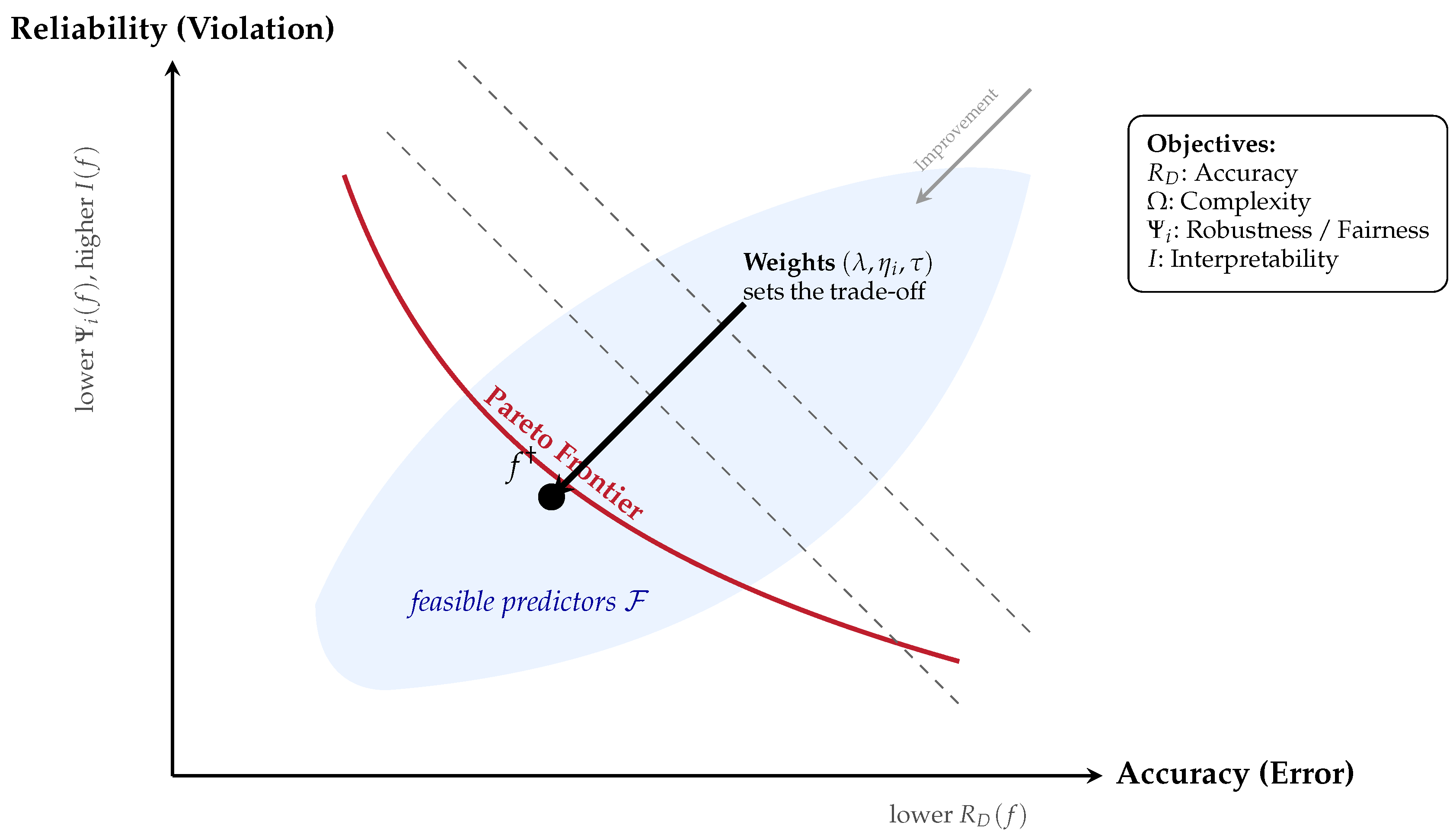
allow the learning problem to simultaneously account for model complexity, robustness, fairness, physical consistency, or interpretability within a single optimization principle. In many modern machine learning applications, such structural properties cannot be treated as purely post hoc corrections. For example, robustness, fairness, and interpretability may fundamentally interact with predictive performance and with one another. Incorporating these requirements directly into the objective functional allows the resulting predictors to be analyzed through a unified variational and multi-objective framework, making the trade-offs between competing criteria mathematically explicit. The geometric interpretation of these competing objectives is illustrated in
Figure 1, where the scalarized functional selects Pareto-optimal predictors within a multi-objective trade-off space. The dashed lines in
Figure 1 schematically illustrate the effect of the trade-off parameters
on the optimization process. Varying these weights changes the relative importance assigned to predictive accuracy, robustness, fairness, complexity, and interpretability, thereby inducing the selection of different Pareto-optimal solutions along the Pareto frontier.
The hypothesis space is assumed to consist of measurable predictors where is the input space and is the prediction space. Depending on the learning setting, may be a finite-dimensional parameter space, a Banach space, a reproducing kernel Hilbert space (RKHS), or a class of neural network parametrizations. Throughout the paper, the functional-analytic structure imposed on is chosen so that the relevant variational properties (e.g., lower semicontinuity, coercivity, compactness) are well-defined.
3.2. Well-Posedness and Basic Properties
We now collect basic properties of the unified objective. These results follow from standard arguments in the calculus of variations and multi-objective optimization.
We assume that is endowed with a topology (e.g., a Banach or Hilbert space structure) under which the functionals are defined.
Proposition 1 (Well-posedness and basic properties)
. Let and let be a hypothesis space of measurable functions . Consider the functionalAssume:
- (H1)
Ω is coercive on ;
- (H2)
, Ω, and each are lower semicontinuous;
- (H3)
the sublevel sets of are relatively compact;
- (H4)
I is upper semicontinuous.
Then:
- (i)
Existence. There exists such that - (ii)
Trade-off inequality. Let - (iii)
Pareto optimality. The minimizer is Pareto-optimal for the multi-objective problem
Remark 1.
The above properties follow from classical arguments in variational analysis. In particular, existence is a consequence of the direct method [11] of the calculus of variations, while Pareto optimality follows from standard scalarization principles in multi-objective optimization. Their role here is to show that the unified functional preserves well-posedness while incorporating multiple structural constraints. Remark 2.
Typical examples of reflexive Banach spaces include spaces for and Hilbert spaces such as reproducing kernel Hilbert spaces, which are used in Section 4.2. Remark 3
(On the assumptions). The compactness assumption (H3) can be ensured in standard settings. For example, if is a reflexive Banach space and Ω is coercive, then sublevel sets of are relatively compact in the weak topology.
Proposition 1 provides a unified variational perspective on learning problems with multiple structural objectives. It shows that:
Predictors can be characterized as minimizers of a composite functional;
Structural constraints such as robustness, fairness, and interpretability can be incorporated without compromising well-posedness;
Trade-offs between predictive accuracy and additional constraints arise naturally from the objective;
The unified formulation induces Pareto-optimal solutions in the corresponding multi-objective space.
This perspective serves as a foundation for the analysis and examples developed in the subsequent sections.
3.3. Intuitive Interpretation: The Control Panel View
The unified objective (
1) can be understood through a simple geometric and conceptual analogy. Rather than viewing learning as the optimization of a single quantity, the proposed formulation treats it as a multi-criteria control problemin which several competing objectives must be balanced simultaneously.
From single-objective to multi-objective learning.
Classical empirical risk minimization focuses primarily on predictive accuracy, as measured by the risk . In this setting, the learning problem can be interpreted as minimizing a single axis: the prediction error.
However, in many real-world applications, additional requirements are essential. Robustness, fairness, and interpretability impose structural constraints that cannot, in general, be satisfied simultaneously without affecting predictive performance. The unified objective makes these requirements explicit by introducing additional terms that quantify deviations from these desired properties.
A control panel of competing objectives. Each component of the functional plays a distinct role:
measures predictive accuracy: how well the model fits the data.
controls model complexity: how simple or regular the predictor is.
quantify violations of structural constraints, such as lack of robustness or fairness.
measures interpretability: how understandable or stable the model is.
These terms can be viewed as defining a control panel with multiple dials. The parameters determine how much weight is assigned to each objective, and therefore how much predictive accuracy one is willing to trade in order to enforce structural properties.
Trade-offs and the Pareto frontier. From a geometric perspective, each predictor
corresponds to a point in a multi-dimensional space whose coordinates are given by
In this space, it is generally impossible to simultaneously minimize all coordinates. Improving one objective (e.g., fairness) may worsen another (e.g., accuracy). As a result, optimal solutions lie on the
Pareto frontier. A predictor is said to be Pareto-optimal if no other predictor can improve one objective without worsening at least one of the remaining objectives. The collection of all such predictors forms the Pareto frontier. The scalarized objective (
1) selects a particular point on this frontier by assigning weights to each component. Different choices of
correspond to different trade-offs and lead to different Pareto-optimal solutions.
Why trade-offs are unavoidable. The proposed framework emphasizes that trade-offs are intrinsic to multi-objective learning problems rather than artifacts of particular algorithms. Structural objectives often compete directly with predictive accuracy. For example, enforcing fairness constraints may reduce the use of highly predictive but sensitive features, while robustness requirements may limit highly specialized decision boundaries. Similarly, interpretability and simplicity constraints can restrict the expressive complexity of admissible predictors. Consequently, no single predictor can generally optimize all criteria simultaneously, making Pareto trade-offs unavoidable within the learning process itself.
Summary. The unified variational principle can thus be interpreted as a mechanism for navigating a space of competing objectives. Instead of searching for a single notion of optimality, it provides a structured way to explore and control trade-offs between accuracy, robustness, fairness, and interpretability. This perspective complements the formal results of Proposition 1 by providing an intuitive understanding of why Pareto-optimal solutions arise naturally in the proposed framework.
4. Reinterpreting Existing Paradigms
The unified functional formulation introduced in
Section 3 provides a common variational perspective that encompasses a wide range of machine learning methodologies. In this section, we demonstrate how several established paradigms arise as special cases of the proposed framework. We now illustrate how classical methods fit within Proposition 1.
Regularized Learning. Classical statistical learning is typically formulated as empirical or expected risk minimization with a structural penalty:
This corresponds to the proposed framework with
for all
i. Common choices of
include:
regularization (ridge regression): ;
regularization (lasso): ;
RKHS norms in kernel methods: .
These regularizers control model complexity and are closely tied to generalization guarantees via capacity measures. From a variational perspective, these methods differ primarily in the choice of hypothesis space, loss functional, and structural penalties. The proposed framework therefore provides a common functional language for regularization, probabilistic inference, and structural constraints.
The connection between Bayesian inference and regularization is particularly well known [
45,
46]. In Bayesian learning, the maximum a posteriori (MAP) estimator combines a likelihood term with a prior distribution over the model parameters. Taking the negative logarithm of the posterior transforms Bayesian inference into a variational optimization problem consisting of a data-fitting term together with a regularization functional induced by the prior distribution. In particular, Gaussian priors on the parameters lead to quadratic
regularization penalties, while Laplace priors induce sparsity-promoting
regularization terms.
Bayesian Inference. In Bayesian learning, the maximum a posteriori (MAP) estimator is defined as
Identifying
with the empirical risk and
with a regularizer, we obtain
showing that Bayesian inference is equivalent to regularized risk minimization. For example:
A Gaussian prior on parameters induces regularization,
A Laplace prior induces regularization.
Physics-Informed Learning. Physics-informed machine learning incorporates prior knowledge in the form of physical laws, typically expressed as partial differential equations (PDEs). Let
denote a differential operator encoding the governing equation. This constraint can be incorporated as a functional:
The resulting objective,
enforces consistency with known physical principles. This formulation is widely used in physics-informed neural networks (PINNs), where
f is parameterized by a deep neural network. Recent developments [
47,
48] further illustrate the practical importance of incorporating physical constraints directly into learning objectives. In industrial and engineering applications, PINN-type formulations are increasingly used to prevent non-physical extrapolations when training data are sparse or only partially observed. For example, in aerodynamic and thermodynamic modeling [
49,
50,
51], additional functional penalties can enforce physical consistency conditions such as similarity mappings, conservation laws, or surge boundary constraints. Incorporating these constraints directly into the loss function ensures that the learned predictor remains within physically admissible operating regimes, even in regions where observational data are limited. From the perspective of the present framework, such constraints naturally appear as structural functionals
integrated into the variational objective.
Robust Optimization. Distributionally robust optimization (DRO) can be expressed as
where
is an uncertainty set (e.g., a Wasserstein ball). This is equivalent to minimizing a robustness functional:
Similarly, adversarial training corresponds to penalizing worst-case perturbations at the input level:
Fair Representation Learning. Fairness-aware learning can be incorporated by introducing dependence penalties between predictions and protected attributes. For example,
or, alternatively, using kernel-based independence measures such as HSIC. This yields
which enforces statistical independence constraints during training.
Within the unified variational framework, fairness is incorporated by penalizing statistical dependence between model predictions and sensitive attributes. In the mutual-information formulation, the functional
measures the amount of information that the predictions retain about a protected attribute
A. Minimizing this quantity encourages statistical independence between predictions and sensitive variables, thereby reducing discriminatory dependence within the learned representation. From the variational perspective, fairness constraints therefore appear naturally as structural penalties integrated directly into the objective functional rather than as external post hoc corrections.
Deep Learning Heuristics. Several widely used techniques in deep learning can be interpreted within this framework:
Weight decay corresponds to ;
Dropout can be viewed as a stochastic regularization that approximates an ensemble of subnetworks;
Batch normalization implicitly controls the geometry of the optimization landscape;
Early stopping acts as an implicit regularizer by restricting effective model complexity.
Although often introduced heuristically, these techniques can be interpreted as modifying the effective regularization or functional constraints in .
From a variational perspective, these heuristics modify the effective geometry of the optimization problem through explicit or implicit regularization. Weight decay induces Tikhonov-type penalties, dropout introduces stochastic regularization, and early stopping restricts effective model complexity through optimization dynamics.
Summary. These examples show that many learning paradigms can be interpreted as variational problems differing primarily in their structural functionals. The proposed framework extends this perspective by incorporating robustness, fairness, and interpretability within a single objective functional.
Table 2 summarizes several representative paradigms and illustrates how they arise as particular instances of the unified variational formulation through appropriate choices of hypothesis spaces, loss functions, and structural functionals.
4.1. Comparison of Paradigms Within the Unified Framework
Unified template. Let be a measurable space and a standard Borel space (e.g., finite or with the Borel -algebra). Let be a probability measure on , and let .
Let
be an output measurable space (typically
or
). Define the hypothesis space
Let
be measurable and assume
is integrable for
. The (population) risk is
Let be a regularizer and let be structural functionals (robustness, fairness, physics constraints, etc.), all assumed measurable and finite on the admissible class.
The unified variational objective is
and learning corresponds to minimizing
over
(or an empirical approximation thereof).
Proposition 2 (Dictionary learning / sparse coding as an instance of (
12))
. Let and let be a constraint set of dictionaries, e.g., where denotes the j-th column of . Consider the hypothesis space of pairsand define a reconstruction model . Let the loss be and let the regularizer be . Then minimizingrecovers the population sparse coding objective (and its empirical version is the standard dictionary learning/sparse coding problem). If one optimizes over w for each sample and alternates with updates of , one obtains the classical alternating-minimization dictionary learning algorithms. Corollary 1 (Weight decay as Tikhonov regularization)
. Let be a neural network class and let be the expected task loss. If is chosen as , then minimizingis exactly the population objective underlying weight decay (and its empirical analogue is the standard training objective with weight decay). Then dropout training can be interpreted as minimizing
i.e., an instance of (
12) with an additional expectation over the stochasticity.
Corollary 2 (Early stopping as implicit regularization (template-level statement))
. Consider an iterative optimization method producing parameters for minimizing the empirical analogue of . Stopping at a finite time defines a constrained/regularized solution map . In this sense, early stopping can be viewed as selecting an approximate minimizer of (12) with an implicit
regularization determined by the optimization dynamics (e.g., algorithmic stability or norm control along the trajectory); hence, it fits the unified functional perspective at the level of the induced solution operator. Functional Equivalence Principle. The above constructions show that diverse machine learning paradigms can be interpreted as instances of a single variational principle, differing primarily in the choice of hypothesis space and structural functionals rather than in their underlying optimization structure.
In this work, we provide a unified variational formulation that integrates simultaneously robustness, fairness, and interpretability as unified functionals within a single variational learning principle with theoretical guarantees.
4.2. A Fully Rigorous Instance in a Reproducing Kernel Hilbert Space
We now present a concrete instance of the unified variational framework in a reproducing kernel Hilbert space (RKHS) [
10,
17], showing that the abstract assumptions of
Section 3 are satisfied in a standard functional-analytic setting.
Let
be a measurable space and let
be a measurable, positive definite kernel. Denote by
the associated RKHS, equipped with norm
. We take
Assume that
- (A1)
The kernel K is bounded, i.e., ;
- (A2)
The loss is convex and Lipschitz in its first argument;
- (A3)
The output space is finite.
We define the components of the unified objective as follows:
A representative structural functional (e.g., fairness):
where
A denotes a protected attribute.
In the RKHS example, the interpretability score is understood with the Hilbert-compatible simplicity term
rather than the finite-dimensional sparsity score
. Alternatively, if a finite kernel dictionary is fixed, one may use the dictionary-based score
for representations of the form
.
We now verify that the assumptions of Proposition 1 hold.
Coercivity. Since , we have as ; hence, is coercive on .
Lower semicontinuity. The RKHS is a Hilbert space. Under assumption (A1), point evaluations are continuous. Combined with the Lipschitz continuity of ℓ, this implies that is continuous (hence lower semicontinuous) with respect to the norm topology.
Similarly, is continuous, and standard choices of (under appropriate assumptions ensuring finiteness and continuity) are lower semicontinuous.
Compactness of sublevel sets. Since is a Hilbert space, closed and bounded subsets are weakly compact. The coercivity of implies that sublevel sets of are bounded in , hence relatively compact in the weak topology.
Upper semicontinuity of
. Under the assumptions of
Section 6, the interpretability score
is finite and upper semicontinuous.
Therefore, all assumptions of Proposition 1 are satisfied, and the unified objective admits a minimizer in .
Remark 4.
This example demonstrates that the abstract variational framework applies naturally within a classical and widely used functional-analytic setting in machine learning. In particular, it shows that additional structural objectives such as fairness and interpretability can be incorporated directly into the learning functional while preserving key variational properties including coercivity, lower semicontinuity, compactness of sublevel sets, and existence of minimizers. Consequently, the integration of structural constraints does not destroy the well-posedness of the underlying optimization problem under the assumptions considered here.
5. Robustness and Fairness as Structural Functionals
In this section, we define concrete instances of the structural functionals appearing in Proposition 1. These functionals encode robustness to perturbations and fairness constraints, and play a central role in shaping the trade-offs of the unified variational formulation.
5.1. Robustness Functionals
Robustness characterizes the stability of predictions under perturbations of the input or the data distribution.
In the context of machine learning, robustness measures the extent to which a predictor remains stable under perturbations, uncertainty, or shifts in the data-generating process. A robust predictor should produce consistent outputs not only for nominal inputs, but also under small adversarial perturbations, measurement noise, or moderate distributional changes. From a variational perspective, robustness functionals quantify deviations from stability and therefore act as structural penalties controlling the sensitivity of the learned predictor.
Let
be a norm on
X. For
, define the local robustness functional
This functional measures the worst-case sensitivity of the predictor in a neighborhood of each input.
Let
denote the Wasserstein distance of order
p. For
, define
This functional quantifies the sensitivity of the risk under distributional shifts.
These two notions capture complementary aspects of robustness: local stability at the input level and global stability at the distributional level.
Fairness constraints aim to control statistical dependence between predictions and protected attributes.
Let
A denote a protected attribute. We define the fairness functional
where
denotes mutual information.
This functional penalizes statistical dependence between predictions and the protected attribute.
Let
Y denote the target variable. We define
This functional enforces conditional independence given the target.
5.2. A Fundamental Trade-Off: Fairness vs. Accuracy
We now formalize a structural incompatibility between fairness and predictive accuracy that arises naturally within the unified framework.
Theorem 1
(Fairness–accuracy trade-off). Assume that
Then, there exists a constant such that This result is related to known impossibility theorems in fairness [
29,
30] and can be derived under similar informational assumptions.
The underlying mechanism behind this trade-off is informational. When the protected attribute contains predictive information correlated with the target variable, imposing independence constraints necessarily restricts the amount of predictive information available to the model. As a consequence, enforcing fairness constraints may prevent the predictor from attaining the Bayes-optimal risk. This phenomenon illustrates that fairness constraints do not simply act as external ethical corrections, but fundamentally modify the statistical structure of the learning problem itself.
Interpretation. When the protected attribute carries predictive information about the target, enforcing independence between predictions and the attribute induces an irreducible loss in accuracy. This phenomenon is not an artifact of specific algorithms, but a structural property of the learning problem.
5.3. Discussion
The functionals introduced in this section provide concrete instantiations of the abstract terms in Proposition 1. Their inclusion in the unified objective leads to:
Explicit control of robustness under adversarial perturbations and distributional shifts;
Formal incorporation of fairness constraints through statistical dependence penalties;
Systematic characterization of trade-offs between predictive accuracy and structural requirements;
A unified variational interpretation of robustness and fairness as intrinsic components of the learning objective.
More broadly, the unified framework highlights that robustness and fairness are not independent add-on properties, but interacting structural objectives that directly influence the geometry of the optimization problem. Increasing robustness may restrict model flexibility, while enforcing fairness constraints may reduce access to predictive information correlated with protected attributes. The resulting trade-offs therefore arise intrinsically from the variational structure of the learning problem rather than from specific algorithmic choices.
6. Interpretability as a Variational Functional
6.1. Axiomatic Setup and Notation
Let be a probability space. Let be a measurable space, and let be either a finite set with the power -algebra or a standard Borel space. Let be a random pair with law D.
We consider predictors , where is a normed vector space (e.g., or ), and the hypothesis class is a set of -measurable maps.
We model interpretability via a functional
where larger values of
correspond to more interpretable predictors.
We impose the following qualitative desiderata:
A1 (Simplicity). should be larger for models of lower effective complexity.
A2 (Relevance). should reward predictors that preserve information relevant to the target variable Y.
A3 (Stability of explanations). should be larger for models whose explanations are stable under small perturbations of the input.
6.2. Definition of the Interpretability Score
To reflect A1–A3, we define an interpretability score,
where
.
(i) Simplicity score.
The form of the simplicity score depends on the structure of the hypothesis space.
In finite-dimensional parametric models, where
we may define
This choice promotes sparse parameter representations and is appropriate when the parametrization is fixed.
In contrast, in an abstract RKHS
, there is in general no canonical finite-dimensional coefficient vector
w. Hence an
penalty on parameters is not intrinsically defined unless a finite dictionary or basis has been specified. In the RKHS setting, a natural Hilbert-compatible simplicity score is instead
This measures functional complexity directly through the RKHS norm and is compatible with the variational assumptions used in
Section 4.2.
Remark 5
(On sparsity in RKHS settings)
. The sparsity-based score should be understood as a finite-dimensional or dictionary-based interpretability measure. In an RKHS, such a score is rigorous only after choosing a representation,for a fixed finite dictionary , in which case one may defineWithout such a finite representation, the canonical complexity measure is the Hilbert norm rather than an norm of parameters. (ii) Relevance score. We make the representation structure explicit by writing
where
is measurable with
and
is measurable. Define
and
the mutual information between
Z and
Y. We view
as a functional of
f under a fixed data distribution
D.
We assume throughout that , which holds, for example, when is finite or under suitable regularity conditions on the joint distribution.
(iii) Stability score. Let
be an explanation map, assumed
measurable. Typical examples include gradient-based attributions or local surrogate explanations.
We treat as a given operator associated with the predictor f, without specifying its construction, as its precise form depends on the chosen explanation method.
Let be a random perturbation defined on , taking values in , such that is jointly measurable.
We define
whenever the expectation is finite. This term penalizes variability in explanations under input perturbations.
6.3. Well-Posedness Considerations
We briefly discuss conditions ensuring that the interpretability score is well-defined.
Lemma 1
(Basic well-posedness properties). Assume the setup above.
- (a)
If is finite, thenis finite and satisfies - (b)
If is measurable andthenis well-defined, finite, and satisfies - (c)
Ifandthen the interpretability scoreis finite.
Remark 6.
The above conditions are satisfied in many standard settings. For example, when is finite and is constructed via continuous transformations of f, the interpretability score is well-defined.
6.4. Integration into the Unified Objective
Since
is a score (larger is better), it is incorporated into the unified objective by subtraction:
with
.
The interpretability functional appears with a negative sign because the unified objective is formulated as a minimization problem, whereas larger values of correspond to more interpretable predictors. Subtracting therefore rewards predictors with higher interpretability while preserving the variational minimization structure of the framework. In this sense, interpretability acts as a utility-type structural objective competing with prediction error, robustness penalties, and fairness constraints.
6.5. Multi-Objective Interpretation
The scalarization (
18) corresponds to selecting a direction in a multi-objective space. An equivalent Pareto formulation is
which characterizes the competing objectives governing trustworthy machine learning systems. In the Pareto formulation, a predictor is considered Pareto-efficient if no objective can be improved without simultaneously degrading at least one other objective. Consequently, improving predictive accuracy may require sacrificing robustness or fairness, while increasing interpretability may constrain model complexity or expressive power.
This perspective makes explicit that robustness, fairness, and interpretability are not auxiliary post hoc properties, but intrinsic structural objectives interacting directly within the variational optimization problem. The Pareto formulation therefore provides a principled mathematical framework for analyzing the trade-offs and incompatibilities that arise between competing desiderata in modern machine learning systems.
7. Refinements and Consequences of the Unified Variational Principle
In this section, we discuss several consequences of Proposition 1. The results illustrate how the unified variational formulation interacts with classical notions such as stability, generalization, and structural trade-offs.
7.1. Uniform Stability of Empirical Minimizers
Let
, where
, and define the empirical risk
The empirical counterpart of the unified objective is
It follows from standard results that classical results in statistical learning theory relate uniform stability of empirical minimization to generalization performance.
Proposition 3
(Uniform stability in convex settings). Assume that is equipped with a norm such that
Then the learning algorithmis uniformly stable with stability parameterIn particular, Uniform stability quantifies the sensitivity of the learning algorithm to perturbations of the training dataset. In particular, a stability bound of order implies that replacing a single training sample produces only a small change in the learned predictor and its associated risk. Consequently, the empirical risk becomes a reliable approximation of the population risk, leading to generalization guarantees for the learning procedure.
Remark 7.
This result applies to convex instantiations of the framework. In many practical settings (e.g., deep learning or mutual information-based functionals), the objective is nonconvex, and extending stability guarantees to such cases remains an open problem.
7.2. Implications for Generalization
Under the assumptions above, uniform stability implies generalization bounds. In particular, it follows from classical results [
52] that
Remark 8.
This shows that, in convex settings, the addition of structural functionals and I does not change the qualitative generalization rate, but rather affects the location of the minimizer.
7.3. Refined Trade-Off Inequality
We restate the trade-off relation from Proposition 1.
Proposition 4
(Trade-off interpretation)
. Let be a minimizer of the unified objectiveand letThen,In particular, if the structural terms are normalized so thatand then, Remark 9.
This inequality quantifies the trade-off between predictive accuracy and structural objectives within the unified variational framework. More precisely, it shows that the excess prediction risk incurred by the structurally constrained solution is controlled by the extent to which the unconstrained risk minimizer violates robustness, fairness, regularization, or interpretability requirements. Consequently, improving structural properties may require sacrificing predictive optimality, reflecting an intrinsic tension between competing objectives in trustworthy machine learning systems.
7.4. Bias–Variance Interpretation
The unified formulation induces a natural bias–variance perspective.
Proposition 5
(Bias induced by structural constraints)
. Let be an empirical minimizer ofAssume the hypotheses of Proposition 3. Then there exists a constant , independent of n, such that In particular, the structural termsact as bias-inducing terms: they restrict the effective class of admissible solutions, while uniform stability contributes a variance/generalization term of order . Remark 10.
This decomposition shows that structural penalties act as bias-inducing terms in the classical statistical sense: by favoring predictors satisfying robustness, fairness, smoothness, or interpretability requirements, the optimization problem is restricted to a smaller effective class of admissible solutions. As a consequence, the learned predictor may deviate from the unconstrained empirical risk minimizer, thereby introducing bias. At the same time, these structural constraints can improve stability and control variance, while preserving the qualitative generalization rate under the assumptions considered here.
7.5. Robustness and Regularity
We now relate robustness to classical smoothness properties.
Proposition 6
(Robustness and Lipschitz continuity)
. Let and be normed spaces, and assume thatis -Lipschitz; that is,Define the local robustness functional by Remark 11.
This result establishes a direct connection between robustness and classical smoothness properties of predictors. In particular, the proposition shows that if a predictor is Lipschitz continuous, then its local robustness functional is automatically controlled by the Lipschitz constant. Consequently, smoother predictors exhibit greater stability under adversarial perturbations. From the variational perspective, robustness can therefore be interpreted as a form of regularity control closely related to geometric smoothness of the learned function.
7.6. Summary
The discussion above highlights several theoretical consequences of the unified variational framework:
Recovery of classical stability and generalization guarantees under suitable convexity assumptions;
Explicit quantitative characterization of trade-offs between predictive accuracy and structural objectives such as robustness, fairness, and interpretability;
A bias–variance interpretation in which structural penalties act as bias-inducing regularization mechanisms while preserving qualitative statistical rates;
A direct connection between robustness and regularity properties through Lipschitz continuity and smoothness estimates;
A unified functional-analytic perspective linking optimization, stability, structural constraints, and generalization behavior within a common variational formulation.
Together, these results support the view that robustness, fairness, and interpretability can be analyzed systematically as intrinsic structural components of the learning objective rather than as isolated post hoc corrections.
8. Computational Perspective and Practical Instantiations
The unified variational framework developed in this work is not merely an abstract functional construction. Many modern machine learning methodologies already optimize objectives that can be interpreted as particular instances of the variational functional
From this perspective, seemingly distinct learning paradigms differ primarily in the structural functionals imposed on the hypothesis space. Regularization, robustness, fairness constraints, physical admissibility, and interpretability can therefore be viewed as manifestations of a common variational architecture.
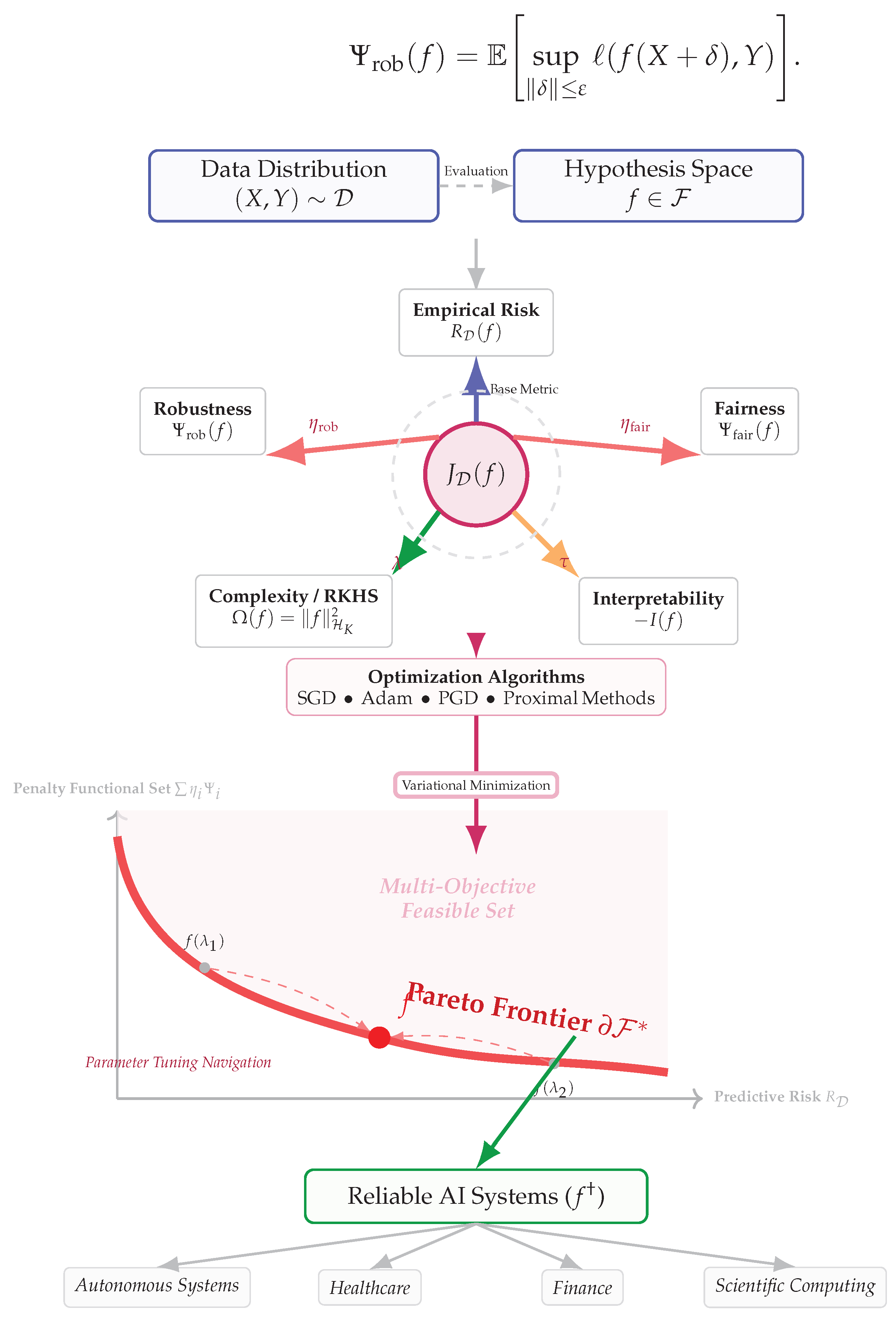
Figure 2 summarizes this viewpoint schematically. The learning objective is represented as a scalarized variational functional balancing predictive risk, robustness, fairness, complexity control, and interpretability. The associated optimization process induces a multi-objective geometry in which predictors correspond to points in a trade-off space, while the scalarized functional selects Pareto-optimal solutions according to the coefficients
. The figure also illustrates how several widely used methodologies arise naturally as particular instances of this general structure. Complementing this geometric perspective,
Table 3 summarizes representative learning paradigms within the unified variational framework and identifies the corresponding risk terms, structural functionals, interpretability components, and typical application domains.
8.1. Worst-Case and Robustness Functionals
Adversarial training and distributionally robust optimization can both be interpreted as variational formulations incorporating worst-case stability directly into the learning objective. A standard adversarial objective takes the form
where the inner maximization defines the robustness functional
Distributionally robust optimization provides a related construction:
where
denotes an uncertainty set, typically defined through Wasserstein or divergence-based neighborhoods of the empirical distribution. In both cases, robustness is incorporated through worst-case functionals controlling sensitivity under perturbations of either the input or the underlying data distribution.
From the present perspective, adversarial training and DRO differ primarily in the geometry of the perturbation set defining the robustness functional. Optimization procedures such as projected gradient descent therefore act as computational approximations for minimizing a particular variational objective rather than as isolated algorithmic heuristics.
8.2. Constraint-Based Structural Objectives
Fairness-aware learning and physics-informed learning both introduce structural constraints directly into the optimization problem.
In fairness-aware learning, predictive risk is augmented by statistical dependence penalties or demographic constraints:
Typical choices of
include demographic parity penalties, equalized-odds constraints, mutual-information penalties, and kernel-based dependence measures such as HSIC. For example,
penalizes statistical dependence between predictions and a protected attribute
A.
Physics-informed neural networks introduce an analogous variational mechanism. Let
denote a governing differential operator. PINN-type objectives take the form
where the PDE residual defines a structural functional
In both settings, structural admissibility is enforced directly at the level of the learning functional. Fairness constraints restrict discriminatory dependence, while physical penalties enforce consistency with governing equations. The resulting predictors are therefore shaped not only by predictive accuracy, but also by additional geometric or structural requirements imposed on the hypothesis space.
8.3. Regularization and Representation Functionals
Sparse coding, kernel methods, and several deep-learning heuristics can be interpreted as instances of structural regularization within the unified variational framework.
Sparse coding and dictionary learning optimize objectives of the form
where the
term acts as a structural functional promoting sparse representations.
Similarly, kernel methods impose RKHS penalties
which control functional complexity through the geometry of the reproducing kernel Hilbert space.
Several widely used deep-learning heuristics admit analogous interpretations. Weight decay corresponds to Tikhonov-type regularization, dropout introduces stochastic regularization, and early stopping acts as an implicit regularizer restricting effective model complexity through optimization dynamics.
From a variational viewpoint, these methods differ primarily in the structural penalties used to control complexity, sparsity, or effective geometry of the optimization landscape.
8.4. Interpretability Functionals
Many interpretable learning systems incorporate explicit structural objectives promoting simplicity, explanation stability, or representation relevance. A representative objective takes the form
where the interpretability score
may combine sparsity, information relevance, and stability of explanations.
Examples include sparse linear models, saliency regularization, explanation-consistency penalties, and concept-based representation constraints. In such formulations, interpretability acts as a utility-type structural functional competing directly with predictive accuracy and other structural objectives.
The unified variational framework developed in
Section 6 provides a common mathematical setting in which interpretability, robustness, and fairness can be analyzed simultaneously rather than through disconnected post hoc procedures.
8.5. Optimization and Computational Considerations
Although the unified objective may involve multiple structural functionals, many of its components admit scalable approximations compatible with modern optimization pipelines. Adversarial robustness terms are commonly approximated through projected gradient methods, fairness penalties through minibatch estimators, and interpretability objectives through sparsity or smoothness regularization. Consequently, optimization procedures such as stochastic gradient descent, Adam-type methods, proximal algorithms, and alternating minimization can often be interpreted as computational strategies for approximating minimizers of composite variational objectives.
At the same time, highly nonconvex settings may require surrogate objectives, stochastic approximations, or specialized optimization schemes, particularly when information-theoretic penalties or explanation-based functionals are involved. The variational perspective nevertheless clarifies that these computational procedures operate on a common structural optimization problem rather than on unrelated collections of heuristics.
8.6. Limitations and Future Directions
The present work is primarily theoretical and variational in nature. The paper does not attempt to provide exhaustive empirical benchmarking across all instantiated objectives or application domains. Moreover, in highly nonconvex settings involving deep neural networks, robustness penalties, or information-theoretic objectives, practical optimization may require surrogate formulations whose theoretical properties remain only partially understood.
Several directions therefore remain open, including the analysis of optimization landscapes for composite structural objectives, scalable estimation of robustness and dependence functionals, and statistical consistency of Pareto-optimal solutions in high-dimensional hypothesis spaces. More broadly, the framework suggests that many deployed machine learning methodologies can be interpreted systematically through the language of variational optimization and structural functionals rather than as isolated algorithmic constructions.
9. Discussion, Computation Considerations and Open Problems
This paper adopts a variational perspective in which predictive risk, robustness, fairness, and interpretability are formulated as functionals on a hypothesis space and incorporated directly into a unified learning objective. The central idea is that many limitations of modern machine learning systems arise because standard optimization objectives encode predictive accuracy but omit additional structural properties required for reliable deployment. From this viewpoint, robustness, fairness, and interpretability are not external post hoc corrections, but intrinsic variational components of the learning problem itself.
Beyond bringing together several existing paradigms under a common formulation, this perspective also suggests new theoretical and computational challenges. In particular, combining modern nonconvex parameterizations with nonsmooth structural penalties leads to substantial difficulties in optimization, stability analysis, and characterization of minimizers.
9.1. Optimization of Nonconvex and Nonsmooth Objectives
The objectives arising from the unified formulation tend to combine several challenging features at once: nonconvex parameterizations (e.g., neural networks), nonsmooth penalties (such as sparsity or max-type robustness terms), and dependence measures that may be difficult to estimate or differentiate. This combination makes even basic optimization questions nontrivial and leads to several open problems.
Algorithmic convergence under composite structure. Establish convergence guarantees for principled algorithms (proximal gradient, alternating minimization, primal–dual schemes, mirror descent) when the objective contains multiple competing functionals, some of which may be only lower semicontinuous or only available through stochastic estimators.
Provably correct surrogates. Many practically used substitutes (e.g., replacing by , mutual information by neural estimators, Wasserstein balls by tractable relaxations) change the geometry of the problem. A natural question is how closely minimizers (or Pareto frontiers) of surrogate objectives approximate those of the original formulation, and at what rate.
Stationarity notions and certificates. For nonsmooth/nonconvex formulations, classical first-order optimality conditions are insufficient. Developing appropriate notions (Clarke stationarity, variational inequalities, weak KKT-type conditions under constraints) and computable certificates is essential for both theory and reproducibility.
9.2. Choice of Trade-Off Parameters and Identifiability of the Pareto Frontier
The parameters govern the relative strength of accuracy, robustness, fairness, and interpretability. Selecting them is not merely a tuning issue; it determines which points on the Pareto set are accessible and how sensitive the solution is to modeling assumptions.
Principled calibration of weights. Develop approaches that connect weights to interpretable quantities (e.g., a bound on worst-case distribution shift size, a target fairness gap, or an interpretability budget). This suggests studying Lagrange-multiplier interpretations and dual formulations whenever constraints are used.
Sensitivity and stability of solutions. Analyze how minimizers vary with , including continuity/discontinuity of minimizers, bifurcations in nonconvex regimes, and conditions ensuring a well-behaved Pareto frontier.
Recovering the Pareto set. Linear scalarization recovers only supported Pareto optima under convexity. For nonconvex objectives, a substantial part of the frontier may be missed. Designing algorithms that explore non-supported Pareto points (e.g., -constraint methods, adaptive scalarizations, or multi-objective proximal methods) remains open.
9.3. Scalability and Computational Complexity
Even when functionals are conceptually well-defined, they may be computationally prohibitive in modern regimes (large models, high-dimensional data, and streaming settings).
Efficient estimation of dependence penalties. Fairness functionals based on mutual information or conditional constraints require estimating high-dimensional dependence, often under distribution shift. Establishing sample complexity bounds and scalable estimators compatible with stochastic optimization is an important direction.
Robustness at scale. Distributional robustness over Wasserstein balls can be costly, and adversarial robustness may require expensive inner maximizations. A key challenge is to identify computationally tractable approximations with explicit error bounds, and to understand when robustness objectives lead to manageable training dynamics.
Sparse/structured interpretability for large models. Interpretability functionals that promote sparsity, modularity, or explanation stability may be natural for linear or kernel methods but become subtle for deep networks. Determining which structural constraints scale (and which collapse into vacuous penalties) is largely unresolved.
9.4. Alignment Between Mathematical Definitions and Human-Centric Notions
A central motivation for this framework is to give formal meanings to robustness, fairness, and interpretability. However, these notions originate in human expectations, legal requirements, and domain-specific semantics.
Fairness: Incompatibilities and context dependence. Different fairness definitions (demographic parity, equalized odds, calibration, individual fairness) encode distinct statistical and normative requirements and can therefore be mutually incompatible depending on the underlying data-generating process. In particular, impossibility results show that multiple fairness criteria cannot generally be satisfied simultaneously except under highly restrictive assumptions, especially when base rates differ across groups.
Interpretability: What is the object being stabilized? Stability of predictions is not the same as stability of explanations. Formalizing the explanation object (saliency maps, concept vectors, local surrogate models, attribution mechanisms) and validating that its stability corresponds to meaningful human understanding remains an open problem. Recent applied research in advanced manufacturing illustrates ongoing efforts to bridge this gap. For example, interpretability techniques such as SHAP and Grad-CAM [
53,
54] have been used to analyze black-box process dynamics in electrochemical machining systems [
55,
56], helping identify physically meaningful regions and feature interactions that align with established domain knowledge. These developments highlight the practical relevance of interpretability-oriented functionals while simultaneously emphasizing that mathematically stable explanations do not automatically guarantee scientifically or cognitively meaningful interpretations.
Robustness: Choosing the right perturbation model. Wasserstein balls, adversarial perturbations, and distribution shift sets are mathematical proxies for deployment uncertainty. Selecting perturbation classes that accurately reflect real-world shifts (while remaining analyzable) is a key bridge between theory and practice.
9.5. Further Theoretical Directions
We conclude with several concrete mathematical questions suggested by the unified formulation:
Existence and compactness. Provide general conditions (coercivity, lower semicontinuity, tightness) ensuring existence of minimizers for objectives combining , robustness and fairness penalties, and interpretability scores.
Generalization under structural constraints. Extend stability and complexity-based generalization analyses to objectives with Wasserstein robust risk, dependence-based fairness penalties, and explanation-based interpretability terms, including sharp rates and minimax optimality where possible.
Duality and certificates. Identify settings where robust and fair objectives admit strong dual representations. Duality can yield both computational algorithms and verifiable certificates (e.g., worst-case shift witnesses, fairness-violation witnesses).
Axiomatic completeness. Determine whether there exist “complete” axiom systems for interpretability functionals (analogous to characterizations in risk measures), and whether different axiom choices lead to equivalent or genuinely distinct notions of interpretability.
Overall, the variational framework offers a precise language for formulating learning objectives that explicitly target reliability properties. At the same time, the open problems outlined above indicate that turning this perspective into a fully developed theory (and a practical design tool) will require progress across optimization, statistical estimation, and the formalization of human-centered notions within a coherent functional-analytic setting.
10. Conclusions
In this work, we introduced a unified variational framework for trustworthy machine learning in which robustness, fairness, and interpretability are formulated directly as structural functionals over the hypothesis space and incorporated into a single learning objective. From this perspective, standard empirical risk minimization is variationally under-specified: it optimizes predictive accuracy while leaving structural reliability properties largely implicit. As a consequence, robustness, fairness, and interpretability are often introduced only through external constraints or post hoc corrections whose interactions remain difficult to analyze systematically.
The proposed formulation treats these properties as intrinsic components of the optimization problem itself. Robustness can be encoded through perturbation-based or distributional functionals, fairness through dependence penalties or statistical constraints on predictive distributions, and interpretability through structural objectives associated with simplicity, relevance, and stability of explanations.
Within this framework, many existing paradigms can be interpreted as particular instances of a common variational architecture differing primarily in the choice of loss functionals, hypothesis spaces, and structural constraints.A central consequence of this viewpoint is that reliability objectives interact intrinsically with predictive performance and with one another. The unified formulation therefore provides a natural setting for analyzing trade-offs, Pareto-optimality, stability, and well-posedness within a common functional-analytic framework. In particular, the framework supports the interpretation of trustworthy behavior not as a secondary heuristic adjustment, but as a structural consequence of the variational principles defining the learning problem.
Several theoretical questions remain open, including the analysis of highly nonconvex composite objectives, scalable estimation of robustness and dependence functionals, and the geometric structure of Pareto-optimal solution sets in high-dimensional hypothesis spaces. More broadly, the present framework suggests that many apparently distinct trustworthy-learning methodologies can be understood through a common language of variational optimization and structural functionals.
We hope that the perspective of this work contributes toward the development of learning principles in which reliability properties become intrinsic and mathematically analyzable components of machine learning systems.