Article

Tripartite Evolutionary Game Model and Stability Analysis for Collaborative Innovation in Traditional Energy Enterprises


1
School of Economics and Management, Shanxi University, Taiyuan 030006, China
2
School of Economics and Management, Taiyuan University of Science and Technology, Taiyuan 030024, China
3
Shanxi Huaxin Gas Energy Research Institute Co., Ltd., Taiyuan 030006, China
4
School of Mechanical Engineering, Taiyuan University of Science and Technology, Taiyuan 030024, China
*
Author to whom correspondence should be addressed.
Mathematics 2026, 14(11), 1968; https://doi.org/10.3390/math14111968
Submission received: 3 April 2026 / Revised: 20 May 2026 / Accepted: 26 May 2026 / Published: 3 June 2026

Abstract

This study systematically explores the underlying mechanisms of collaborative innovation driving the green transformation of traditional energy enterprises. Existing research primarily focuses on enterprise scale and overall competitiveness, rarely delving into these specific collaborative pathways. Furthermore, studies employing evolutionary game theory to analyze the tripartite relationship among the government, traditional energy, and emerging technology enterprises remain fragmented, failing to fully capture the dynamic mechanisms of multi-stakeholder strategic choices. To bridge these gaps, this paper constructs a tripartite evolutionary game model incorporating coordination costs and the benefit distribution ratio to explore their influence mechanisms. Replicator dynamics equations are employed to identify stable cooperation conditions, overcoming traditional two-party framework constraints. Additionally, MATLAB R2024b numerical simulations validate the theoretical findings. The results reveal two evolutionarily stable equilibrium points. First, higher initial willingness among participants accelerates the system’s evolution toward a stable cooperative state. Second, coordination costs induced by information asymmetry act as a core bottleneck that deters participation and risks collaborative collapse. Third, targeted government incentives and a rational benefit distribution ratio directly determine cooperation willingness; notably, enterprises adopt collaborative strategies only when this ratio falls between 0.27 and 0.69. Fourth, fair and transparent supervision is crucial for mitigating trust deficits and distribution disputes. Ultimately, scientifically designing incentives, optimizing benefit structures, promoting information sharing, and establishing robust supervision effectively facilitate a sustainable tripartite collaborative innovation pattern.

1. Introduction

Amid intensifying global climate change, China has put forward the dual goals of carbon peaking and carbon neutrality, driving a comprehensive socioeconomic transition toward a green and low-carbon development path. The formulation of these “dual-carbon” goals marks a major strategic choice for China, rooted in both its obligations to global climate governance and its internal demands for sustainable development. However, as major global energy consumers and carbon emission sources, traditional energy enterprises are heavily characterized by high energy consumption, severe pollution, and substantial carbon emissions. Consequently, their green transformation has become a crucial link in fulfilling the dual-carbon objectives. At present, the traditional energy sector is confronted with mounting industrial pressure, obstacles in swiftly phasing out high-carbon energy, and a reliance on immature new energy technologies. These dilemmas urgently compel relevant enterprises to accelerate strategic transformation and institutional reform [1]. Spontaneous green transformation of traditional energy enterprises can hardly form scale advantages, thereby necessitating the establishment of a sound industrial collaborative system. External driving forces, rational formulation of transformation strategies, and targeted technological research and development constitute the mainstream pathways for the green upgrading of traditional energy enterprises [2]. The vigorous development of strategic emerging enterprises engaged in next-generation information technology, new energy, new materials, and other fields has laid solid technical foundations and delivered essential technological support for the green transformation of traditional energy enterprises [3].
Nevertheless, cooperation between traditional energy enterprises and emerging technology enterprises faces prominent obstacles, notably an insufficient willingness to collaborate and difficulties in reconciling multi-stakeholder interests. Appropriate government guidance can effectively mitigate these potential conflicts during the cooperation process. Policy interventions and technological progress have created the necessary macro conditions for the green transformation of enterprises [4]. However, cooperation between these two types of enterprises is not achieved overnight; rather, it is a dynamic process that requires continuous exploration, learning, and adjustment. In this process, the government, acting as a facilitator, plays a key role in reconciling conflicts of interest between the two parties and promoting information sharing, thereby improving the effectiveness and efficiency of cooperation [5]. Therefore, the interactive relationship among traditional energy enterprises, emerging technology enterprises, and the government can be regarded as a tripartite game, in which the decisions of each participant affect the strategic choices of the other two and the overall cooperative outcome.
The cooperation among the government, traditional energy enterprises, and emerging technology enterprises is a dynamic process. However, traditional static optimization frameworks struggle to capture the dynamic strategic adjustments and long-term evolutionary relationships among participants and therefore cannot accurately explain the cooperation dilemmas in complex energy scenarios [6]. Evolutionary game theory, based on bounded rationality, simulates the strategy evolution process of participants through replicator dynamics equations in repeated games, effectively addressing the limitations of traditional game models. Introducing evolutionary game theory into the research of traditional energy enterprise transformation enables a quantitative analysis of the dynamic interactions among three key elements: the resource advantages of traditional energy enterprises, the technological advantages of emerging technology enterprises, and the policy orientation of the government. Furthermore, it reveals the evolutionary laws governing the three parties in critical areas such as cooperation willingness, risk sharing, and benefit distribution, providing a robust theoretical tool for resolving cross-actor collaboration challenges in the energy industry.
Against the backdrop of government-promoted industrial upgrading, a structural mismatch exists: traditional energy firms are endowed with abundant resources but lack advanced technologies, whereas emerging technology enterprises possess sophisticated technologies yet face a shortage of suitable real-world application scenarios. How to form a stable collaborative innovation pattern among the three parties through interest-driven game interactions has become an urgent theoretical and practical problem awaiting solution. Scholars have explored the evolution of multi-agent collaborative innovation behaviors from various perspectives using evolutionary game theory; however, research that incorporates the role of government guidance in such behaviors remains relatively scarce. Exploring the influence mechanism of government guidance on the collaboration between traditional energy enterprises and emerging technology enterprises can provide optimal behavioral strategies for the government, traditional energy enterprises, and emerging technology enterprises. Therefore, this study employs tripartite evolutionary game theory and MATLAB numerical simulation to construct a tripartite evolutionary game model involving the government, traditional energy enterprises, and emerging technology enterprises. Through the analysis of replicator dynamic equations and the Jacobian matrix, two evolutionarily stable equilibrium points of the system are identified. Combined with numerical simulations, this study systematically analyzes the impact of coordination costs caused by information asymmetry on the evolutionary path of the system. On this basis, it further examines the strategic choices of different game participants in the transformation and development of traditional energy enterprises, aiming to promote the “safe, efficient, green, and sustainable” development of traditional energy enterprises and provide theoretical guidance for the broader energy sector.
The overall framework of this paper is as follows: Section 1 is the introduction, elaborating on the significance of the transformation of traditional energy enterprises and clarifying the research objectives and core directions. Section 2 is the literature review, which sorts out the existing research on evolutionary game theory, collaborative innovation in green transition, and tripartite evolutionary game theory, laying the theoretical foundation for this study. Section 3 is the materials and methods, with the game subjects including government, traditional energy enterprises, and emerging technology enterprises. A tripartite evolutionary game payoff matrix is constructed, and the evolutionary stability of equilibrium points is analyzed based on the Jacobian matrix. Section 4 presents the results, which use MATLAB for numerical simulation to examine how changes in different parameters affect the strategic choices of the government, traditional energy enterprises, and emerging technology enterprises, as well as the stability of the system. Section 5 is the discussion, which critically analyzes the limitations of the model. Section 6 is the conclusion, which proposes recommendations for promoting multi-agent collaborative innovation from the perspectives of the government, traditional energy enterprises, and emerging technology enterprises, providing a basis for future research.

2. Literature Review

2.1. Research Status of Evolutionary Game Theory

As an important branch of game theory, evolutionary game theory has been widely applied in empirical and theoretical research across multiple disciplines. By analyzing the strategic interactions and dynamic adjustment processes of participating agents, this method helps reveal the formation mechanisms and evolutionary laws of the research subjects, thereby providing important methodological support and analytical perspectives for related academic research. In 1974, the concept of evolutionarily stable strategy (ESS) was first introduced by Smith and Price [7], laying an important foundation for the development of evolutionary game theory. In 1978, Taylor [8] pioneered the concept of “replicator dynamics”, providing a key dynamic analysis tool for evolutionary games and enabling the study of strategic evolution processes. These two concepts—evolutionarily stable strategy and replicator dynamics—form the core of evolutionary game theory. In recent years, evolutionary game theory has achieved remarkable progress in both its extended applications and empirical research. Its analytical framework has been widely adopted to examine behavioral interactions among diverse agents across multiple socioeconomic contexts. Nowak et al. [9] investigated the role of indirect reciprocity in the evolution of cooperation and found that reputation mechanisms facilitate cooperative behavior. Santos et al. [10] integrated evolutionary game theory with complex networks to study the impact of network structure on the evolution of cooperation, revealing that network heterogeneity and clustering significantly influence cooperation levels. Fargetta et al. [11] employed evolutionary game theory to investigate the strategic interactions among brands, social media influencers, and consumers within interactive and immersive e-commerce mechanisms. Benko et al. [12] applied network evolutionary games to study cooperative behavior in open data management, explaining the social dilemmas faced by open data administrators. Janan et al. [13] utilized game theory to examine pricing for prosumers in energy blockchains and the financing of energy blockchains through sustainable energy bonds with varying default rates. Hu et al. [14] constructed a moderated mediation model based on data from Chinese new energy vehicle manufacturers. Tian et al. [15] investigated the complex dynamics of a symmetric quantum game model with heterogeneous expectations within a quantum Stackelberg duopoly framework.
Some scholars have employed evolutionary game theory to explore the impact of government behavioral strategy choices on enterprises. Wu et al. [16], within the context of complex networks, found that the evolution speed of enterprise strategies is influenced by government incentives such as regulation and subsidies. Wang et al. [17] discovered that in low-carbon linkage, the government can promote cooperation through regulations or fiscal incentives and plays a significant role in this process. Zhu et al. [18] concluded that government subsidies not only help incentivize joint investment but also improve the assessment accuracy and supervisory efficiency of investment strategies. Xue et al. [19] pointed out that in the early stage of the game, the increase in government regulation and subsidies facilitated the adoption of low-carbon production models by enterprises. Yuan and Zheng [20] found that the intensity of government regulation, innovation subsidies, and carbon tax rates exert varying impacts on enterprises. In the energy field, evolutionary game theory has been widely applied to scenarios such as low-carbon policy analysis, enterprise emission reduction decision making, and technology diffusion. Cheng et al. [21] combined evolutionary game theory with deep reinforcement learning to analyze the dynamic strategic interaction between power purchasing enterprises and power generation enterprises in the electricity market under different pricing mechanisms and policy incentives.

2.2. Research Status of Collaborative Innovation in Green Transition

Collaborative innovation and green transition are mutually reinforcing. Green transition provides application scenarios and value orientation for collaborative innovation, while collaborative innovation provides a pathway for technological breakthroughs and resource integration to advance the green transition. As Chen and Liu [22] noted in their discussion of the green development of China’s data industry, industrial green transition requires coordination among multiple stakeholders—including the government, enterprises, and industry associations—across policy, technology, and standard-setting dimensions. Wu et al. and Lee [23,24] define collaborative innovation as a concrete process wherein firms cooperate with other entities to jointly create new technologies, materials, or systems. Wang and Hu [25] argued that collaborative innovation is a process of the optimal integration of information and technology to accelerate the emergence of new achievements. Liu Dan and Yan Changle [26] contended that in the network environment of information technology, the essence of collaborative innovation lies in improving the performance and enhancing the capability of systematic collaborative innovation. Feranita, Kotlar et al. [27] analyzed the relevant literature and explained collaborative innovation through three theories: strategic theory; transaction cost theory; and relational theory. Liu and Jens F. [28,29] conducted a comprehensive study on the influencing factors of collaborative innovation project performance and categorized these factors into two types: tangible and intangible. Lichtenthaler and Faem [30,31] find that the openness of a firm’s innovation strategy positively impacts its performance. Vivona and Andrea M. [32,33] identified three implicit assumptions that currently hinder accurate analysis of collaborative innovation costs.
Regarding collaborative innovation mechanisms, Li et al. [34] took emerging technology standard alliances as their research object and divided collaborative innovation into three levels: strategic collaboration, process collaboration, and patent collaboration. They found that resource integration and knowledge sharing are key elements in process collaboration, while a reasonable benefit distribution mechanism has the most significant impact on collaborative innovation performance. Chen Zhao et al. [35] explored the collaborative mechanism of scientific and technological innovation in the bay area from the perspective of new economic geography and constructed a collaborative model of a composite system. Xu et al. [36] defined the concept of technological potential energy from three dimensions: the willingness of innovation subjects, the internal and external innovation environment, and the attractiveness of participants to innovation elements. Arsanti et al. [37] explored the bottom-up inter-organizational knowledge flow mechanism formed from the bottom up by research organizations such as universities and enterprises during the process of collaborative innovation. Li Baizhou et al. [38] focused on the upstream and downstream enterprises in the supply chain of strategic emerging industries and deeply analyzed the important role of government regulation and control when the market mechanism fails. Tidd and Muhammad F. [39,40], based on collaborative innovation theory, examined the synergistic effects among innovative elements within enterprises. Xie Xuemei et al. [41] indicated that collaborative innovation helps enterprises acquire external resources, reduce innovation risks, and promote enterprises to carry out collaborative innovation to gain competitive advantages. Based on hypernetwork theory, Gao et al. [42] found that digital transformation drives value co-creation through the chained mediation path: “actor interaction → resource allocation → capability activation”. Mahdavimanshadi et al. [43] developed a multi-stage stochastic optimization model for the pharmaceutical supply chain during the COVID-19 pandemic.

2.3. Research Status of Tripartite Evolutionary Game

As research perspectives have broadened, tripartite and multi-party evolutionary games have gradually become core analytical models for characterizing complex governance systems. Some scholars have employed tripartite evolutionary game models to analyze and discuss various research subjects. Liu et al. [44] constructed a tripartite evolutionary game model of “government–financial institution–enterprise” to explore the stability of collaborative green technology innovation, finding that government policy guidance and innovation returns are key factors for the system’s stable operation. Shao et al. [45] constructed a tripartite evolutionary game model of electric vehicle aggregators, local governments, and electric vehicle users, analyzing the dynamic process of the vehicle–grid interaction market evolving from uncoordinated charging to bidirectional grid interaction. He et al. [46] applied evolutionary game theory to a regional innovation ecosystem and constructed a tripartite evolutionary game model involving core enterprises, complementors, and the government. They found that government subsidies and penalties have a positive impact on system stability and can accelerate the convergence of evolutionary dynamics. Lu and Wang et al. [47] employed system dynamics to investigate the complex relationships among multiple stakeholders in coal mine safety management using a simplified tripartite model. Their study revealed how supervision by government departments and inspections by coal mining enterprises affect safety management efficiency, as well as the roles of restrictive and incentive measures in the safety management process. Han [48] constructed an evolutionary game model integrating the government, platform organizations, and platform member enterprises. The study found that both formal and informal governance can reduce opportunistic behavior within enterprises, with formal governance having a stronger effect than informal governance, although the effect of informal governance is more stable. Zhu et al. [49] constructed a tripartite evolutionary game model of local governments, power grid enterprises, and market regulators under a low-carbon trading mechanism, finding that without third-party supervision, the two parties fail to reach an ideal evolutionarily stable equilibrium. Cai et al. [50] constructed a tripartite evolutionary game model of automobile enterprises, consumers, and the government based on a reward–punishment mechanism and revealed through numerical simulation the critical role of nonlinear dynamic reward–punishment mechanisms in maintaining system stability.

2.4. Research Gaps

Through a systematic review of the existing literature, it is evident that current research has the following characteristics: (1) The vast majority of studies focus on firm size or general capabilities, while lacking in-depth discussion on green collaborative innovation pathways led by traditional energy enterprises. At the same time, few studies comprehensively consider factors such as coordination costs and benefit distribution mechanisms to systematically analyze how these factors influence traditional energy enterprises’ participation in collaborative innovation. (2) There are relatively few studies applying evolutionary game theory to the complex game relationships among traditional energy enterprises, emerging technology enterprises, and the government in the context of enterprise green transformation. Most existing studies remain at the level of two-player evolutionary games, making it difficult to fully reveal the dynamic evolutionary patterns of strategic choices and behavioral adjustments among multiple agents under the combined drivers of policy guidance, resource allocation, and technological innovation. (3) Current research on the role of government in promoting corporate green transformation mostly focuses on setting static government parameters. However, in the process of information transmission and response between enterprises and the government, policies exhibit a certain time-lag effect, and the intensity of government regulation is often difficult to control precisely.
In summary, compared with existing studies, the main contributions of this paper are as follows: (1) Focusing on the participation mechanism of traditional energy enterprises in collaborative innovation for green transition, this paper systematically introduces key influencing factors such as coordination costs and benefit distribution ratios and constructs a tripartite evolutionary game model of the government, traditional energy enterprises, and emerging technology enterprises. It deeply analyzes the influence mechanisms of these factors on the participation of traditional energy enterprises in collaborative innovation, thereby providing a more targeted and systematic framework for resource-based enterprises to engage in collaborative innovation. (2) Introducing evolutionary game theory into the collaborative innovation scenario of traditional energy enterprises during green transition, this paper employs replicator dynamics equations to conduct a dynamic simulation analysis of multi-agent interactions, revealing the critical conditions for multi-agent collaboration and providing a scientific basis for governance and policymaking in complex energy scenarios. (3) Through MATLAB numerical simulation, this paper analyzes the actual policy implementation process, providing a basis for governments to formulate more precise and dynamically adaptive green transition policies, thereby enhancing the practical guiding significance of the research conclusions.

3. Materials and Methods

3.1. Basic Assumptions and Parameter Settings

Assumption 1.
The government departments, traditional energy enterprises, and emerging technology enterprises are identified as the decision-making subjects in the tripartite evolutionary game. The decision-making game behaviors of the three parties in the game are all independent and random.
Assumption 2.
Let  x  represent the proportion of government subject choosing the “incentivize” strategy and  1 x  represent the proportion choosing the “not incentivize” strategy. Let  y  denote the probability of traditional energy enterprise subject selecting the “cooperate” strategy and  1 y  denote the probability of selecting the “not cooperate” strategy. Correspondingly, let  z  be the probability of emerging technology enterprise subject choosing the “cooperate” strategy, with  1 z  being the probability of choosing the “not cooperate” strategy.
Assumption 3.
When both the traditional energy enterprise and the emerging technology enterprise choose the “not cooperate” strategy, they receive basic payoffs of  r 1  and  r 2  , respectively. When both choose the “cooperate” strategy, the total collaborative payoff is  R  . The traditional energy enterprise receives a share  a  of this total payoff; consequently, the emerging technology enterprise receives the remaining share  1 a  . To engage in cooperation, the traditional energy enterprise incurs a resource opening cost of  c 1  and a coordination cost of  c 2 . Thus, the total cost incurred by the traditional energy enterprise for cooperation is  C 1 = α 1 c 1 + β 1 c 2  (here, α 1  is the amplification coefficient of resource scarcity on the resource opening cost, and  β 1  is the sensitivity coefficient of information asymmetry on the coordination cost. The latter refers to a situation where one party possesses more or more critical private information than the other, leading to an unequal footing in decision making). For cooperation, the emerging technology enterprise incurs a technology cost of  c 3  and a coordination cost of  c 4 . Therefore, the total cost incurred by the emerging technology enterprise for cooperation is  C 2 = α 2 c 3 + β 2 c 4  (here, α 2  is the amplification coefficient of technology maturity on the technology cost, serving as a quantitative measure of feasibility from theory to industrialization.  β 2  is the sensitivity coefficient of information asymmetry on the coordination cost, referring to a situation where one party possesses more or more critical private information than the other, leading to an unequal footing in decision making). When one of either the traditional energy enterprise or the emerging technology enterprise chooses the “cooperate” strategy while the other chooses the “not cooperate” strategy, the cooperating party obtains a technology spillover benefit of  d 1 , and the non-cooperating party obtains  d 2 . During the cooperation process, the participating subjects incur innovation risks  l 1  and  l 2  due to innovative activities and other related behaviors. If the traditional energy enterprise and the emerging technology enterprise cooperate, they receive subsidies  s 1  and  s 2 , respectively, from government financial support. However, if either enterprise chooses “not cooperate” while the government adopts an incentive strategy, it incurs a penalty of additional expenditure, denoted as  f 1  for the traditional energy enterprise and  f 2  for the emerging technology enterprise. The government earns the benefit of  w 1  when both the traditional energy enterprise and the emerging technology enterprise groups cooperate. It earns a benefit of  w 2  when only one party chooses to cooperate. The cost incurred by the government for implementing the incentive strategy is  c 0 . Under the incentive strategy, the government ultimately obtains a net payoff of  u 1  if cooperation is achieved and a net payoff of  u 2  if cooperation is not achieved.

3.2. Model Construction

Based on the above assumptions, the government, traditional energy enterprises, and emerging technology enterprises will engage in multiple rounds of games to maximize their own interests, thus constructing a tripartite multi-agent evolutionary game payoff matrix as shown in Table 1.

3.3. Constructing the Payoff Functions

Within the dynamic framework of the tripartite game, each participant will continuously adjust their strategies and learn from each other based on their own payoff function to pursue the maximization of its own interests. When the strategic choices of all participants reach a state of systemic dynamic equilibrium, an evolutionarily stable strategy (ESS) is formed. On this basis, this paper will focus on conducting an in-depth discussion on the evolutionary stable strategy of the tripartite system composed of the government, traditional energy enterprises, and emerging technology enterprises. Based on the payoff matrix established in Table 1, the following results can be derived.
If the traditional energy enterprise chooses the “cooperate” strategy, its expected payoff is denoted as U 11 . If it chooses the “not cooperate” strategy, its expected payoff is denoted as U 12 . The average expected payoff is U 1 ¯ .
U 11 = z x r 1 + a R C 1 l 1 + s 1 + z 1 x r 1 + a R C 1 l 1 + 1 z x r 1 + d 1 C 1 l 1 + s 1 + 1 z 1 x r 1 + d 1 C 1 l 1
U 12 = z x r 1 + d 1 f 1 + 1 z x r 1 f 1 + z 1 x r 1 + d 1 + 1 z 1 x r 1
U 1 ¯ = y U 11 + 1 y U 12
If the emerging technology enterprise chooses the “cooperate” strategy, its expected payoff is denoted as U 21 . If it chooses the “not cooperate” strategy, its expected payoff is denoted as U 22 . The average expected payoff is U 2 ¯ .
U 21 = y x r 2 + 1 a R C 2 l 2 + s 2 + 1 y x r 2 + d 2 C 2 l 2 + s 2 + y 1 x r 2 + 1 a R C 2 l 2 + 1 y 1 x r 2 + d 2 C 2 l 2
U 22 = y x r 2 + d 2 f 2 + 1 y x r 2 f 2 + y 1 x r 2 + d 2 + 1 y 1 x r 2
U 2 ¯ = z U 21 + 1 z U 22
If the government chooses the “incentivize” strategy, its expected payoff is denoted as U 31 . If it chooses the “not incentivize” strategy, its expected payoff is denoted as U 32 . The average expected payoff is U 3 ¯ .
U 31 = y z w 1 c 0 + u 1 + y 1 z w 2 + u 2 c 0 + 1 y z w 2 + u 2 c 0 + 1 y 1 z u 2 c 0
U 32 = y z w 1 + y 1 z w 2 + 1 y z w 2
U 3 ¯ = x U 31 + 1 x U 32

3.4. Replicator Dynamic Analysis

(1) Replicator Dynamic Analysis of Traditional Energy Enterprises
The replicator dynamic equation for the traditional energy enterprise is:
F y = d y d t = y U 11 U 1 ¯ = y 1 y U 11 U 12 = y 1 y z a R + x s 1 + d 1 C 1 l 1 + x f 1 2 z d 1
When F y = 0 and F y < 0 are satisfied, the corresponding equilibrium points can be obtained. The phase diagram depicting its strategic evolutionary trajectory is shown in Figure 1.
Set F ( y ) = 0 , and in this case x = 2 z d 1 z a R d 1 + C 1 + l 1 s 1 + f 1 ( m 1 = x )
➀ When x = m 1 , F ( y ) = 0 . Regardless of the value of y , the strategic choice of the traditional energy enterprise remains in a stable state, as shown in Figure 1a.
➁ When x m 1 , let F ( y ) = 0 . At this point, y 1 = 0 , while y 2 = 1 . Taking the derivative of F ( y ) with respect to y yields:
F ( y ) = d F ( y ) d y = ( 1 2 y ) ( z a R + x s 1 + d 1 C 1 l 1 + x f 1 2 z d 1 )
When 0 < x < m 1 , F ( 0 ) < 0 , and F ( 1 ) > 0 . At this point, y = 0 is the evolutionary stable point, as shown in Figure 1b. When the probability of government incentives is less than m 1 , it is difficult to secure the self-interest of the traditional energy enterprise. Consequently, its rational decision will tend to be non-participation in collaborative innovation.
When m 1 < x < 1 , F ( 0 ) > 0 , and F ( 1 ) < 0 . At this point, y = 1 is the evolutionary stable point, as shown in Figure 1c. When the probability of government incentives exceeds m 1 , the sum of the total payoff is obtained, and the government subsidies will surpass all costs incurred if the traditional energy enterprise participates in collaborative innovation. Under this condition, choosing “collaborative innovation” becomes the optimal strategy for the traditional energy enterprise.
(2) Replicator Dynamic Analysis of Emerging Technology Enterprises
The replicator dynamic equation for the emerging technology enterprise is:
F ( z ) = d z d t = z ( U 21 U 2 ¯ ) = z ( 1 z ) ( U 21 U 22 )       = z ( 1 z ) ( x s 2 + y ( 1 a ) R + d 2 C 2 l 2 2 y d 2 + x f 2 )
When F ( z ) = 0 and F ( z ) < 0 , the corresponding equilibrium point can be obtained. At this point, the phase diagram depicting the strategic evolution of the emerging technology enterprise is shown in Figure 2.
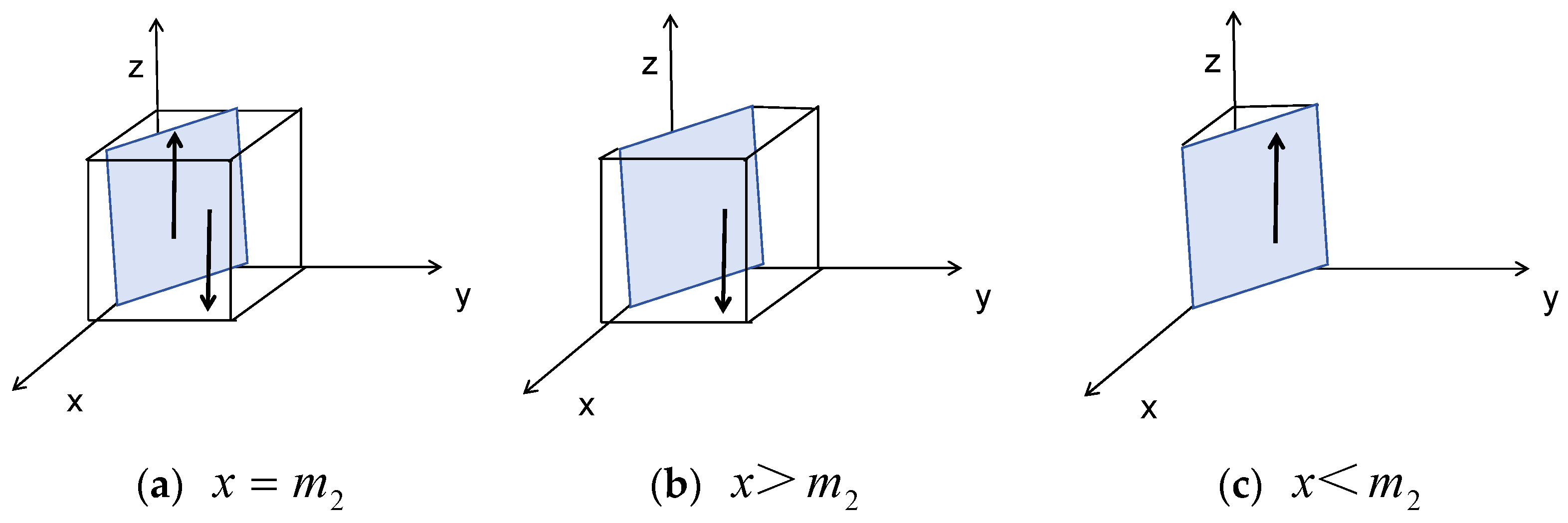
Set F ( z ) = 0 , and in this case x = y ( 1 a ) R d 2 + C 2 + l 2 + 2 y d 2 s 2 + f 2 ( m 2 = x )
➀ When x = m 2 , F ( z ) = 0 . Regardless of the value of z , the strategic choice of the emerging technology enterprise remains in a stable state, as shown in Figure 2a.
➁ When x m 2 , let F ( z ) = 0 . At this point, z 1 = 0 , z 2 = 1 . Taking the derivative of F ( z ) with respect to z yields:
F ( z ) = d F ( z ) d z = ( 1 2 z ) ( x s 2 + y ( 1 a ) R + d 2 C 2 l 2 2 y d 2 + x f 2 )
When m 2 < x < 1 , F ( 0 ) > 0 , and F ( 1 ) < 0 . At this point, z = 1 is the evolutionary stable point, as shown in Figure 2b. When the probability of government incentives exceeds m 2 and the sum of the benefits obtained from collaborative innovation and government subsidies surpasses the total cost required, choosing to participate in “collaborative innovation” becomes its optimal strategy.
When 0 < x < m 2 , F ( 0 ) < 0 , and F ( 1 ) > 0 . At this point, z = 0 is the evolutionary stable point, as shown in Figure 2c. When the probability of government incentives is less than m 2 , the core interests of the emerging technology enterprise cannot be adequately safeguarded. Consequently, its rational decision will lead to non-participation in collaborative innovation.
(3) Replicator Dynamic Analysis of the Government
The replicator dynamic equation for the government is:
F ( x ) = d x d t = x ( U 31 U 3 ¯ ) = x ( 1 x ) ( U 31 U 32 ) = x ( 1 x ) ( y z u 1 + u 2 y z u 2 c 0 )
When F ( x ) = 0 and F ( x ) < 0 , the corresponding equilibrium point can be obtained. At this point, the phase diagram depicting the strategic evolution of the government is shown in Figure 3.
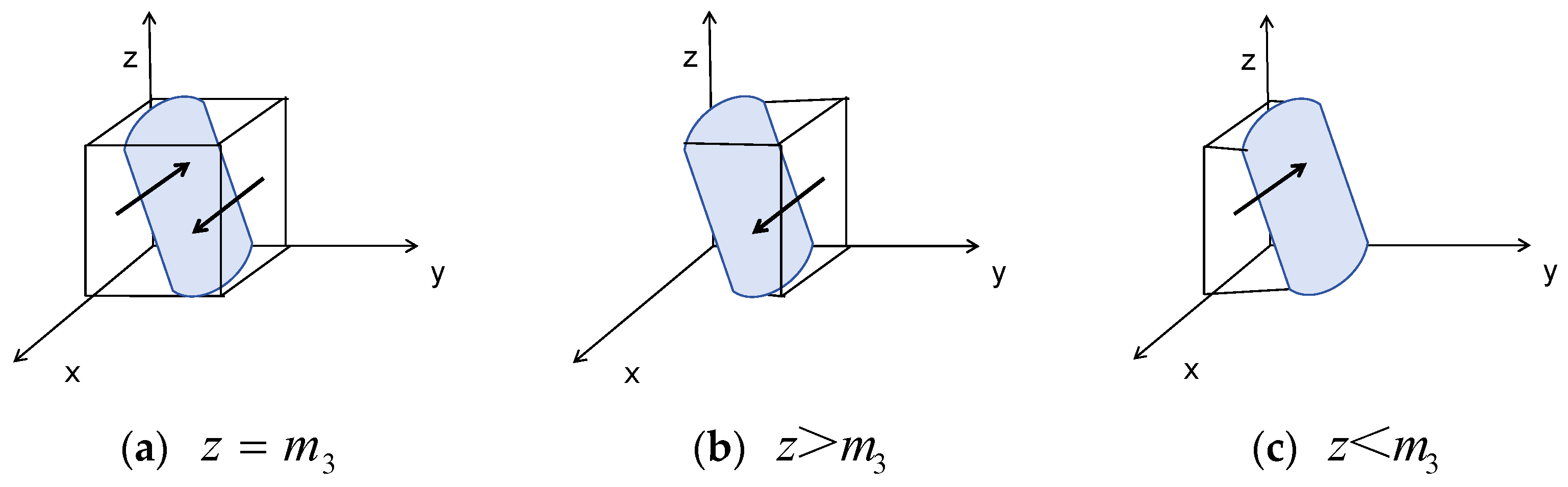
Set F ( x ) = 0 , and in this case z = u 2 c 0 y u 2 y u 1 ( m 3 = z )
➀ When z = m 3 , F ( x ) = 0 . Regardless of the value of x , the strategic choice of the government remains in a stable state, as shown in Figure 3a.
➁ When z m 3 , let F ( x ) = 0 . At this point, x 1 = 0 , and x 2 = 1 . Taking the derivative of F ( x ) with respect to x yields:
F ( x ) = d F ( x ) d x = ( 1 2 x ) ( y z u 1 y z u 2 + u 2 c 0 )
When m 3 < z < 1 , F ( 0 ) < 0 , and F ( 1 ) > 0 . At this point, x = 0 is the evolutionary stable point, as shown in Figure 3b. When the probabilities of emerging technology enterprises and traditional energy enterprises participating in collaborative innovation are both higher than m 3 , if the net revenue obtained by the government implementing incentives is lower than that when no incentives are implemented, the government will tend to adopt a “non-incentive” strategy in consideration of maximizing overall revenue.
When 0 < z < m 3 , F ( 0 ) > 0 , and F ( 1 ) < 0 . At this point, x = 1 is the evolutionarily stable point, as shown in Figure 3c. When the probabilities of traditional energy enterprises and emerging technology enterprises participating in collaborative innovation are both lower than m 3 , if the net revenue obtained by the government adopting an incentive strategy is higher than that when no incentives are adopted, based on the principle of maximizing benefits, the government’s decision-making tendency will clearly point to the implementation of an “incentive” strategy.
Figure 3. Phase diagram of strategic evolution for the government.
Mathematics 14 01968 g003

3.5. Evolutionarily Stable Strategy Analysis

The replicator dynamic system of the tripartite evolutionary game is as follows:
{ F ( x ) = d x d t = x ( U 31 U 3 ¯ ) = x ( 1 x ) ( U 31 U 32 ) = x ( 1 x ) ( y z u 1 y z u 2 + u 2 c 0 ) F ( y ) = d y d t = y ( U 11 U 1 ¯ ) = y ( 1 y ) ( U 11 U 12 ) = y ( 1 y ) ( z a R + x s 1 + d 1 C 1 l 1 + x f 1 2 z d 1 ) F ( z ) = d z d t = z ( U 21 U 2 ¯ ) = z ( 1 z ) ( U 21 U 22 ) = z ( 1 z ) ( x s 2 + y ( 1 a ) R + d 2 C 2 l 2 2 y d 2 + x f 2 )
Let F ( x ) = 0 , F ( y ) = 0 , and F ( z ) = 0 . This yields eight pure-strategy equilibrium points: E 1 ( 0 , 0 , 0 ) , E 2 ( 0 , 0 , 1 ) , E 3 ( 0 , 1 , 0 ) , E 4 ( 0 , 1 , 1 ) , E 5 ( 1 , 0 , 0 ) , E 6 ( 1 , 0 , 1 ) , E 7 ( 1 , 1 , 0 ) , and E 8 ( 1 , 1 , 1 ) . The Jacobian matrix J of the system is constructed accordingly as follows:
J = { F ( x ) x F ( x ) y F ( x ) z F ( y ) x F ( y ) y F ( y ) z F ( z ) x F ( z ) y F ( z ) z } = { ( 1 2 x ) ( y z u 1 y z u 2 + u 2 c 0 ) x ( 1 x ) ( z u 1 z u 2 ) x ( 1 x ) ( y u 1 y u 2 ) y ( 1 y ) ( s 1 + f 1 ) ( 1 2 y ) ( z a R + x s 1 + d 1 C 1 l 1 + x f 1 2 z d 1 ) y ( 1 y ) ( a R 2 d 1 ) z ( 1 z ) ( s 2 + f 2 ) z ( 1 z ) ( ( 1 a ) R 2 d 2 ) ( 1 2 z ) ( x s 2 + y ( 1 a ) R + d 2 C 2 l 2 2 y d 2 + x f 2 ) }
According to evolutionary game theory, if all eigenvalues of the Jacobian matrix corresponding to an equilibrium point are strictly less than zero, that equilibrium is an evolutionarily stable point (ESS) of the replicator dynamic system. Conversely, if the signs of the eigenvalues are definitive and at least one eigenvalue is greater than zero, the equilibrium point is evolutionarily unstable. The eigenvalues corresponding to each equilibrium point are presented in Table 2.
When u 1 c 0 > 0 , a R + s 1 d 1 C 1 l 1 + f 1 > 0 , and s 2 + ( 1 a ) R d 2 C 2 l 2 + f 2 > 0 , under the condition that the total payoff from cooperation between the traditional energy enterprise and the emerging technology enterprise is greater than the payoff from non-cooperation when the government provides incentives, among the three eigenvalues corresponding to equilibrium points E 1 , E 2 , E 3 , E 4 , E 6 , and E 7 , at least one is greater than zero. Consequently, none of these equilibrium points are stable. The three eigenvalues corresponding to equilibrium point E 8 are all less than zero, indicating that the system is in a stable state. The corresponding evolutionary stable strategy is (Incentivize, Cooperate, Cooperate). This means that when cooperation is achieved under government incentives, the benefits obtained by the government outweigh the costs it incurs. For the traditional energy enterprise, the sum of the total payoff from cooperation and the financial subsidies received under government incentives exceeds the sum of the technology spillover benefits from unilateral cooperation, the total costs incurred, and the innovation risks borne. For the emerging technology enterprise, the sum of the total payoff from cooperation and the financial subsidies received under government incentives exceeds the sum of the technology spillover benefits from unilateral cooperation, the total costs incurred, and the innovation risks borne. At this point, both traditional energy enterprises and emerging technology enterprises actively respond to government policies and establish an efficient collaborative innovation mechanism, allowing government policies to fully exert their effects. This leads to the optimal stable strategy that achieves the transformation of traditional energy enterprises and the technological progress of emerging technology enterprises. For the equilibrium point E 5 , when s 1 + d 1 C 1 l 1 + f 1 < 0 and s 2 + d 2 C 2 l 2 + f 2 < 0 , the three corresponding eigenvalues of the equilibrium point E 5 ( 1 , 0 , 0 ) are all negative, making it a stable point of the system, and the corresponding evolutionarily stable strategy is (Incentivize, Not Cooperate, Not Cooperate). This equilibrium point often appears in the initial stage of collaborative innovation. At this stage, traditional energy enterprises and emerging technology enterprises are still in the contact and exploration stage, with a weak foundation of mutual trust and limited understanding of each other’s technological capabilities and cooperation demands. Consequently, neither has yet substantively engaged in collaborative innovation. At this point, the government, acting as a promoter of the transformation of traditional energy enterprises and their collaborative innovation, plays a key guiding role by providing financial subsidies and policy support, thereby laying the foundation for subsequent in-depth cooperation between enterprises. With continuous government incentives and repeated interactions and coordination between the enterprises, cooperation between the two sides gradually deepens, collaborative innovation activities advance steadily, and the system eventually converges to the stable equilibrium state at point E 8 ( 1 , 1 , 1 ) .

4. Results

Based on a comprehensive consideration of the transformation policies of traditional energy enterprises, the actual cooperation between traditional energy enterprises and emerging technology enterprises, and existing research, the parameters in this study’s model are assigned values. Regarding the payoffs of traditional energy enterprises and emerging technology enterprises when they choose not to cooperate, as well as their collaborative synergy benefits, Li [51] pointed out that the returns from collaborative innovation are significantly higher than those from independent innovation. Specifically, returns from collaborative innovation range from 100 to 150, while those from independent innovation range from 20 to 60. According to Liang, J. [52], government subsidies are typically set between 10 and 50 and should not exceed the direct benefits of innovation. The penalty mechanism is designed conservatively, usually kept within 10 [53]. Jia et al. [54] pointed out that based on the actual resource contributions of enterprises, the benefit distribution ratio for collaborative innovation should be moderately tilted toward the technology supplier. According to practical circumstances, the benefits obtained by the government under the incentive strategy should be greater than those when cooperation is not achieved. Although traditional enterprises contribute more basic resources, in collaborative innovation, benefit distribution should be moderately tilted toward the technology supplier to incentivize technological input. Therefore, the benefit distribution ratio is assigned to a value of less than 0.5. The impacts of information asymmetry and coordination costs differ between traditional energy enterprises and emerging technology enterprises. The core technologies of emerging technology enterprises have stronger confidentiality and higher technological barriers, making them more sensitive to information asymmetry. Moreover, the knowledge and technologies of emerging technology enterprises are more cutting-edge and transferable, so their potential spillover value is higher than that of traditional energy enterprises. In terms of innovation risk, emerging technology enterprises face challenges such as accelerated technological iteration and uncertain market acceptance, and their innovation risk is much higher than that of traditional energy enterprises. In summary, based on the existing literature and practical circumstances, the parameters are assigned as follows: u 1 = 55 , c 0 = 20 , a = 0.4 , R = 135 , s 1 = 15 , f 1 = 5 , s 2 = 30 , f 2 = 6 , w 1 = 20 , w 2 = 10 , u 2 = 45 , c 1 = 40 , β 1 = 0.2 , c 2 = 30 , c 3 = 50 , β 2 = 0.3 , c 4 = 20 , r 1 = 30 , r 2 = 50 , c 0 = 20 , l 1 = 10 , d 1 = 8 , l 2 = 14 , d 2 = 12 , α 1 = 0.8 , and α 2 = 0.8 .

4.1. Impact of Initial Willingness on the Evolutionary Path of Cooperative Relationships

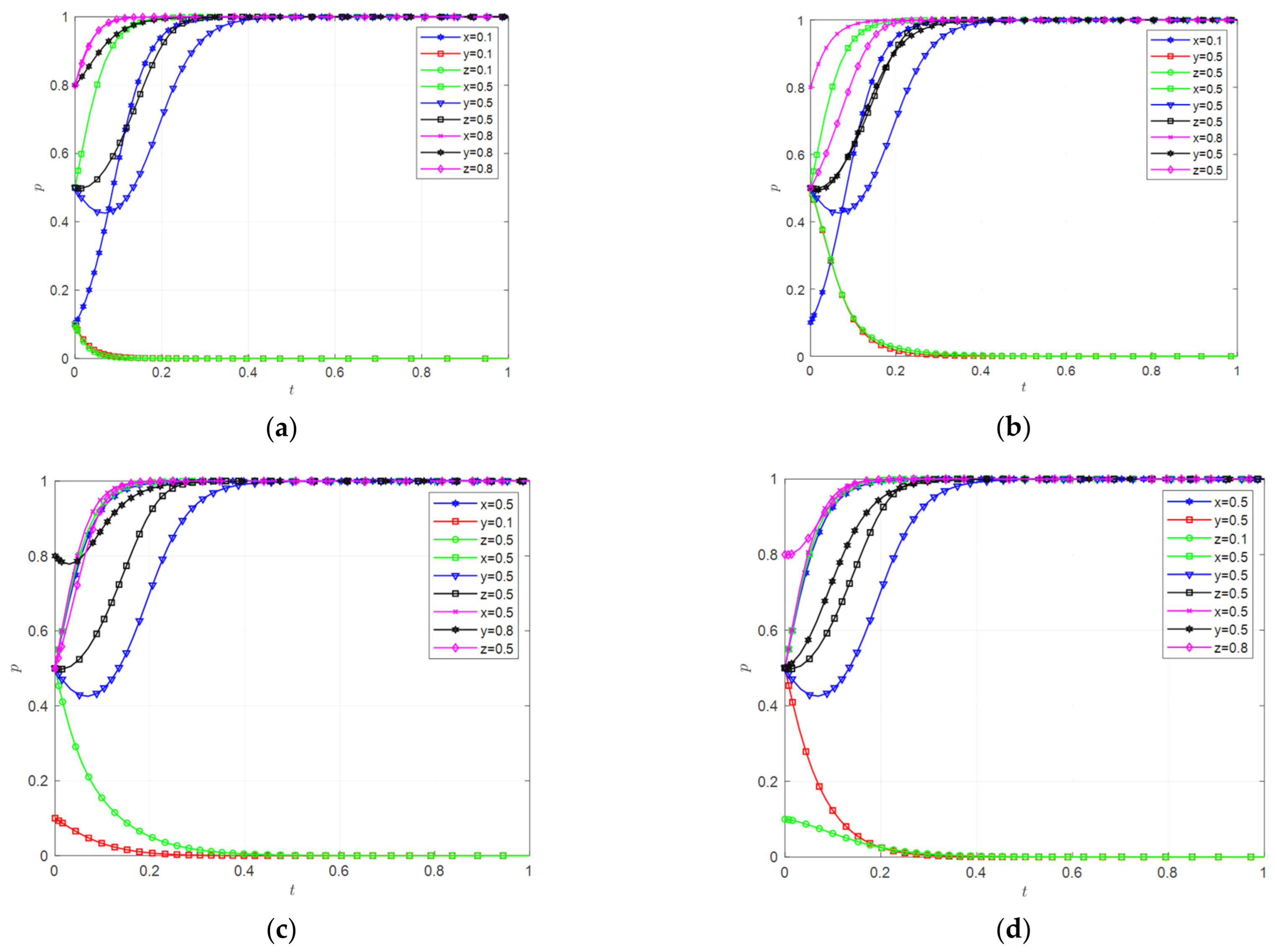
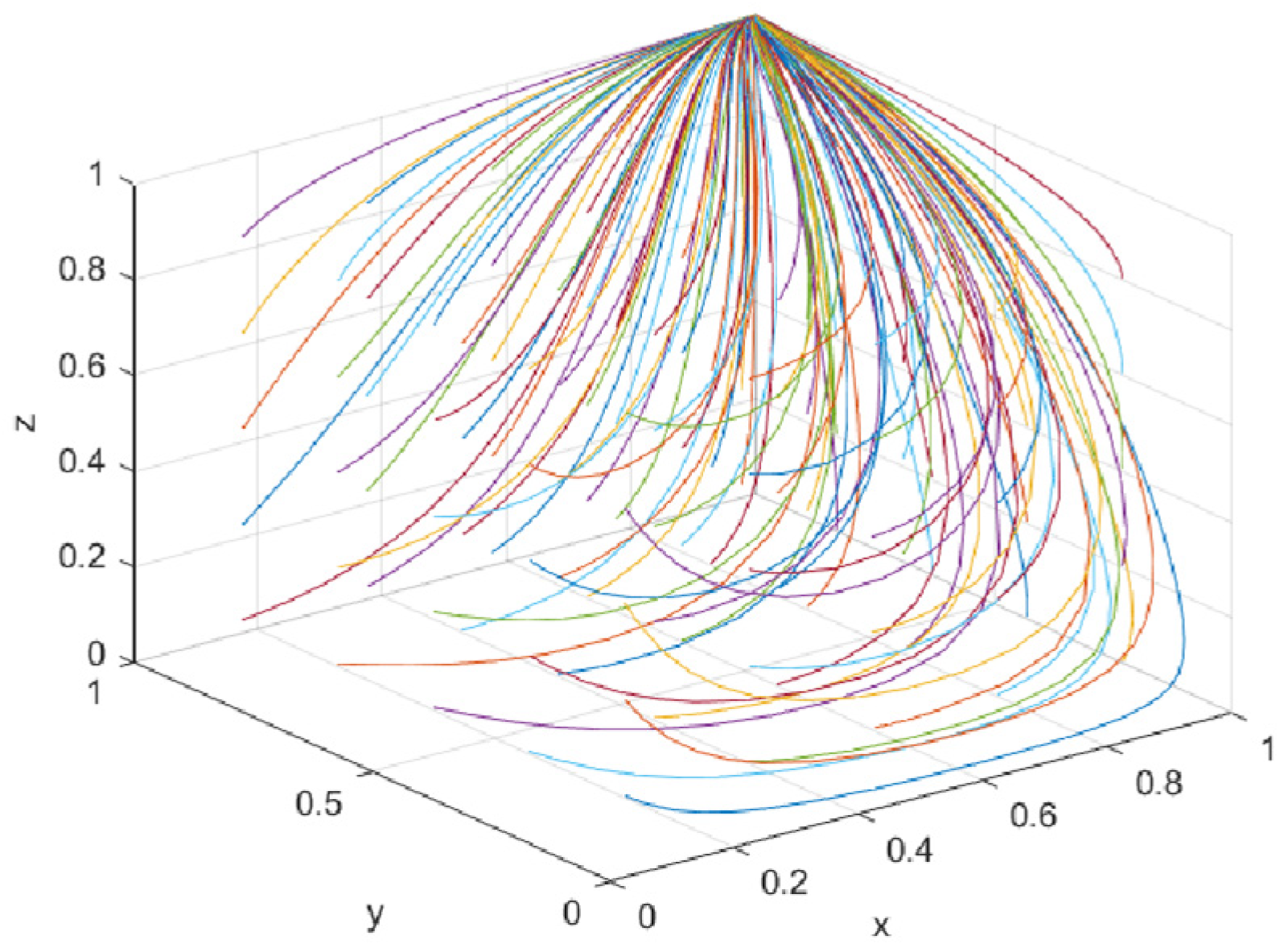
The impact of the tripartite initial willingness on the evolutionary trajectory of the collaborative innovation system is shown in Figure 4. Analyzing Figure 4a, when the tripartite initial willingness value is set to 0.1, the government strategy variable x converges to 1, while the traditional energy enterprise variable y and the emerging technology enterprise variable z both converge to 0, at which point the system reaches the corresponding equilibrium point E 5 ( 1 , 0 , 0 ) . When the initial willingness values of the three participating parties are increased to 0.5 or 0.8, x , y , and z all converge to 1, and the system reaches the equilibrium point E 8 ( 1 , 1 , 1 ) at this stage. As the initial willingness gradually strengthens, the convergence speed of traditional energy enterprises and emerging technology enterprises adopting collaborative innovation strategies significantly accelerates, while the convergence speed of the government’s incentive strategy correspondingly slows down, ultimately arriving at the equilibrium point E 8 ( 1 , 1 , 1 ) . When the overall initial willingness among the three participating parties is relatively low, the willingness to cooperate between traditional energy enterprises and emerging technology enterprises is weak. Currently, the government promotes the integration and sharing of resources between the two sides by improving policies and regulations and providing financial support, thereby guiding the enterprises towards cooperation. When the overall initial willingness of the three participating parties is relatively high, the evolutionary speed of traditional energy enterprises and emerging technology enterprises in choosing cooperative strategies is faster than that of the government. The collaborative cooperation between traditional energy enterprises and emerging technology enterprises will further incentivize the government to participate more actively, strengthen the motivation for tripartite cooperation, drive the cooperation towards further development, and accelerate the transformation and innovation process of traditional energy enterprises.
As shown in Figure 4b, when the initial willingness of government incentives x is 0.1, x converges to 1, while y and z both converge to 0. When x is increased to 0.5 or 0.8, x , y , and z all converge to 1. As x increases from 0.5 to 0.8, the speeds at which y and z converge to 1 gradually accelerate, and the convergence speed of y is consistently slower than that of z . This indicates that an increase in the government’s incentive willingness enhances the cooperative inclination of both traditional energy enterprises and emerging technology enterprises, and the cooperative willingness of emerging technology enterprises is more sensitive to government incentives. As shown in Figure 4c, when the initial willingness of the traditional energy enterprise y is 0.1, both y and z converge to 0, and x converges to 1. When y is increased to 0.5 or 0.8, x , y , and z all converge to 1. As y increases, the convergence speed of z correspondingly accelerates, while the convergence speed of x gradually slows down. This indicates that an increase in the cooperative willingness of traditional energy enterprises drives emerging technology enterprises to participate in cooperation more quickly while simultaneously making the government more cautious in its strategic choices. Nevertheless, the system will eventually tend to tripartite collaboration. As shown in Figure 4d, when the initial cooperative willingness z of the emerging technology enterprise is low, both z and y converge to 0, and x converges to 1. When z is at a medium or higher level, x , y , and z all converge to 1, with the convergence speed of y accelerating and the speed of x converging to 1 slowing down. This indicates that an enhancement in the cooperative willingness of emerging technology enterprises prompts the government to focus more on avoiding excessive intervention to stimulate innovation vitality. Accordingly, it appropriately slows the pace of incentives to better facilitate the transition and economic development of traditional energy enterprises.

4.2. Impact of Different Parameter Variations on the Evolutionary Path of Collaborative Innovation Relationships

4.2.1. The Impact of the Benefit Distribution Ratio

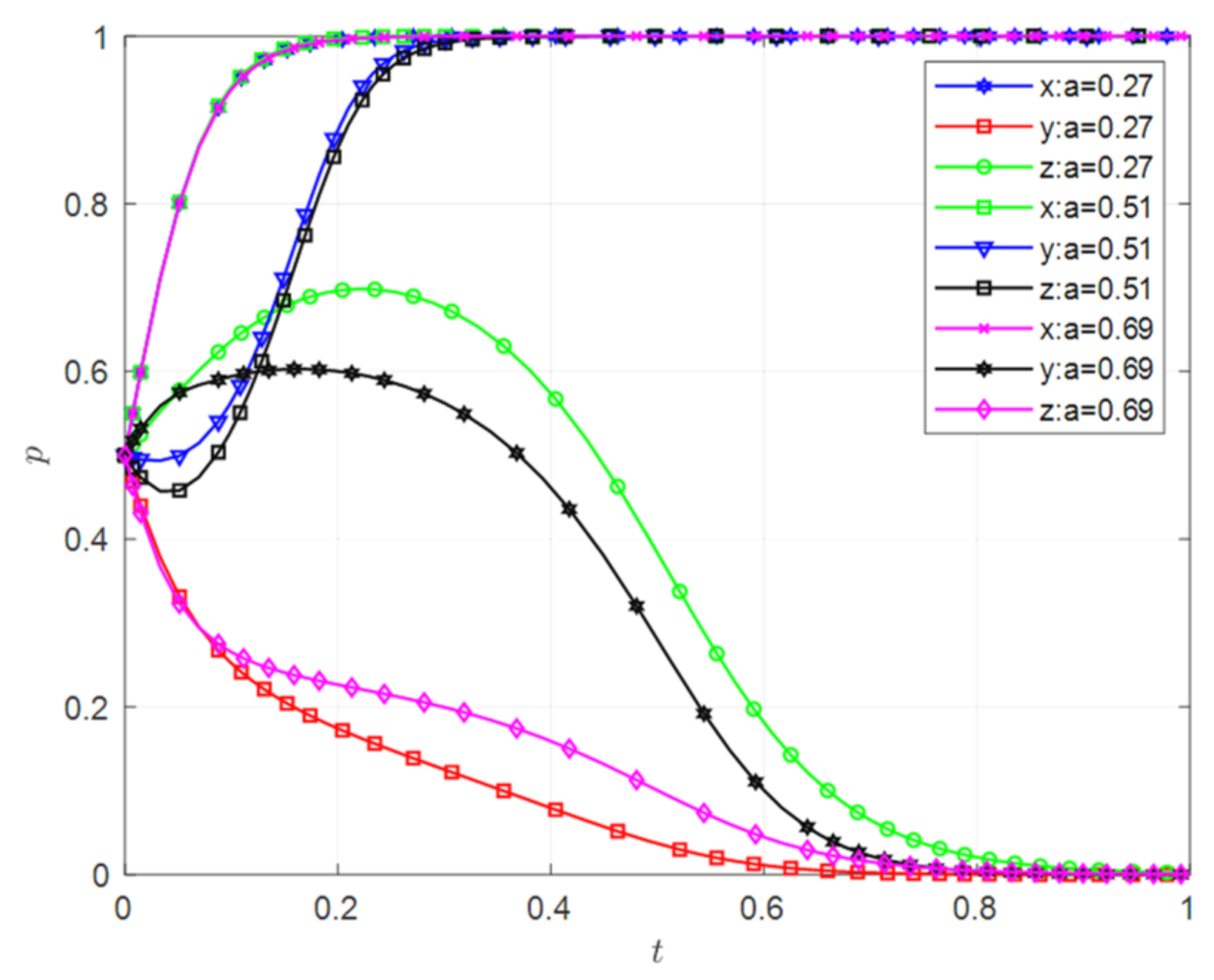
Keeping other parameter settings unchanged, the impact of the total payoff distribution ratio a on the evolutionary paths of both traditional energy enterprises and emerging technology enterprises is shown in Figure 5. As can be seen in Figure 5, when a = 0.27 , both traditional energy enterprises and emerging technology enterprises choose not to participate in collaborative innovation. During this process, as the value of a increases, the speed at which y and z approach 0 shows a trend of gradual deceleration. In the initial stage, as emerging technology enterprises obtain a relatively higher share of benefits, their enthusiasm for participating in cooperation increases first. However, as the participating willingness of traditional energy enterprises gradually declines, the willingness of emerging technology enterprises to cooperate then weakens accordingly. When a = 0.51 , both traditional energy enterprises and emerging technology enterprises tend to participate in collaborative innovation. This is because as a increases, the benefits obtained by emerging technology enterprises correspondingly decrease, leading to a slowdown in their pace of engaging in collaborative innovation. Meanwhile, the benefits received by traditional energy enterprises correspondingly increase, raising their willingness to cooperate. However, due to the influence of changes in the willingness of emerging technology enterprises, the speed at which they participate in collaborative innovation shows a trend of first increasing and then decreasing. When a = 0.69 , neither traditional energy enterprises nor emerging technology enterprises continue to participate in collaborative innovation. Although traditional energy enterprises obtain a higher share of benefits, leading to an increased willingness to engage in collaborative innovation, the significant decline in the participation willingness of emerging technology enterprises ultimately results in both sides withdrawing from cooperation.

4.2.2. The Impact of the Information Asymmetry Sensitivity Coefficient

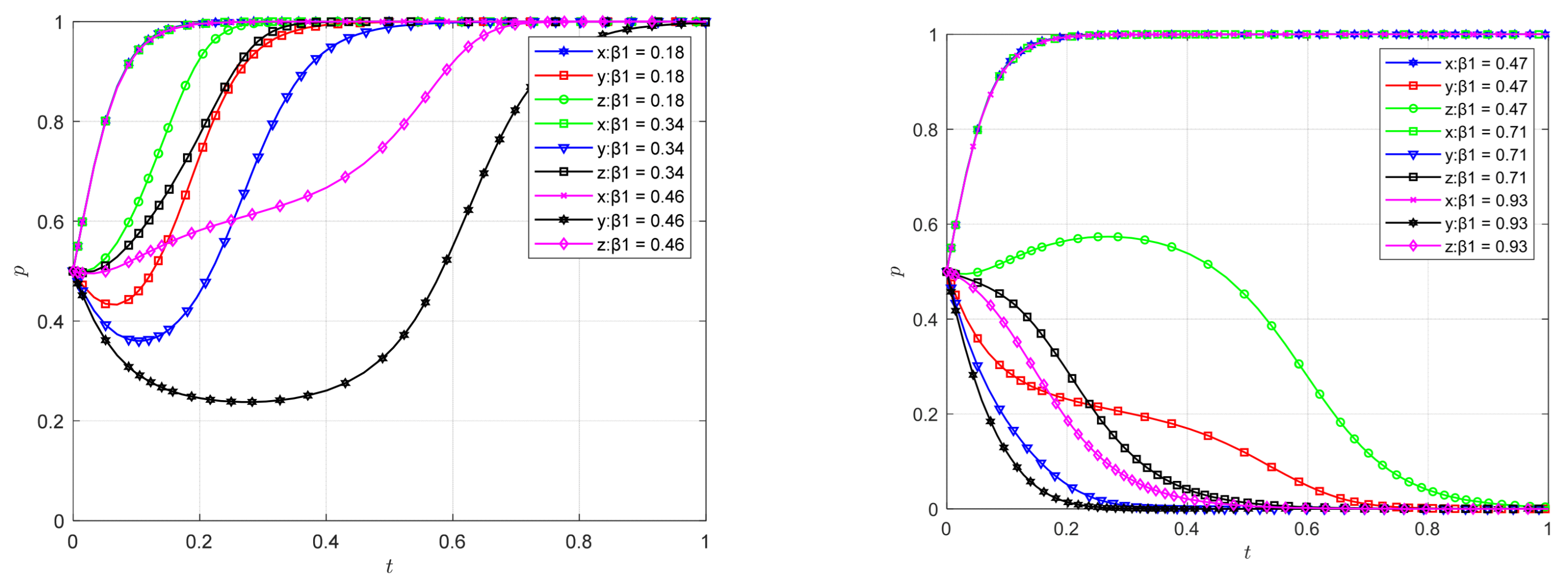
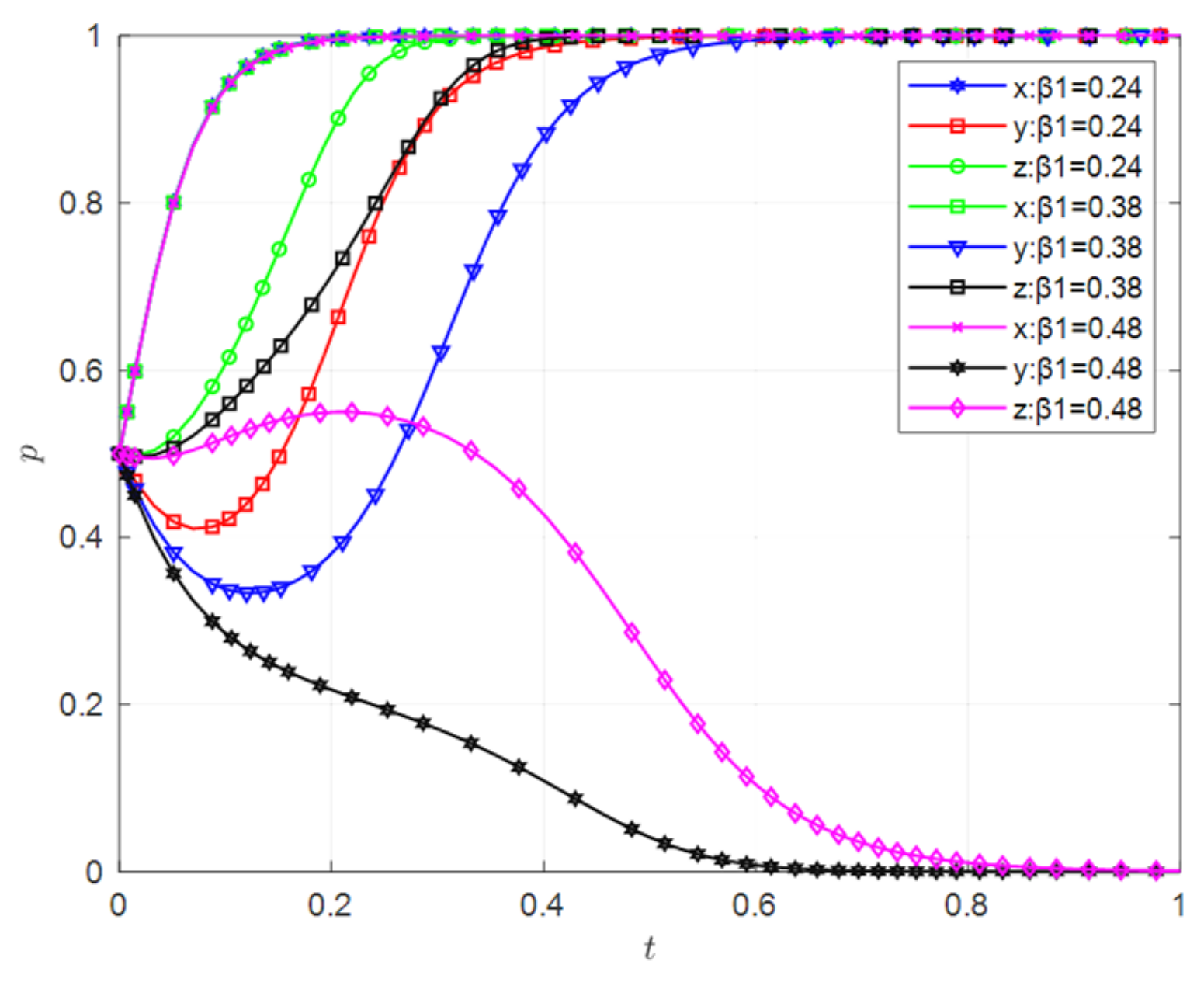
Keeping other parameter settings unchanged, the impact of the sensitivity coefficient of information asymmetry on coordination costs for traditional energy enterprises, denoted as β 1 , on the strategic choices of both enterprises is shown in Figure 6. As shown in Figure 6, the cooperative willingness of traditional energy enterprises exhibits a clear threshold effect in response to changes in β 1 . When β 1 is 0.24 and 0.38, traditional energy enterprises maintain a high level of cooperative willingness. However, when β 1 increases to 0.48, their cooperative willingness noticeably approaches zero. The strategic evolution of emerging technology enterprises shows a highly consistent trend of change with that of traditional energy enterprises. When β 1 is 0.24 and 0.38, emerging technology enterprises demonstrate stable cooperative willingness; when β 1 increases to 0.48, their cooperative willingness also approaches zero. Information asymmetry plays a crucial role in the cooperative decision making of traditional energy enterprises. When β 1 is below 0.48, the coordination costs remain within an acceptable range, and traditional energy enterprises are willing to participate in collaborative innovation. Once β 1 exceeds this critical threshold exceeds, the coordination costs caused by information asymmetry rise sharply, making cooperation economically unviable. Consequently, traditional energy enterprises tend to choose a non-cooperative strategy. The increase in coordination costs for traditional energy enterprises directly affects their cooperative decisions, which, in turn, transmits to emerging technology enterprises through cooperative expectations.
The cooperation willingness of traditional energy enterprises and emerging technology enterprises exhibits a significant threshold effect in response to changes in β 1 , as shown in Figure 7. When 0 < β 1 0.46 , traditional energy enterprises maintain a high level of cooperation willingness; when 0.46 < β 1 < 1 , their cooperation willingness clearly tends toward zero. The strategic evolution of emerging technology enterprises shows a trend highly consistent with that of traditional energy enterprises. When 0 < β 1 0.46 , emerging technology enterprises exhibit a stable willingness to cooperate; when 0.46 < β 1 < 1 , their willingness to cooperate also tends to zero. When β 1 is below 0.46, coordination costs remain within an acceptable range, and traditional energy enterprises are willing to participate in collaborative innovation. Once β 1 exceeds this critical threshold, the coordination costs caused by information asymmetry rise sharply, making cooperation uneconomical, and traditional energy enterprises tend to choose a non-cooperative strategy. The increase in coordination costs for traditional energy enterprises directly affects their cooperation decisions, which, in turn, is transmitted to emerging technology enterprises through cooperative expectations. Similarly, Fan et al. [55] found that in the tripartite evolutionary game of clean heating technology diffusion, key parameters such as costs, subsidies, and penalties also exhibit clear critical thresholds, beyond which the system’s stability rapidly deteriorates.
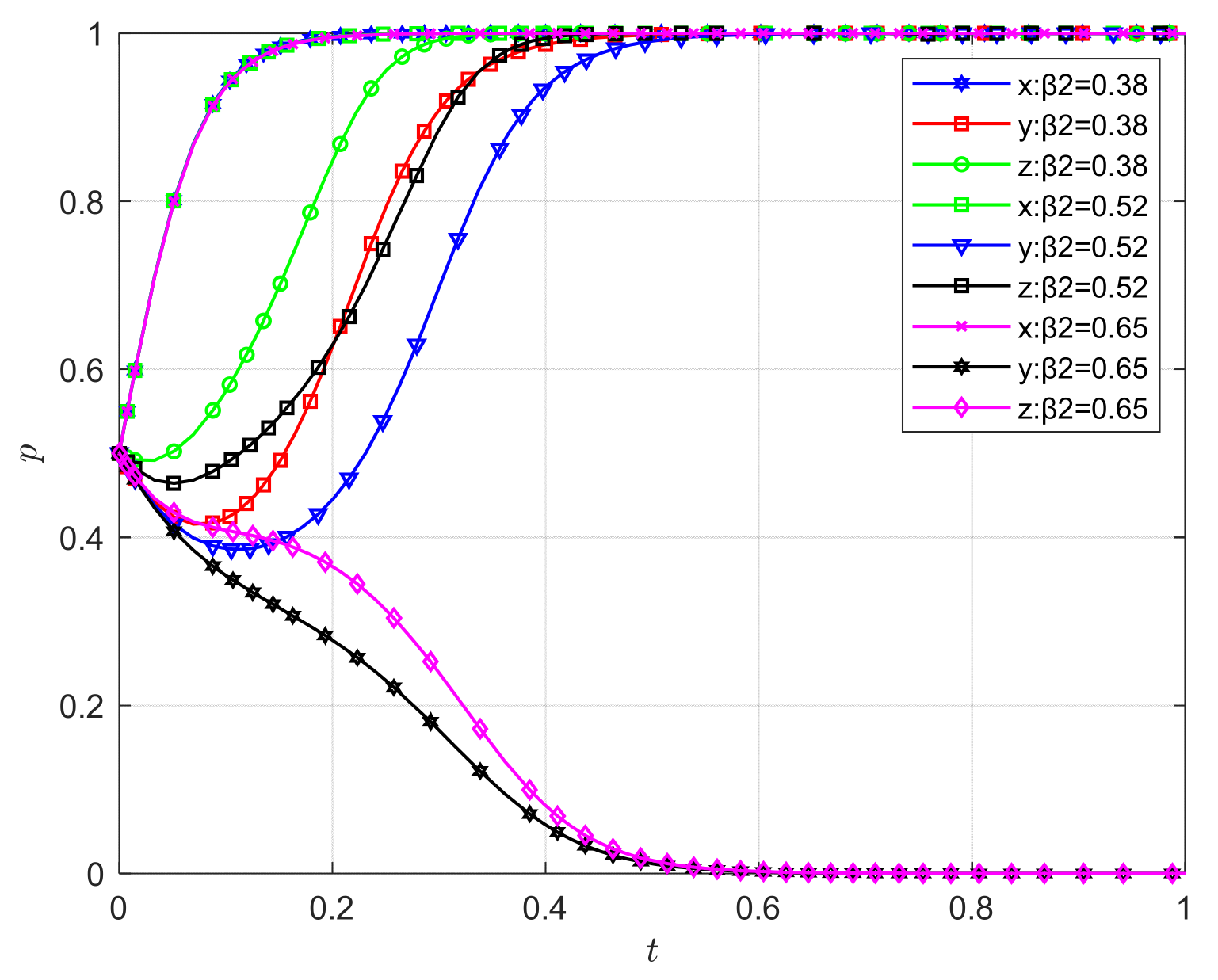
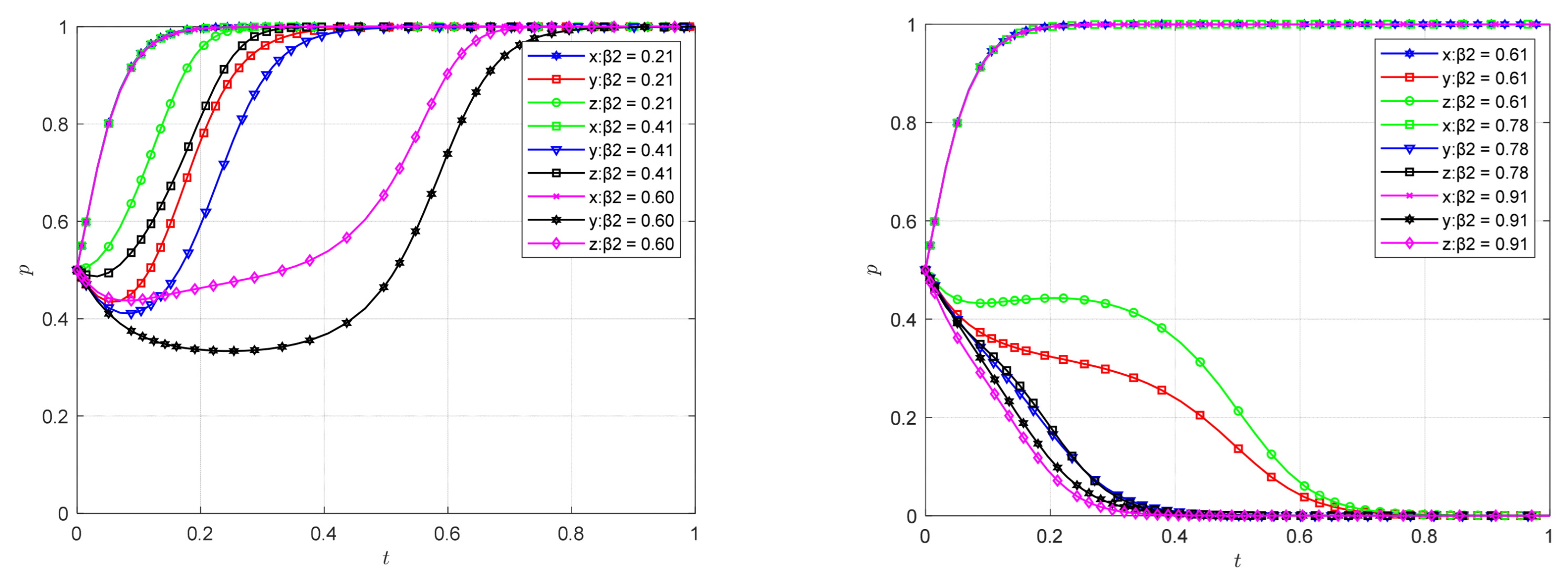
Keeping other parameter settings unchanged, the impact of the sensitivity coefficient of information asymmetry on coordination costs for emerging technology enterprises, denoted as β 2 , on the strategic choices of both enterprises is shown in Figure 8. As shown in Figure 8, the cooperative willingness of traditional energy enterprises shows a characteristic of first remaining stable and then declining in response to changes in β 2 . When β 2 is 0.38 and 0.52, traditional energy enterprises maintain a stable cooperative willingness. When β 2 increases to 0.65, their cooperative willingness begins to decline noticeably and tends to zero. The strategic evolution of emerging technology enterprises exhibits higher sensitivity to changes in β 2 . When β 2 is 0.38, emerging technology enterprises demonstrate a strong cooperative willingness. When β 2 increases to 0.52, their cooperative willingness has already begun to decline. When β 2 is 0.65, their cooperative willingness decreases significantly and tends to zero. This sharp change reflects the direct constraining effect of coordination costs on the cooperative decision making of emerging technology enterprises. Although β 2 directly acts on emerging technology enterprises, its influence is transmitted to traditional energy enterprises through the cooperation network. The synergistic evolution of both enterprises reveals the systematic impact of coordination costs in collaborative innovation. An increase in coordination costs for emerging technology enterprises not only directly affects their willingness to participate but also influences the decisions of traditional energy enterprises through cooperative expectations.
The cooperation willingness of traditional energy enterprises and emerging technology enterprises exhibits a significant threshold effect in response to changes in β 2 , as shown in Figure 9. When 0 < β 2 0.6 , traditional energy enterprises maintain a stable willingness to cooperate; when 0.6 < β 2 < 1 , their willingness to cooperate begins to decline significantly and tends toward zero. The strategic evolution of emerging technology enterprises exhibits higher sensitivity to changes in β 2 . When 0 < β 2 0.6 , emerging technology enterprises exhibit a strong willingness to cooperate; when 0.6 < β 2 < 1 , their willingness to cooperate begins to decline and gradually tends toward zero. When β 2 exceeds the critical threshold, coordination costs increase sharply. This sharp increase reflects the direct constraining effect of coordination costs on the cooperative decision making of emerging technology enterprises. Although β 2 directly affects emerging technology enterprises, its influence is transmitted to traditional energy enterprises through the cooperation network. The co-evolution of the two types of enterprises reveals the systemic impact of coordination costs in collaborative innovation. An increase in coordination costs for emerging technology enterprises not only directly affects their willingness to participate but also influences the decision making of traditional energy enterprises through cooperative expectations.

4.2.3. Impact of Government Subsidy and Penalty Intensity

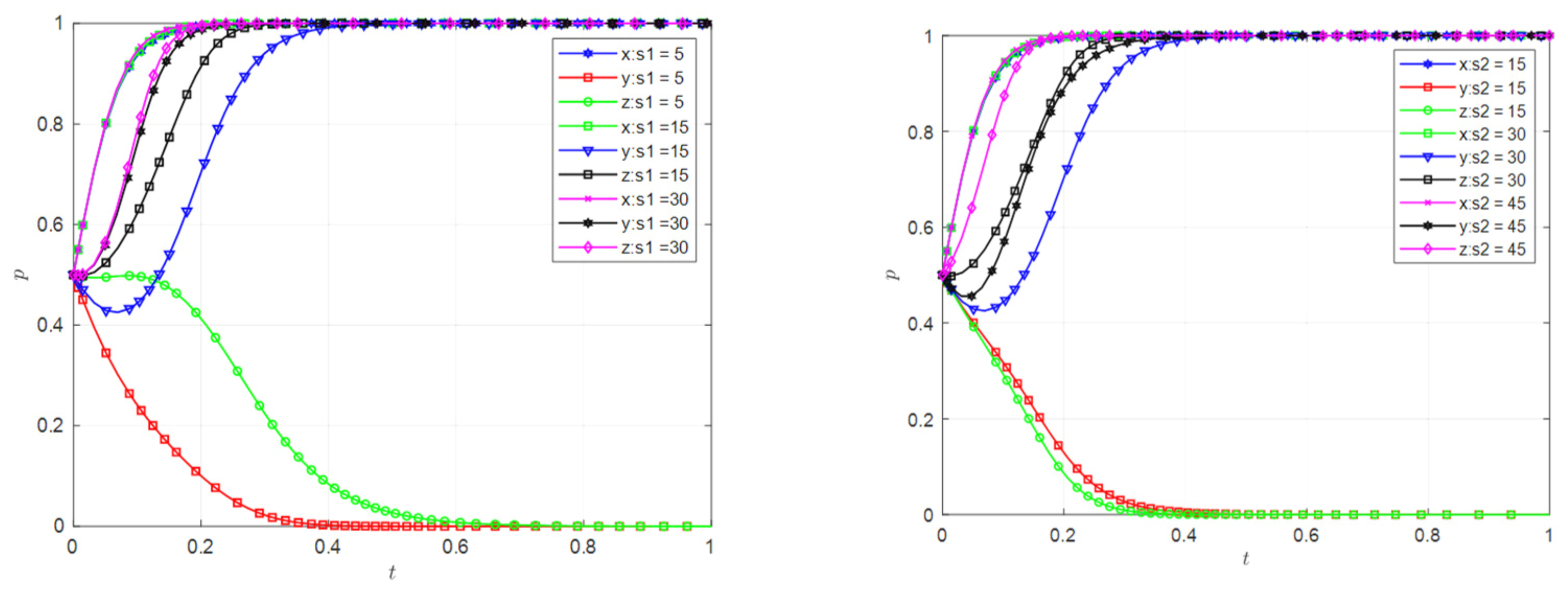
Keeping other parameter settings unchanged, the impact of government subsidies on the choice of collaborative innovation strategies by traditional energy enterprises and emerging technology enterprises is shown in Figure 10. As can be seen in Figure 10, when government subsidies to traditional energy enterprises and emerging technology enterprises are 5 and 15, respectively, the cooperative willingness of both parties tends toward zero. As the government gradually increases subsidies to both parties, the willingness of traditional energy enterprises and emerging technology enterprises to choose cooperation gradually increases and tends toward 1. As the amount of government subsidies increases, the government’s willingness to participate shows a declining trend. This is because excessively high financial subsidies would significantly increase the economic costs borne by the government, prompting it to be more cautious in the decision of whether to participate in collaborative innovation. In contrast, for traditional energy enterprises and emerging technology enterprises, the increase in government subsidies directly reduces the costs they need to bear to participate in collaborative innovation, thereby enhancing their willingness to engage in it. In other words, government subsidies improve the cost–benefit structure for traditional energy enterprises and emerging technology enterprises, enabling them to obtain cooperative benefits at lower costs. Consequently, both tend to choose to participate in collaborative innovation. Zhang et al. [56] similarly found that in a tripartite evolutionary game, moderate subsidies can effectively enhance enterprises’ willingness to cooperate, and there exists a significant threshold effect between subsidy intensity and system stability.
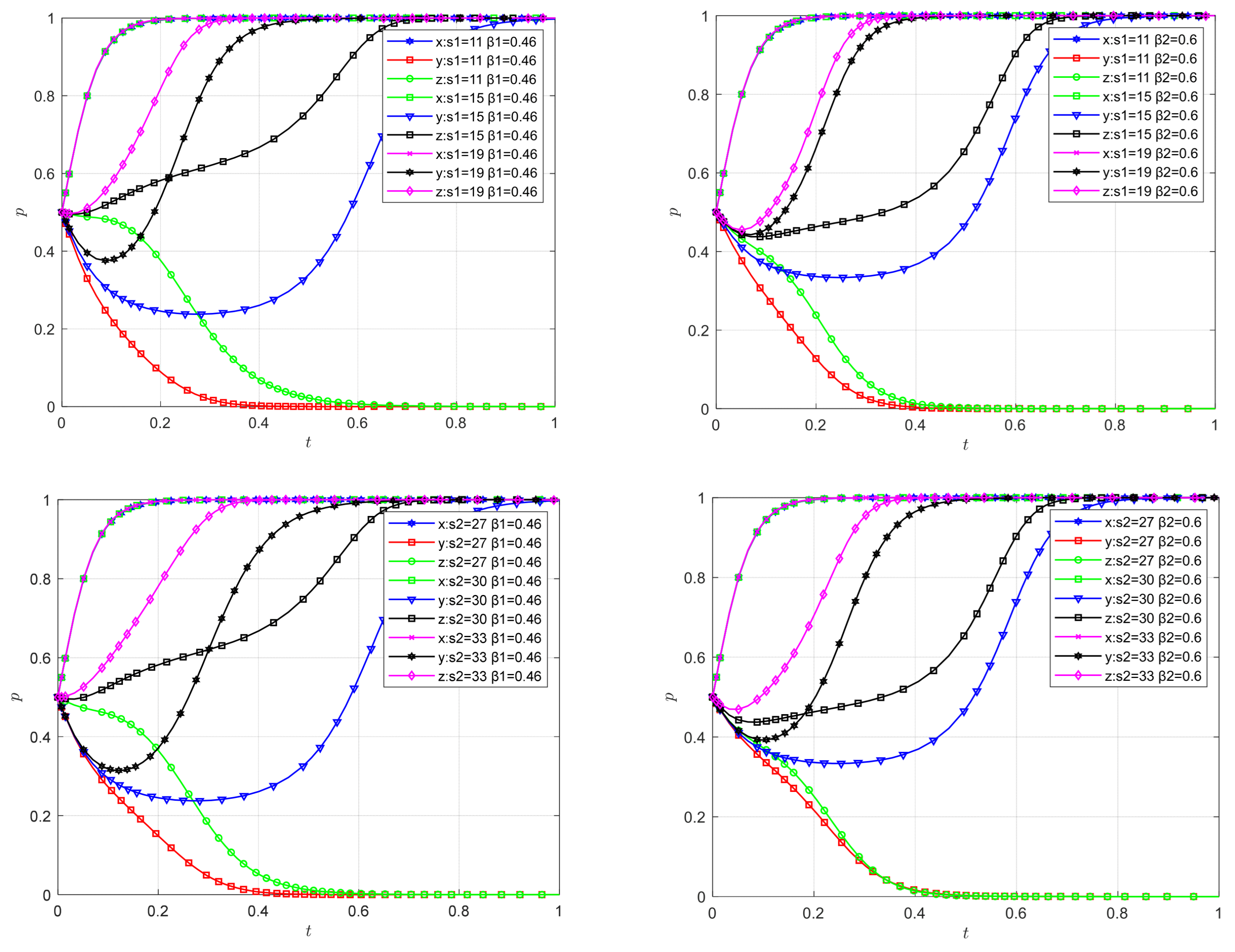
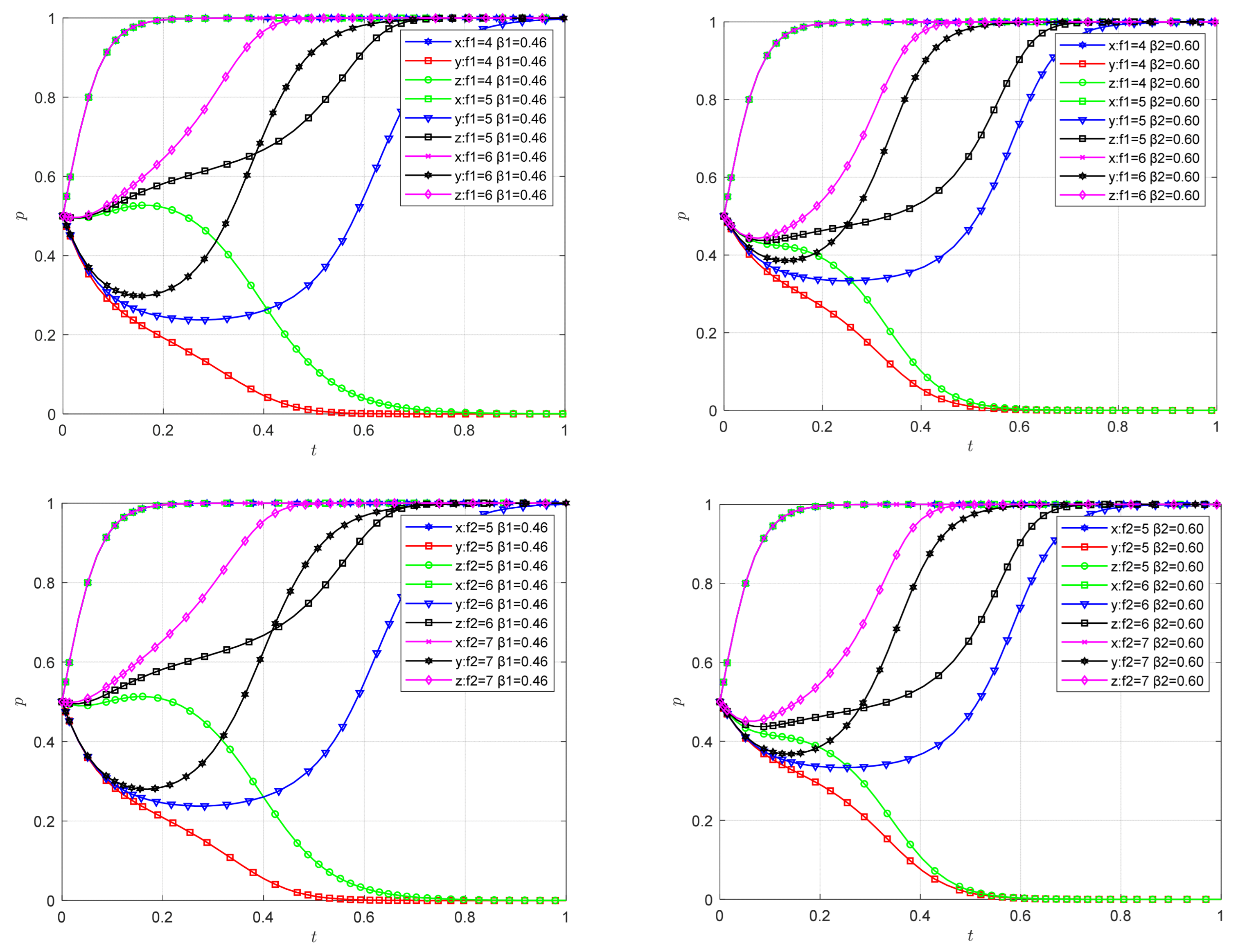
Keeping other parameters unchanged, under government incentives, the additional penalties f 1 and f 2 imposed on traditional energy enterprises and emerging technology enterprises for choosing the “non-cooperative” strategy will affect the critical thresholds of the information asymmetry sensitivity coefficients β 1 for traditional energy enterprises and β 2 for emerging technology enterprises. These effects are illustrated in Figure 11. When the critical threshold of β 1 remains unchanged, varying the magnitude of f 1 shows that as f 1 increases, both traditional energy enterprises and emerging technology enterprises maintain a stable willingness to cooperate, and the critical threshold of β 1 becomes larger. However, when f 1 decreases, their willingness to cooperate tends to zero, and the decrease in f 1 reduces the critical threshold of β 1 . The effect of f 1 on β 2 is the same as its effect on β 1 : when f 1 increases, the critical threshold of β 2 also increases; when f 1 decreases, the critical threshold of β 2 also decreases. Meanwhile, the effect of the additional penalty f 2 imposed on emerging technology enterprises for choosing the “non-cooperative” strategy on β 1 and β 2 is the same as the effect of the additional penalty f 1 imposed on traditional energy enterprises for choosing the “non-cooperative” strategy on β 1 and β 2 . As f 2 increases, the critical thresholds of β 1 and β 2 also increase; as f 2 decreases, the critical thresholds of β 1 and β 2 also decrease. This indicates that when the penalty intensity increases, the cost of choosing the “non-cooperative” strategy for both traditional energy enterprises and emerging technology enterprises increases. This effectively offsets the increase in coordination costs caused by information asymmetry. Even when information barriers are high, both parties still choose to maintain cooperation. Therefore, the critical thresholds of β 1 and β 2 increase accordingly. However, when the penalty intensity decreases, traditional energy enterprises and emerging technology enterprises lack sufficient external constraints, and the negative impact of information asymmetry is amplified. As a result, both parties are more likely to withdraw from cooperation due to excessively high coordination costs, leading to a decline in the critical thresholds of β 1 and β 2 and the eventual breakdown of cooperation. Therefore, a well-designed penalty system can not only effectively enhance the fault tolerance of inter-firm cooperation but also guide enterprises to gradually standardize their market behavior, thereby promoting the healthy and orderly development of the industry.
Keeping other parameters unchanged, the subsidies s 1 and s 2 provided by the government to traditional energy enterprises and emerging technology enterprises affect the critical thresholds of the information asymmetry sensitivity coefficients β 1 for traditional energy enterprises and β 2 for emerging technology enterprises. These effects are illustrated in Figure 12. When the critical threshold of β 1 remains unchanged, varying the magnitude s 1 shows that as s 1 increases, both traditional energy enterprises and emerging technology enterprises maintain a stable willingness to cooperate, and the critical threshold of β 1 becomes larger. However, when s 1 decreases, their willingness to cooperate tends to zero, and the decrease in s 1 reduces the critical threshold of β 1 . The effect of s 1 on β 2 is identical to its effect on β 1 : when s 1 increases, the critical threshold of β 2 also increases; when s 1 decreases, the critical threshold of β 2 also decreases. Meanwhile, the effect of the subsidy s 2 provided to emerging technology enterprises on β 1 and β 2 is identical to the effect of the subsidy s 1 provided to traditional energy enterprises on β 1 and β 2 . As s 2 increases, the critical thresholds of β 1 and β 2 also increase; as s 2 decreases, the critical thresholds of β 1 and β 2 also decrease. The results indicate that although government subsidies s 1 and s 2 and penalties f 1 and f 2 affect traditional energy enterprises and emerging technology enterprises through different mechanisms, their impacts on β 1 and β 2 are consistent. When subsidy intensity increases, the net benefits obtained by traditional energy enterprises and emerging technology enterprises from cooperation increase. Even if coordination costs increase, both parties remain willing to maintain cooperation, and consequently, the critical thresholds of β 1 and β 2 increase accordingly. When subsidy intensity decreases, the expected benefits of cooperation for enterprises diminish, leading to a decline in the critical thresholds of β 1 and β 2 and making cooperation more prone to breakdown. Therefore, a well-designed subsidy mechanism can not only enhance enterprises’ strategic willingness to cooperate but also foster a virtuous cycle of policy guidance, market incentives, and technological progress, thereby providing a solid foundation for the participation of traditional energy enterprises and emerging technology enterprises in collaborative innovation.

4.3. Numerical Simulation of the Evolution of the Ideal Stable Point in Tripartite Cooperation

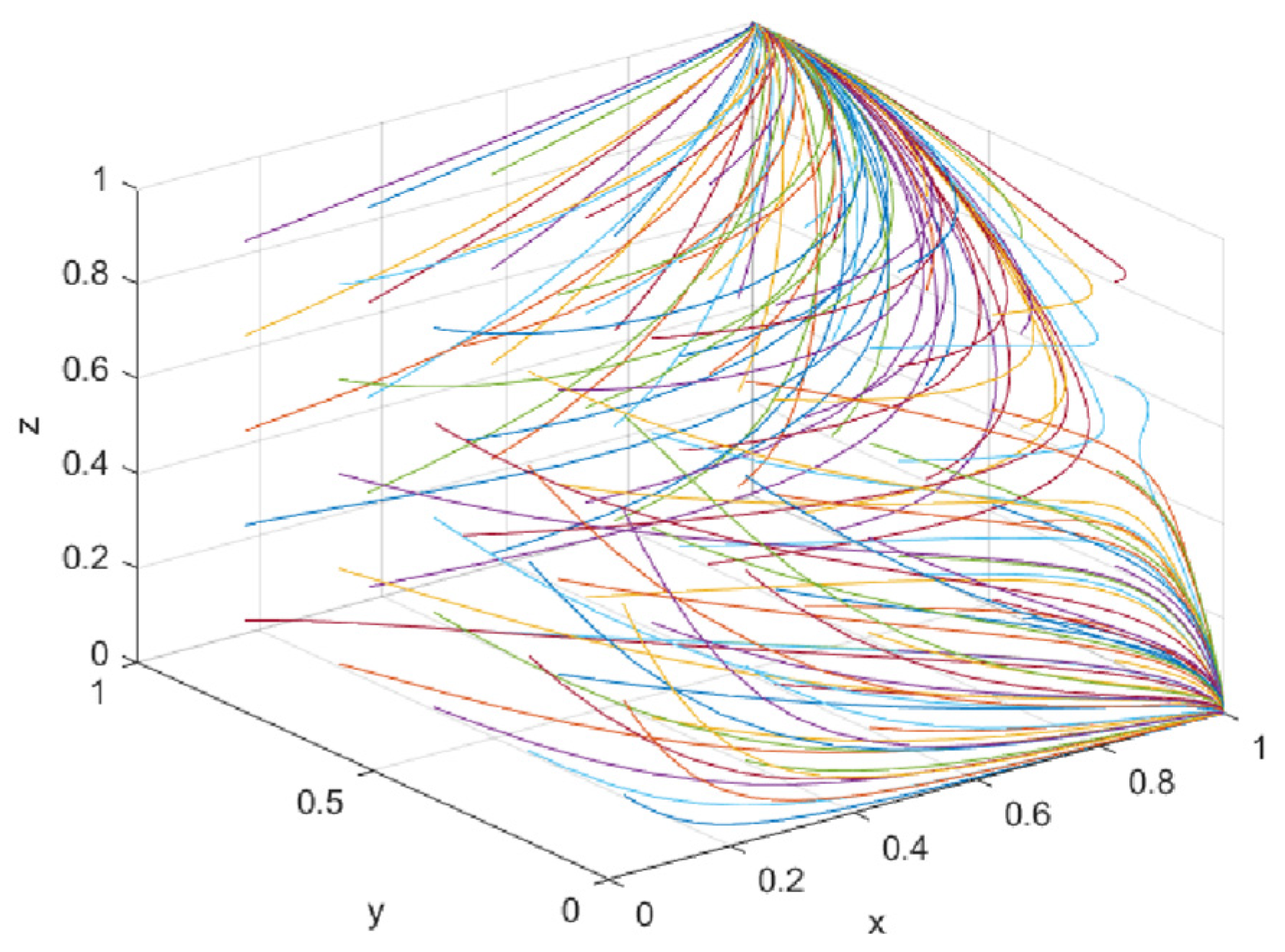
Under the initial conditions u 1 c 0 > 0 , a R + s 1 d 1 C 1 l 1 + f 1 > 0 , and s 2 + ( 1 a ) R d 2 C 2 l 2 + f 2 > 0 and when s 1 + d 1 C 1 l 1 + f 1 < 0 and s 2 + d 2 C 2 l 2 + f 2 < 0 hold, the evolutionarily stable points of the system at this stage are E 5 ( 1 , 0 , 0 ) and E 8 ( 1 , 1 , 1 ) . The dynamic process under this scenario is simulated using MATLAB software. The evolutionary results obtained based on the established parameters are shown in Figure 13. The model system ultimately converges to the two stable points E 5 ( 1 , 0 , 0 ) and E 8 ( 1 , 1 , 1 ) . In the initial stage of traditional energy enterprise transformation, if the direct costs and associated risk costs required for cooperation between traditional energy enterprises and emerging technology enterprises increase, while the expected benefits decrease, and the government’s reward and punishment intensity under incentive policies is insufficient, the system will tend to evolve toward E 5 ( 1 , 0 , 0 ) . On the contrary, if the government continuously strengthens incentive measures, effectively reduces the costs of collaborative innovation for enterprises, enhances cooperative benefits, and increases the implementation intensity of reward and punishment policies, the system will tend to evolve toward E 8 ( 1 , 1 , 1 ) .
Keeping other parameter settings unchanged, by increasing the incentive and penalty intensity for traditional energy enterprises and emerging technology enterprises and reducing their total costs for engaging in collaborative innovation, s 1 = 30 , s 2 = 45 , f 1 = 10 , f 2 = 15 , c 1 = 30 , c 2 = 10 , c 3 = 40 , and c 4 = 10 . The evolutionary results after simulation are shown in Figure 14. The model ultimately evolves to the ideal point E 8 ( 1 , 1 , 1 ) , indicating that the incentive measures adopted by the government can effectively promote collaborative innovation between traditional energy enterprises and emerging technology enterprises. With the support of government subsidies, traditional energy enterprises and emerging technology enterprises can promote collaborative innovation at a lower overall cost. This is not only conducive to maintaining the stable operation of the entire collaborative innovation system but also lays a solid foundation for establishing a long-term and stable cooperative relationship among the three parties: the government, traditional energy enterprises, and emerging technology enterprises.

5. Discussion

(1) The collaborative innovation system has two possible evolutionary equilibrium points, corresponding to the initial and mature stages of collaborative innovation, respectively, with no internal equilibrium point. The internal equilibrium point is always an unstable saddle point due to the presence of positive eigenvalues in the characteristic equation, meaning the system cannot remain in the intermediate state of “partial incentives and partial cooperation” for an extended period. This implies that government incentives and corporate cooperative behaviors require more targeted adjustments and guidance to promote the evolution of the system toward the equilibrium point.
(2) In the model, this paper assumes the synergy benefit to be an exogenous variable R . However, considering that the cross-boundary integration of traditional energy and emerging technologies exhibits typical “strong complementarity of factors”, this paper further extends the synergy benefit function into a multiplicative form: R = R 0 + λ y z , where λ > 0 is the amplification coefficient of collaborative innovation efficiency, y and z represent the initial willingness of traditional energy enterprises and emerging technology enterprises to participate in collaborative innovation, respectively, and R 0 is the base benefit obtained by both parties in collaborative innovation. Substituting the total benefit function into the replicator dynamics equations for traditional energy enterprises and emerging technology enterprises yields: F ( y ) = d y d t = y ( 1 y ) ( z a R 0 + z 2 y a λ + x s 1 + d 1 C 1 l 1 + x f 1 2 z d 1 ) and F ( z ) = d z d t = = z ( 1 z ) ( x s 2 + y ( 1 a ) R 0 + z y 2 ( 1 a ) λ + d 2 C 2 l 2 2 y d 2 + x f 2 ) . When R is determined by the initial willingness of traditional energy enterprises and emerging technology enterprises to participate in collaboration and the collaboration efficiency, the evolutionary equilibrium points of the system become more sensitive to key parameters such as y , z , and λ . When the collaboration efficiency λ increases steadily and the initial willingness of both parties rises, the system converges more easily to the stable point E 8 ( 1 , 1 , 1 ) , thereby maximizing the innovation benefits of the industry as a whole. This not only effectively prevents free-riding behavior by either party in the collaboration but also promotes deep strategic coupling between the cooperating parties, ensuring a more equitable and reasonable distribution of benefits and innovation returns.
(3) In the model, this paper assumes that the costs of traditional energy enterprises and emerging technology enterprises are, respectively, C 1 = α 1 c 1 + β 1 c 2 and C 2 = α 2 c 3 + β 2 c 4 , However, considering the dynamic impact of coordination costs in the collaborative innovation process between traditional energy and emerging technologies, this paper further extends the cost function into a multiplicative form: C 1 = α 1 c 1 + c 2 e β 1 k 1 and C 2 = α 2 c 3 + c 4 e β 2 k 2 , where β 1 and β 2 represent the amplification coefficients of information asymmetry for the two parties, and k 1 , k 2 represent the degrees of information asymmetry for the two parties, respectively. This transforms the linear relationship between coordination costs and the degree of information asymmetry into a nonlinear one. When the degree of information asymmetry between the two parties is low, coordination costs increase slowly, and enterprises can still maintain cooperation through communication and negotiation. When the degree of information asymmetry is high, the exponential function exhibits an accelerating upward trend, causing coordination costs to surge sharply and making cooperation difficult to sustain.
(4) Standardized data protocols can mitigate the degree of information asymmetry between traditional energy enterprises and emerging technology enterprises. Coordination costs induced by information asymmetry constitute a critical constraint for collaborative innovation, and excessively high costs directly inhibit the bilateral willingness to cooperate. The information asymmetry sensitivity coefficient has a critical threshold. When this threshold is exceeded, information asymmetry causes coordination costs to increase exponentially, raising the coordination costs for traditional energy enterprises and emerging technology enterprises to participate in collaborative innovation, thereby inhibiting both parties from engaging in cooperation.

6. Conclusions

Based on evolutionary game theory, this paper constructs a tripartite evolutionary game model involving the government, traditional energy enterprises, and emerging technology enterprises. Through systematic numerical simulation, it reveals the critical conditions for the transformation of the collaborative innovation system from non-cooperation to cooperation. The results show the following: (1) The initial willingness of participating entities significantly impacts the evolutionary trajectory of the collaborative innovation system. The higher the initial willingness, the faster traditional energy enterprises and emerging technology enterprises evolve toward the “cooperation” strategy, and the faster the government evolves toward the “incentive” strategy. If both parties show strong enthusiasm in the initial stage of collaborative innovation, they will quickly break through the initial “wait-and-see” stage and promote collaborative innovation. However, when the initial willingness of both parties is insufficient, they will fall into a predicament of lacking motivation for cooperation, making it difficult to effectively achieve collaborative innovation. (2) Information asymmetry plays a critical role in the cooperation between traditional energy enterprises and emerging technology enterprises. If the two parties lack effective communication, the information asymmetry sensitivity coefficient will increase, leading to higher coordination costs. This may even cause both parties to refrain from participating in collaborative innovation, ultimately resulting in the breakdown of cooperation. (3) A rational benefit distribution ratio and targeted government incentives are central to fostering enterprise participation. When the benefit distribution ratio is too low or too high, it reduces enterprises’ willingness to cooperate. Meanwhile, scientifically designing government subsidies and penalty systems can effectively mobilize the enthusiasm of both parties to engage in collaborative innovation. (4) Fair and transparent supervision is crucial for sustaining long-term collaborative innovation. In the process, the two parties often face information asymmetry, which can easily lead to cognitive biases, lack of trust, and distribution disputes, thereby weakening their enthusiasm for cooperation.
While this paper provides important insights into the tripartite collaborative innovation behaviors driving the green transformation of traditional energy enterprises, it has several limitations. First, the model currently assumes a linear relationship between coordination costs and the information asymmetry sensitivity coefficient. In reality, the impact of information asymmetry often exhibits complex, nonlinear characteristics, potentially causing exponential increases in coordination costs. Future research could adopt more realistic nonlinear cost functions to test the robustness of these conclusions. Second, the analysis relies heavily on numerical simulations, with parameters derived primarily from the existing literature and theoretical reasoning rather than empirical corporate data. This deviation between theoretical parameters and real-world scenarios may affect the model’s precision. Future studies should enhance the external validity of these findings through empirical case studies or questionnaire surveys.
Based on the above findings, the following recommendations are proposed to promote collaborative innovation for the green transformation of traditional energy enterprises: (1) Enhance the initial willingness to collaborate through early government intervention: In the initial stage of collaborative innovation, the government can enhance the initial willingness of traditional energy enterprises and emerging technology enterprises to participate through various means, such as establishing special funds, designing incentive mechanisms, and promoting knowledge related to collaborative innovation. When both parties demonstrate high enthusiasm at the initial stage, they can overcome hesitation, accelerate cooperation, and maximize the effectiveness of collaborative innovation. Conversely, if initial willingness is insufficient, timely intervention measures should be taken to avoid the predicament of lacking cooperation motivation. (2) Build an industrial data platform to mitigate information asymmetry: By constructing a unified and highly collaborative data foundation, data empowerment can break down information silos. Through standardized data sharing protocols, both parties can gain real-time visibility into each other’s performance, thereby reducing the impact of information asymmetry. (3) Establish a closed-loop “incentive–assessment–reward–punishment” system: It should strengthen the incentive intensity of corporate cooperation benefits, reduce the explicit costs of collaborative innovation, and link the reward and punishment system to the outcomes of collaborative innovation. This will effectively activate the endogenous motivation of traditional energy enterprises to participate in collaborative innovation, promote their shift from passive participation to proactive engagement, and ultimately achieve a transformation of collaborative innovation from quantitative growth to qualitative improvement with enhanced efficiency. (4) Introduce third-party agencies for independent evaluation and supervision: Through third-party institutions, implement intermediary process supervision throughout the cooperation to ensure that both parties always collaborate within a fair and reasonable framework. This prevents one party’s motivation from being frustrated due to distribution imbalances, thereby avoiding negative impacts on their cooperation.

Author Contributions

Conceptualization, N.S.; methodology, N.S. and S.J.; investigation, N.S. and S.J.; data curation, Y.X.; writing—original draft preparation, S.J.; writing—review and editing, N.S. and S.J.; visualization, S.J.; funding acquisition, N.S. and Y.X. All authors have read and agreed to the published version of the manuscript.

Funding

This research was funded by the Shanxi Provincial Science and Technology Strategy Research Special Project (202404030401087), Key Research and Development Program Project of Shanxi Province (202402080301013), Doctoral Research Startup Fund of Taiyuan University of Science and Technology (W20222006), and Science and Technology Project of the Department of Transport of Shanxi Province (2016-1-6).

Data Availability Statement

The original contributions presented in this study are included in the article. Further inquiries can be directed to the corresponding author.

Conflicts of Interest

Author Nina Su was employed by the company Shanxi Huaxin Gas Energy Research Institute Co., Ltd. The remaining authors declare that the research was conducted in the absence of any commercial or financial relationships that could be construed as a potential conflict of interest.

References

  1. Wang, L.; Yang, Z.; Chen, T.; Xu, T.; Xiao, B. The Mechanism of Green Transition of Energy Enterprises Applying Noncooperative–Cooperative Biform Game Model. Systems 2025, 13, 942. [Google Scholar] [CrossRef]
  2. Wang, L.; Zhang, B. Research on the Green Investment of Traditional Energy Enterprises and Its Effectiveness Under Environmental Regulation. Sustainability 2025, 17, 590. [Google Scholar] [CrossRef]
  3. Wang, Y.; Chen, G.; Yan, B.; Bastiaans, R. A coupling energy system of 10 clean-energy heating systems: A case study in Shandong province in China. Int. J. Green Energy 2021, 18, 1323–1338. [Google Scholar] [CrossRef]
  4. Peng, Y.; Zhou, J.; Ke, Y.; Qin, Q. Risk or Opportunity: The Impact of Economic Policy Uncertainty on Technological Innovation in Energy Enterprises. Energies 2026, 19, 337. [Google Scholar] [CrossRef]
  5. Wang, Y.; Akhtar, R.; Mu, W.; Lv, W.; Li, L. Government Subsidy and Enterprise Green Innovation: Evidence from Chinese Enterprises. Pol. J. Environ. Stud. 2025, 34, 5319–5336. [Google Scholar] [CrossRef]
  6. Ruan, W.; Zhang, H.; Yang, J. How to break carbon lock-in of thermal power industry in China—A tripartite evolutionary game analysis. Appl. Energy 2025, 377, 124504. [Google Scholar] [CrossRef]
  7. Smith, J.M.; Price, G.R. The logic of animal conflict. Nature 1973, 246, 15–18. [Google Scholar] [CrossRef]
  8. Taylor, P.D.; Jonker, L.B. Evolutionarily stable strategies and game dynamics. Math. Biosci. 1978, 40, 145–156. [Google Scholar] [CrossRef]
  9. Nowak, M.A.; Sigmund, K. Evolution of indirect reciprocity. Nature 2005, 437, 1291–1298. [Google Scholar] [CrossRef]
  10. Santos, F.C.; Pacheco, J.M. Scale-free networks provide a unifying framework for the emergence of cooperation. Phys. Rev. Lett. 2005, 95, 098104. [Google Scholar] [CrossRef] [PubMed]
  11. Fargetta, G.; Scrimali, R.L. A tripartite evolutionary game for strategic decision-making in live-streaming e-commerce. J. Comput. Sci. 2025, 87, 102585. [Google Scholar] [CrossRef]
  12. Benko, P.T.; Pi, B.; Li, Q.; Feng, M.; Perc, M.; Vošner, H.B. Evolutionary games for cooperation in open data management. Appl. Math. Comput. 2025, 496, 129364. [Google Scholar] [CrossRef]
  13. Janan, M.; Taleizadeh, A.A.; Jolai, F. Electric energy supply chain finance and pricing in an energy blockchain environment: Sustainable energy bonds and evolutionary game theory. Energy 2025, 320, 135186. [Google Scholar] [CrossRef]
  14. Hu, J.; Ai, X.; Wang, J. The impact of supply chain digitalization on the technological innovation of new energy vehicle enterprises: The moderated mediation effect. Bus. Process Manag. J. 2026; ahead-of-print. [CrossRef]
  15. Tian, H.; Wang, Z.; Zhang, P.; Li, J.; Wang, Q.; Zhang, S. Complex dynamics of a symmetric quantum Stackelberg duopoly game model with heterogeneous expectations. Phys. A Stat. Mech. Its Appl. 2026, 681, 131073. [Google Scholar] [CrossRef]
  16. Wu, B.; Liu, P.; Xu, X. An evolutionary analysis of low-carbon strategies based on the government–enterprise game in the complex network context. J. Clean. Prod. 2017, 141, 168–179. [Google Scholar] [CrossRef]
  17. Wang, H.; Chen, L.; Liu, J. An evolutionary game theory analysis linking manufacturing, logistics, and the government in low-carbon development. J. Oper. Res. Soc. 2022, 73, 1014–1032. [Google Scholar] [CrossRef]
  18. Zhu, G.; Pan, G.; Zhang, W. Evolutionary Game Theoretic Analysis of Low Carbon Investment in Supply Chains under Governmental Subsidies. Int. J. Environ. Res. Public Health 2018, 15, 2465. [Google Scholar] [CrossRef]
  19. Xue, J.; He, Y.; Gao, P.; Tang, Y.; Xu, H. Multi-Agent Evolutionary Game Model: Corporate Low-Carbon Manufacturing, Chinese Government Supervision, and Public Media Investigation. Sustainability 2022, 14, 5587. [Google Scholar] [CrossRef]
  20. Yuan, X.-M.; Zheng, C.-C. Evolutionary game and simulation analysis of low-carbon technology innovation with multi-agent participation. IEEE Access 2022, 10, 11284–11295. [Google Scholar] [CrossRef]
  21. Cheng, L.; Peng, P.; Lu, W.; Huang, P.; Chen, Y. Study of Flexibility Transformation in Thermal Power Enterprises under Multi-Factor Drivers: Application of Complex-Network Evolutionary Game Theory. Mathematics 2024, 12, 2537. [Google Scholar] [CrossRef]
  22. Chen, B.; Liu, Y. Data Industry Green Development Promoted by Public Policy and Law in China. Sustainability 2024, 16, 7173. [Google Scholar] [CrossRef]
  23. Wu, A.H.; Wang, Z.; Chen, S. Impact of specific investments, governance mechanisms and behaviors on the performance of cooperative innovation projects. Int. J. Proj. Manag. 2017, 35, 504–515. [Google Scholar] [CrossRef]
  24. Lee, J.; Yu, S. Does external monitoring substitute for or complement internal monitoring by corporate board? Evidence from Korean state-owned enterprises. Emerg. Mark. Financ. Trade 2020, 56, 3646–3661. [Google Scholar] [CrossRef]
  25. Wang, C.; Hu, Q. Knowledge sharing in supply chain networks: Effects of collaborative innovation activities and capability on innovation performance. Technovation 2020, 94–95, 102010. [Google Scholar] [CrossRef]
  26. Liu, D.; Yan, C. The structure and mechanism of collaborative innovation networks. Manag. World 2013, 243, 1–4. (In Chinese) [Google Scholar] [CrossRef]
  27. Feranita, F.; Kotlar, J.; De Massis, A. Collaborative innovation in family firms: Past research, current debates and agenda for future research. J. Fam. Bus. Strategy 2017, 8, 137–156. [Google Scholar] [CrossRef]
  28. Liu, H.; Liu, Z.; Lai, Y.; Li, L. Factors Influencing Collaborative Innovation Project Performance: The Case of China. Sustainability 2021, 13, 7380. [Google Scholar] [CrossRef]
  29. Jens, F. Inter-firm exchange and innovation in platform ecosystems: Evidence from apple’s worldwide developers conference. Manag. Sci. 2020, 66, 4784–4801. [Google Scholar] [CrossRef]
  30. Lichtenthaler, U. Outbound open innovation and its effect on firm performance: Examining environmental influences. R D Manag. 2009, 39, 317–330. [Google Scholar] [CrossRef]
  31. Faems, D.; De Visser, M.; Andries, P.; Van Looy, B. Technology alliance portfolios and financial performance: Value-enhancing and cost-increasing effects of open innovation. J. Product. Innov. Manag. 2010, 27, 785–796. [Google Scholar] [CrossRef]
  32. Vivona, R.; Demircioglu, M.A.; Audretsch, D.B. The costs of collaborative innovation. J. Technol. Transf. 2023, 48, 873–899. [Google Scholar] [CrossRef]
  33. Andrea, M.; Francisco, R. Equilibrium innovation ecosystems: The dark side of collaborating with complementors. Manag. Sci. 2016, 62, 534–549. [Google Scholar] [CrossRef]
  34. Li, Y.; Guo, H.; Cooper, S.Y.; Wang, H. The Influencing Factors of the Technology Standard Alliance Collaborative Innovation of Emerging Industry. Sustainability 2019, 11, 6930. [Google Scholar] [CrossRef]
  35. Chen, Z.; Liang, S.Z. The research on the collaborative mechanism of technological innovation in the Guangdong-Hong Kong-Macao Greater Bay Area. Sci. Technol. Manag. Res. 2021, 41, 86–96. (In Chinese) [Google Scholar] [CrossRef]
  36. Xu, Y.; Zhu, J.; Tao, C. The mechanism of technological potential energy driving Industry-University-Research institution collaborative innovation. Int. Entrep. Manag. J. 2021, 17, 1541–1567. [Google Scholar] [CrossRef]
  37. Arsanti, T.A.; Rupidara, N.; Bondarouk, T. Managing knowledge flows within open innovation: Knowledge sharing and absorption mechanisms in collaborative innovation. Cogent Bus. Manag. 2024, 11, 2351832. [Google Scholar] [CrossRef]
  38. Li, B.Z.; Wang, X.; Su, Y.; Luo, X.F. The evolutionary game research on collaborative innovation of supply chain enterprises among China’s strategic emerging industries. Chin. J. Manag. Sci. 2021, 29, 136–147. (In Chinese) [Google Scholar] [CrossRef]
  39. Tidd, J.; Bessant, J.R. Managing Innovation: Integrating Technological, Market and Organizational Change; John Wiley & Sons: Hoboken, NJ, USA, 2018. [Google Scholar]
  40. Muhammad, F. An empirical study of university-industry R&D collaboration in China: Implications for technology in society. Technol. Soc. 2013, 35, 191–202. [Google Scholar] [CrossRef]
  41. Xie, X.M.; Liu, S.Y. The influence mechanism of collaborative innovation models on collaborative effects and innovation performance. J. Manag. Sci. 2015, 28, 27–39. (In Chinese) [Google Scholar] [CrossRef]
  42. Gao, K.; Yuan, Y.; Liu, T. Digital transformation and value co-creation in state-owned manufacturing enterprises: A hypernetwork perspective. Bus. Process Manag. J. 2026; ahead-of-print. [CrossRef]
  43. Mahdavimanshadi, M.; Anaraki, M.G.; Mowlai, M.; Ahmadirad, Z. A Multistage Stochastic Optimization Model for Resilient Pharmaceutical Supply Chain in COVID-19 Pandemic Based on Patient Group Priority. In 2024 Systems and Information Engineering Design Symposium (SIEDS), Charlottesville, VA, USA; IEEE: New York, NY, USA, 2024; pp. 382–387. [Google Scholar] [CrossRef]
  44. Liu, Y.; Yu, C.; Zhang, X.; Yang, X. Research on the Evolution Game of Collaborative Innovation of Government- Finance-Enterprise Green Technology from the Perspective of Incentive Mechanism. Pol. J. Environ. Stud. 2024, 33, 6267–6280. [Google Scholar] [CrossRef] [PubMed]
  45. Shao, Q.; Lyu, Y.; Cao, J. Evolutionary Dynamics and Policy Coordination in the Vehicle–Grid Interaction Market: A Tripartite Evolutionary Game Analysis. Mathematics 2025, 13, 2356. [Google Scholar] [CrossRef]
  46. He, Z.; Ma, X.; Hu, Y.; Liu, H.; Dong, X. Dynamic evolution game of regional innovation ecosystem with multiple actors under digitalization. Front. Phys. 2026, 14, 1740603. [Google Scholar] [CrossRef]
  47. Lu, R.; Wang, X.; Yu, H.; Li, D. Multiparty evolutionary game model in coal mine safety management and its application. Complexity 2018, 2018, 9620142. [Google Scholar] [CrossRef]
  48. Han, Y. A tripartite evolutionary game analysis of enterprises’ behaviour in the platform ecosystem. In Discrete Dynamics in Nature and Society; Wiley: Hoboken, NJ, USA, 2020; pp. 1–10. [Google Scholar] [CrossRef]
  49. Zhu, Z.; Cheng, L.; Shen, T. Spontaneous Formation of Evolutionary Game Strategies for Long-Term Carbon Emission Reduction Based on Low-Carbon Trading Mechanism. Mathematics 2024, 12, 3109. [Google Scholar] [CrossRef]
  50. Cai, R.; Zhang, T.; Wang, X.; Jia, Q.; Zhao, S.; Liu, N.; Wang, X. Evolutionary Game and Simulation Analysis of New-Energy Vehicle Promotion in China Based on Reward and Punishment Mechanisms. Mathematics 2024, 12, 2900. [Google Scholar] [CrossRef]
  51. Li, F.; Wang, Y. Study on the Evolutionary Game of Cooperation and Innovation in Science and Technology Town Enterprises. Sustainability 2022, 14, 9210. [Google Scholar] [CrossRef]
  52. Liang, J.; Dou, Y.; Song, Y. A Tripartite Evolutionary Game Study on the Carbon Emission Reduction of Shipping Enterprises Considering Government and Shipper Behavior. Sustainability 2025, 17, 3895. [Google Scholar] [CrossRef]
  53. Jiang, Z.; Xu, C. Policy incentives, government subsidies, and technological innovation in new energy vehicle enterprises: Evidence from China. Energy Policy 2023, 177, 113527. [Google Scholar] [CrossRef]
  54. Jia, J.; Lai, Y.; Yang, Z.; Li, L. The Optimal Strategy of Enterprise Key Resource Allocation and Utilization in Collaborative Innovation Project Based on Evolutionary Game. Mathematics 2022, 10, 400. [Google Scholar] [CrossRef]
  55. Fan, R.; Lu, J.; Zhu, C. Clean Heating Technology Diffusion with Government Departments’ and Commercial Banks’ Participation: An Evolutionary Game Analysis. Sustainability 2025, 17, 3413. [Google Scholar] [CrossRef]
  56. Zhang, R.; Xie, Y.; Li, Y.; Chen, Q.; Wang, Q. How Do Incentive Policy and Benefit Distribution Affect the Cooperative Development Mechanism of Intelligent Connected Vehicles? A Tripartite Evolutionary Game Approach. Electronics 2025, 14, 2042. [Google Scholar] [CrossRef]
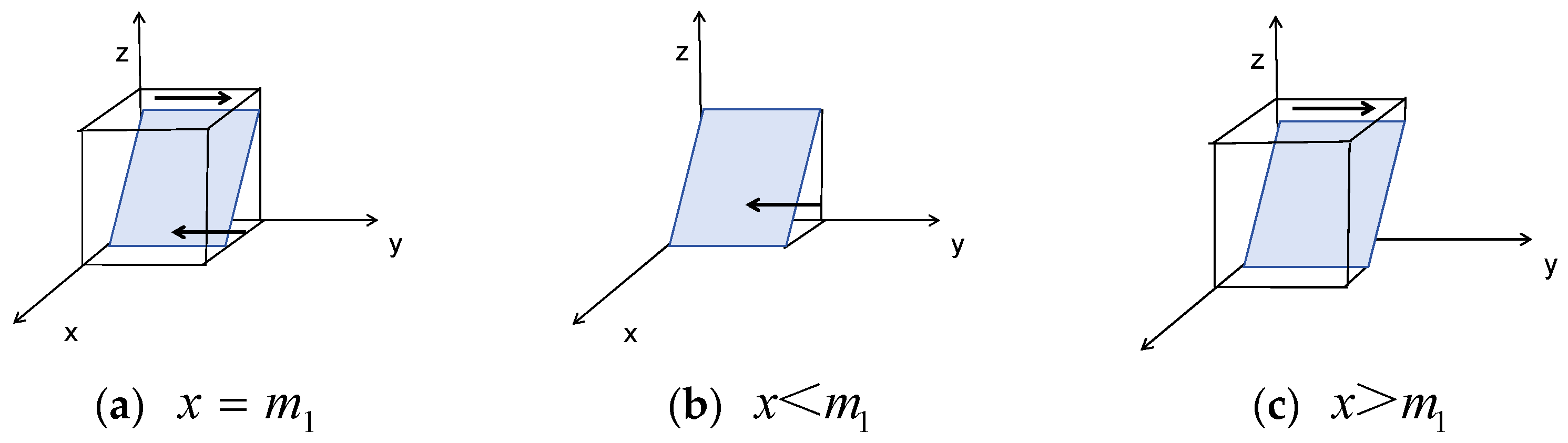
Figure 1. Phase diagram of strategic evolution for traditional energy enterprises.
Mathematics 14 01968 g001
Figure 2. Phase diagram of strategic evolution for emerging technology enterprises.
Mathematics 14 01968 g002
Figure 4. Impacts of changes in the subjects’ participation willingness on the evolutionary process. (a) Simultaneous variation of participation willingness x , y , and z . (b) Variation of participation willingness x . (c) Variation of participation willingness y . (d) Variation of participation willingness z .
Mathematics 14 01968 g004
Figure 5. Impact of changes in total payoff distribution ratio on evolutionary paths.
Mathematics 14 01968 g005
Figure 6. Impact of changes in β 1 on evolutionary paths.
Mathematics 14 01968 g006
Figure 7. The critical threshold effect of β 1 .
Mathematics 14 01968 g007
Figure 8. Impact of changes in β 2 on evolutionary paths.
Mathematics 14 01968 g008
Figure 9. The critical threshold effect of β 2 .
Mathematics 14 01968 g009
Figure 10. Impact of changes in government subsidies on evolutionary paths.
Mathematics 14 01968 g010
Figure 11. Variation of critical thresholds of information asymmetry sensitivity coefficients β 1 and β 2 under different penalty intensities.
Mathematics 14 01968 g011
Figure 12. Variation of critical thresholds of information asymmetry sensitivity coefficients β 1 and β 2 under different government subsidies.
Mathematics 14 01968 g012
Figure 13. Evolutionary path diagram of the tripartite game for equilibrium points E 5 ( 1 , 0 , 0 ) and E 8 ( 1 , 1 , 1 ) .
Mathematics 14 01968 g013
Figure 14. Evolutionary path diagram of the tripartite game for the ideal point E 8 ( 1 , 1 , 1 ) .
Mathematics 14 01968 g014
Table 1. Game benefit payoff matrix of the government, traditional energy enterprises, and emerging technology enterprises.
Game ParticipantsGovernment
Incentivize x Not Incentivize 1 x
Traditional Energy EnterprisesCooperate y Emerging Technology EnterprisesCooperate
z
( r 1 + a R C 1 l 1 + s 1 , r 2 + ( 1 a ) R C 2 l 2 + s 2 , w 1 c 0 + u 1 ) ( r 1 + a R C 1 l 1 , r 2 + ( 1 a ) R C 2 l 2 , w 1 )
Not cooperate 1 z ( r 1 + d 1 C 1 l 1 + s 1 , r 2 + d 2 f 2 , w 2 + u 2 c 0 ) ( r 1 + d 1 C 1 l 1 , r 2 + d 2 , w 2 )
Not cooperate 1 y Emerging Technology EnterprisesCooperate
z
( r 1 + d 1 f 1 , r 2 + d 2 C 2 l 2 + s 2 , w 2 + u 2 c 0 ) ( r 1 + d 1 , r 2 + d 2 C 2 l 2 , w 2 )
Not cooperate 1 z ( r 1 f 1 , r 2 f 2 , u 2 c 0 ) ( r 1 , r 2 , 0 )
Table 2. Eigenvalues of the Jacobian matrix.
Equilibrium PointEigenvalues λ 1 Eigenvalues λ 2 Eigenvalues λ 3
E 1 ( 0 , 0 , 0 ) u 2 c 0 d 1 C 1 l 1 d 2 C 2 l 2
E 2 ( 0 , 0 , 1 ) u 2 c 0 a R C 1 l 1 d 1 ( d 2 C 2 l 2 )
E 3 ( 0 , 1 , 0 ) u 2 c 0 ( d 1 C 1 l 1 ) ( 1 a ) R d 2 C 2 l 2
E 4 ( 0 , 1 , 1 ) u 1 c 0 ( a R d 1 C 1 l 1 ) ( ( 1 a ) R d 2 C 2 l 2 )
E 5 ( 1 , 0 , 0 ) ( u 2 c 0 ) s 1 + d 1 C 1 l 1 + f 1 s 2 + d 2 C 2 l 2 + f 2
E 6 ( 1 , 0 , 1 ) ( u 2 c 0 ) a R + s 1 d 1 C 1 l 1 + f 1 ( s 2 + d 2 C 2 l 2 + f 2 )
E 7 ( 1 , 1 , 0 ) ( u 2 c 0 ) ( s 1 + d 1 C 1 l 1 + f 1 ) s 2 + ( 1 a ) R d 2 C 2 l 2 + f 2
E 8 ( 1 , 1 , 1 ) ( u 1 c 0 ) ( a R + s 1 d 1 C 1 l 1 + f 1 ) ( s 2 + ( 1 a ) R d 2 C 2 l 2 + f 2 )
Disclaimer/Publisher’s Note: The statements, opinions and data contained in all publications are solely those of the individual author(s) and contributor(s) and not of MDPI and/or the editor(s). MDPI and/or the editor(s) disclaim responsibility for any injury to people or property resulting from any ideas, methods, instructions or products referred to in the content.