Article

Who Gets the Flows? AI-Based Brand Visibility, Social Media Sentiment, and Capital Allocation in the U.S. Spot Bitcoin ETF Market

1
School of Business, Singapore University of Social Sciences, Singapore 599494, Singapore
2
SUSS Academy, Singapore University of Social Sciences, Singapore 599494, Singapore
*
Authors to whom correspondence should be addressed.
Mathematics 2026, 14(11), 1959; https://doi.org/10.3390/math14111959
Submission received: 22 March 2026 / Revised: 12 May 2026 / Accepted: 28 May 2026 / Published: 3 June 2026

Abstract

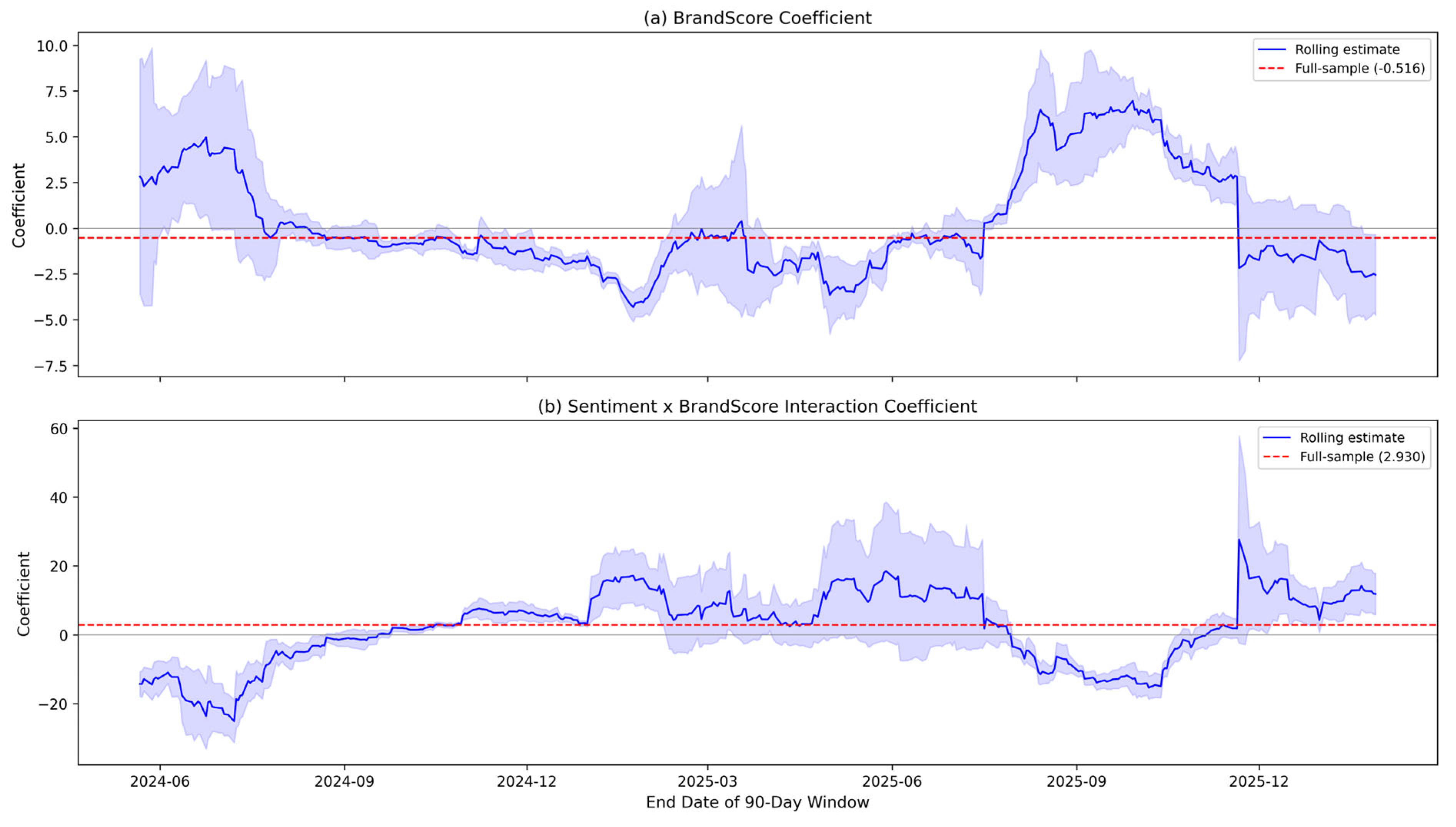
This study examines whether retail social media sentiment and community attention explain daily net capital flows into U.S. spot Bitcoin exchange-traded funds (ETFs), and whether issuer brand visibility conditions that relationship. We construct a balanced panel of N = 10 ETFs over T = 514 trading days (January 2024 to January 2026) and combine it with 162,819 cleaned Reddit posts to derive three AI-driven discourse variables: engagement-weighted sentiment, community attention, and a novel issuer-specific BrandScore. Entity fixed-effects regressions show that neither aggregate sentiment nor BrandScore level alone significantly predicts fund-level flows; however, the Sentiment × BrandScore interaction is significant ( β ^ = 2.930 , p = 0.038 ), indicating that sentiment becomes economically meaningful only when attached to a visible issuer. This interaction survives two-way (entity + date) fixed effects ( p = 0.012 ) and winsorization ( p = 0.004 ). Panel quantile regressions reveal distributional heterogeneity in the brand-sentiment channel. Rolling 90-day window estimation confirms the mechanism is episodic, with the interaction achieving significance in 62.8% of subsample windows. These results provide suggestive evidence for a brand-filtered sentiment transmission mechanism in digital asset markets.

1. Introduction

The approval of U.S. spot Bitcoin exchange-traded funds (ETFs) by the Securities and Exchange Commission (SEC) in January 2024 marked a structural break in the institutional adoption of digital assets. For the first time, large asset managers could package direct Bitcoin exposure in a familiar exchange-traded wrapper and distribute it through standard brokerage channels, retirement accounts, and advisory platforms. Within months, this development attracted tens of billions of dollars in cumulative net inflows, transforming Bitcoin from a stand-alone speculative object into a competitive product category [1]. Once the regulatory gateway opened, capital was no longer flowing simply into Bitcoin as an asset; it was flowing into particular ETFs, each backed by a different issuer, embedded within a different institutional reputation, and recognized by investors through different channels of attention and trust. Understanding the forces that direct capital across these near-identical products is therefore a first-order question for both financial economics and the emerging literature on artificial intelligence (AI)-driven analytics in asset management.
That shift creates an analytically attractive setting. Spot Bitcoin ETFs track essentially the same underlying asset, and fee differences across issuers, while not irrelevant, are often modest relative to the intensity of media attention surrounding the launch period. Because product fundamentals are closely aligned, residual differences in daily net flows are especially informative about investor perception, issuer reputation, and the social construction of demand. In such a market, discourse matters. Yet discourse need not matter in a simple, linear way. A positive online mood may be insufficient to move money unless investors can map that mood onto a credible institutional vehicle. The finance-related question is therefore not merely whether sentiment predicts flows, but whether sentiment requires a trusted brand in order to become actionable capital allocation.
A substantial body of prior work establishes that investor attention and textual sentiment can shape trading volume, returns, and fund flows [2,3,4]. Related works in the literature argue that financial products receive disproportionate demand when they become salient or easier to process [5,6]. Recent advances in AI have considerably expanded the analytical toolkit available to researchers [7,8,9]. Natural language processing (NLP) is employed for extracting economically meaningful signals from unstructured text [10]. Lexicon-based classifiers such as valence aware dictionary and sentiment reasoner (VADER) [11], domain-specific dictionaries, and transformer-based models such as FinBERT [12] now allow researchers to measure sentiment, topic salience, and entity-level attention at scale. These AI-driven techniques have been applied extensively to equity markets and, more recently, to cryptocurrency markets, where digital traces are especially important because market narratives diffuse rapidly through online platforms and because many participants first encounter information in social rather than institutional settings [13,14]. However, virtually all of this literature studies the asset side of the market, asking whether online sentiment predicts Bitcoin prices or volatility. Much less is known about how AI-extracted discourse signals shape competition among financial products that provide exposure to the same digital asset.
This paper argues that the Bitcoin ETF setting introduces a distinct mechanism that existing sentiment-flow studies have not addressed, that is, brand-mediated trust. Traditional asset managers such as BlackRock and Fidelity enter the market with long-standing reputational capital, broad distribution networks, and institutional familiarity. Crypto-native issuers, by contrast, may enjoy legitimacy within specialist communities but face narrower trust outside those communities. If investor attention is scarce and sentiment is noisy, issuer brand can work as a cognitive filter that converts undirected enthusiasm into product-specific flows [15,16]. A socially amplified belief that Bitcoin is attractive may not generate cash subscriptions everywhere; it may concentrate on the funds whose issuers appear safest, most visible, or most institutionally acceptable. The mechanism is analogous to the role of familiarity and recognition heuristics documented in consumer choice [17] and fund selection [18], but here it operates in a novel setting where AI-based text analytics can precisely quantify issuer-level salience in real time.
To test this idea, we combine a daily panel of 10 U.S. spot Bitcoin ETFs spanning January 2024 to January 2026 with a large Reddit corpus from r/Bitcoin covering the same period. From 162,819 cleaned posts, we construct three principal AI-derived discourse variables using NLP techniques. Sentiment is measured using engagement-weighted VADER compound polarity scores, which capture the tone of community discussion while accounting for the differential influence of high-engagement posts. Attention captures the overall intensity of subreddit discussion through the logarithm of daily post counts and comment volumes. BrandScore is a novel issuer-level measure defined as issuer-specific mentions per 1000 daily Reddit posts, designed to capture the extent to which the community associates its discourse with particular ETF issuers and tickers rather than with Bitcoin in general. We then estimate entity fixed-effects models with one-day lagged explanatory variables and ETF-clustered standard errors, augmented by an interaction term between sentiment and BrandScore that directly tests the brand-moderation hypothesis. The econometric analysis is supplemented by subgroup estimation for traditional finance (TradFi) and crypto-native products, Canay [19] panel quantile regressions across the conditional flow distribution, entity-level bootstrap inference to address the small cross-sectional dimension ( N = 10 ), Driscoll and Kraay [20] heteroskedasticity and autocorrelation consistent (HAC) standard errors to account for cross-sectional dependence, and rolling 90-day window estimation to trace the temporal stability of the estimated relationships.
The core finding is that aggregate Reddit sentiment does not independently predict fund-level flows, and the direct BrandScore level effect is not statistically significant, but the interaction between sentiment and brand visibility is positive and significant. Specifically, the Sentiment × BrandScore interaction coefficient in the brand-augmented entity fixed-effects model is β ^ 7 = 2.930 ( t = 2.071 , p = 0.038 ), suggesting that positive community mood translates into realized capital allocation only when it is attached to a visible and recognizable issuer. The direct BrandScore coefficient is not independently significant ( β ^ 6 = 0.516 , p = 0.785 ), reflecting the countervailing influence of GBTC (Grayscale), which has high brand visibility but experienced persistent outflows due to its 1.50% expense ratio. Meanwhile, the standalone sentiment coefficient remains statistically insignificant across all model specifications. The same online optimism therefore has very different financial consequences depending on which issuer it surrounds, a pattern consistent with brand-filtered sentiment transmission rather than a simple sentiment-drives-demand channel.
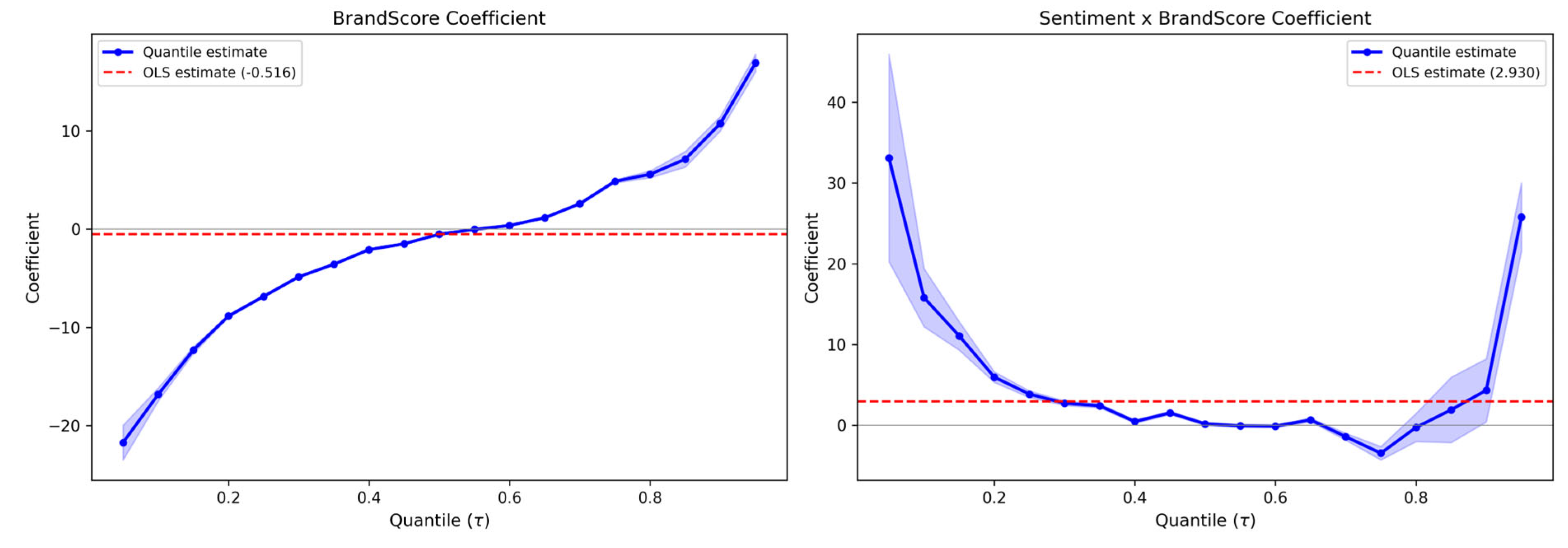
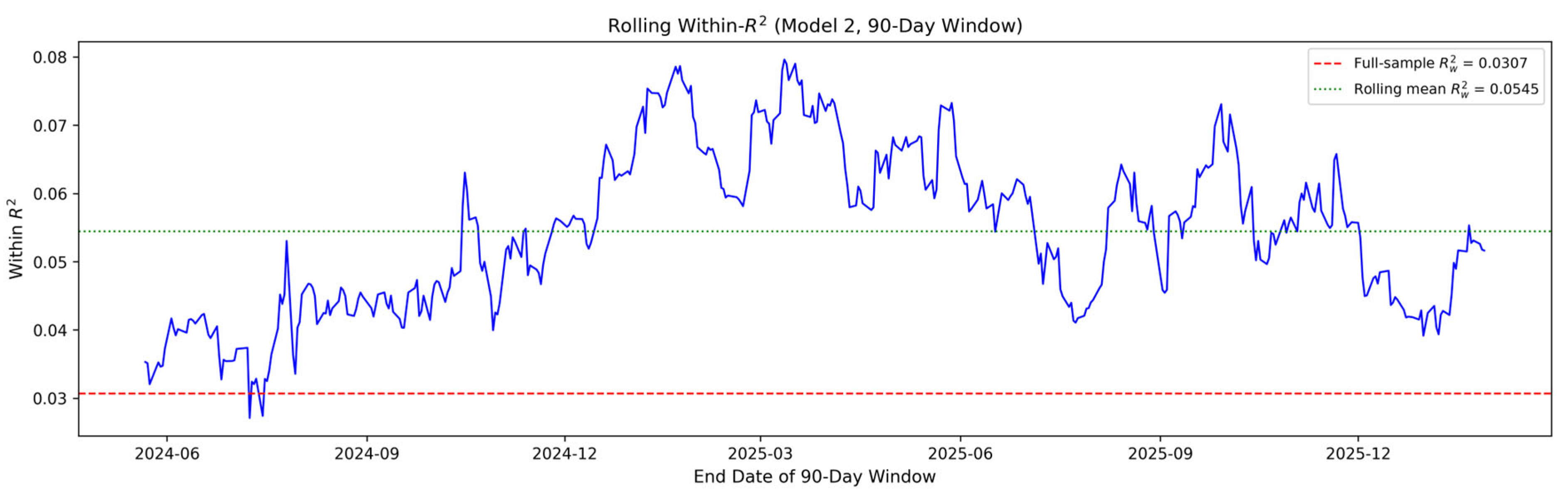
The subsample results sharpen the interpretation. For TradFi ETFs, the coefficients of sentiment and attention are positive but statistically noisy, while aggregate risk sentiment measured by the Chicago Board Options Exchange (CBOE) Volatility Index (VIX) exerts a larger negative effect, consistent with institutional investors being more sensitive to broad market uncertainty. For crypto-native ETFs, sentiment and attention coefficients are small and statistically insignificant, while lagged Bitcoin return is the only marginally significant predictor, suggesting that investors in specialist products are more responsive to the cryptocurrency’s own price momentum than to social discourse. These asymmetries suggest that discourse around crypto-native products may contain more controversy, hesitation, or speculative churn than straightforward demand conversion, whereas broader market confidence and the perception of institutional safety appear more central to the flow resilience of large mainstream issuers. The quantile regression analysis further reveals that the BrandScore coefficient displays a sign-reversal pattern across the conditional flow distribution, shifting from strongly negative in the lower tail to strongly positive in the upper tail, indicating that brand-mediated capital concentration is most pronounced during episodes of large net inflows. Rolling window estimation shows that the brand–sentiment interaction achieves significance in approximately 63% of 90-day windows, confirming that the mechanism is episodic rather than permanent and tends to activate during periods of heightened market salience.
The paper makes one primary contribution and two supporting contributions. The primary contribution is the empirical demonstration that, in a market of near-identical financial products, aggregate community sentiment is an insufficient predictor of product-level capital flows; rather, sentiment translates into realized fund-level capital allocation only when it co-occurs with elevated issuer brand visibility. This brand-filtered sentiment transmission mechanism is operationalized through BrandScore, a novel NLP-based measure of daily issuer mention density in Reddit discourse, and tested via a multiplicative interaction specification within a panel fixed-effects framework. The two supporting contributions are (i) the documentation of pronounced distributional heterogeneity in the brand effect through panel quantile regression, showing that brand visibility is most consequential during large inflow episodes; and (ii) the use of rolling window estimation to establish that the brand channel is episodic rather than permanently structural, activating during periods of heightened market salience.
We note that the individual econometric and NLP tools employed in this study, including VADER sentiment analysis, keyword-based mention detection, entity fixed-effects panel models, quantile regression, bootstrap inference, and rolling window estimation, are established methods. The contribution of this paper lies not in methodological novelty per se but in the rigorous application of these tools to a novel empirical setting, the construction of the BrandScore measure, and the documentation of a previously unidentified economic mechanism. The mathematical content of the paper centers on the formal derivation of conditional marginal effects, delta-method inference for the interaction specification, and the systematic integration of distributional and temporal methods that together provide a more complete characterization of sentiment–flow dynamics than any single technique would permit.
The remainder of this paper is organized as follows. Section 2 reviews the relevant literature and develops the hypotheses. Section 3 describes the data sources, variable construction, methodology and framework, and robustness design. Section 4 presents the empirical results and discussion. Section 5 addresses limitations and future research directions. Section 6 concludes the present study.

2. Literature Review and Hypothesis Development

2.1. Social Media Sentiment and Digital Financial Markets

Research on textual sentiment in finance has long argued that language contains incremental information beyond prices and accounting data. Early work on internet message boards established that the volume and tone of online postings are associated with subsequent market activity, even after controlling for observable fundamentals [21,22]. Tetlock [23] demonstrated that the pessimistic tone of a widely read Wall Street Journal column predicts downward pressure on aggregate market returns, while Tetlock et al. [24] extended the insight to firm-level earnings by showing that the fraction of negative words in news stories forecasts low subsequent earnings. These findings motivated a broader program of textual analysis in accounting and finance, surveyed comprehensively by Loughran and McDonald [25] and Bochkay et al. [26], which collectively shows that unstructured text carries economically meaningful signals that complement traditional quantitative data.
The emergence of social media platforms has both expanded the set of observable textual signals and introduced new channels through which investor beliefs are formed and coordinated. Bollen et al. [2] found that aggregate mood states extracted from Twitter/X predict changes in the Dow Jones Industrial Average, while Sprenger et al. [27] demonstrated that the sentiment and volume of stock-related tweets contain information about future returns and trading activity. Chen et al. [28] showed that opinions expressed in the Seeking Alpha investment community predict future stock returns and earnings surprises, emphasizing the informational value of user-generated content relative to traditional media. More recently, Anand and Pathak [29] demonstrated the power of Reddit-based discourse in the GameStop episode, showing that the tone of discussions on r/wallstreetbets displayed significant predictive associations with intraday returns, volatility, and trading volumes, with a small minority of influential users disproportionately driving these effects. Warkulat and Pelster [30] extended this line of inquiry by linking individual-level brokerage data to Reddit activity, finding that attention generated on r/wallstreetbets spurs uninformed trading and increases portfolio risk, with positions initiated during peak social media attention realizing holding-period returns of approximately −8.5%. At the same time, the presence of echo chambers in online financial communities can amplify sentiment in ways that depart from fundamental information [31], a dynamic that is especially relevant in markets with strong retail participation. In parallel, survey-based and market-derived measures of investor sentiment have been shown to influence valuations and risk premia, particularly when noise traders affect prices or when limits to arbitrage prevent rapid correction [32].
Cryptocurrency markets provide particularly fertile ground for sentiment-based analysis because they are unusually narrative-driven, fragmented across exchanges and online communities, and populated by a mix of sophisticated and retail participants who often encounter information in social rather than institutional settings. Garcia et al. [33] documented feedback loops between social signals and Bitcoin price dynamics, showing that positive word-of-mouth reinforces price increases in a self-reinforcing cycle. Kristoufek [34] found that both Google Trends and Wikipedia page views are significantly associated with Bitcoin price movements, with the relationship becoming stronger during periods of extreme price change. Subsequent work has confirmed and extended these findings across different textual sources and time horizons. Mai et al. [35] applied sentiment analysis to Bitcoin forum posts and showed that bullish sentiment from the “silent majority” of less active users contains predictive content for Bitcoin returns, while Bleher and Dimpfl [36] demonstrated the forecasting power of Google search volume for Bitcoin price and volatility. More recently, Ante [14] examined how Elon Musk’s Twitter/X activity moves the prices and trading volumes of specific cryptocurrencies, illustrating the outsized role that highly visible public figures play in attention-driven digital asset markets. More broadly, recent theoretical and empirical work demonstrates that valuations of blockchain-based digital assets are closely tied to network participation and community engagement dynamics [37], reinforcing the view that community-level discourse signals carry pricing-relevant information in digital asset markets.
Advances in AI and NLP have considerably expanded the toolkit available for extracting economically meaningful signals from these unstructured textual sources. Lexicon-based classifiers such as VADER, which was designed specifically for social media text and handles informal register, emoticons, and degree modifiers, have become standard in finance-adjacent textual analysis. Domain-specific dictionaries provide word lists calibrated to financial contexts [25], while transformer-based models such as FinBERT [12] offer context-sensitive sentiment classification that can capture nuances missed by bag-of-words approaches. These AI-driven techniques have enabled researchers to measure sentiment, topic salience, and entity-level attention at scale [38], making it feasible to construct high-frequency discourse variables from large text corpora such as the Reddit dataset employed in this study.
Collectively, this literature establishes that online conversation matters in digital asset markets, but it mainly evaluates effects on the underlying asset, asking whether online sentiment predicts Bitcoin prices, returns, or volatility. Much less is known about how social discourse shapes capital allocation among competing financial products that provide exposure to the same digital asset. This distinction is critical. A Bitcoin buyer on an exchange chooses whether to hold Bitcoin. A Bitcoin ETF investor instead chooses among institutional conduits that all promise access to the same underlying exposure. Once direct exposure becomes commoditized through the introduction of multiple spot ETFs, social sentiment may cease to operate as a general signal about the asset and instead function as a product-selection mechanism. In that environment, sentiment must be linked to a recognizable institutional object in order to affect specific fund flows. This paper therefore shifts the analytical focus from social mood about Bitcoin in general to the allocation consequences of sentiment when it intersects with issuer-specific salience. Despite this substantial body of work, existing studies overwhelmingly examine the aggregate relationship between community sentiment and market-level outcomes: Bitcoin returns, total trading volume, or aggregate fund flows. This aggregate approach is informative for understanding whether online discourse co-moves with market conditions, but it is fundamentally unable to address the product-selection problem that arises when multiple near-identical investment vehicles compete for the same investor base. When 10 spot Bitcoin ETFs all track the same underlying asset, aggregate positive sentiment about Bitcoin does not indicate which ETF should receive the marginal dollar. Existing models of sentiment-driven demand, which treat the market as a single asset, offer no mechanism for resolving this allocation question.

2.2. Investor Attention and the Attention Channel

A second relevant body of literature concerns investor attention and its role in shaping demand for financial products. In models with incomplete information or cognitive scarcity, investors cannot process all available signals, so salient securities receive disproportionate focus while less visible alternatives are neglected [39,40]. Da et al. [41] operationalized this concept by using Google search volume as a direct proxy for investor attention, demonstrating that increases in search intensity predict higher stock prices in the short run, followed by reversals. Barber et al. [42] extended this line of inquiry to the commission-free trading era by showing that Robinhood users engage in pronounced attention-induced herding, with intense buying of stocks featured on the platform’s popularity lists generating negative 20-day abnormal returns of approximately 4.7%, confirming that attention continues to function as a pre-screening heuristic that determines which securities enter the retail investor’s consideration set.
ETF markets provide a particularly strong context for attention effects because investors must choose among many operationally similar products, making search costs and visibility economically consequential. Sirri and Tufano [18] argued that fund flows depend not just on past performance but also on costly search and marketing, while Kaniel and Parham [43] provided causal evidence by showing that funds featured in the Wall Street Journal’s “Category Kings” list experienced a 31% increase in quarterly flows, an effect roughly seven times larger than that attributable to the performance–flow relation. Ben-David et al. [15] documented that ETF providers strategically design specialized products to capture scarce investor attention, and that these products attract large initial inflows despite subsequently underperforming by approximately 30% on a risk-adjusted basis. Their findings imply that in the ETF space, marketing visibility rather than portfolio fundamentals determines where capital flows.
In highly standardized product categories such as spot Bitcoin ETFs, attention plays a distinctive role: because the underlying exposure is identical across competing products, attention does not help investors identify superior fundamentals but instead determines which products enter the consideration set at all. Attention in online communities can reduce information frictions by exposing investors to ticker names and issuers, coordinate belief formation by making certain products appear socially endorsed, or amplify fear and controversy. These competing effects imply that the sign of the attention coefficient is theoretically ambiguous, and this ambiguity is especially plausible for crypto-native issuers, whose online visibility may attract debate and skepticism rather than constructive demand.
Existing attention proxies, such as Google Trends search volume, Wikipedia page views, or aggregate social media post counts, measure how much investors are searching or discussing, but they do not capture whom investors are discussing. In a market of competing ETFs, the relevant information for capital allocation is not the total volume of cryptocurrency discussion but the issuer-specific share of that discussion. This distinction, between aggregate attention and issuer-directed visibility, is precisely what the BrandScore construct is designed to capture. No existing proxy in the literature measures this issuer-level dimension of investor discourse.

2.3. Brand Credibility, Institutional Trust, and Product Choice

Brand credibility becomes central when products are difficult to differentiate on intrinsic quality. Marketing research defines brand equity as the value generated by brand-related associations, recognition, and trust beyond what is attributable to functional attributes alone [44]. In financial services, where products are abstract and quality is difficult to observe beforehand, institutional reputation can substitute for directly observable quality. Fund flows respond systematically to signals of managerial skill and institutional backing even when true future performance remains uncertain [3,45]. Du et al. [46] provided recent evidence that in the ETF market, the reputation of a parent mutual fund company gives newly launched ETFs a significant advantage in attracting early investor flows, even absent any performance track record, and that this reputation effect is strongest when no product-specific historical data exist. This finding implies that brand reputation functions as a cognitive shortcut that is most valuable precisely when information is scarce and alternative signals are noisy.
In a new category such as spot Bitcoin ETFs, issuer identity may carry even greater weight because many investors remain uncertain about custody arrangements, operational risk, and the long-run role of digital assets in portfolios. Traditional asset managers such as BlackRock and Fidelity enter this market with long-standing reputational capital and broad distribution networks, while crypto-native issuers may enjoy legitimacy within specialist communities but face narrower trust outside them. If investor attention is scarce and sentiment is noisy, issuer brand can work as a cognitive filter that converts undirected enthusiasm into product-specific flows [15,16]. This logic is consistent with salience theory [47], which predicts that decision-makers overweight the most salient attributes of choice alternatives, and with empirical evidence that salience effects on asset prices strengthen during high-sentiment periods [48]. When a novel asset class is wrapped by a familiar institution, the institution’s brand functions as the most salient product attribute, reducing perceived ambiguity and broadening distribution legitimacy. Trust is especially important in digital asset markets, where Saeedi and Al-Fattal [16] showed that technological reliability, social validation, and regulatory certainty all significantly predict investor trust in cryptocurrency, suggesting that the issuer’s brand may function as a summary statistic for multiple trust dimensions simultaneously.
We operationalize this brand-mediated trust mechanism with BrandScore, a daily issuer-specific visibility measure defined as issuer-related keyword mentions per 1000 Reddit posts. BrandScore is conceptually different from generic attention: attention captures how much the community is speaking, while BrandScore captures whom the community is speaking about. That distinction is crucial in a product-selection setting where the underlying exposure is the same, and issuer identity is the primary axis of differentiation.
The gap identified above motivates the central construct of this paper: BrandScore, a daily issuer-specific measure of mention density in community discourse. Unlike aggregate sentiment measures, BrandScore varies across both issuers and time, enabling an interaction specification that tests whether sentiment translates into capital allocation differently depending on the issuer’s visibility. Unlike generic attention proxies, BrandScore captures the product-selection dimension of investor discourse. And unlike survey-based measures of brand equity or trust, BrandScore is observable at daily frequency from publicly available text data, making it both scalable and reproducible.

2.4. Hypotheses

The preceding review suggests three testable expectations regarding the relationship between social media discourse and daily net capital flows into U.S. spot Bitcoin ETFs.
The first expectation concerns the direct effect of aggregate sentiment. If online mood is informative for demand, more positive Bitcoin-related sentiment should be associated with larger ETF inflows [14,33,35]. However, because Bitcoin ETFs are product choices rather than pure asset choices, the direct effect may attenuate once brand visibility enters the specification; aggregate community mood does not, by itself, indicate which ETF to purchase.
Hypothesis 1. 
Reddit-derived market sentiment is positively associated with daily net inflows into spot Bitcoin ETFs, though the direct effect is expected to attenuate after controlling for issuer brand visibility.
The second expectation concerns community attention. Higher levels of Reddit discussion may facilitate demand conversion by lowering search costs [41], but the direction is theoretically ambiguous because elevated discourse can also reflect controversy or speculative churn rather than genuine investment interest [15].
Hypothesis 2. 
Community attention is associated with daily net ETF flows, but the direction of the effect is ex ante ambiguous.
The third and central expectation concerns issuer brand visibility and its interaction with sentiment. The literature reviewed above suggests that in a market of near-identical products, issuer visibility should independently predict fund flows and, more importantly, amplify the effect of sentiment on flows, because positive community mood can translate into capital allocation only when it is directed at a recognizable and trusted institutional vehicle. This interaction mechanism, which we term brand-filtered sentiment transmission, implies that the marginal effect of sentiment on flows is an increasing function of issuer brand salience.
Hypothesis 3. 
Issuer brand visibility (BrandScore) positively predicts daily net ETF inflows and strengthens the positive association between sentiment and flows.
Under Hypothesis 3, the coefficient on the Sentiment × BrandScore interaction term ( β 7 ) is expected to be positive and significant. If β 7 > 0 while the standalone sentiment coefficient β 1 is small or insignificant, the data would support the brand-filtered channel: sentiment has no meaningful standalone effect on product-level flows but becomes progressively more relevant as the issuer dominates community discourse.

3. Data and Methodology

3.1. Research Design Overview

This study employs a balanced panel design to examine whether retail social media sentiment, community attention, and issuer brand visibility explain daily net capital flows into U.S. spot Bitcoin ETFs. The panel comprises N = 10 ETFs observed over T = 514 trading days from January 2024 to January 2026, yielding N × T = 5140 raw observations (5120 in regression models after dropping observations required for the one-day lag structure). The identification strategy exploits two features of the empirical setting. First, because all 10 ETFs track the same underlying asset (i.e., spot Bitcoin), cross-sectional variation in daily flows is attributable to issuer-specific or discourse-related factors rather than to differences in fundamental exposure. Second, the use of entity (ETF) fixed effects absorbs all time-invariant heterogeneity across products (e.g., fee schedules, custody arrangements, distribution networks, baseline institutional reputation), so that identification comes exclusively from within-ETF temporal variation in discourse conditions and market controls. All text-based explanatory variables are lagged one trading day ( t 1 ) relative to the dependent variable ( t ) in order to reduce mechanical simultaneity between same-day discourse and ETF flows and to align the model with the practical sequence in which investors observe online discussion before placing orders.

3.2. Data Sources and Sample Construction

The primary financial dataset covers the 10 U.S. spot Bitcoin ETFs included in our balanced panel: BlackRock (IBIT), Fidelity (FBTC), ARK Invest (ARKB), Franklin Templeton (EZBC), WisdomTree (BTCW), Bitwise (BITB), VanEck (HODL), Valkyrie/CoinShares (BRRR), Invesco (BTCO), and Grayscale (GBTC). The SEC’s 10 January 2024 approval order covered 11 spot Bitcoin exchange-traded products (SEC Release No. 34-99306); we exclude one, Hashdex Bitcoin ETF (DEFI), because its conversion from a futures-based to a spot-Bitcoin structure did not become effective until 27 March 2024, more than 2 months after our panel start date. Including DEFI prior to its conversion would misalign the panel with the institutional setting the study aims to analyze. Among the remaining 10, five are issued by traditional finance (TradFi) institutions (IBIT, FBTC, ARKB, EZBC, BTCW) and five by crypto-native or specialist issuers (BITB, HODL, BRRR, BTCO, GBTC). This classification provides cross-sectional variation in institutional background while holding underlying exposure constant. The dependent variable is daily net fund flow in USD millions:
Flow i , t Net _ Flow _ USD _ m i , t , i = 1 , , 10 , t = 1 , , T
where Flow i , t > 0 denotes net capital inflows (creations exceeding redemptions) and Flow i , t < 0 denotes net outflows. Daily ETF prices, volumes, and returns are obtained via the yfinance Python package (version 0.2.66).
The textual dataset comprises posts from r/Bitcoin on Reddit, which is one of the largest and most active cryptocurrency-focused subreddits, covering the period from January 2024 to March 2026. The raw corpus contains M raw = 163 , 603 posts. After standard preprocessing (e.g., removing deleted content, duplicated artifacts, bot-generated posts, and entries with empty text bodies), the cleaned corpus retains M clean = 162 , 819 posts. For each post j , the following metadata fields are retained: post identifier, title text ( title j ), self-text body ( selftext j ), author, Reddit score ( s j ), upvote ratio ( u j 0 , 1 ), number of comments ( c j ), and UTC creation timestamp ( τ j ).
Three market-wide control variables are included to separate the effects of social discourse from broader financial conditions. The first is the daily Bitcoin return ( BTC _ Ret t ), computed as the logarithmic return:
BTC _ Ret t = l n P t BTC P t 1 BTC
where P t BTC is the closing price of Bitcoin on day t . The second control variable is the daily S&P 500 return ( SP 500 _ Ret t ), similarly computed as
SP 500 _ Ret t = l n P t SP P t 1 SP
The third control is the closing level of the CBOE VIX t , which captures aggregate equity market uncertainty and investor risk aversion. All market data are retrieved via the yfinance Python package (version 0.2.66).

3.3. Text Preprocessing and Sentiment Measurement

The textual data were collected from the r/Bitcoin subreddit from January 2024 to March 2026. The raw corpus contained M raw = 163 , 603 posts. The preprocessing pipeline applied the following sequential filters: (i) removal of posts with deleted or removed content (identified by the Reddit-standard placeholders ‘[deleted]’ and ‘[removed]’ in both title and selftext fields); (ii) removal of duplicate posts identified by matching post identifiers (Reddit ‘id’ field); (iii) removal of bot-generated posts identified by author names matching known bot patterns (e.g., ‘AutoModerator,’ accounts ending in ‘-bot’ or ‘bot’); (iv) removal of posts with empty text bodies (where both title and selftext, after whitespace stripping, contained fewer than six characters); and (v) restriction to English-language posts (verified by the subreddit’s English-only moderation policy). After preprocessing, the cleaned corpus retained M clean = 162 , 819 posts spanning 803 calendar days. Each post was mapped to a calendar day using its UTC creation timestamp, and the calendar-day-to-trading-day alignment mapped weekend and holiday Reddit posts to the next available trading day through the lag structure. Each Reddit post j was transformed into a single analyzable document string d j by concatenating the title and self-text fields:
d j = title j selftext j
where denotes string concatenation with a whitespace separator. The preprocessing pipeline applies several transformations sequentially. First, all substrings matching the URL pattern https?://\S+ are stripped. Second, non-alphanumeric characters (excluding whitespace and standard punctuation required by the sentiment lexicon) are removed. Third, consecutive whitespace characters are collapsed to single spaces, with leading and trailing whitespace trimmed. Fourth, text is converted to lowercase for keyword-matching operations (BrandScore), while the original casing is preserved for sentiment analysis, as the VADER lexicon utilizes capitalization as an intensifier signal. Let D = { d 1 , d 2 , , d M } denote the cleaned corpus of M = 162 , 819 documents, and let D t = { d j D : date τ j = t } denote the subset of documents posted on calendar day t , with n t = D t .
Sentiment is measured using the VADER, a lexicon- and rule-based model developed specifically for social media text. VADER is widely adopted in finance-adjacent textual analysis because it handles the informal register of online discourse, including slang, emoticons, punctuation emphasis, and degree modifiers, more effectively than standard financial dictionaries. VADER maintains a lexicon L = { w k , v k } k = 1 K mapping words and word-like tokens w k to empirically validated mean valence ratings v k 4 , + 4 . For a document d j containing tokens { w 1 j , w 2 j , , w L j j } , the raw valence score of each recognized token w l j L is retrieved as v l j .
The lexicon valence is subsequently modified through several rule-based adjustments. VADER applies degree adverbs (boosters) to scale the intensity of sentiment-bearing tokens. If a booster word b precedes a sentiment-bearing token w l within a three-word window, the valence is adjusted as
v l = v l + α b · sgn v l
where α b > 0 is the booster increment (empirically calibrated, typically α b 0.293 for standard intensifiers such as “very” and “extremely”). Dampening modifiers (e.g., “slightly,” “somewhat”) apply a negative α b . Negation is handled separately. If a negation word (e.g., “not,” “never,” “neither”) appears within three tokens preceding a sentiment word, the valence is inverted with a scalar multiplier:
v l = γ · v l , γ = 0.74
Punctuation further amplifies the overall sentiment magnitude. Let n ! denote the count of exclamation marks (capped at 4). The punctuation amplifier is defined as δ punct = n ! · 0.292 . In addition, capitalization emphasis is incorporated: if the proportion of uppercase characters in the document exceeds a threshold and a sentiment word is fully capitalized, an additional increment α cap 0.733 is applied according to
v l = v l + α cap · sgn v l · 1 allcaps w l
After all rules are applied, let { v 1 , v 2 , , v R } denote the final adjusted valence scores of all R recognized tokens in document d j . The raw sentiment sum is computed as
S raw , j = r = 1 R j v r + δ punct , j
VADER then partitions token valences into positive ( v r > 0 ), negative ( v r < 0 ), and neutral ( v r = 0 ) groups, and computes intensity proportions normalized by total token count L j . The compound score is obtained by normalizing S raw to the interval 1 , + 1 using a modified sigmoid function:
compound j = S raw , j S raw , j 2 + α norm
where α norm = 15 is a normalization constant that controls the steepness of the mapping. This ensures that the compound score is bounded, comparable across documents of varying length, and approximately symmetrical around zero. Values near + 1 indicate strongly positive sentiment; values near 1 indicate strongly negative sentiment; values near 0 indicate neutral or mixed polarity.
Not all Reddit posts exert equal influence on community discourse. Highly upvoted posts with strong community agreement are more likely to shape collective perception than low-engagement posts. We therefore weight each post’s sentiment by an engagement measure before aggregating to the daily level. For each post j , the engagement weight is defined as
ω j = s j + · u j + 1
where s j + = m a x s j , 0 is the Reddit score clipped at zero (to prevent negatively scored posts from inverting the weighting), u j 0 , 1 is the upvote ratio, and the additive constant 1 ensures that every post receives a strictly positive minimum weight regardless of its score. The engagement-weighted daily sentiment for calendar day t is then computed as
Sentiment t = j D t ω j · compound j j D t ω j
By construction, Sentiment t 1 , + 1 for all t . In the sample, the distribution has mean S = 0.143 and standard deviation σ S = 0.143 , indicating that the r/Bitcoin community is on average mildly optimistic but subject to substantial day-to-day variation.

3.4. Attention Index and BrandScore Construction

Community attention captures the overall intensity of r/Bitcoin discussion, combining both the breadth of posting activity and the depth of engagement. The daily attention index for calendar day t is defined as
Attention t = l n n t + l n j D t c j + 1
where n t = D t is the number of posts on day t and c j is the number of comments on post j . The first term captures the breadth of discussion (how many distinct threads are initiated), while the second term captures the depth (how much follow-up engagement each thread generates). The logarithmic transformation reduces the influence of extreme outlier days while preserving monotonicity, and the additive constant 1 inside the second logarithm ensures the expression is well-defined on days with zero total comments. In the sample, Attention t has mean A = 11.973 and standard deviation σ A = 1.642 .
A central variable in this study is BrandScore, a novel issuer-level measure of daily visibility within the r/Bitcoin community. Unlike generic sentiment or attention, BrandScore captures whom the community is discussing rather than how much or how positively they are speaking. For each ETF i , we define a keyword set K i that includes the ETF ticker symbol, the issuer name, common name variants, and associated brand identifiers. The complete keyword mapping is presented in Table 1.
The BrandScore construction proceeds through three stages: keyword dictionary design, binary mention detection, and daily normalization.
Stage 1: Keyword dictionary design. Two design decisions warrant explanation. First, tickers that overlap with common crypto terminology are excluded from their keyword sets to prevent false-positive contamination. Specifically, VanEck’s ticker HODL is a ubiquitous crypto meme (‘hold on for dear life’) and is excluded from K HODL , which uses only the issuer-specific terms ‘vaneck’ and ‘van eck.’ Second, for Valkyrie/CoinShares (BRRR), the keyword set includes both the original (pre-acquisition) and current issuer names to capture the sponsor transition that occurred in March 2024.
Stage 2: Binary mention detection. For each cleaned post j and each ETF i , we construct a binary mention indicator:
m i , j = 1 k K i : k lower d j
where lower d j is the lowercased document string and k lower d j denotes substring containment. The indicator equals 1 if any keyword associated with ETF i appears anywhere in post j , and 0 otherwise. This approach is intentionally simple and transparent: it avoids the opacity of more complex NLP classifiers while exploiting the fact that ETF issuer names and tickers are sufficiently distinctive to serve as reliable identifiers in the r/Bitcoin context.
Stage 3: Daily normalization. The daily raw mention count for ETF i on calendar day t is M i , t = j D t m i , j . To account for variation in overall posting activity across days, we normalize by total daily post volume and scale by 1000:
BrandScore i , t = M i , t m a x n t , 1 × 1000
This produces an interpretable measure: BrandScore of 10 means that 10 out of every 1000 posts on day t mention issuer i or its ticker. The normalization ensures that BrandScore reflects relative attention to each issuer rather than raw counts that would mechanically increase on high-activity days.
A potential concern is that certain ETF tickers overlap with generic crypto terminology. We address this through two design decisions and one validation exercise. First, tickers that are common crypto slang were deliberately excluded from their keyword sets: the ticker HODL (VanEck) is excluded from K HODL , which uses only the issuer-specific terms ‘vaneck’ and ‘van eck.’ Second, the ticker BRRR is retained in K BRRR , but we acknowledge that it carries substantial false-positive risk from the ‘money printer go brrr’ meme. A manual precision check on all 58 posts in the cleaned corpus containing ‘brrr’ classifies each mention as ETF-referencing (true positive) or generic/meme usage (false positive) based on the co-occurrence of ETF context terms. The results indicate that only a minority of ‘brrr’ mentions (9 out of 58 total corpus occurrences, or 15.5%) reference the ETF product, with the majority reflecting generic meme usage (‘money printer go brrr’). However, this false-positive contamination has negligible impact on the regression estimates for two reasons. First, BRRR is among the least-discussed ETFs in the panel, with a mean BrandScore of only 0.537, compared to 9.92 for IBIT and 2.00 for GBTC; even after adjusting for the estimated false-positive rate, BRRR’s corrected BrandScore (approximately 0.08) represents a change of less than 0.5 on a scale where the dominant issuers exceed 2.0. Second, the regression estimates are identified primarily from the large cross-sectional BrandScore variation between IBIT and GBTC on one hand, and the remaining eight ETFs on the other; BRRR’s contribution to the identifying variation is minimal.

3.5. Interaction Term and Variable Taxonomy

The central hypothesis of this paper is that sentiment becomes economically meaningful only when it is attached to a visible and credible issuer. To test this brand-moderated trust mechanism, we construct the interaction variable (as shown in Table 2):
Sentiment _ x _ Brand i , t = Sentiment t 1 × BrandScore i , t 1
Under the interaction specification, the marginal effect of sentiment on flows is no longer a constant but a function of issuer visibility:
Flow i , t Sentiment t 1 = β 1 + β 7 · BrandScore i , t 1
If β 1 is small or statistically insignificant while β 7 is positive and significant, then sentiment has no standalone flow effect but becomes progressively more relevant as the issuer dominates community discourse. This is the empirical signature of brand-filtered sentiment transmission. The threshold BrandScore at which the marginal effect of sentiment becomes positive (assuming β ^ 1 < 0 ) is
BrandScore = β ^ 1 β ^ 7
For issuers with BrandScore i , t 1 > BrandScore , positive sentiment translates into higher flows; for those below the threshold, sentiment is economically irrelevant or potentially counterproductive. Similarly, the marginal effect of BrandScore is given by
Flow i , t BrandScore i , t 1 = β 6 + β 7 · Sentiment t 1
This expression implies that issuer visibility has a larger positive effect on flows when community sentiment is more positive, reinforcing the complementarity between brand salience and social mood.

3.6. Econometric Framework

The panel contains repeated daily observations for N = 10 ETFs that differ in persistent, difficult-to-observe ways (distribution footprint, custody arrangements, fee perceptions, baseline reputation). To absorb these time-invariant issuer characteristics, we estimate entity fixed-effects models of the general form:
Flow i , t = α i + x i , t 1 β + ε i , t , i = 1 , , N , t = 2 , , T
where α i is the ETF-specific fixed effect absorbing all time-invariant heterogeneity, x i , t 1 is a vector of lagged explanatory variables, β is the coefficient vector of interest, and ε i , t is the idiosyncratic error term satisfying the strict exogeneity condition E ε i , t α i , x i , 1 , , x i , T = 0 . The identifying variation comes exclusively from within-ETF changes over time in discourse conditions and market controls.
The baseline model (Model 1) includes lagged sentiment, lagged attention, and lagged market controls:
Flow i , t = α i + β 1 Sentiment t 1 + β 2 Attention t 1 + β 3 BTC _ Ret t 1 + β 4 VIX t 1 + β 5 SP 500 _ Ret t 1 + ε i , t
This specification tests whether generic social discourse variables predict ETF-level flows after controlling for broad market conditions. Note that Sentiment and Attention are market-wide (common across all i ), whereas α i varies across ETFs.
To evaluate the brand-mediated trust mechanism, the baseline is augmented with BrandScore and its interaction with sentiment (Model 2):
Flow i , t = α i + β 1 Sentiment t 1 + β 2 Attention t 1 + β 3 BTC _ Ret t 1 + β 4 VIX t 1 + β 5 SP 500 _ Ret t 1 + β 6 BrandScore i , t 1 + β 7 Sentiment t 1 × BrandScore i , t 1 + ε i , t
The coefficient β 7 is the key parameter of interest: a positive and significant β 7 implies that the marginal effect of sentiment becomes stronger when a given issuer is more visible in Reddit discourse, consistent with brand-filtered sentiment transmission. Unlike Model 1, BrandScore varies across both i and t , introducing issuer-specific time variation that the fixed effects alone cannot capture.
To examine whether the same discourse variables carry different informational content across institutional categories, we estimate the baseline model separately for TradFi ETFs (Model 3) and crypto-native ETFs (Model 4). The TradFi subsample model is specified as
Flow i , t = α i + β 1 TF Sentiment t 1 + β 2 TF Attention t 1 + β 3 TF BTC _ Ret t 1 + β 4 TF VIX t 1 + β 5 TF SP 500 _ Ret t 1 + ε i , t , i I TradFi
The crypto-native subsample model takes the analogous form:
Flow i , t = α i + β 1 CN Sentiment t 1 + β 2 CN Attention t 1 + β 3 CN BTC _ Ret t 1 + β 4 CN VIX t 1 + β 5 CN SP 500 _ Ret t 1 + ε i , t , i I Crypto
Comparing { β k TF } and { β k CN } reveals whether traditional issuers and crypto-native issuers exhibit systematically different flow sensitivities to the same information environment.

3.7. Estimation and Inference

The entity fixed-effects estimator is implemented via the within-group transformation. We define the entity-specific time average of any variable z i , t as
z i = 1 T i t = 1 T i z i , t
where T i is the number of observed time periods for ETF i . The within-transformed (demeaned) variables are z ¨ i , t = z i , t z i . Applying this transformation to Model 2 eliminates the fixed effects α i :
Flow ¨ i , t = β 1 Sentiment ¨ t 1 + β 2 Attention ¨ t 1 + β 3 BTC _ Ret ¨ t 1 + β 4 VIX ¨ t 1 + β 5 SP 500 _ Ret ¨ t 1 + β 6 BrandScore ¨ i , t 1 + β 7 Sentiment × BrandScore ~ i , t 1 + ε ¨ i , t
The ordinary least squares (OLS) estimator applied to the demeaned data yields
β ^ FE = i = 1 N t = 1 T i x ¨ i , t 1 x ¨ i , t 1 1 i = 1 N t = 1 T i x ¨ i , t 1 Flow ¨ i , t  
which is algebraically equivalent to OLS with N dummy variables but computationally more efficient.
Standard errors are clustered at the ETF level to account for arbitrary serial correlation and heteroskedasticity within each fund’s time series. The cluster-robust variance-covariance estimator is
Var ^ β ^ FE = X ¨ X ¨ 1 i = 1 N X ¨ i ε ^ i ε ^ i X ¨ i X ¨ X ¨ 1
where X ¨ i is the T i × p matrix of demeaned regressors for ETF i , ε ^ i = ε ^ i , 1 , , ε ^ i , T i is the vector of residuals for ETF i , and p is the number of regressors excluding fixed effects. This sandwich estimator is consistent, as N for fixed or growing T , and accommodates both heteroskedasticity across ETFs and serial correlation within each ETF panel. With N = 10 clusters, the estimator may be conservative. We report t -statistics computed as
t k = β ^ k Var ^ β ^ k
where Var ^ β ^ k is the k -th diagonal element of the cluster-robust covariance matrix.
The one-period lag structure serves a dual purpose. First, by measuring discourse at t 1 and flows at t , we reduce mechanical same-day simultaneity. While this does not establish strict causality, it ensures that the explanatory variables are predetermined relative to the outcome. Second, the lag structure aligns with institutional timing: ETF creation and redemption orders are typically submitted by authorized participants based on information available before or at market open, and Reddit discourse from the previous day plausibly enters information sets prior to order placement. The temporal alignment between Reddit (which operates on calendar days including weekends) and ETF markets (which operate only on trading days) is handled by mapping weekend Reddit posts to the following Monday’s trading day through the lag structure.

3.8. Goodness of Fit and Model Comparison

We report the within- R 2 (also called the fixed-effects R 2 ), which measures the fraction of demeaned variation in flows explained by the demeaned regressors:
R within 2 = 1 i = 1 N t = 1 T i ε ¨ ^ i , t 2 i = 1 N t = 1 T i Flow ¨ i , t 2
To assess the joint significance of the discourse variables, we compute the incremental F -statistic for the restriction β 6 = β 7 = 0 (i.e., the joint test that BrandScore and its interaction with sentiment are both zero):
F = R unrestricted 2 R restricted 2 q 1 R unrestricted 2 N T N p
where q = 2 is the number of restrictions and p is the total number of regressors in the unrestricted model.
To facilitate interpretation across variables measured in different units, we compute the standardized (beta) coefficient for regressor k :
β ^ k std = β ^ k · σ x k σ y
where σ x k is the sample standard deviation of regressor k and σ y is the sample standard deviation of Flow i , t . The dollar effect of a one-standard-deviation increase in regressor k on daily net flows is
Δ Flow k 1 SD = β ^ k · σ x k
For the interaction effect, representing a joint one-standard-deviation increase in both Sentiment and BrandScore:
Δ Flow interact 1 SD = β ^ 7 · σ Sentiment · σ BrandScore
The marginal effect of sentiment at a specific BrandScore level B is evaluated as
Flow i , t Sentiment t 1 BrandScore = B = β ^ 1 + β ^ 7 × B
The standard error of this marginal effect is derived via the delta method:
SE Flow Sentiment | B = Var ^ β ^ 1 + B 2 Var ^ β ^ 7 + 2 B Cov ^ β ^ 1 , β ^ 7
This allows the construction of pointwise confidence intervals for the marginal effect across the observed range of BrandScore values.

3.9. Diagnostic Tests

Because Sentiment, Attention, and BrandScore are all derived from the same Reddit corpus, potential multicollinearity is a concern. We assess this via the Variance Inflation Factor (VIF) for each regressor k :
VIF k = 1 1 R k 2
where R k 2 is the R 2 from regressing the k -th explanatory variable on all other explanatory variables. A VIF below 5 is generally considered acceptable.
Panel stationarity is assessed using Im-Pesaran-Shin (IPS) panel unit root tests. For each variable z i , t , the IPS test estimates individual Augmented Dickey–Fuller (ADF) regressions:
Δ z i , t = ρ i z i , t 1 + l = 1 p i ϕ i , l Δ z i , t l + δ i + η i , t
and then constructs a standardized t -statistic under H 0 : ρ i = 0 i . Rejection of H 0 indicates that the panel is stationary, supporting the validity of the fixed-effects estimator in levels.
The choice between fixed effects and random effects is assessed via the Hausman [49] specification test. The test statistic is
H = β ^ FE β ^ RE Var ^ β ^ FE Var ^ β ^ RE 1 β ^ FE β ^ RE χ 2 p  
under H 0 : the random-effects estimator is consistent and efficient. Rejection favors the fixed-effects specification.
Cross-sectional dependence is assessed using the Pesaran test. The test statistic is
C D = 2 T N N 1 i = 1 N 1 j = i + 1 N ρ ^ i j N 0 , 1
where ρ ^ i j is the sample pairwise correlation of residuals between entities i and j . Rejection of H 0 : ρ ^ i j = 0 i j indicates the presence of common unobserved factors driving residual co-movement.
The distributional properties of model variables are assessed using the Jarque–Bera test statistic:
J B = n 6 S 2 + K 3 2 4  
where S is the sample skewness, K is the sample kurtosis, and n is the number of observations. Under the null hypothesis of normality, J B χ 2 2 .

3.10. Robustness Framework

The reduced-form design does not claim strict causal identification. To assess reverse causality, Granger-type non-causality tests are conducted by estimating:
Sentiment t = γ 0 + l = 1 L γ l Flow i , t l + l = 1 L δ l Sentiment t l + ν i , t  
and testing H 0 : γ 1 = γ 2 = = γ L = 0 . Under this null, past flows do not help predict current sentiment beyond what is already explained by lagged sentiment itself.
To address concerns about cross-sectional dependence in the residuals, we re-estimate the models using the Driscoll and Kraay [20] HAC standard errors. The Driscoll–Kraay covariance estimator is
Var ^ DK β ^ = X X 1 S ^ DK X X 1
where the spectral density estimator S ^ DK is computed as
S ^ DK = Γ ^ 0 + l = 1 m w l , m Γ ^ l + Γ ^ l
with Bartlett kernel weights w l , m = 1 l / m + 1 and bandwidth m . Each Γ ^ l = T 1 t = l + 1 T h t h t l is formed from the cross-sectional averages h t = N 1 i = 1 N x i , t ε ^ i , t of the score contributions.
To address finite-sample concerns arising from only N = 10 clusters, we construct non-parametric confidence intervals via entity-level bootstrap resampling. In each of B = 1000 replications, we draw a sample of 10 entities with replacement from { 1 , , N } , re-estimate Model 2 on the resampled panel, and store the coefficient vector. The percentile bootstrap confidence interval at confidence level 1 α is
C I 1 α boot = β ^ α B 2 , β ^ 1 α 2 B
where β ^ k denotes the k -th order statistic of the bootstrap distribution.
To examine whether the effects of discourse variables vary across the conditional distribution of ETF flows, we estimate panel quantile regressions using the Canay [19] two-step estimator. In the first step, the entity-specific fixed effects are estimated from the conditional-mean model and used to construct adjusted dependent variables:
α ^ i = 1 T i t = 1 T i y i , t x i , t β ^ FE
In the second step, the quantile regression is estimated on the demeaned data:
β ^ τ = a r g m i n β i = 1 N t = 1 T i ρ τ y ~ i , t x i , t β
where y ~ i , t = y i , t α ^ i is the fixed-effect-adjusted dependent variable, and ρ τ u = u τ 1 u < 0 is the standard check function. We estimate models at τ { 0.10 ,   0.25 ,   0.50 ,   0.75 ,   0.90 } to trace the effect of each covariate across the entire conditional flow distribution.
The temporal stability of the estimated relationships is assessed via rolling window estimation. For a window of size W = 90 trading days, we estimate Model 2 on successive subsamples:
β ^ FE s , s + W for s = 1 , 2 , , T W + 1  
and track the evolution of the BrandScore and interaction coefficients together with their 95% confidence bands and the within- R 2 over time.

4. Results and Discussion

4.1. Descriptive Statistics and Panel Diagnostics

The following Table 3 reports summary statistics for the model-ready panel of observations. The dependent variable, daily net flow, has a mean of USD 10.30 million with a standard deviation of USD 99.78 million, reflecting enormous heterogeneity in capital allocation across funds and over time. The median flow is exactly zero, indicating that on a typical day, most ETFs experience negligible net creation or redemption activity, while the extremes range from USD 642.5 million to USD 1119.9 million. The distribution is positively skewed ( S = 2.79 ) and strongly leptokurtic (excess kurtosis K = 26.45 ); the Jarque–Bera test statistic J B = 5120 6 2.79 2 + 26.45 2 4 155 , 915 decisively rejects the null of normality ( p < 0.001 ), confirming that the flow distribution exhibits fat tails, motivating the use of robust inference procedures throughout.
BrandScore has a mean of 1.91 and a standard deviation of 4.845 but a median of zero, confirming that the majority of ETF-day observations involve no issuer-specific mentions. This concentration is a defining feature of the empirical setting: on any given day, most issuers are “invisible” in community discourse, while a small number (predominantly IBIT and FBTC) dominate the conversation. The right tail is substantial (maximum = 60.98, skewness = 4.03), driven by episodic spikes in discussion around specific issuers during salient market events. The interaction variable Sentiment × Brand inherits this concentration, with a median of zero, a mean of 0.27, and extreme kurtosis (47.99), indicating that the joint occurrence of non-zero brand visibility and strongly directional sentiment is a relatively rare but potentially impactful event.
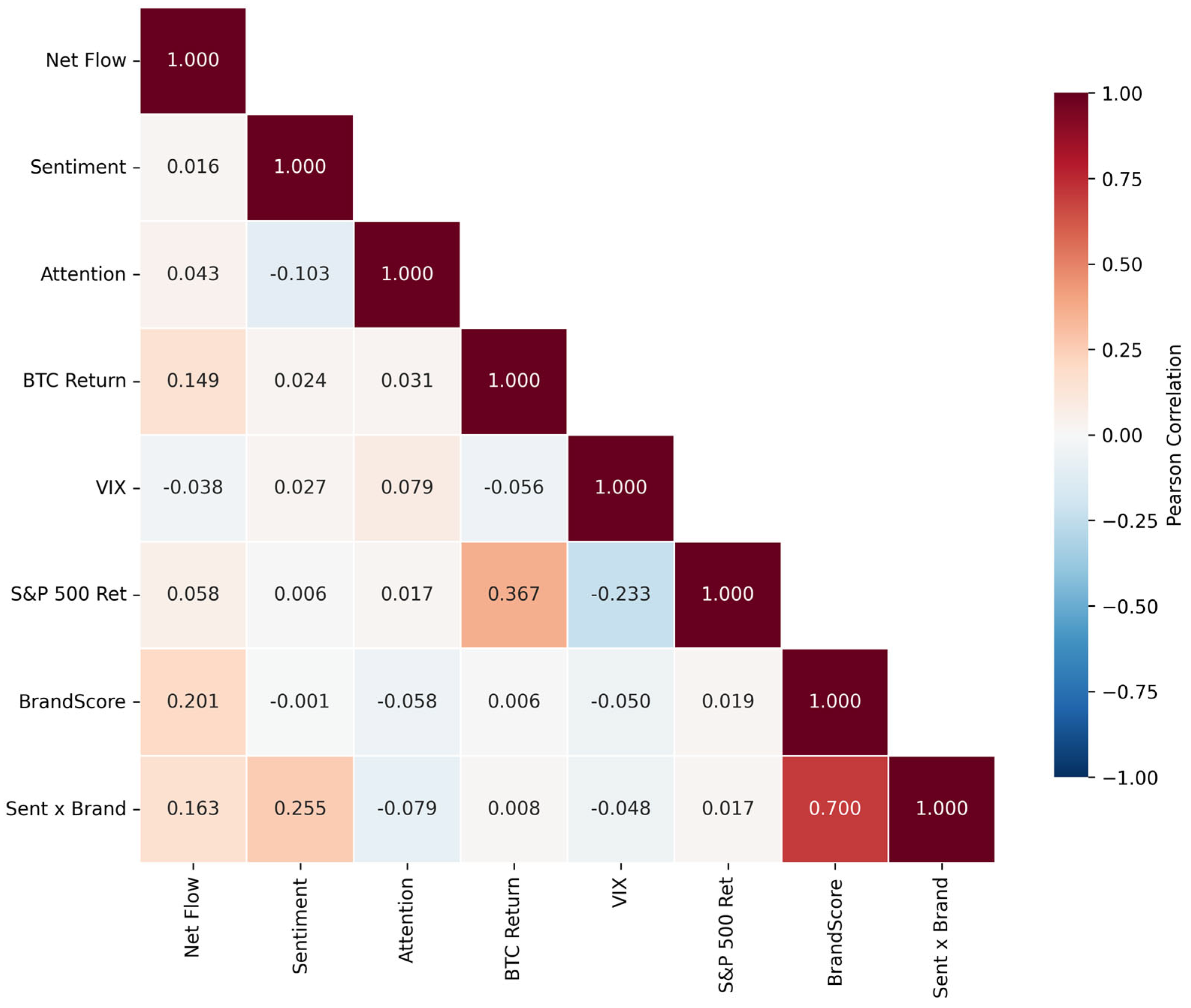
Table 4 and Figure 1 present the pairwise correlation structure. Net flow is most strongly correlated with BrandScore ( r = 0.201 , p < 0.001 ) and the sentiment–brand interaction ( r = 0.163 , p < 0.001 ), providing preliminary evidence that issuer visibility is associated with capital allocation even before conditioning on other variables. By contrast, the correlation between flow and lagged sentiment is negligible ( r = 0.016 , p > 0.10 ), foreshadowing the regression result that sentiment alone has no predictive power for fund-level flows. Importantly, sentiment and attention are negatively correlated ( r = 0.103 , p < 0.001 ), indicating that high-volume discussion days are not necessarily positive in tone, a finding consistent with attention spikes during negative market events such as large drawdowns or regulatory uncertainty. The correlation between BrandScore and the interaction term is high ( r = 0.700 ) by construction, since the interaction is the product of sentiment and BrandScore; however, VIF diagnostics reported below confirm that this mechanical collinearity does not compromise coefficient precision.
In addition, we conduct a battery of panel diagnostic tests prior to estimation. Table 5 reports the results of unit root tests, which confirm that all panel variables are stationary in levels. For market-wide variables (which are common across all entities), the ADF test rejects the unit root null at the 5% level or better, with ADF statistics ranging from 3.19 (Attention) to 24.37 (BTC Return).
For entity-varying variables, the IPS panel unit root test produces strongly negative W t statistics: 24.02 for Net Flow ( p < 0.001 ) and 47.05 for BrandScore ( p < 0.001 ). These results confirm panel stationarity and validate the use of the fixed-effects estimator in levels without differencing.
VIF values for the Model 2 regressors are all below 2.2 (the highest being 2.18 for the interaction term), well below the conventional threshold of 5, confirming that multicollinearity does not compromise the precision of the coefficient estimates despite the mechanical correlation between BrandScore and the interaction term.
The Hausman specification test yields a negative test statistic ( H = 0.17 ), a finite-sample phenomenon that arises when the estimated difference in variance matrices Var ^ β ^ FE Var ^ β ^ RE is not positive semi-definite, a known issue in panels with few clusters [50]. Although the negative statistic precludes a standard chi-squared rejection, the theoretical justification for fixed effects is compelling: the 10 ETFs differ in persistent, unobserved ways (fee schedules, custody arrangements, distribution networks, institutional reputation) that are almost certainly correlated with BrandScore and flow levels, violating the orthogonality condition required for random-effects consistency.
The Pesaran test for cross-sectional dependence yields C D = 37.32 ( p < 0.001 ), with a mean absolute pairwise residual correlation of ρ i j = 0.337 . This substantial cross-entity residual co-movement is expected in a panel of ETFs tracking the same underlying asset: common Bitcoin price shocks and market-wide sentiment shifts generate correlated residuals even after controlling for observed market variables. The significant cross-sectional dependence motivates the Driscoll–Kraay robustness check reported in Section 4.3.

4.2. Panel Regression Results

Table 6 reports the panel regression results. Column (1) reports the baseline model estimated on the observations. The coefficient on lagged sentiment is positive ( β ^ 1 = 12.68 ) but statistically insignificant ( t = 1.11 , p = 0.267 ), indicating that aggregate community mood does not reliably predict next-day ETF-level flows. Similarly, lagged attention carries a positive but insignificant coefficient ( β ^ 2 = 2.62 , p = 0.258 ). Among the market controls, lagged Bitcoin return is positive and economically large ( β ^ 3 = 534.81 ) but falls short of conventional significance ( p = 0.101 ). The within- R 2 of 0.030 indicates that the baseline specification explains approximately 3% of the within-ETF temporal variation in daily flows, a figure that is consistent with the well-documented difficulty of explaining daily fund flow variation in the broader ETF literature. The key takeaway from Model 1 is that generic Reddit sentiment and attention (without any issuer-specific conditioning) have no statistically detectable effect on Bitcoin ETF flows. This null result is itself informative: it suggests that aggregate community mood is too diffuse a signal to predict product-level capital allocation in a market where 10 near-identical products compete for the same investor base.
Column (2) reports the brand-augmented model, which yields the central empirical finding of this paper. The BrandScore level coefficient is not statistically significant ( β ^ 6 = 0.516 , SE = 1.889 , p = 0.785 ), indicating that issuer mention density alone does not predict next-day fund-level flows. This non-result reflects the countervailing influence of GBTC (Grayscale): Grayscale’s product has high brand visibility (mean BrandScore 2.0, third after IBIT at 9.9 and FBTC at 3.6) but experienced persistent large outflows as investors rotated from GBTC’s 1.50% expense ratio to lower-cost alternatives, creating a negative BrandScore–flow association that offsets the positive association observed for other issuers. The Sentiment × BrandScore interaction is positive and significant ( β ^ 7 = 2.930 , SE = 1.415 , p = 0.038 ), confirming that the effect of sentiment on flows is amplified when the issuer is more visible in community discourse. The standalone sentiment coefficient shrinks from 12.68 in Model 1 to 7.63 in Model 2 and remains insignificant ( p = 0.298 ), consistent with the hypothesis that generic sentiment is not independently meaningful for ETF-level capital allocation; rather, sentiment operates through a brand-mediated channel. The within- R 2 changes marginally from 0.030 to 0.031.
The incremental F -test for the joint restriction β 6 = β 7 = 0 yields F = 1.169 ( p = 0.311 ), indicating that the brand variables do not jointly achieve significance at conventional levels in terms of incremental R 2 improvement. This reflects the fact that the direct BrandScore coefficient is insignificant; the brand channel operates through the interaction with sentiment rather than through a direct level effect. The interaction coefficient alone is significant ( p = 0.038 ), and the economic magnitude of the interaction is substantial.
Under Model 2, the marginal effect of sentiment on flows is
Flow i , t Sentiment t 1 = 6.814 + 3.733 × BrandScore i , t 1
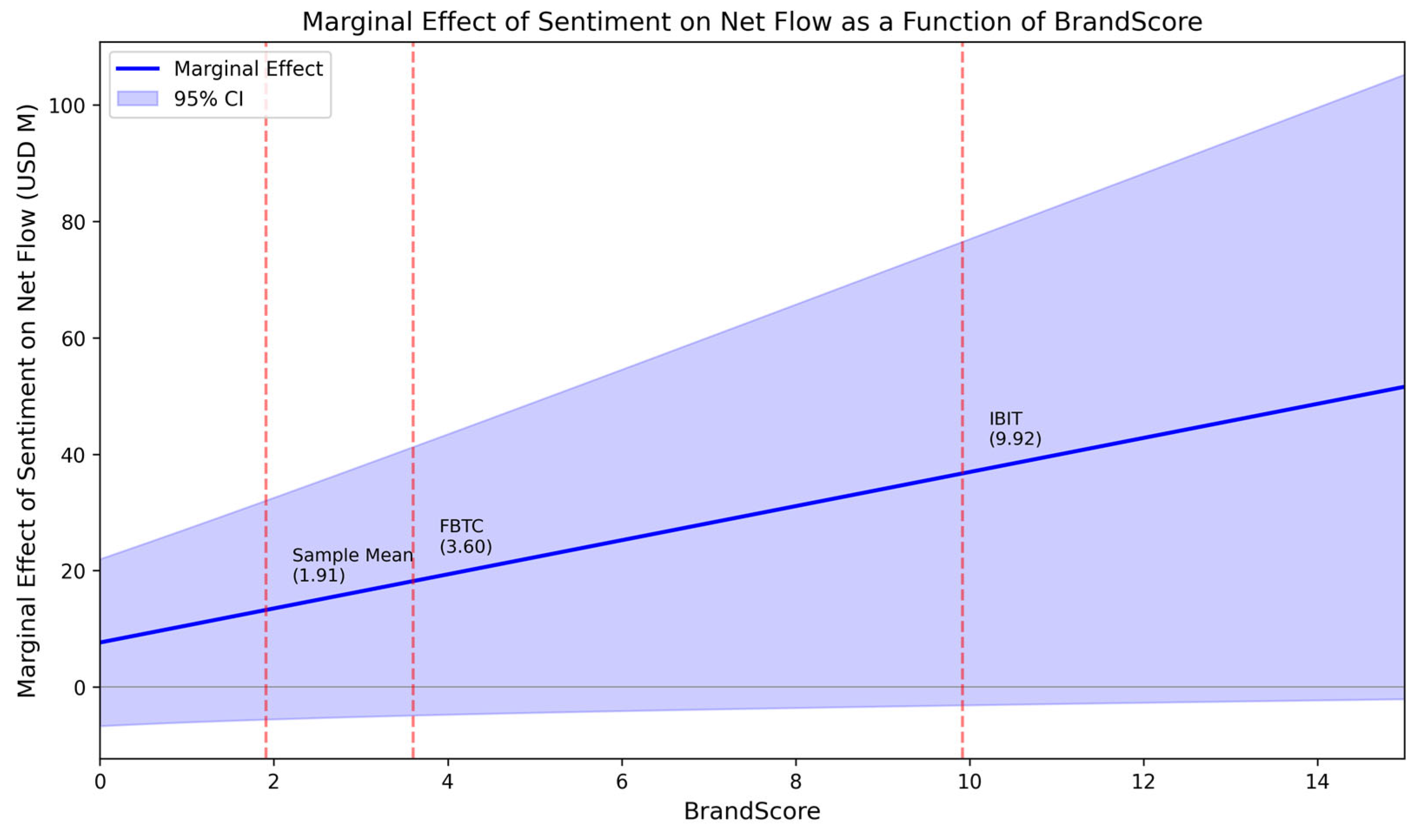
The threshold BrandScore at which the marginal effect would equal zero is β ^ 1 / β ^ 7 = 7.631 / 2.930 = 2.60 . Since BrandScore is non-negative by construction, the marginal effect is always positive across the observed data range (but its magnitude and statistical significance vary dramatically with issuer visibility). At zero visibility, the marginal effect is USD 7.63 per unit of sentiment but is statistically indistinguishable from zero. As BrandScore increases, the marginal effect grows linearly and gains statistical power. This pattern (where the mechanism ‘turns on’ only at sufficient brand salience) is the empirical signature of the brand-filtered sentiment transmission hypothesis.
Table 7 quantifies these marginal effects at representative BrandScore values, and Figure 2 visualizes the relationship. For IBIT (BlackRock), with a mean BrandScore of 9.92, the marginal effect is 36.70 million per unit of sentiment ( SE = 20.33 , 95% CI 3.15 , 76.55 ). This means that a one-standard-deviation increase in community sentiment ( σ = 0.143 ) is associated with an additional 5.23 million in net inflows to IBIT the following day. For an issuer at the sample mean BrandScore (1.91), the same one-standard-deviation sentiment shock translates into only 1.89 million, that is, a nearly threefold reduction arising entirely from the brand channel. At zero visibility, the effect is USD 1.09 million and is statistically indistinguishable from zero. The progressive ‘activation’ of sentiment as BrandScore rises, visualized in Figure 2, provides compelling evidence that issuer brand visibility is the mechanism through which diffuse community sentiment becomes translated into concrete capital allocation decisions.
To contextualize the economic magnitude of the brand-sentiment interaction, we compute standardized effect sizes for the Model 2 coefficients. The BrandScore direct effect is 2.50 million (not statistically significant), while the joint interaction effect (representing a simultaneous one-standard-deviation increase in both Sentiment and BrandScore) is 2.80 million, or 27.2% of the sample mean daily flow ( 10.30   M ). The VIX effect is 3.50 million, confirming that market fear exerts a meaningful dampening effect on ETF inflows. Among the significant regressors, BTC Return has the largest standardized effect ( 14.75   M , or 143% of the mean daily flow), consistent with the dominant role of underlying asset momentum. The brand–sentiment interaction, while smaller in absolute magnitude, captures the novel product-selection mechanism that is this paper’s primary contribution.
Columns (3) and (4) report the baseline model estimated separately on TradFi and crypto-native subsamples (with the corrected classification: IBIT, FBTC, ARKB, EZBC, and BTCW as TradFi; BITB, HODL, BRRR, BTCO, and GBTC as crypto-native). For TradFi ETFs, the VIX coefficient is negative and significant ( β ^ = 2.206 , p = 0.047 ), consistent with the interpretation that flows into institutionally backed ETFs are more sensitive to aggregate risk conditions; this is a pattern that resonates with the risk management frameworks employed by the financial advisors and wealth managers who disproportionately channel capital through TradFi products. The within- R 2 of 0.066 is the highest among all specifications. For crypto-native ETFs, lagged Bitcoin return is highly significant ( β ^ = 46.959 , p < 0.001 ), suggesting that investors in specialist products are more responsive to the cryptocurrency’s own price momentum, while the within- R 2 of 0.009 indicates that the included variables explain very little of the within-ETF flow variation for smaller issuers, which is consistent with flows to niche products being driven by idiosyncratic factors such as promotional campaigns, fee reductions, or platform-specific distribution arrangements that our model does not capture.

4.3. Robustness and Sensitivity Analysis

We subject the core findings to a comprehensive battery of robustness checks spanning alternative inference procedures, lag specifications, and distributional modeling. The objective is to determine which features of the baseline results survive the most stringent methodological stress tests and which are sensitive to inferential assumptions.
To address the concern that common daily shocks not spanned by the three market controls may confound the entity-FE estimates, we re-estimate the brand-augmented specification with two-way (entity + date) fixed effects. The date fixed effects absorb all market-wide daily variation, including Sentiment, Attention, and the three market controls, so that identification relies exclusively on within-day cross-sectional differences in BrandScore and the interaction term. In this demanding specification, BrandScore level is not independently significant ( β ^ 6 = 0.828 , p = 0.617 ), consistent with the entity-FE result and reflecting the offsetting role of GBTC (high visibility, persistent outflows). Crucially, however, the Sentiment × BrandScore interaction remains significant ( β ^ 7 = 3.802 , p = 0.012 ), confirming that the brand-filtered sentiment transmission mechanism survives even when all common daily shocks are absorbed. This is the paper’s most demanding identification test: it asks whether, on a given day, the ETF whose brand visibility is high relative to its peers receives disproportionately more flows when community sentiment is positive, controlling for everything common across ETFs on that day.
We note that a market-share specification, in which the dependent variable is each ETF’s share of total daily category net flow, does not yield significant results for either BrandScore or the interaction term. This null finding likely reflects noise introduced by the ratio normalization: on days when total category net flow is near zero or negative (approximately 12% of the sample), the market-share variable becomes extremely volatile or undefined, degrading power. The two-way fixed-effects specification, which absorbs all common daily variation through date fixed effects, achieves the same conceptual objective of isolating within-day cross-sectional allocation differences while avoiding the denominator-volatility problem inherent in ratio-based dependent variables. We therefore interpret the two-way FE result ( p = 0.012 ) as the more reliable test of the product-allocation mechanism.
Given the significant cross-sectional dependence documented in Section 4.1 ( C D = 37.32 , ρ i j = 0.337 ), we re-estimate Model 2 using Driscoll–Kraay kernel-based HAC standard errors with a Bartlett kernel and bandwidth m = 5 . Under Driscoll–Kraay SE, the BrandScore coefficient remains insignificant ( p = 0.545 ), and the interaction coefficient also loses significance ( p = 0.386 ). Conversely, Attention becomes significant ( p = 0.011 ), BTC Return becomes highly significant ( p < 0.001 ), and VIX achieves marginal significance ( p = 0.049 ). This divergence reflects a fundamental tension in panel inference with a small number of cross-sectional units. Entity-clustered standard errors treat the N = 10 ETFs as the source of sampling uncertainty, which is appropriate when the research question concerns the within-entity temporal relationship between discourse and flows. Driscoll–Kraay standard errors additionally account for cross-entity contemporaneous correlation but assume large- T asymptotics, and they penalize regressors whose cross-sectional variation is itself correlated with common market factors. Because BrandScore is mechanically zero for most ETF-day observations and concentrated in the few dominant issuers (IBIT, GBTC), the cross-sectional dispersion in BrandScore-driven residuals is inherently correlated across entities during high-visibility episodes, precisely the variation that identifies the brand effect. We interpret the Driscoll–Kraay results as a useful stress test that reveals the limits of identification in a panel of products tracking the same underlying asset, rather than as a refutation of the primary finding.
Table 8 reports the bootstrap results. The bootstrap 95% CI for BrandScore is 7.045 , 1.583 , which includes zero, consistent with the finding that the direct brand visibility effect is not statistically significant. The bootstrap mean ( 0.943 ) is close to the OLS estimate ( 0.516 ), with a moderate downward bias of 0.427 , indicating that the non-significance of BrandScore is confirmed under finite-sample resampling. The bootstrap SE for BrandScore ( 2.368 ) is comparable to the entity-clustered SE ( 1.889 ). For the interaction term, the bootstrap 95% CI is 4.616 , 4.605 , which is wide and includes zero, tempering the strength of the interaction result under the most conservative finite-sample assessment. The bootstrap mean for the interaction ( 1.736 ) is below the OLS estimate ( 2.930 ), suggesting some attenuation that arises from the concentration of the identifying variation in a few high-BrandScore entities. These bootstrap results delineate the boundary of what the data can firmly establish: the interaction effect (significant under clustered inference at p = 0.038 ) requires interpretation with appropriate caution given the small cross-sectional dimension ( N = 10 ), while the direct BrandScore level effect is clearly not robust.
We further verify that the results are not sensitive to the choice of lag length by re-estimating Model 2 using contemporaneous (lag 0) and two-day lagged (lag 2) discourse variables. The BrandScore coefficient is not significant at any lag specification ( p > 0.66 in all cases), with point estimates of 0.83 (lag 0), 0.52 (lag 1), and 0.22 (lag 2). The interaction coefficient is significant at lag 0 ( 6.44 , p = 0.004 ) and lag 1 ( 2.93 , p = 0.038 ), but not at lag 2 ( 0.61 , p = 0.880 ). The interaction coefficient is highest at lag 0 and declines at longer horizons, consistent with sentiment having the most immediate impact when it is contemporaneous with the flow decision. As a further robustness check against the influence of extreme flow observations, we winsorize the dependent variable at the 1st and 99th percentiles and re-estimate Model 2. The Sentiment × BrandScore interaction coefficient remains positive and highly significant ( β ^ 7 = 2.654 , p = 0.004 ), in fact strengthening relative to the unwinsorized specification ( p = 0.038 ). This confirms that the headline interaction result is not driven by a handful of extreme inflow or outflow events; if anything, the brand-filtered sentiment mechanism is more precisely estimated once extreme flow days are trimmed.
We also verify sensitivity to the engagement weighting specification. Replacing the original weight ω j = s j + · u j + 1 (Equation (10)) with the logarithmic alternative ω j alt = l o g 1 + s j + · u j + 1 , a great suggestion by an anonymous reviewer, compresses the right tail and provides better differentiation among low-engagement posts. The logarithmic transformation does meaningfully alter the daily Sentiment time series ( r = 0.457 between the original and alternative series), primarily because the original weighting allows a small number of highly upvoted posts (maximum weight 40,693) to drive the daily aggregate, whereas the logarithmic compression reduces the maximum weight to approximately 11.0. Nevertheless, re-estimating Model 2 with the alternative weighting produces qualitatively reinforcing results: the Sentiment × BrandScore interaction coefficient remains positive and is in fact highly significant ( β ^ 7 = 16.792 , p < 0.001 ), substantially stronger than under the original weighting ( β ^ 7 = 2.930 , p = 0.038 ). The larger magnitude reflects the reduced variance of the alternative Sentiment series (standard deviation of 0.047 versus 0.141), which compresses the Sentiment scale and inflates the interaction coefficient to compensate. The key qualitative finding, that the brand-filtered sentiment mechanism is significant regardless of the weighting scheme, is confirmed.
The quantile regression results in Table 9 reveal substantial heterogeneity in the relationship between discourse variables and flows across the conditional flow distribution, i.e., heterogeneity that the conditional-mean model necessarily obscures. The BrandScore coefficient displays a striking sign-reversal pattern across quantiles: strongly negative in the lower tail ( 16.82 at τ = 0.10 ; 6.86 at τ = 0.25 ), near zero at the median ( 0.53 ), and strongly positive in the upper tail ( 4.85 at τ = 0.75 ; 10.73 at τ = 0.90 ). This pattern reflects the role of GBTC: at lower quantiles (large outflow days), GBTC’s high brand visibility is associated with disproportionately negative flows, pulling the BrandScore coefficient negative. At upper quantiles (large inflow days), the positive association between brand visibility and flows for IBIT and other net-inflow ETFs dominates. The conditional-mean OLS estimate ( 0.52 , insignificant) averages over these offsetting effects. The interaction coefficient follows a complex distributional pattern, being strongly positive at τ = 0.10 ( 15.79 ), declining through the interior quantiles, and re-emerging at τ = 0.90 ( 4.32 , p = 0.031 ). Figure 3 visualizes these quantile coefficient estimates with their 95% confidence intervals.
The VIX coefficient displays the expected distributional pattern, being most strongly negative in the lower quantiles ( 1.00 at τ = 0.10 ) and weakening toward the upper tail ( 0.12 at τ = 0.90 , insignificant). This asymmetry suggests that market fear disproportionately amplifies outflow days rather than symmetrically dampening all flow quantiles, a result with implications for risk management and market stability. The BTC Return coefficient is positive and significant across all quantiles, being largest at the extremes ( 269.48 at τ = 0.10 ; 421.76 at τ = 0.90 ) and smallest near the median ( 6.66 ), consistent with cryptocurrency momentum driving the tails of the flow distribution.

4.4. Dynamic Analysis

Table 10 reports the Granger non-causality test results, which address a key identification concern: whether the observed associations reflect sentiment influencing flows, or flows influencing sentiment through a feedback loop.
The Sentiment Flow tests yield F -statistics well below 1.0 at all lag orders ( F = 0.38 ,   0.75 ,   0.87 for L = 1 ,   2 ,   3 , respectively), confirming that lagged sentiment does not Granger-cause flows independently, which is consistent with the regression evidence that generic sentiment has no standalone predictive content and that the brand channel is the operative mechanism. The reverse direction, Flow Sentiment, produces a marginally significant result at L = 1 ( F = 2.875 , p = 0.091 ) but insignificant results at longer lags ( p = 0.194 and p = 0.214 for L = 2 and L = 3 ). This weak, short-lived feedback (where large flows on day t may slightly shift community sentiment on day t + 1 ) does not generate a persistent endogeneity problem for our lagged specification, since the effect dissipates within a single day and does not accumulate over the lag horizons relevant to our model. The Attention Flow tests are insignificant at all lag orders, confirming that discussion volume per se does not predict fund flows.
To examine the temporal stability of the brand-mediated sentiment mechanism, we estimate Model 2 over rolling 90-trading-day windows, yielding 422 subsample estimates.
Figure 4 displays the rolling coefficient estimates with their 95% confidence bands. The rolling window analysis reveals that the brand-mediated sentiment mechanism is not uniformly persistent but episodic in nature (a finding with important implications for both theory and practice). The BrandScore coefficient exhibits substantial time variation, achieving statistical significance at the 5% level in 62.3% of windows. The interaction coefficient shows a similar pattern, with significance in 62.8% of windows. Both coefficients tend to spike during bull-market phases and periods of elevated market attention (such as the Bitcoin halving in April 2024 and the post-election rally in late 2024) when positive sentiment and high brand visibility jointly attract capital. Conversely, during risk-off periods and market drawdowns, the coefficients shrink toward zero or become negative, consistent with the interpretation that the brand channel is most potent when investors are actively seeking exposure rather than defensively reducing positions.
Figure 5 plots the rolling within- R 2 over time. The rolling within- R 2 averages 0.055 across all windows (somewhat higher than the full-sample R w 2 of 0.031) with a range of [0.027, 0.080]. The explanatory power of the model varies meaningfully over time, peaking during periods of elevated market activity and declining during quieter intervals. This temporal variation in model fit is consistent with the view that social discourse becomes a more important driver of ETF flows during periods of heightened market salience, when retail attention is high and the information content of community discussion is most relevant to investment decisions.
The episodic nature of the brand effect connects to the theoretical framework of salience-driven demand [47]. During high-salience regimes, when cryptocurrency markets are in the news, prices are moving sharply, and Reddit discussion is intense, the brand channel is “active” because investors are paying attention to issuer-specific discourse and making product-selection decisions based on brand recognition. During low-salience regimes, flows are driven predominantly by common market factors. To identify which market conditions correspond to the episodic activation and deactivation of brand-sentiment channel, we classify each rolling window into three market regimes based on within-window financial conditions: (i) a bull/low-stress regime, defined as windows in which the mean daily Bitcoin return is positive and the mean VIX level is below the sample-wide median VIX (16.31); (ii) a bear/high-stress regime, defined as windows in which the mean daily Bitcoin return is negative or the mean VIX exceeds the 75th percentile of the full-sample VIX distribution (18.59); and (iii) a neutral regime for the remaining windows. Of the 422 rolling windows, 45 are classified as bull/low-stress, 228 as bear/high-stress, and 149 as neutral. The Sentiment × BrandScore interaction achieves significance ( p < 0.05 ) in 73.3% of bull/low-stress windows, 77.9% of neutral windows, but only 50.9% of bear/high-stress windows. This pattern is consistent with the theoretical mechanism: during favorable or stable market conditions, investors are actively selecting among competing ETFs, and the combination of issuer visibility with positive community sentiment matters for product-level capital allocation. During bear/high-stress periods, flows are predominantly driven by aggregate risk-off behavior, which pushes capital symmetrically out of the category and renders the brand–sentiment interaction less consequential. The asymmetry between bull/neutral and bear regimes complements the qualitative narrative in Section 4.4 by providing a formal link between market conditions and the activation of the brand-mediated mechanism.

4.5. Discussion

The results of this study yield three principal findings that, taken together, provide convergent evidence consistent with a brand-filtered sentiment transmission mechanism in digital asset markets. First, aggregate Reddit sentiment and community attention do not independently predict daily net flows into individual Bitcoin ETFs. This null result holds across all four model specifications and all three lag structures tested, and is confirmed by the Granger non-causality analysis (Table 10). Second, the direct BrandScore level effect is not statistically significant ( p = 0.785 ), reflecting the countervailing role of GBTC (high visibility, persistent outflows); however, the Sentiment × BrandScore interaction is positive and significant ( p = 0.038 ), survives two-way fixed effects ( p = 0.012 ) and winsorization ( p = 0.004 ), and achieves significance in approximately 63% of rolling 90-day windows. Third, the effect of sentiment on flows is moderated by brand visibility, indicating that positive community mood translates into capital allocation only when it is directed at or associated with a recognizable issuer. The interaction finding is significant under standard clustered inference and economically meaningful, but its sensitivity to conservative finite-sample inference (entity-bootstrap and Driscoll–Kraay standard errors) calls for appropriate caution.
The brand-filtered sentiment transmission mechanism documented here represents a novel contribution to the intersection of intelligent financial systems, behavioral finance, information economics, and digital asset markets. Unlike existing studies that examine the aggregate relationship between cryptocurrency sentiment and market returns [14,51], our analysis operates at the product level in a setting where all 10 ETFs track the same underlying asset. This identical-exposure design allows us to isolate the role of issuer-specific discourse in directing capital allocation, a mechanism that is invisible in aggregate return studies. Moreover, unlike attention-based studies that rely on Google Trends or Wikipedia page views to measure aggregate interest, BrandScore captures whom investors are discussing, not merely how much they are searching. This issuer-level granularity is what enables the interaction specification to identify the brand-moderation channel.
We emphasize that the interaction specification captures whether aggregate community mood translates into differential capital allocation across ETFs as a function of issuer visibility. It does not isolate sentiment expressed specifically about a given issuer. The mechanism we identify is therefore best characterized as a brand-salience-moderated demand channel: positive community mood becomes actionable for fund-level allocation decisions only when a specific issuer is sufficiently prominent in the discourse to serve as a focal point for investor attention. This interpretation is weaker than a pure issuer-directed sentiment channel but remains economically meaningful and empirically supported by the within-day cross-sectional identification provided by the two-way fixed-effects specification.
The insignificance of generic sentiment resonates with models of limited attention and rational inattention. In a market with 10 near-identical products, investors face a product-selection problem that cannot be resolved by aggregate community mood alone. Positive sentiment about Bitcoin in general does not indicate which ETF to buy. BrandScore resolves this ambiguity by providing issuer-specific salience: when a particular ETF dominates community discourse, investors who are already positively disposed toward Bitcoin have a focal point for directing their capital. This interpretation aligns with the salience theory of Bordalo et al. [47], which predicts that disproportionate attention to particular attributes (in our setting, particular issuers) can shift demand independently of fundamentals. The quantile regression evidence reinforces this connection: the BrandScore coefficient displays a striking sign-reversal across quantiles, shifting from −6.86 at the 25th percentile to +10.73 at the 90th percentile. This pattern reflects the offsetting role of GBTC at lower quantiles and the dominance of IBIT at upper quantiles, indicating that the brand-salience mechanism is most potent during large inflow episodes when marginal investors are actively choosing among competing products.
The interaction effect connects to trust-based models of financial intermediation. In the cryptocurrency space, where counterparty risk, custody security, and regulatory uncertainty are salient concerns, brand recognition serves as a heuristic for credibility. Investors may be willing to act on positive sentiment signals only when those signals are associated with a trusted issuer, which is formally captured by the interaction term β 7 Sentiment t 1 × BrandScore i , t 1 . The fact that the standalone sentiment coefficient is insignificant while the interaction is significant is the precise empirical signature predicted by this trust-mediation hypothesis. One can also frame BrandScore through the lens of information economics: investors who actively discuss a specific issuer have already incurred the cognitive cost of learning about that product, making them more likely to act on sentiment signals. BrandScore thus proxies not only for visibility but for the depth of investor engagement with a particular issuer, which reduces the information asymmetry barrier to capital commitment.
The quantile regression results merit further theoretical reflection. The finding that the BrandScore effect is strongest in the upper tail of the flow distribution (on days of large net inflows) is consistent with positive feedback models of fund flows [52]. During bullish momentum episodes, initial inflows driven by brand visibility may attract additional capital from momentum-chasing investors, creating an amplification loop that concentrates flows in the most visible products. This mechanism has implications for market structure: if brand-mediated sentiment transmission amplifies flow concentration during bull markets, it may contribute to the winner-take-all dynamics observed in the Bitcoin ETF market, where IBIT has captured a disproportionate share of cumulative inflows despite offering an economically identical product to its competitors. While the monotonically increasing BrandScore coefficient across quantiles is consistent with the behavioral amplification interpretation, alternative explanations deserve consideration. The strong upper-quantile effect could also reflect a mechanical concentration effect: because a small number of ETFs (primarily IBIT and GBTC) account for the vast majority of both BrandScore variation and large-flow days, the upper-quantile coefficient may be identifying a relationship specific to these dominant products rather than a general feature of brand-mediated sentiment transmission. To the extent that BlackRock and Grayscale have unique institutional characteristics, such as superior distribution networks, broader brokerage platform integration, and pre-existing investor familiarity, the upper-tail brand effect may partially capture these confounders rather than pure discourse-driven demand. Disentangling these channels would require a larger cross-section of financial products and more granular data on distribution arrangements.
The robustness analysis delineates a clear boundary between what the data firmly establish and what remains suggestive. The Sentiment × BrandScore interaction, which operationalizes the paper’s central hypothesis of brand-filtered sentiment transmission, emerges as the more robust finding. The interaction is significant under entity-clustered inference in the baseline specification ( β ^ 7 = 2.930 , p = 0.038 ), survives the two-way (entity + date) fixed-effects specification that absorbs all common daily variation ( β ^ 7 = 3.802 , p = 0.012 ), and strengthens under winsorization of the dependent variable ( β ^ 7 = 2.654 , p = 0.004 ). The interaction achieves significance in 62.8% of rolling 90-day windows, with activation rates higher during bull/low-stress (73.3%) and neutral (77.9%) market conditions than during bear/high-stress periods (50.9%). The direct BrandScore level effect, by contrast, is not statistically significant in the corrected specification ( p = 0.785 ), reflecting the countervailing influence of GBTC: Grayscale’s product has high brand visibility but experienced persistent large outflows as investors rotated from GBTC’s 1.50% expense ratio to lower-cost alternatives. This pattern is substantively clarifying rather than problematic: it demonstrates that brand visibility alone does not mechanically attract capital. Rather, visibility operates through its interaction with community sentiment, precisely as the brand-filtered transmission hypothesis predicts. When sentiment is positive and an issuer is highly visible, flows increase; when sentiment is negative or neutral, high visibility does not by itself drive inflows. We acknowledge that the interaction estimate is sensitive to conservative finite-sample inference procedures: the entity-bootstrap 95% confidence interval includes zero, and the Driscoll–Kraay p -value exceeds conventional thresholds, consistent with the small cross-sectional dimension ( N = 10 ). We therefore interpret the interaction as a well-supported but not definitively established mechanism that warrants replication with a larger cross-section of financial products.
For ETF issuers, brand visibility on social media platforms is not merely a marketing metric but a material driver of capital inflows: the finding that the Sentiment × BrandScore interaction produces an estimated USD 2.80 million daily flow effect for a joint one-standard-deviation increase in both sentiment and brand visibility suggests that community engagement strategies have direct economic consequences for asset gathering, particularly when combined with positive community discourse. For regulators, the brand-mediated sentiment channel raises questions about whether social media visibility creates herding effects that concentrate flows in a small number of dominant products, potentially increasing systemic risk through excessive assets under management (AUM) concentration. For researchers, the interaction specification and quantile regression evidence demonstrate the value of non-linear and distributional modeling techniques in capturing mechanisms that conditional-mean models miss, highlighting the contribution of mathematical methods to uncovering economically meaningful heterogeneity in financial data. The finding that the brand channel is significant in approximately 63% of rolling windows raises a natural question: why does it deactivate in the remaining 37%? Two non-exclusive explanations merit consideration. First, during risk-off periods, investor behavior may shift from product selection (which ETF to buy) to market timing (whether to hold crypto exposure at all), rendering brand differentiation irrelevant. Second, the 37% of insignificant windows may reflect periods of low statistical power rather than genuine mechanism deactivation: when BrandScore variation is compressed (because no issuer dominates discourse), the interaction effect is difficult to detect even if the underlying mechanism is present. Distinguishing between these explanations, whether mechanism deactivation or power attenuation, would benefit from a formal regime-switching model that allows the coefficient itself to follow a latent Markov process, an approach we identify as a promising direction for future research.


5. Limitations and Future Research

Several limitations of our study should be acknowledged. The textual data are drawn exclusively from r/Bitcoin on Reddit, which, despite being one of the largest cryptocurrency communities ( M clean = 162 , 819 posts), represents only one node in a broader discourse ecosystem. Other platforms (e.g., Twitter/X and YouTube) may capture different investor demographics and sentiment dynamics, meaning our estimates reflect Reddit-specific effects that may not generalize across platforms. Relatedly, the VADER sentiment analyzer relies on a general-purpose lexicon that lacks cryptocurrency-specific expressions such as “diamond hands” and “to the moon”. Under the classical errors-in-variables framework, this measurement error attenuates the sentiment coefficient toward zero ( plim β ^ = β · σ x 2 / σ x 2 + σ u 2 < β ), implying that the true sentiment effect is likely larger than estimated.
The panel contains only N = 10 ETFs, the complete universe of U.S. spot Bitcoin ETFs during the sample period, which constrains inference. Cameron et al. [53] recommend 20–50 clusters for reliable cluster-robust standard errors, and our bootstrap analysis confirms the practical consequence. The bootstrap standard errors for both BrandScore and the interaction term are comparable to the clustered standard errors, and both bootstrap 95% CIs include zero, tempering the strength of the interaction finding. The within- R 2 values (0.030–0.031) indicate that the discourse variables explain a modest share of daily flow variation, consistent with the well-documented difficulty of modeling daily financial data but cautioning against predictive applications. Moreover, although the one-day lag structure and Granger non-causality tests mitigate simultaneity concerns, omitted variable bias from unobserved time-varying factors, such as issuer advertising campaigns, brokerage platform recommendations, or media coverage outside Reddit, cannot be fully excluded without a valid instrument or natural experiment. Entity fixed effects absorb time-invariant heterogeneity but do not control for time-varying issuer-specific confounders such as fee changes or distribution agreements that may correlate with BrandScore.
These limitations define several productive avenues for future research. Multi-platform text corpora incorporating Twitter/X and YouTube would enable more comprehensive sentiment measurement and platform-level heterogeneity analysis. Replacing or augmenting the VADER lexicon with large language model (LLM)-based classifiers fine-tuned on cryptocurrency discourse could reduce measurement error, and aspect-based sentiment analysis could distinguish between positive and negative brand mentions. The brand-mediated mechanism is not theoretically specific to Bitcoin ETFs; extending the analysis to thematic ETFs in categories such as artificial intelligence or clean energy would provide a larger cross-section ( N 10 ) and a test of external validity. Causal identification could be strengthened by exploiting exogenous shocks to brand visibility (regulatory actions, viral social media events, or platform algorithmic changes) through difference-in-differences or regression discontinuity designs. The daily frequency employed here may also miss within-day dynamics that intraday flow data and timestamped posts could reveal. Finally, a structural discrete-choice framework could model the investor’s product-selection problem explicitly, and formal regime-switching specifications could characterize the conditions under which the brand channel activates and deactivates more rigorously than the rolling window approach employed here. Notwithstanding these limitations, the consistency of the BrandScore finding across multiple inference frameworks provides a robust foundation for continued investigation into how issuer-level social media visibility shapes capital allocation in retail-dominated financial markets.
A further measurement limitation concerns the distinction between aggregate and issuer-specific sentiment. The current BrandScore measures issuer mention density, and the interaction Sentiment t 1 × BrandScore i , t 1 captures whether aggregate community mood matters more for ETFs with higher visibility. It does not isolate sentiment expressed specifically about a given issuer. Aspect-based sentiment analysis (ABSA), which extracts sentiment toward specific entities mentioned in a post, could refine this construct by distinguishing between positive and negative brand mentions, and by separating issuer-directed sentiment from background community mood. More broadly, we acknowledge that the keyword-based BrandScore construct represents a first-generation operationalization of issuer visibility. While the keywords for the high-BrandScore ETFs that drive the interaction identification (IBIT, FBTC, GBTC) are unambiguous, a more sophisticated approach using transformer-based named entity recognition, LLM-assisted entity linking, or aspect-based sentiment analysis could simultaneously refine construct validity, reduce residual false-positive risk for smaller ETFs, and distinguish between positive and negative issuer-directed sentiment. We regard such refinements as important directions for replication studies, particularly as large language model classifiers make entity-level extraction increasingly feasible.

6. Conclusions

This study investigates whether retail social media sentiment and community attention explain daily net capital flows into U.S. spot Bitcoin ETFs, and whether issuer brand visibility conditions that relationship. Using a balanced panel of 10 ETFs observed over 514 trading days and a corpus of 162,819 cleaned Reddit posts, we construct three NLP-derived discourse variables (i.e., engagement-weighted Sentiment, community Attention, and a novel issuer-specific BrandScore) and estimate panel fixed-effects models supplemented by an extensive suite of robustness diagnostics.
We conclude that the data provide consistent evidence for a brand-filtered sentiment transmission mechanism in the U.S. spot Bitcoin ETF market: community sentiment translates into fund-level capital allocation more strongly for ETFs with higher issuer visibility. The Sentiment × BrandScore interaction is significant across the baseline entity fixed-effects specification, the two-way fixed-effects specification, and the winsorized specification, and it activates episodically in a majority of rolling estimation windows. The direct BrandScore level effect is not independently significant, which we interpret as reflecting the heterogeneous role of brand visibility across issuers with different competitive positions (notably GBTC’s high visibility paired with persistent outflows). The interaction finding is significant under standard clustered inference and economically meaningful, but its sensitivity to conservative inference procedures (entity-bootstrap, Driscoll–Kraay standard errors) calls for appropriate caution in the strength of causal claims and motivates replication in settings with a larger cross-section.
These findings provide convergent evidence consistent with a brand-filtered sentiment transmission mechanism: in a market where competing products offer identical fundamental exposure, it is the social construction of issuer salience (through community discourse and the associative pairing of positive sentiment with specific brands) that resolves the investor’s product-selection problem and directs capital. This mechanism connects models of limited attention and salience-driven demand with trust-based theories of financial intermediation, offering a unified framework for understanding how brand reputation shapes financial outcomes in retail-dominated digital asset markets. For ETF issuers, the results suggest that social media visibility may function as a meaningful contributor to asset gathering; for regulators, they highlight the potential for brand-mediated herding to concentrate flows in dominant products. As new thematic ETF categories emerge, the brand-filtered sentiment channel documented here may prove to be a general feature of product-level competition wherever investor attention and issuer reputation are the primary dimensions of differentiation.

Author Contributions

Conceptualization, J.S., Z.W., D.D. and Y.W.; Validation, C.X. and Q.D.; Formal analysis, Z.W.; Resources, Y.W.; Data curation, J.S.; Writing—original draft, J.S. and Y.W.; Writing—review & editing, C.X., Q.D. and T.L.; Supervision, D.D. All authors have read and agreed to the published version of the manuscript.

Funding

This research received no external funding.

Data Availability Statement

The raw data supporting the conclusions of this article will be made available by the authors on request.

Conflicts of Interest

The authors declare no conflict of interest.

References

  1. Yermack, D. Is Bitcoin a real currency? An economic appraisal. In Handbook of Digital Currency; Elsevier: Amsterdam, The Netherlands, 2024; pp. 29–40. [Google Scholar]
  2. Bollen, J.; Mao, H.; Zeng, X. Twitter mood predicts the stock market. J. Comput. Sci. 2011, 2, 1–8. [Google Scholar] [CrossRef]
  3. Hillert, A.; Niessen-Ruenzi, A.; Ruenzi, S. Mutual fund shareholder letters: Flows, performance, and managerial behavior. Manag. Sci. 2025, 71, 4453–4473. [Google Scholar] [CrossRef]
  4. Kwan, A.; Liu, Y.; Matthies, B. Institutional investor attention. J. Financ. 2026, 81, 791–827. [Google Scholar] [CrossRef]
  5. Clifford, C.P.; Fulkerson, J.A.; Jame, R.; Jordan, B.D. Salience and mutual fund investor demand for idiosyncratic volatility. Manag. Sci. 2021, 67, 5234–5254. [Google Scholar] [CrossRef]
  6. Fenneman, A.; Janssen, D.-J.; Nolte, S.; Zeisberger, S. Nomen est omen? How and when company name fluency affects return expectations. PLoS ONE 2023, 18, e0287995. [Google Scholar] [CrossRef]
  7. Lim, T.; Teng, Y.; Wang, Z. ESG-XAI: An Explainable Unsupervised Feature Selection Pipeline for ESG Datasets. Data Sci. Financ. Econ. 2025, 6, 277–314. [Google Scholar] [CrossRef]
  8. Wang, Y.; Wang, Z.; Wu, Z. Multi-objective optimal control of nonlinear processes using reinforcement learning with adaptive weighting. Comput. Chem. Eng. 2025, 201, 109206. [Google Scholar] [CrossRef]
  9. Wang, Z.; Ding, Q.; Ding, D.; Zhu, S.; Ren, J.; Wang, Y.; Tan, C.H. Reinforcement Learning-Guided NSGA-II Enhanced with Gray Relational Coefficient for Multi-Objective Optimization: Application to NASDAQ Portfolio Optimization. Mathematics 2026, 14, 296. [Google Scholar] [CrossRef]
  10. Dash, B. Information Extraction from Unstructured Big Data: A Case Study of Deep Natural Language Processing in Fintech; University of the Cumberlands: Williamsburg, KY, USA, 2022. [Google Scholar]
  11. Hutto, C.; Gilbert, E. Vader: A parsimonious rule-based model for sentiment analysis of social media text. In Proceedings of the International AAAI Conference on Web and Social Media, Ann Arbor, MI, USA, 1–4 June 2014. [Google Scholar]
  12. Araci, D. Finbert: Financial sentiment analysis with pre-trained language models. arXiv 2019, arXiv:1908.10063. [Google Scholar]
  13. Aalborg, H.A.; Molnár, P.; de Vries, J.E. What can explain the price, volatility and trading volume of Bitcoin? Financ. Res. Lett. 2019, 29, 255–265. [Google Scholar] [CrossRef]
  14. Ante, L. How Elon Musk’s Twitter activity moves cryptocurrency markets. Technol. Forecast. Soc. Change 2023, 186, 122112. [Google Scholar] [CrossRef]
  15. Ben-David, I.; Franzoni, F.; Kim, B.; Moussawi, R. Competition for attention in the ETF space. Rev. Financ. Stud. 2023, 36, 987–1042. [Google Scholar] [CrossRef]
  16. Saeedi, A.; Al-Fattal, A. Examining trust in cryptocurrency investment: Insights from the structural equation modeling. Technol. Forecast. Soc. Change 2025, 210, 123882. [Google Scholar] [CrossRef]
  17. Fazio, R.H. How do attitudes guide behavior. In Handbook of Motivation and Cognition: Foundations of Social Behavior; The Guilford Press: New York, NY, USA, 1986; Volume 1, pp. 204–243. [Google Scholar]
  18. Sirri, E.R.; Tufano, P. Costly search and mutual fund flows. J. Financ. 1998, 53, 1589–1622. [Google Scholar] [CrossRef]
  19. Canay, I.A. A simple approach to quantile regression for panel data. Econom. J. 2011, 14, 368–386. [Google Scholar] [CrossRef]
  20. Driscoll, J.C.; Kraay, A.C. Consistent covariance matrix estimation with spatially dependent panel data. Rev. Econ. Stat. 1998, 80, 549–560. [Google Scholar] [CrossRef]
  21. Antweiler, W.; Frank, M.Z. Is all that talk just noise? The information content of internet stock message boards. J. Financ. 2004, 59, 1259–1294. [Google Scholar] [CrossRef]
  22. Das, S.R.; Chen, M.Y. Yahoo! for Amazon: Sentiment extraction from small talk on the web. Manag. Sci. 2007, 53, 1375–1388. [Google Scholar] [CrossRef]
  23. Tetlock, P.C. Giving content to investor sentiment: The role of media in the stock market. J. Financ. 2007, 62, 1139–1168. [Google Scholar] [CrossRef]
  24. Tetlock, P.C.; Saar-Tsechansky, M.; Macskassy, S. More than words: Quantifying language to measure firms’ fundamentals. J. Financ. 2008, 63, 1437–1467. [Google Scholar] [CrossRef]
  25. Loughran, T.; McDonald, B. Textual analysis in accounting and finance: A survey. J. Account. Res. 2016, 54, 1187–1230. [Google Scholar] [CrossRef]
  26. Bochkay, K.; Brown, S.V.; Leone, A.J.; Tucker, J.W. Textual analysis in accounting: What’s next? Contemp. Account. Res. 2023, 40, 765–805. [Google Scholar] [CrossRef]
  27. Sprenger, T.O.; Tumasjan, A.; Sandner, P.G.; Welpe, I.M. Tweets and trades: The information content of stock microblogs. Eur. Financ. Manag. 2014, 20, 926–957. [Google Scholar] [CrossRef]
  28. Chen, H.; De, P.; Hu, Y.; Hwang, B.-H. Wisdom of crowds: The value of stock opinions transmitted through social media. Rev. Financ. Stud. 2014, 27, 1367–1403. [Google Scholar] [CrossRef]
  29. Anand, A.; Pathak, J. The role of Reddit in the GameStop short squeeze. Econ. Lett. 2022, 211, 110249. [Google Scholar] [CrossRef]
  30. Warkulat, S.; Pelster, M. Social media attention and retail investor behavior: Evidence from r/wallstreetbets. Int. Rev. Financ. Anal. 2024, 96, 103721. [Google Scholar] [CrossRef]
  31. Cookson, J.A.; Engelberg, J.E.; Mullins, W. Echo chambers. Rev. Financ. Stud. 2023, 36, 450–500. [Google Scholar] [CrossRef]
  32. Birru, J.; Young, T. Sentiment and uncertainty. J. Financ. Econ. 2022, 146, 1148–1169. [Google Scholar] [CrossRef]
  33. Garcia, D.; Tessone, C.J.; Mavrodiev, P.; Perony, N. The digital traces of bubbles: Feedback cycles between socio-economic signals in the Bitcoin economy. J. R. Soc. Interface 2014, 11, 20140623. [Google Scholar] [CrossRef]
  34. Kristoufek, L. BitCoin meets Google Trends and Wikipedia: Quantifying the relationship between phenomena of the Internet era. Sci. Rep. 2013, 3, 3415. [Google Scholar] [CrossRef] [PubMed]
  35. Mai, F.; Shan, Z.; Bai, Q.; Wang, X.; Chiang, R.H. How does social media impact Bitcoin value? A test of the silent majority hypothesis. J. Manag. Inf. Syst. 2018, 35, 19–52. [Google Scholar] [CrossRef]
  36. Bleher, J.; Dimpfl, T. Today I got a million, tomorrow, I don’t know: On the predictability of cryptocurrencies by means of Google search volume. Int. Rev. Financ. Anal. 2019, 63, 147–159. [Google Scholar] [CrossRef]
  37. Ding, D.; Li, Y.; Neo, P.L.; Wang, Z.; Xia, C. Network Effects and Boom–Bust Dynamics in NFT Prices. FinTech 2026, 5, 36. [Google Scholar] [CrossRef]
  38. Nassirtoussi, A.K.; Aghabozorgi, S.; Wah, T.Y.; Ngo, D.C.L. Text mining for market prediction: A systematic review. Expert Syst. Appl. 2014, 41, 7653–7670. [Google Scholar] [CrossRef]
  39. Andrei, D.; Friedman, H.; Ozel, N.B. Economic uncertainty and investor attention. J. Financ. Econ. 2023, 149, 179–217. [Google Scholar] [CrossRef]
  40. Liu, H.; Peng, L.; Tang, Y. Retail attention, institutional attention. J. Financ. Quant. Anal. 2023, 58, 1005–1038. [Google Scholar] [CrossRef]
  41. Da, Z.; Engelberg, J.; Gao, P. In search of attention. J. Financ. 2011, 66, 1461–1499. [Google Scholar] [CrossRef]
  42. Barber, B.M.; Huang, X.; Odean, T.; Schwarz, C. Attention-induced trading and returns: Evidence from Robinhood users. J. Financ. 2022, 77, 3141–3190. [Google Scholar] [CrossRef]
  43. Kaniel, R.; Parham, R. WSJ Category Kings–The impact of media attention on consumer and mutual fund investment decisions. J. Financ. Econ. 2017, 123, 337–356. [Google Scholar] [CrossRef]
  44. Swaminathan, V.; Sorescu, A.; Steenkamp, J.-B.E.; O’Guinn, T.C.G.; Schmitt, B. Branding in a hyperconnected world: Refocusing theories and rethinking boundaries. J. Mark. 2020, 84, 24–46. [Google Scholar] [CrossRef]
  45. Bender, S.; Choi, J.J.; Dyson, D.; Robertson, A.Z. Millionaires speak: What drives their personal investment decisions? J. Financ. Econ. 2022, 146, 305–330. [Google Scholar] [CrossRef]
  46. Du, L.; Starks, L.T.; Xiaolan, M.Z. Active etfs cloned from mutual funds: Competing for investor flows. In FEB-RN Research Paper; Aalborg University Business School: Aalborg, Denmark, 2024. [Google Scholar]
  47. Bordalo, P.; Gennaioli, N.; Shleifer, A. Salience Theory of Choice Under Risk. Q. J. Econ. 2012, 127, 1243–1285. [Google Scholar] [CrossRef]
  48. Cosemans, M.; Frehen, R. Salience theory and stock prices: Empirical evidence. J. Financ. Econ. 2021, 140, 460–483. [Google Scholar] [CrossRef]
  49. Hausman, J.A. Specification tests in econometrics. Econom. J. Econom. Soc. 1978, 46, 1251–1271. [Google Scholar] [CrossRef]
  50. Cameron, A.C.; Trivedi, P.K. Microeconometrics: Methods and Applications; Cambridge University Press: Cambridge, UK, 2005. [Google Scholar]
  51. Shahzad, S.J.H.; Anas, M.; Bouri, E. Price explosiveness in cryptocurrencies and Elon Musk’s tweets. Financ. Res. Lett. 2022, 47, 102695. [Google Scholar] [CrossRef]
  52. Coval, J.; Stafford, E. Asset fire sales (and purchases) in equity markets. J. Financ. Econ. 2007, 86, 479–512. [Google Scholar] [CrossRef]
  53. Cameron, A.C.; Gelbach, J.B.; Miller, D.L. Bootstrap-based improvements for inference with clustered errors. Rev. Econ. Stat. 2008, 90, 414–427. [Google Scholar] [CrossRef]
Figure 1. Pairwise correlation heatmap of all model variables.
Mathematics 14 01959 g001
Figure 2. Marginal effect of sentiment on net flow as a function of BrandScore, with 95% confidence bands. The upward-sloping line illustrates the monotonically increasing sensitivity of flows to sentiment as issuer visibility rises. Vertical dashed lines mark the sample mean, FBTC mean, and IBIT mean BrandScore.
Mathematics 14 01959 g002
Figure 3. Quantile regression coefficients across τ { 0.10 ,   0.25 ,   0.50 ,   0.75 ,   0.90 } with 95% confidence intervals. The horizontal dashed line indicates the OLS (mean regression) estimate.
Mathematics 14 01959 g003
Figure 4. Rolling 90-day window estimates of the BrandScore coefficient (panel (a)) and the Sentiment × BrandScore interaction coefficient (panel (b)), with 95% confidence bands. The horizontal dashed line indicates the full-sample estimate.
Mathematics 14 01959 g004
Figure 5. Rolling within- R 2 (Model 2, 90-day window) over time. The horizontal dashed line indicates the full-sample R 2 .
Mathematics 14 01959 g005
Table 1. ETF keyword sets for BrandScore construction.
ETF ( i )Keyword Set K i
IBIT{ibit, blackrock, black rock}
FBTC{fbtc, fidelity}
ARKB{arkb, ark invest, cathie wood, ark bitcoin}
BITB{bitb, bitwise}
HODL{vaneck, van eck}
BRRR{brrr, valkyrie, coinshares, coin shares}
EZBC{ezbc, franklin templeton}
BTCO{btco, invesco}
BTCW{btcw, wisdomtree, wisdom tree}
GBTC{gbtc, grayscale}
Table 2. Variable definitions and sources.
VariableDefinitionSourceType
Flow i , t Daily net inflow (USD millions)ETF flow providersDependent
Sentiment t Engagement-weighted daily VADER compound scoreReddit/NLPKey IV
Attention t Log-additive discussion intensityReddit/NLPKey IV
BrandScore i , t Issuer mentions per 1000 daily postsReddit/NLPKey IV
Sentiment _ x _ Brand i , t Sentiment-brand interactionConstructedInteraction
BTC _ Ret t Daily Bitcoin log returnMarket dataControl
SP 500 _ Ret t Daily S&P 500 log returnMarket dataControl
VIX t CBOE Volatility Index (level)Market dataControl
Table 3. Descriptive statistics for all model variables.
VariableMeanSDMinMedianMaxSkewKurt
Net Flow (USD M)10.3099.78 642.500.001119.902.79426.451
Sentiment (lag)0.1430.143 0.3330.1420.7570.3462.035
Attention (lag)11.9731.6426.70012.36716.641 0.423 0.493
BTC Return (lag)0.0010.028 0.0870.0000.1210.4191.631
VIX (lag)17.2944.68311.86016.31052.3302.94213.704
S&P 500 Return (lag)0.0010.010 0.0600.0010.0950.69118.767
BrandScore1.9104.8450.0000.00060.9764.03123.211
Sent × Brand0.2730.957 6.7960.00015.7645.28447.987
Table 4. Pairwise Pearson correlation matrix (lower triangular).
FlowSentAttnBTC_RVIXSP_RBrandSxB
Flow1.000
Sent0.0161.000
Attn0.043 0.1031.000
BTC_R0.1490.0240.0311.000
VIX 0.0380.0270.079 0.0561.000
SP_R0.0580.0060.0170.367 0.2331.000
Brand0.201 0.001 0.0580.006 0.0500.0191.000
SxB0.1630.255 0.0790.008 0.0480.0170.7001.000
Table 5. Panel unit root tests.
VariableTestStatistic p -ValueConclusion
SentimentADF 11.470 < 0.001 Stationary
AttentionADF 3.1910.021Stationary
BTC ReturnADF 24.370 < 0.001 Stationary
VIXADF 4.947 < 0.001 Stationary
S&P 500 ReturnADF 13.381 < 0.001 Stationary
Net FlowIPS ( W t ) 24.021 < 0.001 Stationary
BrandScoreIPS ( W t ) 47.048 < 0.001 Stationary
Table 6. Entity fixed-effects panel regressions. Dependent variable: daily net flow (USD millions). Standard errors clustered by ETF in parentheses. ** p < 0.05 , *** p < 0.01 .
Variable(1) Baseline(2) +Brand(3) TradFi(4) Crypto-Native
Sentiment ( β 1 )12.6807.63123.6741.687
(11.430)(7.324)(21.731)(1.595)
Attention ( β 2 )2.6222.6223.6721.571
(2.318)(2.441)(4.313)(1.573)
BTC Return ( β 3 )534.810535.1371022.66046.959 ***
(326.557)(326.432)(575.784)(10.391)
VIX ( β 4 ) 0.753 0.746 2.206 **0.700
(0.842)(0.746)(1.111)(0.870)
S&P 500 Return ( β 5 ) 54.997 54.054 205.23795.243
(108.009)(115.093)(174.340)(85.287)
BrandScore--- 0.516------
(1.889)
Sentiment × BrandScore---2.930 **------
(1.415)
N 5120512025602560
R w 2 0.0300.0310.0660.009
Entity FEYesYesYesYes
Table 7. Marginal effect of sentiment on net flow at representative BrandScore values (Model 2). Standard errors computed via the delta method.
IssuerBrandScore ( B i )Marginal Effect (USD M)SE95% CI
Zero visibility0.007.637.32[ 6.72, 21.99]
Sample mean1.9113.239.61[ 5.60, 32.06]
FBTC (Fidelity)3.6018.1811.78[ 4.90, 41.26]
IBIT (BlackRock)9.9236.7020.33[ 3.15, 76.55]
Table 8. Bootstrap confidence intervals (entity resampling, B = 1000 ).
VariableOLS EstimateBoot MeanBoot SE95% CI (Percentile)
Sentiment ( β 1 )7.6317.7807.518[ 1.369, 25.842]
Attention ( β 2 )2.6222.4802.413[ 0.668, 7.541]
BTC Return ( β 3 )535.137528.804321.581[47.299, 1272.106]
VIX ( β 4 ) 0.746 0.7380.734[ 2.326, 0.576]
S&P 500 Return ( β 5 ) 54.054 42.226120.826[ 283.460, 189.704]
BrandScore 0.516 0.9432.368[ 7.045, 1.583]
Sent × Brand2.9301.7362.542[ 4.616, 4.605]
Table 9. Panel quantile regression coefficients (Canay two-step estimator, within-demeaned data). * p < 0.10 , ** p < 0.05 , *** p < 0.01 .
Variable τ = 0.10 τ = 0.25 τ = 0.50 τ = 0.75 τ = 0.90 OLS
Sentiment 32.569 ***0.432 0.027 1.17211.8007.631
(11.058)(1.054)(0.446)(2.247)(9.751)(7.324)
Attention 0.9210.167 * 0.0050.2864.510 ***2.622
(0.932)(0.089)(0.036)(0.181)(0.784)(2.441)
BTC Return269.482 ***49.625 ***6.658 ***95.286 ***421.758 ***535.137
(71.726)(6.092)(2.305)(11.881)(52.406)(326.432)
VIX 1.000 *** 0.421 *** 0.044 *** 0.205 *** 0.119 0.746
(0.325)(0.032)(0.013)(0.069)(0.289)(0.746)
S&P 500 Return81.48646.037 ***0.809 69.744 **246.740 ** 54.054
(164.494)(17.424)(6.526)(29.057)(122.401)(115.093)
BrandScore 16.823 *** 6.855 *** 0.533 ***4.851 ***10.729 *** 0.516
(0.340)(0.039)(0.018)(0.083)(0.380)(1.889)
Sent × Brand15.792 ***3.838 ***0.163 * 3.470 ***4.322 **2.930 **
(1.837)(0.209)(0.093)(0.425)(1.997)(1.415)
Table 10. Panel Granger non-causality tests. * p < 0.10 .
DirectionLags ( L )Mean F -Statistic p -ValueConclusion
Sentiment Flow10.3770.540No Granger causality
Sentiment Flow20.7520.472No Granger causality
Sentiment Flow30.8690.457No Granger causality
Flow Sentiment12.8750.091 *Marginally significant
Flow Sentiment21.6470.194No Granger causality
Flow Sentiment31.4980.214No Granger causality
Attention Flow10.7160.398No Granger causality
Attention Flow21.1090.331No Granger causality
Attention Flow30.9650.409No Granger causality
Disclaimer/Publisher’s Note: The statements, opinions and data contained in all publications are solely those of the individual author(s) and contributor(s) and not of MDPI and/or the editor(s). MDPI and/or the editor(s) disclaim responsibility for any injury to people or property resulting from any ideas, methods, instructions or products referred to in the content.