Article

Aperiodically Intermittent Control for Hybrid McKean–Vlasov Stochastic Differential Equations Driven by Lévy Noise Based on Discrete-Time Observations


1
Department of Mathematics, Harbin University, Harbin 150086, China
2
Department of Mathematics, Heilongjiang Institute of Technology, Harbin 150050, China
3
Department of Software Engineering, Harbin University, Harbin 150086, China
*
Author to whom correspondence should be addressed.
Mathematics 2026, 14(11), 1952; https://doi.org/10.3390/math14111952
Submission received: 14 April 2026 / Revised: 27 May 2026 / Accepted: 29 May 2026 / Published: 2 June 2026

Abstract

This paper designs a novel aperiodic intermittent control (AIC) strategy using discrete-time observation information. It can stabilize unstable hybrid McKean–Vlasov stochastic differential equations and reduce control consumption effectively. Key contributions include the following: (1) Lévy noise is introduced into the hybrid McKean–Vlasov framework to describe discontinuous disturbances. We further derive the existence, uniqueness and generalized Itô formula for the above system. (2) A new distribution-dependent Lyapunov functional to prove moment finiteness, mean square, and asymptotic exponential stability is constructed. (3) We derive explicit ranges for the AIC time rate and observation intervals. By tightening the state error bound via an innovative technique, the control design constraints are effectively relaxed. (4) We prove the equivalence of exponential stability between the controlled system and its particle approximation. This approach avoids the computational intractability of the exact probability distribution. Finally, the efficacy of our method is demonstrated through a numerical example.

1. Introduction

Stability is a core consideration in system analysis. Instability undermines sustainable and reliable system operation, disturbs normal functioning, and causes both tangible and intangible losses. The stability issue has drawn extensive attention from the mathematical and control communities, and many methods have been developed to stabilize unstable dynamical systems. Among these methods, the continuous-time state observation feedback stabilization, the discrete-time state observation feedback stabilization and the aperiodic intermittent control techniques are the most widely used. The continuous-time state observation feedback stabilization involves designing a controller that assumes full access to the state vector at all times, which has been used in establishing the mean square exponential stabilization for a class of stochastic differential equations (SDEs), see, [1,2] and the references therein. This technique may be too expensive and restrictive in some circumstances where the technology is not available to measure some state variables. To overcome these, the discrete-time state feedback stabilization, which only needs to observe the state at some discrete time, was proposed in [3] and has been widely used in the control problems; see, e.g., [4,5,6] and the references therein. It is worth mentioning that employing feedback control based on discrete-time observation to stabilize stochastic systems always requires the control function to remain active throughout the entire control period and demands real-time high-frequency feedback information, which involves higher costs and resource demands. For example, wind power generation is always irregular, thus requiring real-time high-frequency feedback information for a fixed duration for each wind time is usually unreasonable and impractical. Therefore, it is necessary to explore more general intermittent control technology to overcome these shortcomings. Aperiodically intermittent control (AIC) is a strategy that activates the controller only during certain intervals (referred to as control or work periods) and deactivates it during others (rest periods), with non-uniform durations for both. This approach can effectively meet control requirements while significantly reducing energy consumption. As a result, AIC has been widely adopted for stabilizing complex dynamical networks and stochastic differential systems, as evidenced in [7,8] and related references.
In practical applications, Brownian motions are used widely to model the system uncertainties influenced by various independent factors, and Markov chains are used to model the abrupt changes of the system parameters or structures, whereas neither of them can effectively model the random jumps inherent in system states. In practice, numerous real-world systems are subject to abrupt, jump-type disturbances caused by unpredictable events such as earthquakes, storms, floods, bankruptcies, wars, and pandemics. In such cases, the underlying processes exhibit significant heavy-tailed distributions and peak pulse characteristics, rendering models based solely on Brownian motion and Markov chains inadequate for capturing the complexities of real-world dynamics. To enable more realistic modeling, Lévy noise, which possesses the ability to capture discontinuous behavior, heavy tails, and impulsive peaks associated with random jumps, is increasingly employed. In particular, the McKean–Vlasov dynamics with Lévy jumps and Markov switching arise naturally in systemic risk modeling, where Lévy jumps capture sudden market shocks, Markov switching describes economic cycles, and mean-field terms reflect contagious risk spillovers across agents. They also appear in large-scale spiking neuron networks, where jumps model abrupt action potentials, regime-switching captures varying network activity states, and mean-field terms encode population-level synaptic feedback. Such systems further find applications in modeling collective motion in heterogeneous environments, where Lévy jumps represent long-range particle displacements, Markov switching captures changing environmental conditions, and mean-field terms describe crowding or alignment interactions among agents. The problems of stability and stabilization for stochastic hybrid systems driven by Lévy noise have received considerable attention and remain a subject of extensive study. For example, Zong et al. in [9] were concerned with the stability and stabilization of regime-switching jump diffusion systems. Yin et al. in [10] investigated the discrete control of nonlinear stochastic systems driven by a Lévy process. Zhu in [11,12,13,14] made significant contributions to the field of stabilization and control for stochastic nonlinear systems with Lévy noise. Hao and Li in [15] studied the stability of mean-field SDEs with jumps, and Di et al. in [16] stabilized the discrete-time mean-field stochastic Markov jump systems with multiple delays. Although the stabilization theory for several classes of SDEs, including jump and McKean–Vlasov types, has seen significant advances, a significant gap remains in translating these theoretical gains into practice. Bridging this gap necessitates further research into the following issues specific to McKean–Vlasov SDEs.
Q1. Characterize random perturbations by Lévy noise.
To characterize natural stochastic jumps, Lévy noise is widely used in stochastic systems, and the stability and stabilization of Lévy-noise-driven mean-field SDEs have garnered extensive attention. Such systems exhibit distribution dependence via expectation, with dynamics governed by the first moment rather than the full probability distribution. This work generalizes expectation to general probability measures and constructs Lévy-noise-driven McKean–Vlasov SDEs, offering a refined framework for analyzing distribution-dependent systems with abrupt disturbances.
Q2. The control function is AIC.
To cut the costs and reduce the resource demands, AIC based on discrete-time state feedback is used to stabilize stochastic hybrid systems with or without jumps (see, e.g., [8,17,18]). The primary concern of this paper is to design AIC based on discrete-time observations to stabilize unstable LN-HMVSDEs.
Q3. Apply the particle system approach to the stability of LN-HMVSDEs.
McKean–Vlasov equations stem from the mean-field approximation of finite-dimensional particle systems, and particle approximation serves as its inverse process. Based on the stability equivalence guaranteed by pathwise propagation of chaos, investigating particle systems offers a feasible approach to analyze the stability of hybrid McKean–Vlasov SDEs driven by Lévy noise.
This paper is dedicated to addressing the aforementioned three issues. Theoretically, the AIC proposed for LN-HMVSDEs is more efficient and less stringent. In practice, this approach not only extends coverage to a broader class of mean-field systems but also results in a substantial reduction in control costs. We emphasize several key contributions of this paper as follows:
(1)
This work presents the first study on stabilizing LN-HMVSDEs via an aperiodic intermittent control (AIC) strategy based on discrete-time observations, establishing a novel framework for controlling this complex class of systems.
(2)
We rigorously establish the well-posedness of LN-HMVSDEs by proving the existence and uniqueness of solutions using a distribution iteration method under global Lipschitz conditions.
(3)
The long-time behavior of the controlled system is thoroughly investigated, achieving demonstrations of both mean square and asymptotic exponential stability. Furthermore, to bridge theory with practice, we introduce an interacting particle system and prove the exponential stability equivalence between the original LN-HMVSDE and its particle approximation, providing a tractable route for numerical analysis.
The remainder of this paper is organized as follows. In Section 2, we introduce some necessary notations and aperiodically intermittent control. In Section 3, we confirm the well-posedness of the controlled LN-HMVSDE and establish the Itô formula. In Section 4, we deal with the stabilization problem of the controlled LN-HMVSDE via AIC. In Section 5, we study the propagation of chaos for the interactive particle system associated with the LN-HMVSDE. Finally, we present one example to explain the effectiveness of our proposed control strategy in Section 6.

2. System Description and Formulation

2.1. Notations

Let us introduce the notation that will be used in the subsequent analysis. Let R = ( , + ) and R + = [ 0 , + ) . Let R d denote the d-dimensional Euclidean space, R d × n denote the set of d × n real matrices, and | · | denote the Euclidean norm in R d . Let M T denote the transpose of matrix M and t r ( M ) denote the trace of M. Let | M | = t r ( M T M ) be the trace norm of M. For any set A, denote by I A the indicator function, that is, I A ( ω ) = 1 if ω A and 0 otherwise.
Let ( Ω , F , P ) be a product space with Ω = Ω 0 × Ω 1 and ( F , P ) be the completion of ( F 0 F 1 , P 0 P 1 ) , where the symbol F 0 F 1 denotes the tensor product of the σ -algebras of two independent filtrations and P 0 P 1 represents the product measure of two independent probability measures. Let ( F s ) s 0 be the complete, right-continuous augmentation of ( F s 0 F s 1 ) s 0 . Let ω = ( ω 0 , ω 1 ) be the element of Ω with ω 0 Ω 0 and ω 1 Ω 1 . Let E be the expectation under P and E 1 be the expectation under P 1 . For i = 1 , 2 , denote by ( Ω i 1 , F i 1 , P i 1 ) the copies of ( Ω 1 , F 1 , P 1 ) and Ω i = Ω i 0 × Ω i 1 the copies of Ω , as well as E i 1 the expectation under P i 1 . Let L p ( Ω , F , P ; R m ) ( L p ( Ω ; R m ) for short) be the family of R m -valued random variables η with E | η | p < , p > 0 . Let P ( R m ) denote the set of all probability measures over ( R m , B ( R m ) ) , and B ( R m ) denote the Borel σ -field over R m . Let P 2 ( R m ) denote all probability measures having a finite second moment, that is
P 2 ( R m ) : = μ P ( R m ) : R m | y | 2 μ ( d y ) < .
For any μ 1 , μ 2 P 2 ( R m ) , the 2–Wasserstein metric is defined as
W 2 ( μ 1 , μ 2 ) : = inf π Π ( μ 1 , μ 2 ) R m × R m | x 1 x 2 | 2 π ( d x 1 , d x 2 ) 1 2 ,
where W 2 is used as a widely recognized metric for measuring the discrepancy between probability distributions , and Π ( μ 1 , μ 2 ) denotes the collection of all probability measures on R m × R m with marginals μ 1 and μ 2 .
Furthermore,
W 2 2 ( μ 1 , μ 2 ) = inf π Π ( μ 1 , μ 2 ) R d × R d | x 1 x 2 | 2 π ( d x 1 , d x 2 ) R d × R d | x 1 x 2 | 2 d P ( X 1 , X 2 ) ( x 1 , x 2 ) = E | X 1 X 2 | 2 .
Let S = { 1 , 2 , , N 0 } , N 0 < be a finite state space. Let { r ( s ) , s 0 } be an aperiodic irreducible Markov chain on the probability space ( Ω 0 , F 0 , P 0 ) taking values in S with generator Γ = ( γ j k ) N 0 × N 0
P r ( s + Δ ) = k | r ( s ) = j = γ j k Δ + o ( Δ ) if j k , 1 + γ j j Δ + o ( Δ ) if j = k .
with Δ > 0 . Here, γ j k 0 denotes the transition rate from j to k if j k while γ j j = k j γ j k for all j , k S . Define a sequence { q i } 1 j N 0 with q j = γ j j . Then, by Theorem 15.9 of [19], there exists a unique stationary distribution, and we denote it by π = ( π 1 , π 2 , , π N 0 ) . Let { τ k , k 0 } be the switching moments, and let S i be the sojourn time at each state i S , which is exponentially distributed by the mean θ i = 1 | γ i i | , i.e., P ( S i x ) = 1 e x θ i , x > 0 . We make the following assumption hold throughout the paper.
Assumption 1. (1) The sequence { τ n + 1 τ n , n 0 } is a collection of independent random variables.
(2) The sequence { τ n + 1 τ n , n 0 } is independent of { r ( t n ) , n 0 } . Moreover, we assume W t and r ( t ) are mutually independent.
Lemma 1
([20]). Let N r ( t ) be the switching number of r ( t ) on the interval ( t 0 , t ] ; then, we have
P ( N r ( t ) = k ) e q ˜ t ( q ¯ t ) k k ! , k 0 ,
where q ˜ = max { γ i j : i , j S } , q ¯ = max { | γ i i | : i S } .
Remark 1.
Lemma 1 shows that r ( t ) has only a finite number of switching times over a finite time interval.

2.2. Differentiability of Functions of Measures

There are different notions for the differentiability of functions of measures; see, for example, [21,22]. In this paper, we adopt the notion of the Lions’ derivative. Lions’ derivatives are employed to verify the existence of weak solutions to nonlinear evolution equations. This theory constructs a complete analytical framework consisting of a priori estimates, the Galerkin method and compactness theorems, which enables the unified treatment of nonlinear problems with diverse forms.
Definition 1.
A function h : P 2 ( R d ) R is called L-differentiable for μ P 2 ( R d ) if there exists some ζ L 2 ( R d ) such that L ( ζ ) = μ , and the lifted function h ˜ , which has the form h ˜ ( ζ ) = h L ( ζ ) , is Fr e ´ chet-differentiable at ζ.
We recall that h ˜ is Fr e ´ chet-differentiable at ζ , meaning that there exists a continuous mapping D h ˜ ( ζ ) : L 2 ( R d ) R such that for any β L 2 ( Ω , F , P ; R d )
h ˜ ( ζ + β ) h ˜ ( ζ ) = D h ˜ ( ζ ) ( β ) + o ( | β | L 2 ) , a s | β | L 2 0 ,
where L p ( Ω , F , P ; R d ) ( L p ( R d ) for short) denotes the family of R d -valued random variables ξ with E | ξ | p < .
Due to D h ˜ ( ζ ) L ( L 2 ( R ) ; R ) , by the Riesz representation theorem, there exists a P -a.s. unique variable y L 2 ( R d ) such that for any β L 2 ( R d ) ,
D h ˜ ( ζ ) ( β ) = β , y L 2 = E [ β y ] .
Cardaliaguet [23] proved that there exists a Borel measurable function f : R d R d , which depends on the distribution L ( ζ ) rather than ζ itself, such that y = f ( ζ ) . Thus, for ζ L 2 ( R d ) ,
h L ( ζ + β ) h L ( ζ ) = E [ f ( ζ ) β ] + o ( | β | L 2 ) .
We call μ h ( L ( ζ ) ) ( β ) : = f ( β ) the L-derivative of h at L ( ζ ) , ζ L 2 ( R d ) (see, e.g., [24]).
Remark  2.
The Lions’ derivative of the coefficient, functioning with respect to the measure argument, is introduced to characterize the sensitivity of the system coefficients to the variation of the mean-field term. In the subsequent sections, this derivative will be employed to derive the local Lipschitz conditions of the system coefficients, estimate the local error of the stochastic approximation scheme, and prove the strong convergence and exponential mean square stability of the numerical solution, which is a core tool for the theoretical analysis of the mean-field system.
We introduce the following space, which will be used later.
Let C 2 , 2 , 1 : = C 2 , 2 , 1 ( R d × P 2 ( R d ) × S × R + ; R ) denote the family of all operators V = V ( x , μ , i , t ) , satisfying:
(i)
V is twice continuously differentiable at x and is continuously differentiable at t for each i S ;
(ii)
For any ( x , i , t ) R d × S × R + , V is twice L-differentiable at μ such that,
(a)
L-differentiable of V at μ : R d × P 2 ( R d ) × S × R + × R d ( x , μ , i , t , y ) μ V ( x , μ , i , t ) ( y ) R d ;
(b)
the partial derivative of μ V ( x , μ , i , t ) ( y ) at x: R d × P 2 ( R d ) × S × R + × R d ( x , μ , i , t , y ) x μ V ( x , μ , i , t ) ( y ) R d ;
(c)
the partial derivative of μ V ( x , μ , i , t ) ( y ) at y: R d × P 2 ( R d ) × S × R + × R d ( x , μ , i , t , y ) y μ V ( x , μ , i , t ) ( y ) R d ;
(d)
the L-derivative of μ V ( x , μ , i , t ) ( y ) at μ : R d × P 2 ( R d ) × S × R + × R d × R d ( x , μ , i , t , y , z ) μ 2 V ( x , μ , i , t ) ( y , z ) R d × d .
All have the versions that are locally bounded and continuous at any point ( x , μ , i , t , y ) with y Supp ( μ ) and ( x , μ , i , t , y , z ) with y , z Supp ( μ ) .
(iii)
For any compact set ø¤ K R d × P 2 ( R d ) × S × R + ,
sup ( x , μ , i , t ) K [ R d | μ V ( x , μ , i , t ) ( y ) | 2 μ ( d y ) + R d | y μ V ( x , μ , i , t ) ( y ) | 2 μ ( d y ) + R d R d | μ 2 V ( x , μ , i , t ) ( y , z ) | 2 μ ( d y ) μ ( d z ) + R d | x μ V ( x , μ , i , t ) ( y ) | 2 μ ( d y ) ] < .

2.3. Aperiodically Intermittent Control

In general, the LN-HMVSDE has the form
d X ( t ) = ( b ( X ( t ) , L 1 ( X ( t ) ) , r ( t ) , t ) d t + ι ( X ( t ) , L 1 ( X ( t ) ) , r ( t ) , t ) d W t + 0 < | z | < c g ( X ( t ) , L 1 ( X ( t ) ) , r ( t ) , t , z ) N ˜ ( d t , d z ) + | z | c G ( X ( t ) , L 1 ( X ( t ) ) , r ( t ) , t , z ) N ( d t , d z ) ,
where L 1 ( X ( t ) ) : Ω 0 ω 0 L ( X ( ω 0 , · ) ) is a random variable from ( Ω 0 , F 0 , P 0 ) into P 2 ( R d ) , which is P 0 —almost surely well-defined—and can be seen as a conditional law of X, given F 0 (see Lemma 2.4 in [25]), for a fixed ω Ω , N ( t , · ) ( ω ) is a Poisson random measure defined on R + × R 0 d ,
where R 0 d = R d { 0 } , and its compensated Poisson random measure is denoted by N ˜ ( d t , d z ) = N ( d t , d z ) λ ( d z ) d t , where λ is a L e ´ vy measure satisfying
R 0 d ( 1 | z | 2 ) λ ( d z ) < ,
b : R d × P 2 ( R d ) × S × R + R d , ι : R d × P 2 ( R d ) × S × R + R d × n , g : R d × P 2 ( R d ) × S × R + × R 0 d R d and G : R d × P 2 ( R d ) × S × R + × R 0 d R d , X ( t ) = lim s t X ( s ) and the constant c ( 0 , ) is used to specify the so-called ’large’ and ’small’ jumps in specific applications. Moreover, W t , N ˜ ( d t , d z ) and r ( t ) are mutually independent, W t , N ˜ ( d t , d z ) are defined on ( Ω 1 , F 1 , P 1 ) , and r ( t ) is defined on ( Ω 0 , F 0 , P 0 ) . The switching process r ( t ) acts as a discrete-state indicator, representing the discrete state or operating mode of the system at time t.
Observe that the last integral term in (4) is a compound Poisson process, which can be handled easily by using interlacing (see, e.g., [26], pp. 112–115) or the methods developed in this paper on how to deal with small jumps. We omit the large jump component because it corresponds to rare extreme events with negligible impact on long-term dynamic behavior and stability. According to the Lévy-Itô decomposition, the large jump part is a finite-variation process that only increases derivation complexity without changing the core theoretical conclusions of the model. Our current results hold well under this simplification, and they can be further extended to the case including large jumps by imposing proper moment assumptions in follow-up research. Hence, it makes sense to begin by omitting the large jumps term and concentrating on the study of the equation driven by continuous noise interspersed with small jumps (see, e.g., [26], p. 302).
We will, therefore, concentrate on the study of the simplified hybrid MVSDEs with small jumps in the form
d X ( t ) = ( b ( X ( t ) , L 1 ( X ( t ) ) , r ( t ) , t ) d t + ι ( X ( t ) , L 1 ( X ( t ) ) , r ( t ) , t ) d W t + 0 < | z | < c g ( X ( t ) , L 1 ( X ( t ) ) , r ( t ) , t , z ) N ˜ ( d t , d z ) , t 0 , X ( 0 ) = ξ , r ( 0 ) = r 0 ,
where ξ is F 0 -measurable and satisfies some integrable condition to be specified below. Furthermore, we assume that the initial value X ( 0 ) of (6) is defined on ( Ω 1 , F 1 , P 1 ) . Thus, in the following, we only consider the initial value on ( Ω 1 , F 1 , P 1 ) ; for alternative choices of the initial data, we refer to Remark 2.10 in [25].
For the unstable LN-HMVSDE (6), we add an aperiodically adaptive intermittent controller such that
d X ( t ) = b ( X ( t ) , L 1 ( X ( t ) ) , r ( t ) , t ) + u ( X ( σ t ) , L 1 ( X ( σ t ) ) , r ( t ) , t ) d t + ι ( X ( t ) , L 1 ( X ( t ) ) , r ( t ) , t ) d W t + 0 < | z | < c g ( X ( t ) , L 1 ( X ( t ) ) , r ( t ) , t , z ) N ˜ ( d t , d z ) , t 0 , X ( 0 ) = ξ , r ( 0 ) = r 0 .
become stable, where σ t = [ t / τ ] τ , [ t / τ ] is the integer part of t / τ , and τ is the duration time of every observation. u ( X ( σ t ) , L 1 ( X ( σ t ) ) , r ( t ) , t ) is an aperiodically intermittent control defined by
u ( X ( σ t ) , L 1 ( X ( σ t ) ) , r ( t ) , t ) = u ˜ ( X ( σ t ) , L 1 ( X ( σ t ) ) , r ( t ) , t ) R ( t ) ,
where u ˜ : R d × P 2 ( R d ) × S × R + R d , R ( t ) = k = 0 I [ t k , s k ) ( t ) , t k , s k are intermittent instants, t k denotes the start of the k-th control-on interval, s k denotes the end of the k-th control-on interval, t k + 1 s k is the rest width and s k t k is the work width. Let inf k ( s k t k ) denote the minimum proportion of the work width such that inf k ( s k t k ) > τ . This means that at least one discrete observation occurs within the control interval. It is evident that the aperiodic control function u ( X ( σ t ) , L 1 ( X ( σ t ) ) , r ( t ) , t ) manifests periodicity under the conditions t k = k T 0 and s k = ( k + θ ) T 0 , where T 0 > 0 denotes the control period, and θ ( 0 , 1 ) signifies the control rate.
We impose the following assumption on the control function u ˜ for future use.
Assumption 2.
Assume that there exists a positive constant K such that for any t 1 , t 2 [ 0 , T ] , x 1 , x 2 R d , μ , v P 2 ( R d ) , and i S ,
| u ˜ ( x 1 , μ , i , t 1 ) u ˜ ( x 2 , v , i , t 2 ) | 2 K | x 1 x 2 | 2 + W 2 2 ( μ , v )
with u ˜ ( 0 , δ 0 , i , t ) = 0 , where δ 0 denotes the Dirac measure at 0.
(9) does not explicitly contain time variable | t 1 t 2 | because the state variable X ( t ) in the expression of u ˜ is actually a time-dependent state trajectory, which implicitly encodes the dependence on t. Therefore, the time effect is already included in the | x 1 x 2 | 2 term, and there is no need to add an explicit | t 1 t 2 | term separately. Additionally, the Lipschitz constant K itself can be adjusted to incorporate the time-related influence, which further allows us to regulate the implicit time dependence in the condition.
We now turn to providing the concept of the average control rate, which characterizes the distribution of control intervals in aperiodically intermittent control.
Definition 2
([27]). AIC u ˜ ( t ) is said to have an average control rate ρ ( 0 , 1 ) if there is S 0 0 such that
S ( t , s ) ρ ( t s ) S 0 , t > s t 0 ,
where S ( t , s ) denotes the total control interval length on [ s , t ) , and S 0 is called the elasticity number.
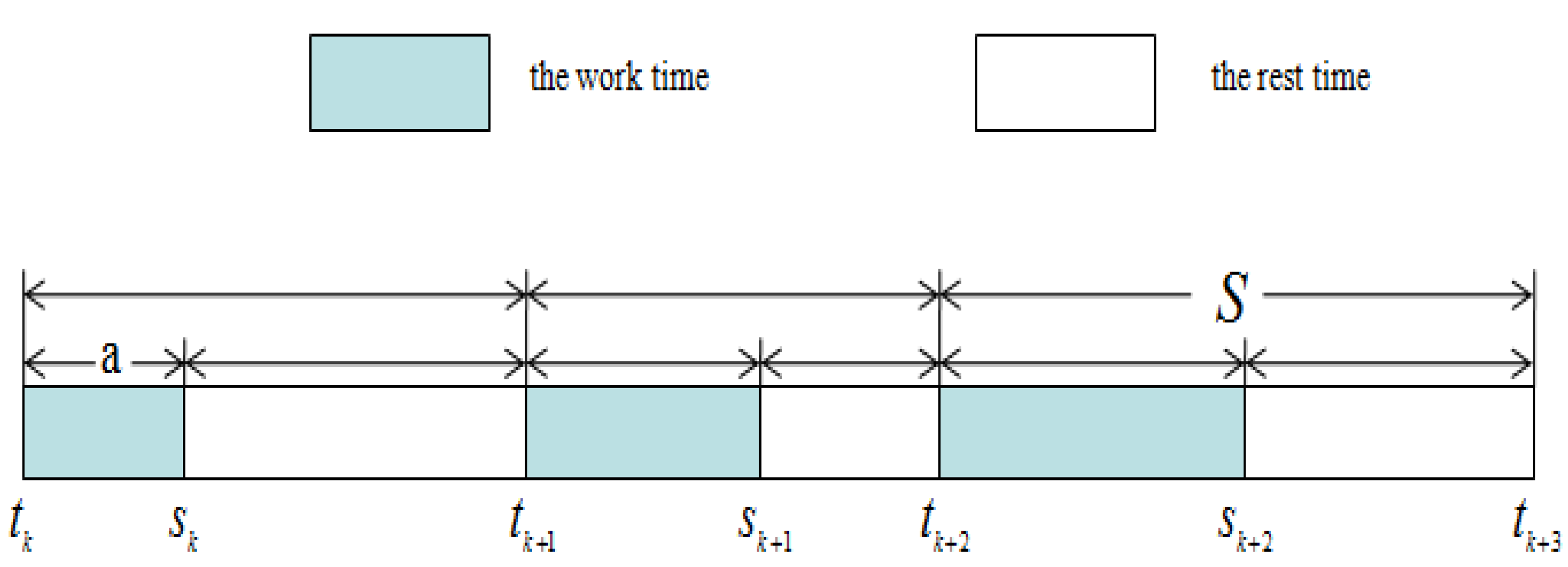
In Figure 1, a denotes the lower bound of control-on lengths, i.e., inf m ( s m t m ) = a , and S denotes the upper bound of control periods, i.e., sup m ( t m + 1 t m ) = S . Let S c ( t , s ) denote the total rest interval length on [ s , t ) . It can be deduced from Definition 2 that
S c ( t , s ) = ( t s ) S ( t , s ) ( 1 ρ ) ( t s ) + S 0 , t > s t 0 .
We present the operating principle of aperiodically intermittent control in Figure 1, in which the lengths of the control intervals are different, the lower bound of control intervals (i.e., inf m ( s m t m ) ) is ’a’, and the upper bound of control periods (i.e., sup m ( t m + 1 t m ) ) is ’S’; ’a’ may be very small, and ’S’ may reach a significant magnitude. Obviously, the average control rate in Figure 1 is ( s k t k + s k + 1 t k + 1 + s k + 2 t k + 2 ) / ( t k + 3 t k ) .

3. The It o ^ Formula and the Well-Posedness

3.1. The It o ^ Formula

This subsection will establish the essential tool, Itô’s formula, for the asymptotic analysis of the controlled system (7).
Let { T i j : i , j S } be a sequence of intervals on the real line, which is defined in the manner
T 12 = 0 , γ 12 , T 13 = γ 12 , γ 12 + γ 13 , , T 1 N 0 = j = 2 N 0 1 γ 1 j , q 1 , T 21 = q 1 , q 1 + γ 21 , T 23 = [ q 1 + γ 21 , q 1 + γ 21 + γ 23 ) , T 2 N 0 = [ q 1 + γ 21 + γ 23 + + γ 2 N 0 1 , q 1 + q 2 ) ,
and so on. For convenience of notation, T i j = if γ i j = 0 , and T i i = .
Define a function Θ : S × R R by
Θ ( i , z ) = j S ( j i ) 1 T i j ( z ) , i S , z [ 0 , ) .
Then,
d r ( t ) = R Θ ( r ( t ) , z ) V ( d t , d z ) ,
where V ( d t , d z ) denotes a Poisson random measure with intensity d t × m ˜ ( d z ) , and m ˜ denotes the Lebesgue measure on R . The poisson random measure V ( d t , d z ) is defined on ( Ω 0 , F 0 , P 0 ) , adapted to F 0 0 and independent of the Wiener process W t .
This paper deals with the process ( X ( t ) , L 1 ( X ( t ) ) , r ( t ) , t ) derived from (6) and (7), so we need to know how a function V : R d × P 2 ( R d ) × S × R + R will map ( X ( t ) , L 1 ( X ( t ) ) , r ( t ) , t ) into another process V ( X ( t ) , L 1 ( X ( t ) ) , r ( t ) , t ) . The following formula, known as the generalized It o ^ formula, states how V maps ( X ( t ) , L 1 ( X ( t ) ) , r ( t ) , t ) into a new process V ( X ( t ) , L 1 ( X ( t ) ) , r ( t ) , t ) .
Theorem 1.
Let V ( x , μ , i , t ) belong to C 2 , 2 , 1 ( R d × P 2 ( R d ) × S × ; R + ) . Then, V ( X ( t ) , L 1 ( X ( t ) ) , r ( t ) , t ) is an Itô process of the form
V ( X ( t ) , L 1 ( X ( t ) ) , r ( t ) , t ) = V ( X ( 0 ) , L 1 ( X ( 0 ) ) , r ( 0 ) , 0 ) + 0 t [ L V ( X ( s ) , L 1 ( X ( s ) ) , r ( s ) , s ) + j S γ r ( s ) j V ( X ( s ) , L 1 ( X ( s ) ) , j , s ) ] d s + M ( t ) ,
where the operator L is defined from R d × P 2 ( R d ) × S × R + to R as
L V ( X ( t ) , L 1 ( X ( t ) ) , r ( t ) , t ) = t V ( X ( t ) , L 1 ( X ( t ) ) , r ( t ) , t ) + x V ( X ( t ) , L 1 ( X ( t ) ) , r ( t ) , t ) b ( X ( t ) , L 1 ( X ( t ) ) , r ( t ) , t ) + R d μ V ( X ( t ) , L 1 ( X ( t ) ) , r ( t ) , t ) ( y ) b ( y , L 1 ( X ( t ) ) , r ( t ) , t ) μ t ( d y ) + 1 2 t r x x V ( X ( t ) , L 1 ( X ( t ) ) , r ( t ) , t ) ι ( X ( t ) , L 1 ( X ( t ) ) , r ( t ) , t ) ι T ( X ( t ) , L 1 ( X ( t ) ) , r ( t ) , t ) ) + 1 2 R d t r y μ V ( X ( t ) , L 1 ( X ( t ) ) , r ( t ) , t ) ( y ) ι ( y , L 1 ( X ( t ) ) , r ( t ) , t ) ι T ( y , L 1 ( X ( t ) ) , r ( t ) , t ) μ t ( d y ) + 0 < | z | < c [ V ( X ( s ) + g ( X ( s ) , L 1 ( X ( s ) ) , r ( s ) , s , z ) , L 1 ( X ( s ) ) , r ( s ) , s ) V ( X ( s ) , L 1 ( X ( s ) ) , r ( s ) , s ) x V ( X ( s ) , L 1 ( X ( s ) ) , r ( s ) , s ) g ( X ( s ) , L 1 ( X ( s ) ) , r ( s ) , s , z ) ] λ ( d z ) + 0 < | z | < c 0 t R d μ V ( X ( s ) , L 1 ( X ( s ) ) , r ( s ) , s ) y + β g ( y , L 1 ( X ( s ) ) , r ( s ) , s , z ) μ V ( X ( s ) , L 1 ( X ( s ) ) , r ( s ) , s ) ( y ) , g ( y , L 1 ( X ( s ) ) , r ( s ) , s , z ) μ s ( d y ) d β λ ( d z ) .
and
M ( t ) = 0 t x V ( X ( s ) , L 1 ( X ( s ) ) , r ( s ) , s ) ι ( X ( s ) , L 1 ( X ( s ) ) , r ( s ) , s ) d W s + 0 t 0 < | z | < c [ V ( X ( s ) + g ( X ( s ) , L 1 ( X ( s ) ) , r ( s ) , s , z ) , r ( s ) , s ) V ( X ( s ) , L 1 ( X ( s ) ) , r ( s ) , s ) ] N ˜ ( d s , d z ) + 0 t R [ V ( X ( s ) , L 1 ( X ( s ) ) , r ( 0 ) + Θ ( r ( s ) , z ) , s ) V ( X ( s ) , L 1 ( X ( s ) ) , r ( s ) , s ) ] V ( d s , d z ) .
Proof. 
Let 0 < τ 1 < τ 2 < τ v < t be all the times when r ( s ) has a jump. Applying the Itô formula to V ( X ( s ) , L 1 ( X ( s ) ) , z , s ) on the intervals [ 0 , τ 1 ) , [ τ 1 , τ 2 ) , , [ τ v , t ] , we have
V ( X ( τ 1 ) , L 1 ( X ( τ 1 ) ) , z , τ 1 ) V ( X ( 0 ) , L 1 ( X ( 0 ) ) , z , 0 ) = 0 τ 1 L V ( X ( s ) , L 1 ( X ( s ) ) , z , s ) d s + 0 τ 1 x V ( X ( s ) , L 1 ( X ( s ) ) , z , s ) ι ( X ( s ) , L 1 ( X ( s ) ) , z , s ) d W s ,
V ( X ( τ k + 1 ) , L 1 ( X ( τ k + 1 ) ) , z , τ k + 1 ) V ( X ( τ k ) , L 1 ( X ( τ k ) ) , z , τ k ) = τ k τ k + 1 V ( X ( s ) , L 1 ( X ( s ) ) , z , s ) d s + τ k τ k + 1 x V ( X ( s ) , L 1 ( X ( s ) ) , z , s ) ι ( X ( s ) , L 1 ( X ( s ) ) , z , s ) d W s ,
V ( X ( t ) , L 1 ( X ( t ) ) , z , t ) V ( X ( τ v ) , L 1 ( X ( τ v ) ) , z , τ v ) = τ v t L V ( X ( s ) , L 1 ( X ( s ) ) , z , s ) d s + τ v t x V ( X ( s ) , L 1 ( X ( s ) ) , z , s ) ι ( X ( s ) , L 1 ( X ( s ) ) , z , s ) d W s .
Substituting z = r ( 0 ) in the first equation, z = r ( τ k ) in the second, and z = r ( τ v ) in the third and adding them over k from 1 to v 1 , we get
V ( X ( t ) , L 1 ( X ( t ) ) , r ( t ) , t ) V ( X ( 0 ) , L 1 ( X ( 0 ) ) , r ( 0 ) , 0 ) = 0 t L V ( X ( s ) , L 1 ( X ( s ) ) , r ( s ) , s ) d s + 0 t x V ( X ( s ) , L 1 ( X ( s ) ) , r ( s ) , s ) ι ( X ( s ) , L 1 ( X ( s ) ) , r ( s ) , s ) d W s + 1 v V ( X ( τ k ) , L 1 ( X ( τ k ) ) , r ( τ k ) , τ k ) V ( X ( τ k ) , L 1 ( X ( τ k ) ) , r ( τ k ) , τ k ) = 0 t L V ( X ( s ) , L 1 ( X ( s ) ) , r ( s ) , s ) d s + 0 t x V ( X ( s ) , L 1 ( X ( s ) ) , r ( s ) , s ) ι ( X ( s ) , L 1 ( X ( s ) ) , r ( s ) , s ) d W s + 0 t R [ V ( X ( s ) , L 1 ( X ( s ) ) , r ( s ) + Θ ( X ( s ) , L 1 ( X ( s ) ) , r ( s ) , z , s ) ) V ( X ( s ) , L 1 ( X ( s ) ) , r ( s ) , s ) ] d s × m ˜ ( d z ) + 0 t R [ V ( X ( s ) , L 1 ( X ( s ) ) , r ( 0 ) + Θ ( X ( s ) , L 1 ( X ( s ) ) , r ( s ) , z ) , s ) V ( X ( s ) , L 1 ( X ( s ) ) , r ( s ) , s ) ] μ ( d s , d z ) ,
where μ ( d s , d z ) = p ( d s , d z ) d s × m ˜ ( d z ) is a martingale measure. Considering
R V ( X ( s ) , L 1 ( X ( s ) ) , r ( s ) + Θ ( X ( s ) , L 1 ( X ( s ) ) , r ( s ) , z ) , s ) V ( X ( s ) , L 1 ( X ( s ) ) , r ( s ) , s ) m ˜ ( d z ) = j S γ r ( s ) j ( X ( s ) , L 1 ( X ( s ) ) ) V ( X ( s ) , L 1 ( X ( s ) ) , j , s ) ,
assertion (12) is obtained. □
Remark 3.
We remark that the Itô formula is the essential tool for the asymptotic analysis of stochastic systems. The Itô formula established in Theorem 1 is a multivariate Itô formula that includes the distribution, Markov chains and jumps. So, the Itô formula for MVSDEs established in [28], the Itô formula for SDEs with Markovian switching established in [29], and the Itô formula for MVSDEs with jumps established in [28] can be regarded as special cases of our Itô formula established in Theorem 1.
Following Itô’s formula (12), we define two differential operators associated with Equations (6) and (7) for future use.
Definition 3.
For V ( x , μ , i , t ) C 2 , 2 , 1 ( R d × P 2 ( R d ) × S × R + ) , we define an It o ^ operator L μ associated with (7) as follows:
L μ V ( X ( t ) , L 1 ( X ( t ) ) , r ( t ) , t ) = t V ( X ( t ) , L 1 ( X ( t ) ) , r ( t ) , t ) + x V ( X ( t ) , L 1 ( X ( t ) ) , r ( t ) , t ) b ( X ( t ) , L 1 ( X ( t ) ) , r ( t ) , t ) + u ( X ( t ) , L 1 ( X ( t ) ) , r ( t ) , t ) + R d μ V ( X ( t ) , L 1 ( X ( t ) ) , r ( t ) , t ) ( y ) b ( y , L 1 ( X ( t ) ) , r ( t ) , t ) + u ( y , L 1 ( X ( t ) ) , r ( t ) , t ) μ t ( d y ) + 1 2 t r x x V ( X ( t ) , L 1 ( X ( t ) ) , r ( t ) , t ) ι ( X ( t ) , L 1 ( X ( t ) ) , r ( t ) , t ) ι T ( X ( t ) , L 1 ( X ( t ) ) , r ( t ) , t ) + 1 2 R d t r y μ V ( X ( t ) , L 1 ( X ( t ) ) , r ( t ) , t ) ( y ) ι ( y , L 1 ( X ( t ) ) , r ( t ) , t ) ι T ( y , L 1 ( X ( t ) ) , r ( t ) , t ) μ t ( d y ) + j S γ r ( t ) j V ( X ( t ) , L 1 ( X ( t ) ) , j , t ) + 0 < | z | < c [ V ( X ( s ) + g ( X ( s ) , L 1 ( X ( s ) ) , r ( s ) , s , z ) , L 1 ( X ( s ) ) , r ( s ) , s ) V ( X ( s ) , L 1 ( X ( s ) ) , r ( s ) , s ) x V ( X ( s ) , L 1 ( X ( s ) ) , r ( s ) , s ) λ ( d z ) g ( X ( s ) , L 1 ( X ( s ) ) , r ( s ) , s , z ) ] + 0 < | z | < c 0 t R d μ V ( X ( s ) , L 1 ( X ( s ) ) , r ( s ) , s ) ( y + β g ( y , L 1 ( X ( s ) ) , r ( s ) , s , z ) ) μ V ( X ( s ) , L 1 ( X ( s ) ) , r ( s ) , s ) ( y ) , g ( y , L 1 ( X ( s ) ) , r ( s ) , s , z ) μ s ( d y ) d β λ ( d z ) ,
where y is the copy of X ( t ) on the space ( Ω 1 , F 1 , P 1 ) .
Definition 4.
Let ζ and β be two random variables with distributions μ and v, respectively. Let the joint distribution of ( ζ , β ) be F ζ , β ( z , z ¯ ) . For a non-negative Lyapunov function V ( x , μ , y , v , i , t ) C 2 , 2 , 1 ( R d × P 2 ( R d ) × S × R + ) , the operator L μ V : R d × P 2 ( R d ) × R d × P 2 ( R d ) × S × R + R associated with (7) is defined as
L μ V ( X ( t ) , L 1 ( X ( t ) ) , X ˜ ( t ) , L 1 ( X ˜ ( t ) ) , r ( t ) , t ) = t V ( X ( t ) , L 1 ( X ( t ) ) , r ( t ) , t ) + x V ( X ( t ) , L 1 ( X ( t ) ) , r ( t ) , t ) b ( X ( t ) , L 1 ( X ( t ) ) , r ( t ) , t ) + u ( X ˜ ( t ) , L 1 ( X ˜ ( t ) ) , r ( t ) , t ) + R d μ V ( X ( t ) , L 1 ( X ( t ) ) , r ( t ) , t ) ( X 1 ( t ) ) b ( X 1 ( t ) , L 1 ( X ( t ) ) , r ( t ) , t ) μ t ( d X 1 ( t ) ) + R d R d μ V ( X ( t ) , L 1 ( X ( t ) ) , r ( t ) , t ) ( X 1 ( t ) ) u ( X ˜ 1 ( t ) , L 1 ( X ˜ ( t ) ) , r ( t ) , t ) F X ( t ) , X ˜ ( t ) ( d X 1 ( t ) , d X ˜ 1 ( t ) ) + 1 2 t r x x V ( X ( t ) , L 1 ( X ( t ) ) , r ( t ) , t ) ι ( X ( t ) , L 1 ( X ( t ) ) , r ( t ) , t ) ι T ( X ( t ) , L 1 ( X ( t ) ) , r ( t ) , t ) + 1 2 R d t r ( y μ V ( X ( t ) , L 1 ( X ( t ) ) , r ( t ) , t ) ( X 1 ( t ) ) ι ( X 1 ( t ) , L 1 ( X ( t ) ) , r ( t ) , t ) ι T ( X 1 ( t ) , L 1 ( X ( t ) ) , r ( t ) , t ) ) μ t ( d X 1 ( t ) ) + j S γ r ( t ) j V ( X ( t ) , L 1 ( X ( t ) ) , j , t ) + 0 < | z | < c [ V ( X ( s ) + g ( X ( s ) , L 1 ( X ( s ) ) , r ( s ) , s , z ) , L 1 ( X ( s ) ) , r ( s ) , s ) V ( X ( s ) , L 1 ( X ( s ) ) , r ( s ) , s ) x V ( X ( s ) , L 1 ( X ( s ) ) , r ( s ) , s ) g ( X ( s ) , L 1 ( X ( s ) ) , r ( s ) , s , z ) ] λ ( d z ) + 0 < | z | < c 0 t R d μ V ( X ( s ) , L 1 ( X ( s ) ) , r ( s ) , s ) ( X 1 ( s ) + β g ( X 1 ( s ) , L 1 ( X ( s ) ) , r ( s ) , s , z ) ) μ V ( X ( s ) , L 1 ( X ( s ) ) , r ( s ) , s ) X 1 ( s ) , g ( X 1 ( s ) , L 1 ( X ( s ) ) , r ( s ) , s , z ) μ s ( d X 1 ( s ) ) d β λ ( d z ) ,
where X 1 ( t ) is the copy of X ( t ) on the space ( Ω 1 , F 1 , P 1 ) , and X ˜ 1 ( t ) is the copy of X ˜ ( t ) on the space ( Ω 1 , F 1 , P 1 ) .

3.2. Well-Posedness

We impose the following hypotheses to ensure well-posedness.
Assumption 3.
There exists a positive constant K such that for any t 1 , t 2 [ 0 , T ] , x 1 , x 2 R d , μ , v P 2 ( R d ) , and i S ,
| b ( x 1 , μ , i , t 1 ) b ( x 2 , v , i , t 2 ) | 2 | ι ( x 1 , μ , i , t 1 ) ι ( x 2 , v , i , t 2 ) | 2 0 < | z | < c | g ( x 1 , μ , i , t 1 , z ) g ( x 2 , v , i , t 2 , z ) | 2 λ ( d z ) K | x 1 x 2 | 2 + W 2 2 ( μ , v ) .
The jump coefficient g ( x , μ , i , t , z ) : R d × P 2 ( R d ) × S × R + × R d R d satisfies
0 < | z | < c | g ( x , μ , i , t , z ) | 2 λ ( d z ) <
for all x R d , μ P 2 ( R d ) , i S and t 0 . Moreover, we assume that b ( 0 , δ 0 , i , t ) = 0 , ι ( 0 , δ 0 , i , t ) = 0 and g ( 0 , δ 0 , i , t ) = 0 . It can be deduced from (16) that for any t [ 0 , T ] , x R d , μ P 2 ( R d ) , and i S ,
| b ( x , μ , i , t ) | 2 | ι ( x , μ , i , t ) | 2 0 < | z | < c | g ( x , μ , i , t , z ) | 2 λ ( d z ) K | x | 2 + W 2 2 ( μ , δ 0 ) .
Remark 4.
The Lipschitz continuity of b, ι and γ in Assumption 3 guarantees the well-posedness of the LN-HMVSDEs, which will be stated below.
Remark 5.
In Assumption 3, we consider the Lipschitz condition on coefficients b, ι and γ defined under L 2 -Wasserstein distance, which is different from that defined under L 1 -Wasserstein distance in reference [30]. The L 2 -Wasserstein distance leads to a weaker Lipschitz condition compared to the L 1 -Wasserstein distance. Furthermore, the probability space P 2 ( R d ) endowed with the L 2 -Wasserstein distance possesses a richer geometric structure than that endowed with the L 1 distance. Readers can refer to [31,32] and the references therein for McKean–Vlasov SDEs under L 2 -Wasserstein distance.
Suppose that the initial data of LN-HMVSDE (6) is ξ with ξ F 0 , satisfying E | ξ | 2 < and r ( 0 ) = r 0 S . Now, we can investigate the well-posedness of (6) and the controlled system (7).
Theorem 2.
Let Assumptions 1 and 3 hold. Then, LN-HMVSDE (6) with initial data ξ admits a unique solution X ( t ) for all t 0 , and the solution has the property that for all t 0 , E | X ( t ) | 2 < .
Proof. 
Suppose that ( X ( t ) , L 1 ( X ( t ) ) , r ( t ) , t ) and ( Y ( t ) , L 1 ( Y ( t ) ) , r ˜ ( t ) , t ) are solutions of (6). If r ( t ) = r ˜ ( t ) a.s., the uniqueness follows from the It o ^ formula (12) and the Gronwall inequality since the coefficients are Lipschitz. Otherwise, define τ N = inf { t 0 : r ( t ) = r ˜ ( t ) } . We can prove τ N = a.s. We refer the reader to Theorem 3.3 in [32] for the details.
Assume that for almost every ω Ω , there exist a sequence of stopping times ( τ k ) k 0 and a finite k ¯ = k ¯ ( ω ) such that 0 = τ 0 < τ 1 < τ 2 < < τ k ¯ = T and τ k = T for k k ¯ ; then, r ( s ) is a random constant on every interval [ τ i , τ i + 1 ) , that is,
r ( s ) = r ( τ i ) o n τ i s < τ i + 1 f o r i 0 .
Then, on [ τ 0 , τ 1 ) , (6) simplifies to
d X ( t ) = ( b ( X ( t ) , L 1 ( X ( t ) ) , r 0 , t ) d t + ι ( X ( t ) , L 1 ( X ( t ) ) , r 0 , t ) d W t + 0 < | z | < c g ( X ( t ) , L 1 ( X ( t ) ) , r 0 , t , z ) N ˜ ( d t , d z ) ,
with initial data ξ and r 0 . Let X 0 ( t ) = X ( 0 ) = ξ , L 1 ( X 0 ( t ) ) = L 1 ( X ( 0 ) ) . For any n 1 , let X n ( t ) solve the SDE
X n ( t ) = b ( X n ( t ) , L 1 ( X n 1 ( t ) ) , r 0 , t ) d t + ι ( X n ( t ) , L 1 ( X n 1 ( t ) ) , r 0 , t ) d W t + 0 < | z | < c g ( X n ( t ) , L ( X n 1 ( t ) ) , r 0 , t , z ) N ˜ ( d t , d z ) , X 0 ( t ) = X ( 0 ) = ξ , t [ τ 0 , τ 1 ) .
Similar to the proof of Lemma 2.7 in [33], we can prove that E sup τ 0 t < τ 1 | X n ( t ) | 2 < C , and { X n ( t ) } τ 0 t < τ 1 is a Cauchy sequence and, hence, has a limit X ( t ) in the space C ( [ τ 0 , τ 1 ) ) as n ; this is a solution belonging to M 2 ( [ τ 0 , τ 1 ) ; R d ) and X ( τ 1 ) L F τ 1 2 ( Ω ; R d ) , where L F τ 1 2 ( Ω ; R d ) denotes the family of R d -valued F τ 1 -measurable random variables ζ with E | ζ | 2 < , and M 2 ( [ a , b ) ; R d ) denotes the family of processes { X ( t ) } a t < b with a b | X ( t ) | 2 d t < such that E a b | X ( t ) | 2 d t < . We proceed to consider (6) on t [ τ 1 , τ 2 ) , which simplifies to
d X ( t ) = ( b ( X ( t ) , L 1 ( X ( t ) ) , r ( τ 1 ) , t ) d t + ι ( X ( t ) , L 1 ( X ( t ) ) , r ( τ 1 ) , t ) d W t + 0 < | z | < c g ( X ( t ) , L 1 ( X ( t ) ) , r ( τ 1 ) , t , z ) N ˜ ( d t , d z ) ,
with initial data X ( τ 1 ) and r ( τ 1 ) . On each interval [ τ i , τ i + 1 ) , we take X ( τ i ) as the initial value, which is the solution value at the end of the previous interval, with E | X ( τ i ) | 2 < . Let X 0 ( t ) = X ( τ 1 ) , L 1 ( X 0 ( t ) ) = L 1 ( X ( τ 1 ) ) . For any n 1 , let X n ( t ) solve the SDE
X n ( t ) = b ( X n ( t ) , L 1 ( X n 1 ( t ) ) , r ( τ 1 ) , t ) d t + ι ( X n ( t ) , L 1 ( X n 1 ( t ) ) , r ( τ 1 ) , t ) d W t + 0 < | z | < c g ( X n ( t ) , L 1 ( X n 1 ( t ) ) , r ( τ 1 ) , t , z ) N ˜ ( d t , d z ) , X 0 ( t ) = X ( τ 1 ) , t [ τ 1 , τ 2 ) .
Similar to the proof of Lemma 2.7 in [33], we can prove that E sup τ 1 t < τ 2 | X n ( t ) | 2 < C , and { X n ( t ) } τ 1 t < τ 2 is a Cauchy sequence and, hence, has a limit X ( t ) in the space C ( [ τ 1 , τ 2 ) ) as n , which is a solution belonging to M 2 ( [ τ 1 , τ 2 ) ; R d ) and X ( τ 2 ) L F τ 2 2 ( Ω ; R d ) . By repeating this procedure, we can conclude that Equation (6) has a unique solution X ( t ) on [ 0 , T ] and E | X ( t ) | 2 < . The proof is completed. □
Theorem 3.
Under Assumptions 1 and 3, the controlled system (7) with initial data ξ has a unique solution X ( t ) for all t 0 , and the solution has the property that for all t 0 , E | X ( t ) | 2 < .
Proof. 
The proof can be finished in a similar fashion to that of Theorem 2, and we omit it here. □

4. AIC Stabilization Problem

This section mainly focuses on the stabilization issue under the influence of state distribution, Markovian switching and jumps. For the stabilization purpose related to the controlled system (7), we will use a Lyapunov functional on the segments X ^ t : = { X ( t + s ) : τ s 0 } and r ^ t : = { r ( t + s ) : τ s 0 } for t 0 . Obviously, X ^ t is an F t -adapted C ( [ τ , 0 ] ; R d ) -valued stochastic process. Let X ( t ) : = ξ for τ t 0 , L 1 ( X ( t ) ) : = L 1 ( ξ ) and r ( t ) : = r 0 for τ t 0 .
For the stochastic system with state distribution, Lévy noise, and Markovian switching, the Lyapunov functional, which characterizes the current state, delayed states, mode-dependent energy, and distributional features, is defined as follows,
V ( X ^ t , L 1 ( X ^ t ) , r ^ t , t ) = V ( X ( t ) , L 1 ( X ( t ) ) , r ( t ) , t ) + I ( t ) , t 0 ,
where
I ( t ) = t τ t s t | X ( v ) | 2 d v d s .
By the fundamental theory of calculus, it gives
d I ( t ) = I 1 ( t ) d t I 2 ( t ) d t ,
where I 1 ( t ) = τ | X ( t ) | 2 , I 2 ( t ) = t τ t | X ( s ) | 2 d s .
Corollary 1.
It can be obtained by exchanging the order of integration such that
I ( t ) = τ I 2 ( t ) .
Remark 6.
The term V ( X ( t ) , L 1 ( X ( t ) ) , r ( t ) , t ) is constructed to characterize the current system state, the distribution feature of the state (via the first-order Lie derivative L 1 ), and the mode-dependent energy under Markovian switching, which matches the system’s hybrid structure. The integral term I ( t ) = t τ t s t | X ( v ) | 2 d v d s is introduced to handle the time-delay effect in the system, which is a common and effective technique in Lyapunov–Krasovskii functional design for delayed stochastic systems, as it can fully capture the cumulative influence of historical state information.
When studying discrete state feedback stabilization, it is crucial to evaluate the difference between the current state, denoted by X ( t ) , and the state at discrete sampling times, denoted by X ( σ t ) . This disparity is quantified as | X ( t ) X ( σ t ) | . We rigorously formulate this evaluation in the form of the subsequent Lemma.
Lemma 2.
Let τ be sufficiently small such that ( 8 K ( ρ τ S 0 ) τ + 16 K τ 2 + 128 K τ ) e 16 K τ 2 + 128 K τ < 1 2 . Then, for any t 0 , ξ R d and r 0 S ,
E | X ( t ) X ( σ t ) | 2 2 ( 8 K ( ρ τ S 0 ) τ + 16 K τ 2 + 128 K τ ) e 16 K τ 2 + 128 K τ 1 2 ( 8 K ( ρ τ S 0 ) τ + 16 K τ 2 + 128 K τ ) e 16 K τ 2 + 128 K τ E | X ( t ) | 2 .
Proof. 
For any t 0 , we can find a unique integer s 0 such that t [ s τ , ( s + 1 ) τ ) ; moreover, σ t = s τ . It follows from (7) that
X ( t ) X ( σ t ) = s τ t b ( X ( l ) , L 1 ( X ( l ) ) , r ( l ) , l ) + u ( X ( σ l ) , L 1 ( X ( σ l ) ) , r ( l ) , l ) d l + s τ t ι ( X ( l ) , L 1 ( X ( l ) ) , r ( l ) , l ) d W l + s τ t 0 < | z | < c g ( X ( l ) , L 1 ( X ( l ) ) , r ( l ) , l , z ) d N ˜ ( d l , d z ) .
By using It o ^ ’s isometry, H o ¨ lder inequality, Doob martingale inequality (see, e.g., [26]) and Assumptions 1 and 3, we have
E | X ( t ) X ( σ t ) | 2 4 | s τ t b ( X ( l ) , L 1 ( X ( l ) ) , r ( l ) , l ) d l | 2 + 4 | s τ t u ( X ( σ l ) , L 1 ( X ( σ l ) ) , r ( l ) , l ) ) d l | 2 + 4 | s τ t ι ( X ( l ) , L 1 ( X ( l ) ) , r ( l ) , l ) d W l | 2 + 4 | s τ t 0 < | z | < c g ( X ( l ) , L 1 ( X ( l ) ) , r ( l ) , l , z ) d N ˜ ( d l , d z ) | 2 ( 8 K τ + 64 K ) s τ t E | X ( z ) | 2 d z + 8 K ( ρ τ S 0 ) τ E | X ( s τ ) | 2 ( 16 K τ + 128 K ) s τ t E | X ( z ) X ( σ z ) | 2 d z + ( 8 K ( ρ τ S 0 ) τ + 16 K τ 2 + 128 K τ ) E | X ( s τ ) | 2 ,
where we use that W 2 2 ( L 1 ( X ( l ) ) , δ 0 ) E | X ( l ) ) | 2 . Noting that t [ s τ , ( s + 1 ) τ ) , the Gronwall inequality yields
E | X ( t ) X ( σ t ) | 2 ( 8 K ( ρ τ S 0 ) τ + 16 K τ 2 + 128 K τ ) E | X ( s τ ) | 2 e 16 K τ 2 + 128 K τ .
Furthermore,
E | X ( t ) X ( σ t ) | 2 2 ( 8 K ( ρ τ S 0 ) τ + 16 K τ 2 + 128 K τ ) E | X ( s τ ) X ( t ) | 2 e 16 K τ 2 + 128 K τ + 2 ( 8 K ( ρ τ S 0 ) τ + 16 K τ 2 + 128 K τ ) E | X ( t ) | 2 e 16 K τ 2 + 128 K τ .
Hence, it follows from ( 8 K ( ρ τ S 0 ) τ + 16 K τ 2 + 128 K τ ) e 16 K τ 2 + 128 K τ < 1 2 that
E | X ( t ) X ( σ t ) | 2 2 ( 8 K ( ρ τ S 0 ) τ + 16 K τ 2 + 128 K τ ) e 16 K τ 2 + 128 K τ 1 2 ( 8 K ( ρ τ S 0 ) τ + 16 K τ 2 + 128 K τ ) e 16 K τ 2 + 128 K τ E | X ( t ) | 2 .
Remark 7.
This condition ( 8 K ( ρ τ S 0 ) τ + 16 K τ 2 + 128 K τ ) e 16 K τ 2 + 128 K τ < 1 2 in (26) guarantees the contraction property of the stochastic system under aperiodically intermittent control, which is essential to ensure the convergence of the error term and the stability of the system. It restricts the control interval length τ, control gain K, and system parameters to prevent error divergence.
Remark 8.
From Theorem 3, we can conclude that the term E | X ( t ) X ( σ t ) | 2 would be sufficiently small if the observation duration τ is small.
We need an extra condition to discuss the mean square exponential stabilization by feedback controls.
Assumption 4.
Assume that there exist a Lyapunov function V C 2 , 2 , 1 ( R d × P 2 ( R d ) × S × R + ) and four constants λ 1 > 0 , λ 2 > 0 , γ 1 > 0 , γ ^ 1 > 0 such that
R L μ V ( x , μ , i , t ) μ ( d x ) + λ 1 R | x V ( x , μ , i , t ) | 2 μ ( d x ) + λ 2 R | μ V ( x , μ , i , t ) ( y ) | 2 μ ( d y ) γ 1 R ( t ) R d V ( x , μ , i , t ) μ ( d x ) + γ 1 ^ ( 1 R ( t ) ) R d V ( x , μ , i , t ) μ ( d x ) .
Lemma 3.
Let Assumptions 1–4 hold, and assume that there exists a positive constant c 1 such that c 1 R d | X ( t ) | 2 μ t ( d X ( t ) ) R d V ( X ( t ) , L 1 ( X ( t ) ) , r ( t ) , t ) μ t ( d X ( t ) ) . If τ > 0 is sufficiently small such that
γ 1 c 1 τ K λ 1 + K λ 2 2 ( 8 K ( ρ τ S 0 ) τ + 16 K τ 2 + 128 K τ ) e 16 K τ 2 + 128 K τ 1 2 ( 8 K ( ρ τ S 0 ) τ + 16 K τ 2 + 128 K τ ) e 16 K τ 2 + 128 K τ > 0 ,
then
E L V ( X ^ t , L 1 ( X ^ t ) , r ^ t , t ) λ 3 ( t ) E | X ( t ) | 2 E I 2 ( t ) .
where λ 3 ( t ) = ψ 1 R ( t ) + ψ 2 ( 1 R ( t ) ) , ψ 1 = γ 1 c 1 τ K λ 1 + K λ 2 2 ( 8 K ( ρ τ S 0 ) τ + 16 K τ 2 + 128 K τ ) e 16 K τ 2 + 128 K τ 1 2 ( 8 K ( ρ τ S 0 ) τ + 16 K τ 2 + 128 K τ ) e 16 K τ 2 + 128 K τ and ψ 2 = γ 1 ^ c 1 τ .
Proof. 
Applying the generalized It o ^ formula (12) to the Lyapunov functional defined by (19) yields
d V ( X ^ t , L 1 ( X ^ t ) , r ^ t , t ) = L V ( X ^ t , L 1 ( X ^ t ) , r ^ t , t ) d t + d M ( t ) , t 0 ,
where
L V ( X ^ t , L 1 ( X ^ t ) , r ^ t , t ) = L μ V ( X ( t ) , L 1 ( X ( t ) ) , X ( σ t ) , L 1 ( X ( σ t ) ) , r ( t ) , t ) + I 1 ( t ) I 2 ( t ) .
and M ( t ) is a real-valued local martingale (see, e.g., [26]), which is defined the same as that defined in (13) with M ( 0 ) = 0 .
Substituting (14) and (15) into (29) gives
L V ( X ^ t , L 1 ( X ^ t ) , r ^ t , t ) = L μ V ( X ( t ) , L 1 ( X ( t ) ) , r ( t ) , t ) x V ( X ( t ) , L 1 ( X ( t ) ) , r ( t ) , t ) u ( X ( t ) , L 1 ( X ( t ) ) , r ( t ) , t ) u ( X ( σ t ) , L 1 ( X ( σ t ) ) , r ( t ) , t ) R d R d μ V ( X ( t ) , L 1 ( X ( t ) ) , r ( t ) , t ) ( X 1 ( t ) ) ( u ( X 1 ( t ) , L 1 ( X ( t ) ) , r ( t ) , t ) u ( X ˜ 1 ( t ) , L 1 ( X ( σ t ) ) , r ( t ) , t ) ) F X ( t ) , X ( σ t ) ( d X 1 ( t ) , d X ˜ 1 ( t ) ) + I 1 ( t ) I 2 ( t ) .
Recalling the Young inequality and Assumption 1, we have
x V ( X ( t ) , L 1 ( X ( t ) ) , r ( t ) , t ) u ( X ( t ) , L 1 ( X ( t ) ) , r ( t ) , t ) u ( X ( σ t ) , L 1 ( X ( σ t ) ) , r ( t ) , t ) λ 1 | x V ( X ( t ) , L 1 ( X ( t ) ) , r ( t ) , t ) | 2 + K R ( t ) 2 λ 1 | X ( t ) X ( σ t ) | 2 + K R ( t ) 2 λ 1 W 2 2 L 1 ( X ( t ) ) , L 1 ( X ( σ t ) ) ,
and
R d R d μ V ( X ( t ) , L 1 ( X ( t ) ) , r ( t ) , t ) ( X 1 ( t ) ) ( u ( X 1 ( t ) , L 1 ( X ( t ) ) , r ( t ) , t ) u ( X ˜ 1 ( t ) , L 1 ( X ( σ t ) ) , r ( t ) , t ) ) F X ( t ) , X ( σ t ) ( d X 1 ( t ) , d X ˜ 1 ( t ) ) λ 2 R | μ V ( X ( t ) , L 1 ( X ( t ) ) , r ( t ) ) ( y ) | 2 μ ( d y ) + K R ( t ) 2 λ 2 E | X ( t ) X ( σ t ) | 2 + K R ( t ) 2 λ 2 W 2 2 L 1 ( X ( t ) ) , L 1 ( X ( σ t ) ) .
Substituting (31) and (32) into (30) yields
L V ( X ^ t , L 1 ( X ^ t ) , r ^ t , t ) L μ V ( X ( t ) , L 1 ( X ( t ) ) , r ( t ) , t ) + λ 1 | x V ( X ( t ) , L 1 ( X ( t ) ) , r ( t ) , t ) | 2 + λ 2 R | μ V ( X ( t ) , L 1 ( X ( t ) ) , r ( t ) , t ) ( y ) | 2 μ ( d y ) + K R ( t ) 2 λ 1 | X ( t ) X ( σ t ) | 2 + τ | X ( t ) | 2 + K R ( t ) 2 λ 2 E | X ( t ) X ( σ t ) | 2 + K R ( t ) 2 λ 1 + K R ( t ) 2 λ 2 W 2 2 L 1 ( X ( t ) ) , L 1 ( X ( σ t ) ) I 2 ( t ) .
Taking the expectation on both sides of (33) and considering (1), as well as Assumption 4, yields
E L V ( X ^ t , L 1 ( X ^ t ) , r ^ t , t ) ( γ 1 c 1 τ ) R ( t ) ( γ 1 ^ c 1 τ ) ( 1 R ( t ) ) E | X ( t ) | 2 + K R ( t ) λ 1 + K R ( t ) λ 2 E | X ( t ) X ( σ t ) | 2 E I 2 ( t ) .
By considering (26), we have
E L V ( X ^ t , L 1 ( X ^ t ) , r ^ t , t ) λ 3 ( t ) E | X ( t ) | 2 E I 2 ( t ) .
where λ 3 ( t ) = ψ 1 R ( t ) + ψ 2 ( 1 R ( t ) ) with ψ 1 = γ 1 c 1 τ K λ 1 + K λ 2 2 ( 8 K ( ρ τ S 0 ) τ + 16 K τ 2 + 128 K τ ) e 16 K τ 2 + 128 K τ 1 2 ( 8 K ( ρ τ S 0 ) τ + 16 K τ 2 + 128 K τ ) e 16 K τ 2 + 128 K τ and ψ 2 = γ 1 ^ c 1 τ . □
Remark 9.
The Lyapunov functional method is one of the most effective tools for studying stability, which has been used in various stochastic systems (see, e.g., [4,5,18]). The core of this method is the construction of Lyapunov functionals, and it is a substantial challenge to proficiently develop functionals. In stochastic domains, the most frequently used Lyapunov functional has the following expression:
V ( X ^ t , L 1 ( X ^ t ) , r ^ t , t ) = V ( X ( t ) , L 1 ( X ( t ) ) , r ( t ) , t ) + I ( t ) , t 0 ,
where
I ( t ) = t τ t v t τ | b s + u s | 2 + | ι s | 2 + 0 < | z | < c | g s ( z ) | 2 λ ( d z ) d s d v ,
and where we use b s = b ( X ( s ) , L 1 ( X ( s ) ) , r ( s ) , s ) , u s = u ( X ( σ s ) , L 1 ( X ( σ s ) ) , r ( s ) , s ) , ι s = ι ( X ( s ) , L 1 ( X ( s ) ) , r ( s ) , s ) and g s ( z ) = g ( X ( s ) , L 1 ( X ( s ) ) , r ( s ) , s , z ) for s 0 to simplify the notations. Using the fundamental theory of calculus gives
d I ( t ) = I 1 ( t ) d t I 2 ( t ) d t ,
where I 1 ( t ) = τ τ | b t + u t | 2 + | ι t | 2 + 0 < | z | < c | g t ( z ) | 2 λ ( d z ) , I 2 ( t ) = t τ t τ | b s + u s | 2 + | ι s | 2 + 0 < | z | < c | g s ( z ) | 2 λ ( d z ) d s . Compared with this particular functional, the one we developed is both simpler and more efficient.
Remark 10.
The standard Lyapunov method for stability analysis of stochastic systems, including delayed and jump diffusion models, relies on constructing a positive definite Lyapunov functional and proving its infinitesimal generator (via Itô’s formula) is negative, but it typically requires complex auxiliary terms to handle delays and jumps, leading to cumbersome derivations and overly restrictive, conservative stability conditions; in contrast, the work presented introduces an enhanced Lyapunov functional that appends a novel double-integral term I ( t ) to the standard functional, where
I ( t ) = t τ t v t τ | b s + u s | 2 + | t s | 2 + 0 < | z | < c | g s ( z ) | 2 λ ( d z ) d s d v
and can be directly differentiated via the Fundamental Theorem of Calculus as
d I ( t ) = I 1 ( t ) d t I 2 ( t ) d t ,
eliminating the need for complex auxiliary estimates while explicitly capturing the system’s drift, diffusion, jump, and delay dynamics in its integrand, resulting in a simpler, more efficient derivation with less conservative stability conditions, as explicitly noted in the text (the proposed functional is both simpler and more efficient than the compared standard form).
We now introduce the following assumption to discuss the mean square exponential stabilization by aperiodically intermittent control.
Assumption 5.
Assume that there exist two positive constants a 1 and a 2 such that,
a 1 R ( | x | 2 + W 2 2 ( μ , δ 0 ) ) μ ( d x ) R V ( x , μ , i , t ) μ ( d x ) a 2 R ( | x | 2 + W 2 2 ( μ , δ 0 ) ) μ ( d x ) ,
for all ( x , μ , i , t ) R d × P 2 ( R d ) × S × R + .
We now proceed to the main theorem of this paper.
Theorem 4.
Let the conditions of Lemmas 2 and 3 hold. Let τ be sufficiently small such that ψ 1 τ 2 a 2 1 . Then, the solution of the controlled system (7) satisfies
E | X ( t ) | 2 C ^ e a t E | X ( 0 ) | 2 , t 0 ,
where C ^ = 2 a 2 a 1 e ( ψ 1 ψ 2 ) S 0 2 a 2 and a = ρ ( ψ 1 ψ 2 ) + ψ 2 2 a 2 . Furthermore, let λ = a 4 ; then, for any t 0 , X ( 0 ) R d and r 0 S ,
lim sup t 1 t ln | X ( t ) | λ .
Proof. 
Let H ( t ) = λ 3 ( t ) 2 a 2 . Applying the It o ^ formula (12) to e 0 t H ( s ) d s V ( X ^ t , L 1 ( X ^ t ) , r ^ t ) and considering (19), we have
e 0 t H ( s ) d s V ( X ^ t , L 1 ( X ^ t ) , r ^ t , t ) V ( X ^ 0 , L 1 ( X ^ 0 ) , r ^ 0 , 0 ) = 0 t e 0 s H ( u ) d u ( H ( s ) V ( X ^ s , L 1 ( X ^ s ) , r ^ s , s ) + L μ V ( X ( s ) , L 1 ( X ( s ) ) , r ( s ) , s ) x V ( X ( s ) , L 1 ( X ( s ) ) , r ( s ) , s ) u ( X ( s ) , L 1 ( X ( s ) ) , r ( s ) , s ) u ( X ( σ s ) , L 1 ( X ( σ s ) ) , r ( s ) , s ) R d R d μ V ( X ( s ) , L 1 ( X ( s ) ) , r ( s ) , s ) ( X 1 ( s ) ) ( u ( X 1 ( s ) , L 1 ( X ( s ) ) , r ( s ) , s ) u ( X ˜ 1 ( s ) , L 1 ( X ( σ s ) ) , r ( s ) , s ) ) F X ( s ) , X ( σ s ) ( d X 1 ( s ) , d X ˜ 1 ( s ) ) + I 1 ( s ) I 2 ( s ) + M ( s ) ) d s ,
where 0 t e 0 s H ( u ) d u M ( s ) d s is a real-valued local martingale (see, e.g., [26]). Taking the expectation on both sides of (40) and combining (35), we obtain
E [ e 0 t H ( s ) d s V ( X ^ t , L 1 ( X ^ t ) , r ^ t , t ) ] E [ V ( X ^ 0 , L 1 ( X ^ 0 ) , r ^ 0 , 0 ) ] + 0 t e 0 s H ( u ) d u H ( s ) E [ V ( X ^ s , L 1 ( X ^ s ) , r ^ s , s ) ] λ 3 ( s ) E | X ( s ) | 2 E I 2 ( s ) d s .
Recalling the definition of V ( X ^ t , L 1 ( X ^ t ) , r ^ t , t ) , which, together with (21) and (37), yields
E [ V ( X ^ t , L 1 ( X ^ t ) , r ^ t , t ) ] 2 a 2 E | X ( t ) | 2 + τ E [ I 2 ( t ) ] .
Substituting (42) into (41) and considering (37) and ψ 1 τ 2 a 2 1 , we have
a 1 e 0 t H ( s ) d s E | X ( t ) | 2 2 a 2 E | X ( 0 ) | 2 + 0 t e 0 t H ( s ) d s ( 2 a 2 H ( s ) λ 3 ( s ) ) E | X ( s ) | 2 + ( H ( s ) τ 1 ) E I 2 ( s ) d s 2 a 2 E | X ( 0 ) | 2 .
Thus,
E | X ( t ) | 2 2 a 2 a 1 e 0 t H ( s ) d s E | X ( 0 ) | 2 .
A direct calculation based on Definition 2 yields
0 t H ( s ) d s = 1 2 a 2 0 t ψ 1 R ( s ) + ψ 2 ( 1 R ( s ) ) d s = 1 2 a 2 ψ 1 S ( t , 0 ) + ψ 2 S c ( t , 0 ) ρ ψ 1 t 2 a 2 + ψ 1 S 0 2 a 2 ( 1 ρ ) ψ 2 t 2 a 2 ψ 2 S 0 2 a 2 ρ ( ψ 1 ψ 2 ) + ψ 2 t 2 a 2 + ( ψ 1 ψ 2 ) S 0 2 a 2 .
Thus,
E | X ( t ) | 2 C ^ e a t E | X ( 0 ) | 2 ,
where C ^ = 2 a 2 a 1 e ( ψ 1 ψ 2 ) S 0 2 a 2 and a = ρ ( ψ 1 ψ 2 ) + ψ 2 2 a 2 .
Clearly, (45) means that
lim sup t 1 t ln ( E | X ( t ) | 2 ) a .
By a > 0 and a 2 > 0 , we see ψ 2 ψ 1 ψ 2 < ρ < 1 .
For any t 0 , there exists a positive integer m such that ( m 1 ) τ t < m τ . Then, (45) yields
E [ sup ( m 1 ) τ t < m τ | X ( t ) | 2 ] C ^ e a ( m 1 ) τ E | X ( 0 ) | 2 .
For any ϵ > 0 , by Chebyshev’s inequality, we have
P { ω : sup ( m 1 ) τ t < m τ | X ( t ) | 2 > e ( a + ϵ ) ( m 1 ) τ } C ^ e ϵ ( m 1 ) τ E | X ( 0 ) | 2 .
The Borel–Cantelli lemma yields that for almost all ω Ω , there exists a random integer m 0 = m 0 ( ω ) such that for an arbitrarily small ϵ ,
sup ( m 1 ) τ t < m τ | X ( t ) | 2 e ( a + ϵ ) ( m 1 ) τ e a 2 ( m 1 ) τ , a s m m 0 ,
which implies
lim sup t 1 t log | X ( t ) | a 4 .
The proof is completed. □
Remark 11.
We can see that, provided that there exists a Lyapunov function comparable to the square of the system state, which is a standard prerequisite for most stochastic stability analysis, and the sampling interval τ is chosen to be sufficiently small, all conditions in Lemma 3 and Theorem 4 can be easily satisfied. Their complexity mainly lies in the algebraic derivations rather than imposing strict practical constraints on the original system.
Remark 12.
Compared to the intermittent control in previous investigations, we do not impose specific limitations on individual controls, intervals of rest, or the maximal proportion of rest width within each control period. Instead, we constrain the average control rate ρ for AIC in Theorem 4, which balances both control flexibility and system stability. This approach enables the system to track fluctuating operating conditions while avoiding the resource waste and response lag inherent in conservative control strategies. The novelty is mainly summarized as follows: The construction of a distribution-dependent Lyapunov functional in Assumption 5 reveals the exponential stability of the considered system; the sufficient condition ψ 1 τ 2 a 2 1 derived in Theorem 4 is relatively mild; combined with Lemma 1, Theorem 4 further establishes a piecewise Lyapunov functional.

5. The Particle Method for the Stability

In this section, we are concerned with the stability of LN-HMVSDEs from the perspective of the particle system. We first introduce the following interacting particle system
d X k , N ( t ) = b ( X k , N ( t ) , μ t N , r ( t ) , t ) + u ( X k , N ( σ t ) , μ σ t N , r ( t ) , t ) d t + ι ( X k , N ( t ) , μ t N , r ( t ) , t ) d W t k + 0 < | z | < c g ( X k , N ( t ) , μ t N , r ( t ) , r ( t ) , t , z ) d N ˜ k ( d t , d z ) X k , N ( 0 ) = X 0 k , r ( 0 ) = r 0 ,
for k 1 , where W t 1 , W t 2 , , are independent d-dimensional Brownian motions, μ t N = 1 N k = 1 N δ X k , N ( t ) and μ σ t N = 1 N k = 1 N δ X k , N ( σ t ) with δ x denote the Dirac measure at x. N k ( d t , d z ) is a Poisson random measure, with an intensity measure λ ( d z ) d t satisfying
R 0 d ( 1 | z | 2 ) λ ( d z ) < ,
and N ˜ k ( d t , d z ) = N k ( d t , d z ) λ ( d z ) d t denotes the compensated Poisson random measure. { r ( s ) , s 0 } is a continuous-time Markov chain on S = { 1 , 2 , , N 0 } with N 0 < and transition rate matrix ( γ j k ) j , k S . r ( 0 ) = r 0 S . W t k and N k ( d t , d z ) are defined on ( Ω 1 , F 1 , P 1 ) , and r ( s ) is defined on ( Ω 0 , F 0 , P 0 ) ; all of them are mutually independent. Assume the initial value { X 0 k } k 1 is a sequence of i.i.d. F 0 1 -measurable random variables defined on ( Ω 1 , F 1 , P 1 ) .
An auxiliary system is introduced below to analyze the asymptotic behavior of the interacting particle system (48). For k 1 ,
d X k ( t ) = b ( X k ( t ) , μ t X k , r ( t ) , t ) + u ( X k ( σ t ) , μ σ t X k , r ( t ) , t ) d t + ι ( X k ( t ) , μ t X k , r ( t ) , t ) d W t k + 0 < | z | < c g ( X k ( t ) , μ t X k , r ( t ) , t , z ) d N ˜ k ( d t , d z ) X k ( 0 ) = X 0 k , r ( 0 ) = r 0 ,
where μ t X k and μ σ t X k represent the conditional law of X k ( t ) and X k , N ( σ t ) , respectively, i.e., μ t X k = L 1 ( X k ( t ) ) , μ σ t X k = L 1 ( X ( σ t ) ) . The uniqueness of the solution of (49) under Assumptions 1 and 3 yields that, given ω 0 Ω 0 , { X k ( t , ω 0 , · ) ; k 1 } are independent, identically distributed (i.i.d.), then E [ X k ( t ) ] = E [ X ( t ) ] .
Considering that the distribution of X ( t ) is difficult to obtain, we proceed to explore whether the exponential stability of particle system (48) can imply the exponential stability of system (7). We state the result as the following theorem.
Theorem 5.
Assume that Assumptions 1–5 hold and E | X k ( 0 ) | q < for some q > 2 . Let ( X ( t ) ) t 0 be the solution of (7) with an initial value X ( 0 ) = X k ( 0 ) . Then, for T > 0 , there exists a constant C ˜ > 0 depending on T, d and q such that the following two results hold:
( 1 )
max 1 k N E sup t [ 0 , T ] | X k , N ( t ) X k ( t ) | 2 C ˜ N 1 / 2 + N ( q 2 ) / q , i f d < 4 , q 4 , N 1 / 2 log ( 1 + N ) + N ( q 2 ) / q , i f d = 4 , q 4 , N 2 / d + N ( q 2 ) / q , i f d > 4 , q d / ( d 2 ) ,
and
sup t [ 0 , T ] E W 2 2 1 N k = 1 N δ X k , N ( t ) , L 1 ( X ( t ) ) C ˜ N 1 / 2 + N ( q 2 ) / q , i f d < 4 , q 4 , N 1 / 2 log ( 1 + N ) + N ( q 2 ) / q , i f d = 4 , q 4 , N 2 / d + N ( q 2 ) / q , i f d > 4 , q d / ( d 2 ) .
( 2 ) The solution of (7) is mean square-exponentially stable, i.e., there exists a positive constant l 1 such that
lim sup t 1 t log E | X ( t ) | 2 l 1
if and only if the solution of (48) is mean square-exponentially stable, i.e., there exists a positive constant l 2 such that for any k 1
lim sup t lim N 1 t log E | X k , N ( t ) | 2 l 2 .
Proof. 
(1) By the Burkholder–Davis–Gundy inequality and Assumptions 1 and 3, we have
E [ sup 0 s t | X k , N ( s ) X k ( s ) | 2 ] E [ sup 0 r t 0 r ( 2 X i , N ( v ) X i ( v ) , b X k , N ( v ) , μ v N , r ( v ) , v b X k ( v ) , μ v X k , r ( v ) , v + u X k , N ( v ) , μ v N , r ( v ) , v u X k ( v ) , μ v X k , r ( v ) , v + | ι X k , N ( v ) , μ v N , r ( v ) , v ι X k ( v ) , μ v X k , r ( v ) , v | 2 ) d v + E sup 0 r t 0 r X k , N ( v ) X k ( v ) , ι X k , N ( v ) , μ v N , r ( v ) , v ι X k ( v ) , μ v X k , r ( v ) , v d W v i + E [ sup 0 r t 0 r 2 X k , N ( v ) X k ( v ) , 0 < | z | < c | g ( X k , N ( v ) , μ v N , r ( v ) , v , z ) g ( X k ( v ) , μ v X k , r ( v ) , v , z ) | 2 λ ( d z ) d v ] + E sup 0 r t 0 r 0 < | z | < c | g ( X k , N ( v ) , μ v N , r ( v ) , v , z ) g ( X k ( v ) , μ v X k , r ( v ) , v , z ) | 2 λ ( d z ) d v .
Denote by
I 1 k ( r ) = 0 r ( 2 X k , N ( v ) X k ( v ) , b X k , N ( v ) , μ v N , r ( v ) , v b X k ( v ) , μ v X k , r ( v ) , v + u X k , N ( v ) , μ v N , r ( v ) , v u X k ( v ) , μ v X k , r ( v ) , v + | g X k , N ( v ) , μ v N , r ( v ) , v g X k ( v ) , μ v X k , r ( v ) , v | 2 + 0 < | z | < c | g ( X k , N ( v ) , μ v N , r ( v ) , v , z ) g ( X k ( v ) , μ v X k , r ( v ) , v , z ) | 2 λ ( d z ) ) d v ,
I 2 k ( r ) = 2 0 r X k , N ( v ) X k ( v ) , ι X k , N ( v ) , μ v N , r ( v ) , v ι X k ( v ) , μ v X k , r ( v ) , v d W v k ,
I 3 k ( r ) = 2 0 r X k , N ( v ) X k ( v ) , 0 < | z | < c | g ( X k , N ( v ) , μ v N , r ( v ) , v , z ) g ( X k ( v ) , μ v X k , r ( v ) , v , z ) | 2 λ ( d z ) d v
By the elementary inequality and Assumptions 1 and 3, we have
E sup 0 r t I 1 k ( r ) E [ sup 0 r t 0 r ( 2 X k , N ( v ) X k ( v ) , b X k , N ( v ) , μ v N , r ( v ) , v b X k ( v ) , μ v X k , r ( v ) , v + u X k , N ( v ) , μ v N , r ( v ) , v u X k ( v ) , μ v X k , r ( v ) , v + | g X k , N ( v ) , μ v N , r ( v ) , v g X k ( v ) , μ v X k , r ( v ) , v | 2 + 0 < | z | < c | g ( X k , N ( v ) , μ v N , r ( v ) , v , z ) g ( X k ( v ) , μ v X k , r ( v ) , v , z ) | 2 λ ( d z ) ) d v K 0 t E | X k , N ( v ) X k ( v ) | 2 + W 2 2 μ v N , μ v X k d v .
Combining Assumption 1 and the Cauchy–Schwarz inequality, we obtain
E sup 0 r t I 2 k ( r ) 2 E sup 0 r t 0 r | X k , N ( v ) X k ( v ) | 2 | ι X k , N ( v ) , μ v N , r ( v ) , v ι X k ( v ) , μ v X k , r ( v ) , v | 2 d v 1 2 2 E sup 0 r t | X k , N ( r ) X k ( r ) | 2 0 t | ι X k , N ( v ) , μ v N , r ( v ) , v ι X k ( v ) , μ v X k , r ( v ) , v | 2 d v 1 2 1 2 E sup 0 v t | X k , N ( v ) X k ( v ) | 2 + 2 K 0 t E | X k , N ( v ) X k ( v ) | 2 d + W 2 2 μ v N , μ v X k d v .
Similarly, we have
E [ sup 0 r t I 3 k ( r ) 2 E [ sup 0 r t ( 0 r X k , N ( v ) X k ( v ) , 0 < | z | < c | g ( X k , N ( v ) , μ v N , r ( v ) , v , z ) g ( X k ( v ) , μ v X k , r ( v ) , v , z ) | 2 λ ( d z ) d v 1 2 E sup 0 v t | X k , N ( v ) X k ( v ) | 2 + 2 K 0 t E | X k , N ( v ) X k ( v ) | 2 d + W 2 2 μ v N , μ v X k d v .
Note that
1 N i = 1 N E | X k ( v ) X k , N ( v ) | 2 = E | X k ( v ) X k , N ( v ) | 2 .
By (1) and Theorem 1 in [34], we can obtain a constant ε N depending on d and q such that
E W 2 2 1 N k = 1 N δ X k , N ( v ) , μ v X k 2 E W 2 2 1 N k = 1 N δ X k , N ( v ) , 1 N k = 1 N δ X k ( v ) + 2 E W 2 2 1 N k = 1 N δ X k ( v ) , μ v X k 2 E | 1 N i = 1 N δ X k , N ( v ) 1 N k = 1 N δ X k ( v ) | 2 + ε N 2 N k = 1 N E | X k , N ( v ) X k ( v ) | 2 + ε N 2 E | X k , N ( v ) X k ( v ) | 2 + ε N ,
where ε N = C N 1 / 2 + N ( q 2 ) / q , i f d < 4 , q 4 , N 1 / 2 log ( 1 + N ) + N ( q 2 ) / q , i f d = 4 , q 4 , N 2 / d + N ( q 2 ) / q , i f d > 4 , q d / ( d 2 ) . and C denotes a constant that depends on T, K, and E | ξ k | 2 .
Substituting (55)–(57) into (54) yields
E sup 0 s t | X k , N ( s ) X k ( s ) | 2 36 ( T K + 2 K ) 0 t E sup 0 v s | X k , N ( v ) X k ( v ) | 2 + ε N d s .
An application of the Gronwall inequality gives
E sup 0 s t | X k , N ( s ) X k ( s ) | 2 C ˜ ε N ,
where C ˜ is a constant dependent on T, d and q. Therefore, the first result is proved.
Substituting this bound into (58), we have
sup t [ 0 , T ] E W 2 2 1 N k = 1 N δ X k , N ( t ) , L 1 ( X ( t ) ) C ˜ ε N .
Therefore, the second result is proved.
(2) In fact, we have
E | X k , N ( t ) | 2 2 E | X k , N ( t ) X k ( t ) | 2 + 2 E | X k ( t ) | 2 , E | X k ( t ) | 2 2 E | X k , N ( t ) X k ( t ) | 2 + 2 E | X k , N ( t ) | 2 .
Then, it is easy to use these two inequalities to establish the second result. □
Remark 13.
Compared to standard SDEs, MVSDEs introduce additional complexity due to the need to approximate the law at each time step. A widely adopted approach to address this challenge is the use of interacting particle systems. Theorem 5 establishes a stability equivalence between the LN-HMVSDEs and their corresponding interacting particle systems, providing a fundamental theoretical foundation for analyzing the stability of MVSDEs through the study of the associated particle systems. Furthermore, Theorem 5 guarantees the reliability of simulating MVSDEs by means of their corresponding particle systems approximations. The numerical methods for MVSDEs containing the approximation via particle systems are available in [35,36] and the references therein. The core advantages of this study lie in its broader model applicability, deeper theoretical insights, a more versatile analytical framework, and a theoretically guaranteed simulation reliability.
Theorem 5 establishes the stability equivalence between LN-HMVSDEs and their corresponding interacting particle systems, provides a theoretical foundation for indirectly analyzing the stability of MVSDEs via particle systems, and guarantees the validity and reliability of numerical simulations of MVSDEs based on particle system approximations.

6. Numerical Example

In order to further verify the effectiveness and reliability of the theoretical results, this section provides numerical analysis on uncontrolled systems and intermittent control systems. Firstly, the following example is presented to illustrate the mean square exponential unstable factor of the uncontrolled systems.
d X ( t ) = b ( X ( t ) , L 1 ( X ( t ) ) , r ( t ) , t ) d t + ι ( X ( t ) , L 1 ( X ( t ) ) , r ( t ) , t ) d W t + 0 < | z | < c g ( X ( t ) , L 1 ( X ( t ) ) , r ( t ) , t , z ) N ˜ ( d t , d z )
on t 0 , with initial data X ( 0 ) = 0.5 . Here, the coefficients b, ι and g are defined by
b ( X ( t ) , L 1 ( X ( t ) ) , 1 , t ) = 0.1 X ( t ) + 0.03 R z μ t ( d z ) , b ( X ( t ) , L 1 ( X ( t ) ) , 2 , t ) = 0.1 X ( t ) + 0.03 R z μ t ( d z ) , ι ( X ( t ) , L 1 ( X ( t ) ) , 1 , t ) = 0.1 X ( t ) , ι ( X ( t ) , L 1 ( X ( t ) ) , 2 , t ) = 0.1 X ( t ) , g ( X ( t ) , L 1 ( X ( t ) ) , 1 , t , z ) = 0.5 z X ( t ) , g ( X ( t ) , L 1 ( X ( t ) ) , 2 , t , z ) = 0.5 z X ( t ) ,
for all z R 0 , where R 0 = R { 0 } and c = 5 . W t is a 1-dimensional Brownian motion, and r ( t ) is a Markov chain on the state space ø¬ S = { 1 , 2 } with the generator
Γ = 2 2 2 2 .
The Lévy measure satisfies m ˜ ( d z ) = a ϕ ( z ) = 0.5 × e 2 | z | d z with the jump rate a = 0.5 and ϕ ( · ) denoting the jump distribution. Thus, its probability density function is e 2 | z | , and then (5) can be met. We can show that the coefficients are globally Lipschitz continuous. Set
V ( x , μ , i , t ) = 10 | x | 2 + 10 R | z | 2 μ ( d z ) .
Thus, we have μ ( R | z | 2 μ ( d z ) ) ( y ) = 2 y , and
L μ V ( x , μ , 1 , t ) = 0.1 x + 0.03 R z μ ( d z ) 20 x + 10 ( 0.1 x ) 2 + R 0.1 y + 0.03 R z μ ( d z ) 20 y μ ( d y ) + 10 R ( 0.1 y ) 2 μ ( d y ) + 0 < c < 5 0 1 R 20 ( y + 0.5 η y z ) 20 y , 0.5 y z μ ( d y ) d η m ˜ ( d z ) + 0 < c < 5 10 | x + 0.5 y z | 2 10 | x | 2 10 | x | y z m ˜ ( d z ) 69 32 | x | 2 + 69 32 R | z | 2 μ ( d z ) + 0.5 | R z μ ( d z ) | 2 ,
L μ V ( x , μ , 2 , t ) = 0.1 x + 0.03 R z μ ( d z ) 20 x + 10 ( 0.1 x ) 2 + R 0.1 y + 0.03 R z μ ( d z ) 20 y μ ( d y ) + 10 R ( 0.1 y ) 2 μ ( d y ) + 0 < c < 5 0 1 R 20 ( y 0.5 η y z ) 20 y , 0.5 y z μ ( d y ) d η m ˜ ( d z ) + 0 < c < 5 10 | x 0.5 y z | 2 10 | x | 2 10 | x | y z m ˜ ( d z ) | x | 2 + R | z | 2 μ ( d z ) + 0.5 | R z μ ( d z ) | 2 .
By the It o ^ formula (12), we deduce that the uncontrolled system (60) is mean square-exponentially unstable.
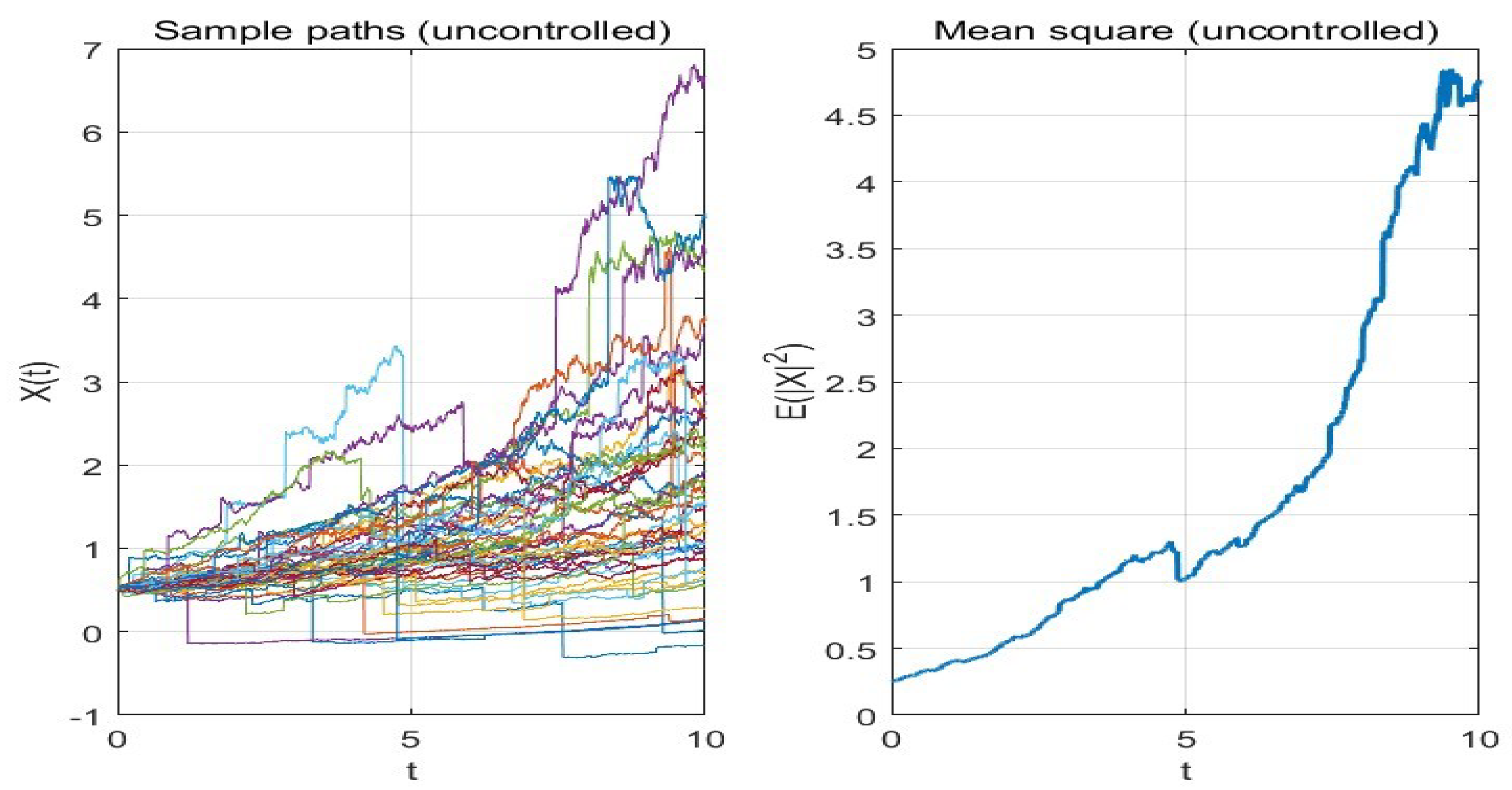
Next, the numerical simulation is proposed to illustrate the above theoretical results in Figure 2. For the uncontrolled systems (60), we depict N = 50 sample paths with time step τ = 0.01 over the time interval t [ 0 , 10 ] . The left picture of Figure 2 shows the state trajectories of X ( t ) , while the right picture of Figure 2 depicts the mean square E | X ( t ) | 2 of the state trajectories X ( t ) . It can be clearly seen that the sample paths X ( t ) and the mean square E | X ( t ) | 2 grow exponentially over time, which confirms the theoretical conclusion of mean square-exponential instability.
Subsequently, we will provide theoretical proof and simulation verification of the stability of AIC systems. Define the continuous-time feedback control function by
u ˜ ( X ( t ) , L 1 ( X ( t ) ) , 1 , t ) = 0.3 X ( t ) 0.09 R z μ t ( d z ) , u ˜ ( X ( t ) , L 1 ( X ( t ) ) , 2 , t ) = 0.2 X ( t ) 0.06 R z μ t ( d z ) .
Consequently, the controlled LN-MVSDE can be represented as
d X ( t ) = b ( X ( t ) , L 1 ( X ( t ) ) , r ( t ) , t ) + u ( X ( σ t ) , L 1 ( X ( σ t ) ) , r ( t ) , t ) d t + ι ( X ( t ) , L 1 ( X ( t ) ) , r ( t ) , t ) d W t + 0 < | z | < c g ( X ( t ) , L 1 ( X ( t ) ) , r ( t ) , z , t ) N ˜ ( d t , d z ) ,
where
u ( X ( σ t ) , L 1 ( X ( σ t ) ) , 1 , t ) = 0.3 X ( σ t ) 0.09 R z μ σ t ( d z ) , t [ t k , s k ) , 0 , t [ s k , t k + 1 ) . u ( X ( σ t ) , L 1 ( X ( σ t ) ) , 2 , t ) = 0.2 X ( σ t ) 0.06 R z μ σ t ( d z ) , t [ t k , s k ) , 0 , t [ s k , t k + 1 ) .
It is easy to see that Assumptions 1 and 3 hold with K = 0.5 . Select the control intervals as k = 0 [ t k , s k ) = k = 0 [ 2 k , 2 k + 0.95 ) [ 2 k + 1 , 2 k + 1.95 ) . Then, it can be obtained that the average control rate is ρ = 0.95 . For any initial data ξ R and i 0 { 1 , 2 } , the controlled system (62) has a unique global solution for t R + . However, this alone is not sufficient for stability purposes. The operator L μ V ( x , μ , i , t ) acting on V ( x , μ , i , t ) yields
L μ V ( x , μ , 1 , t ) = 0.2 x 0.06 R z μ ( d z ) 20 x + 10 ( 0.1 x ) 2 + R 0.2 y 0.06 R z μ ( d z ) 20 y μ ( d y ) + 10 R ( 0.1 y ) 2 μ ( d y ) + 0 < c < 5 0 1 R 20 ( y + 0.5 η y z ) 20 y , 0.5 y z μ ( d y ) d η m ˜ ( d z ) + 0 < c < 5 10 | x + 0.5 y z | 2 10 | x | 2 10 | x | y z m ˜ ( d z ) 2.8 | x | 2 3 R | z | 2 μ ( d z ) | R z μ ( d z ) | 2 ,
L μ V ( x , μ , 2 , t ) = 0.1 x 0.03 R z μ ( d z ) 20 x + 10 ( 0.1 x ) 2 + R 0.1 y 0.03 R z μ ( d z ) 20 y μ ( d y ) + 10 R ( 0.1 y ) 2 μ ( d y ) + 0 < c < 5 0 1 R 20 ( y 0.5 η y z ) 20 y , 0.5 y z μ ( d y ) d η m ˜ ( d z ) + 0 < c < 5 10 | x 0.5 y z | 2 10 | x | 2 10 | x | y z m ˜ ( d z ) 0.9 | x | 2 R | z | 2 μ ( d z ) 0.6 | R z μ ( d z ) | 2 ,
and
λ 1 | V x ( x , μ , i , t ) | 2 = 400 λ 1 | x | 2 , λ 2 R | μ V ( x , μ , i , t ) ( y ) | 2 μ ( d y ) 400 λ 2 R | y | 2 μ ( d y ) .
Choose λ 1 = λ 2 = 0.00025 to give
R L μ V ( x , μ , i , t ) μ ( d x ) + λ 1 R | V x ( x , μ , i , t ) | 2 μ ( d x ) + λ 2 R | μ V ( x , μ , i , t ) ( y ) | 2 μ ( d y ) 0.8 R ( t ) R V ( x , μ , i , t ) μ ( d x ) + 0.1 ( 1 R ( t ) ) R V ( x , μ , i , t ) μ ( d x ) .
Obviously, Assumption 3 holds with γ 1 = 0.8 , γ 2 = 0.1 . Moreover,
10 R | x | 2 μ ( d x ) R V ( x , μ , i , t ) μ ( d x ) 45 R | x | 2 μ ( d x ) .
Hence, the conditions of Lemma 3 hold. Thus, we assert that the solution of (62) is finite for T ( 0 , ) . Furthermore, define
V ( X ^ t , L 1 ( X ^ t ) , r ^ t , t ) = 10 | X ( t ) | 2 + 10 R | z | 2 μ t ( d z ) + t τ t s t | X ( t ) | 2 d v d s ,
where we choose τ = 0.01 . We can verify that the conditions of Theorem 4 hold, and
E V ( X ^ t , L 1 ( X ^ t ) , r ^ t , t ) 2 a 2 E | X ( t ) | 2 + E [ I ( t ) ] .
We can compute that ψ 1 = 7.97 , ψ 2 = 1.02 , S 0 = 0.05 , H 1 = 0.003 , C ^ = 9 and a = 0.008 . Thus,
E | X ( t ) | 2 C ^ e a t E | X ( 0 ) | 2 .
Furthermore, we can verify that the conditions of Theorem 5 hold, thus the corresponding interacting particle system is mean square-exponentially stable.
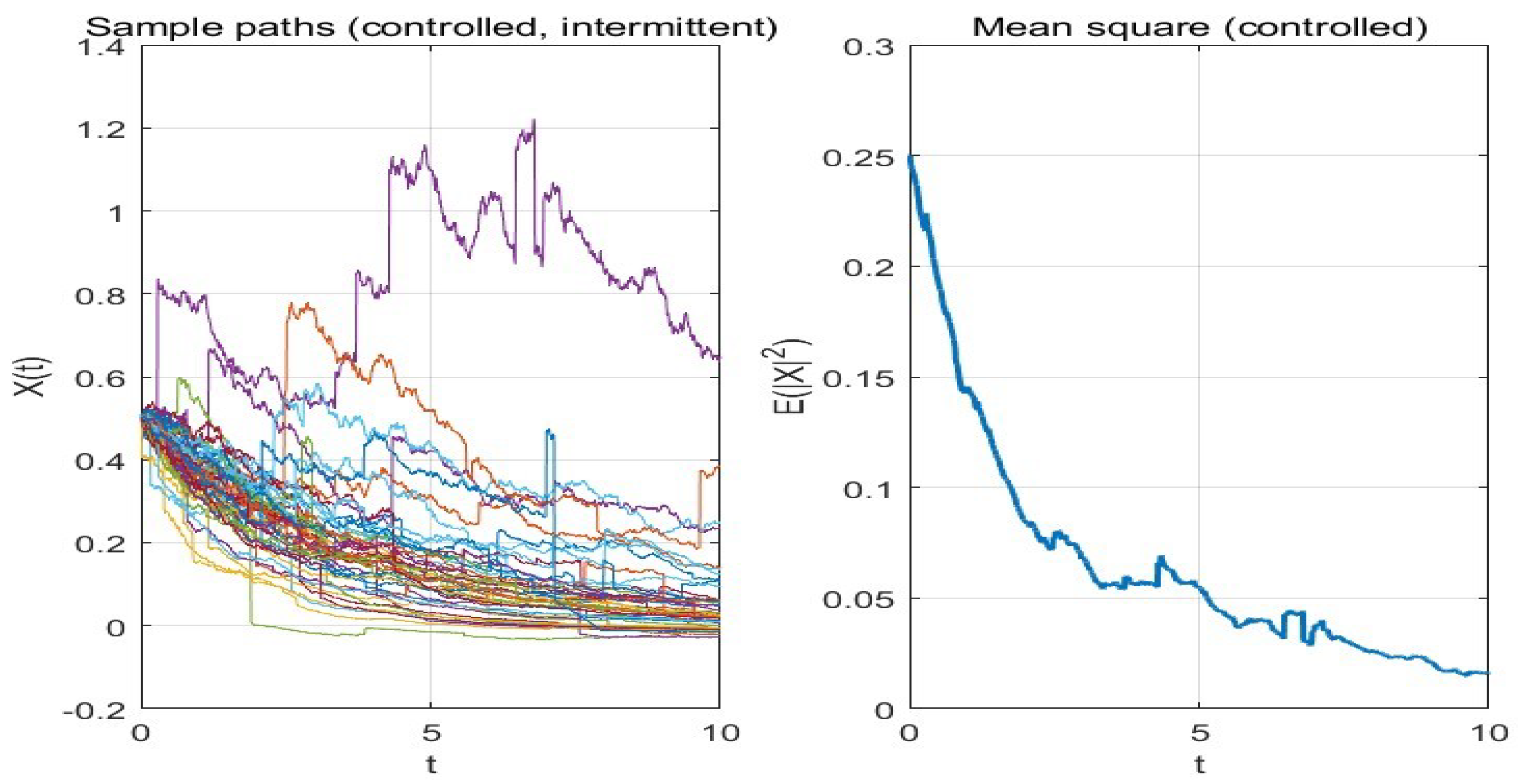
For the LN-MVSDE (62), Figure 3 presents the simulation results over t [ 0 , 10 ] with N = 50 sample paths and step size τ = 0.01 . The left picture shows the state trajectories of X ( t ) , while the right picture plots the corresponding mean square trajectory of X ( t ) . From Figure 3, it can be seen that the trajectories rapidly decay during each controlled interval, which may briefly rebound during the uncontrolled rest interval. Although there are fluctuations in the trajectories, the overall trend remains downward, confirming that the systems (62) are exponentially stable in the mean square sense.

7. Conclusions

This paper has studied a class of unstable hybrid McKean–Vlasov stochastic differential equations driven by Lévy noise (LN-HMVSDEs). We have established the well-posedness of the system and derived a generalized Itô formula. Building on this foundation, an aperiodic intermittent control (AIC) strategy based on discrete-time observations has been designed to stabilize the inherently unstable system. The mean square exponential and asymptotic stability of the controlled system have been rigorously analyzed. Furthermore, the relationship between the LN-HMVSDEs and their interacting particle systems has been explored, providing an explicit bound for the convergence error and demonstrating their stability equivalence. Finally, a numerical example has been presented to validate the theoretical results.
Future research can be further explored along the following directions. Firstly, extend the established theory to generalized mean-field stochastic systems coupled with time delays, impulses and Markov switching, so as to improve the theoretical framework and enhance model applicability. Secondly, optimize the aperiodic intermittent control strategy by incorporating practical engineering constraints to strengthen its robustness and practicability, and improve the particle system algorithm to reduce computational complexity and optimize error estimation. Thirdly, develop more universal stability criteria, promote the application of theoretical results in multi-agent coordination, financial risk control and other fields, and further enrich the theoretical system of mean-field stochastic system control.

Author Contributions

P.Z.: writing, reviewing, methodology, supervision, software, validation, formal analysis, project administration and supervision. H.Y.: conceptualization, data analysis, writing—original draft preparation. K.W.: conceptualization, methodology, reviewing, formal analysis, visualization, supervision, software, validation. All authors have read and agreed to the published version of the manuscript.

Funding

This research is supported by Heilongjiang Provincial Natural Science Foundation of China, grant number PL2025A002; the Key Project of Education Science Planning in Heilongjiang Province, grant number GJB1424223, Harbin City Science and Technology Plan Project, grant number 2022ZCZJCG019; and the Heilongjiang Province Key Research and Development Plan Project, grant number JD2023SJ21.

Institutional Review Board Statement

Not applicable.

Informed Consent Statement

Not applicable.

Data Availability Statement

The original contributions presented in this study are included in the article. Further inquiries can be directed to the corresponding author.

Conflicts of Interest

The authors declare no conflicts of interest.

References

  1. Baudoin, F. Conditioned Stochastic Differential Equations: Theory, Examples and Application to Finance. Stoch. Process. Appl. 2002, 100, 109–145. [Google Scholar] [CrossRef]
  2. Chakroun, F.; Abid, F. An Application of Stochastic Control Theory to a Bank Portfolio Choice Problem. Stat. Interface 2016, 9, 69–77. [Google Scholar] [CrossRef]
  3. Mao, X. Stabilization of Continuous-time Hybrid Stochastic Differential Equations by Discrete-Time Feedback Control. Automatica 2013, 49, 3677–3681. [Google Scholar] [CrossRef]
  4. Ren, Y.; Yin, W.; Sakthivel, R. Stabilization of Stochastic Differential Equations Driven by G-Brownian Motion with Feedback Control Based on Discrete-Time State Observation. Automatica 2018, 95, 146–151. [Google Scholar] [CrossRef]
  5. Wu, H.; Hu, J.; Gao, S.; Yuan, C. Stabilization of Stochastic McKean-Vlasov Equations with Feedback Control Based on Discrete-Time State Observation. SIAM J. Control Optim. 2022, 60, 2884–2901. [Google Scholar] [CrossRef]
  6. Yuan, H.; Zhu, Q. The Well-Posedness and Stabilities of Mean-Field Stochastic Differential Equations Driven by G-Brownian motion. SIAM J. Control Optim. 2025, 63, 596–624. [Google Scholar] [CrossRef]
  7. Cheng, L.; Chen, X.; Qiu, J.; Lu, J.; Cao, J. Aperiodically Intermittent Control for Synchronization of Switched Complex Networks with Unstable Modes Via Matrix ω-Measure Approach. Nonlinear Dyn. 2018, 92, 10911102. [Google Scholar] [CrossRef]
  8. Liu, L.; Perc, M.; Cao, J. Aperiodically Intermittent Stochastic Stabilization via Discrete Time or Delay Feedback Control. Sci. China Inf. Sci. 2019, 62, 13. [Google Scholar] [CrossRef]
  9. Zong, X.; Wu, F.; Yin, G.; Jin, Z. Almost Sure and pth Moment Stability and Stabilization of Regime-Switching Jump Diffusion Systems. SIAM J. Control Optim. 2014, 52, 2595–2622. [Google Scholar] [CrossRef]
  10. Yin, L.; Han, Y.; Song, G.; Miao, G.; Li, T. Discrete Control of Nonlinear Stochastic Systems Driven by Lévy Process. J. Frankl. Inst. 2023, 360, 9427–9445. [Google Scholar] [CrossRef]
  11. Zhu, Q. Asymptotic Stability in the pth Moment for Stochastic Differential Equations with Lévy Noise. J. Math. Anal. Appl. 2014, 416, 126142. [Google Scholar] [CrossRef]
  12. Zhu, Q. Razumikhin-type Theorem for Stochastic Functional Differential Equations with Lévy Noise and Markov Switching. Int. J. Control 2017, 90, 1703–1712. [Google Scholar] [CrossRef]
  13. Zhu, Q. Stability Analysis of Stochastic Delay Differential Equations with Lévy Noise. Syst. Control Lett. 2018, 118, 62–68. [Google Scholar] [CrossRef]
  14. Zhu, Q. Event-triggered sampling problem for exponential stability of stochastic nonlinear delay systems driven by Lévy processes. IEEE Trans. Autom. Control 2025, 70, 1176–1183. [Google Scholar] [CrossRef]
  15. Hao, T.; Li, J. Mean-field SDEs with jumps and nonlocal integral-PDEs. NODEA-Nonlinear Diff. 2016, 23, 17. [Google Scholar] [CrossRef]
  16. Di, J.; Tan, C.; Zhang, Z.; Wong, W. Stabilisation for Discrete-time Mean-field Stochastic Markov Jump Systems with Multiple Delays. IET Control Theory Appl. 2023, 17, 1471–1484. [Google Scholar] [CrossRef]
  17. Hu, L.; Ren, Y.; Zhang, Q. Periodically Intermittent Discrete Observations Control for Stabilization of Highly Nonlinear Hybrid Stochastic Differential Equations. Nonlinear Anal.-Hybri. 2023, 50, 101400. [Google Scholar] [CrossRef]
  18. Shen, G.; Xiao, R.; Yin, X.; Zhang, J. Stabilization for Hybrid Stochastic Systems by Aperiodically Intermittent Control. Nonlinear Anal.-Hybri. 2021, 39, 100990. [Google Scholar] [CrossRef]
  19. Kobayashi, H.; Mark, B.L.; Turin, W. Probability, Random Processes, and Statistical Analysis; Cambridge University Press: New York, NY, USA, 2011. [Google Scholar]
  20. Chatterjee, D.; Liberzon, D. On stability of randomly switched nonlinear systems. IEEE Trans. Autom. Control 2007, 52, 2390–2394. [Google Scholar] [CrossRef]
  21. Ambrosio, L.; Gigli, N.; Savaré, G. Gradient Flows in Metric Spaces and in the Space of Probability Measures, 2nd ed.; Lectures in Mathematics ETH Zu¨rich; MR2401600; Birkha¨ruser: Basel, Switzerland, 2008. [Google Scholar] [CrossRef]
  22. Villani, C. Optimal transport: Monge meets Riemann and Fourier. J. Egypt. Math. Soc. 2011, 19, 95–96. [Google Scholar] [CrossRef]
  23. Cardaliaguet, P. Notes on Mean Field Games (from P.L. Lions’ Lectures at College de France. 2013. Available online: https://www.ceremade.dauphine.fr/~cardaliaguet/MFG20130420.pdf (accessed on 21 January 2026).
  24. Chaman, K.; Christoph, R.; Wolfgang, S. Well-Posedness and Tamed Schemes for Mckean-Vlasov Eqautions with Common Noise. Ann. Appl. Probab. 2022, 32, 3283–3330. [Google Scholar] [CrossRef]
  25. Carmona, R.; Delarue, F. Probabilistic Theory of Mean Field Games with Applications II; Probab Theory Stoch Model; Springer: Berlin/Heidelberg, Germany, 2018; Volume 84. [Google Scholar] [CrossRef]
  26. Applebaum, D. Lévy Processes and Stochastic Calculus; Cambridge University Press: Cambridge, UK, 2009. [Google Scholar] [CrossRef]
  27. Wang, P.; Wang, R.; Su, H. Stability of Time-Varying Hybrid Stochastic Delayed Systems with Application to Aperiodically Intermittent Stabilization. IEEE Trans. Cybern. 2021, 52, 9026–9035. [Google Scholar] [CrossRef]
  28. Qiao, H.; Wu, J. Path Independence of the Additive Functionals for McKean-Vlasov Stochastic Differential Equations with Jumps. Infin. Dimens. Anal. Quantum Probab. Relat. Top. 2021, 24, 1198–1218. [Google Scholar] [CrossRef]
  29. Mao, X.; Yuan, C. Stochastic Differential Equations with Markovian Switching; Imperial College Press: London, UK, 2006. [Google Scholar] [CrossRef]
  30. Shao, J.; Wei, D. Propagation of Chaos and Conditional McKean-Vlasov SDEs with Regime-Switching. Front. Math. China 2022, 17, 731–746. [Google Scholar] [CrossRef]
  31. Chen, X.; Li, X.; Yuan, C. The Delay Feedback Control for the McKean-Vlasov Stochastic Differential Equations with Common Noise. Syst. Control Lett. 2025, 196, 105993. [Google Scholar] [CrossRef]
  32. Liu, Z.; Ma, M. Existence, Uniqueness and Exponential Ergodicity under Lyapunov Conditions for McKean-Vlasov SDEs with Markovian Switching. IEEE Trans. Syst. Man Cybern. Syst. 2022, 337, 138–167. [Google Scholar] [CrossRef]
  33. Dong, H.; Tang, J.; Mao, X. Stabilization of Highly Nonlinear Hybrid Stochastic Differential Delay Equations with Lévy Noise by Delay Feedback Control. SIAM J. Control Optim. 2022, 60, 3302–3325. [Google Scholar] [CrossRef]
  34. Fournier, N.; Guillin, A. On the rate of Convergence in Wasserstein Distnace of the Empirical Measure. Probab. Theory Rel. 2014, 162, 707–738. [Google Scholar] [CrossRef]
  35. Bao, J.; Huang, X. Approximations of McKean-Vlasov Stochastic Differential Equations with Irregular Coefficients. J. Theor. Probab. 2022, 35, 1187–1215. [Google Scholar] [CrossRef]
  36. Reis, G.D.; Engelhardt, S.; Smith, G. Simulation of McKean-Vlasov SDEs with Super-Linear growth. IMA J. Numer. Anal. 2022, 42, 874–922. [Google Scholar] [CrossRef]
Figure 1. Simple aperiodically intermittent control.
Mathematics 14 01952 g001
Figure 2. The state trajectory of the uncontrolled systems (60).
Mathematics 14 01952 g002
Figure 3. The state trajectory of the controlled systems (62).
Mathematics 14 01952 g003
Disclaimer/Publisher’s Note: The statements, opinions and data contained in all publications are solely those of the individual author(s) and contributor(s) and not of MDPI and/or the editor(s). MDPI and/or the editor(s) disclaim responsibility for any injury to people or property resulting from any ideas, methods, instructions or products referred to in the content.