1. Introduction
The numerical solution of systems of nonlinear equations is a central topic in numerical analysis, applied mathematics, and scientific computing, since a broad range of mathematical models arising in physics, engineering, biology, and other applied sciences can be formulated as root-finding problems for vector-valued functions [
1,
2]. In this context, Newton’s method remains one of the most classical and influential techniques because of its simple structure and local quadratic convergence under suitable regularity assumptions. Nevertheless, its practical use may be severely affected by the need to evaluate and factorize the Jacobian matrix at each iteration, particularly when the dimension of the problem is large or when the nonlinear operator has a complicated structure [
1,
2]. These difficulties have motivated the construction of multipoint and high-order iterative methods whose purpose is to improve the local convergence behavior while maintaining a reasonable computational cost per iteration.
The design of predictor–corrector schemes provides a natural framework for the development of such methods. In particular, methods based on weighting functions have attracted considerable interest, as they introduce functional degrees of freedom into the correction stage, allowing for the cancelation of dominant terms in the error equation and, consequently, the construction of more accurate and flexible iterative families. This philosophy is closely related to the well-known Kung–Traub conjecture, according to which, for the scalar case, a memoryless multipoint method using
n functional evaluations can achieve a maximum order of
[
3].
In the scalar case, the use of weight functions has proved to be a particularly fruitful strategy for generating high-order methods from simpler iterative schemes. Instead of prescribing a fixed correction term, one introduces a functional factor depending on suitable ratios or accelerators, thereby obtaining parametric families whose members can be tuned to satisfy desired convergence conditions. In this direction, Jaiswal proposed a class of fourth-order methods obtained by using weight functions, showing that this procedure provides a systematic mechanism for constructing efficient iterative families with improved local behavior [
4]. Since then, the weight function technique has become one of the standard tools in the design of scalar high-order methods, especially when the goal is to increase flexibility without losing computational efficiency.
The extension of this strategy to systems of nonlinear equations is significantly more delicate. In the multidimensional setting, the scalar arguments based on ordinary Taylor expansions must be replaced by operator expansions and matrix-based error analysis, and the design of suitable weighted corrections becomes more involved. Even so, important advances have shown that this methodology can be successfully transferred to nonlinear systems. For instance, Artidiello, Cordero, Torregrosa, and Vassileva developed multidimensional generalizations of iterative schemes derived from the weight function procedure, establishing high-order convergence in the vector case and confirming the effectiveness of this approach beyond one-dimensional root-finding problems [
5,
6]. Later, Sharma, introduced efficient weighted-Newton methods for solving systems of nonlinear equations, further illustrating that weighted corrections can be adapted to the vector setting while preserving favorable convergence properties [
7]. More recently, Capdevila, Cordero, and Torregrosa constructed a three-step family based on scalar and matrix weight functions, obtaining sixth-order convergence in both scalar and vector formulations [
8]. Altogether, these contributions confirm that weight functions constitute a robust and versatile design tool for iterative schemes in nonlinear systems.
Within this line of research, fifth-order methods occupy an especially attractive position, since they provide a good compromise between local accuracy and computational effort. In particular, recent contributions such as the work of Singh–Sharma have emphasized the construction of simple and efficient fifth-order solvers for nonlinear systems, underlining the continuing relevance of this order in the search for practically competitive methods [
9]. In this framework, the Singh–Sharma method represents a highly efficient reference scheme whose structure suggests that the correction stage can be generalized through appropriate weight functions. This observation is mathematically and computationally relevant: instead of working with a single fixed iterative formula, one may construct a whole family of methods that contains the original scheme as a particular case and, at the same time, preserves its essential convergence properties.
Motivated by these considerations, in this paper we introduce a weighted generalization of Singh–Sharma method for solving systems of nonlinear equations. The proposed family is constructed by incorporating suitable weight functions into the iterative process in such a way that the original Singh–Sharma scheme is recovered as a particular case for specific choices of these functions. The corresponding local convergence analysis makes it possible to determine explicit conditions on the weight functions under which the fifth-order convergence of the original method is preserved. In this way, the new family extends a highly efficient reference scheme without modifying its essential convergence structure, while enlarging the class of admissible iterative formulations and providing additional flexibility for the design of new solvers.
From the viewpoint of applications, nonlinear systems arising from the discretization of differential equations constitute a natural and demanding benchmark for high-order iterative methods. Among them, Burgers-type equations play a prominent role in applied mathematics, since they arise as prototype nonlinear models in fluid mechanics and related transport phenomena, and their stationary forms lead, after spatial discretization, to nonlinear algebraic systems that are well suited for testing iterative solvers [
10,
11]. In particular, the stationary viscous Burgers equation provides a representative nonlinear boundary-value problem in which convection and diffusion interact in a nontrivial way, giving rise to algebraic systems whose efficient numerical resolution is of clear interest [
10]. For this reason, in order to illustrate the practical applicability of the proposed family, we consider a nonlinear system obtained from the discretization of a stationary Burgers equation.
The main contributions of this paper can be summarized as follows. First, we construct a new weighted family of fifth-order iterative methods for systems of nonlinear equations, obtained as a generalization of a highly efficient Singh–Sharma type scheme. Second, we derive sufficient conditions on the weight functions that guarantee the preservation of fifth-order local convergence. Third, we provide several admissible choices of weight functions, which generate different particular members of the family and illustrate its flexibility from both the theoretical and computational points of view. Fourth, we carry out a comparative numerical study on several large-scale nonlinear systems in order to assess the practical behavior of the proposed schemes. Finally, we illustrate the applicability of the family to a nonlinear system of differential origin obtained from the discretization of a stationary Burgers equation. Therefore, the paper combines the theoretical construction of a weighted iterative family with a representative application that highlights its usefulness in nonlinear numerical models.
The remainder of the paper is organized as follows. In
Section 2, we present the preliminary concepts and auxiliary results used throughout the manuscript.
Section 3 introduces the proposed weighted family of iterative methods and establishes its local order of convergence. This section also includes complementary theoretical results, such as propositions, remarks, and particular cases derived from the general formulation. In
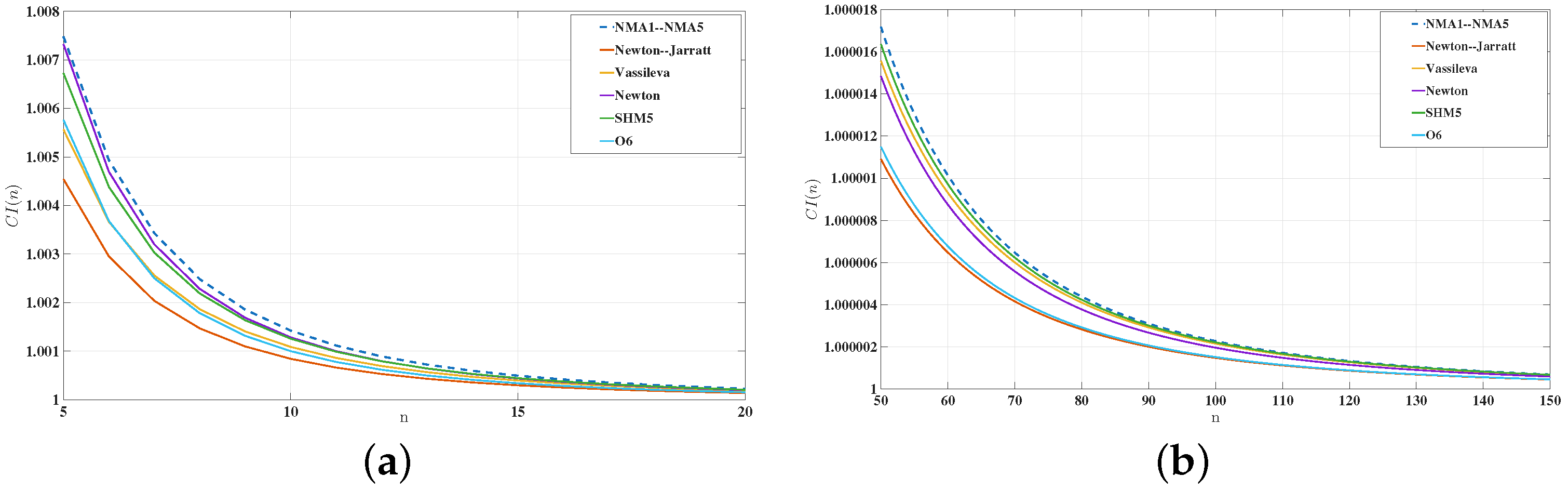
Section 4, we present the different weight functions selected for the numerical tests, together with the comparison methods considered in the study. This section also includes the analysis of the computational efficiency index and the numerical experiments carried out on several large-scale nonlinear systems in order to evaluate the practical performance of the proposed schemes. In
Section 5, we address the discretization and numerical solution of a particular stationary Burgers equation, which leads to a second-order nonlinear ordinary differential equation. Finally,
Section 6 summarizes the main conclusions of the work.
2. Preliminary Concepts
Throughout this work, we assume that the nonlinear system possesses a solution
, such that
and that all derivatives required for the subsequent analysis exist and remain continuous in a neighborhood of
.
To formalize this assumption, we begin by recalling the notion of a simple root, which will be used throughout the local convergence analysis.
Definition 1. A point is called a simple root of the nonlinear system if To establish the notation used in the local study, we now recall the multilinear structure of the higher-order derivatives of
F. For
, the
m-th derivative of the map
F at a point
x is the
m-linear operator
For brevity, we employ the compact notation
Moreover, whenever one argument of
is the vector
, we write
In order to derive the local error equation of the proposed family, we recall the Taylor expansion of
F around the solution
. Let
, with
sufficiently small. Assuming that
is not singular, a Taylor expansion around
yields
where
A similar expansion for the Jacobian operator of
F at
around
reads
Moreover, the inverse matrix
admits the expansion
Next, we introduce the local error notation associated with an iterative sequence.
Definition 2. Given a sequence of approximations to ξ, we define the local error at iteration k by This notation allows us to express the local behavior of the method through its error equation.
Definition 3. We say that the sequence converges locally to ξ with order ifwhere denotes a suitable p-linear operator characterizing the leading term of the local behavior. For the numerical experiments, we also use the following computational approximation of the convergence order (ACOC) and the computational order of convergence (COC).
Definition 4 ([
12])
. The approximated computational order of convergence (ACOC) is given by Definition 5 ([
13])
. Let be a sequence generated by an iterative method converging to a simple root ξ of . When the exact solution ξ is known, the computational order of convergence (COC) is estimated by Since the proposed family is built by means of weighted corrections, it is convenient to make explicit the notion of weight function used in this work.
Definition 6 (weight function). A weight function is an auxiliary scalar-, vector-, or matrix-valued function introduced into an iterative scheme in order to modify the correction step and control the cancelation of dominant terms in the local error equation, thus improving the convergence order without significantly increasing the computational cost.
Novelty and Scope of the Proposed Contribution
The proposed family should not be interpreted merely as a formal parametrization of the Singh–Sharma fifth-order method. Its main contribution lies in the construction of a cost-preserving weighted class whose members retain fifth-order local convergence while modifying the leading error operator. More precisely, the local error equation derived in this work contains the term
which shows that the second derivative of the weight function
G directly affects the principal error contribution. Therefore, suitable choices of the weight functions can modify the dominant local error operator without increasing the number of nonlinear function evaluations, Jacobian evaluations, or linear solves per iteration.
In this sense, the proposed family extends the Singh–Sharma method in a systematic way. The original scheme is recovered as a particular case, whereas the additional admissible weights provide a mechanism for tuning the correction step and generating alternative fifth-order methods with the same basic evaluation structure.
The purpose of the present work is not to replace general-purpose large-scale nonlinear solvers, such as Newton–Krylov methods, nor data-driven PDE solvers. Rather, the proposed methods are deterministic high-order local solvers for smooth nonlinear systems in which the Jacobian matrix is available, accurately computable, or has an exploitable sparse or structured form. This makes the family particularly relevant in high-accuracy local computations and in nonlinear algebraic systems arising from controlled discretizations of differential models.
5. Application to a Stationary Viscous Burgers Problem
In order to illustrate the applicability of the proposed iterative family to nonlinear differential models, we consider a stationary one-dimensional viscous Burgers problem. This equation is a classical nonlinear model describing the interaction between convection and diffusion, and it is frequently used as a prototype in fluid mechanics, transport phenomena, and nonlinear wave propagation [
20].
We study the boundary value problem
subject to the homogeneous Dirichlet boundary conditions
where
denotes the viscosity parameter.
In order to validate the numerical solution, we use the method of manufactured solutions [
21,
22]. More precisely, we prescribe the exact solution
which satisfies the boundary conditions (
15). Its derivatives are
Substituting (
16) into (
14), the forcing term is obtained as
Therefore, the model problem under consideration is
with
The choice of this model is convenient for two reasons. First, it preserves the nonlinear convection–diffusion structure characteristic of Burgers-type equations [
20]. Second, the exact solution is explicitly known, which allows us to verify the quality of the discrete approximation and to assess the performance of the iterative methods on the nonlinear algebraic system arising from the discretization.
Let
N be the number of interior nodes and define the uniform mesh
with mesh size
At the interior nodes
,
, we denote by
the numerical approximation of the exact solution.
To discretize the derivatives, we employ the standard centered finite-difference formulas [
23]. For the second derivative, we use
while for the first derivative we take
Substituting (
19) and (
20) into (
18), we obtain, for each interior node
,
Using the boundary conditions,
the discrete problem becomes a nonlinear system of
N equations with
N unknowns.
Let
. The nonlinear system can be written in compact form as
where
, with components given by
together with the conventions
More explicitly, the first and last equations read
while for
,
This system is nonlinear because of the convective term
Consequently, an iterative method is required in order to compute the discrete solution.
Since the methods considered in this work require the Jacobian matrix, we now derive its explicit form. Differentiating (
22) with respect to the neighboring unknowns, we obtain
All other partial derivatives are zero. Therefore, the Jacobian matrix
is tridiagonal and can be written as
Hence, the discrete problem (
21) leads to a sparse nonlinear algebraic system whose Jacobian has a structured tridiagonal form. This makes it especially suitable for assessing the practical performance of the iterative methods studied in this work.
To solve the nonlinear system (
21), one may choose as initial approximation, for instance,
or, if desired, the exact solution sampled at the grid points plus a small perturbation. Once the mesh size
h, the viscosity parameter
, and the forcing term
are fixed, the iterative schemes are applied directly to the nonlinear system (
21).
For each computed approximation
, the quality of the numerical solution may be assessed through the residual norm
and, since the exact solution is known, also through the discrete error
This allows us to compare not only the convergence speed of the iterative methods, but also the accuracy of the final discrete approximation.
The previous construction provides a complete test framework: a nonlinear differential model of physical interest, a manufactured exact solution, a finite-difference discretization, and an explicit nonlinear algebraic system. Therefore, the stationary Burgers problem constitutes a suitable benchmark for validating the theoretical and practical performance of the proposed high-order iterative family [
20].
For the numerical solution of the nonlinear algebraic system arising from the finite-difference discretization of the stationary Burgers problem, we considered
interior nodes, viscosity parameter
, and mesh size
. The stopping criterion was fixed as
with a maximum of 50 iterations.
Table 12 reports, for each method, the total number of iterations, the increment norm
, the residual norm
, the execution time in seconds, the approximated computational order of convergence (ACOC), and, when the exact solution is used, the computational order of convergence (COC), together with the infinity norm of the error.
5.1. On the Observed ACOC and COC in the Burgers Experiment
Although the proposed family has theoretical local order five, the computational orders obtained for the Burgers problem are close to four for the NMA variants. This does not contradict the convergence theorem, since the theoretical result is asymptotic, whereas the numerical test involves a finite-difference discretization, a finite mesh, and a nonlinear system whose Jacobian depends on the mesh size h and the viscosity parameter .
In
Table 12, the NMA methods converge in only four iterations. Thus, only a few consecutive error ratios are available to estimate the order. Moreover, the stringent stopping criterion
may stop the process before a sufficiently long fifth-order asymptotic regime is numerically visible. Mesh effects, conditioning of the discrete Jacobian, and numerical saturation at very small residual levels can also influence the observed order.
Since the Burgers problem has a manufactured exact solution, we also computed the classical computational order of convergence (COC), based on the true errors. The ACOC and COC values reported in
Table 12 are very similar for NMA1–NMA5, which indicates that the observed reduction is not merely an artifact of the ACOC estimator. Rather, it reflects the numerical behavior of this particular discretized problem under the selected mesh, viscosity, initial approximation, and stopping criterion. Therefore, these computational orders should be interpreted as numerical indicators and do not invalidate the fifth-order local convergence established theoretically.
5.2. Graphical Analysis for the Stationary Burgers Problem
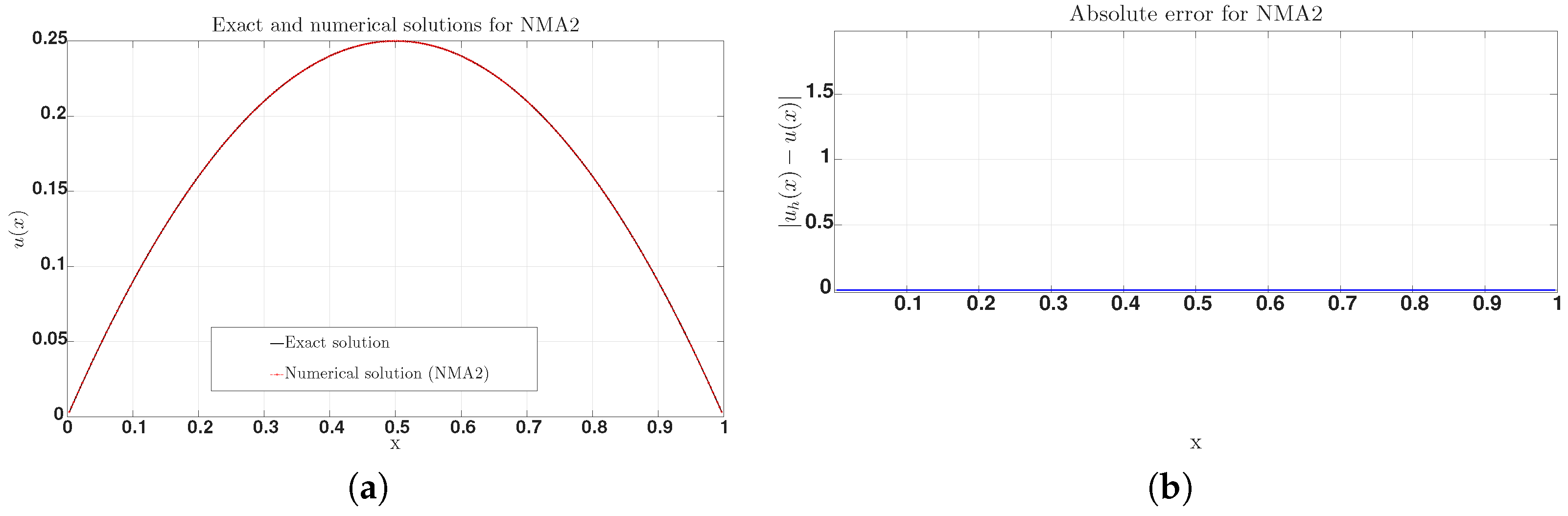
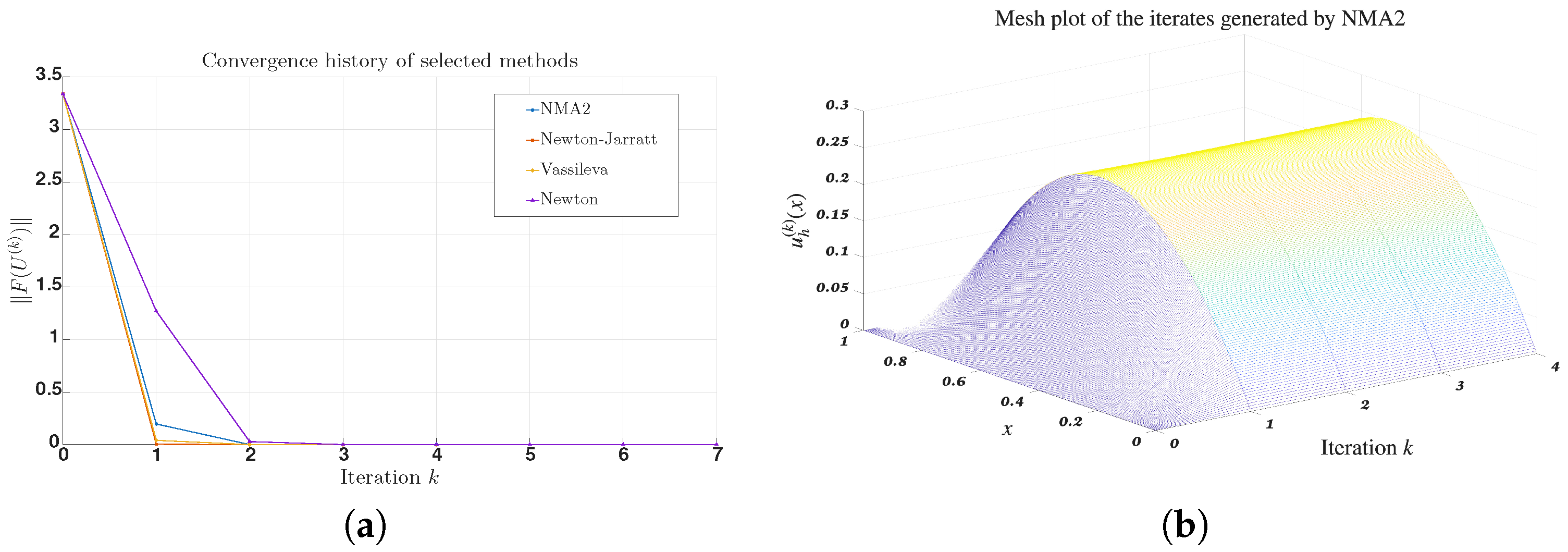
To complement the numerical results reported above, this subsection presents a graphical analysis of the performance of NMA2 when applied to the stationary Burgers problem. The visual comparison includes the agreement between the exact and numerical solutions, the distribution of the absolute error, the convergence history of the selected methods, and the evolution of the iterates generated during the nonlinear resolution process.
Figure 2a,b show that the numerical solution obtained with NMA2 is practically indistinguishable from the exact solution and that the absolute error remains negligible over the computational mesh.
Figure 3a confirms the fast decrease in the residual norm for NMA2 compared with the reference methods, while
Figure 3b illustrates the stable evolution of the iterates toward the final discrete solution. Overall, these plots provide graphical evidence of the accuracy, stability, and fast convergence of NMA2 for this nonlinear differential problem.
Robustness with Respect to the Initial Approximation
Since the convergence result established in
Section 3 is local, we added robustness tests with different initial approximations. The purpose of these experiments is not to prove global convergence, but to provide numerical evidence about the stability of the proposed weighted family when the starting point is perturbed.
For the algebraic systems, we considered initial approximations of the form
where
v is a fixed normalized perturbation vector and
controls the distance from the root. For the Burgers problem, we considered the zero vector, constant initial profiles, and perturbations of the manufactured solution.
All tests were performed using the same stopping criterion and maximum number of iterations as in the previous experiments.
The robustness results in
Table 13 show that the proposed schemes preserve convergence under moderate perturbations of the initial approximation. For Example 1, both NMA1 and NMA2 converge for all tested values of
, requiring only three or four iterations and reaching very small final residuals.
For the stationary Burgers equation, NMA2 also converges from the three initial profiles considered. In this case, the ACOC values , , and remain close to four, confirming a stable high-order behavior even in the discretized nonlinear PDE setting. These results support the numerical robustness of the proposed family, although the theoretical convergence result remains local.
5.3. Limitations and Practical Applicability
The convergence analysis developed in this work is local. Therefore, the initial approximation must be sufficiently close to a simple root of the nonlinear system. The present paper does not establish semilocal or global convergence. A semilocal theory would require additional assumptions, such as explicit bounds on , Lipschitz-type conditions on , and a majorizing sequence argument. These topics are beyond the scope of the present contribution.
The proposed methods also require the solution of two linear systems per iteration involving Jacobian matrices evaluated at and . Consequently, the methods are most appropriate when the Jacobian matrix is available analytically, can be computed accurately, or has an exploitable sparse or structured form. In the Burgers discretization considered here, the Jacobian matrix is tridiagonal, which makes the problem more favorable than a fully dense nonlinear system.
The assumption that is nonsingular implies, by continuity of , that remains nonsingular in a sufficiently small neighborhood of . The local convergence analysis is restricted to iterates lying in such a neighborhood. If the Jacobian becomes nearly singular, the constants appearing in the local error equation may become large, the linear solves may be ill-conditioned, and the expected high-order behavior may deteriorate.
In near-singular or poorly conditioned cases, damping strategies, trust-region safeguards, pivoting techniques, regularization, or preconditioned Jacobian-free variants may be required. Thus, the proposed family should be viewed as a high-order deterministic local solver for smooth nonlinear systems, rather than as a globally convergent black-box method for arbitrary nonsmooth, ill-conditioned, or very large-scale problems.
6. Conclusions
We introduced a weighted family of fifth-order iterative methods for solving smooth systems of nonlinear equations. The proposed schemes include Singh–Sharma fifth-order method as a particular case and preserve the same local convergence order under suitable conditions on the weight functions. The leading error equation shows that the weight function G can modify the principal error operator, providing additional flexibility without changing the basic evaluation structure.
The numerical experiments show that the proposed variants are competitive with several fifth-order reference methods in terms of residual decay, number of iterations, execution time, ACOC, and computational efficiency index. The application to the stationary viscous Burgers problem illustrates the behavior of the family on a nonlinear algebraic system arising from a finite-difference discretization with structured Jacobian.
The method is local and requires nonsingular Jacobians in a neighborhood of the solution. Therefore, its most natural use is in smooth problems where the Jacobian is available or structured. Future work will address semilocal convergence, globalization strategies, Jacobian-free variants, and applications to more demanding nonlinear PDE discretizations.




 ,
,